EP0180839B1 - Procédé de préparation de chlorures d'acides carboxyliques polybasiques ainsi que les produits intermédiaires appropriés - Google Patents
Procédé de préparation de chlorures d'acides carboxyliques polybasiques ainsi que les produits intermédiaires appropriés Download PDFInfo
- Publication number
- EP0180839B1 EP0180839B1 EP85113313A EP85113313A EP0180839B1 EP 0180839 B1 EP0180839 B1 EP 0180839B1 EP 85113313 A EP85113313 A EP 85113313A EP 85113313 A EP85113313 A EP 85113313A EP 0180839 B1 EP0180839 B1 EP 0180839B1
- Authority
- EP
- European Patent Office
- Prior art keywords
- carboxylic acids
- acid
- polybasic carboxylic
- anhydrides
- reaction
- Prior art date
- Legal status (The legal status is an assumption and is not a legal conclusion. Google has not performed a legal analysis and makes no representation as to the accuracy of the status listed.)
- Expired
Links
- -1 carboxylic-acid chlorides Chemical class 0.000 title claims description 12
- 238000004519 manufacturing process Methods 0.000 title description 13
- 239000000543 intermediate Substances 0.000 title description 7
- 150000008064 anhydrides Chemical class 0.000 claims description 58
- 238000000034 method Methods 0.000 claims description 52
- 150000001735 carboxylic acids Chemical class 0.000 claims description 51
- 238000006243 chemical reaction Methods 0.000 claims description 45
- 239000002904 solvent Substances 0.000 claims description 39
- YGYAWVDWMABLBF-UHFFFAOYSA-N Phosgene Chemical compound ClC(Cl)=O YGYAWVDWMABLBF-UHFFFAOYSA-N 0.000 claims description 32
- KKEYFWRCBNTPAC-UHFFFAOYSA-N Terephthalic acid Chemical compound OC(=O)C1=CC=C(C(O)=O)C=C1 KKEYFWRCBNTPAC-UHFFFAOYSA-N 0.000 claims description 32
- 239000002253 acid Substances 0.000 claims description 25
- 239000003054 catalyst Substances 0.000 claims description 21
- 125000003178 carboxy group Chemical group [H]OC(*)=O 0.000 claims description 20
- 238000009835 boiling Methods 0.000 claims description 19
- 150000001805 chlorine compounds Chemical class 0.000 claims description 19
- QQVIHTHCMHWDBS-UHFFFAOYSA-N isophthalic acid Chemical compound OC(=O)C1=CC=CC(C(O)=O)=C1 QQVIHTHCMHWDBS-UHFFFAOYSA-N 0.000 claims description 17
- 239000000725 suspension Substances 0.000 claims description 17
- 238000002360 preparation method Methods 0.000 claims description 15
- 239000000203 mixture Substances 0.000 claims description 14
- 239000011541 reaction mixture Substances 0.000 claims description 10
- 150000001732 carboxylic acid derivatives Chemical class 0.000 claims description 9
- 125000004432 carbon atom Chemical group C* 0.000 claims description 7
- 229910052760 oxygen Inorganic materials 0.000 claims description 7
- NINIDFKCEFEMDL-UHFFFAOYSA-N Sulfur Chemical compound [S] NINIDFKCEFEMDL-UHFFFAOYSA-N 0.000 claims description 6
- 125000000753 cycloalkyl group Chemical group 0.000 claims description 6
- 239000001301 oxygen Substances 0.000 claims description 6
- 239000000470 constituent Substances 0.000 claims description 5
- 150000001991 dicarboxylic acids Chemical class 0.000 claims description 5
- 229930195733 hydrocarbon Natural products 0.000 claims description 5
- 150000002430 hydrocarbons Chemical class 0.000 claims description 5
- PXGZQGDTEZPERC-UHFFFAOYSA-N 1,4-cyclohexanedicarboxylic acid Chemical compound OC(=O)C1CCC(C(O)=O)CC1 PXGZQGDTEZPERC-UHFFFAOYSA-N 0.000 claims description 4
- WNLRTRBMVRJNCN-UHFFFAOYSA-N adipic acid Chemical compound OC(=O)CCCCC(O)=O WNLRTRBMVRJNCN-UHFFFAOYSA-N 0.000 claims description 4
- 125000003118 aryl group Chemical group 0.000 claims description 4
- QVGXLLKOCUKJST-UHFFFAOYSA-N atomic oxygen Chemical compound [O] QVGXLLKOCUKJST-UHFFFAOYSA-N 0.000 claims description 4
- 150000003857 carboxamides Chemical class 0.000 claims description 4
- 125000001309 chloro group Chemical group Cl* 0.000 claims description 4
- CXMXRPHRNRROMY-UHFFFAOYSA-N sebacic acid Chemical compound OC(=O)CCCCCCCCC(O)=O CXMXRPHRNRROMY-UHFFFAOYSA-N 0.000 claims description 4
- ZAMOUSCENKQFHK-UHFFFAOYSA-N Chlorine atom Chemical compound [Cl] ZAMOUSCENKQFHK-UHFFFAOYSA-N 0.000 claims description 3
- 150000002170 ethers Chemical class 0.000 claims description 3
- 125000000951 phenoxy group Chemical group [H]C1=C([H])C([H])=C(O*)C([H])=C1[H] 0.000 claims description 3
- 125000001997 phenyl group Chemical group [H]C1=C([H])C([H])=C(*)C([H])=C1[H] 0.000 claims description 3
- 229920000642 polymer Polymers 0.000 claims description 3
- 239000001361 adipic acid Substances 0.000 claims description 2
- 235000011037 adipic acid Nutrition 0.000 claims description 2
- 125000001931 aliphatic group Chemical group 0.000 claims description 2
- 125000003545 alkoxy group Chemical group 0.000 claims description 2
- 150000001412 amines Chemical class 0.000 claims description 2
- 239000000460 chlorine Substances 0.000 claims description 2
- 229910052801 chlorine Inorganic materials 0.000 claims description 2
- CHTHALBTIRVDBM-UHFFFAOYSA-N furan-2,5-dicarboxylic acid Chemical compound OC(=O)C1=CC=C(C(O)=O)O1 CHTHALBTIRVDBM-UHFFFAOYSA-N 0.000 claims description 2
- 125000000623 heterocyclic group Chemical group 0.000 claims description 2
- 125000000449 nitro group Chemical group [O-][N+](*)=O 0.000 claims description 2
- MPQXHAGKBWFSNV-UHFFFAOYSA-N oxidophosphanium Chemical class [PH3]=O MPQXHAGKBWFSNV-UHFFFAOYSA-N 0.000 claims description 2
- 150000003003 phosphines Chemical class 0.000 claims description 2
- 239000005864 Sulphur Substances 0.000 claims 2
- ARCGXLSVLAOJQL-UHFFFAOYSA-N trimellitic acid Chemical compound OC(=O)C1=CC=C(C(O)=O)C(C(O)=O)=C1 ARCGXLSVLAOJQL-UHFFFAOYSA-N 0.000 claims 2
- WFDIJRYMOXRFFG-UHFFFAOYSA-N Acetic anhydride Chemical compound CC(=O)OC(C)=O WFDIJRYMOXRFFG-UHFFFAOYSA-N 0.000 description 44
- RFFLAFLAYFXFSW-UHFFFAOYSA-N 1,2-dichlorobenzene Chemical compound ClC1=CC=CC=C1Cl RFFLAFLAYFXFSW-UHFFFAOYSA-N 0.000 description 14
- 238000004821 distillation Methods 0.000 description 12
- 239000000047 product Substances 0.000 description 11
- 150000002762 monocarboxylic acid derivatives Chemical class 0.000 description 10
- LXEJRKJRKIFVNY-UHFFFAOYSA-N terephthaloyl chloride Chemical compound ClC(=O)C1=CC=C(C(Cl)=O)C=C1 LXEJRKJRKIFVNY-UHFFFAOYSA-N 0.000 description 10
- JUJWROOIHBZHMG-UHFFFAOYSA-N Pyridine Chemical compound C1=CC=NC=C1 JUJWROOIHBZHMG-UHFFFAOYSA-N 0.000 description 8
- CURLTUGMZLYLDI-UHFFFAOYSA-N Carbon dioxide Chemical compound O=C=O CURLTUGMZLYLDI-UHFFFAOYSA-N 0.000 description 6
- CXWXQJXEFPUFDZ-UHFFFAOYSA-N tetralin Chemical compound C1=CC=C2CCCCC2=C1 CXWXQJXEFPUFDZ-UHFFFAOYSA-N 0.000 description 6
- WEHZNZTWKUYVIY-UHFFFAOYSA-N 3-oxabicyclo[3.2.2]nona-1(7),5,8-triene-2,4-dione Chemical compound O=C1OC(=O)C2=CC=C1C=C2 WEHZNZTWKUYVIY-UHFFFAOYSA-N 0.000 description 5
- 150000001875 compounds Chemical class 0.000 description 5
- 229910052757 nitrogen Inorganic materials 0.000 description 5
- 239000000243 solution Substances 0.000 description 5
- NGNBDVOYPDDBFK-UHFFFAOYSA-N 2-[2,4-di(pentan-2-yl)phenoxy]acetyl chloride Chemical compound CCCC(C)C1=CC=C(OCC(Cl)=O)C(C(C)CCC)=C1 NGNBDVOYPDDBFK-UHFFFAOYSA-N 0.000 description 4
- QTBSBXVTEAMEQO-UHFFFAOYSA-N Acetic acid Chemical compound CC(O)=O QTBSBXVTEAMEQO-UHFFFAOYSA-N 0.000 description 4
- IJGRMHOSHXDMSA-UHFFFAOYSA-N Atomic nitrogen Chemical compound N#N IJGRMHOSHXDMSA-UHFFFAOYSA-N 0.000 description 4
- 150000008065 acid anhydrides Chemical class 0.000 description 4
- NNBZCPXTIHJBJL-UHFFFAOYSA-N decalin Chemical compound C1CCCC2CCCCC21 NNBZCPXTIHJBJL-UHFFFAOYSA-N 0.000 description 4
- 239000007789 gas Substances 0.000 description 4
- VLKZOEOYAKHREP-UHFFFAOYSA-N n-Hexane Chemical compound CCCCCC VLKZOEOYAKHREP-UHFFFAOYSA-N 0.000 description 4
- UMJSCPRVCHMLSP-UHFFFAOYSA-N pyridine Natural products COC1=CC=CN=C1 UMJSCPRVCHMLSP-UHFFFAOYSA-N 0.000 description 4
- 238000000926 separation method Methods 0.000 description 4
- 239000007787 solid Substances 0.000 description 4
- RIOQSEWOXXDEQQ-UHFFFAOYSA-N triphenylphosphine Chemical compound C1=CC=CC=C1P(C=1C=CC=CC=1)C1=CC=CC=C1 RIOQSEWOXXDEQQ-UHFFFAOYSA-N 0.000 description 4
- YMWUJEATGCHHMB-UHFFFAOYSA-N Dichloromethane Chemical compound ClCCl YMWUJEATGCHHMB-UHFFFAOYSA-N 0.000 description 3
- VEXZGXHMUGYJMC-UHFFFAOYSA-N Hydrochloric acid Chemical compound Cl VEXZGXHMUGYJMC-UHFFFAOYSA-N 0.000 description 3
- OFOBLEOULBTSOW-UHFFFAOYSA-N Malonic acid Chemical compound OC(=O)CC(O)=O OFOBLEOULBTSOW-UHFFFAOYSA-N 0.000 description 3
- ZMXDDKWLCZADIW-UHFFFAOYSA-N N,N-Dimethylformamide Chemical compound CN(C)C=O ZMXDDKWLCZADIW-UHFFFAOYSA-N 0.000 description 3
- 125000000217 alkyl group Chemical group 0.000 description 3
- IISBACLAFKSPIT-UHFFFAOYSA-N bisphenol A Chemical compound C=1C=C(O)C=CC=1C(C)(C)C1=CC=C(O)C=C1 IISBACLAFKSPIT-UHFFFAOYSA-N 0.000 description 3
- 239000006227 byproduct Substances 0.000 description 3
- 239000001569 carbon dioxide Substances 0.000 description 3
- 229910002092 carbon dioxide Inorganic materials 0.000 description 3
- 238000009833 condensation Methods 0.000 description 3
- 230000005494 condensation Effects 0.000 description 3
- 238000003756 stirring Methods 0.000 description 3
- 229910052717 sulfur Inorganic materials 0.000 description 3
- 150000003512 tertiary amines Chemical class 0.000 description 3
- OCJBOOLMMGQPQU-UHFFFAOYSA-N 1,4-dichlorobenzene Chemical compound ClC1=CC=C(Cl)C=C1 OCJBOOLMMGQPQU-UHFFFAOYSA-N 0.000 description 2
- RTZKZFJDLAIYFH-UHFFFAOYSA-N Diethyl ether Chemical compound CCOCC RTZKZFJDLAIYFH-UHFFFAOYSA-N 0.000 description 2
- MYMOFIZGZYHOMD-UHFFFAOYSA-N Dioxygen Chemical compound O=O MYMOFIZGZYHOMD-UHFFFAOYSA-N 0.000 description 2
- XYFCBTPGUUZFHI-UHFFFAOYSA-N Phosphine Chemical compound P XYFCBTPGUUZFHI-UHFFFAOYSA-N 0.000 description 2
- SMWDFEZZVXVKRB-UHFFFAOYSA-N Quinoline Chemical compound N1=CC=CC2=CC=CC=C21 SMWDFEZZVXVKRB-UHFFFAOYSA-N 0.000 description 2
- 230000002411 adverse Effects 0.000 description 2
- RDOXTESZEPMUJZ-UHFFFAOYSA-N anisole Chemical compound COC1=CC=CC=C1 RDOXTESZEPMUJZ-UHFFFAOYSA-N 0.000 description 2
- QMKYBPDZANOJGF-UHFFFAOYSA-N benzene-1,3,5-tricarboxylic acid Chemical compound OC(=O)C1=CC(C(O)=O)=CC(C(O)=O)=C1 QMKYBPDZANOJGF-UHFFFAOYSA-N 0.000 description 2
- FDQSRULYDNDXQB-UHFFFAOYSA-N benzene-1,3-dicarbonyl chloride Chemical compound ClC(=O)C1=CC=CC(C(Cl)=O)=C1 FDQSRULYDNDXQB-UHFFFAOYSA-N 0.000 description 2
- 230000015572 biosynthetic process Effects 0.000 description 2
- 150000008280 chlorinated hydrocarbons Chemical class 0.000 description 2
- MVPPADPHJFYWMZ-UHFFFAOYSA-N chlorobenzene Chemical compound ClC1=CC=CC=C1 MVPPADPHJFYWMZ-UHFFFAOYSA-N 0.000 description 2
- 239000012043 crude product Substances 0.000 description 2
- DIOQZVSQGTUSAI-UHFFFAOYSA-N decane Chemical compound CCCCCCCCCC DIOQZVSQGTUSAI-UHFFFAOYSA-N 0.000 description 2
- USIUVYZYUHIAEV-UHFFFAOYSA-N diphenyl ether Chemical compound C=1C=CC=CC=1OC1=CC=CC=C1 USIUVYZYUHIAEV-UHFFFAOYSA-N 0.000 description 2
- 239000011521 glass Substances 0.000 description 2
- 238000010438 heat treatment Methods 0.000 description 2
- 239000012535 impurity Substances 0.000 description 2
- 239000011261 inert gas Substances 0.000 description 2
- AWJUIBRHMBBTKR-UHFFFAOYSA-N isoquinoline Chemical compound C1=NC=CC2=CC=CC=C21 AWJUIBRHMBBTKR-UHFFFAOYSA-N 0.000 description 2
- 239000007788 liquid Substances 0.000 description 2
- 150000002763 monocarboxylic acids Chemical class 0.000 description 2
- 150000002829 nitrogen Chemical class 0.000 description 2
- 229910052698 phosphorus Inorganic materials 0.000 description 2
- XNGIFLGASWRNHJ-UHFFFAOYSA-N phthalic acid Chemical compound OC(=O)C1=CC=CC=C1C(O)=O XNGIFLGASWRNHJ-UHFFFAOYSA-N 0.000 description 2
- 229920003023 plastic Polymers 0.000 description 2
- 239000004033 plastic Substances 0.000 description 2
- 229920000728 polyester Polymers 0.000 description 2
- 239000000376 reactant Substances 0.000 description 2
- 238000010992 reflux Methods 0.000 description 2
- 239000011593 sulfur Chemical group 0.000 description 2
- PXXNTAGJWPJAGM-UHFFFAOYSA-N vertaline Natural products C1C2C=3C=C(OC)C(OC)=CC=3OC(C=C3)=CC=C3CCC(=O)OC1CC1N2CCCC1 PXXNTAGJWPJAGM-UHFFFAOYSA-N 0.000 description 2
- 238000005406 washing Methods 0.000 description 2
- XLYOFNOQVPJJNP-UHFFFAOYSA-N water Substances O XLYOFNOQVPJJNP-UHFFFAOYSA-N 0.000 description 2
- 125000003161 (C1-C6) alkylene group Chemical group 0.000 description 1
- RELMFMZEBKVZJC-UHFFFAOYSA-N 1,2,3-trichlorobenzene Chemical class ClC1=CC=CC(Cl)=C1Cl RELMFMZEBKVZJC-UHFFFAOYSA-N 0.000 description 1
- ZPQOPVIELGIULI-UHFFFAOYSA-N 1,3-dichlorobenzene Chemical compound ClC1=CC=CC(Cl)=C1 ZPQOPVIELGIULI-UHFFFAOYSA-N 0.000 description 1
- RRQYJINTUHWNHW-UHFFFAOYSA-N 1-ethoxy-2-(2-ethoxyethoxy)ethane Chemical compound CCOCCOCCOCC RRQYJINTUHWNHW-UHFFFAOYSA-N 0.000 description 1
- GNETVOUSGGAEDK-UHFFFAOYSA-N 4-bis[4-(dimethylamino)phenyl]phosphanyl-n,n-dimethylaniline Chemical compound C1=CC(N(C)C)=CC=C1P(C=1C=CC(=CC=1)N(C)C)C1=CC=C(N(C)C)C=C1 GNETVOUSGGAEDK-UHFFFAOYSA-N 0.000 description 1
- WGHGXQIVHBFPRP-UHFFFAOYSA-N C(C1NC1)C1CCC1 Chemical compound C(C1NC1)C1CCC1 WGHGXQIVHBFPRP-UHFFFAOYSA-N 0.000 description 1
- OKTJSMMVPCPJKN-UHFFFAOYSA-N Carbon Chemical group [C] OKTJSMMVPCPJKN-UHFFFAOYSA-N 0.000 description 1
- 239000004215 Carbon black (E152) Substances 0.000 description 1
- 229920002732 Polyanhydride Polymers 0.000 description 1
- 241000589614 Pseudomonas stutzeri Species 0.000 description 1
- 238000010521 absorption reaction Methods 0.000 description 1
- 150000007513 acids Chemical class 0.000 description 1
- 230000032683 aging Effects 0.000 description 1
- 230000009286 beneficial effect Effects 0.000 description 1
- FYXKZNLBZKRYSS-UHFFFAOYSA-N benzene-1,2-dicarbonyl chloride Chemical compound ClC(=O)C1=CC=CC=C1C(Cl)=O FYXKZNLBZKRYSS-UHFFFAOYSA-N 0.000 description 1
- 150000001244 carboxylic acid anhydrides Chemical class 0.000 description 1
- 239000013065 commercial product Substances 0.000 description 1
- 238000002425 crystallisation Methods 0.000 description 1
- 230000008025 crystallization Effects 0.000 description 1
- 125000004122 cyclic group Chemical group 0.000 description 1
- 125000000113 cyclohexyl group Chemical group [H]C1([H])C([H])([H])C([H])([H])C([H])(*)C([H])([H])C1([H])[H] 0.000 description 1
- 229940117389 dichlorobenzene Drugs 0.000 description 1
- 150000004816 dichlorobenzenes Chemical class 0.000 description 1
- 229940019778 diethylene glycol diethyl ether Drugs 0.000 description 1
- SBZXBUIDTXKZTM-UHFFFAOYSA-N diglyme Chemical compound COCCOCCOC SBZXBUIDTXKZTM-UHFFFAOYSA-N 0.000 description 1
- SNRUBQQJIBEYMU-UHFFFAOYSA-N dodecane Chemical class CCCCCCCCCCCC SNRUBQQJIBEYMU-UHFFFAOYSA-N 0.000 description 1
- 238000001035 drying Methods 0.000 description 1
- 230000008030 elimination Effects 0.000 description 1
- 238000003379 elimination reaction Methods 0.000 description 1
- 238000000605 extraction Methods 0.000 description 1
- 230000002349 favourable effect Effects 0.000 description 1
- 239000012065 filter cake Substances 0.000 description 1
- 238000001914 filtration Methods 0.000 description 1
- 238000004817 gas chromatography Methods 0.000 description 1
- 125000001072 heteroaryl group Chemical group 0.000 description 1
- 125000005842 heteroatom Chemical group 0.000 description 1
- IXCSERBJSXMMFS-UHFFFAOYSA-N hydrogen chloride Substances Cl.Cl IXCSERBJSXMMFS-UHFFFAOYSA-N 0.000 description 1
- 229910000041 hydrogen chloride Inorganic materials 0.000 description 1
- 239000012948 isocyanate Substances 0.000 description 1
- 150000002513 isocyanates Chemical class 0.000 description 1
- 235000021184 main course Nutrition 0.000 description 1
- 125000000956 methoxy group Chemical group [H]C([H])([H])O* 0.000 description 1
- UZKWTJUDCOPSNM-UHFFFAOYSA-N methoxybenzene Substances CCCCOC=C UZKWTJUDCOPSNM-UHFFFAOYSA-N 0.000 description 1
- 238000003541 multi-stage reaction Methods 0.000 description 1
- 125000004433 nitrogen atom Chemical group N* 0.000 description 1
- 229910017464 nitrogen compound Inorganic materials 0.000 description 1
- 150000002830 nitrogen compounds Chemical class 0.000 description 1
- 238000005580 one pot reaction Methods 0.000 description 1
- 150000002903 organophosphorus compounds Chemical class 0.000 description 1
- 125000003854 p-chlorophenyl group Chemical group [H]C1=C([H])C(*)=C([H])C([H])=C1Cl 0.000 description 1
- 239000002245 particle Substances 0.000 description 1
- DLRJIFUOBPOJNS-UHFFFAOYSA-N phenetole Chemical compound CCOC1=CC=CC=C1 DLRJIFUOBPOJNS-UHFFFAOYSA-N 0.000 description 1
- RFASNSQFGZUUBB-UHFFFAOYSA-N phenyl-(2-phenylphosphanylphenyl)phosphane Chemical compound C=1C=CC=C(PC=2C=CC=CC=2)C=1PC1=CC=CC=C1 RFASNSQFGZUUBB-UHFFFAOYSA-N 0.000 description 1
- 125000004437 phosphorous atom Chemical group 0.000 description 1
- 150000003017 phosphorus Chemical class 0.000 description 1
- 239000011574 phosphorus Substances 0.000 description 1
- 229910000073 phosphorus hydride Inorganic materials 0.000 description 1
- 229920000515 polycarbonate Polymers 0.000 description 1
- 239000004417 polycarbonate Substances 0.000 description 1
- 238000006068 polycondensation reaction Methods 0.000 description 1
- 229920002717 polyvinylpyridine Polymers 0.000 description 1
- WYVAMUWZEOHJOQ-UHFFFAOYSA-N propionic anhydride Chemical compound CCC(=O)OC(=O)CC WYVAMUWZEOHJOQ-UHFFFAOYSA-N 0.000 description 1
- 238000000197 pyrolysis Methods 0.000 description 1
- 230000035484 reaction time Effects 0.000 description 1
- 238000004064 recycling Methods 0.000 description 1
- UIIMBOGNXHQVGW-UHFFFAOYSA-N sodium;hydron;carbonate Chemical compound [Na+].OC(O)=O UIIMBOGNXHQVGW-UHFFFAOYSA-N 0.000 description 1
- BGHCVCJVXZWKCC-UHFFFAOYSA-N tetradecane Chemical class CCCCCCCCCCCCCC BGHCVCJVXZWKCC-UHFFFAOYSA-N 0.000 description 1
- 150000003628 tricarboxylic acids Chemical class 0.000 description 1
- 125000002023 trifluoromethyl group Chemical group FC(F)(F)* 0.000 description 1
- 150000005199 trimethylbenzenes Chemical class 0.000 description 1
- RSJKGSCJYJTIGS-UHFFFAOYSA-N undecane Chemical class CCCCCCCCCCC RSJKGSCJYJTIGS-UHFFFAOYSA-N 0.000 description 1
- 238000010626 work up procedure Methods 0.000 description 1
Classifications
-
- C—CHEMISTRY; METALLURGY
- C08—ORGANIC MACROMOLECULAR COMPOUNDS; THEIR PREPARATION OR CHEMICAL WORKING-UP; COMPOSITIONS BASED THEREON
- C08G—MACROMOLECULAR COMPOUNDS OBTAINED OTHERWISE THAN BY REACTIONS ONLY INVOLVING UNSATURATED CARBON-TO-CARBON BONDS
- C08G67/00—Macromolecular compounds obtained by reactions forming in the main chain of the macromolecule a linkage containing oxygen or oxygen and carbon, not provided for in groups C08G2/00 - C08G65/00
- C08G67/04—Polyanhydrides
-
- C—CHEMISTRY; METALLURGY
- C07—ORGANIC CHEMISTRY
- C07C—ACYCLIC OR CARBOCYCLIC COMPOUNDS
- C07C51/00—Preparation of carboxylic acids or their salts, halides or anhydrides
- C07C51/54—Preparation of carboxylic acid anhydrides
- C07C51/567—Preparation of carboxylic acid anhydrides by reactions not involving carboxylic acid anhydride groups
-
- C—CHEMISTRY; METALLURGY
- C07—ORGANIC CHEMISTRY
- C07C—ACYCLIC OR CARBOCYCLIC COMPOUNDS
- C07C51/00—Preparation of carboxylic acids or their salts, halides or anhydrides
- C07C51/58—Preparation of carboxylic acid halides
- C07C51/60—Preparation of carboxylic acid halides by conversion of carboxylic acids or their anhydrides or esters, lactones, salts into halides with the same carboxylic acid part
Definitions
- the present invention relates to a process for the preparation of acid chlorides of polybasic carboxylic acids by stepwise reaction of polybasic carboxylic acids which contain at least two carboxyl groups which are not capable of forming internal anhydrides, with acid anhydrides of monobasic carboxylic acids and phosgene, and also intermediates therefor consisting of a suspension, the polymeric anhydrides thereof Contains carboxylic acids and processes for producing such polymeric anhydrides.
- Acid chlorides of polybasic carboxylic acids are required for the production of technically important polycondensates, for example for the reaction with bisphenol A to give polyesters.
- the quality of the acid chlorides strongly influences the quality and properties of the polycondensates produced from them, e.g. B. their transparency and aging resistance (see, for example, EP-OS 0 050 783 and DE-OS 2 933 148).
- There is therefore a need for a simple and economical process for the preparation of acid chlorides of polybasic carboxylic acids which are as pure as possible and which at most contain small amounts of such impurities which do not adversely affect the quality and properties of the polycondensates produced therefrom.
- Terephthalic anhydrides with higher degrees of condensation can only be obtained if terephthalic acid is reacted with terephthalic acid dichloride, terephthalic acid with phthalic acid dichloride or terephthalic acid dichloride with phthalic acid at temperatures of 200 to 300 ° C (see above).
- Terephthalic anhydrides which are produced according to this reference using acetic anhydride, have only low degrees of condensation despite the laborious and expensive process. They are therefore not suitable for the production of terephthalic acid dichloride which is as pure as possible, since, based on the -C-CO bridges present, there are a relatively large number of -COOH end groups which, in larger quantities, result in disruptive by-products during the conversion of the terephthalic acid anhydrides into terephthalic acid dichloride.
- a process has now been found for the preparation of acid chlorides of polybasic carboxylic acids, which is characterized in that firstly from polybasic carboxylic acids which contain at least two carboxyl groups which are not capable of forming an internal anhydride, by reaction with anhydrides of monobasic C 2 -C 4 -carboxylic acids produces polymeric anhydrides of polybasic carboxylic acids.
- a solvent is added in which the anhydrides of monobasic C 2 - to C 4 -carboxylic acids are soluble, which has a higher boiling point and in which the polymeric anhydrides of polybasic carboxylic acids are insoluble and then lower than those after separation the suspension of boiling constituents initiates suspension phosgene in the presence of catalysts.
- polybasic carboxylic acids which contain at least two carboxyl groups which are not capable of internal anhydride formation.
- These polybasic carboxylic acids can contain, for example, an aliphatic, cycloaliphatic, heterocyclic, aromatic or araliphatic skeleton which, for example, without consideration of the carboxyl groups, can contain 4 to 50 C atoms, preferably 4 to 15 C atoms.
- the molecular skeletons bearing carboxyl groups can contain fused and / or fused rings or ring systems which can also be connected via bridge members which optionally contain heteroatoms, such as O, S, N or P, and they can be further substituted, for example with C 1 - bis C io alkyl, trifluoromethyl, cyclohexyl, phenyl, 4-chlorophenyl, 3-trifluoromethylphenyl, methoxy and / or phenoxy groups.
- the polybasic carboxylic acids can contain further carboxyl groups of any arrangement. They can contain a total of, for example, 2 to 5 carboxyl groups per molecule. Those polybasic carboxylic acids are preferably used which, apart from two carboxyl groups which are not capable of forming internal anhydrides, contain no further carboxyl groups.
- polybasic carboxylic acids suitable for the process according to the invention are adipic acid, sebacic acid, cis-1,4-cyclohexanedicarboxylic acid, trans-1,4-cyclohexanedicarboxylic acid, trimesic acid, isophthalic acid, terephthalic acid, 2,5-furanedicarboxylic acid and dicarboxylic acids which have the formulas (I) correspond to (VI).
- Preferred polybasic carboxylic acids for the process according to the invention are aromatic and heteroaromatic rings containing di- and tricarboxylic acids, in particular dicarboxylic acids, which have a mirror-image molecular structure with respect to the carboxyl groups and in which the carboxyl groups are arranged in such a way that the formation of internal anhydrides is not possible.
- Isophthalic acid and terephthalic acid are particularly preferred.
- polybasic carboxylic acids can be used individually or in any mixtures with one another. Of these mixtures, those which consist of iso- and terephthalic acid in any proportions are particularly preferred.
- Anhydrides of monobasic C 2 -C 4 -carboxylic acids suitable for the process according to the invention are, for example, those which contain a branched or unbranched carbon skeleton and correspond to the formula (VII) in which R and R 'independently of one another represent a straight-chain or branched C 1 -C 3 -alkyl radical.
- Propionic anhydride and acetic anhydride are preferred here, particularly preferred acetic anhydride.
- the amount of the acid anhydride of a monobasic carboxylic acid is generally such that at least half a mole of acid anhydride is used per mole of carboxyl groups of the polybasic carboxylic acid (s) to be reacted.
- the acid anhydride is preferably used in an amount which corresponds to 1.05 to 10 times, particularly preferably 1.05 to 4 times, this minimum amount.
- the first stage of the process according to the invention for the preparation of acid chlorides of polybasic carboxylic acids which comprises the preparation of a suspension of polymeric anhydrides of polybasic carboxylic acids, is generally carried out under normal pressure. However, it can also be carried out at reduced or elevated pressure, for example at 0.5 to 10 bar.
- the temperature for the first stage of the process is at least at least as high, selected at the end that the resulting monocarboxylic acid and any excess anhydride of a monobasic C Z - to C 4 carboxylic acid can be distilled off.
- the temperature can be, for example, in the range from 140 to 220 ° C., preferably at 150 to 200 ° C.
- the resulting monocarboxylic acid can be distilled off to the extent that it is produced. You can also first boil the reaction mixture at reflux and only after some time, for. B. after 30 minutes to 4 hours, start distilling off the monocarboxylic acid. Towards the end of the reaction, depending on the reactants and the reaction conditions, that is after about 1 hour to a day, only a little monocarboxylic acid is obtained. The excess of the anhydride of a monobasic C 2 to C 4 carboxylic acid which may be present is distilled off together with or subsequently to the monocarboxylic acid.
- a distillation column or a dephlegmator which is operated in such a way that the distillate contains as high a proportion of monocarboxylic acid as possible, is preferably used for distilling off the monocarboxylic acid and any excess of anhydride of a monobasic C 2 -C 4 -carboxylic acid.
- Preferred solvents are those which are additionally capable of dissolving the acid chloride formed in a polybasic carboxylic acid and can be easily separated therefrom.
- the second starting product, the polybasic carboxylic acids, need not be soluble in the solvent used.
- Suitable solvents that meet the above criteria are, for example, straight-chain and branched hydrocarbons with 9 to 20 carbon atoms such as nonanes, decanes, undecanes, dodecanes and tetradecanes, cyclic hydrocarbons with boiling points above 140 ° C.
- n-decane, decalin, tetralin, m-dichlorobenzene, p-dichlorobenzene and / or o-dichlorobenzene are used as solvents.
- the solvent is preferably used in an amount such that the reaction mixture is readily stirrable.
- the amount of solvent can vary in the individual reaction stages, e.g. B. by adding or distilling off solvent. In general, the proportion of the solvent is more than 20% by weight, based on the total reaction mixture.
- the amount of solvent is preferably in the range from 20 to 70% by weight. based on the entire reaction mixture.
- solvent are added, preferably in an amount such that the volume the reaction mixture does not change significantly.
- the second stage of the process according to the invention for the production of acid chlorides generally takes place directly in the suspension which is present after the first reaction stage.
- the phosgene to be used in the second stage can be used in a specification which is customary in industry, as is the case, for example, for the production of isocyanates and polycarbonates.
- the phosgene can also be used in a mixture with inert gases such as carbon dioxide or nitrogen. It may also contain small amounts of hydrogen chloride. It is also possible to use the phosgene in dissolved form, for example dissolved in methylene chloride, chlorobenzene or dichlorobenzene.
- the amount of phosgene is generally such that at least half a mole of phosgene is available per mole of carboxyl groups present in the polybasic carboxylic acids used, for example in the case of terephthalic acid, for example, generally at least 1 mole of phosgene is used per mole of terephthalic acid.
- the phosgene can be used in any desired excess, but for reasons of economy and disposal, it is not expedient to use more than twice this minimum amount of phosgene.
- Catalysts are used to activate the phosgene, for example organic phosphorus and / or nitrogen compounds. Such compounds are used to shorten the reaction times, i. H. in order to obtain the process products in technically favorable space-time yields.
- catalysts are phosphines, phosphine oxides, cyclic aza compounds, amines and carboxamides.
- Such catalytically active compounds are known in principle and are described, for example, in: EP-OS 0 050 783, EP-OS 0 050 775, EP-OS 0 021 373, US Pat. No. 3,318,950, DE-OS 2,400,007, EP- OS 0 027 941, DE-OS 2 933 148, DE-OS 2 926 789, DE-OS 2 926 779, DE-OS 2 321 122, US-PS 3 547 960, US-PS 3 544 627, US-PS 3,544,626 and U.S. Patent No. 3,184,506.
- Preferred catalysts are trialkylphosphines, triarylphosphines, carboxamides, cyclic aza compounds and tertiary amines, each in the molecular weight range up to about 500. Particular preference is given to triarylphosphines, N, N-dialkylcarboxamides, tertiary amines, in particular cyclic aza compounds with trisubstituted nitrogen. Triphenylphosphine, pyridine, quinoline, isoquinoline and N, N-dimethylformamide are very particularly preferred.
- catalysts are also suitable as catalysts, as are compounds. which have two or more trisubstituted phosphorus and / or nitrogen atoms per molecule, such as bis (1,2-diphenylphosphino) benzene and tris (4-dimethylaminophenyl) phosphine.
- Polymers which contain tertiary amine and / or phosphine as structural elements, for example polyvinylpyridine or polymer-bound triphenylphosphine (see US Pat. No. 3,708,462) can also be used as catalysts, in deviation from the molecular weight limitation mentioned above.
- Such polymeric catalysts are also preferred for the process according to the invention.
- the catalysts are generally used in an amount of 0.01 to 10% by weight, preferably in an amount of 0.2 to 5% by weight, in each case based on the entire reaction mixture at the beginning of the phosgenation step. If catalysts are used which have only triply substituted nitrogen and / or phosphorus atoms as the catalytically active structural element, they can already be present in the first reaction stage without this being adversely affected.
- Suitable solvents for the second reaction stage are those described above for the first reaction stage. It is advantageous to carry out both reaction stages in the presence of the same solvent. This makes it possible to batch-produce the acid chlorides using a one-pot process or, in the case of continuous operation, without intermediate separation steps, to carry out both reaction stages directly in succession.
- the second stage of the process according to the invention for the production of acid chlorides can be carried out, for example, at temperatures in the range from 80 to 200.degree. Temperatures in the range from 120 to 170 ° C. are preferred here.
- the escaping gas stream can be recycled in whole or in part.
- the phosgene still present there can also be recovered from the escaping gas stream, for example by washing out or an absorption process, and the recovered phosgene can be used again. It is particularly advantageous to wash the phosgene out of the exhaust gas stream with the solvent used in the reaction and to return the phosgene-laden solvent.
- the suspension present at the beginning of the second reaction stage generally turns into a solution in the course of the phosgene treatment.
- the introduction of phosgene can generally be stopped when the suspension becomes clear or shortly thereafter, since the reaction to the desired acid chloride is then generally ended.
- the crude product can be worked up by customary methods, e.g. B. by distillation, rectification, extraction and / or crystallization in continuous and / or discontinuous embodiments.
- the reaction mixture by distillation methods.
- the solvent possibly together with the catalyst, at normal pressure or moderate vacuum, e.g. B. at 1,020 to 10 mbar.
- the residue from this distillation can then be subjected to a rectification in the pressure range of, for example, 0.1 to 50 mbar using a distillation column, preferably a tray column.
- the bottom of the rectification then optionally contains the catalyst or a likewise active secondary product of the catalyst.
- the catalyst or its secondary product can be separated from the bottom product and recycled.
- the major part of the catalyst-containing bottom product can also be returned directly to the second reaction stage.
- the top product of the rectification after removal of a forerun, which still contains solvent residues is a high-purity polycondensation acid chloride of the polybasic carboxylic acid used. It can be obtained in this quality with the use of recirculated side streams in total yields of, for example, 80 to 96 mol%, based on the polybasic carboxylic acid used.
- Solvent recovered in the working up by distillation can be recycled to the first reaction stage. If the solvent recovered by distillation also contains catalyst, it can generally also be returned to the first reaction stage without further separation, since the catalyst generally does not interfere there.
- the monocarboxylic acid distilled off from the first reaction stage or mixtures of monocarboxylic acids with anhydrides of monobasic C 2 -C 4 -carboxylic acids can be used again for the preparation of these anhydrides, preferably by a pyrolysis process. It is also possible to use monocarboxylic acid separated off by distillation in some other way.
- the present invention further relates to a process for the preparation of polymeric anhydrides of polybasic carboxylic acids by reacting polybasic carboxylic acids which contain at least two carboxyl groups which are not capable of forming an internal anhydride with anhydrides of monobasic C 2 -C 4 -carboxylic acids, which is characterized in that the reaction is carried out at 140 to 220 ° C.
- a solvent is added before or during the reaction in which the anhydrides of monobasic C 2 -C 4 -carboxylic acids are soluble, which boils higher than this and in to which the polymeric anhydrides of polybasic carboxylic acids are insoluble, the constituents boiling lower than the solvent being separated off from the reaction mixture and finally the solvent being removed.
- the present invention relates to suspensions of polymeric anhydrides of polybasic carboxylic acids, the 30 to 80 wt .-% polymeric anhydrides of polybasic carboxylic acids and in addition to 100 wt .-% one or more solvents from the group of straight-chain and branched hydrocarbons with 9 to 20 C atoms, cyclic hydrocarbons or corresponding chlorinated hydrocarbons with up to 4 chlorine atoms per molecule and ether, each with boiling points above 140 ° C.
- the preparation of such a suspension has been described above as the first stage of the process according to the invention for the production of acid chlorides of polybasic carboxylic acids.
- Such suspensions can be used, for example, for the preparation of acid chlorides of polybasic carboxylic acids by reacting them with phosgene in the presence of catalysts, as described above.
- the acid chlorides of polybasic carboxylic acids produced in accordance with the invention are of very high purity and are outstandingly suitable for producing polycondensates therefrom, for example by reaction with bisphenol A.
- the acid chlorides prepared according to the invention are, for example, so pure that they are suitable for the production of colorless polyesters according to the method described in DE -OS 3 346 946 described methods can be used.
- practically only byproducts are C 2 -C 4 -monocarboxylic acids and carbon dioxide.
- the monocarboxylic acids can be used as described.
- the disposal of carbon dioxide is not a problem.
- the procedure is' feasible easily and polybasic for the production of industrial quantities of acid chlorides carboxylic acids suitable. High temperatures and low pressures can be avoided.
- the polybasic carboxylic acids used and the polymeric anhydrides resulting therefrom in the first stage do not have to be reacted in dissolved form, because acid chlorides which are just as important as terephthalic acid dichloride are derived from acids which are only poor in common solvents or are not soluble at all.
- the polymeric anhydrides which occur as intermediates are also insoluble in customary solvents. According to the prior art, however, it was previously considered necessary to add the polymeric anhydrides or the compounds containing anhydrides in solution, e.g. B. in recycled carboxylic acid chloride, with phosgene.
- the process according to the invention for the production of polymeric anhydrides of polybasic carboxylic acids is superior to the processes of the prior art because products with high molecular weights are obtained in a simpler manner and from readily accessible starting products, with no disruptive by-products being produced.
- suspensions according to the invention which contain polymeric anhydrides of polybasic carboxylic acids are new and as such intermediates for the production of acid chlorides of polybasic carboxylic acids.
- the iso- and terephthalic acid used was a commercial product of approximately 98.5% purity.
- the technical grade acetic anhydride was used undistilled, the technical grade ortho-dichlorobenzene was also used, but distilled before use.
- the purity of the acid dichlorides was determined by gas chromatography, in the trace range using a glass capillary using the on-column technique.
- 1,079 g (6.5 mol) of isophthalic acid and 1,079 g (6.5 mol) of terephthalic acid in finely powdered form in 2918 were placed in a 5 l glass stirring apparatus with a double jacket for heating with an oil circulation thermostat and with a distillation attachment (150 cm packed column) g (28.6 mol) of acetic anhydride were stirred in and heated to reflux for 3 hours. Stirring was continued throughout the reaction in the first and second reaction stages. A mixture of acetic acid and acetic anhydride was then taken off at the top and ortho-dichlorobenzene (about 2 050 g in total) was added dropwise, approximately in volume to the distillate obtained. After two more hours, the first reaction stage was complete, recognizable from the fact that the boiling point rose to the boiling point of ortho-dichlorobenzene. A white suspended solid was present throughout the first reaction step.
- 1,079 g (6.5 mol) of isophthalic acid and 1,079 g (6.5 mol) of terephthalic acid, finely pulverized in 2300 g of o-dichlorobenzene, were initially introduced into the apparatus of Example 1.
- 2,570 g (25.2 mol) of acetic anhydride were added dropwise with stirring over the course of 6 hours, and at the same time a mixture of acetic acid and acetic anhydride was distilled off at a head temperature of 119 to 130 ° C. The temperature was then increased until the boiling point of ortho-dichlorobenzene (179 ° C.) was established at the top of the column.
- the second reaction stage was carried out as indicated in Example 1.
- iso / terephthalic acid chloride was obtained in 82% yield and 99.99% purity.
- the first reaction stage was carried out as indicated in Examples 1, 10 and 11.
- the suspension of the polymeric anhydrides thus obtained was cooled to 100 ° C. and filtered off at this temperature.
- the filter cake was washed with n-hexane, then stirred in boiling n-hexane.
- the filter residue was dried in a circulating air cabinet at 100 ° C and examined by the DSC method. The results are shown in Table 2. (See table 2 page 11 f.)
Landscapes
- Chemical & Material Sciences (AREA)
- Organic Chemistry (AREA)
- Chemical Kinetics & Catalysis (AREA)
- Engineering & Computer Science (AREA)
- Oil, Petroleum & Natural Gas (AREA)
- Health & Medical Sciences (AREA)
- Medicinal Chemistry (AREA)
- Polymers & Plastics (AREA)
- Organic Low-Molecular-Weight Compounds And Preparation Thereof (AREA)
- Furan Compounds (AREA)
Claims (10)

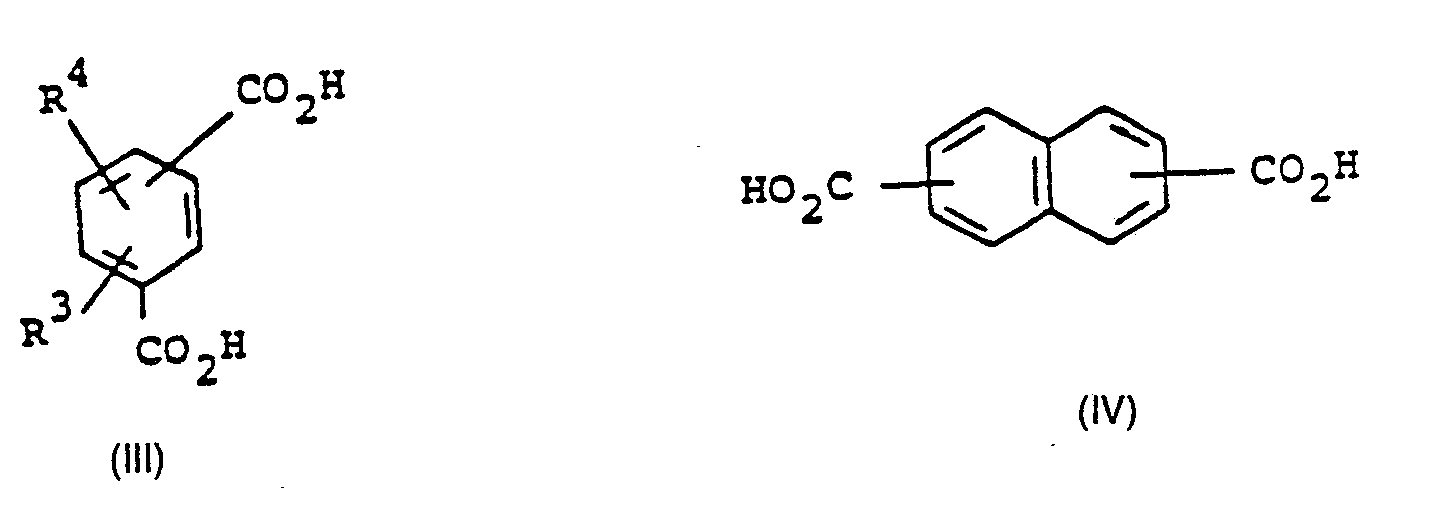


étant exceptés les acides dicarboxyliques qui peuvent former des anhydrides internes.
Applications Claiming Priority (2)
| Application Number | Priority Date | Filing Date | Title |
|---|---|---|---|
| DE19843439937 DE3439937A1 (de) | 1984-11-02 | 1984-11-02 | Verfahren zur herstellung von saeurechloriden mehrbasischer carbonsaeuren, sowie zwischenprodukte hierfuer bestehend aus einer suspension, die polymere anhydride dieser carbonsaeuren enthaelt und verfahren zur herstellung solcher polymerer anhydride |
| DE3439937 | 1984-11-02 |
Publications (2)
| Publication Number | Publication Date |
|---|---|
| EP0180839A1 EP0180839A1 (fr) | 1986-05-14 |
| EP0180839B1 true EP0180839B1 (fr) | 1988-03-02 |
Family
ID=6249235
Family Applications (1)
| Application Number | Title | Priority Date | Filing Date |
|---|---|---|---|
| EP85113313A Expired EP0180839B1 (fr) | 1984-11-02 | 1985-10-21 | Procédé de préparation de chlorures d'acides carboxyliques polybasiques ainsi que les produits intermédiaires appropriés |
Country Status (3)
| Country | Link |
|---|---|
| EP (1) | EP0180839B1 (fr) |
| JP (1) | JPS61109751A (fr) |
| DE (2) | DE3439937A1 (fr) |
Families Citing this family (3)
| Publication number | Priority date | Publication date | Assignee | Title |
|---|---|---|---|---|
| US4789724A (en) * | 1986-10-17 | 1988-12-06 | Massachusetts Institute Of Technology | Preparation of anhydride copolymers |
| US5200560A (en) * | 1990-04-21 | 1993-04-06 | Basf Aktiengesellschaft | Preparation of carboxylic chlorides |
| WO2010126152A1 (fr) | 2009-04-28 | 2010-11-04 | 住友化学株式会社 | Procédé de production d'un composé d'acide phtalique comprenant un cycle aromatique chloré |
Family Cites Families (3)
| Publication number | Priority date | Publication date | Assignee | Title |
|---|---|---|---|---|
| US3318950A (en) * | 1963-12-10 | 1967-05-09 | Du Pont | Process for preparing carboxylic acid chlorides |
| US3869485A (en) * | 1969-09-25 | 1975-03-04 | Allied Chem | Preparation of acid chlorides with phosgene in the presence of a catalyst |
| JPS5935375B2 (ja) * | 1979-04-27 | 1984-08-28 | ダイセル化学工業株式会社 | モノクロルカルボン酸クロライドの製造法 |
-
1984
- 1984-11-02 DE DE19843439937 patent/DE3439937A1/de not_active Withdrawn
-
1985
- 1985-10-21 EP EP85113313A patent/EP0180839B1/fr not_active Expired
- 1985-10-21 DE DE8585113313T patent/DE3561720D1/de not_active Expired
- 1985-10-29 JP JP60240700A patent/JPS61109751A/ja active Pending
Also Published As
| Publication number | Publication date |
|---|---|
| DE3439937A1 (de) | 1986-05-15 |
| EP0180839A1 (fr) | 1986-05-14 |
| DE3561720D1 (en) | 1988-04-07 |
| JPS61109751A (ja) | 1986-05-28 |
Similar Documents
| Publication | Publication Date | Title |
|---|---|---|
| DE1643347A1 (de) | Verfahren zur Herstellung von aromatischen Lactonen | |
| DE3504479A1 (de) | Verfahren zur herstellung von 4-nitrodiphenylaminen | |
| DE3028934A1 (de) | Verfahren zur gewinnung von halogenkomponenten aus einem carbonylierungsabgasstrom | |
| EP0180839B1 (fr) | Procédé de préparation de chlorures d'acides carboxyliques polybasiques ainsi que les produits intermédiaires appropriés | |
| EP0124002B1 (fr) | Procédé pour la préparation de composés aromatiques qui contiennent des chaînes latérales perfluorées liées par un atome hétérogène | |
| DE3019526A1 (de) | Verfahren zur herstellung von chlorameisensaeurearylestern | |
| EP0317884A2 (fr) | Acides carboxyliques partiellement fluorés, leur dérivés, procédé de préparation et utilisation | |
| DE2443179B2 (de) | Verfahren zur herstellung von perchlormethylbenzolen | |
| EP1799746B1 (fr) | Procede de production de polyesters | |
| DE1931486C3 (de) | Verfahren zur Herstellung von 1,4-Diacetoxybuten-(2) aus Dichlorbutenen | |
| EP0936220B1 (fr) | Procédé pour la préparation catalytique des 3-isochromanones commencant des phthalanes | |
| DE69708942T2 (de) | Verfahren zur Herstellung von hochreiner Naphthalin-Dicarbonsäure | |
| EP0558938B1 (fr) | Acides dicarboxyliques substitués par fluor, leur procédé de préparation et leur emploi | |
| EP0413264A1 (fr) | Procédé pour la préparation des chlorures d'acides chlorocarboxyliques | |
| EP0510490B1 (fr) | Procédé de préparation d'acide 2,3,4,5-tetrafluorobenzoique | |
| EP0173201A1 (fr) | Procédé pour la préparation de composés aromatiques bromés | |
| EP0332124B1 (fr) | Procédé pour la préparation de composés aromatiques halogénés | |
| EP0095698A1 (fr) | Procédé pour la préparation des dichlorures des acides téré- et isophtalique | |
| DE19627411A1 (de) | Verfahren zur Decarboxylierung halogenierter aromatischer Carbonsäuren | |
| EP0251041A1 (fr) | Procédé de préparation d'acide 2,3,5,6-tétrafluoro-benzoique et les composés de benzochlorure 2,3,5,6-tétrachloro-4-trifluoro-méthylique et le benzofluorure 2,3,5,6-tétrafluoro-4-trifluoro-méthylique | |
| DE2214225C2 (de) | Verfahren zur Gewinnung von Trimellitsäureanhydrid | |
| DE69004974T4 (de) | Herstellung von 2-Chlorterephthalsäurechlorid. | |
| EP0464472A2 (fr) | Biphényles partiellement fluorés, procédé pour leur fabrication et leur utilisation | |
| EP0045430A1 (fr) | Procédé de bromuration en alpha de fluortoluènes éventuellement substitués et mélanges de fluortoluènes éventuellement substitués ayant un degré de bromuration différent en position alpha | |
| EP0483106B1 (fr) | Procédé de préparation d'acides tetracarboxyliques partiellement fluorés |
Legal Events
| Date | Code | Title | Description |
|---|---|---|---|
| PUAI | Public reference made under article 153(3) epc to a published international application that has entered the european phase |
Free format text: ORIGINAL CODE: 0009012 |
|
| 17P | Request for examination filed |
Effective date: 19851021 |
|
| AK | Designated contracting states |
Kind code of ref document: A1 Designated state(s): BE DE FR GB IT NL |
|
| 17Q | First examination report despatched |
Effective date: 19870507 |
|
| GRAA | (expected) grant |
Free format text: ORIGINAL CODE: 0009210 |
|
| AK | Designated contracting states |
Kind code of ref document: B1 Designated state(s): BE DE FR GB IT NL |
|
| ITF | It: translation for a ep patent filed | ||
| GBT | Gb: translation of ep patent filed (gb section 77(6)(a)/1977) | ||
| REF | Corresponds to: |
Ref document number: 3561720 Country of ref document: DE Date of ref document: 19880407 |
|
| ET | Fr: translation filed | ||
| PG25 | Lapsed in a contracting state [announced via postgrant information from national office to epo] |
Ref country code: BE Effective date: 19881031 |
|
| PLBE | No opposition filed within time limit |
Free format text: ORIGINAL CODE: 0009261 |
|
| STAA | Information on the status of an ep patent application or granted ep patent |
Free format text: STATUS: NO OPPOSITION FILED WITHIN TIME LIMIT |
|
| 26N | No opposition filed | ||
| BERE | Be: lapsed |
Owner name: BAYER A.G. Effective date: 19881031 |
|
| PG25 | Lapsed in a contracting state [announced via postgrant information from national office to epo] |
Ref country code: NL Effective date: 19890501 |
|
| NLV4 | Nl: lapsed or anulled due to non-payment of the annual fee | ||
| PG25 | Lapsed in a contracting state [announced via postgrant information from national office to epo] |
Ref country code: FR Free format text: LAPSE BECAUSE OF NON-PAYMENT OF DUE FEES Effective date: 19890630 |
|
| PG25 | Lapsed in a contracting state [announced via postgrant information from national office to epo] |
Ref country code: DE Effective date: 19890701 |
|
| REG | Reference to a national code |
Ref country code: FR Ref legal event code: ST |
|
| PG25 | Lapsed in a contracting state [announced via postgrant information from national office to epo] |
Ref country code: GB Effective date: 19891021 |
|
| GBPC | Gb: european patent ceased through non-payment of renewal fee |