EP0181037A1 - Metal carboxylate derivative for use in synthetic materials, emulsions and suspensions - Google Patents
Metal carboxylate derivative for use in synthetic materials, emulsions and suspensions Download PDFInfo
- Publication number
- EP0181037A1 EP0181037A1 EP85201774A EP85201774A EP0181037A1 EP 0181037 A1 EP0181037 A1 EP 0181037A1 EP 85201774 A EP85201774 A EP 85201774A EP 85201774 A EP85201774 A EP 85201774A EP 0181037 A1 EP0181037 A1 EP 0181037A1
- Authority
- EP
- European Patent Office
- Prior art keywords
- derivative according
- olefin
- metal carboxylate
- metal
- copolymer
- Prior art date
- Legal status (The legal status is an assumption and is not a legal conclusion. Google has not performed a legal analysis and makes no representation as to the accuracy of the status listed.)
- Granted
Links
Classifications
-
- C—CHEMISTRY; METALLURGY
- C08—ORGANIC MACROMOLECULAR COMPOUNDS; THEIR PREPARATION OR CHEMICAL WORKING-UP; COMPOSITIONS BASED THEREON
- C08F—MACROMOLECULAR COMPOUNDS OBTAINED BY REACTIONS ONLY INVOLVING CARBON-TO-CARBON UNSATURATED BONDS
- C08F8/00—Chemical modification by after-treatment
- C08F8/44—Preparation of metal salts or ammonium salts
Definitions
- the invention relates to a metal carboxyiate derivative of a partially esterified a-olefin-unsaturated polycarboxylic acid copolymer and to the use of this compound as lubricant or stabilizer in synthetic materials and as emulsifier and/or suspending agent
- a metal carboxylate derivative of the type indicated above is known from US 4036810, in which it is described as stabilizer for chlorine-containing polymers. It is also mentioned as lubricant for polyvinyl chloride.
- a metal carboxylate derivative of a partially esterified a-olefin-unsaturated polycarboxylic copolymer has now been found which is a surprisingly satisfactory internal and external lubricant for synthetic materials.
- This metal carboxyiate derivative is characterized in that at least 80 per cent by weight of the unesterified copolymer has a molecular weight in the range of from 1000 to 100000.
- DE 2727329, DE 3003797 and DE 3136931 describe partially and wholly esterified a -olefin-unsaturated polycarboxylic acid copolymers, more particularly a-olefin-maleic acid copolymers suitable for use as lubricant
- the present lubricants distinguish themselves from these copolymers by the presence of metal carboxylate groups, which results in a surprisingly satisfactory lubricating or stabilizing action.
- EP 54761 which claims a lubricant consisting of the salt of a copolymer of an ⁇ - ⁇ -saturated acid and ethylene.
- the invention also relates to the use of the present compounds as emulsifying and/or suspending agent and they are surprisingly effective as such.
- aqueous suspensions of clay can be more satisfactorily stabilized with these compounds than with carboxy methyl cellulose or copolymers from DE 3 136 931.
- At least 80 per cent by weight of the unesterified copolyester used in the preparation has a molecular weight in the range of from 1000 to 100000.
- the average molecular weight is generally in the range of 1500 to 50000, preferably 2000 to 30 000.
- the molecular weight of the copolymer is determined by gel permeation chromatography, as further described in Example 1.
- the a-olefin used for the preparation of the copolymer contains 6 to 40 carbon atoms. It is preferred that the number of carbon atoms should be in the range of 10 to 24. Generally, the a-olefins used are mixtures of largely linear aliphatic hydrocarbons. Alternatively, however, the a-olefin may be branched and contain one or more cycloaliphatic, aromatic, ether, halogen, nitro, cyano, hydroxy, alkoxy, carbonyl and/or acid groups.
- a-olefins may be mentioned: hexene-1, octene-1, decene-1, dodecene-1, tetradecene-1, hexadecene-1, octadecene-1, eicosene-1, docosene-1, tetracosene-1, hexacosene-1, octacosene-1, tricontene-1, dotricontene-1, tetratricontene-1, 7-methyldecene-2, vinylcyclohexane, cyclohexyl-hexadecene-1, 5(2-norbomyl)-nonadecene-1, phenyidocosene-1, hexyl allyl ether, 9-chlorononene-1, 5-methoxydecene-1, 8-ketotriadecene-1, 14-cyano
- the co-monomer of the a-olefin is a derivative of an unsaturated polycarboxylic acid, more particularly a derivative of cis- or transethene dicarboxyiic acid, such as a monoester of unsubstituted or monosubstituted ethene dicarboxylic acid, a metal maleate, or maleic anhydride.
- an unsaturated polycarboxylic acid more particularly a derivative of cis- or transethene dicarboxyiic acid, such as a monoester of unsubstituted or monosubstituted ethene dicarboxylic acid, a metal maleate, or maleic anhydride.
- unsaturated polycarboxylic acid derivatives may be mentioned: maleic anhydride, 2-chloro-maleic anhydride, 2-methylmaleic anhydride, dioctyl tin maleate and the monomethyl, monobutyl, mono-2-ethylhexyl and monomethyl- diglycol ester of maleic acid, fumaric acid, 2-chloromaleic acid, citraconic acid, mesaconic acid, itaconic acid and aconitic acid. It is preferred that use should be made of maleic anhydride.
- the partially esterified a-olefin-unsaturated polycarboxylic acid copolymer is esterified with alcohols which may be linear, branched or cycloaliphatic and may contain one or more unsaturated bonds, ether groups, ester groups and/or aromatic groups. Aftematively, mixtures of alcohols may be used. When the present compounds are used as lubricant or stabilizer, the alcohol generally contains 1 to 40 carbon atoms, preferably 4 to 18 carbon atoms.
- the alcohol is preferably a polyalkylene oxide glycol ether, more particularly a polyethylene oxide glycol ether with 1 to 50 ethylene oxide units, and more particularly with 1 to 30 ethylene oxide units.
- suitable alcohols include: butanol, 2-ethylhexanol, talc alcohol, octadecanol, guerbet alcohol, diglycolethylene methyl ether, polyethylene glycol methyl ether, allyl alcohol, nonyl-phenol ethoxylate, benzyl alcohol.
- the partially esterified a-olefin-unsaturated pofycarbox- ylic acid copolymers are preferably esterified with 0, 5 to 1 ,5 equivalents of alcohol, particularly with 0,8 to 1,2, and more particularly 1,0 equivalent of alcohol.
- the present compounds may contain all kinds of metals, such as metals from the groups la, Ila, Ilb, Ilia and IVa of the Periodic System of the Elements. Particularly suitable for the present lubricants are barium, cadmium, calcium, magnesium, lead, tin and zinc. Also suitable are combinations of different metals, such as barium and zinc, and magnesium and zinc.
- emulsifying and/or suspending agent use is preferably made of metals from the group la, particularly sodium or potassium.
- the resulting polymers have a low oligomer content, which is in contrast to the products prepared in accordance with US 4 036810, which contain a large proportion of compounds, such as dimers and trimers, of a molecular weight below 1000.
- the amount of the reactants is preferably so chosen that the molar ratio of the a-olefin to the polycarboxylic acid in the copolymer is in the range of 1:2 to 2:1. This can generally be achieved by choosing the ratio of the monomers to be used in the polymerization between 1:2 and 4:1.
- the formation of the metal carboxyiate takes place in the last reaction stage by bringing the acid groups of the partially esterified a-olefin-unsaturated polycarboxylic acid copolymer into reaction with a metal oxide, a metal hydroxide and/or a metal carbonate.
- free acid groups may remain in the ready product. This is for instance the case if the degree of esterification of the polycarboxylic acid is low.
- the viscosity of the reaction mixture will then readily become so high that the metal oxide, the metal hydroxide and/or the metal carbonate will be converted only to a limited extent
- the ratio of metal carboxylate groups to acid groups should be higher than 0,1, preferably higher than 0,5, more particularly higher than 1 0.
- the end products may also contain more than one equivalent of metal oxide.
- the invention also relates to the use of the present metal carboxylates of partially esterified a-olefin unsaturated poly-carboxylic acid copolymers as lubricant or stabilizer for synthetic materials and as emulsifying agent and/or suspending agent
- synthetic materials in which the metal carboxylates may be used include polyvinyl chloride, chlorinated polyvinyl chloride, polymer compositions containing polyvinyl chloride, such as polyvinyl chloride-polyvinyl acetate, copolymers formed from vinyl chloride and other monomers, such as vinyl acetate, vinylidene chloride or acrylonrtrile, and other polymers such as polyolefins, polystyrene and polyacrylates.
- the present compounds should be used in chlorine-containing synthetic materials, more particularly polyvinyl chloride.
- These chlorine-containing materials are processed at elevated temperature and pressure. To permit rapid processing under these conditions while avoiding degradation of the polymer lubricants are added. On the one hand they serve to prevent excessive sticking to hot parts of the processing equipment (external lubrication) and on the other to reduce friction between the polymer particles (internal lubrication). Most lubricants either only display a good internal or a good external lubricating action, which necessitates the use of lubricant mixtures.
- the present metal carboxylates of partially esterified a-olefin unsaturated poIycarboxylic copolymers distinguish themselves by their excellent internal and external lubricating action and also have an unexpectedly good stabilizing effect on the polymer. Because of their high effectiveness the amount in which the present lubricants are to be used need only be small (usually less than 5, more particularly 0,1 to 2 parts per hundred), which has a favourable effect on the mechanical properties of the end product
- the excellent internal lubricating effect appears from the short gelling times as measured with a Brabender Plasticorder. By aging tests carried out in an oven at elevated temperature the thermal stability of the polymer composition can be determined.
- the present metal carboxylate derivatives of partially esterified a-olefin polycarboxylic acid copolymers are generally waxy or liquid and very suitable to be used in combination with stabilizers and/or other additives such as antioxidants, pigments, plasticizers, fillers, etc.
- Suitable PVC stabilizers are metal-containing compounds such as calcium soaps, barium soaps and zinc soaps, organotin compounds and lead salts, and organic co-stabilizers such as phosphites and ⁇ -diketones. It is very well possible to prepare such ready mixtures of the present metal carboxylates and other additives as are adapted to the processing of particular synthetic materials.
- copolymers When the present copolymers are to be used as emulsifying and/or suspending agent, it is preferred that use should be made of those copolymers that are esterified with a polyethylene oxide glycol ether with 1 to 50, more particularly 1 to 30 ethylene oxide units and which contain as metal sodium and/or potassium. These compounds are suitable for many uses, such as the dispersion of, say, clay or pigments, the stabilization of latices and as lubricating agent in high water based fluids.
- copolymers described in Table 1 were prepared in the same manner.
- the molecular weight of the unesterified copolymers was determined with the aid of a gel permeation chromatograph equipped with a micro-styragel column (Waters Associates, see firm bulletin A 143, June 1974) and a differential refractometer.
- the mobile phase consisted of tetrahydrofuran.
- Example 1 The copolymer of Example 1 (300g, containing 0,864 moles of maleic acid units) and talc alcohol (219g, 0,86 4 moles) were stirred for 4 hours at 150°C.
- Table I mentions several half esters that were prepared in the same way.
- Table II mentions several metal carboxylates prepared in a similar manner. Incomplete conversions of the metal oxide, metal hydroxide or metal carbonate were quantified by successively filtering, washing, drying and weighing unconverted metal oxide, metal hydroxide or metal carbonate.
- compositions were mixed on a two-roll mill at 180°C.
- Example 2 In the way indicated in Example 2 the product mixture was converted with a talc alcohol into a half ester. The acid groups of the half ester were subsequently reacted with barium oxide or calcium oxide to be completely converted into the corresponding carboxylates (see Example 3).
- Example 9 The lubricants mentioned in Example 9 were tested. The gelling times are given in Table VIII. The results show that the present lubricants display a far better internal lubricating action than the (half) esters from DE 2727329 and DE 3003797.
- compositions were prepared, each containing a different amount of barium toluate or Ba-VIII (which is identical with Ba-II except that it is esterified with talc alcohol). See Table IX.
- the compositions A, B and C were mixed on a mill for 5 minutes at 172°C and subsequently aged in a Wemer Mathis oven at 185°C until degradation of the PVC took place (recognizable by rapid discoloration).
- compositions have the same metal content (0,17% Ba and 0,05% Zn).
- a copolymer built up from equivalent amounts of maleic anhydride and C 12 - 14 - ⁇ -olefin and having a molecular weight of 20 000 was converted with polyethylene oxide glycol methyl ether (6- 1 0 ethytene oxide units) into a half ester.
- the half ester 400 parts
- the half ester readily dissolved in a solution of 14 parts of sodium hydroxide (100%) in water (586 parts).
- sodium carboxylate derivative a suspension of clay in water was prepared by stirring the components for 10 minutes (stirring speed 100 rpm).
- the suspension was kept in a 100 ml-graduated cylinder for 24 hours at room temperature, after which 10 ml of the suspension was pipetted from the graduated cylinder at half height.
- a 40%-dispersion of ethylene acrylate homopolymer in water was prepared by emulsion polymerization (initiator: potassium sulphate; polymerization temperature: 75°C).
- El- fan® OS 46 sodium olefin sulphate
- the various dispersions were mixed in a Star Mixer (which is similar to a Warring blender) for 2 minutes at 7500 rpm and subsequently filtered using an 0,2 mm stainless steel screen. The coagulate was dried at 110°C and weighed.
Landscapes
- Chemical & Material Sciences (AREA)
- General Chemical & Material Sciences (AREA)
- Health & Medical Sciences (AREA)
- Chemical Kinetics & Catalysis (AREA)
- Medicinal Chemistry (AREA)
- Polymers & Plastics (AREA)
- Organic Chemistry (AREA)
- Lubricants (AREA)
- Compositions Of Macromolecular Compounds (AREA)
- Addition Polymer Or Copolymer, Post-Treatments, Or Chemical Modifications (AREA)
- Organic Low-Molecular-Weight Compounds And Preparation Thereof (AREA)
Abstract
Description
- The invention relates to a metal carboxyiate derivative of a partially esterified a-olefin-unsaturated polycarboxylic acid copolymer and to the use of this compound as lubricant or stabilizer in synthetic materials and as emulsifier and/or suspending agent
- A metal carboxylate derivative of the type indicated above is known from US 4036810, in which it is described as stabilizer for chlorine-containing polymers. It is also mentioned as lubricant for polyvinyl chloride.
- Apparently, however, a considerable proportion of the carboxylates obtained by the process of said patent specification consists of compounds whose molecular weight is below 1000 and whose lubricating action is limited.
- A metal carboxylate derivative of a partially esterified a-olefin-unsaturated polycarboxylic copolymer has now been found which is a surprisingly satisfactory internal and external lubricant for synthetic materials. This metal carboxyiate derivative is characterized in that at least 80 per cent by weight of the unesterified copolymer has a molecular weight in the range of from 1000 to 100000.
- It should be added that DE 2727329, DE 3003797 and DE 3136931 describe partially and wholly esterified a -olefin-unsaturated polycarboxylic acid copolymers, more particularly a-olefin-maleic acid copolymers suitable for use as lubricant The present lubricants distinguish themselves from these copolymers by the presence of metal carboxylate groups, which results in a surprisingly satisfactory lubricating or stabilizing action. Reference is also. made to EP 54761, which claims a lubricant consisting of the salt of a copolymer of an α-β-saturated acid and ethylene.
- The invention also relates to the use of the present compounds as emulsifying and/or suspending agent and they are surprisingly effective as such. For instance, aqueous suspensions of clay can be more satisfactorily stabilized with these compounds than with carboxy methyl cellulose or copolymers from DE 3 136 931.
- As far as the metal carboxylate according to the invention is concerned, at least 80 per cent by weight of the unesterified copolyester used in the preparation has a molecular weight in the range of from 1000 to 100000. The average molecular weight is generally in the range of 1500 to 50000, preferably 2000 to 30 000. The molecular weight of the copolymer is determined by gel permeation chromatography, as further described in Example 1.
- The a-olefin used for the preparation of the copolymer contains 6 to 40 carbon atoms. It is preferred that the number of carbon atoms should be in the range of 10 to 24. Generally, the a-olefins used are mixtures of largely linear aliphatic hydrocarbons. Alternatively, however, the a-olefin may be branched and contain one or more cycloaliphatic, aromatic, ether, halogen, nitro, cyano, hydroxy, alkoxy, carbonyl and/or acid groups. As examples of these a-olefins may be mentioned: hexene-1, octene-1, decene-1, dodecene-1, tetradecene-1, hexadecene-1, octadecene-1, eicosene-1, docosene-1, tetracosene-1, hexacosene-1, octacosene-1, tricontene-1, dotricontene-1, tetratricontene-1, 7-methyldecene-2, vinylcyclohexane, cyclohexyl-hexadecene-1, 5(2-norbomyl)-nonadecene-1, phenyidocosene-1, hexyl allyl ether, 9-chlorononene-1, 5-methoxydecene-1, 8-ketotriadecene-1, 14-cyano-pentadecene-1, 10-undecene carboxylic acid and 15-n-hexadecene carboxyiic acid.
- The co-monomer of the a-olefin is a derivative of an unsaturated polycarboxylic acid, more particularly a derivative of cis- or transethene dicarboxyiic acid, such as a monoester of unsubstituted or monosubstituted ethene dicarboxylic acid, a metal maleate, or maleic anhydride. Of course, also mixtures of these compounds may be used. As examples of unsaturated polycarboxylic acid derivatives may be mentioned: maleic anhydride, 2-chloro-maleic anhydride, 2-methylmaleic anhydride, dioctyl tin maleate and the monomethyl, monobutyl, mono-2-ethylhexyl and monomethyl- diglycol ester of maleic acid, fumaric acid, 2-chloromaleic acid, citraconic acid, mesaconic acid, itaconic acid and aconitic acid. It is preferred that use should be made of maleic anhydride.
- The partially esterified a-olefin-unsaturated polycarboxylic acid copolymer is esterified with alcohols which may be linear, branched or cycloaliphatic and may contain one or more unsaturated bonds, ether groups, ester groups and/or aromatic groups. Aftematively, mixtures of alcohols may be used. When the present compounds are used as lubricant or stabilizer, the alcohol generally contains 1 to 40 carbon atoms, preferably 4 to 18 carbon atoms. When the present compounds are used as emulsifying and/or suspending agent, the alcohol is preferably a polyalkylene oxide glycol ether, more particularly a polyethylene oxide glycol ether with 1 to 50 ethylene oxide units, and more particularly with 1 to 30 ethylene oxide units.
- Examples of suitable alcohols include: butanol, 2-ethylhexanol, talc alcohol, octadecanol, guerbet alcohol, diglycolethylene methyl ether, polyethylene glycol methyl ether, allyl alcohol, nonyl-phenol ethoxylate, benzyl alcohol.
- The partially esterified a-olefin-unsaturated pofycarbox- ylic acid copolymers are preferably esterified with 0,5 to 1,5 equivalents of alcohol, particularly with 0,8 to 1,2, and more particularly 1,0 equivalent of alcohol. The present compounds may contain all kinds of metals, such as metals from the groups la, Ila, Ilb, Ilia and IVa of the Periodic System of the Elements. Particularly suitable for the present lubricants are barium, cadmium, calcium, magnesium, lead, tin and zinc. Also suitable are combinations of different metals, such as barium and zinc, and magnesium and zinc. For application as emulsifying and/or suspending agent use is preferably made of metals from the group la, particularly sodium or potassium.
- In the preparation of the present metal carboxylate derivatives of partially esterified a-olefin-unsaturated poly- carboxylic acid copolymers roughly three reaction steps may be distinguished, viz. copolymerization, esterification and formation of metal carboxylates. Copolymerization and esterification generally take place first The copolymerization is carried out in the presence of a radical initiator such as di-tert-butyl peroxide, benzoyl peroxide, dilauryl peroxide, dicumyl peroxide, tert. butyl hydroperoxide and/or cumyl hydroperoxide.
- A process of the type indicated above is described in DE 2727329, DE 3003797 and DE 3136931.
- The resulting polymers have a low oligomer content, which is in contrast to the products prepared in accordance with US 4036810, which contain a large proportion of compounds, such as dimers and trimers, of a molecular weight below 1000.
- In the copolymerization the amount of the reactants is preferably so chosen that the molar ratio of the a-olefin to the polycarboxylic acid in the copolymer is in the range of 1:2 to 2:1. This can generally be achieved by choosing the ratio of the monomers to be used in the polymerization between 1:2 and 4:1.
- Generally the formation of the metal carboxyiate takes place in the last reaction stage by bringing the acid groups of the partially esterified a-olefin-unsaturated polycarboxylic acid copolymer into reaction with a metal oxide, a metal hydroxide and/or a metal carbonate. Depending on the reaction conditions and the choice of the reactants free acid groups may remain in the ready product. This is for instance the case if the degree of esterification of the polycarboxylic acid is low. The viscosity of the reaction mixture will then readily become so high that the metal oxide, the metal hydroxide and/or the metal carbonate will be converted only to a limited extent To ensure the presence in the end product of a considerable proportion of metal it is preferred that the ratio of metal carboxylate groups to acid groups should be higher than 0,1, preferably higher than 0,5, more particularly higher than 10. The end products may also contain more than one equivalent of metal oxide.
- The invention also relates to the use of the present metal carboxylates of partially esterified a-olefin unsaturated poly-carboxylic acid copolymers as lubricant or stabilizer for synthetic materials and as emulsifying agent and/or suspending agent Examples of synthetic materials in which the metal carboxylates may be used include polyvinyl chloride, chlorinated polyvinyl chloride, polymer compositions containing polyvinyl chloride, such as polyvinyl chloride-polyvinyl acetate, copolymers formed from vinyl chloride and other monomers, such as vinyl acetate, vinylidene chloride or acrylonrtrile, and other polymers such as polyolefins, polystyrene and polyacrylates.
- It is preferred that the present compounds should be used in chlorine-containing synthetic materials, more particularly polyvinyl chloride. These chlorine-containing materials are processed at elevated temperature and pressure. To permit rapid processing under these conditions while avoiding degradation of the polymer lubricants are added. On the one hand they serve to prevent excessive sticking to hot parts of the processing equipment (external lubrication) and on the other to reduce friction between the polymer particles (internal lubrication). Most lubricants either only display a good internal or a good external lubricating action, which necessitates the use of lubricant mixtures. The present metal carboxylates of partially esterified a-olefin unsaturated poIycarboxylic copolymers distinguish themselves by their excellent internal and external lubricating action and also have an unexpectedly good stabilizing effect on the polymer. Because of their high effectiveness the amount in which the present lubricants are to be used need only be small (usually less than 5, more particularly 0,1 to 2 parts per hundred), which has a favourable effect on the mechanical properties of the end product
- The excellent effectiveness as regards external lubrication manifests itself for instance in the long period the polymer can be milled without sticking to the metal mill rolls. Very often there is not even question of any excessive sticking for a long time after the stabilization period of the polymer. These properties make it possible for the processing equipment to be cleaned without any problems. Moreover, the present lubricants cause no or only very little "plating out" on the metal surface of the equipment.
- The excellent internal lubricating effect appears from the short gelling times as measured with a Brabender Plasticorder. By aging tests carried out in an oven at elevated temperature the thermal stability of the polymer composition can be determined. The present metal carboxylate derivatives of partially esterified a-olefin polycarboxylic acid copolymers are generally waxy or liquid and very suitable to be used in combination with stabilizers and/or other additives such as antioxidants, pigments, plasticizers, fillers, etc. Suitable PVC stabilizers are metal-containing compounds such as calcium soaps, barium soaps and zinc soaps, organotin compounds and lead salts, and organic co-stabilizers such as phosphites and β-diketones. It is very well possible to prepare such ready mixtures of the present metal carboxylates and other additives as are adapted to the processing of particular synthetic materials.
- When the present copolymers are to be used as emulsifying and/or suspending agent, it is preferred that use should be made of those copolymers that are esterified with a polyethylene oxide glycol ether with 1 to 50, more particularly 1 to 30 ethylene oxide units and which contain as metal sodium and/or potassium. These compounds are suitable for many uses, such as the dispersion of, say, clay or pigments, the stabilization of latices and as lubricating agent in high water based fluids.
- The invention will be further described in the following examples.
- (Copolymerization of CI1-a-olefin and maleic anhydride)
- A flask containing C18-α-olefin (756g, 3 moles) was flushed with nitrogen and heated to 200°C. Subsequently, 10 equal portions of maleic anhydride (in all 294g, 3 moles) and ditert-butyl peroxide (in all 15 ml) were added with stirring and at 30 minute intervals. After the addition over the next 1 hours of 3 more portions of ditertbutyl peroxide (in all 4,5 ml) the mixture was heated to 200°C for another 30 minutes, after which a small amount (about 15g) of volatile constituents was distilled off by means of a water jet pump. By elementary analysis it was found that the ratio olefin: maleic acid was 0,987. From a gel permeation chromatography analysis it appeared that the polymer had a broad molecular weight distribution and an average molecular weight of 2950, 92 per cent of the product having a molecular weight in the range of from 1000 to 22000. Yield 1045g.
- The copolymers described in Table 1 were prepared in the same manner.
- The molecular weight of the unesterified copolymers was determined with the aid of a gel permeation chromatograph equipped with a micro-styragel column (Waters Associates, see firm bulletin A 143, June 1974) and a differential refractometer. The mobile phase consisted of tetrahydrofuran. For molecular weights below and above 3000 use was made of, respectively, polyethylene glycol and polystyrene calibrating materials. By the average molecular weight is to be understood the molecular weight at the main peak.
- Table I
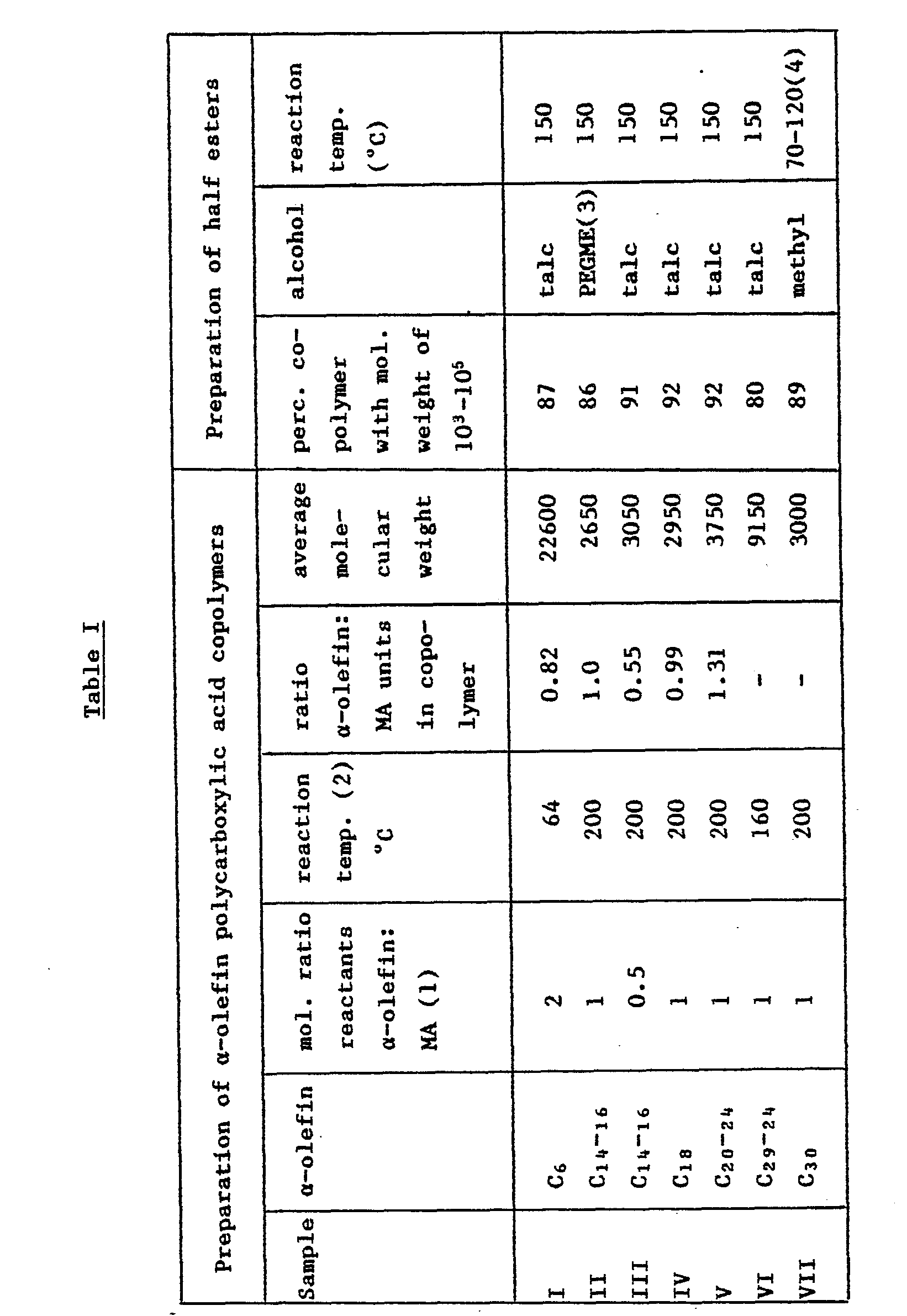
- (1) Maleic anhyoride
- (2) Reaction time 7 hours (sample I, 10,5 hours)
- (3) Polyethylene glycol methyl ether (molecular weight 350)
- (4) Temperature rises from 70° to 120°C
- (Preparation of the half ester from the C18-α-olefin maleic anhydride copolymer)
- The copolymer of Example 1 (300g, containing 0,864 moles of maleic acid units) and talc alcohol (219g, 0,864 moles) were stirred for 4 hours at 150°C.
- Table I mentions several half esters that were prepared in the same way.
- (Preparation of a calcium carboxylate derivative from the half ester of a C18-α-olefin maleic anhydride copolymer)
- The half ester from Example 2 (600g, containing 1 mole of acid groups) and calcium hydroxide (37g, 0,5 moles) were stirred for 1-5 hours at 110°-150°C, the calcium hydroxide being quantitatively converted and a clear viscous melt being formed.
- Table II mentions several metal carboxylates prepared in a similar manner. Incomplete conversions of the metal oxide, metal hydroxide or metal carbonate were quantified by successively filtering, washing, drying and weighing unconverted metal oxide, metal hydroxide or metal carbonate.

- 1 polyethylene glycol methyl ether (molecular weight 350)
- In a dry blender the following compounds were premixed for 1 minute:
- S-PVC (K-70) 100 parts
- dioctylphthalate 25 parts
- lubricantsee Table III
- stabilizersee Table III
- The resulting compositions were mixed on a two-roll mill at 180°C.
- roll diameters 110 and 125 mm
- slit width between the rolls 0,8 to 1 mm
- roll speed 20 rpm
- After about 1 minute a plastic mass was formed which, depending on the lubricant used, did or did not readily stick to the roll or did not stick to it at all (end of lubricating action). The results are given in Table III. They clearly show that the present lubricants are more effective than the commercially available lubricants: E-Wachs, Loxiol G 70 and Loxiol G 71.
- Also the plating out of samples with the present lubricants is far less considerable, and the rolling skin did not stick to the roll for a long time after the end of the stabilization period.


- * stabilized with 2,5 parts of dibuiyltin dimonomethyl maleate
- ** stabilized with 2 parts of commercially available Ba-Zn stabilizer
- In a dry blender the following compounds were premixed for 1 minute:
- S-PVC (K-70) 100 parts
- PbSO. - 4PbO 1,5 parts
- Pb(C, H35COO)22PbO 1 part
- lubricant see Table IV
- An amount of 31 g of this mixture was tested in a Brabender at 25 rpm and at a temperature of 180°C.
- The gelling times are mentioned in the table below.


- (Preparation of barium carboxylate and calcium carbox- ytate lubricants in accordance with US 4036810)
- In an autoclave a mixture of C,,-a-olefin (504g, 2 moles) and maleic anhydride (98g, 1 mole) was stirred for 44 hours at 185°C. Subsequently, 233g (0,93 moles) of the C18-α-olefin product were distilled off from the crude product mixture. The main product was the adduct of one molecule of a-olefin and one molecule of maleic anhydride and the residue contained 23 per cent by weight of polymer of a molecular weight higher than 1000.
- In the way indicated in Example 2 the product mixture was converted with a talc alcohol into a half ester. The acid groups of the half ester were subsequently reacted with barium oxide or calcium oxide to be completely converted into the corresponding carboxylates (see Example 3).
- (Milling experiments)
- In the way described in Example 4 milling experiments were carried out with the following formulations:
- S-PVC (K-70) 100 parts
- dioctylphthalate 25 parts
- lubricant 1,5 parts
- The results mentioned in Table V demonstrate that the present lubricants display a far better external lubricating action than corresponding compounds from US 4036810 (see Example 6).


- (Brabender experiments)
- In the way described in Example 5 Brabender experiments were conducted with the following formulations:
- S-PVC (K-68) 100 parts
- PbSO,-4PbO 1,5 parts
- Pb(C18H36O2)22PbO 1 part
- paraffin (melting point 60°C) 0,6 parts
- lubricant to be tested 0,6 parts
- The results mentioned in Table Vi show that the present lubricants display a far better internal lubricating action than corresponding compounds from US 4 036 810 (see Example 6).

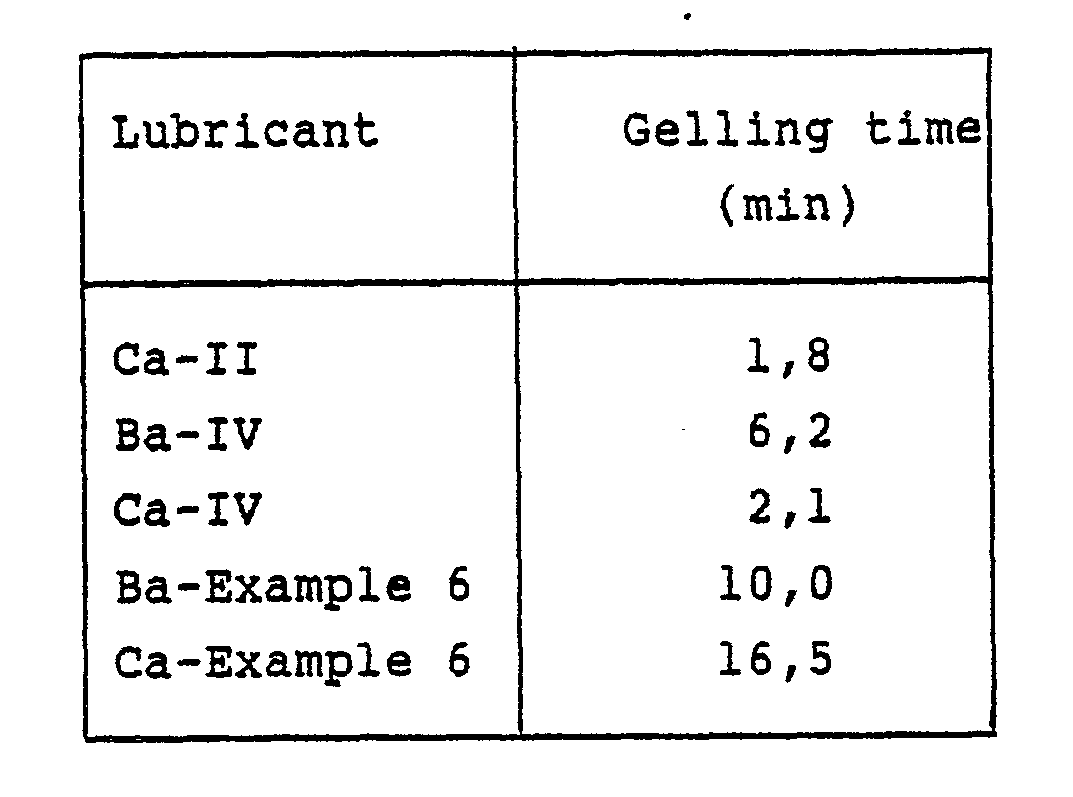
- (Milling experiments)
- In the way described in Example 4 milling experiments were carried out with the following formulations:
- S-PVC (K-70)100 parts
- dioctylphthalate 2,5 parts
- Ca/Zn-stabilizer (M330)1,2 parts
- lubricant to be tested0,3 parts
- The following lubricants were tested: Mg-IV, Ba-IV, half ester-IV, ester-IV (the two last-mentioned compounds are the copolymers IV according to DE 2727329 and DE 3003797, respectively half and wholly esterified with talc alcohol).
- The results given in Table VII illustrate that the present lubricants display a far better external lubricating action than the corresponding (half) ester copolymers.


- (Brabender tests)
- In the way described in Example 5 Brabender tests were carried out with the following formulations:
- S-PVC (K-70) 100 parts
- Ca/Zn-stabilizer 1,2 parts
- lubricant to be tested 0,6 parts
- . The lubricants mentioned in Example 9 were tested. The gelling times are given in Table VIII. The results show that the present lubricants display a far better internal lubricating action than the (half) esters from DE 2727329 and DE 3003797.

- (Oven aging)
- In a dry blender the following compounds were premixed:
- S-PVC (K-64)100 parts
- dioctytphthalate 25 parts
- epoxidized soybean oil 3 parts
- Ba/Zn-stabilizer 2 parts
- Three compositions were prepared, each containing a different amount of barium toluate or Ba-VIII (which is identical with Ba-II except that it is esterified with talc alcohol). See Table IX. The compositions A, B and C were mixed on a mill for 5 minutes at 172°C and subsequently aged in a Wemer Mathis oven at 185°C until degradation of the PVC took place (recognizable by rapid discoloration).
- All three compositions have the same metal content (0,17% Ba and 0,05% Zn).
- The experiments show that PVC with the same metal content is better stabilized when use is made of the present metal carboxylates.


- A copolymer built up from equivalent amounts of maleic anhydride and C12-14-α-olefin and having a molecular weight of 20 000 was converted with polyethylene oxide glycol methyl ether (6-10 ethytene oxide units) into a half ester. The half ester (400 parts) readily dissolved in a solution of 14 parts of sodium hydroxide (100%) in water (586 parts). With the resulting sodium carboxylate derivative a suspension of clay in water was prepared by stirring the components for 10 minutes (stirring speed 100 rpm). The suspension was kept in a 100 ml-graduated cylinder for 24 hours at room temperature, after which 10 ml of the suspension was pipetted from the graduated cylinder at half height. After the water had been evaporated off at 105°C the amount of suspended clay was determined by weighing. In reference experiments carboxymethyl cellulose and the half ester that had not been converted into a metal salt were used as suspending agents. The results in Table X illustrate the favourable suspending properties of the sodium carboxylate.
-


- (Emulsion polymerization)
- A 40%-dispersion of ethylene acrylate homopolymer in water was prepared by emulsion polymerization (initiator: potassium sulphate; polymerization temperature: 75°C). El- fan® OS 46 (sodium olefin sulphate) was used as emulsifying agent in different amounts. In one experiment it was partly replaced with the potassium salt of the half ester copolymer mentioned in Example 12 (see Table XI). The various dispersions were mixed in a Star Mixer (which is similar to a Warring blender) for 2 minutes at 7500 rpm and subsequently filtered using an 0,2 mm stainless steel screen. The coagulate was dried at 110°C and weighed.
- The result show the excellent mechanical stability of the dispersions when using potassium carboxyiate.


Claims (17)
Priority Applications (1)
| Application Number | Priority Date | Filing Date | Title |
|---|---|---|---|
| AT85201774T ATE45583T1 (en) | 1984-11-05 | 1985-11-01 | METAL CARBOXYLATE DERIVATIVE FOR USE IN SYNTHETIC PRODUCTS, EMULSIONS AND SUSPENSIONS. |
Applications Claiming Priority (2)
| Application Number | Priority Date | Filing Date | Title |
|---|---|---|---|
| NL8403347 | 1984-11-05 | ||
| NL8403347 | 1984-11-05 |
Publications (2)
| Publication Number | Publication Date |
|---|---|
| EP0181037A1 true EP0181037A1 (en) | 1986-05-14 |
| EP0181037B1 EP0181037B1 (en) | 1989-08-16 |
Family
ID=19844704
Family Applications (1)
| Application Number | Title | Priority Date | Filing Date |
|---|---|---|---|
| EP85201774A Expired EP0181037B1 (en) | 1984-11-05 | 1985-11-01 | Metal carboxylate derivative for use in synthetic materials, emulsions and suspensions |
Country Status (6)
| Country | Link |
|---|---|
| US (2) | US4775723A (en) |
| EP (1) | EP0181037B1 (en) |
| JP (1) | JPH0657727B2 (en) |
| AT (1) | ATE45583T1 (en) |
| CA (1) | CA1266679A (en) |
| DE (1) | DE3572361D1 (en) |
Cited By (4)
| Publication number | Priority date | Publication date | Assignee | Title |
|---|---|---|---|---|
| EP0659827A1 (en) * | 1993-12-04 | 1995-06-28 | Hoechst Aktiengesellschaft | Vinyl chloride polymer moulding matter |
| EP0643080A3 (en) * | 1993-09-10 | 1995-06-28 | Hoechst Ag | Mixtures of polymers and water. |
| EP0900809A1 (en) * | 1997-09-03 | 1999-03-10 | Kansai Paint Co., Ltd. | Method for production of antifouling resin and antifouling resin composition |
| DE102005019747B3 (en) * | 2005-04-28 | 2006-06-01 | Clariant Gmbh | Aqueous pigment preparation, useful for e.g. coloring macromolecular materials, comprises organic and/or inorganic pigment and a polymer-dispersing agent |
Families Citing this family (9)
| Publication number | Priority date | Publication date | Assignee | Title |
|---|---|---|---|---|
| US5298568A (en) * | 1992-01-31 | 1994-03-29 | Toyo Ink Manufacturing Co., Ltd. | Modified olefin resin and resin composition |
| US5328948A (en) * | 1992-09-23 | 1994-07-12 | Ausimont, U.S.A., Inc. | Stabilization of halopolymers with ionomers |
| US5486307A (en) * | 1993-11-22 | 1996-01-23 | Colgate-Palmolive Co. | Liquid cleaning compositions with grease release agent |
| US5573702A (en) * | 1993-11-22 | 1996-11-12 | Colgate-Palmolive Co. | Liquid cleaning compositions with grease release agent |
| US5942556A (en) * | 1996-11-27 | 1999-08-24 | Ppg Industries Ohio, Inc. | Stabilized radiation curable compositions based on unsaturated ester and vinyl ether compounds |
| US6020061A (en) * | 1997-04-15 | 2000-02-01 | S. C. Johnson Commercial Markets, Inc. | Emulsion polymerization using polymeric surfactants |
| WO2003016395A1 (en) * | 2001-08-16 | 2003-02-27 | Dover Chemical Corporation | Polymer dispersible polybasic metal carboxylate complexes |
| US7256242B2 (en) * | 2003-06-27 | 2007-08-14 | Chevron Oronite Company, Llc | Esterified copolymers of polyalkenes/unsaturated acidic reagents useful as lubricant and fuel additives |
| EP2664632A1 (en) * | 2008-07-31 | 2013-11-20 | The Lubrizol Corporation | Novel copolymers and lubricating compositions thereof |
Citations (4)
| Publication number | Priority date | Publication date | Assignee | Title |
|---|---|---|---|---|
| DE2338642A1 (en) * | 1973-07-30 | 1975-03-13 | Hoechst Ag | Binders for printing inks and paints - contg. salts of polyvalent metals with carboxylated polymers and ammonia/amines |
| US4036810A (en) * | 1974-01-02 | 1977-07-19 | Hooker Chemicals & Plastics Corporation | Halogen containing polymeric resins having heat and light stability |
| FR2394556A1 (en) * | 1977-06-16 | 1979-01-12 | Akzo Nv | OLEFIN-MALEIC ACID COPOLYMERISATE ESTER AND ITS APPLICATION AS A SLIDING AGENT FOR THE FORMING TREATMENT OF SYNTHETIC MATERIALS |
| GB2068386A (en) * | 1980-02-02 | 1981-08-12 | Akzo Nv | Forming lubricant-containing plastics |
Family Cites Families (12)
| Publication number | Priority date | Publication date | Assignee | Title |
|---|---|---|---|---|
| US2977334A (en) * | 1956-10-04 | 1961-03-28 | Monsanto Chemicals | Derivatives of ethylene/maleic anhydride copolymers |
| US3030342A (en) * | 1960-01-15 | 1962-04-17 | Koppers Co Inc | Salts of styrene-maleic anhydride copolymers |
| US3741940A (en) * | 1971-05-20 | 1973-06-26 | Gulf Research Development Co | Process for the preparation and recovery of esterified copolymers containing maleic anhydride |
| US4013609A (en) * | 1972-03-29 | 1977-03-22 | Hoechst Aktiengesellschaft | Resinous composition |
| US3943111A (en) * | 1972-03-29 | 1976-03-09 | Hoechst Aktiengesellschaft | Process for preparing modified copolymers |
| US4055581A (en) * | 1974-01-02 | 1977-10-25 | Hooker Chemicals & Plastics Corporation | Heat and light stabilizers for halogen containing polymeric resins |
| US3933740A (en) * | 1974-01-02 | 1976-01-20 | Hooker Chemicals & Plastics Corporation | Halogen containing polymeric resins having improved heat and light stability |
| US4128185A (en) * | 1977-01-05 | 1978-12-05 | W. R. Grace & Co. | Container closure |
| FR2496394A1 (en) * | 1980-12-18 | 1982-06-25 | Kuhn Sa | IMPROVEMENT TO SUPPORTS OF CUTTING ELEMENTS OF ROTARY MOWERS |
| DE3174146D1 (en) * | 1980-12-22 | 1986-04-24 | Allied Corp | Low molecular weight copolymer salts |
| DE3136931A1 (en) * | 1981-09-17 | 1983-04-07 | Akzo Gmbh, 5600 Wuppertal | COPOLYMERS FROM (ALPHA) - (BETA) -UNSATURED DICARBONIC ACID ESTERS, METHOD FOR THE PRODUCTION THEREOF AND THE USE THEREOF AS A LUBRICANT FOR THE PLASTIC PROCESSING |
| US4482675A (en) * | 1982-12-13 | 1984-11-13 | Colgate-Palmolive Company | Water-soluble, pressure-sensitive adhesive composition, and process for making same |
-
1985
- 1985-11-01 EP EP85201774A patent/EP0181037B1/en not_active Expired
- 1985-11-01 DE DE8585201774T patent/DE3572361D1/en not_active Expired
- 1985-11-01 AT AT85201774T patent/ATE45583T1/en active
- 1985-11-05 JP JP60246456A patent/JPH0657727B2/en not_active Expired - Lifetime
- 1985-11-05 CA CA000494627A patent/CA1266679A/en not_active Expired - Lifetime
-
1987
- 1987-11-04 US US07/117,451 patent/US4775723A/en not_active Expired - Fee Related
-
1989
- 1989-12-01 US US07/443,829 patent/US4999400A/en not_active Expired - Fee Related
Patent Citations (4)
| Publication number | Priority date | Publication date | Assignee | Title |
|---|---|---|---|---|
| DE2338642A1 (en) * | 1973-07-30 | 1975-03-13 | Hoechst Ag | Binders for printing inks and paints - contg. salts of polyvalent metals with carboxylated polymers and ammonia/amines |
| US4036810A (en) * | 1974-01-02 | 1977-07-19 | Hooker Chemicals & Plastics Corporation | Halogen containing polymeric resins having heat and light stability |
| FR2394556A1 (en) * | 1977-06-16 | 1979-01-12 | Akzo Nv | OLEFIN-MALEIC ACID COPOLYMERISATE ESTER AND ITS APPLICATION AS A SLIDING AGENT FOR THE FORMING TREATMENT OF SYNTHETIC MATERIALS |
| GB2068386A (en) * | 1980-02-02 | 1981-08-12 | Akzo Nv | Forming lubricant-containing plastics |
Cited By (9)
| Publication number | Priority date | Publication date | Assignee | Title |
|---|---|---|---|---|
| EP0643080A3 (en) * | 1993-09-10 | 1995-06-28 | Hoechst Ag | Mixtures of polymers and water. |
| US5521267A (en) * | 1993-09-10 | 1996-05-28 | Hoechst Aktiengesellschaft | Mixtures of polymers with water |
| AU674433B2 (en) * | 1993-09-10 | 1996-12-19 | Hoechst Aktiengesellschaft | Mixtures of polymers with water |
| EP0659827A1 (en) * | 1993-12-04 | 1995-06-28 | Hoechst Aktiengesellschaft | Vinyl chloride polymer moulding matter |
| EP0900809A1 (en) * | 1997-09-03 | 1999-03-10 | Kansai Paint Co., Ltd. | Method for production of antifouling resin and antifouling resin composition |
| US6211301B1 (en) | 1997-09-03 | 2001-04-03 | Kansai Paint Co., Ltd | Method for production of antifouling resin and antifouling resin composition |
| DE102005019747B3 (en) * | 2005-04-28 | 2006-06-01 | Clariant Gmbh | Aqueous pigment preparation, useful for e.g. coloring macromolecular materials, comprises organic and/or inorganic pigment and a polymer-dispersing agent |
| EP1721941A2 (en) | 2005-04-28 | 2006-11-15 | Clariant Produkte (Deutschland) GmbH | Waterbased pigment preparations |
| EP1721941A3 (en) * | 2005-04-28 | 2007-06-27 | Clariant Produkte (Deutschland) GmbH | Waterbased pigment preparations |
Also Published As
| Publication number | Publication date |
|---|---|
| JPH0657727B2 (en) | 1994-08-03 |
| DE3572361D1 (en) | 1989-09-21 |
| EP0181037B1 (en) | 1989-08-16 |
| JPS61120811A (en) | 1986-06-07 |
| CA1266679A (en) | 1990-03-13 |
| US4999400A (en) | 1991-03-12 |
| US4775723A (en) | 1988-10-04 |
| ATE45583T1 (en) | 1989-09-15 |
Similar Documents
| Publication | Publication Date | Title |
|---|---|---|
| EP0181037B1 (en) | Metal carboxylate derivative for use in synthetic materials, emulsions and suspensions | |
| US4104216A (en) | Copolymers containing an alpha-olefin and an alpha, beta-ethylenically unsaturated carboxylic acid plasticized with long-chain fatty acid | |
| US4192930A (en) | Esterified olefin-maleic anhydride copolymers | |
| US2985625A (en) | Composition comprising derivatives of cross-linked carboxylic acid anhydride polymers and method of preparing same | |
| US4014831A (en) | Novel ionic polymer compositions | |
| DE2536223A1 (en) | POLYESTER PLASTICIZER | |
| US4334038A (en) | Shaping of plastic materials containing polymeric lubricant | |
| US7071252B2 (en) | Plasticizer compositions for non-aqueous plastisols | |
| US3491075A (en) | Crosslinking of polymers having dependent ester groups with polyvalent metal alkoxides | |
| US5306437A (en) | Copolymers and their use as lubricants and release agents for processing thermoplastics | |
| EP0181408B1 (en) | Multi-component ethylene copolymers, process for their preparation, and vulcanizate thereof | |
| US4122064A (en) | Novel organo-tin compounds and their use as stabilizers | |
| US4438008A (en) | Lubricant, containing esterified ethylene/acrylic acid or ethylene/maleic acid copolymers as the active ingredient, for moulding chlorine-containing thermoplastics | |
| DE2119701C3 (en) | Polymer compositions | |
| US2554259A (en) | Oxidized polypropylene and its use as plasticizer | |
| US4104232A (en) | Halogen-containing resin composition | |
| US6835328B2 (en) | Overbased metal carbonate/carboxylate microemulsions and halogen-containing polymers containing same | |
| JPS5841311B2 (en) | Stabilizing compositions based on polyvinyl chloride | |
| JPS6364466B2 (en) | ||
| US3468823A (en) | Maleic interpolymer-starch-rosin sizes | |
| US3994995A (en) | Thermoplastic composition comprising pvc and chlorinated polyethylene | |
| US20060036013A1 (en) | Side-chain-modified copolymer waxes | |
| US20040006165A1 (en) | Overbased metal carbonate/carboxylate microemulsions and halogen-containing polymers containing same | |
| US3626031A (en) | Vinyl halide polymer stabilized with partial ester salt of maleic anhydride-vinyl compound polymer | |
| DE2639171C2 (en) | Internally plasticized copolymer |
Legal Events
| Date | Code | Title | Description |
|---|---|---|---|
| PUAI | Public reference made under article 153(3) epc to a published international application that has entered the european phase |
Free format text: ORIGINAL CODE: 0009012 |
|
| AK | Designated contracting states |
Kind code of ref document: A1 Designated state(s): AT BE CH DE FR GB IT LI LU NL SE |
|
| 17P | Request for examination filed |
Effective date: 19861007 |
|
| 17Q | First examination report despatched |
Effective date: 19880226 |
|
| GRAA | (expected) grant |
Free format text: ORIGINAL CODE: 0009210 |
|
| AK | Designated contracting states |
Kind code of ref document: B1 Designated state(s): AT BE CH DE FR GB IT LI LU NL SE |
|
| REF | Corresponds to: |
Ref document number: 45583 Country of ref document: AT Date of ref document: 19890915 Kind code of ref document: T |
|
| ITF | It: translation for a ep patent filed | ||
| REF | Corresponds to: |
Ref document number: 3572361 Country of ref document: DE Date of ref document: 19890921 |
|
| ET | Fr: translation filed | ||
| PLBE | No opposition filed within time limit |
Free format text: ORIGINAL CODE: 0009261 |
|
| STAA | Information on the status of an ep patent application or granted ep patent |
Free format text: STATUS: NO OPPOSITION FILED WITHIN TIME LIMIT |
|
| 26N | No opposition filed | ||
| ITTA | It: last paid annual fee | ||
| EPTA | Lu: last paid annual fee | ||
| EAL | Se: european patent in force in sweden |
Ref document number: 85201774.8 |
|
| PGFP | Annual fee paid to national office [announced via postgrant information from national office to epo] |
Ref country code: SE Payment date: 19960927 Year of fee payment: 12 |
|
| PGFP | Annual fee paid to national office [announced via postgrant information from national office to epo] |
Ref country code: LU Payment date: 19961001 Year of fee payment: 12 |
|
| PGFP | Annual fee paid to national office [announced via postgrant information from national office to epo] |
Ref country code: GB Payment date: 19961009 Year of fee payment: 12 |
|
| PGFP | Annual fee paid to national office [announced via postgrant information from national office to epo] |
Ref country code: FR Payment date: 19961011 Year of fee payment: 12 Ref country code: CH Payment date: 19961011 Year of fee payment: 12 |
|
| PGFP | Annual fee paid to national office [announced via postgrant information from national office to epo] |
Ref country code: DE Payment date: 19961014 Year of fee payment: 12 |
|
| PGFP | Annual fee paid to national office [announced via postgrant information from national office to epo] |
Ref country code: BE Payment date: 19961021 Year of fee payment: 12 |
|
| PGFP | Annual fee paid to national office [announced via postgrant information from national office to epo] |
Ref country code: AT Payment date: 19961024 Year of fee payment: 12 |
|
| PGFP | Annual fee paid to national office [announced via postgrant information from national office to epo] |
Ref country code: NL Payment date: 19961127 Year of fee payment: 12 |
|
| PG25 | Lapsed in a contracting state [announced via postgrant information from national office to epo] |
Ref country code: LU Free format text: LAPSE BECAUSE OF NON-PAYMENT OF DUE FEES Effective date: 19971101 Ref country code: GB Free format text: LAPSE BECAUSE OF NON-PAYMENT OF DUE FEES Effective date: 19971101 Ref country code: AT Free format text: LAPSE BECAUSE OF NON-PAYMENT OF DUE FEES Effective date: 19971101 |
|
| PG25 | Lapsed in a contracting state [announced via postgrant information from national office to epo] |
Ref country code: SE Free format text: LAPSE BECAUSE OF NON-PAYMENT OF DUE FEES Effective date: 19971102 |
|
| PG25 | Lapsed in a contracting state [announced via postgrant information from national office to epo] |
Ref country code: LI Free format text: LAPSE BECAUSE OF NON-PAYMENT OF DUE FEES Effective date: 19971130 Ref country code: FR Free format text: THE PATENT HAS BEEN ANNULLED BY A DECISION OF A NATIONAL AUTHORITY Effective date: 19971130 Ref country code: CH Free format text: LAPSE BECAUSE OF NON-PAYMENT OF DUE FEES Effective date: 19971130 Ref country code: BE Free format text: LAPSE BECAUSE OF NON-PAYMENT OF DUE FEES Effective date: 19971130 |
|
| BERE | Be: lapsed |
Owner name: AKZO N.V. Effective date: 19971130 |
|
| PG25 | Lapsed in a contracting state [announced via postgrant information from national office to epo] |
Ref country code: NL Free format text: LAPSE BECAUSE OF NON-PAYMENT OF DUE FEES Effective date: 19980601 |
|
| GBPC | Gb: european patent ceased through non-payment of renewal fee |
Effective date: 19971101 |
|
| REG | Reference to a national code |
Ref country code: CH Ref legal event code: PL |
|
| PG25 | Lapsed in a contracting state [announced via postgrant information from national office to epo] |
Ref country code: DE Free format text: LAPSE BECAUSE OF NON-PAYMENT OF DUE FEES Effective date: 19980801 |
|
| EUG | Se: european patent has lapsed |
Ref document number: 85201774.8 |
|
| NLV4 | Nl: lapsed or anulled due to non-payment of the annual fee |
Effective date: 19980601 |
|
| REG | Reference to a national code |
Ref country code: FR Ref legal event code: ST |