EP0187113A2 - Cord lock device - Google Patents
Cord lock device Download PDFInfo
- Publication number
- EP0187113A2 EP0187113A2 EP85630172A EP85630172A EP0187113A2 EP 0187113 A2 EP0187113 A2 EP 0187113A2 EP 85630172 A EP85630172 A EP 85630172A EP 85630172 A EP85630172 A EP 85630172A EP 0187113 A2 EP0187113 A2 EP 0187113A2
- Authority
- EP
- European Patent Office
- Prior art keywords
- actuating member
- locking
- locking members
- pin
- relative
- Prior art date
- Legal status (The legal status is an assumption and is not a legal conclusion. Google has not performed a legal analysis and makes no representation as to the accuracy of the status listed.)
- Withdrawn
Links
Images


Classifications
-
- F—MECHANICAL ENGINEERING; LIGHTING; HEATING; WEAPONS; BLASTING
- F16—ENGINEERING ELEMENTS AND UNITS; GENERAL MEASURES FOR PRODUCING AND MAINTAINING EFFECTIVE FUNCTIONING OF MACHINES OR INSTALLATIONS; THERMAL INSULATION IN GENERAL
- F16G—BELTS, CABLES, OR ROPES, PREDOMINANTLY USED FOR DRIVING PURPOSES; CHAINS; FITTINGS PREDOMINANTLY USED THEREFOR
- F16G11/00—Means for fastening cables or ropes to one another or to other objects; Caps or sleeves for fixing on cables or ropes
- F16G11/10—Quick-acting fastenings; Clamps holding in one direction only
- F16G11/101—Quick-acting fastenings; Clamps holding in one direction only deforming the cable by moving a part of the fastener
-
- Y—GENERAL TAGGING OF NEW TECHNOLOGICAL DEVELOPMENTS; GENERAL TAGGING OF CROSS-SECTIONAL TECHNOLOGIES SPANNING OVER SEVERAL SECTIONS OF THE IPC; TECHNICAL SUBJECTS COVERED BY FORMER USPC CROSS-REFERENCE ART COLLECTIONS [XRACs] AND DIGESTS
- Y10—TECHNICAL SUBJECTS COVERED BY FORMER USPC
- Y10T—TECHNICAL SUBJECTS COVERED BY FORMER US CLASSIFICATION
- Y10T24/00—Buckles, buttons, clasps, etc.
- Y10T24/39—Cord and rope holders
- Y10T24/3936—Pivoted part
-
- Y—GENERAL TAGGING OF NEW TECHNOLOGICAL DEVELOPMENTS; GENERAL TAGGING OF CROSS-SECTIONAL TECHNOLOGIES SPANNING OVER SEVERAL SECTIONS OF THE IPC; TECHNICAL SUBJECTS COVERED BY FORMER USPC CROSS-REFERENCE ART COLLECTIONS [XRACs] AND DIGESTS
- Y10—TECHNICAL SUBJECTS COVERED BY FORMER USPC
- Y10T—TECHNICAL SUBJECTS COVERED BY FORMER US CLASSIFICATION
- Y10T24/00—Buckles, buttons, clasps, etc.
- Y10T24/39—Cord and rope holders
- Y10T24/3936—Pivoted part
- Y10T24/394—Cam lever
-
- Y—GENERAL TAGGING OF NEW TECHNOLOGICAL DEVELOPMENTS; GENERAL TAGGING OF CROSS-SECTIONAL TECHNOLOGIES SPANNING OVER SEVERAL SECTIONS OF THE IPC; TECHNICAL SUBJECTS COVERED BY FORMER USPC CROSS-REFERENCE ART COLLECTIONS [XRACs] AND DIGESTS
- Y10—TECHNICAL SUBJECTS COVERED BY FORMER USPC
- Y10T—TECHNICAL SUBJECTS COVERED BY FORMER US CLASSIFICATION
- Y10T24/00—Buckles, buttons, clasps, etc.
- Y10T24/40—Buckles
- Y10T24/4072—Pivoted lever
Definitions
- This invention relates to devices for retaining elongated flexible elements, such as cords, against longitudinal movement.
- a locking unit including an actuating member mounted pivotally to a body and carrying a locking member which engages two elongated flexible elements to hold them against longitudinal movement, with the locking member being mounted for pivotal movement with the actuating member and also relative thereto to attain automatic tightening of the gripping effect.
- the locking member has teeth which press the two cords into a toothed recess in the body to clamp the cord therein in parallel relation. In most instances, the two cords are in actuality opposite ends of a single cord which functions as a drawstring of a mail bag, garment, or the like.
- a major purpose of the present invention is to provide an improved double cord retaining device of the above discussed type in which, though a single actuating member serves by pivotal movement to simultaneously lock both of the cords against longitudinal movement, the automatic grip tightening effect on each of the cords is attained essentially independently of the grip tightening effect on the other cord, to thus assure very positive retention of each cord against longitudinal movement regardless of how the other cord may be manipulated.
- This arrangement therefore prevents the locking effect of the device from being defeated, either accidentally or intentionally, by exertion of a different longitudinal force on one of the cords than on the other in a manner which might release or relieve the holding effect on one of the cords and thereby perhaps ultimately permit access to a mail sack or the like held in closed condition by the device.
- a device embodying the invention preferably includes two locking members carried by a single pivotally mounted swinging actuating member, with each of the two locking members engaging and gripping a corresponding one of the two cords or other elongated flexible elements, and with each locking ⁇ member being mounted to pivot with the actuating member between its locking and released positions and also to pivot relative to both the actuating member and the other of the locking members in the locked condition of the assembly.
- each of the locking members can pivot automatically and independently as necessary to attain an optimum locking effect on the particular cord with which it is encaged, so that both cords may be very effectively and tightly held against longitudinal movement.
- Manipulation of one cord can have no effect on the positioning of the locking member associated with the other cord, and can not either intentionally or unintentionally release or partially relieve the locking action with respect to the other cord, so that regardless of how the cords are manipulated the lock can not be defeated.
- these two members are preferably maintained out of engagement with one another, desirably by a flange carried by the actuating member and received between the two locking members.
- This flange may have a portion projecting radially beyond the locking members and adapted to be received between the two cords to assist in maintaining them in spaced relation.
- An additional feature of the invention resides in the provision of a shroud structure carried by the actuating nomber and projecting to a location radially outwardly of and closely adjacent the locking members, to prevent unwanted access to those locking members by a person attempting to defeat the effect of the device.
- the actuating member may be mounted for movement by a pin connected to a pair of walls of the body of the device and actuating member and havinq a snap detent relation with the other parts of the device in a manner enabling the pin to be easily inserted to an assembled condition but automatically preventing its withdrawal after such insertion.
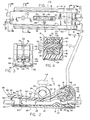
- the cord locking device 10 shown in the drawings acts to prevent longitudinal movement of a pair of flexible cords 11, which may be separate cords or opposite ends of a single drawstring of a mail bag, garment or the like. In its locked condition the device 10 holds the cords against movement in a rightward direction as viewed in Figs. 1 and 2 relative to the device.
- the cord lock 10 includes a main body part 12, an actuating member 13 mounted for swinging movement about an axis 14 relative to body 12 between the full line locked position of Fig. 2 and the broken line released position of that figure, two locking members 15 and 16 carried movably by actuating member 13, and a pivot pin 17 for connecting the parts 13, 15 and 16 to the body. All of these parts may be injection molded from an appropriate resinous plastic material, preferably nylon.
- Body 12 has two opposite sides walls 18 and 19 which extend parallel to one another and to a central longitudinal plane 20.
- the device will be described in the present specification as positioned to have plane 20 and walls 18 and 19 in directly vertically extending condition.
- Each of the walls 18 and 19 may be flat, and defined by parallel planar inner and outer vertical surfaces 21 and 22.
- those walls may have relatively high portions 23 near their right ends as viewed in Fig. 2, with the height of the walls decreasing leftwardly to a location 24, and then continuing at an essentially uniform reduced height between the location 24 and the .. location 25 of Fig. 2.
- body 12 Formed integrally with side walls 18 and 19, body 12 has a bottom wall 26, having an upper surface 27 extending directly horizontally between the two side walls and having a parallel horizontal undersurface 28. Suitable means may be provided for holding an address card or other identifying card 29 closely adjacent and generally parallel to the undersurface of bottom wall 26, as by forming the body to have retaining flanges 30 projecting downwardly therefrom and then inwardly at 31 to slidably receive opposite edges of the card 29.
- An elongated convex projection 32 extending downwardly from a central portion of bottom wall 26 can engage the card to deflect it to a slightly bowed condition assuring frictional retention of the card in a set position within the guideway flanges 30, with an end projection 33 extending downwardly at one end of body 12 for engagement with an end of the card to define the fully inserted position thereof.
- the two cords 11 extend essentially parallel to one another in laterally spaced relation along the upper surface of bottom wall 26 of body 12. These cords contact the previously mentioned upper horizontal surface 27 of bottom wall 26 except at the location of a slightly upwardly projecting gripping portion 34 of body 12, molded integrally with the remainder of the body near its right end as viewed in Fig. 2. Gripping portion 34 defines a recess 35 into which cords 11 are pressed downwardly by the two locking members 15 and 16 respectively, and against an essentially curving gripping surface or face 36 forming a wall of the recess.
- Actuating member 13 includes an arm 37 which extends generally horizontally in the Fig. 2 locking position of the parts, and whose left end as viewed in Figs. 1 and 2 functions as a handle by which member 13 can be swung upwardly or downwardly between its full line and broken line positions.
- the arm 37 of actuating member 13 may first extend gradually downwardly to a location 39, and then extend gradually upwardly at 41 toward the location of pivotal axis 14 and between the opposite side walls 18 and 19 of body 12.
- arm 37 contains a slot 42 which is elongated in the direction in which arm 37 extends, and which in the locked position of the device (full lines in Fig.
- a padlock 44 may be positioned with its locking portion or loop 45 extending through loop 43 of body 12 above arm 37 of actuating member 13 in a relation retaining the actuating member 13 in its Fig. 2 full line position and against upward cord releasing movement.
- the portion 39 of arm 37 of the actuating member engages upwardly against portion 45 of the padlock in the locking condition of the parts.
- actuating member 13 has at its right end as viewed in Fig. 2 a tubular mounting portion 46 which connects integrally with arm 37 at 47, and has an inner straight cylindrical bearing surface 48.
- the tubular portion 46 of member 13 has two outer straight cylindrical bearing surfaces 49 which are aligned axially with one another and concentric with inner surface 48, and an essentially annular flange 50 projecting radially outwardly beyond surfaces 49 at a location axially between those surfaces.
- flange 50 and the two surfaces 49 at opposite axial sides of the flange are circularly continuous about axis 14 except at the location 47 at which arm 37 connects to tubular mounting portion 46 of member 13.
- Portion 46 of member 13 has an axial length just slightly less than the spacing between the two side walls 18 and 19 of body 12, with annular parallel vertical opposite end surfaces 51 of portion 46 engaging the inner surfaces 21 of side walls 18 and 19 to effectively locate portion 46 of member 13 laterally between walls 18 and 19 and against axial movement relative thereto.
- Pivot pin 17 is preferably formed of the same type of resinous plastic material as the other parts of the device, with that material being substantially rigid and stiff but adapted for very slight resilient deformability to enable the pin to be retained in its illustrated assembled position by a snap action effect.
- the pin has an outer cylindrical surface 52 (Fig. 9) which engages and fits closely within the cylindrical bore 48 in portion 46 of member 13 in a manner mounting member 13 for its pivotal movement about axis 14 relative to body 12. This surface 52 continues at a uniform diameter from the left end 53 of the pin as viewed in Fig. 4 to a location 54 (Fi g . 9) at which an annular groove 55 centered about axis 14 is formed in the pin.
- This groove has an inner wall 56 which is cylindrical about axis 14 and two annular side walls 57 and 58 lying in planes disposed perpendicular to axis 14.
- pin 17 has a surface 52' which is externally cylindrical about axis 14 and of a diameter corresponding to surface 52 and aligned therewith to form in effect a continuation thereof.
- the pin has a frustoconically tapering annular camming surface 59 centered about axis 14 and terminating at a planar end face 60 disposed transversely of axis 14.
- the pin has a second transverse end face 61 which is perpendicular to axis 14 and co-planar with the outer surface 22 of side wall 18 of body 12 in the assembled condition of the parts.
- the left end portion of the pin as viewed in Fig. 4 is received and fits closely within a cylindrical opening 62 in wall 19, to effectively locate the pin at that end.
- wall 18 contains a blind recess 63 having a cylindrical wall 64 centered about axis 14 and coaxial with opening 62 at the opposite side of the device and of a diameter corresponding to that opening to closely receive and effectively locate the external surface 52' of the pin.
- wall 18 of the device has a portion 65 which closes recess 63 beyond the pin, to prevent access to the pin from that end.
- Portion 65 may be defined at its inner side by a planar surface 66 disposed perpendicular to axis 14.
- the outer surface 22 of wall 18 of the body is planar and uninterrupted at the location of the blind recess 63, so that recess 63 and the end of the pin cannot be seen at all from the outer side of wall 18.
- the previously mentioned inner cylindrical surface 48 of portion 46 of the actuating member 13 is preferably a straight cylindrical surface along the entire axial length of portion 46 between its opposite end surfaces 51 except at the location of a detenting projection or lug 67 which projects inwardly from portion 46 and beyond the diameter of surface 48 near the right side of portion 46 as viewed in Figs. 4 and 9.
- This projection 67 preferably has a planar shoulder surface 68 lying in a plane disposed perpendicular to axis 14 and adapted to engage surface 58 of the pin in the assembled condition of the parts to retain the pin against removal.
- projection 67 may have a second planar surface 69 disposed parallel to surface 68 and perpendicular to axis 14.
- the radially inner surface 70 of projection or lug 67 may be planar as seen in Fig. 10 and disposed perpendicular to a line 71 extending radially outwardly from axis 14.
- the minimum diameter portion 72 of projection 67 is spaced outwardly from axis 14 just slightly farther than the diameter of inner surface 56 of groove 55 in the pin.
- the minimum diameter portion 71 of the tapering camming surface 59 of the pin is preferably at a radial distance r from axis 14 which is not greater than and preferably less than radial distance R of the minimum diameter portion 72 of surface 70 from that axis.
- the two locking elements 15 and 16 may be identical and disposed about the tubular mounting portion 46 of actuating member.13 at opposite axial sides of flange 50, with the locking members being interrupted circularly at the location 47 at which arm 37 of actuating member 13 is connected to the mounting portion 46.
- the gap 172 formed in each of the locking members at the location of arm 37 has a circular extent greater than that of the arm to allow limited pivotal movement of locking members 15 and 16 relative to portion 46 and about axis 14'.
- each locking member 15 or 16 has an inner cylindrical surface 73 of a diameter corresponding to the outer surfaces 49 of portion 46 to mount the locking members for the desired pivotal movement relative to actuating member 13.
- each of the locking members 15 or 16 has a planar vertical side surface 74 slidably engaging the inner surface 21 of a corresponding one of the side walls 18 or 19 to locate the locking member relative thereto.
- each locking member has a vertical planar inner surface 75 extending parallel to surface 74 and perpendicular to axis 14 and engaging one of two parallel planar opposite side surfaces 76 of flange 50 which are also perpendicular to axis 14.
- the flange 50 of actuating member 13 prevents each of the locking members from contacting the other, and thereby avoids any tendency for one of the locking members when pivoting relative to actuating member 13 to frictionally induce corresponding pivotal movement of the other locking member.
- the locking members 15 and 16 have similar aligned outer cylindrical surfaces 77 (Fig. 5) centered about axis 14 and extending continuously about members 15 and 16 except at the location of gap 172-and at the location of a locking portion 78 projecting from the remainder of each of the locking members and provided with a series of gripping teeth 79.
- the teeth 79 of locking member 15 engage one of the cords 11, while the teeth 79 of the other gripping member 16 engage the other cord to individually lock the cords against longitudinal movement.
- These teeth are movable between the broken line released position of Fig. 2 and the full line gripping position of that figure.
- the teeth extend parallel to pivotal axis 14 of the parts, and in the locking position are received vertically opposite gripping portion 36 of body 12, to clamp the cords thereagainst.
- body 12 At its left end as viewed in Fi g . 2, body 12 has a vertical end wall 80 extending between side walls 18 and 10 and containing two openings 81 (Fig. 7) through which cords 11 extend in a manner confining and guiding them in spaced relation at that location.
- the upper sides of these openings may be formed by surfaces 82 curved arcuately in correspondence with cords 11, and the bottoms of the openings may be defined by the upper surface of bottom wall 26 of body 12.
- the padlock loop 43 carried by body 12 may be formed as part of a wall 83 projecting upwardly from body 12 and having opposite side surfaces 84 disposed parallel to and equidistant from central vertical plane 20 of the device.
- wall 83 Leftwardly of the loop portion 43 of this wall as viewed in Figs. 1 and 2, wall 83 has a reduced height portion 85 shaped to form a detenting lug 86 at its left end, with that lug having a preferably horizontal downwardly facing locking shoulder 87 at its underside, a vertical end surface 88 extending upwardly above the level of shoulder 87, and an inclined camming surface 88' (Fig. 6) thereabove.
- Arm 37 of member 13 has a detenting projection 89 extending downwardly at 90 and then rightwardly at 91 to engage shoulder surface 87 of lug 86 in a relation releasably holding actuating member 13 in its Fig. 6 full line locking position.
- the lower extremity of projection 89 has an inclined camming surface 92 which is engageable with surface 88 of lu g 86 to deflect projection 89 leftwardly as viewed in Fig. 6 upon downward movement of actuating member 13, and against the resilience of projection 89, so that the portion 91 of the projection may move downwardly past detenting lug 86 and then rightwardly at the underside of surface 89 in latching relation.
- the upper preferably horizontal surface 93 of projection 89 engages undersurface 87 of body 12 in an effective latching action while permitting manual release of the latched condition when desired.
- the resilience of the resinous plastic material of member 13 and its projection 89 is such that the actuating member 13 can be released by exertion of upward force of a predetermined value against its left end.
- projection 89 deflects leftwardly by virtue of its resilient deformability to release the latching action. This effect may be enhanced by slight flexure of arm 37 of member 13 as a result of the exertion of the upward force against the left end of member 13.
- Fig. 5 illustrates in vertical cross section the configuration of the teeth 79 formed on each of the locking members 15 and 16 and the configuration of the toothed gripping face 36 formed on portion 34 of body member 12.
- the vertical cross section of toothed gripping face 36, transversely-of axis 14, is uniform and of the configuration illustrated in Fig. 5 and described more specifically hereinbelow through the entire extent of surface 35 between the inner surface 21 of wall 18 and the inner surface 21 of wall 19.
- the vertical sectional configuration of the teeth 79 of each of the locking members 15 and 16 is desirably uniform and as illustrated in Fig. 5 through the entire axial extent of that locking member between its opposite side surfaces 74 and 75.
- the vertical cross section of the remainder of the gripping portion 34 of member 12 forwardly and rearwardly of the toothed gripping face 36 is uniform along the entire axial distance between walls 18 and 19 except at the location of two shallow grooves or recesses 94 formed in the upper surface of body 12 at the locations of the two cords 11. Except at the locations of those grooves and toothed gripping face 36, the upper surfaces 95 of portion 34 of body 12 may be horizontal, with the gripping face 36 being recessed downwardly beneath the level of those horizontal surfaces.
- each locking member 15 or 16 are preferably not centered about the pivotal axis 14 and are not a uniform radial distance from that axis. Instead, these teeth are desirably centered about a second axis 96 which is parallel to but spaced laterally from axis 14 and which in the Fig. 5 locking position of the parts is offset directly leftwardly from axis 14 and in the same horizontal plane as that axis.
- the peaks 97 of the different teeth 79 thus follow or define the curving pattern 98 represented in Fig. 5 extending about axis 96 and eccentrically with respect to main pivotal axis 14.
- teeth 79 is thus substantially closer to pivotal axis 14 than is the next successive tooth 79b, with the succeeding teeth advancing progressively farther away from axis 14.
- the peak surfaces 97 of teeth 79 preferably are flattened as shown to lie essentially along the cylindrical pattern represented at 98, with the recesses 99 between the teeth preferably being relatively shallow and curved as shown.
- the teeth 100 of gripping face 36 of part 12, and the face defined by those teeth, are also arranged in a pattern which is preferably curved essentially arcuately but not centered with respect to pivotal axis 14.
- teeth 100 are desirably smaller, than teeth 79 of locking members 15 and 16, so that the radial dimension of teeth 100 is less than the radial dimension of teeth 79, and the circular spacing between successive teeth 100 is less than the circular spacing between successive teeth 79.
- Teeth 100 have a radius greater than teeth 79, and are preferably centered about an axis or axes spaced farther from pivotal axis 14 than is the axis 96 of teeth 79. In the preferred arrangement illustrated in Fig.
- a first series of teeth 100, between the locations 101 and 102, are centered about an axis 103 which is parallel to and offset leftwardly from pivotal axis 14, while a second series of teeth 100 between locations 104 and 105 may be centered about a different axis 106 which is slightly closer to axis 14 than is axis 103, but is slightly farther from axis 14 than is axis 96.
- all of these axes 14, 96, 103 and 106 may be parallel to one another and lie in a common horizontal plane 107 (Fig. 5).
- the teeth 100 may be considered as having no effective curvature about either of the axes 103 or 106, so that in effect a line 108 joining the peaks of teeth 100 between those locations 102 and 104 may extend directly horizontally and parallel to the plane 107.
- the curved pattern defined by the peaks of teeth 100 between the locations 101 and 102 (centered about axis 103) is indicated at 109 in Fig. 5, and the curved pattern defined by the teeth 100 between the locations 104 and 105 and about axis 106 is represented at 110.
- actuating member 13 has a portion 111 forming a shroud which is received above upper portions of the locking members and bridges across the portion of gap 172 which extends between the upper side of arm 37 and end shoulders 112 of the locking members.
- This shroud thus prevents access to the portion of gap 172 which is located between arm 37 and shoulders 112, and prevents a person from inserting a screw driver or other tool into that gap and exerting prying force against the locking members at their shoulders 112 in an attempt to detach the actuating member from the locking members and thereby defeat the locking action of the device.
- Shroud 111 is formed integrally with the other portions of actuating member 13, with the shroud being connected integrally to arm 37 at the left end of the shroud as viewed in Fig. 5 and extending from that location arcuately in an upward and rightward direction to a forward end edge 113 of the shroud.
- the inner surface 114 of the shroud is cylindrical about axis 14, at a diameter just slightly greater than that of the outer cylindrical surfaces 77 of the locking members, to be received in close proximity thereto while enabling free pivotal movement of the locking members and shroud relative to one another about axis 14.
- the shroud may have an outer cylindrical surface 115 also centered about axis 14.
- the shroud has planar opposite sides surfaces 116 and 117 lying in planes which are parallel to one another and perpendicular to the pivotal axis 14 of the device, with surfaces 116 and 117 being parallel to and closely proximate inner surfaces 21 of side walls 18 and 19 of body 12, to thus prevent insertion of a screw driver or other tool between the shroud and these walls and thereby further assure against defeat of the locking action by access to gap172.
- the walls 18 and 19 of body 12 project upwardly high enough to completely enclose the opposite sides of shroud 111.
- walls 18 and 19 have upper surfaces 120 which are cylindrical about axis 14 at essentially the same diameter as the outer cylindrical surface 115 of the shroud, so that in effect the shroud surface 115 and surfaces 120 of walls 18 and 19 form an essentially continuous cylindrical surface at the top of the device.
- the walls 18 and 19 widen as seen in Fig. 5 so that in all positions the shroud is completely enclosed between and protected by the side walls.
- the periphery of flange 50 of actuating member 13 is connected integrally to the interior of shroud 111 thrcugh- the entire arcuate extent of that shroud between its edge 113 and the location 121 of Fig. 5, so that the flange assists in maintaining the shroud against deformation and the shroud also assists in maintaining the integrity and positioning of the flange.
- the flange Throughout the remainder of the circular extent of the essentially annular flange 50, the flange has an outer edge surface 122 which is centered about axis 14 and is arcuately continuous in a clockwise direction from end edge 113 of the shroud to a location 123 at the underside of arm 37 of actuating member 13.
- This edge is at a diameter substantially greater than the diameter of outer cylindrical surfaces 77 of the locking members 15 and 16 (see Figs. 2 and 5), so that the flange projects to a location horizontally between the two cords 11 (Figs. 3 and 4) , to assist in rraintaininc: those cords in separated relation.
- the grooves 94 formed in the upper surface of body 12 at the right side of teeth 100 as viewed in Figs. 2 and 5 are defined by upwardly facing surfaces 124 which are curved cylindrically about the parallel horizontal axes 125 along which cords 11 extend leftwardly toward the location of teeth 100.
- the diameter of these cylindrically curved surfaces 124 corresponds to the external diameter of the size of cord 11 with which the device is intended to be used, so that the lower portions of the cords can be received partially within grooves 94 and be located thereby to coact with the peripheral portion of flange 50 in maintaining the cords in their properly spaced positions, and facilitate initial insertion of the cords into those positions beneath the locking members.
- the two locking members 15 and 16 are first slipped axially onto tubular mounting portion 46 of actuating member 13, from opposite ends of that tubular portion, and to positions in which members 15 and 16 engage and are spaced axially apart by flange 50.
- Tubular portion 46 and the carried members 15 and 16 are then moved downwardly to a position between the two side walls 18 and 19 of body 12, and to a location in which pivot pin 17 may be inserted rightwardly from the broken line position of Fig. 4 through opening 62 in side wall 19 of body 12 and through the inner bore 48 in tubular portion 46 of member 13 and into the blind recess 63 of wall 18.
- camming surface 59 at the inner end of the pin engages the edge 126 formed on detent projection 67 (Fig. 9) of portion 46, to exert a camming force on projection 67 deflecting that projection downwardly as viewed in Fig. 9 against the resilience of the material of portion 46 and far enough to enable surface 52' of the-pin to move rightwardly past projection 67 and to the Fig. 9 fully assembled position.
- the resilience of the material of portion 46 of actuating-member 13 and of the projection 67 causes that projection to automatically return upwardly into groove 55 in the pin and into blocking relation with the portion of the pin to the right of groove 55 to positively prevent leftward withdrawal of the pin from its assembled position.
- the shoulder surface 68 of projection 67 is received to the left of and axially opposite coacting shoulder surface 58 formed on the pin, and with both of these surfaces being disposed directly perpendicular to axis 14 this engagement prevents the pin from being withdrawn.
- the recess 63 is a blind one prevents access to the right end of the pin as viewed in Fig. 9, and the fact that the left end surface 61 of the pin is flush with the outer surface 22 of wall 19 prevents a person from withdrawing the pin from that side. The device therefore cannot be disassembled by persons attempting to defeat the locking action.
- actuating member 13 may be swung upwardly about axis 14 relative to member 12 to the broken line position of Fig. 2, with corresponding swinging movement of locking members 15 and 16 to their broken line positions of Fig. 2, enabling insertion of cords 11 leftwardly through the gaps formed between elements 15 and 16 and gripping portion 34 of body 12, and with flange 50 and grooves 94 maintaining the cords in properly spaced relation in a manner assuring engagement of one cord only with locking member 15 and the other cord only with locking member 16.
- the cords are advanced leftwardly along the upper surface of the body and through the openings 81 in wall 80 to maintain them in located parallel relation as they project leftwardly beyond the locking device.
- actuating member 13 may be swung downwardly from its broken line position of Fig. 2 to its full line position, with the arm 37 of member 13 engaging members 15 and 16 at edges 127 formed on those members at the lower sides of their gaps 172, to cause members 15 and 16 to swing with actuating member 13 from their broken line position of Fig. 2 to their full line position of Figs. 2 and 5, bringing teeth 79 into engagement with the cords and thereby clamping the cords into the recess formed by gripping face 36 and against the curved series of teeth 100 in that recess.
- the design of locking elements 15 and 16 and the other parts is such that, so long as padlock 44 is in its Fig. 2 active position of engagement with loop 43, the arm 37 can not swing upwardly far enough to release the gripping engagement of locking members 15 and 16 with the cords, even though detent 89 is not in its holding condition. If the detent is unlatched and arm 37 is swung upwardly into engagement with the underside of loop 44 of the padlock and as far as it can go while the padlock is in place, members 15 and 16 still can not pivot far enough to release the cords for rightward movement as viewed in Figs. 2 and 5, and upon slight rightward movement members 15 and 16 turn in a counterclockwise direction to attain their discussed automatic tightening action.
- Fig. 11 is a view similar to Fig. 4, but showing a variational arrrangement in which a metal pin 17a is substituted for the plastic pin 17 of the first form of the invention.
- This metal pin has a cylindrical shank 126 which extends through openings or passages 127 and 128 in side walls 18a and 19a of body 12a of the device, and which extends through portion 46a of actuating member 13a between the two side walls.
- pin 17a has an enlarged head 129 bearing against side wall 19a, and at its opposite end the initially cylindrical extremity of shank 17a is upset to form an annular flange or enlargement 130 engaging the opposite side wall in a manner effectively retaining the pin in its assembled position.
- the cord lock of Fig. 11 may be identical to the first form of the invention illustrated in Figs. 1 through 10.
Landscapes
- Engineering & Computer Science (AREA)
- General Engineering & Computer Science (AREA)
- Mechanical Engineering (AREA)
- Clamps And Clips (AREA)
- Lock And Its Accessories (AREA)
- Buckles (AREA)
- Storage Of Web-Like Or Filamentary Materials (AREA)
Abstract
Description
- This invention relates to devices for retaining elongated flexible elements, such as cords, against longitudinal movement.
- In my United States Patent Number 4,424,609 issued January 10, 1984 on "Lock For Gripping Cords or The Like", I have disclosed a locking unit including an actuating member mounted pivotally to a body and carrying a locking member which engages two elongated flexible elements to hold them against longitudinal movement, with the locking member being mounted for pivotal movement with the actuating member and also relative thereto to attain automatic tightening of the gripping effect. The locking member has teeth which press the two cords into a toothed recess in the body to clamp the cord therein in parallel relation. In most instances, the two cords are in actuality opposite ends of a single cord which functions as a drawstring of a mail bag, garment, or the like.
- A major purpose of the present invention is to provide an improved double cord retaining device of the above discussed type in which, though a single actuating member serves by pivotal movement to simultaneously lock both of the cords against longitudinal movement, the automatic grip tightening effect on each of the cords is attained essentially independently of the grip tightening effect on the other cord, to thus assure very positive retention of each cord against longitudinal movement regardless of how the other cord may be manipulated. This arrangement therefore prevents the locking effect of the device from being defeated, either accidentally or intentionally, by exertion of a different longitudinal force on one of the cords than on the other in a manner which might release or relieve the holding effect on one of the cords and thereby perhaps ultimately permit access to a mail sack or the like held in closed condition by the device.
- To achieve such an independent automatic tightening action on each of the cords, a device embodying the invention preferably includes two locking members carried by a single pivotally mounted swinging actuating member, with each of the two locking members engaging and gripping a corresponding one of the two cords or other elongated flexible elements, and with each locking·member being mounted to pivot with the actuating member between its locking and released positions and also to pivot relative to both the actuating member and the other of the locking members in the locked condition of the assembly. As a result, each of the locking members can pivot automatically and independently as necessary to attain an optimum locking effect on the particular cord with which it is encaged, so that both cords may be very effectively and tightly held against longitudinal movement. Manipulation of one cord can have no effect on the positioning of the locking member associated with the other cord, and can not either intentionally or unintentionally release or partially relieve the locking action with respect to the other cord, so that regardless of how the cords are manipulated the lock can not be defeated.
- To avoid any tendency for one of the locking members upon pivotal actuation to cause corresponding pivotal movement of the other locking member, these two members are preferably maintained out of engagement with one another, desirably by a flange carried by the actuating member and received between the two locking members. This flange may have a portion projecting radially beyond the locking members and adapted to be received between the two cords to assist in maintaining them in spaced relation.
- An additional feature of the invention resides in the provision of a shroud structure carried by the actuating nomber and projecting to a location radially outwardly of and closely adjacent the locking members, to prevent unwanted access to those locking members by a person attempting to defeat theeffect of the device.

- The actuating member may be mounted formovement by a pin connected to a pair of
 walls of the body of the device and
 actuating member and havinq a snap detent relation with the other parts of the device in a manner enabling the pin to be easily inserted to an assembled condition but automatically preventing its withdrawal after such insertion.
- The above and other features and objects of the invention will be better understood from the following detailed description of the typical embodiment illustrated in the accompanying drawings, in which:
- Fig. 1 is a plan view of a cord locking device embodying the invention;
- Fig. 2 is a vertical section taken on line 2-2 of Fig. 1;
- Fig. 3 is an end elevational view taken on line 3-3 of Fig. 1;
- Fiq. 4 is a vertical section taken on line 4-4 of Fig. 1;
- Fig. 5 is an enlarged fragmentary view representing a portion of Fig. 2;
- Fig. 6 is a vertical section taken on line 6-6 of Fig. 1;
- Fig. 7 is an end view taken on line 7-7 of Fig. 1;
- Fig. 8 is a vertical section taken on line 8-8 of Fig. 1;
- Fig. 9 is an enlarged fragmentary vertical section corresponding to a portion of Fig. 4;
- Fig. 10 is a fragmentary vertical section taken on line 10-10 of Fig. 9; and
- Fig. 11 is a view similar to Fig. 4 but showing a second form of the invention.
- With reference first to Figs. 1 and 2, the
cord locking device 10 shown in the drawings acts to prevent longitudinal movement of a pair offlexible cords 11, which may be separate cords or opposite ends of a single drawstring of a mail bag, garment or the like. In its locked condition thedevice 10 holds the cords against movement in a rightward direction as viewed in Figs. 1 and 2 relative to the device. - The
cord lock 10 includes amain body part 12, an actuatingmember 13 mounted for swinging movement about anaxis 14 relative tobody 12 between the full line locked position of Fig. 2 and the broken line released position of that figure, two lockingmembers member 13, and apivot pin 17 for connecting theparts -
Body 12 has twoopposite sides walls longitudinal plane 20. The device will be described in the present specification as positioned to haveplane 20 andwalls walls vertical surfaces member 13 to the side walls, those walls may have relativelyhigh portions 23 near their right ends as viewed in Fig. 2, with the height of the walls decreasing leftwardly to alocation 24, and then continuing at an essentially uniform reduced height between thelocation 24 and the ..location 25 of Fig. 2. Formed integrally withside walls body 12 has abottom wall 26, having anupper surface 27 extending directly horizontally between the two side walls and having a parallelhorizontal undersurface 28. Suitable means may be provided for holding an address card or other identifyingcard 29 closely adjacent and generally parallel to the undersurface ofbottom wall 26, as by forming the body to have retainingflanges 30 projecting downwardly therefrom and then inwardly at 31 to slidably receive opposite edges of thecard 29. An elongatedconvex projection 32 extending downwardly from a central portion ofbottom wall 26 can engage the card to deflect it to a slightly bowed condition assuring frictional retention of the card in a set position within theguideway flanges 30, with anend projection 33 extending downwardly at one end ofbody 12 for engagement with an end of the card to define the fully inserted position thereof. - The two
cords 11 extend essentially parallel to one another in laterally spaced relation along the upper surface ofbottom wall 26 ofbody 12. These cords contact the previously mentioned upperhorizontal surface 27 ofbottom wall 26 except at the location of a slightly upwardly projectinggripping portion 34 ofbody 12, molded integrally with the remainder of the body near its right end as viewed in Fig. 2. Grippingportion 34 defines arecess 35 into whichcords 11 are pressed downwardly by the two lockingmembers - Actuating
member 13 includes anarm 37 which extends generally horizontally in the Fig. 2 locking position of the parts, and whose left end as viewed in Figs. 1 and 2 functions as a handle by whichmember 13 can be swung upwardly or downwardly between its full line and broken line positions. In extending rightwardly from itsextremity 38 in the full line locking position of Fig. 2, thearm 37 of actuatingmember 13 may first extend gradually downwardly to alocation 39, and then extend gradually upwardly at 41 toward the location ofpivotal axis 14 and between theopposite side walls body 12. At a central location,arm 37 contains aslot 42 which is elongated in the direction in whicharm 37 extends, and which in the locked position of the device (full lines in Fig. 2) receives apadlock loop 43 projecting upwardly from and formed integrally withbottom wall 26 ofbody 12. Apadlock 44 may be positioned with its locking portion orloop 45 extending throughloop 43 ofbody 12 abovearm 37 of actuatingmember 13 in a relation retaining the actuatingmember 13 in its Fig. 2 full line position and against upward cord releasing movement. Theportion 39 ofarm 37 of the actuating member engages upwardly againstportion 45 of the padlock in the locking condition of the parts. - For connection to
body 12, actuatingmember 13 has at its right end as viewed in Fig. 2 atubular mounting portion 46 which connects integrally witharm 37 at 47, and has an inner straightcylindrical bearing surface 48. Externally, thetubular portion 46 ofmember 13 has two outer straight cylindrical bearing surfaces 49 which are aligned axially with one another and concentric withinner surface 48, and an essentiallyannular flange 50 projecting radially outwardly beyondsurfaces 49 at a location axially between those surfaces. As will be understood,flange 50 and the twosurfaces 49 at opposite axial sides of the flange are circularly continuous aboutaxis 14 except at thelocation 47 at whicharm 37 connects to tubular mountingportion 46 ofmember 13.Portion 46 ofmember 13 has an axial length just slightly less than the spacing between the twoside walls body 12, with annular parallel vertical opposite end surfaces 51 ofportion 46 engaging theinner surfaces 21 ofside walls portion 46 ofmember 13 laterally betweenwalls -
Pivot pin 17 is preferably formed of the same type of resinous plastic material as the other parts of the device, with that material being substantially rigid and stiff but adapted for very slight resilient deformability to enable the pin to be retained in its illustrated assembled position by a snap action effect. The pin has an outer cylindrical surface 52 (Fig. 9) which engages and fits closely within the cylindrical bore 48 inportion 46 ofmember 13 in amanner mounting member 13 for its pivotal movement aboutaxis 14 relative tobody 12. Thissurface 52 continues at a uniform diameter from theleft end 53 of the pin as viewed in Fig. 4 to a location 54 (Fig. 9) at which anannular groove 55 centered aboutaxis 14 is formed in the pin. This groove has aninner wall 56 which is cylindrical aboutaxis 14 and twoannular side walls axis 14. Rightwardly beyond the groove as viewed in Figs. 4 and 9,pin 17 has a surface 52' which is externally cylindrical aboutaxis 14 and of a diameter corresponding to surface 52 and aligned therewith to form in effect a continuation thereof. At its right extremity in Figs. 4 and 9, the pin has a frustoconically taperingannular camming surface 59 centered aboutaxis 14 and terminating at aplanar end face 60 disposed transversely ofaxis 14. At its left end in Fig. 4, the pin has a secondtransverse end face 61 which is perpendicular toaxis 14 and co-planar with theouter surface 22 ofside wall 18 ofbody 12 in the assembled condition of the parts. The left end portion of the pin as viewed in Fig. 4 is received and fits closely within acylindrical opening 62 inwall 19, to effectively locate the pin at that end. - At the opposite end of the pin,
wall 18 contains ablind recess 63 having acylindrical wall 64 centered aboutaxis 14 and coaxial with opening 62 at the opposite side of the device and of a diameter corresponding to that opening to closely receive and effectively locate the external surface 52' of the pin. Rightwardly beyond theend surface 60 of the pin,wall 18 of the device has aportion 65 which closesrecess 63 beyond the pin, to prevent access to the pin from that end.Portion 65 may be defined at its inner side by aplanar surface 66 disposed perpendicular toaxis 14. Theouter surface 22 ofwall 18 of the body is planar and uninterrupted at the location of theblind recess 63, so that recess 63 and the end of the pin cannot be seen at all from the outer side ofwall 18. - The previously mentioned inner
cylindrical surface 48 ofportion 46 of the actuatingmember 13 is preferably a straight cylindrical surface along the entire axial length ofportion 46 between its opposite end surfaces 51 except at the location of a detenting projection or lug 67 which projects inwardly fromportion 46 and beyond the diameter ofsurface 48 near the right side ofportion 46 as viewed in Figs. 4 and 9. Thisprojection 67 preferably has aplanar shoulder surface 68 lying in a plane disposed perpendicular toaxis 14 and adapted to engagesurface 58 of the pin in the assembled condition of the parts to retain the pin against removal. At its left side in Figs. 4 and 9,projection 67 may have a secondplanar surface 69 disposed parallel to surface 68 and perpendicular toaxis 14. The radiallyinner surface 70 of projection or lug 67 may be planar as seen in Fig. 10 and disposed perpendicular to aline 71 extending radially outwardly fromaxis 14. Theminimum diameter portion 72 ofprojection 67 is spaced outwardly fromaxis 14 just slightly farther than the diameter ofinner surface 56 ofgroove 55 in the pin. It is also noted that theminimum diameter portion 71 of the taperingcamming surface 59 of the pin is preferably at a radial distance r fromaxis 14 which is not greater than and preferably less than radial distance R of theminimum diameter portion 72 ofsurface 70 from that axis. - The two
locking elements tubular mounting portion 46 of actuating member.13 at opposite axial sides offlange 50, with the locking members being interrupted circularly at thelocation 47 at whicharm 37 of actuatingmember 13 is connected to the mountingportion 46. Thegap 172 formed in each of the locking members at the location ofarm 37 has a circular extent greater than that of the arm to allow limited pivotal movement of lockingmembers portion 46 and about axis 14'. Internally, each lockingmember cylindrical surface 73 of a diameter corresponding to theouter surfaces 49 ofportion 46 to mount the locking members for the desired pivotal movement relative to actuatingmember 13. At one of its sides, each of the lockingmembers vertical side surface 74 slidably engaging theinner surface 21 of a corresponding one of theside walls inner surface 75 extending parallel to surface 74 and perpendicular toaxis 14 and engaging one of two parallel planar opposite side surfaces 76 offlange 50 which are also perpendicular toaxis 14. Thus theflange 50 of actuatingmember 13 prevents each of the locking members from contacting the other, and thereby avoids any tendency for one of the locking members when pivoting relative to actuatingmember 13 to frictionally induce corresponding pivotal movement of the other locking member. - Externally, the locking
members axis 14 and extending continuously aboutmembers portion 78 projecting from the remainder of each of the locking members and provided with a series of grippingteeth 79. Theteeth 79 of lockingmember 15 engage one of thecords 11, while theteeth 79 of the other grippingmember 16 engage the other cord to individually lock the cords against longitudinal movement. These teeth are movable between the broken line released position of Fig. 2 and the full line gripping position of that figure. The teeth extend parallel topivotal axis 14 of the parts, and in the locking position are received vertically opposite grippingportion 36 ofbody 12, to clamp the cords thereagainst. - At its left end as viewed in Fig. 2,
body 12 has avertical end wall 80 extending betweenside walls cords 11 extend in a manner confining and guiding them in spaced relation at that location. The upper sides of these openings may be formed bysurfaces 82 curved arcuately in correspondence withcords 11, and the bottoms of the openings may be defined by the upper surface ofbottom wall 26 ofbody 12. - The
padlock loop 43 carried bybody 12 may be formed as part of awall 83 projecting upwardly frombody 12 and having opposite side surfaces 84 disposed parallel to and equidistant from centralvertical plane 20 of the device. Leftwardly of theloop portion 43 of this wall as viewed in Figs. 1 and 2,wall 83 has a reducedheight portion 85 shaped to form adetenting lug 86 at its left end, with that lug having a preferably horizontal downwardly facing lockingshoulder 87 at its underside, avertical end surface 88 extending upwardly above the level ofshoulder 87, and an inclined camming surface 88' (Fig. 6) thereabove.Arm 37 ofmember 13 has adetenting projection 89 extending downwardly at 90 and then rightwardly at 91 to engageshoulder surface 87 oflug 86 in a relation releasably holding actuatingmember 13 in its Fig. 6 full line locking position. The lower extremity ofprojection 89 has aninclined camming surface 92 which is engageable withsurface 88 oflu g 86 to deflectprojection 89 leftwardly as viewed in Fig. 6 upon downward movement of actuatingmember 13, and against the resilience ofprojection 89, so that theportion 91 of the projection may move downwardlypast detenting lug 86 and then rightwardly at the underside ofsurface 89 in latching relation. In that latched condition, the upper preferablyhorizontal surface 93 ofprojection 89 engagesundersurface 87 ofbody 12 in an effective latching action while permitting manual release of the latched condition when desired. The resilience of the resinous plastic material ofmember 13 and itsprojection 89 is such that the actuatingmember 13 can be released by exertion of upward force of a predetermined value against its left end. When handle 37 is thus forced upwardly,projection 89 deflects leftwardly by virtue of its resilient deformability to release the latching action. This effect may be enhanced by slight flexure ofarm 37 ofmember 13 as a result of the exertion of the upward force against the left end ofmember 13. - Fig. 5 illustrates in vertical cross section the configuration of the
teeth 79 formed on each of the lockingmembers face 36 formed onportion 34 ofbody member 12. The vertical cross section of toothedgripping face 36, transversely-ofaxis 14, is uniform and of the configuration illustrated in Fig. 5 and described more specifically hereinbelow through the entire extent ofsurface 35 between theinner surface 21 ofwall 18 and theinner surface 21 ofwall 19. The vertical sectional configuration of theteeth 79 of each of the lockingmembers portion 34 ofmember 12 forwardly and rearwardly of the toothed grippingface 36 is uniform along the entire axial distance betweenwalls body 12 at the locations of the twocords 11. Except at the locations of those grooves and toothedgripping face 36, theupper surfaces 95 ofportion 34 ofbody 12 may be horizontal, with the grippingface 36 being recessed downwardly beneath the level of those horizontal surfaces. - The
different teeth 79 of each lockingmember pivotal axis 14 and are not a uniform radial distance from that axis. Instead, these teeth are desirably centered about a second axis 96 which is parallel to but spaced laterally fromaxis 14 and which in the Fig. 5 locking position of the parts is offset directly leftwardly fromaxis 14 and in the same horizontal plane as that axis. Thepeaks 97 of thedifferent teeth 79 thus follow or define the curvingpattern 98 represented in Fig. 5 extending about axis 96 and eccentrically with respect to mainpivotal axis 14. The circularly leading one of theteeth 79, designated astooth 79a in Fig. 5, is thus substantially closer topivotal axis 14 than is the nextsuccessive tooth 79b, with the succeeding teeth advancing progressively farther away fromaxis 14. The peak surfaces 97 ofteeth 79 preferably are flattened as shown to lie essentially along the cylindrical pattern represented at 98, with therecesses 99 between the teeth preferably being relatively shallow and curved as shown. Theteeth 100 of grippingface 36 ofpart 12, and the face defined by those teeth, are also arranged in a pattern which is preferably curved essentially arcuately but not centered with respect topivotal axis 14. Theseteeth 100 are desirably smaller, thanteeth 79 of lockingmembers teeth 100 is less than the radial dimension ofteeth 79, and the circular spacing betweensuccessive teeth 100 is less than the circular spacing betweensuccessive teeth 79.Teeth 100 have a radius greater thanteeth 79, and are preferably centered about an axis or axes spaced farther frompivotal axis 14 than is the axis 96 ofteeth 79. In the preferred arrangement illustrated in Fig. 5, a first series ofteeth 100, between thelocations axis 103 which is parallel to and offset leftwardly frompivotal axis 14, while a second series ofteeth 100 betweenlocations different axis 106 which is slightly closer toaxis 14 than isaxis 103, but is slightly farther fromaxis 14 than is axis 96. In the Fig. 2 full line position of the parts, all of theseaxes locations teeth 100 may be considered as having no effective curvature about either of theaxes line 108 joining the peaks ofteeth 100 between thoselocations plane 107. The curved pattern defined by the peaks ofteeth 100 between thelocations 101 and 102 (centered about axis 103) is indicated at 109 in Fig. 5, and the curved pattern defined by theteeth 100 between thelocations axis 106 is represented at 110. - At the upper side of the two locking
members member 13 has aportion 111 forming a shroud which is received above upper portions of the locking members and bridges across the portion ofgap 172 which extends between the upper side ofarm 37 and endshoulders 112 of the locking members. This shroud thus prevents access to the portion ofgap 172 which is located betweenarm 37 andshoulders 112, and prevents a person from inserting a screw driver or other tool into that gap and exerting prying force against the locking members at theirshoulders 112 in an attempt to detach the actuating member from the locking members and thereby defeat the locking action of the device.Shroud 111 is formed integrally with the other portions of actuatingmember 13, with the shroud being connected integrally toarm 37 at the left end of the shroud as viewed in Fig. 5 and extending from that location arcuately in an upward and rightward direction to aforward end edge 113 of the shroud. Theinner surface 114 of the shroud is cylindrical aboutaxis 14, at a diameter just slightly greater than that of the outercylindrical surfaces 77 of the locking members, to be received in close proximity thereto while enabling free pivotal movement of the locking members and shroud relative to one another aboutaxis 14. Externally, the shroud may have an outercylindrical surface 115 also centered aboutaxis 14. At its opposite sides, the shroud has planar opposite sides surfaces 116 and 117 lying in planes which are parallel to one another and perpendicular to thepivotal axis 14 of the device, withsurfaces inner surfaces 21 ofside walls body 12, to thus prevent insertion of a screw driver or other tool between the shroud and these walls and thereby further assure against defeat of the locking action by access to gap172. Thewalls body 12 project upwardly high enough to completely enclose the opposite sides ofshroud 111. Preferably, between thelocations walls upper surfaces 120 which are cylindrical aboutaxis 14 at essentially the same diameter as the outercylindrical surface 115 of the shroud, so that in effect theshroud surface 115 andsurfaces 120 ofwalls location 118 in Fig. 5 and downwardly beyond thelocation 119, thewalls - The periphery of
flange 50 of actuatingmember 13 is connected integrally to the interior ofshroud 111 thrcugh- the entire arcuate extent of that shroud between itsedge 113 and thelocation 121 of Fig. 5, so that the flange assists in maintaining the shroud against deformation and the shroud also assists in maintaining the integrity and positioning of the flange. Throughout the remainder of the circular extent of the essentiallyannular flange 50, the flange has anouter edge surface 122 which is centered aboutaxis 14 and is arcuately continuous in a clockwise direction fromend edge 113 of the shroud to alocation 123 at the underside ofarm 37 of actuatingmember 13. This edge is at a diameter substantially greater than the diameter of outercylindrical surfaces 77 of the lockingmembers 15 and 16 (see Figs. 2 and 5), so that the flange projects to a location horizontally between the two cords 11 (Figs. 3 and 4) , to assist in rraintaininc: those cords in separated relation. - The
grooves 94 formed in the upper surface ofbody 12 at the right side ofteeth 100 as viewed in Figs. 2 and 5 are defined by upwardly facingsurfaces 124 which are curved cylindrically about the parallelhorizontal axes 125 along whichcords 11 extend leftwardly toward the location ofteeth 100. The diameter of these cylindricallycurved surfaces 124 corresponds to the external diameter of the size ofcord 11 with which the device is intended to be used, so that the lower portions of the cords can be received partially withingrooves 94 and be located thereby to coact with the peripheral portion offlange 50 in maintaining the cords in their properly spaced positions, and facilitate initial insertion of the cords into those positions beneath the locking members. - To initially assemble the device, the two locking
members tubular mounting portion 46 of actuatingmember 13, from opposite ends of that tubular portion, and to positions in whichmembers flange 50.Tubular portion 46 and the carriedmembers side walls body 12, and to a location in whichpivot pin 17 may be inserted rightwardly from the broken line position of Fig. 4 throughopening 62 inside wall 19 ofbody 12 and through theinner bore 48 intubular portion 46 ofmember 13 and into theblind recess 63 ofwall 18. During this axial insertion of the pin to its fully assembled position,camming surface 59 at the inner end of the pin engages theedge 126 formed on detent projection 67 (Fig. 9) ofportion 46, to exert a camming force onprojection 67 deflecting that projection downwardly as viewed in Fig. 9 against the resilience of the material ofportion 46 and far enough to enable surface 52' of the-pin to move rightwardlypast projection 67 and to the Fig. 9 fully assembled position. When the pin reaches that position, the resilience of the material ofportion 46 of actuating-member 13 and of theprojection 67 causes that projection to automatically return upwardly intogroove 55 in the pin and into blocking relation with the portion of the pin to the right ofgroove 55 to positively prevent leftward withdrawal of the pin from its assembled position. In that condition, theshoulder surface 68 ofprojection 67 is received to the left of and axially opposite coactingshoulder surface 58 formed on the pin, and with both of these surfaces being disposed directly perpendicular toaxis 14 this engagement prevents the pin from being withdrawn. In addition, the fact that therecess 63 is a blind one prevents access to the right end of the pin as viewed in Fig. 9, and the fact that theleft end surface 61 of the pin is flush with theouter surface 22 ofwall 19 prevents a person from withdrawing the pin from that side. The device therefore cannot be disassembled by persons attempting to defeat the locking action. - After such assembly, actuating
member 13 may be swung upwardly aboutaxis 14 relative tomember 12 to the broken line position of Fig. 2, with corresponding swinging movement of lockingmembers cords 11 leftwardly through the gaps formed betweenelements portion 34 ofbody 12, and withflange 50 andgrooves 94 maintaining the cords in properly spaced relation in a manner assuring engagement of one cord only with lockingmember 15 and the other cord only with lockingmember 16. The cords are advanced leftwardly along the upper surface of the body and through theopenings 81 inwall 80 to maintain them in located parallel relation as they project leftwardly beyond the locking device. After the cords are in place, actuatingmember 13 may be swung downwardly from its broken line position of Fig. 2 to its full line position, with thearm 37 ofmember 13 engagingmembers edges 127 formed on those members at the lower sides of theirgaps 172, to causemembers member 13 from their broken line position of Fig. 2 to their full line position of Figs. 2 and 5, bringingteeth 79 into engagement with the cords and thereby clamping the cords into the recess formed by grippingface 36 and against the curved series ofteeth 100 in that recess. Subsequent exertion of rightward longitudinal force on the cords tends to cause counterclockwise pivotal movement ofmembers member 13 and aboutaxis 14, which pivotal movement acts by virtue of the eccentric configuration of both theteeth 79 ofmembers teeth 100 ofmember 12 to move theteeth 79 progressively closer toteeth 100 and thereby grip the cords progressively more tightly. An automatic tightening action is thus attained effectively and very positively preventing rightward withdrawal of the cords from between the gripping surfaces. During the final portion of the downward swinging movement of actuatingmember 13,detenting projection 89 is deflected by detentingportion 86 ofbody 12, and then returns to a position beneathportion 86, to releasably hold actuatingmember 13 in its locking position.Parts hasp 45 ofpadlock 44 throughloop 43 at a location above actuatingarm 37. - In the locked condition of the device, longitudinal force exerted by either of the
cords 11 is transmitted to only one of the two lockingmembers - Preferably, the design of locking
elements padlock 44 is in its Fig. 2 active position of engagement withloop 43, thearm 37 can not swing upwardly far enough to release the gripping engagement of lockingmembers detent 89 is not in its holding condition. If the detent is unlatched andarm 37 is swung upwardly into engagement with the underside ofloop 44 of the padlock and as far as it can go while the padlock is in place,members rightward movement members - Fig. 11 is a view similar to Fig. 4, but showing a variational arrrangement in which a
metal pin 17a is substituted for theplastic pin 17 of the first form of the invention. This metal pin has acylindrical shank 126 which extends through openings orpassages side walls body 12a of the device, and which extends throughportion 46a of actuatingmember 13a between the two side walls. At one of its ends,pin 17a has anenlarged head 129 bearing againstside wall 19a, and at its opposite end the initially cylindrical extremity ofshank 17a is upset to form an annular flange orenlargement 130 engaging the opposite side wall in a manner effectively retaining the pin in its assembled position. Except with respect to the pin and its manner of connection to the other parts of the device, the cord lock of Fig. 11 may be identical to the first form of the invention illustrated in Figs. 1 through 10. - While a certain specific embodiment of the present invention has been disclosed as typical, the invention is of course not limited to this particular form, but rather is applicable broadly to all such variations as fall within the scope of the appended claims.
Claims (24)
Applications Claiming Priority (2)
| Application Number | Priority Date | Filing Date | Title |
|---|---|---|---|
| US06/684,676 US4639978A (en) | 1984-12-21 | 1984-12-21 | Cord lock device |
| US684676 | 1984-12-21 |
Publications (2)
| Publication Number | Publication Date |
|---|---|
| EP0187113A2 true EP0187113A2 (en) | 1986-07-09 |
| EP0187113A3 EP0187113A3 (en) | 1986-12-30 |
Family
ID=24749084
Family Applications (1)
| Application Number | Title | Priority Date | Filing Date |
|---|---|---|---|
| EP85630172A Withdrawn EP0187113A3 (en) | 1984-12-21 | 1985-10-24 | Cord lock device |
Country Status (5)
| Country | Link |
|---|---|
| US (1) | US4639978A (en) |
| EP (1) | EP0187113A3 (en) |
| JP (1) | JPS61150969A (en) |
| AU (1) | AU571111B2 (en) |
| DE (1) | DE187113T1 (en) |
Cited By (3)
| Publication number | Priority date | Publication date | Assignee | Title |
|---|---|---|---|---|
| WO1997009543A1 (en) * | 1995-09-06 | 1997-03-13 | Latchways Limited | Cable grip |
| EP1990548A2 (en) | 2007-05-09 | 2008-11-12 | YKK Europe Limited | Holding device for an awning |
| KR20100003709A (en) * | 2008-07-01 | 2010-01-11 | 삼성전자주식회사 | Apparatus and method for performing handover in wireless communication system |
Families Citing this family (28)
| Publication number | Priority date | Publication date | Assignee | Title |
|---|---|---|---|---|
| US4716630A (en) * | 1987-01-20 | 1988-01-05 | Skyba Helmut K | Cam lock with positive release |
| AU600598B2 (en) * | 1987-09-25 | 1990-08-16 | Peter Hugh Wallner | Tensioning buckle |
| US4998327A (en) * | 1990-04-11 | 1991-03-12 | Hull Harold L | Traction hook and rope lock |
| US10361802B1 (en) | 1999-02-01 | 2019-07-23 | Blanding Hovenweep, Llc | Adaptive pattern recognition based control system and method |
| US8352400B2 (en) | 1991-12-23 | 2013-01-08 | Hoffberg Steven M | Adaptive pattern recognition based controller apparatus and method and human-factored interface therefore |
| US5269050A (en) * | 1992-12-10 | 1993-12-14 | Yewer Jr Edward H | Cam type buckle |
| US5408729A (en) * | 1994-03-08 | 1995-04-25 | C.I.S.-Lrc Joint Venture | Apparatus for clamping an elongated flexible member |
| US5440788A (en) * | 1994-04-04 | 1995-08-15 | Boden; Robert O. | Cord lock of elastomeric material |
| US5431123A (en) * | 1994-06-08 | 1995-07-11 | Betterway Technology, Inc. | Anchoring apparatus |
| US5819560A (en) * | 1996-05-02 | 1998-10-13 | American Lock Company | Plastic lock |
| US5722640A (en) * | 1996-09-25 | 1998-03-03 | Skyba; Helmut K. | Winch and improved sheave |
| US6209176B1 (en) * | 1997-11-03 | 2001-04-03 | National Molding Corporation | Zipper pull cord fastener |
| US7904187B2 (en) | 1999-02-01 | 2011-03-08 | Hoffberg Steven M | Internet appliance system and method |
| US6328594B1 (en) * | 1999-03-04 | 2001-12-11 | Heyco Products, Inc. | In-line strain relief |
| US6237197B1 (en) * | 1999-04-28 | 2001-05-29 | Richard Cahill Donahue | Golf cart buckle lever retaining clip |
| US6212919B1 (en) * | 1999-07-06 | 2001-04-10 | John S. Gerow | Adjustable cable loop locking system for securing a pair of spacially separated articles together |
| AU750833B2 (en) * | 1999-07-26 | 2002-08-01 | Brian Whitty | Leg-rope connection device |
| AUPQ182999A0 (en) * | 1999-07-26 | 1999-08-19 | Whitty, Brian | Leg-rope connection device |
| US6305053B1 (en) | 2000-02-01 | 2001-10-23 | John A. Galbreath | Cord lock |
| US6755054B2 (en) * | 2001-08-31 | 2004-06-29 | Master Lock Company | Cable locking mechanism |
| US7076844B2 (en) * | 2004-05-03 | 2006-07-18 | Skyba Helmut K | Open sided cam lock for ropes |
| EP2097602A1 (en) * | 2006-12-27 | 2009-09-09 | Dirk Buis | Closure means for holding closed a door |
| US20110056050A1 (en) * | 2007-10-05 | 2011-03-10 | Rope Lok, Llc | Rope lok |
| US8789485B2 (en) | 2012-02-24 | 2014-07-29 | Arthur W. Juenger | Device for securing a portion of a line |
| US8997536B2 (en) | 2012-08-30 | 2015-04-07 | Master Lock Company Llc | Lockout device |
| US8763211B1 (en) * | 2013-03-04 | 2014-07-01 | Cheng-Che Yu | Binding belt-based rod member clamping device |
| US10618730B2 (en) * | 2015-03-02 | 2020-04-14 | Grigooris MANSSOURIAN | Retainer mechanism |
| CA2970322A1 (en) * | 2016-06-14 | 2017-12-14 | Polygroup Macau Limited (Bvi) | Control wire clamp and loop systems and methods |
Family Cites Families (12)
| Publication number | Priority date | Publication date | Assignee | Title |
|---|---|---|---|---|
| US297303A (en) * | 1884-04-22 | Gael j | ||
| US715381A (en) * | 1902-06-26 | 1902-12-09 | Alexander S Hill | Hitching-post. |
| US1601046A (en) * | 1924-03-31 | 1926-09-28 | Shannon Robert Lowe | Key-actuated rope lock |
| US1597181A (en) * | 1925-11-05 | 1926-08-24 | Dennis John Everett | Mail-bag lock |
| US2431819A (en) * | 1944-05-25 | 1947-12-02 | Robert L Meyer | Cargo lash fastener |
| US2940290A (en) * | 1957-10-31 | 1960-06-14 | Stanley H Gordon | Drawrope handle lock |
| US3605205A (en) * | 1969-05-14 | 1971-09-20 | Aeroquip Corp | Low profile buckle |
| DE2928931A1 (en) * | 1979-07-18 | 1981-02-12 | Bosch Gmbh Robert | TENSION RELIEF DEVICE FOR AN ELECTRICAL CONNECTION LINE, IN PARTICULAR FROM A POWER TOOL |
| US4300269A (en) * | 1980-02-19 | 1981-11-17 | Boden Ogden W | Cord locks or the like resistant to tampering |
| US4373234A (en) * | 1980-04-01 | 1983-02-15 | Boden Ogden W | Device for gripping an elongated flexible element |
| US4424609A (en) * | 1982-01-18 | 1984-01-10 | Boden Ogden W | Lock for gripping cords or the like |
| US4465011A (en) * | 1982-07-19 | 1984-08-14 | Schaefer Marine, Inc. | Halyard stopper |
-
1984
- 1984-12-21 US US06/684,676 patent/US4639978A/en not_active Expired - Fee Related
-
1985
- 1985-09-12 AU AU47418/85A patent/AU571111B2/en not_active Ceased
- 1985-09-24 JP JP60210911A patent/JPS61150969A/en active Pending
- 1985-10-24 EP EP85630172A patent/EP0187113A3/en not_active Withdrawn
- 1985-10-24 DE DE198585630172T patent/DE187113T1/en active Pending
Cited By (4)
| Publication number | Priority date | Publication date | Assignee | Title |
|---|---|---|---|---|
| WO1997009543A1 (en) * | 1995-09-06 | 1997-03-13 | Latchways Limited | Cable grip |
| EP1990548A2 (en) | 2007-05-09 | 2008-11-12 | YKK Europe Limited | Holding device for an awning |
| DE102007021754A1 (en) | 2007-05-09 | 2008-11-13 | Ykk Europe Ltd. | Holding device for a tarpaulin |
| KR20100003709A (en) * | 2008-07-01 | 2010-01-11 | 삼성전자주식회사 | Apparatus and method for performing handover in wireless communication system |
Also Published As
| Publication number | Publication date |
|---|---|
| AU571111B2 (en) | 1988-03-31 |
| JPS61150969A (en) | 1986-07-09 |
| DE187113T1 (en) | 1986-12-18 |
| AU4741885A (en) | 1986-06-26 |
| EP0187113A3 (en) | 1986-12-30 |
| US4639978A (en) | 1987-02-03 |
Similar Documents
| Publication | Publication Date | Title |
|---|---|---|
| US4639978A (en) | Cord lock device | |
| JP3076286B2 (en) | Staple driving device | |
| US5125758A (en) | Piercing clamp | |
| US5365641A (en) | Cord stopper | |
| US5893201A (en) | Installation tool for irrigation emitter barbs | |
| USRE43718E1 (en) | Clamping device for a cutting insert | |
| US5862913A (en) | Tool display assembly | |
| US4704929A (en) | Device for setting screw | |
| US5996231A (en) | Scraping tool with replaceable blade and controlled quick-release clamp | |
| US3997053A (en) | Tool holder | |
| US5572770A (en) | Self locking cord lock | |
| CA1329700C (en) | Cord retainer for a portable electric tool | |
| CA1241853A (en) | Device for holding a screw or the like | |
| US4572039A (en) | Interlocking lock screw with screw driver | |
| US4311071A (en) | Screw driver and screw head system | |
| US6314624B1 (en) | Slide of auto-lock zipper | |
| CA2301974A1 (en) | Hex key gripping aid | |
| US4424609A (en) | Lock for gripping cords or the like | |
| US4876932A (en) | Cutting tool holder | |
| US5517840A (en) | Cylinder lock-key combination which includes a side bar; and a lock key | |
| CA2023849A1 (en) | Ball-lock tie application tool & method of use | |
| US6364191B1 (en) | Loop fastener dispensing tool | |
| US5307975A (en) | Needle for use as part of a plastic fastener dispensing tool | |
| US4784370A (en) | Staple removing device and associated method | |
| US4763388A (en) | Manually operated bag closure device |
Legal Events
| Date | Code | Title | Description |
|---|---|---|---|
| PUAI | Public reference made under article 153(3) epc to a published international application that has entered the european phase |
Free format text: ORIGINAL CODE: 0009012 |
|
| AK | Designated contracting states |
Kind code of ref document: A2 Designated state(s): DE FR GB IT SE |
|
| ITCL | It: translation for ep claims filed |
Representative=s name: RICCARDI SERGIO & CO. |
|
| PUAL | Search report despatched |
Free format text: ORIGINAL CODE: 0009013 |
|
| EL | Fr: translation of claims filed | ||
| DET | De: translation of patent claims | ||
| AK | Designated contracting states |
Kind code of ref document: A3 Designated state(s): DE FR GB IT SE |
|
| 17P | Request for examination filed |
Effective date: 19870601 |
|
| 17Q | First examination report despatched |
Effective date: 19880809 |
|
| STAA | Information on the status of an ep patent application or granted ep patent |
Free format text: STATUS: THE APPLICATION IS DEEMED TO BE WITHDRAWN |
|
| 18D | Application deemed to be withdrawn |
Effective date: 19881219 |