EP0194009B1 - Perfluoropolycycloalcoyles - Google Patents
Perfluoropolycycloalcoyles Download PDFInfo
- Publication number
- EP0194009B1 EP0194009B1 EP86300425A EP86300425A EP0194009B1 EP 0194009 B1 EP0194009 B1 EP 0194009B1 EP 86300425 A EP86300425 A EP 86300425A EP 86300425 A EP86300425 A EP 86300425A EP 0194009 B1 EP0194009 B1 EP 0194009B1
- Authority
- EP
- European Patent Office
- Prior art keywords
- fluorochemical
- compounds
- cof
- fluoride
- photolysis
- Prior art date
- Legal status (The legal status is an assumption and is not a legal conclusion. Google has not performed a legal analysis and makes no representation as to the accuracy of the status listed.)
- Expired
Links
- 150000001875 compounds Chemical class 0.000 claims description 24
- 238000006303 photolysis reaction Methods 0.000 claims description 18
- 230000015843 photosynthesis, light reaction Effects 0.000 claims description 16
- 239000000203 mixture Substances 0.000 claims description 13
- 239000007788 liquid Substances 0.000 claims description 10
- 125000004432 carbon atom Chemical group C* 0.000 claims description 9
- IYRWEQXVUNLMAY-UHFFFAOYSA-N carbonyl fluoride Chemical class FC(F)=O IYRWEQXVUNLMAY-UHFFFAOYSA-N 0.000 claims description 8
- 238000000034 method Methods 0.000 claims description 6
- SYNPRNNJJLRHTI-UHFFFAOYSA-N 2-(hydroxymethyl)butane-1,4-diol Chemical compound OCCC(CO)CO SYNPRNNJJLRHTI-UHFFFAOYSA-N 0.000 claims description 5
- 239000006227 byproduct Substances 0.000 claims description 5
- 150000001298 alcohols Chemical class 0.000 claims description 4
- 125000004122 cyclic group Chemical group 0.000 claims description 4
- 125000000113 cyclohexyl group Chemical group [H]C1([H])C([H])([H])C([H])([H])C([H])(*)C([H])([H])C1([H])[H] 0.000 claims description 4
- 125000005010 perfluoroalkyl group Chemical group 0.000 claims description 3
- 239000002243 precursor Substances 0.000 claims description 3
- QVGXLLKOCUKJST-UHFFFAOYSA-N atomic oxygen Chemical compound [O] QVGXLLKOCUKJST-UHFFFAOYSA-N 0.000 claims description 2
- 239000001301 oxygen Substances 0.000 claims description 2
- 229910052760 oxygen Inorganic materials 0.000 claims description 2
- 125000005460 perfluorocycloalkyl group Chemical group 0.000 claims description 2
- 239000004215 Carbon black (E152) Substances 0.000 claims 1
- 125000004855 decalinyl group Chemical class C1(CCCC2CCCCC12)* 0.000 claims 1
- 229930195733 hydrocarbon Natural products 0.000 claims 1
- 150000002430 hydrocarbons Chemical class 0.000 claims 1
- 239000000047 product Substances 0.000 description 26
- 239000012530 fluid Substances 0.000 description 12
- 238000009835 boiling Methods 0.000 description 11
- 238000003682 fluorination reaction Methods 0.000 description 10
- KRHYYFGTRYWZRS-UHFFFAOYSA-M Fluoride anion Chemical compound [F-] KRHYYFGTRYWZRS-UHFFFAOYSA-M 0.000 description 9
- 239000002253 acid Substances 0.000 description 8
- 150000002222 fluorine compounds Chemical class 0.000 description 8
- 238000006243 chemical reaction Methods 0.000 description 7
- -1 alkyl cyclohexane Chemical compound 0.000 description 6
- 230000000712 assembly Effects 0.000 description 5
- 238000000429 assembly Methods 0.000 description 5
- 238000010168 coupling process Methods 0.000 description 5
- NNBZCPXTIHJBJL-UHFFFAOYSA-N decalin Chemical class C1CCCC2CCCCC21 NNBZCPXTIHJBJL-UHFFFAOYSA-N 0.000 description 5
- 239000000178 monomer Substances 0.000 description 5
- FDFOVWJGNPGGIZ-UHFFFAOYSA-N 1-[1,2,2,3,3,4,4,5,6,6-decafluoro-5-(trifluoromethyl)cyclohexyl]-1,2,2,3,3,4,4,5,6,6-decafluoro-5-(trifluoromethyl)cyclohexane Chemical compound FC1(F)C(C(F)(F)F)(F)C(F)(F)C(F)(F)C(F)(F)C1(F)C1(F)C(F)(F)C(F)(C(F)(F)F)C(F)(F)C(F)(F)C1(F)F FDFOVWJGNPGGIZ-UHFFFAOYSA-N 0.000 description 4
- WNHHTRSRVNASNC-UHFFFAOYSA-N carbonyl difluoride 1,1,2,2,3,3,4,4,5,5,6-undecafluoro-6-(trifluoromethyl)cyclohexane Chemical compound FC(F)=O.FC(F)(F)C1(F)C(F)(F)C(F)(F)C(F)(F)C(F)(F)C1(F)F WNHHTRSRVNASNC-UHFFFAOYSA-N 0.000 description 4
- 239000007795 chemical reaction product Substances 0.000 description 4
- 238000004821 distillation Methods 0.000 description 4
- NBVXSUQYWXRMNV-UHFFFAOYSA-N fluoromethane Chemical class FC NBVXSUQYWXRMNV-UHFFFAOYSA-N 0.000 description 4
- 238000007654 immersion Methods 0.000 description 4
- QSHDDOUJBYECFT-UHFFFAOYSA-N mercury Chemical compound [Hg] QSHDDOUJBYECFT-UHFFFAOYSA-N 0.000 description 4
- 150000003673 urethanes Chemical class 0.000 description 4
- HIXDQWDOVZUNNA-UHFFFAOYSA-N 2-(3,4-dimethoxyphenyl)-5-hydroxy-7-methoxychromen-4-one Chemical compound C=1C(OC)=CC(O)=C(C(C=2)=O)C=1OC=2C1=CC=C(OC)C(OC)=C1 HIXDQWDOVZUNNA-UHFFFAOYSA-N 0.000 description 3
- NIXOWILDQLNWCW-UHFFFAOYSA-M Acrylate Chemical compound [O-]C(=O)C=C NIXOWILDQLNWCW-UHFFFAOYSA-M 0.000 description 3
- OKKJLVBELUTLKV-UHFFFAOYSA-N Methanol Chemical compound OC OKKJLVBELUTLKV-UHFFFAOYSA-N 0.000 description 3
- 239000000654 additive Substances 0.000 description 3
- 238000004458 analytical method Methods 0.000 description 3
- RTZKZFJDLAIYFH-UHFFFAOYSA-N ether Substances CCOCC RTZKZFJDLAIYFH-UHFFFAOYSA-N 0.000 description 3
- 229910052731 fluorine Inorganic materials 0.000 description 3
- 239000000543 intermediate Substances 0.000 description 3
- 229910052753 mercury Inorganic materials 0.000 description 3
- 238000002360 preparation method Methods 0.000 description 3
- 239000007787 solid Substances 0.000 description 3
- 239000007858 starting material Substances 0.000 description 3
- 239000012808 vapor phase Substances 0.000 description 3
- XLYOFNOQVPJJNP-UHFFFAOYSA-N water Substances O XLYOFNOQVPJJNP-UHFFFAOYSA-N 0.000 description 3
- HDCGZKPLSIIZAZ-UHFFFAOYSA-N 1,1,2,2,3,3,4,4,5,5,6,6,6-tridecafluoro-n,n-bis(1,1,2,2,3,3,4,4,5,5,6,6,6-tridecafluorohexyl)hexan-1-amine Chemical compound FC(F)(F)C(F)(F)C(F)(F)C(F)(F)C(F)(F)C(F)(F)N(C(F)(F)C(F)(F)C(F)(F)C(F)(F)C(F)(F)C(F)(F)F)C(F)(F)C(F)(F)C(F)(F)C(F)(F)C(F)(F)C(F)(F)F HDCGZKPLSIIZAZ-UHFFFAOYSA-N 0.000 description 2
- OSOUNOBYRMOXQQ-UHFFFAOYSA-N 1-chloro-3-methylbenzene Chemical compound CC1=CC=CC(Cl)=C1 OSOUNOBYRMOXQQ-UHFFFAOYSA-N 0.000 description 2
- KRHYYFGTRYWZRS-UHFFFAOYSA-N Fluorane Chemical compound F KRHYYFGTRYWZRS-UHFFFAOYSA-N 0.000 description 2
- YCKRFDGAMUMZLT-UHFFFAOYSA-N Fluorine atom Chemical compound [F] YCKRFDGAMUMZLT-UHFFFAOYSA-N 0.000 description 2
- 238000005481 NMR spectroscopy Methods 0.000 description 2
- 150000001252 acrylic acid derivatives Chemical class 0.000 description 2
- 125000003118 aryl group Chemical group 0.000 description 2
- 230000015572 biosynthetic process Effects 0.000 description 2
- WTEOIRVLGSZEPR-UHFFFAOYSA-N boron trifluoride Chemical compound FB(F)F WTEOIRVLGSZEPR-UHFFFAOYSA-N 0.000 description 2
- 239000003153 chemical reaction reagent Substances 0.000 description 2
- 230000008878 coupling Effects 0.000 description 2
- 238000005859 coupling reaction Methods 0.000 description 2
- 125000000753 cycloalkyl group Chemical group 0.000 description 2
- 239000011737 fluorine Substances 0.000 description 2
- 125000002887 hydroxy group Chemical group [H]O* 0.000 description 2
- 239000000463 material Substances 0.000 description 2
- 150000004702 methyl esters Chemical class 0.000 description 2
- 229920000642 polymer Polymers 0.000 description 2
- 238000010992 reflux Methods 0.000 description 2
- 229920005989 resin Polymers 0.000 description 2
- 239000011347 resin Substances 0.000 description 2
- PUZPDOWCWNUUKD-UHFFFAOYSA-M sodium fluoride Chemical compound [F-].[Na+] PUZPDOWCWNUUKD-UHFFFAOYSA-M 0.000 description 2
- 238000005476 soldering Methods 0.000 description 2
- 230000003595 spectral effect Effects 0.000 description 2
- 238000003786 synthesis reaction Methods 0.000 description 2
- HDVGMDBHTBNCLT-UHFFFAOYSA-N 1,2,2,3,3,4,4,5,5,6,6-undecafluorocyclohexane-1-carbonyl fluoride Chemical compound FC(=O)C1(F)C(F)(F)C(F)(F)C(F)(F)C(F)(F)C1(F)F HDVGMDBHTBNCLT-UHFFFAOYSA-N 0.000 description 1
- OIMROLVIJAVYPD-UHFFFAOYSA-N 1,2,2,3,4,4,5,5,6,6-decafluorocyclohexane-1,3-dicarbonyl fluoride Chemical compound FC(=O)C1(F)C(F)(F)C(F)(F)C(F)(F)C(F)(C(F)=O)C1(F)F OIMROLVIJAVYPD-UHFFFAOYSA-N 0.000 description 1
- XFILGGKBPBMMAU-UHFFFAOYSA-N 1-cyclohexyl-3-methylcyclohexane Chemical compound C1C(C)CCCC1C1CCCCC1 XFILGGKBPBMMAU-UHFFFAOYSA-N 0.000 description 1
- RRKMWVISRMWBAL-UHFFFAOYSA-N 3,4-dihydroxy-5-methoxybenzaldehyde Chemical compound COC1=CC(C=O)=CC(O)=C1O RRKMWVISRMWBAL-UHFFFAOYSA-N 0.000 description 1
- NVMYRXGXUBZAIU-UHFFFAOYSA-N 9-fluoren-9-ylidenefluorene Chemical class C12=CC=CC=C2C2=CC=CC=C2C1=C1C2=CC=CC=C2C2=CC=CC=C21 NVMYRXGXUBZAIU-UHFFFAOYSA-N 0.000 description 1
- 229910015900 BF3 Inorganic materials 0.000 description 1
- OKTJSMMVPCPJKN-UHFFFAOYSA-N Carbon Chemical group [C] OKTJSMMVPCPJKN-UHFFFAOYSA-N 0.000 description 1
- UGFAIRIUMAVXCW-UHFFFAOYSA-N Carbon monoxide Chemical compound [O+]#[C-] UGFAIRIUMAVXCW-UHFFFAOYSA-N 0.000 description 1
- 229910021582 Cobalt(II) fluoride Inorganic materials 0.000 description 1
- 229910021583 Cobalt(III) fluoride Inorganic materials 0.000 description 1
- XDTMQSROBMDMFD-UHFFFAOYSA-N Cyclohexane Chemical compound C1CCCCC1 XDTMQSROBMDMFD-UHFFFAOYSA-N 0.000 description 1
- 101100328843 Dictyostelium discoideum cofB gene Proteins 0.000 description 1
- YRHYPQKDFDAARH-UHFFFAOYSA-N FC(=O)F.[C] Chemical group FC(=O)F.[C] YRHYPQKDFDAARH-UHFFFAOYSA-N 0.000 description 1
- 235000015842 Hesperis Nutrition 0.000 description 1
- 235000012633 Iberis amara Nutrition 0.000 description 1
- 230000006978 adaptation Effects 0.000 description 1
- 229910001515 alkali metal fluoride Inorganic materials 0.000 description 1
- 150000001408 amides Chemical class 0.000 description 1
- 150000001491 aromatic compounds Chemical class 0.000 description 1
- 125000004429 atom Chemical group 0.000 description 1
- FDQSRULYDNDXQB-UHFFFAOYSA-N benzene-1,3-dicarbonyl chloride Chemical compound ClC(=O)C1=CC=CC(C(Cl)=O)=C1 FDQSRULYDNDXQB-UHFFFAOYSA-N 0.000 description 1
- 239000011230 binding agent Substances 0.000 description 1
- 238000010504 bond cleavage reaction Methods 0.000 description 1
- 229910002091 carbon monoxide Inorganic materials 0.000 description 1
- 239000003054 catalyst Substances 0.000 description 1
- 238000004587 chromatography analysis Methods 0.000 description 1
- 238000003776 cleavage reaction Methods 0.000 description 1
- 238000000576 coating method Methods 0.000 description 1
- WZJQNLGQTOCWDS-UHFFFAOYSA-K cobalt(iii) fluoride Chemical compound F[Co](F)F WZJQNLGQTOCWDS-UHFFFAOYSA-K 0.000 description 1
- 238000004132 cross linking Methods 0.000 description 1
- 150000001934 cyclohexanes Chemical class 0.000 description 1
- 230000006324 decarbonylation Effects 0.000 description 1
- 238000006606 decarbonylation reaction Methods 0.000 description 1
- 230000003247 decreasing effect Effects 0.000 description 1
- 239000000539 dimer Substances 0.000 description 1
- ZUOUZKKEUPVFJK-UHFFFAOYSA-N diphenyl Chemical group C1=CC=CC=C1C1=CC=CC=C1 ZUOUZKKEUPVFJK-UHFFFAOYSA-N 0.000 description 1
- 238000005516 engineering process Methods 0.000 description 1
- 150000002148 esters Chemical class 0.000 description 1
- 125000001153 fluoro group Chemical group F* 0.000 description 1
- 238000001030 gas--liquid chromatography Methods 0.000 description 1
- 239000013529 heat transfer fluid Substances 0.000 description 1
- 238000010438 heat treatment Methods 0.000 description 1
- 229910000040 hydrogen fluoride Inorganic materials 0.000 description 1
- 230000002209 hydrophobic effect Effects 0.000 description 1
- 239000007791 liquid phase Substances 0.000 description 1
- 239000012263 liquid product Substances 0.000 description 1
- 230000008018 melting Effects 0.000 description 1
- 238000002844 melting Methods 0.000 description 1
- 125000000956 methoxy group Chemical group [H]C([H])([H])O* 0.000 description 1
- 125000001160 methoxycarbonyl group Chemical group [H]C([H])([H])OC(*)=O 0.000 description 1
- 238000012544 monitoring process Methods 0.000 description 1
- 239000012299 nitrogen atmosphere Substances 0.000 description 1
- 239000003921 oil Substances 0.000 description 1
- 230000003647 oxidation Effects 0.000 description 1
- 238000007254 oxidation reaction Methods 0.000 description 1
- 125000004430 oxygen atom Chemical group O* 0.000 description 1
- 239000010702 perfluoropolyether Substances 0.000 description 1
- 238000011907 photodimerization Methods 0.000 description 1
- 239000003380 propellant Substances 0.000 description 1
- 239000010453 quartz Substances 0.000 description 1
- 238000004064 recycling Methods 0.000 description 1
- 230000007017 scission Effects 0.000 description 1
- VYPSYNLAJGMNEJ-UHFFFAOYSA-N silicon dioxide Inorganic materials O=[Si]=O VYPSYNLAJGMNEJ-UHFFFAOYSA-N 0.000 description 1
- 235000013024 sodium fluoride Nutrition 0.000 description 1
- 239000011775 sodium fluoride Substances 0.000 description 1
- PFUVRDFDKPNGAV-UHFFFAOYSA-N sodium peroxide Chemical compound [Na+].[Na+].[O-][O-] PFUVRDFDKPNGAV-UHFFFAOYSA-N 0.000 description 1
- 239000002904 solvent Substances 0.000 description 1
- 239000000126 substance Substances 0.000 description 1
- 125000001424 substituent group Chemical group 0.000 description 1
- 238000005979 thermal decomposition reaction Methods 0.000 description 1
- 238000009834 vaporization Methods 0.000 description 1
- 230000008016 vaporization Effects 0.000 description 1
Classifications
-
- C—CHEMISTRY; METALLURGY
- C07—ORGANIC CHEMISTRY
- C07C—ACYCLIC OR CARBOCYCLIC COMPOUNDS
- C07C23/00—Compounds containing at least one halogen atom bound to a ring other than a six-membered aromatic ring
- C07C23/18—Polycyclic halogenated hydrocarbons
- C07C23/20—Polycyclic halogenated hydrocarbons with condensed rings none of which is aromatic
- C07C23/36—Halogenated completely or partially hydrogenated naphthalenes
-
- C—CHEMISTRY; METALLURGY
- C07—ORGANIC CHEMISTRY
- C07C—ACYCLIC OR CARBOCYCLIC COMPOUNDS
- C07C23/00—Compounds containing at least one halogen atom bound to a ring other than a six-membered aromatic ring
- C07C23/18—Polycyclic halogenated hydrocarbons
-
- C—CHEMISTRY; METALLURGY
- C07—ORGANIC CHEMISTRY
- C07C—ACYCLIC OR CARBOCYCLIC COMPOUNDS
- C07C61/00—Compounds having carboxyl groups bound to carbon atoms of rings other than six-membered aromatic rings
- C07C61/15—Saturated compounds containing halogen
Definitions
- This invention relates to perfluoropolycycloalkane compositions.
- 3,600,433 discloses perfluorinated cyclohexane having a perfluoroalkyl side chain of 2 to 10 carbon atoms prepared by electrolytic fluorination.
- U.S. Patent No. 3,699,156 discloses perfluorocyclohexane carbonyl fluoride and perfluoro(alkyl cyclohexane) carbonyl fluorides, prepared by electrolytic fluorination.
- U.S. Patent No. 3,775,489 discloses polynuclear perfluoroaromatic compounds prepared by direct fluorination with controlled flow rate.
- This '489 patent discloses fluorinated aromatic compounds which are liquid or solid and more specially discloses in the examples mononuclear assemblies which are liquid when they have 10 carbon atoms or less and are solid when they have 14 carbon atoms or more and also refers to two compounds having coupled ring assemblies namely the perfluorinated biphenyl and the perfluorinated 9,9'bifluorene but does not suggest they are liquid at room temperature.
- the '489 patent does not suggest that the present fluorocarbon compounds having coupled ring assemblies which have at least 14 carbon atoms are liquid at room temperature.
- the present invention provides fluorochemical compounds which are liquid at room temperature and have the general formula:
- R1 and R5 are independently selected from -F, -COF and derivatives thereof other than alcohols, perfluoroalkyl groups having 1 to 4 carton atoms, and perfluorocycloalkyl groups having 4 to 14 carbon atoms;
- R2, R3 and R4 are independently residues of perfluorocycloalkane carbonyl fluorides selected from perfluorinated cyclohexane rings or perfluorinated decahydronaphthalene fused ring systems: n is 1 or 2; and m is 0 or a number less than 5 but subject to the proviso that if (R1) n R2 and R4 (R5) n are both residues of perfluorinated cyclohexane rings then m is not equal to 0.
- the perfluoropolycycloalkanes of this invention are, especially in the inert, non-functional form, nonflammable, thermally stable, and resistant to oxidation, properties which make them particularly useful as high performance fluids for use in high temperature environments, e.g., as inert fluids, heat transfer fluids, and pump fluids.
- these perfluoropolycycloalkanes are useful as fluorochemical reagents, monomers and intermediates, for example, hydroxyl group-containing compounds can be used to prepare acrylate monomers or urethane derivatives.
- perfluoropolycycloalkane ring assemblies of the present invention can be prepared by the photodimerization of perfluorocycloalkane carbonyl fluoride compounds, such as 1,3-perfluorocyclohexane dicarbonyl fluoride, and 1,5-perfluoro(decahydronaphthalene) dicarbonyl fluoride.
- the perfluorocycloalkane carbonyl fluoride precursors used in the photodimerziation, i.e., photolysis, process can be prepared by electrochemical fluorination of the appropriate cyclic hydrocarbon starting materials in liquid hydrogen fluoride following the procedures described in United States Patent No. 2,717,871.
- the crude acid fluoride products can be treated with sodium fluoride, filtered, and distilled to obtain the purified perfluorocycloalkane carbonyl fluorides.
- the purified perfluorocycloalkane carbonyl fluorides thus obtained can be photolyzed using a ultraviolet light source, for example a 450-watt medium pressure mercury vapor lamp, to cause bond cleavage between the carbonyl fluoride carbon atom and the carbon ring atom to which it is bonded, followed by coupling of the perfluorocycloalkane radicals to yield the perfluoropolycycloalkane compounds of this invention.
- a ultraviolet light source for example a 450-watt medium pressure mercury vapor lamp
- the product of the photolysis reaction is generally a mixture of the perfluorocycloalkane products which make up a major amount of the composition, generally at least 50 weight percent and usually up to 70 weight percent.
- small amounts of by-products such as ring-contracted, ring-opened, and ring-expanded compounds, can be present in the mixtures or reaction products as a result of the reaction conditions involved in their preparation.
- the presence of such by-products in amounts, for example, up to 30 weight percent of the reaction product, but generally less than 15 weight percent of the reaction product, generally does not affect the usefulness of the perfluoropolycycloalkane compounds in admixture therewith.
- R h is a cycloaliphatic or aromatic radical derived from cyclohexane or decahydronaphthalene
- X is Cl, F, or OCH3
- R f is a perfluorocycloalkane radical.
- R f COF, product II usually contains some R f F from cleavage during the electrochemical fluorination.
- R f F compounds are generally not separated and thus are present during photolysis and in the final photolysis products.
- Representative cyclic hydrocarbon (aromatic) starting materials (I), fluorinated cyclic acid fluorides (II), and the final perfluorocyclic photolysis products (III) are shown in Table 1.
- perfluorocyclic photolysis products (III) can be made, especially from the photolysis of diacid fluorides or mixtures containing diacid fluorides.
- Table 1 A wide variety of perfluorocyclic photolysis products (III) can be made, especially from the photolysis of diacid fluorides or mixtures containing diacid fluorides.
- the "F" within a ring structure conventionally denotes that the ring is perfluoro, i.e., all the ring carbon atoms are bonded to fluorine atoms and also may be bonded to substituents, e.g. CF3 or C4F9.
- R f radicals can form from R f COF, which, in addition to coupling to form the major products R f R f , can also react to a limited extent at the oxygen atom of the -COF groups to yield minor amounts of ether-containing products, e.g. (R f ) 2 CFOR f , (IV), as shown below.
- ether-containing products e.g. (R f ) 2 CFOR f , (IV), as shown below.
- IVA type IV ether product is formed along with the major coupled product IIIA on photolysis of IIA.
- various types of photoreactors can be employed. These include simple immersion reactors and recycle reactors.
- the ultraviolet light source e.g. a 450-watt medium pressure mercury lamp, generally located inside a water-cooled quartz sleeve, is placed in the perfluorocycloalkane carbonyl fluoride solution in a reaction vessel, and photolysis is carried out for the desired period (see Harris, J.F., Jr. J. Org. Chem. Vol. 30, pp. 2182-2190; 1965).
- a recycle reactor such as that disclosed by Mitsch (J. Org. Chem., Vol. 35, No. 8, pg. 2816, 1970), is generally preferred for the photolytic coupling process since it is more efficient than immersion reactors.
- the recycle reactor for the photolytic coupling process consists of refluxing a fluorochemical acid fluoride under a dry nitrogen atmosphere, with or without a suitable codistilling solvent, into the photoreactor zone where the liquid phase is photolyzed and then returned to the flask.
- the higher molecular weight acid fluoride produced hereinafter referred to as "coupled ring assembly product”
- the residence time is determined empirically and the return tube leading from the photolysis chamber to a Vigreux column is made with appropriate dimensions to accomplish the desired residence time.
- the crude reaction product mixture from the photoreactor is fractionally distilled.
- the difference in boiling points between a monoacid fluoride starting material and the coupled product is generally at least about 90°C., facilitating separat on by distillation.
- perfluoro-3-methylcyclohexane carbonyl fluoride (IIA) boils at 100°C
- perfluoro-3,3'-dimethylbicyclohexane (IIIA) boils in the range of 205-215°C.
- Perfluorocycloalkane coupled ring assembly products prepared from monoacid fluorides, may be used directly, for example, as inert fluids and heat transfer fluids for vapor phase soldering. (See Danielson, Kirk-Othmer Encyclopedia of Chemical Technology, 3rd Edition, Vol. 10, page 874, 1980).
- Coupled ring assembly products prepared from diacid fluorides may contain residual carbonyl fluoride groups. These functional compounds can be stabilized by decarbonylation by treatment with cobalt trifluoride, e.g., R f R f COF + 2CoF3 ⁇ R f R f F + CoF2 + COF2. The stabilized product is then suitable for use as a heat transfer fluid, a hydraulic fluid, or for vapor phase soldering.
- cobalt trifluoride e.g., R f R f COF + 2CoF3 ⁇ R f R f F + CoF2 + COF2.
- the fluorochemical compounds of this invention which have cyclic structures with coupled ring assemblies have lower melting and pour points than other fluorocarbon molecules with similar molecular weights, but composed entirely of open chain structures.
- perfluorotrihexylamine C18
- perfluorobis(decahydronaphthalene), IIIC, Table 1 c20
- This property is important in some applications where the fluorocarbon compound must be a fluid at a given temperature.
- the higher boiling points of the perfluoropolycycloalkane compounds having about fifteen carbon atoms or more are suitable for higher temperature adaptations of current uses for fluorocarbon inert liquids mentioned above.
- Functional coupled perfluoropolycycloalkane products containing at least one acid fluoride group can he converted to conventional derivatives such as amides, esters and alcohols or coupled further.
- the alcohols can be used to prepare acrylate monomers or urethane derivatives.
- Acrylates can be used as comonomers or crosslinking additives, e.g., for polyfunctional acrylates in the preparation of various polymers or resins. When used for this purpose these derivatives may impart water and oil resistance to the polymer or resin.
- Urethanes can be employed as hydrophobic additives in conformal coatings used on electronic circuit boards, or as high energy, high density binders or additives for propellants in rockets and flares.
- the perfluoropolycycloalkanes of this invention are, especially in the non-functional, inert form, particularly useful as fluids for use in high temperature environments, for example, as inert fluids, heat transfer fluids, and pump fluids.
- these perfluoropolycycloalkanes are useful as fluorochemical reagents, monomers, and intermediates, for example, hydroxyl group-containing compounds can be used to prepare acrylate monomers or urethane derivatives.
- Perfluoro-3-methylcyclohexane carbonyl fluoride (IIA Table 1), (464 g, 61% -COF content) obtained from the electrochemical fluorination of m-toluyl chloride, was charged to the distillation pot of a recycle photoreactor, heated at 100 to 180°C to distill into the reactor well, then irradiated for 24 hours, with a 450 watt medium pressure mercury lamp with continuous heating, distillation and recycling.
- the photoreactor contents were distilled at reduced pressure (4 to 5 torr) to yield 109 g of product boiling at 75 to 86°C. Redistillation of 62.3 g of this material at atmospheric pressure gave 55.5 g of liquid boiling between 205 to 215°C. Fluorine nuclear magnetic resonance and infrared spectral analyses of this product were consistent for the dimer IIIA of Table 1, perfluoro-3,3'-dimethylbicyclohexane. This data is summarized in Table 2.
- This example describes the photocoupling of a diacid fluoride with a monoacid fluoride using a simple immersion photoreactor.
- fraction 2 A portion of fraction 2 was distilled at atmospheric pressure to yield a liquid product, 88% boiling in the range of 270 to 287°C.
- This product was identified by fluorine nuclear magnetic resonance and infrared spectral analyses to be mainly perfluorobis-1,3 (3'-methylcyclohexyl)cyclohexane,
Landscapes
- Chemical & Material Sciences (AREA)
- Organic Chemistry (AREA)
- Organic Low-Molecular-Weight Compounds And Preparation Thereof (AREA)
Claims (7)
- Composés fluorochimiques, qui sont liquides à la température ambiante et ont la formule générale :
(R¹)nR²(R³)mR⁴(R⁵)n
dans laquelle R¹ et R⁵, indépendamment l'un de l'autre, sont chacun choisis parmi l'ensemble comprenant -F, -COF et leurs dérivés autres que les alcools, les groupes perfluoralkyle ayant de 1 à 4 atomes de carbone et les groupes perfluorocycloalkyle ayant de 4 à 14 atomes de carbone ; R², R³ et R⁴, indépendamment les uns des autres, représentent des résidus de fluorures de perfluorocycloalcanecarbonyle, choisis parmi l'ensemble comprenant les cycles cyclohexane perfluorés ou les systèmes à noyaux condensés décahydronaphtalène perfluorés ; n vaut 1 ou 2; et m vaut 0 ou un nombre inférieur à 5 mais soumis à la condition que, si (R¹)nR² et R⁴(R⁵)n sont tous les deux des résidus de noyaux cyclohexane perfluorés, alors m n'est pas égal à 0. - Composé fluorochimique selon la revendication 1, répondant à la formule :
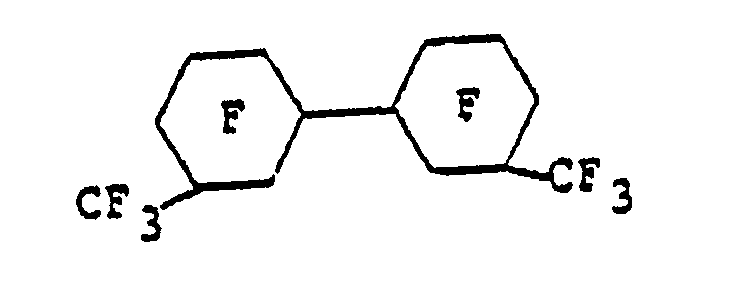
- Composé fluorochimique selon la revendication 1, répondant à la formule :

- Composé fluorochimique selon la revendication 1, répondant à la formule :

- Composé fluorochimique selon la revendication 1, répondant à la formule :

- Composition fluorochimique comprenant un composé fluorochimique selon la revendication 1 dans lequel R¹ et R⁵ représentent tous les deux -F, et une quantité mineure d'un sous-produit oxygéné de la photolyse d'un précurseur fluorure de carbonyle dudit composé fluorochimique.
- Procédé pour la conversion d'une composition fluorochimique selon la revendication 1, dans lequel au moins l'un des radicaux R¹ et R⁵ est -COF, et les autres éventuels radicaux R¹ et R⁵ représentent -F, en hydrocarbure fluoré correspondant, ledit procédé comprenant la réaction de ladite composition avec COF₃.
Applications Claiming Priority (2)
| Application Number | Priority Date | Filing Date | Title |
|---|---|---|---|
| US06/697,508 US4739112A (en) | 1985-02-01 | 1985-02-01 | Perfluoropolycycloalkanes |
| US697508 | 1985-02-01 |
Publications (3)
| Publication Number | Publication Date |
|---|---|
| EP0194009A2 EP0194009A2 (fr) | 1986-09-10 |
| EP0194009A3 EP0194009A3 (en) | 1986-12-10 |
| EP0194009B1 true EP0194009B1 (fr) | 1991-03-20 |
Family
ID=24801397
Family Applications (1)
| Application Number | Title | Priority Date | Filing Date |
|---|---|---|---|
| EP86300425A Expired EP0194009B1 (fr) | 1985-02-01 | 1986-01-22 | Perfluoropolycycloalcoyles |
Country Status (4)
| Country | Link |
|---|---|
| US (1) | US4739112A (fr) |
| EP (1) | EP0194009B1 (fr) |
| JP (1) | JPS61218537A (fr) |
| DE (1) | DE3678182D1 (fr) |
Families Citing this family (14)
| Publication number | Priority date | Publication date | Assignee | Title |
|---|---|---|---|---|
| GB8615400D0 (en) * | 1986-06-24 | 1986-07-30 | Isc Chemicals Ltd | Flourinated polycyclic compounds |
| US4873315A (en) * | 1987-08-25 | 1989-10-10 | Air Products And Chemicals, Inc. | Perfluorinated propyl derivative compounds |
| US4777304A (en) * | 1987-08-25 | 1988-10-11 | Air Products & Chemicals, Inc. | Perfluorinated butyl derivative compounds |
| US4885414A (en) * | 1987-08-25 | 1989-12-05 | Schweighardt Frank K | Perfluorinated propyl derivative compounds |
| US4956390A (en) * | 1987-08-25 | 1990-09-11 | Air Products And Chemicals, Inc. | Gas transport employing perfluorobutyldecalin |
| US4881682A (en) * | 1987-08-25 | 1989-11-21 | Air Products And Chemicals, Inc. | Vapor phase soldering with perfluorinated butyl derivative compounds |
| US4889656A (en) * | 1987-10-30 | 1989-12-26 | Minnesota Mining And Manufacturing Company | Perfluoro(cycloaliphatic methyleneoxyalkylene) carbonyl fluorides and derivatives thereof |
| US5210282A (en) * | 1987-10-30 | 1993-05-11 | Minnesota Mining And Manufacturing Company | Perfluoro(cycloaliphatic methyleneoxyalkylene) carbonyl fluorides and derivatives thereof |
| US4827053A (en) * | 1988-08-03 | 1989-05-02 | Air Products And Chemicals, Inc. | Perfluorinated Di-isopropylmethyl decalin |
| US4849553A (en) * | 1988-08-03 | 1989-07-18 | Air Products And Chemicals, Inc. | Perfluorinated dibutyl derivatives compounds |
| EP0366123B1 (fr) * | 1988-10-26 | 1994-06-01 | Osaka Gas Co., Ltd. | Fluorocarbone fluide et sa méthode de préparation |
| US5356986A (en) * | 1992-08-28 | 1994-10-18 | E. I. Du Pont De Nemours And Company | Plasticized fluoropolymers |
| JP4601759B2 (ja) * | 2000-03-09 | 2010-12-22 | 石原薬品株式会社 | ペルフルオロデカリル基含有過酸化物及びその製造方法並びにペルフルオロデカリル基含有化合物の製造方法 |
| JP5609871B2 (ja) * | 2009-07-08 | 2014-10-22 | 旭硝子株式会社 | ジ(メタ)アクリレート化合物、重合性液晶性組成物、光学異方性材料、光学素子および光情報記録再生装置 |
Family Cites Families (8)
| Publication number | Priority date | Publication date | Assignee | Title |
|---|---|---|---|---|
| US2717871A (en) * | 1952-02-01 | 1955-09-13 | Minnesota Mining & Mfg | Electrochemical production of flucrocarbon acid fluoride derivatives |
| US3028321A (en) * | 1956-11-23 | 1962-04-03 | Minnesota Mining & Mfg | Electrochemical production of fluorocarbon acid fluorides |
| US3461155A (en) * | 1965-01-18 | 1969-08-12 | Minnesota Mining & Mfg | Bis(omega-substituted perfluoroacyl) peroxides |
| US3480667A (en) * | 1965-04-28 | 1969-11-25 | Texaco Inc | Method of producing fluorinated compounds |
| US3600433A (en) * | 1967-01-11 | 1971-08-17 | Air Prod & Chem | Perfluoro cyclohexane esters of acrylic and methacrylic acids |
| US3699156A (en) * | 1967-01-11 | 1972-10-17 | Air Prod & Chem | Fluorinated cyclic alcohol and their esters |
| US3849504A (en) * | 1967-03-10 | 1974-11-19 | Minnesota Mining & Mfg | Perfluoropolyethers and process for making |
| US3775489A (en) * | 1971-04-14 | 1973-11-27 | J Margrave | Process for fluorination of aromatic and polynuclear hydrocarbon compounds and fluorocarbons produced thereby |
-
1985
- 1985-02-01 US US06/697,508 patent/US4739112A/en not_active Expired - Fee Related
-
1986
- 1986-01-22 EP EP86300425A patent/EP0194009B1/fr not_active Expired
- 1986-01-22 DE DE8686300425T patent/DE3678182D1/de not_active Expired - Lifetime
- 1986-01-31 JP JP61020024A patent/JPS61218537A/ja active Pending
Also Published As
| Publication number | Publication date |
|---|---|
| US4739112A (en) | 1988-04-19 |
| JPS61218537A (ja) | 1986-09-29 |
| EP0194009A3 (en) | 1986-12-10 |
| DE3678182D1 (de) | 1991-04-25 |
| EP0194009A2 (fr) | 1986-09-10 |
Similar Documents
| Publication | Publication Date | Title |
|---|---|---|
| EP0194009B1 (fr) | Perfluoropolycycloalcoyles | |
| US3513203A (en) | Fluorinated ketones and process for their preparation | |
| US3242218A (en) | Process for preparing fluorocarbon polyethers | |
| US4131740A (en) | Alkyl perfluoro-ω-fluoroformyl esters and their preparation | |
| US3250806A (en) | Fluorocarbon ethers of tetrafluoroethylene epoxide | |
| US2982786A (en) | Novel cyclic dimers of perfluorovinyl ethers | |
| US3542859A (en) | Fluorinated ethers | |
| GB2118541A (en) | Fluorinated vinyl ethers and their preparation | |
| US4960951A (en) | Novel perfluoropolyethers | |
| US5648560A (en) | Process for preparing perhaloethers from perhaloolefins and new perhaloethers so obtained | |
| EP0194348B1 (fr) | Addition initiée par sulphinates d'iodures perfluorés à des oléfines | |
| EP0190847A2 (fr) | Perfluorocycloalcoyle carbonyle fluorures et leurs dérivés | |
| US3311658A (en) | Fluorocarbon ethers containing iodine | |
| KR900002835B1 (ko) | 옥세탄구조함유 유동액 및 그의 제조방법 | |
| US4769184A (en) | Process for producing carbonyl fluoride compound | |
| US4898991A (en) | New perfluoropolyethers | |
| EP0344935A2 (fr) | Procédé de fluorination directe sous forme de solution utilisant une irradiation | |
| Sievert et al. | Synthesis of perfluorinated ethers by an improved solution phase direct fluorination process | |
| US3435078A (en) | Alpha,omega-bis(fluoroperhaloisopropoxy) - perfluoroalkanes and process for preparing them | |
| US3403191A (en) | Conversion of tetrafluoroethylene to liquid fluorocarbons | |
| EP0748318B1 (fr) | Procede de preparation de polyfluorooxetanes | |
| US3125581A (en) | perfluoro carbon substi- | |
| US3388078A (en) | Novel epoxy compounds and polymers therefrom | |
| US3448121A (en) | Fluorinated oxetanes | |
| US4231849A (en) | Process for the preparation of a perfluorinated cyclic ether |
Legal Events
| Date | Code | Title | Description |
|---|---|---|---|
| PUAI | Public reference made under article 153(3) epc to a published international application that has entered the european phase |
Free format text: ORIGINAL CODE: 0009012 |
|
| AK | Designated contracting states |
Kind code of ref document: A2 Designated state(s): DE FR GB IT NL |
|
| PUAL | Search report despatched |
Free format text: ORIGINAL CODE: 0009013 |
|
| AK | Designated contracting states |
Kind code of ref document: A3 Designated state(s): DE FR GB IT NL |
|
| 17P | Request for examination filed |
Effective date: 19870602 |
|
| 17Q | First examination report despatched |
Effective date: 19880212 |
|
| ITF | It: translation for a ep patent filed | ||
| GRAA | (expected) grant |
Free format text: ORIGINAL CODE: 0009210 |
|
| AK | Designated contracting states |
Kind code of ref document: B1 Designated state(s): DE FR GB IT NL |
|
| REF | Corresponds to: |
Ref document number: 3678182 Country of ref document: DE Date of ref document: 19910425 |
|
| ET | Fr: translation filed | ||
| PLBE | No opposition filed within time limit |
Free format text: ORIGINAL CODE: 0009261 |
|
| STAA | Information on the status of an ep patent application or granted ep patent |
Free format text: STATUS: NO OPPOSITION FILED WITHIN TIME LIMIT |
|
| 26N | No opposition filed | ||
| PGFP | Annual fee paid to national office [announced via postgrant information from national office to epo] |
Ref country code: FR Payment date: 19941214 Year of fee payment: 10 |
|
| PGFP | Annual fee paid to national office [announced via postgrant information from national office to epo] |
Ref country code: DE Payment date: 19941227 Year of fee payment: 10 |
|
| PGFP | Annual fee paid to national office [announced via postgrant information from national office to epo] |
Ref country code: GB Payment date: 19941228 Year of fee payment: 10 |
|
| PGFP | Annual fee paid to national office [announced via postgrant information from national office to epo] |
Ref country code: NL Payment date: 19950131 Year of fee payment: 10 |
|
| PG25 | Lapsed in a contracting state [announced via postgrant information from national office to epo] |
Ref country code: GB Effective date: 19960122 |
|
| PG25 | Lapsed in a contracting state [announced via postgrant information from national office to epo] |
Ref country code: NL Effective date: 19960801 |
|
| GBPC | Gb: european patent ceased through non-payment of renewal fee |
Effective date: 19960122 |
|
| PG25 | Lapsed in a contracting state [announced via postgrant information from national office to epo] |
Ref country code: FR Effective date: 19960930 |
|
| NLV4 | Nl: lapsed or anulled due to non-payment of the annual fee |
Effective date: 19960801 |
|
| PG25 | Lapsed in a contracting state [announced via postgrant information from national office to epo] |
Ref country code: DE Effective date: 19961001 |
|
| REG | Reference to a national code |
Ref country code: FR Ref legal event code: ST |
|
| PG25 | Lapsed in a contracting state [announced via postgrant information from national office to epo] |
Ref country code: IT Free format text: LAPSE BECAUSE OF NON-PAYMENT OF DUE FEES;WARNING: LAPSES OF ITALIAN PATENTS WITH EFFECTIVE DATE BEFORE 2007 MAY HAVE OCCURRED AT ANY TIME BEFORE 2007. THE CORRECT EFFECTIVE DATE MAY BE DIFFERENT FROM THE ONE RECORDED. Effective date: 20050122 |