EP0196989B1 - Elektromechanisches Schloss - Google Patents
Elektromechanisches Schloss Download PDFInfo
- Publication number
- EP0196989B1 EP0196989B1 EP86430003A EP86430003A EP0196989B1 EP 0196989 B1 EP0196989 B1 EP 0196989B1 EP 86430003 A EP86430003 A EP 86430003A EP 86430003 A EP86430003 A EP 86430003A EP 0196989 B1 EP0196989 B1 EP 0196989B1
- Authority
- EP
- European Patent Office
- Prior art keywords
- lock
- door
- keyboard
- code
- motor
- Prior art date
- Legal status (The legal status is an assumption and is not a legal conclusion. Google has not performed a legal analysis and makes no representation as to the accuracy of the status listed.)
- Expired - Lifetime
Links
- 230000009471 action Effects 0.000 claims abstract description 10
- 239000000463 material Substances 0.000 claims abstract description 3
- 238000000034 method Methods 0.000 claims description 14
- 239000002184 metal Substances 0.000 claims description 5
- 230000000694 effects Effects 0.000 claims description 3
- 230000007246 mechanism Effects 0.000 claims description 2
- 230000008859 change Effects 0.000 description 7
- 230000008901 benefit Effects 0.000 description 3
- 238000004140 cleaning Methods 0.000 description 2
- 230000006870 function Effects 0.000 description 2
- 230000005484 gravity Effects 0.000 description 2
- 238000012423 maintenance Methods 0.000 description 2
- 230000000712 assembly Effects 0.000 description 1
- 238000000429 assembly Methods 0.000 description 1
- 230000002354 daily effect Effects 0.000 description 1
- 238000012217 deletion Methods 0.000 description 1
- 230000037430 deletion Effects 0.000 description 1
- 238000013461 design Methods 0.000 description 1
- 230000003203 everyday effect Effects 0.000 description 1
- 238000009434 installation Methods 0.000 description 1
- 230000000737 periodic effect Effects 0.000 description 1
- 230000009897 systematic effect Effects 0.000 description 1
- 238000012360 testing method Methods 0.000 description 1
Images



Classifications
-
- E—FIXED CONSTRUCTIONS
- E05—LOCKS; KEYS; WINDOW OR DOOR FITTINGS; SAFES
- E05B—LOCKS; ACCESSORIES THEREFOR; HANDCUFFS
- E05B47/00—Operating or controlling locks or other fastening devices by electric or magnetic means
- E05B47/0001—Operating or controlling locks or other fastening devices by electric or magnetic means with electric actuators; Constructional features thereof
- E05B47/0012—Operating or controlling locks or other fastening devices by electric or magnetic means with electric actuators; Constructional features thereof with rotary electromotors
-
- G—PHYSICS
- G07—CHECKING-DEVICES
- G07C—TIME OR ATTENDANCE REGISTERS; REGISTERING OR INDICATING THE WORKING OF MACHINES; GENERATING RANDOM NUMBERS; VOTING OR LOTTERY APPARATUS; ARRANGEMENTS, SYSTEMS OR APPARATUS FOR CHECKING NOT PROVIDED FOR ELSEWHERE
- G07C9/00—Individual registration on entry or exit
- G07C9/00174—Electronically operated locks; Circuits therefor; Nonmechanical keys therefor, e.g. passive or active electrical keys or other data carriers without mechanical keys
- G07C9/00658—Electronically operated locks; Circuits therefor; Nonmechanical keys therefor, e.g. passive or active electrical keys or other data carriers without mechanical keys operated by passive electrical keys
- G07C9/00674—Electronically operated locks; Circuits therefor; Nonmechanical keys therefor, e.g. passive or active electrical keys or other data carriers without mechanical keys operated by passive electrical keys with switch-buttons
- G07C9/0069—Electronically operated locks; Circuits therefor; Nonmechanical keys therefor, e.g. passive or active electrical keys or other data carriers without mechanical keys operated by passive electrical keys with switch-buttons actuated in a predetermined sequence
-
- E—FIXED CONSTRUCTIONS
- E05—LOCKS; KEYS; WINDOW OR DOOR FITTINGS; SAFES
- E05B—LOCKS; ACCESSORIES THEREFOR; HANDCUFFS
- E05B47/00—Operating or controlling locks or other fastening devices by electric or magnetic means
- E05B47/0001—Operating or controlling locks or other fastening devices by electric or magnetic means with electric actuators; Constructional features thereof
- E05B2047/0014—Constructional features of actuators or power transmissions therefor
- E05B2047/0018—Details of actuator transmissions
- E05B2047/0024—Cams
-
- E—FIXED CONSTRUCTIONS
- E05—LOCKS; KEYS; WINDOW OR DOOR FITTINGS; SAFES
- E05B—LOCKS; ACCESSORIES THEREFOR; HANDCUFFS
- E05B47/00—Operating or controlling locks or other fastening devices by electric or magnetic means
- E05B47/0001—Operating or controlling locks or other fastening devices by electric or magnetic means with electric actuators; Constructional features thereof
- E05B2047/0014—Constructional features of actuators or power transmissions therefor
- E05B2047/0018—Details of actuator transmissions
- E05B2047/0026—Clutches, couplings or braking arrangements
- E05B2047/0027—Clutches, couplings or braking arrangements using centrifugal action
-
- Y—GENERAL TAGGING OF NEW TECHNOLOGICAL DEVELOPMENTS; GENERAL TAGGING OF CROSS-SECTIONAL TECHNOLOGIES SPANNING OVER SEVERAL SECTIONS OF THE IPC; TECHNICAL SUBJECTS COVERED BY FORMER USPC CROSS-REFERENCE ART COLLECTIONS [XRACs] AND DIGESTS
- Y10—TECHNICAL SUBJECTS COVERED BY FORMER USPC
- Y10T—TECHNICAL SUBJECTS COVERED BY FORMER US CLASSIFICATION
- Y10T70/00—Locks
- Y10T70/50—Special application
- Y10T70/5611—For control and machine elements
- Y10T70/5757—Handle, handwheel or knob
- Y10T70/5765—Rotary or swinging
- Y10T70/577—Locked stationary
- Y10T70/5783—Combination lock
- Y10T70/5788—Push pin or button
-
- Y—GENERAL TAGGING OF NEW TECHNOLOGICAL DEVELOPMENTS; GENERAL TAGGING OF CROSS-SECTIONAL TECHNOLOGIES SPANNING OVER SEVERAL SECTIONS OF THE IPC; TECHNICAL SUBJECTS COVERED BY FORMER USPC CROSS-REFERENCE ART COLLECTIONS [XRACs] AND DIGESTS
- Y10—TECHNICAL SUBJECTS COVERED BY FORMER USPC
- Y10T—TECHNICAL SUBJECTS COVERED BY FORMER US CLASSIFICATION
- Y10T70/00—Locks
- Y10T70/70—Operating mechanism
- Y10T70/7051—Using a powered device [e.g., motor]
- Y10T70/7062—Electrical type [e.g., solenoid]
- Y10T70/7068—Actuated after correct combination recognized [e.g., numerical, alphabetical, or magnet[s] pattern]
Definitions
- the subject of the invention is an electromechanical lock which can be locked at the same time by several programmable codes, by one or more users and whose eccentric for unlocking the bolt is mounted, offset, directly on the axis of the motor.
- US-A-4,148,092 describes an electromechanical lock with a coded keypad.
- DE-A-1,911,947 describes an electric lock which uses an eccentric actuated by an electric motor which acts on an unlocking trigger.
- Each door must be provided with a specific key which will be entrusted to the client for the duration of their stay and, therefore, this key must not be able to open the other doors, and master keys which will allow personnel to '' access the rooms to carry out cleaning or maintenance, daily or accidental.
- the traditional locksmith has long satisfied this need by offering hierarchical lock barrels, but a customer can take his key and an employee can lose his "pass". For security reasons, in the first case, it will be necessary to change the barrel of the door concerned, in the second case, all the cannons obeying the lost master key.
- the lock according to the invention tends to solve all these drawbacks.
- the electromechanical lock with coded keypad comprises, on its inside face, a push button which makes it possible to program the secret code of the passing user and the secret service code or codes and, on its outside face, a coded keypad; said lock comprises, in addition, keys corresponding to the normal keys of a keyboard, specific keys which are controlled for opening the door after having composed the program and / or for programming secret service codes, the electric unlocking of the lock uses an eccentric, actuated by an electric motor, which acts on the unlocking trigger; the eccentric is of the known type such as a disc mounted off-center on the axis of the electric motor; the rotation of said axis rotates the disc, which comes to strike the trigger to release the bolt characterized in that said lock comprises a plastic disc fixed concentrically to the axis of the motor so as to be integral with it in rotation.
- the customer can try his code number according to the instructions for use indicated on the external face of the lock. Without changing position, after releasing the internal electric push button, it will lock the door by pressing the mechanical push button placed in the center of the interior handle. He can then verify that the exterior handle is blocked. To unlock it, he must first press one of the specific keys. He will then dial his four-digit code number on the decimal keyboard. He will finally press one of the specific keys, simultaneously with this pressure he will perceive a small click in the lock which indicates that the unlocking is carried out. The outside handle will again be free, driving the bolt of the lock.
- the client To lock his door, either when he is in his room or when he leaves it, the client must press the mechanical push button located in the center of the interior handle. However, it will never be blocked, even when the door is locked, the exit from the room will always be free.
- the administration of the club has nine secret code numbers which will allow it to achieve a very complete pyramid hierarchy. Each contributor will be given a secret code number that only he will know, along with the security manager. Using his number, he will be able to open the doors of the rooms to which he must have access, and these only.
- the employee will have to use a procedure slightly different from that of the client. Instead of starting by pressing one of the specific keys, he will first press the first digit of his combination, an invariable number that always precedes the four-digit secret code. For example, housekeepers will be assigned coded combinations starting with the number 1 (first level in the hierarchy, with management having the number 9 corresponding to the highest level). The rest of the operation is similar to that of customers.
- the outer handle has in its center a lock barrel. Its action takes priority over the electronic functioning of the system.
- the lock according to the invention is powered by two flat batteries.
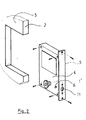
- the client finds door 3 of their room unlocked at the start of their rental. He will have to program his lock 1 according to the indications given by the screen-printed text on the inside of the latter. This mode employment will be supplemented by an illustrated sheet which will be given to him at the reception, together with the number of his room.
- the customer can try his code number according to the instructions for use indicated on the external face 4 of the lock 1. Without changing position, after having released the internal electric push button 6, he will lock the door 3 by pressing the mechanical pusher 8 placed in the center of the interior handle 9. He can then verify that the exterior handle 10 is blocked. To unlock it, he must first press the specific key 20. He will then dial his four-digit code number on the decimal keyboard. Finally, he will press the specific key 20, simultaneously with this pressure he will perceive a small click in the lock 1 which indicates that the unlocking is carried out. The exterior handle 10 will again be free, driving the bolt 11 of the lock.
- the employee To unlock a door 3, the employee must first press the first digit of his combination, unchanging number which always precedes the four-digit secret code. For example, housekeepers will be assigned coded combinations starting with the number 1 (first level in the hierarchy, with management having the number 9 corresponding to the highest level). The rest of the operation is similar to that of customers.
- the outer handle 10 has at its center a lock barrel 12. The action thereof has priority over the electronic operation of the system. These keys will not be distributed, but kept by the security manager and used only as a last resort in the event of the electronic failure of the lock.
- the lock according to the invention is powered by two flat batteries 13 of 4.5 volts. These batteries 13 allow autonomy greater than one year, under average conditions of use. Their periodic replacement must be organized systematically.
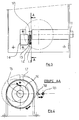
- the function to be exercised is analogous to that necessary for unlocking an electric strike: it is necessary to act on a trigger to release a mechanism, previously armed by manual effort, which moves under the action of a spring.
- the universally adopted solution for achieving this function involves the use of an electromagnet which acts directly, or indirectly, on the trigger. The energy efficiency of this solution is extremely poor and the resulting assemblies are generally delicate and therefore not very reliable.
- the solution chosen by the inventors is an original solution which directly uses the axis of an electric motor.
- a plastic disc 14 is attached concentrically with the axis 15 of the motor 16 so as to be integral with it in rotation.
- a second disc 17, made of metal to have sufficient mass, is fixed to the first, but this time off center.
- the metal disc 17 acts as an eccentric and comes to strike the trigger 18 to release it.
- This device has the advantage of benefiting from the electrical efficiency of the motor 16, which is much higher than that of an electromagnet for a large mechanical stroke, and of requiring no permanent connection between the parts linked to the motor and the trigger. On the other hand, it allows several successive tests to be carried out automatically, if the first is not successful.
- the action on the trigger takes place only after it has gained sufficient speed, which makes it possible to benefit from the kinetic energy acquired.
- the electronic part is not shown in the figures.
- the integrated circuits of the other parts are connected by lines 19 which are alone shown from the keyboard 7.
Landscapes
- Physics & Mathematics (AREA)
- General Physics & Mathematics (AREA)
- Lock And Its Accessories (AREA)
- Lubrication Of Internal Combustion Engines (AREA)
- Refinement Of Pig-Iron, Manufacture Of Cast Iron, And Steel Manufacture Other Than In Revolving Furnaces (AREA)
- Supports Or Holders For Household Use (AREA)
Claims (4)
Priority Applications (1)
| Application Number | Priority Date | Filing Date | Title |
|---|---|---|---|
| AT86430003T ATE52827T1 (de) | 1985-02-14 | 1986-02-04 | Elektromechanisches schloss. |
Applications Claiming Priority (2)
| Application Number | Priority Date | Filing Date | Title |
|---|---|---|---|
| FR8502387 | 1985-02-14 | ||
| FR8502387A FR2577601B1 (fr) | 1985-02-14 | 1985-02-14 | Serrure electromecanique verrouillable, a la fois par plusieurs codes programmables, par un ou plusieurs utilisateurs et dont la came de deverrouillage du pene est montee excentree directement sur l'axe du moteur |
Publications (2)
| Publication Number | Publication Date |
|---|---|
| EP0196989A1 EP0196989A1 (de) | 1986-10-08 |
| EP0196989B1 true EP0196989B1 (de) | 1990-05-16 |
Family
ID=9316429
Family Applications (1)
| Application Number | Title | Priority Date | Filing Date |
|---|---|---|---|
| EP86430003A Expired - Lifetime EP0196989B1 (de) | 1985-02-14 | 1986-02-04 | Elektromechanisches Schloss |
Country Status (5)
| Country | Link |
|---|---|
| US (1) | US4672826A (de) |
| EP (1) | EP0196989B1 (de) |
| AT (1) | ATE52827T1 (de) |
| DE (1) | DE3671265D1 (de) |
| FR (1) | FR2577601B1 (de) |
Families Citing this family (17)
| Publication number | Priority date | Publication date | Assignee | Title |
|---|---|---|---|---|
| USRE33873E (en) * | 1986-02-27 | 1992-04-07 | Microcomputer controlled combination lock security system | |
| US4929003A (en) * | 1988-10-07 | 1990-05-29 | Adtec Incorporated | Motorized locking mechanism for a door |
| US5027629A (en) * | 1990-01-22 | 1991-07-02 | Liu Yin Chic | Control mechanism of electronic lock |
| US4995248A (en) * | 1990-04-16 | 1991-02-26 | Liu Yin Chic | Control mechanism of electronic lock having double bolts |
| GB2255368B (en) * | 1991-05-03 | 1994-09-28 | Yale Security Prod Ltd | Electro-mechanical lock devices |
| WO1992021844A1 (de) * | 1991-05-30 | 1992-12-10 | Hans Schreiber | Verfahren nebst bausatz zur betätigung eines elektronisch gesteuerten schlosses bzw. schliesszylinders |
| DE69412139T2 (de) * | 1993-12-23 | 1999-03-25 | Shivendra Brampton Ontario Varma | Mittels kode betätigbarer schlossmechanismus der eine falle und einen riegel fuer hotelzimmertueren umfasst |
| FR2728614B1 (fr) * | 1994-12-23 | 1997-10-31 | Anelec | Fermeture electromecanique de porte |
| US5820234A (en) * | 1995-02-07 | 1998-10-13 | Hurd Corporation | Programmable electronic desk lock |
| FR2782112A1 (fr) * | 1998-08-05 | 2000-02-11 | Elie Wagman | Procede et dispositif de commande d'acces a un lieu collectif |
| USD553953S1 (en) | 2006-04-13 | 2007-10-30 | Harrow Products Llc | Deadbolt escutcheon |
| USD552966S1 (en) | 2006-07-21 | 2007-10-16 | Harrow Products Llc | Lock escutcheon |
| USD552964S1 (en) | 2006-07-21 | 2007-10-16 | Harrow Products Llc | Keypad for a deadbolt escutcheon |
| USD552968S1 (en) | 2006-07-21 | 2007-10-16 | Harrow Products Llc | Deadbolt escutcheon |
| USD552967S1 (en) | 2006-07-21 | 2007-10-16 | Harrow Products Llc | Lock escutcheon |
| US8141400B2 (en) * | 2009-04-10 | 2012-03-27 | Emtek Products, Inc. | Keypad lockset |
| ES2555675B1 (es) * | 2014-07-02 | 2016-06-28 | Cerrajeria Delhom Sl | Cerradura electrónica |
Family Cites Families (9)
| Publication number | Priority date | Publication date | Assignee | Title |
|---|---|---|---|---|
| DE1911947A1 (de) * | 1969-03-10 | 1970-09-24 | Jean Wuertz | Ferngesteuerter Toroeffner |
| DE1914724A1 (de) * | 1969-03-22 | 1970-10-15 | Volkswagenwerk Ag | Motorische Schlossverriegelung |
| US3584486A (en) * | 1969-11-14 | 1971-06-15 | Trius Corp | Electronic lock and security system |
| US4038846A (en) * | 1975-10-24 | 1977-08-02 | Paul Klann | Electronic combination lock |
| US4148092A (en) * | 1977-08-04 | 1979-04-03 | Ricky Martin | Electronic combination door lock with dead bolt sensing means |
| CH609413A5 (de) * | 1977-09-23 | 1979-02-28 | Huwil Werke Gmbh | |
| FR2444979A1 (fr) * | 1978-12-18 | 1980-07-18 | Mer Paul Andre | Dispositif electronique de commande codee par clavier a touches |
| FR2467946A1 (fr) * | 1979-10-16 | 1981-04-30 | Phan Chi Cao Son | Serrure electronique a alarme |
| FR2535775B1 (fr) * | 1982-11-10 | 1986-06-06 | Lewiner Jacques | Perfectionnement aux serrures de securite a tringles |
-
1985
- 1985-02-14 FR FR8502387A patent/FR2577601B1/fr not_active Expired - Fee Related
-
1986
- 1986-02-04 AT AT86430003T patent/ATE52827T1/de not_active IP Right Cessation
- 1986-02-04 EP EP86430003A patent/EP0196989B1/de not_active Expired - Lifetime
- 1986-02-04 DE DE8686430003T patent/DE3671265D1/de not_active Expired - Fee Related
- 1986-02-14 US US06/829,609 patent/US4672826A/en not_active Expired - Fee Related
Also Published As
| Publication number | Publication date |
|---|---|
| DE3671265D1 (de) | 1990-06-21 |
| ATE52827T1 (de) | 1990-06-15 |
| US4672826A (en) | 1987-06-16 |
| EP0196989A1 (de) | 1986-10-08 |
| FR2577601A1 (fr) | 1986-08-22 |
| FR2577601B1 (fr) | 1991-03-01 |
Similar Documents
| Publication | Publication Date | Title |
|---|---|---|
| EP0196989B1 (de) | Elektromechanisches Schloss | |
| EP0099762B1 (de) | Kodierbare Fernsteuerungsanordnungen | |
| DK174392B1 (da) | Udendørs, offentlig modultelefon | |
| CN102282331B (zh) | 锁和对应该锁的二进制钥匙 | |
| US20050217326A1 (en) | Mechanical dial combination lock | |
| EP0068936B1 (de) | Elektronisch kodierbare Verriegelungsanordnungen | |
| CN1232714C (zh) | 号码锁 | |
| EP0973986A1 (de) | Elektronisch gesteuertes schloss | |
| FR2532677A1 (fr) | Serrure electronique dont le code peut etre modifie | |
| FR2500520A1 (fr) | Dispositif de commande electromecanique d'une serrure | |
| EP0033261B1 (de) | Kombinations-Sicherheitsschlösser | |
| EP0133837B1 (de) | Verstellbares Konbinationsschloss | |
| EP4127364A1 (de) | Türschloss und knopfsystem mit unsichtbarer nabe | |
| EP0116001B1 (de) | Sicherheitseinrichtung für Türen, Fenster und dergleichen | |
| EP0187104B1 (de) | Schloss mit Falle und Zusatzriegel | |
| US4599877A (en) | Key lock with key isolation | |
| FR2700933A1 (fr) | Casier de rangement et modules de casiers de rangement formant vestiaire par exemple. | |
| EP4435212B1 (de) | Aussteller | |
| EP0262262B1 (de) | Einrichtung zur Betätigung eines Sicherheitsschlosses und mit einer solchen Einrichtung ausgestattetes Schloss | |
| EP0323344B1 (de) | Elektronisches Schloss mit programmierbarer Scheibe | |
| EP2896771B1 (de) | Perfektioniertes Schloss mit Doppelzylinder | |
| RU2709565C1 (ru) | Перестановочный замок | |
| FR2519058A1 (fr) | Dispositif d'acces code a semi-conducteurs | |
| FR2788546A1 (fr) | Serrure et systeme de securite equipe d'une telle serrure | |
| EP0412969A1 (de) | Mit einem schlüssel oder einer karte zu betätigende sicherheitseinrichtung |
Legal Events
| Date | Code | Title | Description |
|---|---|---|---|
| PUAI | Public reference made under article 153(3) epc to a published international application that has entered the european phase |
Free format text: ORIGINAL CODE: 0009012 |
|
| AK | Designated contracting states |
Kind code of ref document: A1 Designated state(s): AT BE CH DE GB IT LI LU NL SE |
|
| 17P | Request for examination filed |
Effective date: 19870218 |
|
| 17Q | First examination report despatched |
Effective date: 19880624 |
|
| GRAA | (expected) grant |
Free format text: ORIGINAL CODE: 0009210 |
|
| AK | Designated contracting states |
Kind code of ref document: B1 Designated state(s): AT BE CH DE GB IT LI LU NL SE |
|
| PG25 | Lapsed in a contracting state [announced via postgrant information from national office to epo] |
Ref country code: IT Free format text: LAPSE BECAUSE OF FAILURE TO SUBMIT A TRANSLATION OF THE DESCRIPTION OR TO PAY THE FEE WITHIN THE PRE;WARNING: LAPSES OF ITALIAN PATENTS WITH EFFECTIVE DATE BEFORE 2007 MAY HAVE OCCURRED AT ANY TIME BEFORE 2007. THE CORRECT EFFECTIVE DATE MAY BE DIFFERENT FROM THE ONE RECORDED.SCRIBED TIME-LIMIT Effective date: 19900516 Ref country code: AT Effective date: 19900516 Ref country code: NL Effective date: 19900516 Ref country code: GB Effective date: 19900516 Ref country code: SE Effective date: 19900516 |
|
| REF | Corresponds to: |
Ref document number: 52827 Country of ref document: AT Date of ref document: 19900615 Kind code of ref document: T |
|
| REF | Corresponds to: |
Ref document number: 3671265 Country of ref document: DE Date of ref document: 19900621 |
|
| NLV1 | Nl: lapsed or annulled due to failure to fulfill the requirements of art. 29p and 29m of the patents act | ||
| GBV | Gb: ep patent (uk) treated as always having been void in accordance with gb section 77(7)/1977 [no translation filed] | ||
| PG25 | Lapsed in a contracting state [announced via postgrant information from national office to epo] |
Ref country code: LU Free format text: LAPSE BECAUSE OF NON-PAYMENT OF DUE FEES Effective date: 19910228 Ref country code: CH Effective date: 19910228 Ref country code: LI Effective date: 19910228 |
|
| PLBE | No opposition filed within time limit |
Free format text: ORIGINAL CODE: 0009261 |
|
| STAA | Information on the status of an ep patent application or granted ep patent |
Free format text: STATUS: NO OPPOSITION FILED WITHIN TIME LIMIT |
|
| 26N | No opposition filed | ||
| REG | Reference to a national code |
Ref country code: CH Ref legal event code: PL |
|
| PGFP | Annual fee paid to national office [announced via postgrant information from national office to epo] |
Ref country code: BE Payment date: 19960212 Year of fee payment: 11 |
|
| PGFP | Annual fee paid to national office [announced via postgrant information from national office to epo] |
Ref country code: DE Payment date: 19960426 Year of fee payment: 11 |
|
| PG25 | Lapsed in a contracting state [announced via postgrant information from national office to epo] |
Ref country code: BE Effective date: 19970228 |
|
| BERE | Be: lapsed |
Owner name: MER/ICB MECANISMES ELECTRONIQUES REALISES/INNOVA Effective date: 19970228 |
|
| PG25 | Lapsed in a contracting state [announced via postgrant information from national office to epo] |
Ref country code: DE Effective date: 19971101 |