EP0203017A1 - Thermoplastische Zusammensetzungen mit sehr hohem Gehalt an pulverförmigen mineralischen Stoffen zur Einarbeitung in Polymere - Google Patents
Thermoplastische Zusammensetzungen mit sehr hohem Gehalt an pulverförmigen mineralischen Stoffen zur Einarbeitung in Polymere Download PDFInfo
- Publication number
- EP0203017A1 EP0203017A1 EP86420133A EP86420133A EP0203017A1 EP 0203017 A1 EP0203017 A1 EP 0203017A1 EP 86420133 A EP86420133 A EP 86420133A EP 86420133 A EP86420133 A EP 86420133A EP 0203017 A1 EP0203017 A1 EP 0203017A1
- Authority
- EP
- European Patent Office
- Prior art keywords
- high content
- aggregates
- mineral matter
- weight
- polymer
- Prior art date
- Legal status (The legal status is an assumption and is not a legal conclusion. Google has not performed a legal analysis and makes no representation as to the accuracy of the status listed.)
- Granted
Links
- 229920000642 polymer Polymers 0.000 title claims abstract description 119
- 229910052500 inorganic mineral Inorganic materials 0.000 title claims abstract description 90
- 239000011707 mineral Substances 0.000 title claims abstract description 90
- 239000000203 mixture Substances 0.000 title claims abstract description 83
- 229920001169 thermoplastic Polymers 0.000 title claims abstract description 31
- 239000004416 thermosoftening plastic Substances 0.000 title claims abstract description 22
- 238000010348 incorporation Methods 0.000 title description 16
- 239000000126 substance Substances 0.000 title description 3
- 239000000463 material Substances 0.000 claims abstract description 52
- 229920001577 copolymer Polymers 0.000 claims abstract description 49
- 229920000098 polyolefin Polymers 0.000 claims abstract description 48
- 239000003795 chemical substances by application Substances 0.000 claims abstract description 43
- 230000001427 coherent effect Effects 0.000 claims abstract description 17
- 239000000178 monomer Substances 0.000 claims abstract description 12
- 238000002844 melting Methods 0.000 claims abstract description 9
- 230000008018 melting Effects 0.000 claims abstract description 9
- 239000002671 adjuvant Substances 0.000 claims abstract description 6
- 229910019142 PO4 Inorganic materials 0.000 claims abstract description 4
- 239000010452 phosphate Substances 0.000 claims abstract description 4
- 235000010755 mineral Nutrition 0.000 claims description 86
- -1 polypropylenes Polymers 0.000 claims description 32
- 239000000155 melt Substances 0.000 claims description 23
- 229920001684 low density polyethylene Polymers 0.000 claims description 13
- 150000003254 radicals Chemical class 0.000 claims description 12
- 238000002156 mixing Methods 0.000 claims description 11
- 125000004432 carbon atom Chemical group C* 0.000 claims description 7
- 235000013339 cereals Nutrition 0.000 claims description 7
- 239000004743 Polypropylene Substances 0.000 claims description 6
- 229920001155 polypropylene Polymers 0.000 claims description 6
- 229910052751 metal Inorganic materials 0.000 claims description 5
- 229920006395 saturated elastomer Polymers 0.000 claims description 5
- 239000005995 Aluminium silicate Substances 0.000 claims description 4
- CPLXHLVBOLITMK-UHFFFAOYSA-N Magnesium oxide Chemical compound [Mg]=O CPLXHLVBOLITMK-UHFFFAOYSA-N 0.000 claims description 4
- VYPSYNLAJGMNEJ-UHFFFAOYSA-N Silicium dioxide Chemical compound O=[Si]=O VYPSYNLAJGMNEJ-UHFFFAOYSA-N 0.000 claims description 4
- 235000012211 aluminium silicate Nutrition 0.000 claims description 4
- 238000007334 copolymerization reaction Methods 0.000 claims description 4
- NLYAJNPCOHFWQQ-UHFFFAOYSA-N kaolin Chemical compound O.O.O=[Al]O[Si](=O)O[Si](=O)O[Al]=O NLYAJNPCOHFWQQ-UHFFFAOYSA-N 0.000 claims description 4
- 239000000454 talc Substances 0.000 claims description 4
- 229910052623 talc Inorganic materials 0.000 claims description 4
- 229920002367 Polyisobutene Polymers 0.000 claims description 3
- TZCXTZWJZNENPQ-UHFFFAOYSA-L barium sulfate Chemical class [Ba+2].[O-]S([O-])(=O)=O TZCXTZWJZNENPQ-UHFFFAOYSA-L 0.000 claims description 3
- 150000003839 salts Chemical class 0.000 claims description 3
- OKTJSMMVPCPJKN-UHFFFAOYSA-N Carbon Chemical group [C] OKTJSMMVPCPJKN-UHFFFAOYSA-N 0.000 claims description 2
- 229920000049 Carbon (fiber) Polymers 0.000 claims description 2
- 229920003043 Cellulose fiber Polymers 0.000 claims description 2
- 235000008733 Citrus aurantifolia Nutrition 0.000 claims description 2
- 229920002943 EPDM rubber Polymers 0.000 claims description 2
- IAYPIBMASNFSPL-UHFFFAOYSA-N Ethylene oxide Chemical compound C1CO1 IAYPIBMASNFSPL-UHFFFAOYSA-N 0.000 claims description 2
- VQTUBCCKSQIDNK-UHFFFAOYSA-N Isobutene Chemical group CC(C)=C VQTUBCCKSQIDNK-UHFFFAOYSA-N 0.000 claims description 2
- NBIIXXVUZAFLBC-UHFFFAOYSA-N Phosphoric acid Chemical group OP(O)(O)=O NBIIXXVUZAFLBC-UHFFFAOYSA-N 0.000 claims description 2
- GOOHAUXETOMSMM-UHFFFAOYSA-N Propylene oxide Chemical compound CC1CO1 GOOHAUXETOMSMM-UHFFFAOYSA-N 0.000 claims description 2
- 229920002472 Starch Polymers 0.000 claims description 2
- 235000011941 Tilia x europaea Nutrition 0.000 claims description 2
- FMRLDPWIRHBCCC-UHFFFAOYSA-L Zinc carbonate Chemical compound [Zn+2].[O-]C([O-])=O FMRLDPWIRHBCCC-UHFFFAOYSA-L 0.000 claims description 2
- 239000002253 acid Substances 0.000 claims description 2
- WNROFYMDJYEPJX-UHFFFAOYSA-K aluminium hydroxide Chemical class [OH-].[OH-].[OH-].[Al+3] WNROFYMDJYEPJX-UHFFFAOYSA-K 0.000 claims description 2
- 150000005840 aryl radicals Chemical class 0.000 claims description 2
- 239000011324 bead Substances 0.000 claims description 2
- 239000004917 carbon fiber Substances 0.000 claims description 2
- 150000004649 carbonic acid derivatives Chemical class 0.000 claims description 2
- 125000003178 carboxy group Chemical group [H]OC(*)=O 0.000 claims description 2
- 239000010459 dolomite Substances 0.000 claims description 2
- 229910000514 dolomite Inorganic materials 0.000 claims description 2
- 239000000975 dye Substances 0.000 claims description 2
- 235000013312 flour Nutrition 0.000 claims description 2
- 125000000524 functional group Chemical group 0.000 claims description 2
- 229910052736 halogen Inorganic materials 0.000 claims description 2
- 150000002367 halogens Chemical class 0.000 claims description 2
- 125000000623 heterocyclic group Chemical group 0.000 claims description 2
- 229910052739 hydrogen Inorganic materials 0.000 claims description 2
- 239000001257 hydrogen Substances 0.000 claims description 2
- 239000004571 lime Substances 0.000 claims description 2
- ZLNQQNXFFQJAID-UHFFFAOYSA-L magnesium carbonate Chemical compound [Mg+2].[O-]C([O-])=O ZLNQQNXFFQJAID-UHFFFAOYSA-L 0.000 claims description 2
- 239000001095 magnesium carbonate Substances 0.000 claims description 2
- 229910000021 magnesium carbonate Inorganic materials 0.000 claims description 2
- 239000000395 magnesium oxide Substances 0.000 claims description 2
- 239000010445 mica Substances 0.000 claims description 2
- 229910052618 mica group Inorganic materials 0.000 claims description 2
- 239000000377 silicon dioxide Substances 0.000 claims description 2
- 239000008107 starch Substances 0.000 claims description 2
- 235000019698 starch Nutrition 0.000 claims description 2
- 229920001935 styrene-ethylene-butadiene-styrene Polymers 0.000 claims description 2
- 239000010456 wollastonite Substances 0.000 claims description 2
- 229910052882 wollastonite Inorganic materials 0.000 claims description 2
- 239000011667 zinc carbonate Substances 0.000 claims description 2
- 229910000010 zinc carbonate Inorganic materials 0.000 claims description 2
- 235000004416 zinc carbonate Nutrition 0.000 claims description 2
- XEEYBQQBJWHFJM-UHFFFAOYSA-N Iron Chemical compound [Fe] XEEYBQQBJWHFJM-UHFFFAOYSA-N 0.000 claims 2
- OYPRJOBELJOOCE-UHFFFAOYSA-N Calcium Chemical compound [Ca] OYPRJOBELJOOCE-UHFFFAOYSA-N 0.000 claims 1
- RTAQQCXQSZGOHL-UHFFFAOYSA-N Titanium Chemical compound [Ti] RTAQQCXQSZGOHL-UHFFFAOYSA-N 0.000 claims 1
- HCHKCACWOHOZIP-UHFFFAOYSA-N Zinc Chemical compound [Zn] HCHKCACWOHOZIP-UHFFFAOYSA-N 0.000 claims 1
- 229910052791 calcium Inorganic materials 0.000 claims 1
- 239000011575 calcium Substances 0.000 claims 1
- 239000003365 glass fiber Substances 0.000 claims 1
- 229920001519 homopolymer Polymers 0.000 claims 1
- 150000002431 hydrogen Chemical class 0.000 claims 1
- 229910052742 iron Inorganic materials 0.000 claims 1
- 125000002467 phosphate group Chemical group [H]OP(=O)(O[H])O[*] 0.000 claims 1
- 150000003431 steroids Chemical class 0.000 claims 1
- 239000010936 titanium Substances 0.000 claims 1
- 229910052719 titanium Inorganic materials 0.000 claims 1
- 239000011701 zinc Substances 0.000 claims 1
- 229910052725 zinc Inorganic materials 0.000 claims 1
- NBIIXXVUZAFLBC-UHFFFAOYSA-K phosphate Chemical compound [O-]P([O-])([O-])=O NBIIXXVUZAFLBC-UHFFFAOYSA-K 0.000 abstract description 2
- 230000002378 acidificating effect Effects 0.000 abstract 1
- 238000012360 testing method Methods 0.000 description 94
- 239000008187 granular material Substances 0.000 description 25
- 239000007924 injection Substances 0.000 description 17
- 238000002347 injection Methods 0.000 description 16
- 238000002360 preparation method Methods 0.000 description 15
- VTYYLEPIZMXCLO-UHFFFAOYSA-L Calcium carbonate Chemical compound [Ca+2].[O-]C([O-])=O VTYYLEPIZMXCLO-UHFFFAOYSA-L 0.000 description 14
- 239000004594 Masterbatch (MB) Substances 0.000 description 14
- 238000001125 extrusion Methods 0.000 description 13
- 238000005259 measurement Methods 0.000 description 13
- 239000012764 mineral filler Substances 0.000 description 13
- 239000004702 low-density polyethylene Substances 0.000 description 11
- 238000004519 manufacturing process Methods 0.000 description 11
- 239000004698 Polyethylene Substances 0.000 description 9
- 239000002245 particle Substances 0.000 description 9
- 229920000573 polyethylene Polymers 0.000 description 9
- 229920003023 plastic Polymers 0.000 description 8
- 239000004033 plastic Substances 0.000 description 8
- 239000004952 Polyamide Substances 0.000 description 7
- 239000004793 Polystyrene Substances 0.000 description 7
- BGYHLZZASRKEJE-UHFFFAOYSA-N [3-[3-(3,5-ditert-butyl-4-hydroxyphenyl)propanoyloxy]-2,2-bis[3-(3,5-ditert-butyl-4-hydroxyphenyl)propanoyloxymethyl]propyl] 3-(3,5-ditert-butyl-4-hydroxyphenyl)propanoate Chemical compound CC(C)(C)C1=C(O)C(C(C)(C)C)=CC(CCC(=O)OCC(COC(=O)CCC=2C=C(C(O)=C(C=2)C(C)(C)C)C(C)(C)C)(COC(=O)CCC=2C=C(C(O)=C(C=2)C(C)(C)C)C(C)(C)C)COC(=O)CCC=2C=C(C(O)=C(C=2)C(C)(C)C)C(C)(C)C)=C1 BGYHLZZASRKEJE-UHFFFAOYSA-N 0.000 description 7
- 229920002647 polyamide Polymers 0.000 description 7
- 230000009466 transformation Effects 0.000 description 7
- VGGSQFUCUMXWEO-UHFFFAOYSA-N Ethene Chemical compound C=C VGGSQFUCUMXWEO-UHFFFAOYSA-N 0.000 description 6
- 229910000019 calcium carbonate Inorganic materials 0.000 description 6
- 235000010216 calcium carbonate Nutrition 0.000 description 6
- 238000009472 formulation Methods 0.000 description 6
- 238000004898 kneading Methods 0.000 description 6
- 238000000034 method Methods 0.000 description 6
- 229920005606 polypropylene copolymer Polymers 0.000 description 6
- 229920002223 polystyrene Polymers 0.000 description 6
- 239000004676 acrylonitrile butadiene styrene Substances 0.000 description 5
- XECAHXYUAAWDEL-UHFFFAOYSA-N acrylonitrile butadiene styrene Chemical class C=CC=C.C=CC#N.C=CC1=CC=CC=C1 XECAHXYUAAWDEL-UHFFFAOYSA-N 0.000 description 5
- 229920000122 acrylonitrile butadiene styrene Polymers 0.000 description 5
- 239000003017 thermal stabilizer Substances 0.000 description 5
- 238000003490 calendering Methods 0.000 description 4
- 239000000470 constituent Substances 0.000 description 4
- 238000005520 cutting process Methods 0.000 description 4
- 229910018828 PO3H2 Inorganic materials 0.000 description 3
- GWEVSGVZZGPLCZ-UHFFFAOYSA-N Titan oxide Chemical compound O=[Ti]=O GWEVSGVZZGPLCZ-UHFFFAOYSA-N 0.000 description 3
- 239000011521 glass Substances 0.000 description 3
- 229920001903 high density polyethylene Polymers 0.000 description 3
- 230000001788 irregular Effects 0.000 description 3
- 239000000314 lubricant Substances 0.000 description 3
- 239000002184 metal Substances 0.000 description 3
- 239000004014 plasticizer Substances 0.000 description 3
- 229920005629 polypropylene homopolymer Polymers 0.000 description 3
- 230000006641 stabilisation Effects 0.000 description 3
- 238000003756 stirring Methods 0.000 description 3
- 239000006057 Non-nutritive feed additive Substances 0.000 description 2
- XLOMVQKBTHCTTD-UHFFFAOYSA-N Zinc monoxide Chemical compound [Zn]=O XLOMVQKBTHCTTD-UHFFFAOYSA-N 0.000 description 2
- PNEYBMLMFCGWSK-UHFFFAOYSA-N aluminium oxide Inorganic materials [O-2].[O-2].[O-2].[Al+3].[Al+3] PNEYBMLMFCGWSK-UHFFFAOYSA-N 0.000 description 2
- 239000011230 binding agent Substances 0.000 description 2
- DQXBYHZEEUGOBF-UHFFFAOYSA-N but-3-enoic acid;ethene Chemical compound C=C.OC(=O)CC=C DQXBYHZEEUGOBF-UHFFFAOYSA-N 0.000 description 2
- HVYWMOMLDIMFJA-DPAQBDIFSA-N cholesterol Chemical compound C1C=C2C[C@@H](O)CC[C@]2(C)[C@@H]2[C@@H]1[C@@H]1CC[C@H]([C@H](C)CCCC(C)C)[C@@]1(C)CC2 HVYWMOMLDIMFJA-DPAQBDIFSA-N 0.000 description 2
- 150000001875 compounds Chemical class 0.000 description 2
- 238000007906 compression Methods 0.000 description 2
- 230000006835 compression Effects 0.000 description 2
- 150000002148 esters Chemical class 0.000 description 2
- 239000005038 ethylene vinyl acetate Substances 0.000 description 2
- 239000000945 filler Substances 0.000 description 2
- 239000003063 flame retardant Substances 0.000 description 2
- 230000004927 fusion Effects 0.000 description 2
- 239000007789 gas Substances 0.000 description 2
- 238000005469 granulation Methods 0.000 description 2
- 230000003179 granulation Effects 0.000 description 2
- 230000002209 hydrophobic effect Effects 0.000 description 2
- 229920001600 hydrophobic polymer Polymers 0.000 description 2
- VIKNJXKGJWUCNN-XGXHKTLJSA-N norethisterone Chemical compound O=C1CC[C@@H]2[C@H]3CC[C@](C)([C@](CC4)(O)C#C)[C@@H]4[C@@H]3CCC2=C1 VIKNJXKGJWUCNN-XGXHKTLJSA-N 0.000 description 2
- 229920001200 poly(ethylene-vinyl acetate) Polymers 0.000 description 2
- 239000004417 polycarbonate Substances 0.000 description 2
- 229920000515 polycarbonate Polymers 0.000 description 2
- 229920000728 polyester Polymers 0.000 description 2
- 229920000139 polyethylene terephthalate Polymers 0.000 description 2
- 229920000915 polyvinyl chloride Polymers 0.000 description 2
- 238000005204 segregation Methods 0.000 description 2
- 239000003381 stabilizer Substances 0.000 description 2
- 239000004094 surface-active agent Substances 0.000 description 2
- QJJDJWUCRAPCOL-UHFFFAOYSA-N 1-ethenoxyoctadecane Chemical group CCCCCCCCCCCCCCCCCCOC=C QJJDJWUCRAPCOL-UHFFFAOYSA-N 0.000 description 1
- MJELOWOAIAAUJT-UHFFFAOYSA-N 3,6,9,12,15-pentaoxatricosan-1-ol Chemical group CCCCCCCCOCCOCCOCCOCCOCCO MJELOWOAIAAUJT-UHFFFAOYSA-N 0.000 description 1
- LSNNMFCWUKXFEE-UHFFFAOYSA-M Bisulfite Chemical compound OS([O-])=O LSNNMFCWUKXFEE-UHFFFAOYSA-M 0.000 description 1
- BVKZGUZCCUSVTD-UHFFFAOYSA-L Carbonate Chemical compound [O-]C([O-])=O BVKZGUZCCUSVTD-UHFFFAOYSA-L 0.000 description 1
- 239000004709 Chlorinated polyethylene Substances 0.000 description 1
- UFHFLCQGNIYNRP-UHFFFAOYSA-N Hydrogen Chemical compound [H][H] UFHFLCQGNIYNRP-UHFFFAOYSA-N 0.000 description 1
- 229920001890 Novodur Polymers 0.000 description 1
- ABLZXFCXXLZCGV-UHFFFAOYSA-N Phosphorous acid Chemical compound OP(O)=O ABLZXFCXXLZCGV-UHFFFAOYSA-N 0.000 description 1
- 239000004721 Polyphenylene oxide Substances 0.000 description 1
- 235000021355 Stearic acid Nutrition 0.000 description 1
- 238000009825 accumulation Methods 0.000 description 1
- 150000001298 alcohols Chemical class 0.000 description 1
- 239000002216 antistatic agent Substances 0.000 description 1
- 229910052788 barium Inorganic materials 0.000 description 1
- DSAJWYNOEDNPEQ-UHFFFAOYSA-N barium atom Chemical compound [Ba] DSAJWYNOEDNPEQ-UHFFFAOYSA-N 0.000 description 1
- 239000003139 biocide Substances 0.000 description 1
- 230000000903 blocking effect Effects 0.000 description 1
- 238000007664 blowing Methods 0.000 description 1
- FACXGONDLDSNOE-UHFFFAOYSA-N buta-1,3-diene;styrene Chemical class C=CC=C.C=CC1=CC=CC=C1.C=CC1=CC=CC=C1 FACXGONDLDSNOE-UHFFFAOYSA-N 0.000 description 1
- MTAZNLWOLGHBHU-UHFFFAOYSA-N butadiene-styrene rubber Chemical class C=CC=C.C=CC1=CC=CC=C1 MTAZNLWOLGHBHU-UHFFFAOYSA-N 0.000 description 1
- OSGAYBCDTDRGGQ-UHFFFAOYSA-L calcium sulfate Chemical class [Ca+2].[O-]S([O-])(=O)=O OSGAYBCDTDRGGQ-UHFFFAOYSA-L 0.000 description 1
- 235000011132 calcium sulphate Nutrition 0.000 description 1
- 238000004364 calculation method Methods 0.000 description 1
- 150000001732 carboxylic acid derivatives Chemical class 0.000 description 1
- 150000001735 carboxylic acids Chemical class 0.000 description 1
- 235000012000 cholesterol Nutrition 0.000 description 1
- 239000011248 coating agent Substances 0.000 description 1
- 238000000576 coating method Methods 0.000 description 1
- 230000000052 comparative effect Effects 0.000 description 1
- 230000001010 compromised effect Effects 0.000 description 1
- 238000001816 cooling Methods 0.000 description 1
- 125000000113 cyclohexyl group Chemical group [H]C1([H])C([H])([H])C([H])([H])C([H])(*)C([H])([H])C1([H])[H] 0.000 description 1
- 230000006866 deterioration Effects 0.000 description 1
- 230000001627 detrimental effect Effects 0.000 description 1
- 150000002009 diols Chemical class 0.000 description 1
- 239000006185 dispersion Substances 0.000 description 1
- 230000000694 effects Effects 0.000 description 1
- 229940082150 encore Drugs 0.000 description 1
- 229920001038 ethylene copolymer Polymers 0.000 description 1
- 229920006226 ethylene-acrylic acid Polymers 0.000 description 1
- 230000001747 exhibiting effect Effects 0.000 description 1
- 239000000835 fiber Substances 0.000 description 1
- 239000013529 heat transfer fluid Substances 0.000 description 1
- 238000010438 heat treatment Methods 0.000 description 1
- 239000004700 high-density polyethylene Substances 0.000 description 1
- 238000001746 injection moulding Methods 0.000 description 1
- 239000011256 inorganic filler Substances 0.000 description 1
- 229910003475 inorganic filler Inorganic materials 0.000 description 1
- 238000009413 insulation Methods 0.000 description 1
- UQSXHKLRYXJYBZ-UHFFFAOYSA-N iron oxide Inorganic materials [Fe]=O UQSXHKLRYXJYBZ-UHFFFAOYSA-N 0.000 description 1
- 235000013980 iron oxide Nutrition 0.000 description 1
- VBMVTYDPPZVILR-UHFFFAOYSA-N iron(2+);oxygen(2-) Chemical class [O-2].[Fe+2] VBMVTYDPPZVILR-UHFFFAOYSA-N 0.000 description 1
- 229920000092 linear low density polyethylene Polymers 0.000 description 1
- 239000004707 linear low-density polyethylene Substances 0.000 description 1
- 235000014380 magnesium carbonate Nutrition 0.000 description 1
- 230000014759 maintenance of location Effects 0.000 description 1
- 229910044991 metal oxide Inorganic materials 0.000 description 1
- 150000004706 metal oxides Chemical class 0.000 description 1
- 238000000465 moulding Methods 0.000 description 1
- 125000001280 n-hexyl group Chemical group C(CCCCC)* 0.000 description 1
- RXZQRAZBYGMHMG-UHFFFAOYSA-N octadec-1-ene-1,1,2-triol Chemical group CCCCCCCCCCCCCCCCC(O)=C(O)O RXZQRAZBYGMHMG-UHFFFAOYSA-N 0.000 description 1
- QIQXTHQIDYTFRH-UHFFFAOYSA-N octadecanoic acid Chemical class CCCCCCCCCCCCCCCCCC(O)=O QIQXTHQIDYTFRH-UHFFFAOYSA-N 0.000 description 1
- ZQPPMHVWECSIRJ-KTKRTIGZSA-N oleic acid group Chemical group C(CCCCCCC\C=C/CCCCCCCC)(=O)O ZQPPMHVWECSIRJ-KTKRTIGZSA-N 0.000 description 1
- 239000011368 organic material Substances 0.000 description 1
- 150000002898 organic sulfur compounds Chemical class 0.000 description 1
- 230000001590 oxidative effect Effects 0.000 description 1
- 235000011837 pasties Nutrition 0.000 description 1
- 125000001997 phenyl group Chemical group [H]C1=C([H])C([H])=C(*)C([H])=C1[H] 0.000 description 1
- WSDQIHATCCOMLH-UHFFFAOYSA-N phenyl n-(3,5-dichlorophenyl)carbamate Chemical compound ClC1=CC(Cl)=CC(NC(=O)OC=2C=CC=CC=2)=C1 WSDQIHATCCOMLH-UHFFFAOYSA-N 0.000 description 1
- UEZVMMHDMIWARA-UHFFFAOYSA-M phosphonate Chemical compound [O-]P(=O)=O UEZVMMHDMIWARA-UHFFFAOYSA-M 0.000 description 1
- 239000003116 photochemical stabilizer Substances 0.000 description 1
- 238000013001 point bending Methods 0.000 description 1
- 229920006112 polar polymer Polymers 0.000 description 1
- 239000005020 polyethylene terephthalate Substances 0.000 description 1
- 229920006254 polymer film Polymers 0.000 description 1
- 229920000306 polymethylpentene Polymers 0.000 description 1
- 239000011116 polymethylpentene Substances 0.000 description 1
- 229920006380 polyphenylene oxide Polymers 0.000 description 1
- 239000004800 polyvinyl chloride Substances 0.000 description 1
- 238000003672 processing method Methods 0.000 description 1
- 230000000750 progressive effect Effects 0.000 description 1
- 125000004368 propenyl group Chemical group C(=CC)* 0.000 description 1
- 238000011160 research Methods 0.000 description 1
- 229920005989 resin Polymers 0.000 description 1
- 239000011347 resin Substances 0.000 description 1
- 230000035939 shock Effects 0.000 description 1
- 238000007711 solidification Methods 0.000 description 1
- 230000008023 solidification Effects 0.000 description 1
- 239000000243 solution Substances 0.000 description 1
- 229920000638 styrene acrylonitrile Polymers 0.000 description 1
- 229920003048 styrene butadiene rubber Polymers 0.000 description 1
- 229920000468 styrene butadiene styrene block copolymer Polymers 0.000 description 1
- 150000003871 sulfonates Chemical class 0.000 description 1
- 150000003467 sulfuric acid derivatives Chemical class 0.000 description 1
- 125000000383 tetramethylene group Chemical group [H]C([H])([*:1])C([H])([H])C([H])([H])C([H])([H])[*:2] 0.000 description 1
- 229920002725 thermoplastic elastomer Polymers 0.000 description 1
- 239000012749 thinning agent Substances 0.000 description 1
- 239000004408 titanium dioxide Substances 0.000 description 1
- OGIDPMRJRNCKJF-UHFFFAOYSA-N titanium oxide Inorganic materials [Ti]=O OGIDPMRJRNCKJF-UHFFFAOYSA-N 0.000 description 1
- 238000011426 transformation method Methods 0.000 description 1
- XLYOFNOQVPJJNP-UHFFFAOYSA-N water Substances O XLYOFNOQVPJJNP-UHFFFAOYSA-N 0.000 description 1
- 239000011787 zinc oxide Substances 0.000 description 1
Images
Classifications
-
- C—CHEMISTRY; METALLURGY
- C08—ORGANIC MACROMOLECULAR COMPOUNDS; THEIR PREPARATION OR CHEMICAL WORKING-UP; COMPOSITIONS BASED THEREON
- C08K—Use of inorganic or non-macromolecular organic substances as compounding ingredients
- C08K13/00—Use of mixtures of ingredients not covered by one single of the preceding main groups, each of these compounds being essential
- C08K13/06—Pretreated ingredients and ingredients covered by the main groups C08K3/00 - C08K7/00
-
- C—CHEMISTRY; METALLURGY
- C08—ORGANIC MACROMOLECULAR COMPOUNDS; THEIR PREPARATION OR CHEMICAL WORKING-UP; COMPOSITIONS BASED THEREON
- C08K—Use of inorganic or non-macromolecular organic substances as compounding ingredients
- C08K5/00—Use of organic ingredients
- C08K5/49—Phosphorus-containing compounds
- C08K5/51—Phosphorus bound to oxygen
- C08K5/52—Phosphorus bound to oxygen only
- C08K5/521—Esters of phosphoric acids, e.g. of H3PO4
-
- C—CHEMISTRY; METALLURGY
- C08—ORGANIC MACROMOLECULAR COMPOUNDS; THEIR PREPARATION OR CHEMICAL WORKING-UP; COMPOSITIONS BASED THEREON
- C08J—WORKING-UP; GENERAL PROCESSES OF COMPOUNDING; AFTER-TREATMENT NOT COVERED BY SUBCLASSES C08B, C08C, C08F, C08G or C08H
- C08J3/00—Processes of treating or compounding macromolecular substances
- C08J3/20—Compounding polymers with additives, e.g. colouring
- C08J3/22—Compounding polymers with additives, e.g. colouring using masterbatch techniques
- C08J3/226—Compounding polymers with additives, e.g. colouring using masterbatch techniques using a polymer as a carrier
-
- C—CHEMISTRY; METALLURGY
- C08—ORGANIC MACROMOLECULAR COMPOUNDS; THEIR PREPARATION OR CHEMICAL WORKING-UP; COMPOSITIONS BASED THEREON
- C08K—Use of inorganic or non-macromolecular organic substances as compounding ingredients
- C08K13/00—Use of mixtures of ingredients not covered by one single of the preceding main groups, each of these compounds being essential
- C08K13/02—Organic and inorganic ingredients
-
- C—CHEMISTRY; METALLURGY
- C08—ORGANIC MACROMOLECULAR COMPOUNDS; THEIR PREPARATION OR CHEMICAL WORKING-UP; COMPOSITIONS BASED THEREON
- C08K—Use of inorganic or non-macromolecular organic substances as compounding ingredients
- C08K3/00—Use of inorganic substances as compounding ingredients
- C08K3/01—Use of inorganic substances as compounding ingredients characterized by their specific function
- C08K3/013—Fillers, pigments or reinforcing additives
-
- C—CHEMISTRY; METALLURGY
- C08—ORGANIC MACROMOLECULAR COMPOUNDS; THEIR PREPARATION OR CHEMICAL WORKING-UP; COMPOSITIONS BASED THEREON
- C08K—Use of inorganic or non-macromolecular organic substances as compounding ingredients
- C08K3/00—Use of inorganic substances as compounding ingredients
- C08K3/18—Oxygen-containing compounds, e.g. metal carbonyls
- C08K3/24—Acids; Salts thereof
- C08K3/26—Carbonates; Bicarbonates
-
- C—CHEMISTRY; METALLURGY
- C08—ORGANIC MACROMOLECULAR COMPOUNDS; THEIR PREPARATION OR CHEMICAL WORKING-UP; COMPOSITIONS BASED THEREON
- C08J—WORKING-UP; GENERAL PROCESSES OF COMPOUNDING; AFTER-TREATMENT NOT COVERED BY SUBCLASSES C08B, C08C, C08F, C08G or C08H
- C08J2423/00—Characterised by the use of homopolymers or copolymers of unsaturated aliphatic hydrocarbons having only one carbon-to-carbon double bond; Derivatives of such polymers
Definitions
- thermoplastic compositions or thermoplastic aggregates essentially comprising powdery mineral materials in very high content, at least one polyolefinic thermoplastic polymer and / or copolymer in small quantity, finally having a high melt index.
- a fluidizing agent of the mixture consisting of powdery mineral materials and the thermoplastic polymer and / or copolymer said compositions or aggregates being intended to be incorporated in the thermoplastic polymers.
- thermoplastic granules or "masterbatches” formed from a mineral and / or organic powdery material such as, for example, very finely calcium carbonate. ground, optionally various agents such as stabilizers, lubricants, plasticizers, bridging agents, biocidal agents, flame retardants, and a polymer which is a polyolefin, the mixture of these various constituents being subjected to thermal and mechanical mixing and extrusion actions.
- the natural calcium carbonates have been treated with agents chosen from unsaturated or non-unsaturated carboxylic acids of medium or high molecular weight, such as butyric, lauric, oleic, stearic acids, as well as from weight alcohols molecular molecules, transformed by combination into sulfonates, sulfates or others (FR 1 047 087).
- agents chosen from unsaturated or non-unsaturated carboxylic acids of medium or high molecular weight such as butyric, lauric, oleic, stearic acids, as well as from weight alcohols molecular molecules, transformed by combination into sulfonates, sulfates or others (FR 1 047 087).
- unsaturated or non-unsaturated carboxylic acids of medium or high molecular weight such as butyric, lauric, oleic, stearic acids, as well as from weight alcohols molecular molecules
- thermoplastic compositions comprising an olefinic polymer with a melt index (MFI) of between 0.1 and 40, a mineral filler (from 30 to 90% by weight relative to the total charge) and a so-called "processing aid" agent formed from a mixture: a) of a metal salt of a carboxylic acid comprising at least 6 carbon atoms and b) esters of said acid (a) or of organic phosphate or of a lubricant.
- MFI melt index
- processing aid formed from a mixture: a) of a metal salt of a carboxylic acid comprising at least 6 carbon atoms and b) esters of said acid (a) or of organic phosphate or of a lubricant.
- 80% by weight of a mineral filler represents a volume of said filler relative to 100 parts of resins which is, in the case of barium sulfate, 1.7 times smaller than in the case of calcium carbonate .
- the proposed method consists in covering the crystalline polyolefin and / or the particles with the mineral filler by means of the binding agent which constitutes an envelope ensuring the adhesion of the particles to each other.
- the granules prepared by the aforementioned process could not withstand a concentration of mineral matter greater than 80% by weight, without exhibiting poor redispersion in the polymers, even when using a mineral material of high average particle size. , such as 50 pm for example.
- This limit of 80% by weight becomes absolutely inaccessible and unrealistic because of the appearance during mixing of a phase segregation which manifests itself when the particle size of the mineral filler is chosen in the average values less than 50 ⁇ m, c that is to say when the user makes use of an average particle size of the order of, for example, 3 ⁇ m.
- Such a process does not lead to the production of a coherent pasty mixture, that is to say of the same composition in the entire mixture at the production temperature and with the means used, but to the production of agglomerates.
- incoherent that is to say of composition generally different from one to the other, of irregular dimensions subsequently causing poor redispersion, as the Applicant has been able to observe.
- compositions also contain from 40 to 90% by weight of mineral fillers (the density of which must be taken into account) relative to the total mass, and from 0.05 to 5% by weight of known surfactants skilled in the art, and optionally agents such as plasticizers, thermoplastic rubbers, tackifying agents.
- the presence of the polar comonomer does not allow produce homogeneous granules comprising more than 80% by weight of mineral filler which can subsequently be redispersed uniformly in the redispersion polymers.
- the present invention relates to coherent thermoplastic aggregates with a very high content of powdery mineral matter which consist of said materials, of polyolefin polymers and / or copolymers, and possibly of various known adjuvants, and which are characterized in that, with the aim that they have a density close to and at most equal to the theoretical density of the pulverulent mineral materials entering into their composition, and that they simultaneously have excellent compatibility for the redispersion polymers, the interparticle voids delimited by the grains of mineral materials practically in at most are filled, in the presence of a fluidizing agent, with at least one polyolefin polymer and / or copolymer free of polar monomers with melting point and / or softening at least equal to 60 ° C. and of index of fluidity of at least 50 (measured according to ASTM 1238).
- the melt index characterizing the polymer and / or copolymer according to the invention is the quantity of polymer and / or copolymer, expressed in grams for 10 minutes, which flows at a temperature chosen in the interval limited by softening and transformation temperatures under a given standard load (2.16 kg, 5 kg, 10 kg, 21.6 kg) through a die of determined diameter (2.09 millimeters to 2.10 millimeters) during a measured time.
- the granules according to the prior art are indeed produced from mixtures containing pulverulent mineral materials, at least one polyolefin polymer and / or copolymer, and optionally various known adjuvants, it appears that the polymer and / or copolymer used are always chosen from those containing at least one polar comonomer and / or those having a melt index of less than 50 under the conditions of the above-mentioned ASTM standard.
- the aggregates according to the invention comprising in their compositions a very high content of pulverulent mineral matter, at least one polyolefin polymer and / or copolymer and possibly various known adjuvants, are also characterized by the fact that the polymer and / or polyolefinic copolymer is chosen from those free of polar monomers and having a melting and / or softening point at least equal to 60 ° C. and a melt index of at least 50 (ASTM 1238 standard), that it is used, in the compositions, in a minor amount and in the presence of a fluidizing agent.
- the polyolefin polymers and / or copolymers free of polar monomers used in the composition of the aggregates according to the invention are chosen from those having a melting and / or softening point of at least 60 ° C. and an index of fluidity of at least 50 according to the aforementioned ASTM standard, such as low density, linear or branched or high density polyethylenes, polypropylene homopolymers, or copolymers, polyisobutylenes and the copolymers obtained by the combinations during the copolymerization of two at least ethylene, propylene and isobutylene monomers, polyolefins modified by grafting or copolymerization such as for example halogenated polyolefins, EPDM modified polypropylenes, SEBS modified polypropylenes or alternatively of at least two of the above polymers and / or copolymers by physical mixing.
- ASTM standard such as low density, linear or branched or high density polyethylenes, polypropylene homopol
- polyolefin polymers and / or copolymers involved in the composition of the aggregates according to the invention are preferably chosen from those which have a melt index of at least 200 and very preferentially chosen from those which have an index fluidity of at least 400 under the conditions of standard ASTM D 1238.
- the pulverulent mineral materials used in the composition of the aggregates according to the invention may be of natural or synthetic origins and introduced alone or in mixtures. They are generally chosen from mineral salts and / or oxides containing at least one metallic element, such as, for example, alkaline earth carbonates, such as calcium carbonate, magnesium carbonate, zinc carbonate, dolomite; lime; magnesia; barium and calcium sulfates; aluminum hydroxides; silica, clays and other silico-aluminous materials such as kaolin, talc, mica; metal oxides such as for example zinc oxide, iron oxides, titanium oxide; fibers and glass beads, wollastonite.
- alkaline earth carbonates such as calcium carbonate, magnesium carbonate, zinc carbonate, dolomite
- lime magnesia
- barium and calcium sulfates aluminum hydroxides
- silica, clays and other silico-aluminous materials such as kaolin, talc, mica
- metal oxides such as for example zinc oxide
- organic powdery materials of natural or synthetic origin can be added, such as, for example, dyes, starch, cellulose fibers and flour, carbon fibers.
- the pulverulent materials used in the invention have at least one dimension of between 0.01 and 100 ⁇ m and more particularly between 0.5 and 5 ⁇ m, the quantity of pulverulent mineral materials introduced into the mixture depending not only on the nature of said material, but also of its particle size.
- the fluidizing agent used in the context of the invention corresponds to the general formula having at least one free phosphoric acid function, in which (A) represents ethylene oxide, (B) represents propylene oxide, with 0 ⁇ (m + n) ⁇ 24, R is a linear alkyl radical or unsaturated or unsaturated, an aryl radical, a saturated or unsaturated heterocycle, containing from 5 to 28 carbon atoms and preferably from 8 to 24 carbon atoms, or also a steroid radical, said radical R possibly being branched and not / or comprise one or more functional groups of the halogen type -OH, -COOH, -COOR, -N0 2 , -NH 2 , -CONH 2 , -CN, -OPO 3 H 2 , while the radical R 'can be l 'hydrogen, a carbon chain containing 1 to 4 carbon atoms or one of the radicals belonging to the group previously defined for R. But it is possible that the radical R' is identical to the
- the radicals as diverse as n-hexyl, n-octyl, n-decyl, n-dodecyl, n-dodecyldioxyethylene, n-tetradecyl, n-hexadecyl, n-hexadecyltrioxylethylene, n-octadecyl, n-octadecyloxyethylene, n-octylpentaoxyethylene, n-heptadecyl, phenyl, methyl-2, butyl-2, methyl-2, butyl-1, phenyl-3, propenyl-1, phenyl-1, propenyl, paranonylphenyl dioxyethylene, paramethylphenyl, cyclohexyl, the radical of cholesterol, pnaphthyl, the radicals of the diols.
- the various adjuvants of known type which can also be introduced into the composition of the aggregates according to the invention, belong to the group consisting of thermal or photochemical stabilizers, lubricants, plasticizers, antistatic agents, flame retardants, metal passivating agents , such as cupropassatives.
- the aggregates according to the invention are prepared by the use of methods and means known to those skilled in the art comprising the kneading and granulation steps.
- the kneading step which takes place in a mixer fitted with stirring means and heating means consists in treating at the transformation temperature of the polyolefins (with a melt index of at least 50) and with sufficient stirring the mixing of the components introduced successively or simultaneously into the mixer.
- the transformation temperature of said polyolefins is generally between 60 ° C and 300 ° C.
- the kneading can be done using a kneader of known type, such as for example continuous or discontinuous internal mixers, twin screw extruders, fast mixers.
- the granulation step which follows the kneading step makes it possible to transform the hot mixture coming from kneading into aggregates, according to well-known means, such as for example by extrusion through a die followed by cutting, or else by calendering a sheet and cutting it or by using granulating rollers.
- the aggregates obtained according to the invention have a size which is favorably close to that of the polymer granules in which they are intended to be redispersed.
- the aggregates according to the invention offer excellent redispersion compatibility in the polymers or copolymers chosen from the group consisting of homo polyolefins or copolymers, such as for example low or high density polyethylenes, linear polyethylenes, polypropylenes, ethylene copolymers -propylene, ethylene-vinyl acetate, ethylene-acrylic acid, halogenated polyethylenes such as chlorinated polyethylene, pulybutene, polymethylpentene, polyisobutylene; polystyrenes and their derivatives such as for example styrene-butadienes, Acrylonitrile-Butadiene Styrenes, styrene-acrylonitriles, styrene-butadiene-styrenes; polyvinyl chloride; polycarbonates; saturated polyesters such as polyethylene terephthalates and / or butylene; polyphenylene oxides.
- homo polyolefins or copolymers
- the redispersion of the aggregates according to the invention is carried out within a polymer and / or copolymer chosen by the user from the aforementioned group of polymers and / or copolymers, from premixtures, and according to well-known transformation methods until this day.
- the extrusion of a film or a sheath may be cited as illustrative examples of the invention first, the extrusion of a film or a sheath, the extrusion of strips, or even the coating extrusion on paper or metal sheets, the premixes of which may contain, for example, from 1 to 30% by weight of aggregates relative to the total formulation.
- the premixes of which may contain, for example, from 1 to 30% by weight of aggregates relative to the total formulation.
- the processing methods injection, blowing of hollow bodies, extrusion of tubes, profiles or sheets, manufacture of wires and cables, calendering, from premixes which may contain from 1 to 70% by weight of aggregates relative to the total formulation.
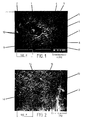
- the microtomic section relates to a granule prepared according to a method belonging to the known art, the composition of which expressed in parts by weight relative to the total mass is 80 parts of CaC0 3 (with an average diameter of 3 ⁇ m and of cut 10 ⁇ m: Millicarb from the company OMYA) and of 20 parts of low density polyethylene, of melt index 20 prepared at 190 ° C. in a BUSS co-mixer from a premix of the mineral matter and the polymer produced at room temperature. Beyond this concentration of mineral matter (80 parts by weight of CaCOa), it was impossible to achieve a correct bonding of said mineral matter by the polymer, a large fraction of the initial mixture of the components remaining in the form of distinct phases. .
- the mixture formed by the polymer and the mineral matter when it is kneaded manifests an unmeasurable index of fluidity (at 190 ° C. and 2.16 kg) corresponding to a high viscosity of the medium which is at the origin of l appearance of the cavities by retention of a gas phase.
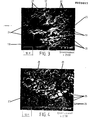
- the microtomic section relates to an aggregate according to the invention, the composition of which expressed in parts by weight of the total mass is 88 parts of CaCO 3 (Millicarb), 11.2 parts of polymer of melt index 800 (140'C - 2.16 kg), sold by the company HULS under the name Vestoplast 3632, and 0.8 parts of a fluidizing agent which is an alkylphosphate (Ci 4 -H 29 -OP0 3 -H 2 ).
- a fluidizing agent which is an alkylphosphate (Ci 4 -H 29 -OP0 3 -H 2 ).
- the mixture was prepared in a BUSS comalaxer, at a temperature of 140 ° C. from a premix produced at room temperature from the three aforementioned compounds.
- Figure 3 which is a high magnification of a part of Figure 1 relating to a granule of the prior art, we can observe cavities (17, 18) due to the gas phase trapped by the mixture with melt index excessively low and not measurable at 190 "C under a load of 2.16 kg. We can also see plies of polymers (19) as well as very many polymer filaments (20, 21 and 22) which constitute by their entanglements a strong and irregular texture Finally, we can distinguish some large grains of mineral matter (24) whose largest dimension is of the order of 10 microns, as well as imprints of torn grains (23) during microtomic cutting.
- FIG. 4 which is also a high magnification of part of FIG. 2, concerning an aggregate according to the invention, there are a few cavities (for example 25, 26) due to the tearing of grains of mineral matter during the microtomic section, a few rare polymer filaments (examples 27, 28 and 29) which makes it possible to visualize the very high concentration of mineral matter as well as the existence of an almost organized structure of the particles of mineral matter, practically in contact with the with each other and thus defining the interparticle voids at most filled with said polymer.
- the consistency of the almost organized medium is confirmed by the comparisons of the densities measured experimentally and theoretically, the first being 2.13 while the second is 2.15, giving a smaller difference. at 1%, despite the high amount of mineral matter.
- This example illustrates the preparation of the aggregates according to the invention, making use of four different modes well known to those skilled in the art for this type of production.
- the mixture was subjected to the mechanical action of a blade rotating at the speed of 1500 revolutions per minute while the temperature of the medium was maintained at 140 ° C.
- the whole operation lasted about 15 minutes.
- the paste obtained was then calendered in the form of plates which were cut into small cubes having a dimension of 2 to 3 millimeters on each side, constituting the aggregates according to the invention.
- This composition was premixed at room temperature in a rapid mixer of the Papenmeyer type and then transferred to the hopper of the BUSS co-mixer.
- the mixing zone of the latter was at a temperature of 140 ° C., the speed of rotation of the screw of 60 revolutions per minute and the flow rate at the outlet of the extruder of 15 kg per hour, said extruder being provided with a die allowing a head cut with water rings.
- the speed of rotation of the mixer arms was 47 revolutions per minute and the mixing time was 30 minutes.
- the dough thus obtained was calendered and gave a plate 3 mm thick which was subsequently cut into small cubes, constituting the aggregates according to the invention.
- the final temperature of said mixture was 140 ° C. and the speed of rotation of the blades was 90 rpm.
- test pieces (ISO type) were produced by injection using a NESTAL NEOMAT 170/90 press controlled by a microprocessor.
- the closing force was 900 KN, the diameter of the screw 32 mm, and the length / diameter ratio (L / D) 18.8.
- the press was successively supplied with polymers or copolymers alone serving as a control, and with mixtures of the same polymers or copolymers into which mineral materials were introduced by means of aggregates according to the invention or "masterbatches "chosen from among the best available on the market today.
- the aggregates according to the invention were redispersed within a low density polyethylene, sold by the company ATOCHEM under the reference of "LACQTENE 1070 MN 18", d fluidity index (190 ° C - 2.16 kg) equal to 7.
- Test 1 relates to virgin low density polyethylene as mentioned above.
- Test 2 relates to the incorporation into the abovementioned polymer of 20% by weight of CaCOa Millicarb, from a "masterbatch” marketed by the company MULTIBASE (France) under the name LDPE 707 A and known for its good redispersion qualities.
- Test 3 relates to the incorporation into the abovementioned polymer of 20% by weight of CaCOa from the aggregate according to the invention produced according to preparation mode 1 of Example 1.
- Test 4 concerns the same type of formulation as test 2, but comprises 40% by weight of CaCOa from the "masterbatch” LDPE 707 A from MULTIBASE.
- Test 5 relates to the same type of formulation as test 3, but comprises 40% by weight of CaCO 3 provided by the aggregate according to the invention produced according to preparation mode 1 of Example 1.
- the aggregates according to the invention were redispersed in linear low density polyethylene (DOW CHEMICAL: Dowlex 2047) with a melt index of 2.3 (190 ° C. - 2.16 kg).
- Test 7 incorporation of 20% by weight of CaCO 3 Millicarb from the company OMYA (having the same characteristics as those mentioned above) from the "masterbatch" LDPE 707 A from MULTIBASE.
- Test 8 incorporation of 20% by weight of CaCO 3 Millicarb from aggregates according to the invention produced according to mode of preparation 4 of Example 1.
- Test 9 incorporation of 40% by weight of CaCO 3 Millicarb from the "masterbatch" LDPE 707 A from MULTIBASE.
- Test 10 incorporation of 40% by weight of CaCOa Millicarb from the aggregates according to the invention defined in test 8.
- the aggregates according to the invention were redispersed in high density polyethylene (HOECHST: Hostalène GC 7260) with a melt flow index 8 (190 ° C - 2.16 kg).
- HOECHST Hostalène GC 7260
- Test 12 incorporation of 20% by weight of CaCO 3 Millicarb from the "masterbatch" LDPE 707 A from MULTIBASE.
- Test 13 incorporation of 20% by weight of CaCOa Millicarb from aggregates according to the invention produced according to preparation method 1 of Example 1.
- Test 14 virgin polymer Test 15: polymer loaded with 20% by weight of CaCO 3 Millicarb from "masterbatch" PPH 7012 A from MULTIBASE.
- Test 16 polymer loaded with 20% by weight of CaCO 3 Millicarb from aggregates according to the invention produced according to preparation mode 4 of Example 1.
- Test 17 polymer loaded with 40% by weight of CaCO 3 Millicarb in accordance with test 15.
- Test 18 polymer loaded with 40% by weight of CaCO 3 Millicarb in accordance with test 16.
- Test 20 polymer loaded with 20% by weight of CaCO 3 Millicarb from "masterbatch" PPC 7012 A from MULTIBASE.
- Test 21 polymer loaded with 20% by weight of CaCO 3 Millicarb from aggregates according to the invention produced according to mode 1 of Example 1.
- Test 22 polymer loaded with 40% by weight of CaCO 3 Millicarb in accordance with test 20.
- Test 23 polymer loaded with 40% by weight of CaCO 3 Millicarb in accordance with test 21.
- Example 2 illustrates, in the same way as Example 2, the excellent redispersion within polyolefin polymers of the aggregates according to the invention, prepared according to mode 2 of Example 1 and containing 91% by weight of CaCO 3 (Millicarb ), representing 1118 parts by weight per 100 parts by weight of polyolefin polymer and / or copolymer according to the invention, with a melt flow index of at least 50.
- CaCO 3 Melticarb
- the ANDOUART machine was successively supplied with the redispersion polymer alone (test 24) serving as a control and with a mixture formed from the same polymer and a mineral filler introduced via aggregates according to the invention (test 25) .
- Test 24 was carried out with low density polyethylene, with a melt index 2 (190 ° C - 2.16 kg) sold by ESSO under the reference ESCORENE LD 104.
- Test 25 was carried out with a mixture formed of the same polyethylene and CaCO 3 (Millicarb) in an amount of 10% by weight, incorporated by means of aggregates according to the invention, produced according to mode 2 of the example 1.
- a 3 mm thick ribbon was extruded through a flat die, using a TOREY single screw extruder whose screw had a diameter D of 25 mm, a length equal to 15 D whereas the die had a length of 16 mm and a height of 2.5 mm.
- the speed of rotation of the screw was 50 revolutions per minute, the compression ratio of 3 and the extrusion temperature of 170 ° C for polyethylene and 210 ° C for polypropylene copolymer.
- the extruder was successively supplied with the redispersion polymer and copolymer alone (tests 26 and 29) serving as controls, and with mixtures formed from the same polymer or copolymer and an inorganic filler introduced in the form of granules belonging to the field public (tests 27 and 30), and aggregates according to the invention (tests 28 and 31) by incorporating 1% by weight of CaCOa relative to the total mass.
- Test 26 was carried out with low density polyethylene with a melt index 7 (190 ° C - 2.16 kg) (ATOCHEM: LACQTENE 1070 MN 18) while test 29 was carried out with a polypropylene copolymer fluidity index 5 (230 ° C - 2.16 kg) (ATOCHEM: LACQTENE 3050 MN 4).
- Test 27 relates to the redispersion (in the polyethylene of test 26) of 1% by weight of CaCO 3 Millicarb incorporated in the form of a "masterbatch" LDPE 707 A (MULTIBASE), while the test 30 relates to the redispersion of 1% by weight of the same CaCO 3 in the polypropylene copolymer of test 29 from the same "masterbatch".
- Test 28 relates to the redispersion in the polyethylene of test 26 of 1% by weight of CaCO 3 (Millicarb) incorporated in the form of aggregates according to the invention, prepared according to mode 3 of Example l, then that test 31 relates to the redispersion of 1% by weight of the same CaCO 3 in the polypropylene copolymer of test 29 from the same aggregates according to the invention.
- Examination with a binocular magnifying glass of magnification 50 revealed an excellent redispersion of the aggregates according to the invention (absence of agglomerates), dispersion better than that obtained with "masterbatches" of the known art.
- Test 32 concerns the injection of virgin polystyrene (Ilostyrene N 4000 from HOECHST) with a fluidity index 4.5 (200 ° C - 5 kg).
- Test 33 relates to the incorporation into the above-mentioned polystyrene of 20% by weight of CaCO 3 (Millicarb) from a "masterbatch" of the known art (PS 600 A from MULTIBASE).
- Test 34 relates to the incorporation into the abovementioned polystyrene of 20% by weight of CaCO 3 (Millicarb) from aggregates according to the invention prepared according to mode 4 of Example 1.
- ABS acrylonitrile-butadiene-styrene
- Test 35 concerns the injection of virgin ABS (BAYER-NOVODUR PG 211) having a melt flow index of 4 (230 ° C - 2.16 kg).
- Test 36 relates to the incorporation of 20% by weight of CaCO 3 (Millicarb) from the same "masterbatch" as in test 33.
- Test 37 concerns the incorporation into the abovementioned ABS of 20% by weight of CaCO 3 (Millicarb) from aggregates according to the invention prepared according to mode 4 of Example 1.
- Test 38 relates to the incorporation into the abovementioned ABS of 40% by weight of CaCO 3 from the same aggregates as in Test 37.
- Test 39 concerns the injection of a virgin polyamide (BASF - Ultramid B 3 K) having a melt index of 2.6 (220 ° C - 2.16 kg).
- Test 40 relates to the incorporation into the above-mentioned polyamide of 20% by weight of CaCO 3 (Millicarb) from aggregates according to the invention prepared according to mode 1 of Example 1.
- Test 41 relates to the incorporation into the aforementioned polyamide of 40% by weight of CaCO 3 from the same aggregates as in test 40.
- the tests mentioned relate to the redispersion in the polyamides of the only aggregates according to the invention, the known art not offering a "masterbatch” making it possible to carry out comparative tests. Examination of the injected test pieces and their mechanical characteristics makes it possible to confirm the excellent redispersion in the polyamides of the mineral materials provided by the aggregates according to the invention.
- the redispersion of the aggregates according to the invention is excellent in polymers other than polyolefins, despite high levels of powdery mineral matter in the aggregates.
- the aggregates according to the invention prove to be compatible with various thermoplastic redispersion polymers, in contrast to granules or "masterbatches" of the known art, the compatibility of which in general is only possible. with the polymers entering into their composition.
- This example illustrates the production of aggregates comprising a progressive percentage by weight of mineral materials within the limits of the invention, aggregates which after their production, were coherent, had a plastic appearance and could be easily redispersed in one of the polymers and / or the above-mentioned redispersion copolymers.
- This example illustrates the production of aggregates according to the invention comprising various powdery mineral materials, such as talc, alumina hydrate, calcined kaolin, titanium dioxide.
- powdery mineral materials such as talc, alumina hydrate, calcined kaolin, titanium dioxide.
- tests 53 to 62 were prepared according to the protocol described in mode 2 of preparation of Example 1.
- the polyolefin polymer according to the invention with a melt index at least equal to 50 was a mixture of Vestoplast 3632 (from HULS) and Vestowax H 2 (polyethylene wax from HULS) in proportions of 95% of the first and 5% of the second.
- the fluidizing agent was an alkyl phosphate of formula C 14 H 29 OPO 3 H 2 .
- Control tests 53, 56, 58 and 60 relating to talc, kaolin and alumina hydrate were very difficult to carry out, or even impractical at 800 parts by weight relative to the total formula in the absence of the combination new consisting of at least one polyolefin with a melt flow index at least 50 and the fluidizing agent.
- the aggregates thus prepared were subjected to a measurement of the melt index according to standard ASTM 1238, at two pairs of temperature-load (140 ° C - 2.16 kg) and (190 ° C - 5 kg) while preserving the same industry.
- a strip 2 mm thick was extruded using the flat die using a GOETTFERT single screw extruder, the screw of which had a diameter D: 30 mm and a length of 25 D.
- the extrusion was carried out at the usual transformation temperatures of the various redispersion polymers.
- the strips thus produced had a good surface appearance and good elasticity. From these strips, films of 100 ⁇ m thickness were prepared using a hot working compression press.
Landscapes
- Chemical & Material Sciences (AREA)
- Health & Medical Sciences (AREA)
- Chemical Kinetics & Catalysis (AREA)
- Medicinal Chemistry (AREA)
- Polymers & Plastics (AREA)
- Organic Chemistry (AREA)
- Compositions Of Macromolecular Compounds (AREA)
- Processes Of Treating Macromolecular Substances (AREA)
- Micro-Organisms Or Cultivation Processes Thereof (AREA)
- Crushing And Grinding (AREA)
- Materials For Medical Uses (AREA)
- Dental Preparations (AREA)
Priority Applications (1)
| Application Number | Priority Date | Filing Date | Title |
|---|---|---|---|
| AT86420133T ATE41781T1 (de) | 1985-05-21 | 1986-05-20 | Thermoplastische zusammensetzungen mit sehr hohem gehalt an pulverfoermigen mineralischen stoffen zur einarbeitung in polymere. |
Applications Claiming Priority (2)
| Application Number | Priority Date | Filing Date | Title |
|---|---|---|---|
| FR8507819 | 1985-05-21 | ||
| FR8507819A FR2582310B1 (fr) | 1985-05-21 | 1985-05-21 | Compositions thermoplastiques a tres haute teneur en matieres minerales pulverulentes pour incorporation dans les polymeres |
Publications (2)
| Publication Number | Publication Date |
|---|---|
| EP0203017A1 true EP0203017A1 (de) | 1986-11-26 |
| EP0203017B1 EP0203017B1 (de) | 1989-03-29 |
Family
ID=9319523
Family Applications (1)
| Application Number | Title | Priority Date | Filing Date |
|---|---|---|---|
| EP86420133A Expired EP0203017B1 (de) | 1985-05-21 | 1986-05-20 | Thermoplastische Zusammensetzungen mit sehr hohem Gehalt an pulverförmigen mineralischen Stoffen zur Einarbeitung in Polymere |
Country Status (19)
| Country | Link |
|---|---|
| US (1) | US4803231A (de) |
| EP (1) | EP0203017B1 (de) |
| JP (1) | JPS61266444A (de) |
| KR (1) | KR860009065A (de) |
| CN (1) | CN86104074A (de) |
| AT (1) | ATE41781T1 (de) |
| AU (2) | AU5760286A (de) |
| BE (1) | BE904762A (de) |
| BR (1) | BR8602301A (de) |
| CA (1) | CA1284400C (de) |
| CH (1) | CH670093A5 (de) |
| DE (1) | DE3662596D1 (de) |
| ES (1) | ES8801845A1 (de) |
| FI (1) | FI862114L (de) |
| FR (1) | FR2582310B1 (de) |
| IT (1) | IT1190642B (de) |
| NO (1) | NO861987L (de) |
| SE (1) | SE8602197L (de) |
| ZA (1) | ZA863791B (de) |
Cited By (9)
| Publication number | Priority date | Publication date | Assignee | Title |
|---|---|---|---|---|
| FR2602236A1 (fr) * | 1986-07-30 | 1988-02-05 | Pluss Stauffer Ag | Compositions thermoplastiques a tres haute teneur en matieres minerales pulverulentes pour incorporation dans les polymeres |
| EP0334170A1 (de) * | 1988-03-22 | 1989-09-27 | Bayer Ag | Fliessverbesserung für feststoffhaltige Polymere |
| EP0397165A1 (de) * | 1989-05-11 | 1990-11-14 | Plüss-Staufer AG | Redispergierbares Additivagglomerat |
| EP0737214A4 (de) * | 1993-12-22 | 1997-09-24 | Ecc Int Inc | Granulares calcium-carbonat zum gebrauch als direktes additiv für thermoplaste |
| WO2000005295A1 (fr) * | 1998-07-24 | 2000-02-03 | Ace S.A. | Films microporeux polyolefiniques permeables aux gaz et impermeables aux liquides |
| WO2001058988A1 (fr) * | 2000-02-14 | 2001-08-16 | Omya Sas | Concentres de charges utilisables dans les thermoplastiques |
| RU2394052C2 (ru) * | 2005-06-02 | 2010-07-10 | ЮНИВЕЙШН ТЕКНОЛОДЖИЗ, ЭлЭлСи | Полиэтиленовые трубы |
| CN102219935A (zh) * | 2011-06-07 | 2011-10-19 | 刘立文 | 一种硫酸钙淀粉可生物降解复合材料及其制备方法 |
| RU2623754C1 (ru) * | 2016-03-29 | 2017-06-29 | Федеральное государственное бюджетное образовательное учреждение высшего образования "Саратовский государственный технический университет имени Гагарина Ю.А." (СГТУ имени Гагарина Ю.А.) | Смесь для получения композиционных строительных материалов |
Families Citing this family (28)
| Publication number | Priority date | Publication date | Assignee | Title |
|---|---|---|---|---|
| GB8617387D0 (en) * | 1986-07-16 | 1986-08-20 | Alcan Int Ltd | Alumina hydrates |
| US4801627A (en) * | 1986-08-18 | 1989-01-31 | The B. F. Goodrich Company | Glass fiber reinforced vinyl chloride polymer products and process for their preparation |
| FR2607054B1 (fr) * | 1986-11-20 | 1989-03-17 | Pluss Stauffer Ag | Compositions thermoplastiques a tres haute teneur en matieres minerales pulverulentes pour incorporation dans les polymeres |
| DE3931772A1 (de) * | 1989-09-23 | 1991-04-04 | Bayer Ag | Thermoplastische formmassen aus polyalkylenterephthalat, speziellem bariumsulfat, teilchenfoermigen pfropfpolymerisaten und gegebenenfalls verstaerkungsmitteln |
| US5064893A (en) * | 1990-03-08 | 1991-11-12 | Rexene Corporation | Flexible label film from polyethylene and calcium carbonate-polymer mixture |
| FR2697846B1 (fr) * | 1992-11-10 | 1995-01-20 | Total Raffinage Distribution | Utilisation comme charge pour polymères de chaux sulfatée provenant de la désulfuration par voie sèche de fumées. |
| US5420183A (en) * | 1993-07-06 | 1995-05-30 | Hpg International, Inc. | Flame retardant polypropylene composition |
| US6323269B1 (en) | 1993-12-22 | 2001-11-27 | Imerys Pigments, Inc. | Mineral containing thermoplastic granules |
| FR2722204B1 (fr) | 1994-07-08 | 1996-09-20 | Coatex Sa | Nouveaux derives d'anhydride et nouvelles compositions polymeriques chargees ainsi que leurs applications |
| US6153670A (en) * | 1996-04-25 | 2000-11-28 | Imerys Pigments, Inc. | Granule for a thermoplastic end product comprising a mineral and/or a colorant pigment system |
| GB9611701D0 (en) * | 1996-06-05 | 1996-08-07 | Ecc Int Ltd | Particulate materials |
| ID19516A (id) * | 1996-06-12 | 1998-07-16 | Hoechst Celanese Corp | Pelapis penghalang uap untuk benda-benda polimerik |
| ATE215117T1 (de) * | 1996-06-12 | 2002-04-15 | Trespaphan Gmbh | Dampf sperrender überzug für polymergegenstände |
| ID19111A (id) | 1996-06-12 | 1998-06-18 | Hoechst Celanese Corp | Metoda pembuatan bahan-bahan poliolefin untuk pelapisan |
| CA2254761C (en) | 1996-06-12 | 2006-10-10 | Hoechst Trespaphan Gmbh | Method of priming polyolefin articles for coating |
| AUPO116296A0 (en) * | 1996-07-22 | 1996-08-15 | CRC for Polymer Blends Pty. Ltd. | Polymer blend |
| US6232389B1 (en) | 1997-06-09 | 2001-05-15 | Inmat, Llc | Barrier coating of an elastomer and a dispersed layered filler in a liquid carrier and coated articles |
| US6087016A (en) * | 1997-06-09 | 2000-07-11 | Inmat, Llc | Barrier coating of an elastomer and a dispersed layered filler in a liquid carrier |
| AU1946099A (en) * | 1997-12-29 | 1999-07-19 | Ecc International Inc. | A method for controlling surface characteristics of thermoplastics and an associated product |
| GB9925927D0 (en) | 1999-11-03 | 1999-12-29 | Ecc Int Ltd | Treating particulate alkaline earth metal carbonates |
| IT1311724B1 (it) * | 1999-12-06 | 2002-03-19 | Electrolux Zanussi Elettrodome | Composizione polimerica particolarmente idonea alla formatura persoffiatura, suo procedimento di fabbricazione e articoli tecnici |
| US6911519B2 (en) * | 2002-03-26 | 2005-06-28 | University Of Connecticut | Low viscosity melt processable high temperature polyimides |
| KR100563412B1 (ko) * | 2004-05-14 | 2006-03-22 | 덕양산업주식회사 | 자동차 실내 정화를 위한 광촉매 적용 열가소성 수지 조성물 |
| EP2267086A1 (de) | 2009-06-23 | 2010-12-29 | Omya Development AG | Verfahren zur Herstellung eines oberflächenkompaktierten Materials, das auf einem Einzelschrauben-Kunststoffumwandlungsgerät verarbeitet werden kann |
| CN103102563A (zh) * | 2012-11-13 | 2013-05-15 | 合肥朗胜新材料有限公司 | 一种epdm包覆硫酸钙晶须改性低密度聚乙烯发泡材料及其制备方法 |
| FR3002539B1 (fr) * | 2013-02-22 | 2017-03-10 | Coatex Sas | Agent d'hydrophobisation et utilisation pour traiter en surface des particules de matiere minerale. |
| ES2660425T3 (es) * | 2014-12-02 | 2018-03-22 | Omya International Ag | Proceso para la producción de un material compactado, material así producido y uso del mismo |
| CN119639166B (zh) * | 2024-11-07 | 2025-11-14 | 北京航天凯恩新材料有限公司 | Sebs负载的硫酸钡母粒、制备方法以及硫酸钡填充聚烯烃弹性体材料 |
Citations (1)
| Publication number | Priority date | Publication date | Assignee | Title |
|---|---|---|---|---|
| EP0114724A2 (de) * | 1983-01-18 | 1984-08-01 | Imperial Chemical Industries Plc | Polymerzusammensetzung |
Family Cites Families (8)
| Publication number | Priority date | Publication date | Assignee | Title |
|---|---|---|---|---|
| GB1345475A (en) * | 1971-02-01 | 1974-01-30 | Mitsubishi Petrochemical Co | Mthod of forming a filler and resin or rubber composition |
| US4210572A (en) * | 1978-08-29 | 1980-07-01 | Nl Industries, Inc. | Coupling agents for thermosetting composites |
| US4191798A (en) * | 1978-11-22 | 1980-03-04 | E. I. Du Pont De Nemours And Company | Highly filled thermoplastic compositions based on ethylene interpolymers and processing oils |
| DE2910586B2 (de) * | 1979-03-17 | 1981-01-29 | Hoechst Ag, 6000 Frankfurt | Füllstoff enthaltende Polyolefin-Formmasse und Verfahren zu ihrer Herstellung |
| JPS5891736A (ja) * | 1981-11-09 | 1983-05-31 | Sumitomo Chem Co Ltd | 充填剤の顆粒化方法 |
| US4430468A (en) * | 1982-07-21 | 1984-02-07 | E. I. Du Pont De Nemours And Company | Surfactant-containing filled and plasticized thermoplastic compositions based on ethylene interpolymers |
| US4511834A (en) * | 1982-12-23 | 1985-04-16 | Borg-Warner Corporation | Control and stabilizing system for damperless synchronous motor |
| AU2300083A (en) * | 1983-01-17 | 1984-07-19 | Scovill Inc. | Tyre valve and low pressure indicator |
-
1985
- 1985-05-21 FR FR8507819A patent/FR2582310B1/fr not_active Expired
- 1985-10-29 US US06/792,523 patent/US4803231A/en not_active Expired - Lifetime
-
1986
- 1986-05-12 CH CH1922/86A patent/CH670093A5/fr not_active IP Right Cessation
- 1986-05-14 BE BE0/216655A patent/BE904762A/fr not_active IP Right Cessation
- 1986-05-14 SE SE8602197A patent/SE8602197L/xx not_active Application Discontinuation
- 1986-05-19 IT IT20473/86A patent/IT1190642B/it active
- 1986-05-20 NO NO861987A patent/NO861987L/no unknown
- 1986-05-20 DE DE8686420133T patent/DE3662596D1/de not_active Expired
- 1986-05-20 JP JP61116031A patent/JPS61266444A/ja active Pending
- 1986-05-20 FI FI862114A patent/FI862114L/fi not_active IP Right Cessation
- 1986-05-20 BR BR8602301A patent/BR8602301A/pt unknown
- 1986-05-20 CA CA000509541A patent/CA1284400C/fr not_active Expired - Lifetime
- 1986-05-20 AU AU57602/86A patent/AU5760286A/en not_active Abandoned
- 1986-05-20 EP EP86420133A patent/EP0203017B1/de not_active Expired
- 1986-05-20 AT AT86420133T patent/ATE41781T1/de not_active IP Right Cessation
- 1986-05-20 CN CN198686104074A patent/CN86104074A/zh active Pending
- 1986-05-21 KR KR1019860003959A patent/KR860009065A/ko not_active Ceased
- 1986-05-21 ES ES555182A patent/ES8801845A1/es not_active Expired
- 1986-05-21 ZA ZA863791A patent/ZA863791B/xx unknown
-
1990
- 1990-01-05 AU AU47712/90A patent/AU624891B2/en not_active Ceased
Patent Citations (1)
| Publication number | Priority date | Publication date | Assignee | Title |
|---|---|---|---|---|
| EP0114724A2 (de) * | 1983-01-18 | 1984-08-01 | Imperial Chemical Industries Plc | Polymerzusammensetzung |
Cited By (22)
| Publication number | Priority date | Publication date | Assignee | Title |
|---|---|---|---|---|
| FR2602236A1 (fr) * | 1986-07-30 | 1988-02-05 | Pluss Stauffer Ag | Compositions thermoplastiques a tres haute teneur en matieres minerales pulverulentes pour incorporation dans les polymeres |
| EP0258154A1 (de) * | 1986-07-30 | 1988-03-02 | Pluess Staufer Ag | Thermoplastische Zusammensetzungen mit sehr hohem Gehalt an pulverförmigen, mineralischen Stoffen zur Einarbeitung in Polymere |
| EP0334170A1 (de) * | 1988-03-22 | 1989-09-27 | Bayer Ag | Fliessverbesserung für feststoffhaltige Polymere |
| EP0397165A1 (de) * | 1989-05-11 | 1990-11-14 | Plüss-Staufer AG | Redispergierbares Additivagglomerat |
| EP0737214A4 (de) * | 1993-12-22 | 1997-09-24 | Ecc Int Inc | Granulares calcium-carbonat zum gebrauch als direktes additiv für thermoplaste |
| US5744530A (en) * | 1993-12-22 | 1998-04-28 | Ecc International Inc. | Granular calcium carbonate for use as a direct additive for thermoplastics |
| US6676871B1 (en) * | 1998-07-24 | 2004-01-13 | Ace S.A. | Gas-permeable but liquid-impermeable polyolefin microporous films |
| WO2000005295A1 (fr) * | 1998-07-24 | 2000-02-03 | Ace S.A. | Films microporeux polyolefiniques permeables aux gaz et impermeables aux liquides |
| BE1012087A4 (fr) * | 1998-07-24 | 2000-04-04 | Age S A | Films microporeux polyolefiniques permeables aux gaz et impermeables aux liquides |
| EP1743914A3 (de) * | 2000-02-14 | 2007-04-25 | Omya Development Ag | Verwendung von sehr hochflüssigen und isotaktischen Polypropylenen zur Herstellung von in Olefintype-Thermoplasten verwendbaren Füllstoffkonzentraten, so hergestellte Füllstoffkonzentrate und Thermoplaste |
| FR2804964A1 (fr) * | 2000-02-14 | 2001-08-17 | Omya Sa | Utilisation de polypropylenes isotactiques de tres grande fluidite pour la preparation de concentres de charges utilisables dans les thermoplastiques de type olefinique, concentres de charges et thermoplastiques ainsi obtenus |
| US6951900B2 (en) | 2000-02-14 | 2005-10-04 | Omya Sas | Filler concentrates for use in thermoplastic materials |
| RU2278128C2 (ru) * | 2000-02-14 | 2006-06-20 | Омиа Сас | Используемые в термопластах концентраты наполнителей |
| WO2001058988A1 (fr) * | 2000-02-14 | 2001-08-16 | Omya Sas | Concentres de charges utilisables dans les thermoplastiques |
| KR100856764B1 (ko) * | 2000-02-14 | 2008-09-05 | 옴야 디벨로프먼트 아게 | 열가소성 물질에 사용하기 위한 충전제 농축물 |
| BG65919B1 (bg) * | 2000-02-14 | 2010-05-31 | Omya Sa | Концентрати на инертни пълнители използувани в термопластичните продукти |
| HRP20020550B1 (en) * | 2000-02-14 | 2011-05-31 | Omya Development Ag | Filler concentrates for use in thermoplastic materials |
| CN1781970B (zh) * | 2000-02-14 | 2012-02-22 | Omya发展股份公司 | 用于热塑性材料的填料浓缩物 |
| RU2394052C2 (ru) * | 2005-06-02 | 2010-07-10 | ЮНИВЕЙШН ТЕКНОЛОДЖИЗ, ЭлЭлСи | Полиэтиленовые трубы |
| CN102219935A (zh) * | 2011-06-07 | 2011-10-19 | 刘立文 | 一种硫酸钙淀粉可生物降解复合材料及其制备方法 |
| CN102219935B (zh) * | 2011-06-07 | 2012-08-15 | 刘立文 | 一种硫酸钙淀粉可生物降解复合材料及其制备方法 |
| RU2623754C1 (ru) * | 2016-03-29 | 2017-06-29 | Федеральное государственное бюджетное образовательное учреждение высшего образования "Саратовский государственный технический университет имени Гагарина Ю.А." (СГТУ имени Гагарина Ю.А.) | Смесь для получения композиционных строительных материалов |
Also Published As
| Publication number | Publication date |
|---|---|
| FR2582310A1 (fr) | 1986-11-28 |
| ZA863791B (en) | 1987-01-28 |
| SE8602197D0 (sv) | 1986-05-14 |
| FI862114A7 (fi) | 1986-11-22 |
| FR2582310B1 (fr) | 1987-10-09 |
| AU4771290A (en) | 1990-05-31 |
| NO861987L (no) | 1986-11-24 |
| IT8620473A0 (it) | 1986-05-19 |
| ES8801845A1 (es) | 1988-02-16 |
| JPS61266444A (ja) | 1986-11-26 |
| CN86104074A (zh) | 1987-04-08 |
| IT1190642B (it) | 1988-02-16 |
| IT8620473A1 (it) | 1987-11-19 |
| AU624891B2 (en) | 1992-06-25 |
| EP0203017B1 (de) | 1989-03-29 |
| BR8602301A (pt) | 1987-01-21 |
| ATE41781T1 (de) | 1989-04-15 |
| SE8602197L (sv) | 1986-11-22 |
| CA1284400C (fr) | 1991-05-21 |
| FI862114A0 (fi) | 1986-05-20 |
| AU5760286A (en) | 1986-11-27 |
| DE3662596D1 (en) | 1989-05-03 |
| CH670093A5 (de) | 1989-05-12 |
| FI862114L (fi) | 1986-11-22 |
| KR860009065A (ko) | 1986-12-19 |
| ES555182A0 (es) | 1988-02-16 |
| BE904762A (fr) | 1986-09-01 |
| US4803231A (en) | 1989-02-07 |
Similar Documents
| Publication | Publication Date | Title |
|---|---|---|
| EP0203017B1 (de) | Thermoplastische Zusammensetzungen mit sehr hohem Gehalt an pulverförmigen mineralischen Stoffen zur Einarbeitung in Polymere | |
| CA2398699C (fr) | Concentres de charges utilisables dans les thermoplastiques | |
| EP0258154A1 (de) | Thermoplastische Zusammensetzungen mit sehr hohem Gehalt an pulverförmigen, mineralischen Stoffen zur Einarbeitung in Polymere | |
| US4091164A (en) | Polymer modified hydrophilic inorganic fillers for thermoplastic polymeric materials | |
| CA1169173A (en) | Surface modification of alumina hydrate with liquid fatty acids | |
| CN101374881A (zh) | 生物聚合物与丙烯酸类共聚物的混合物 | |
| CH656136A5 (fr) | Composition a base de polyolefines. | |
| EP2804906B1 (de) | Feuerfeste wärmehärtende zusammensetzungen mit hoher mechanischer festigkeit, insbesondere für stromkabel | |
| EP0877044A1 (de) | Mit Feststoffpartikeln gefüllte Polymerzusammensetzung | |
| CN102869722B (zh) | 超软热塑性弹性体 | |
| FR2626778A1 (fr) | Nouvelles semelles de ski, leur procede de fabrication et skis equipes de ces semelles | |
| FR2742446A1 (fr) | Utilisation de copolymeres de styrene et d'anhydride maleique comme agents dispersants et/ou de traitement de charges minerales. compositions thermoplastiques les contenant | |
| KR0140708B1 (ko) | 압출 배합 충전물과 혼합된 비닐리덴 클로라이드 인터폴리머를 포함하는 중합체 조성물 | |
| FR2607054A1 (fr) | Compositions thermoplastiques a tres haute teneur en matieres minerales pulverulentes pour incorporation dans les polymeres | |
| CA2036506C (fr) | Compositions glissantes, anti-bloquantes et de qualite optique a base de copolymeres d'ethylene de faible cristallinite | |
| JPH10502409A (ja) | 圧延硬質ビニルポリマー組成物 | |
| EP3710493B1 (de) | Artikel enthaltend kern-schale-pfropfcopolymere mit verbesserten oberflächeneigenschaften | |
| WO2021245354A1 (fr) | Zéolithes à compatibilité améliorée | |
| JPS6043859B2 (ja) | 透明性のすぐれたポリプロピレンフイルム | |
| EP0440557A2 (de) | Hydrotalcit enthaltende verseifte Äthylen-Vinylacetat-Zusammensetzung und Verwendung davon | |
| JPS6152859B2 (de) | ||
| FR2781807A1 (fr) | Composition de resine thermoplastique ignifuge | |
| ROY et al. | Rheological Behaviour of Short Carbon Fiber Filled Thermoplastic | |
| JPH0571625B2 (de) |
Legal Events
| Date | Code | Title | Description |
|---|---|---|---|
| PUAI | Public reference made under article 153(3) epc to a published international application that has entered the european phase |
Free format text: ORIGINAL CODE: 0009012 |
|
| AK | Designated contracting states |
Kind code of ref document: A1 Designated state(s): AT DE GB NL |
|
| 17P | Request for examination filed |
Effective date: 19861216 |
|
| 17Q | First examination report despatched |
Effective date: 19880323 |
|
| GRAA | (expected) grant |
Free format text: ORIGINAL CODE: 0009210 |
|
| AK | Designated contracting states |
Kind code of ref document: B1 Designated state(s): AT DE GB NL |
|
| REF | Corresponds to: |
Ref document number: 41781 Country of ref document: AT Date of ref document: 19890415 Kind code of ref document: T |
|
| GBT | Gb: translation of ep patent filed (gb section 77(6)(a)/1977) | ||
| REF | Corresponds to: |
Ref document number: 3662596 Country of ref document: DE Date of ref document: 19890503 |
|
| PLBE | No opposition filed within time limit |
Free format text: ORIGINAL CODE: 0009261 |
|
| STAA | Information on the status of an ep patent application or granted ep patent |
Free format text: STATUS: NO OPPOSITION FILED WITHIN TIME LIMIT |
|
| 26N | No opposition filed | ||
| PGFP | Annual fee paid to national office [announced via postgrant information from national office to epo] |
Ref country code: NL Payment date: 19920531 Year of fee payment: 7 |
|
| PG25 | Lapsed in a contracting state [announced via postgrant information from national office to epo] |
Ref country code: NL Effective date: 19931201 |
|
| NLV4 | Nl: lapsed or anulled due to non-payment of the annual fee | ||
| REG | Reference to a national code |
Ref country code: GB Ref legal event code: IF02 |
|
| PGFP | Annual fee paid to national office [announced via postgrant information from national office to epo] |
Ref country code: GB Payment date: 20030514 Year of fee payment: 18 Ref country code: AT Payment date: 20030514 Year of fee payment: 18 |
|
| PGFP | Annual fee paid to national office [announced via postgrant information from national office to epo] |
Ref country code: DE Payment date: 20030602 Year of fee payment: 18 |
|
| PG25 | Lapsed in a contracting state [announced via postgrant information from national office to epo] |
Ref country code: GB Free format text: LAPSE BECAUSE OF NON-PAYMENT OF DUE FEES Effective date: 20040520 Ref country code: AT Free format text: LAPSE BECAUSE OF NON-PAYMENT OF DUE FEES Effective date: 20040520 |
|
| PG25 | Lapsed in a contracting state [announced via postgrant information from national office to epo] |
Ref country code: DE Free format text: LAPSE BECAUSE OF NON-PAYMENT OF DUE FEES Effective date: 20041201 |
|
| GBPC | Gb: european patent ceased through non-payment of renewal fee |
Effective date: 20040520 |