EP0211653A1 - Procédé pour la fabrication de produits creux par coulage et aspiration - Google Patents
Procédé pour la fabrication de produits creux par coulage et aspiration Download PDFInfo
- Publication number
- EP0211653A1 EP0211653A1 EP86306053A EP86306053A EP0211653A1 EP 0211653 A1 EP0211653 A1 EP 0211653A1 EP 86306053 A EP86306053 A EP 86306053A EP 86306053 A EP86306053 A EP 86306053A EP 0211653 A1 EP0211653 A1 EP 0211653A1
- Authority
- EP
- European Patent Office
- Prior art keywords
- slip
- mold
- water
- molded article
- drainage means
- Prior art date
- Legal status (The legal status is an assumption and is not a legal conclusion. Google has not performed a legal analysis and makes no representation as to the accuracy of the status listed.)
- Granted
Links
- 238000000034 method Methods 0.000 title claims abstract description 35
- XLYOFNOQVPJJNP-UHFFFAOYSA-N water Substances O XLYOFNOQVPJJNP-UHFFFAOYSA-N 0.000 claims abstract description 24
- 238000005266 casting Methods 0.000 claims abstract description 19
- 239000000919 ceramic Substances 0.000 claims abstract description 8
- 230000008021 deposition Effects 0.000 claims description 20
- 239000000463 material Substances 0.000 claims description 18
- 229910052602 gypsum Inorganic materials 0.000 claims description 15
- 239000010440 gypsum Substances 0.000 claims description 15
- 239000000203 mixture Substances 0.000 claims description 7
- 239000011148 porous material Substances 0.000 claims description 7
- 239000003822 epoxy resin Substances 0.000 claims description 4
- 239000004033 plastic Substances 0.000 claims description 4
- 229920003023 plastic Polymers 0.000 claims description 4
- 229920000647 polyepoxide Polymers 0.000 claims description 4
- 229920001225 polyester resin Polymers 0.000 claims description 3
- 239000004645 polyester resin Substances 0.000 claims description 3
- 239000004925 Acrylic resin Substances 0.000 claims description 2
- 229920000178 Acrylic resin Polymers 0.000 claims description 2
- 239000007900 aqueous suspension Substances 0.000 claims description 2
- QHIWVLPBUQWDMQ-UHFFFAOYSA-N butyl prop-2-enoate;methyl 2-methylprop-2-enoate;prop-2-enoic acid Chemical compound OC(=O)C=C.COC(=O)C(C)=C.CCCCOC(=O)C=C QHIWVLPBUQWDMQ-UHFFFAOYSA-N 0.000 claims description 2
- 229910010293 ceramic material Inorganic materials 0.000 claims description 2
- 239000000835 fiber Substances 0.000 claims description 2
- 230000009969 flowable effect Effects 0.000 claims description 2
- 239000002184 metal Substances 0.000 claims description 2
- 229920001568 phenolic resin Polymers 0.000 claims description 2
- 239000005011 phenolic resin Substances 0.000 claims description 2
- LNEPOXFFQSENCJ-UHFFFAOYSA-N haloperidol Chemical compound C1CC(O)(C=2C=CC(Cl)=CC=2)CCN1CCCC(=O)C1=CC=C(F)C=C1 LNEPOXFFQSENCJ-UHFFFAOYSA-N 0.000 claims 1
- 238000000151 deposition Methods 0.000 description 18
- 238000000465 moulding Methods 0.000 description 7
- 239000011347 resin Substances 0.000 description 5
- 229920005989 resin Polymers 0.000 description 5
- 229920000742 Cotton Polymers 0.000 description 3
- 230000005484 gravity Effects 0.000 description 3
- 238000004519 manufacturing process Methods 0.000 description 3
- 230000013011 mating Effects 0.000 description 3
- 238000007796 conventional method Methods 0.000 description 2
- 238000001035 drying Methods 0.000 description 2
- 239000007788 liquid Substances 0.000 description 2
- 230000035699 permeability Effects 0.000 description 2
- 230000002035 prolonged effect Effects 0.000 description 2
- 239000007787 solid Substances 0.000 description 2
- 241000692870 Inachis io Species 0.000 description 1
- 238000010521 absorption reaction Methods 0.000 description 1
- 238000013019 agitation Methods 0.000 description 1
- 239000004568 cement Substances 0.000 description 1
- 239000003795 chemical substances by application Substances 0.000 description 1
- 230000003247 decreasing effect Effects 0.000 description 1
- 230000007547 defect Effects 0.000 description 1
- 230000006866 deterioration Effects 0.000 description 1
- 230000000694 effects Effects 0.000 description 1
- 239000003995 emulsifying agent Substances 0.000 description 1
- 239000000945 filler Substances 0.000 description 1
- 238000001914 filtration Methods 0.000 description 1
- 239000007769 metal material Substances 0.000 description 1
- 229910052573 porcelain Inorganic materials 0.000 description 1
- 239000000843 powder Substances 0.000 description 1
- 239000004094 surface-active agent Substances 0.000 description 1
Images

Classifications
-
- B—PERFORMING OPERATIONS; TRANSPORTING
- B28—WORKING CEMENT, CLAY, OR STONE
- B28B—SHAPING CLAY OR OTHER CERAMIC COMPOSITIONS; SHAPING SLAG; SHAPING MIXTURES CONTAINING CEMENTITIOUS MATERIAL, e.g. PLASTER
- B28B1/00—Producing shaped prefabricated articles from the material
- B28B1/26—Producing shaped prefabricated articles from the material by slip-casting, i.e. by casting a suspension or dispersion of the material in a liquid-absorbent or porous mould, the liquid being allowed to soak into or pass through the walls of the mould; Moulds therefor ; specially for manufacturing articles starting from a ceramic slip; Moulds therefor
-
- B—PERFORMING OPERATIONS; TRANSPORTING
- B28—WORKING CEMENT, CLAY, OR STONE
- B28B—SHAPING CLAY OR OTHER CERAMIC COMPOSITIONS; SHAPING SLAG; SHAPING MIXTURES CONTAINING CEMENTITIOUS MATERIAL, e.g. PLASTER
- B28B1/00—Producing shaped prefabricated articles from the material
- B28B1/26—Producing shaped prefabricated articles from the material by slip-casting, i.e. by casting a suspension or dispersion of the material in a liquid-absorbent or porous mould, the liquid being allowed to soak into or pass through the walls of the mould; Moulds therefor ; specially for manufacturing articles starting from a ceramic slip; Moulds therefor
- B28B1/265—Producing shaped prefabricated articles from the material by slip-casting, i.e. by casting a suspension or dispersion of the material in a liquid-absorbent or porous mould, the liquid being allowed to soak into or pass through the walls of the mould; Moulds therefor ; specially for manufacturing articles starting from a ceramic slip; Moulds therefor pressure being applied on the slip in the filled mould or on the moulded article in the mould, e.g. pneumatically, by compressing slip in a closed mould
-
- B—PERFORMING OPERATIONS; TRANSPORTING
- B28—WORKING CEMENT, CLAY, OR STONE
- B28B—SHAPING CLAY OR OTHER CERAMIC COMPOSITIONS; SHAPING SLAG; SHAPING MIXTURES CONTAINING CEMENTITIOUS MATERIAL, e.g. PLASTER
- B28B1/00—Producing shaped prefabricated articles from the material
- B28B1/26—Producing shaped prefabricated articles from the material by slip-casting, i.e. by casting a suspension or dispersion of the material in a liquid-absorbent or porous mould, the liquid being allowed to soak into or pass through the walls of the mould; Moulds therefor ; specially for manufacturing articles starting from a ceramic slip; Moulds therefor
- B28B1/265—Producing shaped prefabricated articles from the material by slip-casting, i.e. by casting a suspension or dispersion of the material in a liquid-absorbent or porous mould, the liquid being allowed to soak into or pass through the walls of the mould; Moulds therefor ; specially for manufacturing articles starting from a ceramic slip; Moulds therefor pressure being applied on the slip in the filled mould or on the moulded article in the mould, e.g. pneumatically, by compressing slip in a closed mould
- B28B1/266—Means for counteracting the pressure being applied on the slip or on the moulded article in the mould, e.g. means for clamping the moulds parts together in a frame-like structure
Definitions
- This invention relates to a methodLfor obtaining drain-cast hollow articles. More particularly, this invention relates to a method for drain-casting a slip to obtain substantially hollow molded articles. Such hollow articles drain-cast with a ceramic slip are especially useful, which are then fired to produce substantially hollow ceramic or porcelain ware such as sanitary ware, art ware, other ceramic ware vessels, and the like. Moreover, such hollow articles having complicated appearances can be efficiently produced according to the present invention.
- Conventional methods for drain-casting slips comprise, for example, filling the mold cavity of a divisible gypsum mold which has been dried with a slip, depositing the slip onto the surface of the gypsum mold by the action of gypsum in absorbing water from the slip, draining undeposited slip remaining in the mold by gravity, increasing the strength of the resulting molded article by having the moisture of the deposited slip absorbed into the gypsum mold, and then removing the mold by hand operations to obtain the molded article.
- An apparatus for drain-casting a slip comprises a mold (1) including at least two divisible mating mold portions (2a, 2b) to form a mold cavity (4), a slip tank, a pump, air compressors, suction pumps, valves and tubings to connect them accordingly, supporting means (8) of the mold portions, and a stand.
- the mold portion (2a, 2b) includes an air-tight vessel (2) and a filter member (3, 3') inside the vessel, the filter member (3, 3') contains a water-drainage means (5, 5'), and the drainage means is communicated with the outside of the vessel.
- One of the mold portions has a slip supply duct (6) and one other mold portion has an overflow duct (7), which ducts communicate with the outsides of the vessels.
- a method using such apparatus to form hollow ceramic ware comprises pressurizing a slip introduced into the mold cavity (4) and preferably depressurizing the water-drainage means (5, 5') to deposit the slip onto the filter members (3, 3'), draining an undeposited slip through the slip supply duct (6), removing one of the mold portions by applying compressed air to the water-drainage means (5, 5') of the mold portion to exude some water between the filter member and the resulting molded article, depressurizing the water-drainage means (5, 5') of the other mold portion to attract the molded article into the mold portion, hanging the molded article attracted into the mold portion, applying compressed air to the water- drainage means (5, 5') as described above, and thus demolding the molded article on the stand (9) safely.
- the term “drain-casting” used herein refers to-the operation of cast-molding a slip into a hollow article by draining the undeposited slip remaining in a mold cavity.
- substantially hollow molded article used herein means both a molded article composed essentially of hollow parts and a molded article composed of hollow parts and solid parts such as a built-in washbowl and stool sanitary ware.
- a method for drain-casting a slip to obtain a substantially hollow molded article by the use of an apparatus comprising a divisible mold including an upper mold portion, a lower mold portion, and at least two side mold portions to be mated together and form a mold cavity, each mold portion including a pressure-proof air-tight vessel and a filter member inside the vessel, said filter member containing a means for draining water contained in the slip such as a water-drainage conduit placed at suitable intervals, said water-drainage means such as conduits being communicated with the openings outside of the vessel, one of said lower or upper mold portion having a slip supply duct; which method comprises the steps of
- the side mold portions are simultaneously divided and removed to demold the molded article on the stand safely.
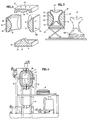
- a mold 21 includes at least four divisible mating mold portions consisting essentially of an upper mold portion 22, a lower mold portion 23, and side mold portions 24, 25 to form a mold cavity 38.
- Each of the mold portions includes a pressure-proof air-tight vessel 26-29 and a filter member 30-33 inside the vessel.
- the inner surfaces of the filter members define a shape of the article to be molded when the four mold portions are mated together.
- Each of the filter members 30-33 has therein a water-drainage means such as a water-drainage conduit 34-37 placed at suitable intervals.
- the water-drainage means (hereinafter referred to as a conduit or conduits) is communicated with the openings outside of the vessel.
- the upper mold portion 22 can have an overflow duct 41 at its top and the lower mold portion 23 has a slip supply duct 40 at its bottom, the ducts of which are communicated with the mold cavity 38 and with the openings outside of the vessels 26, 27.
- the mold 21 is normally composed of four mold portions as shown in the drawings, but the mold portions and particularly the side mold portions can be designed to be further divided into a plurality of mold parts in accordance with the shapes and structures of the article to be molded.
- the mold can be pipe-lined in the following way.
- An overflow tank 39 is desirably connected with the overflow duct 41, and is also connected with a three-way valve at its upper position. One end of the valve is opened to atmosphere and other end thereof is connected with an air-compressor (not shown in the drawing).
- the overflow tank, overflow duct and valve may be avoided in a simple embodiment of the present invention.
- Each of the outer tubings 26a-29a communicated with the water-drainage conduit 34-37 is connected with a gas- liquid separator.
- the separator (not shown) is equipped with a draining valve and a three-way valve. One end of the three-way valve is connected with an air-compressor (not shown) and the other end thereof is connected with a suction pump (not shown).
- the slip supply duct 40 is connected through a flexible tube with a valve of a slip supply unit.
- the slip supply unit is installed at a position lower than the mold 21 to utilize the gravity drop of the slip.
- the slip supply unit may be set at a position higher than the mold 21 by the use of a slip-draining pump (not shown).
- a stand 43 to receive and carry a molded article 42 is equipped in a preferred embodiment.
- the table 43 includes a table lifter and a conveyor set thereon. The table lifter is movable from a waiting position (shown by two-dotted chain lines in FIG. 3) to an article-receiving position (shown by full lines in FIG. 3).
- the apparatus for drain-casting a slip shown in FIG. 1 comprises an upper mold portion 22 supported at an upper position, a lower mold portion 23 supported at a position under the upper mold portion, and side mold portions 24, 25; but the condition for combining the mold portions is not always restricted to such an embodiment.
- a molded article having a substantially protuberant part is produced by designing the mold to contain the protuberant part in the lower mold portion, so that the undeposited slip can be readily drained. and lower are After the upper v portions v removed first, the side mold portions are turned upside down by means of turning means 46 as shown in FIG. 4, so that the molded article can be demolded safely on a stand.
- the molding apparatus to be used in the present invention is preferably equipped with rake-adjustment rams 47 as shown in FIG. 4 for draining the remaining undeposited slip.
- the rams 44, 45, 47 can be fixed to frame works 48 as shown in FIG. 4.
- the above mentioned filter members 30-33 consist essentially of porous filter materials having a suitable cohesive or self-binding property which withstands the pressure to be applied to the filter members.
- the porous materials for the filter members include, for example, gypsum, porous cement materials, porous plastics, porous metal, porous ceramics, and mixtures thereof. From the viewpoint of efficiently fabricating a mold including the filter members, the porous materials for the filter may be preferably of a material dispersible or soluble in water or liquid.
- the above-mentioned water-drainage means such as conduits 34-37 are preferably composed of a permeable conduit such as tubes or cords which are more porous than the filter materials.
- Such permeable materials are not especially restricted as long as they are more permeable and porous than the filter materials.
- a knitted fiber (e.g., cotton) tube having an outer diameter of about 2 mm to about 20 mm can be effectively used as a typical material therefor.
- the porous plastics for the above mentioned filter members include £poxy resins, phenolic resins, water-containing polyester resins, foamed polyester resins, acrylic resins, mixtures thereof, etc. which can be incorporated with emulsifiers, curing agents, water, surfactants and/or fillers.
- the porous tubes or the like for the water-drainage conduits in the mold portions it is preferred that at least two continuous circuit tubes or the like are used in each mold portion and one or both ends of each tube be independently communicated with the openings outside of the vessel, in order to conduct drainage of water, pressurization to exude water and depressurization and also to provide for the local breakage of the filter member.
- the water- drainage conduit contained in each filter member be divided into a plurality of circuits composed of porous tubes or the like, and each of the circuits be independently communicated with the openings, outside of the pressure-proof vessel. It is also preferred that both ends of each tube are communicated with the openings outside of the vessel, so that the filter material such as resins clogged in the conduit in the production of the mold portion can be washed out.
- the effective thickness refers to a distance between the inner surface of the filter member and the water-drainage conduit.
- the thickness required depends on filtering characteristics and mechanical strength of the filter member.
- a porous sheet 1 mm or less thick having good mechanical strength may also be used.
- the thickness is determined in view of mechanical strength and is in the range of 1- to 8-fold thickness of the diameter of the water-drainage conduit, and preferably in the range of about 2- to about 5-fold thickness thereof.
- a thickness of about 20 mm is used in the case of a knitted cotton tube conduit 10 mm in diameter.
- the thickness can be thinner in the case of porous resin or porous metal materials.
- the porosity is preferably in the range of 30% to 60% and typically about 40% to about 45%.
- the pore size is preferably 1 to 40 microns and typically 1 to 30 microns. In the case of resin filter material, the pore size can be made smaller, for example, as small as 0.3 micron.
- the permeability of the filter member should be substantially uniform in principle, but a variation thereof up to about 15% is empirically allowable.
- the interval between the conduits is in the range of 0 to 100 mm, preferably 5 to 60 mm and typically 10 to 50 mm.
- the method for drain-casting a slip according to the present invention can be carried out in the following way by using the apparatus shown in the drawings.
- a slip pressurized by the pump is supplied via the slip supply duct 40 into the mold cavity 38 formed by mating the four mold portion 22-25 together.
- the valve over the overflow tank 39 is opened to atmosphere in the course of supplying the slip.
- the pressurizing pump is stopped and the valve below the slip supply duct is closed.
- Compressed air e.g. about 5 to 15 kg/cm 2 , is then supplied into the overflow tank 39 to pressurize the slip within the mold cavity 38.
- the overflow tank 39 and duct 41 are not provided in a simple embodiment, the slip within the mold cavity is pressurized via the slip supply duct 40.
- the pressure within the outer tubings 26a-29a and water-drainage conduits 34-37 is made atmospheric pressure, or alternatively, is made negative pressure, e.g. about 300 to 700 mmHg.
- the pressurized slip within the mold cavity 38 is rapidly deposited onto the surfaces of the filter members 30-33 because water contained in the slip is expressed through the filter members into the drainage conduits 34-37 having lower pressure.
- the pressure within the overflow tank 39 is decreased or returned to atmospheric pressure, or alternatively, atmospheric pressure or some pressure is applied to the mold cavity 38 through an opening or tubing communicated with mold cavity in the absence of the overflow duct 41.
- undeposited slip remaining in the mold cavity 38 is returned, by opening the valves, to the slip tank via the slip supply duct 40.
- compressed air may be used to repressurize the deposited slip and lower the water content thereof uniformly.
- compressed air is supplied into the water-drainage conduits 34, 35 of the upper and lower mold portions 22, 23 to exude some water remaining in the filter members 30, 31 between the surface of the filter members 30, 31 and the molded article 42 to form a water film between them.
- the lower and upper mold portions 22, 23 are separated from the side mold portions 24, 25 and moved downward and upward, while the molded article 42 is attracted by vacuum into the filter members 32, 33 to hold and support the molded article between the side mold portions.
- the stand 43 for the molded article is moved under the suspended article 42, and the table lifter is elevated to allow the stand to support the bottom of the molded article 42.
- compressed air is supplied to pressurize the water-drainage conduits 36, 37.
- a slip conventionally used for casting or drain-casting is successfully utilized in the present invention.
- the composition of the slip for ceramic ware is shown as an example in the following, wherein the percentages are approximate values by weight and the solid components may contain some moisture.
- the temperature of the slip is generally in the range of 10 to 80°C, preferably 15 to 50°C and typically 25 to 40°C.
- the slip is warmed up to about 28°C or more in cold weather, and the slipis:maintained at the above mentioned temperature range by agitation in mild or hot weather.
- the term "slip" used herein refers to a flowable aqueous suspension of fine powder comprising ceramic materials, resin materials or mixture thereof for casting or drain-casting maintained generally at a temperature given above.
- the pressure is in the range of 1 kgf/cm 2 to a safe pressure of the filter member, preferably about 5 to about 50 kgf/cm 2 and typically about 7 to about 30 kgf/cm 2 .
- the pressure depends on the filter member and the conduit to be used.
- the depressurization may be zero, but is generally in the range of 10 mmHg to a safe pressure of the filter member, preferably about 200 mmHg or more, and typically about 500 mmHg or more.
- the deposition velocity is not in proportion to the sum of the pressure applied to the slip and the pressure evacuated through the conduits.
- the depressurization of the conduits does not make a large difference when the filter member is rather dry, but in the later course of the deposition, the deposition velocity and the hardness of molded articles are markedly increased by depressurizing the water-drainage conduits.
- the depressurization of the conduits in the first course of the deposition may sometimes cause clogging of the filter members.
- the depressurization of the conduits is effective to conduct the depressurization of the conduits only in the later about 2/3 to 1/20 and preferably in the later about 1/2 to 1/10 course of the deposition step.
- the depressurization of the water-drainage means be employed during, i.e. at least in some course of, the slip-deposition step of the present invention.
- the suitable thickness is generally in the range of about 3 mm to about 25 mm in the case of hollow molded articles and actually will be about 10 mm.
- the deposition amount and the molding time are substantially proportionate in this thickness range.
- the hardness number is measured by a rubber-stamping hardness tester supplied oy Peacock Company.
- the molded article having the following hardness can be demolded and placed on a stand without deformation or damage thereof;
- the pressure depends on the filter member, and is generally in the range of 0.5 to 9 kgf/cm 2 , preferably 1 to 7 kgf/cm 2 and typically 2 to 5 kgf/cm 2 .
- the depressurization is generally 10 mmhg or more, preferably 200 mmHg or more and typically 500 mmhg or more.
- FIGS. 1 through 4 An apparatus as described above and illustrated in FIGS. 1 through 4 was used to carry out drain-casting operations to obtain hollow molded articles.
- the specifications of the apparatus used and conditions of the casting and demolding operations employed were as follows :
- the hollow molded articles for stool sanitary ware similar to those illustrated in FIGS. 1 and 3 were produced in accordance with the present invention.
- the deposition step commencing the supply of the slip and ending the drainage of the slip took about 10 minutes with the gypsum mold, and about 7 minutes with the epoxy resin mold.
- the subsequent step for demolding the molded article on a stand safely without deformation or damage thereof took about 1 minute with the gypsum mold, and about 0.5 minute or more with the epoxy resin mold.
- the duration of the gypsum mold was about 500 molding cycles in the present process. That of the porous epoxy resin mold was estimated by the present inventor to be about 10,000 molding cycles.
- the step of depressurizing the water-drainage means or conduits 36, 37 of the side mold portions, when the upper and lower mold portions are removed and the molded article is suspended is not always necessary, as long as the hollow molded article is firmly held and supported due to the cohesion of deposited slip between the filter members 32, 33 of the side mold portions 24, 25.
- the depressurization of the side mold portions is normally employed to support the molded article firmly.
- the slip supply duct 40 illustrated in the partially sectional view of FIG. 1 looks not to reach the mold cavity 38; however, it is to be noted that the duct 40 is communicated with the lowest portion of the mold cavity 38 at a position not shown on the section of FIG. 1. Thus, undeposited slip remaining in the mold cavity is readily drained via the slip supply duct 40.
- one of the features of the present invention is to remove the upper and lower mold portions first upward and downward, respectively and then to remove the side mold portions sideways, the four mold portions being movably supported by the frame works or the like ; whereby demolding a hollow molded article on a stand safely.
Landscapes
- Engineering & Computer Science (AREA)
- Chemical & Material Sciences (AREA)
- Ceramic Engineering (AREA)
- Dispersion Chemistry (AREA)
- Manufacturing & Machinery (AREA)
- Mechanical Engineering (AREA)
- Producing Shaped Articles From Materials (AREA)
- Press-Shaping Or Shaping Using Conveyers (AREA)
- Separation Using Semi-Permeable Membranes (AREA)
- Casting Or Compression Moulding Of Plastics Or The Like (AREA)
Priority Applications (1)
| Application Number | Priority Date | Filing Date | Title |
|---|---|---|---|
| AT86306053T ATE69993T1 (de) | 1985-08-06 | 1986-08-06 | Verfahren zur herstellung von hohlwaren durch sauggiessen. |
Applications Claiming Priority (2)
| Application Number | Priority Date | Filing Date | Title |
|---|---|---|---|
| JP173922/85 | 1985-08-06 | ||
| JP60173922A JPS6233601A (ja) | 1985-08-06 | 1985-08-06 | 排泥鋳込み成形方法 |
Publications (2)
| Publication Number | Publication Date |
|---|---|
| EP0211653A1 true EP0211653A1 (fr) | 1987-02-25 |
| EP0211653B1 EP0211653B1 (fr) | 1991-12-04 |
Family
ID=15969560
Family Applications (1)
| Application Number | Title | Priority Date | Filing Date |
|---|---|---|---|
| EP86306053A Expired - Lifetime EP0211653B1 (fr) | 1985-08-06 | 1986-08-06 | Procédé pour la fabrication de produits creux par coulage et aspiration |
Country Status (6)
| Country | Link |
|---|---|
| US (1) | US4882111A (fr) |
| EP (1) | EP0211653B1 (fr) |
| JP (1) | JPS6233601A (fr) |
| AT (1) | ATE69993T1 (fr) |
| DE (1) | DE3682720D1 (fr) |
| ES (1) | ES2008877A6 (fr) |
Cited By (12)
| Publication number | Priority date | Publication date | Assignee | Title |
|---|---|---|---|---|
| US4818457A (en) * | 1986-07-26 | 1989-04-04 | Toto Ltd. | Method of making mold used in slip casting process |
| US4830802A (en) * | 1986-08-08 | 1989-05-16 | Toto Ltd. | Method of making mold used in pressure slip casting |
| US4832890A (en) * | 1986-08-08 | 1989-05-23 | Toto Ltd. | Casting process |
| US4844853A (en) * | 1986-07-26 | 1989-07-04 | Toto Ltd. | Method of making mold used in pressure slip casting |
| US4874304A (en) * | 1986-07-26 | 1989-10-17 | Toto Ltd. | Porous mold for pressure slip casting |
| US5020983A (en) * | 1988-07-19 | 1991-06-04 | Inax Corporation | Divisible slip-casting molds |
| US5046937A (en) * | 1988-07-19 | 1991-09-10 | Inax Corporation | Slip-casting molds |
| EP0540004A1 (fr) * | 1991-10-29 | 1993-05-05 | Inax Corporation | Mécanisme pour ajuster ensemble des éléments de moule dans un dispositif de moulage sous pression |
| EP0411960B1 (fr) * | 1989-08-03 | 1994-12-14 | Toto Ltd. | Dispositif de coulage en barbotine sous pression pour la fabrication d'articles sanitaires |
| US5611980A (en) * | 1994-06-08 | 1997-03-18 | Toto Ltd. | Apparatus and method for slip casting |
| US5922258A (en) * | 1995-04-04 | 1999-07-13 | S.I.T.A. S.P.A. Societa Impianti Termoelettrici Industriali | Method and device for forming complex sanitary fittings |
| CN105798259A (zh) * | 2015-11-17 | 2016-07-27 | 佛山市南海奔达模具有限公司 | 采用铸造模具生产铸件的脱模方法、脱模机构及铸造机器 |
Families Citing this family (10)
| Publication number | Priority date | Publication date | Assignee | Title |
|---|---|---|---|---|
| JPH02167701A (ja) * | 1988-12-21 | 1990-06-28 | Ngk Insulators Ltd | 排気チャネル断熱用の多枝セラミック管の製造方法 |
| US5451152A (en) * | 1989-06-21 | 1995-09-19 | Ngk Insulators, Ltd. | Porous mold for manufacturing ceramics |
| JPH05149196A (ja) * | 1991-10-04 | 1993-06-15 | Ngk Insulators Ltd | セラミツクポートライナーの成形方法 |
| US5427722A (en) * | 1993-06-11 | 1995-06-27 | General Motors Corporation | Pressure slip casting process for making hollow-shaped ceramics |
| IT235163Y1 (it) * | 1994-10-10 | 2000-03-31 | Ideal Standard Spa | Gruppo di tenuta per elementi maschio di stampi per la colatura di apparecchiature igienico-sanitarie |
| US6531078B2 (en) * | 2001-02-26 | 2003-03-11 | Ahlstrom Glassfibre Oy | Method for foam casting using three-dimensional molds |
| DE10130186A1 (de) * | 2001-06-22 | 2003-01-02 | Josef Wagner | Verfahren und Vorrichtung zum Schlickergießen unter Druckeinwirkung |
| EP3168387B1 (fr) * | 2015-11-14 | 2020-11-04 | kaminofenkeramik Rene Rasbach e.K. | Marche d'escalier et procédé de fabrication d'une marche d'escalier |
| CN107486923B (zh) * | 2017-09-29 | 2023-05-12 | 唐山贺祥智能科技股份有限公司 | 快排水模具脱模排水供气装置 |
| EP3482845B1 (fr) | 2017-11-13 | 2023-12-13 | Dorst Technologies GmbH & Co. KG | Pièce moulée, moule et procédé de moulage d'une ébauche crue |
Citations (4)
| Publication number | Priority date | Publication date | Assignee | Title |
|---|---|---|---|---|
| US1817391A (en) * | 1928-12-31 | 1931-08-04 | John C Miller | Mold |
| US3461194A (en) * | 1967-04-17 | 1969-08-12 | Universal Rundle Corp | Method and means for casting syphon-jet type toilet bowls |
| FR2300664A1 (fr) * | 1975-02-12 | 1976-09-10 | Motte Bernadette | Procede et moule pour le faconnage par coulage d'articles en porcelaines ou en ceramiques |
| GB2124540A (en) * | 1982-05-27 | 1984-02-22 | Ina Seito Kk | Slip-casting hollow articles |
Family Cites Families (5)
| Publication number | Priority date | Publication date | Assignee | Title |
|---|---|---|---|---|
| US2669762A (en) * | 1953-02-05 | 1954-02-23 | Andrew R Blackburn | Method for making ware by casting |
| BE613464A (fr) * | 1961-02-14 | 1962-05-29 | Gasbetonwerk Josef Hebel Gmbh | Procédé pour soulever et transporter des blocs de matière agglomérée. |
| NL139254B (nl) * | 1965-02-03 | 1973-07-16 | Fabriek Van Bouwmaterialen Loe | Werkwijze en inrichting voor het vervaardigen van voorwerpen van gasbeton en voorwerpen volgens deze werkwijze vervaardigd. |
| NL6501347A (fr) * | 1965-02-03 | 1966-08-04 | ||
| US3792149A (en) * | 1969-10-13 | 1974-02-12 | Mansfield Sanitary Inc | Method to extricate intricate,ceramic shapes from multiple piece molds |
-
1985
- 1985-08-06 JP JP60173922A patent/JPS6233601A/ja active Granted
-
1986
- 1986-08-04 US US06/894,497 patent/US4882111A/en not_active Expired - Fee Related
- 1986-08-06 AT AT86306053T patent/ATE69993T1/de active
- 1986-08-06 DE DE8686306053T patent/DE3682720D1/de not_active Expired - Fee Related
- 1986-08-06 EP EP86306053A patent/EP0211653B1/fr not_active Expired - Lifetime
- 1986-08-06 ES ES8600899A patent/ES2008877A6/es not_active Expired
Patent Citations (4)
| Publication number | Priority date | Publication date | Assignee | Title |
|---|---|---|---|---|
| US1817391A (en) * | 1928-12-31 | 1931-08-04 | John C Miller | Mold |
| US3461194A (en) * | 1967-04-17 | 1969-08-12 | Universal Rundle Corp | Method and means for casting syphon-jet type toilet bowls |
| FR2300664A1 (fr) * | 1975-02-12 | 1976-09-10 | Motte Bernadette | Procede et moule pour le faconnage par coulage d'articles en porcelaines ou en ceramiques |
| GB2124540A (en) * | 1982-05-27 | 1984-02-22 | Ina Seito Kk | Slip-casting hollow articles |
Cited By (14)
| Publication number | Priority date | Publication date | Assignee | Title |
|---|---|---|---|---|
| US4818457A (en) * | 1986-07-26 | 1989-04-04 | Toto Ltd. | Method of making mold used in slip casting process |
| US4844853A (en) * | 1986-07-26 | 1989-07-04 | Toto Ltd. | Method of making mold used in pressure slip casting |
| US4874304A (en) * | 1986-07-26 | 1989-10-17 | Toto Ltd. | Porous mold for pressure slip casting |
| US4913868A (en) * | 1986-07-26 | 1990-04-03 | Toto Ltd. | Method for making porous mold for pressure slip casting |
| US4830802A (en) * | 1986-08-08 | 1989-05-16 | Toto Ltd. | Method of making mold used in pressure slip casting |
| US4832890A (en) * | 1986-08-08 | 1989-05-23 | Toto Ltd. | Casting process |
| US5020983A (en) * | 1988-07-19 | 1991-06-04 | Inax Corporation | Divisible slip-casting molds |
| US5046937A (en) * | 1988-07-19 | 1991-09-10 | Inax Corporation | Slip-casting molds |
| EP0411960B1 (fr) * | 1989-08-03 | 1994-12-14 | Toto Ltd. | Dispositif de coulage en barbotine sous pression pour la fabrication d'articles sanitaires |
| EP0540004A1 (fr) * | 1991-10-29 | 1993-05-05 | Inax Corporation | Mécanisme pour ajuster ensemble des éléments de moule dans un dispositif de moulage sous pression |
| US5611980A (en) * | 1994-06-08 | 1997-03-18 | Toto Ltd. | Apparatus and method for slip casting |
| US5922258A (en) * | 1995-04-04 | 1999-07-13 | S.I.T.A. S.P.A. Societa Impianti Termoelettrici Industriali | Method and device for forming complex sanitary fittings |
| CN105798259A (zh) * | 2015-11-17 | 2016-07-27 | 佛山市南海奔达模具有限公司 | 采用铸造模具生产铸件的脱模方法、脱模机构及铸造机器 |
| CN105798259B (zh) * | 2015-11-17 | 2018-02-23 | 佛山市南海奔达模具有限公司 | 采用铸造模具生产铸件的脱模方法、脱模机构及铸造机器 |
Also Published As
| Publication number | Publication date |
|---|---|
| EP0211653B1 (fr) | 1991-12-04 |
| US4882111A (en) | 1989-11-21 |
| JPS6233601A (ja) | 1987-02-13 |
| DE3682720D1 (de) | 1992-01-16 |
| JPH0146283B2 (fr) | 1989-10-06 |
| ATE69993T1 (de) | 1991-12-15 |
| ES2008877A6 (es) | 1989-08-16 |
Similar Documents
| Publication | Publication Date | Title |
|---|---|---|
| EP0211653B1 (fr) | Procédé pour la fabrication de produits creux par coulage et aspiration | |
| US4528152A (en) | Method for obtaining drain-cast hollow articles for ceramic ware | |
| EP0559490B1 (fr) | Moule pour pulpe, procédé et appareil de moulage pour la fabrication de corps fibreux | |
| US5120211A (en) | Slip casting device | |
| US20020100536A1 (en) | Apparatus for casting a plumbing fixture | |
| EP1242222B1 (fr) | Appareil de coulage en barbotine et procede | |
| US20090315221A1 (en) | Method for demolding ceramic products and apparatus for implementing the method | |
| JP2001047415A (ja) | 衛生陶器及びその製造方法並びに鋳込み成形装置 | |
| EP0352056B1 (fr) | Moule à coulage de barbotine | |
| US5645863A (en) | Equipment for unmolding sanitary ware | |
| GB1359684A (en) | Casting of ceramic articles | |
| US5299624A (en) | Fluid assisted casting apparatus | |
| US4268001A (en) | Mold for casting ceramic materials | |
| JP2534966B2 (ja) | 陶磁器板の製法およびそれに用いる成形型 | |
| Rump | INFLUENCE OF PRESSURE CASTING ON THE MICROSTRUCTURE OF SiC MATERIALS | |
| SU1447664A1 (ru) | Способ изготовлени фасонных изделий из волокнистого материала | |
| RU2021108C1 (ru) | Способ изготовления глуходонных кварцевых стаканов и линия для его осуществления | |
| JPH0369304A (ja) | 泥漿鋳込み成形装置 | |
| JPH034007B2 (fr) | ||
| JPH03262602A (ja) | セラミックス鋳込成形体の乾燥方法 | |
| JPH0360644B2 (fr) | ||
| JPH0740318A (ja) | 水硬性無機質成形物の成形装置及び成形方法 |
Legal Events
| Date | Code | Title | Description |
|---|---|---|---|
| PUAI | Public reference made under article 153(3) epc to a published international application that has entered the european phase |
Free format text: ORIGINAL CODE: 0009012 |
|
| AK | Designated contracting states |
Kind code of ref document: A1 Designated state(s): AT BE CH DE FR GB IT LI NL |
|
| 17P | Request for examination filed |
Effective date: 19870814 |
|
| 17Q | First examination report despatched |
Effective date: 19880811 |
|
| GRAA | (expected) grant |
Free format text: ORIGINAL CODE: 0009210 |
|
| AK | Designated contracting states |
Kind code of ref document: B1 Designated state(s): AT BE CH DE FR GB IT LI NL |
|
| REF | Corresponds to: |
Ref document number: 69993 Country of ref document: AT Date of ref document: 19911215 Kind code of ref document: T |
|
| REF | Corresponds to: |
Ref document number: 3682720 Country of ref document: DE Date of ref document: 19920116 |
|
| ET | Fr: translation filed | ||
| ITF | It: translation for a ep patent filed | ||
| PLBE | No opposition filed within time limit |
Free format text: ORIGINAL CODE: 0009261 |
|
| STAA | Information on the status of an ep patent application or granted ep patent |
Free format text: STATUS: NO OPPOSITION FILED WITHIN TIME LIMIT |
|
| 26N | No opposition filed | ||
| PGFP | Annual fee paid to national office [announced via postgrant information from national office to epo] |
Ref country code: GB Payment date: 19960829 Year of fee payment: 11 |
|
| PGFP | Annual fee paid to national office [announced via postgrant information from national office to epo] |
Ref country code: FR Payment date: 19960830 Year of fee payment: 11 |
|
| PGFP | Annual fee paid to national office [announced via postgrant information from national office to epo] |
Ref country code: DE Payment date: 19960906 Year of fee payment: 11 |
|
| PGFP | Annual fee paid to national office [announced via postgrant information from national office to epo] |
Ref country code: AT Payment date: 19960912 Year of fee payment: 11 |
|
| PGFP | Annual fee paid to national office [announced via postgrant information from national office to epo] |
Ref country code: CH Payment date: 19960919 Year of fee payment: 11 |
|
| PGFP | Annual fee paid to national office [announced via postgrant information from national office to epo] |
Ref country code: NL Payment date: 19960930 Year of fee payment: 11 |
|
| PGFP | Annual fee paid to national office [announced via postgrant information from national office to epo] |
Ref country code: BE Payment date: 19961003 Year of fee payment: 11 |
|
| PG25 | Lapsed in a contracting state [announced via postgrant information from national office to epo] |
Ref country code: GB Free format text: LAPSE BECAUSE OF NON-PAYMENT OF DUE FEES Effective date: 19970806 Ref country code: AT Free format text: LAPSE BECAUSE OF NON-PAYMENT OF DUE FEES Effective date: 19970806 |
|
| PG25 | Lapsed in a contracting state [announced via postgrant information from national office to epo] |
Ref country code: LI Free format text: LAPSE BECAUSE OF NON-PAYMENT OF DUE FEES Effective date: 19970831 Ref country code: CH Free format text: LAPSE BECAUSE OF NON-PAYMENT OF DUE FEES Effective date: 19970831 Ref country code: BE Free format text: LAPSE BECAUSE OF NON-PAYMENT OF DUE FEES Effective date: 19970831 |
|
| BERE | Be: lapsed |
Owner name: INAX CORP. Effective date: 19970831 |
|
| PG25 | Lapsed in a contracting state [announced via postgrant information from national office to epo] |
Ref country code: NL Free format text: LAPSE BECAUSE OF NON-PAYMENT OF DUE FEES Effective date: 19980301 |
|
| GBPC | Gb: european patent ceased through non-payment of renewal fee |
Effective date: 19970806 |
|
| REG | Reference to a national code |
Ref country code: CH Ref legal event code: PL |
|
| PG25 | Lapsed in a contracting state [announced via postgrant information from national office to epo] |
Ref country code: FR Free format text: LAPSE BECAUSE OF NON-PAYMENT OF DUE FEES Effective date: 19980430 |
|
| PG25 | Lapsed in a contracting state [announced via postgrant information from national office to epo] |
Ref country code: DE Free format text: LAPSE BECAUSE OF NON-PAYMENT OF DUE FEES Effective date: 19980501 |
|
| NLV4 | Nl: lapsed or anulled due to non-payment of the annual fee |
Effective date: 19980301 |
|
| REG | Reference to a national code |
Ref country code: FR Ref legal event code: ST |
|
| PG25 | Lapsed in a contracting state [announced via postgrant information from national office to epo] |
Ref country code: IT Free format text: LAPSE BECAUSE OF NON-PAYMENT OF DUE FEES;WARNING: LAPSES OF ITALIAN PATENTS WITH EFFECTIVE DATE BEFORE 2007 MAY HAVE OCCURRED AT ANY TIME BEFORE 2007. THE CORRECT EFFECTIVE DATE MAY BE DIFFERENT FROM THE ONE RECORDED. Effective date: 20050806 |