EP0216453B1 - Esters of hyaluronic acid and their salts. - Google Patents
Esters of hyaluronic acid and their salts. Download PDFInfo
- Publication number
- EP0216453B1 EP0216453B1 EP86305233A EP86305233A EP0216453B1 EP 0216453 B1 EP0216453 B1 EP 0216453B1 EP 86305233 A EP86305233 A EP 86305233A EP 86305233 A EP86305233 A EP 86305233A EP 0216453 B1 EP0216453 B1 EP 0216453B1
- Authority
- EP
- European Patent Office
- Prior art keywords
- ester
- hyaluronic acid
- hyaluronic
- groups
- salt
- Prior art date
- Legal status (The legal status is an assumption and is not a legal conclusion. Google has not performed a legal analysis and makes no representation as to the accuracy of the status listed.)
- Expired - Lifetime
Links
- 229920002674 hyaluronan Polymers 0.000 title claims description 253
- 229960003160 hyaluronic acid Drugs 0.000 title claims description 248
- KIUKXJAPPMFGSW-DNGZLQJQSA-N (2S,3S,4S,5R,6R)-6-[(2S,3R,4R,5S,6R)-3-Acetamido-2-[(2S,3S,4R,5R,6R)-6-[(2R,3R,4R,5S,6R)-3-acetamido-2,5-dihydroxy-6-(hydroxymethyl)oxan-4-yl]oxy-2-carboxy-4,5-dihydroxyoxan-3-yl]oxy-5-hydroxy-6-(hydroxymethyl)oxan-4-yl]oxy-3,4,5-trihydroxyoxane-2-carboxylic acid Chemical compound CC(=O)N[C@H]1[C@H](O)O[C@H](CO)[C@@H](O)[C@@H]1O[C@H]1[C@H](O)[C@@H](O)[C@H](O[C@H]2[C@@H]([C@@H](O[C@H]3[C@@H]([C@@H](O)[C@H](O)[C@H](O3)C(O)=O)O)[C@H](O)[C@@H](CO)O2)NC(C)=O)[C@@H](C(O)=O)O1 KIUKXJAPPMFGSW-DNGZLQJQSA-N 0.000 title claims description 236
- 150000002148 esters Chemical class 0.000 title claims description 179
- 150000003839 salts Chemical class 0.000 title claims description 107
- LFQSCWFLJHTTHZ-UHFFFAOYSA-N Ethanol Chemical compound CCO LFQSCWFLJHTTHZ-UHFFFAOYSA-N 0.000 claims description 140
- 235000019441 ethanol Nutrition 0.000 claims description 109
- 239000000243 solution Substances 0.000 claims description 102
- 239000003814 drug Substances 0.000 claims description 97
- -1 amino, hydroxy, mercapto Chemical class 0.000 claims description 88
- 238000002360 preparation method Methods 0.000 claims description 74
- 238000000034 method Methods 0.000 claims description 63
- IAZDPXIOMUYVGZ-UHFFFAOYSA-N Dimethylsulphoxide Chemical compound CS(C)=O IAZDPXIOMUYVGZ-UHFFFAOYSA-N 0.000 claims description 61
- 150000001298 alcohols Chemical class 0.000 claims description 39
- 239000013543 active substance Substances 0.000 claims description 36
- 125000003178 carboxy group Chemical group [H]OC(*)=O 0.000 claims description 36
- 239000000126 substance Substances 0.000 claims description 33
- 239000011734 sodium Substances 0.000 claims description 25
- 125000004432 carbon atom Chemical group C* 0.000 claims description 24
- 150000001875 compounds Chemical class 0.000 claims description 21
- 239000002537 cosmetic Substances 0.000 claims description 21
- 229940079593 drug Drugs 0.000 claims description 20
- DGAQECJNVWCQMB-PUAWFVPOSA-M Ilexoside XXIX Chemical compound C[C@@H]1CC[C@@]2(CC[C@@]3(C(=CC[C@H]4[C@]3(CC[C@@H]5[C@@]4(CC[C@@H](C5(C)C)OS(=O)(=O)[O-])C)C)[C@@H]2[C@]1(C)O)C)C(=O)O[C@H]6[C@@H]([C@H]([C@@H]([C@H](O6)CO)O)O)O.[Na+] DGAQECJNVWCQMB-PUAWFVPOSA-M 0.000 claims description 18
- 125000001931 aliphatic group Chemical group 0.000 claims description 18
- 125000000217 alkyl group Chemical group 0.000 claims description 18
- 150000004702 methyl esters Chemical class 0.000 claims description 18
- 229910052708 sodium Inorganic materials 0.000 claims description 18
- ULGZDMOVFRHVEP-RWJQBGPGSA-N Erythromycin Chemical compound O([C@@H]1[C@@H](C)C(=O)O[C@@H]([C@@]([C@H](O)[C@@H](C)C(=O)[C@H](C)C[C@@](C)(O)[C@H](O[C@H]2[C@@H]([C@H](C[C@@H](C)O2)N(C)C)O)[C@H]1C)(C)O)CC)[C@H]1C[C@@](C)(OC)[C@@H](O)[C@H](C)O1 ULGZDMOVFRHVEP-RWJQBGPGSA-N 0.000 claims description 17
- 229930193140 Neomycin Natural products 0.000 claims description 17
- 229960004927 neomycin Drugs 0.000 claims description 17
- 239000002904 solvent Substances 0.000 claims description 17
- 239000003981 vehicle Substances 0.000 claims description 17
- 239000003960 organic solvent Substances 0.000 claims description 15
- 239000000825 pharmaceutical preparation Substances 0.000 claims description 15
- 125000004494 ethyl ester group Chemical group 0.000 claims description 14
- 150000007530 organic bases Chemical class 0.000 claims description 13
- IJGRMHOSHXDMSA-UHFFFAOYSA-N Atomic nitrogen Chemical compound N#N IJGRMHOSHXDMSA-UHFFFAOYSA-N 0.000 claims description 12
- PEDCQBHIVMGVHV-UHFFFAOYSA-N Glycerine Chemical compound OCC(O)CO PEDCQBHIVMGVHV-UHFFFAOYSA-N 0.000 claims description 12
- UCSJYZPVAKXKNQ-HZYVHMACSA-N streptomycin Chemical compound CN[C@H]1[C@H](O)[C@@H](O)[C@H](CO)O[C@H]1O[C@@H]1[C@](C=O)(O)[C@H](C)O[C@H]1O[C@@H]1[C@@H](NC(N)=N)[C@H](O)[C@@H](NC(N)=N)[C@H](O)[C@H]1O UCSJYZPVAKXKNQ-HZYVHMACSA-N 0.000 claims description 12
- QCHFTSOMWOSFHM-WPRPVWTQSA-N (+)-Pilocarpine Chemical compound C1OC(=O)[C@@H](CC)[C@H]1CC1=CN=CN1C QCHFTSOMWOSFHM-WPRPVWTQSA-N 0.000 claims description 11
- CEAZRRDELHUEMR-URQXQFDESA-N Gentamicin Chemical compound O1[C@H](C(C)NC)CC[C@@H](N)[C@H]1O[C@H]1[C@H](O)[C@@H](O[C@@H]2[C@@H]([C@@H](NC)[C@@](C)(O)CO2)O)[C@H](N)C[C@@H]1N CEAZRRDELHUEMR-URQXQFDESA-N 0.000 claims description 11
- 150000007529 inorganic bases Chemical class 0.000 claims description 11
- SBUJHOSQTJFQJX-NOAMYHISSA-N kanamycin Chemical compound O[C@@H]1[C@@H](O)[C@H](O)[C@@H](CN)O[C@@H]1O[C@H]1[C@H](O)[C@@H](O[C@@H]2[C@@H]([C@@H](N)[C@H](O)[C@@H](CO)O2)O)[C@H](N)C[C@@H]1N SBUJHOSQTJFQJX-NOAMYHISSA-N 0.000 claims description 11
- 239000007787 solid Substances 0.000 claims description 11
- 229930182566 Gentamicin Natural products 0.000 claims description 10
- LKCWBDHBTVXHDL-RMDFUYIESA-N amikacin Chemical compound O([C@@H]1[C@@H](N)C[C@H]([C@@H]([C@H]1O)O[C@@H]1[C@@H]([C@@H](N)[C@H](O)[C@@H](CO)O1)O)NC(=O)[C@@H](O)CCN)[C@H]1O[C@H](CN)[C@@H](O)[C@H](O)[C@H]1O LKCWBDHBTVXHDL-RMDFUYIESA-N 0.000 claims description 10
- 239000003795 chemical substances by application Substances 0.000 claims description 10
- 125000002496 methyl group Chemical group [H]C([H])([H])* 0.000 claims description 10
- BDERNNFJNOPAEC-UHFFFAOYSA-N propan-1-ol Chemical compound CCCO BDERNNFJNOPAEC-UHFFFAOYSA-N 0.000 claims description 10
- 238000001356 surgical procedure Methods 0.000 claims description 10
- QCHFTSOMWOSFHM-UHFFFAOYSA-N SJ000285536 Natural products C1OC(=O)C(CC)C1CC1=CN=CN1C QCHFTSOMWOSFHM-UHFFFAOYSA-N 0.000 claims description 9
- 239000002775 capsule Substances 0.000 claims description 9
- 239000000546 pharmaceutical excipient Substances 0.000 claims description 9
- 229960001416 pilocarpine Drugs 0.000 claims description 9
- RTZKZFJDLAIYFH-UHFFFAOYSA-N Diethyl ether Chemical compound CCOCC RTZKZFJDLAIYFH-UHFFFAOYSA-N 0.000 claims description 8
- LYCAIKOWRPUZTN-UHFFFAOYSA-N Ethylene glycol Chemical compound OCCO LYCAIKOWRPUZTN-UHFFFAOYSA-N 0.000 claims description 8
- LRHPLDYGYMQRHN-UHFFFAOYSA-N N-Butanol Chemical compound CCCCO LRHPLDYGYMQRHN-UHFFFAOYSA-N 0.000 claims description 8
- 229960000318 kanamycin Drugs 0.000 claims description 8
- 229930027917 kanamycin Natural products 0.000 claims description 8
- 229930182823 kanamycin A Natural products 0.000 claims description 8
- QGZKDVFQNNGYKY-UHFFFAOYSA-O Ammonium Chemical compound [NH4+] QGZKDVFQNNGYKY-UHFFFAOYSA-O 0.000 claims description 7
- KFZMGEQAYNKOFK-UHFFFAOYSA-N Isopropanol Chemical compound CC(C)O KFZMGEQAYNKOFK-UHFFFAOYSA-N 0.000 claims description 7
- QOSMNYMQXIVWKY-UHFFFAOYSA-N Propyl levulinate Chemical compound CCCOC(=O)CCC(C)=O QOSMNYMQXIVWKY-UHFFFAOYSA-N 0.000 claims description 7
- 230000003110 anti-inflammatory effect Effects 0.000 claims description 7
- 229960003276 erythromycin Drugs 0.000 claims description 7
- 125000000524 functional group Chemical group 0.000 claims description 7
- 125000001183 hydrocarbyl group Chemical group 0.000 claims description 7
- 238000007920 subcutaneous administration Methods 0.000 claims description 7
- DNIAPMSPPWPWGF-UHFFFAOYSA-N Propylene glycol Chemical compound CC(O)CO DNIAPMSPPWPWGF-UHFFFAOYSA-N 0.000 claims description 6
- 206010052428 Wound Diseases 0.000 claims description 6
- 208000027418 Wounds and injury Diseases 0.000 claims description 6
- 229910052784 alkaline earth metal Inorganic materials 0.000 claims description 6
- 150000001342 alkaline earth metals Chemical class 0.000 claims description 6
- 229960004821 amikacin Drugs 0.000 claims description 6
- QVGXLLKOCUKJST-UHFFFAOYSA-N atomic oxygen Chemical compound [O] QVGXLLKOCUKJST-UHFFFAOYSA-N 0.000 claims description 6
- 235000011187 glycerol Nutrition 0.000 claims description 6
- 229910052757 nitrogen Inorganic materials 0.000 claims description 6
- 229910052760 oxygen Inorganic materials 0.000 claims description 6
- 239000001301 oxygen Substances 0.000 claims description 6
- 239000004480 active ingredient Substances 0.000 claims description 5
- 239000000010 aprotic solvent Substances 0.000 claims description 5
- 125000002887 hydroxy group Chemical group [H]O* 0.000 claims description 5
- 238000002513 implantation Methods 0.000 claims description 5
- 125000001997 phenyl group Chemical group [H]C1=C([H])C([H])=C(*)C([H])=C1[H] 0.000 claims description 5
- 230000008569 process Effects 0.000 claims description 5
- 150000003242 quaternary ammonium salts Chemical class 0.000 claims description 5
- DZLFLBLQUQXARW-UHFFFAOYSA-N tetrabutylammonium Chemical class CCCC[N+](CCCC)(CCCC)CCCC DZLFLBLQUQXARW-UHFFFAOYSA-N 0.000 claims description 5
- 239000005526 vasoconstrictor agent Substances 0.000 claims description 5
- KWGRBVOPPLSCSI-WPRPVWTQSA-N (-)-ephedrine Chemical compound CN[C@@H](C)[C@H](O)C1=CC=CC=C1 KWGRBVOPPLSCSI-WPRPVWTQSA-N 0.000 claims description 4
- FYYHWMGAXLPEAU-UHFFFAOYSA-N Magnesium Chemical compound [Mg] FYYHWMGAXLPEAU-UHFFFAOYSA-N 0.000 claims description 4
- DKGAVHZHDRPRBM-UHFFFAOYSA-N Tert-Butanol Chemical compound CC(C)(C)O DKGAVHZHDRPRBM-UHFFFAOYSA-N 0.000 claims description 4
- 239000003125 aqueous solvent Substances 0.000 claims description 4
- 239000003937 drug carrier Substances 0.000 claims description 4
- 125000001495 ethyl group Chemical group [H]C([H])([H])C([H])([H])* 0.000 claims description 4
- 230000006870 function Effects 0.000 claims description 4
- ZXEKIIBDNHEJCQ-UHFFFAOYSA-N isobutanol Chemical compound CC(C)CO ZXEKIIBDNHEJCQ-UHFFFAOYSA-N 0.000 claims description 4
- UCTWMZQNUQWSLP-UHFFFAOYSA-N Adrenaline Natural products CNCC(O)C1=CC=C(O)C(O)=C1 UCTWMZQNUQWSLP-UHFFFAOYSA-N 0.000 claims description 3
- 150000003863 ammonium salts Chemical class 0.000 claims description 3
- 125000005843 halogen group Chemical group 0.000 claims description 3
- 125000005842 heteroatom Chemical group 0.000 claims description 3
- 239000011777 magnesium Substances 0.000 claims description 3
- 229910052749 magnesium Inorganic materials 0.000 claims description 3
- 239000003094 microcapsule Substances 0.000 claims description 3
- 230000007170 pathology Effects 0.000 claims description 3
- 229960005322 streptomycin Drugs 0.000 claims description 3
- 150000005621 tetraalkylammonium salts Chemical class 0.000 claims description 3
- 150000007970 thio esters Chemical class 0.000 claims description 3
- 150000003568 thioethers Chemical class 0.000 claims description 3
- PUPZLCDOIYMWBV-UHFFFAOYSA-N (+/-)-1,3-Butanediol Chemical compound CC(O)CCO PUPZLCDOIYMWBV-UHFFFAOYSA-N 0.000 claims description 2
- NINIDFKCEFEMDL-UHFFFAOYSA-N Sulfur Chemical compound [S] NINIDFKCEFEMDL-UHFFFAOYSA-N 0.000 claims description 2
- 230000001476 alcoholic effect Effects 0.000 claims description 2
- 150000001299 aldehydes Chemical class 0.000 claims description 2
- 229910052782 aluminium Inorganic materials 0.000 claims description 2
- XAGFODPZIPBFFR-UHFFFAOYSA-N aluminium Chemical compound [Al] XAGFODPZIPBFFR-UHFFFAOYSA-N 0.000 claims description 2
- 230000000840 anti-viral effect Effects 0.000 claims description 2
- KWGRBVOPPLSCSI-UHFFFAOYSA-N d-ephedrine Natural products CNC(C)C(O)C1=CC=CC=C1 KWGRBVOPPLSCSI-UHFFFAOYSA-N 0.000 claims description 2
- 229960002179 ephedrine Drugs 0.000 claims description 2
- 229940093476 ethylene glycol Drugs 0.000 claims description 2
- 238000010253 intravenous injection Methods 0.000 claims description 2
- 229940035429 isobutyl alcohol Drugs 0.000 claims description 2
- 230000003902 lesion Effects 0.000 claims description 2
- 125000004123 n-propyl group Chemical group [H]C([H])([H])C([H])([H])C([H])([H])* 0.000 claims description 2
- 125000003386 piperidinyl group Chemical group 0.000 claims description 2
- 229960004063 propylene glycol Drugs 0.000 claims description 2
- 235000013772 propylene glycol Nutrition 0.000 claims description 2
- DCKVNWZUADLDEH-UHFFFAOYSA-N sec-butyl acetate Chemical compound CCC(C)OC(C)=O DCKVNWZUADLDEH-UHFFFAOYSA-N 0.000 claims description 2
- 239000011593 sulfur Substances 0.000 claims description 2
- 229910052717 sulfur Inorganic materials 0.000 claims description 2
- UCTWMZQNUQWSLP-VIFPVBQESA-N (R)-adrenaline Chemical compound CNC[C@H](O)C1=CC=C(O)C(O)=C1 UCTWMZQNUQWSLP-VIFPVBQESA-N 0.000 claims 2
- WRMNZCZEMHIOCP-UHFFFAOYSA-N 2-phenylethanol Chemical compound OCCC1=CC=CC=C1 WRMNZCZEMHIOCP-UHFFFAOYSA-N 0.000 claims 2
- AMQJEAYHLZJPGS-UHFFFAOYSA-N N-Pentanol Chemical compound CCCCCO AMQJEAYHLZJPGS-UHFFFAOYSA-N 0.000 claims 2
- ZSIAUFGUXNUGDI-UHFFFAOYSA-N hexan-1-ol Chemical compound CCCCCCO ZSIAUFGUXNUGDI-UHFFFAOYSA-N 0.000 claims 2
- KBPLFHHGFOOTCA-UHFFFAOYSA-N 1-Octanol Chemical compound CCCCCCCCO KBPLFHHGFOOTCA-UHFFFAOYSA-N 0.000 claims 1
- AMOYMEBHYUTMKJ-UHFFFAOYSA-N 2-(2-phenylethoxy)ethylbenzene Chemical compound C=1C=CC=CC=1CCOCCC1=CC=CC=C1 AMOYMEBHYUTMKJ-UHFFFAOYSA-N 0.000 claims 1
- 229930194542 Keto Natural products 0.000 claims 1
- 125000002777 acetyl group Chemical group [H]C([H])([H])C(*)=O 0.000 claims 1
- 239000000061 acid fraction Substances 0.000 claims 1
- 229940102884 adrenalin Drugs 0.000 claims 1
- 239000004411 aluminium Substances 0.000 claims 1
- 230000003444 anaesthetic effect Effects 0.000 claims 1
- 230000000202 analgesic effect Effects 0.000 claims 1
- 125000001664 diethylamino group Chemical group [H]C([H])([H])C([H])([H])N(*)C([H])([H])C([H])([H])[H] 0.000 claims 1
- 125000000623 heterocyclic group Chemical group 0.000 claims 1
- 239000011261 inert gas Substances 0.000 claims 1
- 238000010255 intramuscular injection Methods 0.000 claims 1
- 125000000468 ketone group Chemical group 0.000 claims 1
- WVDDGKGOMKODPV-ZQBYOMGUSA-N phenyl(114C)methanol Chemical compound O[14CH2]C1=CC=CC=C1 WVDDGKGOMKODPV-ZQBYOMGUSA-N 0.000 claims 1
- 125000000719 pyrrolidinyl group Chemical group 0.000 claims 1
- 238000010254 subcutaneous injection Methods 0.000 claims 1
- CSCPPACGZOOCGX-UHFFFAOYSA-N Acetone Chemical compound CC(C)=O CSCPPACGZOOCGX-UHFFFAOYSA-N 0.000 description 138
- XLYOFNOQVPJJNP-UHFFFAOYSA-N water Substances O XLYOFNOQVPJJNP-UHFFFAOYSA-N 0.000 description 70
- FAPWRFPIFSIZLT-UHFFFAOYSA-M Sodium chloride Chemical compound [Na+].[Cl-] FAPWRFPIFSIZLT-UHFFFAOYSA-M 0.000 description 66
- XEKOWRVHYACXOJ-UHFFFAOYSA-N Ethyl acetate Chemical compound CCOC(C)=O XEKOWRVHYACXOJ-UHFFFAOYSA-N 0.000 description 54
- 239000000203 mixture Substances 0.000 description 43
- 238000013019 agitation Methods 0.000 description 36
- 239000002244 precipitate Substances 0.000 description 36
- 239000011780 sodium chloride Substances 0.000 description 35
- 229960001760 dimethyl sulfoxide Drugs 0.000 description 32
- 239000000047 product Substances 0.000 description 32
- 239000000463 material Substances 0.000 description 21
- 125000004185 ester group Chemical group 0.000 description 19
- 239000002253 acid Substances 0.000 description 17
- 239000011347 resin Substances 0.000 description 16
- 229920005989 resin Polymers 0.000 description 16
- 229940088710 antibiotic agent Drugs 0.000 description 15
- 230000000694 effects Effects 0.000 description 15
- 229920001467 poly(styrenesulfonates) Polymers 0.000 description 15
- 239000003242 anti bacterial agent Substances 0.000 description 14
- 230000009471 action Effects 0.000 description 13
- 210000001519 tissue Anatomy 0.000 description 13
- OKKJLVBELUTLKV-UHFFFAOYSA-N Methanol Chemical compound OC OKKJLVBELUTLKV-UHFFFAOYSA-N 0.000 description 12
- KRKNYBCHXYNGOX-UHFFFAOYSA-N citric acid Chemical compound OC(=O)CC(O)(C(O)=O)CC(O)=O KRKNYBCHXYNGOX-UHFFFAOYSA-N 0.000 description 12
- 239000012528 membrane Substances 0.000 description 12
- 229910052751 metal Inorganic materials 0.000 description 12
- 239000002184 metal Substances 0.000 description 12
- 230000032050 esterification Effects 0.000 description 11
- 238000005886 esterification reaction Methods 0.000 description 11
- 210000004379 membrane Anatomy 0.000 description 11
- 238000009472 formulation Methods 0.000 description 10
- JYGXADMDTFJGBT-VWUMJDOOSA-N hydrocortisone Chemical compound O=C1CC[C@]2(C)[C@H]3[C@@H](O)C[C@](C)([C@@](CC4)(O)C(=O)CO)[C@@H]4[C@@H]3CCC2=C1 JYGXADMDTFJGBT-VWUMJDOOSA-N 0.000 description 10
- 150000002739 metals Chemical class 0.000 description 10
- 229920001282 polysaccharide Polymers 0.000 description 10
- 239000005017 polysaccharide Substances 0.000 description 10
- 159000000000 sodium salts Chemical class 0.000 description 10
- 230000000699 topical effect Effects 0.000 description 10
- 108090000790 Enzymes Proteins 0.000 description 9
- 102000004190 Enzymes Human genes 0.000 description 9
- 239000002260 anti-inflammatory agent Substances 0.000 description 9
- 229940088598 enzyme Drugs 0.000 description 9
- 230000001225 therapeutic effect Effects 0.000 description 9
- 239000006071 cream Substances 0.000 description 8
- 239000007788 liquid Substances 0.000 description 8
- 150000004804 polysaccharides Chemical class 0.000 description 8
- 150000001412 amines Chemical class 0.000 description 7
- 229940121363 anti-inflammatory agent Drugs 0.000 description 7
- 239000002674 ointment Substances 0.000 description 7
- 125000001453 quaternary ammonium group Chemical group 0.000 description 7
- 108010003272 Hyaluronate lyase Proteins 0.000 description 6
- 102000001974 Hyaluronidases Human genes 0.000 description 6
- 239000007864 aqueous solution Substances 0.000 description 6
- 210000001520 comb Anatomy 0.000 description 6
- 229960002518 gentamicin Drugs 0.000 description 6
- 229960002773 hyaluronidase Drugs 0.000 description 6
- 230000036571 hydration Effects 0.000 description 6
- 238000006703 hydration reaction Methods 0.000 description 6
- 238000004519 manufacturing process Methods 0.000 description 6
- 230000002906 microbiologic effect Effects 0.000 description 6
- 210000000056 organ Anatomy 0.000 description 6
- DPKBAXPHAYBPRL-UHFFFAOYSA-M tetrabutylazanium;iodide Chemical compound [I-].CCCC[N+](CCCC)(CCCC)CCCC DPKBAXPHAYBPRL-UHFFFAOYSA-M 0.000 description 6
- 238000000108 ultra-filtration Methods 0.000 description 6
- WVDDGKGOMKODPV-UHFFFAOYSA-N Benzyl alcohol Chemical compound OCC1=CC=CC=C1 WVDDGKGOMKODPV-UHFFFAOYSA-N 0.000 description 5
- 108010026389 Gramicidin Proteins 0.000 description 5
- 241001465754 Metazoa Species 0.000 description 5
- 150000007513 acids Chemical class 0.000 description 5
- 238000004458 analytical method Methods 0.000 description 5
- 230000008901 benefit Effects 0.000 description 5
- 229960001927 cetylpyridinium chloride Drugs 0.000 description 5
- NFCRBQADEGXVDL-UHFFFAOYSA-M cetylpyridinium chloride monohydrate Chemical compound O.[Cl-].CCCCCCCCCCCCCCCC[N+]1=CC=CC=C1 NFCRBQADEGXVDL-UHFFFAOYSA-M 0.000 description 5
- 201000010099 disease Diseases 0.000 description 5
- 208000037265 diseases, disorders, signs and symptoms Diseases 0.000 description 5
- 230000007717 exclusion Effects 0.000 description 5
- 229960004905 gramicidin Drugs 0.000 description 5
- ZWCXYZRRTRDGQE-SORVKSEFSA-N gramicidina Chemical compound C1=CC=C2C(C[C@H](NC(=O)[C@@H](CC(C)C)NC(=O)[C@H](CC=3C4=CC=CC=C4NC=3)NC(=O)[C@@H](CC(C)C)NC(=O)[C@H](CC=3C4=CC=CC=C4NC=3)NC(=O)[C@@H](CC(C)C)NC(=O)[C@H](CC=3C4=CC=CC=C4NC=3)NC(=O)[C@H](C(C)C)NC(=O)[C@H](C(C)C)NC(=O)[C@@H](C(C)C)NC(=O)[C@H](C)NC(=O)[C@H](NC(=O)[C@H](C)NC(=O)CNC(=O)[C@@H](NC=O)C(C)C)CC(C)C)C(=O)NCCO)=CNC2=C1 ZWCXYZRRTRDGQE-SORVKSEFSA-N 0.000 description 5
- 229960000890 hydrocortisone Drugs 0.000 description 5
- 230000000144 pharmacologic effect Effects 0.000 description 5
- 229920001296 polysiloxane Polymers 0.000 description 5
- 239000000843 powder Substances 0.000 description 5
- 125000001436 propyl group Chemical group [H]C([*])([H])C([H])([H])C([H])([H])[H] 0.000 description 5
- 239000007858 starting material Substances 0.000 description 5
- 150000003431 steroids Chemical class 0.000 description 5
- 238000002560 therapeutic procedure Methods 0.000 description 5
- DNIAPMSPPWPWGF-GSVOUGTGSA-N (R)-(-)-Propylene glycol Chemical compound C[C@@H](O)CO DNIAPMSPPWPWGF-GSVOUGTGSA-N 0.000 description 4
- CURLTUGMZLYLDI-UHFFFAOYSA-N Carbon dioxide Chemical compound O=C=O CURLTUGMZLYLDI-UHFFFAOYSA-N 0.000 description 4
- 108090000371 Esterases Proteins 0.000 description 4
- GLZPCOQZEFWAFX-UHFFFAOYSA-N Geraniol Chemical compound CC(C)=CCCC(C)=CCO GLZPCOQZEFWAFX-UHFFFAOYSA-N 0.000 description 4
- 108010093965 Polymyxin B Proteins 0.000 description 4
- UIIMBOGNXHQVGW-UHFFFAOYSA-M Sodium bicarbonate Chemical compound [Na+].OC([O-])=O UIIMBOGNXHQVGW-UHFFFAOYSA-M 0.000 description 4
- 229920001284 acidic polysaccharide Polymers 0.000 description 4
- 150000004805 acidic polysaccharides Chemical class 0.000 description 4
- 230000015572 biosynthetic process Effects 0.000 description 4
- 238000009835 boiling Methods 0.000 description 4
- 238000005119 centrifugation Methods 0.000 description 4
- 238000006243 chemical reaction Methods 0.000 description 4
- 238000000605 extraction Methods 0.000 description 4
- 238000001914 filtration Methods 0.000 description 4
- 239000003193 general anesthetic agent Substances 0.000 description 4
- 239000011521 glass Substances 0.000 description 4
- 150000002576 ketones Chemical class 0.000 description 4
- 229920000024 polymyxin B Polymers 0.000 description 4
- 229960005266 polymyxin b Drugs 0.000 description 4
- 229960005205 prednisolone Drugs 0.000 description 4
- OIGNJSKKLXVSLS-VWUMJDOOSA-N prednisolone Chemical compound O=C1C=C[C@]2(C)[C@H]3[C@@H](O)C[C@](C)([C@@](CC4)(O)C(=O)CO)[C@@H]4[C@@H]3CCC2=C1 OIGNJSKKLXVSLS-VWUMJDOOSA-N 0.000 description 4
- 229920006395 saturated elastomer Polymers 0.000 description 4
- 210000002966 serum Anatomy 0.000 description 4
- 210000004872 soft tissue Anatomy 0.000 description 4
- 239000007921 spray Substances 0.000 description 4
- 229940124597 therapeutic agent Drugs 0.000 description 4
- 150000003672 ureas Chemical group 0.000 description 4
- FUFLCEKSBBHCMO-UHFFFAOYSA-N 11-dehydrocorticosterone Natural products O=C1CCC2(C)C3C(=O)CC(C)(C(CC4)C(=O)CO)C4C3CCC2=C1 FUFLCEKSBBHCMO-UHFFFAOYSA-N 0.000 description 3
- MFYSYFVPBJMHGN-ZPOLXVRWSA-N Cortisone Chemical compound O=C1CC[C@]2(C)[C@H]3C(=O)C[C@](C)([C@@](CC4)(O)C(=O)CO)[C@@H]4[C@@H]3CCC2=C1 MFYSYFVPBJMHGN-ZPOLXVRWSA-N 0.000 description 3
- MFYSYFVPBJMHGN-UHFFFAOYSA-N Cortisone Natural products O=C1CCC2(C)C3C(=O)CC(C)(C(CC4)(O)C(=O)CO)C4C3CCC2=C1 MFYSYFVPBJMHGN-UHFFFAOYSA-N 0.000 description 3
- IAJILQKETJEXLJ-UHFFFAOYSA-N Galacturonsaeure Natural products O=CC(O)C(O)C(O)C(O)C(O)=O IAJILQKETJEXLJ-UHFFFAOYSA-N 0.000 description 3
- ZMXDDKWLCZADIW-UHFFFAOYSA-N N,N-Dimethylformamide Chemical compound CN(C)C=O ZMXDDKWLCZADIW-UHFFFAOYSA-N 0.000 description 3
- ZLMJMSJWJFRBEC-UHFFFAOYSA-N Potassium Chemical compound [K] ZLMJMSJWJFRBEC-UHFFFAOYSA-N 0.000 description 3
- RWRDLPDLKQPQOW-UHFFFAOYSA-N Pyrrolidine Chemical compound C1CCNC1 RWRDLPDLKQPQOW-UHFFFAOYSA-N 0.000 description 3
- VYPSYNLAJGMNEJ-UHFFFAOYSA-N Silicium dioxide Chemical compound O=[Si]=O VYPSYNLAJGMNEJ-UHFFFAOYSA-N 0.000 description 3
- 239000004098 Tetracycline Substances 0.000 description 3
- 238000010521 absorption reaction Methods 0.000 description 3
- 239000000654 additive Substances 0.000 description 3
- 239000000048 adrenergic agonist Substances 0.000 description 3
- 239000000674 adrenergic antagonist Substances 0.000 description 3
- 150000001447 alkali salts Chemical class 0.000 description 3
- 229940035674 anesthetics Drugs 0.000 description 3
- 230000000844 anti-bacterial effect Effects 0.000 description 3
- 239000002246 antineoplastic agent Substances 0.000 description 3
- 230000003115 biocidal effect Effects 0.000 description 3
- 229920000704 biodegradable plastic Polymers 0.000 description 3
- 230000004071 biological effect Effects 0.000 description 3
- 150000004649 carbonic acid derivatives Chemical class 0.000 description 3
- 229960004544 cortisone Drugs 0.000 description 3
- 230000007547 defect Effects 0.000 description 3
- 239000000645 desinfectant Substances 0.000 description 3
- UREBDLICKHMUKA-CXSFZGCWSA-N dexamethasone Chemical compound C1CC2=CC(=O)C=C[C@]2(C)[C@]2(F)[C@@H]1[C@@H]1C[C@@H](C)[C@@](C(=O)CO)(O)[C@@]1(C)C[C@@H]2O UREBDLICKHMUKA-CXSFZGCWSA-N 0.000 description 3
- 239000012153 distilled water Substances 0.000 description 3
- 230000002255 enzymatic effect Effects 0.000 description 3
- 210000003560 epithelium corneal Anatomy 0.000 description 3
- 238000011156 evaluation Methods 0.000 description 3
- 239000007789 gas Substances 0.000 description 3
- 229910052736 halogen Inorganic materials 0.000 description 3
- 229940088597 hormone Drugs 0.000 description 3
- 239000005556 hormone Substances 0.000 description 3
- 230000000887 hydrating effect Effects 0.000 description 3
- 230000003301 hydrolyzing effect Effects 0.000 description 3
- 238000002347 injection Methods 0.000 description 3
- 239000007924 injection Substances 0.000 description 3
- 238000007918 intramuscular administration Methods 0.000 description 3
- HVTICUPFWKNHNG-UHFFFAOYSA-N iodoethane Chemical compound CCI HVTICUPFWKNHNG-UHFFFAOYSA-N 0.000 description 3
- PVWOIHVRPOBWPI-UHFFFAOYSA-N n-propyl iodide Chemical compound CCCI PVWOIHVRPOBWPI-UHFFFAOYSA-N 0.000 description 3
- 230000007935 neutral effect Effects 0.000 description 3
- 229940023490 ophthalmic product Drugs 0.000 description 3
- 239000002304 perfume Substances 0.000 description 3
- 230000035699 permeability Effects 0.000 description 3
- 229960001802 phenylephrine Drugs 0.000 description 3
- SONNWYBIRXJNDC-VIFPVBQESA-N phenylephrine Chemical compound CNC[C@H](O)C1=CC=CC(O)=C1 SONNWYBIRXJNDC-VIFPVBQESA-N 0.000 description 3
- 229940068196 placebo Drugs 0.000 description 3
- 239000000902 placebo Substances 0.000 description 3
- 229920003023 plastic Polymers 0.000 description 3
- 239000004033 plastic Substances 0.000 description 3
- 239000011591 potassium Substances 0.000 description 3
- 229910052700 potassium Inorganic materials 0.000 description 3
- XAEFZNCEHLXOMS-UHFFFAOYSA-M potassium benzoate Chemical compound [K+].[O-]C(=O)C1=CC=CC=C1 XAEFZNCEHLXOMS-UHFFFAOYSA-M 0.000 description 3
- 230000002035 prolonged effect Effects 0.000 description 3
- 238000000746 purification Methods 0.000 description 3
- 230000001105 regulatory effect Effects 0.000 description 3
- YWIVKILSMZOHHF-QJZPQSOGSA-N sodium;(2s,3s,4s,5r,6r)-6-[(2s,3r,4r,5s,6r)-3-acetamido-2-[(2s,3s,4r,5r,6r)-6-[(2r,3r,4r,5s,6r)-3-acetamido-2,5-dihydroxy-6-(hydroxymethyl)oxan-4-yl]oxy-2-carboxy-4,5-dihydroxyoxan-3-yl]oxy-5-hydroxy-6-(hydroxymethyl)oxan-4-yl]oxy-3,4,5-trihydroxyoxane-2- Chemical compound [Na+].CC(=O)N[C@H]1[C@H](O)O[C@H](CO)[C@@H](O)[C@@H]1O[C@H]1[C@H](O)[C@@H](O)[C@H](O[C@H]2[C@@H]([C@@H](O[C@H]3[C@@H]([C@@H](O)[C@H](O)[C@H](O3)C(O)=O)O)[C@H](O)[C@@H](CO)O2)NC(C)=O)[C@@H](C(O)=O)O1 YWIVKILSMZOHHF-QJZPQSOGSA-N 0.000 description 3
- 239000006228 supernatant Substances 0.000 description 3
- 239000000829 suppository Substances 0.000 description 3
- 239000000725 suspension Substances 0.000 description 3
- 238000012360 testing method Methods 0.000 description 3
- 235000019364 tetracycline Nutrition 0.000 description 3
- 150000003522 tetracyclines Chemical class 0.000 description 3
- 210000003954 umbilical cord Anatomy 0.000 description 3
- 239000011782 vitamin Substances 0.000 description 3
- 229940088594 vitamin Drugs 0.000 description 3
- 235000013343 vitamin Nutrition 0.000 description 3
- 229930003231 vitamin Natural products 0.000 description 3
- KIUKXJAPPMFGSW-YXBJCWEESA-N (2s,4s,5r,6s)-6-[(2s,3r,5s,6r)-3-acetamido-2-[(3s,4r,5r,6r)-6-[(3r,4r,5s,6r)-3-acetamido-2,5-dihydroxy-6-(hydroxymethyl)oxan-4-yl]oxy-2-carboxy-4,5-dihydroxyoxan-3-yl]oxy-5-hydroxy-6-(hydroxymethyl)oxan-4-yl]oxy-3,4,5-trihydroxyoxane-2-carboxylic acid Chemical compound CC(=O)N[C@H]1C(O)O[C@H](CO)[C@@H](O)[C@@H]1O[C@H]1[C@H](O)[C@@H](O)[C@H](O[C@H]2[C@@H](C(O[C@@H]3[C@@H]([C@@H](O)C(O)[C@H](O3)C(O)=O)O)[C@H](O)[C@@H](CO)O2)NC(C)=O)C(C(O)=O)O1 KIUKXJAPPMFGSW-YXBJCWEESA-N 0.000 description 2
- BYEAHWXPCBROCE-UHFFFAOYSA-N 1,1,1,3,3,3-hexafluoropropan-2-ol Chemical compound FC(F)(F)C(O)C(F)(F)F BYEAHWXPCBROCE-UHFFFAOYSA-N 0.000 description 2
- CNIIGCLFLJGOGP-UHFFFAOYSA-N 2-(1-naphthalenylmethyl)-4,5-dihydro-1H-imidazole Chemical compound C=1C=CC2=CC=CC=C2C=1CC1=NCCN1 CNIIGCLFLJGOGP-UHFFFAOYSA-N 0.000 description 2
- HZAXFHJVJLSVMW-UHFFFAOYSA-N 2-Aminoethan-1-ol Chemical compound NCCO HZAXFHJVJLSVMW-UHFFFAOYSA-N 0.000 description 2
- QGZKDVFQNNGYKY-UHFFFAOYSA-N Ammonia Chemical compound N QGZKDVFQNNGYKY-UHFFFAOYSA-N 0.000 description 2
- 208000036487 Arthropathies Diseases 0.000 description 2
- 235000014469 Bacillus subtilis Nutrition 0.000 description 2
- 108010001478 Bacitracin Proteins 0.000 description 2
- BVKZGUZCCUSVTD-UHFFFAOYSA-M Bicarbonate Chemical class OC([O-])=O BVKZGUZCCUSVTD-UHFFFAOYSA-M 0.000 description 2
- 241000283690 Bos taurus Species 0.000 description 2
- 241000283707 Capra Species 0.000 description 2
- FBPFZTCFMRRESA-FSIIMWSLSA-N D-Glucitol Natural products OC[C@H](O)[C@H](O)[C@@H](O)[C@H](O)CO FBPFZTCFMRRESA-FSIIMWSLSA-N 0.000 description 2
- SNRUBQQJIBEYMU-UHFFFAOYSA-N Dodecane Natural products CCCCCCCCCCCC SNRUBQQJIBEYMU-UHFFFAOYSA-N 0.000 description 2
- AEMRFAOFKBGASW-UHFFFAOYSA-N Glycolic acid Chemical compound OCC(O)=O AEMRFAOFKBGASW-UHFFFAOYSA-N 0.000 description 2
- 208000012659 Joint disease Diseases 0.000 description 2
- LSDPWZHWYPCBBB-UHFFFAOYSA-N Methanethiol Chemical compound SC LSDPWZHWYPCBBB-UHFFFAOYSA-N 0.000 description 2
- YNAVUWVOSKDBBP-UHFFFAOYSA-N Morpholine Chemical compound C1COCCN1 YNAVUWVOSKDBBP-UHFFFAOYSA-N 0.000 description 2
- OVRNDRQMDRJTHS-UHFFFAOYSA-N N-acelyl-D-glucosamine Natural products CC(=O)NC1C(O)OC(CO)C(O)C1O OVRNDRQMDRJTHS-UHFFFAOYSA-N 0.000 description 2
- OVRNDRQMDRJTHS-FMDGEEDCSA-N N-acetyl-beta-D-glucosamine Chemical compound CC(=O)N[C@H]1[C@H](O)O[C@H](CO)[C@@H](O)[C@@H]1O OVRNDRQMDRJTHS-FMDGEEDCSA-N 0.000 description 2
- 239000004100 Oxytetracycline Substances 0.000 description 2
- 241001494479 Pecora Species 0.000 description 2
- JGSARLDLIJGVTE-MBNYWOFBSA-N Penicillin G Chemical compound N([C@H]1[C@H]2SC([C@@H](N2C1=O)C(O)=O)(C)C)C(=O)CC1=CC=CC=C1 JGSARLDLIJGVTE-MBNYWOFBSA-N 0.000 description 2
- NBIIXXVUZAFLBC-UHFFFAOYSA-N Phosphoric acid Chemical compound OP(O)(O)=O NBIIXXVUZAFLBC-UHFFFAOYSA-N 0.000 description 2
- NQRYJNQNLNOLGT-UHFFFAOYSA-N Piperidine Chemical compound C1CCNCC1 NQRYJNQNLNOLGT-UHFFFAOYSA-N 0.000 description 2
- 239000004698 Polyethylene Substances 0.000 description 2
- JUJWROOIHBZHMG-UHFFFAOYSA-N Pyridine Chemical compound C1=CC=NC=C1 JUJWROOIHBZHMG-UHFFFAOYSA-N 0.000 description 2
- 229920000297 Rayon Polymers 0.000 description 2
- 206010070834 Sensitisation Diseases 0.000 description 2
- 229920002385 Sodium hyaluronate Polymers 0.000 description 2
- QAOWNCQODCNURD-UHFFFAOYSA-L Sulfate Chemical compound [O-]S([O-])(=O)=O QAOWNCQODCNURD-UHFFFAOYSA-L 0.000 description 2
- FEWJPZIEWOKRBE-UHFFFAOYSA-N Tartaric Acid Chemical class [H+].[H+].[O-]C(=O)C(O)C(O)C([O-])=O FEWJPZIEWOKRBE-UHFFFAOYSA-N 0.000 description 2
- YXFVVABEGXRONW-UHFFFAOYSA-N Toluene Chemical compound CC1=CC=CC=C1 YXFVVABEGXRONW-UHFFFAOYSA-N 0.000 description 2
- DHKHKXVYLBGOIT-UHFFFAOYSA-N acetaldehyde Diethyl Acetal Natural products CCOC(C)OCC DHKHKXVYLBGOIT-UHFFFAOYSA-N 0.000 description 2
- 150000001241 acetals Chemical class 0.000 description 2
- 230000000996 additive effect Effects 0.000 description 2
- 229930013930 alkaloid Natural products 0.000 description 2
- 229940100198 alkylating agent Drugs 0.000 description 2
- 239000002168 alkylating agent Substances 0.000 description 2
- XXROGKLTLUQVRX-UHFFFAOYSA-N allyl alcohol Chemical compound OCC=C XXROGKLTLUQVRX-UHFFFAOYSA-N 0.000 description 2
- AEMOLEFTQBMNLQ-WAXACMCWSA-N alpha-D-glucuronic acid Chemical compound O[C@H]1O[C@H](C(O)=O)[C@@H](O)[C@H](O)[C@H]1O AEMOLEFTQBMNLQ-WAXACMCWSA-N 0.000 description 2
- 125000003277 amino group Chemical group 0.000 description 2
- 230000001741 anti-phlogistic effect Effects 0.000 description 2
- 229960005475 antiinfective agent Drugs 0.000 description 2
- 239000004599 antimicrobial Substances 0.000 description 2
- 239000003443 antiviral agent Substances 0.000 description 2
- 229940121357 antivirals Drugs 0.000 description 2
- 206010003246 arthritis Diseases 0.000 description 2
- 229960003071 bacitracin Drugs 0.000 description 2
- 229930184125 bacitracin Natural products 0.000 description 2
- CLKOFPXJLQSYAH-ABRJDSQDSA-N bacitracin A Chemical compound C1SC([C@@H](N)[C@@H](C)CC)=N[C@@H]1C(=O)N[C@@H](CC(C)C)C(=O)N[C@H](CCC(O)=O)C(=O)N[C@@H]([C@@H](C)CC)C(=O)N[C@@H]1C(=O)N[C@H](CCCN)C(=O)N[C@@H]([C@@H](C)CC)C(=O)N[C@H](CC=2C=CC=CC=2)C(=O)N[C@@H](CC=2N=CNC=2)C(=O)N[C@H](CC(O)=O)C(=O)N[C@@H](CC(N)=O)C(=O)NCCCC1 CLKOFPXJLQSYAH-ABRJDSQDSA-N 0.000 description 2
- BLFLLBZGZJTVJG-UHFFFAOYSA-N benzocaine Chemical compound CCOC(=O)C1=CC=C(N)C=C1 BLFLLBZGZJTVJG-UHFFFAOYSA-N 0.000 description 2
- AGEZXYOZHKGVCM-UHFFFAOYSA-N benzyl bromide Chemical compound BrCC1=CC=CC=C1 AGEZXYOZHKGVCM-UHFFFAOYSA-N 0.000 description 2
- 239000012620 biological material Substances 0.000 description 2
- 239000000872 buffer Substances 0.000 description 2
- 229910002092 carbon dioxide Inorganic materials 0.000 description 2
- 230000015556 catabolic process Effects 0.000 description 2
- 230000001413 cellular effect Effects 0.000 description 2
- WIIZWVCIJKGZOK-RKDXNWHRSA-N chloramphenicol Chemical compound ClC(Cl)C(=O)N[C@H](CO)[C@H](O)C1=CC=C([N+]([O-])=O)C=C1 WIIZWVCIJKGZOK-RKDXNWHRSA-N 0.000 description 2
- OEYIOHPDSNJKLS-UHFFFAOYSA-N choline Chemical compound C[N+](C)(C)CCO OEYIOHPDSNJKLS-UHFFFAOYSA-N 0.000 description 2
- 229960001231 choline Drugs 0.000 description 2
- 239000000064 cholinergic agonist Substances 0.000 description 2
- 239000000812 cholinergic antagonist Substances 0.000 description 2
- QMVPMAAFGQKVCJ-UHFFFAOYSA-N citronellol Chemical compound OCCC(C)CCC=C(C)C QMVPMAAFGQKVCJ-UHFFFAOYSA-N 0.000 description 2
- 239000003246 corticosteroid Substances 0.000 description 2
- 229960001334 corticosteroids Drugs 0.000 description 2
- 239000000824 cytostatic agent Substances 0.000 description 2
- 230000001085 cytostatic effect Effects 0.000 description 2
- 231100000433 cytotoxic Toxicity 0.000 description 2
- 229940127089 cytotoxic agent Drugs 0.000 description 2
- 230000001472 cytotoxic effect Effects 0.000 description 2
- SASYSVUEVMOWPL-NXVVXOECSA-N decyl oleate Chemical compound CCCCCCCCCCOC(=O)CCCCCCC\C=C/CCCCCCCC SASYSVUEVMOWPL-NXVVXOECSA-N 0.000 description 2
- 238000006731 degradation reaction Methods 0.000 description 2
- 229960003957 dexamethasone Drugs 0.000 description 2
- 125000000118 dimethyl group Chemical group [H]C([H])([H])* 0.000 description 2
- 238000009826 distribution Methods 0.000 description 2
- 150000002170 ethers Chemical class 0.000 description 2
- 238000002474 experimental method Methods 0.000 description 2
- 239000000284 extract Substances 0.000 description 2
- 229960001048 fluorometholone Drugs 0.000 description 2
- FAOZLTXFLGPHNG-KNAQIMQKSA-N fluorometholone Chemical compound C([C@@]12C)=CC(=O)C=C1[C@@H](C)C[C@@H]1[C@]2(F)[C@@H](O)C[C@]2(C)[C@@](O)(C(C)=O)CC[C@H]21 FAOZLTXFLGPHNG-KNAQIMQKSA-N 0.000 description 2
- 210000000245 forearm Anatomy 0.000 description 2
- 239000007903 gelatin capsule Substances 0.000 description 2
- 159000000011 group IA salts Chemical class 0.000 description 2
- BXWNKGSJHAJOGX-UHFFFAOYSA-N hexadecan-1-ol Chemical compound CCCCCCCCCCCCCCCCO BXWNKGSJHAJOGX-UHFFFAOYSA-N 0.000 description 2
- 238000011065 in-situ storage Methods 0.000 description 2
- CGIGDMFJXJATDK-UHFFFAOYSA-N indomethacin Chemical compound CC1=C(CC(O)=O)C2=CC(OC)=CC=C2N1C(=O)C1=CC=C(Cl)C=C1 CGIGDMFJXJATDK-UHFFFAOYSA-N 0.000 description 2
- 208000015181 infectious disease Diseases 0.000 description 2
- 239000004615 ingredient Substances 0.000 description 2
- 229910052500 inorganic mineral Inorganic materials 0.000 description 2
- INQOMBQAUSQDDS-UHFFFAOYSA-N iodomethane Chemical compound IC INQOMBQAUSQDDS-UHFFFAOYSA-N 0.000 description 2
- CDOSHBSSFJOMGT-UHFFFAOYSA-N linalool Chemical compound CC(C)=CCCC(C)(O)C=C CDOSHBSSFJOMGT-UHFFFAOYSA-N 0.000 description 2
- 230000005012 migration Effects 0.000 description 2
- 238000013508 migration Methods 0.000 description 2
- 235000010755 mineral Nutrition 0.000 description 2
- 239000011707 mineral Substances 0.000 description 2
- 150000007522 mineralic acids Chemical class 0.000 description 2
- 230000003547 miosis Effects 0.000 description 2
- 210000000214 mouth Anatomy 0.000 description 2
- 229950006780 n-acetylglucosamine Drugs 0.000 description 2
- 239000007922 nasal spray Substances 0.000 description 2
- 229960000988 nystatin Drugs 0.000 description 2
- VQOXZBDYSJBXMA-NQTDYLQESA-N nystatin A1 Chemical compound O[C@H]1[C@@H](N)[C@H](O)[C@@H](C)O[C@H]1O[C@H]1/C=C/C=C/C=C/C=C/CC/C=C/C=C/[C@H](C)[C@@H](O)[C@@H](C)[C@H](C)OC(=O)C[C@H](O)C[C@H](O)C[C@H](O)CC[C@@H](O)[C@H](O)C[C@](O)(C[C@H](O)[C@H]2C(O)=O)O[C@H]2C1 VQOXZBDYSJBXMA-NQTDYLQESA-N 0.000 description 2
- 125000002347 octyl group Chemical group [H]C([*])([H])C([H])([H])C([H])([H])C([H])([H])C([H])([H])C([H])([H])C([H])([H])C([H])([H])[H] 0.000 description 2
- 229960000625 oxytetracycline Drugs 0.000 description 2
- IWVCMVBTMGNXQD-PXOLEDIWSA-N oxytetracycline Chemical compound C1=CC=C2[C@](O)(C)[C@H]3[C@H](O)[C@H]4[C@H](N(C)C)C(O)=C(C(N)=O)C(=O)[C@@]4(O)C(O)=C3C(=O)C2=C1O IWVCMVBTMGNXQD-PXOLEDIWSA-N 0.000 description 2
- 235000019366 oxytetracycline Nutrition 0.000 description 2
- 235000010603 pastilles Nutrition 0.000 description 2
- 229960002139 pilocarpine hydrochloride Drugs 0.000 description 2
- RNAICSBVACLLGM-GNAZCLTHSA-N pilocarpine hydrochloride Chemical compound Cl.C1OC(=O)[C@@H](CC)[C@H]1CC1=CN=CN1C RNAICSBVACLLGM-GNAZCLTHSA-N 0.000 description 2
- 229920000573 polyethylene Polymers 0.000 description 2
- 108090000765 processed proteins & peptides Proteins 0.000 description 2
- 102000004196 processed proteins & peptides Human genes 0.000 description 2
- 150000003254 radicals Chemical class 0.000 description 2
- HMEYVGGHISAPJR-IAHYZSEUSA-N rolitetracycline Chemical compound O=C([C@@]1(O)C(O)=C2[C@@H]([C@](C3=CC=CC(O)=C3C2=O)(C)O)C[C@H]1[C@@H](C=1O)N(C)C)C=1C(=O)NCN1CCCC1 HMEYVGGHISAPJR-IAHYZSEUSA-N 0.000 description 2
- 229960005009 rolitetracycline Drugs 0.000 description 2
- YGSDEFSMJLZEOE-UHFFFAOYSA-M salicylate Chemical compound OC1=CC=CC=C1C([O-])=O YGSDEFSMJLZEOE-UHFFFAOYSA-M 0.000 description 2
- 230000008313 sensitization Effects 0.000 description 2
- NDVLTYZPCACLMA-UHFFFAOYSA-N silver oxide Chemical compound [O-2].[Ag+].[Ag+] NDVLTYZPCACLMA-UHFFFAOYSA-N 0.000 description 2
- 235000017557 sodium bicarbonate Nutrition 0.000 description 2
- 229910000030 sodium bicarbonate Inorganic materials 0.000 description 2
- 229940010747 sodium hyaluronate Drugs 0.000 description 2
- 239000000600 sorbitol Substances 0.000 description 2
- 230000009885 systemic effect Effects 0.000 description 2
- 235000002906 tartaric acid Nutrition 0.000 description 2
- IWVCMVBTMGNXQD-UHFFFAOYSA-N terramycin dehydrate Natural products C1=CC=C2C(O)(C)C3C(O)C4C(N(C)C)C(O)=C(C(N)=O)C(=O)C4(O)C(O)=C3C(=O)C2=C1O IWVCMVBTMGNXQD-UHFFFAOYSA-N 0.000 description 2
- 229940040944 tetracyclines Drugs 0.000 description 2
- REZQBEBOWJAQKS-UHFFFAOYSA-N triacontan-1-ol Chemical compound CCCCCCCCCCCCCCCCCCCCCCCCCCCCCCO REZQBEBOWJAQKS-UHFFFAOYSA-N 0.000 description 2
- 238000005303 weighing Methods 0.000 description 2
- 230000029663 wound healing Effects 0.000 description 2
- FQTLCLSUCSAZDY-UHFFFAOYSA-N (+) E(S) nerolidol Natural products CC(C)=CCCC(C)=CCCC(C)(O)C=C FQTLCLSUCSAZDY-UHFFFAOYSA-N 0.000 description 1
- CEMAWMOMDPGJMB-UHFFFAOYSA-N (+-)-Oxprenolol Chemical compound CC(C)NCC(O)COC1=CC=CC=C1OCC=C CEMAWMOMDPGJMB-UHFFFAOYSA-N 0.000 description 1
- SFLSHLFXELFNJZ-QMMMGPOBSA-N (-)-norepinephrine Chemical compound NC[C@H](O)C1=CC=C(O)C(O)=C1 SFLSHLFXELFNJZ-QMMMGPOBSA-N 0.000 description 1
- TWUSDDMONZULSC-QMTHXVAHSA-N (1s,2r)-2-(tert-butylamino)-1-(2,5-dimethoxyphenyl)propan-1-ol Chemical compound COC1=CC=C(OC)C([C@H](O)[C@@H](C)NC(C)(C)C)=C1 TWUSDDMONZULSC-QMTHXVAHSA-N 0.000 description 1
- CRDAMVZIKSXKFV-FBXUGWQNSA-N (2-cis,6-cis)-farnesol Chemical compound CC(C)=CCC\C(C)=C/CC\C(C)=C/CO CRDAMVZIKSXKFV-FBXUGWQNSA-N 0.000 description 1
- 239000000260 (2E,6E)-3,7,11-trimethyldodeca-2,6,10-trien-1-ol Substances 0.000 description 1
- RDEIXVOBVLKYNT-VQBXQJRRSA-N (2r,3r,4r,5r)-2-[(1s,2s,3r,4s,6r)-4,6-diamino-3-[(2r,3r,6s)-3-amino-6-(1-aminoethyl)oxan-2-yl]oxy-2-hydroxycyclohexyl]oxy-5-methyl-4-(methylamino)oxane-3,5-diol;(2r,3r,4r,5r)-2-[(1s,2s,3r,4s,6r)-4,6-diamino-3-[(2r,3r,6s)-3-amino-6-(aminomethyl)oxan-2-yl]o Chemical compound OS(O)(=O)=O.O1C[C@@](O)(C)[C@H](NC)[C@@H](O)[C@H]1O[C@@H]1[C@@H](O)[C@H](O[C@@H]2[C@@H](CC[C@@H](CN)O2)N)[C@@H](N)C[C@H]1N.O1C[C@@](O)(C)[C@H](NC)[C@@H](O)[C@H]1O[C@@H]1[C@@H](O)[C@H](O[C@@H]2[C@@H](CC[C@H](O2)C(C)N)N)[C@@H](N)C[C@H]1N.O1[C@H](C(C)NC)CC[C@@H](N)[C@H]1O[C@H]1[C@H](O)[C@@H](O[C@@H]2[C@@H]([C@@H](NC)[C@@](C)(O)CO2)O)[C@H](N)C[C@@H]1N RDEIXVOBVLKYNT-VQBXQJRRSA-N 0.000 description 1
- WCDDVEOXEIYWFB-VXORFPGASA-N (2s,3s,4r,5r,6r)-3-[(2s,3r,5s,6r)-3-acetamido-5-hydroxy-6-(hydroxymethyl)oxan-2-yl]oxy-4,5,6-trihydroxyoxane-2-carboxylic acid Chemical compound CC(=O)N[C@@H]1C[C@H](O)[C@@H](CO)O[C@H]1O[C@@H]1[C@@H](C(O)=O)O[C@@H](O)[C@H](O)[C@H]1O WCDDVEOXEIYWFB-VXORFPGASA-N 0.000 description 1
- 239000001490 (3R)-3,7-dimethylocta-1,6-dien-3-ol Substances 0.000 description 1
- 239000001707 (E,7R,11R)-3,7,11,15-tetramethylhexadec-2-en-1-ol Substances 0.000 description 1
- QMVPMAAFGQKVCJ-SNVBAGLBSA-N (R)-(+)-citronellol Natural products OCC[C@H](C)CCC=C(C)C QMVPMAAFGQKVCJ-SNVBAGLBSA-N 0.000 description 1
- METKIMKYRPQLGS-GFCCVEGCSA-N (R)-atenolol Chemical compound CC(C)NC[C@@H](O)COC1=CC=C(CC(N)=O)C=C1 METKIMKYRPQLGS-GFCCVEGCSA-N 0.000 description 1
- CDOSHBSSFJOMGT-JTQLQIEISA-N (R)-linalool Natural products CC(C)=CCC[C@@](C)(O)C=C CDOSHBSSFJOMGT-JTQLQIEISA-N 0.000 description 1
- BJEPYKJPYRNKOW-REOHCLBHSA-N (S)-malic acid Chemical compound OC(=O)[C@@H](O)CC(O)=O BJEPYKJPYRNKOW-REOHCLBHSA-N 0.000 description 1
- TWBNMYSKRDRHAT-RCWTXCDDSA-N (S)-timolol hemihydrate Chemical compound O.CC(C)(C)NC[C@H](O)COC1=NSN=C1N1CCOCC1.CC(C)(C)NC[C@H](O)COC1=NSN=C1N1CCOCC1 TWBNMYSKRDRHAT-RCWTXCDDSA-N 0.000 description 1
- RYHBNJHYFVUHQT-UHFFFAOYSA-N 1,4-Dioxane Chemical compound C1COCCO1 RYHBNJHYFVUHQT-UHFFFAOYSA-N 0.000 description 1
- FEJKHHYOIOYSGL-VAOFZXAKSA-N 1-[(2r,4s,5r)-2-ethyl-4-hydroxy-5-(hydroxymethyl)oxolan-2-yl]pyrimidine-2,4-dione Chemical compound C1=CC(=O)NC(=O)N1[C@@]1(CC)C[C@H](O)[C@@H](CO)O1 FEJKHHYOIOYSGL-VAOFZXAKSA-N 0.000 description 1
- UNJJHOQIVSZFDN-RRKCRQDMSA-N 1-[(2r,4s,5r)-5-(aminomethyl)-4-hydroxyoxolan-2-yl]-5-iodopyrimidine-2,4-dione Chemical compound C1[C@H](O)[C@@H](CN)O[C@H]1N1C(=O)NC(=O)C(I)=C1 UNJJHOQIVSZFDN-RRKCRQDMSA-N 0.000 description 1
- YXZFFTJAHVMMLF-UHFFFAOYSA-N 1-bromo-3-methylbutane Chemical compound CC(C)CCBr YXZFFTJAHVMMLF-UHFFFAOYSA-N 0.000 description 1
- YZWKKMVJZFACSU-UHFFFAOYSA-N 1-bromopentane Chemical compound CCCCCBr YZWKKMVJZFACSU-UHFFFAOYSA-N 0.000 description 1
- HTGCVLNFLVVCST-UHFFFAOYSA-N 1-piperazin-1-ylethanol Chemical compound CC(O)N1CCNCC1 HTGCVLNFLVVCST-UHFFFAOYSA-N 0.000 description 1
- MADORZDTLHDDEN-UHFFFAOYSA-N 1-piperidin-1-ylethanol Chemical compound CC(O)N1CCCCC1 MADORZDTLHDDEN-UHFFFAOYSA-N 0.000 description 1
- KEVKXUZQHIMSCM-UHFFFAOYSA-N 1-pyrrolidin-1-ylethanol Chemical compound CC(O)N1CCCC1 KEVKXUZQHIMSCM-UHFFFAOYSA-N 0.000 description 1
- MXZROAOUCUVNHX-UHFFFAOYSA-N 2-Aminopropanol Chemical compound CCC(N)O MXZROAOUCUVNHX-UHFFFAOYSA-N 0.000 description 1
- ACTOXUHEUCPTEW-BWHGAVFKSA-N 2-[(4r,5s,6s,7r,9r,10r,11e,13e,16r)-6-[(2s,3r,4r,5s,6r)-5-[(2s,4r,5s,6s)-4,5-dihydroxy-4,6-dimethyloxan-2-yl]oxy-4-(dimethylamino)-3-hydroxy-6-methyloxan-2-yl]oxy-10-[(2s,5s,6r)-5-(dimethylamino)-6-methyloxan-2-yl]oxy-4-hydroxy-5-methoxy-9,16-dimethyl-2-o Chemical compound O([C@H]1/C=C/C=C/C[C@@H](C)OC(=O)C[C@@H](O)[C@@H]([C@H]([C@@H](CC=O)C[C@H]1C)O[C@H]1[C@@H]([C@H]([C@H](O[C@@H]2O[C@@H](C)[C@H](O)[C@](C)(O)C2)[C@@H](C)O1)N(C)C)O)OC)[C@@H]1CC[C@H](N(C)C)[C@@H](C)O1 ACTOXUHEUCPTEW-BWHGAVFKSA-N 0.000 description 1
- JCBPETKZIGVZRE-UHFFFAOYSA-N 2-aminobutan-1-ol Chemical compound CCC(N)CO JCBPETKZIGVZRE-UHFFFAOYSA-N 0.000 description 1
- SGUAFYQXFOLMHL-UHFFFAOYSA-N 2-hydroxy-5-{1-hydroxy-2-[(4-phenylbutan-2-yl)amino]ethyl}benzamide Chemical compound C=1C=C(O)C(C(N)=O)=CC=1C(O)CNC(C)CCC1=CC=CC=C1 SGUAFYQXFOLMHL-UHFFFAOYSA-N 0.000 description 1
- WMPPDTMATNBGJN-UHFFFAOYSA-N 2-phenylethylbromide Chemical compound BrCCC1=CC=CC=C1 WMPPDTMATNBGJN-UHFFFAOYSA-N 0.000 description 1
- CYDQOEWLBCCFJZ-UHFFFAOYSA-N 4-(4-fluorophenyl)oxane-4-carboxylic acid Chemical compound C=1C=C(F)C=CC=1C1(C(=O)O)CCOCC1 CYDQOEWLBCCFJZ-UHFFFAOYSA-N 0.000 description 1
- QTBSBXVTEAMEQO-UHFFFAOYSA-M Acetate Chemical compound CC([O-])=O QTBSBXVTEAMEQO-UHFFFAOYSA-M 0.000 description 1
- APKFDSVGJQXUKY-KKGHZKTASA-N Amphotericin-B Natural products O[C@H]1[C@@H](N)[C@H](O)[C@@H](C)O[C@H]1O[C@H]1C=CC=CC=CC=CC=CC=CC=C[C@H](C)[C@@H](O)[C@@H](C)[C@H](C)OC(=O)C[C@H](O)C[C@H](O)CC[C@@H](O)[C@H](O)C[C@H](O)C[C@](O)(C[C@H](O)[C@H]2C(O)=O)O[C@H]2C1 APKFDSVGJQXUKY-KKGHZKTASA-N 0.000 description 1
- 206010003694 Atrophy Diseases 0.000 description 1
- 229930003347 Atropine Natural products 0.000 description 1
- 241000894006 Bacteria Species 0.000 description 1
- WKBOTKDWSSQWDR-UHFFFAOYSA-N Bromine atom Chemical compound [Br] WKBOTKDWSSQWDR-UHFFFAOYSA-N 0.000 description 1
- OYPRJOBELJOOCE-UHFFFAOYSA-N Calcium Chemical compound [Ca] OYPRJOBELJOOCE-UHFFFAOYSA-N 0.000 description 1
- 229930188120 Carbomycin Natural products 0.000 description 1
- 229920000049 Carbon (fiber) Polymers 0.000 description 1
- BVKZGUZCCUSVTD-UHFFFAOYSA-L Carbonate Chemical compound [O-]C([O-])=O BVKZGUZCCUSVTD-UHFFFAOYSA-L 0.000 description 1
- GHXZTYHSJHQHIJ-UHFFFAOYSA-N Chlorhexidine Chemical compound C=1C=C(Cl)C=CC=1NC(N)=NC(N)=NCCCCCCN=C(N)N=C(N)NC1=CC=C(Cl)C=C1 GHXZTYHSJHQHIJ-UHFFFAOYSA-N 0.000 description 1
- VEXZGXHMUGYJMC-UHFFFAOYSA-M Chloride anion Chemical compound [Cl-] VEXZGXHMUGYJMC-UHFFFAOYSA-M 0.000 description 1
- ZAMOUSCENKQFHK-UHFFFAOYSA-N Chlorine atom Chemical compound [Cl] ZAMOUSCENKQFHK-UHFFFAOYSA-N 0.000 description 1
- 108010078777 Colistin Proteins 0.000 description 1
- 102000008186 Collagen Human genes 0.000 description 1
- 108010035532 Collagen Proteins 0.000 description 1
- 208000031973 Conjunctivitis infective Diseases 0.000 description 1
- 206010011026 Corneal lesion Diseases 0.000 description 1
- YXHKONLOYHBTNS-UHFFFAOYSA-N Diazomethane Chemical compound C=[N+]=[N-] YXHKONLOYHBTNS-UHFFFAOYSA-N 0.000 description 1
- IIUZTXTZRGLYTI-UHFFFAOYSA-N Dihydrogriseofulvin Natural products COC1CC(=O)CC(C)C11C(=O)C(C(OC)=CC(OC)=C2Cl)=C2O1 IIUZTXTZRGLYTI-UHFFFAOYSA-N 0.000 description 1
- ASXBYYWOLISCLQ-UHFFFAOYSA-N Dihydrostreptomycin Natural products O1C(CO)C(O)C(O)C(NC)C1OC1C(CO)(O)C(C)OC1OC1C(N=C(N)N)C(O)C(N=C(N)N)C(O)C1O ASXBYYWOLISCLQ-UHFFFAOYSA-N 0.000 description 1
- 229940123907 Disease modifying antirheumatic drug Drugs 0.000 description 1
- 102000009024 Epidermal Growth Factor Human genes 0.000 description 1
- 102400001368 Epidermal growth factor Human genes 0.000 description 1
- 101800003838 Epidermal growth factor Proteins 0.000 description 1
- PIICEJLVQHRZGT-UHFFFAOYSA-N Ethylenediamine Chemical compound NCCN PIICEJLVQHRZGT-UHFFFAOYSA-N 0.000 description 1
- GHASVSINZRGABV-UHFFFAOYSA-N Fluorouracil Chemical compound FC1=CNC(=O)NC1=O GHASVSINZRGABV-UHFFFAOYSA-N 0.000 description 1
- 239000001828 Gelatine Substances 0.000 description 1
- GLZPCOQZEFWAFX-YFHOEESVSA-N Geraniol Natural products CC(C)=CCC\C(C)=C/CO GLZPCOQZEFWAFX-YFHOEESVSA-N 0.000 description 1
- 239000005792 Geraniol Substances 0.000 description 1
- UXWOXTQWVMFRSE-UHFFFAOYSA-N Griseoviridin Natural products O=C1OC(C)CC=C(C(NCC=CC=CC(O)CC(O)C2)=O)SCC1NC(=O)C1=COC2=N1 UXWOXTQWVMFRSE-UHFFFAOYSA-N 0.000 description 1
- HTTJABKRGRZYRN-UHFFFAOYSA-N Heparin Chemical compound OC1C(NC(=O)C)C(O)OC(COS(O)(=O)=O)C1OC1C(OS(O)(=O)=O)C(O)C(OC2C(C(OS(O)(=O)=O)C(OC3C(C(O)C(O)C(O3)C(O)=O)OS(O)(=O)=O)C(CO)O2)NS(O)(=O)=O)C(C(O)=O)O1 HTTJABKRGRZYRN-UHFFFAOYSA-N 0.000 description 1
- VEXZGXHMUGYJMC-UHFFFAOYSA-N Hydrochloric acid Chemical compound Cl VEXZGXHMUGYJMC-UHFFFAOYSA-N 0.000 description 1
- RKUNBYITZUJHSG-UHFFFAOYSA-N Hyosciamin-hydrochlorid Natural products CN1C(C2)CCC1CC2OC(=O)C(CO)C1=CC=CC=C1 RKUNBYITZUJHSG-UHFFFAOYSA-N 0.000 description 1
- XQFRJNBWHJMXHO-RRKCRQDMSA-N IDUR Chemical compound C1[C@H](O)[C@@H](CO)O[C@H]1N1C(=O)NC(=O)C(I)=C1 XQFRJNBWHJMXHO-RRKCRQDMSA-N 0.000 description 1
- 206010061218 Inflammation Diseases 0.000 description 1
- FBOZXECLQNJBKD-ZDUSSCGKSA-N L-methotrexate Chemical compound C=1N=C2N=C(N)N=C(N)C2=NC=1CN(C)C1=CC=C(C(=O)N[C@@H](CCC(O)=O)C(O)=O)C=C1 FBOZXECLQNJBKD-ZDUSSCGKSA-N 0.000 description 1
- OJMMVQQUTAEWLP-UHFFFAOYSA-N Lincomycin Natural products CN1CC(CCC)CC1C(=O)NC(C(C)O)C1C(O)C(O)C(O)C(SC)O1 OJMMVQQUTAEWLP-UHFFFAOYSA-N 0.000 description 1
- TYMRLRRVMHJFTF-UHFFFAOYSA-N Mafenide Chemical compound NCC1=CC=C(S(N)(=O)=O)C=C1 TYMRLRRVMHJFTF-UHFFFAOYSA-N 0.000 description 1
- GZENKSODFLBBHQ-ILSZZQPISA-N Medrysone Chemical compound C([C@@]12C)CC(=O)C=C1[C@@H](C)C[C@@H]1[C@@H]2[C@@H](O)C[C@]2(C)[C@@H](C(C)=O)CC[C@H]21 GZENKSODFLBBHQ-ILSZZQPISA-N 0.000 description 1
- WJAJPNHVVFWKKL-UHFFFAOYSA-N Methoxamine Chemical compound COC1=CC=C(OC)C(C(O)C(C)N)=C1 WJAJPNHVVFWKKL-UHFFFAOYSA-N 0.000 description 1
- BYBLEWFAAKGYCD-UHFFFAOYSA-N Miconazole Chemical compound ClC1=CC(Cl)=CC=C1COC(C=1C(=CC(Cl)=CC=1)Cl)CN1C=NC=C1 BYBLEWFAAKGYCD-UHFFFAOYSA-N 0.000 description 1
- 241000588622 Moraxella bovis Species 0.000 description 1
- SUAKHGWARZSWIH-UHFFFAOYSA-N N,N‐diethylformamide Chemical compound CCN(CC)C=O SUAKHGWARZSWIH-UHFFFAOYSA-N 0.000 description 1
- SECXISVLQFMRJM-UHFFFAOYSA-N N-Methylpyrrolidone Chemical compound CN1CCCC1=O SECXISVLQFMRJM-UHFFFAOYSA-N 0.000 description 1
- 229910002651 NO3 Inorganic materials 0.000 description 1
- DDUHZTYCFQRHIY-UHFFFAOYSA-N Negwer: 6874 Natural products COC1=CC(=O)CC(C)C11C(=O)C(C(OC)=CC(OC)=C2Cl)=C2O1 DDUHZTYCFQRHIY-UHFFFAOYSA-N 0.000 description 1
- GLZPCOQZEFWAFX-JXMROGBWSA-N Nerol Natural products CC(C)=CCC\C(C)=C\CO GLZPCOQZEFWAFX-JXMROGBWSA-N 0.000 description 1
- FQTLCLSUCSAZDY-ATGUSINASA-N Nerolidol Chemical compound CC(C)=CCC\C(C)=C\CC[C@](C)(O)C=C FQTLCLSUCSAZDY-ATGUSINASA-N 0.000 description 1
- NHNBFGGVMKEFGY-UHFFFAOYSA-N Nitrate Chemical compound [O-][N+]([O-])=O NHNBFGGVMKEFGY-UHFFFAOYSA-N 0.000 description 1
- YJQPYGGHQPGBLI-UHFFFAOYSA-N Novobiocin Natural products O1C(C)(C)C(OC)C(OC(N)=O)C(O)C1OC1=CC=C(C(O)=C(NC(=O)C=2C=C(CC=C(C)C)C(O)=CC=2)C(=O)O2)C2=C1C YJQPYGGHQPGBLI-UHFFFAOYSA-N 0.000 description 1
- 239000004104 Oleandomycin Substances 0.000 description 1
- RZPAKFUAFGMUPI-UHFFFAOYSA-N Oleandomycin Natural products O1C(C)C(O)C(OC)CC1OC1C(C)C(=O)OC(C)C(C)C(O)C(C)C(=O)C2(OC2)CC(C)C(OC2C(C(CC(C)O2)N(C)C)O)C1C RZPAKFUAFGMUPI-UHFFFAOYSA-N 0.000 description 1
- 241000283973 Oryctolagus cuniculus Species 0.000 description 1
- 229910019142 PO4 Inorganic materials 0.000 description 1
- 108090000526 Papain Proteins 0.000 description 1
- 229930182555 Penicillin Natural products 0.000 description 1
- PIJVFDBKTWXHHD-UHFFFAOYSA-N Physostigmine Natural products C12=CC(OC(=O)NC)=CC=C2N(C)C2C1(C)CCN2C PIJVFDBKTWXHHD-UHFFFAOYSA-N 0.000 description 1
- BLUHKGOSFDHHGX-UHFFFAOYSA-N Phytol Natural products CC(C)CCCC(C)CCCC(C)CCCC(C)C=CO BLUHKGOSFDHHGX-UHFFFAOYSA-N 0.000 description 1
- ATTZFSUZZUNHBP-UHFFFAOYSA-N Piperonyl sulfoxide Chemical compound CCCCCCCCS(=O)C(C)CC1=CC=C2OCOC2=C1 ATTZFSUZZUNHBP-UHFFFAOYSA-N 0.000 description 1
- 239000004952 Polyamide Substances 0.000 description 1
- ORNBQBCIOKFOEO-YQUGOWONSA-N Pregnenolone Natural products O=C(C)[C@@H]1[C@@]2(C)[C@H]([C@H]3[C@@H]([C@]4(C)C(=CC3)C[C@@H](O)CC4)CC2)CC1 ORNBQBCIOKFOEO-YQUGOWONSA-N 0.000 description 1
- KCLANYCVBBTKTO-UHFFFAOYSA-N Proparacaine Chemical compound CCCOC1=CC=C(C(=O)OCCN(CC)CC)C=C1N KCLANYCVBBTKTO-UHFFFAOYSA-N 0.000 description 1
- 239000004365 Protease Substances 0.000 description 1
- 206010037660 Pyrexia Diseases 0.000 description 1
- 108010081391 Ristocetin Proteins 0.000 description 1
- 206010039580 Scar Diseases 0.000 description 1
- 206010040849 Skin fissures Diseases 0.000 description 1
- UIIMBOGNXHQVGW-DEQYMQKBSA-M Sodium bicarbonate-14C Chemical compound [Na+].O[14C]([O-])=O UIIMBOGNXHQVGW-DEQYMQKBSA-M 0.000 description 1
- 239000004288 Sodium dehydroacetate Substances 0.000 description 1
- 239000004187 Spiramycin Substances 0.000 description 1
- NHUHCSRWZMLRLA-UHFFFAOYSA-N Sulfisoxazole Chemical compound CC1=NOC(NS(=O)(=O)C=2C=CC(N)=CC=2)=C1C NHUHCSRWZMLRLA-UHFFFAOYSA-N 0.000 description 1
- 239000004809 Teflon Substances 0.000 description 1
- 229920006362 Teflon® Polymers 0.000 description 1
- HNZBNQYXWOLKBA-UHFFFAOYSA-N Tetrahydrofarnesol Natural products CC(C)CCCC(C)CCCC(C)=CCO HNZBNQYXWOLKBA-UHFFFAOYSA-N 0.000 description 1
- 206010053615 Thermal burn Diseases 0.000 description 1
- RHQDFWAXVIIEBN-UHFFFAOYSA-N Trifluoroethanol Chemical compound OCC(F)(F)F RHQDFWAXVIIEBN-UHFFFAOYSA-N 0.000 description 1
- 239000004182 Tylosin Substances 0.000 description 1
- 229930194936 Tylosin Natural products 0.000 description 1
- XSQUKJJJFZCRTK-UHFFFAOYSA-N Urea Chemical group NC(N)=O XSQUKJJJFZCRTK-UHFFFAOYSA-N 0.000 description 1
- 108010059993 Vancomycin Proteins 0.000 description 1
- 241000251539 Vertebrata <Metazoa> Species 0.000 description 1
- OIRDTQYFTABQOQ-UHTZMRCNSA-N Vidarabine Chemical compound C1=NC=2C(N)=NC=NC=2N1[C@@H]1O[C@H](CO)[C@@H](O)[C@@H]1O OIRDTQYFTABQOQ-UHTZMRCNSA-N 0.000 description 1
- 241000700605 Viruses Species 0.000 description 1
- FQVHOULQCKDUCY-OGHXVOSASA-N [(2s,3s,4r,6s)-6-[(2r,3s,4r,5r,6s)-6-[[(1s,3r,7r,8s,9s,10r,12r,14e,16s)-7-acetyloxy-8-methoxy-3,12-dimethyl-5,13-dioxo-10-(2-oxoethyl)-4,17-dioxabicyclo[14.1.0]heptadec-14-en-9-yl]oxy]-4-(dimethylamino)-5-hydroxy-2-methyloxan-3-yl]oxy-4-hydroxy-2,4-dimeth Chemical compound O([C@@H]1[C@@H](C)O[C@H]([C@@H]([C@H]1N(C)C)O)O[C@H]1[C@@H](CC=O)C[C@@H](C)C(=O)/C=C/[C@@H]2O[C@H]2C[C@@H](C)OC(=O)C[C@H]([C@@H]1OC)OC(C)=O)[C@H]1C[C@@](C)(O)[C@@H](OC(=O)CC(C)C)[C@H](C)O1 FQVHOULQCKDUCY-OGHXVOSASA-N 0.000 description 1
- MKFDPPVZZSGKLC-YBEGLDIGSA-N [(z)-3-chloro-4-phenylbut-2-enyl] 2,2-dimethyl-3-(2-methylprop-1-enyl)cyclopropane-1-carboxylate Chemical compound CC1(C)C(C=C(C)C)C1C(=O)OC\C=C(/Cl)CC1=CC=CC=C1 MKFDPPVZZSGKLC-YBEGLDIGSA-N 0.000 description 1
- 229960003216 aceclidine Drugs 0.000 description 1
- WRJPSSPFHGNBMG-UHFFFAOYSA-N acetic acid 1-azabicyclo[2.2.2]octan-3-yl ester Chemical compound C1CC2C(OC(=O)C)CN1CC2 WRJPSSPFHGNBMG-UHFFFAOYSA-N 0.000 description 1
- 238000003811 acetone extraction Methods 0.000 description 1
- 229960004150 aciclovir Drugs 0.000 description 1
- 201000001028 acute contagious conjunctivitis Diseases 0.000 description 1
- 230000001154 acute effect Effects 0.000 description 1
- 239000000853 adhesive Substances 0.000 description 1
- 230000001070 adhesive effect Effects 0.000 description 1
- 230000002411 adverse Effects 0.000 description 1
- 125000003158 alcohol group Chemical group 0.000 description 1
- IAJILQKETJEXLJ-QTBDOELSSA-N aldehydo-D-glucuronic acid Chemical compound O=C[C@H](O)[C@@H](O)[C@H](O)[C@H](O)C(O)=O IAJILQKETJEXLJ-QTBDOELSSA-N 0.000 description 1
- 150000003797 alkaloid derivatives Chemical class 0.000 description 1
- 125000002947 alkylene group Chemical group 0.000 description 1
- 125000001118 alkylidene group Chemical group 0.000 description 1
- BOTWFXYSPFMFNR-OALUTQOASA-N all-rac-phytol Natural products CC(C)CCC[C@H](C)CCC[C@H](C)CCCC(C)=CCO BOTWFXYSPFMFNR-OALUTQOASA-N 0.000 description 1
- 150000004808 allyl alcohols Chemical class 0.000 description 1
- BJEPYKJPYRNKOW-UHFFFAOYSA-N alpha-hydroxysuccinic acid Natural products OC(=O)C(O)CC(O)=O BJEPYKJPYRNKOW-UHFFFAOYSA-N 0.000 description 1
- AZDRQVAHHNSJOQ-UHFFFAOYSA-N alumane Chemical class [AlH3] AZDRQVAHHNSJOQ-UHFFFAOYSA-N 0.000 description 1
- 229910000147 aluminium phosphate Inorganic materials 0.000 description 1
- 150000001408 amides Chemical class 0.000 description 1
- 150000001414 amino alcohols Chemical class 0.000 description 1
- 229940126575 aminoglycoside Drugs 0.000 description 1
- 229910021529 ammonia Inorganic materials 0.000 description 1
- APKFDSVGJQXUKY-INPOYWNPSA-N amphotericin B Chemical compound O[C@H]1[C@@H](N)[C@H](O)[C@@H](C)O[C@H]1O[C@H]1/C=C/C=C/C=C/C=C/C=C/C=C/C=C/[C@H](C)[C@@H](O)[C@@H](C)[C@H](C)OC(=O)C[C@H](O)C[C@H](O)CC[C@@H](O)[C@H](O)C[C@H](O)C[C@](O)(C[C@H](O)[C@H]2C(O)=O)O[C@H]2C1 APKFDSVGJQXUKY-INPOYWNPSA-N 0.000 description 1
- 229960003942 amphotericin b Drugs 0.000 description 1
- 229940035676 analgesics Drugs 0.000 description 1
- HOPRXXXSABQWAV-UHFFFAOYSA-N anhydrous collidine Natural products CC1=CC=NC(C)=C1C HOPRXXXSABQWAV-UHFFFAOYSA-N 0.000 description 1
- 230000000578 anorexic effect Effects 0.000 description 1
- 239000000730 antalgic agent Substances 0.000 description 1
- 230000003474 anti-emetic effect Effects 0.000 description 1
- 230000002924 anti-infective effect Effects 0.000 description 1
- 230000003377 anti-microbal effect Effects 0.000 description 1
- 230000000845 anti-microbial effect Effects 0.000 description 1
- 230000000118 anti-neoplastic effect Effects 0.000 description 1
- 230000003356 anti-rheumatic effect Effects 0.000 description 1
- 230000000259 anti-tumor effect Effects 0.000 description 1
- 230000001153 anti-wrinkle effect Effects 0.000 description 1
- 239000000043 antiallergic agent Substances 0.000 description 1
- 229940125681 anticonvulsant agent Drugs 0.000 description 1
- 239000001961 anticonvulsive agent Substances 0.000 description 1
- 229940125683 antiemetic agent Drugs 0.000 description 1
- 239000002111 antiemetic agent Substances 0.000 description 1
- 229940006133 antiglaucoma drug and miotics carbonic anhydrase inhibitors Drugs 0.000 description 1
- 229940030600 antihypertensive agent Drugs 0.000 description 1
- 239000002220 antihypertensive agent Substances 0.000 description 1
- 239000003430 antimalarial agent Substances 0.000 description 1
- 229940033495 antimalarials Drugs 0.000 description 1
- 229940034982 antineoplastic agent Drugs 0.000 description 1
- 239000000164 antipsychotic agent Substances 0.000 description 1
- 229940005529 antipsychotics Drugs 0.000 description 1
- 239000003435 antirheumatic agent Substances 0.000 description 1
- 229960003093 antiseptics and disinfectants Drugs 0.000 description 1
- 230000004596 appetite loss Effects 0.000 description 1
- 239000002152 aqueous-organic solution Substances 0.000 description 1
- 150000003975 aryl alkyl amines Chemical class 0.000 description 1
- 125000003118 aryl group Chemical group 0.000 description 1
- 229960002274 atenolol Drugs 0.000 description 1
- 239000012298 atmosphere Substances 0.000 description 1
- 230000037444 atrophy Effects 0.000 description 1
- RKUNBYITZUJHSG-SPUOUPEWSA-N atropine Chemical compound O([C@H]1C[C@H]2CC[C@@H](C1)N2C)C(=O)C(CO)C1=CC=CC=C1 RKUNBYITZUJHSG-SPUOUPEWSA-N 0.000 description 1
- 229960000396 atropine Drugs 0.000 description 1
- VHUUQVKOLVNVRT-UHFFFAOYSA-O azanium;hydron;hydroxide Chemical compound [NH4+].O VHUUQVKOLVNVRT-UHFFFAOYSA-O 0.000 description 1
- 229960005274 benzocaine Drugs 0.000 description 1
- 229940049706 benzodiazepine Drugs 0.000 description 1
- 125000003310 benzodiazepinyl group Chemical class N1N=C(C=CC2=C1C=CC=C2)* 0.000 description 1
- 150000001558 benzoic acid derivatives Chemical class 0.000 description 1
- 235000019445 benzyl alcohol Nutrition 0.000 description 1
- JGQFVRIQXUFPAH-UHFFFAOYSA-N beta-citronellol Natural products OCCC(C)CCCC(C)=C JGQFVRIQXUFPAH-UHFFFAOYSA-N 0.000 description 1
- 229960002537 betamethasone Drugs 0.000 description 1
- UREBDLICKHMUKA-DVTGEIKXSA-N betamethasone Chemical compound C1CC2=CC(=O)C=C[C@]2(C)[C@]2(F)[C@@H]1[C@@H]1C[C@H](C)[C@@](C(=O)CO)(O)[C@@]1(C)C[C@@H]2O UREBDLICKHMUKA-DVTGEIKXSA-N 0.000 description 1
- VQODGRNSFPNSQE-DVTGEIKXSA-N betamethasone phosphate Chemical compound C1CC2=CC(=O)C=C[C@]2(C)[C@]2(F)[C@@H]1[C@@H]1C[C@H](C)[C@@](C(=O)COP(O)(O)=O)(O)[C@@]1(C)C[C@@H]2O VQODGRNSFPNSQE-DVTGEIKXSA-N 0.000 description 1
- 229950006991 betamethasone phosphate Drugs 0.000 description 1
- 230000031018 biological processes and functions Effects 0.000 description 1
- 206010005159 blepharospasm Diseases 0.000 description 1
- 230000000744 blepharospasm Effects 0.000 description 1
- 229910000085 borane Inorganic materials 0.000 description 1
- 229960001169 brivudine Drugs 0.000 description 1
- GDTBXPJZTBHREO-UHFFFAOYSA-N bromine Substances BrBr GDTBXPJZTBHREO-UHFFFAOYSA-N 0.000 description 1
- 229910052794 bromium Inorganic materials 0.000 description 1
- HQIRNZOQPUAHHV-UHFFFAOYSA-N bupranolol Chemical compound CC1=CC=C(Cl)C(OCC(O)CNC(C)(C)C)=C1 HQIRNZOQPUAHHV-UHFFFAOYSA-N 0.000 description 1
- 229960000330 bupranolol Drugs 0.000 description 1
- KMGBZBJJOKUPIA-UHFFFAOYSA-N butyl iodide Chemical compound CCCCI KMGBZBJJOKUPIA-UHFFFAOYSA-N 0.000 description 1
- 239000011575 calcium Substances 0.000 description 1
- 229910052791 calcium Inorganic materials 0.000 description 1
- 239000004202 carbamide Chemical group 0.000 description 1
- 235000013877 carbamide Nutrition 0.000 description 1
- 150000001720 carbohydrates Chemical group 0.000 description 1
- 229950005779 carbomycin Drugs 0.000 description 1
- 150000001721 carbon Chemical group 0.000 description 1
- 229910052799 carbon Inorganic materials 0.000 description 1
- 239000001569 carbon dioxide Substances 0.000 description 1
- 239000004917 carbon fiber Substances 0.000 description 1
- 239000003489 carbonate dehydratase inhibitor Substances 0.000 description 1
- 150000001732 carboxylic acid derivatives Chemical class 0.000 description 1
- 150000001733 carboxylic acid esters Chemical class 0.000 description 1
- 125000002843 carboxylic acid group Chemical group 0.000 description 1
- 150000001735 carboxylic acids Chemical class 0.000 description 1
- 210000000748 cardiovascular system Anatomy 0.000 description 1
- 210000000845 cartilage Anatomy 0.000 description 1
- 230000003197 catalytic effect Effects 0.000 description 1
- 210000004027 cell Anatomy 0.000 description 1
- 230000024245 cell differentiation Effects 0.000 description 1
- 230000003915 cell function Effects 0.000 description 1
- 229960000541 cetyl alcohol Drugs 0.000 description 1
- BGTFCAQCKWKTRL-YDEUACAXSA-N chembl1095986 Chemical compound C1[C@@H](N)[C@@H](O)[C@H](C)O[C@H]1O[C@@H]([C@H]1C(N[C@H](C2=CC(O)=CC(O[C@@H]3[C@H]([C@@H](O)[C@H](O)[C@@H](CO)O3)O)=C2C=2C(O)=CC=C(C=2)[C@@H](NC(=O)[C@@H]2NC(=O)[C@@H]3C=4C=C(C(=C(O)C=4)C)OC=4C(O)=CC=C(C=4)[C@@H](N)C(=O)N[C@@H](C(=O)N3)[C@H](O)C=3C=CC(O4)=CC=3)C(=O)N1)C(O)=O)=O)C(C=C1)=CC=C1OC1=C(O[C@@H]3[C@H]([C@H](O)[C@@H](O)[C@H](CO[C@@H]5[C@H]([C@@H](O)[C@H](O)[C@@H](C)O5)O)O3)O[C@@H]3[C@H]([C@@H](O)[C@H](O)[C@@H](CO)O3)O[C@@H]3[C@H]([C@H](O)[C@@H](CO)O3)O)C4=CC2=C1 BGTFCAQCKWKTRL-YDEUACAXSA-N 0.000 description 1
- 229960005091 chloramphenicol Drugs 0.000 description 1
- 229960003260 chlorhexidine Drugs 0.000 description 1
- 239000000460 chlorine Substances 0.000 description 1
- 229910052801 chlorine Inorganic materials 0.000 description 1
- 229940097572 chloromycetin Drugs 0.000 description 1
- ASKHTHDBINVNFJ-UHFFFAOYSA-N chlorosulfonyloxyethane Chemical compound CCOS(Cl)(=O)=O ASKHTHDBINVNFJ-UHFFFAOYSA-N 0.000 description 1
- PUFQVTATUTYEAL-UHFFFAOYSA-N cinchocaine Chemical compound C1=CC=CC2=NC(OCCCC)=CC(C(=O)NCCN(CC)CC)=C21 PUFQVTATUTYEAL-UHFFFAOYSA-N 0.000 description 1
- 229960001747 cinchocaine Drugs 0.000 description 1
- 235000000484 citronellol Nutrition 0.000 description 1
- 206010009259 cleft lip Diseases 0.000 description 1
- 229960002227 clindamycin Drugs 0.000 description 1
- KDLRVYVGXIQJDK-AWPVFWJPSA-N clindamycin Chemical compound CN1C[C@H](CCC)C[C@H]1C(=O)N[C@H]([C@H](C)Cl)[C@@H]1[C@H](O)[C@H](O)[C@@H](O)[C@@H](SC)O1 KDLRVYVGXIQJDK-AWPVFWJPSA-N 0.000 description 1
- 229960002842 clobetasol Drugs 0.000 description 1
- CBGUOGMQLZIXBE-XGQKBEPLSA-N clobetasol propionate Chemical compound C1CC2=CC(=O)C=C[C@]2(C)[C@]2(F)[C@@H]1[C@@H]1C[C@H](C)[C@@](C(=O)CCl)(OC(=O)CC)[C@@]1(C)C[C@@H]2O CBGUOGMQLZIXBE-XGQKBEPLSA-N 0.000 description 1
- LQOLIRLGBULYKD-JKIFEVAISA-N cloxacillin Chemical compound N([C@@H]1C(N2[C@H](C(C)(C)S[C@@H]21)C(O)=O)=O)C(=O)C1=C(C)ON=C1C1=CC=CC=C1Cl LQOLIRLGBULYKD-JKIFEVAISA-N 0.000 description 1
- 229960003326 cloxacillin Drugs 0.000 description 1
- 229960003346 colistin Drugs 0.000 description 1
- 229920001436 collagen Polymers 0.000 description 1
- UTBIMNXEDGNJFE-UHFFFAOYSA-N collidine Natural products CC1=CC=C(C)C(C)=N1 UTBIMNXEDGNJFE-UHFFFAOYSA-N 0.000 description 1
- 210000002808 connective tissue Anatomy 0.000 description 1
- 210000004087 cornea Anatomy 0.000 description 1
- 239000003218 coronary vasodilator agent Substances 0.000 description 1
- 125000004122 cyclic group Chemical group 0.000 description 1
- XUJNEKJLAYXESH-UHFFFAOYSA-N cysteine Natural products SCC(N)C(O)=O XUJNEKJLAYXESH-UHFFFAOYSA-N 0.000 description 1
- 235000018417 cysteine Nutrition 0.000 description 1
- 230000006378 damage Effects 0.000 description 1
- 238000010908 decantation Methods 0.000 description 1
- 230000007423 decrease Effects 0.000 description 1
- 206010061428 decreased appetite Diseases 0.000 description 1
- 230000007123 defense Effects 0.000 description 1
- 239000003405 delayed action preparation Substances 0.000 description 1
- RWZVPVOZTJJMNU-UHFFFAOYSA-N demarcarium Chemical compound C=1C=CC([N+](C)(C)C)=CC=1OC(=O)N(C)CCCCCCCCCCN(C)C(=O)OC1=CC=CC([N+](C)(C)C)=C1 RWZVPVOZTJJMNU-UHFFFAOYSA-N 0.000 description 1
- 229960004656 demecarium Drugs 0.000 description 1
- 239000002781 deodorant agent Substances 0.000 description 1
- VQODGRNSFPNSQE-CXSFZGCWSA-N dexamethasone phosphate Chemical compound C1CC2=CC(=O)C=C[C@]2(C)[C@]2(F)[C@@H]1[C@@H]1C[C@@H](C)[C@@](C(=O)COP(O)(O)=O)(O)[C@@]1(C)C[C@@H]2O VQODGRNSFPNSQE-CXSFZGCWSA-N 0.000 description 1
- 229960004833 dexamethasone phosphate Drugs 0.000 description 1
- 125000005432 dialkylcarboxamide group Chemical group 0.000 description 1
- 235000014113 dietary fatty acids Nutrition 0.000 description 1
- RCKMWOKWVGPNJF-UHFFFAOYSA-N diethylcarbamazine Chemical compound CCN(CC)C(=O)N1CCN(C)CC1 RCKMWOKWVGPNJF-UHFFFAOYSA-N 0.000 description 1
- 229960003974 diethylcarbamazine Drugs 0.000 description 1
- 210000002249 digestive system Anatomy 0.000 description 1
- 229960002222 dihydrostreptomycin Drugs 0.000 description 1
- ASXBYYWOLISCLQ-HZYVHMACSA-N dihydrostreptomycin Chemical compound CN[C@H]1[C@H](O)[C@@H](O)[C@H](CO)O[C@H]1O[C@@H]1[C@](CO)(O)[C@H](C)O[C@H]1O[C@@H]1[C@@H](NC(N)=N)[C@H](O)[C@@H](NC(N)=N)[C@H](O)[C@H]1O ASXBYYWOLISCLQ-HZYVHMACSA-N 0.000 description 1
- 239000003085 diluting agent Substances 0.000 description 1
- 238000010790 dilution Methods 0.000 description 1
- 239000012895 dilution Substances 0.000 description 1
- 125000000600 disaccharide group Chemical group 0.000 description 1
- 239000006185 dispersion Substances 0.000 description 1
- 239000002934 diuretic Substances 0.000 description 1
- 229940030606 diuretics Drugs 0.000 description 1
- 238000000578 dry spinning Methods 0.000 description 1
- 230000002124 endocrine Effects 0.000 description 1
- 238000005516 engineering process Methods 0.000 description 1
- 230000006862 enzymatic digestion Effects 0.000 description 1
- 229940116977 epidermal growth factor Drugs 0.000 description 1
- 210000000981 epithelium Anatomy 0.000 description 1
- VEUUMBGHMNQHGO-UHFFFAOYSA-N ethyl chloroacetate Chemical compound CCOC(=O)CCl VEUUMBGHMNQHGO-UHFFFAOYSA-N 0.000 description 1
- 210000000416 exudates and transudate Anatomy 0.000 description 1
- 229930002886 farnesol Natural products 0.000 description 1
- 229940043259 farnesol Drugs 0.000 description 1
- 229930195729 fatty acid Natural products 0.000 description 1
- 239000000194 fatty acid Substances 0.000 description 1
- 150000004665 fatty acids Chemical class 0.000 description 1
- 239000012530 fluid Substances 0.000 description 1
- 229960003469 flumetasone Drugs 0.000 description 1
- WXURHACBFYSXBI-GQKYHHCASA-N flumethasone Chemical compound C1([C@@H](F)C2)=CC(=O)C=C[C@]1(C)[C@]1(F)[C@@H]2[C@@H]2C[C@@H](C)[C@@](C(=O)CO)(O)[C@@]2(C)C[C@@H]1O WXURHACBFYSXBI-GQKYHHCASA-N 0.000 description 1
- 229960002949 fluorouracil Drugs 0.000 description 1
- 229960002390 flurbiprofen Drugs 0.000 description 1
- SYTBZMRGLBWNTM-UHFFFAOYSA-N flurbiprofen Chemical compound FC1=CC(C(C(O)=O)C)=CC=C1C1=CC=CC=C1 SYTBZMRGLBWNTM-UHFFFAOYSA-N 0.000 description 1
- 239000003205 fragrance Substances 0.000 description 1
- 238000004108 freeze drying Methods 0.000 description 1
- 239000000499 gel Substances 0.000 description 1
- 238000001891 gel spinning Methods 0.000 description 1
- 229920000159 gelatin Polymers 0.000 description 1
- 235000019322 gelatine Nutrition 0.000 description 1
- 229940113087 geraniol Drugs 0.000 description 1
- 229940097043 glucuronic acid Drugs 0.000 description 1
- DDUHZTYCFQRHIY-RBHXEPJQSA-N griseofulvin Chemical compound COC1=CC(=O)C[C@@H](C)[C@@]11C(=O)C(C(OC)=CC(OC)=C2Cl)=C2O1 DDUHZTYCFQRHIY-RBHXEPJQSA-N 0.000 description 1
- 229960002867 griseofulvin Drugs 0.000 description 1
- 150000002367 halogens Chemical class 0.000 description 1
- 210000003128 head Anatomy 0.000 description 1
- 229940089982 healon Drugs 0.000 description 1
- 210000003709 heart valve Anatomy 0.000 description 1
- ODZBBRURCPAEIQ-PIXDULNESA-N helpin Chemical compound C1[C@H](O)[C@@H](CO)O[C@H]1N1C(=O)NC(=O)C(\C=C\Br)=C1 ODZBBRURCPAEIQ-PIXDULNESA-N 0.000 description 1
- 229920000669 heparin Polymers 0.000 description 1
- 229960002897 heparin Drugs 0.000 description 1
- 125000004051 hexyl group Chemical group [H]C([H])([H])C([H])([H])C([H])([H])C([H])([H])C([H])([H])C([H])([H])* 0.000 description 1
- 229940014041 hyaluronate Drugs 0.000 description 1
- 150000004677 hydrates Chemical class 0.000 description 1
- 229930195733 hydrocarbon Natural products 0.000 description 1
- 150000002430 hydrocarbons Chemical class 0.000 description 1
- XMBWDFGMSWQBCA-UHFFFAOYSA-N hydrogen iodide Chemical compound I XMBWDFGMSWQBCA-UHFFFAOYSA-N 0.000 description 1
- 230000007062 hydrolysis Effects 0.000 description 1
- 238000006460 hydrolysis reaction Methods 0.000 description 1
- WGCNASOHLSPBMP-UHFFFAOYSA-N hydroxyacetaldehyde Natural products OCC=O WGCNASOHLSPBMP-UHFFFAOYSA-N 0.000 description 1
- 239000003326 hypnotic agent Substances 0.000 description 1
- 230000000147 hypnotic effect Effects 0.000 description 1
- 229960004716 idoxuridine Drugs 0.000 description 1
- 229960001438 immunostimulant agent Drugs 0.000 description 1
- 239000003022 immunostimulating agent Substances 0.000 description 1
- 230000003308 immunostimulating effect Effects 0.000 description 1
- 229960003444 immunosuppressant agent Drugs 0.000 description 1
- 239000003018 immunosuppressive agent Substances 0.000 description 1
- 238000000338 in vitro Methods 0.000 description 1
- 229960000905 indomethacin Drugs 0.000 description 1
- 230000001524 infective effect Effects 0.000 description 1
- 230000002757 inflammatory effect Effects 0.000 description 1
- 230000004054 inflammatory process Effects 0.000 description 1
- 238000001802 infusion Methods 0.000 description 1
- 229940102223 injectable solution Drugs 0.000 description 1
- 230000003834 intracellular effect Effects 0.000 description 1
- 238000001990 intravenous administration Methods 0.000 description 1
- PNDPGZBMCMUPRI-UHFFFAOYSA-N iodine Chemical compound II PNDPGZBMCMUPRI-UHFFFAOYSA-N 0.000 description 1
- FMKOJHQHASLBPH-UHFFFAOYSA-N isopropyl iodide Chemical compound CC(C)I FMKOJHQHASLBPH-UHFFFAOYSA-N 0.000 description 1
- OOYGSFOGFJDDHP-KMCOLRRFSA-N kanamycin A sulfate Chemical compound OS(O)(=O)=O.O[C@@H]1[C@@H](O)[C@H](O)[C@@H](CN)O[C@@H]1O[C@H]1[C@H](O)[C@@H](O[C@@H]2[C@@H]([C@@H](N)[C@H](O)[C@@H](CO)O2)O)[C@H](N)C[C@@H]1N OOYGSFOGFJDDHP-KMCOLRRFSA-N 0.000 description 1
- 229960002064 kanamycin sulfate Drugs 0.000 description 1
- 206010023332 keratitis Diseases 0.000 description 1
- JVTAAEKCZFNVCJ-UHFFFAOYSA-N lactic acid Chemical class CC(O)C(O)=O JVTAAEKCZFNVCJ-UHFFFAOYSA-N 0.000 description 1
- 235000014655 lactic acid Nutrition 0.000 description 1
- 229930007744 linalool Natural products 0.000 description 1
- 229960005287 lincomycin Drugs 0.000 description 1
- OJMMVQQUTAEWLP-KIDUDLJLSA-N lincomycin Chemical compound CN1C[C@H](CCC)C[C@H]1C(=O)N[C@H]([C@@H](C)O)[C@@H]1[C@H](O)[C@H](O)[C@@H](O)[C@@H](SC)O1 OJMMVQQUTAEWLP-KIDUDLJLSA-N 0.000 description 1
- 239000003589 local anesthetic agent Substances 0.000 description 1
- 229960005015 local anesthetics Drugs 0.000 description 1
- 208000019017 loss of appetite Diseases 0.000 description 1
- 235000021266 loss of appetite Nutrition 0.000 description 1
- 239000006210 lotion Substances 0.000 description 1
- 239000000314 lubricant Substances 0.000 description 1
- 238000005461 lubrication Methods 0.000 description 1
- 239000003120 macrolide antibiotic agent Substances 0.000 description 1
- 229940041033 macrolides Drugs 0.000 description 1
- 229960003640 mafenide Drugs 0.000 description 1
- 239000000395 magnesium oxide Substances 0.000 description 1
- CPLXHLVBOLITMK-UHFFFAOYSA-N magnesium oxide Inorganic materials [Mg]=O CPLXHLVBOLITMK-UHFFFAOYSA-N 0.000 description 1
- 239000001630 malic acid Substances 0.000 description 1
- 235000011090 malic acid Nutrition 0.000 description 1
- 239000011159 matrix material Substances 0.000 description 1
- 238000005259 measurement Methods 0.000 description 1
- 235000013372 meat Nutrition 0.000 description 1
- BAXLBXFAUKGCDY-UHFFFAOYSA-N mebendazole Chemical compound [CH]1C2=NC(NC(=O)OC)=NC2=CC=C1C(=O)C1=CC=CC=C1 BAXLBXFAUKGCDY-UHFFFAOYSA-N 0.000 description 1
- 229960003439 mebendazole Drugs 0.000 description 1
- 229960001011 medrysone Drugs 0.000 description 1
- 229960000485 methotrexate Drugs 0.000 description 1
- 229960005192 methoxamine Drugs 0.000 description 1
- IUBSYMUCCVWXPE-UHFFFAOYSA-N metoprolol Chemical compound COCCC1=CC=C(OCC(O)CNC(C)C)C=C1 IUBSYMUCCVWXPE-UHFFFAOYSA-N 0.000 description 1
- 229960002237 metoprolol Drugs 0.000 description 1
- 229960002509 miconazole Drugs 0.000 description 1
- 238000013048 microbiological method Methods 0.000 description 1
- 244000005700 microbiome Species 0.000 description 1
- 235000013336 milk Nutrition 0.000 description 1
- 239000008267 milk Substances 0.000 description 1
- 210000004080 milk Anatomy 0.000 description 1
- 201000002266 mite infestation Diseases 0.000 description 1
- 238000002156 mixing Methods 0.000 description 1
- 230000004048 modification Effects 0.000 description 1
- 238000012986 modification Methods 0.000 description 1
- 125000002950 monocyclic group Chemical group 0.000 description 1
- 210000004400 mucous membrane Anatomy 0.000 description 1
- 210000003205 muscle Anatomy 0.000 description 1
- 229940035363 muscle relaxants Drugs 0.000 description 1
- 239000003158 myorelaxant agent Substances 0.000 description 1
- AJFDBNQQDYLMJN-UHFFFAOYSA-N n,n-diethylacetamide Chemical compound CCN(CC)C(C)=O AJFDBNQQDYLMJN-UHFFFAOYSA-N 0.000 description 1
- JORAUNFTUVJTNG-BSTBCYLQSA-N n-[(2s)-4-amino-1-[[(2s,3r)-1-[[(2s)-4-amino-1-oxo-1-[[(3s,6s,9s,12s,15r,18s,21s)-6,9,18-tris(2-aminoethyl)-3-[(1r)-1-hydroxyethyl]-12,15-bis(2-methylpropyl)-2,5,8,11,14,17,20-heptaoxo-1,4,7,10,13,16,19-heptazacyclotricos-21-yl]amino]butan-2-yl]amino]-3-h Chemical compound CC(C)CCCCC(=O)N[C@@H](CCN)C(=O)N[C@H]([C@@H](C)O)CN[C@@H](CCN)C(=O)N[C@H]1CCNC(=O)[C@H]([C@@H](C)O)NC(=O)[C@H](CCN)NC(=O)[C@H](CCN)NC(=O)[C@H](CC(C)C)NC(=O)[C@@H](CC(C)C)NC(=O)[C@H](CCN)NC1=O.CCC(C)CCCCC(=O)N[C@@H](CCN)C(=O)N[C@H]([C@@H](C)O)CN[C@@H](CCN)C(=O)N[C@H]1CCNC(=O)[C@H]([C@@H](C)O)NC(=O)[C@H](CCN)NC(=O)[C@H](CCN)NC(=O)[C@H](CC(C)C)NC(=O)[C@@H](CC(C)C)NC(=O)[C@H](CCN)NC1=O JORAUNFTUVJTNG-BSTBCYLQSA-N 0.000 description 1
- 125000000740 n-pentyl group Chemical group [H]C([H])([H])C([H])([H])C([H])([H])C([H])([H])C([H])([H])* 0.000 description 1
- 229960005016 naphazoline Drugs 0.000 description 1
- 239000003887 narcotic antagonist Substances 0.000 description 1
- OIXVKQDWLFHVGR-WQDIDPJDSA-N neomycin B sulfate Chemical compound OS(O)(=O)=O.N[C@@H]1[C@@H](O)[C@H](O)[C@H](CN)O[C@@H]1O[C@H]1[C@@H](O)[C@H](O[C@H]2[C@@H]([C@@H](N)C[C@@H](N)[C@@H]2O)O[C@@H]2[C@@H]([C@@H](O)[C@H](O)[C@@H](CN)O2)N)O[C@@H]1CO OIXVKQDWLFHVGR-WQDIDPJDSA-N 0.000 description 1
- 229940053050 neomycin sulfate Drugs 0.000 description 1
- 229960002362 neostigmine Drugs 0.000 description 1
- LULNWZDBKTWDGK-UHFFFAOYSA-M neostigmine bromide Chemical compound [Br-].CN(C)C(=O)OC1=CC=CC([N+](C)(C)C)=C1 LULNWZDBKTWDGK-UHFFFAOYSA-M 0.000 description 1
- WASNIKZYIWZQIP-AWEZNQCLSA-N nerolidol Natural products CC(=CCCC(=CCC[C@@H](O)C=C)C)C WASNIKZYIWZQIP-AWEZNQCLSA-N 0.000 description 1
- 125000002560 nitrile group Chemical group 0.000 description 1
- 239000012454 non-polar solvent Substances 0.000 description 1
- 239000000041 non-steroidal anti-inflammatory agent Substances 0.000 description 1
- 125000001400 nonyl group Chemical group [H]C([*])([H])C([H])([H])C([H])([H])C([H])([H])C([H])([H])C([H])([H])C([H])([H])C([H])([H])C([H])([H])[H] 0.000 description 1
- 229960002748 norepinephrine Drugs 0.000 description 1
- SFLSHLFXELFNJZ-UHFFFAOYSA-N norepinephrine Natural products NCC(O)C1=CC=C(O)C(O)=C1 SFLSHLFXELFNJZ-UHFFFAOYSA-N 0.000 description 1
- 229960002950 novobiocin Drugs 0.000 description 1
- YJQPYGGHQPGBLI-KGSXXDOSSA-N novobiocin Chemical compound O1C(C)(C)[C@H](OC)[C@@H](OC(N)=O)[C@@H](O)[C@@H]1OC1=CC=C(C(O)=C(NC(=O)C=2C=C(CC=C(C)C)C(O)=CC=2)C(=O)O2)C2=C1C YJQPYGGHQPGBLI-KGSXXDOSSA-N 0.000 description 1
- RZPAKFUAFGMUPI-KGIGTXTPSA-N oleandomycin Chemical compound O1[C@@H](C)[C@H](O)[C@@H](OC)C[C@@H]1O[C@@H]1[C@@H](C)C(=O)O[C@H](C)[C@H](C)[C@H](O)[C@@H](C)C(=O)[C@]2(OC2)C[C@H](C)[C@H](O[C@H]2[C@@H]([C@H](C[C@@H](C)O2)N(C)C)O)[C@H]1C RZPAKFUAFGMUPI-KGIGTXTPSA-N 0.000 description 1
- 235000019367 oleandomycin Nutrition 0.000 description 1
- 229960002351 oleandomycin Drugs 0.000 description 1
- 150000007524 organic acids Chemical class 0.000 description 1
- 235000005985 organic acids Nutrition 0.000 description 1
- 239000011368 organic material Substances 0.000 description 1
- 230000003204 osmotic effect Effects 0.000 description 1
- 229960004570 oxprenolol Drugs 0.000 description 1
- CMHHMUWAYWTMGS-UHFFFAOYSA-N oxybuprocaine Chemical compound CCCCOC1=CC(C(=O)OCCN(CC)CC)=CC=C1N CMHHMUWAYWTMGS-UHFFFAOYSA-N 0.000 description 1
- 229960003502 oxybuprocaine Drugs 0.000 description 1
- 229960000649 oxyphenbutazone Drugs 0.000 description 1
- CNDQSXOVEQXJOE-UHFFFAOYSA-N oxyphenbutazone hydrate Chemical compound O.O=C1C(CCCC)C(=O)N(C=2C=CC=CC=2)N1C1=CC=C(O)C=C1 CNDQSXOVEQXJOE-UHFFFAOYSA-N 0.000 description 1
- 229940055729 papain Drugs 0.000 description 1
- 235000019834 papain Nutrition 0.000 description 1
- 239000012188 paraffin wax Substances 0.000 description 1
- 235000011837 pasties Nutrition 0.000 description 1
- 235000019371 penicillin G benzathine Nutrition 0.000 description 1
- 229940056360 penicillin g Drugs 0.000 description 1
- 150000002960 penicillins Chemical class 0.000 description 1
- 125000001147 pentyl group Chemical group C(CCCC)* 0.000 description 1
- 210000003800 pharynx Anatomy 0.000 description 1
- 125000001484 phenothiazinyl group Chemical class C1(=CC=CC=2SC3=CC=CC=C3NC12)* 0.000 description 1
- NBIIXXVUZAFLBC-UHFFFAOYSA-K phosphate Chemical compound [O-]P([O-])([O-])=O NBIIXXVUZAFLBC-UHFFFAOYSA-K 0.000 description 1
- 239000010452 phosphate Substances 0.000 description 1
- 239000008363 phosphate buffer Substances 0.000 description 1
- AQSJGOWTSHOLKH-UHFFFAOYSA-N phosphite(3-) Chemical class [O-]P([O-])[O-] AQSJGOWTSHOLKH-UHFFFAOYSA-N 0.000 description 1
- 230000035790 physiological processes and functions Effects 0.000 description 1
- 229960001697 physostigmine Drugs 0.000 description 1
- PIJVFDBKTWXHHD-HIFRSBDPSA-N physostigmine Chemical compound C12=CC(OC(=O)NC)=CC=C2N(C)[C@@H]2[C@@]1(C)CCN2C PIJVFDBKTWXHHD-HIFRSBDPSA-N 0.000 description 1
- BOTWFXYSPFMFNR-PYDDKJGSSA-N phytol Chemical compound CC(C)CCC[C@@H](C)CCC[C@@H](C)CCC\C(C)=C\CO BOTWFXYSPFMFNR-PYDDKJGSSA-N 0.000 description 1
- PHUTUTUABXHXLW-UHFFFAOYSA-N pindolol Chemical compound CC(C)NCC(O)COC1=CC=CC2=NC=C[C]12 PHUTUTUABXHXLW-UHFFFAOYSA-N 0.000 description 1
- 229960002508 pindolol Drugs 0.000 description 1
- 229920000058 polyacrylate Polymers 0.000 description 1
- 229920002647 polyamide Polymers 0.000 description 1
- 229920000728 polyester Polymers 0.000 description 1
- 229920000642 polymer Polymers 0.000 description 1
- XDJYMJULXQKGMM-UHFFFAOYSA-N polymyxin E1 Natural products CCC(C)CCCCC(=O)NC(CCN)C(=O)NC(C(C)O)C(=O)NC(CCN)C(=O)NC1CCNC(=O)C(C(C)O)NC(=O)C(CCN)NC(=O)C(CCN)NC(=O)C(CC(C)C)NC(=O)C(CC(C)C)NC(=O)C(CCN)NC1=O XDJYMJULXQKGMM-UHFFFAOYSA-N 0.000 description 1
- KNIWPHSUTGNZST-UHFFFAOYSA-N polymyxin E2 Natural products CC(C)CCCCC(=O)NC(CCN)C(=O)NC(C(C)O)C(=O)NC(CCN)C(=O)NC1CCNC(=O)C(C(C)O)NC(=O)C(CCN)NC(=O)C(CCN)NC(=O)C(CC(C)C)NC(=O)C(CC(C)C)NC(=O)C(CCN)NC1=O KNIWPHSUTGNZST-UHFFFAOYSA-N 0.000 description 1
- 229920000098 polyolefin Polymers 0.000 description 1
- 229920002635 polyurethane Polymers 0.000 description 1
- 239000004814 polyurethane Substances 0.000 description 1
- 229920002451 polyvinyl alcohol Polymers 0.000 description 1
- 235000019422 polyvinyl alcohol Nutrition 0.000 description 1
- 239000011148 porous material Substances 0.000 description 1
- DURULFYMVIFBIR-UHFFFAOYSA-N practolol Chemical compound CC(C)NCC(O)COC1=CC=C(NC(C)=O)C=C1 DURULFYMVIFBIR-UHFFFAOYSA-N 0.000 description 1
- 229960001749 practolol Drugs 0.000 description 1
- 238000001556 precipitation Methods 0.000 description 1
- 229960000249 pregnenolone Drugs 0.000 description 1
- OZZAYJQNMKMUSD-DMISRAGPSA-N pregnenolone succinate Chemical compound C1C=C2C[C@@H](OC(=O)CCC(O)=O)CC[C@]2(C)[C@@H]2[C@@H]1[C@@H]1CC[C@H](C(=O)C)[C@@]1(C)CC2 OZZAYJQNMKMUSD-DMISRAGPSA-N 0.000 description 1
- 230000002265 prevention Effects 0.000 description 1
- TVDSBUOJIPERQY-UHFFFAOYSA-N prop-2-yn-1-ol Chemical compound OCC#C TVDSBUOJIPERQY-UHFFFAOYSA-N 0.000 description 1
- 229960003981 proparacaine Drugs 0.000 description 1
- 230000000069 prophylactic effect Effects 0.000 description 1
- AQHHHDLHHXJYJD-UHFFFAOYSA-N propranolol Chemical compound C1=CC=C2C(OCC(O)CNC(C)C)=CC=CC2=C1 AQHHHDLHHXJYJD-UHFFFAOYSA-N 0.000 description 1
- 230000009993 protective function Effects 0.000 description 1
- UMJSCPRVCHMLSP-UHFFFAOYSA-N pyridine Natural products COC1=CC=CN=C1 UMJSCPRVCHMLSP-UHFFFAOYSA-N 0.000 description 1
- 238000004445 quantitative analysis Methods 0.000 description 1
- 230000005855 radiation Effects 0.000 description 1
- 230000001172 regenerating effect Effects 0.000 description 1
- 210000005227 renal system Anatomy 0.000 description 1
- 238000009877 rendering Methods 0.000 description 1
- 210000002345 respiratory system Anatomy 0.000 description 1
- 229950004257 ristocetin Drugs 0.000 description 1
- IOVGROKTTNBUGK-SJCJKPOMSA-N ritodrine Chemical compound N([C@@H](C)[C@H](O)C=1C=CC(O)=CC=1)CCC1=CC=C(O)C=C1 IOVGROKTTNBUGK-SJCJKPOMSA-N 0.000 description 1
- 230000028327 secretion Effects 0.000 description 1
- 238000000926 separation method Methods 0.000 description 1
- 230000001568 sexual effect Effects 0.000 description 1
- 229920000260 silastic Polymers 0.000 description 1
- 150000004760 silicates Chemical class 0.000 description 1
- 229910001923 silver oxide Inorganic materials 0.000 description 1
- 208000017520 skin disease Diseases 0.000 description 1
- 230000037067 skin hydration Effects 0.000 description 1
- 229940079839 sodium dehydroacetate Drugs 0.000 description 1
- 235000019259 sodium dehydroacetate Nutrition 0.000 description 1
- 239000001540 sodium lactate Substances 0.000 description 1
- 235000011088 sodium lactate Nutrition 0.000 description 1
- 229940005581 sodium lactate Drugs 0.000 description 1
- RYYKJJJTJZKILX-UHFFFAOYSA-M sodium octadecanoate Chemical compound [Na+].CCCCCCCCCCCCCCCCCC([O-])=O RYYKJJJTJZKILX-UHFFFAOYSA-M 0.000 description 1
- 229940045870 sodium palmitate Drugs 0.000 description 1
- DSOWAKKSGYUMTF-GZOLSCHFSA-M sodium;(1e)-1-(6-methyl-2,4-dioxopyran-3-ylidene)ethanolate Chemical compound [Na+].C\C([O-])=C1/C(=O)OC(C)=CC1=O DSOWAKKSGYUMTF-GZOLSCHFSA-M 0.000 description 1
- RMLUKZWYIKEASN-UHFFFAOYSA-M sodium;2-amino-9-(2-hydroxyethoxymethyl)purin-6-olate Chemical compound [Na+].O=C1[N-]C(N)=NC2=C1N=CN2COCCO RMLUKZWYIKEASN-UHFFFAOYSA-M 0.000 description 1
- GGXKEBACDBNFAF-UHFFFAOYSA-M sodium;hexadecanoate Chemical compound [Na+].CCCCCCCCCCCCCCCC([O-])=O GGXKEBACDBNFAF-UHFFFAOYSA-M 0.000 description 1
- ZBMZVLHSJCTVON-UHFFFAOYSA-N sotalol Chemical compound CC(C)NCC(O)C1=CC=C(NS(C)(=O)=O)C=C1 ZBMZVLHSJCTVON-UHFFFAOYSA-N 0.000 description 1
- 229960002370 sotalol Drugs 0.000 description 1
- 241000894007 species Species 0.000 description 1
- UNFWWIHTNXNPBV-WXKVUWSESA-N spectinomycin Chemical compound O([C@@H]1[C@@H](NC)[C@@H](O)[C@H]([C@@H]([C@H]1O1)O)NC)[C@]2(O)[C@H]1O[C@H](C)CC2=O UNFWWIHTNXNPBV-WXKVUWSESA-N 0.000 description 1
- 229960000268 spectinomycin Drugs 0.000 description 1
- 235000019372 spiramycin Nutrition 0.000 description 1
- 229960001294 spiramycin Drugs 0.000 description 1
- 229930191512 spiramycin Natural products 0.000 description 1
- 229910001220 stainless steel Inorganic materials 0.000 description 1
- 239000010935 stainless steel Substances 0.000 description 1
- 238000003860 storage Methods 0.000 description 1
- 238000006467 substitution reaction Methods 0.000 description 1
- 229960002673 sulfacetamide Drugs 0.000 description 1
- SKIVFJLNDNKQPD-UHFFFAOYSA-N sulfacetamide Chemical compound CC(=O)NS(=O)(=O)C1=CC=C(N)C=C1 SKIVFJLNDNKQPD-UHFFFAOYSA-N 0.000 description 1
- 229960004306 sulfadiazine Drugs 0.000 description 1
- SEEPANYCNGTZFQ-UHFFFAOYSA-N sulfadiazine Chemical compound C1=CC(N)=CC=C1S(=O)(=O)NC1=NC=CC=N1 SEEPANYCNGTZFQ-UHFFFAOYSA-N 0.000 description 1
- 229960000654 sulfafurazole Drugs 0.000 description 1
- NVBFHJWHLNUMCV-UHFFFAOYSA-N sulfamide Chemical class NS(N)(=O)=O NVBFHJWHLNUMCV-UHFFFAOYSA-N 0.000 description 1
- 229940124530 sulfonamide Drugs 0.000 description 1
- 150000003456 sulfonamides Chemical class 0.000 description 1
- 125000004434 sulfur atom Chemical group 0.000 description 1
- 150000003467 sulfuric acid derivatives Chemical class 0.000 description 1
- 229910021653 sulphate ion Inorganic materials 0.000 description 1
- 230000000475 sunscreen effect Effects 0.000 description 1
- 239000000516 sunscreening agent Substances 0.000 description 1
- GFYHSKONPJXCDE-UHFFFAOYSA-N sym-collidine Natural products CC1=CN=C(C)C(C)=C1 GFYHSKONPJXCDE-UHFFFAOYSA-N 0.000 description 1
- 210000001179 synovial fluid Anatomy 0.000 description 1
- 239000003826 tablet Substances 0.000 description 1
- 239000011975 tartaric acid Substances 0.000 description 1
- 210000002435 tendon Anatomy 0.000 description 1
- 150000003505 terpenes Chemical class 0.000 description 1
- 235000007586 terpenes Nutrition 0.000 description 1
- 210000001550 testis Anatomy 0.000 description 1
- 125000005207 tetraalkylammonium group Chemical class 0.000 description 1
- 229960002180 tetracycline Drugs 0.000 description 1
- 229930101283 tetracycline Natural products 0.000 description 1
- 150000005075 thioxanthenes Chemical class 0.000 description 1
- 229960004605 timolol Drugs 0.000 description 1
- 229960000707 tobramycin Drugs 0.000 description 1
- NLVFBUXFDBBNBW-PBSUHMDJSA-N tobramycin Chemical compound N[C@@H]1C[C@H](O)[C@@H](CN)O[C@@H]1O[C@H]1[C@H](O)[C@@H](O[C@@H]2[C@@H]([C@@H](N)[C@H](O)[C@@H](CO)O2)O)[C@H](N)C[C@@H]1N NLVFBUXFDBBNBW-PBSUHMDJSA-N 0.000 description 1
- JOXIMZWYDAKGHI-UHFFFAOYSA-N toluene-4-sulfonic acid Chemical compound CC1=CC=C(S(O)(=O)=O)C=C1 JOXIMZWYDAKGHI-UHFFFAOYSA-N 0.000 description 1
- CRDAMVZIKSXKFV-UHFFFAOYSA-N trans-Farnesol Natural products CC(C)=CCCC(C)=CCCC(C)=CCO CRDAMVZIKSXKFV-UHFFFAOYSA-N 0.000 description 1
- 125000005270 trialkylamine group Chemical group 0.000 description 1
- 229960005294 triamcinolone Drugs 0.000 description 1
- GFNANZIMVAIWHM-OBYCQNJPSA-N triamcinolone Chemical compound O=C1C=C[C@]2(C)[C@@]3(F)[C@@H](O)C[C@](C)([C@@]([C@H](O)C4)(O)C(=O)CO)[C@@H]4[C@@H]3CCC2=C1 GFNANZIMVAIWHM-OBYCQNJPSA-N 0.000 description 1
- 229960002117 triamcinolone acetonide Drugs 0.000 description 1
- YNDXUCZADRHECN-JNQJZLCISA-N triamcinolone acetonide Chemical compound C1CC2=CC(=O)C=C[C@]2(C)[C@]2(F)[C@@H]1[C@@H]1C[C@H]3OC(C)(C)O[C@@]3(C(=O)CO)[C@@]1(C)C[C@@H]2O YNDXUCZADRHECN-JNQJZLCISA-N 0.000 description 1
- VSQQQLOSPVPRAZ-RRKCRQDMSA-N trifluridine Chemical compound C1[C@H](O)[C@@H](CO)O[C@H]1N1C(=O)NC(=O)C(C(F)(F)F)=C1 VSQQQLOSPVPRAZ-RRKCRQDMSA-N 0.000 description 1
- 229960003962 trifluridine Drugs 0.000 description 1
- UORVGPXVDQYIDP-UHFFFAOYSA-N trihydridoboron Substances B UORVGPXVDQYIDP-UHFFFAOYSA-N 0.000 description 1
- 229960004059 tylosin Drugs 0.000 description 1
- WBPYTXDJUQJLPQ-VMXQISHHSA-N tylosin Chemical compound O([C@@H]1[C@@H](C)O[C@H]([C@@H]([C@H]1N(C)C)O)O[C@@H]1[C@@H](C)[C@H](O)CC(=O)O[C@@H]([C@H](/C=C(\C)/C=C/C(=O)[C@H](C)C[C@@H]1CC=O)CO[C@H]1[C@@H]([C@H](OC)[C@H](O)[C@@H](C)O1)OC)CC)[C@H]1C[C@@](C)(O)[C@@H](O)[C@H](C)O1 WBPYTXDJUQJLPQ-VMXQISHHSA-N 0.000 description 1
- 235000019375 tylosin Nutrition 0.000 description 1
- VBEQCZHXXJYVRD-GACYYNSASA-N uroanthelone Chemical compound C([C@@H](C(=O)N[C@H](C(=O)N[C@@H](CS)C(=O)N[C@@H](CC(N)=O)C(=O)N[C@@H](CS)C(=O)N[C@H](C(=O)N[C@@H]([C@@H](C)CC)C(=O)NCC(=O)N[C@@H](CC=1C=CC(O)=CC=1)C(=O)N[C@@H](CO)C(=O)NCC(=O)N[C@@H](CC(O)=O)C(=O)N[C@@H](CCCNC(N)=N)C(=O)N[C@@H](CS)C(=O)N[C@@H](CCC(N)=O)C(=O)N[C@@H]([C@@H](C)O)C(=O)N[C@@H](CCCNC(N)=N)C(=O)N[C@@H](CC(O)=O)C(=O)N[C@@H](CC(C)C)C(=O)N[C@@H](CCCNC(N)=N)C(=O)N[C@@H](CC=1C2=CC=CC=C2NC=1)C(=O)N[C@@H](CC=1C2=CC=CC=C2NC=1)C(=O)N[C@@H](CCC(O)=O)C(=O)N[C@@H](CC(C)C)C(=O)N[C@@H](CCCNC(N)=N)C(O)=O)C(C)C)[C@@H](C)O)NC(=O)[C@H](CO)NC(=O)[C@H](CC(O)=O)NC(=O)[C@H](CC(C)C)NC(=O)[C@H](CO)NC(=O)[C@H](CCC(O)=O)NC(=O)[C@@H](NC(=O)[C@H](CC=1NC=NC=1)NC(=O)[C@H](CCSC)NC(=O)[C@H](CS)NC(=O)[C@@H](NC(=O)CNC(=O)CNC(=O)[C@H](CC(N)=O)NC(=O)[C@H](CC(C)C)NC(=O)[C@H](CS)NC(=O)[C@H](CC=1C=CC(O)=CC=1)NC(=O)CNC(=O)[C@H](CC(O)=O)NC(=O)[C@H](CC=1C=CC(O)=CC=1)NC(=O)[C@H](CO)NC(=O)[C@H](CO)NC(=O)[C@H]1N(CCC1)C(=O)[C@H](CS)NC(=O)CNC(=O)[C@H]1N(CCC1)C(=O)[C@H](CC=1C=CC(O)=CC=1)NC(=O)[C@H](CO)NC(=O)[C@@H](N)CC(N)=O)C(C)C)[C@@H](C)CC)C1=CC=C(O)C=C1 VBEQCZHXXJYVRD-GACYYNSASA-N 0.000 description 1
- NQPDZGIKBAWPEJ-UHFFFAOYSA-M valerate Chemical class CCCCC([O-])=O NQPDZGIKBAWPEJ-UHFFFAOYSA-M 0.000 description 1
- MYPYJXKWCTUITO-LYRMYLQWSA-N vancomycin Chemical compound O([C@@H]1[C@@H](O)[C@H](O)[C@@H](CO)O[C@H]1OC1=C2C=C3C=C1OC1=CC=C(C=C1Cl)[C@@H](O)[C@H](C(N[C@@H](CC(N)=O)C(=O)N[C@H]3C(=O)N[C@H]1C(=O)N[C@H](C(N[C@@H](C3=CC(O)=CC(O)=C3C=3C(O)=CC=C1C=3)C(O)=O)=O)[C@H](O)C1=CC=C(C(=C1)Cl)O2)=O)NC(=O)[C@@H](CC(C)C)NC)[C@H]1C[C@](C)(N)[C@H](O)[C@H](C)O1 MYPYJXKWCTUITO-LYRMYLQWSA-N 0.000 description 1
- 229960003165 vancomycin Drugs 0.000 description 1
- MYPYJXKWCTUITO-UHFFFAOYSA-N vancomycin Natural products O1C(C(=C2)Cl)=CC=C2C(O)C(C(NC(C2=CC(O)=CC(O)=C2C=2C(O)=CC=C3C=2)C(O)=O)=O)NC(=O)C3NC(=O)C2NC(=O)C(CC(N)=O)NC(=O)C(NC(=O)C(CC(C)C)NC)C(O)C(C=C3Cl)=CC=C3OC3=CC2=CC1=C3OC1OC(CO)C(O)C(O)C1OC1CC(C)(N)C(O)C(C)O1 MYPYJXKWCTUITO-UHFFFAOYSA-N 0.000 description 1
- 230000002792 vascular Effects 0.000 description 1
- 229960003636 vidarabine Drugs 0.000 description 1
- 125000000391 vinyl group Chemical group [H]C([*])=C([H])[H] 0.000 description 1
- 229920002554 vinyl polymer Polymers 0.000 description 1
- 125000002348 vinylic group Chemical group 0.000 description 1
- 230000003612 virological effect Effects 0.000 description 1
- 210000001835 viscera Anatomy 0.000 description 1
- 150000003722 vitamin derivatives Chemical class 0.000 description 1
- 210000004127 vitreous body Anatomy 0.000 description 1
- 239000000341 volatile oil Substances 0.000 description 1
- 238000005406 washing Methods 0.000 description 1
- 238000004078 waterproofing Methods 0.000 description 1
- 238000002166 wet spinning Methods 0.000 description 1
- 239000003357 wound healing promoting agent Substances 0.000 description 1
- 230000037303 wrinkles Effects 0.000 description 1
- DGVVWUTYPXICAM-UHFFFAOYSA-N β‐Mercaptoethanol Chemical compound OCCS DGVVWUTYPXICAM-UHFFFAOYSA-N 0.000 description 1
Classifications
-
- A—HUMAN NECESSITIES
- A61—MEDICAL OR VETERINARY SCIENCE; HYGIENE
- A61K—PREPARATIONS FOR MEDICAL, DENTAL OR TOILETRY PURPOSES
- A61K9/00—Medicinal preparations characterised by special physical form
- A61K9/0012—Galenical forms characterised by the site of application
- A61K9/0014—Skin, i.e. galenical aspects of topical compositions
-
- C—CHEMISTRY; METALLURGY
- C07—ORGANIC CHEMISTRY
- C07H—SUGARS; DERIVATIVES THEREOF; NUCLEOSIDES; NUCLEOTIDES; NUCLEIC ACIDS
- C07H9/00—Compounds containing a hetero ring sharing at least two hetero atoms with a saccharide radical
-
- A—HUMAN NECESSITIES
- A61—MEDICAL OR VETERINARY SCIENCE; HYGIENE
- A61K—PREPARATIONS FOR MEDICAL, DENTAL OR TOILETRY PURPOSES
- A61K47/00—Medicinal preparations characterised by the non-active ingredients used, e.g. carriers or inert additives; Targeting or modifying agents chemically bound to the active ingredient
- A61K47/30—Macromolecular organic or inorganic compounds, e.g. inorganic polyphosphates
- A61K47/36—Polysaccharides; Derivatives thereof, e.g. gums, starch, alginate, dextrin, hyaluronic acid, chitosan, inulin, agar or pectin
-
- A—HUMAN NECESSITIES
- A61—MEDICAL OR VETERINARY SCIENCE; HYGIENE
- A61K—PREPARATIONS FOR MEDICAL, DENTAL OR TOILETRY PURPOSES
- A61K8/00—Cosmetics or similar toiletry preparations
- A61K8/18—Cosmetics or similar toiletry preparations characterised by the composition
- A61K8/72—Cosmetics or similar toiletry preparations characterised by the composition containing organic macromolecular compounds
- A61K8/73—Polysaccharides
- A61K8/735—Mucopolysaccharides, e.g. hyaluronic acid; Derivatives thereof
-
- A—HUMAN NECESSITIES
- A61—MEDICAL OR VETERINARY SCIENCE; HYGIENE
- A61K—PREPARATIONS FOR MEDICAL, DENTAL OR TOILETRY PURPOSES
- A61K9/00—Medicinal preparations characterised by special physical form
- A61K9/0012—Galenical forms characterised by the site of application
- A61K9/0019—Injectable compositions; Intramuscular, intravenous, arterial, subcutaneous administration; Compositions to be administered through the skin in an invasive manner
-
- A—HUMAN NECESSITIES
- A61—MEDICAL OR VETERINARY SCIENCE; HYGIENE
- A61L—METHODS OR APPARATUS FOR STERILISING MATERIALS OR OBJECTS IN GENERAL; DISINFECTION, STERILISATION OR DEODORISATION OF AIR; CHEMICAL ASPECTS OF BANDAGES, DRESSINGS, ABSORBENT PADS OR SURGICAL ARTICLES; MATERIALS FOR BANDAGES, DRESSINGS, ABSORBENT PADS OR SURGICAL ARTICLES
- A61L15/00—Chemical aspects of, or use of materials for, bandages, dressings or absorbent pads
- A61L15/16—Bandages, dressings or absorbent pads for physiological fluids such as urine or blood, e.g. sanitary towels, tampons
- A61L15/22—Bandages, dressings or absorbent pads for physiological fluids such as urine or blood, e.g. sanitary towels, tampons containing macromolecular materials
- A61L15/28—Polysaccharides or their derivatives
-
- A—HUMAN NECESSITIES
- A61—MEDICAL OR VETERINARY SCIENCE; HYGIENE
- A61L—METHODS OR APPARATUS FOR STERILISING MATERIALS OR OBJECTS IN GENERAL; DISINFECTION, STERILISATION OR DEODORISATION OF AIR; CHEMICAL ASPECTS OF BANDAGES, DRESSINGS, ABSORBENT PADS OR SURGICAL ARTICLES; MATERIALS FOR BANDAGES, DRESSINGS, ABSORBENT PADS OR SURGICAL ARTICLES
- A61L17/00—Materials for surgical sutures or for ligaturing blood vessels ; Materials for prostheses or catheters
- A61L17/06—At least partially resorbable materials
-
- A—HUMAN NECESSITIES
- A61—MEDICAL OR VETERINARY SCIENCE; HYGIENE
- A61P—SPECIFIC THERAPEUTIC ACTIVITY OF CHEMICAL COMPOUNDS OR MEDICINAL PREPARATIONS
- A61P17/00—Drugs for dermatological disorders
- A61P17/16—Emollients or protectives, e.g. against radiation
-
- A—HUMAN NECESSITIES
- A61—MEDICAL OR VETERINARY SCIENCE; HYGIENE
- A61P—SPECIFIC THERAPEUTIC ACTIVITY OF CHEMICAL COMPOUNDS OR MEDICINAL PREPARATIONS
- A61P29/00—Non-central analgesic, antipyretic or antiinflammatory agents, e.g. antirheumatic agents; Non-steroidal antiinflammatory drugs [NSAID]
-
- A—HUMAN NECESSITIES
- A61—MEDICAL OR VETERINARY SCIENCE; HYGIENE
- A61Q—SPECIFIC USE OF COSMETICS OR SIMILAR TOILETRY PREPARATIONS
- A61Q19/00—Preparations for care of the skin
-
- C—CHEMISTRY; METALLURGY
- C08—ORGANIC MACROMOLECULAR COMPOUNDS; THEIR PREPARATION OR CHEMICAL WORKING-UP; COMPOSITIONS BASED THEREON
- C08B—POLYSACCHARIDES; DERIVATIVES THEREOF
- C08B37/00—Preparation of polysaccharides not provided for in groups C08B1/00 - C08B35/00; Derivatives thereof
- C08B37/006—Heteroglycans, i.e. polysaccharides having more than one sugar residue in the main chain in either alternating or less regular sequence; Gellans; Succinoglycans; Arabinogalactans; Tragacanth or gum tragacanth or traganth from Astragalus; Gum Karaya from Sterculia urens; Gum Ghatti from Anogeissus latifolia; Derivatives thereof
- C08B37/0063—Glycosaminoglycans or mucopolysaccharides, e.g. keratan sulfate; Derivatives thereof, e.g. fucoidan
- C08B37/0072—Hyaluronic acid, i.e. HA or hyaluronan; Derivatives thereof, e.g. crosslinked hyaluronic acid (hylan) or hyaluronates
-
- C—CHEMISTRY; METALLURGY
- C08—ORGANIC MACROMOLECULAR COMPOUNDS; THEIR PREPARATION OR CHEMICAL WORKING-UP; COMPOSITIONS BASED THEREON
- C08L—COMPOSITIONS OF MACROMOLECULAR COMPOUNDS
- C08L5/00—Compositions of polysaccharides or of their derivatives not provided for in groups C08L1/00 or C08L3/00
- C08L5/08—Chitin; Chondroitin sulfate; Hyaluronic acid; Derivatives thereof
-
- A—HUMAN NECESSITIES
- A61—MEDICAL OR VETERINARY SCIENCE; HYGIENE
- A61Q—SPECIFIC USE OF COSMETICS OR SIMILAR TOILETRY PREPARATIONS
- A61Q19/00—Preparations for care of the skin
- A61Q19/08—Anti-ageing preparations
Definitions
- the present invention relates to new polysaccharide esters and more precisely esters of hyaluronic acid and their use in the pharmaceutical and cosmetic fields, and in the field of biodegradable plastic materials.
- the invention therefore includes new medicaments, cosmetic, medical and surgical articles.
- hyaluronic acid also referred to as "HY” hereinafter
- HY hyaluronic acid
- Hyaluronic acid plays an important role in the iological organism, firstly as a mechanical support of e cells of many tissues, such as the skin, the tendons, muscles and cartilage and it is therefore the main component of the intracellular matrix. But hyaluronic acid also performs other functions in the biological processes, such as the hydration of tissues, lubrication, cellular migration, cell function and differentiation. (See for example A. Balazs et al., Cosmetics & Toiletries, No. 5/84, pages 8-17). Hyaluronic acid may be extracted from the above mentioned natural tissues, such as cocks' combs, or also from certain bacteria. Today, hyaluronic acid may also be prepared by microbiological methods.
- the molecular weight of whole hyaluronic acid obtained by extraction is in the region of 8-13 million.
- the molecular chain of the polysaccharide can be degraded quite easily under the influence of various physical and chemical factors, such as mechanical influences or under the influence of radiation, hydrolyzing, oxydizing or enzymatic agents. For this reason often in the ordinary purification procedures of original extracts, degraded fractions with a lower molecular weight are obtained.
- Hyaluronic acid, its molecular fractions and the respective salts have been used as medicaments and their use is also proposed in cosmetics (see for example the above mentioned article by Balazs et al. and the French Patent No. 2478468).
- hyaluronic acid and its salts have been used especially in therapy for arthropathies, such as in veterinary medicine for the cure of arthritis in horses [Acta Vet. Scand. 167, 379 (1976)].
- hyaluronic acid and its molecular fractions and their salts have been used in ophthalmic surgery (see for example Balazs et al., Modern Problems in Ophthalmology, Vol. 10, 1970, p. 3 - E.B. Strieff, S.
- Hyaluronic acid may also be used as an additive for a wide variety of polymeric materials used for medical and surgical articles, such as polyurethanes, polyesters, polyolefins, polyamides, polysiloxanes, vinylic and acrylic polymers and carbon fibers with the effect of rendering these materials biocompatible.
- polymeric materials used for medical and surgical articles such as polyurethanes, polyesters, polyolefins, polyamides, polysiloxanes, vinylic and acrylic polymers and carbon fibers with the effect of rendering these materials biocompatible.
- HY or one of its salts is effected for example by covering the surface of such materials, by dispersion in the same or by both of these procedures.
- Such materials may be used for the manufacture of various sanitary and medical articles, such as cardiac valves, intraocular lenses, vascular clips, pacemakers and such (see U.S. Patent No. 4,500,676).
- hyaluronic acid is commonly used in an improper sense, meaning, as can be seen from above, a whole series of polysaccharies with alternations of residues of D-glucuronic acid and N-acetyl-D-glucosamine with varying molecular weights or even degraded fractions of the same, and although the plural form “hyaluronic acids” may seem more appropriate, the discussion herein shall continue to use the singular form to refer to hyaluronic acid in its various forms including its molecular fractions, and the abbreviation "HY" will also often be used to describe this collective term.
- EP-A-0044228 discloses the preparation of esters of heparin and alkaline salts thereof particularly for use in the preparation of medicaments.
- a total or partial ester of hyaluronic acid with an alcohol of the aliphatic, or araliphatic series or a salt of such partial ester with an inorganic or organic base with the exception of the methyl esters of hyaluronic acid.
- esters possess interesting and precious bio-plastic and pharmaceutical properties and may be used in innumerable fields, including cosmetics, surgery and medicine.
- hyaluronic acid in which the new products qualitatively possess the same or similar physical-chemical, pharmacological and therapeutic properties, they are considerably more stable, especially regarding the action of the natural enzymes responsible for the degradation of the polysaccharide molecule in the organism, such as especially hyaluronidase, and they, therefore, conserve the above mentioned properties for very long periods.
- esters according to the present invention useful in therapy as well as in the other above mentioned fields, is therefore represented by those in which the qualities of hyaluronic acid itself dominate and may be exploited.
- esters derive from alcohols of the above mentioned series which do not themselves possess a notable pharmacological action, such as for example the saturated alcohols of the aliphatic series.
- esters in which some of the carboxylic acid groups remain free may be salified with metals or organic bases, such as with alkaline or alkaline earth metals or with ammonia or nitrogenous organic bases.
- esters of HY unlike HY itself, present a certain degree of solubility in organic solvents. This solubility depends on the percentage of esterified carboxylic groups and on the type of alkyl group linked with the carboxyl. Therefore an HY compound with all its carboxylic groups esterified presents, at room temperature, good solubility for example in dimethylsulfoxide (the benzyl ester of HY dissolves in DMSO in a measure of 200 mg/ml). Most of the total esters of HY present also, unlike HY and especially its salts, poor solubility in water.
- solubility characteristics allow the use of HY esters to obtain sanitary and medical preparations which are insoluble in saline and which have the particular, desired form.
- These materials are obtained by preparing a solution of an HY ester in an organic solvent, forming the very viscose solution into the form of the desired article, and extracting the organic solvent with another solvent which mixes with the first, but in which the HY ester is insoluble.
- esters of hyaluronic acid according to the present invention are all new, except for the aforementioned methyl ester of hyaluronic acid extracted from human umbilical cords and the methyl esters of the above mentioned oligomers of HY. Also new, therefore, are salts of partial esters of hyaluronic acid with methyl alcohol with metal or organic bases.
- the biological and pharmacological activities of the above mentioned methyl esters described in literature were unknown, as were their excellent bioplastic qualities and high stabilty. Also unknown, therefore, was the use of such esters for the preparation of medicaments, cosmetics, sanitary and surgical articles and other new products discussed above which are a part of the present invention. In particular therefore, the pharmaceutical preparations containing the already known methyl esters of HY are also new.
- the present invention also includes the use of the above mentioned new products and of the above mentioned known methyl ester, as vehicles for active pharmaceutical substances, and medicaments including the above mentioned esterified derivatives of hyaluronic acid and one or more of such active substances.
- the hyaluronic ester or one of its salts is preferably derived from pharmacologically inactive alcohols, but may also represent an ester derived from a pharmacologically active alcohol and have itself a pharmacological activity.
- the vehicling action of the component represented by the hyaluronic ester or one of its salts is to be observed in a more satisfactory assimilation of the active substance in conditions which are particularly compatible with the biological environment of the organ to be treated. This is especially the case in the field of ophthalmology.
- these medicaments containing a hyaluronic ester as vehicle those for topical use are particularly important.
- a second aspect of the present invention is represented by the pharmaceutical preparations containing as their active ingredient one or more esters of hyaluronic acid or one of their salts as described above, including the total methyl ester of hyaluronic acid, and the use of such esters for therapeutic uses.
- a third aspect of the present invention is represented by medicaments including:
- a fourth aspect of the present invention is represented by the use of the esters and their salts as described above in cosmetics, and by cosmetic articles containing such esters.
- a fifth aspect of the present invention is represented by the use of the esters and their salts as described above for the manufacture of sanitary and surgical plastic articles and by these articles themselves.
- esters according to the invention refers to the manufacture of sanitary, cosmetic and surgical articles in which the hyaluronic esters act as vehicles for the basic substances which serve this purpose, such as the various polymers mentioned above.
- Another object of the invention is finally represented by the procedures for the preparation of the esters of hyaluronic acid and of the salts of the partial esters.
- Alcohols of the aliphatic series to be used as esterifying components of the carboxylic groups of hyaluronic acid according to the present invention are for example those with a maximum of 34 carbon atoms, which may be saturated or unsaturated and which may possibly also be substituted by other free functional or functionally modified groups, such as amine, hydroxyl, aldehyde, ketone, mercaptan, or carboxyl groups or by groups derived from these, such as hydrocarbyl or di-hydrocarbylamine groups (from now on the term "hydrocarbyl” will be used to refer not only to monovalent radicals of hydrocarbons such as the C n H 2n+1 type, but also bivalent or trivalent radicals, such as "alkylenes" C n H 2n or “alkylidenes” C n H 2n ), ether or ester groups, acetal or ketal groups, thioether or thioester groups, and esterified carboxyl or carbamide groups and carbamide
- these are preferably lower aliphatic radicals, such as alkyls, with a maximum of 6 carbon atoms.
- Such alcohols may also be interrupted in the carbon atom chain by heteroatoms, such as oxygen, nitrogen and sulfur atoms.
- Preferred are alcohols substituted with one or two of the said functional groups.
- Alcohols of the above mentioned group which are preferably to be used within the bounds of the present invention are those with a maximum of 12, and especially 6 carbon atoms, and in which the hydrocarbyl atoms in the above mentioned amine, ether, ester, thioether, thioester, acetal, ketal groups represent alkyl groups with a maximum of 4 carbon atoms, and also in the esterified carboxyl or substituted carbamide groups the hydrocarbyl groups are alkyls with the same number of carbon atoms, and in which in the amine or carbamide groups may be alkylenamine or alkylencarbamide groups with a maximum of 8 carbon atoms.
- the bivalent alcohols should be listed, such as ethyleneglycol, propyleneglycol and butyleneglycol, the trivalent alcohols such as glycerine, the aldehyde alcohols such as tartronic alcohol, the carboxylic alcohols such as lactic acids, for example glycolic acid, malic acid, the tartaric acids, citric acid, the aminoalcohols, such as normal aminoethanol, aminopropanol, normal aminobutanol and their dimethylated and diethylated derivatives in the amine function, choline, pyrrolidinylethanol, piperidinylethanol, piperazineylethanol and the corresponding derivatives of normal propyl or normal butyl alcohol, monothioethyleneglycol or its alkyl derivatives, such as the ethyl derivative in the mercaptan function.
- the aminoalcohols such as normal aminoethanol, aminopropanol, normal aminobutanol and their dimethylated and diethylated derivatives in the
- cetyl alcohol and myricyl alcohol are especially important, such as especially those contained in many essential oils and with affinity to terpene, such as citronellol, geraniol, nerol, nerolidol, linalool, farnesol, phytol.
- unsaturated lower alcohols it is necessary to consider allyl alcohol and propargyl alcohol.
- araliphatic alcohols special attention should be given to those with only one benzene residue and in which the aliphatic chain has a maximum of 4 carbon atoms, which the benzene residue can be substituted by between 1 and 3 methyl or hydroxyl groups or by halogen atoms, especially by chlorine, bromine and iodine, and in which the aliphatic chain may be substituted by one or more functions chosen from the group containing fee amine groups or mono- or dimethylated or by pyrrolidine or piperidine groups.
- hyaluronic acid esters may be of interest where the ester groups derive from two or more therapeutically active hydroxylic substances, and naturally all possible variants may be obtained.
- the degree of esterification of hyaluronic acid with the above mentioned alcohols depends firstly on the special properties to be obtained in the various fields of application, for example a greater or lesser lipophilia or hydrophilia with respect to certain tissues such as the skin.
- a high degree of esterification up to total esterification of hyaluronic acid increases its lipophilic character and therefore lessens its solubility in water.
- the esterification of the carboxylic groups of hyaluronic acid may play various roles, which may be useful in different fields, for example in medicine using the esters as therapeutic agents or in surgery using them as plastic articles.
- a particularly interesting aspect of the present invention is the possibility of preparing more stable drugs than those available at present. It is possible therefore on the one hand to prepare esters of hyaluronic acid with therapeutically inactive alcohols for use in typical indications of hyaluronic acid itself, such as for intra-articular injections, where the ester acts as a lubricant. Due to the improved stability of the esters relative to hyaluronidase as compared to the free acid, it is possible to obtain quite a considerable prolonged action. On the other hand, it is possible to obtain drugs with a "retard" actions for the above-mentioned esters of HY with therapeutically active alcohols, possibly also salified with therapeutically active bases. The liberation of the active alcohols due to esterase and that of the salified groups due to the hydrolitic action is very slow.
- esters of hyaluronic acid with pharmacologically inert alcohols, such as saturated or unsaturated aliphatic alcohols, for example non-substituted alcohols of this type with a straight or ramified chain, for example with between 1 and 8 carbon atoms, such as those specifically mentioned previously.
- pharmacologically inert alcohols such as saturated or unsaturated aliphatic alcohols, for example non-substituted alcohols of this type with a straight or ramified chain, for example with between 1 and 8 carbon atoms, such as those specifically mentioned previously.
- unsaturated alcohols such as with one or more double bonds, such as vinyl or allyl alcohols and their condensed derivatives, such as especially polyvinyl alcohols or polyvalent alcohols, such as glycerine.
- mixed esters are also possible to use, according to the intended purpose, mixed esters.
- the alcohols to be used preferably to make articles for sanitary and surgical use are essentially the same as those listed above for cosmetic use.
- the percentage of esterified groups may vary greatly in relation to the use for which the product is intended, and that is above all with regard to the use in the various fields of application mentioned above.
- the ratio between the number of different types of ester groups may obviously also vary in the mixed partial esters.
- the ratio varies preferably between 0:1:1 and 1:01, and the same is true of total esters.
- the ratio varies preferably between 0.5:1 and 1:0.5.
- Such ratios are preferably also valid for total esters and, in the partial esters, they are to be taken preferably with reference to the percentages mentioned above regarding the inclusive number of esterified groups.
- the non-esterified carboxylic groups may be kept free or may be salified.
- the bases are chosen according to the criterion of these for which the product is intended. It is possible to form inorganic salts deriving from alkaline metals, such as potassium and especially sodium and ammonium, or deriving from alkaline earth metals, such as calcium, or magnesium or aluminum salts.
- salts with organic bases especially nitrogenized bases and therefore aliphatic, arylaliphatic, cycloaliphatic or heterocyclic amines.
- ammonic salts may derive from therapeutically acceptable but inactive amines or from amines with therapeutic action.
- aliphatic amines above all should be considered, such as mono- di- and tri-alkylamines with alkyl groups having a maximum of 18 carbon atoms or arylalkylamines with the same number of carbon atoms in the aliphatic part and where aryl means a benzene group possibly substituted by 1 and 3 methyl groups or halogen atoms or hydroxyl groups.
- the biologically inactive bases for the formation of salts may also be cyclic such as monocyclic alkylenamines with cycles of between 4 and 6 carbon atoms, possibly interrupted in the cycle by heteroatoms chosen from the group formed by nitrogen, oxygen and sulfur, such as piperidine or morpholine, and may be substituted for example by aminic or hydroxylic functions, such as aminoethanol, ethylendiamine, ephedrine or choline.
- the quarternary ammonium salts of the partial esters for example the salts of tetraalkylammonium with the above mentioned number of carbon atoms and preferably salts of such a type in which the fourth alkyl group has between 1 and 4 carbon atoms, for example a methyl group.
- the biologically active amines whose therapeutic actions may be put to use, are included all the nitrogenized and basic drugs such as those included in the following groups: alkaloids, peptides, phenothiazines, benzodiazepines, thioxanthenes, hormones, vitamins, anticonvulsants, antipsychotics, antiemetics, anesthetics, hypnotics, anorexics, transquilizers, muscle relaxants, coronary vasodilators, antineoplastics, antibiotics, antibacterials, antivirals, antimalarials, carbonic anhydrase inhibitors, non-steroid antiinflammatory agents, vasoconstrictors, cholinergic agonists, cholinergic antagonists, adrenergic agonists, adrenergic antagonists, narcotic antagonists.
- alkaloids alkaloids, peptides, phenothiazines, benzodiazepines, thioxanthenes, hormones, vitamins
- the new hyaluronic esters and their salts may be used as an excellent vehicle for therapeutically active substances.
- the total esters or the partial esters of the salified partial esters in the remaining carboxylic groups for example with one of the above mentioned substances therapeutically acceptable but not biologically active, above all with alkaline metals, for example sodium.
- the hyaluronic esters to be used in these medicaments are above all those in which the esterifying alcohol is not itself pharmacologically active, for example a simple aliphatic alcohol, as described above.
- Medicaments of this type in which the ester also is pharmacologically active for example a simple aliphatic alcohol, as described above.
- Medicaments of this type in which the ester also is pharmacologically active are not excluded from this aspect of the invention, as for example in the case of one of the esters described above deriving from alcohols with pharmacological action.
- the invention also includes medicaments of this type in which the esters of Component (2) are salified also with therapeutically active bases.
- bases may be the same pharmacologically active substances vehicled in the hyaluronic ester, and the mixture in this case, as described below, therefore contains salts of a partial ester of hyaluronic acid with therapeutically active bases, possibly in the presence of an excess of active base component (1).
- the case may on the other hand present itself where the vehicled substance is not of a basic nature, and free carboxylic groups in the hyaluronic ester are still salified with therapeutically active bases.
- hyaluronic esters as a vehicle allows therefore the preparation of the new medicaments described above, including 1) a pharmacologically active substance or an association of two or more of such substances and 2) a hyaluronic ester as described above or one of its salts, and such medicaments are a further object of the invention.
- the possible salification of the remaining carboxylic groups is carried out preferably with therapeutically neutral inorganic or organic bases, especially with alkaline metals such as sodium or ammonium.
- the new medicaments therefore include in particular partial esters of hyaluronic acid partially and totally salified with pharmacologically active substances and of a basic character.
- Component (1) is a pharmacologically active substance for topical use.
- hyaluronic esters as a vehicle for drugs to be applied topically is particularly useful in ophthalmology where a particular compatibility is to be observed for the new products with the corneal epithelium, and therefore excellent tolerability, without any sensitization effects.
- the medicaments are administered in the form of concentrated solutions with elastic-viscose characteristics or in solid form, it is possible to achieve homogenous and stable films which are perfectly transparent and adhesive on the corneal epithelium, guaranteeing prolonged bioavailability of the drug and therefore representing excellent preparations with a retard effect.
- Such ophthalmic medicaments are particularly valuable in the veterinary field, considering for example that at present there are no veterinary specialities for oculistic use containing chemotherapeutic agents. Indeed, preparations intended for human use are usually used, and these do not always guarantee a specific range of action or they do not make allowances for the particular conditions in which the treatment must take place. This, for example, is the case in therapy for infective keratoconjunctivities, pink eye or IBK, an infection which usually affects cattle, sheep and goats.
- the main microorganism involved seems to be Moraxella bovis (even though other agents of a viral origin should not be excluded, such as for example Rinotracheitis virus, in sheep Micoplasma, Rickettsiae and Clamidiae, and in goats Rickettsiae).
- the disease manifests itself in acute form and tends to spread rapidly: in the initial stages the symptomatology is characterized by blepharospasm and excessive lachrymtion, followed by purulent exudate, conjunctivities and keratitis, often accompanied by fever, loss of appetite and milk production.
- Particularly serious are the corneal lesions which in the final stages may even cause perforation of the cornea itself.
- the clinical progress of the disease varies from a few days to several weeks.
- chemotherapeutic agents are used for treatment, administered both topically (often in association with steroid antiinflammatory agents), and systemic, including: tetracyclines, such as oxytetracycline, penicillins, such as cloxacillin and benzylpenicillin, sulfonamides, polymyxin B (associated with miconazole and prednisolone), chloramphenicol, tylosin and chloromycetin.
- Topical treatment of the disease is still an unsolved problem, since with the oculistic preparations used so far, it has not been possible for one reason or another, to obtain therapeutically efficient concentrations of antibiotics or sulphamides in the lachrymal secretion.
- This is quite understandable in the case of solutions, considering the mainly inclined position of the head in these animals, but the same is also true of semisolid medicaments, as the commonly used excipients do not possess the necessary qualities of adhesiveness to the corneal surface, since they do not usually have a high enought concentration of active substance and cannot achieve perfect distribution of the same (i.e., there is a presence of a distribution gradient).
- These defects of conventional colliriums in ophthalmic use have for example been described by Slatter et al., Austr. Vet. J., 1982, 59 (3), pp. 69-72.
- hyaluronic acid ester as a vehicle for ophthalmic drugs in fact allows the formulation of excellent preparations with no concentration gradients of the active substance and they are therefore perfectly homogenous, with perfect transparency and excellent adhesiveness to the corneal epithelium, with no sensitization effects, with excellent vehicling of the active substance and possibly a retard effect.
- the new medicaments may of course be exploited also in fields other than ophthalmology. They may be used in dermatology and in diseases of the mucous membranes, for example in the mouth. Furthermore, they may be used to obtain a systemic effect due to the effect of transcutaneous absorption, such as in suppositories. All these applications are possible both in human and veterinary medicine. In human medicine the new medicaments are particularly suitable for use in pediatrics. The present invention includes therefore in particular any of these therapeutic applications.
- the component (1) described above may first of all be defined in regard to its use in the various fields of therapy, starting with the distinction between human and veterinary medicine, and then specifying the various sectors of application with regard to the organs or tissues to be treated, such as, with reference to topical use, ophthalmology, dermatology, otorhinolaryngology, gynecology, angiology, neurology or any type of pathology of internal organs which may be treated with topical applications, for example with rectal applications.
- vehicling action of the hyaluronic esters also applies to associated medicaments of the type mentioned above in which the active substance acts not only topically or by nasal or rectal absorption, for example by nasal sprays or preparations for inhalation for the oral cavity or the pharynx, but also by oral or parenteral route, for example by intramuscular, subcutaneous or intravenous route, as it favors absorption of the drug into the application site.
- the new medicaments can therefore be applied, apart from in the fields already mentioned, in practically all sectors of medicine, such as internal medicine, for example in pathologies of the cardiovascular system, in infections of the respiratory system, the digestive system, the renal system, in diseases of an endocrinological nature, in oncology, in psychiatry etc., and may also be classified therefore from the point of view of their specific action, being perhaps anesthetics, analgesics, antiinflammatories, wound healers, antimicrobics, adrenergic agonists and antagonists, cytostatics, antirheumatics, antihypertensives, diuretics, sexual hormones, immunostimulants and immunosuppressants, for example, one of the drugs having the activity already described for the therapeutically active alcohols to be used as esterifying component according to the present invention, or for the therapeutically active bases used for the salification of the free carboxylic groups.
- internal medicine for example in pathologies of the cardiovascular system, in infections of the respiratory system, the digestive system
- Component (1) of the above mentioned medicaments may also be, according to the invention, an association of two or more active substances, as contained in many known medicaments.
- the indications may be for example: the miotic, antiinflammatory, wound healing and antimicrobial effects.
- Examples of pharmacologically active substances to be used in ophthalmic medicaments according to the invention are: basic and non-basic antibiotics such as aminoglycosides, macrolides, tetracyclines and peptides, such as gentamycin, neomycin, streptomycin, dihydrostreptomycin, kanamycin, amikacin, tobramycin, spectinomycin, erythromycin, oleandomycin, carbomycin, spiramycin, oxytetracycline, rolitetracycline, bacitracin, polymyxin B.
- basic and non-basic antibiotics such as aminoglycosides, macrolides, tetracyclines and peptides, such as gentamycin, neomycin, streptomycin, dihydrostreptomycin, kanamycin, amikacin, tobramycin, spectinomycin, erythromycin, oleandomycin, carbomycin, spir
- gramicidin colistin, chlkoramphenicol, lincomycin, vancomycin, novobiocin, ristocetin, clindamycin, amphotericin B, griseofulvin, nystatin, and possibly their salts such as sulfate or nitrate, or associations of the same between themselves or with other active ingredients, such as those mentioned below.
- ophthalmic drugs to be used to advantage according to the present invention are: other antiinfectives such as diethylcarbamazine, mebendazole, sulfamidics such as sulfacetamide, sulfadiazine, sulfisoxazole, antivirals and antitumorals such as iododeoxyuridine, adenine arabinoside, trifluorothymidine, acyclovir, ethyldeoxyuridine, bromovinyldeoxyuridine, 5-iodo-5'-amino-2',5'-dideoxy-uridine; steroid antiinflammatories, such as dexamethasone, hydrocortisone, prednisolone, fluorometholone, medrysone and possibly their esters, for example phosphoric acid; non-steroid antiinflammatories such as indomethacin, oxyphenbutazone, flurbiprofen; wound healers such
- active substances examples include therapeutic agents as antiinfective agents, antibiotics, antimicrobials, antiinflammatory, cytostatic, cytotoxic, antiviral, anesthetic agents, and prophylactic agents, such a sun screens, deodorants, antiseptics and disinfectants.
- antibiotics particularly important are: erythromycin, bacitracin, gentamicin, neomycin, aureomicin, gramicidin and their associations, of the antibacterials and disinfectants: nitroflurzone, mafenide, chlorhexidine, and derivatives of 81-hydroxyquinoline and possibly their salts; of the antiinflammatory agents above all the corticosteroids such as prednisolone, dexamethazone, flumethasone, clobetasol, triamcinolone acetonide, betamethasone and their esters, such a valerates, benzoates, dipropionates; of the cytotoxic group,: fluorouracil, methotrexate, pdophyllin; of the anesthetics dibucaine, lidocain, benzocaine.
- antibiotics such as erythromycin, gentamycin, neomycin, gramicidin, polymyxin B, among themselves, or associations of these antibiotics with antiinflammatory agents, for example corticosteroids, for example hydrocortisone + neomycin, hydrocortisone + neomycin + polymyxin B + gramicidin, dexamethasone + neomycin, fluorometholone + neomycin, prednisolone + neomycin, triamcinolone + neomycin + gramicidin + nystatin, or any other association used in conventional preparations for dermatology.
- corticosteroids for example hydrocortisone + neomycin, hydrocortisone + neomycin + polymyxin B + gramicidin, dexamethasone + neomycin, fluorometholone + neomycin, prednisolone + neomycin, triamcinolone +
- the salts which are formed with a partial hyaluronic ester may be of various types, that is, all the remaining carboxylic groups may be salified or only an aliquot part, thereby producing esters - acid salts, or esters - neutral salts.
- the number of acid groups which are to be kept free may be of importance for the preparation of medicaments with a particular pH.
- the medicaments of this type starting from previously isolated and possibly purified salts, in their solid anhydrous state, as amorphous powders, which form an aqueous solution on contact with the tissue to be treated, characterized by viscosity and elastic properties. These qualities are maintained even at stronger dilutions and it is possible therefore to use, in the place of the above mentioned anhydrous salts, more or less concentrated solutions in water or saline, possibly with the addition of other excipients or additives, such as for example other mineral salts to regulate the pH and osmotic pressure. It is of course possible to use the salts also for the preparation of gels, inserts, creams or ointments, containing also other excipients or ingredients used in traditional formulations of these pharmaceutical preparations.
- the medicaments containing the hyaluronic ester or their salts with therapeutically active or inactive substances as a vehicle are used alone (except possibly with an aqueous solvent).
- Component (1) according to the invention may also be associations or mixtures of two or more such drugs and possibly also with other principles.
- a drug may be associated with an antibiotic or antiphlogistic substance and a vasoconstrictor or with several antibiotics, one or more antiphlogistic substances, or with one or more antibiotics, a mydiatric or a miotic or wound healing or antiallergic agent, etc.
- association of ophthalmic drugs may be used: kanamycin + phenylephrine + dexamethasone phosphate; kanamycin + betamethasone phosphate + phenylephrine; or similar associations with other antibiotics used in ophthalmology, such as rolitetracycline, neomycin, gentamicin, tetracycline.
- the salts of the basic active substances and the partial ester of hyaluronic acid may be mixed salts of one or more of such basic substances or possibly mixed salts of this type with a certain number of other acid groups of the polysaccharides salified with metals or bases mentioned above.
- salts of a partial ester of hyaluronic acid or of one of the molecular fractions Hyalastine or Hyalectin with a pharmacologically inactive alcohol for example a lower alkanol and with a certain percentage of salified acid groups with the antibiotic kanamycin, another percentage of carboxylic groups salified with the vasoconstrictor phenylephrine, and a remaining percentage of acid groups may be, for example, free of salified with sodium or one of the other above mentioned metals.
- a pharmacologically inactive alcohol for example a lower alkanol and with a certain percentage of salified acid groups with the antibiotic kanamycin, another percentage of carboxylic groups salified with the vasoconstrictor phenylephrine, and a remaining percentage of acid groups may be, for example, free of salified with sodium or one of the other above mentioned metals.
- this type of mixed salt with free hyaluronic acid or its fractions or their metallic salts, as indicated above for
- medicaments according to the present invention are to be used in the above mentioned fields of medicine, such as for example in otorhinolaryngology, odontology or in internal medicine, for example in endocrinology.
- Such preparations may, therefore, be for example antiinflammatories, vasoconstrictors, or vasocompressors such as those already mentioned for ophthalmology, vitamins, antibiotics, such as those mentioned above, hormones, chemiotherapics, antibacterials, etc. also as mentioned above for use in dermatology.
- the associated medicaments of a hyaluronic ester with a pharmacologically active substance may contain other pharmaceutical vehicles, such as those mentioned below for the pharmaceutical preparations containing only hyaluronic esters, and may appear in the form of ointments, creams, pastilles, gelatine capsules, capsules, aqueous or oily solutions, sprays, suppositories, etc.
- the medicaments of the invention are of particular importance, according to each case, those with a degree of acidity suitable for the environment to which they are to be applied, that is with a physiologically tolerable pH.
- the adjustment of the pH for example in the above mentioned salts of the partial ester of hyaluronic acid with a basic active substance, may be done by suitably regulating the quantities of polysaccharide, of its salts and of the basic substance itself.
- the excess of free acid groups cans be neutralized with the above mentioned inorganic bases, for example with the hydrate of sodium or potassium or ammonium.
- esters of hyaluronic acid according to the invention may be prepared by methods known per se for the esterification of carboxylic acids, for example by treatment of free hyaluronic acid with the desired alcohols in the presence of catalyzing substances, such as strong inorganic acids or ionic exchangers of the acid type, or with an etherifying agent capable of introducing the desired alcoholic residue in the presence of inorganic or organic bases.
- catalyzing substances such as strong inorganic acids or ionic exchangers of the acid type
- an etherifying agent capable of introducing the desired alcoholic residue in the presence of inorganic or organic bases.
- etherifying agents it is possible to use those known in literature, such as especially the esters of various inorganic acids or of organic sulphonic acids, such as hydracids, that is hydrocarbyl halogenides, such as methyl or ethyl iodide, or neutral sulphates or hydrocarbyl acids, alfites, carbonates, silicates, phosphites or hydrocarbyl sulfonates, such as methyl benzene or p-toluenesulfonate or methyl or ethyl chlorosulfonate.
- the reaction may take place in a suitable solvent, for example an alcohol, preferably that corresponding to the alkyl group to be introduced in the carboxyl group.
- reaction may also take place in non-polar solvents, such as ketones, ethers, such as dioxane or aprotic solvents, such as dimethylsulphoxide.
- non-polar solvents such as ketones, ethers, such as dioxane or aprotic solvents, such as dimethylsulphoxide.
- a base it is possible to use for example a hydrate of an alkaline or alkaline earth metal or magnesium or silver oxide or a basic salt or one of these metals, such as a carbonate, and, of the organic bases, a tertiary azotized base, such as pyridine or collidine.
- an ionic exchanger of the basic type In the place of the base it is also possible to use an ionic exchanger of the basic type.
- esterification method employs the metal salts or salts with organic azotized bases, for example ammonium or ammonium substitute salts.
- organic azotized bases for example ammonium or ammonium substitute salts.
- the salts of the alkaline or alkaline earth metals are used, but also any other metallic salt may be used.
- the esterifying agents are also in this case those mentioned above and the same applies to the solvents. It is preferable to use aprotic solvents, for example dimethylsulphoxide and dimethylformamide.
- esters obtained according to this procedure or according to the other procedure described hereafter free carboxylic groups of the partial esters may be salified, if desired, in a per se known manner.
- the hyaluronic esters of the present invention may, however, be prepared to advantage according to a second method which may be generally applied to the preparation of carboxylic esters of acidic polysaccharides with carboxyl groups.
- This method consists of treating a quaternary ammoniuim salt of an acidic polysaccharide containing carboxyl groups with an etherifying agent, preferably in an aprotic organic solvent.
- aprotic solvents such as dialkylsulphoxides, dialkylcarboxamides, such as in particular lower alkyl dialkylsulphoxides, especially dimethylsulphoxide, and lower alkyl dialkylamides of lower aliphatic acids, such as dimethyl or diethylformamide or dimethyl or diethylacetamide.
- solvents which are not always aprotic, such as alcohols, ethers, ketones, esters, especially aliphatic or heterocyclic alcohols and ketones with a lower boiling point, such as hexafluoroisopropanol, trifluoroethanol, and N-methylpyrrolidone.
- the reaction is effected preferably at a temperature range of between about 0°C and 100°C, especially between about 25°C and 75°C, for example at about 30°C.
- the esterification is carried out preferably by adding by degrees the esterifying agent to the above mentioned ammonium salt to one of the above mentioned solvents, for example to dimethylsulphoxide.
- alkylating agent it is possible to use those mentioned above, especially the hydrocarbyl halogens, for example alkyl halogens.
- hydrocarbyl halogens for example alkyl halogens.
- the hydrocarbyl halogens for example alkyl halogens.
- the lower ammonium tetraalkylates with alkyl groups preferably between 1 and 6 carbon atoms.
- alkyl groups preferably between 1 and 6 carbon atoms.
- hyaluronate of tetrabutylammonium is used. It is possible to prepare these quaternary ammonium salts by reacting a metallic salt of hyaluronic acid preferably one of those mentioned above, especially sodium or potassium salt, in aqueous solution with a salified sulphonic resin with a quaternary ammonium base.
- the tetraalkylammonium salt of the hyaluronic acid can be obtained by freeze drying the eluate.
- the tetraalkylammonium salts of hyaluronic acid used as starting compounds of the new procedure and deriving from inferior alkyls, especially alkyls with between 1 and 6 carbon atoms, are new and form another object of the present invention.
- such salts have provided to be soluble in the above mentioned organic solvents, and for this reason the esterification of hyaluronic acid according to the above mentioned procedure B is particularly easy and gives generous yields. It is therefore only by using this kind of procedure that one can exactly dose the number of carboxylic groups of hyaluronic acid which are to be esterified.
- the new procedure B is very suitable especially for the preparation of hyaluronic esters according to the present invention.
- the quaternary ammonium salts of hyaluronic acid especially those deriving from lower alkyls, and especially from alkyls with between 1 and 6 carbon atoms, are new and form a particular object of the present invention.
- One variation of the previously described procedure consists in reacting potassium salt or acidic polysaccharide sodium, suspended in a suitable solution such as dimethylsulphoxide, with a suitable alkylating agent in the presence of catalytic quantities of a quaternary ammonium salt, such as iodide of tetrabutylammonium.
- hyaluronic acids of any origin, such as for example the acids extracted from the above mentioned natural starting materials, for example from cocks' combs.
- the preparation of such acids is described in literature: preferably, purified hyaluronic acids are used.
- Such fractions may be obtained with various procedures described in literature, such as by hydrolyzing, oxydizing, enzymatic or physical procedures, such as mechanical or radiational procedures. Primordial extracts are therefore often formed during these same purification procedures (for example see the article by Balazs et al. quoted above in "Cosmetics & Toiletries”).
- the separation and purification of the molecular fractions obtained are brought about by known techniques, for example by molecular filtration.
- One fraction of purified HY suitable for use according to the invention is for example that known as "non-inflammatory-NIF-NaHA sodium hyaluronate described by Balazs in the booklet "Healon” - A guide to its use in Ophthalmic Surgery D. Miller & R. Stegmann, eds. John Wiley & Sons N.Y. 81983: p. 5.
- Particularly important as starting materials for the esters of the present invention are two purified fractions obtainable from hyaluronic acid, for example the ones extracted from cocks' combs, known as "Hyalastine” and "Hyalectin".
- the fraction Hyalastine has an average molecular weight of about 50,000 to 100,000 while the fraction Hyalectin has an average molecular weight of between about 500,000 and 730,000.
- a combined fraction of these two fractions has also been isolated and characterized as having an average molecular weight of about 250,000 to about 350,000.
- This combined fraction may be obtained with a yield of 80% of total hyaluronic acid available in the particular starting material, while the fraction Hyalectin may be obtained with a yield of 30% and the fraction Hyalastine with a yield of 50% of the starting HY.
- the preparation of these fractions is described in the Examples A-C.
- the salification of HY with the above metals for the preparation of starting salts for the particular esterification procedure of the present invention described above, is performed in a per se known manner, for example by reacting HY with the calculated base quantity, for. example with alkaline hydrates or with basic salts of such metals, such as carbonates or bicarbonates.
- esters of the present invention it is possible to salify all the remaining carboxylic groups or only part of them, dosing the base quantities so as to obtain the desired stoichiometric degree of salification. With the correct degree of salification it is possible to obtain esters with a wide range of different dissocation constants and which therefore give the desired pH, in solution or "in situ" at the time of therapeutic application.
- the present invention also includes modifications of the preparation procedures of the new esters and their salts, in which a procedure is interrupted at any given stage or started with an intermediate compound on which the remaining stages are carried out, or in which the starting products are formed in situ.
- Example A Method for obtaining a mixture of Hyalastine and Hyalectin fractions having no inflammatory activity
- Fresh or frozen cocks' combs (3000 g) are minced in a meat mincer and then carefully homogenized in a mechanical homogenizer.
- the paste thus obtained is placed in a stainless steel container AISI 316 or in glass and treated with 10 volumes of anhydrous acetone.
- the whole is agitated for 6 hours at a speed of 50 rpm. It is left to separate for 12 hours and the acetone is discarded by syphoning.
- the acetone extraction is repeated until the discarded acetone has reached the correct degree of humidity (Karl-Fischer method).
- the whole is then centrifuged and vacuum dried at a suitable temperature for 5-8 hours. In this way about 500-600 g of dry powdered cocks' combs are obtained.
- the product is ultrafiltered from 5 to 6 original volumes adding distilled water continually to the product in ultrafiltration. The addition of water is suspended and the ultrafiltration is continued until the volume is reduced to 1/3 of the original volume.
- the residue liquid is rendered 0.1M by the addition of sodium chloride and the temperature is brought to 50°C. Under agitation at 60 rpm, 45 g of cetylpyridinium chloride are added. It is agitated for 60 minutes and then 50 g of Celite R are added. Under agitation, the temperature of the whole is brought to 25°C and the precipitate formed by centrifugation is gathered. The precipitate obtained is suspended in a 0.01M solution in sodium chloride (5 litres) containing 0.05% of cetylpiridinium chloride. The resulting suspension is agitated for 60 minutes at 50°C; the temperature is then brought to 25°C and the precipitate is centrifuged.
- the washing operation is repeated 3 times after which the precipitate is gathered in a receptacle containing 3 liters of a 0.05M solution of sodium chloride containing 0.05% of cetylpyridinium chloride. It is agitated at 60 rpm for 60 minutes and the temperature is kept constant at 25°C for two hours. The supernatant is eliminated by centrifugation. The procedure is repeated several times with solutions of 0.1M sodium chloride containing 0.05% of cetylpyridinium chloride. The mixture is centrifuged and the supernatant is discarded. The precipitate is dispersed in a solution of 0.30M sodium chloride containing 0.05 % of cetylpyridinium chloride (3 liters) . The mixture is agitated and both the precipitate and the clear liquid are gathered. Extraction is repeated three more times on the precipitate, each time using 0.5 liter of the same aqueous solution.
- the mixture is cooled at 25°C and then filtered first on Celite R pack and then through a filter. It then undergoes molecular ultrafiltration again, on a membrane with a molecular exclusion limit of 30,000 ultrafiltering three initial volumes with the addition of a solution of 0.33M sodium chloride.
- the addition of sodium chloride solution is interrupted and the volume is reduced to 1/4 of the initial volume.
- the solution thus concentrated is precipitated under agitation (60 rpm) at 25°C with 3 volumes of ethanol (95%).
- the precipitate is gathered by centrifugation and the supernatant is discarded.
- the precipitate is dissolved in 1 lt of 0.01M solution in sodium chloride and the precipitation is repeated with 3 volumes of ethanol 95%.
- the precipitate is gathered and washed first with 75% ethanol (3 times), then with absolute ethanol (3 times), and lastly with absolute acetone (3 times).
- the product thus obtained (HYALASTINE + HYALECTIN fractions) has an average molecular weight of between 250,000 and 350,000.
- the yield of HY is 0.6% of the original fresh tissue.
- Example B Method for obtaining the fraction Hyalastine from the mixture obtained by the method described in Example A.
- the mixture obtained by the method described in Example A is dissolved in twice distilled apyrogenetic water at the rate of 10 mg of product to each 1 ml of water.
- the solution obtained is exposed to molecular filtration through filter membranes with a molecular exclusion limit of 200,000, following a concentration technique on the membrane without the addition of water.
- the molecules with a molecular weight of more than 200,000 do not pass through, while the smaller molecules pass through the membrane together with the water.
- no water is added, so that the volume decreases, and there is therefore an increase in the concentration of molecules with a molecular weight of more than 200,000.
- the product is ultrafiltered until the volume on top of the membrane is reduced to 10% of the initial volume.
- Two volumes of apyrogenetic twice distilled water are added and it is then ultrafiltered again until the volume is reduced to 1/3.
- the operation is repeated twice more.
- the solution passed through the membrane is brought to 0.1M with sodium chloride and then precipitated with 4 volumes of ethanol at 95%.
- the precipitate is washed 3 times with ethanol at 75% and then vacuum dried.
- the product thus obtained (HYALASTINE fraction) has an average molecular weight of between 50,000 and 100,000.
- the yield of HY is equal to 0.4% of the original fresh tissue.
- the concentrated solution gathered in the container on top of the ultrafiltration membrane with a molecular exclusion of 200,000 as in Example B, is diluted with water until a solution containing 5 mg/ml of hyaluronic acid is obtained, as determined by quantitative analysis based on the dosage of glucuronic acid.
- the solution is brought to 0.1M in sodium chloride and then precipitated with 4 volumes of ethanol at 95%.
- the precipitate is washed 3 times with ethanol at 75% and then vacuum dried.
- the product thus obtained (HYALECTIN fraction) has an average molecular weight of between 500,000 and 730,000. This corresponds to a specific fraction of hyaluronic acid with a defined length of molecular chain of about 2,500 to 3,500 saccharide units with a high degree of purity.
- the yield of HY is equal to 0.2% of the original fresh tissue.
- Example D Preparation of the salt of tetrabutylammonium of hyaluronic acid (HY).
- Example 2 Preparation of the (partial) isopropyl ester of hyaluronic acid (HY) - 50% of esterified carboxylic groups - 50% of salified carboxylic groups (Na)
- Example 8 Preparation of the (partial) butyl ester of hyaluronic acid (HY) - 50% of esterified carboxylic groups - 50% of salified carboxylic groups (Na) .
- the suspension is kept in agitation for 48 hours at 30°.
- the resulting mixture is slowly poured into 1,000 ml of ethyl acetate under constant agitation.
- a precipitate is formed which is filtered and washed four times with 150 ml of ethyl acetate and finally vacuum dried for twenty four hours at 30°.
- Example 15 Preparation of streptomycine salt of hyaluronic acid (HY) partially esterified with ethanol - 75% of carboxylic groups esterified with ethanol - 25% of carboxylic groups salified with streptomycine.
- HY hyaluronic acid
- the sulphate-free eluate is gathered in a thermostatic container at a temperature of 5°.
- the sodium-free eluate is gathered under agitation in the solution of streptomycine base.
- the resulting solution is instantly frozen and freeze-dried. Yield: 1.7 g.
- Example 16 Preparation of the erythromycin salt of hyaluronic acid (HY) partially esterified with ethanol - 75% of carboxylic groups esterified with ethanol - 25% of carboxylic groups salified with erythromycin .
- HY hyaluronic acid
- Microbiological determination on St. aureus ATCC 6538 in comparison to standard erythromycin shows a content of 31.7% in weight of erythromycin base, corresponding to the theoretically calculated weight.
- Example 17 Preparation of the neomycin salt of a hyaluronic acid (HY) partially esterified with ethanol - 75% of carboxylic groups esterified with ethanol - 25% of carboxylic groups salified with neomycin.
- HY hyaluronic acid
- neomycin sulfate (1 m.Eq. ) are solubilized in 20 ml of water.
- the solution is eluted in a thermostatic column at 5° containing 2 ml of quaternary ammonium resin (Dowex 1 x 8) in OH ⁇ form.
- the sulphate-free eluate is gathered in a thermostatic container at a temperature of 5°.
- the sodium-free eluate is gathered under agitation in the solution of neomycin base.
- the resulting solution is instantly frozen and freeze-dried. Yield: 1.65 g.
- Example 18 Preparation of the gentamicin salt of hyaluronic acid (HY) partially esterified with ethanol - 75% of carboxylic groups esterified with ethanol - 25% of carboxylic groups salified with gentamicin .
- HY hyaluronic acid
- gentamicin sulfate 145 mg are solubilized in 10 ml of water.
- the solution is eluted in a thermostatic column at 5° containing 2 ml of quaternary ammonium resin (Dowex 1 x 8) in OH ⁇ form.
- the sulphate-free eluate is gathered in a thermostatic container at a temperature of 5°.
- the sodium-free eluate is gathered under agitation in the solution of gentamicin base.
- the resulting solution is instantly frozen and freeze-dried. Yield: 1.7 g.
- Example 19 Preparation of the amikacin salt of hyaluronic acid (HY) partially esterified with ethanol- 75% of carboxylic groups esterified with ethanol - 25% of carboxylic groups salified with amikacin 147 mg of amikacin base (1 m.Eq. are solubilized in 20 ml of water.
- HY hyaluronic acid
- the sodium-free eluate is gathered under agitation in the solution of amikacin base.
- the resulting solution is instantly frozen and freeze-dried. Yield: 1.70 g.
- Example 20 Preparation of the kanamycin salt of hyaluronic acid (HY) partially estified with ethanol - 75% of carboxylic groups esterified with ethanol - 25% of carboxylic groups salified with kanamycin.
- HY hyaluronic acid
- kanamycin sulfate (1 m.Eq.) are solubilized in 20 ml of water.
- the solution is eluted in a thermostatic column at 5° containing 2 ml of quaternary ammonium resin (Dowex 1 x 8) in OH ⁇ form.
- the sulphate-free eluate is gathered in a thermostatic container at a temperature of 5°.
- the sodium-free eluate is gathered under agitation in the solution of kanamycin base.
- the resulting solution is instantly frozen and freeze-dried. Yield: 1.5 g.
- Example 21 Preparation of the pilocarpine salt of hyaluronic acid (HY) partially esterified with ethanol - 75% of carboxylic groups esterified with ethanol - 25% of carboxylic groups salified with pilocarpine .
- HY hyaluronic acid
- the chloride-free eluate is gathered in a thermostatic container at 5°.
- the sodium-free eluate is gathered under agitation in the solution of pilocarpine base.
- the resulting solution is instantly frozen and freeze-dried. Yield: 1/89 g.
- Example 22 Preparation of the (partial propyl) ester of hyaluronic acid (HY) - 85% of esterified carboxylic groups - 15 % of salified carboxylic groups (Na) .
- a solution is then added containing 62 ml of water and 9 g of sodium chloride and the resulting mixture is slowluy poured into 3,500 ml of acetone under constant agitation.
- a precipitate is formed which is filtered and washed three times with 500 ml of acetone/water 5:1 and three times with acetone and finally vacuum dried for eight hours at 30°.
- Example 23 Preparation of the pilocarpine salt of hyaluronic acid (HY) partially esterified with n-propanol - 85% of carboxylic groups esterified with n-propanol - 15% of carboxylic groups salified with pilocarpine.
- HY hyaluronic acid
- the chloride-free eluate is gathered in a thermostatic container at 5°.
- the eluate is gathered under agitation in the solution of pilocarpine base.
- the resulting solution is precipitated with ethyl acetate (600 ml).
- the skin due to the complex nature of its physiological functions, cannot be considered as exclusively a passive covering organ, but rather as a dynamic, polyvalent organ.
- the complete functional capacity of the skin is fundamentally guaranteed by the presence of an intact hydrolipidic covering and this requires a correct humidity content in the horny layer, which varies a great deal according to its storage capacity (values vary between 10% and 60% of water content).
- the skin's humidity depends on a series of endogenous and exogenous factors.
- Cutaneous humidity fundamentally influences the formation of the skin's specific hydrolipidic film which modifies and stores the substances it eliminates, thus forming the basis for the realization of its protective functions.
- the means of defense used so far to restore the maximum degree of hydration for the skin involve the use -of highly hygroscopic substances, such as glycerine, sodium lactate and propylenic glycol. These substances, however, had the disadvantage, in dry conditions, of drawing humidity from the skin itself instead of from the external environment, thus making the skin even drier.
- esters As hyaluronic derivatives according to the present invention the following esters were used.
- Each volunteer was treated (single administration) with all the formulations in examination, which were applied (1 gr./ointment) to the inside surface of each forearm, distinguishing with a dermographic pencil the application zone (about 25 cm) of each product and standardizing the procedure as far as possible.
- To the right forearm were applied the compounds known as HYAFF2, HYAFF7, HYAFF8, HYAFF9, while to the left were applied HYAFF10, placebo and hyaluronic acid.
- the dielectric strength of the water was measured (in 0.8 seconds), after application of the sensor (condenser) to the skin surface.
- the value thus obtained the measurement unit of which corresponds to 0.07 mg of water (normal values are between 90 and 100 units), was read on the dial of the instrument.
- Each film (weighing about 20 mg.) was placed in a polyethylene capsule together with 5 ml of rabbit serum and kept at a constant temperature (37°C).
- the evaluation parameter was the time taken (in hours) for the film to dissolve. The results are reported in Table 2.
- Each film (weighing about 20 mg.) was placed in a polyethylene capsule. together with pH 5 buffer (acetate 0.1M, NaCl 0.15M) or pH 7.2 (phosphate 0.1M, NaCl 0.15M) containing 100 U of enzyme (testicle hyaluronidase from Miles batch 8062, activity 342 turbidometric units/mg) in each ml and kept at a constant temperature (37°C).
- the evaluation parameter was the time taken (in hours) for the film to dissolve. The results are reported in Table 2.
- Each film was placed in a container having 2 compartments separated by the membrane itself.
- the whole system was insulated in nitrogen.
- One object of the present invention is the provision of pharmaceutical preparations containing one or more of the above mentioned esters of hyaluronic acid and salts thereof, or one or more medicaments resulting from the association of one of such esters with a pharmacologically active substance for topical application, as described above. That is medicaments in which the hyaluronic ester acts as a vehicle for the active substance.
- the pharmaceutical preparations containing the hyaluronic esters as an active principle both in the case of esters with therapeutically inactive alcohols destined for the same uses as hyaluronic acid itself, and esters with therapeutically active alcohols intended for the usual uses of such alcohols, contain the usual excipients and may be employed for oral, rectal, parenteral, subcutaneous, local or intradermal use. They are therefore in solid or semisolid form, for example as pastilles, tablets, gelatin capsules, capsules, suppositories, soft gelatin capsules.
- parenteral and subcutaneous use it is possible to use forms intended for intramuscular or intradermal administration, or suitable for infusions or intravenous injections.
- solutions of the active compounds or freeze dried powders of the active compounds to be added to one or more pharmaceutically acceptable excipients or diluents, convenient for the above mentioned uses and with osmolarity compatible with the physiological liquids.
- preparations in spray form may be used, for example nasal sprays, creams or ointments for topical use or specially prepared sticking plasters for intradermal administration.
- solubility of the hyaluronic esters in organic solvents with low boiling points makes them particularly suitable for the manufacture of "sprays".
- the preparations of the invention may be administered to man or animals. They contain preferably between 0.01% and 10% of active component for the solutions, sprays, ointments and creams and between 1% and 100%, preferably between 5% and 50%, of active compound for the preparations in solid form.
- the dosage to be administered will depend on individual needs, on the desired effect and on the chosen administration route.
- the daily dosage of such preparations may be decided according to that use for the corresponding known preparations both of hyaluronic acid for the corresponding cures, for example for the cure of arthritis, for example in man or horse, and of the therapeutically active alcohol, the action of which is to be put to use.
- the dosage of a hyaluronic ester with cortisone may be derived from its content of this steroid and from its usual dosage in the known pharmaceutical preparations.
- One particular form of pharmaceutical preparations is represented by the above mentioned medicaments containing the association of an hyaluronic ester and of one or more active substances. These may also be in solid form, for example as freeze dried powders containing only the two components (1) and (12), together or separate. This galenic form is especially suitable for topical use. Indeed these solid medicaments form, on contact with the surfaces to be treated, more of less concentrated solutions according to the nature of the particular epithelium, with the same characteristics of the solutions previously prepared in vitro and which represent another particularly important aspect of the present invention. Such solutions are preferably in distilled water or sterile saline and preferably contain no other pharmaceutical vehicle apart from the hyaluronic ester or one of its salts.
- concentrations of such solutions may also vary within ample limits, for example between 0.01 and 75% both for each of the two components taken separately, and for their mixtures or salts. Particular preference is given to solutions with a pronounced elastic-viscous character, for example with a content of 10% to 90% of the medicament or of each of its components.
- medicaments of this type both in anhydrous form (freeze dried powder) or as solutions, concentrated or diluted in water or saline, possibly with the addition of additive or auxillary substances, such as in particular disinfectant substances or mineral salts acting as buffer or others, for ophthalmic use.
- the medicaments of the invention particularly important, as the case may be, are those with a degree of acidity suitable for the environment to which they are to be applied, that is with a physiologically tolerable pH. Adjustment of the pH, for example in the above mentioned salts of the esters of hyaluronic acid with a basic active substance, may be effected by suitably regulating the quantities of polysaccharide, of the salts of the basic substance itself. Thus, for example, if the acidity of a salt of a hyaluronic ester with a basic substance is too high, the excess of free acid groups is neutralized with the above mentioned inorganic bases, for example with sodium, potassium or ammonium hydrate.
- the preparation of the salts according to the invention may be effected in a per se known manner by placing in contact solutions, aqueous solutions or organic solutions, of the two components (1) and (2), and possibly bases or basic salts of the above mentioned alkaline or alkaline earth metals or magnesium or aluminum in the right quantities and isolating the salts in an amorphous anhydrous form according to known techniques. It is possible for example to prepare first aqueous solutions of the two components (1) and (2), freeing such components from aqueous solutions of their salts with suitable ionic exchangers, and mixing the two solutions at a low temperature, for example between 0°C and 20°C. If the salt thus obtained is easily soluble in water it can be freeze dried, while the salts which are difficult to solubilize may be separated by centrifugation, filtration or decantation and possibly subsequently dried.
- the dose is based on that of the active principles used singly and may therefore easily be determined by a skilled person, taking into consideration the dosages recommended for the corresponding known drugs.
- the hyaluronic esters and their salts are mixed with the excipients commonly used in the field and are for example those already listed above for the pharmaceutical preparations.
- the hyaluronic ester or one of its salts may represent the cosmetic active principle possibly with the addition of other cosmetically active principles, such as for example steroids, for example pregnenolone, or one of the principles mentioned above.
- the hyaluronic ester is preferably an ester with an alcohol with no cosmetic action, such as an lower aliphatic alcohol, such as one of those already mentioned. The effect is due to the intrinsic cosmetic properties of the polysaccharide component, such as in the case of free hyaluronic acid or of its salts.
- the cosmetic articles may however be based on substances with specific actions other than those of hyaluronic acid, for example disinfectant substances, sunshields, waterproofing or regenerating or antiwrinkle substances, or odorants, especially perfumes.
- the hyaluronic ester may itself be the active ingredient and derives from alcohols with the same properties, for example from higher aliphatic alcohols or terpenic alcohols in the case of perfumes or acts above all as vehicle for substances with those properties associated with it.
- esters deriving from alcohols used in the perfume industry represent an important step forward in technology, since they allow a slow, constant and protracted release of the scented ingredients.
- the invention therefore includes all the articles similar to those already on the market, based on hyaluronic acid but containing a hyaluronic ester or one of its salts in place of the free acid or one of its salts, for example inserts or ophthalmic lenses.
- Completely new surgical and sanitary articles according to the present invention are represented by the esters of hyaluronic acid regenerated as such by appropriate organic solutions from which it is possible to obtain, by means of the suitable procedures, films, thin sheets or threads to be used in surgery, as aids or substitutes of the skin in cases of serious damage to this organ, such as for example following burns, as a suture in surgical operations.
- the invention includes particularly these uses and a procedure for the preparation of such articles consisting in the formation of a solution of hyaluronic ester or of one of its salts in a suitable organic solvent such as an amide of a carboxylic acid, especially a dialkylamide of an aliphatic acid with between 1 and 5 carbon atoms and deriving from alkyl groups with between 1 and 6 carbon atoms, and above all from an organic sulphoxide, that is a dialkylsulphoxide with alkyl groups with a maximum of 6 carbon atoms, such as especially dimethylsulphoxide or diethylsuphoxide and again most importantly by a fluoronated solvent with a lower boiling point such as especially hexafluoro-isopropanol.
- a suitable organic solvent such as an amide of a carboxylic acid, especially a dialkylamide of an aliphatic acid with between 1 and 5 carbon atoms and deriving from alkyl groups with between 1 and 6 carbon
- the invention includes turning such solutions into sheet or thread form and in removing the organic solvent by contact with another organic or aqueous solvent which can be mixed with the first solvent and in which the hyaluronic ester is not soluble, especially a lower aliphatic alcohol, for example ethyl alcohol (wet spinning), or, should a solvent with a not too high boiling point be used to prepare the solution of the hyaluronic derivative, in removing such a solvent in dry conditions with a current of gas, especially with suitably heated nitrogen (dry spinning). It is also possible to obtain excellent results with dry-wet spinning.
- a lower aliphatic alcohol for example ethyl alcohol (wet spinning)
- dry spinning suitably heated nitrogen
- the threads obtained with hyaluronic acid esters may be used for the preparation of gauzes for the medication of wounds and in surgery.
- the use of such gauzes has the exceptional advantage of their biodegradability in the organism, made possible by the enzymes which they contain. These enzymes divide the ester into hyaluronic acid and the corresponding alcohol, and therefore into a compound already present in the organism, made possible by the enzymes which they contain. These enzymes divide the ester into hyaluronic acid and the corresponding alcohol, and therefore into a compound already present in the organism and into a harmless compound, such as an alcohol, should a hyaluronic ester be used which derives from a therapeutically acceptable alcohol, such as ethyl alcohol.
- gauzes and also the aforementioned threads may therefore be left inside the organism after surgery, since they are slowly absorbed thanks to the aforesaid degradation.
- plastifying materials which improve their mechanical characteristics, such as in the case of the threads, to improve their resistance to knots.
- These plastifying materials may be for example alkaline salts of fatty acids, for example sodium stearate or sodium palmitate, the esters of organic acids with many carbon atoms, etc.
- Another application of the new esters using to advantage their biodegradability due to the esterases present in the organism, is represented by the preparation of capsules for subcutaneous implantation of medicaments or of microcapsules for injection, for example by subcutaneous or intramuscular route.
- capsules made of silicone materials have mostly been used up till now, with the disadvantage that the capsule is liable to move about inside the organism and it is not possible to recover it.
- this danger no longer exists.
- Another application relates to the use to augment and correct soft tissue defects.
- the need for a safe and effective biomaterial by which to replace missing or damaged soft tissue has long been recognized.
- Several alloplastic materials, including paraffin, Teflon paste, silicone and borine collagen have been used to replace lost soft tissue.
- these materials have been associated with permanent undesirable textural changes in the skin, with migration from the site of implantation and with adverse treatment reactions.
- the hyaluronic acid esters can be used safely and effectively to augment and correct such soft tissue defects as acne scars, atrophy post surgical irregularities, mohs chemiosurgery, cleft lip sears and age-related wrinkles.
- Formulation 1 Collirium containing cortisone of which 100 ml contain:
- Formulation 2 Injectable solution containing hydrocortisone of which 100 ml contain:
- Formulation 3 Cream containing a partial ester of hyaluronic acid with ethyl alcohol (Ex. 3), of which 100 gr. contain:
- Example 27 Preparation of films using esters of hyaluronic acid .
- a solution is prepared in dimethylsulfoxide of the n-propyl ester of HY (MW 130,000) with a concentration of 180 mg/ml.
- a thin layer of solution is spread on a glass sheet; the thickness must be 10 times greater than the final thickness of the film.
- the glass sheet is immersed in ethanol which absorbs the dimethylsulfoxide but does not solubilize the HY ester which becomes solid.
- the film is detached from the glass sheet, is repeatedly washed with ethanol, then with water and then again with ethanol.
- the resulting sheet is dried in a press for 48 hours at 30°.
- Example 28 Preparation of threads using esters of hyaluronic acid .
- a solution is prepared in dimethylsulfoxide of the benzyl ester of HY (MW 165,000) with a concentration of 200 mg/ml.
- the solution thus obtained is pressed by means of a pump through a threader with 0.5 mm holes.
- the threader is immersed in ethanol/dimethylsulfoxide 80:20 (this concentration is kept constant by continuous addition of ethanol); when the solution in dimethylsulfoxide is soaked in this way it tends to lose most of the dimethylsulfoxide and the thread solidifies.
- the thread is stretched while it still has a content of dimethylsulfoxide, is then repeatedly stretched and washed with ethanol.
- the thread is dried in nitrogen current.
- Example 29 Preparation of a spongy material made with hyaluronic acid esters .
- the pasty mixture is stratified in various ways, for instance by means of a mange consisting of two rollers which turn opposite each other at an adjustable distance between the two. Regulating this distance the paste is passed between the rollers together with a strip of silicone paper which acts as a support to the layer of paste thus formed.
- the layer is cut to the desired dimensions of length and breadth, removed from the silicone, wrapped in filter paper and emerged in a suitable solvent, such as water.
- the sponges thus obtained are washed with a suitable solvent such as water and possibly sterilized with gamma rays.
- Example 30 Preparation of a spongy material made with hyaluronic acid esters .
- Example 29 it is possible to prepare spongy materials with other hyaluronic acid esters.
- dimethylsulfoxide it is possible to use, if desired, any other solvent capable of dissolving the chosen ester.
- any other solid compound which is insoluble in the solvent used to dissolve the hyaluronic acid ester, but which is however soluble in the solvent used to precipitate the hyaluronic ester after the above mentioned mechanical treatment, and finally which has the correct degree of granularity to obtain the type of pores desired in the sponge material.
Landscapes
- Health & Medical Sciences (AREA)
- Chemical & Material Sciences (AREA)
- Life Sciences & Earth Sciences (AREA)
- General Health & Medical Sciences (AREA)
- Veterinary Medicine (AREA)
- Public Health (AREA)
- Animal Behavior & Ethology (AREA)
- Epidemiology (AREA)
- Medicinal Chemistry (AREA)
- Engineering & Computer Science (AREA)
- Organic Chemistry (AREA)
- Pharmacology & Pharmacy (AREA)
- Dermatology (AREA)
- Materials Engineering (AREA)
- Chemical Kinetics & Catalysis (AREA)
- Polymers & Plastics (AREA)
- Biochemistry (AREA)
- Molecular Biology (AREA)
- Inorganic Chemistry (AREA)
- Vascular Medicine (AREA)
- General Chemical & Material Sciences (AREA)
- Hematology (AREA)
- Birds (AREA)
- Nuclear Medicine, Radiotherapy & Molecular Imaging (AREA)
- Surgery (AREA)
- Toxicology (AREA)
- Bioinformatics & Cheminformatics (AREA)
- Rheumatology (AREA)
- Pain & Pain Management (AREA)
- Biotechnology (AREA)
- Genetics & Genomics (AREA)
- Pharmaceuticals Containing Other Organic And Inorganic Compounds (AREA)
- Polysaccharides And Polysaccharide Derivatives (AREA)
- Medicinal Preparation (AREA)
- Cosmetics (AREA)
- Materials For Medical Uses (AREA)
Description
- The present invention relates to new polysaccharide esters and more precisely esters of hyaluronic acid and their use in the pharmaceutical and cosmetic fields, and in the field of biodegradable plastic materials. The invention therefore includes new medicaments, cosmetic, medical and surgical articles.
- The term "hyaluronic acid" (also referred to as "HY" hereinafter) is used in literature to designate an acidic polysaccharide with various molecular weights constituted by residues of D-glucuronic acid and N-acetyl-D-glucosamine, which naturally occur in cellular surfaces, in the basic extracellular substances of the connective tissues of vertebrates, in the synovial fluid of joints, in the vitreous humor of the eye, in the tissue of the human umbilical cord and in cocks' combs.
- Hyaluronic acid plays an important role in the iological organism, firstly as a mechanical support of e cells of many tissues, such as the skin, the tendons, muscles and cartilage and it is therefore the main component of the intracellular matrix. But hyaluronic acid also performs other functions in the biological processes, such as the hydration of tissues, lubrication, cellular migration, cell function and differentiation. (See for example A. Balazs et al., Cosmetics & Toiletries, No. 5/84, pages 8-17). Hyaluronic acid may be extracted from the above mentioned natural tissues, such as cocks' combs, or also from certain bacteria. Today, hyaluronic acid may also be prepared by microbiological methods. The molecular weight of whole hyaluronic acid obtained by extraction is in the region of 8-13 million. However, the molecular chain of the polysaccharide can be degraded quite easily under the influence of various physical and chemical factors, such as mechanical influences or under the influence of radiation, hydrolyzing, oxydizing or enzymatic agents. For this reason often in the ordinary purification procedures of original extracts, degraded fractions with a lower molecular weight are obtained. (See Balazs et al. cited above). Hyaluronic acid, its molecular fractions and the respective salts have been used as medicaments and their use is also proposed in cosmetics (see for example the above mentioned article by Balazs et al. and the French Patent No. 2478468).
- As a therapeutic agent, hyaluronic acid and its salts have been used especially in therapy for arthropathies, such as in veterinary medicine for the cure of arthritis in horses [Acta Vet. Scand. 167, 379 (1976)]. As an auxilary and substitutional therapeutic agent for natural tissues and organs, hyaluronic acid and its molecular fractions and their salts have been used in ophthalmic surgery (see for example Balazs et al., Modern Problems in Ophthalmology, Vol. 10, 1970, p. 3 - E.B. Strieff, S. Karger eds., Basel; Viscosurgery and the Use of Sodium Hyaluronate During Intraocular Lens Implantation, Paper presented at the International Congress and First Film Festival on Intraocular Implantation, Cannes, 1979; U.S. Patent No. 4,328,803 with a summary of the literature on the uses of HY in ophthalmology; and U.S. Patent No. 4,141, 973.
- In European patent publication no. 0138572, a molecular fraction of hyaluronic acid is described which can be used, for example as sodium salt, for intraocular and intraarticular injections suitable for the substitution of internal fluids of the eye and in arthropathy therapies, respectively.
- Hyaluronic acid may also be used as an additive for a wide variety of polymeric materials used for medical and surgical articles, such as polyurethanes, polyesters, polyolefins, polyamides, polysiloxanes, vinylic and acrylic polymers and carbon fibers with the effect of rendering these materials biocompatible. In this case the addition of HY or one of its salts is effected for example by covering the surface of such materials, by dispersion in the same or by both of these procedures. Such materials may be used for the manufacture of various sanitary and medical articles, such as cardiac valves, intraocular lenses, vascular clips, pacemakers and such (see U.S. Patent No. 4,500,676).
- Although the term "hyaluronic acid" is commonly used in an improper sense, meaning, as can be seen from above, a whole series of polysaccharies with alternations of residues of D-glucuronic acid and N-acetyl-D-glucosamine with varying molecular weights or even degraded fractions of the same, and although the plural form "hyaluronic acids" may seem more appropriate, the discussion herein shall continue to use the singular form to refer to hyaluronic acid in its various forms including its molecular fractions, and the abbreviation "HY" will also often be used to describe this collective term.
- Relative to the esters of hyaluronic acid, there is a description in the literature of the methyl ester of a hyaluronic acid with a high molecular weight obtained by extraction from human umbilical cords [Jeanloz et al., J. Biol. Chem. 186 (1950), 495-511, and Jager et al., J. Bacteriology 1065-1067 (1979)]. This ester was obtained by treatment of free hyaluronic acid with diazomethane in ether solution and in it substantially all the carboxylic groups proved to be esterified. Furthermore, methyl esters of oligomers of HY with about between 5 and 15 disaccharide units have also been described [see Biochem. J. (1977) 167, 711-716]. Also described is a methyl ester of hyaluronic acid etherified with methyl alcohol in a part of the hydroxyl alcohol groups [ Jeanloz et al., J. Biol. Chem. 194 (1952), 141-150; and Jeanloz et al., Helvetica Chimica Acta 35 (1952), 262-271]. No biological activity and therefore no pharmaceutical use has been reported for these esters.
- Abstract No. 92658Y of Chemical Abstracts, Vol. 80 (1974) discloses methyl esters of hyaluronic acid with a degree of esterification of 70% and 80%. The Abstract relates to enzymatic experiments and does not disclose any pharmaceutical or biological use for such esters.
- EP-A-0044228 discloses the preparation of esters of heparin and alkaline salts thereof particularly for use in the preparation of medicaments.
- According to one aspect of the present invention there is provided a total or partial ester of hyaluronic acid with an alcohol of the aliphatic, or araliphatic series or a salt of such partial ester with an inorganic or organic base, with the exception of the methyl esters of hyaluronic acid. Such esters possess interesting and precious bio-plastic and pharmaceutical properties and may be used in innumerable fields, including cosmetics, surgery and medicine. In the case of hyaluronic acid, in which the new products qualitatively possess the same or similar physical-chemical, pharmacological and therapeutic properties, they are considerably more stable, especially regarding the action of the natural enzymes responsible for the degradation of the polysaccharide molecule in the organism, such as especially hyaluronidase, and they, therefore, conserve the above mentioned properties for very long periods.
- A first group of esters according to the present invention, useful in therapy as well as in the other above mentioned fields, is therefore represented by those in which the qualities of hyaluronic acid itself dominate and may be exploited. Such esters derive from alcohols of the above mentioned series which do not themselves possess a notable pharmacological action, such as for example the saturated alcohols of the aliphatic series.
- In the above mentioned esters in which some of the carboxylic acid groups remain free, these may be salified with metals or organic bases, such as with alkaline or alkaline earth metals or with ammonia or nitrogenous organic bases.
- Most of the esters of HY, unlike HY itself, present a certain degree of solubility in organic solvents. This solubility depends on the percentage of esterified carboxylic groups and on the type of alkyl group linked with the carboxyl. Therefore an HY compound with all its carboxylic groups esterified presents, at room temperature, good solubility for example in dimethylsulfoxide (the benzyl ester of HY dissolves in DMSO in a measure of 200 mg/ml). Most of the total esters of HY present also, unlike HY and especially its salts, poor solubility in water.
- The previously mentioned solubility characteristics, together with particular and notable viscoelastic properties, allow the use of HY esters to obtain sanitary and medical preparations which are insoluble in saline and which have the particular, desired form. These materials are obtained by preparing a solution of an HY ester in an organic solvent, forming the very viscose solution into the form of the desired article, and extracting the organic solvent with another solvent which mixes with the first, but in which the HY ester is insoluble.
- The esters of hyaluronic acid according to the present invention are all new, except for the aforementioned methyl ester of hyaluronic acid extracted from human umbilical cords and the methyl esters of the above mentioned oligomers of HY. Also new, therefore, are salts of partial esters of hyaluronic acid with methyl alcohol with metal or organic bases. The biological and pharmacological activities of the above mentioned methyl esters described in literature, were unknown, as were their excellent bioplastic qualities and high stabilty. Also unknown, therefore, was the use of such esters for the preparation of medicaments, cosmetics, sanitary and surgical articles and other new products discussed above which are a part of the present invention. In particular therefore, the pharmaceutical preparations containing the already known methyl esters of HY are also new.
- Finally, the present invention also includes the use of the above mentioned new products and of the above mentioned known methyl ester, as vehicles for active pharmaceutical substances, and medicaments including the above mentioned esterified derivatives of hyaluronic acid and one or more of such active substances. In such medicaments the hyaluronic ester or one of its salts is preferably derived from pharmacologically inactive alcohols, but may also represent an ester derived from a pharmacologically active alcohol and have itself a pharmacological activity. The vehicling action of the component represented by the hyaluronic ester or one of its salts is to be observed in a more satisfactory assimilation of the active substance in conditions which are particularly compatible with the biological environment of the organ to be treated. This is especially the case in the field of ophthalmology. Of these medicaments containing a hyaluronic ester as vehicle, those for topical use are particularly important.
- A second aspect of the present invention is represented by the pharmaceutical preparations containing as their active ingredient one or more esters of hyaluronic acid or one of their salts as described above, including the total methyl ester of hyaluronic acid, and the use of such esters for therapeutic uses.
- A third aspect of the present invention is represented by medicaments including:
- 1) a pharmacologically active substance or an association of pharmacologically active substances and
- 2) a carrying vehicle made up of a total or partial ester of hyaluronic acid with alcohols of the aliphatic or araliphatic series or of the salts of such partial esters with inorganic or organic bases, with the addition, if desired, of hyaluronic acid or one of its salts with inorganic or organic bases, and by the use of such medicaments for therapeutic uses.
- A fourth aspect of the present invention is represented by the use of the esters and their salts as described above in cosmetics, and by cosmetic articles containing such esters.
- A fifth aspect of the present invention is represented by the use of the esters and their salts as described above for the manufacture of sanitary and surgical plastic articles and by these articles themselves.
- Another use of the new and the known esters according to the invention refers to the manufacture of sanitary, cosmetic and surgical articles in which the hyaluronic esters act as vehicles for the basic substances which serve this purpose, such as the various polymers mentioned above.
- Another object of the invention is finally represented by the procedures for the preparation of the esters of hyaluronic acid and of the salts of the partial esters.
- Alcohols of the aliphatic series to be used as esterifying components of the carboxylic groups of hyaluronic acid according to the present invention are for example those with a maximum of 34 carbon atoms, which may be saturated or unsaturated and which may possibly also be substituted by other free functional or functionally modified groups, such as amine, hydroxyl, aldehyde, ketone, mercaptan, or carboxyl groups or by groups derived from these, such as hydrocarbyl or di-hydrocarbylamine groups (from now on the term "hydrocarbyl" will be used to refer not only to monovalent radicals of hydrocarbons such as the CnH2n+1 type, but also bivalent or trivalent radicals, such as "alkylenes" CnH2n or "alkylidenes" CnH2n), ether or ester groups, acetal or ketal groups, thioether or thioester groups, and esterified carboxyl or carbamide groups and carbamide substituted by one or more hydrocarbyl groups, by nitrile groups or by halogens.
- Of the above mentioned groups containing hydrocarbyl radicals, these are preferably lower aliphatic radicals, such as alkyls, with a maximum of 6 carbon atoms. Such alcohols may also be interrupted in the carbon atom chain by heteroatoms, such as oxygen, nitrogen and sulfur atoms. Preferred are alcohols substituted with one or two of the said functional groups.
- Alcohols of the above mentioned group which are preferably to be used within the bounds of the present invention are those with a maximum of 12, and especially 6 carbon atoms, and in which the hydrocarbyl atoms in the above mentioned amine, ether, ester, thioether, thioester, acetal, ketal groups represent alkyl groups with a maximum of 4 carbon atoms, and also in the esterified carboxyl or substituted carbamide groups the hydrocarbyl groups are alkyls with the same number of carbon atoms, and in which in the amine or carbamide groups may be alkylenamine or alkylencarbamide groups with a maximum of 8 carbon atoms. Of these alcohols special mention should be given to those which are saturated and not substituted such as the methyl, ethyl, propyl, and isopropyl alcohols, normal butyl alcohol, isobutyl alcohol, tertiary butyl alcohol, the amyl, pentyl, hexyl, octyl, nonyl and dodecyl alcohols and, above all, those with a linear chain, such as normal octyl and dodecyl alcohols. Of the substituted alcohols of this group, the bivalent alcohols should be listed, such as ethyleneglycol, propyleneglycol and butyleneglycol, the trivalent alcohols such as glycerine, the aldehyde alcohols such as tartronic alcohol, the carboxylic alcohols such as lactic acids, for example glycolic acid, malic acid, the tartaric acids, citric acid, the aminoalcohols, such as normal aminoethanol, aminopropanol, normal aminobutanol and their dimethylated and diethylated derivatives in the amine function, choline, pyrrolidinylethanol, piperidinylethanol, piperazineylethanol and the corresponding derivatives of normal propyl or normal butyl alcohol, monothioethyleneglycol or its alkyl derivatives, such as the ethyl derivative in the mercaptan function.
- Of the higher saturated aliphatic alcohols the following should be mentioned: cetyl alcohol and myricyl alcohol, but for the aim of the present invention the higher unsaturated alcohols with one or two double bonds, are especially important, such as especially those contained in many essential oils and with affinity to terpene, such as citronellol, geraniol, nerol, nerolidol, linalool, farnesol, phytol. Of the unsaturated lower alcohols it is necessary to consider allyl alcohol and propargyl alcohol. Of the araliphatic alcohols special attention should be given to those with only one benzene residue and in which the aliphatic chain has a maximum of 4 carbon atoms, which the benzene residue can be substituted by between 1 and 3 methyl or hydroxyl groups or by halogen atoms, especially by chlorine, bromine and iodine, and in which the aliphatic chain may be substituted by one or more functions chosen from the group containing fee amine groups or mono- or dimethylated or by pyrrolidine or piperidine groups. Of these alcohols special attention should be given to benzyl alcohol and phenetyl alcohol.
- In some cases hyaluronic acid esters may be of interest where the ester groups derive from two or more therapeutically active hydroxylic substances, and naturally all possible variants may be obtained. Especially interesting are the substances in which two types of different ester groups deriving from drugs of a hydroxylic character are present and in which the remaining carboxyl groups are free, salified with metals or with one or various bases listed later, possibly also bases being themselves therapeutically active, for example with the same or similar activity as that of the esterifying component. In particular, it is possible to have hyaluronic esters deriving from a vitamin, from an alkaloid or from an antibiotic, such as one of those listed.
- The degree of esterification of hyaluronic acid with the above mentioned alcohols depends firstly on the special properties to be obtained in the various fields of application, for example a greater or lesser lipophilia or hydrophilia with respect to certain tissues such as the skin.
- Normally, a high degree of esterification up to total esterification of hyaluronic acid increases its lipophilic character and therefore lessens its solubility in water. For a therapeutic use of the new esters of this invention, for example, it is especially important to regulate the degree of esterification in order to ensure, despite a good and increased level of lipophilia compared to hyaluronic acid or its sodium salt, sufficient hydrosolublity, for example, a solubility of 10 mg/ml. Naturally it is necessary to bear in mind the influence of the molecular size of the same esterifying component, which usually influences hydrosolubility in an inversely proportional manner. As has already been said, the esterification of the carboxylic groups of hyaluronic acid may play various roles, which may be useful in different fields, for example in medicine using the esters as therapeutic agents or in surgery using them as plastic articles.
- A particularly interesting aspect of the present invention is the possibility of preparing more stable drugs than those available at present. It is possible therefore on the one hand to prepare esters of hyaluronic acid with therapeutically inactive alcohols for use in typical indications of hyaluronic acid itself, such as for intra-articular injections, where the ester acts as a lubricant. Due to the improved stability of the esters relative to hyaluronidase as compared to the free acid, it is possible to obtain quite a considerable prolonged action. On the other hand, it is possible to obtain drugs with a "retard" actions for the above-mentioned esters of HY with therapeutically active alcohols, possibly also salified with therapeutically active bases. The liberation of the active alcohols due to esterase and that of the salified groups due to the hydrolitic action is very slow.
- For cosmetic use it is preferable to use total or partial esters of hyaluronic acid with pharmacologically inert alcohols, such as saturated or unsaturated aliphatic alcohols, for example non-substituted alcohols of this type with a straight or ramified chain, for example with between 1 and 8 carbon atoms, such as those specifically mentioned previously. Particularly interesting are those unsaturated alcohols, such as with one or more double bonds, such as vinyl or allyl alcohols and their condensed derivatives, such as especially polyvinyl alcohols or polyvalent alcohols, such as glycerine. In this case also it is possible to use, according to the intended purpose, mixed esters.
- The alcohols to be used preferably to make articles for sanitary and surgical use are essentially the same as those listed above for cosmetic use. In the partial esters according to the invention the percentage of esterified groups may vary greatly in relation to the use for which the product is intended, and that is above all with regard to the use in the various fields of application mentioned above.
- Of particular interest however are those partial esters in which at least 5% and at most 90% of all the carboxylic groups of HY are esterified, and especially those with an esterified percentage of between 50 and 80%.
- The ratio between the number of different types of ester groups may obviously also vary in the mixed partial esters. For example in the case of two types of such groups, the ratio varies preferably between 0:1:1 and 1:01, and the same is true of total esters. For the esters intended for- therapeutic use the ratio varies preferably between 0.5:1 and 1:0.5. Such ratios are preferably also valid for total esters and, in the partial esters, they are to be taken preferably with reference to the percentages mentioned above regarding the inclusive number of esterified groups.
- In the partial esters of the invention the non-esterified carboxylic groups may be kept free or may be salified. For the formation of such salts the bases are chosen according to the criterion of these for which the product is intended. It is possible to form inorganic salts deriving from alkaline metals, such as potassium and especially sodium and ammonium, or deriving from alkaline earth metals, such as calcium, or magnesium or aluminum salts.
- Particularly interesting are the salts with organic bases, especially nitrogenized bases and therefore aliphatic, arylaliphatic, cycloaliphatic or heterocyclic amines.
- These ammonic salts may derive from therapeutically acceptable but inactive amines or from amines with therapeutic action. Of the former the aliphatic amines above all should be considered, such as mono- di- and tri-alkylamines with alkyl groups having a maximum of 18 carbon atoms or arylalkylamines with the same number of carbon atoms in the aliphatic part and where aryl means a benzene group possibly substituted by 1 and 3 methyl groups or halogen atoms or hydroxyl groups. The biologically inactive bases for the formation of salts may also be cyclic such as monocyclic alkylenamines with cycles of between 4 and 6 carbon atoms, possibly interrupted in the cycle by heteroatoms chosen from the group formed by nitrogen, oxygen and sulfur, such as piperidine or morpholine, and may be substituted for example by aminic or hydroxylic functions, such as aminoethanol, ethylendiamine, ephedrine or choline.
- It is also possible to form the quarternary ammonium salts of the partial esters, for example the salts of tetraalkylammonium with the above mentioned number of carbon atoms and preferably salts of such a type in which the fourth alkyl group has between 1 and 4 carbon atoms, for example a methyl group.
- Among the biologically active amines whose therapeutic actions may be put to use, are included all the nitrogenized and basic drugs such as those included in the following groups:
alkaloids, peptides, phenothiazines, benzodiazepines, thioxanthenes, hormones, vitamins, anticonvulsants, antipsychotics, antiemetics, anesthetics, hypnotics, anorexics, transquilizers, muscle relaxants, coronary vasodilators, antineoplastics, antibiotics, antibacterials, antivirals, antimalarials, carbonic anhydrase inhibitors, non-steroid antiinflammatory agents, vasoconstrictors, cholinergic agonists, cholinergic antagonists, adrenergic agonists, adrenergic antagonists, narcotic antagonists. - All those drugs with basic nitrogenized groups listed in the invention and regarding the use of the esters may be quoted as examples.
- According to a particular aspect of the present invention the new hyaluronic esters and their salts may be used as an excellent vehicle for therapeutically active substances. To this end it is possible to use the total esters or the partial esters of the salified partial esters in the remaining carboxylic groups, for example with one of the above mentioned substances therapeutically acceptable but not biologically active, above all with alkaline metals, for example sodium. These are the above mentioned medicaments made by association containing two components:
- Component (1) - a pharmacologically active substance or an association of two or more active substances; and
- Component (2) - a carrying vehicle comprising a partial or total ester of hyaluronic acid with an alcohol, or the salts of such partial esters with an organic or inorganic base, optionally with the addition of hyaluronic acid or a salt thereof with an inorganic or organic base.
- The hyaluronic esters to be used in these medicaments are above all those in which the esterifying alcohol is not itself pharmacologically active, for example a simple aliphatic alcohol, as described above. Medicaments of this type in which the ester also is pharmacologically active, for example a simple aliphatic alcohol, as described above. Medicaments of this type in which the ester also is pharmacologically active are not excluded from this aspect of the invention, as for example in the case of one of the esters described above deriving from alcohols with pharmacological action.
- In the same way, the invention also includes medicaments of this type in which the esters of Component (2) are salified also with therapeutically active bases. These bases may be the same pharmacologically active substances vehicled in the hyaluronic ester, and the mixture in this case, as described below, therefore contains salts of a partial ester of hyaluronic acid with therapeutically active bases, possibly in the presence of an excess of active base component (1). The case may on the other hand present itself where the vehicled substance is not of a basic nature, and free carboxylic groups in the hyaluronic ester are still salified with therapeutically active bases.
- The use of hyaluronic esters as a vehicle allows therefore the preparation of the new medicaments described above, including 1) a pharmacologically active substance or an association of two or more of such substances and 2) a hyaluronic ester as described above or one of its salts, and such medicaments are a further object of the invention. In such medicaments, if partial esters of HY are used, the possible salification of the remaining carboxylic groups is carried out preferably with therapeutically neutral inorganic or organic bases, especially with alkaline metals such as sodium or ammonium. Should the active substance component (1) or a corresponding association of substances have basic groups, such as for example antibiotics containing amine groups, and if partial esters of hyaluronic acid should be used with remaining free carboxylic groups, the corresponding salts are formed between the carboxylic groups and these basic substances. The new medicaments therefore include in particular partial esters of hyaluronic acid partially and totally salified with pharmacologically active substances and of a basic character. As described above, particularly important are the associated medicaments of the type described here, in which Component (1) is a pharmacologically active substance for topical use.
- The use of hyaluronic esters as a vehicle for drugs to be applied topically is particularly useful in ophthalmology where a particular compatibility is to be observed for the new products with the corneal epithelium, and therefore excellent tolerability, without any sensitization effects. Furthermore, when the medicaments are administered in the form of concentrated solutions with elastic-viscose characteristics or in solid form, it is possible to achieve homogenous and stable films which are perfectly transparent and adhesive on the corneal epithelium, guaranteeing prolonged bioavailability of the drug and therefore representing excellent preparations with a retard effect.
- Such ophthalmic medicaments are particularly valuable in the veterinary field, considering for example that at present there are no veterinary specialities for oculistic use containing chemotherapeutic agents. Indeed, preparations intended for human use are usually used, and these do not always guarantee a specific range of action or they do not make allowances for the particular conditions in which the treatment must take place. This, for example, is the case in therapy for infective keratoconjunctivities, pink eye or IBK, an infection which usually affects cattle, sheep and goats. Presumably for these three species there are specific etiological factors and more particularly: in cattle the main microorganism involved seems to be Moraxella bovis (even though other agents of a viral origin should not be excluded, such as for example Rinotracheitis virus, in sheep Micoplasma, Rickettsiae and Clamidiae, and in goats Rickettsiae). The disease manifests itself in acute form and tends to spread rapidly: in the initial stages the symptomatology is characterized by blepharospasm and excessive lachrymtion, followed by purulent exudate, conjunctivities and keratitis, often accompanied by fever, loss of appetite and milk production. Particularly serious are the corneal lesions which in the final stages may even cause perforation of the cornea itself. The clinical progress of the disease varies from a few days to several weeks.
- A vast selection of chemotherapeutic agents are used for treatment, administered both topically (often in association with steroid antiinflammatory agents), and systemic, including: tetracyclines, such as oxytetracycline, penicillins, such as cloxacillin and benzylpenicillin, sulfonamides, polymyxin B (associated with miconazole and prednisolone), chloramphenicol, tylosin and chloromycetin. Topical treatment of the disease, despite its apparent simplicity, is still an unsolved problem, since with the oculistic preparations used so far, it has not been possible for one reason or another, to obtain therapeutically efficient concentrations of antibiotics or sulphamides in the lachrymal secretion. This is quite understandable in the case of solutions, considering the mainly inclined position of the head in these animals, but the same is also true of semisolid medicaments, as the commonly used excipients do not possess the necessary qualities of adhesiveness to the corneal surface, since they do not usually have a high enought concentration of active substance and cannot achieve perfect distribution of the same (i.e., there is a presence of a distribution gradient). These defects of conventional colliriums in ophthalmic use have for example been described by Slatter et al., Austr. Vet. J., 1982, 59 (3), pp. 69-72.
- With the esters of the present invention these difficulties can be overcome. The presence of the hyaluronic acid ester as a vehicle for ophthalmic drugs in fact allows the formulation of excellent preparations with no concentration gradients of the active substance and they are therefore perfectly homogenous, with perfect transparency and excellent adhesiveness to the corneal epithelium, with no sensitization effects, with excellent vehicling of the active substance and possibly a retard effect.
- The above mentioned properties of the new medicaments may of course be exploited also in fields other than ophthalmology. They may be used in dermatology and in diseases of the mucous membranes, for example in the mouth. Furthermore, they may be used to obtain a systemic effect due to the effect of transcutaneous absorption, such as in suppositories. All these applications are possible both in human and veterinary medicine. In human medicine the new medicaments are particularly suitable for use in pediatrics. The present invention includes therefore in particular any of these therapeutic applications.
- For the sake of brevity, from now on when the active substance of component (1) according to the invention is mentioned, it is to be understood to also include the association of one or more active substances.
- The component (1) described above may first of all be defined in regard to its use in the various fields of therapy, starting with the distinction between human and veterinary medicine, and then specifying the various sectors of application with regard to the organs or tissues to be treated, such as, with reference to topical use, ophthalmology, dermatology, otorhinolaryngology, gynecology, angiology, neurology or any type of pathology of internal organs which may be treated with topical applications, for example with rectal applications.
- The vehicling action of the hyaluronic esters also applies to associated medicaments of the type mentioned above in which the active substance acts not only topically or by nasal or rectal absorption, for example by nasal sprays or preparations for inhalation for the oral cavity or the pharynx, but also by oral or parenteral route, for example by intramuscular, subcutaneous or intravenous route, as it favors absorption of the drug into the application site. The new medicaments can therefore be applied, apart from in the fields already mentioned, in practically all sectors of medicine, such as internal medicine, for example in pathologies of the cardiovascular system, in infections of the respiratory system, the digestive system, the renal system, in diseases of an endocrinological nature, in oncology, in psychiatry etc., and may also be classified therefore from the point of view of their specific action, being perhaps anesthetics, analgesics, antiinflammatories, wound healers, antimicrobics, adrenergic agonists and antagonists, cytostatics, antirheumatics, antihypertensives, diuretics, sexual hormones, immunostimulants and immunosuppressants, for example, one of the drugs having the activity already described for the therapeutically active alcohols to be used as esterifying component according to the present invention, or for the therapeutically active bases used for the salification of the free carboxylic groups.
- Component (1) of the above mentioned medicaments may also be, according to the invention, an association of two or more active substances, as contained in many known medicaments.
- Regarding the field of ophthalmology, the indications may be for example: the miotic, antiinflammatory, wound healing and antimicrobial effects.
- Examples of pharmacologically active substances to be used in ophthalmic medicaments according to the invention are: basic and non-basic antibiotics such as aminoglycosides, macrolides, tetracyclines and peptides, such as gentamycin, neomycin, streptomycin, dihydrostreptomycin, kanamycin, amikacin, tobramycin, spectinomycin, erythromycin, oleandomycin, carbomycin, spiramycin, oxytetracycline, rolitetracycline, bacitracin, polymyxin B. gramicidin, colistin, chlkoramphenicol, lincomycin, vancomycin, novobiocin, ristocetin, clindamycin, amphotericin B, griseofulvin, nystatin, and possibly their salts such as sulfate or nitrate, or associations of the same between themselves or with other active ingredients, such as those mentioned below.
- Other ophthalmic drugs to be used to advantage according to the present invention are: other antiinfectives such as diethylcarbamazine, mebendazole, sulfamidics such as sulfacetamide, sulfadiazine, sulfisoxazole, antivirals and antitumorals such as iododeoxyuridine, adenine arabinoside, trifluorothymidine, acyclovir, ethyldeoxyuridine, bromovinyldeoxyuridine, 5-iodo-5'-amino-2',5'-dideoxy-uridine; steroid antiinflammatories, such as dexamethasone, hydrocortisone, prednisolone, fluorometholone, medrysone and possibly their esters, for example phosphoric acid; non-steroid antiinflammatories such as indomethacin, oxyphenbutazone, flurbiprofen; wound healers such as epidermal growth factor, EGF; local anesthetics, such as Benoxinate, proparacaine and possibly their salts; cholinergic agonists such as pilocarpine, methcholine, carbomylcholine, aceclidine, physostigmine, neostigmine, demecarium and possibly their salts; cholinergic antagonist drugs such as atropine and their salts; adrenergic agonist drugs such as noradrenaline, adrenaline, naphazoline, methoxamine and possibly their salts; adrenergic antagonist drugs such as propanolol, timolol, pindolol, bupranolol, atenolol, metoprolol, oxprenolol, practolol, butoxamine, sotalol, butathrin, labetolol and possibly their salts.
- Examples of the active substances to be used alone or in association among themselves or with other active principles in dermatology are: therapeutic agents as antiinfective agents, antibiotics, antimicrobials, antiinflammatory, cytostatic, cytotoxic, antiviral, anesthetic agents, and prophylactic agents, such a sun screens, deodorants, antiseptics and disinfectants. Of the antibiotics, particularly important are: erythromycin, bacitracin, gentamicin, neomycin, aureomicin, gramicidin and their associations, of the antibacterials and disinfectants: nitroflurzone, mafenide, chlorhexidine, and derivatives of 81-hydroxyquinoline and possibly their salts; of the antiinflammatory agents above all the corticosteroids such as prednisolone, dexamethazone, flumethasone, clobetasol, triamcinolone acetonide, betamethasone and their esters, such a valerates, benzoates, dipropionates; of the cytotoxic group,: fluorouracil, methotrexate, pdophyllin; of the anesthetics dibucaine, lidocain, benzocaine.
- This list of course only gives some examples and any other agents described in the literature may be used.
- As associations of drugs to be used in dermatology, the various antibiotics should be mentioned, such as erythromycin, gentamycin, neomycin, gramicidin, polymyxin B, among themselves, or associations of these antibiotics with antiinflammatory agents, for example corticosteroids, for example hydrocortisone + neomycin, hydrocortisone + neomycin + polymyxin B + gramicidin, dexamethasone + neomycin, fluorometholone + neomycin, prednisolone + neomycin, triamcinolone + neomycin + gramicidin + nystatin, or any other association used in conventional preparations for dermatology.
- The associations of various active substances are not of course limited to this field, but in each of the above mentioned sectors of medicine it is possible to use associations similar to those already in use for the known pharmaceutical preparations of the art.
- In the above case of the use of a component (1) of a basic character, the salts which are formed with a partial hyaluronic ester (since the latter is used to excess) may be of various types, that is, all the remaining carboxylic groups may be salified or only an aliquot part, thereby producing esters - acid salts, or esters - neutral salts. The number of acid groups which are to be kept free may be of importance for the preparation of medicaments with a particular pH. Vice versa, it is possible to use an excess of basic component (1), in which case all the carboxylic groups available in the hyaluronic ester are salified with the base.
- According to a particular aspect of the invention it is possible to prepare the medicaments of this type starting from previously isolated and possibly purified salts, in their solid anhydrous state, as amorphous powders, which form an aqueous solution on contact with the tissue to be treated, characterized by viscosity and elastic properties. These qualities are maintained even at stronger dilutions and it is possible therefore to use, in the place of the above mentioned anhydrous salts, more or less concentrated solutions in water or saline, possibly with the addition of other excipients or additives, such as for example other mineral salts to regulate the pH and osmotic pressure. It is of course possible to use the salts also for the preparation of gels, inserts, creams or ointments, containing also other excipients or ingredients used in traditional formulations of these pharmaceutical preparations.
- According to a major aspect of the invention however, the medicaments containing the hyaluronic ester or their salts with therapeutically active or inactive substances as a vehicle are used alone (except possibly with an aqueous solvent). Also included in the invention are the mixtures obtainable from all the types of medicaments described here, mixtures of the same medicaments, and also possibly mixtures of the new hyaluronic esters with free hyaluronic acid or mixtures of their salts, for example sodium salts.
- Component (1) according to the invention may also be associations or mixtures of two or more such drugs and possibly also with other principles. For example, in ophthalmology, a drug may be associated with an antibiotic or antiphlogistic substance and a vasoconstrictor or with several antibiotics, one or more antiphlogistic substances, or with one or more antibiotics, a mydiatric or a miotic or wound healing or antiallergic agent, etc. For example the following associations of ophthalmic drugs may be used: kanamycin + phenylephrine + dexamethasone phosphate; kanamycin + betamethasone phosphate + phenylephrine; or similar associations with other antibiotics used in ophthalmology, such as rolitetracycline, neomycin, gentamicin, tetracycline.
- If in the place of just one active substance component (1), associations of active substances are used, such as those mentioned above, the salts of the basic active substances and the partial ester of hyaluronic acid may be mixed salts of one or more of such basic substances or possibly mixed salts of this type with a certain number of other acid groups of the polysaccharides salified with metals or bases mentioned above. For example, it is possible to prepare salts of a partial ester of hyaluronic acid or of one of the molecular fractions Hyalastine or Hyalectin with a pharmacologically inactive alcohol, for example a lower alkanol and with a certain percentage of salified acid groups with the antibiotic kanamycin, another percentage of carboxylic groups salified with the vasoconstrictor phenylephrine, and a remaining percentage of acid groups may be, for example, free of salified with sodium or one of the other above mentioned metals. It is also possible to mix this type of mixed salt with free hyaluronic acid or its fractions or their metallic salts, as indicated above for the medicaments containing salts of one single active substance with the aforementioned polysaccharide esters.
- Of the examples discussed for ophthalmology and dermatology it is possible to understand by analogy which medicaments according to the present invention are to be used in the above mentioned fields of medicine, such as for example in otorhinolaryngology, odontology or in internal medicine, for example in endocrinology. Such preparations may, therefore, be for example antiinflammatories, vasoconstrictors, or vasocompressors such as those already mentioned for ophthalmology, vitamins, antibiotics, such as those mentioned above, hormones, chemiotherapics, antibacterials, etc. also as mentioned above for use in dermatology.
- The associated medicaments of a hyaluronic ester with a pharmacologically active substance may contain other pharmaceutical vehicles, such as those mentioned below for the pharmaceutical preparations containing only hyaluronic esters, and may appear in the form of ointments, creams, pastilles, gelatine capsules, capsules, aqueous or oily solutions, sprays, suppositories, etc. However, according to a particular aspect of the present invention it is preferable to use medicaments containing an association of components (1) and (2), with component (2) as the sole vehicle (apart from a possible solvent such as an aqueous solvent).
- Of the medicaments of the invention the following are of particular importance, according to each case, those with a degree of acidity suitable for the environment to which they are to be applied, that is with a physiologically tolerable pH. The adjustment of the pH, for example in the above mentioned salts of the partial ester of hyaluronic acid with a basic active substance, may be done by suitably regulating the quantities of polysaccharide, of its salts and of the basic substance itself. Thus, for example, if the aciditiy of a salt of the partial ester of hyaluronic acid with a basic substance is too high, the excess of free acid groups cans be neutralized with the above mentioned inorganic bases, for example with the hydrate of sodium or potassium or ammonium.
- The esters of hyaluronic acid according to the invention may be prepared by methods known per se for the esterification of carboxylic acids, for example by treatment of free hyaluronic acid with the desired alcohols in the presence of catalyzing substances, such as strong inorganic acids or ionic exchangers of the acid type, or with an etherifying agent capable of introducing the desired alcoholic residue in the presence of inorganic or organic bases. As etherifying agents it is possible to use those known in literature, such as especially the esters of various inorganic acids or of organic sulphonic acids, such as hydracids, that is hydrocarbyl halogenides, such as methyl or ethyl iodide, or neutral sulphates or hydrocarbyl acids, alfites, carbonates, silicates, phosphites or hydrocarbyl sulfonates, such as methyl benzene or p-toluenesulfonate or methyl or ethyl chlorosulfonate. The reaction may take place in a suitable solvent, for example an alcohol, preferably that corresponding to the alkyl group to be introduced in the carboxyl group. But the reaction may also take place in non-polar solvents, such as ketones, ethers, such as dioxane or aprotic solvents, such as dimethylsulphoxide. As a base it is possible to use for example a hydrate of an alkaline or alkaline earth metal or magnesium or silver oxide or a basic salt or one of these metals, such as a carbonate, and, of the organic bases, a tertiary azotized base, such as pyridine or collidine. In the place of the base it is also possible to use an ionic exchanger of the basic type.
- Another esterification method employs the metal salts or salts with organic azotized bases, for example ammonium or ammonium substitute salts. Preferably, the salts of the alkaline or alkaline earth metals are used, but also any other metallic salt may be used. The esterifying agents are also in this case those mentioned above and the same applies to the solvents. It is preferable to use aprotic solvents, for example dimethylsulphoxide and dimethylformamide.
- In the esters obtained according to this procedure or according to the other procedure described hereafter, free carboxylic groups of the partial esters may be salified, if desired, in a per se known manner.
- The hyaluronic esters of the present invention may, however, be prepared to advantage according to a second method which may be generally applied to the preparation of carboxylic esters of acidic polysaccharides with carboxyl groups. This method consists of treating a quaternary ammoniuim salt of an acidic polysaccharide containing carboxyl groups with an etherifying agent, preferably in an aprotic organic solvent.
- As organic solvents it is preferable to use aprotic solvents, such as dialkylsulphoxides, dialkylcarboxamides, such as in particular lower alkyl dialkylsulphoxides, especially dimethylsulphoxide, and lower alkyl dialkylamides of lower aliphatic acids, such as dimethyl or diethylformamide or dimethyl or diethylacetamide.
- Other solvents however are to be considered which are not always aprotic, such as alcohols, ethers, ketones, esters, especially aliphatic or heterocyclic alcohols and ketones with a lower boiling point, such as hexafluoroisopropanol, trifluoroethanol, and N-methylpyrrolidone.
- The reaction is effected preferably at a temperature range of between about 0°C and 100°C, especially between about 25°C and 75°C, for example at about 30°C.
- The esterification is carried out preferably by adding by degrees the esterifying agent to the above mentioned ammonium salt to one of the above mentioned solvents, for example to dimethylsulphoxide.
- As an alkylating agent it is possible to use those mentioned above, especially the hydrocarbyl halogens, for example alkyl halogens. As starting quaternary ammonium salts it is preferable to use the lower ammonium tetraalkylates, with alkyl groups preferably between 1 and 6 carbon atoms. Mostly, hyaluronate of tetrabutylammonium is used. It is possible to prepare these quaternary ammonium salts by reacting a metallic salt of hyaluronic acid preferably one of those mentioned above, especially sodium or potassium salt, in aqueous solution with a salified sulphonic resin with a quaternary ammonium base.
- The tetraalkylammonium salt of the hyaluronic acid can be obtained by freeze drying the eluate. The tetraalkylammonium salts of hyaluronic acid used as starting compounds of the new procedure and deriving from inferior alkyls, especially alkyls with between 1 and 6 carbon atoms, are new and form another object of the present invention. Surprisingly, such salts have provided to be soluble in the above mentioned organic solvents, and for this reason the esterification of hyaluronic acid according to the above mentioned procedure B is particularly easy and gives generous yields. It is therefore only by using this kind of procedure that one can exactly dose the number of carboxylic groups of hyaluronic acid which are to be esterified.
- The new procedure B is very suitable especially for the preparation of hyaluronic esters according to the present invention. In particular, therefore, as starting compounds of the new procedure, the quaternary ammonium salts of hyaluronic acid, especially those deriving from lower alkyls, and especially from alkyls with between 1 and 6 carbon atoms, are new and form a particular object of the present invention.
- One variation of the previously described procedure consists in reacting potassium salt or acidic polysaccharide sodium, suspended in a suitable solution such as dimethylsulphoxide, with a suitable alkylating agent in the presence of catalytic quantities of a quaternary ammonium salt, such as iodide of tetrabutylammonium.
- For the preparation of the new esters according to the present invention it is possible to use hyaluronic acids of any origin, such as for example the acids extracted from the above mentioned natural starting materials, for example from cocks' combs. The preparation of such acids is described in literature: preferably, purified hyaluronic acids are used. According to the invention, especially used are hyaluronic acids comprising molecular fractions of the integral acids obtained directly by extraction of the organic materials with molecular weights varying within a wide range, for example from about 90%-80% (MW = 11.7 - 10.4 million) to 0.2% (MW = 30,000) of the molecular weight of the integral acid having a molecular weight of 13 million, preferably between 5% and 0.2%. Such fractions may be obtained with various procedures described in literature, such as by hydrolyzing, oxydizing, enzymatic or physical procedures, such as mechanical or radiational procedures. Primordial extracts are therefore often formed during these same purification procedures (for example see the article by Balazs et al. quoted above in "Cosmetics & Toiletries"). The separation and purification of the molecular fractions obtained are brought about by known techniques, for example by molecular filtration.
- One fraction of purified HY suitable for use according to the invention is for example that known as "non-inflammatory-NIF-NaHA sodium hyaluronate described by Balazs in the booklet "Healon" - A guide to its use in Ophthalmic Surgery D. Miller & R. Stegmann, eds. John Wiley & Sons N.Y. 81983: p. 5.
- Particularly important as starting materials for the esters of the present invention are two purified fractions obtainable from hyaluronic acid, for example the ones extracted from cocks' combs, known as "Hyalastine" and "Hyalectin". The fraction Hyalastine has an average molecular weight of about 50,000 to 100,000 while the fraction Hyalectin has an average molecular weight of between about 500,000 and 730,000. A combined fraction of these two fractions has also been isolated and characterized as having an average molecular weight of about 250,000 to about 350,000. This combined fraction may be obtained with a yield of 80% of total hyaluronic acid available in the particular starting material, while the fraction Hyalectin may be obtained with a yield of 30% and the fraction Hyalastine with a yield of 50% of the starting HY. The preparation of these fractions is described in the Examples A-C.
- The salification of HY with the above metals, for the preparation of starting salts for the particular esterification procedure of the present invention described above, is performed in a per se known manner, for example by reacting HY with the calculated base quantity, for. example with alkaline hydrates or with basic salts of such metals, such as carbonates or bicarbonates.
- In the partial esters of the present invention it is possible to salify all the remaining carboxylic groups or only part of them, dosing the base quantities so as to obtain the desired stoichiometric degree of salification. With the correct degree of salification it is possible to obtain esters with a wide range of different dissocation constants and which therefore give the desired pH, in solution or "in situ" at the time of therapeutic application.
- Of the new products of the present invention, of particular importancae are the esters and their salts described above and those described in the following illustrative Examples.
- The present invention also includes modifications of the preparation procedures of the new esters and their salts, in which a procedure is interrupted at any given stage or started with an intermediate compound on which the remaining stages are carried out, or in which the starting products are formed in situ.
- The invention is illustrated by the following Examples which are not intended to be limitive of the invention.
- The following Examples A-C describe the procedures for preparing the preferred hyaluronic acids fractions utilized in the present invention.
- Fresh or frozen cocks' combs, (3000 g) are minced in a meat mincer and then carefully homogenized in a mechanical homogenizer. The paste thus obtained is placed in a stainless steel container AISI 316 or in glass and treated with 10 volumes of anhydrous acetone. The whole is agitated for 6 hours at a speed of 50 rpm. It is left to separate for 12 hours and the acetone is discarded by syphoning. The acetone extraction is repeated until the discarded acetone has reached the correct degree of humidity (Karl-Fischer method). The whole is then centrifuged and vacuum dried at a suitable temperature for 5-8 hours. In this way about 500-600 g of dry powdered cocks' combs are obtained.
- 300 gr. of dry powder are exposed to enzymatic digestion with papain (0.2 g) in aqueous conditions, buffered with phosphate buffer in the presence of a suitable quantity of hydrochloride cysteine. The resultant is agitated for 24 hours at 60 rpm keeping the temperature constant at 60-65°C. It is then cooled at 25°C and CeliteR (60 gr) is added maintaining the agitation for another hour. The resulting mixture is filtered until a clear liquid is obtained. The clear liquid then undergoes molecular ultrafiltration using membranes with a molecular exclusion limit of 30,000 in order to retain on the membrane those molecules with a molecular weight greater than 30,000.
- The product is ultrafiltered from 5 to 6 original volumes adding distilled water continually to the product in ultrafiltration. The addition of water is suspended and the ultrafiltration is continued until the volume is reduced to 1/3 of the original volume.
- The residue liquid is rendered 0.1M by the addition of sodium chloride and the temperature is brought to 50°C. Under agitation at 60 rpm, 45 g of cetylpyridinium chloride are added. It is agitated for 60 minutes and then 50 g of CeliteR are added. Under agitation, the temperature of the whole is brought to 25°C and the precipitate formed by centrifugation is gathered. The precipitate obtained is suspended in a 0.01M solution in sodium chloride (5 litres) containing 0.05% of cetylpiridinium chloride. The resulting suspension is agitated for 60 minutes at 50°C; the temperature is then brought to 25°C and the precipitate is centrifuged. The washing operation is repeated 3 times after which the precipitate is gathered in a receptacle containing 3 liters of a 0.05M solution of sodium chloride containing 0.05% of cetylpyridinium chloride. It is agitated at 60 rpm for 60 minutes and the temperature is kept constant at 25°C for two hours. The supernatant is eliminated by centrifugation. The procedure is repeated several times with solutions of 0.1M sodium chloride containing 0.05% of cetylpyridinium chloride. The mixture is centrifuged and the supernatant is discarded. The precipitate is dispersed in a solution of 0.30M sodium chloride containing 0.05 % of cetylpyridinium chloride (3 liters) . The mixture is agitated and both the precipitate and the clear liquid are gathered. Extraction is repeated three more times on the precipitate, each time using 0.5 liter of the same aqueous solution.
- Finally the precipitate residue is eliminated and the clear liquids are all placed together in a single container. The temperature of the liquid is brought to 50°C under constant agitation. The liquid is then brought to 0.23M with sodium chloride. 1 gr of cetylpyridinium chloride is added, and it is maintained in agitation for 12 hours.
- The mixture is cooled at 25°C and then filtered first on CeliteR pack and then through a filter. It then undergoes molecular ultrafiltration again, on a membrane with a molecular exclusion limit of 30,000 ultrafiltering three initial volumes with the addition of a solution of 0.33M sodium chloride. The addition of sodium chloride solution is interrupted and the volume is reduced to 1/4 of the initial volume. The solution thus concentrated is precipitated under agitation (60 rpm) at 25°C with 3 volumes of ethanol (95%). The precipitate is gathered by centrifugation and the supernatant is discarded. The precipitate is dissolved in 1 lt of 0.01M solution in sodium chloride and the precipitation is repeated with 3 volumes of ethanol 95%.
- The precipitate is gathered and washed first with 75% ethanol (3 times), then with absolute ethanol (3 times), and lastly with absolute acetone (3 times).
- The product thus obtained (HYALASTINE + HYALECTIN fractions) has an average molecular weight of between 250,000 and 350,000.
- The yield of HY is 0.6% of the original fresh tissue.
- The mixture obtained by the method described in Example A is dissolved in twice distilled apyrogenetic water at the rate of 10 mg of product to each 1 ml of water. The solution obtained is exposed to molecular filtration through filter membranes with a molecular exclusion limit of 200,000, following a concentration technique on the membrane without the addition of water. During the ultrafiltration process through membranes with a molecular exclusion limit of 200,000, the molecules with a molecular weight of more than 200,000 do not pass through, while the smaller molecules pass through the membrane together with the water. During the filtration procedure no water is added, so that the volume decreases, and there is therefore an increase in the concentration of molecules with a molecular weight of more than 200,000. The product is ultrafiltered until the volume on top of the membrane is reduced to 10% of the initial volume. Two volumes of apyrogenetic twice distilled water are added and it is then ultrafiltered again until the volume is reduced to 1/3. The operation is repeated twice more. The solution passed through the membrane is brought to 0.1M with sodium chloride and then precipitated with 4 volumes of ethanol at 95%. The precipitate is washed 3 times with ethanol at 75% and then vacuum dried.
- The product thus obtained (HYALASTINE fraction) has an average molecular weight of between 50,000 and 100,000. The yield of HY is equal to 0.4% of the original fresh tissue.
- The concentrated solution gathered in the container on top of the ultrafiltration membrane with a molecular exclusion of 200,000 as in Example B, is diluted with water until a solution containing 5 mg/ml of hyaluronic acid is obtained, as determined by quantitative analysis based on the dosage of glucuronic acid.
- The solution is brought to 0.1M in sodium chloride and then precipitated with 4 volumes of ethanol at 95%. The precipitate is washed 3 times with ethanol at 75% and then vacuum dried.
- The product thus obtained (HYALECTIN fraction) has an average molecular weight of between 500,000 and 730,000. This corresponds to a specific fraction of hyaluronic acid with a defined length of molecular chain of about 2,500 to 3,500 saccharide units with a high degree of purity. The yield of HY is equal to 0.2% of the original fresh tissue.
- 4.02 g of HY sodium salt (10 m.Eq.) are solubilized in 400 ml of distilled H₂O. The solution is then eluted in a thermostatic column at 4°C containing 15 ml of sulphonic resin (Dowex 50 x 8) in tetrabutylanmonium form. The eluate, free from sodium, is instantly frozen and freeze-dried. Yield: 6.18 g.
-
- 50% of the esterified carboxylic groups
- 50% of the salified carboxylic groups (Na)
- A solution containing 62 ml of water and 9 g of sodium chloride is added and the resulting mixture is slowly poured into 3,500 ml of acetone under constant agitation. A precipitate is formed which is filtered and washed three times with 500 ml of acetone/water 5:1 and three times with acetone and finally vacuum dried for eight hours at 30°.
- The product is then dissolved in 550 ml of water containing 1% of sodium chloride and the solution is slowly poured into 3,000 ml of acetone under constant agitation. A precipitate is formed which is filtered and washed twice with 500 ml of acetone/water (5:1) and three times with 500 ml of acetone and finally vacuum dried for 24 hours at 30°. 7.9 g of the partial propyl ester compound in the title are obtained. Quantitative determination of the ester groups is carried out using the method of R.H. Cundiff and P.C. Markunas [Anal. Chem. 33, 1028-1030, (1961)].
- 12.4 g of HY tetrabutylammonium salt with a molecular weight of 160,000 corresponding to 20 m.Eq. of a monomeric unit are solubilized in 620 ml of dimethylsulfoxide at 25°, 1.8 g (10.6 m.Eq.) of isopropyl iodide are added and the resulting solution is kept for 12 hours at 30°.
- A solution containing 62 ml of water and 9 g of sodium chloride is added and the resulting mixture is slowly poured into 3,500 ml of acetone under constant agitation. A precipitate is formed which is filtered and washed three times with 500 ml of acetone/water 5:1 and three times with acetone and finally vacuum dried for eight hours at 30°.
- The product is then dissolved in 550 ml of water containing 1% of sodium chloride and the solution is slowly poured into 3,000 ml of acetone under constant agitation. A precipitate is formed which is filtered and washed twice with 500 ml of acetone/water 5:1 and three times with 500 ml of acetone and finally vacuum dried for 24 hours at 30°. 7.8 g of the partial isopropyl ester compound in the title are obtained. Quantitative determination of the ester groups is carried out using the method of R.H. Cundiff and P.C. Markunas [Anal. Chem. 33, 1028-1030, (1961)].
- 12.4 g of HY tetrabutylammonium salt with a molecular weight of 250,000 corresponding to 20 m.Eq. of a monomeric unit are solubilized in 620 ml of dimethylsulfoxide at 25°, 2.5 g (15.9 m.Eq.) of ethyl iodide are added and the resulting solution is kept for 12 hours at 30°.
- A solution containing 62 ml of water and 9 g of sodium chloride is added and the resulting mixture is slowly poured into 3,500 ml of acetone under constant agitation. A precipitate is formed which is filtered and washed three times with 500 ml of acetone/water 5:1 and three times with acetone and finally vacuum dried for eight hours at 30°.
- The product is then dissolved in 550 ml of water containing 1% of sodium chloride and the solution is slowly poured into 3,000 ml of acetone under constant agitation. A precipitate is formed which is filtered and washed twice with 500 ml of acetone/water 5:1 and three times with 500 ml of acetone and finally vacuum dried for 24 hours at 30°. 7.9 g of the partial ethyl ester compound in the title are obtained. Quantitative determination of the ester groups is carried out using the method of R.H. Cundiff and P.C. Markunas [Anal. Chem. 33, 1028-1030, (1961)].
- 12.4g of HY tetrabutylammonium salt with a molecular weight of 80,000 corresponding to 20 m.Eq. of a monomeric unit are solubilized in 620 ml of dimethylsulfoxide at 25°, 2.26 g (15.9 m.Eq.) of methyl iodide are added and the resulting solution is kept for 12 hours at 30°.
- A solution containing 62 ml of water and 9 g of sodium chloride is added and the resulting mixture is slowly poured into 3,500 ml of acetone under constant agitation. A precipitate is formed which is filtered and washed three times with 500 ml of acetone/water 5:1 and three times with acetone and finally vacuum dried for eight hours at 30°.
- The product is then dissolved in 550 ml of water containing 1% of sodium chloride and the solution is slowly poured into 3,000 ml of acetone under constant agitation. A precipitate is formed which is filtered and washed twice with 500 ml of acetone/water 5:1 and three times with 500 ml of acetone and finally vacuum dried for 24 hours at 30°. 7.8 g of the partial methyl ester compound in the title are obtained. Quantitative determination of the ester groups is carried out using the method of R.H. Cundiff and P.C. Markunas [Anal. Chem. 33, 1028-1030, (1961)].
- 12.4 g of HY tetrabutylammonium salt with a molecular weight of 120,000 corresponding to 20 m.Eq. of a monomeric unit are solubilized in 620 ml of dimethylsulfoxide at 25°, 3 g (21.2 m.Eq.) of methyl iodide are added and the solution is kept for 12 hours at 30°.
- The resulting mixture is slowly poured into 3,500 ml of ethyl acetate under constant agitation. A precipitate is formed which is filtered and washed four times with 500 ml of ethyl acetate and finally vacuum dried for twenty four hours at 30°.
- 8 g of the ethyl ester product in the title are obtained. Quantitative determination of the ester groups is carried out using the method of R.H. Cundiff and P.C. Markunas [Anal. Chem. 33, 1028-1030, (1961)].
- 12.4 g of HY tetrabutylammonium salt with a molecular weight of 85,000 corresponding to 20 m.Eq. of a monomeric unit are solubized in 620 ml of dimethylsulfoxide at 25°, 3.3 g (21.2 m.Eq.) of ethyl iodide are added and the solultion is kept for 12 hours at 30°.
- The resulting mixture is slowly poured into 3,500 ml of ethyl acetate under constant agitation. A precipitate is formed which is filtered and washed four times with 500 ml of ethyl acetate and finally vacuum dried for twenty-four hours at 30°.
- 8 g of the ethyl ester product in the title are obtained. Quantitative determination of the ester groups is carried out using the method of R.H. Cundiff and P.C. Markunas [Anal. Chem. 33, 1028-1030, (1961)].
- 12.4 g of HY tetrabutylammonium salt with a molecular weight of 170,000 corresponding to 20 m.Eq. of a monomeric unit are solubilized in 620 ml of dimethylsulfoxide at 25°, 3.6 g (21.2 m.Eq.) of propyl iodide are added and the solution is kept for 12 hours at 30°.
- The resulting mixture is slowly poured into 3,500 ml of ethyl acetate under constant agitation. A precipitate is formed which is filtered and washed four times with 500 ml of ethyl acetate and finally vacuum dried for twenty-four hours at 30°.
- 8.3 g of the propyl ester product in the title are obtained. Quantitative determination of the ester groups is carried out using the method of R.H. Cundiff and P,C. Markunas [Anal. Chem. 33, 1028-1030, (1961)].
- 12.4 g of HY tetrabutylammonium salt with a molecular weight of 620,000 corresponding to 20 m.Eq. of a monomeric unit are solubilized in 620 ml of dimethylsulfoxide at 25°, 1.95 g (10.6 m.Eq.) of n-butyl iodide are added and the resulting solution is kept for 12 hours at 30°.
- A solution containing 62 ml of water and 9 g of sodium chloride is added and the resulting mixture is slowly poured into 3,500 ml of acetone under constant agitation. A precipitate is formed which is filtered and washed three times with 500 ml of acetone/water 5:1 and three times with acetone and finally vacuum dried for eight hours at 30°.
- The product is then dissolved in 550 ml of water containing 1% of sodium chloride and the solution is slowly poured into 3,000 ml of acetone under constant agitation. A precipitate is formed which is filtered and washed twice with 500 ml of acetone/water 5:1 and three times with 500 ml of acetone and finally vacuum dried for 24 hours at 30°. 8 g of the partial butyl ester compound in the title are obtained. Quantitative determination of the ester groups is carried out using the method of R.H. Cundiff and P.C. Markunas [Anal. Chem. 33, 1028-1030, (1961)].
- 12.4 g of HY tetrabutylammonium salt with a molecular weight of 180,000 corresponding to 20 m.Eq. of a monomeric unit are solubilized in 620 ml of dimethylsulfoxide at 25°, 2 g of tetrabutylammonium iodide and 1.84 g (15 m.Eq.) of ethyl chloroacetate are added and the resulting solution of kept for 24 hours at 30°.
- A solution containing 62 ml of water and 9 g of sodium chloride is added and the resulting mixture is slowly poured into 3,500 ml of acetone under constant agitation. A precipitate is formed which is filtered and washed three times with 500 ml of acetone/water 5:1 and three times with acetone and finally vacuum dried for eight hours at 30°C.
- The product is then dissolved in 550 ml of water containing 1% of sodium chloride and the solution is slowly poured into 3,000 ml of acetone under constant agitation. A precipitate is formed which is filtered and washed twice with 500 ml of acetone/water 5:1 and three times with 500 ml di acetone and finally vacuum dried for 24 hours at 30°. 10 g of the partial ethoxycarbonyl methyl ester compound in the title are obtained. Quantitative determination of the ethoxylic ester groups is carried out using the method of R.H. Cundiff and P.C. Markunas [Anal. Chem. 33, 1028-1030, (1961)].
- 12.4 g of HY tetrabutylammonium salt with a molecular weight of 620,000 corresponding to 20 m.Eq. of a monomeric unit are solubilized in 620 ml of dimethylsulfoxide at 25°, 3.8 g (25 m.Eq.) of n-pentyl bromide and 0.2 g of iodide tetrabutylammonium are added, the solution is kept for 12 hours at 30°.
- The resulting mixture is slowly poured into 3,500 ml of ethyl acetate under constant agitation. A precipitate is formed which is filtered and washed four times with 500 ml of ethyl acetate and finally vacuum dried for twenty four hours at 30°.
- 8.7 g of the n-pentyl ester product in the title are obtained. Quantitative determination of the ester groups is carried out using the method described on pages 169-172 of Siggia S. and Hann J.G. "Quantitative organic analysis via functional groups" 4th edition John Wiley and Sons.
- 12.4 g of HY tetrabutylammonium salt with a molecular weight of 170,000 corresponding to 20 m.Eq. of a monomeric unit are solubilized in 620 ml of dimethysulfoxide at 25°, 3.8 g (25 m.Eq.) of isopentyl bromide and 0.2 g of tetrabutylammonium iodide are added, the solution is kept for 12 hours at 30°.
- The resulting mixture is slowly poured into 3,500 ml of ethyl acetate under constant agitation. A precipitate is formed which is filtered and washed four times with 500 ml of ethyl acetate and finally vacuum dried for twenty four hours at 30°.
- 8.6 g of the isopentyl ester product featured in the title are obtained. Quantitative determination of the ester groups is carried out according to the method described on pages 169-172 of Siggia S. and Hanna J.G. "Quantitative organic analysis via functional groups" 4th edition, John Wiley and Sons.
- 12.4 g of HY tetrabutylammonium salt with a molecular weight of 170,000 corresponding to 20 m.Eq. of a monomeric unit are solubilized in 620 ml of dimethylsulfoxide at 25°, 4.5 g (25 m.Eq.) of benzyl bromide and 0.2 g of tetrabutylammonium iodide are added, the solution is kept for 12 hours at 30°.
- The resulting mixture is slowly poured into 3,500 ml of ethyl acetate under constant agitation. A precipitate is formed which is filtered and washed four times with 500 ml of ethyl acetate and finally vacuum dried for twenty four hours at 30°.
- 9 g of the benzyl ester product in the title are obtained. Quantitative determination of the ester groups is carried out according to the method described on pages 169-172 of Siggia S. and Hanna J.G. "Quantitative organic analysis via functional groups" 4th edition, John Wiley and Sons.
- 12.4 g of HY tetrabutylammonium salt with a molecular weight of 125,000 corresponding to 20 m.Eq. of a monomeric unit are solubilized in 620 ml of dimethylsulfoxide at 25°, 4.6 g (25 m.Eq.) of 2-bromoethylbenzene and 185 mg of tetrabutylammonium iodide are added, and the solution is kept for 12 hours at 30°.
- The resulting mixture is slowly poured into 3,500 ml of ethyl acetate under constant agitation. A precipitate is thus formed which is then filtered and washed four times with 500 ml of ethyl acetate and finally vacuum dried for twenty four hours at 30°.
- 9.1 g of the β-phenylethyl ester in the title are obtained. Quantitative determination of the ester groups is carried out according to the method described on page 168-172 of Siggia S. and hanna J.G. "Quantitative organic analysis via functional groups" 4th edition, John Wiley and Sons.
- 3 g of the potassium salt of HY with a molecular weight of 162,000 are suspended in 200 ml of dimethylsulfoxide; 120 mg of tetrabutylammonium iodide and 2.4 g of benzyl bromide are added.
- The suspension is kept in agitation for 48 hours at 30°. The resulting mixture is slowly poured into 1,000 ml of ethyl acetate under constant agitation. A precipitate is formed which is filtered and washed four times with 150 ml of ethyl acetate and finally vacuum dried for twenty four hours at 30°.
- 3.1 g of the benzyl ester product in the title are obtained. Quantitative determination of the ester groups is carried out according to the method described on pages 169-172 of Siggia S. and Hanna J.G. "Quantitative organic analysis via functional groups" 4th edition, John Wiley and Sons.
- 243 mg of streptomycine sulphate (1 m.Eq.) are solubilized in 20 ml of water. The solution is eluted in a thermostatic column at 5° containing 2 ml of quaternary ammonium resin (Dowex 1 x 8) in OH⁻ form.
- The sulphate-free eluate is gathered in a thermostatic container at a temperature of 5°.
- 1.6 g of a 75% ethyl ester of HY and 25% sodium salt (corresponding to 1 m.Eq. of a monomeric unit relative to the non-esterified carboxyl), are solubilized in 400 ml of water. The solution is eluted in a thermostatic column at 20° and containing 2 ml of sulphonic resin (Dowex 50 x 8) in H⁺ form.
- The sodium-free eluate is gathered under agitation in the solution of streptomycine base. The resulting solution is instantly frozen and freeze-dried. Yield: 1.7 g.
- Microbiological determination on B.subtilis ATCC 6633 in comparison with streptomycine standard, shows a content of 10.9% in weight of streptomycine base, corresponding to the theoretically calculated content.
- 1.6 g of a 75% ethyl ester of HY and sodium salt at 25% (corresponding to m.Eq. of a monomeric unit relative to the non-esterified carboxyl), are solublized in 400 ml of water. The solution is eluted in a thermostatic column at 20° containing 2 ml of sulfonic resin (Dowex 50 x 8) in H⁺ form.
- To the sodium-free eluate are added 734 mg of erythromycin base (1 m.Eq.). The resulting solution is instantly frozen and freeze-dried. Yield: 2.1 g.
- Microbiological determination on St. aureus ATCC 6538 in comparison to standard erythromycin, shows a content of 31.7% in weight of erythromycin base, corresponding to the theoretically calculated weight.
- 152 mg of neomycin sulfate (1 m.Eq. ) are solubilized in 20 ml of water. The solution is eluted in a thermostatic column at 5° containing 2 ml of quaternary ammonium resin (Dowex 1 x 8) in OH⁻ form.
- The sulphate-free eluate is gathered in a thermostatic container at a temperature of 5°.
- 1.6 g of a 75% ethyl ester of HY and sodium salt al 25% (corresponding to 1 m.Eq. of monomeric unit relative to the non-esterified carboxyl), are solubilized in 400 ml of water. The solution is eluted in a thermostatic column at 20° and containing 2 ml of sulfonic resin (Dowex 50 x 8) in H⁺ form.
- The sodium-free eluate is gathered under agitation in the solution of neomycin base. The resulting solution is instantly frozen and freeze-dried. Yield: 1.65 g.
- Microbiological determination carried out on St. aureus ATCC 6538 in comparison to standard neomycin, shows a content of 6.1% in weight of neomycin base, corresponding to the theoretically calculated value.
- 145 mg of gentamicin sulfate are solubilized in 10 ml of water. The solution is eluted in a thermostatic column at 5° containing 2 ml of quaternary ammonium resin (Dowex 1 x 8) in OH⁻ form.
- The sulphate-free eluate is gathered in a thermostatic container at a temperature of 5°.
- 1.6 g of a 75% ethyl ester of HY and sodium salt at 25% (corresponding to 1 m.Eq. of a monomeric unit relative to the non-esterified carboxyl), are solubilized in 400 ml of water. The solution is eluted in a thermostatic column at 20° and containing 2 ml of sulfonic resin (Dowex 50 x 8) in H⁺ form.
- The sodium-free eluate is gathered under agitation in the solution of gentamicin base. The resulting solution is instantly frozen and freeze-dried. Yield: 1.7 g.
- Microbiological determination carried out on S. epidermidus ATCC 12228 in comparison to standard gentamicin, shows a content of 6.50% in weight of gentamicin base, corresponding to the theoretically calculated value.
- 147 mg of amikacin (1 m.Eq.) are solubilized in 20 ml of water.
- 1.6 g of a 75% ethyl ester of HY and sodium salt at 25% (corresponding to 1 m.Eq. of a monomeric unit relative to the non-esterified carboxyl), are solubilized in 400 ml of wter. The solution is eluted in a thermostatic column at 20° and containing 2 ml of sulfonic resin (Dowex 50 x 8) in H⁺form.
- The sodium-free eluate is gathered under agitation in the solution of amikacin base. The resulting solution is instantly frozen and freeze-dried. Yield: 1.70 g.
- Microbiological determination carried out on St. aureus ATCC 29737 in comparison to standard amikacin, shows a content of 8.5% in weight of amikacin base, corresponding to the theoretically calculated value.
- 146 mg of kanamycin sulfate (1 m.Eq.) are solubilized in 20 ml of water. The solution is eluted in a thermostatic column at 5° containing 2 ml of quaternary ammonium resin (Dowex 1 x 8) in OH⁻ form.
- The sulphate-free eluate is gathered in a thermostatic container at a temperature of 5°.
- 1.6 g of a 75% ethyl ester of HY and sodium salt at 25% (corresponding to 1 m.Eq. of a monomeric unit relative to the non-esterified carboxyl), are solubilized in 400 ml of water. The solution is eluted in a thermostatic column at 20° and containing 2 ml of sulfonic resin (Dowex 50 x 8) in H⁺ form.
- The sodium-free eluate is gathered under agitation in the solution of kanamycin base. The resulting solution is instantly frozen and freeze-dried. Yield: 1.5 g.
- Microbiological determination carried out on B. subtilis ATCC 6633 in comparison to standard kanamycin, shows a content of 7% in weight of kanamycin base, corresponding to the theoretically calculated value.
- 245 mg of pilocarpine hydrochloride (1 m.Eq.) are solubilized in 20 ml of water. The solution is eluted in a thermostatic column at 5° containing 2 ml of quaternary ammonium resin (Dowex 1 x 8) in OH⁻ form.
- The chloride-free eluate is gathered in a thermostatic container at 5°.
- 1.6 g of a 75% ethyl ester of HY and sodium salt at 25% (corresponding to 1 m.Eq. of a monomeric unit relative to the non-esterified carboxyl), are solubilized in 400 ml of water. The solution is eluted in a thermostatic column at 20° and containing 2 ml of sulfonic resin (Dowex 50 x 8) in H⁺ form.
- The sodium-free eluate is gathered under agitation in the solution of pilocarpine base. The resulting solution is instantly frozen and freeze-dried. Yield: 1/89 g.
- 12.4 g of HY tetrabutylammonium salt with a molecular weight of 165,000 corresponding to 20 m.Eq. of a monomeric unit are solubilized in 620 ml of dimethysulfoxide at 25°, 2.9 g (17 m.Eq.) of propyl iodide are added and the resulting solution is kept for 12 hours at 30°.
- A solution is then added containing 62 ml of water and 9 g of sodium chloride and the resulting mixture is slowluy poured into 3,500 ml of acetone under constant agitation. A precipitate is formed which is filtered and washed three times with 500 ml of acetone/water 5:1 and three times with acetone and finally vacuum dried for eight hours at 30°.
- The product is then dissolved in 550 ml of water containing 1% of sodium chloride and the solution is slowly poured into 3,000 ml of acetone under constant agitation. A precipitate is formed which is filtered and washed twice with 500 ml of acetone/water 5:1 and three times with 500 ml of acetone and finally vacuum dried for 24 hours at 30°. 8 g of the partial propyl ester compound in the title are obtained. Quantitative determination of the ester groups is carried out using the method of R.H. Cundiff and P.C. Markunas [Anal. Chem. 33, 1028-1030, (1961)].
- 245 mg of pilocarpine hydrochloride (1 m.Eq.) are solubilized in 10 ml of water. The solution is eluted in a thermostatic column at 5° containing 2 ml of quaternary ammonium resin (Dowex 1 x 8) in OH⁻ form.
- The chloride-free eluate is gathered in a thermostatic container at 5°.
- 4.1 g. of the propyl ester of HY 85% and tetrabutylammonium salt at 15% (corresponding to 1 m.Eq. of a monomeric unit relative to the non-esterified carboxyl) are solubilized in 100 ml of dimethylsulfoxide. The solution is eluted in a thermostatic column at 20° containing 2 ml of damp sulfonic resin (Dowex 50 x 8) in H⁺ form.
- The eluate is gathered under agitation in the solution of pilocarpine base. The resulting solution is precipitated with ethyl acetate (600 ml).
- The precipitate is filtered and washed four times with 200 ml of ethyl acetate and finally vacuum dried for 24 hours at 30°. 3.5 g of the compound featured in the title are obtained.
- Hydrolysis of the ester bond, as has already been said, is a saturation process; that is, it tends towards zero grade kinetics. This, for a retard form, is a very desirable factor, since, by definition, a controlled release preparation is "a preparation which determines the release of a constant aliquot of active principle in a given time" and this is the condition reached by zero grade kinetics.
- The skin, due to the complex nature of its physiological functions, cannot be considered as exclusively a passive covering organ, but rather as a dynamic, polyvalent organ. The complete functional capacity of the skin is fundamentally guaranteed by the presence of an intact hydrolipidic covering and this requires a correct humidity content in the horny layer, which varies a great deal according to its storage capacity (values vary between 10% and 60% of water content). The skin's humidity depends on a series of endogenous and exogenous factors.
- Cutaneous humidity fundamentally influences the formation of the skin's specific hydrolipidic film which modifies and stores the substances it eliminates, thus forming the basis for the realization of its protective functions.
- The means of defense used so far to restore the maximum degree of hydration for the skin involve the use -of highly hygroscopic substances, such as glycerine, sodium lactate and propylenic glycol. These substances, however, had the disadvantage, in dry conditions, of drawing humidity from the skin itself instead of from the external environment, thus making the skin even drier.
- For this reason at present there is a preference for biological substances whose origins lie, for their particular characteristics, to the natural hydrating factors mentioned before. In this context is included the considerable interest in the use of hyaluronic acid.
- The hydration of the skin and its nourishment seem closely related to the HY content of the cutaneous tissue. It has in fact been demonstrated that the exogeneous contribution of HY contributes noticeably to the state of hydration of the cutaneous tissue.
- These particular characteristics of hyaluronic acid are also found, and to an even greater degree, in the esterified derivatives of HY according to the present invention, and for this reason they may be used to a great extent in the field of cosmetics.
- In order to establish a comparison between hyaluronic acid and its derivatives of the present invention, some experiments were carried out to instrumentally evaluate, after topical application, the hydrating properties of the compounds in examination.
- As hyaluronic derivatives according to the present invention the following esters were used.
- HYAFF₂
- hyaluronic acid esterified by 75% with methanol
- HYAFF₇
- hyaluronic acid esterified by 75% with ethanol
- HYAFF₈
- hyaluronic acid esterified by 50% with isopropanol
- HYAFF₉
- hyaluronic acid esterified by 50% with n-propanol
- HYAFF₁₀
- hyaluronic acid esterified by 50% with n-butanol
- All the compounds were vehicled at a concentration of 0.2% in an ointment the composition of which was as follows:
- Polyethylenglycol monostearate 400, gr. 10.000
- Cetiol V, gr. 5.000
- Lanette SX, gr. 2.000
- Paraoxybenzoate of methyl, gr. 0.075
- Paraoxybenzoate of propyl, gr. 0.050
- Sodium dehydroacetate, gr. 0.100
- Glycerine F.U., gr. 1.000
- Sorbitol 70, gr. 1.500
- Test cream, gr. 0.050
- Water for injectable prepar. q.b.a., gr. 100.000
- The study was carried out on 10 healthy volunteers (6 women and 4 men not suffering from any form of skin disease), aged between 20 and 60 years.
- Each volunteer was treated (single administration) with all the formulations in examination, which were applied (1 gr./ointment) to the inside surface of each forearm, distinguishing with a dermographic pencil the application zone (about 25 cm) of each product and standardizing the procedure as far as possible. To the right forearm were applied the compounds known as HYAFF₂, HYAFF₇, HYAFF₈, HYAFF₉, while to the left were applied HYAFF₁₀, placebo and hyaluronic acid.
- At the established times (0, 3, 6 and 24 hours after treatment) the degree of hydration was measured with a corneometer of the horny layer of each application zone.
- Most particularly, the dielectric strength of the water was measured (in 0.8 seconds), after application of the sensor (condenser) to the skin surface. The value thus obtained, the measurement unit of which corresponds to 0.07 mg of water (normal values are between 90 and 100 units), was read on the dial of the instrument.
- Registrations were carried out in constant humidity conditions.
- As can be seen from the results reported in Table 1, treatment with the compounds of the HYAFF series induced, in all cases, a notable increase in the degree of hydration of the horny layer, which was particularly evident not only during the hours immediately following application, but also from the last registrations. This effect proved to be superior both to that of the placebo formulation and to the formulation containing hyaluronic acid sodium salt. Of the compounds tested, the derivatives HYAFF₂ and HYAFF₉ appeared particularly interesting.
- On the basis of the results obtained it was possible to conclude that the esterified HYAFF derivatives do in fact determine a notable and prolonged hydrating effect at the skin level, which is superior to that observed with the formulation containing hyaluronic acid, thus guaranteeing the integrity and physiological efficiency of the hydrolipidic film. These satisfactory results form therefore a valid basis for the use of these compounds in the prevention (or treatment) of chapped skin, the treatment of burns and scalds and the maintaining of physiological nourishment and elasticity of the skin.

- The valuable properties of the new esters according to the present invention, already partially described, which form their technical advantages over the already known products in the respective fields are further illustrated by the following results on the stability of the enzymes and the permeability to oxygen of the films obtained with the following compounds:
- HYAFF₂'
- hyaluronic acid esterified by 100% with methanol
- HYAFF₇'
- hyaluronic acid esterified by 100% with ethanol
- HYAFF₈'
- hyaluronic acid esterified by 100% with isopropanol
- HYAFF₉'
- hyaluronic acid esterified by 100% with n-propanol
- HYAFF₁₁'
- hyaluronic acid esterified by 100% with benzylic alcohol
- HYAFF₂₀'
- hyaluronic acid esterified by 100% with β-phenylethylic alcohol
- HYAFF₂₂'
- hyaluronic acid esterified by 100% with isopentylic alcohol
- Each film (weighing about 20 mg.) was placed in a polyethylene capsule together with 5 ml of rabbit serum and kept at a constant temperature (37°C).
- The evaluation parameter was the time taken (in hours) for the film to dissolve. The results are reported in Table 2.
- Each film (weighing about 20 mg.) was placed in a polyethylene capsule. together with pH 5 buffer (acetate 0.1M, NaCl 0.15M) or pH 7.2 (phosphate 0.1M, NaCl 0.15M) containing 100 U of enzyme (testicle hyaluronidase from Miles batch 8062, activity 342 turbidometric units/mg) in each ml and kept at a constant temperature (37°C). The evaluation parameter was the time taken (in hours) for the film to dissolve. The results are reported in Table 2.
Table 2 Stability of the films of the HYAFF series derivatives in the presence of serum esterase (37°C) and in the presence of hyaluronidase (37°C; pH 5 and pH 7.2) COMPOUNDS STABILITY (hrs) SERUM ESTERASE HYALURONIDASE pH 5 pH 7.2 HYAFF₂' 72 120 120 HYAFF₉' 120 168 168 HYAFF₇' 90 150 150 HYAFF11' 60 140 140 HYAFF₂₀' 130 180 180 HYAFF₂₂' 130 175 175 - Each film was placed in a container having 2 compartments separated by the membrane itself. One compartment (volume = 1, 2 cc) was filled with partially degassed water (PO₂=45mm of Hg at 23°C), into the other was introduced a flow of O₂ and CO₂ (95% and 5% respectively), kept constant (1 bubble/second) in time. The whole system was insulated in nitrogen.
- At the established times (15, 30, 60, 90, 120, 240 minutes) a suitable aliquot of water was drawn off (1.2 cc) and determination of the partial pressure of O₂ was effected by a Gas System analyser 1302 from the Instrumentation Laboratories. The saturation pressure (550 mg of Hg) was taken as reference value and calculated, in the previously described experimental conditions, by insufflating the O₂ atmosphere.
- The tests were carried out in comparison to an impermeable membrane and silastic (Lepetit cat. No. 500-1). The results are reported in Table 3.
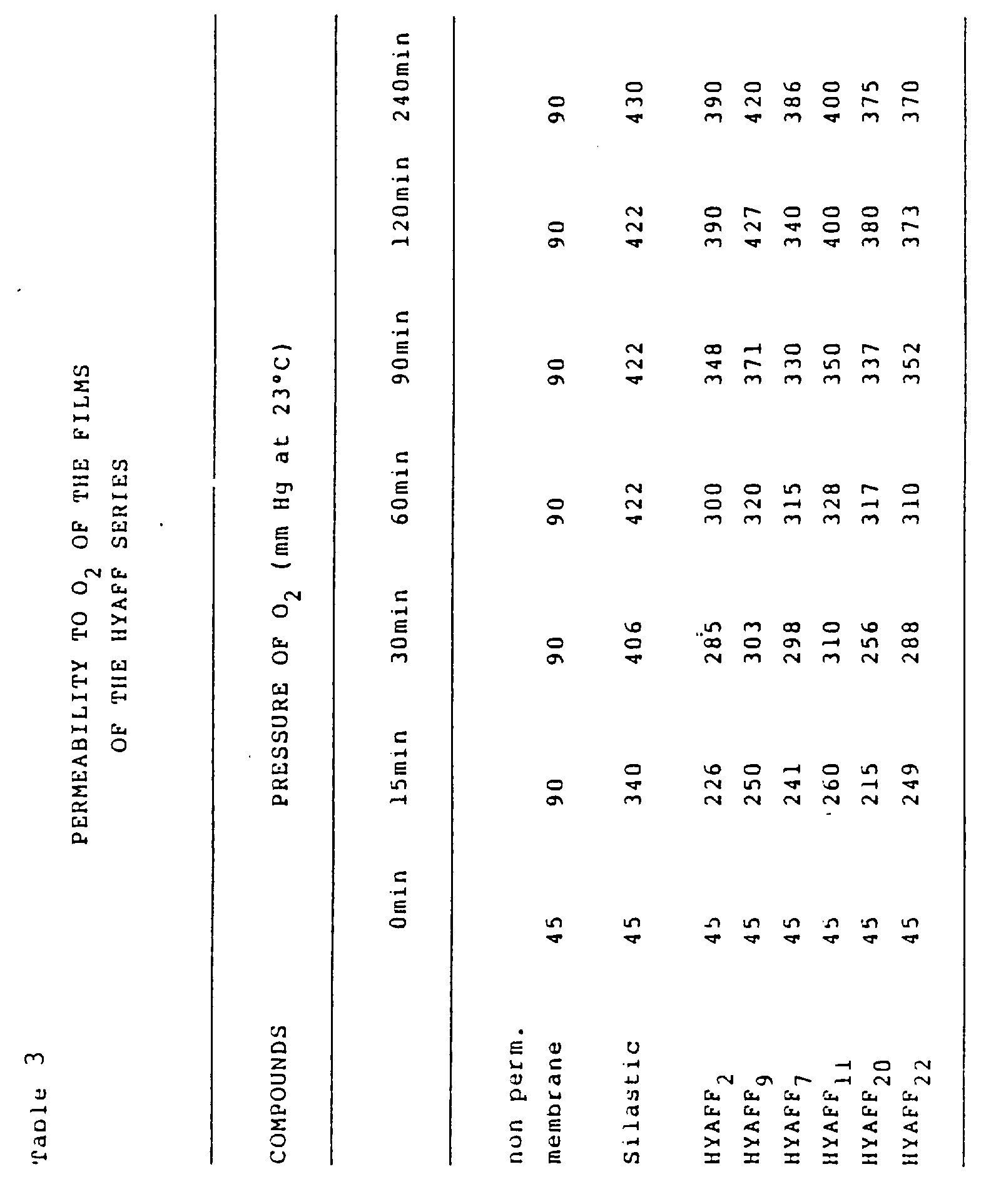
- One object of the present invention is the provision of pharmaceutical preparations containing one or more of the above mentioned esters of hyaluronic acid and salts thereof, or one or more medicaments resulting from the association of one of such esters with a pharmacologically active substance for topical application, as described above. That is medicaments in which the hyaluronic ester acts as a vehicle for the active substance.
- The pharmaceutical preparations containing the hyaluronic esters as an active principle, both in the case of esters with therapeutically inactive alcohols destined for the same uses as hyaluronic acid itself, and esters with therapeutically active alcohols intended for the usual uses of such alcohols, contain the usual excipients and may be employed for oral, rectal, parenteral, subcutaneous, local or intradermal use. They are therefore in solid or semisolid form, for example as pastilles, tablets, gelatin capsules, capsules, suppositories, soft gelatin capsules. For parenteral and subcutaneous use it is possible to use forms intended for intramuscular or intradermal administration, or suitable for infusions or intravenous injections. It is possible therefore to provide solutions of the active compounds or freeze dried powders of the active compounds to be added to one or more pharmaceutically acceptable excipients or diluents, convenient for the above mentioned uses and with osmolarity compatible with the physiological liquids. For local use, preparations in spray form may be used, for example nasal sprays, creams or ointments for topical use or specially prepared sticking plasters for intradermal administration. The solubility of the hyaluronic esters in organic solvents with low boiling points makes them particularly suitable for the manufacture of "sprays".
- The preparations of the invention may be administered to man or animals. They contain preferably between 0.01% and 10% of active component for the solutions, sprays, ointments and creams and between 1% and 100%, preferably between 5% and 50%, of active compound for the preparations in solid form. The dosage to be administered will depend on individual needs, on the desired effect and on the chosen administration route. The daily dosage of such preparations may be decided according to that use for the corresponding known preparations both of hyaluronic acid for the corresponding cures, for example for the cure of arthritis, for example in man or horse, and of the therapeutically active alcohol, the action of which is to be put to use. Thus, for example, the dosage of a hyaluronic ester with cortisone may be derived from its content of this steroid and from its usual dosage in the known pharmaceutical preparations.
- One particular form of pharmaceutical preparations is represented by the above mentioned medicaments containing the association of an hyaluronic ester and of one or more active substances. These may also be in solid form, for example as freeze dried powders containing only the two components (1) and (12), together or separate. This galenic form is especially suitable for topical use. Indeed these solid medicaments form, on contact with the surfaces to be treated, more of less concentrated solutions according to the nature of the particular epithelium, with the same characteristics of the solutions previously prepared in vitro and which represent another particularly important aspect of the present invention. Such solutions are preferably in distilled water or sterile saline and preferably contain no other pharmaceutical vehicle apart from the hyaluronic ester or one of its salts. The concentrations of such solutions may also vary within ample limits, for example between 0.01 and 75% both for each of the two components taken separately, and for their mixtures or salts. Particular preference is given to solutions with a pronounced elastic-viscous character, for example with a content of 10% to 90% of the medicament or of each of its components.
- Particularly important are the medicaments of this type, both in anhydrous form (freeze dried powder) or as solutions, concentrated or diluted in water or saline, possibly with the addition of additive or auxillary substances, such as in particular disinfectant substances or mineral salts acting as buffer or others, for ophthalmic use.
- Of the medicaments of the invention, particularly important, as the case may be, are those with a degree of acidity suitable for the environment to which they are to be applied, that is with a physiologically tolerable pH. Adjustment of the pH, for example in the above mentioned salts of the esters of hyaluronic acid with a basic active substance, may be effected by suitably regulating the quantities of polysaccharide, of the salts of the basic substance itself. Thus, for example, if the acidity of a salt of a hyaluronic ester with a basic substance is too high, the excess of free acid groups is neutralized with the above mentioned inorganic bases, for example with sodium, potassium or ammonium hydrate.
- The preparation of the salts according to the invention may be effected in a per se known manner by placing in contact solutions, aqueous solutions or organic solutions, of the two components (1) and (2), and possibly bases or basic salts of the above mentioned alkaline or alkaline earth metals or magnesium or aluminum in the right quantities and isolating the salts in an amorphous anhydrous form according to known techniques. It is possible for example to prepare first aqueous solutions of the two components (1) and (2), freeing such components from aqueous solutions of their salts with suitable ionic exchangers, and mixing the two solutions at a low temperature, for example between 0°C and 20°C. If the salt thus obtained is easily soluble in water it can be freeze dried, while the salts which are difficult to solubilize may be separated by centrifugation, filtration or decantation and possibly subsequently dried.
- For these associated medicaments too, the dose is based on that of the active principles used singly and may therefore easily be determined by a skilled person, taking into consideration the dosages recommended for the corresponding known drugs.
- In the cosmetic articles according to the invention the hyaluronic esters and their salts are mixed with the excipients commonly used in the field and are for example those already listed above for the pharmaceutical preparations. Mostly used are creams, ointments, and lotions for topical use in which the hyaluronic ester or one of its salts may represent the cosmetic active principle possibly with the addition of other cosmetically active principles, such as for example steroids, for example pregnenolone, or one of the principles mentioned above. In such preparations the hyaluronic ester is preferably an ester with an alcohol with no cosmetic action, such as an lower aliphatic alcohol, such as one of those already mentioned. The effect is due to the intrinsic cosmetic properties of the polysaccharide component, such as in the case of free hyaluronic acid or of its salts.
- The cosmetic articles may however be based on substances with specific actions other than those of hyaluronic acid, for example disinfectant substances, sunshields, waterproofing or regenerating or antiwrinkle substances, or odorants, especially perfumes. In this case the hyaluronic ester may itself be the active ingredient and derives from alcohols with the same properties, for example from higher aliphatic alcohols or terpenic alcohols in the case of perfumes or acts above all as vehicle for substances with those properties associated with it.
- Particularly important therefore are cosmetic compositions similar to the medicaments described above in which the pharmaceutically active component (1) is substituted by a cosmetic factor, and the relative salts.
- The use of the above mentioned esters deriving from alcohols used in the perfume industry represent an important step forward in technology, since they allow a slow, constant and protracted release of the scented ingredients.
- An important application of the present invention regards sanitary and surgical articles already described above, the methods for their manufacture and use. The invention therefore includes all the articles similar to those already on the market, based on hyaluronic acid but containing a hyaluronic ester or one of its salts in place of the free acid or one of its salts, for example inserts or ophthalmic lenses.
- Completely new surgical and sanitary articles according to the present invention are represented by the esters of hyaluronic acid regenerated as such by appropriate organic solutions from which it is possible to obtain, by means of the suitable procedures, films, thin sheets or threads to be used in surgery, as aids or substitutes of the skin in cases of serious damage to this organ, such as for example following burns, as a suture in surgical operations. The invention includes particularly these uses and a procedure for the preparation of such articles consisting in the formation of a solution of hyaluronic ester or of one of its salts in a suitable organic solvent such as an amide of a carboxylic acid, especially a dialkylamide of an aliphatic acid with between 1 and 5 carbon atoms and deriving from alkyl groups with between 1 and 6 carbon atoms, and above all from an organic sulphoxide, that is a dialkylsulphoxide with alkyl groups with a maximum of 6 carbon atoms, such as especially dimethylsulphoxide or diethylsuphoxide and again most importantly by a fluoronated solvent with a lower boiling point such as especially hexafluoro-isopropanol. The invention includes turning such solutions into sheet or thread form and in removing the organic solvent by contact with another organic or aqueous solvent which can be mixed with the first solvent and in which the hyaluronic ester is not soluble, especially a lower aliphatic alcohol, for example ethyl alcohol (wet spinning), or, should a solvent with a not too high boiling point be used to prepare the solution of the hyaluronic derivative, in removing such a solvent in dry conditions with a current of gas, especially with suitably heated nitrogen (dry spinning). It is also possible to obtain excellent results with dry-wet spinning.
- The threads obtained with hyaluronic acid esters may be used for the preparation of gauzes for the medication of wounds and in surgery. The use of such gauzes has the exceptional advantage of their biodegradability in the organism, made possible by the enzymes which they contain. These enzymes divide the ester into hyaluronic acid and the corresponding alcohol, and therefore into a compound already present in the organism, made possible by the enzymes which they contain. These enzymes divide the ester into hyaluronic acid and the corresponding alcohol, and therefore into a compound already present in the organism and into a harmless compound, such as an alcohol, should a hyaluronic ester be used which derives from a therapeutically acceptable alcohol, such as ethyl alcohol.
- These gauzes and also the aforementioned threads may therefore be left inside the organism after surgery, since they are slowly absorbed thanks to the aforesaid degradation.
- During the preparation of the sanitary and surgical articles described above, it is possible to add plastifying materials which improve their mechanical characteristics, such as in the case of the threads, to improve their resistance to knots. These plastifying materials may be for example alkaline salts of fatty acids, for example sodium stearate or sodium palmitate, the esters of organic acids with many carbon atoms, etc.
- Another application of the new esters, using to advantage their biodegradability due to the esterases present in the organism, is represented by the preparation of capsules for subcutaneous implantation of medicaments or of microcapsules for injection, for example by subcutaneous or intramuscular route. For the applications of subcutaneous medicaments for obtaining a slow release and therefore a "retard" action, capsules made of silicone materials have mostly been used up till now, with the disadvantage that the capsule is liable to move about inside the organism and it is not possible to recover it. Evidently with the new hyaluronic esters this danger no longer exists.
- Of great importance is also the preparation of microcapsules made with hyaluronic esters, eliminating the problems regarding their use which up till now has been limited, for the same reasons as those mentioned above and which opens up a vast field of application where a "retard" effect is sought be an injected route. A further application in the sector of medicine and surgery of the new esters concerns the preparation of a large variety of solid inserts such as plates, discs, sheets, etc. substituting those in metallic form or those made of synthetic plastic materials already in use, in the case of inserts intended for removal after a certain period of time. Preparations made of animal pollagen, being of a proteic nature, often provoke undesirable side effects such as inflammation or rejection. In the case of animal, and not human, hyaluronic acid, this danger does not exist, as there is no incompatability between the polysaccharides of different animal species.
- Another application relates to the use to augment and correct soft tissue defects. The need for a safe and effective biomaterial by which to replace missing or damaged soft tissue has long been recognized. Several alloplastic materials, including paraffin, Teflon paste, silicone and borine collagen have been used to replace lost soft tissue. However, these materials have been associated with permanent undesirable textural changes in the skin, with migration from the site of implantation and with adverse treatment reactions. Thus, the need for a versatile biomaterial in medicine continues. The hyaluronic acid esters can be used safely and effectively to augment and correct such soft tissue defects as acne scars, atrophy post surgical irregularities, mohs chemiosurgery, cleft lip sears and age-related wrinkles.
- Part of the applications in the field of medicine and surgery of the new esters according to the present invention, are represented by expansive materials, especially in the form of sponges, for the medication of wounds and various lesions.
- The following are particular exemplary pharmaceutical preparations according to the invention.
- Formulation 1 - Collirium containing cortisone of which 100 ml contain:
- partial ester of hyaluronic acid with cortisone (Ex. 10), gr. 0.200
- ethyl p. hydroxybenzoate, gr. 0.010
- methyl p. hydroxybenzoate, gr. 0.050
- sodium chloride, gr. 0.900
- water for injectable preparations/q.b.a., ml. 100
- Formulation 2 - Injectable solution containing hydrocortisone of which 100 ml contain:
- partial ester of hyaluronic acid with hydrocortisone (Ex. 11), gr. 0.1
- sodium chloride, gr. 0.9
- water for injectable preparations/q.b.a., ml. 100
- Formulation 3 - Cream containing a partial ester of hyaluronic acid with ethyl alcohol (Ex. 3), of which 100 gr. contain:
- partial ester of hyaluronic acid with ethyl alcohol, gr. 0.2
- Polyethylenglycol monostearate 400, gr. 10.000
- Cetiol V, gr. 5.000
- Lanette SX, gr. 2.000
- Paraoxybenzoate of methyl, gr. 0.075
- Paraoxybenzoate of propyl, gr. 0.050
- Sodium dihydroacetate, gr. 0.100
- Glycerine F.U., gr. 1.500
- Sorbitol 70, gr. 1.500
- Test cream, gr. 0.050
- Water for injectable preparations/q.b.a., gr. 100.00
- The following are exemplary material products utilizing the hyaluronic esters of the invention.
- A solution is prepared in dimethylsulfoxide of the n-propyl ester of HY (MW 130,000) with a concentration of 180 mg/ml.
- By means of a stratifier, a thin layer of solution is spread on a glass sheet; the thickness must be 10 times greater than the final thickness of the film. The glass sheet is immersed in ethanol which absorbs the dimethylsulfoxide but does not solubilize the HY ester which becomes solid. The film is detached from the glass sheet, is repeatedly washed with ethanol, then with water and then again with ethanol.
- The resulting sheet is dried in a press for 48 hours at 30°.
- A solution is prepared in dimethylsulfoxide of the benzyl ester of HY (MW 165,000) with a concentration of 200 mg/ml. The solution thus obtained is pressed by means of a pump through a threader with 0.5 mm holes.
- The threader is immersed in ethanol/dimethylsulfoxide 80:20 (this concentration is kept constant by continuous addition of ethanol); when the solution in dimethylsulfoxide is soaked in this way it tends to lose most of the dimethylsulfoxide and the thread solidifies.
- The thread is stretched while it still has a content of dimethylsulfoxide, is then repeatedly stretched and washed with ethanol. The thread is dried in nitrogen current.
- 1 g of benzyl ester of hyaluronic acid with a molecular weight of 170,000 in which all the carboxylic groups are esterified (obtained for example as described in Example 14) are dissolved in 5 ml of dimethylsulfoxide. To each 10 ml of solution prepared, a mixture of 31.5 g of sodium chloride with a degree of granularity corresponding to 300µ , 1.28 g of sodium bicarbonate and 1 g of citric acid is added and the whole is homogenized in a mixer.
- The pasty mixture is stratified in various ways, for instance by means of a mange consisting of two rollers which turn opposite each other at an adjustable distance between the two. Regulating this distance the paste is passed between the rollers together with a strip of silicone paper which acts as a support to the layer of paste thus formed. The layer is cut to the desired dimensions of length and breadth, removed from the silicone, wrapped in filter paper and emerged in a suitable solvent, such as water. The sponges thus obtained are washed with a suitable solvent such as water and possibly sterilized with gamma rays.
- In the manner described in Example 29 it is possible to prepare spongy materials with other hyaluronic acid esters. In the place of dimethylsulfoxide it is possible to use, if desired, any other solvent capable of dissolving the chosen ester. In the place of sodium chloride it is possible to use any other solid compound which is insoluble in the solvent used to dissolve the hyaluronic acid ester, but which is however soluble in the solvent used to precipitate the hyaluronic ester after the above mentioned mechanical treatment, and finally which has the correct degree of granularity to obtain the type of pores desired in the sponge material.
- In the place of sodium bicarbonate and citric acid it is possible to use other couples of similar compounds, that is, compound which react to each other in suspension or solution of the solvent used to dissolve hyaluronic acid in such a way as to form a gas, such as carbon dioxide, which has the effect of producing a less compact spongy material. In this way it is possible to use, in the place of sodium bicarbonate, other bicarbonates or alkaline or alkaline earth carbonates and in the place of citric acid other acids in solid form, such as tartaric acid.
Claims (36)
- A total or partial ester of hyaluronic acid with an alcohol of the aliphatic or araliphatic series or a salt of such partial ester with an inorganic or organic base, with the exception of methyl esters of hyaluronic acid.
- An ester of hyaluronic acid according to claim 1, in which alcohols of the aliphatic series have a maximum of 34 carbon atoms and are unsubstituted or substituted by one or two functional groups chosen from the group formed by amino, hydroxy, mercapto, aldehyde, keto, carboxy, hydrocarbyl, dihydrocarbylamino, ether, ester, thio-ether, thioester, acetyl, ketal, carbalkoxy, carbamidic and substituted carbamidic groups by one or two alkyl groups, the hydrocarbyl radicals in these functionally modified groups having a maximum of 6 carbon atoms, and in which such alcohols of the aliphatic series may be interrupted in the carbon atom chain by heteroatoms chosen from the group formed by oxygen, sulfur and nitrogen.
- An ester of hyaluronic acid according to claim 2, in which the esterifying alcoholic component derives from ethyl alcohol, propyl alcohol, isopropyl alcohol, normal butyl alcohol, isobutyl alcohol, tert-butyl alcohol, amyl alcohol, pentyl alcohol, hexyl alcohol, octyl alcohol, ethyleneglycol, propyleneglycol, butyleneglycol or glycerin.
- An ester of hyaluronic acid according to claim 1, in which alcohols of the araliphatic series are those with only one benzene residue and in which the aliphatic chain has a maximum of 4 carbon atoms and in which the benzene residue may be substituted by 1 to 3 methyl or hydroxy groups, by halogen atoms, and in which the aliphatic chain may be substituted by one or two functions chosen from the group including free or mono or diethyl amino groups or by pyrrolidinyl or piperidinyl groups.
- An ester of hyaluronic acid according to claim 4, wherein said alcohol is chosen from the group formed by benzyl alcohol, phenethyl alcohol, ephedrine and adrenalin.
- A salt of a partial hyaluronic ester according to any one of claims 1-5 with an alkaline or alkaline earth metal, magnesium or aluminium.
- A salt of a partial hyaluranic ester according to any one of claims, 1 to 5, which is a sodium or ammonium salt.
- A salt of a partial ester according to any one of the claims 1-5 with a therapeutically acceptable ammonium, aliphatic, araliphatic, cycloaliphatic or heterocyclic base.
- A compound according to claim 1 chosen from the group formed by:the partial propyl ester of hyaluronic acid with 50% of the carboxyl groups esterified and 50% of the carboxy groups salified with sodium;the partial isopropyl ester of hyaluronic acid with 50% of the carboxy groups esterified and 50% of the carboxy groups salified with sodium;the partial propyl ester of hyaluronic acid in which 85% of the carboxylic groups are esterified and 15% of the carboxylic groups are salified with sodium;the partial ethyl ester of hyaluronic acid with 75% of the carboxy groups esterified and 25% of the carboxy groups salified with sodium;the partial methyl ester of hyaluronic acid with 75% of the carboxy groups esterified and 25% of the carboxy groups salified with sodium;the total ethyl ester of hyaluronic acid;the total propyl ester of hyaluronic acid;the partial butyl ester of hyaluronic acid with 50% of the carboxylic groups esterified and 50% of the carboxylic groups salified with sodium;the partial ethoxycarbonylmethyl ester of hyaluronic acid with 75% of the carboxy groups esterified and 25% of the carboxy groups salified with sodium;the total pentyl ester of hyaluronic acid;the total isopentyl ester of hyaluronic acid;the total benzyl ester of hyaluronic acid;the total phenethyl ester of hyaluronic acid;salt with streptomycin of a hyaluronic acid partially esterified with ethanol (75%) and 25% of the carboxyls of the same salified with streptomycin;salt with erythromycin of a hyaluronic acid partially esterified with ethanol (75%) and 25% of the carboxyls of the same salified with erythromycin;salt with neomycin of a hyaluronic acid partially esterified with ethanol (75%) and 25% of the carboxyls of the same salified with neomycin;salt with gentamycin of a hyaluronic acid partially esterified with ethanol (75%) and 25% of the carboxyls of the same salified with gentamycin;salt with amikacin of hyaluronic acid partially esterified with ethanol (75%) and 25% of the carboxyls of the same salified with amikacin;salt with kanamycin of hyaluronic acid partially esterified with ethanol (75%) and 25% of the carboxyls of the same salified with kanamycin;salt with pilocarpine of hyaluronic acid partially esterified with ethanol (75%) and 25% of the carboxyls of the same salified with pilocarpine; andsalt with pilocarpine of hyaluronic acid partially esterified (85%) with ethanol and 15% of the carboxyls of the same salified with pilocarpine.
- An ester of hyaluronic acid according to claim 1 selected from the group consisting of the total benzyl ester, the total n-propyl ester and the total ethyl ester.
- A pharmaceutical preparation containing as an active ingredient an ester or one of its salts defined in claim 1 or a methyl ester of hyaluronic acid, together with a pharmaceutically acceptable excipient or carrier.
- A pharmaceutical preparation containing as an active ingredient a hyaluronic acid ester according to any one of claims 1-10, together with a pharmaceutically acceptable excipient or carrier.
- A medicament comprising:a) one or more pharmacologically active substances andb) a carrying vehicle comprised of a total or partial ester of hyaluronic acid with an alcohol of the aliphatic or araliphatic, series or a salt of such a partial ester with an inorganic or organic base, and optionallyc) a common excipient for pharmaceutical preparations.
- A medicament according to claim 13 in which the carrying vehicle b) contains an ester of hyaluronic acid with a pharmacologically inactive alcohol.
- A medicament according to claim 13 in which the carrying vehicle b) contains an ester of hyaluronic acid with a pharmacologically active alcohol.
- A medicament according to claim 13 in which the vehicled substance is of a basic nature and contains partial hyaluronic esters, the unesterified groups of which are salified with the pharmacologically active substance.
- A medicament according to any one of the claims 13-16 in which the pharmacologically active substance is chosen from the group formed by an anesthetic, an analgesic, an anti-inflammatory, a vasoconstrictor, an antibiotic-antibacterial, an antiviral.
- A medicament according to any one of the claims 13-16 in which the active substance 1) is topically active.
- The use of an ester of hyaluronic acid or one of its salts according to claim 1 for the preparation of a medicament for use in ophthalmology.
- The use of an ester of hyaluronic acid or one of its salts according to claim 1 for the preparation of a medicament for use in dermatology, in otorhinolaryngology, odontology, angiology, gynecology, neurology or any type of internal medical pathologies.
- A cosmetic article including a hyaluronic ester or one of its salts according to any one of claims 1-10, or a methyl ester of hyaluronic acid.
- A sanitary or surgical article including a hyaluronic ester or one of its salts according to any one of claims 1-10, or a methyl ester of hyaluronic acid.
- A sanitary or surgical article according to claim 22 in the form of a film or thread.
- A film or thread according to claim 22 or 23 in the form of artificial skin for use in surgical dermatology and in this respect as a suture thread in surgical operations.
- Gauze made of a thread according to one of claims 22-24 for the medication of wounds and in surgery.
- A procedure for the preparation of a film or thread of a hyaluronic ester according to any one of claims 22-25 in which the hyaluronic ester is dissolved in an organic solvent, the solution is made into sheet or thread form respectively and the organic solvent is then eliminated by treatment with another suitable organic or aqueous solvent which is soluble in the first solvent.
- A procedure for the preparation of a film or thread of a hyaluronic ester according to any one of claims 22-25 in which the hyaluronic ester is dissolved in an organic solvent, the solution is made into sheet or thread form respectively and then the organic solvent is eliminated by treatment with a current of suitably heated inert gas.
- A sanitary or surgical article according to claim 22 in the form of a capsule for the subcutaneous implantation of medicaments;in the form of a microcapsule for subcutaneous, intramuscular or intravenous injection;in the form of a solid insert to be removed after a certain length of time; orin the form of a sponge for the medication of wounds and various lesions.
- A process for the preparation of hyaluronic acid esters in which a quaternary ammonium salt of hyaluronic acid is treated with an esterifying agent in an aprotic solvent, and, if desired, free carboxy groups are salified in the partial esters obtained, or salified groups are released in them.
- A process according to claim 29 in which dimethylsulfoxide is used as the aprotic solvent.
- A process according to claim 29 in which a lower tetraalkylammonium salt of hyaluronic acid is used as the starting salt.
- A process according to claim 29 in which the tetrabutylammonium salt of hyaluronic acid is used.
- An ester according to any one of claims 1-10, in which the hyaluronic ester derives from a hyaluronic acid having a molecular weight of between 8 and 13 million.
- An ester, according to any one of claims 1-10, in which the hyaluronic ester derives from a hyaluronic acid fraction with a molecular weight of between about 90-80% and 0.23% of the molecular weight of an integral hyaluronic acid with a M.W. of 13 million.
- An ester, according to any one of claims 1-10, in which the hyaluronic ester derives from a molecular fraction having a molecular weight of between about 50,000 and 100,000 and being substantially free of hyaluronic acid having a molecular weight of less than 30,000.
- An ester, according to any one of claims 1-10, in which the hyaluronic ester derives from a molecular fraction having a molecular weight of between about 500,000 and 730,000 and being substantially free of hyaluronic acid having a molecular weight of less than 30,000.
Priority Applications (1)
| Application Number | Priority Date | Filing Date | Title |
|---|---|---|---|
| EP95202284A EP0696598B1 (en) | 1985-07-08 | 1986-07-07 | Polysaccharide esters and their salts |
Applications Claiming Priority (4)
| Application Number | Priority Date | Filing Date | Title |
|---|---|---|---|
| IT8548322A IT1214658B (en) | 1985-07-08 | 1985-07-08 | New total and partial ester(s) of hyaluronic acid and salts |
| IT4832285 | 1985-07-08 | ||
| IT4820286 | 1986-06-30 | ||
| IT48202/86A IT1203815B (en) | 1986-06-30 | 1986-06-30 | New total and partial hyaluronic acid ester(s) |
Related Child Applications (2)
| Application Number | Title | Priority Date | Filing Date |
|---|---|---|---|
| EP95202284A Division EP0696598B1 (en) | 1985-07-08 | 1986-07-07 | Polysaccharide esters and their salts |
| EP95202284.6 Division-Into | 1986-07-07 |
Publications (3)
| Publication Number | Publication Date |
|---|---|
| EP0216453A2 EP0216453A2 (en) | 1987-04-01 |
| EP0216453A3 EP0216453A3 (en) | 1988-10-26 |
| EP0216453B1 true EP0216453B1 (en) | 1996-03-20 |
Family
ID=26329289
Family Applications (2)
| Application Number | Title | Priority Date | Filing Date |
|---|---|---|---|
| EP95202284A Expired - Lifetime EP0696598B1 (en) | 1985-07-08 | 1986-07-07 | Polysaccharide esters and their salts |
| EP86305233A Expired - Lifetime EP0216453B1 (en) | 1985-07-08 | 1986-07-07 | Esters of hyaluronic acid and their salts. |
Family Applications Before (1)
| Application Number | Title | Priority Date | Filing Date |
|---|---|---|---|
| EP95202284A Expired - Lifetime EP0696598B1 (en) | 1985-07-08 | 1986-07-07 | Polysaccharide esters and their salts |
Country Status (21)
| Country | Link |
|---|---|
| US (3) | US4851521A (en) |
| EP (2) | EP0696598B1 (en) |
| JP (1) | JP2569012B2 (en) |
| KR (1) | KR870001901B1 (en) |
| AR (1) | AR242593A1 (en) |
| AT (2) | ATE135713T1 (en) |
| AU (1) | AU591501B2 (en) |
| CA (2) | CA1341603C (en) |
| DE (2) | DE3650501T2 (en) |
| DK (1) | DK175661B1 (en) |
| ES (1) | ES2001512A6 (en) |
| FI (6) | FI94766C (en) |
| HU (1) | HU201966B (en) |
| IE (1) | IE81120B1 (en) |
| IL (1) | IL79362A (en) |
| IN (1) | IN165582B (en) |
| NO (2) | NO175716C (en) |
| NZ (2) | NZ216786A (en) |
| PH (1) | PH25189A (en) |
| PT (1) | PT82941B (en) |
| SG (1) | SG90006A1 (en) |
Cited By (53)
| Publication number | Priority date | Publication date | Assignee | Title |
|---|---|---|---|---|
| US6020484A (en) * | 1995-12-20 | 2000-02-01 | Fidia Advanced Biopolymers S.R.L. | Process for preparing a hyaluronic acid fraction having a low polydispersion index |
| US6129956A (en) * | 1995-02-07 | 2000-10-10 | Fidia Advanced Bioplymers, Srl | Process for the coating of objects with hyaluronic acid, derivatives thereof, and semisynthetic polymers |
| US6224857B1 (en) | 1996-10-17 | 2001-05-01 | Fidia, S.P.A. | Pharmaceutical preparations comprised of salts of hyaluronic acid with local anaesthetics |
| EP1609493A1 (en) | 1998-06-17 | 2005-12-28 | Fidia Advanced Biopolymers S.R.L. | Use of three-dimensional prostheses containing hyaluronic acid derivatives |
| US7049434B2 (en) | 2001-06-04 | 2006-05-23 | Eurand Pharmaceuticals Ltd. | Derivatives of hyaluronan |
| US7087745B1 (en) | 1999-04-08 | 2006-08-08 | Fidia Farmaceutici S.P.A. | Three-dimensional structures containing hyaluronic acid derivatives obtained by the supercritical antisolvent technique |
| WO2007006403A2 (en) | 2005-07-07 | 2007-01-18 | Fidia Advanced Biopolymers S.R.L. | Biomaterials in the form of fibres for use as medical devices in the treatment of wounds, and their production process |
| WO2009001209A1 (en) | 2007-06-22 | 2008-12-31 | Fidia Farmaceutici S.P.A. | Use of conjugates of hyaluronic acid in the local treatment of hyperproliferative skin diseases |
| WO2009031006A2 (en) | 2007-09-05 | 2009-03-12 | Fidia Farmaceutici S.P.A. | Antiviral topical formulations in the form of a bio-adhesive gel |
| US8075872B2 (en) | 2003-08-06 | 2011-12-13 | Gruenenthal Gmbh | Abuse-proofed dosage form |
| US8114383B2 (en) | 2003-08-06 | 2012-02-14 | Gruenenthal Gmbh | Abuse-proofed dosage form |
| US8114384B2 (en) | 2004-07-01 | 2012-02-14 | Gruenenthal Gmbh | Process for the production of an abuse-proofed solid dosage form |
| US8192722B2 (en) | 2003-08-06 | 2012-06-05 | Grunenthal Gmbh | Abuse-proof dosage form |
| US8287894B2 (en) | 2000-07-14 | 2012-10-16 | Alchemia Oncology Pty Limited | Hyaluronan as a drug pre-sensitizer and chemo-sensitizer in the treatment of disease |
| EP2537533A2 (en) | 2005-08-03 | 2012-12-26 | FIDIA FARMACEUTICI S.p.A. | Antitumoral bioconjugates of hyaluronic acid or its derivatives obtained by indirect chemical conjugation |
| US8383152B2 (en) | 2008-01-25 | 2013-02-26 | Gruenenthal Gmbh | Pharmaceutical dosage form |
| WO2013156547A1 (en) | 2012-04-20 | 2013-10-24 | Anika Therapeutics S.R.L. | Biomaterials based on gellan for use as fillers in surgery |
| US8623354B2 (en) | 2005-09-07 | 2014-01-07 | Alchemia Oncology Pty Limited | Therapeutic compositions comprising hyaluronan and therapeutic antibodies as well as methods of treatment |
| US8722086B2 (en) | 2007-03-07 | 2014-05-13 | Gruenenthal Gmbh | Dosage form with impeded abuse |
| US8741970B2 (en) | 1999-01-13 | 2014-06-03 | Alchemia Oncology Pty Limited | Composition and method for the enhancement of the efficacy of drugs |
| US8815289B2 (en) | 2006-08-25 | 2014-08-26 | Purdue Pharma L.P. | Tamper resistant dosage forms |
| US8937052B2 (en) | 2005-07-27 | 2015-01-20 | Alchemia Oncology Pty Limited | Therapeutic protocols using hyaluronan |
| US9066919B2 (en) | 2000-07-14 | 2015-06-30 | Alchemia Oncology Pty Limited | Hyaluronan as a chemo-sensitizer in the treatment of cancer |
| US20150196574A1 (en) * | 2005-10-12 | 2015-07-16 | Seikagaku Corporation | Agent for applying to mucosa and method for the production thereof |
| US9161917B2 (en) | 2008-05-09 | 2015-10-20 | Grünenthal GmbH | Process for the preparation of a solid dosage form, in particular a tablet, for pharmaceutical use and process for the preparation of a precursor for a solid dosage form, in particular a tablet |
| US9636303B2 (en) | 2010-09-02 | 2017-05-02 | Gruenenthal Gmbh | Tamper resistant dosage form comprising an anionic polymer |
| US9655853B2 (en) | 2012-02-28 | 2017-05-23 | Grünenthal GmbH | Tamper-resistant dosage form comprising pharmacologically active compound and anionic polymer |
| US9675610B2 (en) | 2002-06-17 | 2017-06-13 | Grünenthal GmbH | Abuse-proofed dosage form |
| US9737490B2 (en) | 2013-05-29 | 2017-08-22 | Grünenthal GmbH | Tamper resistant dosage form with bimodal release profile |
| US9855263B2 (en) | 2015-04-24 | 2018-01-02 | Grünenthal GmbH | Tamper-resistant dosage form with immediate release and resistance against solvent extraction |
| US9867810B1 (en) | 2016-08-19 | 2018-01-16 | Orasis Pharmaceuticals Ltd. | Ophthalmic pharmaceutical compositions and uses relating thereto |
| US9872835B2 (en) | 2014-05-26 | 2018-01-23 | Grünenthal GmbH | Multiparticles safeguarded against ethanolic dose-dumping |
| US9913814B2 (en) | 2014-05-12 | 2018-03-13 | Grünenthal GmbH | Tamper resistant immediate release capsule formulation comprising tapentadol |
| US9925146B2 (en) | 2009-07-22 | 2018-03-27 | Grünenthal GmbH | Oxidation-stabilized tamper-resistant dosage form |
| US10058548B2 (en) | 2003-08-06 | 2018-08-28 | Grünenthal GmbH | Abuse-proofed dosage form |
| US10064945B2 (en) | 2012-05-11 | 2018-09-04 | Gruenenthal Gmbh | Thermoformed, tamper-resistant pharmaceutical dosage form containing zinc |
| US10080721B2 (en) | 2009-07-22 | 2018-09-25 | Gruenenthal Gmbh | Hot-melt extruded pharmaceutical dosage form |
| US10154966B2 (en) | 2013-05-29 | 2018-12-18 | Grünenthal GmbH | Tamper-resistant dosage form containing one or more particles |
| US10201502B2 (en) | 2011-07-29 | 2019-02-12 | Gruenenthal Gmbh | Tamper-resistant tablet providing immediate drug release |
| US10300141B2 (en) | 2010-09-02 | 2019-05-28 | Grünenthal GmbH | Tamper resistant dosage form comprising inorganic salt |
| US10335373B2 (en) | 2012-04-18 | 2019-07-02 | Grunenthal Gmbh | Tamper resistant and dose-dumping resistant pharmaceutical dosage form |
| US10441677B2 (en) | 2016-04-27 | 2019-10-15 | Anika Therapeutics, Inc. | Methods and compositions for treating tendon degeneration |
| US10449547B2 (en) | 2013-11-26 | 2019-10-22 | Grünenthal GmbH | Preparation of a powdery pharmaceutical composition by means of cryo-milling |
| US10624862B2 (en) | 2013-07-12 | 2020-04-21 | Grünenthal GmbH | Tamper-resistant dosage form containing ethylene-vinyl acetate polymer |
| US10695297B2 (en) | 2011-07-29 | 2020-06-30 | Grünenthal GmbH | Tamper-resistant tablet providing immediate drug release |
| US10729658B2 (en) | 2005-02-04 | 2020-08-04 | Grünenthal GmbH | Process for the production of an abuse-proofed dosage form |
| WO2021000050A1 (en) | 2019-07-03 | 2021-01-07 | Molly Sandra Shoichet | Hydrogel compositions and uses thereof |
| US11224576B2 (en) | 2003-12-24 | 2022-01-18 | Grünenthal GmbH | Process for the production of an abuse-proofed dosage form |
| IT202100012737A1 (en) | 2021-05-18 | 2022-11-18 | Jointherapeutics S R L | BLENDS OF POLYSACCHARIDES AND POLYAMINOSACCHARIDES WITH IMPROVED RHEOLOGICAL PROPERTIES |
| IT202100013787A1 (en) | 2021-05-27 | 2022-11-27 | Farmigea Spa | A COMPOSITION FOR USE IN THE TREATMENT OF OCULAR AFFECTIONS, SUCH AS DRY EYE DISEASE, ESPECIALLY AFTER EYE SURGERY |
| IT202100032111A1 (en) | 2021-12-22 | 2023-06-22 | Fidia Farm Spa | NEW BIOCOMPATIBLE SUBSTITUTES OF THE VITREOUS HUMOR |
| US11844865B2 (en) | 2004-07-01 | 2023-12-19 | Grünenthal GmbH | Abuse-proofed oral dosage form |
| IT202300023433A1 (en) | 2023-11-07 | 2025-05-07 | Univ Degli Studi Di Catania | HYALURONIC ACID DERIVATIVES PHOTOGENERATING NITRIC OXIDE |
Families Citing this family (302)
| Publication number | Priority date | Publication date | Assignee | Title |
|---|---|---|---|---|
| US5166331A (en) * | 1983-10-10 | 1992-11-24 | Fidia, S.P.A. | Hyaluronics acid fractions, methods for the preparation thereof, and pharmaceutical compositions containing same |
| US5202431A (en) * | 1985-07-08 | 1993-04-13 | Fidia, S.P.A. | Partial esters of hyaluronic acid |
| US4851521A (en) * | 1985-07-08 | 1989-07-25 | Fidia, S.P.A. | Esters of hyaluronic acid |
| AU600257B2 (en) * | 1986-03-21 | 1990-08-09 | International Pharmaceutical Products, Inc. | Non-inflammatory hyaluronic acid fraction and process for preparing it |
| IT1203814B (en) * | 1986-06-30 | 1989-02-23 | Fidia Farmaceutici | ESTERS OF ALGINIC ACID |
| US5264422A (en) * | 1986-06-30 | 1993-11-23 | Fidia S.P.A. | Esters of alginic acid with steroidal alcohols |
| US6150328A (en) * | 1986-07-01 | 2000-11-21 | Genetics Institute, Inc. | BMP products |
| IT1198449B (en) * | 1986-10-13 | 1988-12-21 | F I D I Farmaceutici Italiani | ESTERS OF POLYVALENT ALCOHOLS OF HYALURONIC ACID |
| IT1219587B (en) * | 1988-05-13 | 1990-05-18 | Fidia Farmaceutici | SELF-CROSS-LINKED CARBOXYLY POLYSACCHARIDES |
| LU87350A1 (en) * | 1988-09-28 | 1990-04-06 | Oreal | COSMETIC APPLICATION OF DIESTER FUNCTIONAL POLYSILOXANES AND COMPOSITIONS IMPLEMENTED |
| US4965071A (en) * | 1988-10-19 | 1990-10-23 | The Gillette Company | Wrinkle masking composition of sodium polystyrene sulfonate and process for use |
| US5700479A (en) * | 1988-12-23 | 1997-12-23 | Guidor Ab | Surgical element and method for selective tissue regeneration |
| DE69018440T2 (en) * | 1989-09-12 | 1995-08-10 | Shiseido Co Ltd | METHOD FOR PRODUCING HYALURONIC ACID WITH LOW MOLECULAR WEIGHT. |
| CA1340994C (en) * | 1989-09-21 | 2000-05-16 | Rudolf Edgar Dr. Falk | Treatment of conditions and disease |
| JP2945993B2 (en) * | 1989-12-05 | 1999-09-06 | 武田薬品工業株式会社 | External preparation |
| JP2788340B2 (en) * | 1989-12-21 | 1998-08-20 | 株式会社ニッショー | Inflammation treatment |
| EP0589871B1 (en) * | 1990-02-13 | 2000-04-26 | Ethicon, Inc. | Peritoneal induced medicaments |
| EP0528971B1 (en) * | 1990-05-14 | 1999-09-01 | JERNBERG, Gary R. | Surgical implant and method incorporating chemotherapeutic agents |
| US5290271A (en) * | 1990-05-14 | 1994-03-01 | Jernberg Gary R | Surgical implant and method for controlled release of chemotherapeutic agents |
| US5059123A (en) * | 1990-05-14 | 1991-10-22 | Jernberg Gary R | Periodontal barrier and method for aiding periodontal tissue regeneration |
| IT1248934B (en) * | 1990-06-01 | 1995-02-11 | Fidia Spa | BIOCOMPATIBLE PERFORATED MEMBRANES, PROCESSES FOR THEIR PREPARATION, THEIR USE AS A SUPPORT FOR THE IN VITRO GROWTH OF EPITHELIAL CELLS, ARTIFICIAL LEATHER THUS OBTAINED AND THEIR USE IN LEATHER TRANSPLANTS |
| US5910489A (en) * | 1990-09-18 | 1999-06-08 | Hyal Pharmaceutical Corporation | Topical composition containing hyaluronic acid and NSAIDS |
| CA2061703C (en) * | 1992-02-20 | 2002-07-02 | Rudolf E. Falk | Formulations containing hyaluronic acid |
| US5824658A (en) * | 1990-09-18 | 1998-10-20 | Hyal Pharmaceutical Corporation | Topical composition containing hyaluronic acid and NSAIDS |
| US5990096A (en) * | 1990-09-18 | 1999-11-23 | Hyal Pharmaceutical Corporation | Formulations containing hyaluronic acid |
| US5639738A (en) * | 1992-02-20 | 1997-06-17 | Hyal Pharmaceutical Corporation | Treatment of basal cell carcinoma and actinic keratosis employing hyaluronic acid and NSAIDs |
| US5733891A (en) * | 1990-10-18 | 1998-03-31 | Shiseido Co., Ltd. | Compound for medicinal ingredient and hyaluronic acid and process for producing the same |
| WO1992006714A1 (en) * | 1990-10-18 | 1992-04-30 | Shiseido Co., Ltd. | Combination of hyaluronic acid with medicinal ingredient and production thereof |
| GB9024223D0 (en) * | 1990-11-07 | 1990-12-19 | Fermentech Ltd | Production of hyaluronic acid |
| IT1247157B (en) * | 1991-02-11 | 1994-12-12 | Fidia Spa | BIODEGRADABLE AND BIOABSORBABLE GUIDE CHANNELS TO BE USED FOR NERVE REGENERATION. |
| ES2087471T3 (en) * | 1991-02-11 | 1996-07-16 | Fidia Spa | ESTERES GELAN. |
| IT1247472B (en) | 1991-05-31 | 1994-12-17 | Fidia Spa | PROCESS FOR THE PREPARATION OF MICROSPHERES CONTAINING BIOLOGICALLY ACTIVE COMPONENTS. |
| US5234914A (en) * | 1991-06-11 | 1993-08-10 | Patent Biopharmaceutics, Inc. | Methods of treating hemorrhoids and anorecial disease |
| US5817644A (en) * | 1991-07-03 | 1998-10-06 | Hyal Pharmaceutical Corporation | Targeting of dosages of medicine and therapeutic agents |
| US5977088A (en) * | 1991-07-03 | 1999-11-02 | Hyal Pharmaceutical Corporation | Formulations containing hyaluronic acid |
| WO1994007505A1 (en) * | 1991-07-03 | 1994-04-14 | Norpharmco Inc. | Use of hyaluronic acid and forms to prevent arterial restenosis |
| US6022866A (en) * | 1991-07-03 | 2000-02-08 | Hyal Pharmaceutical Corporation | Use of hyaluronic acid and forms to prevent arterial restenosis |
| US5990095A (en) * | 1991-07-03 | 1999-11-23 | Hyal Pharmaceutical Corporation | Use of hyaluronic acid and forms to prevent arterial restenosis |
| US6103704A (en) * | 1991-07-03 | 2000-08-15 | Hyal Pharmaceutical Corporation | Therapeutic methods using hyaluronic acid |
| US5792753A (en) * | 1991-07-03 | 1998-08-11 | Hyal Pharmaceutical Corporation | Compositions comprising hyaluronic acid and prostaglandin-synthesis-inhibiting drugs |
| US5356629A (en) * | 1991-07-12 | 1994-10-18 | United States Surgical Corporation | Composition for effecting bone repair |
| IT1251151B (en) * | 1991-08-05 | 1995-05-04 | Fidia Spa | SPONGY MATERIAL ESSENTIALLY CONSTITUTED BY HYALURONIC ACID, OR ITS DERIVATIVES |
| IT1254119B (en) * | 1991-09-13 | 1995-09-08 | Fidia | ESTERS OF CARBOXYLIC DERIVATIVES OF POLYSACCHARIDES |
| IT1263755B (en) * | 1991-09-16 | 1996-08-29 | Fidia Spa | USE OF CHINA ESTERS WITH ACID POLYSACCHARIDES AS ANTI-ULCER AND GASTROPROTECTIVE AGENTS |
| EP0610441A4 (en) * | 1991-10-29 | 1996-01-10 | Clover Cons Ltd | Crosslinkable polysaccharides, polycations and lipids useful for encapsulation and drug release. |
| US20080139474A1 (en) * | 1991-11-04 | 2008-06-12 | David Israel | Recombinant bone morphogenetic protein heterodimers, compositions and methods of use |
| WO1993009229A1 (en) | 1991-11-04 | 1993-05-13 | Genetics Institute, Inc. | Recombinant bone morphogenetic protein heterodimers, compositions and methods of use |
| IT1254170B (en) * | 1991-12-18 | 1995-09-11 | Mini Ricerca Scient Tecnolog | COMPOSITE MEMBRANES FOR GUIDED REGENERATION OF FABRICS |
| IT1254704B (en) * | 1991-12-18 | 1995-10-09 | Mini Ricerca Scient Tecnolog | NON-WOVEN FABRIC ESSENTIALLY CONSTITUTED FROM DERIVATIVES OF HYALURONIC ACID |
| US5824335A (en) * | 1991-12-18 | 1998-10-20 | Dorigatti; Franco | Non-woven fabric material comprising auto-crosslinked hyaluronic acid derivatives |
| IT1254706B (en) | 1991-12-23 | 1995-10-09 | Fidia Spa | THERAPEUTIC USE OF GANGLIOSIDE GM1 IN THE TREATMENT OF DAMAGE TO THE SPINAL CORD |
| US5942498A (en) * | 1992-02-20 | 1999-08-24 | Hyal Pharmaceutical Corporation | Formulations containing hyaluronic acid |
| US6218373B1 (en) | 1992-02-20 | 2001-04-17 | Hyal Pharmaceutical Corporation | Formulations containing hyaluronic acid |
| CA2061567C (en) * | 1992-02-20 | 1998-02-03 | Rudolf E. Falk | Use of hyaluronic acid to repair ischemia reperfusion damage |
| US5767106A (en) * | 1992-02-21 | 1998-06-16 | Hyal Pharmaceutical Corporation | Treatment of disease and conditions associated with macrophage infiltration |
| US6114314A (en) * | 1992-02-21 | 2000-09-05 | Hyal Pharmaceutical Corp. | Formulations containing hyaluronic acid |
| IT1259090B (en) | 1992-04-17 | 1996-03-11 | Fidia Spa | BIOMATERIALS FOR BONE PROSTHESIS |
| IT1260154B (en) * | 1992-07-03 | 1996-03-28 | Lanfranco Callegaro | HYALURONIC ACID AND ITS DERIVATIVES IN INTERPENETRATING POLYMERS (IPN) |
| US5879359A (en) * | 1992-08-03 | 1999-03-09 | Fidia S.P.A. | Biodegradable guide channels comprised of esters of hyaluronic acid for use in tissue repair as surgical aids |
| IT1259141B (en) * | 1992-08-03 | 1996-03-11 | Fidia Spa | BIODEGRADABLE AND BIORIABSORBABLE GUIDE CHANNELS TO BE USED FOR TISSUE REPAIR AS ADJUVANT IN SURGICAL INTERVENTIONS |
| DE4328329C2 (en) * | 1992-08-26 | 1998-02-12 | Suwelack Nachf Dr Otto | Freeze-dried biomatrix |
| US5550112A (en) * | 1992-12-30 | 1996-08-27 | Patent Biopharmaceutics, Inc. | Hyaluronic acid-urea pharmaceutical compositions and uses |
| IT1263144B (en) * | 1993-02-04 | 1996-08-01 | Lanfranco Callegaro | PHARMACEUTICAL COMPOSITIONS INCLUDING SPONGY MATERIAL CONSTITUTED FROM FOREIGN DERIVATIVES OF HYALURONIC ACID IN ASSOCIATION WITH OTHER PHARMACOLOGICALLY ACTIVE SUBSTANCES |
| IT1263316B (en) * | 1993-02-12 | 1996-08-05 | Fidia Advanced Biopolymers Srl | MULTILAYER NON WOVEN FABRIC IN WHICH ONE OF THE LAYERS IS ESSENTIALS ESSENTIALS FROM HYALURONIC ACID ESTERS |
| IT1263394B (en) | 1993-07-30 | 1996-08-05 | Fidia Advanced Biopolymers Srl | PHARMACEUTICAL COMPOSITIONS FOR TOPICAL USE BASED ON HYALURONIC ACID AND ITS DERIVATIVES |
| US5430142A (en) * | 1993-08-06 | 1995-07-04 | The Center For Innovative Technology | Thermoplastic pentosan-rich polysaccharides from biomass |
| WO1995007085A1 (en) * | 1993-09-07 | 1995-03-16 | Escalon Ophthalmics, Inc. | Surface active viscoelastic solutions for ocular use |
| US6291206B1 (en) * | 1993-09-17 | 2001-09-18 | Genetics Institute, Inc. | BMP receptor proteins |
| US5531716A (en) * | 1993-09-29 | 1996-07-02 | Hercules Incorporated | Medical devices subject to triggered disintegration |
| US5616568A (en) * | 1993-11-30 | 1997-04-01 | The Research Foundation Of State University Of New York | Functionalized derivatives of hyaluronic acid |
| AU689184B2 (en) * | 1993-12-07 | 1998-03-26 | Genetics Institute, Llc | BMP-12, BMP-13 and tendon-inducing compositions thereof |
| US5498527A (en) * | 1994-02-18 | 1996-03-12 | Ube Industries, Ltd. | Phosphorylcholine-containing glyceroglycolipid |
| JPH0881501A (en) * | 1994-03-22 | 1996-03-26 | Agawamura | Acidic polysaccharide |
| US5633003A (en) * | 1994-03-31 | 1997-05-27 | Cantor; Jerome O. | Use of intratracheally administered hyaluronic acid to ameliorate emphysema |
| US5690961A (en) * | 1994-12-22 | 1997-11-25 | Hercules Incorporated | Acidic polysaccharides crosslinked with polycarboxylic acids and their uses |
| RU2173563C2 (en) * | 1995-02-07 | 2001-09-20 | Фидиа Адвансед Биополимерс, С.Р.Л. | Method of applying, onto object surfaces, coating based on hyaluronic acid, its derivatives and semisynthetic polymers |
| IT1281870B1 (en) * | 1995-04-27 | 1998-03-03 | Fidia Advanced Biopolymers Srl | HUMAN ARTIFICIAL SKIN MADE UP OF BIOCOMPATIBLE MATERIALS BASED ON HYALURONIC ACID DERIVATIVES |
| US6017901A (en) * | 1995-05-10 | 2000-01-25 | Fidia Advanced Bioplymers S.R.L. | Heavy metal salts of succinic acid hemiesters with hyaluronic acid or hyaluronic acid esters, a process for their preparation and relative pharmaceutical compositions |
| IT1281877B1 (en) * | 1995-05-10 | 1998-03-03 | Fidia Advanced Biopolymers Srl | Heavy metal salts of succinyl derivatives of hyaluronic acid and their use as potential therapeutic agents |
| US5559088A (en) * | 1995-07-07 | 1996-09-24 | The Proctor & Gamble Company | Dryer-activated fabric conditioning and antistatic compositions with improved perfume longevity |
| US5531910A (en) * | 1995-07-07 | 1996-07-02 | The Procter & Gamble Company | Biodegradable fabric softener compositions with improved perfume longevity |
| CZ293968B6 (en) * | 1995-08-29 | 2004-08-18 | Fidiaáadvancedábiopolymersźásrl | Compound biomaterial for inhibiting surgical adhesions of tissue, use thereof and method |
| KR100236771B1 (en) * | 1997-04-01 | 2000-02-01 | 성재갑 | Sustained Release Microparticle Formulation of Drugs Using Hyaluronic Acid |
| US5939047A (en) * | 1996-04-16 | 1999-08-17 | Jernberg; Gary R. | Local delivery of chemotherapeutic agents for treatment of periodontal disease |
| EP0907721A1 (en) * | 1996-05-28 | 1999-04-14 | Brown University Research Foundation | Hyaluronan based biodegradable scaffolds for tissue repair |
| US6368356B1 (en) | 1996-07-11 | 2002-04-09 | Scimed Life Systems, Inc. | Medical devices comprising hydrogel polymers having improved mechanical properties |
| US6060534A (en) | 1996-07-11 | 2000-05-09 | Scimed Life Systems, Inc. | Medical devices comprising ionically and non-ionically crosslinked polymer hydrogels having improved mechanical properties |
| IT1287698B1 (en) * | 1996-08-29 | 1998-08-18 | Fidia Advanced Biopolymers Srl | SUTURE THREADS ESSENTIALLY MADE OF ESTERE DERIVATIVES OF HYALURONIC ACID |
| US6632802B2 (en) * | 1996-08-29 | 2003-10-14 | Fidia Advanced Biopolymers S.R.L. | Hyaluronic acid esters, threads and biomaterials containing them, and their use in surgery |
| ES2312179T3 (en) | 1996-12-06 | 2009-02-16 | Amgen Inc. | COMBINED THERAPY USING AN IL-1 INHIBITOR FOR THE TREATMENT OF ILL-1 ILLNESSES. |
| IT1291452B1 (en) | 1997-04-14 | 1999-01-11 | Fidia Advanced Biopolymers Srl | COATING BASED ON HYALURONIC ACID AND ITS DERIVATIVES FOR THE PROTECTION OF ELECTRONIC PARTS FROM EXTERNAL AGENTS |
| US6596703B1 (en) | 1997-07-11 | 2003-07-22 | Jagotec Ag | Promotion of wound healing utilizing steroids having reduced deteriorous systemic side effects typical of glucocorticoids, mineralocorticoids and sex steroids |
| US6123957A (en) * | 1997-07-16 | 2000-09-26 | Jernberg; Gary R. | Delivery of agents and method for regeneration of periodontal tissues |
| IT1294797B1 (en) | 1997-07-28 | 1999-04-15 | Fidia Advanced Biopolymers Srl | USE OF HYALURONIC ACID DERIVATIVES IN THE PREPARATION OF BIOMATERIALS WITH PHYSICAL AND BUFFERING HEMOSTATIC ACTIVITIES |
| IT1296689B1 (en) * | 1997-11-06 | 1999-07-14 | Fidia Advanced Biopolymers Srl | ESTERE DERIVATIVES OF HYALURONIC ACID HAVING VISCOELASTIC PROPERTIES AND THEIR USE IN THE BIOMEDICAL-HEALTH FIELD |
| CA2308462C (en) | 1997-11-17 | 2009-02-24 | Haemacure Corporation | Fibrin sealants or adhesives comprising a hyaluronic acid derivative material |
| US6099952A (en) * | 1998-02-18 | 2000-08-08 | Xomed Surgical Products, Inc. | Medical sponge having mucopolysaccharide coating |
| ITPD980037A1 (en) * | 1998-02-25 | 1999-08-25 | Fidia Advanced Biopolymers Srl | SULFATED HYALURONIC ACID AND ITS DERIVATIVES COVALENTLY LINKED TO SYNTHETIC POLYMERS FOR THE PREPARATION OF BIOMATERIALS AND FOR COATING |
| US7115417B1 (en) * | 1998-05-01 | 2006-10-03 | Chancellor Michael B | Soft tissue and bone augmentation and bulking utilizing muscle-derived progenito compositions, and treatments thereof |
| US6866842B1 (en) * | 1998-05-01 | 2005-03-15 | University Of Pittsburgh | Muscle-derived cells (MDCs) for treating muscle-or bone-related injury or dysfunction |
| AU752280C (en) * | 1998-05-20 | 2005-03-03 | Chugai Seiyaku Kabushiki Kaisha | Conjugate of therapeutic agent for joint disease and hyaluronic acid. |
| US6872819B1 (en) | 1998-05-27 | 2005-03-29 | Fidia Advanced Biopolymers S.R.L. | Biomaterials containing hyaluronic acid derivatives in the form of three-dimensional structures free from cellular components or products thereof for the in vivo regeneration of tissue cells |
| US6824793B1 (en) * | 1998-06-01 | 2004-11-30 | Chiron Corporation | Use of hyaluronic acid polymers for mucosal delivery of vaccine antigens and adjuvants |
| ITPD980169A1 (en) | 1998-07-06 | 2000-01-06 | Fidia Advanced Biopolymers Srl | AMIDES OF HYALURONIC ACID AND ITS DERIVATIVES AND PROCESS FOR THEIR PREPARATION. |
| US6630457B1 (en) * | 1998-09-18 | 2003-10-07 | Orthogene Llc | Functionalized derivatives of hyaluronic acid, formation of hydrogels in situ using same, and methods for making and using same |
| IT1303735B1 (en) * | 1998-11-11 | 2001-02-23 | Falorni Italia Farmaceutici S | CROSS-LINKED HYALURONIC ACIDS AND THEIR MEDICAL USES. |
| IT1302534B1 (en) * | 1998-12-21 | 2000-09-05 | Fidia Advanced Biopolymers Srl | INJECTABLE, BIOCOMPATIBLE AND BIODEGRADABLE COMPOSITIONS INCLUDING AT LEAST A DERIVATIVE OF HYALURONIC ACID, CHONDROGENIC CELLS, FOR |
| EP1165097B1 (en) * | 1999-02-01 | 2007-05-02 | Dermal Research Laboratories, Inc. | A pharmaceutical composition of complex carbohydrates and their use |
| US6727224B1 (en) * | 1999-02-01 | 2004-04-27 | Genetics Institute, Llc. | Methods and compositions for healing and repair of articular cartilage |
| GB9902412D0 (en) * | 1999-02-03 | 1999-03-24 | Fermentech Med Ltd | Process |
| US6884427B1 (en) * | 1999-02-08 | 2005-04-26 | Aderans Research Institute, Inc. | Filamentary means for introducing agents into tissue of a living host |
| US6388069B1 (en) * | 1999-02-10 | 2002-05-14 | Eastman Chemical Company | Corn fiber for the production of advanced chemicals and materials:arabinoxylan and arabinoxylan derivatives made therefrom |
| IT1309588B1 (en) * | 1999-03-05 | 2002-01-24 | Altergon Sa | PATCH WITH THIN THICKNESS CONTAINING BETAMETASONE AND ACIDOIALURONIC FOR THE TREATMENT OF PSORIASIS, DERMATITIS, DERMATOSIS. |
| FR2794763B1 (en) * | 1999-06-08 | 2001-08-24 | Centre Nat Rech Scient | NOVEL HYALURONIC ACID DERIVATIVES, THEIR PREPARATION AND THEIR USE |
| IT1306679B1 (en) * | 1999-06-29 | 2001-10-02 | Fidia Advanced Biopolymers Srl | USE OF HYALURONIC ACID DERIVATIVES FOR THE PREPARATION OF PHARMACEUTICAL AND BIOMATERIAL COMPOSITIONS FOR THE PREVENTION OF |
| EP1481695A1 (en) * | 1999-10-15 | 2004-12-01 | Genetics Institute, LLC | Formulations of hyaluronic acid for delivery of osteogenic proteins |
| DK1223990T3 (en) | 1999-10-15 | 2004-11-29 | Inst Genetics Llc | Formulations of hyaluronic acid for delivery of osteogenic proteins |
| EP1110971B1 (en) * | 1999-12-14 | 2004-08-11 | Kibun Food Chemifa Co., Ltd. | Propylene glycol hyaluronate and agent for external use to skin using the same |
| US6710038B1 (en) | 1999-12-14 | 2004-03-23 | Kibun Food Chemifa Co., Ltd. | Emulsification method using propylene glycol hyaluronate |
| DE60012866T2 (en) * | 1999-12-14 | 2005-09-08 | Kibun Food Chemifa Co., Ltd. | Propylene glycol hyaluronate and topical skin care product containing it |
| IT1318403B1 (en) | 2000-03-17 | 2003-08-25 | Cooperativa Ct Ricerche Poly T | POLYSACCHARID ESTERS OF N-DERIVATIVES OF GLUTAMIC ACID. |
| HK1052645B (en) * | 2000-04-14 | 2008-03-20 | Universtiy Of Pittsburgh | Soft tissue and bone augmentation and bulking utilizing muscle-derived progenitor cells, compositions and treatments thereof |
| AU2001264817A1 (en) * | 2000-05-23 | 2001-12-17 | Exhale Therapeutics, Inc. | Method for treating respiratory disorders associated with pulmonary elastic fiber injury comprising the use of clycosaminoglycans |
| JP4017977B2 (en) * | 2000-08-08 | 2007-12-05 | アデランス リサーチ インスティテュート インコーポレイテッド | Table for hair treated with tissue engineering |
| IT1317359B1 (en) * | 2000-08-31 | 2003-06-16 | Fidia Advanced Biopolymers Srl | PERCARBOXYLATE POLYSACCHARIDES, SUCH AS HYALURONIC ACID, PROCESS FOR THEIR PREPARATION AND USE IN THE PHARMACEUTICAL FIELD AND |
| US20030013643A1 (en) * | 2000-09-21 | 2003-01-16 | Wessels Michael R. | Prevention and treatment of streptococcal and staphylococcal infection |
| WO2002041877A1 (en) * | 2000-10-24 | 2002-05-30 | Clear Solutions Biotech, Inc. | Sodium hyaluronate microspheres |
| US6576226B1 (en) | 2000-11-17 | 2003-06-10 | Gary R. Jernberg | Local delivery of agents for disruption and inhibition of bacterial biofilm for treatment of periodontal disease |
| US6726898B2 (en) | 2000-11-17 | 2004-04-27 | Gary R. Jernberg | Local delivery of agents for disruption and inhibition of bacterial biofilm for treatment of periodontal disease |
| US20030082233A1 (en) * | 2000-12-01 | 2003-05-01 | Lyons Karen M. | Method and composition for modulating bone growth |
| BR0116641A (en) * | 2000-12-28 | 2004-02-17 | Fidia Advanced Biopolymers S P | Use of a biological material containing three-dimensional frames of hyaluronic acid derivatives for arthroscopic implant preparation and an instrument kit for insertion of said biological material by arthroscopy |
| US20020155096A1 (en) * | 2001-02-23 | 2002-10-24 | Chancellor Michael B. | Rapid preparation of stem cell matrices for use in tissue and organ treatment and repair |
| US20020172712A1 (en) * | 2001-03-19 | 2002-11-21 | Alan Drizen | Antiemetic, anti-motion sustained release drug delivery system |
| US6913765B2 (en) * | 2001-03-21 | 2005-07-05 | Scimed Life Systems, Inc. | Controlling resorption of bioresorbable medical implant material |
| DE60218375D1 (en) * | 2001-03-30 | 2007-04-12 | Chisso Corp | Pharmaceutical composition for the treatment of gynecological diseases |
| US7226587B2 (en) * | 2001-06-01 | 2007-06-05 | Wyeth | Compositions and methods for systemic administration of sequences encoding bone morphogenetic proteins |
| TWI267378B (en) * | 2001-06-08 | 2006-12-01 | Wyeth Corp | Calcium phosphate delivery vehicles for osteoinductive proteins |
| CA2458856C (en) * | 2001-08-27 | 2011-02-15 | Meditech Research Limited | Improved therapeutic protocols |
| WO2003024496A1 (en) * | 2001-09-05 | 2003-03-27 | Hans Biomed Corporation | A process for preparing a biomaterial for tissue repair |
| JP2005506839A (en) * | 2001-10-02 | 2005-03-10 | ベクトン・ディキンソン・アンド・カンパニー | Proliferation and differentiation of stem cells using extracellular matrix and other molecules |
| US7662954B2 (en) * | 2001-10-30 | 2010-02-16 | Colorado State University Research Foundation | Outer layer having entanglement of hydrophobic polymer host and hydrophilic polymer guest |
| US8524884B2 (en) | 2001-10-30 | 2013-09-03 | Colorado State University Research Foundation | Outer layer material having entanglement of hydrophobic polymer hostblended with a maleated hydrophobic polymer co-host, and hydrophilic polymer guest |
| DE10161110A1 (en) * | 2001-12-12 | 2003-06-26 | Ursapharm Arzneimittel Gmbh | Pharmaceutical composition for ophthalmic and rhinological use |
| US7923431B2 (en) | 2001-12-21 | 2011-04-12 | Ferrosan Medical Devices A/S | Haemostatic kit, a method of preparing a haemostatic agent and a method of promoting haemostatis |
| WO2003057274A2 (en) * | 2001-12-28 | 2003-07-17 | Genzyme Corporation | Bioresorbable foam packing device and use thereof |
| ITPD20020003A1 (en) * | 2002-01-11 | 2003-07-11 | Fidia Advanced Biopolymers Srl | BIOMATERIALS BASED ON HYALURONIC ACID AS ANTI-ANGIOGENIC THERAPY IN CANCER TREATMENT. |
| US20040068284A1 (en) * | 2002-01-29 | 2004-04-08 | Barrows Thomas H. | Method for stimulating hair growth and kit for carrying out said method |
| ITPD20020064A1 (en) * | 2002-03-12 | 2003-09-12 | Fidia Advanced Biopolymers Srl | FOREIGN DERIVATIVES OF HYALURONIC ACID FOR THE PREPARATION OF HYDROGELD FOR USE IN THE BIOMEDICAL, SANITARY AND SURGICAL FIELD AND AS A SYSTEM |
| EP1507543A4 (en) * | 2002-05-09 | 2006-07-26 | Cambridgemed Inc | A pharmaceutical composition for treatment of wounds containing blood plasma or serum |
| TWI282283B (en) * | 2002-05-17 | 2007-06-11 | Wyeth Corp | Injectable solid hyaluronic acid carriers for delivery of osteogenic proteins |
| RU2005102604A (en) * | 2002-07-03 | 2005-09-10 | Перикор Сайенс, Инк. (Us) | COMPOSITION OF HYALURONIC ACID AND METHODS OF APPLICATION |
| FR2842737B1 (en) * | 2002-07-25 | 2006-01-27 | Centre Nat Rech Scient | PARTICLES COATED ON THE SURFACE OF HYALURONANE OR ONE OF ITS DERIVATIVES AND THEIR USE AS BIOLOGICAL VECTORS FOR ACTIVE MATERIALS |
| CN100393322C (en) | 2002-08-16 | 2008-06-11 | 电气化学工业株式会社 | Separate medical material |
| US20040062882A1 (en) * | 2002-09-30 | 2004-04-01 | Andrea Liebmann-Vinson | Cell adhesion resisting surfaces |
| ITPD20020271A1 (en) * | 2002-10-18 | 2004-04-19 | Fidia Farmaceutici | CHEMICAL-PHARMACEUTICAL COMPOUNDS CONSISTING OF TAXAN DERIVATIVES COVALENTLY LINKED TO HYALURONIC ACID OR ITS DERIVATIVES. |
| EP1564220A4 (en) | 2002-11-21 | 2010-03-17 | Chugai Pharmaceutical Co Ltd | EXCIPIENT FOR DELAYED RELEASE MEDICINE |
| US7955288B2 (en) * | 2002-12-11 | 2011-06-07 | Ferrosan Medical Devices A/S | Gelatine-based materials as swabs |
| WO2004060404A1 (en) * | 2002-12-27 | 2004-07-22 | Chugai Seiyaku Kabushiki Kaisha | Drug carrier |
| US20040185022A1 (en) * | 2003-02-19 | 2004-09-23 | Steven Rubin | Regimen for acne treatment |
| US7238677B2 (en) * | 2003-03-28 | 2007-07-03 | Kimberly-Clark Worldwide, Inc. | Prevention of urogenital infections |
| RU2325193C2 (en) * | 2003-04-04 | 2008-05-27 | Бэйко Тек Лимитед | Vascular stent |
| US6821331B2 (en) * | 2003-04-09 | 2004-11-23 | Wisconsin Alumni Research Foundation | Protein-polysaccharide hybrid hydrogels |
| CN103230415B (en) * | 2003-04-25 | 2016-05-04 | 匹兹堡大学联邦制高等教育 | Muscle-derived cells (MDCs) for promoting and enhancing nerve repair and regeneration |
| US20060246137A1 (en) * | 2003-07-30 | 2006-11-02 | Laurence Hermitte | Complex matrix for biomedical use |
| GB2404920A (en) * | 2003-08-12 | 2005-02-16 | Johnson & Johnson Medical Ltd | Antimicrobial polymer |
| US7157275B2 (en) * | 2003-08-15 | 2007-01-02 | Becton, Dickinson And Company | Peptides for enhanced cell attachment and growth |
| US7074615B2 (en) * | 2003-08-15 | 2006-07-11 | Becton, Dickinson And Company | Peptides for enhanced cell attachment and cell growth |
| JP5392981B2 (en) * | 2003-09-12 | 2014-01-22 | ワイス・エルエルシー | Injectable calcium phosphate solid rods and pastes for delivery of bone morphogenetic proteins |
| US7198855B2 (en) * | 2003-09-12 | 2007-04-03 | Becton, Dickinson And Company | Methods of surface modification of a flexible substrate to enhance cell adhesion |
| CA2538793C (en) * | 2003-09-19 | 2011-01-11 | Colorado State University Research Foundation (Csurf) | Hyaluronan (ha) esterification via acylation technique for moldable devices |
| US20050095219A1 (en) * | 2003-10-29 | 2005-05-05 | Shu-Ping Yang | Compositions for promoting vaginal cell proliferation and maturation |
| US8313765B2 (en) | 2003-12-04 | 2012-11-20 | Industrial Technology Research Institute | Biodegradable hyaluronic acid derivative, biodegradable polymeric micelle composition and pharmaceutical or bioactive composition |
| GB2408741B (en) * | 2003-12-04 | 2008-06-18 | Ind Tech Res Inst | Hyaluronic acid derivative with urethane linkage |
| US7091191B2 (en) * | 2003-12-19 | 2006-08-15 | Ethicon, Inc. | Modified hyaluronic acid for use in musculoskeletal tissue repair |
| US7625581B2 (en) * | 2003-12-19 | 2009-12-01 | Ethicon, Inc. | Tissue scaffolds for use in muscoloskeletal repairs |
| US8124120B2 (en) * | 2003-12-22 | 2012-02-28 | Anika Therapeutics, Inc. | Crosslinked hyaluronic acid compositions for tissue augmentation |
| EP1710257A4 (en) * | 2004-01-07 | 2011-03-23 | Seikagaku Kogyo Co Ltd | HYALURONIC ACID DERIVATIVE AND MEDICAMENT CONTAINING THE SAME |
| CA2554994C (en) * | 2004-01-30 | 2015-05-19 | Ferrosan A/S | Haemostatic sprays and compositions |
| AU2005212339B2 (en) | 2004-02-06 | 2010-11-25 | Georgia Tech Research Corporation | Load bearing biocompatible device |
| US8002830B2 (en) | 2004-02-06 | 2011-08-23 | Georgia Tech Research Corporation | Surface directed cellular attachment |
| US7354980B1 (en) | 2004-03-12 | 2008-04-08 | Key Medical Technologies, Inc. | High refractive index polymers for ophthalmic applications |
| US7597885B2 (en) * | 2004-03-26 | 2009-10-06 | Aderans Research Institute, Inc. | Tissue engineered biomimetic hair follicle graft |
| GB0411166D0 (en) * | 2004-05-19 | 2004-06-23 | Bionovate Ltd | Treatment for asthma and arthritis |
| GB0411165D0 (en) * | 2004-05-19 | 2004-06-23 | Bionovate Ltd | Hyaluronic acid containing pharmaceutical or veterinary compounds |
| ES2706848T3 (en) | 2004-07-06 | 2019-04-01 | Zymogenetics Inc | Pharmaceutical composition comprising FGF18 and IL-1 antagonist and method of use |
| KR20070046093A (en) * | 2004-07-09 | 2007-05-02 | 훼로산 아크티에 셀스카브 | Hemostatic composition containing hyaluronic acid |
| AR050212A1 (en) * | 2004-08-13 | 2006-10-04 | Aderans Res Inst Inc | ORGANOGENESIS FROM DISCELLED CELLS |
| US7858107B2 (en) * | 2004-09-10 | 2010-12-28 | Medtronic Xomed, Inc. | Flexible bioresorbable hemostatic packing and stent having a preselectable in-vivo residence time |
| US7446157B2 (en) | 2004-12-07 | 2008-11-04 | Key Medical Technologies, Inc. | Nanohybrid polymers for ophthalmic applications |
| ITMI20050262A1 (en) * | 2005-02-21 | 2006-08-22 | Carlo Ghisalberti | SUBSTANCES COMPOSITIONS AND METHODS OF TREATMENT OF ALOPECIA |
| ITPD20050056A1 (en) | 2005-03-02 | 2006-09-03 | Fidia Farmaceutici | AMIDID DERIVATIVES OF HYALURONIC ACID IN OSTEOARTROSI |
| GB0513552D0 (en) | 2005-07-01 | 2005-08-10 | Bristol Myers Squibb Co | Bandage |
| ITPD20050207A1 (en) | 2005-07-07 | 2007-01-08 | Fidia Farmaceutici | NEW PHARMACEUTICAL COMPOSITIONS CONTAINING HYALURONIC ACID AND COLLAGENAS IN THE TOPIC TREATMENT OF WOUNDS, BURNS AND ULCERS |
| US7323184B2 (en) * | 2005-08-22 | 2008-01-29 | Healagenics, Inc. | Compositions and methods for the treatment of wounds and the reduction of scar formation |
| US20070065515A1 (en) * | 2005-09-22 | 2007-03-22 | Key Douglas J | Methods and compositions for treating skin lines and wrinkles and improving skin quality |
| US20090082321A1 (en) * | 2007-09-21 | 2009-03-26 | Allergan, Inc. | Steroid containing drug delivery systems |
| MX339797B (en) | 2005-10-18 | 2016-06-10 | Allergan Inc | Ocular therapy using glucocorticoid derivatives selectively penetrating posterior segment tissues. |
| US20070110788A1 (en) * | 2005-11-14 | 2007-05-17 | Hissong James B | Injectable formulation capable of forming a drug-releasing device |
| TW200803877A (en) * | 2005-11-22 | 2008-01-16 | Aderans Res Inst Inc | Hair grafts derived from plucked hair |
| WO2007062386A2 (en) * | 2005-11-22 | 2007-05-31 | Aderans Research Institute, Inc. | Hair follicle graft from tissue engineered skin |
| US7976873B2 (en) * | 2006-05-10 | 2011-07-12 | Medtronic Xomed, Inc. | Extracellular polysaccharide solvating system for treatment of bacterial ear conditions |
| US7993675B2 (en) * | 2006-05-10 | 2011-08-09 | Medtronic Xomed, Inc. | Solvating system and sealant for medical use in the sinuses and nasal passages |
| US7959943B2 (en) * | 2006-05-10 | 2011-06-14 | Medtronics Xomed, Inc. | Solvating system and sealant for medical use in the middle or inner ear |
| US20070264296A1 (en) * | 2006-05-10 | 2007-11-15 | Myntti Matthew F | Biofilm extracellular polysachharide solvating system |
| US20090075935A1 (en) * | 2006-07-03 | 2009-03-19 | L'oreal | Composition comprising at least one c-glycoside derivative and at least one hyaluronic acid and its cosmetic use |
| CA2662581C (en) * | 2006-09-13 | 2018-01-30 | Enhance Skin Products, Inc. | Cosmetic composition for the treatment of skin and methods thereof |
| AU2007325698B2 (en) * | 2006-11-28 | 2014-03-20 | University Of Pittsburgh | Muscle derived cells for the treatment of cardiac pathologies and methods of making and using the same |
| EP2500015A1 (en) * | 2006-12-05 | 2012-09-19 | Landec Corporation | Delivery of drugs |
| US20100158875A1 (en) | 2006-12-18 | 2010-06-24 | University Of Pittsburgh - Of The Commonwealth System Of Higher Education | Muscle derived cells for the treatment of gastro-esophageal pathologies and methods of making and using the same |
| US9121009B2 (en) * | 2006-12-18 | 2015-09-01 | University of Pittsburgh—Of the Commonweath System of Higher Education | Muscle derived cells for the treatment of gastro-esophageal pathologies and methods of making and using the same |
| JP5425641B2 (en) | 2007-01-11 | 2014-02-26 | ユニバーシティー オブ ピッツバーグ − オブ ザ コモンウェルス システム オブ ハイヤー エデュケーション | Muscle-derived cells for the treatment of urinary tract conditions and methods of making and using the same |
| TW200838552A (en) * | 2007-01-25 | 2008-10-01 | Novozymes Biopolymer As | Methyl esters of hyaluronic acid |
| US8088095B2 (en) * | 2007-02-08 | 2012-01-03 | Medtronic Xomed, Inc. | Polymeric sealant for medical use |
| US8529951B1 (en) | 2007-02-21 | 2013-09-10 | Anand Ramamurthi | Elastogenic cues and methods for using same |
| WO2008133267A1 (en) * | 2007-04-24 | 2008-11-06 | Q.P. Corporation | Cationized hyaluronic acid and/or salt thereof, method for producing the same, and hair modifying agent, cuticle repairing agent, skin modifying agent and cosmetic preparation each using the same |
| US8609634B2 (en) | 2007-05-16 | 2013-12-17 | Mcneil-Ppc, Inc. | Preserved compositions containing hyaluronic acid or a pharmaceutically-acceptable salt thereof and related methods |
| US9579341B2 (en) | 2007-05-16 | 2017-02-28 | Johnson & Johnson Consumer Inc. | Preserved compositions containing hyaluronic acid or a pharmaceutically-acceptable salt thereof and related methods |
| CA2722758C (en) * | 2007-05-29 | 2017-04-25 | Thomas Payne | Bone augmentation utilizing muscle-derived progenitor compositions, and treatments thereof |
| US7985537B2 (en) * | 2007-06-12 | 2011-07-26 | Aderans Research Institute, Inc. | Methods for determining the hair follicle inductive properties of a composition |
| CN101547939A (en) * | 2007-08-09 | 2009-09-30 | 株式会社纪文福德凯米发 | Propylene glycol hyaluronate and skin external preparation using same |
| CN101855248B (en) * | 2007-11-13 | 2012-08-22 | 生物技术通用(以色列)有限公司 | Dilute filtration sterilization process for viscoelastic biopolymers |
| CA2716872C (en) * | 2008-02-29 | 2015-02-10 | Ferrosan Medical Devices A/S | Device for promotion of hemostasis and/or wound healing |
| AU2009231634B2 (en) | 2008-04-04 | 2014-05-15 | University Of Utah Research Foundation | Alkylated semi-synthetic glycosaminoglycosan ethers, and methods for making and using thereof |
| ES2759373T3 (en) | 2008-06-12 | 2020-05-08 | Medtronic Xomed Inc | Product for the treatment of chronic wounds with an extracellular system of solvation of polymeric substances |
| AU2009282619B2 (en) * | 2008-08-18 | 2015-08-20 | University Of Pittsburgh - Of The Commonwealth System Of Higher Education | Bone augmentation utilizing muscle-derived progenitor compositions in biocompatible matrix, and treatments thereof |
| AU2009288118B2 (en) | 2008-09-02 | 2014-12-11 | Allergan, Inc. | Threads of hyaluronic acid and/or derivatives thereof, methods of making thereof and uses thereof |
| WO2010042427A2 (en) * | 2008-10-06 | 2010-04-15 | Microbial Defense Systems, Llc | Antimicrobial composition and methods of making and using same |
| US8759322B2 (en) * | 2008-11-05 | 2014-06-24 | National University Corporation Tokyo Medical And Dental University | Hyaluronic acid derivative and pharmaceutical composition thereof |
| US20100233138A1 (en) * | 2008-11-07 | 2010-09-16 | University Of Pittsburgh - Of The Commonwealth System Of Higher Education | Vocal Cord Augmentation Utilizing Muscle-Derived Progenitor Compositions, and Treatments Thereof |
| JP2010163485A (en) * | 2009-01-13 | 2010-07-29 | Teijin Ltd | Carboxypolysaccharide solution |
| IT1399351B1 (en) | 2009-06-16 | 2013-04-16 | Fidia Farmaceutici | PROCEDURE FOR THE SYNTHESIS OF GLYCOSAMINOGLICAN CONJUGATES (GAG) WITH BIOLOGICALLY ACTIVE MOLECULES, POLYMERIC CONJUGATES AND RELATIVE USES |
| IT1394570B1 (en) | 2009-07-02 | 2012-07-05 | Fidia Farmaceutici | BIOLOGICAL MATERIAL SUITABLE FOR THE OSTEOARTROSIS THERAPY OF TAPER DAMAGE AND FOR THE TREATMENT OF JOINT-PATHOLOGIES. |
| US8273725B2 (en) * | 2009-09-10 | 2012-09-25 | Genzyme Corporation | Stable hyaluronan/steroid formulation |
| CZ2009835A3 (en) | 2009-12-11 | 2011-06-22 | Contipro C A.S. | Process for preparing hyaluronic acid derivative oxidized in position 6 of saccharide glucosamine portion selectively to aldehyde and modification method thereof |
| CZ302504B6 (en) | 2009-12-11 | 2011-06-22 | Contipro C A.S. | Hyaluronic acid derivative oxidized selectively in position 6 of polysaccharide glucosamine portion to aldehyde and modification process thereof |
| WO2011102462A1 (en) * | 2010-02-19 | 2011-08-25 | キユーピー株式会社 | Modified hyaluronic acid and/or salt thereof, method for producing same and cosmetic comprising same |
| CN103108661B (en) * | 2010-03-25 | 2016-01-20 | 生命细胞公司 | The preparation of reproducibility organization bracket |
| WO2011148116A2 (en) | 2010-05-27 | 2011-12-01 | Laboratoire Idenov | Modified hyaluronic acid, method for manufacturing same and uses thereof |
| EP2598536A1 (en) * | 2010-07-29 | 2013-06-05 | Université de Genève | Process for the esterification of hyaluronic acid with hydrophobic organic compounds |
| CZ302994B6 (en) | 2010-12-31 | 2012-02-08 | Cpn S.R.O. | Hyaluronic fibers, process of their preparation and use |
| CZ303548B6 (en) | 2011-01-05 | 2012-11-28 | Contipro Pharma A.S. | Iodine-forming health formulation, process of its preparation and bandage containing thereof |
| CA2830933A1 (en) | 2011-03-23 | 2012-09-27 | University Of Utah Research Foundation | Methods for treating or preventing urological inflammation |
| AU2012253476B2 (en) | 2011-05-10 | 2015-09-24 | Next Science IP Holdings Pty Ltd | Antimicrobial solid and methods of making and using same |
| EP2757964B1 (en) | 2011-05-26 | 2016-05-04 | Cartiva, Inc. | Tapered joint implant and related tools |
| TWI561535B (en) | 2011-10-06 | 2016-12-11 | Bvw Holding Ag | Copolymers of hydrophobic and hydrophilic segments that reduce protein adsorption |
| WO2013097152A1 (en) * | 2011-12-29 | 2013-07-04 | 财团法人工业技术研究院 | Ph-sensitive hyaluronic acid derivative and use thereof |
| CZ2012136A3 (en) | 2012-02-28 | 2013-06-05 | Contipro Biotech S.R.O. | Derivatives based on hyaluronic acid capable of forming hydrogels, process of their preparation, hydrogels based on these derivatives, process of their preparation and use |
| CN104159527B (en) | 2012-03-06 | 2017-04-12 | 弗罗桑医疗设备公司 | Pressure vessel containing hemostatic paste |
| ITPD20120173A1 (en) | 2012-05-31 | 2013-12-01 | Fidia Farmaceutici | "NEW HYDROPHOBIC PROTEIN RELEASE SYSTEM" |
| RU2636240C2 (en) | 2012-06-12 | 2017-11-21 | Ферросан Медикал Дивайсиз А/С | Dry haemostatic composition |
| CZ304512B6 (en) | 2012-08-08 | 2014-06-11 | Contipro Biotech S.R.O. | Hyaluronic acid derivative, process for its preparation, modification process and use thereof |
| JP2015533190A (en) | 2012-10-09 | 2015-11-19 | シグマ−タウ・インドゥストリエ・ファルマチェウチケ・リウニテ・ソシエタ・ペル・アチオニSigma−Tau Industrie Farmaceutiche Riunite Societa Per Azioni | Modified hyaluronic acid derivatives and uses thereof |
| CZ304303B6 (en) | 2012-11-27 | 2014-02-19 | Contipro Biotech S.R.O. | Fibers based on hydrophobized hyaluronate, process for their preparation and use, fabric based thereon and use thereof |
| CZ2012842A3 (en) | 2012-11-27 | 2014-08-20 | Contipro Biotech S.R.O. | C6-C18-acylated hyaluronate-based nanomicellar composition, process for preparing C6-C18-acylated hyaluronate, process for preparing nanomicellar composition and stabilized nanomicellar composition as well as use thereof |
| ITPD20120360A1 (en) | 2012-11-30 | 2014-05-31 | Fidia Farmaceutici | "NEW VISCOELASTIC GELES IN OPHTHALMIC SURGERY" |
| TWI484983B (en) * | 2012-12-06 | 2015-05-21 | 國立臺灣大學 | Dressing applied to respiratory epithelial cells |
| JP6390873B2 (en) | 2013-06-21 | 2018-09-19 | フェッローサン メディカル ディバイス エー/エス | Dry composition expanded under reduced pressure and syringe for holding the same |
| US20160158369A1 (en) * | 2013-07-10 | 2016-06-09 | Seikagaku Corporation | Pharmaceutical composition for respiratory administration |
| CA2924025C (en) | 2013-10-02 | 2020-11-03 | Ao Technology Ag | Thermosensitive hyaluronic acid conjugates and methods for the preparation thereof |
| ITMI20131971A1 (en) | 2013-11-26 | 2015-05-27 | Fidia Farmaceutici | PHARMACEUTICAL COMPOSITIONS WITH MOISTURIZING AND LUBRICATING ACTIVITY |
| BR112016013322B1 (en) | 2013-12-11 | 2020-07-21 | Ferrosan Medical Devices A/S | methods for preparing a dry composition and for reconstituting a dry composition, dry composition, use of a dry composition, and, kit |
| CZ305153B6 (en) | 2014-03-11 | 2015-05-20 | Contipro Biotech S.R.O. | Conjugates of hyaluronic acid oligomer or a salt thereof, process for their preparation and use |
| EP3154413B1 (en) | 2014-06-15 | 2021-08-25 | Yeda Research and Development Co. Ltd. | Surface treatment of contact lens and treatment of ocular discomfort by water soluble polymers and lipids/liposomes |
| CZ2014451A3 (en) | 2014-06-30 | 2016-01-13 | Contipro Pharma A.S. | Antitumor composition based on hyaluronic acid and inorganic nanoparticles, process of its preparation and use |
| KR20170052626A (en) | 2014-09-05 | 2017-05-12 | 심바이오믹스 세러퓨틱스 엘엘씨 | Secnidazole for use in the treatment of bacterial vaginosis |
| BR112017007466B1 (en) | 2014-10-13 | 2021-03-02 | Ferrosan Medical Devices A/S | method for preparing a dry composition, method for reconstituting the dry composition, paste, dry composition, container, homeostatic kit, and, using a dry composition |
| RU2705905C2 (en) | 2014-12-24 | 2019-11-12 | Ферросан Медикал Дивайсиз А/С | Syringe for holding and mixing first and second substances |
| CZ309295B6 (en) | 2015-03-09 | 2022-08-10 | Contipro A.S. | Self-supporting, biodegradable film based on hydrophobized hyaluronic acid, method of its preparation and use |
| WO2016161026A1 (en) | 2015-03-31 | 2016-10-06 | Cartiva, Inc. | Carpometacarpal (cmc) implants and methods |
| US9907663B2 (en) | 2015-03-31 | 2018-03-06 | Cartiva, Inc. | Hydrogel implants with porous materials and methods |
| MA41912A (en) * | 2015-04-07 | 2018-02-13 | Hyalblue S R L | GLYCOSAMINOGLYCANE ESTERS, PROCESSES FOR THEIR PREPARATION AND USE IN FORMULATIONS FOR OPHTHALMIC USE |
| WO2016168363A1 (en) | 2015-04-14 | 2016-10-20 | Cartiva, Inc. | Tooling for creating tapered opening in tissue and related methods |
| CZ306479B6 (en) | 2015-06-15 | 2017-02-08 | Contipro A.S. | A method of crosslinking polysaccharides by using photolabile protecting groups |
| CZ306662B6 (en) | 2015-06-26 | 2017-04-26 | Contipro A.S. | Sulphated polysaccharides derivatives, the method of their preparation, the method of their modification and the use |
| CA2986981A1 (en) | 2015-07-03 | 2017-01-12 | Ferrosan Medical Devices A/S | Syringe for mixing two components and for retaining a vacuum in a storage condition |
| AU2016293784B2 (en) * | 2015-07-13 | 2021-11-11 | Cosmed Pharmaceutical Co., Ltd. | Drug sustained-release carrier and method for producing same |
| JP2018526414A (en) | 2015-09-10 | 2018-09-13 | グリュネンタール・ゲゼルシャフト・ミト・ベシュレンクテル・ハフツング | Protection against oral overdose with abuse-inhibiting immediate release formulations |
| EP3673927A1 (en) | 2015-11-18 | 2020-07-01 | LifeCell Corporation | Hydrogel coated mesh |
| CZ308106B6 (en) | 2016-06-27 | 2020-01-08 | Contipro A.S. | Unsaturated derivatives of polysaccharides, their preparation and their use |
| US11337994B2 (en) | 2016-09-15 | 2022-05-24 | University Of Utah Research Foundation | In situ gelling compositions for the treatment or prevention of inflammation and tissue damage |
| CZ2016826A3 (en) | 2016-12-22 | 2018-07-04 | Contipro A.S. | A medicinal agent with a carrier based on hyaluronan and/or its derivatives, a method of the manufacture and use |
| CZ2016827A3 (en) * | 2016-12-23 | 2018-02-07 | Contipro A.S. | An ophthalmic preparation |
| US11129862B2 (en) | 2017-08-30 | 2021-09-28 | Johnson & Johnson Consumer Inc. | Ophthalmic compositions |
| JP6279801B1 (en) * | 2017-09-19 | 2018-02-14 | 株式会社らいむ | Composition and method for producing the same |
| US11246994B2 (en) | 2017-10-19 | 2022-02-15 | Lifecell Corporation | Methods for introduction of flowable acellular tissue matrix products into a hand |
| IT201700122135A1 (en) * | 2017-10-26 | 2019-04-26 | Jointherapeutics S R L | HYALURONIC ACID FUNCTIONALIZED OR ITS DERIVATIVE IN THE TREATMENT OF INFLAMMATORY STATES |
| US11413023B2 (en) | 2018-01-10 | 2022-08-16 | The Provost, Fellows, Scholars And Other Members Of Board Of Trinity College Dublin | System and methods for sealing a channel in tissue |
| WO2020144372A1 (en) | 2019-01-10 | 2020-07-16 | The Provost, Fellows, Scholars And Other Members Of Board Of Trinity College Dublin | Composite viscoelastic hydrogel, and uses thereof for sealing a channel in tissue |
| PL3681500T3 (en) | 2018-04-24 | 2022-08-01 | Allergan, Inc. | Use of pilocarpine hydrochloride for the treatment of presbyopia |
| IT201900006250A1 (en) | 2019-04-23 | 2020-10-23 | Fidia Farm Spa | MEDICATION FOR THE TREATMENT OF THE INJURED SKIN |
| EP4321182A3 (en) | 2018-05-09 | 2024-05-29 | Ferrosan Medical Devices A/S | Method for preparing a haemostatic composition |
| WO2020016820A1 (en) | 2018-07-18 | 2020-01-23 | Bio-Technology General (Israel) Ltd. | Process of, and arrangement for, sterile filtering a non-newtonian liquid and formulation of a liquid obtainable thereby |
| CN111228653A (en) | 2018-11-13 | 2020-06-05 | 格莱科米拉治疗公司 | Method for enhancing cancer treatment with ionizing radiation |
| EP3976123A1 (en) | 2019-05-31 | 2022-04-06 | University College Dublin | Hyaluronic acid-based hybrid hydrogel |
| IT201900019762A1 (en) | 2019-10-24 | 2021-04-24 | Fidia Farm Spa | Pharmaceutical composition for use in the treatment of cystitis of various etiology |
| CZ308980B6 (en) * | 2020-01-24 | 2021-11-03 | Contipro A.S. | Dental preparation made of hyaluronic acid fibres with adjustable biodegradability |
| US12280037B2 (en) | 2020-09-22 | 2025-04-22 | Evofem Biosciences, Inc. | Method and pharmaceutical composition for treating or preventing trichomoniasis and uses thereof |
| WO2022117567A1 (en) | 2020-12-02 | 2022-06-09 | Anika Therapeutics S.R.L. | Bioabsorbable textiles and methods for joint function restoration |
| IT202000032243A1 (en) | 2020-12-23 | 2022-06-23 | Fidia Farm Spa | NEW ANTIVIRAL AGENTS |
| IT202200004613A1 (en) | 2022-03-10 | 2023-09-10 | Cmed Aesthetics S R L | “PROCESS FOR PREPARATION OF STERILE PRODUCTS” |
| EP4559410A1 (en) | 2023-11-22 | 2025-05-28 | Anika Therapeutics, Inc. | Surgical tools and systems |
| WO2025109556A1 (en) | 2023-11-22 | 2025-05-30 | Anika Therapeutics, Inc. | Rotator cuff system |
Citations (3)
| Publication number | Priority date | Publication date | Assignee | Title |
|---|---|---|---|---|
| US4328803A (en) * | 1980-10-20 | 1982-05-11 | Opthalmic Systems, Inc. | Ophthalmological procedures |
| EP0138572A2 (en) * | 1983-10-11 | 1985-04-24 | FIDIA S.p.A. | Hyaluronic acid fractions having pharmaceutical activity, methods for preparation thereof, and pharmaceutical compositions containing the same |
| GB2151244A (en) * | 1983-12-15 | 1985-07-17 | Biomatrix Inc | Insolubilized biocompatible hyaluronic acid preparations |
Family Cites Families (34)
| Publication number | Priority date | Publication date | Assignee | Title |
|---|---|---|---|---|
| US3402236A (en) * | 1964-01-29 | 1968-09-17 | Chemstrand Ltd | Manufacture and treatment of synthetic fibres and fabrics containing the same |
| US3474163A (en) * | 1967-11-22 | 1969-10-21 | Celanese Corp | Process of spinning filaments of vinylidene cyanide |
| US4141973A (en) * | 1975-10-17 | 1979-02-27 | Biotrics, Inc. | Ultrapure hyaluronic acid and the use thereof |
| JPS53105583A (en) * | 1977-02-25 | 1978-09-13 | Grelan Pharmaceut Co Ltd | Polysaccharide sulfate derivative |
| DE2736065A1 (en) * | 1977-08-10 | 1979-02-22 | Bayer Ag | PROCESS FOR MANUFACTURING HYDROPHILIC FIBERS AND FIBERS BY THE DRY-THEN-WET SPINNING PROCESS |
| JPS5436388A (en) * | 1977-08-26 | 1979-03-17 | Sumitomo Electric Ind Ltd | Porous polysaccharide and its preparation |
| JPS5629597A (en) * | 1979-08-21 | 1981-03-24 | Seikagaku Kogyo Co Ltd | Alkyl glycoside of constituent unit disaccharide of acid mucopolysaccharide and oligosaccharide consisting of said disaccharide, and preparation thereof |
| US4352770A (en) * | 1980-04-30 | 1982-10-05 | International Telephone And Telegraph Corporation | Process for forming shaped cellulosic product |
| FR2482603A1 (en) * | 1980-05-14 | 1981-11-20 | Pharmindustrie | NOVEL HEPARIN ESTERS FOR USE IN THE PREPARATION OF MEDICAMENTS, AND METHODS FOR THEIR PREPARATION |
| FR2519987A1 (en) * | 1982-01-15 | 1983-07-22 | Choay Sa | Uronic acid derivs. - useful as glycoside intermediates or hapten(s) |
| US4593091A (en) * | 1981-08-04 | 1986-06-03 | Fidia, S.P.A. | Method for preparing ganglioside derivatives and use thereof in pharmaceutical compositions |
| JPS5837001A (en) * | 1981-08-27 | 1983-03-04 | Green Cross Corp:The | Production of hyaluronic acid |
| SE8200751L (en) * | 1982-02-09 | 1983-08-10 | Olle Larm | PROCEDURE FOR COVALENT COUPLING FOR MANUFACTURE OF CONJUGATE AND REQUIRED PRODUCTS |
| JPS58135551U (en) * | 1982-03-09 | 1983-09-12 | 株式会社クボタ | Tractor drive structure |
| US4551296A (en) * | 1982-03-19 | 1985-11-05 | Allied Corporation | Producing high tenacity, high modulus crystalline article such as fiber or film |
| US5166331A (en) * | 1983-10-10 | 1992-11-24 | Fidia, S.P.A. | Hyaluronics acid fractions, methods for the preparation thereof, and pharmaceutical compositions containing same |
| US4440711A (en) * | 1982-09-30 | 1984-04-03 | Allied Corporation | Method of preparing high strength and modulus polyvinyl alcohol fibers |
| JPS59110612A (en) * | 1982-12-15 | 1984-06-26 | Pola Chem Ind Inc | Hair treatment |
| US4517295A (en) * | 1983-02-18 | 1985-05-14 | Diagnostic, Inc. | Hyaluronic acid from bacterial culture |
| JPS59219209A (en) * | 1983-05-28 | 1984-12-10 | Kanebo Ltd | Skin cosmetic |
| JPS6028401A (en) * | 1983-07-27 | 1985-02-13 | Advance Res & Dev Co Ltd | Polysaccharide active to lower triglyceride level |
| JPS60116618A (en) * | 1983-11-30 | 1985-06-24 | Shiseido Co Ltd | Cosmetic |
| JPS60130601A (en) * | 1983-12-15 | 1985-07-12 | バイオマトリツクス,インコ−ポレイテツド | Manufacture of hyaluronic acid water-insoluble composition |
| US4716224A (en) * | 1984-05-04 | 1987-12-29 | Seikagaku Kogyo Co. Ltd. | Crosslinked hyaluronic acid and its use |
| US4695624A (en) * | 1984-05-10 | 1987-09-22 | Merck & Co., Inc. | Covalently-modified polyanionic bacterial polysaccharides, stable covalent conjugates of such polysaccharides and immunogenic proteins with bigeneric spacers, and methods of preparing such polysaccharides and conjugates and of confirming covalency |
| US4582865A (en) * | 1984-12-06 | 1986-04-15 | Biomatrix, Inc. | Cross-linked gels of hyaluronic acid and products containing such gels |
| US4636524A (en) * | 1984-12-06 | 1987-01-13 | Biomatrix, Inc. | Cross-linked gels of hyaluronic acid and products containing such gels |
| US4713448A (en) * | 1985-03-12 | 1987-12-15 | Biomatrix, Inc. | Chemically modified hyaluronic acid preparation and method of recovery thereof from animal tissues |
| US4879375A (en) * | 1985-05-09 | 1989-11-07 | Hill David Cullis | Preparation of hyaluronic acid from synovial fluid |
| US4851521A (en) * | 1985-07-08 | 1989-07-25 | Fidia, S.P.A. | Esters of hyaluronic acid |
| GB8519416D0 (en) * | 1985-08-01 | 1985-09-04 | Unilever Plc | Oligosaccharides |
| DE3684887D1 (en) * | 1985-11-29 | 1992-05-21 | Biomatrix Inc | DRUG DELIVERY SYSTEMS BASED ON HYALURONANE, THEIR DERIVATIVES AND SALTS AND METHOD FOR THE PRODUCTION THEREOF. |
| US4696677A (en) * | 1986-04-11 | 1987-09-29 | Merck & Co., Inc. | Quaternary ammonium salts of anionic gums |
| IT1198449B (en) * | 1986-10-13 | 1988-12-21 | F I D I Farmaceutici Italiani | ESTERS OF POLYVALENT ALCOHOLS OF HYALURONIC ACID |
-
1986
- 1986-07-02 US US06/881,454 patent/US4851521A/en not_active Expired - Lifetime
- 1986-07-04 IE IE181386A patent/IE81120B1/en not_active IP Right Cessation
- 1986-07-07 AT AT86305233T patent/ATE135713T1/en not_active IP Right Cessation
- 1986-07-07 NO NO862734A patent/NO175716C/en not_active IP Right Cessation
- 1986-07-07 DK DK198603236A patent/DK175661B1/en not_active IP Right Cessation
- 1986-07-07 EP EP95202284A patent/EP0696598B1/en not_active Expired - Lifetime
- 1986-07-07 SG SG9605757A patent/SG90006A1/en unknown
- 1986-07-07 DE DE3650501T patent/DE3650501T2/en not_active Expired - Lifetime
- 1986-07-07 DE DE3650776T patent/DE3650776T2/en not_active Expired - Lifetime
- 1986-07-07 EP EP86305233A patent/EP0216453B1/en not_active Expired - Lifetime
- 1986-07-07 AT AT95202284T patent/ATE227741T1/en not_active IP Right Cessation
- 1986-07-08 HU HU862845A patent/HU201966B/en unknown
- 1986-07-08 CA CA617150A patent/CA1341603C/en active Active
- 1986-07-08 ES ES8601101A patent/ES2001512A6/en not_active Expired
- 1986-07-08 CA CA000513350A patent/CA1341276C/en not_active Expired - Lifetime
- 1986-07-08 FI FI862878A patent/FI94766C/en not_active IP Right Cessation
- 1986-07-08 NZ NZ216786A patent/NZ216786A/en unknown
- 1986-07-08 IN IN505/CAL/86A patent/IN165582B/en unknown
- 1986-07-08 AR AR86304466A patent/AR242593A1/en active
- 1986-07-08 FI FI892711A patent/FI892711L/en not_active Application Discontinuation
- 1986-07-08 KR KR1019860005509A patent/KR870001901B1/en not_active Expired
- 1986-07-08 JP JP61161769A patent/JP2569012B2/en not_active Expired - Lifetime
- 1986-07-08 IL IL7936286A patent/IL79362A/en not_active IP Right Cessation
- 1986-07-08 FI FI912619A patent/FI912619A0/en unknown
- 1986-07-08 FI FI912618A patent/FI912618A7/en not_active Application Discontinuation
- 1986-07-08 PH PH33990A patent/PH25189A/en unknown
- 1986-07-08 NZ NZ233045A patent/NZ233045A/en unknown
- 1986-07-08 AU AU59836/86A patent/AU591501B2/en not_active Expired
- 1986-07-08 PT PT82941A patent/PT82941B/en unknown
-
1989
- 1989-04-19 US US07/339,919 patent/US4965353A/en not_active Expired - Lifetime
- 1989-06-02 FI FI892710A patent/FI94778C/en not_active IP Right Cessation
-
1990
- 1990-03-16 FI FI901341A patent/FI94767C/en not_active IP Right Cessation
-
1991
- 1991-01-25 NO NO910295A patent/NO305369B1/en not_active IP Right Cessation
-
1992
- 1992-12-30 US US07/998,749 patent/US5336767A/en not_active Expired - Lifetime
Patent Citations (4)
| Publication number | Priority date | Publication date | Assignee | Title |
|---|---|---|---|---|
| US4328803A (en) * | 1980-10-20 | 1982-05-11 | Opthalmic Systems, Inc. | Ophthalmological procedures |
| US4328803B1 (en) * | 1980-10-20 | 1994-01-11 | Opthalmic Systems, Inc. | Opthalmological procedures |
| EP0138572A2 (en) * | 1983-10-11 | 1985-04-24 | FIDIA S.p.A. | Hyaluronic acid fractions having pharmaceutical activity, methods for preparation thereof, and pharmaceutical compositions containing the same |
| GB2151244A (en) * | 1983-12-15 | 1985-07-17 | Biomatrix Inc | Insolubilized biocompatible hyaluronic acid preparations |
Cited By (80)
| Publication number | Priority date | Publication date | Assignee | Title |
|---|---|---|---|---|
| US6129956A (en) * | 1995-02-07 | 2000-10-10 | Fidia Advanced Bioplymers, Srl | Process for the coating of objects with hyaluronic acid, derivatives thereof, and semisynthetic polymers |
| US6020484A (en) * | 1995-12-20 | 2000-02-01 | Fidia Advanced Biopolymers S.R.L. | Process for preparing a hyaluronic acid fraction having a low polydispersion index |
| US6224857B1 (en) | 1996-10-17 | 2001-05-01 | Fidia, S.P.A. | Pharmaceutical preparations comprised of salts of hyaluronic acid with local anaesthetics |
| EP1609493A1 (en) | 1998-06-17 | 2005-12-28 | Fidia Advanced Biopolymers S.R.L. | Use of three-dimensional prostheses containing hyaluronic acid derivatives |
| US8741970B2 (en) | 1999-01-13 | 2014-06-03 | Alchemia Oncology Pty Limited | Composition and method for the enhancement of the efficacy of drugs |
| US7087745B1 (en) | 1999-04-08 | 2006-08-08 | Fidia Farmaceutici S.P.A. | Three-dimensional structures containing hyaluronic acid derivatives obtained by the supercritical antisolvent technique |
| US8287894B2 (en) | 2000-07-14 | 2012-10-16 | Alchemia Oncology Pty Limited | Hyaluronan as a drug pre-sensitizer and chemo-sensitizer in the treatment of disease |
| US9066919B2 (en) | 2000-07-14 | 2015-06-30 | Alchemia Oncology Pty Limited | Hyaluronan as a chemo-sensitizer in the treatment of cancer |
| US8388993B2 (en) | 2000-07-14 | 2013-03-05 | Alchemia Oncology Pty Limited | Hyaluronan-chemotherapeutic agent formulations for the treatment of colon cancer |
| US7049434B2 (en) | 2001-06-04 | 2006-05-23 | Eurand Pharmaceuticals Ltd. | Derivatives of hyaluronan |
| US10369109B2 (en) | 2002-06-17 | 2019-08-06 | Grünenthal GmbH | Abuse-proofed dosage form |
| US9675610B2 (en) | 2002-06-17 | 2017-06-13 | Grünenthal GmbH | Abuse-proofed dosage form |
| US8192722B2 (en) | 2003-08-06 | 2012-06-05 | Grunenthal Gmbh | Abuse-proof dosage form |
| US8114383B2 (en) | 2003-08-06 | 2012-02-14 | Gruenenthal Gmbh | Abuse-proofed dosage form |
| US8309060B2 (en) | 2003-08-06 | 2012-11-13 | Grunenthal Gmbh | Abuse-proofed dosage form |
| US8075872B2 (en) | 2003-08-06 | 2011-12-13 | Gruenenthal Gmbh | Abuse-proofed dosage form |
| US10058548B2 (en) | 2003-08-06 | 2018-08-28 | Grünenthal GmbH | Abuse-proofed dosage form |
| US9629807B2 (en) | 2003-08-06 | 2017-04-25 | Grünenthal GmbH | Abuse-proofed dosage form |
| US10130591B2 (en) | 2003-08-06 | 2018-11-20 | Grünenthal GmbH | Abuse-proofed dosage form |
| US8420056B2 (en) | 2003-08-06 | 2013-04-16 | Grunenthal Gmbh | Abuse-proofed dosage form |
| US11224576B2 (en) | 2003-12-24 | 2022-01-18 | Grünenthal GmbH | Process for the production of an abuse-proofed dosage form |
| US8114384B2 (en) | 2004-07-01 | 2012-02-14 | Gruenenthal Gmbh | Process for the production of an abuse-proofed solid dosage form |
| US11844865B2 (en) | 2004-07-01 | 2023-12-19 | Grünenthal GmbH | Abuse-proofed oral dosage form |
| US10675278B2 (en) | 2005-02-04 | 2020-06-09 | Grünenthal GmbH | Crush resistant delayed-release dosage forms |
| US10729658B2 (en) | 2005-02-04 | 2020-08-04 | Grünenthal GmbH | Process for the production of an abuse-proofed dosage form |
| WO2007006403A2 (en) | 2005-07-07 | 2007-01-18 | Fidia Advanced Biopolymers S.R.L. | Biomaterials in the form of fibres for use as medical devices in the treatment of wounds, and their production process |
| US8937052B2 (en) | 2005-07-27 | 2015-01-20 | Alchemia Oncology Pty Limited | Therapeutic protocols using hyaluronan |
| EP2548582A1 (en) | 2005-08-03 | 2013-01-23 | Fidia Farmaceutici S.p.A. | Antitumoral bioconjugates of hyaluronic acid or its derivatives obtained by indirect chemical conjugation |
| EP2540319A1 (en) | 2005-08-03 | 2013-01-02 | FIDIA FARMACEUTICI S.p.A. | Antitumoral bioconjugates of hyaluronic acid or its derivatives obtained by indirect chemical conjugation |
| EP2537533A2 (en) | 2005-08-03 | 2012-12-26 | FIDIA FARMACEUTICI S.p.A. | Antitumoral bioconjugates of hyaluronic acid or its derivatives obtained by indirect chemical conjugation |
| US8623354B2 (en) | 2005-09-07 | 2014-01-07 | Alchemia Oncology Pty Limited | Therapeutic compositions comprising hyaluronan and therapeutic antibodies as well as methods of treatment |
| US20150196574A1 (en) * | 2005-10-12 | 2015-07-16 | Seikagaku Corporation | Agent for applying to mucosa and method for the production thereof |
| US8894987B2 (en) | 2006-08-25 | 2014-11-25 | William H. McKenna | Tamper resistant dosage forms |
| US8821929B2 (en) | 2006-08-25 | 2014-09-02 | Purdue Pharma L.P. | Tamper resistant dosage forms |
| US8894988B2 (en) | 2006-08-25 | 2014-11-25 | Purdue Pharma L.P. | Tamper resistant dosage forms |
| US9084816B2 (en) | 2006-08-25 | 2015-07-21 | Purdue Pharma L.P. | Tamper resistant dosage forms |
| US9095615B2 (en) | 2006-08-25 | 2015-08-04 | Purdue Pharma L.P. | Tamper resistant dosage forms |
| US9095614B2 (en) | 2006-08-25 | 2015-08-04 | Purdue Pharma L.P. | Tamper resistant dosage forms |
| US9101661B2 (en) | 2006-08-25 | 2015-08-11 | Purdue Pharma L.P. | Tamper resistant dosage forms |
| US8815289B2 (en) | 2006-08-25 | 2014-08-26 | Purdue Pharma L.P. | Tamper resistant dosage forms |
| US8846086B2 (en) | 2006-08-25 | 2014-09-30 | Purdue Pharma L.P. | Tamper resistant dosage forms |
| US8834925B2 (en) | 2006-08-25 | 2014-09-16 | Purdue Pharma L.P. | Tamper resistant dosage forms |
| US8911719B2 (en) | 2006-08-25 | 2014-12-16 | Purdue Pharma Lp | Tamper resistant dosage forms |
| US8722086B2 (en) | 2007-03-07 | 2014-05-13 | Gruenenthal Gmbh | Dosage form with impeded abuse |
| WO2009001209A1 (en) | 2007-06-22 | 2008-12-31 | Fidia Farmaceutici S.P.A. | Use of conjugates of hyaluronic acid in the local treatment of hyperproliferative skin diseases |
| WO2009031006A2 (en) | 2007-09-05 | 2009-03-12 | Fidia Farmaceutici S.P.A. | Antiviral topical formulations in the form of a bio-adhesive gel |
| US9750701B2 (en) | 2008-01-25 | 2017-09-05 | Grünenthal GmbH | Pharmaceutical dosage form |
| US8383152B2 (en) | 2008-01-25 | 2013-02-26 | Gruenenthal Gmbh | Pharmaceutical dosage form |
| US9161917B2 (en) | 2008-05-09 | 2015-10-20 | Grünenthal GmbH | Process for the preparation of a solid dosage form, in particular a tablet, for pharmaceutical use and process for the preparation of a precursor for a solid dosage form, in particular a tablet |
| US9925146B2 (en) | 2009-07-22 | 2018-03-27 | Grünenthal GmbH | Oxidation-stabilized tamper-resistant dosage form |
| US10493033B2 (en) | 2009-07-22 | 2019-12-03 | Grünenthal GmbH | Oxidation-stabilized tamper-resistant dosage form |
| US10080721B2 (en) | 2009-07-22 | 2018-09-25 | Gruenenthal Gmbh | Hot-melt extruded pharmaceutical dosage form |
| US9636303B2 (en) | 2010-09-02 | 2017-05-02 | Gruenenthal Gmbh | Tamper resistant dosage form comprising an anionic polymer |
| US10300141B2 (en) | 2010-09-02 | 2019-05-28 | Grünenthal GmbH | Tamper resistant dosage form comprising inorganic salt |
| US10695297B2 (en) | 2011-07-29 | 2020-06-30 | Grünenthal GmbH | Tamper-resistant tablet providing immediate drug release |
| US10201502B2 (en) | 2011-07-29 | 2019-02-12 | Gruenenthal Gmbh | Tamper-resistant tablet providing immediate drug release |
| US10864164B2 (en) | 2011-07-29 | 2020-12-15 | Grünenthal GmbH | Tamper-resistant tablet providing immediate drug release |
| US9655853B2 (en) | 2012-02-28 | 2017-05-23 | Grünenthal GmbH | Tamper-resistant dosage form comprising pharmacologically active compound and anionic polymer |
| US10335373B2 (en) | 2012-04-18 | 2019-07-02 | Grunenthal Gmbh | Tamper resistant and dose-dumping resistant pharmaceutical dosage form |
| WO2013156547A1 (en) | 2012-04-20 | 2013-10-24 | Anika Therapeutics S.R.L. | Biomaterials based on gellan for use as fillers in surgery |
| US10064945B2 (en) | 2012-05-11 | 2018-09-04 | Gruenenthal Gmbh | Thermoformed, tamper-resistant pharmaceutical dosage form containing zinc |
| US10154966B2 (en) | 2013-05-29 | 2018-12-18 | Grünenthal GmbH | Tamper-resistant dosage form containing one or more particles |
| US9737490B2 (en) | 2013-05-29 | 2017-08-22 | Grünenthal GmbH | Tamper resistant dosage form with bimodal release profile |
| US10624862B2 (en) | 2013-07-12 | 2020-04-21 | Grünenthal GmbH | Tamper-resistant dosage form containing ethylene-vinyl acetate polymer |
| US10449547B2 (en) | 2013-11-26 | 2019-10-22 | Grünenthal GmbH | Preparation of a powdery pharmaceutical composition by means of cryo-milling |
| US9913814B2 (en) | 2014-05-12 | 2018-03-13 | Grünenthal GmbH | Tamper resistant immediate release capsule formulation comprising tapentadol |
| US9872835B2 (en) | 2014-05-26 | 2018-01-23 | Grünenthal GmbH | Multiparticles safeguarded against ethanolic dose-dumping |
| US9855263B2 (en) | 2015-04-24 | 2018-01-02 | Grünenthal GmbH | Tamper-resistant dosage form with immediate release and resistance against solvent extraction |
| US10441677B2 (en) | 2016-04-27 | 2019-10-15 | Anika Therapeutics, Inc. | Methods and compositions for treating tendon degeneration |
| US10639297B2 (en) | 2016-08-19 | 2020-05-05 | Orasis Pharmaceuticals Ltd. | Ophthalmic pharmaceutical compositions and uses relating thereto |
| US11129812B2 (en) | 2016-08-19 | 2021-09-28 | Orasis Pharmaceuticals Ltd. | Ophthalmic pharmaceutical compositions and uses relating thereto |
| US9867810B1 (en) | 2016-08-19 | 2018-01-16 | Orasis Pharmaceuticals Ltd. | Ophthalmic pharmaceutical compositions and uses relating thereto |
| US11974986B2 (en) | 2016-08-19 | 2024-05-07 | Orasis Pharmaceuticals Ltd. | Ophthalmic pharmaceutical compositions and uses relating thereto |
| WO2021000050A1 (en) | 2019-07-03 | 2021-01-07 | Molly Sandra Shoichet | Hydrogel compositions and uses thereof |
| IT202100012737A1 (en) | 2021-05-18 | 2022-11-18 | Jointherapeutics S R L | BLENDS OF POLYSACCHARIDES AND POLYAMINOSACCHARIDES WITH IMPROVED RHEOLOGICAL PROPERTIES |
| IT202100013787A1 (en) | 2021-05-27 | 2022-11-27 | Farmigea Spa | A COMPOSITION FOR USE IN THE TREATMENT OF OCULAR AFFECTIONS, SUCH AS DRY EYE DISEASE, ESPECIALLY AFTER EYE SURGERY |
| WO2022249028A1 (en) | 2021-05-27 | 2022-12-01 | Farmigea S.P.A. | A composition for use in the treatment of ocular affections, such as dry eye disease, especially after eye surgery |
| IT202100032111A1 (en) | 2021-12-22 | 2023-06-22 | Fidia Farm Spa | NEW BIOCOMPATIBLE SUBSTITUTES OF THE VITREOUS HUMOR |
| IT202300023433A1 (en) | 2023-11-07 | 2025-05-07 | Univ Degli Studi Di Catania | HYALURONIC ACID DERIVATIVES PHOTOGENERATING NITRIC OXIDE |
| EP4552653A1 (en) | 2023-11-07 | 2025-05-14 | Università degli Studi di Catania | Hyaluronic acid derivatives photogenerating nitric oxide |
Also Published As
Similar Documents
| Publication | Publication Date | Title |
|---|---|---|
| EP0216453B1 (en) | Esters of hyaluronic acid and their salts. | |
| US5202431A (en) | Partial esters of hyaluronic acid | |
| US4957744A (en) | Cross-linked esters of hyaluronic acid | |
| AU631125B2 (en) | Cross-linked hyalonic acid ester polysaccharides | |
| AU602901B2 (en) | New esters of alginic acid | |
| US5264422A (en) | Esters of alginic acid with steroidal alcohols | |
| US5147861A (en) | Esters of alginic acid | |
| CA1338236C (en) | Esters of alginic acid | |
| IE83813B1 (en) | Polysaccharide esters and their salts |
Legal Events
| Date | Code | Title | Description |
|---|---|---|---|
| PUAI | Public reference made under article 153(3) epc to a published international application that has entered the european phase |
Free format text: ORIGINAL CODE: 0009012 |
|
| AK | Designated contracting states |
Kind code of ref document: A2 Designated state(s): AT BE CH DE FR GB IT LI LU NL SE |
|
| PUAL | Search report despatched |
Free format text: ORIGINAL CODE: 0009013 |
|
| AK | Designated contracting states |
Kind code of ref document: A3 Designated state(s): AT BE CH DE FR GB IT LI LU NL SE |
|
| 17P | Request for examination filed |
Effective date: 19890413 |
|
| 17Q | First examination report despatched |
Effective date: 19910722 |
|
| GRAH | Despatch of communication of intention to grant a patent |
Free format text: ORIGINAL CODE: EPIDOS IGRA |
|
| GRAA | (expected) grant |
Free format text: ORIGINAL CODE: 0009210 |
|
| AK | Designated contracting states |
Kind code of ref document: B1 Designated state(s): AT BE CH DE FR GB IT LI LU NL SE |
|
| REF | Corresponds to: |
Ref document number: 135713 Country of ref document: AT Date of ref document: 19960415 Kind code of ref document: T |
|
| XX | Miscellaneous (additional remarks) |
Free format text: TEILANMELDUNG 95202284.6 EINGEREICHT AM 23/08/95. |
|
| REF | Corresponds to: |
Ref document number: 3650501 Country of ref document: DE Date of ref document: 19960425 |
|
| ET | Fr: translation filed | ||
| ITF | It: translation for a ep patent filed | ||
| REG | Reference to a national code |
Ref country code: CH Ref legal event code: NV Representative=s name: A. BRAUN, BRAUN, HERITIER, ESCHMANN AG PATENTANWAE |
|
| PLBE | No opposition filed within time limit |
Free format text: ORIGINAL CODE: 0009261 |
|
| STAA | Information on the status of an ep patent application or granted ep patent |
Free format text: STATUS: NO OPPOSITION FILED WITHIN TIME LIMIT |
|
| 26N | No opposition filed | ||
| REG | Reference to a national code |
Ref country code: CH Ref legal event code: PLI Owner name: FIDIA S.P.A. TRANSFER- FIDIA ADVANCED BIOPOLYMERS |
|
| REG | Reference to a national code |
Ref country code: FR Ref legal event code: CL |
|
| REG | Reference to a national code |
Ref country code: FR Ref legal event code: CL |
|
| NLUE | Nl: licence registered with regard to european patents |
Effective date: 19980707 |
|
| REG | Reference to a national code |
Ref country code: GB Ref legal event code: IF02 |
|
| REG | Reference to a national code |
Ref country code: CH Ref legal event code: PFA Free format text: FIDIA S.P.A. TRANSFER- FIDIA FARMACEUTICI S.P.A. |
|
| NLT1 | Nl: modifications of names registered in virtue of documents presented to the patent office pursuant to art. 16 a, paragraph 1 |
Owner name: FIDIA FARMACEUTICI S.P.A. |
|
| REG | Reference to a national code |
Ref country code: FR Ref legal event code: CD |
|
| PGFP | Annual fee paid to national office [announced via postgrant information from national office to epo] |
Ref country code: GB Payment date: 20050706 Year of fee payment: 20 Ref country code: CH Payment date: 20050706 Year of fee payment: 20 |
|
| PG25 | Lapsed in a contracting state [announced via postgrant information from national office to epo] |
Ref country code: IT Free format text: LAPSE BECAUSE OF NON-PAYMENT OF DUE FEES;WARNING: LAPSES OF ITALIAN PATENTS WITH EFFECTIVE DATE BEFORE 2007 MAY HAVE OCCURRED AT ANY TIME BEFORE 2007. THE CORRECT EFFECTIVE DATE MAY BE DIFFERENT FROM THE ONE RECORDED. Effective date: 20050707 |
|
| PGFP | Annual fee paid to national office [announced via postgrant information from national office to epo] |
Ref country code: BE Payment date: 20050714 Year of fee payment: 20 |
|
| PGFP | Annual fee paid to national office [announced via postgrant information from national office to epo] |
Ref country code: FR Payment date: 20050715 Year of fee payment: 20 |
|
| PGFP | Annual fee paid to national office [announced via postgrant information from national office to epo] |
Ref country code: SE Payment date: 20050721 Year of fee payment: 20 |
|
| PGFP | Annual fee paid to national office [announced via postgrant information from national office to epo] |
Ref country code: AT Payment date: 20050725 Year of fee payment: 20 |
|
| PGFP | Annual fee paid to national office [announced via postgrant information from national office to epo] |
Ref country code: LU Payment date: 20050727 Year of fee payment: 20 |
|
| PGFP | Annual fee paid to national office [announced via postgrant information from national office to epo] |
Ref country code: NL Payment date: 20050728 Year of fee payment: 20 |
|
| PGFP | Annual fee paid to national office [announced via postgrant information from national office to epo] |
Ref country code: DE Payment date: 20050830 Year of fee payment: 20 |
|
| PG25 | Lapsed in a contracting state [announced via postgrant information from national office to epo] |
Ref country code: GB Free format text: LAPSE BECAUSE OF EXPIRATION OF PROTECTION Effective date: 20060706 |
|
| PG25 | Lapsed in a contracting state [announced via postgrant information from national office to epo] |
Ref country code: NL Free format text: LAPSE BECAUSE OF EXPIRATION OF PROTECTION Effective date: 20060707 |
|
| REG | Reference to a national code |
Ref country code: GB Ref legal event code: PE20 |
|
| REG | Reference to a national code |
Ref country code: CH Ref legal event code: PL |
|
| NLV7 | Nl: ceased due to reaching the maximum lifetime of a patent |
Effective date: 20060707 |
|
| EUG | Se: european patent has lapsed | ||
| BE20 | Be: patent expired |
Owner name: *FIDIA FARMACEUTICI S.P.A. Effective date: 20060707 |