EP0226171A2 - Dispersions polymériques, leur procédé de préparation et leur utilisation comme liants - Google Patents
Dispersions polymériques, leur procédé de préparation et leur utilisation comme liants Download PDFInfo
- Publication number
- EP0226171A2 EP0226171A2 EP86117167A EP86117167A EP0226171A2 EP 0226171 A2 EP0226171 A2 EP 0226171A2 EP 86117167 A EP86117167 A EP 86117167A EP 86117167 A EP86117167 A EP 86117167A EP 0226171 A2 EP0226171 A2 EP 0226171A2
- Authority
- EP
- European Patent Office
- Prior art keywords
- weight
- polymer
- component
- polymer dispersions
- aqueous
- Prior art date
- Legal status (The legal status is an assumption and is not a legal conclusion. Google has not performed a legal analysis and makes no representation as to the accuracy of the status listed.)
- Granted
Links
- 0 CC(C*c1ccc(C(*)=O)c(C)c1)*c(cc1)cc(C(O2)=O)c1C2=O Chemical compound CC(C*c1ccc(C(*)=O)c(C)c1)*c(cc1)cc(C(O2)=O)c1C2=O 0.000 description 2
Images
Classifications
-
- C—CHEMISTRY; METALLURGY
- C09—DYES; PAINTS; POLISHES; NATURAL RESINS; ADHESIVES; COMPOSITIONS NOT OTHERWISE PROVIDED FOR; APPLICATIONS OF MATERIALS NOT OTHERWISE PROVIDED FOR
- C09D—COATING COMPOSITIONS, e.g. PAINTS, VARNISHES OR LACQUERS; FILLING PASTES; CHEMICAL PAINT OR INK REMOVERS; INKS; CORRECTING FLUIDS; WOODSTAINS; PASTES OR SOLIDS FOR COLOURING OR PRINTING; USE OF MATERIALS THEREFOR
- C09D151/00—Coating compositions based on graft polymers in which the grafted component is obtained by reactions only involving carbon-to-carbon unsaturated bonds; Coating compositions based on derivatives of such polymers
- C09D151/003—Coating compositions based on graft polymers in which the grafted component is obtained by reactions only involving carbon-to-carbon unsaturated bonds; Coating compositions based on derivatives of such polymers grafted on to macromolecular compounds obtained by reactions only involving unsaturated carbon-to-carbon bonds
-
- C—CHEMISTRY; METALLURGY
- C08—ORGANIC MACROMOLECULAR COMPOUNDS; THEIR PREPARATION OR CHEMICAL WORKING-UP; COMPOSITIONS BASED THEREON
- C08F—MACROMOLECULAR COMPOUNDS OBTAINED BY REACTIONS ONLY INVOLVING CARBON-TO-CARBON UNSATURATED BONDS
- C08F283/00—Macromolecular compounds obtained by polymerising monomers on to polymers provided for in subclass C08G
- C08F283/10—Macromolecular compounds obtained by polymerising monomers on to polymers provided for in subclass C08G on to polymers containing more than one epoxy radical per molecule
Definitions
- the invention relates to aqueous dispersions based on crosslinkable polymers and ⁇ , ⁇ -olefinically unsaturated monomers for the production of crosslinkable coatings on surfaces, their production and their use, in particular for stoving coatings and paints.
- Carboxy-functional self-curing polymers which additionally contain epoxy groups, for example prepared in accordance with DE-Offenlegungsschrift 28 11 913, in combination with melamine resins in "metallic basecoat” formulations (according to DE-Offenlegungsschrift 33 01 729) give well-adhering coatings which, however, have unfavorable properties for example with regard to storage in water. This applies in particular to the build-up of paints under so-called repair conditions, with further paint layers being applied to already painted substrates at low curing temperatures.
- the polymers mentioned cannot be adequately rheologically controlled with thickeners.
- this is a very crucial disadvantage because of the rheological properties must be set specifically for the different areas of application.
- the rheological properties of metallic base coat lacquers are one of the most important properties, since the rapid fixation of the flaky pigments is decisive for the metallic appearance of the lacquer applied.
- polymer dispersions e.g., the polymer dispersions with the self-curing polymers mentioned above, which are described in the previously mentioned DE-Laid-Open Nos. 31 28 025 and 31 28 062, when combined with reactive melamine resins in aqueous "metallic base coat" coatings do not improve the desired combination of properties of interlayer adhesion and water storage stability. On the contrary, there is usually a combination of poor interlayer adhesion and insufficient water storage stability. In addition, this mixture cannot be thickened sufficiently with conventional thickeners based on polyacrylates, polyethylene oxide, polyvinyl alcohols, cellulose ethers and others.
- Self-curing carboxy-functional polymers are those which each contain at least one carboxy group and one epoxy group in the molecule, the carboxyl group (s) of which are (are) neutralized with salt-forming substances, which prevents premature reaction with the epoxy groups present. They are generally in the form of aqueous systems.
- the object of the invention was therefore to develop aqueous binder dispersions which, in addition to excellent adhesion properties on various substrates or in the case of multi-layer lacquer structures between the individual layers in aqueous lacquer systems, also have very good water storage stability, in particular under so-called Repair conditions, and can be adequately controlled rheologically by thickeners.
- the invention therefore relates to stable aqueous polymer dispersions based on A) 1 to 99% by weight of a carboxy-functional polymer which additionally contains epoxy groups, B) 1 to 99% by weight of a polymer composed of at least one ⁇ , ⁇ -olefinically unsaturated monomer , wherein the polymer B) has been prepared in the presence of the polymer A), C) 0 to 20% by weight of anionic or nonionic emulsifiers or a mixture of both or protective colloids, the quantitative data relating to the solids content of component A) to C), and optionally other conventional additives, the sum of all components always being 100%.
- the invention further relates to a process for the preparation of these polymer dispersions, characterized in that 1 to 99% by weight of at least one ⁇ , ⁇ -olefinically unsaturated monomer in the presence of A) 1 to 99% by weight in an aqueous system B) a carboxy-functional polymer which additionally contains epoxy groups and from C) 0 to 20% by weight of anionic or non-ionic emulsifiers or a mixture of both or protective colloids, the quantitative data relating to the solids content of components A) to C), and polymerized in the presence of further additives, if appropriate, at a temperature between 0 and 150 ° C.
- Aqueous systems can be real or colloidal solutions and / or dispersions.
- polymerization of non-crosslinking vinyl monomers in the aqueous dispersion or solution of an uncrosslinked self-curing carboxy-functional polymer can produce water-soluble or water-dispersible polymers.
- the hydrophilic or also the hydrophobic properties and the hardness or flexibility can be set in a targeted manner by a suitable choice of components A) and B).
- reactive vinyl monomers it is first possible to prepare polymers which are dispersible in water and which, after application to a substrate, are then preferably converted into the crosslinked state by means of an appropriate aftertreatment.
- Suitable polymers of component A) are those as described, for example, in German Offenlegungsschriften 2,811,913 and 3,301,729. Reference is hereby made to these references, including the preferred embodiments disclosed therein.
- the carboxy-functional polymers are then reacted by reacting a) halogen-free polycarboxylic acid units, b) salt-forming substances from the group alkali, alkaline earth metal and quaternary ammonium salts, organic bases and / or ammonia, cl) OH-containing polymers with an OH number of 20 to 300, preferably 40 to 200 and / or c2) epoxy compounds and subsequent solution and / or dispersion in water.
- the polymers contain at least 3 of the 4 units listed above.
- the molecular weight of such compounds A) is advantageously in the weight average Jf from 2000 to 100,000, preferably 6,000 to 50,000 (gel chromatography, polystyrene standard).
- Their acid number in water is generally 1 to 200, preferably 5 to 150 (based on 100% resin).
- the iodine number is usually below 50, preferably below 20 and particularly preferably below 5.
- the compounds (cl) preferably have OH numbers in the range from 50 to 130.
- the solids ratio of polycarboxylic anhydride mixture (a) to (cl) is generally between 50:50 and 10:90, preferably 40:60 to 15:85;
- epoxidized oils e.g. those based on soybean oil, linseed oil, tall oil and / or ricin oil with epoxy numbers from 1 to 50, preferably from 2 to 25 and in particular 3 to 15.
- the epoxy groups of component c2) react with the COOH groups to form an ester a) and cl) reaction mixtures obtained.
- the ratio of the free carboxyl group equivalent of this reaction mixture to the epoxide group equivalent of c2) is generally 3: 1 to 1: 3, preferably 1.25: 1 to 1: 1.25.
- ß-olefinically unsaturated monomers come into question, and practically all radical-polymerizable monomers, although the usual restrictions apply to copolymerizations, which are determined by the Q and e scheme according to Alfrey and Price or by the copolymerization parameters (see e.g. Brandrup, Immergut, Polymer Handbook, 2nd ed. (1975) John Wiley & Sohn, New York).
- hydrophilic monomers for component B) is possible for carrying out the polymerizations according to the invention, but is not generally necessary.
- Suitable ⁇ , 0-olefinically unsaturated monomers (B) are:
- B1 is, for example, (meth) acrylic acid, methyl (meth) acrylate, ethyl (meth) acrylate, propyl (meth) acrylate, the various butyl (meth) acrylates, 2-ethylhexyl (meth) acrylate, esters of (meth ) acrylic acid with polyhydric alcohols such as ethyl glycol, 1,2-propylene glycol or 1,3-propylene glycol, 1,4-butylene glycol, trimethylolpropane, glycerol, such as hydroxyethyl or hydroxypropyl (meth) acrylate; Reaction products of (meth) acrylic acid with terminal epoxides, such as hexene oxide or dodecane oxide or with glycidyl esters such as ®Cardura E (glycidyl ester of "versatic acid”); Aminoalkyl compounds such as methylaminoethyl (me),
- B2 dicarboxylic acids, such as maleic acid, fumaric acid, itaconic acid, sorbic acid or their mono- and diesters with OR 2 or (R 4 O) r R 5 as the ester radical, where R 2 , R 4 , R 5 and r have the meaning given above; further derivatives as described above under B1) (amides, N-alkylolamides, nitriles etc.);
- vinyl compounds other than B3
- vinyl ethers for example methyl, ethyl vinyl ether or alkyl vinyl ether having 3 to 6 carbon atoms
- Allyl ethers such as allyl glycidyl ether
- N-vinyl pyrrolidone N-vinyl pyrrolidone
- vinyl aromatic monomers such as styrene, a-methylstyrene, vinyl toluene, vinyl pyridine;
- halogen-containing in particular chlorine- or fluorine-containing monomers, such as vinyl chloride, vinylidene chloride, hexafluoropropene, perfluorohexylethylene, 2-hydroperfluoroethyl allyl ether, 2-hydroperfluoropropyl allyl ether;
- B7) monomers with isocyanate groups such as isocyanatoethyl (meth) acrylate, and corresponding derivatives with blocked isocyanate groups; furthermore vinyl urethanes obtained by reacting vinyl isocyanate with conventional capping agents; Examples of this last group are: N-vinylcarbamic acid tert-butyl ester, N-vinylcarbamic acid cyclohexyl ester, N-vinylcarbamic acid-ß-caprolactam adduct.
- isocyanate groups such as isocyanatoethyl (meth) acrylate, and corresponding derivatives with blocked isocyanate groups; furthermore vinyl urethanes obtained by reacting vinyl isocyanate with conventional capping agents; Examples of this last group are: N-vinylcarbamic acid tert-butyl ester, N-vinylcarbamic acid cyclohexyl ester, N-vinylcarbamic acid-ß-caprolactam
- B8) monomers of the type multiple, preferably two to three times ethylenically unsaturated compounds such as divinylbenzene, ethanediol di (meth) acrylate, propanediol di (meth) acrylate, butanediol di (meth) acrylate, hexanediol di (meth) acrylate, glycerol tri (meth) acrylate, pentaerythri - Toltri (meth) acrylate and diallyl phthalate.
- ethylenically unsaturated compounds such as divinylbenzene, ethanediol di (meth) acrylate, propanediol di (meth) acrylate, butanediol di (meth) acrylate, hexanediol di (meth) acrylate, glycerol tri (meth) acrylate, pentaerythri - Toltri
- These polyethylenically unsaturated monomers are only used together with at least one monomer B1) to B7); their amount is generally 0.01 to 20 wt .-%, based on the total amount of monomers B).
- the addition of these monomers, which act as crosslinking agents, makes it possible to prepare dispersions with partially or completely crosslinked particles.
- Mixtures of the individual representatives can also be used within the above groups B1) to B8).
- the use of the ⁇ , ⁇ -olefinically unsaturated compounds of group B1) is preferred.
- monomer units with functional groups are present in the binder according to the invention.
- Monomers with functional groups are to be understood as meaning those which, in addition to their olefinic double bond, with which they are copolymerized into the resulting copolymer during the preparation of the binder, also carry chemical groups which act at a later point in time, preferably after the finished lacquer has been applied thermal or radiation energy and / or catalysts, with chemical groups of the same or a different type, in such a way that crosslinking takes place.
- Examples of chemical groups which can be used and which can lead to crosslinking in the applied lacquer are carboxylic acid, sulfonic acid, hydroxyl, amino, amido, keto, aldehyde, lactam, lactone, isocyanate and epoxy groups. Copolymerizable monomers which carry such functional groupings are known. Some of these crosslinking groups are already present in component A) (carboxyl, hydroxyl and epoxy groups). In order to achieve the highest possible crosslinking density, it is also expedient to use comonomers which contain correspondingly reactive groups in the context of component B).
- hydroxalkyl (meth) acrylates examples include hydroxalkyl (meth) acrylates, N-alkylol (meth) acrylates, glycidyl (meth) acrylates, isocyanatoalkyl (meth) acrylates.
- the amount of these comonomers within component B) is generally 0 to 60% by weight, preferably 0.5 to 40% by weight.
- the quantitative ratios of components A) and B) can vary within wide limits. Preferably 5 to 95 wt .-%, in particular 10 to 69 wt .-% and especially 25 to 45% by weight of component A) with 95 to 5% by weight, in particular 90 to 31% by weight and especially 75 to 55% by weight of monomers B), the quantitative ratios based on the total solids content of component A ) and B) are related.
- the self-curing component A) is generally used in the form of a 5 to 65% by weight aqueous system.
- Preferred dispersion copolymers can, as monomer units, based on the amount of component B), up to 100% by weight of methyl methacrylate and / or n-butyl acrylate, 0 to 20% by weight of hydroxyethyl methacrylate, 0 to 20% by weight of glycidyl methacrylate and 0 to 20 % By weight of acrylic acid and / or methacrylic acid, the sum of the monomer units always being 100%.
- a mixing ratio which is 15 to 80% by weight of methyl methacrylate, 15 to 50% by weight of n-butyl acrylate, 0 to 15% by weight of hydroxyethyl methacrylate, 0 to 15% by weight of glycidyl methacrylate and 0 to 5% by weight is particularly preferred.
- -% contains acrylic acid and / or methacrylic acid as monomer units.
- the polymerization process according to the invention is preferably carried out as an emulsion polymerization in an aqueous medium at temperatures in the range between 0 and 150, preferably 20 and 100, in particular 40 and 90 ° C.
- the carboxy-functional polymer A) is polymerized with the vinyl monomers B), preferably with the addition of a polymerization initiator and, if appropriate, other conventional additives such as emulsifiers and / or protective colloids and molecular weight regulators.
- the aqueous medium of the polymerization batch can originate from the aqueous systems of component A), but in general water is also added to the batch in order to achieve the best conditions for the emulsion polymerization.
- the polymerization can be carried out in such a way that the carboxy-functional polymer A) as an aqueous System to which the entire amount of water present in the polymerization has been added, together with part of an initiator and optionally an emulsifier and a molecular weight regulator, and is preheated to the desired polymerization temperature, whereupon the monomer mixture B) and the rest of the initiator are added slowly becomes.
- the solids content in the polymer dispersions obtained is generally 5 to 75, preferably 10 to 65 percent by weight.
- the value for the average molecular weight M of the polymer w obtained is generally 50,000 to 10 million, preferably 75,000 to 1 million, based on the polystyrene standard gel chromatogram.
- Percarbonates peresters such as tert-butyl perpivalate, peroctoate, benzoyl peroxide, o-methoxybenzoyl peroxide, dichlorobenzyl peroxide, azodiisobutyronitrile, and in particular peroxy compounds or aliphatic azo compounds, for example, come into consideration as free-radical initiators.
- the initiator can be water-soluble and / or monomer-soluble. For example, sodium, potassium, ammonium peroxydisulfate or sodium, potassium, Ammonium peroxydisulfate redox systems with sodium, potassium, ammonium sulfides, sulfites or other reducing agents.
- the amount of the polymerization initiator is generally 0.01 to 10, preferably 0.02 to 5, in particular 0.05 to 3% by weight, based on the total amount of the vinyl monomers B).
- the polymerization can be carried out in the presence or absence of an emulsifier and / or a protective colloid.
- Anionic and / or nonionic emulsifiers may be used.
- anionic emulsifiers are the alkali metal and ammonium salts of sulfuric acid half-esters of alkylphenols or the abovementioned alcohols or else alkyl or aryl sulfonate, preferably the alkali metal salts of sulfuric acid half-ester of a nonylphenol reacted with 4 to 5 mol of ethylene oxide, sodium lauryl sulfate, sodium sulfonate and sodium lauryl chain ethoxylate contains up to 12 carbon atoms.
- a nonionic emulsifier of the type of an ethoxylated alkylphenol or fatty alcohol for example nonylphenol with 4 to 30 mol of ethylene oxide, can be used in a mixture with the anionic emulsifier.
- the amount of the anionic emulsifier is 0 to 15% by weight, based on the vinyl monomers B).
- a "fluorosurfactant” can be used as an emulsifier, the term “fluorosurfactant” being understood to mean surface-active compounds which, as hydrophobic constituents, contain perfluoroalkyl radicals having 2 to 20 carbon atoms or perfluoroaralkyl radicals in the molecule, for example perfluoroalkylsulfonic acids, perfluoroaralkylsulfonic acids, langketti ge perfluoroalkyl carboxylic acids, perfluoroalkanephosphonic acids -phosphinic acids, each having 1 to 15 carbon atoms in the alkane radical, the salts of these acids, perfluoroalkyl sulfates and perfluoroaralkyl sulfate.
- perfluoroalkyl radicals having 2 to 20 carbon atoms or perfluoroaralkyl radicals in the molecule
- perfluoroalkylsulfonic acids perfluoroaralkylsulfonic acids
- the molecular weight of the polymers can be reduced in a known manner by using molecular weight regulators such as mercaptans, halogen-containing compounds and other radical-transferred substances.
- molecular weight regulators such as mercaptans, halogen-containing compounds and other radical-transferred substances.
- the polymer dispersions according to the invention are self-crosslinking.
- the binder dispersion according to the invention which carries one or more of the functional monomer units mentioned, is mixed in the coating formulation with a further low molecular weight, oligomeric and / or polymeric compound which likewise carries functional groups.
- the binder crosslinking also takes place in the case of external crosslinking, preferably when baking, and preferably by reaction between the polymer dispersion according to the invention and the added foreign component. It cannot always be ruled out that both components can also react and / or network with themselves.
- Crosslinking foreign components are, for example, aminoplast resins, in particular melamine-formaldehyde resins, phenolic plastics resins, acrylate resins, isocyanates or blocked isocyanate resins, ie isocyanate resins with blocked isocyanate group, which with or without the action of Catalysts, such as maleic, citric, phosphoric, alkyl phosphoric acid, p-toluenesulfonic acid and / or naphthalenedisulfonic acid, in the presence of binder copolymers, which preferably carry hydroxyl, amide or carboxyl groups, can give highly crosslinked coatings when stoved.
- Acrylic resins and / or methyl etherified melamine resins are particularly preferably used as crosslinking components.
- the polymer dispersions according to the invention are suitable for versatile use, e.g. for the production of coating systems curing at room temperature or at elevated temperature. Not only can they be crosslinked externally, they can also be combined and are generally compatible with other aqueous plastic dispersions, e.g. Thermoplastics based on polyvinyl acetate, vinyl chloride, acrylic and / or methacrylic polymers, polyvinyl ether, chloroprene, acrylonitrile and ethylene-butadiene-styrene copolymers.
- Thermoplastics based on polyvinyl acetate, vinyl chloride, acrylic and / or methacrylic polymers, polyvinyl ether, chloroprene, acrylonitrile and ethylene-butadiene-styrene copolymers.
- dispersions of such copolymers which have been made more polar by copolymerization of the abovementioned monomers with functional monomers, such as hydroxyalkyl acrylates or methacrylates. If appropriate, the dispersions are used together with dispersion auxiliaries.
- the polymer dispersions according to the invention can also be combined with substances with a thickening action based on polyacrylates, hydroxyethyl celluloses, polyvinyl alcohols, etc., so that any desired adjustment of the rheological properties is possible. So-called reactive diluents can also be used.
- the polymer dispersions according to the invention can be applied to a wide variety of substrates, provided they withstand the curing temperatures of the coating.
- Suitable documents are e.g. Ceramics, wood, glass, concrete, plastics, preferably metal, such as iron, tin, titanium, copper, aluminum, steel, brass, bronze, magnesium or the like, the documents, if appropriate, by suitable mechanical and / or chemical pretreatment or can be made more corrosion resistant.
- metal substrates e.g. Ceramics, wood, glass, concrete, plastics, preferably metal, such as iron, tin, titanium, copper, aluminum, steel, brass, bronze, magnesium or the like
- the documents adhere extremely well to a wide variety of metal substrates without an adhesion-promoting primer or intermediate layer.
- the good adhesion of these paints corresponds to the values GT OA to GT 1A according to the test regulations according to DIN 53 151.
- these coatings which can be made glossy or matt as desired, can be deformed very well, have high weather resistance and excellent chemical
- the dispersions according to the invention are suitable for the production of corrosion-protective coatings and / or intermediate coatings for a very wide range of applications, in particular as resistant coatings and matt coatings, and also metallic coating layers.
- the layer thicknesses of the individual lacquer coatings for the basecoat are generally 10-40, preferably 15-25 ⁇ m, while the top layer generally has thicknesses of 20-70, preferably 30-50 microns.
- the binder mixture is applied to a prepared surface, e.g. sprayed onto a car body provided with a filler, air-dried, and then coated with a topcoat. Both layers are then processed in one operation, e.g. Baked for 10 - 40 min at 100 - 180 ° C, the temperature being related to the baking time.
- the dispersions according to the invention are also suitable for the coating and lining of objects which come into contact with fuels and solvents, and also for protective coatings against atmospheric influences, such as road markings, components for electrotechnical purposes or their elements, in particular for electrical conductors, and for coatings of thermally stressed objects.
- the dispersions according to the invention are also outstandingly suitable for single-layer coating.
- sheets coated with the binders according to the invention can subsequently be deformed by deep drawing, folding, profiling, embossing or the like without appreciably affecting the other favorable properties.
- the adhesive coating layer can remain unchanged, but it can also serve as an intermediate layer, that is to say as a base for further coatings, which in turn can consist of the same or another conventional coating material.
- the dis according to the invention are suitable persions also for use in electrocoating.
- water-dilutable adhesives can also be used as binders for textile, organic and / or inorganic materials. They are also suitable for use with curable molding compounds, casting resins, putties, cellular or porous materials such as foams and as an insulating varnish.
- T means parts by weight and% by weight.
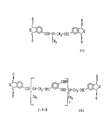
- the polycarboxylic acid component a) in each case was an anhydride mixture prepared by reacting trimellitic anhydride with 1,2-propanediol, thus consisting of trimellitic anhydride and anhydrides of the formulas (1) and (2) (see formula sheet) and as OH- Group-containing component c) each polyester, prepared as described in DE-OS 28 11 913, used.
- trimellitic anhydride 1536 g of trimellitic anhydride (TMSA) were melted in a 4 l reaction vessel with the addition of 80 g of xylene. 2.5 g of sodium tungstophosphoric acid were added and the mixture was heated to 190.degree. 308 g of 1,2-propanediol were then added to the melt and the batch was heated to 200 ° C. in the course of 1 to 1.5 hours. The reaction temperature was raised to 220 ° C and held until the elimination of water was complete. After about 4 hours, the amount of water was about 150 to 160 ml.
- TMSA trimellitic anhydride
- reaction mixture was then cooled to about 180 ° C. and the xylene was distilled off using a water jet vacuum. After cooling, about 1680 g of a solid, yellowish resin were obtained.
- 355 parts of the (39%) aqueous dispersion from 1a) were mixed with 452 parts of water in a reactor equipped with a stirrer, reflux condenser, internal thermometer and metering devices for the monomers and the initiator, and the mixture was stirred at 80 ° C. heated and a solution of 0.5 T ammonium peroxydisulfate in 35 T water was added. 5 minutes after the addition of the initiator, 35 parts of a monomer mixture of 165 parts of methyl methacrylate, 142 parts of n-butyl acrylate and 24 parts of hydroxyethyl acrylate were added and, after a further 15 minutes of prepolymerization, the remaining amount of monomer was metered in over 2 hours.
- Example 1b was repeated with the difference that glycidyl methacrylate was now used instead of hydroxyethyl acrylate. This also resulted in a stable dispersion with a solids content of approximately 40%.
- Example 1b 705 parts of the aqueous (32% strength) dispersions from 3a) and 196 parts of water were introduced into a reactor as in Example 1b). This mixture was heated to 80 ° C. with stirring and a solution of 0.5 T ammonium peroxydisulfate in 35 T water was added. 5 minutes after the addition of the initiator, 35 parts of a monomer mixture of 125 parts of methyl methacrylate, 94 parts of n-butyl acrylate and 17 parts of hydroxymethyl methacrylate were added and the mixture was further processed as described in Example 1b. The result was a stable dispersion with a solids content of approximately 40%.
- Example 3b was repeated with the difference that glycidyl methacrylate instead of hydroxyethyl methacrylate was used.
- the result is a stable dispersion with approximately 40% solids content.
- V3 14 parts of a monomer emulsion composed of 652 parts of water, 21 parts of a 50% strength aqueous solution of an alkylarylpolyglycol ether sulfate sodium salt (( R ) Hostapal BV from Hoechst AG) and 1.75 parts of ammonium peroxydisulfate were added to a reaction vessel such as Example 1b) Dissolved 536 T water and heated to 80 ° C.
- a reaction vessel such as Example 1b
- the mixture was brought to a pH of 8 using about 80 parts of a 25% strength aqueous dimethylaminoethanol solution , 0 - 8.2 set.
- the result was an aqueous dispersion with a finished material content of approximately 50%.
- binder solutions or dispersions of the examples mentioned were diluted with water to a solids content of 25% and tested in this form.
- the pigmented and unpigmented paints according to 5A) and 5B) were tested as follows:
- Body panels were primed using the cataphoretic electrocoating process and baked at 180 ° C. within 20 minutes.
- the primed sheets were then coated with a stoving filler based on a commercially available polyester resin (( R ) Alftalat VAN 1951 from Hoechst AG) and a likewise commercially available butyl etherified melamine resin (( R ) Maprenal MF 590 from Hoechst AG) and again within 20 Hardened for minutes at 160 ° C.
- the pigmented and unpigmented basecoats according to 5A) and 5B) were then applied to the sheets prepared in this way in a dry film thickness of 10 to 15 ⁇ m.
- the lacquer surfaces were coated with a 2K clear lacquer, a mixture of a commercially available OH group-containing acrylate resin (( R ) M acrynal SM 510n from Hoechst AG) and one as well commercially available aliphatic polyisocyanate ( (R) Desmodur N / 75% strength from Bayer AG), coated in a dry film thickness of approx. 35 ⁇ m.
- the coated sheets with a 4-layer paint structure were baked at 135 ° C for 20 minutes.
- the rheology of the paints must be adjustable to ensure that the paints can be applied properly. This does not succeed in cases V1, V2 and V4 with thickeners according to the prior art.
- Test failed softening, bubbles etc. or loss of liability
- Example 4 A The binder dispersions of Example 4 and Comparative Example V3) described above were diluted with water to a solids content of 25% and tested in this form.
- A 304 parts of the binder dispersions of Examples 4) and V3) described under 6) A are mixed with 220 parts of a pigment paste consisting of 600 parts of commercially available titanium dioxide pigment (Kronos ( R ) CL 310 titanium company, Frankfurt), 50 parts of butylglycol and 300 parts of a second , 4% aqueous solution of a commercially available polyacrylate thickener (Viscalex ( R ) HV 30 from Allied Colloids, England) and diluted with water to a solids content of 17%. The uni basecoats are then adjusted to a pH of 7.2 with triethylamine.
- a pigment paste consisting of 600 parts of commercially available titanium dioxide pigment (Kronos ( R ) CL 310 titanium company, Frankfurt), 50 parts of butylglycol and 300 parts of a second , 4% aqueous solution of a commercially available polyacrylate thickener (Viscalex ( R ) HV 30 from Allied Colloids, England) and diluted
Landscapes
- Chemical & Material Sciences (AREA)
- Organic Chemistry (AREA)
- Chemical Kinetics & Catalysis (AREA)
- Polymers & Plastics (AREA)
- Medicinal Chemistry (AREA)
- Health & Medical Sciences (AREA)
- Materials Engineering (AREA)
- Wood Science & Technology (AREA)
- Engineering & Computer Science (AREA)
- Life Sciences & Earth Sciences (AREA)
- Paints Or Removers (AREA)
- Polymerisation Methods In General (AREA)
- Graft Or Block Polymers (AREA)
- Adhesives Or Adhesive Processes (AREA)
- Addition Polymer Or Copolymer, Post-Treatments, Or Chemical Modifications (AREA)
- Compositions Of Macromolecular Compounds (AREA)
Priority Applications (1)
| Application Number | Priority Date | Filing Date | Title |
|---|---|---|---|
| AT86117167T ATE76414T1 (de) | 1985-12-14 | 1986-12-09 | Polymerisatdispersionen, verfahren zu ihrer herstellung, sowie deren anwendung als bindemittel. |
Applications Claiming Priority (2)
| Application Number | Priority Date | Filing Date | Title |
|---|---|---|---|
| DE19853544337 DE3544337A1 (de) | 1985-12-14 | 1985-12-14 | Polymerisatdispersionen, verfahren zu ihrer herstellung, sowie deren anwendung als bindemittel |
| DE3544337 | 1985-12-14 |
Publications (3)
| Publication Number | Publication Date |
|---|---|
| EP0226171A2 true EP0226171A2 (fr) | 1987-06-24 |
| EP0226171A3 EP0226171A3 (en) | 1989-08-16 |
| EP0226171B1 EP0226171B1 (fr) | 1992-05-20 |
Family
ID=6288490
Family Applications (1)
| Application Number | Title | Priority Date | Filing Date |
|---|---|---|---|
| EP86117167A Expired - Lifetime EP0226171B1 (fr) | 1985-12-14 | 1986-12-09 | Dispersions polymériques, leur procédé de préparation et leur utilisation comme liants |
Country Status (15)
| Country | Link |
|---|---|
| US (1) | US4981885A (fr) |
| EP (1) | EP0226171B1 (fr) |
| JP (1) | JPH0813869B2 (fr) |
| KR (1) | KR940010968B1 (fr) |
| AR (1) | AR245169A1 (fr) |
| AT (1) | ATE76414T1 (fr) |
| AU (1) | AU590369B2 (fr) |
| BR (1) | BR8606156A (fr) |
| CA (1) | CA1297606C (fr) |
| DE (2) | DE3544337A1 (fr) |
| ES (1) | ES2042490T3 (fr) |
| FI (1) | FI90555C (fr) |
| MX (1) | MX164417B (fr) |
| PT (1) | PT83925B (fr) |
| ZA (1) | ZA869372B (fr) |
Cited By (5)
| Publication number | Priority date | Publication date | Assignee | Title |
|---|---|---|---|---|
| EP0260447A3 (en) * | 1986-08-19 | 1990-04-11 | Herberts Gesellschaft Mit Beschrankter Haftung | Aqueous coating composition, process for its preparation and its use |
| EP0561343A1 (fr) * | 1992-03-16 | 1993-09-22 | Kawasaki Steel Corporation | Système liant et son utilisation dans le moulage et par injection des poudres frittables et composition contenant ce système |
| US5708072A (en) * | 1993-12-06 | 1998-01-13 | Vianova Resins Aktiengesellschaft | Process for the preparation of water-dilutable coating binders, and the use thereof |
| US5824733A (en) * | 1994-04-30 | 1998-10-20 | Wacker-Chemie Gmbh | Aqueous coating product and a process for producing multiple layer paint coatings whose perceived color varies with the angle from which they are viewed |
| EP0808333B2 (fr) † | 1995-02-07 | 2002-10-23 | Bollig & Kemper GmbH & Co. KG | Microgel |
Families Citing this family (18)
| Publication number | Priority date | Publication date | Assignee | Title |
|---|---|---|---|---|
| JPH0623238B2 (ja) * | 1986-04-08 | 1994-03-30 | 日本ゼオン株式会社 | アクリレ−ト系エラストマ−加硫性組成物 |
| US5120889A (en) * | 1989-12-14 | 1992-06-09 | National Starch And Chemical Investment Holding Corporation | Method for manufacturing binder for lead storage battery glass (fiber) mats |
| CA2065100A1 (fr) * | 1991-04-05 | 1992-10-06 | Masami Uemae | Dispersion aqueuse de polymere acrylique |
| US5286415A (en) * | 1992-12-28 | 1994-02-15 | Advanced Products, Inc. | Water-based polymer thick film conductive ink |
| JPH06346020A (ja) * | 1993-06-03 | 1994-12-20 | Mitsui Saitetsuku Kk | 缶外面水性樹脂組成物 |
| JP3644080B2 (ja) * | 1994-08-17 | 2005-04-27 | 大同特殊鋼株式会社 | モータ用部品及びその塗装方法 |
| DE19644176A1 (de) * | 1996-10-24 | 1998-04-30 | Belland Ag | Packung, enthaltend einen trockenen alkalischen Feststoff |
| US6187374B1 (en) | 1998-09-02 | 2001-02-13 | Xim Products, Inc. | Coatings with increased adhesion |
| US6409814B1 (en) | 2000-04-19 | 2002-06-25 | E. I. Du Pont De Nemours And Company | Pigment preparations and water-borne effect base coats prepared therewith |
| US6528582B2 (en) | 2000-05-16 | 2003-03-04 | Neste Resins Canada | Method of preparing co-polymer particles |
| US6245853B1 (en) * | 2000-05-16 | 2001-06-12 | Neste Resins Canada | Method of preparing co-polymer particles |
| EP1664438A1 (fr) * | 2003-09-04 | 2006-06-07 | Koninklijke Philips Electronics N.V. | Systeme de signalisation horizontale sur des routes |
| ATE513025T1 (de) | 2004-10-20 | 2011-07-15 | Valspar Sourcing Inc | Beschichtungszusammensetzungen für dosen und beschichtungsverfahren |
| CN101636457B (zh) * | 2007-03-22 | 2012-07-25 | 关西涂料株式会社 | 水基涂料组合物及多层涂膜形成方法 |
| JP5424184B2 (ja) * | 2007-10-11 | 2014-02-26 | 関西ペイント株式会社 | 水性塗料組成物 |
| KR101884537B1 (ko) | 2013-07-02 | 2018-08-01 | 발스파 소싱 인코포레이티드 | 식품 및 음료 용기와 같은 패키징 물품을 위한 코팅 조성물 |
| PL3016868T3 (pl) | 2013-07-02 | 2024-02-05 | Swimc Llc | Kompozycje powłokowe do artykułów opakowaniowych, takich jak pojemniki na żywność i napoje |
| KR101549791B1 (ko) * | 2013-09-30 | 2015-09-02 | 주식회사 엘지화학 | 아크릴계 광학 필름, 이를 포함하는 편광판 |
Family Cites Families (14)
| Publication number | Priority date | Publication date | Assignee | Title |
|---|---|---|---|---|
| US3386939A (en) * | 1964-11-27 | 1968-06-04 | Du Pont | Acrylic dispersions for wire enamels |
| BE823039A (fr) * | 1973-12-06 | 1975-04-01 | Peintures en poudre contenant des particules metalliques | |
| DE2408298C3 (de) * | 1974-02-21 | 1980-08-21 | Basf Ag, 6700 Ludwigshafen | Verfahren zur flächenhaften Beschichtung von festen Substraten und seine Anwendung |
| US3953644A (en) * | 1974-12-20 | 1976-04-27 | Ford Motor Company | Powa--method for coating and product |
| JPS5922722B2 (ja) * | 1975-09-12 | 1984-05-29 | 関西ペイント株式会社 | エマルジヨン組成物 |
| JPS595350B2 (ja) * | 1976-01-30 | 1984-02-03 | 三井東圧化学株式会社 | メタリック調塗膜の形成方法 |
| JPS52108488A (en) * | 1976-03-08 | 1977-09-10 | Kao Corp | Preparation of liquid resin dispersions |
| SE441599B (sv) * | 1976-05-11 | 1985-10-21 | Scm Corp | Ymppolymerkomposition av ett epoxidharts och etenisk omettad additionspolymeriserbar monomer och forfarande for framstellning derav |
| DE2851962A1 (de) * | 1978-03-18 | 1980-06-19 | Hoechst Ag | Verwendung eines wasserloeslichen reaktiven bindemittels fuer klebstoffe |
| DE2811913A1 (de) * | 1978-03-18 | 1980-02-21 | Hoechst Ag | Wasserloesliche reaktive polymerenmischung |
| DE3128062A1 (de) * | 1981-07-16 | 1983-02-03 | Hoechst Ag, 6000 Frankfurt | Waessrige copolymerisat-dispersionen, verfahren zu ihrer herstellung und verwendung der dispersionen |
| US4444923A (en) * | 1982-12-30 | 1984-04-24 | Mobil Oil Corporation | Process for preparing aqueous coatings comprising dispersible epoxy resin-acid polymer ester |
| US4564648A (en) * | 1984-09-21 | 1986-01-14 | E. I. Du Pont De Nemours And Company | Epoxy graft acrylic water-based primer surfaces |
| US4579887A (en) * | 1985-02-26 | 1986-04-01 | The Dow Chemical Company | Non-aqueous dispersions of relatively high molecular weight epoxy resins |
-
1985
- 1985-12-14 DE DE19853544337 patent/DE3544337A1/de not_active Withdrawn
-
1986
- 1986-12-09 EP EP86117167A patent/EP0226171B1/fr not_active Expired - Lifetime
- 1986-12-09 ES ES86117167T patent/ES2042490T3/es not_active Expired - Lifetime
- 1986-12-09 AT AT86117167T patent/ATE76414T1/de not_active IP Right Cessation
- 1986-12-09 DE DE8686117167T patent/DE3685415D1/de not_active Expired - Fee Related
- 1986-12-11 BR BR8606156A patent/BR8606156A/pt not_active IP Right Cessation
- 1986-12-11 FI FI865060A patent/FI90555C/fi not_active IP Right Cessation
- 1986-12-11 AR AR86306149A patent/AR245169A1/es active
- 1986-12-12 MX MX4646A patent/MX164417B/es unknown
- 1986-12-12 PT PT83925A patent/PT83925B/pt not_active IP Right Cessation
- 1986-12-12 ZA ZA869372A patent/ZA869372B/xx unknown
- 1986-12-12 AU AU66481/86A patent/AU590369B2/en not_active Ceased
- 1986-12-12 CA CA000525165A patent/CA1297606C/fr not_active Expired - Fee Related
- 1986-12-13 KR KR1019860010687A patent/KR940010968B1/ko not_active Expired - Fee Related
- 1986-12-13 JP JP61295775A patent/JPH0813869B2/ja not_active Expired - Lifetime
-
1989
- 1989-08-23 US US07/397,770 patent/US4981885A/en not_active Expired - Lifetime
Cited By (5)
| Publication number | Priority date | Publication date | Assignee | Title |
|---|---|---|---|---|
| EP0260447A3 (en) * | 1986-08-19 | 1990-04-11 | Herberts Gesellschaft Mit Beschrankter Haftung | Aqueous coating composition, process for its preparation and its use |
| EP0561343A1 (fr) * | 1992-03-16 | 1993-09-22 | Kawasaki Steel Corporation | Système liant et son utilisation dans le moulage et par injection des poudres frittables et composition contenant ce système |
| US5708072A (en) * | 1993-12-06 | 1998-01-13 | Vianova Resins Aktiengesellschaft | Process for the preparation of water-dilutable coating binders, and the use thereof |
| US5824733A (en) * | 1994-04-30 | 1998-10-20 | Wacker-Chemie Gmbh | Aqueous coating product and a process for producing multiple layer paint coatings whose perceived color varies with the angle from which they are viewed |
| EP0808333B2 (fr) † | 1995-02-07 | 2002-10-23 | Bollig & Kemper GmbH & Co. KG | Microgel |
Also Published As
| Publication number | Publication date |
|---|---|
| AU6648186A (en) | 1987-06-18 |
| ZA869372B (en) | 1987-08-26 |
| DE3544337A1 (de) | 1987-06-19 |
| FI865060L (fi) | 1987-06-15 |
| JPS62141013A (ja) | 1987-06-24 |
| EP0226171B1 (fr) | 1992-05-20 |
| CA1297606C (fr) | 1992-03-17 |
| PT83925A (de) | 1987-01-01 |
| PT83925B (pt) | 1989-06-30 |
| EP0226171A3 (en) | 1989-08-16 |
| KR870005683A (ko) | 1987-07-06 |
| AR245169A1 (es) | 1993-12-30 |
| FI90555B (fi) | 1993-11-15 |
| ATE76414T1 (de) | 1992-06-15 |
| KR940010968B1 (ko) | 1994-11-21 |
| ES2042490T3 (es) | 1993-12-16 |
| DE3685415D1 (de) | 1992-06-25 |
| BR8606156A (pt) | 1987-09-22 |
| AU590369B2 (en) | 1989-11-02 |
| MX164417B (es) | 1992-08-12 |
| US4981885A (en) | 1991-01-01 |
| JPH0813869B2 (ja) | 1996-02-14 |
| FI865060A0 (fi) | 1986-12-11 |
| FI90555C (fi) | 1994-02-25 |
Similar Documents
| Publication | Publication Date | Title |
|---|---|---|
| EP0226171B1 (fr) | Dispersions polymériques, leur procédé de préparation et leur utilisation comme liants | |
| EP1173491B1 (fr) | Polymere | |
| DE69311589T2 (de) | Wässrige Farblackmischung und eine diese verwendende Beschichtungsmethode | |
| DE69016264T2 (de) | Wässerige Beschichtungsmittel für Kraftfahrzeuge. | |
| DE69332667T2 (de) | Wässrige beschichtungszusammensetzungen mit verbesserter pigmentorientierung | |
| DE3874836T2 (de) | Waermehaertende pulvrige beschichtungszusammensetzung. | |
| EP1185568B1 (fr) | Polymere | |
| EP0674672B2 (fr) | Dispersions aqueuses de polymeres pour laques transparentes | |
| EP0391271A2 (fr) | Composition de revêtement aqueuse et thermodurcissable à base de polyester et d'acrylate, son procédé de préparation et son utilisation | |
| EP0473148A1 (fr) | Copolymère diluable par l'eau, sa préparation et son utilisation, et composition aqueuse de revêtement | |
| EP0071071B2 (fr) | Procédé de préparation d'une dispersion aqueuse d'un copolymère et usage de celle-ci | |
| DE60023010T2 (de) | Elektrotauchlack-zusammensetzung und verfahren zum elektrotauchlackieren eines substrats | |
| DE2633267B2 (de) | Mit Polyester modifiziertes Vinylpolymeres, Verfahren zu seiner Herstellung und Verwendung | |
| EP1554323B1 (fr) | Dispersion de microgel modifiee par acide phosphonique | |
| EP0663428A2 (fr) | Procédé de revêtement et composition de revêtement utilisant des polybutènes | |
| DE69508405T2 (de) | Wasserdispergierbares acryl-pfropfcopoloymer, verfahren zu dessen herstellung lund wässriges anstrichmittel | |
| EP0496079A2 (fr) | Liants de revêtement à base de copolymères acryliques diluables dans l'eau | |
| DE3832142A1 (de) | Verfahren zur herstellung eines mehrschichtigen, schuetzenden und/oder dekorativen ueberzugs und wasserverduennbare beschichtungszusammensetzungen | |
| WO1995016720A1 (fr) | Dispersions polymeres aqueuses, peintures aqueuses a base de telles dispersions et procede pour l'application de ces peintures sur des carrosseries automobiles | |
| WO1993023177A1 (fr) | Procede pour l'obtention d'un vernissage en deux couches et vernis aqueux utilise pour ce procede | |
| DE2515705A1 (de) | Copolymerisatloesung aus acrylharz | |
| WO1990002159A1 (fr) | Procede pour fabriquer des materiaux de revetement diluables a l'eau et stables au stockage, ainsi que leur emploi | |
| DE10247847A1 (de) | Phosphonsäuremodifizierte Mikrogeldispersion | |
| DE1644810A1 (de) | UEberzugsmittel und Lacke | |
| DE2423887A1 (de) | Waermehaertbares, pulverfoermiges ueberzugsmittel aus einer mischung aus glycidylgruppenhaltigen copolymerisaten, dicarbonsaeureanhydriden und haertungsbeschleunigern |
Legal Events
| Date | Code | Title | Description |
|---|---|---|---|
| PUAI | Public reference made under article 153(3) epc to a published international application that has entered the european phase |
Free format text: ORIGINAL CODE: 0009012 |
|
| AK | Designated contracting states |
Kind code of ref document: A2 Designated state(s): AT BE CH DE ES FR GB IT LI NL SE |
|
| PUAL | Search report despatched |
Free format text: ORIGINAL CODE: 0009013 |
|
| RHK1 | Main classification (correction) |
Ipc: C08F283/10 |
|
| AK | Designated contracting states |
Kind code of ref document: A3 Designated state(s): AT BE CH DE ES FR GB IT LI NL SE |
|
| 17P | Request for examination filed |
Effective date: 19891207 |
|
| 17Q | First examination report despatched |
Effective date: 19910328 |
|
| GRAA | (expected) grant |
Free format text: ORIGINAL CODE: 0009210 |
|
| AK | Designated contracting states |
Kind code of ref document: B1 Designated state(s): AT BE CH DE ES FR GB IT LI NL SE |
|
| REF | Corresponds to: |
Ref document number: 76414 Country of ref document: AT Date of ref document: 19920615 Kind code of ref document: T |
|
| ITF | It: translation for a ep patent filed | ||
| REF | Corresponds to: |
Ref document number: 3685415 Country of ref document: DE Date of ref document: 19920625 |
|
| ET | Fr: translation filed | ||
| GBT | Gb: translation of ep patent filed (gb section 77(6)(a)/1977) | ||
| PLBE | No opposition filed within time limit |
Free format text: ORIGINAL CODE: 0009261 |
|
| STAA | Information on the status of an ep patent application or granted ep patent |
Free format text: STATUS: NO OPPOSITION FILED WITHIN TIME LIMIT |
|
| 26N | No opposition filed | ||
| REG | Reference to a national code |
Ref country code: ES Ref legal event code: FG2A Ref document number: 2042490 Country of ref document: ES Kind code of ref document: T3 |
|
| EAL | Se: european patent in force in sweden |
Ref document number: 86117167.6 |
|
| PGFP | Annual fee paid to national office [announced via postgrant information from national office to epo] |
Ref country code: FR Payment date: 19971124 Year of fee payment: 12 |
|
| PGFP | Annual fee paid to national office [announced via postgrant information from national office to epo] |
Ref country code: NL Payment date: 19971130 Year of fee payment: 12 |
|
| PGFP | Annual fee paid to national office [announced via postgrant information from national office to epo] |
Ref country code: GB Payment date: 19971204 Year of fee payment: 12 |
|
| PGFP | Annual fee paid to national office [announced via postgrant information from national office to epo] |
Ref country code: ES Payment date: 19971209 Year of fee payment: 12 |
|
| PGFP | Annual fee paid to national office [announced via postgrant information from national office to epo] |
Ref country code: SE Payment date: 19971211 Year of fee payment: 12 |
|
| PGFP | Annual fee paid to national office [announced via postgrant information from national office to epo] |
Ref country code: CH Payment date: 19971218 Year of fee payment: 12 |
|
| PGFP | Annual fee paid to national office [announced via postgrant information from national office to epo] |
Ref country code: BE Payment date: 19971230 Year of fee payment: 12 |
|
| PG25 | Lapsed in a contracting state [announced via postgrant information from national office to epo] |
Ref country code: GB Free format text: LAPSE BECAUSE OF NON-PAYMENT OF DUE FEES Effective date: 19981209 |
|
| PG25 | Lapsed in a contracting state [announced via postgrant information from national office to epo] |
Ref country code: SE Free format text: LAPSE BECAUSE OF NON-PAYMENT OF DUE FEES Effective date: 19981210 |
|
| PG25 | Lapsed in a contracting state [announced via postgrant information from national office to epo] |
Ref country code: LI Free format text: LAPSE BECAUSE OF NON-PAYMENT OF DUE FEES Effective date: 19981231 Ref country code: CH Free format text: LAPSE BECAUSE OF NON-PAYMENT OF DUE FEES Effective date: 19981231 Ref country code: BE Free format text: LAPSE BECAUSE OF NON-PAYMENT OF DUE FEES Effective date: 19981231 |
|
| BERE | Be: lapsed |
Owner name: HOECHST A.G. Effective date: 19981231 |
|
| PG25 | Lapsed in a contracting state [announced via postgrant information from national office to epo] |
Ref country code: NL Free format text: LAPSE BECAUSE OF NON-PAYMENT OF DUE FEES Effective date: 19990701 |
|
| GBPC | Gb: european patent ceased through non-payment of renewal fee |
Effective date: 19981209 |
|
| REG | Reference to a national code |
Ref country code: CH Ref legal event code: PL |
|
| PG25 | Lapsed in a contracting state [announced via postgrant information from national office to epo] |
Ref country code: FR Free format text: LAPSE BECAUSE OF NON-PAYMENT OF DUE FEES Effective date: 19990831 |
|
| NLV4 | Nl: lapsed or anulled due to non-payment of the annual fee |
Effective date: 19990701 |
|
| REG | Reference to a national code |
Ref country code: FR Ref legal event code: ST |
|
| PG25 | Lapsed in a contracting state [announced via postgrant information from national office to epo] |
Ref country code: ES Free format text: LAPSE BECAUSE OF NON-PAYMENT OF DUE FEES Effective date: 19991210 |
|
| PGFP | Annual fee paid to national office [announced via postgrant information from national office to epo] |
Ref country code: AT Payment date: 20001027 Year of fee payment: 15 |
|
| PG25 | Lapsed in a contracting state [announced via postgrant information from national office to epo] |
Ref country code: AT Free format text: LAPSE BECAUSE OF NON-PAYMENT OF DUE FEES Effective date: 20011209 |
|
| REG | Reference to a national code |
Ref country code: ES Ref legal event code: FD2A Effective date: 20000114 |
|
| PGFP | Annual fee paid to national office [announced via postgrant information from national office to epo] |
Ref country code: DE Payment date: 20041202 Year of fee payment: 19 |
|
| PG25 | Lapsed in a contracting state [announced via postgrant information from national office to epo] |
Ref country code: IT Free format text: LAPSE BECAUSE OF NON-PAYMENT OF DUE FEES;WARNING: LAPSES OF ITALIAN PATENTS WITH EFFECTIVE DATE BEFORE 2007 MAY HAVE OCCURRED AT ANY TIME BEFORE 2007. THE CORRECT EFFECTIVE DATE MAY BE DIFFERENT FROM THE ONE RECORDED. Effective date: 20051209 |
|
| PG25 | Lapsed in a contracting state [announced via postgrant information from national office to epo] |
Ref country code: DE Free format text: LAPSE BECAUSE OF NON-PAYMENT OF DUE FEES Effective date: 20060701 |