EP0246111A1 - Flow streamlining device for transfer line heat exchangers - Google Patents
Flow streamlining device for transfer line heat exchangers Download PDFInfo
- Publication number
- EP0246111A1 EP0246111A1 EP87304339A EP87304339A EP0246111A1 EP 0246111 A1 EP0246111 A1 EP 0246111A1 EP 87304339 A EP87304339 A EP 87304339A EP 87304339 A EP87304339 A EP 87304339A EP 0246111 A1 EP0246111 A1 EP 0246111A1
- Authority
- EP
- European Patent Office
- Prior art keywords
- heat exchange
- exchange tubes
- tubesheet
- recited
- flow
- Prior art date
- Legal status (The legal status is an assumption and is not a legal conclusion. Google has not performed a legal analysis and makes no representation as to the accuracy of the status listed.)
- Withdrawn
Links
- 238000012546 transfer Methods 0.000 title claims abstract description 16
- 239000007789 gas Substances 0.000 claims abstract description 54
- 238000000034 method Methods 0.000 claims abstract description 22
- 238000010791 quenching Methods 0.000 claims abstract description 6
- 230000000171 quenching effect Effects 0.000 claims abstract description 5
- 239000000571 coke Substances 0.000 description 19
- 239000000463 material Substances 0.000 description 7
- 239000012530 fluid Substances 0.000 description 6
- 230000007246 mechanism Effects 0.000 description 6
- 238000004939 coking Methods 0.000 description 5
- QGZKDVFQNNGYKY-UHFFFAOYSA-N Ammonia Chemical compound N QGZKDVFQNNGYKY-UHFFFAOYSA-N 0.000 description 4
- 238000005336 cracking Methods 0.000 description 4
- 238000001311 chemical methods and process Methods 0.000 description 3
- 238000012993 chemical processing Methods 0.000 description 3
- 238000012986 modification Methods 0.000 description 3
- 230000004048 modification Effects 0.000 description 3
- 238000000197 pyrolysis Methods 0.000 description 3
- 239000000126 substance Substances 0.000 description 3
- 239000011269 tar Substances 0.000 description 3
- XLYOFNOQVPJJNP-UHFFFAOYSA-N water Substances O XLYOFNOQVPJJNP-UHFFFAOYSA-N 0.000 description 3
- 235000003823 Petasites japonicus Nutrition 0.000 description 2
- 240000003296 Petasites japonicus Species 0.000 description 2
- 229910021529 ammonia Inorganic materials 0.000 description 2
- 238000006243 chemical reaction Methods 0.000 description 2
- 238000009833 condensation Methods 0.000 description 2
- 230000005494 condensation Effects 0.000 description 2
- 239000012809 cooling fluid Substances 0.000 description 2
- 238000005235 decoking Methods 0.000 description 2
- 238000000151 deposition Methods 0.000 description 2
- 239000002245 particle Substances 0.000 description 2
- OKTJSMMVPCPJKN-UHFFFAOYSA-N Carbon Chemical compound [C] OKTJSMMVPCPJKN-UHFFFAOYSA-N 0.000 description 1
- 239000004215 Carbon black (E152) Substances 0.000 description 1
- 229910001018 Cast iron Inorganic materials 0.000 description 1
- 241000196324 Embryophyta Species 0.000 description 1
- 229910000831 Steel Inorganic materials 0.000 description 1
- 150000001336 alkenes Chemical class 0.000 description 1
- 230000015572 biosynthetic process Effects 0.000 description 1
- 229910052799 carbon Inorganic materials 0.000 description 1
- 229910010293 ceramic material Inorganic materials 0.000 description 1
- 238000004140 cleaning Methods 0.000 description 1
- 238000001816 cooling Methods 0.000 description 1
- 238000000354 decomposition reaction Methods 0.000 description 1
- 230000001419 dependent effect Effects 0.000 description 1
- 230000008021 deposition Effects 0.000 description 1
- 230000001627 detrimental effect Effects 0.000 description 1
- 238000009826 distribution Methods 0.000 description 1
- -1 e.g. Substances 0.000 description 1
- 230000000694 effects Effects 0.000 description 1
- 239000013529 heat transfer fluid Substances 0.000 description 1
- 229930195733 hydrocarbon Natural products 0.000 description 1
- 150000002430 hydrocarbons Chemical class 0.000 description 1
- 239000007788 liquid Substances 0.000 description 1
- 239000000203 mixture Substances 0.000 description 1
- JRZJOMJEPLMPRA-UHFFFAOYSA-N olefin Natural products CCCCCCCC=C JRZJOMJEPLMPRA-UHFFFAOYSA-N 0.000 description 1
- 229920000642 polymer Polymers 0.000 description 1
- 238000001556 precipitation Methods 0.000 description 1
- 238000004540 process dynamic Methods 0.000 description 1
- 238000012545 processing Methods 0.000 description 1
- 238000011084 recovery Methods 0.000 description 1
- 238000010517 secondary reaction Methods 0.000 description 1
- 238000010583 slow cooling Methods 0.000 description 1
- 239000007787 solid Substances 0.000 description 1
- 239000010959 steel Substances 0.000 description 1
Images

Classifications
-
- F—MECHANICAL ENGINEERING; LIGHTING; HEATING; WEAPONS; BLASTING
- F28—HEAT EXCHANGE IN GENERAL
- F28F—DETAILS OF HEAT-EXCHANGE AND HEAT-TRANSFER APPARATUS, OF GENERAL APPLICATION
- F28F19/00—Preventing the formation of deposits or corrosion, e.g. by using filters or scrapers
- F28F19/002—Preventing the formation of deposits or corrosion, e.g. by using filters or scrapers by using inserts or attachments
-
- C—CHEMISTRY; METALLURGY
- C10—PETROLEUM, GAS OR COKE INDUSTRIES; TECHNICAL GASES CONTAINING CARBON MONOXIDE; FUELS; LUBRICANTS; PEAT
- C10G—CRACKING HYDROCARBON OILS; PRODUCTION OF LIQUID HYDROCARBON MIXTURES, e.g. BY DESTRUCTIVE HYDROGENATION, OLIGOMERISATION, POLYMERISATION; RECOVERY OF HYDROCARBON OILS FROM OIL-SHALE, OIL-SAND, OR GASES; REFINING MIXTURES MAINLY CONSISTING OF HYDROCARBONS; REFORMING OF NAPHTHA; MINERAL WAXES
- C10G9/00—Thermal non-catalytic cracking, in the absence of hydrogen, of hydrocarbon oils
- C10G9/002—Cooling of cracked gases
-
- F—MECHANICAL ENGINEERING; LIGHTING; HEATING; WEAPONS; BLASTING
- F28—HEAT EXCHANGE IN GENERAL
- F28D—HEAT-EXCHANGE APPARATUS, NOT PROVIDED FOR IN ANOTHER SUBCLASS, IN WHICH THE HEAT-EXCHANGE MEDIA DO NOT COME INTO DIRECT CONTACT
- F28D21/00—Heat-exchange apparatus not covered by any of the groups F28D1/00 - F28D20/00
- F28D2021/0019—Other heat exchangers for particular applications; Heat exchange systems not otherwise provided for
- F28D2021/0075—Other heat exchangers for particular applications; Heat exchange systems not otherwise provided for for syngas or cracked gas cooling systems
-
- F—MECHANICAL ENGINEERING; LIGHTING; HEATING; WEAPONS; BLASTING
- F28—HEAT EXCHANGE IN GENERAL
- F28F—DETAILS OF HEAT-EXCHANGE AND HEAT-TRANSFER APPARATUS, OF GENERAL APPLICATION
- F28F2250/00—Arrangements for modifying the flow of the heat exchange media, e.g. flow guiding means; Particular flow patterns
- F28F2250/02—Streamline-shaped elements
Definitions
- This invention relates to novel heat exchangers and to chemical processes involving their use. More particularly, this invention relates to new and improved indirect shell-and-tube heat exchangers of the type known as transfer line heat exchangers (TLEs), and to improved processes of quenching or recovering heat from high temperature fluids, and particularly high temperature gases, which involve their use.
- TLEs transfer line heat exchangers
- These novel TLEs are modified at their inlet ends in two respects in comparison to conventional TLEs by means which, taken together, can be characterized as a flow streamlining device. These modifications minimize or prevent inlet end fouling, which commonly occurs in conventional TLEs due to coke buildup resulting from condensation or precipitation, and then decomposition at high temperature, of tars, high polymers or other high molecular weight materials during processing. Their use also reduces the overall down time required to clean the inlet ends of the heat transfer tubes should inlet end fouling eventually occur.
- Transfer line heat exchangers are in widespread use in commercial chemical processing. In general, they operate to cool hot gases by passing these gases through a bundle of tubes in heat exchange relationship with a cooling fluid, such as water, passing around the outside, or shell side, of the tubes and contained within a defined area along the tubes by means of a pair of tubesheets which are generally perpendicular to the tubes contained within them. In certain processes, the heat removed from the process gas is sufficient to vaporize the fluid on the shell side. In such cases if water is used as the cooling fluid the heat exchanger also becomes a steam generator.
- a cooling fluid such as water
- TLEs are commonly used to cool very hot process gases. For example, they are used in processes for producing ammonia such as that disclosed in U.S. Patent No. 3,442, 613, issued May 6, 1969 to Grotz, to cool the approximately 850°F ammonia-containing gas exiting a syngas converter. They are also used in olefin plants and in other hydrocarbon cracking operations to recover usable heat from reactor gases, e.g., gases exiting pyrolysis furnace coils at temperatures above 1500°F. To avoid secondary reactions leading to less valuable or useless products, the residence time spent by the exiting gases between The furnace coil outlet and the TLE inlet should be minimized.
- Another object of this invention is to provide improved processes of quenching or recovering heat from high temperature fluids, and particularly high temperature gases, which involve the use of my novel transfer line heat exchangers.
- a further object of this invention is to provide novel transfer line heat exchangers whose inlet ends are modified by means of a novel flow streamlining device.
- a still further object of this invention is to provide novel transfer line heat exchangers which minimize or prevent inlet end fouling due to coke buildup.
- the novel flow streamlining device of this invention includes: -flared end means, preferably in the form of hollow truncated cones, with the smaller ends aligned with and mated to the inlet ends of the heat exchange tubes in a conventional TLE, the ends of these heat exchange tubes being contained within tubesheets which are generally perpendicular to the tubes, the flared end means extending away from the inlet end tubesheet, and -peaked gas guide means, preferably in the form of closed, concave gables having rounded, smooth tops, which rise between the rims or edges of adjacent larger ends of the flared end means and enclose the spaces between these rims or edges.
- the peaked gas guide means in combination with the flared end means, almost completely eliminate the tube sheet impact area perpendicular to the gas flow on which hot gases exiting a reactor impinge in a conventional TLE, thus lessening the opportunity for condensible or precipitatible materials in the gases entering the novel TLEs of this invention to deposit at the TLE inlet end and ultimately form coke deposits.
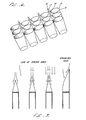
- the topology of this novel flow streamlining device is somewhat similar to that of the bottom half of an egg carton, as will be evident from accompanying FIG. 4.
- TLE inlet end fouling by coke deposit formation is chiefly due to at least one and possibly three distinct mechanisms, each of which can contribute to slow cooling at and in the vicinity of the TLE inlet end, a condition believed to be conducive to coke deposition.
- solid coke particles entrained in the entering gases can impact on TLE surfaces, particularly surfaces perpendicular to the direction of the gas flow, and progressively build up deposits on these surfaces. Ultimately, such deposits can block the inlet ends of the TLE tubes by "scaffolding" or cantilevering across the tube openings.
- nonideal gas flow distribution in the TLE at its inlet and beyond, and on the hot tubesheet can cause turbulent eddies and backmixing of the gases present, cooling them to also result in increased fouling.
- coke and pyrolysis tars, and other condensible or precipitatible materials can condense or deposit on any surface of the TLE or adjacent equipment which has been allowed to cool to below the dew point of the condensing or depositing material.
- the ratio of total tube inlet area to flat surface area on the surrounding tubesheet can be quite small.
- a typical TLE 1 may have less than 20% of the total surface area of its tubesheet 3 perforated with heat exchange tube inlets 5; see, for example, the Fuki et al, Hengstebeck and Koontz patents.
- Whatever portion of the flat surface area on the tubesheet 1 not perforated by heat exchange tube inlets 5 becomes an impact surface (the shaded area within the dotted boundary of FIG. 1, for example), one which is normally comparatively cool by virtue of contact with heat exchange fluid on its underside and thus one which can give rise to coke deposits by any or all of the above-mentioned mechanisms.
- transfer line exchanger 7 with heat exchange tube inlet ends (not shown) aligned with and mated to the smaller ends 11 of flared end means 9 in the form of hollow truncated cones, has a greatly reduced impact area on its tubesheet 13 (the shaded area within the tubesheet portion 13 of FIG. 2) in comparison to that of the TLE of FIG. 1.
- the hollow truncated cones 9 are configured in such a manner that the rims or edges of their larger ends 15 closesly abut one another, and preferably come within from zero to about 3/8 inches of one another.
- Typical dimensions for such hollow truncated cones 9 are as follows: a height as measured along the central axis of the cone of from about 5/8 to about 8 inches, and preferably from about 11 ⁇ 4 to about 21 ⁇ 2 inches, a diameter at the rim or edge of the smaller end 11 of from about 1 ⁇ 2 to about 21 ⁇ 2 inches, and preferably from about 1 to about 11 ⁇ 2 inches, and a diameter at the rim or edge of the larger end 15 of from about 3/4 to about 4 inches, and preferably from about 11 ⁇ 4 to about 21 ⁇ 2 inches, thus giving a typical pitch or slope from the smaller end 11 of the hollow truncated cone 9 to the larger end 15 of from about 5 to about 35 degrees, and preferably from about 10 to about 25 degrees.
- the peaked gas guide means 17 in the form of closed, concave gables having rounded, smooth tops 19 and concave sides 21 which gently slope downwardly from the rounded tops 19 to the rims or edges of the larger ends 15 of the hollow truncated cones 9, as shown in FIG. 3 and FIG. 4, rise between the rims or edges of the larger ends 15 of the hollow truncated cones 9 to enclose and cover the remaining flat surface area on the tubesheet 13 (again, for example, the shaded area within the tubesheet portion 13 of FIG. 2).
- the gases exiting a reactor (not shown), instead of impinging on flat tubesheet surfaces, stream down the concave sides 21 of the closed, concave gables 17, enter the enlarged inlets provided by the hollow truncated cones 9, and then pass beyond the tubesheet 13 through the TLE's heat exchange tubes 23.
- the impact area perpendicular to the gas flow at the inlet end 25 of a thus-modified TLE is almost completely eliminated, turbulent eddies and backmixing are minimized, and gases carrying entrained coke particles, tarry substances or other tar and coke formers are guided past the closed concave gables 17 through the hollow truncated cones 9 with minimal recirculation.
- a minimum amount of heat is lost by the gases in the inlet area. This helps alleviate problems caused by condensation, which in turn helps reduce coke deposits.
- the number of sides the peaked gas guide means will have in any particular flow streamlining device of this invention applied to the inlet end of a TLE will depend upon the geometric arrangement of the TLE's heat exchange tubes.
- the devices shown in FIGs 3 and 4 have four sided closed, concave gables, but peaked gas guide means having three, five or more sides are also possible, and thus are within the scope of the invention. It is desirable to maximize the height of the peaked gas guide means within the confines of the flared end means present, since the higher the peaked gas guide means the smoother and more streamlined the gas flow will be.
- typical height of the peaked gas guide means preferably in the form of closed, concave gables, will be from about three to about six times, and preferably from about 4 to about 5 times, the inside diameter of the TLE's heat exchange tubes, all measured from the smaller end of the truncated cone.
- the overall height of the flow streamlining device of this invention can thus typically range from about 1 to about 12 inches, and preferably from about 21 ⁇ 2 to about 8 inches.
- the novel flow streamlining device can be made of any material suitable for use in a TLE including, but not limited to, steel, cast iron and ceramic materials, with the choice of materials being dictated by cost and the conditions (exiting gas temperature, reactor pressure, composition of the gas being quenched, nature of the heat transfer fluid, etc.) of the chemical process being carried out.
Landscapes
- Physics & Mathematics (AREA)
- Thermal Sciences (AREA)
- Chemical & Material Sciences (AREA)
- Engineering & Computer Science (AREA)
- Oil, Petroleum & Natural Gas (AREA)
- General Chemical & Material Sciences (AREA)
- Chemical Kinetics & Catalysis (AREA)
- Organic Chemistry (AREA)
- Mechanical Engineering (AREA)
- General Engineering & Computer Science (AREA)
- Production Of Liquid Hydrocarbon Mixture For Refining Petroleum (AREA)
- Heat-Exchange Devices With Radiators And Conduit Assemblies (AREA)
- Details Of Heat-Exchange And Heat-Transfer (AREA)
Abstract
Shell-and-tube transfer line heat exchangers are disclosed, having inlet (5) ends with a flow streamlining device comprising, in combination:
- flared end means (9), preferably in the form of hollow truncated cones (9), whose smaller ends (11) are aligned with and mated to the inlet (5) ends of the heat exchange tubes (23) in a conventional transfer line heat exchanger (7), the ends of these heat exchange tubes (23) being contained within tubesheets (13), the flared end means (9) extending away from the inlet (5) and tubesheet (13), and
- peaked gas guide means (17), preferably in the form of closed, concave gables having rounded, smooth tops (19), which rise between the rims or edges of adjacent larger ends of the flared end means (9) and enclose the spaces between these rims or edges.
- flared end means (9), preferably in the form of hollow truncated cones (9), whose smaller ends (11) are aligned with and mated to the inlet (5) ends of the heat exchange tubes (23) in a conventional transfer line heat exchanger (7), the ends of these heat exchange tubes (23) being contained within tubesheets (13), the flared end means (9) extending away from the inlet (5) and tubesheet (13), and
- peaked gas guide means (17), preferably in the form of closed, concave gables having rounded, smooth tops (19), which rise between the rims or edges of adjacent larger ends of the flared end means (9) and enclose the spaces between these rims or edges.
Methods of quenching high temperature gases while recovering useable heat therefrom using these modified transfer line heat exchangers are also disclosed.
Description
- This invention relates to novel heat exchangers and to chemical processes involving their use. More particularly, this invention relates to new and improved indirect shell-and-tube heat exchangers of the type known as transfer line heat exchangers (TLEs), and to improved processes of quenching or recovering heat from high temperature fluids, and particularly high temperature gases, which involve their use. These novel TLEs are modified at their inlet ends in two respects in comparison to conventional TLEs by means which, taken together, can be characterized as a flow streamlining device. These modifications minimize or prevent inlet end fouling, which commonly occurs in conventional TLEs due to coke buildup resulting from condensation or precipitation, and then decomposition at high temperature, of tars, high polymers or other high molecular weight materials during processing. Their use also reduces the overall down time required to clean the inlet ends of the heat transfer tubes should inlet end fouling eventually occur.
- Transfer line heat exchangers are in widespread use in commercial chemical processing. In general, they operate to cool hot gases by passing these gases through a bundle of tubes in heat exchange relationship with a cooling fluid, such as water, passing around the outside, or shell side, of the tubes and contained within a defined area along the tubes by means of a pair of tubesheets which are generally perpendicular to the tubes contained within them. In certain processes, the heat removed from the process gas is sufficient to vaporize the fluid on the shell side. In such cases if water is used as the cooling fluid the heat exchanger also becomes a steam generator.
- TLEs are commonly used to cool very hot process gases. For example, they are used in processes for producing ammonia such as that disclosed in U.S. Patent No. 3,442, 613, issued May 6, 1969 to Grotz, to cool the approximately 850°F ammonia-containing gas exiting a syngas converter. They are also used in olefin plants and in other hydrocarbon cracking operations to recover usable heat from reactor gases, e.g., gases exiting pyrolysis furnace coils at temperatures above 1500°F. To avoid secondary reactions leading to less valuable or useless products, the residence time spent by the exiting gases between The furnace coil outlet and the TLE inlet should be minimized. the pressure drop across the TLE should also be minimized, since cracking selectivity towards more useful products in the furnace is directly dependent on cracking-coil outlet pressure, and ordinarily a pressure rise of no more than a few p.s.i. at the furnace outlet is all that can be tolerated if process stability is to be maintained. A discussion of various TLE designs is found in Albright et al, "Pyrolysis Theory and Industrial Practice (New York: Academic Press, 1983), Chapter 18.
- The efficiency with which heat is recovered by a TLE can have a marked effect on plant operating costs. Inlet end fouling due to coke buildup can impair this efficiency to a substantial extent. At higher temperatures in processes where coking is a problem, very hard and often refractory layers of coke or carbon can form on the walls of the reactor, conduits and heat exchangers. This coke buildup will cause an increase in pressure drop across the TLE, which is detrimental to cracking yields and eventually requires a shutdown of this equipment to permit decoking.
- It is difficult to examine in detail all of the reaction mechanisms occurring in chemical processes carried out at extremely high temperatures and pressures. Consequently, the mechanism(s) responsible for coke buildup in processes involving the use of TLEs have never been entirely elucidated. Some believe that it is important to keep the TLE tubes at a temperature above the dew point of any materials present which have a tendency to coke or deposit; see U.S. Patent No. 4,405,440, issued September 20, 1983 to Gwyn. Others believe it to be important to keep the connector between the reactor and the TLE at a temperature below 450°C, well below that of the exiting gas stream, on the theory that if a gas stream, e.g., one flowing at a mass velocity below 50 kg/m² per second, is quickly cooled to a temperature well below the temperature at the reactor exit, coking will not occur; see U.S. Patent No. 4,151,217, issued April 24, 1979 to Amano et al, and U.S. Patent No. 4,384,160, issued May 17, 1983 to Skraba.
- Other prior art methods of ameliorating the coking problem or attempting to prevent coking from occurring altogether have generally fallen into one of three categories:
-prevention of coke buildup by means of substances added to the gas stream (see U.S. Patent Nos. 3,174,924, issued March 23, 1965 to Clark et al; 4,097,544, issued June 27, 1978 to Hengstebeck, and the Skraba patent, each of which discloses injecting a quench fluid or fluids into the gas stream being cooled) or added to the TLE tubes themselves (see U.S. Patent Nos. 3,073,875, issued January 15, 1963 to Braconier et al and 4,288,408, issued September 8, 1981 to Guth et al, which disclose methods of forming a liquid or a gas film on the inner surfaces of the reactor, the tubes or both);
-mechanical means for cleaning out coke deposits once formed; see U.S. Patent No. 4,248,834, issued February 3, 1981 to Tokumitsu, which discloses decoking by feeding air through the system after interrupting the gas stream exiting the reactor, and U.S. Patent No. 4,366,003, issued December 28, 1982 to Korte et al, which discloses the use of jet nozzles positioned above the TLE inlet openings to periodically flush them clean, and
-various mechanical modifications of the TLEs or surrounding equipment, such as the use of inlet screens or sieve mediums (U.S. Patent No. 3,880,621, issued April 29, 1975 to Schneider et al), varying tube size to equalize flow through each of the TLE tubes (U.S. Patent No. 4,397,740, issued August 9, 1983 to Koontz), "insulating" the tubes with heat transfer medium which is thinner at the inlet end and increases in thickness gradually or uniformly to a point at or near the end of the tubes (the Gwyn patent), using an expansion section and conduits to inject water to form a steam sheath adjacent to the walls of the expansion section (U.S. Patent No. 3,574,781, issued February 14, 1968 to Racine et al), using a precooler closely followed by a pair of aftercoolers connected in parallel (U.S. Patent No. 3,607,153, issued September 21, 1971 to Cijer), connecting a conically ended heat exchanger directly to a cracking heater outlet (U.S. Patent No. 3,456,719, issued July 22, 1969 to Palchik), and using a bundle of triple tubes (U.S. Patent No. 3,903,963, issued September 9, 1975 to Fuki et al). - None of these expedients has fully served the intended purpose, and coking at TLE inlet ends remains a significant problem to the involved segments of the chemical processing industry.
- There has now been discovered a simple combination of mechanical expedients which minimizes or prevents entirely TLE inlet end fouling by coke buildup during high temperature chemical processing, and thus minimizes increased pressure drop across the system. This in turn optimizes heat recovery, process dynamics and process stability, and permits longer process runs between shutdowns.
- It is, therefore, an object of this invention to provide novel transfer line heat exchangers.
- Another object of this invention is to provide improved processes of quenching or recovering heat from high temperature fluids, and particularly high temperature gases, which involve the use of my novel transfer line heat exchangers.
- A further object of this invention is to provide novel transfer line heat exchangers whose inlet ends are modified by means of a novel flow streamlining device.
- A still further object of this invention is to provide novel transfer line heat exchangers which minimize or prevent inlet end fouling due to coke buildup.
- These and other objects, as well as the nature, scope and utilization of this invention, will become readily apparent to those skilled in the art from the following description, the drawings and the appended claims.
- The novel flow streamlining device of this invention includes:
-flared end means, preferably in the form of hollow truncated cones, with the smaller ends aligned with and mated to the inlet ends of the heat exchange tubes in a conventional TLE, the ends of these heat exchange tubes being contained within tubesheets which are generally perpendicular to the tubes, the flared end means extending away from the inlet end tubesheet, and
-peaked gas guide means, preferably in the form of closed, concave gables having rounded, smooth tops, which rise between the rims or edges of adjacent larger ends of the flared end means and enclose the spaces between these rims or edges. - The peaked gas guide means, in combination with the flared end means, almost completely eliminate the tube sheet impact area perpendicular to the gas flow on which hot gases exiting a reactor impinge in a conventional TLE, thus lessening the opportunity for condensible or precipitatible materials in the gases entering the novel TLEs of this invention to deposit at the TLE inlet end and ultimately form coke deposits. The topology of this novel flow streamlining device is somewhat similar to that of the bottom half of an egg carton, as will be evident from accompanying FIG. 4.
-
- FIG. 1 is an end view of a portion of the inlet end of a typical TLE, showing the ends of four tubes and the tube sheet impact area between them perpendicular to the direction of gas flow.
- FIG. 2 is an end view of a portion of the inlet end of a TLE drawn to the same dimensions as the TLE of FIG. 1 but partially modified in accordance with the invention, showing four tubes containing flared end means having no peaked gas guide means between them so as to illustrate the reduced tube sheet impact area between the inlets of the tubes.
- FIG. 3 is a plan view of a portion of the inlet end of a TLE modified in accordance with the invention, showing four tubes containing flared end means having a peaked gas guide means between them.
- FIG. 4 is a more comprehensive plan view of a flow streamlining device of the invention, showing multiple flared end means having peaked gas guide means between them.
- FIG. 5 is a cross-sectional view of the portion of the inlet end of a TLE modified in accordance with the invention shown in FIG. 3.
- I do not wish to be bound by any particular mechanism or theory advanced to explain the mode of operation of my novel flow streamlining device, the advantages obtainable therefrom, or the mechanism(s) of chemical reactions, physical phenomena or combinations thereof occurring in and around this device as positioned in accordance with the invention at the inlet end of a TLE situated at or near the exit of a chemical reactor generating a stream of high temperature gas. I believe, however, that TLE inlet end fouling by coke deposit formation is chiefly due to at least one and possibly three distinct mechanisms, each of which can contribute to slow cooling at and in the vicinity of the TLE inlet end, a condition believed to be conducive to coke deposition.
- First, solid coke particles entrained in the entering gases can impact on TLE surfaces, particularly surfaces perpendicular to the direction of the gas flow, and progressively build up deposits on these surfaces. Ultimately, such deposits can block the inlet ends of the TLE tubes by "scaffolding" or cantilevering across the tube openings.
- Second, nonideal gas flow distribution in the TLE at its inlet and beyond, and on the hot tubesheet, can cause turbulent eddies and backmixing of the gases present, cooling them to also result in increased fouling.
- Third, coke and pyrolysis tars, and other condensible or precipitatible materials, can condense or deposit on any surface of the TLE or adjacent equipment which has been allowed to cool to below the dew point of the condensing or depositing material.
- In hitherto commonly used TLEs, the ratio of total tube inlet area to flat surface area on the surrounding tubesheet can be quite small. As illustrated in FIG. 1, for example, a typical TLE 1 may have less than 20% of the total surface area of its
tubesheet 3 perforated with heat exchange tube inlets 5; see, for example, the Fuki et al, Hengstebeck and Koontz patents. Whatever portion of the flat surface area on the tubesheet 1 not perforated by heat exchange tube inlets 5 becomes an impact surface (the shaded area within the dotted boundary of FIG. 1, for example), one which is normally comparatively cool by virtue of contact with heat exchange fluid on its underside and thus one which can give rise to coke deposits by any or all of the above-mentioned mechanisms. - Considering now the present invention and its use in minimizing or preventing TLE inlet end fouling, with reference to the remaining accompanying drawings:
- As illustrated in FIG. 2, transfer line exchanger 7, with heat exchange tube inlet ends (not shown) aligned with and mated to the smaller ends 11 of flared end means 9 in the form of hollow truncated cones, has a greatly reduced impact area on its tubesheet 13 (the shaded area within the
tubesheet portion 13 of FIG. 2) in comparison to that of the TLE of FIG. 1. The hollow truncated cones 9 are configured in such a manner that the rims or edges of theirlarger ends 15 closesly abut one another, and preferably come within from zero to about 3/8 inches of one another. Typical dimensions for such hollow truncated cones 9 are as follows: a height as measured along the central axis of the cone of from about 5/8 to about 8 inches, and preferably from about 1¼ to about 2½ inches, a diameter at the rim or edge of the smaller end 11 of from about ½ to about 2½ inches, and preferably from about 1 to about 1½ inches, and a diameter at the rim or edge of thelarger end 15 of from about 3/4 to about 4 inches, and preferably from about 1¼ to about 2½ inches, thus giving a typical pitch or slope from the smaller end 11 of the hollow truncated cone 9 to thelarger end 15 of from about 5 to about 35 degrees, and preferably from about 10 to about 25 degrees. - The peaked gas guide means 17 in the form of closed, concave gables having rounded, smooth tops 19 and
concave sides 21 which gently slope downwardly from the rounded tops 19 to the rims or edges of the larger ends 15 of the hollow truncated cones 9, as shown in FIG. 3 and FIG. 4, rise between the rims or edges of the larger ends 15 of the hollow truncated cones 9 to enclose and cover the remaining flat surface area on the tubesheet 13 (again, for example, the shaded area within thetubesheet portion 13 of FIG. 2). Thus, the gases exiting a reactor (not shown), instead of impinging on flat tubesheet surfaces, stream down theconcave sides 21 of the closed,concave gables 17, enter the enlarged inlets provided by the hollow truncated cones 9, and then pass beyond thetubesheet 13 through the TLE'sheat exchange tubes 23. As shown in FIG. 5, the impact area perpendicular to the gas flow at the inlet end 25 of a thus-modified TLE is almost completely eliminated, turbulent eddies and backmixing are minimized, and gases carrying entrained coke particles, tarry substances or other tar and coke formers are guided past the closedconcave gables 17 through the hollow truncated cones 9 with minimal recirculation. And, since no relatively cooler surfaces on thetubesheet 13 remain for the gas to contact, a minimum amount of heat is lost by the gases in the inlet area. This helps alleviate problems caused by condensation, which in turn helps reduce coke deposits. - The number of sides the peaked gas guide means will have in any particular flow streamlining device of this invention applied to the inlet end of a TLE will depend upon the geometric arrangement of the TLE's heat exchange tubes. The devices shown in FIGs 3 and 4 have four sided closed, concave gables, but peaked gas guide means having three, five or more sides are also possible, and thus are within the scope of the invention. It is desirable to maximize the height of the peaked gas guide means within the confines of the flared end means present, since the higher the peaked gas guide means the smoother and more streamlined the gas flow will be. Hence, typical height of the peaked gas guide means, preferably in the form of closed, concave gables, will be from about three to about six times, and preferably from about 4 to about 5 times, the inside diameter of the TLE's heat exchange tubes, all measured from the smaller end of the truncated cone. The overall height of the flow streamlining device of this invention (flared end means plus peaked gas guide means) can thus typically range from about 1 to about 12 inches, and preferably from about 2½ to about 8 inches.
- The novel flow streamlining device can be made of any material suitable for use in a TLE including, but not limited to, steel, cast iron and ceramic materials, with the choice of materials being dictated by cost and the conditions (exiting gas temperature, reactor pressure, composition of the gas being quenched, nature of the heat transfer fluid, etc.) of the chemical process being carried out.
- The above discussion of this invention is directed primarily to preferred embodiments and practices thereof. It will be readily apparent to those skilled in the art that further changes and modifications in the actual implementation of the concepts described herein can readily be made without departing from the spirit and scope of the invention as defined by the following claims.
Claims (10)
1. A flow streamlining device for the inlet end of an indirect shell-and-tube transfer line heat exchanger whose heat exchange tubes are contained within a tubesheet, comprising:
(1) flared end means extending away from the tubesheet having their smaller ends in alignment with and mated to the inlet ends of the heat exchange tubes, and
(2) peaked gas guide means, proximate to the flated end means, having sides sloping upwardly from and enclosing the spaces between the rims of the larger ends of the flared end means.
2. In a method of quenching high temperature gases while recovering useable heat therefrom by means of an indirect shell-and-tube transfer line heat exchanger whose heat exchange tubes are affixed to a tubesheet, the improvement comprising streamlining high temperature gas flow into the heat exchange tubes by means of a flow streamlining device comprising:
(1) flared end means extending away from the tubesheet having their smaller ends in alignment with and mated to the inlet ends of the heat exchange tubes, and
(2) peaked gas guide means, proximate to the flared end means, having sides sloping upwardly from and enclosing the spaces between the rims of the larger ends of the flared end means.
3. A flow streamlining device as recited in claim 1, or a method as recited in claim 2, wherein the flared end means comprise hollow truncated cones.
4. A flow streamlining device or a method as recited in claim 3, wherein the rims of the larger ends of the hollow truncated cones closely abut one another.
5. A flow streamlining device or a method as recited in claim 4, wherein the height of the hollow truncated cones, as measured along the central axis of the cone, is from about 5/8 to about 8 inches.
6. A flow streamlining device or a method as recited in any one of claims 1 to 5, wherein the peaked gas guide means comprise closed, concave gables.
7. A flow streamlining device or a method as recited in claim 6, wherein the closed, concave gables have rounded, smooth tops.
8. A flow streamlining device as recited in claim 7, wherein the height of the closed concave gables is from about three to about twelve times the inside diameter of the heat exchange tubes.
9. A method as recited in claim 7, wherein the height of the closed concave gables is from about three to about six times the inside diameter of the heat exchange tubes, measured from the smaller end of the truncated cone.
10. A method of quenching high temperature gases while recovering useable heat therefrom by means of an indirect shell-and-tube transfer line heat exchanger whose heat exchange tubes are affixed to a tubesheet, wherein high temperature gas flow is streamlined into the heat exchange tubes by means of a flow streamlining device comprising:
(1) hollowing truncated cones wherein the rims of the larger end of the cones closely abut one another, these cones extending away from the tubesheet and having their smaller ends in alignment with and mated to the inlet ends of the heat exchange tubes, and
(2) closed, concave gables, proximate to the hollow truncated cones, having rounded, smooth tops and sides sloping upwardly from and enclosing the spaces between the rims of the larger ends of the hollow truncated cones.
Applications Claiming Priority (2)
| Application Number | Priority Date | Filing Date | Title |
|---|---|---|---|
| US864018 | 1986-05-16 | ||
| US06/864,018 US4785877A (en) | 1986-05-16 | 1986-05-16 | Flow streamlining device for transfer line heat exchanges |
Publications (1)
| Publication Number | Publication Date |
|---|---|
| EP0246111A1 true EP0246111A1 (en) | 1987-11-19 |
Family
ID=25342337
Family Applications (1)
| Application Number | Title | Priority Date | Filing Date |
|---|---|---|---|
| EP87304339A Withdrawn EP0246111A1 (en) | 1986-05-16 | 1987-05-15 | Flow streamlining device for transfer line heat exchangers |
Country Status (4)
| Country | Link |
|---|---|
| US (1) | US4785877A (en) |
| EP (1) | EP0246111A1 (en) |
| JP (1) | JPS6325495A (en) |
| AU (1) | AU7292287A (en) |
Cited By (5)
| Publication number | Priority date | Publication date | Assignee | Title |
|---|---|---|---|---|
| EP0565813A1 (en) * | 1992-04-16 | 1993-10-20 | Längerer & Reich GmbH & Co. | Heat-exchanger |
| DE10311529B3 (en) * | 2003-03-17 | 2004-09-16 | Tuchenhagen Dairy Systems Gmbh | Device used in the food and drinks industry comprises tubular support plates having a flow region with expanded throughput cross-sections within the exchanger flange and a connecting support |
| EP1742006A1 (en) * | 2005-07-02 | 2007-01-10 | Tuchenhagen Dairy Systems GmbH | Process and apparatus to guide the fluid in tube bundle heat exchangers for thermal treatment of suspensions. |
| WO2008113496A1 (en) * | 2007-03-22 | 2008-09-25 | Alstom Technology Ltd. | Flue gas cooling and cleaning system |
| EP3376150A1 (en) * | 2017-03-14 | 2018-09-19 | ALFA LAVAL OLMI S.p.A. | Protection device for a shell-and-tube equipment |
Families Citing this family (8)
| Publication number | Priority date | Publication date | Assignee | Title |
|---|---|---|---|---|
| CN1134647C (en) * | 1995-12-14 | 2004-01-14 | 利乐拉瓦尔集团及财务有限公司 | Improvement of shell and tube heat exchanger |
| JP2002071292A (en) * | 2000-08-29 | 2002-03-08 | Mitsubishi Rayon Co Ltd | Heat exchanger for fluidized bed reaction |
| US6774148B2 (en) | 2002-06-25 | 2004-08-10 | Chevron U.S.A. Inc. | Process for conversion of LPG and CH4 to syngas and higher valued products |
| CN100453948C (en) * | 2007-07-20 | 2009-01-21 | 中国石化扬子石油化工有限公司 | A vertical shell-and-tube heat exchanger and its anti-blocking method |
| US9267744B2 (en) * | 2010-08-30 | 2016-02-23 | Shell Oil Company | Gasification reactor with a heat exchange unit provided with one or more fouling protection devices |
| CA2817509A1 (en) * | 2010-11-09 | 2012-05-18 | Knighthawk Engineering, Inc. | Coating to reduce coking and assist with decoking in transfer line heat exchanger |
| CN102564205B (en) * | 2012-01-16 | 2014-06-11 | 杭州沈氏换热器有限公司 | Flow distributing structure of heat exchanger with micro-channels |
| US10782071B2 (en) * | 2017-03-28 | 2020-09-22 | General Electric Company | Tubular array heat exchanger |
Citations (6)
| Publication number | Priority date | Publication date | Assignee | Title |
|---|---|---|---|---|
| FR939389A (en) * | 1946-10-23 | 1948-11-12 | advanced heat exchanger | |
| FR1222655A (en) * | 1959-01-19 | 1960-06-13 | Pechiney Prod Chimiques Sa | Improvements to heat exchangers |
| US3707186A (en) * | 1971-01-18 | 1972-12-26 | Foster Wheeler Corp | Cooling tube ferrule |
| FR2419489A1 (en) * | 1978-03-06 | 1979-10-05 | Apv | Recuperative heat exchange system for milk powder spray dryer - increases prod. yield while reducing loss of heat and fines to atmos. |
| US4397740A (en) * | 1982-09-30 | 1983-08-09 | Phillips Petroleum Company | Method and apparatus for cooling thermally cracked hydrocarbon gases |
| EP0105442A1 (en) * | 1982-09-30 | 1984-04-18 | KRW Energy Systems Inc. | Cooled tubesheet inlet for abrasive fluid heat exchanger |
Family Cites Families (29)
| Publication number | Priority date | Publication date | Assignee | Title |
|---|---|---|---|---|
| US307480A (en) * | 1884-11-04 | luttgens | ||
| NL82389C (en) * | ||||
| US1184199A (en) * | 1915-05-13 | 1916-05-23 | Donald Barns Morison | Condensing and cooling apparatus of the tubular surface type. |
| FR657100A (en) * | 1928-07-06 | 1929-05-16 | Device to prevent leaks in heat exchangers | |
| US2225615A (en) * | 1940-01-08 | 1940-12-24 | Thomas J Bay | Condenser tube protector |
| GB634608A (en) * | 1946-10-23 | 1950-03-15 | Andre Huet | Improvements in or relating to tubular heat exchange apparatus |
| US3073875A (en) * | 1957-02-15 | 1963-01-15 | Belge Produits Chimiques Sa | Process for preparation of acetylene |
| US3174924A (en) * | 1962-06-04 | 1965-03-23 | Phillips Petroleum Co | Quench method and apparatus |
| US3442613A (en) * | 1965-10-22 | 1969-05-06 | Braun & Co C F | Hydrocarbon reforming for production of a synthesis gas from which ammonia can be prepared |
| GB1212526A (en) * | 1967-06-15 | 1970-11-18 | Foster Wheeler Brown Boilers | Improvements in shell and tube heat exchangers |
| US3456719A (en) * | 1967-10-03 | 1969-07-22 | Lummus Co | Transfer line heat exchanger |
| US3574781A (en) * | 1968-02-14 | 1971-04-13 | Atlantic Richfield Co | Transition section for ethylene production unit |
| NL159133C (en) * | 1968-09-20 | 1979-11-15 | Kinetics Technology | DEVICE FOR CRACKING HYDROCARBONS INTO A PRODUCT WITH A HIGH ETHANE CONTENT. |
| GB1291847A (en) * | 1969-12-22 | 1972-10-04 | Basf Ag | A hot-gas cooler |
| US3880621A (en) * | 1970-12-03 | 1975-04-29 | Texaco Ag | Method for preventing coke obstructions in pyrolysis plants |
| US4151217A (en) * | 1972-07-04 | 1979-04-24 | Mitsubishi Jukogyo Kabushiki Kaisha | Method of cooling cracked gases of low boiling hydrocarbons |
| JPS5227855B2 (en) * | 1973-03-06 | 1977-07-22 | ||
| IN145015B (en) * | 1974-04-25 | 1978-08-12 | Shell Int Research | |
| US3995689A (en) * | 1975-01-27 | 1976-12-07 | The Marley Cooling Tower Company | Air cooled atmospheric heat exchanger |
| US4103738A (en) * | 1976-08-16 | 1978-08-01 | Smith Engineering Company | Replaceable inlet means for heat exchanger |
| US4097544A (en) * | 1977-04-25 | 1978-06-27 | Standard Oil Company | System for steam-cracking hydrocarbons and transfer-line exchanger therefor |
| US4288408A (en) * | 1978-07-07 | 1981-09-08 | L. A. Daly Company | Apparatus for the diacritic cracking of hydrocarbon feeds for the selective production of ethylene and synthesis gas |
| JPS5844198B2 (en) * | 1978-10-05 | 1983-10-01 | 株式会社日立製作所 | Shell-and-tube heat exchanger |
| US4248834A (en) * | 1979-05-07 | 1981-02-03 | Idemitsu Petrochemical Co. Ltd. | Apparatus for quenching pyrolysis gas |
| US4254819A (en) * | 1979-10-12 | 1981-03-10 | Atlantic Richfield Company | Protecting entry portions of tubes of emergency cooling system |
| DE2948201C2 (en) * | 1979-11-30 | 1985-09-26 | Degussa Ag, 6000 Frankfurt | Apparatus and method for periodically cleaning heat exchanger tubes from solid deposits and the use of this apparatus |
| US4384160A (en) * | 1980-10-22 | 1983-05-17 | Phillips Petroleum Company | Prequench of cracked stream to avoid deposits in downstream heat exchangers |
| US4457364A (en) * | 1982-03-18 | 1984-07-03 | Exxon Research & Engineering Co. | Close-coupled transfer line heat exchanger unit |
| US4405440A (en) * | 1982-11-22 | 1983-09-20 | Shell Oil Company | Process for maintaining the temperature of a steam-making effluent above the dew point |
-
1986
- 1986-05-16 US US06/864,018 patent/US4785877A/en not_active Expired - Fee Related
-
1987
- 1987-05-14 AU AU72922/87A patent/AU7292287A/en not_active Abandoned
- 1987-05-15 EP EP87304339A patent/EP0246111A1/en not_active Withdrawn
- 1987-05-15 JP JP62118729A patent/JPS6325495A/en active Pending
Patent Citations (6)
| Publication number | Priority date | Publication date | Assignee | Title |
|---|---|---|---|---|
| FR939389A (en) * | 1946-10-23 | 1948-11-12 | advanced heat exchanger | |
| FR1222655A (en) * | 1959-01-19 | 1960-06-13 | Pechiney Prod Chimiques Sa | Improvements to heat exchangers |
| US3707186A (en) * | 1971-01-18 | 1972-12-26 | Foster Wheeler Corp | Cooling tube ferrule |
| FR2419489A1 (en) * | 1978-03-06 | 1979-10-05 | Apv | Recuperative heat exchange system for milk powder spray dryer - increases prod. yield while reducing loss of heat and fines to atmos. |
| US4397740A (en) * | 1982-09-30 | 1983-08-09 | Phillips Petroleum Company | Method and apparatus for cooling thermally cracked hydrocarbon gases |
| EP0105442A1 (en) * | 1982-09-30 | 1984-04-18 | KRW Energy Systems Inc. | Cooled tubesheet inlet for abrasive fluid heat exchanger |
Cited By (13)
| Publication number | Priority date | Publication date | Assignee | Title |
|---|---|---|---|---|
| EP0565813A1 (en) * | 1992-04-16 | 1993-10-20 | Längerer & Reich GmbH & Co. | Heat-exchanger |
| DE10311529B3 (en) * | 2003-03-17 | 2004-09-16 | Tuchenhagen Dairy Systems Gmbh | Device used in the food and drinks industry comprises tubular support plates having a flow region with expanded throughput cross-sections within the exchanger flange and a connecting support |
| WO2004083761A1 (en) | 2003-03-17 | 2004-09-30 | Tuchenhagen Dairy Systems Gmbh | Device for inflowing in the stream area of a tube carrier plate of a heat exchanges provided with a tube bundle |
| EP1742006A1 (en) * | 2005-07-02 | 2007-01-10 | Tuchenhagen Dairy Systems GmbH | Process and apparatus to guide the fluid in tube bundle heat exchangers for thermal treatment of suspensions. |
| WO2008113496A1 (en) * | 2007-03-22 | 2008-09-25 | Alstom Technology Ltd. | Flue gas cooling and cleaning system |
| AU2008228516B2 (en) * | 2007-03-22 | 2010-10-28 | General Electric Technology Gmbh | Flue gas cooling and cleaning system |
| CN101641462B (en) * | 2007-03-22 | 2011-12-14 | 阿尔斯托姆科技有限公司 | Flue gas cooling and cleaning system |
| US8894921B2 (en) | 2007-03-22 | 2014-11-25 | Alstom Technology Ltd. | Flue gas cooling and cleaning system |
| EP3376150A1 (en) * | 2017-03-14 | 2018-09-19 | ALFA LAVAL OLMI S.p.A. | Protection device for a shell-and-tube equipment |
| WO2018166868A1 (en) * | 2017-03-14 | 2018-09-20 | Alfa Laval Olmi S.P.A | Protection device for a shell-and-tube equipment |
| CN110382992A (en) * | 2017-03-14 | 2019-10-25 | 阿法拉伐奥米有限公司 | Protective devices for shell and tube equipment |
| CN110382992B (en) * | 2017-03-14 | 2020-09-29 | 阿法拉伐奥米有限公司 | Protective device for a shell-and-tube installation |
| US11143465B2 (en) | 2017-03-14 | 2021-10-12 | Alfa Laval Olmi S.P.A | Protection device for a shell-and-tube equipment |
Also Published As
| Publication number | Publication date |
|---|---|
| US4785877A (en) | 1988-11-22 |
| AU7292287A (en) | 1987-11-19 |
| JPS6325495A (en) | 1988-02-02 |
Similar Documents
| Publication | Publication Date | Title |
|---|---|---|
| US4785877A (en) | Flow streamlining device for transfer line heat exchanges | |
| EP0089742B1 (en) | Close-coupled transfer line heat exchanger unit | |
| US4714109A (en) | Gas cooling with heat recovery | |
| US4245693A (en) | Waste heat recovery | |
| US5653282A (en) | Shell and tube heat exchanger with impingement distributor | |
| US4614229A (en) | Method and apparatus for efficient recovery of heat from hot gases that tend to foul heat exchanger tubes | |
| US4372253A (en) | Radiation boiler | |
| EP0523762B1 (en) | Thermal cracking furnace and process | |
| US6585949B1 (en) | Heat exchanger | |
| AU7829698A (en) | Pyrolysis furnace with an internally finned u-shaped radiant coil | |
| US4296800A (en) | Waste heat recovery | |
| JP7629447B2 (en) | Antifouling device for heat exchangers and use thereof | |
| CA2054600A1 (en) | Process and apparatus for pyrolysis of hydrocarbons | |
| US4397740A (en) | Method and apparatus for cooling thermally cracked hydrocarbon gases | |
| US4703793A (en) | Minimizing coke buildup in transfer line heat exchangers | |
| KR100318124B1 (en) | Method of adjusting the heat of solid in heat exchanger by using cylindrical tube surface in catalytic regeneration process | |
| US2908485A (en) | Process using fluidized solids | |
| EP0724707A1 (en) | Apparatus and method for thermocracking a fluid | |
| US4430302A (en) | Fluidized catalyst regeneration apparatus | |
| US5316662A (en) | Integrated disengager stripper and its use in fluidized catalytic cracking process | |
| US3593779A (en) | Heat exchanger for quenching thermally cracked gas | |
| US2723948A (en) | Catalytic cracking heat exchange process | |
| RU2106385C1 (en) | Method for thermal cracking of hydrocarbons | |
| US4418050A (en) | Carbon black process | |
| US3449212A (en) | Cyclonic cracking vapor heat exchanger inlet for solids removal |
Legal Events
| Date | Code | Title | Description |
|---|---|---|---|
| PUAI | Public reference made under article 153(3) epc to a published international application that has entered the european phase |
Free format text: ORIGINAL CODE: 0009012 |
|
| AK | Designated contracting states |
Kind code of ref document: A1 Designated state(s): AT BE CH DE ES FR GB GR IT LI LU NL SE |
|
| STAA | Information on the status of an ep patent application or granted ep patent |
Free format text: STATUS: THE APPLICATION IS DEEMED TO BE WITHDRAWN |
|
| 18D | Application deemed to be withdrawn |
Effective date: 19880520 |
|
| RIN1 | Information on inventor provided before grant (corrected) |
Inventor name: SHEN-TU, CARLTON KUANG |