EP0250219A2 - Procédé de stockage d'une solution de traitement photographique - Google Patents
Procédé de stockage d'une solution de traitement photographique Download PDFInfo
- Publication number
- EP0250219A2 EP0250219A2 EP19870305361 EP87305361A EP0250219A2 EP 0250219 A2 EP0250219 A2 EP 0250219A2 EP 19870305361 EP19870305361 EP 19870305361 EP 87305361 A EP87305361 A EP 87305361A EP 0250219 A2 EP0250219 A2 EP 0250219A2
- Authority
- EP
- European Patent Office
- Prior art keywords
- acid
- fixer
- bleach
- group
- color developer
- Prior art date
- Legal status (The legal status is an assumption and is not a legal conclusion. Google has not performed a legal analysis and makes no representation as to the accuracy of the status listed.)
- Granted
Links
Images
Classifications
-
- G—PHYSICS
- G03—PHOTOGRAPHY; CINEMATOGRAPHY; ANALOGOUS TECHNIQUES USING WAVES OTHER THAN OPTICAL WAVES; ELECTROGRAPHY; HOLOGRAPHY
- G03C—PHOTOSENSITIVE MATERIALS FOR PHOTOGRAPHIC PURPOSES; PHOTOGRAPHIC PROCESSES, e.g. CINE, X-RAY, COLOUR, STEREO-PHOTOGRAPHIC PROCESSES; AUXILIARY PROCESSES IN PHOTOGRAPHY
- G03C5/00—Photographic processes or agents therefor; Regeneration of such processing agents
- G03C5/26—Processes using silver-salt-containing photosensitive materials or agents therefor
- G03C5/264—Supplying of photographic processing chemicals; Preparation or packaging thereof
Definitions
- the present invention relates to a method of storing photographic processing solutions used for treating silver halide photographic light-sensitive materials of color photography, and more specifically to a method to store color developer as well as bleach-fixer without deteriorating the properties of such processing solutions.
- forming a photographic image inevitably accompanies a process to form a negative or positive image by treating a silver halide photographic light-sensitive material already bearing a latent image in such processing steps as developing, fixing and the like.
- a silver halide photographic light-sensitive material for color photography a negative or positive color image is formed via such processes as color developing, bleach-fixing (in some cases, bleaching and fixing are independently carried out), washing and others.
- Treating silver halide photographic light-sensitive materials in such processes has been conventionally exercised in photofinishing laboratories, known as large-scale laboratory systems having large-scale facilities and equipment. Recently however, the chances are increasing for less experienced people, or so-called "amateurs", to process silver halide photographic light-sensitive materials, as the so-called mini-laboratory systems for private use, which allow easy processing even in individual camera shops, business offices and the like, have been developed and marketed. Developing and bleach-fixing the silver halide photographic light-sensitive materials for color photography requires color developer and bleach-fixer. In such processing steps for the so-called mini-laboratory system for private use, these processing solutions should be readily-usable types having incorporated specific ingredients, because an operator is a so-called "amateur".
- the conventional color developer comprises contents working as oxidizing agents as well as those working as reducing agents. Accordingly, such a developer has disadvantages: its properties tend to deteriorate due to internal redox reaction during storage; reductive materials in it tends to degrade due to oxidation with air. As a result, the long-term storage of the similar developer is disadvantageously difficult.
- bleach-fixer As a useful bleach-fixer, those composed of ferric amino carboxylate and thiosulfate have been conventionally known in the art. However, such a bleach-fixer has a problem; because ferric aminocarboxylate functions as an oxidizing agent, and thiosulfate functions as a reducing agent, the thiosulfate is decomposed in oxidation by the ferric aminocarboxylate during the course of storing the bleach-fixer, generating sulfur, and, consequently, the properties of the bleach-fixer deteriorates as the sulfur precipitates.
- the color developer and the bleach-fixer have been supplied to users in compliance with the following means.
- the means in (2), above, involves many ingredients which must be prepared, and also requires a procedure to dissolve the ingredients into a solvent. Furthermore, in this procedure, it is usually mandatory to start dissolving one ingredient after another ingredient has been completely dissolved. This indicates one must wait, with continuous stirring, for several to scores of minutes before one can start dissolving another ingredient, and, therefore, requires considerable amount of time and labor.
- a color developer conventionally contains a preservative, such as a hydroxylamine, or a sulfate or hydrochloride thereof, which prevents the oxidation by air and inhibits redox reaction among ingredients.
- a preservative such as a hydroxylamine, or a sulfate or hydrochloride thereof, which prevents the oxidation by air and inhibits redox reaction among ingredients.
- a hydroxylamine readily decomposes in an alkali solution, and readily emits ammonia gas and nitrogen gas, causing various problems: the color developer may fail to fully provide its photographic performance; the nitrogen gas filled in a sealed container may break a seal of a plastic packing material, leaking the color developer, or may break an outlet or inlet for color developer provided on the container.
- a color developing agent, a preservative comprising hydroxylamine, and an alkali agent are necessarily stored in independent packs. Accordingly, a user himself/herself must blend the ingredients to prepare a color developer before carrying out developing process.
- an unsubstituted hydroxylamine, or a sulfate thereof has a strong toxity, and has a large probability to adversely affect human body or the like when a user handles a color developer in a mini-laboratory system for the private use.
- the oxidation of sulfite in the bleach-fixer processed due to a trifle amount of oxygen permeating through the container, and the oxidation further proceeds by ferric aminocarboxylate in the bleach-fixer.
- the sulfide fails to fully provide its performance as a preservative, triggering the oxygenic decomposition of thiosulfate, which lowers the performance of the bleach-fixer.
- ferric aminocarboxylate As a reduction product of the ferric amino carboxylate generates, and the cumulative ferrous aminocarboxylate disadvantageously causes so-called poor recoloration, wherein a dye is made into a leuco material which has a color different from that of the dye.
- a bleach-fixer By regulating the proportion of contained aminopolycarboxylic acid which is a free chelating agent usually contained in a bleach-fixer and serving as a stabilizing agent for ferric aminopolycarboxylate, a bleach-fixer can be stably stored without incurring the problems such as the failure in recoloration, mentioned above, even if the bleach-fixer is stored for an extended period in a container composed of a plastic packing material having a small oxygen-permeation co efficient, and; by selecting a content of contained sulfite in proportion of content of contained aminopolycarboxylic acid, mentioned above, the decomposition of the sulfite can be considerably inhibited.
- the present invention has been intended to cope with the above-mentioned drawbacks.
- the above-mentioned objects of the present invention can effectively by attained by a method characterized in that storing a photographic processing solution selected from the group consisting of a liquid color developer containing ingredients given below and a liquid bleach-fixer containing ingredients given below in an container made of plastic material of which oxygen permeation coefficient is 0 to 50 ml/(m2 ⁇ atm ⁇ day) under temperature at 20°C and relative humidity at 60%;
- the ingredient (BB) contained as a preservative has the following features: being a specific alkyl-substituted hydroxylamine, it has a limited toxity which in turn allows safe handling, and performs excellently as a preservative; it has a limited reactivity with the ingredient (CC), or an alkali agent, and can stably coexist, in a container, with the similar agent, and; even if being decomposed, it does not generate a large amount of ammonia gas or nitrogen gas, and, therefore, the container is seldom broken.
- the present invention is further characterized in that the container storing the color developer comprises a plastic packing material having an oxygen-permeation coefficient smaller than a specific level, and, accordingly, the oxidation of the color developer stored in the container can be satisfactorily inhibited, and, as a result, the color developer having a limited toxity which in turn allows safe handling can be stored for an extended period of time without deteriorating its photographic properties.
- a bleach-fixer comprising ferric aminopolycarboxylate as an oxidizing agent, thiosulfate as a reducing agent, less than a specific proportion of aminopolycarboxylic acid, and a specific amount of sulfite serving as a preservative to prevent oxygen-decomposi tion of thiosulfate can be stably stored for a long period without incurring the deterioration of its photographic properties of the bleach-fixer, by storing it in a container composed of a plastic packing material whose oxygen-permeation coefficient is less than a specific level.
- the bleach-fixer comprises components respectively not readily oxidized or reduced, and can be stably stored for a long period. Accordingly, even if the bleach-fixer after a long period of storing is used for bleach-fixing process, a dye in silver halide color photographic light-sensitive material does not make a leuco material, and, as a result, poor recoloration does not occur. Additionally, a container composed of a plastic packing material having a small oxygen-permeation coefficient can stably store sulfite, allowing satisfactory bleach-fixing process.
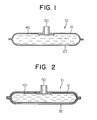
- Figs. l and 2 independently illustrate a typical constitution of a contained used according to the present invention.
- a color developer comprising the previously mentioned ingredients (AA) and (CC), as well as a bleach-fixer comprising the previously mentioned ingredient (OO) AND (RR) are stored in containers respectively composed of a plastic packing material having an oxygen-permeability coefficient of less than 50 ml/(m2 ⁇ atm ⁇ day)(temperature, 20 °C; relative humidity, 65%), and, more preferably, 0 to 25 ml/(m2 ⁇ atm ⁇ day).
- An oxygen-permeation coefficient can be measured by a method described in "O2 Permeation of Plastic Container, Modern Packing; N.J. Calyan, l968), Dec. issue, pp. l43 - l45.
- a plastic packing material forming a container according to the invention are as follows: a sheet made of a plastic, having a small oxygen-permeation coefficient, such as polyvinylidene chloride, nylon, saponified ethylene-vinyl acetate copolymer, polyvinyl alcohol and others; a sheet comprising a sheet of any of the above-mentioned plastics and provided with a lamination of metal such as aluminum or the like, and, the similar sheet provided with a deposition of metal such as aluminum or the like; a multi-layered sheet formed by bonding any of the already mentioned sheets with a sheet made of polyethylene, ethylene-vinyl acetate copolymer or the like; and others.
- a container may be formed by singly or combinedly using any of these sheets.
- plastic packing materials those especially preferably used are polyvinylidene chloride, nylon, saponified thtylene-vinyl acetate copolymer, because they have small oxygen-permeation coefficients, a formed container has a large strength, and they may be easily formed into containers.
- the container may be whichever a bottle type, cubic type, bellows type or the like.
- the container when forming a cubic type container, it may be formed with a laminated material obtained by jointly extruding any of the above-mentioned plastic packing materials.
- a flexible bellows type container Being compact, and allowing easy handling, a flexible bellows type container is preferable.
- the examples of such a bellows type container are shown in Figs. l and 2.
- external walls 2l and 22 constituting one pair and independently made of a single square flexible sheet are bonded to each other with their circumferential rims tightly contacting to each other, so as to form a container l0.
- external walls 3l and 32 constituting a pair and respectively made of two independent square flexible sheets are bonded air-tight to each other with their circumferential rims tightly contacting to each other, so as to form a container l0.
- the latter is an example, so to speak, having external walls of multi-layered sheet.
- Reference numeral 40 represents a container chamber for a color developer or bleach-fixer
- reference numeral 50 represents an inlet/outlet of such processing solutions.
- an oxygen-permeation coefficient of the sheet should be, as mentioned previously, 0 to 50 ml(m2 ⁇ atm ⁇ day).
- an oxygen-permeation coefficient of the two sheets as one entity should be 0 to 50 ml/m2 ⁇ atm ⁇ day).
- a sheet forming such an external wall As a sheet forming such an external wall, a single-layered plastic sheet, a multi-layered plastic sheet formed by bonding a plurality of plastic sheets together, and others are available. Additionally, such a plastic may be solely composed of plastic sheets, or may be a plastic sheet having a lamination of metal foil, paper or the like, or may be a plastic sheet having an evaporation-deposited metal film.
- plastic sheets composed of polyvinylidene chloride, nylon, saponified ethylene-vinyl acetate copolymer, polyvinyl alcohol, and the like; sheets comprising any of the above-mentioned plastic sheets, and having a lamination of metal foil, such as of aluminum, or a lamination of paper or the like; sheets comprising any of the above-mentioned plastic sheets, and having an evaporation-deposited metal film of, for example, aluminum.
- a multi-layered plastic sheet comprising a plurality of plastic sheet bonded together are as follows: a three-layered sheet comprising polyethylene terephthalate/polyvinyl alcohol-ethylene copolymer/polyethylene; a three-layered sheet comprising drawn polypropylene/polyvinyl alcohol-et-ylene copolymer/polyethylene; a three-layered sheet comprising undrawn polypropylene/polyvinyl alcohol-ethylene copolymer/polyethylene; a three-layered sheet comprising nylon/aluminum foil/polyet-ylene; a three-layered sheet comprising polyethylene terephthalate/aluminum foil/polyethylene; a four-layered sheet comprising cellophane/polyethylene/aluminum foil/polyethylene; a three-layered sheet comprising aluminum foil/paper/polyethylene; a four-layered sheet comprising polyethylene terephthalate/polyethylene/aluminum foil/pol
- a plastic sheet composed of, for example, polyethylene, ethylene-vinyl acetate copolymer, or the like, each of which being more flexible, though having a larger oxygen-permeation coefficient, a satisfactory impermeability to oxygen can be resulted, and a container not liable to cause pinholes and has an excellent durability can be obtained.
- the thickness of a sheet forming the external wall of container substantially varies according to the constitutional material, and there is no specific value.
- the preferred thickness is generally within a range of 5 to l500 ⁇ m, and, more favorably, l0 to 500 ⁇ m.
- a color developer stored in a container contains, as mentioned previously, the ingredients (AA) and (CC).
- a usable aromatic primary amine as the ingredient (AA) is, for example, an N,N ⁇ -dialkyl-p-phenylenediamine compound, alkyl and phenyl groups may be substitued by an optional arbitrary substituent. More specifically, a useful aromatic primary amine is typified by any of an N,N ⁇ -diethyl-p-phenylenediamine hydrochloride, N-methyl-p-phenylenediamine hydrochloride, N,N-dimethyl-p-phenylenediamine hydrochloride, 2-amino-5-(N-ethyl-N-dodecylamino)-toluene, N-ethyl-N- ⁇ -methanesulfonamideethyl-3-methyl-4-aminoaniline sulfate, N-ethyl-N- ⁇ -hydroxyethylaniline, 4-amino-3-methyl-N,N ⁇ -diethylaniline
- a preferred content of such an aromatic primary amine contained is usually within the range of 0.005 to 0.2 mol per l color developer.
- Aromatic primary amines especially useful as a color developer are those of paraphenylenediamines independently having at least one water-soluble group (hydrophilic group) within their amino group.
- the typical examples of such a water-soluble group are as follows. o Water-soluble groups -(CH2) n -CH2OH -(CH2) m -NHSO2-(CH2) n -CH3 -(CH2) m -O-(CH2) n -CH3 -(CH2CH2O) n C m H 2m+1 -COOH -SO3H (m and n independently represent an integer more than 0.)
- aromatic primary amine of such paraphenylenediamines respectively having at least one water-soluble group are those represented by the following formulas.
- aromatic amine primary amines are the compounds having in their amino group a substituent such as -(CH2) n -CH2OH, -(CH2) m -NHSO2-(CH2) n -CH3, -(CH2) m O-(CH2) n -CH3, -(CH2CH2O) n C m H 2m+1 , and, more specifically, such compounds are typified by those represented by the above-mentioned formulas (l), (2), (3), (4), (5), (6) and (7).
- m and n are independently an integer more than 0, or, preferively an integer 0 through 5.
- A-l, A-2, A-8, A-9, A-l2, A-l8 and A-2l are perticularly useful in the present invention.
- These compounds of the present invention are usually used in the form of, for example, a free amine a chloride, a sulfate, a p-toluen sulfonate, an oxalate, a phosphate and an acetate.
- the compound represented by the general formula [I] is incorporated in the liquid color developer of the present invention usually at a quantity of 0.2 to 50 g per liter of the liquid color developer, preferably 0.5 to 30 g/l, and, most preferably, l to l5 g/l.
- the alkali agent or the ingredient (CC), is an ingredient to make the pH of color developer more than 9.5, and is available in the form of, for example, sodium hydroxide, potassium hydroxide, sodium carbonate, potassium carbonate, sodium tertiary phosphate, potassium tertialy phosphate or the like. Some of these alkali agents serves as pH-adjusting agents, or as buffer agents.
- additives are, if so required, blended into a color developer in accordance with the present invention.
- useful additives are a preservative composed of sulfite, anti-fogging agent, development inhibiting agent, development accelerating agent, organic solvent, chelating agent functioning as a water softener or a heavy metal-coordinating agent, auxiliary developer and the like.
- sulfite As a preservative comprising sulfite, sodium sulfite, potassium sulfite, lithium sulfite, ammonium sulfite, sodium bisulfite, potassium metabisulfite, sodium formardehyde bisulfite and the like are available.
- the preferred content of such a sulfite is usually 0.4 to 2.5 mol, or more specifically, 0.5 to 2.5 mol per one l color developer.
- useful anti-fogging agents are as follows: mercapto compounds such as l-phenyl-5-mercaptotetrazole, sodium 2-mercaptobenzimidazole-5-sulfonate, and others; indazole compounds such as 5-nitroindazole, and others; benztriazole compounds such as 5-methylbenztriazole, and others; inorganic halide compounds such as potassium bromide, potassium iodide, and others; 6-nitrobenzimidazoles disclosed in the specification of U.S. Patent No. 2,496,940; 5-nitrobenzimidazoles disclosed in the specifications of U.S. Patents No. 2,497,9l7 and No.
- the preferred content of such an anti-fogging agent is usually 0.00l to 30 g, or more specifically, 0.00l to 5 g per one l color developer.
- sodium bromide, potassium bromide, potassium iodide and the like are available, the preferred content of such a development inhibiting agent is usually 0.00l to 30 g, or more specifically, 0.05 to 5 g per one l color developer.
- a useful development accelerating agent are as follows: pyridium compounds, other cationic compounds, cation dyes such as phenosafranine, neutral salts such as thalium nitrate described in the specifications of U.S. Patents No. 2,648,604 and No. 3,67l,247, as well as in Japanese Patent Examined Publication No. 9503/l979; polyethyleneglycol or derivatives thereof, and nonion compounds, described in the specifications of U.S. Patents No. 2,533,990, No. 2,53l,832, No. 2,950,970 and No. 2,577,l27, as well as in Japanese Patent Examined Publication No.
- development accelerating agents include benzyl alcohol and phenethyl alcohol described in the specification of U.S. Patent No. 2,304,925, and, in addition, acetylene glycol, methylethylketone, cyclohexane, thioethers, pyridine, ammonia, hydrazine, amines, and others.
- the preferivelyred content of such a development accelerating agent is usual strictlyly 0.05 to l50 g, or more specifically, 0.5 to 30 g per one l color developer.
- a useful organic solvent examples include ethylene glycol, diethylene glycol, triethylene glycol, dimethylforma mide, Methyl cellosolve, hexylene glycol, ethanol, methanol, acetone, dimethylformardehyde, and the other compounds described in Japanese Patent Examined Publications No. 33378/l972 and No. 9509/l979.
- the preferred content of such an organic solvent is usually 0.05 to l00 g, or more specifically, 0.5 to 30 g per one l color developer.
- a useful chelating agent which serves as a water-softener or heavy metal-coordinating agent are as follows: phosphates such as polyphosphate; aminopolycarboxylic acid such as nitrilotriacetic acid, l,3-diaminopropanoltetraacetic acid, diethylenetriaminepentaacetic acid, hydroxyethyliminodiacetic acid, and the like; oxycarboxylic acids such as citric acid, gluconic acid, and the like; organic acids such as l-hydrocyethylidene-l,l-diphosphonic acid, and the like; aminopolyphosphonic acids such as aminotri(methylenephosphonic acid) and the like; polyhydroxy compounds such as l,2-dihydroxybenzene and the like; and others.
- the preferred content of such a chelating agent is usually 0.05 to l60 g, or more specifically, 0.l to 50 g per one l color developer.
- auxiliary developer examples include N-methyl-p-aminophenol sulfate (Methol), phenidone, N,N-diethy-p-aminophenol hydrochloride, N,N,N,N-tetramethyl-p-phenylenediamine hydrochloride, and the like.
- the preferred content of such an auxiliary developer is usually 0.0l to 30 g per one l color developer.
- the following compounds may be also used: competitive couplers such as citrazinic acid and the like; fogging agents including tin chelating agent such as tin N,N,N-trimethlenephosphonate, tin citrate, and the like, as well as borohydride compounds such as tert-butylamineborane and the like; colored couplers; development inhibiting-releasing couplers (so-called DIR couplers); compounds to release development inhibiters; and others.
- competitive couplers such as citrazinic acid and the like
- fogging agents including tin chelating agent such as tin N,N,N-trimethlenephosphonate, tin citrate, and the like, as well as borohydride compounds such as tert-butylamineborane and the like
- colored couplers such as tin N,N,N-trimethlenephosphonate, tin citrate, and the like
- borohydride compounds such as tert
- the useful defoaming agents include silicon defoaming agents and others.
- the preferred content of such a defoaming agent is usually 5 ⁇ l0 ⁇ 4 to 5 g per one l color developer.
- An aromatic primary amine, used as the ingredient (AA), should be used at the pH of more than 9.5, and more favorably, at the range of pH9.6 to l3, and most favorably, at the range of pH9.8 to l2.5.
- the preferred temperature range for color developing is 25 to 75°C, and more specifically, 30 to 62°C.
- color developer 2 was prepared in a manner identical to that of the preparation for color developer l, except that monomethylhydroxylamine was used, at the rate of 3 g/l, instead of hydroxylamine sulfate. This was designated "color developer 2".
- a color developer was prepared in a manner identical to that of the preparation for color developer l, except that dimethylhydroxylamine was used, at the rate of 3 g/l, instead of hydroxylamine sulfate. This was designated "color developer 3".
- a color developer was prepared in a manner identical to that of the preparation for color developer l, except that monoethylhydroxylamine was used, at the rate of 3 g/l, instead of hydroxylamine sulfate. This was designated "color developer 4".
- a color developer was prepared in a manner identical to that of the preparation for color developer l, except that diethylhydroxylamine was used, at the rate of 3 g/l, instead of hydroxylamine sulfate. This was designated "color developer 5".
- a color developer was prepared in a manner identical to that of the preparation for color developer l, except that monopropylhydroxylamine was used, at the rate of 3 g/l, instead of hydroxylamine sulfate. This was designated "color developer 6".
- a color developer was prepared in a manner identical to that of the preparation for color developer l, except that dipropylhydroxylamine was used, at the rate of 3 g/l, instead of hydroxylamine sulfate. This was designated "color developer 7".
- Container 2 (Comparison)
- a pair of square-shaped multi-layered sheets each comprising an independent single-layered sheet F composed of poly ethylene (50 ⁇ m), an independent single-layered square sheet G composed of polyethylene-vinyl acetate copolymer (l00 ⁇ m) and an independent single-layered square sheet H composed of polyethylene-vinyl acetate copolymer (l00 ⁇ m) were prepared, then the circumferential rims of the two multi-layered sheets members were bonded together, and at the same time, an inlet/outlet was provided on the one of square-shaped multi-layered sheets, thus a bellows-type container (capacity; 5 l) was formed. This was designated "container 3".
- the oxygen-permeation coefficient of the container 3 is 200 ml/(m2 ⁇ atm ⁇ day) (temperature, 20°C; relative humidity, 65%).
- Container 4 (Invention)
- a pair of square-shaped multi-layered sheets each comprising an independent three-layered square sheet A composed of polyethylene-vinyl acetate copolymer (20 ⁇ m)/nylon (l5 ⁇ m)/polyethylene (l5 ⁇ m) and an independent single-layered square sheet B composed of polyethylene-vinyl acetate copolymer (l00 ⁇ m) were prepared, then the circumferential rims of the pair of multi-layered sheets were bonded together, and at the same time, an inlet/outlet was provided on the one of square-shaped multi-layered sheets, thus a bellows-type container (capacity; 5 l) was formed. This was designated "container 4".
- the oxygen-permeation coefficient of the container 4 is 6 ml/(m2 ⁇ atm ⁇ day) (temperature, 20°C; relative humidity, 65%).
- Container 5 (Invention)
- a pair of two-layered square-shaped sheets C each comprising a nylon (75 ⁇ m)/polyethylene (75 ⁇ m) were prepared, then the circumferential rims of the pair of square-shaped sheets were bonded together, and at the same time, an inlet/outlet was provided on the one of square-shaped multi-layered sheets, thus a bellows-type container (capacity; 5 l) was formed. This was designated "container 5".
- the oxygen-permeation coefficient of the container 5 is 20 ml/(m2 ⁇ atm ⁇ day) (temperature, 20°C; relative humidity, 65%).
- SAKURA COLOR SR paper manufactured by Konishiroku Photo Industry Co., Ltd.
- Color developers were stored in a manner identical to that in the test (l) for preservation-stability of color developers, except that a temperature in the test chamber was changed to 58°C.
- test to form a photograph was carried out in a manner identical to test l, whereby the results identical to those in table l were obtained.
- Color developers were stored in a manner identical to that in the test (l) for preservation-stability of color devel opers, except that a temperature in the test chamber was changed to 78°C.
- test to form a photograph was carried out in a manner identical to test l, whereby the results identical to those in table l were obtained.
- the use of the method according to the invention can stably store a color developer for a long period, without jeopardizing its photographic performance nor without damaging a container. As a result, color developing process is satisfactorily carried out even with a stored color developer.
- the decomposed color developer l when storing the comparison color developer l, the decomposed color developer l generates ammonia gas and nitrogen gas, and accordingly, jeopardizes its own performance, thus making a satisfactory developing process impossible. Also, there is a strong possibility that a container is damaged in the course of storing the color developer due to the generated nitrogen gas.
- a bleach-fixer stored in a container contains, as mentioned previously, the ingredients (00) through (RR), and may further contain various additives, in accordance with a requirement.
- the ingredient (OO), or ferric aminopolycarboxylate functions as a bleacher.
- an aminopolycarboxylic acid making such a ferric aminopolycarboxylate can be any type of the similar acid, the following examples can be preferably used. However, the scope of the invention is not limited only to these compounds.
- aminopolycarboxylic acids the especially advantageous are diethylenetriaminepentaacetic acid, cyclohexanediaminetetraacetic acid, hydroxyethyliminodiacetic acid, triethylenetetraminehexaacetic acid, l,3-diamino propanetetraacetic acid, ethylenediaminetetraacetic acid, l,2-diaminopropanetetraacetic acid, methyliminodiacetic acid, glycoletherdiaminetetraacetic acid and nitrilotripropionic acid.
- the ingredient (OO), ferric aminopolycarboxylate is used in the following forms: free acids (hydrogen salts); alkali metal salts including sodium salts, potassium salts, lithium salts and the like; ammonium salts; water-soluble amine salts including triethanolamine salts and the like; and others. More specifically, the ingredient is used in the form of a potassium salt, sodium salt, ammonium salt or the like.
- free acids hydrogen salts
- alkali metal salts including sodium salts, potassium salts, lithium salts and the like
- ammonium salts water-soluble amine salts including triethanolamine salts and the like
- water-soluble amine salts including triethanolamine salts and the like
- the ingredient is used in the form of a potassium salt, sodium salt, ammonium salt or the like.
- Such aminopolycarboxylic acids may be singly used, or two or more of them may be combinedly used.
- polycarboxylic acids such as tartaric acid, succinic acid, citric acid and
- ferric aminopolycarboxylate there is no specific content for ferric aminopolycarboxylate contained in bleach-fixer, and it is proportionally determined on case-by-case basis depending upon the silver content in a silver halide photographic light-sensitive material being processed as well as the composition and the like of silver halide.
- a ferric aminopolycarboxylate may be used in a lower concentration when compared to other aminopolycarboxylates. Its preferred content is usually 5 to 500 g, or more specifically, l0 to 300 g per one l bleach-fixer.
- aminopolycarboxylic acid or the ingredient (PP) may be an aminopolycarboxylic acid whose structure is either identical to or different from that of the similar polycarboxylic acid forming a ferric aminopolycarboxylate of the ingredient (OO).
- the content of such an aminopolycarboxylic acid should be less than l ⁇ l0 ⁇ 1 mol, or preferably, 0 to 5 ⁇ l0 ⁇ 2 mol, and more specifically, 0 to 2 ⁇ l0 ⁇ 2 mol per one l bleach-fixer. If the content is excessively large, an increased proportion of the ferrous aminopolycarboxylate which is a product of the ingredient (OO), or a ferric aminopolycarboxylate, reduced by such an aminopolycarboxylic acid causes poor recoloration in the cause of bleach-fixing process, thus making satisfactory bleach-fixing impossible.
- More than two types of aminopolycarboxylic acids may be mixedly used if the mixing ratio is within an allowable range in accordance with the invention.
- the ingredient (QQ), a thiosulfate functions as a fixer for silver halide, and reacts with silver halide to form a water soluble complex salt.
- a fixer for silver halide for such a thisulfate, those known compounds used as a fixer for silver halide can be used, and the scope of such compounds is not necessarily limited.
- those usable include potassium thiosulfate, sodium thiosulfate, ammonium thiosulfate, and thiosulfates described in Japanese Patent Publication Open to Public Inspection No. l85435/l982.
- Such a thiosulfate is used at the rate it can be dissolved into bleach-fixer solution. More specifically, the advantageous thiosulfate content is usually more than 5 g, or more favorably, more than 50 g, and most favorably, more than 70 g per one l bleach-fixer. Though the maximum allowable content depends on the solubility limit, a higher concentration is preferable.
- the ingredient (RR), a sulfite functions as a preservative inhibiting oxidation-decomposition of the thiosulfate.
- a sulfite those known compounds usually used in a bleach-fixer or fixer can be used, and the scope of such compounds is not necessarily limited.
- those usable include potassium sulfite, sodium sulfite, ammonium sulfite, acid sodium bisulfite, acid potassium bisulfite, acid ammonium bisulfite, potassium metabisulfite, sodium metabisulfite, ammonium metabisulfite, formaldehyde sulfurous acid adduct and others.
- any compounds may be used only if they can emit sulfurous ions, and more than two of such compounds may be combinedly used.
- the content of such a sulfite should be l ⁇ l0 ⁇ 3 to 2 ⁇ l0 ⁇ 1 mol, or preferably, l ⁇ l0 ⁇ 2 to l.5 ⁇ l0 ⁇ 1 mol per one l bleach-fixer. If the content is excessively high, an increased proportion of the ferric aminopolycarboxylate tends to be readily reduced, resulting in increased amount of ferrous aminopolycarboxylate, which in turn causes poor recoloration. In contrast, if the content is escessively low, the thiosulfuric ions tend to be readily decomposed by oxidation.
- One advantage of the present invention is that, because a container is composed of a plastic packing material having a smaller oxygen-permeation coefficient, the thiosulfate less readily decomposes even if the content of sulfite is unconventionally low.
- the preferred pH value of bleach-fixer is usually 2 to 9.8, or more specifically, 4 to 9, and most favorably, 5.0 to 8.5.
- the preferred temperature for storing bleach-fixer is usually 5 to 60°C, and more specifically, 20 to 45°C.
- Such a useful additive is an alkali halide or ammonium halide functioning as a bleach-accelerating agent. More specifically, the examples of such an additive include potassium bromide, sodium bromide, sodium chloride, ammonium bromide, potassium iodide, sodium iodide, ammonium iodide and others. The preferred content of such an additive is within the range of 0.5 to 900 g per one l bleach-fixer.
- ком ⁇ онентs are those usually contained in a bleach-fixer as an additive, and are as follows: pH buffers such as a borate, oxalate, carbonate, phosphate, and the like; solubilizing agents such as triethanolamine and the like; acetylacetone, phosphonocarboxylic acid, polyphosphoric acid, organic phosphonic acid, oxycarboxylic acid, polycarboxylic acid, alkylamines and polyethyleneoxides; and others.
- pH buffers such as a borate, oxalate, carbonate, phosphate, and the like
- solubilizing agents such as triethanolamine and the like
- acetylacetone phosphonocarboxylic acid, polyphosphoric acid, organic phosphonic acid, oxycarboxylic acid, polycarboxylic acid, alkylamines and polyethyleneoxides
- useful additives include various fluorescent whitening agents, defoaming agents, surface active agents, fungicides, and others. Still other useful additives are as follows: preservatives such as hydroxylamine, hydrazine, metabisulfite, bisulfurous acid adduct of aldehyde or ketone compound, and the like; organic chelating agents such as acetylacetone, phosphonocarboxylic acid, polyphosphoric acid, organic phosphonic acid, oxycarboxylic acid, dicarboxylic acid, and the like; stabilizing agents such as nitro alcohol, nitrate, and the like; solubilizing agents such as alkanolamine and the like; anti-stain agents such as organic amine and the like; other additives; organic solvents such as methanol, dimethylformamide, dimethylsulfoxide, and the like; and others.
- preservatives such as hydroxylamine, hydrazine, metabisulfite, bisulfurous acid a
- ingredients (PP) and (RR) were as follows.
- Ingredient (PP) l.70 ⁇ l0 ⁇ 1 mol/l
- Ingredient (RR) l.26 ⁇ l0 ⁇ 1 mol/l
- ingredients (PP) and (RR) were as follows.
- Ingredient (PP) l.l9 ⁇ l0 ⁇ 1 mol/l
- Ingredient (RR) 3.l0 ⁇ l0 ⁇ 1 mol/l
- a comparison bleach-fixer was prepared in a manner identical to that of bleach-fixer l, except that the amount of ingredient (PP), ethylenediaminetetraacetic acid, was 5 g and the amount of ingredient (RR), ammonium sulfite (40% aqueous solution) was 0.l ml. This was designated "Bleach-fixer 3".
- ingredients (PP) and (RR) were as follows.
- Ingredient (PP) l.70 ⁇ l0 ⁇ 2 mol/l
- Ingredient (RR) 3.l0 ⁇ l0 ⁇ 4 mol/l
- a bleach-fixer according to the invention was prepared in a manner identical to that of bleach-fixer l, except that the amount of ingredient (PP), ethylenediaminetetraacetic acid, was 5 g and the amount of ingredient (RR), ammonium sulfite (40% aqueous solution) was 35 ml. This was designated "Bleach-fixer 4".
- ingredients (PP) and (RR) were as follows.
- Ingredient (PP) l.70 ⁇ l0 ⁇ 2 moll
- Ingredient (RR) l.l0 ⁇ l0 ⁇ 1 mol/l
- a bleach-fixer according to the invention was prepared in a manner identical to that of bleach-fixer l, except that five g hydroxyethyliminodiacetic acid was used as ingredient (PP) instead of ethylenediaminetetraacetic acid and that ten g formaldehyde-sulfurous acid adduct was used as ingredient (RR) instead of ammonium sulfite (40% aqueous solution). This was designated "Bleach-fixer 5".
- ingredients (PP) and (RR) were as follows.
- Ingredient (PP) 2.80 ⁇ l0 ⁇ 2 mol/l
- Ingredient (RR) l.25 ⁇ l0 ⁇ 1 mol/l
- a bleach-fixer according to the invention was prepared in a manner identical to that of bleach-fixer l, except that ethylenediaminetetraacetic acid as the ingredient (PP) was not used and that the amount of ammonium sulfite (40% aqueous solution) was changed to 36 ml. This was designated "Bleach-fixer 6".
- ingredients (PP) and (RR) were as follows.
- Ingredient (PP) 0 mol/l
- Ingredient (RR) l.l4 ⁇ l0 ⁇ 1 mol/l
- a bleach-fixer according to the invention was prepared in a manner identical to that of bleach-fixer 6, except that l50 g diethylenetriaminepentaacetic acid was used as the ingredient (OO) instead of ferric ammonium ethylenediaminetraacetate dihydride. This was designated "Bleach-fixer 7".
- ingredients (PP) and (RR) were as follows.
- Ingredient (PP) 0 mol/l
- Ingredient (RR) l.l4 ⁇ l0 ⁇ 1 mol/l
- a bleach-fixer according to the invention was prepared in a manner identical to that of bleach-fixer 6, except that l50 g ferric ammonium hydroxyiminodiacetate used as the ingredient (OO) instead of ferric ammonium ethylenediaminetetraacetate dihydride. This was designated "Bleachfixer 8".
- ingredients (PP) and (RR) were as follows.
- Ingredient (PP) 0 mol/l
- Ingredient (RR) l.l4 ⁇ l0 ⁇ 1 mol/l
- Container l ⁇ , container 2 ⁇ , container 3 ⁇ , container 4 ⁇ and container 5 ⁇ were fabricated respectively with a combination of material and method correspondingly identical to that of container l, container 2, container 3, container 4 and container 5 in the typical examples for color developers.
- the containers for bleach-fixer differ from those for color developer only in terms of a capacity.
- the test to form a photograph was carried out, in compliance with the following conditions, by actually treating a silver halide photographic light-sensitive material, for color paper, which had been already exposed with a step-type exposure wedge for sensitometry, whereby the recoloration and the whiteness were examined with an obtained photograph.
- a red-density was measured with each of the obtained photographs, then each photograph was subjected to red-treatment, whereby it was immersed in 5% aqueous red prussiate for five minutes, washed with water for three minutes, and dried. Subsequently, each of the obtained photographs was measured in a manner identical to that mentioned above, and the difference between two density values was determined.
- a red-density of a photograph, after red-treatment, being higher than that of the same photograph before the red-treatment indicates recoloration, which in turn means the photograph, before the red-treatment, has a poor recoloration. Additionally, a poor recoloration is defined as a red-density of a photograph, after the red-treatment, being more than + 0.l larger than that of the same photograph before the red-treatment.
- a poor whiteness is defined as a whiteness more than 0.0l larger, in terms of density, than that of a reference sample.
- SAKURA COLOR type SIII paper manufactured by Konishiroku Photo Industry Co., Ltd.
- Bleach-fixers were stored in a manner identical to that in the test (l) for preservation-stability of bleach-fixers, except that a temperature in the test chamber was changed to 58°C. Next, using each of bleach-fixers after storage, the test to form a photograph was carried out in a manner identical to test l, whereby the results identical to those in table 2 were obtained.
- Color developers were stored in a manner identical to that in the test (l) for preservation-stability of bleach-fixers, except that a temperature in the test chamber was changed to 78°C. Next, using each of color developers after storage, the test to form a photograph was carried out in a manner identical to test l, whereby the results identical to those in table 2 were obtained.
- the use of the method according to the invention can stably store a bleach-fixer for a long period, without jeopardizing its photographic performance.
- a bleach-fixing process is satisfactorily carried out even with a stored bleach-fixer.
- a high content of the ingredient (PP), aminopolycarboxylic acid, in the bleach-fixer l causes the poor recoloration which is considered to be triggered by the accumulation of ferrous aminopolycarboxylate, or a reduction product of ferric aminopolycarboxylate.
Landscapes
- Chemical & Material Sciences (AREA)
- Chemical Kinetics & Catalysis (AREA)
- General Chemical & Material Sciences (AREA)
- Physics & Mathematics (AREA)
- General Physics & Mathematics (AREA)
- Silver Salt Photography Or Processing Solution Therefor (AREA)
Applications Claiming Priority (4)
| Application Number | Priority Date | Filing Date | Title |
|---|---|---|---|
| JP142818/86 | 1986-06-20 | ||
| JP142819/86 | 1986-06-20 | ||
| JP14281886A JPS62299850A (ja) | 1986-06-20 | 1986-06-20 | 特性の劣化を伴わない漂白定着液の保存方法 |
| JP61142819A JPH073569B2 (ja) | 1986-06-20 | 1986-06-20 | 特性の劣化を伴わない発色現像液の保存方法 |
Publications (3)
| Publication Number | Publication Date |
|---|---|
| EP0250219A2 true EP0250219A2 (fr) | 1987-12-23 |
| EP0250219A3 EP0250219A3 (en) | 1989-07-12 |
| EP0250219B1 EP0250219B1 (fr) | 1994-03-30 |
Family
ID=26474703
Family Applications (1)
| Application Number | Title | Priority Date | Filing Date |
|---|---|---|---|
| EP87305361A Expired - Lifetime EP0250219B1 (fr) | 1986-06-20 | 1987-06-17 | Procédé de stockage d'une solution de traitement photographique |
Country Status (4)
| Country | Link |
|---|---|
| US (1) | US4814260A (fr) |
| EP (1) | EP0250219B1 (fr) |
| CA (1) | CA1311644C (fr) |
| DE (1) | DE3789470D1 (fr) |
Cited By (4)
| Publication number | Priority date | Publication date | Assignee | Title |
|---|---|---|---|---|
| EP0469877A1 (fr) * | 1990-07-30 | 1992-02-05 | Konica Corporation | Compositions solides, emballées pour le traitement photographique |
| EP0574829A1 (fr) * | 1992-06-15 | 1993-12-22 | Konica Corporation | Kit de produits chimiques pour traitement de matériaux photographiques sensibles à la lumière |
| EP1341036A1 (fr) * | 2002-03-01 | 2003-09-03 | Konica Corporation | Concentré pour le développement en couleur et méthode de traitement utilisant ce concentré |
| EP1245535A3 (fr) * | 2001-03-29 | 2003-09-17 | Konica Corporation | Solution aqueuse contenant un sel d'hydroxylamine et méthode de stockage de celle-ci |
Families Citing this family (15)
| Publication number | Priority date | Publication date | Assignee | Title |
|---|---|---|---|---|
| US5264317A (en) * | 1991-09-03 | 1993-11-23 | Eastman Kodak Company | Oxygen barrier coated photographic coupler dispersion particles for enhanced dye-stability |
| US5185230A (en) * | 1991-09-03 | 1993-02-09 | Eastman Kodak Company | Oxygen barrier coated photographic coupler dispersion particles for enhanced dye-stability |
| US5660974A (en) * | 1994-06-09 | 1997-08-26 | Eastman Kodak Company | Color developer containing hydroxylamine antioxidants |
| US5508155A (en) * | 1994-12-22 | 1996-04-16 | Eastman Kodak Company | Photographic color developers containing odorless antioxidants formed in situ from reaction of hydroxylamine and epoxide and use of same |
| JP3544238B2 (ja) * | 1995-02-24 | 2004-07-21 | 富士写真フイルム株式会社 | ハロゲン化銀カラー写真感光材料用の液体発色現像剤及びそれを用いる処理方法 |
| JP3555788B2 (ja) * | 1995-06-21 | 2004-08-18 | 富士写真フイルム株式会社 | ハロゲン化銀写真感光材料の現像方法 |
| FR2737791B1 (fr) * | 1995-08-11 | 1997-09-12 | Kodak Pathe | Solution concentree pour developpement photograhique chromogene |
| JPH09211817A (ja) * | 1996-01-23 | 1997-08-15 | Eastman Kodak Co | 写真処理方法および発色現像液の安定化方法 |
| JP3523416B2 (ja) * | 1996-03-05 | 2004-04-26 | 富士写真フイルム株式会社 | ハロゲン化銀写真感光材料用液体現像剤およびハロゲン化銀写真感光材料の現像方法 |
| US6410215B1 (en) | 1996-08-27 | 2002-06-25 | Eastman Kodak Company | High temperature color development of photographic silver bromoiodide color negative films using pH stabilized color developer |
| CA2396002A1 (fr) * | 2000-01-06 | 2001-07-12 | Laszlo Papai | Concentres liquides de blanchiment-fixage a un composant |
| JP2001305733A (ja) * | 2000-04-18 | 2001-11-02 | Sumitomo Chem Co Ltd | 感光性組成物の保存方法 |
| EP1160622A1 (fr) * | 2000-05-27 | 2001-12-05 | Agfa-Gevaert N.V. | Une solution concentrée de blanchiment-fixage |
| US20050244762A1 (en) * | 2004-05-03 | 2005-11-03 | Eastman Kodak Company | Method for reducing sensitizing dye stain |
| US20060093970A1 (en) * | 2004-11-03 | 2006-05-04 | Eastman Kodak Company | Combinations of preservatives and sequestrants to avoid formation of isonitrile malodor |
Family Cites Families (12)
| Publication number | Priority date | Publication date | Assignee | Title |
|---|---|---|---|---|
| BE558501A (fr) * | 1956-06-20 | |||
| JPS5943735B2 (ja) * | 1976-09-07 | 1984-10-24 | 富士写真フイルム株式会社 | カラ−写真処理方法 |
| JPS53144727A (en) * | 1977-05-24 | 1978-12-16 | Konishiroku Photo Ind Co Ltd | Photographic product |
| JPS5659231A (en) * | 1979-10-02 | 1981-05-22 | Fuji Photo Film Co Ltd | Silver halide color photographic material |
| US4252892A (en) * | 1979-12-10 | 1981-02-24 | Eastman Kodak Company | Photographic color developer compositions |
| JPS57500485A (fr) * | 1980-04-11 | 1982-03-18 | ||
| US4303750A (en) * | 1980-06-16 | 1981-12-01 | Polaroid Corporation | Alkaline fluid photographic processing composition containers |
| US4303751A (en) * | 1980-06-16 | 1981-12-01 | Polaroid Corporation | Rupturable photographic processing alkaline fluid container |
| US4601975A (en) * | 1983-12-23 | 1986-07-22 | Konishiroku Photo Industry Co., Ltd. | Method for processing light-sensitive silver halide color photographic material |
| JPS60143337A (ja) * | 1983-12-29 | 1985-07-29 | Fuji Photo Film Co Ltd | ハロゲン化銀カラ−感光材料の処理方法 |
| JPS60147735A (ja) * | 1984-01-12 | 1985-08-03 | Fuji Photo Film Co Ltd | カラ−写真処理法 |
| EP0149978A3 (en) * | 1984-01-20 | 1988-08-31 | Ciba-Geigy Ag | Process for the production of photographic images by the silver dye-bleaching process |
-
1987
- 1987-06-16 US US07/062,871 patent/US4814260A/en not_active Expired - Lifetime
- 1987-06-17 DE DE87305361T patent/DE3789470D1/de not_active Expired - Lifetime
- 1987-06-17 EP EP87305361A patent/EP0250219B1/fr not_active Expired - Lifetime
- 1987-06-19 CA CA000540118A patent/CA1311644C/fr not_active Expired - Fee Related
Cited By (6)
| Publication number | Priority date | Publication date | Assignee | Title |
|---|---|---|---|---|
| EP0469877A1 (fr) * | 1990-07-30 | 1992-02-05 | Konica Corporation | Compositions solides, emballées pour le traitement photographique |
| EP0574829A1 (fr) * | 1992-06-15 | 1993-12-22 | Konica Corporation | Kit de produits chimiques pour traitement de matériaux photographiques sensibles à la lumière |
| US5384233A (en) * | 1992-06-15 | 1995-01-24 | Konica Corporation | Chemicals kit including a container formed of multilayer film, for processing photographic light-sensitive materials |
| EP1245535A3 (fr) * | 2001-03-29 | 2003-09-17 | Konica Corporation | Solution aqueuse contenant un sel d'hydroxylamine et méthode de stockage de celle-ci |
| EP1341036A1 (fr) * | 2002-03-01 | 2003-09-03 | Konica Corporation | Concentré pour le développement en couleur et méthode de traitement utilisant ce concentré |
| US6884572B2 (en) | 2002-03-01 | 2005-04-26 | Konica Corporation | Concentrated color developer composition and processing method by use thereof |
Also Published As
| Publication number | Publication date |
|---|---|
| EP0250219B1 (fr) | 1994-03-30 |
| DE3789470D1 (de) | 1994-05-05 |
| CA1311644C (fr) | 1992-12-22 |
| US4814260A (en) | 1989-03-21 |
| EP0250219A3 (en) | 1989-07-12 |
| AU7447887A (en) | 1987-12-24 |
| AU592651B2 (en) | 1990-01-18 |
Similar Documents
| Publication | Publication Date | Title |
|---|---|---|
| EP0250219A2 (fr) | Procédé de stockage d'une solution de traitement photographique | |
| US6077651A (en) | Homogeneous single-part photographic color developing concentrate and method of making | |
| US4791013A (en) | Housing pack for photographic processing solution | |
| EP1037105A1 (fr) | Développement en couleur avec taux de remplissage faible utilisant un révélateur couleur sous forme concentrée ne contenant pas d'ions chlorure | |
| US20010026909A1 (en) | Multi-part photographic color developing composition and methods of manufacture and use | |
| US6159670A (en) | Calcium ion stable photographic color developing concentrate and method of manufacture | |
| US6582893B2 (en) | Ferrous photographic bleach-fixing precursor compositions and methods for their use | |
| US6503696B2 (en) | Calcium ion stable photographic color developing composition and method of use | |
| US5217854A (en) | Vacuum packaged color developing composition | |
| US6037111A (en) | Lithium and magnesium ion free color developing composition and method of photoprocessing | |
| US6573035B1 (en) | Stable multi-part photographic color developing composition and method of use | |
| US20040063045A1 (en) | Three-part concentrated photographic color developing kit and methods of use | |
| US6852477B2 (en) | Photographic peracid bleaching composition, processing kit, and method of use | |
| US6828084B2 (en) | Odorless photographic bleaching composition and color photographic processing | |
| US6599688B1 (en) | Stable photographic color developing composition and method of use | |
| AU1557502A (en) | Photographic processing compositions and methods of using in color reversal image formation | |
| JPS62299850A (ja) | 特性の劣化を伴わない漂白定着液の保存方法 | |
| US6958208B2 (en) | Methods of providing color photographic image using acidic stop and rinse solutions | |
| JP2006194944A (ja) | ハロゲン化銀カラー写真感光材料用発色現像濃縮組成物及びそれを用いたハロゲン化銀カラー写真感光材料の処理方法 | |
| JPH04230748A (ja) | 発色現像用処理製品 | |
| JP2005037908A (ja) | ハロゲン化銀カラー写真感光材料用漂白定着処理液の作製方法、漂白定着濃縮組成物用のスターター及び感光材料の処理方法 | |
| EP1484643A1 (fr) | Procédé pour la préparation d'une solution de traitement pour le blanchiment et le fixage de matériaux photographiques à l'halogénure d'argent en couleur sensibles à la lumière, déclencheur en solution pour une composition de blanchiment-fixage concentrée et méthode de traitement de matériau photographique sensible à la lumière | |
| JP2006010925A (ja) | ハロゲン化銀カラー写真感光材料の処理方法 |
Legal Events
| Date | Code | Title | Description |
|---|---|---|---|
| PUAI | Public reference made under article 153(3) epc to a published international application that has entered the european phase |
Free format text: ORIGINAL CODE: 0009012 |
|
| AK | Designated contracting states |
Kind code of ref document: A2 Designated state(s): DE GB |
|
| PUAL | Search report despatched |
Free format text: ORIGINAL CODE: 0009013 |
|
| AK | Designated contracting states |
Kind code of ref document: A3 Designated state(s): DE GB |
|
| 17P | Request for examination filed |
Effective date: 19900129 |
|
| RAP3 | Party data changed (applicant data changed or rights of an application transferred) |
Owner name: KONICA CORPORATION |
|
| 17Q | First examination report despatched |
Effective date: 19920224 |
|
| GRAA | (expected) grant |
Free format text: ORIGINAL CODE: 0009210 |
|
| AK | Designated contracting states |
Kind code of ref document: B1 Designated state(s): DE GB |
|
| PG25 | Lapsed in a contracting state [announced via postgrant information from national office to epo] |
Ref country code: DE Effective date: 19940330 |
|
| REF | Corresponds to: |
Ref document number: 3789470 Country of ref document: DE Date of ref document: 19940505 |
|
| PLBE | No opposition filed within time limit |
Free format text: ORIGINAL CODE: 0009261 |
|
| STAA | Information on the status of an ep patent application or granted ep patent |
Free format text: STATUS: NO OPPOSITION FILED WITHIN TIME LIMIT |
|
| 26N | No opposition filed | ||
| PGFP | Annual fee paid to national office [announced via postgrant information from national office to epo] |
Ref country code: GB Payment date: 19950606 Year of fee payment: 9 |
|
| PG25 | Lapsed in a contracting state [announced via postgrant information from national office to epo] |
Ref country code: GB Effective date: 19960617 |
|
| GBPC | Gb: european patent ceased through non-payment of renewal fee |
Effective date: 19960617 |