EP0251431B1 - Epoxyharz - Google Patents
Epoxyharz Download PDFInfo
- Publication number
- EP0251431B1 EP0251431B1 EP87302734A EP87302734A EP0251431B1 EP 0251431 B1 EP0251431 B1 EP 0251431B1 EP 87302734 A EP87302734 A EP 87302734A EP 87302734 A EP87302734 A EP 87302734A EP 0251431 B1 EP0251431 B1 EP 0251431B1
- Authority
- EP
- European Patent Office
- Prior art keywords
- epoxy resin
- formula
- epoxy
- different
- residues
- Prior art date
- Legal status (The legal status is an assumption and is not a legal conclusion. Google has not performed a legal analysis and makes no representation as to the accuracy of the status listed.)
- Expired - Lifetime
Links
- 0 CC(C)(C)C=CC=CC(C)(C)CC*=[N+] Chemical compound CC(C)(C)C=CC=CC(C)(C)CC*=[N+] 0.000 description 6
Images


Classifications
-
- C—CHEMISTRY; METALLURGY
- C08—ORGANIC MACROMOLECULAR COMPOUNDS; THEIR PREPARATION OR CHEMICAL WORKING-UP; COMPOSITIONS BASED THEREON
- C08G—MACROMOLECULAR COMPOUNDS OBTAINED OTHERWISE THAN BY REACTIONS ONLY INVOLVING UNSATURATED CARBON-TO-CARBON BONDS
- C08G59/00—Polycondensates containing more than one epoxy group per molecule; Macromolecules obtained by polymerising compounds containing more than one epoxy group per molecule using curing agents or catalysts which react with the epoxy groups
- C08G59/18—Macromolecules obtained by polymerising compounds containing more than one epoxy group per molecule using curing agents or catalysts which react with the epoxy groups ; e.g. general methods of curing
- C08G59/20—Macromolecules obtained by polymerising compounds containing more than one epoxy group per molecule using curing agents or catalysts which react with the epoxy groups ; e.g. general methods of curing characterised by the epoxy compounds used
- C08G59/32—Epoxy compounds containing three or more epoxy groups
- C08G59/38—Epoxy compounds containing three or more epoxy groups together with di-epoxy compounds
-
- C—CHEMISTRY; METALLURGY
- C07—ORGANIC CHEMISTRY
- C07D—HETEROCYCLIC COMPOUNDS
- C07D303/00—Compounds containing three-membered rings having one oxygen atom as the only ring hetero atom
- C07D303/02—Compounds containing oxirane rings
- C07D303/12—Compounds containing oxirane rings with hydrocarbon radicals, substituted by singly or doubly bound oxygen atoms
- C07D303/18—Compounds containing oxirane rings with hydrocarbon radicals, substituted by singly or doubly bound oxygen atoms by etherified hydroxyl radicals
- C07D303/20—Ethers with hydroxy compounds containing no oxirane rings
- C07D303/24—Ethers with hydroxy compounds containing no oxirane rings with polyhydroxy compounds
-
- C—CHEMISTRY; METALLURGY
- C08—ORGANIC MACROMOLECULAR COMPOUNDS; THEIR PREPARATION OR CHEMICAL WORKING-UP; COMPOSITIONS BASED THEREON
- C08G—MACROMOLECULAR COMPOUNDS OBTAINED OTHERWISE THAN BY REACTIONS ONLY INVOLVING UNSATURATED CARBON-TO-CARBON BONDS
- C08G59/00—Polycondensates containing more than one epoxy group per molecule; Macromolecules obtained by polymerising compounds containing more than one epoxy group per molecule using curing agents or catalysts which react with the epoxy groups
- C08G59/18—Macromolecules obtained by polymerising compounds containing more than one epoxy group per molecule using curing agents or catalysts which react with the epoxy groups ; e.g. general methods of curing
- C08G59/20—Macromolecules obtained by polymerising compounds containing more than one epoxy group per molecule using curing agents or catalysts which react with the epoxy groups ; e.g. general methods of curing characterised by the epoxy compounds used
- C08G59/32—Epoxy compounds containing three or more epoxy groups
- C08G59/3218—Carbocyclic compounds
Definitions
- the present invention relates to an epoxy resin composition. More particularly, the present invention relates to an epoxy resin composition excellent in heat resistance and flame retardancy, which is obtained by reacting a specific trifunctional epoxy compound with a halogenated bisphenol. Furthermore, the present invention relates to a novel epoxy resin excellent in heat resistance and mechanical properties.
- compositions formed by incorporating a curing agent such as an aromatic polyamine, an aliphatic polyamine, a polyamide-amine, an amine adduct, dicyandiamide, an acid anhydride or a phenol-novolak resin into an epoxy resin have been used as adhesives, paints, molding materials and casting materials.
- a varnish is formed by dissolving such a composition in a solvent, a reinforcing substrate is impregnated or coated with this varnish and the impregnated or laminated reinforcing substrate is used for molding a laminated plate.
- the flame-retardant epoxy resin to be used as a laminated plate printed circuit substrate comprising a laminate of a glass cloth and an epoxy resin
- a linear epoxy resin obtained by reacting a bisphenol A type epoxy resin such as a liquid bisphenol A type epoxy resin having an epoxy equivalent of about 190 with tetrabromobisphenol A.
- the glass transition temperature (Tg) of the cured product (the bromine content is 20 to 22 % by weight) is as low as 120 to 130°C. if a large amount of a polyfunctional epoxy resin such as o-cresol-novolak epoxy resin or a phenol-novolak epoxy resin is added to the above epoxy resin so as to increase the heat resistance of the cured product, the flame retardancy is reduced and the moldability becomes insufficient, and therefore, the amount added of the polyfunctional epoxy resin is restricted.
- a polyfunctional epoxy resin such as o-cresol-novolak epoxy resin or a phenol-novolak epoxy resin
- a cured product formed from a polyfunctional epoxy resin such as an o-cresol-novolak epoxy resin or a phenol-novolak resin has a high flexural modulus and hence, is hard and brittle, and therefore, the cured product is poor in mechanical properties and cracking is readily caused by a thermal shock. Accordingly, development of an epoxy resin excellent in both heat resistance and mechanical properties is eagerly desired
- an epoxy resin composition obtained by reacting a trifunctional epoxy compound having a specific structure with a halogenated bisphenol A in the presence of a catalyst has excellent heat resistance and excellent flame retardancy in combination. It also was found that a trifunctional epoxy resin having a specific structural formula has excellent heat resistance and excellent mechanical properties in combination.
- Another object of the present invention is to provide a novel epoxy resin composition which can be formed into a laminated plate having an improved reliability of the mechanical strength or electrically insulating property at high temperatures by curing.
- Still another object of the present invention is to provide a novel epoxy resin which can be formed into a paint, sealant or molded product excellent in heat resistance and mechanical characteristics and having a high resistance to cracking by a thermal shock by curing.
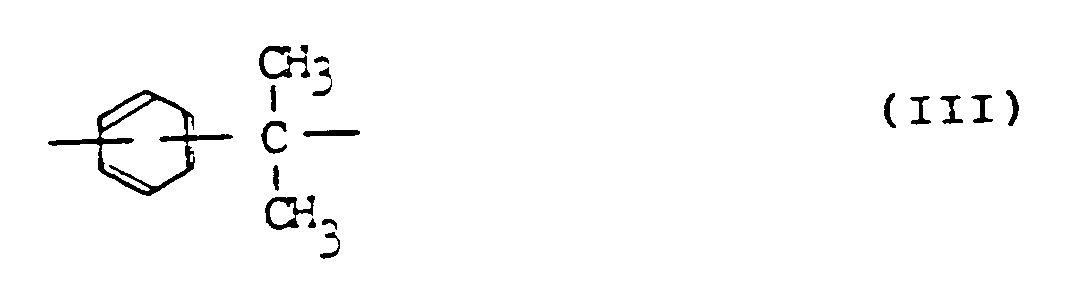
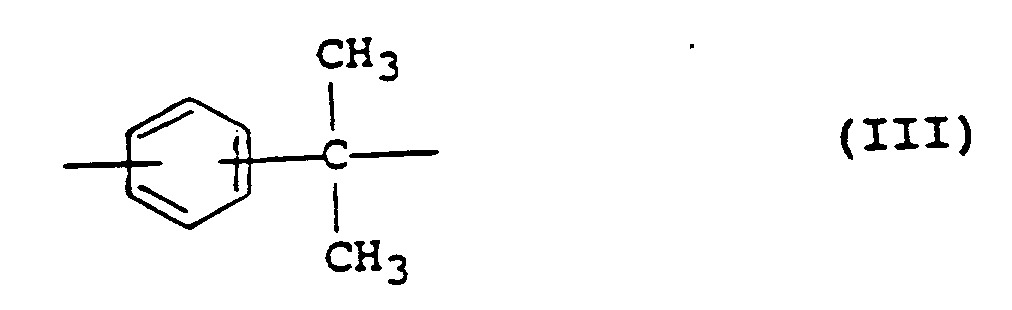
- a trifunctional epoxy compound of formula (I) wherein R1 and R2 are the same or different and each is hydrogen, halogen, alkyl of 1 to 4 carbon atoms or alkoxy of 1 to 4 carbon atoms (the groups R1 and R2 bonded to the respective phenyl groups may be the same or different), Z is a group of formula (II): in which A is hydrogen or methyl and Y1 is a group of formula (III):
- the invention further provides an epoxy resin comprising residues of (A) a trifunctional compound of formula (I) as hereinbefore defined and (B) a halogenated bisphenol.
- the epoxy resin of the present invention is an epoxy resin obtained by reacting the above-mentioned specific trifunctional epoxy compound with a halogenated bisphenol, as is apparent from comparison of application examples given hereinafter with comparative application examples given hereinafter, a cured product prepared from the epoxy resin of the present invention has a much higher heat resistance than that of a cured product prepared from a known flame-retardant epoxy resin, and since the epoxy resin of the present invention contains a halogen, the cured product shows an excellent flame retardancy.
- the epoxy resin of the present invention is laminated with, for example, a glass cloth and is cured, there can be obtained a laminate which is excellent in both heat resistance and flame retardancy and has an improved reliability at high temperatures and which is very valuable as an electronic part.
- the novel epoxy resin of the present invention is cured, there can be provided a cured product having a higher flexural strength and a lower flexural modulus than those of a cured product of a conventional epoxy resin and also having a heat distortion temperature higher than 230°C.
- an epoxy resin which gives a cured product having a high reliability even at high temperatures when the epoxy resin is used as an adhesive, a paint, a sealant, a molding material, a varnish or a material for formation of a laminated plate.
- Preferred epoxy resins of the invention are those which are soluble in methyl ethyl ketone.
- the epoxy resin is derived from a trifunctional epoxy compound
- the epoxy resin has a substantially linear, gel-free structure such that the epoxy resin is completely soluble in an organic solvent such as methylethylketone, and the epoxy resin of the present invention is advantageous in that the handling and processing properties are very good then the epoxy resin is used in various fields.
- Fig. 1 shows an infrared absorption spectrum of an epoxy resin obtained in Example 1, which is a novel compound included within the scope of the trifunctional epoxy compound of the present invention.
- Fig. 2 shows an infrared absorption spectrum of an epoxy resin obtained in Example 2, which is a novel compound included within the scope of the trifunctional epoxy compound of the present invention.
- the trifunctional epoxy compound used for obtaining the epoxy resin of the present invention is represented by the above-mentioned general formula (I), and it is preferred that this trifunctional epoxy compound be a compound represented by the general formula (I) wherein Z is glycidoxy, R1 and R2 are the same or different and each is hydrogen or alkyl of 1 to 4 atoms.
- the trifunctional epoxy compound represented by the general formula (I) there can be mentioned 1-[ ⁇ -methyl- ⁇ -(4'-glycidoxyphenyl)ethyl]-4-[ ⁇ ', ⁇ '-bis(4''-glycidoxyphenyl)-ethyl]benzene, 1-[ ⁇ -methyl- ⁇ -(2'-methyl-4'-gylcidoxy-5'tert-butylphenyl)ethyl]-4-[ ⁇ ', ⁇ '-bis(2''-methyl-4''-glycidoxy-5''-tert-butylphenyl)ethyl] benzene, 1-[ ⁇ -methyl- ⁇ -(3',5'-dimethyl-4'-glycidoxyphenyl)ethyl]-4-[ ⁇ ', ⁇ '-bis(3'',5''-dimethyl-4''-glycidoxyphenyl]ethyl]benzene, 1-[ ⁇ -methyl- ⁇ -(3'-ter
- Preferred compounds of formula (I) are 1-[ ⁇ -methyl- ⁇ -(4'-glycidoxyphenyl)ethyl]-4-[ ⁇ ', ⁇ '-bis(4''-glycidoxyphenyl)-ethyl]benzene, and 1-[ ⁇ -methyl- ⁇ -(3',5'dimethyl-4'-glycidoxyphenyl)ethyl]-4-[ ⁇ ', ⁇ '-bis(3''-5''-dimethyl-4''-glycidoxyphenyl)ethyl]benzene.
- the group Z be bonded to the paraposition of the phenyl group and R1 and R2 should stand for a hydrogen atom or an alkyl group having 1 to 4 carbon atoms.
- the trifunctional epoxy compound represented by the general formula (I) is prepared, for example, by etherifying a tris-phenol compound represented by the following general formula (IV): wherein R1, R2 and Y, are as defined above, with an epihalohydrin or a ⁇ -methylepihalohydrin, preferably epichlorohydrin or ⁇ -methylepichlorohydrin, in the presence of an appropriate etherifying catalyst, and dehydrohalogenating the etherification product.
- the reaction of the tris-phenol compound with the epihalohydrin or ⁇ -methylepihalohydrin can be accomplished according to various known processes.
- an alkali compound for example, an alkali metal hydroxide such as sodium hydroxide, potassium hydroxide or lithium hydroxide, preferably sodium hydroxide, is used in an amount of at least 1 mole, preferably 1.02 to 1.05 mole, per equivalent of the phenolic hydroxyl group of the tris-phenol, etherification and dehydrohalogenation are simultaneously carried out in the presence of water at a temperature of about 60 to about 90°C, the unreacted halohydrin, water and the formed salt are removed from the reaction mixture after the reaction and the trifunctional epoxy compound as the reaction product is dried and recovered.
- an alkali compound for example, an alkali metal hydroxide such as sodium hydroxide, potassium hydroxide or lithium hydroxide, preferably sodium hydroxide
- etherification and dehydrohalogenation are simultaneously carried out in the presence of water at
- the etherification is carried out in the presence of about 0.005 to 5 mole %, based on 1 equivalent of the phenolic hydroxyl group of the tris-phenol, of an etherifying catalyst, for example, a tertiary amine such as trimethylamine or triethylamine, a tertiary phosphine such as triphenylphosphine or tributylphosphine, a quaternary ammonium salt such as tetramethyl ammonium chloride, tetramethyl ammonium bromide, tetraethyl ammonium chloride, tetraethyl ammonium bromide or choline chloride, a quaternary phosphonium salt such as tetramethyl phosphonium bromide, tetramethyl phosphonium iodide or triphenylpropyl phosphonium bromide or a tertiary sulfonium salt such as benzyl
- the reaction is carried out to such an extent that at least 50 %, preferably at least 80 %, of the hydroxyl group of the tris-phenol be etherified.
- the reaction is generally conducted at a temperature of 60 to 110°C for 1 to 12 hours.
- the presence of water is not preferred. If water is present, the amount of water should be controlled below 3.0 % by weight.
- the reaction product obtained at the etherification step is subjected to the reaction as it is, that is, in the state where the reaction product contains the unreacted epihalohydrin.
- the catalyst for the reaction there is used the same alkali compound as used in the above-mentioned first process, for example, an alkali metal hydroxide, preferably sodium hydroxide, in an amount of at least 0.5 mole, preferably at least 0.8 mole, per equivalent of the phenolic hydroxyl group of the tris-phenol.
- the amount of the catalyst should be smaller than 1 mole per equivalent of the phenolic hydroxyl group of the tris-phenol.
- the epihalohydrin or ⁇ -methylepihalohydrin be used in an amount of 3 to 30 moles per mole of the tris-phenol compound. From the industrial viewpoint, epichlorohydrin or ⁇ - methylepichlorohydrin is preferred as the epihalohydrin or ⁇ -methylepihalohydrin.
- the trifunctional compound of the present invention is semi-solid or a solid having a softening point lower than 130°C, and the epoxy equivalent is from 154 to 380.
- a brominated bisphenol is preferred as the halogenated bisphenol to be reacted with the trifunctional epoxy compound in the present invention.
- tetrabromobisphenol A, tetrabromobisphenol B, tetrabromobisphenol F and 1,1-bis(3,5-dibromo-4-hydroxyphenyl)ethane are especially preferred.
- the reaction of the trifunctional epoxy compound with the halogenated bisphenol is carried out in the presence of a catalyst in the absence of a solvent or, if necessary, in a solvent, for example, an aromatic solvent such as toluene or xylene or a ketone solvent such as methylisobutyl ketone.
- a solvent for example, an aromatic solvent such as toluene or xylene or a ketone solvent such as methylisobutyl ketone.
- any known catalysts customarily used for the polyaddition reaction between the epoxy group and the phenolic hydroxyl group can be used as the catalyst in the present invention.
- basic catalysts such as sodium hydroxide and sodium carbonate
- quaternary ammonium salt catalysts such as tetra-alkyl ammonium halides and aralkyl-trialkyl ammonium halides
- phosphorus type catalysts such as triphenylphosphine and ethyltriphenyl phosphonium halides. It is preferred that the catalyst be used in an amount of 10 to 400 ppm based on the used trifunctional epoxy compound.
- the above reaction can be carried out at a temperature of 120 to 200°C under atmospheric pressure for 3 to 20 hours with stirring in the molten state or solution state.
- a difunctional epoxy compound such as a bisphenol A type epoxy resin, a bisphenol F type epoxy resin or 1,1-bis(glycidoxyphenyl)ethane may be present in the reaction system.
- the epoxy resin composition of the present invention obtained by reacting the trifunctional epoxy compound with the halogenated bisphenol, as the halogen content is high, the softening point tends to be too high.
- the softening point of the obtained epoxy resin can be reduced without degradation of the flame retardancy. Accordingly, the amount of the difunctional epoxy compound used can be appropriately adjusted according to the halogen content of the epoxy resin composition of the present invention and the desired halogen content.
- the weight ratio of the trifunctional epoxy compound to the difunctional epoxy compound be in the range of from 50/50 to 90/10, especially from 60/40 to 80/20.
- the reaction ratio of the epoxy compound to the halogenated bisphenol is appropriately selected according to the desired halogen content in the epoxy resin composition obtained by the reaction. However, it is generally preferred that the reaction ratio be selected so that the halogen content in the epoxy resin composition of the present invention obtained by the reaction is 5 to 30 % by weight, especially 10 to 25 % by weight, particularly especially 15 to 20 % by weight. If the halogen content in the epoxy resin composition is too low and below the above-mentioned range, no sufficient flame retardancy can be attained.
- the invention therefore provides a process for producing the foregoing epoxy resins comprising reacting a trifunctional epoxy compound of formula (I) with a halogenated bisphenol in the presence of a catalyst, preferably involving reacting a bisphenol with an epihalohydrin and reacting the condensation product with the trifunctional epoxy compound and halogenated bisphenol.
- the epoxy equivalent of the final epoxy resin be 300 to 2000, especially 300 to 1000.
- the epoxy resin composition of the present invention comprises a polymer represented by the following general formula (VI)), though the general formula is not particularly critical: wherein X is glycidoxy, R3 and R4 are the same or different and each is hydrogen or alkyl of 1 to 4 carbon atoms, X is halogen, E is a group of formula (VII) in which R1 and R2 are the same or different and each is hydrogen or alkyl of 1 to 4 carbon atoms, Y1 is a group of formula (III) as hereinbefore defined and m is an integer of at least 1.
- general formula (VI) wherein X is glycidoxy, R3 and R4 are the same or different and each is hydrogen or alkyl of 1 to 4 carbon atoms, X is halogen, E is a group of formula (VII) in which R1 and R2 are the same or different and each is hydrogen or alkyl of 1 to 4 carbon atoms, Y1 is a group of formula (III) as hereinbefore defined and
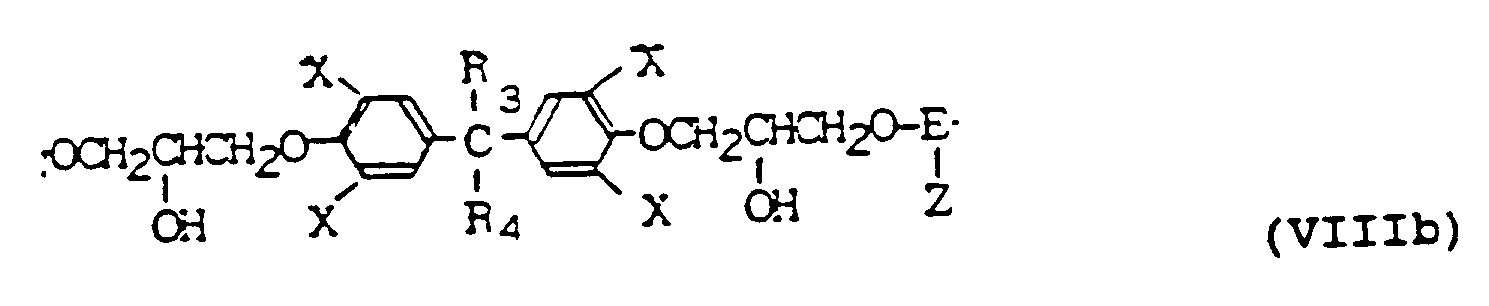
- the epoxy resin composition derived from the combination of the trifunctional epoxy compound and the difunctional epoxy compound comprises a copolymer represented by the following general formula (VIII).
- Z is glycidoxy
- R3 and R4 are the same or different and each is hydrogen or alkyl of 1 to 4 carbon atoms
- X is halogen
- E is a group of formula (VII): in which R1 and R2 are the same or different and each is hydrogen or alkyl of 1 to 4 carbon atoms
- Y1 is a group of formula (III) as hereinbefore defined
- k is O or an integer of at least 1
- l is an integer of at least 1
- k and l are selected so that the halogen-containing epoxy resin has an epoxy equivalent of 300 to 2000 and a halogen content of 5 to 30 % by weight.
- the epoxy resin composition of the present invention may further comprise a known epoxy resin such as a phenol-novolak type epoxy resin or an o-cresol-novolak type epoxy resin, so far as the attainment of the objects of the present invention is not hindered.
- a known epoxy resin such as a phenol-novolak type epoxy resin or an o-cresol-novolak type epoxy resin
- the epoxy resin composition of the present invention may comprise an unreactive diluent such as a phthalic acid ester or an ether or ester of a glycol, a reactive diluent such as a long-chain alkylene oxide, butylglycidyl ether, phenylglycidyl ether or p-butylphenyl-glycidyl ether, a filler such as calcium carbonate, clay, asbestos, silica, mica, quartz powder, aluminum powder, graphite, titanium oxide, alumina, iron oxide, glass powder or glass fiber, and a colorant such as carbon black, Toluidine Red, Hansa Yellow, Phthalocyanine Blue or Phthalocyanine Green.
- an unreactive diluent such as a phthalic acid ester or an ether or ester of a glycol
- a reactive diluent such as a long-chain alkylene oxide, butylglycidyl ether, phenylg
- a known curing agent for an epoxy resin for example, an aliphatic amine, an aromatic amine, an amine adduct, dicyandiamide, a phenol-novolak resin, an o-cresol-novolak resin or an acid anhydride is incorporated into the epoxy resin composition, and the composition is used for the production of an electrically insulating paint, a molding material, a sealant, a laminated plate and the like.
- the amount used of the curing agent is changed according to the kind of the curing agent.
- the amount used of the polyamine as the curing agent is determined based on the ratio between the epoxy equivalent and the active hydrogen equivalent.
- a curing promotor can be used according to need.
- a general-purpose colorant pigment
- a filler a filler
- a solvent a defoamer and the like
- various fillers can be incorporated for the production of sealants.
- a varnish is generally formed by dissolving the epoxy resin composition in an aromatic hydrocarbon such as toluene or xylene or a ketone type solvent such as acetone, methylethylketone or methylisobutylketone.
- a reinforcing substrate such as a glass cloth, carbon fiber, glass fiber, paper, asbestos, polyester fiber or aromatic polyamide fiber (such as a product marketed under the tradename of "Kevler") is impregnated with the so-formed varnish to form a prepreg, and the prepregs are heat-pressed to obtain a laminated plate.
- the trifunctional epoxy compound represented by the general formula (I) may be mixed with other epoxy resin, a reactive diluent, a filler, a colorant and the like according to need, so far as the characteristics are not degraded, as described hereinbefore with respect to the heat-resistant flame-retardant epoxy resin composition, and the resulting composition is mixed with a curing agent and, if necessary, a curing promotor, and is used for the production of an electrically insulating paint, a sealant, a molding material, an adhesive, a material for formation of a laminated plate and the like.
- a 1-liter four-neck glass flask equipped with a stirring rod and a reflux device was charged with 462.5 g of epichlorohydrin, 141.3 g of 1-[ ⁇ -methyl- ⁇ -(4'-hydroxyphenyl)ethyl]-4-[ ⁇ ', ⁇ '-bis(4''-hydroxyphenyl)ethyl] benzene and 2.73 g of tetramethyl ammonium chloride, and reaction was carried out at 70°C for 3 hours with stirring.
- Methylisobutylketone was completely removed from the oil phase under a reduced pressure of 5 mmHg at 150°C to obtain 180 g of 1-[ ⁇ -methyl- ⁇ -(4'-glycidoxyphenyl)ethyl]-4-[ ⁇ ', ⁇ '-bis(4''-glycidoxyphenyl)ethyl]benzene having an epoxy equivalent of 219 and a softening point of 63°C.
- the infrared absorption spectrum of the obtained resin is shown in Fig. 1.
- a cured product was obtained by heating and mixing 100 parts (parts by weight; all of "parts” given hereinafter are by weight) of the epoxy resin obtained in Example 1 with 78 parts of Methyl Nadic anhydride (Kayahard MCD supplied by Nippon Kayaku) and 1 part of 2-ethyl-4-methylimidazole (2E4MZ supplied by Shikoku Kasei) at 100°C for 3 hours and at 230°C for 2 hours.
- the obtained cured product was tested with respect to the heat distortion temperature (ASTM D-648), the flexural strength (JIS K-6911) and the flexural modulus (JIS K-6911).
- a cured product was prepared from 50 parts of the epoxy resin obtained in Example 1, 50 parts of a bisphenol A type epoxy resin (EPOMIK R-140 supplied Mitsui Sekiyu Kagaku), 84 parts of Methyl Nadic anhydride and 1 part of 2-ethyl-4-methylimidazole and the obtained cured product was tested.
- EPOMIK R-140 supplied Mitsui Sekiyu Kagaku
- a cured product was prepared from 100 parts of the epoxy resin obtained in Example 2, 71 parts of Methyl Nadic anhydride and 1 part of 2-ethyl-4-methylimidazole and the cured product was tested.
- a cured product was prepared from 100 parts of a bisphenol A type epoxy resin (EPOMIK R-140), 90 parts of Methyl Nadic anhydride and 1 part of 2-ethyl-4-methylimidazole and the cured product was tested.
- EPOMIK R-140 bisphenol A type epoxy resin
- a cured product was prepared from 100 parts of an o-cresolnovolak type epoxy resin (EOCN 102 supplied by Nippon Kayaku), 81 parts of Methyl Nadic anhydride and 1 part of 2-methyl-4-methylimidazole and the cured product was tested.
- EOCN 102 o-cresolnovolak type epoxy resin supplied by Nippon Kayaku
- a 1-liter separable flask was charged with 400 g of 1,1,3-tris(2-methyl-4-glycidoxy-5-tert-butylphenyl)butane (having an epoxy equivalent of 248), 176.4 g of tetrabromobisphenol A and 60 g of xylene, and 1.6 ml of an aqueous solution containing 1 %, by weight of tetramethyl ammonium chloride was further added.
- the mixture was heated with stirring in a nitrogen gas atmosphere, the mixture became completely homogeneous at a temperature of up to 100°C.
- the pressure was reduced and xylene and water were removed while elevating the temperature to 140°C.
- the pressure was returned to atmospheric pressure and the reaction mixture was further heated at 150°C for 6 hours in a nitrogen gas atmosphere.
- Example 3 Procedures of Example 3 were repeated in the same manner except, that a mixture of 280 g of 1,1,3-tris(2-methyl-4-glycidoxy-5-tert-butylphenyl)butane (having an epoxy equivalent of 271) and 120 g of a bisphenol A type epoxy resin (having an epoxy equivalent of 189; EPOMIK R-140 supplied by Mitsui Sekiyu Kagaku) was used instead of 400 g of 1,1,3-tris(2-methyl-4-glycidoxy-5-tert-butylphenyl)butane, whereby 576.4 g of an epoxy resin composition having an epoxy equivalent of 573 and a bromine content of about 18 % by weight was obtained. This epoxy resin composition was soluble in methylethylketone.
- the epoxy resin composition obtained in Comparative Example 1 was dissolved in methylethylketone to form a solution having an epoxy resin concentration of 75 % by weight.
- This epoxy resin solution (100 parts by weight as the solid) was mixed with a solution comprising 15 parts by weight of methyl cellosolve, 15 parts by weight of dimethylformamide, 3.1 parts by weight of dicyandiamide and 0.2 part by weight of 2-ethyl-4-methyl-imidazole (2E4MZ supplied by Shikoku Kasei) to form a vanish-like epoxy resin composition.
- a glass cloth (WE-18K-BZ2 supplied by Nitto Boseki) was impregnated with this composition and was heated at 150°C for 6 minutes to obtain a prepreg of the B stage having a resin impregnation ratio of about 45 % by weight. These prepregs were piled in 9 plies and a glass cloth laminated plate was formed under molding conditions of 180°C, 10 Kgf/cm2 and 90 minutes.
- the glass transition temperature (Tg) of the cured resin of the obtained laminated plate was 185°C as measured by a differential scanning calorimeter (DSC), and the flame retardancy was 94V-O as determined by the UL method.
- a glass cloth laminated plate was prepared by repeating procedures of Comparative Application Example 3 in the same manner except that the epoxy resin composition obtained in Comparative Example 2 was used instead of the epoxy resin composition obtained in Comparative Example 1 and the amount used of dicyandiamide was changed to 3.3 parts by weight.
- Tg of the cured resin of the laminated plate was 170°C and the flame retardancy was 94V-O as determined by the UL method.
- a glass cloth laminated plate was prepared by repeating procedures of Comparative Application Example 3 in the same manner except that the epoxy resin composition obtained in Example 3 was used instead of the epoxy resin composition obtained in Comparative Example 1 and the amount used of dicyandiamide was changed to 3.9 parts by weight.
- Tg of the cured resin of the laminated plate was 188°C.
- a glass cloth laminated plate was prepared by repeating procedures of Comparative Application Example 3 in the same manner except that the epoxy resin composition obtained in Example 4 was used instead of the epoxy resin composition obtained in Comparative Example 1 and the amount used of dicyandiamide was changed to 4.2 parts by weight.
- Tg of the cured resin of the laminated plate was 175°C, and the flame retardance was 94V-O as determined by the UL method.
- a glass cloth laminated plate was prepared by repeating procedures of Comparative Application Example 3 in the same manner except the 100 parts by weight of a brominated bisphenol A type epoxy resin (having an epoxy equivalent of 408 and a bromine content of 18 % by weight) was used instead of the epoxy resin composition obtained in Comparative Example 1 and the amount used of dicyandiamide was changed 4.7 parts by weight.
- a brominated bisphenol A type epoxy resin having an epoxy equivalent of 408 and a bromine content of 18 % by weight
- Tg of the cured resin of the laminated plate was 127°C.
- a glass cloth laminated plate was prepared by repeating procedures of Comparative Application Example 1 in the same manner except that the epoxy resin composition obtained in Example 5 was used instead of the epoxy resin composition obtained in Comparative Example 1 and the amount used of dicyandiamide was changed to 4.2 parts by weight.
- Tg of the cured resin of the laminated plate was 190°C and the flame retardancy was 94V-0 as determined by the UL method.
- a glass cloth laminated plate was prepared by repeating procedures of Comparative Application Example 3 in the same manner except that the epoxy resin composition obtained in Comparative Example 3 was used instead of the epoxy resin composition obtained in Comparative Example 1 and the amount used of dicyandiamide was changed to 5.8 parts by weight.
- Tg of the cured resin of the laminated plate was 181°C and the flame retardancy was 94V-0 as determined by the UL method.
- a glass cloth laminated plate was prepared by repeating procedures of Comparative Application Example 3 in the same manner except that the epoxy resin composition obtained in Comparative Example 4 was used instead of the epoxy resin composition obtained in Comparative Example 1 and the amount used of dicyandiamide was changed to 4.8 parts by weight.
- Tg of the cured resin of the laminated plate was 181°C and the flame retardancy was 94V-0 as determined by the UL method.
- a glass cloth laminated plate was prepared by repeating procedures of Comparative Application Example 3 in the same manner except that the epoxy resin composition obtained in Comparative Example 5 was used instead of the epoxy resin composition obtained in Comparative Example 1 and the amount used of dicyandiamide was changed to 4.4 parts by weight.
- Tg of the cured resin of the laminated plate was 183°C and the flame retardancy was 94V-O as determined by the UL method.
- a glass cloth laminated plate was prepared by repeating procedures of Application Example 4 in the same manner except that a mixture (having a bromine content of about 18 % by weight) comprising 86 parts by weight of a brominated bisphenol A type epoxy resin (having an epoxy equivalent of 479 and a bromine content of 21 % by weight) and 14 parts by weight of an o-cresol-novolak type epoxy resin (having an epoxy equivalent of 210; EOCN 103S supplied by Nippon Kayaku) was used instead of the epoxy resin composition obtained in Comparative Example 1.
- a mixture having a bromine content of about 18 % by weight
- a brominated bisphenol A type epoxy resin having an epoxy equivalent of 479 and a bromine content of 21 % by weight
- an o-cresol-novolak type epoxy resin having an epoxy equivalent of 210; EOCN 103S supplied by Nippon Kayaku
- Tg of the cured resin of the laminated plate was 137°C.
Landscapes
- Chemical & Material Sciences (AREA)
- Organic Chemistry (AREA)
- Health & Medical Sciences (AREA)
- Chemical Kinetics & Catalysis (AREA)
- Medicinal Chemistry (AREA)
- Polymers & Plastics (AREA)
- Epoxy Resins (AREA)
Claims (18)
- Trifunktionelle Epoxyverbindung der Formel (I)


- 1-[α-Methyl-α-(4'-glycidoxyphenyl)ethyl]-4-[α',α'-bis(4''-glycidoxyphenyl)ethyl]benzol.
- 1-[α-Methyl-α-(3',5'-dimethyl-4'-glycidoxyphenyl)ethyl]-4-[α',α'-bis(3'',5''-dimethyl-4''-glycidoxyphenyl)ethyl]benzol.
- Epoxyharz, umfassend Reste von(A) einer trifunktionellen Epoxyverbindung der Formel (I):


 (B) Reste eines halogenierten Bisphenols.
 - Epoxyharz gemäss Anspruch 4, umfassend Reste des difunktionellen Epoxykondensationsproduktes eines Bisphenols und ein Epihalohydrin.
- Epoxyharz gemäss Anspruch 4 oder 5, worin die trifunktionelle Epoxyverbindung eine Verbindung der Formel (I) ist, worin Z Glycidoxy bedeutet, R₁ und R₂ gleich oder verschieden sind und jedes ist Wasserstoff oder C₁-C₄-Alkyl und Y₁ die im Anspruch 4 angegebene Bedeutung hat.
- Epoxyharz gemäss einem der Ansprüche 4 bis 6, welches ein Epoxyäquivalent von 300 oder 2000 aufweist.
- Epoxyharz gemäss einem der Ansprüche 4 bis 7, welches einen Halogengehalt von 5 bis 30 Gew.% aufweist.
- Epoxyharz gemäss einem der Ansprüche 4 bis 8, worin das halogenierte Bisphenol Tetrabrombisphenol A ist.
- Epoxyharz gemäss einem der Ansprüche 5 bis 9, worin das Gewichtsverhältnis der Reste der trifunktionellen Epoxyverbindung zu den Resten des difunktionellen Epoxy Kondensationsproduktes im Bereich von 50/50 bis 90/10 liegt.
- Epoxyharz gemäss Anspruch 10, worin das Gewichtsverhältnis der Reste der trifunktionellen Epoxyverbindung zu den Resten des Kondensationsproduktes im Bereich von 60/40 bis 80/20 liegt.
- Epoxyharz gemäss einem der Ansprüche 4 bis 11, welches in Methylethylketon löslich ist.
- Epoxyharz der Formel (VI)


- Epoxyharz umfassend Reste der Formel (VIIIa):



- Verfahren zur Herstellung eines Epoxyharzes gemäss einem der Ansprüche 4 bis 14, umfassend, die Reaktion von (A) einer trifunktionellen Epoxyverbindung der Formel (I) und (B) eines halogenierten Bisphenols in Anwesenheit eines Katalysators.
- Verfahren gemäss Anspruch 15, umfassend kondensieren ein Bisphenol mit einem Epihalohydrin und das Kondensationsprodukt mit (A) einer trifunktionellen Verbindung der Formel (I) und (B) einem halogenierten Bisphenol in Anwesenheit eines Katalysators zur Reaktion bringen.
- Harzzusammensetzung, umfassend, ein Epoxyharz wie in einem der Ansprüche 4 bis 14 definiert oder hergestellt gemäss Anspruch 15 bis 16.
- Verfahren zur Herstellung eines wärmebeständigen Gegenstandes, umfassend, Härtung eines Epoxyharzes wie in einem der Ansprüche 4 bis 14 definiert, oder hergestellt gemäss Anspruch 15 oder 16 oder Härtung einer Harzzusammensetzung gemäss Anspruch 17.
Applications Claiming Priority (4)
| Application Number | Priority Date | Filing Date | Title |
|---|---|---|---|
| JP14780886A JPH0653784B2 (ja) | 1986-06-24 | 1986-06-24 | 新規エポキシ樹脂 |
| JP147808/86 | 1986-06-24 | ||
| JP306561/86 | 1986-12-24 | ||
| JP30656186 | 1986-12-24 |
Publications (3)
| Publication Number | Publication Date |
|---|---|
| EP0251431A2 EP0251431A2 (de) | 1988-01-07 |
| EP0251431A3 EP0251431A3 (en) | 1988-08-31 |
| EP0251431B1 true EP0251431B1 (de) | 1993-07-28 |
Family
ID=26478244
Family Applications (1)
| Application Number | Title | Priority Date | Filing Date |
|---|---|---|---|
| EP87302734A Expired - Lifetime EP0251431B1 (de) | 1986-06-24 | 1987-03-30 | Epoxyharz |
Country Status (2)
| Country | Link |
|---|---|
| EP (1) | EP0251431B1 (de) |
| DE (1) | DE3786718T2 (de) |
Families Citing this family (5)
| Publication number | Priority date | Publication date | Assignee | Title |
|---|---|---|---|---|
| JPH0733430B2 (ja) * | 1987-05-30 | 1995-04-12 | 三井石油化学工業株式会社 | エポキシ樹脂組成物 |
| CA2017613A1 (en) * | 1989-05-29 | 1990-11-29 | Kiyomi Yasuda | Heat-resistant, flame-retardant epoxy resin compositions |
| JPH0314818A (ja) * | 1989-06-13 | 1991-01-23 | Yuka Shell Epoxy Kk | 半導体封止用エポキシ樹脂組成物 |
| DE69332098T2 (de) * | 1992-09-22 | 2003-03-13 | Sumitomo Chemical Co., Ltd. | Halogen enthaltende Epoxidharzzusammensetzung und kupferkaschiertes Laminat |
| CN1312189C (zh) * | 2004-03-17 | 2007-04-25 | 中国科学院化学研究所 | 一种三官能团环氧树脂及衍生物和制备方法与用途 |
Citations (1)
| Publication number | Priority date | Publication date | Assignee | Title |
|---|---|---|---|---|
| EP0103282A2 (de) * | 1982-09-13 | 1984-03-21 | The Dow Chemical Company | Verfahren zur Herstellung von Glycidylderivaten von Verbindungen mit mindestens einer aromatischen Hydroxylgruppe oder aromatischen Aminogruppe |
Family Cites Families (5)
| Publication number | Priority date | Publication date | Assignee | Title |
|---|---|---|---|---|
| GB871301A (en) * | 1958-08-26 | 1961-06-28 | Shell Int Research | Improvements in or relating to the preparation of a poly(epoxyalkoxyaryl)propane |
| US3277048A (en) * | 1961-01-16 | 1966-10-04 | Dow Chemical Co | Thermoplastic fire-retardant, highpolymer, epoxide resin composition |
| BE635199A (de) * | 1962-07-23 | |||
| US3309339A (en) * | 1963-11-12 | 1967-03-14 | Allied Chem | New trisphenols and epoxide resins prepared therefrom |
| US4552814A (en) * | 1984-05-21 | 1985-11-12 | The Dow Chemical Company | Advanced epoxy resins having improved impact resistance when cured |
-
1987
- 1987-03-30 EP EP87302734A patent/EP0251431B1/de not_active Expired - Lifetime
- 1987-03-30 DE DE19873786718 patent/DE3786718T2/de not_active Expired - Fee Related
Patent Citations (1)
| Publication number | Priority date | Publication date | Assignee | Title |
|---|---|---|---|---|
| EP0103282A2 (de) * | 1982-09-13 | 1984-03-21 | The Dow Chemical Company | Verfahren zur Herstellung von Glycidylderivaten von Verbindungen mit mindestens einer aromatischen Hydroxylgruppe oder aromatischen Aminogruppe |
Also Published As
| Publication number | Publication date |
|---|---|
| EP0251431A2 (de) | 1988-01-07 |
| DE3786718D1 (de) | 1993-09-02 |
| DE3786718T2 (de) | 1993-11-18 |
| EP0251431A3 (en) | 1988-08-31 |
Similar Documents
| Publication | Publication Date | Title |
|---|---|---|
| US6291626B1 (en) | Phosphorus-containing dihydric phenol or naphthol-advanced epoxy resin or cured | |
| US6797821B2 (en) | Phosphorus-containing flame-retardant hardeners, epoxy resins, advanced epoxy resins and cured epoxy resins | |
| US4390664A (en) | Process for preparing a polyepoxide and composition therefrom | |
| KR101716634B1 (ko) | 에폭시수지, 에폭시수지 조성물 및 경화물 | |
| JP4873223B2 (ja) | 新規なエポキシ樹脂 | |
| US4759978A (en) | Epoxy resin composition | |
| CA1331904C (en) | Epoxy compounds and epoxy resin compositions containing the same | |
| EP0251431B1 (de) | Epoxyharz | |
| US4954603A (en) | Epoxy resin | |
| CA1222521A (en) | Triglycidyl compounds of aminophenols | |
| EP0214722A1 (de) | Bromierte hydroxyaromatische Verbindungen | |
| JPH0317117A (ja) | 耐熱性エポキシ樹脂組成物 | |
| US5081206A (en) | Trisphenol, bisphenol and halogenated bisphenol epoxy resins composition | |
| JPH0784510B2 (ja) | 耐熱難燃性エポキシ樹脂組成物 | |
| JP2509673B2 (ja) | エポキシ化合物およびこれを必須成分とするエポキシ樹脂組成物 | |
| JP2702228B2 (ja) | 耐熱難燃性エポキシ樹脂組成物 | |
| JP3446164B2 (ja) | エポキシ樹脂及びその製造方法 | |
| JP3446165B2 (ja) | フェノ−ル・ジシクロペンタジエン共縮合樹脂及びこれを含有するエポキシ樹脂 | |
| US3686358A (en) | Glycidyl ethers of haloneopentyl glycols | |
| JP2702226B2 (ja) | 耐熱難燃性エポキシ樹脂組成物 | |
| JP2702227B2 (ja) | 耐熱難燃性エポキシ樹脂組成物 | |
| JP2711149B2 (ja) | 耐熱難燃性エポキシ樹脂組成物 | |
| JPS633015A (ja) | 新規エポキシ樹脂 | |
| US3328353A (en) | Polyepoxides of thiomethyl diphenyl oxide | |
| JPH01304110A (ja) | 難燃性エポキシ樹脂 |
Legal Events
| Date | Code | Title | Description |
|---|---|---|---|
| PUAI | Public reference made under article 153(3) epc to a published international application that has entered the european phase |
Free format text: ORIGINAL CODE: 0009012 |
|
| AK | Designated contracting states |
Kind code of ref document: A2 Designated state(s): DE FR GB |
|
| PUAL | Search report despatched |
Free format text: ORIGINAL CODE: 0009013 |
|
| AK | Designated contracting states |
Kind code of ref document: A3 Designated state(s): DE FR GB |
|
| 17P | Request for examination filed |
Effective date: 19881128 |
|
| 17Q | First examination report despatched |
Effective date: 19900820 |
|
| GRAA | (expected) grant |
Free format text: ORIGINAL CODE: 0009210 |
|
| AK | Designated contracting states |
Kind code of ref document: B1 Designated state(s): DE FR GB |
|
| REF | Corresponds to: |
Ref document number: 3786718 Country of ref document: DE Date of ref document: 19930902 |
|
| ET | Fr: translation filed | ||
| PLBE | No opposition filed within time limit |
Free format text: ORIGINAL CODE: 0009261 |
|
| STAA | Information on the status of an ep patent application or granted ep patent |
Free format text: STATUS: NO OPPOSITION FILED WITHIN TIME LIMIT |
|
| 26N | No opposition filed | ||
| REG | Reference to a national code |
Ref country code: FR Ref legal event code: CD |
|
| REG | Reference to a national code |
Ref country code: GB Ref legal event code: IF02 |
|
| PGFP | Annual fee paid to national office [announced via postgrant information from national office to epo] |
Ref country code: FR Payment date: 20020312 Year of fee payment: 16 |
|
| PGFP | Annual fee paid to national office [announced via postgrant information from national office to epo] |
Ref country code: GB Payment date: 20020327 Year of fee payment: 16 |
|
| PGFP | Annual fee paid to national office [announced via postgrant information from national office to epo] |
Ref country code: DE Payment date: 20020404 Year of fee payment: 16 |
|
| PG25 | Lapsed in a contracting state [announced via postgrant information from national office to epo] |
Ref country code: GB Free format text: LAPSE BECAUSE OF NON-PAYMENT OF DUE FEES Effective date: 20030330 |
|
| PG25 | Lapsed in a contracting state [announced via postgrant information from national office to epo] |
Ref country code: DE Free format text: LAPSE BECAUSE OF NON-PAYMENT OF DUE FEES Effective date: 20031001 |
|
| GBPC | Gb: european patent ceased through non-payment of renewal fee |
Effective date: 20030330 |
|
| PG25 | Lapsed in a contracting state [announced via postgrant information from national office to epo] |
Ref country code: FR Free format text: LAPSE BECAUSE OF NON-PAYMENT OF DUE FEES Effective date: 20031127 |
|
| REG | Reference to a national code |
Ref country code: FR Ref legal event code: ST |