EP0253567A1 - Laundry compositions - Google Patents
Laundry compositions Download PDFInfo
- Publication number
- EP0253567A1 EP0253567A1 EP87306047A EP87306047A EP0253567A1 EP 0253567 A1 EP0253567 A1 EP 0253567A1 EP 87306047 A EP87306047 A EP 87306047A EP 87306047 A EP87306047 A EP 87306047A EP 0253567 A1 EP0253567 A1 EP 0253567A1
- Authority
- EP
- European Patent Office
- Prior art keywords
- peo
- units
- soil
- alkyl
- molecular weight
- Prior art date
- Legal status (The legal status is an assumption and is not a legal conclusion. Google has not performed a legal analysis and makes no representation as to the accuracy of the status listed.)
- Granted
Links
Classifications
-
- C—CHEMISTRY; METALLURGY
- C11—ANIMAL OR VEGETABLE OILS, FATS, FATTY SUBSTANCES OR WAXES; FATTY ACIDS THEREFROM; DETERGENTS; CANDLES
- C11D—DETERGENT COMPOSITIONS; USE OF SINGLE SUBSTANCES AS DETERGENTS; SOAP OR SOAP-MAKING; RESIN SOAPS; RECOVERY OF GLYCEROL
- C11D3/00—Other compounding ingredients of detergent compositions covered in group C11D1/00
- C11D3/16—Organic compounds
- C11D3/37—Polymers
- C11D3/3703—Macromolecular compounds obtained otherwise than by reactions only involving carbon-to-carbon unsaturated bonds
- C11D3/3715—Polyesters or polycarbonates
Definitions
- the present invention relates to laundry detergent compositions.
- it relates to laundry detergent compositions containing soil-release agents.
- laundry detergent compositions desirably have other benefits.
- One is the ability to confer soil release properties to fabrics, particularly those woven from polyester fibres. These fabrics are mostly co-polymers of ethylene glycol and terephthalic acid, and are sold under a number of tradenames, e.g. Dacron, Fortrel, Kodel and Blue C Polyester.
- the hydrophobic character of polyester fabrics makes their laundering difficult, particularly as regards oily soil and oily stains.
- the oily soil or stain preferentially "wets" the fabric. As a result, the oily soil or stain is difficult to remove in an aqueous laundering process.
- High molecular weight polyesters containing random ethylene terephthalate/polyethylene glycol terephthalate units have been used as soil release compounds in laundry detergent compositions - see for example US-A-3,962,152 and US-A-3,959,230.
- these soil release polyesters adsorb onto the surface of fabrics immersed in the wash solution.
- the adsorbed polyester than forms a hydrophilic film which remains on the fabric after it is removed from the wash solution and dried. This film can be renewed by subsequent washing of the fabric with a detergent composition containing the soil release polyesters.
- a major disadvantage of the known detergent formulations is that they can adversely effect cleaning performance in other areas of laundry detergency, especially clay soil detergency. Presumably this is the result of the polymer depositing on soil which is already adhered to the fabric surface, thereby preventing solubilization or dispersion of the soil by other components of the detergent composition.
- Quaternary ammonium surfactants are themselves known to have a detrimental effect on clay soil detergency and anti-redeposition and, if anything, therefore adding a quaternary ammonium surfactant merely compounds the problem.
- terephthalate soil release polymers having a specified ratio of ethyleneoxy terephthalate to polyethyleneoxy terephthalate units and specified molecular weight and preferably having polyethyleneglycol terminating groups at both ends of the polymer chain provide excellent soil-release performance in a detergency context without detriment to clay soil detergency and anti-redeposition. Indeed in low or zero phosphate detergent compositions, clay soil cleaning performance is actually enhanced. Furthermore, incorporation of a water-soluble quaternary ammonium surfactant promotes further increases in polymer deposition and improved soil-release performance again surprisingly without detriment to clay-soil detergency. Moreover, the quaternary ammonium surfactant is beneficial from the viewpoint of promoting soil-release performance in the presence of anionic surfactant components.
- a laundry detergent or detergent additive composition comprising (a) from about 0.1% to about 25% by weight of a soil-release polymer comprising ethyleneoxy terephthalate (EO-T) units and polyethyleneoxy terephthalate (PEO-T) units at a molar ratio (EO-T/PEO-T) of from about 0.5 to about 1.5, the PEO-T units containing polyethylene oxide (PEO) linking units having a molecular weight of from about 300 to about 3000, the molecular weight of the polymer being in the range from about 900 to about 9,000, and (b) from about 0.1% to about 20% of a water-soluble quaternary ammonium surfactant.
- EO-T ethyleneoxy terephthalate
- PEO-T polyethyleneoxy terephthalate
- PEO-T polyethyleneoxy terephthalate
- compositions of the invention contain from about 0.1% to about 25% preferably from about 0.2% to about 15%, more preferably from about 0.3% to about 10%, of a soil release polymer containing ethyleneoxy terephthalate (EO-T) groups having the formula: and polyethyleneoxy terephthalate (PEO-T) groups having the formula: wherein the molar ratio of ethyleneoxy terephthalate to polyethyleneoxy terephthalate in the polymer is from about 0.5 to about 1.5.
- the molecular weight of the polyethylene oxide linking unit is in the range from about 300 to about 3,000 i.e., n in the above formula is an integer of from about 7 to about 70.
- the polymers have an average molecular weight in the range from 900 to about 9,000.
- the polymers are also characterized by a random polymer structure, i.e., all possible combinations of ethyleneoxy terephthalate and polyethyleneoxy terephthalate can be present.
- soil-release polymers comprising at least about 10%, preferably at least 20% thereof (molar basis) of components wherein both chain terminating units of the polymer are independently selected from units having the general formula X-PEO-T wherein X is selected from H, C 1-4 alkyl, C 1-4 hydroxyalkyl and C 1-4 acyl.
- soil release polymers having a molecular weight in the range from about 1,000 to about 4,900, preferably from about 1,500 to about 4,500, and an EO-T/PEO-T molar ratio of from about 0.6 to about 0.95, preferably from about 0.65 to about 0.85.
- the PEO molecular weight is preferably from about 1,000 to about 2,000, more preferably from about 1,200 to about 1,800.
- the molar ratio of EO-T to PEO:T units is determined herein by 270 MHz proton NMR, the ratio being directly derived from the relative peak areas of the C6H4CO2CH2 methylene resonances attributable to EO-T and PEO-T groups respectively.
- compositions of the invention preferably also contain from about 0.1% to about 20%, more preferably from about 0.5% to about 15%, especially from about 1% to about 5% of a water-soluble quaternary ammonium surfactant.
- quaternary ammonium surfactants having the general formula: [R2(OR3) y ][R4(OR3) y ]2R5N+X ⁇ wherein R2 is an alkyl, alkenyl or alkyl benzyl group having from about 8 to about 18 carbon atoms, preferably 10 to 14 carbon atoms in the alkyl chain; each R3 is selected from -CH2CH2-, -CH2CH(CH3)-, -CH2CH(CH2CH2OH)-, -CH2CH2CH2-, and mixtures thereof; each R4 is selected from C1-C4 alkyl, C1-C4 hydroxyalkyl, benzyl, ring structures formed by joining the two R4 groups, -CH2CHOH
- alkyl quaternary ammonium surfactants especially the mono-long chain alkyl susrfactants described in the above formula when R5 is selected from the same groups as R4.
- the most preferred quaternary ammonium surfactants are the chloride, bromide and methylsulfate alkyl trimethylammonium salts, alkyl di(hydroxyethyl)methylammonium salts, alkyl hydroxyethyldimethylammonium salts, and alkyloxypropyl trimethylammonium salts wherein alkyl is C8-C16, preferably C10-C14.
- decyl trimethylammonium methylsulfate lauryl trimethylammonium chloride, myristyl trimethylammonium bromide and coconut trimethylammonium chloride and methylsulfate are particularly preferred.
- Highly preferred water-soluble cationic surfactants herein have a critical micelle concentration (CMC) as measured for instance by surface tension or conductivity of at least 200ppm, preferably at least 500ppm at 30°C and in distilled water - see for instance Critical Micelle Concentrations of Aqueous Surfactant Systems, P. Mukerjee and K J Mysels NSRDS-NBS 36, (1971).
- CMC critical micelle concentration
- compositions of the invention can take the form of a conventional main wash laundry detergent composition or of a laundry additive composition for use together with a separate main-wash detergent composition. In either instance, however, preferred compositions will normally contain from about 1% to about 40%, more preferably from about 5% to about 25% by weight of anionic or nonionic surfactant.
- the compositions can also be complemented by other usual laundry detergent components such as detergency builders, bleaches etc.
- Suitable synthetic anionic surfactants are water-soluble salts of C8-C22 alkyl benzene sulphonates, C8-C22 alkyl sulphates, C 10-18 alkyl polyethoxy ether sulphates, C 8-24 paraffin sulphonates, alpha- C 12-24 olefin sulphonates, alpha-sulphonated C6-C20 fatty acids and their esters, C10-C18 alkyl glyceryl ether sulphonates, fatty acid monoglyceride sulphates and sulphonates, especially those prepared from coconut oil, C8-C12 alkyl phenol polyethoxy ether sulphates, 2-acyloxy C9-C23 alkane-1-sulphonate, and beta-alkyloxy C8-C20 alkane sulphonates.
- a particularly suitable class of anionic surfactants includes water-soluble salts, particularly the alkali metal, ammonium and alkanolammonium salts or organic sulphuric reaction products having in their molecular structure an alkyl or alkaryl group containing from about 8 to about 22, especially from about 10 to about 20 carbon atoms and a sulphonic acid or sulphuric acid ester group.
- alkyl is the alkyl portion of acyl groups).
- this group of synthetic detergents are the sodium and potassium alkyl sulphates, especially those obtained by sulphating the higher alcohols (C 8-18 ) carbon atoms produced by reducing the glycerides of tallow or coconut oil and sodium and potassium alkyl benzene sulphonates, in which the alkyl group contains from about 9 to about 15, especially about 11 to about 13, carbon atoms, in straight chain or branched chain configuration, e.g.
- alkane chains of the foregoing non-soap anionic surfactants can be derived from natural sources such as coconut oil or tallow, or can be made synthetically as for example using the Ziegler or Oxo processes. Water solubility can be achieved by using alkali metal, ammonium or alkanolammonium cations; sodium is preferred.
- Suitable fatty acid soaps herein can be selected from the ordinary alkali metal (sodium, potassium), ammonium, and alkylolammonium salts of higher fatty acids containing from about 8 to about 24, preferably from about 10 to about 22 and especially from about 16 to about 22 carbon atoms in the alkyl chain.
- Fatty acids in partially neutralized form are also suitable for use herein, especially in liquid compositions.
- Sodium and potassium soaps can be made by direct saponification of the fats and oils or by the neutralization of the free fatty acids which are prepared in a separate manufacturing process. Particularly useful are the sodium and potassium salts of the mixtures of fatty acids derived from tallow and hydrogenated fish oil.
- Mixtures of anionic surfactants are particularly suitable herein, especially mixtures of sulphonate and sulphate surfactants in a weight ratio of from about 5:1 to about 1:5, preferably from about 5:1 to about 1:1, more preferably from about 5:1 to about 1.5:1.
- an alkyl benzene sulphonate having from 9 to 15, especially 11 to 13 carbon atoms in the alkyl radical, the cation being an alkali metal, preferably sodium; and either an alkyl sulphate having from 10 to 20, preferably 12 to 18 carbon atoms in the alkyl radical or an ethoxy sulphate having from 10 to 20, preferably 10 to 16 carbon atoms in the alkyl radical and an average degree of ethoxylation of 1 to 6, having an alkali metal cation, preferably sodium.
- Nonionic surfactants suitable herein are condensates of ethylene oxide with a hydrophobic moiety to provide a surfactant having an average hydrophilic-lipophilic balance (HLB) in the range from about 8 to 17, preferably from about 9.5 to 13.5, more preferably from about 10 to about 12.5.
- HLB hydrophilic-lipophilic balance
- nonionic surfactants include the condensation products of primary or secondary aliphatic alcohols having from 8 to 24 carbon atoms, in either straight chain or branched chain configuration, with from 2 to about 40 moles, preferably 2 to about 9 moles of ethylene oxide per mole of alcohol.
- the aliphatic alcohol comprises between 9 and 18 carbon atoms and is ethoxylated with between 2 and 9, desirably between 3 and 8 moles of ethylene oxide per mole of aliphatic alcohol.
- the preferred surfactants are prepared from primary alcohols which are either linear (such as those derived from natural fats or, prepared by the Ziegler process from ethylene, e.g.
- myristyl, cetyl, stearyl alcohols or partly branched such as the Lutensols, Dobanols and Neodols which have about 25% 2-methyl branching (Lutensol being a Trade Name of BASF, Dobanol and Neodol being Trade Names of Shell), or Synperonics, which are understood to have about 50% 2-methyl branching (Synperonic is a Trade Name of I.C.I.) or the primary alcohols having more than 50% branched chain structure sold under the Trade Name Lial by Liquichimica.
- Lutensol being a Trade Name of BASF
- Dobanol and Neodol being Trade Names of Shell
- Synperonics which are understood to have about 50% 2-methyl branching (Synperonic is a Trade Name of I.C.I.) or the primary alcohols having more than 50% branched chain structure sold under the Trade Name Lial by Liquichimica.
- nonionic surfactants falling within the scope of the invention include Dobanol 45-4, Dobanol 45-7, Dobanol 45-9, Dobanol 91-2.5, Dobanol 91-3, Dobanol 91-4, Dobanol 91-6, Dobanol 91-8, Dobanol 23-6.5, Synperonic 6, Synperonic 14, the condensation products of coconut alcohol with an average of between 5 and 12 moles of ethylene oxide per mole of alcohol, the coconut alkyl portion having from 10 to 14 carbon atoms, and the condensation products of tallow alcohol with an average of between 7 and 12 moles of ethylene oxide per mole of alcohol, the tallow portion comprising essentially between 16 and 22 carbon atoms.
- Secondary linear alkyl ethoxylates are also suitable in the present compositions, especially those ethoxylates of the Tergitol series having from about 9 to 15 carbon atoms in the alkyl group and up to about 11, especially from about 3 to 9, ethoxy residues per molecule.
- nonionic surfactants include the condensation products of C6-C12 alkyl phenols with from about 3 to 30, preferably 5 to 14 moles of ethylene oxide, and the compounds formed by condensing ethylene oxide with a hydrophobic base formed by the condensation of propylene oxide with propylene glycol, such synthetic nonionic detergents being available on the market under the Trade Name of "Pluronic" supplied by Wyandotte Chemicals Corporation.
- Especially preferred nonionic surfactants for use herein are the C9-C15 primary alcohol ethoxylates containing 3-8 moles of ethylene oxide per mole of alcohol, particularly the C12-C15 primary alcohols containing 6-8 moles of ethylene oxide per mole of alcohol.
- Suitable builder salts useful in the compositions of the invention can be of the polyvalent inorganic and polyvalent organic types, or mixtures thereof. The level of these materials is generally from about 15% to about 90%, preferably from about 20% to about 60% by weight of the total laundry composition.
- suitable water-soluble, inorganic alkaline builder salts include the alkali metal carbonates, borates, phosphates, pyrophosphates, tripolyphosphates and bicarbonates.
- Organic builder/chelating agents that can be incorporated include organic polycarboyxlates and aminopolycarboyxlates and their salts, organic phosphonate derivatives such as those disclosed in US-A-3,213,030, US-A-3,433,021, US-A-3,292,121 and US-A-2,599,807, and carboxylic acid builder salts such as those disclosed in US-A-3,308,067.
- Preferred chelating agents include citric acid, nitrilotriacetic (NTA) and ethylenediamine tetra acetic acids (EDTA), hydroxyethylethylenediaminetriacetic acid (HEEDTA), nitrilo(trimethylene phosphonic acid) (NTMP), ethylenediamine tetra(methylene phosphonic acid) (EDTMP) and diethylenetriamine penta(methylene phosphonic acid) (DETPMP) and salts thereof.
- NTA nitrilotriacetic
- EDTA ethylenediamine tetra acetic acids
- HEEDTA hydroxyethylethylenediaminetriacetic acid
- NTMP nitrilo(trimethylene phosphonic acid)
- ETMP ethylenediamine tetra(methylene phosphonic acid)
- DETPMP diethylenetriamine penta(methylene phosphonic acid) and salts thereof.
- compositions having a low or zero phosphate builder content have a phosphorus content of less than about 5%, preferably less than about 2% by weight.
- the builder preferably belongs to the alumino silicate type which functions by cation exchange to remove polyvalent mineral hardness and heavy metal ions from solution.
- a preferred builder of this type has the formulation Na z (Al02) z (SiO2) y .xH2O wherein z and y are integers of at least the molar ratio of z to y is in the range from 1.0 to about 0.5 and x is an integer from about 15 to about 264.
- Compositions incorporating builder salts of this type form the subject of GB-A-1,429,143, DE-A-2,433,485, and DE-A-2,525,778.
- laundry compositions herein can be supplemented by all manner of detergent and laundering components.
- alkali metal, or alkaline earth metal, silicate can also be present.
- the alkali metal silicate is preferably from about 3% to about 15% by weight of the total composition.
- Suitable silicate solids have a molar ratio of SiO2/alkali metal2O in the range from about 0.5 to about 3.3, more preferably from about 1.0 to about 2.0.
- the laundry compositions herein can also contain bleaching components.
- the bleach is selected from inorganic peroxy salts, hydrogen peroxide, hydrogen peroxide adducts, and organic peroxy acids and salts thereof.
- Suitable inorganic peroxygen bleaches include sodium perborate mono- and tetrahydrate, sodium percarbonate, sodium persilicate, urea-hydrogen peroxide addition products and the clathrate 4Na2SO:2H202:lNaCl.
- Suitable organic bleaches include peroxylauric acid, peroxyoctanoic acid, peroxynonanoic acid, peroxydecanoic acid, diperoxydodecanedioic acid, diperoxyazelaic acid, mono- and diperoxyphthalic acid and mono- and diperoxyisophthalic acid and salts (especially the magnesium salts) thereof.
- the bleaching agent is generally present at a level of from about 5% to about 35%, preferably from about 10% to about 25% by weight of total laundry composition.
- Peroxyacid bleach precursors suitable herein are disclosed in UK-A-2040983, highly preferred being peracetic acid bleach precursors such as tetraacetylethylene diamine, tetraacetylmethylenediamine, tetraacetylhexylenediamine, sodium p-acetoxybenzene sulphonate, tetraacetylglycouril, pentaacetylglucose, octaacetyllactose, methyl O-acetoxy benzoate, sodium 3,5,5-trimethylhexanoyloxybenzene sulfonate, sodium 3,5,5-trimethylhexanoyloxybenzoate, sodium 2-ethylhexanoyloxybenzenesulfonate, sodium nonanoyloxybenzenesulfonate and sodium octanoyloxybenzenesulfonate.
- peracetic acid bleach precursors such as t
- the level of bleach precursor is generally from about 0.5% to about 10%, preferably from about 1% to about 6% by weight of the total composition.
- the bleach precursor is preferably added in a level of from about 1% to about 50%, preferably from about 5% to about 35% by weight thereof.
- compositions herein include suds suppressors, enzymes, fluorescers, photoactivators, soil suspending agents, anti-caking agents, pigments, perfumes, fabric conditioning agents etc.
- Suds suppressors are represented by materials of the silicone, wax, vegetable and hydrocarbon oil and phosphate ester varieties.
- Suitable silicone suds controlling agents include polydimethylsiloxanes having a molecular weight in the range from about 200 to about 200,000 and a kinematic viscosity in the range from about 20 to about 2,000,000 mm2/s, preferably from about 3000 to about 30,000 mm2/s, and mixtures of siloxanes and hydrophobic silanated (preferably trimethylsilanated) silica having a particle size in the range from about 10 millimicrons to about 20 millimicrons and a specific surface area above about 50 m2/g.
- Suitable waxes include microcrystalline waxes having a melting point in the range from about 65°C to about 100°C, a molecular weight in the range from about 4000-1000, and a penetration value of at least 6, measured at 77°C by ASTM-D1321, and also paraffin waxes, synthetic waxes and natural waxes.
- Suitable phosphate esters include mono- and/or di-C16-C22 alkyl or alkenyl phosphate esters, and the corresponding mono- and/or di alkyl or alkenyl ether phosphates containing up to 6 ethoxy groups per molecule.
- Enzymes suitable for use herein include those discussed in US-A-3,519,570 and US-A-3,533,139.
- Suitable fluorescers include Blankophor MBBH (Bayer AG) and Tinopal CBS-X and EMS (Ciba Geigy).
- Photoactivators are discussed in EP-A-57088, highly preferred materials being zinc phthalocyanine, tri- and tetra-sulfonates.
- Suitable fabric conditioning agents include smectite-type clays as disclosed in GB-A-1400898 and di-C12-C24 alkyl or alkenyl amines and ammonium salts.
- Antiredeposition and soil suspension agents suitable herein include cellulose derivatives such as methylcellulose, carboxymethylcellulose and hydroxyethylcellulose, and homo- or co-polymeric polycarboxylic acids or their salts in which the polycarboxylic acid comprises at least two carboxyl radicals separated from each other by not more than two carbon atoms.
- Polymers of this type are disclosed in GB-A-1,596,756.
- Preferred polymers include copolymers or salts thereof of maleic anhydride with ethylene, methylvinyl ether, acrylic acid or methacrylic acid, the maleic anhydride constituting at least about 10 mole percent, preferably at least about 20 mole percent of the copolymer.
- the laundry detergent and additive compositions of the invention can be formulated, packaged and retailed in conventional granular, powdery or liquid form but preferably, the composition is formulated as part of a laundry product comprising the composition in water-releasable combination with a water-insoluble substrate or a single- or multi-compartment sachet.
- Laundry products of this kind are valuable herein from the viewpoint of providing a slow and sustained release of the soil-removal polymer into the laundry solution, a factor which appears to be beneficial for achieving optimum soil-release and single-cycle cleaning advantages.
- Laundry products preferred for use herein comprise a substrate or sachet formed from a flexible, water-insoluble sheet-like material.
- the sheet-like material may be made of paper, woven or non-woven fabrics or the like.
- the basis weight of the water-insoluble sheet is preferably from about 10 to about 70 grams/sq metre, more preferably from about 20 to about 50 grams/sq metre.
- Preferred materials for use herein are apertured nonwoven fabrics which can generally be defined as adhesively or thermo-bonded fibrous or filamentous products, having a web or carded fibre structure (where the fibre strength is suitable to allow carding) or comprising fibrous mats, in which the fibres of filaments are distributed haphazardly or in random array (i.e. an array of fibres in a carded web wherein partial orientation of the fibres is frequently present as well as a completely haphazard distributional orientation) or substantially aligned.
- the fibres or filaments can be natural (e.g.
- non-woven cloths can be made by air or water laying processes in which the fibres or filaments are first cut to desired lengths from long strands, passed into a water or air stream, and then deposited onto a screen through which the fibre-laden air or water is passed. The deposited fibres or filaments are then adhesively or thermo-bonded together, dried cured and otherwise treated as desired to form the non-woven cloth.
- Non-woven cloths which are spin-bonded, spin-laced or melt-blown are also suitable however.
- the non-woven cloth is made from cellulosic fibres, particularly from regenerated cellulose or rayon, which are lubricated with standard textile lubricant such as sodium oleate.
- the non-woven cloth preferably also has a content of a polyolefin such as polypropylene to allow for heat sealing to the poly(ethylene oxide) film.
- the fibres are from about 4 to about 50mm, especially from about 8mm to about 20mm, in length and are from about 1 to about 5 denier (denier is an internationally recognised unit in yarn measure, corresponding to the weight in grams of a 9,000 meter length of yarn.).
- the fibres are at least partially orientated haphazardly, particularly substantially haphazardly, and are adhesively bonded together with hydrophobic or substantially hydrophobic binder-resin, particularly with a nonionic self-crosslinking acrylic polymer or polymers.
- the cloth comprises from about 75% to about 88%, especially from about 78% to about 84% fibre and from about 12% to about 25%, especially from about 16% to about 22% hydrophobic binder-resin polymer by weight and has a basis weight of from about 10 to about 70, preferably from 20 to 50g/m2.
- Suitable hydrophobic binder-resins are ethylacrylate resins such as Primal HA24, Rhoplex HA8 and HA16 (Rohm and Haas, Inc) and mixtures thereof.
- the substrate apertures which extend between opposite surfaces of the substrate, are normally in a pattern and are formed during lay-down of the fibres to produce the substrate.
- Exemplary apertured non-woven substrates are disclosed in US Patent Nos. 3,741,724, 3,930,086 and 3,750,237.
- an apertured non-woven substrate suitable herein is a polypropylene-containing regenerated cellulose sheet of 1.5 denier fibres bonded with Rhoplex HA 8 binder (fibre:binder ratio of about 77:23) having a basis weight of about 35 g/m2 and about 17 apertures/cm2.
- the apertures are generally ellipitical in shape and are in side-by-side arrangement.
- the apertures have a width of about 0.9mm and a length of about 2.5mm measured in a relaxed condition.
- Another highly preferred substrate based on 1.5 denier regenerated cellulose fibres with Rhoplex HA8 binder has a fibre:binder ration of about 82:18, a basis weight of about 35g/m2, and about 22 apertures/cm2.
- the apertures are generally square-shaped with a width of about 1.1mm. The apertures are again disposed in side-by-side arrangement.
- the laundry composition is coated on or impregnated into the substrate at a weight ratio of composition : substrate of at least about 3:1, preferably at least about 5:1.
- the laundry composition preferably contains at least about 5%, more preferably at least about 15% by weight of composition of water-soluble or water-dispersible organic binding agent.
- the binding agent is selected from polyethylene glycols of molecualr weight greater than about 1,000, more preferably greater than about 4,000, C12-C18 fatty acids and esters and amides thereof, polyvinyl pyrrolidone of molecular weight in the range from about 40,000 to about 700,000, and C14-C24 fatty alcohols ethoxylated with from about 14 to about 100 moles of ethylene oxide.
- the laundry compositions of the invention in granular or powder form are preferably made by spray-drying an aqueous slurry comprising anionic surfactant and detergency builder to a density of at least about 0.3g/cc, spraying-on nonionic surfactant, where present, and optionally comminuting the spray-dried granules in for example a Patterson-Kelley twin shell blender to a bulk density of at least about 0.5g/cc.
- the aqueous slurry for spray drying preferably comprises from about 30% to about 60% water and from about 40% to about 70% of the detergency builder; it is heated to a temperature of from about 60°C to about 90°C and spray dried in a current of air having an inlet temperature of from about 200°C to about 400°C, preferably from about 275°C to about 350°C, and an outlet temperature of from about 95°C to about 125°C, preferably from about 100°C to about 115°C.
- the weight average particle size of the spray dried granules is from about 0.15 to about 3mm, preferably from about 0.5mm to about 1.4mm. After comminution, the weight average particle size is from about 0.1 to about 0.5mm, preferably from about 0.15 to about 0.4mm.
- LAS Linear C12 alkyl benzene sulphonate
- TAS Tallow alkyl sulphate C 14/15
- AS Sodium C14-C15 alkyl sulphate
- TAEn Hardened tallow alcohol ethoxylated with n moles of ethylene oxide per mole of alcohol
- C14TMAB C14 alkyl trimethyl ammonium bromide
- Dobanol 45-E-7 A C14-C15 primary alcohol condensed with 7 moles of ethylene oxide, marketed by Shell Clay : Sodium montmorillonite INOBS : Sodium 3,5,5-trimethyl hexanoyl oxybenzene sulphonate
- TAE D Tetraacetylethylenediamine Silicone/Silica : 85:15 mixture of polydimethylsiloxane and silanated silica prilled with STPP and TAE80
- Enzyme Savina
- Perborate Anhydrous sodium perborate bleach of empirical formula NaBO2.H2O2
- Percarbonate Sodium percarbonate
- MA/AA Maleic acid/acrylic acid copolymer, 1:3 mole ratio, m.wt.
- EDTA Sodiumethylenediaminetetraacetate Brightener : Tinopal (RTM) CBS-X EDTMP : Ethylenediamine tetra(methylene phosphonic acid), marketed by Monsanto, under the Trade name Dequest 2041
- Substrate Non-woven fabric formed of 100% unbleached crimped rayon fibres of 1:5 denier bonded with 18% polyacrylate binder; basis weight 35g/m2; 22 square-shaped apertures/cm2; side dimension 1.1mm
- Laundry additive products according to the invention are prepared as follows.
- the components of the laundry additive composition are mixed at a temperature of about 65°C and passed through a Fryma Colloid Mill, Model MK95-R/MZ 80R (made by M.M. Process Equipment Ltd of M.M. House, Frogmore Road, Hemel Hempstead, Hertfordshire, United Kingdom) in which the grinding faces are set to a separation of about 180 microns.
- the melt is then fed through a pair of counterrotating rolls heated to 76°C and having a nip setting of 250 microns and is transferred to substrate moving counter to one of the rollers by wiping.
- the coated substrate is finally passed between a pair of static plates having a spacing of 180 microns, air-cooled, and cut into sheets of size 35 ⁇ 23cm.
- the above products When used as laundry additive products together with a main wash laundry detergent composition, the above products provide excellent soil release performance without detriment to clay-soil detergency and anti-redeposition performance
- a base powder composition is first prepared by mixing all components except Dobanol 45E7, bleach, bleach activator, enzyme, suds suppressor, phosphate and carbonate in a crutcher as an aqueous slurry at a temperature of about 55°C and containing about 35% water.
- the slurry is then spray dried at a gas inlet temperature of about 330°C to form base powder granules and the granules are comminuted in a Patterson-Kelley twin shell blender.
- the bleach activator where present, is then admixed with TAE25 as binder and extruded in the form of elongate particles through a radial extruder as described in European Patent Application Number 62523.
- the bleach activator noodles, bleach, enzyme, suds suppressor, phosphate and carbonate are then dry-mixed with the base powder composition and finally Dobanol 45E7 is sprayed into the final mixture.
- Each composition had a bulk density of about 0.7g/cc.
- a twin-compartment sachet is made from a non-woven fabric formed of 100% unbleached crimped rayon fibres of 1.5 denier bonded with 18% polyacrylate builder, the non-woven fabric having a basis weight of 35g/m2.
- the sachet is made from a sheet of the fabric measuring 120mm ⁇ 80mm by folding midway along the long dimension, sealing along the two opposing free edges with sodium silicate solution and along a longitudinal seam parallel to and half-way between the two opposing edges, filling the two compartments with 120cc each of detergent composition VII and then sealing along the open edge of the sachet. The procedure is then replicated five times using composition VIII to XII respectively.
- the above examples provide excellent soil-release performance without detriment to clay-soil detergency and anti-redeposition performance.
Landscapes
- Chemical & Material Sciences (AREA)
- Life Sciences & Earth Sciences (AREA)
- Engineering & Computer Science (AREA)
- Chemical Kinetics & Catalysis (AREA)
- Oil, Petroleum & Natural Gas (AREA)
- Wood Science & Technology (AREA)
- Organic Chemistry (AREA)
- Detergent Compositions (AREA)
- Acyclic And Carbocyclic Compounds In Medicinal Compositions (AREA)
- Television Systems (AREA)
- Forging (AREA)
- Color Television Systems (AREA)
Abstract
Description
- The present invention relates to laundry detergent compositions. In particular, it relates to laundry detergent compositions containing soil-release agents.
- In addition to cleaning, laundry detergent compositions desirably have other benefits. One is the ability to confer soil release properties to fabrics, particularly those woven from polyester fibres. These fabrics are mostly co-polymers of ethylene glycol and terephthalic acid, and are sold under a number of tradenames, e.g. Dacron, Fortrel, Kodel and Blue C Polyester. The hydrophobic character of polyester fabrics makes their laundering difficult, particularly as regards oily soil and oily stains. The oily soil or stain preferentially "wets" the fabric. As a result, the oily soil or stain is difficult to remove in an aqueous laundering process.
- High molecular weight (e.g., 40,000 to 50,000 M.W.) polyesters containing random ethylene terephthalate/polyethylene glycol terephthalate units have been used as soil release compounds in laundry detergent compositions - see for example US-A-3,962,152 and US-A-3,959,230. During the laundering operation, these soil release polyesters adsorb onto the surface of fabrics immersed in the wash solution. The adsorbed polyester than forms a hydrophilic film which remains on the fabric after it is removed from the wash solution and dried. This film can be renewed by subsequent washing of the fabric with a detergent composition containing the soil release polyesters.
- A major disadvantage of the known detergent formulations, however, is that they can adversely effect cleaning performance in other areas of laundry detergency, especially clay soil detergency. Presumably this is the result of the polymer depositing on soil which is already adhered to the fabric surface, thereby preventing solubilization or dispersion of the soil by other components of the detergent composition.
- It is also known that introducing specific quaternary ammonium surfactants into the aqueous laundry liquor can provide increased deposition of terephthalate-based soil-release polymers and hence provide superior removal of oily soils and stains (see US-A-4132680).
- Quaternary ammonium surfactants are themselves known to have a detrimental effect on clay soil detergency and anti-redeposition and, if anything, therefore adding a quaternary ammonium surfactant merely compounds the problem.
- It has now been discovered that certain terephthalate soil release polymers having a specified ratio of ethyleneoxy terephthalate to polyethyleneoxy terephthalate units and specified molecular weight and preferably having polyethyleneglycol terminating groups at both ends of the polymer chain provide excellent soil-release performance in a detergency context without detriment to clay soil detergency and anti-redeposition. Indeed in low or zero phosphate detergent compositions, clay soil cleaning performance is actually enhanced. Furthermore, incorporation of a water-soluble quaternary ammonium surfactant promotes further increases in polymer deposition and improved soil-release performance again surprisingly without detriment to clay-soil detergency. Moreover, the quaternary ammonium surfactant is beneficial from the viewpoint of promoting soil-release performance in the presence of anionic surfactant components.
- According to one aspect of the invention, therefore, there is provided a laundry detergent or detergent additive composition comprising (a) from about 0.1% to about 25% by weight of a soil-release polymer comprising ethyleneoxy terephthalate (EO-T) units and polyethyleneoxy terephthalate (PEO-T) units at a molar ratio (EO-T/PEO-T) of from about 0.5 to about 1.5, the PEO-T units containing polyethylene oxide (PEO) linking units having a molecular weight of from about 300 to about 3000, the molecular weight of the polymer being in the range from about 900 to about 9,000, and (b) from about 0.1% to about 20% of a water-soluble quaternary ammonium surfactant.
- The compositions of the invention contain from about 0.1% to about 25% preferably from about 0.2% to about 15%, more preferably from about 0.3% to about 10%, of a soil release polymer containing ethyleneoxy terephthalate (EO-T) groups having the formula:

polyethyleneoxy terephthalate (PEO-T) groups having the formula:
- Highly preferred from the viewpoint of acceptable clay-soil detergency are soil-release polymers comprising at least about 10%, preferably at least 20% thereof (molar basis) of components wherein both chain terminating units of the polymer are independently selected from units having the general formula X-PEO-T wherein X is selected from H, C1-4 alkyl, C1-4 hydroxyalkyl and C1-4 acyl.
- Also preferred herein from the viewpoint of achieving optimum soil-release and clay-soil cleaning performance are soil release polymers having a molecular weight in the range from about 1,000 to about 4,900, preferably from about 1,500 to about 4,500, and an EO-T/PEO-T molar ratio of from about 0.6 to about 0.95, preferably from about 0.65 to about 0.85. The PEO molecular weight, on the other hand, is preferably from about 1,000 to about 2,000, more preferably from about 1,200 to about 1,800.
- The molar ratio of EO-T to PEO:T units is determined herein by 270 MHz proton NMR, the ratio being directly derived from the relative peak areas of the C₆H₄CO₂CH₂ methylene
resonances attributable to EO-T and PEO-T groups respectively. Molecular weight, on the other hand, is determined herein by measuring the specific viscosity of a solution of the polymer in chloroform at 0.5g/dl concentration using an Ostwald No 100 viscometer, the number average molecular weight (M) being related to the specific viscosity (Nsp) and concentration (c) by the equation
M = 3.6236 × 10⁴(Nsp/c)1.3852 - The compositions of the invention preferably also contain from about 0.1% to about 20%, more preferably from about 0.5% to about 15%, especially from about 1% to about 5% of a water-soluble quaternary ammonium surfactant. Preferred for use herein are quaternary ammonium surfactants having the general formula:
[R²(OR³)y][R⁴(OR³)y]₂R⁵N⁺X⁻
wherein R² is an alkyl, alkenyl or alkyl benzyl group having from about 8 to about 18 carbon atoms, preferably 10 to 14 carbon atoms in the alkyl chain; each R³ is selected from -CH₂CH₂-, -CH₂CH(CH₃)-, -CH₂CH(CH₂CH₂OH)-, -CH₂CH₂CH₂-, and mixtures thereof; each R⁴ is selected from C₁-C₄ alkyl, C₁-C₄ hydroxyalkyl, benzyl, ring structures formed by joining the two R⁴ groups, -CH₂CHOHCHOHCOR⁶CHOHCH₂OH wherein R⁶ is any hexose or hexose polymer having a molecular weight less than about 1,000, and hydrogen when y is not 0; R⁵ is the same as R⁴or is an alkyl chain wherein the total number of carbon atoms of R² plus R⁵ is not more than about 18; each y is from 0 to about 10 and the sum of the y values is from 0 to about 15; and X is any compatible anion. - Preferred of the above are the alkyl quaternary ammonium surfactants, especially the mono-long chain alkyl susrfactants described in the above formula when R⁵ is selected from the same groups as R⁴. The most preferred quaternary ammonium surfactants are the chloride, bromide and methylsulfate alkyl trimethylammonium salts, alkyl di(hydroxyethyl)methylammonium salts, alkyl hydroxyethyldimethylammonium salts, and alkyloxypropyl trimethylammonium salts wherein alkyl is C₈-C₁₆, preferably C₁₀-C₁₄. Of the above, decyl trimethylammonium methylsulfate, lauryl trimethylammonium chloride, myristyl trimethylammonium bromide and coconut trimethylammonium chloride and methylsulfate are particularly preferred.
- Other useful cationic surfactants are disclosed in US-A-4,259,217.
- Highly preferred water-soluble cationic surfactants herein have a critical micelle concentration (CMC) as measured for instance by surface tension or conductivity of at least 200ppm, preferably at least 500ppm at 30°C and in distilled water - see for instance Critical Micelle Concentrations of Aqueous Surfactant Systems, P. Mukerjee and K J Mysels NSRDS-NBS 36, (1971).
- The compositions of the invention can take the form of a conventional main wash laundry detergent composition or of a laundry additive composition for use together with a separate main-wash detergent composition. In either instance, however, preferred compositions will normally contain from about 1% to about 40%, more preferably from about 5% to about 25% by weight of anionic or nonionic surfactant. The compositions can also be complemented by other usual laundry detergent components such as detergency builders, bleaches etc.
- Suitable synthetic anionic surfactants are water-soluble salts of C₈-C₂₂ alkyl benzene sulphonates, C₈-C₂₂ alkyl sulphates, C10-18 alkyl polyethoxy ether sulphates, C8-24 paraffin sulphonates, alpha- C12-24 olefin sulphonates, alpha-sulphonated C₆-C₂₀ fatty acids and their esters, C₁₀-C₁₈ alkyl glyceryl ether sulphonates, fatty acid monoglyceride sulphates and sulphonates, especially those prepared from coconut oil, C₈-C₁₂ alkyl phenol polyethoxy ether sulphates, 2-acyloxy C₉-C₂₃ alkane-1-sulphonate, and beta-alkyloxy C₈-C₂₀ alkane sulphonates.
- A particularly suitable class of anionic surfactants includes water-soluble salts, particularly the alkali metal, ammonium and alkanolammonium salts or organic sulphuric reaction products having in their molecular structure an alkyl or alkaryl group containing from about 8 to about 22, especially from about 10 to about 20 carbon atoms and a sulphonic acid or sulphuric acid ester group. (Included in the term "alkyl" is the alkyl portion of acyl groups).
- Examples of this group of synthetic detergents are the sodium and potassium alkyl sulphates, especially those obtained by sulphating the higher alcohols (C8-18) carbon atoms produced by reducing the glycerides of tallow or coconut oil and sodium and potassium alkyl benzene sulphonates, in which the alkyl group contains from about 9 to about 15, especially about 11 to about 13, carbon atoms, in straight chain or branched chain configuration, e.g. those of the type described in U.S.-A-2,220,099 and U.S.-A-2,477,383 and those prepared from alkylbenzenes obtained by alkylation with straight chain chloroparaffins (using aluminium trichloride catalysis) or straight chain olefins (using hydrogen fluoride catalysis). Especially valuable are linear straight chain alkyl benzene sulphonates in which the average of the alkyl group is about 11.8 carbon atoms, abbreviated as C11.8 LAS, and C₁₂-C₁₅ methyl branched alkyl sulphates.
- The alkane chains of the foregoing non-soap anionic surfactants can be derived from natural sources such as coconut oil or tallow, or can be made synthetically as for example using the Ziegler or Oxo processes. Water solubility can be achieved by using alkali metal, ammonium or alkanolammonium cations; sodium is preferred.
- Suitable fatty acid soaps herein can be selected from the ordinary alkali metal (sodium, potassium), ammonium, and alkylolammonium salts of higher fatty acids containing from about 8 to about 24, preferably from about 10 to about 22 and especially from about 16 to about 22 carbon atoms in the alkyl chain. Fatty acids in partially neutralized form are also suitable for use herein, especially in liquid compositions. Sodium and potassium soaps can be made by direct saponification of the fats and oils or by the neutralization of the free fatty acids which are prepared in a separate manufacturing process. Particularly useful are the sodium and potassium salts of the mixtures of fatty acids derived from tallow and hydrogenated fish oil.
- Mixtures of anionic surfactants are particularly suitable herein, especially mixtures of sulphonate and sulphate surfactants in a weight ratio of from about 5:1 to about 1:5, preferably from about 5:1 to about 1:1, more preferably from about 5:1 to about 1.5:1. Especially preferred is a mixture of an alkyl benzene sulphonate having from 9 to 15, especially 11 to 13 carbon atoms in the alkyl radical, the cation being an alkali metal, preferably sodium; and either an alkyl sulphate having from 10 to 20, preferably 12 to 18 carbon atoms in the alkyl radical or an ethoxy sulphate having from 10 to 20, preferably 10 to 16 carbon atoms in the alkyl radical and an average degree of ethoxylation of 1 to 6, having an alkali metal cation, preferably sodium.
- Nonionic surfactants suitable herein are condensates of ethylene oxide with a hydrophobic moiety to provide a surfactant having an average hydrophilic-lipophilic balance (HLB) in the range from about 8 to 17, preferably from about 9.5 to 13.5, more preferably from about 10 to about 12.5.
- Examples of suitable nonionic surfactants include the condensation products of primary or secondary aliphatic alcohols having from 8 to 24 carbon atoms, in either straight chain or branched chain configuration, with from 2 to about 40 moles, preferably 2 to about 9 moles of ethylene oxide per mole of alcohol. Preferably, the aliphatic alcoholcomprises between 9 and 18 carbon atoms and is ethoxylated with between 2 and 9, desirably between 3 and 8 moles of ethylene oxide per mole of aliphatic alcohol. The preferred surfactants are prepared from primary alcohols which are either linear (such as those derived from natural fats or, prepared by the Ziegler process from ethylene, e.g. myristyl, cetyl, stearyl alcohols), or partly branched such as the Lutensols, Dobanols and Neodols which have about 25% 2-methyl branching (Lutensol being a Trade Name of BASF, Dobanol and Neodol being Trade Names of Shell), or Synperonics, which are understood to have about 50% 2-methyl branching (Synperonic is a Trade Name of I.C.I.) or the primary alcohols having more than 50% branched chain structure sold under the Trade Name Lial by Liquichimica. Specific examples of nonionic surfactants falling within the scope of the invention include Dobanol 45-4, Dobanol 45-7, Dobanol 45-9, Dobanol 91-2.5, Dobanol 91-3, Dobanol 91-4, Dobanol 91-6, Dobanol 91-8, Dobanol 23-6.5, Synperonic 6, Synperonic 14, the condensation products of coconut alcohol with an average of between 5 and 12 moles of ethylene oxide per mole of alcohol, the coconut alkyl portion having from 10 to 14 carbon atoms, and the condensation products of tallow alcohol with an average of between 7 and 12 moles of ethylene oxide per mole of alcohol, the tallow portion comprising essentially between 16 and 22 carbon atoms. Secondary linear alkyl ethoxylates are also suitable in the present compositions, especially those ethoxylates of the Tergitol series having from about 9 to 15 carbon atoms in the alkyl group and up to about 11, especially from about 3 to 9, ethoxy residues per molecule.
- Other suitable nonionic surfactants include the condensation products of C₆-C₁₂ alkyl phenols with from about 3 to 30, preferably 5 to 14 moles of ethylene oxide, and the compounds formed by condensing ethylene oxide with a hydrophobic base formed by the condensation of propylene oxide with propylene glycol, such synthetic nonionic detergents being available on the market under the Trade Name of "Pluronic" supplied by Wyandotte Chemicals Corporation.
- Especially preferred nonionic surfactants for use herein are the C₉-C₁₅ primary alcohol ethoxylates containing 3-8 moles of ethylene oxide per mole of alcohol, particularly the C₁₂-C₁₅ primary alcohols containing 6-8 moles of ethylene oxide per mole of alcohol.
- Suitable builder salts useful in the compositions of the invention can be of the polyvalent inorganic and polyvalent organic types, or mixtures thereof. The level of these materials is generally from about 15% to about 90%, preferably from about 20% to about 60% by weight of the total laundry composition. Non-limiting examples of suitable water-soluble, inorganic alkaline builder salts include the alkali metal carbonates, borates, phosphates, pyrophosphates, tripolyphosphates and bicarbonates.
- Organic builder/chelating agents that can be incorporated include organic polycarboyxlates and aminopolycarboyxlates and their salts, organic phosphonate derivatives such as those disclosed in US-A-3,213,030, US-A-3,433,021, US-A-3,292,121 and US-A-2,599,807, and carboxylic acid builder salts such as those disclosed in US-A-3,308,067.
- Preferred chelating agents include citric acid, nitrilotriacetic (NTA) and ethylenediamine tetra acetic acids (EDTA), hydroxyethylethylenediaminetriacetic acid (HEEDTA), nitrilo(trimethylene phosphonic acid) (NTMP), ethylenediamine tetra(methylene phosphonic acid) (EDTMP) and diethylenetriamine penta(methylene phosphonic acid) (DETPMP) and salts thereof. Mixtures of organic and/or inorganic builders can be used herein. One such mixture of builders is disclosed in CA-A-755,038, e.g. a ternary mixture of sodium tripolyphosphate, trisodium nitrilotriacetate, and trisodium ethane-1-hydroxy-1,1-diphosphonate.
- As mentioned earlier, a valuable feature of the invention is the improved clay-soil detergency performance observed in compositions having a low or zero phosphate builder content. Accordingly, preferred compositions herein have a phosphorus content of less than about 5%, preferably less than about 2% by weight. In compositions of this type, the builder preferably belongs to the alumino silicate type which functions by cation exchange to remove polyvalent mineral hardness and heavy metal ions from solution. A preferred builder of this type has the formulation Naz(Al0₂)z(SiO₂)y.xH₂O wherein z and y are integers of at least the molar ratio of z to y is in the range from 1.0 to about 0.5 and x is an integer from about 15 to about 264. Compositions incorporating builder salts of this type form the subject of GB-A-1,429,143, DE-A-2,433,485, and DE-A-2,525,778.
- The laundry compositions herein can be supplemented by all manner of detergent and laundering components.
- An alkali metal, or alkaline earth metal, silicate can also be present. The alkali metal silicate is preferably from about 3% to about 15% by weight of the total composition. Suitable silicate solids have a molar ratio of SiO₂/alkali metal₂O in the range from about 0.5 to about 3.3, more preferably from about 1.0 to about 2.0.
- The laundry compositions herein can also contain bleaching components. In general, the bleach is selected from inorganic peroxy salts, hydrogen peroxide, hydrogen peroxide adducts, and organic peroxy acids and salts thereof. Suitable inorganic peroxygen bleaches include sodium perborate mono- and tetrahydrate, sodium percarbonate, sodium persilicate, urea-hydrogen peroxide addition products and the clathrate 4Na₂SO:2H₂0₂:lNaCl. Suitable organic bleaches include peroxylauric acid, peroxyoctanoic acid, peroxynonanoic acid, peroxydecanoic acid, diperoxydodecanedioic acid, diperoxyazelaic acid, mono- and diperoxyphthalic acid and mono- and diperoxyisophthalic acid and salts (especially the magnesium salts) thereof. The bleaching agent is generally present at a level of from about 5% to about 35%, preferably from about 10% to about 25% by weight of total laundry composition. Peroxyacid bleach precursors suitable herein are disclosed in UK-A-2040983, highly preferred being peracetic acid bleach precursors such as tetraacetylethylene diamine, tetraacetylmethylenediamine, tetraacetylhexylenediamine, sodium p-acetoxybenzene sulphonate, tetraacetylglycouril, pentaacetylglucose, octaacetyllactose, methyl O-acetoxy benzoate, sodium 3,5,5-trimethylhexanoyloxybenzene sulfonate, sodium 3,5,5-trimethylhexanoyloxybenzoate, sodium 2-ethylhexanoyloxybenzenesulfonate, sodium nonanoyloxybenzenesulfonate and sodium octanoyloxybenzenesulfonate. In laundry detergent compositions, the level of bleach precursor is generally from about 0.5% to about 10%, preferably from about 1% to about 6% by weight of the total composition. In additive compositions, however, the bleach precursor is preferably added in a level of from about 1% to about 50%, preferably from about 5% to about 35% by weight thereof.
- Other optional components of the compositions herein include suds suppressors, enzymes, fluorescers, photoactivators, soil suspending agents, anti-caking agents, pigments, perfumes, fabric conditioning agents etc.
- Suds suppressors are represented by materials of the silicone, wax, vegetable and hydrocarbon oil and phosphate ester varieties. Suitable silicone suds controlling agents include polydimethylsiloxanes having a molecular weight in the range from about 200 to about 200,000 and a kinematic viscosity in the range from about 20 to about 2,000,000 mm²/s, preferably from about 3000 to about 30,000 mm²/s, and mixtures of siloxanes and hydrophobic silanated (preferably trimethylsilanated) silica having a particle size in the range from about 10 millimicrons to about 20 millimicrons and a specific surface area above about 50 m²/g. Suitable waxes include microcrystalline waxes having a melting point in the range from about 65°C to about 100°C, a molecular weight in the range from about 4000-1000, and a penetration value of at least 6, measured at 77°C by ASTM-D1321, and also paraffin waxes, synthetic waxes and natural waxes. Suitable phosphate esters include mono- and/or di-C₁₆-C₂₂ alkyl or alkenyl phosphate esters, and the corresponding mono- and/or di alkyl or alkenyl ether phosphates containing up to 6 ethoxy groups per molecule.
- Enzymes suitable for use herein include those discussed in US-A-3,519,570 and US-A-3,533,139. Suitable fluorescers include Blankophor MBBH (Bayer AG) and Tinopal CBS-X and EMS (Ciba Geigy). Photoactivators are discussed in EP-A-57088, highly preferred materials being zinc phthalocyanine, tri- and tetra-sulfonates. Suitable fabric conditioning agents include smectite-type clays as disclosed in GB-A-1400898 and di-C₁₂-C₂₄ alkyl or alkenyl amines and ammonium salts.
- Antiredeposition and soil suspension agents suitable herein include cellulose derivatives such as methylcellulose, carboxymethylcellulose and hydroxyethylcellulose, and homo- or co-polymeric polycarboxylic acids or their salts in which the polycarboxylic acid comprises at least two carboxyl radicals separated from each other by not more than two carbon atoms. Polymers of this type are disclosed in GB-A-1,596,756. Preferred polymers include copolymers or salts thereof of maleic anhydride with ethylene, methylvinyl ether, acrylic acid or methacrylic acid, the maleic anhydride constituting at least about 10 mole percent, preferably at least about 20 mole percent of the copolymer. These polymers are valuable for improving whiteness maintenance, fabric ash deposition, and cleaning performance on clay, proteinaceous and oxidizable soils in the presence of transition metal impurities.
- The laundry detergent and additive compositions of the invention can be formulated, packaged and retailed in conventional granular, powdery or liquid form but preferably, the composition is formulated as part of a laundry product comprising the composition in water-releasable combination with a water-insoluble substrate or a single- or multi-compartment sachet. Laundry products of this kind are valuable herein from the viewpoint of providing a slow and sustained release of the soil-removal polymer into the laundry solution, a factor which appears to be beneficial for achieving optimum soil-release and single-cycle cleaning advantages.
- Laundry products preferred for use herein comprise a substrate or sachet formed from a flexible, water-insoluble sheet-like material. The sheet-like material may be made of paper, woven or non-woven fabrics or the like.
- The basis weight of the water-insoluble sheet is preferably from about 10 to about 70 grams/sq metre, more preferably from about 20 to about 50 grams/sq metre. Preferred materials for use herein are apertured nonwoven fabrics which can generally be defined as adhesively or thermo-bonded fibrous or filamentous products, having a web or carded fibre structure (where the fibre strength is suitable to allow carding) or comprising fibrous mats, in which the fibres of filaments are distributed haphazardly or in random array (i.e. an array of fibres in a carded web wherein partial orientation of the fibres is frequently present as well as a completely haphazard distributional orientation) or substantially aligned. The fibres or filaments can be natural (e.g. wool, silk, wood pulp, jute, hemp, cotton, linen, sisal, or ramie), synthetic (e.g. rayon, cellulose, ester, polyvinyl derivatives, polyolefins, polyamides, or polyesters) or mixtures of any of the above.
- Generally, non-woven cloths can be made by air or water laying processes in which the fibres or filaments are first cut to desired lengths from long strands, passed into a water or air stream, and then deposited onto a screen through which the fibre-laden air or water is passed. The deposited fibres or filaments are then adhesively or thermo-bonded together, dried cured and otherwise treated as desired to form the non-woven cloth. Non-woven cloths which are spin-bonded, spin-laced or melt-blown are also suitable however.
- Preferably, the non-woven cloth is made from cellulosic fibres, particularly from regenerated cellulose or rayon, which are lubricated with standard textile lubricant such as sodium oleate. The non-woven cloth preferably also has a content of a polyolefin such as polypropylene to allow for heat sealing to the poly(ethylene oxide) film. Preferably the fibres are from about 4 to about 50mm, especially from about 8mm to about 20mm, in length and are from about 1 to about 5 denier (denier is an internationally recognised unit in yarn measure, corresponding to the weight in grams of a 9,000 meter length of yarn.).
- Preferably the fibres are at least partially orientated haphazardly, particularly substantially haphazardly, and are adhesively bonded together with hydrophobic or substantially hydrophobic binder-resin, particularly with a nonionic self-crosslinking acrylic polymer or polymers. In highly preferred embodiments, the cloth comprises from about 75% to about 88%, especially from about 78% to about 84% fibre and from about 12% to about 25%, especially from about 16% to about 22% hydrophobic binder-resin polymer by weight and has a basis weight of from about 10 to about 70, preferably from 20 to 50g/m². Suitable hydrophobic binder-resins are ethylacrylate resins such as Primal HA24, Rhoplex HA8 and HA16 (Rohm and Haas, Inc) and mixtures thereof.
- The substrate apertures, which extend between opposite surfaces of the substrate, are normally in a pattern and are formed during lay-down of the fibres to produce the substrate. Exemplary apertured non-woven substrates are disclosed in US Patent Nos. 3,741,724, 3,930,086 and 3,750,237.
- An example of an apertured non-woven substrate suitable herein is a polypropylene-containing regenerated cellulose sheet of 1.5 denier fibres bonded with Rhoplex HA 8 binder (fibre:binder ratio of about 77:23) having a basis weight of about 35 g/m² and about 17 apertures/cm². The apertures are generally ellipitical in shape and are in side-by-side arrangement. The apertures have a width of about 0.9mm and a length of about 2.5mm measured in a relaxed condition. Another highly preferred substrate based on 1.5 denier regenerated cellulose fibres with Rhoplex HA8 binder has a fibre:binder ration of about 82:18, a basis weight of about 35g/m², and about 22 apertures/cm². In this example, the apertures are generally square-shaped with a width of about 1.1mm. The apertures are again disposed in side-by-side arrangement.
- In the substrate embodiments of the invention, the laundry composition is coated on or impregnated into the substrate at a weight ratio of composition : substrate of at least about 3:1, preferably at least about 5:1. In these embodiments, the laundry composition preferably contains at least about 5%, more preferably at least about 15% by weight of composition of water-soluble or water-dispersible organic binding agent. Preferably, the binding agent is selected from polyethylene glycols of molecualr weight greater than about 1,000, more preferably greater than about 4,000, C₁₂-C₁₈ fatty acids and esters and amides thereof, polyvinyl pyrrolidone of molecular weight in the range from about 40,000 to about 700,000, and C₁₄-C₂₄ fatty alcohols ethoxylated with from about 14 to about 100 moles of ethylene oxide.
- The laundry compositions of the invention in granular or powder form are preferably made by spray-drying an aqueous slurry comprising anionic surfactant and detergency builder to a density of at least about 0.3g/cc, spraying-on nonionic surfactant, where present, and optionally comminuting the spray-dried granules in for example a Patterson-Kelley twin shell blender to a bulk density of at least about 0.5g/cc. The aqueous slurry for spray drying preferably comprises from about 30% to about 60% water and from about 40% to about 70% of the detergency builder; it is heated to a temperature of from about 60°C to about 90°C and spray dried in a current of air having an inlet temperature of from about 200°C to about 400°C, preferably from about 275°C to about 350°C, and an outlet temperature of from about 95°C to about 125°C, preferably from about 100°C to about 115°C. The weight average particle size of the spray dried granules is from about 0.15 to about 3mm, preferably from about 0.5mm to about 1.4mm. After comminution, the weight average particle size is from about 0.1 to about 0.5mm, preferably from about 0.15 to about 0.4mm.
- In the Examples, the abbreviations used have the following designation:
LAS : Linear C₁₂ alkyl benzene sulphonate
TAS : Tallow alkyl sulphate
C14/15AS : Sodium C₁₄-C₁₅ alkyl sulphate
TAEn : Hardened tallow alcohol ethoxylated with n moles of ethylene oxide per mole of alcohol
C₁₄TMAB : C₁₄ alkyl trimethyl ammonium bromide
Dobanol 45-E-7 : A C₁₄-C₁₅ primary alcohol condensed with 7 moles of ethylene oxide, marketed by Shell
Clay : Sodium montmorillonite
INOBS : Sodium 3,5,5-trimethyl hexanoyl oxybenzene sulphonate
TAED : Tetraacetylethylenediamine
Silicone/Silica : 85:15 mixture of polydimethylsiloxane and silanated silica prilled with STPP and TAE₈₀
Enzyme : Savinase prills
STPP : Sodium tripolyphosphate
Zeolite : Zeolite 4A
Polymer : Terephthalate Soil release polymer; EO-T/PEO:T =0.6; Molecular weight = 3,800
Gantrez AN119 : Moleic anhydride/vinyl methyl ether copolymer mol. wt about 240,000
Metasilicate : Sodium metasilicate
Na₂C0₃ : Sodium carbonate
Silicate : Sodium silicate (SiO₂:Na₂O = 1.6:1)
Perborate : Anhydrous sodium perborate bleach of empirical formula NaBO₂.H₂O₂
Percarbonate : Sodium percarbonate
MA/AA : Maleic acid/acrylic acid copolymer, 1:3 mole ratio, m.wt. 70,000
EDTA : Sodiumethylenediaminetetraacetate
Brightener : Tinopal (RTM) CBS-X
EDTMP : Ethylenediamine tetra(methylene phosphonic acid), marketed by Monsanto, under the Trade name Dequest 2041
Substrate : Non-woven fabric formed of 100% unbleached crimped rayon fibres of 1:5 denier bonded with 18% polyacrylate binder; basis weight 35g/m²; 22 square-shaped apertures/cm²; side dimension 1.1mm - Laundry additive products according to the invention are prepared as follows. For each product, the components of the laundry additive composition are mixed at a temperature of about 65°C and passed through a Fryma Colloid Mill, Model MK95-R/MZ 80R (made by M.M. Process Equipment Ltd of M.M. House, Frogmore Road, Hemel Hempstead, Hertfordshire, United Kingdom) in which the grinding faces are set to a separation of about 180 microns. The melt is then fed through a pair of counterrotating rolls heated to 76°C and having a nip setting of 250 microns and is transferred to substrate moving counter to one of the rollers by wiping. The coated substrate is finally passed between a pair of static plates having a spacing of 180 microns, air-cooled, and cut into sheets of size 35 × 23cm.
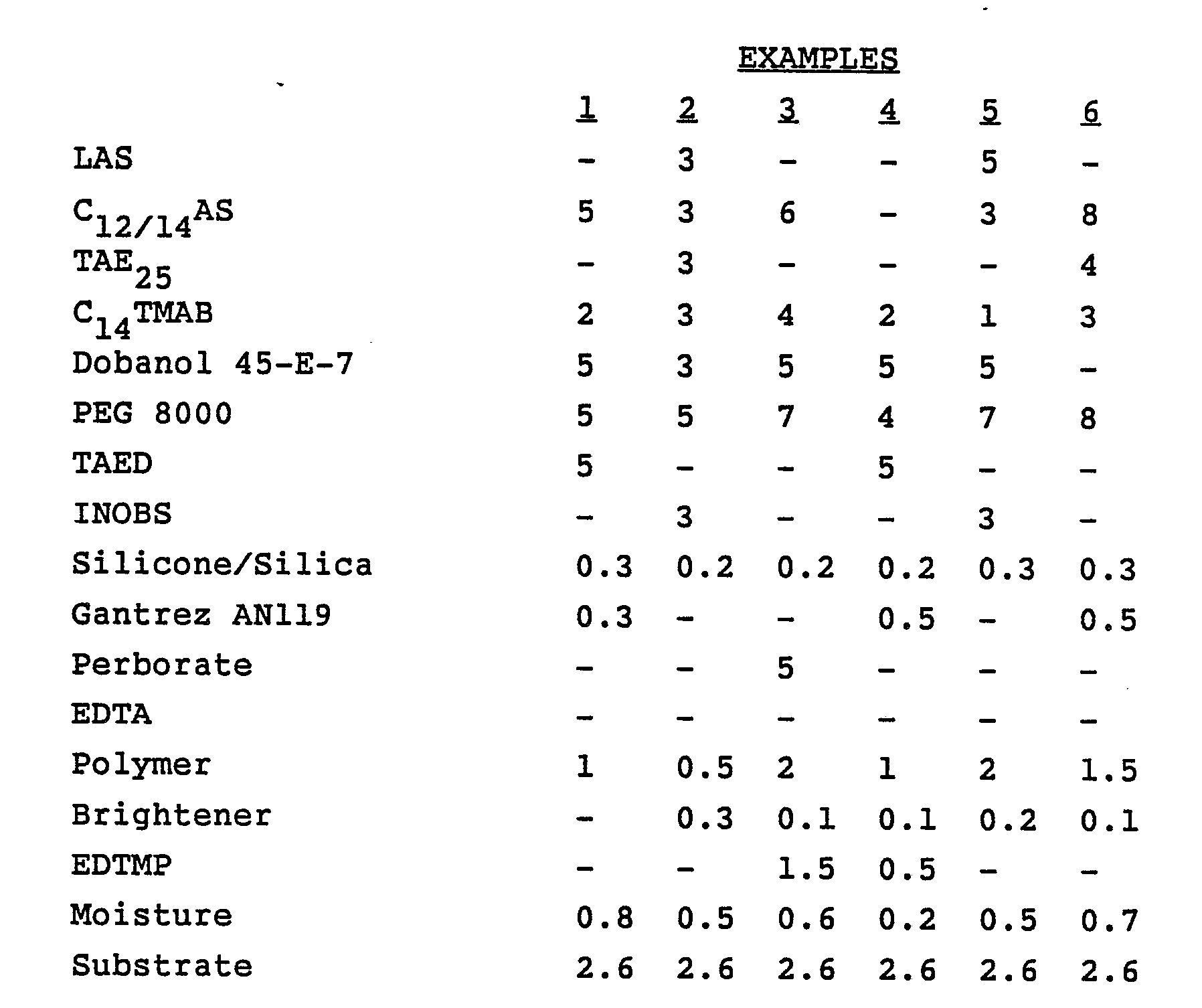
- When used as laundry additive products together with a main wash laundry detergent composition, the above products provide excellent soil release performance without detriment to clay-soil detergency and anti-redeposition performance
- Six laundry products are prepared as follows:
- A base powder composition is first prepared by mixing all components except Dobanol 45E7, bleach, bleach activator, enzyme, suds suppressor, phosphate and carbonate in a crutcher as an aqueous slurry at a temperature of about 55°C and containing about 35% water. The slurry is then spray dried at a gas inlet temperature of about 330°C to form base powder granules and the granules are comminuted in a Patterson-Kelley twin shell blender. The bleach activator where present, is then admixed with TAE₂₅ as binder and extruded in the form of elongate particles through a radial extruder as described in European Patent Application Number 62523. The bleach activator noodles, bleach, enzyme, suds suppressor, phosphate and carbonate are then dry-mixed with the base powder composition and finally Dobanol 45E7 is sprayed into the final mixture. Each composition had a bulk density of about 0.7g/cc.

- A twin-compartment sachet is made from a non-woven fabric formed of 100% unbleached crimped rayon fibres of 1.5 denier bonded with 18% polyacrylate builder, the non-woven fabric having a basis weight of 35g/m². The sachet is made from a sheet of the fabric measuring 120mm × 80mm by folding midway along the long dimension, sealing along the two opposing free edges with sodium silicate solution and along a longitudinal seam parallel to and half-way between the two opposing edges, filling the two compartments with 120cc each of detergent composition VII and then sealing along the open edge of the sachet. The procedure is then replicated five times using composition VIII to XII respectively.
- When used as main-wash laundry detergent products, the above examples provide excellent soil-release performance without detriment to clay-soil detergency and anti-redeposition performance.
Claims (10)
[R²(OR³)y][R⁴(OR³)y]₂R⁵N⁺X⁻
wherein R² is an alkyl, alkenyl or alkyl benzyl group having from about 8 to about 18 carbon atoms, preferably 10 to 14 carbon atoms in the alkyl chain; each R³ is selected from -CH₂CH₂-, -CH₂CH(CH₃)-, -CH₂CH(CH₂OH)-, -CH₂CH₂CH₂-, and mixtures thereof; each R⁴ is selected from C₁-C₄ alkyl, C₁-C₄ hydroxyalkyl, benzyl, ring structures formed by joining the two R⁴ groups, -CH₂CHOHCHOHCOR⁶CHOHCH₂OH wherein R⁶ is any hexose or hexose polymer having a molecular weight less than about 1000, and hydrogen when y is not 0; R⁵ is the same as R⁴ or is an alkyl chain wherein the total number of carbon atoms of R² plus R⁵ is not more than about 18; each y is from 0 to about 10 and the sum of the y values is from 0 to about 15; and X is any compatible anion.
Priority Applications (1)
| Application Number | Priority Date | Filing Date | Title |
|---|---|---|---|
| AT87306047T ATE58914T1 (en) | 1986-07-15 | 1987-07-08 | DETERGENT COMPOSITIONS. |
Applications Claiming Priority (2)
| Application Number | Priority Date | Filing Date | Title |
|---|---|---|---|
| GB8617255 | 1986-07-15 | ||
| GB868617255A GB8617255D0 (en) | 1986-07-15 | 1986-07-15 | Laundry compositions |
Publications (2)
| Publication Number | Publication Date |
|---|---|
| EP0253567A1 true EP0253567A1 (en) | 1988-01-20 |
| EP0253567B1 EP0253567B1 (en) | 1990-12-05 |
Family
ID=10601096
Family Applications (1)
| Application Number | Title | Priority Date | Filing Date |
|---|---|---|---|
| EP87306047A Expired - Lifetime EP0253567B1 (en) | 1986-07-15 | 1987-07-08 | Laundry compositions |
Country Status (14)
| Country | Link |
|---|---|
| US (1) | US4795584A (en) |
| EP (1) | EP0253567B1 (en) |
| JP (1) | JP2559743B2 (en) |
| AT (1) | ATE58914T1 (en) |
| CA (1) | CA1302196C (en) |
| DE (1) | DE3766556D1 (en) |
| DK (1) | DK167773B1 (en) |
| FI (1) | FI87364C (en) |
| GB (1) | GB8617255D0 (en) |
| GR (1) | GR3001171T3 (en) |
| IE (1) | IE60889B1 (en) |
| MX (1) | MX168894B (en) |
| PH (1) | PH24017A (en) |
| TR (1) | TR24535A (en) |
Cited By (47)
| Publication number | Priority date | Publication date | Assignee | Title |
|---|---|---|---|---|
| WO1997016526A1 (en) * | 1995-10-31 | 1997-05-09 | Henkel Kommanditgesellschaft Auf Aktien | Method of producing soil-release granulates |
| EP0776965A2 (en) | 1995-11-30 | 1997-06-04 | Unilever N.V. | Polymer compositions |
| EP0843715A4 (en) * | 1995-07-08 | 1999-09-29 | Procter & Gamble | WATER COMPOSITIONS. |
| US6200351B1 (en) | 1996-11-13 | 2001-03-13 | Henkel-Ecolab Gmbh & Co. Ohg | Institutional washing process using soil-release polymer |
| US6211136B1 (en) | 1996-08-31 | 2001-04-03 | Henkel Kommanditgesellschaft Auf Aktien | Process for preparing granular detergent components |
| EP1097986A1 (en) | 1999-11-05 | 2001-05-09 | Rwe-Dea Aktiengesellschaft Für Mineraloel Und Chemie | Surface cleaning method |
| WO2002022772A1 (en) * | 2000-09-11 | 2002-03-21 | The Procter & Gamble Company | Laundry articles and methods for combined cleaning and care of fabrics |
| US6391838B1 (en) | 1999-03-31 | 2002-05-21 | Henkel Kommanditgesellschaft Auf Aktien | Detergents containing enzymes and bleach activators |
| US6489395B2 (en) | 1999-12-08 | 2002-12-03 | Clariant Gmbh | Emulsions |
| GB2376238A (en) * | 2001-06-07 | 2002-12-11 | Reckitt Benckiser Inc | Hard surface cleaner in a container |
| US6514927B2 (en) | 1997-06-17 | 2003-02-04 | Clariant Gmbh | Detergent and cleaner containing soil release polymer and alkanesulfonate and/or α-olefinsulfonate |
| US6537961B1 (en) | 1997-08-18 | 2003-03-25 | Sasol Germany Gmbh | Amphiphile polymers based on polyester with condensed acetal groups which are liquid at room temperature and are used in detergents and cleaning agents |
| US6833129B2 (en) | 2000-01-26 | 2004-12-21 | Clariant Gmbh | Aqueous or aqueous-alcoholic body-cleansing compositions comprising oligoesters |
| WO2007054203A2 (en) | 2005-11-08 | 2007-05-18 | Henkel Ag & Co. Kgaa | Enzyme/substrate system for generating hydrogen peroxide containing sorbitol oxidase consisting of streptomyces c0elic0l0r and sorbitol |
| DE102006015837A1 (en) * | 2006-04-03 | 2007-10-04 | Henkel Kgaa | Dirt-repellent particles for use as additives in detergents, care materials and cleaning materials, contain polyethylene glycol and an amphiphilic polyester, especially e.g. polyethylene glycol terephthalate |
| DE102007003143A1 (en) | 2007-01-16 | 2008-07-17 | Henkel Kgaa | New alkaline protease from Bacillus gibsonii and detergents and cleaners containing this novel alkaline protease |
| DE102007005532A1 (en) | 2007-02-03 | 2008-08-07 | Clariant International Limited | Aqueous oligo- and polyester preparations |
| DE102007008868A1 (en) | 2007-02-21 | 2008-08-28 | Henkel Ag & Co. Kgaa | Automatic dishwasher detergent containing a sugar acid amide, e.g. N-octyl-D-gluconamide, useful especially for removing tenacious and-or burnt-on dirt from hard surfaces or textiles |
| DE102007013141A1 (en) | 2007-03-15 | 2008-09-18 | Cognis Ip Management Gmbh | Amphoteric polymers as soil release additives in detergents and cleaners |
| US7431739B2 (en) | 2005-06-08 | 2008-10-07 | Henkel Kommanditgesellschaft Auf Aktien | Boosting the cleaning performance of laundry detergents by polymer of styrene/methyl methacrylate/methyl polyethylene glycol |
| DE102007023827A1 (en) | 2007-05-21 | 2008-11-27 | Henkel Ag & Co. Kgaa | Use of polycarbonate, polyurethane and/or polyurea-polyorganosiloxane compounds or their acid addition compounds and/or salts to improve the cleaning efficiency of laundry detergents during washing textiles |
| DE102007038456A1 (en) | 2007-08-14 | 2009-02-19 | Henkel Ag & Co. Kgaa | Use of polycarbonate, polyurethane and/or polyurea-polyorganosiloxane compounds or their acid addition compounds and/or salts to improve the cleaning efficiency of laundry detergents during washing textiles |
| DE102007049830A1 (en) | 2007-10-16 | 2009-04-23 | Henkel Ag & Co. Kgaa | New protein variants by circular permutation |
| DE102007051092A1 (en) | 2007-10-24 | 2009-04-30 | Henkel Ag & Co. Kgaa | Subtilisin from Becillus pumilus and detergents and cleaners containing this new subtilisin |
| DE102008023803A1 (en) | 2008-05-15 | 2009-11-26 | Clariant International Ltd. | Additives for detergents and cleaners |
| US7691618B2 (en) | 2004-04-23 | 2010-04-06 | Henkel Ag & Co. Kgaa | Alkaline proteases and detergents and cleaners comprising these alkaline proteases |
| US7811076B2 (en) | 2003-12-23 | 2010-10-12 | Henkel Ag & Co. Kgaa | Alkaline protease and washing and cleaning products containing said novel alkaline protease |
| US7811376B2 (en) | 2004-10-22 | 2010-10-12 | Clariant Produkte (Deutschland) Gmbh | Aqueous, oligoester-based pigment preparations, their production and use |
| US8044011B2 (en) | 2007-04-03 | 2011-10-25 | Henkel Ag & Co. Kgaa | Cleaning agents comprising a polycarbonate-, polyurethane-, and/or polyurea-polyorganosiloxane compound |
| US8044016B2 (en) | 2007-04-03 | 2011-10-25 | Henkel Ag & Co. Kgaa | Anti-grey detergent comprising a polycarbonate-, polyurethane-, and/or polyurea-polyorganosiloxane compound |
| US8202372B2 (en) | 2007-04-03 | 2012-06-19 | Henkel Ag & Co. Kgaa | Product for treating hard surfaces |
| US8524648B2 (en) | 2007-04-03 | 2013-09-03 | Henkel Ag & Co. Kgaa | Color-protecting detergents or cleaning agents |
| US8685913B2 (en) | 2007-04-03 | 2014-04-01 | Henkel Ag & Co. Kgaa | Detergent having an active ingredient that improves the primary detergency |
| DE102014218953A1 (en) | 2014-09-19 | 2016-03-24 | Henkel Ag & Co. Kgaa | Portion for textile treatment agent |
| DE102014218950A1 (en) | 2014-09-19 | 2016-03-24 | Henkel Ag & Co. Kgaa | Solid composition for textile treatment |
| DE102014218951A1 (en) | 2014-09-19 | 2016-03-24 | Henkel Ag & Co. Kgaa | Solid composition for textile treatment |
| DE102017210143A1 (en) | 2017-06-16 | 2018-12-20 | Henkel Ag & Co. Kgaa | Viscoelastic, solid surfactant composition |
| WO2018229037A1 (en) | 2017-06-16 | 2018-12-20 | Henkel Ag & Co. Kgaa | Viscoelastic solid surfactant composition having a high surfactant content |
| WO2018229036A1 (en) | 2017-06-16 | 2018-12-20 | Henkel Ag & Co. Kgaa | Viscoelastic, solid-state surfactant composition having a high surfactant content |
| WO2018229038A1 (en) | 2017-06-16 | 2018-12-20 | Henkel Ag & Co. Kgaa | Portion for providing surfactant-containing liquors |
| DE102017223460A1 (en) | 2017-12-20 | 2019-06-27 | Henkel Ag & Co. Kgaa | Viscose-elastic, high-surfactant, solid surfactant composition |
| DE102017223456A1 (en) | 2017-12-20 | 2019-06-27 | Henkel Ag & Co. Kgaa | Viscoelastic, high solids surfactant composition |
| WO2019154612A1 (en) | 2018-02-06 | 2019-08-15 | Henkel Ag & Co. Kgaa | Viscoelastic, solid surfactant composition |
| DE102018219413A1 (en) | 2018-11-14 | 2020-05-14 | Henkel Ag & Co. Kgaa | Textile pretreatment composition containing a shaped body with a glucosamine derivative as a low-molecular gelling agent |
| DE102018219415A1 (en) | 2018-11-14 | 2020-05-14 | Henkel Ag & Co. Kgaa | Textile pretreatment composition containing a shaped body with a low molecular weight gel former |
| DE102018221674A1 (en) | 2018-12-13 | 2020-06-18 | Henkel Ag & Co. Kgaa | Device and method for producing a water-soluble casing and detergent or cleaning agent portions containing this water-soluble casing |
| WO2020120208A2 (en) | 2018-12-13 | 2020-06-18 | Henkel Ag & Co. Kgaa | Apparatus and process for production of a water-soluble shell, and washing or cleaning agent portion packs comprising said water-soluble shell and containing a viscoelastic, solid filling substance |
Families Citing this family (39)
| Publication number | Priority date | Publication date | Assignee | Title |
|---|---|---|---|---|
| US5209874A (en) * | 1989-04-26 | 1993-05-11 | Shell Oil Company | Liquid surface active compositions |
| CZ184693A3 (en) * | 1991-03-08 | 1994-03-16 | Procter & Gamble | Concentrated textile plasticizing mixtures |
| GB2296919A (en) * | 1995-01-12 | 1996-07-17 | Procter & Gamble | Detergent composition |
| US6194367B1 (en) * | 1995-03-01 | 2001-02-27 | Charvid Limited Liability Co. | Non-caustic cleaning composition comprising peroxygen compound and specific silicate and method of making the same in free-flowing, particulate form |
| US6034048A (en) * | 1995-03-01 | 2000-03-07 | Charvid Limited Liability Co. | Non-caustic cleaning composition using an alkali salt |
| US5663132A (en) * | 1995-03-01 | 1997-09-02 | Charvid Limited Liability Company | Non-caustic composition comprising peroxygen compound and metasilicate and cleaning methods for using same |
| US5898024A (en) * | 1995-03-01 | 1999-04-27 | Charvid Limited Liability | Non-caustic cleaning composition comprising peroxygen compound and specific silicate, and method of making the same in free-flowing, particulate form |
| FR2732690B1 (en) * | 1995-04-05 | 1997-05-09 | Rhone Poulenc Chimie | DETERGENT FORMULATION WITH ANTI-SOIL PROPERTIES FOR THE WASHING OF LAUNDRY |
| US6864196B2 (en) | 1995-12-19 | 2005-03-08 | Newlund Laboratories, Inc. | Method of making a laundry detergent article containing detergent formulations |
| DE19616096A1 (en) * | 1996-04-23 | 1997-11-06 | Huels Chemische Werke Ag | Use of anionic gemini surfactants in formulations for washing, cleaning and personal care products |
| US5922663A (en) * | 1996-10-04 | 1999-07-13 | Rhodia Inc. | Enhancement of soil release with gemini surfactants |
| IL154142A0 (en) | 2000-07-28 | 2003-07-31 | Henkel Kgaa | Novel amylolytic enzyme extracted from bacillus sp.a 7-7 (dsm 12368) and washing and cleaning agents containing this novel amylolytic |
| US6419906B1 (en) * | 2001-03-12 | 2002-07-16 | Colgate Palmolive Company | Strip for whitening tooth surfaces |
| CN1575308B (en) | 2001-10-22 | 2010-04-28 | 汉高两合股份公司 | Cotton-reactive, soil-release urethane-based polymer |
| DE10153792A1 (en) | 2001-10-31 | 2003-05-22 | Henkel Kgaa | New alkaline protease variants and washing and cleaning agents containing these new alkaline protease variants |
| DE10162728A1 (en) | 2001-12-20 | 2003-07-10 | Henkel Kgaa | New alkaline protease from Bacillus gibsonii (DSM 14393) and washing and cleaning agents containing this new alkaline protease |
| DE10162727A1 (en) | 2001-12-20 | 2003-07-10 | Henkel Kgaa | New alkaline protease from Bacillus gibsonii (DSM 14391) and washing and cleaning agents containing this new alkaline protease |
| DE10163748A1 (en) | 2001-12-21 | 2003-07-17 | Henkel Kgaa | New glycosyl hydrolases |
| DE10163884A1 (en) | 2001-12-22 | 2003-07-10 | Henkel Kgaa | New alkaline protease from Bacillus sp. (DSM 14392) and detergents and cleaning agents containing this new alkaline protease |
| JP3910530B2 (en) * | 2002-12-16 | 2007-04-25 | 花王株式会社 | Dirt release agent |
| DE10260903A1 (en) | 2002-12-20 | 2004-07-08 | Henkel Kgaa | New perhydrolases |
| DE10351325A1 (en) | 2003-02-10 | 2004-08-26 | Henkel Kgaa | Detergent or cleaning agent with water-soluble builder system and dirt-releasing cellulose derivative |
| WO2004069978A1 (en) | 2003-02-10 | 2004-08-19 | Henkel Kommanditgesellschaft Auf Aktien | Detergents or cleaning agents containing a bleaching agent, a water-soluble building block system and a cellulose derivative with dirt dissolving properties |
| DE10334046A1 (en) * | 2003-07-25 | 2005-02-10 | Clariant Gmbh | Process for the preparation of granulated acyloxybenzenesulfonates or acyloxybenzenecarboxylic acids and their salts |
| EP1529517A3 (en) * | 2003-11-04 | 2005-09-14 | Clariant GmbH | Use of polymers for maintaining the colour in dyed hair |
| DE102004012915A1 (en) * | 2004-03-17 | 2005-10-13 | Clariant Gmbh | Solid preparations containing a sensitive active ingredient |
| DE102004029310A1 (en) * | 2004-06-17 | 2005-12-29 | Clariant Gmbh | Highly concentrated, aqueous formulations of oligoesters and polyesters |
| DE102004031629A1 (en) * | 2004-06-30 | 2006-02-02 | Clariant Gmbh | Building materials containing polyester fibers |
| DE102004047776B4 (en) | 2004-10-01 | 2018-05-09 | Basf Se | Stabilized against di- and / or multimerization alpha-amylase variants, processes for their preparation and their use |
| DE102004047777B4 (en) | 2004-10-01 | 2018-05-09 | Basf Se | Alpha-amylase variants with increased solvent stability, process for their preparation and their use |
| EP1698687A1 (en) * | 2005-02-07 | 2006-09-06 | The Procter & Gamble Company | Detergent compositions |
| ATE552763T1 (en) * | 2005-10-24 | 2012-04-15 | Aculon Inc | CHEMICAL RAGS |
| JP5014739B2 (en) * | 2006-02-16 | 2012-08-29 | 花王株式会社 | Soil release agent for textiles |
| ATE502998T1 (en) * | 2006-07-07 | 2011-04-15 | Procter & Gamble | DETERGENT COMPOSITIONS |
| US9597774B2 (en) * | 2006-12-11 | 2017-03-21 | Element Six Abrasives S.A. | Cubic boron nitride compacts |
| EP2093323B1 (en) | 2006-12-12 | 2012-10-10 | Kao Corporation | Liquid softener composition, or transparent or semi-transparent liquid softener composition |
| JP5292606B2 (en) * | 2007-04-24 | 2013-09-18 | ライオン株式会社 | Liquid detergent composition for clothing |
| JP5628537B2 (en) * | 2010-03-18 | 2014-11-19 | 花王株式会社 | Cleaning composition for clothing |
| MY187226A (en) * | 2015-03-30 | 2021-09-13 | Lion Corp | Liquid detergent for fiber product |
Citations (6)
| Publication number | Priority date | Publication date | Assignee | Title |
|---|---|---|---|---|
| US3962152A (en) * | 1974-06-25 | 1976-06-08 | The Procter & Gamble Company | Detergent compositions having improved soil release properties |
| US4125370A (en) * | 1976-06-24 | 1978-11-14 | The Procter & Gamble Company | Laundry method imparting soil release properties to laundered fabrics |
| EP0001305A1 (en) * | 1977-09-23 | 1979-04-04 | THE PROCTER & GAMBLE COMPANY | Anionic surfactant-containing detergent compositions having soil-release properties |
| GB2137221A (en) * | 1983-03-29 | 1984-10-03 | Colgate Palmolive Co | Soil releasing detergent |
| EP0217186A1 (en) * | 1985-09-12 | 1987-04-08 | S.C. Johnson & Son, Inc. | Polymer sheet for delivering laundry care additive and laundry care product formed therefrom |
| EP0199403B1 (en) * | 1985-04-15 | 1993-12-15 | The Procter & Gamble Company | Stable liquid detergent compositions |
Family Cites Families (8)
| Publication number | Priority date | Publication date | Assignee | Title |
|---|---|---|---|---|
| US3712873A (en) * | 1970-10-27 | 1973-01-23 | Procter & Gamble | Textile treating compositions which aid in the removal of soil from polyester and polyamide synthetic textile materials |
| CA989557A (en) * | 1971-10-28 | 1976-05-25 | The Procter And Gamble Company | Compositions and process for imparting renewable soil release finish to polyester-containing fabrics |
| US3959230A (en) * | 1974-06-25 | 1976-05-25 | The Procter & Gamble Company | Polyethylene oxide terephthalate polymers |
| US4411831A (en) * | 1981-12-02 | 1983-10-25 | Purex Industries, Inc. | Stable liquid anionic detergent compositions having soil, release properties |
| US4548744A (en) * | 1983-07-22 | 1985-10-22 | Connor Daniel S | Ethoxylated amine oxides having clay soil removal/anti-redeposition properties useful in detergent compositions |
| EP0143476B1 (en) * | 1983-10-03 | 1987-09-09 | Akzo N.V. | Dosing unit comprising a detergent and/or bleaching agent |
| US4571303A (en) * | 1985-01-23 | 1986-02-18 | Colgate-Palmolive Company | Built nonionic detergent composition containing stabilized polyethylene terephthalate-polyoxyethylene terephthalate soil release promoting polymer |
| US4713194A (en) * | 1986-04-15 | 1987-12-15 | The Procter & Gamble Company | Block polyester and like compounds having branched hydrophilic capping groups useful as soil release agents in detergent compositions |
-
1986
- 1986-07-15 GB GB868617255A patent/GB8617255D0/en active Pending
-
1987
- 1987-07-07 US US07/070,472 patent/US4795584A/en not_active Expired - Fee Related
- 1987-07-08 AT AT87306047T patent/ATE58914T1/en not_active IP Right Cessation
- 1987-07-08 DE DE8787306047T patent/DE3766556D1/en not_active Expired - Lifetime
- 1987-07-08 EP EP87306047A patent/EP0253567B1/en not_active Expired - Lifetime
- 1987-07-13 TR TR87/0501A patent/TR24535A/en unknown
- 1987-07-14 FI FI873113A patent/FI87364C/en not_active IP Right Cessation
- 1987-07-14 CA CA000542052A patent/CA1302196C/en not_active Expired - Lifetime
- 1987-07-14 PH PH35533A patent/PH24017A/en unknown
- 1987-07-14 IE IE189787A patent/IE60889B1/en not_active IP Right Cessation
- 1987-07-14 JP JP62175779A patent/JP2559743B2/en not_active Expired - Lifetime
- 1987-07-15 MX MX007361A patent/MX168894B/en unknown
- 1987-07-15 DK DK369587A patent/DK167773B1/en active
-
1990
- 1990-12-06 GR GR90400966T patent/GR3001171T3/en unknown
Patent Citations (6)
| Publication number | Priority date | Publication date | Assignee | Title |
|---|---|---|---|---|
| US3962152A (en) * | 1974-06-25 | 1976-06-08 | The Procter & Gamble Company | Detergent compositions having improved soil release properties |
| US4125370A (en) * | 1976-06-24 | 1978-11-14 | The Procter & Gamble Company | Laundry method imparting soil release properties to laundered fabrics |
| EP0001305A1 (en) * | 1977-09-23 | 1979-04-04 | THE PROCTER & GAMBLE COMPANY | Anionic surfactant-containing detergent compositions having soil-release properties |
| GB2137221A (en) * | 1983-03-29 | 1984-10-03 | Colgate Palmolive Co | Soil releasing detergent |
| EP0199403B1 (en) * | 1985-04-15 | 1993-12-15 | The Procter & Gamble Company | Stable liquid detergent compositions |
| EP0217186A1 (en) * | 1985-09-12 | 1987-04-08 | S.C. Johnson & Son, Inc. | Polymer sheet for delivering laundry care additive and laundry care product formed therefrom |
Cited By (60)
| Publication number | Priority date | Publication date | Assignee | Title |
|---|---|---|---|---|
| EP0843715A4 (en) * | 1995-07-08 | 1999-09-29 | Procter & Gamble | WATER COMPOSITIONS. |
| WO1997016526A1 (en) * | 1995-10-31 | 1997-05-09 | Henkel Kommanditgesellschaft Auf Aktien | Method of producing soil-release granulates |
| EP0776965A2 (en) | 1995-11-30 | 1997-06-04 | Unilever N.V. | Polymer compositions |
| US6211136B1 (en) | 1996-08-31 | 2001-04-03 | Henkel Kommanditgesellschaft Auf Aktien | Process for preparing granular detergent components |
| US6200351B1 (en) | 1996-11-13 | 2001-03-13 | Henkel-Ecolab Gmbh & Co. Ohg | Institutional washing process using soil-release polymer |
| US6514927B2 (en) | 1997-06-17 | 2003-02-04 | Clariant Gmbh | Detergent and cleaner containing soil release polymer and alkanesulfonate and/or α-olefinsulfonate |
| US6537961B1 (en) | 1997-08-18 | 2003-03-25 | Sasol Germany Gmbh | Amphiphile polymers based on polyester with condensed acetal groups which are liquid at room temperature and are used in detergents and cleaning agents |
| US6391838B1 (en) | 1999-03-31 | 2002-05-21 | Henkel Kommanditgesellschaft Auf Aktien | Detergents containing enzymes and bleach activators |
| EP1097986A1 (en) | 1999-11-05 | 2001-05-09 | Rwe-Dea Aktiengesellschaft Für Mineraloel Und Chemie | Surface cleaning method |
| US6489395B2 (en) | 1999-12-08 | 2002-12-03 | Clariant Gmbh | Emulsions |
| USRE39993E1 (en) * | 1999-12-08 | 2008-01-01 | Clariant Produkte (Deutschland) Gmbh | Emulsions |
| US6833129B2 (en) | 2000-01-26 | 2004-12-21 | Clariant Gmbh | Aqueous or aqueous-alcoholic body-cleansing compositions comprising oligoesters |
| WO2002022772A1 (en) * | 2000-09-11 | 2002-03-21 | The Procter & Gamble Company | Laundry articles and methods for combined cleaning and care of fabrics |
| GB2376238A (en) * | 2001-06-07 | 2002-12-11 | Reckitt Benckiser Inc | Hard surface cleaner in a container |
| US7273841B2 (en) | 2001-06-07 | 2007-09-25 | Reckitt Benckiser Inc | Encapsulated hard surface cleaning concentrates |
| US7811076B2 (en) | 2003-12-23 | 2010-10-12 | Henkel Ag & Co. Kgaa | Alkaline protease and washing and cleaning products containing said novel alkaline protease |
| US7985570B2 (en) | 2004-04-23 | 2011-07-26 | B.R.A.I.N. Biotechnology Research And Information Network A.G. | Alkaline proteases and detergents and cleaners comprising these alkaline proteases |
| US7691618B2 (en) | 2004-04-23 | 2010-04-06 | Henkel Ag & Co. Kgaa | Alkaline proteases and detergents and cleaners comprising these alkaline proteases |
| US7811376B2 (en) | 2004-10-22 | 2010-10-12 | Clariant Produkte (Deutschland) Gmbh | Aqueous, oligoester-based pigment preparations, their production and use |
| US7431739B2 (en) | 2005-06-08 | 2008-10-07 | Henkel Kommanditgesellschaft Auf Aktien | Boosting the cleaning performance of laundry detergents by polymer of styrene/methyl methacrylate/methyl polyethylene glycol |
| WO2007054203A2 (en) | 2005-11-08 | 2007-05-18 | Henkel Ag & Co. Kgaa | Enzyme/substrate system for generating hydrogen peroxide containing sorbitol oxidase consisting of streptomyces c0elic0l0r and sorbitol |
| DE102006015837A1 (en) * | 2006-04-03 | 2007-10-04 | Henkel Kgaa | Dirt-repellent particles for use as additives in detergents, care materials and cleaning materials, contain polyethylene glycol and an amphiphilic polyester, especially e.g. polyethylene glycol terephthalate |
| DE102007003143A1 (en) | 2007-01-16 | 2008-07-17 | Henkel Kgaa | New alkaline protease from Bacillus gibsonii and detergents and cleaners containing this novel alkaline protease |
| DE102007005532A1 (en) | 2007-02-03 | 2008-08-07 | Clariant International Limited | Aqueous oligo- and polyester preparations |
| DE102007008868A1 (en) | 2007-02-21 | 2008-08-28 | Henkel Ag & Co. Kgaa | Automatic dishwasher detergent containing a sugar acid amide, e.g. N-octyl-D-gluconamide, useful especially for removing tenacious and-or burnt-on dirt from hard surfaces or textiles |
| EP1972683A1 (en) | 2007-03-15 | 2008-09-24 | Cognis IP Management GmbH | Amphoterous polymers as soil release additive in washing agents |
| DE102007013141A1 (en) | 2007-03-15 | 2008-09-18 | Cognis Ip Management Gmbh | Amphoteric polymers as soil release additives in detergents and cleaners |
| US8044011B2 (en) | 2007-04-03 | 2011-10-25 | Henkel Ag & Co. Kgaa | Cleaning agents comprising a polycarbonate-, polyurethane-, and/or polyurea-polyorganosiloxane compound |
| US8685913B2 (en) | 2007-04-03 | 2014-04-01 | Henkel Ag & Co. Kgaa | Detergent having an active ingredient that improves the primary detergency |
| US8044016B2 (en) | 2007-04-03 | 2011-10-25 | Henkel Ag & Co. Kgaa | Anti-grey detergent comprising a polycarbonate-, polyurethane-, and/or polyurea-polyorganosiloxane compound |
| US8202372B2 (en) | 2007-04-03 | 2012-06-19 | Henkel Ag & Co. Kgaa | Product for treating hard surfaces |
| US8318649B2 (en) | 2007-04-03 | 2012-11-27 | Henkel, AG & Co. KGAA | Cleaning agents comprising a cyclic carbonate |
| US8324145B2 (en) | 2007-04-03 | 2012-12-04 | Henkel Ag & Co. Kgaa | Anti-grey detergent comprising a cyclic carbonate or urea |
| US8524648B2 (en) | 2007-04-03 | 2013-09-03 | Henkel Ag & Co. Kgaa | Color-protecting detergents or cleaning agents |
| DE102007023827A1 (en) | 2007-05-21 | 2008-11-27 | Henkel Ag & Co. Kgaa | Use of polycarbonate, polyurethane and/or polyurea-polyorganosiloxane compounds or their acid addition compounds and/or salts to improve the cleaning efficiency of laundry detergents during washing textiles |
| DE102007038456A1 (en) | 2007-08-14 | 2009-02-19 | Henkel Ag & Co. Kgaa | Use of polycarbonate, polyurethane and/or polyurea-polyorganosiloxane compounds or their acid addition compounds and/or salts to improve the cleaning efficiency of laundry detergents during washing textiles |
| DE102007049830A1 (en) | 2007-10-16 | 2009-04-23 | Henkel Ag & Co. Kgaa | New protein variants by circular permutation |
| DE102007051092A1 (en) | 2007-10-24 | 2009-04-30 | Henkel Ag & Co. Kgaa | Subtilisin from Becillus pumilus and detergents and cleaners containing this new subtilisin |
| DE102008023803A1 (en) | 2008-05-15 | 2009-11-26 | Clariant International Ltd. | Additives for detergents and cleaners |
| US10479962B2 (en) | 2014-09-19 | 2019-11-19 | Henkel Ag & Co. Kgaa | Solid composition for textile treatment |
| DE102014218950A1 (en) | 2014-09-19 | 2016-03-24 | Henkel Ag & Co. Kgaa | Solid composition for textile treatment |
| DE102014218951A1 (en) | 2014-09-19 | 2016-03-24 | Henkel Ag & Co. Kgaa | Solid composition for textile treatment |
| DE102014218953A1 (en) | 2014-09-19 | 2016-03-24 | Henkel Ag & Co. Kgaa | Portion for textile treatment agent |
| DE102017210143A1 (en) | 2017-06-16 | 2018-12-20 | Henkel Ag & Co. Kgaa | Viscoelastic, solid surfactant composition |
| WO2018229039A1 (en) | 2017-06-16 | 2018-12-20 | Henkel Ag & Co. Kgaa | Viscoelastic, solid surfactant composition |
| WO2018229037A1 (en) | 2017-06-16 | 2018-12-20 | Henkel Ag & Co. Kgaa | Viscoelastic solid surfactant composition having a high surfactant content |
| WO2018229036A1 (en) | 2017-06-16 | 2018-12-20 | Henkel Ag & Co. Kgaa | Viscoelastic, solid-state surfactant composition having a high surfactant content |
| WO2018229038A1 (en) | 2017-06-16 | 2018-12-20 | Henkel Ag & Co. Kgaa | Portion for providing surfactant-containing liquors |
| DE102017210141A1 (en) | 2017-06-16 | 2018-12-20 | Henkel Ag & Co. Kgaa | Portion to provide surfactant-containing fleets |
| US11414627B2 (en) | 2017-06-16 | 2022-08-16 | Henkel Ag & Co. Kgaa | Unit-dose detergent portion comprising a granular solid and a viscoelastic solid |
| US11261407B2 (en) | 2017-06-16 | 2022-03-01 | Henkel Ag & Co. Kgaa | Viscoelastic, solid-state surfactant composition having a high surfactant content |
| DE102017223456A1 (en) | 2017-12-20 | 2019-06-27 | Henkel Ag & Co. Kgaa | Viscoelastic, high solids surfactant composition |
| DE102017223460A1 (en) | 2017-12-20 | 2019-06-27 | Henkel Ag & Co. Kgaa | Viscose-elastic, high-surfactant, solid surfactant composition |
| WO2019154612A1 (en) | 2018-02-06 | 2019-08-15 | Henkel Ag & Co. Kgaa | Viscoelastic, solid surfactant composition |
| DE102018219413A1 (en) | 2018-11-14 | 2020-05-14 | Henkel Ag & Co. Kgaa | Textile pretreatment composition containing a shaped body with a glucosamine derivative as a low-molecular gelling agent |
| DE102018219415A1 (en) | 2018-11-14 | 2020-05-14 | Henkel Ag & Co. Kgaa | Textile pretreatment composition containing a shaped body with a low molecular weight gel former |
| DE102018221674A1 (en) | 2018-12-13 | 2020-06-18 | Henkel Ag & Co. Kgaa | Device and method for producing a water-soluble casing and detergent or cleaning agent portions containing this water-soluble casing |
| WO2020120209A1 (en) | 2018-12-13 | 2020-06-18 | Henkel Ag & Co. Kgaa | Process and apparatus for production of a water-soluble shell and washing or cleaning composition portions containing said water-soluble shell |
| WO2020120208A2 (en) | 2018-12-13 | 2020-06-18 | Henkel Ag & Co. Kgaa | Apparatus and process for production of a water-soluble shell, and washing or cleaning agent portion packs comprising said water-soluble shell and containing a viscoelastic, solid filling substance |
| DE102018221671A1 (en) | 2018-12-13 | 2020-06-18 | Henkel Ag & Co. Kgaa | Device and method for producing a water-soluble casing and detergent or cleaning agent portions containing this water-soluble casing with viscoelastic, solid filler substance |
Also Published As
| Publication number | Publication date |
|---|---|
| GR3001171T3 (en) | 1992-06-30 |
| JP2559743B2 (en) | 1996-12-04 |
| ATE58914T1 (en) | 1990-12-15 |
| FI87364B (en) | 1992-09-15 |
| FI873113L (en) | 1988-01-16 |
| EP0253567B1 (en) | 1990-12-05 |
| DK167773B1 (en) | 1993-12-13 |
| TR24535A (en) | 1991-11-20 |
| GB8617255D0 (en) | 1986-08-20 |
| DK369587A (en) | 1988-01-16 |
| CA1302196C (en) | 1992-06-02 |
| IE60889B1 (en) | 1994-08-24 |
| DE3766556D1 (en) | 1991-01-17 |
| IE871897L (en) | 1988-01-15 |
| FI87364C (en) | 1992-12-28 |
| US4795584A (en) | 1989-01-03 |
| MX168894B (en) | 1993-06-14 |
| JPS6392696A (en) | 1988-04-23 |
| PH24017A (en) | 1990-02-09 |
| DK369587D0 (en) | 1987-07-15 |
| FI873113A0 (en) | 1987-07-14 |
Similar Documents
| Publication | Publication Date | Title |
|---|---|---|
| US4795584A (en) | Laundry compositions | |
| CA1297625C (en) | Terephthalate ester copolymers and their use in laundry compositions | |
| EP0293139B1 (en) | Laundry products | |
| US4853143A (en) | Bleach activator compositions containing an antioxidant | |
| US4681695A (en) | Bleach compositions | |
| CA2503144C (en) | Laundry detergent composition | |
| GB2143231A (en) | Peroxy acid bleach precursors and their use in cleaning compositions and washing processes | |
| IE55611B1 (en) | Detergent additive product | |
| EP0253566B1 (en) | Laundry products | |
| EP0320219B1 (en) | Detergent compositions | |
| EP0123423B1 (en) | Detergent compositions, detergent liquors and method for their preparation | |
| CA1210301A (en) | Laundry additive products | |
| ZA200503245B (en) | Laundry detergent composition | |
| EP0190880B1 (en) | Laundry products | |
| GB2175928A (en) | Bleaching compositions and other laundry additive products incorporating non linear aliphatic peroxycarboxylic acid precursors |
Legal Events
| Date | Code | Title | Description |
|---|---|---|---|
| PUAI | Public reference made under article 153(3) epc to a published international application that has entered the european phase |
Free format text: ORIGINAL CODE: 0009012 |
|
| AK | Designated contracting states |
Kind code of ref document: A1 Designated state(s): AT BE CH DE FR GB GR IT LI LU NL SE |
|
| 17P | Request for examination filed |
Effective date: 19880707 |
|
| 17Q | First examination report despatched |
Effective date: 19890310 |
|
| GRAA | (expected) grant |
Free format text: ORIGINAL CODE: 0009210 |
|
| AK | Designated contracting states |
Kind code of ref document: B1 Designated state(s): AT BE CH DE FR GB GR IT LI LU NL SE |
|
| REF | Corresponds to: |
Ref document number: 58914 Country of ref document: AT Date of ref document: 19901215 Kind code of ref document: T |
|
| ITF | It: translation for a ep patent filed | ||
| ET | Fr: translation filed | ||
| REF | Corresponds to: |
Ref document number: 3766556 Country of ref document: DE Date of ref document: 19910117 |
|
| ITTA | It: last paid annual fee | ||
| REG | Reference to a national code |
Ref country code: GR Ref legal event code: FG4A Free format text: 3001171 |
|
| PLBE | No opposition filed within time limit |
Free format text: ORIGINAL CODE: 0009261 |
|
| STAA | Information on the status of an ep patent application or granted ep patent |
Free format text: STATUS: NO OPPOSITION FILED WITHIN TIME LIMIT |
|
| 26N | No opposition filed | ||
| PGFP | Annual fee paid to national office [announced via postgrant information from national office to epo] |
Ref country code: CH Payment date: 19940713 Year of fee payment: 8 |
|
| PGFP | Annual fee paid to national office [announced via postgrant information from national office to epo] |
Ref country code: AT Payment date: 19940714 Year of fee payment: 8 |
|
| PGFP | Annual fee paid to national office [announced via postgrant information from national office to epo] |
Ref country code: GR Payment date: 19940720 Year of fee payment: 8 |
|
| PGFP | Annual fee paid to national office [announced via postgrant information from national office to epo] |
Ref country code: SE Payment date: 19940731 Year of fee payment: 8 Ref country code: NL Payment date: 19940731 Year of fee payment: 8 Ref country code: LU Payment date: 19940731 Year of fee payment: 8 |
|
| PGFP | Annual fee paid to national office [announced via postgrant information from national office to epo] |
Ref country code: BE Payment date: 19940912 Year of fee payment: 8 |
|
| EPTA | Lu: last paid annual fee | ||
| EAL | Se: european patent in force in sweden |
Ref document number: 87306047.9 |
|
| PG25 | Lapsed in a contracting state [announced via postgrant information from national office to epo] |
Ref country code: LU Free format text: LAPSE BECAUSE OF NON-PAYMENT OF DUE FEES Effective date: 19950708 Ref country code: AT Effective date: 19950708 |
|
| PG25 | Lapsed in a contracting state [announced via postgrant information from national office to epo] |
Ref country code: SE Effective date: 19950709 |
|
| PG25 | Lapsed in a contracting state [announced via postgrant information from national office to epo] |
Ref country code: LI Effective date: 19950731 Ref country code: CH Effective date: 19950731 Ref country code: BE Effective date: 19950731 |
|
| BERE | Be: lapsed |
Owner name: THE PROCTER & GAMBLE CY Effective date: 19950731 |
|
| PG25 | Lapsed in a contracting state [announced via postgrant information from national office to epo] |
Ref country code: GR Free format text: THE PATENT HAS BEEN ANNULLED BY A DECISION OF A NATIONAL AUTHORITY Effective date: 19960131 |
|
| PG25 | Lapsed in a contracting state [announced via postgrant information from national office to epo] |
Ref country code: NL Effective date: 19960201 |
|
| REG | Reference to a national code |
Ref country code: CH Ref legal event code: PL |
|
| REG | Reference to a national code |
Ref country code: GR Ref legal event code: MM2A Free format text: 3001171 |
|
| NLV4 | Nl: lapsed or anulled due to non-payment of the annual fee |
Effective date: 19960201 |
|
| EUG | Se: european patent has lapsed |
Ref document number: 87306047.9 |
|
| PGFP | Annual fee paid to national office [announced via postgrant information from national office to epo] |
Ref country code: GB Payment date: 19960701 Year of fee payment: 10 |
|
| PGFP | Annual fee paid to national office [announced via postgrant information from national office to epo] |
Ref country code: FR Payment date: 19960709 Year of fee payment: 10 |
|
| PGFP | Annual fee paid to national office [announced via postgrant information from national office to epo] |
Ref country code: DE Payment date: 19960712 Year of fee payment: 10 |
|
| PG25 | Lapsed in a contracting state [announced via postgrant information from national office to epo] |
Ref country code: GB Free format text: LAPSE BECAUSE OF NON-PAYMENT OF DUE FEES Effective date: 19970708 |
|
| GBPC | Gb: european patent ceased through non-payment of renewal fee |
Effective date: 19970708 |
|
| PG25 | Lapsed in a contracting state [announced via postgrant information from national office to epo] |
Ref country code: FR Free format text: LAPSE BECAUSE OF NON-PAYMENT OF DUE FEES Effective date: 19980331 |
|
| PG25 | Lapsed in a contracting state [announced via postgrant information from national office to epo] |
Ref country code: DE Free format text: LAPSE BECAUSE OF NON-PAYMENT OF DUE FEES Effective date: 19980401 |
|
| REG | Reference to a national code |
Ref country code: FR Ref legal event code: ST |
|
| PG25 | Lapsed in a contracting state [announced via postgrant information from national office to epo] |
Ref country code: IT Free format text: LAPSE BECAUSE OF NON-PAYMENT OF DUE FEES;WARNING: LAPSES OF ITALIAN PATENTS WITH EFFECTIVE DATE BEFORE 2007 MAY HAVE OCCURRED AT ANY TIME BEFORE 2007. THE CORRECT EFFECTIVE DATE MAY BE DIFFERENT FROM THE ONE RECORDED. Effective date: 20050708 |