EP0256906A1 - Matériau hydrophyle biocompatible, et son procédé de fabrication - Google Patents
Matériau hydrophyle biocompatible, et son procédé de fabrication Download PDFInfo
- Publication number
- EP0256906A1 EP0256906A1 EP87401640A EP87401640A EP0256906A1 EP 0256906 A1 EP0256906 A1 EP 0256906A1 EP 87401640 A EP87401640 A EP 87401640A EP 87401640 A EP87401640 A EP 87401640A EP 0256906 A1 EP0256906 A1 EP 0256906A1
- Authority
- EP
- European Patent Office
- Prior art keywords
- cellulose
- sulfur
- water
- coagulation
- sodium
- Prior art date
- Legal status (The legal status is an assumption and is not a legal conclusion. Google has not performed a legal analysis and makes no representation as to the accuracy of the status listed.)
- Granted
Links
- 239000000463 material Substances 0.000 title claims abstract description 53
- 238000000034 method Methods 0.000 title claims description 17
- 238000004519 manufacturing process Methods 0.000 title claims description 5
- 229920002678 cellulose Polymers 0.000 claims abstract description 26
- 239000001913 cellulose Substances 0.000 claims abstract description 26
- XLYOFNOQVPJJNP-UHFFFAOYSA-N water Substances O XLYOFNOQVPJJNP-UHFFFAOYSA-N 0.000 claims abstract description 26
- 239000000560 biocompatible material Substances 0.000 claims abstract description 6
- 238000001035 drying Methods 0.000 claims abstract description 5
- HEMHJVSKTPXQMS-UHFFFAOYSA-M Sodium hydroxide Chemical compound [OH-].[Na+] HEMHJVSKTPXQMS-UHFFFAOYSA-M 0.000 claims description 27
- CDBYLPFSWZWCQE-UHFFFAOYSA-L Sodium Carbonate Chemical compound [Na+].[Na+].[O-]C([O-])=O CDBYLPFSWZWCQE-UHFFFAOYSA-L 0.000 claims description 21
- NINIDFKCEFEMDL-UHFFFAOYSA-N Sulfur Chemical compound [S] NINIDFKCEFEMDL-UHFFFAOYSA-N 0.000 claims description 20
- 239000011593 sulfur Substances 0.000 claims description 20
- 229910052717 sulfur Inorganic materials 0.000 claims description 20
- 230000015271 coagulation Effects 0.000 claims description 17
- 238000005345 coagulation Methods 0.000 claims description 17
- GEHJYWRUCIMESM-UHFFFAOYSA-L sodium sulfite Chemical compound [Na+].[Na+].[O-]S([O-])=O GEHJYWRUCIMESM-UHFFFAOYSA-L 0.000 claims description 16
- 229920000297 Rayon Polymers 0.000 claims description 15
- 210000000988 bone and bone Anatomy 0.000 claims description 14
- 229910000029 sodium carbonate Inorganic materials 0.000 claims description 9
- 238000010438 heat treatment Methods 0.000 claims description 8
- 235000010265 sodium sulphite Nutrition 0.000 claims description 8
- 238000005406 washing Methods 0.000 claims description 7
- QGJOPFRUJISHPQ-UHFFFAOYSA-N Carbon disulfide Chemical compound S=C=S QGJOPFRUJISHPQ-UHFFFAOYSA-N 0.000 claims description 5
- 239000012783 reinforcing fiber Substances 0.000 claims description 5
- 238000007789 sealing Methods 0.000 claims description 5
- 230000008030 elimination Effects 0.000 claims description 4
- 238000003379 elimination reaction Methods 0.000 claims description 4
- 239000000835 fiber Substances 0.000 claims description 4
- 230000002441 reversible effect Effects 0.000 claims description 4
- RZFBEFUNINJXRQ-UHFFFAOYSA-M sodium ethyl xanthate Chemical compound [Na+].CCOC([S-])=S RZFBEFUNINJXRQ-UHFFFAOYSA-M 0.000 claims description 4
- 210000001519 tissue Anatomy 0.000 claims description 4
- 239000011148 porous material Substances 0.000 claims description 3
- 238000003825 pressing Methods 0.000 claims description 3
- 231100001055 skeletal defect Toxicity 0.000 claims description 3
- LSNNMFCWUKXFEE-UHFFFAOYSA-M Bisulfite Chemical compound OS([O-])=O LSNNMFCWUKXFEE-UHFFFAOYSA-M 0.000 claims description 2
- 239000002253 acid Substances 0.000 claims description 2
- 238000007731 hot pressing Methods 0.000 claims description 2
- 238000002791 soaking Methods 0.000 claims description 2
- 238000009987 spinning Methods 0.000 claims description 2
- 230000000399 orthopedic effect Effects 0.000 claims 2
- 239000000243 solution Substances 0.000 description 19
- 239000002023 wood Substances 0.000 description 5
- 238000002360 preparation method Methods 0.000 description 4
- 239000004568 cement Substances 0.000 description 3
- 239000002131 composite material Substances 0.000 description 3
- 210000001624 hip Anatomy 0.000 description 3
- 239000000203 mixture Substances 0.000 description 3
- 210000000689 upper leg Anatomy 0.000 description 3
- 229920002488 Hemicellulose Polymers 0.000 description 2
- 239000003513 alkali Substances 0.000 description 2
- 238000004873 anchoring Methods 0.000 description 2
- 239000011230 binding agent Substances 0.000 description 2
- 238000006243 chemical reaction Methods 0.000 description 2
- ZOOODBUHSVUZEM-UHFFFAOYSA-N ethoxymethanedithioic acid Chemical compound CCOC(S)=S ZOOODBUHSVUZEM-UHFFFAOYSA-N 0.000 description 2
- 238000011049 filling Methods 0.000 description 2
- 229910052751 metal Inorganic materials 0.000 description 2
- 239000002184 metal Substances 0.000 description 2
- 239000012991 xanthate Substances 0.000 description 2
- 206010003694 Atrophy Diseases 0.000 description 1
- 235000014653 Carica parviflora Nutrition 0.000 description 1
- 241000243321 Cnidaria Species 0.000 description 1
- 238000010521 absorption reaction Methods 0.000 description 1
- 239000003522 acrylic cement Substances 0.000 description 1
- 239000002671 adjuvant Substances 0.000 description 1
- 230000037444 atrophy Effects 0.000 description 1
- 238000005452 bending Methods 0.000 description 1
- 239000012620 biological material Substances 0.000 description 1
- 239000001506 calcium phosphate Substances 0.000 description 1
- 230000015556 catabolic process Effects 0.000 description 1
- 239000003795 chemical substances by application Substances 0.000 description 1
- 230000006835 compression Effects 0.000 description 1
- 238000007906 compression Methods 0.000 description 1
- 238000004132 cross linking Methods 0.000 description 1
- 238000013016 damping Methods 0.000 description 1
- 238000006731 degradation reaction Methods 0.000 description 1
- 210000003275 diaphysis Anatomy 0.000 description 1
- 210000004394 hip joint Anatomy 0.000 description 1
- 229910052588 hydroxylapatite Inorganic materials 0.000 description 1
- 239000012535 impurity Substances 0.000 description 1
- 238000010348 incorporation Methods 0.000 description 1
- 208000014674 injury Diseases 0.000 description 1
- 229910052500 inorganic mineral Inorganic materials 0.000 description 1
- 230000003902 lesion Effects 0.000 description 1
- 239000011707 mineral Substances 0.000 description 1
- 238000000465 moulding Methods 0.000 description 1
- 230000017074 necrotic cell death Effects 0.000 description 1
- 229910000392 octacalcium phosphate Inorganic materials 0.000 description 1
- 230000001575 pathological effect Effects 0.000 description 1
- XYJRXVWERLGGKC-UHFFFAOYSA-D pentacalcium;hydroxide;triphosphate Chemical compound [OH-].[Ca+2].[Ca+2].[Ca+2].[Ca+2].[Ca+2].[O-]P([O-])([O-])=O.[O-]P([O-])([O-])=O.[O-]P([O-])([O-])=O XYJRXVWERLGGKC-UHFFFAOYSA-D 0.000 description 1
- 239000002504 physiological saline solution Substances 0.000 description 1
- 229920003229 poly(methyl methacrylate) Polymers 0.000 description 1
- 238000006116 polymerization reaction Methods 0.000 description 1
- 239000004926 polymethyl methacrylate Substances 0.000 description 1
- 230000002265 prevention Effects 0.000 description 1
- 239000002994 raw material Substances 0.000 description 1
- 239000011347 resin Substances 0.000 description 1
- 229920005989 resin Polymers 0.000 description 1
- 238000010008 shearing Methods 0.000 description 1
- 230000035939 shock Effects 0.000 description 1
- 230000003068 static effect Effects 0.000 description 1
- 238000003756 stirring Methods 0.000 description 1
- 239000000126 substance Substances 0.000 description 1
- LSNNMFCWUKXFEE-UHFFFAOYSA-L sulfite Chemical compound [O-]S([O-])=O LSNNMFCWUKXFEE-UHFFFAOYSA-L 0.000 description 1
- 238000005987 sulfurization reaction Methods 0.000 description 1
- 239000000725 suspension Substances 0.000 description 1
- 229920002994 synthetic fiber Polymers 0.000 description 1
- YIGWVOWKHUSYER-UHFFFAOYSA-F tetracalcium;hydrogen phosphate;diphosphate Chemical compound [Ca+2].[Ca+2].[Ca+2].[Ca+2].OP([O-])([O-])=O.[O-]P([O-])([O-])=O.[O-]P([O-])([O-])=O YIGWVOWKHUSYER-UHFFFAOYSA-F 0.000 description 1
- 230000008733 trauma Effects 0.000 description 1
- 230000000472 traumatic effect Effects 0.000 description 1
- QORWJWZARLRLPR-UHFFFAOYSA-H tricalcium bis(phosphate) Chemical compound [Ca+2].[Ca+2].[Ca+2].[O-]P([O-])([O-])=O.[O-]P([O-])([O-])=O QORWJWZARLRLPR-UHFFFAOYSA-H 0.000 description 1
- 229910000391 tricalcium phosphate Inorganic materials 0.000 description 1
- 229940078499 tricalcium phosphate Drugs 0.000 description 1
- 235000019731 tricalcium phosphate Nutrition 0.000 description 1
Images

Classifications
-
- C—CHEMISTRY; METALLURGY
- C08—ORGANIC MACROMOLECULAR COMPOUNDS; THEIR PREPARATION OR CHEMICAL WORKING-UP; COMPOSITIONS BASED THEREON
- C08L—COMPOSITIONS OF MACROMOLECULAR COMPOUNDS
- C08L1/00—Compositions of cellulose, modified cellulose or cellulose derivatives
- C08L1/02—Cellulose; Modified cellulose
- C08L1/06—Cellulose hydrate
-
- A—HUMAN NECESSITIES
- A61—MEDICAL OR VETERINARY SCIENCE; HYGIENE
- A61L—METHODS OR APPARATUS FOR STERILISING MATERIALS OR OBJECTS IN GENERAL; DISINFECTION, STERILISATION OR DEODORISATION OF AIR; CHEMICAL ASPECTS OF BANDAGES, DRESSINGS, ABSORBENT PADS OR SURGICAL ARTICLES; MATERIALS FOR BANDAGES, DRESSINGS, ABSORBENT PADS OR SURGICAL ARTICLES
- A61L27/00—Materials for grafts or prostheses or for coating grafts or prostheses
- A61L27/14—Macromolecular materials
- A61L27/20—Polysaccharides
-
- A—HUMAN NECESSITIES
- A61—MEDICAL OR VETERINARY SCIENCE; HYGIENE
- A61L—METHODS OR APPARATUS FOR STERILISING MATERIALS OR OBJECTS IN GENERAL; DISINFECTION, STERILISATION OR DEODORISATION OF AIR; CHEMICAL ASPECTS OF BANDAGES, DRESSINGS, ABSORBENT PADS OR SURGICAL ARTICLES; MATERIALS FOR BANDAGES, DRESSINGS, ABSORBENT PADS OR SURGICAL ARTICLES
- A61L27/00—Materials for grafts or prostheses or for coating grafts or prostheses
- A61L27/40—Composite materials, i.e. containing one material dispersed in a matrix of the same or different material
- A61L27/44—Composite materials, i.e. containing one material dispersed in a matrix of the same or different material having a macromolecular matrix
-
- C—CHEMISTRY; METALLURGY
- C08—ORGANIC MACROMOLECULAR COMPOUNDS; THEIR PREPARATION OR CHEMICAL WORKING-UP; COMPOSITIONS BASED THEREON
- C08B—POLYSACCHARIDES; DERIVATIVES THEREOF
- C08B16/00—Regeneration of cellulose
-
- Y—GENERAL TAGGING OF NEW TECHNOLOGICAL DEVELOPMENTS; GENERAL TAGGING OF CROSS-SECTIONAL TECHNOLOGIES SPANNING OVER SEVERAL SECTIONS OF THE IPC; TECHNICAL SUBJECTS COVERED BY FORMER USPC CROSS-REFERENCE ART COLLECTIONS [XRACs] AND DIGESTS
- Y10—TECHNICAL SUBJECTS COVERED BY FORMER USPC
- Y10S—TECHNICAL SUBJECTS COVERED BY FORMER USPC CROSS-REFERENCE ART COLLECTIONS [XRACs] AND DIGESTS
- Y10S623/00—Prosthesis, i.e. artificial body members, parts thereof, or aids and accessories therefor
- Y10S623/901—Method of manufacturing prosthetic device
-
- Y—GENERAL TAGGING OF NEW TECHNOLOGICAL DEVELOPMENTS; GENERAL TAGGING OF CROSS-SECTIONAL TECHNOLOGIES SPANNING OVER SEVERAL SECTIONS OF THE IPC; TECHNICAL SUBJECTS COVERED BY FORMER USPC CROSS-REFERENCE ART COLLECTIONS [XRACs] AND DIGESTS
- Y10—TECHNICAL SUBJECTS COVERED BY FORMER USPC
- Y10S—TECHNICAL SUBJECTS COVERED BY FORMER USPC CROSS-REFERENCE ART COLLECTIONS [XRACs] AND DIGESTS
- Y10S623/00—Prosthesis, i.e. artificial body members, parts thereof, or aids and accessories therefor
- Y10S623/92—Method or apparatus for preparing or treating prosthetic
- Y10S623/923—Bone
Definitions
- the present invention relates to a hydrophilic biocompatible material, its manufacturing process and its applications, in particular in the human body.
- the materials proposed for making such substitutes are generally composite and involve in their composition a mineral phase of natural origin such as coral or more often of synthetic origin such as hydroxyapatite, tricalcium phosphate or octacalcium phosphate and a phase organic serving as a binder and conducive to cell colonization from adjacent host tissues.
- Another area of use for a biocompatible material is the area of joint prostheses.
- the prostheses can also be sealed by biological anchoring.
- bone regrowth is observed which, in the event that the prosthesis must be removed, in particular in the event of rupture thereof, complicates its removal.
- the invention provides a reversible seal which overcomes the aforementioned drawbacks.
- the sealing according to the invention uses a biocompatible material having a volume expansion potential capable of creating forces normal to the facing surfaces and which oppose the relative movements of the prosthetic piece and of the prosthetic bone.
- the material according to the invention placed between the prosthesis element and the receiving part of the bone provides a seal with "modular force joint".
- the potential mentioned above is released, the resulting expansion is accompanied by a degradation of the mechanical properties of the material, which facilitates the removal of the prosthesis.
- One of the objects of the invention is the hydrophilic biocompatible material which has the properties to be able to be used in particular for the restoration of skeletal defects or as an adjuvant for the placement of joint prostheses.
- a material in accordance with the invention is a material based on purified cellulose, material from which all or most of the water has been removed by drying, and which has a modular water uptake potential up to a content in water of about 60%.
- This material is obtained in particular by the following operations: - Alkali cellulose is prepared by soaking the cellulose pulp, in particular the pulp obtained by the acid bisulfite process in a soda solution followed by spinning and pressing to reach a weight of dry cellulose between 30 and 40% approximately, the sulphurization of the alkali-cellulose is then carried out with carbon sulphide, preferably in excess relative to the stoichiometric amounts, in order to obtain sodium xanthate, - The sodium xanthate is dissolved in a dilute sodium hydroxide solution to obtain viscose, that is to say a solution containing cellulose and sodium hydroxide at well determined contents, preferably from 7 to 12% by weight of cellulose and 4 to 8% by weight of soda, the viscous solution obtained is subjected to a heat treatment in order to bring about the coagulation of the viscose and to a treatment for removing sulfur, in order to obtain an amorphous material having a rubbery character, - And the material obtained is dried
- the viscous solution is first coagulated by a heat treatment, for example by bringing said solution to approximately 100 ° C. for approximately 1-2 hours, then the sulfur is removed by washing. with water and with a product reactive with respect to sulfur such as sodium sulfite, sodium carbonate, the washing preferably consisting of several successive washes.
- a heat treatment for example by bringing said solution to approximately 100 ° C. for approximately 1-2 hours
- the sulfur is removed by washing. with water and with a product reactive with respect to sulfur such as sodium sulfite, sodium carbonate
- the washing preferably consisting of several successive washes.
- the sulfur removal treatment is carried out at least partially before performing the coagulation by a heat treatment.
- alternating sulfur removal phases and coagulation phases In a preferred form, alternating sulfur removal phases and coagulation phases.
- This process achieves sulfur levels well below 0.1% by weight of the weight of the material.
- the drying is carried out by hot pressing of the material obtained after coagulation of the cellulose.
- the material can be placed in an oven at a temperature of approximately 110 ° C. and under a pressure of approximately 1 to 10 bars for approximately 24 hours.
- the material obtained can be easily machined to obtain all shapes of parts. Indeed, this material has mechanical properties close to those of wood and it can be machined in a similar way and even better, because unlike wood, this material is isotropic.
- This highly hydrophilic material is capable of taking up water equivalent to approximately 60% of its weight for approximately 90% of increase in volume and in this case loses all mechanical strength. But when the volume of expansion offered is zero or limited, the water absorption is necessarily moderate, up to about 20% by weight and the loss of mechanical properties remains acceptable for the applications envisaged.
- reinforcing fibers in particular paper fibers, preferably before the cellulose coagulation operation.
- the level of incorporated fibers found in the material obtained can vary from 0 to 50% by weight relative to the total weight of the composite material.
- the incorporation of the above-mentioned fibers improves certain characteristics of the material, in particular the resistance to fatigue.
- the material is sufficiently biocompatible so as not to cause lesions or necrosis on the living tissues with which it must be interfaced.
- Another quality of the material is that it allows an adjustment resistant to rotational movements on the one hand and axial translation on the other hand of the hip prosthesis tail in the medullary canal of the femur. Thanks to its water uptake potential, the material takes up water supplied in a quantity determined during sealing. By the volume expansion which is linked to it, pressure forces will be established which will oppose the relative movements of the prosthesis and of the receiving bone piece.
- the material also allows reversible fitting of the prostheses and eliminates the drawbacks of prostheses cementable with cement or self-sealing prostheses whose removal is particularly delicate, in particular in prosthesis rupture.
- a variant for the preparation of the hydrophilic material allows parts of multiple shapes to be obtained directly.
- This variant consists in molding the material obtained after coagulation of the cellulose while extracting the water, taking account of the shrinkages corresponding to the elimination of most of the water.
- hydrophilic material according to the invention is its use for the restoration of skeletal defects.
- the limiting surface of the material can be chemically modified, so that the cells of the host tissue can colonize it in a controlled manner.
- One can also modulate or improve the cytocompatibility of the material by crosslinking and / or radiochemical grafting.
- This example describes a preparation of the porous material which can be used in particular for the manufacture of prosthesis tail fitting sheaths.
- Impurities such as residual hemi-celluloses, resins are thus eliminated and the alkali-cellulose is formed.
- the cellulose / NaOH ratio is controlled, by pressing the suspension until a dry cellulose weight of approximately 35% is reached and eliminating part of the excess sodium hydroxide and dissolved hemi-celluloses.
- the xanthate is then prepared by sulfurization of the alkali cellulose with carbon sulphide CS2 in a reactor using CS2 at a rate of 31% by weight of the weight of the cellulose, depending on the reaction
- the xanthate is then dissolved in a dilute sodium hydroxide solution. At the end of the operation, the solution contains a cellulose content of approximately 9% and sodium hydroxide content of approximately 5%.
- the viscose obtained is deaerated.
- the solution is heated at 100 ° C for 2 hours which causes coagulation. It is then washed several times with water, sulphite and sodium carbonate. A material is obtained which is in a compact, amorphous and relatively rubbery form. This material is then pressed for 24 hours at a temperature of 110 ° C under a pressure of 2 bars, which eliminates the water it contains.
- This hydrophilic material obtained can be used according to the invention in various applications. Its mechanical properties such as rigidity in bending, compression and tension are comparable to those of natural wood. This isotropic material can be machined easily.
- an adjustment sheath is machined for a metal tail of hip prosthesis in order to apply the concept of a seal with a modular force joint.
- a model assembly is made up consisting of a section of femoral diaphysis of human origin, the channel of which is occupied by the metal part constituting the prosthesis tail, surrounded by the sheath machined from the porous material.
- One of the advantages of the material used is that one can easily adjust the occupation ratio of the channel by the sheath and optimize the strength of the assembly.
- the whole is immersed in physiological saline at 37 ° C.
- the prevention of volume expansion results in the establishment of normal pressures at the interface limiting expansion.
- the hip joint 1 is very schematically represented with the prosthesis tail 2 surrounded by the machined sheath 3 of the hydrophilic material according to the invention, in place in the medullary canal of the femur 4.
- the assembly withstands well the static forces of longitudinal and rotational shearing.
- the sheath also contributes to the damping of the numerous dynamic stresses which the joint prosthesis faces.
- the measured modulus of elasticity of the hydrophilic material is between 7 and 12 gigapascals while that of a traditional polymethylmethacrylate cement is between 5.1 and 5.7 gigapascals.
- the material according to the invention is less rigid and it absorbs shocks better.
- the operation is carried out in the same way as in Example 1, except that incorporating into the viscose solution before the coagulation operation, paper reinforcing fibers, at a rate of approximately 30% by weight of the viscose.
- the product obtained can be machined as easily as the hydrophilic product according to Example 1.
- the procedure is the same as in Example 1, except that the viscose is subjected to a treatment for partial elimination of sulfur, before the coagulation operation.
- sodium sulfite and sodium carbonate are added to the viscose solution at the rate of 10 g of sodium sulfite and 2 g of sodium carbonate per 100 cm3 of viscose solution.
- the mixture is left stirring at room temperature.
- Coagulation is then started by heating the solution at approximately 100 ° C. for approximately 1 hour.
- the block obtained is washed several times with hot and cold water.
Landscapes
- Chemical & Material Sciences (AREA)
- Health & Medical Sciences (AREA)
- Medicinal Chemistry (AREA)
- Life Sciences & Earth Sciences (AREA)
- Public Health (AREA)
- Polymers & Plastics (AREA)
- Epidemiology (AREA)
- Oral & Maxillofacial Surgery (AREA)
- Animal Behavior & Ethology (AREA)
- General Health & Medical Sciences (AREA)
- Dermatology (AREA)
- Veterinary Medicine (AREA)
- Engineering & Computer Science (AREA)
- Organic Chemistry (AREA)
- Materials Engineering (AREA)
- Transplantation (AREA)
- Chemical Kinetics & Catalysis (AREA)
- Biochemistry (AREA)
- Composite Materials (AREA)
- Materials For Medical Uses (AREA)
- Polysaccharides And Polysaccharide Derivatives (AREA)
- Prostheses (AREA)
Abstract
Description
- La présente invention concerne un matériau hydrophyle biocompatible, son procédé de fabrication et ses applications, notamment dans le corps humain.
- En face d'une lacune osseuse d'origine pathologique ou traumatique, dont la pérennité peut avoir des conséquences biomécaniques ou même esthétiques, le médecin se doit d'intervenir pour essayer de promouvoir la reconstitution de l'os manquant ou de suppléer ce manque par la pratique d'une greffe osseuse ou par l'apposition d'un biomatériau convenablement choisi.
- La pratique de l'autogreffe est une solution, mais les sources utilisables (côtes, crêtes iliaques, os spongieux épyphysaire) sont limitées quant aux volumes disponibles et leur exploitation n'est pas toujours compatible avec l'état de santé des patients. A défaut d'autogreffe, le chirurgien peut pratiquer une homogreffe s'il dispose à proximité d'une banque bien gérée et bien approvisionnée ; en tout état de cause, la disponibilité quantitative reste limitée.
- Ainsi la disponibilité de substituts de masse osseuse d'origine allogène apparait clairement comme la seule solution permet tant de répondre avec souplesse et efficacité aux besoins. Les matériaux proposés pour la confection de tels substituts sont généralement composites et font intervenir dans leur composition une phase minérale d'origine naturelle comme le corail ou plus souvent d'origine synthétique tels l'hydroxyapatite, le phosphate tricalcique ou le phosphate octacalcique et une phase organique servant de liant et propice à la colonisation cellulaire à partir des tissus d'accueil adjacents.
- Les nombreux travaux menés sur le sujet mettent pour la plupart en évidence l'intérêt de tels mélanges composites pour le comblement des pertes de substance osseuse, mais les procédés de préparation et de mise en oeuvre proposés ne sont pas entièrement satisfaisants. En outre, le coût des matières premières interdit leur emploi pour le comblement de cavités volumiquement importantes, rencontrées en traumatologie ou en carcinologie.
- An autre domaine d'utilisation d'un matériau biocompatible est le domaine des prothèses articulaires.
- Les prothèses actuelles réalisées en un matériau métallique ou de synthèses peuvent être scellées dans l'os par un liant tel un ciment acrylique. Un des inconvénients de ce type de scellement est l'atrophie des cellules vivantes voisines due à la température de polymérisation du ciment.
- Selon une variante, les prothèses peuvent aussi être scellées par ancrage biologique. Dans ce cas, on observe une repousse osseuse qui au cas où la prothèse doit être retirée, notamment en cas de rupture de celle-ci, complique son retrait.
- L'invention propose un scellement réversible qui obvie aux inconvénients cités. Le scellement selon l'invention utilise un matériau biocompatible présentant un potentiel d'expansion volumique susceptible de créer des efforts normaux aux surfaces en regard et qui s'opposent aux mouvements relatifs de la pièce prothétique et de l'os prothésé. Le matériau selon l'invention placé entre l'élément de prothèse et la partie réceptrice de l'os fournit un scellement à "joint d'effort modulable". Lorsqu'on libère le potentiel évoqué ci-dessus, l'expansion résultante s'accompagne d'une dégradation des propriétés mécaniques du matériau, ce qui facilite le retrait de la prothèse.
- Un des objets de l'invention est le matériau biocompatible hydrophyle qui présente les propriétés pour pouvoir être utilisé notamment pour la restauration de défauts du squelette ou comme adjuvant pour la pose de prothèses articulaires.
- Un matériau conforme à l'invention est un matériau à base de cellulose purifiée, matériau duquel on a retiré par séchage la totalité ou la majeure partie de l'eau, et qui présente un potentiel de reprise d'eau modulable jusqu'à une teneur en eau de 60 % environ.
- Ce matériau est obtenu en particulier par la suite des opérations suivantes :
- on prépare de l'alcali-cellulose par trempage de la pâte de cellulose notamment de la pâte obtenue par le procédé bisulfite acide dans une solution de soude suivi d'un essorage et d'un pressage pour atteindre un poids en cellulose sèche compris entre 30 et 40 % environ,
- on réalise ensuite la sulfuration de l'alcali-cellulose par du sulfure de carbone de préférence en excès par rapport aux quantités stoéchiométriques pour obtenir du xanthate de sodium,
- on dissous le xanthate de sodium dans une solution de soude diluée pour obtenir de la viscose, c'est-à-dire une solution contenant de la cellulose et de la soude à des teneurs bien déterminées, de préférence de 7 à 12 % en poids de cellulose et de 4 à 8 % en poids de soude,
- on soumet la solution visqueuse obtenue à un traitement thermique afin de provoquer la coagulation de la viscose et à un traitement d'élimination du soufre, pour obtenir un matériau amorphe et présentant un caractère caoutchouteux,
- et on sèche le matériau obtenu. - Selon une forme de réalisation du procédé, on provoque d'abord la coagulation de la solution visqueuse par un traitement thermique, par exemple en portant ladite solution à environ 100°C pendant environ 1-2 heures, puis on élimine le soufre par un lavage avec de l'eau et avec un produit réactif vis à vis du soufre tel le sulfite de sodium, le carbonate de sodium, le lavage consistant de préférence en plusieurs lavages successifs. Afin d'augmenter l'efficacité du lavage, de préférence, on peut prévoir un chauffage ou traitement du block coagulé dans le bain de lavage, par des micro-ondes.
- Dans une variante du procédé, on réalise le traitement d'élimination du soufre au moins partiellement avant d'effectuer la coagulation par un traitement thermique.
- Dans une forme préférée, on alterne des phases d'élimination du soufre et des phases de coagulation.
- En effet, on s'est aperçu qu'une coagulation trop importante de la solution de viscose rendait l'élimination ultérieure du soufre difficile. Et qu'à l'inverse, une élimination trop importante du soufre avant la coagulation rendait celle-ci également difficile. Ainsi, on préfère effectuer une élimination partielle du soufre en traitant la solution de viscose avec un agent réactif avec le soufre tel le sulfite de sodium et le carbonate de sodium par exemple à raison d'environ 10 g de sulfite de sodium et 2 g de carbonate de sodium pour 100 cm³ de solution de viscose. Puis on démarre la coagulation. On lave avec de l'eau et on recommence éventuellement cette suite d'opérations.
- Ce procédé permet d'atteindre des taux de soufre bien inférieurs à 0,1 % en poids du poids du matériau.
- Selon une caractéristique du procédé, le séchage est réalisé par un pressage à chaud du matériau obtenu après coagulation de la cellulose. A cet effet, le matériau peut être placé dans une étuve à une température de 110°C environ et sous une pression de 1 à 10 bars environ pendant 24 heures environ.
- Le matériau obtenu peut être facilement usiné pour l'obtention de toutes formes de pièces. En effet, ce matériau présente des propriétés mécaniques proches de celles du bois et il peut être usiné de façon semblable et même mieux, car à la différence du bois, ce matériau est isotrope.
- Ce matériau fortement hydrophile est capable d'une reprise en eau équivalente à 60 % environ de son poids pour 90 % environ d'augmentation de volume et perd dans ce cas toute tenue mécanique. Mais lorsque le volume d'expansion offert est nul ou limité, l'absorption d'eau est nécessairement modérée, allant jusqu'à 20 % en poids environ et la perte de propriétés mécaniques reste acceptable pour les applications envisagées.
- Sous un des aspects avantageux de l'invention, on incorpore au matériau, au cours de sa préparation, des fibres de renforcement notamment des fibres papetières, de préférence avant l'opération de coagulation de la cellulose. Le taux de fibres incorporées que l'on retrouve dans le matériau obtenu peut varier de 0 à 50 % en poids par rapport au poids total du matériau composite. L'incorporation des fibres sus-mentionnées améliore certaines caractéristiques du matériau, en particulier la résistance à la fatigue.
- Une des applications particulièrement avantageuse de ce matériau, qui en exploite les propriétés évoquées précédemment, conformément à l'invention, est la confection d'une gaine d'ajustage pour des prothèses articulaires, en particulier pour les queues de prothèse de hanche permettant de réaliser leur ancrage réversible dans le canal mé dullaire du fémur.
- Le matériau est suffisamment biocompatible pour ne pas entrainer de lésions ni de nécroses sur les tissus vivants avec lesquels il doit être interfacé.
- Une autre qualité du matériau est qu'il permet un ajustement résistant aux mouvements de rotation d'une part et de translation axiale d'autre part de la queue de prothèse de hanche dans le canal médullaire du fémur. Grâce à son potentiel de reprise d'eau, le matériau reprend de l'eau fournie en quantité déterminée au cours du scellement. De par l'expansion volumique qui lui est liée, il va s'établir des forces de pressions qui vont s'opposer aux mouvements relatifs de la prothèse et de la pièce osseuse réceptrice.
- Grâce à ses propriétés, notamment à son potentiel de reprise d'eau, le matériau autorise aussi une mise en place réversible des prothèses et supprime les inconvénients des prothèses scellables par ciment ou des prothèses auto-scellables dont le retrait est particulièrement délicat, notamment en cas de rupture de la prothèse. Ainsi pour retirer une prothèse conforme à l'invention, il suffit de fournir un supplément d'eau artificiellement à la gaine qui va ainsi perdre ses propriétés de résistance mécanique.
- Une variante pour la préparation du matériau hydrophyle permet d'obtenir directement des pièces de formes multiples. Cette variante consiste à moulé le matériau obtenu après coagulation de la cellulose tout en extrayant l'eau, en tenant compte des retraits correspondant à l'élimination de la majeure partie de l'eau.
- Une autre application du matériau hydrophyle selon l'invention est son utilisation pour la restauration de défauts du squelette. Selon une caractéristique de l'invention, on peut modifier chimiquement la surface limitante du matériau, de sorte que les cellules du tissu d'accueil puissent le coloniser de façon contrôlée. On peut aussi moduler ou améliorer la cytocompatibilité du matériau par une réticulation et/ou un greffage radiochimique.
- D'autres avantages et caractéristiques de l'invention apparaitront dans les exemples décrits ci-après.
- Cet exemple décrit une préparation du matériau poreux pouvant être utilisé notamment pour la confection de gaines d'ajustage de queue de prothèse.
- On traite 650 g de pate de cellulose par une solution de sou de 6 M selon la réaction.
(6₆H₁₀O₅)n + nNaOH → (C₆H₉O₄ -ONa)n + nH₂O - On élimine ainsi les impuretés telles les hémi-celluloses résiduaires, les résines et on forme l'alcali-cellulose. On contrôle le rapport cellulose/NaOH, en pressant la suspension jusqu'à atteindre un poids en cellulose sèche d'environ 35 % et en éliminant une partie de la soude en excès et des hémi-celluloses dissoutes.
- On prépare ensuite le xanthate par sulfuration de l'alcali-cellulose par le sulfure de carbone CS₂ dans un réacteur en utilisant du CS₂ à raison de 31 % en poids du poids de la cellulose, selon la réaction
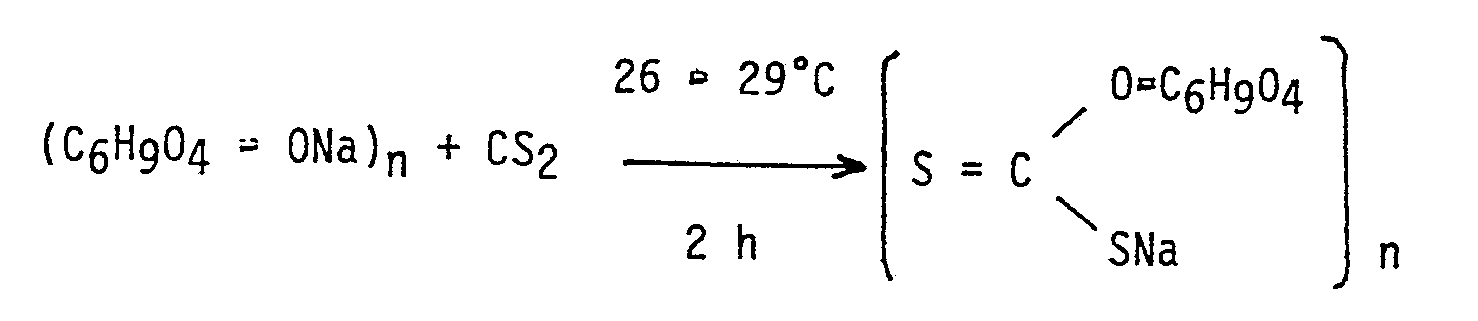
- On dissous ensuite le xanthate dans une solution de soude diluée. En fin d'opération, la solution contient une teneur en cellulose de 9 % environ et de soude de 5 % environ. La viscose obtenue est désaérée. On chauffe la solution à 100°C pendant 2 heures ce qui provoque une coagulation. On lave ensuite plusieurs fois avec de l'eau, du sulfite et du carbonate de soude. On obtient un matériau qui se présente sous une forme compacte, amorphe et relativement caoutchouteuse. Ce matériau est ensuite pressé durant 24 heures à une température de 110°C sous une pression de 2 bars, ce qui élimine l'eau qu'il contient.
- On obtient un matériau qui a l'aspect d'un bois naturel.
- Ce matériau hydrophile obtenu peut être utilisé selon l'invention dans diverses applications. Ses propriétés mécaniques telle que la rigidité en flexion, compression et tension sont comparables à celles d'un bois naturel. Ce matériau isotrope peut être usiné facilement.
- A partir du matériau hydrophile obtenu, on usine une gaine d'ajustage pour une queue métallique de prothèse de hanche afin d'appliquer le concept d'un scellement à joint d'effort modulable.
- On réalise un assemblage modèle constitué par un tronçon de diaphyse fémorale d'origine humaine dont le canal est occupé par la pièce métallique constituant la queue de prothèse, entourée par la gaine usinée du matériau poreux. Un des avantages du matériau utilisé est qu'on peut ajuster aisément le rapport d'occupation du canal par la gaine et optimiser la résistance de l'assemblage.
- L'ensemble est immergé dans du sérum physiologique à 37°C. L'empêchement de l'expansion volumique se traduit par l'établissement de pressions normales à l'interface limitant l'expansion.
- Sur la figure 1, on a représenté très schématiquement l'articulation de la hanche 1 avec 1a queue de prothèse 2 entourée par la gaine usinée 3 du matériau hydrophile selon l'invention, en place dans le canal médullaire du fémur 4.
- L'assemblage résiste bien aux efforts statique de cisaillements longitudinaux et rotationnels. La gaine contribue également à l'amortissement des nombreuses sollicitations dynamiques auxquelles est confrontée la prothèse articulaire.
- Le module d'élasticité mesuré du matériau hydrophile est compris entre 7 et 12 gigapascals alors que celui d'un ciment traditionnel en polyméthacrylate de méthyle est compris entre 5,1 et 5,7 gigapascals. Le matériau selon l'invention est moins rigide et il encaisse mieux les chocs.
- On opère de la même façon que dans l'exemple 1, sauf qu'on incorpore à la solution de viscose avant l'opération de coagulation, des fibres papetières de renforcement, à raison d'environ 30 % en poids de la viscose.
- Le produit obtenu peut être usiné aussi facilement que le produit hydrophile selon l'exemple 1.
- La résistance à la fatique est améliorée.
- On opère de la même façon que dans l'exemple 1, sauf qu'on soumet la viscose à un traitement d'élimination partielle du soufre, avant l'opération de coagulation. A cette fin, on ajoute à la solution de viscose du sulfite de sodium et du carbonate de sodium à raison de 10 g de sulfite de sodium et 2 g de carbonate de sodium pour 100 cm³ de solution de viscose. On laisse sous agitation à la température ambiante. On démarre ensuite la coagulation en chauffant la solution à 100°C environ pendant 1 heure environ. Le bloc obtenu est lavé plusieurs fois avec de l'eau chaude et de l'eau froide.
- Après séchage, on obtient un matériau qui a l'aspect du bois naturel et dont la teneur en soufre est d'environ 0,09 %.
Claims (15)
- on prépare de l'alcali-cellulose par trempage de la pâte de cellulose notamment de la pâte obtenue par le procédé bisulfite acide, dans une solution de soude suivi d'un essorage et d'un pressage pour atteindre un poids en cellulose sèche compris entre 30 % et 40 % environ,
- on réalise ensuite la sulfuration de l'alcali-cellulose par du sulfure de carbone, de préférence en excès par rapport aux quantités stoéchiométriques, pour obtenir du xanthate de sodium,
- on dissous le xanthate de sodium dans une solution de soude diluée pour obtenir de la viscose, c'est-à-dire une solution contenant de la cellulose et de la soude à des teneurs bien déterminées, de préférence de 7 à 12 % en poids de cellulose et de 4 à 8 % en poids de soude,
- on soumet la solution visqueuse obtenue à un traitement thermique afin de provoquer la coagulation de la viscose et à un traitement d'élimination du soufre, pour obtenir un matériau amorphe et présentant un caractère caoutchouteux,
- et on sèche le matériau obtenu.
Priority Applications (1)
| Application Number | Priority Date | Filing Date | Title |
|---|---|---|---|
| AT87401640T ATE69957T1 (de) | 1986-07-16 | 1987-07-10 | Hydrophiles biomaterial und verfahren zu seiner herstellung. |
Applications Claiming Priority (2)
| Application Number | Priority Date | Filing Date | Title |
|---|---|---|---|
| FR8610331 | 1986-07-16 | ||
| FR8610331A FR2601593B1 (fr) | 1986-07-16 | 1986-07-16 | Materiau hydrophile biocompatible, procede de fabrication et applications |
Publications (2)
| Publication Number | Publication Date |
|---|---|
| EP0256906A1 true EP0256906A1 (fr) | 1988-02-24 |
| EP0256906B1 EP0256906B1 (fr) | 1991-12-04 |
Family
ID=9337464
Family Applications (1)
| Application Number | Title | Priority Date | Filing Date |
|---|---|---|---|
| EP87401640A Expired - Lifetime EP0256906B1 (fr) | 1986-07-16 | 1987-07-10 | Matériau hydrophyle biocompatible, et son procédé de fabrication |
Country Status (10)
| Country | Link |
|---|---|
| US (3) | US4904258A (fr) |
| EP (1) | EP0256906B1 (fr) |
| JP (1) | JPS6373968A (fr) |
| AT (1) | ATE69957T1 (fr) |
| AU (1) | AU603813B2 (fr) |
| CA (1) | CA1298289C (fr) |
| DE (1) | DE3774961D1 (fr) |
| ES (1) | ES2028891T3 (fr) |
| FR (1) | FR2601593B1 (fr) |
| GR (1) | GR3003954T3 (fr) |
Families Citing this family (9)
| Publication number | Priority date | Publication date | Assignee | Title |
|---|---|---|---|---|
| FR2601593B1 (fr) * | 1986-07-16 | 1994-04-15 | Cellulose Pin | Materiau hydrophile biocompatible, procede de fabrication et applications |
| CH680564A5 (fr) * | 1989-12-07 | 1992-09-30 | Experimentelle Chirurgie Schwe | |
| US5282857A (en) * | 1992-04-13 | 1994-02-01 | Perry Larry C | Gel-filled implants |
| RU2136319C1 (ru) * | 1993-12-23 | 1999-09-10 | Джонсон энд Джонсон Медикал, Инк. | Биоабсорбируемое хирургическое гемостатическое средство и способ его получения (варианты) |
| AU5262000A (en) * | 1999-05-28 | 2000-12-18 | Christian Hogfors | Implantable device for lengthening and correcting malpositions of skeletal bones |
| FI108403B (fi) * | 2000-02-25 | 2002-01-31 | Yli Urpo Antti | Yksil÷n kudosrekonstruktioon soveltuva materiaali |
| US20020114795A1 (en) * | 2000-12-22 | 2002-08-22 | Thorne Kevin J. | Composition and process for bone growth and repair |
| US7718616B2 (en) | 2006-12-21 | 2010-05-18 | Zimmer Orthobiologics, Inc. | Bone growth particles and osteoinductive composition thereof |
| US8613938B2 (en) | 2010-11-15 | 2013-12-24 | Zimmer Orthobiologics, Inc. | Bone void fillers |
Citations (5)
| Publication number | Priority date | Publication date | Assignee | Title |
|---|---|---|---|---|
| GB407811A (en) * | 1933-01-30 | 1934-03-29 | Courtaulds Ltd | Improvements in and relating to the manufacture and production of tubular bodies from viscose |
| FR1310496A (fr) * | 1960-03-28 | 1962-11-30 | Johnson & Johnson | Procédé de fabrication d'une matière hémostatique et matière obtenue par ce procédé |
| US3108357A (en) * | 1962-06-20 | 1963-10-29 | William J Liebig | Compound absorbable prosthetic implants, fabrics and yarns therefor |
| FR2147139A1 (fr) * | 1971-07-23 | 1973-03-09 | Viscose Development Co Ltd | |
| WO1986001113A1 (fr) * | 1984-08-17 | 1986-02-27 | Gerrit Johannes Brinks | Materiau de remplacement d'os |
Family Cites Families (15)
| Publication number | Priority date | Publication date | Assignee | Title |
|---|---|---|---|---|
| US2451558A (en) * | 1944-11-06 | 1948-10-19 | Rayonier Inc | Chemically treated wood pulp and a method of producing a cellulosic product |
| US3657035A (en) * | 1969-07-23 | 1972-04-18 | Nylonge Corp | Water absorbent web and its production |
| US4200558A (en) * | 1973-12-24 | 1980-04-29 | Hoechst Aktiengesellschaft | Method of producing hydrophilic articles of water-insoluble polymers |
| US3901236A (en) * | 1974-07-29 | 1975-08-26 | Union Carbide Corp | Disposable absorbent articles containing hydrogel composites having improved fluid absorption efficiencies and processes for preparation |
| US4210747A (en) * | 1976-03-10 | 1980-07-01 | Kemira Oy | Process for the preparation of viscose |
| JPS5950339B2 (ja) * | 1977-03-29 | 1984-12-07 | ユニチカ株式会社 | セルロ−ス系抗血栓性医療材料 |
| DE2855061A1 (de) * | 1978-12-20 | 1980-06-26 | Hoechst Ag | Verfahren zur herstellung von viskose |
| US4270914A (en) * | 1979-10-26 | 1981-06-02 | Borregaard Industries Limited | Process for controlling hemicellulose concentration during the mercerization of cellulose |
| US4289875A (en) * | 1979-10-29 | 1981-09-15 | Fiber Associates, Incorporated | Process for continuous filtration and aging of xanthated alkali cellulose |
| US4284765A (en) * | 1979-12-11 | 1981-08-18 | Fiber Associates, Inc. | Automatic aging analyzer using a motor having a constant torque |
| DE3000306A1 (de) * | 1980-01-05 | 1981-07-09 | Hoechst Ag, 6230 Frankfurt | Verfahren zur herstellung von viskose |
| US4405324A (en) * | 1981-08-24 | 1983-09-20 | Morca, Inc. | Absorbent cellulosic structures |
| US4468428A (en) * | 1982-06-01 | 1984-08-28 | The Procter & Gamble Company | Hydrophilic microfibrous absorbent webs |
| JPS59225064A (ja) * | 1983-06-03 | 1984-12-18 | ユニチカ株式会社 | 生理活性物質固定化用担体 |
| FR2601593B1 (fr) * | 1986-07-16 | 1994-04-15 | Cellulose Pin | Materiau hydrophile biocompatible, procede de fabrication et applications |
-
1986
- 1986-07-16 FR FR8610331A patent/FR2601593B1/fr not_active Expired - Fee Related
-
1987
- 1987-07-10 AU AU75530/87A patent/AU603813B2/en not_active Ceased
- 1987-07-10 EP EP87401640A patent/EP0256906B1/fr not_active Expired - Lifetime
- 1987-07-10 ES ES198787401640T patent/ES2028891T3/es not_active Expired - Lifetime
- 1987-07-10 DE DE8787401640T patent/DE3774961D1/de not_active Expired - Lifetime
- 1987-07-10 AT AT87401640T patent/ATE69957T1/de not_active IP Right Cessation
- 1987-07-14 CA CA000542060A patent/CA1298289C/fr not_active Expired - Lifetime
- 1987-07-15 JP JP62174992A patent/JPS6373968A/ja active Pending
- 1987-07-16 US US07/074,047 patent/US4904258A/en not_active Expired - Fee Related
-
1989
- 1989-12-06 US US07/446,693 patent/US5123923A/en not_active Expired - Fee Related
-
1992
- 1992-01-09 US US07/818,561 patent/US5152793A/en not_active Expired - Fee Related
- 1992-03-04 GR GR920400376T patent/GR3003954T3/el unknown
Patent Citations (5)
| Publication number | Priority date | Publication date | Assignee | Title |
|---|---|---|---|---|
| GB407811A (en) * | 1933-01-30 | 1934-03-29 | Courtaulds Ltd | Improvements in and relating to the manufacture and production of tubular bodies from viscose |
| FR1310496A (fr) * | 1960-03-28 | 1962-11-30 | Johnson & Johnson | Procédé de fabrication d'une matière hémostatique et matière obtenue par ce procédé |
| US3108357A (en) * | 1962-06-20 | 1963-10-29 | William J Liebig | Compound absorbable prosthetic implants, fabrics and yarns therefor |
| FR2147139A1 (fr) * | 1971-07-23 | 1973-03-09 | Viscose Development Co Ltd | |
| WO1986001113A1 (fr) * | 1984-08-17 | 1986-02-27 | Gerrit Johannes Brinks | Materiau de remplacement d'os |
Non-Patent Citations (1)
| Title |
|---|
| GAZETTE VAN ANTWERPEN, 8 novembre 1977, page 7; "Houtenbeen": "Le tissu osseux repousse dans les pores de diverses sortes de bois notamment le bois de frêne ou de bouleau" * |
Also Published As
| Publication number | Publication date |
|---|---|
| ATE69957T1 (de) | 1991-12-15 |
| EP0256906B1 (fr) | 1991-12-04 |
| JPS6373968A (ja) | 1988-04-04 |
| GR3003954T3 (fr) | 1993-03-16 |
| ES2028891T3 (es) | 1992-07-16 |
| AU603813B2 (en) | 1990-11-29 |
| US5123923A (en) | 1992-06-23 |
| AU7553087A (en) | 1988-01-21 |
| US5152793A (en) | 1992-10-06 |
| FR2601593B1 (fr) | 1994-04-15 |
| CA1298289C (fr) | 1992-03-31 |
| US4904258A (en) | 1990-02-27 |
| DE3774961D1 (de) | 1992-01-16 |
| FR2601593A1 (fr) | 1988-01-22 |
Similar Documents
| Publication | Publication Date | Title |
|---|---|---|
| EP0256906B1 (fr) | Matériau hydrophyle biocompatible, et son procédé de fabrication | |
| EP1599238B1 (fr) | Ligament prothetique biomimetique et procede d'obtention | |
| EP0214070B1 (fr) | Produit de remplacement de la matrice osseuse favorisant l'ostéogénèse | |
| CN1230207C (zh) | 骨代用品材料 | |
| CH621059A5 (fr) | ||
| FI64131B (fi) | Foerfarande foer framstaellning av polykristallint sintrat keramiskt material | |
| JPS6247544B2 (fr) | ||
| Ohlsèn et al. | The early development of articular cartilage after perichondrial grafting | |
| FR2749756A1 (fr) | Procede de preparation d'un materiau composite implantable, materiau obtenu, implant comprenant ce materiau et kit de mise en oeuvre | |
| JP4551761B2 (ja) | ケラチン由来の整形外科材料 | |
| JPH0346146B2 (fr) | ||
| EP2897657B1 (fr) | Échafaudage dur | |
| JP2003169845A (ja) | スポンジ状多孔質アパタイト・コラーゲン複合体、スポンジ状超多孔質アパタイト・コラーゲン複合体及びそれらの製造方法 | |
| EP0454599A1 (fr) | Prothèse ligamentaire et procédé de fabrication | |
| FR2687577A1 (fr) | Biomateriau pour la realisation de produits applicables en medecine humaine particulierement en orthopedie et son procede de fabrication. | |
| EP0011523B1 (fr) | Hydrogels de polymères protéiques naturels, leur préparation et lentilles de contact souples à partir de ceux-ci | |
| CN109897194A (zh) | 一种仿昆虫表皮结构的高强度水凝胶制备方法 | |
| KR970004592B1 (ko) | 자연골치환형 인공골과 그 제조방법 | |
| BE1030086B1 (fr) | Matériau de régénération osseuse | |
| EP0534873A1 (fr) | Procédé pour la réalisation d'une poudre destinée à la fabrication d'os de synthèse, poudre et produits ainsi réalisés | |
| BE831944A (fr) | Materiau ceramique | |
| KR20240100305A (ko) | 치과용 멤브레인 제조방법 및 치과용 멤브레인 | |
| RU2150964C1 (ru) | Композитный субстант для остеорепарации | |
| WO2025205926A1 (fr) | Matériau médical et son procédé de production | |
| CN120242146A (zh) | 一种抗液体扩散多孔壳聚糖-羟基磷灰石复合材料及其制备方法 |
Legal Events
| Date | Code | Title | Description |
|---|---|---|---|
| PUAI | Public reference made under article 153(3) epc to a published international application that has entered the european phase |
Free format text: ORIGINAL CODE: 0009012 |
|
| AK | Designated contracting states |
Kind code of ref document: A1 Designated state(s): AT BE CH DE ES FR GB GR IT LI LU NL SE |
|
| 17P | Request for examination filed |
Effective date: 19880718 |
|
| 17Q | First examination report despatched |
Effective date: 19890925 |
|
| GRAA | (expected) grant |
Free format text: ORIGINAL CODE: 0009210 |
|
| AK | Designated contracting states |
Kind code of ref document: B1 Designated state(s): AT BE CH DE ES FR GB GR IT LI LU NL SE |
|
| REF | Corresponds to: |
Ref document number: 69957 Country of ref document: AT Date of ref document: 19911215 Kind code of ref document: T |
|
| REF | Corresponds to: |
Ref document number: 3774961 Country of ref document: DE Date of ref document: 19920116 |
|
| ITF | It: translation for a ep patent filed | ||
| GBT | Gb: translation of ep patent filed (gb section 77(6)(a)/1977) | ||
| REG | Reference to a national code |
Ref country code: ES Ref legal event code: FG2A Ref document number: 2028891 Country of ref document: ES Kind code of ref document: T3 |
|
| PLBE | No opposition filed within time limit |
Free format text: ORIGINAL CODE: 0009261 |
|
| STAA | Information on the status of an ep patent application or granted ep patent |
Free format text: STATUS: NO OPPOSITION FILED WITHIN TIME LIMIT |
|
| 26N | No opposition filed | ||
| REG | Reference to a national code |
Ref country code: GR Ref legal event code: FG4A Free format text: 3003954 |
|
| PGFP | Annual fee paid to national office [announced via postgrant information from national office to epo] |
Ref country code: SE Payment date: 19940527 Year of fee payment: 8 |
|
| PGFP | Annual fee paid to national office [announced via postgrant information from national office to epo] |
Ref country code: GR Payment date: 19940630 Year of fee payment: 8 |
|
| PGFP | Annual fee paid to national office [announced via postgrant information from national office to epo] |
Ref country code: ES Payment date: 19940704 Year of fee payment: 8 |
|
| PGFP | Annual fee paid to national office [announced via postgrant information from national office to epo] |
Ref country code: BE Payment date: 19940706 Year of fee payment: 8 |
|
| PGFP | Annual fee paid to national office [announced via postgrant information from national office to epo] |
Ref country code: AT Payment date: 19940711 Year of fee payment: 8 |
|
| PGFP | Annual fee paid to national office [announced via postgrant information from national office to epo] |
Ref country code: CH Payment date: 19940729 Year of fee payment: 8 |
|
| PGFP | Annual fee paid to national office [announced via postgrant information from national office to epo] |
Ref country code: NL Payment date: 19940731 Year of fee payment: 8 Ref country code: LU Payment date: 19940731 Year of fee payment: 8 |
|
| EPTA | Lu: last paid annual fee | ||
| EAL | Se: european patent in force in sweden |
Ref document number: 87401640.5 |
|
| PG25 | Lapsed in a contracting state [announced via postgrant information from national office to epo] |
Ref country code: LU Free format text: LAPSE BECAUSE OF NON-PAYMENT OF DUE FEES Effective date: 19950710 Ref country code: AT Effective date: 19950710 |
|
| PG25 | Lapsed in a contracting state [announced via postgrant information from national office to epo] |
Ref country code: SE Effective date: 19950711 Ref country code: ES Free format text: LAPSE BECAUSE OF NON-PAYMENT OF DUE FEES Effective date: 19950711 |
|
| PG25 | Lapsed in a contracting state [announced via postgrant information from national office to epo] |
Ref country code: LI Effective date: 19950731 Ref country code: CH Effective date: 19950731 Ref country code: BE Effective date: 19950731 |
|
| BERE | Be: lapsed |
Owner name: UNIVERSITE DE BORDEAUX II Effective date: 19950731 Owner name: LA CELLULOSE DU PIN Effective date: 19950731 |
|
| PG25 | Lapsed in a contracting state [announced via postgrant information from national office to epo] |
Ref country code: GR Free format text: THE PATENT HAS BEEN ANNULLED BY A DECISION OF A NATIONAL AUTHORITY Effective date: 19960131 |
|
| PG25 | Lapsed in a contracting state [announced via postgrant information from national office to epo] |
Ref country code: NL Effective date: 19960201 |
|
| REG | Reference to a national code |
Ref country code: CH Ref legal event code: PL |
|
| REG | Reference to a national code |
Ref country code: GR Ref legal event code: MM2A Free format text: 3003954 |
|
| NLV4 | Nl: lapsed or anulled due to non-payment of the annual fee |
Effective date: 19960201 |
|
| EUG | Se: european patent has lapsed |
Ref document number: 87401640.5 |
|
| PGFP | Annual fee paid to national office [announced via postgrant information from national office to epo] |
Ref country code: GB Payment date: 19960628 Year of fee payment: 10 |
|
| PGFP | Annual fee paid to national office [announced via postgrant information from national office to epo] |
Ref country code: FR Payment date: 19960719 Year of fee payment: 10 |
|
| PGFP | Annual fee paid to national office [announced via postgrant information from national office to epo] |
Ref country code: DE Payment date: 19960824 Year of fee payment: 10 |
|
| PG25 | Lapsed in a contracting state [announced via postgrant information from national office to epo] |
Ref country code: GB Free format text: LAPSE BECAUSE OF NON-PAYMENT OF DUE FEES Effective date: 19970710 |
|
| GBPC | Gb: european patent ceased through non-payment of renewal fee |
Effective date: 19970710 |
|
| PG25 | Lapsed in a contracting state [announced via postgrant information from national office to epo] |
Ref country code: FR Free format text: LAPSE BECAUSE OF NON-PAYMENT OF DUE FEES Effective date: 19980331 |
|
| PG25 | Lapsed in a contracting state [announced via postgrant information from national office to epo] |
Ref country code: DE Free format text: LAPSE BECAUSE OF NON-PAYMENT OF DUE FEES Effective date: 19980401 |
|
| REG | Reference to a national code |
Ref country code: FR Ref legal event code: ST |
|
| REG | Reference to a national code |
Ref country code: ES Ref legal event code: FD2A Effective date: 20020603 |
|
| PG25 | Lapsed in a contracting state [announced via postgrant information from national office to epo] |
Ref country code: IT Free format text: LAPSE BECAUSE OF NON-PAYMENT OF DUE FEES;WARNING: LAPSES OF ITALIAN PATENTS WITH EFFECTIVE DATE BEFORE 2007 MAY HAVE OCCURRED AT ANY TIME BEFORE 2007. THE CORRECT EFFECTIVE DATE MAY BE DIFFERENT FROM THE ONE RECORDED. Effective date: 20050710 |