EP0264936A2 - Method of producing composite steel body shaft - Google Patents
Method of producing composite steel body shaft Download PDFInfo
- Publication number
- EP0264936A2 EP0264936A2 EP87115455A EP87115455A EP0264936A2 EP 0264936 A2 EP0264936 A2 EP 0264936A2 EP 87115455 A EP87115455 A EP 87115455A EP 87115455 A EP87115455 A EP 87115455A EP 0264936 A2 EP0264936 A2 EP 0264936A2
- Authority
- EP
- European Patent Office
- Prior art keywords
- steel body
- diameter
- producing
- hole
- cavity
- Prior art date
- Legal status (The legal status is an assumption and is not a legal conclusion. Google has not performed a legal analysis and makes no representation as to the accuracy of the status listed.)
- Granted
Links
- 229910000831 Steel Inorganic materials 0.000 title claims abstract description 80
- 239000010959 steel Substances 0.000 title claims abstract description 80
- 239000002131 composite material Substances 0.000 title claims abstract description 29
- 238000000034 method Methods 0.000 title claims abstract description 20
- 239000002184 metal Substances 0.000 claims abstract description 40
- 229910052751 metal Inorganic materials 0.000 claims abstract description 40
- PXHVJJICTQNCMI-UHFFFAOYSA-N Nickel Chemical compound [Ni] PXHVJJICTQNCMI-UHFFFAOYSA-N 0.000 claims description 18
- 229910052759 nickel Inorganic materials 0.000 claims description 9
- 229910001141 Ductile iron Inorganic materials 0.000 claims description 7
- XEEYBQQBJWHFJM-UHFFFAOYSA-N Iron Chemical compound [Fe] XEEYBQQBJWHFJM-UHFFFAOYSA-N 0.000 claims description 5
- 229910000975 Carbon steel Inorganic materials 0.000 claims description 3
- 239000010962 carbon steel Substances 0.000 claims description 3
- 229910052742 iron Inorganic materials 0.000 claims description 2
- 238000001816 cooling Methods 0.000 abstract description 31
- 239000002893 slag Substances 0.000 abstract description 21
- 238000002844 melting Methods 0.000 description 19
- 230000008018 melting Effects 0.000 description 19
- 239000000463 material Substances 0.000 description 9
- XLYOFNOQVPJJNP-UHFFFAOYSA-N water Substances O XLYOFNOQVPJJNP-UHFFFAOYSA-N 0.000 description 6
- 239000010949 copper Substances 0.000 description 5
- 238000004519 manufacturing process Methods 0.000 description 4
- 238000000465 moulding Methods 0.000 description 4
- 239000000498 cooling water Substances 0.000 description 3
- RYGMFSIKBFXOCR-UHFFFAOYSA-N Copper Chemical compound [Cu] RYGMFSIKBFXOCR-UHFFFAOYSA-N 0.000 description 2
- 229910052802 copper Inorganic materials 0.000 description 2
- 239000000155 melt Substances 0.000 description 2
- 102200082816 rs34868397 Human genes 0.000 description 2
- 238000010420 art technique Methods 0.000 description 1
- 230000015572 biosynthetic process Effects 0.000 description 1
- 230000007547 defect Effects 0.000 description 1
- 230000000694 effects Effects 0.000 description 1
- 230000004927 fusion Effects 0.000 description 1
- 239000012535 impurity Substances 0.000 description 1
- 238000010309 melting process Methods 0.000 description 1
- 230000002093 peripheral effect Effects 0.000 description 1
Images




Classifications
-
- C—CHEMISTRY; METALLURGY
- C22—METALLURGY; FERROUS OR NON-FERROUS ALLOYS; TREATMENT OF ALLOYS OR NON-FERROUS METALS
- C22B—PRODUCTION AND REFINING OF METALS; PRETREATMENT OF RAW MATERIALS
- C22B9/00—General processes of refining or remelting of metals; Apparatus for electroslag or arc remelting of metals
- C22B9/16—Remelting metals
- C22B9/18—Electroslag remelting
-
- B—PERFORMING OPERATIONS; TRANSPORTING
- B22—CASTING; POWDER METALLURGY
- B22D—CASTING OF METALS; CASTING OF OTHER SUBSTANCES BY THE SAME PROCESSES OR DEVICES
- B22D23/00—Casting processes not provided for in groups B22D1/00 - B22D21/00
- B22D23/06—Melting-down metal, e.g. metal particles, in the mould
- B22D23/10—Electroslag casting
Definitions
- the present invention relates to a method of producing a composite steel body shaft used to form a shaft member such as a screw rotor having tooth portions and a shaft portion which screw rotor is used in a screw compressor, and relates more particularly to a process of producing a composite steel body shaft by electroslag remelting.
- Japanese Patent Unexamined Publication No. 197232/1983 discloses an example of a method comprising the steps of providing a steel body with a cavity, inserting a consumable electrode into the cavity, melting the consumable electrode in the manner of electroslag remelting and thereafter solidifying the melt made of the consumable electrode, thereby manufacturing a composite steel body.
- Another example of the method, in which the consumable electrode is melted in the manner of the electroslag rmelting is disclosed in Japanese Patent Examined Publication No. 5402/1977. These methods were provided with a view to obtaining a high quality material having a fine structure.
- no method of forming a composite steel body shaft by connecting a steel ingot to the outer periphery of a central shaft member made of the consumable electrode in the manner of electroslag remelting had been discussed.
- a cross-sectional area of the cavity of the hollow steel body is smaller than that of the cavity of the metal mold, the upward movement of slag provided on a bath is obstructed by a steel body portion protruding radially inward from the periphery of the cavity of a larger diameter when a melting portion made of the material of the electrode reaches in the vicinity of the protruding steel body portion and when the protruding portion is to be melted, so that the slag mass cannot be smoothly raised and there is caused such a fear that a part of the slag is mixed with or confined in the remelting portion of the hollow steel body.
- This confined slag makes it impossible to obtain advantageous effects of the electroslag remelting technique which is used for forming a shaft portion formed in the hollow steel body so as to achieve high quality. Also, in an extreme case, there will occur a fear of serious defects in the end portion of the interface along which a shaft portion is integrated to the outer steel body, due to the confined slag.
- the present invention provides a method of producing a composite steel body shaft, comprising the steps of: disposing a cylindrical steel body having a cavity of a diameter (D) and two axial end surfaces so that said cylindrical steel ingot stands vertically; disposing at least one cylindrical metal mold having a cavity of a diameter (d) so that said cylindrical metal mold stands vertically in a coaxially contacting relation to least one of said end surfaces of said steel body, thereby forming a through-hole defined by said cavities of said steel body and said mold; forming a space of a shape having a bottom of a dimension greater than one of said diameters (D) or (d) of said cavities which one is greater than the other, said space being formed in a portion of said steel body or of said metal mold the cavity of which portion has the smaller one of said diameters, at the position of contact defined between said steel body and said metal mold at which position the diameter of said through hole is reduced from (D) to (d) or from (d) to (D) with respect to the vertically upward direction; inserting
- the cross sectional area of said space is reduced linearly with respect to a direction advancing upward from said position of contact at which said steel body contacts said mold, and said space being in communication with an intermediate portion of one of said cavities having said diameter (D) or (d).
- said space is of a truncated cone shape.
- the inclination of the tilted curved surface of said truncated cone shape can be in a range of 5° to 45° with respect to the axis of the through-hole.
- the lower bottom of said truncated cone shape can be slightly larger in diameter than the diameter (D) or (d) of one of said cavities which one is in direct communication with said space of the truncated cone shape.
- the shaft portion is made of a carbon steel for machine structural use, the steel body integrally connected onto the shaft portion being made of a high nickel ductile cast iron.
- the high nickel ductile cast iron may consist essentially, by weight, of 32 to 46% nickel and the balance iron.
- FIG. 3 is an illustration of a basic constitution of the present invention.
- An electroslag remelting apparatus used in the invention comprises an electrode molding base 9, power source equipment 10, current supply wirings 11 and 12, a consumable electrode 7, and an electrode-lifting device 8.
- a lower cooling metal mold 5 and an upper cooling metal mold 6 are disposed to be in contact with the upper and lower ends of a hollow steel body 4, respectively.
- the consumable electrode 7 is inserted into a through hole defined by both the metal molds and the hollow steel body 4 all of which are disposed coaxially, and is melted under a slag 15 by current supplied from the power source equipment 10, thereby forming a melting portion 14. As the melting portion 14 moves upward, the consumable electrode 7 is raised by the electrode lifting device 8.
- Fig. 4 illustrates the state of melting in the cavity of the hollow steel body in which the melting portion 14 melts a wall portion of the cavity of a steel body 4 to thereby be mixed therewith and is thereafter solidified, whereby there are formed the solidified portion 13 and a connecting portion 16.
- a composite steel body shaft such as that shown in Fig. 2 can be obtained by removing the upper cooling metal mold 6 and the lower cooling metal mold 5.
- the type of composite steel body shaft in which a shaft portion which is formed from the material of the consumable electrode 7 protrudes beyond the opposite ends of the steel body 4, has been described above with reference to Figs. 2 to 5.
- another composite steel body shaft having such a shape as in Fig.
- one or more cooling metal molds having cavities which communicate with the cavity of the hollow steel body are disposed at the upper and/or lower end of the hollow steel body, and the consumable electrode is continuously melted under the slag in a through hole defined by the cavities.
- a composite steel body shaft having one or more steel body members which are disposed along and are connected to the outer periphery of the center shaft portion formed of the material of the consumable electrode, at a position or at a plurality of positions over the length of the center shaft portion.
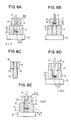
- Figs. 8 and 9 illustrate the movement of the slag.
- the confining of a slag 18 occurs at a position, e.g., at the position of a contact interface 17 defined between the lower cooling metal mold 5 and the hollow steel body 4, as shown in Fig. 8B.
- a chamfer 20 shown in Fig. 8E which chamber 20 defines a truncated cone shape having a lower bottom slightly larger (, for example by 1 to 3 mm) than the size (D) of the metal mold cavity, as shown in Fig. 8E, thereby preventing the confining of the slag from occurring and enabling manufacture of a composite steel body shaft having no notched portion. It is preferred that an inclination of the chamfer 20 defined with respect to the axis of the through hole is in a range of 5 to 45°. Figs.
- FIG. 9A and 9B illustrate a case in which slag moves from the cavity of the hollow steel body 4 to the upper cooling metal mold 6.
- the slag-confining 21 occurs, as shown in Fig. 9B, in a manner similar to that shown in Fig. 8B, resulting in the occurrence of a notched portion 22 in the slag-confining portion solidified after melting, as shown in Fig. 9(c).
- a chamfer 23 which forms a space of a truncated cone shape 23, may be formed in the lower end portion of the upper cooling metal mold 6, as shown in Fig. 9E, thereby preventing the confining of the slag from occurring and enabling manufacture of a composite steel body shaft having no notched portion.
- a chamfer at an lower edge of the step-wise diameter-reducing portion of the cooling metal mold or of the hollow steel body 4, as shown in Fig. 1 or 8E, which chamfer defines a space of a truncated cone shape having a lower bottom slightly larger in size than a cavity of the metal mold (or of the hollow steel body) disposed in contact with the edge at which the truncated cone space is provided, an inclination of which chamfer is in a range of 5° - 45°.
- FIG. 1 A working example of the process embodying the present invention will now be described with reference to Fig. 1.
- the arrangement shown in Fig. 1 is used to produce a composite steel body shaft to be formed into a rotor for use in an oil-free screw compressor, the composite steel body shaft being in the form of a stepped round bar.
- a center shaft portion thereof is made of a carbon steel for machine structural use such as S45C defined in JIS G4051 which is a material of the consumable electrode 27.
- An outer steel body of high nickel ductile cast iron consisting of 32 - 46 wt% Ni and the balance Fe and incidental impurities was connected to a part of the outer periphery of the center shaft portion.
- a lower cooling mold 31 made of Cu which has an internal cavity 45 and which as both a columnar shape having a diameter of 39 mm and an water jacket 43 were placed on a molding board 38 made of Cu which is disposed at the lowermost position.
- a hollow round bar 30 made of hig Ni ductile cast iron and which bar 30 has a columnar cavity 46 of 23 mm in diameter and a truncated-cone-shape space 47 was coaxially placed on the lower cooling mold 31.
- An upper cooling mold 29 made of Cu which has both an internal cavity 45 and an water jacket 42 was placed in an end-to-end contact coaxial relation to the hollow round bar 30.
- the truncated-cone-like space 47 was defined by a chamfer having an inclination of 5.2° and was provided with a lower bottom of 40 cm in diameter.
- the cooling metal molds were formed of copper because copper has a high thermal conductivity. Cooling water was supplied to the water jackets of the upper and lower cooling metal molds by a pump 34 which draws cooling water from a water tank 36. Cooling water was first supplied from the pump 34 to the water jacket 43 via a pipe 33, then to the water jacket 42 via a pipe 32, and was finally returned to the water tank 36 via a pipe 35.
- An consumable electrode 27 was inserted in the through-hole so that the lower end thereof was in the vicinity of the board 38, and electroslag remelting was started from the position immediately above the molding board 38.
- electric power of 500 - 600 A at 35 - 45 V was supplied from power source equipment 28 by connecting one of the terminals thereof to the molding board 38 through a brush 37 and by connecting another terminal to the consumable electrode 27 through an electrode-lifting device 26.
- electroslag remelting was continuously performed successively from the lower cooling metal mold 31 to the hollow round bar 30 then to the upper cooling metal mold, thereby obtaining a composite shaft member bar for producing a composite rotor used in an oil-free screw compressor.
- the shaft member had a center shaft portion 45 made of the material S45C and an outer peripheral portion 46 made of the high nickel ductile cast iron and had connected to a part of the center shaft portion, as shown in Fig. 11.
- a chamfer 44 having an inclination of 5.2° with respect to the axis of the through-hole was provided at the lower end of the hollow round bar 30 in order to prevent the confining of slag 39 from occurring at any intermediate portion, with the result that no occurrence of a notched or recessed portion at the end portions, of the hollow round bar 30 was ensured because no confining of slag occurs during the upper movement of the slag and remelting metal.
- the present invention ensures that the slag can be smoothly moved upward, thereby enabling the production of a composite steel body shaft of high quality.
Landscapes
- Engineering & Computer Science (AREA)
- Mechanical Engineering (AREA)
- Chemical & Material Sciences (AREA)
- Manufacturing & Machinery (AREA)
- Materials Engineering (AREA)
- Metallurgy (AREA)
- Organic Chemistry (AREA)
- Manufacture And Refinement Of Metals (AREA)
- Heat Treatment Of Articles (AREA)
- Molds, Cores, And Manufacturing Methods Thereof (AREA)
Abstract
Description
- The present invention relates to a method of producing a composite steel body shaft used to form a shaft member such as a screw rotor having tooth portions and a shaft portion which screw rotor is used in a screw compressor, and relates more particularly to a process of producing a composite steel body shaft by electroslag remelting.
- Japanese Patent Unexamined Publication No. 197232/1983 discloses an example of a method comprising the steps of providing a steel body with a cavity, inserting a consumable electrode into the cavity, melting the consumable electrode in the manner of electroslag remelting and thereafter solidifying the melt made of the consumable electrode, thereby manufacturing a composite steel body. Another example of the method, in which the consumable electrode is melted in the manner of the electroslag rmelting, is disclosed in Japanese Patent Examined Publication No. 5402/1977. These methods were provided with a view to obtaining a high quality material having a fine structure. With respect to these related prior arts, no method of forming a composite steel body shaft by connecting a steel ingot to the outer periphery of a central shaft member made of the consumable electrode in the manner of electroslag remelting had been discussed.
- Further, in the above-described prior art technique, only the connection of both a hollow steel body member and a consumable electrod material had been taken into consideration, that is, no forming of a shaft other than such connection by use of the electroslag remelting had been taken into consideration. Therefore, if a cross-sectional area of the cavity of the hollow steel body is smaller than that of the cavity of the metal mold, the upward movement of slag provided on a bath is obstructed by a steel body portion protruding radially inward from the periphery of the cavity of a larger diameter when a melting portion made of the material of the electrode reaches in the vicinity of the protruding steel body portion and when the protruding portion is to be melted, so that the slag mass cannot be smoothly raised and there is caused such a fear that a part of the slag is mixed with or confined in the remelting portion of the hollow steel body. This confined slag makes it impossible to obtain advantageous effects of the electroslag remelting technique which is used for forming a shaft portion formed in the hollow steel body so as to achieve high quality. Also, in an extreme case, there will occur a fear of serious defects in the end portion of the interface along which a shaft portion is integrated to the outer steel body, due to the confined slag.
- It is an object of the present invention to provide a method of producing a composite steel body shaft of high quality by use of electroslag remelting.
- The present invention provides a method of producing a composite steel body shaft, comprising the steps of:
disposing a cylindrical steel body having a cavity of a diameter (D) and two axial end surfaces so that said cylindrical steel ingot stands vertically;
disposing at least one cylindrical metal mold having a cavity of a diameter (d) so that said cylindrical metal mold stands vertically in a coaxially contacting relation to least one of said end surfaces of said steel body, thereby forming a through-hole defined by said cavities of said steel body and said mold;
forming a space of a shape having a bottom of a dimension greater than one of said diameters (D) or (d) of said cavities which one is greater than the other, said space being formed in a portion of said steel body or of said metal mold the cavity of which portion has the smaller one of said diameters, at the position of contact defined between said steel body and said metal mold at which position the diameter of said through hole is reduced from (D) to (d) or from (d) to (D) with respect to the vertically upward direction;
inserting a consumable electrode into said through hole; and
effecting an electroslag remelting-and-solidifying of the electrode by supplying power to said consumable electrode so as to form a shaft portion in said through hole and so as to connect said shaft portion and said cylindrical steel body to each other. - Advantageously the cross sectional area of said space is reduced linearly with respect to a direction advancing upward from said position of contact at which said steel body contacts said mold, and said space being in communication with an intermediate portion of one of said cavities having said diameter (D) or (d).
- Conveniently said space is of a truncated cone shape.
- The inclination of the tilted curved surface of said truncated cone shape can be in a range of 5° to 45° with respect to the axis of the through-hole.
- Further, the lower bottom of said truncated cone shape can be slightly larger in diameter than the diameter (D) or (d) of one of said cavities which one is in direct communication with said space of the truncated cone shape.
- Preferably the shaft portion is made of a carbon steel for machine structural use, the steel body integrally connected onto the shaft portion being made of a high nickel ductile cast iron.
- The high nickel ductile cast iron may consist essentially, by weight, of 32 to 46% nickel and the balance iron.
- In the following embodiments of the invention are described with the aid of drawings.
- Fig. 1 is an illustration of an embodiment of the present invention;
- Fig. 2 is a schematic illustration of a composite steel body shaft which is produced in accordance with the present invention;
- Fig. 3 is an illustration of a basic arrangement of the present invention;
- Fig. 4 is an illustration of the state of melting in a cavity of a hollow steel body;
- Fig. 5 is an illustration of the state of connection achieved after the completion of melting;
- Figs. 6 and 7 are illustrations of examples of the composite steel body;
- Figs. 8A to 8E and 9A and 9E are illustrations of confining of slag during melting;
- Fig. 10 is an illustration of a chamfer; and
- Fig. 11 is an illustration of a composite steel body shaft produced in accordance with the embodiment of the present invention.
- Fig. 3 is an illustration of a basic constitution of the present invention. An electroslag remelting apparatus used in the invention comprises an
electrode molding base 9,power source equipment 10,current supply wirings 11 and 12, aconsumable electrode 7, and an electrode-lifting device 8. In the electrode remelting apparatus, a lowercooling metal mold 5 and an uppercooling metal mold 6 are disposed to be in contact with the upper and lower ends of ahollow steel body 4, respectively. Theconsumable electrode 7 is inserted into a through hole defined by both the metal molds and thehollow steel body 4 all of which are disposed coaxially, and is melted under aslag 15 by current supplied from thepower source equipment 10, thereby forming a meltingportion 14. As the meltingportion 14 moves upward, theconsumable electrode 7 is raised by theelectrode lifting device 8. Since thecooling metal molds melting portion 14, and a part of themelting portion 14 becomes asolidified portion 13 because of the removal of the heat thereof by use of the cooling mold. The consumable electrode is continuously melted under theslag 15 until the melting portion reaches the upper end of the uppercooling metal mold 6. Fig. 4 illustrates the state of melting in the cavity of the hollow steel body in which themelting portion 14 melts a wall portion of the cavity of asteel body 4 to thereby be mixed therewith and is thereafter solidified, whereby there are formed thesolidified portion 13 and a connectingportion 16. The material of theconsumable electrode 7 and the material of thehollow steel body 4 is thereby connected or integrated each other completely. The state of melting in the cavity of the uppercooling metal mold 6 is the same as that of the melting in the cavity of the lowercooling metal mold 5. Fig. 5 illustrates the state of fusion connection formed after the melting has been completed. From this state, a composite steel body shaft such as that shown in Fig. 2 can be obtained by removing the uppercooling metal mold 6 and the lowercooling metal mold 5. The type of composite steel body shaft, in which a shaft portion which is formed from the material of theconsumable electrode 7 protrudes beyond the opposite ends of thesteel body 4, has been described above with reference to Figs. 2 to 5. However, in a case of producing another composite steel body shaft having such a shape as in Fig. 6 in which a shaft portion protrudes only from one end of thesteel body 4, either one of the upper and lower cooling mold is used. Further, in a case of connecting a plurality ofhollow steel bodies 2 onto a shaft portion as shown in Fig. 7, it is necessary to coaxially dispose some of such cooling metal molds and hollow steel bodies as shown in Fig. 3. However, in this case, in order to provide means for removing the cooling metal molds, it is necessary for the cooling metal molds to be, for example, of a split type. In the method of the present invention, as described above, one or more cooling metal molds having cavities which communicate with the cavity of the hollow steel body are disposed at the upper and/or lower end of the hollow steel body, and the consumable electrode is continuously melted under the slag in a through hole defined by the cavities. Thus, it becomes possible to produce a composite steel body shaft having one or more steel body members which are disposed along and are connected to the outer periphery of the center shaft portion formed of the material of the consumable electrode, at a position or at a plurality of positions over the length of the center shaft portion. - Figs. 8 and 9 illustrate the movement of the slag. In a case shown in Fig. 8A in which the size of the cross section of the cavity of the
hollow steel body 4 is smaller than that of the cross section of the cavity of the lowercooling metal mold 5, the confining of aslag 18 occurs at a position, e.g., at the position of a contact interface 17 defined between the lowercooling metal mold 5 and thehollow steel body 4, as shown in Fig. 8B. That is, at a position of a through hole where the size of the cross section thereof is reduced step-wise with respect to a direction in which themelting portion 14 proceeds, the confining of theslag 18 occurs at this position due to a sudden reduction in the size of the cross section, with the result that the melting portion cannot melt a hollowsteel body portion 4 protruding from the interface, resulting in the occurrence of a recessed or notchedportion 19 in a resultant product, as shown in Fig. 8C. To prevent the formation of such notched portion, it is necessary to make the size of the cross section of the cavity of the hollowsteel body portion 4 larger than the size of the cross section of the cavity of the lowercooling metal mold 5, as shown in Fig. 8D. If it is not possible to achieve this condition over the entire length of the lowercooling metal mold 5, it is necessary to provide achamfer 20 shown in Fig. 8E, whichchamber 20 defines a truncated cone shape having a lower bottom slightly larger (, for example by 1 to 3 mm) than the size (D) of the metal mold cavity, as shown in Fig. 8E, thereby preventing the confining of the slag from occurring and enabling manufacture of a composite steel body shaft having no notched portion. It is preferred that an inclination of thechamfer 20 defined with respect to the axis of the through hole is in a range of 5 to 45°. Figs. 9A and 9B illustrate a case in which slag moves from the cavity of thehollow steel body 4 to the uppercooling metal mold 6. In this case, if, as shown in Fig. 9A, the size (D) of the cavity cross section of the uppercooling metal mold 6 is smaller than that of the cavity cross section of thehollow steel body 4, the slag-confining 21 occurs, as shown in Fig. 9B, in a manner similar to that shown in Fig. 8B, resulting in the occurrence of a notchedportion 22 in the slag-confining portion solidified after melting, as shown in Fig. 9(c). To prevent this notched portion from occurring, it is necessary to make the size of the cross section of the cavity of the coolingmetal mold 6 larger than the size of the cross section of the cavity of thehollow steel body 4, as shown in Fig. 9D. If it is impossible to make, over the entire length of thehollow steel body 4, the size of the cross section of the cavity larger than the cross section of the cavity of thehollow steel body 4, achamfer 23, which forms a space of atruncated cone shape 23, may be formed in the lower end portion of the uppercooling metal mold 6, as shown in Fig. 9E, thereby preventing the confining of the slag from occurring and enabling manufacture of a composite steel body shaft having no notched portion. For achieving smooth upper movement of the slag and the melting portion through a through-hole having a step-wise diameter-reducing portion, it is effective to form a chamfer at an lower edge of the step-wise diameter-reducing portion of the cooling metal mold or of thehollow steel body 4, as shown in Fig. 1 or 8E, which chamfer defines a space of a truncated cone shape having a lower bottom slightly larger in size than a cavity of the metal mold (or of the hollow steel body) disposed in contact with the edge at which the truncated cone space is provided, an inclination of which chamfer is in a range of 5° - 45°. - A working example of the process embodying the present invention will now be described with reference to Fig. 1. The arrangement shown in Fig. 1 is used to produce a composite steel body shaft to be formed into a rotor for use in an oil-free screw compressor, the composite steel body shaft being in the form of a stepped round bar. A center shaft portion thereof is made of a carbon steel for machine structural use such as S45C defined in JIS G4051 which is a material of the
consumable electrode 27. An outer steel body of high nickel ductile cast iron consisting of 32 - 46 wt% Ni and the balance Fe and incidental impurities was connected to a part of the outer periphery of the center shaft portion. In this arrangement, alower cooling mold 31 made of Cu which has aninternal cavity 45 and which as both a columnar shape having a diameter of 39 mm and anwater jacket 43 were placed on amolding board 38 made of Cu which is disposed at the lowermost position. Ahollow round bar 30 made of hig Ni ductile cast iron and which bar 30 has acolumnar cavity 46 of 23 mm in diameter and a truncated-cone-shape space 47 was coaxially placed on thelower cooling mold 31. Anupper cooling mold 29 made of Cu which has both aninternal cavity 45 and anwater jacket 42 was placed in an end-to-end contact coaxial relation to thehollow round bar 30. The truncated-cone-like space 47 was defined by a chamfer having an inclination of 5.2° and was provided with a lower bottom of 40 cm in diameter. The cooling metal molds were formed of copper because copper has a high thermal conductivity. Cooling water was supplied to the water jackets of the upper and lower cooling metal molds by apump 34 which draws cooling water from awater tank 36. Cooling water was first supplied from thepump 34 to thewater jacket 43 via apipe 33, then to thewater jacket 42 via apipe 32, and was finally returned to thewater tank 36 via apipe 35. Anconsumable electrode 27 was inserted in the through-hole so that the lower end thereof was in the vicinity of theboard 38, and electroslag remelting was started from the position immediately above themolding board 38. At this time, electric power of 500 - 600 A at 35 - 45 V was supplied frompower source equipment 28 by connecting one of the terminals thereof to themolding board 38 through abrush 37 and by connecting another terminal to theconsumable electrode 27 through an electrode-liftingdevice 26. In this state, electroslag remelting was continuously performed successively from the lowercooling metal mold 31 to thehollow round bar 30 then to the upper cooling metal mold, thereby obtaining a composite shaft member bar for producing a composite rotor used in an oil-free screw compressor. The shaft member had acenter shaft portion 45 made of the material S45C and an outerperipheral portion 46 made of the high nickel ductile cast iron and had connected to a part of the center shaft portion, as shown in Fig. 11. In this melting process, achamfer 44 having an inclination of 5.2° with respect to the axis of the through-hole was provided at the lower end of thehollow round bar 30 in order to prevent the confining ofslag 39 from occurring at any intermediate portion, with the result that no occurrence of a notched or recessed portion at the end portions, of thehollow round bar 30 was ensured because no confining of slag occurs during the upper movement of the slag and remelting metal. - As described above, the present invention ensures that the slag can be smoothly moved upward, thereby enabling the production of a composite steel body shaft of high quality.
Claims (7)
disposing a cylindrical steel body having a cavity of a diameter (D) and two axial end surfaces so that said cylindrical steel ingot stands vertically;
disposing at least one cylindrical metal mold having a cavity of a diameter (d) so that said cylindrical metal mold stands vertically in a coaxially contacting relation to least one of said end surfaces of said steel body, thereby forming a through-hole defined by said cavities of said steel body and said mold;
forming a space of a shape having a bottom of a dimension greater than one of said diameters (D) or (d) of said cavities which one is greater than the other, said space being formed in a portion of said steel body or of said metal mold the cavity of which portion has the smaller one of said diameters, at the position of contact defined between said steel body and said metal mold at which the diameter of said through hole is reduced from (D) to (d) or from (d) to (D) with respect to the vertically upward direction;
inserting a consumable electrode into said through hole; and
effecting an electroslag remelting-and-solidifying of the electrode by supplying power to said consumable electrode so as to form a shaft portion in said through hole and so as to connect said shaft portion and said cylindrical steel body to each other.
Applications Claiming Priority (2)
| Application Number | Priority Date | Filing Date | Title |
|---|---|---|---|
| JP251780/86 | 1986-10-24 | ||
| JP61251780A JPS63108964A (en) | 1986-10-24 | 1986-10-24 | Production of composite steel ingot shaft |
Publications (3)
| Publication Number | Publication Date |
|---|---|
| EP0264936A2 true EP0264936A2 (en) | 1988-04-27 |
| EP0264936A3 EP0264936A3 (en) | 1990-05-02 |
| EP0264936B1 EP0264936B1 (en) | 1993-02-24 |
Family
ID=17227812
Family Applications (1)
| Application Number | Title | Priority Date | Filing Date |
|---|---|---|---|
| EP87115455A Expired - Lifetime EP0264936B1 (en) | 1986-10-24 | 1987-10-21 | Method of producing composite steel body shaft |
Country Status (4)
| Country | Link |
|---|---|
| US (1) | US4815521A (en) |
| EP (1) | EP0264936B1 (en) |
| JP (1) | JPS63108964A (en) |
| DE (1) | DE3784304T2 (en) |
Cited By (1)
| Publication number | Priority date | Publication date | Assignee | Title |
|---|---|---|---|---|
| EP1564376A3 (en) * | 2004-02-14 | 2013-06-19 | Alstom Technology Ltd | Turbomachine rotor construction |
Families Citing this family (9)
| Publication number | Priority date | Publication date | Assignee | Title |
|---|---|---|---|---|
| RU2175069C2 (en) * | 1996-02-29 | 2001-10-20 | Сименс Акциенгезелльшафт | Turbine shaft and its manufacturing process |
| CN1292860C (en) * | 2002-07-25 | 2007-01-03 | 潘明忠 | Electroslag Casting Technology of Train Axle |
| RU2264899C2 (en) * | 2004-02-09 | 2005-11-27 | Хабаровский государственный технический университет | Device for repairing parts by electroslag fusing |
| RU2275283C2 (en) * | 2004-05-06 | 2006-04-27 | Хабаровский государственный технический университет | Apparatus for restoring parts by electroslag surfacing |
| RU2272703C2 (en) * | 2004-05-24 | 2006-03-27 | Хабаровский государственный технический университет | Part restoration method with use of electroslag surfacing |
| RU2336971C2 (en) * | 2006-12-01 | 2008-10-27 | Государственное образовательное учреждение высшего профессионального образования "Тихоокеанский государственный университет" | Method of electroslag facing with grainy filler |
| RU2368476C1 (en) * | 2008-04-21 | 2009-09-27 | Государственное образовательное учреждение высшего профессионального образования "Тихоокеанский государственный университет" | Device for recovery of parts by electroslag hard-facing |
| CN103817297B (en) * | 2014-01-18 | 2015-07-22 | 辽宁工业大学 | Device and method for preparing copper-clad aluminum composite ingots by forced cooling of molten aluminum in copper pipes |
| CN114619019B (en) * | 2022-03-08 | 2023-06-23 | 朱龙华 | Electroslag remelting surfacing composite (re)manufacturing equipment and technology for metallurgical rolls |
Family Cites Families (3)
| Publication number | Priority date | Publication date | Assignee | Title |
|---|---|---|---|---|
| US3972366A (en) * | 1974-11-29 | 1976-08-03 | Blaw-Knox Foundry & Mill Machinery, Inc. | Method of and apparatus for making compound rolls |
| FR2306037A1 (en) * | 1975-04-01 | 1976-10-29 | Usinor | Composite rolls for rolling mills - using cast barrel with core formed by electroslag remelting |
| DE2554959C2 (en) * | 1975-12-06 | 1984-11-29 | Leybold-Heraeus GmbH, 5000 Köln | Method and device for the production of solid forging blocks with manipulator pins |
-
1986
- 1986-10-24 JP JP61251780A patent/JPS63108964A/en active Pending
-
1987
- 1987-10-21 EP EP87115455A patent/EP0264936B1/en not_active Expired - Lifetime
- 1987-10-21 DE DE8787115455T patent/DE3784304T2/en not_active Expired - Fee Related
- 1987-10-23 US US07/111,628 patent/US4815521A/en not_active Expired - Lifetime
Cited By (1)
| Publication number | Priority date | Publication date | Assignee | Title |
|---|---|---|---|---|
| EP1564376A3 (en) * | 2004-02-14 | 2013-06-19 | Alstom Technology Ltd | Turbomachine rotor construction |
Also Published As
| Publication number | Publication date |
|---|---|
| DE3784304D1 (en) | 1993-04-01 |
| JPS63108964A (en) | 1988-05-13 |
| EP0264936A3 (en) | 1990-05-02 |
| DE3784304T2 (en) | 1993-06-09 |
| US4815521A (en) | 1989-03-28 |
| EP0264936B1 (en) | 1993-02-24 |
Similar Documents
| Publication | Publication Date | Title |
|---|---|---|
| US4815521A (en) | Method of producing composite steel body shaft | |
| KR19990022720A (en) | Unprocessed Continuous Cast Copper-Nickel-Tin Spynodal Alloy | |
| RU2082789C1 (en) | Method of producing ingots | |
| EP0007581A1 (en) | Mold assembly and method for continuous casting of metallic strands at exceptionally high speeds | |
| US3610320A (en) | Unit for manufacturing hollow metal ingots | |
| CN1014213B (en) | Improved electroslag melting device for crankshaft blank | |
| US4167963A (en) | Method and apparatus for feeding molten metal to an ingot during solidification | |
| JP4563639B2 (en) | Method and apparatus for producing hollow metal castings | |
| CN113458352B (en) | Method for producing Cu-Ni-Sn alloy and cooler for use in same | |
| JP2622796B2 (en) | Electroslag for remelting electroslag and method for producing alloy using the electrode | |
| DE3436957A1 (en) | METAL FINISHING PROCESS | |
| JPH0931558A (en) | Vacuum arc remelting method | |
| JP4672203B2 (en) | Method for producing ingot for gold bonding wire | |
| US3938581A (en) | Plant for electroslag melting of hollow metal ingots | |
| JPS613651A (en) | Water-cooled casting mold for electroslag refining | |
| US3774667A (en) | Method and apparatus for manufacturing bent pipes | |
| US3852510A (en) | Method of electroslag remelting and device effecting | |
| JPS61270336A (en) | How to manufacture hollow tools | |
| JPH05130B2 (en) | ||
| US3861448A (en) | Method of electroslag melting of semiannular metallic ingot | |
| US3952792A (en) | Method and apparatus for casting a plurality of ingots | |
| KR100307099B1 (en) | Material manufacturing apparatus for large hot forging dies using electrode casting method | |
| JP3792604B2 (en) | Manufacturing method of Nb3Sn superconducting wire | |
| US3878882A (en) | Method for producing shaped ingots by electroslag remelting | |
| JPH06218497A (en) | Mold for continuous casting |
Legal Events
| Date | Code | Title | Description |
|---|---|---|---|
| PUAI | Public reference made under article 153(3) epc to a published international application that has entered the european phase |
Free format text: ORIGINAL CODE: 0009012 |
|
| 17P | Request for examination filed |
Effective date: 19871021 |
|
| AK | Designated contracting states |
Kind code of ref document: A2 Designated state(s): DE FR GB IT |
|
| PUAL | Search report despatched |
Free format text: ORIGINAL CODE: 0009013 |
|
| AK | Designated contracting states |
Kind code of ref document: A3 Designated state(s): DE FR GB IT |
|
| 17Q | First examination report despatched |
Effective date: 19911122 |
|
| GRAA | (expected) grant |
Free format text: ORIGINAL CODE: 0009210 |
|
| AK | Designated contracting states |
Kind code of ref document: B1 Designated state(s): DE FR GB IT |
|
| REF | Corresponds to: |
Ref document number: 3784304 Country of ref document: DE Date of ref document: 19930401 |
|
| ET | Fr: translation filed | ||
| ITF | It: translation for a ep patent filed | ||
| PLBE | No opposition filed within time limit |
Free format text: ORIGINAL CODE: 0009261 |
|
| STAA | Information on the status of an ep patent application or granted ep patent |
Free format text: STATUS: NO OPPOSITION FILED WITHIN TIME LIMIT |
|
| 26N | No opposition filed | ||
| REG | Reference to a national code |
Ref country code: GB Ref legal event code: IF02 |
|
| PGFP | Annual fee paid to national office [announced via postgrant information from national office to epo] |
Ref country code: FR Payment date: 20050922 Year of fee payment: 19 |
|
| PGFP | Annual fee paid to national office [announced via postgrant information from national office to epo] |
Ref country code: GB Payment date: 20050926 Year of fee payment: 19 |
|
| PGFP | Annual fee paid to national office [announced via postgrant information from national office to epo] |
Ref country code: DE Payment date: 20051202 Year of fee payment: 19 |
|
| PGFP | Annual fee paid to national office [announced via postgrant information from national office to epo] |
Ref country code: IT Payment date: 20061031 Year of fee payment: 20 |
|
| PG25 | Lapsed in a contracting state [announced via postgrant information from national office to epo] |
Ref country code: DE Free format text: LAPSE BECAUSE OF NON-PAYMENT OF DUE FEES Effective date: 20070501 |
|
| GBPC | Gb: european patent ceased through non-payment of renewal fee |
Effective date: 20061021 |
|
| REG | Reference to a national code |
Ref country code: FR Ref legal event code: ST Effective date: 20070629 |
|
| PG25 | Lapsed in a contracting state [announced via postgrant information from national office to epo] |
Ref country code: GB Free format text: LAPSE BECAUSE OF NON-PAYMENT OF DUE FEES Effective date: 20061021 |
|
| PG25 | Lapsed in a contracting state [announced via postgrant information from national office to epo] |
Ref country code: FR Free format text: LAPSE BECAUSE OF NON-PAYMENT OF DUE FEES Effective date: 20061031 |