EP0266725A1 - 4-cyano-4-(fluorophenyl)-3-(substituted phenyl) butyric acids, esters and derivatives thereof, and a method of selectively controlling undesirable vegetation in rice therewith - Google Patents
4-cyano-4-(fluorophenyl)-3-(substituted phenyl) butyric acids, esters and derivatives thereof, and a method of selectively controlling undesirable vegetation in rice therewith Download PDFInfo
- Publication number
- EP0266725A1 EP0266725A1 EP87116101A EP87116101A EP0266725A1 EP 0266725 A1 EP0266725 A1 EP 0266725A1 EP 87116101 A EP87116101 A EP 87116101A EP 87116101 A EP87116101 A EP 87116101A EP 0266725 A1 EP0266725 A1 EP 0266725A1
- Authority
- EP
- European Patent Office
- Prior art keywords
- threo
- cyano
- fluorophenyl
- erythro
- butyric acid
- Prior art date
- Legal status (The legal status is an assumption and is not a legal conclusion. Google has not performed a legal analysis and makes no representation as to the accuracy of the status listed.)
- Withdrawn
Links
- 235000007164 Oryza sativa Nutrition 0.000 title claims abstract description 27
- 235000009566 rice Nutrition 0.000 title claims abstract description 27
- 150000002148 esters Chemical class 0.000 title claims abstract description 21
- 238000000034 method Methods 0.000 title claims abstract description 21
- -1 4-cyano-4-(fluorophenyl)-3-(substituted phenyl) butyric acids Chemical class 0.000 title claims abstract description 17
- 240000007594 Oryza sativa Species 0.000 title abstract 2
- 150000001875 compounds Chemical class 0.000 claims description 40
- FERIUCNNQQJTOY-UHFFFAOYSA-N Butyric acid Chemical compound CCCC(O)=O FERIUCNNQQJTOY-UHFFFAOYSA-N 0.000 claims description 35
- ULGZDMOVFRHVEP-RWJQBGPGSA-N Erythromycin Chemical compound O([C@@H]1[C@@H](C)C(=O)O[C@@H]([C@@]([C@H](O)[C@@H](C)C(=O)[C@H](C)C[C@@](C)(O)[C@H](O[C@H]2[C@@H]([C@H](C[C@@H](C)O2)N(C)C)O)[C@H]1C)(C)O)CC)[C@H]1C[C@@](C)(OC)[C@@H](O)[C@H](C)O1 ULGZDMOVFRHVEP-RWJQBGPGSA-N 0.000 claims description 25
- 241000209094 Oryza Species 0.000 claims description 25
- 241000196324 Embryophyta Species 0.000 claims description 19
- 239000000203 mixture Substances 0.000 claims description 19
- 125000000217 alkyl group Chemical group 0.000 claims description 18
- 229910052739 hydrogen Inorganic materials 0.000 claims description 18
- XLYOFNOQVPJJNP-UHFFFAOYSA-N water Substances O XLYOFNOQVPJJNP-UHFFFAOYSA-N 0.000 claims description 18
- 239000001257 hydrogen Substances 0.000 claims description 15
- 239000002689 soil Substances 0.000 claims description 11
- 229910052731 fluorine Inorganic materials 0.000 claims description 10
- UFHFLCQGNIYNRP-UHFFFAOYSA-N Hydrogen Chemical compound [H][H] UFHFLCQGNIYNRP-UHFFFAOYSA-N 0.000 claims description 9
- YXFVVABEGXRONW-UHFFFAOYSA-N Toluene Chemical compound CC1=CC=CC=C1 YXFVVABEGXRONW-UHFFFAOYSA-N 0.000 claims description 9
- 238000011282 treatment Methods 0.000 claims description 8
- 239000011737 fluorine Substances 0.000 claims description 7
- WKBOTKDWSSQWDR-UHFFFAOYSA-N Bromine atom Chemical compound [Br] WKBOTKDWSSQWDR-UHFFFAOYSA-N 0.000 claims description 6
- ZAMOUSCENKQFHK-UHFFFAOYSA-N Chlorine atom Chemical compound [Cl] ZAMOUSCENKQFHK-UHFFFAOYSA-N 0.000 claims description 6
- 240000005979 Hordeum vulgare Species 0.000 claims description 6
- 235000007340 Hordeum vulgare Nutrition 0.000 claims description 6
- CSNNHWWHGAXBCP-UHFFFAOYSA-L Magnesium sulfate Chemical compound [Mg+2].[O-][S+2]([O-])([O-])[O-] CSNNHWWHGAXBCP-UHFFFAOYSA-L 0.000 claims description 6
- WQDUMFSSJAZKTM-UHFFFAOYSA-N Sodium methoxide Chemical compound [Na+].[O-]C WQDUMFSSJAZKTM-UHFFFAOYSA-N 0.000 claims description 6
- 241000209140 Triticum Species 0.000 claims description 6
- 235000021307 Triticum Nutrition 0.000 claims description 6
- GDTBXPJZTBHREO-UHFFFAOYSA-N bromine Substances BrBr GDTBXPJZTBHREO-UHFFFAOYSA-N 0.000 claims description 6
- 229910052794 bromium Inorganic materials 0.000 claims description 6
- 229910052801 chlorine Inorganic materials 0.000 claims description 6
- 239000000460 chlorine Substances 0.000 claims description 6
- 150000002431 hydrogen Chemical class 0.000 claims description 6
- 150000003839 salts Chemical class 0.000 claims description 6
- 239000002253 acid Substances 0.000 claims description 5
- 125000003545 alkoxy group Chemical group 0.000 claims description 5
- 125000004786 difluoromethoxy group Chemical group [H]C(F)(F)O* 0.000 claims description 5
- 125000005016 hydroxyalkynyl group Chemical group 0.000 claims description 5
- 125000006682 monohaloalkyl group Chemical group 0.000 claims description 5
- 210000000056 organ Anatomy 0.000 claims description 5
- 230000001902 propagating effect Effects 0.000 claims description 5
- 239000011541 reaction mixture Substances 0.000 claims description 5
- 229910052943 magnesium sulfate Inorganic materials 0.000 claims description 4
- 125000001997 phenyl group Chemical group [H]C1=C([H])C([H])=C(*)C([H])=C1[H] 0.000 claims description 4
- 125000000229 (C1-C4)alkoxy group Chemical group 0.000 claims description 3
- HZAXFHJVJLSVMW-UHFFFAOYSA-N 2-Aminoethan-1-ol Chemical compound NCCO HZAXFHJVJLSVMW-UHFFFAOYSA-N 0.000 claims description 3
- QGZKDVFQNNGYKY-UHFFFAOYSA-O Ammonium Chemical compound [NH4+] QGZKDVFQNNGYKY-UHFFFAOYSA-O 0.000 claims description 3
- 229910052783 alkali metal Inorganic materials 0.000 claims description 3
- 150000001340 alkali metals Chemical class 0.000 claims description 3
- 125000001797 benzyl group Chemical group [H]C1=C([H])C([H])=C(C([H])=C1[H])C([H])([H])* 0.000 claims description 3
- 125000000051 benzyloxy group Chemical group [H]C1=C([H])C([H])=C(C([H])=C1[H])C([H])([H])O* 0.000 claims description 3
- 125000005131 dialkylammonium group Chemical group 0.000 claims description 3
- PNDPGZBMCMUPRI-UHFFFAOYSA-N iodine Chemical compound II PNDPGZBMCMUPRI-UHFFFAOYSA-N 0.000 claims description 3
- 235000019341 magnesium sulphate Nutrition 0.000 claims description 3
- 125000000876 trifluoromethoxy group Chemical group FC(F)(F)O* 0.000 claims description 3
- 125000004178 (C1-C4) alkyl group Chemical group 0.000 claims description 2
- 150000007513 acids Chemical class 0.000 claims description 2
- FERIUCNNQQJTOY-UHFFFAOYSA-M Butyrate Chemical compound CCCC([O-])=O FERIUCNNQQJTOY-UHFFFAOYSA-M 0.000 claims 6
- PXGOKWXKJXAPGV-UHFFFAOYSA-N Fluorine Chemical compound FF PXGOKWXKJXAPGV-UHFFFAOYSA-N 0.000 claims 4
- 125000000956 methoxy group Chemical group [H]C([H])([H])O* 0.000 claims 2
- JCXJVPUVTGWSNB-UHFFFAOYSA-N nitrogen dioxide Inorganic materials O=[N]=O JCXJVPUVTGWSNB-UHFFFAOYSA-N 0.000 claims 2
- 125000002023 trifluoromethyl group Chemical group FC(F)(F)* 0.000 claims 2
- SNFKREQIOGLZTQ-UHFFFAOYSA-N 2-(3-fluorophenyl)acetonitrile;methyl 3-(4-fluorophenyl)prop-2-enoate Chemical compound FC1=CC=CC(CC#N)=C1.COC(=O)C=CC1=CC=C(F)C=C1 SNFKREQIOGLZTQ-UHFFFAOYSA-N 0.000 claims 1
- 229910052736 halogen Inorganic materials 0.000 claims 1
- 150000002367 halogens Chemical group 0.000 claims 1
- 239000000463 material Substances 0.000 claims 1
- 238000000638 solvent extraction Methods 0.000 claims 1
- 238000010792 warming Methods 0.000 claims 1
- 230000002363 herbicidal effect Effects 0.000 abstract description 17
- RTZKZFJDLAIYFH-UHFFFAOYSA-N Diethyl ether Chemical compound CCOCC RTZKZFJDLAIYFH-UHFFFAOYSA-N 0.000 description 18
- 239000000243 solution Substances 0.000 description 18
- 239000007787 solid Substances 0.000 description 12
- CSCPPACGZOOCGX-UHFFFAOYSA-N Acetone Chemical compound CC(C)=O CSCPPACGZOOCGX-UHFFFAOYSA-N 0.000 description 10
- VYPSYNLAJGMNEJ-UHFFFAOYSA-N Silicium dioxide Chemical compound O=[Si]=O VYPSYNLAJGMNEJ-UHFFFAOYSA-N 0.000 description 10
- 238000002360 preparation method Methods 0.000 description 8
- 239000000725 suspension Substances 0.000 description 8
- 238000000425 proton nuclear magnetic resonance spectrum Methods 0.000 description 7
- 239000006188 syrup Substances 0.000 description 7
- 235000020357 syrup Nutrition 0.000 description 7
- OKTJSMMVPCPJKN-UHFFFAOYSA-N Carbon Chemical compound [C] OKTJSMMVPCPJKN-UHFFFAOYSA-N 0.000 description 6
- YMWUJEATGCHHMB-UHFFFAOYSA-N Dichloromethane Chemical compound ClCCl YMWUJEATGCHHMB-UHFFFAOYSA-N 0.000 description 6
- 229910052799 carbon Inorganic materials 0.000 description 6
- 238000002329 infrared spectrum Methods 0.000 description 6
- 238000001228 spectrum Methods 0.000 description 5
- LFQSCWFLJHTTHZ-UHFFFAOYSA-N Ethanol Chemical compound CCO LFQSCWFLJHTTHZ-UHFFFAOYSA-N 0.000 description 4
- FAPWRFPIFSIZLT-UHFFFAOYSA-M Sodium chloride Chemical compound [Na+].[Cl-] FAPWRFPIFSIZLT-UHFFFAOYSA-M 0.000 description 4
- 239000007864 aqueous solution Substances 0.000 description 4
- UAOMVDZJSHZZME-UHFFFAOYSA-N diisopropylamine Chemical class CC(C)NC(C)C UAOMVDZJSHZZME-UHFFFAOYSA-N 0.000 description 4
- 239000004009 herbicide Substances 0.000 description 4
- HJOVHMDZYOCNQW-UHFFFAOYSA-N isophorone Chemical compound CC1=CC(=O)CC(C)(C)C1 HJOVHMDZYOCNQW-UHFFFAOYSA-N 0.000 description 4
- 239000007788 liquid Substances 0.000 description 4
- 238000001819 mass spectrum Methods 0.000 description 4
- 238000002844 melting Methods 0.000 description 4
- 159000000000 sodium salts Chemical class 0.000 description 4
- VZGDMQKNWNREIO-UHFFFAOYSA-N tetrachloromethane Chemical compound ClC(Cl)(Cl)Cl VZGDMQKNWNREIO-UHFFFAOYSA-N 0.000 description 4
- 231100000167 toxic agent Toxicity 0.000 description 4
- 239000003440 toxic substance Substances 0.000 description 4
- WUEGSADBRZSQHG-UHFFFAOYSA-N 4-cyano-4-(3-fluorophenyl)-3-(4-fluorophenyl)butanoic acid Chemical compound C=1C=C(F)C=CC=1C(CC(=O)O)C(C#N)C1=CC=CC(F)=C1 WUEGSADBRZSQHG-UHFFFAOYSA-N 0.000 description 3
- YCKRFDGAMUMZLT-UHFFFAOYSA-N Fluorine atom Chemical compound [F] YCKRFDGAMUMZLT-UHFFFAOYSA-N 0.000 description 3
- OKKJLVBELUTLKV-UHFFFAOYSA-N Methanol Chemical compound OC OKKJLVBELUTLKV-UHFFFAOYSA-N 0.000 description 3
- ZMXDDKWLCZADIW-UHFFFAOYSA-N N,N-Dimethylformamide Chemical compound CN(C)C=O ZMXDDKWLCZADIW-UHFFFAOYSA-N 0.000 description 3
- DNIAPMSPPWPWGF-UHFFFAOYSA-N Propylene glycol Chemical compound CC(O)CO DNIAPMSPPWPWGF-UHFFFAOYSA-N 0.000 description 3
- HEMHJVSKTPXQMS-UHFFFAOYSA-M Sodium hydroxide Chemical compound [OH-].[Na+] HEMHJVSKTPXQMS-UHFFFAOYSA-M 0.000 description 3
- 240000008042 Zea mays Species 0.000 description 3
- 235000005824 Zea mays ssp. parviglumis Nutrition 0.000 description 3
- 235000002017 Zea mays subsp mays Nutrition 0.000 description 3
- 229960000892 attapulgite Drugs 0.000 description 3
- 230000001276 controlling effect Effects 0.000 description 3
- 235000005822 corn Nutrition 0.000 description 3
- 239000013078 crystal Substances 0.000 description 3
- 239000000706 filtrate Substances 0.000 description 3
- 238000009472 formulation Methods 0.000 description 3
- 229910052625 palygorskite Inorganic materials 0.000 description 3
- 239000000047 product Substances 0.000 description 3
- 238000010992 reflux Methods 0.000 description 3
- 239000000377 silicon dioxide Substances 0.000 description 3
- 241000894007 species Species 0.000 description 3
- 238000003756 stirring Methods 0.000 description 3
- DEJPYROXSVVWIE-UHFFFAOYSA-N 2-(3-fluorophenyl)acetonitrile Chemical compound FC1=CC=CC(CC#N)=C1 DEJPYROXSVVWIE-UHFFFAOYSA-N 0.000 description 2
- NGNBDVOYPDDBFK-UHFFFAOYSA-N 2-[2,4-di(pentan-2-yl)phenoxy]acetyl chloride Chemical compound CCCC(C)C1=CC=C(OCC(Cl)=O)C(C(C)CCC)=C1 NGNBDVOYPDDBFK-UHFFFAOYSA-N 0.000 description 2
- 239000005995 Aluminium silicate Substances 0.000 description 2
- IAZDPXIOMUYVGZ-WFGJKAKNSA-N Dimethyl sulfoxide Chemical compound [2H]C([2H])([2H])S(=O)C([2H])([2H])[2H] IAZDPXIOMUYVGZ-WFGJKAKNSA-N 0.000 description 2
- LYCAIKOWRPUZTN-UHFFFAOYSA-N Ethylene glycol Chemical compound OCCO LYCAIKOWRPUZTN-UHFFFAOYSA-N 0.000 description 2
- VEXZGXHMUGYJMC-UHFFFAOYSA-N Hydrochloric acid Chemical compound Cl VEXZGXHMUGYJMC-UHFFFAOYSA-N 0.000 description 2
- KFZMGEQAYNKOFK-UHFFFAOYSA-N Isopropanol Chemical compound CC(C)O KFZMGEQAYNKOFK-UHFFFAOYSA-N 0.000 description 2
- 239000005909 Kieselgur Substances 0.000 description 2
- 241000209504 Poaceae Species 0.000 description 2
- 229920003171 Poly (ethylene oxide) Polymers 0.000 description 2
- JUJWROOIHBZHMG-UHFFFAOYSA-N Pyridine Chemical compound C1=CC=NC=C1 JUJWROOIHBZHMG-UHFFFAOYSA-N 0.000 description 2
- HEDRZPFGACZZDS-MICDWDOJSA-N Trichloro(2H)methane Chemical compound [2H]C(Cl)(Cl)Cl HEDRZPFGACZZDS-MICDWDOJSA-N 0.000 description 2
- 235000012211 aluminium silicate Nutrition 0.000 description 2
- 239000000440 bentonite Substances 0.000 description 2
- 229910000278 bentonite Inorganic materials 0.000 description 2
- SVPXDRXYRYOSEX-UHFFFAOYSA-N bentoquatam Chemical compound O.O=[Si]=O.O=[Al]O[Al]=O SVPXDRXYRYOSEX-UHFFFAOYSA-N 0.000 description 2
- 235000013339 cereals Nutrition 0.000 description 2
- 238000000170 chemical ionisation mass spectrum Methods 0.000 description 2
- 239000012141 concentrate Substances 0.000 description 2
- 235000008504 concentrate Nutrition 0.000 description 2
- GUJOJGAPFQRJSV-UHFFFAOYSA-N dialuminum;dioxosilane;oxygen(2-);hydrate Chemical compound O.[O-2].[O-2].[O-2].[Al+3].[Al+3].O=[Si]=O.O=[Si]=O.O=[Si]=O.O=[Si]=O GUJOJGAPFQRJSV-UHFFFAOYSA-N 0.000 description 2
- 239000003085 diluting agent Substances 0.000 description 2
- 238000001035 drying Methods 0.000 description 2
- 235000013399 edible fruits Nutrition 0.000 description 2
- 239000004495 emulsifiable concentrate Substances 0.000 description 2
- 230000009969 flowable effect Effects 0.000 description 2
- 238000000227 grinding Methods 0.000 description 2
- NLYAJNPCOHFWQQ-UHFFFAOYSA-N kaolin Chemical compound O.O.O=[Al]O[Si](=O)O[Si](=O)O[Al]=O NLYAJNPCOHFWQQ-UHFFFAOYSA-N 0.000 description 2
- 230000008018 melting Effects 0.000 description 2
- HSNCAEKOZRUMTB-QPJJXVBHSA-N methyl (e)-3-(4-fluorophenyl)prop-2-enoate Chemical compound COC(=O)\C=C\C1=CC=C(F)C=C1 HSNCAEKOZRUMTB-QPJJXVBHSA-N 0.000 description 2
- 229910052901 montmorillonite Inorganic materials 0.000 description 2
- VLKZOEOYAKHREP-UHFFFAOYSA-N n-Hexane Chemical class CCCCCC VLKZOEOYAKHREP-UHFFFAOYSA-N 0.000 description 2
- SYSQUGFVNFXIIT-UHFFFAOYSA-N n-[4-(1,3-benzoxazol-2-yl)phenyl]-4-nitrobenzenesulfonamide Chemical class C1=CC([N+](=O)[O-])=CC=C1S(=O)(=O)NC1=CC=C(C=2OC3=CC=CC=C3N=2)C=C1 SYSQUGFVNFXIIT-UHFFFAOYSA-N 0.000 description 2
- 239000012299 nitrogen atmosphere Substances 0.000 description 2
- CTSLXHKWHWQRSH-UHFFFAOYSA-N oxalyl chloride Chemical compound ClC(=O)C(Cl)=O CTSLXHKWHWQRSH-UHFFFAOYSA-N 0.000 description 2
- 230000008635 plant growth Effects 0.000 description 2
- 239000000843 powder Substances 0.000 description 2
- 238000011084 recovery Methods 0.000 description 2
- 229920006395 saturated elastomer Polymers 0.000 description 2
- 238000000926 separation method Methods 0.000 description 2
- 239000000741 silica gel Substances 0.000 description 2
- 229910002027 silica gel Inorganic materials 0.000 description 2
- 239000011734 sodium Substances 0.000 description 2
- 229910052708 sodium Inorganic materials 0.000 description 2
- 239000011780 sodium chloride Substances 0.000 description 2
- 239000002904 solvent Substances 0.000 description 2
- 239000007858 starting material Substances 0.000 description 2
- 238000006467 substitution reaction Methods 0.000 description 2
- 238000004809 thin layer chromatography Methods 0.000 description 2
- 0 *C(CC1)=CC=C1N Chemical compound *C(CC1)=CC=C1N 0.000 description 1
- XNWFRZJHXBZDAG-UHFFFAOYSA-N 2-METHOXYETHANOL Chemical compound COCCO XNWFRZJHXBZDAG-UHFFFAOYSA-N 0.000 description 1
- XNINAOUGJUYOQX-UHFFFAOYSA-N 2-cyanobutanoic acid Chemical class CCC(C#N)C(O)=O XNINAOUGJUYOQX-UHFFFAOYSA-N 0.000 description 1
- FZNDGCLOBXTABS-UHFFFAOYSA-N 4-cyano-3,4-diphenylbutanoic acid Chemical class C=1C=CC=CC=1C(CC(=O)O)C(C#N)C1=CC=CC=C1 FZNDGCLOBXTABS-UHFFFAOYSA-N 0.000 description 1
- KLKFTUQTJWIHBY-UHFFFAOYSA-N 4-cyano-3-(3-fluorophenyl)-4-(4-fluorophenyl)butanoic acid Chemical compound C=1C=CC(F)=CC=1C(CC(=O)O)C(C#N)C1=CC=C(F)C=C1 KLKFTUQTJWIHBY-UHFFFAOYSA-N 0.000 description 1
- 244000025254 Cannabis sativa Species 0.000 description 1
- 229920000742 Cotton Polymers 0.000 description 1
- FBPFZTCFMRRESA-FSIIMWSLSA-N D-Glucitol Natural products OC[C@H](O)[C@H](O)[C@@H](O)[C@H](O)CO FBPFZTCFMRRESA-FSIIMWSLSA-N 0.000 description 1
- 244000068988 Glycine max Species 0.000 description 1
- 235000010469 Glycine max Nutrition 0.000 description 1
- 244000299507 Gossypium hirsutum Species 0.000 description 1
- DGAQECJNVWCQMB-PUAWFVPOSA-M Ilexoside XXIX Chemical compound C[C@@H]1CC[C@@]2(CC[C@@]3(C(=CC[C@H]4[C@]3(CC[C@@H]5[C@@]4(CC[C@@H](C5(C)C)OS(=O)(=O)[O-])C)C)[C@@H]2[C@]1(C)O)C)C(=O)O[C@H]6[C@@H]([C@H]([C@@H]([C@H](O6)CO)O)O)O.[Na+] DGAQECJNVWCQMB-PUAWFVPOSA-M 0.000 description 1
- 235000019738 Limestone Nutrition 0.000 description 1
- QAOWNCQODCNURD-UHFFFAOYSA-N Sulfuric acid Chemical compound OS(O)(=O)=O QAOWNCQODCNURD-UHFFFAOYSA-N 0.000 description 1
- 239000012190 activator Substances 0.000 description 1
- 239000004480 active ingredient Substances 0.000 description 1
- 125000002877 alkyl aryl group Chemical group 0.000 description 1
- 125000003118 aryl group Chemical group 0.000 description 1
- 238000003556 assay Methods 0.000 description 1
- 150000007962 benzene acetonitriles Chemical class 0.000 description 1
- 150000004652 butanoic acids Chemical class 0.000 description 1
- 239000003795 chemical substances by application Substances 0.000 description 1
- 229940114081 cinnamate Drugs 0.000 description 1
- 239000004927 clay Substances 0.000 description 1
- 238000009833 condensation Methods 0.000 description 1
- 230000005494 condensation Effects 0.000 description 1
- 229940043279 diisopropylamine Drugs 0.000 description 1
- 239000012259 ether extract Substances 0.000 description 1
- 125000004494 ethyl ester group Chemical group 0.000 description 1
- 238000003818 flash chromatography Methods 0.000 description 1
- 235000021588 free fatty acids Nutrition 0.000 description 1
- 229910000286 fullers earth Inorganic materials 0.000 description 1
- 238000001030 gas--liquid chromatography Methods 0.000 description 1
- 239000011521 glass Substances 0.000 description 1
- 230000012010 growth Effects 0.000 description 1
- 238000003306 harvesting Methods 0.000 description 1
- 239000008241 heterogeneous mixture Substances 0.000 description 1
- WGCNASOHLSPBMP-UHFFFAOYSA-N hydroxyacetaldehyde Natural products OCC=O WGCNASOHLSPBMP-UHFFFAOYSA-N 0.000 description 1
- 230000005764 inhibitory process Effects 0.000 description 1
- 239000006028 limestone Substances 0.000 description 1
- 238000012423 maintenance Methods 0.000 description 1
- 125000001434 methanylylidene group Chemical group [H]C#[*] 0.000 description 1
- GLBXVXHCEYLVKU-UHFFFAOYSA-N methyl 3-(3-chlorophenyl)-4-cyano-4-(4-fluorophenyl)butanoate Chemical compound C=1C=CC(Cl)=CC=1C(CC(=O)OC)C(C#N)C1=CC=C(F)C=C1 GLBXVXHCEYLVKU-UHFFFAOYSA-N 0.000 description 1
- 239000004570 mortar (masonry) Substances 0.000 description 1
- PSZYNBSKGUBXEH-UHFFFAOYSA-M naphthalene-1-sulfonate Chemical compound C1=CC=C2C(S(=O)(=O)[O-])=CC=CC2=C1 PSZYNBSKGUBXEH-UHFFFAOYSA-M 0.000 description 1
- PSZYNBSKGUBXEH-UHFFFAOYSA-N naphthalene-1-sulfonic acid Chemical class C1=CC=C2C(S(=O)(=O)O)=CC=CC2=C1 PSZYNBSKGUBXEH-UHFFFAOYSA-N 0.000 description 1
- 239000002736 nonionic surfactant Substances 0.000 description 1
- 239000003209 petroleum derivative Substances 0.000 description 1
- SUSQOBVLVYHIEX-UHFFFAOYSA-N phenylacetonitrile Chemical compound N#CCC1=CC=CC=C1 SUSQOBVLVYHIEX-UHFFFAOYSA-N 0.000 description 1
- 238000004382 potting Methods 0.000 description 1
- 239000008262 pumice Substances 0.000 description 1
- UMJSCPRVCHMLSP-UHFFFAOYSA-N pyridine Natural products COC1=CC=CN=C1 UMJSCPRVCHMLSP-UHFFFAOYSA-N 0.000 description 1
- 230000001105 regulatory effect Effects 0.000 description 1
- QDRKDTQENPPHOJ-UHFFFAOYSA-N sodium ethoxide Chemical compound [Na+].CC[O-] QDRKDTQENPPHOJ-UHFFFAOYSA-N 0.000 description 1
- IZWPGJFSBABFGL-GMFCBQQYSA-M sodium;2-[methyl-[(z)-octadec-9-enoyl]amino]ethanesulfonate Chemical compound [Na+].CCCCCCCC\C=C/CCCCCCCC(=O)N(C)CCS([O-])(=O)=O IZWPGJFSBABFGL-GMFCBQQYSA-M 0.000 description 1
- 239000000600 sorbitol Substances 0.000 description 1
- 239000007921 spray Substances 0.000 description 1
- 238000005507 spraying Methods 0.000 description 1
- 125000001424 substituent group Chemical group 0.000 description 1
- 239000004094 surface-active agent Substances 0.000 description 1
- 239000000454 talc Substances 0.000 description 1
- 229910052623 talc Inorganic materials 0.000 description 1
- 230000009974 thixotropic effect Effects 0.000 description 1
- WBYWAXJHAXSJNI-VOTSOKGWSA-M trans-cinnamate Chemical class [O-]C(=O)\C=C\C1=CC=CC=C1 WBYWAXJHAXSJNI-VOTSOKGWSA-M 0.000 description 1
- 238000005406 washing Methods 0.000 description 1
- 239000004563 wettable powder Substances 0.000 description 1
- 238000004383 yellowing Methods 0.000 description 1
Classifications
-
- C—CHEMISTRY; METALLURGY
- C07—ORGANIC CHEMISTRY
- C07C—ACYCLIC OR CARBOCYCLIC COMPOUNDS
- C07C255/00—Carboxylic acid nitriles
- C07C255/01—Carboxylic acid nitriles having cyano groups bound to acyclic carbon atoms
- C07C255/32—Carboxylic acid nitriles having cyano groups bound to acyclic carbon atoms having cyano groups bound to acyclic carbon atoms of a carbon skeleton containing at least one six-membered aromatic ring
- C07C255/41—Carboxylic acid nitriles having cyano groups bound to acyclic carbon atoms having cyano groups bound to acyclic carbon atoms of a carbon skeleton containing at least one six-membered aromatic ring the carbon skeleton being further substituted by carboxyl groups, other than cyano groups
-
- C—CHEMISTRY; METALLURGY
- C07—ORGANIC CHEMISTRY
- C07D—HETEROCYCLIC COMPOUNDS
- C07D307/00—Heterocyclic compounds containing five-membered rings having one oxygen atom as the only ring hetero atom
- C07D307/02—Heterocyclic compounds containing five-membered rings having one oxygen atom as the only ring hetero atom not condensed with other rings
- C07D307/34—Heterocyclic compounds containing five-membered rings having one oxygen atom as the only ring hetero atom not condensed with other rings having two or three double bonds between ring members or between ring members and non-ring members
- C07D307/38—Heterocyclic compounds containing five-membered rings having one oxygen atom as the only ring hetero atom not condensed with other rings having two or three double bonds between ring members or between ring members and non-ring members with substituted hydrocarbon radicals attached to ring carbon atoms
- C07D307/40—Radicals substituted by oxygen atoms
- C07D307/42—Singly bound oxygen atoms
-
- A—HUMAN NECESSITIES
- A01—AGRICULTURE; FORESTRY; ANIMAL HUSBANDRY; HUNTING; TRAPPING; FISHING
- A01N—PRESERVATION OF BODIES OF HUMANS OR ANIMALS OR PLANTS OR PARTS THEREOF; BIOCIDES, e.g. AS DISINFECTANTS, AS PESTICIDES OR AS HERBICIDES; PEST REPELLANTS OR ATTRACTANTS; PLANT GROWTH REGULATORS
- A01N37/00—Biocides, pest repellants or attractants, or plant growth regulators containing organic compounds containing a carbon atom having three bonds to hetero atoms with at the most two bonds to halogen, e.g. carboxylic acids
- A01N37/34—Nitriles
-
- A—HUMAN NECESSITIES
- A01—AGRICULTURE; FORESTRY; ANIMAL HUSBANDRY; HUNTING; TRAPPING; FISHING
- A01N—PRESERVATION OF BODIES OF HUMANS OR ANIMALS OR PLANTS OR PARTS THEREOF; BIOCIDES, e.g. AS DISINFECTANTS, AS PESTICIDES OR AS HERBICIDES; PEST REPELLANTS OR ATTRACTANTS; PLANT GROWTH REGULATORS
- A01N37/00—Biocides, pest repellants or attractants, or plant growth regulators containing organic compounds containing a carbon atom having three bonds to hetero atoms with at the most two bonds to halogen, e.g. carboxylic acids
- A01N37/36—Biocides, pest repellants or attractants, or plant growth regulators containing organic compounds containing a carbon atom having three bonds to hetero atoms with at the most two bonds to halogen, e.g. carboxylic acids containing at least one carboxylic group or a thio analogue, or a derivative thereof, and a singly bound oxygen or sulfur atom attached to the same carbon skeleton, this oxygen or sulfur atom not being a member of a carboxylic group or of a thio analogue, or of a derivative thereof, e.g. hydroxy-carboxylic acids
- A01N37/38—Biocides, pest repellants or attractants, or plant growth regulators containing organic compounds containing a carbon atom having three bonds to hetero atoms with at the most two bonds to halogen, e.g. carboxylic acids containing at least one carboxylic group or a thio analogue, or a derivative thereof, and a singly bound oxygen or sulfur atom attached to the same carbon skeleton, this oxygen or sulfur atom not being a member of a carboxylic group or of a thio analogue, or of a derivative thereof, e.g. hydroxy-carboxylic acids having at least one oxygen or sulfur atom attached to an aromatic ring system
-
- A—HUMAN NECESSITIES
- A01—AGRICULTURE; FORESTRY; ANIMAL HUSBANDRY; HUNTING; TRAPPING; FISHING
- A01N—PRESERVATION OF BODIES OF HUMANS OR ANIMALS OR PLANTS OR PARTS THEREOF; BIOCIDES, e.g. AS DISINFECTANTS, AS PESTICIDES OR AS HERBICIDES; PEST REPELLANTS OR ATTRACTANTS; PLANT GROWTH REGULATORS
- A01N41/00—Biocides, pest repellants or attractants, or plant growth regulators containing organic compounds containing a sulfur atom bound to a hetero atom
- A01N41/02—Biocides, pest repellants or attractants, or plant growth regulators containing organic compounds containing a sulfur atom bound to a hetero atom containing a sulfur-to-oxygen double bond
- A01N41/10—Sulfones; Sulfoxides
-
- C—CHEMISTRY; METALLURGY
- C07—ORGANIC CHEMISTRY
- C07C—ACYCLIC OR CARBOCYCLIC COMPOUNDS
- C07C255/00—Carboxylic acid nitriles
-
- C—CHEMISTRY; METALLURGY
- C07—ORGANIC CHEMISTRY
- C07C—ACYCLIC OR CARBOCYCLIC COMPOUNDS
- C07C317/00—Sulfones; Sulfoxides
-
- C—CHEMISTRY; METALLURGY
- C07—ORGANIC CHEMISTRY
- C07C—ACYCLIC OR CARBOCYCLIC COMPOUNDS
- C07C323/00—Thiols, sulfides, hydropolysulfides or polysulfides substituted by halogen, oxygen or nitrogen atoms, or by sulfur atoms not being part of thio groups
-
- C—CHEMISTRY; METALLURGY
- C07—ORGANIC CHEMISTRY
- C07F—ACYCLIC, CARBOCYCLIC OR HETEROCYCLIC COMPOUNDS CONTAINING ELEMENTS OTHER THAN CARBON, HYDROGEN, HALOGEN, OXYGEN, NITROGEN, SULFUR, SELENIUM OR TELLURIUM
- C07F7/00—Compounds containing elements of Groups 4 or 14 of the Periodic Table
- C07F7/02—Silicon compounds
- C07F7/08—Compounds having one or more C—Si linkages
- C07F7/18—Compounds having one or more C—Si linkages as well as one or more C—O—Si linkages
- C07F7/1804—Compounds having Si-O-C linkages
Definitions
- threo isomers of these compounds are disclosed as being non-selective vegetation control agents while the erythro/threo isomer mixtures are disclosed as postemergence herbicides having selectivity in certain crops such as corn, barley and wheat and as preemergence herbicides having selectivity in crops such as corn, cotton, soybeans, wheat and barley.
- the invention relates to selective herbicidal 4-cyano-4-(fluorophenyl)-3-(substituted-phenyl)butyric acids, esters and derivatives of formula I below wherein R 1 is OH, OR 4 , NR 5 R 6 , OM, benzyloxy C 2 -C 3 alkyl, benzyl or furfuryl; R 2 and R 3 are each hydrogen, fluorine, chlorine, bromine, iodine, NO z , CN, C 1 -C 4 alkyl, C 1 -C 4 alkoxy, OCHF 2 , OCF 2 CF 2 H, OCF 3 , CF 3 , S(O)- x CH 3 or S(O) x CF 2 R 7 , wherein X is 0, 1 or 2 and R 7 is H, F, CHFC1, CFzH or CF 3 ; provided that R 2 and R 3 are not both hydrogen; n is an integer of one to three; m is zero or one
- R 5 and R 6 each independently represent members selected from the group consisting of hydrogen and alkyl C 1 -C 3 ;
- M is an alkali metal, ammonium, C 1 -C 8 , mono or dialkylammonium or hydroxyethylammonium; and the stereioisomers thereof.
- a preferred group of compounds are those of formula I wherein n is an integer of one or two; R 2 and R 3 are each hydrogen, bromine, chlorine or fluorine provided that R 2 and R 3 are not both hydrogen.
- methyl 3-( M -chlorophenyl)-4-cyano-4-(p -fluorophenyl)butyrate and other esters of this acid are unique in that they provide selective preemergence control of weeds in wheat and barley as well as selective weed control in rice.
- the compounds of formula I besides controlling undesirable plant species selectively in the presence of rice, are found to modify or regulate the growth of desirable plant species.
- plant species include graminaceous species such as turf grasses and cereals as well as woody species such as fruit trees.
- the inhibition of vegetative plant growth in grasses is significant economically in areas requiring turf grass management by reducing the frequency of mowing and lowering the attendant overall maintenance costs.
- the reduction in the height of cereals is also important since a reduction in stem length can reduce or prevent lodging to facilitate harvesting and allow a greater realization of yield.
- the compounds of the invention may conveniently be applied as a solid or granular herbicidal compositions, comprising a herbicidally effective amount of a formula I polysubstituted butyric acid, ester or derivative, hereinabove defined, in admixture with an inert solid, water insoluble, diluent such as finely divided silica, kaolin, attapulgite, bentonite, montmorillonite, pumice, talc, fullers earth, diatomaceous earth, and the like. They may be applied as post transplant preemergence treatments, i.e., applied to the soil or to the floodwater after the rice has been transplanted, but prior to or shortly after the emergence of weeds; or as pre-plant incorporated treatments.
- a formula I polysubstituted butyric acid, ester or derivative, hereinabove defined in admixture with an inert solid, water insoluble, diluent such as finely divided silica, kaolin, at
- Certain of the formula I compounds may be applied by foliar application after the weeds have emerged, i.e., postemergence treatment, making them suitable for weed control in direct-seeded rice in addition to transplanted rice.
- the erythro-threo stereoisomeric mixtures are generally applied to the foliage and stems of undesirable plants or to soil or paddy floodwater containing seeds, seedlings or other propagating organs thereof, at a rate of application between about 0.032 and 11.2 kg per hectare of active ingredient.
- the polysubstituted butyric acids, esters and derivatives of formula I may be prepared as granular formulations containing, generally about 1 % to 15% by weight of toxicant.
- the above compounds may also be formulated as wettable powders, emulsifiable concentrates, or flowable (thixotrophic) concentrates which are usually dispersed in water or other inexpensive liquid diluent for application as a liquid spray. Salts of the formula I compound which are water soluble may also be applied as aqueous solutions.
- Wettable powder compositions can be prepared by grinding together about 15% to 80% by weight of a solid formula I compound, about 2% to 15% by weight of a surfactant such as sodium N-methyl-N-oleoyl taurate, alkyl phenoxy polyoxyethylene ethanol or sodium alkyl naphthalene sulfonate, and 18% to 65% by weight of a finely divided carrier such as kaolin attapulgite, diatomaceous earth, or the like.
- a surfactant such as sodium N-methyl-N-oleoyl taurate, alkyl phenoxy polyoxyethylene ethanol or sodium alkyl naphthalene sulfonate
- a finely divided carrier such as kaolin attapulgite, diatomaceous earth, or the like.
- a typical formulation prepared in accordance with the above description can be defined as follows: 66% by weight of a formula I toxicant; 10% by weight of sodium salt of sulfated nonylphenoxypoly)-ethyleneoxy)ethanol, and 24% by weight of precipitated silica.
- flowable (thixotropic) concentrates can be prepared by grinding together 40% to 60% by weight of a solid formula I toxicant, 1% to 4% by weight of the sodium salt of condensed naphthalene sulfonic acids, 2% to 3% by weight of a gelling clay, 2% by weight of propylene glycol and from 54% to 32% by weight of water.
- a typical granular formulation can be prepared by dissolving or dispersing the active compound in a solvent and applying the toxicant to a sorptive or nonsorptive carrier such as attapulgite, corn cob grits, limestone, silica, montmorillonite, bentonite or the like.
- a sorptive or nonsorptive carrier such as attapulgite, corn cob grits, limestone, silica, montmorillonite, bentonite or the like.
- a nonionic surfactant such as a polyoxyethylene sorbitol ester
- the orange ether layer is washed three times with water, once with 1 % aqueous hydrochloric acid, again with water and finally with a saturated aqueous sodium chloride solution. After stirring with magnesium sulfate, the filtrate is concentrated on a rotary evaporator using a water aspirator, followed by a vacuum pump at 0.5 mm Hg for eight hours.
- the title product is obtained in 95% yield (166.7 g) as a pinkish-orange semi-solid identified as an isomeric mixture of esters based on the proton and carbon magnetic resonance, infrared and chemical ionization mass spectra.
- Thin layer chromatography on Merck Silica Gel 60F-254 plates shows two major spots which are not completely resolved.
- Gas-liquid chromatography (10% SP 2100 programmed at 125°/five minutes to 250°/30 minutes at a rate of 10°/minute) indicates a 93 relative area percent purity for the isomeric esters.
- the corresponding ethyl ester is prepared by using ethyl e-fluorocinnamate and sodium ethoxide instead of methyl e-fluorocinnamate and sodium methoxide.
- a solution of sodium hydroxide (18.3 g of 98.6% assay, 0.451 mol) in 230 mL of water is added dropwise over a one-hour period to a stirred solution of the ester (135.5 g of crude, 0.430 mol uncorrected) at room temperature.
- the resulting reddish-brown solution is heated at 50-55°C for two hours and thirty minutes and is stirred at room temperature overnight.
- the foamy brown syrup is partitioned between diethyl ether and water. The aqueous layer is extracted with five portions of ether and stirred under vacuum to remove residual ether to yield 736 mL of a reddish amber aqueous solution.
- This solution is divided to prepare both the acid and the sodium salt.
- a volume of 579 mL (0.331 mol after correcting for 2.72 g of a red liquid, largely unreacted benzyl cyanide (nmr) isolated from the ether extracts) of the aqueous solution is diluted with water to 750 mL and acidified by the dropwise addition of 10% HCI over a six-hour period. after'stirring the resulting suspension at room temperature overnight, the white solids are collected, washed with water and dried in a vacuum oven at 45 to 50°C to yield the title product, 97.2 g (97.4%) as a white powder having a melting point 110°(sinter), 128-177°C.
- the product is identified by its chemical ionization mass spectrum, infrared spectrum and proton and carbon nmr spectrum.
- Thin layer chromatography (CH 2 Cl 2 ) shows one major spot streaking from the baseline with only trace amounts of components having higher R f values.
- the white solids are recrystallized from 600 mL CH 2 Cl 2 to yield 23.7 g (57.4% recovery of the amount of the erythro isomer present in the starting material) of fine white needles having mp 186° (sinter), 190.5-191.5°C of the less-soluble, higher-melting erythro isomer by the proton and carbon magnetic resonance spectra, mass spectrum, and infrared spectrum.
- a suspension of the solid is prepared in 200 mL CC1 4 which is heated at reflux for one hour, filtered, cooled to room temperature, and left standing for one day to give 17.2 g of a heterogeneous mixture of dull white granular crystals and brighter white needles.
- Diisopropylamine (0.26 g, 2.6 mmol) is added dropwise with stirring to a solution of erythro-and threo-4-cyano-3-(p-fluorophenyl)-4-m-fluorophenyl)butyric acid (0.77 g, 2.6 mmol) in 5 mL anhydrous ether.
- the solution is stirred overnight under a nitrogen atmosphere.
- the resulting milky suspension is concentrated to a white solid and dried under vacuum at 50° to give 1.00 g (96%) of the title salt which had a melting point of 138-143°C.
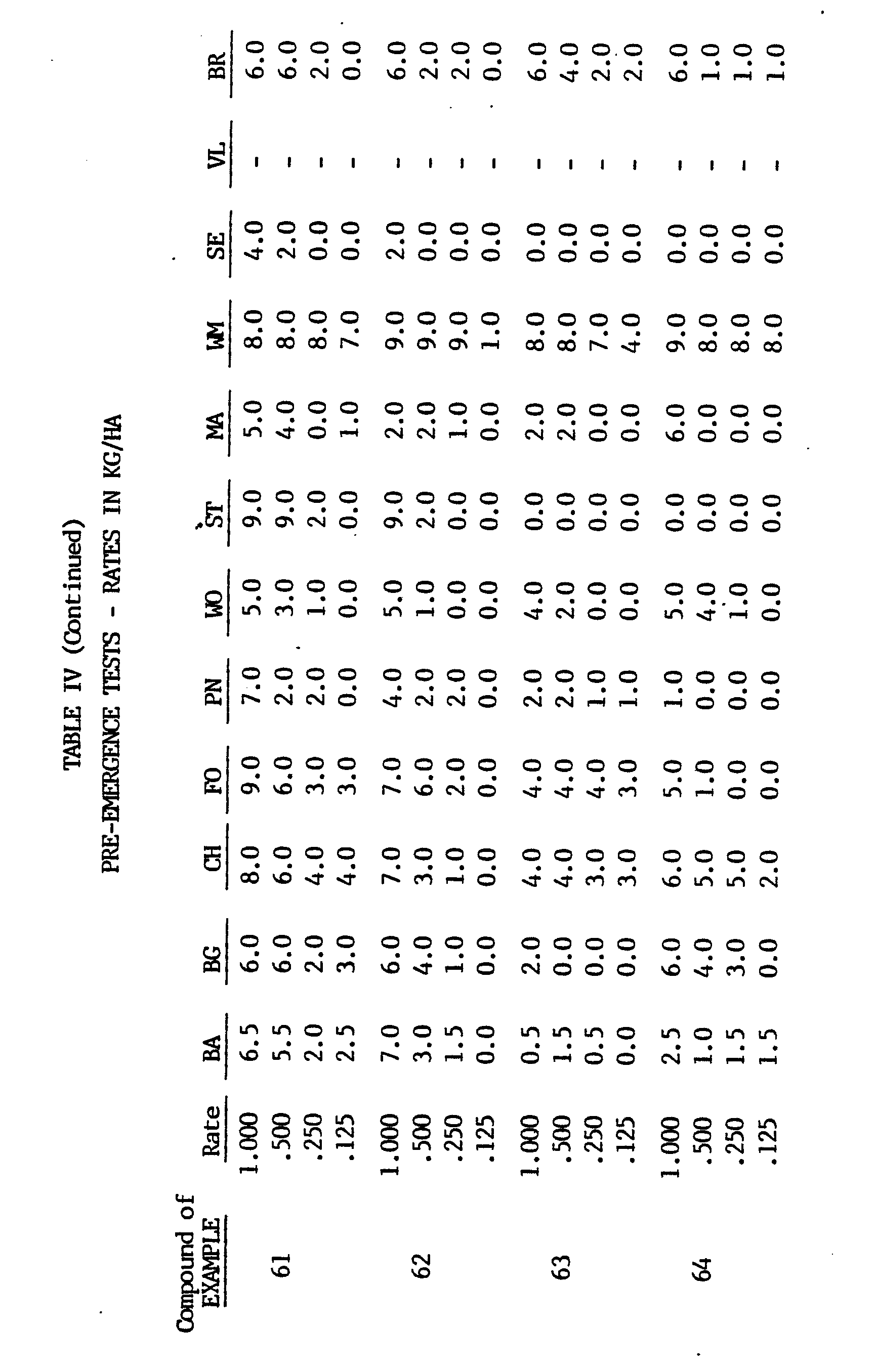
- the preemergence herbicidal activity of the compounds of the present invention is exemplified by the following tests in which the seeds or propagating organs of a variety of monocotyledonous and dicotyledonous plants, including important weeds in transplanted rice culture, are planted in separate cups and covered with approximately 2.5 cm of soil. After planting, the cups are sprayed with the selected aqueous acetone solution containing test compound in sufficient quantity to provide the equivalent of about 0.063 kg to 2 kg per hectare of test compound per cup. The treated cups are then placed on greenhouse benches, watered and cared for in accordance with conventional greenhouse procedures. Three to five weeks after treatment, the tests are terminated and each cup is examined and rated according to the rating system provided below. The data obtained are reported in Table IV below.
- the selectivity of the compounds of the invention is exemplified by the following tests in which two-ten-day old rice seedlings (cv. S-201) are transplanted into a 32 oz plastic container with a diameter of 10.5 cm containing 700 grams of a silt loam soil. After planting the containers are flooded and the water level is maintained at 0.5 to 3.0 cm above the soil surface. Three to seven days after transplanting, the flooded soil surface of the cups are treated with the selected aqueous acetone solution containing test compound in sufficient quantity to provide the equivalent of about 0.063 to 2.0 kg per hectare of test compound per cup. The treated cups are then placed on greenhouse benches, watered such that water level is maintained as stated above, and cared for in accordance with conventional greenhouse procedures. Three to five weeks after treatment, the tests are terminated and each cup is examined and rated according to the rating system provided in Example 68. The data obtained are reported in Table V below.
- the postemergence herbicidal activity and rice selectivity of some of the compounds of the present invention is demonstrated by the following tests, wherein a variety of monocotyledonous and dicotyledonous plants are treated with test compounds dispersed in aqueous acetone mixtures.
- seedling plants are grown in separate cups for about two weeks.
- the cups are then sprayed with the selected aqueous acetone solution containing test compound in sufficient quantity to provide the equivalent of about 0.063 kg to 2 kg per hectare of test compound per cup.
- These solutions also contained 0.5% of a spreader activator such as an alkylaryl polyoxyethylene glycol plus free fatty acid and isopropanol.
- the preemergence herbicidal activity and selectivity of some of the compounds of the present invention is exemplified by the following tests in which the seeds or propagating organs of a variety of monocotyledonous and dicotyledonous plants are separately mixed with potting soil and planted on top of approximately 2.5 cm of soil in separate cups. After planting, the cups are sprayed with the selected aqueous acetone solution containing test compound in sufficient quantity to provide the equivalent of about 0.063 kg to 2.0 kg per hectare of test compound per cup. The treated cups are then placed on greenhouse benches, watered and cared for in accordance with conventional greenhouse procedures. Three to five weeks after treatment, the tests are terminated and each cup is examined and rated according to the rating system provided in Example 68. The data obtained are reported in Table VII below.
- esters of 4-cyano-3-substituted-phenyl-4-fluorophenylbutyric acids that can be prepared as described in Examples 1 and 5 are listed in Table IX below.
- a toluene solution of the acid chloride (2.7 g, 8.4 mmol) is added over a 15-minute period to a solution of methoxyethanol (0.70 g, 9.2 mmol) and 5 mL pyridine at 0°.
- the resulting yellow suspension is warmed to room temperature and stirred overnight.
- the resulting pale yellow liquid is partitioned between diethyl ether and water.
- the ether layer is washed twice wtih 10% HCI, twice with saturated aqueous sodium chloride and is stirred over magnesium sulfate.
- the filtered solution is concentrated to yeild 2.0 g (67% yield) of an amber oil, identified as the title ester by the proton and carbon resonance spectra, mass spectrum and infrared spectrum.
- Other esters similarily prepared from the acid chloride using the appropriate alcohol are listed in Table X.
- the selectivity of the compounds included among Examples 72-141 is exemplified using the procedure of Example 69 on two ten-day old rice seedlings (cv. S-201 or cv. Newbonnett).
Landscapes
- Chemical & Material Sciences (AREA)
- Organic Chemistry (AREA)
- Life Sciences & Earth Sciences (AREA)
- Agronomy & Crop Science (AREA)
- Pest Control & Pesticides (AREA)
- Plant Pathology (AREA)
- Health & Medical Sciences (AREA)
- Engineering & Computer Science (AREA)
- Dentistry (AREA)
- General Health & Medical Sciences (AREA)
- Wood Science & Technology (AREA)
- Zoology (AREA)
- Environmental Sciences (AREA)
- Agricultural Chemicals And Associated Chemicals (AREA)
- Organic Low-Molecular-Weight Compounds And Preparation Thereof (AREA)
- Pyridine Compounds (AREA)
Abstract
The invention relates to selective herbicidal 4-cyano-4-(fluorophenyl)-3-(substituted-phenyl)butyric acids, esters and derivatives thereof, and a method of selectively controlling undesirable vegetation in rice therewith.
Description
- Polysubstituted butyric acids, esters and derivatives of the general formula

- The threo isomers of these compounds are disclosed as being non-selective vegetation control agents while the erythro/threo isomer mixtures are disclosed as postemergence herbicides having selectivity in certain crops such as corn, barley and wheat and as preemergence herbicides having selectivity in crops such as corn, cotton, soybeans, wheat and barley.
- A method for the preparation of substituted-diaryl-cyanobutryrates by the condensation of ethyl cinnamates with benzyl cyanides has recently been reported in the literature.
- While the references disclose post-emergence herbicidal activity in general for some of the compounds, they do not indicate that any would be useful selective herbicides for use in controlling undersirable vegetation in transplanted rice. Further, they do not indicate that in order to obtain selectivity for use in transplanted rice only certain specific substitution patterns for R2 and R3 in the general formula are effective.
- It is an object of this invention to provide compounds which contain the specific substituents in both R2 and R3 which are required to obtain selectivity in rice. It is another object of this invention to provide a method for controlling undesirable vegetation selectively in the presence of rice utilizing these compounds.
- The invention relates to selective herbicidal 4-cyano-4-(fluorophenyl)-3-(substituted-phenyl)butyric acids, esters and derivatives of formula I below

- It has been found that the 4-cyano-3,4-diphenylbutyric acids, esters and derivatives thereof described above are effective herbicidal agents which may be used safely on rice. This result is surprising in light of the high level of herbicidal activity and lack of selectivity on rice of many of the compounds described in the literature.
- The discovery that the selectivity in rice is obtained by substitution in both the phenyl ring at the C-4 position and the phenyl ring at the C-3 position of the butyric acid chain, and further that at least one fluorine must be present in the C-4 phenyl ring in the formula I cyanobutyric acid compounds of the present invention is unexpected. A preferred group of compounds are those of formula I wherein n is an integer of one or two; R2 and R3 are each hydrogen, bromine, chlorine or fluorine provided that R2 and R3 are not both hydrogen.
- Additionally, it has been found that methyl 3-(M-chlorophenyl)-4-cyano-4-(p -fluorophenyl)butyrate and other esters of this acid are unique in that they provide selective preemergence control of weeds in wheat and barley as well as selective weed control in rice.
- Moreover, the compounds of formula I, besides controlling undesirable plant species selectively in the presence of rice, are found to modify or regulate the growth of desirable plant species. Such plant species include graminaceous species such as turf grasses and cereals as well as woody species such as fruit trees. The inhibition of vegetative plant growth in grasses is significant economically in areas requiring turf grass management by reducing the frequency of mowing and lowering the attendant overall maintenance costs. The reduction in the height of cereals is also important since a reduction in stem length can reduce or prevent lodging to facilitate harvesting and allow a greater realization of yield. Furthermore branching in woody species can be induced by breaking the apical dominance to promote the development of side shoots which, together with a reduction in height, is a very desirable feature in the cultivation of fruit trees and ornamentals. The compounds of this invention are used in regulating the growth of plants.
- The compounds of the invention may conveniently be applied as a solid or granular herbicidal compositions, comprising a herbicidally effective amount of a formula I polysubstituted butyric acid, ester or derivative, hereinabove defined, in admixture with an inert solid, water insoluble, diluent such as finely divided silica, kaolin, attapulgite, bentonite, montmorillonite, pumice, talc, fullers earth, diatomaceous earth, and the like. They may be applied as post transplant preemergence treatments, i.e., applied to the soil or to the floodwater after the rice has been transplanted, but prior to or shortly after the emergence of weeds; or as pre-plant incorporated treatments.
- Certain of the formula I compounds may be applied by foliar application after the weeds have emerged, i.e., postemergence treatment, making them suitable for weed control in direct-seeded rice in addition to transplanted rice.
- In practice, the erythro-threo stereoisomeric mixtures are generally applied to the foliage and stems of undesirable plants or to soil or paddy floodwater containing seeds, seedlings or other propagating organs thereof, at a rate of application between about 0.032 and 11.2 kg per hectare of active ingredient.
- The polysubstituted butyric acids, esters and derivatives of formula I, may be prepared as granular formulations containing, generally about 1 % to 15% by weight of toxicant. The above compounds may also be formulated as wettable powders, emulsifiable concentrates, or flowable (thixotrophic) concentrates which are usually dispersed in water or other inexpensive liquid diluent for application as a liquid spray. Salts of the formula I compound which are water soluble may also be applied as aqueous solutions.
- Wettable powder compositions can be prepared by grinding together about 15% to 80% by weight of a solid formula I compound, about 2% to 15% by weight of a surfactant such as sodium N-methyl-N-oleoyl taurate, alkyl phenoxy polyoxyethylene ethanol or sodium alkyl naphthalene sulfonate, and 18% to 65% by weight of a finely divided carrier such as kaolin attapulgite, diatomaceous earth, or the like.
- A typical formulation prepared in accordance with the above description can be defined as follows: 66% by weight of a formula I toxicant; 10% by weight of sodium salt of sulfated nonylphenoxypoly)-ethyleneoxy)ethanol, and 24% by weight of precipitated silica.
- Advantageously, flowable (thixotropic) concentrates can be prepared by grinding together 40% to 60% by weight of a solid formula I toxicant, 1% to 4% by weight of the sodium salt of condensed naphthalene sulfonic acids, 2% to 3% by weight of a gelling clay, 2% by weight of propylene glycol and from 54% to 32% by weight of water.
- A typical granular formulation can be prepared by dissolving or dispersing the active compound in a solvent and applying the toxicant to a sorptive or nonsorptive carrier such as attapulgite, corn cob grits, limestone, silica, montmorillonite, bentonite or the like.
- A typical emulsifiable concentrate can be prepared by admixing 13% by weight of the formula I compound with 6% by weight of a nonionic surfactant, such as a polyoxyethylene sorbitol ester, with 81 % by weight of isophorone or 37% by weight of isophorone and 44% by weight of an aromatic petroleum distillate (bp 304-330°F) Sp.G. 15/56° C = 0.853-0.875.
- The invention is further illustrated by the following non-limiting examples.
- Preparation of erythro-and threo-methyl 4-cyano-3-(p-fluorophenyl)-4-(m-fluorophenyl)butyrate
-

- The corresponding ethyl ester is prepared by using ethyl e-fluorocinnamate and sodium ethoxide instead of methyl e-fluorocinnamate and sodium methoxide.
-
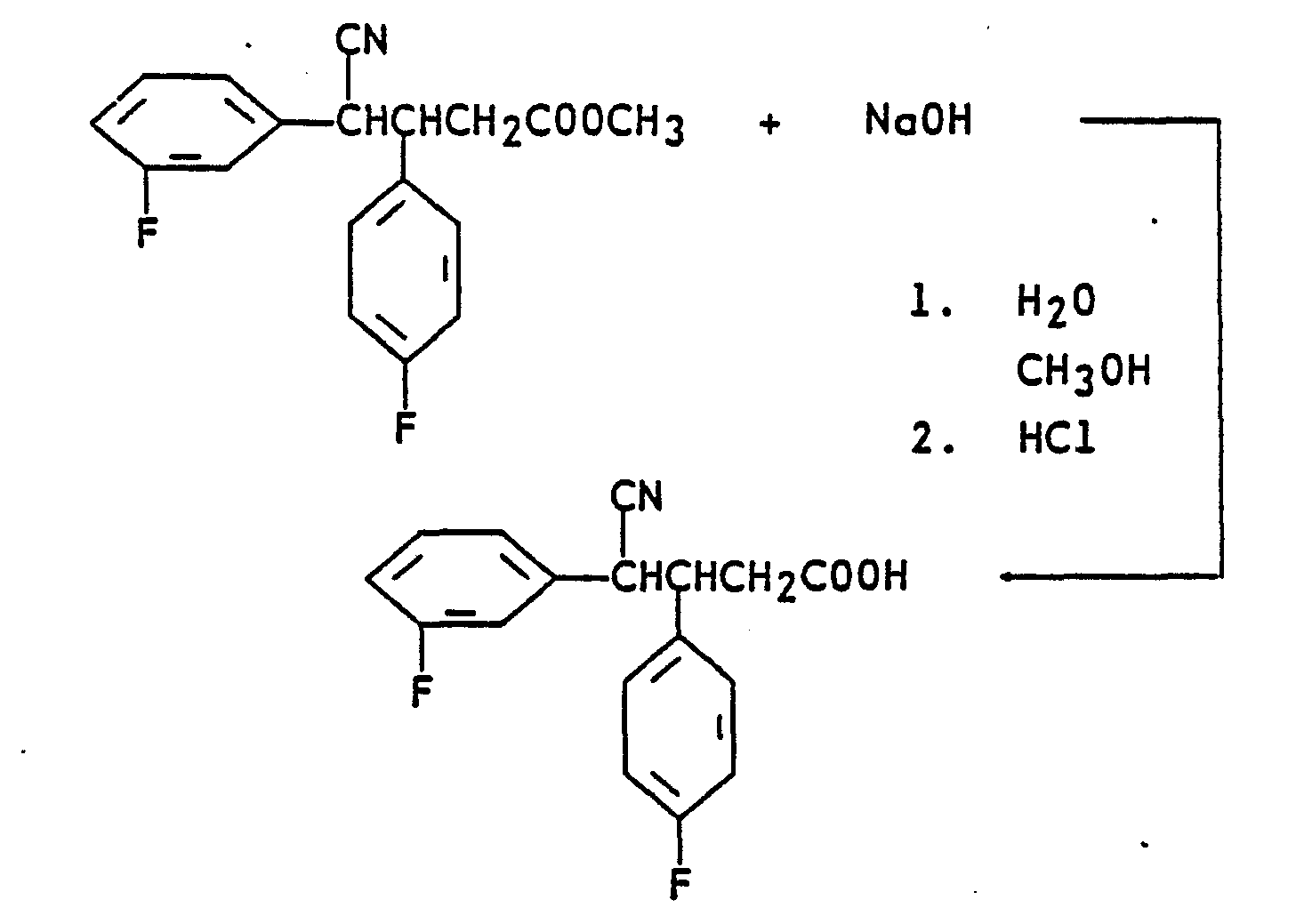
- A solution of sodium hydroxide (18.3 g of 98.6% assay, 0.451 mol) in 230 mL of water is added dropwise over a one-hour period to a stirred solution of the ester (135.5 g of crude, 0.430 mol uncorrected) at room temperature. The resulting reddish-brown solution is heated at 50-55°C for two hours and thirty minutes and is stirred at room temperature overnight. After concentrating the mixture, the foamy brown syrup is partitioned between diethyl ether and water. The aqueous layer is extracted with five portions of ether and stirred under vacuum to remove residual ether to yield 736 mL of a reddish amber aqueous solution. This solution is divided to prepare both the acid and the sodium salt. A volume of 579 mL (0.331 mol after correcting for 2.72 g of a red liquid, largely unreacted benzyl cyanide (nmr) isolated from the ether extracts) of the aqueous solution is diluted with water to 750 mL and acidified by the dropwise addition of 10% HCI over a six-hour period. after'stirring the resulting suspension at room temperature overnight, the white solids are collected, washed with water and dried in a vacuum oven at 45 to 50°C to yield the title product, 97.2 g (97.4%) as a white powder having a melting point 110°(sinter), 128-177°C. The product is identified by its chemical ionization mass spectrum, infrared spectrum and proton and carbon nmr spectrum. The ratio of isomers is determined to be erythrolthreo = 59/41 from the proton nmr spectrum. Thin layer chromatography (CH2Cl2) shows one major spot streaking from the baseline with only trace amounts of components having higher Rfvalues.
-

- A portion of the aqueous solution of the hydrolyzed ester (157 mL, 0.090 mol) prepared in Example 2 is concentrated on a rotary evaporator. The resulting foamy viscous amber syrup is placed under a vacuum at <1 mm Hg for one day at a temperature of 50° to 55°. The glass which formed is pulverized with a mortar and pestle to yield 29.6 g light tan solids. Continued evacuation under the same conditions for an additional day with the sample on the rotary evaporator gives 28.8 g (99%) of the sodium salt with mp 138°C (yellowing), 218°C(sinter), 230-235°C. The isomer ratio is found by proton nmr to be erythro/threo = 57/43.
-
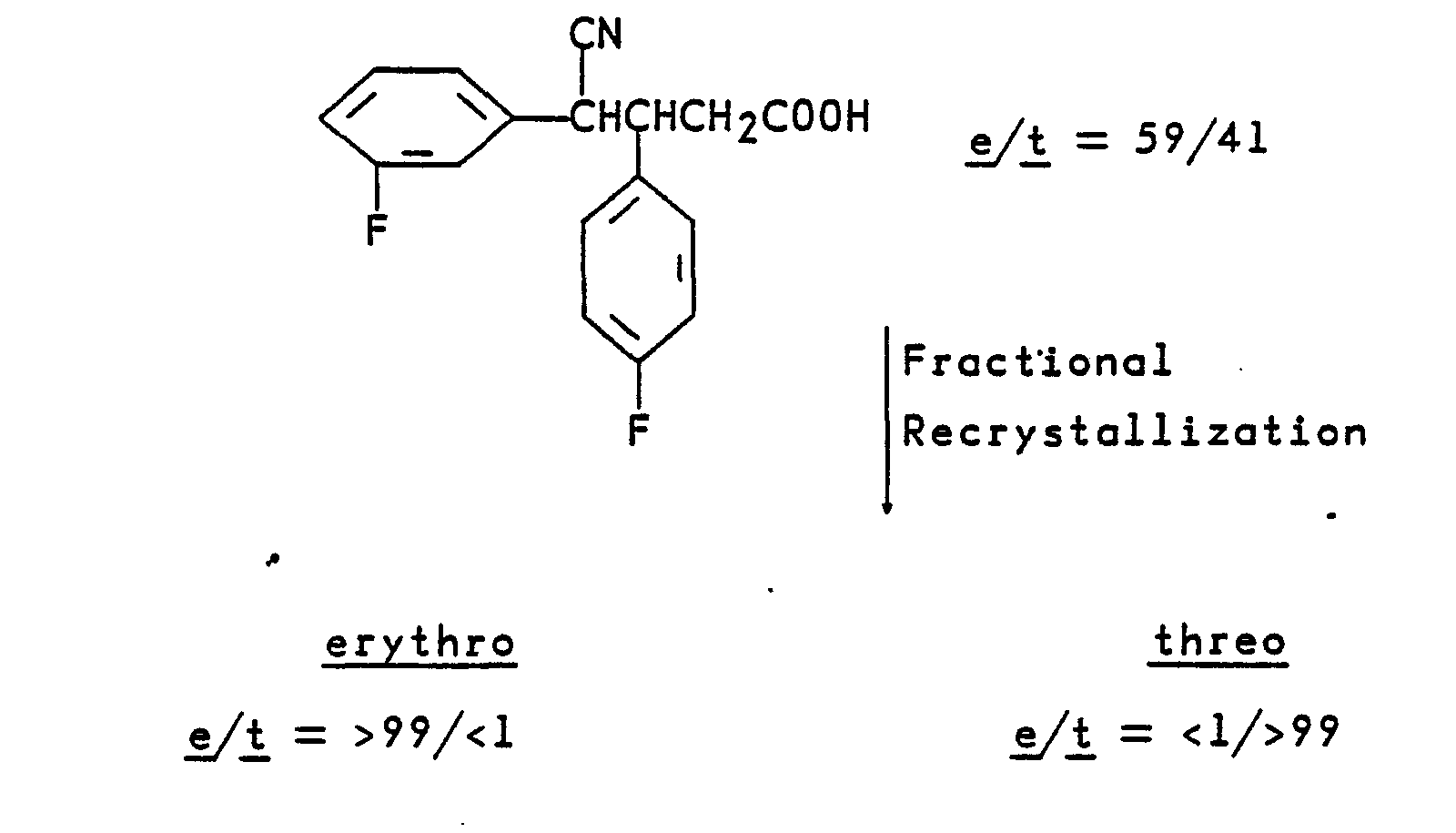
- A suspension of an isomeric mixture of 4-cyano-3-(p-fluorophenyl)-4-(m-fluorophenyl)butyric acids (70.0 g, 0.232 mol, erythro/threo = 59/41) in 1.4 I CCl4 is heated at reflux for 30 minutes. The suspension is filtered to yield after drying 38.2 g of white solids and a pale yellow filtrate.
- The white solids are recrystallized from 600 mL CH2Cl2 to yield 23.7 g (57.4% recovery of the amount of the erythro isomer present in the starting material) of fine white needles having mp 186° (sinter), 190.5-191.5°C of the less-soluble, higher-melting erythro isomer by the proton and carbon magnetic resonance spectra, mass spectrum, and infrared spectrum.
- The ratio of isomers, based on the CH methine doublets of the erythroisomer at δ4.70 (J = 8Hz) and the threo isomer at δ4.65 (J = 8Hz), respectively, in the proton nmr spectrum (DMSO-d6), was erythro/threo = > 99/<1.
- The pale yellow filtrate from the original suspension is cooled to room temperature for one day to yield, after collecting, washing and drying, 18.2 g of white solids having an isomer ratio of erythro/threo = 8/92 by proton nmr. A suspension of the solid is prepared in 200 mL CC14 which is heated at reflux for one hour, filtered, cooled to room temperature, and left standing for one day to give 17.2 g of a heterogeneous mixture of dull white granular crystals and brighter white needles. Physical separation gives 4.5 g of granular crystals which are recrystallized from 50 mL CCl4 to yield 4.2 g (15% recovery of the amount of the threo isomer present in the starting material) of a mixture of crystals and needles. The sample is homogenized and identified as the more-soluble, lower-melting threo isomer by the proton and carbon resonance spectra, mass spectrum, infrared spectrum and mp 110.5° (sinter), 115-121°C. The isomer ratio is determined to be erythro/threo = <11>99 based on the proton nmr spectrum as previously described.
-

- A suspension of an isomeric mixture of 4-cyano-3-(p-fluorophenyl)-4-(m -fluorophenyl)butyric acids (1.8 g, 5.9 mmol, erythro/ threo = 8/92) in 20 mL absolute MeOH containing 0.2 g concentrated H2SO4 is heated at reflux for 22 hours. After the reaction mixture is concentrated on a rotary evaporator, the resulting syrup is partitioned between methylene chloride and water. The methylene chloride layer is separated and . washed three times with water, dried (MgS04), and concentrated to give 1.90 g of an amber syrup. Flash chromatography on a column of silica gel using hexanes/CH2Cl2 (1/1) gives 0.90 g (48%) of a water-white syrup, identified as the title compound by the proton and carbon resonance spectrum, mass spectrum and infrared spectrum. The isomer ratio is determined to be erythro/threo = 1/99 based on the proton nmr spectrum (CDCI3) as previously described. (Other esters were similarly prepared using the appropriate alcohol.)
- Utilizing the procedures of Examples one to five above and substituting the appropriately substituted fluorophenylacetonitrile for m-fluorophenylacetonitrile and alkyl-substituted cinnamate for methyl p-fluorocinnamate yields the 4-cyano-4-(fluorophenyl)-3-(substituted-phenyl)butyric acids, esters and salts listed in Tables I-III below.


-

- Diisopropylamine (0.26 g, 2.6 mmol) is added dropwise with stirring to a solution of erythro-and threo-4-cyano-3-(p-fluorophenyl)-4-m-fluorophenyl)butyric acid (0.77 g, 2.6 mmol) in 5 mL anhydrous ether. The solution is stirred overnight under a nitrogen atmosphere. The resulting milky suspension is concentrated to a white solid and dried under vacuum at 50° to give 1.00 g (96%) of the title salt which had a melting point of 138-143°C. The proton nmr spectrum indicated a ratio of erythro/threo = 54/46.
- - The preemergence herbicidal activity of the compounds of the present invention is exemplified by the following tests in which the seeds or propagating organs of a variety of monocotyledonous and dicotyledonous plants, including important weeds in transplanted rice culture, are planted in separate cups and covered with approximately 2.5 cm of soil. After planting, the cups are sprayed with the selected aqueous acetone solution containing test compound in sufficient quantity to provide the equivalent of about 0.063 kg to 2 kg per hectare of test compound per cup. The treated cups are then placed on greenhouse benches, watered and cared for in accordance with conventional greenhouse procedures. Three to five weeks after treatment, the tests are terminated and each cup is examined and rated according to the rating system provided below. The data obtained are reported in Table IV below.

- Plant abbreviations, common name and scientific name



- The selectivity of the compounds of the invention is exemplified by the following tests in which two-ten-day old rice seedlings (cv. S-201) are transplanted into a 32 oz plastic container with a diameter of 10.5 cm containing 700 grams of a silt loam soil. After planting the containers are flooded and the water level is maintained at 0.5 to 3.0 cm above the soil surface. Three to seven days after transplanting, the flooded soil surface of the cups are treated with the selected aqueous acetone solution containing test compound in sufficient quantity to provide the equivalent of about 0.063 to 2.0 kg per hectare of test compound per cup. The treated cups are then placed on greenhouse benches, watered such that water level is maintained as stated above, and cared for in accordance with conventional greenhouse procedures. Three to five weeks after treatment, the tests are terminated and each cup is examined and rated according to the rating system provided in Example 68. The data obtained are reported in Table V below.


- The postemergence herbicidal activity and rice selectivity of some of the compounds of the present invention is demonstrated by the following tests, wherein a variety of monocotyledonous and dicotyledonous plants are treated with test compounds dispersed in aqueous acetone mixtures. In the tests, seedling plants are grown in separate cups for about two weeks. The cups are then sprayed with the selected aqueous acetone solution containing test compound in sufficient quantity to provide the equivalent of about 0.063 kg to 2 kg per hectare of test compound per cup. These solutions also contained 0.5% of a spreader activator such as an alkylaryl polyoxyethylene glycol plus free fatty acid and isopropanol. After spraying, the plants are placed on greenhouse benches and are cared for in the usual manner, commensurate with conventional greenhouse practices. Three to five weeks after treatment, the seedling plants are examined and rated according to the rating system set forth in Example 68. The data obtained are reported in Table VI below.


- The preemergence herbicidal activity and selectivity of some of the compounds of the present invention is exemplified by the following tests in which the seeds or propagating organs of a variety of monocotyledonous and dicotyledonous plants are separately mixed with potting soil and planted on top of approximately 2.5 cm of soil in separate cups. After planting, the cups are sprayed with the selected aqueous acetone solution containing test compound in sufficient quantity to provide the equivalent of about 0.063 kg to 2.0 kg per hectare of test compound per cup. The treated cups are then placed on greenhouse benches, watered and cared for in accordance with conventional greenhouse procedures. Three to five weeks after treatment, the tests are terminated and each cup is examined and rated according to the rating system provided in Example 68. The data obtained are reported in Table VII below.


- In addition to the compounds described in Table I, other examples of 4-cyano-3-substituted-phenyl-4-fluorophenylbutryic acids that can be prepared by the procedures of Examples 2 and 4, are listed in Table VIII below.

- Other examples of esters of 4-cyano-3-substituted-phenyl-4-fluorophenylbutyric acids that can be prepared as described in Examples 1 and 5 are listed in Table IX below.


-
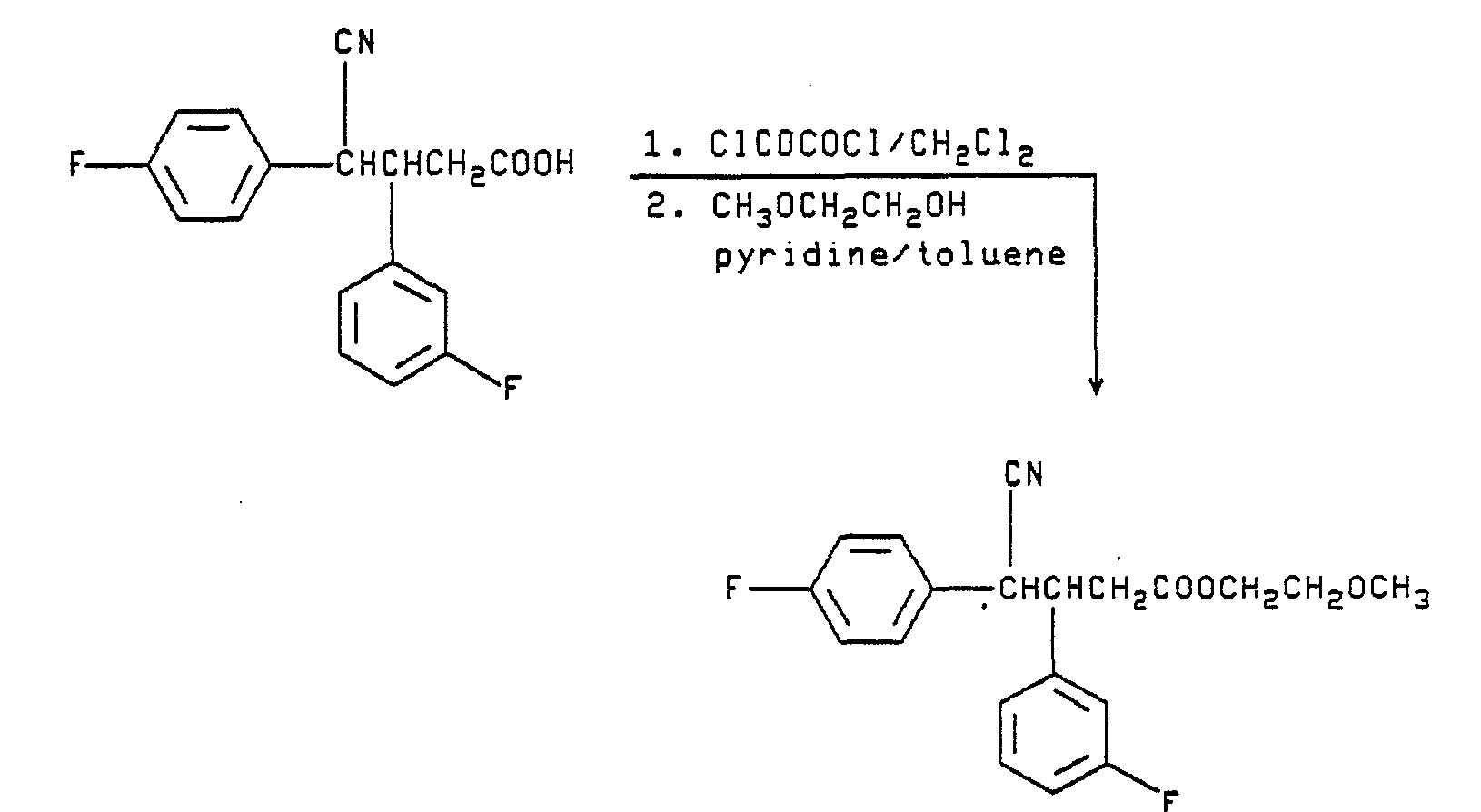
- A solution of oxalyl chloride (4.5 g, 34 mmol) in 10 mL CH2Cl2 is added dropwise over a five-minute period to a solution of 4-cyano-3-(m-fluorophenyl)-4-(p-fluorophenyl)butyric acid (5.3 g, 17 mmol, erythro/threo = 58/42) in 150 mL CH2Cl2. After the addition of one drop of N,N-dimethylformamide, the reaction mixture is stirred for three hours and is concentrated to yield a syrup. A toluene solution of the acid chloride (2.7 g, 8.4 mmol) is added over a 15-minute period to a solution of methoxyethanol (0.70 g, 9.2 mmol) and 5 mL pyridine at 0°. The resulting yellow suspension is warmed to room temperature and stirred overnight. After removing the solvent using a rotary evaporator, the resulting pale yellow liquid is partitioned between diethyl ether and water. The ether layer is washed twice wtih 10% HCI, twice with saturated aqueous sodium chloride and is stirred over magnesium sulfate. The filtered solution is concentrated to yeild 2.0 g (67% yield) of an amber oil, identified as the title ester by the proton and carbon resonance spectra, mass spectrum and infrared spectrum. The isomer ratio is determined to be erythro/threo = 62/38 based on the proton nmr spectrum (CDCl3) as previously described. Other esters similarily prepared from the acid chloride using the appropriate alcohol are listed in Table X.

- The preemergence herbicidal activity of the compounds of Examples 72-141 is exemplified using the procedure of Example 68. The data are reported in Table XI below.


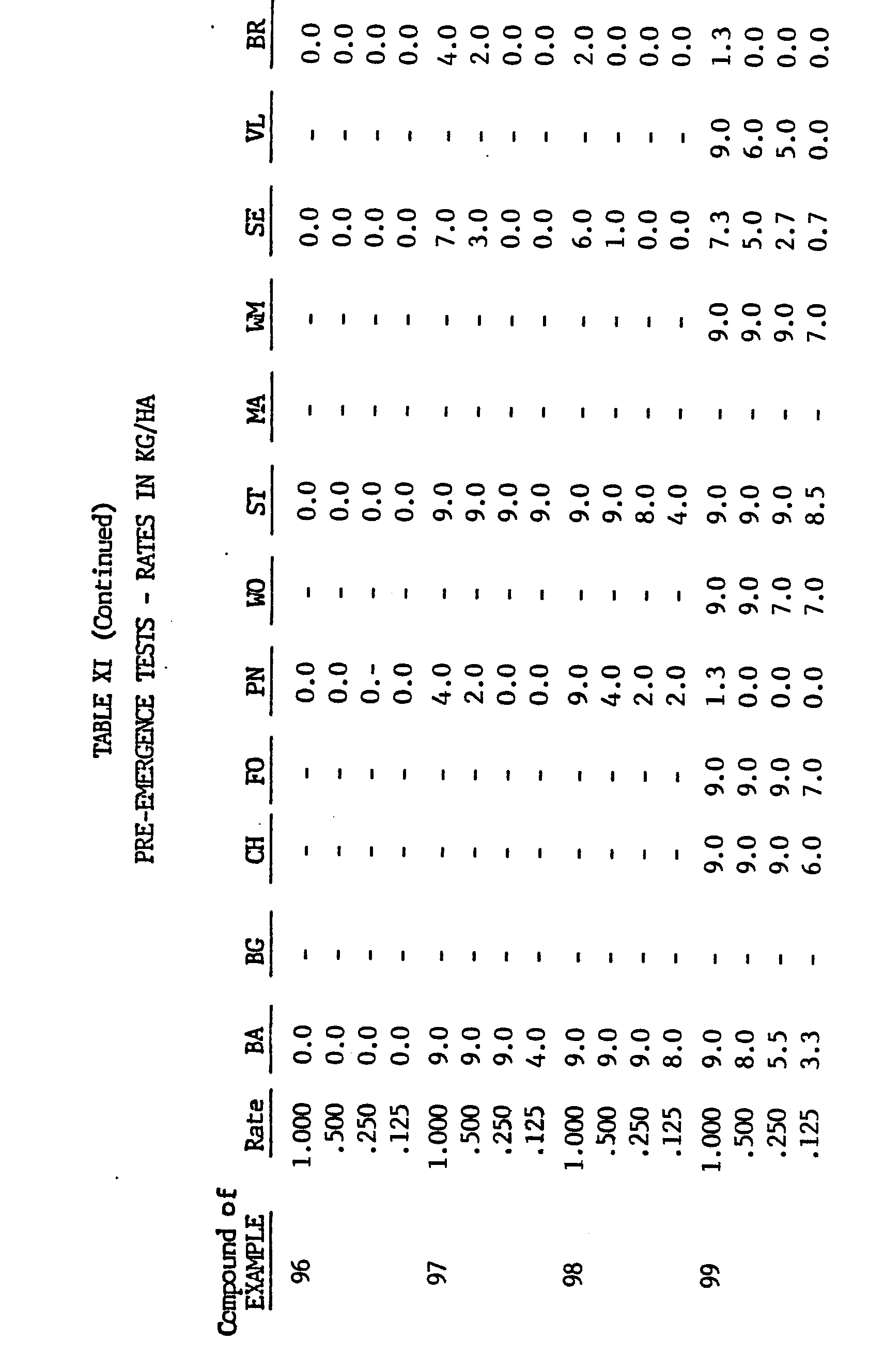


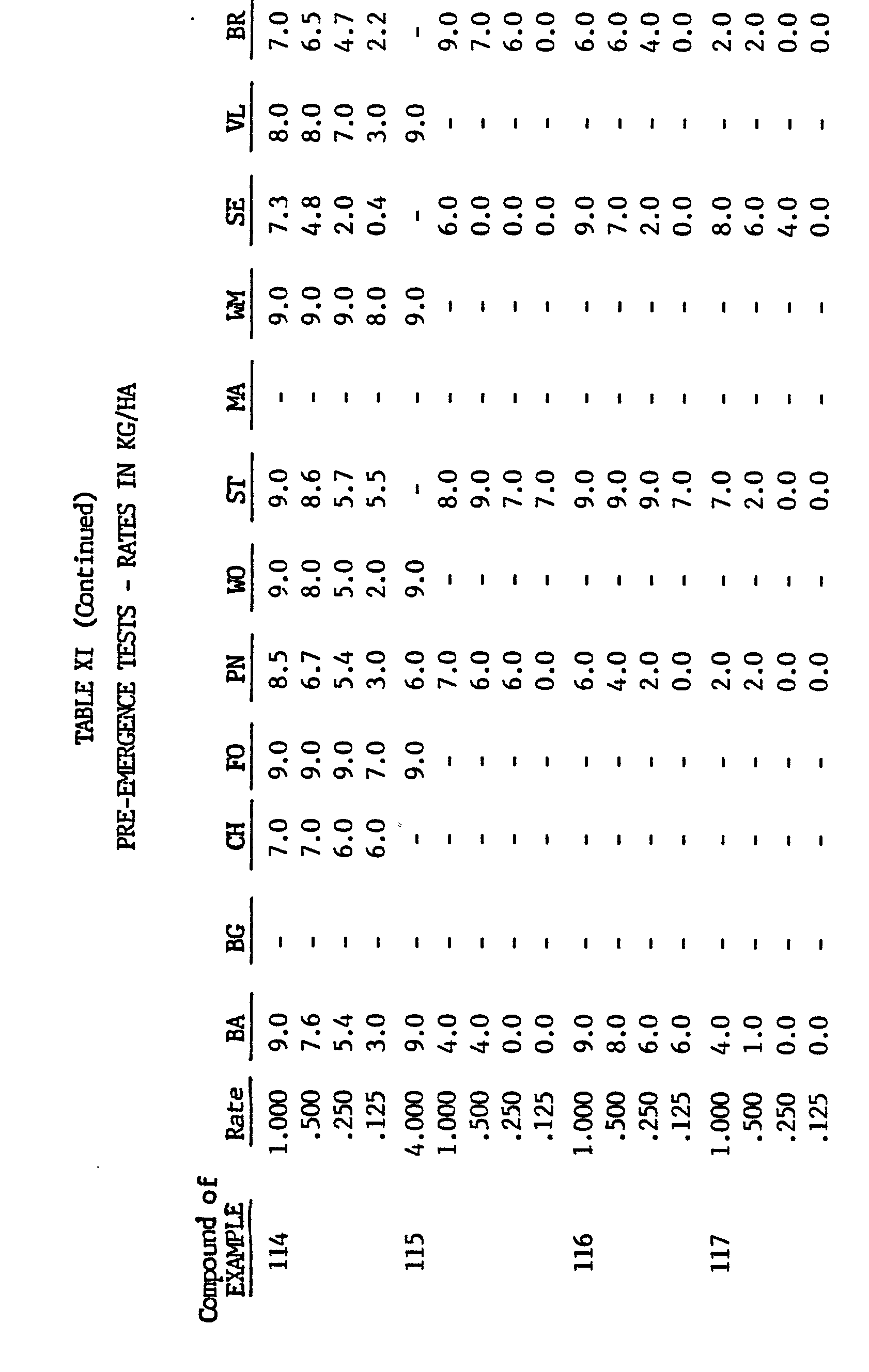


- The selectivity of the compounds included among Examples 72-141 is exemplified using the procedure of Example 69 on two ten-day old rice seedlings (cv. S-201 or cv. Newbonnett).
- The data are reported in Table XII.


- The postemergence herbicidal activity and rice selectivity of some of the compounds of Examples 72-141 are exemplified using the procedure of Example 70. The data are reported in Table XIII below.


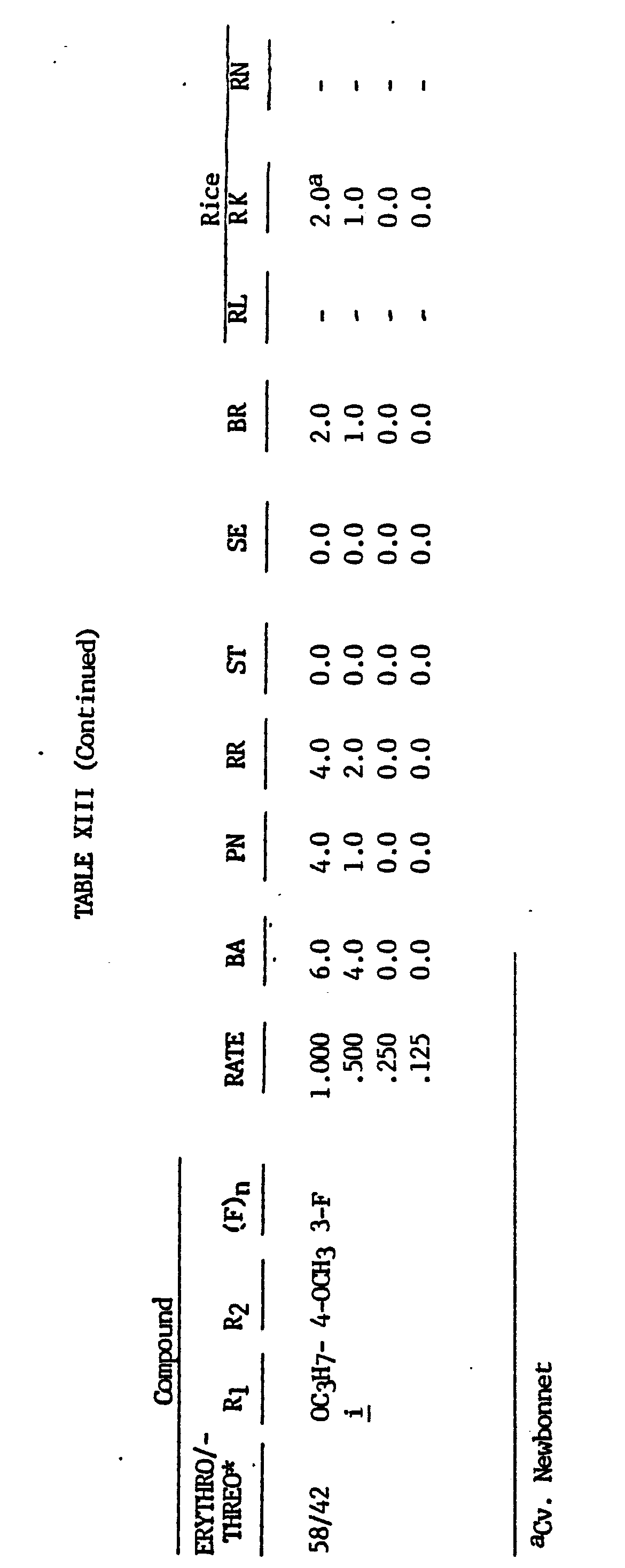
- The preemergence herbicidal activity and selectivity of some of the compounds included among Examples 72-141 is exemplified using the procedure of Example 71. The data are listed in Table XIV below.

Claims (12)
1. 4-Cyano-4-(fluorophenyl)-3-substituted-phenyl)butyric acids, esters and derivatives of formula I below

wherein R1 is OH, OR4 NR5R6, OM, benzyloxy C2-C3 alkyl, benzyl or furfuryl; R2 and R3 are each hydrogen, fluorine, chlorine, bromine, iodine, NO2, CN, C2-C4 alkyl, C1-C4 alkoxy, OCHF2, OCF2CF2H, OCF3, CF3, S(O)-xCH3 or S(O)xCF2R7, wherein X is 0, 1 or 2 and R7 is H, F, CHFCI, CF2H or CF3; provided that R2 and R3 are not both hydrogen; n is an integer of one to three; m is zero or one; R4 is alkyl C1-C8, monohaloalkyl C1-C4, hydroxyalkynyl C4-C6, monohaloalkynyl C4-C6, monohaloalkenyl C3-C4, alkoxy C1-C4 or alkyl C1-C-4; R5 and R6 each independently represent members selected from the group consisting of hydrogen and alkyl C1-C3; M is an alkali metal, ammonium, C1-C8 mono or dialkylammonium or hydroxyethylammonium; and the stereoisomers thereof.
2. A compound according to Claim 1, wherein n is an integer of one or two; R2 and R3 are each hydrogen, bromine, chlorine, fluorine, CF3, OCH3 or OCHF2 with the proviso that R2 and R3 are not both hydrogen; and R1 is OR4
3. The compound according to claim 2, erythro/threo- 4-cyano-4-(m-fluorophenyl)-3-(p -fluorophenyl)-butyric acid; erythro-/threo- 4-cyano-4-(m-fluorophenyl)-3-(m-fluorophenyl)-butyric acid; erthro-/threo- 4-cyano-3-(m-chlorophenyl)-4-(m-fluorophenyl)butyric acid; erythro-/threo- 4-cyano-3-(m-chlorophenyl)-4-( p-fluorophenyl)butyric acid; erythro-/threo-3-( p-chlorophenyl)-4-cyano-4-(3,4-difluorophenyl)butyric acid; erythro-/threo-3-(p-chtorophenyt)-4-cyano-4-(mfluoropheny))butyric acid; erythro-/threo-3-(m-chlorophenyl)-4-cyano-4-(3,4-difluorophenyl)butyric acid; erythro -/threo-4-cyano-4-(3,4-difluorophenyl)-3-(m -fluorophenyl)-butyric acid; erythro-/threo-4-cyano-3,4-bis(m-fluorophenyt)butyric acid; erythro -/threo-3-(3-chloro-4-fluorophenyl)-4-cyano-4-(m -fluorophenyl)butyric acid; erythro-/threo-4-cyano-3-[m-(difluoromethoxy)phenyl]-4-(m-fluorophenyl)butyric acid; erythro-/threo-4-cyano-3-(2,4-difluorophenyi)-4-(mfluoropheny))butyric acid; or erythro-/threo-3-(mbromophenyl)-4-cyano-(3,4-difluorophenyl)butyric acid or a salt or ester thereof.
4. The compound according to Claim 2, erythro -/threo-4-cyano-3-(m-fluorophenyl)-4-( p-fluorophenyl)-butyric acid; erythro-/threo-methyl-4-cyano-4-(3,4-difluorophenyl)-3-(p-methoxypheny))butyrate; erythro- /threo-methyl 4-cyano-4-(m-fluorophenyl)-3-(p-methoxyphenyl)-butyrate; erythro-/threo-methyl 4-cyano-4-(p-fluorophenyl)-3-(p-methoxyphenyl)butyrate; or erythro-/threo-methyl 4-cyano-4-(m-fluorophenyl)-3-( m-methoxyphenyl)butyrate.
5. A method for selectively controlling undesirable vegetation in transplanted rice comprising applying to flood water or soil as a preemergence post-transplant or pre-plant incorporated treatment, a herbicidally effective amoaunt of an erythro /threo mixture of a compound of formula I

wherein R1 is OH, OR4, NR5R6, OM, benzyloxy Ci-C3 alkyl, benzyl or furfuryl; R2 and R3 are each hydrogen, fluorine, chlorine, bromine, iodine,NO2, CN, C1-C4 alkyl, C1-C4 alkoxy, OCHF2, OCF2CF2H, OCF3, CF3, S(O)-xCH3 or S(O)xCF2R7, wherein X is 0, 1 or 2 and R7 is H, F, CHFCI, CF2H or CF3; provided that R2 and R3 are not both hydrogen; n is an integer of one to three; m is zero or one; R4 is alkyl C1-C8, monohaloalkyl C1-C4, hydroxyalkynyl C4-C6, monohaloalkynyl C4-C6, monohaloalkenyl C3-C4, alkoxy C1-C4 or alkyl C1-C4; R5 and R6 each independently represent members selected from the group consisting of hydrogen and alkyl C1-C3; M is an alkali metal, ammonium, C1-C8 mono or dialkylammonium or hydroxyethylammonium; and the stereoisomers thereof.
6. A method according to Claim 5, wherein n is an integer of one or two; R2 and R3 are each hydrogen, bromine, chlorine, fluorine, CF3, OCH3 or OCHF2 with the proviso that R2 and R3 are not both hydrogen; and R1 is OR4.
7. The method according to Claim 6 erythro/threo- 4-cyano-4-(m-fluorophenyl)-3-p-fluorophenyl)butyric acid; erythro-/threo- 4-cyano-4-(m-fluorophenyl)-3-(m-fluorophenyl)-butyric acid; ery-thro-/threo- 4-cyano-3-(m-chlorophenyl)-4-(m-fluoro-phenyl)butyric acid; erythro-/threo- 4-cyano-3-(m-chlorophenyl)-4-( p-fluorophenyl)butyric acid; erythro-/threo-3-( p-chlorophenyl)-4-cyano-4-(3,4-difluorophenyl)butyric acid; erythro-/threo-3-(p-chlorophenyl)-4-cyano-4-(m-fluorophenyl)butyric acid; erythro-/threo-3-(m-chlorophenyl)-4-cyano-4-(3,4-difluorophenyl)butyric acid; erythro -/threo-4-cyano-4-(3,4-difluorophenyl)-3-(m -fluorophenyl)-butyric acid; erythro-/threo- 4-cyano-3,4-bis(m-fluorophenyl)butyric acid;erythro -/threo-3-(3-chloro-4-fluorophenyl)-4-cyano-4-(m-fluorophenyl)butyric acid; erythro-/threo -4-cyano-3-[m-(difluoromethoxy(phenyl]-4-(m -fluorophenyl)butyric acid; erythro-/threo- 4-cyano-3-(2,4-difluorophenyl)-4-(m-fluorophenyl)butyric acid; or erythro-/threo-3-(m-bromophenyl)-4-cyano-(3,4-difluorophenyl)butyric acid or salt or ester thereof.
8. The method according to Claim 5 erythro-/threo-4-cyano-3-(m-fluorophenyl)-4-(p -fluorophenyl)butyric acid; erythro-/threo-methyl-4-cyano-4-(3,4-difluorophenyl)-3-(p-methoxyphenyl)butyrate; erythro-/threo-methyl 4-cyano-4-(m-fluorophenyl)-3-(p-methoxyphenyl)-butyrate; erythro-/threo-methyl 4-cyano-4-(p-fluorophenyl)-3-(p-methoxyphenyl)-butyrate; or erythro-/threo-methyl 4-cyano-4-(m-fluorophenyl)-3-( m-methoxyphenyl)butyrate.
9. A method for the selective control of undesirable vegetation in transplanted or direct-seeded rice comprising applying to the foliage and stems or to soil containing seeds or other propagating organs of said undesirable vegetation, after the rice has been transplanted or after the direct-seeded rice has emerged from the ground, a herbicidally effective amount of an erythro/threo mixture of a compound having the structure

wherein n is an integer of 1 or 2, m is 0 or 1; R2 is halogen; R1 is OR4; R4 is alkyl C1-C8, monohaloalkyl C1-C4, hydroxyalkynyl C4-C6, monohaloalkynyl C4-C6, monohaloalkenyl C3-C4, alkoxy C1-C4, or alkyl C1-C4.
10. The method according to Claim 9 erythro-/threo-4-cyano-3-(m-fluorophenyl)-4-(p-fluorophenyl)-butyric acid; erythro -/threo-methyl-4-cyano-4-(3,4-difluorophenyl)-3-(p-methoxyphenyl)butyrate; erythro- /threo-methyl 4-cyano-4-(m-fluorophenyl)-3-(p-methoxyphenyl)-butyrate; erythro-/threo-methyl 4-cyano-4-(p-fluorophenyl)-3-(p-methoxyphenyl)-butyrate; or erythro-/threo-methyl 4-cyano-4-(m-fluorophenyl)-3-( m-methoxyphenyl)butyrate.
11. A method for the selective control of undesirable vegetation in wheat and barley comprising applying to the soil containing seeds or other propagating organs of said undesirable vegetation, a herbicidally effective amount of an erythro /threo mixture of a compound having the structure

wherein R4 is alkyl C1-C8, monohaloalkyl C1-C4, hydroxyalkynyl C2-C4, monohaloalkynyl C4-C6, monohaloalkenyl C4-C6, alkoxy C1-C4 or alkyl Ci-C4.
12. A method for preparing erythro-/threo-methyl 4-cyano-3-(p-fluorophenyl)-4-( m-fluorophenyl) butyrate characterized by reacting sodium methoxide with m-fluorophenylacetonitrile methyl p-fluorocinnamate in cooled toluene to form a reaction mixture; warming the mixture to room temperature; and separating the erythro-/threo-methyl 4-cyano-3-(p-fluorophenyl)-4-(m-fluorophenyl) butyrate from the warmed reaction mixture by partitioning the mixture and treating the partitioned material with magnesium sulfate.
Applications Claiming Priority (2)
| Application Number | Priority Date | Filing Date | Title |
|---|---|---|---|
| US92807786A | 1986-11-06 | 1986-11-06 | |
| US928077 | 2001-08-10 |
Publications (1)
| Publication Number | Publication Date |
|---|---|
| EP0266725A1 true EP0266725A1 (en) | 1988-05-11 |
Family
ID=25455689
Family Applications (1)
| Application Number | Title | Priority Date | Filing Date |
|---|---|---|---|
| EP87116101A Withdrawn EP0266725A1 (en) | 1986-11-06 | 1987-11-02 | 4-cyano-4-(fluorophenyl)-3-(substituted phenyl) butyric acids, esters and derivatives thereof, and a method of selectively controlling undesirable vegetation in rice therewith |
Country Status (8)
| Country | Link |
|---|---|
| EP (1) | EP0266725A1 (en) |
| JP (1) | JP2506131B2 (en) |
| KR (1) | KR880006169A (en) |
| BG (1) | BG49811A3 (en) |
| BR (1) | BR8705973A (en) |
| IN (1) | IN168494B (en) |
| PH (1) | PH24843A (en) |
| YU (1) | YU46235B (en) |
Cited By (16)
| Publication number | Priority date | Publication date | Assignee | Title |
|---|---|---|---|---|
| WO2011003775A2 (en) | 2009-07-09 | 2011-01-13 | Basf Se | Substituted cyanobutyrates having a herbicidal effect |
| WO2011003776A2 (en) | 2009-07-09 | 2011-01-13 | Basf Se | Substituted cyanobutyrates having a herbicidal effect |
| WO2011042378A1 (en) | 2009-10-09 | 2011-04-14 | Basf Se | Substituted cyanobutyrates having herbicidal effect |
| WO2011073143A1 (en) | 2009-12-18 | 2011-06-23 | Basf Se | Substituted cyanobutyrates having herbicidal action |
| WO2011098417A1 (en) | 2010-02-10 | 2011-08-18 | Basf Se | Substituted cyanobutyrates having herbicidal action |
| DE102011080568A1 (en) | 2010-08-16 | 2012-02-16 | Basf Se | New substituted cyanobutyrate compounds useful for combating weeds in culture plants e.g. cotton, rice, maize or wheat |
| EP2474226A1 (en) | 2011-01-07 | 2012-07-11 | Basf Se | Herbicidally active composition comprising cyanobutyrates |
| WO2012126764A1 (en) | 2011-03-18 | 2012-09-27 | Bayer Cropscience Ag | Substituted 4-cyan-3-(2,6-difluorophenyl)-4-phenylbutanoates, method for the production thereof and use thereof as herbicides and plant growth regulators |
| WO2012126765A1 (en) | 2011-03-18 | 2012-09-27 | Bayer Cropscience Ag | Substituted (3r,4r)-4-cyan-3,4-diphenylbutanoates, method for the production thereof and use thereof as herbicides and plant growth regulators |
| WO2013010882A2 (en) | 2011-07-15 | 2013-01-24 | Bayer Intellectual Property Gmbh | 2,3-diphenyl-valeronitrile derivatives, method for the production thereof and use thereof as herbicides and plant growth regulators |
| WO2013064462A1 (en) | 2011-10-31 | 2013-05-10 | Bayer Intellectual Property Gmbh | Substituted 4-cyano-3-phenyl-4-(pyridin-3-yl)butanoates, processes for preparation thereof and use thereof as herbicides and plant growth regulators |
| WO2013092500A1 (en) | 2011-12-19 | 2013-06-27 | Bayer Intellectual Property Gmbh | Substituted 4-cyan-3-phenyl-4-(pyridine-3-yl)butanoates, processes for preparation thereof and use thereof as herbicides and plant growth regulators. |
| WO2014195253A1 (en) | 2013-06-07 | 2014-12-11 | Bayer Cropscience Ag | Substituted 5-hydroxy-2,3-diphenylpentanonitrile derivatives, processes for their preparation and their use as herbicides and/or plant growth regulators |
| WO2016001204A1 (en) | 2014-07-04 | 2016-01-07 | Bayer Cropscience Ag | Substituted 5-hydroxy-2-heteroaryl-3-phenylpentanonitrile derivatives, processes for their preparation and their use as herbicides and/or plant growth regulators |
| US9661848B2 (en) | 2012-12-21 | 2017-05-30 | Bayer Cropscience Ag | Substituted 4-cyan-3-(pyridyl)-4-phenylbutanoates, method for the production thereof and uses as herbicides and plant growth regulators |
| US10172350B2 (en) | 2014-10-08 | 2019-01-08 | Bayer Cropscience Aktiengesellschaft | Substituted 5-hydroxy-2-phenyl-3-heteroaryl pentanenitrile derivatives, method for the production thereof and use thereof as herbicides and/or plant growth regulators |
Citations (1)
| Publication number | Priority date | Publication date | Assignee | Title |
|---|---|---|---|---|
| EP0005341A2 (en) * | 1978-05-05 | 1979-11-14 | American Cyanamid Company | Polysubstituted butanoic acids, esters and derivatives thereof useful as herbicides, Compositions containing them and their use |
-
1987
- 1987-11-02 EP EP87116101A patent/EP0266725A1/en not_active Withdrawn
- 1987-11-03 IN IN864/CAL/87A patent/IN168494B/en unknown
- 1987-11-05 PH PH36023A patent/PH24843A/en unknown
- 1987-11-06 JP JP62280849A patent/JP2506131B2/en not_active Expired - Lifetime
- 1987-11-06 YU YU201887A patent/YU46235B/en unknown
- 1987-11-06 KR KR870012541A patent/KR880006169A/en not_active Withdrawn
- 1987-11-06 BG BG081720A patent/BG49811A3/en unknown
- 1987-11-06 BR BR8705973A patent/BR8705973A/en not_active IP Right Cessation
Patent Citations (1)
| Publication number | Priority date | Publication date | Assignee | Title |
|---|---|---|---|---|
| EP0005341A2 (en) * | 1978-05-05 | 1979-11-14 | American Cyanamid Company | Polysubstituted butanoic acids, esters and derivatives thereof useful as herbicides, Compositions containing them and their use |
Non-Patent Citations (1)
| Title |
|---|
| CHEMICAL ABSTRACTS, Vol. 104, No. 21, May 26, 1986, Columbus, Ohio, USA M.M. AL-ARAB et al. "Condensation of Ethylcinnamates with Benzylcyanides" page 603, column 1, Abstract-No. 186 096e & J. Chem. Eng. Data 1986, 31(2), 261-2 * |
Cited By (30)
| Publication number | Priority date | Publication date | Assignee | Title |
|---|---|---|---|---|
| WO2011003775A2 (en) | 2009-07-09 | 2011-01-13 | Basf Se | Substituted cyanobutyrates having a herbicidal effect |
| WO2011003776A2 (en) | 2009-07-09 | 2011-01-13 | Basf Se | Substituted cyanobutyrates having a herbicidal effect |
| WO2011003776A3 (en) * | 2009-07-09 | 2011-04-21 | Basf Se | Substituted cyanobutyrates having a herbicidal effect |
| WO2011003775A3 (en) * | 2009-07-09 | 2011-04-21 | Basf Se | Substituted cyanobutyrates having a herbicidal effect |
| WO2011042378A1 (en) | 2009-10-09 | 2011-04-14 | Basf Se | Substituted cyanobutyrates having herbicidal effect |
| WO2011073143A1 (en) | 2009-12-18 | 2011-06-23 | Basf Se | Substituted cyanobutyrates having herbicidal action |
| WO2011098417A1 (en) | 2010-02-10 | 2011-08-18 | Basf Se | Substituted cyanobutyrates having herbicidal action |
| DE102011080568A1 (en) | 2010-08-16 | 2012-02-16 | Basf Se | New substituted cyanobutyrate compounds useful for combating weeds in culture plants e.g. cotton, rice, maize or wheat |
| EP2474226A1 (en) | 2011-01-07 | 2012-07-11 | Basf Se | Herbicidally active composition comprising cyanobutyrates |
| US9049863B2 (en) | 2011-03-18 | 2015-06-09 | Bayer Intellectual Property Gmbh | Substituted (3R,4R)-4-cyan-3,4-diphenylbutanoates, method for the production thereof and use thereof as herbicides and plant growth regulators |
| US20140194291A1 (en) * | 2011-03-18 | 2014-07-10 | Harald Jakobi | Substituted (3r,4r)-4-cyan-3,4-diphenylbutanoates, method for the production thereof and use thereof as herbicides and plant growth regulators |
| WO2012126765A1 (en) | 2011-03-18 | 2012-09-27 | Bayer Cropscience Ag | Substituted (3r,4r)-4-cyan-3,4-diphenylbutanoates, method for the production thereof and use thereof as herbicides and plant growth regulators |
| WO2012126764A1 (en) | 2011-03-18 | 2012-09-27 | Bayer Cropscience Ag | Substituted 4-cyan-3-(2,6-difluorophenyl)-4-phenylbutanoates, method for the production thereof and use thereof as herbicides and plant growth regulators |
| JP2014516919A (en) * | 2011-03-18 | 2014-07-17 | バイエル・インテレクチユアル・プロパテイー・ゲー・エム・ベー・ハー | Substituted 4-cyano-3- (2,6-difluorophenyl) -4-phenylbutanoic acid compounds, processes for their preparation and their use as herbicides and plant growth regulators |
| JP2014516920A (en) * | 2011-03-18 | 2014-07-17 | バイエル・インテレクチユアル・プロパテイー・ゲー・エム・ベー・ハー | Substituted (3R, 4R) -4-cyano-3,4-diphenylbutanoates, processes for their preparation, and their use as herbicides and plant growth regulators |
| CN103814009A (en) * | 2011-03-18 | 2014-05-21 | 拜耳知识产权有限责任公司 | Substituted 4-cyan-3-(2,6-difluorophenyl)-4-phenylbutanoates, method for the production thereof and use thereof as herbicides and plant growth regulators |
| CN103748075B (en) * | 2011-07-15 | 2016-09-07 | 拜耳知识产权有限责任公司 | 2,3-diphenyl valeronitrile derivant, its preparation method and as herbicide and the purposes of plant growth regulator |
| US9084425B2 (en) | 2011-07-15 | 2015-07-21 | Bayer Intellectual Property Gmbh | 2,3-diphenyl-valeronitrile derivatives, method for the production thereof and use thereof as herbicides and plant growth regulators |
| WO2013010882A2 (en) | 2011-07-15 | 2013-01-24 | Bayer Intellectual Property Gmbh | 2,3-diphenyl-valeronitrile derivatives, method for the production thereof and use thereof as herbicides and plant growth regulators |
| CN103748075A (en) * | 2011-07-15 | 2014-04-23 | 拜耳知识产权有限责任公司 | 2,3-diphenyl-valeronitrile derivatives, method for the production thereof and use thereof as herbicides and plant growth regulators |
| US8975412B2 (en) | 2011-10-31 | 2015-03-10 | Bayer Intellectual Property Gmbh | Substituted 4-cyano-3-phenyl-4-(pyridin-3-yl)butanoates, processes for preparation thereof and use thereof as herbicides and plant growth regulators |
| WO2013064462A1 (en) | 2011-10-31 | 2013-05-10 | Bayer Intellectual Property Gmbh | Substituted 4-cyano-3-phenyl-4-(pyridin-3-yl)butanoates, processes for preparation thereof and use thereof as herbicides and plant growth regulators |
| US9161537B2 (en) | 2011-12-19 | 2015-10-20 | Bayer Intellectual Property Gmbh | Substituted 4-cyan-3-phenyl-4-(pyridine-3-yl)butanoates, processes for preparation thereof and use thereof as herbicides and plant growth regulators |
| WO2013092500A1 (en) | 2011-12-19 | 2013-06-27 | Bayer Intellectual Property Gmbh | Substituted 4-cyan-3-phenyl-4-(pyridine-3-yl)butanoates, processes for preparation thereof and use thereof as herbicides and plant growth regulators. |
| US9661848B2 (en) | 2012-12-21 | 2017-05-30 | Bayer Cropscience Ag | Substituted 4-cyan-3-(pyridyl)-4-phenylbutanoates, method for the production thereof and uses as herbicides and plant growth regulators |
| WO2014195253A1 (en) | 2013-06-07 | 2014-12-11 | Bayer Cropscience Ag | Substituted 5-hydroxy-2,3-diphenylpentanonitrile derivatives, processes for their preparation and their use as herbicides and/or plant growth regulators |
| US10021877B2 (en) | 2013-06-07 | 2018-07-17 | Bayer Cropscience Aktiengesellschaft | Substituted 5-hydroxy-2,3-diphenylpentanonitrile derivatives, processes for their preparation and their use as herbicides and/or plant growth regulators |
| WO2016001204A1 (en) | 2014-07-04 | 2016-01-07 | Bayer Cropscience Ag | Substituted 5-hydroxy-2-heteroaryl-3-phenylpentanonitrile derivatives, processes for their preparation and their use as herbicides and/or plant growth regulators |
| US9957248B2 (en) | 2014-07-04 | 2018-05-01 | Bayer Cropscience Aktiengesellshaft | Substituted 5-hydroxy-2-heteroaryl-3-phenylpentanonitrile derivatives, processes for their preparation and their use as herbicides and/or plant growth regulators |
| US10172350B2 (en) | 2014-10-08 | 2019-01-08 | Bayer Cropscience Aktiengesellschaft | Substituted 5-hydroxy-2-phenyl-3-heteroaryl pentanenitrile derivatives, method for the production thereof and use thereof as herbicides and/or plant growth regulators |
Also Published As
| Publication number | Publication date |
|---|---|
| PH24843A (en) | 1990-10-30 |
| JPH01135755A (en) | 1989-05-29 |
| JP2506131B2 (en) | 1996-06-12 |
| YU46235B (en) | 1993-05-28 |
| IN168494B (en) | 1991-04-13 |
| KR880006169A (en) | 1988-07-21 |
| BR8705973A (en) | 1988-06-14 |
| YU201887A (en) | 1988-10-31 |
| BG49811A3 (en) | 1992-02-14 |
Similar Documents
| Publication | Publication Date | Title |
|---|---|---|
| US4332961A (en) | Herbicidal compound, herbicidal composition containing the same, and method of use thereof | |
| US5123951A (en) | Synergistic plant growth regulator compositions | |
| EP0463287B1 (en) | 1-((O-(cyclopropylcarbonyl)phenyl)sulfamoyl)-3-(4,6-dimethoxy-2-pyrimidinyl)urea and method for the preparation thereof | |
| EP0123001B1 (en) | New cyclohexane derivatives having plant-growth regulating activities, and uses of these derivatives | |
| US4046553A (en) | Herbicidal compound, herbicidal composition containing the same and method of use thereof | |
| AU614488B2 (en) | Synergistic plant growth regulator compositions | |
| US4620867A (en) | 1-carbalkoxyalkyl-3-aryloxy-4-(substituted-2'-carboxyphenyl)-azet-2-ones as plant growth regulators and herbicides | |
| JPH0655692B2 (en) | Cyclohexanedionecarboxylic acid derivative, process for producing the same and composition containing the same | |
| US4224052A (en) | Polysubstituted butanoic acids, esters and derivatives thereof utilizing the same as herbicides | |
| JPH0625162B2 (en) | Amino pyridine | |
| IL148464A (en) | Uracil substituted phenyl sulfamoyl carboxamides | |
| JPS6254103B2 (en) | ||
| JP2506131B2 (en) | 4-cyano-4- (fluorophenyl) -3- (substituted phenyl) butyric acids, their esters and derivatives, and methods of selectively controlling unwanted plants in rice using them | |
| JPS6230184B2 (en) | ||
| CZ287887A3 (en) | Acylcyclohexadiones and their oxime ethers exhibiting herbicidal and plant growth regulating activity | |
| CA1162559A (en) | Derivatives of 1-aminocyclopropane carboxylic acid | |
| US4803268A (en) | Process for the preparation of cyclohexanedionecarboxylic acid derivatives | |
| US4083714A (en) | Alkoxyalkyl esters of substituted pyridyloxyphenoxy-2-propanoic acids, herbicidal composition containing the same and method of use thereof | |
| US4144049A (en) | N-(4-Benzyloxyphenyl)-N-methyl-N-methoxyurea | |
| US4945113A (en) | herbicidal sulfonamide derivatives | |
| US4092151A (en) | Herbicidal compound, herbicidal composition containing the same and method of use thereof | |
| JPS58219180A (en) | Novel sulfonylurea and sulfonylthiourea, manufacture and herbicidal and/or growth regulant composition | |
| JP2834247B2 (en) | Substituted sulfonylureas and herbicides containing said compounds | |
| US4383848A (en) | Polysubstituted butanoic acids, esters and derivatives thereof utilizing the same as herbicides | |
| HU218978B (en) | 2-Heteroaryloxy carboxylic acid derivatives, herbicidal and plant growth regulating compositions containing them, a process for preparing the compounds and their use |
Legal Events
| Date | Code | Title | Description |
|---|---|---|---|
| PUAI | Public reference made under article 153(3) epc to a published international application that has entered the european phase |
Free format text: ORIGINAL CODE: 0009012 |
|
| AK | Designated contracting states |
Kind code of ref document: A1 Designated state(s): AT BE CH DE ES FR GB GR IT LI LU NL SE |
|
| 17P | Request for examination filed |
Effective date: 19881026 |
|
| 17Q | First examination report despatched |
Effective date: 19900208 |
|
| STAA | Information on the status of an ep patent application or granted ep patent |
Free format text: STATUS: THE APPLICATION IS DEEMED TO BE WITHDRAWN |
|
| 18D | Application deemed to be withdrawn |
Effective date: 19910522 |