EP0267698A2 - Curing composition - Google Patents
Curing composition Download PDFInfo
- Publication number
- EP0267698A2 EP0267698A2 EP87309185A EP87309185A EP0267698A2 EP 0267698 A2 EP0267698 A2 EP 0267698A2 EP 87309185 A EP87309185 A EP 87309185A EP 87309185 A EP87309185 A EP 87309185A EP 0267698 A2 EP0267698 A2 EP 0267698A2
- Authority
- EP
- European Patent Office
- Prior art keywords
- formula
- group
- composition
- component
- iii
- Prior art date
- Legal status (The legal status is an assumption and is not a legal conclusion. Google has not performed a legal analysis and makes no representation as to the accuracy of the status listed.)
- Granted
Links
Classifications
-
- C—CHEMISTRY; METALLURGY
- C09—DYES; PAINTS; POLISHES; NATURAL RESINS; ADHESIVES; COMPOSITIONS NOT OTHERWISE PROVIDED FOR; APPLICATIONS OF MATERIALS NOT OTHERWISE PROVIDED FOR
- C09D—COATING COMPOSITIONS, e.g. PAINTS, VARNISHES OR LACQUERS; FILLING PASTES; CHEMICAL PAINT OR INK REMOVERS; INKS; CORRECTING FLUIDS; WOODSTAINS; PASTES OR SOLIDS FOR COLOURING OR PRINTING; USE OF MATERIALS THEREFOR
- C09D133/00—Coating compositions based on homopolymers or copolymers of compounds having one or more unsaturated aliphatic radicals, each having only one carbon-to-carbon double bond, and at least one being terminated by only one carboxyl radical, or of salts, anhydrides, esters, amides, imides, or nitriles thereof; Coating compositions based on derivatives of such polymers
- C09D133/04—Homopolymers or copolymers of esters
- C09D133/06—Homopolymers or copolymers of esters of esters containing only carbon, hydrogen and oxygen, the oxygen atom being present only as part of the carboxyl radical
-
- C—CHEMISTRY; METALLURGY
- C08—ORGANIC MACROMOLECULAR COMPOUNDS; THEIR PREPARATION OR CHEMICAL WORKING-UP; COMPOSITIONS BASED THEREON
- C08L—COMPOSITIONS OF MACROMOLECULAR COMPOUNDS
- C08L33/00—Compositions of homopolymers or copolymers of compounds having one or more unsaturated aliphatic radicals, each having only one carbon-to-carbon double bond, and only one being terminated by only one carboxyl radical, or of salts, anhydrides, esters, amides, imides or nitriles thereof; Compositions of derivatives of such polymers
- C08L33/04—Homopolymers or copolymers of esters
- C08L33/06—Homopolymers or copolymers of esters of esters containing only carbon, hydrogen and oxygen, which oxygen atoms are present only as part of the carboxyl radical
-
- C—CHEMISTRY; METALLURGY
- C08—ORGANIC MACROMOLECULAR COMPOUNDS; THEIR PREPARATION OR CHEMICAL WORKING-UP; COMPOSITIONS BASED THEREON
- C08L—COMPOSITIONS OF MACROMOLECULAR COMPOUNDS
- C08L43/00—Compositions of homopolymers or copolymers of compounds having one or more unsaturated aliphatic radicals, each having only one carbon-to-carbon double bond, and containing boron, silicon, phosphorus, selenium, tellurium or a metal; Compositions of derivatives of such polymers
- C08L43/04—Homopolymers or copolymers of monomers containing silicon
-
- C—CHEMISTRY; METALLURGY
- C09—DYES; PAINTS; POLISHES; NATURAL RESINS; ADHESIVES; COMPOSITIONS NOT OTHERWISE PROVIDED FOR; APPLICATIONS OF MATERIALS NOT OTHERWISE PROVIDED FOR
- C09D—COATING COMPOSITIONS, e.g. PAINTS, VARNISHES OR LACQUERS; FILLING PASTES; CHEMICAL PAINT OR INK REMOVERS; INKS; CORRECTING FLUIDS; WOODSTAINS; PASTES OR SOLIDS FOR COLOURING OR PRINTING; USE OF MATERIALS THEREFOR
- C09D143/00—Coating compositions based on homopolymers or copolymers of compounds having one or more unsaturated aliphatic radicals, each having only one carbon-to-carbon double bond, and containing boron, silicon, phosphorus, selenium, tellurium, or a metal; Coating compositions based on derivatives of such polymers
- C09D143/04—Homopolymers or copolymers of monomers containing silicon
-
- C—CHEMISTRY; METALLURGY
- C08—ORGANIC MACROMOLECULAR COMPOUNDS; THEIR PREPARATION OR CHEMICAL WORKING-UP; COMPOSITIONS BASED THEREON
- C08L—COMPOSITIONS OF MACROMOLECULAR COMPOUNDS
- C08L75/00—Compositions of polyureas or polyurethanes; Compositions of derivatives of such polymers
- C08L75/04—Polyurethanes
-
- C—CHEMISTRY; METALLURGY
- C08—ORGANIC MACROMOLECULAR COMPOUNDS; THEIR PREPARATION OR CHEMICAL WORKING-UP; COMPOSITIONS BASED THEREON
- C08L—COMPOSITIONS OF MACROMOLECULAR COMPOUNDS
- C08L75/00—Compositions of polyureas or polyurethanes; Compositions of derivatives of such polymers
- C08L75/04—Polyurethanes
- C08L75/06—Polyurethanes from polyesters
Definitions
- This invention relates to curing compositions, to a process for their preparation and their use in coatings, particularly in coatings that are cured at ambient or at moderately elevated temperatures in a few hours.
- Some decorative and/or protective coating systems and especially those currently used in vehicle repair and re-spraying which cure under such conditions are based on polyisocyanate- polyhydroxyl compositions. These are two-pack paints consisting of an acrylic polymer containing hydroxyl groups and a curing agent containing isocyanate groups. These coating compositions suffer from the disadvantage that precautions have to be taken in the handling and application of isocyanate based compositions to avoid inhalation of isocyanate droplets or prolonged skin contact owing to their known toxicity and sensitising effects.
- compositions have now been invented which cure in times which are comparable with those obtained using isocyanate/hydroxyl systems without the associated disadvantages of toxicity and give hard, glossy, clear films with good solvent and water resistance. These compositions are particulaly useful as clear coatings applied over pigmented basecoats.
- a is 3
- R1 is methyl and preferably in the silyl group of Formula (II)
- R2 are C1 to C6 alkoxy groups.
- An example of such a polymerisable silyl compound of Formula (I) is methacryloxypropyl trimethoxysilane.
- ethylenically unsaturated monomers from which the structural units may be derived are styrene and 1-10 alkyl acrylates and methacrylates in particular, methyl methacrylate, ethyl methacrylate, propyl methacrylate, pentyl methacrylate, hexyl methacrylate, dodecyl methacrylate, ethyl acrylate, propyl acrylate, butyl acrylate, pentyl acrylate, hexyl acrylate, octyl acrylate, 2-ethyhexyl acrylate, and dodecyl acrylate.
- the units are C 1-6 alkyl esters of acrylic or methacrylic acid and styrene and especially are C 1-4 alkyl esters of acrylic and methacrylic acids and styrene.
- the polymer component is such that its number average molecular weight is between 1,000 and 30,000 g mol ⁇ 1.
- the synthesis of the polymer can be carried out by conventional polymerisation methods.
- Preferably polymerisation of the unsaturated compounds is conducted using non-reactive solvents such as hydrocarbons or esters.
- the preferred method is by solution polymerisation of the monomers.
- the polymerisable silane compound together with any other monomers optionally selected as above, and a radical initiator, such as azodiisobutyronitrile, are added together in an appropriate solvent and reacted at 50-150C.
- oligomeric components are those in which E is the residue of Desmodur N3300 (Desmodur is a Registered Trade Mark), the residue of the isocyanurate trimer of hexamethylene diisocyanate idealised in Formula (IV).
- a further class of oligomeric components is those in which E is the residue of Desmodur L which is idealised as the residue of the adduct of three moles of toluene diisocyanate with one mole of trimethylol propane, as shown in Formula (V).
- a further class of oligomeric component is those in which E is the residue of Desmodur Z, thought to be the isocyanate formed from 3 moles of isophorone diisocyanate as shown in Formula (VI)
- a further class of oligomeric component are those in which E is the residue of an isocyanate oligomer formed as an adduct of an isocyanate such as one of those previously given from which E can be derived, with a diol or triol, to give an isocyanate oligomer which is four or six functional in isocyanate.
- a diol of Formula (IV) is sold under the trade name Capa 200 ("Capa" is a registered Trade Mark)
- triols which can be used are glycerol, trimethylol propane and 2 ethyl trimethylol propane.
- oligomeric components of Formula (III) is that in which G is -[O(CH2)5CO]2-[O(CH2)2]-[OCO(CH2)2]- which is derived from "Tone M100" (believed to be an adduct of 2 moles of capralactone and 1 mole of hydroxyethyl acrylate) (Tone is a registered Trade Mark).
- a further class of oligomeric component of Formula (III) is that in which G is -[O(CH2) d ]-[OCO(CH2)2]- which are derived from hydroxyaklyl acrylates.
- G is -[O(CH2) d ]-[OCO(CH2)2]- which are derived from hydroxyaklyl acrylates.
- d is 2, derived from hydroxyethyl acrylate or those in which d is 4, derived from hydroxybutyl acrylate.
- a further class of oligomeric component of Formula (III) is that in which R5 is either hydrogen or methyl, derived from an amino-alkyl silane compound.
- R5 is either hydrogen or methyl, derived from an amino-alkyl silane compound.
- m is 3.
- a further class of oligomeric component of formula (III) is that in which K is in which R6 is defined with reference to Formula (II), n and m are preferably from 2 to 4, and which is derived from a di(alkylsilane) amine compound.
- a further class of oligomeric component of Formula (III) is that in which K is which is derived from an ⁇ -amino-alkyl silane compound in which the secondary amine is further reacted with an epoxy compound, preferably an ⁇ -epoxy silane compound in which R6 is L as previously defined in Formula (II) or hydrogen and n is 1 to 6.
- the polymer and oligomer components are combined in proportions such that the ratio of the number of silyl groups in the oligomer component, to those in the polymer component is in the range 1:4 to 2:1.
- Each component is normally dissolved in dry organic solvent which can dissolve both the polymer and the oligomer component, and which either does not react with the silyl groups or which reacts reversibly with them.
- solvents are aliphatic hydrocarbons, aromatic hydrocarbons, halogenated hydrocarbons, alcohols, ketones, esters, ethers or ether-alcohols.
- the amount of the solvent will vary depending on the molecular weight or composition of the polymer and the cross-linker and will be so that the resulting composition is of the correct viscosity for the application method to be used.
- a catalyst may be optionally used to accelerate the cross-linking reaction.
- the catalyst can be chosen from the compounds generally used as the curing catalysts for hydrolysable silyl group containing compounds. Examples of such catalysts are tin salts such as dibutyl tin dilaurate, dibutyl tin diacetate, tin octoate and dibutyl tin oxide, amines such as triethylamine, tetramethylguanidine and tri- ethylene diamine, and acids such as para-toluene sulphonic acid.
- the weight of the catalyst used is up to 5% of the weight of the polymer component, preferably from 0.3 to 3% of the weight of the polymer component.
- compositions of this type additives such as UV absorbers, flow aids and water scavengers commonly used in paint formulations to modify application or final film properties.
- compositions of this invention can be used to coat surfaces by applying a film to the surface by standard techniques for example by dipping or with a brush or roller or with a spray gun and then allowing the solvent to evaporate.
- silyl-group containing vinyl type polymer having a number average molecular weight as determined by gel-permeation chromatography of 10,000.
- a mixture of 192g of Desmodur Z (thought to be the isocyanurate of isophorone diisocyanate and 39.8g of xylene were added over one hour to a stirred mixture of 80.0 grams of hydroxybutyl acrylate and 58.0 of xylene at 70°C under dry air. The temperature was increased to 90°C and the mixture was stirred until all the isocyanate had reacted. The mixture was allowed to cool.
- Desmodur N3300 thought to be a
- silane functional vinyl-type polymer of solids content 60%, and number average molecular weight as determined by gel permeation chromatography of 1,079.
- compositions comprising 28.6g of the oligomer from Example 3(i) and 100g of the polymer from Example 1(i) were added various amounts of two catalysts, dibutyltin dilaurate (DBTDL) and dibutyltin diacetate (DBTDA). The compositions were reduced to 50% non vol. with xylene.
- DBTDL dibutyltin dilaurate
- DBTDA dibutyltin diacetate
- compositions 25 to 30 comprising various ratios of the oligomer component from Example 3(i) and the polymer component from Example 1(i) together with fixed amounts of dibutyltin dilaurate (DBTDL) catalyst, diluted to 50% non vol content with xylene.
- DBTDL dibutyltin dilaurate
- the '%' figure relates to the theoretical percentage of the number of siloxane groups on the polymer component to those on the oligomer component. Other figures are in grams.
- Isophorone diisocyanate (0.2 mole) and dibutyl tin dilaurate (0.05g) were mixed in xylene (60 ml) and heated to 80°C to 90°C.
- Polypropylene glycol (M.W. 400, 0.13 mole)m was added dropwise over 1 hour and the reaction was continued for a further 4 hours at the same temperature, giving the urethane prepolymer with terminal NCO groups.
- the ethylene oxide addition product (2 molecules) of methanol (methyl carbitol, 0.03 mole) and ⁇ -aminopropyl- trimethoxysilane (0.11 mole) were then added and reacted for 4 hours at the same temperature.
- the temperature was then raised to 100°C to 110°C and a mixture of n-butyl methacrylate (0.3 mole) ⁇ -methacryloxypropyltrimethoxysilane (0.05 mole) and azobisisobutyronitrile (0.5g) was added dropwise over 30 minutes. The reaction was continued for a further 3 hours at the same temperature. Further azobisisobutyronitrile (0.1g) was added and after a further 2 hours' reaction the mixture of the urethane prepolymer (A) with blocked terminal NCO groups and the vinyl resin (B) possessing hydrolysable side chain silyl groups was obtained.
- Isophorone diisocyanate (0.2 mole) and dibutyl tin dilaurate (0.05 g) were mixed in xylene (60 ml) and the temperature raised to 90°C.
- Polypropylene glycol (M.W. 400, 0.13 mole) was dropped in over 1 hour and the urethane prepolymer with terminal NCO groups was obtained after a further 4 hours' reaction at the same temperature.
- Methyl carbitol (0.034 mole) and ⁇ -aminopropyltrimethoxysilane (0.11 mole) were added and reacted at the same temperature for 4 hours. When a sample of the resulting solution was taken and the solvent was removed under reduced pressure, a blocked urethane prepolymer (A) of molecular weight approximately 1200 was obtained. The free NCO content was zero.
- composition representing a standard non-pigmented isocyanate-hydroxyl clearcoat was made up comprising Macrynal 510n 67 parts by weight ("Macrynal is a registered Trade Mark) Isocyanate cross-Iinker 33 parts by weight
- the isocyanate crosslinker was Desmodur N.
- films were formed from these compositions by spreading them at a thickness of 200 microns with a Sheen 200 ⁇ block spreader (Sheen is a Registered Trade Mark) over a degreased, clean glass substrate. All resins were applied at 50% non vol. Dilutions were carried out with suitable solvents such as xylene as necessary.
- compositions according to the invention give acceptable Erichsen hardness and pencil hardness, have petrol resistance which is comparable with or better than the prior art while having superior clarity, water resistance and MEK rub resistance.
Landscapes
- Chemical & Material Sciences (AREA)
- Organic Chemistry (AREA)
- Materials Engineering (AREA)
- Wood Science & Technology (AREA)
- Polymers & Plastics (AREA)
- Chemical Kinetics & Catalysis (AREA)
- Life Sciences & Earth Sciences (AREA)
- Engineering & Computer Science (AREA)
- Health & Medical Sciences (AREA)
- Medicinal Chemistry (AREA)
- Polyurethanes Or Polyureas (AREA)
- Organic Low-Molecular-Weight Compounds And Preparation Thereof (AREA)
- Macromonomer-Based Addition Polymer (AREA)
- Addition Polymer Or Copolymer, Post-Treatments, Or Chemical Modifications (AREA)
- Paints Or Removers (AREA)
- Compositions Of Macromolecular Compounds (AREA)
Abstract
Description
- This invention relates to curing compositions, to a process for their preparation and their use in coatings, particularly in coatings that are cured at ambient or at moderately elevated temperatures in a few hours.
- Some decorative and/or protective coating systems and especially those currently used in vehicle repair and re-spraying which cure under such conditions are based on polyisocyanate- polyhydroxyl compositions. These are two-pack paints consisting of an acrylic polymer containing hydroxyl groups and a curing agent containing isocyanate groups. These coating compositions suffer from the disadvantage that precautions have to be taken in the handling and application of isocyanate based compositions to avoid inhalation of isocyanate droplets or prolonged skin contact owing to their known toxicity and sensitising effects.
- One solution to these problems associated with isocyanate containing curing compositions is described in Japanese Patent Application number 60-44549. This describes a two-pack composition containing a urethane prepolymer in which the terminal NCO groups are blocked with a silane coupling agent and a vinyl resin which contains one or more hydrolysable silyl groups per molecule of polymer. These compositions however suffer from poor clarity and appearance together with poor solvent and water resistance.
- Certain compositions have now been invented which cure in times which are comparable with those obtained using isocyanate/hydroxyl systems without the associated disadvantages of toxicity and give hard, glossy, clear films with good solvent and water resistance. These compositions are particulaly useful as clear coatings applied over pigmented basecoats.
- According to the present invention there is provided a curing composition comprising a polymer component and a compatable oligomeric component, the polymer component being a co-polymer of functional silyl group-containing units derived from monomers of Formula (I):-
CH₂=CR¹CO₂(CH₂)aL
Formula (I)
where ais 2 to 4
R¹ is hydrogen or methyl and
L is a group of Formula (II):-
R² is C1-4 alkoxy, C2-4 alkoxy-C2-4 alkoxy, C2-4 alkanoyl, enolate, or oxime and R³ and R⁴ are as defined with reference to R² or are C1-6 alkyl; and structural units derived from polymerisable ethylenically unsaturated monomers such that each molecule of the polymer component contains at least two silyl groups of Formula (II);
the oligomeric component being a compound of Formula (III):-
E(GKL)b
Formula (III)
where b is 3 to 6; E is derived from a biuret or isocyanurate oligomer of a di-functional isocyanate the isocyanurate being a C4-15 aliphatic, cycloaliphatic or aromatic diisocyanate optionally substituted with one or more C1-6 alkyl groups or E is derived from an adduct of C2-6 aliphatic diol, triol or tetraol and a poly functional isocyanate, the poly functional isocyanate being either a di-functional isocyanate as previously defined or being itself the adduct of an aliphatic triol and a di-functional isocyanate as previously defined;
G is
-[O(CH₂)₅CO]c[O(CH₂)dOCO(CH₂)₂]- in which c is 0 to 2, and d is 2 to 4
K is;
-[NR⁵(CH₂)m]-
in which m is 1 to 6, R⁵ is hydrogen, methyl, -(CH₂)n-R⁶ or -CH₂CHOH(CH₂)n-R⁶, in which R⁶ is the group L as defined with reference to Formula (II) and n is 1 to 6. - Preferably in the functional silyl group containing units of Formula (1), a is 3, R¹ is methyl and preferably in the silyl group of Formula (II) R², R³ and R⁴ are C₁ to C₆ alkoxy groups.
- An example of such a polymerisable silyl compound of Formula (I) is methacryloxypropyl trimethoxysilane.
- Examples of ethylenically unsaturated monomers from which the structural units may be derived are styrene and 1-10 alkyl acrylates and methacrylates in particular, methyl methacrylate, ethyl methacrylate, propyl methacrylate, pentyl methacrylate, hexyl methacrylate, dodecyl methacrylate, ethyl acrylate, propyl acrylate, butyl acrylate, pentyl acrylate, hexyl acrylate, octyl acrylate, 2-ethyhexyl acrylate, and dodecyl acrylate.
- Preferably the units are C1-6 alkyl esters of acrylic or methacrylic acid and styrene and especially are C1-4 alkyl esters of acrylic and methacrylic acids and styrene.
- In practice,the polymer component is such that its number average molecular weight is between 1,000 and 30,000 g mol ⁻¹.
- The synthesis of the polymer can be carried out by conventional polymerisation methods. Preferably polymerisation of the unsaturated compounds is conducted using non-reactive solvents such as hydrocarbons or esters.
- The preferred method is by solution polymerisation of the monomers. In the method in order to obtain a silyl group containing polymer or co-polymer having an appropriate molecular weight, the polymerisable silane compound, together with any other monomers optionally selected as above, and a radical initiator, such as azodiisobutyronitrile, are added together in an appropriate solvent and reacted at 50-150C.
- An example of one class of oligomeric components are those in which E is the residue of Desmodur N3300 (Desmodur is a Registered Trade Mark), the residue of the isocyanurate trimer of hexamethylene diisocyanate idealised in Formula (IV).
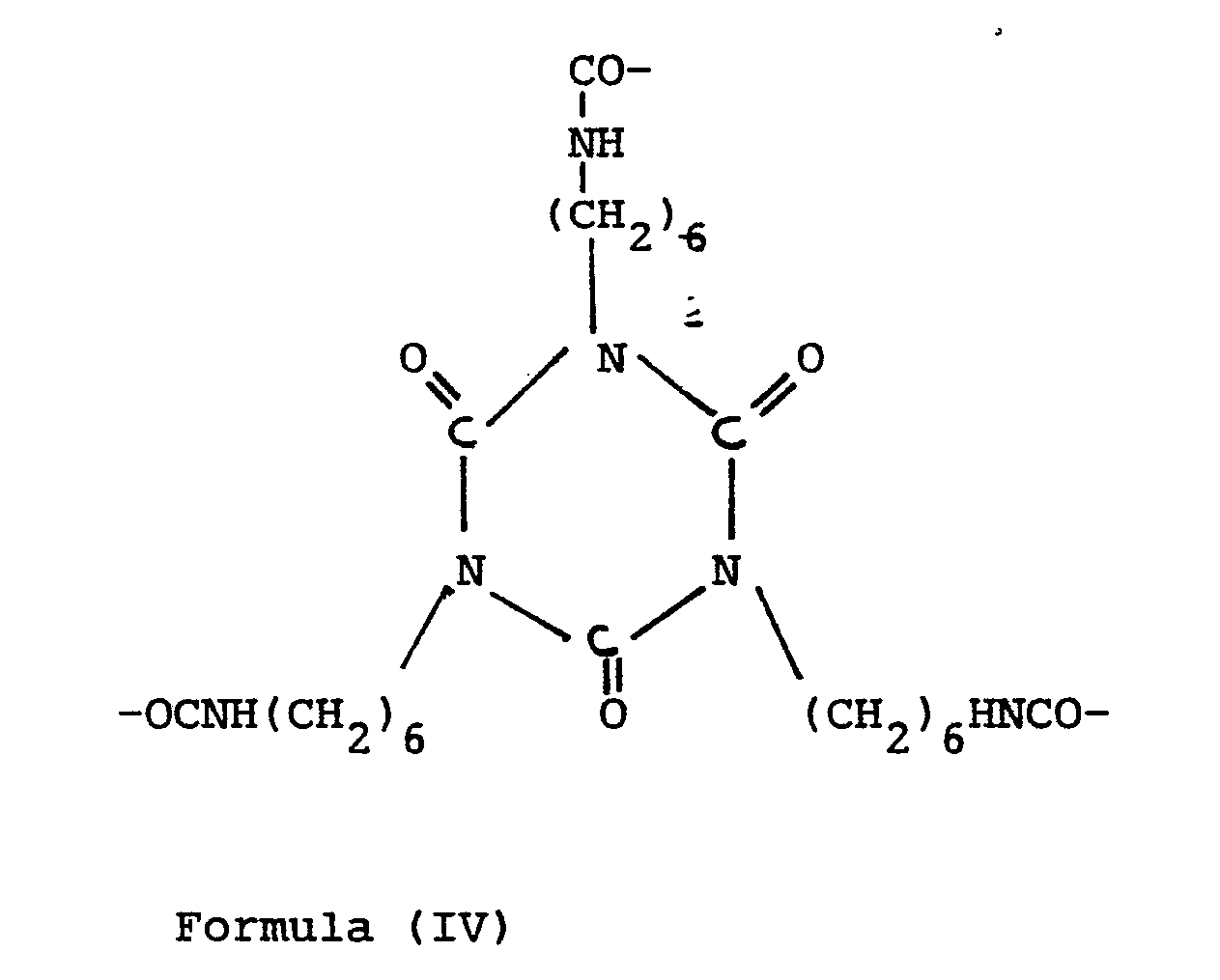
- A further class of oligomeric components is those in which E is the residue of Desmodur L which is idealised as the residue of the adduct of three moles of toluene diisocyanate with one mole of trimethylol propane, as shown in Formula (V).

- A further class of oligomeric component is those in which E is the residue of Desmodur Z, thought to be the isocyanate formed from 3 moles of isophorone diisocyanate as shown in Formula (VI)

- A further class of oligomeric component are those in which E is the residue of an isocyanate oligomer formed as an adduct of an isocyanate such as one of those previously given from which E can be derived, with a diol or triol, to give an isocyanate oligomer which is four or six functional in isocyanate. Examples of such diols are ethylene glycol, propylene glycol and polycapralactone polyether diol of molecular weight 498g mol⁻¹ of Formula (VII):-
H[OCH₂(CH₂)₃CH₂CO]xO(CH₂)₂0(CH₂)₂O[CO(CH₂)₄O)]yH
Formula (VII)
in which x+y = 4. A diol of Formula (IV) is sold under the trade name Capa 200 ("Capa" is a registered Trade Mark) - Examples of triols which can be used are glycerol, trimethylol propane and 2 ethyl trimethylol propane.
- One class of oligomeric components of Formula (III) is that in which G is
-[O(CH₂)₅CO]₂-[O(CH₂)₂]-[OCO(CH₂)₂]-
which is derived from "Tone M100" (believed to be an adduct of 2 moles of capralactone and 1 mole of hydroxyethyl acrylate) (Tone is a registered Trade Mark). - A further class of oligomeric component of Formula (III) is that in which G is
-[O(CH₂)d]-[OCO(CH₂)₂]-
which are derived from hydroxyaklyl acrylates. Preferably in this class are those in which d is 2, derived from hydroxyethyl acrylate or those in which d is 4, derived from hydroxybutyl acrylate. - A further class of oligomeric component of Formula (III) is that in which
R⁵ is either hydrogen or methyl, derived from an amino-alkyl silane compound. Preferably m is 3. - A further class of oligomeric component of formula (III) is that in which K is

- A further class of oligomeric component of Formula (III) is that in which K is

- In making the compositions of the invention, the polymer and oligomer components are combined in proportions such that the ratio of the number of silyl groups in the oligomer component, to those in the polymer component is in the range 1:4 to 2:1.
- Each component is normally dissolved in dry organic solvent which can dissolve both the polymer and the oligomer component, and which either does not react with the silyl groups or which reacts reversibly with them. Examples of such solvents are aliphatic hydrocarbons, aromatic hydrocarbons, halogenated hydrocarbons, alcohols, ketones, esters, ethers or ether-alcohols.
- The amount of the solvent will vary depending on the molecular weight or composition of the polymer and the cross-linker and will be so that the resulting composition is of the correct viscosity for the application method to be used.
- A catalyst may be optionally used to accelerate the cross-linking reaction. The catalyst can be chosen from the compounds generally used as the curing catalysts for hydrolysable silyl group containing compounds. Examples of such catalysts are tin salts such as dibutyl tin dilaurate, dibutyl tin diacetate, tin octoate and dibutyl tin oxide, amines such as triethylamine, tetramethylguanidine and tri- ethylene diamine, and acids such as para-toluene sulphonic acid. The weight of the catalyst used is up to 5% of the weight of the polymer component, preferably from 0.3 to 3% of the weight of the polymer component.
- In addition, there can be added to a composition of this type additives such as UV absorbers, flow aids and water scavengers commonly used in paint formulations to modify application or final film properties.
- The compositions of this invention can be used to coat surfaces by applying a film to the surface by standard techniques for example by dipping or with a brush or roller or with a spray gun and then allowing the solvent to evaporate.
- The following Examples illustrate the invention.
- All properties are in parts by weight unless stated otherwise.
- A solution of 6 parts of azodiisobutyronitrile in 72 parts of γ-methacryloxypropyltrimethoxysilane, 322.8 parts of methylmethacrylate, 93 parts of n-butyl methacrylate, and 112.2 parts of butyl acrylate were added dropwise with stirring over three hours to 400 parts of xylene at 80°C under nitrogen. The mixture was stirred at 80°C for a further hour. After each non-volatile contents determination which gave a value of below 60%, a further 1.5 grams of azodiisobutyronitrile were added and the mixture was stirred for a further 2 hours at 80°C.
- This produces a silyl-group containing vinyl type polymer having a number average molecular weight as determined by gel-permeation chromatography of 10,000.
- A mixture of 192g of Desmodur Z (thought to be the isocyanurate of isophorone diisocyanate and 39.8g of xylene were added over one hour to a stirred mixture of 80.0 grams of hydroxybutyl acrylate and 58.0 of xylene at 70°C under dry air. The temperature was increased to 90°C and the mixture was stirred until all the isocyanate had reacted. The mixture was allowed to cool.
- 132.5g of γ-aminopropyltriethoxysilane and 96.0g of xylene was added to the product from (i) the mixture being stirred and kept under nitrogen during the addition.
- Polymer component from (i) 66.9 g
Oligomer Component from (ii) 19.8 g
Dibutyl Tin Dilaurate Catalyst 1.2 g
Thinner 12.1 g
The "thinner" used was formulated as foIlows:
- Xylene 50.0 g
Ethylene Glycol Mono butyl ether 25.0 g
*Solvesso 100 25.0 g
*Solvesso 100 is a mixture of C₉ aromatic hydrocarbons. - A solution of 12 parts of azodiisobutyro- nitrile in 66 parts of γ-methacryloxypropyl- trimethoxysilane, 138.0 parts of methylmethacrylate, 94.2 parts of n-butyl methacrylate, 113.4 parts of butyl acrylate and 188.4 parts of styrene was added dropwise with stirring over three hours to 400 parts of xylene at 120°C under nitrogen and the mixture was stirred at 120°C for a further hour.
- After each non-volatile contents determination which gave a value below 60%, a further 3 grams of azodiisobutyronitrile were added and the mixture was stirred for a further hour at 120°C.
- This produces a silyl-group containing vinyl type polymer having a molecular weight as determined by gel-permeation chromatography of 4,000.
- Polymer component from Example 2(i) 65.7 g
Oligomer component from Example 1(ii) 21.2 g
Dibutyl Tin Dilaurate Catalyst 1.18 g
Thinner 11.92 g
- Reaction of isocyanate with the hydroxybutyl acrylate.
- A mixture of 149.6 g of hydroxybutylacrylate, 16g of butyl acetate and 91.4 g of xylene was slowly added to a stirred solution of 203 g of Desmodur N3300 (thought to be a hexamethylene diisocyanate isocyanurate trimer) in 14.2 g of butyl acetate and 132 g of xylene at 70°C under dry air. The mixture was held at 90°C until all the isocyanate had reacted. A mixture of 228.4 g of γ-aminopropyltriethoxy-silane, 16.2 g of butyl acetate and 149.2 g of xylene was added slowly at 25°C. An infrared spectrum of the mixture showed no peak at 1640cm⁻¹ due to the carbon-carbon double bond.
- Polymer component from Example 2 (i) 68.0 g
Oligomer component from Example 3(i) 14.7 g
Dibutyl Tin Dilaurate Catalyst 1.2 g
Thinner 16.1 g
- Polymer component from Example 1(i) 66.9 g
Oligomer component from Example 3(i) 15.8 g
Dibutyl Tin Dilaurate Catalyst 1.2 g
Thinner 16.1 g
- A mixture of 110.1 g of hydroxybutylacrylate and 79.9 g of xylene was added over 30 minutes to a stirred solution of 225.6 g of Desmodur N3300 (thought to be a hexamethylene diisocyanate isocyanurate trimer) in 162.4 g of xylene at 70°C under dry air. The mixture was stirred at 90°C until the isocyanate had reacted. A solution of 76.7 g of an aliphatic polyester poly-ether diol (Capa200) in 53 g of xylene was added over 30 minutes. The mixture was stirred for a further 3 hours while the temperature was maintained at between 70°C and 90°C and was allowed to cool to room temperature. A solution of 169.2 g of γ-aminopropyltriethoxysilane in 123.1 g of xylene was added over 15 minutes. The mixture was heated to 50°C for 30 minutes.
- Polymer component from Example 2(i) 66.3 g
Oligomer component from Example 5(i) 16.5 g
Dibutyl Tin Dilaurate Catalyst 1.19 g
Thinner 16.01 g
- Polymer component from Example 1 (i) 65.1 g
Oligomer component from Example 5 (i) 17.6 g
Dibutyl Tin Dilaurate Catalyst 1.17g
Thinner 15.83g
- A mixture of 479.7 g of Desmodur Z (thought to be the isocyanurate of isophorone diisocyanate), 89.3 g of xylene and 9.8 g of butyl acetate was added over 80 min. to a stirred solution of 98.4 g of 2-hydroxyethyl acrylate in 64.2 g of xylene and 7.1 g of butylacetate at 70°C. The mixture was held at 90°C until the isocyanate value, by titration, had fallen to 2/3 of the original value, and allowed to cool to 25°C. A solution of 18.6 g of trimethylol propane in 13.7 g of butyl acetate was added with stirring and the temperature was raised to 90°C for one hour. An infra red spectrum of this mixture showed no peak at 2250cm⁻¹ corresponding to the isocyanate group.
- A mixture of 187.3 g of γ-aminopropyltriethoxysilane and 31.9 g of xylene were added with stirring over 90 minutes. An infra red spectrum of the mixture showed no peaks at 1640cm⁻¹ due to the carbon-carbon double bond.
- Polymer component from Example 2(i) 57.1 g
Oligomer component from Example 7(i) 26.2 g
Dibutyl Tin Dilaurate Catalyst 1.02 g
Thinner 15.68 g
- Polymer component from Example 1(i) 55.5 g
Oligomer component from Example 7(i) 27.8 g
Dibutyl Tin Dilaurate Catalyst 0.99g
Thinner 15.71 g
- A mixture of 262.1 g of an adduct of 2-hydroxyethyl acrylate and two molecules of caprolactone (Tone M100), 170.9 g of xylene and 18.9 g of butyl acetate were added to 149.9 g of stirred solution of Desmodur N3300 (thought to be a hexamethylene diisocyanate isocyanurate trimer) in 98 g of xylene and 10.5 g of butyl acetate at 70°C and stirred at 90°C until all the isocyanate had reacted.
- 168 g of γ-aminopropyltriethoxysilane was added in 41.8 grams of xylene and 4 g of butylacetate whilst stirring at 25°C. Stirring continued at 50°C until all the double bond had reacted shown by the absence of the peak in the infrared spectrum at 1640cm⁻¹.
- Polymer component from Example 2(i) 66.7 g
Oligomer component from Example 9(i) 16.1 g
Dibutyl Tin Dilaurate Catalyst 0.92 g
Thinner 16.28 g
- Polymer component from Example 1(i) 65.4 g
Oligomer component from Example 9(i) 17.3 g
Dibutyl Tin Dilaurate Catalyst 1.17 g
Thinner 16.13 g
- A mixture of 164.5 g of Desmodur Z (thought to be the isocyanurate of isophorone diisocyanate) 73.7 g of xylene and 8.3 g of butyl acetate was added over 60 minutes to a stirred mixture of 58.1 g of hydroxybutyl acrylate at 70°C. The preparation was stirred at 90°C until all the isocyanate had reacted and there was no peak at 2250cm⁻¹ in the infrared spectrum of the mixture, demonstrating the absence of the isocyanate group.
- A mixture of 200.5 g of γ-aminopropyltriethoxysilane 79.9 g of toluene and 9.3 g of butyl acetate was added and the reaction was monitored by loss of the peak due to the carbon-carbon bond at 1640cm⁻¹. When the reaction was complete a solution of 159.8 g of γ-glycidoxypropyltrimethoxysilane in 14.5 g of butyl acetate and 231 g of xylene was added and the mixture was heated to 50°C until the infrared spectrum of the mixture showed the absence of a peak at 940-960cm⁻¹ due to the epoxide group.
- Polymer component from Example 2(i) 71.9 g
Oligomer component from Example 11(i) 15.3 g
Dibutyl Tin Dilaurate Catalyst 0.93 g
Thinner 11.87 g
- Polymer component from Example 1(i) 71.1 g
Oligomer component from Example 11(i) 16.5 g
Dibutyl Tin Dilaurate Catalyst 1.27 g
Thinner 11.28 g
-

- The above feeds A and B were simultaneously added dropwise over a period of two hours to butyl acetate (137.5 g) while the butyl acetate was at reflux temperature with stirring under a nitrogen blanket. On completion of the addition of the two feeds, a mixture of butyl acetate (6.9 g) and genitron AZM (2.9 g) was added. The contents of the flask were held at reflux for one hour. A mixture of butyl acetate (6.9 g) and genitron AZM were added and the contents of the flask were held at reflux for a further 1.5 hours.
- This produced a silyl group-containing vinyl type polymer having a number average molecular weight as determined by gel permeation chromatography of 1,210.
- Polymer component from Example 13(i) 10.0 g
Oligomer component from Example 2 (i) 2.86 g
Dibutyl Tin Dilaurate Catalyst 0.18 g
Xylene 2.66 g
- Polymer component from Example 13(i) 10.0 g
Dibutyl Tin Dilaurate Catalyst 0.18 g
Xylene 2.38 g
-

- The above feeds A and B were simultaneously added dropwise over a period of two hours to butyl acetate (137.5 g) at reflux, 120°C, stirred under nitrogen. On completion of the feed additions, a mixture of butyl acetate (6.9 g) and Genitron AZM (2.9 g) were added. The reaction mixture was held at reflux for one hour. A mixture of butyl acetate (6.9 g) and Genitron AZM (2.9 g) were added. The reaction mixture was held at reflux for a further 1.5 hours. The mixture was allowed to cool to room temperature. Butyl acetate (215.0 g) was added to reduce the viscosity.
- This produced a silane functional vinyl-type polymer of solids content 60%, and number average molecular weight as determined by gel permeation chromatography of 1,079.
- Polymer component from Example 14 (i) 10.0 g
Oligomer component from Example 3 (i) 2.86 g
Dibutyl Tin Dilaurate catalyst 0.18 g
Xylene 2.38 g
- Polymer component from Example 14(i) 10.0 g
Dibutyl Tin Dilaurate catalyst 0.18
Xylene 2.38
- These examples show the effects of the variation of the catalyst level in a single polymer/oligomer composition.
- To a composition comprising 28.6g of the oligomer from Example 3(i) and 100g of the polymer from Example 1(i) were added various amounts of two catalysts, dibutyltin dilaurate (DBTDL) and dibutyltin diacetate (DBTDA). The compositions were reduced to 50% non vol. with xylene.

- These examples show the effect of the variation of the ratio of oligomer component to the polymer component in compositions with constant polymer and oligomer type.
- Compositions 25 to 30 comprising various ratios of the oligomer component from Example 3(i) and the polymer component from Example 1(i) together with fixed amounts of dibutyltin dilaurate (DBTDL) catalyst, diluted to 50% non vol content with xylene. The '%' figure relates to the theoretical percentage of the number of siloxane groups on the polymer component to those on the oligomer component. Other figures are in grams.

- In order to establish the advantageous properties of the compositions of the invention in relation to the state of the art Examples 1, 3, and 4 of the Japanese Application No. 60-44549 were repeated as follows
- Isophorone diisocyanate (0.2 mole) and dibutyl tin dilaurate (0.05g) were mixed in xylene (60 ml) and heated to 80°C to 90°C. Polypropylene glycol (M.W. 400, 0.13 mole)m was added dropwise over 1 hour and the reaction was continued for a further 4 hours at the same temperature, giving the urethane prepolymer with terminal NCO groups. The ethylene oxide addition product (2 molecules) of methanol (methyl carbitol, 0.03 mole) and γ-aminopropyl- trimethoxysilane (0.11 mole) were then added and reacted for 4 hours at the same temperature.
- The temperature was then raised to 100°C to 110°C and a mixture of n-butyl methacrylate (0.3 mole) γ-methacryloxypropyltrimethoxysilane (0.05 mole) and azobisisobutyronitrile (0.5g) was added dropwise over 30 minutes. The reaction was continued for a further 3 hours at the same temperature. Further azobisisobutyronitrile (0.1g) was added and after a further 2 hours' reaction the mixture of the urethane prepolymer (A) with blocked terminal NCO groups and the vinyl resin (B) possessing hydrolysable side chain silyl groups was obtained.
- Product from Example 31(i) 10.0 g
Dibutyl Tin Dilaurate 0.2 g
- Isophorone diisocyanate (0.2 mole) and dibutyl tin dilaurate (0.05 g) were mixed in xylene (60 ml) and the temperature raised to 90°C. Polypropylene glycol (M.W. 400, 0.13 mole) was dropped in over 1 hour and the urethane prepolymer with terminal NCO groups was obtained after a further 4 hours' reaction at the same temperature. Methyl carbitol (0.034 mole) and γ-aminopropyltrimethoxysilane (0.11 mole) were added and reacted at the same temperature for 4 hours. When a sample of the resulting solution was taken and the solvent was removed under reduced pressure, a blocked urethane prepolymer (A) of molecular weight approximately 1200 was obtained. The free NCO content was zero.
- Product from Example 32(i) 10.0 g
Dibutyl Tin Dilaurate 0.2 g
- A mixture of n-butyl methacrylate (0.3 mole), γ-methacryloxypropyltrimethoxysilane (0.05 mole) and azobisisobutyronitrile (0.5 g) was added dropwise to xylene (60 ml) at 100 to 110 over 30 minutes. The reaction was continued for 3 hours at the same temperature. Further azobisisobutyronitrile (0.1gram) was added and reacted for 2 hours, giving the vinyl resin (B) with hydrolysable side chain silyl groups. It was ascertained that there was no absorbtion at 1648 cm⁻¹ in the infrared absorption spectrum of the product.
- Product from Example 33(i) 10.0 g
Dibutyl Tin Dilaurate 0.2 g
- Product from Example 32(i) 5.0 g
Product from Example 33(i) 5.0 g
Dibutyl Tin Dilaurate 0.2 g
- Product from Example 32(i) 8.0 g
Product from Example 33(i) 2.0 g
Dibutyl Tin Dilaurate 0.2 g
- A composition representing a standard non-pigmented isocyanate-hydroxyl clearcoat, was made up comprising
Macrynal 510n 67 parts by weight
("Macrynal is a registered Trade Mark)
Isocyanate cross-Iinker 33 parts by weight
The isocyanate crosslinker was Desmodur N.
- For comparison and testing purposes films were formed from these compositions by spreading them at a thickness of 200 microns with a Sheen 200µ block spreader (Sheen is a Registered Trade Mark) over a degreased, clean glass substrate. All resins were applied at 50% non vol. Dilutions were carried out with suitable solvents such as xylene as necessary.
- The films so formed were allowed to cure overnight at and the following tests were carried out on each film.
Clarity: assesed by eye.
MEK rubs: rubbing the panel with a rag soaked in MEK (Methyl Ethyl Ketone).
Petrol Test: the panel is covered with an absorbent pad which has been soaked with petrol. After 15 minutes the pad is removed.
Water Spot Test: a few drops of distilled water are placed on the panel, left for 2 hours then wiped off.
Erichsen Hardness: number of swings given by the Erichsen Hardness Apparatus.
Pencil Hardness: The hardest pencil which may be drawn across the surface of the film without scratching through to the substrate.
The test results for each film over glass are given in Table 1. The rating system used is given in Table 3. - It can be seen from Table 1 that the compositions according to the invention ( compositions 1 to 28 ) give acceptable Erichsen hardness and pencil hardness, have petrol resistance which is comparable with or better than the prior art while having superior clarity, water resistance and MEK rub resistance.
- In order to illustrate the use of some of these compositions in a paint system they were thinned to spraying viscosity by the addition of xylene and applied by compressed air spray over a commonly used nitrocellulose basecoat "Belco" ( "Belco" is a registered trade mark). The results of testing these films after curing overnight at room temperature are given in Table 2. It can be seen that in these less controlled tests the advantages of the films formed from the compositions of the invention are comparable with those seen in the more controlled test over the glass substrate.


-
- 1 = Very good clear films
- 2 = Clear film
- 3 = Slightly hazy
- 4 = Hazy
- 5 = Badly Hazy
-
- 1 = Unaffected
- 2 = Very slight softening
- 3 = Slight softening
- 4 = Softening
- 5 = Bad/Severe Softening
-
- 1 = Unaffected
- 2 = Slight softening
- 3 = Softening and marking
- 4 = Bad softening
Claims (10)
CH₂=CR¹CO₂(CH₂)aL
Formula (I)
where a is 2 to 6
R¹ is hydrogen or methyl and
L is a group of Formula (II):-

R² is C1-4alkoxy, C2-4alkoxy-C2-4 alkoxy, C1-4 alkanoyl, enolate or oxime and R³ and R⁴ are as defined with reference to R₂ or are C1-6alkyl; and structural units derived from polymerisable ethylenically unsaturated monomers such that each molecule of the polymer component contains at least two silyl groups of Formula (II);
the oligomeric component being a compound of Formula (III):-
E(GKL)b
Formula (III)
where b is 3 to 6; E is derived from a biuret or isocyanurate oligomer of a di-functional isocyanate the isocyanate being a C4-15 aliphatic, cycloaliphatic or aromatic diisocyanate optionally substituted with one or more C1-6 alkyl groups or is derived from an adduct of C2-6 aliphatic diol triol or tetraol and a poly functional isocyanate, the poly functional isocyanate being either a di-functional isocyanate as previously defined or being itself the adduct of an aliphatic triol and a di-functional isocyanate as previously defined,
G is
-[O(CH₂)₅CO]c[O(CH₂)dOCO(CH₂)₂]-
in which c is 0 to 2, d is 2 to 4;
K is
-[NR⁵(CH₂)m]-
in which m is 1 to 6, and R⁵ is hydrogen, methyl, -(CH₂)nR⁶, or -CH₂CHOH(CH₂)n-R⁶ in which R⁶ is the group L as defined with reference to Formula (I) and n is 1 to 4.
CH₂=CR¹CO₂(CH₂)aL
Formula (I)
where a is 2 to 6
R¹ is hydrogen or methyl and
L is a group of Formula (II):-

R² is C1-4alkoxy, C2-4alkoxy-C2-4 alkoxy, C1-4 alkanoyl, enolate or oxime and R³ and R⁴ are as defined with reference to R₂ or are C1-6alkyl; and structural units derived from polymerisable ethylenically unsaturated monomers such that each molecule of the polymer component contains at least two silyl groups of Formula (II);
the oligomeric component being a compound of Formula (III):-
E(GKL)b
Formula (III)
where b is 3 to 6; E is derived from a biuret or isocyanurate oligomer of a di-functional isocyanate the isocyanate being a C4-15 aliphatic, cycloaliphatic or aromatic diisocyanate optionally substituted with one or more C1-6 alkyl groups or is derived from an adduct of C2-6 aliphatic diol triol or tetraol and a poly functional isocyanate, the poly functional isocyanate being either a di-functional isocyanate as previously defined or being itself the adduct of an aliphatic triol and a di-functional isocyanate as previously defined,
G is
-[O(CH₂)₅CO]C[O(CH₂)dOCO(CH₂)₂]-
in which c is 0 to 2, d is 2 to 4;
K is
-[NR⁵(CH₂)m]-
in which m is 1 to 6, and R⁵ is hydrogen, or -CH₂CHOH(CH₂)n-R⁶ in which R⁶ is the group L as defined with reference to Formula (I) and n is 1 to 6.
Priority Applications (1)
| Application Number | Priority Date | Filing Date | Title |
|---|---|---|---|
| AT87309185T ATE90959T1 (en) | 1986-11-14 | 1987-10-16 | CURING COMPOSITION. |
Applications Claiming Priority (2)
| Application Number | Priority Date | Filing Date | Title |
|---|---|---|---|
| GB868627314A GB8627314D0 (en) | 1986-11-14 | 1986-11-14 | Curing composition |
| GB8627314 | 1986-11-14 |
Publications (3)
| Publication Number | Publication Date |
|---|---|
| EP0267698A2 true EP0267698A2 (en) | 1988-05-18 |
| EP0267698A3 EP0267698A3 (en) | 1990-05-09 |
| EP0267698B1 EP0267698B1 (en) | 1993-06-23 |
Family
ID=10607387
Family Applications (1)
| Application Number | Title | Priority Date | Filing Date |
|---|---|---|---|
| EP87309185A Expired - Lifetime EP0267698B1 (en) | 1986-11-14 | 1987-10-16 | Curing composition |
Country Status (13)
| Country | Link |
|---|---|
| US (1) | US4785035A (en) |
| EP (1) | EP0267698B1 (en) |
| JP (1) | JPS63139936A (en) |
| CN (1) | CN87107861A (en) |
| AT (1) | ATE90959T1 (en) |
| AU (1) | AU604073B2 (en) |
| CA (1) | CA1296450C (en) |
| DE (1) | DE3786326T2 (en) |
| ES (1) | ES2041268T3 (en) |
| GB (2) | GB8627314D0 (en) |
| NZ (1) | NZ222272A (en) |
| ZA (1) | ZA877990B (en) |
| ZW (1) | ZW19587A1 (en) |
Cited By (5)
| Publication number | Priority date | Publication date | Assignee | Title |
|---|---|---|---|---|
| EP0571073A3 (en) * | 1992-05-19 | 1994-01-05 | Imperial Chemical Industries Plc | Silane functional oligomer |
| EP0841383A3 (en) * | 1996-11-12 | 1998-11-25 | OSi Specialties, Inc. | Alkoxysilyl-functional oligomers in curable silane polymer compositions |
| EP0702016A3 (en) * | 1994-08-30 | 1999-04-14 | Hüls Aktiengesellschaft | Acryloxypropyl alkoxysilanes, process for their preparation and their use |
| WO2007109274A3 (en) * | 2006-03-21 | 2008-01-10 | Alza Corp | Hydratable polymeric ester matrix for drug electrotransport |
| US7357960B2 (en) | 2002-08-14 | 2008-04-15 | Wacker Chemie Ag | Silane-crosslinkable coating formulations |
Families Citing this family (15)
| Publication number | Priority date | Publication date | Assignee | Title |
|---|---|---|---|---|
| DE3920325C2 (en) * | 1988-06-24 | 2001-04-12 | Sunstar Engineering Inc | Masked polyisocyanurate compound and plastisol composition containing it |
| EP0491357B1 (en) * | 1990-12-17 | 2001-03-07 | Dainichiseika Color & Chemicals Mfg. Co. Ltd. | Coating compositions |
| US5658988A (en) * | 1994-06-30 | 1997-08-19 | Kansai Paint Co., Ltd. | Resinous composition for coating |
| GB9425436D0 (en) * | 1994-12-16 | 1995-02-15 | Ici Plc | Water-based coating composition |
| JP4860073B2 (en) * | 2001-09-18 | 2012-01-25 | コニシ株式会社 | Silylated urethane-based fast-curing aqueous composition, aqueous adhesive containing the aqueous composition, and aqueous coating agent |
| JP4860072B2 (en) * | 2001-09-18 | 2012-01-25 | コニシ株式会社 | Silylated urethane-based fast-curing aqueous composition, aqueous adhesive containing the aqueous composition, and aqueous coating agent |
| US6756465B1 (en) | 2001-10-19 | 2004-06-29 | Henkel Loctite Corporation | Moisture curable compounds and compositions |
| US7401843B2 (en) * | 2003-07-24 | 2008-07-22 | Tremco Incorporated | Recreational vehicle roofing coating |
| WO2006064884A1 (en) * | 2004-12-15 | 2006-06-22 | Kuraray Co., Ltd. | Actinic energy ray curable resion composition and use thereof |
| DE102007020404A1 (en) * | 2006-09-18 | 2008-10-30 | Nano-X Gmbh | Process for the preparation of a coating material |
| DE102006044310A1 (en) * | 2006-09-18 | 2008-03-27 | Nano-X Gmbh | Silane coating material and method of making a silane coating material |
| WO2008156806A1 (en) * | 2007-06-19 | 2008-12-24 | The University Of Akron | Singly-terminated polyisobutylenes and process for making same |
| CN102015935A (en) * | 2008-03-18 | 2011-04-13 | 纳米X有限公司 | Method for the production of a highly abrasion-resistant vehicle paint, vehicle paint, and the use thereof |
| CN102947370B (en) * | 2010-04-23 | 2016-05-11 | 汉高知识产权控股有限责任公司 | silicone-acrylic copolymer |
| RU2510725C1 (en) * | 2012-10-18 | 2014-04-10 | Владимир Юрьевич Гаравин | Foam-generating composition |
Family Cites Families (4)
| Publication number | Priority date | Publication date | Assignee | Title |
|---|---|---|---|---|
| US4540766A (en) * | 1983-10-03 | 1985-09-10 | Ppg Industries, Inc. | Thermosetting high solids solvent-based polyester-urethane one-component coating compositions |
| JPS60212453A (en) * | 1984-04-09 | 1985-10-24 | Kanegafuchi Chem Ind Co Ltd | Curable resin composition |
| US4539345A (en) * | 1985-02-04 | 1985-09-03 | Minnesota Mining And Manufacturing Company | Moisture-curable polyurethane composition |
| BR8701765A (en) * | 1986-04-18 | 1988-02-02 | Du Pont | COMPOSITION OF AT LEAST TWO POLYMERS; ENAMEL INK; AND SUBSTRATE COATED WITH ENAMEL |
-
1986
- 1986-11-14 GB GB868627314A patent/GB8627314D0/en active Pending
-
1987
- 1987-10-16 ES ES198787309185T patent/ES2041268T3/en not_active Expired - Lifetime
- 1987-10-16 AT AT87309185T patent/ATE90959T1/en not_active IP Right Cessation
- 1987-10-16 GB GB08724347A patent/GB2197325A/en not_active Withdrawn
- 1987-10-16 EP EP87309185A patent/EP0267698B1/en not_active Expired - Lifetime
- 1987-10-16 DE DE87309185T patent/DE3786326T2/en not_active Expired - Fee Related
- 1987-10-22 NZ NZ222272A patent/NZ222272A/en unknown
- 1987-10-23 ZA ZA877990A patent/ZA877990B/en unknown
- 1987-10-28 CA CA000550452A patent/CA1296450C/en not_active Expired - Lifetime
- 1987-10-30 US US07/114,735 patent/US4785035A/en not_active Expired - Fee Related
- 1987-11-02 ZW ZW195/87A patent/ZW19587A1/en unknown
- 1987-11-12 AU AU81150/87A patent/AU604073B2/en not_active Ceased
- 1987-11-13 JP JP62285684A patent/JPS63139936A/en active Pending
- 1987-11-14 CN CN198787107861A patent/CN87107861A/en active Pending
Cited By (6)
| Publication number | Priority date | Publication date | Assignee | Title |
|---|---|---|---|---|
| EP0571073A3 (en) * | 1992-05-19 | 1994-01-05 | Imperial Chemical Industries Plc | Silane functional oligomer |
| EP0702016A3 (en) * | 1994-08-30 | 1999-04-14 | Hüls Aktiengesellschaft | Acryloxypropyl alkoxysilanes, process for their preparation and their use |
| EP0841383A3 (en) * | 1996-11-12 | 1998-11-25 | OSi Specialties, Inc. | Alkoxysilyl-functional oligomers in curable silane polymer compositions |
| US7357960B2 (en) | 2002-08-14 | 2008-04-15 | Wacker Chemie Ag | Silane-crosslinkable coating formulations |
| US7871675B2 (en) | 2002-08-14 | 2011-01-18 | Wacker Chemie Ag | Silane-crosslinkable coating formulations |
| WO2007109274A3 (en) * | 2006-03-21 | 2008-01-10 | Alza Corp | Hydratable polymeric ester matrix for drug electrotransport |
Also Published As
| Publication number | Publication date |
|---|---|
| EP0267698B1 (en) | 1993-06-23 |
| EP0267698A3 (en) | 1990-05-09 |
| GB8627314D0 (en) | 1986-12-17 |
| US4785035B1 (en) | 1990-07-31 |
| GB2197325A (en) | 1988-05-18 |
| ZA877990B (en) | 1989-01-25 |
| NZ222272A (en) | 1990-02-26 |
| DE3786326D1 (en) | 1993-07-29 |
| AU8115087A (en) | 1988-05-19 |
| JPS63139936A (en) | 1988-06-11 |
| DE3786326T2 (en) | 1993-09-30 |
| ES2041268T3 (en) | 1993-11-16 |
| ZW19587A1 (en) | 1989-05-31 |
| GB8724347D0 (en) | 1987-11-18 |
| CA1296450C (en) | 1992-02-25 |
| CN87107861A (en) | 1988-05-25 |
| US4785035A (en) | 1988-11-15 |
| AU604073B2 (en) | 1990-12-06 |
| ATE90959T1 (en) | 1993-07-15 |
Similar Documents
| Publication | Publication Date | Title |
|---|---|---|
| EP0267698B1 (en) | Curing composition | |
| US5834555A (en) | Aqueous multicomponent polyurethane coating composition, process for its preparation and its use in methods of producing a multicoat finish | |
| DE69808486T2 (en) | CURABLE COMPOSITIONS BASED ON FUNCTIONAL POLYSILOXANS | |
| EP0868460B1 (en) | Coating containing acrylosilane polymer to improve mar and acid etch resistance | |
| CA1179097A (en) | Urethane rheology modifiers and compositions containing same | |
| US3558564A (en) | Thermosetting coating composition of an organic polyisocyanate and a polymer having pendant hydroxyl containing ester groups | |
| US5017655A (en) | Urethane coating resin composition | |
| US5916992A (en) | Polysiloxane polyols | |
| CA1179096A (en) | Urethane rheology modifiers substantially free of terminal hydrophobic groups and compositions containing same | |
| KR20040032912A (en) | Coating materials that can be cured thermally and by actinic radiation, and the use thereof | |
| JPH1036767A (en) | Two pack type aqueous coating composition | |
| US3557043A (en) | Polyacrylate-urethane lacquers | |
| DE112013003992B4 (en) | Two component waterborne coating compositions | |
| KR920002989B1 (en) | Coating composition based on urethane-containing polyacid curing agent and polyepoxide | |
| JP3972409B2 (en) | Coating resin composition and method for curing the same | |
| JPH11189744A (en) | Coating material composition having high solid content | |
| EP0491357A1 (en) | Coating compositions | |
| WO2002032977A1 (en) | Water-dispersible polyisocyanate composition, process for its production, water-base curable composition and its application | |
| US5658988A (en) | Resinous composition for coating | |
| JP3232390B2 (en) | Paint composition for aerosol | |
| JPH0359944B2 (en) | ||
| JPH0249346B2 (en) | ||
| JP3411679B2 (en) | Resin composition for coating | |
| JP2979439B2 (en) | Thermosetting resin composition | |
| JP2818231B2 (en) | Paint composition |
Legal Events
| Date | Code | Title | Description |
|---|---|---|---|
| PUAI | Public reference made under article 153(3) epc to a published international application that has entered the european phase |
Free format text: ORIGINAL CODE: 0009012 |
|
| AK | Designated contracting states |
Kind code of ref document: A2 Designated state(s): AT BE CH DE ES FR GB IT LI NL SE |
|
| PUAL | Search report despatched |
Free format text: ORIGINAL CODE: 0009013 |
|
| AK | Designated contracting states |
Kind code of ref document: A3 Designated state(s): AT BE CH DE ES FR GB IT LI NL SE |
|
| 17P | Request for examination filed |
Effective date: 19901001 |
|
| 17Q | First examination report despatched |
Effective date: 19910806 |
|
| GRAA | (expected) grant |
Free format text: ORIGINAL CODE: 0009210 |
|
| AK | Designated contracting states |
Kind code of ref document: B1 Designated state(s): AT BE CH DE ES FR GB IT LI NL SE |
|
| PG25 | Lapsed in a contracting state [announced via postgrant information from national office to epo] |
Ref country code: SE Effective date: 19930623 Ref country code: AT Effective date: 19930623 |
|
| REF | Corresponds to: |
Ref document number: 90959 Country of ref document: AT Date of ref document: 19930715 Kind code of ref document: T |
|
| ITF | It: translation for a ep patent filed | ||
| REF | Corresponds to: |
Ref document number: 3786326 Country of ref document: DE Date of ref document: 19930729 |
|
| ET | Fr: translation filed | ||
| PG25 | Lapsed in a contracting state [announced via postgrant information from national office to epo] |
Ref country code: ES Free format text: LAPSE BECAUSE OF EXPIRATION OF PROTECTION Effective date: 19931018 |
|
| PG25 | Lapsed in a contracting state [announced via postgrant information from national office to epo] |
Ref country code: LI Effective date: 19931031 Ref country code: CH Effective date: 19931031 |
|
| REG | Reference to a national code |
Ref country code: ES Ref legal event code: FG2A Ref document number: 2041268 Country of ref document: ES Kind code of ref document: T3 |
|
| PLBE | No opposition filed within time limit |
Free format text: ORIGINAL CODE: 0009261 |
|
| STAA | Information on the status of an ep patent application or granted ep patent |
Free format text: STATUS: NO OPPOSITION FILED WITHIN TIME LIMIT |
|
| PG25 | Lapsed in a contracting state [announced via postgrant information from national office to epo] |
Ref country code: NL Effective date: 19940501 |
|
| 26N | No opposition filed | ||
| NLV4 | Nl: lapsed or anulled due to non-payment of the annual fee | ||
| PG25 | Lapsed in a contracting state [announced via postgrant information from national office to epo] |
Ref country code: FR Effective date: 19940630 |
|
| REG | Reference to a national code |
Ref country code: CH Ref legal event code: PL |
|
| REG | Reference to a national code |
Ref country code: FR Ref legal event code: ST |
|
| PGFP | Annual fee paid to national office [announced via postgrant information from national office to epo] |
Ref country code: BE Payment date: 19950925 Year of fee payment: 9 |
|
| PG25 | Lapsed in a contracting state [announced via postgrant information from national office to epo] |
Ref country code: BE Effective date: 19961031 |
|
| BERE | Be: lapsed |
Owner name: IMPERIAL CHEMICAL INDUSTRIES P.L.C. Effective date: 19961031 |
|
| PGFP | Annual fee paid to national office [announced via postgrant information from national office to epo] |
Ref country code: DE Payment date: 20001003 Year of fee payment: 14 |
|
| PGFP | Annual fee paid to national office [announced via postgrant information from national office to epo] |
Ref country code: GB Payment date: 20001004 Year of fee payment: 14 |
|
| REG | Reference to a national code |
Ref country code: GB Ref legal event code: 732E |
|
| REG | Reference to a national code |
Ref country code: ES Ref legal event code: FD2A Effective date: 20010201 |
|
| PG25 | Lapsed in a contracting state [announced via postgrant information from national office to epo] |
Ref country code: GB Free format text: LAPSE BECAUSE OF NON-PAYMENT OF DUE FEES Effective date: 20011016 |
|
| REG | Reference to a national code |
Ref country code: GB Ref legal event code: IF02 |
|
| GBPC | Gb: european patent ceased through non-payment of renewal fee |
Effective date: 20011016 |
|
| PG25 | Lapsed in a contracting state [announced via postgrant information from national office to epo] |
Ref country code: DE Free format text: LAPSE BECAUSE OF NON-PAYMENT OF DUE FEES Effective date: 20020702 |
|
| PG25 | Lapsed in a contracting state [announced via postgrant information from national office to epo] |
Ref country code: IT Free format text: LAPSE BECAUSE OF NON-PAYMENT OF DUE FEES;WARNING: LAPSES OF ITALIAN PATENTS WITH EFFECTIVE DATE BEFORE 2007 MAY HAVE OCCURRED AT ANY TIME BEFORE 2007. THE CORRECT EFFECTIVE DATE MAY BE DIFFERENT FROM THE ONE RECORDED. Effective date: 20051016 |