EP0273090A1 - Solution polymerization of acrylic acid derived monomers using tertiary alkyl( C5)-hydroperoxides - Google Patents
Solution polymerization of acrylic acid derived monomers using tertiary alkyl( C5)-hydroperoxides Download PDFInfo
- Publication number
- EP0273090A1 EP0273090A1 EP87100025A EP87100025A EP0273090A1 EP 0273090 A1 EP0273090 A1 EP 0273090A1 EP 87100025 A EP87100025 A EP 87100025A EP 87100025 A EP87100025 A EP 87100025A EP 0273090 A1 EP0273090 A1 EP 0273090A1
- Authority
- EP
- European Patent Office
- Prior art keywords
- carbons
- tertiary
- methacrylate
- alkyl
- monomer
- Prior art date
- Legal status (The legal status is an assumption and is not a legal conclusion. Google has not performed a legal analysis and makes no representation as to the accuracy of the status listed.)
- Granted
Links
- 239000000178 monomer Substances 0.000 title claims abstract description 79
- NIXOWILDQLNWCW-UHFFFAOYSA-N 2-Propenoic acid Natural products OC(=O)C=C NIXOWILDQLNWCW-UHFFFAOYSA-N 0.000 title claims abstract description 11
- 125000000217 alkyl group Chemical group 0.000 title claims description 12
- SMZOUWXMTYCWNB-UHFFFAOYSA-N 2-(2-methoxy-5-methylphenyl)ethanamine Chemical compound COC1=CC=C(C)C=C1CCN SMZOUWXMTYCWNB-UHFFFAOYSA-N 0.000 title claims description 3
- 238000010528 free radical solution polymerization reaction Methods 0.000 title description 4
- 229920000642 polymer Polymers 0.000 claims abstract description 93
- 239000003999 initiator Substances 0.000 claims abstract description 70
- 239000007787 solid Substances 0.000 claims abstract description 47
- 239000002904 solvent Substances 0.000 claims abstract description 40
- 238000000034 method Methods 0.000 claims abstract description 29
- 238000000576 coating method Methods 0.000 claims abstract description 28
- 239000011248 coating agent Substances 0.000 claims abstract description 23
- 238000009826 distribution Methods 0.000 claims abstract description 22
- 239000000203 mixture Substances 0.000 claims abstract description 18
- 230000008569 process Effects 0.000 claims abstract description 14
- -1 hydroxyalkyl acrylate Chemical compound 0.000 claims abstract description 12
- CERQOIWHTDAKMF-UHFFFAOYSA-M Methacrylate Chemical compound CC(=C)C([O-])=O CERQOIWHTDAKMF-UHFFFAOYSA-M 0.000 claims abstract description 6
- CERQOIWHTDAKMF-UHFFFAOYSA-N Methacrylic acid Chemical compound CC(=C)C(O)=O CERQOIWHTDAKMF-UHFFFAOYSA-N 0.000 claims abstract description 6
- 150000002148 esters Chemical class 0.000 claims abstract description 5
- 238000000354 decomposition reaction Methods 0.000 claims abstract description 4
- 230000000977 initiatory effect Effects 0.000 claims abstract description 4
- 230000000379 polymerizing effect Effects 0.000 claims abstract description 4
- 238000010526 radical polymerization reaction Methods 0.000 claims abstract 2
- 150000002978 peroxides Chemical class 0.000 claims description 21
- 238000006243 chemical reaction Methods 0.000 claims description 19
- PPBRXRYQALVLMV-UHFFFAOYSA-N Styrene Chemical compound C=CC1=CC=CC=C1 PPBRXRYQALVLMV-UHFFFAOYSA-N 0.000 claims description 18
- SOGAXMICEFXMKE-UHFFFAOYSA-N Butylmethacrylate Chemical compound CCCCOC(=O)C(C)=C SOGAXMICEFXMKE-UHFFFAOYSA-N 0.000 claims description 13
- CATSNJVOTSVZJV-UHFFFAOYSA-N heptan-2-one Chemical compound CCCCCC(C)=O CATSNJVOTSVZJV-UHFFFAOYSA-N 0.000 claims description 11
- YXFVVABEGXRONW-UHFFFAOYSA-N Toluene Chemical compound CC1=CC=CC=C1 YXFVVABEGXRONW-UHFFFAOYSA-N 0.000 claims description 9
- IJGRMHOSHXDMSA-UHFFFAOYSA-N Atomic nitrogen Chemical compound N#N IJGRMHOSHXDMSA-UHFFFAOYSA-N 0.000 claims description 8
- WOBHKFSMXKNTIM-UHFFFAOYSA-N Hydroxyethyl methacrylate Chemical compound CC(=C)C(=O)OCCO WOBHKFSMXKNTIM-UHFFFAOYSA-N 0.000 claims description 8
- 125000002947 alkylene group Chemical group 0.000 claims description 8
- ZWEHNKRNPOVVGH-UHFFFAOYSA-N 2-Butanone Chemical compound CCC(C)=O ZWEHNKRNPOVVGH-UHFFFAOYSA-N 0.000 claims description 6
- CSCPPACGZOOCGX-UHFFFAOYSA-N Acetone Chemical compound CC(C)=O CSCPPACGZOOCGX-UHFFFAOYSA-N 0.000 claims description 6
- XEKOWRVHYACXOJ-UHFFFAOYSA-N Ethyl acetate Chemical compound CCOC(C)=O XEKOWRVHYACXOJ-UHFFFAOYSA-N 0.000 claims description 6
- 125000004453 alkoxycarbonyl group Chemical group 0.000 claims description 6
- 229910052760 oxygen Inorganic materials 0.000 claims description 6
- 229920002818 (Hydroxyethyl)methacrylate Polymers 0.000 claims description 5
- JJRDRFZYKKFYMO-UHFFFAOYSA-N 2-methyl-2-(2-methylbutan-2-ylperoxy)butane Chemical compound CCC(C)(C)OOC(C)(C)CC JJRDRFZYKKFYMO-UHFFFAOYSA-N 0.000 claims description 5
- RUMACXVDVNRZJZ-UHFFFAOYSA-N 2-methylpropyl 2-methylprop-2-enoate Chemical compound CC(C)COC(=O)C(C)=C RUMACXVDVNRZJZ-UHFFFAOYSA-N 0.000 claims description 5
- VVQNEPGJFQJSBK-UHFFFAOYSA-N Methyl methacrylate Chemical compound COC(=O)C(C)=C VVQNEPGJFQJSBK-UHFFFAOYSA-N 0.000 claims description 5
- LLHKCFNBLRBOGN-UHFFFAOYSA-N propylene glycol methyl ether acetate Chemical compound COCC(C)OC(C)=O LLHKCFNBLRBOGN-UHFFFAOYSA-N 0.000 claims description 5
- XQZFZMLSXDDOGF-UHFFFAOYSA-N 7-oxoheptyl acetate Chemical compound CC(=O)OCCCCCCC=O XQZFZMLSXDDOGF-UHFFFAOYSA-N 0.000 claims description 4
- LFQSCWFLJHTTHZ-UHFFFAOYSA-N Ethanol Chemical compound CCO LFQSCWFLJHTTHZ-UHFFFAOYSA-N 0.000 claims description 4
- 125000002252 acyl group Chemical group 0.000 claims description 4
- 125000003435 aroyl group Chemical group 0.000 claims description 4
- 125000000732 arylene group Chemical group 0.000 claims description 4
- 125000000753 cycloalkyl group Chemical group 0.000 claims description 4
- 125000002993 cycloalkylene group Chemical group 0.000 claims description 4
- 239000001257 hydrogen Substances 0.000 claims description 4
- 229910052739 hydrogen Inorganic materials 0.000 claims description 4
- 125000004435 hydrogen atom Chemical class [H]* 0.000 claims description 4
- JLBJTVDPSNHSKJ-UHFFFAOYSA-N 4-Methylstyrene Chemical compound CC1=CC=C(C=C)C=C1 JLBJTVDPSNHSKJ-UHFFFAOYSA-N 0.000 claims description 3
- CTQNGGLPUBDAKN-UHFFFAOYSA-N O-Xylene Chemical compound CC1=CC=CC=C1C CTQNGGLPUBDAKN-UHFFFAOYSA-N 0.000 claims description 3
- 235000019441 ethanol Nutrition 0.000 claims description 3
- 239000008096 xylene Substances 0.000 claims description 3
- IMYCVFRTNVMHAD-UHFFFAOYSA-N 1,1-bis(2-methylbutan-2-ylperoxy)cyclohexane Chemical compound CCC(C)(C)OOC1(OOC(C)(C)CC)CCCCC1 IMYCVFRTNVMHAD-UHFFFAOYSA-N 0.000 claims description 2
- CPXNIVVFCDRHFM-UHFFFAOYSA-N 2,2,4-trimethyl-4-[2-(2,4,4-trimethylpentan-2-ylperoxy)propan-2-ylperoxy]pentane Chemical compound CC(C)(C)CC(C)(C)OOC(C)(C)OOC(C)(C)CC(C)(C)C CPXNIVVFCDRHFM-UHFFFAOYSA-N 0.000 claims description 2
- JKNCOURZONDCGV-UHFFFAOYSA-N 2-(dimethylamino)ethyl 2-methylprop-2-enoate Chemical compound CN(C)CCOC(=O)C(C)=C JKNCOURZONDCGV-UHFFFAOYSA-N 0.000 claims description 2
- IVOIHMSMNONJSR-UHFFFAOYSA-N 2-methyl-2-[2-(2-methylbutan-2-ylperoxy)butan-2-ylperoxy]butane Chemical compound CCC(C)(C)OOC(C)(CC)OOC(C)(C)CC IVOIHMSMNONJSR-UHFFFAOYSA-N 0.000 claims description 2
- LHOKCCUPZYSAJG-UHFFFAOYSA-N 6-oxohexyl acetate Chemical compound CC(=O)OCCCCCC=O LHOKCCUPZYSAJG-UHFFFAOYSA-N 0.000 claims description 2
- 239000004593 Epoxy Substances 0.000 claims description 2
- MHAJPDPJQMAIIY-UHFFFAOYSA-N Hydrogen peroxide Chemical compound OO MHAJPDPJQMAIIY-UHFFFAOYSA-N 0.000 claims description 2
- 125000004423 acyloxy group Chemical group 0.000 claims description 2
- 125000003545 alkoxy group Chemical group 0.000 claims description 2
- 125000005115 alkyl carbamoyl group Chemical group 0.000 claims description 2
- 125000004419 alkynylene group Chemical group 0.000 claims description 2
- 125000003710 aryl alkyl group Chemical group 0.000 claims description 2
- 125000003118 aryl group Chemical group 0.000 claims description 2
- 125000004104 aryloxy group Chemical group 0.000 claims description 2
- QVGXLLKOCUKJST-UHFFFAOYSA-N atomic oxygen Chemical compound [O] QVGXLLKOCUKJST-UHFFFAOYSA-N 0.000 claims description 2
- GYWKWKBSDKAGKP-UHFFFAOYSA-N bis(2-methylbutan-2-yl) nonanediperoxoate Chemical compound CCC(C)(C)OOC(=O)CCCCCCCC(=O)OOC(C)(C)CC GYWKWKBSDKAGKP-UHFFFAOYSA-N 0.000 claims description 2
- 125000003917 carbamoyl group Chemical group [H]N([H])C(*)=O 0.000 claims description 2
- 125000000392 cycloalkenyl group Chemical group 0.000 claims description 2
- NICWAKGKDIAMOD-UHFFFAOYSA-N ethyl 3,3-bis(2-methylbutan-2-ylperoxy)butanoate Chemical compound CCOC(=O)CC(C)(OOC(C)(C)CC)OOC(C)(C)CC NICWAKGKDIAMOD-UHFFFAOYSA-N 0.000 claims description 2
- 125000001475 halogen functional group Chemical group 0.000 claims description 2
- 229910052500 inorganic mineral Inorganic materials 0.000 claims description 2
- 239000011707 mineral Substances 0.000 claims description 2
- 229910052757 nitrogen Inorganic materials 0.000 claims description 2
- 239000001301 oxygen Substances 0.000 claims description 2
- WVDDGKGOMKODPV-ZQBYOMGUSA-N phenyl(114C)methanol Chemical compound O[14CH2]C1=CC=CC=C1 WVDDGKGOMKODPV-ZQBYOMGUSA-N 0.000 claims description 2
- 235000015096 spirit Nutrition 0.000 claims description 2
- 125000001424 substituent group Chemical group 0.000 claims description 2
- OMIGHNLMNHATMP-UHFFFAOYSA-N 2-hydroxyethyl prop-2-enoate Chemical compound OCCOC(=O)C=C OMIGHNLMNHATMP-UHFFFAOYSA-N 0.000 claims 2
- CQEYYJKEWSMYFG-UHFFFAOYSA-N butyl acrylate Chemical compound CCCCOC(=O)C=C CQEYYJKEWSMYFG-UHFFFAOYSA-N 0.000 claims 2
- 238000004519 manufacturing process Methods 0.000 abstract description 7
- 238000006116 polymerization reaction Methods 0.000 description 19
- 239000011347 resin Substances 0.000 description 15
- 229920005989 resin Polymers 0.000 description 15
- 239000003054 catalyst Substances 0.000 description 9
- DSCFFEYYQKSRSV-UHFFFAOYSA-N 1L-O1-methyl-muco-inositol Natural products COC1C(O)C(O)C(O)C(O)C1O DSCFFEYYQKSRSV-UHFFFAOYSA-N 0.000 description 8
- OMPJBNCRMGITSC-UHFFFAOYSA-N Benzoylperoxide Chemical compound C=1C=CC=CC=1C(=O)OOC(=O)C1=CC=CC=C1 OMPJBNCRMGITSC-UHFFFAOYSA-N 0.000 description 8
- 238000005227 gel permeation chromatography Methods 0.000 description 8
- 238000002360 preparation method Methods 0.000 description 8
- 238000010992 reflux Methods 0.000 description 7
- 239000008199 coating composition Substances 0.000 description 6
- 125000000999 tert-butyl group Chemical group [H]C([H])([H])C(*)(C([H])([H])[H])C([H])([H])[H] 0.000 description 6
- NIXOWILDQLNWCW-UHFFFAOYSA-M Acrylate Chemical compound [O-]C(=O)C=C NIXOWILDQLNWCW-UHFFFAOYSA-M 0.000 description 5
- 238000004458 analytical method Methods 0.000 description 5
- 150000001875 compounds Chemical class 0.000 description 5
- LSXWFXONGKSEMY-UHFFFAOYSA-N di-tert-butyl peroxide Chemical compound CC(C)(C)OOC(C)(C)C LSXWFXONGKSEMY-UHFFFAOYSA-N 0.000 description 5
- 239000004925 Acrylic resin Substances 0.000 description 4
- 229920000178 Acrylic resin Polymers 0.000 description 4
- 229910001873 dinitrogen Inorganic materials 0.000 description 4
- 239000011521 glass Substances 0.000 description 4
- 150000002432 hydroperoxides Chemical class 0.000 description 4
- 125000002887 hydroxy group Chemical group [H]O* 0.000 description 4
- 239000003505 polymerization initiator Substances 0.000 description 4
- OZAIFHULBGXAKX-UHFFFAOYSA-N 2-(2-cyanopropan-2-yldiazenyl)-2-methylpropanenitrile Chemical group N#CC(C)(C)N=NC(C)(C)C#N OZAIFHULBGXAKX-UHFFFAOYSA-N 0.000 description 3
- 241001550224 Apha Species 0.000 description 3
- 238000003556 assay Methods 0.000 description 3
- UOCJDOLVGGIYIQ-PBFPGSCMSA-N cefatrizine Chemical class S([C@@H]1[C@@H](C(N1C=1C(O)=O)=O)NC(=O)[C@H](N)C=2C=CC(O)=CC=2)CC=1CSC=1C=NNN=1 UOCJDOLVGGIYIQ-PBFPGSCMSA-N 0.000 description 3
- 238000004587 chromatography analysis Methods 0.000 description 3
- 239000007789 gas Substances 0.000 description 3
- 230000006872 improvement Effects 0.000 description 3
- 150000003254 radicals Chemical class 0.000 description 3
- 239000003643 water by type Substances 0.000 description 3
- IAXXETNIOYFMLW-UHFFFAOYSA-N (4,7,7-trimethyl-3-bicyclo[2.2.1]heptanyl) 2-methylprop-2-enoate Chemical compound C1CC2(C)C(OC(=O)C(=C)C)CC1C2(C)C IAXXETNIOYFMLW-UHFFFAOYSA-N 0.000 description 2
- ZMMYZOSYBMIWIR-UHFFFAOYSA-N 2,2,4-trimethyl-4-(2,4,4-trimethylpentan-2-ylperoxy)pentane Chemical compound CC(C)(C)CC(C)(C)OOC(C)(C)CC(C)(C)C ZMMYZOSYBMIWIR-UHFFFAOYSA-N 0.000 description 2
- 102100026735 Coagulation factor VIII Human genes 0.000 description 2
- 239000005977 Ethylene Substances 0.000 description 2
- 101000911390 Homo sapiens Coagulation factor VIII Proteins 0.000 description 2
- 239000004793 Polystyrene Substances 0.000 description 2
- ATUOYWHBWRKTHZ-UHFFFAOYSA-N Propane Chemical compound CCC ATUOYWHBWRKTHZ-UHFFFAOYSA-N 0.000 description 2
- 230000008901 benefit Effects 0.000 description 2
- 230000015572 biosynthetic process Effects 0.000 description 2
- 125000003178 carboxy group Chemical group [H]OC(*)=O 0.000 description 2
- 238000004132 cross linking Methods 0.000 description 2
- SNRUBQQJIBEYMU-UHFFFAOYSA-N dodecane Chemical compound CCCCCCCCCCCC SNRUBQQJIBEYMU-UHFFFAOYSA-N 0.000 description 2
- 230000000694 effects Effects 0.000 description 2
- 150000002734 metacrylic acid derivatives Chemical class 0.000 description 2
- 125000000740 n-pentyl group Chemical group [H]C([H])([H])C([H])([H])C([H])([H])C([H])([H])C([H])([H])* 0.000 description 2
- 150000001451 organic peroxides Chemical class 0.000 description 2
- 229920002223 polystyrene Polymers 0.000 description 2
- 230000009467 reduction Effects 0.000 description 2
- 239000000126 substance Substances 0.000 description 2
- 230000001988 toxicity Effects 0.000 description 2
- 231100000419 toxicity Toxicity 0.000 description 2
- FAFORWYAGFJJLY-UHFFFAOYSA-N 1,1,5-trimethyl-3,3-bis(2,4,4-trimethylpentan-2-ylperoxy)cyclohexane Chemical compound CC1CC(C)(C)CC(OOC(C)(C)CC(C)(C)C)(OOC(C)(C)CC(C)(C)C)C1 FAFORWYAGFJJLY-UHFFFAOYSA-N 0.000 description 1
- VMJIDDGLSSJEFK-UHFFFAOYSA-N 1,1,5-trimethyl-3,3-bis(2-methylbutan-2-ylperoxy)cyclohexane Chemical compound CCC(C)(C)OOC1(OOC(C)(C)CC)CC(C)CC(C)(C)C1 VMJIDDGLSSJEFK-UHFFFAOYSA-N 0.000 description 1
- TUOSOLSBXIUFHB-UHFFFAOYSA-N 1,1-bis(2,4,4-trimethylpentan-2-ylperoxy)cyclohexane Chemical compound CC(C)(C)CC(C)(C)OOC1(OOC(C)(C)CC(C)(C)C)CCCCC1 TUOSOLSBXIUFHB-UHFFFAOYSA-N 0.000 description 1
- PAOHAQSLJSMLAT-UHFFFAOYSA-N 1-butylperoxybutane Chemical group CCCCOOCCCC PAOHAQSLJSMLAT-UHFFFAOYSA-N 0.000 description 1
- AKUNSTOMHUXJOZ-UHFFFAOYSA-N 1-hydroperoxybutane Chemical group CCCCOO AKUNSTOMHUXJOZ-UHFFFAOYSA-N 0.000 description 1
- GQJRUTYNDSXCEO-UHFFFAOYSA-N 2,2,4-trimethyl-4-[2-(2,4,4-trimethylpentan-2-ylperoxy)butan-2-ylperoxy]pentane Chemical compound CC(C)(C)CC(C)(C)OOC(C)(CC)OOC(C)(C)CC(C)(C)C GQJRUTYNDSXCEO-UHFFFAOYSA-N 0.000 description 1
- RRDGUXHOCAOXGX-UHFFFAOYSA-N 2,2,4-trimethyl-4-[2-(2,4,4-trimethylpentan-2-ylperoxy)heptan-2-ylperoxy]pentane Chemical compound CC(C)(C)CC(C)(C)OOC(C)(CCCCC)OOC(C)(C)CC(C)(C)C RRDGUXHOCAOXGX-UHFFFAOYSA-N 0.000 description 1
- ZDLXEPLKPYNLGP-UHFFFAOYSA-N 2,2-bis(2-methylbutan-2-ylperoxy)heptane Chemical compound CCCCCC(C)(OOC(C)(C)CC)OOC(C)(C)CC ZDLXEPLKPYNLGP-UHFFFAOYSA-N 0.000 description 1
- MSIJNEPFXZFULB-UHFFFAOYSA-N 2,4,4-trimethylpentan-2-yl 2-methylpropaneperoxoate Chemical compound CC(C)C(=O)OOC(C)(C)CC(C)(C)C MSIJNEPFXZFULB-UHFFFAOYSA-N 0.000 description 1
- IJOHRMCEDZASLA-UHFFFAOYSA-N 2,4,4-trimethylpentan-2-yl benzenecarboperoxoate Chemical compound CC(C)(C)CC(C)(C)OOC(=O)C1=CC=CC=C1 IJOHRMCEDZASLA-UHFFFAOYSA-N 0.000 description 1
- MCKTVGUGBRRZKM-UHFFFAOYSA-N 2,4,4-trimethylpentan-2-yl ethaneperoxoate Chemical compound CC(=O)OOC(C)(C)CC(C)(C)C MCKTVGUGBRRZKM-UHFFFAOYSA-N 0.000 description 1
- CRVIYIAMRPICTB-UHFFFAOYSA-N 2,4,4-trimethylpentan-2-yl propaneperoxoate Chemical compound CCC(=O)OOC(C)(C)CC(C)(C)C CRVIYIAMRPICTB-UHFFFAOYSA-N 0.000 description 1
- LXCKMDJZZXDUFX-UHFFFAOYSA-N 2,5-dimethyl-2,5-bis(2,4,4-trimethylpentan-2-ylperoxy)hexane Chemical compound CC(C)(C)CC(C)(C)OOC(C)(C)CCC(C)(C)OOC(C)(C)CC(C)(C)C LXCKMDJZZXDUFX-UHFFFAOYSA-N 0.000 description 1
- TUAPLLGBMYGPST-UHFFFAOYSA-N 2,5-dimethyl-2,5-bis(2-methylbutan-2-ylperoxy)hexane Chemical compound CCC(C)(C)OOC(C)(C)CCC(C)(C)OOC(C)(C)CC TUAPLLGBMYGPST-UHFFFAOYSA-N 0.000 description 1
- SJIXRGNQPBQWMK-UHFFFAOYSA-N 2-(diethylamino)ethyl 2-methylprop-2-enoate Chemical compound CCN(CC)CCOC(=O)C(C)=C SJIXRGNQPBQWMK-UHFFFAOYSA-N 0.000 description 1
- BEWCNXNIQCLWHP-UHFFFAOYSA-N 2-(tert-butylamino)ethyl 2-methylprop-2-enoate Chemical compound CC(=C)C(=O)OCCNC(C)(C)C BEWCNXNIQCLWHP-UHFFFAOYSA-N 0.000 description 1
- GOXQRTZXKQZDDN-UHFFFAOYSA-N 2-Ethylhexyl acrylate Chemical compound CCCCC(CC)COC(=O)C=C GOXQRTZXKQZDDN-UHFFFAOYSA-N 0.000 description 1
- WDQMWEYDKDCEHT-UHFFFAOYSA-N 2-ethylhexyl 2-methylprop-2-enoate Chemical compound CCCCC(CC)COC(=O)C(C)=C WDQMWEYDKDCEHT-UHFFFAOYSA-N 0.000 description 1
- IEVADDDOVGMCSI-UHFFFAOYSA-N 2-hydroxybutyl 2-methylprop-2-enoate Chemical compound CCC(O)COC(=O)C(C)=C IEVADDDOVGMCSI-UHFFFAOYSA-N 0.000 description 1
- NJRHMGPRPPEGQL-UHFFFAOYSA-N 2-hydroxybutyl prop-2-enoate Chemical compound CCC(O)COC(=O)C=C NJRHMGPRPPEGQL-UHFFFAOYSA-N 0.000 description 1
- VHSHLMUCYSAUQU-UHFFFAOYSA-N 2-hydroxypropyl methacrylate Chemical compound CC(O)COC(=O)C(C)=C VHSHLMUCYSAUQU-UHFFFAOYSA-N 0.000 description 1
- PHIGUQOUWMSXFV-UHFFFAOYSA-N 2-methyl-2-[2-(2-methylbutan-2-ylperoxy)propan-2-ylperoxy]butane Chemical compound CCC(C)(C)OOC(C)(C)OOC(C)(C)CC PHIGUQOUWMSXFV-UHFFFAOYSA-N 0.000 description 1
- IFXDUNDBQDXPQZ-UHFFFAOYSA-N 2-methylbutan-2-yl 2-ethylhexaneperoxoate Chemical compound CCCCC(CC)C(=O)OOC(C)(C)CC IFXDUNDBQDXPQZ-UHFFFAOYSA-N 0.000 description 1
- KLILDKXSRNDFKB-UHFFFAOYSA-N 2-methylbutan-2-yl 2-methylpropaneperoxoate Chemical compound CCC(C)(C)OOC(=O)C(C)C KLILDKXSRNDFKB-UHFFFAOYSA-N 0.000 description 1
- RFSCGDQQLKVJEJ-UHFFFAOYSA-N 2-methylbutan-2-yl benzenecarboperoxoate Chemical compound CCC(C)(C)OOC(=O)C1=CC=CC=C1 RFSCGDQQLKVJEJ-UHFFFAOYSA-N 0.000 description 1
- FSGAMPVWQZPGJF-UHFFFAOYSA-N 2-methylbutan-2-yl ethaneperoxoate Chemical compound CCC(C)(C)OOC(C)=O FSGAMPVWQZPGJF-UHFFFAOYSA-N 0.000 description 1
- KSNFYVAQPONXBO-UHFFFAOYSA-N 2-methylbutan-2-yl propaneperoxoate Chemical compound CCC(=O)OOC(C)(C)CC KSNFYVAQPONXBO-UHFFFAOYSA-N 0.000 description 1
- CFVWNXQPGQOHRJ-UHFFFAOYSA-N 2-methylpropyl prop-2-enoate Chemical compound CC(C)COC(=O)C=C CFVWNXQPGQOHRJ-UHFFFAOYSA-N 0.000 description 1
- BDDLQTCWFFSDIP-UHFFFAOYSA-N 3,3-bis(2-methylbutan-2-ylperoxy)pentane Chemical compound CCC(C)(C)OOC(CC)(CC)OOC(C)(C)CC BDDLQTCWFFSDIP-UHFFFAOYSA-N 0.000 description 1
- QZPSOSOOLFHYRR-UHFFFAOYSA-N 3-hydroxypropyl prop-2-enoate Chemical compound OCCCOC(=O)C=C QZPSOSOOLFHYRR-UHFFFAOYSA-N 0.000 description 1
- NDWUBGAGUCISDV-UHFFFAOYSA-N 4-hydroxybutyl prop-2-enoate Chemical compound OCCCCOC(=O)C=C NDWUBGAGUCISDV-UHFFFAOYSA-N 0.000 description 1
- IUOIKMWXRCMSQR-UHFFFAOYSA-N C(C=1C(C(=O)OOC(C)(C)CC(C)(C)C)=CC=CC1)(=O)OOC(C)(C)CC(C)(C)C Chemical compound C(C=1C(C(=O)OOC(C)(C)CC(C)(C)C)=CC=CC1)(=O)OOC(C)(C)CC(C)(C)C IUOIKMWXRCMSQR-UHFFFAOYSA-N 0.000 description 1
- HOIDNXAKYDSHRM-UHFFFAOYSA-N C(CCCCCCCC(=O)OOC(C)(C)CC(C)(C)C)(=O)OOC(C)(C)CC(C)(C)C Chemical compound C(CCCCCCCC(=O)OOC(C)(C)CC(C)(C)C)(=O)OOC(C)(C)CC(C)(C)C HOIDNXAKYDSHRM-UHFFFAOYSA-N 0.000 description 1
- JIGUQPWFLRLWPJ-UHFFFAOYSA-N Ethyl acrylate Chemical compound CCOC(=O)C=C JIGUQPWFLRLWPJ-UHFFFAOYSA-N 0.000 description 1
- 229920000877 Melamine resin Polymers 0.000 description 1
- WYURNTSHIVDZCO-UHFFFAOYSA-N Tetrahydrofuran Chemical compound C1CCOC1 WYURNTSHIVDZCO-UHFFFAOYSA-N 0.000 description 1
- XTXRWKRVRITETP-UHFFFAOYSA-N Vinyl acetate Chemical compound CC(=O)OC=C XTXRWKRVRITETP-UHFFFAOYSA-N 0.000 description 1
- 230000002411 adverse Effects 0.000 description 1
- 150000001298 alcohols Chemical class 0.000 description 1
- 125000001931 aliphatic group Chemical group 0.000 description 1
- 125000005250 alkyl acrylate group Chemical group 0.000 description 1
- 238000000149 argon plasma sintering Methods 0.000 description 1
- 150000004945 aromatic hydrocarbons Chemical class 0.000 description 1
- QYTYOZPDMJVQKU-UHFFFAOYSA-N bis(2-methylbutan-2-yl) benzene-1,2-dicarboperoxoate Chemical compound CCC(C)(C)OOC(=O)C1=CC=CC=C1C(=O)OOC(C)(C)CC QYTYOZPDMJVQKU-UHFFFAOYSA-N 0.000 description 1
- 238000012662 bulk polymerization Methods 0.000 description 1
- 239000001273 butane Substances 0.000 description 1
- BITHCWOJNDLUOU-UHFFFAOYSA-N butyl 4,4-bis(2,4,4-trimethylpentan-2-ylperoxy)pentanoate Chemical compound CCCCOC(=O)CCC(C)(OOC(C)(C)CC(C)(C)C)OOC(C)(C)CC(C)(C)C BITHCWOJNDLUOU-UHFFFAOYSA-N 0.000 description 1
- PAKRLBFYNABWNT-UHFFFAOYSA-N butyl 4,4-bis(2-methylbutan-2-ylperoxy)pentanoate Chemical compound CCCCOC(=O)CCC(C)(OOC(C)(C)CC)OOC(C)(C)CC PAKRLBFYNABWNT-UHFFFAOYSA-N 0.000 description 1
- 125000004432 carbon atom Chemical group C* 0.000 description 1
- 239000012986 chain transfer agent Substances 0.000 description 1
- 239000007810 chemical reaction solvent Substances 0.000 description 1
- 239000003795 chemical substances by application Substances 0.000 description 1
- 238000010960 commercial process Methods 0.000 description 1
- 238000009833 condensation Methods 0.000 description 1
- 230000005494 condensation Effects 0.000 description 1
- 230000007423 decrease Effects 0.000 description 1
- 239000000539 dimer Substances 0.000 description 1
- GMSCBRSQMRDRCD-UHFFFAOYSA-N dodecyl 2-methylprop-2-enoate Chemical compound CCCCCCCCCCCCOC(=O)C(C)=C GMSCBRSQMRDRCD-UHFFFAOYSA-N 0.000 description 1
- 238000005516 engineering process Methods 0.000 description 1
- 230000006353 environmental stress Effects 0.000 description 1
- 150000002170 ethers Chemical class 0.000 description 1
- SUPCQIBBMFXVTL-UHFFFAOYSA-N ethyl 2-methylprop-2-enoate Chemical compound CCOC(=O)C(C)=C SUPCQIBBMFXVTL-UHFFFAOYSA-N 0.000 description 1
- MTGWEUOZROSEEW-UHFFFAOYSA-N ethyl 3,3-bis(2,4,4-trimethylpentan-2-ylperoxy)butanoate Chemical compound CC(C)(C)CC(C)(C)OOC(C)(CC(=O)OCC)OOC(C)(C)CC(C)(C)C MTGWEUOZROSEEW-UHFFFAOYSA-N 0.000 description 1
- 229920001002 functional polymer Polymers 0.000 description 1
- 238000004817 gas chromatography Methods 0.000 description 1
- 230000036541 health Effects 0.000 description 1
- LNCPIMCVTKXXOY-UHFFFAOYSA-N hexyl 2-methylprop-2-enoate Chemical compound CCCCCCOC(=O)C(C)=C LNCPIMCVTKXXOY-UHFFFAOYSA-N 0.000 description 1
- LNMQRPPRQDGUDR-UHFFFAOYSA-N hexyl prop-2-enoate Chemical compound CCCCCCOC(=O)C=C LNMQRPPRQDGUDR-UHFFFAOYSA-N 0.000 description 1
- 150000002576 ketones Chemical class 0.000 description 1
- PBOSTUDLECTMNL-UHFFFAOYSA-N lauryl acrylate Chemical compound CCCCCCCCCCCCOC(=O)C=C PBOSTUDLECTMNL-UHFFFAOYSA-N 0.000 description 1
- 239000007788 liquid Substances 0.000 description 1
- 239000000463 material Substances 0.000 description 1
- 238000005259 measurement Methods 0.000 description 1
- JDSHMPZPIAZGSV-UHFFFAOYSA-N melamine Chemical compound NC1=NC(N)=NC(N)=N1 JDSHMPZPIAZGSV-UHFFFAOYSA-N 0.000 description 1
- IJDNQMDRQITEOD-UHFFFAOYSA-N n-butane Chemical compound CCCC IJDNQMDRQITEOD-UHFFFAOYSA-N 0.000 description 1
- OFBQJSOFQDEBGM-UHFFFAOYSA-N n-pentane Natural products CCCCC OFBQJSOFQDEBGM-UHFFFAOYSA-N 0.000 description 1
- 125000002347 octyl group Chemical group [H]C([*])([H])C([H])([H])C([H])([H])C([H])([H])C([H])([H])C([H])([H])C([H])([H])C([H])([H])[H] 0.000 description 1
- 238000002103 osmometry Methods 0.000 description 1
- NWVVVBRKAWDGAB-UHFFFAOYSA-N p-methoxyphenol Chemical compound COC1=CC=C(O)C=C1 NWVVVBRKAWDGAB-UHFFFAOYSA-N 0.000 description 1
- PNJWIWWMYCMZRO-UHFFFAOYSA-N pent‐4‐en‐2‐one Natural products CC(=O)CC=C PNJWIWWMYCMZRO-UHFFFAOYSA-N 0.000 description 1
- 230000035699 permeability Effects 0.000 description 1
- 230000001737 promoting effect Effects 0.000 description 1
- LYBIZMNPXTXVMV-UHFFFAOYSA-N propan-2-yl prop-2-enoate Chemical compound CC(C)OC(=O)C=C LYBIZMNPXTXVMV-UHFFFAOYSA-N 0.000 description 1
- 239000001294 propane Substances 0.000 description 1
- PNXMTCDJUBJHQJ-UHFFFAOYSA-N propyl prop-2-enoate Chemical compound CCCOC(=O)C=C PNXMTCDJUBJHQJ-UHFFFAOYSA-N 0.000 description 1
- 239000012429 reaction media Substances 0.000 description 1
- 230000009257 reactivity Effects 0.000 description 1
- 238000007665 sagging Methods 0.000 description 1
- 239000007921 spray Substances 0.000 description 1
- 239000013638 trimer Substances 0.000 description 1
- 238000005199 ultracentrifugation Methods 0.000 description 1
- 239000012808 vapor phase Substances 0.000 description 1
- 125000000391 vinyl group Chemical group [H]C([*])=C([H])[H] 0.000 description 1
- 229920002554 vinyl polymer Polymers 0.000 description 1
- 239000003039 volatile agent Substances 0.000 description 1
- 239000012855 volatile organic compound Substances 0.000 description 1
- 238000005303 weighing Methods 0.000 description 1
Classifications
-
- C—CHEMISTRY; METALLURGY
- C08—ORGANIC MACROMOLECULAR COMPOUNDS; THEIR PREPARATION OR CHEMICAL WORKING-UP; COMPOSITIONS BASED THEREON
- C08F—MACROMOLECULAR COMPOUNDS OBTAINED BY REACTIONS ONLY INVOLVING CARBON-TO-CARBON UNSATURATED BONDS
- C08F2/00—Processes of polymerisation
- C08F2/04—Polymerisation in solution
- C08F2/06—Organic solvent
Definitions
- This invention relates to an improved process for polymerizing monomers derived from substituted or unsubstituted acrylic acid/methacrylic acid and esters thereof using an initiating amount of a tertiary alkyl hydroperoxide having at least five carbons and/or its derivatives wherein the polymer product has a low molecular weight and a narrow molecular weight distribution suitable for high solids coating applications.
- Free radical solution polymerization is the most widely used commercial process for the preparation of polymers suitable for use in high solid coating formulations.
- Azonitrile compounds espectially symmetrical azonitrile compounds, are currently being used as the free radical source in the industry for producing polymers suitable as high solids coating resins by solution polymerization technique.
- Azonitrile initiators generally produce much narrower MWD polymers in comparison to conventional organic perioxide initiators. (Conventional organic peroxides are primarily derivatives of tertiary butyl hydroperoxides). By the ability of the azonitrile compounds to produce narrow MWD polymers, this makes azonitrile compounds preferred initiators for high solid coating resin production.
- tertiary alkyl perioxide having at least five carbon atoms are known in the prior art, no publication was found which discloses the use of these perioxides for producing polymers having a narrow molecular weight distribution which polymers will be suitable in high solids coating formulations.
- U.S. Patent Nos. 3,686,102, 3,950,432, and 4,137,105 discloses the use of tertiary amyl(C 5 ) and tertiary octyl (C a ) peroxides as free radical initiators for vinyl polymerization.
- U.S. Patent No. 4,130,700 discloses the use of tertiary amyl diperoxyketals as finishing catalysts to reduce residual styrene levels for the bulk polymerization of styrene.
- the present invention is directed to an improved process for the production of polymers suitable for high solids coating applications.
- This process comprises solution polymerizing monomers derived from substituted or unsubstituted acrylic acid or methacrylic acid or esters thereof wherein 20-40% by weight of the monomer composition is hydroxyalkyl acrylate or methacrylate in a temperature range of from about 90° to 200°C in the presence of a solvent suitable for high solids coating applications wherein the solvent to monomer ratio is 3:1 to 0.1:1, and in the presence of an initiating amount of tertiary alkyl hydroperoxide and/or its derivatives having a one hour half-life temperature in the range of 50°-190°C and having at least five carbons in the tertiary alkyl component.
- the derivatives of the hydroperoxide are selected from peroxyketals, dialkylperoxides, peroxyesters, and monoperoxycarbonates.
- the initiator and monomers, alone or in combination, are added continuously at a programmed rate wherein the rate of addition corresponds approximately to the rate of decomposition of said monomer and initiator over a period of at least about 3 hours so that at the end of the addition the percent conversion of monomer to polymer is at least about 90-95%.
- the polymer product has a narrow MWD and an average molecular weight of 4000 or less.
- POlymers suitable for high solids coating applications are prepared by solution polymerization in which select monomers are blended with solvent, polymerization initiator(s), and, optionally, a chain transfer agent, and heated to about 90°-200°C for 1-10 hours.
- Low solvent to monomer (s/m) ratios are used to conduct the polymerization in order to achieve the desired high solids content required for high solids coating applications, typically, 25 to 90% solids by weight.
- the solvent to monomer ratios generally used are in the range of (3/1) to (0.1/1).
- the polymer's molecular weight has to be very low.
- the normal number-average molecular weight ( M n ) is of the order of 4000 or less.
- a preferred method for preparing the low molecular weight polymers suitable for high solids coating applications is a programmed addition of monomers and initiator(s) at a given rate into a polymerization vessel containing solvent at the desired temperature and/or refluxing temperature.
- Monomer(s) and initiator-(s), along or in combination, are metered into reaction solvent at a rate such that the addition time is about 1-12 hours, preferably 3-10 hours.
- the rate of addition of the two can be the same or different. In general, the rate of initiator and monomer addition is adjusted/controlled to be about equal to the rate of consumption/polymerization in the reaction medium.
- the rate of addition of initiator and monomer By controlling the rate of addition of initiator and monomer to correspond approximately to the rate of decomposition so that there is no build up in the reactor, drift in the polmer product molecular weight with percent conversion is substantially eliminated.
- the percent conversion of monomer to polymer attainable is about 90-95% or better.
- the percent residual monomer(s) at the end of the monomer / initiator addition is generally about 1.0% or higher.
- Polymerization is generally conducted at about the reflux temperature of the solvent or mixture of solvents.
- the initiator would preferably have a half-life of about 1-60 minutes, preferably 5-20 minutes, at the polymerization temperature.
- tertiary-alkyl (? C 5 ) hydroperoxide derivatives as chaser catalysts.
- the chaser catalyst employed can be the same or different as the one used in conducting the polymerization.
- the use of the tertiary-alkyl (a C 5 ) hydroperoxide derivatives of the present invention as chaser catalysts results in a reduction in the percent residual monomer(s) to 0.1% and less without any adverse effects on polymer molecular weight and MWD.
- a high solids coatings resin other than low molecular weight, is it must contain chemically active groups (usually hydroxyl or carboxy functionality) in order to undergo molecular weight buildup and network formation during the final crosslinking (curing) reaction where compounds such as melamine are used as the curing agents.
- chemically active groups usually hydroxyl or carboxy functionality
- Polymers suitable for use in high solids coating formulations normally, have a hydroxyl content of from about 2 to about 7% weight.
- a sufficient amount of hydroxyalkyl acrylate or methacrylate is used (normally, 20-40% by weight of the monomer composition).
- hydroxyalkyl acrylates and methacrylates that can be used to prepare polymers suitable for high solids coating applications include: 2-hyrdroxyethyl acrylate, 2-hyrdroxypropyl acrylate, 2-hydroxybutyl acrylate, 2-hyrdroxyethyl methacrylate, 2-hydroxypropyl methacrylate, 2 hydroxybutyl methacrylate, 3 hydroxypropyl acrylate, 4-hydroxybutyl acrylate, and the like.
- alkyl acrylates and methacrylates that can be used to prepare polymers suitable for high solids coating applications include: methyl methacrylate, ethyl methacrylate, butyl methacrylate, isobutyl methacrylate, hexyl methacrylate, 2-ethylhexyl methacrylate, lauryl methacrylate, ethyl acrylate, propyl acrylate, isopropyl acrylate, buyl acrylate, isobutyl acrylate, hexyl acrylate, 2-ethylhexyl acrylate, lauryl acrylate, and the like.
- Adhesion promoting monomers can also be used in the preparation of polymers suitable for high solids coating applications, such as diethylaminoethyl methacrylate, di-methylaminoethyl methacrylate, tertiary- butylaminoethyl methacrylate, 3-(2-methacryloxyethyl)-2,2-spirocyclohexyl oxazolidene, and the like.
- the primary considerations in the selection of a suitable solvent are cost, toxicity, flammability, volatility, and chain-transfer activity.
- An Example of a polymer suitable for high solids coating applications contains 30 % by weight methyl methacrylate, 40% by weight isobutyl methacrylate, and 30% by weight hydroxyethyl methacrylate.
- Other useful polymers would comprise about 10-30% by weight styrene, 30-60% by weight butyl methacrylate and / or acrylate, and 20-40% by weight hydroxyethyl methacrylate and/or acrylate; the polymer should have a number-average molecular weight ( M n ) of the order of 4,000 or less.
- molecular weights and MWD of polymers can be measured by many different methods (e.g., vapor phase osmometry, ultracentrifugation, and light scattering), the method used in the practice of this invention (gel permeation chromatography) is particularly preferred.
- Gel permeation chromatography GPC is the most widely used method within the polymer industry to measure the molecular weights and MWD of polymers.
- the tertiary-alkyl (Z C 5 ) peroxide initiators used in the practice of this invention are those that have one hour half-life temperatures in the range of 50° to 190°C., preferably those in the range of 60° to 170°C. (half-life is defined as the time it takes for one half of a given quantity of peroxide in dilute solution (i.e., typically, 0.2 molar in a solvent such as dodecane or toluene) to decompose).
- the initiator concentration used in the practice of this invention is in the range of about 0.50 to about 10.0 parts by weight per 100 parts of monomer, preferably about 2.0 to about 5.0 parts by weight per 100 parts of monomer.
- High initiator concentration facilitates the production of the desired low molecular weight polymer.
- high initiator concentration facilitates the production of the desired narrow MWD.
- a mixture of two or more tertiary-alkyl ( ⁇ C 5 ) peroxides can also be used in the practice of this invention.
- tertiary-alkyl ( ⁇ C 5 )VRK hydroperoxides and/or derivatives of said hydroperoxides employed in the practice of this invention as polymerization initiators are of the formula:
- Suitable tertiary-alkyl ( ⁇ C 5 ) peroxide initiators used in the practice of this invention include:
- This example illustrates the performance of conventional tertiary-butyl peroxides in comparison to peroxides derived from tertiary-alkyl hydroperoxide with five carbons (i.e. tertiary-amyl peroxides) with respect to polymer molecular weight, MWD, and polymer solution color.
- This example illustrates the performance of conventional tertiary-butyl peroxides in comparison to peroxides derived from tertiary-alkyl hydroperoxide with eight carbons (i.e. tertiary-octyl peroxides) with respect to polymer molecular weight and distribution (MWD).
- This example illustrates the performance of azonitrile initiators (VazoO) versus the preferred teritary- alkyl peroxide initiators of the present invention (i.e. tertiary-amyl peroxyketals) with respect to polymer molecular weight, MWD, and polymer solution color.
- VazoO azonitrile initiators
- tertiary-amyl peroxyketals preferred teritary- alkyl peroxide initiators of the present invention
- This example illustrates the performance of an azonitrile initiator (i.e. Vazo@-88) versus an initiator of the present invention with respect to polymer molecular weight, MWD, percent conversion, and solution color.
- Vazo@-88 azonitrile initiator
- the same percent conversion was obtained in less time (5 hrs. vs. 6 hrs.) with the initiator of the present invention vs. the azonitrile initiator. Also, lower molecular weight, narrower MWD, and lower solution color was obtained with Lupersol@533 vs. Vazo@-88 while employing a low solvent to monomer ratio. Thus, for conducting polymerizations at low solvent to monomer ratios, preferred initiators of the present initiator, specifically Lupersol@533 would be favored over azonitrile initiators.
- This example illustrates the relative performance of a conventional tertiary butyl peroxide and its corresponding tertiary-alkyl (>C 5 ) analog with respect to polymer molecular weight, MWD, and solution viscosity at a low solvent to monomer ratio.
- the initiators were compared on an equal molar basis, after correcting for any assay differences.
- oxo-heptyl acetate solvent 150 g was heated to the specified reaction temperature (See Table 7) in a jacketed glass reactor equipped with a stirrer, thermometer, reflux condenser, and nitrogen gas sparging line.
- a mixture of (a) 180 g styrene, (b) 180 g BA, (c) 120 g BMA, (d) 120 g HEA, and (e) initiator was added uniformly at a rate of 100 g per hour to the solvent for five hours. After the monomer/initiator addition was completed, polymerization was continued for one-half hour. At the end of five and one-half hours an additional charge of initiator was added (i.e. chaser) and polymerization was further continued for one hour.
- the percent solids (polymer) content was determined based on a gas chromatographic analysis of percent residual monomer(s) and solvent content by weight present in solution after polymerization.
- Polymer solution viscosity at ambient temperature was determined using a Brookfield viscometer model #HBT with a spindle #HB2 at a speed of 10 rpm.
- This example illustrates the performance of a mixture of a conventional t-butyl peroxide and a tertiary-alkyl (>C 5 ) peroxide initiator with respect to polymer molecular weight and MWD.
- a tertiary-alkyl ( ⁇ C 5 ) peroxide would represent a slightly higher cost product than a t-butyl peroxide.
- This example illustrates the performance of tertiary-alkyl ( ⁇ C 5 ) peroxide initiators with respect to polymer molecular weight and MWD using various monomer combinations.
- This example compares the molecular weight and MWD of suitable high solids coating resins prepared using initiators of the present invention to a commercial high solids acrylic resin (i.e., Acryloid® AT-400, Rohm & Haas) currently being used by the industry.
- a commercial high solids acrylic resin i.e., Acryloid® AT-400, Rohm & Haas
- the molecular weight and MWD of the resins were determined as described in Example 1.
- suitable coating resins prepared using initiators of the present invention possess a significantly narrower MWD, particularly the M z/ M n ratio, than commercially used high solids acrylic resins (i.e. Acryloid® AT-400).
- the narrower MWD resins obtained with initiators of the present invention would allow one to go to higher solids contents without substantially affecting the solution viscosity. Also, the narrower MWD resins would result in achieving superior film properties as previously discussed in the present invention.
- This example illustrates the performance of conventional tertiary-butyl peroxides in comparison to peroxides derived from tertiary-alkyl hydroperoxide with five carbons (i.e., tertiary-amyl peroxides) as chaser catalysts (i.e., ability to reduce residual monomer without altering M n and MWD of polymer) for solution acrylic resins.
- Initiators were compared on an equal molar basis after correcting for any assay differences at a temperature corresponding to the 15 minute half-life of the initiator.
- Percent residual monomers were determined by gas chromatography.
- Resin molecular weight and distribution were determined by GPC analysis (See Example 1).
- tertiary-alkyl (C 5 ) peroxides would be preferred over their conventional t-butyl analogs as chaser catalysts for solution acrylic resins.
- the use of the tertiary-amyl (C 5 ) peroxide resulted in a reduction in residual monomer without significantly altering the molecular weight and distribution of the resin.
- the use of the tertiary-butyl peroxide resulted in an increase (broadening) of the distribution (MWD) of the resin.
- a chaser catalyst reduce the residual monomer level (i.e., for health toxicity concerns) without altering the molecular weight and distribution of ther resin (i.e., without increasing the solution viscosity of the resin solution).
- initiators of the present invention would be desirable as chaser catalysts.
Landscapes
- Chemical & Material Sciences (AREA)
- Health & Medical Sciences (AREA)
- Chemical Kinetics & Catalysis (AREA)
- Medicinal Chemistry (AREA)
- Polymers & Plastics (AREA)
- Organic Chemistry (AREA)
- Addition Polymer Or Copolymer, Post-Treatments, Or Chemical Modifications (AREA)
- Polymerization Catalysts (AREA)
- Paints Or Removers (AREA)
- Polymerisation Methods In General (AREA)
Abstract
Description
- This invention relates to an improved process for polymerizing monomers derived from substituted or unsubstituted acrylic acid/methacrylic acid and esters thereof using an initiating amount of a tertiary alkyl hydroperoxide having at least five carbons and/or its derivatives wherein the polymer product has a low molecular weight and a narrow molecular weight distribution suitable for high solids coating applications.
- There is a need in the coatings industry to develop polymers which posses a narrow molecular weight distribution (MWD) for use in high solids coating formulations. Such polymers must not only have a low molecular weight and a low viscosity in order to produce a sprayable solution, but must also contain chemically active groups (usually hydroxyl or carboxyl functionality) in order to undergo molecular weight build up and network formation during the cross-linking (i.e., curing) reaction. A more uniformed, homogeneous crosslinked network can be produced if the polymer possesses a narrow molecular weight distribution (MWD). Hence, a narrow MWD improves overall film properties and influences the viscosity of the coating solution. Therefore, it is desirable for polymers used in high solids coating formulations to be of low molecular weight and to possess a narrow MWD.
- Free radical solution polymerization is the most widely used commercial process for the preparation of polymers suitable for use in high solid coating formulations. Azonitrile compounds, espectially symmetrical azonitrile compounds, are currently being used as the free radical source in the industry for producing polymers suitable as high solids coating resins by solution polymerization technique. Azonitrile initiators generally produce much narrower MWD polymers in comparison to conventional organic perioxide initiators. (Conventional organic peroxides are primarily derivatives of tertiary butyl hydroperoxides). By the ability of the azonitrile compounds to produce narrow MWD polymers, this makes azonitrile compounds preferred initiators for high solid coating resin production.
- Although tertiary alkyl perioxide having at least five carbon atoms are known in the prior art, no publication was found which discloses the use of these perioxides for producing polymers having a narrow molecular weight distribution which polymers will be suitable in high solids coating formulations. U.S. Patent Nos. 3,686,102, 3,950,432, and 4,137,105 discloses the use of tertiary amyl(C5) and tertiary octyl (Ca) peroxides as free radical initiators for vinyl polymerization. Also, U.S. Patent No. 4,130,700 discloses the use of tertiary amyl diperoxyketals as finishing catalysts to reduce residual styrene levels for the bulk polymerization of styrene.
- The present invention is directed to an improved process for the production of polymers suitable for high solids coating applications. This process comprises solution polymerizing monomers derived from substituted or unsubstituted acrylic acid or methacrylic acid or esters thereof wherein 20-40% by weight of the monomer composition is hydroxyalkyl acrylate or methacrylate in a temperature range of from about 90° to 200°C in the presence of a solvent suitable for high solids coating applications wherein the solvent to monomer ratio is 3:1 to 0.1:1, and in the presence of an initiating amount of tertiary alkyl hydroperoxide and/or its derivatives having a one hour half-life temperature in the range of 50°-190°C and having at least five carbons in the tertiary alkyl component. The derivatives of the hydroperoxide are selected from peroxyketals, dialkylperoxides, peroxyesters, and monoperoxycarbonates. The initiator and monomers, alone or in combination, are added continuously at a programmed rate wherein the rate of addition corresponds approximately to the rate of decomposition of said monomer and initiator over a period of at least about 3 hours so that at the end of the addition the percent conversion of monomer to polymer is at least about 90-95%. The polymer product has a narrow MWD and an average molecular weight of 4000 or less.
- POlymers suitable for high solids coating applications are prepared by solution polymerization in which select monomers are blended with solvent, polymerization initiator(s), and, optionally, a chain transfer agent, and heated to about 90°-200°C for 1-10 hours.
- Low solvent to monomer (s/m) ratios are used to conduct the polymerization in order to achieve the desired high solids content required for high solids coating applications, typically, 25 to 90% solids by weight. The solvent to monomer ratios generally used are in the range of (3/1) to (0.1/1).
- In order to give low viscosity, sprayable solutions with high solids contents, the polymer's molecular weight has to be very low. The normal number-average molecular weight ( M n) is of the order of 4000 or less.
- A preferred method for preparing the low molecular weight polymers suitable for high solids coating applications is a programmed addition of monomers and initiator(s) at a given rate into a polymerization vessel containing solvent at the desired temperature and/or refluxing temperature. Monomer(s) and initiator-(s), along or in combination, are metered into reaction solvent at a rate such that the addition time is about 1-12 hours, preferably 3-10 hours. When the monomer and initiator are metered separately, the rate of addition of the two can be the same or different. In general, the rate of initiator and monomer addition is adjusted/controlled to be about equal to the rate of consumption/polymerization in the reaction medium. By controlling the rate of addition of initiator and monomer to correspond approximately to the rate of decomposition so that there is no build up in the reactor, drift in the polmer product molecular weight with percent conversion is substantially eliminated. Typically, at the end of the monomer/initiator addition, the percent conversion of monomer to polymer attainable is about 90-95% or better. The percent residual monomer(s) at the end of the monomer/initiator addition is generally about 1.0% or higher.
- Polymerization is generally conducted at about the reflux temperature of the solvent or mixture of solvents. The initiator would preferably have a half-life of about 1-60 minutes, preferably 5-20 minutes, at the polymerization temperature.
- It is desirable to have percent residual monomer(s) levels of 0.1 % or less. This can be accomplished by adding initiator(s) and further polymerization time. This setp is frequently called "chaser catalyst" in the art. In the practice of this invention, it is preferred to use tertiary-alkyl (? C5) hydroperoxide derivatives as chaser catalysts. The chaser catalyst employed can be the same or different as the one used in conducting the polymerization. The use of the tertiary-alkyl (a C5) hydroperoxide derivatives of the present invention as chaser catalysts results in a reduction in the percent residual monomer(s) to 0.1% and less without any adverse effects on polymer molecular weight and MWD.
- Another requirement of a high solids coatings resin, other than low molecular weight, is it must contain chemically active groups (usually hydroxyl or carboxy functionality) in order to undergo molecular weight buildup and network formation during the final crosslinking (curing) reaction where compounds such as melamine are used as the curing agents. Polymers suitable for use in high solids coating formulations, normally, have a hydroxyl content of from about 2 to about 7% weight. To prepare a polymer which has a hydroxyl content of about 2-7% by weight, a sufficient amount of hydroxyalkyl acrylate or methacrylate is used (normally, 20-40% by weight of the monomer composition).
- Examples of hydroxyalkyl acrylates and methacrylates that can be used to prepare polymers suitable for high solids coating applications include: 2-hyrdroxyethyl acrylate, 2-hyrdroxypropyl acrylate, 2-hydroxybutyl acrylate, 2-hyrdroxyethyl methacrylate, 2-hydroxypropyl methacrylate, 2 hydroxybutyl methacrylate, 3 hydroxypropyl acrylate, 4-hydroxybutyl acrylate, and the like.
- Examples of alkyl acrylates and methacrylates that can be used to prepare polymers suitable for high solids coating applications include: methyl methacrylate, ethyl methacrylate, butyl methacrylate, isobutyl methacrylate, hexyl methacrylate, 2-ethylhexyl methacrylate, lauryl methacrylate, ethyl acrylate, propyl acrylate, isopropyl acrylate, buyl acrylate, isobutyl acrylate, hexyl acrylate, 2-ethylhexyl acrylate, lauryl acrylate, and the like.
- Other monomers, such as, styrene, para-methyl styrene, acrylic acid, methacrylic acid, or vinyl acetate, can also be used in the preparation of polymers suitable for high solids coating applications (i.e. to control monomer costs and/or to obtain a balance of film properties).
- Adhesion promoting monomers can also be used in the preparation of polymers suitable for high solids coating applications, such as diethylaminoethyl methacrylate, di-methylaminoethyl methacrylate, tertiary- butylaminoethyl methacrylate, 3-(2-methacryloxyethyl)-2,2-spirocyclohexyl oxazolidene, and the like.
- Examples of solvents which are used to prepare polymers suitable for high solids coating applications include: toluene, xylene, ethyl acetate, acetone, methyl ethyl ketone, methyl n-amyl ketone, ethyl alcohol, benzyl alcohol, oxo-hexyl acetate, oxo-heptyl acetate, propylene glycol methyl ether acetate, mineral spirits, and other aliphatic, cycloaliphatic and aromatic hydrocarbon, esters, ethers, ketones, and alcohols which are conventionally used. Commercially, the primary considerations in the selection of a suitable solvent are cost, toxicity, flammability, volatility, and chain-transfer activity.
- An Example of a polymer suitable for high solids coating applications contains 30 % by weight methyl methacrylate, 40% by weight isobutyl methacrylate, and 30% by weight hydroxyethyl methacrylate. Other useful polymers would comprise about 10-30% by weight styrene, 30-60% by weight butyl methacrylate and/or acrylate, and 20-40% by weight hydroxyethyl methacrylate and/or acrylate; the polymer should have a number-average molecular weight ( M n) of the order of 4,000 or less.
- Molecular weight averages of a discrete distribution of molecular weights can be defined by the generalized expression:
-
M = (E NiMi α)/(Σ NiMi α 1) - where Ni indicates the number of molecules with a molecular weight, M; , and where the parameter a is a weighing factor. Those molecular weight averages that are important in determining polymer properties are the number-average
M n (α = 1), the weight-averageM w (a = 2), and the Z-averageM z (a = 3), whereM n <M w <M z. - A measure of the breadth of the distribution of molecular weights can be given by the ratios (
M wM n) and (M z/M n) . A high (M w/M n) ratio indicates the presence of a low molecular weight tail and a high (M z/M n) ratio indicates the presence of a high molecular weight tail in the distribution. - The molecular weight distribution (MWD) of a polymer is one of its most fundamental characteristics. Flow properties, reactivity, cure characteristics, hardness, strength, and various other mechanical properties are all influenced by the MWD. Also, it is observed that performance-oriented criteria (such as environmental stress, crack resistance, and permeability to gases and liquids) heavily depend on the MWD.
- Broad MWD polymers (i.e., high (
M w/M n) and (M z/M n) ratios) are unsuitable for high solids coating applications. It is desirable for polymers used in high solids coating formulations to posses a narrow MWD (i.e., low (M w/M n) and (M z/M n) ratios). - The primary goal of high solids coatings technology is to increase the solids (i.e., polymer) content (i.e., reduce the amount of solvent in the system) while maintaining (or even reducing) the solution viscosity. The solution viscosity is strongly influenced by the MWD of the polymer, particularly the (
M z/M n) ratio. A narrow MWD polymer (i.e., low (M z/M n) leads to lower solution viscosity. Thus, a narrow MWD results in voc-compliant coatings (i.e., voc-volatile organic compounds) having low viscosity at high solids, superior sprayability (even with conventional air spray at room temperature) and easier control of film thickness. - Narrow MWD also provides a more homogenous cross-linked network in the final cure/bake cycle (i.e., improves overall film properties). Narrow MWD results in freedom from non-functional or mono-functional dimers and trimers which compromise resistance properties, cause oven condensation, and contribute to sagging. It is the intent of this invention disclosure to teach the use of certain organic peroxides (i.e., tertiary-alkyl with five or more carbons) as polymerization initiators to produce low molecular weight functional polymers suitable for high solids coating applications which possess a narrow MWD.
- A low molecular weight polymer in the practice of this invention is defined as having a number-average molecular weight (M n) of 500 to 4,000. A narrow MWD in the practice of this invention is defined as having a (
M wM n) ratio of 1.5 to 3.0 and a (M z/M n) ratio of 2.0 to 5.0, preferably a (M w/M n) ratio of 1.5 to 2.5 and a (M z/M n) ratio of 2.0 to 4.0. The polymer molecular weight,(M n,M w, andM z) were determined by standardized gel permeation chromatography (based on narrow MWD polystyrene calibration). - While molecular weights and MWD of polymers can be measured by many different methods (e.g., vapor phase osmometry, ultracentrifugation, and light scattering), the method used in the practice of this invention (gel permeation chromatography) is particularly preferred. Gel permeation chromatography (GPC) is the most widely used method within the polymer industry to measure the molecular weights and MWD of polymers. The advantages of using (GPC) for measuring the molecular weights and MWD of polymers are: (1) moderate cost, (2) fast analysis time, (3) excellent reproducibility of results, (4) can be applied to a wide variety of solvents and polymers, (5) can be applied to a wide range of molecular weights, and (6) good agreement of results, particularly MWD, with results obtained from other techniques.
- The tertiary-alkyl (Z C5) peroxide initiators used in the practice of this invention are those that have one hour half-life temperatures in the range of 50° to 190°C., preferably those in the range of 60° to 170°C. (half-life is defined as the time it takes for one half of a given quantity of peroxide in dilute solution (i.e., typically, 0.2 molar in a solvent such as dodecane or toluene) to decompose).
- The initiator concentration used in the practice of this invention is in the range of about 0.50 to about 10.0 parts by weight per 100 parts of monomer, preferably about 2.0 to about 5.0 parts by weight per 100 parts of monomer. High initiator concentration facilitates the production of the desired low molecular weight polymer. Also, high initiator concentration facilitates the production of the desired narrow MWD. A mixture of two or more tertiary-alkyl (≧ C5) peroxides can also be used in the practice of this invention.
- The tertiary-alkyl (≧ C5)VRK hydroperoxides and/or derivatives of said hydroperoxides employed in the practice of this invention as polymerization initiators are of the formula:
- (ROO)nR1
- where n is 1 or 2, and when n is 1,
- R is selected from t-alkyl of 5-20 carbons, t-cycloalkyl of 6-20 carbons, and

- R2 is selected from lower alkyl of 1-6 carbons,
- R3 is selected from alkyl of 2-6 carbons, and
- Ar is selected from aryl of 6-12 carbons; and
- R1 is independently selected from R, hydrogen, acyl of 2-18 carbons, aroyl of 7-18 carbons, or alkoxycarbonyl of 2-19 carbons; and
- when n is 2,
- R1 is selected from di-tertiary-alkylene of 7-20 carbons, di-tertiary alkynylene of 8-20 carbons, di-t-cycloalkylene of 12-20 carbons, and

- where R2 is as defined above and Ar' is selected from arylene of 6-12 carbons,

- where R4 and Rs are the same or different, alkyl of 1-10 carbons, cycloalkyl of 5-10 carbons, cycloalkenyl of 5-10 carbons, or aralkyl of 7-10 carbons, and R4 and R5 can join together to form an alkylene diradical of 5-11 carbons,
-

- where R6 is selected from alkylene of 1-20 carbons, cycloalkylene of 5-12 carbons, arylene of 6-12 carbons,
-

- where R7 is selected from alkylene of 2-20 carbons and cycloalkylene of 5-12 carbons: and
- R is selected from the same groups mentioned above when n = 1 and also can be hydrogen, acyl of 2-18 carbons, aroyl of 7-18 carbons, or alkoxycarbonyl of 2-19 carbons when R1 is selected from di-t-alkylene, dit-alkynylene, di-t-cycloalkylene, or

- wherein R, Ri, R2, R3, R4, F5, R6, R7, Ar, and Ar' can optionally be substituted, wherein the substituents can be one or more of lower alkyl (1-4 carbons), cycloalkyl of 5-12 carbons, halo, carboxy, hydroxy, lower acyloxy, epoxy, lower alkoxy, aryloxy of 6-12 carbons, lower alkoxycarbonyl, carbamoyl, mono and di lower alkyl carbamoyl, and dicarboximido of 4-12 carbons; and Ar', R6 and R7 and when R4 and R5 join together to form an alkylene diradical can optionally contain one or more oxygen or nitrogen.
- Representative examples of suitable tertiary-alkyl (≧ C5) peroxide initiators used in the practice of this invention include:
- 1,1-Bis(t-amylperoxy)-3,3,5-trimethylcyclohexane, 1,1-Bis(t-octylperoxy)-3,3,5-trimethylcyclohexane, 1,1-Di-(t-amylperoxy)cyclohexane, 1,1-Di-(t-octylperoxy)cyclohexane, 2,2-Di-(t-amylperoxy)propane, 2,2-di-(t-octyl- peroxy)propane, 2,2-Di-(t-amylperoxy)butane, 2,2-Di-(t-octylperoxy)butane, 3,3-Di(t-amylperoxy)pentane, 2,2-Di-(t-amylperoxy)heptane, 2,2-Di(t-octylperoxy)heptane, n-Butyl 4,4-bis(t-amylperoxy)valerate, n-Butyl 4,4- bis(t-octylperoxy)valerate, Ethyl 3,3-di-(t-amylperoxy)butyrate, Ethyl 3,3-di-(t-octylperoxy)butyrate, Di-t-amyl peroxide, Di-t-octyl peroxide, 2,5-Dimethyl-2,5-di-(t-amylperoxy)hexane, 2,5-Dimethyl-2,5-di-(t-octylperoxy)-hexane, 2,5-Dimethyl-2,5-di-(t-amylperoxy)hexyne-3, 2,5-Dimethy(-2,5-di-(t-octylperoxy)hexyne-3, t-Amyl peroxy-2-ethylhexanoate, t-Octyl peroxy-2-ethylhexanoate, t-Amyl peroxybenzoate, t-Octyl peroxybenzoate, t-Amyl peroxyisobutyrate, t-Octyl peroxyisobutyrate, t-Amyl peroxyacetate, t-Octyl peroxyacetate, t-Amyl peroxypropionate, t-Octyl peroxypropionate, Di-t-amyl diperoxyazelate, Di-t-octyl diperoxyazelate, di-t-amyl diperoxyphthalate, Di-t-octyl diperoxyphthalate, OO-t-Amyl 0-(2-ethylhexy) monopèroxycarbonate, OO-t-Octyl 0-(2-ethylhexyl) monoperoxycarbonate, OO-t-amyl O-Isopropyl monoperoxycarbonate, OO-t-Octyl O-isopropyl monoperoxycarbonate, O,O'-Ethylene bis(OO-t-amyl monoperoxycarbonate), 0,0'-Ethylene bis-(OO-t-octyl monoperoxycarbonate), O,O'-Hexylene bis(OO-t-amyl monoperoxycarbonate), O,O'-Hexylene bis(OO-t-octyl monoperoxycarbonate), O,O'-(Oxybisethylene) bis (OO-t-amyl monoperoxycarbonate), 0,0'-(Oxybisethylene) bis(OO-t-octyl monoperoxycarbonate), (etc.).
- Definitions of Materials Used in the ExamplesMMA - Methyl methacrylate monomer (inhibited 10 ppm MEHQ).
- IBMA - Isobutyl methacrylate monomer.
- HEMA - 2-Hydroxyethyl methacrylate (practical).
- PMS - Para-methylstyrene monomer.
- AEMA - Dimethylaminoethyl methacrylate.
- MAK - Methyl n-amyl ketone (2-heptanone).
- t-Octyl - 1,1,3,3-tetramethylbutyl (C8).
- Vazo® 67 - 2,2'-Azobis(methylbutyronitrile), from DuPont Corp.
- Vazo@ 88 - 1,1'-Azobis(cyclohexanecarbonitrile), from DuPont Corp.
- Lupersol®331-1,1-Di(t-butylperoxy)cyclohexane, marketed by the Lucidol Div. of Pennwalt Corp.
- Lupersol®531-1,1-di(t-amylperoxy)cyclohexane, marketed by the Lucidol Division of Pennwalt Corporation.
- Lupersol®553-2,2-Di(t-amylperoxy)propane, marketed by the Lucidol Div. of Pennwalt Corp.
- Lupersol®520-2,2-Di-(t-amylperoxy)butane, marketed by the Lucidol Div. of Pennwalt Corp.
- Lupersol®233-Ethyl 3,3-di(t-amylperoxy)butyrate, marketed by the Lucidol Div. of Pennwalt Corp.
- Lupersol®533-Ethyl 3,3-di(t-amylperoxy)butyrate, marketed by the Lucidol Div. of Pennwalt Corp.
- Dowanol®PMA - Propylene glycol methyl ether acetate, from the Dow Chemical Company (Midland, Michigan)
- BA - Butyl acrylate monomer.
- BMA - Butyl methacrylate monomer.
- HEA - 2-Hydroxyethyl acrylate monomer.
- Lupersol®TBEC-00-t-butyl 0-(2-ethylhexyl)monoperoxy-carbonate, marketed by the Lucidol Division of Pennwalt Corp.
- Lupersol®TAEC-00-t-amyl 0-(2-ethylhexyl)monoperoxycarbonate, marketed by the Lucidol Division of Pennwalt Corp.
- EXXATE®700 - oxo-heptyl acetate, from Exxon Chemicals Corp.
- PHM - parts per hundred arts monomer(s)
- PHR - parts per hundred parts resin
- This example illustrates the performance of conventional tertiary-butyl peroxides in comparison to peroxides derived from tertiary-alkyl hydroperoxide with five carbons (i.e. tertiary-amyl peroxides) with respect to polymer molecular weight, MWD, and polymer solution color.
-
- i)Preparation of Polymer300 g. of methyl n-amyl ketone is heated to 145°C in a jacketed glass reactor equipped with a stirrer, thermometer, reflux condenser, and nitrogen gas sparging line. A mixture of (a) 40 g. MMA, (b) 53 g. IBMA, (c) 40 g. HEMA, and (d) initiator is added uniformly at a rate of 25 g. per hour to the refluxing solvent for four hours. After the monomer/initiator addition is completed, polymerization is continued further for one hour.
- ii)Polymer Molecular Weight and MWD Analysis The polymer molecular weight and distribution was determined by standardized get permeation chromotography (based on narrow MWD polystyrene calibration). The reported molecular weight and distribution include
M n, (M w/M n), and (M z/M n). Precision of the experimental determinations made is on the order of 5% maximum standard deviation for M n and 10% maximum standard deviation for (M w/M n) and (M z/M n). The polymer molecular weight and MWD results were determined as follows:- 1) Mode: Gel permeation chromatography
- 2) Unit: Waters Associates ALC-GPC 244 with Model 6000A solvent delivering system
- 3) Detector: Waters Model R401 Refracting Index Detector.
- 4) Columns: Waters Ultra-Stragel 104 A0, 103 A°, and two 500 A° columns.
- 5) Solvent: THF (tetrahydrofuran).
- 6) Polymer solution concentration: 0,5% by weight.
- 7) Calibration: TSK narrow MWD polystrene standards (range 500-106 M w).
- iii)Polymer Solution Color Determination Polymer solution color was determined by APHA color values based on a color test (ASTM-D2849) scale of 5 to 500, in increments of 5. The lower the APHA color value, the less colored the solution.As shown in Table 1, a significant improvement in the molecular weight distribution (i.e.

M w/M n and M z/ M n ratios) is evident with the use of t-amyl analog peroxides in comparison to their corresponding conventional t-butyl analogs. Also, the results in Table 1 show that polymer solution color (APHA) is better using t-amyl analog peroxides. - Further, the results obtained with the t-amyl analogs indicate an increase in molar efficiency. Lower molecular weights were obtained with the t-amyl peroxides, even by using less moles of initiator. On the basis of standard free radical kinetics, it is well known that polymer molecular weight decreases with increasing initiator concentration. In view of this, the molecular weight results in Table 1 are quite unexpected. This is readily apparent when the initiator concentration is expressed in moles per 100 parts by weight of monomer (see Table 1).
- This example illustrates the performance of conventional tertiary-butyl peroxides in comparison to peroxides derived from tertiary-alkyl hydroperoxide with eight carbons (i.e. tertiary-octyl peroxides) with respect to polymer molecular weight and distribution (MWD).
- The procedure was the same as that used in Example 1.

- (1) A concentration level of 9.1 x 10 3 moles per 100 g. of monomer was used.
- (2) A concentration level of 19.2 x 10 3 moles per 100 g. of monomer was used.
- As shown in Table 2, an improvement in the molecular weight distribution (MWD) was also evident with the use of t-octyl peroxides in comparison with their corresponding conventional t-butyl analogs.
- This example illustrates the performance of azonitrile initiators (VazoO) versus the preferred teritary- alkyl peroxide initiators of the present invention (i.e. tertiary-amyl peroxyketals) with respect to polymer molecular weight, MWD, and polymer solution color.
- A) The procedure was the same as that used in Example 1.

- B) The procedure was the same as that used in Example 1, except xylene was used as the solvent in place of methyl n-amyl ketone at a temperature of 135°C.
- Commerically, the preparation of polymers suitable for high solids coating applications is conducted in solution at low solvent to monomer ratios (i.e. solids contents of 60% or greater). This example illustrates the performance of an azonitrile initiator used commercially for the production of high solids coatings resins (i.e. Vazo®67) versus an initiator of the present invention with respect to polymer molecular weight, MWD, and % conversion of monomer to polymer achieved. A low solvent ratio was employed; the theoretical percent of solids attainable at 100% conversation is 63% by weight.
-
- i) Preparation of Polymer150 g. of Dowanol® PMA (propylene glycol methyl ether acetate) was heated to the specified reaction temperatures (see Table 4) in a jacketed glass reactor equipped with a stirer, thermometer, reflux condensor, and nitrogen gas sparging line. A mixture of (a) 90 g. sytrene, (b) 90 g. BA, (c) 60 g. BMA, (d) 60 g. HEA, and (e) initiator was added uniformly at a rate of 50 g. per hour to the solvent for five hours. After the monomer/initiator addition was completed, polymerization was continued further for one hour.
- ii)% Conversion DeterminationThe % conversion of monomer(s) to polymer achieved was based on a gas chromatographic analysis of % residual monomer(s) content by weight present in solution after polymerization.
- iii) Polymer molecular weight and MWD analysis were the same as that used in Example 1.

- As shown in Table 4, employing a reaction temperature corresponding to the 20 minute half-life of the initiator, significantly lower molecular weight ( M n) polymer production is evident with an initiator of the present invention versus an azonitrile initiator, even when three times as much of the azo initiator is used on per weight basis. A comparison of the polymer MWD (i.e., M w/
M n and M z/M n ratios) shows that the polymer MWD obtained with each initiator is essentially the same. A comparison of the percent conversion achieved for each initiator shows that higher conversion is obtained with the peroxide initiator of the present invention versus the azo initiator, resulting in higher polymer productivity and lower % volatiles present. - This example illustrates the performance of an azonitrile initiator (i.e. Vazo@-88) versus an initiator of the present invention with respect to polymer molecular weight, MWD, percent conversion, and solution color. A low solvent ratio was employed; the theoretical percent of solids attainable at 100% conversion is 77% by weight.
- 150 g. of oxo-heptyl acetate solvent was heated to 145°C in a jacketed glass reactor equipped with a sitrrer, thermometer, reflux condenser, and nitrogen gas sparging line. A mixture of (a) 180 g styrene, (b) 180 g BA, (c) 120 g BMA, (d) 120 g HEA, and (e) initiator was added uniformly at a rate of 100 g. per hour to the solvent for five hours. After the monomer/initiator addition was completed, polymerization was continued further for one hour.
- ii) Polymer molecular weight and MWD analysis were the same as that used in Example 1.
- iii) Percent Conversion was determined the same as Example 4.
- iv) Solution color was determined the same as Example 1.

- As shown in Table 5, the same percent conversion was obtained in less time (5 hrs. vs. 6 hrs.) with the initiator of the present invention vs. the azonitrile initiator. Also, lower molecular weight, narrower MWD, and lower solution color was obtained with Lupersol@533 vs. Vazo@-88 while employing a low solvent to monomer ratio. Thus, for conducting polymerizations at low solvent to monomer ratios, preferred initiators of the present initiator, specifically Lupersol@533 would be favored over azonitrile initiators.
- This example illustrates the relative performance of a conventional tertiary butyl peroxide and its corresponding tertiary-alkyl (>C5) analog with respect to polymer molecular weight, MWD, and solution viscosity at a low solvent to monomer ratio.
- The procedure was the same as that used in Example 1, except the amount of solvent (MAK) used to conduct the polymerization was reduced (i.e., 150 g. of solvent was used). Total solids content was 40% by weight.
-

- The initiators were compared on an equal molar basis, after correcting for any assay differences.
- This example illustrates the relative performance of a conventional tertiary-butyl peroxide and its corresponding tertiary-alkyl (>C5) analog with respect to polymer molecular weight, MWD, and solution viscosity employing a low solvent to monomer ratio (S/M = 0.3/1). Total solids content was 78% by weight.
- 150 g of oxo-heptyl acetate solvent was heated to the specified reaction temperature (See Table 7) in a jacketed glass reactor equipped with a stirrer, thermometer, reflux condenser, and nitrogen gas sparging line. A mixture of (a) 180 g styrene, (b) 180 g BA, (c) 120 g BMA, (d) 120 g HEA, and (e) initiator was added uniformly at a rate of 100 g per hour to the solvent for five hours. After the monomer/initiator addition was completed, polymerization was continued for one-half hour. At the end of five and one-half hours an additional charge of initiator was added (i.e. chaser) and polymerization was further continued for one hour.
- The percent solids (polymer) content was determined based on a gas chromatographic analysis of percent residual monomer(s) and solvent content by weight present in solution after polymerization.
- Polymer solution viscosity at ambient temperature (26°C) was determined using a Brookfield viscometer model #HBT with a spindle #HB2 at a speed of 10 rpm.

- As shown in Tables 6 and 7 an improvement in the molecular distribution is evident with the use of the tertiary-alkyl peroxide in comparison to its corresponding conventional t-butyl analog, even at low solvent content. Consequently, as a result of a narrower MWD, the solution viscosity was much lower. Solution viscosity is an important consideration at high solids/low solvent contents. Thus, the use of tertiary-alkyl (≧C5) peroxides would be favored over their corresponding conventional t-butyl analogs at low solvent contents.
- This example illustrates the performance of a mixture of a conventional t-butyl peroxide and a tertiary-alkyl (>C5) peroxide initiator with respect to polymer molecular weight and MWD.
- The procedure was the same as that used in Example 1.
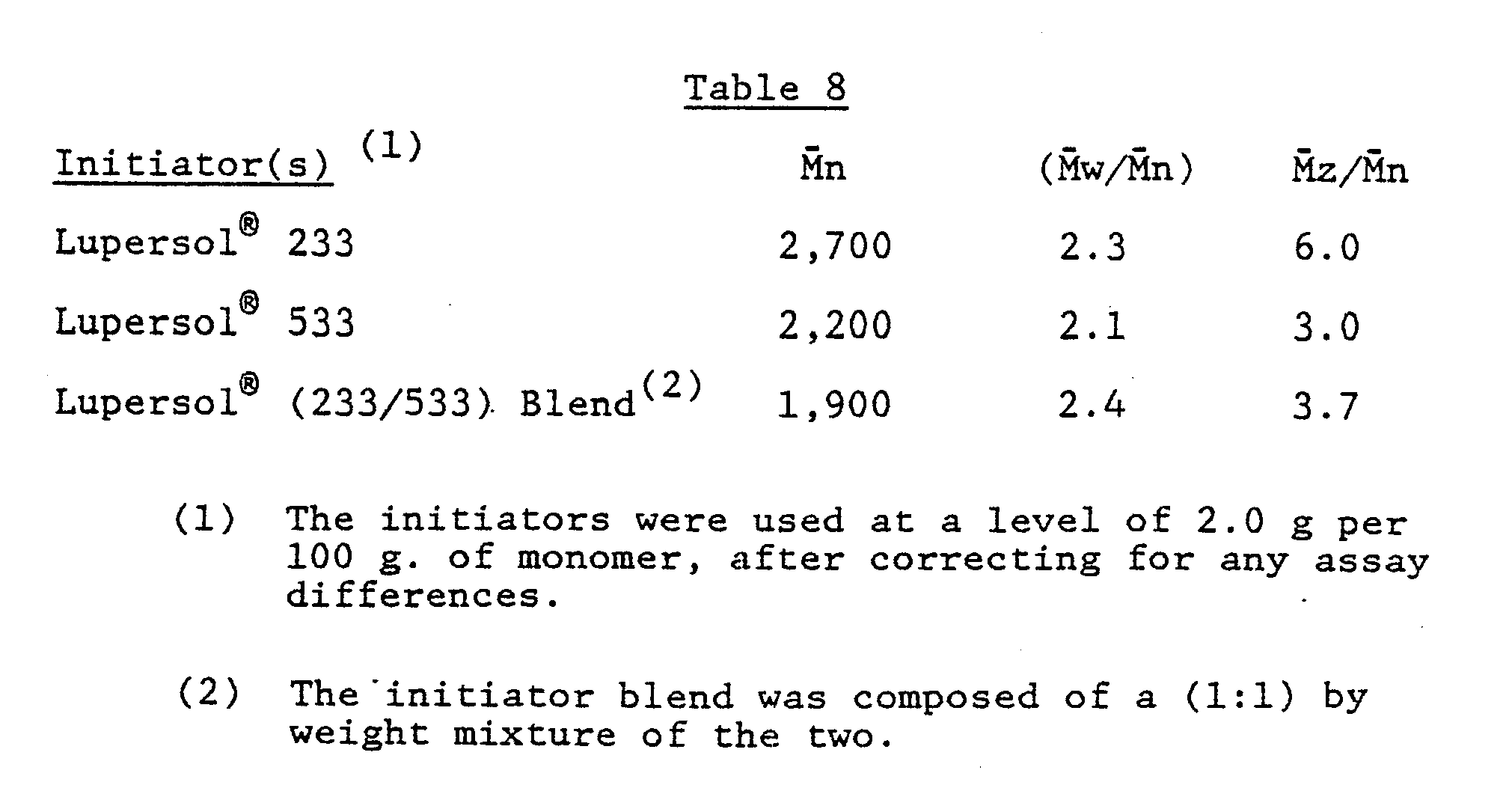
- As shown in Table 8, the use of a conventional t-butyl peroxide (i.e., Lupersol 233) resulted in a broad MWD polymer. The use of the corresponding tertiary-alkyl analog peroxide initiator (i.e., Lupersol 533) resulted in a much narrower MWD polymer. The use of a mixture of the two initiators resulted in a polymer MWD much narrower than that obtained with the t-butyl peroxide initiator, but slightly broader than that obtained with the tertiary-alkyl (C5) analog peroxide. A tertiary-alkyl (≧C5) peroxide would represent a slightly higher cost product than a t-butyl peroxide. Thus, blends of t-butyl and t-alkyl (,=C5) analog peroxides could be used as a potential cost reducing system, with the benefit of narrowing the MWD versus using a t-butyl peroxide as the sole polymerization initiator.
- This example illustrates the performance of tertiary-alkyl (≧C5) peroxide initiators with respect to polymer molecular weight and MWD using various monomer combinations.
- The procedure was the same as that used in Example 1. The ratio amounts of each monomer in the polymers tested are 30/40/30 weight ratios; the polymers tested and results are set forth in Table 9 as follows:

- This example compares the molecular weight and MWD of suitable high solids coating resins prepared using initiators of the present invention to a commercial high solids acrylic resin (i.e., Acryloid® AT-400, Rohm & Haas) currently being used by the industry.
- The molecular weight and MWD of the resins were determined as described in Example 1.

- As shown in Table 10, suitable coating resins prepared using initiators of the present invention possess a significantly narrower MWD, particularly the
M z/M n ratio, than commercially used high solids acrylic resins (i.e. Acryloid® AT-400). The narrower MWD resins obtained with initiators of the present invention would allow one to go to higher solids contents without substantially affecting the solution viscosity. Also, the narrower MWD resins would result in achieving superior film properties as previously discussed in the present invention. - This example illustrates the performance of conventional tertiary-butyl peroxides in comparison to peroxides derived from tertiary-alkyl hydroperoxide with five carbons (i.e., tertiary-amyl peroxides) as chaser catalysts (i.e., ability to reduce residual monomer without altering
M n and MWD of polymer) for solution acrylic resins.
- Percent residual monomers were determined by gas chromatography.
- Resin molecular weight and distribution were determined by GPC analysis (See Example 1).

- As shown in Tables 11A & B, the use of tertiary-alkyl (C5) peroxides would be preferred over their conventional t-butyl analogs as chaser catalysts for solution acrylic resins. The use of the tertiary-amyl (C5) peroxide resulted in a reduction in residual monomer without significantly altering the molecular weight and distribution of the resin. The use of the tertiary-butyl peroxide, however, resulted in an increase (broadening) of the distribution (MWD) of the resin. It is desirable that a chaser catalyst reduce the residual monomer level (i.e., for health toxicity concerns) without altering the molecular weight and distribution of ther resin (i.e., without increasing the solution viscosity of the resin solution). Thus, initiators of the present invention would be desirable as chaser catalysts.

Claims (10)
R is selected from t-alkyl of 5-20 carbons, t-cycloalkyl of 6-20 carbons, and

when n is 2,
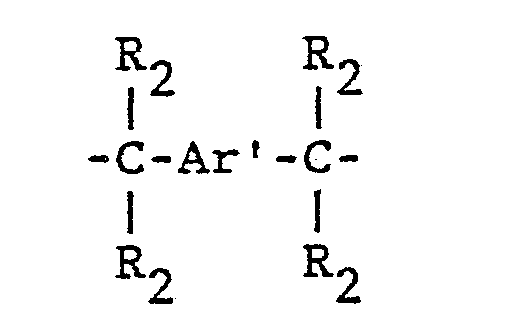


R is selected from the same groups mentioned above. when n = 1 and also can be hydrogen, acyl of 2-18 carbons, aroyl of 7-18 carbons, or alkoxycarbonyl of 2-19 carbons when R, is selected from di-t-alkylene, dit-alkynylene, di-t-cycloalkylene, or

wherein R, Ri, R2, R3, R4, Rs, R6, R7, Ar, and Ar' can optionally be substituted wherein the substituents can be one or more of lower alkyl of 1-4 carbons, cycloalkyl of 5-12 carbons, halo, carboxy, hydroxy, lower acyloxy of 1-4 carbons, epoxy, lower alkoxy of 1-4 carbons, aryloxy of 6-12 carbons, lower alkoxycarbonyl of 1-4 carbons, carbamoyl, mono and di lower alkyl carbamoyl of 1-4 carbons, and dicarboximido of 4-12 carbons, and Ar', Rs, R7 and when R4 and R5 join together to form an alkylene diradical can optionally contain one or more oxygen or nitrogen.
Priority Applications (5)
| Application Number | Priority Date | Filing Date | Title |
|---|---|---|---|
| JP61309006A JPS63168415A (en) | 1987-01-02 | 1986-12-26 | Solution polymerization of acrylic acid derivative monomer using t-alkylhydroxyperoxide |
| DE8787100025T DE3777581D1 (en) | 1987-01-02 | 1987-01-02 | SOLUTION POLYMERIZATION OF ACRYLIC ACID MONOMER DERIVATIVES BY USING TERTIOALKYL (C5) HYDROPEROXIDES. |
| AT87100025T ATE73826T1 (en) | 1987-01-02 | 1987-01-02 | SOLUTION POLYMERIZATION OF ACRYLIC ACID MONOMER DERIVATIVES BY USING TERTIOALKYL(C5) HYDROPEROXIDES. |
| ES198787100025T ES2030001T3 (en) | 1987-01-02 | 1987-01-02 | POLYMERIZATION IN SOLUTION OF MONOMERS DERIVED FROM ACRYLIC ACID USING TERTIAL ALKYL HYDROPEROXIDES (C5). |
| EP87100025A EP0273090B1 (en) | 1987-01-02 | 1987-01-02 | Solution polymerization of acrylic acid derived monomers using tertiary alkyl( c5)-hydroperoxides |
Applications Claiming Priority (1)
| Application Number | Priority Date | Filing Date | Title |
|---|---|---|---|
| EP87100025A EP0273090B1 (en) | 1987-01-02 | 1987-01-02 | Solution polymerization of acrylic acid derived monomers using tertiary alkyl( c5)-hydroperoxides |
Publications (2)
| Publication Number | Publication Date |
|---|---|
| EP0273090A1 true EP0273090A1 (en) | 1988-07-06 |
| EP0273090B1 EP0273090B1 (en) | 1992-03-18 |
Family
ID=8196663
Family Applications (1)
| Application Number | Title | Priority Date | Filing Date |
|---|---|---|---|
| EP87100025A Expired EP0273090B1 (en) | 1987-01-02 | 1987-01-02 | Solution polymerization of acrylic acid derived monomers using tertiary alkyl( c5)-hydroperoxides |
Country Status (5)
| Country | Link |
|---|---|
| EP (1) | EP0273090B1 (en) |
| JP (1) | JPS63168415A (en) |
| AT (1) | ATE73826T1 (en) |
| DE (1) | DE3777581D1 (en) |
| ES (1) | ES2030001T3 (en) |
Cited By (2)
| Publication number | Priority date | Publication date | Assignee | Title |
|---|---|---|---|---|
| KR20010008678A (en) * | 1999-07-02 | 2001-02-05 | 신재섭 | Method of precise molecular weight control of oligomer with narrow molecular weight distribution |
| WO2012107689A1 (en) | 2011-02-10 | 2012-08-16 | Arkema France | Free radical polymerisation of ethylene initiated by organic peroxides with high productivity |
Families Citing this family (6)
| Publication number | Priority date | Publication date | Assignee | Title |
|---|---|---|---|---|
| JP3357100B2 (en) * | 1992-12-01 | 2002-12-16 | 積水化学工業株式会社 | Method for producing acrylic adhesive |
| DE4324801A1 (en) * | 1993-07-23 | 1995-01-26 | Hoechst Ag | Process for the preparation of copolymers containing OH groups and their use in high-solids coating compositions |
| JP4774172B2 (en) * | 2001-08-23 | 2011-09-14 | 化薬アクゾ株式会社 | Acrylic resin production method |
| FR3041645B1 (en) * | 2015-09-29 | 2017-09-08 | Arkema France | RADICAL POLYMERIZATION OF ETHYLENE PRIMERED BY A COUPLE OF HIGH-PRODUCTIVITY ORGANIC PEROXIDES |
| TWI751145B (en) * | 2016-03-18 | 2022-01-01 | 日商日油股份有限公司 | Method for manufacturing (meth)acrylate varnish for paint |
| JP6868979B2 (en) * | 2016-07-06 | 2021-05-12 | 株式会社日本触媒 | Acrylic acid ester polymer and its manufacturing method |
Citations (5)
| Publication number | Priority date | Publication date | Assignee | Title |
|---|---|---|---|---|
| US3832336A (en) * | 1970-06-03 | 1974-08-27 | Pennwalt Corp | Curing and polymerizing processes employing beta-substituted diperoxyketals |
| AT367436B (en) * | 1980-11-13 | 1982-07-12 | Vianova Kunstharz Ag | METHOD FOR PRODUCING COPOLYMERISATS |
| US4369299A (en) * | 1977-11-11 | 1983-01-18 | Asahi Kasei Kogyo Kabushiki Kaisha | Acrylic resin having excellent solvent resistance and moldability |
| EP0136813A2 (en) * | 1983-09-06 | 1985-04-10 | Exxon Research And Engineering Company | Improvement in the copolymerisation of unsaturated esters |
| EP0136439A2 (en) * | 1983-07-25 | 1985-04-10 | The B.F. GOODRICH Company | Acrylic polymers of intermediate molecular weight |
-
1986
- 1986-12-26 JP JP61309006A patent/JPS63168415A/en active Pending
-
1987
- 1987-01-02 DE DE8787100025T patent/DE3777581D1/en not_active Revoked
- 1987-01-02 AT AT87100025T patent/ATE73826T1/en not_active IP Right Cessation
- 1987-01-02 ES ES198787100025T patent/ES2030001T3/en not_active Expired - Lifetime
- 1987-01-02 EP EP87100025A patent/EP0273090B1/en not_active Expired
Patent Citations (5)
| Publication number | Priority date | Publication date | Assignee | Title |
|---|---|---|---|---|
| US3832336A (en) * | 1970-06-03 | 1974-08-27 | Pennwalt Corp | Curing and polymerizing processes employing beta-substituted diperoxyketals |
| US4369299A (en) * | 1977-11-11 | 1983-01-18 | Asahi Kasei Kogyo Kabushiki Kaisha | Acrylic resin having excellent solvent resistance and moldability |
| AT367436B (en) * | 1980-11-13 | 1982-07-12 | Vianova Kunstharz Ag | METHOD FOR PRODUCING COPOLYMERISATS |
| EP0136439A2 (en) * | 1983-07-25 | 1985-04-10 | The B.F. GOODRICH Company | Acrylic polymers of intermediate molecular weight |
| EP0136813A2 (en) * | 1983-09-06 | 1985-04-10 | Exxon Research And Engineering Company | Improvement in the copolymerisation of unsaturated esters |
Non-Patent Citations (1)
| Title |
|---|
| CHEMICAL ABSTRACTS, vol. 97, no. 16, October 1982, page 91, abstract no. 129218j, Columbus, Ohio, US; & AT-B-367 436 (VIANOVA KUNSTHARZ AG) 12-07-1982 * |
Cited By (4)
| Publication number | Priority date | Publication date | Assignee | Title |
|---|---|---|---|---|
| KR20010008678A (en) * | 1999-07-02 | 2001-02-05 | 신재섭 | Method of precise molecular weight control of oligomer with narrow molecular weight distribution |
| WO2012107689A1 (en) | 2011-02-10 | 2012-08-16 | Arkema France | Free radical polymerisation of ethylene initiated by organic peroxides with high productivity |
| FR2971510A1 (en) * | 2011-02-10 | 2012-08-17 | Arkema France | RADICAL POLYMERIZATION OF ETHYLENE STARCHED WITH HIGH-PRODUCTIVITY ORGANIC PEROXIDES |
| US9045571B2 (en) | 2011-02-10 | 2015-06-02 | Arkema France | Free radical polymerisation of ethylene initiated by organic peroxides with high productivity |
Also Published As
| Publication number | Publication date |
|---|---|
| ES2030001T3 (en) | 1992-10-16 |
| ATE73826T1 (en) | 1992-04-15 |
| JPS63168415A (en) | 1988-07-12 |
| DE3777581D1 (en) | 1992-04-23 |
| EP0273090B1 (en) | 1992-03-18 |
Similar Documents
| Publication | Publication Date | Title |
|---|---|---|
| US4777230A (en) | Solution polymerization of acrylic acid derived monomers using tertiary alkyl(ηC5)hydroperoxides | |
| US4246382A (en) | Solvent resistent acrylic resin and process for producing the same | |
| WO2002014379A1 (en) | Use of trioxepans in the process to make high-solid acrylic, styrenic, and ldpe-type resins | |
| US20090215960A1 (en) | Thermoplastic Resin Having Uniform Composition and Narrow Molecular Weight Distribution, and Method for Preparing the Same | |
| EP0273090B1 (en) | Solution polymerization of acrylic acid derived monomers using tertiary alkyl( c5)-hydroperoxides | |
| EP1123324A1 (en) | Dialkyl peroxide compound and process using such for initiating a chemical reaction | |
| TW202219081A (en) | Thermoplastic resin composition, method of preparing the same, and molded article manufactured using the same | |
| US3745137A (en) | Process of preparing nonaqueous dispersions of thermosetting copolymers | |
| CA1262008A (en) | Solution polymerization of acrylic acid derived monomers using tertiary alkyl ( c.sub.5) hydroperoxides | |
| US3956225A (en) | Stable dispersion of vinyl polymer | |
| US6720398B2 (en) | Use of trioxepans in the process to make high-solid acrylic, styrenic, and LDPE-type resins | |
| JPH0532733A (en) | Production of varnish for paint | |
| Buback et al. | High‐Pressure Free‐Radical Copolymerization of Ethene and Methyl methacrylate | |
| US4212718A (en) | Process for producing hydroxytelechelic oligomers and polymers by photolysis | |
| JP2003128712A (en) | Methacrylic resin and method for producing the same | |
| US5369204A (en) | Low molecular weight acrylamidoglycolate crosslinker and process | |
| JP7634832B2 (en) | Vinyl polymer and method for producing same | |
| JP2565377B2 (en) | Method for producing α-methylstyrene-acrylonitrile copolymer | |
| JP2001049149A (en) | Method for producing paint varnish | |
| KR100449608B1 (en) | Preparation method of styrene-based thermoplastic resin using vinyl-based mercaptan compound | |
| JPS60219204A (en) | Production of low-molecular weight polymer | |
| CN117700604A (en) | Single-component acrylic resin resistant to 84 disinfectant soaking and preparation method thereof | |
| EP3750929A1 (en) | Styrenic polymers having reduced trimer content | |
| IL32342A (en) | Acrylic modifiers for polymers | |
| KR19980050092A (en) | Manufacturing method of styrene resin composition excellent in workability |
Legal Events
| Date | Code | Title | Description |
|---|---|---|---|
| PUAI | Public reference made under article 153(3) epc to a published international application that has entered the european phase |
Free format text: ORIGINAL CODE: 0009012 |
|
| AK | Designated contracting states |
Kind code of ref document: A1 Designated state(s): AT BE CH DE ES FR GB IT LI NL SE |
|
| 17P | Request for examination filed |
Effective date: 19881026 |
|
| 17Q | First examination report despatched |
Effective date: 19900123 |
|
| RAP1 | Party data changed (applicant data changed or rights of an application transferred) |
Owner name: ATOCHEM NORTH AMERICA, INC. (A PENNSYLVANIA CORP.) |
|
| GRAA | (expected) grant |
Free format text: ORIGINAL CODE: 0009210 |
|
| ITF | It: translation for a ep patent filed | ||
| AK | Designated contracting states |
Kind code of ref document: B1 Designated state(s): AT BE CH DE ES FR GB IT LI NL SE |
|
| REF | Corresponds to: |
Ref document number: 73826 Country of ref document: AT Date of ref document: 19920415 Kind code of ref document: T |
|
| REF | Corresponds to: |
Ref document number: 3777581 Country of ref document: DE Date of ref document: 19920423 |
|
| ET | Fr: translation filed | ||
| REG | Reference to a national code |
Ref country code: ES Ref legal event code: FG2A Ref document number: 2030001 Country of ref document: ES Kind code of ref document: T3 |
|
| PGFP | Annual fee paid to national office [announced via postgrant information from national office to epo] |
Ref country code: SE Payment date: 19921215 Year of fee payment: 7 |
|
| PGFP | Annual fee paid to national office [announced via postgrant information from national office to epo] |
Ref country code: GB Payment date: 19921216 Year of fee payment: 7 Ref country code: FR Payment date: 19921216 Year of fee payment: 7 Ref country code: AT Payment date: 19921216 Year of fee payment: 7 |
|
| PLBI | Opposition filed |
Free format text: ORIGINAL CODE: 0009260 |
|
| PGFP | Annual fee paid to national office [announced via postgrant information from national office to epo] |
Ref country code: ES Payment date: 19930118 Year of fee payment: 7 |
|
| PGFP | Annual fee paid to national office [announced via postgrant information from national office to epo] |
Ref country code: DE Payment date: 19930127 Year of fee payment: 7 |
|
| PGFP | Annual fee paid to national office [announced via postgrant information from national office to epo] |
Ref country code: NL Payment date: 19930131 Year of fee payment: 7 |
|
| PGFP | Annual fee paid to national office [announced via postgrant information from national office to epo] |
Ref country code: BE Payment date: 19930212 Year of fee payment: 7 |
|
| 26 | Opposition filed |
Opponent name: AKZO N.V. Effective date: 19921218 |
|
| PGFP | Annual fee paid to national office [announced via postgrant information from national office to epo] |
Ref country code: CH Payment date: 19930324 Year of fee payment: 7 |
|
| NLR1 | Nl: opposition has been filed with the epo |
Opponent name: AKZO N.V. |
|
| RDAG | Patent revoked |
Free format text: ORIGINAL CODE: 0009271 |
|
| STAA | Information on the status of an ep patent application or granted ep patent |
Free format text: STATUS: PATENT REVOKED |
|
| 27W | Patent revoked |
Effective date: 19930409 |
|
| GBPR | Gb: patent revoked under art. 102 of the ep convention designating the uk as contracting state |
Free format text: 930409 |
|
| REG | Reference to a national code |
Ref country code: CH Ref legal event code: PL |
|
| NLR2 | Nl: decision of opposition | ||
| EUG | Se: european patent has lapsed |
Ref document number: 87100025.3 Effective date: 19930825 |
|
| PLAB | Opposition data, opponent's data or that of the opponent's representative modified |
Free format text: ORIGINAL CODE: 0009299OPPO |