EP0275523B1 - Optisch aktives Tetrahydro-2-furanon-Derivat als Mikrobizid - Google Patents
Optisch aktives Tetrahydro-2-furanon-Derivat als Mikrobizid Download PDFInfo
- Publication number
- EP0275523B1 EP0275523B1 EP87118931A EP87118931A EP0275523B1 EP 0275523 B1 EP0275523 B1 EP 0275523B1 EP 87118931 A EP87118931 A EP 87118931A EP 87118931 A EP87118931 A EP 87118931A EP 0275523 B1 EP0275523 B1 EP 0275523B1
- Authority
- EP
- European Patent Office
- Prior art keywords
- process according
- methoxyacetyl
- dimethylphenyl
- chloro
- enantiomer
- Prior art date
- Legal status (The legal status is an assumption and is not a legal conclusion. Google has not performed a legal analysis and makes no representation as to the accuracy of the status listed.)
- Expired - Lifetime
Links
Classifications
-
- A—HUMAN NECESSITIES
- A01—AGRICULTURE; FORESTRY; ANIMAL HUSBANDRY; HUNTING; TRAPPING; FISHING
- A01N—PRESERVATION OF BODIES OF HUMANS OR ANIMALS OR PLANTS OR PARTS THEREOF; BIOCIDES, e.g. AS DISINFECTANTS, AS PESTICIDES OR AS HERBICIDES; PEST REPELLANTS OR ATTRACTANTS; PLANT GROWTH REGULATORS
- A01N35/00—Biocides, pest repellants or attractants, or plant growth regulators containing organic compounds containing a carbon atom having two bonds to hetero atoms with at the most one bond to halogen, e.g. aldehyde radical
-
- C—CHEMISTRY; METALLURGY
- C07—ORGANIC CHEMISTRY
- C07D—HETEROCYCLIC COMPOUNDS
- C07D307/00—Heterocyclic compounds containing five-membered rings having one oxygen atom as the only ring hetero atom
- C07D307/02—Heterocyclic compounds containing five-membered rings having one oxygen atom as the only ring hetero atom not condensed with other rings
- C07D307/26—Heterocyclic compounds containing five-membered rings having one oxygen atom as the only ring hetero atom not condensed with other rings having one double bond between ring members or between a ring member and a non-ring member
- C07D307/30—Heterocyclic compounds containing five-membered rings having one oxygen atom as the only ring hetero atom not condensed with other rings having one double bond between ring members or between a ring member and a non-ring member with hetero atoms or with carbon atoms having three bonds to hetero atoms with at the most one bond to halogen, e.g. ester or nitrile radicals, directly attached to ring carbon atoms
- C07D307/32—Oxygen atoms
- C07D307/33—Oxygen atoms in position 2, the oxygen atom being in its keto or unsubstituted enol form
-
- A—HUMAN NECESSITIES
- A01—AGRICULTURE; FORESTRY; ANIMAL HUSBANDRY; HUNTING; TRAPPING; FISHING
- A01N—PRESERVATION OF BODIES OF HUMANS OR ANIMALS OR PLANTS OR PARTS THEREOF; BIOCIDES, e.g. AS DISINFECTANTS, AS PESTICIDES OR AS HERBICIDES; PEST REPELLANTS OR ATTRACTANTS; PLANT GROWTH REGULATORS
- A01N43/00—Biocides, pest repellants or attractants, or plant growth regulators containing heterocyclic compounds
- A01N43/02—Biocides, pest repellants or attractants, or plant growth regulators containing heterocyclic compounds having rings with one or more oxygen or sulfur atoms as the only ring hetero atoms
- A01N43/04—Biocides, pest repellants or attractants, or plant growth regulators containing heterocyclic compounds having rings with one or more oxygen or sulfur atoms as the only ring hetero atoms with one hetero atom
- A01N43/06—Biocides, pest repellants or attractants, or plant growth regulators containing heterocyclic compounds having rings with one or more oxygen or sulfur atoms as the only ring hetero atoms with one hetero atom five-membered rings
- A01N43/08—Biocides, pest repellants or attractants, or plant growth regulators containing heterocyclic compounds having rings with one or more oxygen or sulfur atoms as the only ring hetero atoms with one hetero atom five-membered rings with oxygen as the ring hetero atom
Definitions
- the present invention relates to the optically active (aS, 1'R) -3- [N- (methoxyacetyl) -N- (3-chloro-2,6-dimethylphenyl)] - amino-tetrahydro-2-furanone, process for its Production, microbicidal agents containing it as active components, and the use of these agents as microbicides in crop protection.
- the 3- [N- (methoxyacetyl) -N- (3-chloro-2,6-dimethylphenyl)] - amino-tetrahydro-2-furanone is known as a microbicide from DE-OS 2,804,299 or from the corresponding GB-PS 1,577,702 effective connection known.
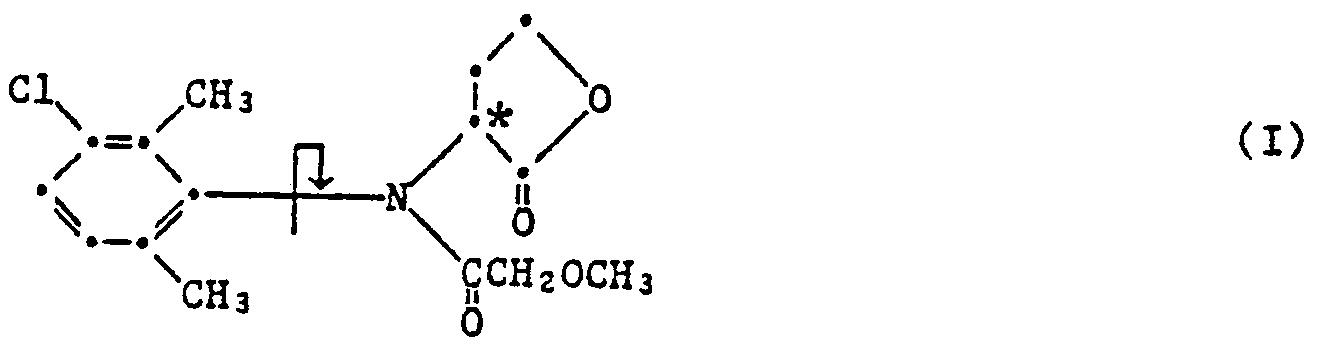
- the compound of formula I as a structural feature, an asymmetry center at the indicated location * .
- it can be split into optical antipodes in the usual way, the different configurations having different levels of microbicidal activity.
- Center of asymmetry also has a rotation isomerism (atropisomerism) caused by the chiral axis ( ⁇ ⁇ ), which is caused by the asymmetric chlorine substitution of the rotation-impaired 2,6-dimethylphenyl ring.
- the racemic 3- [N- (methoxyacetyl) -N- (3-chloro-2,6-dimethylphenyl)] - amino-tetrahydro-2-furanone mentioned in DE-OS 2,804,299 as compound no. 30 proves to be a 1 : 1 mixture, consisting of two diastereomeric enantiomeric rafters that melt at 140 ° or 115 ° C and which can be separated from each other.
- Adsorption chromatography is a suitable separation method. Both enantiomer pairs can be cleaved as racemates in the usual way into optical antipodes. From the (aS, 1'S) (aR, 1'R) enantiomer pair melting as a by-product at 140 ° C, the enantiomers (aS, 1'S1- and (aR, 1'R) -3- [N- ( Methoxyacetyl) -N- (3-chloro-2,6-dimethylphenyl)] - amino-tetrahydro-2-furanone, from the desired (aR, 1'S) (aS, 1'R) enantiomer melting at 115 ° C.
- the approximate 1: 1 composition of the diastereomeric enantiomer mixture obtainable according to DE-OS 2,804,299 fluctuates between 45 and 55%.
- the present invention therefore also relates to a compound of the formula with a higher proportion of the (aS, 1'R) enantiomer than 25% by weight, as would be expected in theory when a racemic mixture of 2 diastereomeric enantiomer pairs is present.
- the present invention relates to a compound of the formula having an (aS, 1'R) enantiomer content of at least 28% by weight, preferably at least 40% by weight, particularly preferably at least 50% by weight
- a compound of the formula I having an (aS, 1'R) enantiomer content of at least 70% by weight, in particular at least 90% by weight, is very particularly preferred for practical purposes as plant fungicides.
- the invention also relates to the pure (aS, 1'R) enantiomer of 3- [N- (methoxyacetyl) -N- (3-chloro-2,6-dimethylphenyl)] - amino-tetrahydro-2-furanone.
- raceme (aR, 1'S) (aS, 1'R) -3- [N- (methoxyacetyl) -N- (3-chloro-2,6-dimethylphenyl)] - amino-tetra-hydro-2-furanone also shows a significant increase in the microbicidal activity and the duration of action compared to the isomer mixture of the formula, the extent of the increase in activity being less than that of the (aS, 1'R) enantiomer.
- the enantiomer pair (aR, 1'S) (aS, 1'R) or approximate 1: 1 mixtures of these two parts (45:55 to 55:45) are particularly suitable as plant fungicides.
- the raceme (aR, 1'S) (aS, 1'R) isomer therefore also forms an object of the present invention.
- the preparation of the enantiomeric (aS, 1'R) -3- [N- (methoxyacetyl) -N- (3-chloro-2,6-dimethylphenyl)] - amino-tetrahydro-2-furanone can be carried out by chromatographic separation of the isomer twice - Mixture of the formula and the resulting (aR, 1'S) (aS, 1'R) -3- [N- (methoxyacetyl) -N- (3-chloro-2,6-dimethylphenyl)] - melting at 115 ° C amino-tetrahydro-2-furanone.
- a liquid phase eluent
- all carrier materials familiar to the person skilled in the art, such as silica gel, Al 2 O 3 , or organic polymer resins (polyamide, polyacrylamide and the like), furthermore agarose, sepharose, but especially modified cellulose, can be used. Acetylated or benzoylated cellulose is particularly suitable.
- the (aR, 1'S) (aS, 1'R) enantiomer pair can then be used as such in formulated form as a plant fugicide or further separated.
- acylated cellulose such as acetylated or benzoylated cellulose can be used as the optically active solid phase.
- examples are triacetyl cellulose or tri- (3-methylbenzoyl) cellulose.
- all four enantiomers of the isomer mixture obtainable according to DE-OS 2,804,299 can be separated from one another in only one separation stage instead of two.
- a suitable mobile phase eluent
- Acylated (for example acetylated or benzoylated cellulose, in particular tri- (3-methylbenzoyl) cellulose is preferably applied as a stationary phase and then eluted with a hexane / isopropanol mixture (1: 1 to 9: 1).
- the solutions of the detached isomers are collected in fractions and the isomers isolated after evaporation of the solvent mixture as evaporation residue.
- the (aS, 1'S) (aR, 1'R) -enantiomer pair which is obtainable as a by-product when the isomer mixture is separated and racemized at 140 ° C. can be racemized again to the starting mixture.
- Such racemization or isomerization can be carried out, for example, thermally, by heating the (aS, 1'S) (aR, 1'R) enantiomer pair to 140-180 ° C in the melt, preferably in the presence of a tetraalkylammonium salt, e.g. Tetrabutylammonium bromide, until balance is achieved.
- the resulting product again consisting of two diastereomeric pairs of enantiomers, can be returned to the separation process.
- This additional re-isomerization process also forms an object of the present invention.
- the present invention also relates to a process for the production of (aR, 1'R) (aS, 1'R) -3- [N- (methoxyacetyl) -N- (3-chloro-2,6-dimethylphenyl)] - amino -tetrahydro-2-furanone, which also has a significantly higher fungicidal activity than the racemate known from DE-OS 2,804,299.
- This pair of diastereomers in a 1: 1 ratio or in an approximate 1: 1 ratio (45:55 to 55:45) is particularly suitable as a plant fungicide. It is also an object of the present invention.
- the mixture of the (aR, 1'R) and (aS, 1'R) enantiomers obtained with the chlorination can be used as such as a fungicide or further to obtain the (aS, 1'R) enantiomer again after the Method of the preliminary separation step a) are separated chromatographically.
- raceme starting product 3- [N- (methoxyacetyl) -N-2,6-dimethylphenyl)] - amino-tetrahydro-2-furanone is also described in DE-OS 2,804,299 and in GB-PS 1,577,702.
- chromatographic separation step a) all carrier materials familiar to the person skilled in the art such as silica gel, Al 2 O 3 , or organic polymer resins (polyamide, polyacrylamide and the like), furthermore agarose, sepharose, but especially modified cellulose, can be used. Acetylated or benzoylated cellulose is particularly suitable.
- the chlorination of (1'R) -3- [N- (methoxyacetyl) -N-2,6-dimethylphenyl)] - amino-tetrahydro-2-furanone is advantageously carried out in an inert solvent.
- Chlorinated aromatic and aliphatic hydrocarbons such as chlorobenzene, methylene chloride, chloroform, carbon tetrachloride and others are suitable as solvents.
- lower alkane carboxylic acids are useful, e.g. Formic acid, acetic acid, propionic acid.
- a preferred solvent is formic acid.
- the chlorination is advantageously carried out in the temperature range from 0 ° to 50 ° C, e.g. at room temperature.
- Lewis acids such as aluminum chloride, zinc chloride, iron (III) chloride and tin (IV) chloride.
- a preferred Lewis acid is ferric chloride.
- the Lewis acids are used in an amount of 1-8% by weight, based on the (1'R) -isomer to be chlorinated. It can also be chlorinated without Lewis acids.
- the chlorination is carried out at normal pressure or slightly elevated pressure. Sulfuryl chloride, but preferably chlorine, is used for the chlorination.
- crop plants are, for example, cereals, maize, rice, vegetables, sugar beets, soybeans, peanuts, fruit trees, ornamental plants, but above all vines, hops, cucumber plants (cucumbers, pumpkins, melons), solanaceae such as potatoes, tobacco and tomatoes, and also also banana, cocoa and natural rubber plants.
- the (aS, 1'R) enantiomer or its above-mentioned isomer mixtures can contain or destroy the fungi that occur on plants or parts of plants (fruits, flowers, foliage, stems, tubers, roots) of these and related crops, with subsequent growth also increasing Parts of plants are spared from such fungi.
- the active substances are active against the phytopathogenic fungi belonging to the following classes: Ascomycetes (e.g. Erysiphaceae); Basidiomycetes such as especially rust fungi; Fungi imperfecti (e.g.
- the isomers have a systemic effect. They can also be used as a dressing for the treatment of seeds (fruits, tubers, grains) and plant cuttings for protection against fungal infections and against phytopahtogenic fungi occurring in the soil.
- cereals such as wheat, barley, rye, oats, rice, sorghum and relatives
- Beets such as carrots, sugar and fat beets
- Pome, stone and berry fruit such as apple, pear, plum, peach, almond, cherry, strawberry, brain and blackberry
- Legumes such as beans, lentils, peas, soybeans
- Oil crops such as rapeseed, mustard, poppy seeds, olives, sunflowers, coconut, castor bean, cocoa, peanuts
- Cucumber plants such as pumpkin, cucumber, melons
- Fiber plants such as cotton, flax, hemp, jute, nettle
- Citrus surfaces such as spinach, lettuce, asparagus, types of cabbage), onions, tomatoes, potatoes, peppers
- Laurel plants such as Avocadom Cinnamonum, camphor
- the active compounds according to the invention are usually used in the form of compositions and can be added to the surface, plant or substrate to be treated simultaneously or in succession with further active compounds.
- These further active ingredients can be fertilizers, trace element mediators or other preparations which influence plant growth.
- it can also be selective herbicides, insecticides, fungicides, bactericides, nematicides, molluscicides or mixtures of several of these preparations, together with any other carriers, surfactants or other application-promoting additives which are customary in formulation technology.
- Suitable carriers and additives can be solid or liquid and correspond to the substances useful in formulation technology, e.g. natural or regenerated mineral substances, solvents, dispersants, wetting agents, adhesives, thickeners, binders or fertilizers. Phospholipids are particularly advantageous additives.
- a preferred method for applying an active ingredient according to the invention or an (agro) chemical agent which contains at least one of these active ingredients is the application to the foliage (foliar application).
- the number of applications and the application rate depend on the infestation pressure for the relevant pathogen (type of fungus).
- the active substances according to the invention can also get into the plant via the soil through the root system (systemic effect) by soaking the location of the plant with a liquid preparation or introducing the substances into the ground in solid form, e.g. in the form of granules (floor application).
- the compounds according to the invention can also be applied to seeds (coating) by either impregnating the grains with a liquid preparation of the active ingredient or coating them with a solid preparation.
- other types of application are possible in special cases, e.g. the targeted treatment of plant stems or buds.
- the compounds according to the invention are used in unchanged form or preferably together with the auxiliaries customary in formulation technology and are therefore used, for example, to form emulsion concentrates, spreadable pastes, directly sprayable or dilutable solutions, diluted emulsions, wettable powders, soluble powders, dusts, granules, by encapsulation in eg polymeric materials processed in a known manner.
- the application procedures like Spraying, nebulizing, dusting, scattering, brushing or pouring, like the type of agent, are chosen in accordance with the desired goals and the given conditions.
- Favorable application rates are generally 50 g to 5 kg of active substance (AS) per ha; preferably 100 g to 2 kg ai / ha, in particular at 200 g to 600 g ai / ha.
- Possible solvents are: aromatic hydrocarbons, preferably the fractions C 8 to C 12 ' such as xylene mixtures or substituted naphthalenes, phthalic esters such as dibutyl or dioctyl phthalate, aliphatic hydrocarbons such as cyclohexane or paraffins, alcohols and glycols and their ethers and esters, such as Ethanol, ethylene glycol, ethylene glycol monomethyl or ethyl ether, ketones such as cyclohexanone, strongly polar solvents such as N-methyl-2-pyrrolidone, dimethyl sulfoxide or dimethylformamide, and optionally epoxidized vegetable oils such as epoxidized coconut oil, sunflower oil or soybean oil; or water.
- aromatic hydrocarbons preferably the fractions C 8 to C 12 ' such as xylene mixtures or substituted naphthalenes
- phthalic esters such as dibutyl or dioctyl
- solid carriers e.g. natural dust, such as calcite, talc, kaolin, montmorillonite or attapulgite
- natural dust such as calcite, talc, kaolin, montmorillonite or attapulgite
- highly disperse silica or highly disperse absorbent polymers can also be added.
- Porous types such as e.g. Pumice stone, broken brick, sepiolite or bentonite, as non-adsorptive carrier materials e.g. Calcite or sand in question.
- a large number of pregranulated materials of inorganic or organic nature such as in particular dolomite or comminuted plant residues, such as e.g. Cork flour or sawdust.
- suitable surface-active compounds are nonionic, cationic and / or anionic surfactants with good emulsifying, dispersing and wetting properties.
- surfactants are also to be understood as mixtures of surfactants.
- Suitable anionic surfactants can be both so-called water-soluble soaps and water-soluble synthetic surface-active compounds.
- the soaps are the alkali or optionally substituted ammonium salts of higher fatty acids (C 10 -C 22 ), such as the Na or K salts of oleic or stearic acid, or of natural fatty acid mixtures obtained, for example, from coconut or tallow oil can.
- surfactants are the fatty acid methyl laurine salts and modified and unmodified phospholipids.
- Suitable nonionic surfactants are primarily polyglycol ether derivatives of alphatic or cycloaliphatic alcohols, saturated or unsaturated fatty acids and alkylphenols, which can contain 3 to 30 glycol ether groups and 8 to 20 carbon atoms in the (aliphatic) hydrocarbon radical and 6 to 18 carbon atoms in the alkyl radical of the alkylphenols.
- Fatty acid esters of polyoxyethyl sorbitan such as polyoxyethylene sorbitan trioleate, are also suitable.
- the cationic surfactants are primarily quaternary ammonium salts which contain at least one alkyl radical having 8 to 22 carbon atoms as N substituents and, as further substituents, have low, optionally halogenated alkyl, benzyl or envious hydroxyalkyl radicals.
- the salts are preferably in the form of halides, methyl sulfates or ethyl sulfates, e.g. the stearyltrimethylammonium chloride or the benzyldi (2-chloroethyl) ethylammonium bromide.
- the fungicidal compositions according to the present invention generally contain 0.1 to 95% by weight of the (aS, 1'R) enantiomer according to the invention in a higher proportion among the 4 isomers of the compound of the formula I than the theoretical proportion of 25% by weight corresponds, together with 99.9 to 5 wt .-% of a solid and / or liquid carrier material.
- agents which contain 28% by weight of the (aS, 1'R) enantiomer or more in the active ingredient fraction or, in addition, an equal or lower proportion of the (aR, 1'R) enantiomer or an equally high or less Have share of the (aR, 1'S) enantiomer.
- agents which contain 40% by weight of the (aS, 1'R) enantiomer or more in the amount of active ingredient, and those which in addition contain an equally high or less proportion of (aR, 1 ' R) enantiomers or an equal or lower proportion of the (aR, 1'S) enantiomer.
- Agents which contain 50% by weight of the (aS, 1'R) enantiomer in the amount of active ingredient are particularly preferred or contain more, and those that also have a 100% by weight supplementary or smaller proportion of the (aR, 1'R) enantiomer or of the (aR, 1'S) enantiomer in the amount of active ingredient.
- the above information thus relates to the quantitative ratios of the four isomers of 3- [N- (methoxyacetyl) -N- (3-chloro-2,6-dimethylphenyl)] - aminotetrahydro-2-furan, in which the (aS, 1 ' R) enantiomers represent the highest proportion, if possible, followed proportionally by either the (aR, 1'R) or the (aR, 1'S) enantiomers, although each of the otherwise remaining enantiomers can nevertheless be present in small proportions.
- the agents can also contain other additives such as stabilizers, defoamers, viscosity regulators, binders, adhesives and fertilizers or other active ingredients to achieve special effects.
- Such (agro) chemical agents are part of the present invention.
- Emulsions of any desired concentration can be prepared from such concentrates by dilution with water.
- the active ingredient is dissolved in methylene chloride, sprayed onto the carrier and the solvent is then evaporated off in vacuo. Granules for soil application are obtained.
- Ready-to-use dusts are obtained by intimately mixing carrier substances with the active ingredient.
- the active ingredient is mixed well with the additives and ground in a suitable mill.
- Spray powder is obtained which can be diluted with water to form suspensions of any desired concentration.
- Emulsions of any desired concentration can be prepared from this concentrate by dilution with water.
- Ready-to-use dusts are obtained by mixing the active ingredient with the carrier in a suitable mill.
- the active ingredient is mixed with the additives, ground and moistened with water. This mixture was extruded and then dried in a stream of air.
- the finely ground active ingredient is applied evenly in a mixer to the kaolin moistened with polyethylene glycol. In this way, dust-free coating granules are obtained which are particularly suitable for soil applications.
- Bond fungus protective local soil application.
- tomato plants were sprayed with a spray mixture (0.02% active ingredient) prepared from wettable powder of the active ingredient. After 24 hours, the treated plants were infected with a sporangia suspension of the fungus. The fungal attack was assessed after incubation of the infected plants for 5 days at 90-100% atmospheric humidity and 20 ° C.
- a spray liquor prepared from wettable powder of the active ingredient was poured into tomato plants [0.002% active substance based on the volume of the earth]. Care was taken to ensure that the spray mixture did not come into contact with the parts of the plant above ground. After 48 hours, the treated plants were infected with a sporangia suspension of the fungus. The fungal attack was assessed after incubation of the infected plants for 5 days at 90-100% relative atmospheric humidity and 20 ° C.
- Vine seedlings 5 weeks old are sprayed with a spray mixture prepared from the formulated test substance and infected 1 day later with a sporangia suspension (200,000 sprorangia / ml) from P. viticola.
- Incubation takes place at 20 ° C in a greenhouse cabin; a 14-hour incubation phase with 100% rel.
- Humidity follows 4 days with 75-85% and finally another night with 100% to induce fungal sporulation. After the 6-day incubation, the fungal attack is evaluated (evaluation scheme as in Example 3.1).
- Vine seedlings 5 weeks old are watered with a spray mixture made from the formulated test substance. 3 days later, the plants are infected with a spore suspension (200,000 sporangia / ml) from P. viticola. Execution of the test as described under a).
- the mushroom was grown on carrot pulp nutrient solution and added to a soil-sand mixture.
- the soil infected in this way was filled into flower pots and sown with sugar beet seeds.
- the test preparations formulated as wettable powder were poured into the soil as aqueous suspensions (20 ppm of active ingredient based on the volume of the soil).
- the pots were then placed in the greenhouse at about 20 ° C. for 3 weeks.
- the earth was kept evenly moist by light showering.
- the mushroom was grown on carrot pulp nutrient solution and added to a soil-sand mixture.
- the soil infected in this way was filled into flower pots and sown with corn seeds.
- the test preparations formulated as wettable powder were poured into the soil as aqueous suspensions (20 ppm of active ingredient based on the volume of the soil).
- the pots were then placed in the greenhouse at about 20 ° C. for 3 weeks.
- the earth was kept evenly moist by light showering.
- 0.1 ml 0.75% acetonic solution of the active substances is sterile diluted to 15 ml water.
- One ml each from this stock solution or from the dilution series prepared sterile by adding water are incorporated in 19 ml culture medium in 9 cm petri dishes at 50 ° C.
- the active substance quantities are 50, 5, 0.5, 0.05 and 0.005 ppm per dish.
- these dishes and the control dishes without active ingredient are inoculated with Phytophthora capsici in the form of agarrondelles (0.6 mm 0, overgrown side down).
- the inoculated cultures are at 60-70% rel. Moisture and placed in the dark at 18 ° C.
- the active substance substances to be tested are mixed as wettable powder, each with 100 ml of water and mixed with 20 liters of earth.
- the concentration of the active substances used is based on dry earth.
- Tobacco plants (Hicks variety) grown in sterile soil are planted in the 5-6 leaf state in fungicide-containing ends (in 5-liter pots). Two days later, the furrows on both sides of the plant are artificially infected by inoculation with a total of twice 20 ml of a spore suspension (containing 10,000 sporangia / ml) from Phytophthora nicotianae.
- N 0.
- the plant is considered protected until the first typical signs of the disease appear. The test lasts 100 days during which the tobacco plant matures.
- the daurer action of the individual active ingredients is compared with the help of factors.
- the duration of action in days for which the protection (N) corresponds to that of the isomer mixture * (definition see Table 1) at 0.25 ppm concentration after 50 days is determined for the individual active ingredients used at different concentrations (ppm).
- the comparison factor (f) is calculated using the following formula
- test methodology corresponds to that mentioned in Example 3.3.
- Table 5 shows a surprisingly similar one Effectiveness of the pair of enantiomers and of the diastereomer to that of the (aS, 1'R) enantiomer, although the active (aS, 1'R) enantiomer represents only one of the two portions. This result indicates an apparent interaction of the enantiomers, which can increase the biological activity.
Landscapes
- Life Sciences & Earth Sciences (AREA)
- Organic Chemistry (AREA)
- Chemical & Material Sciences (AREA)
- Dentistry (AREA)
- Engineering & Computer Science (AREA)
- Health & Medical Sciences (AREA)
- General Health & Medical Sciences (AREA)
- Wood Science & Technology (AREA)
- Zoology (AREA)
- Environmental Sciences (AREA)
- Plant Pathology (AREA)
- Agronomy & Crop Science (AREA)
- Pest Control & Pesticides (AREA)
- Furan Compounds (AREA)
- Agricultural Chemicals And Associated Chemicals (AREA)
- Organic Low-Molecular-Weight Compounds And Preparation Thereof (AREA)
- Pharmaceuticals Containing Other Organic And Inorganic Compounds (AREA)
- Heterocyclic Carbon Compounds Containing A Hetero Ring Having Oxygen Or Sulfur (AREA)
- Fats And Perfumes (AREA)
- Plural Heterocyclic Compounds (AREA)
- Solid Fuels And Fuel-Associated Substances (AREA)
- Orthopedics, Nursing, And Contraception (AREA)
Description
- Die vorliegende Erfindung betrifft das optisch aktive (aS, 1'R)-3-[N-(Methoxyacetyl)-N-(3-chlor-2,6-dimethylphenyl)]-amino-tetrahydro-2-furanon, Verfahren zu seiner Herstellung, mikrobizide Mittel, die es als aktive Komponenten enthalten, sowie die Verwendung dieser Mittel als Mikrobizide im Pflanzenschutz.
- Das 3-[N-(Methoxyacetyl)-N-(3-chlor-2,6-dimethylphenyl)]-amino-tetrahydro-2-furanon ist aus der DE-OS 2,804,299 oder aus der entsprechenden GB-PS 1,577,702 als eine mikrobizid wirksame Verbindung bekannt. Nach dieser Veröffentlichung weist die Verbindung der Formel I
- Es findet sich in dieser Referenz weder ein Hinweis, wie gross diese Wirkungsdifferenz sein mag, noch welcher der beiden Antipoden überhaupt die stärkere mikrobizide Wirkung besitzt. Darüberhinaus werden in der DE-OS 2,804,299 bzw. in der GB-PS 1,577,702 im Rahmen des dortigen chemischen Umfangs keine Angaben zu weiteren Isomerie-Möglichkeiten ausserhalb des Furanonrings gemacht.
- Im Falle der konventionell als Racemat erhältlichen Verbindung der Formel I liegt aber nicht nur aufgrund der asymmetrischen Substitution am markierten *C-Atom ein einziges Enantiomerenpaar vor, sondern ein Gemisch von 4 Isomeren, d.h. von zwei diastereomeren Enantiomerenpaaren.
- Der Grund hierfür liegt darin, dass das Molekül ausser dem erwähnten.
- Asymmetriezentrum noch eine, durch die chirale Achse (┌↓) bedingte Rotationsisomerie (Atropisomerie) aufweist, welche durch die asymmetrische Chlorsubstitution des rotationsbehinderten 2,6-Dimethylphenylrings verursacht wird. Das in der DE-OS 2,804,299 als Verbindung Nr. 30 genannte racemische 3-[N-(Methoxyacetyl)-N-(3-chlor-2,6-dimethylphenyl)]-amino-tetrahydro-2-furanon erweist sich als ein 1: 1-Gemisch, bestehend aus zwei diastereomeren Enantiomerenparren, die bei 140° bzw. 115°C schmelzen und die sich voneinander trennen lassen. Als Trennverfahren eignet sich beispielsweise die Adsorptionschromatographie. Beide Enantiomerenpaare können als Racemate auf übliche Art in optische Antipoden gespalten werden. Aus dem bei 140°C schmelzenden, als Nebenprodukt anfallenden (aS,1'S)(aR,1'R)-Enantiomerenpaar können die Enantiomeren (aS,1'S1- und (aR,1'R)-3-[N-(Methoxyacetyl)-N-(3-chlor-2,6-dimethylphenyl)]-amino-tetrahydro-2-furanone, aus dem bei 115°C schmelzenden erwünschten (aR,1'S)(aS,1'R)-Enantiomerenpaar die Enantiomeren (aR,1'S)- und (aS,1'R)-3-[N-(Methoxyacetyl)-N-(3-chlor-2,6-dimethylphenyl)]-amino-tetrahydro-2-furanone isoliert werden, beispielsweise durch Chromatographie über eine optisch aktive Phase.
- Die ungefähre 1:1-Zusammensetzung des nach DE-OS 2,804,299 erhältlichen diastereomeren Enantiomeren-Gemisches schwankt zwischen 45 und 55%.
- Es wurde nun gefunden, dass des enantiomere (aS,1'R)-3-[N-(Methoxyacetyl)-N-(3-chlor-2,6-dimethyl- phenyi)]-amino-tetrahydro-2-furanon eine überraschend stark erhöhte mikrobizide Aktivität verbunden mit einer unerwartet hohen Wirkungsdauer gegenüber dem Isomeren-Gemisch der Formel I aufweist.
- Gegenstand vorliegender Erfindung ist daher auch eine Verbindung der Formel mit einem höheren Anteil am (aS,1'R)-Enantiomeren als 25 Gewichtsprozent, wie es nach der Theorie beim Vorliegen eines racemischen Gemischs von 2 diastereomeren Enantiomerenpaaren zu erwarten wäre. Gegenstand vorliegender Erfindung ist im engeren Sinne eine Verbindung der Formel mit einem (aS,1'R)-Enantiomeren-Anteil von mindestens 28 Gew.-%, bevorzugt von mindestens 40 Gew.-%, besonders bevorzugt von mindestens 50 Gew.-%, Ganz besonders bevorzugt für praktische Zwecke als Pflanzenfungizide ist eine Verbindung der Formel I mit einem (aS,1'R)-Enantiomeren-Anteil von mindestens 70 Gew.-%, insbesondere von mindestens 90 Gew.-%. Die Erfindung betrifft auch das reine (aS,1'R)-Enantiomere des 3-[N-(Methoxyacetyl)-N-(3-chlor-2,6-dimethylphenyl)]-amino-tetrahydro-2-furanon.
- Auch das raceme (aR,1'S)(aS,1'R)-3-[N-(Methoxyacetyl)-N-(3-chlor-2,6-dimethylphenyl)]-amino-tetra- hydro-2-furanon weist eine wesentliche Erhöhung der mikrobiziden Aktivität und der Wirkungsdauer gegenüber dem Isomeren-Gemisch der Formel auf, wobei das Ausmass der Wirkungssteigerung geringer ist als beim (aS,1'R)-Enantiomeren.
- Als Pflanzenfungizid ist das Enantiomerenpaar (aR,1'S)(aS,1'R) bzw. sind ungefähre 1:1 Mischungen dieser beiden Anteile (45:55 bis 55:45) besonders geeignet.
- Des raceme (aR,1'S)(aS,1'R)-Isomere bildet daher ebenfalls einen Gegenstand der vorliegenden Erfindung.
- Die Herstellung des enantiomeren (aS,1'R)-3-[N-(Methoxyacetyl)-N-(3-chlor-2,6-dimethylphenyl)]-amino-tetrahydro-2-furanons kann durch zweimalige chromatographische Trennung des Isomeren-Gemisches der Formel und des daraus erhaltenen, bei 115°C schmelzenden (aR,1'S)(aS,1'R)-3-[N-(Methoxyacetyl)-N-(3-chlor-2,6-dimethylphenyl)]-amino-tetrahydro-2-furanon erfolgen.
- Der erste Schritt der Auftrennung des aus zwei diastereomeren Enantiomerenpaaren bestehenden Racemats erfolgt an einer stationären festen Phase mit Hilfe einer flüssigen Phase (= Laufmittel), wobei das gewünschte (aR,1'S)(aS,1'R)-Enantiomerenpaar gewonnen wird. Für diesen Trennungsschritt lassen sich alle dem Fachmann geläufigen Trägermaterialien wie Kieselgel, AI203, oder organische Polymer-Harze (Polyamid, Polyacrylamid und dergleichen), ferner Agarose, Sepharose, besonders aber modifizierte Cellulose verwenden. Besonders geeignet ist acetylierte oder benzoylierte Cellulose. Das (aR,1'S)(aS,1'R)-Enantiomerenpaar lässt sich dann als solches in formulierter Form als Pflanzenfugizid verwenden oder weiter auftrennen.
- Beim zweiten Trennungsschritt geht man so vor, dass mann die Lösung des Racemats des (aR,1'S)-und (aS,1'R)-3-[N-(Methoxyacetyl)-N-(3-chlor-2,6-dimethylphenyl)]-amino-tetrahydro-2-furanons über eine optisch aktive Phase in die Enantiomeren trennt und das aS,1'R-3-[N-(Methoxyacetyl)-N-(3-chlor-2,6-dimethylphenyl)]-amino-tetrahydro-2-furanon aus der lösung isoliert.
- Als optisch aktive feste Phase lässt sich beispielsweise acylierte Cellulose verwenden wie acetylierte oder benzoylierte Cellulose. Beispiele sind Triacetylcellulose oder Tri-(3-methylbenzoyl)cellulose.
- Nach einer bevorzugten Variante des beschriebenen Trennverfahrens können alle vier Enantiomeren des nach DE-OS 2,804,299 erhältlichen Isomeren-Gemisches in nur einer Trennstufe anstatt zwei voneinander getrennt werden. Bei dieser Variante wird die verdünnte Lösung des zu trennenden Gemisches in Hexan/lsopropanol (1:1) auf modifizierte Cellulose als optisch aktive Phase aufgetragen und mit einer geeigneten mobilen Phase (= Laufmittel) nacheinander abgelöst. Vorzugsweise wird acylierte (z.B. acetylierte oder benzoylierte Cellulose, insbesondere Tri-(3-methylbenzoyl)-cellulose als stationäre Phase aufgetragen und anschliessend mit einem Hexan/lsopropanol-Gemisch (1:1 bis 9:1) eluiert. Die Lösungen der abgelösten Isomeren werden in Fraktionen aufgefangen und die Isomeren nach Verdampfen des Lösungsmittelgemisches als Verdampfungsrückstand isoliert.
- Nach einer ebenfalls bevorzugten Variante des gemischilderten Herstellungsverfahrens kann das bei der Trennung des Isomeren-Gemisches als Nebenprodukt erhältliche, bei 140°C schmelzende (aS,1'S)(aR,1'R)-Enantiomerenpaar wieder zum Ausgangsgemisch racemisiert werden. Solche Racemisierung oder Isomerisierung kann beispielsweise thermisch, durch Erwärmung des (aS,1'S)(aR,1'R)-Enantiomerenpaares auf 140―180°C in der Schmelze, vorzugsweise in Gegenwart eines Tetraalkylammonium-Salzes, z.B. Tetrabutylammoniumbromid, bis zur Einstellung des Gleichgewichts erfolgen. Das resultierende, wieder aus zwei diastereomeren Enantiomerenpaaren bestehende Produkt kann in das Trennverfahren zurückgeführt werden. Dieses zusätzliche Re-Isomerisierungsverfahren bildet ebenfalls einen Gegenstand der vorliegenden Erfindung.
- Auch in Racemisierung des (aR,1'S)-3-[N-(Methoxyacetyl)-N-(3-chlor-2,6-dimethylphenyl)]-amino- tetrahydro-2-furanons durch Oeffnung des Laktonringes mit Alkali und durch den anschliessenden unter geeigneten Bedingungen erfolgenden Ringschluss, ist möglich. Das hieraus resultierende Racemat kann gleichfalls in das Trennverfahren zurückgeführt werden.
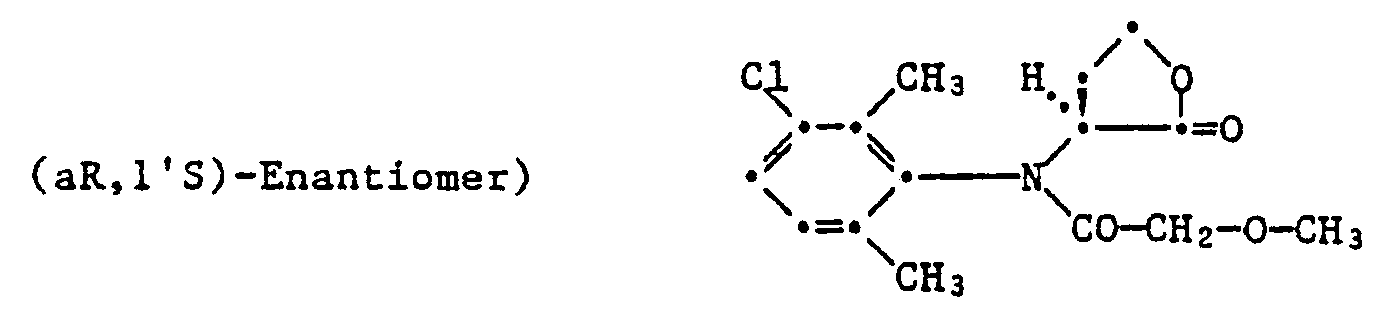
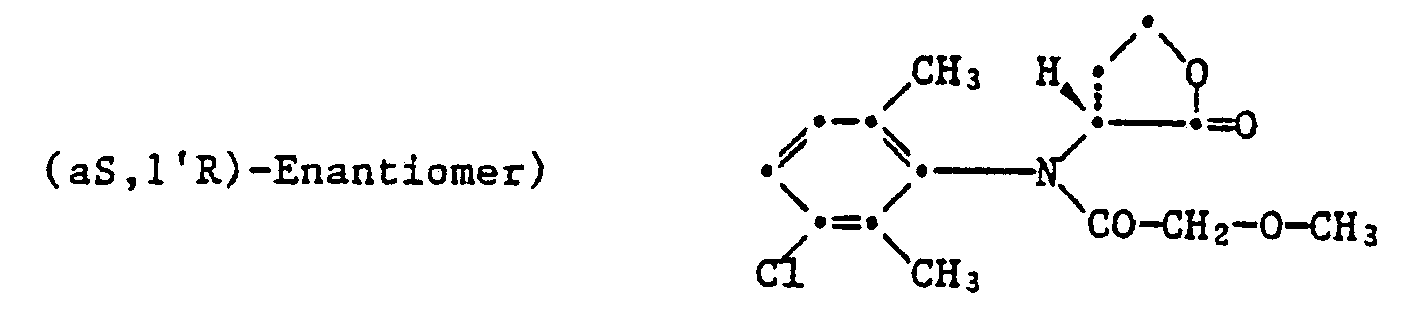
- Die absolute Konfiguration der Enantiomeren wurde durch Röntgenstrukturanalyse ermittelt und lässt sich wie folgt wiedergeben:


- Gegenstand vorliegender Erfindung ist auch ein Verfahren zur Gewinnung von (aR,1'R)(aS,1'R)-3-[N-(Methoxyacetyl)-N-(3-chlor-2,6-dimethylphenyl)]-amino-tetrahydro-2-furanon, das gleichfalls eine wesentlich höhere Fungizid-Wirkung als das aus der DE-OS 2,804,299 bekanntgewordene Racemat entfaltet. Als Pflanzenfungizid ist dieses Diastereomerenpaar im 1:1-Verhältnis oder im ungefähren 1:1-Verhältnis (45:55 bis 55:45) besonders geeignet. Es its gleichfalls ein Gegenstand vorliegender Erfindung.
- Beim Herstellungsverfahren wendet man kombiniert a) ein Trennungsverfahren zweier Isomeren eines Zwischenproduktsund b) ein nachfolgendes Chlorierungsverfahren gemäss folgendem Schema an:


- Das mit der Chlorierung anfallende Gemisch des (aR,1'R)- und des (aS,1'R)-Enantiomeren, kann als solches als Fungizid verwendet oder weiterhin zur Gewinnung des (aS,1'R)-Entantiomeren wiederum nach der Methode des einleitenden Trennungsschritts a) chromatographisch getrennt werden.
- Das raceme Ausgangsprodukt 3-[N-(Methoxyacetyl)-N-2,6-dimethylphenyl)]-amino-tetrahydro-2-furanon ist gleichfalls in der DE-OS 2,804,299 bzw. in der GB-PS 1,577,702 beschrieben.
- Für den vorstehend skizzierten chromatographischen Trennungsschritt a) lassen sich alle dem Fachmann geläufigen Trägermaterialien wie Kieselgel, AI203, oder organische Polymer-Harze (Polyamid, Polyacrylamid und dergleichen), ferner Agarose, Sepharose, besonders aber modifizierte Cellulose verwenden. Besonders geeignet ist acetylierte oder benzoylierte Cellulose.
- Die Chlorierung des (1'R)-3-[N-(Methoxyacetyl)-N-2,6-dimethylphenyl)]-amino-tetrahydro-2-furanons wird vorteilhaft in einem inerten Lösungsmittel vorgenommen. Als Lösungsmittel sind chlorierte aromatische und aliphatische Kohlenwasserstoffe, wie Chlorbenzol, Methylenchlorid, Chloroform, Kohlenstofftetrachlorid und andere geeignet. Insbesondere sind niedere Alkancarbonsäuren verwendbar, z.B. Ameisensäure, Essigsäure, Propionsäure. Ein bevorzugtes Lösungsmittel ist Ameisensäure.
- Die Chlorierung wird vorteilhaft im Temperaturbereich von 0° bis 50°C durchgeführt, z.B. bei Raumtemperatur.
- Es ist ferner vorteilhaft, die Chlorierung in Gegenwart von Lewis-Säuren, wie Aluminiumchlorid, Zinkchlorid, Eisen(III)chlorid und Zinn(lV)chlorid durchzuführen. Eine bevorzugte Lewis-Säure ist Eisen(III)-chlorid. Die Lewis-Säuren werden in einer Menge von 1-8 Gew.-%, bezogen auf das zu chlorierende (1'R)-Isomere, eingesetzt. Es kann auch ohne Lewis-Säuren chloriert werden. Die Chlorierung wird bei Normaldruck oder leicht erhöhtem Druck durchgeführt. Für die Chlorierung wird Sulfurylchlorid, bevorzugt aber Chlor verwendet.
- Durch das erfindungsgemässe Verfahren a) der Abtrennung des (1'R)-Enantiomeren aus dem racemischen 3-[N-(Methoxyacetyl)-N-(2,6-dimethylphenyl)]-amino-tetrahydro-2-furanon an einer festen Trägerphase (Adsorptionschromatographie) und b) der Chlorierung zu einem (aR,1'R)(aS,1'R)-Isomeren-Gemisch zweier Atropisomerer gelangt man in hoher Ausbeute überraschend zu einer Wirkstoff-Komponente, die eine Fungizid-Wirkung in der gleichen Grössenordnung zeigt wie das hockwirksame Enantiomere (aS,1'R)-3-[N-(Methoxyacetyl)-N-(3-chlor-2,6-dimethylphenyl)]-amino-tetrahydro-2-furanon.
- Es wurde gefunden, dass vor allem das (aS,TR)-3-[N-(Methoxyacetyi)-N-(3-chior-2,6-dimethyiphenyi)]-amino-tetrahydro-2-furanon, aber auch das raceme (aR,1'S)(aS,1'R)-3-[N-(Methoxyacetyl)-N-(3-chlor-2,6-dimethylphenyl)]-amino-tetrahydro-2-furanon und das Isomeren-Gemisch (aR,1'R)- und (aS,1'R)-3-[N-(Methoxyacetyl)-N-(3-chlor-2,6-dimethylphenyl)1-amino-tetrahydro-2-furanon dem aus der DE-OS 2,804,299 bekannt gewordenen Racemat, das 4 Isomeren enthält, in der Mikrobizid-Wirkung um ein Mehrfaches überlegen sind. Diese beiden Isomeren-Gemische und das (aS,1'R)-Enantiomere besitzen jeweils ein für die praktischen Bedürfnisse sehr günstiges Mikrobizid-Spektrum zum Schutze von Kulturpflanzen, ohne diese durch unerwünschte Nebenwirkungen nachteilig zu beeinflussen. Kulturpflanzen seien im Rahmen vorliegender Erfindung beispielsweise Getreide, Mais, Reis, Gemüse, Zuckerrüben, Soja, Erdnüsse, Obstbäume, Zierpflanzen, vor allem aber Reben, Hopfen, Gurkengewächse (Gurken, Kürbis, Melonen), Solanaceen wie Kartoffeln, Tabak und Tomaten, sowie auch Bananen-, Kakao- und Natrukautschuk-Gewächse.
- Das (aS,1'R)-Enantiomere oder seine vorstehend genannten Isomeren-Gemische können an Pflanzen oder Pflanzenteilen (Früchte, Blüten, Laubwerk, Stengel, Knollen, Wurzeln) dieser und vewandter Nutzkulturen die auftretenden Pilze eindämmen oder vernichten, wobei auch später zuwachsende Pflanzenteile von derartigen Pilzen verschont bleiben. Die Wirkstoffe sind gegen die den folgenden Klassen angehörenden phytopathogenen Pilze wirksam: Ascomycetes (z.B. Erysiphaceae); Basidiomycetes wie vor allem Rostpilze; Fungi imperfecti (z.B. Moniliales); dann aber besonders gegen die der Klasse der Phycomycetes angehörenden Oomycetes wie Phytophthora, Peronospora, Pseudoperonospora, Pythium oder Plasmopara. Ueberdies wirken die Isomeren systemisch. Sie können ferner als Beizmittel zur Behandlung von Sattgut (Früchte, Knollen, Körner) und Pflanzenstecklingen zum Schutz vor Pilzinfektionen sowie gegen im Erdboden auftretende phytopahtogene Pilze eingesetzt werden.
- Als Beispiele, die keinen das Anwendungsgebiet limitierenden Charakter im Rahmen dieser Erfindung besitzten, seien folgende Pflanzen und ihre Agrarprodukte genannt: Getreide (wie Weizen, Gerste, Roggen, Hafer, Reis, Sorghum und Verwandte); Rüben (wie Möhren, Zucker- und Fetterrüben); Kern-, Stein- und Beerenobst (wie Aepfel, Birnen, Pflaumen, Pfirsiche, Mandeln, Kirschen, Erd-, Hirn- und Brombeeren); Hülsenfrüchte (wie Bohnen, Linsen, Erbsen, Soja); Oelkulturen (wie Raps, Senf, Mohn, Oliven, Sonnenblumen, Kokos, Rizinus, Kakao, Erdnüsse); Gurkengewächse (wie Kürbis, Gurken, Melonen); Fasergewächse (wie Baumwolle, Flachs, Hanf, Jute, Nessel); Citrusflächte; Gemüsesorten (wie Spinat, Salat, Spargel, Kohlarten), Zwiebeln, Tomaten, Kartoffeln, Paprika); Lorbeergewächse (wie Avocadom Cinnamonum, Kampfer) oder Mais, Tabak, Nüsse, Kaffee, Zuckerrohr, Tee, Weintrauben, Kastenien, Hopfen, Bananen, Ananas, Gras (z.B. Golfrasen) und Heu.
- Die erfindungsgemässen Wirkstoffe werden üblicherweise in Form von Zusammensetzungen verwendet und können gleichzeitig oder nacheinander mit weiteren Wirkstoffen auf die zu behandelnde Fläche, Pflanze oder Substrat gegeben werden. Diese weiteren Wirkstoffe können sowhol Düngemittel, Spurenelement-Vermittler oder andere das Pflanzenwachstum beeinflussende Präparate sein. Es können aber auch selektive Herbizide, Insektizide, Fungizide, Bakterizide, Nematizide, Molluskizide oder Gemischse mehrerer dieser Präparate sein, zusammen mit gegebenenfalls weiteren in der Formulierungstechnik üblichen Trägerstoffen, Tensiden oder anderen applikationsfördernden Zusätzen.
- Geeignete Träger und Zusätze können fest oder flüssig sein und entsprechen den in der Formulierungstechnik zweckdienlichen Stoffen, wie z.B. natürlichen oder regenerierten mineralischen Stoffen, Lösungs-, Dispergier-, Netz-, Haft-, Verdickungs-, Binde- oder Düngemitteln. Besonders vorteilhafte Zusatzstoffe sind Phospholipide.
- Ein bevorzugtes Verfahren zum Aufbringen eines erfindungsgemässen Wirkstoffes bzw. eines (agro)-chemischen Mittels, das mindestens einen dieser Wirkstoffe enthält, ist das Aufbringen auf das Blattwerk (Blattapplikation). Anzahl der Applikation und Aufwandmenge richten sich dabei nach dem Befallsdruck für den entsprechenden Erreger (Pilzsorte). Die erfundungsgemässen Wirkstoffe können aber auc über den Erdboden durch das Wurzelwerk in die Pflanze gelangen (systemische Wirkung), indem man den Standort der Pflanze mit einer flüssigen Zubereitung tränkt oder die Substanzen in fester Form in den Boden einbringt, z.B. in Form von Granulat (Bodenapplikation). Die erfindungsgemässen Verbindungen können aber auch auf Samenkörner aufgebracht werden (Coating), indem man die Körner entweder mit einer flüssigen Zubereitung des Wirkstoffs tränkt oder sie mit einer festen Zubereitung beschichtet. Darüber hinaus sind in besonderen Fällen weitere Applikationsarten möglich, so z.B. die gezielte Behandlung der Pflanzenstengel oder der Knospen.
- Die erfindungsgemässen Verbindungen werden dabei in unveränderter Form oder vorzugsweise zusammen mit den in der Formulierungstechnik üblichen Hilfsmittel eingesetzt und werden daher z.B. zu Emulsionskonzentraten, streichfähigen Pasten, direkt versprühbaren oder verdünnbaren Lösungen, verdünnten Emulsionen, Spritzpulvern, löslichen Pulvern, Stäubemitteln, Granulaten, durch Verkapselungen in z.B. polymeren Stoffen in bekannter Weise verarbeitet. Die Anwendungsverfahren wie Versprühen, Vernebeln, Verstäuben, Verstreuen, Bestreichen oder Giessen werden gleich wie die Art der Mittel den angestrebten Zielen und den gegebenen Verhältnissen entsprechend gewählt. Günstige Aufwandmengen liegen in allgemeinen bei 50 g bis 5 kg Aktivsubstanz (AS) je ha; bevorzugt 100 g bis 2 kg AS/ha, insbesondere bei 200 g bis 600 g AS/ha.
- Die Formulierungen d.h. die einer erfindungsgemässen Wirkstoff und gegebenenfalls eine festen oder flüssigen Zusatzstoff enthaltenden Mittel, Zubereitungen oder Zusammensetzungen werden in bekannter Weise hergestellt, z.B. durch inniges Vermischen und/oder Vermahlen der Wirkstoffe mit Streckmitteln, wie z.B. mit Lösungsmitteln, festen Trägerstoffen, und gegebenenfalls oberflächenaktiven Verbindungen (Tensiden).
- Als Lösungsmittel können in Frage kommen: Aromatische Kohlenwasserstoffe, bevorzugt die Fraktionen C8 bis C12' wie z.B. Xylolgemische oder substituierte Naphthaline, Phthalsäureester wie Dibutyl-oder Dioctylphthalat, aliphatische Kohlenwasserstoffe wie Cyclohexan oder Paraffine, Alkohole und Glykole sowie deren Ether und Ester, wie Ethanol, Ethylenglykol, Ethylenglykolmonomethyl- oder -ethylether, Ketone wie Cyclohexanon, stark polare Lösungsmittel wie N-Methyl-2-pyrrolidon, Dimethylsulfoxid oder Dimethylformamid, sowie gegebenenfalls epoxydierte Pflanzenöle wie epoxydiertes Kokosnussöl, Sonnenblumenöl oder Sojaöl; oder Wasser.
- Als feste Trägerstoffe, z.B. für Stäubemittel und dispergierbare Pulver, werden in der Regel natürliche Gesteinsmehle verwendet, wie Calcit, Talkum, Kaolin, Montmorillonit oder Attapulgit. Zur Verbesserung der physikalischen Eigenschaften können auch hochdisperse Kielselsäure oder hochdisperse saugfähige Polymerisate zugesetzt werden. Als gekörnte, adsoprtive Granulatträger kommen poröse Typen wie z.B. Bimsstein, Ziegelbruch, Sepiolit oder Bentonit, als nicht adsorptive Trägermaterialien z.B. Calcit oder Sand in Frage. Darüber hinaus kann eine Vielzahl von vorgranulierten Materialien anorganischer oder organischer Natur wie insbesondere Dolomit oder zerkleinerte Pflanzenrückstände, wie z.B. Korkmehl oder Sägemehl, verwendet werden.
- Als oberflächenaktive Verbindungen kommen je nach Art des zu formulierenden erfindungsgemässen Wirkstoffes nichtionosgene, kation-und/oder anionaktive Tenside mit guten Emulgier-, Dispergier- und Netzeigenschaften in Betracht. Unter Tensiden sind auch Tensidgemische zu verstehen.
- Geeignete anionische Tenside können sowohl sog. wasserlösliche Seifen, als auch wasserlösliche synthetische oberflächenaktive Verbindungen sein.
- Als Seifen seien die Alkali- oder gegenenfalls substituierten Ammoniumsalze von höheren Fettsäuren (C1O-C22), wie z.B. die Na- oder K-Salze der Oel- oder Stearinsäure, oder von natürlichen Fettsäuregemischen, die z.B. aus Kokosnuss- oder Talgöl gewonnen werde können. Ferner sind als Tenside auch die Fettsäure-methyllaurinsalze sowie modifizierte und nicht modifizierte Phospholipide zu erwähnen.
- Häufiger werden jedoch sog. synthetische Tenside verwendet, insbesondere Fettsulfonate, Fettsulfate, sulfonierte Benzimidazolderivate oder Alkylsulfonate.
- Als nichtionische Tenside kommen in erster Linie Polyglykoletherderivate von alphatischen oder cycloaliphatischen Alkoholen, gesättigten oder ungesättigten Fettsäuren und Alkylphenolen in Frage, die 3 bis 30 Glykolethergruppen und 8 bis 20 Kohlenstoffatome im (aliphatischen) Kohlenwasserstoffrest und 6 bis 18 Kohlenstoffatome im Alkylrest der Alkylphenole enthalten können.
- Ferner kommen auch Fettsäureester von Polyoxyethylsorbitan wie das Polyoxyethylensorbitan-trioleat im Betracht.
- Bei den kationischen Tensiden handelt es sich vor allem um quatäre Ammoniumsalze, welche als N-Substituenten mindestens einen Alkylrest mit 8 bis 22 C-Atomen enthalten und als weitere Substituenten niedrige, gegebenenfalls halogenierte Alkyl-, Benzyl- oder neidrige Hydroxyalkylreste aufweisen. Die Salze liegen vorzugsweise als Halogenide, Methylsulfate oder Ethylsulfate vor, z.B. das Stearyltrimethylammoniumchlorid oder das Benzyldi(2-chlorethyl)ethylammoniumbromid.
- Die in der Formulierungstechnik gebräuchlichen Tenside sind u.a. in folgenden Publikationen beschrieben:
- "McCutcheon's Detergents and Emulsifiers Annual" MC Publishing Corp. Ridgewood, New Jersey, 1979;
- Dr. Helmut Stache "Tensid Taschenbuch", Carl Hanser Verlag München/Wien 1981.
- Auf dem Vorratsschutzgebiet werden die für die menschliche und tierische Ernährung unbedenklichen Zuschlagstoffe bevorzugt.
- Die fungiziden Mittel gemäss vorliegender Erfindung enthalten in der Regel 0,1 bis 95 Gew.-% des erfindungsgemässen (aS,1'R)-Enantiomeren in einem höheren Anteil unter den 4 Isomeren der Verbindung der Formel I als dem theoretischen Anteil von 25 Gewichtsprozent entspricht, zusammen mit 99,9 bis 5 Gew.-% eines festen und/oder flüssigen Trägermaterials.
- Bevorzugt sind Mittel, die im Wirkstoffanteil 28 Gew.-% des (aS,1'R)-Entantiomeren oder mehr enthalten bzw. daneben einen gleich hohen oder geringeren Anteil des (aR,1'R)-Enantiomeren oder einen gleich hohen oder geringeren Anteil des (aR,1'S)-Entantiomeren besitzen.
- Vor allem sind Mittel bevorzugt, die in der Wirkstoffmenge 40 Gew.-% des (aS,1'R)-Enantiomeren oder mehr enthalten, und solche, die in der Wirkstoffmenge daneben noch einen gleich hohen oder geringeren Anteil des (aR,1'R)-Enantiomeren oder einen gleich hohen oder geringeren Anteil des (aR,1'S)-Enantiomeren besitzen.
- Besonders bevorzugt sind Mittel, die in der Wirkstoffmenge 50 Gew.-% des (aS,1'R)-Enantiomeren oder mehr enthalten, und solche, die in der Wirkstoffmenge daneben noch einen 100 Gew.-% ergänzenden oder auch geringeren Anteil des (aR,1'R)-Enantiomeren oder des (aR,1'S)-Enantiomeren besitzen.
- Weiterhin sind Mittel bevorzugt, die in der Wirkstoffmenge 70 Gew.-% des (aS,1'R)-Enantiomeren oder mehr enthalten, insbesondere solche, deren Wirkstoffmenge im wesentlichen (= 90 Gew.-% oder mehr) aus dem (aS,1'R)-Enantiomeren besteht.
- Die vorstehenden Angaben beziehen sich also auf Mengenverhältnisse der vier Isomeren des 3-[N-(methoxyacetyl)-N-(3-chlor-2,6-dimethylphenyl)]-aminotetrahydro-2-furan, bei denen das (aS,1'R)-Enantiomeren nach Möglichkeit den höchsten Anteil darstellt, anteilsmässig gefolgt von entweder den (aR,1'R)- oder dem (aR,1'S)-Enantiomeren, wobei jedes der sonst verbleibeneden Enantiomeren trotzdem in geringen Anteilen vorhanden sein kann.
- Die angegebenen Mengenanteile beziehen sich ausschliesslich auf den Wirkstoff der Formel I und schliessen keine Menge anderer Wirkstoffe ein, die möglicherweise in den erfindungsgemässen Mitteln weiterhin anwesend sein können.
- Während als Handelsware eher konzentrierte Mittel bevorzugt werden, verwendet der Endverbraucher in der Regel verdünnte Mittel.
- Die Mittel können auch weitere Zusätze wie Stabilisatoren, Entschäumer, Viskositätsregulatoren, Bindemittel, Haftmittel sowie Dünger oder andere Wirkstoffe zur Erzielung spezieller Effekte enthalten.
- Derartige (agro)chemische Mittel sind ein Bestandteil der vorliegenden Erfindung.
- Die nachfolgenden Beispiele dienen der Illustration der Erfindung, ohne dieselbe einzuschränken (Prozente und Teile beziehen sich auf Gewicht; Temperaturen sind in Celsiusgraden angegeben).
- 70 g des nach DE-OS 2,804,299 hergestellten losmeren-Gemisches von 3-[N-(Methoxyacetyl)-N-(3-chlor-2,6-dimethylphenyl)]-amino-tetrahydro-2-furanon der Formel 1 werden mittels einer Kieselgel-Flashchromatographiesäule mit Essigsäureäthylester/Diäthylether (1/4) als Fliessmittel aufgetrennt.
-
- 33,8 g (aS,1'S)(aR,1'R)-3-[N-(Methoxyacetyl)-N-(3-chlor-2,6-dimethylphenyl)]-amino-tetrahydro-2-furanon, Smp. 140°C,
- 32,6 g (aR,1'S)(aS,1'R)-3-[N-(Methoxyacetyl)-N-(3-chlor-2,6-dimethylphenyl)]-amino-tetrahydro-2-furanon, Smp. 115°C.
- 1 g des (aS,1'S)(aR,1'R)-3-[N-(Methoxyacetyl)-N-(3-chlor-2,6-dimethylphenyl)]-amino-tetrahydro-2-furanon werden über eine mit Triacetylcellulose gefüllte Mitteldruckchromatographiesäule bei 2 bar Druck mit einem aus Aethanol (95 Vol%) und Wasser (5 Vol%) bestehenden Fliessmittel in die beiden Enantiomeren aufgetrennt.
-
- 0,215 g (aR,1'R)-3-[N-(Methoxyacetyl)-N-(3-chlor-2,6-dimethylphenyl)]-amino-tetrahydro-2-furanon, Smp. 117-120°C, [a]94 (in CHCl3): +64 ± 1° (ee >98%),
- 0,232 g (aS,1'S)-3-[N-(Methoxyacetyl)-N-(3-chlor-2,6-dimethylphenyl)]-amino-tetrahydro-2-furanon, Smp. 115-117°C,

- 0,5 g (aR,1'S)(aS,1'R)-3-[N-(Methoxyacetyl)-N-(3-chlor-2,6-dimethylphenyl)]-amino-tetrahydro-2-furanons werden über eine mit Triacetylcellulose gefüllte Mitteldruckchromatographiesäule bei 2 bar Druck mit einem aus Aethanol (95 Vol%) und Wasser (5 Vol%) bestehenden Fliessmittel in die beiden Enantiomeren aufgetrennt.
-
- 0,154 g (aR,1'S)-3-[N-(Methoxyacetyl)-N-(3-chlor-2,6-dimethylphenyl)]-amino-tetrahydro-2-furanon, Smp. 98-100°C,

- 0,152 des hochwirksamen (aS,1'R)-3-[N-(Methoxyacetyl)-N-(3-chlor-2,6-dimethylphenyl)]-amino- tetrahydro-2-furanon, Smp. 94―96°C,

- Auf eine mit Tri-(3-methylbenzoyl)-cellulose gefüllte HPLC-Säule (0,46 x 25 cm), werden 20 µl einer 1 % Lösung des Isomerengemischs in Hexan/2-Propanol (1:1) aufgetragen. Die Chromatographie wird dann bei einem Durchfluss von 1 ml/Min. mit einem aus Hexan und 2-Propanol (60:40) bestehenden Fliessmittel durchgeführt. Unter diesen Bedingungen werden die vier Isomeren getrennt. Die Retentionszeiten der einzelnen Isomeren sind die folgenden:

- Die Isomeren werden nach Verdampfen des Lösungsmittelgemisches und nach Trocknen rein isoliert. (Die physikalischen Daten entsprechen den in den vorangehenden Beispielen angegebenen Werten). Das in die stationäre Phase eingesetzte Tri-(3-methylbenzoyl)-cellulose wird wie folgt zubereitet:
- 10 g Tri-(3-methylbenzoyl)-cellulose werden in 300 ml Methylenchlorid mit 50 ml Heptanol versetzt. Die erhaltene Lösung wird bei Raumtemperatur in eine bei 400 Upm gerührte 0.7% Natriumlaurylsulfatlösung (240 ml) getropft. Anschliessend wird bei derselben Rührgeschwindigkeit bei 40―42°C (Badtemperatur) das Methylenchlorid abgedampft. Der Rückstand wird abfiltriert und mit Wasser und Ethanol gewaschen. Das pulverige Produkt wird im Vakuumschrank bei 80°C (20 Std.) getrocknet. Ausbeute: 9,6 g (96% der Theorie). Die kugleförmigen mit einem Durchmesser von 10-20 µm können nach Bedarf durch Sieben oder Sedimentieren fraktioniert werden. Weitere physikalische Eigenschaften des Produktes:

- Die gezielte Herstellung eines (aR,1'R)- und (aS,1'R)-Isomerengemischs von 3-[N-(methoxyacetyl)-N-(3-chlor-2,6-dimethylphenyl)]-amino-tetrahydro-2-furanon durch Chlorierung von (1'R)-3-[N-(Methoxyacetyl)-N-(2,6-dimethylphenyl)]-amino-tetrahydro-2-furanon lässt sich leicht und in hoher Ausbeute erreichen (Beispiel 2.1). Dieses Gemisch kann formuliert als hochwirksames Pflanzen-Mikrobizid eingesetzt werden. Es kann daraus aber auch, sofern gewünscht, das (aS,1'R)-Enantiomere abgetrennt werden (Beispiel 2.2).
- Das als Ausgangsprodukt für die Chlorierung zu verwendente (1'R)-3-[N-(methoxyacetyl)-N-(2,6-dimethylphenyl)]-amino-tetrahydro-2-furanon lässt sich etwa nach Art des folgenden Beispiels 2.0 aus dem zugrundeliegenden Racemat abtrennen.
-
- 2.0 Auftrennung der enantiomeren Zwischenprodukte (1'S)-3-[N-(Methoxyacetyl)-N-(2,6-dimethylphenyl)]-amino-tetrahydro-2-furanon und (1'R)-3-[N-(Methoxyacetyl)-N-(2,6-dimethylphenyl)]-amino-tetra- hydro-2-furanon
- 2 g 3-[N-(Methoxyacetyl)-N-(2,6-dimethylphenyl)]-amino-tetrahydro-2-furanon werden über eine mit-Triacetylcellulose gefüllte Mitteldruckchromatographiesäule bei 2 bar Druck mit einem aus Aethanol (95%; Vol%) und Wasser (5 Vol%) bestehenden Fliessmittel in die beiden Enantiomeren aufgetrennt. i
-
- 0,808 g 1'R-3-[N-(Methoxyacetyl)-N-(2,6-dimethylphenyl)]-amino-tetrahydro-2-furanon, Smp. 63―65°C,

- 0.978 g 1'S-3-[N-(Methoxyacetyl)-N-(2,6-dimethylphenyl)]-amino-tetrahydro-2-furanon, Smp. 62-64°C,

- 0,222 g (1'R)-3-[N-(Methoxyacetyl)-N-(2,6-dimethylphenyl)]-amino-tetrahydro-2-furanon der Formel I werden in 30 ml Ameisensäure gelöst. 0,06 g Chlor werden bei Raumtemperatur in Gegenwart einer Spur Eisen(III)chlorid in die Lösung eingeleitet. Die Lösung wird ca. 1 Std. bei Raumtemperatur gerührt und das Lösungsmittel unter vermindertem Druck verdampft. Der Rückstand wird in Essigsäureäthylester gelöst, die Lösung mit Wasser extrahiert, mit Natriumsulfat getrocknet, filtriert und eingedampft. Das getrocknetete Gemisch schmilzt bei 79-82°C, es enthält je ca. 50% der beiden Isomeren, d.h. das Isomerenverhältnis schwankt zwischen 45:55 bis 55:45.
- Der durch Chlorierung gemäss Beispiel 2.1 erhaltene Rückstand wird in Essigsäureäthylester gelöst, die Lösung mit Wasser extrahiert, mit Natriumsulfat getrocknet, filtriert und eingedampft. Das rohe Produktegemisch wird an einer Kieselgel-Flashsäule mit Essigsäureäthylester/Hexan (1/3) als Fliessmittel aufgetrennt.
-
- 0,070 g (aR,1'R)-3-[N-(Methoxyacetyl)-N-(3-chlor-2,6-dimethylphenyl)]-amino-tetrahydro-2-furanon,

- 0,075 g (aS,1'S)-3-[N-(Methoxyacetyl)-N-(3-chlor-2,6-dimethylphenyl)]-amino-tetrahydro-2-furanon,

- Formulierungsbeispiele für Wirkstoffe der Formel I einschliesslich Isomeren und deren Gemische, die nach den Beispielen 1.1-1.4 sowie 2.1 und 2.2 hergestellt werden können.
- [In Klammern Prozentsatz an (aS,1'R)-Isomeren in Wirkstoff der Formel I]
-

- Aus solchen Kozentraten können durch Verdünnen mit Wasser Emulsionen jeder gewünschten Konzentration hergestellt werden.


- Der Wirkstoff wird in Methylenchlorid gelöst, auf den Träger aufgesprüht und das Lösungsmittel anschliessend im Vakuum abgedampft. Man erhält Granulate für die Erdbodenapplikation.

- Durch inniges Vermischen auf Trägerstoffe mit dem Wirkstoff erhält man gebrauchsfertige Stäubemittel.
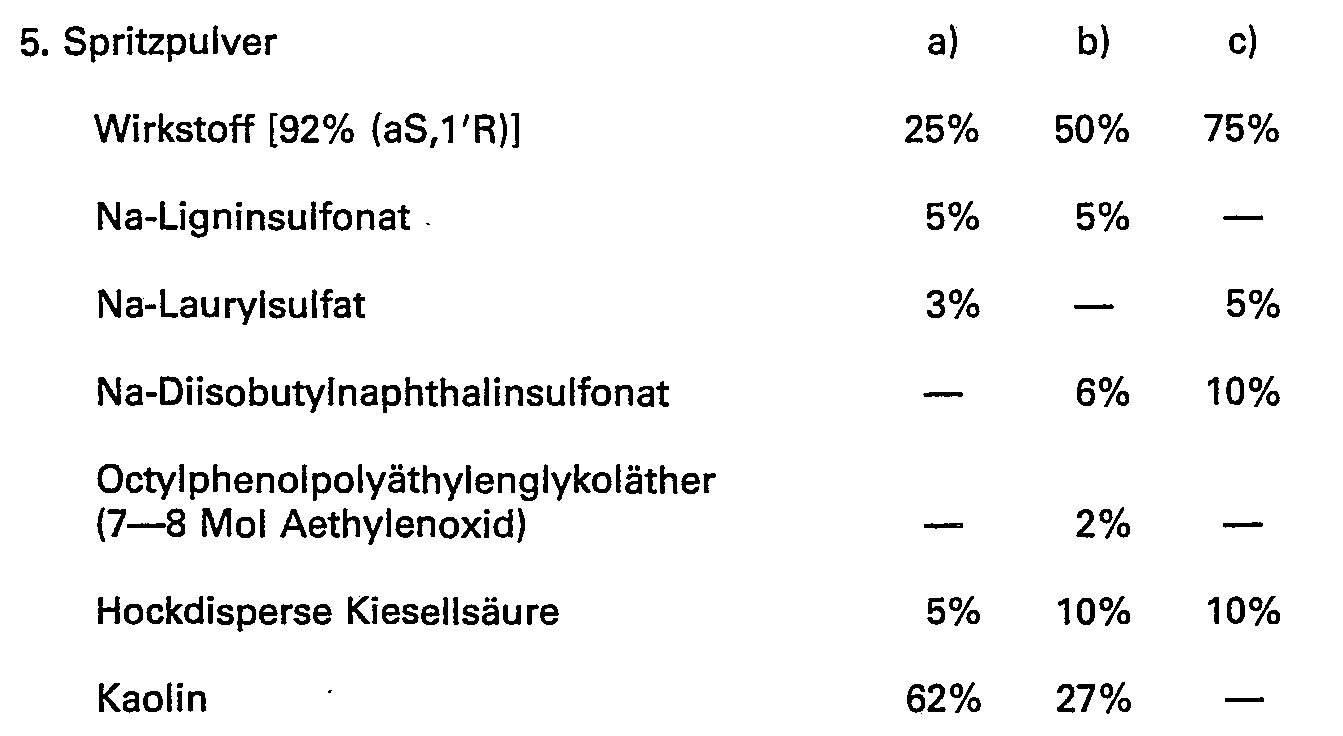
- Der Wirkstoff wird mit den Zusatzstoffen gut vermischt und in einer geeigneten Mühle vermahlen. Man erhält Spritzpulver, die sich mit Wasser zu Suspensionen jeder gewünschten Konzentration verdünnen lassen.

- Aus diesem Konzentrat können durch Verdünnen mit Wasser Emulsionen jeder gewünschten Konzentration hergestellt werden.

- Man erhält anwendungsfertige Stäubemittel, indem der Wirkstoff mit dem Träger vermischt auf einer geeigneten Mühle vermahlen wird.

- Der Wirkstoff wird mit den Zusatzstoffen vermischt, vermahlen und mit Wasser angefuchtet. Dieses Gemisch wurde extrudiert und anschliessend im Luftstrom getrocknet.
-

- Der fein gemahlene Wirkstoff wird in einem Mischer auf das mit Polyäthylenglykol angefeuchtete Kaolin gleichmässig aufgetragen. Auf diese Weise erhält man staubfreie Umhüllungs-Granulate, die besonders für Erdbodenapplikationen geeignet sind.

- Der fein gemahlene Wirkstoff wird mit den Zusatzstoffen innig vermischt. Man erhält so ein Suspensions-Konzentrat, aus welchem durch Verdünnen mit Wasser Suspensionen jeder gewünschten Konzentration hergestellt werden können.
- 3. Biologische Beispiele
- 3.1 Pythium ultimum auf Beta vulgaris (Zuckerrübe, cv. Kleinwanzleben Monogerm) und auf Pythium ultimum auf Zea mays (Mais, cv. Sweet Corn)
- Testprinzip: Bondenpilz: protektiv lokale Bodenapplikation.
- Testmethode: Myzel von Pythium ultimum wird mit Erde gemischt (500 ml Myzelsuspension auf 10 Liter Erde) und das Pilz-Erdgemisch in 250 ml Plastikschalen abgefüllt. Nach einer 4-tägigen Inkubation bei 10°C werden pro Schale 10 Körner der zu prüfenden Pflanze (Mais oder Zuckerrube) gesteckt. Am nächsten Tag werden die so vorbereitetn Schalen mit je 50 ml, aus 25% Spritzpulver und Wasser hergestellten Spritzlösungen mit 20; 6; 2; 0,6; 0,2; 0,06 und 0,02 ppm AS übergossen. Nach einer 7-tägigen Inkubationsphase bei 10°C und einer anschliessenden 4-tägigen Inkubationsphase bei 22°C wird die Wirkung der Testsubstanzen durch zahlenmässige Bestimmung des Auflaufs der Testpflanzen nach dem folgenden Notenschema bewertet:

- Die erzielten Resultate sind in der Tabelle I zusammengefasst.

- Das unter 3 genannte Racemat gemäss vorliegender Erfindung erzielt bis hinab zu einer Dosis von 0,6-0,2 ppm fungizide Wirkung.
- 3.2 Wirkung gegen Phytophthora infestans auf Tomatenpflanzen
- Tomatenpflanzen wurden nach 3-wöchiger Anzucht mit einer aus Spritzpulver des Wirkstoffes hergestellten Spritzbrühe (0,02% Aktivsubstanz) besprüht. Nach 24 Stunden wurden die behandelten Pflanzen mit einer Sporangiensuspension des Pilzes infiziert. Die Beurteilung des Pilzbefalls erfolgte nach einer Inkubation der infizierten Pflanzen während 5 Tagen bei 90-100% Luftfeuchtigkeit und 20°C.
- Zu Tomatenpflanzen wurde nach 3-wöchiger Anzucht eine aus Spritzpulver des Wirkstoffes hergestellte Spritzbrühe gegossen [0,002% Aktivsubstanz bezogen auf das Erdvolumen]. Es wurde darauf geachtet, dass die Spritzbrühe nicht mit den oberirdischen Pflazenteilen in Berührung kam. Nach 48 Stunden wurden die behandelten Pflanzen mit einer Sporangiensuspension des Pilzes infiziert. Die Beurteilung des Pilzbefalls erfolgte nach einer Inkubation der infizierten Pflanzen während 5 Tagen bei 90-100% relativer Luftfeuchtigkeit und 20°C.
- Die Resultate wurden nach dem unter Beispiel 3.1. beschriebenen Bewertungsschema beurteilt und die zur Erzielung der gleichen Bewertungsnote 1-2 benötigte Dosis jeweils auf die Dosis des aktivsten Enantiomeren aS,1'R bezogen. Die auf diese Weise ermittelten Dosisfaktoren (f) sind in der Tabelle 2 zusammengefasst.
- 5 Wochen alte Rebensämlinge werden mit einer aus der formulierten Prüfsubstanz hergestellten Spritzbrühe besprüht und 1 Tag später mit einer Sporangiensuspension (200'00 Sprorangien/ml) von P. viticola infiziert. Die Inkubation erfolgt bei 20°C in einer Gewächshauskabine; einer 14-stündigen Inkubationsphase mit 100% rel. Luftfeuchtigkeit folgen 4 Tage mit 75-85% und abschliessend zur Induktion der Pilzsporulation noch eine Nacht mit 100%. Nach der 6-tägigen Inkubation wird der Pilzbefall ausgewertet (Bewertungsschema wie Beispiel 3.1).
- 5 Wochen alte Rebensämlinge werden mit einer aus der formulierten Prüfsubstanz hergestellten Spritzbrühe angegossen. 3 Tage später werden die Pflanzen mit einer Sporensuspension (200'000 Sporangien/ml) von P. viticola infiziert. Ausführung des Versuchs wie unter a) beschrieben.
- Die analog zum Beispiel 3.2. ermittelten Dosisfaktoren sind in der Tabelle 2 zusammengefasst.
- Der Pilz wurde auf Karottenschnitzel-Nährlösung kultiviert und einer Erde-Sand-Mischung beigegeben. Die so infizierte Erde wurde in Blumentöpfe abgefüllt und mit Zuckerrübensamen besät. Gleich nach der Aussat wurden die als Spritzpulver formulierten Versuchspräparate als wässrige Suspensionen in die Erde gegossen (20 ppm Wirkstoff bezogen auf das Erdvolumen). Die Töpfe wurden darauf während 3 Wochen im Gewächshaus bei ca. 20°C aufgestellt. Die Erde wurde dabei durch leichtes Ueberbrausen gleichmässig feucht gehalten.
- Bei der Auswertung der Tests wurde die Zahl der aufgelaufenen Zuckerrübenpflanzen sowie der Anteil gesunder und kranker Pflanzen bestimmt.
- Die analog zum Versuch 3.2. ermittelten Dosisfaktoren sind in der Tabelle 2 zusammengefasst.
- Der Pilz wurde auf Karottenschnitzel-Nährlösung kultiviert und einer Erde-Sand-Mischung beigegeben. Die so infizierte Erde wurde in Blumentöpfe abgefüllt und mit Maissamen besät. Gleich nach der Aussaat wurden die als Spritzpulver formulierten Versuchspräparate als wässrige Suspensionen in die Erde gegossen (20 ppm Wirkstoff bezogen auf das Erdvolumen). Die Töpfe wurden darauf während 3 Wochen im Gewächshaus bei ca. 20°C aufgestellt. Die Erde wurde dabei durch leichtes Ueberbrausen gleichmässig feucht gehalten. Bei der Auswertung der Tests wurde die Zahl der aufgelaufenen Maispflanzen sowie der Anteil gesunder und kranker Pflanzen bestimmt.
- Die analog zum Versuch 3.2. ermittelten Dosisfaktoren sind in der Tabelle 2 zusammengefasst.
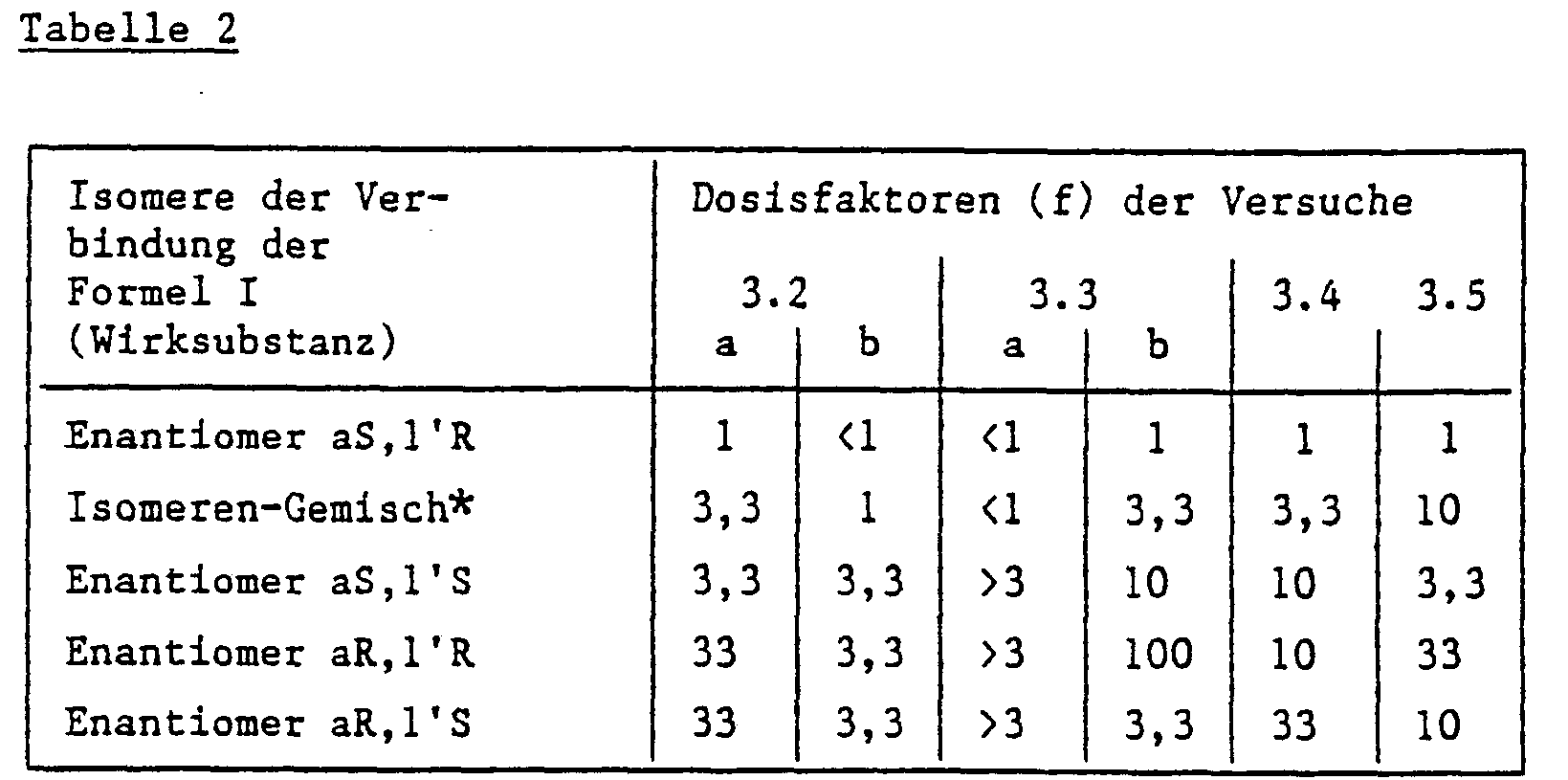
- Aus der Tabelle 2 ist ersichtlich, dass das (aS,1'R)-Enantiomer gemäss vorliegender Erfindung eine durchschnittlich 3-30fach bessere Wirkung im Vergleich zu den übrigen drei Enantiomeren und zum Racemat (= Isomeren-Gemisch* gemäss DE-OS 2,804,299) besitzt.
- 0,1 ml 0,75%-ige acetonsiche Lösung der Wirksubstanzen wird auf 15 ml Wasser steril verdünnt. Je ein ml aus dieser Stammlösung bzw. aus der daraus durch Wasserzusatz steril hergestellten Verdünnungsreihe werden in 19 ml Nährboden in 9 cm Petrischaten bei 50°C inkorporiert. Die Wirksubstanzmengen betragen 50, 5, 0,5, 0,05 und 0,005 ppm pro Schale. Nach 2 Stunden werden diese Schalen und die wirkstofflosen Kontrollschalen mit Phytophthora capsici in Form von Agarrondellen (0,6 mm 0, bewachsene Seite nach unten) beimpft. Die beimpften Kulturen werden bis zur Bewertung des Wachstums bei 60-70% rel. Feuchtigkeit und bei 18°C in Dunkelheit gestellt. Nach 4-6 Tagen, wenn die Kultur der Kontrollschale 2/3 der Petrischale erfüllt, erfolgt die Auswertung der Versuchsreihe, wobei die Wirkstoffkonzentration gegen das radial ermittelte Wachstum (% des Kontrollversuchs) auf einem Graphikon logarithmisch aufgetragen wird. Zum Vergleich der einzelnen Wirksubstanzen wird jeweils jene Konzentration graphisch ermittelt, bei welcher das Wachstum 50% des Kontrollversuchs erreicht (ELso-Wert). Die ELso-Werte sind in der Tabelle 3 zusammengefasst:
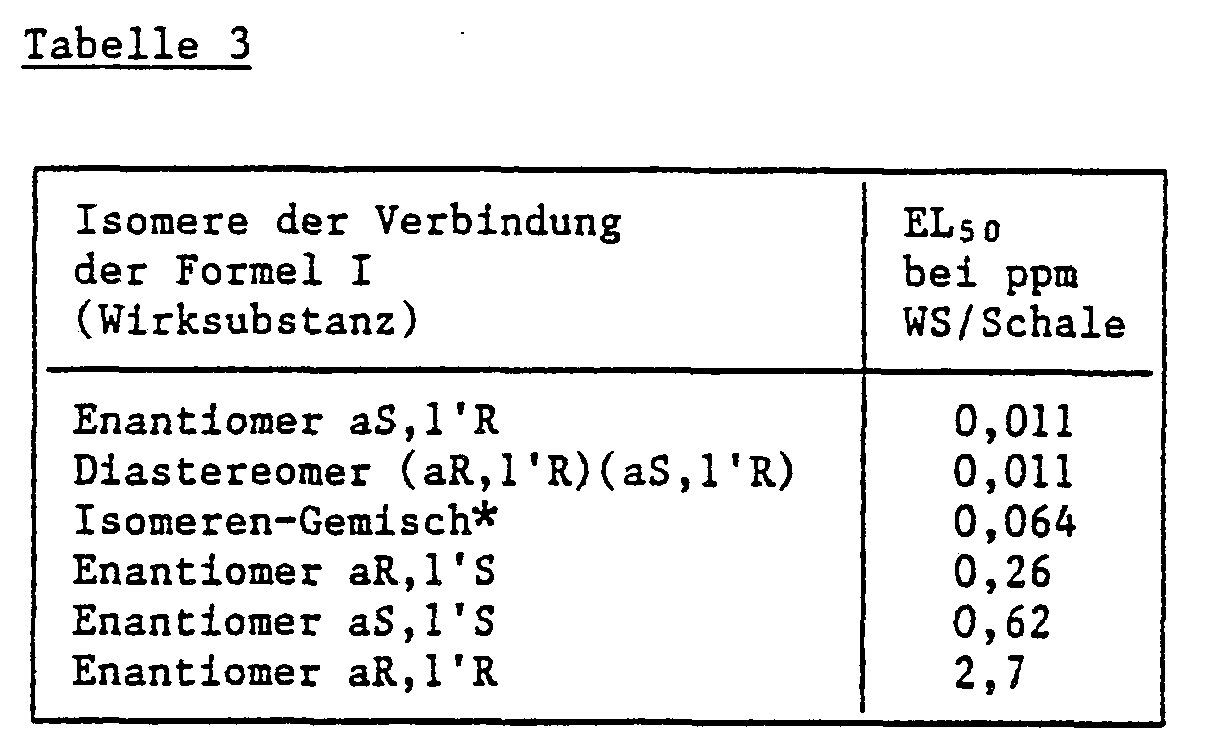
- Versuch 3.6 beweist, dass das hochwirksame (aS,1'R)-Enantiomer im ca. 1:1 Gemsich mit den (aR,1'R)-Enantiomer eine gleich hohe Wirksamkeit erzielt.
- Die zu prüfenden Wirkstoffsubstanzen werden als Spritzpulver, jeweils mit 100 ml Wasser verrührt und mit 20 Liter Erde vermischt. Die Konzentration der eingesetzten Aktivsubstanzen wird auf trockene Erde bezogen.
- In steriler Erde aufgezogenene Tabakpflazen (Hicks-Sorte) werden im 5-6 Blattzustand in fungizidhaltige Ende (in 5-Liter-Töpfen) ausgepflanzt. Zwei Tage danach werden die Furchen auf beiden Seiten der Pflanze durch Inokulation mit insgesamt zweimal 20 ml einer Sporen-Suspension (enthaltend 10000 Sporangien/ml) von Phytophthora nicotianae künstlich infiziert.
- Die Bewertung erfolgt in regelmässigen Abständen mit Noten (N) gemäss einer Skala von 1-100 unter Berücksichtigung der Welkens der Blätter, der Stengel-Schädigung und der Intensität des Schadens. Bei vollstädigem Schutz ist N = 0.
- Bis zur Erscheinung der ersten typischen Krankheitszeichen gilt die Pflanze als geschützt. Die Prüfung dauert 100 Tage, während derer die Tabakpflanze reift.
- Die Daurerwirkung der einzelnen Wirkstoffe wird mit Hilfe von Faktoren verglichen. Hierzu wird für die einzelnen bei verschiedenen Konzentrationen (ppm) eingesetzten Wirkstoffe jene Wirkungsdauer in Tagen ermittelt, bei welcher der Schutz (N) dem des Isomeren-Gemisches* (Definition siehe Tabelle 1) bei 0,25 ppm Konzentration nach 50 Tagen entspricht. Der Vergleichsfaktor (f) wird berechnet nach folgender Formel
-

- Die für die einzelnen Wirksubstanzen so ermittelten Faktoren wurden in der Tabelle 4 zusammengefasst, aus der die hohe Dauerwirkung des (aS,1'R)-Enantiomeren und des (aR,1'S)(aS,1'R)-Enantiomerenpaars im Vergleich zu den anderen drei Enantiomeren und zu zwei Gemischen hervorgeht.

- 3.8 Wirkung gegen Phytophthora infestans auf Tomatenpflanzen
- a) Residual-protektive Wirkung
- b) Systemische Wirkung
- Die Testmethodik entspricht der unter Beispiel 3.2 genannten.
- 3.9 Wirkung gegen Plasmopara viticola auf Reben
- a) Residual-protektive Blattapplikation
- b) Systemische Wirkung
- Die Testmethodik entspricht der unter Beispiel 3.3 genannten.
- Es wurden nebeneinander das (aR,1'S)(aS,1'R)-Enantiomerenpaar und das (aR,1'R)(aS,1'R)-Diastereomere in beiden Indikationen geprüft, und ihre Wirkung wurde dem parallel geprüften und aktivsten (aS,1'R)-Enantiomeren gegenübergestellt. In der Tabelle 5 ist nach dem Vorbild der Tabelle 2 angegeben eine um wieviel höhere Aufwandmenge bei dem jeweiligen Diastereomeren eingesetzt werden musste (Dosisfaktor f), um die gleich volle Wirkung (>95%; Note 1) zu erzielen wie das (aS,1'R)-Enantiomere.
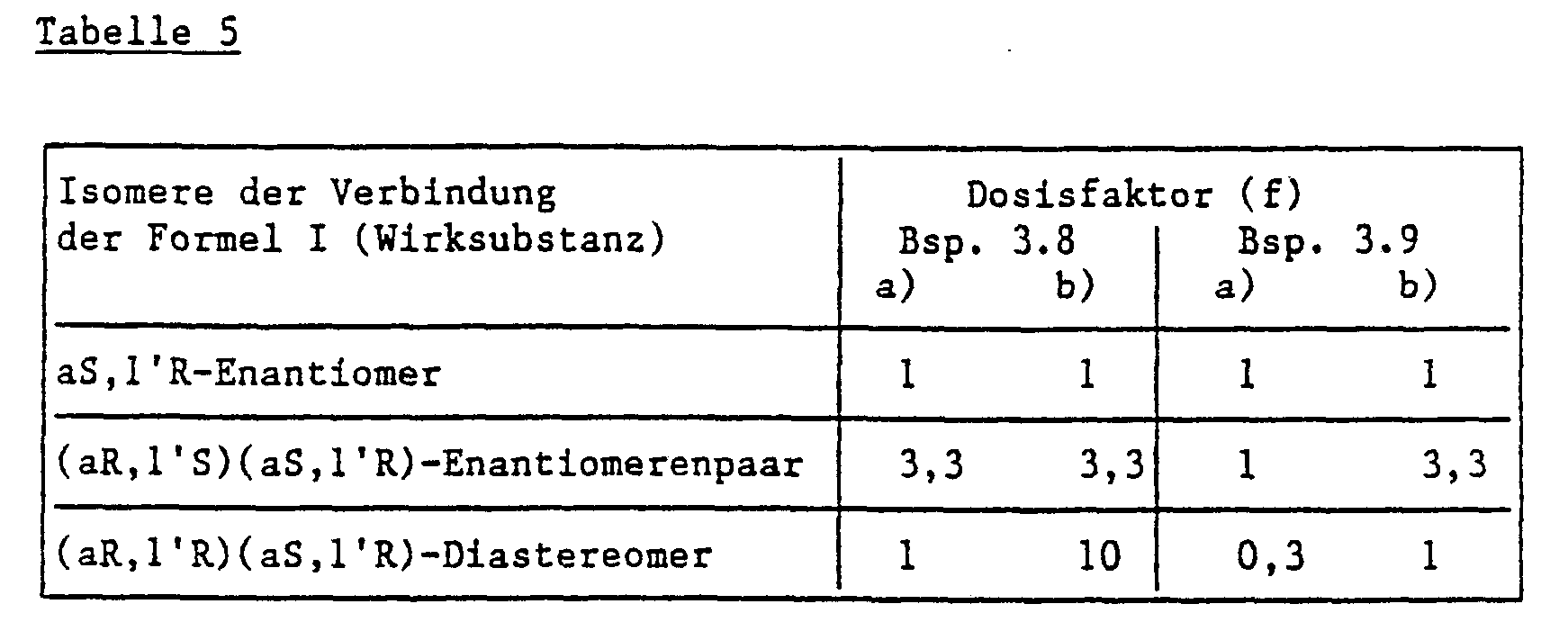
- Im Gegensatz zu den Resultaten der Tabelle 2, bei denen das (aS,1'R)-Enantiomer als überragendes Aktivitätsprinzip gegenüber den anderen Enantiomeren und gegenüber der vorbekannten racemischen Verbindung (= Isomeren-Gemisch*) erkannt wird, zeigt Tabelle 5 eine überraschend ähnliche Wirkungshöhe des Enantiomerenpaares und des Diastereomeren zu der des (aS,1'R)-Enantiomeren, obwohl das wirksame (aS,1'R)-Enantiomer nur je einen der beiden Anteile stellt. Dieses Resultat deutet auf eine offenbare Wechselwirkung der Enantiomeren hin, die die biologische Aktivität verstärken kann.
Claims (48)
Priority Applications (1)
| Application Number | Priority Date | Filing Date | Title |
|---|---|---|---|
| AT87118931T ATE60764T1 (de) | 1986-12-23 | 1987-12-21 | Optisch aktives tetrahydro-2-furanon-derivat als mikrobizid. |
Applications Claiming Priority (4)
| Application Number | Priority Date | Filing Date | Title |
|---|---|---|---|
| CH5201/86 | 1986-12-23 | ||
| CH5201/86A CH667653A5 (de) | 1986-12-23 | 1986-12-23 | Optisch aktives tetrahydro-2-furanon-derivat als mikrobizid. |
| CH447587 | 1987-11-18 | ||
| CH4475/87 | 1987-11-18 |
Publications (2)
| Publication Number | Publication Date |
|---|---|
| EP0275523A1 EP0275523A1 (de) | 1988-07-27 |
| EP0275523B1 true EP0275523B1 (de) | 1991-02-06 |
Family
ID=25695561
Family Applications (1)
| Application Number | Title | Priority Date | Filing Date |
|---|---|---|---|
| EP87118931A Expired - Lifetime EP0275523B1 (de) | 1986-12-23 | 1987-12-21 | Optisch aktives Tetrahydro-2-furanon-Derivat als Mikrobizid |
Country Status (17)
| Country | Link |
|---|---|
| EP (1) | EP0275523B1 (de) |
| KR (1) | KR880006982A (de) |
| AT (1) | ATE60764T1 (de) |
| AU (1) | AU8292087A (de) |
| BR (1) | BR8707026A (de) |
| CA (1) | CA1314291C (de) |
| DE (1) | DE3767999D1 (de) |
| DK (1) | DK677187A (de) |
| ES (1) | ES2021004B3 (de) |
| FI (1) | FI875602A7 (de) |
| GR (1) | GR3001469T3 (de) |
| HU (1) | HU200262B (de) |
| IL (1) | IL84891A0 (de) |
| NO (1) | NO875402L (de) |
| NZ (1) | NZ223007A (de) |
| PT (1) | PT86434B (de) |
| TR (1) | TR23686A (de) |
Families Citing this family (3)
| Publication number | Priority date | Publication date | Assignee | Title |
|---|---|---|---|---|
| EP0348351A1 (de) * | 1988-06-22 | 1989-12-27 | Ciba-Geigy Ag | Verfahren zur Herstellung von substituierten Aniliden |
| AU1676300A (en) * | 1999-12-29 | 2001-07-16 | Oxis Isle Of Man, Limited | Methods for resolving racemic mixtures of 5-substituted 4-hydroxy-2-furanones |
| KR100618163B1 (ko) * | 2005-02-21 | 2006-08-29 | 학교법인 계명기독학원 | 프라네올을 유효 성분으로 함유하는 항진균용 조성물 |
Family Cites Families (2)
| Publication number | Priority date | Publication date | Assignee | Title |
|---|---|---|---|---|
| US4147792A (en) * | 1977-02-04 | 1979-04-03 | Ciba-Geigy Corporation | Fungicidal compositions |
| DE3262501D1 (en) * | 1981-10-16 | 1985-04-11 | Ciba Geigy Ag | N-(1'-methyl-2'-methoxyethyl)-n-chloroacetyl-2-ethyl-6-methyl aniline as a herbicide |
-
1987
- 1987-12-18 FI FI875602A patent/FI875602A7/fi not_active IP Right Cessation
- 1987-12-21 CA CA000554937A patent/CA1314291C/en not_active Expired - Fee Related
- 1987-12-21 NZ NZ223007A patent/NZ223007A/xx unknown
- 1987-12-21 IL IL84891A patent/IL84891A0/xx unknown
- 1987-12-21 AT AT87118931T patent/ATE60764T1/de not_active IP Right Cessation
- 1987-12-21 DE DE8787118931T patent/DE3767999D1/de not_active Expired - Lifetime
- 1987-12-21 EP EP87118931A patent/EP0275523B1/de not_active Expired - Lifetime
- 1987-12-21 ES ES87118931T patent/ES2021004B3/es not_active Expired - Lifetime
- 1987-12-22 AU AU82920/87A patent/AU8292087A/en not_active Abandoned
- 1987-12-22 DK DK677187A patent/DK677187A/da not_active Application Discontinuation
- 1987-12-22 HU HU875953A patent/HU200262B/hu not_active IP Right Cessation
- 1987-12-22 NO NO875402A patent/NO875402L/no unknown
- 1987-12-22 PT PT86434A patent/PT86434B/pt not_active IP Right Cessation
- 1987-12-23 KR KR1019870015026A patent/KR880006982A/ko not_active Withdrawn
- 1987-12-23 BR BR8707026A patent/BR8707026A/pt unknown
-
1988
- 1988-12-22 TR TR88/0001A patent/TR23686A/xx unknown
-
1991
- 1991-02-12 GR GR90401111T patent/GR3001469T3/el unknown
Also Published As
| Publication number | Publication date |
|---|---|
| CA1314291C (en) | 1993-03-09 |
| NZ223007A (en) | 1989-09-27 |
| DK677187A (da) | 1988-06-24 |
| GR3001469T3 (en) | 1992-10-08 |
| KR880006982A (ko) | 1988-08-26 |
| IL84891A0 (en) | 1988-06-30 |
| HU200262B (en) | 1990-05-28 |
| PT86434A (en) | 1988-01-01 |
| EP0275523A1 (de) | 1988-07-27 |
| DE3767999D1 (de) | 1991-03-14 |
| DK677187D0 (da) | 1987-12-22 |
| AU8292087A (en) | 1988-06-23 |
| ES2021004B3 (es) | 1991-10-16 |
| HUT46190A (en) | 1988-10-28 |
| NO875402D0 (no) | 1987-12-22 |
| FI875602L (fi) | 1988-06-24 |
| TR23686A (tr) | 1990-03-26 |
| ATE60764T1 (de) | 1991-02-15 |
| BR8707026A (pt) | 1988-08-09 |
| PT86434B (pt) | 1990-11-20 |
| FI875602A7 (fi) | 1988-06-24 |
| NO875402L (no) | 1988-06-24 |
| FI875602A0 (fi) | 1987-12-18 |
Similar Documents
| Publication | Publication Date | Title |
|---|---|---|
| EP0275955B1 (de) | Mikrobizides Mittel | |
| EP0297345B2 (de) | Azolylmethyl-cyclopropyl-Derivate | |
| EP0332579B1 (de) | Mittel zum Schutz von Pflanzen gegen Krankheiten | |
| EP0276432A2 (de) | Schädlingsbekämpfungsmittel | |
| EP0182738A2 (de) | Verfahren zur Herstellung fungizid aktiver 4-Phenyl-pyrrol-Derivate | |
| EP0198797B1 (de) | Schädlingsbekämpfungsmittel | |
| DE2433680B2 (de) | 23-DUiydro-2^-dimethyl-7-benzofuranyl-methyl-carbamat-N-aminosulfenylderivate, Verfahren zu deren Herstellung und diese Verbindungen enthaltende insektizide Zubereitungen | |
| EP0268775B1 (de) | Verfahren zum Schutz von Pflanzen gegen Krankheiten | |
| EP0310558A2 (de) | Mikrobizide Mittel | |
| EP0300413B1 (de) | Mikrobizide Mittel | |
| EP0130149B1 (de) | 3-Phenyl-4-cyanopyrrol-Derivate, Verfahren zu deren Herstellung und deren Verwendung als Mikrobizide | |
| EP0275523B1 (de) | Optisch aktives Tetrahydro-2-furanon-Derivat als Mikrobizid | |
| EP0517660B1 (de) | Benzo-1,2,3-thiadiazol-Derivate | |
| EP0065483B1 (de) | Mikrobizide Acylanilin- und Acylnaphthylamin-Derivate, Verfahren zu deren Herstellung und ihre Verwendung | |
| EP0114609B1 (de) | (-)-Antipode des (E)-1-Cyclohexyl-4,4-dimethyl-3-hydroxy-2-(1,2,4-triazol-1-yl)-pent-1-ens | |
| EP0241429A2 (de) | Mikrobizide Silane | |
| EP0207890B1 (de) | Mikrobizide Mittel | |
| DE2916611C2 (de) | ||
| DE3405417A1 (de) | Substituierte oxirane | |
| DE2513788C3 (de) | Substituierte Furan-2-carbonsäureanilide und Verfahren zu deren Herstellung sowie diese Verbindungen enthaltende fungizide Mittel | |
| EP0228995A1 (de) | Mikrobizide | |
| CH667653A5 (de) | Optisch aktives tetrahydro-2-furanon-derivat als mikrobizid. | |
| DE3720756A1 (de) | Azolylmethyl-cyclopropyl-carbinol-derivate | |
| CH635083A5 (de) | 1-alkylcarbonyl-3-(3,5-dihalogenphenyl)-imidazolidin-2,4-dione mit verzweigter alkylgruppe im alkylcarbonylrest. | |
| DE3905316A1 (de) | Cyclopropyl-hydroxyethyl-azolyl-derivate |
Legal Events
| Date | Code | Title | Description |
|---|---|---|---|
| PUAI | Public reference made under article 153(3) epc to a published international application that has entered the european phase |
Free format text: ORIGINAL CODE: 0009012 |
|
| 17P | Request for examination filed |
Effective date: 19871221 |
|
| AK | Designated contracting states |
Kind code of ref document: A1 Designated state(s): AT BE CH DE ES FR GB GR IT LI LU NL SE |
|
| 17Q | First examination report despatched |
Effective date: 19900221 |
|
| GRAA | (expected) grant |
Free format text: ORIGINAL CODE: 0009210 |
|
| AK | Designated contracting states |
Kind code of ref document: B1 Designated state(s): AT BE CH DE ES FR GB GR IT LI LU NL SE |
|
| REF | Corresponds to: |
Ref document number: 60764 Country of ref document: AT Date of ref document: 19910215 Kind code of ref document: T |
|
| ITF | It: translation for a ep patent filed | ||
| REF | Corresponds to: |
Ref document number: 3767999 Country of ref document: DE Date of ref document: 19910314 |
|
| ET | Fr: translation filed | ||
| GBT | Gb: translation of ep patent filed (gb section 77(6)(a)/1977) | ||
| PLBE | No opposition filed within time limit |
Free format text: ORIGINAL CODE: 0009261 |
|
| STAA | Information on the status of an ep patent application or granted ep patent |
Free format text: STATUS: NO OPPOSITION FILED WITHIN TIME LIMIT |
|
| 26N | No opposition filed | ||
| REG | Reference to a national code |
Ref country code: GR Ref legal event code: FG4A Free format text: 3001469 |
|
| PGFP | Annual fee paid to national office [announced via postgrant information from national office to epo] |
Ref country code: AT Payment date: 19921020 Year of fee payment: 6 |
|
| PGFP | Annual fee paid to national office [announced via postgrant information from national office to epo] |
Ref country code: FR Payment date: 19921023 Year of fee payment: 6 |
|
| PGFP | Annual fee paid to national office [announced via postgrant information from national office to epo] |
Ref country code: GB Payment date: 19921110 Year of fee payment: 6 |
|
| PGFP | Annual fee paid to national office [announced via postgrant information from national office to epo] |
Ref country code: DE Payment date: 19921113 Year of fee payment: 6 |
|
| PGFP | Annual fee paid to national office [announced via postgrant information from national office to epo] |
Ref country code: GR Payment date: 19921120 Year of fee payment: 6 |
|
| PGFP | Annual fee paid to national office [announced via postgrant information from national office to epo] |
Ref country code: ES Payment date: 19921210 Year of fee payment: 6 |
|
| PGFP | Annual fee paid to national office [announced via postgrant information from national office to epo] |
Ref country code: LU Payment date: 19921216 Year of fee payment: 6 |
|
| PGFP | Annual fee paid to national office [announced via postgrant information from national office to epo] |
Ref country code: SE Payment date: 19921218 Year of fee payment: 6 |
|
| PGFP | Annual fee paid to national office [announced via postgrant information from national office to epo] |
Ref country code: CH Payment date: 19921222 Year of fee payment: 6 |
|
| PGFP | Annual fee paid to national office [announced via postgrant information from national office to epo] |
Ref country code: BE Payment date: 19921223 Year of fee payment: 6 |
|
| PGFP | Annual fee paid to national office [announced via postgrant information from national office to epo] |
Ref country code: NL Payment date: 19921231 Year of fee payment: 6 |
|
| EPTA | Lu: last paid annual fee | ||
| PG25 | Lapsed in a contracting state [announced via postgrant information from national office to epo] |
Ref country code: LU Free format text: LAPSE BECAUSE OF NON-PAYMENT OF DUE FEES Effective date: 19931221 Ref country code: GB Effective date: 19931221 Ref country code: AT Effective date: 19931221 |
|
| PG25 | Lapsed in a contracting state [announced via postgrant information from national office to epo] |
Ref country code: SE Effective date: 19931222 |
|
| PG25 | Lapsed in a contracting state [announced via postgrant information from national office to epo] |
Ref country code: LI Effective date: 19931231 Ref country code: CH Effective date: 19931231 Ref country code: BE Effective date: 19931231 |
|
| BERE | Be: lapsed |
Owner name: CIBA-GEIGY A.G. Effective date: 19931231 |
|
| PG25 | Lapsed in a contracting state [announced via postgrant information from national office to epo] |
Ref country code: GR Free format text: THE PATENT HAS BEEN ANNULLED BY A DECISION OF A NATIONAL AUTHORITY Effective date: 19940630 |
|
| PG25 | Lapsed in a contracting state [announced via postgrant information from national office to epo] |
Ref country code: NL Effective date: 19940701 |
|
| NLV4 | Nl: lapsed or anulled due to non-payment of the annual fee | ||
| GBPC | Gb: european patent ceased through non-payment of renewal fee |
Effective date: 19931221 |
|
| PG25 | Lapsed in a contracting state [announced via postgrant information from national office to epo] |
Ref country code: FR Effective date: 19940831 |
|
| REG | Reference to a national code |
Ref country code: CH Ref legal event code: PL |
|
| PG25 | Lapsed in a contracting state [announced via postgrant information from national office to epo] |
Ref country code: DE Effective date: 19940901 |
|
| REG | Reference to a national code |
Ref country code: FR Ref legal event code: ST |
|
| PG25 | Lapsed in a contracting state [announced via postgrant information from national office to epo] |
Ref country code: ES Free format text: LAPSE BECAUSE OF NON-PAYMENT OF DUE FEES Effective date: 19941222 |
|
| REG | Reference to a national code |
Ref country code: GR Ref legal event code: MM2A Free format text: 3001469 |
|
| EUG | Se: european patent has lapsed |
Ref document number: 87118931.2 Effective date: 19940710 |
|
| REG | Reference to a national code |
Ref country code: ES Ref legal event code: FD2A Effective date: 19950112 |
|
| PG25 | Lapsed in a contracting state [announced via postgrant information from national office to epo] |
Ref country code: IT Free format text: LAPSE BECAUSE OF NON-PAYMENT OF DUE FEES;WARNING: LAPSES OF ITALIAN PATENTS WITH EFFECTIVE DATE BEFORE 2007 MAY HAVE OCCURRED AT ANY TIME BEFORE 2007. THE CORRECT EFFECTIVE DATE MAY BE DIFFERENT FROM THE ONE RECORDED. Effective date: 20051221 |