EP0282008A2 - Vehicle wheel made of polymer synthetics material - Google Patents
Vehicle wheel made of polymer synthetics material Download PDFInfo
- Publication number
- EP0282008A2 EP0282008A2 EP88103628A EP88103628A EP0282008A2 EP 0282008 A2 EP0282008 A2 EP 0282008A2 EP 88103628 A EP88103628 A EP 88103628A EP 88103628 A EP88103628 A EP 88103628A EP 0282008 A2 EP0282008 A2 EP 0282008A2
- Authority
- EP
- European Patent Office
- Prior art keywords
- vehicle
- pins
- wheel
- wheel disc
- fastening elements
- Prior art date
- Legal status (The legal status is an assumption and is not a legal conclusion. Google has not performed a legal analysis and makes no representation as to the accuracy of the status listed.)
- Withdrawn
Links
Images
Classifications
-
- B—PERFORMING OPERATIONS; TRANSPORTING
- B60—VEHICLES IN GENERAL
- B60B—VEHICLE WHEELS; CASTORS; AXLES FOR WHEELS OR CASTORS; INCREASING WHEEL ADHESION
- B60B5/00—Wheels, spokes, disc bodies, rims, hubs, wholly or predominantly made of non-metallic material
- B60B5/02—Wheels, spokes, disc bodies, rims, hubs, wholly or predominantly made of non-metallic material made of synthetic material
Definitions
- the invention relates to a vehicle wheel made of engineering plastic or polymer material, which has a rim with a tire bed formed therein, a wheel disk connected to the rim with holes for fastening elements and a heat-insulating plate inserted between the wheel disk and a vehicle hub.
- Vehicle wheels of this type are used primarily in automobile construction.
- a plastic vehicle wheel which has a rim with a tire bed formed therein.
- the rim is connected to a wheel disk, in which holes for bolts are provided for fastening to the vehicle hub of a motor vehicle.
- Tungsten carbide inserts are inserted in the area of these holes.
- a vehicle wheel made of glass fiber reinforced plastic which consists of a rim which is connected to a wheel disc, in which holes for bolts for fastening the vehicle wheel to the vehicle hub of a motor vehicle are provided.
- a heat-insulating plate is inserted between the wheel disc and the vehicle hub. Despite the heat-insulating plate, the material creeps in the area of the holes for the bolts, which reduces the tightening torque.
- a heat-insulating plate with radially arranged ribs and ventilation channels is inserted between the wheel disk and the vehicle hub.
- the invention has for its object to design the vehicle wheel of the generic type so that the reduction in the tightening torque in the fasteners during operation under load and heating remains within acceptable limits.
- the harmful influence of the creeping of the material in the areas of the holes for the fastening elements is reduced, as a result of which the initial tightening torque of the fastening elements during operation under load and heating decreases within permissible limits. This leads to an increase in safety and to safe operation of the motor vehicle.
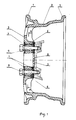
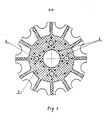
- the vehicle wheel shown in FIGS. 1 and 2 consists of a rim 1 with a tire bed 2 formed therein.
- the rim 1 is connected to a wheel disc 3 which has holes 4 for bolts 9 serving as fastening elements.
- a heat-insulating plate 8 is inserted between the wheel disc 3 and a vehicle hub 5.
- pins 6 In the area of each hole 4 for a bolt 9 are axial evenly arranged pins 6 inserted, which are made of steel with a high elastic limit.
- the end faces of the pins 6 are in contact with support plates 7 which are arranged on both sides of the disk 3.
- the linear thermal expansion numbers of the pins 6 and the bolts 9 are the same.
- the number of pins 6 axially arranged in these areas, their diameter and their material are so determines that the total deformation of the pins 6 under the action of the axial pressure of the bolts 9 is in the elastic range of the deformation of the material of the pins 6 and is also as large as the deformation of the material in these areas.
- a vehicle wheel made of polyamide 6 reinforced with 30% glass fibers is when pins 6 and support plates 7 are used made of 65G steel and a heat-insulating plate 8 made of polyaminobismaleimide reinforced with 65% glass fibers, mounted on a vehicle hub 5 under laboratory conditions, the four bolts 9 being tightened with an initial tightening torque of 90 Nm.
- the vehicle hub 5 with the vehicle wheel attached to it is electrically heated in a static state. When a temperature of 250 ° C is reached, it is automatically maintained for two hours with an accuracy of ⁇ 10 ° C. The heat supply is then interrupted. The system of vehicle wheel and vehicle hub 5 can cool down freely to 25 ° C without blowing and ventilation. This cycle is repeated 10 times.
- the tightening torques measured in the bolts 9 after the end of the test, measured in the tightening direction, are in the range from 83 Nm to 79 Nm.
- the initial tightening torque of the bolts 9 has decreased by 8 to 12%, which is within the permissible limits for the safe operation of the vehicle wheels made of engineering plastic.
- a vehicle wheel made of polyamide 6.6 reinforced with 43% and 50% glass fibers is tested under the test conditions of example 1.
- the measured tightening torques in the bolts 9 after completion of the test of the vehicle wheels made of both materials, measured in the tightening direction, are within the limits of 85 to 83 Nm, i.e. the tightening torque is reduced by 5 to 8%.
- Two vehicle wheels made of polyamide 6 reinforced with 30% glass fibers are mounted on the two front vehicle hubs of a car (Lada brand) for testing in accordance with Example 1.
- the four bolts 9 are tightened with an initial tightening torque of 90 Nm.
- Wire-thermocouples are arranged between the vehicle hub 5 and the heat-insulating plate 8 of the vehicle wheel for measuring the surface temperature, which increases due to intensive braking.
- the car is loaded with a maximum load of 400 kg. It is driven over a 30 km flat motorway. 40 braking operations are carried out from a speed of 120 km / h to 40 km / h with a degree of deceleration, ie a negative acceleration of about 6 m / s2 and an ambient temperature of 19 ° C.
- the maximum temperatures become stable after the first 18 braking operations and reach a value of 185 to 190 ° C.
- the car After 40 braking operations, the car is parked in a parking lot so that the heated vehicle hubs 5 can cool down in a static position.
- the tightening torque in the bolts 9 of the two front vehicle wheels is measured in the tightening direction.
- the tightening torque is on average 82 Nm, i.e. it has decreased by 9%.
Landscapes
- Engineering & Computer Science (AREA)
- Chemical & Material Sciences (AREA)
- Materials Engineering (AREA)
- Mechanical Engineering (AREA)
- Braking Arrangements (AREA)
- Tires In General (AREA)
Abstract
Description
Die Erfindung betrifft ein Fahrzeugrad aus technischem Kunststoff bzw. Polymerwerkstoff, welches eine Felge mit einem in ihr ausgebildeten Reifenbett, eine mit der Felge verbundene Radscheibe mit Löchern für Befestigungselemente und eine zwischen der Radscheibe und einer Fahrzeugnabe eingesetzte wärmeisolierende Platte aufweist.The invention relates to a vehicle wheel made of engineering plastic or polymer material, which has a rim with a tire bed formed therein, a wheel disk connected to the rim with holes for fastening elements and a heat-insulating plate inserted between the wheel disk and a vehicle hub.
Derartige Fahrzeugräder werden vor allem im Automobilbau verwendet.Vehicle wheels of this type are used primarily in automobile construction.
Aus der US-A-3 811 737 ist ein Fahrzeugrad aus Kunststoff bekannt, das eine Felge mit einem in ihr ausgebildeten Reifenbett aufweist. Die Felge ist mit einer Radscheibe verbunden, in welcher Löcher für Bolzen zum Befestigen an der Fahrzeugnabe eines Kraftfahrzeugs vorgesehen sind. Im Bereich dieser Löcher sind Hartmetalleinsätze eingelegt. Bei Belastung und Erwärmung des Fahrzeugrads wird der Kunststoff im Bereich der Löcher für die Bolzen zerquetscht, wodurch das Festziehmoment in den Bolzen abnimmt.From US-A-3 811 737 a plastic vehicle wheel is known which has a rim with a tire bed formed therein. The rim is connected to a wheel disk, in which holes for bolts are provided for fastening to the vehicle hub of a motor vehicle. Tungsten carbide inserts are inserted in the area of these holes. When the vehicle wheel is loaded and heated, the plastic is crushed in the area of the holes for the bolts, as a result of which the tightening torque in the bolts decreases.
Aus der DE-A-32 24 929 ist ferner ein Fahrzeugrad aus glasfaserverstärktem Kunststoff bekannt, das aus einer Felge besteht, die mit einer Radscheibe verbunden ist, in welche Löcher für Bolzen zum Befestigen des Fahrzeugrads an die Fahrzeugnabe eines Kraftfahrzeugs vorgesehen sind. Für das Herabsetzen der Erwärmung der Radscheibe ist zwischen der Radscheibe und der Fahrzeugnabe eine wärmeisolierende Platte eingelegt. Trotz der wärmeisolierenden Platte erfolgt ein Kriechen des Werkstoffs im Bereich der Löcher für die Bolzen, wodurch das Festziehmoment reduziert wird.From DE-A-32 24 929 a vehicle wheel made of glass fiber reinforced plastic is also known, which consists of a rim which is connected to a wheel disc, in which holes for bolts for fastening the vehicle wheel to the vehicle hub of a motor vehicle are provided. In order to reduce the heating of the wheel disc, a heat-insulating plate is inserted between the wheel disc and the vehicle hub. Despite the heat-insulating plate, the material creeps in the area of the holes for the bolts, which reduces the tightening torque.
Bei einem ähnlich gebauten, aus der GB-A-20 69 422 bekannten Fahrzeugrad aus glasfaserverstärktem Polymerwerkstoff mit einer Felge und Radscheibe ist zwischen der Radscheibe und der Fahrzeugnabe eine wärmeisolierende Platte mit radial angeordneten Rippen und Lüftungskanälen eingelegt. Unterhalb der Befestigungselemente, welche die Radscheibe mit der Fahrzeugnabe verbinden, sind wärmeisolierende Ringe angebracht. Der schädliche Einfluß des Kriechens des Werkstoffs im Bereich der Befestigungselemente kann auch bei diesem komplizierten Aufbau auch nicht vermieden werden, so daß das Festziehmoment ebenfalls verringert wird.In a similarly constructed vehicle wheel made of glass fiber reinforced polymer material with a rim and wheel disk known from GB-A-20 69 422, a heat-insulating plate with radially arranged ribs and ventilation channels is inserted between the wheel disk and the vehicle hub. Below the fasteners, which connect the wheel disc to the vehicle hub, there are heat-insulating rings. The harmful influence of the creep of the material in the area of the fastening elements cannot be avoided even with this complicated structure, so that the tightening torque is also reduced.
Der Erfindung liegt die Aufgabe zugrunde, das Fahrzeugrad der gattungsgemäßen Art so auszubilden, daß die Verringerung des Festziehmoments in den Befestigungselementen während des Betriebs bei Belastung und Erwärmung in zulässigen Grenzen bleibt.The invention has for its object to design the vehicle wheel of the generic type so that the reduction in the tightening torque in the fasteners during operation under load and heating remains within acceptable limits.
Diese Aufgabe wird bei dem Fahrzeugrad der gattungsgemäßen Art dadurch gelöst, daß im Bereich eines jeden Lochs für das Befestigungselement axial gleichmäßig angeordnete Stifte aus Stahl mit hoher Elastizitätsgrenze eingesetzt sind, deren Stirnflächen in Berührung mit Stützplatten stehen, die auf beiden Seiten der Radscheibe angeordnet sind, wobei die lineare Wärmeausdehnungszahl der Stifte und der Befestigungselemente gleich groß ist.This object is achieved in the vehicle wheel of the generic type in that axially uniformly arranged pins made of steel with a high elastic limit are used in the region of each hole for the fastening element, the end faces of which are in contact with support plates which are arranged on both sides of the wheel disc, the linear thermal expansion coefficient of the pins and the fastening elements being the same.
Bei dem erfindungsgemäßen Fahrzeugrad ist der schädliche Einfluß des Kriechens des Werkstoffs in den Bereichen der Löcher für die Befestigungselemente herabgesetzt, wodurch das anfängliche Festziehmoment der Befestigungselemente während des Betriebs bei Belastung und Erwärmung in zulässigen Grenzen abnimmt. Dies führt zu einer Erhöhung der Sicherheit und zu einem gefahrlosen Betrieb des Kraftfahrzeugs.In the vehicle wheel according to the invention, the harmful influence of the creeping of the material in the areas of the holes for the fastening elements is reduced, as a result of which the initial tightening torque of the fastening elements during operation under load and heating decreases within permissible limits. This leads to an increase in safety and to safe operation of the motor vehicle.
Anhand von Zeichnungen wird ein Ausführungsbeispiel der Erfindung näher erläutert. Es zeigt:
- Fig. 1 das Fahrzeugrad im Längsschnitt angebracht an einer Fahrzeugnabe und
- Fig. 2 den Schnitt A-A von Fig. 1.
- Fig. 1 shows the vehicle wheel in longitudinal section attached to a vehicle hub and
- 2 shows the section AA of Fig. 1st
Das in Fig. 1 und 2 gezeigte Fahrzeugrad besteht aus einer Felge 1 mit einem in ihr ausgebildeten Reifenbett 2. Die Felge 1 ist mit einer Radscheibe 3 verbunden, welche Löcher 4 für als Befestigungselemente dienende Bolzen 9 aufweist. Zwischen der Radscheibe 3 und einer Fahrzeugnabe 5 ist eine wärmeisolierende Platte 8 eingelegt. Im Bereich eines jeden Loches 4 für einen Bolzen 9 sind axial gleichmäßig angeordnete Stifte 6 eingelegt, die aus Stahl mit hoher Elastizitätsgrenze hergestellt sind. Die Stirnflächen der Stifte 6 stehen in Berührung mit Stützplatten 7, die beiderseits der Scheibe 3 angeordnet sind. Die linearen Wärmeausdehnungszahlen der Stifte 6 und der Bolzen 9 sind gleich.The vehicle wheel shown in FIGS. 1 and 2 consists of a rim 1 with a
Während des Betriebs des Kraftfahrzeugs, wenn die Fahrzeugräder bei intensiver Benutzung des Bremssystems belastet werden und sich erwärmen, wird infolge des axialen Drucks der Bolzen 9 das Kriechen des Kunststoffs bzw. Polymerwerkstoffs erhöht, was zur Abnahme des anfänglichen Festziehmoments führt. Das Kriechen tritt in den Bereichen der Bolzen 9 und zwischen den Stützplatten 7 auf, die mit den Stiften 6 in Berührung stehen. Um den schädlichen Einfluß des Kriechens des Werkstoffs in den Bereichen um die Bolzen 9 und zwischen den Stützplatten 7, die beiderseits der Scheibe 3 angeordnet sind, zu vermeiden, werden die Anzahl der in diesen Bereichen axial angeordneten Stifte 6, ihr Durchmesser und ihr Werkstoff so bestimmt, daß die Gesamtverformung der Stifte 6 unter der Einwirkung des axialen Drucks der Bolzen 9 im elastischen Bereich der Verformung des Werkstoffs der Stifte 6 liegt und außerdem genauso groß ist wie die Verformung des Werkstoffs in diesen Bereichen.During the operation of the motor vehicle, when the vehicle wheels are loaded and heat up during intensive use of the brake system, the creep of the plastic or polymer material is increased as a result of the axial pressure of the
Anhand von Beispielen wird die Erfindung weiter erläutert.The invention is further explained using examples.
Ein Fahrzeugrad aus mit 30 % Glasfasern verstärktem Polyamid 6 ist bei Verwendung von Stiften 6 und Stützplatten 7 aus Stahl 65G und einer wärmeisolierenden Platte 8 aus Polyaminobismaleimid verstärkt mit 65 % Glasfasern, unter Laborbedingungen auf eine Fahrzeugnabe 5 montiert, wobei die vier Bolzen 9 mit einem anfänglichen Festziehmoment von 90 Nm angezogen sind. Die Fahrzeugnabe 5 mit dem an ihr befestigten Fahrzeugrad wird in statischem Zustand elektrisch erwärmt. Wenn eine Temperatur von 250° C erreicht ist, wird sie automatisch während zwei Stunden bei einer Genauigkeit von ± 10° C aufrecht erhalten. Danach wird die Wärmezufuhr unterbrochen. Das System aus Fahrzeugrad und Fahrzeugnabe 5 kann sich ohne Anblasen und Belüftung frei bis 25° C abkühlen. Dieser Zyklus wird 10 mal wiederholt.A vehicle wheel made of
Nach der Beendigung des ersten Zyklus, der nicht in die Prüfung einbezogen ist, und nach dem Abkühlen der Fahrzeugnabe 5, erfolgt eine Kontrolle und erforderlichenfalls eine Wiederherstellung des anfänglichen Festziehmoments in den Bolzen 9 bis zum anfänglichen Wert, um die Bolzen 9, die Stützplatten 7, die Stifte 6, die Radscheibe 3 und die wärmeisolierende Platte 8 einander anzupassen.After the end of the first cycle, which is not included in the test, and after the
Die in den Bolzen 9 gemessenen Festziehmomente nach Beendigung der Prüfung, gemessen in Anziehrichtung, liegen in den Grenzen von 83 Nm bis 79 Nm, d.h. das anfängliche Festziehmoment der Bolzen 9 hat um 8 bis 12 % abgenommen, was in den zulässigen Grenzen für einen gefahrlosen Betrieb der Fahrzeugräderaus technischem Kunststoff liegt.The tightening torques measured in the
Ein Fahrzeugrad aus mit 43 % und 50 % Glasfasern verstärkten Polyamid 6.6 wird bei den Versuchsbedingungen von Beispiel 1 geprüft.A vehicle wheel made of polyamide 6.6 reinforced with 43% and 50% glass fibers is tested under the test conditions of example 1.
Die gemessenen Festziehmomente in den Bolzen 9 nach der Beendigung der Prüfung der Fahrzeugräder aus beiden Werkstoffen, gemessen in Anziehrichtung, liegen in den Grenzen von 85 bis 83 Nm, d.h. das Festziehmoment ist um 5 bis 8 % verringert.The measured tightening torques in the
Zwei Fahrzeugräder aus mit 30 % Glasfasern verstärktem Polyamid 6 werden zur Prüfung gemäß Beispiel 1 auf die beiden vorderen Fahrzeugnaben eines Pkw's (Marke Lada) montiert. Die vier Bolzen 9 werden mit einem anfänglichen Festziehmoment 90 Nm angezogen. Zwischen der Fahrzeugnabe 5 und der wärmeisolierenden Platte 8 des Fahrzeugrades sind zur Messung der Oberflächentemperatur, die sich durch intensives Bremsen erhöht, Draht-Thermopaare angeordnet.Two vehicle wheels made of
Der Pkw ist mit einer maximalen Last von 400 kg belastet. Er wird über 30 km ebene Autobahn gefahren. Dabei werden 40 Bremsungen von einer Geschwindigkeit von 120 km/h auf 40 km/h bei einem Verzögerungsgrad, also einer negativen Beschleunigung von etwa 6 m/s² und Umgebungstemperatur von 19° C durchgeführt.The car is loaded with a maximum load of 400 kg. It is driven over a 30 km flat motorway. 40 braking operations are carried out from a speed of 120 km / h to 40 km / h with a degree of deceleration, ie a negative acceleration of about 6 m / s² and an ambient temperature of 19 ° C.
Die maximalen Temperaturen werden nach den ersten 18 Bremsungen stabil und erreichen einen Wert von 185 bis 190° C. Der Wagen wird nach der Durchführung von 40 Bremsungen auf einem Parkplatz abgestellt, damit sich die erwärmten Fahrzeugnaben 5 in statischer Stellung abkühlen können. Wenn die Fahrzeugnaben 5 eine Temperatur von 25° C erreicht haben, wird das Festziehmoment in den Bolzen 9 der beiden vorderen Fahrzeugräder in Anziehrichtung gemessen. Das Festziehmoment beträgt im Durchschnitt 82 Nm, d.h. es hat um 9 % abgenommen.The maximum temperatures become stable after the first 18 braking operations and reach a value of 185 to 190 ° C. After 40 braking operations, the car is parked in a parking lot so that the
Claims (1)
Applications Claiming Priority (2)
| Application Number | Priority Date | Filing Date | Title |
|---|---|---|---|
| BG78807/87 | 1987-03-10 | ||
| BG8778807A BG45090A1 (en) | 1987-03-10 | 1987-03-10 |
Publications (2)
| Publication Number | Publication Date |
|---|---|
| EP0282008A2 true EP0282008A2 (en) | 1988-09-14 |
| EP0282008A3 EP0282008A3 (en) | 1989-10-04 |
Family
ID=3918667
Family Applications (1)
| Application Number | Title | Priority Date | Filing Date |
|---|---|---|---|
| EP88103628A Withdrawn EP0282008A3 (en) | 1987-03-10 | 1988-03-08 | Vehicle wheel made of polymer synthetics material |
Country Status (6)
| Country | Link |
|---|---|
| US (1) | US4900097A (en) |
| EP (1) | EP0282008A3 (en) |
| JP (1) | JPS6416401A (en) |
| BG (1) | BG45090A1 (en) |
| CS (1) | CS156788A2 (en) |
| SU (1) | SU1623558A3 (en) |
Cited By (8)
| Publication number | Priority date | Publication date | Assignee | Title |
|---|---|---|---|---|
| US5022712A (en) * | 1988-12-30 | 1991-06-11 | Motor Wheel Corporation | Fiber-reinforced resin vehicle wheel mounting |
| EP0529492A1 (en) * | 1991-08-26 | 1993-03-03 | The Goodyear Tire & Rubber Company | A plastic wheel |
| DE4311903A1 (en) * | 1993-04-10 | 1994-10-13 | Audi Ag | Measuring wheel |
| WO2013030106A1 (en) * | 2011-08-26 | 2013-03-07 | Basf Se | Wheel for a motor vehicle |
| DE102013205797A1 (en) * | 2013-04-02 | 2014-10-02 | Bayerische Motoren Werke Aktiengesellschaft | Device for fastening a wheel disc made of fiber composite material |
| WO2015028337A1 (en) * | 2013-08-30 | 2015-03-05 | Mubea Carbo Tech Gmbh | Composite wheel and insert |
| US10500895B2 (en) | 2013-08-05 | 2019-12-10 | Mubea Carbo Tech Gmbh | Wheel made out of a fiber reinforced plastic material |
| EP3805011B1 (en) | 2017-02-27 | 2023-05-24 | Bayerische Motoren Werke Aktiengesellschaft | Composite wheel with galvanic isolation |
Families Citing this family (21)
| Publication number | Priority date | Publication date | Assignee | Title |
|---|---|---|---|---|
| US5277479A (en) * | 1991-02-04 | 1994-01-11 | Bridgestone Corporation | One piece type resin wheel |
| DE4227259C1 (en) * | 1992-08-18 | 1994-03-24 | Stahlschmidt & Maiworm | Arrangement to avoid contact corrosion on magnesium wheels |
| US5630654A (en) * | 1994-09-26 | 1997-05-20 | Lacks Industries, Inc. | Heat-resistant overlay for an automotive steel wheel |
| US6200411B1 (en) | 1996-08-27 | 2001-03-13 | Tech Trim, Inc. | Method of attaching a decorative facing to an automotive wheel |
| RU2137613C1 (en) * | 1998-11-04 | 1999-09-20 | Басюк Семар Тимофеевич | Vehicle wheel |
| RU2144859C1 (en) * | 1998-12-07 | 2000-01-27 | Басюк Семар Тимофеевич | Vehicle wheel |
| EP1249355B1 (en) * | 2001-04-10 | 2004-08-25 | PIAGGIO & C. S.p.A. | Lightweight scooter wheel |
| US20050269866A1 (en) * | 2004-06-03 | 2005-12-08 | Mcgoon Doug Iv | Multi-piece wheel assembly with transparent components |
| US7377596B2 (en) * | 2005-04-29 | 2008-05-27 | Amerityre | Urethane wheel having a metal core |
| USD534981S1 (en) | 2005-06-03 | 2007-01-09 | Mcgoon Iv Doug | Clear wheel |
| CN101062731A (en) * | 2006-04-27 | 2007-10-31 | 富日国际有限公司 | Joint assembly of folding cabinet |
| USD578945S1 (en) | 2006-12-08 | 2008-10-21 | Mcgoon Iv Doug | Pair of clear motorcycle wheels |
| US9463665B2 (en) * | 2007-06-13 | 2016-10-11 | GM Global Technology Operations LLC | Wheel assembly and corrosion barrier for same |
| BRPI0902289B1 (en) * | 2009-07-02 | 2020-09-08 | Plascar Indústria De Componentes Plásticos Ltda | POLYMERIC MATERIAL WHEEL |
| US20120074765A1 (en) * | 2010-09-27 | 2012-03-29 | Edgar Guzman | Plastic wheels |
| US9499008B2 (en) * | 2011-02-17 | 2016-11-22 | Basf Se | Vehicle wheel |
| US20130221731A1 (en) * | 2011-08-25 | 2013-08-29 | Hummel-Formen Gmbh | Wheel for a motor vehicle |
| CN103974834B (en) | 2011-12-06 | 2017-09-05 | 慕贝尔碳纤维技术有限公司 | Wheel produced from fiber-reinforced material and method for producing corresponding wheel |
| EP3142865B1 (en) | 2014-05-16 | 2020-10-28 | Basf Se | Thermoplastic wheel hub |
| JP6863551B2 (en) * | 2014-12-19 | 2021-04-21 | ムベア カルボ テック ゲーエムベーハーMubea Carbo Tech Gmbh | Heat shield structure for wheels |
| JP6682544B2 (en) | 2015-02-11 | 2020-04-15 | ムベア カルボ テック ゲーエムベーハーMubea Carbo Tech Gmbh | Method for producing fiber-reinforced annular body and apparatus for producing fiber-reinforced annular body |
Family Cites Families (13)
| Publication number | Priority date | Publication date | Assignee | Title |
|---|---|---|---|---|
| GB172987A (en) * | 1920-12-20 | 1922-06-15 | John Flint | Improvements in or relating to vehicle wheels |
| US1818447A (en) * | 1921-07-02 | 1931-08-11 | Motor Wheel Corp | Disk wheel hub assembly |
| US1516230A (en) * | 1923-04-30 | 1924-11-18 | William W Garriott | Vehicle wheel |
| US3158404A (en) * | 1963-03-26 | 1964-11-24 | Gordon E Noakes | Molded plastic wheel |
| BE789218A (en) * | 1971-10-04 | 1973-03-26 | Michelin & Cie | WHEEL IMPROVEMENTS |
| FR2265555A1 (en) * | 1974-03-25 | 1975-10-24 | Michelin & Cie | Reinforced light alloy wheel rim - with high tensile fibres or cords moulded radially inside rim |
| US4035028A (en) * | 1975-07-14 | 1977-07-12 | Wilcox Raymond J | Wheel assemblies and components |
| BE869746A (en) * | 1978-08-14 | 1978-12-01 | Milhoux Andre J L | DEVICE FOR TRANSMISSION OF A FORCE TO A PART IN MATERIAL LIKELY TO FLUER |
| DE3047837A1 (en) * | 1979-12-28 | 1981-10-08 | Dunlop S.A., 92 Paris | REINFORCED PLASTIC VEHICLE WHEEL AND NUT FOR FASTENING THE WHEEL TO A HUB |
| DE3135546C2 (en) * | 1981-09-08 | 1983-08-18 | Stahlschmidt & Maiworm GmbH & Co KG, 5980 Werdohl | Light alloy wheel for commercial vehicles |
| DE3224737A1 (en) * | 1982-07-02 | 1984-01-05 | Bodenseewerk Perkin-Elmer & Co GmbH, 7770 Überlingen | SPECTROMETER |
| JPS59195403A (en) * | 1983-04-21 | 1984-11-06 | Mitsubishi Electric Corp | Lightweight wheel using reinforced plastic |
| GB2162802B (en) * | 1984-07-18 | 1988-05-25 | Rubery Owen Holdings Ltd | Plastics wheel |
-
1987
- 1987-03-10 BG BG8778807A patent/BG45090A1/xx unknown
-
1988
- 1988-03-08 EP EP88103628A patent/EP0282008A3/en not_active Withdrawn
- 1988-03-10 SU SU884355410A patent/SU1623558A3/en active
- 1988-03-10 CS CS881567A patent/CS156788A2/en unknown
- 1988-03-10 JP JP63055079A patent/JPS6416401A/en active Pending
- 1988-08-23 US US07/236,059 patent/US4900097A/en not_active Expired - Fee Related
Cited By (13)
| Publication number | Priority date | Publication date | Assignee | Title |
|---|---|---|---|---|
| US5022712A (en) * | 1988-12-30 | 1991-06-11 | Motor Wheel Corporation | Fiber-reinforced resin vehicle wheel mounting |
| US5123711A (en) * | 1988-12-30 | 1992-06-23 | Motor Wheel Corporation | Fiber-reinforced resin vehicle wheel mounting |
| EP0529492A1 (en) * | 1991-08-26 | 1993-03-03 | The Goodyear Tire & Rubber Company | A plastic wheel |
| DE4311903A1 (en) * | 1993-04-10 | 1994-10-13 | Audi Ag | Measuring wheel |
| WO2013030106A1 (en) * | 2011-08-26 | 2013-03-07 | Basf Se | Wheel for a motor vehicle |
| CN103764407A (en) * | 2011-08-26 | 2014-04-30 | 巴斯夫欧洲公司 | Wheel for a motor vehicle |
| DE102013205797A1 (en) * | 2013-04-02 | 2014-10-02 | Bayerische Motoren Werke Aktiengesellschaft | Device for fastening a wheel disc made of fiber composite material |
| US10183525B2 (en) | 2013-04-02 | 2019-01-22 | Bayerische Motoren Werke Aktiengesellschaft | Arrangement for fastening a wheel disc made of fiber composite material to a wheel hub |
| DE102013205797B4 (en) | 2013-04-02 | 2023-08-03 | Bayerische Motoren Werke Aktiengesellschaft | Device for fastening a wheel disc made of fiber composite material |
| US10500895B2 (en) | 2013-08-05 | 2019-12-10 | Mubea Carbo Tech Gmbh | Wheel made out of a fiber reinforced plastic material |
| WO2015028337A1 (en) * | 2013-08-30 | 2015-03-05 | Mubea Carbo Tech Gmbh | Composite wheel and insert |
| US10220653B2 (en) | 2013-08-30 | 2019-03-05 | Mubea Carbo Tech Gmbh | Composite wheel and insert |
| EP3805011B1 (en) | 2017-02-27 | 2023-05-24 | Bayerische Motoren Werke Aktiengesellschaft | Composite wheel with galvanic isolation |
Also Published As
| Publication number | Publication date |
|---|---|
| EP0282008A3 (en) | 1989-10-04 |
| CS156788A2 (en) | 1991-10-15 |
| US4900097A (en) | 1990-02-13 |
| BG45090A1 (en) | 1989-04-14 |
| JPS6416401A (en) | 1989-01-19 |
| SU1623558A3 (en) | 1991-01-23 |
Similar Documents
| Publication | Publication Date | Title |
|---|---|---|
| EP0282008A2 (en) | Vehicle wheel made of polymer synthetics material | |
| DE69207117T2 (en) | Plastic wheel | |
| EP0184051A1 (en) | Flexible steel shaft coupling | |
| DE2906589C2 (en) | Brake disc for disc brake devices in rail vehicles | |
| EP2414697B1 (en) | Brake disk | |
| DE102004045327A1 (en) | Brake disc arrangement for vehicle wheels | |
| DE2513914A1 (en) | BRAKE DISC ARRANGEMENT FOR DISC BRAKES, ESPECIALLY ON RAIL VEHICLES | |
| DE102018127459B4 (en) | RIM FOR AIRLESS TIRE AND WHEEL HAVING THIS RIM | |
| DE102013205797B4 (en) | Device for fastening a wheel disc made of fiber composite material | |
| DE1175721B (en) | Brake disc, especially on rail wheels | |
| DE19756711C2 (en) | Support disc bearing for an open-end spinning rotor | |
| EP0681689B1 (en) | Torque measurement arrangement for motor vehicles | |
| EP0935129A2 (en) | Multi-component measuring wheel | |
| EP0772748A1 (en) | Drum brake with divided brake anchor plate | |
| DE1914409A1 (en) | Brake disc, especially for rail vehicle disc brakes | |
| DE102022004278B3 (en) | Brake disc for a disc brake of a vehicle and brake disc arrangement for forming the brake disc | |
| DE1130707B (en) | Support body for a wheel equipped with a braking device | |
| DE1763048U (en) | RUBBER SUSPENSION WHEEL FOR RAIL VEHICLES. | |
| EP0320616A2 (en) | Railroad wheel with brake discs for carriages with small wheels | |
| EP1118789A2 (en) | Brake disc-/rim system for wheels especially for vehicles | |
| DE2717961A1 (en) | DISC BRAKE | |
| DE7343939U (en) | DISC FOR DISC BRAKES | |
| DE2603617A1 (en) | Safety and securing device for pneumatic tyre fitted on felly - comprises a composite support ring disc with connecting fasteners | |
| DE2312577C3 (en) | Brake disk assembly on a rail vehicle wheel | |
| DD140577A1 (en) | BRAKE DISC, ESPECIALLY FOR DISC BRAKES OF RAIL VEHICLES |
Legal Events
| Date | Code | Title | Description |
|---|---|---|---|
| PUAI | Public reference made under article 153(3) epc to a published international application that has entered the european phase |
Free format text: ORIGINAL CODE: 0009012 |
|
| AK | Designated contracting states |
Kind code of ref document: A2 Designated state(s): DE ES FR GB IT SE |
|
| PUAL | Search report despatched |
Free format text: ORIGINAL CODE: 0009013 |
|
| AK | Designated contracting states |
Kind code of ref document: A3 Designated state(s): DE ES FR GB IT SE |
|
| 17P | Request for examination filed |
Effective date: 19900213 |
|
| 17Q | First examination report despatched |
Effective date: 19910222 |
|
| STAA | Information on the status of an ep patent application or granted ep patent |
Free format text: STATUS: THE APPLICATION IS DEEMED TO BE WITHDRAWN |
|
| 18D | Application deemed to be withdrawn |
Effective date: 19910924 |