EP0286333A2 - Reflector system - Google Patents
Reflector system Download PDFInfo
- Publication number
- EP0286333A2 EP0286333A2 EP88302958A EP88302958A EP0286333A2 EP 0286333 A2 EP0286333 A2 EP 0286333A2 EP 88302958 A EP88302958 A EP 88302958A EP 88302958 A EP88302958 A EP 88302958A EP 0286333 A2 EP0286333 A2 EP 0286333A2
- Authority
- EP
- European Patent Office
- Prior art keywords
- reflector
- focus
- ellipsoidal
- mirror
- opening
- Prior art date
- Legal status (The legal status is an assumption and is not a legal conclusion. Google has not performed a legal analysis and makes no representation as to the accuracy of the status listed.)
- Withdrawn
Links
Images

Classifications
-
- F—MECHANICAL ENGINEERING; LIGHTING; HEATING; WEAPONS; BLASTING
- F21—LIGHTING
- F21V—FUNCTIONAL FEATURES OR DETAILS OF LIGHTING DEVICES OR SYSTEMS THEREOF; STRUCTURAL COMBINATIONS OF LIGHTING DEVICES WITH OTHER ARTICLES, NOT OTHERWISE PROVIDED FOR
- F21V7/00—Reflectors for light sources
- F21V7/04—Optical design
- F21V7/09—Optical design with a combination of different curvatures
-
- F—MECHANICAL ENGINEERING; LIGHTING; HEATING; WEAPONS; BLASTING
- F21—LIGHTING
- F21V—FUNCTIONAL FEATURES OR DETAILS OF LIGHTING DEVICES OR SYSTEMS THEREOF; STRUCTURAL COMBINATIONS OF LIGHTING DEVICES WITH OTHER ARTICLES, NOT OTHERWISE PROVIDED FOR
- F21V7/00—Reflectors for light sources
- F21V7/0025—Combination of two or more reflectors for a single light source
-
- G—PHYSICS
- G02—OPTICS
- G02B—OPTICAL ELEMENTS, SYSTEMS OR APPARATUS
- G02B6/00—Light guides; Structural details of arrangements comprising light guides and other optical elements, e.g. couplings
- G02B6/0001—Light guides; Structural details of arrangements comprising light guides and other optical elements, e.g. couplings specially adapted for lighting devices or systems
- G02B6/0005—Light guides; Structural details of arrangements comprising light guides and other optical elements, e.g. couplings specially adapted for lighting devices or systems the light guides being of the fibre type
- G02B6/0006—Coupling light into the fibre
-
- G—PHYSICS
- G02—OPTICS
- G02B—OPTICAL ELEMENTS, SYSTEMS OR APPARATUS
- G02B6/00—Light guides; Structural details of arrangements comprising light guides and other optical elements, e.g. couplings
- G02B6/24—Coupling light guides
- G02B6/42—Coupling light guides with opto-electronic elements
- G02B6/4298—Coupling light guides with opto-electronic elements coupling with non-coherent light sources and/or radiation detectors, e.g. lamps, incandescent bulbs, scintillation chambers
Definitions
- This invention relates generally, as indicated, to a reflector system, and more particularly, to a reflector system which provides for relatively efficient light collection and focalization upon a relatively tight target or light receiving area.
- U.S. Patent No. 4,241,382 It is generally known from U.S. Patent No. 4,241,382 to provide an illuminator in the form of a light bulb including a combination of ellipsoidal and spherical mirrors which together direct the light emitted from a filament or other light source through a small optical window located at the rear of a fiber optics coupler integral with the bulb envelope into a fiber optics light pipe or the like. To facilitate trapping of the light in the optical fibers, the light may be caused to emerge from the optical window at angles equal to or less than the critical angles of the fibers.
- a relatively efficient light source is generally no more than 50% efficient. That is, for every watt of energy in the optical range generated another watt of non-optical energy is simultaneously generated.
- Arc lamps and metal-halide lamps are in the higher range of optical efficiencies, whereas incandescent lamps are in the lowest range. Accordingly, any increase in the wattage of a lamp to increase its brightness will proportionately increase the existing infra-red energy which could cause heat problems.
- Another object is to provide such a reflector system which is capable of both efficient focal optimization and heat removal.
- Still another object is to provide such a reflector system which has a relatively short overall length thus greatly facilitating the compact packaging of the reflector system.
- the ellipsoidal portion of the reflector desirably commences at the intersection of a plane passing through a first focus normal to the major axis of the ellipsoid and extends in the direction of the major axis toward the minor axis.
- the hemispherical portion also desirably commences at the same place as the ellipsoidal portion but extends in the opposite direction from the ellipsoidal portion.
- a mirror extending normal to the major axis to redirect light rays emitted from a light source placed generally in the region of the first focus back through a much smaller opening or mouth at the rearmost end of the hemispherical portion.
- a dichroic (cold) mirror having suitable multi-layered coatings thereon to allow certain bandwidths of energy to pass through the mirror, for example, the majority of the initially emitted infra-red radiation, and to reflect substantially only the usable non-detrimental optical portion of the radiation incident upon the mirror.
- the mirror should be positioned no closer to the light source than the point at which a ray of light emanating from the light source at approximately 45° as measured from the major axis meets the ellipsoidal portion of the reflector. This assures that the maximum amount of rays which impinge on the ellipsoidal portion will follow the classical ellipsoidal path and be reflected back by the mirror out through the open mouth of the hemispherical portion of the reflector to a final for the light suitably located far enough outside the reflector mouth to allow operation free from the danger of high ambient temperatures inside the reflector and for ease of further optical manipulation.
- another mirror may be oriented approximately 45° to the mouth of the reflector for redirecting the light rays passing out through the mouth to a final focus whose axis is normal to the mouth (reflector) axis.
- This mirror may also be a cold mirror to further assist in eliminating any additional non-optical energy from the light rays before being reflected onto the target.
- the reflector should be constructed so that the mouth opening edge, the place where the ellipsoidal and hemispherical portions meet, the large opening edge, and the edge of the target should all fall in a substantially straight line when the reflector is viewed in a two-dimension longitudinal sectional view.
- a suitable reflective coating for the glass may be a dichroic thin film to aid in heat removal from the system.
- a preferred form of reflector system 1 in accordance with this invention including a reflector 2 for collecting light rays emitted from a light source L mounted within the reflector and focusing such light rays on a relatively tight target or light receiving area A outside the reflector.
- Suitable mounting brackets 4, 5 may be provided for mounting the reflector 2 within a box or housing 6 as schematically illustrated.
- Reflector 2 is a hybrid reflector which combines both ellipsoidal and hemispherical shapes as described hereafter, and may be constructed from any suitable material such as aluminum, glass or nickel coated with an acceptable reflective coating such as enhanced (dielectric) aluminum or overcoated silver.
- a suitable reflective coating for the glass may be a dichroic thin film to aid in heat removal from the system.
- the reflector includes an ellipsoidal portion 7 to take advantage of the inherent geometrical properties of ellipsoidal shapes which are ideal for focusing light into a small opening or target.
- any point light source placed at one of the foci of an ellipse will emit light rays that will always converge on the other focus.
- there is no true point source light emitter and the further one deviates from a point light source in a true elliptical or ellipsoidal reflector, the worse the defocus becomes.
- the purpose of the hemispherical portion 10 of the reflector 2 is to take the light rays R1 emanating from the light source L placed in the region of the first focus P that would otherwise have impinged on the rear portion of a conventional ellipsoidal reflector and lost to defocus and redirect them back through the light source so that these reflected light rays R3 also eventually strike the ellipsoidal portion 7 forwardly of the first focus.
- substantially half of the 90° emitted arc from a lamp L placed substantially at the first focus P which impinges on the hemispherical portion 10 will be reflected back through the lamp until eventually substantially all of the rays R1, R2 leaving the lamp will strike the ellipsoidal portion 7 forwardly of the first focus P.
- the reflector system 1 was designed to channel light into a relatively tight target or light receiving area A at the final focus F such as the end 12 of a fiber optics cable C having a diameter, for example, of 1.5 inches. Not only does this require the tailoring of the final focus F as close to the cable diameter as possible, but also requires that the light be focused on the fiber optics ends at angles within the limited acceptance angle for the particular optical fibers being used, such as a 60° solid angle cone.
- the final focus F is desirably located outside the reflector 2, and the hemispherical portion 10 is sized so that the edge 15 of the small opening or mouth 16 at the rearmost end of the hemispherical portion 10 does not block a significant amount of radiation being reflected by the ellipsoidal portion 7 and still bounces the initial rays R1 emitted from the lamp L back onto the ellipsoidal portion as reflected rays R3 as schematically shown in Fig. 1.
- Another important aspect of the reflector system 1 of the present invention is the manner in which the light is reflected back through the small opening or mouth 16 at the rearmost end of the hemispherical portion 10 of the reflector.
- the light rays emanating from a light source at a first focus are collected at a second focus within the reflector itself.
- a major objection to this is that the overall lighting system must be of an elongated construction which in many cases does not provide an acceptable package shape.
- the reflector system 1 is made much more compact by shortening up its length and placing a mirror 20 at a large opening 21 where the ellipsoidal portion 7 of the reflector terminates forwardly of the first focus P for redirecting the light rays R2, R3 impinging on the ellipsoidal portion 7 back through the small opening or mouth 16 at the rearmost end of the hemispherical portion 10.
- mirror 20 can be a conventional silver coated mirror which will redirect all of the light rays back through the mouth 16 of the reflector.
- mirror 20 is preferably a dichroic mirror of known type having suitable multi-layered coatings thereon similar to that used in the General Electric Company's Quartz Line reflector lamps to allow certain bandwidths of energy to pass through the mirror and cause reflection of others.
- the first 85% to 90% of the initially emitted infra-red radiation R4 can be eliminated so that substantially only the optical wavelengths R5 of the radiation incident upon the mirror are redirected back through the mouth of the reflector.
- the actual placement or location of the mirror 20 is important in order to assure that the maximum amount of light rays emitted from the light source L will follow the classical elliptical path and be directed back through the open mouth 16 of the reflector. To that end, it has been found that the mirror 20 should be placed no closer to the light source L than the point 22 at which a 45° ray emanating from a point light source at the first focal point P meets the internal surface of the elliptical portion 7 of the reflector as schematically shown in Figs. 2 and 4. At the same time, the mirror 20 should not be moved much further away from the light source L or the final focus F will move back into the mouth 16 of the reflector. Any movement of the mirror 20 further away from the light source (at the first focus P) will cause the final focus F to move twice that amount toward the mouth 16 of the reflector.
- mirror 23 may be mounted adjacent the reflector mouth oriented at an angle of approximately 45° to the normal of the reflector mouth for redirecting the light rays passing through the reflector mouth onto the end 12 of a fiber optics cable C whose axis is normal to the mouth (reflector) axis as schematically shown in Fig. 1.
- mirror 23 may be a dichroic mirror similar to the mirror 20 previously described for eliminating additional infra-red radiation R6 emitted from the light source. This mirror 23 coupled with mirror 20 will remove substantially all non-optical energy rays R4, R6 emitted by the light source.
- mirror 23 may be eliminated and the end 12 of the optical light cable C or other light receiving area A may be placed at a final focus F ⁇ exteriorly of the mouth 16 of the reflector 2 in coaxial alignment with the reflector as shown in Fig. 5. Otherwise, the details of construction and operation of the reflector system shown in Fig. 5 are identical to that shown in the Fig. 1 embodiment. Accordingly, the same reference numerals are used to identify like parts.
- the ellipsoidal portion 7 of the reflector 2 commences at the intersection of a plane passing through the first focus P normal to the major axis X and extends forwardly therefrom in the direction of the major axis toward the minor axis Y.
- the hemispherical portion 10 of the reflector also commences at the same place as the ellipsoidal portion 7.
- the hemispherical portion 10 has a center axis substantially coincident with the first focus P of the ellipsoidal portion 7.
- the hemispherical portion 10 extends rearwardly in the opposite direction from the ellipsoidal portion 7.
- each of the ellipsoidal and hemispherical portions 7, 10 extend (in opposite directions) over a distance of approximately 45° as measured from the first focus P. Moreover, it has been found that in order to maintain the resulting incident angles of acceptance of the light at the final focus F with in a 60° solid angle cone, the eccentricity of the ellipsoidal portion of the reflector must fall between approximately 0.8 and 1.0. For best results, when the reflector is viewed in a two-dimensional longitudinal section as shown in Figs.
- the mouth opening edge 15, the point 24 where the ellipsoidal and hemispherical portions 7, 10 meet, the large opening edge 22 and the edge 25 of the target A all desirably fall substantially in a straight line 26, shown in phantom lines in Figs. 1 and 5.
- the ellipsoidal portion 7 of the reflector 2 has a semi-major axis X of approximately 10.88 inches and a semi-minor axis Y of approximately 6.087 inches and an eccentricity of approximately .829. Also, both the ellipsoidal focus and hemispherical center intersect at the first focus P as aforesaid, and the ellipsoidal and hemispherical portions 7, 10 extend over an arc distance of approximately 45° as measured from such first focus.
- the reflector systems of the present invention provide for the relatively efficient collection and focalization of light rays upon a relatively tight target or light receiving area preferably with minimum loss of optical energy and maximum removal of infra-red energy from a light source. While such reflector systems are primarily intended for fiber optical applications, it will be apparent that such systems can also be utilized for other illumination applications as well. With such systems, it is estimated that approximately 35% optical efficiency and approximately 99% non-optical efficiency can be obtained.
Landscapes
- Physics & Mathematics (AREA)
- Engineering & Computer Science (AREA)
- General Engineering & Computer Science (AREA)
- General Physics & Mathematics (AREA)
- Optics & Photonics (AREA)
- Optical Elements Other Than Lenses (AREA)
- Non-Portable Lighting Devices Or Systems Thereof (AREA)
Abstract
Reflector system (1) includes a reflector (2) having an ellipsoidal portion (7) and a hemispherical portion (10) joined together at the intersection of a plane passing through one (P) of the foci of the ellipsoidal portion normal to the major axis of the ellipsoidal portion. A light source (L) is generally positioned at the focus. The ellipsoidal portion extends forwardly of the focus and terminates in an opening (21) covered by a mirror (20) extending normal to the major axis of the ellipsoidal portion for redirecting light rays emanating from the light source back through the reflector. The center axis of the hemispherical portion intersects the focus, and such hemispherical portion extends rearwardly of the focus and terminates in another opening (16) through which the light rays are redirected by the mirror to a final focus (F) located exteriorly of the reflector.
Description
- This invention relates generally, as indicated, to a reflector system, and more particularly, to a reflector system which provides for relatively efficient light collection and focalization upon a relatively tight target or light receiving area.
- It is generally known from U.S. Patent No. 4,241,382 to provide an illuminator in the form of a light bulb including a combination of ellipsoidal and spherical mirrors which together direct the light emitted from a filament or other light source through a small optical window located at the rear of a fiber optics coupler integral with the bulb envelope into a fiber optics light pipe or the like. To facilitate trapping of the light in the optical fibers, the light may be caused to emerge from the optical window at angles equal to or less than the critical angles of the fibers.
- Also, it is generally known from such U.S. patent to provide a multilayer interference film on the ellipsoidal reflector which is highly reflective of visible light and highly transmissive of heat or infra-red radiation to allow most heat to escape into surroundings instead of being focused onto the fiber optics ends.
- While such an illuminator is fairly efficient in directing the light generated by a filament into the end of an attached fiber optics light pipe within the limitations of losses incurred by non-ideal optical components, there is a continuing need for greater efficiencies in light collection and focalization on a limited target as in the case of channeling light into a fiber optics cable or the like.
- In most lighting systems, it is desirable to extract the highest possible light output in lumens per watt of energy input while achieving an adequate amount of intensity. In the usual case, little effort is made to efficiently collect the existing light. Instead, a more intensive light source is utilized than would otherwise be required to make up for the inefficiencies in the light collector. However, there are many applications in which this is not desirable or acceptable such as when light is being channeled into an acrylic (plastic) fiber optics cable because of the damage that may result from the excess heat generated by an overly bright light source.
- A relatively efficient light source is generally no more than 50% efficient. That is, for every watt of energy in the optical range generated another watt of non-optical energy is simultaneously generated. Arc lamps and metal-halide lamps are in the higher range of optical efficiencies, whereas incandescent lamps are in the lowest range. Accordingly, any increase in the wattage of a lamp to increase its brightness will proportionately increase the existing infra-red energy which could cause heat problems.
- Another objection to many illuminators including that shown in the aforementioned U.S. Patent No. 4,241,382 is that they require an elongated construction which in many cases does not readily lend itself to an acceptable compact package shape.
- With the foregoing in mind, it is a principal object of this invention to provide a reflector system for obtaining more efficient collection and focalization of light on a limited target.
- Another object is to provide such a reflector system which is capable of both efficient focal optimization and heat removal.
- Still another object is to provide such a reflector system which has a relatively short overall length thus greatly facilitating the compact packaging of the reflector system.
- These and other objects of the present invention may be achieved by providing a hybrid reflector system that combines both ellipsoidal and hemispherical shapes to collect and focus the light on a limited target. The ellipsoidal portion of the reflector desirably commences at the intersection of a plane passing through a first focus normal to the major axis of the ellipsoid and extends in the direction of the major axis toward the minor axis.. The hemispherical portion also desirably commences at the same place as the ellipsoidal portion but extends in the opposite direction from the ellipsoidal portion. At the end of the ellipsoidal portion furthest from the first focus is a relatively large opening covered by a mirror extending normal to the major axis to redirect light rays emitted from a light source placed generally in the region of the first focus back through a much smaller opening or mouth at the rearmost end of the hemispherical portion. Preferably such mirror is a dichroic (cold) mirror having suitable multi-layered coatings thereon to allow certain bandwidths of energy to pass through the mirror, for example, the majority of the initially emitted infra-red radiation, and to reflect substantially only the usable non-detrimental optical portion of the radiation incident upon the mirror.
- The mirror should be positioned no closer to the light source than the point at which a ray of light emanating from the light source at approximately 45° as measured from the major axis meets the ellipsoidal portion of the reflector. This assures that the maximum amount of rays which impinge on the ellipsoidal portion will follow the classical ellipsoidal path and be reflected back by the mirror out through the open mouth of the hemispherical portion of the reflector to a final for the light suitably located far enough outside the reflector mouth to allow operation free from the danger of high ambient temperatures inside the reflector and for ease of further optical manipulation. If desired, another mirror may be oriented approximately 45° to the mouth of the reflector for redirecting the light rays passing out through the mouth to a final focus whose axis is normal to the mouth (reflector) axis. This mirror may also be a cold mirror to further assist in eliminating any additional non-optical energy from the light rays before being reflected onto the target.
- For best results, the reflector should be constructed so that the mouth opening edge, the place where the ellipsoidal and hemispherical portions meet, the large opening edge, and the edge of the target should all fall in a substantially straight line when the reflector is viewed in a two-dimension longitudinal sectional view. Also, when the reflector is constructed out of glass, a suitable reflective coating for the glass may be a dichroic thin film to aid in heat removal from the system.
- To the accomplishment of the foregoing and related ends, the invention, then, comprises the features hereinafter fully described and particularly pointed out in the claims, the following description and the annexed drawings setting forth in detail certain illustrative embodiments of the invention, these being indicative, however, of but several of the various ways in which the principles of the invention may be employed.
- In the annexed drawings:
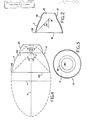
- Fig. 1 is a schematic longitudinal sectional view through a preferred form of reflector system in accordance with this invention;
- Fig. 2 is a longitudinal sectional view, on a reduced scale, of the reflector by itself;
- Fig. 3 is an end elevation view of the reflector of Fig. 2 as seen from the left end thereof;
- Fig. 4 is an enlarged schematic illustration showing in greater detail the geometry of the reflector; and
- Fig. 5 is a schematic longitudinal section similar to Fig. 1 but showing a modified form of reflector system in accordance with this invention.
- Referring now in detail to the drawings, and initially to Fig. 1, there is shown a preferred form of
reflector system 1 in accordance with this invention including areflector 2 for collecting light rays emitted from a light source L mounted within the reflector and focusing such light rays on a relatively tight target or light receiving area A outside the reflector.Suitable mounting brackets 4, 5 may be provided for mounting thereflector 2 within a box orhousing 6 as schematically illustrated. -
Reflector 2 is a hybrid reflector which combines both ellipsoidal and hemispherical shapes as described hereafter, and may be constructed from any suitable material such as aluminum, glass or nickel coated with an acceptable reflective coating such as enhanced (dielectric) aluminum or overcoated silver. When the reflector is constructed out of glass, a suitable reflective coating for the glass may be a dichroic thin film to aid in heat removal from the system. - The reflector includes an ellipsoidal portion 7 to take advantage of the inherent geometrical properties of ellipsoidal shapes which are ideal for focusing light into a small opening or target. As is well known, any point light source placed at one of the foci of an ellipse will emit light rays that will always converge on the other focus. Unfortunately, however, there is no true point source light emitter, and the further one deviates from a point light source in a true elliptical or ellipsoidal reflector, the worse the defocus becomes.
- In accordance with one aspect of the invention, it has been found that if the
portion 10 of thereflector 2 rearwardly of the first focus P on the major axis X (shown schematically in Fig. 4) is formed to provide a hemispherical shape having its axis substantially coinciding with the first focus P, a large portion of the defocus is greatly reduced. The purpose of thehemispherical portion 10 of thereflector 2 is to take the light rays R₁ emanating from the light source L placed in the region of the first focus P that would otherwise have impinged on the rear portion of a conventional ellipsoidal reflector and lost to defocus and redirect them back through the light source so that these reflected light rays R₃ also eventually strike the ellipsoidal portion 7 forwardly of the first focus. By this technique, substantially half of the 90° emitted arc from a lamp L placed substantially at the first focus P which impinges on thehemispherical portion 10 will be reflected back through the lamp until eventually substantially all of the rays R₁, R₂ leaving the lamp will strike the ellipsoidal portion 7 forwardly of the first focus P. - In actual tests, it has been found that the portion of an ellipsoidal reflector forwardly of the first focus is more forgiving of deviation from a point light source than the portion rearwardly of the first focus. Accordingly, substituting a
hemispherical portion 10 for the ellipsoidal portion of a conventional ellipsoidal reflector to the rear of the first focus P to redirect the light rays back to the ellipsoidal portion 7 forwardly of the first focus will result in an overall smaller loss of light at the second focus F than its purely elliptical counterpart. - In accordance with another aspect of the invention, the
reflector system 1 was designed to channel light into a relatively tight target or light receiving area A at the final focus F such as theend 12 of a fiber optics cable C having a diameter, for example, of 1.5 inches. Not only does this require the tailoring of the final focus F as close to the cable diameter as possible, but also requires that the light be focused on the fiber optics ends at angles within the limited acceptance angle for the particular optical fibers being used, such as a 60° solid angle cone. - Also in accordance with the invention, the final focus F is desirably located outside the
reflector 2, and thehemispherical portion 10 is sized so that theedge 15 of the small opening ormouth 16 at the rearmost end of thehemispherical portion 10 does not block a significant amount of radiation being reflected by the ellipsoidal portion 7 and still bounces the initial rays R₁ emitted from the lamp L back onto the ellipsoidal portion as reflected rays R₃ as schematically shown in Fig. 1. - Another important aspect of the
reflector system 1 of the present invention is the manner in which the light is reflected back through the small opening ormouth 16 at the rearmost end of thehemispherical portion 10 of the reflector. In most conventional ellipsoidal reflectors, the light rays emanating from a light source at a first focus are collected at a second focus within the reflector itself. A major objection to this is that the overall lighting system must be of an elongated construction which in many cases does not provide an acceptable package shape. - In accordance with the invention, the
reflector system 1 is made much more compact by shortening up its length and placing amirror 20 at alarge opening 21 where the ellipsoidal portion 7 of the reflector terminates forwardly of the first focus P for redirecting the light rays R₂, R₃ impinging on the ellipsoidal portion 7 back through the small opening ormouth 16 at the rearmost end of thehemispherical portion 10. If desired,mirror 20 can be a conventional silver coated mirror which will redirect all of the light rays back through themouth 16 of the reflector. However,mirror 20 is preferably a dichroic mirror of known type having suitable multi-layered coatings thereon similar to that used in the General Electric Company's Quartz Line reflector lamps to allow certain bandwidths of energy to pass through the mirror and cause reflection of others. By using the proper deposition of materials on the mirror, the first 85% to 90% of the initially emitted infra-red radiation R₄ can be eliminated so that substantially only the optical wavelengths R₅ of the radiation incident upon the mirror are redirected back through the mouth of the reflector. - The actual placement or location of the
mirror 20 is important in order to assure that the maximum amount of light rays emitted from the light source L will follow the classical elliptical path and be directed back through theopen mouth 16 of the reflector. To that end, it has been found that themirror 20 should be placed no closer to the light source L than thepoint 22 at which a 45° ray emanating from a point light source at the first focal point P meets the internal surface of the elliptical portion 7 of the reflector as schematically shown in Figs. 2 and 4. At the same time, themirror 20 should not be moved much further away from the light source L or the final focus F will move back into themouth 16 of the reflector. Any movement of themirror 20 further away from the light source (at the first focus P) will cause the final focus F to move twice that amount toward themouth 16 of the reflector. - In that regard, it is preferred to locate the final focus F sufficiently far outside the
reflector mouth 16 to allow operation free from the danger of high ambient temperatures within thereflector 2 and for ease of further optical manipulation. For example, another mirror 23 may be mounted adjacent the reflector mouth oriented at an angle of approximately 45° to the normal of the reflector mouth for redirecting the light rays passing through the reflector mouth onto theend 12 of a fiber optics cable C whose axis is normal to the mouth (reflector) axis as schematically shown in Fig. 1. If desired, mirror 23 may be a dichroic mirror similar to themirror 20 previously described for eliminating additional infra-red radiation R₆ emitted from the light source. This mirror 23 coupled withmirror 20 will remove substantially all non-optical energy rays R₄, R₆ emitted by the light source. - If such removal is not necessary, mirror 23 may be eliminated and the
end 12 of the optical light cable C or other light receiving area A may be placed at a final focus Fʹ exteriorly of themouth 16 of thereflector 2 in coaxial alignment with the reflector as shown in Fig. 5. Otherwise, the details of construction and operation of the reflector system shown in Fig. 5 are identical to that shown in the Fig. 1 embodiment. Accordingly, the same reference numerals are used to identify like parts. - As schematically shown in Fig. 4, the ellipsoidal portion 7 of the
reflector 2 commences at the intersection of a plane passing through the first focus P normal to the major axis X and extends forwardly therefrom in the direction of the major axis toward the minor axis Y. Thehemispherical portion 10 of the reflector also commences at the same place as the ellipsoidal portion 7. Also, thehemispherical portion 10 has a center axis substantially coincident with the first focus P of the ellipsoidal portion 7. However, thehemispherical portion 10 extends rearwardly in the opposite direction from the ellipsoidal portion 7. - Preferably, each of the ellipsoidal and
hemispherical portions 7, 10 extend (in opposite directions) over a distance of approximately 45° as measured from the first focus P. Moreover, it has been found that in order to maintain the resulting incident angles of acceptance of the light at the final focus F with in a 60° solid angle cone, the eccentricity of the ellipsoidal portion of the reflector must fall between approximately 0.8 and 1.0. For best results, when the reflector is viewed in a two-dimensional longitudinal section as shown in Figs. 1 and 5, themouth opening edge 15, thepoint 24 where the ellipsoidal andhemispherical portions 7, 10 meet, thelarge opening edge 22 and theedge 25 of the target A all desirably fall substantially in astraight line 26, shown in phantom lines in Figs. 1 and 5. - In a preferred form of reflector design in accordance with this invention, the ellipsoidal portion 7 of the
reflector 2 has a semi-major axis X of approximately 10.88 inches and a semi-minor axis Y of approximately 6.087 inches and an eccentricity of approximately .829. Also, both the ellipsoidal focus and hemispherical center intersect at the first focus P as aforesaid, and the ellipsoidal andhemispherical portions 7, 10 extend over an arc distance of approximately 45° as measured from such first focus. - From the foregoing, it will now be apparent that the reflector systems of the present invention provide for the relatively efficient collection and focalization of light rays upon a relatively tight target or light receiving area preferably with minimum loss of optical energy and maximum removal of infra-red energy from a light source. While such reflector systems are primarily intended for fiber optical applications, it will be apparent that such systems can also be utilized for other illumination applications as well. With such systems, it is estimated that approximately 35% optical efficiency and approximately 99% non-optical efficiency can be obtained.
- Although the invention has been shown and described with respect to certain preferred embodiments, it is obvious that equivalent alterations and modifications will occur to others skilled in the art upon the reading and understanding of the specification. The present invention includes all such equivalent alterations and modifications, and is limited only by the scope of the claims.
Claims (12)
1. A reflector system comprising a reflector having an ellipsoidal portion and a hemispherical portion, said ellipsoidal portion including an ellipsoidal focus within said reflector, said ellipsoidal portion extending forwardly of said focus, and said hemispherical portion extending rearwardly of said focus, and a light source generally positioned at said focus, said ellipsoidal and hemispherical portions being joined together at an intersection of a plane passing through said focus normal to a major axis of said ellipsoidal portion, said ellipsoidal portion terminating in an opening having an axis coinciding with said major axis, said opening being covered by a mirror extending normal to said major axis for redirecting light rays emanating from said light source back through said reflector, and said hemispherical portion terminating in a second opening through which the light rays are redirected by said mirror to a fixed focus located exteriorly of said reflector.
2. The reflector system of claim 1 wherein a hemisphere center of said hemispherical portion intersects said focus.
3. The reflector system of claim 1 further comprising a target positioned exteriorly of said second opening proximate said final focus.
4. The reflector system of claim 1 wherein said ellipsoidal portion extends over a distance of at least approximately 45° as measured from said focus.
5. The reflector system of claim 1 wherein said hemispherical portion extends over a distance of at least approximately 45° as measured from said focus.
6. The reflector system of claim 1 wherein said ellipsoidal portion and said hemispherical portion extend in opposite directions over a distance of approximately only 45° as measured from said focus.
7. The reflector system of claim 1 wherein an edge of each of said openings in said ellipsoidal and hemispherical portions and a point at which said ellipsoidal and hemispherical portions are joined together all fall substantially in a straight line when said reflector is viewed in longitudinal section.
8. The reflector system of claim 7 further comprising a target positioned exteriorly of said second opening, said target having an edge that also falls substantially in such straight line when said reflector is viewed in longitudinal section.
9. The reflector system of claim 1 wherein said mirror includes coating means for reflecting substantially all of the visible light generated by said light source and for allowing a major portion of the infra-red radiation generated by said light source to pass through said mirror.
10. The reflector system of claim 1 further comprising another mirror disposed at an angle with respect to said second opening for redirecting the light rays passing through said second opening onto said target, said target having an axis which extends at an angle with respect to an axis of said second opening.
11. The reflector system of claim 10 wherein said another mirror is oriented at an angle of approximately 45° to the normal of said second opening for directing the light rays passing through said second opening onto said target, the axis of which is normal to the axis of said second opening.
12. The reflector system of claim 10 wherein said second mirror includes coating means for reflecting substantially all of the visible light impinging thereon and for allowing a major portion of the infra-red radiation impinging thereon to pass through said second mirror.
Applications Claiming Priority (2)
| Application Number | Priority Date | Filing Date | Title |
|---|---|---|---|
| US07/034,840 US4755918A (en) | 1987-04-06 | 1987-04-06 | Reflector system |
| US34840 | 1987-04-06 |
Publications (2)
| Publication Number | Publication Date |
|---|---|
| EP0286333A2 true EP0286333A2 (en) | 1988-10-12 |
| EP0286333A3 EP0286333A3 (en) | 1989-11-02 |
Family
ID=21878935
Family Applications (1)
| Application Number | Title | Priority Date | Filing Date |
|---|---|---|---|
| EP88302958A Withdrawn EP0286333A3 (en) | 1987-04-06 | 1988-03-31 | Reflector system |
Country Status (3)
| Country | Link |
|---|---|
| US (1) | US4755918A (en) |
| EP (1) | EP0286333A3 (en) |
| JP (1) | JPS63314703A (en) |
Cited By (4)
| Publication number | Priority date | Publication date | Assignee | Title |
|---|---|---|---|---|
| WO1991005972A1 (en) * | 1989-10-13 | 1991-05-02 | Rodney Clive Bastable | Light fittings |
| DE4205069A1 (en) * | 1992-02-19 | 1993-08-26 | Swarovski & Co | REFLECTOR SYSTEM FOR A LIGHTING BODY |
| WO1994024587A1 (en) * | 1993-03-30 | 1994-10-27 | Nauchno-Proizvodstvennaya Firma 'adonis' | Device for use in light-beam processing |
| WO2007006257A1 (en) * | 2005-07-12 | 2007-01-18 | Philipps-Universität Marburg | Reflector systems |
Families Citing this family (53)
| Publication number | Priority date | Publication date | Assignee | Title |
|---|---|---|---|---|
| US4897771A (en) * | 1987-11-24 | 1990-01-30 | Lumitex, Inc. | Reflector and light system |
| JP3132530B2 (en) * | 1992-01-20 | 2001-02-05 | 株式会社デンソー | Light source device |
| DE4341555C2 (en) * | 1992-12-28 | 1996-07-04 | Ford Motor Co | Device for bundling and transmitting light |
| US5365412A (en) * | 1993-01-07 | 1994-11-15 | Ford Motor Company | Low profile illuminator |
| US5471371A (en) * | 1993-01-08 | 1995-11-28 | Ford Motor Company | High efficiency illuminator |
| US5317484A (en) * | 1993-02-01 | 1994-05-31 | General Electric Company | Collection optics for high brightness discharge light source |
| US5479322A (en) * | 1993-07-16 | 1995-12-26 | Fiberstars, Inc. | Lighting system and method for fiber optic and area illumination |
| US5567031A (en) * | 1993-10-20 | 1996-10-22 | General Electric Company | High efficiency dual output light source |
| US5390265A (en) * | 1993-12-17 | 1995-02-14 | General Motors Corporation | Fiber optic light coupler |
| US5434754A (en) * | 1993-12-27 | 1995-07-18 | Ford Motor Company | Light manifold |
| US5428365A (en) * | 1994-03-25 | 1995-06-27 | Inwave Corporation | Method and apparatus for generating uniform illumination |
| US5625738A (en) * | 1994-06-28 | 1997-04-29 | Corning Incorporated | Apparatus for uniformly illuminating a light valve |
| US5515242A (en) * | 1994-10-03 | 1996-05-07 | Ford Motor Company | Double confocal fiber optic light collector |
| US5892867A (en) * | 1995-01-17 | 1999-04-06 | Remote Source Lighting International, Inc. | Spherical multiport illuminator optic design for light guides |
| RU2088388C1 (en) * | 1995-06-28 | 1997-08-27 | Общество с ограниченной ответственностью "МОГАСС" | Light-beam soldering device |
| US5971569A (en) * | 1997-06-11 | 1999-10-26 | Steris Corporation | Surgical light with stacked elliptical reflector |
| US6238074B1 (en) | 1997-12-09 | 2001-05-29 | Cooper Automotive Products, Inc. | Optical waveguide structures |
| US6193399B1 (en) | 1997-12-09 | 2001-02-27 | Cooper Automotive Products, Inc. | Optical waveguide structures for vehicle lighting |
| US6186650B1 (en) | 1997-12-09 | 2001-02-13 | Cooper Automotive Products, Inc. | Vehicle headlamp with beamforming waveguide |
| US6168302B1 (en) | 1997-12-09 | 2001-01-02 | Cooper Automotive Products, Inc. | Hybrid distributed lighting system for a vehicle |
| US6488395B2 (en) | 1998-01-30 | 2002-12-03 | Federal-Mogul World Wide, Inc. | Low profile lighting |
| US6200005B1 (en) | 1998-12-01 | 2001-03-13 | Ilc Technology, Inc. | Xenon ceramic lamp with integrated compound reflectors |
| WO2000053972A1 (en) * | 1999-03-08 | 2000-09-14 | Minnesota Mining And Manufacturing Company | High efficiency reflector for directing collimated light into light guides |
| US6418253B2 (en) | 1999-03-08 | 2002-07-09 | Minnesota Mining And Manufacturing Company | High efficiency reflector for directing collimated light into light guides |
| US6312144B1 (en) * | 2000-03-21 | 2001-11-06 | Cogent Light Technologies, Inc. | Optical system having retro-reflectors |
| US6227682B1 (en) | 2000-03-22 | 2001-05-08 | Cogent Light Technologies, Inc. | Coupling of light from a small light source for projection systems using parabolic reflectors |
| US6563255B1 (en) | 2000-10-19 | 2003-05-13 | General Electric Company | Luminaire incorporating arc tube preheater |
| AU2002240203A1 (en) | 2001-02-05 | 2002-08-19 | Wavien, Inc. | An illumination engine for a projection display using a tapered light pipe |
| US6856727B2 (en) * | 2001-03-02 | 2005-02-15 | Wavien, Inc. | Coupling of light from a non-circular light source |
| US6926435B2 (en) * | 2001-08-23 | 2005-08-09 | Wavien, Inc. | Led illumination engine using a reflector |
| KR20050072152A (en) * | 2002-12-02 | 2005-07-08 | 쓰리엠 이노베이티브 프로퍼티즈 컴파니 | Illumination system using a plurality of light sources |
| US7131749B2 (en) * | 2003-08-21 | 2006-11-07 | Randal Lee Wimberly | Heat distributing hybrid reflector lamp or illumination system |
| US7403680B2 (en) * | 2003-12-02 | 2008-07-22 | 3M Innovative Properties Company | Reflective light coupler |
| US20050116635A1 (en) * | 2003-12-02 | 2005-06-02 | Walson James E. | Multiple LED source and method for assembling same |
| US20050116235A1 (en) * | 2003-12-02 | 2005-06-02 | Schultz John C. | Illumination assembly |
| US7329887B2 (en) * | 2003-12-02 | 2008-02-12 | 3M Innovative Properties Company | Solid state light device |
| US7456805B2 (en) | 2003-12-18 | 2008-11-25 | 3M Innovative Properties Company | Display including a solid state light device and method using same |
| JP4423179B2 (en) * | 2004-12-13 | 2010-03-03 | スタンレー電気株式会社 | Vehicle lighting |
| US20080043470A1 (en) * | 2006-08-17 | 2008-02-21 | Randal Lee Wimberly | Reflector lamp or illumination system |
| US9565782B2 (en) | 2013-02-15 | 2017-02-07 | Ecosense Lighting Inc. | Field replaceable power supply cartridge |
| JP6229321B2 (en) * | 2013-06-07 | 2017-11-15 | 岩崎電気株式会社 | Light source device |
| US10477636B1 (en) | 2014-10-28 | 2019-11-12 | Ecosense Lighting Inc. | Lighting systems having multiple light sources |
| US9869450B2 (en) | 2015-02-09 | 2018-01-16 | Ecosense Lighting Inc. | Lighting systems having a truncated parabolic- or hyperbolic-conical light reflector, or a total internal reflection lens; and having another light reflector |
| US11306897B2 (en) | 2015-02-09 | 2022-04-19 | Ecosense Lighting Inc. | Lighting systems generating partially-collimated light emissions |
| US10801696B2 (en) | 2015-02-09 | 2020-10-13 | Ecosense Lighting Inc. | Lighting systems generating partially-collimated light emissions |
| US9651216B2 (en) | 2015-03-03 | 2017-05-16 | Ecosense Lighting Inc. | Lighting systems including asymmetric lens modules for selectable light distribution |
| US9651227B2 (en) | 2015-03-03 | 2017-05-16 | Ecosense Lighting Inc. | Low-profile lighting system having pivotable lighting enclosure |
| US9746159B1 (en) | 2015-03-03 | 2017-08-29 | Ecosense Lighting Inc. | Lighting system having a sealing system |
| US9568665B2 (en) | 2015-03-03 | 2017-02-14 | Ecosense Lighting Inc. | Lighting systems including lens modules for selectable light distribution |
| USD785218S1 (en) | 2015-07-06 | 2017-04-25 | Ecosense Lighting Inc. | LED luminaire having a mounting system |
| USD782094S1 (en) | 2015-07-20 | 2017-03-21 | Ecosense Lighting Inc. | LED luminaire having a mounting system |
| USD782093S1 (en) | 2015-07-20 | 2017-03-21 | Ecosense Lighting Inc. | LED luminaire having a mounting system |
| US9651232B1 (en) | 2015-08-03 | 2017-05-16 | Ecosense Lighting Inc. | Lighting system having a mounting device |
Family Cites Families (17)
| Publication number | Priority date | Publication date | Assignee | Title |
|---|---|---|---|---|
| BE467046A (en) * | ||||
| GB119470A (en) * | 1917-09-21 | 1919-10-24 | Henry Riegel Evans | Improvements relating to Lamps for Lighting. |
| US1575327A (en) * | 1924-05-02 | 1926-03-02 | Garford Francis Sydney | Headlight |
| FR670082A (en) * | 1928-06-15 | 1929-11-25 | Non-glare headlight for road vehicles | |
| US1995012A (en) * | 1932-05-13 | 1935-03-19 | Rivier Louis | Lighting device |
| GB763376A (en) * | 1954-05-11 | 1956-12-12 | Reinhard Paul Henry Hinds | Improvements relating to vehicle lamps |
| FI41638C (en) * | 1963-05-08 | 1970-01-12 | Mole Richardson England Ltd | Television and film studio lamp |
| FR2090026A1 (en) * | 1970-04-16 | 1972-01-14 | African Explosives & Chem | OPTICAL CAPACITOR FOR LIGHT SOURCE |
| US3770338A (en) * | 1971-08-19 | 1973-11-06 | Chadwick Elect Inc H | Fiber optics light source |
| SE364179B (en) * | 1972-11-17 | 1974-02-18 | Projektutveckling Ab | |
| US4241382A (en) * | 1979-03-23 | 1980-12-23 | Maurice Daniel | Fiber optics illuminator |
| US4305099A (en) * | 1980-02-01 | 1981-12-08 | General Electric Company | Light collection system |
| DE3113964C2 (en) * | 1981-04-07 | 1984-02-23 | Westfälische Metall Industrie KG Hueck & Co, 4780 Lippstadt | "Interior light for vehicles" |
| US4447865A (en) * | 1982-05-13 | 1984-05-08 | General Electric Company | Reflector lamp |
| US4494176A (en) * | 1984-03-14 | 1985-01-15 | General Electric Company | Lamps having multiple and aimed parabolic sections for increased useful light output |
| US4536834A (en) * | 1984-05-22 | 1985-08-20 | General Electric Company | R lamp having an improved neck section for increasing the useful light output |
| HU191444B (en) * | 1984-09-21 | 1987-02-27 | Tungsram Rt,Hu | Reflector lamp |
-
1987
- 1987-04-06 US US07/034,840 patent/US4755918A/en not_active Expired - Lifetime
-
1988
- 1988-03-31 EP EP88302958A patent/EP0286333A3/en not_active Withdrawn
- 1988-04-06 JP JP63083215A patent/JPS63314703A/en active Pending
Cited By (5)
| Publication number | Priority date | Publication date | Assignee | Title |
|---|---|---|---|---|
| WO1991005972A1 (en) * | 1989-10-13 | 1991-05-02 | Rodney Clive Bastable | Light fittings |
| DE4205069A1 (en) * | 1992-02-19 | 1993-08-26 | Swarovski & Co | REFLECTOR SYSTEM FOR A LIGHTING BODY |
| WO1994024587A1 (en) * | 1993-03-30 | 1994-10-27 | Nauchno-Proizvodstvennaya Firma 'adonis' | Device for use in light-beam processing |
| US5594831A (en) * | 1993-03-30 | 1997-01-14 | Nauchno-Proizvodstvennay Firma "Mgm" | Beam machining device with reflector comprised of arcs of confocal ellipses |
| WO2007006257A1 (en) * | 2005-07-12 | 2007-01-18 | Philipps-Universität Marburg | Reflector systems |
Also Published As
| Publication number | Publication date |
|---|---|
| JPS63314703A (en) | 1988-12-22 |
| US4755918A (en) | 1988-07-05 |
| EP0286333A3 (en) | 1989-11-02 |
Similar Documents
| Publication | Publication Date | Title |
|---|---|---|
| US4755918A (en) | Reflector system | |
| US4897771A (en) | Reflector and light system | |
| CN1208649C (en) | Coupling of light from light source to target using dual elpsoidal reflectors | |
| EP0610033B1 (en) | Collection optics for high brightness discharge light source | |
| US5103381A (en) | Lamp reflector system | |
| US5406462A (en) | Apparatus for collecting and transmitting light | |
| US4106078A (en) | Light source system | |
| CN1228566C (en) | Collecting and converging optics utilizing cascaded parabolic mirrors | |
| CN102498338B (en) | Lighting device | |
| US5117312A (en) | Apparatus including concave reflectors and a line of optical fibers | |
| EP2409184B1 (en) | High efficiency optical coupler | |
| US7618158B2 (en) | Illumination system using filament lamps | |
| WO1999008144A1 (en) | Optical device for modifying the angular and spatial distribution of illuminating energy | |
| US6619820B2 (en) | Light condensing and collecting systems using lensed light pipes | |
| US6672740B1 (en) | Condensing and collecting optical system using parabolic reflectors or a corresponding ellipsoid/hyperboloid pair of reflectors | |
| US20060018125A1 (en) | High-efficiency fiber optic lighting system | |
| WO2000067057A1 (en) | Improved coupling of light from a small arc lamp to a larger target | |
| KR101324807B1 (en) | Dual paraboloid reflector and dual ellipsoid reflector systems with optimized magnification | |
| US7513630B2 (en) | Compact dual ellipsoidal reflector (DER) system having two molded ellipsoidal modules such that a radiation receiving module reflects a portion of rays to an opening in the other module | |
| GB2201527A (en) | - Fibre optic coupling device | |
| US7631989B2 (en) | Dual paraboloid reflector and dual ellipsoid reflector systems with optimized magnification | |
| WO2001002890A1 (en) | System for collecting and condensing light | |
| TW200419103A (en) | Multiple output illumination using reflectors | |
| JPS59143117A (en) | Condenser | |
| EP1798579B1 (en) | Condensing and collecting optical system using parabolic reflectors or a corresponding ellipsoid/hyperboloid pair of reflectors |
Legal Events
| Date | Code | Title | Description |
|---|---|---|---|
| PUAI | Public reference made under article 153(3) epc to a published international application that has entered the european phase |
Free format text: ORIGINAL CODE: 0009012 |
|
| AK | Designated contracting states |
Kind code of ref document: A2 Designated state(s): DE FR GB |
|
| PUAL | Search report despatched |
Free format text: ORIGINAL CODE: 0009013 |
|
| AK | Designated contracting states |
Kind code of ref document: A3 Designated state(s): DE FR GB |
|
| STAA | Information on the status of an ep patent application or granted ep patent |
Free format text: STATUS: THE APPLICATION IS DEEMED TO BE WITHDRAWN |
|
| 18D | Application deemed to be withdrawn |
Effective date: 19900503 |