EP0296852A2 - Method of making purely primary diamines - Google Patents
Method of making purely primary diamines Download PDFInfo
- Publication number
- EP0296852A2 EP0296852A2 EP88305728A EP88305728A EP0296852A2 EP 0296852 A2 EP0296852 A2 EP 0296852A2 EP 88305728 A EP88305728 A EP 88305728A EP 88305728 A EP88305728 A EP 88305728A EP 0296852 A2 EP0296852 A2 EP 0296852A2
- Authority
- EP
- European Patent Office
- Prior art keywords
- polyether
- group
- carbon atoms
- alkylene
- moiety
- Prior art date
- Legal status (The legal status is an assumption and is not a legal conclusion. Google has not performed a legal analysis and makes no representation as to the accuracy of the status listed.)
- Granted
Links
- 238000004519 manufacturing process Methods 0.000 title abstract description 4
- 150000004985 diamines Chemical class 0.000 title description 12
- 229920000570 polyether Polymers 0.000 claims abstract description 44
- 238000000034 method Methods 0.000 claims abstract description 18
- 229920002396 Polyurea Polymers 0.000 claims abstract description 12
- 229920001400 block copolymer Polymers 0.000 claims abstract description 11
- 239000000543 intermediate Substances 0.000 claims abstract description 11
- 239000004721 Polyphenylene oxide Substances 0.000 claims description 28
- -1 oxytetramethylene units Chemical group 0.000 claims description 24
- 238000006243 chemical reaction Methods 0.000 claims description 20
- 150000001412 amines Chemical class 0.000 claims description 15
- 239000012038 nucleophile Substances 0.000 claims description 13
- 239000002904 solvent Substances 0.000 claims description 12
- 125000004432 carbon atom Chemical group C* 0.000 claims description 11
- 125000001424 substituent group Chemical group 0.000 claims description 7
- 125000002947 alkylene group Chemical group 0.000 claims description 6
- 125000002993 cycloalkylene group Chemical group 0.000 claims description 6
- VKYKSIONXSXAKP-UHFFFAOYSA-N hexamethylenetetramine Chemical compound C1N(C2)CN3CN1CN2C3 VKYKSIONXSXAKP-UHFFFAOYSA-N 0.000 claims description 6
- QJGQUHMNIGDVPM-UHFFFAOYSA-N nitrogen group Chemical group [N] QJGQUHMNIGDVPM-UHFFFAOYSA-N 0.000 claims description 6
- 125000005702 oxyalkylene group Chemical group 0.000 claims description 6
- 125000000843 phenylene group Chemical group C1(=C(C=CC=C1)*)* 0.000 claims description 6
- 125000004435 hydrogen atom Chemical class [H]* 0.000 claims description 5
- FFUAGWLWBBFQJT-UHFFFAOYSA-N hexamethyldisilazane Chemical class C[Si](C)(C)N[Si](C)(C)C FFUAGWLWBBFQJT-UHFFFAOYSA-N 0.000 claims description 4
- 125000000623 heterocyclic group Chemical group 0.000 claims description 3
- 235000010299 hexamethylene tetramine Nutrition 0.000 claims description 3
- 239000004312 hexamethylene tetramine Substances 0.000 claims description 3
- 229910052739 hydrogen Inorganic materials 0.000 claims description 3
- 239000001257 hydrogen Substances 0.000 claims description 3
- 229960004011 methenamine Drugs 0.000 claims description 3
- 230000000269 nucleophilic effect Effects 0.000 claims description 3
- 125000001997 phenyl group Chemical group [H]C1=C([H])C([H])=C(*)C([H])=C1[H] 0.000 claims description 3
- 238000002360 preparation method Methods 0.000 claims description 3
- 238000003797 solvolysis reaction Methods 0.000 claims description 3
- 229910052783 alkali metal Inorganic materials 0.000 claims description 2
- 125000002924 primary amino group Chemical class [H]N([H])* 0.000 abstract description 8
- 238000011109 contamination Methods 0.000 abstract description 2
- 125000000467 secondary amino group Chemical group [H]N([*:1])[*:2] 0.000 abstract 1
- 125000001302 tertiary amino group Chemical group 0.000 abstract 1
- OKKJLVBELUTLKV-UHFFFAOYSA-N Methanol Chemical compound OC OKKJLVBELUTLKV-UHFFFAOYSA-N 0.000 description 36
- YXFVVABEGXRONW-UHFFFAOYSA-N Toluene Chemical compound CC1=CC=CC=C1 YXFVVABEGXRONW-UHFFFAOYSA-N 0.000 description 33
- WYURNTSHIVDZCO-UHFFFAOYSA-N Tetrahydrofuran Chemical compound C1CCOC1 WYURNTSHIVDZCO-UHFFFAOYSA-N 0.000 description 20
- YMWUJEATGCHHMB-UHFFFAOYSA-N Dichloromethane Chemical compound ClCCl YMWUJEATGCHHMB-UHFFFAOYSA-N 0.000 description 18
- WJKHJLXJJJATHN-UHFFFAOYSA-N triflic anhydride Chemical compound FC(F)(F)S(=O)(=O)OS(=O)(=O)C(F)(F)F WJKHJLXJJJATHN-UHFFFAOYSA-N 0.000 description 14
- YLQBMQCUIZJEEH-UHFFFAOYSA-N tetrahydrofuran Natural products C=1C=COC=1 YLQBMQCUIZJEEH-UHFFFAOYSA-N 0.000 description 10
- VLKZOEOYAKHREP-UHFFFAOYSA-N n-Hexane Chemical compound CCCCCC VLKZOEOYAKHREP-UHFFFAOYSA-N 0.000 description 9
- 238000003756 stirring Methods 0.000 description 8
- 125000005442 diisocyanate group Chemical group 0.000 description 7
- 239000000203 mixture Substances 0.000 description 7
- 229920000642 polymer Polymers 0.000 description 7
- 239000003039 volatile agent Substances 0.000 description 7
- IJGRMHOSHXDMSA-UHFFFAOYSA-N Atomic nitrogen Chemical compound N#N IJGRMHOSHXDMSA-UHFFFAOYSA-N 0.000 description 6
- KFZMGEQAYNKOFK-UHFFFAOYSA-N Isopropanol Chemical compound CC(C)O KFZMGEQAYNKOFK-UHFFFAOYSA-N 0.000 description 6
- 150000003335 secondary amines Chemical class 0.000 description 5
- 239000007787 solid Substances 0.000 description 5
- HEDRZPFGACZZDS-UHFFFAOYSA-N Chloroform Chemical compound ClC(Cl)Cl HEDRZPFGACZZDS-UHFFFAOYSA-N 0.000 description 4
- XDTMQSROBMDMFD-UHFFFAOYSA-N Cyclohexane Chemical compound C1CCCCC1 XDTMQSROBMDMFD-UHFFFAOYSA-N 0.000 description 4
- IMNFDUFMRHMDMM-UHFFFAOYSA-N N-Heptane Chemical compound CCCCCCC IMNFDUFMRHMDMM-UHFFFAOYSA-N 0.000 description 4
- 150000004292 cyclic ethers Chemical class 0.000 description 4
- 238000004821 distillation Methods 0.000 description 4
- 239000000706 filtrate Substances 0.000 description 4
- 238000005406 washing Methods 0.000 description 4
- XLYOFNOQVPJJNP-UHFFFAOYSA-N water Substances O XLYOFNOQVPJJNP-UHFFFAOYSA-N 0.000 description 4
- 239000004970 Chain extender Substances 0.000 description 3
- HEMHJVSKTPXQMS-UHFFFAOYSA-M Sodium hydroxide Chemical compound [OH-].[Na+] HEMHJVSKTPXQMS-UHFFFAOYSA-M 0.000 description 3
- QAOWNCQODCNURD-UHFFFAOYSA-N Sulfuric acid Chemical compound OS(O)(=O)=O QAOWNCQODCNURD-UHFFFAOYSA-N 0.000 description 3
- 229920001971 elastomer Polymers 0.000 description 3
- 239000000806 elastomer Substances 0.000 description 3
- YNESATAKKCNGOF-UHFFFAOYSA-N lithium bis(trimethylsilyl)amide Chemical compound [Li+].C[Si](C)(C)[N-][Si](C)(C)C YNESATAKKCNGOF-UHFFFAOYSA-N 0.000 description 3
- 239000000463 material Substances 0.000 description 3
- 229910052757 nitrogen Inorganic materials 0.000 description 3
- 238000006116 polymerization reaction Methods 0.000 description 3
- 239000000047 product Substances 0.000 description 3
- 150000003512 tertiary amines Chemical group 0.000 description 3
- 238000004448 titration Methods 0.000 description 3
- LJPCNSSTRWGCMZ-UHFFFAOYSA-N 3-methyloxolane Chemical compound CC1CCOC1 LJPCNSSTRWGCMZ-UHFFFAOYSA-N 0.000 description 2
- OXEZLYIDQPBCBB-UHFFFAOYSA-N 4-(3-piperidin-4-ylpropyl)piperidine Chemical compound C1CNCCC1CCCC1CCNCC1 OXEZLYIDQPBCBB-UHFFFAOYSA-N 0.000 description 2
- 239000005058 Isophorone diisocyanate Substances 0.000 description 2
- GLUUGHFHXGJENI-UHFFFAOYSA-N Piperazine Chemical compound C1CNCCN1 GLUUGHFHXGJENI-UHFFFAOYSA-N 0.000 description 2
- UIIMBOGNXHQVGW-UHFFFAOYSA-M Sodium bicarbonate Chemical compound [Na+].OC([O-])=O UIIMBOGNXHQVGW-UHFFFAOYSA-M 0.000 description 2
- 125000000217 alkyl group Chemical group 0.000 description 2
- 150000008064 anhydrides Chemical class 0.000 description 2
- 239000006227 byproduct Substances 0.000 description 2
- 239000006071 cream Substances 0.000 description 2
- 238000004132 cross linking Methods 0.000 description 2
- KORSJDCBLAPZEQ-UHFFFAOYSA-N dicyclohexylmethane-4,4'-diisocyanate Chemical compound C1CC(N=C=O)CCC1CC1CCC(N=C=O)CC1 KORSJDCBLAPZEQ-UHFFFAOYSA-N 0.000 description 2
- 150000002009 diols Chemical group 0.000 description 2
- 239000000499 gel Substances 0.000 description 2
- 238000010438 heat treatment Methods 0.000 description 2
- NAQMVNRVTILPCV-UHFFFAOYSA-N hexane-1,6-diamine Chemical compound NCCCCCCN NAQMVNRVTILPCV-UHFFFAOYSA-N 0.000 description 2
- 239000012535 impurity Substances 0.000 description 2
- NIMLQBUJDJZYEJ-UHFFFAOYSA-N isophorone diisocyanate Chemical compound CC1(C)CC(N=C=O)CC(C)(CN=C=O)C1 NIMLQBUJDJZYEJ-UHFFFAOYSA-N 0.000 description 2
- MCVFFRWZNYZUIJ-UHFFFAOYSA-M lithium;trifluoromethanesulfonate Chemical compound [Li+].[O-]S(=O)(=O)C(F)(F)F MCVFFRWZNYZUIJ-UHFFFAOYSA-M 0.000 description 2
- 238000006140 methanolysis reaction Methods 0.000 description 2
- 239000002244 precipitate Substances 0.000 description 2
- 239000002243 precursor Substances 0.000 description 2
- 150000003254 radicals Chemical class 0.000 description 2
- 239000003930 superacid Substances 0.000 description 2
- NSMWYRLQHIXVAP-UHFFFAOYSA-N 2,5-dimethylpiperazine Chemical compound CC1CNC(C)CN1 NSMWYRLQHIXVAP-UHFFFAOYSA-N 0.000 description 1
- JWUJQDFVADABEY-UHFFFAOYSA-N 2-methyltetrahydrofuran Chemical compound CC1CCCO1 JWUJQDFVADABEY-UHFFFAOYSA-N 0.000 description 1
- UPMLOUAZCHDJJD-UHFFFAOYSA-N 4,4'-Diphenylmethane Diisocyanate Chemical compound C1=CC(N=C=O)=CC=C1CC1=CC=C(N=C=O)C=C1 UPMLOUAZCHDJJD-UHFFFAOYSA-N 0.000 description 1
- ZNBNBTIDJSKEAM-UHFFFAOYSA-N 4-[7-hydroxy-2-[5-[5-[6-hydroxy-6-(hydroxymethyl)-3,5-dimethyloxan-2-yl]-3-methyloxolan-2-yl]-5-methyloxolan-2-yl]-2,8-dimethyl-1,10-dioxaspiro[4.5]decan-9-yl]-2-methyl-3-propanoyloxypentanoic acid Chemical compound C1C(O)C(C)C(C(C)C(OC(=O)CC)C(C)C(O)=O)OC11OC(C)(C2OC(C)(CC2)C2C(CC(O2)C2C(CC(C)C(O)(CO)O2)C)C)CC1 ZNBNBTIDJSKEAM-UHFFFAOYSA-N 0.000 description 1
- QGZKDVFQNNGYKY-UHFFFAOYSA-N Ammonia Chemical compound N QGZKDVFQNNGYKY-UHFFFAOYSA-N 0.000 description 1
- IAYPIBMASNFSPL-UHFFFAOYSA-N Ethylene oxide Chemical compound C1CO1 IAYPIBMASNFSPL-UHFFFAOYSA-N 0.000 description 1
- 239000005057 Hexamethylene diisocyanate Substances 0.000 description 1
- 239000005909 Kieselgur Substances 0.000 description 1
- OAICVXFJPJFONN-UHFFFAOYSA-N Phosphorus Chemical compound [P] OAICVXFJPJFONN-UHFFFAOYSA-N 0.000 description 1
- VYPSYNLAJGMNEJ-UHFFFAOYSA-N Silicium dioxide Chemical compound O=[Si]=O VYPSYNLAJGMNEJ-UHFFFAOYSA-N 0.000 description 1
- GKXVJHDEWHKBFH-UHFFFAOYSA-N [2-(aminomethyl)phenyl]methanamine Chemical compound NCC1=CC=CC=C1CN GKXVJHDEWHKBFH-UHFFFAOYSA-N 0.000 description 1
- 238000013019 agitation Methods 0.000 description 1
- 150000001298 alcohols Chemical class 0.000 description 1
- 230000015572 biosynthetic process Effects 0.000 description 1
- UDSAIICHUKSCKT-UHFFFAOYSA-N bromophenol blue Chemical compound C1=C(Br)C(O)=C(Br)C=C1C1(C=2C=C(Br)C(O)=C(Br)C=2)C2=CC=CC=C2S(=O)(=O)O1 UDSAIICHUKSCKT-UHFFFAOYSA-N 0.000 description 1
- 239000007795 chemical reaction product Substances 0.000 description 1
- 150000008280 chlorinated hydrocarbons Chemical class 0.000 description 1
- 238000003776 cleavage reaction Methods 0.000 description 1
- 238000007796 conventional method Methods 0.000 description 1
- NKDDWNXOKDWJAK-UHFFFAOYSA-N dimethoxymethane Chemical compound COCOC NKDDWNXOKDWJAK-UHFFFAOYSA-N 0.000 description 1
- 238000005516 engineering process Methods 0.000 description 1
- 239000003822 epoxy resin Substances 0.000 description 1
- 150000002170 ethers Chemical class 0.000 description 1
- 238000001914 filtration Methods 0.000 description 1
- 239000012467 final product Substances 0.000 description 1
- 239000011521 glass Substances 0.000 description 1
- 150000004820 halides Chemical group 0.000 description 1
- LNEPOXFFQSENCJ-UHFFFAOYSA-N haloperidol Chemical compound C1CC(O)(C=2C=CC(Cl)=CC=2)CCN1CCCC(=O)C1=CC=C(F)C=C1 LNEPOXFFQSENCJ-UHFFFAOYSA-N 0.000 description 1
- RRAMGCGOFNQTLD-UHFFFAOYSA-N hexamethylene diisocyanate Chemical compound O=C=NCCCCCCN=C=O RRAMGCGOFNQTLD-UHFFFAOYSA-N 0.000 description 1
- 125000004836 hexamethylene group Chemical group [H]C([H])([*:2])C([H])([H])C([H])([H])C([H])([H])C([H])([H])C([H])([H])[*:1] 0.000 description 1
- 230000007062 hydrolysis Effects 0.000 description 1
- 238000006460 hydrolysis reaction Methods 0.000 description 1
- 125000002887 hydroxy group Chemical group [H]O* 0.000 description 1
- 229910000378 hydroxylammonium sulfate Inorganic materials 0.000 description 1
- 238000010348 incorporation Methods 0.000 description 1
- 239000012948 isocyanate Substances 0.000 description 1
- 150000002513 isocyanates Chemical class 0.000 description 1
- 229910003002 lithium salt Inorganic materials 0.000 description 1
- 159000000002 lithium salts Chemical class 0.000 description 1
- 238000010907 mechanical stirring Methods 0.000 description 1
- POPACFLNWGUDSR-UHFFFAOYSA-N methoxy(trimethyl)silane Chemical compound CO[Si](C)(C)C POPACFLNWGUDSR-UHFFFAOYSA-N 0.000 description 1
- 125000001570 methylene group Chemical group [H]C([H])([*:1])[*:2] 0.000 description 1
- 239000000178 monomer Substances 0.000 description 1
- AHHWIHXENZJRFG-UHFFFAOYSA-N oxetane Chemical compound C1COC1 AHHWIHXENZJRFG-UHFFFAOYSA-N 0.000 description 1
- BHIIWXJHALLFBD-UHFFFAOYSA-N oxolane;propan-2-ol Chemical compound CC(C)O.C1CCOC1 BHIIWXJHALLFBD-UHFFFAOYSA-N 0.000 description 1
- 229910052698 phosphorus Inorganic materials 0.000 description 1
- 239000011574 phosphorus Substances 0.000 description 1
- 229920003023 plastic Polymers 0.000 description 1
- 239000004033 plastic Substances 0.000 description 1
- 229920000647 polyepoxide Polymers 0.000 description 1
- 230000000379 polymerizing effect Effects 0.000 description 1
- 229920002635 polyurethane Polymers 0.000 description 1
- 239000004814 polyurethane Substances 0.000 description 1
- 239000000376 reactant Substances 0.000 description 1
- 238000010992 reflux Methods 0.000 description 1
- 150000003839 salts Chemical class 0.000 description 1
- 230000007017 scission Effects 0.000 description 1
- 239000002002 slurry Substances 0.000 description 1
- 229910000030 sodium bicarbonate Inorganic materials 0.000 description 1
- 235000017557 sodium bicarbonate Nutrition 0.000 description 1
- 238000000935 solvent evaporation Methods 0.000 description 1
- 229910001220 stainless steel Inorganic materials 0.000 description 1
- 239000010935 stainless steel Substances 0.000 description 1
- 235000011149 sulphuric acid Nutrition 0.000 description 1
- DVKJHBMWWAPEIU-UHFFFAOYSA-N toluene 2,4-diisocyanate Chemical compound CC1=CC=C(N=C=O)C=C1N=C=O DVKJHBMWWAPEIU-UHFFFAOYSA-N 0.000 description 1
Classifications
-
- C—CHEMISTRY; METALLURGY
- C08—ORGANIC MACROMOLECULAR COMPOUNDS; THEIR PREPARATION OR CHEMICAL WORKING-UP; COMPOSITIONS BASED THEREON
- C08G—MACROMOLECULAR COMPOUNDS OBTAINED OTHERWISE THAN BY REACTIONS ONLY INVOLVING UNSATURATED CARBON-TO-CARBON BONDS
- C08G65/00—Macromolecular compounds obtained by reactions forming an ether link in the main chain of the macromolecule
-
- C—CHEMISTRY; METALLURGY
- C08—ORGANIC MACROMOLECULAR COMPOUNDS; THEIR PREPARATION OR CHEMICAL WORKING-UP; COMPOSITIONS BASED THEREON
- C08G—MACROMOLECULAR COMPOUNDS OBTAINED OTHERWISE THAN BY REACTIONS ONLY INVOLVING UNSATURATED CARBON-TO-CARBON BONDS
- C08G65/00—Macromolecular compounds obtained by reactions forming an ether link in the main chain of the macromolecule
- C08G65/02—Macromolecular compounds obtained by reactions forming an ether link in the main chain of the macromolecule from cyclic ethers by opening of the heterocyclic ring
- C08G65/04—Macromolecular compounds obtained by reactions forming an ether link in the main chain of the macromolecule from cyclic ethers by opening of the heterocyclic ring from cyclic ethers only
- C08G65/06—Cyclic ethers having no atoms other than carbon and hydrogen outside the ring
- C08G65/16—Cyclic ethers having four or more ring atoms
- C08G65/20—Tetrahydrofuran
-
- C—CHEMISTRY; METALLURGY
- C08—ORGANIC MACROMOLECULAR COMPOUNDS; THEIR PREPARATION OR CHEMICAL WORKING-UP; COMPOSITIONS BASED THEREON
- C08G—MACROMOLECULAR COMPOUNDS OBTAINED OTHERWISE THAN BY REACTIONS ONLY INVOLVING UNSATURATED CARBON-TO-CARBON BONDS
- C08G18/00—Polymeric products of isocyanates or isothiocyanates
- C08G18/06—Polymeric products of isocyanates or isothiocyanates with compounds having active hydrogen
- C08G18/28—Polymeric products of isocyanates or isothiocyanates with compounds having active hydrogen characterised by the compounds used containing active hydrogen
- C08G18/40—High-molecular-weight compounds
- C08G18/48—Polyethers
- C08G18/50—Polyethers having heteroatoms other than oxygen
- C08G18/5021—Polyethers having heteroatoms other than oxygen having nitrogen
- C08G18/5024—Polyethers having heteroatoms other than oxygen having nitrogen containing primary and/or secondary amino groups
-
- C—CHEMISTRY; METALLURGY
- C08—ORGANIC MACROMOLECULAR COMPOUNDS; THEIR PREPARATION OR CHEMICAL WORKING-UP; COMPOSITIONS BASED THEREON
- C08G—MACROMOLECULAR COMPOUNDS OBTAINED OTHERWISE THAN BY REACTIONS ONLY INVOLVING UNSATURATED CARBON-TO-CARBON BONDS
- C08G65/00—Macromolecular compounds obtained by reactions forming an ether link in the main chain of the macromolecule
- C08G65/02—Macromolecular compounds obtained by reactions forming an ether link in the main chain of the macromolecule from cyclic ethers by opening of the heterocyclic ring
- C08G65/32—Polymers modified by chemical after-treatment
- C08G65/329—Polymers modified by chemical after-treatment with organic compounds
- C08G65/333—Polymers modified by chemical after-treatment with organic compounds containing nitrogen
Definitions
- the present invention relates to a method of making polyether diprimary amines that are completely free of secondary or tertiary amine functionality in the polymer chain.
- the invention also relates to novel precursors for the polyether diprimary amines, and to polyether-polyurea block copolymers made therefrom.
- Polyethers with molecular weights above 3500 having terminal primary amino functionality are an important class of polymers having a variety of uses. These polyethers may be reacted with epoxy resins to create tough infusible plastics as well as elastomeric vulcanizates. Further, these polyethers may be reacted with diisocyanates to create polyurea block copolymers. It is very important for such applications that the amine terminated polyether precursors be as purely difunctional as possible, i.e., have no terminal hydroxyl, halide, or other inert functionality, in order to maximize the degree of polymerization of the desired products as well as their performance.
- U.S. Patent 3,436,359 discloses polyether diamines with a high degree of terminal primary amino groups. These polyethers were obtained by capping the highly difunctional bis-oxonium ions resulting from the reaction of cyclic ether monomers and trifluoromethanesulfonic anhydride with anhydrous ammonia. However, it is difficult to carry out this process without obtaining polyether diamines contaminated with certain amounts of secondary amine groups (up to 3%) as well as smaller amounts of tertiary amino nitrogens (up to 0.3%) in the chain which provide a primary amine terminated polyether branch or side chain. It is especially difficult to control the level of formation of these by-products when the process is carried out on a large scale.
- polyether diamines containing even these low levels of multifunctional impurities are unsuitable for the preparation of high molecular weight soluble polyether-polyurea block copolymers from the reaction of polyether diamines with stoichiometric molar ratios of diisocyanates.
- These in-chain secondary amines and primary amine terminated tertiary side chains provide additional sites on the polymer chain which result in crosslinking upon reaction with diisocyanates. This typically results in unprocessable gels.
- Diamino polyethers made by the process of the invention have the general formula: H2N-A-NH2 Formula I wherein A is a polyether moiety of molecular weight above about 3500 containing recurring groups, a major portion consisting of oxytetramethylene units, and at most a minor portion consisting of other oxyalkylene units, the alkyl portions thereof having up to about 4 straight chain carbon atoms.
- the method of the invention comprises reacting a nitrogen-containing nucleophile according to the formula, NX′X2, where X is a substituent which is easily cleaved by hydroxylic solvents and X′ is selected from the group consisting of X and an electron pair, with a terminally electrophilically-active polyether according to the following general formulae: wherein Y is a non-nucleophilic moiety and A is defined above. Solvolysis is then performed on the product of this reaction, and it is isolated by conventional techniques.
- the present invention provides a method for the preparation of purely primary diamino polyethers of Formula I: H2N - A - NH2 Formula I where A is a polyether moiety of molecular weight above about 3500 containing recurring groups, a major portion consisting of oxytetramethylene units, and at most a minor portion consisting of other oxyalkylene units, the alkyl portions thereof having up to about 4 straight chain carbon atoms.
- A consists exclusively of oxytetramethylene units.
- Preferred diamino polyethers are ⁇ - ⁇ -diamino polytetramethylene oxides having the following formula: wherein n is an integer of at least about 50, preferably from about 140 to about 280.
- the method consists of the hydrolysis or, preferably, methanolysis of the novel intermediates represented by Formulas IV and V; X3N ⁇ -A- ⁇ NX3 ⁇ 2Y ⁇ Formula IV X2N-A-NX2 Formula V where X is a substituent which is readily cleaved with hydroxylic solvents such as water or, preferably, methanol to provide the free amine, and A is as defined above.
- novel intermediates of Formulas IV and V are made by reacting terminally electrophilically active polyethers corresponding to Formulas II and III: where A is as defined above and wherein Y is a non-nucleophilic moiety such as trifluoromethanesulfonoxy group, a fluorosulfonoxy group, phosphorus hexafluoride, and the like, with a nitrogen nucleophile that has no active hydrogens.
- This nucleophile can be represented by Formula VI: NX′X2 Formula VI where X is a substituent which is easily cleaved by hydroxylic solvents such as water or, preferably, methanol to provide a free amine; X′ may be the same as X or may be a pair of electrons to provide a negative charge.
- the polyethers of Formulas II and III are prepared by polymerization of tetrahydrofuran (or tetrahydrofuran plus up to about 40 mole percent of one or more cationically polymerizable comonomeric cyclic ethers having from 2 to about 4 ring carbon atoms) with a superacid anhydride such as trifluoromethanesulfonic anhydride.
- cationically polymerizable cyclic ether comonomers include 3-methyltetrahydrofuran, 2-methyltetrahydrofuran, ethylene oxide, oxacyclobutane, and the like.
- the highly difunctional bis-electrophilically active polymer of Formula II or III is reacted with a suitable nitrogen containing nucleophile of Formula VI.
- a suitable nitrogen containing nucleophile of Formula VI is reacted with a suitable nitrogen containing nucleophile of Formula VI.
- Suitable nucleophiles are those which have no N-H bonds. Utilizing such nucleophiles entirely eliminates the possibility of forming undesired secondary or tertiary amine in-chain moieties.
- the nucleophiles should also be reasonably soluble in non-hydroxylic solvents.
- the X groups should be substituents which are readily cleaved with a solvent, such as water or, preferably, methanol, to provide the primary amine moiety, -NH2. Finally, the X substituent should be obtained in such a state as to be easily and completely removed from the diamino polyether endproduct.
- nucleophiles include hexamethylenetetramine and alkali metal salts of hexamethyldisilazane.
- the lithium salt is particularly preferred.
- Use of these nucleophiles result in the novel intermediates having the Formulas IVA and VA as depicted below:
- the polyether diamines obtained by the method of the invention are highly pure.
- High molecular weight polyether-polyurea block copolymers may be produced from the reaction of these diamines with various diisocyanates in stoichiometric molar ratios without gellation caused by crosslinking due to the presence of multifunctional impurities.
- Preferred diisocyanates include toluene diisocyanate, hexamethylene diisocyanate, 4,4′-methylene-bis(phenylisocyanate), 4,4′-methylene-bis(cyclohexylisocyanate), and isophorone diisocyanate.
- Preferred solvents for the chain extension reaction are those which are unreactive with isocyanates and which maintain both the reactants and the products in solution.
- Preferred solvents include ethers, chlorinated hydrocarbons, certain alcohols, and mixtures thereof. Most preferred solvents include methylene chloride, tetrahydrofuran and isopropanol.
- Polyether-polyurea block copolymers created by chain extension of diprimary amines made by the method of this invention are purely linear, and comprise a repeating unit represented by Formula VII as depicted below: wherein: Z is a divalent radical selected from phenylene, alkylene, aralkylene, and cycloalkylene; preferably Z is methylene dicyclohexylene, hexamethylene and methylene cyclohexylene; B is a divalent radical selected from alkylene, aralkylene, cycloalkylene, and phenylene; W is a difunctional moiety selected from -O- and - - where D is hydrogen, an alkyl radical with from one to ten carbon atoms, phenyl, or an alkylene radical which completes a ring structure including B to form a heterocycle; m is an integer from zero to about 25, preferably from about 2 to about 10; and A is as defined above.
- Z is a divalent radical
- the polymers are made by polymerizing in an inert atmosphere the exceptionally pure polyether diamine of Formula I, optional diamine or diol chain extender having a molecular structure represented by Formula VIII: H-W-B-W-H Formula VIII where W and B are as defined above, and a stoichiometric amount of diisocyanate having a molecular structure represented by Formula IX: OCN-Z-NCO Formula IX where Z is as described above.
- the combined molar ratio of polyether diamine and diamine or diol chain extender to diisocyanate in the reaction is that which will provide useful properties in the final product, preferably about 1:0.95 to about 1:1.05.
- polyether polyurea block copolymers are purely linear, high molecular weight, soluble elastomers with outstanding properties.
- elastomers have many applications which are well known in the art. For a detailed discussion, see Polyurethanes: Chemistry and Technology , Part II, Saunders, J. H. and Frisch, K.C., Interscience, NY 1964, pp. 431-447.
- the elastomeric properties can be varied significantly by the choice of molecular weight of the polyether diamine and, especially, by the incorporation of various low molecular weight chain extenders such as hexamethylene diamine, xylylene diamine, piperazine, and the like, with 1,3-di(4-piperidyl) propane being most preferred.
- a 75 gallon stainless steel reactor was charged with 90.7 kg dry tetrahydrofuran and cooled to 16°C with agitation.
- a solution of 1.5 kg trifluoromethanesulfonic anhydride in 6.8 kg of cyclohexane was added rapidly with stirring. Transfer was completed with an additional 6.8 kg of cyclohexane.
- the reaction exothermed to 32°C and was then heated to 43°C and held at this temperature for 1/2 hour.
- the reaction was cooled to 18-21°C for an additional 2.5 hours.
- the viscous, clear solution was treated as rapidly as possible with 13.3 kg of a 20% solution of lithium bis(trimethyl silyl) amide in hexane.
- the reaction exothermed to 27°C and was allowed to stir for 1/2 hour.
- a film is completely soluble in solvents such as chloroform, toluene, isopropanol, and tetrahydrofuran.
Landscapes
- Chemical & Material Sciences (AREA)
- Health & Medical Sciences (AREA)
- Chemical Kinetics & Catalysis (AREA)
- Medicinal Chemistry (AREA)
- Polymers & Plastics (AREA)
- Organic Chemistry (AREA)
- General Chemical & Material Sciences (AREA)
- Polyethers (AREA)
- Polyurethanes Or Polyureas (AREA)
- Macromolecular Compounds Obtained By Forming Nitrogen-Containing Linkages In General (AREA)
- Polyamides (AREA)
Abstract
Description
- The present invention relates to a method of making polyether diprimary amines that are completely free of secondary or tertiary amine functionality in the polymer chain. The invention also relates to novel precursors for the polyether diprimary amines, and to polyether-polyurea block copolymers made therefrom.
- Polyethers with molecular weights above 3500 having terminal primary amino functionality are an important class of polymers having a variety of uses. These polyethers may be reacted with epoxy resins to create tough infusible plastics as well as elastomeric vulcanizates. Further, these polyethers may be reacted with diisocyanates to create polyurea block copolymers. It is very important for such applications that the amine terminated polyether precursors be as purely difunctional as possible, i.e., have no terminal hydroxyl, halide, or other inert functionality, in order to maximize the degree of polymerization of the desired products as well as their performance.
- U.S. Patent 3,436,359 discloses polyether diamines with a high degree of terminal primary amino groups. These polyethers were obtained by capping the highly difunctional bis-oxonium ions resulting from the reaction of cyclic ether monomers and trifluoromethanesulfonic anhydride with anhydrous ammonia. However, it is difficult to carry out this process without obtaining polyether diamines contaminated with certain amounts of secondary amine groups (up to 3%) as well as smaller amounts of tertiary amino nitrogens (up to 0.3%) in the chain which provide a primary amine terminated polyether branch or side chain. It is especially difficult to control the level of formation of these by-products when the process is carried out on a large scale. Although such mixtures are useful in a number of applications, polyether diamines containing even these low levels of multifunctional impurities are unsuitable for the preparation of high molecular weight soluble polyether-polyurea block copolymers from the reaction of polyether diamines with stoichiometric molar ratios of diisocyanates. These in-chain secondary amines and primary amine terminated tertiary side chains provide additional sites on the polymer chain which result in crosslinking upon reaction with diisocyanates. This typically results in unprocessable gels.
- A method has now been discovered by the present inventors for making primary amine-terminated linear polyethers of the desired molecular weight range which have virtually no contamination from in-chain secondary amine functionalities or amine-terminated tertiary amine side-chains, even when carried out on a large scale. This method involves the production of novel intermediates.
- Diamino polyethers made by the process of the invention have the general formula:
H₂N-A-NH₂ Formula I
wherein A is a polyether moiety of molecular weight above about 3500 containing recurring groups, a major portion consisting of oxytetramethylene units, and at most a minor portion consisting of other oxyalkylene units, the alkyl portions thereof having up to about 4 straight chain carbon atoms. - The method of the invention comprises reacting a nitrogen-containing nucleophile according to the formula, NX′X₂, where X is a substituent which is easily cleaved by hydroxylic solvents and X′ is selected from the group consisting of X and an electron pair, with a terminally electrophilically-active polyether according to the following general formulae:

- Polymerization of tetrahydrofuran (or tetrahydrofuran plus a minor amount of one or more cationically polymerizable cyclic ethers having from 2 to about 4 ring carbon atoms) with a superacid anhydride (such as trifluoromethanesulfonic anhydride) followed by termination of the resulting di-cationically active linear polyethers by reaction with suitable nitrogen-containing nucleophiles, provides novel intermediates with the following general formulae:
X₃N⊕-A-⊕NX₃·2Y⊖ Formula IV X₂N-A-NX₂ Formula V
wherein X and A are as defined above. Suitable nitrogen-containing nucleophiles are those having no active hydrogens. Solvolysis of the novel intermediates provides the purely primary diamino-terminated polyethers of the invention. Chain-extension of these polyethers then provides the purely linear polyether-polyurea block copolymers of the invention. - The present invention provides a method for the preparation of purely primary diamino polyethers of Formula I:
H₂N - A - NH₂ Formula I
where A is a polyether moiety of molecular weight above about 3500 containing recurring groups, a major portion consisting of oxytetramethylene units, and at most a minor portion consisting of other oxyalkylene units, the alkyl portions thereof having up to about 4 straight chain carbon atoms. Preferably, A consists exclusively of oxytetramethylene units. Preferred diamino polyethers are α-ω-diamino polytetramethylene oxides having the following formula:
- The method consists of the hydrolysis or, preferably, methanolysis of the novel intermediates represented by Formulas IV and V;
X₃N⊕-A-⊕NX₃·2Y⊖ Formula IV X₂N-A-NX₂ Formula V
where X is a substituent which is readily cleaved with hydroxylic solvents such as water or, preferably, methanol to provide the free amine, and A is as defined above. - The novel intermediates of Formulas IV and V are made by reacting terminally electrophilically active polyethers corresponding to Formulas II and III:

NX′X₂ Formula VI
where X is a substituent which is easily cleaved by hydroxylic solvents such as water or, preferably, methanol to provide a free amine; X′ may be the same as X or may be a pair of electrons to provide a negative charge. The polyethers of Formulas II and III are prepared by polymerization of tetrahydrofuran (or tetrahydrofuran plus up to about 40 mole percent of one or more cationically polymerizable comonomeric cyclic ethers having from 2 to about 4 ring carbon atoms) with a superacid anhydride such as trifluoromethanesulfonic anhydride. Examples of cationically polymerizable cyclic ether comonomers include 3-methyltetrahydrofuran, 2-methyltetrahydrofuran, ethylene oxide, oxacyclobutane, and the like. - In order to obtain polyether amines by the method of the present invention, the highly difunctional bis-electrophilically active polymer of Formula II or III is reacted with a suitable nitrogen containing nucleophile of Formula VI. This provides the novel intermediates of Formulas IV and V. Suitable nucleophiles are those which have no N-H bonds. Utilizing such nucleophiles entirely eliminates the possibility of forming undesired secondary or tertiary amine in-chain moieties. The nucleophiles should also be reasonably soluble in non-hydroxylic solvents. The X groups, as stated above, should be substituents which are readily cleaved with a solvent, such as water or, preferably, methanol, to provide the primary amine moiety, -NH₂. Finally, the X substituent should be obtained in such a state as to be easily and completely removed from the diamino polyether endproduct.
- Preferable nucleophiles include hexamethylenetetramine and alkali metal salts of hexamethyldisilazane. The lithium salt is particularly preferred. Use of these nucleophiles result in the novel intermediates having the Formulas IVA and VA as depicted below:

- Cleavage of these intermediates to desired diprimary amines occurs readily upon heating with methanol, or methanol and sulfuric acid. The byproducts of the methanolysis, dimethoxymethane and methoxytrimethylsilane, respectively, are highly volatile and easily distilled from the polymer solution.
- The polyether diamines obtained by the method of the invention are highly pure. High molecular weight polyether-polyurea block copolymers may be produced from the reaction of these diamines with various diisocyanates in stoichiometric molar ratios without gellation caused by crosslinking due to the presence of multifunctional impurities. Preferred diisocyanates include toluene diisocyanate, hexamethylene diisocyanate, 4,4′-methylene-bis(phenylisocyanate), 4,4′-methylene-bis(cyclohexylisocyanate), and isophorone diisocyanate.
- Preferred solvents for the chain extension reaction are those which are unreactive with isocyanates and which maintain both the reactants and the products in solution. Preferred solvents include ethers, chlorinated hydrocarbons, certain alcohols, and mixtures thereof. Most preferred solvents include methylene chloride, tetrahydrofuran and isopropanol.
- Polyether-polyurea block copolymers created by chain extension of diprimary amines made by the method of this invention are purely linear, and comprise a repeating unit represented by Formula VII as depicted below:

Z is a divalent radical selected from phenylene, alkylene, aralkylene, and cycloalkylene; preferably Z is methylene dicyclohexylene, hexamethylene and methylene cyclohexylene;
B is a divalent radical selected from alkylene, aralkylene, cycloalkylene, and phenylene;
W is a difunctional moiety selected from -O- and -- where
D is hydrogen, an alkyl radical with from one to ten carbon atoms, phenyl, or an alkylene radical which completes a ring structure including B to form a heterocycle;
m is an integer from zero to about 25, preferably from about 2 to about 10; and
A is as defined above. - The polymers are made by polymerizing in an inert atmosphere the exceptionally pure polyether diamine of Formula I, optional diamine or diol chain extender having a molecular structure represented by Formula VIII:
H-W-B-W-H Formula VIII
where W and B are as defined above, and a stoichiometric amount of diisocyanate having a molecular structure represented by Formula IX:
OCN-Z-NCO Formula IX
where Z is as described above. - The combined molar ratio of polyether diamine and diamine or diol chain extender to diisocyanate in the reaction is that which will provide useful properties in the final product, preferably about 1:0.95 to about 1:1.05.
- The resulting polyether polyurea block copolymers are purely linear, high molecular weight, soluble elastomers with outstanding properties. Such elastomers have many applications which are well known in the art. For a detailed discussion, see Polyurethanes: Chemistry and Technology, Part II, Saunders, J. H. and Frisch, K.C., Interscience, NY 1964, pp. 431-447. Depending on the particular application, the elastomeric properties can be varied significantly by the choice of molecular weight of the polyether diamine and, especially, by the incorporation of various low molecular weight chain extenders such as hexamethylene diamine, xylylene diamine, piperazine, and the like, with 1,3-di(4-piperidyl) propane being most preferred.
- The following examples are intended to be illustrative only, and should not be construed as limiting the invention.
- A 500 ml three-necked round bottom flask was charged with 125 g dry tetrahydrofuran and 25 g methylene chloride. The solution was cooled to 12°C, and, with mechanical stirring, 3.3 g trifluoromethanesulfonic anhydride in 25 g methylene chloride was added rapidly via syringe. After an exotherm to 21°C, the reaction was cooled to 12°C and stirred at that temperature for 2.0 hours. The stirrer was stopped, and a slurry of 4.1 g hexamethylene tetramine in 25 g chloroform was added. The stirrer was started and run at high speed for 1/2 hour at room temperature. A solution of 9.3 g concentrated H₂SO₄ in 60 g methanol and 60 g toluene was added, the reaction was equipped with a distilling head, and the volatiles were distilled while replenishing the system with methanol until the pot temperature remained at 65°C for one hour. A solution of 2.1 g hydroxylamine sulfate in 6 ml water was added and the reaction heated under reflux for an hour. The solution was then cooled to about 30°C, and 29.0 g 50% NaOH was added with stirring. The mixture was heated, and the MeOH and other volatiles were allowed to distill while replenishing the pot with toluene. At a pot temperature of 80°C, 4.1 g solid NaHCO₃ was added and the distillation continued until the pot reached 108°C. The mixture was cooled to about 60-70°C and filtered through a layer of a filter aid such as diatomaceous earth, available from Johns-Manville under the tradename Super Cel®, washing the collected salts with toluene. The combined filtrate and washings were stripped to dryness on a rotary evaporator to provide 79.6 g (64%) polytetramethylene oxide diprimary amine as a clear, colorless, viscous oil which solidified on standing at room temperature. Titration of a sample in isopropanol-tetrahydrofuran solution with 0.1 N HCl to a bromphenol blue endpoint gave a molecular weight of 9,734.
- To a 1,000 ml three-necked round bottom flask under dry nitrogen was added 150 g dry tetrahydrofuran and 26.4 g cyclohexane. While stirring mechanically, 3.45 g (CF₃SO₂)₂O was added rapidly via syringe at room temperature. The temperature was allowed to rise to 30°C, and then the stirred reaction was cooled to 15°C and held at that temperature for a total of 2 1/2 hours. At that time, 25 ml of a 1.0 M solution of lithium bis(trimethylsilyl)amide in hexane was added rapidly via syringe. The temperature rose to 21°C, the mixture was stirred at room temperature for 1/2 hour, and then diluted to 800 ml with toluene and 100 ml methanol. The reaction flask was fitted for distillation and the volatiles collected to a pot temperature of 110°C while keeping the volume constant by the continued addition of toluene. The resulting solution, containing a precipitate of lithium trifluoromethanesulfonate, was cooled to 50-60°C and filtered through a pad of Super Cel® filter material which was washed with additional toluene. The combined filtrate and washings were stripped to dryness on a rotary evaporator to give polytetramethylene oxide diprimary amine as a pale yellow viscous oil which solidified to a cream colored solid on standing. The yield was 97.5 g (65%). Titration with 0.1 N HCl gave a molecular weight of 11,000.
- A 75 gallon stainless steel reactor was charged with 90.7 kg dry tetrahydrofuran and cooled to 16°C with agitation. A solution of 1.5 kg trifluoromethanesulfonic anhydride in 6.8 kg of cyclohexane was added rapidly with stirring. Transfer was completed with an additional 6.8 kg of cyclohexane. The reaction exothermed to 32°C and was then heated to 43°C and held at this temperature for 1/2 hour. The reaction was cooled to 18-21°C for an additional 2.5 hours. The viscous, clear solution was treated as rapidly as possible with 13.3 kg of a 20% solution of lithium bis(trimethyl silyl) amide in hexane. The reaction exothermed to 27°C and was allowed to stir for 1/2 hour. Toluene (113.4 kg) and methanol (15.5 kg) were charged to the reactor and the heating jacket set to 88°C. Volatiles were allowed to distill over a two hour period. The jacket temperature was then raised to 149°C and the distillation continued until the contents reached 104°C. The solution was cooled to 32°C; 45.4 kg of heptane and 6.8 kg of Super Cel® filter material were added. After stirring for 1/2 hour, the mixture was filtered and the filtrate returned to the kettle. A total of 83.9 kg of volatiles were distilled. The resulting solution was cooled to room temperature to provide polytetramethylene oxide diprimary amine as a 50% solids solution. The total yield of polymer was 63.5 kg (70% yield) and had a titrated molecular weight of 16,000.
- To a 1,000 ml three-necked round bottom flask under dry nitrogen was added 135 g dry tetrahydrofuran, 13.8 g 3-methyl tetrahydrofuran, and 26.4 g cyclohexane. While stirring mechanically, 3.47 g (CF₃SO₂)₂O was added rapidly via syringe at 10°C. The temperature was allowed to rise to 40°C, and then the reaction was stirred for 1/2 hour, cooled to 15°C, and held at that temperature for a total of 2 hours. At that time, 25 ml of a 1.0 M solution of lithium bis(trimethylsilyl)amide in hexane was added rapidly via syringe. The temperature rose to 28°C, the mixture was stirred at room temperature for 1/2 hour, and then diluted with 200 ml of toluene. The reaction flask was fitted for distillation and the volatiles collected to a pot temperature of 110°C while keeping the volume constant by the continued addition of toluene. The resulting solution, containing a precipitate of lithium trifluoromethanesulfonate, was cooled to 22°C and 178 g of heptane added before filtering through a pad of Super Cel® filter material which was washed with additional toluene. The combined filtrate and washings were concentrated to 30% solids w/w. Then, 125 g of methanol was added, and the solution was heated to 105°C while allowing the methanol and other volatiles to distill. The resultant solution was stripped to dryness on a rotary evaporator to give polyether diprimary amine as a pale yellow viscous oil which solidified to a cream colored solid on standing. The yield was 112.5 g (76%). Titration was 0.1 N HCl gave a molecular weight of 11,853.
- A solution of 8.33 g of 8,333 molecular weight polytetramethylene oxide diprimary amine (1.0 mmol) and 0.288 g 2,5-dimethylpiperazine (1.0 mmol) in 65 g isopropanol and 35 g methylene chloride was stirred and treated with 0.786 g (2.0 mmol) of 4,4′-methylene bis(cyclohexylisocyanate) (H-MDI). In 15 minutes at room temperature, the viscosity had risen dramatically, but the solution remained clear and did not gel. A film was cast to provide, after solvent evaporation, a clear, strong polyether polyurea elastomer film having the following properties:
Tensile - 8,155 psi
Elongation - 660%
Permanent Set - 12% - A film is completely soluble in solvents such as chloroform, toluene, isopropanol, and tetrahydrofuran.
- To a solution of 10.08 g of the polyether diprimary amine of Example 4 (11,853 molecular weight; 0.85 mmol) in 30 ml of methylene chloride at room temperature was added all at once with rapid stirring a solution of 0.76 g of isophorone diisocyanate (3.42 mmol). The resulting solution was treated dropwise with stirring with a solution of 0.54 g 1,3-bis(4-piperidyl) propane (2.57 mmol) in 30 ml of methylene chloride. Toward the end of the addition, the reaction became quite viscous but remained clear. The contents of the flask were cast onto a glass plate and the solvent allowed to evaporate. The resulting polyether-polyurea block copolymer was obtained as a clear, strong elastomeric film having the following properties:
Tensile - 5600 psi
Elongation - 700%
Permanent Set - 35%
Claims (8)
NX′X₂
where X is a substituent which is easily cleaved by hydroxylic solvents and X′ is selected from the group consisting of X and an electron pair, with a terminally electrophilically active polyether represented by the following general formulae:


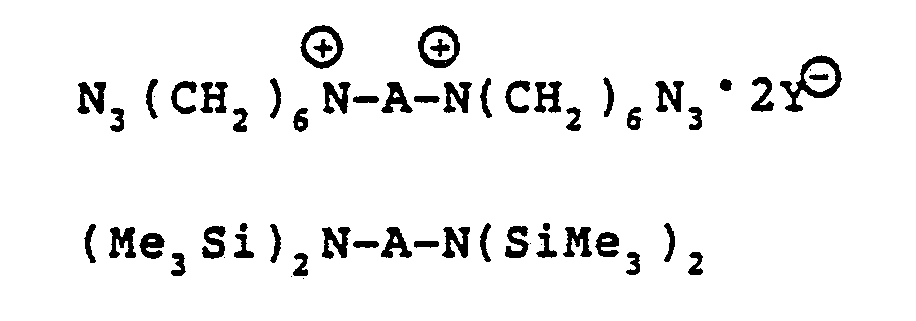
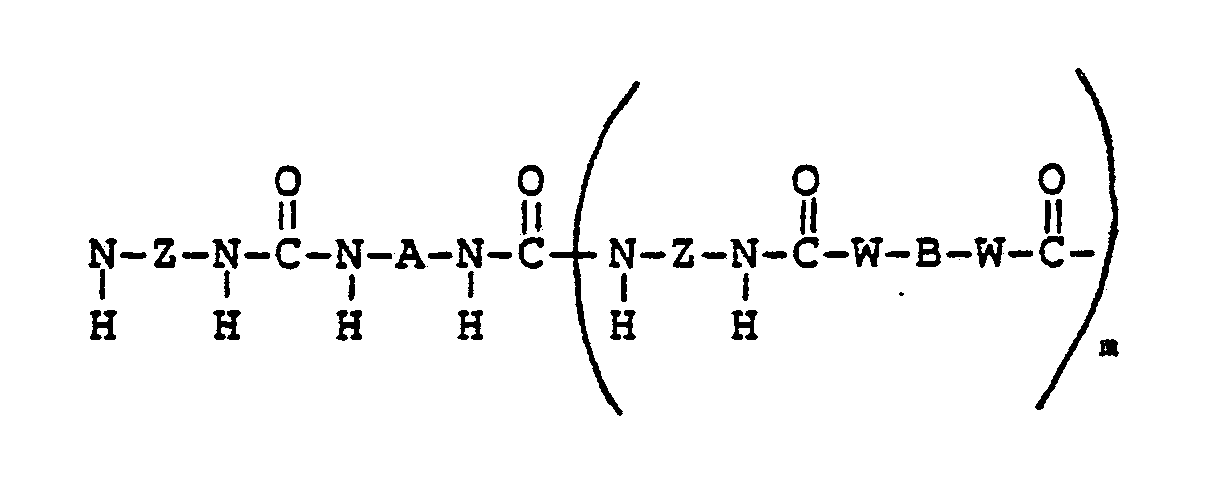
Z is a divalent radical selected from the group consisting of phenylene, alkylene, aralkylene, and cycloalkylene;
B is selected from the group consisting of a divalent radical selected from alkylene, aralkylene, cycloalkylene, and phenylene;
W is a difunctional moiety selected from -O- and -

D is selected from the group consisting of hydrogen, an alkyl radical with from one to ten carbon atoms, phenyl, and an alkylene radical which completes a ring structure including B to form a heterocycle;
m is an integer from zero to about 25; and
A is a polyether moiety having a molecular weight of at least about 3500 containing recurring groups, a major portion being oxytetramethylene units, and a minor portion being other oxyalkylene units having up to about 4 straight chain carbon atoms.

Z is a divalent radical selected from the group consisting of phenylene, alkylene, aralkylene, and cycloalkylene;
B is a divalent radical selected from the group consisting of alkylene, aralkylene, cycloalkylene, and phenylene;
W is a difunctional moiety selected from -O- and -

D is selected from the group consisting of hydrogen, an alkyl radical with from one to ten carbon atoms, phenyl, and an alkylene radical which completes a ring structure including B to form a heterocycle;
m is an integer from zero to about 25; and
A is a polyether moiety having a molecular weight of at least about 3500 containing recurring groups, a major portion being oxytetramethylene units, and a minor portion being other oxyalkylene units having up to about 4 straight chain carbon atoms.
Applications Claiming Priority (2)
| Application Number | Priority Date | Filing Date | Title |
|---|---|---|---|
| US07/067,555 US4833213A (en) | 1987-06-26 | 1987-06-26 | Method of making purely primary diamines from nitrogen containing nocleophile and terminally electrophilically active polyether |
| US67555 | 1987-06-26 |
Publications (3)
| Publication Number | Publication Date |
|---|---|
| EP0296852A2 true EP0296852A2 (en) | 1988-12-28 |
| EP0296852A3 EP0296852A3 (en) | 1990-06-06 |
| EP0296852B1 EP0296852B1 (en) | 1996-03-06 |
Family
ID=22076794
Family Applications (1)
| Application Number | Title | Priority Date | Filing Date |
|---|---|---|---|
| EP88305728A Expired - Lifetime EP0296852B1 (en) | 1987-06-26 | 1988-06-23 | Method of making purely primary diamines |
Country Status (6)
| Country | Link |
|---|---|
| US (1) | US4833213A (en) |
| EP (1) | EP0296852B1 (en) |
| JP (2) | JP2543954B2 (en) |
| KR (1) | KR0129110B1 (en) |
| CA (1) | CA1320494C (en) |
| DE (1) | DE3855056T2 (en) |
Cited By (25)
| Publication number | Priority date | Publication date | Assignee | Title |
|---|---|---|---|---|
| EP0434245A3 (en) * | 1989-12-18 | 1991-11-21 | Texaco Chemical Company | Polyurea elastomer with rapid dry time |
| EP0541252A3 (en) * | 1991-11-04 | 1993-08-11 | Texaco Chemical Company | Catalytic method for the reductive amination of poly(oxytetramethylene)diacetates |
| US6766091B2 (en) | 2002-06-26 | 2004-07-20 | Degussa Ag | Polymeric optical conductors |
| US6884485B2 (en) | 2002-01-19 | 2005-04-26 | Degussa Ag | Molding composition based on polyetheramides |
| DE102007011287A1 (en) | 2007-03-08 | 2008-09-11 | Evonik Degussa Gmbh | Tube useful as compressed-air brake line, comprises an outer layer made from a polymer melt, an intermediate layer made from adhesive polymer melt, and an interior layer made from polymer melt |
| DE102007040683A1 (en) | 2007-08-29 | 2009-03-05 | Evonik Degussa Gmbh | Sheathed pipe |
| DE102009001001A1 (en) | 2009-02-19 | 2010-09-02 | Evonik Degussa Gmbh | Use of a conduit for the production of a pipeline laid in the water |
| DE102010003917A1 (en) | 2010-04-13 | 2011-10-13 | Evonik Degussa Gmbh | Flexible tube with diffusion barrier |
| DE102010003909A1 (en) | 2010-04-13 | 2011-10-13 | Evonik Degussa Gmbh | Flexible tube with multilayer construction |
| DE102010028541A1 (en) | 2010-05-04 | 2011-11-10 | Evonik Degussa Gmbh | Composite of a polyamide molding compound and vulcanized elastomer |
| DE102011007104A1 (en) | 2011-04-11 | 2012-10-11 | Evonik Degussa Gmbh | Polyamide sheathed steel construction tubes for offshore structures |
| EP2610279A1 (en) | 2011-12-29 | 2013-07-03 | Evonik Degussa GmbH | Method for producing a moulded part from a polyamide moulding material with improved hydrolysis resistance |
| DE102012207173A1 (en) | 2012-04-30 | 2013-10-31 | Evonik Degussa Gmbh | Coated metal object |
| DE102012208020A1 (en) | 2012-05-14 | 2013-11-14 | Evonik Industries Ag | Method for producing a heatable tube |
| EP2783851A1 (en) | 2013-03-28 | 2014-10-01 | Evonik Industries AG | Multilayer pipe with polyamide layer |
| EP2783835A1 (en) | 2013-03-28 | 2014-10-01 | Evonik Industries AG | Method for manufacturing a tube clad with an inner liner |
| DE102013209126A1 (en) | 2013-05-16 | 2014-11-20 | Evonik Industries Ag | Air-brake line |
| US8927737B2 (en) | 2011-08-09 | 2015-01-06 | Basf Se | Process for purifying ionic liquids |
| EP2998339A2 (en) | 2014-08-26 | 2016-03-23 | Evonik Degussa GmbH | Metallic pipe having a hydrolysis-resistant layer of a polyamide moulding composition |
| EP3020277A1 (en) | 2014-11-12 | 2016-05-18 | Evonik Degussa GmbH | Composition with controlled release of biocidal metal ions |
| EP3069876A1 (en) | 2015-03-17 | 2016-09-21 | Evonik Degussa GmbH | Laminate with one layer made of a partially aromatic polyamide |
| EP3069866A1 (en) | 2015-03-20 | 2016-09-21 | Evonik Degussa GmbH | Heatable tube |
| EP3477176A1 (en) | 2017-10-25 | 2019-05-01 | Evonik Degussa GmbH | Method for manufacturing a tube clad with an inner liner |
| EP3640287A1 (en) | 2018-10-16 | 2020-04-22 | Röhm GmbH | Polyether blockamide poly(meth)acrylate foams |
| WO2020136136A1 (en) | 2018-12-28 | 2020-07-02 | Giesecke+Devrient Mobile Security Gmbh | Method and device for providing a layer assembly, and layer assembly |
Families Citing this family (19)
| Publication number | Priority date | Publication date | Assignee | Title |
|---|---|---|---|---|
| JPH02242822A (en) * | 1989-03-16 | 1990-09-27 | Hodogaya Chem Co Ltd | Production of polyoxyalkylene derivative |
| US5003107A (en) * | 1989-12-18 | 1991-03-26 | Texaco Chemical Company | Catalytic method for the reductive amination of poly(oxytetramethyle) glycols |
| JP2593032B2 (en) * | 1992-02-07 | 1997-03-19 | 新技術事業団 | Heterofunctional polyethers at both ends, method for producing the polyethers and polymerization initiators |
| US5483008A (en) * | 1992-02-07 | 1996-01-09 | Research Development Corporation Of Japan | Polyether having heterofunctional groups at both ends, process for the preparation thereof and polymerization initiator therefor |
| JP2855419B2 (en) * | 1995-12-19 | 1999-02-10 | 帝国ピストンリング株式会社 | Combination oil ring spacer expander and combination oil ring |
| USRE40088E1 (en) | 1997-06-13 | 2008-02-19 | 3M Innovative Properties Company | Liquid pavement marking compositions |
| KR100565132B1 (en) | 1997-06-13 | 2006-03-30 | 미네소타 마이닝 앤드 매뉴팩춰링 캄파니 | Liquid composition for pavement markings |
| KR101627875B1 (en) | 2008-03-25 | 2016-06-07 | 쓰리엠 이노베이티브 프로퍼티즈 컴파니 | Paint film composites and methods of making and using the same |
| BRPI0909077A2 (en) * | 2008-03-25 | 2015-08-25 | 3M Innovative Properties Co | Multilayer articles and methods of preparation and use |
| JP7240859B2 (en) * | 2018-11-26 | 2023-03-16 | 株式会社カネカ | Method for producing purified polyether and method for producing curable composition |
| JP7805168B2 (en) | 2019-06-13 | 2026-01-23 | スリーエム イノベイティブ プロパティズ カンパニー | Crosslinking agent and curable composition containing same |
| US20230303898A1 (en) * | 2020-08-11 | 2023-09-28 | 3M Innovative Properties Company | (meth)acrylate structural adhesives and methods |
| US11739172B2 (en) | 2020-12-17 | 2023-08-29 | 3M Innovative Properties Company | Composition including monomer with a carboxylic acid group, monomer with a hydroxyl group, and crosslinker and related articles and methods |
| WO2022264065A2 (en) | 2021-06-16 | 2022-12-22 | 3M Innovative Properties Company | Adhesive dispensing systems and methods |
| CN117580878A (en) | 2021-06-29 | 2024-02-20 | 3M创新有限公司 | Pressure sensitive adhesives prepared using polyether-containing macromers |
| EP4377367A1 (en) | 2021-07-27 | 2024-06-05 | 3M Innovative Properties Company | Composition including monomer with a carboxylic acid group, monomer with a hydroxyl group, an alkyl monomer, and crosslinker and related article and method |
| WO2023052904A1 (en) | 2021-10-01 | 2023-04-06 | 3M Innovative Properties Company | Ultrasonic dispensing device |
| US20250026969A1 (en) | 2021-12-10 | 2025-01-23 | 3M Innovative Properties Company | Methods, systems, devices and kits for formulating structural adhesives |
| US20250354037A1 (en) | 2021-12-10 | 2025-11-20 | 3M Innovative Properties Company | Methods, systems, devices and kits for formulating structural adhesives |
Family Cites Families (5)
| Publication number | Priority date | Publication date | Assignee | Title |
|---|---|---|---|---|
| US3436359A (en) * | 1965-10-14 | 1969-04-01 | Minnesota Mining & Mfg | Polyether polyprimary polyamines and elastomeric products thereof |
| US4181682A (en) * | 1978-01-09 | 1980-01-01 | Texaco Development Corp. | Aminated propoxylated polybutanediols |
| DE3147736A1 (en) * | 1981-12-02 | 1983-06-09 | Bayer Ag, 5090 Leverkusen | METHOD FOR PRODUCING ELASTIC MOLDED BODIES |
| GB2116966B (en) * | 1982-02-26 | 1986-01-15 | British Petroleum Co Plc | N-oxyalkylated aqueous compositions of quaternary ammenium salt surfactants |
| US4451618A (en) * | 1982-09-29 | 1984-05-29 | The B. F. Goodrich Company | Block copolymers and process for their preparation |
-
1987
- 1987-06-26 US US07/067,555 patent/US4833213A/en not_active Expired - Lifetime
-
1988
- 1988-06-02 CA CA000568395A patent/CA1320494C/en not_active Expired - Fee Related
- 1988-06-23 EP EP88305728A patent/EP0296852B1/en not_active Expired - Lifetime
- 1988-06-23 DE DE3855056T patent/DE3855056T2/en not_active Expired - Fee Related
- 1988-06-24 KR KR1019880007661A patent/KR0129110B1/en not_active Expired - Fee Related
- 1988-06-24 JP JP63156632A patent/JP2543954B2/en not_active Expired - Lifetime
-
1996
- 1996-03-12 JP JP8054744A patent/JP2720893B2/en not_active Expired - Lifetime
Cited By (42)
| Publication number | Priority date | Publication date | Assignee | Title |
|---|---|---|---|---|
| EP0434245A3 (en) * | 1989-12-18 | 1991-11-21 | Texaco Chemical Company | Polyurea elastomer with rapid dry time |
| EP0541252A3 (en) * | 1991-11-04 | 1993-08-11 | Texaco Chemical Company | Catalytic method for the reductive amination of poly(oxytetramethylene)diacetates |
| US6884485B2 (en) | 2002-01-19 | 2005-04-26 | Degussa Ag | Molding composition based on polyetheramides |
| US6766091B2 (en) | 2002-06-26 | 2004-07-20 | Degussa Ag | Polymeric optical conductors |
| DE102007011287A1 (en) | 2007-03-08 | 2008-09-11 | Evonik Degussa Gmbh | Tube useful as compressed-air brake line, comprises an outer layer made from a polymer melt, an intermediate layer made from adhesive polymer melt, and an interior layer made from polymer melt |
| DE102007040683A1 (en) | 2007-08-29 | 2009-03-05 | Evonik Degussa Gmbh | Sheathed pipe |
| DE102009001001A1 (en) | 2009-02-19 | 2010-09-02 | Evonik Degussa Gmbh | Use of a conduit for the production of a pipeline laid in the water |
| WO2011128197A1 (en) | 2010-04-13 | 2011-10-20 | Evonik Degussa Gmbh | Flexible pipe having a diffusion barrier |
| DE102010003909A1 (en) | 2010-04-13 | 2011-10-13 | Evonik Degussa Gmbh | Flexible tube with multilayer construction |
| WO2011128175A1 (en) | 2010-04-13 | 2011-10-20 | Evonik Degussa Gmbh | Flexible pipe having a multi-layered structure |
| DE102010003917A1 (en) | 2010-04-13 | 2011-10-13 | Evonik Degussa Gmbh | Flexible tube with diffusion barrier |
| DE102010028541A1 (en) | 2010-05-04 | 2011-11-10 | Evonik Degussa Gmbh | Composite of a polyamide molding compound and vulcanized elastomer |
| WO2011138300A1 (en) | 2010-05-04 | 2011-11-10 | Evonik Degussa Gmbh | Composite formed from a polyamide moulding composition and a vulcanized elastomer |
| DE102011007104A1 (en) | 2011-04-11 | 2012-10-11 | Evonik Degussa Gmbh | Polyamide sheathed steel construction tubes for offshore structures |
| EP2511430A1 (en) | 2011-04-11 | 2012-10-17 | Evonik Degussa GmbH | Steel tubes for offshore structures |
| US8927737B2 (en) | 2011-08-09 | 2015-01-06 | Basf Se | Process for purifying ionic liquids |
| EP2610279A1 (en) | 2011-12-29 | 2013-07-03 | Evonik Degussa GmbH | Method for producing a moulded part from a polyamide moulding material with improved hydrolysis resistance |
| DE102011090092A1 (en) | 2011-12-29 | 2013-07-04 | Evonik Degussa Gmbh | Process for the production of a molding from a polyamide molding compound with improved hydrolysis resistance |
| DE102012207173A1 (en) | 2012-04-30 | 2013-10-31 | Evonik Degussa Gmbh | Coated metal object |
| EP2660295A1 (en) | 2012-04-30 | 2013-11-06 | Evonik Industries AG | Metal article coated with a composition comprising olefinic double bonds |
| EP2664835A1 (en) | 2012-05-14 | 2013-11-20 | Evonik Industries AG | Method for producing a heatable pipe, heatable pipe and use thereof |
| DE102012208020A1 (en) | 2012-05-14 | 2013-11-14 | Evonik Industries Ag | Method for producing a heatable tube |
| EP2783851A1 (en) | 2013-03-28 | 2014-10-01 | Evonik Industries AG | Multilayer pipe with polyamide layer |
| EP2783835A1 (en) | 2013-03-28 | 2014-10-01 | Evonik Industries AG | Method for manufacturing a tube clad with an inner liner |
| DE102013205616A1 (en) | 2013-03-28 | 2014-10-02 | Evonik Industries Ag | Multilayer pipe with polyamide layer |
| DE102013205614A1 (en) | 2013-03-28 | 2014-10-02 | Evonik Industries Ag | Method for producing a pipe lined with an inliner |
| DE102013209126A1 (en) | 2013-05-16 | 2014-11-20 | Evonik Industries Ag | Air-brake line |
| EP2842736A1 (en) | 2013-05-16 | 2015-03-04 | Evonik Industries AG | Compressed air brake pipe |
| EP2998339A2 (en) | 2014-08-26 | 2016-03-23 | Evonik Degussa GmbH | Metallic pipe having a hydrolysis-resistant layer of a polyamide moulding composition |
| EP3020277A1 (en) | 2014-11-12 | 2016-05-18 | Evonik Degussa GmbH | Composition with controlled release of biocidal metal ions |
| EP3069876A1 (en) | 2015-03-17 | 2016-09-21 | Evonik Degussa GmbH | Laminate with one layer made of a partially aromatic polyamide |
| EP3069866A1 (en) | 2015-03-20 | 2016-09-21 | Evonik Degussa GmbH | Heatable tube |
| EP3477176A1 (en) | 2017-10-25 | 2019-05-01 | Evonik Degussa GmbH | Method for manufacturing a tube clad with an inner liner |
| WO2019081572A1 (en) | 2017-10-25 | 2019-05-02 | Evonik Degussa Gmbh | METHOD FOR PRODUCING A TUBE DRIPPED WITH AN INLINER |
| US11204111B2 (en) | 2017-10-25 | 2021-12-21 | Evonik Operations Gmbh | Method for producing a pipe lined with an inner liner |
| EP3640287A1 (en) | 2018-10-16 | 2020-04-22 | Röhm GmbH | Polyether blockamide poly(meth)acrylate foams |
| WO2020078856A1 (en) | 2018-10-16 | 2020-04-23 | Evonik Operations Gmbh | Polyether block amide-poly(meth)acrylate foams |
| WO2020079081A1 (en) | 2018-10-16 | 2020-04-23 | Röhm Gmbh | Polyether block amide-poly(meth)acrylate foams |
| US12139605B2 (en) | 2018-10-16 | 2024-11-12 | Evonik Operations Gmbh | Polyether block amide-poly(meth)acrylate foams |
| US12600857B2 (en) | 2018-10-16 | 2026-04-14 | Evonik Operations Gmbh | Polyether block amide-poly(meth)acrylate foams |
| WO2020136136A1 (en) | 2018-12-28 | 2020-07-02 | Giesecke+Devrient Mobile Security Gmbh | Method and device for providing a layer assembly, and layer assembly |
| DE102018133678A1 (en) | 2018-12-28 | 2020-07-02 | Evonik Operations Gmbh | Introduction of a data page into a value document |
Also Published As
| Publication number | Publication date |
|---|---|
| EP0296852B1 (en) | 1996-03-06 |
| JPH08253577A (en) | 1996-10-01 |
| DE3855056D1 (en) | 1996-04-11 |
| CA1320494C (en) | 1993-07-20 |
| JP2720893B2 (en) | 1998-03-04 |
| JP2543954B2 (en) | 1996-10-16 |
| KR890000553A (en) | 1989-03-15 |
| EP0296852A3 (en) | 1990-06-06 |
| KR0129110B1 (en) | 1998-04-07 |
| DE3855056T2 (en) | 1996-10-31 |
| US4833213A (en) | 1989-05-23 |
| JPS6422921A (en) | 1989-01-25 |
Similar Documents
| Publication | Publication Date | Title |
|---|---|---|
| EP0296852B1 (en) | Method of making purely primary diamines | |
| EP0380236B1 (en) | Organopolysiloxane-polyurea block copolymer and method for its production | |
| US3850856A (en) | Hydroxyl-ended epihalohydrin polymers by cationic polymerization | |
| US4680358A (en) | Styryl terminated macromolecular monomers of polyethers | |
| US3580887A (en) | Elastomeric products of epoxy resins and polyether disecondary amines | |
| US4933396A (en) | Method of making purely primary diamines | |
| JP3422857B2 (en) | Thermoplastic polyurethane resin having a wide rubber region and method for producing the same | |
| EP0106218B1 (en) | Block copolymers and process for their preparation | |
| US4959499A (en) | Liquid polymers containing urethane and urea moieties and hydroxyl and/or amino end groups and a process for the preparation thereof | |
| US3172874A (en) | Xnxz xnx xnx | |
| EP1022299A2 (en) | Polymerisation of cyclic ethers | |
| US3644567A (en) | Process for preparing block copolymers from a tetrahydrofuran polymer | |
| CA1205233A (en) | Graft copolymers and process for their preparation | |
| US4154724A (en) | Polyether polyureides and resinous compositions therefrom | |
| CA1329285C (en) | Method of making purely primary diamines | |
| EP0149986B1 (en) | Cross-linked nylon block copolymers and process of their preparation | |
| US3929731A (en) | Process for the production of polymeric acetals containing urethane, carbamide and amide groups | |
| US3824219A (en) | Process for preparing polycationically active polymers of tetrahydrofuran | |
| EP0331307A2 (en) | Perfluoroalkyl polyether glycols and their use | |
| GB2045269A (en) | Thermoplastic Polymers from Diamines and Diepoxides | |
| US3403114A (en) | Polymers of amino epoxides | |
| US4036882A (en) | Amine formal polymers and process of making the same | |
| US3207707A (en) | Nitrogen containing polymers | |
| US3939200A (en) | Aliphatic acyl-containing amine hydrochlorides | |
| US3464933A (en) | Novel c-n backbone polymers |
Legal Events
| Date | Code | Title | Description |
|---|---|---|---|
| PUAI | Public reference made under article 153(3) epc to a published international application that has entered the european phase |
Free format text: ORIGINAL CODE: 0009012 |
|
| AK | Designated contracting states |
Kind code of ref document: A2 Designated state(s): BE CH DE ES FR GB IT LI |
|
| PUAL | Search report despatched |
Free format text: ORIGINAL CODE: 0009013 |
|
| AK | Designated contracting states |
Kind code of ref document: A3 Designated state(s): BE CH DE ES FR GB IT LI |
|
| 17P | Request for examination filed |
Effective date: 19901205 |
|
| 17Q | First examination report despatched |
Effective date: 19920806 |
|
| ITF | It: translation for a ep patent filed | ||
| GRAA | (expected) grant |
Free format text: ORIGINAL CODE: 0009210 |
|
| AK | Designated contracting states |
Kind code of ref document: B1 Designated state(s): BE CH DE ES FR GB IT LI |
|
| PG25 | Lapsed in a contracting state [announced via postgrant information from national office to epo] |
Ref country code: ES Free format text: THE PATENT HAS BEEN ANNULLED BY A DECISION OF A NATIONAL AUTHORITY Effective date: 19960306 Ref country code: BE Effective date: 19960306 |
|
| REG | Reference to a national code |
Ref country code: CH Ref legal event code: NV Representative=s name: E. BLUM & CO. PATENTANWAELTE |
|
| REF | Corresponds to: |
Ref document number: 3855056 Country of ref document: DE Date of ref document: 19960411 |
|
| ET | Fr: translation filed | ||
| PLBE | No opposition filed within time limit |
Free format text: ORIGINAL CODE: 0009261 |
|
| STAA | Information on the status of an ep patent application or granted ep patent |
Free format text: STATUS: NO OPPOSITION FILED WITHIN TIME LIMIT |
|
| 26N | No opposition filed | ||
| PGFP | Annual fee paid to national office [announced via postgrant information from national office to epo] |
Ref country code: CH Payment date: 19980529 Year of fee payment: 11 |
|
| PG25 | Lapsed in a contracting state [announced via postgrant information from national office to epo] |
Ref country code: LI Free format text: LAPSE BECAUSE OF NON-PAYMENT OF DUE FEES Effective date: 19990630 Ref country code: CH Free format text: LAPSE BECAUSE OF NON-PAYMENT OF DUE FEES Effective date: 19990630 |
|
| REG | Reference to a national code |
Ref country code: CH Ref legal event code: PL |
|
| REG | Reference to a national code |
Ref country code: GB Ref legal event code: IF02 |
|
| PG25 | Lapsed in a contracting state [announced via postgrant information from national office to epo] |
Ref country code: IT Free format text: LAPSE BECAUSE OF NON-PAYMENT OF DUE FEES Effective date: 20050623 |
|
| PGFP | Annual fee paid to national office [announced via postgrant information from national office to epo] |
Ref country code: FR Payment date: 20060620 Year of fee payment: 19 |
|
| PGFP | Annual fee paid to national office [announced via postgrant information from national office to epo] |
Ref country code: GB Payment date: 20060626 Year of fee payment: 19 |
|
| PGFP | Annual fee paid to national office [announced via postgrant information from national office to epo] |
Ref country code: DE Payment date: 20060731 Year of fee payment: 19 |
|
| GBPC | Gb: european patent ceased through non-payment of renewal fee |
Effective date: 20070623 |
|
| REG | Reference to a national code |
Ref country code: FR Ref legal event code: ST Effective date: 20080229 |
|
| PG25 | Lapsed in a contracting state [announced via postgrant information from national office to epo] |
Ref country code: DE Free format text: LAPSE BECAUSE OF NON-PAYMENT OF DUE FEES Effective date: 20080101 |
|
| PG25 | Lapsed in a contracting state [announced via postgrant information from national office to epo] |
Ref country code: GB Free format text: LAPSE BECAUSE OF NON-PAYMENT OF DUE FEES Effective date: 20070623 |
|
| PG25 | Lapsed in a contracting state [announced via postgrant information from national office to epo] |
Ref country code: FR Free format text: LAPSE BECAUSE OF NON-PAYMENT OF DUE FEES Effective date: 20070702 |