EP0297788A2 - Procédé pour tremper le produit gazeux d'une réaction contenant de l'acide méthacrylique et procédé pour traiter le liquide trempé - Google Patents
Procédé pour tremper le produit gazeux d'une réaction contenant de l'acide méthacrylique et procédé pour traiter le liquide trempé Download PDFInfo
- Publication number
- EP0297788A2 EP0297788A2 EP88305764A EP88305764A EP0297788A2 EP 0297788 A2 EP0297788 A2 EP 0297788A2 EP 88305764 A EP88305764 A EP 88305764A EP 88305764 A EP88305764 A EP 88305764A EP 0297788 A2 EP0297788 A2 EP 0297788A2
- Authority
- EP
- European Patent Office
- Prior art keywords
- quench column
- reaction product
- gas
- product gas
- methacrylic acid
- Prior art date
- Legal status (The legal status is an assumption and is not a legal conclusion. Google has not performed a legal analysis and makes no representation as to the accuracy of the status listed.)
- Granted
Links
Images

Classifications
-
- C—CHEMISTRY; METALLURGY
- C07—ORGANIC CHEMISTRY
- C07C—ACYCLIC OR CARBOCYCLIC COMPOUNDS
- C07C57/00—Unsaturated compounds having carboxyl groups bound to acyclic carbon atoms
- C07C57/02—Unsaturated compounds having carboxyl groups bound to acyclic carbon atoms with only carbon-to-carbon double bonds as unsaturation
- C07C57/03—Monocarboxylic acids
- C07C57/04—Acrylic acid; Methacrylic acid
-
- C—CHEMISTRY; METALLURGY
- C07—ORGANIC CHEMISTRY
- C07C—ACYCLIC OR CARBOCYCLIC COMPOUNDS
- C07C45/00—Preparation of compounds having >C = O groups bound only to carbon or hydrogen atoms; Preparation of chelates of such compounds
- C07C45/78—Separation; Purification; Stabilisation; Use of additives
- C07C45/783—Separation; Purification; Stabilisation; Use of additives by gas-liquid treatment, e.g. by gas-liquid absorption
-
- C—CHEMISTRY; METALLURGY
- C07—ORGANIC CHEMISTRY
- C07C—ACYCLIC OR CARBOCYCLIC COMPOUNDS
- C07C51/00—Preparation of carboxylic acids or their salts, halides or anhydrides
- C07C51/42—Separation; Purification; Stabilisation; Use of additives
Definitions
- This invention relates to a process for quenching a reaction product gas, which has been obtained by subjecting isobutylene or the like to vapor-phase catalytic oxidation, so as to recover methacrolein and/or methacrylic acid, and in particular to a quenching process and also to a recovery process from the liquid thus quenched.
- a quench column is generally used for collecting methacrolein and/or methacrylic acid from a reaction product gas which has been obtained by subjecting at least one compound selected from isobutylene, tertiary butanol, isobutyl aldehyde and methacrolein to catalytic vapor-phase oxidation with molecular oxygen in the presence of steam in accordance with a one-step or two-step reaction.
- a reaction product gas which has been obtained by subjecting at least one compound selected from isobutylene, tertiary butanol, isobutyl aldehyde and methacrolein to catalytic vapor-phase oxidation with molecular oxygen in the presence of steam in accordance with a one-step or two-step reaction.
- liquid compounds usable for these contacts may be mentioned inter alia a reaction-gas condensate, benzene, benzene derivatives substituted by one or more alkyl groups having 1-4 carbon atoms, alkoxyl groups and/or alkoxycarbonyl groups, aliphatic hydrocarbons having 5-7 carbon atoms and alicyclic hydrocarbons.
- the reaction product gas however contains, in addition to methacrolein and/or methacrylic acid as a target product, high boiling byproducts such as benzoic acid, toluic acid, maleic acid, citraconic acid, terephthalic acid and tar-like substances at rather high concentrations. Trouble may hence arise in that these high boiling byproducts may precipitate in the course of cooling of the reaction product gas and hence could block pipe lines.
- the present inventors have already proposed to bring ammonia gas or ammonium hydroxide together with the condensate of the reaction product gas into contact with the reaction product gas so as to quench the reaction product gas (Japanese Patent Laid-Open No. 438/1987).
- This method is very effective in preventing the deposition of polybasic organic acids, e.g., terephthalic acid, as high boiling byproducts and also in preventing the polymerization of methacrolein and methacrylic acid.
- the ammonium salts of the above organic acids are partitioned to the side of an extraction residue in the subsequent extraction step and hence constitute a portion of an effluent. It is thus necessary to take special measures for their treatment. Taking all the above features into consideration, the above method cannot be considered to be preferred fully.
- the reaction product gas is introduced into a bottom portion of a quench column through a feed pipe provided at a right angle relative to a wall of the column, is blown against spreading buffle plates arranged in the form of a turned square U, and after being spread in horizontal directions, is allowed to flow upwards toward the top of the column.
- a portion of a condensate which has been cooled by a heat-exchanger is caused to fall as a shower along with a polymerization inhibitor from the top of the column, whereby the portion of the condensate is brought into counter current contact with the reaction product gas and the reaction product gas is hence quenched and condensed.
- the cooled condensate which flows downwardly from the point above the spreading plates hits the spreading plates to that the spreading plates are cooled.
- the reaction product gas hence hits the spreading plates and is thus cooled, thereby resulting in condensation and coagulation of high boiling byproducts. Since the insides of the spreading plates are not exposed directly to the condensate containing the polymerization inhibitor, the condensation, coagulation and polymerization of the high boiling byproduct gas proceed at a tip portion of the feed pipe and the operation ceases to be feasible eventually.
- the above patent publication also discloses the introduction of the reaction product gas and condensate from a top portion of a quench column, so that they are contacted with each other as parallel flows.
- the wall of the top portion is heated and due to conduction of heat, the lower wall is also exposed to high temperatures.
- the condensate supplied as the parallel flow splashes against the wall of the column.
- the condensate is thus concentrated, leading to deposition of high boiling byproducts and polymerization of methacrolein and methacrylic acid.
- the reaction product gas quenched by the above method forms a vapor phase and a condensed liquid phase, and methacrylic acid is separated and purified in steps as will be described next.
- methacrolein as a useful component is absorbed and separated, usually, with an absorbent such as water or an organic solvent from the vapor phase containing nitrogen, oxygen, carbon monoxide, carbon dioxide and steam.
- an absorbent such as water or an organic solvent from the vapor phase containing nitrogen, oxygen, carbon monoxide, carbon dioxide and steam.
- methacrolein as a useful component is stripped, separated and recovered along with the other aldehydes.
- methacrylic acid is separated in a purified form usually by extracting the liquid phase with a solvent capable of extracting methacrylic acid selectively and then removing formic acid, acetic acid, propionic acid, acrylic acid and water, which are contained in small amounts in the extract, by azeotropic distillation with a solvent.
- a solvent capable of extracting methacrylic acid selectively and then removing formic acid, acetic acid, propionic acid, acrylic acid and water, which are contained in small amounts in the extract, by azeotropic distillation with a solvent.
- solids matters often deposit in an extraction column to cause a problem for the stable operation of the process such as interior blocking of the column. Basically, solid matters led by terephthalic acid are only poorly soluble in the aqueous solution of methacrylic acid.
- the above-described methods may be effective in removing organic compounds, such as terephthalic acid, dissolved in the aqueous solution of methacrylic acid in a stage prior to the extraction of methacrylic acid.
- organic compounds such as terephthalic acid
- large facilities are required for the slow precipitation velocities of the organic compounds or a special chemical is required. They were therefore unable to provide a perfect solution to the problem of deposition of solid matters inside an extraction column.
- An object of this invention is to provide a stable operation method of a quench column for a reaction product gas containing methacrylic acid, which can prevent the blocking of a nozzle of the quench column and is free from the deposition of high boiling products and tar-like substances in the quench column.
- Another object of this invention is to provide a process for preventing the deposition of high boiling products and tar-like substances in a quench column by dividing the quench column into two or more stages and optimizing the temperature of each stage, especially, the temperature of the first stage and the manner of contact between a condensate and a gas.
- third and fourth objects of this invention are to provide processes for preventing the formation and deposition of solid matters in a methacrolein diffusion column, in which a condensate is processed further, and in a solvent extraction column for an aqueous solution of methacrylic acid, respectively.
- the first object of this invention can be achieved by a process for quenching a reaction product gas, which has been obtained by catalytically oxidizing isobutylene, tertiary butanol, methacrolein or isobutyl aldehyde with a molecular oxygen bearing gas in the presence of steam and contains methacrolein and methacrylic acid, with a condensate of the reaction product gas as a cooling medium in a quench column so as to obtain methacrolein and methacrylic acid from the reaction product gas, which comprises: passing the reaction product gas and a heat-insulating gas through an inner flow passage and an outer flow passage respectively, said inner and outer passages being formed by a double-wall pipe which is constructed of an inner pipe and an outer pipe surrounding the inner pipe and extends through a wall of the quench column; releasing the reaction product gas from a reaction product gas releasing portion toward the surface of a condensate remaining in a bottom of the quench column; spraying a portion
- the second object of this invention can be attained by a process for quenching the reaction product gas so as to obtain methacrolein and methacrylic acid from the reaction product gas, which comprises: guiding the reaction product gas to a quench column; bringing the reaction gas into counter current contact with a liquid mixture of a portion of a condensate of the quench column and a portion of a condensate from a quench column unit composed of at least one quench column in such a way that the temperature of a bottom of the quench column ranges from 50°C to 70°C; guiding an overhead gas from a top of the quench column to the quench column unit; and bringing the overhead gas into counter current contact with a liquid, which has in advance been condensed and accumulated in the quench column unit, in such a way that the temperature of an overhead gas of the quench column unit ranges from 10°C to 30°C.
- the third object of this invention can be attained by adding at least one of at least one organic compound, which is selected from aromatic carboxylic acids and aromatic aldehydes, and metal powder to the aqueous solution of methacrylic acid, said aqueous solution having been obtained by quenching the reaction product gas, so that organic compounds, such as terephthalic acid, contained in the aqueous solution are precipitated; and separating and removing the organic compounds thus precipitated.
- at least one organic compound which is selected from aromatic carboxylic acids and aromatic aldehydes, and metal powder
- the fourth object of this invention can be achieved by adding at least one of at least one organic compound, which is selected from aromatic carboxylic acids and aromatic aldehydes, and metal powder to an aqueous solution of methacrylic acid, said aqueous solution having been obtained by removing light distillates such as methacrolein from the aqueous methacrylic acid solution obtained by quenching the reaction product gas, so that organic compounds, such as terephthalic acid, contained in the aqueous solution are precipitated; and separating and removing the organic compounds thus precipitated.
- the reaction product gas containing methacrylic acid, to which the present invention is applied is obtained by catalytically oxidizing isobutylene, tertiary butanol, methacrolein or isobutyl aldehyde with molecular oxygen in the presence of steam in accordance with a 1-stage or 2-stage reaction.
- the catalytic reactions disclosed in U.S. Patent Nos. 4,001,317 and 4,301,031 are known by way of example.
- the present invention can be applied to a reaction product gas obtained by any one of such catalytic reactions.
- gas bearing molecular oxygen useful in the practice of this invention, may generally be mentioned air, pure oxygen, or a mixed gas of nitrogen and oxygen. Carbon monoxide, carbon dioxide and the like may also be contained in the gas.
- the temperature of the reaction product gas may generally be within a range of 230-370°C.
- the temperature of the condensate of the quench column may generally be controlled to 10-100°C, preferably, to 40-60°C.
- the reaction product gas obtained by the above-mentioned reaction contains byproducts, for example, carboxylic acids such as formic acid, acetic acid, propionic acid, maleic acid, citraconic acid, benzoic acid, toluic acid and terephthalic acid and aldehydes such as formaldehyde, acetaldehyde, propionaldehyde, methacrolein, benzaldehyde, tolualdehyde and furfural, in addition to methacrylic acid as the target product.
- carboxylic acids such as formic acid, acetic acid, propionic acid, maleic acid, citraconic acid
- benzoic acid toluic acid and terephthalic acid
- aldehydes such as formaldehyde, acetaldehyde, propionaldehyde, methacrolein, benzaldehyde, tolualdehyde and furfural, in addition to methacrylic acid as the target product.
- the heat insulating gas employed for the attainment of the first object of this invention may preferably such a gas that does not impair the recovery of the reaction product and has heat insulating effects as great as possible.
- air, nitrogen or a mixed gas of nitrogen and oxygen may be used.
- the heat insulating gas may contain carbon monoxide, carbon dioxide, etc.
- a reaction product gas which has been obtained by vapor-phase oxidation of isobutylene or the like and has flowed out of a reaction zone (not shown), is introduced into a feed line 2 via a feed line 1.
- the reaction product gas is fed through the feed line 2 and is then released from a reaction product gas releasing portion of a quench column 8 toward the surface of a condensate remaining in a bottom of the quench column.
- the condensate cooled by a heat exchanger 4 is fed through a feed line 10 and is sprayed through a sprayer 12 (see FIG. 3), whereby the condensate is brought into parallel flow contact with the reaction product gas released from the reaction product gas releasing portion.
- a majority of the reaction product gas is quenched adiabatically to substantially the middle temperature between its initial temperature and the temperature of the condensate, so that its condensable components are condensed partly.
- the remaining reaction product gas changes its direction and flows upward.
- the reaction product gas is brought into counter current contact with the condensate from a top feed line 11 so that the remaining portions of the condensable components are cooled and collected almost completely.
- the ratio of the condensate portion delivered to the side of the sprayer 12 to that fed to the side of a top of the quench column may preferably range from 1:5 to 1:20.
- the gas phase containing uncondensed methacrolein and methacrylic acid is guided to the next step through a guide line 6.
- the reaction product gas is released into the quenching column as shown in the detailed view of FIG. 2, the insulating gas supplied to an insulating gas blow-out port 9 by way of an insulating gas feed line 3 forms an atmosphere of the insulating gas so that the following merits are brought about. Namely, the quenching spray of the condensate shown in FIG. 3 does not contact the hot feed line 2 directly, thereby preventing the concentration of the condensate, the precipitation of high boiling byproducts, and the polymerization of methacrolein and methacrylic acid.
- the feed line 2 is not cooled owing to the effect of the heat insulating gas at its through portion where the feed line 3 extends through a part of a side wall of the quench column 8. Accordingly, the high boiling byproducts do not deposit inside the feed line 2 and its blocking is completely prevented.
- the reaction product gas Since the reaction product gas is blown against the surface of the condensate in the bottom of the column and the inner wall of the column is completely wet with the condensate owing to the dispersing effects of a packed material, the packed material is not dried locally by the hot reaction product gas which has flowed into the quench column. No blocking phenomenon therefore takes place not only in the feed line 2 but also anywhere in the column.
- a polymerization inhibitor is fed trough a line 7, while the condensate is drawn out from a guide line 5.
- the quenching of the reaction product gas is performed while usually maintaining the ratio L/G within a range of 0.3-2.0 in which G is the amount of the reaction gas while L is the amount of the condensate recirculated from the bottom of the column.
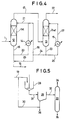
- a reaction product gas which has been obtained by subjecting isobutylene, tertiary butanol, isobutyl aldehyde or methacrolein to a vapor-phase reaction with a molecular oxygen bearing gas in the presence of steam, is introduced into a bottom portion 12 of a first quench column through the feed line 1.
- a portion of a bottom of the first quench column is drawn out through a line 20, subjected to heat-exchange in a heat-exchanger 14 and recirculated together with a portion of a bottom of a bottom portion 13 of a second quench column, said portion being fed via a line 24, through a line 21, whereby the temperature of the bottom of the first quench column is controlled within 50-70°C.
- the bottom of the first quench column becomes lower than 50°C, solid matters formed in the first quench column cannot be collected by these quench columns and remain in the gas in the subsequent steps. Any temperatures higher than 70°C are not usable because methacrylic acid and the like in the bottom begin to polymerize at such high temperatures. If the bottom of the second quench column is discharged out of the system by way of a line 25 indicated by a dotted line in FIG. 4 and is not recirculated to the first quench column, the bottom drawn from the first quench column via the line 18 has problems in its quality as a liquid such that the concentration of methacrylic acid becomes high, thereby developing inconvenience such as polymerization in the first quench column.
- the gas, which has not condensed in the first quench column, is fed to the bottom portion 13 of the second quench column by way of a line 17. It is preferable to control the temperature of gas in the line 17 as closed as possible to the temperature of the bottom of the first quench column.
- a portion of the bottom of the second quench column is recirculated via lines 23, 26 and 27 and is fed through a top portion of the second quench column.
- the portion of the bottom is cooled to such an extent that a gas flowed out of the top portion has a temperature of 10-30°C in a line 22.
- the thermal load of the next step namely, the methacrolein absorption step becomes great.
- the quantity of heat to be exchanged in the heat exchanger 14 becomes great in order to lower the gas temperature below 10°C. This leads to a problem such that the initial cost for the heat exchanger 15 increases, since the temperature difference between the gas and a cooling medium is small.
- the quench column unit in this invention was composed of only one quench column.
- a similar quenching operation is however feasible by a quench column unit constructed of two or more quench columns, preferably, three or more quenching columns.
- the temperature and flow rate in each stage may be controlled suitably as needed.
- Liquids condensed in these quench columns are eventually combined with the bottom of the first quench column, drawn out of the system by way of a line 19, and then fed to the next step, namely, the separation steps of methacrolein and methacrylic acid.
- organic compounds such as terephthalic acid
- dissolved in a supersaturated state in the aqueous methacrylic acid solution from the line 19 by way of example can be separated at accelerated precipitation velocities by adding at least one of at least one organic compound, which is selected from aromatic carboxylic acids and aromatic aldehydes, and metal powder.
- the organic compounds such as terephthalic acid can be easily separated in the step prior to the diffusion column in which light distillates such as methacrolein are removed, so that their conversion into solids and deposition inside the diffusion column can be avoided and their conversion into solids and deposition in columns in the subsequent steps can also be avoided completely.
- aromatic carboxylic acids and aromatic aldehydes are only sparingly soluble in the aqueous solution of methacrylic acid and may include, for example, aromatic carboxylic acids such as terephthalic acid and isophthalic acid and aromatic aldehydes such as terephthalic aldehyde and isophthalic aldehyde. Since solid matters occurred and separated upon practice of the process are organic compounds composed principally of terephthalic acid, the recycled use of a portion of terephthalic acid separated and recovered may be mentioned as a preferred method.
- stainless steel powder may be mentioned by way of example.
- the preferable particle size ranges from 5 ⁇ m to 50 ⁇ m.
- the organic compound and/or metal powder As a method for adding the organic compound and/or metal powder, it may be thrown directly into a reservoir of the aqueous methacrylic acid solution. From the industrial viewpoint, it is however preferable to add it continuously and in a constant proportion relative to the aqueous methacrylc acid solution. It is more preferable to add the organic compound and/or metal powder under stirring. Its proportion may range from 100 ppm to 1% by weight based on the aqueous methacrylic acid solution, with a range of 600-6,000 ppm being particularly preferred.
- the organic compounds such as terephthalic acid may be caused to precipitate at normal temperature, it is preferable to conduct the precipitation at a temperature equal to the bottom temperature of the diffusion column upon stripping methacrolein and the like from the aqueous methacrylic acid solution, namely, 50°C or at a temperature up to about 10°C lower than the bottom temperature, if feasible.
- aqueous methacrylic acid solution obtained by quenching the reaction product gas is continuously charged into a stirred tank 28 via the line 19.
- a portion of a thick slurry with organic compounds, such as terephthalic acid, precipitated as solids therein is recirculated to the line 19 from a solids thickener tank 29, which is to be employed to perform a subsequent step, via a line 30 and is combined.
- aqueous methacrylic acid solution from which organic compounds such as terephthalic acid have been removed as solids, is fed as a supernatant solution to an upper portion of a diffusion column 33 via a line 32.
- Light distillates such as methacrolein are eliminated through a top line 34 of the diffusion column 33, and the resultant aqueous methacrylic acid solution free of light distillates such as methacrolein is discharged as a bottom from a line 35 opening in the bottom of the diffusion column 33.
- the capacity of the solids thickener tank 29 may be determined depending on the tolerable quantity range of solids which flow out into the line 32.
- the residence time is set at a time as long as 1 hour, substantially no solids are observed to flow out.
- a filter or the like may however be provided with the line 32 in order to ensure their elimination.
- the thick slurry of the organic compounds such as terephthalic acid which has been drawn out from the bottom of the solids thickener tank 29, is partly recirculated as a seed slurry for the precipitation of organic compounds dissolved in a supersaturated state in the aqueous methacrylic acid solution from the line 30.
- the thick slurry may be recirculated directly to the stirred tank 28 albeit not illustrated in FIG. 5.
- the remaining portion of the thick slurry is drawn out of the system by way of a line 36. If necessary, the slurry drawn out via the line 36 may be filtered to recover an aqueous solution of methacrylic acid.
- the above-described organic compound selected from aromatic carboxylic acids and aromatic aldehydes and/or the metal powder is added to the aqueous methacrylic acid solution obtained after the removal of light distillates such as methacrolein and recirculated, for example, through the line 24 shown in FIG. 4, whereby organic compounds, such as terephthalic acid, contained in the aqueous methacrylic acid solution are precipitated and separated.
- organic compounds, such as terephthalic acid contained in the aqueous methacrylic acid solution are precipitated and separated.
- the additive may be incorporated in a proportion of 100 ppm - 1% based on the aqueous methacrylic acid solution, with a range of 500-4,000 ppm being particularly preferred.
- the organic compounds such as terephthalic acid may be precipitated at room temperature, it is preferable to perform their precipitation within a temperature range of from the temperature of the extraction column upon selective extraction of methacrylic acid to a temperature about 10°C lower than the aforementioned temperature.
- One embodiment of practice in this case will next be described borrowing FIG. 5. The flow of this embodiment can be envisaged with ease provided that the diffusion column 33 for light distillates such as methacrolein is read as a solvent extraction column.
- the aqueous methacrylic acid solution from which the organic compounds such as terephthalic acid have been precipitated out is fed as a supernatant solution to an upper portion of an extraction column 33 via the line 32.
- Methacrylic acid is extracted with an extracting solvent 37 fed to a bottom portion of the extraction column 33, although the drawing does not show any feed line for the extracting solvent 37.
- the resultant extract is allowed to flow out through a top line 34.
- the extracting solvent added to the aqueous methacrylic acid solution in this process is a solvent capable of selectively extracting methacrylic acid.
- the extracting solvent include heptane, octane, toluene and xylene, and mixtures of two or more of such solvents.
- isobutylene was oxidized into methacrolein in a first-stage oxidation reactor, methacrolein was oxidized into methacrylic acid in a second-stage oxidation reactor, and a reaction product gas flowed out of the second-stage oxidation reactor was blown into a quench column of the type illustrated in FIG. 1.
- the reaction product gas consisting of 0.3 mole % of methacrolein, 2.0 mole % of methacrylic acid, 36.0 mole % of water, 61.4 mole % of non-condensable gas and 0.3 mole % of other gas was released at 230°C and 0.3 kg/cm2, which did not allow high boiling gas components to condense or coagulate inside the feed line 1, toward the bottom portion of the quench column 8.
- air of normal temperature introduced through the feed line 3 was blow out through the annular blow-out port 9 for heat-insulating gas so that the reaction product gas flowed out of the feed line 2 was maintained in an adiabatic state.
- isobytylene was oxidized into methacrolein in a first-stage oxidation reactor, methacrolein was oxidized into methacrylic acid in a second-stage oxidization reactor, and a reaction product gas flowed out of the second-stage oxidation reactor was blown into a quench column of the type illustrated in FIG. 3 of Japanese Patent Laid-Open No. 91944/1982.
- the reaction product gas consisting of 0.3 mole % of methacrolein, 2.0 mole % of methacrylic acid, 36.0 mole % of water, 61.4 mole % of non-condensable gas and 0.3 mole % of other gas was released at 230°C and 0.3 kg/cm2, which did not allow high boiling gas components to condense or coagulate inside the feed line, through a nozzle provided at a top portion of the quench column.
- air heated to 230°C was blown at an average gas flow velocity of 100 m/sec to the periphery of the nozzle.
- a condensate was cooled in a heat exchanger and was sprayed as a parallel flow from the top of the quench column.
- a polymerization inhibitor was also charged into a condensate recirculation line and sprayed downwardly from the top of the quench column.
- a liquid thus condensed and increased was drawn out by a liquid level controller provided at a bottom portion of the quench column, while a gaseous phase was drawn out at a point above the surface of the condensate and supplied to the next step.
- Example 2 An experiment was conducted in exactly the same manner as in Example 2 except temperature conditions described below. As a result, absolutely no problem was observed like Example 2.
- the first quench column was operated in exactly the same manner as in Example 2 while controlling the temperature of the first quench column in such a way that the temperature of the bottom was 38°C and the temperature of the gas (line 17) at the top was 34°C.
- the same temperature conditions were applied to the second quench column.
- the weights of solid matters such as terephthalic acid in the lines 17 and 22 were 15 g/hr and 10 g/hr respectively.
- the blocking of the first quench column progressed and the condensate flowed out together with the gas through the top of the quench column.
- the condensate was caused to flow through the line 25 instead of allowing it to pass through the line 16.
- the first quench column was blocked and its operation was infeasible.
- the temperature of the bottom of the first quench column was 62°C and the concentration of methacrylic acid in the solution was 47.1 wt.%.
- the first quench column was operated to give a bottom temperature of 84°C and a top gas (line 17) temperature of 79°C.
- the second quench column was operated under the same temperature conditions.
- the first quench column was blocked by a continuous operation for about 72 hours, so that no further operation was feasible.
- reaction product gas which had been obtained by subjecting methacrolein to vapor-phase catalytic oxidation in the presence of air and steam while using an oxidation catalyst of the heteropolyacid type, was cooled to about 260°C in an indirect cooler, the reaction product gas was introduced into a quench column.
- the quench column had a diameter of 10 inches and a height of 4 m, and was packed with 3/4B Paul rings over 3 m of its height. A portion of a condensed liquid was fed from a top portion of the column and brought into counter current contact with the reaction product gas.
- the resultant aqueous solution of methacrylic acid consisted of 30.9 wt.% of methacrylic acid, 540 ppm of dissolved terephthalic acid, 9.5 wt.% of other organic acids and aldehydes, and the remainder of water.
- the aqueous methacrylic acid solution was continuously fed at 30.0 kg/hr to the stirred tank 28. When the entire system reached equilibrium, the flow rate and composition in each line were determined. Results are shown in Table 4. No solid matters were observed in the aqueous methacrylic acid solution in the line 32, which was to be fed to the diffusion column 33.
- the diffusion column was packed with "THRU-THE-PACK BX" over 2.4 m of its height. No deposit was observed in the column even when the column was operated for about 2 months at a bottom temperature of 50°C.
- Flow rate Composition Methacrylic acid Organic compounds such as terephthalic acid Water Others Dissolved Solids Unit kg/hr wt.% ppm ppm wt.% wt.% SAMAS* 30.0 31.0 540 0 59.4 9.5 19 31.0 30.9 530 2200 59.3 9.5 31 31.0 30.9 320 2410 59.3 9.5 32 30.0 31.0 320 0 59.5 9.5 35 29.6 31.5 320 0 60.0 8.5 30 1.0 28.9 320 6.8 55.4 8.9 * SAMAS: Starting aqueous methacrylic acid solution.
- reaction product gas which had been obtained by subjecting methacrolein to vapor-phase catalytic oxidation in the presence of air and steam while using an oxidation catalyst of the heteropolyacid type, was cooled to about 260°C in an indirect cooler, the reaction product gas was introduced into a quench column.
- the quench column had a diameter of 10 inches and a height of 4 m, and was packed with 3/4B Paul rings over 3 m of its height.
- a portion of a condensed liquid was fed from a top portion of the column and brought into counter current contact with the reaction product gas.
- the resultant condensate was fed to a diffusion column, in which light distillates such as methacrolein and acetone were removed under reduced pressure of 300 mmHg abs.
- An aqueous solution of methacrylic acid was hence obtained from a bottom portion of the column.
- the thus-obtained aqueous methacrylic acid solution consisted of 31.5 wt.% of methacrylic acid, 530 ppm of dissolved organic compounds such as terephthalic acid, 9.1 wt.% of other organic acids and aldehydes, and the remainder of water.
- Methacrylic acid Organic compounds such as terephthalic acid Water Others n-Heptane Dissolved Solids Unit kg/hr wt.% ppm ppm wt.% wt.% wt.% SAMAS* 30.0 31.5 530 0 59.4 9.1 - 19 31.0 31.4 520 1650 59.3 9.1 - 31 31.0 31.4 310 1860 59.3 9.1 - 32 30.0 31.5 310 0 59.4 9.1 - 37 30.0 0 - - 0.0 0.1 99.9 34 40.3 23.5 30 0 0.0 2.1 74.4 36 1.0 29.9 290 5.1(wt.%) 55.2 9.8 0.0 * SAMAS: Starting aqueous methacrylic acid solution.
Landscapes
- Chemical & Material Sciences (AREA)
- Organic Chemistry (AREA)
- Engineering & Computer Science (AREA)
- Oil, Petroleum & Natural Gas (AREA)
- Organic Low-Molecular-Weight Compounds And Preparation Thereof (AREA)
- Low-Molecular Organic Synthesis Reactions Using Catalysts (AREA)
Applications Claiming Priority (8)
| Application Number | Priority Date | Filing Date | Title |
|---|---|---|---|
| JP158825/87 | 1987-06-27 | ||
| JP62158825A JP2504777B2 (ja) | 1987-06-27 | 1987-06-27 | 反応ガスの急冷方法 |
| JP15882787A JPH0759532B2 (ja) | 1987-06-27 | 1987-06-27 | メタクリル酸生成ガスの急冷方法 |
| JP158827/87 | 1987-06-27 | ||
| JP19434587A JPH0780809B2 (ja) | 1987-08-05 | 1987-08-05 | メタクリル酸水溶液の処理方法 |
| JP194345/87 | 1987-08-05 | ||
| JP19434687A JPH0780810B2 (ja) | 1987-08-05 | 1987-08-05 | メタクリル酸水溶液の処理方法 |
| JP194346/87 | 1987-08-05 |
Publications (3)
| Publication Number | Publication Date |
|---|---|
| EP0297788A2 true EP0297788A2 (fr) | 1989-01-04 |
| EP0297788A3 EP0297788A3 (en) | 1989-10-11 |
| EP0297788B1 EP0297788B1 (fr) | 1992-11-25 |
Family
ID=27473573
Family Applications (1)
| Application Number | Title | Priority Date | Filing Date |
|---|---|---|---|
| EP88305764A Expired - Lifetime EP0297788B1 (fr) | 1987-06-27 | 1988-06-24 | Procédé pour tremper le produit gazeux d'une réaction contenant de l'acide méthacrylique et procédé pour traiter le liquide trempé |
Country Status (7)
| Country | Link |
|---|---|
| US (1) | US4987252A (fr) |
| EP (1) | EP0297788B1 (fr) |
| KR (1) | KR910002223B1 (fr) |
| CN (1) | CN1022237C (fr) |
| CA (1) | CA1316545C (fr) |
| DE (1) | DE3876156T2 (fr) |
| IN (1) | IN170253B (fr) |
Cited By (8)
| Publication number | Priority date | Publication date | Assignee | Title |
|---|---|---|---|---|
| EP0559227A3 (en) * | 1992-03-06 | 1993-09-29 | Sumitomo Chemical Company Limited | Process for producing acrolein |
| EP0847978A1 (fr) * | 1996-12-16 | 1998-06-17 | Nippon Shokubai Co., Ltd. | Procédé de production de l'acide (méth)acrylique |
| WO1999050222A1 (fr) * | 1998-03-31 | 1999-10-07 | Basf Aktiengesellschaft | Procede de preparation d'acide acrylique et d'esters d'acide acrylique |
| WO2003104170A1 (fr) * | 2002-06-10 | 2003-12-18 | Uop Llc | Tour de trempe a deux etages pour utilisation lors d'un procede de conversion de composes oxygenes |
| WO2006014053A1 (fr) | 2004-08-02 | 2006-02-09 | Lg Chem, Ltd. | Methode pour produire de l’acide (meth)acrylique |
| EP2085376A1 (fr) | 2008-01-30 | 2009-08-05 | Evonik Röhm GmbH | Procédé pour la préparation d'acide méthacrylique de grande pureté |
| WO2013164216A1 (fr) | 2012-05-03 | 2013-11-07 | Evonik Industries Ag | Procédé de préparation d'un acide (méth)acrylique très pur, qui ne jaunit pas |
| WO2014146961A1 (fr) | 2013-03-18 | 2014-09-25 | Evonik Industries Ag | Procédé de préparation d'acide méthacrylique et d'esters d'acide méthacrylique |
Families Citing this family (9)
| Publication number | Priority date | Publication date | Assignee | Title |
|---|---|---|---|---|
| JP5073129B2 (ja) * | 1999-03-31 | 2012-11-14 | 株式会社日本触媒 | (メタ)アクリル酸の精製方法 |
| JP3787261B2 (ja) * | 1999-04-16 | 2006-06-21 | 株式会社日本触媒 | 易重合性化合物の重合防止方法 |
| JP2001081050A (ja) * | 1999-09-10 | 2001-03-27 | Nippon Shokubai Co Ltd | 易重合性化合物の取り扱い装置および取り扱い方法 |
| JP4759153B2 (ja) * | 2001-03-21 | 2011-08-31 | 株式会社日本触媒 | (メタ)アクリル酸溶液の蒸留方法 |
| KR101378239B1 (ko) * | 2005-04-27 | 2014-03-27 | 바스프 에스이 | 아크릴산 및/또는 메타크릴산을 함유하는 액체의 정류에의한 분리 방법 |
| US7799946B2 (en) * | 2007-02-14 | 2010-09-21 | Saudi Basic Industries Corporation | Process for separating methacrolein from methacrylic acid in a gas phase product from the partial oxidation of isobutene |
| US8151482B2 (en) * | 2008-11-25 | 2012-04-10 | William H Moss | Two-stage static dryer for converting organic waste to solid fuel |
| EP2711350B1 (fr) | 2011-05-19 | 2017-09-13 | Asahi Kasei Kabushiki Kaisha | Procédé de production de 1,3-butadiene |
| WO2013037132A1 (fr) * | 2011-09-16 | 2013-03-21 | Evonik Roehm Gmbh | Préparation d'acide méthacrylique |
Family Cites Families (6)
| Publication number | Priority date | Publication date | Assignee | Title |
|---|---|---|---|---|
| JPS6059891B2 (ja) * | 1977-09-28 | 1985-12-27 | 住友化学工業株式会社 | メタクロレインおよびメタクリル酸の分離方法 |
| IN151108B (fr) * | 1978-09-13 | 1983-02-19 | Standard Oil Co | |
| JPS56122327A (en) * | 1980-03-03 | 1981-09-25 | Mitsubishi Chem Ind Ltd | Preparation of methacrylic acid |
| JPS5791944A (en) * | 1980-12-01 | 1982-06-08 | Nippon Kayaku Co Ltd | Recovery of methacrolein and/or methacrylic acid, and quenching tower |
| JPS5852239A (ja) * | 1981-09-22 | 1983-03-28 | Nippon Kayaku Co Ltd | 酸化反応生成ガスの処理法 |
| US4554054A (en) * | 1983-12-09 | 1985-11-19 | Rohm And Haas Company | Methacrylic acid separation |
-
1988
- 1988-06-23 CA CA000570305A patent/CA1316545C/fr not_active Expired - Fee Related
- 1988-06-24 IN IN517/CAL/88A patent/IN170253B/en unknown
- 1988-06-24 DE DE8888305764T patent/DE3876156T2/de not_active Expired - Lifetime
- 1988-06-24 EP EP88305764A patent/EP0297788B1/fr not_active Expired - Lifetime
- 1988-06-27 KR KR1019880007781A patent/KR910002223B1/ko not_active Expired
- 1988-06-27 CN CN88104812A patent/CN1022237C/zh not_active Expired - Lifetime
- 1988-06-27 US US07/211,903 patent/US4987252A/en not_active Expired - Lifetime
Cited By (13)
| Publication number | Priority date | Publication date | Assignee | Title |
|---|---|---|---|---|
| US5326916A (en) * | 1992-03-06 | 1994-07-05 | Sumitomo Chemical Co., Ltd. | Process for producing acrolein |
| EP0559227A3 (en) * | 1992-03-06 | 1993-09-29 | Sumitomo Chemical Company Limited | Process for producing acrolein |
| EP0847978A1 (fr) * | 1996-12-16 | 1998-06-17 | Nippon Shokubai Co., Ltd. | Procédé de production de l'acide (méth)acrylique |
| US5872288A (en) * | 1996-12-16 | 1999-02-16 | Nippon Shokubai Co., Ltd. | Process for producing (meth) acrylic acid |
| WO1999050222A1 (fr) * | 1998-03-31 | 1999-10-07 | Basf Aktiengesellschaft | Procede de preparation d'acide acrylique et d'esters d'acide acrylique |
| CN1331828C (zh) * | 2002-06-10 | 2007-08-15 | 环球油品公司 | 用于含氧化合物转化工艺的两级骤冷塔 |
| WO2003104170A1 (fr) * | 2002-06-10 | 2003-12-18 | Uop Llc | Tour de trempe a deux etages pour utilisation lors d'un procede de conversion de composes oxygenes |
| WO2006014053A1 (fr) | 2004-08-02 | 2006-02-09 | Lg Chem, Ltd. | Methode pour produire de l’acide (meth)acrylique |
| EP1773748A4 (fr) * | 2004-08-02 | 2008-08-20 | Lg Chemical Ltd | Methode pour produire de l'acide (meth)acrylique |
| US7632968B2 (en) | 2004-08-02 | 2009-12-15 | Lg Chem, Ltd. | Method for producing (meth) acrylic acid |
| EP2085376A1 (fr) | 2008-01-30 | 2009-08-05 | Evonik Röhm GmbH | Procédé pour la préparation d'acide méthacrylique de grande pureté |
| WO2013164216A1 (fr) | 2012-05-03 | 2013-11-07 | Evonik Industries Ag | Procédé de préparation d'un acide (méth)acrylique très pur, qui ne jaunit pas |
| WO2014146961A1 (fr) | 2013-03-18 | 2014-09-25 | Evonik Industries Ag | Procédé de préparation d'acide méthacrylique et d'esters d'acide méthacrylique |
Also Published As
| Publication number | Publication date |
|---|---|
| KR910002223B1 (ko) | 1991-04-08 |
| EP0297788B1 (fr) | 1992-11-25 |
| DE3876156D1 (de) | 1993-01-07 |
| CN1022237C (zh) | 1993-09-29 |
| CA1316545C (fr) | 1993-04-20 |
| KR890000392A (ko) | 1989-03-14 |
| IN170253B (fr) | 1992-03-07 |
| EP0297788A3 (en) | 1989-10-11 |
| US4987252A (en) | 1991-01-22 |
| DE3876156T2 (de) | 1993-04-01 |
| CN1031523A (zh) | 1989-03-08 |
Similar Documents
| Publication | Publication Date | Title |
|---|---|---|
| EP0297788B1 (fr) | Procédé pour tremper le produit gazeux d'une réaction contenant de l'acide méthacrylique et procédé pour traiter le liquide trempé | |
| EP1554234B1 (fr) | Procede de production d'acide acrylique | |
| US4357475A (en) | Process for the production and the recovery of terephthalic acid | |
| EP1015410B2 (fr) | Procede pour la preparation d'acide acrylique et d'acide methacrylique | |
| US4595788A (en) | Process for producing butadiene | |
| US4925981A (en) | Method of isolating methacrylic acid | |
| JP3053575B2 (ja) | プロピレンの触媒酸化で得られるアクリル酸の精製方法 | |
| US5770021A (en) | Process and apparatus for purification of a gas stream containing acrolein | |
| EP3331847B1 (fr) | Procédé de fabrication d'acide acrylique | |
| JPS60115532A (ja) | ブタジエンの製造方法 | |
| JPH0684326B2 (ja) | メタクロレインの回収方法 | |
| US6787001B2 (en) | Method for distilling (meth) acrylic acid solution | |
| US3405172A (en) | Preparation of acrylic acid with the prevention of formation of acrylic polymers | |
| CA1146594A (fr) | Oxydation catalytique du butane en phase liquide | |
| US3362989A (en) | Method for fractional sublimation | |
| US4435580A (en) | Process for the production of phthalic anhydride | |
| JP2504777B2 (ja) | 反応ガスの急冷方法 | |
| GB2096601A (en) | Process for producing methacrylic acid | |
| JPH01242547A (ja) | メタクロレインの吸収方法 | |
| EP0873970B1 (fr) | Oxydation d'alcools secondaires | |
| JPH0759532B2 (ja) | メタクリル酸生成ガスの急冷方法 | |
| KR20220052985A (ko) | 산화 처리를 통한 폐수 중 포름알데히드의 제거 | |
| JPS6366301B2 (fr) | ||
| JPS5993028A (ja) | メタクリル酸の回収方法 | |
| JPS6032609B2 (ja) | 酸化反応生成ガスの処理方法 |
Legal Events
| Date | Code | Title | Description |
|---|---|---|---|
| PUAI | Public reference made under article 153(3) epc to a published international application that has entered the european phase |
Free format text: ORIGINAL CODE: 0009012 |
|
| AK | Designated contracting states |
Kind code of ref document: A2 Designated state(s): BE DE FR GB IT NL |
|
| PUAL | Search report despatched |
Free format text: ORIGINAL CODE: 0009013 |
|
| AK | Designated contracting states |
Kind code of ref document: A3 Designated state(s): BE DE FR GB IT NL |
|
| 17P | Request for examination filed |
Effective date: 19900310 |
|
| RAP1 | Party data changed (applicant data changed or rights of an application transferred) |
Owner name: MITSUI TOATSU CHEMICALS, INC. Owner name: KURARAY CO., LTD. |
|
| 17Q | First examination report despatched |
Effective date: 19920116 |
|
| GRAA | (expected) grant |
Free format text: ORIGINAL CODE: 0009210 |
|
| AK | Designated contracting states |
Kind code of ref document: B1 Designated state(s): BE DE FR GB IT NL |
|
| ITF | It: translation for a ep patent filed | ||
| REF | Corresponds to: |
Ref document number: 3876156 Country of ref document: DE Date of ref document: 19930107 |
|
| ET | Fr: translation filed | ||
| PLBE | No opposition filed within time limit |
Free format text: ORIGINAL CODE: 0009261 |
|
| STAA | Information on the status of an ep patent application or granted ep patent |
Free format text: STATUS: NO OPPOSITION FILED WITHIN TIME LIMIT |
|
| 26N | No opposition filed | ||
| PGFP | Annual fee paid to national office [announced via postgrant information from national office to epo] |
Ref country code: BE Payment date: 19950614 Year of fee payment: 8 |
|
| PGFP | Annual fee paid to national office [announced via postgrant information from national office to epo] |
Ref country code: NL Payment date: 19950629 Year of fee payment: 8 |
|
| PG25 | Lapsed in a contracting state [announced via postgrant information from national office to epo] |
Ref country code: BE Effective date: 19960630 |
|
| BERE | Be: lapsed |
Owner name: MITSUI TOATSU CHEMICALS INC. Effective date: 19960630 Owner name: KURARAY CO. LTD Effective date: 19960630 |
|
| PG25 | Lapsed in a contracting state [announced via postgrant information from national office to epo] |
Ref country code: NL Effective date: 19970101 |
|
| NLV4 | Nl: lapsed or anulled due to non-payment of the annual fee |
Effective date: 19970101 |
|
| REG | Reference to a national code |
Ref country code: GB Ref legal event code: 732E |
|
| REG | Reference to a national code |
Ref country code: FR Ref legal event code: TP |
|
| REG | Reference to a national code |
Ref country code: GB Ref legal event code: IF02 |
|
| PGFP | Annual fee paid to national office [announced via postgrant information from national office to epo] |
Ref country code: DE Payment date: 20070621 Year of fee payment: 20 |
|
| PGFP | Annual fee paid to national office [announced via postgrant information from national office to epo] |
Ref country code: GB Payment date: 20070620 Year of fee payment: 20 |
|
| PGFP | Annual fee paid to national office [announced via postgrant information from national office to epo] |
Ref country code: IT Payment date: 20070625 Year of fee payment: 20 |
|
| PGFP | Annual fee paid to national office [announced via postgrant information from national office to epo] |
Ref country code: FR Payment date: 20070608 Year of fee payment: 20 |
|
| REG | Reference to a national code |
Ref country code: GB Ref legal event code: PE20 Expiry date: 20080623 |
|
| PG25 | Lapsed in a contracting state [announced via postgrant information from national office to epo] |
Ref country code: GB Free format text: LAPSE BECAUSE OF EXPIRATION OF PROTECTION Effective date: 20080623 |