EP0308229B1 - Radar de suppression des signaux de brouillage de la mer - Google Patents
Radar de suppression des signaux de brouillage de la mer Download PDFInfo
- Publication number
- EP0308229B1 EP0308229B1 EP88308553A EP88308553A EP0308229B1 EP 0308229 B1 EP0308229 B1 EP 0308229B1 EP 88308553 A EP88308553 A EP 88308553A EP 88308553 A EP88308553 A EP 88308553A EP 0308229 B1 EP0308229 B1 EP 0308229B1
- Authority
- EP
- European Patent Office
- Prior art keywords
- output
- outputs
- detectors
- polarity
- circuit
- Prior art date
- Legal status (The legal status is an assumption and is not a legal conclusion. Google has not performed a legal analysis and makes no representation as to the accuracy of the status listed.)
- Expired - Lifetime
Links
- 230000001629 suppression Effects 0.000 title claims description 7
- 238000006243 chemical reaction Methods 0.000 claims description 22
- 230000008030 elimination Effects 0.000 claims description 12
- 238000003379 elimination reaction Methods 0.000 claims description 12
- 230000008878 coupling Effects 0.000 claims 1
- 238000010168 coupling process Methods 0.000 claims 1
- 238000005859 coupling reaction Methods 0.000 claims 1
- 238000010079 rubber tapping Methods 0.000 claims 1
- 230000008859 change Effects 0.000 description 13
- 238000007792 addition Methods 0.000 description 10
- 238000000034 method Methods 0.000 description 10
- 230000010287 polarization Effects 0.000 description 8
- 238000010586 diagram Methods 0.000 description 7
- 230000014509 gene expression Effects 0.000 description 5
- 238000001228 spectrum Methods 0.000 description 4
- 230000003595 spectral effect Effects 0.000 description 3
- 230000000694 effects Effects 0.000 description 2
- 230000005684 electric field Effects 0.000 description 2
- 230000006872 improvement Effects 0.000 description 2
- 230000010363 phase shift Effects 0.000 description 2
- 238000006467 substitution reaction Methods 0.000 description 2
- 230000002123 temporal effect Effects 0.000 description 2
- 230000004075 alteration Effects 0.000 description 1
- 230000003321 amplification Effects 0.000 description 1
- 238000004458 analytical method Methods 0.000 description 1
- 230000007423 decrease Effects 0.000 description 1
- 238000001514 detection method Methods 0.000 description 1
- 230000010354 integration Effects 0.000 description 1
- 238000003199 nucleic acid amplification method Methods 0.000 description 1
- 230000008569 process Effects 0.000 description 1
- 239000007787 solid Substances 0.000 description 1
- 230000007480 spreading Effects 0.000 description 1
- 238000003892 spreading Methods 0.000 description 1
Images



Classifications
-
- G—PHYSICS
- G01—MEASURING; TESTING
- G01S—RADIO DIRECTION-FINDING; RADIO NAVIGATION; DETERMINING DISTANCE OR VELOCITY BY USE OF RADIO WAVES; LOCATING OR PRESENCE-DETECTING BY USE OF THE REFLECTION OR RERADIATION OF RADIO WAVES; ANALOGOUS ARRANGEMENTS USING OTHER WAVES
- G01S7/00—Details of systems according to groups G01S13/00, G01S15/00, G01S17/00
- G01S7/02—Details of systems according to groups G01S13/00, G01S15/00, G01S17/00 of systems according to group G01S13/00
- G01S7/024—Details of systems according to groups G01S13/00, G01S15/00, G01S17/00 of systems according to group G01S13/00 using polarisation effects
Definitions
- the present invention relates to sea clutter suppression radar.
- the radar When a radar senses a target on the sea, the radar may receive not only a true signal reflected from the target but also a false signal reflected from waves on the sea, which degrades the sensing of the target.
- Various techniques are known for suppressing such a reflected signal from waves on the sea, and a technique to correlate those signals is widely known to be effective. Reference is directed to "Studies Concerning The Improvement Of The Signal-To-Clutter Ration of Radar-Detected Ship Targets" by Specker, 1985, XIth Conference Of International Association Of Lighthouse authorities.
- the correlation method correlates a target signal with a reflected signal from the sea surface by making use of addition and multiplication or a combination thereof, etc., when those signals are varied temporarily or vary due to a change in the characteristics of the associated radar radiowaves.
- a clutter suppression radar is also known from US-A-3,755,810 which utilises a polarization diversity technique to discriminate between clutter and particular target returns.
- Horizontally and vertically polarized radiowaves are transmitted and the received returns are processed using first and second detector circuits which detect IF signals of the horizontally and vertically polarized components of the reflected waves, and third and fourth detector circuits which detect IF signals of the vector sum and vector difference of the horizontally and vertically polarized components.
- the outputs of the various detector circuits are combined and displayed on two display tubes to provide a target display.
- signals reflected from the sea surface change slowly in time compared with the period of a pulse from the radar.
- the correlation method utilises correlation between signals shifted in time relative to each other, or correlation between signals with different planes of polarization, or a combination thereof, and unsatisfactory discrimination occurs between signals reflected from the target and reflected clutter from the sea.
- a technique was developed to take the correlation by varying the frequency of radar radiowaves. That is, the technique is adapted to take multiple correlations of four signals: two orthogonal polarized waves and two frequencies, as disclosed in the aforementioned journal reference.
- sea clutter suppression radar capable of effectively suppressing a reflected signal from the sea surface, which may use radiowaves of a single frequency.
- the present invention includes a polarity signal generator for generating a polar signal based upon a subtraction output between an addition output of both outputs from said first and second detectors and a unipolarity conversion output of a subtraction output between said both outputs from the first and second detectors, and a subtraction output between both outputs from said third and fourth detectors; a polarity conversion circuit for converting the polarity of an output derived from said polarity signal generator responsively to a sum of the outputs of said third and fourth detectors; and integrater means for integrating the output of said polarity conversion circuit whereby to provide an output wherein sea clutter tends to be minimized.
- the radar includes a mean level elimination circuit for removing a mean fraction from said sum of the outputs of said third and fourth detectors, for supply to said polarity conversion circuit.
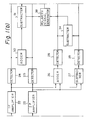
- FIG. 1 is a block diagram illustrating the arrangement of an embodiment of sea clutter suppression radar according to the present invention.
- 10 is a transmitter for sending pulsed radiowaves of a single frequency
- 11 is a circulator for transmitting the pulsed radiowaves in the direction of the arrow illustrated
- 12 is a polarization divider
- 13 is a circular polarizer for circularly polarized wave of a quarter-wave type including a dielectric plate mounted thereon, which is slated 45° to the left and upwardly when viewed from the direction of porpagation of the sent radiowaves
- 14 is an antenna
- 15 is a phase shifter
- 16 is a hybrid circuit for delivering to terminals 4 and 3 the vector sum of and vector difference between input signals at terminals 1 and 2
- 17 and 18 are limiters
- 19 and 20 are mixers
- 21 is a local oscillator
- 22 and 23 are intermediate frequency (IF) amplifiers
- 24, 25, 28, and 29 are detectors for effecting envelope detection for IF signals
- 26 is an
- the transmitter 10 generates pulsed radiowaves which are in turn sent, after passing through the circulator 11, to the polarization divider 12 as horizontally polarized radiowaves having a horizontal electric field component.
- the radiowaves pass through the polarization divider 12 without change, thus sent to the circular polarizer 13 as a horizontally polarized wave, whereby they are converted to a right-handed circularly polarized wave and radiated towards a target through the antenna 14.
- the reflected wave from a target, elliptically polarized in general, is received by the antenna 14 and sent to the circular polarizer 13.
- both polarized components undergo a phase change in the circular polariser 13.
- the polariser 13 produces a phase difference of 90° between electric field components thereof perpendicular and parallel to the dielectric plate disposed in the polarizer 13 after propagation along the length of the dielectic plate.
- horizontally and vertically polarized components ⁇ H and ⁇ V of the radiowaves output by the polarizer 13 are expressed respectively by: These two polarized components ⁇ H and ⁇ V are then separated by the polarization divider 12, and the horizontally polarized component ⁇ H is transmitted to the same terminal as the input terminal for the received radiowaves while the vertically polarized component F V transmitted to the other terminal.
- the horizontally polarized wave output ⁇ H from the polarization divider 12 is, after passage through the circulator 11, inputted into the terminal 2 of the hybrid circuit 16, while the vertically polarized wave output F V , after passage through the phase shifter 15 which produces a predetermined phase shift, is fed to the input terminals of the hybrid circuit 16.
- the predetermined phase shift produced by the phase shifter 15 to the vertically polarized wave makes the propagation phase difference between the horizontally and vertically polarized waves become 90° at the inputs to the hybrid circuit 16.
- the hybrid circuit 16 produces at terminals 4 and 3 sum and vector difference signals from the input signals to the terminals 1 and 2: are outputted. These two signals are, after passage through the limiters 17 and 18 respectively, converted to IF signals by the mixers 19 and 20, and, after amplification by the IF amplifiers 22 and 23, outputted as the IF signals.
- E1 F1e j ⁇ H
- E1 (>0) and E2 (>0) respectively express that the amplitudes E H and E V of the horizontally and vertically polarized components of the received radiowaves of these amplitudes E H and E V are changed mainly through the amplitude characteristics of the IF amplifiers 22 and 23.
- common terms of amplitudes and phases to both signals are omitted here.
- the detectors 24 and 25 output
- E1 and
- E2 respectively, while the detectors 28 and 29 outputting
- the amplitude Y of an output from the adder 37 is given by
- z ⁇ 1+r2+2rcos ⁇ ⁇ - ⁇ 1+r2-2rcos ⁇ ⁇ Fig.
- FIG. 2 illustrates the characteristics of y and z, wherein (a) shows a relationship between y and
- the amplitude Y of the output from the adder 37 has a substantially fixed relation with respect to a phase difference ⁇ associated with the difference between the phases ⁇ H and ⁇ V of the horizontally and vertically polarized components of the received radiowaves as y changes.
- the amplitude Z of the output from the subtracter 34 monotonously decreases or increases in the range 0 ⁇ ⁇ ⁇ 180 or -180 ⁇ ⁇ ⁇ 0 as Z changes.
- the subtracter 31 outputs E1+E2-
- Fig. 3 illustrates the arrangement of the polarity signal generator 38.
- designated at 100 is an input terminal for the output from the subtracter 31, 101 is an inverting amplifier with the gain 1; 102, 103, 104, 105, 106 and 107 are resistors; 108, 109, 110 and 111 are comparators, each outputting 1 when input voltage from the input terminal 112 is higher than voltage across the respective resistors 102 to 107 while outputting 0 in the opposite case; 112 is an input terminal for the output from the subtracter 34; 113, 114, 115 and 116 are NOT circuits; 117, 118 and 119 are AND circuits, 120 is an OR circuit, and 121 is an output terminal.
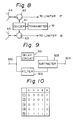
- Table 1 is a truth table when the outputs from the comparators 108, 109, 110 and 111 are a, b, c and d, and the output from the OR circuit 120 is e. Assuming here that the amplitude Z of the output from the subtracter 34 inputted to the input terminal 112 changes from a negative low level (
- Fig. 5 illustrates a relationship between the output e and the phase difference ⁇ with respect to the different amplitude ratios r estimated by setting the phase retardations of the resistors 102, 103, 104, 105, 106 and 107 to 0.075, 0.269, 0.156, 0.156, 0.269 and 0.075 and referring to the characteristics of Z-
- the output e is reversed at each substantially equal interval between the adjacent phase differences ⁇ .
- the mean level elimination circuit 43 is to remove a mean fraction (DC component) included in the reflected signal from the sea surface, the arrangement thereof being as illustrated in Fig. 9.
- Fig. 9 In Fig.
- 300 is an input terminal for the output from the adder 37; 301 is a delay circuit having the same delay time as that of a filter 302 for eliminating longer, in time, signals than a target signal; 303 is a subtracter for subtracting the output from the filter 302 from the output from the delay circuit 301; and 304 is an output terminal, an output from which is fed to the polarity conversion circuit 39.
- the delay circuit 44 having the same delay time as that of the mean level elimination circuit 43 serves to time an output from the polarity signal generator 38 with that from the mean level elimination circuit 43.
- the polarity conversion circuit 39 is arranged as illustrated in Fig. 4.
- designated at 200 is an output terminal for the output from the mean level elimination circuit 43;
- 201 is an inverting amplifier of the gain 1;
- 202 is a switch circuit, which is operated to be connected to the opposite side when a signal at the input terminal 204 is 0,
- 204 is an input terminal for the output from the delay circuit 44, and
- 203 is an output terminal.
- an output from the polarity conversion circuit 39 will be considered to illustrate its effect on the reflected signal from the sea surface, taking as an example a signal reflected from the sea surface when the amplitude ratio r and the phase difference ⁇ both at each pulse repetition period are changed as illustrated as Figs. 6(a) and 6(b).
- the amplitude Y of the output from the adder 37 remains substantially constant with respect to the phase difference ⁇ , and the change in its amplitude at each pulse repetition is reduced compared to the change in amplitude of E1 and E2 as illustrated for example in Fig. 6(c) because of a slow temporal change in the reflected signal from the sea surface.
- the output from the mean level elimination circuit 43 which is obtained by removing a mean fraction from the above output from the adder 37, is commensurately reduced in amplitude change, as illustrated for example in Fig. 6(d).
- the polarity of the output may be changed oppositely to that shown in Fig. 6(d) depending upon the magnitude of the mean fraction, but may be often unchanged within a sequence of pulses from the radar because of the slow temporal change of the reflected signal from the sea surface as described above. Since ⁇ ⁇ 1 in the present embodiment as evidenced from Fig. 6(a), the output characteristics of the polarity signal generator 38 is as illustrated in Fig. 5(a), and hence the output from the polarity conversion circuit 39 is as illustrated in Fig.
- the polarity conversion circuit 39 outputs a reverse polarity signal for each small signal group.
- the bipolar signal is fed to the integrator 40 and added to n signals at each pulse repetition, but when those n signals include bipolar signals, they cancel each other to cause the amplitude of the output from the integrator 40 to be reduced. That is, the signal reflected from the sea surface is suppressed.
- bipolar signals appear at the output of the integrator 40, they are fed to the unipolar circuit 41, by which they are converted to predetermined unipolar signals and delivered to the output terminal.
- the addition of the n signals in the integrator 40 causes, since the changes in the amplitudes themselves of the signals are small as in the previous description, adjacent small signal groups to cancel each other when n > m.
- the integrator 40 only one, at most, small signal group contributes to the output of the integrator 40 to assure the voltage of mV at the highest as the amplitude of the above output.
- a reflecting surface for radar radiowaves is structured as a solid.
- the amplitude ratio r and the phase difference ⁇ are made substantially unchanged during the hits of radar pulses, and also the output from the polarity conversion circuit 39 is made substantially constant in its amplitude and polarity.
- the output amplitude of the integrator 40 is thus n Vs.
- Vs is the target output amplitude of the polarity conversion circuit 39.
- the ratio of the target signal to the signal yielded by removing the mean fraction from the reflected signal from the sea surface substantially exceeds n m ⁇ Vs Vc .
- the improved ratio S/C by the integration in the video signal region is substantially above n/m proportional to the first power of the number of additions of the signal. That is, in the present invention, the improved ratio S/C is proportional to the first power of the number of additions, so that an increase of the addition number n assures a more effective improvement of the ratio S/C than in the prior method where the number of frequencies used is increased.
- the aforementioned number m of signals may be reduced so as to further improve the ratio S/C.
- Reflected radiowaves from the sea surface are frequently different in the amplitudes of both polarized waves thereof from each other so that the amplitude Y is reduced responsively to the amplitude ratio of both polarized waves, while reflected radiowaves from a general target sees no great difference between the amplitudes of both polarized waves so that the amplitude Y is not reduced in particular.
- the signal to clutter voltage ratio may be improved for the reflected signal from the sea surface.
- T is a period of the pulsed radiowaves.
- Fig. 7 illustrates another embodiment of the present invention wherein different portions from those shown in Fig. 1 are shown.
- designated at 50 is a 90° phase shifter for the IF signal
- 51 and 52 are IF amplifiers each for amplifying the voltage of the IF signal to double the same.
- the polarization divider 12 after receiving a signal outputs the two polarized components F V and F H as in the embodiment of Fig. 1. These signals are after passage through limiters 17 and 18, converted to IF signals by mixers 19 and 20, and amplified by IF amplifiers 22 and 23.
- the IF amplifier 22 outputs as an IF signal corresponding to and hence the phase shifter 50 outputs an IF signal 1 ⁇ 2( ⁇ 1 - ⁇ 2).
- the IF amplifier 23 outputs 1 ⁇ 2( ⁇ 1 + ⁇ 2) as a signal corresponding to ⁇ 1 and ⁇ 2 are here the same as those described before.
- ⁇ 1, ⁇ 2, ⁇ 1 + ⁇ 2, and ⁇ 1 - ⁇ 2 appear as IF signals at output terminals of an adder 26, a subtracter 27, an IF amplifier 51, and an IF amplifier 52, respectively.
- Those IF signals are the same as the IF signals inputted to the detectors 24, 25, 28, and 29 of the embodiment of Fig. 1, and hence the remaining operation of the present embodiment is the same as in the embodiment of Fig. 1.
- Fig. 8 illustrates a further embodiment of the present invention wherein different portions from those illustrated in Fig. 1 are shown.
- designated at 61 is a distributor
- 62 and 63 are circulators
- 64 and 65 are antennas, one for sending horizontally and vertically polarized radiowaves, the other for receiving the same.
- Pulsed radiowaves generated by a transmitter 10 of Fig. 8 are divided into two waves by the distributor 61, which are then transmitted to the circulators 62 and 63 and sent through the antennas as horizontally and vertically polarized radiowaves, respectively.
- a horizontally polarized component between reflected radiowaves from a target is received by the antenna 64 while a vertically polarized one received by the antenna 65, both components being then transmitted to the circulators 62 and 63.
- Horizontally and vertically polarized components of the received radiowaves transmitted from the circulators 62 and 63 are fed to the limiters 17 and 18. Operation thereafter is the same as in the embodiment of Fig. 1. Assuming here the amplitudes and phases of the horizontally and vertically polarized components of the received radiowaves in the embodiment of Fig.
- Fig. 1 may be modified such that the subtractors 35 and 36 are removed and the outputs from the detectors 28 and 29 are directly connected to the adder 37. But, the previous feature, in which for the amplitude of the output from the adder 37 that corresponding to one component having a smaller amplitude between both polarized components of the reflected radiowaves is assured differing from the amplitude Y described previously, is thereupon missed.
- the embodiment of Fig. 1 may be modified such that the mean level elimination circuit 43 and the delay circuit 44 are removed, and the outputs from the adder 37 and polarity signal generator 38 are directly fed to the polarity conversion circuit 39. But, the mean fraction included in the output from the adder 37 thereupon remains as it is, so that the amplitude of the output from the polarity conversion circuit 39 for a reflected signal from the sea surface is slightly increased.
- the embodiment of Fig. 1 may further be modified such that an A/D converter is inserted after the detectors 24, 25, 28 and 29 of Fig. 1, and outputs from the respective detectors are converted to digital signals to process all operation after that of Fig. 1 in a digital form.
Landscapes
- Engineering & Computer Science (AREA)
- Computer Networks & Wireless Communication (AREA)
- Physics & Mathematics (AREA)
- General Physics & Mathematics (AREA)
- Radar, Positioning & Navigation (AREA)
- Remote Sensing (AREA)
- Radar Systems Or Details Thereof (AREA)
Claims (10)
- Un radar avec atténuation du fouillis comprenant :
une structure d'antenne (14; 64, 65) pour émettre simultanément des ondes radioélectriques polarisées horizontalement et verticalement;
des premier et second détecteurs (24, 25) pour détecter respectivement des signaux FI des composantes polarisées horizontalement et verticalement d'ondes radioélectriques réfléchies; et
des troisième et quatrième détecteurs (26, 27) pour détecter respectivement des signaux FI de la somme vectorielle et de la différence vectorielle des composantes polarisées horizontalement et verticalement;
caractérisé par :
un générateur de signal de polarité (38) destiné à générer un signal de polarité basé sur un signal de sortie de différence entre un signal de sortie de somme des deux signaux de sortie des premier et second détecteurs (24, 25) et un signal de sortie de conversion unipolaire d'un signal de sortie de différence entre les deux signaux de sortie des premier et second détecteurs (24, 25), et sur un signal de sortie de différence entre les deux signaux de sortie des troisième et quatrième détecteurs (26, 27);
un circuit de conversion de polarité (39) pour convertir la polarité du signal de sortie qui est obtenue à partir du générateur de signal de polarité (38), sous la dépendance d'une somme des signaux de sortie des troisième et quatrième détecteurs; et
des moyens intégrateurs (40) pour intégrer le signal de sortie du circuit de conversion de polarité (39), pour fournir ainsi un signal de sortie dans lequel le fouillis de mer a tendance à être minimisé. - Un radar selon la revendication 1, comprenant un circuit d'élimination de niveau moyen (43) qui est destiné à éliminer une fraction moyenne de la somme des signaux de sortie des troisième et quatrième détecteurs (26, 27) pour l'application au circuit de conversion de polarité (39).
- Un radar selon la revendication 1 ou 2, comprenant un additionneur (30) pour produire le premier signal de sortie de somme des deux signaux de sortie des premier et second détecteurs (24, 25);
un premier soustracteur (33) pour produire le signal de sortie de différence entre les deux signaux de sortie des premier et second détecteurs (24, 25);
un circuit unipolaire (32) qui réagit au signal de sortie du premier soustracteur (33) en produisant le signal de sortie unipolaire;
un second soustracteur (31) pour produire un signal de sortie de différence entre le signal de sortie de l'additionneur (30) et celui du circuit unipolaire (32);
un troisième soustracteur (34) pour produire le signal de sortie de différence entre les deux signaux de sortie des troisième et quatrième détecteurs (26, 27);
dans lequel le générateur de signal de polarité (38) réagit aux signaux de sortie des second et troisième soustracteurs (31, 34) en produisant le signal de polarité. - Un radar selon la revendication 3, comprenant un additionneur supplémentaire (37) pour former la somme des signaux de sortie des troisième et quatrième détecteurs (26, 27).
- Un radar selon la revendication 4, comprenant des moyens soustracteurs (35, 36) pour soustraire le signal de sortie du circuit unipolaire (32) des signaux de sortie des troisième et quatrième détecteurs (26, 27), avant la sommation de ces derniers par l'additionneur supplémentaire (37).
- Un radar selon l'une quelconque des revendications précédentes, dans lequel la structure d'antenne comprend des première et seconde antennes (64, 65) qui sont respectivement destinées aux ondes radioélectriques polarisées horizontalement et verticalement.
- Un radar selon la revendication 2, dans lequel le circuit d'élimination de niveau moyen (43) comprend une entrée (300), un circuit de retard (301) connecté à l'entrée, un filtre (302) connecté à l'entrée, et un soustracteur pour soustraire le signal de sortie du filtre (302) du signal de sortie du circuit de retard (303).
- Un radar selon l'une quelconque des revendications précédentes, dans lequel le circuit de conversion de polarité (39) comprend une entrée (200) qui est destinée à recevoir un signal de sortie qui est obtenu à partir du générateur de signal de polarité (38), des moyens inverseurs (201) pour produire un signal inversé, une sortie (203), et des moyens de commutation (202) pour appliquer à la sortie (203) le signal présent sur l'entrée (200) ou le signal inversé provenant des moyens inverseurs (201), sous la dépendance de la valeur de la somme des signaux de sortie des troisième et quatrième détecteurs (26, 27).
- Un radar selon l'une quelconque des revendications précédentes, comprenant un circuit unipolaire (41) connecté à la sortie de l'intégrateur (40).
- Un radar selon la revendication 3, dans lequel le générateur de signal de polarité (38) comprend un diviseur de potentiel (102-107) qui est destiné à recevoir le signal de sortie du second soustracteur (31), un ensemble de comparateurs (108-111) ayant chacun une première entrée connectée à une prise respective du divineur de potentiel, et chaque comparateur ayant une seconde entrée qui est destinée à recevoir le signal de sortie du troisième soustracteur (34), et des moyens logiques (113-120) pour combiner de façon logique les signaux de sortie des comparateurs de façon à produire un signal à niveaux logiques qui est fonction des phases relatives des signaux de sortie des second et troisième circuits soustracteurs (31, 34).
Applications Claiming Priority (2)
| Application Number | Priority Date | Filing Date | Title |
|---|---|---|---|
| JP232965/87 | 1987-09-17 | ||
| JP62232965A JPH065273B2 (ja) | 1987-09-17 | 1987-09-17 | 海面反射信号抑圧レーダ |
Publications (3)
| Publication Number | Publication Date |
|---|---|
| EP0308229A2 EP0308229A2 (fr) | 1989-03-22 |
| EP0308229A3 EP0308229A3 (en) | 1989-05-24 |
| EP0308229B1 true EP0308229B1 (fr) | 1993-09-08 |
Family
ID=16947649
Family Applications (1)
| Application Number | Title | Priority Date | Filing Date |
|---|---|---|---|
| EP88308553A Expired - Lifetime EP0308229B1 (fr) | 1987-09-17 | 1988-09-16 | Radar de suppression des signaux de brouillage de la mer |
Country Status (4)
| Country | Link |
|---|---|
| US (1) | US4928131A (fr) |
| EP (1) | EP0308229B1 (fr) |
| JP (1) | JPH065273B2 (fr) |
| DE (1) | DE3883901T2 (fr) |
Families Citing this family (40)
| Publication number | Priority date | Publication date | Assignee | Title |
|---|---|---|---|---|
| US5546084A (en) * | 1992-07-17 | 1996-08-13 | Trw Inc. | Synthetic aperture radar clutter reduction system |
| US5689444A (en) * | 1995-06-07 | 1997-11-18 | The United States Of America, As Represented By The Secretary Of Commerce | Statistical quality control of wind profiler data |
| US5805106A (en) * | 1997-01-03 | 1998-09-08 | Trw Inc. | Dual polarization wave clutter reduction |
| US6652398B2 (en) * | 2001-08-27 | 2003-11-25 | Innercore Grip Company | Vibration dampening grip cover for the handle of an implement |
| US8203480B1 (en) | 2003-07-31 | 2012-06-19 | Rockwell Collins, Inc. | Predictive and adaptive weather radar detection system and method |
| US7808422B1 (en) | 2003-07-31 | 2010-10-05 | Rockwell Collins, Inc. | Predictive and adaptive weather radar detection system and method |
| US8902100B1 (en) | 2008-03-07 | 2014-12-02 | Rockwell Collins, Inc. | System and method for turbulence detection |
| RU2256938C1 (ru) * | 2004-01-26 | 2005-07-20 | Федеральное государственное унитарное предприятие "Государственное конструкторское бюро аппаратно-программных систем "Связь" (ФГУП "ГКБ "Связь") | Радиолокационное устройство |
| US7623064B2 (en) * | 2005-12-06 | 2009-11-24 | Arthur Robert Calderbank | Instantaneous radar polarimetry |
| US7683828B2 (en) * | 2006-07-12 | 2010-03-23 | Enterprise Electronics Corporation | System and method for measuring phase and power variance |
| US8258996B2 (en) * | 2007-05-08 | 2012-09-04 | The Johns Hopkins University | Synthetic aperture radar hybrid-quadrature-polarity method and architecture for obtaining the stokes parameters of radar backscatter |
| US7746267B2 (en) * | 2007-05-08 | 2010-06-29 | The Johns Hopkins University | Synthetic aperture radar hybrid-polarity method and architecture for obtaining the stokes parameters of a backscattered field |
| US7570202B2 (en) * | 2007-05-16 | 2009-08-04 | The Johns Hopkins University | Polarimetric selectivity method for suppressing cross-track clutter in sounding radars |
| EP2284950A1 (fr) | 2008-02-07 | 2011-02-16 | Saab Ab | Réseau d'antennes à large bande |
| EP2088449B1 (fr) | 2008-02-07 | 2012-06-06 | Saab Ab | Suppression de lobes latéraux |
| US9846230B1 (en) | 2013-03-15 | 2017-12-19 | Rockwell Collins, Inc. | System and method for ice detection |
| US9057773B1 (en) | 2012-12-06 | 2015-06-16 | Rockwell Collins, Inc. | Weather information display system and method |
| US9244167B1 (en) | 2008-03-07 | 2016-01-26 | Rockwell Collins, Inc. | Long range weather information display system and method |
| US9864055B1 (en) | 2014-03-12 | 2018-01-09 | Rockwell Collins, Inc. | Weather radar system and method for detecting a high altitude crystal cloud condition |
| US9244157B1 (en) | 2008-03-07 | 2016-01-26 | Rockwell Collins, Inc. | Weather radar threat depiction system and method |
| US9244166B1 (en) | 2008-03-07 | 2016-01-26 | Rockwell Collins, Inc. | System and method for ice detection |
| FR2938074B1 (fr) * | 2008-11-04 | 2010-12-24 | Thales Sa | Procede de traitement de profils verticaux mesures de la puissance des echos renvoyes suite a une emission de signaux radar. |
| JP2010197263A (ja) * | 2009-02-26 | 2010-09-09 | Furuno Electric Co Ltd | レーダ装置 |
| US9223020B1 (en) | 2010-09-28 | 2015-12-29 | Rockwell Collins, Inc. | System and method for weather detection using more than one source of radar data |
| WO2012067557A1 (fr) * | 2010-11-19 | 2012-05-24 | Saab Ab | Procédé et système radar pour suppression de brouilleur répéteur et de fouillis |
| US9823347B1 (en) | 2014-03-12 | 2017-11-21 | Rockwell Collins, Inc. | Weather radar system and method for high altitude crystal warning interface |
| US9019146B1 (en) | 2011-09-27 | 2015-04-28 | Rockwell Collins, Inc. | Aviation display depiction of weather threats |
| KR101351793B1 (ko) * | 2011-10-24 | 2014-01-17 | 대한민국 | 해상풍 탐지시스템 및 이를 이용한 해상풍 탐지방법 |
| US9116244B1 (en) | 2013-02-28 | 2015-08-25 | Rockwell Collins, Inc. | System for and method of weather phenomenon detection using multiple beams |
| US9599707B1 (en) | 2014-01-23 | 2017-03-21 | Rockwell Collins, Inc. | Weather radar system and method with path attenuation shadowing |
| US9535158B1 (en) | 2013-11-21 | 2017-01-03 | Rockwell Collins, Inc. | Weather radar system and method with fusion of multiple weather information sources |
| US9810770B1 (en) | 2014-07-03 | 2017-11-07 | Rockwell Collins, Inc. | Efficient retrieval of aviation data and weather over low bandwidth links |
| US9869766B1 (en) | 2015-01-28 | 2018-01-16 | Rockwell Collins, Inc. | Enhancement of airborne weather radar performance using external weather data |
| US10809375B1 (en) | 2015-09-14 | 2020-10-20 | Rockwell Collins, Inc. | Radar system and method for detecting hazards associated with particles or bodies |
| US10302815B1 (en) | 2015-10-01 | 2019-05-28 | Rockwell Collins, Inc. | System and method of integrating global convective weather |
| US12250980B2 (en) | 2015-12-18 | 2025-03-18 | Matscitechno Licensing Company | Apparatuses, systems and methods for equipment for protecting the human body by absorbing and dissipating forces imparted to the body |
| US11864599B2 (en) | 2015-12-18 | 2024-01-09 | Matscitechno Licensing Company | Apparatuses, systems and methods for equipment for protecting the human body by absorbing and dissipating forces imparted to the body |
| US10494108B1 (en) | 2016-05-17 | 2019-12-03 | Rockwell Collins, Inc. | System and method for providing icing condition warnings |
| WO2018098234A1 (fr) * | 2016-11-22 | 2018-05-31 | Massachusetts Institute Of Technology | Système et technique d'atténuation de fouillis radar |
| KR102845980B1 (ko) * | 2019-08-20 | 2025-08-12 | 삼성전자주식회사 | 라이다 장치 및 그 동작 방법 |
Family Cites Families (18)
| Publication number | Priority date | Publication date | Assignee | Title |
|---|---|---|---|---|
| US205A (en) * | 1837-05-30 | Stove-radiator | ||
| US3755810A (en) * | 1957-02-27 | 1973-08-28 | Sperry Rand Corp | Duochromatic indicator for a diversity polarization receiver |
| JPS498196A (fr) * | 1972-05-10 | 1974-01-24 | ||
| US3952305A (en) * | 1972-05-10 | 1976-04-20 | Kabushiki Kaisha Tokyo Keiki | Marine radar transmission and reception system |
| US4008472A (en) * | 1972-05-10 | 1977-02-15 | Kabushiki Kaisha Tokyo Keikio | Marine radar transmission and reception system |
| US3955196A (en) * | 1972-05-10 | 1976-05-04 | Kabushikikaisha Tokyo Keiki | Marine radar transmission and reception system |
| JPS5433517B2 (fr) * | 1972-07-14 | 1979-10-20 | ||
| JPS5156194A (ja) * | 1974-11-12 | 1976-05-17 | Mitsubishi Electric Corp | Kuratsutayokuatsureeda |
| US4053882A (en) * | 1976-02-23 | 1977-10-11 | The United States Of America As Represented By The Secretary Of The Air Force | Polarization radar method and system |
| US4231037A (en) * | 1978-02-23 | 1980-10-28 | Long Maurice W | Radar clutter suppressor |
| GB1604071A (en) * | 1977-05-16 | 1981-12-02 | Long M W | Radar system with clutter suppressor |
| JPS5533655A (en) * | 1978-08-31 | 1980-03-08 | Nec Corp | Target detector |
| NL7901028A (nl) * | 1979-02-09 | 1980-08-12 | Hollandse Signaalapparaten Bv | Videoextractor. |
| JPS5858632A (ja) * | 1981-10-01 | 1983-04-07 | Sharp Corp | I/oインタ−フエ−スの制御方法 |
| USH205H (en) | 1984-02-09 | 1987-02-03 | Wide bandwidth radar having improved signal to clutter response characteristics | |
| JPH0619471B2 (ja) * | 1984-03-30 | 1994-03-16 | 株式会社日立製作所 | 地中物体の識別方法および装置 |
| US4737788A (en) * | 1985-04-04 | 1988-04-12 | Motorola, Inc. | Helicopter obstacle detector |
| US4766435A (en) * | 1986-05-27 | 1988-08-23 | Hughes Aircraft Company | Adaptive radar for reducing background clutter |
-
1987
- 1987-09-17 JP JP62232965A patent/JPH065273B2/ja not_active Expired - Lifetime
-
1988
- 1988-09-07 US US07/241,236 patent/US4928131A/en not_active Expired - Lifetime
- 1988-09-16 EP EP88308553A patent/EP0308229B1/fr not_active Expired - Lifetime
- 1988-09-16 DE DE88308553T patent/DE3883901T2/de not_active Expired - Fee Related
Also Published As
| Publication number | Publication date |
|---|---|
| DE3883901D1 (de) | 1993-10-14 |
| EP0308229A3 (en) | 1989-05-24 |
| JPH065273B2 (ja) | 1994-01-19 |
| JPS6474480A (en) | 1989-03-20 |
| US4928131A (en) | 1990-05-22 |
| DE3883901T2 (de) | 1994-03-24 |
| EP0308229A2 (fr) | 1989-03-22 |
Similar Documents
| Publication | Publication Date | Title |
|---|---|---|
| EP0308229B1 (fr) | Radar de suppression des signaux de brouillage de la mer | |
| US5784026A (en) | Radar detection of accelerating airborne targets | |
| US4219812A (en) | Range-gated pulse doppler radar system | |
| US4086592A (en) | Digital sidelobe canceller | |
| US4132990A (en) | Amti target/clutter discriminator | |
| US5229775A (en) | Digital pulse compression apparatus | |
| US3993994A (en) | Adaptive clutter cancellation for synthetic aperture AMTI radar | |
| EP0065499B1 (fr) | Polarisation adaptive pour l'élimination de l'interférence intentionelle dans un système radar | |
| US4489392A (en) | Orthogonalizer for inphase and quadrature digital data | |
| EP0928427B1 (fr) | Systemes radar | |
| US4394658A (en) | Adaptive MTI clutter tracker-canceller method and apparatus | |
| JPH0672920B2 (ja) | レーダ装置 | |
| US4119963A (en) | Coherent side-lobe suppressing unit for a pulse radar apparatus | |
| US4489320A (en) | Interference suppressor for radar MTI | |
| US3879729A (en) | Moving target indicator with minimum clutter interference | |
| US3618093A (en) | Obstacle detection radar system | |
| US5289188A (en) | High resolution radar system for high speed and satellite vehicles | |
| JPS6349193B2 (fr) | ||
| US4914442A (en) | Adaptive MTI target preservation | |
| US5402130A (en) | Monopulse processor | |
| US3740748A (en) | Electronic image cancellation for doppler receivers | |
| US4308535A (en) | Process and system for the visual display of moving targets | |
| US4139850A (en) | Arrangement for detecting the presence of radar echos in a pulsed radar system | |
| US4390881A (en) | Real-data digital-real-weight canceler | |
| GB2083725A (en) | Radar apparatus |
Legal Events
| Date | Code | Title | Description |
|---|---|---|---|
| PUAI | Public reference made under article 153(3) epc to a published international application that has entered the european phase |
Free format text: ORIGINAL CODE: 0009012 |
|
| AK | Designated contracting states |
Kind code of ref document: A2 Designated state(s): DE FR GB NL |
|
| PUAL | Search report despatched |
Free format text: ORIGINAL CODE: 0009013 |
|
| AK | Designated contracting states |
Kind code of ref document: A3 Designated state(s): DE FR GB NL |
|
| 17P | Request for examination filed |
Effective date: 19891011 |
|
| 17Q | First examination report despatched |
Effective date: 19920629 |
|
| GRAA | (expected) grant |
Free format text: ORIGINAL CODE: 0009210 |
|
| AK | Designated contracting states |
Kind code of ref document: B1 Designated state(s): DE FR GB NL |
|
| REF | Corresponds to: |
Ref document number: 3883901 Country of ref document: DE Date of ref document: 19931014 |
|
| ET | Fr: translation filed | ||
| PLBE | No opposition filed within time limit |
Free format text: ORIGINAL CODE: 0009261 |
|
| STAA | Information on the status of an ep patent application or granted ep patent |
Free format text: STATUS: NO OPPOSITION FILED WITHIN TIME LIMIT |
|
| 26N | No opposition filed | ||
| PGFP | Annual fee paid to national office [announced via postgrant information from national office to epo] |
Ref country code: FR Payment date: 19980909 Year of fee payment: 11 |
|
| PGFP | Annual fee paid to national office [announced via postgrant information from national office to epo] |
Ref country code: DE Payment date: 19980925 Year of fee payment: 11 |
|
| PGFP | Annual fee paid to national office [announced via postgrant information from national office to epo] |
Ref country code: NL Payment date: 19980929 Year of fee payment: 11 |
|
| PGFP | Annual fee paid to national office [announced via postgrant information from national office to epo] |
Ref country code: GB Payment date: 19981001 Year of fee payment: 11 |
|
| PG25 | Lapsed in a contracting state [announced via postgrant information from national office to epo] |
Ref country code: GB Free format text: LAPSE BECAUSE OF NON-PAYMENT OF DUE FEES Effective date: 19990916 |
|
| PG25 | Lapsed in a contracting state [announced via postgrant information from national office to epo] |
Ref country code: NL Free format text: LAPSE BECAUSE OF NON-PAYMENT OF DUE FEES Effective date: 20000401 |
|
| GBPC | Gb: european patent ceased through non-payment of renewal fee |
Effective date: 19990916 |
|
| PG25 | Lapsed in a contracting state [announced via postgrant information from national office to epo] |
Ref country code: FR Free format text: LAPSE BECAUSE OF NON-PAYMENT OF DUE FEES Effective date: 20000531 |
|
| NLV4 | Nl: lapsed or anulled due to non-payment of the annual fee |
Effective date: 20000401 |
|
| PG25 | Lapsed in a contracting state [announced via postgrant information from national office to epo] |
Ref country code: DE Free format text: LAPSE BECAUSE OF NON-PAYMENT OF DUE FEES Effective date: 20000701 |
|
| REG | Reference to a national code |
Ref country code: FR Ref legal event code: ST |