EP0313483A1 - Agent de broyage de la chaux en vue d'en augmenter la réactivité - Google Patents
Agent de broyage de la chaux en vue d'en augmenter la réactivité Download PDFInfo
- Publication number
- EP0313483A1 EP0313483A1 EP88420357A EP88420357A EP0313483A1 EP 0313483 A1 EP0313483 A1 EP 0313483A1 EP 88420357 A EP88420357 A EP 88420357A EP 88420357 A EP88420357 A EP 88420357A EP 0313483 A1 EP0313483 A1 EP 0313483A1
- Authority
- EP
- European Patent Office
- Prior art keywords
- grinding
- lime
- agent
- refined
- suspension
- Prior art date
- Legal status (The legal status is an assumption and is not a legal conclusion. Google has not performed a legal analysis and makes no representation as to the accuracy of the status listed.)
- Granted
Links
- 238000000227 grinding Methods 0.000 title claims abstract description 139
- 239000004571 lime Substances 0.000 title claims abstract description 96
- 235000008733 Citrus aurantifolia Nutrition 0.000 title claims abstract description 95
- 235000011941 Tilia x europaea Nutrition 0.000 title claims abstract description 95
- 230000009257 reactivity Effects 0.000 title claims abstract description 10
- 239000003795 chemical substances by application Substances 0.000 claims abstract description 111
- 239000002245 particle Substances 0.000 claims abstract description 35
- 229920001577 copolymer Polymers 0.000 claims abstract description 30
- 239000007900 aqueous suspension Substances 0.000 claims abstract description 23
- 239000012736 aqueous medium Substances 0.000 claims abstract description 22
- 229920000642 polymer Polymers 0.000 claims abstract description 22
- 239000000178 monomer Substances 0.000 claims abstract description 18
- 230000002378 acidificating effect Effects 0.000 claims abstract description 5
- 229920001038 ethylene copolymer Polymers 0.000 claims abstract description 4
- 229920000573 polyethylene Polymers 0.000 claims abstract description 4
- 239000000725 suspension Substances 0.000 claims description 68
- NIXOWILDQLNWCW-UHFFFAOYSA-N acrylic acid group Chemical group C(C=C)(=O)O NIXOWILDQLNWCW-UHFFFAOYSA-N 0.000 claims description 11
- 238000000034 method Methods 0.000 claims description 11
- 230000003472 neutralizing effect Effects 0.000 claims description 11
- SMZOUWXMTYCWNB-UHFFFAOYSA-N 2-(2-methoxy-5-methylphenyl)ethanamine Chemical compound COC1=CC=C(C)C=C1CCN SMZOUWXMTYCWNB-UHFFFAOYSA-N 0.000 claims description 10
- DNIAPMSPPWPWGF-UHFFFAOYSA-N Propylene glycol Chemical compound CC(O)CO DNIAPMSPPWPWGF-UHFFFAOYSA-N 0.000 claims description 9
- 239000002609 medium Substances 0.000 claims description 7
- 238000002360 preparation method Methods 0.000 claims description 7
- -1 quaternized or not Chemical class 0.000 claims description 7
- 238000003756 stirring Methods 0.000 claims description 7
- 239000000126 substance Substances 0.000 claims description 7
- ZWEHNKRNPOVVGH-UHFFFAOYSA-N 2-Butanone Chemical compound CCC(C)=O ZWEHNKRNPOVVGH-UHFFFAOYSA-N 0.000 claims description 6
- CSCPPACGZOOCGX-UHFFFAOYSA-N Acetone Chemical compound CC(C)=O CSCPPACGZOOCGX-UHFFFAOYSA-N 0.000 claims description 6
- UHOVQNZJYSORNB-UHFFFAOYSA-N Benzene Chemical compound C1=CC=CC=C1 UHOVQNZJYSORNB-UHFFFAOYSA-N 0.000 claims description 6
- YMWUJEATGCHHMB-UHFFFAOYSA-N Dichloromethane Chemical compound ClCCl YMWUJEATGCHHMB-UHFFFAOYSA-N 0.000 claims description 6
- LYCAIKOWRPUZTN-UHFFFAOYSA-N Ethylene glycol Chemical compound OCCO LYCAIKOWRPUZTN-UHFFFAOYSA-N 0.000 claims description 6
- OKKJLVBELUTLKV-UHFFFAOYSA-N Methanol Chemical compound OC OKKJLVBELUTLKV-UHFFFAOYSA-N 0.000 claims description 6
- ZMXDDKWLCZADIW-UHFFFAOYSA-N N,N-Dimethylformamide Chemical compound CN(C)C=O ZMXDDKWLCZADIW-UHFFFAOYSA-N 0.000 claims description 6
- YXFVVABEGXRONW-UHFFFAOYSA-N Toluene Chemical compound CC1=CC=CC=C1 YXFVVABEGXRONW-UHFFFAOYSA-N 0.000 claims description 6
- 239000002253 acid Substances 0.000 claims description 6
- MTHSVFCYNBDYFN-UHFFFAOYSA-N diethylene glycol Chemical compound OCCOCCO MTHSVFCYNBDYFN-UHFFFAOYSA-N 0.000 claims description 6
- VLKZOEOYAKHREP-UHFFFAOYSA-N n-Hexane Chemical compound CCCCCC VLKZOEOYAKHREP-UHFFFAOYSA-N 0.000 claims description 6
- 238000006116 polymerization reaction Methods 0.000 claims description 6
- XLYOFNOQVPJJNP-UHFFFAOYSA-N water Substances O XLYOFNOQVPJJNP-UHFFFAOYSA-N 0.000 claims description 6
- CERQOIWHTDAKMF-UHFFFAOYSA-N Methacrylic acid Chemical compound CC(=C)C(O)=O CERQOIWHTDAKMF-UHFFFAOYSA-N 0.000 claims description 5
- PMNLUUOXGOOLSP-UHFFFAOYSA-N 2-mercaptopropanoic acid Chemical compound CC(S)C(O)=O PMNLUUOXGOOLSP-UHFFFAOYSA-N 0.000 claims description 4
- HGINCPLSRVDWNT-UHFFFAOYSA-N Acrolein Chemical compound C=CC=O HGINCPLSRVDWNT-UHFFFAOYSA-N 0.000 claims description 4
- OYPRJOBELJOOCE-UHFFFAOYSA-N Calcium Chemical compound [Ca] OYPRJOBELJOOCE-UHFFFAOYSA-N 0.000 claims description 4
- HEDRZPFGACZZDS-UHFFFAOYSA-N Chloroform Chemical compound ClC(Cl)Cl HEDRZPFGACZZDS-UHFFFAOYSA-N 0.000 claims description 4
- IAZDPXIOMUYVGZ-UHFFFAOYSA-N Dimethylsulphoxide Chemical compound CS(C)=O IAZDPXIOMUYVGZ-UHFFFAOYSA-N 0.000 claims description 4
- LFQSCWFLJHTTHZ-UHFFFAOYSA-N Ethanol Chemical compound CCO LFQSCWFLJHTTHZ-UHFFFAOYSA-N 0.000 claims description 4
- YNQLUTRBYVCPMQ-UHFFFAOYSA-N Ethylbenzene Chemical compound CCC1=CC=CC=C1 YNQLUTRBYVCPMQ-UHFFFAOYSA-N 0.000 claims description 4
- DGAQECJNVWCQMB-PUAWFVPOSA-M Ilexoside XXIX Chemical compound C[C@@H]1CC[C@@]2(CC[C@@]3(C(=CC[C@H]4[C@]3(CC[C@@H]5[C@@]4(CC[C@@H](C5(C)C)OS(=O)(=O)[O-])C)C)[C@@H]2[C@]1(C)O)C)C(=O)O[C@H]6[C@@H]([C@H]([C@@H]([C@H](O6)CO)O)O)O.[Na+] DGAQECJNVWCQMB-PUAWFVPOSA-M 0.000 claims description 4
- KFZMGEQAYNKOFK-UHFFFAOYSA-N Isopropanol Chemical compound CC(C)O KFZMGEQAYNKOFK-UHFFFAOYSA-N 0.000 claims description 4
- IMNFDUFMRHMDMM-UHFFFAOYSA-N N-Heptane Chemical compound CCCCCCC IMNFDUFMRHMDMM-UHFFFAOYSA-N 0.000 claims description 4
- PPBRXRYQALVLMV-UHFFFAOYSA-N Styrene Chemical compound C=CC1=CC=CC=C1 PPBRXRYQALVLMV-UHFFFAOYSA-N 0.000 claims description 4
- WYURNTSHIVDZCO-UHFFFAOYSA-N Tetrahydrofuran Chemical compound C1CCOC1 WYURNTSHIVDZCO-UHFFFAOYSA-N 0.000 claims description 4
- 150000001252 acrylic acid derivatives Chemical class 0.000 claims description 4
- 239000011149 active material Substances 0.000 claims description 4
- FUSUHKVFWTUUBE-UHFFFAOYSA-N buten-2-one Chemical compound CC(=O)C=C FUSUHKVFWTUUBE-UHFFFAOYSA-N 0.000 claims description 4
- 239000011575 calcium Substances 0.000 claims description 4
- 229910052791 calcium Inorganic materials 0.000 claims description 4
- 150000002148 esters Chemical class 0.000 claims description 4
- 150000002734 metacrylic acid derivatives Chemical class 0.000 claims description 4
- 125000005395 methacrylic acid group Chemical class 0.000 claims description 4
- 239000011734 sodium Substances 0.000 claims description 4
- 239000002904 solvent Substances 0.000 claims description 4
- VZGDMQKNWNREIO-UHFFFAOYSA-N tetrachloromethane Chemical compound ClC(Cl)(Cl)Cl VZGDMQKNWNREIO-UHFFFAOYSA-N 0.000 claims description 4
- CWERGRDVMFNCDR-UHFFFAOYSA-N thioglycolic acid Chemical compound OC(=O)CS CWERGRDVMFNCDR-UHFFFAOYSA-N 0.000 claims description 4
- JKNCOURZONDCGV-UHFFFAOYSA-N 2-(dimethylamino)ethyl 2-methylprop-2-enoate Chemical compound CN(C)CCOC(=O)C(C)=C JKNCOURZONDCGV-UHFFFAOYSA-N 0.000 claims description 3
- HRPVXLWXLXDGHG-UHFFFAOYSA-N Acrylamide Chemical compound NC(=O)C=C HRPVXLWXLXDGHG-UHFFFAOYSA-N 0.000 claims description 3
- QGZKDVFQNNGYKY-UHFFFAOYSA-O Ammonium Chemical compound [NH4+] QGZKDVFQNNGYKY-UHFFFAOYSA-O 0.000 claims description 3
- WHXSMMKQMYFTQS-UHFFFAOYSA-N Lithium Chemical compound [Li] WHXSMMKQMYFTQS-UHFFFAOYSA-N 0.000 claims description 3
- 239000004599 antimicrobial Substances 0.000 claims description 3
- 238000007334 copolymerization reaction Methods 0.000 claims description 3
- 229910052744 lithium Inorganic materials 0.000 claims description 3
- 238000004519 manufacturing process Methods 0.000 claims description 3
- 238000006386 neutralization reaction Methods 0.000 claims description 3
- 229910052708 sodium Inorganic materials 0.000 claims description 3
- FXNDIJDIPNCZQJ-UHFFFAOYSA-N 2,4,4-trimethylpent-1-ene Chemical group CC(=C)CC(C)(C)C FXNDIJDIPNCZQJ-UHFFFAOYSA-N 0.000 claims description 2
- MXRGSJAOLKBZLU-UHFFFAOYSA-N 3-ethenylazepan-2-one Chemical compound C=CC1CCCCNC1=O MXRGSJAOLKBZLU-UHFFFAOYSA-N 0.000 claims description 2
- NLHHRLWOUZZQLW-UHFFFAOYSA-N Acrylonitrile Chemical compound C=CC#N NLHHRLWOUZZQLW-UHFFFAOYSA-N 0.000 claims description 2
- DKPFZGUDAPQIHT-UHFFFAOYSA-N Butyl acetate Natural products CCCCOC(C)=O DKPFZGUDAPQIHT-UHFFFAOYSA-N 0.000 claims description 2
- FYYHWMGAXLPEAU-UHFFFAOYSA-N Magnesium Chemical compound [Mg] FYYHWMGAXLPEAU-UHFFFAOYSA-N 0.000 claims description 2
- LRHPLDYGYMQRHN-UHFFFAOYSA-N N-Butanol Chemical class CCCCO LRHPLDYGYMQRHN-UHFFFAOYSA-N 0.000 claims description 2
- CTQNGGLPUBDAKN-UHFFFAOYSA-N O-Xylene Chemical compound CC1=CC=CC=C1C CTQNGGLPUBDAKN-UHFFFAOYSA-N 0.000 claims description 2
- ZLMJMSJWJFRBEC-UHFFFAOYSA-N Potassium Chemical compound [K] ZLMJMSJWJFRBEC-UHFFFAOYSA-N 0.000 claims description 2
- XTXRWKRVRITETP-UHFFFAOYSA-N Vinyl acetate Chemical compound CC(=O)OC=C XTXRWKRVRITETP-UHFFFAOYSA-N 0.000 claims description 2
- BZHJMEDXRYGGRV-UHFFFAOYSA-N Vinyl chloride Chemical class ClC=C BZHJMEDXRYGGRV-UHFFFAOYSA-N 0.000 claims description 2
- HCHKCACWOHOZIP-UHFFFAOYSA-N Zinc Chemical compound [Zn] HCHKCACWOHOZIP-UHFFFAOYSA-N 0.000 claims description 2
- 230000001476 alcoholic effect Effects 0.000 claims description 2
- 125000001931 aliphatic group Chemical group 0.000 claims description 2
- XYLMUPLGERFSHI-UHFFFAOYSA-N alpha-Methylstyrene Chemical compound CC(=C)C1=CC=CC=C1 XYLMUPLGERFSHI-UHFFFAOYSA-N 0.000 claims description 2
- 229910052782 aluminium Inorganic materials 0.000 claims description 2
- XAGFODPZIPBFFR-UHFFFAOYSA-N aluminium Chemical compound [Al] XAGFODPZIPBFFR-UHFFFAOYSA-N 0.000 claims description 2
- 150000001412 amines Chemical class 0.000 claims description 2
- UIERETOOQGIECD-ARJAWSKDSA-N angelic acid group Chemical group C(\C(\C)=C/C)(=O)O UIERETOOQGIECD-ARJAWSKDSA-N 0.000 claims description 2
- 239000008346 aqueous phase Substances 0.000 claims description 2
- 125000003118 aryl group Chemical group 0.000 claims description 2
- WNAHIZMDSQCWRP-UHFFFAOYSA-N dodecane-1-thiol Chemical compound CCCCCCCCCCCCS WNAHIZMDSQCWRP-UHFFFAOYSA-N 0.000 claims description 2
- DNJIEGIFACGWOD-UHFFFAOYSA-N ethyl mercaptane Natural products CCS DNJIEGIFACGWOD-UHFFFAOYSA-N 0.000 claims description 2
- 239000012530 fluid Substances 0.000 claims description 2
- 239000003517 fume Substances 0.000 claims description 2
- FUZZWVXGSFPDMH-UHFFFAOYSA-N hexanoic acid Chemical compound CCCCCC(O)=O FUZZWVXGSFPDMH-UHFFFAOYSA-N 0.000 claims description 2
- 150000002460 imidazoles Chemical class 0.000 claims description 2
- 239000003999 initiator Substances 0.000 claims description 2
- 239000011777 magnesium Substances 0.000 claims description 2
- 229910052749 magnesium Inorganic materials 0.000 claims description 2
- FPYJFEHAWHCUMM-UHFFFAOYSA-N maleic anhydride Chemical compound O=C1OC(=O)C=C1 FPYJFEHAWHCUMM-UHFFFAOYSA-N 0.000 claims description 2
- 229910052700 potassium Inorganic materials 0.000 claims description 2
- 239000011591 potassium Substances 0.000 claims description 2
- BDERNNFJNOPAEC-UHFFFAOYSA-N propan-1-ol Chemical compound CCCO BDERNNFJNOPAEC-UHFFFAOYSA-N 0.000 claims description 2
- YLQBMQCUIZJEEH-UHFFFAOYSA-N tetrahydrofuran Natural products C=1C=COC=1 YLQBMQCUIZJEEH-UHFFFAOYSA-N 0.000 claims description 2
- YODZTKMDCQEPHD-UHFFFAOYSA-N thiodiglycol Chemical compound OCCSCCO YODZTKMDCQEPHD-UHFFFAOYSA-N 0.000 claims description 2
- 239000008096 xylene Substances 0.000 claims description 2
- 229910052725 zinc Inorganic materials 0.000 claims description 2
- 239000011701 zinc Substances 0.000 claims description 2
- DGVVWUTYPXICAM-UHFFFAOYSA-N β‐Mercaptoethanol Chemical compound OCCS DGVVWUTYPXICAM-UHFFFAOYSA-N 0.000 claims description 2
- XEKOWRVHYACXOJ-UHFFFAOYSA-N Ethyl acetate Chemical compound CCOC(C)=O XEKOWRVHYACXOJ-UHFFFAOYSA-N 0.000 claims 3
- VZCYOOQTPOCHFL-OWOJBTEDSA-N Fumaric acid Chemical compound OC(=O)\C=C\C(O)=O VZCYOOQTPOCHFL-OWOJBTEDSA-N 0.000 claims 2
- 241000282326 Felis catus Species 0.000 claims 1
- 229910052783 alkali metal Inorganic materials 0.000 claims 1
- 150000001340 alkali metals Chemical class 0.000 claims 1
- 239000001530 fumaric acid Substances 0.000 claims 1
- 239000008235 industrial water Substances 0.000 claims 1
- 239000012756 surface treatment agent Substances 0.000 claims 1
- VZCYOOQTPOCHFL-UHFFFAOYSA-N trans-butenedioic acid Natural products OC(=O)C=CC(O)=O VZCYOOQTPOCHFL-UHFFFAOYSA-N 0.000 claims 1
- 229920001519 homopolymer Polymers 0.000 description 10
- 239000002270 dispersing agent Substances 0.000 description 9
- VTYYLEPIZMXCLO-UHFFFAOYSA-L Calcium carbonate Chemical compound [Ca+2].[O-]C([O-])=O VTYYLEPIZMXCLO-UHFFFAOYSA-L 0.000 description 8
- 229910052500 inorganic mineral Inorganic materials 0.000 description 6
- 239000011707 mineral Substances 0.000 description 6
- 235000010755 mineral Nutrition 0.000 description 6
- 229910001415 sodium ion Inorganic materials 0.000 description 6
- FKNQFGJONOIPTF-UHFFFAOYSA-N Sodium cation Chemical compound [Na+] FKNQFGJONOIPTF-UHFFFAOYSA-N 0.000 description 5
- 229910000019 calcium carbonate Inorganic materials 0.000 description 4
- 239000000463 material Substances 0.000 description 4
- 230000000903 blocking effect Effects 0.000 description 3
- AXCZMVOFGPJBDE-UHFFFAOYSA-L calcium dihydroxide Chemical compound [OH-].[OH-].[Ca+2] AXCZMVOFGPJBDE-UHFFFAOYSA-L 0.000 description 3
- 239000000920 calcium hydroxide Substances 0.000 description 3
- 229910001861 calcium hydroxide Inorganic materials 0.000 description 3
- 235000011116 calcium hydroxide Nutrition 0.000 description 3
- 229920001495 poly(sodium acrylate) polymer Polymers 0.000 description 3
- 238000000926 separation method Methods 0.000 description 3
- NNMHYFLPFNGQFZ-UHFFFAOYSA-M sodium polyacrylate Chemical compound [Na+].[O-]C(=O)C=C NNMHYFLPFNGQFZ-UHFFFAOYSA-M 0.000 description 3
- 229920002134 Carboxymethyl cellulose Polymers 0.000 description 2
- VGGSQFUCUMXWEO-UHFFFAOYSA-N Ethene Chemical compound C=C VGGSQFUCUMXWEO-UHFFFAOYSA-N 0.000 description 2
- 239000005977 Ethylene Substances 0.000 description 2
- 229920001732 Lignosulfonate Polymers 0.000 description 2
- 239000007864 aqueous solution Substances 0.000 description 2
- 230000015572 biosynthetic process Effects 0.000 description 2
- 235000010948 carboxy methyl cellulose Nutrition 0.000 description 2
- 239000011362 coarse particle Substances 0.000 description 2
- 229910052593 corundum Inorganic materials 0.000 description 2
- 239000010431 corundum Substances 0.000 description 2
- 238000009837 dry grinding Methods 0.000 description 2
- 238000005189 flocculation Methods 0.000 description 2
- 230000016615 flocculation Effects 0.000 description 2
- 239000000203 mixture Substances 0.000 description 2
- 239000012071 phase Substances 0.000 description 2
- 239000000049 pigment Substances 0.000 description 2
- 239000000843 powder Substances 0.000 description 2
- 238000007670 refining Methods 0.000 description 2
- 238000000518 rheometry Methods 0.000 description 2
- 238000001238 wet grinding Methods 0.000 description 2
- 229920002126 Acrylic acid copolymer Polymers 0.000 description 1
- 208000031968 Cadaver Diseases 0.000 description 1
- BHPQYMZQTOCNFJ-UHFFFAOYSA-N Calcium cation Chemical compound [Ca+2] BHPQYMZQTOCNFJ-UHFFFAOYSA-N 0.000 description 1
- BVKZGUZCCUSVTD-UHFFFAOYSA-L Carbonate Chemical compound [O-]C([O-])=O BVKZGUZCCUSVTD-UHFFFAOYSA-L 0.000 description 1
- VVQNEPGJFQJSBK-UHFFFAOYSA-N Methyl methacrylate Chemical compound COC(=O)C(C)=C VVQNEPGJFQJSBK-UHFFFAOYSA-N 0.000 description 1
- 229910019142 PO4 Inorganic materials 0.000 description 1
- 229920000388 Polyphosphate Polymers 0.000 description 1
- 229920002125 Sokalan® Polymers 0.000 description 1
- 150000001253 acrylic acids Chemical class 0.000 description 1
- 239000000654 additive Substances 0.000 description 1
- 230000000996 additive effect Effects 0.000 description 1
- 238000013019 agitation Methods 0.000 description 1
- 229910001854 alkali hydroxide Inorganic materials 0.000 description 1
- 150000008044 alkali metal hydroxides Chemical class 0.000 description 1
- CQEYYJKEWSMYFG-UHFFFAOYSA-N butyl acrylate Chemical compound CCCCOC(=O)C=C CQEYYJKEWSMYFG-UHFFFAOYSA-N 0.000 description 1
- 238000001354 calcination Methods 0.000 description 1
- 229910001424 calcium ion Inorganic materials 0.000 description 1
- OOCMUZJPDXYRFD-UHFFFAOYSA-L calcium;2-dodecylbenzenesulfonate Chemical compound [Ca+2].CCCCCCCCCCCCC1=CC=CC=C1S([O-])(=O)=O.CCCCCCCCCCCCC1=CC=CC=C1S([O-])(=O)=O OOCMUZJPDXYRFD-UHFFFAOYSA-L 0.000 description 1
- 239000001768 carboxy methyl cellulose Substances 0.000 description 1
- 239000008112 carboxymethyl-cellulose Substances 0.000 description 1
- 150000001768 cations Chemical class 0.000 description 1
- NEHMKBQYUWJMIP-NJFSPNSNSA-N chloro(114C)methane Chemical compound [14CH3]Cl NEHMKBQYUWJMIP-NJFSPNSNSA-N 0.000 description 1
- 230000000052 comparative effect Effects 0.000 description 1
- 239000000470 constituent Substances 0.000 description 1
- 239000012809 cooling fluid Substances 0.000 description 1
- 239000006185 dispersion Substances 0.000 description 1
- 230000000694 effects Effects 0.000 description 1
- 230000008030 elimination Effects 0.000 description 1
- 238000003379 elimination reaction Methods 0.000 description 1
- 239000000945 filler Substances 0.000 description 1
- 238000011049 filling Methods 0.000 description 1
- 238000009434 installation Methods 0.000 description 1
- 150000002500 ions Chemical class 0.000 description 1
- 230000001788 irregular Effects 0.000 description 1
- 235000012204 lemonade/lime carbonate Nutrition 0.000 description 1
- 239000007791 liquid phase Substances 0.000 description 1
- 239000000314 lubricant Substances 0.000 description 1
- 238000012423 maintenance Methods 0.000 description 1
- 150000002689 maleic acids Chemical class 0.000 description 1
- 239000011859 microparticle Substances 0.000 description 1
- 239000008267 milk Substances 0.000 description 1
- 210000004080 milk Anatomy 0.000 description 1
- 235000013336 milk Nutrition 0.000 description 1
- 230000002093 peripheral effect Effects 0.000 description 1
- 239000010452 phosphate Substances 0.000 description 1
- NBIIXXVUZAFLBC-UHFFFAOYSA-K phosphate Chemical compound [O-]P([O-])([O-])=O NBIIXXVUZAFLBC-UHFFFAOYSA-K 0.000 description 1
- 229920000058 polyacrylate Polymers 0.000 description 1
- 229920000867 polyelectrolyte Polymers 0.000 description 1
- 239000001205 polyphosphate Substances 0.000 description 1
- 235000011176 polyphosphates Nutrition 0.000 description 1
- 229910001414 potassium ion Inorganic materials 0.000 description 1
- 238000004064 recycling Methods 0.000 description 1
- 150000003839 salts Chemical class 0.000 description 1
- 238000004062 sedimentation Methods 0.000 description 1
- 239000000344 soap Substances 0.000 description 1
- 230000006641 stabilisation Effects 0.000 description 1
- 238000011105 stabilization Methods 0.000 description 1
- 238000004381 surface treatment Methods 0.000 description 1
- 238000003786 synthesis reaction Methods 0.000 description 1
Images

Classifications
-
- C—CHEMISTRY; METALLURGY
- C04—CEMENTS; CONCRETE; ARTIFICIAL STONE; CERAMICS; REFRACTORIES
- C04B—LIME, MAGNESIA; SLAG; CEMENTS; COMPOSITIONS THEREOF, e.g. MORTARS, CONCRETE OR LIKE BUILDING MATERIALS; ARTIFICIAL STONE; CERAMICS; REFRACTORIES; TREATMENT OF NATURAL STONE
- C04B24/00—Use of organic materials as active ingredients for mortars, concrete or artificial stone, e.g. plasticisers
- C04B24/24—Macromolecular compounds
- C04B24/26—Macromolecular compounds obtained by reactions only involving carbon-to-carbon unsaturated bonds
- C04B24/2641—Polyacrylates; Polymethacrylates
-
- B—PERFORMING OPERATIONS; TRANSPORTING
- B02—CRUSHING, PULVERISING, OR DISINTEGRATING; PREPARATORY TREATMENT OF GRAIN FOR MILLING
- B02C—CRUSHING, PULVERISING, OR DISINTEGRATING IN GENERAL; MILLING GRAIN
- B02C23/00—Auxiliary methods or auxiliary devices or accessories specially adapted for crushing or disintegrating not provided for in preceding groups or not specially adapted to apparatus covered by a single preceding group
- B02C23/06—Selection or use of additives to aid disintegrating
-
- C—CHEMISTRY; METALLURGY
- C01—INORGANIC CHEMISTRY
- C01F—COMPOUNDS OF THE METALS BERYLLIUM, MAGNESIUM, ALUMINIUM, CALCIUM, STRONTIUM, BARIUM, RADIUM, THORIUM, OR OF THE RARE-EARTH METALS
- C01F11/00—Compounds of calcium, strontium, or barium
- C01F11/02—Oxides or hydroxides
-
- C—CHEMISTRY; METALLURGY
- C04—CEMENTS; CONCRETE; ARTIFICIAL STONE; CERAMICS; REFRACTORIES
- C04B—LIME, MAGNESIA; SLAG; CEMENTS; COMPOSITIONS THEREOF, e.g. MORTARS, CONCRETE OR LIKE BUILDING MATERIALS; ARTIFICIAL STONE; CERAMICS; REFRACTORIES; TREATMENT OF NATURAL STONE
- C04B2/00—Lime, magnesia or dolomite
- C04B2/02—Lime
-
- C—CHEMISTRY; METALLURGY
- C01—INORGANIC CHEMISTRY
- C01P—INDEXING SCHEME RELATING TO STRUCTURAL AND PHYSICAL ASPECTS OF SOLID INORGANIC COMPOUNDS
- C01P2004/00—Particle morphology
- C01P2004/60—Particles characterised by their size
- C01P2004/61—Micrometer sized, i.e. from 1-100 micrometer
-
- C—CHEMISTRY; METALLURGY
- C01—INORGANIC CHEMISTRY
- C01P—INDEXING SCHEME RELATING TO STRUCTURAL AND PHYSICAL ASPECTS OF SOLID INORGANIC COMPOUNDS
- C01P2006/00—Physical properties of inorganic compounds
- C01P2006/12—Surface area
-
- C—CHEMISTRY; METALLURGY
- C01—INORGANIC CHEMISTRY
- C01P—INDEXING SCHEME RELATING TO STRUCTURAL AND PHYSICAL ASPECTS OF SOLID INORGANIC COMPOUNDS
- C01P2006/00—Physical properties of inorganic compounds
- C01P2006/22—Rheological behaviour as dispersion, e.g. viscosity, sedimentation stability
-
- C—CHEMISTRY; METALLURGY
- C04—CEMENTS; CONCRETE; ARTIFICIAL STONE; CERAMICS; REFRACTORIES
- C04B—LIME, MAGNESIA; SLAG; CEMENTS; COMPOSITIONS THEREOF, e.g. MORTARS, CONCRETE OR LIKE BUILDING MATERIALS; ARTIFICIAL STONE; CERAMICS; REFRACTORIES; TREATMENT OF NATURAL STONE
- C04B2103/00—Function or property of ingredients for mortars, concrete or artificial stone
- C04B2103/52—Grinding aids; Additives added during grinding
Definitions
- the invention relates to a coarse lime grinding agent in an aqueous medium making it possible to produce, by grinding, aqueous suspensions of refined lime having a dry matter content of at least 20% by weight and preferably at least 40% by weight, having a rheology stable over time, of which the constituent particles have a dimension of less than 4 microns and of which at least 50% of them have a dimension of less than 2.9 microns.
- the invention also relates to the process for grinding in aqueous medium coarse lime in the presence of the grinding agent.
- the invention also relates to the new application to the chemical fields of aqueous suspensions of lime refined by grinding in the presence of the agent.
- Hydrated lime or calcium hydroxide
- lime milk aqueous suspensions
- Such aqueous suspensions of lime are, in spite of everything, used as a chemical neutralizing agent or even as an antiseptic agent, although lime has a low coefficient of solubility in an aqueous medium.
- this mineral substance is obtained, first by calcining calcium carbonate at high temperature, then by refining the calcined product by dry grinding or by grinding in the presence of a small amount of water, lime produced by this refinement, whether hydrated or not, is in the form of aggregates whose very coarse particle size is in the range of 5 to 20 microns.
- Hydrated lime particles of such coarse particle size offer, by definition, a low reactivity when they are used in this state, both in powder form and in the form of an aqueous suspension, even in the presence of an additive such as a dispersing agent.
- the crushed mineral materials In the case where dry grinding is practiced, the crushed mineral materials must undergo a size selection in order to collect the finest particles desired and to recycle all the particles having too large a dimension as many times as it would be necessary to convert them to the desired dimension, or to eliminate as much as possible. Such an operation of recycling and / or elimination of oversized particles remains in the field of utopia as the cost of the operation would be industrially unacceptable.
- the suspension resulting from said grinding is naturally currently limited to an industrial concentration of dry matter at most equal to 20% by weight because of the observed increase in viscosities, that the grinding is carried out in water alone or in an aqueous medium in the presence of a dispersing agent of mineral or organic origin.
- This second route consists in using, during grinding operations in an aqueous medium, grinding agents which are increasingly developed in order to facilitate the operation of said grinding, the dispersion of the particles and the maintenance of the viscosities of the suspensions produced at values acceptable.
- a first type of dispersing agent which could be considered as a grinding agent (described in patents GB 2,127,395 and FR 2,351,706), consists of alkaline polyacrylates, polyphosphates and lignosulfonates. This agent, used in lime and / or calcium carbonate suspensions or other ores, at a concentration of at least 40% by weight, intervenes after flocculation of the mineral materials by means of a polymer generally of high molecular weight.
- the prior flocculation action causes the particles to agglomerate, giving flocs of reduced chemical reactivity, although favorably dispersed thanks to the presence of the dispersing agent.
- this agent also promotes the increase in particle diameter by the formation of flocs and not their refinement as would have been desirable (GB 2,127,395) or by the impossibility of refining to a particle size of less than 4 micrometers (FR 2,351,706).
- a second type of dispersing agent (described in patent FR 2,387,911) consists of a salt of copolymers of acrylic and maleic acids with an average molecular weight of between 2,000 and 10,000, which makes it possible to produce pigmentary carbonate suspensions of calcium having dry matter levels of only between 40% and 60% by weight and which cannot exceed the upper value.
- a very rapid increase in viscosity occurs. of the medium causing the blocking of the industrial mill without, however, a significant refinement of the lime particles having been observed.
- a third type of agent described as a grinding agent in patent FR 2,539,137, consists of acrylic acid polymers and / or copolymers neutralized simultaneously by lime and another neutralizing agent having a monovalent function.
- a grinding agent allows the stabilization of the rheological properties of the calcium carbonate suspensions over time but it does not allow, in the case of lime, the simultaneous achievement of an increase in the concentration of dry matter and of a refinement of the particles as it causes a large and rapid increase in viscosity up to blocking of the industrial mill.
- a last type of dispersing agent (described in patent EP 0 061 354) consists of polyelectrolytes of low average molecular weight but always greater than 2200, such as carboxymethylcelluloses, polymers of acrylic and methacrylic acid, lignosulfonates.
- the dispersing agents belonging to this family lead to good results when they are used for the suspension of coarse lime particles always greater than 5 microns, but cause a sudden and uncontrollable rise in the viscosity of these suspensions up to blocking.
- industrial grinder when they are used as a grinding agent at dry matter concentrations of the order of 40% by weight or more.
- the Applicant continuing its research, has found and developed an agent for grinding lime in an aqueous medium, making it possible to obtain a refined suspension having simultaneously a dry matter concentration of at least 40% by weight. , a particle size less than 4 microns and of which 50% of them have a dimension less than 2.9 microns and a low and stable viscosity over time.
- the grinding agent according to the invention differs from prior art by the fact that it consists of at least one ethylenic polymer and / or copolymer, formed intangibly of at least one ethylenic monocarboxylic monomer.
- any agent for grinding lime in an aqueous medium which does not at least partially contain said monomer is doomed to the same effects as those caused by agents of the prior art, that is to say it is he origin of a sudden and uncontrollable rise in the viscosity of the lime suspension, making it impossible to refine it as soon as the dry matter concentration reaches or exceeds 40% by weight.
- the grinding agent according to the invention based on at least one polymer and / or copolymer formed of at least one ethylenic monocarboxylic monomer must be selected by its average molecular weight in the abovementioned range from 200 to 1 900.
- any polymer of the same structure of average molecular weight greater than 1,900, even close to this limit, leads to suspensions of lime which are poorly ground, or even impossible to be ground when the concentration of dry matter of the suspension exceeds 40% by weight. In this case, the viscosity and particle size characteristics are poor.
- the grinding agent according to the invention consists, as has been previously expressed, of at least one acid polymer and / or copolymer comprising at least one ethylenic monocarboxylated monomer.
- the ethylenic monocarboxylated monomer is preferably chosen from acrylic and methacrylic acids.
- the other monomers used in the context of the invention may be itaconic, crotonic, fumaric, maleic anhydride or isocrotonic, aconitic, mesaconic, sinapic, undecylenic, angelic, hydroxyacrylic, or acrolein, acrylamide and its substituted, acrylonitrile, esters of acrylic and methacrylic acids and, in particular, C1 to C8 acrylates and methacrylates as well as dimethylaminoethyl methacrylate, quaternized or not, imidazoles, vinylpyrolidone, vinylcaprolactam, ethylene, propylene, isobutylene, diisobutylene, vinyl acetate, styrene and its substituted, alphamethylstyrene, methylvinyl ketone, vinyl chlorides, hydroxylated monomers, especially acrylates and methacrylates of ethylene glycol, of propylene glycol and their phosphate, phosphon
- acid polymers and / or copolymers result from the polymerization and / or copolymerization according to known methods, in the presence of suitable initiators and regulators, in aqueous, alcoholic, hydroalcoholic, aromatic, aliphatic medium or in a halogenated solvent, at least one of the acrylic and / or methacrylic acid monomers.
- the polymerization medium can be water, methanol, ethanol, propanol, isopropanol, butanols, or alternatively dimethylformamide, dimethyl sulfoxide, tetrahydrofuran, acetone, methyl ethyl ketone, acetate ethyl, butyl acetate, hexane, heptane, benzene, toluene, ethylbenzene, xylene, mercaptoethanol, tertiododecylmercaptan, thioglycolic acid and its esters, n-dodecylmercaptan, acetic, tartaric, lactic, citric, gluconic, glucoheptonic, 2-mercaptopropionic acid, thiodiethanol, halogenated solvents such as carbon tetrachloride, chloroform, methylene chloride, methyl chloride, ethers
- the polymers and / or copolymers intended to be used as a grinding agent according to the invention are generally chosen from those having a molecular weight of between 200 and 1,900 and preferably between 500 and 1,500.
- the acidic polymers and / or copolymers according to the invention in aqueous solution are collected and can be used in this form.
- the polymers and / or copolymers according to the invention in aqueous solution can be totally or partially neutralized by a neutralizing agent having a monovalent function.
- a neutralizing agent having a monovalent function can be associated with this monovalent agent.
- the neutralizing agent is desirably chosen from the group consisting of alkaline cations and the like, in particular lithium, sodium, potassium, ammonium or optionally polysubstituted amine.
- This agent in the second case, can be combined with an agent from the group of alkaline earths or the like, preferably calcium and magnesium, zinc, aluminum.
- liquid phase resulting from the polymerization and / or copolymerization and containing the acid polymer and / or copolymer can be used in this form as a grinding agent for coarse lime to be refined, but it can also be dried by any known means to eliminate this phase and isolate the polymer and / or copolymer in the form of a fine powder and be used in this other form as a grinding agent.
- the grinding agent according to the invention is introduced into the aqueous lime suspension in an amount of 0.05 to 2% by weight of active materials relative to the dry weight of the coarse mineral materials to be ground, and preferably at from 0.5% to 1.5%.
- At least one rheology-modifying agent is introduced into the lime suspension resulting from the grinding, it is chosen from those having the property of adjusting the viscosity to an appropriate value desired by the user for each subsequent application, or still to promote compatibility between lime and other fillers possibly introduced into the medium.
- This rheology-modifying agent when it is introduced into the suspension resulting from grinding, is in the proportion of 0.01% to 3% by weight of active materials relative to the dry weight of the mineral materials.
- the suspension collected after grinding generally has a dry matter concentration of at least 20% and preferably in the range of 40 to 60% by weight, a size of the pigment particles less than 4 microns, 50% d 'between them having a dimension less than 2.9 microns (median dimension).
- the lime suspension thus refined thanks to the presence of the grinding agent according to the invention can be advantageously used for the neutralization of water, industrial fumes, or even as a chemical neutralizing agent in industrial synthesis processes, such as for example the production of calcium dodecylbenzenesulfonate, dispersing agents for phytosanitary, lubricants, calcium soaps, antiseptic agents, agents for surface treatment, due to the substantial increase in its reactivity placing it in equivalence with alkali hydroxides.
- This example relates to the preparation of a suspension of coarse lime subjected to grinding to refine it into a microparticulate suspension.
- tests 1 and 2 relate to the preparation and grinding of aqueous lime suspensions free of any grinding agent and having a dry matter concentration of 20 to 30% by weight.
- tests 3 to 5 concerns the preparation and grinding of aqueous lime suspensions at various concentrations in the presence of a sodium polyacrylate of average molecular weight 2,400, sold under the brand name DISPEX N40.
- tests 6 to 8 relate to the preparation and grinding of aqueous lime suspensions at various concentrations in the presence of sodium polyacrylate with an average molecular weight of 2,500, sold under the brand OROTAN 850.
- test 9 relates to the use in suspensions of lime to be ground of low molecular weight carboxymethylcellulose, marketed under the brand FINNFIX 5.
- tests 11 to 13 relates to the use of a sodium polyacrylate of average molecular weight 4,000 as a grinding agent for lime in aqueous suspension.
- an aqueous suspension of lime of origin as prepared above was prepared, having a particle size less than 26 microns.
- the aqueous suspension had a variable concentration of dry matter expressed in percent by weight relative to the total mass, according to the quantities indicated in the table below.
- the grinding agent was present in this suspension in the amounts indicated in the table below, expressed in percent by weight relative to the mass of dry lime to be ground.
- the suspension thus prepared was placed in a grinder of the Dyno-Mill type with a fixed cylinder and rotating impeller, the grinding body of which consisted of corundum balls with a diameter in the range 0.6 millimeters to 1.0 millimeters.
- the total volume occupied by the grinding body was 5,000 milliliters while its mass was 10 kilograms.
- the grinding chamber had a volume of 5,000 milliliters.
- the circumferential speed of the mill was 10 meters per second.
- the lime suspension was recycled at the rate of 50 liters per hour.
- the outlet of the Dyno-Mill was equipped with a 300 micron mesh separator, making it possible to separate the suspension resulting from the grinding and the grinding body.
- the temperature during each grinding test was maintained at 25 ° C.
- the grinding time under the aforementioned experimental conditions was variable and at most equal to 90 minutes when grinding was possible.
- the viscosity of the microparticulate suspension was measured using a Brookfield viscometer, at a temperature of 20 ° C. and at rotational speeds of 10 and 100 revolutions per minute. After standing for 24 hours, the viscosity of each suspension was again measured after brief stirring.
- the particle size was determined by means of the HR 850 laser granulometer from the company CILAS ALCATEL.
- Table I reveals that: - grinding lime in an aqueous medium without the assistance of a grinding agent is only possible within the limit where the dry matter concentration is approximately 20% by weight (median diameter of the particles after grinding: 2 , 3 microns). Beyond this concentration, the grinding of lime manifests itself as impossible, the grinding of lime in an aqueous medium with the assistance of a grinding agent, chosen from those of the prior art having the lowest average molecular weight, is possible and gives advantageous results when the lime concentration of grinding medium is of the order of 30% by weight. Beyond this concentration, the median diameter of the ground particles remains greater than 3 microns when the grinding is still possible, that is to say when the lime concentration is less than 40% by weight.
- This example intended to illustrate the object of the invention, relates to the grinding of the same coarse lime (used in example 1) in the presence of a grinding agent consisting of acidic homopolymers of varying average molecular weights from 800 to 7000 salified with sodium ion.
- the table reveals that the effectiveness of the grinding agent according to the invention is excellent when its molecular weight is less than 1,900.
- This example intended to illustrate the object of the invention, relates to the grinding of the same coarse lime (already used in the preceding examples) in the presence of a grinding agent constituted by copolymers of acrylic acid (85 % by weight) and dimethylaminoethyl methacrylate (15% by weight) quaternized with methyl chloride, of average molecular weights varying from 500 to 2,500 and salified with sodium ion.
- a grinding agent constituted by copolymers of acrylic acid (85 % by weight) and dimethylaminoethyl methacrylate (15% by weight) quaternized with methyl chloride, of average molecular weights varying from 500 to 2,500 and salified with sodium ion.
- test 34 to 48 the aqueous lime suspensions subjected to grinding in the presence of said agent having different dry matter concentrations varying from 30 to 45% by weight.
- the grinding agent according to the invention is defined as a polymer and / or copolymer based on at least one ethylene carboxylic monomer having an average molecular weight preferably between 500 and 1,900 .
- This example intended to illustrate the object of the invention, relates to the grinding of the same coarse lime (already used in the preceding examples) in the presence of a grinding agent constituted by copolymers of acrylic acid (75 % by weight) and acrylamide (25% by weight) with average molecular weights varying from 700 to 3,200 and salified with sodium ion.
- a grinding agent constituted by copolymers of acrylic acid (75 % by weight) and acrylamide (25% by weight) with average molecular weights varying from 700 to 3,200 and salified with sodium ion.
- tests 49 to 60 the aqueous lime suspensions subjected to grinding in the presence of said agent having different dry matter concentrations varying from 30 to 45% by weight.
- the grinding agent according to the invention is defined as a polymer and / or copolymer based on at least one ethylene carboxylic monomer of average molecular weight between 500 and 1,900.
- This example intended to illustrate the object of the invention, relates to the grinding of the same coarse lime (already used in the preceding examples) in the presence of a grinding agent constituted by copolymers of acrylic acid (85 % by weight) and butyl acrylate (15% by weight) of average molecular weights varying from 800 to 4,500 and salified with sodium ion.
- a grinding agent constituted by copolymers of acrylic acid (85 % by weight) and butyl acrylate (15% by weight) of average molecular weights varying from 800 to 4,500 and salified with sodium ion.
- tests 61 to 77 the aqueous lime suspensions subjected to grinding in the presence of said agent having different dry matter concentrations varying from 30 to 55% by weight.
- the grinding agent according to the invention is defined as a polymer and / or copolymer based on at least one ethylenic carboxylic monomer of average molecular weight in the range 500 to 1,900 .
- This example intended to illustrate the object of the invention, relates to the grinding of the same coarse lime (already used in the preceding examples) in the presence of a grinding agent constituted by copolymers of acrylic acid (85 % by weight) and methyl methacrylate (15% by weight) of average molecular weights varying from 800 to 2,500 and salified with sodium ion.
- a grinding agent constituted by copolymers of acrylic acid (85 % by weight) and methyl methacrylate (15% by weight) of average molecular weights varying from 800 to 2,500 and salified with sodium ion.
- tests 78 to 86 the aqueous lime suspensions subjected to grinding in the presence of said agent having different dry matter concentrations varying from 30 to 45% by weight.
- This example intended to illustrate the object of the invention, relates to the grinding of the same coarse lime (already used in the preceding examples) in the presence of a grinding agent consisting of a homopolymer of acrylic acid of weight molecular average 800, acting in a salified form with sodium, lithium, ammonium, potassium ions, or in an acid form, or even completely neutralized by sodium and calcium ions at a rate of 0.5 for each.
- a grinding agent consisting of a homopolymer of acrylic acid of weight molecular average 800, acting in a salified form with sodium, lithium, ammonium, potassium ions, or in an acid form, or even completely neutralized by sodium and calcium ions at a rate of 0.5 for each.
- test 87 to 92 the aqueous suspensions of lime subjected to grinding in the presence of said agent having dry matter concentrations fixed at 45% by weight.
- This example illustrates the semi-industrial application of the invention by the use of the grinding agent in an aqueous suspension of lime to be refined intended, after having been subjected to grinding, for the neutralization of acid gaseous effluents.
- a pilot installation comprising a disintegration tank (1) provided with stirring, a buffer tank (2) kept under stirring, a micro-element crusher (3) and a separation zone (4).
- the water required by the conduit (5) was introduced into the disintegration tank (1), then the grinding agent according to the invention through the conduit (6) and finally the lime to be refined by the conduit (7) .
- the suspension thus formed was kept stirring in said tank for about 15 minutes.
- the aqueous suspension in the disintegration zone had the composition expressed in percent by weight:
- the disintegrated aqueous suspension was transferred from the disintegration tank (1) to the buffer tank (2) via the conduit (8) provided with the pump (9).
- the buffer tank (2) provided with a stirring means ensured the regular supply of the crusher (3) through the conduit (10) and the pump (11).
- the micro-element mill (3) of the Dyno-Mill type with a capacity of 50 liters, consisted of a double cylindrical envelope allowing the circulation of a cooling fluid. Inside the double envelope was a rotating impeller with a tangential peripheral speed of 16 meters per second.
- micro-grinding elements were corundum balls with a diameter of 1.2 to 1.6 millimeters, representing a total mass of 100 kilograms.
- the filling rate with micro-elements of the useful volume was 0.85.
- the suspension feed rate to be subjected to grinding was 1,300 kilograms per hour.
- the temperature of the suspension in the mill was maintained at 27 ° C ⁇ 1 ° C.
- micro-element mill At a suitable level of the micro-element mill, and if necessary, it is possible to introduce into the lime suspension during or at the end of grinding the rheology-modifying agent in such a way that the rheological characteristics of the microparticulate suspension are suitable for the application or applications envisaged.
- the rheology modifying agent is introduced into the mill (3) via the conduit (12) and the metering pump (13).
- This suspension had the following composition expressed in percent by weight:
- This suspension subjected to grinding, could only be introduced into the crusher at a limited rate of 200 kilograms per hour (whereas, according to the invention, this rate was 1,300 kilograms per hour) for achieving dimensional characteristics of the microparticles substantially equivalent to those obtained during the use of the grinding agent according to the invention.
Landscapes
- Chemical & Material Sciences (AREA)
- Engineering & Computer Science (AREA)
- Ceramic Engineering (AREA)
- Organic Chemistry (AREA)
- Food Science & Technology (AREA)
- Materials Engineering (AREA)
- Structural Engineering (AREA)
- Life Sciences & Earth Sciences (AREA)
- Chemical Kinetics & Catalysis (AREA)
- Geology (AREA)
- Inorganic Chemistry (AREA)
- Disintegrating Or Milling (AREA)
- Pigments, Carbon Blacks, Or Wood Stains (AREA)
- Compounds Of Alkaline-Earth Elements, Aluminum Or Rare-Earth Metals (AREA)
- Addition Polymer Or Copolymer, Post-Treatments, Or Chemical Modifications (AREA)
- Saccharide Compounds (AREA)
Abstract
Description
- L'invention concerne un agent de broyage de chaux grossière en milieu aqueux permettant de produire par broyage des suspensions aqueuses de chaux affinée ayant une teneur en matière sèche d'au moins 20% en poids et préférentiellement d'au moins 40% en poids, disposant d'une rhéologie stable dans le temps, dont les particules constitutives ont une dimension inférieure à 4 microns et dont au moins 50% d'entre elles ont une dimension inférieure à 2,9 microns.
- L'invention concerne aussi le procédé de broyage en milieu aqueux de la chaux grossière en présence de l'agent de broyage.
- L'invention concerne également l'application nouvelle aux domaines chimiques des suspensions aqueuses de chaux affinées par broyage en présence de l'agent.
- La chaux hydratée (ou encore hydroxyde de calcium) est depuis longtemps utilisée dans de nombreux domaines sous forme de suspensions aqueuses, connues sous le nom de lait de chaux, dont les particules, souvent grossières et irrégulières, sont à l'origine d'une mauvaise réactivité et de sédimentation importante. De telles suspensions aqueuses de chaux sont, malgré tout, mises en oeuvre comme agent de neutralisation chimique ou encore comme agent antiseptique, bien que la chaux ait un faible coefficient de solubilité en milieu aqueux.
- Comme cette substance minérale est obtenue, d'abord par la calcination du carbonate de calcium à haute température, puis par affinement du produit calciné par un broyage à sec ou encore par un broyage en présence d'une faible quantité d'eau, la chaux produite par cet affinement, qu'elle soit hydratée ou non, se présente sous la forme d'agrégats dont la granulométrie très grossière se situe dans l'intervalle de 5 à 20 microns.
- Des particules de chaux hydratées de granulométrie aussi grossière offrent, par définition, une faible réactivité quand elles sont mises en oeuvre dans cet état, aussi bien sous une forme pulvérulente que sous la forme d'une suspension aqueuse, même en présence d'un additif tel qu'un agent dispersant.
- Aussi, pour pouvoir augmenter la réactivité de la chaux, il s'est révélé souhaitable au cours de ces dernières années, d'en améliorer la finesse jusqu'à parvenir à une dimension particulaire de préférence inférieure à 5 microns et, dans le cas où elle se présente sous l'aspect d'une suspension aqueuse pigmentaire, d'en augmenter la concentration en matière sèche simultanément à l'affinement des particules.
- Pour atteindre l'objectif d'une dimension particulaire de préférence inférieure à 5 microns, il s'est révélé souhaitable d'effectuer un broyage plus efficace par l'une ou l'autre des voies sèche ou humide.
- Dans le cas où l'on pratique un broyage par voie sèche, les matériaux minéraux broyés doivent subir une sélection de taille afin de recueillir les particules les plus fines souhaitablement recherchées et de recycler toutes les particules ayant une dimension trop importante autant de fois qu'il serait nécessaire pour les convertir à la dimension recherchée, ou de les éliminer dans la mesure du possible. Une telle opération de recyclage et/ou d'élimination des particules surdimensionnées reste du domaine de l'utopie tant le coût de l'opération serait industriellement inacceptable.
- Dans le cas où l'on pratique un broyage par voie humide, la suspension résultant dudit broyage est naturellement limitée actuellement à une concentration industrielle en matière sèche au plus égale à 20% en poids à cause de l'augmentation constatée des viscosités, que le broyage soit effectué dans l'eau seule ou en milieu aqueux en présence d'un agent dispersant d'origine minérale ou organique.
- Cette deuxième voie consiste à mettre en oeuvre, lors des opérations de broyage en milieu aqueux, des agents de broyage de plus en plus élaborés devant faciliter l'opération dudit broyage, la dispersion des particules et le maintien des viscosités des suspensions produites à des valeurs acceptables.
- Un premier type d'agent dispersant, qui pourrait être considéré comme un agent de broyage (décrit dans les brevets GB 2,127,395 et FR 2,351,706), est constitué par des polyacrylates, polyphosphates et lignosulfonates alcalins. Cet agent, mis en oeuvre dans des suspensions de chaux et/ou de carbonate de calcium ou encore d'autres minerais, à une concentration d'au moins 40% en poids, intervient après une floculation des matières minérales au moyen d'un polymère généralement de haut poids moléculaire.
- Il est certain que l'action de floculation préalable provoque l'agglomération des particules en donnant des flocs de réactivité chimique amoindrie, bien que favorablement dispersés grâce à la présence de l'agent dispersant.
- Mais, si la vocation de ce type d'agent est essentiellement l'obtention d'une suspension de faible viscosité et de haute concentration en matière sèche, cet agent favorise aussi l'augmentation du diamètre des particules par la formation des flocs et non leur affinement comme cela aurait été souhaitable (GB 2,127,395) ou par l'impossibilité d'affiner à une dimension particulaire inférieure à 4 micromètres (FR 2,351,706).
- Un deuxième type d'agent dispersant (décrit dans le brevet FR 2,387,911) se compose d'un sel de copolymères d'acides acrylique et maléïque de poids moléculaire moyen compris entre 2 000 et 10 000, qui permet de réaliser des suspensions pigmentaires de carbonate de calcium ayant des taux de matière sèche compris seulement entre 40% et 60% en poids et ne pouvant pas dépasser la valeur supérieure. Quand un tel agent est mis en oeuvre, non plus dans une suspension de carbonate de calcium, mais dans une suspension de chaux à 40% en poids de matière sèche soumise à une opération de broyage, il se produit une très rapide élévation de la viscosité du milieu provoquant le blocage du broyeur industriel sans pour autant qu'un affinement sensible des particules de chaux ait été constaté.
- Un troisième type d'agent, décrit comme agent de broyage dans le brevet FR 2,539,137, est constitué par les polymères et/ou copolymères acryliques acides neutralisés simultanément par de la chaux et un autre agent de neutralisation disposant d'une fonction monovalente. Un tel agent de broyage permet la stabilisation des propriétés rhéologiques des suspensions de carbonate de calcium dans le temps mais il n'autorise pas, dans le cas de la chaux, la réalisation simultanée d'une augmentation de la concentration en matière sèche et d'un affinement des particules tant il provoque une importante et rapide augmentation de la viscosité allant jusqu'au blocage du broyeur industriel.
- Un dernier type d'agent dispersant (décrit dans le brevet EP 0 061 354) consiste en des polyélectrolytes de faible poids moléculaire moyen mais toujours supérieur à 2 200, tels que les carboxyméthylcelluloses, les polymères d'acide acrylique et méthacrylique, les lignosulfonates. Les agents dispersants appartenant à cette famille conduisent à de bons résultats quand ils sont utilisés pour la mise en suspension de particules de chaux grossières toujours supérieures à 5 microns, mais provoquent une élévation brutale et incontrôlable de la viscosité de ces suspensions allant jusqu'au blocage du broyeur industriel quand ils sont utilisés comme agent de broyage à des concentrations de matière sèche de l'ordre de 40% en poids ou plus.
- Forte des inconvénients précités, la Demanderesse, poursuivant ses recherches, a trouvé et mis au point un agent de broyage de la chaux en milieu aqueux permettant d'obtenir une suspension affinée ayant simultanément une concentration en matière sèche d'au moins 40% en poids, une dimension des particules inférieure à 4 microns et dont 50% d'entre elles ont une dimension inférieure à 2,9 microns et une viscosité faible et stable dans le temps.
- Selon l'invention, l'agent de broyage de la chaux grossière à affiner en milieu aqueux jusqu'à une dimension microparticulaire, constitué de polymère et/ou copolymère éthylénique hydrosoluble, se caractérise en ce que, dans le but d'augmenter la réactivité de la chaux, ledit agent est constitué d'au moins un polymère et/ou copolymère acide :
- a) formé d'au moins un monomère éthylénique monocarboxylique,
- b) sélectionné dans l'intervalle des poids moléculaires moyens compris entre 200 et 1 900.
- Ainsi, alors que l'art antérieur décrit pour l'essentiel des agents dispersants et/ou de broyage par voie humide dont certains sont des polymères et/ou copolymères éthyléniques hydrosolubles, l'agent de broyage selon l'invention se distingue de l'art antérieur par le fait qu'il se compose d'au moins un polymère et/ou copolymère éthylénique, formé de manière intangible d'au moins un monomère éthylénique monocarboxylique. Sinon, tout agent de broyage de la chaux en milieu aqueux ne contenant pas au moins partiellement ledit monomère est voué aux mêmes effets que ceux provoqués par les agents de l'art antérieur, c'est-à-dire qu'il est à l'origine d'une brutale et incontrôlable élévation de la viscosité de la suspension de chaux, rendant impossible son affinement dès lors que la concentration en matière sèche atteint ou dépasse 40% en poids.
- De plus, l'agent de broyage selon l'invention à base d'au moins un polymère et/ou copolymère formé d'au moins un monomère éthylénique monocarboxylique doit être sélectionné par son poids moléculaire moyen dans l'intervalle précité de 200 à 1 900.
- Hors de ce domaine des poids moléculaires moyens, tout polymère de même structure, de poids moléculaire moyen supérieur à 1 900, même proche de cette limite, conduit à des suspensions de chaux mal broyées, voire impossibles à broyer quand la concentration en matière sèche de la suspension dépasse 40% en poids. Dans ce cas, les caractéristiques de viscosité et de dimension particulaire sont mauvaises.
- Ainsi, comme la Demanderesse a pu le constater, il apparaît d'une manière surprenante que les deux conditions précitées conduisant à l'agent de broyage selon l'invention coopèrent pleinement en créant un état de synergie, permettant l'obtention de suspensions aqueuses de chaux microparticulaires, hautement concentrées en matière sèche, de viscosités faibles et stables, et dont les particules ont la dimension souhaitée et une réactivité très améliorée pour les applications envisagées.
- L'agent de broyage selon l'invention est constitué, comme cela a été antérieurement exprimé, par au moins un polymère et/ou copolymère acide comportant au moins un monomère éthylénique monocarboxylé.
- Le monomère éthylénique monocarboxylé est préférentiellement choisi parmi les acides acrylique et méthacrylique.
- Les autres monomères mis en oeuvre dans le cadre de l'invention peuvent être l'acide itaconique, crotonique, fumarique, anhydride maléique ou encore isocrotonique, aconitique, mésaconique, sinapique, undécylénique, angélique, hydroxyacrylique, ou bien l'acroléïne, l'acrylamide et ses substitués, l'acrylonitrile, les esters des acides acrylique et méthacrylique et, en particulier, les acrylates et méthacrylates en C₁ à C₈ ainsi que le méthacrylate de diméthylaminoéthyle quaternisé ou non, les imidazoles, vinylpyrolidone, vinylcaprolactame, l'éthylène, le propylène, l'isobutylène, le diisobutylène, l'acétate de vinyle, le styrène et ses substitués, l'alphaméthylstyrène, la méthylvinylcétone, les chlorures de vinyle, les monomères hydroxylés, plus spécialement les acrylates et les méthacrylates d'éthylène glycol, de propylène glycol ainsi que leurs dérivés phosphatés, phosphonés, phosphonylés, sulfatés, sulfonés, nitrés, nitrosés.
- Ces polymères et/ou copolymères acides résultent de la polymérisation et/ou copolymérisation selon les procédés connus, en présence d'initiateurs et des régulateurs appropriés, en milieu aqueux, alcoolique, hydroalcoolique, aromatique, aliphatique ou dans un solvant halogèné, de l'un au moins des monomères acides acrylique et/ou méthacrylique.
- Ainsi, le milieu de polymérisation peut être l'eau, le méthanol, l'éthanol, le propanol, l'isopropanol, les butanols, ou encore le diméthylformamide, le diméthylsulfoxyde, le tétrahydrofurane, l'acétone, la méthyléthylcétone, l'acétate d'éthyle, l'acétate de butyle, l'hexane, l'heptane, le benzène, le toluène, l'éthylbenzène, le xylène, le mercaptoéthanol, le tertiododécylmercaptan, l'acide thioglycolique et ses esters, le n-dodécylmercaptan, les acides acétique, tartrique, lactique, citrique, gluconique, glucoheptonique, l'acide-2-mercaptopropionique, le thiodiéthanol, les solvants halogénés comme le tétrachlorure de carbone, le chloroforme, le chlorure de méthylène, le chlorure de méthyle, les éthers de monopropylèneglycol, diéthylèneglycol.
- Les polymères et/ou copolymères destinés à être utilisés comme agent de broyage selon l'invention sont généralement choisis parmi ceux ayant un poids moléculaire compris entre 200 et 1 900 et préférentiellement entre 500 et 1 500.
- Dès la fin de la polymérisation, les polymères et/ou copolymères acides selon l'invention en solution aqueuse sont recueillis et peuvent être mis en oeuvre sous cette forme.
- Selon une variante qui s'est révélée être intéressante, les polymères et/ou copolymères selon l'invention en solution aqueuse peuvent être totalement ou partiellement neutralisés par un agent de neutralisation disposant d'une fonction monovalente. Toutefois, à cet agent monovalent peut être associé un agent de neutralisation ayant une fonction polyvalente.
- Dans le premier cas, l'agent de neutralisation est souhaitablement choisi dans le groupe constitué par les cations alcalins et assimilés, en particulier le lithium, le sodium, le potassium, l'ammonium ou amine éventuellement polysubstituée. Cet agent, dans le deuxième cas, peut être associé à un agent du groupe des alcalino-terreux ou assimilés, préférentiellement le calcium et le magnésium, le zinc, l'aluminium.
- En pratique, la phase liquide résultant de la polymérisation et/ou copolymérisation et contenant le polymère et/ou copolymère acide peut être utilisée sous cette forme comme agent de broyage de la chaux grossière à affiner, mais elle peut également être séchée par tous moyens connus pour en éliminer cette phase et isoler le polymère et/ou copolymère sous la forme d'une fine poudre et être utilisée sous cette autre forme comme agent de broyage.
- Dans une plus large perspective, l'agent de broyage selon l'invention peut être mis en oeuvre selon la méthode de préparation d'une suspension aqueuse de chaux comportant les étapes de réalisation suivantes :
- a) on réalise sous agitation la préparation d'une suspension aqueuse de chaux grossière en introduisant d'abord tout ou partie de l'agent de broyage dans la phase aqueuse puis la chaux de manière à obtenir une suspension fluide et souhaitablement homogène,
- b) on introduit en continu la suspension préparée selon (a) dans une zone de broyage constituée par un broyeur à micro-éléments,
- c) on maintient la température de la suspension au cours du broyage à un niveau inférieur à 100°C et préférentiellement comprise entre la température ambiante et 50°C,
- d) on malaxe la suspension à broyer en présence des micro-éléments pendant le temps nécessaire à l'obtention de la granulométrie moyenne recherchée,
- e) éventuellement, on introduit au cours du broyage en au moins une fois une fraction complémentaire de l'agent de broyage,
- f) à la sortie du broyeur, on sépare en continu la suspension de chaux finement broyée d'avec les corps broyants et les particules de chaux refusées parce que trop grossières,
- g) éventuellement, on introduit dans la suspension de chaux finement broyée au moins un agent modificateur de la rhéologie.
- L'agent de broyage selon l'invention est introduit dans la suspension aqueuse de chaux à raison de 0,05 à 2% en poids de matières actives par rapport au poids sec des matériaux minéraux grossiers à broyer, et préférentiellement à raison de 0,5% à 1,5%.
- Dans le cas où au moins un agent modificateur de la rhéologie est introduit dans la suspension de chaux issue du broyage, il est choisi parmi ceux ayant la propriété de régler la viscosité à une valeur appropriée souhaitée par l'utilisateur pour chaque application ultérieure, ou encore de favoriser la compatibilité entre la chaux et d'autres charges éventuellement introduites dans le milieu.
- Cet agent modificateur de la rhéologie, quand il est introduit dans la suspension issue du broyage, l'est à raison de 0,01% à 3% en poids de matières actives par rapport au poids sec des matériaux minéraux.
- La suspension recueillie à l'issue du broyage a généralement une concentration en matière sèche d'au moins 20% et préférentiellement comprise dans l'intervalle de 40 à 60% en poids, une dimension des particules pigmentaires inférieure à 4 microns, 50% d'entre elles ayant une dimension inférieure à 2,9 microns (dimension médiane).
- La suspension de chaux ainsi affinée grâce à la présence de l'agent de broyage selon l'invention peut être avantageusement utilisée pour la neutralisation des eaux, des fumées industrielles, ou encore comme agent de neutralisation chimique dans les procédés de synthèse industriels, tels que par exemple la production de dodécylbenzènesulfonate de calcium, agents dispersants pour phytosanitaires, lubrifiants, savons calciques, des agents antiseptiques, des agents pour traitement de surface, en raison de la substantielle augmentation de sa réactivité la plaçant en équivalence avec les hydroxydes alcalins.
- La portée et l'intérêt de l'invention seront mieux perçus grâce aux exemples illustratifs et comparatifs à l'égard de l'art antérieur.
- Cet exemple, dont le but est d'illustrer l'art connu, concerne la préparation d'une suspension de chaux grossière soumise à un broyage pour l'affiner en une suspension microparticulaire.
- Dans ce but, plusieurs suspensions de chaux grossière ont été préparées à partir d'une chaux de même origine (ULTRA-LEICHT du gisement de Wulfrath, commercialisée par RHEINISCHE KALKSTEINWERKE GmbH) en mettant en oeuvre divers agents de broyage appartenant à l'art antérieur.
- Un premier groupe d'essais (essais 1 et 2) concerne la préparation et le broyage de suspensions aqueuses de chaux exemptes de tout agent de broyage et ayant une concentration en matière sèche de 20 à 30% en poids.
- Un deuxième groupe d'essais (essais 3 à 5) concerne la préparation et le broyage de suspensions aqueuses de chaux à diverses concentrations en présence d'un polyacrylate de sodium de poids moléculaire moyen 2 400, commercialisé sous le nom de marque DISPEX N40.
- Un troisième groupe d'essais (essais 6 à 8) est relatif à la préparation et au broyage de suspensions aqueuses de chaux à diverses concentrations en présence de polyacrylate de sodium de poids moléculaire moyen 2 500, commercialisé sous la marque OROTAN 850.
- Un quatrième groupe d'essais (essais 9 et 10) concerne la mise en oeuvre dans des suspensions de chaux à broyer de carboxyméthylcellulose de faible poids moléculaire, commercialisé sous la marque FINNFIX 5.
- Un cinquième groupe d'essais (essais 11 à 13) est relatif à l'utilisation d'un polyacrylate de sodium de poids moléculaire moyen 4 000 comme agent de broyage de la chaux en suspension aqueuse.
- Ces essais ont été exécutés selon les mêmes critères expérimentaux en effectuant le broyage dans le même appareillage afin que les résultats obtenus puissent être comparés.
- Pour chaque essai, on a préparé une suspension aqueuse de chaux d'origine telle que précitée, ayant une granulométrie inférieure à 26 microns.
- La suspension aqueuse avait une concentration variable en matière sèche exprimée en pour cent en poids par rapport à la masse totale, selon les quantités indiquées dans le tableau ci-après.
- L'agent de broyage était présent dans cette suspension selon les quantités indiquées dans le tableau ci-après, exprimées en pour cent en poids par rapport à la masse de chaux sèche à broyer.
- La suspension ainsi préparée était placée dans un broyeur du type Dyno-Mill à cylindre fixe et impulseur tournant, dont le corps broyant était constitué par des billes de corindon de diamètre compris dans l'intervalle 0,6 millimètre à 1,0 millimètre.
- Le volume total occupé par le corps broyant était de 5 000 millilitres tandis que sa masse était de 10 kilogrammes.
- La chambre de broyage avait un volume de 5 000 millilitres.
- La vitesse circonférentielle du broyeur était de 10 mètres par seconde.
- La suspension de chaux était recyclée à raison de 50 litres par heure.
- La sortie du broyeur Dyno-Mill était munie d'un séparateur de mailles 300 microns, permettant de séparer la suspension résultant du broyage et le corps broyant.
- La température lors de chaque essai de broyage était maintenue à 25° C.
- Le temps de broyage dans les conditions d'expérimentation précitées était variable et au plus égal à 90 minutes quand le broyage était possible.
- A la fin du broyage, la viscosité de la suspension microparticulaire était mesurée à l'aide d'un viscosimètre Brookfield, à une température de 20° C et aux vitesses de rotation de 10 et 100 tours par minute. Après un temps de repos de 24 heures, la viscosité de chaque suspension était à nouveau mesurée après une brève agitation.
- De même, à la fin du broyage, la granulométrie était déterminée par l'intermédiaire du granulomètre à laser H R 850 de la société CILAS ALCATEL.
- Tous les résultats expérimentaux relatifs aux essais 1 à 13 sont regroupés dans le Tableau I.

- Le Tableau I révèle que :
- le broyage de la chaux en milieu aqueux sans l'assistance d'un agent de broyage n'est possible que dans la limite où la concentration en matière sèche est d'environ 20% en poids (diamètre médian des particules après broyage : 2,3 microns). Au-delà de cette concentration, le broyage de la chaux se manifeste impossible,
- le broyage de la chaux en milieu aqueux avec l'assistance d'un agent de broyage, choisi parmi ceux de l'art antérieur ayant un poids moléculaire moyen le plus faible, est possible et donne des résultats intéressants quand la concentration en chaux du milieu de broyage est de l'ordre de 30% en poids. Au-delà de cette concentration, le diamètre médian des particules broyées reste supérieur à 3 microns quand le broyage est encore possible, c'est-à-dire quand la concentration en chaux est inférieure à 40% en poids. - Cet exemple, destiné à illustrer l'objet de l'invention, concerne le broyage de la même chaux grossière (mise en oeuvre dans l'exemple 1) en présence d'un agent de broyage constitué par des homopolymères acides de poids moléculaires moyens variant de 800 à 7 000 salifiés par l'ion sodium.
- Pour ce faire, plusieurs essais ont été effectués, faisant usage (essais 14 à 31) d'homopolymères d'acide acrylique et (essais 32 et 33) d'homopolymère d'acide méthacrylique, les suspensions de chaux soumises au broyage ayant elles-mêmes des concentrations en matière sèche différentes, variant de 30 à 50% en poids.
- Tous ces essais ont été exécutés selon les mêmes critères et avec les mêmes appareils que ceux utilisés dans l'exemple 1.
- Dans ces conditions, les résultats provenant de ces divers essais ont été réunis dans le Tableau II ci-après.

- Le tableau révèle que l'efficacité de l'agent de broyage selon l'invention est excellente quand son poids moléculaire est inférieur à 1 900.
- Tel est le cas des essais 14 à 22 pour lesquels l'agent de broyage est un homopolymère d'acide acrylique, et des essais 32 et 33 pour lesquels l'agent de broyage est un homopolymère d'acide méthacrylique : les essais ci-dessus évoqués conduisent à des suspensions de chaux finement broyées dont la dimension moyenne des particules est inférieure à 2,9 microns.
- Tous les autres essais (essais 23 à 31) dans lesquels l'agent de broyage a un poids moléculaire supérieur à 1 900 conduisent à des résultats d'autant plus médiocres que le poids moléculaire moyen est plus important.
- Cet exemple, destiné à illustrer l'objet de l'invention, concerne le broyage de la même chaux grossière (déjà mise en oeuvre dans les exemples précédents) en présence d'un agent de broyage constitué par des copolymères d'acide acrylique (85% en poids) et de méthacrylate de diméthylaminoéthyl (15% en poids) quaternisé avec du chlorure de méthyle, de poids moléculaires moyens variant de 500 à 2 500 et salifiés par l'ion sodium.
- Dans ce cas, plusieurs essais ont été effectués (essais 34 à 48), les suspensions aqueuses de chaux soumises au broyage en présence dudit agent ayant des concentrations en matière sèche différentes variant de 30 à 45% en poids.
- Tous ces essais ont été réalisés selon la même procédure et les mêmes moyens technologiques que dans l'exemple 1.
- Tous les résultats de ces essais ont été consignés dans le Tableau III ci-après.

- Il découle de ce tableau que l'efficacité de l'agent de broyage constitué par lesdits copolymères présente une efficience équivalente à celle constatée pour les homopolymères de l'exemple 2 puisque cet agent conduit à une dimension moyenne des particules broyées inférieure à 2,9 microns, à condition que le poids moléculaire moyen desdits copolymères soit inférieur à 1 900.
- Dans les conditions des Tableaux II et III, l'agent de broyage selon l'invention se définit comme un polymère et/ou copolymère à base d'au moins un monomère éthylénique carboxylique ayant un poids moléculaire moyen compris de préférence entre 500 et 1 900.
- Cet exemple, destiné à illustrer l'objet de l'invention, concerne le broyage de la même chaux grossière (déjà mise en oeuvre dans les exemples précédents) en présence d'un agent de broyage constitué par des copolymères d'acide acrylique (75% en poids) et d'acrylamide (25% en poids) de poids moléculaires moyens variant de 700 à 3 200 et salifiés par l'ion sodium.
- Dans ce cas, plusieurs essais ont été effectués (essais 49 à 60), les suspensions aqueuses de chaux soumises au broyage en présence dudit agent ayant des concentrations en matière sèche différentes variant de 30 à 45% en poids.
- Tous ces essais ont été réalisés selon la même procédure et les mêmes moyens technologiques que dans l'exemple 1.
- Tous les résultats de ces essais ont été consignés dans le Tableau IV ci-après.

- Il découle de ce tableau que l'efficacité de l'agent de broyage, constitué par lesdits copolymères, présente une efficience équivalente à celle constatée pour les homopolymères de l'exemple 2 puisque cet agent conduit à une dimension moyenne des particules broyées inférieure à 2,9 microns, à condition que le poids moléculaire moyen desdits copolymères soit inférieur à 1 900.
- Dans les conditions des Tableaux II à IV, l'agent de broyage selon l'invention se définit comme un polymère et/ou copolymère à base d'au moins un monomère éthylénique carboxylique de poids moléculaire moyen compris entre 500 et 1 900.
- Cet exemple, destiné à illustrer l'objet de l'invention, concerne le broyage de la même chaux grossière (déjà mise en oeuvre dans les exemples précédents) en présence d'un agent de broyage constitué par des copolymères d'acide acrylique (85% en poids) et d'acrylate de butyle (15% en poids) de poids moléculaires moyens variant de 800 à 4 500 et salifiés par l'ion sodium.
- Dans ce cas, plusieurs essais ont été effectués (essais 61 à 77), les suspensions aqueuses de chaux soumises au broyage en présence dudit agent ayant des concentrations en matière sèche différentes variant de 30 à 55% en poids.
- Tous ces essais ont été réalisés selon la même procédure et les mêmes moyens technologiques que dans l'exemple 1.
- Tous les résultats de ces essais ont été consignés dans le Tableau V ci-après.
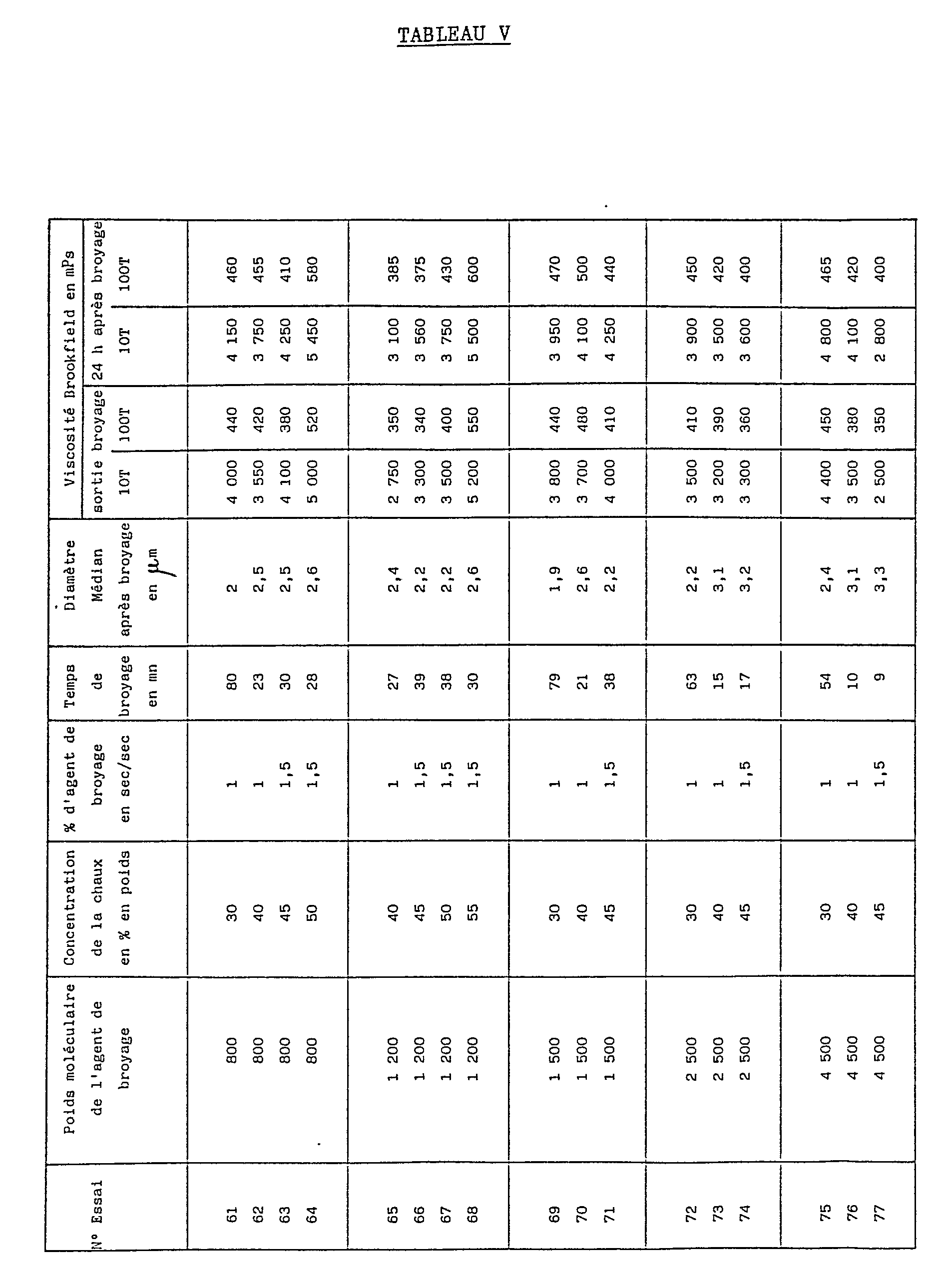
- Il découle de ce tableau que l'efficacité de l'agent de broyage, constitué par lesdits copolymères, présente une efficience équivalente à celle constatée pour les homopolymères de l'exemple 2 puisque cet agent conduit à une dimension moyenne des particules broyées inférieure à 2,9 microns, à condition que le poids moléculaire moyen desdits copolymères soit inférieur à 1 900.
- Dans les conditions des Tableaux II à V, l'agent de broyage selon l'invention se définit comme un polymère et/ou copolymère à base d'au moins un monomère éthylénique carboxylique de poids moléculaire moyen compris dans l'intervalle 500 à 1 900.
- Selon ces mêmes tableaux et en comparaison avec le Tableau I, il apparaît que la concentration en matière sèche des suspensions aqueuses de chaux à broyer peut atteindre des valeurs aussi élevées que 55% en poids, en présence de l'agent de broyage selon l'invention.
- Cet exemple, destiné à illustrer l'objet de l'invention, concerne le broyage de la même chaux grossière (déjà mise en oeuvre dans les exemples précédents) en présence d'un agent de broyage constitué par des copolymères d'acide acrylique (85% en poids) et de méthacrylate de méthyle (15% en poids) de poids moléculaires moyens variant de 800 à 2 500 et salifiés par l'ion sodium.
- Dans ce cas, plusieurs essais ont été effectués (essais 78 à 86), les suspensions aqueuses de chaux soumises au broyage en présence dudit agent ayant des concentrations en matière sèche différentes variant de 30 à 45% en poids.
- Tous ces essais ont été réalisés selon la même procédure et les mêmes moyens technologiques que dans l'exemple 1.
- Tous les résultats de ces essais ont été consignés dans le Tableau VI ci-après.

- Ces résultats permettent de tirer les mêmes conclusions que dans les exemples 2 à 5.
- Cet exemple, destiné à illustrer l'objet de l'invention, concerne le broyage de la même chaux grossière (déjà mise en oeuvre dans les exemples précédents) en présence d'un agent de broyage constitué par un homopolymère d'acide acrylique de poids moléculaire moyen 800, agissant sous une forme salifiée par les ions sodium, lithium, ammonium, potassium, ou sous une forme acide, ou encore neutralisé totalement par les ions sodium et calcium à un taux de 0,5 pour chacun.
- Dans ce cas, plusieurs essais ont été effectués (essais 87 à 92), les suspensions aqueuses de chaux soumises au broyage en présence dudit agent ayant des concentrations en matière sèche fixées à 45% en poids.
- Tous ces essais ont été réalisés selon la même procédure et les mêmes moyens technologiques que dans l'exemple 1.
- Tous les résultats de ces essais ont été consignés dans le Tableau VII ci-après.

- Quelle que soit la nature des ions salifiants ou l'acidité libre existante de l'agent de broyage selon l'invention, celui-ci dispose d'un bonne efficacité puisqu'il conduit par broyage à une dimension moyenne des particules broyées inférieure à 2,9 microns, à condition que le poids moléculaire moyen dudit homopolymère soit inférieur à 1 900.
- Cet exemple illustre l'application semi industrielle de l'invention par utilisation de l'agent de broyage dans une suspension aqueuse de chaux à affiner destinée, après avoir subi un broyage, à la neutralisation d'effluents gazeux acides.
- Dans ce but et selon la Figure 1, on a utilisé une installation pilote comportant un bac de délitage (1) muni d'une agitation, un bac tampon (2) maintenu sous agitation, un broyeur (3) à micro-éléments et une zone de séparation (4).
- On a introduit dans le bac de délitage (1) l'eau nécessaire par le conduit (5), puis l'agent de broyage selon l'invention par le conduit (6) et enfin la chaux à affiner par le conduit (7).
- La suspension ainsi formée a été maintenue sous agitation dans ledit bac pendant environ 15 minutes.
- la suspension aqueuse dans la zone de délitage avait la composition exprimée en pour cent en poids :

- La suspension aqueuse délitée a été transférée du bac de délitage (1) dans le bac tampon (2) par l'intermédiaire du conduit (8) muni de la pompe (9).
- Le bac tampon (2) muni d'un moyen d'agitation assurait l'alimentation régulière du broyeur (3) grâce au conduit (10) et la pompe (11).
- Le broyeur à micro-éléments (3) du type Dyno-Mill, d'une capacité de 50 litres, se composait d'une double enveloppe cylindrique permettant la circulation d'un fluide de refroidissement. A l'intérieur de la double enveloppe se trouvait un impulseur tournant de vitesse périphérique tangentielle de 16 mètres par seconde.
- Les micro-éléments de broyage étaient des billes de corindon ayant un diamètre de 1,2 à 1,6 millimètre, représentant une masse totale de 100 kilogrammes.
- Le taux de remplissage par les micro-éléments du volume utile était de 0,85.
- Le débit d'alimentation en suspension à soumettre au broyage était de 1 300 kilogrammes à l'heure.
- La température de la suspension dans le broyeur était maintenue à 27°C ± 1°C.
- A un niveau approprié du broyeur à micro-éléments, et si cela s'avérait nécessaire, il est possible d'introduire dans la suspension de chaux en cours ou en fin de broyage l'agent modificateur de rhéologie de telle manière que les caractéristiques rhéologiques de la suspension microparticulaire soient adaptées à l'application ou aux applications envisagées.
- Dans ces conditions, l'agent modificateur de rhéologie est introduit dans le broyeur (3) par l'intermédiaire du conduit (12) et de la pompe doseuse (13).
- A la sortie du broyeur (3) se trouvait une zone de séparation (4) permettant le partage de la suspension de chaux microparticulaire selon la sortie (15) et des micro-éléments selon la sortie (16).
- Les caractéristiques physiques et chimiques de la suspension microparticulaire obtenue après la séparation dans la zone (4) étaient les suivantes :

- A titre de comparaison et dans les mêmes conditions technologiques, on a traité dans le broyeur à micro-éléments (3) une suspension aqueuse de chaux à affiner, exempte de tout agent de broyage, mais très faible en concentration.
- Cette suspension avait la composition suivante exprimée en pour cent en poids:

- Cette suspension, soumise au broyage, n'a pu être introduite dans le broyeur qu'au débit restreint de 200 kilogrammes à l'heure (alors que, selon l'invention, ce débit était de 1 300 kilogrammes à l'heure) pour parvenir à des caractéristiques dimensionnelles des microparticules sensiblement équivalentes à celles obtenues lors de la mise en oeuvre de l'agent de broyage selon l'invention.
Claims (16)
Applications Claiming Priority (2)
| Application Number | Priority Date | Filing Date | Title |
|---|---|---|---|
| FR8714956 | 1987-10-23 | ||
| FR8714956A FR2622127B1 (fr) | 1987-10-23 | 1987-10-23 | Agent de broyage de la chaux en vue d'en augmenter la reactivite |
Publications (2)
| Publication Number | Publication Date |
|---|---|
| EP0313483A1 true EP0313483A1 (fr) | 1989-04-26 |
| EP0313483B1 EP0313483B1 (fr) | 1993-06-09 |
Family
ID=9356267
Family Applications (1)
| Application Number | Title | Priority Date | Filing Date |
|---|---|---|---|
| EP88420357A Expired - Lifetime EP0313483B1 (fr) | 1987-10-23 | 1988-10-19 | Agent de broyage de la chaux en vue d'en augmenter la réactivité |
Country Status (11)
| Country | Link |
|---|---|
| EP (1) | EP0313483B1 (fr) |
| JP (1) | JPH01148734A (fr) |
| KR (1) | KR890006299A (fr) |
| AU (1) | AU606758B2 (fr) |
| CA (1) | CA1332856C (fr) |
| DE (1) | DE3881634T2 (fr) |
| DK (1) | DK586788A (fr) |
| ES (1) | ES2040886T3 (fr) |
| FI (1) | FI92924C (fr) |
| FR (1) | FR2622127B1 (fr) |
| NO (1) | NO178726C (fr) |
Cited By (20)
| Publication number | Priority date | Publication date | Assignee | Title |
|---|---|---|---|---|
| FR2677351A1 (fr) * | 1991-06-07 | 1992-12-11 | Italcementi Spa | Suspension aqueuse concentree d'hydrate de calcium et son procede de preparation. |
| FR2687396A1 (fr) * | 1992-01-31 | 1993-08-20 | Lhoist Rech & Dev Sa | Lait de chaux et/ou d'hydroxyde de magnesium, sa preparation et hydroxyde ainsi obtenu. |
| EP0594332A1 (fr) * | 1992-10-20 | 1994-04-27 | Rohm And Haas Company | Suspensions de chaux stabilisés |
| WO1997010308A1 (fr) * | 1995-09-12 | 1997-03-20 | Ecc International Limited | Preparation de systemes a base de matiere particulaire broyee |
| WO1997010309A1 (fr) * | 1995-09-12 | 1997-03-20 | Ecc International Limited | Preparations de suspensions de matiere pariculaire broyee |
| FR2788513A1 (fr) * | 1999-01-19 | 2000-07-21 | B & C Services Sarl | Procede pour preparer un lait de chaux en vue de son injection dans un flux de fumees |
| DE4302539C2 (de) * | 1992-01-31 | 2001-09-20 | Lhoist Rech & Dev Sa | Kalk-und/oder Magnesiumhydroxid-Aufschlämmung und ihre Herstellung |
| US7297205B2 (en) | 2003-03-14 | 2007-11-20 | Basf Aktiengesellschaft | Use of polyacrylic acids as grinding aids for calcium carbonate |
| WO2011054789A1 (fr) | 2009-11-04 | 2011-05-12 | Basf Se | Procédé de fabrication de solutions aqueuses d'acide polyacrylique |
| WO2014076436A1 (fr) * | 2012-11-19 | 2014-05-22 | Coatex | Suspension aqueuse de chaux, procede de preparation et utilisations |
| WO2014076437A1 (fr) * | 2012-11-19 | 2014-05-22 | Coatex | Utilisation d'un copolymere hydrosoluble pour preparer une suspension aqueuse de chaux |
| EP2939980A1 (fr) | 2014-04-30 | 2015-11-04 | Omya International AG | Préparation de carbonate de calcium précipité |
| EP3061729A1 (fr) | 2015-02-27 | 2016-08-31 | Omya International AG | PCC à haute teneur en solides avec additif cationique |
| EP3118161A1 (fr) | 2015-07-17 | 2017-01-18 | Omya International AG | Pcc à haute teneur en solides à base de cellulose carboxylée dépolymérisée |
| EP3156369A1 (fr) | 2015-10-16 | 2017-04-19 | Omya International AG | Pcc à haute teneur en solides avec additif copolymère |
| US9757685B2 (en) | 2012-11-19 | 2017-09-12 | Coatex | Aqueous lime slurry, preparation process and uses |
| WO2020094607A1 (fr) | 2018-11-07 | 2020-05-14 | Carmeuse Research And Technology | Lait de chaux |
| US10889661B2 (en) | 2010-12-17 | 2021-01-12 | Basf Se | Stable polyacrylic acids, their manufacture and their use |
| WO2021058487A1 (fr) | 2019-09-23 | 2021-04-01 | S.A. Lhoist Recherche Et Développement | Sorbant à base de chaux destiné à être utilisé dans une installation de traitement de gaz de combustion et processus de fabrication dudit sorbant à base de chaux |
| WO2022090384A1 (fr) | 2020-11-02 | 2022-05-05 | Omya International Ag | Procédé de production de carbonate de calcium précipité en présence de carbonate de calcium broyé naturel |
Families Citing this family (5)
| Publication number | Priority date | Publication date | Assignee | Title |
|---|---|---|---|---|
| JP4510218B2 (ja) * | 2000-03-31 | 2010-07-21 | 黒崎播磨株式会社 | 湿式吹付施工用の急結剤 |
| JP2005313102A (ja) * | 2004-04-30 | 2005-11-10 | M Technique Co Ltd | 微粒子及びその製造方法 |
| JP4606238B2 (ja) * | 2005-04-25 | 2011-01-05 | 株式会社トクヤマ | 水酸化カルシウムスラリーの製造方法 |
| JP6146848B2 (ja) * | 2011-02-28 | 2017-06-14 | ソリューションズ アイイーエス インコーポレイテッド | 土壌及び地下水改質のための現場でのpH調節 |
| WO2016041643A1 (fr) * | 2014-09-08 | 2016-03-24 | S.A. Lhoist Recherche Et Developpement | Procede pour la fabrication de lait de chaux eteinte de tres grande finesse et lait de chaux eteinte de tres grande finesse |
Citations (5)
| Publication number | Priority date | Publication date | Assignee | Title |
|---|---|---|---|---|
| US3604634A (en) * | 1969-10-28 | 1971-09-14 | English Clays Lovering Pochin | Comminution of solid materials |
| DE2031109A1 (en) * | 1970-06-24 | 1971-12-30 | Ludwig Hörling Fabrik chemischer Baustoffe GmbH, 3283 Lügde | Quicklime treated with flocculant - based on polyacrylic material gives stronger sand-lime bricks |
| FR2351706A1 (fr) * | 1976-05-19 | 1977-12-16 | Dow Chemical Co | Procede pour le broyage par voie humide de mineraux ou de produits miniers non organiques ou organiques fossilises |
| US4175975A (en) * | 1975-12-29 | 1979-11-27 | The Dow Chemical Company | Aqueous suspensions |
| FR2539137A1 (fr) * | 1982-08-06 | 1984-07-13 | Coatex Sa | Agent de broyage a base de polymeres et/ou copolymeres acryliques neutralises pour suspension aqueuse de materiaux mineraux grossiers en vue d'applications pigmentaires |
-
1987
- 1987-10-23 FR FR8714956A patent/FR2622127B1/fr not_active Expired - Fee Related
-
1988
- 1988-09-15 CA CA000577472A patent/CA1332856C/fr not_active Expired - Fee Related
- 1988-09-30 NO NO884353A patent/NO178726C/no not_active IP Right Cessation
- 1988-10-19 DE DE88420357T patent/DE3881634T2/de not_active Expired - Fee Related
- 1988-10-19 EP EP88420357A patent/EP0313483B1/fr not_active Expired - Lifetime
- 1988-10-19 ES ES198888420357T patent/ES2040886T3/es not_active Expired - Lifetime
- 1988-10-20 AU AU24078/88A patent/AU606758B2/en not_active Ceased
- 1988-10-21 FI FI884880A patent/FI92924C/fi not_active IP Right Cessation
- 1988-10-21 JP JP63265972A patent/JPH01148734A/ja active Pending
- 1988-10-21 DK DK586788A patent/DK586788A/da not_active Application Discontinuation
- 1988-10-22 KR KR1019880013868A patent/KR890006299A/ko not_active Withdrawn
Patent Citations (5)
| Publication number | Priority date | Publication date | Assignee | Title |
|---|---|---|---|---|
| US3604634A (en) * | 1969-10-28 | 1971-09-14 | English Clays Lovering Pochin | Comminution of solid materials |
| DE2031109A1 (en) * | 1970-06-24 | 1971-12-30 | Ludwig Hörling Fabrik chemischer Baustoffe GmbH, 3283 Lügde | Quicklime treated with flocculant - based on polyacrylic material gives stronger sand-lime bricks |
| US4175975A (en) * | 1975-12-29 | 1979-11-27 | The Dow Chemical Company | Aqueous suspensions |
| FR2351706A1 (fr) * | 1976-05-19 | 1977-12-16 | Dow Chemical Co | Procede pour le broyage par voie humide de mineraux ou de produits miniers non organiques ou organiques fossilises |
| FR2539137A1 (fr) * | 1982-08-06 | 1984-07-13 | Coatex Sa | Agent de broyage a base de polymeres et/ou copolymeres acryliques neutralises pour suspension aqueuse de materiaux mineraux grossiers en vue d'applications pigmentaires |
Cited By (36)
| Publication number | Priority date | Publication date | Assignee | Title |
|---|---|---|---|---|
| FR2677351A1 (fr) * | 1991-06-07 | 1992-12-11 | Italcementi Spa | Suspension aqueuse concentree d'hydrate de calcium et son procede de preparation. |
| DE4302539C2 (de) * | 1992-01-31 | 2001-09-20 | Lhoist Rech & Dev Sa | Kalk-und/oder Magnesiumhydroxid-Aufschlämmung und ihre Herstellung |
| FR2687396A1 (fr) * | 1992-01-31 | 1993-08-20 | Lhoist Rech & Dev Sa | Lait de chaux et/ou d'hydroxyde de magnesium, sa preparation et hydroxyde ainsi obtenu. |
| BE1006655A5 (fr) * | 1992-01-31 | 1994-11-08 | Lhoist Rech & Dev Sa | Lait de chaux et/ou d'hydroxyde de magnesium. |
| EP0594332A1 (fr) * | 1992-10-20 | 1994-04-27 | Rohm And Haas Company | Suspensions de chaux stabilisés |
| WO1997010308A1 (fr) * | 1995-09-12 | 1997-03-20 | Ecc International Limited | Preparation de systemes a base de matiere particulaire broyee |
| WO1997010309A1 (fr) * | 1995-09-12 | 1997-03-20 | Ecc International Limited | Preparations de suspensions de matiere pariculaire broyee |
| FR2788513A1 (fr) * | 1999-01-19 | 2000-07-21 | B & C Services Sarl | Procede pour preparer un lait de chaux en vue de son injection dans un flux de fumees |
| US7297205B2 (en) | 2003-03-14 | 2007-11-20 | Basf Aktiengesellschaft | Use of polyacrylic acids as grinding aids for calcium carbonate |
| US9056926B2 (en) | 2009-11-04 | 2015-06-16 | Basf Se | Process for preparing aqueous polyacrylic acid solutions |
| WO2011054789A1 (fr) | 2009-11-04 | 2011-05-12 | Basf Se | Procédé de fabrication de solutions aqueuses d'acide polyacrylique |
| US10889661B2 (en) | 2010-12-17 | 2021-01-12 | Basf Se | Stable polyacrylic acids, their manufacture and their use |
| CN104781206B (zh) * | 2012-11-19 | 2017-03-08 | 可泰克斯公司 | 氢氧化钙的水悬浮液、其制备方法及用途 |
| FR2998195A1 (fr) * | 2012-11-19 | 2014-05-23 | Coatex Sas | Utilisation d'un copolymere hydrosoluble pour preparer une suspension aqueuse de chaux |
| FR2998194A1 (fr) * | 2012-11-19 | 2014-05-23 | Coatex Sas | Suspension aqueuse de chaux, procede de preparation et utilisations |
| CN104781206A (zh) * | 2012-11-19 | 2015-07-15 | 可泰克斯公司 | 氢氧化钙的水悬浮液、其制备方法及用途 |
| WO2014076437A1 (fr) * | 2012-11-19 | 2014-05-22 | Coatex | Utilisation d'un copolymere hydrosoluble pour preparer une suspension aqueuse de chaux |
| WO2014076436A1 (fr) * | 2012-11-19 | 2014-05-22 | Coatex | Suspension aqueuse de chaux, procede de preparation et utilisations |
| US10456742B2 (en) | 2012-11-19 | 2019-10-29 | Coatex | Aqueous lime slurry, preparation process and uses |
| US9757685B2 (en) | 2012-11-19 | 2017-09-12 | Coatex | Aqueous lime slurry, preparation process and uses |
| EP2939980A1 (fr) | 2014-04-30 | 2015-11-04 | Omya International AG | Préparation de carbonate de calcium précipité |
| US10000388B2 (en) | 2014-04-30 | 2018-06-19 | Omya International Ag | Production of PCC |
| EP3061729A1 (fr) | 2015-02-27 | 2016-08-31 | Omya International AG | PCC à haute teneur en solides avec additif cationique |
| US10501634B2 (en) | 2015-02-27 | 2019-12-10 | Omya International Ag | High solids precipitated calcium carbonate with cationic additive |
| EP3118161A1 (fr) | 2015-07-17 | 2017-01-18 | Omya International AG | Pcc à haute teneur en solides à base de cellulose carboxylée dépolymérisée |
| WO2017013012A1 (fr) | 2015-07-17 | 2017-01-26 | Omya International Ag | Pcc à forte teneur en fractions solides obtenu à l'aide d'une cellulose carboxylée dépolymérisée |
| WO2017064175A1 (fr) | 2015-10-16 | 2017-04-20 | Omya International Ag | Carbonate de calcium précipité riche en solides avec additif copolymère |
| EP3156369A1 (fr) | 2015-10-16 | 2017-04-19 | Omya International AG | Pcc à haute teneur en solides avec additif copolymère |
| US10689519B2 (en) | 2015-10-16 | 2020-06-23 | Omya International Ag | High solids precipitated calcium carbonate with copolymeric additive |
| WO2020094607A1 (fr) | 2018-11-07 | 2020-05-14 | Carmeuse Research And Technology | Lait de chaux |
| EP4063335A1 (fr) | 2018-11-07 | 2022-09-28 | Carmeuse Research And Technology | Lait de chaux |
| US12391610B2 (en) | 2018-11-07 | 2025-08-19 | Carmeuse Research And Technology | Lime milk |
| WO2021058487A1 (fr) | 2019-09-23 | 2021-04-01 | S.A. Lhoist Recherche Et Développement | Sorbant à base de chaux destiné à être utilisé dans une installation de traitement de gaz de combustion et processus de fabrication dudit sorbant à base de chaux |
| EP4034295A1 (fr) * | 2019-09-23 | 2022-08-03 | Lhoist Recherche et Développement S.A. | Sorbant à base de chaux destiné à être utilisé dans une installation de traitement de gaz de combustion et processus de fabrication dudit sorbant à base de chaux |
| US12440820B2 (en) | 2019-09-23 | 2025-10-14 | S.A. Lhoist Recherche Et Developpment | Lime-based sorbent for use in a flue gas treatment installation and process of manufacturing said lime-based sorbent |
| WO2022090384A1 (fr) | 2020-11-02 | 2022-05-05 | Omya International Ag | Procédé de production de carbonate de calcium précipité en présence de carbonate de calcium broyé naturel |
Also Published As
| Publication number | Publication date |
|---|---|
| NO884353D0 (no) | 1988-09-30 |
| FI92924B (fi) | 1994-10-14 |
| DE3881634T2 (de) | 1993-10-28 |
| DK586788D0 (da) | 1988-10-21 |
| DK586788A (da) | 1989-07-12 |
| EP0313483B1 (fr) | 1993-06-09 |
| JPH01148734A (ja) | 1989-06-12 |
| NO178726B (no) | 1996-02-12 |
| NO178726C (no) | 1996-05-22 |
| ES2040886T3 (es) | 1993-11-01 |
| DE3881634D1 (de) | 1993-07-15 |
| KR890006299A (ko) | 1989-06-12 |
| FR2622127A1 (fr) | 1989-04-28 |
| FI884880A0 (fi) | 1988-10-21 |
| FI92924C (fi) | 1995-01-25 |
| AU606758B2 (en) | 1991-02-14 |
| FI884880L (fi) | 1989-04-24 |
| NO884353L (no) | 1989-04-24 |
| AU2407888A (en) | 1989-04-27 |
| CA1332856C (fr) | 1994-11-01 |
| FR2622127B1 (fr) | 1991-03-22 |
Similar Documents
| Publication | Publication Date | Title |
|---|---|---|
| EP0313483B1 (fr) | Agent de broyage de la chaux en vue d'en augmenter la réactivité | |
| EP0380430B1 (fr) | Procédé de broyage de carbonate de calcium en milieu aqueux | |
| EP0100948B1 (fr) | Agent de broyage à base de polymères et/ou copolymères acryliques pour suspensions aqueuses de matériaux minéraux grossiers en vue d'applications pigmentaires | |
| EP0100947B1 (fr) | Agent de broyage à base de polymères et/ou copolymères neutralisés pour suspensions aqueuses de matériaux minéraux grossiers en vue d'applications pigmentaires | |
| EP0278880B1 (fr) | Pré-traitement de matériaux minéraux grossiers en vue d'applications pigmentaires | |
| EP0542643B1 (fr) | Agent de broyage et/ou de dispersion à base de polymères et/ou copolymères neutralisés en partie par du magnésium pour suspensions aqueuses de matériaux minéraux en vue d'applications pigmentaires | |
| EP0542644B1 (fr) | Agent de broyage et/ou de dispersion à base de polymères et/ou copolymères neutralisés en partie par du magnésium pour suspensions aqueuses de matériaux minéraux en vue d'applications pigmentaires | |
| CA2427476C (fr) | Agent d'aide au broyage et/ou de dispersion de materiaux en suspension aqueuse, suspensions aqueuses obtenues et leurs utilisations | |
| EP2044159B1 (fr) | Agent de dispersion et/ou d'aide au broyage pour dispersion et suspension aqueuse de matieres minerales, dispersion et suspension obtenues et leurs utilisations | |
| EP0412027B1 (fr) | Utilisation dans les suspensions aqueuses pigmentaires de carbonate de calcium d'un agent polycarboxylique à fonction phosphatée ou phosphonée inhibant l'effet de choc provoqué par l'introduction d'un électrolyte sous forme concentrée | |
| FR2488814A1 (fr) | Agent de broyage pour suspension aqueuse de materiaux mineraux en vue d'applications pigmentaires | |
| CA1334775C (fr) | Agent de compatibilite pour suspensions aqueuses polypigmentaires dont l'un des pigments est du sulfate de calcium hydrate | |
| FR2728182A1 (fr) | Procede d'obtention d'agents de broyage et/ou de dispersion par separation physico-chimique, agents obtenus et leurs utilisations | |
| EP0646099B1 (fr) | Procede de preparation d'une suspension aqueuse a base de sulfate de calcium | |
| FR2683536A1 (fr) | Agent de broyage et/ou de dispersion a base de polymeres et/ou copolymeres neutralises en partie par du magnesium pour suspensions aqueuses de materiaux mineraux en vue d'applications pigmentaires. | |
| FR2683538A1 (fr) | Procede de broyage en suspension aqueuse en presence d'un agent de broyage neutralise en partie par du magnesium. | |
| FR2683539A1 (fr) | Procede de broyage en suspension aqueuse en presence d'un agent de broyage neutralise en partie par du magnesium. | |
| FR2683537A1 (fr) | Agent de broyage et/ou de dispersion a base de polymeres et/ou copolymeres neutralises en partie par du magnesium pour suspensions aqueuses de materiaux mineraux en vue d'applications pigmentaires. | |
| EP2646512A1 (fr) | Utilisation de sels alcalins de carbonate pour reduire la dose de polymere acrylique dans un procede de broyage de carbonate de calcium dans l'eau | |
| EP0860477B1 (fr) | Utilisation de sels d'acides polyaspartiques comme agent d'aide au broyage et suspension aqueuse de matériaux minéraux |
Legal Events
| Date | Code | Title | Description |
|---|---|---|---|
| PUAI | Public reference made under article 153(3) epc to a published international application that has entered the european phase |
Free format text: ORIGINAL CODE: 0009012 |
|
| AK | Designated contracting states |
Kind code of ref document: A1 Designated state(s): BE DE ES IT NL SE |
|
| 17P | Request for examination filed |
Effective date: 19890511 |
|
| 17Q | First examination report despatched |
Effective date: 19910902 |
|
| RAP1 | Party data changed (applicant data changed or rights of an application transferred) |
Owner name: COATEX S.A. |
|
| GRAA | (expected) grant |
Free format text: ORIGINAL CODE: 0009210 |
|
| AK | Designated contracting states |
Kind code of ref document: B1 Designated state(s): BE DE ES IT NL SE |
|
| ITF | It: translation for a ep patent filed | ||
| REF | Corresponds to: |
Ref document number: 3881634 Country of ref document: DE Date of ref document: 19930715 |
|
| REG | Reference to a national code |
Ref country code: ES Ref legal event code: FG2A Ref document number: 2040886 Country of ref document: ES Kind code of ref document: T3 |
|
| PLBE | No opposition filed within time limit |
Free format text: ORIGINAL CODE: 0009261 |
|
| STAA | Information on the status of an ep patent application or granted ep patent |
Free format text: STATUS: NO OPPOSITION FILED WITHIN TIME LIMIT |
|
| 26N | No opposition filed | ||
| PGFP | Annual fee paid to national office [announced via postgrant information from national office to epo] |
Ref country code: NL Payment date: 19941031 Year of fee payment: 7 |
|
| EAL | Se: european patent in force in sweden |
Ref document number: 88420357.1 |
|
| PG25 | Lapsed in a contracting state [announced via postgrant information from national office to epo] |
Ref country code: NL Effective date: 19960501 |
|
| NLV4 | Nl: lapsed or anulled due to non-payment of the annual fee |
Effective date: 19960501 |
|
| PGFP | Annual fee paid to national office [announced via postgrant information from national office to epo] |
Ref country code: SE Payment date: 20031007 Year of fee payment: 16 |
|
| PGFP | Annual fee paid to national office [announced via postgrant information from national office to epo] |
Ref country code: DE Payment date: 20031030 Year of fee payment: 16 |
|
| PGFP | Annual fee paid to national office [announced via postgrant information from national office to epo] |
Ref country code: ES Payment date: 20031128 Year of fee payment: 16 |
|
| PGFP | Annual fee paid to national office [announced via postgrant information from national office to epo] |
Ref country code: BE Payment date: 20031211 Year of fee payment: 16 |
|
| PG25 | Lapsed in a contracting state [announced via postgrant information from national office to epo] |
Ref country code: SE Free format text: LAPSE BECAUSE OF NON-PAYMENT OF DUE FEES Effective date: 20041020 Ref country code: ES Free format text: LAPSE BECAUSE OF NON-PAYMENT OF DUE FEES Effective date: 20041020 |
|
| PG25 | Lapsed in a contracting state [announced via postgrant information from national office to epo] |
Ref country code: BE Free format text: LAPSE BECAUSE OF NON-PAYMENT OF DUE FEES Effective date: 20041031 |
|
| BERE | Be: lapsed |
Owner name: *COATEX S.A.S. Effective date: 20041031 |
|
| PG25 | Lapsed in a contracting state [announced via postgrant information from national office to epo] |
Ref country code: DE Free format text: LAPSE BECAUSE OF NON-PAYMENT OF DUE FEES Effective date: 20050503 |
|
| EUG | Se: european patent has lapsed | ||
| PG25 | Lapsed in a contracting state [announced via postgrant information from national office to epo] |
Ref country code: IT Free format text: LAPSE BECAUSE OF NON-PAYMENT OF DUE FEES;WARNING: LAPSES OF ITALIAN PATENTS WITH EFFECTIVE DATE BEFORE 2007 MAY HAVE OCCURRED AT ANY TIME BEFORE 2007. THE CORRECT EFFECTIVE DATE MAY BE DIFFERENT FROM THE ONE RECORDED. Effective date: 20051019 |
|
| REG | Reference to a national code |
Ref country code: ES Ref legal event code: FD2A Effective date: 20041020 |
|
| BERE | Be: lapsed |
Owner name: *COATEX S.A.S. Effective date: 20041031 |