EP0319482B1 - Composés d'acides propane phosphiniques substitués - Google Patents
Composés d'acides propane phosphiniques substitués Download PDFInfo
- Publication number
- EP0319482B1 EP0319482B1 EP88810831A EP88810831A EP0319482B1 EP 0319482 B1 EP0319482 B1 EP 0319482B1 EP 88810831 A EP88810831 A EP 88810831A EP 88810831 A EP88810831 A EP 88810831A EP 0319482 B1 EP0319482 B1 EP 0319482B1
- Authority
- EP
- European Patent Office
- Prior art keywords
- lower alkyl
- alkyl
- hydroxy
- phenyl
- formula
- Prior art date
- Legal status (The legal status is an assumption and is not a legal conclusion. Google has not performed a legal analysis and makes no representation as to the accuracy of the status listed.)
- Expired - Lifetime
Links
- UQZPTVULCJDKIV-UHFFFAOYSA-N CCC.O[PH2]=O Chemical class CCC.O[PH2]=O UQZPTVULCJDKIV-UHFFFAOYSA-N 0.000 title 1
- 125000000217 alkyl group Chemical group 0.000 claims abstract description 322
- 150000001875 compounds Chemical class 0.000 claims abstract description 211
- 229910052739 hydrogen Inorganic materials 0.000 claims abstract description 177
- 239000001257 hydrogen Substances 0.000 claims abstract description 163
- 150000003839 salts Chemical class 0.000 claims abstract description 107
- 125000002887 hydroxy group Chemical group [H]O* 0.000 claims abstract description 83
- 125000004432 carbon atom Chemical group C* 0.000 claims abstract description 64
- UFHFLCQGNIYNRP-UHFFFAOYSA-N Hydrogen Chemical compound [H][H] UFHFLCQGNIYNRP-UHFFFAOYSA-N 0.000 claims abstract description 49
- 125000001931 aliphatic group Chemical group 0.000 claims abstract description 31
- 125000003277 amino group Chemical group 0.000 claims abstract description 17
- 229910052783 alkali metal Inorganic materials 0.000 claims abstract description 14
- 150000001340 alkali metals Chemical class 0.000 claims abstract description 14
- QGZKDVFQNNGYKY-UHFFFAOYSA-O Ammonium Chemical compound [NH4+] QGZKDVFQNNGYKY-UHFFFAOYSA-O 0.000 claims abstract description 10
- LMBFAGIMSUYTBN-MPZNNTNKSA-N teixobactin Chemical compound C([C@H](C(=O)N[C@@H]([C@@H](C)CC)C(=O)N[C@@H](CO)C(=O)N[C@H](CCC(N)=O)C(=O)N[C@H]([C@@H](C)CC)C(=O)N[C@@H]([C@@H](C)CC)C(=O)N[C@@H](CO)C(=O)N[C@H]1C(N[C@@H](C)C(=O)N[C@@H](C[C@@H]2NC(=N)NC2)C(=O)N[C@H](C(=O)O[C@H]1C)[C@@H](C)CC)=O)NC)C1=CC=CC=C1 LMBFAGIMSUYTBN-MPZNNTNKSA-N 0.000 claims abstract description 7
- 150000002431 hydrogen Chemical class 0.000 claims abstract 38
- 125000001997 phenyl group Chemical group [H]C1=C([H])C([H])=C(*)C([H])=C1[H] 0.000 claims description 114
- -1 diethoxymethyl Chemical group 0.000 claims description 110
- 229910052736 halogen Inorganic materials 0.000 claims description 82
- 125000004435 hydrogen atom Chemical group [H]* 0.000 claims description 76
- 238000000034 method Methods 0.000 claims description 75
- 239000000203 mixture Substances 0.000 claims description 66
- 125000000753 cycloalkyl group Chemical group 0.000 claims description 56
- 125000002023 trifluoromethyl group Chemical group FC(F)(F)* 0.000 claims description 55
- 230000008569 process Effects 0.000 claims description 53
- 125000003545 alkoxy group Chemical group 0.000 claims description 48
- 125000003342 alkenyl group Chemical group 0.000 claims description 43
- 125000005843 halogen group Chemical group 0.000 claims description 43
- 150000002367 halogens Chemical class 0.000 claims description 42
- 238000004519 manufacturing process Methods 0.000 claims description 36
- 125000004178 (C1-C4) alkyl group Chemical group 0.000 claims description 35
- QVGXLLKOCUKJST-UHFFFAOYSA-N atomic oxygen Chemical compound [O] QVGXLLKOCUKJST-UHFFFAOYSA-N 0.000 claims description 29
- 239000001301 oxygen Substances 0.000 claims description 29
- 229910052760 oxygen Inorganic materials 0.000 claims description 29
- NINIDFKCEFEMDL-UHFFFAOYSA-N Sulfur Chemical compound [S] NINIDFKCEFEMDL-UHFFFAOYSA-N 0.000 claims description 28
- 125000004429 atom Chemical group 0.000 claims description 28
- 229910052717 sulfur Inorganic materials 0.000 claims description 27
- 239000011593 sulfur Substances 0.000 claims description 27
- 125000000229 (C1-C4)alkoxy group Chemical group 0.000 claims description 20
- 125000000304 alkynyl group Chemical group 0.000 claims description 19
- 230000002829 reductive effect Effects 0.000 claims description 17
- 125000002947 alkylene group Chemical group 0.000 claims description 12
- ACVYVLVWPXVTIT-UHFFFAOYSA-N phosphinic acid Chemical compound O[PH2]=O ACVYVLVWPXVTIT-UHFFFAOYSA-N 0.000 claims description 12
- 229910052799 carbon Inorganic materials 0.000 claims description 11
- 125000002496 methyl group Chemical group [H]C([H])([H])* 0.000 claims description 11
- 229920006395 saturated elastomer Polymers 0.000 claims description 11
- 239000002585 base Substances 0.000 claims description 9
- 125000001624 naphthyl group Chemical group 0.000 claims description 9
- 125000004414 alkyl thio group Chemical group 0.000 claims description 8
- 125000002768 hydroxyalkyl group Chemical group 0.000 claims description 7
- 239000008194 pharmaceutical composition Substances 0.000 claims description 7
- 125000004437 phosphorous atom Chemical group 0.000 claims description 7
- WGYKZJWCGVVSQN-UHFFFAOYSA-N propylamine Chemical group CCCN WGYKZJWCGVVSQN-UHFFFAOYSA-N 0.000 claims description 7
- 125000005913 (C3-C6) cycloalkyl group Chemical group 0.000 claims description 6
- 150000001299 aldehydes Chemical class 0.000 claims description 6
- 150000002576 ketones Chemical class 0.000 claims description 6
- SYSQUGFVNFXIIT-UHFFFAOYSA-N n-[4-(1,3-benzoxazol-2-yl)phenyl]-4-nitrobenzenesulfonamide Chemical class C1=CC([N+](=O)[O-])=CC=C1S(=O)(=O)NC1=CC=C(C=2OC3=CC=CC=C3N=2)C=C1 SYSQUGFVNFXIIT-UHFFFAOYSA-N 0.000 claims description 6
- 230000001777 nootropic effect Effects 0.000 claims description 6
- 125000004209 (C1-C8) alkyl group Chemical group 0.000 claims description 5
- 230000001430 anti-depressive effect Effects 0.000 claims description 5
- 125000005350 hydroxycycloalkyl group Chemical group 0.000 claims description 5
- ONNMDRQRSGKZCN-UHFFFAOYSA-N 3-aminopropyl(butyl)phosphinic acid Chemical compound CCCCP(O)(=O)CCCN ONNMDRQRSGKZCN-UHFFFAOYSA-N 0.000 claims description 4
- 239000007795 chemical reaction product Substances 0.000 claims description 4
- 125000001309 chloro group Chemical group Cl* 0.000 claims description 4
- 239000003814 drug Substances 0.000 claims description 4
- 125000004043 oxo group Chemical group O=* 0.000 claims description 4
- JHHAERSMXJEIIR-UHFFFAOYSA-N 3-aminopropyl(1-hydroxybutyl)phosphinic acid Chemical compound CCCC(O)P(O)(=O)CCCN JHHAERSMXJEIIR-UHFFFAOYSA-N 0.000 claims description 3
- XHVUMXATRAQUGT-UHFFFAOYSA-N 3-aminopropyl(but-3-enyl)phosphinic acid Chemical compound NCCCP(O)(=O)CCC=C XHVUMXATRAQUGT-UHFFFAOYSA-N 0.000 claims description 3
- FOYYKMGSECQQRD-UHFFFAOYSA-N 3-aminopropyl(propyl)phosphinic acid Chemical compound CCCP(O)(=O)CCCN FOYYKMGSECQQRD-UHFFFAOYSA-N 0.000 claims description 3
- 239000004215 Carbon black (E152) Substances 0.000 claims description 3
- 150000003863 ammonium salts Chemical class 0.000 claims description 3
- 230000003556 anti-epileptic effect Effects 0.000 claims description 3
- 239000001961 anticonvulsive agent Substances 0.000 claims description 3
- QIIVUOWTHWIXFO-UHFFFAOYSA-N cgp-35348 Chemical compound CCOC(OCC)P(O)(=O)CCCN QIIVUOWTHWIXFO-UHFFFAOYSA-N 0.000 claims description 3
- 229930195733 hydrocarbon Natural products 0.000 claims description 3
- 125000003854 p-chlorophenyl group Chemical group [H]C1=C([H])C(*)=C([H])C([H])=C1Cl 0.000 claims description 3
- AIGDDXAWJBCNKQ-UHFFFAOYSA-N (3-amino-1-hydroxypropyl)-propylphosphinic acid Chemical compound CCCP(O)(=O)C(O)CCN AIGDDXAWJBCNKQ-UHFFFAOYSA-N 0.000 claims description 2
- XRCHFTXCKVJKIF-UHFFFAOYSA-N (3-amino-2-hydroxypropyl)-propylphosphinic acid Chemical compound CCCP(O)(=O)CC(O)CN XRCHFTXCKVJKIF-UHFFFAOYSA-N 0.000 claims description 2
- FJSVXHZXNCJTQK-UHFFFAOYSA-N 3-aminopropyl(1-hydroxyethyl)phosphinic acid Chemical compound CC(O)P(O)(=O)CCCN FJSVXHZXNCJTQK-UHFFFAOYSA-N 0.000 claims description 2
- YXEGRAWQMNCZMF-UHFFFAOYSA-N 3-aminopropyl(2-ethoxyethyl)phosphinic acid Chemical compound CCOCCP(O)(=O)CCCN YXEGRAWQMNCZMF-UHFFFAOYSA-N 0.000 claims description 2
- RUWMTCHCYQHVCB-UHFFFAOYSA-N 3-aminopropyl(2-hydroxybutyl)phosphinic acid Chemical compound CCC(O)CP(O)(=O)CCCN RUWMTCHCYQHVCB-UHFFFAOYSA-N 0.000 claims description 2
- IKXXEYVFMSTQCB-UHFFFAOYSA-N 3-aminopropyl(2-methylbutyl)phosphinic acid Chemical compound CCC(C)CP(O)(=O)CCCN IKXXEYVFMSTQCB-UHFFFAOYSA-N 0.000 claims description 2
- LPDXOZQQBPOYJU-UHFFFAOYSA-N 3-aminopropyl(2-methylpropyl)phosphinic acid Chemical compound CC(C)CP(O)(=O)CCCN LPDXOZQQBPOYJU-UHFFFAOYSA-N 0.000 claims description 2
- LRAUHQWSSQKNGI-UHFFFAOYSA-N 3-aminopropyl(3-ethoxypropyl)phosphinic acid Chemical compound CCOCCCP(O)(=O)CCCN LRAUHQWSSQKNGI-UHFFFAOYSA-N 0.000 claims description 2
- XOFDJBJCGCEHCU-UHFFFAOYSA-N 3-aminopropyl(3-hydroxybutyl)phosphinic acid Chemical compound CC(O)CCP(O)(=O)CCCN XOFDJBJCGCEHCU-UHFFFAOYSA-N 0.000 claims description 2
- BYPHYEJAZZTADQ-UHFFFAOYSA-N 3-aminopropyl(3-methoxypropyl)phosphinic acid Chemical compound COCCCP(O)(=O)CCCN BYPHYEJAZZTADQ-UHFFFAOYSA-N 0.000 claims description 2
- RRCNMIRNBHQEPE-UHFFFAOYSA-N 3-aminopropyl(3-methylbutyl)phosphinic acid Chemical compound CC(C)CCP(O)(=O)CCCN RRCNMIRNBHQEPE-UHFFFAOYSA-N 0.000 claims description 2
- XDDFQYLPAFFMJY-UHFFFAOYSA-N 3-aminopropyl(4-hydroxybutyl)phosphinic acid Chemical compound NCCCP(O)(=O)CCCCO XDDFQYLPAFFMJY-UHFFFAOYSA-N 0.000 claims description 2
- RBLRLMBKEMYMCN-UHFFFAOYSA-N 3-aminopropyl(benzyl)phosphinic acid Chemical compound NCCCP(O)(=O)CC1=CC=CC=C1 RBLRLMBKEMYMCN-UHFFFAOYSA-N 0.000 claims description 2
- XOESDNIUAWGCLU-UHFFFAOYSA-N 3-aminopropyl(cyclohexylmethyl)phosphinic acid Chemical compound NCCCP(O)(=O)CC1CCCCC1 XOESDNIUAWGCLU-UHFFFAOYSA-N 0.000 claims description 2
- QOIZJKQEHAJIKY-UHFFFAOYSA-N 3-aminopropyl(dibutoxymethyl)phosphinic acid Chemical compound CCCCOC(OCCCC)P(O)(=O)CCCN QOIZJKQEHAJIKY-UHFFFAOYSA-N 0.000 claims description 2
- QQACCNCDFJQPCM-UHFFFAOYSA-N 3-aminopropyl(dipropoxymethyl)phosphinic acid Chemical compound CCCOC(OCCC)P(O)(=O)CCCN QQACCNCDFJQPCM-UHFFFAOYSA-N 0.000 claims description 2
- ISLKYQQXHYGTFX-UHFFFAOYSA-N 3-aminopropyl(dodecyl)phosphinic acid Chemical compound CCCCCCCCCCCCP(O)(=O)CCCN ISLKYQQXHYGTFX-UHFFFAOYSA-N 0.000 claims description 2
- BKGCYZVQMULDMU-UHFFFAOYSA-N 3-aminopropyl(pent-3-ynyl)phosphinic acid Chemical compound CC#CCCP(O)(=O)CCCN BKGCYZVQMULDMU-UHFFFAOYSA-N 0.000 claims description 2
- KJZMSTLQJKUHPX-UHFFFAOYSA-N 3-aminopropyl(prop-2-ynyl)phosphinic acid Chemical compound NCCCP(O)(=O)CC#C KJZMSTLQJKUHPX-UHFFFAOYSA-N 0.000 claims description 2
- XZXSLMHRISKALI-UHFFFAOYSA-N 3-aminopropyl-(1-hydroxy-2-methylpropyl)phosphinic acid Chemical compound CC(C)C(O)P(O)(=O)CCCN XZXSLMHRISKALI-UHFFFAOYSA-N 0.000 claims description 2
- SUDPXVNOJIZMEO-UHFFFAOYSA-N 3-aminopropyl-(4,4,4-trifluoro-1-hydroxybutyl)phosphinic acid Chemical compound NCCCP(O)(=O)C(O)CCC(F)(F)F SUDPXVNOJIZMEO-UHFFFAOYSA-N 0.000 claims description 2
- AHBPBAPPPQURDN-UHFFFAOYSA-N 3-aminopropyl-[(1-hydroxycyclohexa-2,4-dien-1-yl)methyl]phosphinic acid Chemical compound NCCCP(O)(=O)CC1(O)CC=CC=C1 AHBPBAPPPQURDN-UHFFFAOYSA-N 0.000 claims description 2
- BFOZIYFPMSJNAF-QMMMGPOBSA-N 3-aminopropyl-[(2r)-2-hydroxy-3-methylbutyl]phosphinic acid Chemical compound CC(C)[C@@H](O)CP(O)(=O)CCCN BFOZIYFPMSJNAF-QMMMGPOBSA-N 0.000 claims description 2
- IKXXEYVFMSTQCB-QMMMGPOBSA-N 3-aminopropyl-[(2s)-2-methylbutyl]phosphinic acid Chemical compound CC[C@H](C)CP(O)(=O)CCCN IKXXEYVFMSTQCB-QMMMGPOBSA-N 0.000 claims description 2
- JMHRYWNCSXCRSR-KXFIGUGUSA-N 3-aminopropyl-[(z)-2-fluoro-1-hydroxybut-2-enyl]phosphinic acid Chemical compound C\C=C(/F)C(O)P(O)(=O)CCCN JMHRYWNCSXCRSR-KXFIGUGUSA-N 0.000 claims description 2
- DMKUNPXDXGWFEX-UHFFFAOYSA-N 3-aminopropyl-[2-(2-ethoxyethoxy)ethyl]phosphinic acid Chemical compound CCOCCOCCP(O)(=O)CCCN DMKUNPXDXGWFEX-UHFFFAOYSA-N 0.000 claims description 2
- FRVBFCTTYUTRQC-UHFFFAOYSA-N 3-aminopropyl-[cyclobutyl(hydroxy)methyl]phosphinic acid Chemical compound NCCCP(O)(=O)C(O)C1CCC1 FRVBFCTTYUTRQC-UHFFFAOYSA-N 0.000 claims description 2
- CNIWQQWVSWIYIP-UHFFFAOYSA-N 3-aminopropyl-[cyclopropyl(hydroxy)methyl]phosphinic acid Chemical compound NCCCP(O)(=O)C(O)C1CC1 CNIWQQWVSWIYIP-UHFFFAOYSA-N 0.000 claims description 2
- OOYURORZJZERMR-UHFFFAOYSA-N 3-aminopropyl-[di(propan-2-yloxy)methyl]phosphinic acid Chemical compound CC(C)OC(OC(C)C)P(O)(=O)CCCN OOYURORZJZERMR-UHFFFAOYSA-N 0.000 claims description 2
- APWTWYYAXGNAQG-UHFFFAOYSA-N 3-azaniumylpropyl(2-phenylethyl)phosphinate Chemical compound NCCCP(O)(=O)CCC1=CC=CC=C1 APWTWYYAXGNAQG-UHFFFAOYSA-N 0.000 claims description 2
- AYZUSVLFFDHUGN-UHFFFAOYSA-N 4-aminobutan-2-yl(butyl)phosphinic acid Chemical compound CCCCP(O)(=O)C(C)CCN AYZUSVLFFDHUGN-UHFFFAOYSA-N 0.000 claims description 2
- RUXNGYAPBMVEBP-UHFFFAOYSA-N [3-amino-2-(4-chlorophenyl)propyl]-(diethoxymethyl)phosphinic acid Chemical compound CCOC(OCC)P(O)(=O)CC(CN)C1=CC=C(Cl)C=C1 RUXNGYAPBMVEBP-UHFFFAOYSA-N 0.000 claims description 2
- 239000012059 conventional drug carrier Substances 0.000 claims 3
- AGCBAPKMKMJOCT-UHFFFAOYSA-N 3-aminobutyl(diethoxymethyl)phosphinic acid;(3-amino-2-hydroxypropyl)-(diethoxymethyl)phosphinic acid Chemical compound CCOC(OCC)P(O)(=O)CCC(C)N.CCOC(OCC)P(O)(=O)CC(O)CN AGCBAPKMKMJOCT-UHFFFAOYSA-N 0.000 claims 1
- GOYPUXBJXOZXFI-UHFFFAOYSA-N 3-aminopropyl(1,2-dihydroxypropan-2-yl)phosphinic acid Chemical compound OCC(O)(C)P(O)(=O)CCCN GOYPUXBJXOZXFI-UHFFFAOYSA-N 0.000 claims 1
- VZBJHMVIRFXZFB-UHFFFAOYSA-N 3-aminopropyl(pentyl)phosphinic acid Chemical compound CCCCCP(O)(=O)CCCN VZBJHMVIRFXZFB-UHFFFAOYSA-N 0.000 claims 1
- PCPWGDZLWQAIPL-UHFFFAOYSA-N 3-aminopropyl-[hydroxy-(2-methylsulfanylcyclopropyl)methyl]phosphinic acid Chemical compound CSC1CC1C(O)P(O)(=O)CCCN PCPWGDZLWQAIPL-UHFFFAOYSA-N 0.000 claims 1
- SJGXRRVMVRNFIQ-UHFFFAOYSA-N [3-amino-1-(4-chlorophenyl)propyl]-(diethoxymethyl)phosphinic acid Chemical compound CCOC(OCC)P(O)(=O)C(CCN)C1=CC=C(Cl)C=C1 SJGXRRVMVRNFIQ-UHFFFAOYSA-N 0.000 claims 1
- 239000005557 antagonist Substances 0.000 abstract description 10
- LFQSCWFLJHTTHZ-UHFFFAOYSA-N Ethanol Chemical compound CCO LFQSCWFLJHTTHZ-UHFFFAOYSA-N 0.000 description 107
- 238000006243 chemical reaction Methods 0.000 description 90
- 239000000243 solution Substances 0.000 description 86
- YMWUJEATGCHHMB-UHFFFAOYSA-N Dichloromethane Chemical compound ClCCl YMWUJEATGCHHMB-UHFFFAOYSA-N 0.000 description 69
- VEXZGXHMUGYJMC-UHFFFAOYSA-N Hydrochloric acid Chemical compound Cl VEXZGXHMUGYJMC-UHFFFAOYSA-N 0.000 description 65
- XLYOFNOQVPJJNP-UHFFFAOYSA-N water Substances O XLYOFNOQVPJJNP-UHFFFAOYSA-N 0.000 description 65
- RTZKZFJDLAIYFH-UHFFFAOYSA-N Diethyl ether Chemical compound CCOCC RTZKZFJDLAIYFH-UHFFFAOYSA-N 0.000 description 57
- OKKJLVBELUTLKV-UHFFFAOYSA-N Methanol Chemical compound OC OKKJLVBELUTLKV-UHFFFAOYSA-N 0.000 description 51
- 239000002904 solvent Substances 0.000 description 41
- 239000003921 oil Substances 0.000 description 40
- 239000007787 solid Substances 0.000 description 36
- 239000011541 reaction mixture Substances 0.000 description 31
- HEDRZPFGACZZDS-UHFFFAOYSA-N Chloroform Chemical compound ClC(Cl)Cl HEDRZPFGACZZDS-UHFFFAOYSA-N 0.000 description 30
- 239000007858 starting material Substances 0.000 description 30
- HEDRZPFGACZZDS-MICDWDOJSA-N Trichloro(2H)methane Chemical compound [2H]C(Cl)(Cl)Cl HEDRZPFGACZZDS-MICDWDOJSA-N 0.000 description 28
- ZMANZCXQSJIPKH-UHFFFAOYSA-N Triethylamine Chemical compound CCN(CC)CC ZMANZCXQSJIPKH-UHFFFAOYSA-N 0.000 description 27
- CSCPPACGZOOCGX-UHFFFAOYSA-N Acetone Chemical compound CC(C)=O CSCPPACGZOOCGX-UHFFFAOYSA-N 0.000 description 25
- CSNNHWWHGAXBCP-UHFFFAOYSA-L Magnesium sulfate Chemical compound [Mg+2].[O-][S+2]([O-])([O-])[O-] CSNNHWWHGAXBCP-UHFFFAOYSA-L 0.000 description 25
- 239000002253 acid Substances 0.000 description 22
- 238000003756 stirring Methods 0.000 description 22
- XLYOFNOQVPJJNP-ZSJDYOACSA-N Heavy water Chemical compound [2H]O[2H] XLYOFNOQVPJJNP-ZSJDYOACSA-N 0.000 description 21
- FFUAGWLWBBFQJT-UHFFFAOYSA-N hexamethyldisilazane Chemical compound C[Si](C)(C)N[Si](C)(C)C FFUAGWLWBBFQJT-UHFFFAOYSA-N 0.000 description 20
- 235000011167 hydrochloric acid Nutrition 0.000 description 20
- 239000011261 inert gas Substances 0.000 description 19
- 239000000725 suspension Substances 0.000 description 19
- 239000003054 catalyst Substances 0.000 description 18
- 238000001704 evaporation Methods 0.000 description 17
- 230000008020 evaporation Effects 0.000 description 17
- 238000001914 filtration Methods 0.000 description 17
- GOOHAUXETOMSMM-UHFFFAOYSA-N Propylene oxide Chemical compound CC1CO1 GOOHAUXETOMSMM-UHFFFAOYSA-N 0.000 description 15
- 239000000706 filtrate Substances 0.000 description 15
- 150000003254 radicals Chemical class 0.000 description 15
- 238000010992 reflux Methods 0.000 description 15
- 238000001816 cooling Methods 0.000 description 14
- 238000001035 drying Methods 0.000 description 14
- 239000010410 layer Substances 0.000 description 13
- 239000002244 precipitate Substances 0.000 description 13
- QGZKDVFQNNGYKY-UHFFFAOYSA-N Ammonia Chemical compound N QGZKDVFQNNGYKY-UHFFFAOYSA-N 0.000 description 12
- XKRFYHLGVUSROY-UHFFFAOYSA-N Argon Chemical compound [Ar] XKRFYHLGVUSROY-UHFFFAOYSA-N 0.000 description 12
- KFZMGEQAYNKOFK-UHFFFAOYSA-N Isopropanol Chemical compound CC(C)O KFZMGEQAYNKOFK-UHFFFAOYSA-N 0.000 description 12
- HEMHJVSKTPXQMS-UHFFFAOYSA-M Sodium hydroxide Chemical compound [OH-].[Na+] HEMHJVSKTPXQMS-UHFFFAOYSA-M 0.000 description 12
- WYURNTSHIVDZCO-UHFFFAOYSA-N Tetrahydrofuran Chemical compound C1CCOC1 WYURNTSHIVDZCO-UHFFFAOYSA-N 0.000 description 12
- 229910052943 magnesium sulfate Inorganic materials 0.000 description 12
- 235000019341 magnesium sulphate Nutrition 0.000 description 12
- 238000004679 31P NMR spectroscopy Methods 0.000 description 11
- 125000001436 propyl group Chemical group [H]C([*])([H])C([H])([H])C([H])([H])[H] 0.000 description 11
- QTBSBXVTEAMEQO-UHFFFAOYSA-N Acetic acid Chemical compound CC(O)=O QTBSBXVTEAMEQO-UHFFFAOYSA-N 0.000 description 10
- NBIIXXVUZAFLBC-UHFFFAOYSA-N Phosphoric acid Chemical compound OP(O)(O)=O NBIIXXVUZAFLBC-UHFFFAOYSA-N 0.000 description 10
- 239000012298 atmosphere Substances 0.000 description 10
- 125000006239 protecting group Chemical group 0.000 description 10
- 238000005160 1H NMR spectroscopy Methods 0.000 description 9
- 0 C[C@](CC[C@]1[C@](CCCCCC2CC2)C2CC2)[C@](C2C3(C4)[C@]2CCCC3)C1[C@]4C1=CCC*1 Chemical compound C[C@](CC[C@]1[C@](CCCCCC2CC2)C2CC2)[C@](C2C3(C4)[C@]2CCCC3)C1[C@]4C1=CCC*1 0.000 description 9
- WMFOQBRAJBCJND-UHFFFAOYSA-M Lithium hydroxide Chemical compound [Li+].[OH-] WMFOQBRAJBCJND-UHFFFAOYSA-M 0.000 description 9
- VYPSYNLAJGMNEJ-UHFFFAOYSA-N Silicium dioxide Chemical compound O=[Si]=O VYPSYNLAJGMNEJ-UHFFFAOYSA-N 0.000 description 9
- 125000000484 butyl group Chemical group [H]C([*])([H])C([H])([H])C([H])([H])C([H])([H])[H] 0.000 description 9
- FVAUCKIRQBBSSJ-UHFFFAOYSA-M sodium iodide Chemical compound [Na+].[I-] FVAUCKIRQBBSSJ-UHFFFAOYSA-M 0.000 description 9
- SOEYCMDWHXVTQC-UHFFFAOYSA-N 3-aminopropylphosphonous acid Chemical compound NCCCP(O)O SOEYCMDWHXVTQC-UHFFFAOYSA-N 0.000 description 8
- IJGRMHOSHXDMSA-UHFFFAOYSA-N Atomic nitrogen Chemical compound N#N IJGRMHOSHXDMSA-UHFFFAOYSA-N 0.000 description 8
- KPYSYYIEGFHWSV-UHFFFAOYSA-N Baclofen Chemical compound OC(=O)CC(CN)C1=CC=C(Cl)C=C1 KPYSYYIEGFHWSV-UHFFFAOYSA-N 0.000 description 8
- 239000007868 Raney catalyst Substances 0.000 description 8
- NPXOKRUENSOPAO-UHFFFAOYSA-N Raney nickel Chemical compound [Al].[Ni] NPXOKRUENSOPAO-UHFFFAOYSA-N 0.000 description 8
- 229910000564 Raney nickel Inorganic materials 0.000 description 8
- PMZURENOXWZQFD-UHFFFAOYSA-L Sodium Sulfate Chemical compound [Na+].[Na+].[O-]S([O-])(=O)=O PMZURENOXWZQFD-UHFFFAOYSA-L 0.000 description 8
- 229960000794 baclofen Drugs 0.000 description 8
- 239000003795 chemical substances by application Substances 0.000 description 8
- 125000001495 ethyl group Chemical group [H]C([H])([H])C([H])([H])* 0.000 description 8
- 239000000543 intermediate Substances 0.000 description 8
- IJOOHPMOJXWVHK-UHFFFAOYSA-N chlorotrimethylsilane Chemical compound C[Si](C)(C)Cl IJOOHPMOJXWVHK-UHFFFAOYSA-N 0.000 description 7
- 125000004093 cyano group Chemical group *C#N 0.000 description 7
- 229960004132 diethyl ether Drugs 0.000 description 7
- 239000012044 organic layer Substances 0.000 description 7
- 239000012074 organic phase Substances 0.000 description 7
- 238000002360 preparation method Methods 0.000 description 7
- 239000000047 product Substances 0.000 description 7
- WEVYAHXRMPXWCK-UHFFFAOYSA-N Acetonitrile Chemical compound CC#N WEVYAHXRMPXWCK-UHFFFAOYSA-N 0.000 description 6
- NLHHRLWOUZZQLW-UHFFFAOYSA-N Acrylonitrile Chemical compound C=CC#N NLHHRLWOUZZQLW-UHFFFAOYSA-N 0.000 description 6
- UHOVQNZJYSORNB-UHFFFAOYSA-N Benzene Chemical compound C1=CC=CC=C1 UHOVQNZJYSORNB-UHFFFAOYSA-N 0.000 description 6
- ZTQSAGDEMFDKMZ-UHFFFAOYSA-N Butyraldehyde Chemical compound CCCC=O ZTQSAGDEMFDKMZ-UHFFFAOYSA-N 0.000 description 6
- XEKOWRVHYACXOJ-UHFFFAOYSA-N Ethyl acetate Chemical compound CCOC(C)=O XEKOWRVHYACXOJ-UHFFFAOYSA-N 0.000 description 6
- ZMXDDKWLCZADIW-UHFFFAOYSA-N N,N-Dimethylformamide Chemical compound CN(C)C=O ZMXDDKWLCZADIW-UHFFFAOYSA-N 0.000 description 6
- KEAYESYHFKHZAL-UHFFFAOYSA-N Sodium Chemical compound [Na] KEAYESYHFKHZAL-UHFFFAOYSA-N 0.000 description 6
- UIIMBOGNXHQVGW-UHFFFAOYSA-M Sodium bicarbonate Chemical class [Na+].OC([O-])=O UIIMBOGNXHQVGW-UHFFFAOYSA-M 0.000 description 6
- YXFVVABEGXRONW-UHFFFAOYSA-N Toluene Chemical compound CC1=CC=CC=C1 YXFVVABEGXRONW-UHFFFAOYSA-N 0.000 description 6
- 239000004480 active ingredient Substances 0.000 description 6
- 229910052786 argon Inorganic materials 0.000 description 6
- 125000001797 benzyl group Chemical group [H]C1=C([H])C([H])=C(C([H])=C1[H])C([H])([H])* 0.000 description 6
- 238000004821 distillation Methods 0.000 description 6
- 229920001467 poly(styrenesulfonates) Polymers 0.000 description 6
- 125000002924 primary amino group Chemical group [H]N([H])* 0.000 description 6
- QDRKDTQENPPHOJ-UHFFFAOYSA-N sodium ethoxide Chemical compound [Na+].CC[O-] QDRKDTQENPPHOJ-UHFFFAOYSA-N 0.000 description 6
- YLQBMQCUIZJEEH-UHFFFAOYSA-N tetrahydrofuran Natural products C=1C=COC=1 YLQBMQCUIZJEEH-UHFFFAOYSA-N 0.000 description 6
- GUBGYTABKSRVRQ-QKKXKWKRSA-N Lactose Natural products OC[C@H]1O[C@@H](O[C@H]2[C@H](O)[C@@H](O)C(O)O[C@@H]2CO)[C@H](O)[C@@H](O)[C@H]1O GUBGYTABKSRVRQ-QKKXKWKRSA-N 0.000 description 5
- 125000005103 alkyl silyl group Chemical group 0.000 description 5
- 229910000147 aluminium phosphate Inorganic materials 0.000 description 5
- 229910021529 ammonia Inorganic materials 0.000 description 5
- IYYIVELXUANFED-UHFFFAOYSA-N bromo(trimethyl)silane Chemical compound C[Si](C)(C)Br IYYIVELXUANFED-UHFFFAOYSA-N 0.000 description 5
- 238000004587 chromatography analysis Methods 0.000 description 5
- 239000012230 colorless oil Substances 0.000 description 5
- 239000012043 crude product Substances 0.000 description 5
- 230000000694 effects Effects 0.000 description 5
- 125000000959 isobutyl group Chemical group [H]C([H])([H])C([H])(C([H])([H])[H])C([H])([H])* 0.000 description 5
- 125000001449 isopropyl group Chemical group [H]C([H])([H])C([H])(*)C([H])([H])[H] 0.000 description 5
- 239000008101 lactose Substances 0.000 description 5
- 235000011007 phosphoric acid Nutrition 0.000 description 5
- 230000009467 reduction Effects 0.000 description 5
- 238000006722 reduction reaction Methods 0.000 description 5
- 125000001424 substituent group Chemical group 0.000 description 5
- DLYUQMMRRRQYAE-UHFFFAOYSA-N tetraphosphorus decaoxide Chemical compound O1P(O2)(=O)OP3(=O)OP1(=O)OP2(=O)O3 DLYUQMMRRRQYAE-UHFFFAOYSA-N 0.000 description 5
- XXJGBENTLXFVFI-UHFFFAOYSA-N 1-amino-methylene Chemical compound N[CH2] XXJGBENTLXFVFI-UHFFFAOYSA-N 0.000 description 4
- OZAIFHULBGXAKX-UHFFFAOYSA-N 2-(2-cyanopropan-2-yldiazenyl)-2-methylpropanenitrile Chemical compound N#CC(C)(C)N=NC(C)(C)C#N OZAIFHULBGXAKX-UHFFFAOYSA-N 0.000 description 4
- DGAQECJNVWCQMB-PUAWFVPOSA-M Ilexoside XXIX Chemical compound C[C@@H]1CC[C@@]2(CC[C@@]3(C(=CC[C@H]4[C@]3(CC[C@@H]5[C@@]4(CC[C@@H](C5(C)C)OS(=O)(=O)[O-])C)C)[C@@H]2[C@]1(C)O)C)C(=O)O[C@H]6[C@@H]([C@H]([C@@H]([C@H](O6)CO)O)O)O.[Na+] DGAQECJNVWCQMB-PUAWFVPOSA-M 0.000 description 4
- 241000124008 Mammalia Species 0.000 description 4
- 229910052774 Proactinium Inorganic materials 0.000 description 4
- JUJWROOIHBZHMG-UHFFFAOYSA-N Pyridine Chemical compound C1=CC=NC=C1 JUJWROOIHBZHMG-UHFFFAOYSA-N 0.000 description 4
- 229920002472 Starch Polymers 0.000 description 4
- 229960000583 acetic acid Drugs 0.000 description 4
- 150000007513 acids Chemical class 0.000 description 4
- 239000000935 antidepressant agent Substances 0.000 description 4
- 239000002775 capsule Substances 0.000 description 4
- 238000002425 crystallisation Methods 0.000 description 4
- HEBWBGCPWAUNNF-UHFFFAOYSA-N ethoxy(oxolan-2-yl)phosphinous acid Chemical compound CCOP(O)C1CCCO1 HEBWBGCPWAUNNF-UHFFFAOYSA-N 0.000 description 4
- PQVSTLUFSYVLTO-UHFFFAOYSA-N ethyl n-ethoxycarbonylcarbamate Chemical compound CCOC(=O)NC(=O)OCC PQVSTLUFSYVLTO-UHFFFAOYSA-N 0.000 description 4
- 239000012362 glacial acetic acid Substances 0.000 description 4
- 230000003301 hydrolyzing effect Effects 0.000 description 4
- 229940040692 lithium hydroxide monohydrate Drugs 0.000 description 4
- GLXDVVHUTZTUQK-UHFFFAOYSA-M lithium hydroxide monohydrate Substances [Li+].O.[OH-] GLXDVVHUTZTUQK-UHFFFAOYSA-M 0.000 description 4
- HQKMJHAJHXVSDF-UHFFFAOYSA-L magnesium stearate Chemical compound [Mg+2].CCCCCCCCCCCCCCCCCC([O-])=O.CCCCCCCCCCCCCCCCCC([O-])=O HQKMJHAJHXVSDF-UHFFFAOYSA-L 0.000 description 4
- 229910052757 nitrogen Inorganic materials 0.000 description 4
- BDERNNFJNOPAEC-UHFFFAOYSA-N propan-1-ol Chemical compound CCCO BDERNNFJNOPAEC-UHFFFAOYSA-N 0.000 description 4
- 229910052708 sodium Inorganic materials 0.000 description 4
- 239000011734 sodium Substances 0.000 description 4
- 235000015424 sodium Nutrition 0.000 description 4
- 229910052938 sodium sulfate Inorganic materials 0.000 description 4
- 235000011152 sodium sulphate Nutrition 0.000 description 4
- 235000019698 starch Nutrition 0.000 description 4
- 238000004809 thin layer chromatography Methods 0.000 description 4
- CSRZQMIRAZTJOY-UHFFFAOYSA-N trimethylsilyl iodide Chemical compound C[Si](C)(C)I CSRZQMIRAZTJOY-UHFFFAOYSA-N 0.000 description 4
- JIAARYAFYJHUJI-UHFFFAOYSA-L zinc dichloride Chemical compound [Cl-].[Cl-].[Zn+2] JIAARYAFYJHUJI-UHFFFAOYSA-L 0.000 description 4
- ZPQZCSLTMACLHC-UHFFFAOYSA-N (3-amino-2-hydroxypropyl)-(diethoxymethyl)phosphinic acid Chemical compound CCOC(OCC)P(O)(=O)CC(O)CN ZPQZCSLTMACLHC-UHFFFAOYSA-N 0.000 description 3
- RHBHXHXNWHTGSO-UHFFFAOYSA-N 1-iodo-2-methylbutane Chemical compound CCC(C)CI RHBHXHXNWHTGSO-UHFFFAOYSA-N 0.000 description 3
- GGVWFEJRAHBZCE-UHFFFAOYSA-N 3-[ethoxy(oxolan-2-yl)phosphoryl]propan-1-amine Chemical compound NCCCP(=O)(OCC)C1CCCO1 GGVWFEJRAHBZCE-UHFFFAOYSA-N 0.000 description 3
- HXLTUMSNDXOIET-UHFFFAOYSA-N 3-[ethoxy(oxolan-2-yl)phosphoryl]propanenitrile Chemical compound N#CCCP(=O)(OCC)C1CCCO1 HXLTUMSNDXOIET-UHFFFAOYSA-N 0.000 description 3
- WCOTVCRYYSRRSZ-UHFFFAOYSA-N 3-aminopropyl(2-methylpropyl)phosphinic acid;hydrochloride Chemical compound Cl.CC(C)CP(O)(=O)CCCN WCOTVCRYYSRRSZ-UHFFFAOYSA-N 0.000 description 3
- CPELXLSAUQHCOX-UHFFFAOYSA-M Bromide Chemical compound [Br-] CPELXLSAUQHCOX-UHFFFAOYSA-M 0.000 description 3
- 241001465754 Metazoa Species 0.000 description 3
- JGFZNNIVVJXRND-UHFFFAOYSA-N N,N-Diisopropylethylamine (DIPEA) Chemical compound CCN(C(C)C)C(C)C JGFZNNIVVJXRND-UHFFFAOYSA-N 0.000 description 3
- 239000002202 Polyethylene glycol Substances 0.000 description 3
- KWYUFKZDYYNOTN-UHFFFAOYSA-M Potassium hydroxide Chemical compound [OH-].[K+] KWYUFKZDYYNOTN-UHFFFAOYSA-M 0.000 description 3
- DTQVDTLACAAQTR-UHFFFAOYSA-N Trifluoroacetic acid Chemical compound OC(=O)C(F)(F)F DTQVDTLACAAQTR-UHFFFAOYSA-N 0.000 description 3
- 238000005903 acid hydrolysis reaction Methods 0.000 description 3
- 150000003973 alkyl amines Chemical class 0.000 description 3
- 230000008485 antagonism Effects 0.000 description 3
- 229940005513 antidepressants Drugs 0.000 description 3
- 125000003118 aryl group Chemical group 0.000 description 3
- 230000015572 biosynthetic process Effects 0.000 description 3
- 238000009835 boiling Methods 0.000 description 3
- XJIHIOUHJRRTHR-UHFFFAOYSA-N butyl-[3-(phenylmethoxycarbonylamino)propyl]phosphinic acid Chemical compound CCCCP(O)(=O)CCCNC(=O)OCC1=CC=CC=C1 XJIHIOUHJRRTHR-UHFFFAOYSA-N 0.000 description 3
- 125000003917 carbamoyl group Chemical group [H]N([H])C(*)=O 0.000 description 3
- 239000000969 carrier Substances 0.000 description 3
- 210000003710 cerebral cortex Anatomy 0.000 description 3
- KRKNYBCHXYNGOX-UHFFFAOYSA-N citric acid Chemical compound OC(=O)CC(O)(C(O)=O)CC(O)=O KRKNYBCHXYNGOX-UHFFFAOYSA-N 0.000 description 3
- 239000010779 crude oil Substances 0.000 description 3
- 125000004186 cyclopropylmethyl group Chemical group [H]C([H])(*)C1([H])C([H])([H])C1([H])[H] 0.000 description 3
- 239000008367 deionised water Substances 0.000 description 3
- 239000003085 diluting agent Substances 0.000 description 3
- IRHNDRJMWREYTP-UHFFFAOYSA-N ethoxy(propyl)phosphinous acid Chemical compound CCCP(O)OCC IRHNDRJMWREYTP-UHFFFAOYSA-N 0.000 description 3
- QOUHZHXGZRKLEP-UHFFFAOYSA-N ethyl(propan-2-yloxy)phosphinous acid Chemical compound CCP(O)OC(C)C QOUHZHXGZRKLEP-UHFFFAOYSA-N 0.000 description 3
- 239000007789 gas Substances 0.000 description 3
- 238000010438 heat treatment Methods 0.000 description 3
- 238000005984 hydrogenation reaction Methods 0.000 description 3
- 238000007327 hydrogenolysis reaction Methods 0.000 description 3
- 230000007062 hydrolysis Effects 0.000 description 3
- 238000006460 hydrolysis reaction Methods 0.000 description 3
- RAXXELZNTBOGNW-UHFFFAOYSA-N imidazole Natural products C1=CNC=N1 RAXXELZNTBOGNW-UHFFFAOYSA-N 0.000 description 3
- 229910052500 inorganic mineral Inorganic materials 0.000 description 3
- 239000000463 material Substances 0.000 description 3
- 235000010755 mineral Nutrition 0.000 description 3
- 239000011707 mineral Substances 0.000 description 3
- VLKZOEOYAKHREP-UHFFFAOYSA-N n-Hexane Chemical compound CCCCCC VLKZOEOYAKHREP-UHFFFAOYSA-N 0.000 description 3
- 230000003287 optical effect Effects 0.000 description 3
- ACVYVLVWPXVTIT-UHFFFAOYSA-M phosphinate Chemical compound [O-][PH2]=O ACVYVLVWPXVTIT-UHFFFAOYSA-M 0.000 description 3
- 229920001223 polyethylene glycol Polymers 0.000 description 3
- 239000000843 powder Substances 0.000 description 3
- 238000001953 recrystallisation Methods 0.000 description 3
- 239000000741 silica gel Substances 0.000 description 3
- 229910002027 silica gel Inorganic materials 0.000 description 3
- 229960001866 silicon dioxide Drugs 0.000 description 3
- 229940083599 sodium iodide Drugs 0.000 description 3
- 235000009518 sodium iodide Nutrition 0.000 description 3
- 239000008107 starch Substances 0.000 description 3
- 238000012360 testing method Methods 0.000 description 3
- 125000006552 (C3-C8) cycloalkyl group Chemical group 0.000 description 2
- RBACIKXCRWGCBB-UHFFFAOYSA-N 1,2-Epoxybutane Chemical compound CCC1CO1 RBACIKXCRWGCBB-UHFFFAOYSA-N 0.000 description 2
- NWUYHJFMYQTDRP-UHFFFAOYSA-N 1,2-bis(ethenyl)benzene;1-ethenyl-2-ethylbenzene;styrene Chemical compound C=CC1=CC=CC=C1.CCC1=CC=CC=C1C=C.C=CC1=CC=CC=C1C=C NWUYHJFMYQTDRP-UHFFFAOYSA-N 0.000 description 2
- UMDIIEVYIKFLID-UHFFFAOYSA-N 1-amino-3-[diethoxymethyl(ethoxy)phosphoryl]propan-2-ol Chemical compound CCOC(OCC)P(=O)(OCC)CC(O)CN UMDIIEVYIKFLID-UHFFFAOYSA-N 0.000 description 2
- MPPPKRYCTPRNTB-UHFFFAOYSA-N 1-bromobutane Chemical compound CCCCBr MPPPKRYCTPRNTB-UHFFFAOYSA-N 0.000 description 2
- TYODDTFWIMEWAD-UHFFFAOYSA-N 1-ethoxy-3-iodopropane Chemical compound CCOCCCI TYODDTFWIMEWAD-UHFFFAOYSA-N 0.000 description 2
- UQMJTJAKGWZCMA-UHFFFAOYSA-N 2-[1,1-diethoxyethyl(ethoxy)phosphoryl]oxolane Chemical compound CCOC(C)(OCC)P(=O)(OCC)C1CCCO1 UQMJTJAKGWZCMA-UHFFFAOYSA-N 0.000 description 2
- SFNWZEYNOOXZIK-UHFFFAOYSA-N 2-[3-[diethoxymethyl(ethoxy)phosphoryl]-2-hydroxypropyl]isoindole-1,3-dione Chemical compound C1=CC=C2C(=O)N(CC(O)CP(=O)(C(OCC)OCC)OCC)C(=O)C2=C1 SFNWZEYNOOXZIK-UHFFFAOYSA-N 0.000 description 2
- MULOYHAWVKRCKQ-UHFFFAOYSA-N 2-ethoxypropyl 4-methylbenzenesulfonate Chemical compound CCOC(C)COS(=O)(=O)C1=CC=C(C)C=C1 MULOYHAWVKRCKQ-UHFFFAOYSA-N 0.000 description 2
- QPRQEDXDYOZYLA-UHFFFAOYSA-N 2-methylbutan-1-ol Chemical compound CCC(C)CO QPRQEDXDYOZYLA-UHFFFAOYSA-N 0.000 description 2
- HPEVJTNZYIMANV-UHFFFAOYSA-N 2-methylbutyl 4-methylbenzenesulfonate Chemical compound CCC(C)COS(=O)(=O)C1=CC=C(C)C=C1 HPEVJTNZYIMANV-UHFFFAOYSA-N 0.000 description 2
- 125000003903 2-propenyl group Chemical group [H]C([*])([H])C([H])=C([H])[H] 0.000 description 2
- 125000001494 2-propynyl group Chemical group [H]C#CC([H])([H])* 0.000 description 2
- IGENEXLGBAZVDQ-UHFFFAOYSA-N 3-(4-chlorophenyl)-3-[diethoxymethyl(ethoxy)phosphoryl]propan-1-amine Chemical compound CCOC(OCC)P(=O)(OCC)C(CCN)C1=CC=C(Cl)C=C1 IGENEXLGBAZVDQ-UHFFFAOYSA-N 0.000 description 2
- VUXBDVUTZGRZLQ-UHFFFAOYSA-N 3-(4-chlorophenyl)-3-[diethoxymethyl(ethoxy)phosphoryl]propanenitrile Chemical compound CCOC(OCC)P(=O)(OCC)C(CC#N)C1=CC=C(Cl)C=C1 VUXBDVUTZGRZLQ-UHFFFAOYSA-N 0.000 description 2
- JPWSXANTOMVTHH-UHFFFAOYSA-N 3-[benzyl(propan-2-yloxy)phosphoryl]propan-1-amine Chemical compound NCCCP(=O)(OC(C)C)CC1=CC=CC=C1 JPWSXANTOMVTHH-UHFFFAOYSA-N 0.000 description 2
- OTVWVSPSVHVUCW-UHFFFAOYSA-N 3-[dipropoxymethyl(ethoxy)phosphoryl]propan-1-amine Chemical compound CCCOC(OCCC)P(=O)(CCCN)OCC OTVWVSPSVHVUCW-UHFFFAOYSA-N 0.000 description 2
- UVTWSKILGZAVHM-UHFFFAOYSA-N 3-[dipropoxymethyl(ethoxy)phosphoryl]propanenitrile Chemical compound CCCOC(OCCC)P(=O)(CCC#N)OCC UVTWSKILGZAVHM-UHFFFAOYSA-N 0.000 description 2
- ZSXUVBJTMGCHEC-UHFFFAOYSA-N 3-[ethoxy(phenyl)phosphoryl]propan-1-amine Chemical compound NCCCP(=O)(OCC)C1=CC=CC=C1 ZSXUVBJTMGCHEC-UHFFFAOYSA-N 0.000 description 2
- ZEKOBPGBHSDJPX-UHFFFAOYSA-N 3-[ethoxy(phenyl)phosphoryl]propanenitrile Chemical compound N#CCCP(=O)(OCC)C1=CC=CC=C1 ZEKOBPGBHSDJPX-UHFFFAOYSA-N 0.000 description 2
- CDVJFRUTYWAVRV-UHFFFAOYSA-N 3-[ethyl(propan-2-yloxy)phosphoryl]propan-1-amine Chemical compound CC(C)OP(=O)(CC)CCCN CDVJFRUTYWAVRV-UHFFFAOYSA-N 0.000 description 2
- HPLPPCFVYHERDG-UHFFFAOYSA-N 3-[ethyl(propan-2-yloxy)phosphoryl]propanenitrile Chemical compound CC(C)OP(=O)(CC)CCC#N HPLPPCFVYHERDG-UHFFFAOYSA-N 0.000 description 2
- MXSHOBSILBMGAP-UHFFFAOYSA-N 3-[propan-2-yloxy(propyl)phosphoryl]propan-1-amine Chemical compound CCCP(=O)(OC(C)C)CCCN MXSHOBSILBMGAP-UHFFFAOYSA-N 0.000 description 2
- GMPGYUWNXBAZKY-UHFFFAOYSA-N 3-[tert-butyl(propan-2-yloxy)phosphoryl]propan-1-amine Chemical compound CC(C)OP(=O)(C(C)(C)C)CCCN GMPGYUWNXBAZKY-UHFFFAOYSA-N 0.000 description 2
- AHLQGHDWELPDAW-UHFFFAOYSA-N 3-[tert-butyl(propan-2-yloxy)phosphoryl]propanenitrile Chemical compound CC(C)OP(=O)(C(C)(C)C)CCC#N AHLQGHDWELPDAW-UHFFFAOYSA-N 0.000 description 2
- MDGPUUSWAVZTOJ-UHFFFAOYSA-N 3-aminopropyl(phenyl)phosphinic acid Chemical compound NCCCP(O)(=O)C1=CC=CC=C1 MDGPUUSWAVZTOJ-UHFFFAOYSA-N 0.000 description 2
- 125000004975 3-butenyl group Chemical group C(CC=C)* 0.000 description 2
- ZVUYFMOSURHPHS-UHFFFAOYSA-N 4-[diethoxymethyl(ethoxy)phosphoryl]butan-2-amine Chemical compound CCOC(OCC)P(=O)(OCC)CCC(C)N ZVUYFMOSURHPHS-UHFFFAOYSA-N 0.000 description 2
- QIARZBGBBCYFHC-UHFFFAOYSA-N 4-[diethoxymethyl(ethoxy)phosphoryl]butan-2-one Chemical compound CCOC(OCC)P(=O)(OCC)CCC(C)=O QIARZBGBBCYFHC-UHFFFAOYSA-N 0.000 description 2
- DOQLCJMCQWQQHK-UHFFFAOYSA-N 4-chlorobutanal Chemical compound ClCCCC=O DOQLCJMCQWQQHK-UHFFFAOYSA-N 0.000 description 2
- YYROPELSRYBVMQ-UHFFFAOYSA-N 4-toluenesulfonyl chloride Chemical compound CC1=CC=C(S(Cl)(=O)=O)C=C1 YYROPELSRYBVMQ-UHFFFAOYSA-N 0.000 description 2
- IKHGUXGNUITLKF-UHFFFAOYSA-N Acetaldehyde Chemical compound CC=O IKHGUXGNUITLKF-UHFFFAOYSA-N 0.000 description 2
- GUBGYTABKSRVRQ-XLOQQCSPSA-N Alpha-Lactose Chemical compound O[C@@H]1[C@@H](O)[C@@H](O)[C@@H](CO)O[C@H]1O[C@@H]1[C@@H](CO)O[C@H](O)[C@H](O)[C@H]1O GUBGYTABKSRVRQ-XLOQQCSPSA-N 0.000 description 2
- USFZMSVCRYTOJT-UHFFFAOYSA-N Ammonium acetate Chemical compound N.CC(O)=O USFZMSVCRYTOJT-UHFFFAOYSA-N 0.000 description 2
- 239000005695 Ammonium acetate Substances 0.000 description 2
- 208000019901 Anxiety disease Diseases 0.000 description 2
- CIWBSHSKHKDKBQ-JLAZNSOCSA-N Ascorbic acid Chemical compound OC[C@H](O)[C@H]1OC(=O)C(O)=C1O CIWBSHSKHKDKBQ-JLAZNSOCSA-N 0.000 description 2
- BOUSJGSPJQJSIU-UHFFFAOYSA-N C(C1=CC=CC=C1)OC(=O)NCCCP(O)=O Chemical compound C(C1=CC=CC=C1)OC(=O)NCCCP(O)=O BOUSJGSPJQJSIU-UHFFFAOYSA-N 0.000 description 2
- QBUWRLAYJBYZEN-UHFFFAOYSA-N CCOP(=O)C(O)CC(C)CCCNC(=O)OCC1=CC=CC=C1 Chemical compound CCOP(=O)C(O)CC(C)CCCNC(=O)OCC1=CC=CC=C1 QBUWRLAYJBYZEN-UHFFFAOYSA-N 0.000 description 2
- RCDOIKNBTFKIRO-UHFFFAOYSA-N CCOP(=O)CCC#N Chemical compound CCOP(=O)CCC#N RCDOIKNBTFKIRO-UHFFFAOYSA-N 0.000 description 2
- OAKJQQAXSVQMHS-UHFFFAOYSA-N Hydrazine Chemical compound NN OAKJQQAXSVQMHS-UHFFFAOYSA-N 0.000 description 2
- MHAJPDPJQMAIIY-UHFFFAOYSA-N Hydrogen peroxide Chemical compound OO MHAJPDPJQMAIIY-UHFFFAOYSA-N 0.000 description 2
- AMIMRNSIRUDHCM-UHFFFAOYSA-N Isopropylaldehyde Chemical compound CC(C)C=O AMIMRNSIRUDHCM-UHFFFAOYSA-N 0.000 description 2
- 238000005481 NMR spectroscopy Methods 0.000 description 2
- KDLHZDBZIXYQEI-UHFFFAOYSA-N Palladium Chemical compound [Pd] KDLHZDBZIXYQEI-UHFFFAOYSA-N 0.000 description 2
- ZLMJMSJWJFRBEC-UHFFFAOYSA-N Potassium Chemical compound [K] ZLMJMSJWJFRBEC-UHFFFAOYSA-N 0.000 description 2
- WQDUMFSSJAZKTM-UHFFFAOYSA-N Sodium methoxide Chemical compound [Na+].[O-]C WQDUMFSSJAZKTM-UHFFFAOYSA-N 0.000 description 2
- 239000004133 Sodium thiosulphate Substances 0.000 description 2
- QAOWNCQODCNURD-UHFFFAOYSA-N Sulfuric acid Chemical compound OS(O)(=O)=O QAOWNCQODCNURD-UHFFFAOYSA-N 0.000 description 2
- FEWJPZIEWOKRBE-UHFFFAOYSA-N Tartaric Acid Chemical compound [H+].[H+].[O-]C(=O)C(O)C(O)C([O-])=O FEWJPZIEWOKRBE-UHFFFAOYSA-N 0.000 description 2
- SRAJXZOBTBYDGL-UHFFFAOYSA-N [diethoxy(trimethylsilyl)methyl]-ethoxyphosphinous acid Chemical compound CCOP(O)C(OCC)(OCC)[Si](C)(C)C SRAJXZOBTBYDGL-UHFFFAOYSA-N 0.000 description 2
- 125000000738 acetamido group Chemical group [H]C([H])([H])C(=O)N([H])[*] 0.000 description 2
- 239000008186 active pharmaceutical agent Substances 0.000 description 2
- 150000008044 alkali metal hydroxides Chemical class 0.000 description 2
- 229940043376 ammonium acetate Drugs 0.000 description 2
- 235000019257 ammonium acetate Nutrition 0.000 description 2
- ROOXNKNUYICQNP-UHFFFAOYSA-N ammonium persulfate Chemical compound [NH4+].[NH4+].[O-]S(=O)(=O)OOS([O-])(=O)=O ROOXNKNUYICQNP-UHFFFAOYSA-N 0.000 description 2
- 230000036506 anxiety Effects 0.000 description 2
- 239000002249 anxiolytic agent Substances 0.000 description 2
- HUMNYLRZRPPJDN-UHFFFAOYSA-N benzaldehyde Chemical compound O=CC1=CC=CC=C1 HUMNYLRZRPPJDN-UHFFFAOYSA-N 0.000 description 2
- 230000000903 blocking effect Effects 0.000 description 2
- UORVGPXVDQYIDP-UHFFFAOYSA-N borane Chemical compound B UORVGPXVDQYIDP-UHFFFAOYSA-N 0.000 description 2
- 210000004556 brain Anatomy 0.000 description 2
- 125000001246 bromo group Chemical group Br* 0.000 description 2
- FUSUHKVFWTUUBE-UHFFFAOYSA-N buten-2-one Chemical compound CC(=O)C=C FUSUHKVFWTUUBE-UHFFFAOYSA-N 0.000 description 2
- XJHCXCQVJFPJIK-UHFFFAOYSA-M caesium fluoride Chemical compound [F-].[Cs+] XJHCXCQVJFPJIK-UHFFFAOYSA-M 0.000 description 2
- 238000005341 cation exchange Methods 0.000 description 2
- 239000003610 charcoal Substances 0.000 description 2
- 239000003153 chemical reaction reagent Substances 0.000 description 2
- 239000003638 chemical reducing agent Substances 0.000 description 2
- 230000001684 chronic effect Effects 0.000 description 2
- 230000008025 crystallization Effects 0.000 description 2
- 125000000113 cyclohexyl group Chemical group [H]C1([H])C([H])([H])C([H])([H])C([H])(*)C([H])([H])C1([H])[H] 0.000 description 2
- 125000002704 decyl group Chemical group [H]C([H])([H])C([H])([H])C([H])([H])C([H])([H])C([H])([H])C([H])([H])C([H])([H])C([H])([H])C([H])([H])C([H])([H])* 0.000 description 2
- RAFNCPHFRHZCPS-UHFFFAOYSA-N di(imidazol-1-yl)methanethione Chemical compound C1=CN=CN1C(=S)N1C=CN=C1 RAFNCPHFRHZCPS-UHFFFAOYSA-N 0.000 description 2
- SBZXBUIDTXKZTM-UHFFFAOYSA-N diglyme Chemical compound COCCOCCOC SBZXBUIDTXKZTM-UHFFFAOYSA-N 0.000 description 2
- IYWJITFJJLZVRZ-UHFFFAOYSA-N dipropoxymethyl(propoxy)phosphinous acid Chemical compound CCCOC(OCCC)P(O)OCCC IYWJITFJJLZVRZ-UHFFFAOYSA-N 0.000 description 2
- 208000037265 diseases, disorders, signs and symptoms Diseases 0.000 description 2
- 125000003438 dodecyl group Chemical group [H]C([H])([H])C([H])([H])C([H])([H])C([H])([H])C([H])([H])C([H])([H])C([H])([H])C([H])([H])C([H])([H])C([H])([H])C([H])([H])C([H])([H])* 0.000 description 2
- IRCZBJDHNROBCC-UHFFFAOYSA-N dodecyl-[3-(phenylmethoxycarbonylamino)propyl]phosphinic acid Chemical compound CCCCCCCCCCCCP(O)(=O)CCCNC(=O)OCC1=CC=CC=C1 IRCZBJDHNROBCC-UHFFFAOYSA-N 0.000 description 2
- 229940088679 drug related substance Drugs 0.000 description 2
- 230000001037 epileptic effect Effects 0.000 description 2
- QYRHHFOWFDHCLN-UHFFFAOYSA-N ethoxy(phenyl)phosphinous acid Chemical compound CCOP(O)C1=CC=CC=C1 QYRHHFOWFDHCLN-UHFFFAOYSA-N 0.000 description 2
- RIFGWPKJUGCATF-UHFFFAOYSA-N ethyl chloroformate Chemical compound CCOC(Cl)=O RIFGWPKJUGCATF-UHFFFAOYSA-N 0.000 description 2
- 238000001640 fractional crystallisation Methods 0.000 description 2
- 238000004508 fractional distillation Methods 0.000 description 2
- 239000011953 free-radical catalyst Substances 0.000 description 2
- 229960003692 gamma aminobutyric acid Drugs 0.000 description 2
- BTCSSZJGUNDROE-UHFFFAOYSA-N gamma-aminobutyric acid Chemical compound NCCCC(O)=O BTCSSZJGUNDROE-UHFFFAOYSA-N 0.000 description 2
- 150000004820 halides Chemical class 0.000 description 2
- IPCSVZSSVZVIGE-UHFFFAOYSA-N hexadecanoic acid Chemical compound CCCCCCCCCCCCCCCC(O)=O IPCSVZSSVZVIGE-UHFFFAOYSA-N 0.000 description 2
- XLSMFKSTNGKWQX-UHFFFAOYSA-N hydroxyacetone Chemical compound CC(=O)CO XLSMFKSTNGKWQX-UHFFFAOYSA-N 0.000 description 2
- 125000005020 hydroxyalkenyl group Chemical group 0.000 description 2
- 239000005457 ice water Substances 0.000 description 2
- 238000011065 in-situ storage Methods 0.000 description 2
- 239000003999 initiator Substances 0.000 description 2
- 125000002346 iodo group Chemical group I* 0.000 description 2
- 238000005342 ion exchange Methods 0.000 description 2
- 239000003456 ion exchange resin Substances 0.000 description 2
- 229920003303 ion-exchange polymer Polymers 0.000 description 2
- 125000001972 isopentyl group Chemical group [H]C([H])([H])C([H])(C([H])([H])[H])C([H])([H])C([H])([H])* 0.000 description 2
- JVTAAEKCZFNVCJ-UHFFFAOYSA-N lactic acid Chemical compound CC(O)C(O)=O JVTAAEKCZFNVCJ-UHFFFAOYSA-N 0.000 description 2
- 239000007788 liquid Substances 0.000 description 2
- AMXOYNBUYSYVKV-UHFFFAOYSA-M lithium bromide Chemical compound [Li+].[Br-] AMXOYNBUYSYVKV-UHFFFAOYSA-M 0.000 description 2
- 235000019359 magnesium stearate Nutrition 0.000 description 2
- 125000004108 n-butyl group Chemical group [H]C([H])([H])C([H])([H])C([H])([H])C([H])([H])* 0.000 description 2
- FEMOMIGRRWSMCU-UHFFFAOYSA-N ninhydrin Chemical compound C1=CC=C2C(=O)C(O)(O)C(=O)C2=C1 FEMOMIGRRWSMCU-UHFFFAOYSA-N 0.000 description 2
- 239000012434 nucleophilic reagent Substances 0.000 description 2
- QIQXTHQIDYTFRH-UHFFFAOYSA-N octadecanoic acid Chemical compound CCCCCCCCCCCCCCCCCC(O)=O QIQXTHQIDYTFRH-UHFFFAOYSA-N 0.000 description 2
- OQCDKBAXFALNLD-UHFFFAOYSA-N octadecanoic acid Natural products CCCCCCCC(C)CCCCCCCCC(O)=O OQCDKBAXFALNLD-UHFFFAOYSA-N 0.000 description 2
- UZKSXRZGKQGFBG-UHFFFAOYSA-N oxolan-2-ylphosphonous acid Chemical compound OP(O)C1CCCO1 UZKSXRZGKQGFBG-UHFFFAOYSA-N 0.000 description 2
- 239000006072 paste Substances 0.000 description 2
- 125000001147 pentyl group Chemical group C(CCCC)* 0.000 description 2
- 125000000864 peroxy group Chemical group O(O*)* 0.000 description 2
- 125000005544 phthalimido group Chemical group 0.000 description 2
- 229910052700 potassium Inorganic materials 0.000 description 2
- 239000011591 potassium Substances 0.000 description 2
- NROKBHXJSPEDAR-UHFFFAOYSA-M potassium fluoride Chemical compound [F-].[K+] NROKBHXJSPEDAR-UHFFFAOYSA-M 0.000 description 2
- LIVKXVIADRZUCB-UHFFFAOYSA-N propan-2-yloxy(propyl)phosphinous acid Chemical compound CCCP(O)OC(C)C LIVKXVIADRZUCB-UHFFFAOYSA-N 0.000 description 2
- UMJSCPRVCHMLSP-UHFFFAOYSA-N pyridine Natural products COC1=CC=CN=C1 UMJSCPRVCHMLSP-UHFFFAOYSA-N 0.000 description 2
- 239000000376 reactant Substances 0.000 description 2
- 230000000717 retained effect Effects 0.000 description 2
- 230000000630 rising effect Effects 0.000 description 2
- LMHHRCOWPQNFTF-UHFFFAOYSA-N s-propan-2-yl azepane-1-carbothioate Chemical compound CC(C)SC(=O)N1CCCCCC1 LMHHRCOWPQNFTF-UHFFFAOYSA-N 0.000 description 2
- 238000007127 saponification reaction Methods 0.000 description 2
- 239000000377 silicon dioxide Substances 0.000 description 2
- 235000017557 sodium bicarbonate Nutrition 0.000 description 2
- 229910000030 sodium bicarbonate Inorganic materials 0.000 description 2
- BEOOHQFXGBMRKU-UHFFFAOYSA-N sodium cyanoborohydride Chemical compound [Na+].[B-]C#N BEOOHQFXGBMRKU-UHFFFAOYSA-N 0.000 description 2
- 239000012312 sodium hydride Substances 0.000 description 2
- 229910000104 sodium hydride Inorganic materials 0.000 description 2
- AKHNMLFCWUSKQB-UHFFFAOYSA-L sodium thiosulfate Chemical compound [Na+].[Na+].[O-]S([O-])(=O)=S AKHNMLFCWUSKQB-UHFFFAOYSA-L 0.000 description 2
- 235000019345 sodium thiosulphate Nutrition 0.000 description 2
- KVCGISUBCHHTDD-UHFFFAOYSA-M sodium;4-methylbenzenesulfonate Chemical compound [Na+].CC1=CC=C(S([O-])(=O)=O)C=C1 KVCGISUBCHHTDD-UHFFFAOYSA-M 0.000 description 2
- 239000008117 stearic acid Substances 0.000 description 2
- 239000000126 substance Substances 0.000 description 2
- 239000001117 sulphuric acid Substances 0.000 description 2
- 235000011149 sulphuric acid Nutrition 0.000 description 2
- DZYMJYDKDKJUHY-UHFFFAOYSA-N tert-butyl(propan-2-yloxy)phosphinous acid Chemical compound CC(C)OP(O)C(C)(C)C DZYMJYDKDKJUHY-UHFFFAOYSA-N 0.000 description 2
- UMGDCJDMYOKAJW-UHFFFAOYSA-N thiourea Chemical compound NC(N)=S UMGDCJDMYOKAJW-UHFFFAOYSA-N 0.000 description 2
- VZCYOOQTPOCHFL-UHFFFAOYSA-N trans-butenedioic acid Natural products OC(=O)C=CC(O)=O VZCYOOQTPOCHFL-UHFFFAOYSA-N 0.000 description 2
- 125000000026 trimethylsilyl group Chemical group [H]C([H])([H])[Si]([*])(C([H])([H])[H])C([H])([H])[H] 0.000 description 2
- 239000011592 zinc chloride Substances 0.000 description 2
- 235000005074 zinc chloride Nutrition 0.000 description 2
- UAYWVJHJZHQCIE-UHFFFAOYSA-L zinc iodide Chemical compound I[Zn]I UAYWVJHJZHQCIE-UHFFFAOYSA-L 0.000 description 2
- SFLSHLFXELFNJZ-QMMMGPOBSA-N (-)-norepinephrine Chemical compound NC[C@H](O)C1=CC=C(O)C(O)=C1 SFLSHLFXELFNJZ-QMMMGPOBSA-N 0.000 description 1
- REYZXWIIUPKFTI-YFKPBYRVSA-N (2r)-2-propan-2-yloxirane Chemical compound CC(C)[C@@H]1CO1 REYZXWIIUPKFTI-YFKPBYRVSA-N 0.000 description 1
- RHBHXHXNWHTGSO-YFKPBYRVSA-N (2s)-1-iodo-2-methylbutane Chemical compound CC[C@H](C)CI RHBHXHXNWHTGSO-YFKPBYRVSA-N 0.000 description 1
- 125000004169 (C1-C6) alkyl group Chemical group 0.000 description 1
- BJEPYKJPYRNKOW-REOHCLBHSA-N (S)-malic acid Chemical compound OC(=O)[C@@H](O)CC(O)=O BJEPYKJPYRNKOW-REOHCLBHSA-N 0.000 description 1
- QHVYVQRIAQVFIB-RQOWECAXSA-N (z)-2-fluorobut-2-enal Chemical compound C\C=C(/F)C=O QHVYVQRIAQVFIB-RQOWECAXSA-N 0.000 description 1
- CRSBERNSMYQZNG-UHFFFAOYSA-N 1 -dodecene Natural products CCCCCCCCCCC=C CRSBERNSMYQZNG-UHFFFAOYSA-N 0.000 description 1
- LNDGACQEAYKNOI-UHFFFAOYSA-N 1,1,1-trifluoro-4-iodobutane Chemical compound FC(F)(F)CCCI LNDGACQEAYKNOI-UHFFFAOYSA-N 0.000 description 1
- XJTYOKFCHFCVHK-UHFFFAOYSA-N 1,1-diethoxyethyl(ethoxy)phosphinous acid Chemical compound CCOP(O)C(C)(OCC)OCC XJTYOKFCHFCVHK-UHFFFAOYSA-N 0.000 description 1
- OGEBQHPVXHLCGQ-UHFFFAOYSA-N 1,1-diethoxyethyl-ethoxy-oxophosphanium Chemical compound CCO[P+](=O)C(C)(OCC)OCC OGEBQHPVXHLCGQ-UHFFFAOYSA-N 0.000 description 1
- VYMPLPIFKRHAAC-UHFFFAOYSA-N 1,2-ethanedithiol Chemical compound SCCS VYMPLPIFKRHAAC-UHFFFAOYSA-N 0.000 description 1
- RYHBNJHYFVUHQT-UHFFFAOYSA-N 1,4-Dioxane Chemical compound C1COCCO1 RYHBNJHYFVUHQT-UHFFFAOYSA-N 0.000 description 1
- RWNXXQFJBALKAX-UHFFFAOYSA-N 1-(dipropoxymethoxy)propane Chemical compound CCCOC(OCCC)OCCC RWNXXQFJBALKAX-UHFFFAOYSA-N 0.000 description 1
- CRUHIXXJARMYSY-UHFFFAOYSA-N 1-[3-aminopropyl(ethoxy)phosphoryl]butan-1-ol Chemical compound CCCC(O)P(=O)(OCC)CCCN CRUHIXXJARMYSY-UHFFFAOYSA-N 0.000 description 1
- MMYKTRPLXXWLBC-UHFFFAOYSA-N 1-bromo-2-ethoxyethane Chemical compound CCOCCBr MMYKTRPLXXWLBC-UHFFFAOYSA-N 0.000 description 1
- YXZFFTJAHVMMLF-UHFFFAOYSA-N 1-bromo-3-methylbutane Chemical compound CC(C)CCBr YXZFFTJAHVMMLF-UHFFFAOYSA-N 0.000 description 1
- LNNXOEHOXSYWLD-UHFFFAOYSA-N 1-bromobut-2-yne Chemical compound CC#CCBr LNNXOEHOXSYWLD-UHFFFAOYSA-N 0.000 description 1
- 125000004973 1-butenyl group Chemical group C(=CCC)* 0.000 description 1
- MYFKLQFBFSHBPA-UHFFFAOYSA-N 1-chloro-2-methylsulfanylethane Chemical compound CSCCCl MYFKLQFBFSHBPA-UHFFFAOYSA-N 0.000 description 1
- CGRWGGKROZSVFA-UHFFFAOYSA-N 1-ethoxy-2-(2-iodoethoxy)ethane Chemical compound CCOCCOCCI CGRWGGKROZSVFA-UHFFFAOYSA-N 0.000 description 1
- 125000004066 1-hydroxyethyl group Chemical group [H]OC([H])([*])C([H])([H])[H] 0.000 description 1
- FIUGHGUTAZLFGL-UHFFFAOYSA-N 1-iodo-2-methoxypropane Chemical compound COC(C)CI FIUGHGUTAZLFGL-UHFFFAOYSA-N 0.000 description 1
- BTUGGGLMQBJCBN-UHFFFAOYSA-N 1-iodo-2-methylpropane Chemical compound CC(C)CI BTUGGGLMQBJCBN-UHFFFAOYSA-N 0.000 description 1
- LDKSCZJUIURGMW-UHFFFAOYSA-N 1-isothiocyanato-3-methylsulfanylpropane Chemical group CSCCCN=C=S LDKSCZJUIURGMW-UHFFFAOYSA-N 0.000 description 1
- STDVRFVMIDYUSW-UHFFFAOYSA-N 1-methylsulfanylcyclopropane-1-carbaldehyde Chemical compound CSC1(C=O)CC1 STDVRFVMIDYUSW-UHFFFAOYSA-N 0.000 description 1
- 125000004343 1-phenylethyl group Chemical group [H]C1=C([H])C([H])=C(C([H])=C1[H])C([H])(*)C([H])([H])[H] 0.000 description 1
- OCQAXYHNMWVLRH-UHFFFAOYSA-N 2,3-dibenzoyl-2,3-dihydroxybutanedioic acid Chemical compound C=1C=CC=CC=1C(=O)C(O)(C(O)=O)C(O)(C(=O)O)C(=O)C1=CC=CC=C1 OCQAXYHNMWVLRH-UHFFFAOYSA-N 0.000 description 1
- FDPRUUIWTDTXEU-UHFFFAOYSA-N 2-(4-chlorophenyl)-3-[diethoxymethyl(ethoxy)phosphoryl]propan-1-amine Chemical compound CCOC(OCC)P(=O)(OCC)CC(CN)C1=CC=C(Cl)C=C1 FDPRUUIWTDTXEU-UHFFFAOYSA-N 0.000 description 1
- DUILGEYLVHGSEE-UHFFFAOYSA-N 2-(oxiran-2-ylmethyl)isoindole-1,3-dione Chemical compound O=C1C2=CC=CC=C2C(=O)N1CC1CO1 DUILGEYLVHGSEE-UHFFFAOYSA-N 0.000 description 1
- AVCRZLDHMOKWQK-UHFFFAOYSA-N 2-[3-bromo-2-(4-chlorophenyl)propyl]isoindole-1,3-dione Chemical compound C1=CC(Cl)=CC=C1C(CBr)CN1C(=O)C2=CC=CC=C2C1=O AVCRZLDHMOKWQK-UHFFFAOYSA-N 0.000 description 1
- 125000004974 2-butenyl group Chemical group C(C=CC)* 0.000 description 1
- 125000000069 2-butynyl group Chemical group [H]C([H])([H])C#CC([H])([H])* 0.000 description 1
- GDYXRGDMRSWBHQ-UHFFFAOYSA-N 2-ethoxy-1-iodopropane Chemical compound CCOC(C)CI GDYXRGDMRSWBHQ-UHFFFAOYSA-N 0.000 description 1
- DEDUBNVYPMOFDR-UHFFFAOYSA-N 2-ethoxypropan-1-ol Chemical compound CCOC(C)CO DEDUBNVYPMOFDR-UHFFFAOYSA-N 0.000 description 1
- 125000004200 2-methoxyethyl group Chemical group [H]C([H])([H])OC([H])([H])C([H])([H])* 0.000 description 1
- RDXUOPJOOYKQDS-UHFFFAOYSA-N 2-methylpropoxy(2-methylpropyl)phosphinous acid Chemical compound CC(C)COP(O)CC(C)C RDXUOPJOOYKQDS-UHFFFAOYSA-N 0.000 description 1
- XBDLLIFGWQZIAO-UHFFFAOYSA-N 2-methylpropoxy(propan-2-yl)phosphinous acid Chemical compound CC(C)COP(O)C(C)C XBDLLIFGWQZIAO-UHFFFAOYSA-N 0.000 description 1
- 125000000094 2-phenylethyl group Chemical group [H]C1=C([H])C([H])=C(C([H])=C1[H])C([H])([H])C([H])([H])* 0.000 description 1
- WMPPDTMATNBGJN-UHFFFAOYSA-N 2-phenylethylbromide Chemical compound BrCCC1=CC=CC=C1 WMPPDTMATNBGJN-UHFFFAOYSA-N 0.000 description 1
- MPNLRHAWTXGBIV-UHFFFAOYSA-N 3-(phenylmethoxycarbonylamino)propylphosphonous acid Chemical compound OP(O)CCCNC(=O)OCC1=CC=CC=C1 MPNLRHAWTXGBIV-UHFFFAOYSA-N 0.000 description 1
- ZSPTYLOMNJNZNG-UHFFFAOYSA-N 3-Buten-1-ol Chemical compound OCCC=C ZSPTYLOMNJNZNG-UHFFFAOYSA-N 0.000 description 1
- OHXAOPZTJOUYKM-UHFFFAOYSA-N 3-Chloro-2-methylpropene Chemical compound CC(=C)CCl OHXAOPZTJOUYKM-UHFFFAOYSA-N 0.000 description 1
- CEDIABGSGWHYBN-UHFFFAOYSA-N 3-[1,1-diethoxyethyl(ethoxy)phosphoryl]propanenitrile Chemical compound CCOC(C)(OCC)P(=O)(OCC)CCC#N CEDIABGSGWHYBN-UHFFFAOYSA-N 0.000 description 1
- AHXPQMGMLQBXGV-UHFFFAOYSA-N 3-[benzyl(propan-2-yloxy)phosphoryl]propanenitrile Chemical compound N#CCCP(=O)(OC(C)C)CC1=CC=CC=C1 AHXPQMGMLQBXGV-UHFFFAOYSA-N 0.000 description 1
- HONDJFIAECMJQK-UHFFFAOYSA-N 3-[di(propan-2-yloxy)methyl-ethoxyphosphoryl]propan-1-amine Chemical compound NCCCP(=O)(OCC)C(OC(C)C)OC(C)C HONDJFIAECMJQK-UHFFFAOYSA-N 0.000 description 1
- UCMAGDQQRYZPBR-UHFFFAOYSA-N 3-[di(propan-2-yloxy)methyl-ethoxyphosphoryl]propanenitrile Chemical compound N#CCCP(=O)(OCC)C(OC(C)C)OC(C)C UCMAGDQQRYZPBR-UHFFFAOYSA-N 0.000 description 1
- HYZXEUAJGMTMGC-UHFFFAOYSA-N 3-[dibutoxymethyl(ethoxy)phosphoryl]propan-1-amine Chemical compound CCCCOC(OCCCC)P(=O)(CCCN)OCC HYZXEUAJGMTMGC-UHFFFAOYSA-N 0.000 description 1
- SOTBNJIHULNXDN-UHFFFAOYSA-N 3-[dibutoxymethyl(ethoxy)phosphoryl]propanenitrile Chemical compound CCCCOC(OCCCC)P(=O)(CCC#N)OCC SOTBNJIHULNXDN-UHFFFAOYSA-N 0.000 description 1
- WJOMGDVVBPDSRV-UHFFFAOYSA-N 3-[diethoxymethyl(ethoxy)phosphoryl]propan-1-amine Chemical compound CCOC(OCC)P(=O)(OCC)CCCN WJOMGDVVBPDSRV-UHFFFAOYSA-N 0.000 description 1
- AVDZBEBQHCIKDH-UHFFFAOYSA-N 3-[ethoxy(1-hydroxybutyl)phosphoryl]propanenitrile Chemical compound CCCC(O)P(=O)(OCC)CCC#N AVDZBEBQHCIKDH-UHFFFAOYSA-N 0.000 description 1
- NSHNSDXFOGIRQG-UHFFFAOYSA-N 3-[propan-2-yloxy(propyl)phosphoryl]propanenitrile Chemical compound CCCP(=O)(OC(C)C)CCC#N NSHNSDXFOGIRQG-UHFFFAOYSA-N 0.000 description 1
- DFBAYEBBCNSETK-UHFFFAOYSA-N 3-aminobutan-2-ylphosphonous acid Chemical compound CC(N)C(C)P(O)O DFBAYEBBCNSETK-UHFFFAOYSA-N 0.000 description 1
- KQXORYVMXOHZAD-UHFFFAOYSA-N 3-aminobutyl(diethoxymethyl)phosphinic acid Chemical compound CCOC(OCC)P(O)(=O)CCC(C)N KQXORYVMXOHZAD-UHFFFAOYSA-N 0.000 description 1
- JVKPCWPSAJQLSN-UHFFFAOYSA-N 3-aminopropyl(1,2-dihydroxypropan-2-yl)phosphinic acid;hydrochloride Chemical compound Cl.OCC(O)(C)P(O)(=O)CCCN JVKPCWPSAJQLSN-UHFFFAOYSA-N 0.000 description 1
- QLAPCLAKNPPICY-UHFFFAOYSA-N 3-aminopropyl(1,3-dithiolan-2-yl)phosphinic acid Chemical compound NCCCP(O)(=O)C1SCCS1 QLAPCLAKNPPICY-UHFFFAOYSA-N 0.000 description 1
- XPANDZXNEJABGG-UHFFFAOYSA-N 3-aminopropyl(1-hydroxybutyl)phosphinic acid;hydrochloride Chemical compound Cl.CCCC(O)P(O)(=O)CCCN XPANDZXNEJABGG-UHFFFAOYSA-N 0.000 description 1
- URXWQELDDWGKAY-UHFFFAOYSA-N 3-aminopropyl(1-hydroxyethyl)phosphinic acid;hydrochloride Chemical compound Cl.CC(O)P(O)(=O)CCCN URXWQELDDWGKAY-UHFFFAOYSA-N 0.000 description 1
- RNDNOILADFKYPA-UHFFFAOYSA-N 3-aminopropyl(2-hydroxypropan-2-yl)phosphinic acid Chemical compound CC(C)(O)P(O)(=O)CCCN RNDNOILADFKYPA-UHFFFAOYSA-N 0.000 description 1
- KMJHQGHVDIPXIM-UHFFFAOYSA-N 3-aminopropyl(2-hydroxypropan-2-yl)phosphinic acid;hydrochloride Chemical compound Cl.CC(C)(O)P(O)(=O)CCCN KMJHQGHVDIPXIM-UHFFFAOYSA-N 0.000 description 1
- NIMSIKYDRUAKKT-UHFFFAOYSA-N 3-aminopropyl(2-methylsulfanylethyl)phosphinic acid Chemical compound CSCCP(O)(=O)CCCN NIMSIKYDRUAKKT-UHFFFAOYSA-N 0.000 description 1
- NFIRBIZXGIPRCE-UHFFFAOYSA-N 3-aminopropyl(4,4,4-trifluorobutyl)phosphinic acid Chemical compound NCCCP(O)(=O)CCCC(F)(F)F NFIRBIZXGIPRCE-UHFFFAOYSA-N 0.000 description 1
- BWHODGLBWMAUQI-UHFFFAOYSA-N 3-aminopropyl(benzyl)phosphinic acid;hydrochloride Chemical compound Cl.NCCCP(O)(=O)CC1=CC=CC=C1 BWHODGLBWMAUQI-UHFFFAOYSA-N 0.000 description 1
- HWDWNEYXOFMBOE-UHFFFAOYSA-N 3-aminopropyl(but-2-ynyl)phosphinic acid Chemical compound CC#CCP(O)(=O)CCCN HWDWNEYXOFMBOE-UHFFFAOYSA-N 0.000 description 1
- VCZPDDARLIXXNR-UHFFFAOYSA-N 3-aminopropyl(but-3-ynyl)phosphinic acid Chemical compound NCCCP(O)(=O)CCC#C VCZPDDARLIXXNR-UHFFFAOYSA-N 0.000 description 1
- HFUGJCRQWLUTPQ-UHFFFAOYSA-N 3-aminopropyl(cyclohexyl)phosphinic acid Chemical compound NCCCP(O)(=O)C1CCCCC1 HFUGJCRQWLUTPQ-UHFFFAOYSA-N 0.000 description 1
- HQSBHQANKBKJRB-UHFFFAOYSA-N 3-aminopropyl(cyclopropylmethyl)phosphinic acid Chemical compound NCCCP(O)(=O)CC1CC1 HQSBHQANKBKJRB-UHFFFAOYSA-N 0.000 description 1
- XLZMZLNQSHJDPV-UHFFFAOYSA-N 3-aminopropyl(decyl)phosphinic acid Chemical compound CCCCCCCCCCP(O)(=O)CCCN XLZMZLNQSHJDPV-UHFFFAOYSA-N 0.000 description 1
- RWCIPYZWXPUGRM-UHFFFAOYSA-N 3-aminopropyl(ethyl)phosphinic acid Chemical compound CCP(O)(=O)CCCN RWCIPYZWXPUGRM-UHFFFAOYSA-N 0.000 description 1
- FEOYSOUJDRTLHD-UHFFFAOYSA-N 3-aminopropyl(heptyl)phosphinic acid Chemical compound CCCCCCCP(O)(=O)CCCN FEOYSOUJDRTLHD-UHFFFAOYSA-N 0.000 description 1
- QVUUPQCCYOPHFY-UHFFFAOYSA-N 3-aminopropyl(hexyl)phosphinic acid Chemical compound CCCCCCP(O)(=O)CCCN QVUUPQCCYOPHFY-UHFFFAOYSA-N 0.000 description 1
- WHTJZIHVWWAXGK-UHFFFAOYSA-N 3-aminopropyl(methylsulfanylmethyl)phosphinic acid Chemical compound CSCP(O)(=O)CCCN WHTJZIHVWWAXGK-UHFFFAOYSA-N 0.000 description 1
- QJGJPGVOAJASMV-UHFFFAOYSA-N 3-aminopropyl(oxolan-2-yl)phosphinic acid Chemical compound NCCCP(O)(=O)C1CCCO1 QJGJPGVOAJASMV-UHFFFAOYSA-N 0.000 description 1
- VIBQEGACMHQJPJ-UHFFFAOYSA-N 3-aminopropyl(tert-butyl)phosphinic acid Chemical compound CC(C)(C)P(O)(=O)CCCN VIBQEGACMHQJPJ-UHFFFAOYSA-N 0.000 description 1
- ZUVBBBKUKNCVTB-UHFFFAOYSA-N 3-aminopropyl-(1-hydroxy-2-methylpropyl)phosphinic acid;hydrochloride Chemical compound Cl.CC(C)C(O)P(O)(=O)CCCN ZUVBBBKUKNCVTB-UHFFFAOYSA-N 0.000 description 1
- SEYNPTKHXORWNI-UHFFFAOYSA-N 3-aminopropyl-(1-hydroxycyclobutyl)phosphinic acid Chemical compound NCCCP(O)(=O)C1(O)CCC1 SEYNPTKHXORWNI-UHFFFAOYSA-N 0.000 description 1
- AWWXJBADIQRCTD-UHFFFAOYSA-N 3-aminopropyl-(4,4,4-trifluoro-1-hydroxybutyl)phosphinic acid;hydrochloride Chemical compound Cl.NCCCP(O)(=O)C(O)CCC(F)(F)F AWWXJBADIQRCTD-UHFFFAOYSA-N 0.000 description 1
- PMYMYLVZQBJNJN-UHFFFAOYSA-N 3-aminopropyl-[(1-hydroxycyclohexa-2,4-dien-1-yl)methyl]phosphinic acid;hydrochloride Chemical compound Cl.NCCCP(O)(=O)CC1(O)CC=CC=C1 PMYMYLVZQBJNJN-UHFFFAOYSA-N 0.000 description 1
- DGMUYFOSHJWIGN-FHERWMFHSA-N 3-aminopropyl-[(z)-2-fluoro-1-hydroxybut-2-enyl]phosphinic acid;hydrochloride Chemical compound Cl.C\C=C(/F)C(O)P(O)(=O)CCCN DGMUYFOSHJWIGN-FHERWMFHSA-N 0.000 description 1
- SQLHVWSINSFQLO-UHFFFAOYSA-N 3-aminopropyl-[cyclobutyl(hydroxy)methyl]phosphinic acid;hydrochloride Chemical compound Cl.NCCCP(O)(=O)C(O)C1CCC1 SQLHVWSINSFQLO-UHFFFAOYSA-N 0.000 description 1
- ZZGMXDWVUAFQCI-UHFFFAOYSA-N 3-aminopropyl-[cyclopropyl(hydroxy)methyl]phosphinic acid;hydrochloride Chemical compound Cl.NCCCP(O)(=O)C(O)C1CC1 ZZGMXDWVUAFQCI-UHFFFAOYSA-N 0.000 description 1
- XSXYVEPLLQFHRW-UHFFFAOYSA-N 3-aminopropyl-[hydroxy-(1-methylsulfanylcyclopropyl)methyl]phosphinic acid Chemical compound NCCCP(O)(=O)C(O)C1(SC)CC1 XSXYVEPLLQFHRW-UHFFFAOYSA-N 0.000 description 1
- RNZGNRUDCJGWQD-UHFFFAOYSA-N 3-aminopropyl-[hydroxy-(1-methylsulfanylcyclopropyl)methyl]phosphinic acid;hydrochloride Chemical compound Cl.NCCCP(O)(=O)C(O)C1(SC)CC1 RNZGNRUDCJGWQD-UHFFFAOYSA-N 0.000 description 1
- BMYNFMYTOJXKLE-UHFFFAOYSA-N 3-azaniumyl-2-hydroxypropanoate Chemical compound NCC(O)C(O)=O BMYNFMYTOJXKLE-UHFFFAOYSA-N 0.000 description 1
- 125000000474 3-butynyl group Chemical group [H]C#CC([H])([H])C([H])([H])* 0.000 description 1
- QOXOZONBQWIKDA-UHFFFAOYSA-N 3-hydroxypropyl Chemical group [CH2]CCO QOXOZONBQWIKDA-UHFFFAOYSA-N 0.000 description 1
- 125000006201 3-phenylpropyl group Chemical group [H]C1=C([H])C([H])=C(C([H])=C1[H])C([H])([H])C([H])([H])C([H])([H])* 0.000 description 1
- MQIWYGZSHIXQIU-UHFFFAOYSA-O 3-phosphopropylazanium Chemical compound NCCC[P+](O)=O MQIWYGZSHIXQIU-UHFFFAOYSA-O 0.000 description 1
- SCJCDNUXDWFVFI-UHFFFAOYSA-N 4,4,4-trifluorobutanal Chemical compound FC(F)(F)CCC=O SCJCDNUXDWFVFI-UHFFFAOYSA-N 0.000 description 1
- QISOBCMNUJQOJU-UHFFFAOYSA-N 4-bromo-1h-pyrazole-5-carboxylic acid Chemical compound OC(=O)C=1NN=CC=1Br QISOBCMNUJQOJU-UHFFFAOYSA-N 0.000 description 1
- DMAYBPBPEUFIHJ-UHFFFAOYSA-N 4-bromobut-1-ene Chemical compound BrCCC=C DMAYBPBPEUFIHJ-UHFFFAOYSA-N 0.000 description 1
- SXIFAEWFOJETOA-UHFFFAOYSA-N 4-hydroxy-butyl Chemical group [CH2]CCCO SXIFAEWFOJETOA-UHFFFAOYSA-N 0.000 description 1
- SGLSTFIXVDSVNV-UHFFFAOYSA-N 4-iodobut-1-yne Chemical compound ICCC#C SGLSTFIXVDSVNV-UHFFFAOYSA-N 0.000 description 1
- ICJTWBNBVOLXPP-UHFFFAOYSA-N 5-[3-aminopropyl(ethoxy)phosphoryl]octan-4-ol Chemical compound CCCC(O)C(CCC)P(=O)(OCC)CCCN ICJTWBNBVOLXPP-UHFFFAOYSA-N 0.000 description 1
- BRNJRIRAHLASIZ-UHFFFAOYSA-N 5-iodopent-2-yne Chemical compound CC#CCCI BRNJRIRAHLASIZ-UHFFFAOYSA-N 0.000 description 1
- 229920001817 Agar Polymers 0.000 description 1
- VHUUQVKOLVNVRT-UHFFFAOYSA-N Ammonium hydroxide Chemical compound [NH4+].[OH-] VHUUQVKOLVNVRT-UHFFFAOYSA-N 0.000 description 1
- 241000416162 Astragalus gummifer Species 0.000 description 1
- 239000004342 Benzoyl peroxide Substances 0.000 description 1
- OMPJBNCRMGITSC-UHFFFAOYSA-N Benzoylperoxide Chemical compound C=1C=CC=CC=1C(=O)OOC(=O)C1=CC=CC=C1 OMPJBNCRMGITSC-UHFFFAOYSA-N 0.000 description 1
- MNVZXISQSAVMQA-UHFFFAOYSA-N CCOC(CP(O)O)OCC Chemical compound CCOC(CP(O)O)OCC MNVZXISQSAVMQA-UHFFFAOYSA-N 0.000 description 1
- ZEUXUXHXJGNCOT-UHFFFAOYSA-N CCOP(=O)CCC(C)CCCNC(=O)OCC1=CC=CC=C1 Chemical compound CCOP(=O)CCC(C)CCCNC(=O)OCC1=CC=CC=C1 ZEUXUXHXJGNCOT-UHFFFAOYSA-N 0.000 description 1
- OYPRJOBELJOOCE-UHFFFAOYSA-N Calcium Chemical compound [Ca] OYPRJOBELJOOCE-UHFFFAOYSA-N 0.000 description 1
- BVKZGUZCCUSVTD-UHFFFAOYSA-L Carbonate Chemical compound [O-]C([O-])=O BVKZGUZCCUSVTD-UHFFFAOYSA-L 0.000 description 1
- FKLJPTJMIBLJAV-UHFFFAOYSA-N Compound IV Chemical compound O1N=C(C)C=C1CCCCCCCOC1=CC=C(C=2OCCN=2)C=C1 FKLJPTJMIBLJAV-UHFFFAOYSA-N 0.000 description 1
- 229920002261 Corn starch Polymers 0.000 description 1
- FBPFZTCFMRRESA-FSIIMWSLSA-N D-Glucitol Natural products OC[C@H](O)[C@H](O)[C@@H](O)[C@H](O)CO FBPFZTCFMRRESA-FSIIMWSLSA-N 0.000 description 1
- FBPFZTCFMRRESA-KVTDHHQDSA-N D-Mannitol Chemical compound OC[C@@H](O)[C@@H](O)[C@H](O)[C@H](O)CO FBPFZTCFMRRESA-KVTDHHQDSA-N 0.000 description 1
- FBPFZTCFMRRESA-JGWLITMVSA-N D-glucitol Chemical compound OC[C@H](O)[C@@H](O)[C@H](O)[C@H](O)CO FBPFZTCFMRRESA-JGWLITMVSA-N 0.000 description 1
- 208000020401 Depressive disease Diseases 0.000 description 1
- SNRUBQQJIBEYMU-UHFFFAOYSA-N Dodecane Natural products CCCCCCCCCCCC SNRUBQQJIBEYMU-UHFFFAOYSA-N 0.000 description 1
- WSFSSNUMVMOOMR-UHFFFAOYSA-N Formaldehyde Chemical compound O=C WSFSSNUMVMOOMR-UHFFFAOYSA-N 0.000 description 1
- VZCYOOQTPOCHFL-OWOJBTEDSA-N Fumaric acid Natural products OC(=O)\C=C\C(O)=O VZCYOOQTPOCHFL-OWOJBTEDSA-N 0.000 description 1
- 108010010803 Gelatin Proteins 0.000 description 1
- WQZGKKKJIJFFOK-GASJEMHNSA-N Glucose Natural products OC[C@H]1OC(O)[C@H](O)[C@@H](O)[C@@H]1O WQZGKKKJIJFFOK-GASJEMHNSA-N 0.000 description 1
- DHMQDGOQFOQNFH-UHFFFAOYSA-N Glycine Chemical compound NCC(O)=O DHMQDGOQFOQNFH-UHFFFAOYSA-N 0.000 description 1
- 238000000023 Kugelrohr distillation Methods 0.000 description 1
- CKLJMWTZIZZHCS-REOHCLBHSA-N L-aspartic acid Chemical compound OC(=O)[C@@H](N)CC(O)=O CKLJMWTZIZZHCS-REOHCLBHSA-N 0.000 description 1
- WHUUTDBJXJRKMK-VKHMYHEASA-N L-glutamic acid Chemical compound OC(=O)[C@@H](N)CCC(O)=O WHUUTDBJXJRKMK-VKHMYHEASA-N 0.000 description 1
- 239000002841 Lewis acid Substances 0.000 description 1
- 241000282560 Macaca mulatta Species 0.000 description 1
- FYYHWMGAXLPEAU-UHFFFAOYSA-N Magnesium Chemical compound [Mg] FYYHWMGAXLPEAU-UHFFFAOYSA-N 0.000 description 1
- 229930195725 Mannitol Natural products 0.000 description 1
- 208000026139 Memory disease Diseases 0.000 description 1
- AFVFQIVMOAPDHO-UHFFFAOYSA-N Methanesulfonic acid Chemical compound CS(O)(=O)=O AFVFQIVMOAPDHO-UHFFFAOYSA-N 0.000 description 1
- OFOBLEOULBTSOW-UHFFFAOYSA-N Propanedioic acid Natural products OC(=O)CC(O)=O OFOBLEOULBTSOW-UHFFFAOYSA-N 0.000 description 1
- 229910019020 PtO2 Inorganic materials 0.000 description 1
- HEMHJVSKTPXQMS-DYCDLGHISA-M Sodium hydroxide-d Chemical compound [Na+].[2H][O-] HEMHJVSKTPXQMS-DYCDLGHISA-M 0.000 description 1
- 235000021355 Stearic acid Nutrition 0.000 description 1
- 229930006000 Sucrose Natural products 0.000 description 1
- CZMRCDWAGMRECN-UGDNZRGBSA-N Sucrose Chemical compound O[C@H]1[C@H](O)[C@@H](CO)O[C@@]1(CO)O[C@@H]1[C@H](O)[C@@H](O)[C@H](O)[C@@H](CO)O1 CZMRCDWAGMRECN-UGDNZRGBSA-N 0.000 description 1
- 239000005864 Sulphur Substances 0.000 description 1
- 229920001615 Tragacanth Polymers 0.000 description 1
- GSEJCLTVZPLZKY-UHFFFAOYSA-N Triethanolamine Chemical compound OCCN(CCO)CCO GSEJCLTVZPLZKY-UHFFFAOYSA-N 0.000 description 1
- XSQUKJJJFZCRTK-UHFFFAOYSA-N Urea Natural products NC(N)=O XSQUKJJJFZCRTK-UHFFFAOYSA-N 0.000 description 1
- KRQIJLKXBSJYQX-UHFFFAOYSA-N [3-amino-1-(4-chlorophenyl)propyl]-(diethoxymethyl)phosphinic acid;ethanol Chemical compound CCO.CCOC(OCC)P(O)(=O)C(CCN)C1=CC=C(Cl)C=C1 KRQIJLKXBSJYQX-UHFFFAOYSA-N 0.000 description 1
- VXZKWLCXPRDQSZ-UHFFFAOYSA-N [3-amino-2-(4-chlorophenyl)propyl]-propylphosphinic acid Chemical compound CCCP(O)(=O)CC(CN)C1=CC=C(Cl)C=C1 VXZKWLCXPRDQSZ-UHFFFAOYSA-N 0.000 description 1
- 239000002250 absorbent Substances 0.000 description 1
- 230000002745 absorbent Effects 0.000 description 1
- 235000011054 acetic acid Nutrition 0.000 description 1
- DPXJVFZANSGRMM-UHFFFAOYSA-N acetic acid;2,3,4,5,6-pentahydroxyhexanal;sodium Chemical compound [Na].CC(O)=O.OCC(O)C(O)C(O)C(O)C=O DPXJVFZANSGRMM-UHFFFAOYSA-N 0.000 description 1
- XZRVKVCMOMBFJJ-UHFFFAOYSA-N acetonitrile methane Chemical compound C.CC#N XZRVKVCMOMBFJJ-UHFFFAOYSA-N 0.000 description 1
- 239000012445 acidic reagent Substances 0.000 description 1
- 230000003213 activating effect Effects 0.000 description 1
- 125000004442 acylamino group Chemical group 0.000 description 1
- 125000004423 acyloxy group Chemical group 0.000 description 1
- YKIOKAURTKXMSB-UHFFFAOYSA-N adams's catalyst Chemical compound O=[Pt]=O YKIOKAURTKXMSB-UHFFFAOYSA-N 0.000 description 1
- 239000002671 adjuvant Substances 0.000 description 1
- 239000008272 agar Substances 0.000 description 1
- 235000010419 agar Nutrition 0.000 description 1
- 239000000556 agonist Substances 0.000 description 1
- 230000001476 alcoholic effect Effects 0.000 description 1
- 235000010443 alginic acid Nutrition 0.000 description 1
- 239000000783 alginic acid Substances 0.000 description 1
- 229920000615 alginic acid Polymers 0.000 description 1
- 229960001126 alginic acid Drugs 0.000 description 1
- 150000004781 alginic acids Chemical class 0.000 description 1
- 229910001508 alkali metal halide Inorganic materials 0.000 description 1
- 150000008045 alkali metal halides Chemical class 0.000 description 1
- 229910000102 alkali metal hydride Inorganic materials 0.000 description 1
- 150000008046 alkali metal hydrides Chemical class 0.000 description 1
- 150000001447 alkali salts Chemical class 0.000 description 1
- 229910052784 alkaline earth metal Inorganic materials 0.000 description 1
- 229910001618 alkaline earth metal fluoride Inorganic materials 0.000 description 1
- 125000005236 alkanoylamino group Chemical group 0.000 description 1
- 150000004703 alkoxides Chemical class 0.000 description 1
- 125000004466 alkoxycarbonylamino group Chemical group 0.000 description 1
- 125000003282 alkyl amino group Chemical group 0.000 description 1
- 150000001350 alkyl halides Chemical class 0.000 description 1
- BHELZAPQIKSEDF-UHFFFAOYSA-N allyl bromide Chemical compound BrCC=C BHELZAPQIKSEDF-UHFFFAOYSA-N 0.000 description 1
- BJEPYKJPYRNKOW-UHFFFAOYSA-N alpha-hydroxysuccinic acid Natural products OC(=O)C(O)CC(O)=O BJEPYKJPYRNKOW-UHFFFAOYSA-N 0.000 description 1
- SNAAJJQQZSMGQD-UHFFFAOYSA-N aluminum magnesium Chemical compound [Mg].[Al] SNAAJJQQZSMGQD-UHFFFAOYSA-N 0.000 description 1
- 150000001412 amines Chemical class 0.000 description 1
- 125000004202 aminomethyl group Chemical group [H]N([H])C([H])([H])* 0.000 description 1
- 239000000908 ammonium hydroxide Substances 0.000 description 1
- 229910001870 ammonium persulfate Inorganic materials 0.000 description 1
- 238000004458 analytical method Methods 0.000 description 1
- 238000005349 anion exchange Methods 0.000 description 1
- 230000003042 antagnostic effect Effects 0.000 description 1
- 239000000729 antidote Substances 0.000 description 1
- 229940075522 antidotes Drugs 0.000 description 1
- 230000000949 anxiolytic effect Effects 0.000 description 1
- 239000007864 aqueous solution Substances 0.000 description 1
- 235000010323 ascorbic acid Nutrition 0.000 description 1
- 239000011668 ascorbic acid Substances 0.000 description 1
- 229960005070 ascorbic acid Drugs 0.000 description 1
- 229940009098 aspartate Drugs 0.000 description 1
- 125000000852 azido group Chemical group *N=[N+]=[N-] 0.000 description 1
- 230000004888 barrier function Effects 0.000 description 1
- 230000003542 behavioural effect Effects 0.000 description 1
- 230000008901 benefit Effects 0.000 description 1
- SRSXLGNVWSONIS-UHFFFAOYSA-N benzenesulfonic acid Chemical compound OS(=O)(=O)C1=CC=CC=C1 SRSXLGNVWSONIS-UHFFFAOYSA-N 0.000 description 1
- 235000019400 benzoyl peroxide Nutrition 0.000 description 1
- HSDAJNMJOMSNEV-UHFFFAOYSA-N benzyl chloroformate Chemical compound ClC(=O)OCC1=CC=CC=C1 HSDAJNMJOMSNEV-UHFFFAOYSA-N 0.000 description 1
- PQMOZOQTXKMYSK-UHFFFAOYSA-N benzyl n-(3-oxopropyl)carbamate Chemical compound O=CCCNC(=O)OCC1=CC=CC=C1 PQMOZOQTXKMYSK-UHFFFAOYSA-N 0.000 description 1
- JDOXUXDGEFQQII-UHFFFAOYSA-N benzyl(dichloro)phosphane Chemical compound ClP(Cl)CC1=CC=CC=C1 JDOXUXDGEFQQII-UHFFFAOYSA-N 0.000 description 1
- VWYRLAQGLMVTFX-UHFFFAOYSA-N benzyl(propan-2-yloxy)phosphinous acid Chemical compound CC(C)OP(O)CC1=CC=CC=C1 VWYRLAQGLMVTFX-UHFFFAOYSA-N 0.000 description 1
- 125000000440 benzylamino group Chemical group [H]N(*)C([H])([H])C1=C([H])C([H])=C([H])C([H])=C1[H] 0.000 description 1
- IYNDLOXRXUOGIU-LQDWTQKMSA-M benzylpenicillin potassium Chemical compound [K+].N([C@H]1[C@H]2SC([C@@H](N2C1=O)C([O-])=O)(C)C)C(=O)CC1=CC=CC=C1 IYNDLOXRXUOGIU-LQDWTQKMSA-M 0.000 description 1
- WQZGKKKJIJFFOK-VFUOTHLCSA-N beta-D-glucose Chemical compound OC[C@H]1O[C@@H](O)[C@H](O)[C@@H](O)[C@@H]1O WQZGKKKJIJFFOK-VFUOTHLCSA-N 0.000 description 1
- 239000011230 binding agent Substances 0.000 description 1
- 230000037396 body weight Effects 0.000 description 1
- 229910000085 borane Inorganic materials 0.000 description 1
- AEILLAXRDHDKDY-UHFFFAOYSA-N bromomethylcyclopropane Chemical compound BrCC1CC1 AEILLAXRDHDKDY-UHFFFAOYSA-N 0.000 description 1
- 239000000872 buffer Substances 0.000 description 1
- MKUWVMRNQOOSAT-UHFFFAOYSA-N but-3-en-2-ol Chemical compound CC(O)C=C MKUWVMRNQOOSAT-UHFFFAOYSA-N 0.000 description 1
- FTKGRZKIDGHKID-UHFFFAOYSA-N butoxy(dibutoxymethyl)phosphinous acid Chemical compound CCCCOC(OCCCC)P(O)OCCCC FTKGRZKIDGHKID-UHFFFAOYSA-N 0.000 description 1
- QYMJGBFSBOWBTK-UHFFFAOYSA-N butyl(2-methylpropoxy)phosphinous acid Chemical compound CCCCP(O)OCC(C)C QYMJGBFSBOWBTK-UHFFFAOYSA-N 0.000 description 1
- 229910052791 calcium Inorganic materials 0.000 description 1
- 239000011575 calcium Substances 0.000 description 1
- 159000000007 calcium salts Chemical class 0.000 description 1
- MIOPJNTWMNEORI-UHFFFAOYSA-N camphorsulfonic acid Chemical class C1CC2(CS(O)(=O)=O)C(=O)CC1C2(C)C MIOPJNTWMNEORI-UHFFFAOYSA-N 0.000 description 1
- 125000002915 carbonyl group Chemical group [*:2]C([*:1])=O 0.000 description 1
- 239000001768 carboxy methyl cellulose Substances 0.000 description 1
- 150000001735 carboxylic acids Chemical class 0.000 description 1
- 230000003197 catalytic effect Effects 0.000 description 1
- 239000001913 cellulose Substances 0.000 description 1
- 229920002678 cellulose Polymers 0.000 description 1
- JWMLCCRPDOIBAV-UHFFFAOYSA-N chloro(methylsulfanyl)methane Chemical compound CSCCl JWMLCCRPDOIBAV-UHFFFAOYSA-N 0.000 description 1
- KOPOQZFJUQMUML-UHFFFAOYSA-N chlorosilane Chemical compound Cl[SiH3] KOPOQZFJUQMUML-UHFFFAOYSA-N 0.000 description 1
- 235000015165 citric acid Nutrition 0.000 description 1
- 238000010549 co-Evaporation Methods 0.000 description 1
- 238000000576 coating method Methods 0.000 description 1
- 208000010877 cognitive disease Diseases 0.000 description 1
- 230000001149 cognitive effect Effects 0.000 description 1
- 238000009833 condensation Methods 0.000 description 1
- 230000005494 condensation Effects 0.000 description 1
- 230000001276 controlling effect Effects 0.000 description 1
- 239000008120 corn starch Substances 0.000 description 1
- 239000013078 crystal Substances 0.000 description 1
- 125000004122 cyclic group Chemical group 0.000 description 1
- INVYSLWXPIEDIQ-UHFFFAOYSA-N cyclobutanecarbaldehyde Chemical compound O=CC1CCC1 INVYSLWXPIEDIQ-UHFFFAOYSA-N 0.000 description 1
- SHQSVMDWKBRBGB-UHFFFAOYSA-N cyclobutanone Chemical compound O=C1CCC1 SHQSVMDWKBRBGB-UHFFFAOYSA-N 0.000 description 1
- 125000001995 cyclobutyl group Chemical group [H]C1([H])C([H])([H])C([H])(*)C1([H])[H] 0.000 description 1
- 125000004850 cyclobutylmethyl group Chemical group C1(CCC1)C* 0.000 description 1
- 125000004210 cyclohexylmethyl group Chemical group [H]C([H])(*)C1([H])C([H])([H])C([H])([H])C([H])([H])C([H])([H])C1([H])[H] 0.000 description 1
- 125000001511 cyclopentyl group Chemical group [H]C1([H])C([H])([H])C([H])([H])C([H])(*)C1([H])[H] 0.000 description 1
- JMYVMOUINOAAPA-UHFFFAOYSA-N cyclopropanecarbaldehyde Chemical compound O=CC1CC1 JMYVMOUINOAAPA-UHFFFAOYSA-N 0.000 description 1
- 125000001559 cyclopropyl group Chemical group [H]C1([H])C([H])([H])C1([H])* 0.000 description 1
- 230000001419 dependent effect Effects 0.000 description 1
- 239000008121 dextrose Substances 0.000 description 1
- QBYYSQZOZWBBLQ-UHFFFAOYSA-N di(propan-2-yloxy)methyl-propan-2-yloxyphosphinous acid Chemical compound CC(C)OC(OC(C)C)P(O)OC(C)C QBYYSQZOZWBBLQ-UHFFFAOYSA-N 0.000 description 1
- LSXWFXONGKSEMY-UHFFFAOYSA-N di-tert-butyl peroxide Chemical compound CC(C)(C)OOC(C)(C)C LSXWFXONGKSEMY-UHFFFAOYSA-N 0.000 description 1
- JHNJGLVSPIMBLD-UHFFFAOYSA-N dichloro(ethyl)phosphane Chemical compound CCP(Cl)Cl JHNJGLVSPIMBLD-UHFFFAOYSA-N 0.000 description 1
- PVTHAGJZMANMRT-UHFFFAOYSA-N dichloro(propyl)phosphane Chemical compound CCCP(Cl)Cl PVTHAGJZMANMRT-UHFFFAOYSA-N 0.000 description 1
- YDVNLQGCLLPHAH-UHFFFAOYSA-N dichloromethane;hydrate Chemical compound O.ClCCl YDVNLQGCLLPHAH-UHFFFAOYSA-N 0.000 description 1
- IMDXZWRLUZPMDH-UHFFFAOYSA-N dichlorophenylphosphine Chemical compound ClP(Cl)C1=CC=CC=C1 IMDXZWRLUZPMDH-UHFFFAOYSA-N 0.000 description 1
- ZBCBWPMODOFKDW-UHFFFAOYSA-N diethanolamine Chemical compound OCCNCCO ZBCBWPMODOFKDW-UHFFFAOYSA-N 0.000 description 1
- QNCSTEXVIFMHAZ-UHFFFAOYSA-N diethoxymethyl(ethoxy)phosphinous acid Chemical compound CCOC(OCC)P(O)OCC QNCSTEXVIFMHAZ-UHFFFAOYSA-N 0.000 description 1
- ZKNJRUPWSFSOFM-UHFFFAOYSA-N diethoxymethyl-ethoxy-oxophosphanium Chemical compound CCOC(OCC)[P+](=O)OCC ZKNJRUPWSFSOFM-UHFFFAOYSA-N 0.000 description 1
- HPNMFZURTQLUMO-UHFFFAOYSA-N diethylamine Chemical compound CCNCC HPNMFZURTQLUMO-UHFFFAOYSA-N 0.000 description 1
- 201000010099 disease Diseases 0.000 description 1
- 239000007884 disintegrant Substances 0.000 description 1
- 229940069096 dodecene Drugs 0.000 description 1
- 239000003937 drug carrier Substances 0.000 description 1
- 238000001962 electrophoresis Methods 0.000 description 1
- 239000003480 eluent Substances 0.000 description 1
- 239000003995 emulsifying agent Substances 0.000 description 1
- 239000000839 emulsion Substances 0.000 description 1
- 125000005745 ethoxymethyl group Chemical group [H]C([H])([H])C([H])([H])OC([H])([H])* 0.000 description 1
- 125000006351 ethylthiomethyl group Chemical group [H]C([H])([H])C([H])([H])SC([H])([H])* 0.000 description 1
- 230000002461 excitatory amino acid Effects 0.000 description 1
- 239000003257 excitatory amino acid Substances 0.000 description 1
- 239000000284 extract Substances 0.000 description 1
- 238000011049 filling Methods 0.000 description 1
- 239000000796 flavoring agent Substances 0.000 description 1
- 235000019634 flavors Nutrition 0.000 description 1
- 125000001153 fluoro group Chemical group F* 0.000 description 1
- 235000003599 food sweetener Nutrition 0.000 description 1
- 235000019256 formaldehyde Nutrition 0.000 description 1
- 238000009472 formulation Methods 0.000 description 1
- 125000002485 formyl group Chemical group [H]C(*)=O 0.000 description 1
- 239000001530 fumaric acid Substances 0.000 description 1
- 125000000524 functional group Chemical group 0.000 description 1
- 239000008273 gelatin Substances 0.000 description 1
- 229920000159 gelatin Polymers 0.000 description 1
- 239000007903 gelatin capsule Substances 0.000 description 1
- 235000019322 gelatine Nutrition 0.000 description 1
- 235000011852 gelatine desserts Nutrition 0.000 description 1
- 239000011521 glass Substances 0.000 description 1
- 229930195712 glutamate Natural products 0.000 description 1
- 239000008187 granular material Substances 0.000 description 1
- 230000003370 grooming effect Effects 0.000 description 1
- 229940093915 gynecological organic acid Drugs 0.000 description 1
- 125000003187 heptyl group Chemical group [H]C([*])([H])C([H])([H])C([H])([H])C([H])([H])C([H])([H])C([H])([H])C([H])([H])[H] 0.000 description 1
- 125000006038 hexenyl group Chemical group 0.000 description 1
- 125000004051 hexyl group Chemical group [H]C([H])([H])C([H])([H])C([H])([H])C([H])([H])C([H])([H])C([H])([H])* 0.000 description 1
- 230000000971 hippocampal effect Effects 0.000 description 1
- 210000001320 hippocampus Anatomy 0.000 description 1
- 150000004677 hydrates Chemical class 0.000 description 1
- 150000004678 hydrides Chemical class 0.000 description 1
- 150000002430 hydrocarbons Chemical group 0.000 description 1
- XMBWDFGMSWQBCA-UHFFFAOYSA-N hydrogen iodide Chemical compound I XMBWDFGMSWQBCA-UHFFFAOYSA-N 0.000 description 1
- 125000004356 hydroxy functional group Chemical group O* 0.000 description 1
- 238000000338 in vitro Methods 0.000 description 1
- 238000001727 in vivo Methods 0.000 description 1
- 230000010365 information processing Effects 0.000 description 1
- 230000036734 inhibitory postsynaptic potential Effects 0.000 description 1
- 239000007972 injectable composition Substances 0.000 description 1
- 229910003480 inorganic solid Inorganic materials 0.000 description 1
- 230000002452 interceptive effect Effects 0.000 description 1
- 239000013067 intermediate product Substances 0.000 description 1
- 238000004255 ion exchange chromatography Methods 0.000 description 1
- 239000000644 isotonic solution Substances 0.000 description 1
- 150000007517 lewis acids Chemical class 0.000 description 1
- 239000000314 lubricant Substances 0.000 description 1
- 229910052749 magnesium Inorganic materials 0.000 description 1
- 239000011777 magnesium Substances 0.000 description 1
- 159000000003 magnesium salts Chemical class 0.000 description 1
- VZCYOOQTPOCHFL-UPHRSURJSA-N maleic acid Chemical compound OC(=O)\C=C/C(O)=O VZCYOOQTPOCHFL-UPHRSURJSA-N 0.000 description 1
- 239000011976 maleic acid Substances 0.000 description 1
- 239000001630 malic acid Substances 0.000 description 1
- IWYDHOAUDWTVEP-UHFFFAOYSA-M mandelate Chemical compound [O-]C(=O)C(O)C1=CC=CC=C1 IWYDHOAUDWTVEP-UHFFFAOYSA-M 0.000 description 1
- 239000000594 mannitol Substances 0.000 description 1
- 235000010355 mannitol Nutrition 0.000 description 1
- 230000007246 mechanism Effects 0.000 description 1
- 239000012528 membrane Substances 0.000 description 1
- 229910052751 metal Inorganic materials 0.000 description 1
- 239000002184 metal Substances 0.000 description 1
- 150000004692 metal hydroxides Chemical class 0.000 description 1
- 125000004184 methoxymethyl group Chemical group [H]C([H])([H])OC([H])([H])* 0.000 description 1
- 229920000609 methyl cellulose Polymers 0.000 description 1
- 239000001923 methylcellulose Substances 0.000 description 1
- 235000010981 methylcellulose Nutrition 0.000 description 1
- 125000004092 methylthiomethyl group Chemical group [H]C([H])([H])SC([H])([H])* 0.000 description 1
- 238000004452 microanalysis Methods 0.000 description 1
- 239000002480 mineral oil Substances 0.000 description 1
- 235000010446 mineral oil Nutrition 0.000 description 1
- 238000002156 mixing Methods 0.000 description 1
- 230000004048 modification Effects 0.000 description 1
- 238000012986 modification Methods 0.000 description 1
- 239000003158 myorelaxant agent Substances 0.000 description 1
- WQEPLUUGTLDZJY-UHFFFAOYSA-N n-Pentadecanoic acid Natural products CCCCCCCCCCCCCCC(O)=O WQEPLUUGTLDZJY-UHFFFAOYSA-N 0.000 description 1
- 210000005036 nerve Anatomy 0.000 description 1
- 125000000449 nitro group Chemical group [O-][N+](*)=O 0.000 description 1
- 125000001400 nonyl group Chemical group [H]C([*])([H])C([H])([H])C([H])([H])C([H])([H])C([H])([H])C([H])([H])C([H])([H])C([H])([H])C([H])([H])[H] 0.000 description 1
- 239000002664 nootropic agent Substances 0.000 description 1
- 229960002748 norepinephrine Drugs 0.000 description 1
- SFLSHLFXELFNJZ-UHFFFAOYSA-N norepinephrine Natural products NCC(O)C1=CC=C(O)C(O)=C1 SFLSHLFXELFNJZ-UHFFFAOYSA-N 0.000 description 1
- OEELFULYSIVRQT-UHFFFAOYSA-N o-ethyl n-(1h-imidazol-2-yl)carbamothioate Chemical compound CCOC(=S)NC1=NC=CN1 OEELFULYSIVRQT-UHFFFAOYSA-N 0.000 description 1
- 125000002347 octyl group Chemical group [H]C([*])([H])C([H])([H])C([H])([H])C([H])([H])C([H])([H])C([H])([H])C([H])([H])C([H])([H])[H] 0.000 description 1
- 150000007524 organic acids Chemical class 0.000 description 1
- 235000005985 organic acids Nutrition 0.000 description 1
- 150000002894 organic compounds Chemical class 0.000 description 1
- 150000001451 organic peroxides Chemical class 0.000 description 1
- 125000001181 organosilyl group Chemical group [SiH3]* 0.000 description 1
- 150000002905 orthoesters Chemical class 0.000 description 1
- 230000003204 osmotic effect Effects 0.000 description 1
- 125000003566 oxetanyl group Chemical group 0.000 description 1
- 150000002924 oxiranes Chemical class 0.000 description 1
- 125000000466 oxiranyl group Chemical group 0.000 description 1
- 125000004430 oxygen atom Chemical group O* 0.000 description 1
- 230000020477 pH reduction Effects 0.000 description 1
- QNGNSVIICDLXHT-UHFFFAOYSA-N para-ethylbenzaldehyde Natural products CCC1=CC=C(C=O)C=C1 QNGNSVIICDLXHT-UHFFFAOYSA-N 0.000 description 1
- 238000007911 parenteral administration Methods 0.000 description 1
- 238000011302 passive avoidance test Methods 0.000 description 1
- 229940021222 peritoneal dialysis isotonic solution Drugs 0.000 description 1
- 239000003208 petroleum Substances 0.000 description 1
- 239000000546 pharmaceutical excipient Substances 0.000 description 1
- 239000000825 pharmaceutical preparation Substances 0.000 description 1
- 230000000144 pharmacologic effect Effects 0.000 description 1
- 239000012071 phase Substances 0.000 description 1
- XRBCRPZXSCBRTK-UHFFFAOYSA-N phosphonous acid Chemical compound OPO XRBCRPZXSCBRTK-UHFFFAOYSA-N 0.000 description 1
- 238000001394 phosphorus-31 nuclear magnetic resonance spectrum Methods 0.000 description 1
- OXNIZHLAWKMVMX-UHFFFAOYSA-N picric acid Chemical class OC1=C([N+]([O-])=O)C=C([N+]([O-])=O)C=C1[N+]([O-])=O OXNIZHLAWKMVMX-UHFFFAOYSA-N 0.000 description 1
- 239000001267 polyvinylpyrrolidone Substances 0.000 description 1
- 229920000036 polyvinylpyrrolidone Polymers 0.000 description 1
- 235000013855 polyvinylpyrrolidone Nutrition 0.000 description 1
- 239000011698 potassium fluoride Substances 0.000 description 1
- 235000003270 potassium fluoride Nutrition 0.000 description 1
- LPNYRYFBWFDTMA-UHFFFAOYSA-N potassium tert-butoxide Chemical compound [K+].CC(C)(C)[O-] LPNYRYFBWFDTMA-UHFFFAOYSA-N 0.000 description 1
- 230000003389 potentiating effect Effects 0.000 description 1
- 239000003755 preservative agent Substances 0.000 description 1
- 230000002035 prolonged effect Effects 0.000 description 1
- YORCIIVHUBAYBQ-UHFFFAOYSA-N propargyl bromide Chemical compound BrCC#C YORCIIVHUBAYBQ-UHFFFAOYSA-N 0.000 description 1
- 239000003223 protective agent Substances 0.000 description 1
- 238000000746 purification Methods 0.000 description 1
- 239000008213 purified water Substances 0.000 description 1
- 210000002763 pyramidal cell Anatomy 0.000 description 1
- 230000005855 radiation Effects 0.000 description 1
- 229910052705 radium Inorganic materials 0.000 description 1
- 238000006268 reductive amination reaction Methods 0.000 description 1
- 230000001105 regulatory effect Effects 0.000 description 1
- 230000002040 relaxant effect Effects 0.000 description 1
- 230000003252 repetitive effect Effects 0.000 description 1
- 229910052701 rubidium Inorganic materials 0.000 description 1
- 238000000926 separation method Methods 0.000 description 1
- SCPYDCQAZCOKTP-UHFFFAOYSA-N silanol Chemical compound [SiH3]O SCPYDCQAZCOKTP-UHFFFAOYSA-N 0.000 description 1
- 125000003808 silyl group Chemical group [H][Si]([H])([H])[*] 0.000 description 1
- 238000006884 silylation reaction Methods 0.000 description 1
- 239000012279 sodium borohydride Substances 0.000 description 1
- 229910000033 sodium borohydride Inorganic materials 0.000 description 1
- 235000019812 sodium carboxymethyl cellulose Nutrition 0.000 description 1
- 229920001027 sodium carboxymethylcellulose Polymers 0.000 description 1
- 159000000000 sodium salts Chemical class 0.000 description 1
- RZWQDAUIUBVCDD-UHFFFAOYSA-M sodium;benzenethiolate Chemical compound [Na+].[S-]C1=CC=CC=C1 RZWQDAUIUBVCDD-UHFFFAOYSA-M 0.000 description 1
- 239000000600 sorbitol Substances 0.000 description 1
- 241000894007 species Species 0.000 description 1
- 239000003381 stabilizer Substances 0.000 description 1
- 230000000087 stabilizing effect Effects 0.000 description 1
- 238000010561 standard procedure Methods 0.000 description 1
- 230000001300 stimulation of adenylate cyclase Effects 0.000 description 1
- 239000012258 stirred mixture Substances 0.000 description 1
- 239000005720 sucrose Substances 0.000 description 1
- 125000004434 sulfur atom Chemical group 0.000 description 1
- 239000000829 suppository Substances 0.000 description 1
- 239000004094 surface-active agent Substances 0.000 description 1
- 239000003765 sweetening agent Substances 0.000 description 1
- 230000009885 systemic effect Effects 0.000 description 1
- 239000000454 talc Substances 0.000 description 1
- 229910052623 talc Inorganic materials 0.000 description 1
- 235000012222 talc Nutrition 0.000 description 1
- 239000011975 tartaric acid Substances 0.000 description 1
- 235000002906 tartaric acid Nutrition 0.000 description 1
- 229940095064 tartrate Drugs 0.000 description 1
- 125000006633 tert-butoxycarbonylamino group Chemical group 0.000 description 1
- NMJASRUOIRRDSX-UHFFFAOYSA-N tert-butyl(dichloro)phosphane Chemical compound CC(C)(C)P(Cl)Cl NMJASRUOIRRDSX-UHFFFAOYSA-N 0.000 description 1
- BCNZYOJHNLTNEZ-UHFFFAOYSA-N tert-butyldimethylsilyl chloride Chemical compound CC(C)(C)[Si](C)(C)Cl BCNZYOJHNLTNEZ-UHFFFAOYSA-N 0.000 description 1
- 125000003718 tetrahydrofuranyl group Chemical group 0.000 description 1
- 125000001412 tetrahydropyranyl group Chemical group 0.000 description 1
- 125000002053 thietanyl group Chemical group 0.000 description 1
- JOXIMZWYDAKGHI-UHFFFAOYSA-N toluene-4-sulfonic acid Chemical compound CC1=CC=C(S(O)(=O)=O)C=C1 JOXIMZWYDAKGHI-UHFFFAOYSA-N 0.000 description 1
- 239000000196 tragacanth Substances 0.000 description 1
- 235000010487 tragacanth Nutrition 0.000 description 1
- 229940116362 tragacanth Drugs 0.000 description 1
- 238000012546 transfer Methods 0.000 description 1
- DBGVGMSCBYYSLD-UHFFFAOYSA-N tributylstannane Chemical compound CCCC[SnH](CCCC)CCCC DBGVGMSCBYYSLD-UHFFFAOYSA-N 0.000 description 1
- 239000005051 trimethylchlorosilane Substances 0.000 description 1
- 125000002948 undecyl group Chemical group [H]C([*])([H])C([H])([H])C([H])([H])C([H])([H])C([H])([H])C([H])([H])C([H])([H])C([H])([H])C([H])([H])C([H])([H])C([H])([H])[H] 0.000 description 1
- 125000000391 vinyl group Chemical group [H]C([*])=C([H])[H] 0.000 description 1
- 229920002554 vinyl polymer Polymers 0.000 description 1
- 238000009736 wetting Methods 0.000 description 1
- 239000000080 wetting agent Substances 0.000 description 1
- 238000010626 work up procedure Methods 0.000 description 1
- 229910052727 yttrium Inorganic materials 0.000 description 1
Classifications
-
- C—CHEMISTRY; METALLURGY
- C07—ORGANIC CHEMISTRY
- C07F—ACYCLIC, CARBOCYCLIC OR HETEROCYCLIC COMPOUNDS CONTAINING ELEMENTS OTHER THAN CARBON, HYDROGEN, HALOGEN, OXYGEN, NITROGEN, SULFUR, SELENIUM OR TELLURIUM
- C07F9/00—Compounds containing elements of Groups 5 or 15 of the Periodic Table
- C07F9/02—Phosphorus compounds
- C07F9/28—Phosphorus compounds with one or more P—C bonds
- C07F9/30—Phosphinic acids [R2P(=O)(OH)]; Thiophosphinic acids ; [R2P(=X1)(X2H) (X1, X2 are each independently O, S or Se)]
-
- C—CHEMISTRY; METALLURGY
- C07—ORGANIC CHEMISTRY
- C07F—ACYCLIC, CARBOCYCLIC OR HETEROCYCLIC COMPOUNDS CONTAINING ELEMENTS OTHER THAN CARBON, HYDROGEN, HALOGEN, OXYGEN, NITROGEN, SULFUR, SELENIUM OR TELLURIUM
- C07F9/00—Compounds containing elements of Groups 5 or 15 of the Periodic Table
- C07F9/02—Phosphorus compounds
- C07F9/28—Phosphorus compounds with one or more P—C bonds
- C07F9/48—Phosphonous acids [RP(OH)2] including [RHP(=O)(OH)]; Thiophosphonous acids including [RP(SH)2], [RHP(=S)(SH)]; Derivatives thereof
-
- A—HUMAN NECESSITIES
- A61—MEDICAL OR VETERINARY SCIENCE; HYGIENE
- A61K—PREPARATIONS FOR MEDICAL, DENTAL OR TOILETRY PURPOSES
- A61K31/00—Medicinal preparations containing organic active ingredients
- A61K31/66—Phosphorus compounds
-
- A—HUMAN NECESSITIES
- A61—MEDICAL OR VETERINARY SCIENCE; HYGIENE
- A61P—SPECIFIC THERAPEUTIC ACTIVITY OF CHEMICAL COMPOUNDS OR MEDICINAL PREPARATIONS
- A61P25/00—Drugs for disorders of the nervous system
- A61P25/20—Hypnotics; Sedatives
-
- A—HUMAN NECESSITIES
- A61—MEDICAL OR VETERINARY SCIENCE; HYGIENE
- A61P—SPECIFIC THERAPEUTIC ACTIVITY OF CHEMICAL COMPOUNDS OR MEDICINAL PREPARATIONS
- A61P25/00—Drugs for disorders of the nervous system
- A61P25/24—Antidepressants
-
- A—HUMAN NECESSITIES
- A61—MEDICAL OR VETERINARY SCIENCE; HYGIENE
- A61P—SPECIFIC THERAPEUTIC ACTIVITY OF CHEMICAL COMPOUNDS OR MEDICINAL PREPARATIONS
- A61P25/00—Drugs for disorders of the nervous system
- A61P25/26—Psychostimulants, e.g. nicotine, cocaine
-
- A—HUMAN NECESSITIES
- A61—MEDICAL OR VETERINARY SCIENCE; HYGIENE
- A61P—SPECIFIC THERAPEUTIC ACTIVITY OF CHEMICAL COMPOUNDS OR MEDICINAL PREPARATIONS
- A61P25/00—Drugs for disorders of the nervous system
- A61P25/28—Drugs for disorders of the nervous system for treating neurodegenerative disorders of the central nervous system, e.g. nootropic agents, cognition enhancers, drugs for treating Alzheimer's disease or other forms of dementia
-
- A—HUMAN NECESSITIES
- A61—MEDICAL OR VETERINARY SCIENCE; HYGIENE
- A61P—SPECIFIC THERAPEUTIC ACTIVITY OF CHEMICAL COMPOUNDS OR MEDICINAL PREPARATIONS
- A61P39/00—General protective or antinoxious agents
- A61P39/02—Antidotes
-
- A—HUMAN NECESSITIES
- A61—MEDICAL OR VETERINARY SCIENCE; HYGIENE
- A61P—SPECIFIC THERAPEUTIC ACTIVITY OF CHEMICAL COMPOUNDS OR MEDICINAL PREPARATIONS
- A61P43/00—Drugs for specific purposes, not provided for in groups A61P1/00-A61P41/00
-
- C—CHEMISTRY; METALLURGY
- C07—ORGANIC CHEMISTRY
- C07F—ACYCLIC, CARBOCYCLIC OR HETEROCYCLIC COMPOUNDS CONTAINING ELEMENTS OTHER THAN CARBON, HYDROGEN, HALOGEN, OXYGEN, NITROGEN, SULFUR, SELENIUM OR TELLURIUM
- C07F9/00—Compounds containing elements of Groups 5 or 15 of the Periodic Table
- C07F9/02—Phosphorus compounds
- C07F9/28—Phosphorus compounds with one or more P—C bonds
- C07F9/30—Phosphinic acids [R2P(=O)(OH)]; Thiophosphinic acids ; [R2P(=X1)(X2H) (X1, X2 are each independently O, S or Se)]
- C07F9/301—Acyclic saturated acids which can have further substituents on alkyl
-
- Y—GENERAL TAGGING OF NEW TECHNOLOGICAL DEVELOPMENTS; GENERAL TAGGING OF CROSS-SECTIONAL TECHNOLOGIES SPANNING OVER SEVERAL SECTIONS OF THE IPC; TECHNICAL SUBJECTS COVERED BY FORMER USPC CROSS-REFERENCE ART COLLECTIONS [XRACs] AND DIGESTS
- Y02—TECHNOLOGIES OR APPLICATIONS FOR MITIGATION OR ADAPTATION AGAINST CLIMATE CHANGE
- Y02P—CLIMATE CHANGE MITIGATION TECHNOLOGIES IN THE PRODUCTION OR PROCESSING OF GOODS
- Y02P20/00—Technologies relating to chemical industry
- Y02P20/50—Improvements relating to the production of bulk chemicals
- Y02P20/55—Design of synthesis routes, e.g. reducing the use of auxiliary or protecting groups
Definitions
- the invention relates to compounds of the formula I wherein R denotes an aliphatic, cycloaliphatic, cycloaliphatic-aliphatic or araliphatic radical having 2 or more carbon atoms, and wherein one of the groups R1, R2 and R3 represents hydrogen or an aliphatic, cycloaliphatic, araliphatic or aromatic radical, another one of R1, R2 and R3 is hydrogen or, in the case of R1 and R2 is hydroxy, and the remaining one of R1, R2 and R3 is hydrogen, and to their pharmaceutically acceptable salts for use for the treatment of the human or animal body, to pharmaceutical compositions containing the same and to compounds of the formula I, provided that R is different from 1,1-di(C1-C4-alkoxy)-C1-C5-alkyl, if one of R1, R2 and R3 represents hydrogen, C1-C8-alkyl, C3-C6-cycloalkyl, phenyl optionally substituted by halogen,
- Aliphatic radicals R are, for example, alkyl groups that may be interrupted by one or two mutually spaced atoms selected from oxygen and sulfur and/or substituted by halogen or hydroxy, such as alkyl, alkyl mono-, di- or poly- substituted by halogen and/or hydroxy, alkyl being interrupted by one or two mutually spaced atoms selected from oxygen and sulfur or alkyl being interrupted by one or two mutually spaced atoms selected from oxygen and sulfur and substituted by halogen and/or hydroxy, alkenyl groups that may be mono-, di- or poly- substituted by halogen and/or hydroxy, such as lower alkenyl or lower alkenyl substituted by halogen and/or hydroxy, or alkynyl groups, such as lower alkynyl.
- Aliphatic radicals R1, R2 or R3 are, for example, lower alkyl groups.
- Cycloaliphatic radicals R are, for example, cycloalkyl groups that may be interrupted by one or two mutually spaced atoms selected from oxygen and sulfur and/or substituted by hydroxy, such as cycloalkyl, cycloalkyl being interrupted by one or two mutually spaced atoms selected from oxygen and sulfur or cycloalkyl substituted by hydroxy.
- Cycloaliphatic radicals R1, R2 or R3 are, for example, cycloalkyl groups.
- Cycloaliphatic-aliphatic radicals R are, for example, cycloalkyl-lower alkyl groups that may be interrupted by one or two mutually spaced atoms selected from oxygen and sulfur and/or substituted by hydroxy and/or lower alkylthio, such as cycloalkyl-lower alkyl, cycloalkyl-lower alkyl being interrupted by one or two mutually spaced atoms selected from oxygen and sulfur or cycloalkyl-lower alkyl substituted in the cycloalkyl moiety by hydroxy or lower alkylthio and/or in the alkylene moiety by hydroxy.
- Araliphatic radicals R and/or R1, R2 or R3 are, for example, phenyl-lower alkyl or naphthyl-lower alkyl radicals that may be substituted in the aryl ring by halogen, lower alkyl, lower alkoxy and/or trifluoromethyl and/or in the lower alkylene moiety by hydroxy, such as phenyl-lower alkyl, phenyl-(1-hydroxy)-lower alkyl, naphthyl-lower alkyl or phenyl-lower alkyl substituted in the phenyl moiety by halogen, lower alkyl, lower alkoxy and/or trifluoromethyl.
- Aromatic radicals R1, R2 or R3 are, for example, phenyl, naphthyl or phenyl substituted by halogen, lower alkyl, lower alkoxy and/or trifluoromethyl.
- Alkyl, alkenyl and alkynyl R may contain up to and including 14, preferably 12 carbon atoms and are represented by lower alkyl, lower alkenyl and lower alkynyl.
- Alkyl R may also be a C8-C14-, e.g. a C8-C12-alkyl, such as an octyl, nonyl, decyl, undecyl or dodecyl group, e.g. a decyl or dodecyl group.
- Alkyl or alkenyl mono-, di- or poly- substituted by halogen and/or hydroxy is represented by mono- or dihydroxy-lower alkyl, hydroxy-lower alkenyl, mono-, di- or polyhalogeno-lower alkyl, mono-, di- or polyhalogeno-lower alkenyl, mono-, di- or polyhalogeno-lower hydroxyalkyl and mono-, di- or polyhalogeno-lower hydroxyalkenyl.
- Alkyl being interrupted by one or two atoms selected from oxygen and sulfur is represented by lower alkoxy-lower alkyl, lower alkylthio-lower alkyl, lower alkanesulfinyl-lower alkyl, lower alkanesulfonyl-lower alkyl, lower alkoxy-lower alkoxy-lower alkyl, di-lower alkoxy-lower alkyl, di-lower alkylthio-lower alkyl, and lower alkoxy-lower alkylthio-lower alkyl.
- Alkyl being interrupted by one or two atoms selected from oxygen and sulphur and substituted by hydroxy and/or halogen is represented by lower alkoxy-(hydroxy)lower alkyl and lower alkoxy-(halogeno)lower alkyl.
- Cycloalkyl is represented by C3-C8-cycloalkyl.
- Cycloalkyl substituted by hydroxy is represented by 1-hydroxy-C3-C8-cycloalkyl.
- Cycloalkyl and cycloalkyl in cycloalkyl-lower alkyl, in either case, being interrupted by one or two atoms selected from oxygen and sulfur is represented by oxa-C3-C8-cycloalkyl, thia-C3-C8-cycloalkyl, dioxa-C3-C8-cycloalkyl, dithia-C3-C8-cycloalkyl and oxathia-C3-C8-cycloalkyl.
- Cycloalkyl-lower alkyl substituted in the cycloalkyl moiety by hydroxy and/or lower alkylthio and/or in the alkylene moiety by hydroxy is represented by lower alkylthiocycloalkyl-lower alkyl, cycloalkyl-(hydroxy)lower alkyl and lower alkylthiocycloalkyl-(hydroxy)lower alkyl.
- Lower alkyl R is represented by C2-C7-alkyl, e.g. ethyl, propyl, isopropyl, butyl, isobutyl, sec.-butyl, tert.-butyl, (2-methyl)butyl, hexyl or heptyl.
- Lower alkyl other than R denotes, for example, C1-C4-alkyl, e.g. methyl, ethyl, propyl, isopropyl, butyl or tert.-butyl.
- Lower alkenyl denotes, for example, C2-C7-alkenyl, preferably C3-C5-alkenyl, carrying the double bond in a higher than the ⁇ , ⁇ -position, and is e.g. 2-propenyl (allyl), but-3-en-1-yl, (2-methyl)prop-2-en-1-yl (isobutenyl) or (5-methyl)but-2-en-1-yl, but may also carry the double bond in ⁇ , ⁇ -position and may be, for example, vinyl, prop-1-enyl or but-1-enyl, or may be a C6- or C7-alkenyl, such as a hexenyl or heptenyl, group.
- Lower alkynyl denotes, for example, C2-C7-alkynyl, preferably C3-C5-alkynyl, carrying the triple bond in a higher than the ⁇ , ⁇ -position and is e.g. 2-propynyl (propargyl), but-3-yn-1-yl, but-2-yn-1-yl or pent-3-yn-1-yl.
- C3-C8-Cycloalkyl preferably has 3 to 6 ring carbon atoms and thus is C3-C6-cycloalkyl, e.g. cyclopropyl, cyclobutyl, cyclopentyl or cyclohexyl.
- C3-C8-Cycloalkyl-lower alkyl preferably has 3 to 6 ring and 1 to 4 chain carbon atoms and is, for example, C3-C6-cycloalkyl-C1-C4-alkyl, such as cyclopropylmethyl, cyclobutylmethyl or cyclohexylmethyl.
- Mono- or dihydroxy-lower alkyl preferably carries one of the hydroxy groups in ⁇ -position and is for example, ⁇ -hydroxy-C2-C7-alkyl, such as ⁇ -hydroxy-C2-C4-alkyl, e.g.
- Hydroxy-lower alkenyl preferably carries the hydroxy group in ⁇ -position and the double bond in a higher than the ⁇ , ⁇ -position and is, for example, corresponding ⁇ -hydroxy-C3-C5-alkenyl, e.g. 1-hydroxybut-2-enyl.
- Mono-, di- or polyhalogeno-lower alkyl is for example, mono-, di- or trifluoro-C2-C5-alkyl, e.g. 3,3,3-trifluoropropyl, 4,4,4-trifluorobutyl, 1- or 2-fluorobutyl or 1,1-difluorobutyl.
- Mono-, di- or polyhalogeno-lower alkenyl is, for example, mono-, di- or trifluoro-C3-C5-alkenyl, e.g. 2-fluorobut-2-enyl.
- Mono-, di- or polyhalogeno-lower hydroxyalkyl and mono-, di- or polyhalogeno-lower hydroxyalkenyl preferably carries the hydroxy group in ⁇ -position and the halogen atom(s) in a higher than the ⁇ -position and is, for example, corresponding mono-, di- or trifluoro- ⁇ -hydroxy-C2-C7-alkyl or mono- di- or trifluoro-C3-C7-alkenyl, e.g. 2-fluoro-1-hydroxybutyl, 2-fluoro-1-hydroxy-but-2-en-1-yl or 4,4,4-trifluoro-1-hydroxybutyl.
- Lower alkoxy-lower alkyl preferably has up to 10 carbon atoms and is, for example, C1-C4-alkoxy-C1-C4-alkyl, such as C1-C3-alkoxy-C1-C3-alkyl, e.g. methoxymethyl, ethoxymethyl, 2-methoxyethyl, 2-ethoxyethyl, 3-methoxypropyl or 1- or 2-methoxybutyl.
- Lower alkoxy is, for example, C1-C4-alkoxy, e.g. methoxy, ethoxy, isopropoxy, propoxy, butoxy, sec.-butoxy or tert.-butoxy.
- Lower alkoxy-lower alkoxy-lower alkyl is, for example, C1-C4-alkoxy-C2-C4-alkoxy-C1-C4-alkyl, e.g. 2-methoxyethoxymethyl.
- Lower alkylthio-lower alkyl preferably has up to 10 carbon atoms and is, for example, C1-C4-alkylthio-C1-C4-alkyl, such as C1-C3-alkylthio-C1-C3-alkyl, e.g. methylthiomethyl, ethylthiomethyl, 2-methylthioethyl, 2-ethylthioethyl or 3-methylthiopropyl.
- Lower alkansulfinyl- and lower alkanesulfonyl-lower alkyl preferably has up to 10 carbon atoms and is, for example, C1-C4-alkanesulfinyl- or C1-C4-alkanesulfonyl-C1-C4-alkyl, e.g. ethanesulfinylmethyl or ethanesulfonylmethyl.
- Di-lower alkoxy-lower alkyl preferably has up to 15 carbon atoms totally and is, for example, di-C1-C4-alkoxy-C1-C3-alkyl, such as di-C1-C3-alkoxy-C1-C3-alkyl, e.g. dimethoxymethyl, diethoxymethyl, dipropyloxymethyl, 1,1- or 2,2-diethoxyethyl, diisopropyloxymethyl, di-n-butoxymethyl or 3,3-dimethoxypropyl.
- di-C1-C4-alkoxy-C1-C3-alkyl such as di-C1-C3-alkoxy-C1-C3-alkyl, e.g. dimethoxymethyl, diethoxymethyl, dipropyloxymethyl, 1,1- or 2,2-diethoxyethyl, diisopropyloxymethyl, di-n-butoxymethyl or 3,3-dimethoxypropyl.
- Di-lower alkylthio-lower alkyl preferably has up to 15 carbon atoms totally and is, for example, di-C1-C4-alkylthio-C1-C4-alkyl, such as di-C1-C3-alkylthio-C1-C3-alkyl, e.g. dimethylthiomethyl, diethylthiomethyl or 1,1-or 2,2-dimethylthioethyl.
- Lower alkoxy-(hydroxy)lower alkyl is, for example C1-C4-alkoxy-C1-C7-(hydroxy)alkyl e.g. 2-(2-hydroxy-3-methoxy)propyl.
- Lower alkoxy-(halogeno)lower alkyl is, for example C1-C4-alkoxy-C1-C7-(halogeno)alkyl e.g. 1-(2-fluoro-1-methoxy)butyl.
- Hydroxy-C3-C8-cycloalkyl is, for example, 1-hydroxy-C3-C6-cycloalkyl, e.g. 1-hydroxycyclobutyl.
- Oxa- or thia-C3-C8-cycloalkyl preferably has 2 to 6 ring carbon atoms is, for example, 2-oxacyclopropyl (oxiranyl), 2- or 3-oxacyclobutyl (oxetanyl), 2- or 3-thiacyclobutyl (thietanyl), 2- or 3-oxacylcopentyl (tetrahydrofuranyl), 2- or 3-thiacyclopentyl (thiolanyl) or 2-oxacyclohexyl (tetrahydropyranyl).
- 2-oxacyclopropyl oxiranyl
- 2- or 3-oxacyclobutyl oxetanyl
- 2- or 3-thiacyclobutyl thietanyl
- 2- or 3-oxacylcopentyl tetrahydrofuranyl
- 2- or 3-thiacyclopentyl thiolanyl
- 2-oxacyclohexyl t
- Dioxa-C3-C8-cycloalkyl preferably has 3 to 5 ring carbon atoms and carries those two oxygen atoms in 1,3-position to each other, and represents e.g. 1,3-dioxolan-2-yl or 1,3-dioxan-2-yl.
- Dithia-C3-C8-cycloalkyl preferably has 3 to 5 ring carbon atoms and carries those two sulfur atoms in 1,3-position to each other and represents e.g. 1,3-dithiolan-2-yl or 1,3-dithioxan-2-yl.
- Oxathio-C3-C8-cycloalkyl is, for example 1,3-oxathiolan-2-yl or 1,3-oxathioxan-2-yl.
- C3-C8-Cycloalkyl-(hydroxy)lower alkyl preferably has 3 to 6 ring and 1 to 4 chain carbon atoms and is, for example, cyclo-C3-C6-alkyl-C1-C4-alkyl, e.g. 1-cyclopropyl-1-hydroxymethyl or 1-hydroxy-1-cyclobutylmethyl.
- Lower alkylthiocycloalkyl-(hydroxy) lower alkyl is, for example, 1-hydroxy-1-(1-methylthiocyclopropyl).
- Halogen as a substituent of aromatic and/or araliphatic radicals R1, R2 or R3, is preferably chloro, but may also be fluoro, bromo or iodo.
- a phenyl or naphthyl group may have one or more than one, preferably one or two of the same or different substituents as defined hereinbefore.
- Phenyl- or naphthyl-lower alkyl is e.g. benzyl, naphth-2-ylmethyl, 1- or 2-phenylethyl or 2- or 3-phenylpropyl, each optionally substituted in as described hereinbefore.
- Salts of the compounds of the formula I are particularly pharmaceutically acceptable salts thereof, such as the corresponding addition salts with acids, as well as the salts with bases.
- Suitable acids for the formation of acid addition salts are, for example, mineral acids, such as hydrochloric, hydrobromic, sulphuric or phosphoric acid, or organic acids, such as organic sulphonic acids, for example, benzenesulphonic, 4-toluenesulphonic or methanesulphonic acid, and organic carboxylic acids, such as acetic, lactic, palmitic, stearic, malic, maleic, fumaric, tartaric, ascorbic or citric acid.
- Salts with bases are, for example, alkali metal or alkaline earth metal salts, such as sodium, potassium, calcium or magnesium salts, or ammonium salts, such as those with ammonia or suitable organic amines, e.g. diethylamine, di-(2-hydroxyethyl)-amine or tri-(2-hydroxyethyl)-amine.
- the compounds of the formula I may also form inner salts.
- the compounds of this invention may be in the form of mixtures of isomers, particularly racemates, or in the form of pure isomers, particularly optical antipodes.
- the invention therefore relates also to those generically and specifically novel compounds generically known as intermediates and to their pharmaceutically acceptable salts for use in the treatment of the human or animal body and to pharmaceutical preparation containing the same, as well as to compounds of formula I, wherein R is diethoxymethyl, one of R1 and R2 is p-chlorophenyl or methyl and the other one and R3 is hydrogen, or wherein R is a group of the formula -CH(OR')2 in which R' represents C1-C4-alkyl, such as ethyl, propyl, isopropyl or n-butyl, and R1, R2 and R3 denote hydrogen, and to their salts.
- the compounds of the formula I and their pharmaceutically acceptable salts possess valuable pharmacological properties. They show an effective binding at the GABA B -receptor and are found to act as antagonists on said receptor. Mechanistically, antagonism at GABA B receptors may increase the release of fast excitatory amino acid transmitters, i.e glutamate and aspartate, thus improving information processing in the brain. In line with this is the finding that the late inhibitory postsynaptic potential in hippocampus, attributed to a GABA B mechanism, is shortened by the antagonists thus allowing a faster sequence of nerve impulse transfer.
- GABA B antagonists may therefore act as antidepressants.
- the GABA B antagonists of the present invention interact at the GABA B receptor with IC50 values starting from about 10 ⁇ 7 M (moles/litre) in rat brain cortex membranes.
- GABA B agonists such as baclofen
- they do not potentiate the stimulation of adenylate cyclase in rat cerebral cortex slices by noradrenaline, but antagonize the effects of baclofen.
- the antagonism against baclofen has also been shown in in vitro electrophysiological models, such as the penicilline-induced "epileptic" hippocampal slice preparation, where baclofen, at a concentration of 6 ⁇ M inhibits "epileptic"-like discharges of pyramidal cells.
- the compounds of the invention antagonise the effects of baclofen at concentrations from approximately 10 to approximately 100 ⁇ M.
- antagonism has been shown by ionophoresis of baclofen on rat cerebral cortex, and systemic application of antagonists in doses of 10 - 100 mg/kg.
- the muscle relaxant effects of baclofen measured in the rotarod model are also antagonized at doses of about 30 mg/kg ip.
- the antagonists do not only show antagonistic effects against baclofen, but have, as theoretically expected (see above), also effects on their own as antagonists of endogenous GABA.
- the antagonists are active in behavioural models which are established in the art to be indicative of antidepressant, anxiolytic and/or nootropic properties.
- Compounds of the formula I have been found to be active, after peroral application, in the swim test according to Porsolt, in the Geller test, the one trial, step-down passive avoidance test (one-trial modification) in pretrial and posttrial situations, in the two compartment test and in the complex labyrinth.
- the compounds of formula I may be used as nootropic, antidepressive and anxiolytic agents. Of course, they may also be used as baclofen-antidotes.
- the invention relates in particular to compounds of the formula I, wherein R has 2 or more carbon atoms and denotes alkyl, alkenyl, alkynyl, alkyl or alkenyl mono-, di- or poly-substituted by halogen and/or hydroxy, alkyl being interrupted by one or two mutually spaced atoms selected from oxygen and sulfur, alkyl being interrupted by one or two mutually spaced atoms selected from oxygen and sulfur and substituted by halogen and/or hydroxy, cycloalkyl, cycloalkyl substituted by hydroxy, cycloalkyl being interrupted by one or two mutually spaced atoms selected from oxygen and sulfur, cycloalkyl-lower alkyl, cycloalkyl-lower alkyl substituted in the cycloalkyl moiety by hydroxy or lower alkylthio and/or in the alkylene moiety by hydroxy, cycloalkyl-lower alkyl being interrupted by one or two mutual
- the invention relates, for example, to compounds of the formula I, wherein R has 2 or more carbon atoms and is lower alkyl, lower alkenyl, lower alkynyl, alkyl being interrupted by one or two mutually spaced atoms selected from oxygen, sulfur and cycloalkyl, cycloalkyl being interrupted by one or two mutually spaced atoms selected from oxygen and sulfur, cycloalkyl or cycloalkyl-lower alkyl being interrupted by one or two mutually spaced atoms selected from oxygen and sulfur in the cycloalkyl moiety; and wherein one of the groups R1, R2 and R3 represents hydrogen, lower alkyl, cycloalkyl, phenyl, phenyl substituted by halogen, lower alkyl, lower alkoxy and/or trifluoromethyl, phenyl lower alkyl or phenyl lower alkyl substituted in the phenyl moiety by halogen, lower alkyl, lower alkoxy and/
- the invention relates, above all, to compounds of the formula I, wherein R has 2 or more carbon atoms and is lower alkyl, lower alkenyl, lower alkynyl, a cycloalkyl, hydroxycycloalkyl, cycloalkyl-lower alkyl, cycloalkyl-(hydroxy)lower alkyl or lower alkylthiocycloalkyl-(hydroxy)lower alkyl group having 3 to 6 ring carbon atoms, mono- or dihydroxy-lower alkyl, hydroxy-lower alkenyl, mono-, di- or polyhalogeno-lower alkyl, mono-, di-or polyhalogeno-lower alkenyl, mono-, di- or polyhalogeno-(hydroxy)lower alkyl, mono-, di- or polyhalogeno-(hydroxy)lower alkenyl, lower alkoxy-lower alkyl, lower alkylthio-lower alkyl, lower alkanesulfin
- One embodiment of the invention consists of the sub-group A of compounds of formula I, wherein R has 2 or more carbon atoms and is lower alkyl, lower alkenyl, lower alkynyl, a cycloalkyl, hydroxycycloalkyl, cycloalkyl-lower alkyl, cycloalkyl-(hydroxy)lower alkyl or lower alkylthiocycloalkyl-(hydroxy)lower alkyl group having 3 to 6 ring carbon atoms, hydroxy-lower alkyl, hydroxy-lower alkenyl, mono-, di- or polyhalogeno-lower alkyl, mono-, di-or polyhalogeno-lower alkenyl, mono-, di-or polyhalogeno-(hydroxy)lower alkyl, mono-, di- or polyhalogeno-(hydroxy)-lower alkenyl, phenyl-lower alkyl phenyl-lower alkyl mono- or disubstituted,
- Compounds of subgroup A are, for example, those, wherein R has 2 or more carbon atoms and is, lower alkenyl or lower alkynyl, and wherein one of the groups R1, R2 and R3 represents hydrogen, lower alkyl, cycloalkyl, phenyl, phenyl substituted by halogen, lower alkyl, lower alkoxy and/or trifluoromethyl, phenyl lower alkyl or phenyl lower alkyl substituted in the phenyl moiety by halogen, lower alkyl, lower alkoxy and/or trifluoromethyl, or one of R1 and R2 is hydroxy; and the remaining two of R1, R2 and R3 are hydrogen, and their salts, especially pharmaceutically acceptable salts.
- R is represented by lower alkoxy-lower alkyl, lower alkylthio-lower alkyl, lower alkanesulfinyl-lower alkyl, lower alkanesulfonyl-lower alkyl, di-lower alkoxy-lower alkyl, di-lower alkylthio-lower alkyl, lower alkoxy-(hydroxy)lower alkyl, lower alkoxy-(halogeno)lower, oxa- or thiacycloalkyl having 2 to 6 ring carbon atoms, or dioxa- or dithiacycloalkyl having 3 to 5 ring carbon atoms, and wherein one of the groups R1, R2 and R3 represents hydrogen, lower alkyl, cycloalkyl, phenyl, phenyl substituted by halogen, lower alkyl, lower alkoxy and/or trifluoromethyl,
- Compounds of subgroup B are, for example, those, wherein R is represented by lower alkoxy-lower alkyl, lower alkylthio-lower alkyl, di-lower alkoxy-lower alkyl, di-lower alkylthio lower alkyl, lower alkoxy-lower alkylthio-lower alkyl, oxacycloalkyl, thiacycloalkyl, dioxacycloalkyl and dithiacycloalkyl, and wherein one of the groups R1, R2 and R3 represents hydrogen, lower alkyl, cycloalkyl, phenyl, phenyl substituted by halogen, lower alkyl, lower alkoxy and/or trifluoromethyl, phenyl lower alkyl or phenyl lower alkyl substituted in the phenyl moiety by halogen, lower alkyl, lower alkoxy and/or trifluoromethyl, or one of R1 and R2 is hydroxy;
- R has the meaning defined hereinbefore, and wherein one of the groups R1, R2 and R3 represents hydrogen, lower alkyl, phenyl or phenyl substituted by halogen or lower alkyl, and the remaining two of R1, R2 and R3 are hydrogen, and their salts, especially pharmaceutically acceptable salts.
- R is lower alkyl having 2 or more carbon atoms, lower alkenyl or lower alkynyl
- R2 represents hydrogen, lower alkyl, phenyl or phenyl substituted by halogen or lower alkyl
- R1 and R3 are hydrogen, and pharmaceutically acceptable salts thereof.
- R is lower alkoxy-lower alkyl or mono- or dihydroxy-lower alkyl
- R2 represents hydrogen, lower alkyl, phenyl or phenyl substituted by halogen or lower alkyl
- R1 and R3 are hydrogen, with the provisos given hereinbefore and pharmaceutically acceptable salts thereof.
- the invention relates especially to compounds of the formula I, wherein R is C2-C12-alkyl, such as ethyl, butyl, isobutyl, pentyl or isopentyl, C2-C7-alkenyl, such as but-3-enyl, C2-C7-alkynyl, such as pent-3-ynyl, mono- or dihydroxy-C2-C7-alkyl, such as 2-(2-hydroxy)propyl, 2-(1,2-dihydroxy)propyl, 2-(2-hydroxy)butyl or 1-hydroxybutyl, mono-, di- or trihalogeno- ⁇ -hydroxy-C3-C7-alkyl, such as 1-hydroxy-4,4,4-trifluorobutyl, ⁇ -saturated mono-, di- or trihalogeno- ⁇ -hydroxy-C3-C7-alkenyl, such as 1-hydroxy-2-fluoro-but-2-enyl, C1-C4-alkoxy-C1-C4
- R either is C2-C7-alkyl, C2-C7-alkenyl or C2-C7-alkynyl or denotes C1-C4-alkoxy-C1-C4-alkyl or di-C1-C4-alkoxy-C1-C4-alkyl or denotes ⁇ -, ⁇ -, ⁇ - or ⁇ -hydroxy-C2-C7-alkyl or ⁇ , ⁇ -dihydroxy-C2-C7-alkyl
- R2 represents hydrogen, lower alkyl, phenyl or phenyl substituted by halogen or lower alkyl
- R1 and R3 are hydrogen, with the provisos given hereinbefore, and pharmaceutically acceptable salts thereof, with the provisos given hereinbefore.
- R denotes C2-C7-alkyl, such as ethyl, butyl, isobutyl, pentyl or isopentyl, ⁇ -saturated C3-C7-alkenyl, such as but-3-enyl, ⁇ -saturated C3-C7-alkynyl, such as pent-3-ynyl, ⁇ -, ⁇ -, ⁇ - or ⁇ -hydroxy-C2-C7-alkyl, such as 2-(2-hydroxy)propyl or 1-hydroxybutyl, ⁇ , ⁇ -dihydroxy-C2-C4-alkyl, such as 2-(1,2-dihydroxy)propyl, mono-, di- or trifluoro- ⁇ -hydroxy-C3-C7-alkyl, such as 1-hydroxy-4,4,4-trifluorobutyl, ⁇ -saturated mono-, di- or trihalogeno- ⁇ -hydroxy-C3-C7-alken
- subgroups A and/or B of compounds of formula I wherein R is C2-C7-alkyl, C2-C7-alkenyl or C2-C7-alkynyl, or C1-C4-alkoxy-C1-C4-alkyl or di-C1-C4-alkoxy-C1-C4-alkyl and R1, R2 and R3 are hydrogen, and pharmaceutically acceptable salts thereof, with the provisos given hereinbefore.
- subgroup(s) A and/or B compounds of formula I wherein R is C3-C7-alkyl and R1, R2 and R3 are hydrogen, and pharmaceutically acceptable salts thereof.
- the invention specifically relates to compounds of the formula I described in the Examples herein, and to their salts, especially pharmaceutically acceptable salts.
- Protected hydroxy groups such as groups -OR5 present in a protected form in starting materials of the formula II are, for example, etherified hydroxy groups, such as hydroxy groups etherified with aliphatic, cycloaliphatic or araliphatic alcohol, e.g. with a lower alkanol, a cycloalkanol, or a phenyl- or diphenyl-lower alkanol, or hydroxy groups etherified with an aliphatic silanol, e.g. with a tri-lower alkyl silanol.
- groups R5O- lower alkoxy, e.g.
- C1-C4-alkoxy mono- or diphenyl-lower alkoxy, e.g. 1-phenyl- or 1,1-diphenyl-C1-C4-alkoxy, and tri-lower alkylsilyloxy, e.g. tri-C1-C4-alkyl-, such as trimethylsilyloxy, are especially preferred.
- Protected amino groups Z o in starting materials of the formula II are, for example, acylamino groups such as lower alkanoylamino, e.g. acetylamino, or phthalimido, lower alkoxycarbonylamino unsubstituted or substituted by phenyl, e.g. benzyloxycarbonylamino or tert-butoxycarbonylamino groups, or 1-aryl-methylamino groups e.g. benzylamino, or 1-phenyl-lower alkylamino, silylated amino groups, such as tri-lower alkylsilylamino or especially bis-(tri-lower alkylsilyl)amino, e.g. bis trimethyl silylamino.
- a latent amino group Z o may be e.g. nitro or azido.
- Preferred compounds of formula II are those having the formula IIa wherein R5 represents a hydroxy-protective group, for example, C1-C4-alkyl or C1-C4-alkyl substituted by lower alkanoyloxy or by one or two optionally substituted phenyl groups, such as 1-C2-C7-alkanoyloxy-C1-C4-alkyl, e.g. pivaloyloxymethyl, or 1-phenyl- or 1,1-diphenyl-C1-C4-alkyl, e.g.
- R5 represents a hydroxy-protective group, for example, C1-C4-alkyl, C1-C4-alkyl substituted by one or two optionally substituted phenyl groups, such as 1-phenyl- or 1,1-diphenyl-C1-C4-alkyl, e.g. benzyl, or a silyl group, such as tri-C1-C4-alkylsilyl, e.g. trimethylsilyl, and Z o has its previous significance and denotes, for example, C1-C7-alkanoylamino, e.g.
- acetylamido, phthalimido or bis-silylamino such as bis(tri-C1-C4-alkylsilyl)amino, e.g. bis(trimethylsilyl)amino, or having the formula IIc wherein Z o has its previous significance and denotes, for example, C1-C7-alkanoylamino, e.g. acetylamino, C1-C4-alkoxycarbonylamino, e.g.
- R6 denotes an alkalimetal or ammonium ion
- R1, R2 and R3 have their previous significance or in formula IId
- R denotes an unsubstituted aliphatic, cycloaliphatic or araliphatic hydrocarbon residue
- R1 and R3 represent hydrogen
- R2 denotes hydrogen or alkyl.
- the replacement of the protective group R5 in compounds of formula II, IIa or IIb by hydrogen may be effected by treatment with a suitable nucleophilic reagent such as an alkali metal hydroxide, e.g. sodium hydroxide, or lithium hydroxide, an alkali metal halide, particularly bromide or iodide such as lithium bromide or sodium iodide, thiourea, an alkali metal thiophenolate such as sodium thiophenolate.
- a suitable nucleophilic reagent such as an alkali metal hydroxide, e.g. sodium hydroxide, or lithium hydroxide, an alkali metal halide, particularly bromide or iodide such as lithium bromide or sodium iodide, thiourea, an alkali metal thiophenolate such as sodium thiophenolate.
- the replacement reaction may be carried out in the absence or presence of a solvent and, if necessary, while cooling or heating, in a closed
- R5 denotes C1-C4-alkyl substituted in 1-position by one or two phenyl groups, e.g. when R5 is benzyl
- the replacement of such a group in compounds of formulae II, IIa or IIb by hydrogen may be effected by hydrogenolysis in the presence of a metallic hydrogenation catalyst, or any other suitable procedure.
- the replacement of the protective group, e.g. of a silyl or alkyl group, R5 in compounds of formulae II, IIa or IIb or of an alkalimetal or ammonium ion R6 in compounds of the formulae II or IId by hydrogen may be effected by treatment with an acid under hydrolytic conditions, especially with a mineral acid such as a hydrohalic acid e.g. hydrochloric acid which is used in dilute or concentrated aqueous form, or by treatment with an organic silyl halide such as trimethylsilyl iodide or bromide, followed by hydrolysis, if necessary.
- the reaction is preferably conducted at elevated temperature e.g.
- the kind of replacement of the protective group R5 depends e.g. on the substituent R present in a compound of formula II which must be retained in converting a compound of formula II to a compound of formula I. Said replacement may be effected e.g. according to the illustrating examples.
- Protected amino group or latent amino groups Z o in compounds of formula IIb or IIc may be converted into free amino according to known methods, which are selected according to the characteristics of the protected or latent amino group to be converted into amino, such as solvolytic or hydrogenolytic procedures, for example, hydrolysis in the presence of an acid or a base, acidolysis, e.g. treatment with trifluoroacetic acid, treatment with hydrazine, or hydrogenolysis in the presence of a metallic hydrogenation catalyst, or any other suitable procedure.
- solvolytic or hydrogenolytic procedures for example, hydrolysis in the presence of an acid or a base, acidolysis, e.g. treatment with trifluoroacetic acid, treatment with hydrazine, or hydrogenolysis in the presence of a metallic hydrogenation catalyst, or any other suitable procedure.
- the replacement and conversion operations may be carried out in any sequence or simultaneously by methods which are well known per se.
- all protecting groups are converted, R5 or R6 being converted to H and Z o being converted to NH2, in a single step, by treatment with an acid, preferably a hydrohalic acid, especially hydrochloric acid, under hydrolytic conditions.
- an acid preferably a hydrohalic acid, especially hydrochloric acid, under hydrolytic conditions.
- a basic catalyst used in the first step may be e.g. an alkali metal C1-C4-alkoxide, for example, a sodium or potassium C1-C4-alkoxide, in particular sodium methoxide, sodium ethoxide or potassium tert-butoxide, an alkaline or alkaline earth metal fluoride, such as potassium fluoride or caesium fluoride, or an alkali metal hydride, such as sodium hydride.
- the reaction may be effected with or without the use of an added solvent.
- this is preferably an alcohol, in particular a C1-C4-alkanol corresponding to the alkoxide used as basic catalyst.
- the reaction temperature may vary from O°C to the boiling point of any added solvent.
- Agents forming free radicals are, for example, compound convertible into free radicals by ionizing or ultra-violet radiation, preferably peroxy compounds, such as inorganic peroxy compounds, e.g. hydrogen peroxide or ammonium persulfate, or organic peroxides, e.g. benzoyl peroxide or tert-butyl peroxide, or organic azo compounds, e.g. azo-bis-isobutyronitrile. Reactions involving free radical-forming agents may be conducted in the optional presence of a solvent and, if necessary, while cooling or heating, in a closed vessel and/or in an atmosphere of an inert gas.
- peroxy compounds such as inorganic peroxy compounds, e.g. hydrogen peroxide or ammonium persulfate, or organic peroxides, e.g. benzoyl peroxide or tert-butyl peroxide, or organic azo compounds, e.g. azo-bis-isobuty
- the conversion of a group X into the group -CH(R3)-Z is carried out according to known methods.
- Cyano and carbamoyl are converted into aminomethyl by reduction, cyano, for example, by hydrogenation in the presence of a suitable catalyst, e.g. Raney nickel and of a solvent, such as ethanol, which may preferably contain ammonia, and carbamoyl, for example, by treatment with a suitable hydride reducing agent, such as borane in tetrahydrofuran.
- the compounds of formula IV are either known or they may be prepared by methods as described hereinbefore.
- Specific examples of compounds of formula IV include: iso-propyl (ethyl)phosphonite, isopropyl (n-propyl)phosphonite, iso-butyl (n-butyl)phosphonite, iso-butyl (iso-propyl)phosphonite, iso-butyl (iso-butyl)phosphonite and iso-butyl (sec.-butyl)phosphonite.
- a compound of the formula VII in which R5 is C1-C4-alkyl or C1-C4-alkyl substituted by one or two phenyl residues or an additional group -Si(R7)3, each R7, independently, is C1-C6-alkyl, preferably C1-C2-alkyl, particularly methyl, the groups R5 and R7 being the same or different, can be reacted with a compound of the formulae or in which R1, R2, R3, Z o and X have their previous significances, X being primarily cyano or a group of the formula -C(R3) Y and Hal stands for halogen, such as iodo, bromo or chloro.
- reaction with an epoxide of formula VIIIb is advantageously carried out in the presence of a mild Lewis acid, such as anhydroux zinc chloride, whilst the reactions with halides of formulae VIIIa or VIIIc are preferably carried out under the conditions of the Arbusov method, e.g. at a reaction temperature ranging from room temperature to an elevated temperature, e.g. 160°C, while removing the trialkyl silyl halide formed in the reaction.
- a mild Lewis acid such as anhydroux zinc chloride
- the compounds of formula IIb and/or IIc may also be prepared starting from and reacting, e.g. acylating a compound of formula IX wherein R1, R2 and R3 have their previous significances to give a compound of formula X wherein R1, R2 and R3 have their previous significance and Z o is an e.g. acylated amino group and, subsequently, protecting the (acid) hydroxyl group in the compound of formula X to produce a compound of formula XI wherein R1, R2, R3 and Z o have their previous significances and R5O denotes protected, e.g. esterified, hydroxy.
- the starting material of formula IX can be reacted with a silylating agent, such as a hexa-lower alkyl silazane or a tri-lower alkyl halogenosilane, e.g. with hexamethyldisilazane, or with trimethylchlorsilane in the presence of triethylamine, to produce a compound of formula wherein R50 a group R5 being denotes tri-lower alkylsilyl, e.g. trimethylsilyl, and Z o denotes bis(tri-lower alkylsilyl)amino, such as bis(trimethylsilylamino).
- a silylating agent such as a hexa-lower alkyl silazane or a tri-lower alkyl halogenosilane, e.g. with hexamethyldisilazane, or with trimethylchlorsilane in the presence of triethyl
- the intermediate of the formula XI or XI' is then reacted with a compound capable of converting the group into a group wherein R has its previous significance to produce a compound of formula IIb, in which R5 has its previous significance.
- the intermediate of the formula XI may be reacted, in the presence of a basic condensation agent, such as a tri-lower alkyl amine, e.g. of N-ethyl-N,N-diisopropyl-amine, with a corresponding halide, e.g.
- R is an aliphatic, cycloaliphatic-aliphatic or araliphatic radical having at least 2 carbon atoms in each of the aliphatic moieties, in which radical R the carbon atom via which R is bonded to the P-atom is unsubstituted and the adjacent carbon atom is not substituted by hydroxy or, in the case of aliphatic radicals R, by halogen or, in the case of cycloaliphatic-aliphatic radicals R, by lower alkylthio, with a terminally unsaturated aliphatic, cycloaliphatic-aliphatic or araliphatic compound R'''-H (XIIb), wherein R''' is a group otherwise identical to the radical R in the desired end product IIb but has one additional terminal double bond between the carbon
- protecting groups Q e.g. -C(C1-C4-alkyl)(OR a )(OR b ), preferably -CH(OR a )(OR b ) in which R a and R b are C1-C4-alkyl, especially -CH(OC2H5)2 and/or a C1-C4-alkyl group R 5 a
- R a and R b are C1-C4-alkyl, especially -CH(OC2H5)2 and/or a C1-C4-alkyl group R 5 a
- R a and R b are C1-C4-alkyl, especially -CH(OC2H5)2 and/or a C1-C4-alkyl group R 5 a
- R a and R b are C1-C4-alkyl, especially -CH(OC2H5)2 and/or a C1-C4-alkyl group R 5 a
- This known method has the disadvantage that, under the drastic reacting conditions disclosed, the hydroxy-protecting group R 5 a and the amino-protecting group are removed simultaneously with the protecting group Q.
- protic anhydrous media examples include: anhydrous hydrogen chloride gas, or an anhydrous medium may be generated from an organic compound having one or more Si-Cl bonds together with an agent e.g. an alkanol capable of cleaving the Si-Cl bond, to produce an anhydrous protic medium in situ.
- anhydrous hydrogen chloride gas or an anhydrous medium may be generated from an organic compound having one or more Si-Cl bonds together with an agent e.g. an alkanol capable of cleaving the Si-Cl bond, to produce an anhydrous protic medium in situ.
- Preferred anhydrous protic media include therefore trimethyl silyl chloride in technical chloroform which contains ethanol.
- This novel route has the advantage that re-protecting steps, e.g. IX ⁇ X and X ⁇ XI, necessary for known routes, are avoided.
- the novel process is carried out at a temperature ranging from -80°C to 100°C, preferably from 0°C-50°C.
- While the relative molar ratios of the reactants i.e. of reactant XIV to the organic silyl chloride, used may vary within a wide range, it is preferred to use molar ratios ranging from 1 to 2 molar equivalents of the latter, per molar equivalent of XIV.
- reaction sequence XIV ⁇ XV ⁇ VI ⁇ IIa ⁇ I is a novel and advantageous route to compounds of formula I.
- X is preferably cyano
- the anhydrous protic medium is preferably generated from trimethylsilychloride and commercial-grade chloroform
- the intermediate XV is preferably reacted with a compound XIIc and/or the conversion of the cyano group into the -CH2NH2 group is preferably effected by hydrogenolysis.
- a compound of the formula IIc wherein R, R1, R2, R3, R5 and Z o have their previous significances which may be prepared, for example, via the reaction sequences IX ⁇ X ⁇ XI ⁇ IIb or IX ⁇ XI' ⁇ IIb, is subjected to basic or acidic hydrolysis or is treated with a tri-lower alkyl halogenosilane followed by aqueous workup.
- the conversion of the group X into a group of formula -CH(R3)-NH2 according to process variant b) may be effected by any of the methods described hereinbefore, e.g. by a variation of the conversion of compounds of formula VI into compounds of formula II.
- reaction is carried out according to known methods, in the absence or presence of a solvent, which may also serve as a reagent, if necessary, while cooling or heating, in a closed vessel and/or in the atmosphere of an inert gas.
- a solvent which may also serve as a reagent, if necessary, while cooling or heating, in a closed vessel and/or in the atmosphere of an inert gas.
- the starting materials of the formula III may be prepared, for example, from compounds of the formula VI by converting the group R5 O- into hydroxy, the reaction being carried out according to the previously described procedure, e.g. by acidic hydrolysis, such as by treatment with an aqueous mineral acid, e.g. hydrochloric acid, or by treatment with a nucleophilic reagent.
- acidic hydrolysis such as by treatment with an aqueous mineral acid, e.g. hydrochloric acid, or by treatment with a nucleophilic reagent.
- a compound of formula I' may have its unsaturation within the substituent R such that it is e.g. of the formula I''
- R IV may be selected from lower alkenyl, lower alkanedienyl or lower alkynyl, to produce a compound of formula I, wherein R is lower alkyl, or phenyl to produce a compound of formula I wherein R is cyclohexyl.
- the reduction may be effected by any suitable reducing agent, such as hydrogen in the presence of a catalyst, for the reduction of aryl e.g. Nishimura catalyst and for the reduction of aliphatic multiple bonds e.g. Palladium on charcoal, in the presence or absence of a solvent and at room temperature or elevated temperature.
- a suitable reducing agent such as hydrogen in the presence of a catalyst, for the reduction of aryl e.g. Nishimura catalyst and for the reduction of aliphatic multiple bonds e.g. Palladium on charcoal, in the presence or absence of a solvent and at room temperature or elevated temperature.
- lower alkanol such as ethanol
- a tri-lower alkylamine such as triethylamine
- diluents preferably such as are inert to the reagents and are solvents thereof, of catalysts, condensing or said other agents respectively and/or inert atmospheres, at low temperatures, room temperature or elevated temperatures preferably near the boiling point of the solvents used, at atmospheric or super-atmospheric pressure.
- compounds of formula I wherein R is substituted by hydroxy, and/or R1 or R2 denotes hydroxy, can be converted into the corresponding hydroxy-free compounds, for example, by reacting with thiocarbonyldiimidazole and treating the resulting imidazolylthiourethane in the presence of a radical-initiator, such as azoisobutyronitrile, with a tri-lower alkylstannane, e.g. with (C4H9)3SnH, for example in benzene at 60 to 80°C.
- a radical-initiator such as azoisobutyronitrile
- double and/or triple bonds present in the group R may be reduced to single bonds, triple bonds also to double bonds to yield the corresponding less unsaturated compound of formula I.
- the invention further includes any variant of the present processes, in which an intermediate product obtainable at any stage thereof is used as starting material and the remaining steps are carried out, or in which the starting materials are formed under the reaction conditions, or in which the reaction components are used in the form of their salts or optically pure antipodes. Whenever desirable, the above processes are carried out after first suitably protecting any potentially interfering reactive functional groups, e.g. as illustrated herein.
- the invention also relates to novel starting materials and processes for their manufacture.
- compounds of formula IIa and IIc except those, wherein R1 and R3 denote hydrogen, R2 is hydrogen or alkyl and R denotes an unsubstituted aliphatic cycloaliphatic or araliphatic radical, or one of R1, R2 and R3 represents hydrogen or an aliphatic, cycloaliphatic, araliphatic or aromatic radical and the other two of R1, R2 and R3 denote hydrogen and R is -CH(O-C1-C4 alkyl)2 or -C(C1-C4 alkyl)(O-C1-C4 alkyl)2 and compounds of formula IIb except those in which one of R1, R2 and R3 represents hydrogen or an aliphatic, cycloaliphatic, araliphatic or aromatic radical and the other two of R1, R2 and R3 denote hydrogen and R is -CH(O-C1-C4 alkyl)2 or -C(
- the new compounds may be in the form of one of the possible isomers, for example, as diastereomers, as optical isomers (antipodes), as racemates, or as mixtures thereof.
- racemic products of formula I or basic intermediates can be resolved into the optical antipodes, for example, by separation of diastereomeric salts thereof, e.g., by the fractional crystallization of d- or l-(tartrate, dibenzoyltartrate, mandelate or camphorsulfonate) salts.
- the more active of the antipodes of the compounds of this invention is isolated.
- the compounds of the invention are either obtained in the free (Zwitterion-) form, or as a salt thereof.
- any resulting free compound can be converted into a corresponding acid addition salt, preferably with the use of a pharmaceutically acceptable acid or anion exchange preparation, salts with bases by treatment of the free compounds with bases or suitable cation exchange techniques, or resulting salts can be converted into the corresponding free compounds, for example the acid addition salts, with the use of a stronger base, such as a metal or ammonium hydroxide, or any basic salt, e.g., an alkali metal hydroxide or carbonate, or a cation exchange preparation and the salts with bases by treatment with suitable acidic reagents.
- a stronger base such as a metal or ammonium hydroxide, or any basic salt, e.g., an alkali metal hydroxide or carbonate, or a cation exchange preparation and the salts with bases by treatment with suitable acidic reagents.
- salts for example, the picrates
- the picrates can also be used for purification of the compounds obtained; the compounds are then first converted into salts.
- a corresponding salt is also intended, provided such is possible or appropriate under the circumstances and the term "salts" shall, if desired also include the free compounds, where appropriate according to meaning and purpose.
- the compounds, including their salts, may also be obtained in the form of their hydrates, or include other solvents used for the crystallization.
- the present invention also relates to the use of the compounds of the invention for the preparation of pharmaceutical compositions, especially pharmaceutical compositions having selective GABA B -antagonistic activity which can be used for the treatment of e.g. cognitive and memory disorders, depressive states of mind and anxieties.
- compositions according to the invention are those suitable for enteral, such as oral or rectal, transdermal and parenteral administration to mammals, including man, for the treatment of diseases responsive to GABA B -receptor blocking as given above, comprising an effective GABA B -receptor blocking amount of a compound of the invention, alone or in combination with one or more pharmaceutically acceptable carriers.
- pharmacologically active compounds of the invention are incorporated into pharmaceutical compositions comprising an effective amount thereof in conjunction or admixture with excipients or carriers suitable for either enteral or parenteral application.
- tablets and gelatin capsules comprising the active ingredient together with a) diluents, e.g. lactose, dextrose, sucrose, mannitol, sorbitol, cellulose and/or glycine; b) lubricants, e.g. silica, talcum, stearic acid, its magnesium or calcium salts and/or polyethylene glycol; for tablets also c) binders, e.g. magnesium aluminum silicate, starch paste, gelatin, tragacanth, methylcellulose, sodium carboxymethylcellulose and/or polyvinylpyrrolidone; if desired, d) disintegrants, e.g.
- diluents e.g. lactose, dextrose, sucrose, mannitol, sorbitol, cellulose and/or glycine
- lubricants e.g. silica, talcum, stearic acid, its magnesium or calcium salts and
- compositions are preferably aqueous isotonic solutions or suspensions, and suppositories are advantageously prepared from fatty emulsions or suspensions.
- Said compositions may be sterilized and/or contain adjuvants, such as preserving, stabilizing, wetting or emulsifying agents, solution promoters, salts for regulating the osmotic pressure and/or buffers.
- the compositions may also contain other therapeutically valuable substances.
- Said compositions are prepared according to conventional mixing, granulating or coating methods, respectively, and contain about 0.1 to 75 %, preferably about 1 to 50 %, of the active ingredient.
- transdermal devices are in the form of a bandage comprising a backing member, a reservoir containing the compound, optionally with carriers, optionally a rate controlling barrier to deliver the compound to the skin of the host at a controlled and predetermined rate over a prolonged period of time, and means tans to secure the device to the skin.
- the present invention also relates to the use of compounds of the invention having GABA -antagonistic properties for the manufacture of a nootropic, antidepressive and/or antiepileptic medicament.
- One aspect relates advantageously to the use of compounds of the invention for the manufacture of medicaments for treatment of nootropic disorders in mammals, using an effective amount of a compound of the invention, preferably in the form of above-cited pharmaceutical compositions.
- the dosage of active compound administered is dependent on the species of warm-blooded animal (mammal), the body weight, age and individual condition, and on the form of administration.
- a unit dosage for a mammal of about 50 to 70 kg may contain between about 10 and 500 mg of the active ingredient.
- Example 1 To a solution of 1.0 g of ethyl 3-amino-2-(p-chlorophenyl)-propyl(diethoxymethyl)phosphinate in 5 ml of methanol are added 2.5 ml of a 2 normal sodium hydroxide solution and the mixture is heated to a temperature of 80° for a period of 5 hours. After this time, the reaction is concentrated under reduced pressure, and the oily residue is passed down an Ion Exchange Resin (DOWEX® 50W-X8 H+) using de-ionised water as eluant.
- DOWEX® 50W-X8 H+ Ion Exchange Resin
- DOWEX® 50W-X8 H+ Ion Exchange Resin
- the starting material may be prepared as follows: To a solution of 25.0 g of ethyl (trimethylsilyl)diethoxymethyl-phosphonite in 200 ml of dry tetrahydrofuran is added 19.2 g of 2,3-epoxypropylphthalimide under an atmosphere of nitrogen. To this stirred mixture is added a catalytic amount of dry zinc chloride and the mixture is then refluxed for a period of 2 hours. After cooling, the solvent is evaporated under reduced pressure, the residue dissolved in 100 ml of chloroform, and stirred vigorously with 50 ml of water for a period of 0.5 hours. The organic layer is separated, dried over magnesium sulfate and the solvent is removed under reduced pressure.
- the starting material may be prepared as follows: A solution of 5.0 g of 3-aminopropylphosphinic acid in 200 ml of water is cooled to 5°, and the pH adjusted to 9.5 with 2 molar sodium hydroxide solution. To this mixture is added 6.8 g of benzyl chloroformate whilst maintaining the pH and temperature. After the addition is complete the mixture is stirred for 3 hours at pH 9.5 at room temperature and left to stand overnight. The mixture is then extracted with 100 ml of ether and the aqueous layer stirred at 5° with an equal volume of chloroform. The mixture is acidified to pH 2, the chloroform layer separated, dried over magnesium sulfate and the solvent evaporated under reduced pressure.
- Example 4 A solution of 3.3 g of lithium hydroxide monohydrate in 40 ml of water is added to a solution of 20 g of ethyl 3-aminopropyl(diethoxymethyl)phosphinate in 75 ml of ethanol. The mixture is stirred and approximately 25 ml of further water is added to obtain a clear solution. The solution is stirred at room temperature until the reaction is complete after approximately 48 hours. This can be monitored by 31P-NMR. Then the solution is evaporated to give a cloudy oil, to which are added 50 ml of ethanol. The insoluble inorganic solid is removed by filtration and the filtrate evaporated.
- Example 5 To a solution of 8.0 g of isopropyl 3-aminopropyl(t-butyl) phosphinate in 80 ml of chloroform are added 11.7 ml of trimethylsilylbromide. The reaction mixture is stirred at 50° for 4 hours and then at room temperature overnight. Removal of chloroform and excess of trimethylsilylbromide under reduced pressure gives an oil which is taken up in ethanol. Propylene oxide is added and the white solid is filtered off and dried over phosphorous pentoxide to yield 3-aminopropyl(t-butyl)phosphinic acid x 0.15 H2O, m.p. 253-255°.
- Example 6 7.0 g of isopropyl 3-aminopropyl(n-propyl)phosphinate and 40 ml of 20 % hydrochloric acid are stirred at reflux temperature overnight. The reaction mixture is evaporated to dryness, taken up in methanol and treated with propylene oxide. The white solid is filtered off and dried over phosphorous pentoxide to yield 3-aminopropyl(n-propyl)phosphinic acid x 0.1 H2O as white crystals, m.p. 210-213°.
- 3-Aminopropyl(n-propyl)phosphinic acid can also be prepared from the same starting material by silylation with trimethylsilylbromide and subsequent treatment with propylene oxide in ethanol, m.p. 213-215°.
- n 20 D 1.4241
- isopropyl 3-aminopropyl(n-propyl)phosphinate b.p. 155°/6 Pa
- n 20 D 1.4571
- isopropyl 2-cyanoethyl(n-propyl)phosphinate b.p. 132°/40 Pa
- n 20 D 1.4470
- n-propylphosphonous acid-isopropylester b.p. 93°/2.8 kPa
- Example 7 A mixture of 7.73 g of isopropyl 3-aminopropyl(ethyl)phosphinate and 40 ml of 20 % hydrochloric acid is refluxed with stirring for 14 hours. The clear solution is evaporated to dryness and the residue is recrystallized from methanol/propylenoxide to give 3-aminopropyl(ethyl)phosphinic acid as a white solid, m.p. 233-239°; 1H-NMR (D2O): 0.4-1.8 (m, 9H, PCH2CH2 and PCH2CH3); 2.7 (t, 2H, NCH2); 4.55 (s, 3H, OH, NH2).
- the starting materials are prepared as follows: To a solution of 262 g of ethyldichlorophosphine in 1200 ml of diethylether is added with stirring and cooling with ice at 5-10° a solution of 370 ml of isopropanol and 280 ml of triethylamine in 400 ml of diethylether. The reacts exothermic. After stirring for 12 hours at 20° the white precipitate is filtered off and the filtrate is fractionally distilled. There is obtained ethylphosphonous acid-isopropylester as a colorless liquid, b.p. 80-85°/26 kPa.
- Example 8 A mixture of 1.5 g of 3-aminopropyl(phenyl)phosphinic acid in 10 ml of water and 7.9 ml of 1N hydrochloric acid is treated with hydrogen at 25° in the presence of 0.2 g of Nishimura-catalyst (Rh/PtO2). After 1.2 hours hydrogen up-take stops. The reaction mixture is filtered and the filtrate evaporated to dryness. The residue is recrystallized from methanol/propylenoxide to give 1.2 g of 3-aminopropyl(cyclohexyl)phosphinic acid x 0,4 mol hydrochloric acid as a white solid, m.p. 202-203°.
- the starting materials are prepared as follows: To a solution of 270 ml of phenyldichlorophosphine in 1000 ml of diethylether is added with stirring and cooling with ice a solution of 280 ml of ethanol and 280 ml of triethylamine in 500 ml of diethylether. After stirring for 14 hours at 20° the precipitate is filtered off and the filtrate is fractionally distilled. There is obtained phenylphosphonous acid-ethylester as a colorless liquid, b.p. 83-85°/6 Pa.
- Example 9 A mixture of 14.76 g (0.12 mol) of 3-aminopropylphosphonous acid and 96.72 g (0.6 mol) of hexamethyldisilazane is refluxed under an atmosphere of argon with stirring for 16 hours to give a solution. To this solution are added at reflux 60 ml of diethyleneglycol dimethylether and the solution is refluxed for additional 2 hours. The reaction is cooled to 120° and 38.75 g (0.3 mol) of N-ethyl-diisopropyl-amine are added within 20 minutes followed by addition of 54.06 g (0.3 mol) of isobutyl iodide over a period of 20 minutes. The reaction mixture is heated with stirring for 22 hours.
- Example 10 In a manner analogous to that described in Example 9, 3-aminopropyl(n-hexyl)phosphinic acid, m.p. 242°-246°, hydrochloride: m.p. 196-198°, is obtained with n-bromohexane at 130°, 22 hours.
- Example 11 In a manner analogous to that described in Example 9, 3-aminopropyl(allyl)phosphinic acid, m.p. 230°-234° (dec.), hydrochloride: m.p. 140-142°, is obtained by reaction with allylbromide at 60°, 16 hours.
- Example 12 In a manner analogous to that described in Example 9, -aminopropyl(n-pentyl)phosphinic acid m.p. 232°-236°, hydrochloride: m.p. 192-194°, is obtained by reaction with n-bromopentane at 120°, 16 hours.
- Example 13 In a manner analogous to that described in Example 9, 3-aminopropyl(n-heptyl)phosphinic acid, m.p. 232°-236° (dec), hydrochloride: m.p. 190-192°, is obtained by reaction with n-bromoheptane at 120°, 16 hours.
- Example 14 In a manner analogous to that described in Example 9, 3-aminopropyl(but-3-enyl)phosphinic acid, m.p. 215°-220°, hydrochloride: m.p. 170-172°, is obtained by reaction with 4-bromo-1-butene at 95°, 16 hours.
- Example 15 In a manner analogous to that described in Example 9, 3-aminopropyl(n-decyl)phosphinic acid, m.p. 225°-230°, hydrochloride m.p. 185-190°, is obtained by reaction with n-bromodecane at 120°, 20 hours.
- Example 16 In a manner analogous to that described in Example 9, 3-aminopropyl(isopentyl)phosphinic acid, m.p. 238°-240° (dec.), hydrochloride: m.p. 159-161°, is obtained by reaction with 1-bromo-3-methylbutane at 120°, 22 hours.
- Example 17 In a manner analogous to that described in Example 9, 3-aminopropyl(cyclopropylmethyl)phosphinic acid x 0,16H2O, m.p. 235°-238° (dec.), hydrochloride: m.p. 144-146°, is obtained by reaction with bromomethyl-cyclopropane at 100°, for 22 hours.
- Example 18 In a manner analogous to that described in Example 9, (1-methyl-3-aminopropyl)(n-butyl)phosphinic acid x 0,2H2O, m.p. 212°-215°, hydrochloride: m.p. 137-139°, is obtained by reaction of 1-methyl-2-amino-propylphosphonous acid with n-butylbromide at 100°, 48 hours.
- Example 19 In a manner analogous to that described in Example 9, 3-aminopropyl(pent-3-ynyl)phosphinic acid x 0,2H2O, m.p. 220°-224° (dec.), hydrochloride: m.p. 174-176°, is obtained by reaction with 5-iodopent-2-yne at 60°, 16 hours.
- Example 20 In a manner analogous to that described in Example 9, 3-aminopropyl(but-3-ynyl)phosphinic acid, m.p. 214°-218°, hydrochloride: m.p. 148-150°, is obtained by reaction with 4-iodobut-1-yne at 90°, 16 hours.
- Example 21 In a manner analogous to that described in Example 9, 3-aminopropyl(2-ethoxyethyl)phosphinic acid x 0,14H2O m.p. 202°-208°, is obtained by reaction with (2-bromoethoxy)ethane at 100°, 16 hours.
- Example 22 In a manner analogous to that described in Example 9, 3-aminopropyl(2-methylbutyl)-phosphinic acid x 0,1H2O, m.p. 248°-254°, is obtained by reaction with 2-methylbutyliodide at 100°, 16 hours.
- 2-Methylbutyliodide may be prepared in the following manner.
- Example 23 In a manner analogous to that described in Example 9, 3-aminopropyl-(3-ethoxypropyl)-phosphinic acid x 0,1H2O, m.p. 210°-218°; hydrochloride: m.p. 161-165°, is obtained by reaction with 2-ethoxypropyliodide at 130°, 16 hours.
- 3-Ethoxypropyliodide may be prepared in the following manner.
- Example 24 In a manner analogous to that described in Example 9, 3-aminopropyl(3-methoxypropyl)phosphinic acid x 0,25H2O; m.p. 197°-203°, hydrochloride: m.p. 146-148°, is obtained by reaction with 2-methoxypropyliodide at 115°, 40 hours.
- Example 25 In a manner analogous to that described in Example 9, 3-aminopropyl(but-2-ynyl)phosphinic acid x 1,2H2O; m.p. 110°-115°, hydrochloride: m.p. 154-158°, is obtained by reaction with 1-bromo-2-butyne at 90° for 16 hours.
- Example 26 In a manner analogous to that described in Example 9, 3-aminopropyl[2-(2-ethoxyethoxy)ethyl]phosphinic acid x 0.16H2O m.p. 215°-225°, is obtained by reaction with [2-(2-ethoxyethoxy)ethyl]iodide.
- Example 27 In a manner analogous to that described in Example 9, 3-aminopropyl(4,4,4-trifluorobutyl)phosphinic acid, m.p. 237-241° (decomp.), hydrochloride: m.p. 144°-146°, is obtained by reaction with 4,4,4-trifluorobutyliodide at 95°, 16 hours.
- Example 28 In a manner analogous to that described in Example 9, 3-aminopropyl(2-methylthioethyl)phosphinic acid is obtained by reaction with 1-chloro-2-methylthio-ethane at 100°, 16 hours.
- Example 29 In a manner analogous to that described in Example 9, 3-aminopropyl(methylthiomethyl)phosphinic acid is obtained by reaction with methylthiomethyl chloride at 75°, 16 hours.
- Example 30 In a manner analogous to that described in Example 9, 3-aminopropyl(2-phenylethyl)phosphinic acid, m.p. 265°-270° is obtained by reaction with 2-phenylethylbromide at 120°, 16 hours.
- Example 31 In a manner analogous to that described in Example 9, 3-aminopropyl(2-methylallyl)phosphinic acid, m.p. 140°-143°, is obtained by reaction with methallyl chloride at 63°, 24 hours.
- the starting material can be prepared as follows: A solution of 1.30 g of dodecene in 6 ml of dry toluene is heated to 80° under an atmosphere of argon. To this solution a suspension of 2.0 g of 3-benzyloxycarbonylaminopropylphosphonous acid in 30 ml of dry toluene containing 0.6 g of t-butylcyclohexylperdicarbonate is added within 15 minutes. The reaction mixture is then stirred at 80° for 2 hours. An additional amount of 0.6 g of the radical initiator is added and stirring at 80° is continued for 2 hours. Then, the reaction mixture is cooled to room temperature and the solvent is removed by means of a rotary evaporator.
- Example 33 To a solution of 5.7 g (0.0224 mol) of isopropyl 3-aminopropyl(benzyl)phosphinate in 50 ml of chloroform 9.91 ml (0.0922 mol) of trimethylsilylbromide are added raising the temperature to 44°. The reaction mixture is stirred at 50° for 4 hours and then at room temperature overnight. Removal of the chloroform and excess trimethylsilylbromide under reduced pressure yields an oil which is taken up in isopropanol and 20 ml of propylene oxide. After stirring for 10 minutes, a white solid precipitates. The solid is filtered off and dried over phosphorous pentoxide yielding 3-aminopropyl(benzyl)phosphinic acid, m.p. 278-280°.
- the starting material can be prepared from benzyl-dichloro-phosphine via benzylphosphonous acid isopropylester, b.p. 113° (1 mbar), isopropyl 2-cyanoethyl(benzyl)phosphinate, m.p. 69-72°, and isopropyl 3-aminopropyl(benzyl)phosphinate, b.p. 113° (1 mbar).
- Example 34 A suspension of 1,23 g (10 mmol) of 3-aminopropylphosphonous acid in 10.4 ml (50 mmol) of hexamethyldisilazane is heated to reflux under argon for 24 hours. 5 ml of diethylene glycol dimethyl ether are added to the clear solution obtained and the mixture is heated for addtitional 2 hours and then cooled to 0°. 8.5 ml (50 mmol) of N-ethyl-N,N-diisopropyl-amine are added, followed by slow addition of 3.8 ml (50 mmol) of propargyl bromide over a period of 40 minutes.
- Example 35 To a solution of 0.90 g (4.0 mmol) of 3-aminopropyl(diethoxymethyl)phosphinic acid in 10 ml of glacial acetic acid at 0° there are added 0.38 ml (4,4 mmol) of ethane-1,2-dithiol, followed by addition of 2 ml of concentrated hydrochloric acid over a period of 5 min. The mixture is allowed to warm to room temperature and is then stirred for 18 hours.
- Example 36 To 590 mg (2.20 mmol) of lithium hydroxide monohydrate in 1.1 ml of water a solution of 2 mmol of ethyl 3-aminobutyl(diethoxymethyl)phosphinate in 2.1 ml of ethanol, and then 1 ml of water are added. The mixture is stirred 48 hours at room temperature and evaporated in vacuo. 3 ml of water are added to dissolve the precipitate formed. Then 85 mg of 84 % (b.w.) phosphoric acid are added slowly and the suspension is stirred for 18 hours at room temperature.
- the starting material may be obtained as follows: A mixture of 2.7 g of ethyl trimethylsilyldiethoxymethylphosphonite and 0.7 g of methyl vinyl ketone is warmed to 50° for 1 hour under an atmosphere of nitrogen. Then 10 ml of water are added and the mixture is stirred for additional 30 minutes. The residue is extracted thrice with 50 ml of chloroform, the organic phases are combined, dried over magnesium sulphate, filtered and evaporated to dryness. The residue is then distilled to yield ethyl 3-oxobutyl(diethoxymethyl)phosphinate, b.p. 130-5° (13.6 mbar).
- the starting material ethyl 3-amino-1-(p-chlorophenyl)propyl(diethoxymethyl)phosphinate, may be obtained as follows: A mixture of 25.8 g of ethyl diethoxymethylphosphinate, 18.0 g of 4-chlorcinnamoyl nitrile and 100 ml of ethanol is added dropwise at 0 to 5° to a stirred solution of 1.2 g of sodium hydride (50 % suspension in mineral oil) in 30 ml of ethanol.
- Example 38 To a stirred solution of 0.05 g of lithium hydroxide monohydrate in 7.7 ml of water, is added a solution of 4.37 g of ethyl 3-aminopropyl(di-n-propyloxymethyl)phosphinate in 16.2 ml of ethanol. A slight exothermic reaction ensues and the reaction mixture becomes cloudy. A further 2 ml of water are added and the clear solution stirred at room temperature for 5 days. After this time the mixture is concentrated in vacuo at 55° and the residue redissolved in water and extracted with 3 x 10 ml of dichloromethane.
- the aqueous layer is again evaporated to dryness and the residue dissolved in 20 ml of water and treated with 0.51 ml of 85 % phosphoric acid. After stirring overnight, the solid is removed by filtration. Evaporation of the filtrate and crystallisation of the residue from ethanol/ether affords 3-aminopropyl(di-n-propyloxymethyl)phosphinic acid, m.p. 223-225°, as a white solid.
- the starting material may be prepared as follows: A mixture of 6.6 g of hypophosphorous acid (95 % solution in water) and 86 g of tri-n-propyl orthoformate is treated with 0.77 ml of trifluoracetic acid. The two-phase mixture is stirred at room temperature for 48-72 hours until the reaction is complete. This can be monitored by 31P-NMR or thin layer chromatography. The reaction mixture is diluted with 200 ml of dichloromethane and washed twice with 150 ml of a saturated aqueous solution of sodium bicarbonate.
- a solution of sodium ethoxide in absolute ethanol (0.48 g of sodium metal in 15 ml of absolute ethanol) is cooled to 0° under nitrogen or argon.
- a solution of 2.72 g of acrylonitrile and 12.2 g of di-n-propyloxymethyl-phosphonous acid n-propylester in 50 ml of absolute ethanol is added at such a rate that the temperature does not exceed 5°.
- the solution is allowed to warm to room temperature and stirred overnight.
- 1.22 g of glacial acetic acid the reaction mixture is concentrated in vacuo. The residue is partitioned between ethyl acetate and water and the organic phase separated.
- a mixture of 4,35 g of ethyl 2-cyanoethyl(di-n-propyloxymethyl)phosphinate, 10 g of ammonia and 2.3 g of Raney-Nickel in 170 ml of ethanol is hydrogenated for 10.5 hours.
- the catalyst is filtered off and the solvent is removed by evaporation.
- the crude oil is purified by distillation to yield ethyl 3-aminopropyl(di-n-propyloxymethyl)phosphinate as a colourless oil.
- Example 39 In a manner analogous to that escribed in Example 38, 3-aminopropyl(diisopropyloxymethyl)phosphinic acid, m.p. 175° m.p. (dec.) can be prepared.
- the starting materials Diisopropyloxymethylphosphonous acid isopropylester, b.p. 48°, 2 x 10 ⁇ 4 mbar; ethyl 2-cyanoethyl(diisopropyloxymethyl)phosphinate and ethyl 3-aminopropyl(diisopropyloxymethyl)phosphinate are prepared as described in Example 38 from hypophosphorous acid and triisopropyl orthoformiate.
- Example 40 In a manner analogous to that described in Example 38, 3-aminopropyl(di-n-butyloxymethyl)phosphinic acid, m.p. 221-224°, can be prepared.
- the starting materials di-n-butyloxymethylphosphonous acid n-butylester, b.p. 75°, 2.0 x 15 ⁇ 4 mbar; ethyl 2-cyanoethyl(di-n-butyloxymethyl)phosphinate and ethyl 3-aminopropyl(di-n-butoxymethyl)phosphinate are prepared as described in Example 38 from hypophosphorous acid and tri-n-butyl orthoformiate.
- Example 41 To a stirred solution of 0.57 g of lithium hydroxide monohydrate in 10 ml of water is added a solution of 2.0 g of ethyl-3-aminopropyl(tetrahydrofuran-2-yl)phosphinate in 20 ml of ethanol. A slight by exothermic reaction ensues and the reaction mixture becomes turbid. A further 5 ml of water is added and the then clear solution stirred for 3 days at room temperature. After this time, the reaction mixture is concentrated in vacuo at 55°. The residue is re-dissolved in water and washed with 3 x 10 ml of dichloromethane.
- the aqueous layer is again evaporated to dryness and the residue dissolved in 10 ml of water and treated with 0.65 ml of 85 % phosphoric acid in 2 ml of water. After stirring overnight, the solid is removed by filtration. Evaporation of the filtrate and crystallisation of the residue from methanol/ether affords 3-aminopropyl(tetrahydrofuran-2-yl)phosphinic acid, m.p. 222-223° (dec.), as a white solid.
- the starting material can be prepared either from diethoxymethyl- or diethoxyethylphosphonous acid as follows: A solution of 12.7 g of diethoxymethylphosphonous acid ethyl ester and 6.95 g of 4-chlorobutanal in 10 ml of absolute ethanol is cooled to 0° under inert gas. Ethanolic sodium ethoxide (from 1.5 g of sodium metal and 20 ml of absolute ethanol) is added dropwise so that the temperature does not rise above 5°. After the addition is completed, the reaction mixture is warmed to room temperature and stirred for 20 hours. After this time a suspension results and the solvent is removed in vacuo.
- a suspension of 5.32 g of O-ethyl-P-diethoxymethyltetrahydrofuran-2-yl phosphinate in 50 ml of 6.0 M aqueous hydrochloric acid is heated to 100° for 16 hours. After this time the solution is evaporated to dryness in vacuo and the residue co-evaporated in vacuo with 5 x 20 ml of water followed by 5 x 20 ml of water followed by 5 x 10 ml of absolute ethanol.
- Example 42 A suspension of 2.46 g of 3-aminopropylphosphonous acid in 20 ml of hexamethyldisilazane is heated to reflux under an inert gas for 24 hours. The resulting clear solution is cooled to room temperature and 14.8 g of freshly distilled n-butyraldehyde are added. An exothermic reaction ensues, the reaction temperature, rising to approximately 60°C. The reaction mixture is stirred for 1 hour at a temperature between 10° and 60°. After cooling to room temperature, the volatile materials are removed in vacuo to yield a colourless oil. This oil is dissolved in water and stirred at room temperature for 1 hour and the aqueous layer is evaporated to dryness at 55°.
- a semi-solid residue is obtained which is dissolved in 50 ml of 2.0 M aqueous hydrochloric acid and washed with dichloromethane, (3 x 100 ml), and ether (1 x 100 ml). After removal of the water the white solid is co-evaporated with water (10 x 50 ml), and then with 10 x 50 ml of absolute ethanol. Crystallisation of the residue form ethanol yields 3-aminopropyl(1-hydroxybutyl)phosphinic acid hydrochloride, m.p. 154-160°.
- Example 43 In a manner analogous to that described in Example 42, 3-aminopropyl(1-hydroxyisobutyl)phosphinic acid hydrochloride, m.p. 105° (dec.) and 3-aminopropyl(1-hydroxyisobutyl)phosphinic acid, m.p. 122-123° are obtained by reaction with isobutyraldehyde at 40-60° for 1 hour.
- Example 44 In a manner analogous to that described in Example 42, 3-aminopropyl(1-hydroxyethyl)phosphinic acid hydrochloride, m.p. 153-154° and 3-aminopropyl(1-hydroxyethyl)phosphinic acid, m.p. 255-256° may be obtained by reaction with acetaldehyde at 0-15° for 1 hour.
- Example 45 In a manner analogous to that described in Example 42, 3-aminopropyl(1-hydroxybenzyl)phosphinic acid hydrochloride, m.p. 173-174° and 3-aminopropyl(1-hydroxybenzyl)phosphinic acid, m.p. 139-140° are obtained by reaction with freshly distilled benzaldehyde at 40-60° for 1 hour.
- Example 46 In a manner analogous to that described in Example 42, 3-aminopropyl(1-hydroxy-4,4,4-trifluoro-butyl)phosphinic acid hydrochloride, m.p. 139,5-140° and 3-aminopropyl(1-hydroxy-4,4,4-trifluorobutyl)phosphinic acid, m.p. 226-227° are obtained by reaction with 4,4,4-trifluorobutanal at 20° for 1 hour.
- Example 47 In a manner analogous to that described in Example 42, 3-aminopropyl[1-hydroxy-(Z)-2-fluoro-but-2-enyl]phosphinic acid hydrochloride, m.p. 110-112° and 3-aminopropyl(1-hydroxy-2-fluoro-(Z)but-2-enyl)phosphinic acid, m.p. 121-122° are obtained by reaction with (Z)-2-fluorocrotonaldehyde at 0° (very exothermic) for 1 hour.
- Example 48 In a manner analogous to that described in Example 42, 3-aminopropyl(1-hydroxy-1-cyclopropylmethyl)phosphinic acid hydrochloride, m.p. 135-136° and 3-aminopropyl(1-hydroxy-1-cyclopropylmethyl)phosphinic acid, glass: ⁇ (1H-NMR, D2O); 2.90 (3 H, d and t, CHOH, CH2NH2), 1.77 (4 H, m), 0.89 (2 H, m, CH). 0.49 (2 H, m, CH2), 0.22 (2 H, m, CH2) are obtained by reaction with 1-formyl cyclopropane at 20° for 1 hour.
- Example 49 In a manner analogous to that described in Example 42, 3-aminopropyl[1-hydroxy-1-(1-methylthiocyclopropyl)methyl]phosphinic acid hydrochloride, m.p. 100° (dec.) and 3-aminopropyl[1-hydroxy-1-(1-methylthiocyclopropyl)methyl]phosphinic acid, m.p. 105-106° may be obtained by reaction with 1-formyl-1-methylthiocyclopropane at 40°-60° for 1 hour.
- Example 50 In a manner analogous to that described in Example 42, 3-aminopropyl(1-hydroxy-1-cyclobutylmethyl)phosphinic acid hydrochloride, m.p. 167-168° and 3-aminopropyl(1-hydroxy-1-cyclobutylmethyl)phosphinic acid, m.p. 225-226° are obtained by reaction with 1-formylcyclobutane at 40-60° for 1 hour.
- Example 51 A suspension of 2.46 g of 3-aminopropylphosphonous acid in 20 ml of hexamethyldisilazane is heated to reflux under an inert gas for 24 hours after which a clear solution results. The excess hexamethyldisilazane is removed by distillation at atmospheric pressure under a slight positive pressure of inert gas to afford a colourless oil. The oil is cooled to circa 40° and treated with 0.64 g of anhydrous zinc iodide and 25 ml of 1,2-epoxybutane. An exothermic reaction occurs and the epoxybutane refluxes. Reflux is continued for 6 hours after which time thin layer chromatography indicates the reaction to be complete.
- reaction mixture is filtered and the filtrate evaporated to dryness in vacuo at 40°.
- the residue is dissolved in water and stirred at room temperature for 1 hour and the water removed in vacuo to give an oily solid.
- This is dissolved in some 2.0 M aqueous hydrochloric acid and washed with dichloromethane and ether. Removal of the water at 40° in vacuo affords a brown solid which is purified by ion-exchance chormatography on DOWEX® 50 W x 8 (14-40 mesh) to give 3-aminopropyl(-2-hydroxybutyl)phosphinic acid, m.p. 184-185°. as a white solid.
- Example 52 In a manner analogous to that described in Example 51, 3-aminopropyl[2-(R)-hydroxy-3-methylbutyl]phosphinic acid, m.p. 187-189° is obtained by reaction with (R)-(-)-1,2-epoxy-3-methylbutane at 70°.
- Example 53 A suspension of 2.46 g of 3-aminopropylphosphonous acid in 20 ml of hexamethyldisilazane is heated to reflux under an inert gas for 24 hours. The resulting clear solution is cooled to 15° and 2.0 ml of cyclobutanone are added. An exothermic reaction ensues. The reaction mixture is stirred until the temperature drops to room temperature (approximately 1 hour). Water is added and the volatile materials are removed in vacuo to yield a semi-solid. This is dissolved in 2.0 M aqueous hydrochloride acid and washed with 2 x 100 ml of dichloromethane.
- aqueous layer is evaporated in vacuo to afford a solid which is passed through a DOWEX® 50 W x 8 (14-40 mesh) ion-exchange column to give 3-aminopropyl(1-hydroxycyclobutyl)phosphinic acid, m.p. 174-175° (dec).
- Example 54 A mixture of 3.0 g of 3-aminopropyl(benzyl)phosphinic acid hydrochloride and 0.6 g of Nishimura catalyst in 30 ml of methanol is hydrogenated during 4 hours. The catalyst is filtered off and the solvent removed by evaporation. The residue is dissolved in 20 ml of methanol and 10 ml of propyleneoxide are added to the solution. Stirring for 3 hours affords a white solid which is filtered off and dried over phosphorous pentoxide to yield 3-aminopropyl(cyclohexylmethyl)phosphinic acid, m.p. 230° (dec.).
- Example 55 A solution of 1 g of 3-aminopropyl(but-3-enyl)phosphinic acid in 25 ml of water is treated with 0.1 g of 5 % palladium on charcoal and hydrogenated at room temperature until hydrogen uptake ceases. The catalyst is removed by filtration of the reaction mixture through celite and the filtrate evaporated to dryness, to afford 3-aminopropyl(butyl)phosphinic acid, m.p. 231-234° (dec.) 31-NMR (D2O): ⁇ +44.6 ppm.
- Example 56 A suspension of 25.7 g of 3-(N-benzyloxycarbonylaminopropyl)phosphonous acid in 150 ml of anhydrous dichloromethane is cooled to 5° under an inert gas and 11.1 g of triethylamine is added. A slight exotherm results and all the solid dissolves. The solution is re-cooled to 0° and a solution of 11.94 g of ethyl chloroformate in 100 ml of anhydrous dichloromethane is added dropwise over 15-30 minutes, maintaining the temperature at 10°. The reaction is exothermic and gas evolution together with the formation of a white precipitate is observed.
- the red solution is stirred for 20 hours at room temperature, diluted with dichloromethane and washed with cold 1.0m aqueous hydorchloric acid (2 x 30 ml), water and saturated aqueous sodium bicarbonate solution.
- Example 57 A mixture of 2.0 g ethyl 3-aminopropyl(1-hydroxybutyl)phosphinate and 20.0 ml 2 M aqueous hydrochloric acid is refluxed for 2 hours and then evaporated to dryness. The residual oil is dissolved in 10 ml of water, and re-evaprated. The residue is dissolved in 20 ml of ethanol and treated with propylene oxide and to give 1.5 g of 3-aminopropyl(1-hydroxybutyl)phosphinic acid, m.p. 188 °.
- This oil is treated with 25.7 g of trimethylsilyl chloride in 150 ml of commercial grade chloroform (containing 1 to 5 % b.w. of ethanol) at room temperature for 6 hours under argon.
- the reaction mixture is stripped, the oil is dissolved in methanol and re-evaporated to give ethyl 2-cyanoethylphosphinate.
- a mixture of 2.5 g of ethyl 2-cyanoethylphosphinate of 4.96 g of hexamethyl disilazane is treated to 140° for 1 hour.
- the mixture is cooled to 50° and under 2,45 g of n-butyraldehyde are added.
- After 15 minutes to mixture is stripped to an oil which is co-evaporated with 10 ml of aqueous ethanol to give 3.7 g ethyl 2-cyanoethyl(1-hydroxybutyl)phosphinate.
- Tis oil is dissolved in 50 ml of ethanol containing 0.58 g of ammania and 0.5 g of Raney Nickel and hydrogenated for 10 hours.
- the catalyst is filtered off and the solvent is removed by evaporation to give 2.0 g of ethyl 3-aminopropyl(1-hydroxybutyl-n-butyl)phosphinate
- Example 58 A suspension of 1.23 g 3-aminopropylphosphonous acid in 25 ml of hexamethyldisilazane is heated to reflux under an inert gas for 20 hours. After this time a clear solution results and the reaction mixture is cooled to room temperature under inert gas and 50 ml of anhydrous acetone is added and an exothermic reaction results. The reaction mixture is allowed to cool to room temperature and the volatile components removed in vacuo to afford a clear oil. This oil is dissolved in 50 ml of a 2.0 M hydrochloric acid solution in water and washed with 2 x 100 ml of dichloromethane and 1 x 100 ml of ether.
- the aqueous layer is evaporated to dryness to give a semi-solid residue which is co-evaporated with water (10 x 20 ml) and absolute ethanol (10 x 20 ml) yielding 3-aminopropyl(2-hydroxyprop-2-y)phosphinic acid hydrochloride m.p. 159-161° as a white solid. This is suspended in absolute ethanol and treated with propylene oxide. Filtration and drying of the solid affords 3-aminopropyl(2-hydroxyprop-2-yl)phosphinic acid; m.p. 243-244°.
- Example 59 In a manner analogous to that described (above) in Example 58 3-Aminopropyl-(1,2-dihydroxyprop-2-yl)phosphinic acid hydrochloride, m.p. 175-179° and 3-aminopropyl-(1,2-dihydroprop-2-yl)phosphinic acid, m.p. 209-210° (dec.) may be obtained by reaction with 1-0-tertbutyldimethylsilyloxymethyl propan-2-one at 70° for 20 hours.
- the starting material may be obtained as follows: To a solution of 6.8 g of imidazole in 20 ml of anhydrous dimethylformamide is added 7.5 g of tert-butyldimethylsilyl chloride in the same solvent at 10° under inert gas. The clear solution is stirred for 15 minutes at 10° before addition of 20 ml of an anhydrous dimethylformamide solution of 3.7 g of hydroxy acetone. A slight exothermic reaction ensues and the reaction mixture is warmed to room temperature and stirred for 16 hours. Subsequently the reaction mixture is diluted with ether and washed with water.
- Example 60 In an analogous fashion to that described in Example 51, 3-amino-2-hydroxy-propyl(n-propyl)phosphinic acid and its hydrochloride can be prepared by reaction of n-propylphosphonous acid ethyl ester with epoxypropylphthalimide.
- Example 61 In a manner analogous to that described in Example 9, 3-amino-2-(p-chlorophenyl)-propyl(n-propyl)phosphinic acid and its hydrochloride can be prepared by reaction of n-propylphosphonous acid ethyl ester with 1-phthalimido-2-(p-chlorophenyl)-3-bromo-propane.
- Example 62 In a manner analogous to that described in Example 42, 3-amino-1-hydroxy-propyl(n-propyl)phosphinic acid and its hydrochloride can be prepared by reaction of 3-(benzyloxycarbonylamino)propanal with n-propylphosphonousacid ethyl ester.
- Example 63 In a manner analogous to that described in Example 32, 3-aminopropyl(4-hydroxybutyl)phosphinic acid and its hydrochloride can be obtained from the reaction of 3-aminopropylphosphonous acid and 4-hydroxybut-1-ene. Also, by the same method, 3-aminopropyl(3-hydroxybutyl)phosphinic acid and its hydrochloride can be obtained by reaction of 3-aminopropylphosphonous acid and 3-hydroxybut-1-ene.
- Example 64 In a manner analogous to that described in Example 9, 3-aminopropyl[2-(S)-methylbutyl]phosphinic acid, m.p. 252-255° (dec.) is obtained by reaction with (S)-(+)-2-methylbutyliodide at 120°, 16 hours.
- Example 65 Preparation of 10,000 tablets each containing 100 mg of the active ingredient with a formula as follows: 3-amino-2-hydroxy-propyl(diethoxymethyl)phosphinic acid 1,000.00 g Lactose 257.00 g Corn starch 75.00 g Polyethylene glycol 6,000 75.00 g Magnesium stearate 18.00 g Purified water q.s.
- Example 66 Preparation of 10,000 capsules each containing 25 mg of the active ingredient with a formula as follows: 3-amino-2-hydroxypropyl(diethoxymethyl)phosphinic acid 250.0 g Lactose 1,750.0 g
- Example 67 In a manner analogous to that described in Examples 65 and 66 tablets and capsules comprising as the active ingredients 10 - 100 mg of another compounds of the invention, e.g. as described in the Examples 1 to 64.
Landscapes
- Health & Medical Sciences (AREA)
- Chemical & Material Sciences (AREA)
- Organic Chemistry (AREA)
- Life Sciences & Earth Sciences (AREA)
- General Health & Medical Sciences (AREA)
- Medicinal Chemistry (AREA)
- Veterinary Medicine (AREA)
- Public Health (AREA)
- Animal Behavior & Ethology (AREA)
- Pharmacology & Pharmacy (AREA)
- Engineering & Computer Science (AREA)
- Bioinformatics & Cheminformatics (AREA)
- General Chemical & Material Sciences (AREA)
- Chemical Kinetics & Catalysis (AREA)
- Nuclear Medicine, Radiotherapy & Molecular Imaging (AREA)
- Molecular Biology (AREA)
- Biochemistry (AREA)
- Neurosurgery (AREA)
- Biomedical Technology (AREA)
- Neurology (AREA)
- Psychiatry (AREA)
- Pain & Pain Management (AREA)
- Toxicology (AREA)
- Anesthesiology (AREA)
- Hospice & Palliative Care (AREA)
- Epidemiology (AREA)
- Pharmaceuticals Containing Other Organic And Inorganic Compounds (AREA)
- Acyclic And Carbocyclic Compounds In Medicinal Compositions (AREA)
- Organic Low-Molecular-Weight Compounds And Preparation Thereof (AREA)
- Saccharide Compounds (AREA)
- Low-Molecular Organic Synthesis Reactions Using Catalysts (AREA)
- Medicines That Contain Protein Lipid Enzymes And Other Medicines (AREA)
Claims (39)
- Composés de formule I:

R est un radical aliphatique, cycloaliphatique, cycloaliphatique-aliphatique ou araliphatique, ayant au moins 2 atomes de carbone,
et dans laquelle l'un des groupes R¹, R² et R³ représente un hydrogène ou un radical aliphatique, cycloaliphatique, araliphatique ou aromatique, un autre des radicaux R¹, R² et R³ est un hydrogène, ou encore, dans le cas de R¹ et R², un radical hydroxy, le dernier radical R¹, R² et R³ étant un hydrogène, à condition que R soit différent d'un radical 1,1-di(alcoxy en C₁ à C₄)-alkyle en C₁ à C₄, si l'un des radicaux R¹, R² et R³ représente un hydrogène ou un radical alkyle en C₁ à C₈, cycloalkyle en C₃ à C₆, phényle éventuellement substitué par des substituants halogéno, alkyle en C₁ à C₄, alcoxy en C₁ à C₄ et/ou trifluorométhyle, ou encore phénylalkyle en C₇ à C₁₀ éventuellement substitué dans le fragment phényle par des substituants halogéno, alkyle en C₁ à C₄, alcoxy en C₁ à C₄ et/ou trifluorométhyle, et les deux autres radicaux R¹, R² et R³ sont chacun un hydrogène, et leurs sels, à condition que les sels des composés de formule I dans laquelle R est un radical hydrocarboné aliphatique, cycloaliphatique ou araliphatique non substitué, R¹ et R³ soient chacun un hydrogène, et R² est un hydrogène ou un alkyle, avec des bases, sont différents de sels de métaux alcalins et d'ammonium. - Composés selon la revendication 1, de formule I, dans laquelle R possède au moins deux atomes de carbone et désigne un radical alkyle, alcényle, alcynyle, alkyle ou alcényle, substitués par les substituants halogéno et/ou hydroxy, alkyle interrompus par un ou deux atomes situés à une certaine distance l'un de l'autre et choisis parmi l'oxygène et le soufre, alkyle interrompu par un ou deux atomes situés à une certaine distance l'un de l'autre et choisis parmi l'oxygène et le soufre et substitués par des substituants halogéno et/ou hydroxy, cycloalkyle, cycloalkyle hydroxylé, cycloalkyle interrompu par un ou deux atomes situés à une certaine distance l'un de l'autre et choisis parmi l'oxygène et le soufre, cycloalkyl-(alkyle inférieur), cycloalkyle-(alkyle inférieur) substitué dans le fragment cycloalkyle par des substituants hydroxy ou alkylthio inférieurs et/ou dans le fragment alkylène par des substituants hydroxy, cycloalkyl-(alkyle inférieur) interrompu par un ou deux atomes situés à une certaine distance l'un de l'autre et choisis parmi l'oxygène et le soufre dans le fragment cycloalkyle, phényl-(alkyle inférieur), naphtyl-(alkyle inférieur) ou phényl- ou naphtyl-(alkyle inférieur) substitués sur le noyau par des substituants halogéno, alkyle inférieur, alcoxy inférieur et/ou trifluorométhyle, ou encore napthyl-(alkyle inférieur), et/ou avec une substitution de chaîne par des substituants hydroxy, et/ou l'un des groupes R¹, R² et R³ représente un hydrogène ou un radical alkyle inférieur, cycloalkyle, phényle ou naphtyle, phényle ou naphtyle substitué par des substituants halogéno, alkyle inférieur, alcoxy inférieur et/ou trifluorométhyle, phényl-(alkyle inférieur) ou phényl-(alkyle inférieur) substitué dans le fragment phényle par des substituants halogéno, alkyle inférieur, alcoxy inférieur et/ou trifluorométhyle, un autre des radicaux R¹, R² et R³ est un hydrogène, ou encore, dans le cas de R¹ et R², est un radical hydroxy, le dernier radical R¹, R² et R³ étant un hydrogène, et leurs sels.
- Composés selon la revendication 1, de formule I, dans laquelle R possède au moins deux atomes de carbone et est un radical alkyle inférieur, alcényle inférieur, alcynyle inférieur, alkyle interrompu par un ou deux atomes situés à une certaine distance l'un de l'autre et choisis parmi l'oxygène et le soufre, et cycloalkyle, cycloalkyle interrompu par un ou deux atomes situés à une certaine distance l'un de l'autre et choisis parmi l'oxygène et le soufre, cycloalkyle ou cycloalkyl-(alkyle inférieur) interrompu par un ou deux atomes situés à une certaine distance et choisis parmi l'oxygène et le soufre dans le fragment cycloalkyle ; et dans laquelle l'un des groupes R¹, R² et R³ représente un hydrogène ou un radical alkyle inférieur, cycloalkyle, phényle, phényle substitué par des substituants halogéno, alkyle inférieur, alcoxy inférieur et/ou trifluorométhyle, phényl-(alkyle inférieur) ou phényl-(alkyle inférieur) substitué dans le fragment phényle par des substituants halogéno, alkyle inférieur, alcoxy inférieur et/ou trifluorométhyle, et l'un des deux radicaux R¹ et R² est un hydroxy; les deux autres radicaux R¹, R² et R³ étant des hydrogènes, et leurs sels.
- Composés selon la revendication 1, de formule I, dans laquelle R possède au moins deux atomes de carbone, et est un radical alkyle inférieur, alcényle inférieur, alcinyle inférieur, un radical cycloalkyle, hydroxycycloalkyle, cycloalkyl-(alkyle inférieur), cycloalkyl-(hydroxy)-(alkyle inférieur) ou (alkylthio inférieur)-cycloalkyl-(hydroxy)-(alkyle inférieur), ayant de 3 à 6 atomes de carbone, mono- ou dihydroxy-(alkyle inférieur), hydroxy-(alcényle inférieur), mono-, di- ou polyhalogéno-(alkyle inférieur), mono-, di- ou polyhalogéno-(alcényle inférieur), mono-, di- ou polyhalogéno-(hydroxy)-(alkyle inférieur), mono-, di- ou polyhalogéno-(hydroxy)-(alcényle inférieur), (alcoxy inférieur)-(alkyle inférieur), (alkylthio inférieur)-(alkyle inférieur), (alcanesulfinyle inférieur)-(alkyle inférieur), (alcanesulfonyle inférieur)-(alkyle inférieur), di-(alcoxy inférieur)-alkyle inférieur, di-(alkylthio inférieur)-(alkyle inférieur), (alcoxy inférieur)-(hydroxy)-(alkyle inférieur), (alcoxy inférieur)-(halogéno)-(alkyle inférieur), phényl-(alkyle inférieur), phényl-(alkyle inférieur) mono- ou disubstitué, dans le fragment phényle, par des substituants halogéno, alkyle inférieur, alcoxy inférieur et/ou trifluorométhyle, naphtyl-(alkyle inférieur), oxa- ou thiacycloalkyle ayant de 2 à 6 atomes de carbone nucléaire ou dioxa-, oxathia- ou dithiacycloalkyle ayant de 3 à 5 atomes de carbone nucléaire, et dans laquelle l'un des radicaux R¹, R² et R³ représente un hydrogène ou un radical alkyle inférieur, cycloalkyle ayant de 3 à 6 atomes de carbone, phényle, phényle mono- ou disubstitué par des substituants halogéno, alkyle inférieur, alcoxy inférieur et/ou trifluorométhyle, phényl-(alkyle inférieur) ou phényl-(alkyle inférieur) mono- ou disubstitué par des substituants halogéno, alkyle inférieur, alcoxy inférieur et/ou trifluorométhyle, un autre des radicaux R¹, R² et R³ est un hydrogène ou encore, dans le cas de R¹ et R², un hydroxy ; le dernier radical R¹, R² ou R³ étant un hydrogène, et leurs sels.
- Composés selon la revendication 1, de formule I, dans laquelle R a au moins deux atomes de carbone et est un radical alkyle inférieur, alcényle inférieur, alcynyle inférieur, un groupe cycloalkyle, hydroxycycloalkyle, cycloalkyl-(alkyle inférieur), cycloalkyl-(hydroxy)-(alkyle inférieur) ou (alkylthio inférieur)cycloalkyl-(hydroxy)-(alkyle inférieur), ayant 3 à 6 atomes de carbone nucléaire, hydroxy-(alkyle inférieur), hydroxy-(alcényle inférieur), mono-, di- ou polyhalogéno-(alkyle inférieur), mono-, di- ou polyhalogéno-(alcényle inférieur), mono-, di- ou polyhalogéno-(hydroxy)-(alkyle inférieur), mono-, di- ou polyhalogéno-(hydroxy)-(alcényle inférieur), phényl-(alkyle inférieur), phényl-(alkyle inférieur)-mono- ou disubstitué, dans le fragment phényle, par des substituants halogéno, alkyle inférieur, alcoxy inférieur et/ou trifluorométhyle, ou naphtyl-(alkyle inférieur), et dans laquelle l'un des groupes R¹, R² et R³ est un hydrogène ou un radical alkyle inférieur, cycloalkyle, phényle, phényle substitué par des substituants halogéno, alkyle inférieur, alcoxy inférieur et/ou trifluorométhyle, phényl-(alkyle inférieur) ou phényl-(alkyle inférieur) substitué dans le fragment phényle par des substituants halogéno, alkyle inférieur, alcoxy inférieur et/ou trifluorométhyle, un autre des radicaux R¹, R² et R³ est un hydrogène ou encore, dans le cas de R¹ et R², un hydroxy ; le dernier des radicaux R¹, R² ou R³ étant un hydrogène, et leurs sels.
- Composés selon la revendication 3, de formule I, dans laquelle R a au moins deux atomes de carbone et est un radical alcényle inférieur ou alcynyle inférieur, et dans laquelle l'un des groupes R¹, R² et R³ est un hydrogène ou un radical alkyle inférieur, cycloalkyle, phényle, phényle substitué par des substituants halogéno, alkyle inférieur, alcoxy inférieur et/ou trifluorométhyle, phényl-(alkyle inférieur) ou phényl-(alkyle inférieur) substitué dans le fragment phényle par des substituants halogéno, alkyle inférieur, alcoxy inférieur et/ou trifluorométhyle, ou l'un des radicaux R¹ et R² est un hydroxy ; et les deux autres radicaux R¹, R² ou R³ sont des hydrogènes, et leurs sels.
- Composés selon la revendication 1, de formule I, dans laquelle R est un radical (alcoxy inférieur)-(alkyle inférieur), (alkylthio inférieur)-(alkyle inférieur), (alcanesulfinyle inférieur)-(alkyle inférieur), (alcane sulfonyle inférieur)-(alkyle inférieur), di-(alcoxy inférieur)-(alkyle inférieur), di-(alkylthio inférieur)-(alkyle inférieur), (alcoxy inférieur)-(hydroxy)-(alkyle inférieur), (alcoxy inférieur)-(halogéno)-(alkyle inférieur), oxa- ou thiacycloalkyle ayant de 2 à 6 atomes de carbone nucléaire, ou dioxa- ou dithiacycloalkyle ayant de 3 à 5 atomes de carbone nucléaire, et dans laquelle l'un des groupes R¹, R² et R³ est un hydrogène ou un radical alkyle inférieur, cycloalkyle, phényle, phényle substitué par des substituants halogénés, alkyle inférieur, alcoxy inférieur et/ou trifluorométhyle, phényle-(alkyle inférieur) ou phényle-(alkyle inférieur) substitué dans le fragment phényle par des substituants halogéno, alkyle inférieur, alcoxy inférieur et/ou trifluorométhyle, un autres des radicaux R¹, R² et R³ est un hydrogène ou encore, dans le cas de R¹ et R² un radical hydroxy; et le dernier des radicaux R¹, R² et R³ est un hydrogène, du moment que, si l'un des radicaux R¹ et R² est un hydrogène ou un radical alkyle inférieur, cycloalkyle, phényle, phényle substitué par des substituants halogéno, alkyle inférieur, alcoxy inférieur et/ou trifluorométhyle, phényle, (alkyle inférieur) ou phényl-(alkyle inférieur) substitué dans le fragment phényle par des substituants halogéno, alkyle inférieur, alcoxy inférieur et/ou trifluorométhyle, et les deux derniers des radicaux R¹, R² et R³ sont des hydrogènes, alors R est différent d'un radical 1,1-di-(alcoxy en C₁ à C₄)-(alkyle en C₁ à C₅), et leurs sels.
- Composés selon la revendication 1, de formule I, dans laquelle R est un radical alkyle en C₁ à C₁₂, alcényle en C₂ à C₇, alcynyle en C₂ à C₇, mono- ou dihydroxy-(alkyle en C₂ à C₇), mono-, di- ou trihalogéno-α-hydroxy-(alcényle en C₃ à C₇), mono-, di- ou trihalogéno-α-hydroxy-(alcényle en C₃ à C₇) (α-saturé), (alcoxy en C₁ à C₄)-(alkyle en C₁ à C₄), di-(alcoxy en C₁ à C₄)-(alkyle en C₁ à C₄), α-hydroxy-(cycloalkyle en C₃ à C₆), (cycloalkyle en C₃ à C₆)-(alkyle en C₁ à C₄), (cycloalkyle en C₃ à C₆)-α-hydroxy-(alkyle en C₁ à C₃) ou 1-(alkylthio en C₁ à C₄)-cycloalkyl-α-hydroxy-(alkyle en C₁ à C₄) R² est un hydrogène ou un radical hydroxy, alkyle en C₁ à C₄), phényle ou phényle substitué par des substituants halogéno ou alkyle en C₁ à C₄, et R¹ et R³ sont des hydrogènes, ou l'un des radicaux R¹ et R² est un radical hydroxy, et l'autre, ainsi que R³, sont des hydrogènes, et leurs sels.
- Composés selon la revendication 1, de formule I, dans laquelle R est un radical alkyle en C₂ à C₇, alcényle en C₃ à C₇ α-saturé, alcynyle en C₃ à C₇ α-saturé, alkyle en C₂ à C₇ α-, β-, γ- ou δ-hydroxylé, alkyle en C₂ à C₇, α,β-hydroxylé, mono-, di- ou trifluoro-α-hydroxy-(alkyle en C₃ à C₇), mono-, di- ou trifluoro-α-hydroxy (alcényle en C₃ à C₇) α-saturé, (alcoxy en C₁ à C₄)-(alkyle en C₁ à C₄), (cycloalkyle en C₃ à C₆)-(alkyle en C₁ à C₄), (cycloalkyle en C₃ à C₆) α-hydroxylé, ou (cycloalkyle en C₃ à C₆)-(α-hydroxy)-(alkyle en C₁ à C₄), et R¹, R² et R³ sont des hydrogènes, et leurs sels.
- Composés selon la revendication 10, de formule I, dans laquelle R est un radical alkyle en C₂ à C₇, alcényle en C₂ à C₇, alcynyle en C₂ à C₇ ou (alcoxy en C₁ à C₄)-(alkyle en C₁ à C₄), et R¹, R² et R³ sont des hydrogènes, et leurs sels.
- Composés selon la revendication 6, de formule I, dans laquelle R est un radical alkyle en C₃ à C₇ et R¹, R² et R³ sont des hydrogènes, et leurs sels.
- Composés de formule I:

R est le radical diéthoxyméthyle, l'un des radicaux R¹ et R² est le radical parachlorophényle ou méthyle, et R³ est le dernier des radicaux R¹ et R² sont des hydrogènes ; ou dans laquelle R est un groupe de formule -CH(OR')₂ dans laquelle R' est un radical alkyle en C₁ à C₄ et R¹, R² et R³ sont des hydrogènes, et leurs sels. - Acide 3-aminopropyl(n-butyl)phosphinique ou l'un de ses sels.
- Acide 3-aminopropyl(diéthoxyméthyl)phosphinique ou l'un de ses sels.
- Acide 3-aminopropyl(2-hydroxybutyl)phosphinique ou l'un de ses sels.
- Acide 3-aminopropyl(butényl-3)phosphinique ou l'un de ses sels.
- Acide 3-aminopropyl(isopentyl)phosphinique ou l'un de ses sels.
- Acide 3-aminopropyl(2-éthoxyéthyl)phosphinique ou l'un de ses sels.
- Acide 3-aminopropyl(2-méthylallyl)phosphinique ou l'un de ses sels.
- Acide 3-amino-2(p-chlorophényl)-propyl(diéthoxyméthyl)phosphinique, acide 3-amino-2-hydroxypropyl(diéthoxyméthyl)phosphinique ou acide 3-aminopropyl(n-propyl)phosphinique ou l'un de leurs sels.
- Acide 3-aminopropyl(isobutyl)phosphinique,
acide 3-aminopropyl(n-pentyl)phosphinique,
acide 3-aminopropyl(n-heptyl)phosphinique,
acide 3-aminopropyl(cyclopropylméthyl)phosphinique,
acide 1-méthyl-3-aminopropyl(n-butyl)phosphinique,
acide 3-aminopropyl(pentynyl-3)phosphinique,
acide 3-aminopropyl(butinyl-3)phosphinique,
acide 3-aminopropyl(2-méthylbutyl)phosphinique,
acide 3-aminopropyl(3-éthoxypropyl)phosphinique,
acide 3-aminopropyl(3-méthoxypropyl)phosphinique,
acide 3-aminopropyl(butinyl-2)phosphinique,
acide 3-aminopropyl-[2(2-éthoxyéthoxy)-éthyl]phosphinique,
acide 3-aminopropyl(4,4,4-trifluorobutyl)phosphinique,
acide 3-aminobutyl(diéthoxyméthyl)phosphinique,
acide 3-aminopropyl(2-phényléthyl)phosphinique,
acide 3-aminopropyl(dodécyl)phosphinique
acide 3-aminopropyl(benzyl)phosphinique,
acide 3-aminopropyl(propargyl)phosphinique,
acide 3-aminopropyl(1-hydroxybutyl)phosphinique,
acide 3-aminopropyl(1-hydroxyisobutyl)phosphinique,
acide 3-aminopropyl(1-hydroxyéthyl)phosphinique,
acide 3-aminopropyl(1-hydroxybenzyl)phosphinique,
acide 3-aminopropyl(1-hydroxy-4,4,4,-trifluorobutyl)phosphinique,
acide 3-aminopropyl-[1-hydroxy(Z)-2-fluoro-butényl-2]phosphinique,
acide 3-aminopropyl(1-hydroxy-1-cyclopropylméthyl)phosphinique,
acide 3-aminopropyl-[1-hydroxy-1(2-méthylthiocyclopropyl)méthyl]phosphinique,
acide 3-aminopropyl(cyclohexylméthyl)phosphinique,
acide 3-aminopropyl(1-hydroxy-1-cyclobutylméthyl)phosphinique,
acide 3-aminopropyl-[2(R)-hydroxy-3-méthylbutyl]phosphinique,
acide 3-aminopropyl(1,2-dihydroxyprop-2-yl)phosphinique,
acide 3-amino-2-hydroxypropyl(propyl)phosphinique,
acide 3-amino-1-hydroxypropyl(propyl)phosphinique,
acide 3-aminopropyl(4-hydroxybutyl)phosphinique,
acide 3-aminopropyl(3-hydroxybutyl)phosphinique, ou
acide 3-aminopropyl (2(S)-méthylbutyl)phosphinique,
ou l'un de leurs sels. - Acide 3-amino-1(p-chlorophényl)-propyl(diéthoxyméthyl)phosphinique,
acide 3-aminopropyl(di-n-propyloxyméthyl)phosphinique,
acide 3-aminopropyl(diisopropyloxyméthyl)phosphinique, ou
acide 3-aminopropyl(tétrahydrofuranne-2-yl)phosphinique, ou l'un de leurs sels. - Composés de formule I:

R est un radical aliphatique, cycloaliphatique, cycloaliphatique-aliphatique ou araliphatique, ayant au moins 2 atomes de carbone,
et dans laquelle l'un des groupes R¹, R² et R³ représente un hydrogène ou un radical aliphatique, cycloaliphatique, araliphatique ou aromatique, un autre des radicaux R¹, R² et R³ est un hydrogène, ou encore, dans le cas de R¹ et R², un radical hydroxy, le dernier radical R¹ R² et R³ étant un hydrogène,
et leurs sels pharmaceutiquement acceptables, comme utilisation dans le traitement d'un organisme humain ou animal. - Composés selon la revendication 23, de formule I, dans laquelle R possède au moins deux atomes de carbone et désigne un radical alkyle, alcényle, alcynyle, alkyle ou alcényle, substitués par les substituants halogéno et/ou hydroxy, alkyle interrompu par un ou deux atomes situés à une certaine distance l'un de l'autre et choisis parmi l'oxygène et le soufre, alkyle interrompu par un ou deux atomes situés à une certaine distance l'un de l'autre et choisis parmi l'oxygène et le soufre et substitués par des substituants halogéno et/ou hydroxy, cycloalkyle, cycloalkyle hydroxylé, cycloalkyle interrompu par un ou deux atomes situés à une certaine distance l'un de l'autre et choisis parmi l'oxygène et le soufre, cycloalkyl(alkyle inférieur), cycloalkyle(alkyle inférieur) substitué dans le fragment cycloalkyle par des substituants hydroxy ou alkylthio inférieurs et/ou dans le fragment alkylène par des substituants hydroxy, cycloalkyl(alkyle inférieur) interrompu par un ou deux atomes situés à une certaine distance l'un de l'autre et choisis parmi l'oxygène et le soufre dans le fragment cycloalkyle, phényl(alkyle inférieur), naphtyl(alkyle inférieur) ou phényl- ou naphtyl(alkyle inférieur) substitués sur le noyau par des substituants halogéno, alkyle inférieur, alcoxy inférieur et/ou trifluorométhyle, ou encore napthyl(alkyle inférieur), et/ou avec une substitution de chaîne par des substituants hydroxy, et/ou l'un des groupes R¹, R² et R³ représente un hydrogène ou un radical alkyle inférieur, cycloalkyle, phényle ou naphtyle, phényle ou naphtyle substitué par des substituants halogéno, alkyle inférieur, alcoxy inférieur et/ou trifluorométhyle, phényl(alkyle inférieur) ou phényl(alkyle inférieur) substitué dans le fragment phényle par des substituants halogéno, alkyle inférieur, alcoxy inférieur et/ou trifluorométhyle, un autre des radicaux R¹, R² et R³ est un hydrogène, ou encore, dans le cas de R¹ et R², est un radical hydroxy, le dernier radical R¹, R² et R³ étant un hydrogène, et leurs sels pharmaceutiquement acceptables, pour utilisation dans le traitement de l'organisme humain ou animal.
- Composés selon la revendication 23, de formule I, dans laquelle R possède au moins deux atomes de carbone, et est un radical alkyle inférieur, alcényle inférieur, alcinyle inférieur, un radical cycloalkyle, hydroxycycloalkyle, cycloalkyl(alkyle inférieur), cycloalkyl(hydroxy)-(alkyle inférieur) ou (alkylthio inférieur)cycloalkyl(hydroxy)-(alkyle inférieur), ayant de 3 à 6 atomes de carbone, mono- ou dihydroxy(alkyle inférieur), hydroxy(alcényle inférieur), mono-, di- ou polyhalogéno(alkyle inférieur), mono-, di- ou polyhalogéno(alcényle inférieur), mono-, di- ou polyhalogéno(hydroxy)-(alkyle inférieur), mono-, di- ou polyhalogéno(hydroxy)-(alcényle inférieur), (alcoxy inférieur)-(alkyle inférieur), (alkylthio inférieur)-(alkyle inférieur), (alcanesulfinyle inférieur)-(alkyle inférieur), (alcanesulfonyle inférieur)-(alkyle inférieur), di-(alcoxy inférieur)-alkyle inférieur, di-(alkylthio inférieur)-(alkyle inférieur), (alcoxy inférieur)-(hydroxy)-(alkyle inférieur), (alcoxy inférieur)-(halogéno)-(alkyle inférieur), phényl(alkyle inférieur), phényl-(alkyle inférieur) mono- ou disubstitué, dans le fragment phényle, par des substituants halogéno, alkyle inférieur, alcoxy inférieur et/ou trifluorométhyle, naphtyl-(alkyle inférieur), oxa- ou thiacycloalkyle ayant de 2 à 6 atomes de carbone nucléaire ou dioxa-, oxathia- ou dithiacycloalkyle ayant de 3 à 5 atomes de carbone nucléaire, et dans laquelle l'un des radicaux R¹, R² et R³ représente un hydrogène ou un radical alkyle inférieur, cycloalkyle ayant de 3 à 6 atomes de carbone, phényle, phényle mono- ou disubstitué par des substituants halogéno, alkyle inférieur, alcoxy inférieur et/ou trifluorométhyle, phényl-(alkyle inférieur) ou phényl-(alkyle inférieur) mono- ou disubstitué par des substituants halogéno, alkyle inférieur, alcoxy inférieur et/ou trifluorométhyle, un autre des radicaux R¹, R² et R³ est un hydrogène ou encore, dans le cas de R¹ et R², un hydroxy le dernier radical R¹, R² ou R³ étant un hydrogène, et leurs sels pharmaceutiquement acceptables, pour utilisation dans le traitement de l'organisme humain ou animal.
- Composés selon la revendication 23 de formule I, dans laquelle R est un radical 1,1-di-(alcoxy en C₁ à C₄)-(alkyle en C₁ à C₄), et dans laquelle l'un des groupes R¹, R² et R³ est un hydrogène ou un radical alkyle inférieur, phényle ou phényle substitué par des substituants halogéno ou alkyle inférieur, les deux derniers radicaux R¹, R² et R³ étant des hydrogènes, et leurs sels pharmaceutiquement acceptables pour utilisation dans le traitement de l'organisme humain ou animal.
- Composés selon la revendication 23 de formule I, dans laquelle R désigne un radical hydrocarboné aliphatique, cycloaliphatique ou araliphatique, R² est un hydrogène ou un radical alkyle et R¹ et R³ sont des hydrogènes, sous forme d'un sel ou d'un métal alcalin ou d'ammonium pharmaceutiquement acceptables, pour utilisation dans le traitement de l'organisme humain ou animal.
- Composés selon la revendication 23 de formule I, dans laquelle R est un radical alkyle en C₁ à C₁₂, alcényle en C₂ à C₇, alcynyle en C₂ à C₇, mono- ou dihydroxy-(alkyle en C₂ à C₇), mono-, di- ou trihalogéno-α-hydroxy-(alcényle en C₃ à C₇), mono-, di- ou trihalogéno-α-hydroxy-(alcényle en C₃ à C₇) (α-saturé), (alcoxy en C₁ à C₄)-(alkyle en C₁ à C₄), di-(alcoxy en C₁ à C₄)-(alkyle en C₁ à C₄), α-hydroxy-(cycloalkyle en C₃ à C₆), (cycloalkyle en C₃ à C₆)-(alkyle en C₁ à C₄), (cycloalkyle en C₃ à C₆)-α-hydroxy-(alkyle en C₁ à C₃) ou 1-(alkylthio en C₁ à C₄)-cycloalkyl-α-hydroxy-(alkyle en C₁ à C₄), R² est un hydrogène ou un radical hydroxy, alkyle en C₁ à C₄), phényle ou phényle substitué par des substituants halogéno ou alkyle en C₁ à C₄, et R¹ et R³ sont des hydrogènes, ou l'un des radicaux R¹ et R² est un radical hydroxy, et l'autre, ainsi que R³, sont des hydrogènes, et leurs sels pharmaceutiquement acceptables, pour utilisation dans le traitement de l'organisme humain ou animal.
- Composés selon la revendication 23 de formule I, dans laquelle R est un radical di-(alcoxy en C₁ à C₄)-(alkyle en C₁ à C₄), et R¹, R² et R³ sont des hydrogènes, et leurs sels pharmaceutiquement acceptables, pour utilisation dans le traitement de l'organisme humain ou animal.
- Composés selon l'une quelconque des revendications 1, 2, 4, 5, 7 à 9, 12, 16 à 19 et 21 à 25, comprenant leurs sels pharmaceutiquement acceptables, pour utilisation dans le traitement de l'organisme humain ou animal.
- Composés selon l'une quelconque des revendications 3, 6, 10, 11, 13, 14, 20, 26 et 29, comprenant leurs sels pharmaceutiquement acceptables, pour utilisation dans le traitement de l'organisme humain ou animal.
- Compositions pharmaceutiques contenant, comme principe actif, un composé selon l'une quelconque des revendications 1, 2, 4, 5, 7 à 9, 12, 16 à 19, 21 à 25, 27, 28 et 30, en mélange avec un système excipient pharmaceutique classique.
- Compositions pharmaceutiques contenant, comme principe actif, un composé selon l'une quelconque des revendications 3, 6, 10, 11, 13, 14, 20, 26, ,29 et 31, en mélange avec un système excipient pharmaceutique classique.
- Procédé pour fabriquer des composés de formule I:

R est un radical aliphatique, cycloaliphatique, cycloaliphatique-aliphatique ou araliphatique, ayant au moins 2 atomes de carbone,
et dans laquelle l'un des groupes R¹, R² et R³ représente un hydrogène ou un radical aliphatique, cycloaliphatique, araliphatique ou aromatique, un autre des radicaux R¹, R² et R³ est un hydrogène, ou encore, dans le cas de R¹ et R², un radical hydroxy, le dernier radical R¹, R² et R³ étant un hydrogène, à condition que R soit différent d'un radical 1,1-di-(alcoxy en C₁ à C₄)-(alkyle en C₁ à C₅), si l'un des radicaux R¹, R² et R³ est un hydrogène ou un radical aliphatique, cycloaliphatique, araliphatique ou aromatique, et les deux autres radicaux R¹, R² et R³ sont des hydrogènes;
et leurs sels, à condition que les sels des composés de formule I dans laquelle R est un radical hydrocarboné aliphatique, cycloaliphatique ou araliphatique non substitué, R¹ et R³ sont des hydrogènes et R² est un hydrogène ou un radical alkyle, avec des bases, soient différents des sels de métaux alcalins et d'ammonium, et de leurs sels, caractérisé en ce que:a) dans un composé de formule II: R, R¹, R² et R³ ont les significations données ci-dessus,Z représente -NH₂; etR⁴ est groupe R⁵ hydroxy protecteurou, quand R¹ et R³ sont des hydrogènes et R² est un hydrogène ou un radical alkyle, désigne un ion d'un métal alcalin ou un ion ammonium R⁶, ou Z représente un groupe amino Z⁰, protégé ou latent, et R⁴ est un hydrogène ou un groupe R⁵ hydroxy protecteur, l'un quelconque des groupes R⁵ ou R⁶ est remplacé par un hydrogène et/ou l'un quelconque des groupes Z⁰ est converti en -NH₂; oub) dans un composé de formule III:
 R, R¹, R² et R³ ont les significations données ci-dessus, etX est un groupe pouvant être converti en un groupe de formule -CH(R³)NH₂,le groupe X est converti en un groupe de formule:
 R³ a les significations données ci-dessus; ouc) on réduit les composés de formule I', ce composé de formule I' étant par ailleurs identique à un composé de formule I possédant une ou plusieurs multiples carbone-carbone, pour obtenir un composé de formule I et, si on le souhaite, on peut convertir un sel obtenu dans ce procédé, en le composé libre ou un autre sel, et/ou, si on le souhaite, on convertit un composé libre tel qu'obtenu en un sel, de façon à satisfaire à la définition ci-dessus, et/ou, si on le souhaite, on sépare un mélange d'isomères tel qu'obtenu en les isomères individuels.
 - Nouveau procédé pour préparer des composés de formule I:

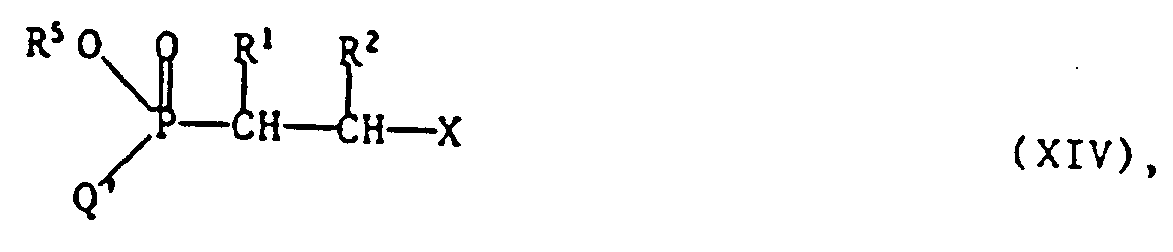
on fait réagir le composé obtenu de formule:
ou, pour la fabrication de composés de formule I, dans laquelle R est un radical aliphatique, cycloaliphatique-aliphatique ou araliphatique ayant au moins 2 atomes de carbone dans chaque fragment aliphatique, un radical R dans lequel l'atome de carbone, par l'intermédiaire duquel R est lié à l'atome P, est non substitué et l'atome de carbone voisin n'est pas substitué par des substituants hydroxy, ou bien, dans le cas des radicaux aliphatiques R, par des substituants halogéno, ou encore, dans le cas des radicaux R cycloaliphatique-aliphatiques, par des substituants alkylthio inférieurs, on le fait réagir avec un composé R'''-H (XIIb), aliphatique, cycloaliphatique-aliphatique ou araliphatique à insaturation terminale, où R''' est un groupe par ailleurs identique au radical R, dans le produit fini recherché I, mais possède une double liaison terminale supplémentaire entre l'atome de carbone par l'intermédiaire duquel R est fixé à l'atome P et l'atome de carbone voisin, ou,
pour fabriquer des composés de formule I dans laquelle l'atome de carbone par l'intermédiaire duquel R est fixé à l'atome P est substitué par un groupe hydroxy, on le fait réagir avec un aldéhyde ou une cétone aliphatique, cycloaliphatique, cycloaliphatique-aliphatique, ou araliphatique, lequel aldéhyde ou cétone correspond, si le groupe fonctionnel aldéhyde ou cétone est remplacé par une valence libre et un groupe hydroxy, au groupe R du produit fini recherché I,
pour obtenir le composé de formule VI:
le groupe X est converti en un groupe de formule -CH(R³)-NH₂ (IIa') et le composé obtenu de formule IIa:
- Procédé selon la revendication 35, pour fabriquer un composé selon l'une quelconque des revendications 1 à 29 ou l'un de ses sels.
- Utilisation d'un composé selon l'une quelconque des revendications 1 à 31, pour fabriquer un médicament nootrope, antidépresseur et/ou anti-épileptique.
- Nouveau procédé pour fabriquer des composés de formule:


- Procédé selon la revendication 38, caractérisé en ce qu'on fabrique le 2-cyanoéthyl(1-hydroxybutyl)phosphinate d'éthyle.
Applications Claiming Priority (2)
| Application Number | Priority Date | Filing Date | Title |
|---|---|---|---|
| GB878728483A GB8728483D0 (en) | 1987-12-04 | 1987-12-04 | Chemical compounds |
| GB8728483 | 1987-12-04 |
Publications (3)
| Publication Number | Publication Date |
|---|---|
| EP0319482A2 EP0319482A2 (fr) | 1989-06-07 |
| EP0319482A3 EP0319482A3 (en) | 1990-07-11 |
| EP0319482B1 true EP0319482B1 (fr) | 1994-05-18 |
Family
ID=10628049
Family Applications (2)
| Application Number | Title | Priority Date | Filing Date |
|---|---|---|---|
| EP88810813A Withdrawn EP0319479A3 (fr) | 1987-12-04 | 1988-11-28 | Composés d'acides propane phosphiniques substitués |
| EP88810831A Expired - Lifetime EP0319482B1 (fr) | 1987-12-04 | 1988-12-05 | Composés d'acides propane phosphiniques substitués |
Family Applications Before (1)
| Application Number | Title | Priority Date | Filing Date |
|---|---|---|---|
| EP88810813A Withdrawn EP0319479A3 (fr) | 1987-12-04 | 1988-11-28 | Composés d'acides propane phosphiniques substitués |
Country Status (22)
| Country | Link |
|---|---|
| US (3) | US5013863A (fr) |
| EP (2) | EP0319479A3 (fr) |
| JP (1) | JP2716761B2 (fr) |
| KR (1) | KR890009955A (fr) |
| AT (1) | ATE105840T1 (fr) |
| AU (1) | AU614316B2 (fr) |
| CA (1) | CA1337352C (fr) |
| DD (1) | DD283630A5 (fr) |
| DE (1) | DE3889638T2 (fr) |
| DK (1) | DK673588A (fr) |
| ES (1) | ES2054869T3 (fr) |
| FI (1) | FI91412C (fr) |
| GB (1) | GB8728483D0 (fr) |
| HU (1) | HU202543B (fr) |
| IE (1) | IE63607B1 (fr) |
| IL (1) | IL88514A0 (fr) |
| MX (1) | MX14033A (fr) |
| NO (1) | NO177674C (fr) |
| NZ (1) | NZ227182A (fr) |
| PT (1) | PT89134B (fr) |
| YU (1) | YU218788A (fr) |
| ZA (1) | ZA889015B (fr) |
Families Citing this family (55)
| Publication number | Priority date | Publication date | Assignee | Title |
|---|---|---|---|---|
| US5243062A (en) * | 1984-10-12 | 1993-09-07 | Ciba-Geigy Corporation | Substituted propane-phosphonous acid compounds |
| US5457095A (en) * | 1984-10-12 | 1995-10-10 | Ciba-Geigy Corporation | Substituted propane-phosponous acid compounds |
| US5190933A (en) * | 1987-12-04 | 1993-03-02 | Ciba-Geigy Corporation | Substituted propane-phosphinic acid compounds |
| US5300679A (en) * | 1987-12-04 | 1994-04-05 | Ciba-Geigy Corporation | Substituted propane-phosphinic acid compounds |
| GB8911017D0 (en) * | 1989-05-13 | 1989-06-28 | Ciba Geigy Ag | Substituted aminoalkylphosphinic acids |
| US5567840A (en) * | 1989-05-13 | 1996-10-22 | Ciba-Geigy Corporation | Substituted aminoalkylphosphinic acids |
| US5281747A (en) * | 1989-05-13 | 1994-01-25 | Ciba-Geigy Corporation | Substituted aminoalkylphosphinic acids |
| US5190934A (en) * | 1989-06-03 | 1993-03-02 | Ciba-Geigy Corporation | P-subsituted propane-phosphinic acid compounds |
| GB8912814D0 (en) * | 1989-06-03 | 1989-07-19 | Ciba Geigy Ag | P-substituted propane-phospinic acid compounds |
| IL114631A (en) * | 1990-06-22 | 1998-12-06 | Novartis Ag | Anti-epileptic compositions containing gabab- antagonistic compounds |
| US5179173A (en) * | 1991-04-10 | 1993-01-12 | Nalco Chemical Company | Aminoalkylphosphinates and phosphinic acid-containing polymers therefrom |
| EP0767174A1 (fr) * | 1991-11-21 | 1997-04-09 | Ciba-Geigy Ag | Nouveaux acides aminalcanephosphiniques et leurs sels |
| GB9125615D0 (en) * | 1991-12-02 | 1992-01-29 | Wyeth John & Brother Ltd | Amines |
| AU662404B2 (en) * | 1992-05-08 | 1995-08-31 | Novartis Ag | Novel N-aralkyl- and N-heteroaralkyl-aminoalkanephosphinic acids |
| US5298625A (en) * | 1992-12-07 | 1994-03-29 | E. R. Squibb & Sons, Inc. | Process for the preparation of 4-phosphinyl-3-keto-carboxylate and 4-phosphonyl-3-keto-carboxylate intermediates useful in the preparation of phosphorus containing HMG-CoA reductase inhibitors |
| GB9304619D0 (en) * | 1993-03-06 | 1993-04-21 | Ciba Geigy Ag | Esters |
| US5385939A (en) * | 1993-04-30 | 1995-01-31 | The Trustees Of The University Of Pennsylvania | GABA-ergic modulation of eye growth |
| DE19604195C1 (de) * | 1996-02-06 | 1997-04-17 | Hoechst Ag | Verfahren zur Herstellung von Phosphonigsäuremonoalkylestern |
| DE19634706A1 (de) * | 1996-08-28 | 1998-03-05 | Hoechst Ag | Verfahren zur Herstellung von 2-Cyanoethyl-phosphinsäureestern |
| GB9906882D0 (en) * | 1999-03-25 | 1999-05-19 | Novartis Ag | Organic compounds |
| EP1372620A2 (fr) * | 2001-03-15 | 2004-01-02 | Saegis Pharmaceuticals | Methodes permettant de retablir la fonction cognitive suite a un stress systemique |
| US20060014801A1 (en) * | 2002-11-22 | 2006-01-19 | The Johns Hopkins University | Prevention and treatment of cognitive impairment using (R)-(-)-5-methyl-1-nicotynoyl-2-pyrazoline (MNP) and analogs |
| EA008596B1 (ru) | 2003-04-29 | 2007-06-29 | Пфайзер Инк. | 5,7-ДИАМИНОПИРАЗОЛО[4,3-d]ПИРИМИДИНЫ, ПОЛЕЗНЫЕ ПРИ ЛЕЧЕНИИ ГИПЕРТЕНЗИИ |
| AR045794A1 (es) * | 2003-09-23 | 2005-11-16 | Aventis Pharma Inc | Procedimiento para preparar derivados de acido 3- amino-2- hidroxipropilfosfinico |
| EP1677759A1 (fr) * | 2003-10-31 | 2006-07-12 | Alza Corporation | Compositions et formes posologiques pour une absorption amelioree de gabapentine et pregabaline |
| US7572799B2 (en) | 2003-11-24 | 2009-08-11 | Pfizer Inc | Pyrazolo[4,3-d]pyrimidines as Phosphodiesterase Inhibitors |
| DE10356410A1 (de) * | 2003-11-24 | 2005-06-23 | Bioagency Ag | Phosphororganische Verbindungen und deren Verwendung |
| DE602005011784D1 (de) | 2004-04-07 | 2009-01-29 | Pfizer | Pyrazoloä4,3-düpyrimidine |
| AU2005244867A1 (en) * | 2004-05-14 | 2005-12-01 | The Johns Hopkins University | Method for improving cognitive function by co-administration of a GABAB receptor antagonist and an acetylcholinesterase inhibitor |
| SE0402199D0 (sv) * | 2004-09-13 | 2004-09-13 | Astrazeneca Ab | New process I |
| WO2006050472A2 (fr) * | 2004-11-03 | 2006-05-11 | Xenoport, Inc. | Prodrogues d'acyloxyalkyl carbamate, et leurs procedes de synthese et d'utilisation |
| WO2006050471A2 (fr) * | 2004-11-03 | 2006-05-11 | Xenoport, Inc. | Prodrogues d'acyloxyalkyl carbamate de l'acide 3-aminopropylsulfinique, et procedes de synthese et d'utilisation |
| RU2007133791A (ru) * | 2005-02-11 | 2009-03-20 | Авентис Фармасьютикалз Инк. (Us) | Замещенные сложные эфиры пропанфосфиновой кислоты |
| GB0608359D0 (en) * | 2006-04-28 | 2006-06-07 | Johnson Matthey Plc | Catalyst additives |
| WO2008033572A1 (fr) * | 2006-09-15 | 2008-03-20 | Xenoport, Inc. | Promédicaments à base de carbamate d'acyloxyalkyle, procédés de synthèse et utilisation |
| CN102046692A (zh) * | 2008-04-03 | 2011-05-04 | 巴斯夫欧洲公司 | 聚酯的用次膦酸化合物的固相聚合方法 |
| DE102008055916A1 (de) | 2008-11-05 | 2010-05-06 | Clariant International Limited | Verfahren zur Herstellung von mono-hydroxyfunktionalisierten Dialkylphosphinsäuren, -estern und -salzen mittels Allylalkoholen und ihre Verwendung |
| DE102008055914A1 (de) | 2008-11-05 | 2010-05-06 | Clariant International Limited | Verfahren zur Herstellung von mono-hydroxyfunktionalisierten Dialkylphosphinsäuren, -estern und -salzen mittels Acroleinen und ihre Verwendung |
| WO2010051883A1 (fr) | 2008-11-05 | 2010-05-14 | Clariant International Ltd | Procédé de production d'acides, d'esters et de sels phosphiniques dialkyle au moyen d'alcools allyliques/acroléines et leur utilisation |
| DE102008056228A1 (de) * | 2008-11-06 | 2010-05-12 | Clariant International Limited | Verfahren zur Herstellung von monoaminofunktionalisierten Dialkylphosphinsäuren, deren Salze und Ester und ihre Verwendung |
| DE102008056342A1 (de) | 2008-11-07 | 2010-05-12 | Clariant International Limited | Verfahren zur Herstellung von Dialkylphosphinsäuren, -estern und -salzen mittels Acrylnitrilen und ihre Verwendung |
| EP2352740B1 (fr) | 2008-11-07 | 2014-09-24 | Clariant Finance (BVI) Limited | Procédé pour produire des acides, des esters et des sels dialkylphosphiniques au moyen de dérivés d'acide acrylique et leur utilisation |
| DE102008056339A1 (de) * | 2008-11-07 | 2010-05-12 | Clariant International Limited | Verfahren zur Herstellung von mono-aminofunktionalisierten Dialkylphosphinsäuren, -estern und -salzen und ihre Verwendung |
| DE102008056341A1 (de) * | 2008-11-07 | 2010-05-12 | Clariant International Limited | Verfahren zur Herstellung von monoaminofunktionalisierten Dialkylphosphinsäuren, -estern und -salzen mittels Acrylnitrilen und ihre Verwendung |
| EP2367835B1 (fr) | 2008-11-11 | 2013-12-11 | Clariant Finance (BVI) Limited | Procédé de fabrication d'acides dialkylphosphiniques à fonction mono-allyle, de leurs sels et de leurs esters avec des composés allyliques, et son utilisation |
| DE102008060035A1 (de) * | 2008-12-02 | 2010-06-10 | Clariant International Limited | Verfahren zur Herstellung von mono-hydroxyfunktionalisierten Dialkylphosphinsäuren, -estern und -salzen mittels Vinylester einer Carbonsäure und ihre Verwendung |
| DE102008060036A1 (de) | 2008-12-02 | 2010-06-10 | Clariant International Limited | Verfahren zur Herstellung von mono-carboxyfunktionalisierten Dialkylphosphinsäuren, -estern und -salzen mittels Vinylester einer Carbonsäure und ihre Verwendung |
| DE102008060535A1 (de) | 2008-12-04 | 2010-06-10 | Clariant International Limited | Verfahren zur Herstellung von mono-carboxyfunktionalisierten Dialkylphosphinsäuren, -estern und -salzen mittels Vinylether und ihre Verwendung |
| DE102008063640A1 (de) * | 2008-12-18 | 2010-06-24 | Clariant International Limited | Verfahren zur Herstellung von gemischtsubstituierten Dialkylphosphinsäuren, -estern und -salzen und ihre Verwendung |
| DE102008063627A1 (de) * | 2008-12-18 | 2010-06-24 | Clariant International Limited | Verfahren zur Herstellung von monohydroxyfunktionalisierten Dialkylphosphinsäuren,-estern und -salzen mittels Ethylenoxid und ihre Verwendung |
| DE102008063642A1 (de) | 2008-12-18 | 2010-06-24 | Clariant International Limited | Verfahren zur Herstellung von monocarboxyfunktionalisierten Dialkylphosphinsäuren, -estern und -salzen mittels Alkylenoxiden und ihre Verwendung |
| DE102008063668A1 (de) | 2008-12-18 | 2010-07-01 | Clariant International Limited | Verfahren zur Herstellung von Alkylphosponsäuren, -estern und -salzen mittels Oxidation von Alkylphosphonigsäuren und ihre Verwendung |
| KR101697948B1 (ko) | 2008-12-18 | 2017-01-19 | 클라리언트 파이넌스 (비브이아이)리미티드 | 아세틸렌을 사용하는 에틸렌디알킬포스핀산, 에틸렌디알킬포스핀산 에스테르 및 에틸렌디알킬포스핀산 염의 제조방법 및 이의 용도 |
| DE102008064003A1 (de) | 2008-12-19 | 2010-06-24 | Clariant International Limited | Verfahren zur Herstellung von mono-funktionalisierten Dialkylphosphinsäuren, -estern und -salzen und ihre Verwendung |
| DE102008064012A1 (de) | 2008-12-19 | 2010-06-24 | Clariant International Limited | Halogenfreie Addukte von Alkylphosphonigsäurederivaten und diesterbildenden Olefinen, halogenfreie Verfahren zu deren Herstellung und ihre Verwendung |
Family Cites Families (10)
| Publication number | Priority date | Publication date | Assignee | Title |
|---|---|---|---|---|
| US3184496A (en) * | 1961-02-27 | 1965-05-18 | Hooker Chemical Corp | Process for the preparation and recovery of triethyl phosphite and derivatives thereof |
| DE2032712C3 (de) * | 1970-07-02 | 1978-10-19 | Bayer Ag, 5090 Leverkusen | Verfahren zur Herstellung von w-Amino-alkanphosphonsäure bzw.- phosphinsäurederivaten |
| DE2440239A1 (de) * | 1974-08-22 | 1976-03-04 | Hoechst Ag | Innere ammoniumsalze von phosphinsaeuren |
| US4064163A (en) * | 1976-12-30 | 1977-12-20 | Amchem Products, Inc. | Process for the manufacture of aliphatic phosphonic acids |
| DE3060427D1 (en) * | 1979-02-06 | 1982-07-08 | Ciba Geigy Ag | 2-substituted 5-phenoxy-phenylphosphonic acid derivatives, process for preparing them and their use as herbicides |
| EP0093081B1 (fr) * | 1982-04-23 | 1986-03-19 | Ciba-Geigy Ag | Produit herbicide et régulateur de la croissance des plantes |
| US4536355A (en) * | 1982-10-08 | 1985-08-20 | Zoecon Corporation | Phenoxyphenylaminoalkylphosphinates useful in weed control |
| GB8425872D0 (en) * | 1984-10-12 | 1984-11-21 | Ciba Geigy Ag | Chemical compounds |
| GB8820266D0 (en) * | 1988-08-26 | 1988-09-28 | Smith Kline French Lab | Compounds |
| GB8912814D0 (en) * | 1989-06-03 | 1989-07-19 | Ciba Geigy Ag | P-substituted propane-phospinic acid compounds |
-
1987
- 1987-12-04 GB GB878728483A patent/GB8728483D0/en active Pending
-
1988
- 1988-11-28 IL IL88514A patent/IL88514A0/xx unknown
- 1988-11-28 EP EP88810813A patent/EP0319479A3/fr not_active Withdrawn
- 1988-12-01 ZA ZA889015A patent/ZA889015B/xx unknown
- 1988-12-01 YU YU02187/88A patent/YU218788A/xx unknown
- 1988-12-01 NO NO885361A patent/NO177674C/no unknown
- 1988-12-02 HU HU886155A patent/HU202543B/hu not_active IP Right Cessation
- 1988-12-02 PT PT89134A patent/PT89134B/pt not_active IP Right Cessation
- 1988-12-02 DK DK673588A patent/DK673588A/da not_active Application Discontinuation
- 1988-12-02 AU AU26544/88A patent/AU614316B2/en not_active Ceased
- 1988-12-02 IE IE361788A patent/IE63607B1/en not_active IP Right Cessation
- 1988-12-02 NZ NZ227182A patent/NZ227182A/en unknown
- 1988-12-02 DD DD88322553A patent/DD283630A5/de not_active IP Right Cessation
- 1988-12-02 FI FI885623A patent/FI91412C/fi not_active IP Right Cessation
- 1988-12-02 MX MX1403388A patent/MX14033A/es unknown
- 1988-12-02 CA CA000584925A patent/CA1337352C/fr not_active Expired - Lifetime
- 1988-12-03 KR KR1019880016196A patent/KR890009955A/ko not_active Abandoned
- 1988-12-05 AT AT88810831T patent/ATE105840T1/de not_active IP Right Cessation
- 1988-12-05 DE DE3889638T patent/DE3889638T2/de not_active Expired - Lifetime
- 1988-12-05 EP EP88810831A patent/EP0319482B1/fr not_active Expired - Lifetime
- 1988-12-05 JP JP63306192A patent/JP2716761B2/ja not_active Expired - Lifetime
- 1988-12-05 ES ES88810831T patent/ES2054869T3/es not_active Expired - Lifetime
-
1989
- 1989-07-12 US US07/378,887 patent/US5013863A/en not_active Expired - Lifetime
-
1990
- 1990-02-26 US US07/484,716 patent/US5051524A/en not_active Expired - Lifetime
- 1990-03-30 US US07/502,399 patent/US5064819A/en not_active Expired - Lifetime
Also Published As
Similar Documents
| Publication | Publication Date | Title |
|---|---|---|
| EP0319482B1 (fr) | Composés d'acides propane phosphiniques substitués | |
| US5190934A (en) | P-subsituted propane-phosphinic acid compounds | |
| US5300679A (en) | Substituted propane-phosphinic acid compounds | |
| US5229379A (en) | Certain n-substituted-amino-alkane phosphinic acid derivatives having anti-epileptic properties | |
| US5190933A (en) | Substituted propane-phosphinic acid compounds | |
| EP0399949B1 (fr) | Acides aminoalkyl phosphiniques substitués | |
| US5281747A (en) | Substituted aminoalkylphosphinic acids | |
| US5567840A (en) | Substituted aminoalkylphosphinic acids | |
| EP0402312B1 (fr) | Composés P-substitués de l'acide propane-phosphinique | |
| CA2026038A1 (fr) | Acides 2-aminoalk-3-enoique substitues en position 4 | |
| SI8812187A (sl) | Postopek za pripravo spojin substituiranih propan-fosfinskih kislin |
Legal Events
| Date | Code | Title | Description |
|---|---|---|---|
| PUAI | Public reference made under article 153(3) epc to a published international application that has entered the european phase |
Free format text: ORIGINAL CODE: 0009012 |
|
| 17P | Request for examination filed |
Effective date: 19881207 |
|
| AK | Designated contracting states |
Kind code of ref document: A2 Designated state(s): AT BE CH DE ES FR GB GR IT LI LU NL SE |
|
| PUAL | Search report despatched |
Free format text: ORIGINAL CODE: 0009013 |
|
| AK | Designated contracting states |
Kind code of ref document: A3 Designated state(s): AT BE CH DE ES FR GB GR IT LI LU NL SE |
|
| 17Q | First examination report despatched |
Effective date: 19930211 |
|
| ITTA | It: last paid annual fee | ||
| GRAA | (expected) grant |
Free format text: ORIGINAL CODE: 0009210 |
|
| AK | Designated contracting states |
Kind code of ref document: B1 Designated state(s): AT BE CH DE ES FR GB GR IT LI LU NL SE |
|
| REF | Corresponds to: |
Ref document number: 105840 Country of ref document: AT Date of ref document: 19940615 Kind code of ref document: T |
|
| REF | Corresponds to: |
Ref document number: 3889638 Country of ref document: DE Date of ref document: 19940623 |
|
| ITF | It: translation for a ep patent filed | ||
| ET | Fr: translation filed | ||
| REG | Reference to a national code |
Ref country code: ES Ref legal event code: FG2A Ref document number: 2054869 Country of ref document: ES Kind code of ref document: T3 |
|
| REG | Reference to a national code |
Ref country code: GR Ref legal event code: FG4A Free format text: 3012329 |
|
| EAL | Se: european patent in force in sweden |
Ref document number: 88810831.3 |
|
| PLBE | No opposition filed within time limit |
Free format text: ORIGINAL CODE: 0009261 |
|
| STAA | Information on the status of an ep patent application or granted ep patent |
Free format text: STATUS: NO OPPOSITION FILED WITHIN TIME LIMIT |
|
| 26N | No opposition filed | ||
| REG | Reference to a national code |
Ref country code: GB Ref legal event code: 727 |
|
| REG | Reference to a national code |
Ref country code: GB Ref legal event code: 727A |
|
| REG | Reference to a national code |
Ref country code: GB Ref legal event code: 727B |
|
| REG | Reference to a national code |
Ref country code: GB Ref legal event code: SP |
|
| REG | Reference to a national code |
Ref country code: CH Ref legal event code: PFA Free format text: CIBA-GEIGY AG TRANSFER- NOVARTIS AG |
|
| REG | Reference to a national code |
Ref country code: GB Ref legal event code: 732E |
|
| NLS | Nl: assignments of ep-patents |
Owner name: NOVARTIS AG |
|
| REG | Reference to a national code |
Ref country code: ES Ref legal event code: PC2A |
|
| PGFP | Annual fee paid to national office [announced via postgrant information from national office to epo] |
Ref country code: LU Payment date: 19971112 Year of fee payment: 10 |
|
| REG | Reference to a national code |
Ref country code: FR Ref legal event code: TP |
|
| PG25 | Lapsed in a contracting state [announced via postgrant information from national office to epo] |
Ref country code: LU Free format text: LAPSE BECAUSE OF NON-PAYMENT OF DUE FEES Effective date: 19981205 |
|
| REG | Reference to a national code |
Ref country code: GB Ref legal event code: IF02 |
|
| PGFP | Annual fee paid to national office [announced via postgrant information from national office to epo] |
Ref country code: NL Payment date: 20071125 Year of fee payment: 20 |
|
| PGFP | Annual fee paid to national office [announced via postgrant information from national office to epo] |
Ref country code: AT Payment date: 20071212 Year of fee payment: 20 Ref country code: CH Payment date: 20071128 Year of fee payment: 20 |
|
| PGFP | Annual fee paid to national office [announced via postgrant information from national office to epo] |
Ref country code: SE Payment date: 20071205 Year of fee payment: 20 |
|
| PGFP | Annual fee paid to national office [announced via postgrant information from national office to epo] |
Ref country code: GB Payment date: 20071205 Year of fee payment: 20 Ref country code: FR Payment date: 20071210 Year of fee payment: 20 Ref country code: ES Payment date: 20080118 Year of fee payment: 20 |
|
| PGFP | Annual fee paid to national office [announced via postgrant information from national office to epo] |
Ref country code: DE Payment date: 20071129 Year of fee payment: 20 Ref country code: GR Payment date: 20071116 Year of fee payment: 20 Ref country code: IT Payment date: 20071228 Year of fee payment: 20 |
|
| PGFP | Annual fee paid to national office [announced via postgrant information from national office to epo] |
Ref country code: BE Payment date: 20080314 Year of fee payment: 20 |
|
| REG | Reference to a national code |
Ref country code: CH Ref legal event code: PL |
|
| REG | Reference to a national code |
Ref country code: GB Ref legal event code: PE20 Expiry date: 20081204 |
|
| BE20 | Be: patent expired |
Owner name: *NOVARTIS A.G. Effective date: 20081205 |
|
| PG25 | Lapsed in a contracting state [announced via postgrant information from national office to epo] |
Ref country code: NL Free format text: LAPSE BECAUSE OF EXPIRATION OF PROTECTION Effective date: 20081205 |
|
| EUG | Se: european patent has lapsed | ||
| REG | Reference to a national code |
Ref country code: ES Ref legal event code: FD2A Effective date: 20081209 |
|
| PG25 | Lapsed in a contracting state [announced via postgrant information from national office to epo] |
Ref country code: ES Free format text: LAPSE BECAUSE OF EXPIRATION OF PROTECTION Effective date: 20081209 |
|
| PG25 | Lapsed in a contracting state [announced via postgrant information from national office to epo] |
Ref country code: GB Free format text: LAPSE BECAUSE OF EXPIRATION OF PROTECTION Effective date: 20081204 |