EP0320715A2 - Procédé pour la production d'un matériau de construction se présentant sous la forme d'une structure sandwich légère - Google Patents
Procédé pour la production d'un matériau de construction se présentant sous la forme d'une structure sandwich légère Download PDFInfo
- Publication number
- EP0320715A2 EP0320715A2 EP88120128A EP88120128A EP0320715A2 EP 0320715 A2 EP0320715 A2 EP 0320715A2 EP 88120128 A EP88120128 A EP 88120128A EP 88120128 A EP88120128 A EP 88120128A EP 0320715 A2 EP0320715 A2 EP 0320715A2
- Authority
- EP
- European Patent Office
- Prior art keywords
- fabric
- temperature
- double fabric
- fibers
- double
- Prior art date
- Legal status (The legal status is an assumption and is not a legal conclusion. Google has not performed a legal analysis and makes no representation as to the accuracy of the status listed.)
- Withdrawn
Links
Images
Classifications
-
- D—TEXTILES; PAPER
- D03—WEAVING
- D03D—WOVEN FABRICS; METHODS OF WEAVING; LOOMS
- D03D27/00—Woven pile fabrics
- D03D27/02—Woven pile fabrics wherein the pile is formed by warp or weft
- D03D27/10—Fabrics woven face-to-face, e.g. double velvet
-
- B—PERFORMING OPERATIONS; TRANSPORTING
- B29—WORKING OF PLASTICS; WORKING OF SUBSTANCES IN A PLASTIC STATE IN GENERAL
- B29C—SHAPING OR JOINING OF PLASTICS; SHAPING OF MATERIAL IN A PLASTIC STATE, NOT OTHERWISE PROVIDED FOR; AFTER-TREATMENT OF THE SHAPED PRODUCTS, e.g. REPAIRING
- B29C70/00—Shaping composites, i.e. plastics material comprising reinforcements, fillers or preformed parts, e.g. inserts
- B29C70/04—Shaping composites, i.e. plastics material comprising reinforcements, fillers or preformed parts, e.g. inserts comprising reinforcements only, e.g. self-reinforcing plastics
- B29C70/06—Fibrous reinforcements only
- B29C70/10—Fibrous reinforcements only characterised by the structure of fibrous reinforcements, e.g. hollow fibres
- B29C70/16—Fibrous reinforcements only characterised by the structure of fibrous reinforcements, e.g. hollow fibres using fibres of substantial or continuous length
- B29C70/24—Fibrous reinforcements only characterised by the structure of fibrous reinforcements, e.g. hollow fibres using fibres of substantial or continuous length oriented in at least three directions forming a three-dimensional [3D] structure
-
- B—PERFORMING OPERATIONS; TRANSPORTING
- B29—WORKING OF PLASTICS; WORKING OF SUBSTANCES IN A PLASTIC STATE IN GENERAL
- B29K—INDEXING SCHEME ASSOCIATED WITH SUBCLASSES B29B, B29C OR B29D, RELATING TO MOULDING MATERIALS OR TO MATERIALS FOR MOULDS, REINFORCEMENTS, FILLERS OR PREFORMED PARTS, e.g. INSERTS
- B29K2105/00—Condition, form or state of moulded material or of the material to be shaped
- B29K2105/06—Condition, form or state of moulded material or of the material to be shaped containing reinforcements, fillers or inserts
- B29K2105/08—Condition, form or state of moulded material or of the material to be shaped containing reinforcements, fillers or inserts of continuous length, e.g. cords, rovings, mats, fabrics, strands or yarns
- B29K2105/0809—Fabrics
- B29K2105/0845—Woven fabrics
-
- D—TEXTILES; PAPER
- D10—INDEXING SCHEME ASSOCIATED WITH SUBLASSES OF SECTION D, RELATING TO TEXTILES
- D10B—INDEXING SCHEME ASSOCIATED WITH SUBLASSES OF SECTION D, RELATING TO TEXTILES
- D10B2331/00—Fibres made from polymers obtained otherwise than by reactions only involving carbon-to-carbon unsaturated bonds, e.g. polycondensation products
- D10B2331/02—Fibres made from polymers obtained otherwise than by reactions only involving carbon-to-carbon unsaturated bonds, e.g. polycondensation products polyamides
- D10B2331/021—Fibres made from polymers obtained otherwise than by reactions only involving carbon-to-carbon unsaturated bonds, e.g. polycondensation products polyamides aromatic polyamides, e.g. aramides
-
- Y—GENERAL TAGGING OF NEW TECHNOLOGICAL DEVELOPMENTS; GENERAL TAGGING OF CROSS-SECTIONAL TECHNOLOGIES SPANNING OVER SEVERAL SECTIONS OF THE IPC; TECHNICAL SUBJECTS COVERED BY FORMER USPC CROSS-REFERENCE ART COLLECTIONS [XRACs] AND DIGESTS
- Y10—TECHNICAL SUBJECTS COVERED BY FORMER USPC
- Y10T—TECHNICAL SUBJECTS COVERED BY FORMER US CLASSIFICATION
- Y10T442/00—Fabric [woven, knitted, or nonwoven textile or cloth, etc.]
- Y10T442/30—Woven fabric [i.e., woven strand or strip material]
- Y10T442/3472—Woven fabric including an additional woven fabric layer
Definitions
- the invention relates to a method for producing a sandwich lightweight building material.
- Lightweight materials are used wherever a material-saving design, i.e. low weight, is important. Therefore, lightweight materials are mainly used in aircraft or vehicle construction, but also in construction technology. In addition to saving weight, mechanical stability, ie strength, resilience and torsional stiffness, is another essential requirement that is placed on the lightweight materials.
- the required mechanical stability is achieved by the so-called sandwich construction, in which two thin, load-bearing cover layers are used, which are connected to each other via a thicker but lighter core material.
- these cover layers consist of metal, plywood or fiber-reinforced, synthetic materials; Rigid foams, balsa wood or honeycomb cores made from a wide variety of materials and filigree materials with a mesh structure are used as fillers.
- This honeycomb or mesh structure is made from warp knitted fabrics impregnated with synthetic resin by deep drawing.
- the core material must be connected to the cover layers, for example by gluing, so that an additional operation is required in the manufacture of the sandwich component.
- the type of connection of the core material and cover layers also has a decisive influence on the mechanical stability of the entire component, so that the requirements cannot be met precisely with regard to the torsional rigidity. This is particularly the case when a honeycomb structure is used as the core material, which only has the thin webs of the honeycomb walls perpendicular to the cover layer as the binding surface.
- a three-dimensional fabric is known from US Pat. No. 4,336,296, which is immersed in a plastic mass to increase the stability, which has the task of gluing the individual threads together. In this way a flexible structure is achieved which is used for the manufacture of motor vehicle tires. This fabric cannot be used as a lightweight building material.
- GB-PS 990,554 a two-layer fabric is known in which the two layers are connected to one another via pile threads.
- these double fabrics are impregnated with a thermosetting synthetic resin, which hardens during a subsequent heat treatment.
- a disadvantage here is the additional impregnation step.
- the object of the invention is therefore a process for the production of a sandwich lightweight building material which is simpler, faster and less expensive to carry out than the known processes, the lightweight building material obtained having at least the same values in terms of strength, rigidity, torsional rigidity, density and fire behavior as the known ones Sandwich building materials.
- the double fabric is made from fibers or yarns which consist of at least one polymer which solidifies under heat, and in which the double fabric is subjected to a temperature aftertreatment in such a way that the fabric solidifies.
- This process has the advantage that the additional process step of impregnation with a thermosetting synthetic resin is eliminated, which considerably shortens the production process.
- fiber types are preferably used which are distinguished by certain glass transition temperatures and melting or decomposition temperatures.
- Fibers without a melting point and not pronounced two-phase structure are preferably used. All polymers that can be processed into fibers or yarns are suitable, i.e. Polycondensate and polyaddition products, such as polyesters or polyamides, or polymers, such as polypropylene, polyacrylonitrile or polytetrafluoroethylene.
- high-temperature-resistant polymers are suitable. These include homocyclic and heterocyclic polymers, in particular fully aromatic polyamides (aramids), fully aromatic polyamides and "ordered polyamides" (copolyamides), heterocyclic aromatic polyamides, heterocyclic polyamides with an ordered structure, polymers made from readily soluble heterocyclic polyamides, fibers made from polyheterocycles, polyimides, polyimides, polyimides Polybenzimidazoles, polyphenylquinoxalines, polyacrylene ethers, polyoxydiazoles, polytriazoles, polythiadiazoles, polybenzoxazoles and polyquinazolinediones.
- the double woven fabric can comprise conductor polymers, in particular poly-bis-benzimidazolbenzophenanthroline or other high-temperature-resistant polymers such as polytherephthaloyl-oxalamidrazone, poly-2,6-diphenyl-p-phenylene oxide or phenol-formaldehyde.
- conductor polymers in particular poly-bis-benzimidazolbenzophenanthroline or other high-temperature-resistant polymers such as polytherephthaloyl-oxalamidrazone, poly-2,6-diphenyl-p-phenylene oxide or phenol-formaldehyde.
- inorganic fibers such as mineral fibers, carbon fibers, polycrystalline, inorganic fibers, whiskers or metal fibers can also be woven in in addition to the polymer fibers.
- a sandwich lightweight construction material provided with such inorganic fibers is particularly advantageous for the new production and retrofitting in future inspections of aircraft, since in the future the thermoplastics previously used for the side cladding, wall cladding, ceiling panels, textile-covered parts, such as baseboards and partition walls, as well as storage flaps and air supply lines, will be replaced by Lightweight building materials must be replaced, which must pass the heat release test developed by Ohio State University (Test No. 14 CFR, Part 25 and 121, No. 24595, No. 25-61 and 121-189).
- a sandwich plate according to the invention made of polyimide fibers with an inorganic fiber portion with the dimensions 150 x 150 mm was irradiated for five minutes in accordance with the test instructions in a heating chamber by a heat source with a power of 3.5 W / cm2. Values of ⁇ 65 kW / m2 were measured at the heating chamber outlet, which means that the test requirements were met.
- polymer fibers or polymer yarns with a high modulus of elasticity are used.
- polymers can be used: Poly - p - benzamide, poly - p - phenylene terephthalamide, aromatic polyamide hydrazide, polyethylene naphthalate, polyethylene diphenoxy dicarboxylate and polyphenylene sulfide.
- the special spinning, drawing and post-treatment technology achieves a physically modified form which enables their use in the lightweight building material.
- Chemically modified fibers can also be used if copolymers with reduced willingness to crystallize or, preferably, amorphous fibers, which have also been treated after the temperature corresponding to the respective polymer, continue to retain an amorphous structure.
- resins can also be stored in the double fabric.
- the sandwich lightweight building material can also have a wide variety of combinations of the polymer fibers or polymer yarns mentioned.
- the fabric can also be stabilized with plastic or impregnation.
- the individual fiber diameters are preferably between 1 and 1000 ⁇ m, the fineness of the yarns used is preferably between 10 dtex and 2200 dtex.
- the lightweight building material can be any edited and redesigned, although it has a multi-oriented structure. This means that a construction that is variable within wide limits is possible, in which the anisotropy of the mechanical and physical properties can be specifically incorporated into the construction, taking into account possible chemical reactions in the material or with other materials or with the atmosphere.
- the lightweight building material is also permeable to gas, water vapor or liquids. This opens up completely new areas of application.
- the three-dimensional double fabric with one, two or three weft weave is produced.
- the corresponding looms for the production of such double fabrics are set up for the accommodation of five or six chains, for a base and binding chain for upper and lower goods and for single and two-weft goods for a pile chain as well as for three-weft goods for two pile chains.
- the shooters hit a beam stop device either in the same stroke or in the cross stroke through the double compartment.
- the two basic fabrics (upper and lower fabric), which can be produced without the use of rods, are woven on top of each other with a spacing that corresponds to the respective later purpose. These basic fabrics are connected by pile warp threads, which can be varied in terms of density and length.
- the pile warp threads are either by shafts or guided from one base fabric to the other by special machines and integrated by weft crossing.
- the two base fabrics later form the two cover constructions of the lightweight sandwich after solidification by mechanical, thermal or chemical influence.
- the pole chains assume the stability in the third dimension in the sandwich. This achieves maximum mechanical properties with minimum density, which is one of the main requirements placed on reinforcement structures.
- the double fabric is produced using the velor process.
- the duration of this temperature aftertreatment also depends on the polymer material used.
- the double fabric is preheated by this temperature aftertreatment, first at temperatures below the glass transition temperature T G of the amorphous material of the polymer or polymers.
- T G glass transition temperature
- the temperature and duration of the pre-tempering depend on the polymer fibers or polymer yarns used.
- the fabric is stretched in the longitudinal and transverse directions prior to the thermal treatment and above the glass transition point during the thermal post-treatment to solidify the fabric Fibers or yarns are allowed to shrink the fabric.
- the fabric After completion or during this pre-tempering and this temperature post-treatment, the fabric can additionally be impregnated or chemically treated in another way.
- the pre-consolidated or finished and post-treated fabric is either cut into plates or pressed into the corresponding molded parts. If the double fabric is pressed into molded parts after the pre-tempering, the post-treatment essentially coincides with the pressing process.
- the finished lightweight building material has a thickness of approx. 2.5 mm to 70 mm. However, other thicknesses can also be produced.
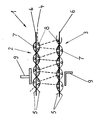
- the figure shows the production of the double fabric 1 according to the invention, which is located between the pile rails 9, which define the thickness of the double fabric.
- the upper fabric 2 and the lower fabric 3 are formed by the base chains 6 and the binding chains 5 as well as the lower wefts 7 and the upper wefts 8.
- the pile warp threads that form the core material are designated by 4.
- the lightweight building material can be pre-annealed as a sheet, blank or molded part, or fully shrunk and solidified, which is an additional advantage over the known lightweight building materials.
- the manufacturing process also brings further advantages with regard to the further processing and the quality of the sandwich components, since the gases which are normally produced when the cover layers are pressed according to the prior art are not enclosed in the sandwich, but are discharged.
- the fact that, apart from special applications, no resins have to be used to stiffen the lightweight construction, gas formation is reduced to a minimum.
Landscapes
- Engineering & Computer Science (AREA)
- Textile Engineering (AREA)
- Chemical & Material Sciences (AREA)
- Composite Materials (AREA)
- Mechanical Engineering (AREA)
- Woven Fabrics (AREA)
- Laminated Bodies (AREA)
Applications Claiming Priority (2)
| Application Number | Priority Date | Filing Date | Title |
|---|---|---|---|
| DE19873742400 DE3742400A1 (de) | 1987-12-15 | 1987-12-15 | Sandwich-leichtbaustoff und verfahren zu seiner herstellung |
| DE3742400 | 1987-12-15 |
Publications (2)
| Publication Number | Publication Date |
|---|---|
| EP0320715A2 true EP0320715A2 (fr) | 1989-06-21 |
| EP0320715A3 EP0320715A3 (fr) | 1991-10-16 |
Family
ID=6342599
Family Applications (1)
| Application Number | Title | Priority Date | Filing Date |
|---|---|---|---|
| EP19880120128 Withdrawn EP0320715A3 (fr) | 1987-12-15 | 1988-12-02 | Procédé pour la production d'un matériau de construction se présentant sous la forme d'une structure sandwich légère |
Country Status (4)
| Country | Link |
|---|---|
| US (1) | US4971642A (fr) |
| EP (1) | EP0320715A3 (fr) |
| JP (1) | JPH01201546A (fr) |
| DE (1) | DE3742400A1 (fr) |
Cited By (6)
| Publication number | Priority date | Publication date | Assignee | Title |
|---|---|---|---|---|
| EP0504708A1 (fr) * | 1991-03-18 | 1992-09-23 | PARABEAM Industrie- en Handelsonderneming B.V. | Corps creux en matière plastique renforcé de fibres |
| EP0602471A3 (fr) * | 1992-12-12 | 1995-01-04 | Parabeam Ind & Handels Bv | Structure textile plane pour matériau composite pouvant être découpée en bandes d'étoffe à poils double. |
| BE1007215A5 (nl) * | 1993-06-11 | 1995-04-25 | Wiele Michel Van De Nv | Weefsel, in het bijzonder tapijt. |
| WO1996031336A1 (fr) * | 1995-04-04 | 1996-10-10 | Katholieke Universiteit Leuven | Procede de fabrication d'un produit textile tridimensionnel, fil mis en ×uvre, et materiaux composites obtenus a l'aide de ce fil et selon ce procede |
| US5655573A (en) * | 1993-06-11 | 1997-08-12 | N.V. Michael Van De Wiele | Method for manufacturing a face-to-face pile fabric having weft threads located above one another |
| DE102024207842A1 (de) * | 2024-08-19 | 2026-02-19 | ESSEDEA GmbH & Co. KG | Abstandsgewirke zur Verwendung in einem begrünbaren Fassadenelement |
Families Citing this family (15)
| Publication number | Priority date | Publication date | Assignee | Title |
|---|---|---|---|---|
| DE9007289U1 (de) * | 1990-06-22 | 1991-10-17 | Parabeam Industrie- En Handelsonderneming B.V., Helmond | Verbund- und Hybridwerkstoffbahn |
| CA2065266A1 (fr) * | 1990-10-03 | 1992-04-04 | Samuel Eugene Dunson | Compose de fibre rigide |
| DE9017482U1 (de) * | 1990-12-27 | 1991-07-18 | Dröge, Rodolf Johannes Cornelis, Mörgestel | Dreidimensionales Flächengebilde |
| DE4100738A1 (de) * | 1991-01-12 | 1992-07-16 | Vorwerk Co Interholding | Bauteil auf basis eines abstandsgewebes |
| US5534318A (en) * | 1991-03-18 | 1996-07-09 | Parabeam Industrie-En Handelsonderneming B.V. | Hollow fiber-reinforced plastic body |
| DE9104141U1 (de) * | 1991-04-05 | 1992-08-13 | Vorwerk & Co. Interholding GmbH, 42275 Wuppertal | Bauteil aus verharztem Abstandsgewebe zur Ausbildung eines Hüllkörpers |
| DE4202589C1 (en) * | 1992-01-30 | 1993-04-22 | Deutsche Aerospace Ag, 8000 Muenchen, De | Prodn. of integral sandwich structure from preformed textile - comprises impregnating core yarns with hardenable plastic and placing between rigid baseplate and covering plate |
| IT1269956B (it) * | 1994-06-28 | 1997-04-16 | Somiver Spa | Procedimento per la realizzazione di una struttura continua in materiale composito |
| GB0114669D0 (en) * | 2001-06-15 | 2001-08-08 | Btg Int Ltd | Amorphous polymer articles |
| US20070228217A1 (en) * | 2004-05-24 | 2007-10-04 | Airbus Deutschland Gmbh | Window Frame for Aircraft |
| GB2465090A (en) * | 2007-06-11 | 2010-05-12 | Escom Composite Materials Ltd | Flexible 3-D textile structure and method of producing thereof |
| IT1394551B1 (it) * | 2009-06-08 | 2012-07-05 | Flii Citterio Spa | Procedimento ed apparato di produzione in continuo di una struttura tessile resistente alla perforazione ed alla penetrazione e struttura tessile cosi' ottenuta |
| EP2758573B1 (fr) * | 2011-09-22 | 2019-07-10 | NV Michel van de Wiele | Procédé permettant de tisser un tissu à poils |
| DE102013107871B4 (de) | 2013-07-23 | 2019-08-14 | Kiesel Bauchemie Gmbh & Co. Kg | Verwendung eines mehrlagigen Textilteils, Schichtverbund für das Anbringen eines Gebäudeflächenbelags sowie Verfahren zum Anbringen eines Gebäudeflächenbelags |
| DE102020005082B3 (de) | 2020-09-02 | 2021-10-14 | G-quadrat Geokunststoffgesellschaft mbH | Flexible Textilstruktur, Bodenbauelement mit einer flexiblen Textilstruktur, Verfahren zur Herstellung eines Bodenbauelements, Erdleitungs-Schutzsystem und Verfahren zur Herstellung eines Erdleitungs-Schutzsystems sowie Verwendung des Bodenbauelements |
Family Cites Families (9)
| Publication number | Priority date | Publication date | Assignee | Title |
|---|---|---|---|---|
| US3045319A (en) * | 1961-01-25 | 1962-07-24 | Wimpfheimer & Bro Inc A | Resin molded fabric |
| US3207185A (en) * | 1961-02-23 | 1965-09-21 | Raymond Dev Ind Inc | Woven panel and method of making same |
| US3670504A (en) * | 1968-02-05 | 1972-06-20 | Collins & Aikman Corp | Fabric containment constructions |
| US3719545A (en) * | 1971-03-15 | 1973-03-06 | Carborundum Co | Reinforced laminated material |
| US4336296A (en) * | 1978-12-27 | 1982-06-22 | Agency Of Industrial Science & Technology | Three-dimensionally latticed flexible-structure composite |
| SE424206B (sv) * | 1979-02-16 | 1982-07-05 | Eiser Ab | Vetskeupptagande textilprodukter |
| DE3101022A1 (de) * | 1981-01-15 | 1982-08-05 | Hoechst Ag, 6000 Frankfurt | "formstabiles verbundmaterial und verfahren zu seiner herstellung" |
| US4359132A (en) * | 1981-05-14 | 1982-11-16 | Albany International Corp. | High performance speaker diaphragm |
| US4759976A (en) * | 1987-04-30 | 1988-07-26 | Albany International Corp. | Forming fabric structure to resist rewet of the paper sheet |
-
1987
- 1987-12-15 DE DE19873742400 patent/DE3742400A1/de not_active Withdrawn
-
1988
- 1988-12-02 EP EP19880120128 patent/EP0320715A3/fr not_active Withdrawn
- 1988-12-05 US US07/280,010 patent/US4971642A/en not_active Expired - Fee Related
- 1988-12-15 JP JP63317560A patent/JPH01201546A/ja active Pending
Cited By (6)
| Publication number | Priority date | Publication date | Assignee | Title |
|---|---|---|---|---|
| EP0504708A1 (fr) * | 1991-03-18 | 1992-09-23 | PARABEAM Industrie- en Handelsonderneming B.V. | Corps creux en matière plastique renforcé de fibres |
| EP0602471A3 (fr) * | 1992-12-12 | 1995-01-04 | Parabeam Ind & Handels Bv | Structure textile plane pour matériau composite pouvant être découpée en bandes d'étoffe à poils double. |
| BE1007215A5 (nl) * | 1993-06-11 | 1995-04-25 | Wiele Michel Van De Nv | Weefsel, in het bijzonder tapijt. |
| US5655573A (en) * | 1993-06-11 | 1997-08-12 | N.V. Michael Van De Wiele | Method for manufacturing a face-to-face pile fabric having weft threads located above one another |
| WO1996031336A1 (fr) * | 1995-04-04 | 1996-10-10 | Katholieke Universiteit Leuven | Procede de fabrication d'un produit textile tridimensionnel, fil mis en ×uvre, et materiaux composites obtenus a l'aide de ce fil et selon ce procede |
| DE102024207842A1 (de) * | 2024-08-19 | 2026-02-19 | ESSEDEA GmbH & Co. KG | Abstandsgewirke zur Verwendung in einem begrünbaren Fassadenelement |
Also Published As
| Publication number | Publication date |
|---|---|
| US4971642A (en) | 1990-11-20 |
| EP0320715A3 (fr) | 1991-10-16 |
| DE3742400A1 (de) | 1989-07-06 |
| JPH01201546A (ja) | 1989-08-14 |
Similar Documents
| Publication | Publication Date | Title |
|---|---|---|
| EP0320715A2 (fr) | Procédé pour la production d'un matériau de construction se présentant sous la forme d'une structure sandwich légère | |
| EP2427323B9 (fr) | Procédé de fabrication d'un matériau composite renforcé par fibres | |
| DE69406815T2 (de) | Verfahren zur Herstellung eines Verbundmaterialkörpers, insbesondere einer Sandwichplatte, aus mehreren zusammengesetzten Vorformen | |
| DE69325718T2 (de) | Nichtmetallische honigwabenstruktur mit hoher wärmeleitfähigkeit | |
| DE69003875T2 (de) | Verstärkungsgewebe und vorgeformtes Halbzeug, faserverstärkter Verbundwerkstoff und daraus hergestellter Träger. | |
| DE69321549T2 (de) | Verformbarer verbundvliesstoff und herstellverfahren hierfür | |
| EP0222399B1 (fr) | Matériau de renforcement et son procédé de fabrication | |
| DE69002088T2 (de) | Textil-Schichtstoff aus Faserbahnen mit verschiedenen Eigenschaften und dessen Verfahren zur Herstellung. | |
| DE69819424T2 (de) | Schalldämpfende Platte, die zumindest eine Schallwiderstandfähige Schicht aufweist, und deren Herstellungsmethode | |
| EP1338406A2 (fr) | Matières a mouler et procédé pour ses fabrications | |
| DE102008063545C5 (de) | Multiaxialgelege, Verfahren zur Herstellung eines Faserverbundkunststoffs und Faserverbundkunststoff | |
| EP1339534A1 (fr) | Procede de production au moyen de fils de fixation fusibles de preformes multicouche a placement des fibres adapte | |
| EP0321735A2 (fr) | Matériau composite léger | |
| WO2012072405A1 (fr) | Préforme fibreuse comprenant des rubans de fibres unidirectionnels et composée de faisceaux de fibres de renforcement, et élément en matériau composite | |
| DE102014013532A1 (de) | Honigwabenstruktur aus einem vlies aus rezyklierten kohlenstofffasern | |
| EP0402708A1 (fr) | Matériau léger et aggloméré avec une matrice thermodurcissable | |
| DE69130111T2 (de) | Verfahren zur herstellung eines verbundwerkstoffes sowie verbundwerkstoff | |
| EP0418772A2 (fr) | Stratifié à dimensions stables, et méthode de fabrication de ce produit | |
| WO2002076701A1 (fr) | Materiau de renforcement contenant des fibres volumisees et procede de fabrication | |
| DE3818301C2 (fr) | ||
| DE4121503A1 (de) | Faserverstaerkte kunststoffolie und auftragungsverfahren zur oberflaechenbearbeitung fuer betonelemente | |
| EP2036701B1 (fr) | Structure stratifiée, ainsi que son procédé et dispositif de fabrication | |
| WO2022253612A1 (fr) | Empilement de préimprégné et son procédé de production | |
| DE69110717T2 (de) | Verfahren zum Herstellen von Verbundmaterialien. | |
| DE69130297T2 (de) | Flache poröse verbundstruktur und verfahren zu deren herstellung |
Legal Events
| Date | Code | Title | Description |
|---|---|---|---|
| PUAI | Public reference made under article 153(3) epc to a published international application that has entered the european phase |
Free format text: ORIGINAL CODE: 0009012 |
|
| AK | Designated contracting states |
Kind code of ref document: A2 Designated state(s): BE DE ES FR GB IT NL |
|
| PUAL | Search report despatched |
Free format text: ORIGINAL CODE: 0009013 |
|
| AK | Designated contracting states |
Kind code of ref document: A3 Designated state(s): BE DE ES FR GB IT NL |
|
| 17P | Request for examination filed |
Effective date: 19920407 |
|
| STAA | Information on the status of an ep patent application or granted ep patent |
Free format text: STATUS: THE APPLICATION IS DEEMED TO BE WITHDRAWN |
|
| 18D | Application deemed to be withdrawn |
Effective date: 19930701 |