EP0325822A1 - Procédé et installation de torréfaction de café - Google Patents
Procédé et installation de torréfaction de café Download PDFInfo
- Publication number
- EP0325822A1 EP0325822A1 EP88300603A EP88300603A EP0325822A1 EP 0325822 A1 EP0325822 A1 EP 0325822A1 EP 88300603 A EP88300603 A EP 88300603A EP 88300603 A EP88300603 A EP 88300603A EP 0325822 A1 EP0325822 A1 EP 0325822A1
- Authority
- EP
- European Patent Office
- Prior art keywords
- coffee
- beans
- roasting
- roasting chamber
- gas
- Prior art date
- Legal status (The legal status is an assumption and is not a legal conclusion. Google has not performed a legal analysis and makes no representation as to the accuracy of the status listed.)
- Granted
Links
- 235000016213 coffee Nutrition 0.000 title claims abstract description 160
- 235000013353 coffee beverage Nutrition 0.000 title claims abstract description 160
- 238000000034 method Methods 0.000 title claims description 56
- 244000046052 Phaseolus vulgaris Species 0.000 claims abstract description 108
- 235000010627 Phaseolus vulgaris Nutrition 0.000 claims abstract description 108
- 238000010438 heat treatment Methods 0.000 claims abstract description 25
- 230000005587 bubbling Effects 0.000 claims abstract description 10
- 240000007154 Coffea arabica Species 0.000 claims description 153
- 241000533293 Sesbania emerus Species 0.000 claims description 32
- 238000010791 quenching Methods 0.000 claims description 25
- 239000000796 flavoring agent Substances 0.000 claims description 23
- 235000019634 flavors Nutrition 0.000 claims description 23
- 239000000203 mixture Substances 0.000 claims description 20
- XLYOFNOQVPJJNP-UHFFFAOYSA-N water Substances O XLYOFNOQVPJJNP-UHFFFAOYSA-N 0.000 claims description 20
- 230000009477 glass transition Effects 0.000 claims description 4
- 239000008373 coffee flavor Substances 0.000 claims description 3
- 230000000694 effects Effects 0.000 claims description 3
- 239000013618 particulate matter Substances 0.000 claims description 3
- 238000013459 approach Methods 0.000 claims description 2
- 238000000197 pyrolysis Methods 0.000 claims description 2
- 230000000171 quenching effect Effects 0.000 claims 3
- 239000003086 colorant Substances 0.000 claims 1
- 239000011295 pitch Substances 0.000 claims 1
- 239000003570 air Substances 0.000 description 70
- 230000008569 process Effects 0.000 description 11
- 239000000047 product Substances 0.000 description 11
- 239000007787 solid Substances 0.000 description 8
- 238000005243 fluidization Methods 0.000 description 6
- 239000000463 material Substances 0.000 description 6
- 230000009467 reduction Effects 0.000 description 6
- 210000002421 cell wall Anatomy 0.000 description 5
- 239000012467 final product Substances 0.000 description 5
- 238000001816 cooling Methods 0.000 description 4
- 238000000227 grinding Methods 0.000 description 4
- 230000007062 hydrolysis Effects 0.000 description 4
- 238000006460 hydrolysis reaction Methods 0.000 description 4
- 230000003068 static effect Effects 0.000 description 4
- 229920000057 Mannan Polymers 0.000 description 3
- 229920002678 cellulose Polymers 0.000 description 3
- 239000001913 cellulose Substances 0.000 description 3
- 230000001419 dependent effect Effects 0.000 description 3
- 238000011161 development Methods 0.000 description 3
- 244000013123 dwarf bean Species 0.000 description 3
- 230000007246 mechanism Effects 0.000 description 3
- 229920000642 polymer Polymers 0.000 description 3
- 238000002360 preparation method Methods 0.000 description 3
- 238000012545 processing Methods 0.000 description 3
- 238000004064 recycling Methods 0.000 description 3
- 238000012546 transfer Methods 0.000 description 3
- 230000007704 transition Effects 0.000 description 3
- 239000012080 ambient air Substances 0.000 description 2
- 230000008901 benefit Effects 0.000 description 2
- 150000001720 carbohydrates Chemical class 0.000 description 2
- 235000014633 carbohydrates Nutrition 0.000 description 2
- 238000006243 chemical reaction Methods 0.000 description 2
- 239000013078 crystal Substances 0.000 description 2
- 238000002474 experimental method Methods 0.000 description 2
- 239000012530 fluid Substances 0.000 description 2
- 238000005259 measurement Methods 0.000 description 2
- 230000003134 recirculating effect Effects 0.000 description 2
- 238000011084 recovery Methods 0.000 description 2
- 239000007921 spray Substances 0.000 description 2
- 239000003039 volatile agent Substances 0.000 description 2
- 241000196324 Embryophyta Species 0.000 description 1
- 241000230533 Gulo gulo Species 0.000 description 1
- 240000009305 Pometia pinnata Species 0.000 description 1
- 235000017284 Pometia pinnata Nutrition 0.000 description 1
- 238000009825 accumulation Methods 0.000 description 1
- 230000009471 action Effects 0.000 description 1
- 230000004075 alteration Effects 0.000 description 1
- 230000003466 anti-cipated effect Effects 0.000 description 1
- 235000013361 beverage Nutrition 0.000 description 1
- 239000006227 byproduct Substances 0.000 description 1
- 230000015556 catabolic process Effects 0.000 description 1
- 210000004027 cell Anatomy 0.000 description 1
- 238000002485 combustion reaction Methods 0.000 description 1
- 238000006731 degradation reaction Methods 0.000 description 1
- 238000001739 density measurement Methods 0.000 description 1
- 238000013461 design Methods 0.000 description 1
- 238000007599 discharging Methods 0.000 description 1
- 238000009826 distribution Methods 0.000 description 1
- 230000003028 elevating effect Effects 0.000 description 1
- 238000001704 evaporation Methods 0.000 description 1
- 230000008020 evaporation Effects 0.000 description 1
- 239000000446 fuel Substances 0.000 description 1
- 239000011521 glass Substances 0.000 description 1
- 239000002184 metal Substances 0.000 description 1
- 238000001000 micrograph Methods 0.000 description 1
- 238000002156 mixing Methods 0.000 description 1
- 238000012986 modification Methods 0.000 description 1
- 230000004048 modification Effects 0.000 description 1
- 238000004806 packaging method and process Methods 0.000 description 1
- 238000012856 packing Methods 0.000 description 1
- 239000002245 particle Substances 0.000 description 1
- 238000005192 partition Methods 0.000 description 1
- 230000001007 puffing effect Effects 0.000 description 1
- 238000003303 reheating Methods 0.000 description 1
- 230000000930 thermomechanical effect Effects 0.000 description 1
- 238000009827 uniform distribution Methods 0.000 description 1
- 210000003934 vacuole Anatomy 0.000 description 1
- 230000000007 visual effect Effects 0.000 description 1
Images




Classifications
-
- A—HUMAN NECESSITIES
- A23—FOODS OR FOODSTUFFS; TREATMENT THEREOF, NOT COVERED BY OTHER CLASSES
- A23N—MACHINES OR APPARATUS FOR TREATING HARVESTED FRUIT, VEGETABLES OR FLOWER BULBS IN BULK, NOT OTHERWISE PROVIDED FOR; PEELING VEGETABLES OR FRUIT IN BULK; APPARATUS FOR PREPARING ANIMAL FEEDING- STUFFS
- A23N12/00—Machines for cleaning, blanching, drying or roasting fruits or vegetables, e.g. coffee, cocoa, nuts
- A23N12/08—Machines for cleaning, blanching, drying or roasting fruits or vegetables, e.g. coffee, cocoa, nuts for drying or roasting
- A23N12/10—Rotary roasters
-
- A—HUMAN NECESSITIES
- A23—FOODS OR FOODSTUFFS; TREATMENT THEREOF, NOT COVERED BY OTHER CLASSES
- A23F—COFFEE; TEA; THEIR SUBSTITUTES; MANUFACTURE, PREPARATION, OR INFUSION THEREOF
- A23F5/00—Coffee; Coffee substitutes; Preparations thereof
- A23F5/04—Methods of roasting coffee
- A23F5/046—Methods of roasting coffee with agitation or transportation of the beans by gases; Fluidised-bed roasting or fluidised-bed cooling after roasting
Definitions
- the present invention relates to a coffee roasting method and more particularly to a coffee roasting method that is quite rapid while providing the opportunity to control final product properties.
- the invention also relates to the product of such a roast and apparatus for performing the coffee roasting method.
- Conventional non-fluidized bed coffee roasting equipment uses a roasting atmosphere at a temperature often exceeding 1000°F.
- conventional non-fluidized bed roasters typically use low weight ratios of roasting atmosphere to coffee beans (herein onlyafter referred to as the air to bean ratio).
- the combination of the high roasting temperature and the low air to bean ratio results in a temperature gradient from bean to bean as well as within the coffee bean itself. Such a temperature gradient indicates that different roasting reactions occur at different times among the beans as well as internally in any given coffee bean.
- Fluidized bed roasting of coffee beans is well established in the art.
- U.S. Pat. No. 4,169,164 to Hubbard et al. describes a two-stage fluidized bed roasting process wherein the temperature in the first stage is 450° to 470°F, while in the second stage roasting is at about 540°F with a fluidized bed depth of about 2 inches.
- a similar process is disclosed in U.S. Pat. No. 4,322,447 to Hubbard wherein the temperature in both stages is between 550° and 570°F.
- the apparatus contemplated for use in both disclosures is a fluidized bed wherein heated gas is directed downwardly through jets onto a vibrating gas-impervious plate which gas is then deflected upward, thereby fluidizing and roasting the coffee beans.
- the apparatus is more fully described in U.S. Pat. No. 3,229,377 to Hoyt. Numerous modifications of the apparatus are disclosed in U.S. Pat. Nos. 3,262,217; 4,109,394; 4,169,322; 4,201,499 and 4,306,359.
- PCT Published International Application No. PCT/US 83/01521 International Publication No. WO 84/01271 in the names of Brown et al. describes a modest laboratory scale apparatus and method for roasting coffee beans in less than 3 minutes.
- the process teaches charging green coffee beans to be roasted in a roasting chamber, flowing fluid through an inlet tube for discharge as a high velocity column against the base of the chamber and deflection radially outward for upward flow at lower velocity.
- the high velocity column of fluid produces a fluidization and toroidal recirculation of the coffee beans in the roasting chamber.
- the combination of the thermal convection and thermal conduction between individual coffee beans in the roasting chamber provides a short time uniform roast.
- Still another specific objective is the ability to roast coffee by first elevating the charge of coffee with a preferred air temperature of at least 500°F, depending upon the air-to-bean ratio, the bean type and the product so desired, whereafter a second roasting occurs generally at an equal or reduced temperature which may broadly be said to be 150°F or less depending upon bean variety and blend as well as feed rate, residence time, air flow and the air temperature of the first zone.
- Still other specific objectives of the present invention are to provide a continuous roasting apparatus to meet the objectives of the invention including means whereby the bed of coffee may be adjusted for receipt of the roasting gas.
- Still another specific object of the present invention is to provide a coffee of acceptable flavor and color and having a roasted whole bean density of 0.34 grams per cc or less and typically in the range of between 0.280 and 0.335 grams per cc.
- a method for continuously roasting coffee in a manner wherein the roaster heating of the coffee is precisely controlled by the mechanical design of a solid screw which insures positive flow and is broadly less than 3 minutes has not been invented.
- green coffee beans are fed into the feed end of a first, longitudinally extending roasting chamber which includes a first cylindrical foraminous container which rotates within a roasting chamber and a first helical screw member attached to and rotatable with the container.
- the screw member has a diameter equal to that of the container and is effective to convey the coffee beans through the roasting chamber at a precise rate, the coffee beans being fed into the container at a rate such that the "static" (packed) bed entering it is substantially less than 25% of the diameter of the container.
- the beans are partially roasted within the container for from 0.25 to 1.5 minutes during which they are subjected to a flow of heated gas which passes upwardly through the first foraminous container at a mass flow rate of at least 10 pounds of gas per pound of beans and such that the hot gas eventually causes an expansion of the advancing bean bed and partial flavor development.
- the depth of the expanded bed is at all times less than 50% of the diameter of the foraminous container.
- the hot gas temperature ranges upwardly from 500°F but is generally less than 630°F. As a result, the beans are partially fluidized, partially dried and partially expanded but do not pop.
- the coffee beans increase in their activity as they approach the terminal phase of the first partial roast to a point whereat the beans are in a bubbling bed but do not exceed 400°F bean temperature; in terms of a temperature range, partially roasting coffees in the 300°-375°F range are common; the more preferred range being above 330°F for one minute or less.
- the beans are then passed from the discharge end of the first roasting chamber into the feed end of a second longitudinally extended roasting chamber like the first.
- the first and second roasting chambers are sealed together in a manner which prevents substantial escape of heated gas and beans therefrom.
- the beans are conveyed through the second roasting chamber by means of a second rotating cylindrical foraminous container and a second helical screw member like the first.
- the coffee beans reside in the second roasting chamber for from 0.25 to 2 minutes, commonly less than 1.5 minutes, while the beans are being subjected to a flow of heated gas which passes upwardly through the second foraminous container at a temperature equal to or less than that of the gas entering the first rotating chamber.
- the beans are vigorously bubbled in the second roasting chamber along the length thereof by gas at a mass flow rate of at least 10 pounds of gas per pound of beans and commonly at least until the beans "pop" and have the requisite flavor and color developed therein.
- the beans are passed from the discharge end of the second roasting chamber into a zone where they are quenched with water and/or air, commonly both.
- the total roasting time in the first and second zone combined may advantageously be less than 3 minutes and indeed in the desired processing from the standpoint of density reduction and flavor strength the total roasting time should be less than 2.0 minutes, commonly less than 1.5 minutes total, a dramatic reduction in the elapsed time of heating coffee to produce coffee flavor.
- the temperature of the gas entering the second roasting chamber will be equal or less than that entering the first roasting chamber, the temperature differential between roasting zones being dependent upon the bean variety.
- the temperature in the second roasting chamber will typically be 25° to 125°F less than that in the first roasting chamber.
- the second gas temperature in the second roasting chamber will be 0° to 75°F less than that in the first chamber.
- the present invention has its widest application in the roasting of individual coffees strains which are thereafter blended, and thus may be characterized as single bean variety roasts, the invention is applicable also to the roasting of blend varieties, that is, blends wherein the coffee strains have been mixed prior to roasting rather than after.
- the coffee in the first and second chambers is subjected to a total mass flow rate of 20 to 60 pounds of gas (preferably heated air) per pound of green bean, the flow rate for each zone being dependent upon the overall length of the first and second roasting cycle.
- gas preferably heated air
- the first and second chambers will have a foraminous roasting cylinder in each zone adapted to receive upwardly-directed heating air creating a novel bubbling action throughout wherein the coffee is only partly fluidized and partly non-fluidized as it advances.
- the flow rate will be such that it will be advantageous that the discharged roasted coffee will next have a water quench and thereafter it will be promptly fed to an air quench; although this is not critical, it is desired that the water quench be promptly employed for the limited period so that controlled predictable conditions may arise.
- the coffee exiting the second heating zone will have a whole bean density whether or not quenched which is very significantly reduced and typically that density range will be between 0.280 and 0.340 grams per cc.
- the bean charge in the first heating zone of the roaster never exceeds the point whereat expansion to the extent of a "pop" is experienced, but it generally does reach a bean temperature exceeding 330°F but not exceeding 375°F as indicated.
- the bean charge entering directly into the second roasting zone will be at a bean temperature typically no less than 15°F below the temperature leaving the first roaster.
- the bean charge will be heated, in the second roaster to a temperature that exceeds 360°F in any event but is less than 480°F, a common range being 365°-450°F.
- controlled pyrolysis occurs in the second roasting chamber generating coffee flavor, color as well as bean expansion.
- the roasted coffee particulate matter including roasted chaff will be collected at discharge end of the second roasting chamber and will be recombined with the roasted coffee as will be discussed hereinafter.
- the total roasting time from the point of entry to the first roaster to the point of discharge from the second roaster will advantageously be less than 2 minutes and provides a distinct product in terms of lower density and higher flavor strength.
- the beans will be heated rapidly and uniformly to a bean temperature of approximately 420°F, the so called "glass-transition temperature" of a coffee bean.
- Glass transition temperature as defined in polymer chemistry is that temperature at which a polymer loses it crystal structure, softens and becomes like glass.
- the coffee bean is known to be comprised of a large portion of crystalline carbohydrates such as mannan and cellulose. When this temperature is reached, the carbohydrates contained in the bean have been softened and lose their crystal structure. Internal pressure produced by gas is generated during roasting and causes the softened mannan and cellulose within the bean to expand, opening-up the bean to roasting and providing the density decrease that is one of the primary objects of the present invention.
- the polymers in this case mannan and cellulose soften and the internal bean pressure causes markedly different rates of expansion, approaching vertical in the terminal stages of roast in a plot of time versus temperature on an expansion curve; such expansion typically occurs between about 410° and 420°F bean temperature as measured by thermal mechanical analysis; ref. Perkin Elmer Thermo- mechanical Analysis, 1977. In a good many roasts this latter temperature will be exceeded for a short period, but generally less than 30 seconds.
- puffing of the once green bean and hydrolysis of solids therein occurs in the first zone in the presence of a large mass of heated are, followed by further expansion of the roasted bean in the second zone which may be at and may eventually exceed the glass transition temperature, the latter expansion being typically for a short period of much less than a minute.
- an endless screw rotating horizontally within and as part of a cylinder In the present process there is contemplated an endless screw rotating horizontally within and as part of a cylinder.
- the gas temperatures in the first zone as contemplated in said apparatus are preferably 500° to 630°F, more particularly 560°-610°F followed by an equal or lower temperature in the second zone, more commonly at a lower air temperature ranging anywhere from 460° to 570°F.
- Bean type, bean quality and moisture will vary and accordingly there will be a variance in the second zone temperature; however, it is generally the case that these temperatures will exceed 460°F and range upwardly to 570°F.
- the atmosphere in which this roasting is effective can be described as a bubbling bed, that is, one which is intermediate a static non-fluidized bed wherein essentially none of the beans are suspended in the roasting atmosphere and a fluidized bed wherein substantially all of the beans are suspended in the roasting atmosphere.
- a bubbling bed as used herein is one in which the greater mass of coffee beans is eventually suspended, that is, 50% or more by weight by visual approximation.
- the bubbling bed constitutes a minimum of say 20% beans fluidized; as the beans are advanced in this chamber the extent of bean fluidization will increase to a point whereat the coffee will be approximately 40% or more, say 50% fluidized.
- the coffee will undergo further fluidization in the second zone to the extend that, by the end of roasting, the coffee will have experienced at least 50% fluidization and commonly in the neighborhood of 70%-80%.
- the degree of fluidization is to some degree dependent upon the bean type as well as the degree of roasting required for the final product.
- the volume and the velocity of the air as well as the feed rate of coffee to the apparatus will all determine the extent to which the bubbling will be manifested. Nevertheless, it is foreseen at the present time that at less than 20:1 gas to bean ratio for the entire roasting operation there will be insufficient mixing, thereby generating non-unform roasting, higher density, longer roast time and generally an unacceptable roasting condition.
- the bubbling bed may be characterized as a recycling one wherein a good portion of the beans are in contact with the heating air stream therebeneath.
- the effecting air-to-bean ratio for the beans that are in the fluidized state per se will exceed the total gas-to-bean ratio aforesaid by as much as 2-4 to 1.
- the rate of this recycling increases as the coffee charge moves through the roasting zones.
- the recycling pattern causes the beans to receive heat energy through alternating mechanisms of convection and conduction thereby allowing an effective transfer of heat energy. This affords two means of heat transfer to occur continuously throughout the roasting process, convection heating becoming progressively more dominant as the means of heat transfer.
- Conductive heating occurs throughout at the lateral extremities of the coffee bed, however, and provides predictable and controllable energy transport.
- a uniform roasting is thus realized throughout where the external history of the roasts of each bean is substantially the same, including the popping region and the region thereafter where flavor is fully developed.
- the amplitude of the height of bean fluidization increases along the length of the bed and will be at least two to threefold the height of the static bed as the coffee is roasted and tumbled, but the bed is never more than 50% of the diameter of the roasting cylinder.
- the bean charge at no time is 100% fluidized and a quantity of beans, at all times along the length of the roaster, will be non-fluidized and in contact with other beans as well as with the heated cylinder.
- the charge of coffee in a quiescent state i.e., without the introduction of an air mass thereto, will be less than 5 inches no matter what the practical outer diameter of the foraminous cylindrical container - helical screw might be.
- the intitial bed depth may range between 1 ⁇ 2 and 21 ⁇ 2 inches typically 2 inches in a quiescent condition.
- the length of the helical screws can vary and range anywhere from 6 ft. to 50 ft.; a common length will typically be in the neighborhood of 25 to 35 ft., say 30 ft. for a screw having a 2 inch coffee bed depth (quiescent).
- an interrupted section intermediate the first and second zone wherein the coffee will reside for a period of no more than 25 seconds and more typically 6 to as high as 18 seconds.
- the coffee In passage through this zone the coffee is maintained essentially at a temperature substantially equal to that in the first zone.
- no more than 15°F bean temperature loss will exist between the exit from the first and, that prior to entry to the second roasting zones.
- the roasted and ground final coffee weight may be typically as high as 14oz. but more commonly will be 11 to 13.5 oz. for a 1 lb. can of conventional diameter and size; for sake of reference an 11oz. roasted and ground product of this invention occupies a volume of 1,090 cubic centimeters, a cannister of approximately 9 inches diameter and 5 3/8 inch height and designed to receive conventional 16 oz. roasted and ground coffee; this reference is used throughout. This corresponds to a roasted whole bean density within the range of 0.280 to 0.340 grams per cubic centimeter. Broadly speaking, for 11 to 131 ⁇ 2 oz. coffee, it will be found that the flavor strength and character will be comparable to that of a conventional atmospheric roast. Thus, when the 11 to 13.5 oz. coffee product of this invention is brewed, it will use the same volume of coffee but at a reduced weight as the recipe for a current 16 oz. product while offering comparable flavor, strength and quality.
- the total volume of heated air during roasting will range anywhere from at least 20:1 and more commonly will be about 35:1, but may be as high by volume of coffee at 60:1 along the total roaster length. It will be understood that this air to bean ratio will constitute a significant departure from prior art which has characterized coffee roasters and which generally range from 3:1 to 15:1 air-to-coffee volume for a Probat-batch or a Wolverine Jetzone type roaster, respectively.
- the gas temperatures will be below 630°F in the first zone. It is possible to practice this invention at higher inlet air temperatures with still shorter times in the first zone than those expressed herein while enjoying the same benefits.
- Such criteria as are specified for the intitial roasting operation are for the purpose of orientation relative to prior art rather than specifying an upper roast temperature in the inlet air to the first zone.
- the second zone is employed to influence color as well as flavor and density control.
- the flavor profile will generally be such that the coffee will be roasted to that desired for a specific blend or variety; this generally involves a lighter roast color Robusta than say the Colombian Milds or the Brazilian Santos.
- the 11 to 13.5 oz. final product density reduction and greater flavor strength is achieved without significant blend or color alteration from current 16 oz. product.
- the typical preferred American preparation would be, which results in a solids level of 0.7% ⁇ .15% in the cup, and considering also the weight of coffee used in roasted and ground preparation to produce a soluble yield of approximately 25% ⁇ 4%, the amount of coffee used in the preparation is reduced significantly.
- 11 oz. of the present roasted coffee now offers the same perceived brew flavor as 16 oz. of conventional roasted coffee at 90 to 110 cups per can in accordance with current consumer usage level; these propositions apply generally in the case of 11 to 13.5 oz. coffee.
- the density measurement procedure is comparable to that of the prior art and reference may be had in this connection to U.S. Patent 4,332,447 to Hubbard issued March 30, 1982, column 4, lines 46-55 wherein a technique is set forth for measurement.
- the roasted coffee product produced will of course vary with bean variety, green character, bean moisture content as well as the distribution of bean sizes in a given variety blend and the age thereof.
- Green coffee subjected to a roast in the first stage is commonly at a moisture content of 10% ⁇ 2% moisture, although the upper moisture level can be as high as 15%. It is anticipated that during the first stage substantial moisture will be lost through evaporation, usually a majority by weight or more, the coffee exiting the first roasting chamber at a level of 0.5-4% moisture, more commonly, 1-2%.
- the moisture content of coffee exiting the second roaster zone will be in the neighborhood of 0.5-2%. Coffee entering the water quench will undergo some increase in moisture content thereby; but, the primary function of the water quench will be to effect an arresting of the flavor development process achieved in the second zone. Thereafter, coffee may be further cooled by an air quench at say room temperature to 100°F, the moisture content thereof being uniform throughout.
- the bean varieties for treatment in accordance with this invention can be blended after a roast (BAR) or blended before roast (BBR).
- BAR roast
- BBR blended before roast
- Robustas have come to be used to a large extent and in the main may be said to comprise a major weight percent of the preferred blend, levels of Milds coffee and/or Santos being employed to like advantage to a lesser extend and as part of a separate roast.
- the recirculating heating medium will be controlled so that chaff generated will be effectively advanced along the length of the roaster and be buffeted upwardly upon leaving the roaster prior to entry of the coffee charge into a cooling area.
- This will commonly involve the use of one or more fans per section which blow and recirculate air independently of one another while at the same time providing air which not only levitates the bed but agitates it.
- the exhaust duct work will be located in the terminal stages of the second roasting area as indicated elsewhere.
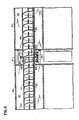
- the roaster will be seen to comprise a first roasting zone 10 communicating with a second roasting zone 12 through the intermediation of transition zone 11.
- Coffee enters zone 10 through a feed hopper 14. After coffee has been roasted in zone 10 and 12, it leaves through discharge generally shown as 16 and enters the cooling zone 18 which comprises a water quench section generally shown as 20 and an air cooler section 22.
- Roasted coffee particulate including chaff is collected at the terminal end of zone 12 through a duct 24 after having been liberated progressively from the coffee along the lengths of zones 10 and 12.
- the roasters vis. zones 10 and 12 have two fan drives for each zone; thus, fan drives 28 and 30 are horizontally mounted and constitues the air flowing means for circulating air in the first zone 10, and fan drives 32 and 34 constitute counterparts in zone 2, the second roasting zone 12.
- a plurality of doors 36, 38, 40, 42, 44 and 46 provide access to the roaster oven zones 10 and 12. At the transition zone 11 between the first and second zone 10 and 12, doors 50 and 51 are also located for access.
- Shafts 52 and 54 operating under the control of drive means generally shown at 56 and 58 mounted at the extremities of the first and second zone operate to drive the shafts respectively mounted for rotation within the first and second zones 10 and 12.
- Shafts 52 and 54 have mounted fixedly thereon respective helical screw 60 and 62 (ref. Fig. 4) for rotation with circumjacent foraminous perforated screens 64 and 66 within roasting cylinders 68 and 70.
- the screen perforations are approximately 1/5 the size of a green bean.
- Solid arcuate plates 72 and 74 mounted beneath each roasting cylinder serve to control the admission of heating air directionally upwardly from below the coffee bed, as at 76, intermediate the edges of plates 72 and 74.
- the space between plates 72 and 74 will be adjusted by means to be hereinafter described so that the width of the area for heat admission 76 will vary in accordance with the quantity of coffee and the amount of heated air supplied.
- the flame port 86 thus feeds heated air through respective inlet ducts 88 and fans 90 upwardly in the direction of the roasting cylinder, whereupon the heated air passes plates 72 and 74, surrender heat energy, and passes cylindrical foraminous screens 64 and 66 of cylinders 68 and 70, the fluidizing gas being redirected to the flame port 86 to complete circulation.
- Heated air passes pressure taps 92 (designated as P1), one for each fan, enters the coffee roasting section through plates 72 and 74 and a corresponding number of pressure taps 94 (designated as P2).
- P1and P2 By utilizing the pressure P1and P2 to obtain a delta P one is able to determine the volume of air being recirculated.
- a portion, say 5% by volume, of the recirculated air is exhausted through ports 93 and 95 located in each of the two roasting zones and are installed along the entire length of each zone.
- the purpose of the upper port 93 is to remove air which contains volatiles released during the roasting process.
- the exhausted air also contains unburnt combustibles and byproducts of combustion released by the flame ports 86.
- the purpose of the lower port 95 known as the sweep exhaust, is to remove coffee particulate matter released through the holes in the foraminous cylinders. Exhausting air containing volatiles/unburnt combustibles along with particular coffee matter prevents the accumulation of these flammable materials within the roasting chambers provides a safe roasting atmosphere.
- the exhausted air and coffee particulates after leaving the roasting chamber are passed through recovery equipment (not shown).
- the recovered partially roasted coffee particulate is used as a source of fuel in boiler operations.
- the recovered coffee particulate could also be thought to represent a source of partially roasted coffee solids for other processing applications.
- Fig. 8 Shown in Fig. 8 is an air intake damper 97. There are two of these intake dampers in each of the two roasting zones.
- the damper consists of a metal shell and adjusting vane 99 whose purpose is to regulate the amount of air which passes through the damper.
- the intake damper provides a path for ambient air to enter the roasting chambers. This ambient air is allowed to enter the roasting chamber so as to replace air exhausted through ports 93, 95 and thus preserve the air balance with the chamber.
- Zone 11 is employed to prevent coffee material from exiting the roasters' foraminous cylindrical screens 64 and 66 at the point of their joinder 96 - 98.
- Zone 11 comprises a pair of trunnions 100, 102 located on the ends of the cylindrical screens 64 and 66.
- the trunnions 100, 102 bear respectively on support bearings 104, 106 mounted on framework 108 for supporting the free ends of the foraminous cylinders 68 and 70.
- An air seal 110 surrounds the ends of cylinders 68 and 70 and communicates with a fan located external to the roaster housing, whereby pressurized air passes into the air seal 110 to create a pneumatic seal at the junctures 96 and 98 of the cylinders. In this manner, a very small gap is maintained in order that the roasting cylinders 68 and 70 may be independently rotatable while being sealed to prevent coffee material from escaping the cylinders through the gap therebetween.
- zone 1 there are two burner sections for zone 1, generally 112 and 114 (Fig. 1) operating independently, the heating sections being operated to maintain a substantially constant gas temperature for the passage of coffee across zone 1.
- zone 2 Essentially the same heating principle is employed for zone 2 except that it has but one heat source 116 serving to pass heated air through energizing zone 2 throughout. In this way a generally lower temperature air (heating gas) is blown by drives 32 and 34 for zone 2 than the air (heating gas) blown by drives 28 and 30 for zone 1.
- discharge chute 16 includes a port 118 which feeds water quench section 20.
- Pipe 120 sprays water through jets 122, 124 onto the bed of coffee deposited in the zone defined by the endwall 126 of quench chamber 20 and a transverse partition in the quench section 20.
- the chaff separating arrangement 24 generally comprises a vertical duct 128 which passes air under the control of fan means 130 upwardly through the descending roasted coffee beans in 16 until it merges with roasted chaff and exits with the chaff through a duct 132 to chaff recovery equipment (not shown).
- roasted chaff within cylinders 68 and 70 is removed under the influence of an air flow within the cylinders and courses through zones 1 and 2 respectively for removal through the duct 132.
- Bars shown at 134, 136 mounted on the walls of the water quench section act to assure uniform distribution of the water spray emanating from jet nozzles 122 and 124, the bars serving to uniformly mix the coffee and the quench water.
- Quench section 20 includes a solid rotatable cylindrical wall 140 and vanes 138 fixedly mounted therewithin to cool coffee.
- the air quench cf. Figs. 6 and 7, comprises an inlet for fresh make-up air 142 which joins a portion of the exhaust air, say 50%, as it recirculates through damper section 144 in the air cooler 22.
- the air enters a fan area 145 and is circulated through aperture 146 and thence through adjustable apertures 147 intermediate baffles 150, 152.
- the openings in apertures 148 are adjustable in the same manner as plates 72 and 74 in the heating zone.
- the cooling air is recirculated upwardly through foraminous cylinder 153 and the roasted whole bean bed contained therein exiting the cylinder wall 153 and exhausting in part through exhaust ports 154.
- shaft 155 operates under control of the drive mechanism therefor and operates and assembly of means for advancing and discharging the coffee beans in the water quench section 20 and the air quench section 22.
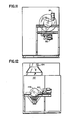
- Means whereby adjustments are made in the width between plate means 72 and 74 through which heated air passes at 76 upwardly will be seen in Figs. 9 and 10 as comprising manually operated wheels 200 each.
- wheel means 200 As wheel means 200 is rotated, it in turn rotates shaft 202 which communicates with shaft 204 through intermediation of universal joint 206, whereby pin 208 rotatably mounted on shaft 204 and pin 205 on block means 210 may each move.
- Pin 208 is adapted to move opposite pin 205 as each respective wheel 200 is rotated so that operation of wheels 200 causes pins 205 and 208 to move inwardly or outwardly.
- Each pin 208 and 205 slides in a slotted arm 212 and block means 210, respectively, whereby the plate gap 76 therebetween is adjusted in each roaster zone.
- a set of wheels 200 comprising 220 and 222 forms an adjustment unit for one gap 76. Adjusting one of two like means for each roasting cylinder 68 and 70 adjusts the gap settings for heated air spanning locations 220, 222; 224, 228; 230, 232; and 234 and 236.
- the gaps 76 between the plates 72 and 74 in each roaster will preferably be uniform, it having been found in common practice that the gap setting for the first and second heating zones may be substantially equal in providing access of the heated air to the coffee charge.
- movement of the wheels 220 and 222; 224 and 228; 230 and 232; and 234 and 236 as aforesaid provides the means for adjusting the openings through which air is admitted for heating purposes in the first and second roasters.
- the gap settings 76 will be at about 6 o'clock or at the lower-center of the arc between the plates 72 and 74.
- the air flow in the gap 76 between plates 72 and 74 may vary.
- the gaps in each zone will be at least 2", though it can be extended to as much as 20".
- Zone 1/Zone 2 0.75"/0.75" 0.75"/0.75" 0.75"/0.75"/0.75"/0.75"
- Cylinder Speed (RPM) Zone 1/Zone 2 10.0/15.4 13.5/22.2 11.5/21.8 12.0/22.2 Temp (°F) Entering Zone 1/Zone 2 600°/560° 600°/560° 600°/560° 600°/560° Static Bed Depth Zone 1/Zone 2 0.5"/0.7" 0.4"/0.5" 0.5"/0.5" 0.5"/0.5" Terminal Bed Depth At Discharge from Zone 2 4" 4" 4" 4" Roast Time Zone 1/Zone 2 40 sec/20 sec 29 sec/18 sec 35 sec/18 sec 33 sec/18 sec Air Quench Moisture After Zone 2/final product moisture after a
- the coffees obtained by the processing conditions listed are each ground by passage through a NIPPON 201 FC Crackulator to produce an 11 ounce roast product.
- the higher yield, lower density coffees produced brewed products of excellent flavor, taste and aroma comparable to coffees brewed from the higher density, lower yield roasted and ground coffees representing the traditional coffee standard.
- a larger plant scale-sized roaster which is capable of roasting 8,000 pounds of coffee per hour of the type described with reference to the accompanying drawings was also employed.
- the coffees were decaffeinated Colombians and Brazils in one experiment and decaffeinated Robustas in the other, the green coffee being fed in each instance at 8000 pounds per hour to the roaster.
- the blend of the first roast (constituting 50% A's and J's) and the second roast was formulated such that 30% of the first roast blend and 70% of the second blend (M) was prepared.
- the decaffeinated A and Js had a green density of 0.650 gms/cc and a moisture of 10.1% and the decaffeinated green Ms had a density of 0.707 gms/cc and a moisture of 11.2%.
- the roasted As and Js had a density of 0.302 gms/cc and the roasted Ms had a density of 0.334 gms/cc.
- the roast in each instance were popped in the second zone.
- the blended material was cracked (ground) through a commercial-scale Nippon mill (of the type set forth in U.S. Patent No. 3,190,572 to Goto, issued June 22, 1965 for Coffee Granulating Apparatus which apparatus employs the Kasai method) No. GRN 6042.
- the gaps between the rolls of the Nippon mill were as follows from top to bottom of the mill: 1.16 mm., 0.66 mm., 0.18 mm. and 0.15 mm.
- the resulting ground density was 0.266 grams per cc in the can at the packing line.
- the ground coffee produces an 11 ounce blend that correlates quite favorably to that which would produce the standard 90 cups of a given strength from 16 oz. of conventional 16 oz roast.
- roasting cylinder per se when it has achieved a steady state, the coffees being fed thereto at approximately 8,000 pounds per hour.
- percolates from the ground coffee produced had a flavor strength and character comparable to that of a conventional atmospheric roast. This is a remarkable finding, considering the reduction in quantity of coffee material required to provide a given beverage.
- an original recipe (16 oz.) requiring 51.2 gms of coffee with 1780 mls. of water can now be prepared from an 11 oz product using 35.2 gms of coffee in a drip coffee brewer.
- the degree of expansion as a result of roasting in accord with this invention will be broadly such that the volume occupied by the roasted blend will have 65%-85% of the weight of a conventional atmospheric roast (say a Probat-batch roaster), commonly much less than 85% of said weight; lower the percent the greater the expansion and the greater the economy use.
- a conventional atmospheric roast say a Probat-batch roaster
- the degree of expansion as a result of roasting in accord with this invention will be broadly such that the volume occupied by the roasted blend will have 65%-85% of the weight of a conventional atmospheric roast (say a Probat-batch roaster), commonly much less than 85% of said weight; lower the percent the greater the expansion and the greater the economy use.
- a greater flavor concentration per weight of coffee such that the extended recipe will contain a flavor comparable to a conventionally roasted coffee.
- a density increase in the roasted and ground coffee will occur after grinding due to conveying of coffee to the packaging line; typically in the order of 5%.
- a final package density of 0.264 gms/cc was originally 0.251 gms/cc at the grinding mill.
- the grinding may be carried out in a manner which preserves the density reduction of the whole beans achieved by roasting.
- a grinder that may be employed for this purpose is a Nippon 201 FC Crackulator.
- the finished gorund density will range from 0.240-0.310 gms/per cc at the mill as measured by free flow density techniques well understood in the art.
Landscapes
- Life Sciences & Earth Sciences (AREA)
- Chemical & Material Sciences (AREA)
- Engineering & Computer Science (AREA)
- Food Science & Technology (AREA)
- Polymers & Plastics (AREA)
- Tea And Coffee (AREA)
- Apparatuses For Bulk Treatment Of Fruits And Vegetables And Apparatuses For Preparing Feeds (AREA)
Priority Applications (4)
| Application Number | Priority Date | Filing Date | Title |
|---|---|---|---|
| US06/894,515 US4737376A (en) | 1985-01-29 | 1986-08-06 | Coffee roasting method |
| ES198888300603T ES2039607T3 (es) | 1988-01-26 | 1988-01-26 | Metodo y aparato para tostar cafe. |
| EP88300603A EP0325822B1 (fr) | 1988-01-26 | 1988-01-26 | Procédé et installation de torréfaction de café |
| DE88300603T DE3879167T2 (de) | 1988-01-26 | 1988-01-26 | Verfahren und Vorrichtung zum Rösten von Kaffee. |
Applications Claiming Priority (1)
| Application Number | Priority Date | Filing Date | Title |
|---|---|---|---|
| EP88300603A EP0325822B1 (fr) | 1988-01-26 | 1988-01-26 | Procédé et installation de torréfaction de café |
Publications (2)
| Publication Number | Publication Date |
|---|---|
| EP0325822A1 true EP0325822A1 (fr) | 1989-08-02 |
| EP0325822B1 EP0325822B1 (fr) | 1993-03-10 |
Family
ID=8199937
Family Applications (1)
| Application Number | Title | Priority Date | Filing Date |
|---|---|---|---|
| EP88300603A Expired - Lifetime EP0325822B1 (fr) | 1985-01-29 | 1988-01-26 | Procédé et installation de torréfaction de café |
Country Status (3)
| Country | Link |
|---|---|
| EP (1) | EP0325822B1 (fr) |
| DE (1) | DE3879167T2 (fr) |
| ES (1) | ES2039607T3 (fr) |
Cited By (1)
| Publication number | Priority date | Publication date | Assignee | Title |
|---|---|---|---|---|
| CN115175576A (zh) * | 2020-01-16 | 2022-10-11 | 骏宝机械制造有限公司波罗拔制造厂 | 用于烘焙豆子的筒式烘焙机 |
Citations (6)
| Publication number | Priority date | Publication date | Assignee | Title |
|---|---|---|---|---|
| US1439317A (en) * | 1921-06-22 | 1922-12-19 | Leland S Maede | Coffee roaster |
| US1793009A (en) * | 1929-03-29 | 1931-02-17 | Maxwell House Products Company | Roasting oven |
| GB501199A (en) * | 1936-11-14 | 1939-02-21 | Jabez Burns And Sons Inc | Improved method and apparatus for roasting coffee, cocoa beans and the like |
| LU83045A1 (fr) * | 1980-09-29 | 1981-03-27 | Hills Bros Coffee | Procede continu de torrefaction rapide et a sec de grains de cafes verts |
| US4501761A (en) * | 1982-10-12 | 1985-02-26 | General Foods Corporation | Controlled coffee roasting |
| US4540591A (en) * | 1982-11-08 | 1985-09-10 | General Foods Corporation | Robusta coffee steaming, roasting and blending method |
-
1988
- 1988-01-26 DE DE88300603T patent/DE3879167T2/de not_active Expired - Fee Related
- 1988-01-26 ES ES198888300603T patent/ES2039607T3/es not_active Expired - Lifetime
- 1988-01-26 EP EP88300603A patent/EP0325822B1/fr not_active Expired - Lifetime
Patent Citations (6)
| Publication number | Priority date | Publication date | Assignee | Title |
|---|---|---|---|---|
| US1439317A (en) * | 1921-06-22 | 1922-12-19 | Leland S Maede | Coffee roaster |
| US1793009A (en) * | 1929-03-29 | 1931-02-17 | Maxwell House Products Company | Roasting oven |
| GB501199A (en) * | 1936-11-14 | 1939-02-21 | Jabez Burns And Sons Inc | Improved method and apparatus for roasting coffee, cocoa beans and the like |
| LU83045A1 (fr) * | 1980-09-29 | 1981-03-27 | Hills Bros Coffee | Procede continu de torrefaction rapide et a sec de grains de cafes verts |
| US4501761A (en) * | 1982-10-12 | 1985-02-26 | General Foods Corporation | Controlled coffee roasting |
| US4540591A (en) * | 1982-11-08 | 1985-09-10 | General Foods Corporation | Robusta coffee steaming, roasting and blending method |
Cited By (1)
| Publication number | Priority date | Publication date | Assignee | Title |
|---|---|---|---|---|
| CN115175576A (zh) * | 2020-01-16 | 2022-10-11 | 骏宝机械制造有限公司波罗拔制造厂 | 用于烘焙豆子的筒式烘焙机 |
Also Published As
| Publication number | Publication date |
|---|---|
| DE3879167D1 (de) | 1993-04-15 |
| DE3879167T2 (de) | 1993-10-07 |
| ES2039607T3 (es) | 1993-10-01 |
| EP0325822B1 (fr) | 1993-03-10 |
Similar Documents
| Publication | Publication Date | Title |
|---|---|---|
| US4737376A (en) | Coffee roasting method | |
| US3189460A (en) | Roasting and heating methods | |
| EP0510099B1 (fr) | Appareil de conditionnement de substances particulaires | |
| US4322447A (en) | High speed process for roasting coffee | |
| US4169164A (en) | Low density coffee roasting process | |
| EP0183878B1 (fr) | Torréfaction contrôlée du café | |
| US3345181A (en) | Method for roasting coffee beans and similar particulate solids | |
| US4540591A (en) | Robusta coffee steaming, roasting and blending method | |
| US4215151A (en) | Process for roasting an agro-food product in a fluidized bed of inert particles | |
| US6607768B1 (en) | Coffee roasting methods | |
| US4478862A (en) | Heat-treatment of cereal | |
| US3285157A (en) | Roasting and heating apparatus | |
| US5155923A (en) | Apparatus and process for conditioning particulate material | |
| US6125550A (en) | Food drying method | |
| US3328172A (en) | Methods of roasting coffee and similar particulate solids | |
| US4489506A (en) | Material treatment | |
| WO2005058073A1 (fr) | Procede de traitement thermique et de mouture en une seule etape de grains de cafe, et leurs produits | |
| US3572235A (en) | Continuous coffee roasting apparatus | |
| US3408920A (en) | Apparatus for roasting coffee and the like | |
| EP0325822B1 (fr) | Procédé et installation de torréfaction de café | |
| JPS62144756A (ja) | 豆状種子の外皮を取る方法およびその方法を実施する装置 | |
| NO150198B (no) | Fremgangsmaate for selektiv hydrogenering i gassfase av flerumettede forbindelser | |
| CA1285174C (fr) | Methode et dispositif de torrefaction du cafe | |
| EP0856261B1 (fr) | Méthode et appareil pour griller en continu des produits alimentaires | |
| US5159764A (en) | Apparatus for conditioning particulate material |
Legal Events
| Date | Code | Title | Description |
|---|---|---|---|
| PUAI | Public reference made under article 153(3) epc to a published international application that has entered the european phase |
Free format text: ORIGINAL CODE: 0009012 |
|
| AK | Designated contracting states |
Kind code of ref document: A1 Designated state(s): DE ES FR GB |
|
| 17P | Request for examination filed |
Effective date: 19900122 |
|
| 17Q | First examination report despatched |
Effective date: 19910524 |
|
| RAP1 | Party data changed (applicant data changed or rights of an application transferred) |
Owner name: KRAFT GENERAL FOODS, INC. |
|
| GRAA | (expected) grant |
Free format text: ORIGINAL CODE: 0009210 |
|
| AK | Designated contracting states |
Kind code of ref document: B1 Designated state(s): DE ES FR GB |
|
| REF | Corresponds to: |
Ref document number: 3879167 Country of ref document: DE Date of ref document: 19930415 |
|
| ET | Fr: translation filed | ||
| REG | Reference to a national code |
Ref country code: ES Ref legal event code: FG2A Ref document number: 2039607 Country of ref document: ES Kind code of ref document: T3 |
|
| PLBE | No opposition filed within time limit |
Free format text: ORIGINAL CODE: 0009261 |
|
| STAA | Information on the status of an ep patent application or granted ep patent |
Free format text: STATUS: NO OPPOSITION FILED WITHIN TIME LIMIT |
|
| 26N | No opposition filed | ||
| PGFP | Annual fee paid to national office [announced via postgrant information from national office to epo] |
Ref country code: FR Payment date: 19951213 Year of fee payment: 9 |
|
| PGFP | Annual fee paid to national office [announced via postgrant information from national office to epo] |
Ref country code: GB Payment date: 19951228 Year of fee payment: 9 Ref country code: DE Payment date: 19951228 Year of fee payment: 9 |
|
| PGFP | Annual fee paid to national office [announced via postgrant information from national office to epo] |
Ref country code: ES Payment date: 19960119 Year of fee payment: 9 |
|
| PG25 | Lapsed in a contracting state [announced via postgrant information from national office to epo] |
Ref country code: GB Effective date: 19970126 |
|
| PG25 | Lapsed in a contracting state [announced via postgrant information from national office to epo] |
Ref country code: ES Free format text: LAPSE BECAUSE OF NON-PAYMENT OF DUE FEES Effective date: 19970127 |
|
| GBPC | Gb: european patent ceased through non-payment of renewal fee |
Effective date: 19970126 |
|
| PG25 | Lapsed in a contracting state [announced via postgrant information from national office to epo] |
Ref country code: FR Effective date: 19970930 |
|
| PG25 | Lapsed in a contracting state [announced via postgrant information from national office to epo] |
Ref country code: DE Effective date: 19971001 |
|
| REG | Reference to a national code |
Ref country code: FR Ref legal event code: ST |
|
| REG | Reference to a national code |
Ref country code: ES Ref legal event code: FD2A Effective date: 19990503 |