EP0330773B1 - Proteine, Expressionsvektoren, die für solche Proteine kodierende DNA enthalten und Zellen, die solche Expressionsvektoren enthalten - Google Patents
Proteine, Expressionsvektoren, die für solche Proteine kodierende DNA enthalten und Zellen, die solche Expressionsvektoren enthalten Download PDFInfo
- Publication number
- EP0330773B1 EP0330773B1 EP88301887A EP88301887A EP0330773B1 EP 0330773 B1 EP0330773 B1 EP 0330773B1 EP 88301887 A EP88301887 A EP 88301887A EP 88301887 A EP88301887 A EP 88301887A EP 0330773 B1 EP0330773 B1 EP 0330773B1
- Authority
- EP
- European Patent Office
- Prior art keywords
- protein
- phe
- phenylalanine
- cmpd
- amino acid
- Prior art date
- Legal status (The legal status is an assumption and is not a legal conclusion. Google has not performed a legal analysis and makes no representation as to the accuracy of the status listed.)
- Expired - Lifetime
Links
- 108090000623 proteins and genes Proteins 0.000 title claims abstract description 34
- 102000004169 proteins and genes Human genes 0.000 title claims abstract description 20
- COLNVLDHVKWLRT-QMMMGPOBSA-N L-phenylalanine Chemical compound OC(=O)[C@@H](N)CC1=CC=CC=C1 COLNVLDHVKWLRT-QMMMGPOBSA-N 0.000 claims abstract description 36
- COLNVLDHVKWLRT-UHFFFAOYSA-N phenylalanine Natural products OC(=O)C(N)CC1=CC=CC=C1 COLNVLDHVKWLRT-UHFFFAOYSA-N 0.000 claims abstract description 36
- 230000000694 effects Effects 0.000 claims abstract description 22
- 241000588724 Escherichia coli Species 0.000 claims abstract description 20
- 150000001413 amino acids Chemical class 0.000 claims abstract description 14
- 108010015724 Prephenate Dehydratase Proteins 0.000 claims abstract description 9
- 230000001105 regulatory effect Effects 0.000 claims abstract description 8
- 101150023849 pheA gene Proteins 0.000 claims description 61
- 102000004190 Enzymes Human genes 0.000 claims description 13
- 108090000790 Enzymes Proteins 0.000 claims description 13
- QIVBCDIJIAJPQS-UHFFFAOYSA-N Tryptophan Natural products C1=CC=C2C(CC(N)C(O)=O)=CNC2=C1 QIVBCDIJIAJPQS-UHFFFAOYSA-N 0.000 claims description 12
- QIVBCDIJIAJPQS-VIFPVBQESA-N L-tryptophane Chemical compound C1=CC=C2C(C[C@H](N)C(O)=O)=CNC2=C1 QIVBCDIJIAJPQS-VIFPVBQESA-N 0.000 claims description 11
- 230000015572 biosynthetic process Effects 0.000 claims description 9
- 108020004705 Codon Proteins 0.000 claims description 8
- 238000000034 method Methods 0.000 claims description 8
- 238000003786 synthesis reaction Methods 0.000 claims description 8
- 125000001433 C-terminal amino-acid group Chemical group 0.000 claims description 6
- 125000000539 amino acid group Chemical group 0.000 claims description 6
- 230000005764 inhibitory process Effects 0.000 claims description 6
- 230000037361 pathway Effects 0.000 claims description 6
- 210000004027 cell Anatomy 0.000 claims description 5
- 239000002773 nucleotide Substances 0.000 claims description 5
- 125000003729 nucleotide group Chemical group 0.000 claims description 5
- 108010000898 Chorismate mutase Proteins 0.000 claims description 4
- XUUXCWCKKCZEAW-YFKPBYRVSA-N Arg-Gly Chemical compound OC(=O)CNC(=O)[C@@H](N)CCCN=C(N)N XUUXCWCKKCZEAW-YFKPBYRVSA-N 0.000 claims description 3
- 125000005454 tryptophanyl group Chemical group 0.000 claims description 3
- 125000002915 carbonyl group Chemical group [*:2]C([*:1])=O 0.000 claims description 2
- 230000002255 enzymatic effect Effects 0.000 claims description 2
- 238000000855 fermentation Methods 0.000 claims description 2
- 230000004151 fermentation Effects 0.000 claims description 2
- 230000033228 biological regulation Effects 0.000 claims 1
- 238000012258 culturing Methods 0.000 claims 1
- 230000035945 sensitivity Effects 0.000 abstract description 5
- 239000013604 expression vector Substances 0.000 abstract description 4
- 244000005700 microbiome Species 0.000 abstract description 4
- 238000010353 genetic engineering Methods 0.000 abstract 1
- 230000004927 fusion Effects 0.000 description 16
- 238000010276 construction Methods 0.000 description 12
- 239000012634 fragment Substances 0.000 description 12
- 239000013612 plasmid Substances 0.000 description 11
- 229940024606 amino acid Drugs 0.000 description 8
- 101100288418 Staphylococcus xylosus lacP gene Proteins 0.000 description 6
- 125000003275 alpha amino acid group Chemical group 0.000 description 6
- 238000006467 substitution reaction Methods 0.000 description 6
- 101100435903 Corynebacterium glutamicum (strain ATCC 13032 / DSM 20300 / BCRC 11384 / JCM 1318 / LMG 3730 / NCIMB 10025) aroG gene Proteins 0.000 description 5
- 101150042732 aroC gene Proteins 0.000 description 5
- 101150019536 aroF gene Proteins 0.000 description 5
- 238000012217 deletion Methods 0.000 description 5
- 230000037430 deletion Effects 0.000 description 5
- 238000003776 cleavage reaction Methods 0.000 description 4
- 101150066555 lacZ gene Proteins 0.000 description 4
- 238000004519 manufacturing process Methods 0.000 description 4
- 230000007017 scission Effects 0.000 description 4
- 230000004048 modification Effects 0.000 description 3
- 238000012986 modification Methods 0.000 description 3
- 108090000765 processed proteins & peptides Proteins 0.000 description 3
- 238000013518 transcription Methods 0.000 description 3
- 230000035897 transcription Effects 0.000 description 3
- 239000013598 vector Substances 0.000 description 3
- 102000004594 DNA Polymerase I Human genes 0.000 description 2
- 108010017826 DNA Polymerase I Proteins 0.000 description 2
- 102000016928 DNA-directed DNA polymerase Human genes 0.000 description 2
- 108010014303 DNA-directed DNA polymerase Proteins 0.000 description 2
- 108060002716 Exonuclease Proteins 0.000 description 2
- CSNNHWWHGAXBCP-UHFFFAOYSA-L Magnesium sulfate Chemical compound [Mg+2].[O-][S+2]([O-])([O-])[O-] CSNNHWWHGAXBCP-UHFFFAOYSA-L 0.000 description 2
- 108010086093 Mung Bean Nuclease Proteins 0.000 description 2
- 125000000729 N-terminal amino-acid group Chemical group 0.000 description 2
- FAPWRFPIFSIZLT-UHFFFAOYSA-M Sodium chloride Chemical compound [Na+].[Cl-] FAPWRFPIFSIZLT-UHFFFAOYSA-M 0.000 description 2
- 230000004075 alteration Effects 0.000 description 2
- 210000004899 c-terminal region Anatomy 0.000 description 2
- 230000008859 change Effects 0.000 description 2
- 238000006243 chemical reaction Methods 0.000 description 2
- 230000002759 chromosomal effect Effects 0.000 description 2
- 102000013165 exonuclease Human genes 0.000 description 2
- XLYOFNOQVPJJNP-ZSJDYOACSA-N heavy water Substances [2H]O[2H] XLYOFNOQVPJJNP-ZSJDYOACSA-N 0.000 description 2
- 239000002609 medium Substances 0.000 description 2
- 239000011785 micronutrient Substances 0.000 description 2
- 235000013369 micronutrients Nutrition 0.000 description 2
- FPWMCUPFBRFMLH-UHFFFAOYSA-N prephenic acid Chemical compound OC1C=CC(CC(=O)C(O)=O)(C(O)=O)C=C1 FPWMCUPFBRFMLH-UHFFFAOYSA-N 0.000 description 2
- 108091008146 restriction endonucleases Proteins 0.000 description 2
- 230000000717 retained effect Effects 0.000 description 2
- WTFXTQVDAKGDEY-UHFFFAOYSA-N (-)-chorismic acid Natural products OC1C=CC(C(O)=O)=CC1OC(=C)C(O)=O WTFXTQVDAKGDEY-UHFFFAOYSA-N 0.000 description 1
- SLAMLWHELXOEJZ-UHFFFAOYSA-M 2-nitrobenzoate Chemical compound [O-]C(=O)C1=CC=CC=C1[N+]([O-])=O SLAMLWHELXOEJZ-UHFFFAOYSA-M 0.000 description 1
- 108010080376 3-Deoxy-7-Phosphoheptulonate Synthase Proteins 0.000 description 1
- 241000894006 Bacteria Species 0.000 description 1
- CPELXLSAUQHCOX-UHFFFAOYSA-M Bromide Chemical compound [Br-] CPELXLSAUQHCOX-UHFFFAOYSA-M 0.000 description 1
- UXVMQQNJUSDDNG-UHFFFAOYSA-L Calcium chloride Chemical compound [Cl-].[Cl-].[Ca+2] UXVMQQNJUSDDNG-UHFFFAOYSA-L 0.000 description 1
- KRKNYBCHXYNGOX-UHFFFAOYSA-K Citrate Chemical compound [O-]C(=O)CC(O)(CC([O-])=O)C([O-])=O KRKNYBCHXYNGOX-UHFFFAOYSA-K 0.000 description 1
- 229910021580 Cobalt(II) chloride Inorganic materials 0.000 description 1
- ODKSFYDXXFIFQN-SCSAIBSYSA-N D-arginine Chemical compound OC(=O)[C@H](N)CCCNC(N)=N ODKSFYDXXFIFQN-SCSAIBSYSA-N 0.000 description 1
- CKLJMWTZIZZHCS-UWTATZPHSA-N D-aspartic acid Chemical compound OC(=O)[C@H](N)CC(O)=O CKLJMWTZIZZHCS-UWTATZPHSA-N 0.000 description 1
- 241001646716 Escherichia coli K-12 Species 0.000 description 1
- WQZGKKKJIJFFOK-GASJEMHNSA-N Glucose Natural products OC[C@H]1OC(O)[C@H](O)[C@@H](O)[C@@H]1O WQZGKKKJIJFFOK-GASJEMHNSA-N 0.000 description 1
- DHMQDGOQFOQNFH-UHFFFAOYSA-N Glycine Chemical compound NCC(O)=O DHMQDGOQFOQNFH-UHFFFAOYSA-N 0.000 description 1
- 239000004471 Glycine Substances 0.000 description 1
- 239000007836 KH2PO4 Substances 0.000 description 1
- DCXYFEDJOCDNAF-REOHCLBHSA-N L-asparagine Chemical compound OC(=O)[C@@H](N)CC(N)=O DCXYFEDJOCDNAF-REOHCLBHSA-N 0.000 description 1
- ROHFNLRQFUQHCH-YFKPBYRVSA-N L-leucine Chemical compound CC(C)C[C@H](N)C(O)=O ROHFNLRQFUQHCH-YFKPBYRVSA-N 0.000 description 1
- 239000004472 Lysine Substances 0.000 description 1
- 229910021380 Manganese Chloride Inorganic materials 0.000 description 1
- GLFNIEUTAYBVOC-UHFFFAOYSA-L Manganese chloride Chemical compound Cl[Mn]Cl GLFNIEUTAYBVOC-UHFFFAOYSA-L 0.000 description 1
- 201000007224 Myeloproliferative neoplasm Diseases 0.000 description 1
- -1 N -asparagine Asp Chemical compound 0.000 description 1
- 229910004619 Na2MoO4 Inorganic materials 0.000 description 1
- 108010076504 Protein Sorting Signals Proteins 0.000 description 1
- 238000012300 Sequence Analysis Methods 0.000 description 1
- 239000004098 Tetracycline Substances 0.000 description 1
- 239000004473 Threonine Substances 0.000 description 1
- 229930003451 Vitamin B1 Natural products 0.000 description 1
- 239000011543 agarose gel Substances 0.000 description 1
- 230000002776 aggregation Effects 0.000 description 1
- 238000004220 aggregation Methods 0.000 description 1
- 229960001230 asparagine Drugs 0.000 description 1
- 238000003556 assay Methods 0.000 description 1
- 230000001580 bacterial effect Effects 0.000 description 1
- KGBXLFKZBHKPEV-UHFFFAOYSA-N boric acid Chemical compound OB(O)O KGBXLFKZBHKPEV-UHFFFAOYSA-N 0.000 description 1
- 230000003197 catalytic effect Effects 0.000 description 1
- WTFXTQVDAKGDEY-HTQZYQBOSA-N chorismic acid Chemical compound O[C@@H]1C=CC(C(O)=O)=C[C@H]1OC(=C)C(O)=O WTFXTQVDAKGDEY-HTQZYQBOSA-N 0.000 description 1
- 239000013611 chromosomal DNA Substances 0.000 description 1
- 238000010367 cloning Methods 0.000 description 1
- 150000001875 compounds Chemical class 0.000 description 1
- ARUVKPQLZAKDPS-UHFFFAOYSA-L copper(II) sulfate Chemical compound [Cu+2].[O-][S+2]([O-])([O-])[O-] ARUVKPQLZAKDPS-UHFFFAOYSA-L 0.000 description 1
- 229910000366 copper(II) sulfate Inorganic materials 0.000 description 1
- 238000005520 cutting process Methods 0.000 description 1
- 125000000151 cysteine group Chemical group N[C@@H](CS)C(=O)* 0.000 description 1
- 125000000118 dimethyl group Chemical group [H]C([H])([H])* 0.000 description 1
- 238000002474 experimental method Methods 0.000 description 1
- 230000009123 feedback regulation Effects 0.000 description 1
- 239000008103 glucose Substances 0.000 description 1
- 239000001963 growth medium Substances 0.000 description 1
- 230000002209 hydrophobic effect Effects 0.000 description 1
- 238000001727 in vivo Methods 0.000 description 1
- BAUYGSIQEAFULO-UHFFFAOYSA-L iron(2+) sulfate (anhydrous) Chemical compound [Fe+2].[O-]S([O-])(=O)=O BAUYGSIQEAFULO-UHFFFAOYSA-L 0.000 description 1
- 229910000359 iron(II) sulfate Inorganic materials 0.000 description 1
- 229960000310 isoleucine Drugs 0.000 description 1
- BTNMPGBKDVTSJY-UHFFFAOYSA-N keto-phenylpyruvic acid Chemical compound OC(=O)C(=O)CC1=CC=CC=C1 BTNMPGBKDVTSJY-UHFFFAOYSA-N 0.000 description 1
- 229910052943 magnesium sulfate Inorganic materials 0.000 description 1
- 235000019341 magnesium sulphate Nutrition 0.000 description 1
- 239000011565 manganese chloride Substances 0.000 description 1
- 235000002867 manganese chloride Nutrition 0.000 description 1
- 230000000813 microbial effect Effects 0.000 description 1
- 239000000203 mixture Substances 0.000 description 1
- 238000010369 molecular cloning Methods 0.000 description 1
- 229910000402 monopotassium phosphate Inorganic materials 0.000 description 1
- 235000019796 monopotassium phosphate Nutrition 0.000 description 1
- GNSKLFRGEWLPPA-UHFFFAOYSA-M potassium dihydrogen phosphate Chemical compound [K+].OP(O)([O-])=O GNSKLFRGEWLPPA-UHFFFAOYSA-M 0.000 description 1
- 230000008569 process Effects 0.000 description 1
- 102000004196 processed proteins & peptides Human genes 0.000 description 1
- 150000003839 salts Chemical class 0.000 description 1
- 238000000926 separation method Methods 0.000 description 1
- 239000011780 sodium chloride Substances 0.000 description 1
- 239000011684 sodium molybdate Substances 0.000 description 1
- 235000015393 sodium molybdate Nutrition 0.000 description 1
- TVXXNOYZHKPKGW-UHFFFAOYSA-N sodium molybdate (anhydrous) Chemical compound [Na+].[Na+].[O-][Mo]([O-])(=O)=O TVXXNOYZHKPKGW-UHFFFAOYSA-N 0.000 description 1
- 238000010561 standard procedure Methods 0.000 description 1
- RWSOTUBLDIXVET-UHFFFAOYSA-O sulfonium Chemical compound [SH3+] RWSOTUBLDIXVET-UHFFFAOYSA-O 0.000 description 1
- 230000002194 synthesizing effect Effects 0.000 description 1
- 238000012360 testing method Methods 0.000 description 1
- 229960002180 tetracycline Drugs 0.000 description 1
- 229930101283 tetracycline Natural products 0.000 description 1
- 235000019364 tetracycline Nutrition 0.000 description 1
- 150000003522 tetracyclines Chemical class 0.000 description 1
- 229960003495 thiamine Drugs 0.000 description 1
- DPJRMOMPQZCRJU-UHFFFAOYSA-M thiamine hydrochloride Chemical compound Cl.[Cl-].CC1=C(CCO)SC=[N+]1CC1=CN=C(C)N=C1N DPJRMOMPQZCRJU-UHFFFAOYSA-M 0.000 description 1
- 125000000430 tryptophan group Chemical group [H]N([H])C(C(=O)O*)C([H])([H])C1=C([H])N([H])C2=C([H])C([H])=C([H])C([H])=C12 0.000 description 1
- 239000004474 valine Substances 0.000 description 1
- 239000011691 vitamin B1 Substances 0.000 description 1
- 235000010374 vitamin B1 Nutrition 0.000 description 1
- NWONKYPBYAMBJT-UHFFFAOYSA-L zinc sulfate Chemical compound [Zn+2].[O-]S([O-])(=O)=O NWONKYPBYAMBJT-UHFFFAOYSA-L 0.000 description 1
- 229910000368 zinc sulfate Inorganic materials 0.000 description 1
- 239000011686 zinc sulphate Substances 0.000 description 1
- 235000009529 zinc sulphate Nutrition 0.000 description 1
Images



Classifications
-
- C—CHEMISTRY; METALLURGY
- C12—BIOCHEMISTRY; BEER; SPIRITS; WINE; VINEGAR; MICROBIOLOGY; ENZYMOLOGY; MUTATION OR GENETIC ENGINEERING
- C12P—FERMENTATION OR ENZYME-USING PROCESSES TO SYNTHESISE A DESIRED CHEMICAL COMPOUND OR COMPOSITION OR TO SEPARATE OPTICAL ISOMERS FROM A RACEMIC MIXTURE
- C12P13/00—Preparation of nitrogen-containing organic compounds
- C12P13/04—Alpha- or beta- amino acids
- C12P13/22—Tryptophan; Tyrosine; Phenylalanine; 3,4-Dihydroxyphenylalanine
- C12P13/222—Phenylalanine
-
- C—CHEMISTRY; METALLURGY
- C12—BIOCHEMISTRY; BEER; SPIRITS; WINE; VINEGAR; MICROBIOLOGY; ENZYMOLOGY; MUTATION OR GENETIC ENGINEERING
- C12N—MICROORGANISMS OR ENZYMES; COMPOSITIONS THEREOF; PROPAGATING, PRESERVING, OR MAINTAINING MICROORGANISMS; MUTATION OR GENETIC ENGINEERING; CULTURE MEDIA
- C12N15/00—Mutation or genetic engineering; DNA or RNA concerning genetic engineering, vectors, e.g. plasmids, or their isolation, preparation or purification; Use of hosts therefor
- C12N15/09—Recombinant DNA-technology
- C12N15/11—DNA or RNA fragments; Modified forms thereof; Non-coding nucleic acids having a biological activity
- C12N15/52—Genes encoding for enzymes or proenzymes
-
- C—CHEMISTRY; METALLURGY
- C12—BIOCHEMISTRY; BEER; SPIRITS; WINE; VINEGAR; MICROBIOLOGY; ENZYMOLOGY; MUTATION OR GENETIC ENGINEERING
- C12N—MICROORGANISMS OR ENZYMES; COMPOSITIONS THEREOF; PROPAGATING, PRESERVING, OR MAINTAINING MICROORGANISMS; MUTATION OR GENETIC ENGINEERING; CULTURE MEDIA
- C12N15/00—Mutation or genetic engineering; DNA or RNA concerning genetic engineering, vectors, e.g. plasmids, or their isolation, preparation or purification; Use of hosts therefor
- C12N15/09—Recombinant DNA-technology
- C12N15/63—Introduction of foreign genetic material using vectors; Vectors; Use of hosts therefor; Regulation of expression
- C12N15/70—Vectors or expression systems specially adapted for E. coli
-
- C—CHEMISTRY; METALLURGY
- C12—BIOCHEMISTRY; BEER; SPIRITS; WINE; VINEGAR; MICROBIOLOGY; ENZYMOLOGY; MUTATION OR GENETIC ENGINEERING
- C12N—MICROORGANISMS OR ENZYMES; COMPOSITIONS THEREOF; PROPAGATING, PRESERVING, OR MAINTAINING MICROORGANISMS; MUTATION OR GENETIC ENGINEERING; CULTURE MEDIA
- C12N9/00—Enzymes; Proenzymes; Compositions thereof; Processes for preparing, activating, inhibiting, separating or purifying enzymes
- C12N9/88—Lyases (4.)
-
- C—CHEMISTRY; METALLURGY
- C12—BIOCHEMISTRY; BEER; SPIRITS; WINE; VINEGAR; MICROBIOLOGY; ENZYMOLOGY; MUTATION OR GENETIC ENGINEERING
- C12N—MICROORGANISMS OR ENZYMES; COMPOSITIONS THEREOF; PROPAGATING, PRESERVING, OR MAINTAINING MICROORGANISMS; MUTATION OR GENETIC ENGINEERING; CULTURE MEDIA
- C12N9/00—Enzymes; Proenzymes; Compositions thereof; Processes for preparing, activating, inhibiting, separating or purifying enzymes
- C12N9/90—Isomerases (5.)
-
- C—CHEMISTRY; METALLURGY
- C07—ORGANIC CHEMISTRY
- C07K—PEPTIDES
- C07K2319/00—Fusion polypeptide
Definitions
- This invention relates to proteins having chorismate mutase and/or prephenate dehydratase activity, expression vehicles comprising DNA encoding such problems, and their use in the production of desired compounds such as phenylalanine.
- CMPD prephenate dehydratase
- Tribe Australian Published Application 72727/81 discloses an E. coli mutant termed NST37 said to produce chorismate mutase prephenate dehydratase substantially free from inhibition by phenylalanine.
- the proteins have the formula: ⁇ CO- ⁇ where ⁇ is an amino acid sequence having CMPD activity, substantially corresponding to the N-terminal 337 amino acid sequence of E. coli CMPD; CO is the carbonyl group of the C-terminal amino acid residue of ⁇ ; and ⁇ is -OH, -O ⁇ , an amino acid residue other than tryptophan connected via a peptide bond to the C-terminal residue of ⁇ , or an amino acid sequence having an N-terminal residue other than tryptophan, connected via a peptide bond to the C-terminal residue of ⁇ .
- substantially corresponding to the CMPD sequence means having sufficient homology to retain activity substantially equivalent to CMPD.
- sequences of phe A genes of bacteria related to E. coli having such homology are included.
- Minor alterations in structure e.g., the addition, deletion, or non-conservative substitution of a limited number of residues or the conservative substitution of many residues which retain substantial activity are included within the meaning of that term.
- ⁇ comprises amino acids 1-337 of E. coli CMPD. That sequence can be determined from pKB912 or pKB702, described below, or from the following sequence published by Hudson and Davidson (1984), cited above, where the single-letter codes refer to the table given below: Also preferably, ⁇ is -OH or -O ⁇ .
- ⁇ is the amino acid sequence ⁇ - ⁇ where: ⁇ is either an amino acid residue other than tryptophan or an amino acid sequence whose N-terminal residue is a residue other than tryptophan; and ⁇ is the sequence EEMFYLDIQANLESAEMQKALKELGITRSMKVLGCYPSENVVPVDPT, or a sequence coding for enzymatic activity other than CMPD activity, preferably the activity of a phenylalanine synthesis pathway enzyme.
- Another activity-encoding sequence suitable for ⁇ is the lac Z ⁇ , which can be derived from the portion of pUC19 encoding lac Z ⁇ , Yanisch-Perron et al.
- ⁇ can be arg-gly.
- the invention also features an expression vehicle comprising DNA encoding the above-described protein, and regulatory DNA positioned and oriented to effect its expression.
- the protein-encoding DNA comprises a nucleotide sequence of about 1011 base pairs identical to, or encoding the same amino acids as, the first 1011 base pairs of the E. coli phe A structural gene.
- the regulatory DNA comprises a promoter (e.g., lac P) that is not subject to phenylalanine feedback regulation and specifically lacks any attenuator sequence intervening between the promoter and the protein-encoding DNA.
- the promoter may control expression of an artificial operon that includes the protein-encoding DNA and DNA encoding a phenylalanine synthesis pathway enzyme other than CMPD, e.g., DNA encoding DAHP synthase.
- Microbial cells transformed with the expression vehicle are cultured in a fermentation broth from which phenylalanine is recovered.
- the invention features a method of engineering a cell to produce feedback insensitive CMPD, by isolating DNA comprising the E. coli phe A gene and converting the codon corresponding to the TGG codon for tryptophan 338 into a TGA stop codon.
- CMPD-active, phenylalanine-insensitive enzymes are useful, particularly for in vivo phenylalanine synthesis, because the penultimate two synthesis steps (chorismate ⁇ prephenate ⁇ phenylpyruvate) proceed even in the presence of phenylalanine product, thus enabling greater product yields, all other things being equal.
- the horizontal line represents the chromosomal DNA of E . coli encoding chorismate-mutase-prephenate dehydratase ( phe A) and its surrounding regions.
- the box represents the translated region of phe A.
- P represents the promoter of phe A, and "A" a transcription attenuator within the 5′ end of the phe A control region.
- the expression vector can be assembled from readily available components using techniques such as those described in Maniatis et al., Molecular Cloning , A Laboratory Manual , Cold Spring Harbor 1982.
- the phe A gene can be derived from pKB45 [Zurawski et al. Proc. Nat'l. Acad. Sci. 75:4275-4274 (1978)], or from other plasmids such as pKB663 (deposited in E . coli YMC9, ATCC 39462, and described in our European Patent Application 85306789.0 (EP-A-0176349).
- the phe A gene (Fig.
- phe A′ a gene coding for phenylalanine-insensitive CMPD.
- the phe A′ gene is then spliced to a suitable promoter and other regulatory DNA.
- the phe A′ is spliced to lac P, derived from pKB663 (referenced above), or from pKB430 (referenced below).
- the novel operon can be constructed as generally described in SN 653,193, referenced above, using a gene encoding another phenylalanine synthesis pathway enzyme, e.g. aro F.
- aro F can be derived from pKB45, referenced above, or from appropriate digests of pKB712 (ATCC 39856) or pKB750 (ATCC 39857) each of which is described in the above-referenced EP-A-0176349.
- a truncated phe A gene (termed phe A′) which determines an active CMPD enzyme lacking the C-terminal 49 amino acids can be constructed by deleting the DNA from the Nco I site in the phe A gene (Fig. 1) through the end of the gene.
- This altered gene has a stop codon (TGA) in place of a naturally-occuring tryptophan codon (TGG).
- TGA stop codon
- TGG naturally-occuring tryptophan codon
- This deletion can be prepared repeatably from any cloned phe A gene by Nco I cleavage, filling in the resulting sticky ends with DNA polymerase, and abutting to a DNA end beginning with an A (e.g., a filled-in Eco RI end).
- Determination that the resulting altered enzyme is feedback resistant is accomplished by assay of either chorismate mutase or prephenate dehydratase (using the technique of Gething et al. (1976) Eur. J. Biochem. 71 :317-325) in the presence of sufficient phenylalanine to feedback inhibit wild type CMPD.
- Neither activity of the truncated CMPD is affected by phenylalanine at concentrations of at least 1.2mM.
- the CMPD activity and phenylalanine insensitivity are retained when the truncated CMPD is expressed as a fusion with other peptides or proteins, e.g., the lac Z alpha peptide.
- the CMPD activity and phenylalanine insensitivity are retained when an amino acid substitution to wild-type CMPD is made at trp 338.
- pKB45 (referenced above) was cleaved with Pst I and ligated into Pst I cut pBR322 (ATCC 37017) to give pKB629.
- This plasmid was then cleaved with Nco I and Eco RI; the sticky ends were filled in with DNA polymerase and ligated together, to give pKB631.
- pKB631 contains the 5′ portion of phe A in a truncated form which we have termed phe A′.
- a phe A′ derivative of pKB663 (deposited in E. coli ATCC strain 39462) was constructed by deleting the Nco I- Eco Rl fragment of pKB663 and religating the plasmid together to yield pKB823, in which the phe A′ gene is under the control of the lac promoter. As explained below, this construction includes a weak attenuator sequence between lac P and phe A′.
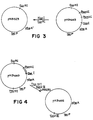
- pKB631 (Fig. 2) was used to fuse phe A′ to aro F by cleaving both pKB631 and pKB668 (EP-A-0176349 cited above) with Eco Rl and Pvu II and ligating the appropriate fragments together, yielding pKB684.
- the phe A′ gene would be transcribed from the phe A promoter.
- the Stu I site on pKB684 is then converted to a Hin d III site by cutting with Stu I and ligating Hin d III linkers into the site, yielding pKB689. This process places a linker between the promoter and operon of phe A, so that a heterologous promoter can be readily inserted if desired.
- Plasmid pKB694 was then constructed by treating pKB689 (Fig. 6) and pKB692 (Fig. 4) with Hin d III and Hpa I, and ligating the relevant fragments, as shown in Fig. 6.
- This plasmid is a varient of the phe A′- aro F operon of Examples 3, and 4,except that the phe A promoter has been supplemented by the lac promoter.
- the Tth lllI site on pKB694 was converted to a Hin d III site using Hin d III linkers, yielding pKB697 (Fig. 6). This was done so that a plasmid which determines tetracycline resistance could be derived from pKB697 as shown in Fig. 8, by fusing Hin d III cut pBR322 with Hin d III cut pKB697 to yield pKB702 (deposited in ATCC strain 67068). This resistance factor facilitates manipulation and selection of the plasmid.
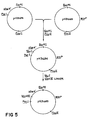
- Wild-type phe A includes an attenuator sequence that operates to regulate transcription in the presence of sufficient phenylalanine to form a leader peptide. It has been found that in some previous phe A- aro F fusions, expressed from a foreign promoter such as the lac promoter, at least some of this attenuator sequence remains between the promoter and the phe A or phe A′ gene and appears to exert some regulatory effect on transcription, thus reducing the level of phe A or phe A′ expression. It is desirable to eliminate the attenuator sequence entirely. Specifically, pKB693, which lacks the attenuator sequence, is derived from pKB689, which includes at least some of the attenuator sequence, (Fig. 5) as shown in Figs. 6 and 7 and as described below.
- pKB45 and pBR322 are ligated with Pst I and recircularized yielding pKB628.
- pKB628 is cleaved at Stu I, chewed back with an exonuclease and resealed with a Kpn I linker, yielding pKB632.
- pKB632 is cleaved at Kpn I, chewed back further with an exonuclease, and resealed with a Kpn I linker, yielding pKB638.
- the Kpn I site in pKB638 is converted to a Hin d III site by a linker, yielding pKB688.
- pKB693 is constructed by treating pKB689 (Fig. 5) and pKB688 (Fig. 7) with Hin d III and Hpa I and ligating fragments (selected by size separation on agarose gels) together.
- pKB912 Another phe A′ construction lacking the above-described attenuator DNA is pKB912 (deposited in ATCC 67067), constructed as shown in Figs. 9 and 10.
- the Kpn I- Eco RI fragment of pKB750 (ATCC 39857, referenced in EP-A-0176349) includes the phe A gene without the attenuator DNA. That fragment is cloned onto pKB444 to yield pKB909. Then, as shown in Fig. 10, the Nco I- Eco RI fragment from pKB909 is deleted, yielding the lac P- phe A′ fusion of pKB912, which is deposited in ATCC 67067.
- pKB444 is derived from pKB430 (a pBR322 derivative described in EP-A-0176349) by changing the Pvu II site of pKB430 first to Hpa I and then to Kpn I using linkers.
- pKB951 (Fig. 10)
- pKB712 an analogue of pKB712 (EP-A-0176349), which has been previously used for biosynthesis of phenylalanine.
- pKB951 is constructed from pKB912 by converting the Tth lllI site to a Cla I site, using Cla I linkers, removing the Cla I- Hpa I fragment and ligating it to the appropriate Cla I- Hpa I fragment of pKB702 (Fig. 8).
- a small change in phe A (resulting in replacement of the tryptophan 338 residue in the wild type enzyme by an arginine-glycine dipeptide) substantially removes sensitivity to feedback inhibition.
- phe A′ is fused to a portion of the lac Z gene, yielding a phe A′- lac Z alpha peptide fusion (Fig. 11).
- the resulting fusion retains CMPD activity.
- the fusion is formed by cloning a lac P- phe A′ gene fragment from pKB894 to the lacZ gene in pUC9, which is commercially available and is referenced in Yanisch et al., cited above.
- the lac Z portion of the fusion has the sequence: RRIPGNSLAVVLQRRDWENPGVTQLNRLAAHPPFAS WRNSEEARTORPSQQLRSLNGEWRLMRYFLLTHLCGISHRIWCTLSTICSDAA.
- pKB894 is cut with Tth lllI, rendered blunt with DNA polymerase I and cut with Xho I.
- pUC9 is cut with Hin d III, rendered blunt with DNA polymerase I and cut with Sal I.
- the Xho I and Sal I ends are joined as are the blunt ends, to yield pKB906.
- Plasmids pKB912 and pKB702 in E . coli K12 strain MM294 have been deposited in the ATCC and assigned numbers 67067 and 67068 respectively.
- one of the above-described expression vectors is transformed by standard techniques into an appropriate microorganism so that the phenylalanine insensitive CMPD is produced in the microorganism.
- the vectors of the invention generally enable increased phenylalanine production in host organisms.
- E. coli is generally a suitable organism particularly for the above-described specific vectors pKB702 and pKB912.
- Those skilled in the art will recognize that other desirable traits may be incorporated into the host organism by engineering to enhance production of the desired product.
- the transformed organisms are cultured in a suitable medium, and phenylalanine is recovered.
- a suitable medium including media recipes disclosed in Miller, Experiments in Molecular Genetics , Cold Spring Harbor 1972, and the following recipe for minimal salts medium (15 g/l glucose, 0.3 g/l MgSO4 ⁇ 7H2O, 14.7 mg/l Cacl2 ⁇ 2H2O, 0.5 g/l NaCl, 5 g/l (NH2)2SO4, 5 mg/l Vitamin B1, 1.5 g/l KH2PO4, 7.5 mg/l FeSO4 ⁇ 7H2O, 1 g/l Na citrate, and 10 ml of micronutrient solution per litre broth.
- Micronutrient solution has the following composition: 0.015 g/l Na2MoO4 ⁇ 2H2O, 0.25 g/l H3BO3, 0.07 g/l CoCl2 ⁇ 6H2O, 0.025 g/l CuSO4 ⁇ 5H2O, 0.16 g/l MnCl2 ⁇ 4H2O, and 0.03 g/l ZnSO4 ⁇ 7H2O).
- CMPD complementary metal-oxide-semiconductor
- phe A′ sequence such as appears in pKB702 or pKB912
- standard engineering techniques can be used to derive other sequences, e.g., by truncating and substituting for residues in the phe A′ sequence, and testing the resulting engineered sequence for CMPD activity.
- modified phe A′ sequences may be greater or less than 337 residues, and they are included within the scope of this invention.
- the E. coli phe A-encoded sequence, altered only by deletion of trp 338, should retain CMPD activity and substantially lack phenylalanine feedback sensitivity.
- Other expression vectors having other regulatory DNA can be used, and other expression systems can be used.
Landscapes
- Health & Medical Sciences (AREA)
- Life Sciences & Earth Sciences (AREA)
- Genetics & Genomics (AREA)
- Chemical & Material Sciences (AREA)
- Engineering & Computer Science (AREA)
- Organic Chemistry (AREA)
- Zoology (AREA)
- Wood Science & Technology (AREA)
- Bioinformatics & Cheminformatics (AREA)
- Biotechnology (AREA)
- Biomedical Technology (AREA)
- General Engineering & Computer Science (AREA)
- Microbiology (AREA)
- Molecular Biology (AREA)
- Biochemistry (AREA)
- General Health & Medical Sciences (AREA)
- Physics & Mathematics (AREA)
- Medicinal Chemistry (AREA)
- Biophysics (AREA)
- Plant Pathology (AREA)
- Chemical Kinetics & Catalysis (AREA)
- General Chemical & Material Sciences (AREA)
- Micro-Organisms Or Cultivation Processes Thereof (AREA)
- Preparation Of Compounds By Using Micro-Organisms (AREA)
- Measuring Or Testing Involving Enzymes Or Micro-Organisms (AREA)
- Peptides Or Proteins (AREA)
Claims (18)
- Protein, gekennzeichnet durch chorismatische Mutase/Prephenat-Dehydratase (CMPD)-Aktivität, welches im wesentlichen einer Phenylalanin-Rückkopplungshemmung gegenüber unempfindlich ist, wobei dieses Protein die Sequenz ΓCOΔ umfaßt, worin Γ eine Aminosäuresequenz ist, die im wesentlichen den N-endständigen 337 Aminosäureresten von Escherichia coli CMPD entspricht, CO die Carbonylgruppe des C-endständigen Restes von Γ ist, und Δ ist -OH, -O⁻, ein Aminosäurerest außer Tryptophan oder eine Aminosäuresequenz, dessen N-Terminus eine Aminosäure außer Tryptophan ist, das über eine Peptidbindung mit dem C-endständigen Rest verbunden ist.
- Protein nach Anspruch 1, worin Γ die Sequenzumfaßt.

- Protein nach Anspruch 1, worin Γ die Aminosäuren 1-337 von E. coli CMPD umfaßt.
- Protein nach Anspruch 1 oder 2, worin Δ -OH oder -O⁻ ist.
- Protein nach Anspruch 1 oder 2, worin Δ eine Aminosäuresequenz Ψ-Ω ist, in der Ψ ein Aminosäurerest außer Tryptophan ist, oder ein Paar von Aminosäureresten, das keinen Tryptophanylrest enthält; und Ω ista) EEMFYLDIQANLESAEMQKALKELGEITRSMKVLGCYPSENVVPVDPT oderb) eine Sequenz, die für eine enzymatische Aktivität außer für CMPD kodiert.
- Protein nach Anspruch 5, worin Ω eine Enzymaktivität im Stoffwechsel der Phenylalaninsynthese oder lacZα-Aktivität umfaßt.
- Protein nach Anspruch 5, worin Ψ arg-gly ist.
- Gentechnisch hergestelltes Expressionsvehikel, umfassend eine DNA, welche für das Protein eines jeden voranstehenden Anspruches kodiert, und eine regulatorische DNA, die so angeordnet und ausgerichtet ist, daß sie die Expression der proteinkodierenden DNA bewirkt.
- Gentechnisch hergestelltes Expressionsvehikel nach Anspruch 8, worin die proteinkodierende DNA eine Nukleotidsequenz von ca. 1011 Basenpaaren umfaßt, welche funktionell identisch mit den ersten 1011 Basenpaaren des E. coli pheA Strukturgens sind.
- Gentechnisch hergestelltes Expressionsvehikel nach Anspruch 9, worin das Codon, welches sich unmittelbar strangabwärts von dieser Nukleotidsequenz befindet, TGA ist.
- Gentechnisch hergestelltes Expressionsvehikel nach Anspruch 8, worin die regulatorische DNA einen Promoter umfaßt, der keiner Phenylalanin-Regulation unterliegt.
- Gentechnisch hergestelltes Expressionsvehikel nach Anspruch 11, worin das Vehikel einen Promoter umfaßt, der nicht mit pheA in Organismen des Wildtyps assoziiert ist, wobei das Vehikel durch die Abwesenheit eines Attenuators zwischen dem Promoter und der proteinkodierenden DNA gekennzeichnet ist.
- Expressionsvehikel nach Anspruch 11, weiterhin umfassend ein synthetisches Operon, wobei das Operon die proteinkodierende DNA sowie DNA umfaßt, welche für ein Enzym außer CMPD kodiert, welches einen Schritt im Stoffwechsel der Phenylalaninsynthese katalysiert, wobei die Expression des Operons unter der Kontrolle des Promoters erfolgt.
- Expressionsvehikel nach Anspruch 11, 12 oder 13, worin der Promoter der lac Promoter ist.
- Expressionsvehikel nach Anspruch 8, worin das Vehikel aus pKB912 (hinterlegt bei ATCC unter der Hinterlegungsnummer 67067) und pKB702 (hinterlegt bei ATCC unter der Hinterlegungsnummer 67068) oder aus funktionell äquivalenten Vehikeln, die davon abgeleitet sind, ausgewählt wird.
- Zelle, die das Expressionsvehikel nach einem der Ansprüche 8 bis 15 enthält.
- Verfahren zur Herstellung von Phenylalanin, umfassend das Kultivieren der Zelle nach Anspruch 16 in einer Fermentationslösung und das Gewinnen von Phenylalanin aus dieser Lösung.
- Verfahren zur gentechnischen Herstellung des Expressionsvehikels nach Anspruch 10, umfassend folgende Schritte:
Bereitstellen des E. coli pheA-Gens,
Verändern des pheA-Gens durch Umwandlung des Codons für Rest 338 von TGG in TGA, und
Fusionieren des veränderten pheA-Gens in ein Expressionsvehikel.
Priority Applications (2)
| Application Number | Priority Date | Filing Date | Title |
|---|---|---|---|
| AT88301887T ATE89317T1 (de) | 1986-05-07 | 1988-03-03 | Proteine, expressionsvektoren, die fuer solche proteine kodierende dna enthalten und zellen, die solche expressionsvektoren enthalten. |
| DE88301887T DE3881023T2 (de) | 1986-05-07 | 1988-03-03 | Proteine, Expressionsvektoren, die für solche Proteine kodierende DNA enthalten und Zellen, die solche Expressionsvektoren enthalten. |
Applications Claiming Priority (1)
| Application Number | Priority Date | Filing Date | Title |
|---|---|---|---|
| US06/860,541 US4753883A (en) | 1986-05-07 | 1986-05-07 | Enzyme deregulation |
Publications (2)
| Publication Number | Publication Date |
|---|---|
| EP0330773A1 EP0330773A1 (de) | 1989-09-06 |
| EP0330773B1 true EP0330773B1 (de) | 1993-05-12 |
Family
ID=25333456
Family Applications (1)
| Application Number | Title | Priority Date | Filing Date |
|---|---|---|---|
| EP88301887A Expired - Lifetime EP0330773B1 (de) | 1986-05-07 | 1988-03-03 | Proteine, Expressionsvektoren, die für solche Proteine kodierende DNA enthalten und Zellen, die solche Expressionsvektoren enthalten |
Country Status (5)
| Country | Link |
|---|---|
| US (1) | US4753883A (de) |
| EP (1) | EP0330773B1 (de) |
| AT (1) | ATE89317T1 (de) |
| CA (1) | CA1295565C (de) |
| DE (1) | DE3881023T2 (de) |
Cited By (1)
| Publication number | Priority date | Publication date | Assignee | Title |
|---|---|---|---|---|
| RU2250261C1 (ru) * | 2003-09-30 | 2005-04-20 | Закрытое акционерное общество "Научно-исследовательский институт Аджиномото-Генетика" (ЗАО АГРИ) | ПРЕФЕНАТДЕГИДРАТАЗА-ХОРИЗМАТМУТАЗА И ФРАГМЕНТ ДНК, КОДИРУЮЩИЙ ПРЕФЕНАТДЕГИДРАТАЗУ-ХОРИЗМАТМУТАЗУ, ИЗ БАКТЕРИИ Methylophilus methylotrophus |
Families Citing this family (14)
| Publication number | Priority date | Publication date | Assignee | Title |
|---|---|---|---|---|
| US4753883A (en) * | 1986-05-07 | 1988-06-28 | Biotechnica International, Inc. | Enzyme deregulation |
| US5120837A (en) * | 1989-09-20 | 1992-06-09 | The Nutrasweet Company | Dna encoding phe a feedback inhibition resistant enzyme analogues |
| EP0488424B1 (de) * | 1990-11-30 | 1997-03-05 | Ajinomoto Co., Inc. | Rekombinante DNS-Sequenzen kodierend für Enzyme frei von Feedback Inhibition, Plasmide diese Sequenzen enthaltend, transformierte Mikroorganismen nützlich für Produktion von aromatischen Aminosäuren, und deren Verfahren zur Herstellung durch Fermentation |
| US5168056A (en) * | 1991-02-08 | 1992-12-01 | Purdue Research Foundation | Enhanced production of common aromatic pathway compounds |
| TW313589B (de) * | 1991-12-12 | 1997-08-21 | Wacker Chemie Gmbh | |
| US5856148A (en) * | 1991-12-12 | 1999-01-05 | Wacker Chemie Gmbh | Materials and methods for biosynthesis of serine and serine-related products |
| US5776736A (en) * | 1992-12-21 | 1998-07-07 | Purdue Research Foundation | Deblocking the common pathway of aromatic amino acid synthesis |
| US5487987A (en) * | 1993-09-16 | 1996-01-30 | Purdue Research Foundation | Synthesis of adipic acid from biomass-derived carbon sources |
| US5629181A (en) * | 1993-09-16 | 1997-05-13 | Purdue Research Foundation | Synthesis of catechol from biomass-derived carbon sources |
| US5728555A (en) * | 1996-09-30 | 1998-03-17 | Monsanto Company | Preparation of d-amino acids by direct fermentative means |
| US6465217B1 (en) * | 2000-07-05 | 2002-10-15 | Paradigm Genetics, Inc. | Methods and compositions for the modulation of chorismate synthase and chorismate mutase expression or activity in plants |
| ES2663445T3 (es) | 2012-01-30 | 2018-04-12 | Myriant Corporation | Producción de ácido mucónico a partir de microorganismos modificados genéticamente |
| KR20190003939A (ko) | 2016-03-02 | 2019-01-10 | 피티티지씨 이노베이션 아메리카 코포레이션 | 유전자 조작된 미생물로부터 개선된 뮤콘산 생산 |
| AU2021237368B2 (en) | 2020-03-18 | 2025-05-08 | Lanzatech, Inc. | Fermentative production of 2-phenylethanol from gaseous substrates |
Family Cites Families (8)
| Publication number | Priority date | Publication date | Assignee | Title |
|---|---|---|---|---|
| JPS561890A (en) * | 1979-06-15 | 1981-01-10 | Ajinomoto Co Inc | Preparation of l-phenylalanine by fermentation |
| DE3128411A1 (de) * | 1980-07-18 | 1983-09-15 | Unisearch Ltd., 2033 Kensington, New South Wales | Kulturstamm-mutante von esccherichia coli sowie verfahren zur herstellung von phenylalanin |
| AU550349B2 (en) * | 1980-07-18 | 1986-03-20 | Austgen-Biojet International Pty. Ltd. | Novel e.coli and phenylalanine production |
| US4839286A (en) * | 1983-10-07 | 1989-06-13 | Biotechnica International, Inc. | Method of biosynthesis and cells therefor |
| CA1283375C (en) * | 1984-09-24 | 1991-04-23 | H.J. Heinz Company | Method of biosynthesis and cells therefor |
| EP0190921A3 (de) * | 1985-02-04 | 1988-01-13 | Engenics, Inc. | Verfahren zur Überproduktion von Aminosäuren |
| WO1987000202A1 (en) * | 1985-06-24 | 1987-01-15 | The Nutrasweet Company | Composite plasmids for amino acid synthesis |
| US4753883A (en) * | 1986-05-07 | 1988-06-28 | Biotechnica International, Inc. | Enzyme deregulation |
-
1986
- 1986-05-07 US US06/860,541 patent/US4753883A/en not_active Expired - Lifetime
-
1987
- 1987-05-06 CA CA000536463A patent/CA1295565C/en not_active Expired - Lifetime
-
1988
- 1988-03-03 EP EP88301887A patent/EP0330773B1/de not_active Expired - Lifetime
- 1988-03-03 AT AT88301887T patent/ATE89317T1/de not_active IP Right Cessation
- 1988-03-03 DE DE88301887T patent/DE3881023T2/de not_active Expired - Fee Related
Cited By (1)
| Publication number | Priority date | Publication date | Assignee | Title |
|---|---|---|---|---|
| RU2250261C1 (ru) * | 2003-09-30 | 2005-04-20 | Закрытое акционерное общество "Научно-исследовательский институт Аджиномото-Генетика" (ЗАО АГРИ) | ПРЕФЕНАТДЕГИДРАТАЗА-ХОРИЗМАТМУТАЗА И ФРАГМЕНТ ДНК, КОДИРУЮЩИЙ ПРЕФЕНАТДЕГИДРАТАЗУ-ХОРИЗМАТМУТАЗУ, ИЗ БАКТЕРИИ Methylophilus methylotrophus |
Also Published As
| Publication number | Publication date |
|---|---|
| CA1295565C (en) | 1992-02-11 |
| US4753883A (en) | 1988-06-28 |
| ATE89317T1 (de) | 1993-05-15 |
| EP0330773A1 (de) | 1989-09-06 |
| DE3881023T2 (de) | 1993-11-25 |
| DE3881023D1 (de) | 1993-06-17 |
Similar Documents
| Publication | Publication Date | Title |
|---|---|---|
| EP0330773B1 (de) | Proteine, Expressionsvektoren, die für solche Proteine kodierende DNA enthalten und Zellen, die solche Expressionsvektoren enthalten | |
| US4865974A (en) | Bacterial methionine N-terminal peptidase | |
| WO1993009235A2 (en) | Ubiquitin-specific proteases | |
| HUT75840A (en) | Expression of n-terminally extended proteins in yeast | |
| CA2174525A1 (en) | Customized proteases with altered transacylation activity | |
| JPH1057061A (ja) | タンパク質の代謝的安定性の調節方法 | |
| EP0563175A1 (de) | Methode zur herstellung synthetischer leader-sequenzen | |
| NZ621527A (en) | A genetically modified yeast cell and method of production of recombinant protein or polypeptide thereof | |
| US5013662A (en) | Bacterial methionine n-terminal peptidase | |
| US4870017A (en) | Bacterial methionine N-terminal peptidase | |
| AU674741B2 (en) | Methods and DNA expression systems for over-expression of proteins in host cells | |
| AU614988B2 (en) | Recombinant dna expression vectors and dna compounds that encode isopenicillin n synthetase from aspergillus nidulans | |
| US5389526A (en) | Plasmid vectors for cellular slime moulds of the genus dictyostelium | |
| CA2223877A1 (en) | Preparation of riboflavin using microorganisms having an altered isocitrate lyase activity | |
| US7109015B2 (en) | Removal of N-terminal methionine from proteins by engineered methionine aminopeptidase | |
| Bartsch et al. | Stereospecific production of the herbicide phosphinothricin (glufosinate) by transamination: cloning, characterization, and overexpression of the gene encoding a phosphinothricin-specific transaminase from Escherichia coli | |
| CA1312029C (en) | Method for increasing gene expression | |
| JP2706461B2 (ja) | 酸素生産の抑制解除 | |
| US9657323B2 (en) | Polypeptide cleavage method using OmpT protease variant | |
| PT607080E (pt) | Nova sequencia pro que permite a secrecao de proteinas heterologas a partir de uma celula de levedura | |
| EP1841862B1 (de) | Ubp1-proteasemutante sowie ihre codierende sequenz, deren anwendungen und heterogenes proteinexpressionssystem | |
| US4952508A (en) | Method and vector organism for controlled accumulation of cloned heterologous gene products in Bacillus subtilis | |
| CN113913414B (zh) | 高稳定性和高催化效率的双碱基酶Kex2突变体 | |
| RU2435863C2 (ru) | Способ продукции белка | |
| US5766881A (en) | Induction-free process for the recombinant preparation of glutarylamidase |
Legal Events
| Date | Code | Title | Description |
|---|---|---|---|
| PUAI | Public reference made under article 153(3) epc to a published international application that has entered the european phase |
Free format text: ORIGINAL CODE: 0009012 |
|
| AK | Designated contracting states |
Kind code of ref document: A1 Designated state(s): AT BE CH DE ES FR GB GR IT LI LU NL SE |
|
| 17P | Request for examination filed |
Effective date: 19900105 |
|
| 17Q | First examination report despatched |
Effective date: 19920316 |
|
| GRAA | (expected) grant |
Free format text: ORIGINAL CODE: 0009210 |
|
| AK | Designated contracting states |
Kind code of ref document: B1 Designated state(s): AT BE CH DE ES FR GB GR IT LI LU NL SE |
|
| PG25 | Lapsed in a contracting state [announced via postgrant information from national office to epo] |
Ref country code: IT Free format text: LAPSE BECAUSE OF FAILURE TO SUBMIT A TRANSLATION OF THE DESCRIPTION OR TO PAY THE FEE WITHIN THE PRESCRIBED TIME-LIMIT;WARNING: LAPSES OF ITALIAN PATENTS WITH EFFECTIVE DATE BEFORE 2007 MAY HAVE OCCURRED AT ANY TIME BEFORE 2007. THE CORRECT EFFECTIVE DATE MAY BE DIFFERENT FROM THE ONE RECORDED. Effective date: 19930512 Ref country code: BE Effective date: 19930512 Ref country code: GR Free format text: LAPSE BECAUSE OF FAILURE TO SUBMIT A TRANSLATION OF THE DESCRIPTION OR TO PAY THE FEE WITHIN THE PRESCRIBED TIME-LIMIT Effective date: 19930512 Ref country code: SE Effective date: 19930512 |
|
| REF | Corresponds to: |
Ref document number: 89317 Country of ref document: AT Date of ref document: 19930515 Kind code of ref document: T |
|
| REF | Corresponds to: |
Ref document number: 3881023 Country of ref document: DE Date of ref document: 19930617 |
|
| PG25 | Lapsed in a contracting state [announced via postgrant information from national office to epo] |
Ref country code: ES Free format text: LAPSE BECAUSE OF FAILURE TO SUBMIT A TRANSLATION OF THE DESCRIPTION OR TO PAY THE FEE WITHIN THE PRESCRIBED TIME-LIMIT Effective date: 19930823 |
|
| ET | Fr: translation filed | ||
| PGFP | Annual fee paid to national office [announced via postgrant information from national office to epo] |
Ref country code: ES Payment date: 19940311 Year of fee payment: 7 |
|
| PG25 | Lapsed in a contracting state [announced via postgrant information from national office to epo] |
Ref country code: LU Free format text: LAPSE BECAUSE OF NON-PAYMENT OF DUE FEES Effective date: 19940331 |
|
| REG | Reference to a national code |
Ref country code: GB Ref legal event code: IF02 |
|
| PGFP | Annual fee paid to national office [announced via postgrant information from national office to epo] |
Ref country code: FR Payment date: 20030221 Year of fee payment: 16 Ref country code: NL Payment date: 20030221 Year of fee payment: 16 Ref country code: AT Payment date: 20030221 Year of fee payment: 16 |
|
| PGFP | Annual fee paid to national office [announced via postgrant information from national office to epo] |
Ref country code: CH Payment date: 20030225 Year of fee payment: 16 |
|
| PGFP | Annual fee paid to national office [announced via postgrant information from national office to epo] |
Ref country code: GB Payment date: 20030226 Year of fee payment: 16 |
|
| PGFP | Annual fee paid to national office [announced via postgrant information from national office to epo] |
Ref country code: DE Payment date: 20030331 Year of fee payment: 16 |
|
| PG25 | Lapsed in a contracting state [announced via postgrant information from national office to epo] |
Ref country code: AT Free format text: LAPSE BECAUSE OF NON-PAYMENT OF DUE FEES Effective date: 20040303 Ref country code: GB Free format text: LAPSE BECAUSE OF NON-PAYMENT OF DUE FEES Effective date: 20040303 |
|
| PG25 | Lapsed in a contracting state [announced via postgrant information from national office to epo] |
Ref country code: CH Free format text: LAPSE BECAUSE OF NON-PAYMENT OF DUE FEES Effective date: 20040331 Ref country code: LI Free format text: LAPSE BECAUSE OF NON-PAYMENT OF DUE FEES Effective date: 20040331 |
|
| PG25 | Lapsed in a contracting state [announced via postgrant information from national office to epo] |
Ref country code: NL Free format text: LAPSE BECAUSE OF NON-PAYMENT OF DUE FEES Effective date: 20041001 Ref country code: DE Free format text: LAPSE BECAUSE OF NON-PAYMENT OF DUE FEES Effective date: 20041001 |
|
| GBPC | Gb: european patent ceased through non-payment of renewal fee | ||
| REG | Reference to a national code |
Ref country code: CH Ref legal event code: PL |
|
| PG25 | Lapsed in a contracting state [announced via postgrant information from national office to epo] |
Ref country code: FR Free format text: LAPSE BECAUSE OF NON-PAYMENT OF DUE FEES Effective date: 20041130 |
|
| NLV4 | Nl: lapsed or anulled due to non-payment of the annual fee |
Effective date: 20041001 |
|
| REG | Reference to a national code |
Ref country code: FR Ref legal event code: ST |
|
| PLBE | No opposition filed within time limit |
Free format text: ORIGINAL CODE: 0009261 |
|
| STAA | Information on the status of an ep patent application or granted ep patent |
Free format text: STATUS: NO OPPOSITION FILED WITHIN TIME LIMIT |