EP0339284A1 - Fluorine-containing dielectric media and capacitors employing such media - Google Patents
Fluorine-containing dielectric media and capacitors employing such media Download PDFInfo
- Publication number
- EP0339284A1 EP0339284A1 EP89105617A EP89105617A EP0339284A1 EP 0339284 A1 EP0339284 A1 EP 0339284A1 EP 89105617 A EP89105617 A EP 89105617A EP 89105617 A EP89105617 A EP 89105617A EP 0339284 A1 EP0339284 A1 EP 0339284A1
- Authority
- EP
- European Patent Office
- Prior art keywords
- dielectric medium
- carbon atoms
- radical
- medium
- alkyl
- Prior art date
- Legal status (The legal status is an assumption and is not a legal conclusion. Google has not performed a legal analysis and makes no representation as to the accuracy of the status listed.)
- Granted
Links
- 239000003990 capacitor Substances 0.000 title claims abstract description 22
- YCKRFDGAMUMZLT-UHFFFAOYSA-N Fluorine atom Chemical compound [F] YCKRFDGAMUMZLT-UHFFFAOYSA-N 0.000 title abstract description 5
- 229910052731 fluorine Inorganic materials 0.000 title abstract description 5
- 239000011737 fluorine Substances 0.000 title abstract description 5
- 239000000203 mixture Substances 0.000 claims abstract description 12
- -1 hydrocarbon radical Chemical class 0.000 claims description 49
- 125000004432 carbon atom Chemical group C* 0.000 claims description 32
- 150000005840 aryl radicals Chemical class 0.000 claims description 8
- 150000001875 compounds Chemical class 0.000 claims description 7
- 125000001153 fluoro group Chemical group F* 0.000 claims description 7
- 150000003254 radicals Chemical group 0.000 claims description 7
- 125000000217 alkyl group Chemical group 0.000 claims description 6
- 239000007787 solid Substances 0.000 claims description 6
- 239000004215 Carbon black (E152) Substances 0.000 claims description 5
- 229910052736 halogen Inorganic materials 0.000 claims description 5
- 150000002367 halogens Chemical class 0.000 claims description 5
- 229930195733 hydrocarbon Natural products 0.000 claims description 5
- 229920006395 saturated elastomer Polymers 0.000 claims description 4
- 125000004417 unsaturated alkyl group Chemical group 0.000 claims description 4
- 239000001257 hydrogen Substances 0.000 claims description 3
- 229910052739 hydrogen Inorganic materials 0.000 claims description 3
- HIZUYBUOEFGDFO-UHFFFAOYSA-N 2,2,3,3,4,4,4-heptafluoro-n,n-dimethylbutanamide Chemical compound CN(C)C(=O)C(F)(F)C(F)(F)C(F)(F)F HIZUYBUOEFGDFO-UHFFFAOYSA-N 0.000 claims description 2
- UFHFLCQGNIYNRP-UHFFFAOYSA-N Hydrogen Chemical compound [H][H] UFHFLCQGNIYNRP-UHFFFAOYSA-N 0.000 claims description 2
- 125000001511 cyclopentyl group Chemical group [H]C1([H])C([H])([H])C([H])([H])C([H])(*)C1([H])[H] 0.000 claims description 2
- LCFRHFXYFVOCGZ-UHFFFAOYSA-N n,n-diethyl-1,1,2,2,3,3,4,4,4-nonafluorobutane-1-sulfonamide Chemical compound CCN(CC)S(=O)(=O)C(F)(F)C(F)(F)C(F)(F)C(F)(F)F LCFRHFXYFVOCGZ-UHFFFAOYSA-N 0.000 claims description 2
- 229910052799 carbon Inorganic materials 0.000 claims 1
- 125000004435 hydrogen atom Chemical group [H]* 0.000 claims 1
- 125000001424 substituent group Chemical group 0.000 claims 1
- 150000001408 amides Chemical class 0.000 abstract description 10
- 229940124530 sulfonamide Drugs 0.000 abstract description 4
- 150000003456 sulfonamides Chemical class 0.000 abstract description 4
- 239000013028 medium composition Substances 0.000 abstract 1
- 239000012530 fluid Substances 0.000 description 16
- 239000000047 product Substances 0.000 description 12
- STSCVKRWJPWALQ-UHFFFAOYSA-N TRIFLUOROACETIC ACID ETHYL ESTER Chemical compound CCOC(=O)C(F)(F)F STSCVKRWJPWALQ-UHFFFAOYSA-N 0.000 description 9
- 239000007788 liquid Substances 0.000 description 8
- 239000002609 medium Substances 0.000 description 8
- 239000011541 reaction mixture Substances 0.000 description 8
- IJGRMHOSHXDMSA-UHFFFAOYSA-N Atomic nitrogen Chemical compound N#N IJGRMHOSHXDMSA-UHFFFAOYSA-N 0.000 description 6
- XEKOWRVHYACXOJ-UHFFFAOYSA-N Ethyl acetate Chemical compound CCOC(C)=O XEKOWRVHYACXOJ-UHFFFAOYSA-N 0.000 description 6
- 239000007789 gas Substances 0.000 description 6
- 238000005470 impregnation Methods 0.000 description 6
- 238000004804 winding Methods 0.000 description 6
- 239000011888 foil Substances 0.000 description 5
- 238000010992 reflux Methods 0.000 description 5
- HEDRZPFGACZZDS-UHFFFAOYSA-N Chloroform Chemical compound ClC(Cl)Cl HEDRZPFGACZZDS-UHFFFAOYSA-N 0.000 description 4
- RTZKZFJDLAIYFH-UHFFFAOYSA-N Diethyl ether Chemical compound CCOCC RTZKZFJDLAIYFH-UHFFFAOYSA-N 0.000 description 4
- LFQSCWFLJHTTHZ-UHFFFAOYSA-N Ethanol Chemical compound CCO LFQSCWFLJHTTHZ-UHFFFAOYSA-N 0.000 description 4
- KFZMGEQAYNKOFK-UHFFFAOYSA-N Isopropanol Chemical compound CC(C)O KFZMGEQAYNKOFK-UHFFFAOYSA-N 0.000 description 4
- 150000001412 amines Chemical class 0.000 description 4
- 230000015556 catabolic process Effects 0.000 description 4
- 239000000463 material Substances 0.000 description 4
- XLYOFNOQVPJJNP-UHFFFAOYSA-N water Chemical compound O XLYOFNOQVPJJNP-UHFFFAOYSA-N 0.000 description 4
- 238000009736 wetting Methods 0.000 description 4
- 239000006227 byproduct Substances 0.000 description 3
- 238000004821 distillation Methods 0.000 description 3
- 238000000034 method Methods 0.000 description 3
- 229910052757 nitrogen Inorganic materials 0.000 description 3
- 229920006254 polymer film Polymers 0.000 description 3
- 125000006850 spacer group Chemical group 0.000 description 3
- MQIUGAXCHLFZKX-UHFFFAOYSA-N Di-n-octyl phthalate Natural products CCCCCCCCOC(=O)C1=CC=CC=C1C(=O)OCCCCCCCC MQIUGAXCHLFZKX-UHFFFAOYSA-N 0.000 description 2
- ROSDSFDQCJNGOL-UHFFFAOYSA-N Dimethylamine Chemical compound CNC ROSDSFDQCJNGOL-UHFFFAOYSA-N 0.000 description 2
- QUSNBJAOOMFDIB-UHFFFAOYSA-N Ethylamine Chemical compound CCN QUSNBJAOOMFDIB-UHFFFAOYSA-N 0.000 description 2
- VEXZGXHMUGYJMC-UHFFFAOYSA-N Hydrochloric acid Chemical compound Cl VEXZGXHMUGYJMC-UHFFFAOYSA-N 0.000 description 2
- CSNNHWWHGAXBCP-UHFFFAOYSA-L Magnesium sulfate Chemical compound [Mg+2].[O-][S+2]([O-])([O-])[O-] CSNNHWWHGAXBCP-UHFFFAOYSA-L 0.000 description 2
- 239000002033 PVDF binder Substances 0.000 description 2
- NQRYJNQNLNOLGT-UHFFFAOYSA-N Piperidine Chemical compound C1CCNCC1 NQRYJNQNLNOLGT-UHFFFAOYSA-N 0.000 description 2
- 239000004743 Polypropylene Substances 0.000 description 2
- YSMRWXYRXBRSND-UHFFFAOYSA-N TOTP Chemical compound CC1=CC=CC=C1OP(=O)(OC=1C(=CC=CC=1)C)OC1=CC=CC=C1C YSMRWXYRXBRSND-UHFFFAOYSA-N 0.000 description 2
- BJQHLKABXJIVAM-UHFFFAOYSA-N bis(2-ethylhexyl) phthalate Chemical compound CCCCC(CC)COC(=O)C1=CC=CC=C1C(=O)OCC(CC)CCCC BJQHLKABXJIVAM-UHFFFAOYSA-N 0.000 description 2
- 238000006243 chemical reaction Methods 0.000 description 2
- 229920001577 copolymer Polymers 0.000 description 2
- PAFZNILMFXTMIY-UHFFFAOYSA-N cyclohexylamine Chemical compound NC1CCCCC1 PAFZNILMFXTMIY-UHFFFAOYSA-N 0.000 description 2
- JQVDAXLFBXTEQA-UHFFFAOYSA-N dibutylamine Chemical compound CCCCNCCCC JQVDAXLFBXTEQA-UHFFFAOYSA-N 0.000 description 2
- HPNMFZURTQLUMO-UHFFFAOYSA-N diethylamine Chemical compound CCNCC HPNMFZURTQLUMO-UHFFFAOYSA-N 0.000 description 2
- 229920002313 fluoropolymer Polymers 0.000 description 2
- 238000010438 heat treatment Methods 0.000 description 2
- 238000004519 manufacturing process Methods 0.000 description 2
- VLKZOEOYAKHREP-UHFFFAOYSA-N n-Hexane Chemical class CCCCCC VLKZOEOYAKHREP-UHFFFAOYSA-N 0.000 description 2
- BIBAVAVHXLGIBU-UHFFFAOYSA-N n-butyl-2,2,2-trifluoroacetamide Chemical compound CCCCNC(=O)C(F)(F)F BIBAVAVHXLGIBU-UHFFFAOYSA-N 0.000 description 2
- 230000007935 neutral effect Effects 0.000 description 2
- 229920000728 polyester Polymers 0.000 description 2
- 229920002981 polyvinylidene fluoride Polymers 0.000 description 2
- WJKHJLXJJJATHN-UHFFFAOYSA-N triflic anhydride Chemical compound FC(F)(F)S(=O)(=O)OS(=O)(=O)C(F)(F)F WJKHJLXJJJATHN-UHFFFAOYSA-N 0.000 description 2
- QTKIQLNGOKOPOE-UHFFFAOYSA-N 1,1'-biphenyl;propane Chemical group CCC.C1=CC=CC=C1C1=CC=CC=C1 QTKIQLNGOKOPOE-UHFFFAOYSA-N 0.000 description 1
- RMSGQZDGSZOJMU-UHFFFAOYSA-N 1-butyl-2-phenylbenzene Chemical group CCCCC1=CC=CC=C1C1=CC=CC=C1 RMSGQZDGSZOJMU-UHFFFAOYSA-N 0.000 description 1
- BMVXCPBXGZKUPN-UHFFFAOYSA-N 1-hexanamine Chemical compound CCCCCCN BMVXCPBXGZKUPN-UHFFFAOYSA-N 0.000 description 1
- ABSXCPJNJUCDEI-UHFFFAOYSA-N 2,2,2-trifluoro-n-hexylacetamide Chemical compound CCCCCCNC(=O)C(F)(F)F ABSXCPJNJUCDEI-UHFFFAOYSA-N 0.000 description 1
- QIJIUJYANDSEKG-UHFFFAOYSA-N 2,4,4-trimethylpentan-2-amine Chemical compound CC(C)(C)CC(C)(C)N QIJIUJYANDSEKG-UHFFFAOYSA-N 0.000 description 1
- 125000003903 2-propenyl group Chemical group [H]C([*])([H])C([H])=C([H])[H] 0.000 description 1
- 125000001494 2-propynyl group Chemical group [H]C#CC([H])([H])* 0.000 description 1
- WKBOTKDWSSQWDR-UHFFFAOYSA-N Bromine atom Chemical compound [Br] WKBOTKDWSSQWDR-UHFFFAOYSA-N 0.000 description 1
- ZAMOUSCENKQFHK-UHFFFAOYSA-N Chlorine atom Chemical compound [Cl] ZAMOUSCENKQFHK-UHFFFAOYSA-N 0.000 description 1
- RYGMFSIKBFXOCR-UHFFFAOYSA-N Copper Chemical compound [Cu] RYGMFSIKBFXOCR-UHFFFAOYSA-N 0.000 description 1
- SNRUBQQJIBEYMU-UHFFFAOYSA-N Dodecane Natural products CCCCCCCCCCCC SNRUBQQJIBEYMU-UHFFFAOYSA-N 0.000 description 1
- 239000004952 Polyamide Substances 0.000 description 1
- 239000004698 Polyethylene Substances 0.000 description 1
- 238000010521 absorption reaction Methods 0.000 description 1
- 239000002253 acid Substances 0.000 description 1
- 230000002378 acidificating effect Effects 0.000 description 1
- 239000000654 additive Substances 0.000 description 1
- 229910052782 aluminium Inorganic materials 0.000 description 1
- XAGFODPZIPBFFR-UHFFFAOYSA-N aluminium Chemical compound [Al] XAGFODPZIPBFFR-UHFFFAOYSA-N 0.000 description 1
- PNEYBMLMFCGWSK-UHFFFAOYSA-N aluminium oxide Inorganic materials [O-2].[O-2].[O-2].[Al+3].[Al+3] PNEYBMLMFCGWSK-UHFFFAOYSA-N 0.000 description 1
- 239000003963 antioxidant agent Substances 0.000 description 1
- 125000004429 atom Chemical group 0.000 description 1
- 239000003139 biocide Substances 0.000 description 1
- 238000009835 boiling Methods 0.000 description 1
- GDTBXPJZTBHREO-UHFFFAOYSA-N bromine Substances BrBr GDTBXPJZTBHREO-UHFFFAOYSA-N 0.000 description 1
- 229910052794 bromium Inorganic materials 0.000 description 1
- HQABUPZFAYXKJW-UHFFFAOYSA-N butan-1-amine Chemical compound CCCCN HQABUPZFAYXKJW-UHFFFAOYSA-N 0.000 description 1
- 125000000484 butyl group Chemical group [H]C([*])([H])C([H])([H])C([H])([H])C([H])([H])[H] 0.000 description 1
- 229910052801 chlorine Inorganic materials 0.000 description 1
- 239000000460 chlorine Substances 0.000 description 1
- 239000002131 composite material Substances 0.000 description 1
- 239000004020 conductor Substances 0.000 description 1
- 230000008602 contraction Effects 0.000 description 1
- 238000001816 cooling Methods 0.000 description 1
- 229910052802 copper Inorganic materials 0.000 description 1
- 239000010949 copper Substances 0.000 description 1
- 238000005260 corrosion Methods 0.000 description 1
- 230000007797 corrosion Effects 0.000 description 1
- 125000000753 cycloalkyl group Chemical group 0.000 description 1
- 125000000113 cyclohexyl group Chemical group [H]C1([H])C([H])([H])C([H])([H])C([H])(*)C([H])([H])C1([H])[H] 0.000 description 1
- 125000000640 cyclooctyl group Chemical group [H]C1([H])C([H])([H])C([H])([H])C([H])([H])C([H])(*)C([H])([H])C([H])([H])C1([H])[H] 0.000 description 1
- 125000001559 cyclopropyl group Chemical group [H]C1([H])C([H])([H])C1([H])* 0.000 description 1
- 125000002704 decyl group Chemical group [H]C([H])([H])C([H])([H])C([H])([H])C([H])([H])C([H])([H])C([H])([H])C([H])([H])C([H])([H])C([H])([H])C([H])([H])* 0.000 description 1
- 230000007123 defense Effects 0.000 description 1
- 239000003989 dielectric material Substances 0.000 description 1
- 239000012153 distilled water Substances 0.000 description 1
- JVHJRIQPDBCRRE-UHFFFAOYSA-N ethyl 2,2,3,3,4,4,4-heptafluorobutanoate Chemical compound CCOC(=O)C(F)(F)C(F)(F)C(F)(F)F JVHJRIQPDBCRRE-UHFFFAOYSA-N 0.000 description 1
- 125000001495 ethyl group Chemical group [H]C([H])([H])C([H])([H])* 0.000 description 1
- 239000003063 flame retardant Substances 0.000 description 1
- 125000003187 heptyl group Chemical group [H]C([*])([H])C([H])([H])C([H])([H])C([H])([H])C([H])([H])C([H])([H])C([H])([H])[H] 0.000 description 1
- 125000004051 hexyl group Chemical group [H]C([H])([H])C([H])([H])C([H])([H])C([H])([H])C([H])([H])C([H])([H])* 0.000 description 1
- 239000004615 ingredient Substances 0.000 description 1
- 239000003112 inhibitor Substances 0.000 description 1
- 239000002655 kraft paper Substances 0.000 description 1
- 229910052943 magnesium sulfate Inorganic materials 0.000 description 1
- 235000019341 magnesium sulphate Nutrition 0.000 description 1
- 239000000155 melt Substances 0.000 description 1
- 229910052751 metal Inorganic materials 0.000 description 1
- 239000002184 metal Substances 0.000 description 1
- 150000002739 metals Chemical class 0.000 description 1
- 125000002496 methyl group Chemical group [H]C([H])([H])* 0.000 description 1
- FDTPPUQOJKHLFQ-UHFFFAOYSA-N n,n-dibutyl-2,2,2-trifluoroacetamide Chemical compound CCCCN(C(=O)C(F)(F)F)CCCC FDTPPUQOJKHLFQ-UHFFFAOYSA-N 0.000 description 1
- SWNGTCLXUUOMAM-UHFFFAOYSA-N n,n-diethyl-1,1,1-trifluoromethanesulfonamide Chemical compound CCN(CC)S(=O)(=O)C(F)(F)F SWNGTCLXUUOMAM-UHFFFAOYSA-N 0.000 description 1
- MOAMIZJDECJMPD-UHFFFAOYSA-N n-butan-2-yl-2,2,2-trifluoroacetamide Chemical compound CCC(C)NC(=O)C(F)(F)F MOAMIZJDECJMPD-UHFFFAOYSA-N 0.000 description 1
- NNIONFSOKOHXIB-UHFFFAOYSA-N n-cyclohexyl-2,2,2-trifluoroacetamide Chemical compound FC(F)(F)C(=O)NC1CCCCC1 NNIONFSOKOHXIB-UHFFFAOYSA-N 0.000 description 1
- SVEZGQGDAZLHQG-UHFFFAOYSA-N n-ethyl-2,2,2-trifluoroacetamide Chemical compound CCNC(=O)C(F)(F)F SVEZGQGDAZLHQG-UHFFFAOYSA-N 0.000 description 1
- 125000001624 naphthyl group Chemical group 0.000 description 1
- 125000001400 nonyl group Chemical group [H]C([*])([H])C([H])([H])C([H])([H])C([H])([H])C([H])([H])C([H])([H])C([H])([H])C([H])([H])C([H])([H])[H] 0.000 description 1
- 125000002347 octyl group Chemical group [H]C([*])([H])C([H])([H])C([H])([H])C([H])([H])C([H])([H])C([H])([H])C([H])([H])C([H])([H])[H] 0.000 description 1
- 239000012074 organic phase Substances 0.000 description 1
- 239000000123 paper Substances 0.000 description 1
- 230000035515 penetration Effects 0.000 description 1
- 125000001147 pentyl group Chemical group C(CCCC)* 0.000 description 1
- LUYQYZLEHLTPBH-UHFFFAOYSA-N perfluorobutanesulfonyl fluoride Chemical compound FC(F)(F)C(F)(F)C(F)(F)C(F)(F)S(F)(=O)=O LUYQYZLEHLTPBH-UHFFFAOYSA-N 0.000 description 1
- 125000001997 phenyl group Chemical group [H]C1=C([H])C([H])=C(*)C([H])=C1[H] 0.000 description 1
- 239000002985 plastic film Substances 0.000 description 1
- 229920006255 plastic film Polymers 0.000 description 1
- 229920002492 poly(sulfone) Polymers 0.000 description 1
- 229920002647 polyamide Polymers 0.000 description 1
- 229920000515 polycarbonate Polymers 0.000 description 1
- 239000004417 polycarbonate Substances 0.000 description 1
- 229920000573 polyethylene Polymers 0.000 description 1
- 229920000642 polymer Polymers 0.000 description 1
- 229920001155 polypropylene Polymers 0.000 description 1
- 229920001343 polytetrafluoroethylene Polymers 0.000 description 1
- 229940058401 polytetrafluoroethylene Drugs 0.000 description 1
- 239000004810 polytetrafluoroethylene Substances 0.000 description 1
- 229920002620 polyvinyl fluoride Polymers 0.000 description 1
- 239000013630 prepared media Substances 0.000 description 1
- 125000001436 propyl group Chemical group [H]C([*])([H])C([H])([H])C([H])([H])[H] 0.000 description 1
- 239000000565 sealant Substances 0.000 description 1
- 238000007789 sealing Methods 0.000 description 1
- BHRZNVHARXXAHW-UHFFFAOYSA-N sec-butylamine Chemical compound CCC(C)N BHRZNVHARXXAHW-UHFFFAOYSA-N 0.000 description 1
- 238000002791 soaking Methods 0.000 description 1
- 229910000679 solder Inorganic materials 0.000 description 1
- 239000012258 stirred mixture Substances 0.000 description 1
- 238000003756 stirring Methods 0.000 description 1
- 239000004094 surface-active agent Substances 0.000 description 1
- 125000003944 tolyl group Chemical group 0.000 description 1
- 125000002948 undecyl group Chemical group [H]C([*])([H])C([H])([H])C([H])([H])C([H])([H])C([H])([H])C([H])([H])C([H])([H])C([H])([H])C([H])([H])C([H])([H])C([H])([H])[H] 0.000 description 1
- 229920002554 vinyl polymer Polymers 0.000 description 1
Images

Classifications
-
- H—ELECTRICITY
- H01—ELECTRIC ELEMENTS
- H01G—CAPACITORS; CAPACITORS, RECTIFIERS, DETECTORS, SWITCHING DEVICES, LIGHT-SENSITIVE OR TEMPERATURE-SENSITIVE DEVICES OF THE ELECTROLYTIC TYPE
- H01G4/00—Fixed capacitors; Processes of their manufacture
- H01G4/002—Details
- H01G4/018—Dielectrics
- H01G4/20—Dielectrics using combinations of dielectrics from more than one of groups H01G4/02 - H01G4/06
- H01G4/22—Dielectrics using combinations of dielectrics from more than one of groups H01G4/02 - H01G4/06 impregnated
- H01G4/221—Dielectrics using combinations of dielectrics from more than one of groups H01G4/02 - H01G4/06 impregnated characterised by the composition of the impregnant
- H01G4/222—Dielectrics using combinations of dielectrics from more than one of groups H01G4/02 - H01G4/06 impregnated characterised by the composition of the impregnant halogenated
-
- H—ELECTRICITY
- H01—ELECTRIC ELEMENTS
- H01B—CABLES; CONDUCTORS; INSULATORS; SELECTION OF MATERIALS FOR THEIR CONDUCTIVE, INSULATING OR DIELECTRIC PROPERTIES
- H01B3/00—Insulators or insulating bodies characterised by the insulating materials; Selection of materials for their insulating or dielectric properties
- H01B3/18—Insulators or insulating bodies characterised by the insulating materials; Selection of materials for their insulating or dielectric properties mainly consisting of organic substances
- H01B3/20—Insulators or insulating bodies characterised by the insulating materials; Selection of materials for their insulating or dielectric properties mainly consisting of organic substances liquids, e.g. oils
- H01B3/24—Insulators or insulating bodies characterised by the insulating materials; Selection of materials for their insulating or dielectric properties mainly consisting of organic substances liquids, e.g. oils containing halogen in the molecules, e.g. halogenated oils
Definitions
- This invention relates to compositions having superior surface tension and dielectric constant properties making them highly useful as dielectric media in electric devices. More particularly, it relates to compositions of fluorine-containing amides and fluorine-containing sulfonamides useful as dielectric media in capacitors and other electrical devices, such as, switches, coils and transformer which require such materials to replace air which has a low dielectric constant and low breakdown strength.
- Capacitors usually consist of alternate layers of a metal-foil conductor and a sheet (or sheets) of solid dielectric material such as a polymer film and/or Kraft paper.
- Many polymer and copolymer films for example, polypropylene, polyvinylidene fluoride and polyesters, are currently used in the manufacture of capacitors.
- capacitors may require an insulating medium referred to as a dielectric impregnant. This impregnant has a substantially higher breakdown strength (voltage) and dielectric constant when compared to air; therefore, more energy may be reliably stored in a fluid impregnated capacitor.
- the selection of a good dielectric media must take into account many factors in addition to the dielectric constant and breakdown strength. These other factors include: surface tension, vapor pressure, viscosity, thermal stability, corrosivity to metals and solubility of various polymer films in the media.
- surface tension which is a direct indication of the wetting ability of a fluid media, is especially important since the fluid must wet all parts of the capacitor winding in order to be truly effective. Voltage breakdown and the resulting catastrophic failure of the capacitor will occur at the weakest point, i.e., any area not completely wet with the fluid.
- Dielectric fluids which are currently used throughout the industry have low dielectric constants and high surface tensions.
- the compositions of this invention have an advantageous combination of both high dielectric constant and low surface tension resulting in superior electrical devices in which they are employed.
- This invention is a dielectric medium containing an effective amount of a compound, or mixtures thereof, having one of the following formulae:
- an amount means an amount sufficient to improve the wetting ability of the medium in fluid form and to provide a medium having an improved dielectric constant compared to commonly used dielectric fluids, eg., tricresyl phosphate. Such amount may, for example, range from 25 to 100% by volume of the dielectric medium.
- This invention is also an electrical device containing as a component a dielectric medium as defined above.
- R1 in the above formulae and as previously identified may be substituted with a halogen or -XR where X is -O-, -S-, -SO-, SO2-, -CO- or -CO2- and where R is an alkyl radical having 1 to 11 carbon atoms, a cycloalkyl radical having 3 to 11 carbon atoms, an aryl radical having 6 to 12 atoms, or an alkaryl radical wherein the alkyl moiety has 1 to 6 carbon atoms.
- radicals represented by R2 and R3 as previously identified may be independently substituted with a halogen or -XR where X and R are the same as recited above; the halogens preferably include chlorine, fluorine, and bromine.
- Alkyl radicals are, for example, methyl, ethyl, propyl, allyl, butyl, pentyl, propargyl, hexyl, heptyl, octyl, nonyl, decyl, undecyl and dodecyl radicals and isomeric forms thereof.
- unsubstituted polyfunctional hydrocarbon radicals eg., alkylene radicals
- the cycloalkyl radicals will include, for example, cyclopropyl, cyclopentyl, cyclohexyl, cyclooctyl, cyclodecyl and cyclododecyl radicals.
- the aryl radicals will include, for example, phenyl and naphthyl.
- the alkaryl radicals will include, for example, methylphenyl, butylphenyl and hexylphenyl.
- R1 is substituted with at least two fluorine atoms, preferably from 3 to 25 and more prefereably from 3 to 11 fluorine atoms.
- amides and sulfonamides include, for example, the N,N-di(C1-C4) alkyl trifluoroacetamides, the N-(C1-C8) alkyl trifluoroacetamides an the N,N-di(C1-C4) alkyl trifluorosulfonamides.
- the dielectric media of this invention may be either liquids or solids.
- the solids can be applied as melts.
- the dielectric compositions of this invention may contain small amounts of additives, such as acid scavengers, corrosion inhibitors, biocides, flame retardants and antioxidants.
- additives such as acid scavengers, corrosion inhibitors, biocides, flame retardants and antioxidants.
- These novel dielectric media can be used as the sole impregnant or in combination with other conventional dielectric media (e.g., dioctyl phthalate).
- Surfactants which lower the surface tension of the dielectric medium can also be added.
- other ingredients may be added to these dielectric media which during impregnation selectively migrate into the plastic film and increase the wettability (critical surface tension) of the film and, thereby, make impregnation of the capacitor winding more facile.
- dielectric compositions are used to impregnate a wide variety of polymer films (e.g., polyethylene, polypropylene, polyesters, polycarbonate, polysulfones, polyamides, vinyl polymers, etc.), but they are especially useful in capacitors incorporating fluorinated polymer films (e.g., polyvinylidene fluoride, polyvinyl fluoride, polytetrafluoroethylene and their copolymers).
- Fluorinated polymers have a low critical surface tension and therefore will resist wetting by most fluids. Optimum wetting (i.e., free spread or zero contact angle of the liquid) on a surface is only obtained when the surface tension of the liquid is less than the critical surface tension of the solid.
- the compositions described here offer the important property of low surface tension along with other desirable properties, such as high dielectric constant, good thermal stability and low viscosity.
- Capacitors employing the present invention may have the general structure as shown in Figure 1 which is a convolutely wound capacitor comprising separate electrode foils 2 and 4 and intermediate dielectric spacers 6 and 8. Electrode posts 10 and 12 attached, respectively, to foils 2 and 4, are shown near the center of the winding. Electrode foils may comprise one or more of a number of different materials, generally metallic, including aluminum and copper. Dielectric spacers 6 and 8 comprise polymeric, paper and/or composite polymeric films such as previously described. The dielectric spacers and electrode foil windings taken together comprise a capacitor element. This element is encased in a hermetically sealed container 20 shown in Figure 2 which includes a small dielectric fluid fill hole 14 and electrical contact posts 16 and 18 which are extensions of posts 10 and 12, respectively.
- the capacitor element is dried under vacuum at a temperature above room temperature and moisture and gases escape through the fluid fill hole.
- the impregnating dielectric medium, in fluid form, is admitted through hole 14 preferable while the dried assembly is still under vacuum.
- the capacitor element in the container must be submerged by the impregnating fluid.
- the pressure of the enclosure is raised to atmospheric pressure and the assembly is permitted to stand or soak for a number of hours for thorough penetration of the liquid impregnant. Repeated vacuum and soaking cycles may be necessary to insure complete removal of all gases and complete impregnation.
- the fluid fill hole 14 may be sealed with solder or some other suitable sealant.
- the capacitor assembly 20 after sealing may be subjected to an elevated temperature to increase the pressure inside the capacitor which will aid impregnation.
- expansion and contraction of the electrode and dielectric windings may induce small movements which aid in introducing the fluid into the spaces between the various winding materials.
- the contents of the flask were heated to 60°C and a slow stream of dimethylamine was passed in.
- the reaction is exothermic and the gas flow rate was adjusted to keep the temperature in the range of 60-70°C without external heat. Gas flow was continued until the weight increase of the flask showed absorption of 22.5 g (0.5 mole) of the amine.
- Dielectric constant and loss at 100 kHz were, respectively, 24.7 and 0.35
- Dielectric constant and loss at 100 kHz were, respectively, 18.5 and 0.03.
- Dielectric constant and loss at 100kHz were, respectively, 21.4 and 0.3.
- Dielectric constant and loss at 100 kHz were, respectively, 33.1 and 0.03.
- Ethyl trifluoroacetate (143g, 1.0m) was placed in a 500ml 3-neck flask equipped with stirrer, gas inlet tube, thermometer, and a reflux distilling head. With rapid stirring a stream of monoethylamine was fed quickly into the liquid. Within 1 1/2 hours, 80g amine (1.8m) were added resulting in an exotherm which brought the pot temperature to 62°C. The reaction mixture was allowed to sit at ambient temperature overnight and then distilled. A total of 123g product distilled at 86°C/50mm Hg.
- the product had a dielectric constant of 99.6 and a loss of 0.46 at 100kHz. Its surface tension at room temperature was 23.1 dynes/cm. A solution in H2O/isopropanol (95/5) was essentially neutral (pH 8.2).
- Ethyl trifluoroacetate (298g, 2.1m) was reacted in a manner similar to Example 5 with n-butylamine (169g, 2.3m), except that the amine was added as a liquid within 1 hour. After the exotherm (peak 56°C) had subsided, the reaction mixture was heated under reflux for 3 1/2 hours (pot temperature 96 to 98°C). The mixture was then distilled to yield 193g of a liquid which boiled at 83°C/7mm Hg.
- the dielectric constant and loss of the product at 100kHz were, respectively, 70.4 and 0.30. Its surface tension at ambient temperature was 23.6 dynes/cm.
- the dielectric constant and loss of the product at 100kHz were, respectively, 59.7 and 0.12. Its surface tension at ambient temperature was 23.0 dynes/cm.
- the dielectric constant and loss of the product at 100kHz were, respectively, 53.8 and 0.16. Its surface tension at ambient temperature was 24.3 dynes/cm.
- This example represents the case of N,N-di substituted fluorinated amides where R2 and R3 are linked together to form a ring.
- Dielectric constant and loss of the product at 100kHz were, respectively, 25.0 and 0.22.
- the surface tension was 22.9 dynes/cm.
- the dielectric constant and surface tension of the above prepared media may be compared with dielectric fluids which are commonly used throughout the capacitor manufacturing industry as shown in the following table.
- Table 1 Dielectric Constant (100kHz) Surface Tension (dynes/cm) Monoisopropyl biphenyl 2.8 34 Tricresyl phosphate 7.4 44 Dioctyl phthalate 4.5 31
- dielectric media of this invention have substantially higher dielectric constants and lower surface tensions than the dielectric fluids of Table 1.
Landscapes
- Engineering & Computer Science (AREA)
- Power Engineering (AREA)
- Physics & Mathematics (AREA)
- Chemical & Material Sciences (AREA)
- Oil, Petroleum & Natural Gas (AREA)
- Spectroscopy & Molecular Physics (AREA)
- Manufacturing & Machinery (AREA)
- Microelectronics & Electronic Packaging (AREA)
- Organic Insulating Materials (AREA)
- Fixed Capacitors And Capacitor Manufacturing Machines (AREA)
Abstract
Description
- This invention was made with Government support under DNA-001-86-C-0176 awarded by the Defense Nuclear Agency. The Government has certain rights in this invention.
- This invention relates to compositions having superior surface tension and dielectric constant properties making them highly useful as dielectric media in electric devices. More particularly, it relates to compositions of fluorine-containing amides and fluorine-containing sulfonamides useful as dielectric media in capacitors and other electrical devices, such as, switches, coils and transformer which require such materials to replace air which has a low dielectric constant and low breakdown strength.
- Capacitors usually consist of alternate layers of a metal-foil conductor and a sheet (or sheets) of solid dielectric material such as a polymer film and/or Kraft paper. Many polymer and copolymer films, for example, polypropylene, polyvinylidene fluoride and polyesters, are currently used in the manufacture of capacitors. Depending on their intended use, capacitors may require an insulating medium referred to as a dielectric impregnant. This impregnant has a substantially higher breakdown strength (voltage) and dielectric constant when compared to air; therefore, more energy may be reliably stored in a fluid impregnated capacitor.
- The selection of a good dielectric media must take into account many factors in addition to the dielectric constant and breakdown strength. These other factors include: surface tension, vapor pressure, viscosity, thermal stability, corrosivity to metals and solubility of various polymer films in the media. The surface tension, which is a direct indication of the wetting ability of a fluid media, is especially important since the fluid must wet all parts of the capacitor winding in order to be truly effective. Voltage breakdown and the resulting catastrophic failure of the capacitor will occur at the weakest point, i.e., any area not completely wet with the fluid.
- Dielectric fluids which are currently used throughout the industry have low dielectric constants and high surface tensions. The compositions of this invention have an advantageous combination of both high dielectric constant and low surface tension resulting in superior electrical devices in which they are employed.
- This invention is a dielectric medium containing an effective amount of a compound, or mixtures thereof, having one of the following formulae:
- a) R¹(CONR²R³)m,
- b) (R¹CON)mR


- c) R¹(SO₂NR²R³)m, or
- d) (R¹SO₂N)mR


- The term "effective amount" as used herein means an amount sufficient to improve the wetting ability of the medium in fluid form and to provide a medium having an improved dielectric constant compared to commonly used dielectric fluids, eg., tricresyl phosphate. Such amount may, for example, range from 25 to 100% by volume of the dielectric medium.
- This invention is also an electrical device containing as a component a dielectric medium as defined above.
-
- Figure 1 is a perspective view of a convolutely wound capacitor; and
- Figure 2 is a perspective view of a hermetically sealed container for the capacitor of Figure 1.
- The radicals represented by R¹ in the above formulae and as previously identified, may be substituted with a halogen or -XR where X is -O-, -S-, -SO-, SO₂-, -CO- or -CO₂- and where R is an alkyl radical having 1 to 11 carbon atoms, a cycloalkyl radical having 3 to 11 carbon atoms, an aryl radical having 6 to 12 atoms, or an alkaryl radical wherein the alkyl moiety has 1 to 6 carbon atoms. Furthermore, the radicals represented by R² and R³ as previously identified, may be independently substituted with a halogen or -XR where X and R are the same as recited above; the halogens preferably include chlorine, fluorine, and bromine.
- Alkyl radicals are, for example, methyl, ethyl, propyl, allyl, butyl, pentyl, propargyl, hexyl, heptyl, octyl, nonyl, decyl, undecyl and dodecyl radicals and isomeric forms thereof. Additionally, unsubstituted polyfunctional hydrocarbon radicals, eg., alkylene radicals, are represented by R¹-R³. The cycloalkyl radicals will include, for example, cyclopropyl, cyclopentyl, cyclohexyl, cyclooctyl, cyclodecyl and cyclododecyl radicals. The aryl radicals will include, for example, phenyl and naphthyl. The alkaryl radicals will include, for example, methylphenyl, butylphenyl and hexylphenyl.
- R¹ is substituted with at least two fluorine atoms, preferably from 3 to 25 and more prefereably from 3 to 11 fluorine atoms.
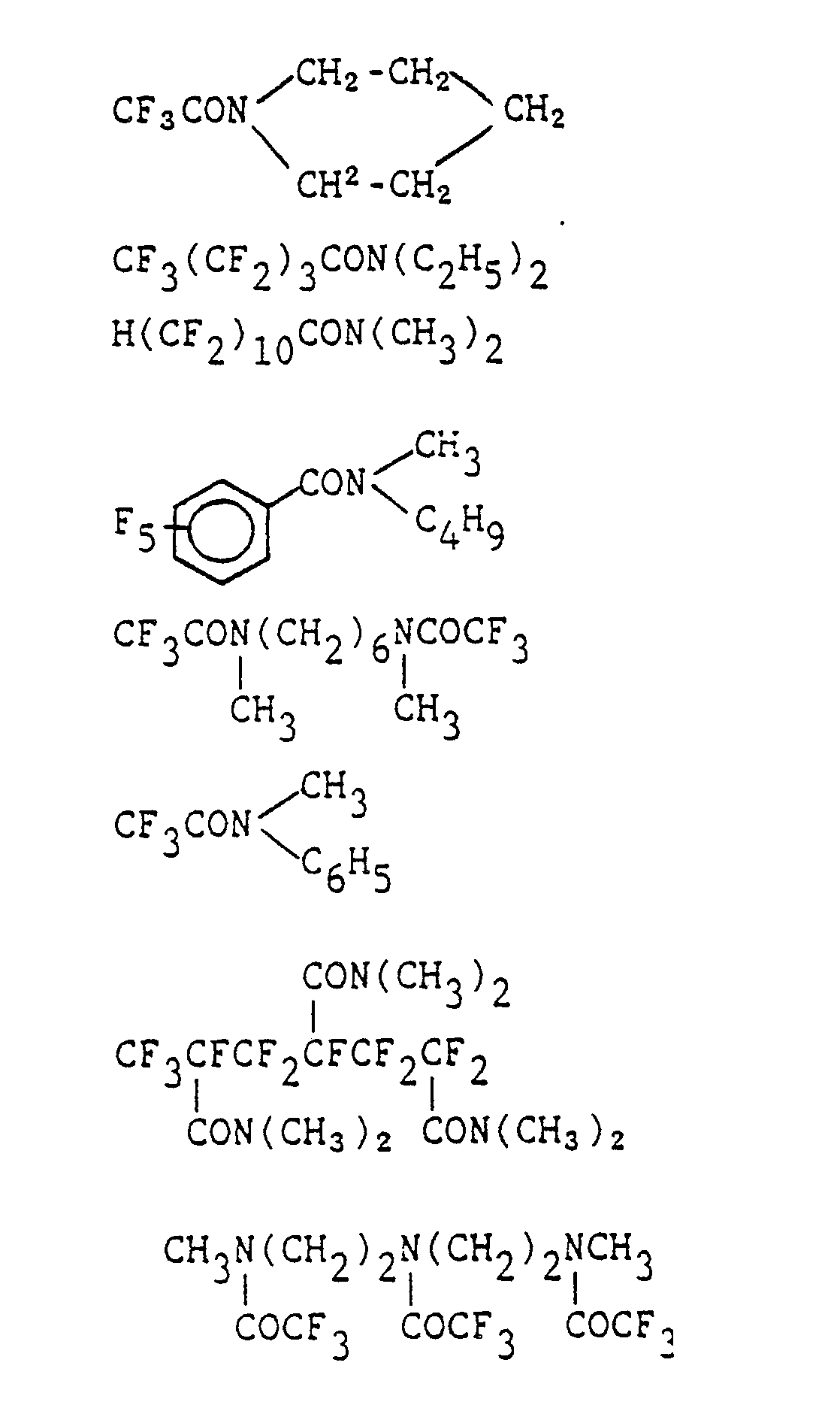
- Representative amides falling within the above formula are:

- Representative sulfonamides falling within the above formulas are:


- Other representative amides and sulfonamides include, for example, the N,N-di(C₁-C₄) alkyl trifluoroacetamides, the N-(C₁-C₈) alkyl trifluoroacetamides an the N,N-di(C₁-C₄) alkyl trifluorosulfonamides.
- Depending on their particular structure, the dielectric media of this invention may be either liquids or solids. For impregnation purposes, the solids can be applied as melts.
- The dielectric compositions of this invention may contain small amounts of additives, such as acid scavengers, corrosion inhibitors, biocides, flame retardants and antioxidants. These novel dielectric media can be used as the sole impregnant or in combination with other conventional dielectric media (e.g., dioctyl phthalate). Surfactants which lower the surface tension of the dielectric medium can also be added. Conversely, other ingredients may be added to these dielectric media which during impregnation selectively migrate into the plastic film and increase the wettability (critical surface tension) of the film and, thereby, make impregnation of the capacitor winding more facile.
- These dielectric compositions are used to impregnate a wide variety of polymer films (e.g., polyethylene, polypropylene, polyesters, polycarbonate, polysulfones, polyamides, vinyl polymers, etc.), but they are especially useful in capacitors incorporating fluorinated polymer films (e.g., polyvinylidene fluoride, polyvinyl fluoride, polytetrafluoroethylene and their copolymers). Fluorinated polymers have a low critical surface tension and therefore will resist wetting by most fluids. Optimum wetting (i.e., free spread or zero contact angle of the liquid) on a surface is only obtained when the surface tension of the liquid is less than the critical surface tension of the solid. The compositions described here offer the important property of low surface tension along with other desirable properties, such as high dielectric constant, good thermal stability and low viscosity.
- Capacitors employing the present invention may have the general structure as shown in Figure 1 which is a convolutely wound capacitor comprising
separate electrode foils dielectric spacers 6 and 8.Electrode posts 10 and 12 attached, respectively, tofoils Dielectric spacers 6 and 8 comprise polymeric, paper and/or composite polymeric films such as previously described. The dielectric spacers and electrode foil windings taken together comprise a capacitor element. This element is encased in a hermetically sealedcontainer 20 shown in Figure 2 which includes a small dielectricfluid fill hole 14 andelectrical contact posts posts 10 and 12, respectively. The capacitor element is dried under vacuum at a temperature above room temperature and moisture and gases escape through the fluid fill hole. The impregnating dielectric medium, in fluid form, is admitted throughhole 14 preferable while the dried assembly is still under vacuum. The capacitor element in the container must be submerged by the impregnating fluid. The pressure of the enclosure is raised to atmospheric pressure and the assembly is permitted to stand or soak for a number of hours for thorough penetration of the liquid impregnant. Repeated vacuum and soaking cycles may be necessary to insure complete removal of all gases and complete impregnation. - After impregnation, the fluid fill
hole 14 may be sealed with solder or some other suitable sealant. Thecapacitor assembly 20 after sealing may be subjected to an elevated temperature to increase the pressure inside the capacitor which will aid impregnation. During heating and cooling cycles, expansion and contraction of the electrode and dielectric windings may induce small movements which aid in introducing the fluid into the spaces between the various winding materials. - The following examples are set forth to demonstrate the present invention.
- A 3-necked flask, equipped with magnetic stirrer, reflux condenser and gas inlet tube, was charged with 121 g (0.5 mole) of ethyl perfluorobutyrate. The contents of the flask were heated to 60°C and a slow stream of dimethylamine was passed in. The reaction is exothermic and the gas flow rate was adjusted to keep the temperature in the range of 60-70°C without external heat. Gas flow was continued until the weight increase of the flask showed absorption of 22.5 g (0.5 mole) of the amine.
- A helices packed distilling column was then attached to the flask and the contents were heated to drive off excess amine and distill out the ethanol by-product. Finally, the pressure was reduced and the product amide was distilled over at 89° at a pressure of 72 mmHg. Yield 92.9%.
- Dielectric constant and loss at 100 kHz were, respectively, 24.7 and 0.35
- Surface tension was found to be 22.2 dynes/cm (23.5°C).
- Under a blanket of nitrogen, a mixture of 55 g (0.180 moles) of perfluorobutane sulfonyl fluoride and 70.7 g (0.970 moles) of diethylamine was heated at reflux for nine hours. The reaction mixture was dissolved in 600 ml of ether and percolated through a column of 60 g of acidic alumina. The ether was stripped and the product was distilled at 56-58°C at 2.0 mm. Yield 41.6 g (65%).
- Dielectric constant and loss at 100 kHz were, respectively, 18.5 and 0.03.
- Surface tension was found to be 21.5 dynes/cm (23.5°C).
- Under a blanket of nitrogen, 2020.9 g (14.22 moles) of ethyl trifluoroacetate was charged to a 12-liter flask equipped with an overhead stirrer, an addition funnel, thermometer, and a condenser. To the stirred ethyl trifluoroacetate, 2015.0 g (15.59 moles) of dibutyl amine was added over a two hour period, during which the temperature of the stirred reaction mixture rose from 20 to 40°C. At the end of the addition period, the reaction flask was equipped with an 8 inch packed column and distillation head. The ethanol by-product was then removed by distillation with a maximum pot temperature of 135°C. The reaction mixture was then cooled and the product was isolated by distillation, boiling range 79-87°C at 2.2-3.2mmHg. Yield 2850 g (89.0%).
- Dielectric constant and loss at 100kHz were, respectively, 21.4 and 0.3.
- Surface tension was found to be 23.5 dynes/cm (23.5°C).
- Under a blanket of dry nitrogen, a mixture of 143.4 g (1.96 mole) of diethyl amine and 350 ml of chloroform in a one liter flask was cooled to 10°C in an ice bath. To this stirred mixture 250.0 g (0.886 mole) of trifluoromethane sulfonic anhydride were added dropwise over a four hour period. During the addition the temperature was kept below 20°C. After the addition was complete the reaction mixture was heated at reflux for 30 minutes and then cooled to room temperature. The reaction mixture was then washed with two 500 ml portions of 10% hydrochloric acid and two 500 ml portions of distilled water. The organic phase was then dried over magnesium sulfate and the chloroform was removed under vacuum. The light yellow liquid was then percolated through a column of 50 g freshly kilned (400°C) Porocel (Engelhart). Yield 103 g (66%).
- Dielectric constant and loss at 100 kHz were, respectively, 33.1 and 0.03.
- Surface tension was found to be 21.9 dynes/cm (23.5°C).
- Ethyl trifluoroacetate (143g, 1.0m) was placed in a 500ml 3-neck flask equipped with stirrer, gas inlet tube, thermometer, and a reflux distilling head. With rapid stirring a stream of monoethylamine was fed quickly into the liquid. Within 1 1/2 hours, 80g amine (1.8m) were added resulting in an exotherm which brought the pot temperature to 62°C. The reaction mixture was allowed to sit at ambient temperature overnight and then distilled. A total of 123g product distilled at 86°C/50mm Hg.
- The product had a dielectric constant of 99.6 and a loss of 0.46 at 100kHz. Its surface tension at room temperature was 23.1 dynes/cm. A solution in H₂O/isopropanol (95/5) was essentially neutral (pH 8.2).
- Ethyl trifluoroacetate (298g, 2.1m) was reacted in a manner similar to Example 5 with n-butylamine (169g, 2.3m), except that the amine was added as a liquid within 1 hour. After the exotherm (peak 56°C) had subsided, the reaction mixture was heated under reflux for 3 1/2 hours (pot temperature 96 to 98°C). The mixture was then distilled to yield 193g of a liquid which boiled at 83°C/7mm Hg.
- The dielectric constant and loss of the product at 100kHz were, respectively, 70.4 and 0.30. Its surface tension at ambient temperature was 23.6 dynes/cm.
- In a procedure similar to Example 6, ethyl trifluoroacetate (295g, 2.07m) was reacted with sec-butylamine. The resulting amide distilled at 72.5°C/8mm Hg and amounted to 285g.
- The dielectric constant and loss of the product at 100kHz were, respectively, 59.7 and 0.12. Its surface tension at ambient temperature was 23.0 dynes/cm.
- In a manner similar to Example 6, ethyl trifluoroacetate (131g, 0.92m) was reacted with n-hexylamine. The resulting amide distilled at 64°C/0.2mm Hg and amounted to 154g.
- The dielectric constant and loss of the product at 100kHz were, respectively, 53.8 and 0.16. Its surface tension at ambient temperature was 24.3 dynes/cm.
- In a procedure similar to Example 6, ethyl trifluoroacetate (100g, 0.7m) was reacted with t-octylamine (94g, 0.72m). The resulting amide was distilled at 68-81°C/1-3mm Hg, and 65g of product were recovered. The product melted at 55-58°C.
- In a manner similiar to Example 6, ethyl trifluoroacetate (102g, 0.72m) was reacted with cyclohexylamine (70g, 0.7m). By-products/unreacted material were removed by heating the reaction mixture under increasing vacuum (final pressure 3mm Hg) to 118°C. The pot residue was then recrystallized from hot ethyl acetate (∼60g) plus hexanes (∼100g) to yield 58g solid which melted at 93-95°C.
- A solution of the product in H₂O/isopropanol (95/5) was essentially neutral (pH 7.55). A 1% solution in ethyl acetate had a surface tension of 22.6 at ambient temperature.
- This example represents the case of N,N-disubstituted fluorinated amides where R² and R³ are linked together to form a ring.
- In a procedure similar to Example 6, ethyl trifluoroacetate (174g, 1.2m) was reacted with piperidine (102g, 1.2m). The resulting amide distilled at 70°C/6mm Hg. to yield 192g.
- Dielectric constant and loss of the product at 100kHz were, respectively, 25.0 and 0.22. The surface tension was 22.9 dynes/cm.
- The dielectric constant and surface tension of the above prepared media may be compared with dielectric fluids which are commonly used throughout the capacitor manufacturing industry as shown in the following table.
Table 1 Dielectric Constant (100kHz) Surface Tension (dynes/cm) Monoisopropyl biphenyl 2.8 34 Tricresyl phosphate 7.4 44 Dioctyl phthalate 4.5 31 - It is evident that the dielectric media of this invention have substantially higher dielectric constants and lower surface tensions than the dielectric fluids of Table 1.
Claims (32)
a) R¹(CONR²R³)m,
b) (R¹CON)mR


c) R¹(SO₂NR²R³)m, or
d) (R¹SO₂N)mR


wherein R¹ is a saturated or unsaturated alkyl or unsubstituted mono- or polyfunctional hydrocarbon radical having 1 to 12 carbon atoms, a cycloalkyl radical having 3 to 12 carbon atoms, an aryl radical having 6 to 12 carbon atoms or an alkaryl radical having 1 to 6 carbon atoms in the alkyl moiety, said radicals substituted with at least two fluorine atoms, R² and R³ are the same or different and independently selected from saturated or unsaturated alkyl or unsubstituted mono- or polyfunctional hydrocarbon radicals having 1 to 12 carbon atoms, cycloalkyl radicals having 3 to 10 carbon atoms, aryl radicals having 6 to 10 carbon atoms or alkaryl radicals having 1 to 6 carbon atoms in the alkyl moiety, R² and R³ may together form the ring of a single cycloalkyl radical having 3 to 10 carbon atom, m, n and o are independently integers of from 1 to 5, and in compounds of formulae a) and b), at least one of R³ may be hydrogen.
R¹(CONR²R³)m
where at least one of R³ is hydrogen.
Applications Claiming Priority (2)
| Application Number | Priority Date | Filing Date | Title |
|---|---|---|---|
| US07/184,524 US4899249A (en) | 1988-04-21 | 1988-04-21 | Fluorine-containing dielectric media and capacitors employing such media |
| US184524 | 1988-04-21 |
Publications (2)
| Publication Number | Publication Date |
|---|---|
| EP0339284A1 true EP0339284A1 (en) | 1989-11-02 |
| EP0339284B1 EP0339284B1 (en) | 1994-06-29 |
Family
ID=22677258
Family Applications (1)
| Application Number | Title | Priority Date | Filing Date |
|---|---|---|---|
| EP89105617A Expired - Lifetime EP0339284B1 (en) | 1988-04-21 | 1989-03-30 | Fluorine-containing dielectric media and capacitors employing such media |
Country Status (4)
| Country | Link |
|---|---|
| US (1) | US4899249A (en) |
| EP (1) | EP0339284B1 (en) |
| JP (1) | JPH02148511A (en) |
| DE (1) | DE68916473T2 (en) |
Cited By (3)
| Publication number | Priority date | Publication date | Assignee | Title |
|---|---|---|---|---|
| EP0545430A1 (en) * | 1991-12-05 | 1993-06-09 | Minnesota Mining And Manufacturing Company | Dielectric liquids |
| EP0902492A1 (en) * | 1997-09-11 | 1999-03-17 | Hydro-Quebec | Solvents and new electrolytic compositions having a large stability range and high conductivity |
| US6489064B2 (en) | 1998-12-19 | 2002-12-03 | Solvay Fluor Und Derivate Gmbh | Electrolyte system for lithium batteries, the use thereof, and method for enhancing the safety of lithium batteries |
Families Citing this family (9)
| Publication number | Priority date | Publication date | Assignee | Title |
|---|---|---|---|---|
| US5228156A (en) * | 1992-05-08 | 1993-07-20 | John Wang | Fluid operated device |
| US5705689A (en) * | 1995-06-19 | 1998-01-06 | Associated Universities, Inc. | Aza compounds as anion receptors |
| US6265243B1 (en) | 1999-03-29 | 2001-07-24 | Lucent Technologies Inc. | Process for fabricating organic circuits |
| CN108831587A (en) | 2012-04-04 | 2018-11-16 | 3M创新有限公司 | Fluorination nitrile as dielectric gaseous |
| KR101424188B1 (en) * | 2012-04-25 | 2014-07-28 | 이원실 | anion receptors, electrolyte containing anion receptors, lithium ion battery and lithium ion capacitor using the same |
| WO2016064585A1 (en) | 2014-10-24 | 2016-04-28 | 3M Innovative Properties Company | Segregated fluorinated esters |
| JP7292280B2 (en) | 2017-12-13 | 2023-06-16 | スリーエム イノベイティブ プロパティズ カンパニー | Perfluorinated 1-Alkoxypropenes, Compositions, and Methods and Apparatus for Using Them |
| TWI797212B (en) | 2017-12-13 | 2023-04-01 | 美商3M新設資產公司 | Perfluorinated 1-alkoxypropenes in dielectric fluids and electrical devices |
| CN111448186A (en) | 2017-12-13 | 2020-07-24 | 3M创新有限公司 | Hydrofluoroolefin ethers, compositions, apparatus and methods for using them |
Citations (3)
| Publication number | Priority date | Publication date | Assignee | Title |
|---|---|---|---|---|
| US2615000A (en) * | 1949-07-02 | 1952-10-21 | Du Pont | Sulfonamides formed by amidation of chlorosulfonated polyethylene |
| GB1309831A (en) * | 1969-01-22 | 1973-03-14 | Ugine Kuhlmann | Polyfluoro sulphonamides |
| US3829466A (en) * | 1971-10-26 | 1974-08-13 | Bayer Ag | Perfluoroalkanesulphonamides |
Family Cites Families (4)
| Publication number | Priority date | Publication date | Assignee | Title |
|---|---|---|---|---|
| US2236168A (en) * | 1940-02-27 | 1941-03-25 | Du Pont | Lubricant |
| US3536749A (en) * | 1966-06-08 | 1970-10-27 | Minnesota Mining & Mfg | Fluorocarbon-acrylate products |
| US3684932A (en) * | 1971-11-04 | 1972-08-15 | Sprague Electric Co | Electrical capacitors with amide impregnants |
| US4098711A (en) * | 1976-03-29 | 1978-07-04 | Continental Oil Company | Sensor wire thermoplastic compounds |
-
1988
- 1988-04-21 US US07/184,524 patent/US4899249A/en not_active Expired - Fee Related
-
1989
- 1989-03-30 EP EP89105617A patent/EP0339284B1/en not_active Expired - Lifetime
- 1989-03-30 DE DE68916473T patent/DE68916473T2/en not_active Expired - Fee Related
- 1989-04-17 JP JP1095456A patent/JPH02148511A/en active Pending
Patent Citations (3)
| Publication number | Priority date | Publication date | Assignee | Title |
|---|---|---|---|---|
| US2615000A (en) * | 1949-07-02 | 1952-10-21 | Du Pont | Sulfonamides formed by amidation of chlorosulfonated polyethylene |
| GB1309831A (en) * | 1969-01-22 | 1973-03-14 | Ugine Kuhlmann | Polyfluoro sulphonamides |
| US3829466A (en) * | 1971-10-26 | 1974-08-13 | Bayer Ag | Perfluoroalkanesulphonamides |
Non-Patent Citations (1)
| Title |
|---|
| THE JOURNAL OF PHYSICAL CHEMISTRY, American Chemical Society, vol. 88, no. 14, July 5, 1984 TRUE N.S. et al. "Conforma- tions and Vibrational Dynamicsof Six Monoalkyltrifluoro- acetamides. Low-Resolution Microwave and Gas Phase NMR Spectroscopic Studies." pages 3216-3220 * |
Cited By (7)
| Publication number | Priority date | Publication date | Assignee | Title |
|---|---|---|---|---|
| EP0545430A1 (en) * | 1991-12-05 | 1993-06-09 | Minnesota Mining And Manufacturing Company | Dielectric liquids |
| EP0902492A1 (en) * | 1997-09-11 | 1999-03-17 | Hydro-Quebec | Solvents and new electrolytic compositions having a large stability range and high conductivity |
| US6296973B1 (en) | 1997-09-11 | 2001-10-02 | Hydro - Quebec | Solvents and novel electrolytic compositions having a large range of stability and high conductivity |
| EP1863109A2 (en) | 1997-09-11 | 2007-12-05 | Acep Inc. | Solvents and new electrolytic compositions possessing a wide stability domain and high conductivity |
| EP1863109A3 (en) * | 1997-09-11 | 2009-07-29 | Acep Inc. | Solvents and new electrolytic compositions possessing a wide stability domain and high conductivity |
| US8737039B2 (en) | 1997-09-11 | 2014-05-27 | Acep Inc. | Solvents and novel electrolytic compositions having a large range of stability and high conductivity |
| US6489064B2 (en) | 1998-12-19 | 2002-12-03 | Solvay Fluor Und Derivate Gmbh | Electrolyte system for lithium batteries, the use thereof, and method for enhancing the safety of lithium batteries |
Also Published As
| Publication number | Publication date |
|---|---|
| DE68916473D1 (en) | 1994-08-04 |
| US4899249A (en) | 1990-02-06 |
| EP0339284B1 (en) | 1994-06-29 |
| JPH02148511A (en) | 1990-06-07 |
| DE68916473T2 (en) | 1994-12-01 |
Similar Documents
| Publication | Publication Date | Title |
|---|---|---|
| EP0339284B1 (en) | Fluorine-containing dielectric media and capacitors employing such media | |
| GB2061316A (en) | Dielectric liquid compositions for electrical capacitors | |
| US4515931A (en) | Polyfunctional acrylate monomers and polymers thereof useful as capacitor dielectrics | |
| US4513349A (en) | Acrylate-containing mixed ester monomers and polymers thereof useful as capacitor dielectrics | |
| US4117531A (en) | Electrolytic capacitor | |
| WO1987005149A1 (en) | Electrolytic solution for driving electrolytic capacitor and electrolytic capacitor prepared by using it | |
| US4142983A (en) | Phthalate mixtures useful as liquid dielectrics | |
| US3855508A (en) | Electrical capacitors having substituted ester impregnants | |
| SE7907274L (en) | CAPACITORS | |
| JP7071834B2 (en) | Capacitor and its manufacturing method, and conductive polymer dispersion | |
| US3112356A (en) | Benzoic acid ester dielectric compositions and electrical apparatus in combination therewith | |
| US3754173A (en) | Stabilized ester impregnated capacitor | |
| CA1136842A (en) | Impregnating agent and its use | |
| JPS6118853B2 (en) | ||
| US20050085655A1 (en) | Method for producing perfluoroalkane sulfonic acid esters and the salts thereof | |
| US4115834A (en) | Dielectric composition and device containing same | |
| US4242722A (en) | Capacitor containing anthranilate electrolyte | |
| US3200077A (en) | Fluoroalkyl benzoate dielectric compositions | |
| JPH0142630B2 (en) | ||
| US3108131A (en) | Polyfluoroalkyl esters of certain ortho-substituted benzoic acids | |
| US4828738A (en) | Solid electrolytic capacitor | |
| US3123620A (en) | Fluoroalkoxy phthaledes | |
| JP3970502B2 (en) | Electrolytic solution for electrolytic capacitor driving and electrolytic capacitor using the same | |
| EP0144149B1 (en) | Dielectric fluid | |
| FI63129C (en) | ELEKTRISK APPARAT MED FOERBAETTRAD DIELEKTRISKT SYSTEM |
Legal Events
| Date | Code | Title | Description |
|---|---|---|---|
| PUAI | Public reference made under article 153(3) epc to a published international application that has entered the european phase |
Free format text: ORIGINAL CODE: 0009012 |
|
| AK | Designated contracting states |
Kind code of ref document: A1 Designated state(s): DE FR GB IT |
|
| 17P | Request for examination filed |
Effective date: 19900424 |
|
| RAP1 | Party data changed (applicant data changed or rights of an application transferred) |
Owner name: ATOCHEM NORTH AMERICA, INC. (A PENNSYLVANIA CORP.) |
|
| 17Q | First examination report despatched |
Effective date: 19920923 |
|
| GRAA | (expected) grant |
Free format text: ORIGINAL CODE: 0009210 |
|
| AK | Designated contracting states |
Kind code of ref document: B1 Designated state(s): DE FR GB IT |
|
| ITF | It: translation for a ep patent filed | ||
| REF | Corresponds to: |
Ref document number: 68916473 Country of ref document: DE Date of ref document: 19940804 |
|
| ET | Fr: translation filed | ||
| PLBE | No opposition filed within time limit |
Free format text: ORIGINAL CODE: 0009261 |
|
| STAA | Information on the status of an ep patent application or granted ep patent |
Free format text: STATUS: NO OPPOSITION FILED WITHIN TIME LIMIT |
|
| 26N | No opposition filed | ||
| PGFP | Annual fee paid to national office [announced via postgrant information from national office to epo] |
Ref country code: FR Payment date: 19990208 Year of fee payment: 11 |
|
| PGFP | Annual fee paid to national office [announced via postgrant information from national office to epo] |
Ref country code: GB Payment date: 19990216 Year of fee payment: 11 |
|
| PGFP | Annual fee paid to national office [announced via postgrant information from national office to epo] |
Ref country code: DE Payment date: 19990226 Year of fee payment: 11 |
|
| PG25 | Lapsed in a contracting state [announced via postgrant information from national office to epo] |
Ref country code: GB Free format text: LAPSE BECAUSE OF NON-PAYMENT OF DUE FEES Effective date: 20000330 |
|
| GBPC | Gb: european patent ceased through non-payment of renewal fee |
Effective date: 20000330 |
|
| PG25 | Lapsed in a contracting state [announced via postgrant information from national office to epo] |
Ref country code: FR Free format text: LAPSE BECAUSE OF NON-PAYMENT OF DUE FEES Effective date: 20001130 |
|
| REG | Reference to a national code |
Ref country code: FR Ref legal event code: ST |
|
| PG25 | Lapsed in a contracting state [announced via postgrant information from national office to epo] |
Ref country code: DE Free format text: LAPSE BECAUSE OF NON-PAYMENT OF DUE FEES Effective date: 20010103 |
|
| PG25 | Lapsed in a contracting state [announced via postgrant information from national office to epo] |
Ref country code: IT Free format text: LAPSE BECAUSE OF NON-PAYMENT OF DUE FEES;WARNING: LAPSES OF ITALIAN PATENTS WITH EFFECTIVE DATE BEFORE 2007 MAY HAVE OCCURRED AT ANY TIME BEFORE 2007. THE CORRECT EFFECTIVE DATE MAY BE DIFFERENT FROM THE ONE RECORDED. Effective date: 20050330 |