EP0341311A1 - Hexapeptide und darauf basierende pharmazeutische zubereitungen zur behandlung erosiver oder geschwüriger läsionen des gastrointestinaltraktes - Google Patents
Hexapeptide und darauf basierende pharmazeutische zubereitungen zur behandlung erosiver oder geschwüriger läsionen des gastrointestinaltraktes Download PDFInfo
- Publication number
- EP0341311A1 EP0341311A1 EP88906225A EP88906225A EP0341311A1 EP 0341311 A1 EP0341311 A1 EP 0341311A1 EP 88906225 A EP88906225 A EP 88906225A EP 88906225 A EP88906225 A EP 88906225A EP 0341311 A1 EP0341311 A1 EP 0341311A1
- Authority
- EP
- European Patent Office
- Prior art keywords
- hexapeptide
- acetic acid
- methanol
- tert
- dissolved
- Prior art date
- Legal status (The legal status is an assumption and is not a legal conclusion. Google has not performed a legal analysis and makes no representation as to the accuracy of the status listed.)
- Withdrawn
Links
- 230000006378 damage Effects 0.000 title claims description 12
- 210000001035 gastrointestinal tract Anatomy 0.000 title claims description 7
- 239000000825 pharmaceutical preparation Substances 0.000 title abstract 2
- 208000025865 Ulcer Diseases 0.000 claims abstract description 19
- 239000003937 drug carrier Substances 0.000 claims abstract description 5
- 239000003814 drug Substances 0.000 claims description 18
- 239000004480 active ingredient Substances 0.000 claims description 10
- 239000002775 capsule Substances 0.000 claims description 6
- ZHUJMSMQIPIPTF-JMBSJVKXSA-N (2s)-2-[[(2s)-2-[[2-[[(2r)-2-[[(2s)-2-amino-3-(4-hydroxyphenyl)propanoyl]amino]propanoyl]amino]acetyl]amino]-3-phenylpropanoyl]amino]-4-methylpentanoic acid Chemical compound C([C@@H](C(=O)N[C@@H](CC(C)C)C(O)=O)NC(=O)CNC(=O)[C@@H](C)NC(=O)[C@@H](N)CC=1C=CC(O)=CC=1)C1=CC=CC=C1 ZHUJMSMQIPIPTF-JMBSJVKXSA-N 0.000 claims description 3
- 239000004006 olive oil Substances 0.000 claims description 2
- 235000008390 olive oil Nutrition 0.000 claims description 2
- 230000003628 erosive effect Effects 0.000 abstract description 3
- 206010052428 Wound Diseases 0.000 abstract 1
- 208000027418 Wounds and injury Diseases 0.000 abstract 1
- 239000013543 active substance Substances 0.000 abstract 1
- 230000035876 healing Effects 0.000 abstract 1
- OKKJLVBELUTLKV-UHFFFAOYSA-N Methanol Chemical compound OC OKKJLVBELUTLKV-UHFFFAOYSA-N 0.000 description 63
- QTBSBXVTEAMEQO-UHFFFAOYSA-N Acetic acid Chemical compound CC(O)=O QTBSBXVTEAMEQO-UHFFFAOYSA-N 0.000 description 60
- ZMXDDKWLCZADIW-UHFFFAOYSA-N N,N-Dimethylformamide Chemical compound CN(C)C=O ZMXDDKWLCZADIW-UHFFFAOYSA-N 0.000 description 42
- XEKOWRVHYACXOJ-UHFFFAOYSA-N Ethyl acetate Chemical compound CCOC(C)=O XEKOWRVHYACXOJ-UHFFFAOYSA-N 0.000 description 35
- RTZKZFJDLAIYFH-UHFFFAOYSA-N Diethyl ether Chemical compound CCOCC RTZKZFJDLAIYFH-UHFFFAOYSA-N 0.000 description 24
- 239000000243 solution Substances 0.000 description 18
- 230000000694 effects Effects 0.000 description 16
- 230000000767 anti-ulcer Effects 0.000 description 15
- XLYOFNOQVPJJNP-UHFFFAOYSA-N water Chemical compound O XLYOFNOQVPJJNP-UHFFFAOYSA-N 0.000 description 15
- HEDRZPFGACZZDS-UHFFFAOYSA-N Chloroform Chemical compound ClC(Cl)Cl HEDRZPFGACZZDS-UHFFFAOYSA-N 0.000 description 14
- KFZMGEQAYNKOFK-UHFFFAOYSA-N Isopropanol Chemical compound CC(C)O KFZMGEQAYNKOFK-UHFFFAOYSA-N 0.000 description 12
- VLKZOEOYAKHREP-UHFFFAOYSA-N n-Hexane Chemical compound CCCCCC VLKZOEOYAKHREP-UHFFFAOYSA-N 0.000 description 11
- KDLHZDBZIXYQEI-UHFFFAOYSA-N Palladium Chemical compound [Pd] KDLHZDBZIXYQEI-UHFFFAOYSA-N 0.000 description 10
- 239000003054 catalyst Substances 0.000 description 10
- 231100000397 ulcer Toxicity 0.000 description 10
- YMWUJEATGCHHMB-UHFFFAOYSA-N Dichloromethane Chemical compound ClCCl YMWUJEATGCHHMB-UHFFFAOYSA-N 0.000 description 9
- UETNIIAIRMUTSM-UHFFFAOYSA-N Jacareubin Natural products CC1(C)OC2=CC3Oc4c(O)c(O)ccc4C(=O)C3C(=C2C=C1)O UETNIIAIRMUTSM-UHFFFAOYSA-N 0.000 description 9
- 208000007107 Stomach Ulcer Diseases 0.000 description 9
- YXFVVABEGXRONW-UHFFFAOYSA-N Toluene Chemical compound CC1=CC=CC=C1 YXFVVABEGXRONW-UHFFFAOYSA-N 0.000 description 9
- NCEXYHBECQHGNR-QZQOTICOSA-N sulfasalazine Chemical compound C1=C(O)C(C(=O)O)=CC(\N=N\C=2C=CC(=CC=2)S(=O)(=O)NC=2N=CC=CC=2)=C1 NCEXYHBECQHGNR-QZQOTICOSA-N 0.000 description 9
- 229960001940 sulfasalazine Drugs 0.000 description 9
- NCEXYHBECQHGNR-UHFFFAOYSA-N sulfasalazine Natural products C1=C(O)C(C(=O)O)=CC(N=NC=2C=CC(=CC=2)S(=O)(=O)NC=2N=CC=CC=2)=C1 NCEXYHBECQHGNR-UHFFFAOYSA-N 0.000 description 9
- 241001465754 Metazoa Species 0.000 description 8
- 239000004220 glutamic acid Substances 0.000 description 8
- CGIGDMFJXJATDK-UHFFFAOYSA-N indomethacin Chemical compound CC1=C(CC(O)=O)C2=CC(OC)=CC=C2N1C(=O)C1=CC=C(Cl)C=C1 CGIGDMFJXJATDK-UHFFFAOYSA-N 0.000 description 8
- 241000700159 Rattus Species 0.000 description 7
- 239000000706 filtrate Substances 0.000 description 7
- 239000000203 mixture Substances 0.000 description 7
- LCZVKKUAUWQDPX-UHFFFAOYSA-N tert-butyl 2-[(2-acetyloxyphenyl)methyl-[2-[(2-acetyloxyphenyl)methyl-[2-[(2-methylpropan-2-yl)oxy]-2-oxoethyl]amino]ethyl]amino]acetate Chemical compound CC(=O)OC1=CC=CC=C1CN(CC(=O)OC(C)(C)C)CCN(CC(=O)OC(C)(C)C)CC1=CC=CC=C1OC(C)=O LCZVKKUAUWQDPX-UHFFFAOYSA-N 0.000 description 7
- MWAGUKZCDDRDCS-UHFFFAOYSA-N 1-nitro-4-(4-nitrophenoxy)benzene Chemical compound C1=CC([N+](=O)[O-])=CC=C1OC1=CC=C([N+]([O-])=O)C=C1 MWAGUKZCDDRDCS-UHFFFAOYSA-N 0.000 description 6
- WHUUTDBJXJRKMK-UHFFFAOYSA-N Glutamic acid Natural products OC(=O)C(N)CCC(O)=O WHUUTDBJXJRKMK-UHFFFAOYSA-N 0.000 description 6
- DHMQDGOQFOQNFH-UHFFFAOYSA-N Glycine Chemical compound NCC(O)=O DHMQDGOQFOQNFH-UHFFFAOYSA-N 0.000 description 6
- HEMHJVSKTPXQMS-UHFFFAOYSA-M Sodium hydroxide Chemical compound [OH-].[Na+] HEMHJVSKTPXQMS-UHFFFAOYSA-M 0.000 description 6
- QAOWNCQODCNURD-UHFFFAOYSA-N Sulfuric acid Chemical compound OS(O)(=O)=O QAOWNCQODCNURD-UHFFFAOYSA-N 0.000 description 6
- 235000013336 milk Nutrition 0.000 description 6
- 239000008267 milk Substances 0.000 description 6
- 210000004080 milk Anatomy 0.000 description 6
- 238000002360 preparation method Methods 0.000 description 6
- 239000011541 reaction mixture Substances 0.000 description 6
- 210000001198 duodenum Anatomy 0.000 description 5
- 229910052763 palladium Inorganic materials 0.000 description 5
- 210000000813 small intestine Anatomy 0.000 description 5
- JUJWROOIHBZHMG-UHFFFAOYSA-N Pyridine Chemical compound C1=CC=NC=C1 JUJWROOIHBZHMG-UHFFFAOYSA-N 0.000 description 4
- 150000001413 amino acids Chemical class 0.000 description 4
- 239000013078 crystal Substances 0.000 description 4
- 229940079593 drug Drugs 0.000 description 4
- 238000002474 experimental method Methods 0.000 description 4
- 201000005917 gastric ulcer Diseases 0.000 description 4
- 230000008018 melting Effects 0.000 description 4
- 238000002844 melting Methods 0.000 description 4
- CSCPPACGZOOCGX-UHFFFAOYSA-N Acetone Chemical compound CC(C)=O CSCPPACGZOOCGX-UHFFFAOYSA-N 0.000 description 3
- UHOVQNZJYSORNB-UHFFFAOYSA-N Benzene Chemical compound C1=CC=CC=C1 UHOVQNZJYSORNB-UHFFFAOYSA-N 0.000 description 3
- 239000004471 Glycine Substances 0.000 description 3
- 206010061217 Infestation Diseases 0.000 description 3
- OUYCCCASQSFEME-QMMMGPOBSA-N L-tyrosine Chemical compound OC(=O)[C@@H](N)CC1=CC=C(O)C=C1 OUYCCCASQSFEME-QMMMGPOBSA-N 0.000 description 3
- IMNFDUFMRHMDMM-UHFFFAOYSA-N N-Heptane Chemical compound CCCCCCC IMNFDUFMRHMDMM-UHFFFAOYSA-N 0.000 description 3
- 235000001014 amino acid Nutrition 0.000 description 3
- 230000015572 biosynthetic process Effects 0.000 description 3
- 208000000718 duodenal ulcer Diseases 0.000 description 3
- 150000002148 esters Chemical class 0.000 description 3
- 239000012634 fragment Substances 0.000 description 3
- 230000002496 gastric effect Effects 0.000 description 3
- 229960000905 indomethacin Drugs 0.000 description 3
- 239000000843 powder Substances 0.000 description 3
- PVFCXMDXBIEMQG-JTQLQIEISA-N (2s)-2-(phenylmethoxycarbonylamino)pentanedioic acid Chemical compound OC(=O)CC[C@@H](C(O)=O)NC(=O)OCC1=CC=CC=C1 PVFCXMDXBIEMQG-JTQLQIEISA-N 0.000 description 2
- OGMADIBCHLQMIP-UHFFFAOYSA-N 2-aminoethanethiol;hydron;chloride Chemical compound Cl.NCCS OGMADIBCHLQMIP-UHFFFAOYSA-N 0.000 description 2
- 206010009900 Colitis ulcerative Diseases 0.000 description 2
- ZAFNJMIOTHYJRJ-UHFFFAOYSA-N Diisopropyl ether Chemical compound CC(C)OC(C)C ZAFNJMIOTHYJRJ-UHFFFAOYSA-N 0.000 description 2
- NTYJJOPFIAHURM-UHFFFAOYSA-N Histamine Chemical compound NCCC1=CN=CN1 NTYJJOPFIAHURM-UHFFFAOYSA-N 0.000 description 2
- VEXZGXHMUGYJMC-UHFFFAOYSA-N Hydrochloric acid Chemical compound Cl VEXZGXHMUGYJMC-UHFFFAOYSA-N 0.000 description 2
- 206010020751 Hypersensitivity Diseases 0.000 description 2
- QNAYBMKLOCPYGJ-REOHCLBHSA-N L-alanine Chemical compound C[C@H](N)C(O)=O QNAYBMKLOCPYGJ-REOHCLBHSA-N 0.000 description 2
- ROHFNLRQFUQHCH-YFKPBYRVSA-N L-leucine Chemical compound CC(C)C[C@H](N)C(O)=O ROHFNLRQFUQHCH-YFKPBYRVSA-N 0.000 description 2
- COLNVLDHVKWLRT-QMMMGPOBSA-N L-phenylalanine Chemical compound OC(=O)[C@@H](N)CC1=CC=CC=C1 COLNVLDHVKWLRT-QMMMGPOBSA-N 0.000 description 2
- ROHFNLRQFUQHCH-UHFFFAOYSA-N Leucine Natural products CC(C)CC(N)C(O)=O ROHFNLRQFUQHCH-UHFFFAOYSA-N 0.000 description 2
- LRHPLDYGYMQRHN-UHFFFAOYSA-N N-Butanol Chemical compound CCCCO LRHPLDYGYMQRHN-UHFFFAOYSA-N 0.000 description 2
- DTQVDTLACAAQTR-UHFFFAOYSA-N Trifluoroacetic acid Chemical compound OC(=O)C(F)(F)F DTQVDTLACAAQTR-UHFFFAOYSA-N 0.000 description 2
- 201000006704 Ulcerative Colitis Diseases 0.000 description 2
- 239000000443 aerosol Substances 0.000 description 2
- 235000004279 alanine Nutrition 0.000 description 2
- 238000004458 analytical method Methods 0.000 description 2
- 125000001584 benzyloxycarbonyl group Chemical group C(=O)(OCC1=CC=CC=C1)* 0.000 description 2
- -1 carbobenzoxy-phenylalanyl-leucylglutamic acid Chemical compound 0.000 description 2
- 229940097265 cysteamine hydrochloride Drugs 0.000 description 2
- 238000001514 detection method Methods 0.000 description 2
- 238000011161 development Methods 0.000 description 2
- 239000003925 fat Substances 0.000 description 2
- 235000019197 fats Nutrition 0.000 description 2
- 235000013922 glutamic acid Nutrition 0.000 description 2
- 208000015181 infectious disease Diseases 0.000 description 2
- 150000002632 lipids Chemical class 0.000 description 2
- 238000004811 liquid chromatography Methods 0.000 description 2
- 210000004185 liver Anatomy 0.000 description 2
- 238000000034 method Methods 0.000 description 2
- 239000012071 phase Substances 0.000 description 2
- COLNVLDHVKWLRT-UHFFFAOYSA-N phenylalanine Natural products OC(=O)C(N)CC1=CC=CC=C1 COLNVLDHVKWLRT-UHFFFAOYSA-N 0.000 description 2
- 239000002244 precipitate Substances 0.000 description 2
- 108090000765 processed proteins & peptides Proteins 0.000 description 2
- UMJSCPRVCHMLSP-UHFFFAOYSA-N pyridine Natural products COC1=CC=CN=C1 UMJSCPRVCHMLSP-UHFFFAOYSA-N 0.000 description 2
- 238000007086 side reaction Methods 0.000 description 2
- 235000011121 sodium hydroxide Nutrition 0.000 description 2
- 239000002904 solvent Substances 0.000 description 2
- 239000000126 substance Substances 0.000 description 2
- 235000019871 vegetable fat Nutrition 0.000 description 2
- TYRGLVWXHJRKMT-MRVPVSSYSA-N (2r)-2-(phenylmethoxycarbonylamino)propanoic acid Chemical compound OC(=O)[C@@H](C)NC(=O)OCC1=CC=CC=C1 TYRGLVWXHJRKMT-MRVPVSSYSA-N 0.000 description 1
- GDPHPXYFLPDZGH-XBTMSFKCSA-N (2s)-2-[[(2s)-2-[[(2s)-2-[[2-[[(2r)-2-[[(2s)-2-amino-3-(4-hydroxyphenyl)propanoyl]amino]propanoyl]amino]acetyl]amino]-3-phenylpropanoyl]amino]-4-methylpentanoyl]amino]-5-(diaminomethylideneamino)pentanoic acid Chemical compound C([C@@H](C(=O)N[C@@H](CC(C)C)C(=O)N[C@@H](CCCN=C(N)N)C(O)=O)NC(=O)CNC(=O)[C@@H](C)NC(=O)[C@@H](N)CC=1C=CC(O)=CC=1)C1=CC=CC=C1 GDPHPXYFLPDZGH-XBTMSFKCSA-N 0.000 description 1
- RRONHWAVOYADJL-HNNXBMFYSA-N (2s)-3-phenyl-2-(phenylmethoxycarbonylamino)propanoic acid Chemical compound C([C@@H](C(=O)O)NC(=O)OCC=1C=CC=CC=1)C1=CC=CC=C1 RRONHWAVOYADJL-HNNXBMFYSA-N 0.000 description 1
- NWUYHJFMYQTDRP-UHFFFAOYSA-N 1,2-bis(ethenyl)benzene;1-ethenyl-2-ethylbenzene;styrene Chemical compound C=CC1=CC=CC=C1.CCC1=CC=CC=C1C=C.C=CC1=CC=CC=C1C=C NWUYHJFMYQTDRP-UHFFFAOYSA-N 0.000 description 1
- ADFXKUOMJKEIND-UHFFFAOYSA-N 1,3-dicyclohexylurea Chemical compound C1CCCCC1NC(=O)NC1CCCCC1 ADFXKUOMJKEIND-UHFFFAOYSA-N 0.000 description 1
- RNBMQRYMCAVZPN-SECBINFHSA-N 2-[[(2r)-2-(phenylmethoxycarbonylamino)propanoyl]amino]acetic acid Chemical compound OC(=O)CNC(=O)[C@@H](C)NC(=O)OCC1=CC=CC=C1 RNBMQRYMCAVZPN-SECBINFHSA-N 0.000 description 1
- BPSNETAIJADFTO-UHFFFAOYSA-N 2-pyridinylacetic acid Chemical compound OC(=O)CC1=CC=CC=N1 BPSNETAIJADFTO-UHFFFAOYSA-N 0.000 description 1
- BTJIUGUIPKRLHP-UHFFFAOYSA-N 4-nitrophenol Chemical compound OC1=CC=C([N+]([O-])=O)C=C1 BTJIUGUIPKRLHP-UHFFFAOYSA-N 0.000 description 1
- 206010012735 Diarrhoea Diseases 0.000 description 1
- QOSSAOTZNIDXMA-UHFFFAOYSA-N Dicylcohexylcarbodiimide Chemical compound C1CCCCC1N=C=NC1CCCCC1 QOSSAOTZNIDXMA-UHFFFAOYSA-N 0.000 description 1
- LFQSCWFLJHTTHZ-UHFFFAOYSA-N Ethanol Chemical compound CCO LFQSCWFLJHTTHZ-UHFFFAOYSA-N 0.000 description 1
- 230000005526 G1 to G0 transition Effects 0.000 description 1
- 206010019233 Headaches Diseases 0.000 description 1
- 102000003710 Histamine H2 Receptors Human genes 0.000 description 1
- 108090000050 Histamine H2 Receptors Proteins 0.000 description 1
- 208000022559 Inflammatory bowel disease Diseases 0.000 description 1
- 208000000112 Myalgia Diseases 0.000 description 1
- 206010028813 Nausea Diseases 0.000 description 1
- 206010062237 Renal impairment Diseases 0.000 description 1
- 206010047700 Vomiting Diseases 0.000 description 1
- 238000010521 absorption reaction Methods 0.000 description 1
- CUXSAAMWQXNZQW-UHFFFAOYSA-N acetic acid;butan-1-ol Chemical compound CC(O)=O.CCCCO CUXSAAMWQXNZQW-UHFFFAOYSA-N 0.000 description 1
- ZCHPKWUIAASXPV-UHFFFAOYSA-N acetic acid;methanol Chemical compound OC.CC(O)=O ZCHPKWUIAASXPV-UHFFFAOYSA-N 0.000 description 1
- 239000002253 acid Substances 0.000 description 1
- 230000001154 acute effect Effects 0.000 description 1
- 230000007059 acute toxicity Effects 0.000 description 1
- 231100000403 acute toxicity Toxicity 0.000 description 1
- 239000007864 aqueous solution Substances 0.000 description 1
- 239000008280 blood Substances 0.000 description 1
- 210000004369 blood Anatomy 0.000 description 1
- JZZXXDXQBKJBQD-UHFFFAOYSA-N butan-1-ol;formic acid Chemical compound OC=O.CCCCO JZZXXDXQBKJBQD-UHFFFAOYSA-N 0.000 description 1
- JXIDRUSBYYMCON-UHFFFAOYSA-N butan-2-one;heptane Chemical compound CCC(C)=O.CCCCCCC JXIDRUSBYYMCON-UHFFFAOYSA-N 0.000 description 1
- 239000000969 carrier Substances 0.000 description 1
- 230000003197 catalytic effect Effects 0.000 description 1
- 230000001413 cellular effect Effects 0.000 description 1
- 239000007795 chemical reaction product Substances 0.000 description 1
- 238000004587 chromatography analysis Methods 0.000 description 1
- CCGSUNCLSOWKJO-UHFFFAOYSA-N cimetidine Chemical compound N#CNC(=N/C)\NCCSCC1=NC=N[C]1C CCGSUNCLSOWKJO-UHFFFAOYSA-N 0.000 description 1
- 229960001380 cimetidine Drugs 0.000 description 1
- 238000003776 cleavage reaction Methods 0.000 description 1
- FDJOLVPMNUYSCM-UVKKECPRSA-L cobalt(3+);[(2r,3s,4r,5s)-5-(5,6-dimethylbenzimidazol-1-yl)-4-hydroxy-2-(hydroxymethyl)oxolan-3-yl] [(2r)-1-[3-[(2r,3r,4z,7s,9z,12s,13s,14z,17s,18s,19r)-2,13,18-tris(2-amino-2-oxoethyl)-7,12,17-tris(3-amino-3-oxopropyl)-3,5,8,8,13,15,18,19-octamethyl-2,7, Chemical compound [Co+3].N#[C-].C1([C@H](CC(N)=O)[C@@]2(C)CCC(=O)NC[C@@H](C)OP([O-])(=O)O[C@H]3[C@H]([C@H](O[C@@H]3CO)N3C4=CC(C)=C(C)C=C4N=C3)O)[N-]\C2=C(C)/C([C@H](C\2(C)C)CCC(N)=O)=N/C/2=C\C([C@H]([C@@]/2(CC(N)=O)C)CCC(N)=O)=N\C\2=C(C)/C2=N[C@]1(C)[C@@](C)(CC(N)=O)[C@@H]2CCC(N)=O FDJOLVPMNUYSCM-UVKKECPRSA-L 0.000 description 1
- 239000012230 colorless oil Substances 0.000 description 1
- 150000001875 compounds Chemical class 0.000 description 1
- 239000012153 distilled water Substances 0.000 description 1
- 238000009826 distribution Methods 0.000 description 1
- 239000003480 eluent Substances 0.000 description 1
- LYEWJUQTCPOXLM-UHFFFAOYSA-N ethyl acetate;2-pyridin-2-ylacetic acid Chemical compound CCOC(C)=O.OC(=O)CC1=CC=CC=N1 LYEWJUQTCPOXLM-UHFFFAOYSA-N 0.000 description 1
- OAYLNYINCPYISS-UHFFFAOYSA-N ethyl acetate;hexane Chemical compound CCCCCC.CCOC(C)=O OAYLNYINCPYISS-UHFFFAOYSA-N 0.000 description 1
- OJAGAAVUZKMVGX-UHFFFAOYSA-N ethyl acetate;pyridine Chemical compound CCOC(C)=O.C1=CC=NC=C1 OJAGAAVUZKMVGX-UHFFFAOYSA-N 0.000 description 1
- 238000001704 evaporation Methods 0.000 description 1
- 230000008020 evaporation Effects 0.000 description 1
- 230000005713 exacerbation Effects 0.000 description 1
- 201000000079 gynecomastia Diseases 0.000 description 1
- 231100000869 headache Toxicity 0.000 description 1
- 229960001340 histamine Drugs 0.000 description 1
- 238000007327 hydrogenolysis reaction Methods 0.000 description 1
- 210000000936 intestine Anatomy 0.000 description 1
- 229940029329 intrinsic factor Drugs 0.000 description 1
- 239000003456 ion exchange resin Substances 0.000 description 1
- 229920003303 ion-exchange polymer Polymers 0.000 description 1
- 230000005977 kidney dysfunction Effects 0.000 description 1
- 201000002364 leukopenia Diseases 0.000 description 1
- 231100001022 leukopenia Toxicity 0.000 description 1
- 208000019423 liver disease Diseases 0.000 description 1
- 230000005976 liver dysfunction Effects 0.000 description 1
- 238000004519 manufacturing process Methods 0.000 description 1
- 210000004400 mucous membrane Anatomy 0.000 description 1
- 230000008693 nausea Effects 0.000 description 1
- 239000012074 organic phase Substances 0.000 description 1
- 238000012261 overproduction Methods 0.000 description 1
- 238000012545 processing Methods 0.000 description 1
- 239000000047 product Substances 0.000 description 1
- 125000006239 protecting group Chemical group 0.000 description 1
- 239000006215 rectal suppository Substances 0.000 description 1
- 239000011347 resin Substances 0.000 description 1
- 229920005989 resin Polymers 0.000 description 1
- 230000007017 scission Effects 0.000 description 1
- 230000028327 secretion Effects 0.000 description 1
- 159000000000 sodium salts Chemical class 0.000 description 1
- 230000003068 static effect Effects 0.000 description 1
- GECHUMIMRBOMGK-UHFFFAOYSA-N sulfapyridine Chemical compound C1=CC(N)=CC=C1S(=O)(=O)NC1=CC=CC=N1 GECHUMIMRBOMGK-UHFFFAOYSA-N 0.000 description 1
- 229960002211 sulfapyridine Drugs 0.000 description 1
- 239000000725 suspension Substances 0.000 description 1
- 238000012360 testing method Methods 0.000 description 1
- OUYCCCASQSFEME-UHFFFAOYSA-N tyrosine Natural products OC(=O)C(N)CC1=CC=C(O)C=C1 OUYCCCASQSFEME-UHFFFAOYSA-N 0.000 description 1
- 125000001493 tyrosinyl group Chemical group [H]OC1=C([H])C([H])=C(C([H])=C1[H])C([H])([H])C([H])(N([H])[H])C(*)=O 0.000 description 1
- 230000008673 vomiting Effects 0.000 description 1
Classifications
-
- C—CHEMISTRY; METALLURGY
- C07—ORGANIC CHEMISTRY
- C07K—PEPTIDES
- C07K7/00—Peptides having 5 to 20 amino acids in a fully defined sequence; Derivatives thereof
- C07K7/04—Linear peptides containing only normal peptide links
- C07K7/06—Linear peptides containing only normal peptide links having 5 to 11 amino acids
-
- C—CHEMISTRY; METALLURGY
- C07—ORGANIC CHEMISTRY
- C07K—PEPTIDES
- C07K14/00—Peptides having more than 20 amino acids; Gastrins; Somatostatins; Melanotropins; Derivatives thereof
- C07K14/435—Peptides having more than 20 amino acids; Gastrins; Somatostatins; Melanotropins; Derivatives thereof from animals; from humans
- C07K14/665—Peptides having more than 20 amino acids; Gastrins; Somatostatins; Melanotropins; Derivatives thereof from animals; from humans derived from pro-opiomelanocortin, pro-enkephalin or pro-dynorphin
-
- A—HUMAN NECESSITIES
- A61—MEDICAL OR VETERINARY SCIENCE; HYGIENE
- A61K—PREPARATIONS FOR MEDICAL, DENTAL OR TOILETRY PURPOSES
- A61K38/00—Medicinal preparations containing peptides
Definitions
- the present invention relates to the field of organic chemistry, and it relates to a novel hexapeptide and a medicament for the treatment of Erosian ulcerative damage to the digestive tract based thereon.
- blockers of H2-receptors of histamine are used particularly extensively for the treatment of the exacerbations of gastric ulcers and duodenal ulcers, for example zymetidine (Somerville KMLangman, Mj.S., "Drugs", I983, 25, pp. 315-330 ).
- the drug mentioned is administered in the form of tablets within several months, its rapid withdrawal usually leads to the recurrence of the gastric ulcer.
- Treatment with cimetidine can lead to the development of a number of side reactions: diarrhea, myalgia, allergic reactions, depression, gynecomastia, which is caused by the overproduction of prolatin, to suppress the production of the intrinsic factor and the absorption capacity of vitamin B 12 , to worsen the secretion function of the liver, which is why the use of zimetidine is undesirable in patients with liver and kidney dysfunction and in some other categories of patients.
- ulcerative colitis is currently mainly carried out by oral administration of sulfasalazine (mixture of 5-aminosilicate and sulfapyridine).
- sulfasalazine mixture of 5-aminosilicate and sulfapyridine
- the drug is often poorly tolerated by patients when it is administered the appearance of nausea, vomiting, headache, allergic reactions, leukopenia possible ("Inflammatory Bowel Diseases, ed.by RNAllan, Edinburgh; 1983).
- a hexapeptide of the following formula is known: Tyr-D-Ala-Gly-Phe-Leu-Arg, which is structurally close to the compound according to the invention (US, A, 4565805) and is used for the treatment of the duodenal ulcer.
- the hexapeptide mentioned has a pronounced antiulcer effect only when administered parenterally and is not very effective when administered orally.
- the invention is based on the object of developing a new hexapeptide and a medicament based thereon which has a high antiulcer effect when administered orally and has no side reactions.
- the hexapeptide according to the invention is a powder of white color, it is readily soluble in distilled water, in physiological solution, alcohol, insoluble in ether, ethyl acetate, benzene, hexane;
- the hexapeptide according to the invention has an antiulcerosis effect.
- the medicament which contains an active ingredient and a pharmaceutical carrier substance has the claimed hexapeptide as the active ingredient.
- the medicament according to the invention can be in any medicinal form which is suitable for oral administration, for example in the form of powders or tablets for enteral administration in milk, in vegetable fats or in lipids in dispersed form and in the form of capsules which are of any pharmaceutical nature contain suitable fat carriers.
- the preparation according to the invention can also be used in the form of an intranasal aerosol or in the form of rectal suppositories.
- the preparation according to the invention preferably contains an active ingredient in a single dose of 5 to 50 mg.
- the medicament according to the invention in the form of capsules preferably contains an active ingredient in an amount of 5 to 50 mg in one capsule and olive oil as the pharmaceutical carrier.
- Antiulcer effects of the hexapeptide according to the invention were investigated in experiments on animals.
- the antiulcer effect was investigated in experiments on male rats of the Wistar line in comparison to the known preparations.
- the ulcerative damage to the duodenum in rats was developed by subcutaneous injection of the $ ysteamine hydrochloride at a dose of 350 mg / kg, which is dissolved in 0.5 ml of physiological solution.
- the rats were administered enterally the hexapeptide according to the invention in a dose of 10 and 100 mg / kg, or known hexapeptide (US, A, 4565805) in a dose of 100 mg / kg using a gastric tube or zimetidine in a dose of 10 mg / kg, which is dissolved in 0.5 ml of 3% milk, which is diluted five times with physiological solution.
- the control group of animals was introduced immediately after the administration of the zysreamin hydrochloride and in 6 hours enterally 0.5 ml of 3% milk, which was diluted five times with physiological solution. The animals were killed by decapitation 24 hours after the introduction of the cysteamine hydrochloride and the condition of the lining of the duodenum was assessed.
- the average degree of infestation was calculated, which is expressed in points (0 - absence of erosion-ulcerative damage, I - erosions, 2 - occasional gastric ulcer, 3 - multiplex gastric ulcers, 4 - perforating gastric ulcers).
- the frequency of the damage was also determined in each group: the ratio of the number of animals with gastric ulcers to the total number of animals that remained alive at the end of the experiment: the gastric ulcer formation factor was determined as the total index of gastric ulcer formation (the severity of the infection + doubled infection frequency) .
- the hexapeptide according to the invention prevented the ulcer formation in the duodenum of rats when administered orally, depending on the dose, and reduced the ulcer factor by a dose of 100 mg / kg by 63%.
- the antiulcer effect of the hexapeptide according to the invention was higher than the antiulcer effect of zymetidine (in a dose of 10 mg / kg), which reduced the ulcer factor by 57%.
- Known antiulcer hexapeptide US, A, 4565805 had weak antiulcer activity when administered orally and reduced the ulcer factor by only 26%.
- the hexapeptide according to the invention was also investigated on a test model of indometacinum ulcers of the small intestine, in which the antiulcer effect of the hexapeptide was compared with the antiulcer effect of sulfasalazine.
- Indometacinum was introduced into the rats orally at a dose of 20 mg / kg with the aid of a gastric tube in the form of a suspension in 0.5 ml of physiological solution.
- the hexapeptide according to the invention in a dose of 100 mg / kg or sulfasalazine in a dose of 200 mg / kg was carried out immediately and in 6 hours after the administration of the indomethacin in 0.5 ml of the 3% milk diluted five times with the physiological solution a.
- the control group of animals was introduced immediately and in 6 hours after the administration of the indomethacin 0.5 ml of the 3% milk orally, which was diluted five times with physiological solution.
- the animals were killed by decapitation 24 hours after administration of the indomethacin and the number of ulcer damage to the mucous membrane of the 30 cm distal section of the small intestine in which the development of ulcers was maximal was calculated.
- One determined for each group of animals the average number of ulcers in the gut
- the hexapeptide according to the invention in a dose of 100 mg / kg reduces the average number of ulcers in the distal section of the small intestine of rats by 52%.
- the antiulcer effect of the hexapeptide according to the invention is not inferior to the antiulcer effect of sulfasalazine, which was administered in a dose of 200 mg / kg and which reduces the number of ulcers in the intestine by 46%.
- the hexapeptide according to the invention was not inferior to zymetidine (in relation to the duodenum) and sulfasalazine (in relation to the small intestine) in the experimental models used for acute erosion-ulcerative damage to the gastrointestinal tract. Since the zymetidine was administered in a dose of 10 mg / kg and the sulfasalazine in a dose of 200 mg / kg, it was evident from this that the antiulcer effect of the hexapeptide according to the invention was higher in the experimental models used than the effect of the zymetidine and the sulfasalazine is 100 times or 2000 times.
- the hexapeptide according to the invention which is more effective than zymetidine and sulfasalazine, is used as an active ingredient in a medicament for the treatment of erosion-ulcerative damage to the gastrointestinal tract (gastric ulcers, duodenal ulcers and ulcerative colitis).
- An advantage when using the preparation according to the invention in comparison with zymetidine and sulfasalazine appears to be a higher effect and the possibility of use with simultaneous erosion damage to the duodenum and the distal sections of the small intestine, and as advantageous compared to the known antiulcer hexapeptide (US, A , 4565805) the possibility of its oral administration appears.
- the medicament according to the invention can be used in various pharmaceutical forms for oral administration in a single dose of 5 to 50 mg.
- the medicament according to the invention can be in any medicinal form which is suitable for oral administration, for example in the form of powders or tablets for oral administration in milk, in vegetable fats or lipids in disperse form and in the form of capsules which contain any pharmaceutically suitable fat carrier substance , be used.
- the preparation according to the invention can be used in the form of an intranasal aerosol or rectal head.
- Ethyl acetate solution is washed with 2% sulfuric acid (20 ml x 2) and with water (20 ml x 2), the mixture is evaporated, 25 ml of isopropyl alcohol are added and the mixture is evaporated.
- the Residue is dissolved in di-isopropyl ether, the precipitated crystals are filtered off, washed on a filter with di-isopropyl ether and dried in a vacuum desiccator.
- the solution is concentrated by evaporation, the residue is dissolved in water äuf, extracted with ether (50 ml x 2), the aqueous solution is acidified with 2 N sulfuric acid to obtain a p H - value of 2 on, it is extracted with ethyl acetate (70 ml x 3) .
- Extract is washed with water (50 ml x 2), 50 ml of isopropyl alcohol are added and the mixture is evaporated.
- the residue is poured over with ether (150 ml), the crystals formed are filtered off, washed with ether on a filter and dried in a vacuum desiccator. 2.62 g (89%) of N-tert are obtained.
- the residue is dissolved in 10 ml of dimethylformamide and 200 mg of p-nitrophenyl ether of N-tert-butyloxycarbonyl-O-benzyl-tyrozyl-D-alanyl-glycine are added.
- the reaction mixture is mixed at room temperature within 24 hours.
- the dimethylformamide is evaporated, the residue is reprecipitated twice from methanol (5 ml) with ether (300 ml).
- fractions containing the end product are collected, evaporated, the residue is reprecipitated from methanol (3 ml) with ether (250 ml), the precipitate formed is filtered off, washed on a filter with ether and dried in a vacuum desiccator.
- anzo acid analysis alanine 1.02 (1), glycine 1.00 (1), glutamic acid 1.04 (1), leucine 1.02 (1), tyrosyl 0.99 (1), phenylalanine 1.03 (1).
- the information from a highly effective liquid chromatography peptide was eluted from a mountain at 38.24% of the gradient in the 12th and in the 16th minute, column 250 x 4.6 mm.
- the hexapeptide according to the invention has an antiulcer effect and can be used in medicine as an active ingredient in a medicament for the treatment of erosion-ulcerative damage to the gastrointestinal tract.
Landscapes
- Chemical & Material Sciences (AREA)
- Organic Chemistry (AREA)
- Health & Medical Sciences (AREA)
- Life Sciences & Earth Sciences (AREA)
- Genetics & Genomics (AREA)
- Biochemistry (AREA)
- Biophysics (AREA)
- General Health & Medical Sciences (AREA)
- Medicinal Chemistry (AREA)
- Molecular Biology (AREA)
- Proteomics, Peptides & Aminoacids (AREA)
- Gastroenterology & Hepatology (AREA)
- Zoology (AREA)
- Toxicology (AREA)
- Medicines That Contain Protein Lipid Enzymes And Other Medicines (AREA)
Abstract
Neues Hexapeptid hat folgende Struktur:

Das erfindungsgemässe Arzneimittel für Behandlung von erosion-ulzerösen Schädigungen des Verdauungstraktes setzt sich aus einem Wirkstoff, dem genannten Hexapeptid, und einer pharmazeutischen Trägersubstanz zusammen.
Description
- Die vorliegende Erfindung bezieht sich auf das Gebiet der organischen Chemie und zwar betrifft sie ein neues Hexapeptid und ein Arzneimittel für die Behandlung von Erosian-ulzerösen Schädigungen des Vordauungstraktes auf seiner Grundlage.
- Gegenwärtig werden für die Behandlung der Verschlimmerungen der Magengeschwüre und der Zwölffingerdarmgeschwüre Blocker von H2-Rezeptoren des Histamins peroral besonders umfassend angewendet, beispi= elsweise Zymetidin (Somerville K.M.Langman, Mj.S., "Drugs", I983, 25, S. 315-330). Das genannte Arzneimittel wird in Form von Tabletten innerhalb von mehreren Monaten verabreicht, seine schnelle Absetzung führt in der Regel zur Wiederkehrung des Magengeschwürs. Die Behandlung mit Zimetidin kann zur Entwicklung'einer Reihe von Nebenreaktionen führen: Diarrhoe, Myalgien, allergische Reaktionen, Depression, Gynäkomastie, die durch die Überproduktion von Prolatin hervorgerufen wird, zur Supression der Produzierung des Intrinsic-Faktors und der Resorptionsfähigkeit des Vitamins B12, zur Verschlechterung der Sekretionsfunktion der Leber, weshalb die Verwendung von Zimetidin bei Patienten mit Leber- und Nierendysfunktion und bei einigen anderen Kategorien von Patienten unerwünscht ist.
- Die Behandlung von Colitis ulcerosa erfolgt gegenwärtig hauptsächtlich durch perorale Verabreichung von Sulfasalazin (Gemisch von 5-Aminosalyzilat und Sulfapyridin). Das Arneimittel wird von den Patienten oft schlecht vertragen, bei seiner Verabreichung ist das Auftreten von Brechreiz, Erbrechen, Kopfschmerzen, allergischen Reaktionen, Leukopenie möglich ("Inflammatory Bowel Diseases, ed.by R.N.Allan, Edinburg; 1983).
- Bekannt ist ein Hexapeptid folgender Formel: Tyr-D-Ala-Gly-Phe-Leu-Arg, das seiner Struktur nach der erfindungsgemässen Verbindung (US, A, 4565805) nahe steht und für die Behandlung des Zwölffingerdarmgeschwürs verwendet wird. Das genannte Hexapeptid weist eine Stark ausgeprägte antiulzeröse Wirkung nur bei der parenteralen Verabreichung auf und ist bei der peroralen Verabreichung wenig effektiv.
- Das beanspruchte Hexapeptid und das Arzneimittel auf seiner Grundlage sind neu und in der Fachliteratur nicht beschrieben.
- Der erfindung liegt die Aufgabe zugrunde, ein neues Hexapeptid und ein Arzneimittel auf seiner Grundlage zu entwickeln, das eine hohe antiulzeröse Wirkung bei seiner peroralen Verabreichung besitzt und keine Nebenreaktionen hat.
- Die Aufgabe wurde dadurch gelöst, dass erfindungsgemäss ein neues Hexapeptid angemeidet wird, das folgende Struktur aufweist:
- Tyr- D - Ala - Gly - Phe - Leu - Glu.
- Das erfindungsgemässe Hexapeptid stellt ein Pulver von weisser Farbe dar, es ist im destillierten Wasser, in physiologischer Lösung, Alkohol gut löslich, in Äther, Äthylazetat, Benzol, Hexan unlöslich ;
-

- Das erfindungsgemässe Hexapeptid besitzt antiulzerose Wirkung. Das Arzneimittel, das einen Wirkstoff und eine pharmazeutische Trägersubstanz enthält, weist erfindungsgemäss als Wirkstoff das beanspruchte Hexapeptid auf.
- Das erfindungsgemässe Arzneimittel kann in einer beliebigen Arzneiform, die für perorale Verabreichung geeignet ist, beispielsweise, in Form von Pulvern oder, Tabletten für die enterale Verabreichung in Milch, in Pflanzenfetten beziehungsweise in Lipiden in disperser Form sowie in Form von Kapseln, die einen beliebigen pharmazeutisch geeigneten Fetträger enthalten, verwendet werden. Das erfindungsgemässe Präparat kann ausserdem in Form eines intranasalen Aerosols beziehungsweise in Form von rektalen Zäpfchen verwendet werden.
- Vorzugsweise enthält das erfindungsgemässe Präparat einen Wirkstoff in einer einmaliger Dosis von 5 bis 50 mg. Das erfindungsgemässe Arzneimittel in Form von Kapseln enthält vorzugsweise einen Wirkstoff in einer Menge von 5 bis 50 mg in einer Kapsel und als pharmazeutische Trägersubstanz Olivenöl.
- Antiulzeröse Wirkung des erfindungsgemässen Hexapeptids wurde in Versuchen an Tieren untersucht.
- Die Untersuchung der antiulzerösen Wirkung erfolgte in Versuchen an Rattenmännchen der Linie Wistar im Vergleich zu den bekannten Präparaten.
- Die Entwicklung der ulzerösen Schädigungen des Zwölffingerdarms bei Ratten erfolgte durch subkutane Injektion des $ysteaminhydrochlorids in einer Dosis von 350 mg/kg, das in 0,5 ml physiologischer Lösung aufgelöst ist. Gleich nach der Einführung des Zysteaminhydrochlorids und in 6 Stunden wurde den Ratten mit Hilfe einer Magensonde das erfindungsgemässe Hexapeptid enteral in einer Dosis von 10 und von 100 mg/kg, oder bekanntenHexapeptid (US, A, 4565805) in einer Dosis von 100 mg/kg beziehungsweise Zimetidin in einer Dosis von 10 mg/kg, die in 0,5 ml 3%iger Milch aufgelöst sind, die fünffach mit physiologischer Lösung verdünnt ist, eingeführt. Der Kontrollgruppe von Tieren führte man gleich nach der Verabreichung des Zysreaminhydrochlorids und in 6 Stunden enteral 0,5 ml 3%ige Milch ein,die fünffach mit physiologischer Lösung verdünnt ist. Das Töten der Tiere erfolgte durch Dekapitation in 24 Stunden nach der Einführung des Zysteaminhydrochlorids und man bewertete den Zustand der Schleimhaut des Zwölffingerdarmes.
- Für jede Gruppe von Ratten errechnete man den durchschnittlichen Befallsgrad, der in Punkten ausgedrückt wird (0 - Ausbleiben von erosion-ulzerösen Schädigungen, I - Erosionen, 2 - vereinzeltes Magengeschwür, 3 - multiplexe Magengeschwüre, 4 - perforierende Magengeschwüre). In jeder Gruppe ermittelte man ausserdem die Frequenz der Schädigungen: das Verhältnis der Anzahl der Tiere mit Magengesohwüren zu der Gesamtanzahl der zum Ende des Versuches am Leben gebliebenen Tiere: Als Gesamtkennziffer der Magengeschwürbildung ermittelte man den bezogenen Magengeschwürfaktor (die Schwäre des Befalls + verdoppelte Befallsfrequenz ) .
- Statische Bearbeitung der erzielten Ergebnisse erfolgte unter Zuhilfenahme des t-Studentkriteriums (für die Schwere des Befalls) und des x2-Pirsonkrite- riums (für Befallsfrequenz). Als zuverlässige Kennziffern betrachtete man die Differenzen bei Werten von 9% (bei P < 0,05). Die erzielten Ergebnisse sind in der Tabelle 1 angeführt.
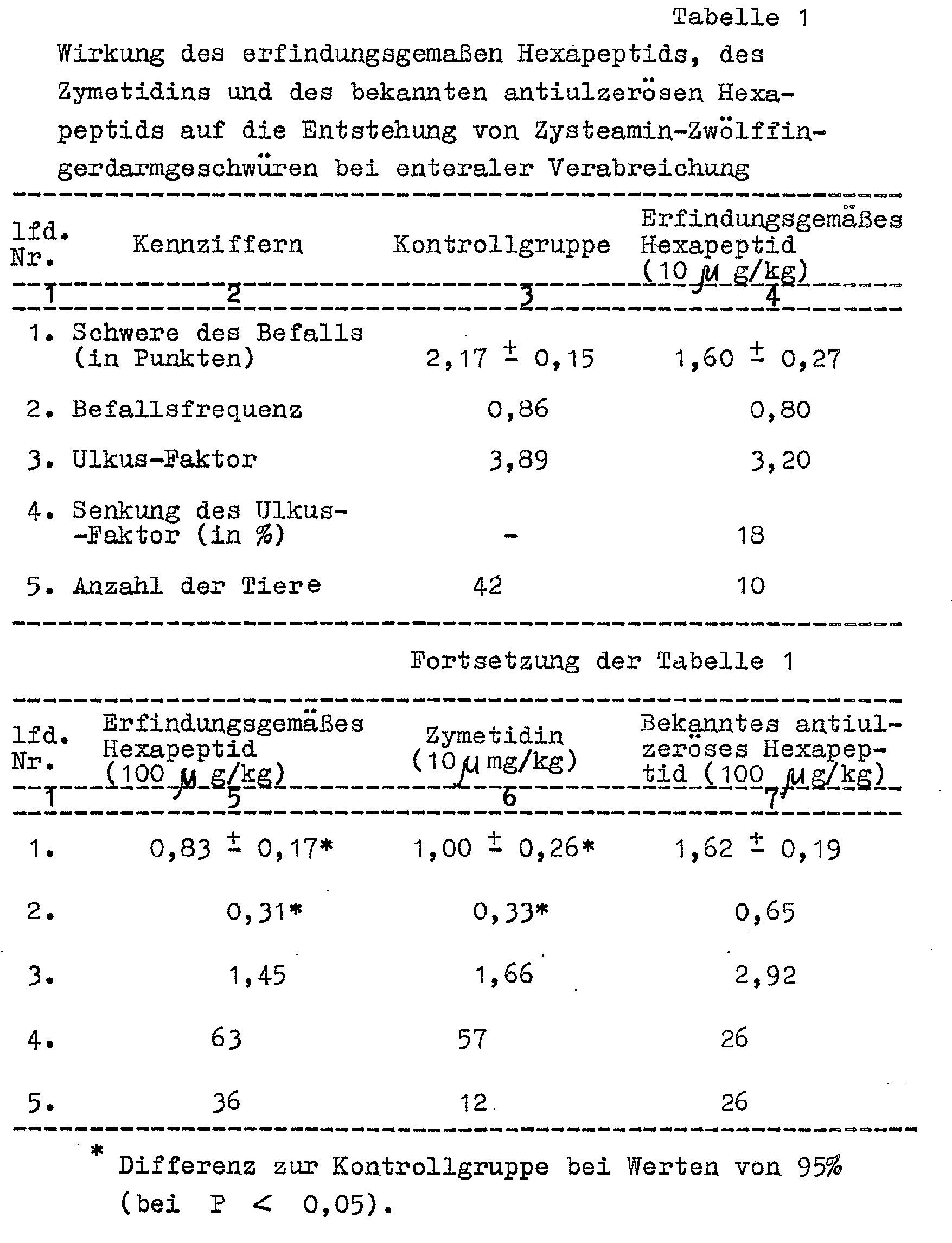
- Wie aus der Tabelle 1 zu ersehen ist, verhinderte das erfindungsgemässe Hexapeptid bei der peroralen Verabreichung in Abhängigkeit von der Dosis die Geschwürbildung im Zwölffingerdarm von Ratten und setzte den Ülkusfaktor bei einer Dosis von 100 mg/kg um 63% herab. Die antiulzeröse Wirkung des erfindungsgemässen Hexapeptids war höher als die antiulzeröse Wirkung des Zymetidins (in einer Dosis von 10 mg/kg), das den Ulkusfaktor um 57% verringerte. Bekanntes antiulzeröses Hexapeptid (US, A, 4565805) wies bei peroraler Verabreichung eine schwache antiulzeröse Wirkung auf, und setzte den Ulkusfaktor lediglich um 26% herab.
- Das erfindungsgemässe Hexapeptid wurde auch an einem Versuchsmodell von Indometacinum-Geschwüren des Dünndarmes untersucht, an dem man die antiulzeröse Wirkung des Hexapeptids mit der antiulzerösen Wirkung des Sulfasalazins verglich. Indometacinum führte man den Ratten peroral in einer Dosis von 20 mg/kg unter Zuhilfenahme einer Magensonde in Form einer Suspension in 0,5 ml physiologischer Lösung ein. Das erfindungsgemässe Hexapeptid in einer Dosis von 100 mg/kg beziehungsweise Sulfasalazin in einer Dosis von 200 mg/kg führte man gleich und in 6 Stunden nach der Verabreichizng des Indometacinums in 0,5 ml der fünffach mit-der physiologischen Lösung verdünnten 3%igen Milch ein. Der Kontrollgruppe der Tiere führte man gleich und in 6 Stunden nach der Verabreichung des Indometacinums 0,5 ml der 3%igen Milch peroral ein, die fünffach mit physiologischer Lösung verdünnt ist. Das Töten der Tiere durch die Dekapitation erfolgt in 24 Stunden nach der Verabreichung des Indometacinums, und man errechnete die Anzahl von Geschwürbeschädigurigen der Schleimhaut des 30 cm langen distalen Abschnitts des Dünndarmes, in dem die Entstehung von Geschwüren maximal war. Für jede Gruppe von Tieren ermittelte man die durchschnittliche Anzahl von Geschwüren im Darmo
- Die statische Bearbeitung der erzielten E-Ergebnisse erfolgt mit Hilfe des t-Studentkriteriums. Als zuverlässig galten die Differenzen bei Werten von 95% (bei P < 0,05). Die erzielten Ergebnisse sind in der Tabelle 2 angeführt.

- Wie aus der Tabelle 2 zu ersehen ist, verringert das erfindungsgemässe Hexapeptid in einer Dosis von 100 mg/kg die durchschnittliche Anzahl der Geschwüre im distalen Abschnitt des Dünndarmes von Ratten um 52%. Die antiulzeröse Wirkung des erfindungsgemässen Hexapeptids steht nicht der antiulzerösen Wirkung des Sulfasalazins nach, das in einer Dosis von 200 mg/kg- verabreicht wurde und das die Anzahl der Geschwüre im Darm um 46% herabsetzt.
- In allen Versuchen mit Verwendung des erfindungsgemässen Hexapeptids wurden keine Veränderungen seitens dea zellulärea Zusammensetzung des Blutes, der wichtigsten Ramodynamischen Kennziffern nachgewiesen. Bei der Untersuchung der akuten Toxizität des erfindungsgemässen Hexapeptids betrug LD50 250 mg/kg.
- Hierdurch stand das erfindungsgemasse Hexapeptid in den eingesetzten Versuchmodellen einer akuten erosion-ulzerösen Beschädigung des Magen-Darm-Traktes nicht dem Zymetidin (in bezug auf den Zwölffingerdarm) und dem Sulfasalazin (in bezug auf den Dünndarm) nach. Da das Zymetidin in einer Dosis von 10 mg/kg und das Sulfasalazin in einer Dosis von 200 mg/kg verabreicht wurden, ging daraus hervor, dass die antiulzeröse Wirkung des erfindungsgemässen Hexapeptids in den verwendeten Versuchsmodellen hoher als die Wirkung des Zymetidins und des Sulfasalazins auf das 100 fache bzw. auf das 2000fache ist.
- Das erfindungsgemässe Hexapeptid, das in seiner Wirkung das Zymetidin und das Sulfasalazin übertrifft, findet Anwendung als Wirkstoff in einem Arzneimittel für die Behandlung der erosion-ulzerösen Beschädigungen des Magen-Darm-Traktes (Magengeschwüre, Zwölffingerdarmgeschwüre und Colitis ulzerosa). Als vorteilig bei der Verwendung des erfindungsgemässen Präparats im Vergleich zum Zymetidin und Sulfasalazin erscheint eine höhere Wirkung und die Möglichkeit der Anwendung bei der gleichzeitigen Erosionsbeschädigung des Zwölffingerdarms und der distalen Abschnitte des Dünndarms, und als vorteilig im Vergleich zu dem bekannten antiulzerösen Hexapeptid (US, A, 4565805) erscheint die Möglichkeit seiner peroralen Verabreichung.
- Bei der Behandlung der Patienten mit erosion-ulzerösen Beschädigungen der Schleimhaut des Magen-Darm- Traktes kann das erfindungsgemasse Arzneimittel in verschiedenen Arzneiformen für die perorale Verabreichung in einer einmaligen Dosis von 5 bis 50 mg angewendet werden.
- Das erfindungsgemässe Arzneimittel kann in beliebiger Arzneiform, die für perorale Verabreichung geeignet ist, beispielsweise, in Form von Pulvern beziehungsweise von Tabletten für die perorale Verabreichung in Milch, in Pflanzenfetten oder Lipiden in disperser Form sowie in Form von Kapseln, die beliebige pharmazeutisch geeignete Fetträgersubstanz enthalten, verwendet werden. Das erfindungsgemässe Präparat kann in Form eines intranasalen Aerosols beziehungsweise von Rektalzöpfchen verwendet werden.
- Erfindungsgemässes Hexapeptid folgender Formel:
- Tyr - D - Äla - Gly - Phe - Leu - Glu synthetisiert man aus zwei Fragmenten, die durch ein konsequentes Angliedern der Aminosäurekette mit je einer Aminosäure: di-tert.-Butylester der Karbobenzoxi-phenylalänyl-leuzylglutaminsäure ausgehend von dem Di-tert.-butylester der Karbobenzoxy-glutaminsäure; N-tert.-Butyloxi-karbonyl-O-benzyltyrosil-D-aianylglyzin ausgehend vom Natriumsalz des Glysins, und aktivierten Estern der geschützten Aminosäuren. Die Fragmente wurden nach der Beseitigung der Karbobenzoxy-Gruppe nach der Methode der aktivierten Ester kondensiert. Die Schutzgruppen wurden mit Hilfe der katalytischen Hydrogenolyse und der azidolytischen Spaltung entfernt.
- Zur besseren Erläuterung der vorliegenden Erfindung wird nachstehendes Beispiel für die Herstellung des erfindungsgemässen Hexapeptids angeführt.
- 6,83 g (17,41 µ Mol) Di-tert.-butylester der Karbobenzoxy-glutaminsäure löst man in 35 ml Methanol und hydriert in Gegenwart eines Palladiumkatalysators innerhalb von 4 Stunden. Der Katalysator wird abgefiltert, an einem Filter mit Methanol gewaschen, das Filtrat wird eingedampft und in 25 ml Dimethylformamid aufgelöst. Der Lösung fügt man 4,50 g (17,41 µ Mol) p-Nitrophenyläther des Karbobenzoxyleuzins hinzu. Das Reaktionsgemisch vermischt man bei Raumtemperatur innerhalb von 24 Stunden. Das Lösungsmittel dampft man ein, den Rückstand löst man in 10 ml eines Gemisches Äthylazetat:Hexan (2:1) auf und trägt man auf eine Chrömatografiesäule auf. Die Chromatografie führt man unter isokratischen Bedingungen (Eluent - Äthylazetat:Hexan 2:1) durch. Fraktionen werden eingedampft und in einem Vakuumexikator getrocknet. Man erhält 6,02 g (68%) Di-tert.-butylesters der Karbobenzoxy-leuzyl-glutaminsäure als farbloses Ö1,
-
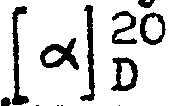
- 1,56 g (3,09 µMol) Di-tert.-butylester der Karbobenzoxy-leuzyl-glutaminsäure löst man in 10 ml Methanol und hydriert man in Gegenwart eines Palladiumkatalysators innerhalb von 3 Stunden. Der Katalysator wird abgefiltert, an einem Filter mit Methanol gewaschen,und das Filtrat wird eingedampft. Der Rückstand wird in 5 ml Dimethylformamid aufgelöst, man setzt 1,30 g (3,09 µMol) p-Nitrophenyläther des Karbobenzoxyphenylalanin zu . Das Reaktionsgemisch wird bei Raumtemperatur innerhalb von 24 Stunden vermischt. Das Lösungsmittel dampft man ein, den Rückstand löst man in 30 ml Äthylazetat auf. Äthylazetatlösung wäscht man mit 2%iger Schwefelsäure (20 ml x 2) und mit Wasser (20 ml x 2), dampft man ein, setzt man 25 ml Isopropylalkohol hinzu und dampft man ein. Den Rückstand löst man in Di-isopropyläther auf, die ausgefallenen Kristalle filtert man ab, wäscht man an einem Filter mit Di-isopropyläther und trocknet man in einem Vakuumexikator. Man erhält 1,55 g (85) Di-tert.-butylester der Karbobenzoxy-phenylalanyl-leuzyl-glutaminsäure vom Schwelzpunkt 120oC, [α]D 20= -25,6° (c 1, Dimethylformamid), Rf : 0,23 (Athylazetat:n-Hexan 1:2), 0,56 (Toluol-Azeton-Azethanol-Essigsäure 14:1:4:1), 0,29 (Toluol:n-Heptan-Methyläthylketon 5:3:1).
- 0,50 g (7,68 µMol) Glyzin löst man in 7,68 ml 1 n-Ätznatronlosung auf und setzt man eine Losung von 2,74g (7,78 µMol) p-Nitrophenyläther des Karbobenzoxy-D-alanins in 20 ml Dimethylformamid zu. Das Reaktionsgemisch vermischt man bei Raumtemperatur innerhalb von 24 Stunden. Die Lösung dampft man ein, den Rückstand löst man in Wasser auf, extrahiert, mit Äther (50 ml x 3), die wässerige Schicht säuert man mit 2 n-Schwefelsäure bis zur Erzielung eines pH-Wertes von 2 an und extrahiert mit Äthylazetat (50 ml x 3). Die Äthylazetatlösung wäscht man mit Wasser (30 ml x 2), setzt man 50 ml Isopropylalkohol hinzu und dampft man ein. Den Rückstand giesst man mit Äther (100 ml) über, die entstandenen Kristalle filtert man ab, wäscht an einem Filter mit Äther und trocknet in einem Vakuumexikkator.
- Man erhält 1,40 g (65%) Karbobenzoxy-D-alanyl-glyzin mit einem Schmelzpunkt von 126,5 bis 127oC,
- [α]D 20 = +20,7 (c 1, MeOH), Rf : 0,67 (Chloroform: Methanol - 32%ige Essigsäure 60:45:20); 0,7I (Äthylazetat-Pyridin:Essigsäure:Wasser 45:20:6:11); 0,35 (Methylenchlorid:Methanol:50%ige Essigsäure 85:15:2).
- 1,66 g (5,90 µMol) Karbobenzoxy-D-alanyl-glyzin löst man in 20 ml Methanol auf und hydriert in Gegenwart eines Palladiumkatalysators innerhalb von 3 Stunden. Der Katalysator wird abgefiltert, an einem Filter mit Methanol gewaschen, das Filtrat wird eingedampft, der Rückstand in 5,9 ml 1 n-Ätznatronlösung aufgelöst, der Lösung setzt man 2,91 g (5,90 µ Mol) p-Nitrophenyläther des N-tert.-Butyloxykarbonyl-0-benzyl-tyrosins in 25 ml Dimethylformamid zu . Das Reaktionsgemisch vermischt man bei Raumtemperatur innerhalb von 24 Stunden. Die Lösung dampft man ein, den Rückstand löst man im Wasser äuf, extrahiert mit Äther (50 ml x 2), die wässerige Lösung säuert man mit 2 n-Schwefelsäure bis zum Erzielen eines pH-Wertes von 2 an, extrahiert man mit Äthylazetat (70 ml x 3).Extrakt wird mit Wasser (50 ml x 2) gewaschen, man setzt 50 ml Isopropylalkohol hinzu und dampft man ein. Den Rückstand giesst man mit Äther (150 ml) über, die entstandenen Kristalle filtert man ab, wäscht man mit Äther an einem Filter und trocknet in einem Vakuumexikkator. Man erhält 2,62 g (89%) N-tert. -Butyloxykarbonyl-0-benzyl- tyräsil-D-alanyl-glyzin mit einem Schmelzpunkt von 100 bis 100,5oC, [α]D 20= -9,3° (c 1, Dimethylformamid), Rf : 0,74 (Äthylazetat:Pyridin-Essigsäure:Wasser 45:20:6:11); 0,57 (Methylenchlorid:Methanol 50%ige Essigsäure 85:15:2); 0,36 (Chloroform:Methanol:Essigsäure 9:1:0,5)
- 3,50 g (7,03 µMol) N-tert.-Butyloxykarbonyl-O-benzyl-tyrosyl-D-alanyl-glyzin und 1,02 g (7,33 µMol) p-Nitrophenol-löst man in 25 ml Dimethylformamid auf, die Lösung kühlt man auf -25°C ab, setzt man 1,54 g (7,33 µMol) Dizyklohexylkarbodiimid in 10 ml Dimethylformamid zu. Das Reaktionsgemisch vermischt man bei einer Temperatur von -25oC innerhalb von 45 Minuten, dann bringt man die Temperatur auf 0°C und hält man bei dieser Temperatur innerhalb von 24 Stunden. Die ausgefallenen Kristalle des Dizyklohexylharnstoffes filtert man ab, wäscht man an einem Filter mit Dimethylformamid, dampft das Filtrat ein,den Rückstand kristallisiert man aus dem Isopropylalkohol um.
- Man erhält 3,63 g (83%) p-Nitrophenyläther des N-tert.-Butyloxy-karbonyl-0-benzyltyrosyl-D-alanyl- lizins mit einem Schmelzpunkt von 154°C, [α]D 20 =0.4° (c 1, Dimethylformamid), Rf : 0,87 (Methylenchlorid:Methanol:50%ige Essigsäure 85:15:2) 0,69 (Chloroform:Methanol-Essigsäure 32:3:1), 0,41 (n-Butanol-Ameisensäure:Wasser 15:3:1).
- 209 mg (0,32 µMol) Di-tert. - butylester der Karbobenzoxy-phenylalanyl-leuzyl-glutaminsäure löst man in 15 ml Methanol auf und hydriert in Gegenwart eines Palladiumkatalysators innerhalb von 3 Stunden. Den Katalysator filtert man ab, wäscht an einem Filter mit Methanol, das Filtrat dampft man ein.
- Den Rückstand löst man in 10 ml Dimethylformamid und setzt man 200 mg p-Nitrophenyläther des N-tert.-Butyloxykarbonyl-O-benzyl-tyrozyl-D-alanyl-glyzins zu.Das Reaktionsgemisch vermischt man bei Raumtemperatur innerhalb von 24 Stunden. Das Dimethylformamid dampft man ein, den Rückstand fällt man zweimal aus Methanol (5 ml) mit Äther (300 ml) um. Man erhält 266 mg (84%) Di-tert.-butylesters der N-tert.-Butyloxykarbonyl-0-benzyl-tyrosyl-D-alanyl-glyzyl-phenylalanyl-leuzyl-glutaminsäure mit einem Schmelzpunkt von 200 bis 201°C, [α]D 20= -19,2° (c l, Dimethylformamid), Rf: 0,88 (Chloroform:Methanol:32%ige Essigsäure 60:45:20); 0,89 (Äthylazetat:Pyridin:Essigsäure:Wasser 45:20:6:11); 0;58 (Chloroform:Methanol:Essigsäure 9:1:0,5).
- 240 mg (0,24 µMol) Di-tert.-butylester der N-tert.-Butyloxykarbonyl-0-benzyl-tyrozyl-D-alanyl-gly- zyl-phenylalanyl-leuzyl-glutaminsäure löst man in 15 ml Essigsäure auf und hidriert man in Gegenwart eines Palladiumkatalysators innerhalb von 3 Stunden. Den Katalysator filtert man ab, wäscht man an einem Filter mit Essigsäure und das Filtrat dampft man ein. Den Rückstand löst man in 15 ml Trifluoressigsäure auf, hält innerhalb von 30 Minuten bei Raumtemperatur. Die lösung dampft man ein, den Rückstand giesst man mit 50 ml Äther über, den ausgefallenen Niederschlag filtert man ab,wäscht man an einem Filter mit Äther, löst man in 50 ml 10%iger Essigsäure auf,behandelt mit Ionenaustauscherharz "Dowex-1" in Ac0-Form. Das Harz filtert man ab, wäscht man an einem Filter mit 10%iger Essigsäure, das Filtrat dampft man ein. Das hergestellte Produkt reinigt man im Gegenstrom-Verteilungsverfahren in einer Planeten-Zentrifuge im Sytem n-Butanol:Essigsäure:Wasser 4:1:5; stationäre Phase ist organische Phase. Die Fraktionen, die das Endprodukt enthalten, sammelt man, dampft man ein, den Rückstand fällt man aus Methanol (3 ml) mit Äther (250 ml) um, den entstandernen Niederschlag filtert man ab, wäscht man an einem Filter mit Äther und trocknet man in einem Vakuumexikkator.
- Man erhält 92 mg (55%) Tyrosyl-D-alanyl-glyzylphenyl-alanyl-leuzyl-glutaminsäure, [α]D 20= +29,8o (c 1, 10% AcOH), Rf: 0,74 (Chloroform:Methanol:32%ige Essigsäure 60:45:20); 0,42 (Äthylazetat-Pyridin-Essigsäure:Wasser 45:20:6:11); 0,48 (n-Butanol-Essigsäure: Wasser 3:1:1). Die Angaben der Animosäure-Analyse: Alanin 1,02 (1), Glyzin 1,00 (1), Glutaminsäure 1,04 (1), Leuzin 1,02 (1), Tyrosyl 0,99 (1), Phenyl-alanin 1,03 (1). Die Angaben einer hocheffektiven Flüssig-chromatografie : Peptid wurde von einem Berg bei 38,24% des Gradienten in der 12. und in der 16. Minute eluiert, Säule 250 x 4,6 mm. Ultrasphera ODS 5 m, bewegliche Phase A: 0,05 Mol KH2 P04, B:CH3CN grad 20 → 50% B in 20 Minuten, Druck 1500psi, Geschwindigkeit 1 ml/min, Detektion bei 214 nm.
- Das erfindungsgemässe Hexapeptid bezitzt eine antiulzeröse Wirkung und kann in der Medizin als Wirkstoff eines Arzneimittels für die Behandlung von erosion-ulzerösen Schädigungen des Magen-Darm-Traktes Anwendung finden.
Claims (5)
1. Hexapeptid folgender Formel:
Tyr - D - Ala - Gly - Phe - Leu - Glu
2. Arzneimittel für die Behandlung von erosion-ulzerösen Schädigungen des Verdauungstraktes, das einen Wirkstoff und eine pharmazeutische Trägersubstanz vorsieht, dadurch gekennzeichnet, dass es als Wirkstoff Hexapeptid nach Anspruch 1 enthält.
3. Arzneimittel nach Anspruch 2, dadurch gekennzeichnet, dass es den Wirkstoff in einer einmaligen Dosis von 5 bis 50 mg enthält.
4. Arzneimittel nach Anspruch 2 in Form von Kapseln, dadurch gekennzeichnet, dass es den Wirkstoff in einer Menge von 5 bis 50 mg in einer Kapsel enthält.
5. Arzneimittel nach Anspruch 4, dadurch gekennzeichnet,dass es als pharmazeutische Trägersubstanz Olivenöl enthält.
Applications Claiming Priority (2)
| Application Number | Priority Date | Filing Date | Title |
|---|---|---|---|
| SU4262648 | 1987-06-19 | ||
| SU874262648A SU1460965A1 (ru) | 1987-06-19 | 1987-06-19 | Гексапептид, обладающий противо звенным действием |
Publications (2)
| Publication Number | Publication Date |
|---|---|
| EP0341311A1 true EP0341311A1 (de) | 1989-11-15 |
| EP0341311A4 EP0341311A4 (de) | 1990-02-20 |
Family
ID=21311138
Family Applications (1)
| Application Number | Title | Priority Date | Filing Date |
|---|---|---|---|
| EP19880906225 Withdrawn EP0341311A4 (de) | 1987-06-19 | 1988-05-25 | Hexapeptide und darauf basierende pharmazeutische zubereitungen zur behandlung erosiver oder geschwüriger läsionen des gastrointestinaltraktes. |
Country Status (5)
| Country | Link |
|---|---|
| US (1) | US5002933A (de) |
| EP (1) | EP0341311A4 (de) |
| AU (1) | AU613060B2 (de) |
| SU (1) | SU1460965A1 (de) |
| WO (1) | WO1988010268A1 (de) |
Families Citing this family (5)
| Publication number | Priority date | Publication date | Assignee | Title |
|---|---|---|---|---|
| WO1989002745A1 (fr) * | 1987-10-02 | 1989-04-06 | Vsesojuzny Kardiologichesky Nauchny Tsentr Akademi | Preparation pharmaceutique de traitement de la sclerose en plaques et de la sclerose laterale amyotrophique |
| WO2009129855A1 (en) * | 2008-04-24 | 2009-10-29 | United Technologies Ut Ag | Photoprotective compositions containing peptides |
| BRPI0924416B1 (pt) * | 2009-03-17 | 2017-06-06 | United Tech Ut Ag | composição tópica e métodos cosméticos de melhoria de aparência e da firmeza e elasticidade, de condicionamento, de redução da severidade da celulite, de estrias e de rugas, de redução e/ou prevenção de cicatrizes, de aumento da produção de colágeno e elastina da pele e uso de composição. |
| WO2020027686A1 (ru) * | 2018-08-03 | 2020-02-06 | Сергей Георгиевич МОРОЗОВ | Способ профилактики несостоятельности межкишечного анастомоза |
| RU2718912C1 (ru) * | 2019-12-24 | 2020-04-15 | Федеральное государственное бюджетное учреждение "Научно-исследовательский институт общей патологии и физиологии" (ФГБНУ "НИИОПП") | Способ лечения и профилактики инфаркта миокарда с патологией легких |
Family Cites Families (6)
| Publication number | Priority date | Publication date | Assignee | Title |
|---|---|---|---|---|
| DE2730851A1 (de) * | 1976-07-19 | 1978-01-26 | Sandoz Ag | Neu polypeptidderivate, ihre herstellung und verwendung |
| DE3117934A1 (de) * | 1981-05-06 | 1982-12-09 | Max-Planck-Gesellschaft zur Förderung der Wissenschaften e.V., 3400 Göttingen | Neues peptid, verfahren zu seiner gewinnung und dieses enthaltendes arzneimittel |
| SU1414392A1 (ru) * | 1982-12-29 | 1988-08-07 | Всесоюзный кардиологический научный центр АМН СССР | Противо звенное средство |
| SU1348343A1 (ru) * | 1984-07-16 | 1987-10-30 | Всесоюзный кардиологический научный центр АМН СССР | Гексапептид,обладающий антипанкреонекротической активностью |
| SU1470739A1 (ru) * | 1984-07-16 | 1989-04-07 | Всесоюзный кардиологический научный центр АМН СССР | Гексапептид, обладающий гепатопротективным действием |
| DE3445932A1 (de) * | 1984-12-17 | 1986-06-26 | Boehringer Ingelheim KG, 6507 Ingelheim | Pharmazeutische zusammensetzungen |
-
1987
- 1987-06-19 SU SU874262648A patent/SU1460965A1/ru active
-
1988
- 1988-05-25 EP EP19880906225 patent/EP0341311A4/de not_active Withdrawn
- 1988-05-25 WO PCT/SU1988/000115 patent/WO1988010268A1/ru not_active Ceased
- 1988-05-25 US US07/328,159 patent/US5002933A/en not_active Expired - Fee Related
- 1988-05-25 AU AU19849/88A patent/AU613060B2/en not_active Ceased
Also Published As
| Publication number | Publication date |
|---|---|
| WO1988010268A1 (fr) | 1988-12-29 |
| SU1460965A1 (ru) | 1991-10-15 |
| US5002933A (en) | 1991-03-26 |
| AU613060B2 (en) | 1991-07-25 |
| AU1984988A (en) | 1989-01-19 |
| EP0341311A4 (de) | 1990-02-20 |
Similar Documents
| Publication | Publication Date | Title |
|---|---|---|
| EP0067425B1 (de) | Gegebenenfalls geschützte Peptide, Verfahren zu ihrer Herstellung und diese enthaltende Arzneimittel | |
| EP0190736B1 (de) | Chemische Derivate von GHL-Cu | |
| EP0346501B1 (de) | Arzneimittelzubereitung zur behandlung des immunmangels | |
| FR2647677A1 (fr) | Nouvelles micro-proteines, procede de preparation et application a titre de medicaments de ces nouvelles micro-proteines | |
| EP0179332B1 (de) | Neue ZNS-aktive Peptide mit Wirkung auf das cholinerge System | |
| EP0025218B1 (de) | Pharmakologisch aktive Peptide und diese enthaltende Arzneimittel | |
| EP0249169A2 (de) | Peptide mit Einfluss auf die Diurese und Natriurese, Verfahren zu ihrer Herstellung, diese enthaltende Mittel und ihre Verwendung | |
| DE68921674T2 (de) | Peptide, deren Verwendung als Immuno-Suppressanten und Verfahren zu deren Herstellung. | |
| EP0341311A1 (de) | Hexapeptide und darauf basierende pharmazeutische zubereitungen zur behandlung erosiver oder geschwüriger läsionen des gastrointestinaltraktes | |
| DE3117948A1 (de) | Anorexigene peptide | |
| EP0003028B1 (de) | Beta h-Endorphin-Analoge, diese enthaltende Präparate und deren Herstellung | |
| EP0080194B1 (de) | Neue Peptide und Verfahren zu ihrer Herstellung | |
| FR2491922A1 (fr) | Nouveaux hexapeptides, procede pour leur preparation et application comme medicaments | |
| EP0034260A1 (de) | Peptide, Verfahren zur Herstellung derselben und diese enthaltende Arzneimittel beziehungsweise Diagnostica | |
| DE2519937A1 (de) | Acetylierte extrakte von corynebakterien, verfahren zu ihrer herstellung und ihre verwendung in arzneimittelzubereitungen | |
| DE69032591T2 (de) | Physiologisch aktive peptide und den calcium-metabolismus regulierende arzneimittel, die genannte peptide als wirkungsvollen bestandteil enthalten | |
| DE2648829A1 (de) | Nonapeptide, verfahren zu deren herstellung und diese enthaltende arzneimittel | |
| DD296084A5 (de) | Verfahren zur herstellung von humanen spleninderivaten | |
| EP0028716A2 (de) | Motilitätssteigernde Peptide und deren Verwendung | |
| CH636343A5 (de) | Verfahren zur herstellung eines neuen tridecapeptids. | |
| EP0248209A2 (de) | Cyclische Peptide mit cytoprotektiver Wirkung | |
| DE2900926C2 (de) | ||
| DE3703159A1 (de) | Cyclische peptide mit cytoprotektiver wirkung | |
| EP0424670B1 (de) | Neue ZNS-aktive Hexapeptide mit antiamnestischer Wirkung | |
| DE3873255T2 (de) | Methoden und praeparate zur vorbeugung von ulcera. |
Legal Events
| Date | Code | Title | Description |
|---|---|---|---|
| PUAI | Public reference made under article 153(3) epc to a published international application that has entered the european phase |
Free format text: ORIGINAL CODE: 0009012 |
|
| 17P | Request for examination filed |
Effective date: 19890210 |
|
| AK | Designated contracting states |
Kind code of ref document: A1 Designated state(s): AT BE CH DE FR GB IT LI NL SE |
|
| A4 | Supplementary search report drawn up and despatched |
Effective date: 19900220 |
|
| STAA | Information on the status of an ep patent application or granted ep patent |
Free format text: STATUS: THE APPLICATION HAS BEEN WITHDRAWN |
|
| 18W | Application withdrawn |
Withdrawal date: 19920304 |