EP0352941A2 - Apparatus and method for flow control - Google Patents
Apparatus and method for flow control Download PDFInfo
- Publication number
- EP0352941A2 EP0352941A2 EP89307112A EP89307112A EP0352941A2 EP 0352941 A2 EP0352941 A2 EP 0352941A2 EP 89307112 A EP89307112 A EP 89307112A EP 89307112 A EP89307112 A EP 89307112A EP 0352941 A2 EP0352941 A2 EP 0352941A2
- Authority
- EP
- European Patent Office
- Prior art keywords
- chamber
- valve
- mixture
- inlet
- pressure
- Prior art date
- Legal status (The legal status is an assumption and is not a legal conclusion. Google has not performed a legal analysis and makes no representation as to the accuracy of the status listed.)
- Withdrawn
Links
- 238000000034 method Methods 0.000 title claims abstract description 15
- 239000000203 mixture Substances 0.000 claims abstract description 111
- 239000007788 liquid Substances 0.000 claims abstract description 26
- 239000007787 solid Substances 0.000 claims abstract description 19
- 239000012530 fluid Substances 0.000 claims description 33
- 230000006698 induction Effects 0.000 claims description 8
- 238000007599 discharging Methods 0.000 claims description 7
- 230000008859 change Effects 0.000 claims description 6
- 230000004044 response Effects 0.000 claims description 6
- 230000005484 gravity Effects 0.000 claims description 4
- 230000004323 axial length Effects 0.000 claims description 3
- 230000000295 complement effect Effects 0.000 claims description 3
- 230000005291 magnetic effect Effects 0.000 claims description 3
- 238000011144 upstream manufacturing Methods 0.000 claims description 3
- 238000002360 preparation method Methods 0.000 claims description 2
- 230000003213 activating effect Effects 0.000 claims 1
- 238000013459 approach Methods 0.000 claims 1
- 241000251468 Actinopterygii Species 0.000 abstract description 37
- XLYOFNOQVPJJNP-UHFFFAOYSA-N water Substances O XLYOFNOQVPJJNP-UHFFFAOYSA-N 0.000 abstract description 25
- 238000011109 contamination Methods 0.000 abstract description 5
- XAGFODPZIPBFFR-UHFFFAOYSA-N aluminium Chemical compound [Al] XAGFODPZIPBFFR-UHFFFAOYSA-N 0.000 description 5
- 229910052782 aluminium Inorganic materials 0.000 description 5
- 230000008901 benefit Effects 0.000 description 5
- 239000000356 contaminant Substances 0.000 description 4
- 230000000694 effects Effects 0.000 description 4
- 238000009434 installation Methods 0.000 description 4
- 230000007246 mechanism Effects 0.000 description 4
- 230000000284 resting effect Effects 0.000 description 4
- 150000003839 salts Chemical class 0.000 description 4
- 238000004140 cleaning Methods 0.000 description 3
- 238000005086 pumping Methods 0.000 description 3
- 230000000630 rising effect Effects 0.000 description 3
- 239000000853 adhesive Substances 0.000 description 2
- 230000001070 adhesive effect Effects 0.000 description 2
- 238000004891 communication Methods 0.000 description 2
- 238000012544 monitoring process Methods 0.000 description 2
- 239000004033 plastic Substances 0.000 description 2
- 238000012360 testing method Methods 0.000 description 2
- 230000000712 assembly Effects 0.000 description 1
- 238000000429 assembly Methods 0.000 description 1
- 230000003190 augmentative effect Effects 0.000 description 1
- 230000015572 biosynthetic process Effects 0.000 description 1
- 238000010276 construction Methods 0.000 description 1
- 238000005260 corrosion Methods 0.000 description 1
- 230000007797 corrosion Effects 0.000 description 1
- 238000002474 experimental method Methods 0.000 description 1
- 239000003302 ferromagnetic material Substances 0.000 description 1
- 235000013305 food Nutrition 0.000 description 1
- 230000000977 initiatory effect Effects 0.000 description 1
- 230000001788 irregular Effects 0.000 description 1
- 238000002955 isolation Methods 0.000 description 1
- 238000012423 maintenance Methods 0.000 description 1
- 239000000463 material Substances 0.000 description 1
- 238000012545 processing Methods 0.000 description 1
- 238000010926 purge Methods 0.000 description 1
- 230000001846 repelling effect Effects 0.000 description 1
- 238000007789 sealing Methods 0.000 description 1
- 238000012163 sequencing technique Methods 0.000 description 1
- 238000012546 transfer Methods 0.000 description 1
- 238000013022 venting Methods 0.000 description 1
Images


Classifications
-
- A—HUMAN NECESSITIES
- A01—AGRICULTURE; FORESTRY; ANIMAL HUSBANDRY; HUNTING; TRAPPING; FISHING
- A01K—ANIMAL HUSBANDRY; AVICULTURE; APICULTURE; PISCICULTURE; FISHING; REARING OR BREEDING ANIMALS, NOT OTHERWISE PROVIDED FOR; NEW BREEDS OF ANIMALS
- A01K79/00—Methods or means of catching fish in bulk not provided for in groups A01K69/00 - A01K77/00, e.g. fish pumps; Detection of fish; Whale fishery
-
- B—PERFORMING OPERATIONS; TRANSPORTING
- B65—CONVEYING; PACKING; STORING; HANDLING THIN OR FILAMENTARY MATERIAL
- B65G—TRANSPORT OR STORAGE DEVICES, e.g. CONVEYORS FOR LOADING OR TIPPING, SHOP CONVEYOR SYSTEMS OR PNEUMATIC TUBE CONVEYORS
- B65G53/00—Conveying materials in bulk through troughs, pipes or tubes by floating the materials or by flow of gas, liquid or foam
- B65G53/30—Conveying materials in bulk through pipes or tubes by liquid pressure
Definitions
- the present invention is closely related to an earlier invention entitled "Apparatus and method for handling solids in liquid "as described and claimed in U.S. Patent 4,517,099, issued 14 May 1985 to Raymond A. Breckner, one of the inventors herein.
- the patent the disclosure of which is incorporated herein by reference, describes a device having a chamber with inlet and outlet valves, the inlet valve being positioned at an upper portion of the tank so as to be clear of a maximum upper level of liquid within the tank.
- Mixture is drawn into the tank, when exposed to a low pressure source, through an inlet duct which has an upwardly curved riser means which constrains the mixture to pass initially upwardly, prior to discharging downwardly through the inlet valve.
- the inlet valve is a hinged plate which is opened when the pressure within the chamber is reduced, and closes when the pressure is increased.
- the patented device has an outlet valve at a lower portion thereof, which has a hinged plate which is closed by reduced pressure within the chamber, and opened when pressure increases.
- the patented device provides a means of ensuring that the inlet valve can close without trapping fish that might otherwise become inadvertently trapped therein.
- the mixture attains a predetermined level at which time the low pressure source is isolated from the chamber.
- the mixture continues to flow through the inlet duct until the pressure differential across the inlet valve is insufficient to maintain the inlet flow, at which time the flow ceases. Any fish that might tend to rest on the inlet valve will fall forwardly through the valve into the chamber, or backwardly into the inlet duct.
- sufficient time is allowed to permit flow through the inlet valve to cease, and to permit any solids that might collect adjacent the valve to fall from the valve, thus permitting the inlet valve to close cleanly.
- the above patent thus discloses an arbitrary time delay to ensure that flow in the inlet duct has ceased prior to closure of the inlet valve.
- it does not provide any means of directly measuring when flow through the inlet duct has actually ceased, and thus, to accommodate many variables in different installations, it is usual to provide a conservatively excessive time for flow through the inlet duct to cease, prior to raising pressure in the chamber.
- the invention reduces the difficulties and disadvantages of the prior art by providing an apparatus and method in which flow in a inlet duct upstream of the inlet valve can be detected directly without requiring a selected time period or time delay sufficient for flow through the duct to cease.
- the time delay disclosed in the previous patent is not required as cessation of flow can be detected directly in the present invention.
- Flow through an outlet duct from the apparatus can also be sensed directly, and thus timing of changes of pressure applied to the chamber can be accurately controlled, so as to avoid inadvertently early or late closing of inlet or outlet valves, as a result of pressure changes within the chamber.
- the present invention also uses an inlet valve seat clearing structure similar to the patented inlet clearing structure which permits any solids that might otherwise tend to come to rest adjacent the inlet valve when the mixture flow therethrough ceases to fall under gravity either forwardly through the inlet valve and into the chamber, or backwardly through the inlet duct.
- the invention By sensing flow in both the inlet and outlet ducts, the invention can be installed in many different installations, with different heights for both drawing mixture into the chamber, and for pumping mixture from the chamber, without requiring many test runs to provide timing adjustment for pressure changes for specific installations. Direct monitoring of cessation of flow in the ducts ensures that pumping efficiency is improved because pressure changing can occur within the chamber essentially immediately after flow in the inlet and/or outlet duct ceases.
- the invention is capable of pumping liquid to discharge at a location either above the apparatus, or below the apparatus without requiring a large number of tests at the installation.
- the apparatus uses a control system which, if desired, can be fully hydraulic, and thus requires no electrical components for actuation of valves, detecting fluid levels or flow within ducts, etc.
- the apparatus can use novel hydraulic valves which are actuated remotely, under relatively low forces generated by magnets, and this permits use of relatively low fluid pressures which enables use of low pressure hoses, pumps, etc., requiring less energy for operation, and lower standards for pressurized fluid components, thus reducing initial costs and maintenance costs.
- the use of remotely actuated valves simplifies construction and permits complete isolation of the valve mechanism from contaminants. Isolating the valve from the mixture also prevents possible contamination of the mixture with oil from the valve.
- This provides an apparatus which can be used on an irregular basis, with long periods of non-use between uses, with negligible problems resulting from contamination due to salt water corrosion, or foreign body contamination such as fish debris tending to seize or restrict movement of delicate flow detecting components, valve actuators, etc.
- the invention provides an apparatus which comprises a receiving chamber, pressure lowering and raising means, quantity sensing means, valve seat clearing means and an inlet flow sensor.
- the receiving chamber is adapted to receive the mixture from an inlet duct in an induction mode and to hold the mixture temporarily prior to discharging the mixture in a discharge mode.
- the chamber has inlet and outlet valves, the inlet valve communicating with the inlet duct to receive the mixture and being positioned adjacent an upper portion of the chamber above an uppermost level of mixture within the chamber.
- the pressure lowering means is for lowering pressure in the chamber to expose the inlet valve to a pressure difference so as to open the inlet valve and to draw mixture therethrough in the induction mode.
- the pressure raising means is for raising pressure in the chamber in the discharge mode which tends to close the inlet valve.
- the quantity sensing means is responsive to a predetermined intermediate quantity of mixture within the chamber to isolate the chamber from low pressure when said predetermined intermediate quantity is reached.
- the valve seat clearing means clears the inlet valve of solids when flow therethrough ceases.
- the inlet flow sensor means is responsive to inlet flow of mixture in said inlet duct to actuate the pressure raising means when the said flow stops, so as to provide time for solids to clear the inlet valve before closure thereof.
- the apparatus includes an outlet duct to receive flow from the outlet valve, with an outlet flow sensor means responsive to the outlet flow in the outlet duct which deactivates the pressure raising means when flow from the outlet valve ceases.
- the inlet and outlet flow sensor means comprise a rotatable paddle extending into the respective duct and mounted for rotation between an undeflected position when there is essentially no flow in the duct, and a deflected position which is responsive to flow of mixture in the duct.
- switch means cooperate with the pressure raising means to activate the pressure raising means when the paddle is in an undeflected position.
- the switch means is magnetically actuated by magnetically responsive means associated with the paddle and the switch means.
- an air relief means for purging air from the mixture as it leaves the chamber is generally responsive to minimum depth of mixture in an outlet duct extending from the chamber.
- the relief means has an intake communicating with the outlet duct, and an exhaust vented to atmosphere, with an air relief valve member controlling flow therebetween.
- the invention also provides a method of handling a solid/liquid mixture in which the mixture is temporarily stored within a receiving chamber, the method including the steps as follows.
- An inlet valve is positioned adjacent an upper portion of the chamber above an uppermost level of mixture within the chamber.
- the chamber is exposed to low pressure to generate a pressure difference across the inlet valve so as to open the inlet valve and draw the mixture into the chamber.
- the low pressure is disconnected from the chamber.
- the method is characterized by sensing when the flow of mixture in an inlet duct adjacent the inlet valve ceases, which permits the inlet valve to clear, prior to increasing pressure in the chamber after the flow of mixture in the inlet duct ceases which closes the inlet valve.
- the outlet valve of the chamber is opened to discharge the mixture from the chamber.
- any excess air carried in the mixture into the outlet duct is exhausted to atmosphere.
- a directional fluid valve which has particular application in the present invention has a valve body, a valve member, and a magnetically responsive means.
- the valve body has an inlet port, an outlet port and a main bore, the ports communicating with the main bore.
- the valve member is mounted within the main bore for movement between first and second positions.
- the valve member has a clearance means and a closure means to control flow between the ports.
- a magnetically responsive means is associated with the valve member and is responsive to an adjacent magnetic field to move the valve member from one position to another.
- a magnetically permeable protecting means is positioned adjacent the valve member to provide a cavity for the magnetically responsive means, the cavity having a size to accommodate movement of the valve member between the open and closed positions.
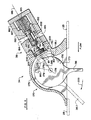
- An apparatus 10 has a receiving chamber 12 supported at a desired inclination on a frame 14, shown partially in broken outline.
- the chamber has an inlet valve assembly 16 and a rigid curved inlet duct 25 at an upper end thereof, and an outlet valve assembly 18 at a lower end thereof.
- An intake hose 21 has an intake funnel 23 at an outer end thereof, and an inner end connected to the rigid curved inlet duct 25. If necessary, the intake hose 21 can be flexible so that the funnel 23 can be moved within a fish hold, or other container holding fish immersed in water, so as to draw the fish in a fish/water mixture from the hold or container, up the hose 21 and into the chamber 12, when the chamber 12 is subjected to low pressure in an induction mode as will be described.
- the assembly 16 also includes an inlet valve plate 29 which is hinged at an upper end thereof to a hinge 31 which permits the valve plate to swing between an open position as shown in full outline, and a closed position as shown in broken outline at 29.1.
- the valve seat 27 is disposed in a generally vertical plane, or preferably overhanging the vertical plane by a few degrees, and the hinge 31 is relatively free, and thus the plate 29 would tend to hang essentially vertically, closely adjacent the seat 27.
- the valve plate 29 is displaced to the inclined open position as shown in full lines in Figure 1 by force of a stream of mixture 32 flowing through the inlet valve 16.
- the inlet duct 25 has an inlet flow sensor 34 which has an inlet paddle 36 which can swing between a deflected position shown in full outline which results from mixture flowing through the duct 25, to a non-deflected position as shown in broken outline at 36.1 when there is no flow in the duct 25.
- the paddle returns by gravity from the deflected position to the undeflected position when the flow ceases.
- the inlet flow sensor is responsive to flow of mixture in the duct and actuates an inlet flow sensor valve 38 which controls timing of application of high pressure to the chamber as will be described.
- the inlet duct 25 has a central duct axis 40 which is generally L-shaped, to provide an apex 42 at an inner corner of the duct.
- An upstream portion of the duct axis 40 is inclined at an angle 44 to the vertical as shown, and a downstream portion of the duct axis is inclined at an angle 46 to the horizontal as shown.
- the apex 42 thus causes mixture moving up the duct to move initially upwardly, over the apex, and then to pass downwardly through the inlet valve into the chamber 12.
- the apex 42 essentially eliminates any fish resting in the duct 25 downstream from the sensor 34 and serves as valve seat clearing means to clear the inlet valve seat 27 of solids as follows.
- a lower surface 48 of the duct adjacent the valve seat 27 is inclined to the horizontal sufficiently to cause any fish that might come to rest thereon to fall under gravity through the valve into the chamber 12. This inclination of the lower surface effectively prevents any fish from resting on the duct surface or across the valve seat when flow through the duct ceases.
- the inlet valve 16 is positioned adjacent the upper portion of the chamber which is above an uppermost of level of mixture within the chamber, as will be described with reference to Figure 3.
- the downwardly sloping lower surface of the inlet duct adjacent the inlet valve, and the relatively high location of the inlet valve within the chamber ensures that the valve plate can close against the valve seat when required, as will be described.
- the outlet valve assembly 18 has an outlet valve seat 52, and an outlet valve plate 54 hinged at a hinge 56 above the seat to permit the plate to swing against the seat to close the outlet of the chamber.
- the outlet valve seat 52 is disposed in a generally vertical plane, so that the valve plate can hang freely to be closely adjacent the valve seat.
- the chamber has a lower surface 58 which is inclined to the horizontal to permit fish, assisted by airflow as will be described, to discharge through the valve when open, so as to reduce the chance of fish resting on the outlet valve seat.
- the valve plate 54 can swing between the closed position as shown in full outline in Figure 1, and an open position as shown in broken outline at 54.1 when liquid discharges through the outlet of the tank.
- the apparatus includes an anti-flooding valve assembly 62 which includes a float chamber or float housing 64 having a float ball 66 therein.
- the float chamber is located relative to, and communicates with, the main chamber 12.
- a main pressure conduit 68 cooperates with an upper portion of the chamber 62, and has an upper end providing a conduit valve seat 71 which cooperates with the float-ball 66 so as to define a pre-determined intermediate level of liquid within the main chamber 12, ie quantity of mixture, as determined by the density of the float and other variables, to be described with reference to Figure 3.
- the conduit 68 has a lower portion which extends to a 5-way pressure control valve 70 which is to be described with reference to Figure 5.
- a vacuum pump 72 which serves also as a compressor, has intake and outlet conduits 74 and 76 cooperating with the valve 70 as will be described in Figure 5.
- a lower level sensor means 73 is located adjacent a lower portion of the float chamber 64 and is contacted by the float ball 66 when level in the main chamber drops as the chamber is emptied.
- the sensor means 73 actuates a level sensor valve or series valve 77 as will be described with reference to Figure 3.
- a wall 75 of the float chamber separating the float chamber from the main chamber is perforated in such a way that more perforations are located adjacent the upper portion of the wall 75 than the lower portion. In this way, air can escape easily from the upper portion of the float chamber, while fish debris and other contaminants are essentially prevented from entering the float chamber which would otherwise tend to interfere with the level sensor means 73.
- a low level sensor cleaner 78 cooperates with the means 73 as will be described with reference to Figure 3.
- the apparatus 10 includes a rigid outlet duct 80 communicating with the outlet valve 18, and a discharge hose 82 is connected to the duct 80 and carries mixture from the apparatus to another location, which can be either above or below the tank 12 as will be described.
- the outlet duct communicates with an air relief valve assembly 85 which extends upwardly from an upper wall of the outlet duct and has an exhaust vent 87 to discharge air from the duct to atmosphere as will be described with reference to Figure 2.
- a portion 89 of the outlet duct wall extending between the relief valve 85 and the duct is perforated to prevent fish and debris from entering the relief valve assembly, while permitting water and air to flow thereinto for purposes to be described.
- the valve assembly 85 includes a float 86 secured to a lower end of a rod 88 extending downwardly within the assembly 85 to be immersed in liquid discharged from the valve 18.
- the apparatus also includes an outlet flow sensor 92 cooperating with the outlet duct 80 which has an outlet paddle 94 which is hinged for rotation about an upper end thereof between an undeflected position as shown in full outline, when there is no flow in the duct, to a deflected position as shown in broken outline at 94.1, which is in response to force from flow within the duct.
- the paddle 94 actuates an outlet flow sensor valve 96.
- the inlet and outlet flow sensors 34 and 92 and respective sensor valves 38 and 96 are essentially identical and are described in greater detail with reference to Figure 4.
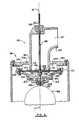
- the air relief valve assembly 85 has a relief valve housing 99 having three main components, namely an upper housing 102, an intermediate housing 104 and a lower housing 106, interconnected as shown.
- the upper housing 102 has the exhause vent 87 to vent air to atmosphere, and a lower end portion 110 which is cylindrical and concentric with a vertical housing axis 111.
- the intermediate housing 104 has a hollow cylindrical channel portion 112 which is concentric with the portion 110 and is secured thereto.
- the portion 112 has a lower edge portion which provides an annular seat 113 of the relief valve assembly, as will be described, and also has an annular outer portion 122 surrounding the portion 112.
- the relief valve assembly 85 includes a flexible diaphragm assembly 114 which has an outer periphery sandwiched between the housings 104 and 106 at a connection therebetween.
- the diaphragm assembly 114 has three layers joined together, namely an upper aluminum layer 116, a middle rubber layer 118, and a lower aluminum layer 120.
- the upper aluminum layer 116 has a smaller diameter than the lower layer 120, the lower layer 120 having a diameter equal to the seat 113.
- the lower housing 106 has a circular support portion 107 which supports the lower aluminum layer 120 and therefore supports the diaphragm in its lowered, open position.
- the housing 106 also includes a lower bushing 109 which projects upwardly sufficiently to be coplanar with the support 107 to similarly support the lower layer 120 of the diaphragm assembly.
- the bushing 109 has a opening 132 on the axis 111.
- the upper housing 102 carries an upper bushing 126 which has an opening 127 fitted with a scraper ring or lip seal and is aligned with the opening 132 of the lower bushing 109, the rod 88 being a sliding fit within the two aligned bores.
- the diaphragm assembly 114 has an opening 128 at the axis to accept the rod 88 therein.
- the rod 88 and opening 128 have diameters of 6.35 mm (1/4 inch) and 11.13 mm (7/16 inch) respectively.
- the opening 128 is slightly larger than the diameter of the rod 88 to provide a radial clearance of approximately 2.39 millimeters (3/32 inch) between the rod and the diaphragm.
- the opening 132 in the bushing 109 is about the same diameter as the opening 128 in the diaphragm to provide a similar radial clearance. Except for the clearances at the openings 128 and 132, the lower housing 206 forms an airtight cavity 134 below the diaphragm.
- a relief valve member 136 is rigidly attached to the rod 88 and is positioned inside the cavity 134 so as to move with the rod as follows.
- the member 136 can move from an upper closed position as shown in solid lines, which corresponds with a closed position of the diaphragm 114, to a lower open position, as shown in broken line at 136.1 which corresponds to the open position of the diaphragm.
- the valve member 136 forms an air and water tight seal with the opening 128 in the diaphragm, and when in the lower position, the valve member forms an air and water tight seal with the opening 132 in the bushing 109.
- the float 86 connected to the lower end of the rod 88, weighs about 1.82 kilograms (4 pounds) and is of suitable density to float on water. This weight is such that the float falls to its lower position when not supported by water, and when air pressure in the cavity 134 is less than about 1.76 kilograms per square centimeter (25 pounds per square inch).
- the clearances between the rod 88 and corresponding openings above, and weight of the float 86 are critical, and interrelated. The values specified above have been found by experiment to be suitable for a maximum discharge height above the apparatus of about 16 meters (50 feet). If the weight of the float is changed, or the radial clearance changed, or the height exceeds 50 feet, adjustments will be necessary to attain correct functioning of the relief valve assembly.
- the annular outer portion 122 of the intermediate housing 104 has a plurality of radial openings 142 passing therethrough to provide communication between the lower portion of the relief valve assembly, and an annular chamber 144 disposed between the inner and outer portions 112 and 122 of the housing 104.
- the rubber layer 118 forms an air and water tight seal with the seat 113 of the housing 104, preventing air or water from venting to atmosphere through the channel portion 112 and the vent 87. This corresponds to flow of mixture from the outlet valve above a minimum flow or minimum level in the duct.
- Apparatus within the float chamber establishes lower and intermediate mixture levels 164 and 165 within the main chamber, and the level 165 has a major effect on an uppermost mixture level 166 as will be described.
- the float chamber 64 of the anti-flooding valve 62 has a perforated float chamber wall 75 separating the interior of the float chamber assembly from the interior of the main chamber 12.
- the wall 75 has perforations 151 which are spaced closer together towards an upper end of the wall 75 than a lower end thereof, to permit rapid discharge of air through the perforations to increase pressure in the chamber 12 in the discharge mode. If air does not pass sufficiently quickly through the upper perforations 151, the float chamber could be dewatered too quickly, the ball 66 would be unsupported, and it could drop down to a lower portion of the float chamber and actuate prematurely the low level sensor means 73.
- the chamber would then be re-subjected to low pressure without first being emptied. Consequently, it is important to ensure that air is vented promptly through the upper portion of the wall 75 of the float chamber while there is still sufficient liquid level in the float chamber to support the ball above the low level sensor means 73.
- the conduit seat 71 of the conduit 68 is complementary to the float ball 66 so as to provide a seal therewith when the chamber is exposed to low pressure in the conduit 68, and water level in the main chamber 12 rises at least to the intermediate level 165 so that the ball assumes an upper position as shown in broken outline at 66.1.
- This seal essentially closes off the main chamber 12 from low pressure within the conduit 68 and initiates a sequence of operations as will be described.
- an end portion 153 of the conduit 68 is moveable axially of the float chamber so as to reposition the seat 71 at other locations, an alternative lower location being shown at 71.1 in broken outline.
- the location of the seat 71 is fairly critical, as it determines the intermediate level of mixture within the chamber 12, which determines the quantity of mixture within the tank when the low pressure within the chamber 68 is cut off or isolated by the ball 66. This determines the final or uppermost mixture level 166, which is below the valve seat 27 ( Figure 1) to prevent trapping of fish in the inlet valve assembly as will be described.
- the level sensor 73 at a lower end of the chamber 64 determines the location of the level 164 which is not very critical.
- the level 164 is established to provide a signal to shift a pressure control switch in preparation for changing pressure in the chamber, but not to initiate the actual change of pressure as will be described.
- the sensor 73 has a rocker arm 155 having an inner end hinged for rotation about a low friction hinge 156 having a horizontal axis. An outer end 158 of the rocker arm 155 is positioned below the conduit 68 so as to be contacted by the ball float 66 when the ball is unsupported by water within the chamber 64.
- An intermediate portion of the arm 155 carries an arm magnet 160 which extends below the arm and is adapted to cooperate with a valve magnet 162 of the level sensor valve 77.
- the valve 77 is a four-way, two-position hydraulic valve having an axially moveable spool which carries the magnet 162 and cooperates with the magnet 160.
- the actuation of the valve 77 by a magnet is generally similar to two-way, two-position spool valve assemblies of the flow sensors 34 and 92, and serves as an interchanging switch to change pressure within the chamber 12 to be described with reference to Figure 5.
- the low level sensor cleaner 78 has a cleaning nozzle 161 which is located closely adjacent the hinge 156 and is adapted to inject a jet of fluid under pressure generally along the rocker arm 155.
- the fluid passes above and below the rocker arm to remove any debris that may collect in the lower portion of the housing 64, for example, ice debris from refrigerated fish, which might otherwise prevent the rocker arm from moving downwardly under the weight of the ball 66 as will be described.
- the float chamber wall 75 has a discharge opening 168 adjacent a lower portion thereof, which is generally aligned with the nozzle 161, so as to receive debris cleared by the nozzle and to permit the debris to be exhausted from the housing.
- the fluid can be water, fed from an external pressurized source, not shown, which would merely mix with the mixture in the chamber.
- the fluid can be air under pressure fed by a separate line, not shown, from the vacuum pump exhaust 72, or alternatively can be from the main conduit 68 passing through a one-way check valve, not shown, between the float chamber 64 and the conduit 68.
- the check valve is necessary to prevent contamination of air drawn into the vacuum pump 70 when the chamber 12 is subjected to low pressure. As stated previously, it is important that the float chamber is not de-watered prematurely by injecting excessive air.
- the air volume flow should be relatively low to ensure that only debris is cleared from the rocker arm, and that sufficient water remains initially in the float chamber above the arm to ensure that the ball does not drop and contact the arm 155 prematurely as previously described.
- the inlet flow sensor 34 has a flow sensor housing 170 having generally flat, parallel side walls, one side wall 173 only being shown, and a curved connecting wall 175.
- the housing 170, the sensor valve 38 and the paddle 36 form a unit which is secured adjacent to an opening in the duct 25 (broken outline), so that the paddle projects therethrough into the duct.
- the inlet paddle 36 extends from a paddle rotor 176 which is journalled for rotation about a paddle axis 178 by means of low friction journals, not shown, mounted in the side walls.
- a paddle magnet 180 is mounted on the paddle rotor 176 in a position which is generally diametrically opposite to the paddle 36.
- the paddle rotor 176, the paddle magnet 180 and paddle 36 are integrally molded in a suitable plastic, with low friction journals molded within the plastic on the axis 178.
- the paddle is flexible so as to deflect when struck by a fish so as to essentially eliminate damage to the fish.
- the rotor has a circumference provided with a generally radially inclined shoulder 181, and the housing 170 has an inwardly projecting shoulder 183.
- the shoulders 181 and 183 are positioned relative to each other so as to interfere with each other when the rotor swings to a position 176.1 shown in broken outline in Figure 4 which occurs when the paddle 36 is moved to the deflected position 36.1 by flow within the duct.
- a magnet axis 179 extending from the axis 178 to a mid-point of the magnet 180 assumes a specific axis position 179.1 as will be described.
- the inlet flow sensor valve 38 has a valve body 182 having an inlet port 184, an outlet port 185 and a main bore 187, the ports communicating with the main bore.
- the main bore has a main axis 188 which, when projected, intersects the paddle axis 178 although this is not critical.
- the valve assembly includes a valve spool 190 mounted for axial movement within the bore between an open or first position, as shown, and a closed or second position in which the valve spool moves upwardly to the right as seen in Figure 4.
- the valve spool is generally cylindrical and has first and second end portions 191 and 192 which are generally complementary to the main bore.
- the first member serves as a closure means to close the outlet port 185 when the spool is in the closed position, not shown.
- a valve spring 195 is interposed between the second end portion 192 of the valve spool and an internal end cap 197 of the valve assembly.
- the valve spool has a reduced diameter portion 199 which has a diameter less than the diameter of the end portions and serves as a clearance means.
- the inlet and outlet ports are spaced axially along the main bore by a port spacing 202, and axial length of the clearance means approximates to the port spacing to permit transfer of fluid between the ports when the spool is correctly positioned axially relative to the port in the open position as shown.
- the spring 195 serves as a biasing means cooperating the valve spool to urge the spool to the open position, i.e. to form a "Normally Open" valve, however it could be re-positioned for other purposes.
- a valve magnet 205 is mounted on a magnet holding means 206 which extends outwardly and axially from the first end portion 191.
- the valve assembly includes a magnetically permeable housing 207 extending from an end thereof adjacent the first end portion of the spool, which encloses the magnet to isolate the magnet 205 and the valve 38 from material within the duct 25 and the housing 170. Isolating the valve and associated structure from the solid/liquid mixture prevents not only the mixture from contaminating the valve, but also prevents any leakage from the valve from contaminating the mixture. This is particularly important when handling food products such as fish.
- the housing 207 serves as a magnetically permeable protecting means to provide a magnet cavity 208 for the magnet 205, the cavity having an axial length which is at least equal to movement of the spool between the open and closed positions.
- the paddle magnet 180 and the valve magnet 205 are positioned so that like poles thereof are closely adjacent each other when, in response to force of flow against the paddle, the paddle 36 swings in direction of an arrow 209 through approximately 45° from the position shown in full outline to the position 36.1, to bring the magnets 180 and 205 closely adjacent each other.
- the magnet axis 179 on the rotor and the main axis 188 of the valve are inclined to each other at an angle 211, which is approximately between 3 degrees and 5 degrees from a position in which the axes would be aligned at a position of minimum spacing, i.e. maximum force, between the magnets.
- a relief conduit 212 communicates with a portion of the main bore containing the spring 195, the outlet port 185 and the the housing 207, so as to relieve any hydraulic lock that might otherwise occur and to drain leakage.
- valve spool 190 is not provided with 0-ring seals on the first and second end portions. Instead, the valve bore has a diameter which is sufficiently greater than the diameter of the valve member to produce a radial clearance therebetween. This permits hydraulic fluid leakage between the valve bore and the valve spool to completely flood the spool and conduits to prevent formation of air pockets. This reduces chances of seizure of the valve spool within the bore when the apparatus is inoperative for a long time.
- the paddle 36 actuates the valve 38 without any direct contact therebetween.
- Use of a magnetic field to actuate valves has the advantage that direct mechanical contact is avoided, which eliminates linkages, etc. that would normally be required for connecting the paddle 36 to the valve. Such linkages would normally be prone to collecting debris from the fish, as well as being exposed to the salt water.
- Use of magnets is this application has many advantages, particularly the simplification of interfacing between the flow sensor and the valve controlled by the flow sensor. This is particularly important in marine fishing applications in the highly corrosive environment of salt water where most mechanical components, if left unattended and coated with salt water, or with highly adhesive fish debris, are rapidly prone to seizure which would then require servicing prior to operation of the machine.
- Figure 4 discloses a two-way, two position or on/off valve which is used for the inlet and the outlet flow sensors 34 and 96 respectively.
- the level sensor or series valve 77 is a four-way, two-position valve in which the pairs of ports are interchanged between the two positions.
- the valve 77 serves as an interchanging switch means, as opposed to an on/off switch means, and thus does not have an open or closed position as described for the valve 38.
- the spool means of the valve 77 shifts between first and second positions to control flow between the ports and, being actuated magnetically, is considered equivalent to the on/off flow sensor valves.
- the pressure control valve 70 has a body 220 having a body cavity 222 communicating with five ports as follows: a main conduit port 224 which communicates with the conduit 68, first and second vent ports 225 and 226 communicating with atmosphere, and a high pressure port 229 communicating with the outlet conduit 76 ( Figure 1) from the vacuum pump 72, which functions as a compressor, and a low pressure port 228 communicating with the intake conduit 74 ( Figure 1) of the vacuum pump 72.
- the ports 225 and 228, and the ports 226 and 229 are disposed radially to each other at 90 degrees apart.
- First and second valve members 231 and 232 are journalled for rotation about first and second valve member axes 235 and 236 respectively to selectively open and close vent ports and pressure ports respectively.
- the valve members have undesignated clearance portions which permit communication between ports disposed at 90 degrees to each other as follows.
- the first valve member 231 is shown in a position in which the pump inlet receives air from the port 228 which was drawn through the vent port 225 from atmosphere.
- the second valve member 232 is shown with the body cavity 222 exposed to high pressure from the pump outlet discharged through the port 229, thus exposing the main conduit port 224 and the conduit 68 to high pressure.
- the first and second valve members 231 and 232 have first and second valve levers 239 and 240 respectively which extend parallel to each other to cooperate with a piston rod 242 of a valve actuating cylinder assembly 244.
- the cylinder assembly 244 has a cylinder body 246 having first and second cylinder ports 247 and 248 respectively, and a piston 250 attached to an inner end of the piston rod.
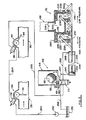
- Figure 5 is also a fluid schematic showing control fluid connections between the main directional valve 70, the inlet and outlet flow sensor valves 38 and 96 respectively, and the level sensor or series valve 77.
- a hydraulic fluid pump 252 supplies fluid from a sump 251 under pressure to the valve 38 through an outfeed conduit 253.
- a first valve conduit 254 extends from the inlet sensor valve 38 to the outlet sensor valve 96.
- a second valve conduit 255 extends from the valve 96 to connect with a corresponding port in the liquid level sensor valve 77.
- the inlet and outlet flow sensor valves receive fluid under pressure in series as shown and serve as on/off switches to control other structures.
- a return conduit 256 returns fluid from the valve 77 to the sump 251.
- First and second actuator conduits 257 and 258 extend from the first and second ports 247 and 248 of the actuating cylinder 244 to respective ports in the level sensor valve 77.
- valve 77 is a two-position, four-way spool valve which is magnetically actuated by magnets 161 and 162 similarly to the inlet and outlet flow valves, but has a known spool and porting structure which permits port interchanging function similar to many prior art two-position, four-way valves and thus is not described in detail.
- Figure 5 depicts a status of the apparatus sometime after initiation of a discharge mode in which the valve actuating cylinder assembly 244 is retracted as shown in full outline.
- the high pressure port 229 is exposed to the outlet from the pump and directs high pressure air to the port 224 and to the conduit 68.
- the port 228 is exposed to atmosphere and the intake of the vacuum pump.
- the inlet and outlet paddles 36 and 94 would normally hang freely generally vertically, the inlet paddle being shown in such a position at 36.1.
- the inlet and outlet valve plates 29 and 54 hang generally vertically as shown for the inner valve plate in broken outline at 29.1, and in full outline for the outlet valve plate 54.
- the float ball 66 of the anti-flooding valve 62 is in a lowered position, resting on the rocker arm 155, see Figures 3 and 5.
- the magnets 161 and 162 repel each other so as to set the series valve 77 in a position as shown in Figure 5 in which the second valve conduit 255 is connected, through the series valve 77, to the first port 247 of the valve actuator cylinder, and the port 248 of the valve actuator cylinder is connected to the sump 251.
- the valve levers 239 and 240 are in positions as shown in full outline in Figure 5 as a result of a previously applied high pressure to the chamber.
- the pump 252 supplies pressurized fluid to the conduit 253, which passes in sequence through the opened valves 38 and 96, and enters the series valve 77 through the conduit 255.
- Pressurized fluid leaves the valve 77 and enters the port 247 of the actuator cylinder 244, extending the piston rod 242 thereof, and associated valve levers to broken outline positions 242.1, 239.1 and 240.1 respectively.
- the valve members 231 and 232 are swung through 90° to new positions, not shown in Figure 5, in which suction from the pump is applied through the port 228 to the main conduit port 224, and exhaust from the pump passes to atmosphere through the ports 229 and 226.
- the main conduit 68 is subjected to low pressure which opens the inlet valve 16 of the main chamber, and closes the outlet valve 18.
- Low pressure within the chamber 12 draws the fish/liquid mixture up the intake hose 21, and over the apex 42 and downwardly through the inlet valve 16 into the chamber 12.
- Flow of the mixture through the inlet duct 25 displaces the inlet paddle 36 to the deflected position as shown in full outline in Figure 1. This causes the magnets to swing towards each other, assume the relative position as shown for the valve 96 in Figure 5, thus repelling the spool and closing the valve 38.
- high pressure fluid in the line 253 is now stopped at the first valve 38, and the series valve 77 is no longer exposed to high pressure fluid.
- the liquid level in the chamber 12 continues to rise and eventually the float ball 66 seats against the seat 71 of the main conduit 68, closing off low pressure applied to the chamber 12.
- the float ball 66 in combination with the valve seat 71 serve as quantity sensing means responsive to the predetermined intermediate quantity of mixture within the chamber to isolate the chamber from low pressure when the predetermined intermediate quantity is reached.
- level of liquid within the chamber is approximately at the uppermost level 166, Figure 3. This is a maximum or uppermost level of liquid reached in the chamber and will vary somewhat, but is always below level of the inlet valve 16. In this way, solids within the chamber 12 cannot interfere with closure of the inlet valve plate 29. As indicated above, any fish that might have a tendency to come to rest on the apex 42 would tend to fall forwardly into the chamber by sliding along the lower surface of the duct, or backwardly into the inlet hose 21. This ensures that the valve seat 27 and plate 29 are maintained free and clear of obstructions permitting it to seat securely.
- the high pressure port 229 is opened to outlet from the pump, which feeds pressurized air from the main conduit 68 in to the anti-flooding chamber, displacing the ball 66 from the seat thereof.
- Air under pressure rapidly passes through the perforations 151 in the wall 75 between the two chambers, and pressurizes the remaining air space in the chamber 12 which causes the valve plate 29 to close (as shown in broken outline in Figure 1 at 29.1).
- the inlet paddle 36 and the flow sensor valve 38 of the inlet flow sensor means are responsive to inlet flow of mixture to activate the pressure raising means when said flow stops, so as to provide time for solids to clear the inlet valve before closure thereof.
- the float ball 66 As level of liquid within the chamber 12 lowers, the float ball 66 simultaneously lowers, until it reaches the level 164 and contacts the rocker arm 155 ( Figure 3). If any ice flakes or debris has accumulated adjacent the rocker arm 155, fluid under pressure is applied to the cleaning nozzle 161, which clears the rocker arm and discharges any ice or debris through the discharge opening 168 into the receiving chamber. As the weight of the ball is applied to the arm, the arm swings downwardly and the magnets repel each other, thus shifting the series valve 77 to the position as shown in Figure 5. However, shifting the series valve 77 has no immediate effect as the valve 77 is isolated from pressurized fluid, as the valve 96 is now closed. However, the direction of flow to the ports in the cylinder 244 have now been interchanged, and are set to change application of pressure to the chamber 12 when required.
- valve actuating cylinder means 244, the pressure control valve 70, the vacuum pump 72 and interconnecting structure serve as means for raising pressure and means for lowering pressure within the chamber.
- the float 66, the rocker arm 155 and level sensor valve 77 and associated structure serve as mode selecting means for selecting mode of operation of the apparatus.
- the mode selecting means is responsive to quantity of mixture within the chamber and selectively controls the pressure lowering means and pressure raising means to control application of pressure to the chamber so as to lower pressure in the chamber in the induction mode and to raise pressure in the discharge mode.
- the outlet valve is responsive to pressure in the chamber so as to close upon lowering of pressure in the chamber to hold the mixture in the chamber, and to open upon raising of pressure in the chamber so as to discharge the mixture from the chamber.
- the float is constrained for movement relative to the valve seat between upper and lower portions of the housing in response to changes of level of mixture within the receiving chamber.
- the quantity sensing means is thus responsive to a predetermined lower quantity of mixture within the chamber, namely the lower level 164, and is adapted to select a subsequent mode of operation of the apparatus when the lower quantity of mixture is attained, whether the level is rising or falling, in order to prepare the apparatus for a change in pressure in the chamber.
- the mode selecting means cooperates with the inlet flow sensor through the conduits 254 and 255 so as to expose the chamber to high pressure when flow in the inlet duct ceases, so as to initiate the discharge mode of the apparatus.
- the mode selecting means also cooperates with the outlet flow sensor through the conduit 255 so as to expose the chamber to low pressure when the flow in the outlet duct ceases, to initiate an induction mode.
- the air relief valve assembly 85 exhausts any undesirable air from the chamber 12 and outlet duct 80 to atmosphere, to prevent substantial quantities of air passing with the mixture discharged through the discharge duct.
- Pressure in the discharge duct forces water upwardly through perforations in the wall 89 into the relief valve housing 99, raising the float ball 86 to attain the raised position shown in Figure 2.
- the diaphragm 114 assumes the full outline position as shown, and seals the hollow cylindrical channel 112 around the seat 113, preventing air or water from passing through the vent 87.
- the diaphragm 114 is urged to its closed position by pressure in the housing 99, which passes through the opening 132 and is higher than atmospheric.
- the air relief valve assembly 85 is generally responsive to a minimum level of water in the duct 80, that is a level sufficient to raise the float 86 to close the diaphragm 114, and vice versa.
- the diaphragm and the corresponding seat 113 provide the air relief valve means which has an intake, i.e. the perforated wall portion 89 communicating with the outlet duct 80, an exhaust vent 87 vented to atmosphere, and an air relief valve, i.e. the diaphragm etc., controlling flow therebetween.
- the float 86 communicates with mixture in the outlet duct so as to float on the mixture when flow of the mixture from the chamber is above a minimum level, and to move to a lower level when flow from the chamber is below the minimum level.
- the float cooperates with the air relief valve member to open and close the diaphragm as required.
- the apparatus has been disclosed for use with an automatic valve sequencing system, in which flow sensors in either the inlet duct or the outlet duct detect when flow therein ceases, which then applies either low pressure or high pressure to the chamber 12 to initiate the next stage or mode of the cycle.
- manual operation might be preferred, and this can be accomplished by disconnecting or eliminating by use of alternative valves the inlet and outlet flow sensors, the level sensor and associated circuitry, and instead monitoring visually cessation of the flow in the ducts.
- the pressure control valve 70 can be shifted manually or by hydraulic or electrical means or equivalents.
- the apparatus has been disclosed for use with a single receiving chamber, in which a single vacuum pump can be used, and in which the intake to the pump provides a low pressure source, and the outlet from the pump provides a high pressure source.
- Efficiency can be increased by providing twin chambers which are fed from a common intake hose, which is bifurcated to feed two separate flows, as required, into the rigid inlet ducts 25 of each chamber.
- a twin chamber embodiment not shown, a first chamber is exposed to low pressure and receives the flow from the hose and through one branch of the bifurcated duct, while the second chamber is subjected to high pressure and is discharging a previously received load. With twin chamber operation a separate compressor and vacuum pump is required.
- While the invention is disclosed using a hydraulic circuit for controlling pressure cycles of the chamber 12 by using three two-position hydraulic spool valves, other control circuits are envisaged.
- an electrical circuit using magnetically actuated switches as a substitute for the two-position hydraulic valves can be substituted.
- the flow sensor valves 38 and 96, and the level sensor valve 77 are axially slidable spool valves which are magnetically actuated by close proximity to a magnet, in which like poles of the magnets are disposed to be closely adjacent each other.
- a magnetically permeable wall is interposed between the two magnets, so as to isolate the valve structure from contaminants in the environment of the other magnet and vice versa.
- any 0-ring seals are eliminated and a small leakage of fluid is also desirable to reduce forces involved in shifting the spool.
- the benefits of this type of valve actuation can also be attained by use of two magnets in which unlike poles are adjacent each other, that is the magnets would attract each other. This would require repositioning of the valve spring. Also, in some applications it might be preferable to eliminate one magnet, and merely to provide an armature of ferromagnetic material or magnetically responsive means to be attracted to the remaining magnet.
- valve is shown as an axially slidable spool valve, it would be possible to obtain the benefits of this invention by incorporating at least one magnet in a rotary valve to obtain similar effects which permit actuation of the valve "at a distance" without direct mechanical contact. While the valve is shown for use with a fish pump, clearly it has applications in many other areas where valve actuation cannot be attained with direct mechanical contact, and electrical or other means are not desirable.
Landscapes
- Life Sciences & Earth Sciences (AREA)
- Environmental Sciences (AREA)
- Engineering & Computer Science (AREA)
- Mechanical Engineering (AREA)
- Marine Sciences & Fisheries (AREA)
- Animal Husbandry (AREA)
- Biodiversity & Conservation Biology (AREA)
- Flow Control (AREA)
- Multiple-Way Valves (AREA)
Abstract
The invention provides an apparatus and method for handling a solid/liquid mixture, for example for conveying fish immersed in a fish/water mixture. The apparatus has a receiving chamber (12) to receive the mixture through an inlet valve (16) when the chamber is subjected to low pressure, and to discharge the mixture through an outlet valve (18) thereof when pressure in the chamber is increased. A quantity sensor (73) is responsive to a predetermined quantity of mixture within the chamber (12) to isolate the chamber from low pressure when the predetermined quantity is reached. The inlet valve (16) is positioned adjacent an upper portion of the chamber above a maximum upper level of mixture within the chamber, and has seat clearing structure to clear the inlet valve seat of solids when flow therethrough ceases. An inlet flow sensor (34) is responsive to inlet flow of mixture through the inlet valve and raises pressure in the chamber when the flow therethrough stops, to provide time for solids to clear the inlet valve (16) before closure thereof. The quantity sensor (73) also has a mode selector for selecting mode of operation of the apparatus which is responsive to quantity of mixture and controls pressure changes within the chamber. A valve/switch which controls actuation of controls for changing pressure within the chamber is magnetically responsive to flow sensors (34, 92) disposed within inlet and outlet ducts to permit actuation of the valve/switch without mechanical contact therewith. This isolates the valve/switch from contamination with the mixture in the duct and vice versa.
Description
- The present invention is closely related to an earlier invention entitled "Apparatus and method for handling solids in liquid "as described and claimed in U.S. Patent 4,517,099, issued 14 May 1985 to Raymond A. Breckner, one of the inventors herein. The patent, the disclosure of which is incorporated herein by reference, describes a device having a chamber with inlet and outlet valves, the inlet valve being positioned at an upper portion of the tank so as to be clear of a maximum upper level of liquid within the tank. Mixture is drawn into the tank, when exposed to a low pressure source, through an inlet duct which has an upwardly curved riser means which constrains the mixture to pass initially upwardly, prior to discharging downwardly through the inlet valve. The inlet valve is a hinged plate which is opened when the pressure within the chamber is reduced, and closes when the pressure is increased. The patented device has an outlet valve at a lower portion thereof, which has a hinged plate which is closed by reduced pressure within the chamber, and opened when pressure increases.
- The patented device provides a means of ensuring that the inlet valve can close without trapping fish that might otherwise become inadvertently trapped therein. As the chamber fills, the mixture attains a predetermined level at which time the low pressure source is isolated from the chamber. The mixture continues to flow through the inlet duct until the pressure differential across the inlet valve is insufficient to maintain the inlet flow, at which time the flow ceases. Any fish that might tend to rest on the inlet valve will fall forwardly through the valve into the chamber, or backwardly into the inlet duct. Prior to raising pressure in the chamber, sufficient time is allowed to permit flow through the inlet valve to cease, and to permit any solids that might collect adjacent the valve to fall from the valve, thus permitting the inlet valve to close cleanly. The above patent thus discloses an arbitrary time delay to ensure that flow in the inlet duct has ceased prior to closure of the inlet valve. However, it does not provide any means of directly measuring when flow through the inlet duct has actually ceased, and thus, to accommodate many variables in different installations, it is usual to provide a conservatively excessive time for flow through the inlet duct to cease, prior to raising pressure in the chamber.
- While providing an excessive time for flow through the inlet duct to cease ensures that the inlet valve can close without trapping solids upon raising of the pressure, in many situations excessive time is wasted when there is no flow in the duct and the pressure in the chamber is not rising.
- Pumps for conveying fish immersed in water, for example from fish holds onto a dockside, or within a fish processing plant, have been used for many years. It is well known that fish debris, e.g. fish scales, fins, roe, etc., from damaged fish is highly adhesive or tenacious and is prone to sticking to any mechanism that is exposed to the debris, and in a short while the mechanism can become seized and no longer functions. Clearing fish debris from such mechanism can be very time consuming, as sometimes considerable mechanical force is required to remove the contaminants. Consequently, any attempt to directly detect or sense flow of a liquid/fish mixture in a duct is susceptible to seizure if the apparatus is not used for some time. Because fish handling equipment tends to be used only during and shortly after the fishing season, such equipment tends to be left for long periods of time without being used, and even after thorough cleaning, is prone to seizure due to tenacious characteristic of fish debris.
- The invention reduces the difficulties and disadvantages of the prior art by providing an apparatus and method in which flow in a inlet duct upstream of the inlet valve can be detected directly without requiring a selected time period or time delay sufficient for flow through the duct to cease. Thus, the time delay disclosed in the previous patent is not required as cessation of flow can be detected directly in the present invention. Flow through an outlet duct from the apparatus can also be sensed directly, and thus timing of changes of pressure applied to the chamber can be accurately controlled, so as to avoid inadvertently early or late closing of inlet or outlet valves, as a result of pressure changes within the chamber. The present invention also uses an inlet valve seat clearing structure similar to the patented inlet clearing structure which permits any solids that might otherwise tend to come to rest adjacent the inlet valve when the mixture flow therethrough ceases to fall under gravity either forwardly through the inlet valve and into the chamber, or backwardly through the inlet duct.
- By sensing flow in both the inlet and outlet ducts, the invention can be installed in many different installations, with different heights for both drawing mixture into the chamber, and for pumping mixture from the chamber, without requiring many test runs to provide timing adjustment for pressure changes for specific installations. Direct monitoring of cessation of flow in the ducts ensures that pumping efficiency is improved because pressure changing can occur within the chamber essentially immediately after flow in the inlet and/or outlet duct ceases.
- Also the invention is capable of pumping liquid to discharge at a location either above the apparatus, or below the apparatus without requiring a large number of tests at the installation.
- Furthermore, the apparatus uses a control system which, if desired, can be fully hydraulic, and thus requires no electrical components for actuation of valves, detecting fluid levels or flow within ducts, etc. Furthermore, the apparatus can use novel hydraulic valves which are actuated remotely, under relatively low forces generated by magnets, and this permits use of relatively low fluid pressures which enables use of low pressure hoses, pumps, etc., requiring less energy for operation, and lower standards for pressurized fluid components, thus reducing initial costs and maintenance costs. The use of remotely actuated valves simplifies construction and permits complete isolation of the valve mechanism from contaminants. Isolating the valve from the mixture also prevents possible contamination of the mixture with oil from the valve. This provides an apparatus which can be used on an irregular basis, with long periods of non-use between uses, with negligible problems resulting from contamination due to salt water corrosion, or foreign body contamination such as fish debris tending to seize or restrict movement of delicate flow detecting components, valve actuators, etc.
- The invention provides an apparatus which comprises a receiving chamber, pressure lowering and raising means, quantity sensing means, valve seat clearing means and an inlet flow sensor. The receiving chamber is adapted to receive the mixture from an inlet duct in an induction mode and to hold the mixture temporarily prior to discharging the mixture in a discharge mode. The chamber has inlet and outlet valves, the inlet valve communicating with the inlet duct to receive the mixture and being positioned adjacent an upper portion of the chamber above an uppermost level of mixture within the chamber. The pressure lowering means is for lowering pressure in the chamber to expose the inlet valve to a pressure difference so as to open the inlet valve and to draw mixture therethrough in the induction mode. The pressure raising means is for raising pressure in the chamber in the discharge mode which tends to close the inlet valve. The quantity sensing means is responsive to a predetermined intermediate quantity of mixture within the chamber to isolate the chamber from low pressure when said predetermined intermediate quantity is reached. The valve seat clearing means clears the inlet valve of solids when flow therethrough ceases. The inlet flow sensor means is responsive to inlet flow of mixture in said inlet duct to actuate the pressure raising means when the said flow stops, so as to provide time for solids to clear the inlet valve before closure thereof.
- Preferably, the apparatus includes an outlet duct to receive flow from the outlet valve, with an outlet flow sensor means responsive to the outlet flow in the outlet duct which deactivates the pressure raising means when flow from the outlet valve ceases. Preferably, the inlet and outlet flow sensor means comprise a rotatable paddle extending into the respective duct and mounted for rotation between an undeflected position when there is essentially no flow in the duct, and a deflected position which is responsive to flow of mixture in the duct. Preferably, switch means cooperate with the pressure raising means to activate the pressure raising means when the paddle is in an undeflected position. Preferably, the switch means is magnetically actuated by magnetically responsive means associated with the paddle and the switch means. Also, an air relief means for purging air from the mixture as it leaves the chamber is generally responsive to minimum depth of mixture in an outlet duct extending from the chamber. The relief means has an intake communicating with the outlet duct, and an exhaust vented to atmosphere, with an air relief valve member controlling flow therebetween.
- The invention also provides a method of handling a solid/liquid mixture in which the mixture is temporarily stored within a receiving chamber, the method including the steps as follows. An inlet valve is positioned adjacent an upper portion of the chamber above an uppermost level of mixture within the chamber. The chamber is exposed to low pressure to generate a pressure difference across the inlet valve so as to open the inlet valve and draw the mixture into the chamber. When the amount of mixture within the chamber attains a predetermined intermediate quantity, the low pressure is disconnected from the chamber. The method is characterized by sensing when the flow of mixture in an inlet duct adjacent the inlet valve ceases, which permits the inlet valve to clear, prior to increasing pressure in the chamber after the flow of mixture in the inlet duct ceases which closes the inlet valve. When the chamber is pressurized the outlet valve of the chamber is opened to discharge the mixture from the chamber. Preferably, after exhausting the mixture through the outlet valve into an outlet duct, any excess air carried in the mixture into the outlet duct is exhausted to atmosphere.
- A directional fluid valve which has particular application in the present invention has a valve body, a valve member, and a magnetically responsive means. The valve body has an inlet port, an outlet port and a main bore, the ports communicating with the main bore. The valve member is mounted within the main bore for movement between first and second positions. The valve member has a clearance means and a closure means to control flow between the ports. A magnetically responsive means is associated with the valve member and is responsive to an adjacent magnetic field to move the valve member from one position to another. Preferably, a magnetically permeable protecting means is positioned adjacent the valve member to provide a cavity for the magnetically responsive means, the cavity having a size to accommodate movement of the valve member between the open and closed positions.
- A detailed disclosure following, related to drawings, describes preferred method and apparatus according to the invention, which are capable of expression in method and apparatus other than those particularly described and illustrated.
-
- Figure 1 is a simplified, fragmented side elevation of the apparatus, shown partially schematically with portions removed for clarity, showing the apparatus approximately halfway through an induction mode of a cycle, in which a receiving chamber is exposed to low pressure and flow enters the chamber through an inlet duct thereof,
- Figure 2 is a simplified fragmented section in a vertical plane through an air relief means associated with an outlet duct of the apparatus,
- Figure 3 is a simplified fragmented section in a vertical plane of a quantity sensing means associated with the receiving chamber of the apparatus,
- Figure 4 is a simplified fragmented section in a vertical plane through a flow sensing means and associated switch means of the invention,
- Figure 5 is a simplified hydraulic schematic showing hydraulic components associated with three sensors of the apparatus and a pressure changing control means, the apparatus being shown approximately midway through a discharge mode of a cycle of the apparatus.
- An
apparatus 10 according to the invention has a receivingchamber 12 supported at a desired inclination on a frame 14, shown partially in broken outline. The chamber has aninlet valve assembly 16 and a rigidcurved inlet duct 25 at an upper end thereof, and anoutlet valve assembly 18 at a lower end thereof. Anintake hose 21 has anintake funnel 23 at an outer end thereof, and an inner end connected to the rigidcurved inlet duct 25. If necessary, theintake hose 21 can be flexible so that thefunnel 23 can be moved within a fish hold, or other container holding fish immersed in water, so as to draw the fish in a fish/water mixture from the hold or container, up thehose 21 and into thechamber 12, when thechamber 12 is subjected to low pressure in an induction mode as will be described. - An inner end of the
duct 25 provides aninlet valve seat 27 which is a portion of theinlet valve assembly 16. Theassembly 16 also includes aninlet valve plate 29 which is hinged at an upper end thereof to ahinge 31 which permits the valve plate to swing between an open position as shown in full outline, and a closed position as shown in broken outline at 29.1. Thevalve seat 27 is disposed in a generally vertical plane, or preferably overhanging the vertical plane by a few degrees, and thehinge 31 is relatively free, and thus theplate 29 would tend to hang essentially vertically, closely adjacent theseat 27. Thevalve plate 29 is displaced to the inclined open position as shown in full lines in Figure 1 by force of a stream ofmixture 32 flowing through theinlet valve 16. - The
inlet duct 25 has aninlet flow sensor 34 which has aninlet paddle 36 which can swing between a deflected position shown in full outline which results from mixture flowing through theduct 25, to a non-deflected position as shown in broken outline at 36.1 when there is no flow in theduct 25. The paddle returns by gravity from the deflected position to the undeflected position when the flow ceases. The inlet flow sensor is responsive to flow of mixture in the duct and actuates an inletflow sensor valve 38 which controls timing of application of high pressure to the chamber as will be described. - The
inlet duct 25 has acentral duct axis 40 which is generally L-shaped, to provide an apex 42 at an inner corner of the duct. An upstream portion of theduct axis 40 is inclined at an angle 44 to the vertical as shown, and a downstream portion of the duct axis is inclined at anangle 46 to the horizontal as shown. The apex 42 thus causes mixture moving up the duct to move initially upwardly, over the apex, and then to pass downwardly through the inlet valve into thechamber 12. The apex 42 essentially eliminates any fish resting in theduct 25 downstream from thesensor 34 and serves as valve seat clearing means to clear theinlet valve seat 27 of solids as follows. Alower surface 48 of the duct adjacent thevalve seat 27 is inclined to the horizontal sufficiently to cause any fish that might come to rest thereon to fall under gravity through the valve into thechamber 12. This inclination of the lower surface effectively prevents any fish from resting on the duct surface or across the valve seat when flow through the duct ceases. It is added that theinlet valve 16 is positioned adjacent the upper portion of the chamber which is above an uppermost of level of mixture within the chamber, as will be described with reference to Figure 3. The downwardly sloping lower surface of the inlet duct adjacent the inlet valve, and the relatively high location of the inlet valve within the chamber ensures that the valve plate can close against the valve seat when required, as will be described. - The
outlet valve assembly 18 has anoutlet valve seat 52, and anoutlet valve plate 54 hinged at ahinge 56 above the seat to permit the plate to swing against the seat to close the outlet of the chamber. Similarly to the inlet valve assembly, theoutlet valve seat 52 is disposed in a generally vertical plane, so that the valve plate can hang freely to be closely adjacent the valve seat. The chamber has alower surface 58 which is inclined to the horizontal to permit fish, assisted by airflow as will be described, to discharge through the valve when open, so as to reduce the chance of fish resting on the outlet valve seat. Thevalve plate 54 can swing between the closed position as shown in full outline in Figure 1, and an open position as shown in broken outline at 54.1 when liquid discharges through the outlet of the tank. - The apparatus includes an
anti-flooding valve assembly 62 which includes a float chamber or floathousing 64 having afloat ball 66 therein. The float chamber is located relative to, and communicates with, themain chamber 12. Amain pressure conduit 68 cooperates with an upper portion of thechamber 62, and has an upper end providing aconduit valve seat 71 which cooperates with the float-ball 66 so as to define a pre-determined intermediate level of liquid within themain chamber 12, ie quantity of mixture, as determined by the density of the float and other variables, to be described with reference to Figure 3. Theconduit 68 has a lower portion which extends to a 5-waypressure control valve 70 which is to be described with reference to Figure 5. Avacuum pump 72, which serves also as a compressor, has intake andoutlet conduits 74 and 76 cooperating with thevalve 70 as will be described in Figure 5. - A lower level sensor means 73 is located adjacent a lower portion of the
float chamber 64 and is contacted by thefloat ball 66 when level in the main chamber drops as the chamber is emptied. The sensor means 73 actuates a level sensor valve orseries valve 77 as will be described with reference to Figure 3. Awall 75 of the float chamber separating the float chamber from the main chamber is perforated in such a way that more perforations are located adjacent the upper portion of thewall 75 than the lower portion. In this way, air can escape easily from the upper portion of the float chamber, while fish debris and other contaminants are essentially prevented from entering the float chamber which would otherwise tend to interfere with the level sensor means 73. A lowlevel sensor cleaner 78 cooperates with themeans 73 as will be described with reference to Figure 3. - The
apparatus 10 includes arigid outlet duct 80 communicating with theoutlet valve 18, and adischarge hose 82 is connected to theduct 80 and carries mixture from the apparatus to another location, which can be either above or below thetank 12 as will be described. The outlet duct communicates with an airrelief valve assembly 85 which extends upwardly from an upper wall of the outlet duct and has anexhaust vent 87 to discharge air from the duct to atmosphere as will be described with reference to Figure 2. Aportion 89 of the outlet duct wall extending between therelief valve 85 and the duct is perforated to prevent fish and debris from entering the relief valve assembly, while permitting water and air to flow thereinto for purposes to be described. Thevalve assembly 85 includes afloat 86 secured to a lower end of arod 88 extending downwardly within theassembly 85 to be immersed in liquid discharged from thevalve 18. - The apparatus also includes an
outlet flow sensor 92 cooperating with theoutlet duct 80 which has anoutlet paddle 94 which is hinged for rotation about an upper end thereof between an undeflected position as shown in full outline, when there is no flow in the duct, to a deflected position as shown in broken outline at 94.1, which is in response to force from flow within the duct. Thepaddle 94 actuates an outletflow sensor valve 96. The inlet andoutlet flow sensors respective sensor valves - The air
relief valve assembly 85 has arelief valve housing 99 having three main components, namely an upper housing 102, anintermediate housing 104 and alower housing 106, interconnected as shown. The upper housing 102 has the exhause vent 87 to vent air to atmosphere, and alower end portion 110 which is cylindrical and concentric with a vertical housing axis 111. Theintermediate housing 104 has a hollowcylindrical channel portion 112 which is concentric with theportion 110 and is secured thereto. Theportion 112 has a lower edge portion which provides anannular seat 113 of the relief valve assembly, as will be described, and also has an annularouter portion 122 surrounding theportion 112. - The
relief valve assembly 85 includes a flexible diaphragm assembly 114 which has an outer periphery sandwiched between thehousings upper aluminum layer 116, amiddle rubber layer 118, and alower aluminum layer 120. Theupper aluminum layer 116 has a smaller diameter than thelower layer 120, thelower layer 120 having a diameter equal to theseat 113. An intermediate annular portion of therubber layer 118, disposed between theupper aluminum layer 120 and an outer periphery of the diaphragm provides flexibility for the diaphragm to permit it to move between a raised closed position, as shown in full outline, and a lowered open position as shown in broken outline at 114.1. Thelower housing 106 has acircular support portion 107 which supports thelower aluminum layer 120 and therefore supports the diaphragm in its lowered, open position. Thehousing 106 also includes alower bushing 109 which projects upwardly sufficiently to be coplanar with thesupport 107 to similarly support thelower layer 120 of the diaphragm assembly. Thebushing 109 has aopening 132 on the axis 111. - The upper housing 102 carries an
upper bushing 126 which has anopening 127 fitted with a scraper ring or lip seal and is aligned with theopening 132 of thelower bushing 109, therod 88 being a sliding fit within the two aligned bores. The diaphragm assembly 114 has anopening 128 at the axis to accept therod 88 therein. Therod 88 andopening 128 have diameters of 6.35 mm (1/4 inch) and 11.13 mm (7/16 inch) respectively. Thus theopening 128 is slightly larger than the diameter of therod 88 to provide a radial clearance of approximately 2.39 millimeters (3/32 inch) between the rod and the diaphragm. Theopening 132 in thebushing 109 is about the same diameter as theopening 128 in the diaphragm to provide a similar radial clearance. Except for the clearances at theopenings lower housing 206 forms anairtight cavity 134 below the diaphragm. - A
relief valve member 136 is rigidly attached to therod 88 and is positioned inside thecavity 134 so as to move with the rod as follows. Themember 136 can move from an upper closed position as shown in solid lines, which corresponds with a closed position of the diaphragm 114, to a lower open position, as shown in broken line at 136.1 which corresponds to the open position of the diaphragm. When in the upper closed position, thevalve member 136 forms an air and water tight seal with theopening 128 in the diaphragm, and when in the lower position, the valve member forms an air and water tight seal with theopening 132 in thebushing 109. Thefloat 86, connected to the lower end of therod 88, weighs about 1.82 kilograms (4 pounds) and is of suitable density to float on water. This weight is such that the float falls to its lower position when not supported by water, and when air pressure in thecavity 134 is less than about 1.76 kilograms per square centimeter (25 pounds per square inch). The clearances between therod 88 and corresponding openings above, and weight of thefloat 86 are critical, and interrelated. The values specified above have been found by experiment to be suitable for a maximum discharge height above the apparatus of about 16 meters (50 feet). If the weight of the float is changed, or the radial clearance changed, or the height exceeds 50 feet, adjustments will be necessary to attain correct functioning of the relief valve assembly. - The annular
outer portion 122 of theintermediate housing 104 has a plurality ofradial openings 142 passing therethrough to provide communication between the lower portion of the relief valve assembly, and anannular chamber 144 disposed between the inner andouter portions housing 104. When the diaphragm is in the closed upper position as shown in full outline, therubber layer 118 forms an air and water tight seal with theseat 113 of thehousing 104, preventing air or water from venting to atmosphere through thechannel portion 112 and thevent 87. This corresponds to flow of mixture from the outlet valve above a minimum flow or minimum level in the duct. When the diaphragm is in the open position, air from thehousing 99 passes through theradial openings 142, into theannular chamber 144, past theseat 113 and into thechannel portion 112 and upper portion 102 to atmosphere through thevent 87. This corresponds to low level or essentially zero flow from the outlet valve and provides a means for exhausting air when mixture drains from theassembly 85 as will be described. - Apparatus within the float chamber establishes lower and
intermediate mixture levels level 165 has a major effect on anuppermost mixture level 166 as will be described. - As previously described, the
float chamber 64 of theanti-flooding valve 62 has a perforatedfloat chamber wall 75 separating the interior of the float chamber assembly from the interior of themain chamber 12. Thewall 75 hasperforations 151 which are spaced closer together towards an upper end of thewall 75 than a lower end thereof, to permit rapid discharge of air through the perforations to increase pressure in thechamber 12 in the discharge mode. If air does not pass sufficiently quickly through theupper perforations 151, the float chamber could be dewatered too quickly, theball 66 would be unsupported, and it could drop down to a lower portion of the float chamber and actuate prematurely the low level sensor means 73. If this actuation occurred before there was sufficient outlet flow from thechamber 12, the chamber would then be re-subjected to low pressure without first being emptied. Consequently, it is important to ensure that air is vented promptly through the upper portion of thewall 75 of the float chamber while there is still sufficient liquid level in the float chamber to support the ball above the low level sensor means 73. - The
conduit seat 71 of theconduit 68 is complementary to thefloat ball 66 so as to provide a seal therewith when the chamber is exposed to low pressure in theconduit 68, and water level in themain chamber 12 rises at least to theintermediate level 165 so that the ball assumes an upper position as shown in broken outline at 66.1. This seal essentially closes off themain chamber 12 from low pressure within theconduit 68 and initiates a sequence of operations as will be described. Preferably, anend portion 153 of theconduit 68 is moveable axially of the float chamber so as to reposition theseat 71 at other locations, an alternative lower location being shown at 71.1 in broken outline. This lower location would result in theball 66 rising to a lower intermediate level 165.1 and being held at a lower position within the chamber, shown at 66.2. The location of theseat 71 is fairly critical, as it determines the intermediate level of mixture within thechamber 12, which determines the quantity of mixture within the tank when the low pressure within thechamber 68 is cut off or isolated by theball 66. This determines the final oruppermost mixture level 166, which is below the valve seat 27 (Figure 1) to prevent trapping of fish in the inlet valve assembly as will be described. - The
level sensor 73 at a lower end of thechamber 64 determines the location of thelevel 164 which is not very critical. Thelevel 164 is established to provide a signal to shift a pressure control switch in preparation for changing pressure in the chamber, but not to initiate the actual change of pressure as will be described. Thesensor 73 has arocker arm 155 having an inner end hinged for rotation about alow friction hinge 156 having a horizontal axis. Anouter end 158 of therocker arm 155 is positioned below theconduit 68 so as to be contacted by theball float 66 when the ball is unsupported by water within thechamber 64. An intermediate portion of thearm 155 carries anarm magnet 160 which extends below the arm and is adapted to cooperate with avalve magnet 162 of thelevel sensor valve 77. Thevalve 77 is a four-way, two-position hydraulic valve having an axially moveable spool which carries themagnet 162 and cooperates with themagnet 160. The actuation of thevalve 77 by a magnet is generally similar to two-way, two-position spool valve assemblies of theflow sensors chamber 12 to be described with reference to Figure 5. - The low
level sensor cleaner 78 has acleaning nozzle 161 which is located closely adjacent thehinge 156 and is adapted to inject a jet of fluid under pressure generally along therocker arm 155. The fluid passes above and below the rocker arm to remove any debris that may collect in the lower portion of thehousing 64, for example, ice debris from refrigerated fish, which might otherwise prevent the rocker arm from moving downwardly under the weight of theball 66 as will be described. Thefloat chamber wall 75 has adischarge opening 168 adjacent a lower portion thereof, which is generally aligned with thenozzle 161, so as to receive debris cleared by the nozzle and to permit the debris to be exhausted from the housing. - The fluid can be water, fed from an external pressurized source, not shown, which would merely mix with the mixture in the chamber. Alternatively, the fluid can be air under pressure fed by a separate line, not shown, from the
vacuum pump exhaust 72, or alternatively can be from themain conduit 68 passing through a one-way check valve, not shown, between thefloat chamber 64 and theconduit 68. The check valve is necessary to prevent contamination of air drawn into thevacuum pump 70 when thechamber 12 is subjected to low pressure. As stated previously, it is important that the float chamber is not de-watered prematurely by injecting excessive air. Consequently, if air is injected through the nozzle, the air volume flow should be relatively low to ensure that only debris is cleared from the rocker arm, and that sufficient water remains initially in the float chamber above the arm to ensure that the ball does not drop and contact thearm 155 prematurely as previously described. - The
inlet flow sensor 34 has aflow sensor housing 170 having generally flat, parallel side walls, oneside wall 173 only being shown, and a curved connectingwall 175. Thehousing 170, thesensor valve 38 and thepaddle 36 form a unit which is secured adjacent to an opening in the duct 25 (broken outline), so that the paddle projects therethrough into the duct. Theinlet paddle 36 extends from apaddle rotor 176 which is journalled for rotation about apaddle axis 178 by means of low friction journals, not shown, mounted in the side walls. A paddle magnet 180 is mounted on thepaddle rotor 176 in a position which is generally diametrically opposite to thepaddle 36. Preferably, thepaddle rotor 176, the paddle magnet 180 and paddle 36 are integrally molded in a suitable plastic, with low friction journals molded within the plastic on theaxis 178. The paddle is flexible so as to deflect when struck by a fish so as to essentially eliminate damage to the fish. The rotor has a circumference provided with a generally radiallyinclined shoulder 181, and thehousing 170 has an inwardly projectingshoulder 183. Theshoulders paddle 36 is moved to the deflected position 36.1 by flow within the duct. In this deflected position, amagnet axis 179 extending from theaxis 178 to a mid-point of the magnet 180 assumes a specific axis position 179.1 as will be described. - The inlet
flow sensor valve 38 has avalve body 182 having aninlet port 184, anoutlet port 185 and amain bore 187, the ports communicating with the main bore. The main bore has amain axis 188 which, when projected, intersects thepaddle axis 178 although this is not critical. The valve assembly includes avalve spool 190 mounted for axial movement within the bore between an open or first position, as shown, and a closed or second position in which the valve spool moves upwardly to the right as seen in Figure 4. The valve spool is generally cylindrical and has first andsecond end portions outlet port 185 when the spool is in the closed position, not shown. Avalve spring 195 is interposed between thesecond end portion 192 of the valve spool and aninternal end cap 197 of the valve assembly. The valve spool has a reduceddiameter portion 199 which has a diameter less than the diameter of the end portions and serves as a clearance means. The inlet and outlet ports are spaced axially along the main bore by aport spacing 202, and axial length of the clearance means approximates to the port spacing to permit transfer of fluid between the ports when the spool is correctly positioned axially relative to the port in the open position as shown. Thespring 195 serves as a biasing means cooperating the valve spool to urge the spool to the open position, i.e. to form a "Normally Open" valve, however it could be re-positioned for other purposes. - A
valve magnet 205 is mounted on a magnet holding means 206 which extends outwardly and axially from thefirst end portion 191. The valve assembly includes a magneticallypermeable housing 207 extending from an end thereof adjacent the first end portion of the spool, which encloses the magnet to isolate themagnet 205 and thevalve 38 from material within theduct 25 and thehousing 170. Isolating the valve and associated structure from the solid/liquid mixture prevents not only the mixture from contaminating the valve, but also prevents any leakage from the valve from contaminating the mixture. This is particularly important when handling food products such as fish. Thehousing 207 serves as a magnetically permeable protecting means to provide amagnet cavity 208 for themagnet 205, the cavity having an axial length which is at least equal to movement of the spool between the open and closed positions. - The paddle magnet 180 and the
valve magnet 205 are positioned so that like poles thereof are closely adjacent each other when, in response to force of flow against the paddle, thepaddle 36 swings in direction of anarrow 209 through approximately 45° from the position shown in full outline to the position 36.1, to bring themagnets 180 and 205 closely adjacent each other. It is noted that, when theshoulder 181 contacts theshoulder 183 as shown in broken outline at 181.1, themagnet axis 179 on the rotor and themain axis 188 of the valve are inclined to each other at anangle 211, which is approximately between 3 degrees and 5 degrees from a position in which the axes would be aligned at a position of minimum spacing, i.e. maximum force, between the magnets. Thus, interference between theshoulders shoulders paddle 36 has sufficient strength to repel themagnet 205 radially outwardly, thus shifting the valve spool outwardly against thespring 195 to the closed position, not shown. Arelief conduit 212 communicates with a portion of the main bore containing thespring 195, theoutlet port 185 and the thehousing 207, so as to relieve any hydraulic lock that might otherwise occur and to drain leakage. - In contrast with prior art valve spools known to the inventor, the
valve spool 190 is not provided with 0-ring seals on the first and second end portions. Instead, the valve bore has a diameter which is sufficiently greater than the diameter of the valve member to produce a radial clearance therebetween. This permits hydraulic fluid leakage between the valve bore and the valve spool to completely flood the spool and conduits to prevent formation of air pockets. This reduces chances of seizure of the valve spool within the bore when the apparatus is inoperative for a long time. - It is noted that the
paddle 36 actuates thevalve 38 without any direct contact therebetween. Use of a magnetic field to actuate valves has the advantage that direct mechanical contact is avoided, which eliminates linkages, etc. that would normally be required for connecting thepaddle 36 to the valve. Such linkages would normally be prone to collecting debris from the fish, as well as being exposed to the salt water. Use of magnets is this application has many advantages, particularly the simplification of interfacing between the flow sensor and the valve controlled by the flow sensor. This is particularly important in marine fishing applications in the highly corrosive environment of salt water where most mechanical components, if left unattended and coated with salt water, or with highly adhesive fish debris, are rapidly prone to seizure which would then require servicing prior to operation of the machine. - Figure 4 discloses a two-way, two position or on/off valve which is used for the inlet and the
outlet flow sensors series valve 77 is a four-way, two-position valve in which the pairs of ports are interchanged between the two positions. Thus, thevalve 77 serves as an interchanging switch means, as opposed to an on/off switch means, and thus does not have an open or closed position as described for thevalve 38. Clearly, the spool means of thevalve 77 shifts between first and second positions to control flow between the ports and, being actuated magnetically, is considered equivalent to the on/off flow sensor valves. - The
pressure control valve 70 has abody 220 having a body cavity 222 communicating with five ports as follows: amain conduit port 224 which communicates with theconduit 68, first andsecond vent ports high pressure port 229 communicating with the outlet conduit 76 (Figure 1) from thevacuum pump 72, which functions as a compressor, and alow pressure port 228 communicating with the intake conduit 74 (Figure 1) of thevacuum pump 72. Theports ports second valve members first valve member 231 is shown in a position in which the pump inlet receives air from theport 228 which was drawn through thevent port 225 from atmosphere. Thesecond valve member 232 is shown with the body cavity 222 exposed to high pressure from the pump outlet discharged through theport 229, thus exposing themain conduit port 224 and theconduit 68 to high pressure. - The first and
second valve members piston rod 242 of a valveactuating cylinder assembly 244. Thecylinder assembly 244 has acylinder body 246 having first andsecond cylinder ports cylinder port 247 and exhausting fluid from thecylinder 248 port extends the piston rod, swinging thelevers - Figure 5 is also a fluid schematic showing control fluid connections between the main
directional valve 70, the inlet and outletflow sensor valves series valve 77. Ahydraulic fluid pump 252 supplies fluid from asump 251 under pressure to thevalve 38 through anoutfeed conduit 253. A first valve conduit 254 extends from theinlet sensor valve 38 to theoutlet sensor valve 96. Asecond valve conduit 255 extends from thevalve 96 to connect with a corresponding port in the liquidlevel sensor valve 77. Thus, the inlet and outlet flow sensor valves receive fluid under pressure in series as shown and serve as on/off switches to control other structures. A return conduit 256 returns fluid from thevalve 77 to thesump 251. First andsecond actuator conduits second ports actuating cylinder 244 to respective ports in thelevel sensor valve 77. - As previously stated, the
valve 77 is a two-position, four-way spool valve which is magnetically actuated bymagnets - Figure 5 depicts a status of the apparatus sometime after initiation of a discharge mode in which the valve
actuating cylinder assembly 244 is retracted as shown in full outline. In this position thehigh pressure port 229 is exposed to the outlet from the pump and directs high pressure air to theport 224 and to theconduit 68. Theport 228 is exposed to atmosphere and the intake of the vacuum pump. - Referring now to Figure 1, high pressure in the
conduit 68 passes air into an upper portion of thechamber 12 by displacing the anti-floodingfloat ball valve 66 away from itsseat 71, and generating a positive pressure in thechamber 12. This causes theinlet valve plate 29 to close against theseat 27 shown (in broken outline at 29.1), thus closing theinlet valve 16. In this condition, there is no flow in theinlet duct 21, and thus theinlet paddle 36 hangs freely in the lowered position, shown in broken outline at 36.1. Theoutlet valve plate 54 has swung outwardly under the influence of flow through theoutlet valve 88 to attain the open position 54.1, shown in broken outline. Theoutlet flow sensor 96 is thus displaced to the deflected position shown in broken outline at 94.1, and theball float 86 rises upwardly due to buoyancy from the stream of fluid leaving thechamber 12 through theoutlet valve 18. - Referring again to Figure 1, when the
apparatus 10 is inactive the inlet and outlet paddles 36 and 94 would normally hang freely generally vertically, the inlet paddle being shown in such a position at 36.1. Similarly, the inlet andoutlet valve plates outlet valve plate 54. Thefloat ball 66 of theanti-flooding valve 62 is in a lowered position, resting on therocker arm 155, see Figures 3 and 5. In this position, themagnets series valve 77 in a position as shown in Figure 5 in which thesecond valve conduit 255 is connected, through theseries valve 77, to thefirst port 247 of the valve actuator cylinder, and theport 248 of the valve actuator cylinder is connected to thesump 251. The valve levers 239 and 240 are in positions as shown in full outline in Figure 5 as a result of a previously applied high pressure to the chamber. - Referring to Figure 5, when the apparatus is switched on, the
pump 252 supplies pressurized fluid to theconduit 253, which passes in sequence through the openedvalves series valve 77 through theconduit 255. Pressurized fluid leaves thevalve 77 and enters theport 247 of theactuator cylinder 244, extending thepiston rod 242 thereof, and associated valve levers to broken outline positions 242.1, 239.1 and 240.1 respectively. Thus, thevalve members port 228 to themain conduit port 224, and exhaust from the pump passes to atmosphere through theports - Thus, referring to Figure 1, the
main conduit 68 is subjected to low pressure which opens theinlet valve 16 of the main chamber, and closes theoutlet valve 18. Low pressure within thechamber 12 draws the fish/liquid mixture up theintake hose 21, and over the apex 42 and downwardly through theinlet valve 16 into thechamber 12. Flow of the mixture through theinlet duct 25 displaces theinlet paddle 36 to the deflected position as shown in full outline in Figure 1. This causes the magnets to swing towards each other, assume the relative position as shown for thevalve 96 in Figure 5, thus repelling the spool and closing thevalve 38. Then high pressure fluid in theline 253 is now stopped at thefirst valve 38, and theseries valve 77 is no longer exposed to high pressure fluid. - As liquid level in the
chamber 12 rises to thelower level 164, theball 66 gradually floats upwardly off the upper end of therocker arm 155. As the rocker arm becomes unweighted, force from the valve spring (not shown) and thevalve magnet 162 is sufficient to repel themagnet 161, which forces therocker arm 155 upwardly, and the return spring of thevalve 77 shifts the spool to a second position thereof, not shown in Figure 5. In the second position, the connections to theports conduit 255 is now connected to thesecond cylinder port 248, and thefirst cylinder port 247 is connected to the sump. However, because there is no pressure in theline 255, thecylinder rod 242 does not move from its extended position, which is shown in broken outline at 242.1 in Figure 5. In effect, theseries valve 77 has been set to interchange the ports of theactuating cylinder 244, but the actuating cylinder cannot move until a particular flow condition is sensed. The actual change of the apparatus operating mode occurs when flow in the inlet duct ceases and the liquid level in the chamber attains theuppermost liquid level 166 as seen in Figure 3. - Meanwhile, the liquid level in the
chamber 12 continues to rise and eventually thefloat ball 66 seats against theseat 71 of themain conduit 68, closing off low pressure applied to thechamber 12. This occurs at theintermediate liquid level 165 in thechamber 12, as seen in Figure 3, which level tends to control the uppermost level ofliquid 166 that is attained in the chamber as will be described. It can be seen that thefloat ball 66 in combination with thevalve seat 71 serve as quantity sensing means responsive to the predetermined intermediate quantity of mixture within the chamber to isolate the chamber from low pressure when the predetermined intermediate quantity is reached. - When the vacuum port or
conduit seat 71 is closed by theball 66, there is still residual low pressure in the chamber which continues to draw liquid up theduct 25 and into thechamber 12. Thus, the chamber continues to fill after the vacuum has been disconnected due to the said residual low pressure in the chamber and also momentum of fluid in the duct. Pressure differential across the inlet valve reduces continually as the chamber continues to fill, and at some point there is insufficient momentum in the flow in the duct, or pressure differential across the valve, to maintain the flow over the apex 42. This causes the flow in theintake hose 21 to fall backwardly, which permits theinlet paddle 36 to swing to the broken outline position at 36.1 as shown in Figure 1. Thelower surface 48 of the duct clears rapidly of fish permitting thevalve plate 29 to close against theseat 27. At this instant, level of liquid within the chamber is approximately at theuppermost level 166, Figure 3. This is a maximum or uppermost level of liquid reached in the chamber and will vary somewhat, but is always below level of theinlet valve 16. In this way, solids within thechamber 12 cannot interfere with closure of theinlet valve plate 29. As indicated above, any fish that might have a tendency to come to rest on the apex 42 would tend to fall forwardly into the chamber by sliding along the lower surface of the duct, or backwardly into theinlet hose 21. This ensures that thevalve seat 27 andplate 29 are maintained free and clear of obstructions permitting it to seat securely. - When the
inlet paddle 36 swings to the undeflected position shown in Figure 1 at 36.1, theinlet flow valve 38 is again opened and discharges fluid under pressure to thevalve 96 and then to theseries valve 77. Thevalve 77 has already been shifted by release of weight of the ball, which is held against theseat 71 by low pressure and buoyancy forces. Flow from thesensor valves valve 77 and into thesecond actuator conduit 258, which retracts thepiston rod 242 and swings thelevers high pressure port 229 is opened to outlet from the pump, which feeds pressurized air from themain conduit 68 in to the anti-flooding chamber, displacing theball 66 from the seat thereof. Air under pressure rapidly passes through theperforations 151 in thewall 75 between the two chambers, and pressurizes the remaining air space in thechamber 12 which causes thevalve plate 29 to close (as shown in broken outline in Figure 1 at 29.1). Thus it can be seen that theinlet paddle 36 and theflow sensor valve 38 of the inlet flow sensor means are responsive to inlet flow of mixture to activate the pressure raising means when said flow stops, so as to provide time for solids to clear the inlet valve before closure thereof. - As pressure in the
chamber 12 rises, theoutlet valve plate 54 swings open (as shown in broken outline at 54.1), permitting the mixture to discharge from the chamber into thedischarge duct 80. Theoutlet flow paddle 94 is now displaced to the inclined position shown at 94.1 in Figure 1, which closes thevalve 96 thus trapping pressurized fluid within the line 254 (Figure 5) and isolating thevalve 77 from pressure. - As level of liquid within the
chamber 12 lowers, thefloat ball 66 simultaneously lowers, until it reaches thelevel 164 and contacts the rocker arm 155 (Figure 3). If any ice flakes or debris has accumulated adjacent therocker arm 155, fluid under pressure is applied to thecleaning nozzle 161, which clears the rocker arm and discharges any ice or debris through thedischarge opening 168 into the receiving chamber. As the weight of the ball is applied to the arm, the arm swings downwardly and the magnets repel each other, thus shifting theseries valve 77 to the position as shown in Figure 5. However, shifting theseries valve 77 has no immediate effect as thevalve 77 is isolated from pressurized fluid, as thevalve 96 is now closed. However, the direction of flow to the ports in thecylinder 244 have now been interchanged, and are set to change application of pressure to thechamber 12 when required. - When the chamber is empty, flow passed the
outlet valve paddle 94 ceases, and the paddle swings to a vertical position as shown in Figure 1. This opens thevalve 96 which then supplies pressurized fluid through theconduits first cylinder port 247. This now extends the piston rod to deactivate the pressure raising means, so that the actuator assumes a position shown in broken outline in Figure 5, and once again low pressure is applied to thechamber 12. - As can be seen, the valve actuating cylinder means 244, the
pressure control valve 70, thevacuum pump 72 and interconnecting structure serve as means for raising pressure and means for lowering pressure within the chamber. Also, thefloat 66, therocker arm 155 andlevel sensor valve 77 and associated structure serve as mode selecting means for selecting mode of operation of the apparatus. The mode selecting means is responsive to quantity of mixture within the chamber and selectively controls the pressure lowering means and pressure raising means to control application of pressure to the chamber so as to lower pressure in the chamber in the induction mode and to raise pressure in the discharge mode. It can be seen that the outlet valve is responsive to pressure in the chamber so as to close upon lowering of pressure in the chamber to hold the mixture in the chamber, and to open upon raising of pressure in the chamber so as to discharge the mixture from the chamber. - It can be also seen that the float is constrained for movement relative to the valve seat between upper and lower portions of the housing in response to changes of level of mixture within the receiving chamber. The quantity sensing means is thus responsive to a predetermined lower quantity of mixture within the chamber, namely the
lower level 164, and is adapted to select a subsequent mode of operation of the apparatus when the lower quantity of mixture is attained, whether the level is rising or falling, in order to prepare the apparatus for a change in pressure in the chamber. Clearly, the mode selecting means cooperates with the inlet flow sensor through theconduits 254 and 255 so as to expose the chamber to high pressure when flow in the inlet duct ceases, so as to initiate the discharge mode of the apparatus. The mode selecting means also cooperates with the outlet flow sensor through theconduit 255 so as to expose the chamber to low pressure when the flow in the outlet duct ceases, to initiate an induction mode. - The air
relief valve assembly 85 exhausts any undesirable air from thechamber 12 andoutlet duct 80 to atmosphere, to prevent substantial quantities of air passing with the mixture discharged through the discharge duct. Pressure in the discharge duct forces water upwardly through perforations in thewall 89 into therelief valve housing 99, raising thefloat ball 86 to attain the raised position shown in Figure 2. In the raised position, the diaphragm 114 assumes the full outline position as shown, and seals the hollowcylindrical channel 112 around theseat 113, preventing air or water from passing through thevent 87. In addition, the diaphragm 114 is urged to its closed position by pressure in thehousing 99, which passes through theopening 132 and is higher than atmospheric. Because surface area of a lower surface of the diaphragm 114, which is exposed to pressure in thehousing 99 andcavity 134, is greater than upper annular surface area of the diaphragm exposed to the same pressure in thechamber 144, sealing of the diaphragm against the seat 114 is augmented. This prevents air or water from flowing to atmosphere through thecavity 142. Note that theopening 128 in the diaphragm is blocked by thevalve member 136 thus maintaining pressure in thecavity 134. - As the flow of water from the
chamber 12 is reduced, the level of water in theduct 80 lowers and thefloat ball 86 tends to drop until thevalve member 136 contacts thelower bushing 109. When thevalve member 136 drops, theopening 128 in the diaphragm is now exposed to theexhaust vent 87, so that air below the diaphragm is now under atmospheric pressure through theopening 128. Air at a higher pressure from within thehousing 99 passes through theradial openings 142 into theannular chamber 144 above the diaphragm. This applies an increased pressure on the upper surface of the diaphragm, and deflects the diaphragm downwardly to the broken outline position 114.1 as shown, permitting the air to exhaust rapidly through thechannel member 112 and to thevent 87. - In summary, it can be seen that the air
relief valve assembly 85 is generally responsive to a minimum level of water in theduct 80, that is a level sufficient to raise thefloat 86 to close the diaphragm 114, and vice versa. The diaphragm and thecorresponding seat 113 provide the air relief valve means which has an intake, i.e. theperforated wall portion 89 communicating with theoutlet duct 80, anexhaust vent 87 vented to atmosphere, and an air relief valve, i.e. the diaphragm etc., controlling flow therebetween. Thefloat 86 communicates with mixture in the outlet duct so as to float on the mixture when flow of the mixture from the chamber is above a minimum level, and to move to a lower level when flow from the chamber is below the minimum level. The float cooperates with the air relief valve member to open and close the diaphragm as required. - The apparatus has been disclosed for use with an automatic valve sequencing system, in which flow sensors in either the inlet duct or the outlet duct detect when flow therein ceases, which then applies either low pressure or high pressure to the
chamber 12 to initiate the next stage or mode of the cycle. For some applications requiring particular delicacy of control, manual operation might be preferred, and this can be accomplished by disconnecting or eliminating by use of alternative valves the inlet and outlet flow sensors, the level sensor and associated circuitry, and instead monitoring visually cessation of the flow in the ducts. Thepressure control valve 70 can be shifted manually or by hydraulic or electrical means or equivalents. - The apparatus has been disclosed for use with a single receiving chamber, in which a single vacuum pump can be used, and in which the intake to the pump provides a low pressure source, and the outlet from the pump provides a high pressure source. Efficiency can be increased by providing twin chambers which are fed from a common intake hose, which is bifurcated to feed two separate flows, as required, into the
rigid inlet ducts 25 of each chamber. In a twin chamber embodiment, not shown, a first chamber is exposed to low pressure and receives the flow from the hose and through one branch of the bifurcated duct, while the second chamber is subjected to high pressure and is discharging a previously received load. With twin chamber operation a separate compressor and vacuum pump is required. - While the invention is disclosed using a hydraulic circuit for controlling pressure cycles of the
chamber 12 by using three two-position hydraulic spool valves, other control circuits are envisaged. For example, an electrical circuit using magnetically actuated switches as a substitute for the two-position hydraulic valves can be substituted. - The
flow sensor valves level sensor valve 77 are axially slidable spool valves which are magnetically actuated by close proximity to a magnet, in which like poles of the magnets are disposed to be closely adjacent each other. A magnetically permeable wall is interposed between the two magnets, so as to isolate the valve structure from contaminants in the environment of the other magnet and vice versa. This has many advantages over valves which require a direct mechanical connection to actuate the spool valve. However, because forces obtainable from the magnets are relatively low, a relatively low spring force to return the spool is required when the paddle magnet is remote. Preferably, any 0-ring seals are eliminated and a small leakage of fluid is also desirable to reduce forces involved in shifting the spool. The benefits of this type of valve actuation can also be attained by use of two magnets in which unlike poles are adjacent each other, that is the magnets would attract each other. This would require repositioning of the valve spring. Also, in some applications it might be preferable to eliminate one magnet, and merely to provide an armature of ferromagnetic material or magnetically responsive means to be attracted to the remaining magnet. - While the valve is shown as an axially slidable spool valve, it would be possible to obtain the benefits of this invention by incorporating at least one magnet in a rotary valve to obtain similar effects which permit actuation of the valve "at a distance" without direct mechanical contact. While the valve is shown for use with a fish pump, clearly it has applications in many other areas where valve actuation cannot be attained with direct mechanical contact, and electrical or other means are not desirable.
Claims (16)
1. An apparatus for handling a solid/liquid mixture, comprising:
(a) a receiving chamber adapted to receive the mixture from an inlet duct in an induction mode and to hold the mixture temporarily prior to discharging the mixture in a discharge mode,
(b) the chamber having inlet and outlet valves, the inlet valve communicating with the inlet duct to receive the mixture and being positioned adjacent an upper portion of the chamber above an uppermost level of the mixture within the chamber,
(c) pressure lowering means for lowering pressure in the chamber to expose the inlet valve to a pressure difference so as to open the inlet valve and draw a mixture therethrough in the induction mode,
(d) pressure raising means for raising pressure in the chamber in the discharge mode which tends to close the inlet valve,
(e) quantity sensing means responsive to a predetermined intermediate quantity of mixture within the chamber to isolate the chamber from low pressure when said predetermined intermediate quantity is reached,
(f) valve seat clearing means to clear the inlet valve of solids when flow therethrough ceases, and
(g) an inlet flow sensor means responsive to inlet flow of mixture in said inlet duct to activate the pressure raising means when the said flow stops, so as to provide time for solids to clear the inlet valve before closure thereof.
2. An apparatus as claimed in Claim 1 further including:
(a) an outlet duct to receive flow from the outlet valve, and an outlet flow sensor means responsive to the outlet flow in the outlet duct so as to deactivate the pressure raising means when the flow from the outlet valve ceases.
3. An apparatus as claimed in Claim 1, in which the flow sensor means comprises:
(a) a rotatable paddle extending into the inlet duct and mounted for rotation between an undeflected position when there is essentially no flow in the duct, and a deflected position which is responsive to flow of mixture in the duct, and a first magnetically responsive means associated with the paddle and being rotatable therewith,
(b) a switch means cooperating with the pressure raising means to activate the pressure raising means when the paddle is in an undeflected position, a second magnetically responsive means cooperating with the switch means so as to actuate the switch means as the paddle rotates in response to flow in the inlet duct,
(c) at least one of the magnetically responsive means is a permanent magnet so as to generate a force on the remaining magnetically responsive means without contact therewith.
4. An apparatus as claimed in Claim 1, in which the valve seat clearing means includes:
(a) a riser means positioned upstream of the inlet valve and adapted to receive and to constrain the mixture to move initially upwardly prior to discharging through the inlet valve into the chamber,
(b) the riser means being shaped so as to cause solids that might otherwise tend to rest adjacent the inlet valve when the flow of the mixture therethrough ceases, to fall under gravity either forwardly through the inlet valve and into the chamber or backwardly through the inlet duct.
5. An apparatus as claimed in Claim 2 in which:
(a) the outlet valve is responsive to pressure in the chamber so as to close upon lowering of pressure in the chamber by said pressure lowering means to hold the mixture in the chamber, and to open upon raising of pressure in the chamber by said pressure raising means, so as to discharge the mixture from the chamber,
and the apparatus further includes:
(b) an air relief means generally responsive to a minimum mixture level in the outlet duct, the air relief means having an intake communicating with the outlet duct, and an exhaust vented to atmosphere, and an air relief valve member controlling flow therebetween.
(a) the outlet valve is responsive to pressure in the chamber so as to close upon lowering of pressure in the chamber by said pressure lowering means to hold the mixture in the chamber, and to open upon raising of pressure in the chamber by said pressure raising means, so as to discharge the mixture from the chamber,
and the apparatus further includes:
(b) an air relief means generally responsive to a minimum mixture level in the outlet duct, the air relief means having an intake communicating with the outlet duct, and an exhaust vented to atmosphere, and an air relief valve member controlling flow therebetween.
6. An apparatus as claimed in Claim 1, in which:
(a) the pressure lowering means includes a conduit having a conduit valve seat communicating with the chamber, the conduit being exposed to low pressure,
(b) the quantity sensing means includes a float adapted to float on a surface of the liquid in the chamber, the float being complementary to the valve seat to from a seal therewith, the float and valve seat establishing the predetermined intermediate quantity of mixture.
7. An apparatus as claimed in Claim 1, in which:
(a) the quantity sensing means is also responsive to a predetermined lower quantity of mixture within the chamber, the lower quantity having a lower level in the chamber than the intermediate quantity, the quantity sensing means being adapted to select a subsequent mode of operation of the apparatus when the lower quantity of mixture is attained, in order to prepare the apparatus for a change in pressure in the chamber.
8. An apparatus as claimed in Claim 7 in which:
(a) the quantity sensing means includes a float housing having upper and lower portions, the valve seat being located adjacent the upper portion, and the float housing communicating with the chamber to reflect level of mixture within the chamber,
(b) the float being mounted for movement between the upper and lower portions of the housing in response to changes in level of the mixture within the chamber,
and the quantity sensing means further includes:
(c) a mode selecting means responsive to position of the float in the housing, the mode selecting means selectively controlling the pressure lowering means and the pressure raising means to control application of pressure to the chamber.
(a) the quantity sensing means includes a float housing having upper and lower portions, the valve seat being located adjacent the upper portion, and the float housing communicating with the chamber to reflect level of mixture within the chamber,
(b) the float being mounted for movement between the upper and lower portions of the housing in response to changes in level of the mixture within the chamber,
and the quantity sensing means further includes:
(c) a mode selecting means responsive to position of the float in the housing, the mode selecting means selectively controlling the pressure lowering means and the pressure raising means to control application of pressure to the chamber.
9. A method of handling a solid/liquid mixture in which the mixture is temporarily stored within a receiving chamber, the method including the steps of:
(a) positioning an inlet valve adjacent an upper portion of the chamber above an uppermost level of mixture within the chamber,
(b) exposing the chamber to low pressure to generate a pressure difference across the inlet valve so as to open the inlet valve and draw the mixture into the chamber,
(c) sensing when the amount of mixture in the chamber attains a predetermined intermediate quantity and disconnecting the low pressure from the chamber,
(d) sensing when the flow of mixture in an inlet duct adjacent the inlet valve ceases,
(e) permitting the inlet valve to clear,
(f) increasing pressure in the chamber after the flow of mixture in the inlet duct ceases so as to close the inlet valve, and opening an outlet valve of the chamber to discharge the mixture from the chamber.
10. A method as claimed in Claim 9, further characterized by:
(a) after discharging the mixture through the outlet valve, sensing when flow of mixture therethrough ceases,
(b) subsequently exposing the chamber to low pressure to generate pressure differences across the valves, so as to close the outlet valve and to open the inlet valve to draw mixture into the chamber.
11. A method as claimed in Claim 9, further characterized by:
(a) sensing flow of mixture within the inlet duct by mounting a rotatable paddle for rotation relative to the inlet duct, the paddle extending into the inlet duct,
(b) detecting rotation of the paddle from an undeflected position when there is essentially no flow in the duct, to a deflected position which is responsive to flow of mixture in the duct,
(c) actuating a switch means in response to movement of the paddle, the switch means activating pressure raising means.
12. A method as claimed in Claim 9, further characterized by:
(a) after discharging the mixture through the outlet valve into an outlet duct, exhausting to atmosphere excess air carried in the mixture into the outlet duct.
13. A method as claimed in Claim 10, further characterized by:
(a) when the quantity of mixture in the chamber is increasing and approaches a predetermined lower quantity, interchanging a mode selecting means in preparation for applying high pressure to the chamber,
(b) when flow through the inlet valve ceases, applying high pressure to the chamber.
14. A directional fluid valve apparatus having:
(a) a valve body having an inlet port, an outlet port and a main bore, the ports communicating with the main bore,
(b) a valve member mounted within the main bore for movement between first and second positions, the valve member having a clearance means and a closure means to control flow between the ports,
(c) a magnetically responsive means associated with the valve member and being responsive to an adjacent magnetic field to move the valve member from one position to another.
15. A valve apparatus as claimed in Claim 14, further including:
(a) a magnetically permeable protecting means positioned adjacent the first end of the spool to provide a cavity for the magnetically responsive means, the cavity having an axial length which is at least equal to movement of the spool between the positions thereof.
16. A valve apparatus as claimed in Claim 14, in which:
(a) the valve bore has a diameter which is sufficiently greater than the diameter of the valve member to produce a clearance therebetween to permit fluid leakage between the valve bore and the valve member to prevent seizure of the valve member within the bore when the apparatus is inoperative for a long time.
Applications Claiming Priority (4)
| Application Number | Priority Date | Filing Date | Title |
|---|---|---|---|
| US22581188A | 1988-07-29 | 1988-07-29 | |
| US225811 | 1988-07-29 | ||
| CA593985 | 1989-03-16 | ||
| CA000593985A CA1303458C (en) | 1988-07-29 | 1989-03-16 | Apparatus and method for flow control |
Publications (2)
| Publication Number | Publication Date |
|---|---|
| EP0352941A2 true EP0352941A2 (en) | 1990-01-31 |
| EP0352941A3 EP0352941A3 (en) | 1991-09-18 |
Family
ID=25672528
Family Applications (1)
| Application Number | Title | Priority Date | Filing Date |
|---|---|---|---|
| EP19890307112 Withdrawn EP0352941A3 (en) | 1988-07-29 | 1989-07-13 | Apparatus and method for flow control |
Country Status (4)
| Country | Link |
|---|---|
| EP (1) | EP0352941A3 (en) |
| DK (1) | DK373989A (en) |
| NO (1) | NO893073L (en) |
| NZ (1) | NZ230095A (en) |
Cited By (1)
| Publication number | Priority date | Publication date | Assignee | Title |
|---|---|---|---|---|
| CN111765414A (en) * | 2020-07-21 | 2020-10-13 | 河南瀚光科技有限公司 | Water surface fish luring lamp |
Families Citing this family (2)
| Publication number | Priority date | Publication date | Assignee | Title |
|---|---|---|---|---|
| NO337898B1 (en) * | 2014-12-11 | 2016-07-04 | Melbu Systems As | Apparatus for pumping liquid with mixed particles, mainly fish in water |
| CN112314496B (en) * | 2020-11-24 | 2024-08-23 | 舟山君耀科技发展有限公司 | Aquaculture device utilizing wave energy |
Family Cites Families (7)
| Publication number | Priority date | Publication date | Assignee | Title |
|---|---|---|---|---|
| DE1131994B (en) * | 1956-12-13 | 1962-06-20 | Megator Pumps Compressor | Pump working with pressure medium displacement |
| US3320970A (en) * | 1965-08-05 | 1967-05-23 | Chicago Pneumatic Tool Co | Liquid level responsive control valve pressure actuator |
| JPS5493575A (en) * | 1977-12-28 | 1979-07-24 | Kyoei Zoki Kk | Shifter |
| NL184106C (en) * | 1978-03-17 | 1989-04-17 | Peter Gerard Marie Kiggen | TRANSPORTATION DEVICE FOR VULNERABLE PRODUCTS INCLUDING LIQUID, SUCH AS VEGETABLE, MEAT, FISH AND THE LIKE. |
| JPS56108622A (en) * | 1980-02-01 | 1981-08-28 | Kyoei Zoki Kk | Transfer device for solid material |
| US4517099A (en) * | 1983-10-07 | 1985-05-14 | Breckner Raymond A | Apparatus and method for handling solids in liquid |
| US4770610A (en) * | 1987-08-07 | 1988-09-13 | Innovac Technology Inc. | Frail material slurry pump |
-
1989
- 1989-07-13 EP EP19890307112 patent/EP0352941A3/en not_active Withdrawn
- 1989-07-26 NZ NZ230095A patent/NZ230095A/en unknown
- 1989-07-28 NO NO89893073A patent/NO893073L/en unknown
- 1989-07-28 DK DK373989A patent/DK373989A/en not_active Application Discontinuation
Cited By (1)
| Publication number | Priority date | Publication date | Assignee | Title |
|---|---|---|---|---|
| CN111765414A (en) * | 2020-07-21 | 2020-10-13 | 河南瀚光科技有限公司 | Water surface fish luring lamp |
Also Published As
| Publication number | Publication date |
|---|---|
| DK373989D0 (en) | 1989-07-28 |
| NZ230095A (en) | 1991-06-25 |
| DK373989A (en) | 1990-01-30 |
| EP0352941A3 (en) | 1991-09-18 |
| NO893073D0 (en) | 1989-07-28 |
| NO893073L (en) | 1990-01-30 |
Similar Documents
| Publication | Publication Date | Title |
|---|---|---|
| US5002463A (en) | Apparatus and method for flow control | |
| US6085366A (en) | Apparatus for supplying pressurized rinse water to a toilet | |
| EP1115993B1 (en) | Improved automatic drain valve | |
| MXPA02009716A (en) | Flush valve. | |
| CA1174520A (en) | Apparatus and method for handling solids in liquid | |
| SE444594B (en) | SEWAGE | |
| WO1996041956A1 (en) | Magnetically controlled liquid transfer system | |
| EP0352941A2 (en) | Apparatus and method for flow control | |
| CA1281593C (en) | Frail material slurry pump | |
| WO1998010209A1 (en) | Float valve | |
| CA1303458C (en) | Apparatus and method for flow control | |
| US5715856A (en) | Liquid flow control apparatus | |
| US8132587B2 (en) | Apparatus and method for introducing air into a hydropneumatic reservoir | |
| EP1162320A1 (en) | Flush control apparatus | |
| SE423300B (en) | CUTTING MACHINE CENTER FOR MILKING MACHINE | |
| AU2004286792B2 (en) | Device and method for automatically starting a milking process | |
| EP0018337A1 (en) | Collecting container arrangement in a vacuum-operated waste-water system | |
| EP1254334B1 (en) | Auto-drain unit | |
| WO2018167542A1 (en) | Air-liquid separator for centrifugal pumps and pump system comprising such separator | |
| US6045336A (en) | Pump and valve for leachate extraction of heavier than water fluids | |
| US5011376A (en) | Valve control system for an air displacement type pump | |
| US3688791A (en) | Siphon system | |
| JP3007791B2 (en) | Automatic transfer device for liquids and other fluids | |
| CN115557570B (en) | Float type oil-water separation device | |
| KR100650188B1 (en) | Automatic Condensate Discharge Device |
Legal Events
| Date | Code | Title | Description |
|---|---|---|---|
| PUAI | Public reference made under article 153(3) epc to a published international application that has entered the european phase |
Free format text: ORIGINAL CODE: 0009012 |
|
| AK | Designated contracting states |
Kind code of ref document: A2 Designated state(s): DE GB NL |
|
| RHK1 | Main classification (correction) |
Ipc: A01K 79/00 |
|
| PUAL | Search report despatched |
Free format text: ORIGINAL CODE: 0009013 |
|
| AK | Designated contracting states |
Kind code of ref document: A3 Designated state(s): DE GB NL |
|
| STAA | Information on the status of an ep patent application or granted ep patent |
Free format text: STATUS: THE APPLICATION IS DEEMED TO BE WITHDRAWN |
|
| 18D | Application deemed to be withdrawn |
Effective date: 19920201 |