EP0360136A1 - Cutting and opening method and device for a rectangular package - Google Patents
Cutting and opening method and device for a rectangular package Download PDFInfo
- Publication number
- EP0360136A1 EP0360136A1 EP89116895A EP89116895A EP0360136A1 EP 0360136 A1 EP0360136 A1 EP 0360136A1 EP 89116895 A EP89116895 A EP 89116895A EP 89116895 A EP89116895 A EP 89116895A EP 0360136 A1 EP0360136 A1 EP 0360136A1
- Authority
- EP
- European Patent Office
- Prior art keywords
- cutting
- packaging material
- package
- platform
- planes
- Prior art date
- Legal status (The legal status is an assumption and is not a legal conclusion. Google has not performed a legal analysis and makes no representation as to the accuracy of the status listed.)
- Withdrawn
Links
Images








Classifications
-
- B—PERFORMING OPERATIONS; TRANSPORTING
- B65—CONVEYING; PACKING; STORING; HANDLING THIN OR FILAMENTARY MATERIAL
- B65B—MACHINES, APPARATUS OR DEVICES FOR, OR METHODS OF, PACKAGING ARTICLES OR MATERIALS; UNPACKING
- B65B69/00—Unpacking of articles or materials, not otherwise provided for
- B65B69/0033—Unpacking of articles or materials, not otherwise provided for by cutting
Definitions
- the invention relates to a method and a device for cutting a rectangular package covered with packaging material at a prescribed position and opening it.
- packaging container blanks are flatly folded as shown in Fig. 20 (A), and combined to a bundle whose outside is covered with packaging material (B) (as shown in Fig. 1) for easy storage and handling.
- the packaging material (B) covering its outside needs to be cut and opened. Hitherto, the operations were carried out manually or by the method and device described in the published, unexamined Japanese Patent Application No. 271828.
- the main object of the invention is to provide a cutting and opening method and a device for a rectangular package, by which any type of package regardless of the type of packaged matters or the strength of the packaging material can be automatically cut and opened.
- a space between the packaging material and the packaged matters on the two mutually opposing planes of the rectangular package covered with packaging material thereafter, the packaging material is cut on those planes from one edge to the other in the direction of height or width, and the packaging material is cut on the above mentioned two planes from one of the two edges other than the edges passing the starting point and the end point of the cutting line.
- the packaging material is cut so as to connect the two cutting lines, and thereafter the packaging material is opened from each cut area on the three planes provided with cutting lines.
- a backplate is inserted via a slit made by cutting the packaging material on the two mutually opposing planes of the rectangular package from one edge to the other, and the packaging material on these planes is cut on top of the backplate.
- the locations of the cutting lines to be provided on the two mutually opposing planes from one edge to the other are varied with respect to the datum plane to be provided with a cutting line and adjacent to the two planes.
- the device comprises a platform on which a package covered with packaging material is placed; means to form a space between the packaging material and the packaged matters on the two mutually opposing planes of the package on the platform; a first pair of cutting blades for cutting the packaging material from one edge to the other on a position where the space is formed between the packaging material and the packaged matters using the above means; a second pair of cutting blades for cutting the packaging material from one of the two edges other than the edges passing the starting point and the end point of the two edges cut by the above first pair of cutting blades to the above mentioned cutting lines; means to form a space between the packaging material and the packaged matters on the plane having two edges passing the ends of the two cutting lines cut by the above second pair of cutting blades; a further cutting blade for cutting the packaging material in such a manner that the two cutting lines on this plane are connected; and a device to open the packaging material from each cut area on the three planes provided with cutting lines.
- a pair of holders for holding a part of the two mutually opposing planes of the rectangular package placed on the platform from both sides, which are provided on the side of the platform.
- a pair of backplates is provided that can move parallel to the two mutually opposing planes of the rectangular package placed on the platform and can be inserted from slits on these two planes made by cutting the packaging material from one edge to the other.
- the platform is positioned in relation to a cylinder so that the position of the platform can be varied with respect to the plane to be provided with a cutting line and adjacent to the two planes of the package to be cut from one edge to the other according to the size of each package.
- a pair of cutting blades is also applied on the two mutually opposing planes in order to cut them from one edge to the other, as well as a pair of holders, and a pair of means to form a space between the packaging material and the packaged matters on the two planes cut from one edge to the other of the package are related to a cylinder so that their operating positions can all be varied according to the sizes of the rectangular packages similar to the platform.
- a backboard that positions the back plane of the package with respect to the platform be located at the back of the platform, and the backboard be positioned in relation to a cylinder so that the position of the said backboard can be varied with respect to the plane to be provided with cutting lines and adjacent to the two mutually opposing planes cut from one edge to the other according to the size of the package to be placed on the platform.
- the activation positions of the platform, the first pair of cutting blades, the pair of holders, the pair of means to form a space between the packaging material and the packaged matters on the two planes of the package that are cut from one edge to the other, and the backboard are related to the cylinder so that they can all be varied with respect to the datum plane of the package, and their positions are chosen according to the depth of the package if necessary.
- the packages are preferably carried in a storage box to the prescribed position on the side of the platform.
- the packaged objects can be cut non-damaged in either case. Also according to the embodiment described in Claim 3, there is no need to implement a means to form a space between the packaging material and the packaged objects on the plane adjacent to the two mutually opposing planes.
- lengthwise and widthwise cutting positions on the two mutually opposing planes of the rectangular package are different according to the size of the package. Therefore, even when cutting different-sized packages, the packaging material can be always be opened.
- the rectangular package does not move on the platform at hazard, eliminating malfunctions such as undesired dislocation of the cutting position or damage to the packaged matters.
- a backplate can be used as a support and a cutting blade can be run on the packaging material from outside, eliminating the possibility of damaging the packaged objects.
- the location of the platform with respect to the datum position can be freely varied according to the size of the package. Therefore, even when handling packages of different sizes, they can all be placed on a single platform.
- the packaging material is cutted in the direction of height or width at the supposedly optimal positions on the two mutually opposing planes even when the packages are different in sizes.
- a pair of cutting blades can be placed in the supposedly optimal positions according to the size of the package when cutting the package on the platform, render ideal cutting and opening operations possible even when packages are different in size.
- a package prior to be placed on the platform can be placed at a prescribed position, render ideal cutting and opening operations possible according to the size of the package even when packages are different in sizes.
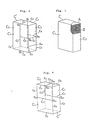
- a package cut by the method according to the invention is shown in Fig. 2 and and Fig. 4.
- cutting lines c1 and c1 are running longitudinally from one edge to the other on two mutually opposing planes C1 and C1, and on each plane, a cutting line c6 is provided between the above mentioned cutting line c1 and the edge c5, which is one of two edges c4 and c5 other than edges c2 and c3 passing the starting point s1 and the end point s2 on the cutting line c1, and on the plane C2 adjacent to C1, C1 each having two edges c5, c5 passing points s3, s3 of the two cutting lines c6, c6, a cutting line c7 connecting these two cutting lines is provided.
- the package can be opened as shown in Fig. 3 (g).
- the two mutually opposing planes C1 and C1 are cut longitudinally from one edge to the other end, and a cutting line c7 is provided on the plane C2
- spaces c8 and c9 are formed on the planes C1, C2 and C3 between the packaging material and the packaged objects or matters as shown in Fig. 5 and Fig. 6, preventing damage to the packaged objects even if the cutting blade is applied to the packaging material B.
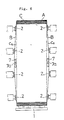
- cutting lines c11 and c11 are running horizontally from one edge to the other on two mutually opposing planes C1 and C1, and on each plane, a cutting line c61 is provided between the above mentioned cutting line c11 and the edge c2, which is one of two edges c2 and c3 other than edges c4 and c5 passing the starting point s11 and the end point s21 on the cutting'line c11, and on the plane C3 adjacent to C1, C1 each having two edges c2 and c3 passing points s31, s31 of the two cutting lines c61, c61, a cutting line c71 connecting these two cutting lines is provided.
- the packaging material on the three planes C1, C1 and C3 on which cutting lines c11, c11, c61, c61 and c71 are provided is cut and opened at each cutting line, the package can be opened, as opposed to the case in Fig. 2, in a fashion that the package shown in Fig. 3 (g) is in the horizontal position.
- a cutting line c11 is provided as shown in Fig. 4 and a space formed between the packaging material and the packaged objects on each of the two mutually opposing planes C1, C1
- the packaging material would be like the one shown in Fig. 3 (d) positioned horizontally.
- a ruler-like plate 7 could be inserted from the slit c1 as shown in Fig. 3 (e) and Fig. 5 to cut the packaging material on top of it to avoid damaging the edges of the packaged objects.
- a cutting line c61 in Fig. 4 shall also be provided in the same fashion.
- formation of a space c9 between the packaging material and the packaged objects requires no extra means because the plate 7 presses the packaging material outward.
- a rectangular package C covered with packaging material B as shown in Fig. 1 is placed on a platform 1 as shown in chain line in Fig. 19.
- a space c8 shown in Fig. 6 is formed between the packaging materials B, B and the packaged objects on these two planes C1, C1.
- a pair of cutting blades 3, 3 is pressed and run on the packaging material on the two planes C1, C1, areas shown by c1, c1 on the two planes in Fig.
- a cutting line is provided in the direction shown by c11 in Fig. 4 on the two mutually opposing planes C1, C1, means to form a space between the packaging material and the packaged objects on the two planes C1, C1 are preferably placed in the latitudinal direction, in which case the pair of cutting blades 3, 3 to cut this packaging material shall also run in the latitudinal direction.
- a pair of cutting blades 4,4 shown in Fig. 8 is applied in the latitudinal direction to the packaging material that is already cut from one edge to the other by the pair of cutting blades 3 and 3.
- the packaging material cut from one edge to the other by the pair of cutting blades 4, 4 is then provided with a cutting line shown by c6 in Fig. 2.
- the pair of cutting blades 4, 4 is arranged perpendicularly, as opposed to the example shown in the figure, and run vertically.
- a means to form a space between the packaging material and the packaged objects on the plane C2 having two edges c5, c5 passing points s3, s3 of the two cutting lines c6 and c6, is activated.
- a cutting blade shown by 5 in Fig. 8 is pressed on the packaging material on the plane C2 and run latitudinally.
- This provides the packaging material on the plane C2 with a cutting line shown by c7 in Fig. 2.
- the cutting blade 5 is arranged perpendicular, as opposed to the example in the figure, and run latitudinally.
- a device is activated to open the package along the cutting lines c1, c1 and c6, c6 and c7 on the three planes C1, C1 and C2 respectively, and a package C′ cut as shown in Fig. 2 can be opened as shown in Fig. 3 (g).
- the package can be opened in the manner that Fig. 3 (g) is in the horizontal position.
- these two planes C1, C1 can be held by a pair of holders 6, 6 to prevent unnecessary movement of the package during the operation of cutting on the platform 1.
- the pair of holders 6, 6 shall operate on the two mutually opposing planes C1, C1 as shown in Fig. 3 (c), and when they are cut as shown in Fig. 4, they shall operate on the two opposing planes C1, C1 in the fashion that Fig. 3 (c) is in the horizontal position.
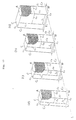
- a pair of cutting blades 3, 3 applied on the two mutually opposing planes that are cut from one edge to the other, a pair of holders 6, 6, and means for forming a space between the packaging material and the packaged objects on the aforementioned two planes C1, C1, can be varied with respect to the planes C2, C3 adjacent to the two planes C1, C1 to be cut from one edge to the other and on which cutting lines c7, c71 are to be provided, according to the size of the package by operating each cylinder according to the size of the package. This will now be described with reference to Fig. 17 (a) to (c).
- a plane C2 to be provided with a cutting line c7 is placed on one datum line L in the case of three packages of different sizes (depth, length) L1 to L3, if a pair of cutting blades 3, 3 for providing a cutting line c1 on each of the two mutually opposing planes C1 and C1 are positioned at distances of l1, l2, and l3 respectively from each datum plane C2 according to the size (depth, length) of each package, for example, a cutting line c1 can be provided at distances of l1, l2 and l3 respectively from each datum plane C2 on each of the two mutually opposing planes C1, C1.
- the operating positions of the pair of holders 6, 6 and the means for forming a space between the packaging material and the packaged objects on the two planes C1, C1 can also be varied as in the case of the pair of cutting blades 3, 3, according to the size (depth, length) of the package.
- the position of the backboard 8 located at the back of the platform 1 is varied with respect to the datum line L according to the size (depth, length) of the rectangular package as shown in Fig. 16 (a) to (c). This way, the package to be placed on the platform 1 can be placed at its prescribed position according to its size (depth, length).
- the activation positions, with respect to the package, of the platform 1, a pair of cutting blades 3, 3, a pair of holders 6, 6, means for forming a space between the packaging material on the two planes C1, C1 of the package that are cut from one edge to the other and the packaged objects, and the backboard 8, are selected appropriately according to the size (depth, length) of the package.
- a package of any size can be provided with a cutting line of a prescribed direction on a prescribed plane of the rectangular package by using a single device as shown in Fig. 2.
- a single device as shown in Fig. 2.
- the packaged objects are flattened packing container blanks as shown in Fig. 20, wherein is shown the way by which multiple blanks A are bundled and covered with packaging material B on the outside as shown in Fig. 1 and such a rectangular package C is cut and opened.
- the packaging material B of the package C is shown in Fig. 1 is cut as shown in Fig. 2 and opened as shown in Fig. 3 (g).
- the method according to the invention can also be applied to cutting and opening the rectangular package C as shown in Fig. 4.
- the biggest difference between the cutting as shown in Fig. 2 and cutting as shown in Fig. 4, is that while in the case of Fig. 2, the cutting direction of the packaging material on the two mutually opposing planes of the rectangular package C from one edge to the other is in the vertical direction (in the direction of height), in the case of Fig. 4, it is in the horizontal direction (in the direction of width).
- the position or direction at or in which a space between the packaged objects and the packaging material B is formed, or the direction of cutting lines c6, c6 and c61, c61 on the two mutually opposing planes C1, C1, the position of the planes C2, C3 each incorporating two edges c5, c5 and c2, c2 that pass points s3, s3 and s31, s31 of c6, c6 and c61, c61, and the direction of cutting lines c7, c7 provided on those planes are different between the cutting as shown in Fig. 2 and the cutting as shown in Fig. 4, but the cut condition shown in Fig. 4 is in the horizontal position of the condition shown in Fig.
- the open condition after cutting as shown in Fig. 4 is like the condition in Fig. 3 (g) in the horizontal position, and they are essentially same.
- a backplate 7 is inserted from slits c1, c1 and c11, c11, in which the only difference between the cutting as shown in Fig. 2 and the cutting as shown in Fig. 4 is the insertion direction, and the matter of inserting the backplate 7 from a cut area is the same.
- the device shown in the embodiment is used to cut the rectangular package as shown in Fig. 3 (b) and Fig. 2 via a method shown in Fig. 3 (c) to (f) and open a package C′ as shown in Fig. 3 (g) after cutting
- the device used to cut and open a package C ⁇ as shown in Fig. 4 after cutting has exactly same function as the former except the arrangement direction, running direction or operating direction of the cutting blade and other components to cut the packaging material B on the prescribed positions.
- 1 is a platform and the package C is placed on this platform 1 where the packaging material B is cut and opened.
- the packaging material B can be cut by applying a thin cutting blade on the packaging material B and move it.
- a space is formed between the packaging material B and the blanks A.
- suction pads 2 are used as shown in Fig. 8, Fig. 10 and Fig. 11.
- the packaging material B could be cut as mentioned above by pressing a thin cutting blade on the packaging material B and move it, but a rotating type cutting blade can also be used, of course.
- the cutting blade pressing positions in the case of the embodiment are on the symmetrical vertical line shown by c1 on the two mutually opposing planes C1, C1 of the package C as shown in Fig.
- the embodiment shows cylinders 3a, 3a which are placed on the sides of the platform 1.
- the left and right pair of cutting blades 3, 3 are pressed on the package C on the platform 1 and moved from the solid line in Fig. 11 to the chain line in the same figure so that areas shown by c1, c1 on the packaging material B of the package C in Fig. 2 can be cut.
- cylinders 3b are provided to allow the cutting blades 3 to move in the left and right direction in Fig. 11. These cylinders 3b are used to tentatively place the cutting blades 3 at the back of the platform 1 (outside on the left and right of Fig. 11) and move them to the solid line in Fig. 11 when cutting the packaging material B, and the cutting blades 3, after the cutting operation is finished, are lowered by the cylinders 3a that are withdrawn by the cylinders 3b.
- the top and bottom cutting blades 4 are arranged to appear symmetrically in Fig. 1. By moving forward from the solid line in Fig. 8 toward the platform 1 on the left, they can cut areas shown by c6, c6 in Fig. 2 on the packaging material B of the package C. As means to move the pair of cutting blades 4, 4 closer to the platform 1 as shown above or move them backward to the solid line in Fig. 8 after cutting the packaging material B, as an example there is shown a frame 4a mounted with the pair of cutting blades 4, 4 which can be moved in the direction of left and right in Fig. 8 by the cylinders 4b.
- the cutting blade 5 is located as shown in Fig. 8 and by moving forward the solid line in the same figure, it can cut an area shown by c7 in Fig. 2 on the packaging material B of the package C placed on the platform 1.
- a cylinder 5a which will move the cutting blade 5 vertically in Fig. 8.
- a pair of holders 6, 6 that can press the two mutually opposing planes C1, C1 are arranged as shown in Figs. 8 and 11.
- a pair of holders 6, 6 shown on the left and right in Fig. 11 are on the solid line in the same figure, tey hold the package C on the platform 1.
- the pair of suction pads 2, 2 shown on the left and right in Fig. 11 are slightly withdrawn from the solid line in the same figure as shown by arrows in Fig.
- the area c1 cut by the cutting blades 3 is in the open condition and is ingeniously utilized in the embodiment. Specifically, ruler-like backplates are inserted through these areas as shown in Fig. 3 (e). Each backplate 7 can be placed in the space c8 partly between the packaging material B pulled outwardly by the suction pads 2, 2 and the packaged blanks A as shown in Fig. 6. Consequently by using these backplates 7 as underlays or supports when cutting the areas shown by c6, c6 in Fig. 2 with cutting blades 4, rim edges of the packaged blanks A are not damaged. Also by forming a longitudinal hollow 7a on the outside of each backplate 7 as shown in Figs. 5 and 6, and arranging the tip of the aforementioned cutting blade 4 to be positioned in the hollow 7a when it moves horizontally and cut the packaging material B, not only the tip of the blade but also the cutting position of the packaging material B are positioned without any shifting.
- a lever 7c that can be oscillated from a pivot 7b as shown in Fig. 10 can be linked to the backplate 7, and the other end of the lever 7c and the tip of the rod of the cylinder 7d can be linked with a lever 7e.
- lever 7c oscillates via lever 7e from pivot 7b as shown by dotted lines in this figure.
- the backplate 7 shown by solid line can move forward to the right in the figure as shown by dotted lines therein, and it can be inserted into the package C gradually from the tip.
- a backboard 8 is provided at the back of the platform 1 and on the left of Fig. 18 in order to determine the position of the package C on the platform 1. During the above operations, this backboard 8 is positioned to contact the back plane C4 shown in Fig. 2 of the package C.
- the holders 6 and the suction pads 2 are located on another platform 9 above the platform 1 as shown in Fig. 8, and the backboard 8 is located on another platform 10 above this platform 9.
- the platform 1 is able to move with respect to the frame 11 by a cylinder 1a
- the platform 9 is able to move with respect to the platform 1 by another cylinder D1 shown by dotted lines in Fig. 8 mounted on the platform 1 and a cylinder D2 mounted on the side of platform 9
- the platform 10 is able to move with respect to the platform 9 by another cylinder D3 shown by dotted lines in Fig. 9 mounted on the platform 9 and a cylinder D4 mounted on the side platform 10, respectively.
- Travelling distances of platforms, 1, 9 and 10 and the inter-platform positional relationships can be freely altered by operating all of the cylinders or only some of them, if desired.
- each package is placed on the platform 1 so that the plane C2 on which a cutting line c7 is to be provided is aligned to the one datum line L.
- the position of the platform 1 has to be varied according to the length of the package as shown by (a) - (d) in Fig. 16.
- the cylinder shown by 1a in Figs. 10 and 18 is operated.
- the position of the platform 1 can be varied according to the length of the package to be cut.
- the cutting blades 3, 3 When cutting a package of a length L1, the cutting blades 3, 3 shall be located at a distance l1 from the datum line L. When cutting a package of a length L2, the cutting blades 3, 3 shall be located at a distance of a length l2 from the datum line L. When cutting packages of lengths L3 and L4, the cutting blades 3, 3 shall be located at a distance l3 from the datum line L, and at the same time the positions of the pair of suction pads 2, 2 and the pair of holders 6, 6 that operate on the two mutually opposing planes C1, C1 of each package shall be varied and the backboard 8 shall be located at distance L1, L2, L3 and L4, respectively, from the datum line L.
- all of the above mentioned four cylinders D1 - D4 are activated or only some of them are activated leaving others inactive if required.
- a pair of cutting blades 3, 3 and a pair of holders 6, 6 are positioned so that the area at a distance l1 from the datum line L can be cut.
- the backboard 8 is positioned so that it contacts the back plane of the package of length L1 (the plane opposite to the datum line L, i.e., the left end plane of Fig. 16 (a) - (d).
- the fact that the platform 9 moves to the right for 105 mm from the initial position in this figure means that the pair of cutting blades 3, 3 mounted on it are moved 105 mm to the right in the figure from the fixed position where a package of length L1 is cut. If the pair of cutting blades 3, 3 are pressed and moved on a package of length L4, the area 105 mm closer to the datum line L from the cutting position of the package of the length L1 can be cut. In this case, the pair of suction pads, and the pair of holders 6 mounted on the platform 9 are also moved according to the movement of the pair of cutting blades 3, 3 respectively.
- the cylinder D3 and the cylinder D4 are moved for 20 mm and 25 mm respectively to the right in this figure as shown in Table 1.
- the cylinder D3 is mounted on the platform 9 as shown by dotted lines in Fig. 9, and its head is linked with a perpendicular plate 10a (solid lines) of the platform 10 above the platform 9 as shown in the same figure.
- the fact that the platform 10 moves 150 mm to the right from the initial position in the figure means that the backboard 8 mounted on it is moved 150 mm to the right in the figure from the fixed position where a package of length L1 is handled, and this backboard 8 contacts the back side of the package of the length L4 (the plane opposite to the datume line L, the extreme left plane of Fig. 16 (a) - (d)) to position it.
- a pair of cutting blades 3, 3, a pair of suction pads 2, 2, a pair of holders 6,6 and a backboard 8 can be positioned at desired places.
- one plane C2 of each package is positioned prior to loading on the platform 1 always at the same position.
- the positions of the one platform 1, the cutting blades 3, the suction pads, the holders 6 and backboard 8, can all be altered according to the lengths of packages. This means that even when packages to be cut are of different lengths, the platform 1 that support these will move to the prescribed position to meet them, and prescribed positions on the two mutually opposing planes of each package can be vertically cut with cutting blades 3. Further even when handling packages of different lengths, packaging material B can be vertically cut at prescribed positions for each package.
- the packaging material B of the package C on the platform 1 can be cut as described above.
- the platform 1 is at the position of the solid line in Fig. 19, which is the cutting line.
- the platform 1 is lowered as shown in Fig. 19 by dotted lines, and the cut packaging material B is opened at this position shown by dotted lines.
- a cylinder shown by 1b in Fig. 8 can be used to lower the entire platform 1 along with a frame 11.
- each package can be placed on the platform 1 so that each plane C2 to be provided with a cutting line c7 is positioned on one and the same datum line L.
- the package C can be stored in the transferring device 12 positioned at a fixed distance from the platform 1. But in this embodiment, the package C is carried in by two conveyors 14, 14 as shown in Figs. 13 and 19, and stored in the transferring device 12 by pushing onto the the transferring device 12 positioned between the both conveyors 14, 14 alternately or from one of them.
- This transferring device 12 is rotated thereafter as shown in Fig. 14 by single-dotted chain line, and is lowered to the fixed position beside the platform 1 as shown by double-dotted chain line in the same figure.
- a device (not shown) that can selectively lift and supply a package placed on the pallet to the two conveyors 14, 14 can be installed.
- the transferring device 12 shown in the embodiment is equipped with a storage box 12a with an L-shaped cross section as shown in Fig. 14, and the package C carried in by the two conveyors 14, 14 is pressed into the storage box 12a either alternately or continuously from either one of the two openings 12b (Fig. 14) shown on the left and right hand side in Fig. 13.
- pusher 15a, 15b are arranged above the two conveyors 14, 14 as shown in Fig. 13, and the pusher 15a and pusher 15b are alternately transferred from the solid line position in Fig. 13 as shown by chain line in the same figure via cylinder 16a and cylinder 16b respectively.
- This storage box 12a can be rotated from the solid line position in Fig. 14 as shown by the single-dotted chain line, and it can be further lowered to the prescribed position as shown by the double-dotted chain line in the same figure whereby the position is maintained.
- a method can be used, for example, in which the storage box 12a and the tip of the rod of cylinder 12c are connected by the lever 12d.
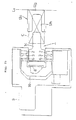
- This pusher 13 will move only a certain stroke from one of the two openings 12b of the storage box 12a, i.e., from the right hand side to the left hand side in Fig. 10. This allows the package inside the storage box 12a to be pushed out to the prescribed position. In other words, as described above, the storage box 12a and the package C stored inside are lowered so that their right ends are in the datum line Lo in Figs. 10, 15 and 16.
- the package C can be placed on the platform 1 so that the right end of the package C is on the datum line shown by L in Figs. 16 (a) - (d).
- This pusher 13 is slightly tilted until the storage box 12a is lowered as shown in Fig. 10. But before the end of the lowering of the storage box 12a it becomes vertical as shown by chain line in the same figure whereby the cylinder 13a serves as a kind of guide, and is moved by another cylinder 13b to the left in Fig. 10 by a certain stroke 1 o (Fig. 16) maintaining its position to push the package C inside the storage box 12a out to the prescribed position (on the line shown by L in Fig. 16), and place it onto the platform 1.
- the bottom part 12g of the storage box 12a is partially cut out as shown by 12h in Fig. 15. This is to avoid mutual collisions of the platform 1 and the storage box 12a that is lowered to the prescribed position when handling packages of different sizes (depth, length).
- the platform 1 is set to be positioned at the place shown by (a) in Fig. 16 when handling a package of length L1, handling of packages of lengths, L2, L3 and L4 that are shorter than that requires that the cylinder 1a (Fig. 18) is activated as above described and the position of platform 1 with respect to the storage box 12a is varied according to the length of the package.
- the part 1c at the front of the platform 1 is engaged in the cut-off part 12h of the storage box 12a and do not collide with one another.
- the package C is placed on the platform 1 and the packaging material B is cut and opened thereon.
- an example of a device to open the cut packaging material B by pairs of cutting blades 3, 3 and 4, 4 and a cutting blade 5, will be described in detail.
- the embodiment shows a case comprising a lever 17 to grasp the upper corner of the cut package C′ placed on the platform 1 (Fig. 2), a stopper 18 to transfer the package from the bottom to the top, and a stopper 19 to transfer the package from the top to the bottom.
- the bottom of the lever 17 is pivoted to the rod 17b of the lever 17a.
- the lever rotates from its solid line position in the same figure as shown by chain line with pivot 17c as the center, and its top grasps the upper corner or edge of the package C′.
- the mouth of the cut packaging material B opens slightly, and the tip of the stopper 18 penetrates into it to engage the open edges shown by (b) and moves upwards.
- the upper half of the packaging material B shown by (b1) opens as shown by Fig. 3 (g) and Fig. 7.
- the upper stopper 19 moves down and its tip hooks the open edges b′ of (b2) ofthe packaging material B in Fig. 7 and moves down too.
- the lower half of the packaging material shown by (b2) opens as shown by Fig. 3 (g) and Fig. 7.
- this opening operation can be performed to rip off the cut packaging material B by sucking either plane of the cut package C′.
- rectangular package comprising and covering a bundle of many flattened blanks A with packaging material B can be automatically cut and opened.
- the packaging material B is no longer necessary, and only the contents have to be taken out.
- this can be done by a robot shown by 20 in Fig. 19.
- This robot 20 is equipped with a grasping means comprising a top-and-bottom pair of forks 20a, 20a which approaches a cut package C ⁇ on platform 1 to take out only many stripped blanks A with the top-and-bottom pair of forks 20a, 20a as shown by Fig. 3 (h).
- the front side 1c of the platform 1 can be laid down as shown by chain line in Fig. 12 to avoid collisions of the bottom fork of the pair of forks 20a, 20a and the platform 1.
- a pusher 21 to push the empty packaging material B after the bulk of blanks A is taken out of the platform 1 by the pair of forks 20a, 20a and it can move forward to the chain line position from the solid line position in Fig. 18 by the activation of cylinder 21a.
- the empty packaging material pushed out by this pusher 21 can be discharged automatically by an device not shown.
Landscapes
- Engineering & Computer Science (AREA)
- Mechanical Engineering (AREA)
- Control And Other Processes For Unpacking Of Materials (AREA)
- Auxiliary Devices For And Details Of Packaging Control (AREA)
Abstract
A cutting and opening method for a rectangular package covered with packaging material is provided comprising the following steps: the packaging material of a rectangular package is cut from one edge to the other on two mutually opposing planes after forming a space between the packaging material and the packaged objects; the packaging material on the same two planes is cut from one of the two edges other than those passing the starting point and the end point of these cutting lines to the above mentioned cutting lines; the packaging material is cut on the plane adjacent to the above mentioned two planes and having two edges passing the two cutting lines in such a manner that the two cutting lines are connected after forming a space between the packaging material and the packaged objects; and thereafter, the packaging material is cut open at each area on the three planes where cutting lines are provided. According to a further aspect a cutting and opening device for a rectangular package covered with packaging material comprising: a platform (1), on which a rectangular package is placed, means for forming a space between the packaging material and the packaged objects on the two mutually opposing planes of the package on said platform (1); a pair of cutting blades (3, 3) cutting the packaging material from one edge to the other in the direction of height or width, whereby a space is formed between the packaging material and the packaged objects by said means; a pair of cutting blades (4, 4) cutting said packaging material from one of the two edges other than the edges passing the starting point and the end point of each of the two cutting lines cut by the pair of cutting blades (3, 3) to the above mentioned cutting lines; means for forming a space between the packaging material and the packaged objects on the plane with two edges that pass the ends of the two cutting lines made by the pair of cutting blades (4, 4); a cutting blade (5) for cutting the packaging material so as to connect the two cutting lines on the above plane; and a device for opening the packaging material from each area on the three planes provided with cutting lines.
Description
- The invention relates to a method and a device for cutting a rectangular package covered with packaging material at a prescribed position and opening it.
- Various types of paper containers have been manufactured up to now. For example, disposable packaging containers are widely used for liquid foodstuffs such as juice; some of which are of parallelepipedic configuration as shown by (A′) in Fig. 21.
- In most cases, such packaging container blanks are flatly folded as shown in Fig. 20 (A), and combined to a bundle whose outside is covered with packaging material (B) (as shown in Fig. 1) for easy storage and handling.
- In order to take packaged matters out of the rectangular package (C) described above, the packaging material (B) covering its outside needs to be cut and opened. Hitherto, the operations were carried out manually or by the method and device described in the published, unexamined Japanese Patent Application No. 271828.
- Performing the above mentioned operations manually is quite inefficient. On the other hand, the use of the method and device described in the published, unexamined Japanese Patent Application No. 271828 enables that the above mentioned operations are to be performed automatically. In this case it is essential to clamp the package to cause loosening of the packaging material. But depending on the type of package matters, loosening cannot be attained. For example hard objects may not be clamped sufficiently in such packages. In such cases, it is impossible to cut and open the package using the above mentioned method and device. By this operation, a cutting blade is applied to the loosening of the packaging material, but if the packaging material is not strong enough, the loosening of the packaging material tends to escape so that the cutting blade and the packaging material cannot be cut straightly.
- The main object of the invention is to provide a cutting and opening method and a device for a rectangular package, by which any type of package regardless of the type of packaged matters or the strength of the packaging material can be automatically cut and opened.
- According to one aspect of the prevent invention there is provided a space between the packaging material and the packaged matters on the two mutually opposing planes of the rectangular package covered with packaging material, thereafter, the packaging material is cut on those planes from one edge to the other in the direction of height or width, and the packaging material is cut on the above mentioned two planes from one of the two edges other than the edges passing the starting point and the end point of the cutting line. After forming the space between the packaging material and the packaged matters on the plane having two edges passing the ends of the above two cutting lines and adjacent to the above mentioned two planes, the packaging material is cut so as to connect the two cutting lines, and thereafter the packaging material is opened from each cut area on the three planes provided with cutting lines.
- According to a preferred embodiment a backplate is inserted via a slit made by cutting the packaging material on the two mutually opposing planes of the rectangular package from one edge to the other, and the packaging material on these planes is cut on top of the backplate. By cutting the packaging material on the two mutually opposing planes, it is preferred that a space be formed between the packaging material and the packaged matters by causing the packaging material to protrude using the tip of the backplate.
- When the packages are of different sizes, it is preferred that the locations of the cutting lines to be provided on the two mutually opposing planes from one edge to the other are varied with respect to the datum plane to be provided with a cutting line and adjacent to the two planes.
- According to another aspect of the invention the device according to the invention comprises a platform on which a package covered with packaging material is placed; means to form a space between the packaging material and the packaged matters on the two mutually opposing planes of the package on the platform; a first pair of cutting blades for cutting the packaging material from one edge to the other on a position where the space is formed between the packaging material and the packaged matters using the above means; a second pair of cutting blades for cutting the packaging material from one of the two edges other than the edges passing the starting point and the end point of the two edges cut by the above first pair of cutting blades to the above mentioned cutting lines; means to form a space between the packaging material and the packaged matters on the plane having two edges passing the ends of the two cutting lines cut by the above second pair of cutting blades; a further cutting blade for cutting the packaging material in such a manner that the two cutting lines on this plane are connected; and a device to open the packaging material from each cut area on the three planes provided with cutting lines.
- According to a preferred embodiment of the invention there is provided a pair of holders for holding a part of the two mutually opposing planes of the rectangular package placed on the platform from both sides, which are provided on the side of the platform. Preferably a pair of backplates is provided that can move parallel to the two mutually opposing planes of the rectangular package placed on the platform and can be inserted from slits on these two planes made by cutting the packaging material from one edge to the other.
- When the rectangular packages to be placed on the platform are of different sizes, preferably the platform is positioned in relation to a cylinder so that the position of the platform can be varied with respect to the plane to be provided with a cutting line and adjacent to the two planes of the package to be cut from one edge to the other according to the size of each package. Preferably a pair of cutting blades is also applied on the two mutually opposing planes in order to cut them from one edge to the other, as well as a pair of holders, and a pair of means to form a space between the packaging material and the packaged matters on the two planes cut from one edge to the other of the package are related to a cylinder so that their operating positions can all be varied according to the sizes of the rectangular packages similar to the platform.
- Furthermore, when the rectangular package is to be placed on the platform by pressing it onto the platform, it is preferred that a backboard that positions the back plane of the package with respect to the platform be located at the back of the platform, and the backboard be positioned in relation to a cylinder so that the position of the said backboard can be varied with respect to the plane to be provided with cutting lines and adjacent to the two mutually opposing planes cut from one edge to the other according to the size of the package to be placed on the platform. Especially if the package is pressed onto the platform via a part on which the plane to be provided with a cutting line and adjacent to the two planes cut from one edge to the other of the package to be placed on the platform is aligned on the fixed position, it is preferred that the activation positions of the platform, the first pair of cutting blades, the pair of holders, the pair of means to form a space between the packaging material and the packaged matters on the two planes of the package that are cut from one edge to the other, and the backboard are related to the cylinder so that they can all be varied with respect to the datum plane of the package, and their positions are chosen according to the depth of the package if necessary. Also in this case, the packages are preferably carried in a storage box to the prescribed position on the side of the platform.
- By the embodiment as claimed in
Claim 1, it is obtained that the packaging material that covers the outside of packaged matters is cut and opened efficiently without demaging them. - According to the embodiment described in
Claim 2 in which the packaging material on the two mutually opposing planes of the package is cut, and according the embodiment described inClaim 3 in which the packaging material on the place adjacent to the two mutually opposing planes is cut, the packaged objects can be cut non-damaged in either case. Also according to the embodiment described inClaim 3, there is no need to implement a means to form a space between the packaging material and the packaged objects on the plane adjacent to the two mutually opposing planes. - According to the embodiment described in
Claim 4, lengthwise and widthwise cutting positions on the two mutually opposing planes of the rectangular package are different according to the size of the package. Therefore, even when cutting different-sized packages, the packaging material can be always be opened. - According to the embodiment described in
Claim 5, it is effected that the packaging material covering the outside of the packaged objects are automatically cut without damaging them, and the package is automatically opened. - According to the embodiment described in
Claim 6, the rectangular package does not move on the platform at hazard, eliminating malfunctions such as undesired dislocation of the cutting position or damage to the packaged matters. - According to the embodiment described in
Claim 7, a backplate can be used as a support and a cutting blade can be run on the packaging material from outside, eliminating the possibility of damaging the packaged objects. - According to the embodiment described in
Claim 8, the location of the platform with respect to the datum position can be freely varied according to the size of the package. Therefore, even when handling packages of different sizes, they can all be placed on a single platform. - According to the embodiment described in
Claim 9, it is effected that the packaging material is cutted in the direction of height or width at the supposedly optimal positions on the two mutually opposing planes even when the packages are different in sizes. - According to the embodiment described in
Claim 10, it is effected that the package is maintained at the supposedly optimal positions on the two mutually opposing planes even when packages are different in sizes. - According to the embodiment described in
Claim 11, it is effected that a space is formed between the packaging material and the packaged matters at supposedly optimal positions on the two mutually opposing planes even when packages are different in sizes. - According to the embodiment described in
Claim 12, it is effected that the positioning of the package pressed into the platform is stable by means of a backboard contacting the back plane of the package even when packages are different in sizes. - According to the embodiment described in
Claim 13, a pair of cutting blades can be placed in the supposedly optimal positions according to the size of the package when cutting the package on the platform, render ideal cutting and opening operations possible even when packages are different in size. - According to the embodiment described in
Claim 14, a package prior to be placed on the platform can be placed at a prescribed position, render ideal cutting and opening operations possible according to the size of the package even when packages are different in sizes. - The foregoing and other objects, features and advantages of the invention will be apparent from the following more particular description of preferred embodiments of invention as illustrated in the accompanying drawings, in which
- Fig. 1 is a perspective view of an example of a rectangular package;
- Fig. 2 ist a perspective view of cutting positions in that case;
- Fig. 3 (a) - (h) are perspective views showing step-by-step operations from the cutting and opening of a package carried in by a conveyor to the taking out of blanks contained in the package;
- Fig. 4 is a perspective view showing a rectangular package cut at different positions in comparison to Fig. 2;
- Fig. 5 is an enlarged side view showing a condition in which a package is cut from one edge to the other on the two mutually opposing planes of the packaging material in the direction of height and a backplate is inserted therefrom;
- Fig. 6 is a vertical cross sectional view of Fig. 5;
- Fig. 7 is an enlarged side view showing the opening condition of a cut package;
- Fig. 8 is a plan view showing a package cutting and opening device schematically;
- Fig. 9 is a plan view showing the relationship between the two platforms located above the platform, being a part of the package cutting and opening device;
- Fig. 10 is a side view of the package cutting and opening device showing a condition in which a storage box is placed in front of the platform, which is a part of the package cutting and opening device, and a pusher is located further in front of the storage box;
- Fig. 11 is a front view of the package cutting and opening device;
- Fig. 12 is a partial side view showing that the platform, which is a part of the package cutting and opening device, can be laid down from the middle of it;
- Fig. 13 is an enlarged plan view showing the relationship between the package transferring device and the pusher located above it and used to press the rectangular package into the storage box of the transferring device;
- Fig. 14 is a vertical cross section of Fig. 13 along line XIV - XIV;
- Fig. 15 is a plan view showing the relationship between the platform, the other two platforms located above it and the storage box lowered to the prescribed position;
- Fig. 16 (a) - (d) are plan views showing the relationship between the storage box positioned at the prescribed position and packages of different sizes and the platform contained in it, a pair of suction pads, a pair of cutting blades, a pair of holders, and the backplate;
- Fig. 17 (a) - (d) are perspective views showing conditions in which a plane of each of the different-sized packages is positioned on the datum line;
- Fig. 18 is a side view showing a condition in which an opening device of a cut package is combined with a cutting device;
- Fig. 19 is a side view showing the relationship between the package cutting and opening device according to the invention, the conveyor for carrying the package, the transferring device for transferring the package carried in by the conveyor to the cutting and opening device, and the robot for taking out the packaged objects contained in the cut and opened package;
- Fig. 20 is a perspective view of packaged flattened blanks; and
- Fig. 21 is a perspective view in which the blanks are erected to form a parallelepiped.
- Referring to the drawings a package cut by the method according to the invention is shown in Fig. 2 and and Fig. 4. In Fig. 2, cutting lines c1 and c1 are running longitudinally from one edge to the other on two mutually opposing planes C1 and C1, and on each plane, a cutting line c6 is provided between the above mentioned cutting line c1 and the edge c5, which is one of two edges c4 and c5 other than edges c2 and c3 passing the starting point s1 and the end point s2 on the cutting line c1, and on the plane C2 adjacent to C1, C1 each having two edges c5, c5 passing points s3, s3 of the two cutting lines c6, c6, a cutting line c7 connecting these two cutting lines is provided. Thus, when the packaging material on the three planes on which cutting lines c1, c1, c6, c6 and c7 are provided is cut-open at each cutting line, the package can be opened as shown in Fig. 3 (g). Also, when the two mutually opposing planes C1 and C1 are cut longitudinally from one edge to the other end, and a cutting line c7 is provided on the plane C2, spaces c8 and c9 are formed on the planes C1, C2 and C3 between the packaging material and the packaged objects or matters as shown in Fig. 5 and Fig. 6, preventing damage to the packaged objects even if the cutting blade is applied to the packaging material B.
- In Fig. 4, on the other hand, cutting lines c11 and c11 are running horizontally from one edge to the other on two mutually opposing planes C1 and C1, and on each plane, a cutting line c61 is provided between the above mentioned cutting line c11 and the edge c2, which is one of two edges c2 and c3 other than edges c4 and c5 passing the starting point s11 and the end point s21 on the cutting'line c11, and on the plane C3 adjacent to C1, C1 each having two edges c2 and c3 passing points s31, s31 of the two cutting lines c61, c61, a cutting line c71 connecting these two cutting lines is provided. Thus, when the packaging material on the three planes C1, C1 and C3 on which cutting lines c11, c11, c61, c61 and c71 are provided is cut and opened at each cutting line, the package can be opened, as opposed to the case in Fig. 2, in a fashion that the package shown in Fig. 3 (g) is in the horizontal position. Also, when a cutting line c11 is provided as shown in Fig. 4 and a space formed between the packaging material and the packaged objects on each of the two mutually opposing planes C1, C1, the packaging material would be like the one shown in Fig. 3 (d) positioned horizontally.
- In providing a cutting line C6 on the two mutually opposing planes C1, C1, a ruler-
like plate 7 could be inserted from the slit c1 as shown in Fig. 3 (e) and Fig. 5 to cut the packaging material on top of it to avoid damaging the edges of the packaged objects. A cutting line c61 in Fig. 4 shall also be provided in the same fashion. In cutting the packaging material on the plane C2 adjacent to the two mutually opposing planes C1, C1, formation of a space c9 between the packaging material and the packaged objects requires no extra means because theplate 7 presses the packaging material outward. By the provision of a cutting line c71 in Fig. 4 it is obtained the same effect by using this method. - When the size of the package varies as shown in Figs. 17 (a) to (c), the position of a cutting line c1 to be provided on two mutually opposing planes C1, C1 could be varied with respect to the plane C2 on which a cutting line c7 is provided, and a slit c1 running from one edge to the other end on two mutually opposing planes C1, C1 of each package of a different size can be placed at different positions l₁, l₂, and l₃ with respect to the one plane C2 as shown in Fig. 17 (a) to (c). The same arrangement can be applied in the case shown in Fig. 4, wherein a ripped part c11 running from one edge to the other on two planes C1, C1 on different-sized packages can be placed at different positions with respect to the one plane C3.
- Next, the functioning of the cutting and opening device according to the invention will be explained.
- A rectangular package C covered with packaging material B as shown in Fig. 1 is placed on a
platform 1 as shown in chain line in Fig. 19. On each side of thisplatform 1, there is a means to form a space between the packaging material and the packaged objects on two planes C1, C1 as shown in Fig. 11, and this pair of spaceforming means is used on the two mutually opposing planes among the six planes of the package C placed on theplatform 1. Then a space c8 shown in Fig. 6 is formed between the packaging materials B, B and the packaged objects on these two planes C1, C1. At this time, when a pair ofcutting blades cutting blades - Next, a pair of
cutting blades cutting blades cutting blades cutting blades - Next, a means to form a space between the packaging material and the packaged objects on the plane C2 having two edges c5, c5 passing points s3, s3 of the two cutting lines c6 and c6, is activated. This forms a space c9 between the packaging material B and the packaged material in this plane C2 as shown in Fig. 5. Then a cutting blade shown by 5 in Fig. 8 is pressed on the packaging material on the plane C2 and run latitudinally. This provides the packaging material on the plane C2 with a cutting line shown by c7 in Fig. 2. When cutting a line shown by c71 on the plane shown by C3 in Fig. 4, the
cutting blade 5 is arranged perpendicular, as opposed to the example in the figure, and run latitudinally. - Thereafter, a device is activated to open the package along the cutting lines c1, c1 and c6, c6 and c7 on the three planes C1, C1 and C2 respectively, and a package C′ cut as shown in Fig. 2 can be opened as shown in Fig. 3 (g). In the case of a package C˝ cut as shown in Fig. 4, the package can be opened in the manner that Fig. 3 (g) is in the horizontal position.
- In cutting the packaging material of the package on the two mutually opposing planes C1, C1 either in the direction of height or width, these two planes C1, C1 can be held by a pair of
holders platform 1. When the package is cut as shown in Fig. 2, the pair ofholders - In providing cutting lines c6, c6 on the two mutually opposing planes C1, C1, by moving the
backplates platform 1 parallel to these two planes C1, C1, the tips of the plates are inserted between the packaging material B and the packaged objects through the slits c1, c1 that are made by cutting the packaging material on these two planes and the backplates can be used as underlays or supports. When cutting as shown in Fig. 4, thesebackplates - When different-sized rectangular packages are to be put on the
platform 1, in the activation positions of theplatform 1, a pair ofcutting blades holders cutting blades holders cutting blades - When the rectangular package is placed onto the
platform 1 by pressing it onto theplatform 1 as shown in Fig. 10, the position of thebackboard 8 located at the back of theplatform 1 is varied with respect to the datum line L according to the size (depth, length) of the rectangular package as shown in Fig. 16 (a) to (c). This way, the package to be placed on theplatform 1 can be placed at its prescribed position according to its size (depth, length). - Especially, when the package is pressed onto the
platform 1 from the same starting line shown by Lo in Fig. 16. (a) to (c), where the datum plane C2 of each package of a different size (depth, length) is aligned, the activation positions, with respect to the package, of theplatform 1, a pair ofcutting blades holders backboard 8, are selected appropriately according to the size (depth, length) of the package. In this way, a package of any size (depth, length) can be provided with a cutting line of a prescribed direction on a prescribed plane of the rectangular package by using a single device as shown in Fig. 2. In this case, if rectangular package are carried to the side of theplatform 1 in a storage box, it is easier to align the datum plane C2 of each package before placing on theplatform 1 on the same starting line shown by Lo in Fig. 16 (a) to (c). - Preferred embodiments of the invention will now be described with reference to the accompanying drawings.
- In one embodiment of the invention, an example is shown in which the packaged objects are flattened packing container blanks as shown in Fig. 20, wherein is shown the way by which multiple blanks A are bundled and covered with packaging material B on the outside as shown in Fig. 1 and such a rectangular package C is cut and opened.
- In another embodiment, in which the packaging material B of the package C is shown in Fig. 1 is cut as shown in Fig. 2 and opened as shown in Fig. 3 (g). The method according to the invention can also be applied to cutting and opening the rectangular package C as shown in Fig. 4.
- Incidentally, the biggest difference between the cutting as shown in Fig. 2 and cutting as shown in Fig. 4, is that while in the case of Fig. 2, the cutting direction of the packaging material on the two mutually opposing planes of the rectangular package C from one edge to the other is in the vertical direction (in the direction of height), in the case of Fig. 4, it is in the horizontal direction (in the direction of width). In accordance with this, the position or direction at or in which a space between the packaged objects and the packaging material B is formed, or the direction of cutting lines c6, c6 and c61, c61 on the two mutually opposing planes C1, C1, the position of the planes C2, C3 each incorporating two edges c5, c5 and c2, c2 that pass points s3, s3 and s31, s31 of c6, c6 and c61, c61, and the direction of cutting lines c7, c7 provided on those planes are different between the cutting as shown in Fig. 2 and the cutting as shown in Fig. 4, but the cut condition shown in Fig. 4 is in the horizontal position of the condition shown in Fig. 2, and their cut conditions are essentially same. The open condition after cutting as shown in Fig. 4 is like the condition in Fig. 3 (g) in the horizontal position, and they are essentially same. In providing cutting lines c6, c6 and c61, c61, a
backplate 7 is inserted from slits c1, c1 and c11, c11, in which the only difference between the cutting as shown in Fig. 2 and the cutting as shown in Fig. 4 is the insertion direction, and the matter of inserting thebackplate 7 from a cut area is the same. - On the other hand, while the device shown in the embodiment is used to cut the rectangular package as shown in Fig. 3 (b) and Fig. 2 via a method shown in Fig. 3 (c) to (f) and open a package C′ as shown in Fig. 3 (g) after cutting, the device used to cut and open a package C˝ as shown in Fig. 4 after cutting has exactly same function as the former except the arrangement direction, running direction or operating direction of the cutting blade and other components to cut the packaging material B on the prescribed positions.
- More detailed description of the embodiments will be as follows. 1 is a platform and the package C is placed on this
platform 1 where the packaging material B is cut and opened. The packaging material B can be cut by applying a thin cutting blade on the packaging material B and move it. In order to avoid to getting the cutting blade contact the package blanks A, a space is formed between the packaging material B and the blanks A. As means to form a space between the packaging material B and the blanks A on the two mutually opposing planes C1, C1, according to thisembodiment suction pads 2 are used as shown in Fig. 8, Fig. 10 and Fig. 11. Also, in providing a cutting line c7 on plane C2 of the rectangular package C, means similar to these suction pads could be used to form a space between the packaging material B and the blanks A, but the embodiment shows an example in which thebackplate 7 inserted from slits c1, c1 is used to cause the packaging material B to protrude outwardly (explained in detail later). - The packaging material B could be cut as mentioned above by pressing a thin cutting blade on the packaging material B and move it, but a rotating type cutting blade can also be used, of course. The cutting blade pressing positions in the case of the embodiment are on the symmetrical vertical line shown by c1 on the two mutually opposing planes C1, C1 of the package C as shown in Fig. 2, on the horizontal lines shown by c6 that connect the aforementioned cutting line c1 with an edge c5, which is one of the two edges c4, c5 other than the two edges c2, c3 that pass the starting point s1 and the end point s2 of the cutting line c1 in the same figure, and on the horizontal line shown by c7 that connects c6 and c6 on the plane C2 in the same figure. The cutting blades to cut these areas are located on the sides of the package C placed on the
platform 1. The cutting blades for providing cutting lines on the packaging material B as shown by c1 in Fig. 2 vertically (heightwise) from one edge to the other on the two mutually opposing planes C1, C1 on the rectangular package C are shown by 3 in Figs. 8 and 11, the cutting blades to provide cutting lines c6 in Fig. 2 are shown by 4 in Fig. 8, and the cutting blade to provide a cutting line c7 in Fig. 2 is shown by 5 in Fig. 8. - As means for moving a left and right pair of
cutting blades cylinders platform 1. The left and right pair ofcutting blades platform 1 and moved from the solid line in Fig. 11 to the chain line in the same figure so that areas shown by c1, c1 on the packaging material B of the package C in Fig. 2 can be cut. In addition to thecylinders 3a,cylinders 3b are provided to allow thecutting blades 3 to move in the left and right direction in Fig. 11. Thesecylinders 3b are used to tentatively place thecutting blades 3 at the back of the platform 1 (outside on the left and right of Fig. 11) and move them to the solid line in Fig. 11 when cutting the packaging material B, and thecutting blades 3, after the cutting operation is finished, are lowered by thecylinders 3a that are withdrawn by thecylinders 3b. - The top and
bottom cutting blades 4 are arranged to appear symmetrically in Fig. 1. By moving forward from the solid line in Fig. 8 toward theplatform 1 on the left, they can cut areas shown by c6, c6 in Fig. 2 on the packaging material B of the package C. As means to move the pair ofcutting blades platform 1 as shown above or move them backward to the solid line in Fig. 8 after cutting the packaging material B, as an example there is shown aframe 4a mounted with the pair ofcutting blades cylinders 4b. - On the other hand, the
cutting blade 5 is located as shown in Fig. 8 and by moving forward the solid line in the same figure, it can cut an area shown by c7 in Fig. 2 on the packaging material B of the package C placed on theplatform 1. As means to move thecutting blade 5 forward like this or to move it backward to the solid line in Fig. 8 after cutting the packaging material B, as an example there is shown acylinder 5a which will move thecutting blade 5 vertically in Fig. 8. - In performing the above mentioned cuttings, the package C on the
platform 1 will not move in this embodiment. Specifically, in the embodiment, a pair ofholders holders platform 1. When the pair ofsuction pads holders aforementioned cutting blades 3 are pressed on the packaging material B and moved on it, and since the package C is held by the pair ofholders - The area c1 cut by the
cutting blades 3 is in the open condition and is ingeniously utilized in the embodiment. Specifically, ruler-like backplates are inserted through these areas as shown in Fig. 3 (e). Eachbackplate 7 can be placed in the space c8 partly between the packaging material B pulled outwardly by thesuction pads backplates 7 as underlays or supports when cutting the areas shown by c6, c6 in Fig. 2 withcutting blades 4, rim edges of the packaged blanks A are not damaged. Also by forming a longitudinal hollow 7a on the outside of eachbackplate 7 as shown in Figs. 5 and 6, and arranging the tip of theaforementioned cutting blade 4 to be positioned in the hollow 7a when it moves horizontally and cut the packaging material B, not only the tip of the blade but also the cutting position of the packaging material B are positioned without any shifting. - The tips of the
backplate 7 that are inserted through the cut areas c1 of the package C push the packaging material B on the other perpendicular plane C2 in the package C outwardly as shown in Figs. 3 (e) and 5. This forms a space c9 between the packaging material B at this part and the packaged blanks A. When cutting the packaging material B on the plane C2 using thecutting blade 5, thus the rim edges of the packaged blanks A are not damaged. Also by forming a hollow 7f at the tip of thebackplate 7 as shown in Fig. 5, and arranging the tip of theaforementioned cutting blade 5 to be positioned in the hollow 7f when it moves horizontally and cut the packaging material B, not only the tip of the blade but also the cutting position of the packaging material B are positioned without any shifting. - By inserting
backplates 7 through the slits c1 cut by thecutting blades 3 as shown in Figs. 3 (e) and 5 on the plane C1 on the package C, one end of a lever 7c that can be oscillated from apivot 7b as shown in Fig. 10 can be linked to thebackplate 7, and the other end of the lever 7c and the tip of the rod of thecylinder 7d can be linked with alever 7e. When the rod of the cylinder is 7d withdrawn from the solid line in Fig. 10, lever 7c oscillates vialever 7e frompivot 7b as shown by dotted lines in this figure. Thus, thebackplate 7 shown by solid line can move forward to the right in the figure as shown by dotted lines therein, and it can be inserted into the package C gradually from the tip. - For the above mentioned cutting operations, a
backboard 8 is provided at the back of theplatform 1 and on the left of Fig. 18 in order to determine the position of the package C on theplatform 1. During the above operations, thisbackboard 8 is positioned to contact the back plane C4 shown in Fig. 2 of the package C. - The
holders 6 and thesuction pads 2 are located on anotherplatform 9 above theplatform 1 as shown in Fig. 8, and thebackboard 8 is located on anotherplatform 10 above thisplatform 9. Theplatform 1 is able to move with respect to theframe 11 by acylinder 1a, theplatform 9 is able to move with respect to theplatform 1 by another cylinder D1 shown by dotted lines in Fig. 8 mounted on theplatform 1 and a cylinder D2 mounted on the side ofplatform 9, and theplatform 10 is able to move with respect to theplatform 9 by another cylinder D3 shown by dotted lines in Fig. 9 mounted on theplatform 9 and a cylinder D4 mounted on theside platform 10, respectively. Travelling distances of platforms, 1, 9 and 10 and the inter-platform positional relationships can be freely altered by operating all of the cylinders or only some of them, if desired. For providing cutting lines c1, c1 on the two mutually opposing planes C1, C1 of four packages of different sizes (depth, length) as shown by L1 - L4 in Fig. 17 (a) - (d) for example, each package is placed on theplatform 1 so that the plane C2 on which a cutting line c7 is to be provided is aligned to the one datum line L. In order to at least place the package on theplatform 1, the position of theplatform 1 has to be varied according to the length of the package as shown by (a) - (d) in Fig. 16. In this embodiment, the cylinder shown by 1a in Figs. 10 and 18 is operated. In other words, by activating thecylinder 1a to move theplatform 1 by a prescribed distance to the left and right directions of the figure with respect to theframe 11, the position of theplatform 1 can be varied according to the length of the package to be cut. - When cutting a package of a length L1, the
cutting blades cutting blades cutting blades suction pads holders backboard 8 shall be located at distance L1, L2, L3 and L4, respectively, from the datum line L. For this purpose, all of the above mentioned four cylinders D1 - D4 are activated or only some of them are activated leaving others inactive if required. For example, when cutting packaging material B in the two mutually opposing planes C1, C1 of a package of length L1, a pair ofcutting blades holders backboard 8 is positioned so that it contacts the back plane of the package of length L1 (the plane opposite to the datum line L, i.e., the left end plane of Fig. 16 (a) - (d). For packages of lengths L2, L3 and L4, areas only 80 mm or 105 mm closer from the cutting positions of the packages to the datum line L are cut as shown in Fig. 16 (b) - (d). If thebackboard 8 is assumed to contact the back plane of each package atpositions 100 mm, 125 mm or 150 mm closer to the datum line L as compared to the case handling a package of length L1, at least one of the four cylinders D1 - D4 could be moved to the amount shown in Table 1 to cut prescribed areas of packages of lengths L2, L3 and L4. In this case, each backboard is made to contact the back plane of each package.Table 1 unit: mm backboard 8 0 100 125 150 cutting blade 30 80 105 105 cylinder D4 0 0 0 25 " D3 0 20 20 20 " D2 0 0 25 25 " D1 0 80 80 80 package length L1 package L2 package L3 package L4 - More detailed descriptions about the cutting a package of the length L4 will be as follows. As shown in Fig. 8, the cylinder D1 mounted on the
platform 1 is moved to the right side in the figure for a stroke of 80 mm (dimensions of the solid line. Figures appearing hereafter are all actual dimensions). Incidentally, this cylinder D1 is mounted on theplatform 1 as shown by dotted lines in Fig. 8, and its head is linked with theperpendicular plate 9a (shown by solid line) on theplatform 9 above theplatform 1 shown in the same figure. Therefore, by moving the cylinder D1 for a stroke of 80 mm, theplatform 9 will also move for 80 mm to the right side. When this cylinder D1 is activated, cylinder D2 is also moved for 25 mm simultaneously as shown in Table 1, moving theplatform 9 25 mm further toward the right with respect toplatform 1 in this figure. Thus, theplatform 9 will move 80 + 25 = 105 mm toward the right with respect toplatform 1. The fact that theplatform 9 moves to the right for 105 mm from the initial position in this figure means that the pair ofcutting blades cutting blades area 105 mm closer to the datum line L from the cutting position of the package of the length L1 can be cut. In this case, the pair of suction pads, and the pair ofholders 6 mounted on theplatform 9 are also moved according to the movement of the pair ofcutting blades - In the above mentioned case, the cylinder D3 and the cylinder D4 are moved for 20 mm and 25 mm respectively to the right in this figure as shown in Table 1. Incidentally, the cylinder D3 is mounted on the
platform 9 as shown by dotted lines in Fig. 9, and its head is linked with aperpendicular plate 10a (solid lines) of theplatform 10 above theplatform 9 as shown in the same figure. Therefore, by moving the cylinder D3 for a stroke of 20 mm, theplatform 9 that is moved for 105 mm with respect to theplatform 1 as described above, moves 105 + 20 = 125 mm to the right in the figure. When this cylinder D3 is moved for a stroke of 20 mn, the cylinder D4 is simultaneously moved 25 mm as shown in Table 1, moving theplatform 10 25 mm to the right in the figure with respect to theplatform 9. Thus theplatform 10 will move 125 + 25 = 150 mm to the right with respect to theplatform 1. The fact that theplatform 10moves 150 mm to the right from the initial position in the figure means that thebackboard 8 mounted on it is moved 150 mm to the right in the figure from the fixed position where a package of length L1 is handled, and thisbackboard 8 contacts the back side of the package of the length L4 (the plane opposite to the datume line L, the extreme left plane of Fig. 16 (a) - (d)) to position it. When handling a package of length L2, cylinders D1 and D3 of the four cylinders are activated, and the other two cylinders D2 and D4 are stopped. When handling a package of length L3, three cylinders D1 - D3 of the four cylinders are activated, and the remaining cylinder D4 is stationary. This allows package of lengths L2 and L3 to be cut at desired places with a pair ofcutting blades backboard 8 can be moved to contact the back plane of each package. - As described above, by using multiple cylinders and having all of them or only some of them activated, a pair of
cutting blades suction pads holders backboard 8 can be positioned at desired places. - Even when the lengths of blanks A and the package C bundled with packaging material B differ as shown in Fig. 16 (a) - (d), one plane C2 of each package is positioned prior to loading on the
platform 1 always at the same position. In other words, on one and the same datum line L, for example, the positions of the oneplatform 1, thecutting blades 3, the suction pads, theholders 6 andbackboard 8, can all be altered according to the lengths of packages. This means that even when packages to be cut are of different lengths, theplatform 1 that support these will move to the prescribed position to meet them, and prescribed positions on the two mutually opposing planes of each package can be vertically cut with cuttingblades 3. Further even when handling packages of different lengths, packaging material B can be vertically cut at prescribed positions for each package. - The packaging material B of the package C on the
platform 1 can be cut as described above. In this case, theplatform 1 is at the position of the solid line in Fig. 19, which is the cutting line. In this embodiment, theplatform 1 is lowered as shown in Fig. 19 by dotted lines, and the cut packaging material B is opened at this position shown by dotted lines. This is very convenient as the spaces above and below can be used to their maximum capacities. In order to lower theplatform 1 from the solid line position in Fig. 19 as shown by dotted lines in the same figure, a cylinder shown by 1b in Fig. 8 can be used to lower theentire platform 1 along with aframe 11. - Incidentally, when providing cutting lines c1, c1 on the two mutually opposing planes C1, C1 of packages of different sizes (depth, length) as shown by L1 to L4 in Fig. 17 (a) - (d), in order to place each package on the
platform 1 so that the plane C2 to be provided with a cutting line c7 is aligned on one datum line L, all packages, regardless of their sizes (depth, length), can be made to be placed on the datim line shown by Lo, and each package is pressed onto theplatform 1 therefrom. In this embodiment, a transferringdevice 12, whose right end with respect to theplatform 1 is on the datum line Lo, is placed beside theplatform 1 as shown in Figs. 10 and 15, and the package C is transferred to theplatform 1 from the transferringdevice 12 by apusher 14 shown by 13 in Figs. 10 and 19. By aligning the right end of both the transferringdevice 12 and the package stored herein on the datum line shown by Lo in Figs. 10, 15 and 16, and by making the stroke of thepusher 13 constant, each package can be placed on theplatform 1 so that each plane C2 to be provided with a cutting line c7 is positioned on one and the same datum line L. - When providing cutting lines c1, c1 on the two mutually opposing planes C1, C1 of the package C, the package C can be stored in the transferring
device 12 positioned at a fixed distance from theplatform 1. But in this embodiment, the package C is carried in by twoconveyors device 12 by pushing onto the the transferringdevice 12 positioned between the bothconveyors device 12 is rotated thereafter as shown in Fig. 14 by single-dotted chain line, and is lowered to the fixed position beside theplatform 1 as shown by double-dotted chain line in the same figure. In order to supply package C to the twoconveyors conveyors - The transferring
device 12 shown in the embodiment is equipped with astorage box 12a with an L-shaped cross section as shown in Fig. 14, and the package C carried in by the twoconveyors storage box 12a either alternately or continuously from either one of the twoopenings 12b (Fig. 14) shown on the left and right hand side in Fig. 13. In order to press the package C into thestorage box 12a,pusher conveyors pusher 15a andpusher 15b are alternately transferred from the solid line position in Fig. 13 as shown by chain line in the same figure viacylinder 16a andcylinder 16b respectively. And in order to store the package C into thestorage box 12a continuously from either one of the twoopenings 12b, only one of the twocylinders storage box 12a can be rotated from the solid line position in Fig. 14 as shown by the single-dotted chain line, and it can be further lowered to the prescribed position as shown by the double-dotted chain line in the same figure whereby the position is maintained. In order to rotate thestorage box 12a from the solid line position in Fig. 14 as shown by the single-dotted chain line, a method can be used, for example, in which thestorage box 12a and the tip of the rod ofcylinder 12c are connected by thelever 12d. When the rod of thecylinder 12c is withdrawn from the solid line position in Fig. 14,storage box 12a that was in the horizontal position via thelever 12d rotates by 90° as shown by the single-dotted chain line in the same figure. In order to lower thestorage box 12a to the prescribed position maintaining its position as shown by the double-dotted chain line in Fig. 14,rod 12f of the verticallyactivatable cylinder 12e, for example, can be directly connected to thestorage box 12a. Thereby, the package C carried in from the twoconveyors storage box 12a either alternately or consecutively, and lowered to the position shown by the double-dotted chain line in Fig. 14 after turning its position by 90°. - At the lowermost position of the transferring
device 12 there is installed a pusher shown by 13 in Figs. 10, 14 and 19. Thispusher 13, as described above, will move only a certain stroke from one of the twoopenings 12b of thestorage box 12a, i.e., from the right hand side to the left hand side in Fig. 10. This allows the package inside thestorage box 12a to be pushed out to the prescribed position. In other words, as described above, thestorage box 12a and the package C stored inside are lowered so that their right ends are in the datum line Lo in Figs. 10, 15 and 16. By a movement of thepusher 13 of aprescribed stroke 1o, the package C can be placed on theplatform 1 so that the right end of the package C is on the datum line shown by L in Figs. 16 (a) - (d). Thispusher 13 is slightly tilted until thestorage box 12a is lowered as shown in Fig. 10. But before the end of the lowering of thestorage box 12a it becomes vertical as shown by chain line in the same figure whereby thecylinder 13a serves as a kind of guide, and is moved by anothercylinder 13b to the left in Fig. 10 by a certain stroke 1o (Fig. 16) maintaining its position to push the package C inside thestorage box 12a out to the prescribed position (on the line shown by L in Fig. 16), and place it onto theplatform 1. - For lowering the package C to the prescribed position the
bottom part 12g of thestorage box 12a is partially cut out as shown by 12h in Fig. 15. This is to avoid mutual collisions of theplatform 1 and thestorage box 12a that is lowered to the prescribed position when handling packages of different sizes (depth, length). If for example theplatform 1 is set to be positioned at the place shown by (a) in Fig. 16 when handling a package of length L1, handling of packages of lengths, L2, L3 and L4 that are shorter than that requires that thecylinder 1a (Fig. 18) is activated as above described and the position ofplatform 1 with respect to thestorage box 12a is varied according to the length of the package. Thepart 1c at the front of theplatform 1 is engaged in the cut-offpart 12h of thestorage box 12a and do not collide with one another. - As already mentioned the package C is placed on the
platform 1 and the packaging material B is cut and opened thereon. Next, an example of a device to open the cut packaging material B by pairs of cuttingblades cutting blade 5, will be described in detail. - As means for opening the cut packaging material B, the embodiment shows a case comprising a
lever 17 to grasp the upper corner of the cut package C′ placed on the platform 1 (Fig. 2), astopper 18 to transfer the package from the bottom to the top, and astopper 19 to transfer the package from the top to the bottom. The bottom of thelever 17 is pivoted to therod 17b of thelever 17a. When therod 17b penetrates in the direction of the arrow in Fig. 18, the lever rotates from its solid line position in the same figure as shown by chain line withpivot 17c as the center, and its top grasps the upper corner or edge of the package C′. Then, the mouth of the cut packaging material B opens slightly, and the tip of thestopper 18 penetrates into it to engage the open edges shown by (b) and moves upwards. In this manner, the upper half of the packaging material B shown by (b1) opens as shown by Fig. 3 (g) and Fig. 7. Next, theupper stopper 19 moves down and its tip hooks the open edges b′ of (b2) ofthe packaging material B in Fig. 7 and moves down too. Then the lower half of the packaging material shown by (b2) opens as shown by Fig. 3 (g) and Fig. 7. In this manner, the cut package C′ is opened on theplatform 1. In addition to the description of this embodiment, this opening operation can be performed to rip off the cut packaging material B by sucking either plane of the cut package C′. - As described above, rectangular package comprising and covering a bundle of many flattened blanks A with packaging material B can be automatically cut and opened.
- Once opened, the packaging material B is no longer necessary, and only the contents have to be taken out. In the embodiment, this can be done by a robot shown by 20 in Fig. 19. This
robot 20 is equipped with a grasping means comprising a top-and-bottom pair offorks platform 1 to take out only many stripped blanks A with the top-and-bottom pair offorks front side 1c of theplatform 1 can be laid down as shown by chain line in Fig. 12 to avoid collisions of the bottom fork of the pair offorks platform 1. - Among other figures, in Fig. 18 there is provided a
pusher 21 to push the empty packaging material B after the bulk of blanks A is taken out of theplatform 1 by the pair offorks cylinder 21a. The empty packaging material pushed out by thispusher 21 can be discharged automatically by an device not shown. - While the invention has been particularly shown and described with reference to several embodiments, it will be understood by those skilled in the art that various changes in form and detail may be made without departing from the spirit and scope of the invention.
Claims (14)
1. A cutting and opening method for a rectangular package covered with packaging material comprising the following steps:
the packaging material of a rectangular package is cut from one edge to the other on two mutually opposing planes after forming a space between the packaging material and the packaged objects;
the packaging material on the same two planes is cut from one of the two edges other than those passing the starting point and the end point of these cutting lines to the above mentioned cutting lines;
the packaging material is cut on the plane adjacent to the above mentioned two planes and having two edges passing the two cutting lines in such a manner that the two cutting lines are connected after forming a space between the packaging material and the packaged objects; and
thereafter, the packaging material is cut open at each area on the three planes where cutting lines are provided.
the packaging material of a rectangular package is cut from one edge to the other on two mutually opposing planes after forming a space between the packaging material and the packaged objects;
the packaging material on the same two planes is cut from one of the two edges other than those passing the starting point and the end point of these cutting lines to the above mentioned cutting lines;
the packaging material is cut on the plane adjacent to the above mentioned two planes and having two edges passing the two cutting lines in such a manner that the two cutting lines are connected after forming a space between the packaging material and the packaged objects; and
thereafter, the packaging material is cut open at each area on the three planes where cutting lines are provided.
2. A cutting and opening method according to claim 1 wherein a backplate is inserted from a cut area made by cutting the packaging material from one edge to the other on each of the two mutually opposing planes, and the packaging material on the planes is cut on top of the backplate.
3. A cutting and opening method according to claim 2 wherein the tip of the backplate, inserted from the cut area on each of the two mutually opposing planes, protrudes outwardly to form a space between the packaging material and the packaging objects when cutting the plane adjacent to the two mutually opposing planes.
4. A cutting and opening method according to anyone of the preceding claims wherein for rectangular packages of different sizes, the positions of the cutting lines running from one edge to the other on the two mutually opposing planes are varied with respect to a datum plane adjacent to the two planes according to the package sizes.
5. A cutting and opening device for a rectangular package covered with packaging material comprising:
a platform (1), on which a rectangular package is placed, means for forming a space between the packaging material and the packaged objects on the two mutually opposing planes of the package on said platform (1);
a pair of cutting blades (3, 3) cutting the packaging material from one edge to the other in the direction of height or width, whereby a space is formed between the packaging material and the packaged objects by said means;
a pair of cutting blades (4, 4) cutting said packaging material from one of the two edges other than the edges passing the starting point and the end point of each of the two cutting lines cut by the pair of cutting blades (3, 3) to the above mentioned cutting lines;
means for forming a space between the packaging material and the packaged objects on the plane with two edges that pass the ends of the two cutting lines made by the pair of cutting blades (4, 4);
a cutting blade (5) for cutting the packaging material so as to connect the two cutting lines on the above plane; and
a device for opening the packaging material from each area on the three planes provided with cutting lines.
a platform (1), on which a rectangular package is placed, means for forming a space between the packaging material and the packaged objects on the two mutually opposing planes of the package on said platform (1);
a pair of cutting blades (3, 3) cutting the packaging material from one edge to the other in the direction of height or width, whereby a space is formed between the packaging material and the packaged objects by said means;
a pair of cutting blades (4, 4) cutting said packaging material from one of the two edges other than the edges passing the starting point and the end point of each of the two cutting lines cut by the pair of cutting blades (3, 3) to the above mentioned cutting lines;
means for forming a space between the packaging material and the packaged objects on the plane with two edges that pass the ends of the two cutting lines made by the pair of cutting blades (4, 4);
a cutting blade (5) for cutting the packaging material so as to connect the two cutting lines on the above plane; and
a device for opening the packaging material from each area on the three planes provided with cutting lines.
6. A cutting and opening device according to claim 5 characterized by a pair of holders (6, 6) for holding parts of the two mutually opposing planes of the rectangular package placed on the platform (1) from both sides, which are provided on the side of the platform (1).
7. A cutting and opening device according to claim 5 characterized by a pair of backplates (7, 7) that are movable parallel to the two mutually opposing planes of the rectangular package placed on the platform (1) and insertable through slits made by cutting the packaging material from one edge to the other on these two planes.
8. A cutting and opening device according to claim 5 characterized in that, for placing different-sized rectangular packages on the platform (1), the platform (1) is positioned in relation to a cylinder so that the position of the platform (1) can be varied with respect to the datum plane (Lo) to be provided with a cutting line and adjacent to the two planes that are cut from one edge to the other according to the package sizes.
9. A cutting and opening device according to claim 5 characterized in that, for placing different-sized rectangular packages on the platform (1), a pair of cutting blades (3, 3) are related to a cylinder so that the activation position of the pair of cutting blades (3, 3) cutting the packaging material from one edge to the other in the direction of height or width on the two mutually opposing planes can be varied with respect to the datum plane (Lo) to be provided with a cutting line and adjacent to the above two planes according to the package sizes.
10. A cutting and opening device according to claim 6 characterized in that, for placing different-sized rectangular packages on the platform (1), the pair of holders (6, 6) is positioned in relation to a cylinder so that the activation position of the pair holders (6, 6) can be varied with respect to the datum plane to be provided with a cutting line and adjacent to the two mutually opposing planes cut from one edge to the other according to the package sizes.
11. A cutting and opening device according to claim 5 characterized in that, for placing different-sized rectangular packages on the platform (1), a pair of means for forming a space between the packaging material and the packaged objects on the two mutually opposing planes are positioned in relation to a cylinder so that their position can be varied with respect to the datum plane to be provided with a cutting line and adjacent to the two mutually opposing planes cut from one edge to the other according to the package sizes.
12. A cutting and opening device according to claim 5 characterized in that, for pressing the rectangular package onto the platform (1), a backboard (8) is provided at the back of the platform (1) to position the back plane of the package with respect to the platform (1), and said backboard is positioned in relation to a cylinder so that its activation position can be varied with respect to the datum plane to be provided with cutting lines and adjacent to the two mutually opposing planes cut from one edge to the other according to the package sizes to be placed on the platform (1).
13. A cutting and opening device according to anyone of the claims 8 to 12 characterized in that, for pressing a package onto the platform (1) from a place where the plane adjacent to the two planes cut from one edge to the other of each package is at a fixed position, the activation positions of the platform (1), a pair of cutting blades (3, 3), a pair of holders (6, 6), a pair of means for forming a space between the packaging material and the packaged objects on the two planes of the package that are cut from one edge to the other, and the backboard (8) are positioned in relation to a cylinder so that they can be varied with respect to the datum plane of the package, and can be chosen according to the package sizes if necessary.
14. A cutting and opening device according to claim 13 characterized in that said package is transported in a storage box toward the prescribed position on the side of the platform (1).
Applications Claiming Priority (2)
| Application Number | Priority Date | Filing Date | Title |
|---|---|---|---|
| JP229667/88 | 1988-09-13 | ||
| JP63229667A JP2678630B2 (en) | 1988-09-13 | 1988-09-13 | Method and device for cutting / opening rectangular flat package wrapped with packaging material |
Publications (1)
| Publication Number | Publication Date |
|---|---|
| EP0360136A1 true EP0360136A1 (en) | 1990-03-28 |
Family
ID=16895788
Family Applications (1)
| Application Number | Title | Priority Date | Filing Date |
|---|---|---|---|
| EP89116895A Withdrawn EP0360136A1 (en) | 1988-09-13 | 1989-09-12 | Cutting and opening method and device for a rectangular package |
Country Status (8)
| Country | Link |
|---|---|
| US (1) | US5048267A (en) |
| EP (1) | EP0360136A1 (en) |
| JP (1) | JP2678630B2 (en) |
| AU (1) | AU615332B2 (en) |
| CA (1) | CA1331449C (en) |
| DK (1) | DK169659B1 (en) |
| FI (1) | FI89030C (en) |
| NO (1) | NO301269B1 (en) |
Cited By (3)
| Publication number | Priority date | Publication date | Assignee | Title |
|---|---|---|---|---|
| US5476354A (en) * | 1994-03-23 | 1995-12-19 | Brown & Williamson Tobacco Corporation | Method and apparatus for opening soft-cup cigarette packs |
| EP0933300A1 (en) * | 1998-01-30 | 1999-08-04 | Nippon Paper Industries Co., Ltd. | Method and apparatus for opening a package utilizing bonded portions thereof |
| CN102826267A (en) * | 2012-09-06 | 2012-12-19 | 河北汇金机电股份有限公司 | Full-automatic money box opening machine |
Families Citing this family (21)
| Publication number | Priority date | Publication date | Assignee | Title |
|---|---|---|---|---|
| US5224827A (en) * | 1992-01-17 | 1993-07-06 | Tien Pao Liem | Bale encasing and de-casing system |
| DE4311421A1 (en) * | 1993-04-07 | 1994-10-13 | Vfi Verpackungstech | Method and device for removing a securing and / or protective film |
| US5475967A (en) * | 1995-03-28 | 1995-12-19 | Levi; Hans L. | Apparatus and method for slitting boxes |
| US6694852B1 (en) * | 2000-11-10 | 2004-02-24 | Kellogg Company | Method and apparatus for cutting a case containing product |
| US7174695B2 (en) * | 2003-06-04 | 2007-02-13 | Porter Dan C | De-packaging machine |
| US7849776B2 (en) * | 2005-12-01 | 2010-12-14 | Walgreen Co. | Case cutter assembly |
| US7694614B2 (en) * | 2005-12-01 | 2010-04-13 | Walgreen, Co | Case cutter assembly |
| US20070125211A1 (en) * | 2005-12-01 | 2007-06-07 | Hilgendorf Dennis J | Case cutter assembly |
| US7720567B2 (en) * | 2005-12-09 | 2010-05-18 | Cornerstone Automation Systems, Inc. | Automated box opening apparatus |
| US7963086B2 (en) * | 2007-11-06 | 2011-06-21 | Porter Technologies, Llc | Package unbundling system |
| JP2010095296A (en) * | 2008-10-17 | 2010-04-30 | Nihon Tetra Pak Kk | Cutting and opening device of square package wrapped with sheet-like packaging material |
| JP2010120669A (en) * | 2008-11-18 | 2010-06-03 | Nihon Tetra Pak Kk | Method for cutting and opening square packaged object wrapped with sheet-like packaging material |
| PL217989B1 (en) * | 2010-07-05 | 2014-09-30 | Int Tobacco Machinery Poland | Method and apparatus for destructive opening of cigarette packs |
| IT1401846B1 (en) * | 2010-10-14 | 2013-08-28 | Co Ri M A S R L | APPARATUS AND METHOD TO REMOVE A STERILE PRODUCT FROM A STERILE PACKAGE THAT CONTAINS IT |
| US9232818B1 (en) | 2012-07-03 | 2016-01-12 | Mr. Sajid Munawar | User friendly cigarette manufacturing machine |
| CN106628458A (en) * | 2016-12-29 | 2017-05-10 | 楚天智能机器人(长沙)有限公司 | Unpacking and defilming method based on intelligent unpacking system |
| US11981023B2 (en) | 2020-01-17 | 2024-05-14 | Robotica, Inc. | Tote handling system with integrated hand and method of using same |
| US12116207B2 (en) | 2020-06-03 | 2024-10-15 | Robotica, Inc. | Tote handling system with tote handler and method of using same |
| US11576425B2 (en) | 2020-07-06 | 2023-02-14 | Sajid Munawar | Self-cleaning cigarette manufacturing machine |
| IT202100004685A1 (en) * | 2021-03-01 | 2022-09-01 | Ima Spa | PROCEDURE AND APPARATUS FOR THE AUTOMATIC TREATMENT OF ENVELOPES. |
| JP7664001B1 (en) * | 2024-09-30 | 2025-04-17 | 株式会社和広エンジニアリング | Film cutting device |
Citations (2)
| Publication number | Priority date | Publication date | Assignee | Title |
|---|---|---|---|---|
| US3889442A (en) * | 1972-03-13 | 1975-06-17 | Platmanufaktur Ab | Method of and device for removing a shrinkable plastic wrapping from a number of units, e.g. bottles, forming a substantially parallelepipedical body |
| DE3443362A1 (en) * | 1984-11-28 | 1986-05-28 | Kodak Ag, 7000 Stuttgart | COPIER |
Family Cites Families (4)
| Publication number | Priority date | Publication date | Assignee | Title |
|---|---|---|---|---|
| US2729885A (en) * | 1954-02-08 | 1956-01-10 | A J Wahl Inc | Apparatus for slitting cartons |
| FI41636C (en) * | 1963-06-10 | 1969-12-10 | Billeruds Ab | A method and apparatus for removing a non-rigid cover from a bottle package |
| US3386320A (en) * | 1966-03-10 | 1968-06-04 | Reynolds Tobacco Co R | Package-opening method and apparatus |
| US4843801A (en) * | 1988-05-25 | 1989-07-04 | Philip Morris Incorporated | Methods and apparatus for opening closed containers |
-
1988
- 1988-09-13 JP JP63229667A patent/JP2678630B2/en not_active Expired - Fee Related
-
1989
- 1989-08-23 FI FI893945A patent/FI89030C/en not_active IP Right Cessation
- 1989-09-08 AU AU41186/89A patent/AU615332B2/en not_active Ceased
- 1989-09-08 NO NO893605A patent/NO301269B1/en not_active IP Right Cessation
- 1989-09-12 DK DK449089A patent/DK169659B1/en not_active IP Right Cessation
- 1989-09-12 EP EP89116895A patent/EP0360136A1/en not_active Withdrawn
- 1989-09-13 CA CA000611245A patent/CA1331449C/en not_active Expired - Fee Related
- 1989-09-13 US US07/406,447 patent/US5048267A/en not_active Expired - Lifetime
Patent Citations (2)
| Publication number | Priority date | Publication date | Assignee | Title |
|---|---|---|---|---|
| US3889442A (en) * | 1972-03-13 | 1975-06-17 | Platmanufaktur Ab | Method of and device for removing a shrinkable plastic wrapping from a number of units, e.g. bottles, forming a substantially parallelepipedical body |
| DE3443362A1 (en) * | 1984-11-28 | 1986-05-28 | Kodak Ag, 7000 Stuttgart | COPIER |
Cited By (4)
| Publication number | Priority date | Publication date | Assignee | Title |
|---|---|---|---|---|
| US5476354A (en) * | 1994-03-23 | 1995-12-19 | Brown & Williamson Tobacco Corporation | Method and apparatus for opening soft-cup cigarette packs |
| EP0933300A1 (en) * | 1998-01-30 | 1999-08-04 | Nippon Paper Industries Co., Ltd. | Method and apparatus for opening a package utilizing bonded portions thereof |
| CN102826267A (en) * | 2012-09-06 | 2012-12-19 | 河北汇金机电股份有限公司 | Full-automatic money box opening machine |
| CN102826267B (en) * | 2012-09-06 | 2013-12-25 | 河北汇金机电股份有限公司 | Full-automatic money box opening machine |
Also Published As
| Publication number | Publication date |
|---|---|
| FI89030C (en) | 1993-08-10 |
| DK449089D0 (en) | 1989-09-12 |
| AU615332B2 (en) | 1991-09-26 |
| JPH0285121A (en) | 1990-03-26 |
| JP2678630B2 (en) | 1997-11-17 |
| NO893605L (en) | 1990-06-01 |
| AU4118689A (en) | 1990-03-22 |
| NO893605D0 (en) | 1989-09-08 |
| FI893945A0 (en) | 1989-08-23 |
| NO301269B1 (en) | 1997-10-06 |
| DK169659B1 (en) | 1995-01-09 |
| FI89030B (en) | 1993-04-30 |
| FI893945A7 (en) | 1990-03-14 |
| US5048267A (en) | 1991-09-17 |
| DK449089A (en) | 1990-03-14 |
| CA1331449C (en) | 1994-08-16 |
Similar Documents
| Publication | Publication Date | Title |
|---|---|---|
| EP0360136A1 (en) | Cutting and opening method and device for a rectangular package | |
| US5059082A (en) | Method and apparatus for emptying a container | |
| US6189298B1 (en) | Method and apparatus for opening a package utilizing bonded portions thereof | |
| EP2736810B1 (en) | Device and method for unpacking and supplying flat folded and upright carton sleeves | |
| EP0361128B1 (en) | Unpacking and feeding device for packing container blanks | |
| JP3261024B2 (en) | Processing equipment for blank piles wrapped in external packaging | |
| JPH1191746A (en) | Unsealing apparatus for packaging box | |
| CN110539938A (en) | An automatic unpacking line for tile packages and its unpacking process | |
| US5181652A (en) | Packaging | |
| JP2001335021A (en) | Cardboard box and method and apparatus for removing articles therefrom | |
| CN121443518A (en) | Packaging method and machine for a rectangular box with a closed top opening using a lid. | |
| KR102047422B1 (en) | Cutting and removing apparatus for a container bundle band | |
| JP2001018932A (en) | Depalletizer with opening mechanism | |
| JPS63162402A (en) | Method and device for receiving work to box such as corrugated box | |
| GB2237549A (en) | A method and a device for automatically forming a stack | |
| JPH0577808A (en) | Box-packing method for tile | |
| JPH0317733B2 (en) | ||
| JPS63162403A (en) | Receiver to box such as corrugated box of collective work | |
| JPH0245342A (en) | Automatic label feeding system and automatic label feeding device | |
| JPS63162418A (en) | Tube case packer | |
| JPH0272005A (en) | Device for closing mouth of packaging bag | |
| JPH0796907A (en) | Packing device |
Legal Events
| Date | Code | Title | Description |
|---|---|---|---|
| PUAI | Public reference made under article 153(3) epc to a published international application that has entered the european phase |
Free format text: ORIGINAL CODE: 0009012 |
|
| AK | Designated contracting states |
Kind code of ref document: A1 Designated state(s): AT BE CH DE ES FR GB IT LI NL SE |
|
| 17P | Request for examination filed |
Effective date: 19900601 |
|
| 17Q | First examination report despatched |
Effective date: 19920320 |
|
| STAA | Information on the status of an ep patent application or granted ep patent |
Free format text: STATUS: THE APPLICATION HAS BEEN WITHDRAWN |
|
| 18W | Application withdrawn |
Withdrawal date: 19921214 |