EP0363726B1 - 1-Trifluormethyl-l-nitro-2-alkoxy-2-aryl-ethane, ihre Herstellung und sie enthaltende antimykotische Mittel - Google Patents
1-Trifluormethyl-l-nitro-2-alkoxy-2-aryl-ethane, ihre Herstellung und sie enthaltende antimykotische Mittel Download PDFInfo
- Publication number
- EP0363726B1 EP0363726B1 EP89117811A EP89117811A EP0363726B1 EP 0363726 B1 EP0363726 B1 EP 0363726B1 EP 89117811 A EP89117811 A EP 89117811A EP 89117811 A EP89117811 A EP 89117811A EP 0363726 B1 EP0363726 B1 EP 0363726B1
- Authority
- EP
- European Patent Office
- Prior art keywords
- formula
- nitro
- alkoxy
- trifluoromethyl
- aryl
- Prior art date
- Legal status (The legal status is an assumption and is not a legal conclusion. Google has not performed a legal analysis and makes no representation as to the accuracy of the status listed.)
- Expired - Lifetime
Links
- 238000002360 preparation method Methods 0.000 title claims description 4
- 230000001857 anti-mycotic effect Effects 0.000 title 1
- 239000002543 antimycotic Substances 0.000 title 1
- -1 alkyl radical Chemical class 0.000 claims description 16
- 150000001875 compounds Chemical class 0.000 claims description 15
- LFQSCWFLJHTTHZ-UHFFFAOYSA-N Ethanol Chemical compound CCO LFQSCWFLJHTTHZ-UHFFFAOYSA-N 0.000 claims description 9
- 238000000034 method Methods 0.000 claims description 7
- JIKDQMLRRHUBKY-UHFFFAOYSA-N 1,1,1-trifluoro-2-nitroethane Chemical compound [O-][N+](=O)CC(F)(F)F JIKDQMLRRHUBKY-UHFFFAOYSA-N 0.000 claims description 6
- IJGRMHOSHXDMSA-UHFFFAOYSA-N Atomic nitrogen Chemical compound N#N IJGRMHOSHXDMSA-UHFFFAOYSA-N 0.000 claims description 6
- 125000003107 substituted aryl group Chemical group 0.000 claims description 5
- 125000003172 aldehyde group Chemical group 0.000 claims description 4
- 125000002485 formyl group Chemical group [H]C(*)=O 0.000 claims description 4
- 125000001424 substituent group Chemical group 0.000 claims description 4
- 125000004432 carbon atom Chemical group C* 0.000 claims description 3
- 125000005842 heteroatom Chemical group 0.000 claims description 3
- 125000000449 nitro group Chemical group [O-][N+](*)=O 0.000 claims description 3
- 229910052757 nitrogen Inorganic materials 0.000 claims description 3
- 150000003254 radicals Chemical class 0.000 claims description 3
- 239000000654 additive Substances 0.000 claims description 2
- 125000003545 alkoxy group Chemical group 0.000 claims description 2
- 239000003429 antifungal agent Substances 0.000 claims description 2
- QVGXLLKOCUKJST-UHFFFAOYSA-N atomic oxygen Chemical compound [O] QVGXLLKOCUKJST-UHFFFAOYSA-N 0.000 claims description 2
- 125000005843 halogen group Chemical group 0.000 claims description 2
- 229910052760 oxygen Inorganic materials 0.000 claims description 2
- 239000001301 oxygen Substances 0.000 claims description 2
- 125000001054 5 membered carbocyclic group Chemical group 0.000 claims 1
- 125000004008 6 membered carbocyclic group Chemical group 0.000 claims 1
- NINIDFKCEFEMDL-UHFFFAOYSA-N Sulfur Chemical group [S] NINIDFKCEFEMDL-UHFFFAOYSA-N 0.000 claims 1
- 125000000623 heterocyclic group Chemical group 0.000 claims 1
- 229910052717 sulfur Inorganic materials 0.000 description 16
- YMWUJEATGCHHMB-UHFFFAOYSA-N Dichloromethane Chemical compound ClCCl YMWUJEATGCHHMB-UHFFFAOYSA-N 0.000 description 12
- 239000000203 mixture Substances 0.000 description 11
- OKKJLVBELUTLKV-UHFFFAOYSA-N Methanol Chemical compound OC OKKJLVBELUTLKV-UHFFFAOYSA-N 0.000 description 9
- YXFVVABEGXRONW-UHFFFAOYSA-N Toluene Chemical compound CC1=CC=CC=C1 YXFVVABEGXRONW-UHFFFAOYSA-N 0.000 description 9
- RTZKZFJDLAIYFH-UHFFFAOYSA-N Diethyl ether Chemical compound CCOCC RTZKZFJDLAIYFH-UHFFFAOYSA-N 0.000 description 6
- UCMIRNVEIXFBKS-UHFFFAOYSA-N beta-alanine Chemical compound NCCC(O)=O UCMIRNVEIXFBKS-UHFFFAOYSA-N 0.000 description 6
- 244000052616 bacterial pathogen Species 0.000 description 5
- 238000004587 chromatography analysis Methods 0.000 description 5
- 239000011541 reaction mixture Substances 0.000 description 5
- 230000035484 reaction time Effects 0.000 description 5
- 239000002904 solvent Substances 0.000 description 5
- AVPYQKSLYISFPO-UHFFFAOYSA-N 4-chlorobenzaldehyde Chemical compound ClC1=CC=C(C=O)C=C1 AVPYQKSLYISFPO-UHFFFAOYSA-N 0.000 description 4
- 150000001299 aldehydes Chemical class 0.000 description 4
- 238000006243 chemical reaction Methods 0.000 description 4
- 238000011534 incubation Methods 0.000 description 4
- UHOVQNZJYSORNB-UHFFFAOYSA-N Benzene Chemical compound C1=CC=CC=C1 UHOVQNZJYSORNB-UHFFFAOYSA-N 0.000 description 3
- XEKOWRVHYACXOJ-UHFFFAOYSA-N Ethyl acetate Chemical compound CCOC(C)=O XEKOWRVHYACXOJ-UHFFFAOYSA-N 0.000 description 3
- PEDCQBHIVMGVHV-UHFFFAOYSA-N Glycerine Chemical compound OCC(O)CO PEDCQBHIVMGVHV-UHFFFAOYSA-N 0.000 description 3
- 240000004808 Saccharomyces cerevisiae Species 0.000 description 3
- 150000001298 alcohols Chemical class 0.000 description 3
- 239000007795 chemical reaction product Substances 0.000 description 3
- 239000000706 filtrate Substances 0.000 description 3
- 230000003287 optical effect Effects 0.000 description 3
- 239000003208 petroleum Substances 0.000 description 3
- 239000000126 substance Substances 0.000 description 3
- XLYOFNOQVPJJNP-UHFFFAOYSA-N water Substances O XLYOFNOQVPJJNP-UHFFFAOYSA-N 0.000 description 3
- HFGUZKLTYQDPII-UHFFFAOYSA-N 1-chloro-4-(3,3,3-trifluoro-1-methoxy-2-nitropropyl)benzene Chemical compound [O-][N+](=O)C(C(F)(F)F)C(OC)C1=CC=C(Cl)C=C1 HFGUZKLTYQDPII-UHFFFAOYSA-N 0.000 description 2
- QTBSBXVTEAMEQO-UHFFFAOYSA-N Acetic acid Chemical compound CC(O)=O QTBSBXVTEAMEQO-UHFFFAOYSA-N 0.000 description 2
- QGZKDVFQNNGYKY-UHFFFAOYSA-N Ammonia Chemical compound N QGZKDVFQNNGYKY-UHFFFAOYSA-N 0.000 description 2
- 241001480043 Arthrodermataceae Species 0.000 description 2
- NQRYJNQNLNOLGT-UHFFFAOYSA-N Piperidine Chemical compound C1CCNCC1 NQRYJNQNLNOLGT-UHFFFAOYSA-N 0.000 description 2
- JUJWROOIHBZHMG-UHFFFAOYSA-N Pyridine Chemical compound C1=CC=NC=C1 JUJWROOIHBZHMG-UHFFFAOYSA-N 0.000 description 2
- FAPWRFPIFSIZLT-UHFFFAOYSA-M Sodium chloride Chemical compound [Na+].[Cl-] FAPWRFPIFSIZLT-UHFFFAOYSA-M 0.000 description 2
- 230000000843 anti-fungal effect Effects 0.000 description 2
- 229940000635 beta-alanine Drugs 0.000 description 2
- 125000001309 chloro group Chemical group Cl* 0.000 description 2
- 239000012043 crude product Substances 0.000 description 2
- 230000037304 dermatophytes Effects 0.000 description 2
- 238000004821 distillation Methods 0.000 description 2
- 239000003480 eluent Substances 0.000 description 2
- 238000001914 filtration Methods 0.000 description 2
- 229910052731 fluorine Inorganic materials 0.000 description 2
- 238000004817 gas chromatography Methods 0.000 description 2
- 230000002401 inhibitory effect Effects 0.000 description 2
- 239000007788 liquid Substances 0.000 description 2
- 238000004811 liquid chromatography Methods 0.000 description 2
- 239000000047 product Substances 0.000 description 2
- 238000001953 recrystallisation Methods 0.000 description 2
- 239000007787 solid Substances 0.000 description 2
- 239000007858 starting material Substances 0.000 description 2
- 238000005406 washing Methods 0.000 description 2
- 125000004191 (C1-C6) alkoxy group Chemical group 0.000 description 1
- YRNBYTFFWMWTGG-UHFFFAOYSA-N 1-chloro-4-(dimethoxymethyl)benzene Chemical compound COC(OC)C1=CC=C(Cl)C=C1 YRNBYTFFWMWTGG-UHFFFAOYSA-N 0.000 description 1
- YJLUBHOZZTYQIP-UHFFFAOYSA-N 2-[5-[2-(2,3-dihydro-1H-inden-2-ylamino)pyrimidin-5-yl]-1,3,4-oxadiazol-2-yl]-1-(2,4,6,7-tetrahydrotriazolo[4,5-c]pyridin-5-yl)ethanone Chemical compound C1C(CC2=CC=CC=C12)NC1=NC=C(C=N1)C1=NN=C(O1)CC(=O)N1CC2=C(CC1)NN=N2 YJLUBHOZZTYQIP-UHFFFAOYSA-N 0.000 description 1
- 125000004182 2-chlorophenyl group Chemical group [H]C1=C([H])C(Cl)=C(*)C([H])=C1[H] 0.000 description 1
- 125000004198 2-fluorophenyl group Chemical group [H]C1=C([H])C(F)=C(*)C([H])=C1[H] 0.000 description 1
- 125000004179 3-chlorophenyl group Chemical group [H]C1=C([H])C(*)=C([H])C(Cl)=C1[H] 0.000 description 1
- 125000004172 4-methoxyphenyl group Chemical group [H]C1=C([H])C(OC([H])([H])[H])=C([H])C([H])=C1* 0.000 description 1
- USFZMSVCRYTOJT-UHFFFAOYSA-N Ammonium acetate Chemical compound N.CC(O)=O USFZMSVCRYTOJT-UHFFFAOYSA-N 0.000 description 1
- 239000005695 Ammonium acetate Substances 0.000 description 1
- 241001225321 Aspergillus fumigatus Species 0.000 description 1
- 241000222122 Candida albicans Species 0.000 description 1
- PXGOKWXKJXAPGV-UHFFFAOYSA-N Fluorine Chemical compound FF PXGOKWXKJXAPGV-UHFFFAOYSA-N 0.000 description 1
- WQZGKKKJIJFFOK-GASJEMHNSA-N Glucose Natural products OC[C@H]1OC(O)[C@H](O)[C@@H](O)[C@@H]1O WQZGKKKJIJFFOK-GASJEMHNSA-N 0.000 description 1
- VYPSYNLAJGMNEJ-UHFFFAOYSA-N Silicium dioxide Chemical compound O=[Si]=O VYPSYNLAJGMNEJ-UHFFFAOYSA-N 0.000 description 1
- 241001045770 Trichophyton mentagrophytes Species 0.000 description 1
- 241000222126 [Candida] glabrata Species 0.000 description 1
- 229960000583 acetic acid Drugs 0.000 description 1
- 150000001412 amines Chemical class 0.000 description 1
- 150000001413 amino acids Chemical class 0.000 description 1
- 229910021529 ammonia Inorganic materials 0.000 description 1
- 229940043376 ammonium acetate Drugs 0.000 description 1
- 235000019257 ammonium acetate Nutrition 0.000 description 1
- 229940121375 antifungal agent Drugs 0.000 description 1
- 150000005840 aryl radicals Chemical class 0.000 description 1
- 229940091771 aspergillus fumigatus Drugs 0.000 description 1
- 235000008429 bread Nutrition 0.000 description 1
- 239000006227 byproduct Substances 0.000 description 1
- 229940095731 candida albicans Drugs 0.000 description 1
- 125000002837 carbocyclic group Chemical group 0.000 description 1
- 238000012512 characterization method Methods 0.000 description 1
- 239000000470 constituent Substances 0.000 description 1
- 239000012084 conversion product Substances 0.000 description 1
- 230000005595 deprotonation Effects 0.000 description 1
- 238000010537 deprotonation reaction Methods 0.000 description 1
- 230000006866 deterioration Effects 0.000 description 1
- 125000001495 ethyl group Chemical group [H]C([H])([H])C([H])([H])* 0.000 description 1
- 230000002349 favourable effect Effects 0.000 description 1
- 239000011737 fluorine Substances 0.000 description 1
- 125000001153 fluoro group Chemical group F* 0.000 description 1
- 239000007789 gas Substances 0.000 description 1
- 239000012362 glacial acetic acid Substances 0.000 description 1
- 239000008103 glucose Substances 0.000 description 1
- 238000000338 in vitro Methods 0.000 description 1
- 239000012442 inert solvent Substances 0.000 description 1
- 125000000959 isobutyl group Chemical group [H]C([H])([H])C([H])(C([H])([H])[H])C([H])([H])* 0.000 description 1
- 125000001449 isopropyl group Chemical group [H]C([H])([H])C([H])(*)C([H])([H])[H] 0.000 description 1
- 125000000956 methoxy group Chemical group [H]C([H])([H])O* 0.000 description 1
- 125000002496 methyl group Chemical group [H]C([H])([H])* 0.000 description 1
- 125000004108 n-butyl group Chemical group [H]C([H])([H])C([H])([H])C([H])([H])C([H])([H])* 0.000 description 1
- 235000015097 nutrients Nutrition 0.000 description 1
- 239000003960 organic solvent Substances 0.000 description 1
- 125000003854 p-chlorophenyl group Chemical group [H]C1=C([H])C(*)=C([H])C([H])=C1Cl 0.000 description 1
- 125000000636 p-nitrophenyl group Chemical group [H]C1=C([H])C(=C([H])C([H])=C1*)[N+]([O-])=O 0.000 description 1
- 125000001997 phenyl group Chemical group [H]C1=C([H])C([H])=C(*)C([H])=C1[H] 0.000 description 1
- 150000003141 primary amines Chemical class 0.000 description 1
- 230000005588 protonation Effects 0.000 description 1
- UMJSCPRVCHMLSP-UHFFFAOYSA-N pyridine Natural products COC1=CC=CN=C1 UMJSCPRVCHMLSP-UHFFFAOYSA-N 0.000 description 1
- 150000003335 secondary amines Chemical class 0.000 description 1
- 238000013207 serial dilution Methods 0.000 description 1
- 239000000741 silica gel Substances 0.000 description 1
- 229910002027 silica gel Inorganic materials 0.000 description 1
- 239000011780 sodium chloride Substances 0.000 description 1
- 239000000243 solution Substances 0.000 description 1
- 238000003756 stirring Methods 0.000 description 1
- 125000004434 sulfur atom Chemical group 0.000 description 1
- 125000000999 tert-butyl group Chemical group [H]C([H])([H])C(*)(C([H])([H])[H])C([H])([H])[H] 0.000 description 1
- 150000003512 tertiary amines Chemical class 0.000 description 1
- 238000010626 work up procedure Methods 0.000 description 1
Classifications
-
- C—CHEMISTRY; METALLURGY
- C07—ORGANIC CHEMISTRY
- C07D—HETEROCYCLIC COMPOUNDS
- C07D277/00—Heterocyclic compounds containing 1,3-thiazole or hydrogenated 1,3-thiazole rings
- C07D277/02—Heterocyclic compounds containing 1,3-thiazole or hydrogenated 1,3-thiazole rings not condensed with other rings
- C07D277/20—Heterocyclic compounds containing 1,3-thiazole or hydrogenated 1,3-thiazole rings not condensed with other rings having two or three double bonds between ring members or between ring members and non-ring members
- C07D277/22—Heterocyclic compounds containing 1,3-thiazole or hydrogenated 1,3-thiazole rings not condensed with other rings having two or three double bonds between ring members or between ring members and non-ring members with only hydrogen atoms, hydrocarbon or substituted hydrocarbon radicals, directly attached to ring carbon atoms
- C07D277/24—Radicals substituted by oxygen atoms
-
- A—HUMAN NECESSITIES
- A01—AGRICULTURE; FORESTRY; ANIMAL HUSBANDRY; HUNTING; TRAPPING; FISHING
- A01N—PRESERVATION OF BODIES OF HUMANS OR ANIMALS OR PLANTS OR PARTS THEREOF; BIOCIDES, e.g. AS DISINFECTANTS, AS PESTICIDES OR AS HERBICIDES; PEST REPELLANTS OR ATTRACTANTS; PLANT GROWTH REGULATORS
- A01N33/00—Biocides, pest repellants or attractants, or plant growth regulators containing organic nitrogen compounds
- A01N33/16—Biocides, pest repellants or attractants, or plant growth regulators containing organic nitrogen compounds containing nitrogen-to-oxygen bonds
- A01N33/18—Nitro compounds
- A01N33/20—Nitro compounds containing oxygen or sulfur attached to the carbon skeleton containing the nitro group
-
- A—HUMAN NECESSITIES
- A01—AGRICULTURE; FORESTRY; ANIMAL HUSBANDRY; HUNTING; TRAPPING; FISHING
- A01N—PRESERVATION OF BODIES OF HUMANS OR ANIMALS OR PLANTS OR PARTS THEREOF; BIOCIDES, e.g. AS DISINFECTANTS, AS PESTICIDES OR AS HERBICIDES; PEST REPELLANTS OR ATTRACTANTS; PLANT GROWTH REGULATORS
- A01N35/00—Biocides, pest repellants or attractants, or plant growth regulators containing organic compounds containing a carbon atom having two bonds to hetero atoms with at the most one bond to halogen, e.g. aldehyde radical
- A01N35/04—Biocides, pest repellants or attractants, or plant growth regulators containing organic compounds containing a carbon atom having two bonds to hetero atoms with at the most one bond to halogen, e.g. aldehyde radical containing aldehyde or keto groups, or thio analogues thereof, directly attached to an aromatic ring system, e.g. acetophenone; Derivatives thereof, e.g. acetals
-
- A—HUMAN NECESSITIES
- A01—AGRICULTURE; FORESTRY; ANIMAL HUSBANDRY; HUNTING; TRAPPING; FISHING
- A01N—PRESERVATION OF BODIES OF HUMANS OR ANIMALS OR PLANTS OR PARTS THEREOF; BIOCIDES, e.g. AS DISINFECTANTS, AS PESTICIDES OR AS HERBICIDES; PEST REPELLANTS OR ATTRACTANTS; PLANT GROWTH REGULATORS
- A01N43/00—Biocides, pest repellants or attractants, or plant growth regulators containing heterocyclic compounds
- A01N43/72—Biocides, pest repellants or attractants, or plant growth regulators containing heterocyclic compounds having rings with nitrogen atoms and oxygen or sulfur atoms as ring hetero atoms
- A01N43/74—Biocides, pest repellants or attractants, or plant growth regulators containing heterocyclic compounds having rings with nitrogen atoms and oxygen or sulfur atoms as ring hetero atoms five-membered rings with one nitrogen atom and either one oxygen atom or one sulfur atom in positions 1,3
- A01N43/78—1,3-Thiazoles; Hydrogenated 1,3-thiazoles
-
- C—CHEMISTRY; METALLURGY
- C07—ORGANIC CHEMISTRY
- C07C—ACYCLIC OR CARBOCYCLIC COMPOUNDS
- C07C205/00—Compounds containing nitro groups bound to a carbon skeleton
- C07C205/27—Compounds containing nitro groups bound to a carbon skeleton the carbon skeleton being further substituted by etherified hydroxy groups
- C07C205/28—Compounds containing nitro groups bound to a carbon skeleton the carbon skeleton being further substituted by etherified hydroxy groups having nitro groups and etherified hydroxy groups bound to acyclic carbon atoms of the carbon skeleton
- C07C205/31—Compounds containing nitro groups bound to a carbon skeleton the carbon skeleton being further substituted by etherified hydroxy groups having nitro groups and etherified hydroxy groups bound to acyclic carbon atoms of the carbon skeleton the carbon skeleton containing six-membered aromatic rings
-
- C—CHEMISTRY; METALLURGY
- C07—ORGANIC CHEMISTRY
- C07C—ACYCLIC OR CARBOCYCLIC COMPOUNDS
- C07C205/00—Compounds containing nitro groups bound to a carbon skeleton
- C07C205/27—Compounds containing nitro groups bound to a carbon skeleton the carbon skeleton being further substituted by etherified hydroxy groups
- C07C205/34—Compounds containing nitro groups bound to a carbon skeleton the carbon skeleton being further substituted by etherified hydroxy groups having nitro groups bound to carbon atoms of six-membered aromatic rings and etherified hydroxy groups bound to acyclic carbon atoms of the carbon skeleton
-
- C—CHEMISTRY; METALLURGY
- C07—ORGANIC CHEMISTRY
- C07C—ACYCLIC OR CARBOCYCLIC COMPOUNDS
- C07C205/00—Compounds containing nitro groups bound to a carbon skeleton
- C07C205/44—Compounds containing nitro groups bound to a carbon skeleton the carbon skeleton being further substituted by —CHO groups
Definitions
- R 1 is preferably a straight-chain or branched alkyl radical having 1 to 6 carbon atoms. Methyl, ethyl, i-propyl, n-butyl, i-butyl and t-butyl are particularly preferred.
- R2 contains heteroatoms, it can be, for example, 1 to 2 nitrogen, oxygen and / or sulfur atoms. If R2 contains substituents, it can be, for example, 1 to 3 halogen atoms, in particular fluorine and / or chlorine atoms, 1 to 2 nitro groups, 1 to 2 alkoxy groups, in particular C1 to C6 alkoxy groups, 1 to 2 CHO groups or one Rest of the type act with R1 has the meaning given above.
- R2 is preferably a 5- or 6-membered, carbocyclic or heterocyclic aryl radical, in particular a phenyl or thiazole radical.
- the aryl radical R 2 preferably contains substituents.
- the substituents are preferably a fluorine atom, 1 to 3 chlorine atoms, a nitro group, a methoxy group, a CHO group or a radical of the type
- radicals R 2 are: dichlorothiazolyl, 3- and 4-nitrophenyl, 4-methoxyphenyl, 4-formylphenyl, 2-, 3- and 4-chlorophenyl, 3,4- and 2,5-dichlorophenyl, 2,4,5- Trichlorophenyl, 2-fluorophenyl and residues of the type
- the compounds of formula (I) have two asymmetric carbon atoms. They can therefore exist in the R, R, R, S, S, R and S, S form and in any mixtures of two, three or all of these forms.
- the present invention relates to the compounds of formula (I) in each case both in the individual forms (R, R, R, S, S, R or S, S form), and in any mixtures of two, three or all of these forms.
- any first component in a proportion of 1 to 70% by weight and additionally a second or 100% a second and third or a second, third and fourth component are present.
- Such mixtures preferably contain all four components, i.e. the R, R, R, S, S, R and S, S form of a compound of the formula (I), each of these components preferably being present in an amount between 15 and 35% by weight and the sum of all Components gives 100 wt .-%.
- composition of a present mixture of optical isomers of a compound of formula (I) can be as follows be changed in a manner known per se. For example, deprotonation can be carried out, followed by protonation, preferably at temperatures in the range -90 to -100 ° C with glacial acetic acid. Chromatographic methods can also be used. Pure optical isomers of compounds of formula (I) can also be obtained from mixtures of optical isomers in a manner known per se, for example by liquid chromatography (LC).
- LC liquid chromatography
- aldehydes of the formula (II) and those alcohols of the formula (III) in which R 2 or R 1 have the meanings described above as preferred and particularly preferred are preferably and particularly preferably used.
- the starting materials can be used, for example, in amounts such that 0.8 to 1.5 mol of an alcohol of the formula (III), at least 1 mol of trifluoromethylnitromethane and. 1 equivalent of aldehyde groups which are present in the compound of the formula (II) 0.1 to 2 moles of the compound containing basic groups used. 1 to 1.2 mol of an alcohol of the formula (III), 1 to 1.8 mol of trifluoromethylnitromethane and 0.8 to 1.2 mol are preferably employed per 1 equivalent of aldehyde groups contained in the compound of the formula (II) of the compound containing basic groups.
- the reaction according to the invention is generally carried out in the presence of an organic solvent.
- organic solvents can be inert solvents, e.g. to benzene or toluene, but it is also possible to use an excess over the amount of the alcohol of the formula (III) required for the reaction.
- the process is preferably carried out without external solvents and with excess alcohol.
- the process according to the invention can be carried out at different temperatures, for example at temperatures in the range from -50 to + 100 ° C. Temperatures in the range from 0 to 50 ° C. are preferred, those in the range from 15 to 30 ° C. being particularly preferred. At higher temperatures, for example above 30 ° C. and in particular above 50 ° C., shorter reaction times can be used, but then one generally has to accept deteriorations in selectivity.
- Suitable reaction times are e.g. those between an hour and a week. When working at temperatures in the range from 0 to 30 ° C., good results are generally obtained with reaction times of 10 to 50 hours.
- Optimal reaction times can be determined by following the course of the reaction by gas chromatography and, for example, stopping the reaction if the reaction mixture no longer has any aldehyde of the formula (II) or if a particularly favorable ratio of 1-trifluoromethyl-1-nitro-2- formed alkoxy-2-aryl-ethane of the formula (I) to by-products and any starting materials still present.
- the reaction mixture can be worked up in various ways.
- the compound containing basic groups or conversion products thereof can first be filtered off, the filtrate concentrated and the remaining residue further purified by recrystallization, distillation and / or chromatographic methods.
- the reaction mixture can also be stirred into water. If the desired reaction product is then in the form of a solid, it can be filtered off by recrystallization, distillation and / or chromatographic methods. If the desired reaction product is in the form of an oil after being stirred into water, it can be taken up with a solvent, for example methylene chloride, and purified, for example, by chromatography.
- a solvent for example methylene chloride
- the 1-trifluoromethyl-1-nitro-2-alkoxy-2-aryl-ethanes of the formula (I) surprisingly show an antifungal activity, for example against dermatophytes, yeasts and molds.
- the present invention therefore also relates to antifungal agents which are characterized in that they contain 1-trifluoromethyl-1-nitro-2-alkoxy-2-aryl-ethanes of the formula (I) and, if appropriate, customary additives.
- Example 1 The procedure was as in Example 1, with a reaction time of 24 hours, but the alcohols and aldehydes used were varied. In some cases, another solvent was used. The details of the examples carried out are shown in Table 1.
- Table 1 the column “R2" in the column “eluent” A stands for methylene chloride / petroleum ether 1: 1, B for methylene chloride / petroleum ether 3: 1, C for toluene / ethyl acetate 1: 1 and D for toluene and in the column "Characterization of the reaction product" IR stands for characteristic IR bands in cm ⁇ 1.
- the in vitro tests were carried out in serial dilution tests, the influence of the tested substances on germinating seeds being investigated in different media and the minimum inhibitory concentration of the tested substances being determined in each case.
- dermatophytes A Trichophyton mentagrophytes. So-called Kimmig broth (5 g glycerol, 13 g nutrient bread, 8.6 g Bacto Repton, 9.0 g NaCl and 10 g glucose mixed with 1 l demineralized water) was used as the medium for this. 1 x 10 1 germs A per ml were used in this medium and incubated for 5 days at 28 ° C.
- mold B Aspergillus fumigatus.
- the same medium, the same amount of germs and the same incubation temperature as for A were used.
- the incubation period was 4 days.
- yeast C Candida albicans.
- Yeast Nitrogen Base (Difco) was used as the medium for this.
- 1 x 10⁴ germ C per ml were used and incubated for 3 days at 37 ° C.
- D Torulopsis glabrata The same medium, the same amount of germs, the same incubation time and the same incubation temperature as for C were used.
- Table 2 tested substance Minimum inhibitory concentration ( ⁇ g / ml) for germs from A B C. D from example 5 2nd 8th ⁇ 1 ⁇ 1 from example 6 1 16 2nd ⁇ 1 from example 7 4th 64 4th ⁇ 1 from example 8 2nd 8th 2nd ⁇ 1
Landscapes
- Chemical & Material Sciences (AREA)
- Organic Chemistry (AREA)
- Life Sciences & Earth Sciences (AREA)
- Environmental Sciences (AREA)
- Plant Pathology (AREA)
- Health & Medical Sciences (AREA)
- Engineering & Computer Science (AREA)
- Dentistry (AREA)
- General Health & Medical Sciences (AREA)
- Wood Science & Technology (AREA)
- Zoology (AREA)
- Agronomy & Crop Science (AREA)
- Pest Control & Pesticides (AREA)
- Pharmaceuticals Containing Other Organic And Inorganic Compounds (AREA)
- Agricultural Chemicals And Associated Chemicals (AREA)
- Organic Low-Molecular-Weight Compounds And Preparation Thereof (AREA)
Description
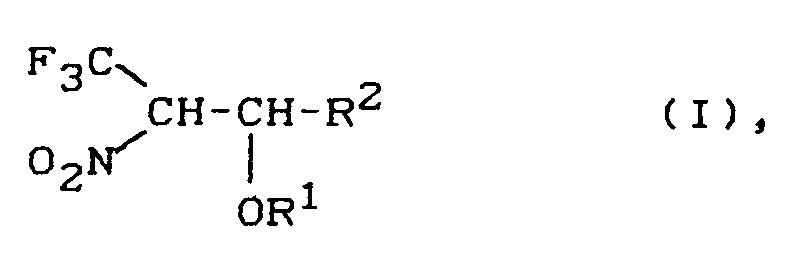
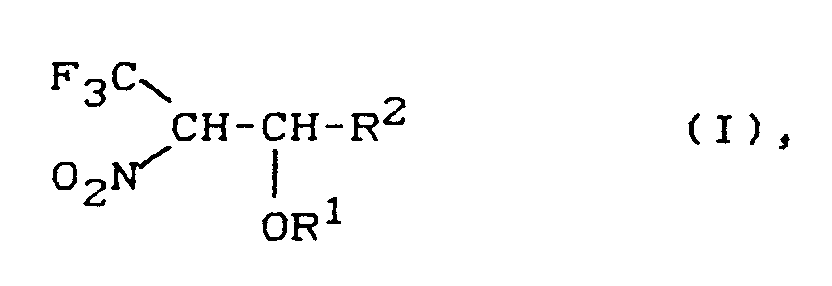
- Die vorliegende Erfindung betrifft neue 1-Trifluormethyl-1-nitro-2-alkoxy-2-aryl-ethane der Formel (I)

in der - R¹
- für einen geradkettigen oder verzweigten Alkylrest und
- R²
- für einen gegebenenfalls substituierten Aryl- oder Hetarylrest
- Vorzugsweise steht R¹ für einen geradkettigen oder verzweigten Alkylrest mit 1 bis 6 C-Atomen. Besonders bevorzugt sind Methyl, Ethyl, i-Propyl, n-Butyl, i-Butyl und t-Butyl.
- Wenn R² Heteroatome enthält, kann es sich beispielsweise um 1 bis 2 Stickstoff-, Sauerstoff- und/oder Schwefelatome handeln. Wenn R² Substituenten enthält, kann es sich beispielsweise um 1 bis 3 Halogenatome, insbesondere Fluor- und/oder Chloratome, 1 bis 2 Nitrogruppen, 1 bis 2 Alkoxygruppen, insbesondere C₁- bis C₆-Alkoxygruppen, 1 bis 2 CHO-Gruppen oder um einen Rest des Typs

handeln, bei dem
R¹ die oben angegebene Bedeutung hat. - Vorzugsweise handelt es sich bei R² um einen 5- oder 6-gliedrigen, carbocyclischen oder heterocyclischen Arylrest, insbesondere um einen Phenyl- oder Thiazolrest.
- Vorzugsweise enthält der Arylrest R² Substituenten. Bevorzugt handelt es sich bei den Substituenten um ein Fluoratom, 1 bis 3 Chloratome, eine Nitrogruppe, eine Methoxygruppe, eine CHO-Gruppe oder einen Rest des Typs

- Besonders bevorzugte Reste R² sind: Dichlorthiazolyl, 3- und 4-Nitrophenyl, 4-Methoxyphenyl, 4-Formylphenyl, 2-, 3- und 4-Chlorphenyl, 3,4- und 2,5-Dichlorphenyl, 2,4,5-Trichlorphenyl, 2-Fluorphenyl und Reste des Typs

- Die Verbindungen der Formel (I) weisen zwei asymmetrische C-Atome auf. Sie können deshalb in der R,R-, R,S-, S,R- und S,S-Form und in beliebigen Mischungen von zwei, drei oder allen diesen Formen vorkommen.
- Die vorliegende Erfindung betrifft die Verbindungen der Formel (I) jeweils sowohl in den einzelnen Formen (R,R-, R,S-, S,R- oder S,S-Form), als auch in beliebigen Mischungen von zwei, drei oder allen diesen Formen.
- In solchen Mischungen kann beispielsweise eine beliebige erste Komponente (R,R-, R,S-, S,R- oder S,S-Form) in einem Anteil von 1 bis 70 Gew.-% und ergänzend zu 100 % eine zweite oder eine zweite und dritte oder eine zweite, dritte und vierte Komponente vorliegen. Vorzugsweise enthalten solche Mischungen alle vier Komponenten, d.h. die R,R-, R,S-, S,R- und S,S-Form einer Verbindung der Formel (I), wobei jede dieser Komponenten vorzugsweise in einer Menge zwischen 15 und 35 Gew.-% vorliegt und die Summe aller Komponenten 100 Gew.-% ergibt.
- Die Zusammensetzung eines vorliegenden Gemisches optischer Isomerer einer Verbindung der Formel (I) kann auf an sich bekannte Weise verändert werden. Beispielsweise kann man eine Deprotonierung durchführen, gefolgt von einer Protonierung, vorzugsweise bei Temperaturen im Bereich -90 bis -100°C mit Eisessig. Man kann auch chromatographische Methoden anwenden. Reine optische Isomere von Verbindungen der Formel (I) können aus Gemischen optischer Isomerer ebenfalls auf an sich bekannte Weise erhalten werden, z.B. durch Flüssigkeitschromatographie (LC).
- Die vorliegende Erfindung betrifft weiterhin ein Verfahren zur Herstellung von 1-Trifluormethyl-1-nitro-2-alkoxy-2-aryl-ethanen der Formel (I)

in der - R¹
- für einen geradkettigen oder verzweigten Alkylrest und
- R²
- für einen gegebenenfalls Heteroatome enthaltenden und gegebenenfalls substituierten Arylrest
- R²
- die bei Formel (I) angegebene Bedeutung hat,
- R¹
- die bei Formel (I) angegebene Bedeutung hat,
- Vorzugsweise und besonders bevorzugt werden solche Aldehyde der Formel (II) und solche Alkohole der Formel (III) eingesetzt, bei denen R² bzw. R¹ die weiter oben als bevorzugt und besonders bevorzugt bezeichneten Bedeutungen haben. Bei den basische Gruppen enthaltenden Verbindungen kann es sich beispielsweise um Ammoniak, primäre, sekundäre oder tertiäre Amine, Ammoniumacetat oder Aminosäuren handeln. Als Beispiele für Amine seien Pyridin und Piperidin genannt. Vorzugsweise wird 3-Aminopropionsäure (= β-Alanin) eingesetzt.
- Die Einsatzmaterialien können beispielsweise in solchen Mengen eingesetzt werden, daß man auf 1 Äquivalent Aldehydgruppen, die in der Verbindung der Formel (II) enthalten sind, 0,8 bis 1,5 Mol eines Alkohols der Formel (III), mindestens 1 Mol Trifluormethylnitromethan und 0,1 bis 2 Mol der basische Gruppen enthaltenden Verbindung verwendet. Vorzugsweise setzt man auf 1 Äquivalent Aldehydgruppen, die in der Verbindung der Formel (II) enthalten sind, 1 bis 1,2 Mol eines Alkohols der Formel (III), 1 bis 1,8 Mol Trifluormethylnitromethan und 0,8 bis 1,2 Mol der basische Gruppen enthaltenden Verbindung ein.
- Die erfindungsgemäße Umsetzung wird im allgemeinen in Gegenwart eines organischen Lösungsmittels durchgeführt. Bei solchen Lösungsmitteln kann es sich um inerte Lösungsmittel handeln, z.B. um Benzol oder Toluol, man kann aber auch einen Überschuß über die für die Reaktion erforderliche Menge des Alkohols der Formel (III) verwenden.
- Da Fremdlösungsmittel in einem besonderen Schritt aus dem Reaktionsgemisch wieder abgetrennt werden müssen und Alkohole der Formel (III) im allgemeinen gut und kostengünstig zugänglich sind, arbeitet man vorzugsweise ohne Fremdlösungsmittel und mit überschüssigem Alkohol.
- Das erfindungsgemäße Verfahren kann bei unterschiedlichen Temperaturen durchgeführt werden, beispielsweise bei solchen im Bereich -50 bis +100°C. Bevorzugt sind Temperaturen im Bereich 0 bis 50°C, besonders bevorzugt solche im Bereich 15 bis 30°C. Bei höheren Temperaturen, beispielsweise über 30°C und insbesondere über 50°C, können zwar kürzere Reaktionszeiten angewendet werden, jedoch muß man dann im allgemeinen Verschlechterungen hinsichtlich der Selektivität in Kauf nehmen.
- Geeignete Reaktionszeiten sind z.B. solche zwischen einer Stunde und einer Woche. Beim Arbeiten bei Temperaturen im Bereich 0 bis 30°C werden im allgemeinen mit Reaktionszeiten von 10 bis 50 Stunden gute Ergebnisse erhalten. Optimale Reaktionszeiten kann man ermitteln, indem man den Reaktionsverlauf gaschromatographisch verfolgt und beispielsweise dann die Reaktion abbricht, wenn im Reaktionsgemisch kein Aldehyd der Formel (II) mehr vorhanden ist oder wenn ein besonders günstiges Verhältnis von gebildetem 1-Trifluormethyl-1-nitro-2-alkoxy-2-aryl-ethan der Formel (I) zu Nebenprodukten und gegebenenfalls noch vorhandenen Ausgangsstoffen vorliegt.
- Die Aufarbeitung des Reaktionsgemisches kann auf verschiedene Weise erfolgen. Beispielsweise kann man zunächst die basische Gruppen enthaltende Verbindung oder Umwandlungsprodukte davon abfiltrieren, das Filtrat einengen und den verbleibenden Rückstand durch Umkristallisation, Destillation und/oder chromatographische Methoden weiter reinigen. Beispielsweise kann man das Reaktionsgemisch auch in Wasser einrühren. Wenn das gewünschte Reaktionsprodukt dann als Feststoff vorliegt, kann man diesen abfiltrieren durch Umkristallisation, Destillation und/oder chromatographische Methoden weiter reinigen. Wenn das gewünschte Reaktionsprodukt nach dem Einrühren in Wasser als Öl vorliegt, kann man dieses mit einem Lösungsmittel, z.B. Methylenchlorid, aufnehmen und beispielsweise auf chromatographischem Wege reinigen.
- Die erfindungsgemäßen 1-Trifluormethyl-1-nitro-2-alkoxy-2-aryl-ethane der Formel (I) zeigen überraschenderweise eine antimykotische Wirkung, z.B. gegen Dermatophyten, Hefen und Schimmelpilze. Die Vorliegende Erfindung betrifft deshalb auch antimykotische Mittel, die dadurch gekennzeichnet sind, daß sie 1-Trifluormethyl-1-nitro-2-alkoxy-2-aryl-ethane der Formel (I) und gegebenenfalls übliche Zusatzstoffe enthalten.
- 60,0 g (0,427 Mol) 4-Chlorbenzaldehyd, enthaltend 0,427 Äquivalente Aldehydgruppen, wurden in 400 ml Methanol gelöst und zu der Lösung zunächst 67 g (0,52 Mol) Trifluormethylnitromethan und anschließend 38,0 g (0,427 Mol) β-Alanin hinzugefügt. Danach wurde das Reaktionsgemisch 24 Stunden lang bei 22°C gerührt. Zur Aufarbeitung wurden die festen Bestandteile durch Filtration abgetrennt, mit Methanol gewaschen, das Filtrat und die Waschflüssigkeit vereinigt und im Vakuum eingeengt. Es hinterblieb ein öliges Gemisch mit kristallinen Anteilen. Die kristallinen Anteile wurden durch erneute Filtration abgetrennt, mit Methanol gewaschen und das Filtrat und die Waschflüssigkeit im Vakuum wieder eingeengt. Es wurden 88,1 g Rohprodukt erhalten, das gemäß gaschromatographischer Analyse folgende Zusammensetzung aufwies:
40,5 Gew.-% 4-Chlorbenzaldehyd,
13,4 Gew.-% 4-Chlorbenzaldehyd-dimethylacetal und
43,2 Gew.-% 1-Trifluormethyl-1-nitro-2-methoxy-2-p-chlorphenyl-ethan (Diastereomerengemisch 12,1+31,1 Gew.-%). - Dieses Rohprodukt wurde an 800 g Kieselgel mit Petrolether/Methylenchlorid (1:1) als Laufmittel chromatographisch aufgetrennt. Als erste Fraktion wurden 36,8 g 1-Trifluormethyl-1-nitro-2-methoxy-2-p-chlorphenyl-ethan (Diastereomerengemisch) als gelbes Öl mit einem Brechungsindex von n

- Bei einer Wiederholung dieses Ansatzes, bei dem jedoch 96 Stunden lang bei 22°C gerührt wurde, wurden nach der chromatographischen Aufarbeitung ein identisches Produkt in einer Ausbeute von 88,5 %, bezogen auf umgesetzten 4-Chlor-benzaldehyd, erhalten.
- Es wurde verfahren wie in Beispiel 1, mit einer Reaktionszeit von 24 Stunden, jedoch wurden die eingesetzten Alkohole und Aldehyde variiert. In einzelnen Fällen wurde auch ein anderes Laufmittel verwendet. Die Einzelheiten der durchgeführten Beispiele sind aus Tabelle 1 ersichtlich. In Tabelle 1 steht in der Spalte "R²"

in der Spalte "Laufmittel" steht A für Methylenchlorid/Petrolether 1:1, B für Methylenchlorid/Petrolether 3:1, C für Toluol/Essigsäureethylester 1:1 und D für Toluol und in der Spalte "Charakterisierung des Reaktionsproduktes" steht IR für charakteristische IR-Banden in cm⁻¹.

- Die in vitro-Prüfungen wurden in Reihenverdünnungstests durchgeführt, wobei der Einfluß der geprüften Substanzen auf Keimeinsaaten in verschiedenen Medien untersucht und jeweils die minimale Hemmkonzentration der geprüften Substanzen ermittelt wurde.
- Als Keime wurden verwendet:
Als Beispiel für Dermatophyten:
A Trichophyton mentagrophytes.
Als Medium hierfür wurde sog. Kimmig-Bouillon (5 g Glycerin, 13 g Nutrient Broth, 8,6 g Bacto Repton, 9,0 g NaCl und 10 g Glukose vermischt mit 1 l entmineralisiertem Wasser) verwendet. In dieses Medium wurden 1 x 10⁵ Keime A pro ml eingesetzt und 5 Tage lang bei 28°C bebrütet. - Als Beispiel für Schimmelpilze:
B Aspergillus fumigatus.
Es wurde das gleiche Medium, die gleiche Menge Keime und die gleiche Bebrütungstemperatur wie bei A angewendet. Die Bebrütungszeit betrug 4 Tage. - Als Beispiele für Hefen:
C Candida albicans.
Als Medium hierfür wurde Yeast Nitrogen Base (Difco) verwendet. In dieses Medium wurden 1 x 10⁴ Keime C pro ml eingesetzt und 3 Tage lang bei 37°C bebrütet.
D Torulopsis glabrata.
Es wurde das gleiche Medium, die gleiche Menge Keime, die gleiche Bebrütungsdauer und die gleiche Bebrütungstemperatur wie bei C angewendet. - Die Ergebnisse sind in Tabelle 2 zusammengestellt.
Tabelle 2 geprüfte Substanz Minimale Hemmkonzentration (µg/ml) für Keime von A B C D aus Beispiel 5 2 8 <1 <1 aus Beispiel 6 1 16 2 <1 aus Beispiel 7 4 64 4 <1 aus Beispiel 8 2 8 2 <1
R²-CHO (II),
in der
R¹-OH (III),
in der
Claims (7)


R²-CHO (II),
in der
(III)
R¹-OH (III),
in der
und gegebenenfalls übliche Zusatzstoffe enthalt.
Applications Claiming Priority (2)
| Application Number | Priority Date | Filing Date | Title |
|---|---|---|---|
| DE3834326 | 1988-10-08 | ||
| DE3834326A DE3834326A1 (de) | 1988-10-08 | 1988-10-08 | 1-trifluormethyl-1-nitro-2-alkoxy-2-aryl- ethane, ihre herstellung und sie enthaltende antimykotische mittel |
Publications (3)
| Publication Number | Publication Date |
|---|---|
| EP0363726A2 EP0363726A2 (de) | 1990-04-18 |
| EP0363726A3 EP0363726A3 (de) | 1991-08-14 |
| EP0363726B1 true EP0363726B1 (de) | 1993-11-24 |
Family
ID=6364702
Family Applications (1)
| Application Number | Title | Priority Date | Filing Date |
|---|---|---|---|
| EP89117811A Expired - Lifetime EP0363726B1 (de) | 1988-10-08 | 1989-09-27 | 1-Trifluormethyl-l-nitro-2-alkoxy-2-aryl-ethane, ihre Herstellung und sie enthaltende antimykotische Mittel |
Country Status (3)
| Country | Link |
|---|---|
| US (1) | US5066681A (de) |
| EP (1) | EP0363726B1 (de) |
| DE (2) | DE3834326A1 (de) |
Families Citing this family (1)
| Publication number | Priority date | Publication date | Assignee | Title |
|---|---|---|---|---|
| US5258394A (en) * | 1988-10-08 | 1993-11-02 | Bayer Aktiengesellschaft | 1-trifluoromethyl-1-nitro-2-alkoxy-2-aryl-ethanes, their preparation and antimycotic agents containing them |
Family Cites Families (1)
| Publication number | Priority date | Publication date | Assignee | Title |
|---|---|---|---|---|
| DE3540332A1 (de) * | 1985-11-14 | 1987-05-21 | Bayer Ag | Fluorierte nitro- und aminoalkohole |
-
1988
- 1988-10-08 DE DE3834326A patent/DE3834326A1/de not_active Withdrawn
-
1989
- 1989-09-20 US US07/409,909 patent/US5066681A/en not_active Expired - Fee Related
- 1989-09-27 EP EP89117811A patent/EP0363726B1/de not_active Expired - Lifetime
- 1989-09-27 DE DE89117811T patent/DE58906249D1/de not_active Expired - Fee Related
Also Published As
| Publication number | Publication date |
|---|---|
| EP0363726A3 (de) | 1991-08-14 |
| DE3834326A1 (de) | 1990-04-19 |
| EP0363726A2 (de) | 1990-04-18 |
| DE58906249D1 (de) | 1994-01-05 |
| US5066681A (en) | 1991-11-19 |
Similar Documents
| Publication | Publication Date | Title |
|---|---|---|
| DE2541855A1 (de) | 4-(polyalkoxy-phenyl)-2-pyrrolidone ii | |
| DE2130919B2 (de) | Substituierte diphenylaether, verfahren zu ihrer herstellung und ihre verwendung als herbizide | |
| DE1146892B (de) | Verfahren zur Herstellung von Orthoameisensaeuredialkylester-amiden | |
| EP0363726B1 (de) | 1-Trifluormethyl-l-nitro-2-alkoxy-2-aryl-ethane, ihre Herstellung und sie enthaltende antimykotische Mittel | |
| EP0735016A1 (de) | Verfahren zur Herstellung von Alpha-Chloralkylarylketonen | |
| EP0352504A1 (de) | Verfahren zur gemeinschaftlichen Herstellung von 3-Dialkylaminopropionitrilen, Bis-(2-cyanoethyl)-ether und gewünschtenfalls Ethylencyanhydrin | |
| DE2632603C2 (de) | ||
| EP0546418B1 (de) | Verfahren zur Herstellung von 5-substituierten 2-Chlorpyridinen | |
| DE941288C (de) | Verfahren zur Herstellung substituierter 2-Imino-4-thiazoline oder von Salzen derselben bzw. von substituierten 2-Aminothiazolen | |
| DE2836945A1 (de) | Derivate des 1,2,4-triazols | |
| DE2462967C2 (de) | Derivate des 3-Amino-5-methyl-2-phenyl-pyrrols, deren Salze und diese enthaltende pharmazeutische Zubereitung | |
| DE3037086A1 (de) | 3-(m-chloranilino-)acrylsaeureaethylester und ein verfahren zu dessen herstellung | |
| DE2606299C2 (de) | Verfahren zur Herstellung von 3-Ethoxy-11&beta;-hydroxy-&Delta;3,5-pregnadien-Derivaten | |
| EP0693466A1 (de) | Verfahren zur Herstellung von aromatischen fluorierten Verbindungen und neue Diamide | |
| DE1695554C3 (de) | Verfahren zur Herstellung kondensierter Piperazinonderivate | |
| EP0090185A2 (de) | Verfahren zur Herstellung von Acetalen und Enoläthern aus Acryloxymethylenverbindungen | |
| DE2336403A1 (de) | Verfahren zur herstellung von isocyanaten | |
| EP0400435B1 (de) | Betainartige Kohlensäurehalbester | |
| DE3104883A1 (de) | Benzylidenderivate, verfahren zu ihrer herstellung und sie enthaltende arzneimittel | |
| DE3873720T2 (de) | Nicotinoylpiperazin-derivate, verfahren zu ihrer herstellung und ihre verwendung in der therapie. | |
| DE2356684A1 (de) | Neue 4-aminoderivate von pyrazolo (3,4-b)pyridin-5-carboxamiden | |
| EP0854133B1 (de) | Arylaminomethylencampherderivate | |
| DE19647538A1 (de) | Verfahren zur Herstellung von enantiomerenreinem N-Methyl-N-[1-phenyl-2-(-3-hydroxypyrrolidin-1-yl)ethyl]-2,2-diphenylacetamid | |
| DD147611A5 (de) | Fungizide mittel | |
| AT214909B (de) | Verfahren zur Herstellung von ungesättigten Ketonen |
Legal Events
| Date | Code | Title | Description |
|---|---|---|---|
| PUAI | Public reference made under article 153(3) epc to a published international application that has entered the european phase |
Free format text: ORIGINAL CODE: 0009012 |
|
| 17P | Request for examination filed |
Effective date: 19890927 |
|
| AK | Designated contracting states |
Kind code of ref document: A2 Designated state(s): CH DE FR GB LI |
|
| PUAL | Search report despatched |
Free format text: ORIGINAL CODE: 0009013 |
|
| AK | Designated contracting states |
Kind code of ref document: A3 Designated state(s): CH DE FR GB LI |
|
| 17Q | First examination report despatched |
Effective date: 19930210 |
|
| GRAA | (expected) grant |
Free format text: ORIGINAL CODE: 0009210 |
|
| AK | Designated contracting states |
Kind code of ref document: B1 Designated state(s): CH DE FR GB LI |
|
| GBT | Gb: translation of ep patent filed (gb section 77(6)(a)/1977) |
Effective date: 19931130 |
|
| REF | Corresponds to: |
Ref document number: 58906249 Country of ref document: DE Date of ref document: 19940105 |
|
| ET | Fr: translation filed | ||
| PLBE | No opposition filed within time limit |
Free format text: ORIGINAL CODE: 0009261 |
|
| STAA | Information on the status of an ep patent application or granted ep patent |
Free format text: STATUS: NO OPPOSITION FILED WITHIN TIME LIMIT |
|
| PG25 | Lapsed in a contracting state [announced via postgrant information from national office to epo] |
Ref country code: GB Effective date: 19940927 |
|
| PG25 | Lapsed in a contracting state [announced via postgrant information from national office to epo] |
Ref country code: LI Effective date: 19940930 Ref country code: CH Effective date: 19940930 |
|
| 26N | No opposition filed | ||
| GBPC | Gb: european patent ceased through non-payment of renewal fee |
Effective date: 19940927 |
|
| PG25 | Lapsed in a contracting state [announced via postgrant information from national office to epo] |
Ref country code: FR Effective date: 19950531 |
|
| REG | Reference to a national code |
Ref country code: CH Ref legal event code: PL |
|
| PG25 | Lapsed in a contracting state [announced via postgrant information from national office to epo] |
Ref country code: DE Effective date: 19950601 |
|
| REG | Reference to a national code |
Ref country code: FR Ref legal event code: ST |