EP0372486B1 - Neue Benzoesäure- und Phenylessigsäurederivate, ihre Herstellung und Verwendung als Heilmittel - Google Patents
Neue Benzoesäure- und Phenylessigsäurederivate, ihre Herstellung und Verwendung als Heilmittel Download PDFInfo
- Publication number
- EP0372486B1 EP0372486B1 EP89122396A EP89122396A EP0372486B1 EP 0372486 B1 EP0372486 B1 EP 0372486B1 EP 89122396 A EP89122396 A EP 89122396A EP 89122396 A EP89122396 A EP 89122396A EP 0372486 B1 EP0372486 B1 EP 0372486B1
- Authority
- EP
- European Patent Office
- Prior art keywords
- alanine
- benzoyl
- amino
- formula
- acid
- Prior art date
- Legal status (The legal status is an assumption and is not a legal conclusion. Google has not performed a legal analysis and makes no representation as to the accuracy of the status listed.)
- Expired - Lifetime
Links
- KFZLNWFEMNSAKP-HTAVEAQLSA-N CC1(C)/C=C\C=[N](C)(C)=CC(C)(C)/C=C1 Chemical compound CC1(C)/C=C\C=[N](C)(C)=CC(C)(C)/C=C1 KFZLNWFEMNSAKP-HTAVEAQLSA-N 0.000 description 1
Classifications
-
- C—CHEMISTRY; METALLURGY
- C07—ORGANIC CHEMISTRY
- C07C—ACYCLIC OR CARBOCYCLIC COMPOUNDS
- C07C237/00—Carboxylic acid amides, the carbon skeleton of the acid part being further substituted by amino groups
- C07C237/28—Carboxylic acid amides, the carbon skeleton of the acid part being further substituted by amino groups having the carbon atom of at least one of the carboxamide groups bound to a carbon atom of a non-condensed six-membered aromatic ring of the carbon skeleton
- C07C237/42—Carboxylic acid amides, the carbon skeleton of the acid part being further substituted by amino groups having the carbon atom of at least one of the carboxamide groups bound to a carbon atom of a non-condensed six-membered aromatic ring of the carbon skeleton having nitrogen atoms of amino groups bound to the carbon skeleton of the acid part, further acylated
-
- A—HUMAN NECESSITIES
- A61—MEDICAL OR VETERINARY SCIENCE; HYGIENE
- A61P—SPECIFIC THERAPEUTIC ACTIVITY OF CHEMICAL COMPOUNDS OR MEDICINAL PREPARATIONS
- A61P29/00—Non-central analgesic, antipyretic or antiinflammatory agents, e.g. antirheumatic agents; Non-steroidal antiinflammatory drugs [NSAID]
-
- A—HUMAN NECESSITIES
- A61—MEDICAL OR VETERINARY SCIENCE; HYGIENE
- A61P—SPECIFIC THERAPEUTIC ACTIVITY OF CHEMICAL COMPOUNDS OR MEDICINAL PREPARATIONS
- A61P7/00—Drugs for disorders of the blood or the extracellular fluid
- A61P7/02—Antithrombotic agents; Anticoagulants; Platelet aggregation inhibitors
-
- A—HUMAN NECESSITIES
- A61—MEDICAL OR VETERINARY SCIENCE; HYGIENE
- A61P—SPECIFIC THERAPEUTIC ACTIVITY OF CHEMICAL COMPOUNDS OR MEDICINAL PREPARATIONS
- A61P9/00—Drugs for disorders of the cardiovascular system
- A61P9/06—Antiarrhythmics
-
- A—HUMAN NECESSITIES
- A61—MEDICAL OR VETERINARY SCIENCE; HYGIENE
- A61P—SPECIFIC THERAPEUTIC ACTIVITY OF CHEMICAL COMPOUNDS OR MEDICINAL PREPARATIONS
- A61P9/00—Drugs for disorders of the cardiovascular system
- A61P9/08—Vasodilators for multiple indications
-
- A—HUMAN NECESSITIES
- A61—MEDICAL OR VETERINARY SCIENCE; HYGIENE
- A61P—SPECIFIC THERAPEUTIC ACTIVITY OF CHEMICAL COMPOUNDS OR MEDICINAL PREPARATIONS
- A61P9/00—Drugs for disorders of the cardiovascular system
- A61P9/10—Drugs for disorders of the cardiovascular system for treating ischaemic or atherosclerotic diseases, e.g. antianginal drugs, coronary vasodilators, drugs for myocardial infarction, retinopathy, cerebrovascula insufficiency, renal arteriosclerosis
-
- C—CHEMISTRY; METALLURGY
- C07—ORGANIC CHEMISTRY
- C07C—ACYCLIC OR CARBOCYCLIC COMPOUNDS
- C07C237/00—Carboxylic acid amides, the carbon skeleton of the acid part being further substituted by amino groups
- C07C237/28—Carboxylic acid amides, the carbon skeleton of the acid part being further substituted by amino groups having the carbon atom of at least one of the carboxamide groups bound to a carbon atom of a non-condensed six-membered aromatic ring of the carbon skeleton
- C07C237/40—Carboxylic acid amides, the carbon skeleton of the acid part being further substituted by amino groups having the carbon atom of at least one of the carboxamide groups bound to a carbon atom of a non-condensed six-membered aromatic ring of the carbon skeleton having the nitrogen atom of the carboxamide group bound to a carbon atom of a six-membered aromatic ring
-
- C—CHEMISTRY; METALLURGY
- C07—ORGANIC CHEMISTRY
- C07C—ACYCLIC OR CARBOCYCLIC COMPOUNDS
- C07C237/00—Carboxylic acid amides, the carbon skeleton of the acid part being further substituted by amino groups
- C07C237/28—Carboxylic acid amides, the carbon skeleton of the acid part being further substituted by amino groups having the carbon atom of at least one of the carboxamide groups bound to a carbon atom of a non-condensed six-membered aromatic ring of the carbon skeleton
- C07C237/44—Carboxylic acid amides, the carbon skeleton of the acid part being further substituted by amino groups having the carbon atom of at least one of the carboxamide groups bound to a carbon atom of a non-condensed six-membered aromatic ring of the carbon skeleton having carbon atoms of carboxamide groups, amino groups and singly-bound oxygen atoms bound to carbon atoms of the same non-condensed six-membered aromatic ring
-
- C—CHEMISTRY; METALLURGY
- C07—ORGANIC CHEMISTRY
- C07C—ACYCLIC OR CARBOCYCLIC COMPOUNDS
- C07C257/00—Compounds containing carboxyl groups, the doubly-bound oxygen atom of a carboxyl group being replaced by a doubly-bound nitrogen atom, this nitrogen atom not being further bound to an oxygen atom, e.g. imino-ethers, amidines
- C07C257/10—Compounds containing carboxyl groups, the doubly-bound oxygen atom of a carboxyl group being replaced by a doubly-bound nitrogen atom, this nitrogen atom not being further bound to an oxygen atom, e.g. imino-ethers, amidines with replacement of the other oxygen atom of the carboxyl group by nitrogen atoms, e.g. amidines
- C07C257/18—Compounds containing carboxyl groups, the doubly-bound oxygen atom of a carboxyl group being replaced by a doubly-bound nitrogen atom, this nitrogen atom not being further bound to an oxygen atom, e.g. imino-ethers, amidines with replacement of the other oxygen atom of the carboxyl group by nitrogen atoms, e.g. amidines having carbon atoms of amidino groups bound to carbon atoms of six-membered aromatic rings
-
- C—CHEMISTRY; METALLURGY
- C07—ORGANIC CHEMISTRY
- C07C—ACYCLIC OR CARBOCYCLIC COMPOUNDS
- C07C271/00—Derivatives of carbamic acids, i.e. compounds containing any of the groups, the nitrogen atom not being part of nitro or nitroso groups
- C07C271/06—Esters of carbamic acids
- C07C271/08—Esters of carbamic acids having oxygen atoms of carbamate groups bound to acyclic carbon atoms
- C07C271/10—Esters of carbamic acids having oxygen atoms of carbamate groups bound to acyclic carbon atoms with the nitrogen atoms of the carbamate groups bound to hydrogen atoms or to acyclic carbon atoms
- C07C271/22—Esters of carbamic acids having oxygen atoms of carbamate groups bound to acyclic carbon atoms with the nitrogen atoms of the carbamate groups bound to hydrogen atoms or to acyclic carbon atoms to carbon atoms of hydrocarbon radicals substituted by carboxyl groups
-
- C—CHEMISTRY; METALLURGY
- C07—ORGANIC CHEMISTRY
- C07C—ACYCLIC OR CARBOCYCLIC COMPOUNDS
- C07C279/00—Derivatives of guanidine, i.e. compounds containing the group, the singly-bound nitrogen atoms not being part of nitro or nitroso groups
- C07C279/04—Derivatives of guanidine, i.e. compounds containing the group, the singly-bound nitrogen atoms not being part of nitro or nitroso groups having nitrogen atoms of guanidine groups bound to acyclic carbon atoms of a carbon skeleton
- C07C279/14—Derivatives of guanidine, i.e. compounds containing the group, the singly-bound nitrogen atoms not being part of nitro or nitroso groups having nitrogen atoms of guanidine groups bound to acyclic carbon atoms of a carbon skeleton being further substituted by carboxyl groups
-
- C—CHEMISTRY; METALLURGY
- C07—ORGANIC CHEMISTRY
- C07D—HETEROCYCLIC COMPOUNDS
- C07D211/00—Heterocyclic compounds containing hydrogenated pyridine rings, not condensed with other rings
- C07D211/04—Heterocyclic compounds containing hydrogenated pyridine rings, not condensed with other rings with only hydrogen or carbon atoms directly attached to the ring nitrogen atom
- C07D211/06—Heterocyclic compounds containing hydrogenated pyridine rings, not condensed with other rings with only hydrogen or carbon atoms directly attached to the ring nitrogen atom having no double bonds between ring members or between ring members and non-ring members
- C07D211/08—Heterocyclic compounds containing hydrogenated pyridine rings, not condensed with other rings with only hydrogen or carbon atoms directly attached to the ring nitrogen atom having no double bonds between ring members or between ring members and non-ring members with hydrocarbon or substituted hydrocarbon radicals directly attached to ring carbon atoms
- C07D211/18—Heterocyclic compounds containing hydrogenated pyridine rings, not condensed with other rings with only hydrogen or carbon atoms directly attached to the ring nitrogen atom having no double bonds between ring members or between ring members and non-ring members with hydrocarbon or substituted hydrocarbon radicals directly attached to ring carbon atoms with substituted hydrocarbon radicals attached to ring carbon atoms
- C07D211/34—Heterocyclic compounds containing hydrogenated pyridine rings, not condensed with other rings with only hydrogen or carbon atoms directly attached to the ring nitrogen atom having no double bonds between ring members or between ring members and non-ring members with hydrocarbon or substituted hydrocarbon radicals directly attached to ring carbon atoms with substituted hydrocarbon radicals attached to ring carbon atoms with hydrocarbon radicals, substituted by carbon atoms having three bonds to hetero atoms with at the most one bond to halogen, e.g. ester or nitrile radicals
-
- C—CHEMISTRY; METALLURGY
- C07—ORGANIC CHEMISTRY
- C07K—PEPTIDES
- C07K5/00—Peptides containing up to four amino acids in a fully defined sequence; Derivatives thereof
- C07K5/02—Peptides containing up to four amino acids in a fully defined sequence; Derivatives thereof containing at least one abnormal peptide link
- C07K5/0205—Peptides containing up to four amino acids in a fully defined sequence; Derivatives thereof containing at least one abnormal peptide link containing the structure -NH-(X)3-C(=0)-, e.g. statine or derivatives thereof
-
- C—CHEMISTRY; METALLURGY
- C07—ORGANIC CHEMISTRY
- C07C—ACYCLIC OR CARBOCYCLIC COMPOUNDS
- C07C2601/00—Systems containing only non-condensed rings
- C07C2601/12—Systems containing only non-condensed rings with a six-membered ring
- C07C2601/14—The ring being saturated
-
- C—CHEMISTRY; METALLURGY
- C07—ORGANIC CHEMISTRY
- C07C—ACYCLIC OR CARBOCYCLIC COMPOUNDS
- C07C2602/00—Systems containing two condensed rings
- C07C2602/02—Systems containing two condensed rings the rings having only two atoms in common
- C07C2602/04—One of the condensed rings being a six-membered aromatic ring
- C07C2602/08—One of the condensed rings being a six-membered aromatic ring the other ring being five-membered, e.g. indane
Definitions
- the present invention relates to new benzoic acid and phenylacetic acid derivatives. Process for the preparation of pharmaceutical preparations containing such compounds, and the use of these compounds in the manufacture of pharmaceutical preparations.
- Preferred compounds of formula I and IA are also those in which R1 is a group (amino or guanidino) - (CH2) 1 ⁇ 7-, ⁇ - (amino or guanidino) - (m or p) -tolyl or ⁇ -amino-p -tolylmethyl or wherein R1-CO- represents the acid residue of arginine, ornithine, N2-Boc-arginine or N2-Boc-ornithine, or 3- (p-amidinophenyl) -DL-alanyl or p-amidinobenzoyl.
- R1 is a group (amino or guanidino) - (CH2) 1 ⁇ 7-, ⁇ - (amino or guanidino) - (m or p) -tolyl or ⁇ -amino-p -tolylmethyl or wherein R1-CO- represents the acid residue of arginine, ornithine
- R3 is hydrogen, carboxyisobutylidene aminocarbonyl or 1-carboxy-2- (1-naphthyl) ethylidene aminocarbonyl, and those in which R2 is H, CH3, OCH3, NO2 or Cl.
- a protected amino group Ra contained in the substituent R1 can be split off, for example by means of formic acid, as in the above Connection with the splitting off of protective groups described.
- IC50 values below correspond to the concentration of the test substance which is required to inhibit the binding of fibrinogen to the immobilized receptor by 50%:
- N- (m-aminobenzoyl) - ⁇ -alanine benzyl ester trifluoroacetate.
- N ⁇ -ZN- ⁇ -nitro-L-arginine is activated with isobutyl chloroformate and triethylamine in THF (4 minutes, -10 ° C) and with N- (m-aminobenzoyl) - ⁇ -alanine benzyl ester trifluoroacetate and triethylamine desired benzyl ester coupled, mp. 157-160 ° C.
- the starting ester (mp. 121-122 ° C) is obtained analogously to the above examples from 6- [1- (benzyloxy) formamido] hexanoic acid and N- (m-aminobenzoyl) - ⁇ -alanine benzyl ester trifluoroacetate.
- the starting ester (mp. 123-124 ° C) is obtained by 8- [1- (benzyloxy) formamidooctanoic acid and 3-aminobenzoic acid couples to m- [8- [1- (benzyloxy) formamido] octanamido] benzoic acid, mp. 167-168 ° C. and the latter is reacted with ⁇ -alanine benzyl ester p-toluenesulfonate.
- m- [ ⁇ - [1- (benzyloxy) formamido] -p-toluamido] benzoic acid mp. 250 °
- N- [m [ ⁇ - [1- (benzyloxy) formamido] -p- toluamido] benzoyl] - ⁇ -alanine benzyl ester mp. 155-156 °
- the N- [m- ( ⁇ -amino-p-toluamido) benzoyl] - ⁇ -alanine mp. 232 ° C.
- N- [5- [6- (1-tert-butoxyformamido) hexanamido] -2-chlorobenzoyl- ⁇ -alanine is converted into N- [5- (6-aminohexanamido) -2-chlorobenzoyl] - ⁇ -alanine , Mp. 264 ° from H2O, obtained.
- the starting material [MS: 661 (7, M + H)] is obtained from N6- (benzyloxycarbonyl) -N2- (tert-butoxycarbonyl) -L-lysine-h ydroxysuccinimide ester and N- (m-aminobenzoyl) - ⁇ -alanine benzyl ester in boiling THF.
- N- [3- (5-aminovaleramido) - is obtained from N- [3- [5- (1-tert-butoxyformamido) valeramido] -4-chlorobenzoyl] - ⁇ -alanine tert-butyl ester.
- N- [3- [5- (1-tert-butoxyformamido) valeramido] -p-toluoyl] - ⁇ -alanine benzyl ester gives the N- [3- (5-aminovaleramido) -p-toluoyl] - ⁇ -alanine, mp 212-213 ° C, as hydrate (2: 1).
- the starting material, MS: 524 (87, M + H) is obtained from m- [5- (1-tert-butoxyformamido) valeramido] benzoic acid and ⁇ -amino-5-indanopropionic acid.
- N- [m- [trans-4 - [[1- (benzyloxy) formamido] methyl] cyclohexanecarboxamido] benzoyl] - ⁇ -alanine benzyl ester is used to obtain the N- [m- [trans-4- (aminomethyl) cyclohexanecarboxamido] benzoyl] - ⁇ -alanine, mp. 248-249 ° C.
- the starting material mp. 145-146 ° C., is obtained by coupling the trans-4 - [[1- (benzyloxy) formamido] methyl] cyclohexane carboxylic acid with N- (m-aminobenzoyl) - ⁇ -alanine benzyl ester.
- N- [m- [m- [N - [(benzyloxy) carbonyl] amidino] benzamido] benzoyl] - ⁇ -alanine benzyl ester gives the N- [m- (m-amidinobenzamido) benzoyl - ⁇ -alanine, Mp 221-223 ° C (decomposed).
- the starting material is obtained from DL-N- [m- (5-aminovaleramido) benzoyl] -3- (5-indanyl) - ⁇ -alanine trifluoroacetate and NN'-bis (tert-butoxycarbonyl) -S-methyl-isothiourea .
- N- [2- (benzyloxy) -5- [5- (1-tert-butoxyformamido) valeramido] benzoyl] - ⁇ -alanine is obtained in 2 hours from N- [5- (5-aminovaleramido) -2- (benzyloxy) benzoyl- ⁇ -alanine, m.p. 227-228 ° C.
- the starting material, MS: 656 (32, M + H), is obtained from N- [5- (5-aminovaleramido) -2- (benzyloxy) benzoyl] - ⁇ -alanine, (Example 46), and N, N ' -Bis (tert-butoxycarbonyl) -S-methylisothiourea.
- the starting material, MS: 572 (11, M + H), is obtained by coupling 1 - [(benzyloxy) carbonyl] -4-piperidinepropionic acid with N- (m-aminobenzoyl) - ⁇ -alanine benzyl ester trifluoroacetate.
- N- [2- (benzyloxy) -5- [p- [N- (tert-butoxycarbonyl) amidino] benzamido] benzoyl] - ⁇ -alanine is obtained in 4 hours from N- [5- ( p-Amidinobenzamido) -2- (benzyloxy) benzoyl] - ⁇ -alanine, mp. 215-217 ° (lyophilized), as hydrate (1: 4).
- the starting material is obtained from N- [4- (benzyloxy) -3- [p- [N- (tert-butoxycarbonyl) amidino] benzamido] benzoyl- ⁇ -alanine methyl ester by catalysis. Hydrogenation on Pd / C in ethanol-DMF 2: 1 to N- [3- [p- [N- (tert-butoxycarbon) amidino] benzamido] -4-hydroxybenzoyl] - ⁇ -alanine methyl ester, mp.> 180 ° ( Dec.), MS: 485 (78, M + H) and saponification of the latter in methanolic sodium hydroxide solution.
- N- [5- (p- [N- (tert-butoxycarbonyl) amidino] benzamido] salicyloyl] - ⁇ -alanine is obtained from N- [5- (p-amidinobenzamido) salicyloyl] - ⁇ -alanine , Mp> 260 °, MS: 371 (8, M + H).
- the starting material mp.> 140 ° C (dec.), Is obtained from N- [m- [3- (4-piperidinyl) propionamido] benzoyl] - ⁇ -alanine and N, N′-bis (tert.- butoxycarbonyl) -S-methylisothiourea.
- N- [m- (p-amidinobenzamido) benzoyl] -3- (tert-butoxycarbonyl) -L-alanine N- [m- (p-amidinobenzamido) benzoyl] -L- is obtained in a manner analogous to that in Example 60. asparagine trifluoroacetate (1: 2). Yield: 80%, mp. 107-108 ° C (Et2O; dec.), MS: 399 (M + 1) +.
- the starting material can be produced as follows: By coupling 3-aminobenzoic acid with H-Asp (OtBu) -Phe-OtBu (obtained from the condensation of Z-Asp (OtBu) -OH with H-Phe-OtBu followed by hydrogenolysis) in the manner described in Example 59 a) there is obtained N- [N- (m-aminobenzoyl) -3-t-butoxycarbonyl-L-alanyl] -3-phenyl-L-alanine-t-butyl ester. MS: 512 (M + 1) +.
- a compound of the formula I can be used in a manner known per se as an active ingredient for producing tablets of the following composition: per tablet Active ingredient 200 mg microcrystalline cellulose 155 mg Cornstarch 25 mg Talk 25 mg Hydroxypropylmethyl cellulose 20 mg 425 mg
- a compound of formula I can be used in a manner known per se as an active ingredient for the production of capsules of the following composition: per capsule Active ingredient 100.0 mg Cornstarch 20.0 mg Milk sugar 95.0 mg Talk 4.5 mg Magnesium stearate 0.5 mg 220.0 mg
Landscapes
- Chemical & Material Sciences (AREA)
- Organic Chemistry (AREA)
- Health & Medical Sciences (AREA)
- General Health & Medical Sciences (AREA)
- Life Sciences & Earth Sciences (AREA)
- Medicinal Chemistry (AREA)
- Chemical Kinetics & Catalysis (AREA)
- Public Health (AREA)
- General Chemical & Material Sciences (AREA)
- Nuclear Medicine, Radiotherapy & Molecular Imaging (AREA)
- Veterinary Medicine (AREA)
- Pharmacology & Pharmacy (AREA)
- Bioinformatics & Cheminformatics (AREA)
- Animal Behavior & Ethology (AREA)
- Engineering & Computer Science (AREA)
- Cardiology (AREA)
- Heart & Thoracic Surgery (AREA)
- Proteomics, Peptides & Aminoacids (AREA)
- Crystallography & Structural Chemistry (AREA)
- Molecular Biology (AREA)
- Genetics & Genomics (AREA)
- Biophysics (AREA)
- Biochemistry (AREA)
- Rheumatology (AREA)
- Urology & Nephrology (AREA)
- Pain & Pain Management (AREA)
- Hematology (AREA)
- Diabetes (AREA)
- Vascular Medicine (AREA)
- Organic Low-Molecular-Weight Compounds And Preparation Thereof (AREA)
- Peptides Or Proteins (AREA)
- Medicines That Contain Protein Lipid Enzymes And Other Medicines (AREA)
- Acyclic And Carbocyclic Compounds In Medicinal Compositions (AREA)
- Pharmaceuticals Containing Other Organic And Inorganic Compounds (AREA)
- Hydrogenated Pyridines (AREA)
Description
- Die vorliegende Erfindung betrifft neue Benzoesäure- und Phenylessigsäurederivate. Verfahren zu deren Herstellung pharmazeutische Präparate, die solche Verbindungen enthalten, sowie die Verwendung dieser Verbindungen bei der Herstellung pharmazeutischer Präparate.
- Die Erfindung betrifft insbesondere Benzoesäure- und Phenylessigsäurederivate der Formel

worin R¹ eine Gruppe der Formel
-C(H,Ra)-(CH₂)n-NH-Rb (R-1)
-(T)1 oder 0-C₆H₄-CH₂NH-Rc (R-2)
-(T)1 oder 0-C₆H₄-(NH)1 oder 0-C(NH)NH₂ (R-3)

Ra H, NH₂, -NHCOO-C₁₋₄-Alkyl, -NH-Z oder -NHCOCH₂N(Y)-CH₂CH₂NH-Y, und n 1-6 oder, falls Ra H ist, n auch 0 sein kann,
Y H, Boc oder Z;
Rb H, Amidino oder -C(NH)-(CH₂)₀₋₃CH₃;
Rc H oder Amidino;
T -CH₂-, -CH=CH- oder -C(H,Rd)-CH₂- ist;
Rd die gleiche Bedeutung wie Ra hat oder -NHCO-phenyl, -NHCO-phenylen-N₃ oder -NHSO₂-Aryl ist;
Re H oder Amidino;
R³ H, -CONH₂, -CORf, COORg oder Aryl;
Rf der Rest einer über die Aminogruppe gebundenen α-Aminocarbonsäure oder eines Esters oder Amids davon;
Rg H oder nieder-Alkyl;
R² H, CH₃, OCH₃, NO₂, Halogen, NH₂, NHCO-phenylen-COOH, -NHCO(CH₂)₁₋₄-COOH, ORh, -CH₂CH₂ORh, -CH₂CH₂OCH₂CH₂ORh, oder -CH₂COORh; und
Rh H oder nieder-Alkyl ist.
sowie Hydrate oder Solvate und physiologisch verwendbare Salze davon. - Im Rahmen der vorliegenden Erfindung bezeichnet Me Methyl. Bzl Benzyl, tBu t-Butyl, Boc t-Butoxycarbonyl, Z Benzyloxycarbonyl, Arg L-Arginyl, Orn L-Ornithyl, Val L-Valyl, Phe L-Phenylalanyl, Leu L-Leucyl, Ileu L-Isoleucyl, Ser L-Seryl, Thr L-Threonyl, Gly Glycyl, Ala L-Alanyl, Asp L-α-Aspartyl.
- Aryl bezeichnet mono- oder bicyclische Reste wie Phenyl, Tolyl und α- oder β-Naphthyl.
- Beispiele von über die Aminogruppe gebundenen α-Aminocarbonsäuren sind Val, Phe, Leu, Ileu, Ser, Thr, N-Isopropyl-Gly, β-Cyclohexyl-Ala, β-(1-Naphthyl)-Ala und Cycloleucin
- Die Verbindungen der Formel I können solvatisiert, insbesondere hydratisiert sein. Die Hydratisierung kann im Zuge des Herstellungsverfahrens erfolgen oder allmählich als Folge hygroskopischer Eigenschaften einer zunächst wasserfreien Verbindung der Formel I auftreten.
- Beispiele von physiologisch verwendbaren Salzen der Verbindungen der Formel I sind Salze mit physiologisch verträglichen Mineralsäuren, wie Salzsäure, Schwefelsäure oder Phosphorsäure, oder mit organischen Säuren, wie Methansulfonsäure, Essigsäure, Trifluoressigsäure, Zitronensäure, Fumarsäure, Bernsteinsäure oder Salicylsäure. Die Verbindungen der Formel I können auch Salze mit physiologisch verträglichen Basen bilden. Beispiele solcher Salze sind Alkalimetall-, Erdalkalimetall-, Ammonium- und Alkylammoniumsalze, wie das Na-, K-, Ca- oder Trimethylammoniumsalz. Verbindungen der Formel I, die eine Amino, Amidino- oder Guanidinogruppe enthalten, können in Form von Zwitterionen vorliegen.
- Die Verbindungen der Formel I, die ein oder mehrere asymmetrische C-Atome enthalten, können als Enantiomere, als Diastereomere oder als Gemische davon, z.B. als Racemate, vorliegen.
- Eine bevorzugte Gruppe von Verbindungen der Formel sind Verbindungen der Formel

worin R1a eine Gruppe der Formeln R-1, R-2 oder R-3 ist;
R2a H, -CH₃, -OCH₃ -NO₂, Halogen, -NH₂, -NHCO-phenylen-COOH oder -NHCO(CH₂)₁₋₄-COOH ist;
R3a H, -CONH₂ oder -CORi;
Ri der Rest einer über die Aminogruppe gebundenen α-Aminocarbonsäure ist,
und R-1, R-2 und R-3 die oben angegebene Bedeutung haben. - Bevorzugte Verbindungen der Formel I und IA sind ferner diejenigen, worin R¹ eine Gruppe (Amino oder Guanidino)-(CH₂)₁₋₇-, α-(Amino oder Guanidino)-(m oder p)-tolyl oder α-Amino-p-tolylmethyl oder worin R¹-CO- den Säurerest von Arginin, Ornithin, N²-Boc-Arginin oder N²-Boc-Ornithin darstellt, oder 3-(p-Amidinophenyl)-DL-alanyl oder p-Amidinobenzoyl darstellt.
- Bevorzugt sind ferner die Verbindungen der Formel I und IA worin R³ Wasserstoff, Carboxyisobutylidenaminocarbonyl oder 1-Carboxy-2-(1-naphthyl)äthylidenaminocarbonyl ist, sowie diejenigen, worin R² H, CH₃, OCH₃, NO₂ oder Cl ist.
- Die Verbindungen der Formel I können erfindungsgemäss dadurch erhalten werden, dass man aus einer Verbindung der Formel
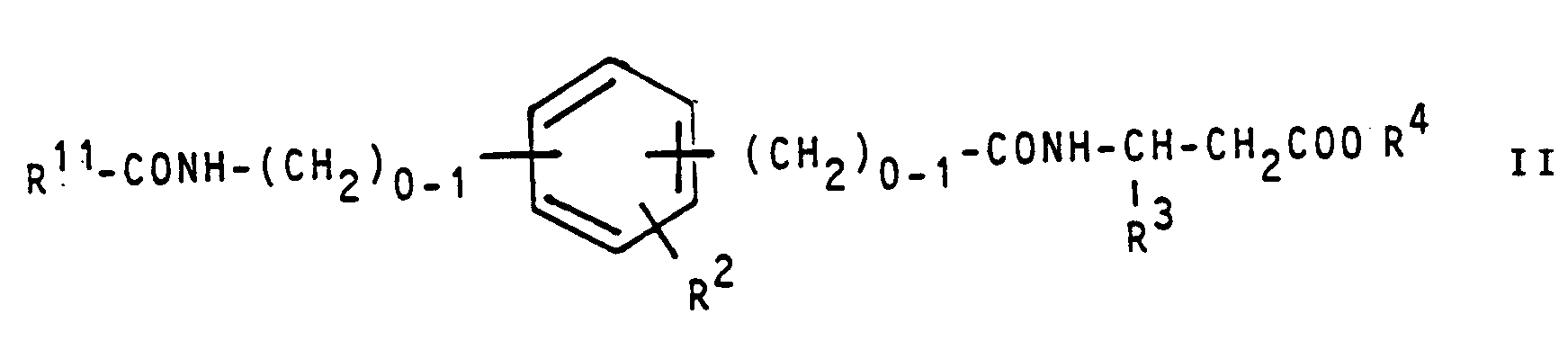
worin R¹¹ ein Rest der Formeln R-1, R-2, R-3, R-4 oder R-5 gemäss obiger Definition darstelllt, in denen eine gegebenenfalls anwesende Amino-, Amidino- oder Guanidinogruppe in geschützter Form vorliegen kann, R⁴ Wasserstoff oder eine leicht spaltbare Estergruppe ist und R² und R³ die weiter oben angegebene Bedeutung haben; und wobei das Molekül mindestens eine leicht spaltbare Estergruppe oder eine geschützte Amino-, Amidino- oder Guanidinogruppe enthält,
Estergruppe(n) und/oder Amino-, Amidino- oder Guanidinoschutzgruppe(n) abspaltet, gewünschtenfalls eine im Rest R¹ enthaltene, reaktionsfähige Gruppe funktionell abwandelt, und gewünschtenfalls eine Verbindung der Formel I in ein physiologisch verträgliches Salz überführt oder ein Salz einer Verbindung der Formel I in die freie Säure oder Base überführt. - Beispiele von geschützten Amino-, Amidino- und Guanidinoschutzgruppen sind -NH-Z, -NH-Boc und Azido; -C(NH)NH-Z; -NHC(NH)NH-NO₂ und -NHC(N-Boc)-NH-Boc. Beispiele von leicht spaltbaren Estergruppen R⁴ sind Methyl, t-Butyl und Benzyl. Ein Beispiel für einen in Form eines leicht spaltbaren Esters vorliegenden Rests Ro ist Benzyloxycarbonylisobutylidenamino.
- Die Abspaltungen der Estergruppen und der NH₂-Schutzgruppen lassen sich in an sich bekannter Weise durchführen. Beispielsweise kann man eine Estergruppe mit einer Base, wie einem Alkalimetallhydroxyd, z.B. Natronlauge, verseifen. Benzylester können durch Hydrierung in Gegenwart eines Edelmetallkatalysators, wie Palladium auf Kohlenstoff (Pd/C) in einem Lösungsmittel, wie Methanol, Athanol, Ameisensäure oder Essigsäure, bei einer Temperatur bis zu etwa 40°C, vorzugsweise bei Raumtemperatur gespalten werden. Dabei werden gleichzeitig in der Gruppe R enthaltene Amino- oder Amidinoschutzgruppen, wie Z; bzw. Guanidinoschutzgruppen, wie NO₂, abgespalten.
- Eine im Substituenten R¹¹ enthaltene geschützte Aminogruppe, z.B. -NH-Boc, lässt sich z.B. mit einer Säure, wie Ameisensäure oder Trifluoressigsäure, bei einer Temperatur bis zu 40°C, vorzugsweise bei etwa Raumtemperatur spalten. Dabei werden gleichzeitig Estergruppen R³, z.B. t-Butyl, bzw. Amidinoschutzgruppen, wie Boc, abgespalten.
- Die funktionellen Abwandlungen reaktionsfähiger Gruppen in R¹ lassen sich ebenfalls nach an sich geläufigen Methoden bewerkstelligen. So kann man eine in dem Substituenten R¹ enthaltene primäre Aminogruppe -NH-Rb oder -NH-Rc in eine Guanidinogruppe umwandeln, z.B. mittels 2-[(Aminoiminomethyl)thio]äthansulfonsäure in Gegenwart einer Base, wie Natriumcarbonat oder Natriumhydroxid, bei einer Temperatur bis zu 40°C, vorzugsweise bei etwa Raumtemperatur.
- Eine in einem Substituenten R¹ enthaltene primäre Aminogruppe Rª kann man in die -NH-Boc-Gruppe umwandeln, z.B. mittels Di-t-Butyl-dicarbonat in einem Lösungsmittel. wie Dioxan, in Gegenwart von Pyridinhydrobromid und Natriumbicarbonat bei einer Temperatur bis zu 40°C, vorzugsweise bei etwa Raumtemperatur.
- Umgekehrt lässt sich eine im Substituenten R¹ enthaltene geschützte Aminogruppe Rª, wie -NH-Boc, abspalten, z.B. mittels Ameisensäure, wie oben im Zusammenhang mit der Abspaltung von Schutzgruppen beschrieben.
- Die Verbindungen der Formel II sind neu und ebenfalls Gegenstand der vorliegenden Erfindung. Ihre Herstellung kann ausgehend von bekannten Verbindungen nach an sich bekannten und jedem Fachmann geläufigen Methoden erfolgen.
- So lassen sich Verbindungen der Formel II dadurch erhalten, dass man eine Säure der Formel
R¹²-COOH III
mit einem Amin der Formel
oder eine Säure der Formel
mit einem Amin der Formel
H₂N-CH(R³)-CH₂COOR⁴ VI
worin R³ und R⁴ die obige Bedeutung haben und R¹² und R²¹ einen Rest R¹ bzw. R² darstellt, in dem eine gegebenenfalls anwesende Amino-, Amidino- oder Guanidinogruppe in geschützter Form vorliegt,
unter Bildung einer Amidbindung kuppelt. Aus dem so erhaltenen Reaktionsprodukt können sodann darin enthaltene Estergruppen und Amino-, Amidino- oder Guanidinoschutzgruppen gegebenenfalls selektiv abgespalten werden. Die Kupplungsreaktionen in den Säuren der Formeln III und V mit den Aminen der Formeln IV und VI können nach aus der Peptidchemie an sich bekannten Methoden durchgeführt werden
Eine Säure der Formel III kann man z.B. mit Chlorameisensäureisobutylester und Triäthylamin in Tetrahydrofuran (THF) bei einer Temperatur zwischen etwa -10°C und Raumtemperatur aktivieren und mit dem Trifluoracetat einer Base der Formel IV bei der besagten Temperatur reagieren lassen. - Eine Säure der Formel V kann man z.B. in THF mit 2-Chlor-4,6-dimethoxy-1,3,5-triazin und N-Methylmorpholin aktivieren und mit dem p-Toluolsulfonat eines Amins der Formel VI reagieren lassen. Man kann auch die Säure V in Dimethylformamid (DMF) mit Chlorameisensäureisobutylester und N-Methylmorpholin aktivieren und bei einer Temperatur zwischen etwa -5°C und Raumtemperatur mit dem Trifluoracetat des Amins VI reagieren lassen.
- Eine in einem Ester der Formel II enthaltene Estergruppe z.B. Methoxycarbonyl, lässt sich selektiv spalten, z.B. durch Verseifung in methanolischer Natronlauge. Eine im Ester II vorhandene Aminoschutzgruppe, wie Boc, bleibt dabei erhalten.
- Geschützte Amidinogruppen, die als Vorläufer der Reste R-1, R-2 und R-3 vorliegen können, können aus entsprechenden Nitrilen hergestellt werden durch Umsetzung mit Schwefelwasserstoff und Triäthylamin in Pyridin zum Thioamid, Methylierung mit Methyljodid und anschliessende Umsetzung mit Ammoniumacetat in Methanol. Die Schutzgruppe kann dann durch Behandlung des Amidins mit Chlorameisensäurebenzylester und Triäthylamin in THF eingeführt werden. Eine geschützte Guanidinogruppe kann aus einer Aminogruppe durch Umsetzung mit N,N′-Bis(tert-butoxycarbonyl)-S-methylisothioharnstoff in tert. Butanol und Wasser in Gegenwart von Triäthylamin aufgebaut werden.
- Die Amine der Formel IV lassen sich in an sich bekannter Weise ausgehend von einer Säure der Formel

worin R⁹ eine geschützte Aminogruppe, wie -NH-Boc ist,
und einem Amin der Formel VI herstellen; und die Säuren der Formel V ausgehend von einer Säure der Formel III und einer Verbindung der Formel
herstellen, wobei wie oben für die Umsetzung der Verbindungen III und V mit den Verbindungen IV und VI beschrieben vorgegangen werden kann. Amine der Formel IV können auch dadurch hergestellt werden, dass man eine Säure der Formel VII mit einem Amin der Formel
H₂NCH(COOCH₃)CH₂COOR⁴ IX
zu einer Verbindung der Formel
umsetzt, die Gruppe -COOCH₃ verseift und die erhaltene Säure mit einem Amin HR⁸ umsetzt. - Darüberhinaus enthalten zahlreiche der nachfolgenden Beispiele ausführliche Angaben betreffend die Herstellung von spezifischen Verbindungen der Formel II. Die Ausgangsprodukte der Formeln III, VI, VIII, VIII-1, IX und XII sind bekannt, z.B. aus J. Med. Chem. 13 (1970) 352; Nippon Kagaku Zasshi 78 (1957) 1768 oder DOS 3 700 166, oder nach an sich bekannten und dem Fachmann geläufigen Methoden herstellbar.
- Die Verbindungen der Formel I, ihre Solvate und ihre Salze hemmen sowohl die Bindung von Fibrinogen, Fibronectin und des Willebrand-Faktors an den Fibrinogenrezeptor der Blutplättchen (Glykoprotein IIb/IIIa) als auch die Bindung derselben und weiterer adhäsiver Proteine, wie Vitronectin, Kollagen und Laminin, an die entsprechenden Rezeptoren auf der Oberfläche verschiedener Zelltypen. Die besagten Verbindungen beeinflussen somit Zell-Zell- und Zell-Matrix-Wechselwirkungen. Sie verhindern insbesondere die Entstehung von Blutplättchenthromben und können bei der Bekämpfung bzw. Verhütung von Krankheiten wie Thrombose, Hirnschlag, Herzinfarkt, Entzündung und Arteriosklerose verwendet werden. Ferner haben diese Verbindungen einen Effekt auf Tumorzellen, indem sie deren Metastasierung hemmen. Somit können sie auch als Antitumor-Mittel eingesetzt werden.
- Die Hemmung der Fibrinogenbindung an dem Fibrinogenrezeptor, Glykoprotein IIb/IIIa, kann wie folgt nachgewiesen werden:
Das Glykoprotein IIb/IIIa wird aus Triton X-100 Extrakten von menschlichen Blutplättchen gewonnen und durch Lectin-Affinitätschromatographie (Analytical Biochemistry 151, 1985, 169-177) und Chromatographie an einer Arg-Gly-Asp-Ser-Affinitätssäule (Science 231, 1986, 1559-62) gereinigt. Das so erhaltene Rezeptorprotein wird an Mikrotiterplatten gebunden. Die spezifische Bindung von Fibrinogen an den immobilisierten Rezeptor wird mit Hilfe eines ELISA-Systems ("enzyme-linked immunosorbent assay") bestimmt. Die nachstehenden IC₅₀-Werte entsprechen derjenigen Konzentration der Testsubstanz, welche benötigt wird, um die Bindung von Fibrinogen an den immobilisierten Rezeptor um 50% zu hemmen:Produkt von Beispiel: 5 8 9 10 13 14 15 17 IC₅₀ (µM) 0,27 0,16 0,24 0,26 0,22 0,3 0,08 0,38 Produkt von Beispiel: 21 22 24 28 32 34 35 36 IC₅₀ (µM) 0,46 0,25 0,38 0,14 0,12 0,046 0,0001 0,27 Produkt von Beispiel: 41 46 47 51 52 53 IC₅₀ (µM) 0,28 0,15 0,18 0,017 0,14 0,07 Produkt von Beispiel: 54 55 56 60 64 65 IC₅₀ (µM) 0,01 0,025 0,005 0,05 0,22 0,084 - Die Verbindungen der Formel I sind untoxisch. So hat das Produkt von Beispiel 10 eine LD₅₀ von mehr als 1000 mg/kg intraperitoneal und mehr als 2000 mg/kg peroral an der Maus.
- Wie eingangs erwähnt, sind Arzneimittel, enthaltend ein m-Aminobenzoat der Formel I, ein Solvat davon oder ein Salz davon, ebenfalls Gegenstand der vorliegenden Erfindung, weiterhin auch ein Verfahren zur Herstellung derartiger Arzneimittel, welches dadurch gekennzeichnet ist, dass man eine oder mehrere der besagten Verbindungen und erwünschtenfalls einen oder mehrere andere therapeutisch wertvolle Stoffe in eine galenische Darreichungsform bringt. Die Arzneimittel können enteral, z.B. oral in Form von Tabletten, Lacktabletten, Dragées, Hart- und Weichgelatinekapseln, Lösungen, Emulsionen oder Suspensionen, oder rektal, z.B. in Form von Suppositorien, oder als Spray verabreicht werden. Die Verabreichung kann aber auch parenteral, z.B. in Form von Injektionslösungen, erfolgen.
- Zur Herstellung von Tabletten, Lacktabletten, Dragées und Hartgelatinekapseln kann der Wirkstoff mit pharmazeutisch inerten, anorganischen oder organischen Excipientien vermischt werden. Als solche Excipientien kann man für Tabletten, Dragées und Hartgelatinekapseln z.B. Lactose, Maisstärke oder Derivate davon, Talk, Stearinsäure oder deren Salze, verwenden. Für Weichgelatinekapseln eignen sich als Excipientien z.B. vegetabile Oele, Wachse, Fette, halbfeste und flüssige Polyole; je nach Beschaffenheit des Wirkstoffes sind jedoch bei Weichgelatinekapseln überhaupt keine Excipientien erforderlich. Zur Herstellung von Lösungen und Sirupen eignen sich als Excipientien z.B. Wasser, Polyole, Saccharose, Invertzucker und Glukose, für Injektionslösungen eignen sich z.B. Wasser, Alkohole, Polyole, Glycerin und vegetabile Oele, und für Suppositorien eignen sich z.B. natürliche oder gehärtete Oele, Wachse, Fette und halbflüssige oder flüssige Polyole. Die pharmazeutischen Präparate können daneben noch Konservierungsmittel, Lösungsvermittler, Stabilisierungsmittel, Netzmittel, Emulgiermittel, Süssmittel, Färbemittel, Aromatisierungsmittel, Salze zur Veränderung des osmotischen Druckes, Puffer, Ueberzugsmittel oder Antioxidantien enthalten.
- Für die Bekämpfung bzw. Verhütung der weiter oben genannten Krankheiten kann die Dosierung des Wirkstoffes innerhalb weiter Grenzen variieren und ist natürlich in jedem einzelnen Fall den individuellen Gegebenheiten anzupassen. Im allgemeinen dürfte bei oraler Verabreichung eine Dosis von etwa 0,1 bis 20 mg/kg, vorzugsweise von etwa 0,5 bis 4 mg/kg, pro Tag für den Erwachsenen angemessen sein, wobei aber die soeben angegebene obere Grenze auch überschritten werden kann, wenn sich dies als angezeigt erweisen sollte.
- 900 mg N-[m-[[N₂-[(Benzyloxy)carbonyl]-N₅-(N-nitroamidino) -L-ornithyl]amino]benzoyl]-β-alanin-benzylester und 300 mg Pd/C (5%) werden in 20 ml Ameisensäure 18 Stunden unter Wasserstoff gerührt. Das Reaktionsgemisch wird filtriert und das Filtrat im Vakuum eingedampft. Der Rückstand wird in Wasser aufgenommen und im Vakuum wieder eingedampft. Nach Trocknen erhält man 545 mg N-[m-(L-Arginylamino)benzoyl]-β-alaninformiat (2:3), [α]

- Zur Herstellung des Ausgangsesters wird m-(1-t-Butoxyformamido)benzoesäure in THF mit 2-Chlor-4,6-dimethoxy-1,3,5-triazin und N-Methylmorpholin aktiviert (2 Stunden, 0°C) und mit β-Alaninbenzylester-p-toluolsulfonat und N-Methylmorpholin zu N-[m-(1-t-Butoxyformamido)benzoyl]-β-alaninbenzylester umsetzt, Smp. 130-131°C. Spaltung mit Trifluoressigsäure gibt N-(m-Aminobenzoyl)-β-alaninbenzylester-trifluoracetat. Nα-Z-N-ω-Nitro-L-arginin wird mit Chlorameisensäureisobutylester und Triäthylamin in THF aktiviert (4 Minuten, -10°C) und mit N-(m-Aminobenzoyl)-β-alaninbenzylester-trifluoracetat und Triäthylamin zum erwünschten Benzylester gekoppelt, Smp. 157-160°C.
- N-[m-(L-Arginylamino)benzoyl]-β-alaninformiat wird in Wasser an Amberlite IR-120 (H⁺), einem stark sauren SO₃H-Gruppen enthaltenden Kationenaustauscherharz, adsorbiert und mit ionenfreiem Wasser neutral gewaschen. Mit wässrigem Ammoniak (2%) wird anschliessend freies N-[m-(L-Arginylamino)benzoyl]-β-alanin eluiert, Smp. 93-95°C.
- 390 mg N-[3-[[N₂-(Benzyloxycarbonyl)-N₅-(N-nitroamidino) -L-ornithyl]amino]-p-anisoyl]-β-alaninbenzylester und 160 mg Pd/C (5%) werden in 8 ml Ameisensäure 5 Stunden unter Wasserstoff gerührt. Die filtrierte Lösung wird eingedampft und der Rückstand mit Methanol-Ameisensäure (99:1) an Kieselgel gereinigt. Man erhält 195 mg N-[3-(L-Arginylamino)-p-anisoyl]-β-alaninformiat (1:2), [α]

- Zur Herstellung des Ausgangsesters wird Nα-Z-Nω-Nitro-L-arginin in THF mit 2-Chlor-4,6-dimethoxy-1,3,5-triazin und N-Methylmorpholin aktiviert und mit 3-Amino-4-methoxybenzoesäure und N-Methylmorpholin zu 3-[[N₂-(Benzyloxycarbonyl)-N₅-(N-nitroamidino) -L-ornithyl]amino]-p-anissäure umgesetzt, Smp. 208-209°C. Diese wird in analoger Weise mit β-Alaninbenzylester-p-toluolsulfonat zum erwünschten Ester gekoppelt, Smp. 151-153°C.
- Analog Beispiel 1 erhält man aus 415 mg N-[3-[[N₂-(Benzyloxycarbonyl)-N₅-(N-nitroamidino) -L-ornithyl]amino]-p-toluoyl]-β-alaninbenzylester, 264 mg N-[3-(L-Arginylamino)-p-toluoyl]-β-alaninformiat (2:3), [α]

- Der Ausgangsester (Smp. 154-156°C) wird analog Beispiel 3 aus Nα-Z-Nω-Nitro-L-arginin und 3-Amino-4-methylbenzoesäure, via m-[[N₂-(Benzyloxycarbonyl)-N₅-(N-nitroamidino) -L-ornithyl]amino]-p-toluylsäure, Smp. 235°C (Zers.) erhalten.
- 545 mg N-[m-[6-[1-(Benzyloxy)formamido]hexanamido]benzoyl] -β-alaninbenzylester und 136 mg Pd/C werden in 10 ml Essigsäure 3 Stunden unter Wasserstoff gerührt. Die filtrierte Lösung wird im Vakuum eingedampft und der Rückstand in Wasser gelöst und wieder eingedampft. Man erhält 330 mg N-[m-(6-Aminohexanamido)benzoyl]-β-alanin, Smp. 221°C.
- Der Ausgangsester (Smp. 121-122°C) wird analog obigen Beispielen erhalten aus 6-[1-(Benzyloxy)formamido]hexansäure und N-(m-Aminobenzoyl)-β-alaninbenzylester-trifluoracetat.
- Analog Beispiel 5 erhält man aus N-[m-[[N-(Benzyloxycarbonyl)-β-alanyl]amino]benzoyl] -β-alaninbenzylester, Smp. 155-156°; das N-[m-(β-Alanylamino)benzoyl]-β-alanin, Smp. 238°C.
- Analog Beispiel 5 erhält man aus N-[m-[8-[1-(Benzyloxy)formamido]octanamido]benzoyl] -β-alaninbenzylester das N-[m-(8-Aminooctanamido)benzoyl]-β-alanin, Smp. 231-233°C.
- Den Ausgangsester (Smp. 123-124°C) erhält man, in dem man 8-[1-(Benzyloxy)formamidooctansäure und 3-Aminobenzoesäure zu m-[8-[1-(Benzyloxy)formamido]octanamido]benzoesäure, Smp. 167-168°C koppelt und letztere mit β-Alaninbenzylester-p-toluolsulfonat umsetzt.
- Analog obigen Beispielen erhält man aus m-[α-[1-(Benzyloxy)formamido]-p-toluamido]benzoesäure, Smp. 250°, via N-[m[α-[1-(Benzyloxy)formamido]-p-toluamido]benzoyl] -β-alaninbenzylester, Smp. 155-156°, das N-[m-(α-Amino-p-toluamido)benzoyl]-β-alanin, Smp. 232°C.
- Analog obigen Beispielen erhält man aus m-[5-[1-(Benzyloxy)formamido]valeramido]benzoesäure, Smp. 217-221°, via N-[m-[5-[1-(Benzyloxy)formamido]valeramido]benzoyl]-β-alaninbenzylester, Smp 122-126°, das N-[m-(5-Aminovaleramido)benzoyl]-β-alanin, Smp. 192-194°C.
- 439 mg N-[m-(6-Aminohexanamido)benzoyl]-β-alanin (Beispiel 5) und 378 mg 2-[(Aminoiminomethyl)thio]äthansulfonsäure werden in 1,4 ml gesättigter Natriumcarbonatlösung 22 Stunden bei 20°C gerührt. Das ausgefallene N-[m-(6-Guanidinohexanamido)benzoyl]-β-alanin wird abgenutscht, mit Wasser gewaschen und durch Kristallisation gereinigt, Smp. 248°C.
- Ebenso wird aus N-[m-(8-Aminooctanamido)benzoyl-β-alanin (Beispiel 7) das N-(m-(8-Guanidinooctanamido)benzoyl]-β-alanin, Smp. 221-226°C, hergestellt.
- Ebenso wird aus N-[m-(β-Alanylamino)benzoyl]-β-alanin (Beispiel 6) das N-[m-[(N-Amidino-β-alanyl)amino]benzoyl]-β-alanin, Smp. 241°, erhalten.
- Analog wird aus N-[m-(α-Amino-p-toluamido)benzoyl]-β-alanin (Beispiel 8) das N-[m-(α-Guanidino-p-toluamido)benzoyl]-β-alanin, Smp. 221°C, hergestellt.
- 750 mg [m-[Z-Arg(NO₂)-NH]-Benzoyl]-Asp(OBzl)-Val-OBzl werden in 50 ml 90% Eisessig gelöst und in Gegenwart von Pd/C (10%) bei Raumtemperatur hydriert. Nach 2 Stunden ist die Hydrierung beendet. Der Katalysator wird abfiltriert und das Filtrat lyophilisiert. Man erhält 490 mg N-[N-[m-(L-Arginylamino)benzoyl]L-α-aspartyl]-L-valinacetat (1:1), MS: 508 (M+H)⁺.
- Den Ausgangsbenzylester kann man wie folgt herstellen:
- a) Eine Lösung von 7,07 g Z-Arg(NO₂)-OH in 50 ml DMF wird bei -5°C unter Rühren mit 2,2 ml N-Methylmorpholin, 2,61 ml Chlorameisensäureisobutylester und dann mit einer Lösung von 2,74 g 3-Aminobenzoesäure und 2,2 ml N-Methylmorpholin in 40 ml DMF versetzt. Das Reaktionsgemisch wird 30 Minuten bei -5°C und 2 Stunden bei Raumtemperatur gerührt; anschliessend zwischen Aethylacetat und 5% KHSO₄/10% K₂SO₄-Lösung verteilt. Die organische Phase wird mit gesättigter NaCl-Lösung gewaschen und über Na₂SO₄ getrocknet. Das Filtrat wird konzentriert, die weissen Kristalle werden abgenutscht und im Vakuum getrocknet. Man erhält 3,0 g m-[[N₂-(Benzyloxycarbonyl)-N₅-(N₁-nitroamidino)-L-ornithyl]amino]benzoesäure, Smp. 232°C; [α]

- b) Eine Lösung von 1,42 g der in a) erhaltenen Säure in 15 ml DMF wird nacheinander bei -5°C mit 0,33 ml N-Methylmorpholin und 0,39 ml Chlorameisensäureisobutylester und dann bei -10°C mit einer Lösung von 1,58 g H-Asp(OBzl)-Val-OBzl.CF₃COOH und 0,33 ml N-Methylmorpholin in 10 ml DMF versetzt. Das Reaktionsgemisch wird 10 Minuten bei -5°C und 2 Stunden bei Raumtemperatur gerührt und anschliessend zwischen Aethylacetat und Wasser verteilt. Die organische Phase wird mit 5% KHSO₄/10% K₂SO₄ Lösung, Wasser, gesättigter NaHCO₃-Lösung, Wasser und gesättigter NaCl-Lösung gewaschen und über Na₂SO₄ getrocknet. Das Trockenmittel wird abfiltriert und das Filtrat im Vakuum eingeengt. Der Rückstand wird aus Aether kristallisiert. Man erhält 1,6 g [m-[Z-Arg(NO2)-NH]-Benzoyl]-Asp(OBzl)-Val-OBzl, Smp. 80°C; [α]

- Eine Lösung von 142 mg N-[N-[m-(L-Arginylamino)benzoyl]-L-α-aspartyl]-L-valinacetat (Beispiel 1) in 1 ml Dioxan und 1 ml H₂O wird nacheinander mit 40 mg Pyridin·HBr, 105 mg NaHCO₃ und 76 mg Di-t-butyl-dicarbonat versetzt. Nach 3-stündigem Schütteln bei Raumtemperatur wird das Reaktionsgemisch mit Eisessig auf pH 4 angesäuert und über Sephadex G-25S, einem Polysaccharidharz, in 0,2N Essigsäure gereinigt. Die Hauptfraktion wird lyophilisiert und mittels HPLC über Lichrosorb RP18, einem chemisch modifizierten Kieselgel, mit 0,05M Ammoniumacetat und Aethanol gereinigt. Die Hauptfraktion wird aus Wasser lyophilisiert. Man erhält 54 mg [m-(Boc-Arg-NH)Benzoyl]-Asp-Val, MS: 608 (M+H)⁺.
- 807 mg N-[3-[6-(1-t-Butoxyformamido)hexanamido]-5-nitrobenzoyl] -β-alanin werden in 2,7 ml Ameisensäure 18 Stunden bei Raumtemperatur stehen gelassen. Das Lösungsmittel wird im Vakuum abgedampft. Der Rückstand wird in Wasser gelöst und die Lösung im Vakuum eingedampft. Man erhält 573 mg N-[3-(6-Aminohexanamido)-5-nitrobenzoyl]-β-alaninformiat (2:1), MS: 367 (67, M+H).
- Zur Herstellung des Ausgangsmaterials, MS: 367 (N-BOC+H), werden 6-(1-t-Butoxyformamido)hexansäure und 3-Amino-5-nitrobenzoesäure zur 3-[6-(1-t-Butoxyformamido)hexanamido]-5-nitrobenzoesäure, MS: 396 (2, M+H), und letztere mit β-Alaninmethylester zum N-[3-[6-(1-t-Butoxyformamido)hexanamido]-5-nitrobenzoyl] -β-alaninmethylester umgesetzt, MS: 381 (100, M-Boc+H). Dieser wird dann in methanolischer Natronlauge verseift.
- Analog Beispiel 16 wird aus N-[5-[6-(1-tert-Butoxyformamido)hexanamido]-2-chlorbenzoyl -β-alanin das N-[5-(6-Aminohexanamido)-2-chlorbenzoyl]-β-alanin, Smp. 264° aus H₂O, erhalten.
- Zur Herstellung des Ausgangsmaterials [MS: 456 (1, M+H)] werden 6-(1-t-Butoxyformamido)hexansäure und 5-Amino-2-chlorbenzoesäure zur 5-[6-(1-tert-Butoxyformamido)hexanamido]-2-chlorbenzoesäure, MS: 385 (2, M+H), letztere mit β-Alaninmethylester zum N-[5-[6-(1-tert-Butoxyformamido)hexanamido]-2-chlorbenzoyl -β-alaninmethylester gekoppelt. MS: 470 (14, M+H), und dieser dann in methanolischer Natronlauge verseift.
- Analog Beispiel 16 wird aus N-[5-[3-(1-t-Butoxyformamido)propionamido]-2-nitrobenzoyl] -β-alanin-t-butylester das N-[5-(β-Alanylamino)-2-nitrobenzoyl]-β-alanin erhalten, MS: 325 (77, M+H).
- Zur Herstellung des Ausgangsesters werden N-(t-Butoxycarbonyl)-β-alanin und 5-Amino-2-nitrobenzoesäure zur 5-[3-(1-t-Butoxyformamido)propionamido]-2-nitrobenzoesäure gekoppelt, MS: 354 (17, M+H) und letztere mit β-Alanin-t-butylester umgesetzt.
- Analog Beispiel 16 wird aus N-[3-[6-[2,3-Bis(t-butoxycarbonyl)guanidino]hexanamido]-5-nitrobenzoyl]-β-alanin das N-[3-(6-Guanidinohexanamido)-5-nitrobenzoyl]-β-alanin hergestellt, MS: 409 (100, M+H).
- Zur Herstellung des Ausgangsmaterials, MS: 509 (2, M-Boc+H), wird N-[3-(6-Aminohexanamido)-5-nitrobenzoyl]-β-alanin (Beispiel 16) in t-Butanol, Wasser und Triäthylamin bei 60°C mit N,N′-Bis(t-butoxycarbonyl)-S-methylisothioharnstoff umgesetzt.
- Analog Beispiel 16 wird aus N-[5-[6-[2,3-Bis(tert-butoxycarbonyl)guanidino]hexanamido] -2-chlorbenzoyl]-β-alanin das N-[5-(6-Guanidinohexanamido)-2-chlorbenzoyl]-β-alanin erhalten, Smp. 235°C.
- Das Ausgangsmaterial, MS: 598 (3, M+H), wird aus N-[5-(6-Aminohexanamido)-2-chlorbenzoyl]-β-alanin (Beispiel 17) und N,N′-Bis(t-butoxycarbonyl)-S-methylisothioharnstoff erhalten.
- 1,43 g N-[m-[7-(1-t-Butoxyformamido)heptanamido]benzoyl]-β-alaninbenzylester und 476 mg Pd/C werden in 28 ml Ameisensäure 5 Stunden unter Wasserstoff gerührt. Das Reaktionsgemisch wird filtriert und das Filtrat im Vakuum eingedampft. Der Rückstand wird in Wasser aufgenommen und eingedampft. Aus Methanol erhält man 464 mg N-[m-(7-Aminoheptanamido)benzoyl-β-alanin, Smp. 236°C.
- Das Ausgangsmaterial, Smp. 128-129°C (Essigester), wird aus 7-(1-t-Butoxyformamido)heptansäure und N-(m-Aminobenzoyl)-β-alaninbenzylester-trifluoracetat erhalten.
- Analog Beispiel 10 erhält man aus N-[m-(5-Aminovaleramido)benzoyl]-β-alanin (Beispiel 9) das N-[m-(5-Guanidinovaleramido)benzoyl]-β-alanin, Smp. 167-173°.
- Ebenso wird aus N-[m(7-Aminoheptanamido)benzoyl]-β-alanin (Beispiel 21) das N-[m-(7-Guanidinoheptanamido)benzoyl]-β-alanin, Smp. 237°C erhalten.
- Ebenso wird aus N-[m-(4-Aminobutyramido)benzoyl]-β-alanin (Beispiel 25) das N-[m-(4-Guanidinobutyramido)benzoyl]-β-alanin, Smp. >260°C erhalten.
- Analog Beispiel 5 wird aus N-[m-[4-[1-(Benzyloxy)formamido]butyramido]benzoyl] -β-alaninbenzylester das N-[m-(4-Aminobutyramido)benzoyl]-β-alanin, Smp. 205-206°C. erhalten.
- Zur Herstellung des Ausgangsesters, Smp. 119-120°C (aus Aethanol), wird 4-[1-(Benzyloxy)formamido]buttersäure mit m-Aminobenzoesäure zur m-[4-[1-(Benzyloxy)formamido]butyramidobenzoesäure und letztere mit β-Alaninbenzylester umgesetzt.
- Ebenso wird aus N-[m-[α-[1-(Benzyloxy)formamido]-m-toluamido]benzoyl] -β-alaninbenzylester das N-[m-(α-Amino-m-toluamido)benzoyl]-β-alanin, Smp. 242°C (aus Wasser), erhalten.
- Der Ausgangsester, Smp. 151-152°C (aus Aethanol), wird aus α-[1-(Benzyloxy)formamido]-m-toluylsäure und N-(m-Aminobenzoyl)-β-alaninbenzylester-trifluoracetat hergestellt.
- Ebenso wird aus N-[m-[[N-[(Benzyloxy)carbonyl] -3-[p-[N-(benzyloxycarbonyl)amidino]phenyl] -DL-alanyl]amino]benzoyl]-β-alaninbenzylester das N-[m-[[3-(p-Amidinophenyl)-DL-alanyl]amino]benzoyl] -β-alaninacetat (1:1) hergestellt, MS: 398 (72, M+H).
- Zur Herstellung des Ausgangsesters, MS: 756 (15, M+H) werden N-(Benzyloxycarbonyl)-3-(p-cyanophenyl)-DL-alanin und N-(m-Aminobenzoyl)-β-alaninbenzylester-trifluoracetat zum N-[m-[[N-(Benzyloxycarbonyl)-3-(p-cyanophenyl) -DL-alanyl]amino]benzoyl]-β-alaninbenzylester gekoppelt, MS: 605 (15, M+H), und dieser mit Schwefelwasserstoff und Triäthylamin in Pyridin in den N-[m-[[N-(Benzyloxycarbonyl)-3-[p-(thiocarbamoyl)phenyl] -DL-alanyl]amino]benzoyl]-β-alaninbenzylester, Smp. 145-146°C (aus Essigester) übergeführt. Letzterer wird dann mit Methyljodid in Aceton und anschliessend mit Ammoniumacetat in Methanol umgesetzt und mit Chlorameisensäurebenzylester und Triäthylamin in THF behandelt.
- 500 mg N-[m-[[N₅-(Benzyloxycarbonyl)-N₂-t-butoxycarbonyl -L-ornithyl]amino]benzoyl]-β-alaninbenzylester, 10 ml Aethanol, 0,05 ml Essigsäure und 125 mg Pd/C werden 3,5 Stunden unter Wasserstoff gerührt. Das Reaktionsgemisch wird filtriert und das Filtrat im Vakuum eingedampft. Man erhält 333 mg N-[m-[[(S)-N₂-(t-Butoxycarbonyl)-L-ornithyl]amino]benzoyl] -β-alaninacetat (1:1), [α]D = -18,1° (MeOH, C = 0,44%).
- Der Ausgangsester, [α]D = -13,2° (MeOH, c = 0,5%). wird aus N₂-(t-Butoxycarbonyl)-N₅-(benzyloxycarbonyl)-L-ornithin und N-(m-Aminobenzoyl)-β-alaninbenzylester-trifluoracetat hergestellt.
- 512 mg N-[m-(α-Amino-m-toluamido)benzoyl]-β-alanin (Beispiel 26) und 553 mg 2-[(Aminoiminomethyl)thio]äthansulfonsäure werden in 3 ml H₂O und 3 ml 1N Natronlauge 4 Tage bei 20°C gerührt. Der Niederschlag wird abzentrifugiert, 20 Stunden in 5 ml 0,1N Natronlauge gerührt, abzentrifugiert, mit Methanol-Wasser 1:1, Methanol und Aether gewaschen. Man erhält 512 mg N-[m-(α-Guanidino-m-toluamido)benzoyl]-β-alanin, Smp. 314°C (Zers.).
- Analog Beispiel 16 wird aus N-[m-[[(S)-N₂-(t-Butoxycarbonyl)-L-ornithyl]amino]benzoyl] -β-alaninacetat (1:1) (Beispiel 28) das N-[m-(L-Ornithylamino)benzoyl]-β-alaninformiat (1:1) erhalten. [α]D = +40,4° (Wasser, c = 0,5%).
- 293 mg N-[5-[[N-(t-Butoxycarbonyl)-β-alanyl]amino]anthraniloyl] -β-alanin-t-butylester werden in 1,3 ml Trifluoressigsäure 3 Stunden bei 20°C gerührt. Das Lösungsmittel wird im Vakuum eingedampft, der Rückstand in Wasser gelöst und im Vakuum eingedampft. Man erhält 324 mg N-[5-(β-Alanylamino)anthraniloyl]-β-alanin-trifluoracetat (1:2), MS: 295 (100, M+H).
- Zur Herstellung des Ausgangsesters, MS: 468 (18, M+NH₄), 451 (100, M+H), werden N-(t-Butoxycarbonyl)-β-alanin und 5-Amino-2-nitrobenzoesäure zur 5-[3-(1-t-Butoxyformamido)propionamido]-2-nitrobenzoesäure, MS: 354 (17, M+H), letztere mit β-Alanin-t-butylester zum N-[5-[3-(1-t-Butoxyformamido)propionamido]-2-nitrobenzoyl]-β-alanin-t-butylester umgesetzt und dieser an Pd/C in Aethanol hydriert.
- 296 mg N-[m-[2-(α-Azido-p-tolyl)acetamido]benzoyl]-β-alaninbenzylester und 74 mg Pd/C werden in 6 ml Essigsäure 7 Stunden unter Wasserstoff gerührt. Nach Zugabe von 3 ml Wasser wird filtriert und das Filtrat im Vakuum eingedampft. Der Rückstand wird in Wasser aufgenommen und die Suspension im Vakuum eingedampft. Der Rückstand wird in Methanol verrührt, abgenutscht und getrocknet. Man erhält 125 mg N-[m-[2-(α-Amino-p-tolyl)acetamido]benzoyl]-β-alanin (3:4-Hydrat), Smp. 226°C.
- Der Ausgangsester, Smp. 108-109°C (aus Aethanol), wird aus (α-Azido-p-tolyl)essigsäure und N-(m-Aminobenzoyl)-β-alaninbenzylester-trifluoracetat hergestellt.
-
- A) Eine Lösung von 55 mg N-[N-[m-[[3-(p-Amidinophenyl)-N-(t-butoxycarbonyl) -DL-alanyl]amino]benzoyl]-3-(t-butoxycarbonyl) -L-alanyl]-3-(1-naphthyl)-L-alanin (1:1 Epimer) in einer Mischung von 10 ml Methylenchlorid und 5 ml Trifluoressigsäure wird unter Begasung mit Argon 2 Stunden bei Raumtemperatur aufbewahrt. Nach Verdampfen der Lösungsmittel erhält man N-[N-[m-[[3-(p-Amidinophenyl)-DL-alanyl]amino]benzoyl] -L-α-aspartyl]-3-(1-naphthyl)-L-alanintrifluoracetat (1:2), Smp. 165°C (Zers.) (Aethanol/Essigester), Ausbeute: 84% d.Th., MS: 639 (M+H)⁺.
- B) Das Ausgangsmaterial kann auf folgende Weise hergestellt werden:
- a) Eine auf 0°C abgekühlte Lösung von 1,95 g N-Z-Aminobenzoesäure wird unter Rühren durch tropfenweise Zugabe von N-Methylmorpholin auf pH 8 gebracht und hierzu 2 g O-Benzotriazolyl-N,N,N,N-tetramethyluronium-hexafluorphosphat (HBTU) und eine Lösung von 2,1 g H-Asp(OtBu)-OMe in 160 ml DMF addiert. Unter Begasung mit Argon wird 1 Stunde bei 0°C gerührt und über Nacht im Kühlschrank aufbewahrt. Der nach Verdampfen des Lösungsmittels zurückbleibende Rückstand wird in Essigester aufgenommen und die organische Phase wird mit gesättigter Natriumbicarbonatlösung, Wasser, 10%ige Kaliumhydrogensulfonatlösung und Wasser gewaschen, über Natriumsulfat getrocknet, filtriert und eingedampft. Man erhält 4-t-Butyl-1-methyl-N-[m-[1-(benzyloxy)formamido]benzoyl]-L-aspartat, Smp. 115-116°C (Aether/Hexan), Ausbeute: 88% d.Th., MS: 457 (M+H)⁺.
- b) Einer Lösung von 27,0 g des Produkts von a) in 200 ml Aceton werden unter Eiskühlung 70 ml 1N NaOH unter Rühren zugetropft und das Rühren wird bei dieser Temperatur 2 Stunden fortgesetzt. Durch Zugabe von 10%iger wässriger Zitronensäure wird das pH auf 4 eingestellt und vom Lösungsmittel befreit. Durch Kristallisation und nachfolgende Extraktion mit Aether erhält man nach dem Umkristallisieren aus Methylenchlorid/Hexan 4-t-Butyl-1-Wasserstoff-N-[m-[1-(benzyloxy)formamido]benzoyl] -L-aspartat, Smp. 140-142°C, Ausbeute: 89% d.Th., MS: 443 (M+H)⁺.
- c) In analoger Weise wie unter a) beschrieben erhält man durch Kupplung des Produkts von b) mit Methyl-(S)-α-amino-1-naphthalenpropionat den N-[N-[(m-[1-(Benzyloxy)formamido]benzoyl] -3-(t-butoxycarbonyl)-L-alanyl]-3-(1-naphthyl)-L-alaninmethylester, Smp. 95-98°C (Essigester/Hexan). Ausbeute: 63% d.Th., MS: 654 (M+H)⁺.
- d) Eine Lösung von 1,9 g des Produkts von c) in 100 ml Methanol wird in Gegenwart von 0,1 g Pd/C 10% hydriert. Nach Aufnahme der theoretischen Menge Wasserstoff wird filtriert und zur Trockene verdampft. Reinigung durch Chromatographie an Kieselgel mit Methylenchlorid/MeOH (98:2) ergibt N-[N-(m-Aminobenzoyl)-3-(t-butoxycartonyl) -L-alanyl]-3-(1-naphthyl)-L-alaninmethylester, Smp. 70-72°C (Hexan), Ausbeute: 84% d.Th., MS: 520 (M+H)⁺.
- e) Zu einer Lösung von 200 mg N-Boc-3-(p-cyanophenyl)-DL-alanin und 294 mg des Produkts von d) in 10 ml DMF fügt man unter Rühren und Begasung mit Argon 67 mg N-Methylmorpholin und 250 mg HBTU zu und bewahrt die Mischung über Nacht auf. Das nach dem Verdampfen des Lösungsmittel erhältliche Oel wird in Essigester gelöst, die Lösung mit 5% wässriger Natriumbicarbonatlösung und Wasser gewaschen, über MgSO₄ getrocknet und eingedampft, der zurückbleibende Schaum durch Chromatographie an Kieselgel mit Essigester gereinigt. Man erhält N-[3-(t-Butoxycarbonyl)-N-[m-[[N-(t-butoxycarbonyl) -3-(p-cyanophenyl)-DL-alanyl]amino]benzoyl]-L-alanyl] -3-(p-naphthyl)-L-alaninmethylester (1:1 Epimere), Smp. 182-185°C (Essigester/Hexan), Ausbeute: 39% d.Th., MS: 792 (M+H)⁺.
- f) 362 mg des Produkts von e) werden in 40 ml Pyridin und 3 ml Triäthylamin gelöst. Nach Sättigung mit H₂S wird 2 Tage aufbewahrt, in Wasser eingerührt und mit Essigester extrahiert. Das Rohprodukt wird durch Chromatographie an Kieselgel mit Methylenchlorid/Methanol (97:3) gereinigt. Man erhält N-[3-(t-Butoxycarbonyl)-N-[m-[[N-(t-butoxycarbonyl)-3-[p-(thiocarbamoyl)phenyl]-DL-alanyl]amino]benzoyl]-L-alanyl]-3-(1-naphthyl)-L-alaninmethylester (1:1 Epimere), Smp. 131°C (Zers.), Ausbeute: 58% d.Th., MS: 826 (M+H)⁺.
- g) Das Thioamid von f) wird in 30 ml Aceton gelöst, mit 0,6 ml Methyljodid versetzt und 3 Stunden unter Rückfluss erhitzt. Nach Filtration und Einengen wird das Produkt durch Zugabe von Aether ausgefällt. Man erhält N-[3-(t-Butoxycarbonyl)-N-[m-[[N-(t-butoxycarbonyl) -3-[p-[(methylthio)formimidoyl]phenyl] -DL-alanyl]amino]benzoyl]-L-alanyl]-3-(1-naphthyl) -L-alaninmethylester-hydrojodid (1:1 Epimere), Smp. 162-163°C (Aether), Ausbeute: 75% d.Th., MS: 840 (M+H)⁺.
- h) Eine Lösung von 180 mg Thioimidsäuremethylesterhydrojodid von f) in 30 ml MeOH wird mit 36 mg Ammoniumacetat versetzt und 5 Stunden auf 60°C erwärmt. Nach dem Abkühlen und Filtrieren wird das Rohprodukt mit Aether ausgefällt. Man erhält N-[N-[m-[[3-(p-Amidinophenyl)-N-(t-butoxycarbonyl) -DL-alanyl]amino]benzoyl]-3-(t-butoxycarbonyl)-L-alanyl]-3-(1-naphthyl)-L-alaninmethylester-hydrojodid (1:1 Epimere), Smp. 170-171°C (Zers.) (Aether), Ausbeute: 71% d.Th., MS: 809 (M+H)⁺.
- i) Analog Absatz b) erhält man durch alkalische Verseifung des Produkts von h) N-[N-[m-[[3-(p-Amidinophenyl)-N-(t-butoxycarbonyl) -DL-alanyl]amino]benzoyl]-3-(t-butoxycarbonyl) -L-alanyl]-3-(1-naphthyl)-L-alanin (1:1 Epimere), Smp. 263-265°C (Wasser), Ausbeute: 94% d.Th., MS: 795 (M+H)⁺.
- Analog Beispiel 33 durch Acidolyse von N-[N-[m-(p-Amidinobenzamido)benzoyl]-3-(t-butoxycarbonyl) -L-alanyl]-3-(1-naphthyl)-L-alanin erhält man N-[N-[m-(p-Amidinobenzamido)benzoyl]-L-α-aspartyl] -3-(1-naphthyl)-L-alanintrifluoracetat (1:1,9), Smp. 130°C (Zers.) (Hexan), Ausbeute: 54% d.Th., MS: 596 (M+H)⁺.
- Das Ausgangsmaterial kann wie folgt hergestellt werden:
- a) Durch Kupplung von 4-Cyanobenzoesäure mit N-[N-(m-Aminobenzoyl)-3-(t-butoxycarbonyl)-L-alanyl] -3-(1-naphthyl)-L-alaninmethylester erhält man den N-[3-(t-Butoxycarbonyl)-N-[m-(p-cyanobenzamido)benzoyl] -L-alanyl]-3-(-1-naphthyl)-L-alaninmethylester, Ausbeute: 56% d.Th., MS: 649 (M+H)⁺.
- b) Durch Thionierung, Methylierung und Ammonolyse des Produkts von a) erhält man das N-[N-[m-(p-Amidinobenzamido)benzoyl]-3-(t-butoxycarbonyl) -L-alanyl]-3-(-1-naphthyl)-L-alaninmethylester-hydrojodid, Smp 87°C (Zers.) (Hexan), Ausbeute: 74% d.Th., MS: 666 (M+H)⁺.
- c) Durch alkalische Verseifung der Vorstufe erhält man N-[N-[m-(p-Amidinobenzamido)benzoyl]-3-(t-butoxycarbonyl)-L-alanyl]-3-(-1-naphthyl)-L-alanin, Smp. 230°C (Zers.), Ausbeute: 34% d.Th., MS: 652 (M+H)⁺.
- Analog Beispiel 32 erhält man aus 579 mg N-[m-[p-[N-(Benzyloxycarbonyl)amidino]benzamido]benzoyl] -β-alaninbenzylester 268 mg N-[m-(p-Amidinobenzamido)benzoyl-β-alanin, Smp. 276°C (Zers.).
- Zur Herstellung des Ausgangsesters (Smp. 192°C) werden p-Amidinobenzoylchlorid-hydrochlorid, m-Aminobenzoyl-β-alaninbenzylestertrifluoracetat und Triäthylamin in THF 20 Stunden bei 0-5°C reagieren gelassen. Anschliessend wird mit Chlorameisensäurebenzylester und Triäthylamin versetzt und 30 Stunden bei 0-5°C reagieren gelassen.
- Analog Beispiel 1 erhält man aus N-[m-[[N-[N,N′ -Bis(t-butoxycarbonyl)amidino]glycyl]amino]benzoyl] -β-alaninbenzylester das N-[m-[(N-Amidinoglycyl)amino]benzoyl]-β-alaninformiat (2:1), MS: 308 (33, M+H).
- Den Ausgangsester [MS: 598 (4, M+H)] erhält man aus Glycin und N,N′-Bis(t-butoxycarbonyl)-S-methylisothioharnstoff über N-[N,N′-Bis(t-butoxycarbonyl)amidino]glycin und N-(m-Aminbenzoyl)-β-alaninbenzylestertrifluoracetat.
- Analog Beispiel 1 erhält man aus N-[m-[N₆-[(Benzyloxy)carbonyl]-N₂-(tert-butoxycarbonyl) -L-lysyl]benzoyl]-β-alaninbenzylester das N-[m-(L-Lysylamino)benzoyl]-β-alaninfotmiat (2:3), MS: 337 (7, M+H).
- Das Ausgangsmaterial [MS: 661 (7, M+H)] erhält man aus N₆-(Benzyloxycarbonyl)-N₂-(tert.-butoxycarbonyl)-L-lysin-h ydroxysuccinimidester und N-(m-Aminobenzoyl)-β-alaninbenzylester in siedendem THF.
- Analog Beispiel 1 erhält man aus DL-N-[m-[5-(1-tert.-Butoxyformamido)valeramido]benzoyl] -3-phenyl-β-alaninbenzylester das DL-N-[m-(5-Aminovaleramido)-benzoyl]-3-phenyl-β-alanin-formiat(2:1), MS: 384 (100, M+H).
- Das Ausgangsmaterial kann wie folgt hergestellt werden:
- a) DL-3-Amino-3-phenylpropionsäure wird mit Benzylalkohol und p-Toluolsulfonsäure zu DL-3-Amino-3-phenylpropionsäurebenzylester-p-toluolsulfonat verestert, MS: 164 (23, M-C₇H₇).
- b) 5-[1-(tert.-Butoxy)formamidovaleriansäure wird mit m-Aminobenzoesäure zu m-[5-(1-tert.-Butoxyformamido)valeramido]-benzoesäure, Smp. 188°C gekoppelt und letzteres mit 3-Amino-3-phenylpropionsäurebenzylester-p-toluolsulfonat zu DL-N-[m-[5-(1-tert.Butoxyformamido)valeramido]-benzoyl]-3-phenyl-β-alaninbenzylester umgesetzt, MS: 574 (17, M+H).
- Analog Beispiel 16 erhält man aus N-[3-[5-(1-tert.-Butoxyformamido)valeramido]-4-chlorbenzoyl] -β-alanin-tert.-butylester das N-[3-(5-Aminovaleramido)-4-chlorbenzoyl -β-alanin-formiat (2:1), Smp. 184-186°C.
- Zur Herstellung des Ausgangsmaterials werden 5-[1-(tert.-Butoxy)formamidovaleriansäure und 3-Amino-4-chlorbenzoesäure zur 3-[5-(1-tert.-Butoxyformamido)valeramido]-4-chlorbenzoesäure, Smp. 203°C, letztere mit β-Alanin-tert.-butylester zum N-[3-[5-(1-tert.-Butoxyformamido)valeramido]-4-chlorbenzoyl] -β-alanin-tert.-butylester gekoppelt, MS: 498 (60, M+H).
- Analog Beispiel 1 erhält man aus N-[3-[5-(1-tert.-Butoxyformamido)valeramido]-p-toluoyl] -β-alaninbenzylester das N-[3-(5-Aminovaleramido)-p-toluoyl] -β-alanin, Smp. 212-213°C, als Hydrat (2:1).
- Zur Herstellung des Ausgangsmaterials werden 5-[1-(tert.-Butoxyformamido)valeriansäure und 3-Amino-p-toluoylsäure zur 3-[5-(1-tert.-Butoxyformamido)valeramido]-p-toluoylsäure, Smp. 212°C, letztere mit β-Alaninbenzylester zum N-[3-[5-(1-tert.-Butoxyformamido)valeramido]-p-toluoyl] -β-alaninbenzylester gekoppelt, Smp. 112-113°C.
- Analog Beispiel 31 erhält man aus DL-N-[-m-[5-(1-tert.-Butoxyformamido)valeramido]-benzoyl] -3-(5-indanyl)-β-alanin das DL-N-[m-(5-Aminovaleramido)benzoyl] -3-(5-indanyl)-β-alanin-trifluoracetat (2:3), MS: 424 (36, M+H).
- Das Ausgangsmaterial, MS: 524 (87, M+H) erhält man aus m-[5-(1-tert.-Butoxyformamido)valeramido]-benzoesäure und β-Amino-5-indanpropionsäure.
- Analog Beispiel 5 erhält man aus N-[m-[trans-4-[[1-(Benzyloxy)formamido]-methyl] cyclohexancarboxamido]benzoyl]-β-alaninbenzylester das N-[m-[trans-4-(Aminomethyl)cyclohexancarboxamido]benzoyl] -β-alanin, Smp. 248-249°C.
- Das Ausgangsmaterial, Smp. 145-146°C, erhält man durch Kopplung vom trans-4-[[1-(Benzyloxy)formamido]methyl]-cyclohexancarbonsäure mit N-(m-Aminobenzoyl)-β-alaninbenzylester.
- Analog Beispiel 5 erhält man aus N-[m-[m-[N-[(Benzyloxy)carbonyl]amidino]benzamido]benzoyl] -β-alaninbenzylester das N-[m-(m-Amidinobenzamido)benzoyl -β-alanin, Smp. 221-223°C (Zersetzung).
- Zur Herstellung des Ausgangsmaterials, Smp. 182-183°C werden 3-Cyanobenzoesäure und N-(m-Aminobenzoyl)-β-alaninbenzylester-trifluoracetat zum N-[m-(m-Cyanobenzamido)benzoyl] -β-alaninbenzylester gekoppelt, MS: 428 (100, M+H), und dieser mit Schwefelwasserstoff und Triäthylamin in Pyridin in den N-[m-[m-(Thiocarbamoyl)-benzamido]benzoyl]-β-alaninbenzylester, Smp. 128-131°C übergeführt. Letzterer wird dann mit Methyljodid in Aceton und anschliessend mit Ammoniumacetat in Methanol umgesetzt und mit Chlorameisensäurebenzylester und Triäthylamin in THF behandelt.
- Analog Beispiel 16 erhält man aus DL-N-[m-[5-[(E/Z)-2,3-Bis(tert.-butoxycarbonyl)-guanidino] valeramido]benzoyl]-3-(5-indanyl)-β-alanin das DL-N-[m-(5-Guanidinovaleramido)-benzoyl] -3-(5-indanyl)-β-alanin-formiat (2:1), MS: 466 (100, M+H).
- Das Ausgangsmaterial wird aus DL-N-[m-(5-Aminovaleramido)benzoyl]-3-(5-indanyl) -β-alanin-trifluoracetat und N-N′-Bis(tert.-butoxycarbonyl) -S-methyl-isothioharnstoff erhalten.
- Analog Beispiel 5 erhält man durch Hydrierung in Essigsäure-Methanol 1:1 von N-[[m-[α[1-(Benzyloxy)formamido]-p-toluamido]phenyl]acetyl] -β-alanin das N-[[m-(α-Amino-p-toluamido)phenyl]acetyl]-β-alanin, MS: 356 (100, M+H).
- Das Ausgangsmaterial, Smp. 208-210°C, kann hergestellt werden, indem man
- a) m-Nitrophenylessigsäure und β-Alaninbenzylester zu N-[(m-Nitrophenyl)acetyl]-β-alaninbenzylester koppelt, MS: 236 (6, M-C₆H₅-CH₂O).
- b) diesen zu N-[(m-Aminophenyl)acetyl]-β-alanin hydriert, MS: 223 (100, M+H) und
- c) letzteres mit α-[1-(Benzyloxy)formamido] -p-toluylsäure koppelt.
- Analog Beispiel 16 erhält man aus N-[2-(Benzyloxy)-5-[5-(1-tert.-butoxyformamido)valeramido] benzoyl]-β-alanin in 2 Stunden das N-[5-(5-Aminovaleramido)-2-(benzyloxy)-benzoyl-β-alanin, Smp. 227-228°C.
- Das Ausgangsmaterial kann wie folgt hergestellt werden:
- a) 5-[1-(tert.-Butoxy)formamidovaleriansäure wird mit 5-Aminosalicylsäure zu 5-[5-(1-tert.-Butoxyformamido) valeramido]-salicylsäure, Smp. 181°C, gekoppelt.
- b) Daraus erhält man mit Benzylbromid und Kaliumcarbonat in DMF tert.-Butyl[4-[[4-(benzyloxy)-3-[(benzyloxy)carbonyl]phenyl] -carbamoyl]butyl]carbamat, Smp. 104-106°C.
- c) Durch Verseifung mit NaOH in t-Butanol erhält man daraus die 2-(Benzyloxy)-5-[5-(1-tert.-butoxyformamido)valeramido]-benzoesäure, Smp. 133-134°C.
- d) Diese wird mit β-Alaninbenzylester zu N-[2-(Benzyloxy)-5-[5-(1-tert.-butoxyformamido)valeramido] benzoyl]-β-alaninbenzylester, Smp. 97-99°C, gekoppelt.
- e) Letzterer wird in Methanol mit NaOH verseift zu N-[2-(Benzyloxy)-5-[5-(1-tert.-butoxyformamido)valeramido] benzoyl]-β-alanin, MS: 514 (51, M°H).
- Analog Beispiel 16 erhält man aus N-[2-(Benzyloxy)-5-[5-[(E/Z)-N,N′-bis(tert.-butoxycarbonyl) guanidino]valeramido]benzoyl]-β-alanin das N-[2-(Benzyloxy)-5-(5-guanidinovaleramido)-benzoyl] -β-alanin, Smp. 242-245°C.
- Das Ausgangsmaterial, MS: 656 (32, M+H), erhält man aus N-[5-(5-Aminovaleramido)-2-(benzyloxy)benzoyl] -β-alanin, (Beispiel 46), und N,N′-Bis(tert.-butoxycarbonyl)-S-methylisothioharnstoff.
- Analog Beispiel 16 erhält man aus N-[5-[5-[(E oder Z)-2,3-Bis(tert.-butoxycarbonyl)-guanidino]valeramido] salicyloyl]-β-alanin das N-[5-(5-Guanidinovaleramido)salicyloyl]-β-alanin, Smp. >260°C, MS: 366 (100, M+H).
- Das Ausgangsmaterial, Smp. >250°C, MS: 566 (28, M+H), erhält man aus N-[2-(Benzyloxy)-5-[5-[(E/Z)-N,N′-bis-(tert.-butoxycarbonyl) guanidino]valeramido]-benzoyl]-β-alanin in Aethanol mit Wasserstoff und Pd/C.
- Analog Beispiel 5 erhält man aus N-[α-[p-[N-[(Benzyloxy)carbonyl]amidino]benzamido] -m-toluoyl]-β-alaninbenzylester das N-[α-(p-Amidinobenzamido)-m-toluoyl]-β-alanin, Smp 286°C.
- Das Ausgangsmaterial, Smp 157°C, kann wie folgt hergestellt werden:
- a) α-(1-tert.-Butoxyformamido)-m-toluoylsäure und β-Alaninbenzylester werden zu N-[α-(1-tert.-Butoxyformamido)-m-toluoyl] -β-alaninbenzylester gekoppelt, MS: 413 (4, M+H).
- b) Daraus erhält man mit Trifluoressigsäure das N-[(α-Amino)-m-toluoyl]-β-alanin-benzylester-trifluoracetat.
- c) Letzteres wird zunächst in Methylenchlorid in Gegenwart von gesättigter wässeriger Natriumhydrogencarbonatlösung mit p-Amidinobenzoylchlorid und anschliessend in Gegenwart von Natriumcarbonatlösung mit Chlorameisensäurebenzylester ungesetzt.
- Analog Beispiel 1 erhält man aus N-[α-[p-[N-[(Benzyloxy)carbonyl]amidino]benzamido] -p-toluoyl]-β-alaninbenzylester das N[α-(p-Amidinobenzamido)-p-toluoyl]-β-alanin, Smp. >300°, MS: 369 (100, M+H).
- Das Ausgangsmaterial, Smp. 188-192°C, kann wie folgt hergestellt werden:
- a) α-(1-tert.-Butoxyformamido)-p-toluoylsäure und β-Alaninbenzylester werden zu N-[α-(1-tert.-Butoxyformamido)-p-toluoyl] -β-alaninbenzylester, Smp.113-116°C, gekoppelt.
- b) Daraus erhält man mit Trfluoressigsäure das N-[(α-Amino)-p-toluoyl]-β-alaninbenzylester-trifluoracetat.
- c) Letzteres wird zunächst mit p-Amidino-benzoylchlorid und anschliessend mit Chlorameisensäurebenzylester umgesetzt.
- 550 mg N-[p-[p-[N,N,N′-Tris(tert.-butoxycarbonyl)-amidino]benzamido]benzoyl]-β-alanin wurden 1 Stunde in 10 ml Trifluoressigsäure gerührt. Das Lösungsmittel wurde im Vakuum eingedampft, der Rückstand in Wasser gelöst und die Lösung wieder eingedampft. Der verbliebene feste Rückstand wurde in Wasser aufgenommen und die Suspension mit Ammoniak auf pH 8-9 eingestellt. Nach kurzem Rühren wurde das kristalline N-[p-(p-Amidinobenzamido)benzoyl] -β-alanin abgenutscht, mit Wasser gewaschen und getrocknet, Smp. >250°, MS: 355 (21, M+H).
- Das Ausgangsmaterial kann wie folgt hergestellt werden:
- a) p-(Amidinobenzoesäuremethylester-hydrochlorid wird in Methylenchlorid und wässerige Natriumcarbonatlösung mit Di-tert.-butyldicarbonat zu p-[N-(tert.-Butoxycarbonyl)amidino]benzoesäuremethylester umgesetzt, Smp. 157°C.
- b) Daraus erhält man mit Di-tert.-butyldicarbonat und p-Dimethylaminopyridin in Acetonitril den p-[(E/Z)-Tri(tert.-butoxycarbonyl)-amidino] benzoesäuremethylester, Smp. 70-73°C.
- c) Dieser wird mit methanolischer Natronlauge zu p-[(E/Z)-Tri(tert.-butoxycarbonyl)amidino] benzoesäure, Smp. 157°C, verseift.
- d) N-(p-Aminobenzamido)-β-alanin wird mit Benzylalkohol und p-Toluolsulfonsäure zu N-(p-Aminobenzamido)-β-alaninbenzylester umgesetzt, Smp. 96-97°C.
- e) Letzterer wird mit p-[(E/Z)-Tri(tert.-butoxycarbonyl)amidino]benzoesäure zu N-[p-[p-[N,N,N′-Tris(tert.-butoxycarbonyl)amidino] benzamido]benzoyl]-β-alaninbenzylester gekoppelt, Smp. 164-165°C.
- f) Durch katalytische Hydrierung erhält man daraus das N-[p-[p-[N,N,N′-Tris(tert.-butoxycarbonyl)amidino] benzamido]benzoyl]-β-alanin, Smp. >160°, (Zers.).
- Analog Beispiel 5 erhält man nach 48 Stunden aus N-[m-[2-[p-[[1-(Benzyloxy)formamido]formimidoyl]phenyl] acetamido]benzoyl]-β-alaninbenzylester das N-[m-[2-(p-Amidinophenyl)acetamido]benzoyl]-β-alanin, Smp. 270°C (Zers.), als Hydrat (1:1).
- Das Ausgangsmaterial, Smp. 167°C, kann wie folgt hergestellt werden:
- a) p-Cyanophenylessigsäure und N-(m-Aminobenzoyl) -β-alaninbenzylester-trifluoracetat werden zu N-[m-[2-(p-Cyanophenyl)acetamido]benzoyl] -β-alaninbenzylester gekoppelt, Smp. 98-99°C.
- b) Dieser wird mit Schwefelwasserstoff und Triäthylamin in Pyridin in den N-[m-[2-[p-(Thiocarbamoyl)phenyl]acetamido] benzoyl]-β-alaninbenzylester übergeführt, Smp. 163°C (Zers.).
- c) Letzteres wird mit Methyljodid in Aceton, anschliessend mit Ammoniumacetat in Methanol und schliesslich mit Chlorameisensäurebenzylester in Essigester und gesättigter Natriumcarbonatlösung umgesetzt.
- Analog Beispiel 5 erhält man aus N-[m-[3-[1-[(Benzyloxy)carbonyl] -4-piperidinyl]-propionamido]benzoyl] -β-alaninbenzylester das N-[m-[3-(4-Piperidinyl)propionamido]benzoyl] -β-alanin, Smp. 163°C (MeOH), als Solvat mit MeOH (4:3).
- Das Ausgangsmaterial, MS: 572 (11, M+H), erhält man durch Kopplung von 1-[(Benzyloxy)carbonyl] -4-piperidinpropionsäure mit N-(m-Aminobenzoyl) -β-alaninbenzylester-trifluoracetat.
- Analog Beispiel 16 erhält man in 4 Stunden aus N-[2-(Benzyloxy)-5-[p-[N-(tert.-butoxycarbonyl)-amidino] benzamido]benzoyl]-β-alanin das N-[5-(p-Amidinobenzamido)-2-(benzyloxy)-benzoyl]-β-alanin, Smp. 215-217° (lyophilisiert), als Hydrat (1:4).
- Das Ausgangsmaterial, Smp. >235°C, (Zers.), kann wie folgt hergestellt werden:
- a) 5-Aminosalicylsäure wird in tert.-Butanol und Wasser mit Di-tert.-butyldicarbonat und Triäthylamin zu 5-(1-tert.-Butoxyformamido)salicylsäure, Smp. >270°, MS: 253 (8, M), umgesetzt.
- b) Daraus erhält man mit Benzylbromid und Kaliumcarbonat in Aceton den 2-(Benzyloxy) -5-(1-tert.-butoxyformamido)benzoesäurebenzylester, Smp. 113-115°C.
- c) Dieser wird in methanolischer Natronlauge zur 2-(Benzyloxy) -5-(1-tert.-butoxyformamido)benzoesäure verseift, Smp. 136-139°C.
- d) Koppelt man letztere mit β-Alaninmethylester so erhält man N-[2-(Benzyloxy)-5-(1-tert.-butoxyformamido)benzoyl]-β-alaninmethylester, Smp. 139-141°C.
- e) In Trifluoressigsäure erhält man daraus den N-[5-Amino-2-(benzyloxy)benzoyl] -β-alaninmethylester, Smp. 80-83°C.
- f) Letzterer wird mit p-Amidinobenzoylchlorid und anschliessend mit Di-tert.-butyldicarbonat zum N-[2-(Benzyloxy)-5-[p-[N-(tert.-butoxycarbonyl)amidino] benzamido]benzoyl]-β-alaninmethylester umgesetzt, Smp. >270° (Zers.), MS: 575 (14, M+H).
- g) Verseifung dieses Esters mit Natronlauge in Methanol-THF gibt das Ausgangsmaterial.
- 173 mg N-[4-(Benzyloxy)-3-[p-[N-(tert.-butoxycarbonyl)amidino] benzamido]benzoyl]-β-alanin werden in 4 ml Ameisensäure 4 Stunden bei 20° gerührt. Das Reaktionsgemisch wird im Vakuum eingedampft, der Rückstand in Wasser suspendiert und mit Ammoniak auf pH 8-9 eingestellt. Nach kurzem Rühren wird abgenutscht, mit Wasser gewaschen und bei 50° im Vakuum getrocknet. Man erhält 136 mg N-[3-(p-Amidinobenzamido)-4-(benzyloxy)benzoyl] -β-alanin, Smp. >250° MS: 461 (41, M+H), als Hydrat (1:1).
- Das Ausgangsmaterial, Smp. >190° (Zers.), MS: 561 (29, M+H), kann in Analogie zu der in Beispiel 54 beschriebenen Weise aus 3-Amino-4-hydroxybenzoesäure über folgende Zwischenprodukte hergestellt werden:
- a) 3-(1-tert.-Butoxyformamido)-4-hydroxybenzoesäure, Smp. >185° (Zers.), MS: 197 (40, M-C₄H₈).
- b) 4-(Benzyloxy)-3-(1-tert.-butoxyformamido) benzoesäurebenzylester, MS: 433 (3, M).
- c) 4-(Benzyloxy)-3-(1-tert.-butoxyformamido)-benzoesäure, Smp. 200-201°C.
- d) N-[4-(Benzyloxy)-3-(1-tert.-butoxyformamido)benzoyl]-β-alaninmethylester, MS: 429 (58, M+H).
- e) N-[3-Amino-4-(benzyloxy)benzoyl] -β-alaninmethylester, Smp. 121-122°C.
- f) N-[4-(Benzyloxy)-3-[p-[N-(tert.-butoxycarbonyl)amidino] benzamido]benzoyl-β-alaninmethylester, Smp. >260°C (Zers.), MS: 575 (29, M+H).
- Analog Beispiel 55 erhält man aus N-[3-[p-[N-(tert.-Butoxycarbonyl)amidino]benzamido] -4-hydroxybenzoyl]-β-alanin das N-[3-(p-Amidinobenzamido) -4-hydroxybenzoyl-β-alanin, Smp. 253-255 (Zers.).
- Das Ausgangsmaterial erhält man aus N-[4-(Benzyloxy)-3-[p-[N-(tert.-butoxycarbonyl)-amidino] benzamido]benzoyl-β-alaninmethylester durch katal. Hydrierung an Pd/C in Aethanol-DMF 2:1 zu N-[3-[p-[N-(tert.-Butoxycarbon)amidino]benzamido] -4-hydroxybenzoyl]-β-alaninmethylester, Smp. >180° (Zers.), MS: 485 (78, M+H) und Verseifung des letztgenannten in methanolischer Natronlauge.
- Analog Beispiel 55 erhält man aus N-[5-[p-[N-(tert.-Butoxycarbonyl)amidino]benzamido] salicyloyl]-β-alanin das N-[5-(p-Amidinobenzamido)salicyloyl] -β-alanin, Smp. >260°, MS: 371 (8, M+H).
- Das Ausgangsmaterial, Smp. 189-195 (Zers.), erhält man aus N-[2-(Benzyloxy)-5-[p-[N-(tert.-butoxycarbonyl) amidino]benzamido]benzoyl]-β-alaninmethylester durch katal. Hydrierung an Pd/C in DMF zu N-[5-[p-[N-(tert.-Butoxycarbonyl)amidino] benzamido]salicyloyl]-β-alaninmethylester, Smp. 177-179°C und Verseifung des letzteren in methanolischer Natronlauge.
- Analog Beispiel 31 erhält man aus N-[m-[3-[1-[(E oder Z)-N,N′-Bis(tert.-butoxycarbonyl)amidino] -4-piperidinyl]propionamido]benzoyl]-β-alanin das N-[m-[3-(1 Amidino-4-piperidinyl)propionamido]benzoyl] -β-alanin-trifluoracetat (2:3), MS: 390 (38, M+H).
- Das Ausgangsmaterial, Smp. >140°C (Zers.), erhält man aus N-[m-[3-(4-Piperidinyl)-propionamido]benzoyl] -β-alanin und N,N′-Bis(tert.-butoxycarbonyl)-S-methylisothioharnstoff.
- Eine Lösung von 3-(tert.-Butoxycarbonyl)-N-[m-[p-[-1-(methylthio)-formimidoyl] benzamido]benzoyl]-L-alaninmethylester-hydrojodid in Methanol wird in analoger Weise wie in Beispiel 33 B) h) beschrieben mit Ammoniumacetat umgesetzt. Man erhält in 71% Ausbeute N-[m-(p Amidinobenzamido)benzoyl] -3-(tert.-butoxycarbonyl)-L-alaninmethylester-hydrojodid in Form eines farblosen Festkörpers, Smp. 118-120°C (Aether/Isopropyläther), MS: 469 (M+1)⁺.
- Das Ausgangsmaterial kann wie folgt hergestellt werden:
- a) 4-Cyanobenzoesäure wird analog Beispiel 1 mit 2-Chlor-4,6-dimethoxy-1,3,5-triazin und N-Methylmorpholin aktiviert und anschliessend mit 3-Aminobenzoesäure in DMF/CH₂Cl₂ umgesetzt. Man erhält m-(p-Cyanobenzamido)benzoesäure in Form farbloser Kristalle. Ausbeute = 70%, Smp. 267°C (Essigester/Acetonitril).
- b) m-(p-Cyanobenzamido)benzoesäure wird in gleicher Weide wie unter a) beschrieben aktiviert und mit dem p-Toluolsulfonat von H-Asp(OtBu)OMe in DMF bei Raumtemperatur gekoppelt. Man isoliert 3-(tert.-Butoxycarbonyl)-N-[m-(p-Cyanobenzamido) benzoyl]-L-alanin-methylester, Ausbeute: 65%, Smp. 83-84°C (Hexan).
- c) Das Nitrat von b) wird in analoger Weide wie in Beispiel 33 B) f) beschrieben mit H₂S behandelt, wobei 3-(tert.-Butoxycarbonyl)-N-[m-(p-(thiocarbamoyl)benzamido] benzoyl]-L-alaninmethylester gewonnen wird. Ausbeute: 93%, Smp. 97-99°C (Hexan).
- d) Die Umsetzung des Thioamids von c) mit Methyljodid erfolgt analog Beispiel 33 B) g). Man erhält 3-(t-Butoxycarbonyl)-N-[m-[p-[1-(methylthio)formimidoyl] benzamido]benzoyl]-L-alaninmethylester-hydrojodid. Ausbeute: 90%, Smp. 167-169°C (Zers., Aether), MS: 500 (M+1)⁺.
- Eine Lösung von N-[m-(p-Amidinobenzamido)benzoyl]-3-(t-butoxycarbonyl)-L-alaninmethylesterhydrojodid in CH₂Cl₂/Trifluoressigsäure wird 3 Stunden bei Raumtemperatur stehen gelassen. Nach Entfernen der Lösungsmittel und Umkristallisation des Rückstandes aus Aethanol/Aether erhält man (S)-3-[m-(p-Amidinobenzamido)benzamido]-3-(methoxycarbonyl)propionsäure-trifluoracetat. Ausbeute: 75%, Smp. 132-134°C (Zersetzung), MS: 413 (M+H)⁺.
- Eine Lösung von N-[m-(p-Amidinobenzamido)benzoyl]-3-(t-butoxycarbonyl)-L-alaninmethylesterhydrojodid in Methanol wird mit 1N Natronlauge behandelt. Nach 3 Stunden bei Raumtemperatur neutralisiert man mit 1N Salzsäure. Das ausgefallene Produkt, N-[m-(p-Amidinobenzamido)benzoyl]-3-(tert.-butoxycarbonyl)-L-alanin wird abgenutscht und getrocknet. Ausbeute: 75%, Smp. 218-220°C, MS: 455 (M+H)⁺.
- Aus N-[m-(p-Amidinobenzamido)benzoyl] -3-(tert.-butoxycarbonyl) -L-alanin erhält man in analoger Weise wie in Beispiel 60 N-[m-(p-Amidinobenzamido)benzoyl] -L-asparagintrifluoracetat (1:2). Ausbeute: 80%, Smp. 107-108°C (Et₂O; Zers.), MS: 399 (M+1)⁺.
- Die Ammonolyse von (S)-3-[m-(p-Amidinobenzamido)benzamido] -3-(methoxycarbonyl)propionsäure in NH₃/CH₃OH ergibt nach Entfernung der Lösungsmittel (S)-3-[m-(p-Amidinobenzamido)benzamido] -3-(aminocarbonyl)propionsäure. Ausbeute: 50%, Smp. 248-249°C (MeOH, Zers.).
- Die Kupplung von N-[N-(m-Aminobenzoyl)-3-tert.-butoxycarbonyl -L-alanyl]-3-phenyl-L-alanin-tert.-butylester mit 1-Amidino-4-piperidincarbonsäure erfolgt analog Beispiel 33 B) a) in Gegenwart von Pyridiniumhydrochlorid. Das nach üblicher Aufarbeitung erhaltene Produkt wird sogleich mit Trifluoressigsäure/CH₂Cl₂ behandelt, wobei man nach Abdampfen der Lösungsmittel und Umkristallisation aus Methanol/Essigester N-[N-[m-(1-Amidino-4-piperidincarboxamid)benzoyl] -L-α-aspartyl]-3-phenyl-L-alanin-trifluoracetat erhalten wird. Ausbeute: 11%, Smp. 150°C, MS: 553 (M+H)⁺.
- Das Ausgangsmaterial kann wie folgt hergestellt werden:
Durch Kupplung von 3-Aminobenzoesäure mit H-Asp(OtBu)-Phe-OtBu (gewonnen aus der Kondensation von Z-Asp(OtBu)-OH mit H-Phe-OtBu gefolgt von Hydrogenolyse) auf die in Beispiel 59 a) beschriebene Art erhält man N-[N-(m-Aminobenzoyl) -3-t-butoxycarbonyl-L-alanyl] -3-phenyl-L-alanin-t-butylester. MS: 512 (M+1)⁺. - Analog Beispiel 60 erhält man durch Acidolyse von N-[N-[m-[2-(p-Amidinophenyl)acetamido]benzoyl] -3-(tert.-butoxycarbonyl)-L-alanyl]-3-phenyl -L-alanin-tert.-butylesterhydrojodid (1:1). das Trifluoracetatsalz von N-[N-[m-[2-(p-Amidinophenyl)acetamido]benzoyl] -L-α-aspartyl]-3-phenyl-L-alanin. Ausbeute: 51%, Smp. 160°C (Essigester/Hexan, Zers.), MS: 560 (M+1)⁺.
- Das Ausgangsmaterial kann wie folgt hergestellt werden:
- a) Kupplung von N-[N-(m-Aminobenzoyl) -3-t-butoxycarbonyl-L-alanyl]-3 phenyl-L-alanin-t-butylester (Beispiel 64) mit 4-Cyanophenylessigsäure analog Beispiel 33 B) a) ergibt N-[3-(tert.-Butoxycarbonyl)-N-[m-[2-(p-cyanophenyl)acetamido] benzoyl]-L-alanyl]-3-phenyl-L-alanin-tert.-butylester. Ausbeute: 64%, Smp. 90°C (Essigester/Hexan), MS: 655 (M+1)⁺.
- b) Durch Thionierung des Produktes von a) gemäss Beispiel 33 B) f) erhält man N-[3-(tert.-Butoxycarbonyl)-N-[m-[2-[p-(thiocarbamoyl) phenyl]acetamido]benzoyl]-L-alanyl]-3-phenyl-L-alanin-tert.-butylester. Ausbeute: 78%, Smp. 99°C (Essigester/Hexan, Zers.), MS: 689 (M+1)⁺.
- c) Durch Methylierung des Produktes von b) analog Beispiel 33 B) g) gewinnt man N-[3-(tert.-Butoxycarbonyl)-N-[m-[2-[p-[1-(methylthio) formimidoyl]phenyl]acetamido]benzoyl-L-alanyl]-3-phenyl-L-alanin-tert.-butylesterhydrojodid. Ausbeute: 77%, Smp. 115°C (Essigester/Hexan, Zers.), MS: 703 (M+1)⁺.
- d) Ammonolyse des Produktes von c) analog Beispiel 33 B) h) ergibt N-[N-[m-[2-(p-Amidinophenyl)acetamido]benzoyl]-3-(tert.-butoxycarbonyl)-L-alanyl] -3-phenyl-L-alanin-tert.-butylesterhydrojodid. Ausbeute: 89%, Smp. 125°C (Essigester/Hexan, Zers.), MS: 672 (M+1)⁺.
- Eine Verbindung der Formel I kann man in an sich bekannter Weise als Wirkstoff zur Herstellung von Tabletten folgender Zusammensetzung verwenden:
pro Tablette Wirkstoff 200 mg mikrokristalline Cellulose 155 mg Maisstärke 25 mg Talk 25 mg Hydroxypropylmethylcellulose 20 mg 425 mg - Eine Verbindung der Formel I kann man in an sich bekannter Weise als Wirkstoff zur Herstellung von Kapseln folgender Zusammensetzung verwenden:
pro Kapsel Wirkstoff 100,0 mg Maisstärke 20,0 mg Milchzucker 95,0 mg Talk 4,5 mg Magnesiumstearat 0,5 mg 220,0 mg
Claims (22)
- Verfahren zur Herstellung von Verbindungen der Formel

-C(H,Ra)-(CH₂)n-NH-Rb (R-1)
-(T)1 oder 0-C₆H₄-CH₂NH-Rc (R-2)
-(T)1 oder 0-C₆H₄-(NH)1 oder 0-C(NH)NH₂ (R-3)

Y H, Boc oder Z;
Rb H, Amidino oder -C(NH)-(CH₂)₀₋₃-CH₃;
Rc H oder Amidino;
T -CH₂-, -CH=CH- oder -C(H,Rd)-CH₂- ist;
Rd die gleiche Bedeutung wie Ra hat oder -NHCO-phenyl, -NHCO-phenylen-N₃ oder -NHSO₂-Aryl ist;
Re H oder Amidino;
R³ H, -CONH₂, -CORf, COORg oder Aryl;
Rf der Rest einer über die Aminogruppe gebundenen α-Aminocarbonsäure oder eines Esters oder Amids davon;
Rg H oder nieder-Alkyl;
R² H, CH₃, OCH₃, NO₂, Halogen, NH₂, NHCO-phenylen-COOH, -NHCO(CH₂)₁₋₄-COOH, ORh, -CH₂CH₂ORh, -CH₂CH₂OCH₂CH₂ORh, oder -CH₂COORh; und
Rh H oder nieder-Alkyl ist,
sowie von Hydraten oder Solvaten und physiologisch verwendbaren Salzen davon, dadurch gekennzeichnet, dass man aus einer Verbindung der Formel
Estergruppe(n) und/oder Amino-, Amidino- oder Guanidinoschutzgruppe(n) abspaltet, gewünschtenfalls eine im Rest R¹ enthaltene, reaktionsfähige Gruppe funktionell abwandelt, und gewünschtenfalls eine Verbindung der Formel I in ein physiologisch verträgliches Salz überführt oder ein Salz einer Verbindung der Formel I in die freie Säure oder Base überführt. - Verfahren nach Anspruch 1 der Formel

R2a H, -CH₃, -OCH₃ -NO₂, Halogen, -NH₂, -NHCO-phenylen-COOH oder -NHCO(CH₂)₁₋₄-COOH ist;
R3a H, -CONH₂ oder -CORi;
Ri der Rest einer über die Aminogruppe gebundenen α-Aminocarbonsäure ist
und R-1, R-2 und R-3 die oben angegebene Bedeutung haben. - Verfahren nach Anspruch 1 worin R¹ ein Rest der Formel R-1 mit der in Anspruch 1 angegebenen Bedeutung ist.
- Verfahren nach Anspruch 3, worin R¹ (Amino oder Guanidino)-(CH₂)₁₋₇- ist oder worin R¹-CO der Säurerest von Arginin, Ornithin, N²-Boc-Arginin oder N²-Boc-Ornithin ist.
- Verfahren nach Anspruch 1, worin R¹ ein Rest R-2 mit der in Anspruch 1 angegebenen Bedeutung ist.
- Verfahren nach Anspruch 5 worin R¹ α-(Amino oder Guanidino)-(m oder p)-tolyl oder α-Amino-p-tolylmethyl ist.
- Verfahren nach Anspruch 1, worin R¹ ein Rest R-3 mit der in Anspruch 1 angegebenen Bedeutung ist.
- Verfahren nach Anspruch 7 worin R¹-CO 3-(p-Amidinophenyl)-DL-alanyl oder p-Amidinobenzoyl ist.
- Verfahren nach Anspruch 1, worin R¹ ein Rest R-4 ist.
- Verfahren nach Anspruch 1, worin R¹ ein Rest R-5 ist.
- Verfahren nach einem der Ansprüche 1-10, worin R³ Wasserstoff, Carboxyisobutylidenaminocarbonyl, 2-Carboxyphenylaminocarbonyl oder 1-Carboxy-2-(1-naphthyl)äthylidenaminocarbonyl ist.
- Verfahren nach einem der Ansprüche 1-11, worin R² H, -CH₃, -OCH₃, NO₂ oder -Cl ist.
- Verfahren nach Anspruch 3, in dem man Verbindungen nach Anspruch 3 aus der Gruppe der folgenden herstellt:
N-[m-(L-Arginylamino)benzoyl]-β-alanin;
N-[m-(L-Arginylamino)benzoyl]-β-alaninformiat;
N-[3-(L-Arginylamino)-p-anisoyl]-β-alaninformiat;
N-[3-(L-Arginylamino)-p-toluoyl]-β-alaninformiat;
N-[m-(6-Aminohexanamido)benzoyl]-β-alanin;
N-[m-(β-Alanylamino)benzoyl]-β-alanin;
N-[m-(8-Aminooctanamido)benzoyl]-β-alanin;
N-[m-(5-Aminovaleramido)benzoyl]-β-alanin;
N-[m-(6-Guanidinohexanamido)benzoyl]-β-alanin;
N-[m-(8-Guanidinooctanamido)benzoyl]-β-alanin;
N-[m-[(N-Amidino-β-alanyl)amino]benzoyl]-β-alanin;
N-[N-[m(-L-Arginylamino)benzoyl]-L-α-aspartyl]-L-valinacetat;
N-[3-(6-Aminohexanamido)-5-nitrobenzoyl] -β-alaninformiat;
N-[5-(6-Aminohexanamido)-2-chlorbenzoyl] -β-alanin;
N-[5-(β-Alanylamino)-2-nitrobenzoyl] -β-alanin;
N-[3-(6-Guanidinohexanamido)-5-nitrobenzoyl] -β-alanin;
N-[5-(6-Guanidinohexanamido)-2-chlorbenzoyl] -β-alanin;
[m- (Boc-Arg-NH)Benzoyl]-Asp-Val;
N-[m-(7-Aminoheptanamido)benzoyl-β-alanin;
N-[m-(5-Guanidinovaleramido)benzoyl]-β-alanin;
N-[m-(7-Guanidinoheptanamido)benzoyl-β-alanin;
N-[m-(4-Guanidinobutyramido)benzoyl]-β-alanin;
N-[m-(4-Aminobutyramido)benzoyl]-β-alanin;
N-[m-[[(S)-N₂-(t-Butoxycarbonyl)-L-ornithyl]amino]benzoyl]-β-alaninacetat;
N-[m-(-L-Ornithylamino)benzoyl]-β-alaninformiat;
N-[5-(β-Alanylamino)anthraniloyl]-β-alanin-trifluoracetat;
N-[m-[(N-Amidinoglycyl)amino]benzoyl]-β-alaninformiat;
N-[m-(-L-Lysylamino)benzoyl]-β-alaninformiat;
DL-N-[m-(5-Aminovaleramido)benzoyl]-3-phenyl-β-alaninformiat;
N-[3-(5-Aminovaleramido)-4-chlorbenzoyl]-β-alaninformiat;
N-[3-(5-Aminovaleramido)-p-toluoyl]-β-alanin;
DL-N-[m-(5-Aminovaleramido)benzoyl]-3-(5-indanyl)-β-alanintrifluoracetat;
DL-N-[m-(5-(Guanidinovaleramido)benzoyl]-3-(5-indanyl)-β-alaninformiat;
N-[5-(5-Aminovaleramido)-2-benzyloxy)benzoyl] -β-alanin;
N-[2-(Benzyloxy)-5-(5-Guanidinovaleramido)benzoyl] -β-alanin;
N-[5-[5-Guanidinovaleramido)salicyloyl] -β-alanin. - Verfahren nach Anspruch 5, in dem man Verbindungen nach Anspruch 5 aus der Gruppe der folgenden herstellt:
N-[m-(α-Amino-p-toluamido)benzoyl] -β-alanin;
N-[m-(α-Guanidino-p-toluamido)benzoyl] -β-alanin;
N-[m-(α-Amino-m-toluamido)benzoyl] -β-alanin;
N-[m-(α-Guanidino-m-toluamido)benzoyl] -β-alanin;
N-[m-[2-(α-Amino-p-tolyl)acetamido]benzoyl] -β-alanin;
N-[N-[m-[2-(p-Amidinophenyl)acetamido]benzoyl]-L-α-aspartyl]-3-phenyl -L-alanintrifluoracetat;
N-[[m-(α-Amino-p-toluamido)phenyl]acetyl) -β-alanin. - Verfahren nach Anspruch 7, in den man Verbindungen nach Anspruch 7 aus der Gruppe der folgenden herstellt:
N-[m-[[3-(p-Amidinophenyl)-DL-alanyl]amino]benzoyl]-β-alaninacetat;
N-[N-[m-[[-3-(p-Amidinophenyl)-DL-alanyl]amino] benzoyl]-L-α-aspartyl]-3-(-L-naphthyl)-L-alanintrifluoracetat;
N-[N-[m-(p-Amidinobenzamido)benzoyl]-L-α-aspartyl]-3-(1-naphthyl) -L-alanintrifluoracetat;
N-(m-(p-Amidinobenzamido)benzoyl-β-alanin;
N-[m-(p-Amidinobenzamido)benzoyl]-3-(tert.-butoxycarbonyl)-L-alaninmethylester-hydrojodid;
(S)-3-[m-(p-Amidinobenzamido)benzamido]-3-(methoxycarbonyl)propionsäure-trifluoracetat;
N-[m-(p-Amidinobenzamido)benzoyl]-3-(tert.-butoxycarbonyl)-L-alanin;
N-[m-(p-Amidinobenzamido)benzoyl]-L-asparagintrifluoracetat;
(S)-3-[m-(p-Amidinobenzamido)benzamido]-3-(aminocarbonyl)propionsäure;
N-[m-(m-Amidinobenzamido)benzoyl] -β-alanin;
N-[α-(p-Amidinobenzamido) -m-toluoyl]-β-alanin;
N-[α-(p-Amidinobenzamido) -p-toluoyl]-β-alanin;
N-[m-[2-(p-Amidinophenyl)acetamido]benzoyl] -β-alanin;
N-[5-(p-Amidinobenzamido) -2-(benzyloxy)benzoyl-β-alanin;
N-[3-(p-Amidinobenzamido) -4-(benzyloxy)benzoyl]-β-alanin;
N-[3-(p-Amidinobenzamido) -4-hydroxybenzoyl]-β-alanin;
N-[5-(p-Amidinobenzamido)salicyloyl]-β-alanin;
N-[p-(p-Amidinobenzamido)benzoyl]-β-alanin. - Verfahren nach Anspruch 9, in dem man das
N-[m-(trans-4-(Aminomethyl)cyclohexancarboxamido] benzoyl]-β-alanin herstellt. - Verfahren nach Anspruch 10, in dem man Verbindungen nach Anspruch 10 aus der Gruppe der folgenden herstellt:
N-(N-[m-(1-Amidino-4-piperidincarboxamido)benzoyl]-L-α-aspartyl]-3-phenyl-L-alanintrifluoracetat;
N-[m-[3-(4-Piperidinyl)propionamido)benzoyl] -β-alanin;
N-[m-[3-(1-Amidino-4-piperidinyl)proplonamido] benzoyl]-β-alanintrifluoracetat. - Verfahren nach Anspruch 1, worin man eine Estergruppe mit einer Base verseift, einen Benzylester durch katalytische Hydrierung spaltet, eine geschützte Aminogruppe mit einer Säure bei einer Temperatur bis zu 40°C spaltet.
- Verfahren zur Herstellung von pharmazeutischen Präparaten, dadurch gekennzeichnet, dass man eine Verbindung der Formel I nach Anspruch 1 oder ein physiologisch verträgliches Salz davon in eine galenische Darreichungsform bringt.
- Verwendung einer Verbindung der Formel I von Anspruch 1 zur Herstellung von Arzneimitteln zur Behandlung oder Verhütung von Thrombosen, Hirninfarkt, Herzinfarkt, Arteriosklerose, Entzündungen und Carcinomen.
- Verbindungen der Formel

Applications Claiming Priority (4)
| Application Number | Priority Date | Filing Date | Title |
|---|---|---|---|
| CH4543/88 | 1988-12-08 | ||
| CH454388 | 1988-12-08 | ||
| CH3703/89 | 1989-10-11 | ||
| CH370389 | 1989-10-11 |
Publications (3)
| Publication Number | Publication Date |
|---|---|
| EP0372486A2 EP0372486A2 (de) | 1990-06-13 |
| EP0372486A3 EP0372486A3 (de) | 1991-06-12 |
| EP0372486B1 true EP0372486B1 (de) | 1994-06-01 |
Family
ID=25693661
Family Applications (1)
| Application Number | Title | Priority Date | Filing Date |
|---|---|---|---|
| EP89122396A Expired - Lifetime EP0372486B1 (de) | 1988-12-08 | 1989-12-05 | Neue Benzoesäure- und Phenylessigsäurederivate, ihre Herstellung und Verwendung als Heilmittel |
Country Status (18)
| Country | Link |
|---|---|
| US (1) | US5039805A (de) |
| EP (1) | EP0372486B1 (de) |
| JP (1) | JPH0610179B2 (de) |
| AR (1) | AR247198A1 (de) |
| AT (1) | ATE106389T1 (de) |
| AU (1) | AU648751B2 (de) |
| CA (1) | CA2004127C (de) |
| DE (1) | DE58907773D1 (de) |
| DK (1) | DK171888B1 (de) |
| ES (1) | ES2054995T3 (de) |
| FI (1) | FI895860A7 (de) |
| HU (1) | HU206192B (de) |
| IE (1) | IE64407B1 (de) |
| IL (1) | IL92518A (de) |
| MC (1) | MC2077A1 (de) |
| NO (1) | NO894919L (de) |
| NZ (1) | NZ231607A (de) |
| PT (1) | PT92513B (de) |
Cited By (44)
| Publication number | Priority date | Publication date | Assignee | Title |
|---|---|---|---|---|
| EP0478362A3 (en) * | 1990-09-27 | 1992-08-19 | Merck & Co. Inc. | Fibrinogen receptor antagonists |
| EP0539343A1 (de) * | 1991-10-15 | 1993-04-28 | Monsanto Company | Substituierte heterozyklische Derivate, verwendbar als Plättchenaggregationshemmstoffe |
| WO1993007867A1 (en) * | 1991-10-15 | 1993-04-29 | G.D. Searle & Co. | SUBSTITUTED β-AMINO ACID DERIVATIVES USEFUL AS PLATELET AGGREGATION INHIBITORS |
| EP0505868A3 (en) * | 1991-03-26 | 1993-05-05 | F. Hoffmann-La Roche Ag | N-acyl-alpha-aminoacids derivatives |
| US5220050A (en) * | 1991-05-17 | 1993-06-15 | G. D. Searle & Co. | Peptide mimetic compounds useful as platelet aggregation inhibitors |
| US5227490A (en) * | 1992-02-21 | 1993-07-13 | Merck & Co., Inc. | Fibrinogen receptor antagonists |
| US5264420A (en) * | 1990-09-27 | 1993-11-23 | Merck & Co., Inc. | Fibrinogen receptor antagonists |
| EP0560730A3 (en) * | 1992-03-10 | 1993-12-01 | Sandoz Ltd | New derivatives of beta-amino acids with anti-thrombotic activity |
| US5272158A (en) * | 1991-10-29 | 1993-12-21 | Merck & Co., Inc. | Fibrinogen receptor antagonists |
| WO1994000424A1 (en) * | 1992-06-25 | 1994-01-06 | G.D. Searle & Co. | Phenyl amidine alkanoic acids and lactones useful as platelet aggregation inhibitors |
| US5281585A (en) * | 1991-05-07 | 1994-01-25 | Merck & Co., Inc. | Fibrinogen receptor antagonists for inhibiting aggregation of blood platelets |
| US5334596A (en) * | 1993-05-11 | 1994-08-02 | Merck & Co., Inc. | Fibrinogen receptor antagonists |
| US5340798A (en) * | 1992-10-14 | 1994-08-23 | Merck & Co., Inc. | Fibrinogen receptor antagonists |
| US5352667A (en) * | 1991-11-22 | 1994-10-04 | Ofer Lider | Non-peptidic surrogates of the Arg-Gly-Asp sequence and pharmaceutical compositions comprising them |
| US5358956A (en) * | 1992-10-14 | 1994-10-25 | Merck & Co., Inc. | Fibrinogen receptor antagonists |
| US5378727A (en) * | 1991-10-15 | 1995-01-03 | G. D. Searle & Co. | Substituted bicyclic heterocyclic compounds useful as platelet aggregation inhibitors |
| US5389631A (en) * | 1991-10-29 | 1995-02-14 | Merck & Co., Inc. | Fibrinogen receptor antagonists |
| US5397791A (en) * | 1993-08-09 | 1995-03-14 | Merck & Co., Inc. | Fibrinogen receptor antagonists |
| US5409939A (en) * | 1993-02-12 | 1995-04-25 | G. D. Searle & Co. | Phenyl amidine thio derivatives useful as platelet aggregation inhibitors |
| US5424334A (en) * | 1991-12-19 | 1995-06-13 | G. D. Searle & Co. | Peptide mimetic compounds useful as platelet aggregation inhibitors |
| US5441974A (en) * | 1991-12-13 | 1995-08-15 | G. D. Searle & Co. | Phenyl amidines lactones useful as platelet aggregation inhibitors |
| US5441952A (en) * | 1993-04-05 | 1995-08-15 | Merck & Co., Inc. | Fibrinogen receptor antagonists |
| US5481021A (en) * | 1991-03-06 | 1996-01-02 | G. D. Searle & Co. | Phenyl amidines derivatives useful as platelet aggregation inhibitors |
| US5519024A (en) * | 1993-03-09 | 1996-05-21 | Takeda Chemical Industries, Ltd. | Quinolonecarboxylic acid derivatives and their use |
| US5545658A (en) * | 1991-03-26 | 1996-08-13 | Hoffman-La Roche Inc. | Amino acid derivatives |
| US5559127A (en) * | 1992-10-14 | 1996-09-24 | Merck & Co., Inc. | Fibrinogen receptor antagonists |
| US5612355A (en) * | 1993-06-23 | 1997-03-18 | G. D. Searle & Co. | Phenyl amidine lactones useful as platelet aggregation inhibitors |
| US5625093A (en) * | 1991-10-15 | 1997-04-29 | G. D. Searle & Co. | Substituted β-amino acid derivatives useful as platelet aggregation inhibitors |
| US5648368A (en) * | 1992-12-01 | 1997-07-15 | Merck & Co., Inc. | Fibrinogen receptor antagonists |
| WO1997036859A1 (en) * | 1996-03-29 | 1997-10-09 | G.D. Searle & Co. | Para-substituted phenylpropanoic acid derivatives as integrin antagonists |
| US5677466A (en) * | 1992-04-28 | 1997-10-14 | Dr. Karl Thomae, Gmbh | Labelled fibrinogen receptor antagonists, the use thereof and processes for preparing them |
| US5719162A (en) * | 1995-02-22 | 1998-02-17 | Merck & Co., Inc. | Fibrinogen receptor antagonists |
| US5780480A (en) * | 1996-02-28 | 1998-07-14 | Merck & Co., Inc. | Fibrinogen receptor antagonists |
| US5786373A (en) * | 1992-10-14 | 1998-07-28 | Merck & Co., Inc. | Fibrinogen receptor antagonists |
| US5789421A (en) * | 1995-10-26 | 1998-08-04 | Merck & Co., Inc. | Fibrinogen receptor antagonist |
| US5792769A (en) * | 1995-09-29 | 1998-08-11 | 3-Dimensional Pharmaceuticals, Inc. | Guanidino protease inhibitors |
| US5821241A (en) * | 1994-02-22 | 1998-10-13 | Merck & Co., Inc. | Fibrinogen receptor antagonists |
| US5889023A (en) * | 1996-05-10 | 1999-03-30 | Merck & Co., Inc. | Fibrinogen receptor antagonist |
| US5952306A (en) * | 1996-01-16 | 1999-09-14 | Merck & Co., Inc. | Integrin receptor antagonists |
| US6034127A (en) * | 1995-12-29 | 2000-03-07 | 3-Dimensional Pharmaceuticals, Inc. | Amidino protease inhibitors |
| US6037365A (en) * | 1998-09-25 | 2000-03-14 | G.D. Searle & Co. | Aminobenzamidinosuccinyl lactone derivatives useful as inhibitors of platelet aggregation |
| US6127191A (en) * | 1996-12-03 | 2000-10-03 | 3-Dimensional Pharmaceuticals, Inc. | Aminobenzenedicarboxylic acid-based combinatorial libraries |
| US6294549B1 (en) | 1997-07-23 | 2001-09-25 | Merck & Co., Inc. | Method for eliciting an αvβ5 or dual αvβ3/αvβ5 antagonizing effect |
| US6387880B1 (en) | 1994-10-24 | 2002-05-14 | G.D. Searle & Co. | Transdermal N-[N-[5-[4-(aminoiminomethly)phenyl]-1-oxopentyl]-L-α-aspartyl]-L-phenylalainine or its esters and their pharmaceutically acceptable salts |
Families Citing this family (67)
| Publication number | Priority date | Publication date | Assignee | Title |
|---|---|---|---|---|
| CA2008116C (en) * | 1989-02-23 | 2001-11-20 | Thomas Weller | Glycine derivatives |
| US5273982A (en) * | 1990-03-09 | 1993-12-28 | Hoffmann-La Roche Inc. | Acetic acid derivatives |
| US5281623A (en) * | 1990-08-27 | 1994-01-25 | Eli Lilly And Company | Method for treating inflammation |
| US5645815A (en) | 1991-02-08 | 1997-07-08 | Diatide, Inc. | Radiolabled compounds for thrombus imaging |
| US5736122A (en) * | 1991-02-08 | 1998-04-07 | Diatide, Inc. | Technetium-99m labeled peptides for thrombus imaging |
| JP2774378B2 (ja) * | 1991-02-08 | 1998-07-09 | ダイアテク,インコーポレイテッド | 映像用テクネチウム−99m標識化ポリペプチド |
| US5321034A (en) * | 1991-05-07 | 1994-06-14 | Merck & Co., Inc. | Fibrinogen receptor antagonists |
| ATE142641T1 (de) * | 1991-05-13 | 1996-09-15 | Fujisawa Pharmaceutical Co | Neue peptid-verbindungen und verfahren zur herstellung davon |
| AU666318B2 (en) * | 1991-06-28 | 1996-02-08 | Smithkline Beecham Corporation | Bicyclic fibrinogen antagonists |
| US5939412A (en) * | 1992-06-26 | 1999-08-17 | Smithkline Beecham Corporation | Bicyclic fibrinogen antagonists |
| US5250679A (en) * | 1991-10-18 | 1993-10-05 | Genentech, Inc. | Nonpeptidyl platelet aggregation inhibitors having specificity for the GPIIb III.sub. receptor |
| US5674863A (en) * | 1991-10-18 | 1997-10-07 | Genentech, Inc. | Nonpeptidyl integrin inhibitors having specificity for the GPIIb IIIa receptor |
| US5250564A (en) * | 1991-12-12 | 1993-10-05 | Trustees Of The University Of Pennsylvania | Aromatic peptidomimetics |
| DE4212304A1 (de) * | 1992-04-13 | 1993-10-14 | Cassella Ag | Asparaginsäurederivate, ihre Herstellung und Verwendung |
| US5968476A (en) * | 1992-05-21 | 1999-10-19 | Diatide, Inc. | Technetium-99m labeled peptides for thrombus imaging |
| US5478945A (en) * | 1992-07-15 | 1995-12-26 | Taisho Pharmaceutical Co., Ltd. | Thiazoline derivatives |
| DE4241632A1 (de) * | 1992-12-10 | 1994-06-16 | Thomae Gmbh Dr K | Carbonsäurederivate, diese Verbindungen enthaltende Arzneimittel und Verfahren zu ihrer Herstellung |
| US5314902A (en) * | 1993-01-27 | 1994-05-24 | Monsanto Company | Urea derivatives useful as platelet aggregation inhibitors |
| US6268380B1 (en) | 1993-02-19 | 2001-07-31 | G. D. Searle & Co. | Urea derivatives useful as platelet aggregation inhibitors |
| AU6267894A (en) * | 1993-03-02 | 1994-09-26 | G.D. Searle & Co. | N-acyl beta amino acid derivatives useful as platelet aggregation inhibitors |
| EP0690847A1 (de) * | 1993-03-29 | 1996-01-10 | Zeneca Limited | Heterozyklische derivate als plätchenaggregationsinhibitoren |
| EP0691959B1 (de) * | 1993-03-29 | 1998-07-22 | Zeneca Limited | Heterozyklische derivate als plätchenaggregationsinhibitoren |
| US5750754A (en) * | 1993-03-29 | 1998-05-12 | Zeneca Limited | Heterocyclic compounds |
| US5652242A (en) * | 1993-03-29 | 1997-07-29 | Zeneca Limited | Heterocyclic derivatives |
| US5753659A (en) * | 1993-03-29 | 1998-05-19 | Zeneca Limited | Heterocyclic compouds |
| EP0702671A4 (de) * | 1993-06-09 | 1996-06-19 | Smithkline Beecham Corp | Bicyclische fibrinogen-antagonisten |
| GB9313268D0 (en) * | 1993-06-28 | 1993-08-11 | Zeneca Ltd | Chemical compounds |
| US5463011A (en) * | 1993-06-28 | 1995-10-31 | Zeneca Limited | Acid derivatives |
| GB9313285D0 (en) * | 1993-06-28 | 1993-08-11 | Zeneca Ltd | Acid derivatives |
| IL110172A (en) * | 1993-07-22 | 2001-10-31 | Lilly Co Eli | Bicyclic compounds and pharmaceutical compositions containing them |
| US6448269B1 (en) | 1993-07-22 | 2002-09-10 | Eli Lilly And Company | Glycoprotein IIb/IIIa antagonists |
| US5731324A (en) * | 1993-07-22 | 1998-03-24 | Eli Lilly And Company | Glycoprotein IIb/IIIa antagonists |
| US6137002A (en) * | 1993-07-22 | 2000-10-24 | Eli Lilly And Company | Glycoprotein IIb/IIIa antagonists |
| US5446056A (en) * | 1993-11-24 | 1995-08-29 | The Du Pont Merck Pharmaceutical Company | Isoxazoline compounds useful as fibrinogen receptor antagonists |
| US5523302A (en) * | 1993-11-24 | 1996-06-04 | The Du Pont Merck Pharmaceutical Company | Aromatic compounds containing basic and acidic termini useful as fibrinogen receptor antagonists |
| US5849736A (en) * | 1993-11-24 | 1998-12-15 | The Dupont Merck Pharmaceutical Company | Isoxazoline and isoxazole fibrinogen receptor antagonists |
| ES2147210T3 (es) * | 1993-12-03 | 2000-09-01 | Hoffmann La Roche | Derivados de acido acetico como medicamentos. |
| US5563158A (en) * | 1993-12-28 | 1996-10-08 | The Dupont Merck Pharmaceutical Company | Aromatic compounds containing basic and acidic termini useful as fibrinogen receptor antagonists |
| MA23420A1 (fr) * | 1994-01-07 | 1995-10-01 | Smithkline Beecham Corp | Antagonistes bicycliques de fibrinogene. |
| US6458784B1 (en) | 1994-06-29 | 2002-10-01 | Smithkline Beecham Corporation | Vitronectin receptor antagonists |
| WO1996013497A1 (en) * | 1994-11-01 | 1996-05-09 | Terumo Kabushiki Kaisha | Tetrahydroisoquinoline derivative and medicinal preparation containing the same |
| US6117910A (en) * | 1994-12-13 | 2000-09-12 | Smithkline Beecham Corporation | Bicyclic fibrinogen antagonists |
| WO1996019223A1 (en) * | 1994-12-22 | 1996-06-27 | Smithkline Beecham Corporation | Fibrinogen receptor antagonists |
| WO1996019221A1 (en) * | 1994-12-22 | 1996-06-27 | Smithkline Beecham Corporation | Fibrinogen receptor antagonists |
| US5811398A (en) * | 1995-04-11 | 1998-09-22 | G. D. Searle & Co. | Platelet aggregation inhibitors containing C-terminal aminergic side chain amino acid residues |
| ZA963391B (en) * | 1995-05-24 | 1997-10-29 | Du Pont Merck Pharma | Isoxazoline fibrinogen receptor antagonists. |
| US5977101A (en) * | 1995-06-29 | 1999-11-02 | Smithkline Beecham Corporation | Benzimidazoles/Imidazoles Linked to a Fibrinogen Receptor Antagonist Template Having Vitronectin Receptor Antagonist Activity |
| CA2234967A1 (en) * | 1995-10-19 | 1997-04-24 | Merck & Co., Inc. | Fibrinogen receptor antagonists |
| US6489346B1 (en) * | 1996-01-04 | 2002-12-03 | The Curators Of The University Of Missouri | Substituted benzimidazole dosage forms and method of using same |
| EP1157985A1 (de) * | 1996-03-29 | 2001-11-28 | G.D. Searle & Co. | Para-substituierte Phenylen-Derivate und ihre Verwendung als Integrin Antagonisten |
| DE69713582T2 (de) * | 1996-03-29 | 2003-01-09 | G.D. Searle & Co., Chicago | Zimtsäurederivate und deren verwendung als integrin-antagonisten |
| US5945545A (en) * | 1996-12-13 | 1999-08-31 | Merck & Co., Inc. | Fibrinogen receptor antagonists |
| JP2001506633A (ja) * | 1996-12-13 | 2001-05-22 | メルク エンド カンパニー インコーポレーテッド | フィブリノーゲン受容体拮抗薬 |
| US6444849B1 (en) | 1997-06-25 | 2002-09-03 | Mitsubishi Chemical Corporation | Amide derivatives |
| US6229011B1 (en) * | 1997-08-22 | 2001-05-08 | Hoffman-La Roche Inc. | N-aroylphenylalanine derivative VCAM-1 inhibitors |
| US5872122A (en) * | 1997-10-16 | 1999-02-16 | Monsanto Company | Pyrimidinylamidino β-amino acid derivatives useful as inhibitors of platelet aggregation |
| AU1411499A (en) * | 1997-11-20 | 1999-06-15 | Merck & Co., Inc. | Para-aminomethylaryl carboxamide derivatives |
| US6191171B1 (en) | 1997-11-20 | 2001-02-20 | Merck & Co., Inc. | Para-aminomethylaryl carboxamide derivatives |
| EP1063973B1 (de) | 1998-03-19 | 2016-11-16 | Bristol-Myers Squibb Company | Zweiphasiges kontrolliertes verabreichungssystem für hochlösliche arzneimittel und verwandtes verfahren |
| BR9916536A (pt) | 1998-12-23 | 2002-01-02 | Searle & Co | Método para o tratamento ou prevenção de um distúrbio de neoplasia em um mamìfero em necessidade deste tratamento ou prevenção, e, combinação |
| AU771938B2 (en) | 1999-02-18 | 2004-04-08 | F. Hoffmann-La Roche Ag | Phenylalaninol derivatives |
| KR100649819B1 (ko) | 1999-02-18 | 2007-02-28 | 에프. 호프만-라 로슈 아게 | 티오아미드 유도체 |
| US20020151595A1 (en) * | 2001-02-02 | 2002-10-17 | Ries Uwe Joerg | Carboxylic acid amides having antithrombotic activity |
| EP1360170A1 (de) * | 2001-02-02 | 2003-11-12 | Boehringer Ingelheim Pharma GmbH & Co.KG | Carbonsäureamide, deren herstellung und deren verwendung als arzneimittel |
| WO2004052364A1 (en) * | 2002-12-06 | 2004-06-24 | The Trustees Of Boston University | METHODS FOR SUSTAINING eNOS ACTIVITY |
| WO2011048004A1 (en) * | 2009-10-23 | 2011-04-28 | Boehringer Ingelheim International Gmbh | Inhibitors of the microsomal prostaglandin e2 synthase-1 |
| CN103153288B (zh) | 2010-07-09 | 2017-02-15 | 詹姆斯·特林卡·格林 | 用于包括瑞格列净的短半衰期药物的组合立即/延迟释放递送系统 |
Family Cites Families (4)
| Publication number | Priority date | Publication date | Assignee | Title |
|---|---|---|---|---|
| US4578079A (en) * | 1982-08-04 | 1986-03-25 | La Jolla Cancer Research Foundation | Tetrapeptide |
| US4683291A (en) * | 1985-10-28 | 1987-07-28 | Scripps Clinic And Research Foundation | Platelet binding inhibitors |
| HU194913B (en) * | 1986-01-03 | 1988-03-28 | Innofinance Altalanos Innovaci | Process for producing novel gonadoliberin derivatives containing in the sixth position aromatic amino carboxylic acid and medical preparations containing these compounds |
| DE3642497A1 (de) * | 1986-12-12 | 1988-06-23 | Hoechst Ag | Substituierte aminopropionsaeureamide, verfahren zu ihrer herstellung, diese enthaltende mittel und ihre verwendung sowie die bei der herstellung anfallenden neuen zwischenprodukte |
-
1989
- 1989-11-24 US US07/440,949 patent/US5039805A/en not_active Expired - Lifetime
- 1989-11-29 CA CA002004127A patent/CA2004127C/en not_active Expired - Fee Related
- 1989-12-01 IL IL9251889A patent/IL92518A/en not_active IP Right Cessation
- 1989-12-01 NZ NZ231607A patent/NZ231607A/en unknown
- 1989-12-04 HU HU896350A patent/HU206192B/hu not_active IP Right Cessation
- 1989-12-04 AU AU45865/89A patent/AU648751B2/en not_active Ceased
- 1989-12-05 AT AT89122396T patent/ATE106389T1/de active
- 1989-12-05 ES ES89122396T patent/ES2054995T3/es not_active Expired - Lifetime
- 1989-12-05 EP EP89122396A patent/EP0372486B1/de not_active Expired - Lifetime
- 1989-12-05 MC MC892082A patent/MC2077A1/fr unknown
- 1989-12-05 DE DE58907773T patent/DE58907773D1/de not_active Expired - Fee Related
- 1989-12-06 AR AR89315621A patent/AR247198A1/es active
- 1989-12-06 DK DK615389A patent/DK171888B1/da not_active Application Discontinuation
- 1989-12-07 NO NO89894919A patent/NO894919L/no unknown
- 1989-12-07 PT PT92513A patent/PT92513B/pt not_active IP Right Cessation
- 1989-12-07 IE IE391889A patent/IE64407B1/en not_active IP Right Cessation
- 1989-12-08 FI FI895860A patent/FI895860A7/fi not_active IP Right Cessation
- 1989-12-08 JP JP1320391A patent/JPH0610179B2/ja not_active Expired - Fee Related
Cited By (65)
| Publication number | Priority date | Publication date | Assignee | Title |
|---|---|---|---|---|
| US5264420A (en) * | 1990-09-27 | 1993-11-23 | Merck & Co., Inc. | Fibrinogen receptor antagonists |
| EP0478362A3 (en) * | 1990-09-27 | 1992-08-19 | Merck & Co. Inc. | Fibrinogen receptor antagonists |
| US5481021A (en) * | 1991-03-06 | 1996-01-02 | G. D. Searle & Co. | Phenyl amidines derivatives useful as platelet aggregation inhibitors |
| US5545658A (en) * | 1991-03-26 | 1996-08-13 | Hoffman-La Roche Inc. | Amino acid derivatives |
| US5658928A (en) * | 1991-03-26 | 1997-08-19 | Hoffmann-La Roche Inc. | Amino acid derivatives |
| EP0505868A3 (en) * | 1991-03-26 | 1993-05-05 | F. Hoffmann-La Roche Ag | N-acyl-alpha-aminoacids derivatives |
| US5670515A (en) * | 1991-03-26 | 1997-09-23 | Hoffmann-La Roche Inc. | Amino acid derivatives |
| US5747522A (en) * | 1991-03-26 | 1998-05-05 | Hoffman-La Roche Inc. | Amino acid derivatives |
| US5281585A (en) * | 1991-05-07 | 1994-01-25 | Merck & Co., Inc. | Fibrinogen receptor antagonists for inhibiting aggregation of blood platelets |
| US5455243A (en) * | 1991-05-07 | 1995-10-03 | Merck & Co., Inc. | Fibrinogen receptor antagonists for inhibiting aggregation of blood platelets |
| AU647618B2 (en) * | 1991-05-07 | 1994-03-24 | Merck & Co., Inc. | Fibrinogen receptor antagonists |
| US5220050A (en) * | 1991-05-17 | 1993-06-15 | G. D. Searle & Co. | Peptide mimetic compounds useful as platelet aggregation inhibitors |
| US5239113A (en) * | 1991-10-15 | 1993-08-24 | Monsanto Company | Substituted β-amino acid derivatives useful as platelet aggregation inhibitors and intermediates thereof |
| US5378727A (en) * | 1991-10-15 | 1995-01-03 | G. D. Searle & Co. | Substituted bicyclic heterocyclic compounds useful as platelet aggregation inhibitors |
| WO1993008164A1 (en) * | 1991-10-15 | 1993-04-29 | G.D. Searle & Co. | Substituted heterocyclic derivatives useful as platelet aggregation inhibitors |
| US5886208A (en) * | 1991-10-15 | 1999-03-23 | G. D. Searle & Co. | Substituted B-amino acid derivatives useful as platelet aggregation inhibitors |
| US5625093A (en) * | 1991-10-15 | 1997-04-29 | G. D. Searle & Co. | Substituted β-amino acid derivatives useful as platelet aggregation inhibitors |
| EP0542708A1 (de) * | 1991-10-15 | 1993-05-19 | Monsanto Company | Substituierte Beta-Aminosäurederivate, verwendbar als Plättchenaggregationshemmstoffe |
| EP0539343A1 (de) * | 1991-10-15 | 1993-04-28 | Monsanto Company | Substituierte heterozyklische Derivate, verwendbar als Plättchenaggregationshemmstoffe |
| WO1993007867A1 (en) * | 1991-10-15 | 1993-04-29 | G.D. Searle & Co. | SUBSTITUTED β-AMINO ACID DERIVATIVES USEFUL AS PLATELET AGGREGATION INHIBITORS |
| US5703125A (en) * | 1991-10-15 | 1997-12-30 | G. D. Searle & Co. | Substituted β-amino acid derivatives useful as platelet aggregation inhibitors |
| US5389631A (en) * | 1991-10-29 | 1995-02-14 | Merck & Co., Inc. | Fibrinogen receptor antagonists |
| US5272158A (en) * | 1991-10-29 | 1993-12-21 | Merck & Co., Inc. | Fibrinogen receptor antagonists |
| US5352667A (en) * | 1991-11-22 | 1994-10-04 | Ofer Lider | Non-peptidic surrogates of the Arg-Gly-Asp sequence and pharmaceutical compositions comprising them |
| US5441974A (en) * | 1991-12-13 | 1995-08-15 | G. D. Searle & Co. | Phenyl amidines lactones useful as platelet aggregation inhibitors |
| US5552431A (en) * | 1991-12-19 | 1996-09-03 | G. D. Searle & Co. | Peptide mimetic compounds useful as platelet aggregation inhibitors |
| US5424334A (en) * | 1991-12-19 | 1995-06-13 | G. D. Searle & Co. | Peptide mimetic compounds useful as platelet aggregation inhibitors |
| US5227490A (en) * | 1992-02-21 | 1993-07-13 | Merck & Co., Inc. | Fibrinogen receptor antagonists |
| US5561112A (en) * | 1992-03-10 | 1996-10-01 | Sandoz Ltd. | Pseudopeptide isosteres of gly-asp and their use as antithrombic agents |
| EP0560730A3 (en) * | 1992-03-10 | 1993-12-01 | Sandoz Ltd | New derivatives of beta-amino acids with anti-thrombotic activity |
| US5677466A (en) * | 1992-04-28 | 1997-10-14 | Dr. Karl Thomae, Gmbh | Labelled fibrinogen receptor antagonists, the use thereof and processes for preparing them |
| US5504106A (en) * | 1992-06-25 | 1996-04-02 | G. D. Searle & Co. | Phenyl amidine alkanoic acids and lactones useful as platelet aggregation inhibitors |
| US5646183A (en) * | 1992-06-25 | 1997-07-08 | G. D. Searle & Co. | Phenyl amidine alkanoic acids useful as platelet aggregation inhibitors |
| WO1994000424A1 (en) * | 1992-06-25 | 1994-01-06 | G.D. Searle & Co. | Phenyl amidine alkanoic acids and lactones useful as platelet aggregation inhibitors |
| US5340798A (en) * | 1992-10-14 | 1994-08-23 | Merck & Co., Inc. | Fibrinogen receptor antagonists |
| US5559127A (en) * | 1992-10-14 | 1996-09-24 | Merck & Co., Inc. | Fibrinogen receptor antagonists |
| US5786373A (en) * | 1992-10-14 | 1998-07-28 | Merck & Co., Inc. | Fibrinogen receptor antagonists |
| US5358956A (en) * | 1992-10-14 | 1994-10-25 | Merck & Co., Inc. | Fibrinogen receptor antagonists |
| US5648368A (en) * | 1992-12-01 | 1997-07-15 | Merck & Co., Inc. | Fibrinogen receptor antagonists |
| US5409939A (en) * | 1993-02-12 | 1995-04-25 | G. D. Searle & Co. | Phenyl amidine thio derivatives useful as platelet aggregation inhibitors |
| US5543425A (en) * | 1993-02-12 | 1996-08-06 | G. D. Searle & Co. | Method of inhibiting platelet aggregation using phenyl amidine thio derivatives |
| US5889009A (en) * | 1993-03-09 | 1999-03-30 | Takeda Chemical Industries, Ltd. | Method of inhibiting cell adhesion |
| US5519024A (en) * | 1993-03-09 | 1996-05-21 | Takeda Chemical Industries, Ltd. | Quinolonecarboxylic acid derivatives and their use |
| US5441952A (en) * | 1993-04-05 | 1995-08-15 | Merck & Co., Inc. | Fibrinogen receptor antagonists |
| US5334596A (en) * | 1993-05-11 | 1994-08-02 | Merck & Co., Inc. | Fibrinogen receptor antagonists |
| US5612355A (en) * | 1993-06-23 | 1997-03-18 | G. D. Searle & Co. | Phenyl amidine lactones useful as platelet aggregation inhibitors |
| US5397791A (en) * | 1993-08-09 | 1995-03-14 | Merck & Co., Inc. | Fibrinogen receptor antagonists |
| US5821241A (en) * | 1994-02-22 | 1998-10-13 | Merck & Co., Inc. | Fibrinogen receptor antagonists |
| US6387880B1 (en) | 1994-10-24 | 2002-05-14 | G.D. Searle & Co. | Transdermal N-[N-[5-[4-(aminoiminomethly)phenyl]-1-oxopentyl]-L-α-aspartyl]-L-phenylalainine or its esters and their pharmaceutically acceptable salts |
| US5719162A (en) * | 1995-02-22 | 1998-02-17 | Merck & Co., Inc. | Fibrinogen receptor antagonists |
| US5719144A (en) * | 1995-02-22 | 1998-02-17 | Merck & Co., Inc. | Fibrinogen receptor antagonists |
| US5792769A (en) * | 1995-09-29 | 1998-08-11 | 3-Dimensional Pharmaceuticals, Inc. | Guanidino protease inhibitors |
| US5789421A (en) * | 1995-10-26 | 1998-08-04 | Merck & Co., Inc. | Fibrinogen receptor antagonist |
| US6034127A (en) * | 1995-12-29 | 2000-03-07 | 3-Dimensional Pharmaceuticals, Inc. | Amidino protease inhibitors |
| US6133315A (en) * | 1995-12-29 | 2000-10-17 | 3-Dimensional Pharmaceuticals, Inc. | Amidino protease inhibitors |
| US6225302B1 (en) | 1995-12-29 | 2001-05-01 | 3-Dimensional Pharmaceuticals, Inc. | Amidino protease inhibitors |
| US6281206B1 (en) | 1995-12-29 | 2001-08-28 | 3-Dimensional Pharmaceuticals, Inc. | Amidino protease inhibitors |
| US6414020B2 (en) | 1995-12-29 | 2002-07-02 | 3- Dimensional Pharmaceuticals, Inc. | Amidino protease inhibitors |
| US5952306A (en) * | 1996-01-16 | 1999-09-14 | Merck & Co., Inc. | Integrin receptor antagonists |
| US5780480A (en) * | 1996-02-28 | 1998-07-14 | Merck & Co., Inc. | Fibrinogen receptor antagonists |
| WO1997036859A1 (en) * | 1996-03-29 | 1997-10-09 | G.D. Searle & Co. | Para-substituted phenylpropanoic acid derivatives as integrin antagonists |
| US5889023A (en) * | 1996-05-10 | 1999-03-30 | Merck & Co., Inc. | Fibrinogen receptor antagonist |
| US6127191A (en) * | 1996-12-03 | 2000-10-03 | 3-Dimensional Pharmaceuticals, Inc. | Aminobenzenedicarboxylic acid-based combinatorial libraries |
| US6294549B1 (en) | 1997-07-23 | 2001-09-25 | Merck & Co., Inc. | Method for eliciting an αvβ5 or dual αvβ3/αvβ5 antagonizing effect |
| US6037365A (en) * | 1998-09-25 | 2000-03-14 | G.D. Searle & Co. | Aminobenzamidinosuccinyl lactone derivatives useful as inhibitors of platelet aggregation |
Also Published As
| Publication number | Publication date |
|---|---|
| IE893918L (en) | 1990-06-08 |
| CA2004127A1 (en) | 1990-06-08 |
| HUT53068A (en) | 1990-09-28 |
| ES2054995T3 (es) | 1994-08-16 |
| US5039805A (en) | 1991-08-13 |
| EP0372486A3 (de) | 1991-06-12 |
| JPH02223543A (ja) | 1990-09-05 |
| EP0372486A2 (de) | 1990-06-13 |
| IE64407B1 (en) | 1995-08-09 |
| PT92513B (pt) | 1995-08-09 |
| IL92518A0 (en) | 1990-08-31 |
| HU206192B (en) | 1992-09-28 |
| DK615389D0 (da) | 1989-12-06 |
| FI895860A0 (fi) | 1989-12-08 |
| IL92518A (en) | 1994-11-29 |
| NO894919L (no) | 1990-06-11 |
| AU648751B2 (en) | 1994-05-05 |
| AU4586589A (en) | 1990-11-01 |
| ATE106389T1 (de) | 1994-06-15 |
| FI895860A7 (fi) | 1990-06-09 |
| CA2004127C (en) | 2002-04-23 |
| AR247198A1 (es) | 1994-11-30 |
| HU896350D0 (en) | 1990-02-28 |
| NO894919D0 (no) | 1989-12-07 |
| DE58907773D1 (de) | 1994-07-07 |
| DK615389A (da) | 1990-06-09 |
| DK171888B1 (da) | 1997-08-04 |
| MC2077A1 (fr) | 1990-10-12 |
| NZ231607A (en) | 1992-05-26 |
| PT92513A (pt) | 1990-06-29 |
| JPH0610179B2 (ja) | 1994-02-09 |
Similar Documents
| Publication | Publication Date | Title |
|---|---|---|
| EP0372486B1 (de) | Neue Benzoesäure- und Phenylessigsäurederivate, ihre Herstellung und Verwendung als Heilmittel | |
| EP0445796B1 (de) | Peptidbindungen enthaltende Essigsäurederivate | |
| EP0505868B1 (de) | N-Acyl-alpha-aminosäurederivate | |
| DE69736669T2 (de) | Zelladhäsionsinhibitoren | |
| EP0384362B1 (de) | Glycinderivate | |
| EP0381033B1 (de) | Carbonsäure- und Sulfonsäureamide | |
| US5273982A (en) | Acetic acid derivatives | |
| EP0566919B1 (de) | 2,4-Dioxo-imidazolidin-Derivate | |
| EP0729460B1 (de) | Substituierte 5-ring-heterocyclen, ihre herstellung und ihre verwendung | |
| DE69929669T2 (de) | Zyklische Amidderivate die Cathepsin K hemmen | |
| EP0656348A2 (de) | Essigsäurederivate als Arzneimittel | |
| DD284222A5 (de) | Verfahren zur herstellung von cycloalkylsubstituierten glutaramidderivaten | |
| CH676988A5 (de) | ||
| DE69232883T2 (de) | Substituierte heterocyklische derivate, verwendbar als plättchenaggregationshemmstoffe | |
| DE3211569A1 (de) | N-substituierte amidoaminosaeuren und verfahren zu ihrer herstellung | |
| DE69703201T2 (de) | Hydroxyamidinderivate verwendbar als stickoxidsynthese inhibitoren | |
| DE3606480A1 (de) | Oligopeptidylnitrilderivate, diese enthaltende mittel, verfahren zu ihrer herstellung und ihre verwendung | |
| DE4443390A1 (de) | Neue dipeptidische p-Amidinobenzylamide mit N-terminalen Sulfonyl- bzw. Aminosulfonylresten | |
| EP0236874A2 (de) | Renininhibitoren, deren Herstellung und Verwendung sowie Aminosäure- und Aminoaldehyd-Derivate | |
| US20040039040A1 (en) | Urea derivative and adhesive-molecule inhibitor containing the same as active ingredient | |
| EP0865426A1 (de) | Aminosäurederivate, diese verbindungen enthaltende arzneimittel und verfahren zu ihrer herstellung | |
| DE60006542T2 (de) | Verbindungen die die tryptase-activität hemmen | |
| DE69304573T2 (de) | Aminsäurederivate mit antithrombotischer Wirkung | |
| EP0133225A2 (de) | Neue Peptidderivate und Salze davon, diese enthaltende pharmazeutische Präparate, Verfahren und Zwischenprodukte zu ihrer Herstellung | |
| EP1664089B1 (de) | Basisch-substituierte benzylaminanaloga als inhibitoren des gerinnungsfaktors xa, ihre herstellung und verwendung |
Legal Events
| Date | Code | Title | Description |
|---|---|---|---|
| PUAI | Public reference made under article 153(3) epc to a published international application that has entered the european phase |
Free format text: ORIGINAL CODE: 0009012 |
|
| 17P | Request for examination filed |
Effective date: 19891205 |
|
| AK | Designated contracting states |
Kind code of ref document: A2 Designated state(s): AT BE CH DE ES FR GB GR IT LI LU NL SE |
|
| PUAL | Search report despatched |
Free format text: ORIGINAL CODE: 0009013 |
|
| AK | Designated contracting states |
Kind code of ref document: A3 Designated state(s): AT BE CH DE ES FR GB GR IT LI LU NL SE |
|
| 17Q | First examination report despatched |
Effective date: 19930706 |
|
| GRAA | (expected) grant |
Free format text: ORIGINAL CODE: 0009210 |
|
| AK | Designated contracting states |
Kind code of ref document: B1 Designated state(s): AT BE CH DE ES FR GB GR IT LI LU NL SE |
|
| REF | Corresponds to: |
Ref document number: 106389 Country of ref document: AT Date of ref document: 19940615 Kind code of ref document: T |
|
| REF | Corresponds to: |
Ref document number: 58907773 Country of ref document: DE Date of ref document: 19940707 |
|
| REG | Reference to a national code |
Ref country code: ES Ref legal event code: FG2A Ref document number: 2054995 Country of ref document: ES Kind code of ref document: T3 |
|
| ITF | It: translation for a ep patent filed | ||
| GBT | Gb: translation of ep patent filed (gb section 77(6)(a)/1977) |
Effective date: 19940801 |
|
| ET | Fr: translation filed | ||
| REG | Reference to a national code |
Ref country code: GR Ref legal event code: FG4A Free format text: 3012729 |
|
| EAL | Se: european patent in force in sweden |
Ref document number: 89122396.8 |
|
| PLBE | No opposition filed within time limit |
Free format text: ORIGINAL CODE: 0009261 |
|
| STAA | Information on the status of an ep patent application or granted ep patent |
Free format text: STATUS: NO OPPOSITION FILED WITHIN TIME LIMIT |
|
| 26N | No opposition filed | ||
| PGFP | Annual fee paid to national office [announced via postgrant information from national office to epo] |
Ref country code: BE Payment date: 19971110 Year of fee payment: 9 |
|
| PGFP | Annual fee paid to national office [announced via postgrant information from national office to epo] |
Ref country code: SE Payment date: 19971111 Year of fee payment: 9 |
|
| PGFP | Annual fee paid to national office [announced via postgrant information from national office to epo] |
Ref country code: CH Payment date: 19971216 Year of fee payment: 9 |
|
| PGFP | Annual fee paid to national office [announced via postgrant information from national office to epo] |
Ref country code: GR Payment date: 19971217 Year of fee payment: 9 |
|
| PGFP | Annual fee paid to national office [announced via postgrant information from national office to epo] |
Ref country code: LU Payment date: 19971224 Year of fee payment: 9 |
|
| PGFP | Annual fee paid to national office [announced via postgrant information from national office to epo] |
Ref country code: AT Payment date: 19971230 Year of fee payment: 9 |
|
| PGFP | Annual fee paid to national office [announced via postgrant information from national office to epo] |
Ref country code: NL Payment date: 19971231 Year of fee payment: 9 |
|
| PG25 | Lapsed in a contracting state [announced via postgrant information from national office to epo] |
Ref country code: LU Free format text: LAPSE BECAUSE OF NON-PAYMENT OF DUE FEES Effective date: 19981205 Ref country code: AT Free format text: LAPSE BECAUSE OF NON-PAYMENT OF DUE FEES Effective date: 19981205 |
|
| PG25 | Lapsed in a contracting state [announced via postgrant information from national office to epo] |
Ref country code: SE Free format text: LAPSE BECAUSE OF NON-PAYMENT OF DUE FEES Effective date: 19981206 |
|
| PG25 | Lapsed in a contracting state [announced via postgrant information from national office to epo] |
Ref country code: LI Free format text: LAPSE BECAUSE OF NON-PAYMENT OF DUE FEES Effective date: 19981231 Ref country code: GR Free format text: LAPSE BECAUSE OF NON-PAYMENT OF DUE FEES Effective date: 19981231 Ref country code: CH Free format text: LAPSE BECAUSE OF NON-PAYMENT OF DUE FEES Effective date: 19981231 Ref country code: BE Free format text: LAPSE BECAUSE OF NON-PAYMENT OF DUE FEES Effective date: 19981231 |
|
| BERE | Be: lapsed |
Owner name: F. HOFFMANN-LA ROCHE A.G. Effective date: 19981231 |
|
| PG25 | Lapsed in a contracting state [announced via postgrant information from national office to epo] |
Ref country code: NL Free format text: LAPSE BECAUSE OF NON-PAYMENT OF DUE FEES Effective date: 19990701 |
|
| REG | Reference to a national code |
Ref country code: CH Ref legal event code: PL |
|
| NLV4 | Nl: lapsed or anulled due to non-payment of the annual fee |
Effective date: 19990701 |
|
| REG | Reference to a national code |
Ref country code: GB Ref legal event code: IF02 |
|
| PGFP | Annual fee paid to national office [announced via postgrant information from national office to epo] |
Ref country code: GB Payment date: 20021204 Year of fee payment: 14 |
|
| PGFP | Annual fee paid to national office [announced via postgrant information from national office to epo] |
Ref country code: DE Payment date: 20021205 Year of fee payment: 14 |
|
| PGFP | Annual fee paid to national office [announced via postgrant information from national office to epo] |
Ref country code: FR Payment date: 20021210 Year of fee payment: 14 |
|
| PGFP | Annual fee paid to national office [announced via postgrant information from national office to epo] |
Ref country code: ES Payment date: 20030121 Year of fee payment: 14 |
|
| PG25 | Lapsed in a contracting state [announced via postgrant information from national office to epo] |
Ref country code: GB Free format text: LAPSE BECAUSE OF NON-PAYMENT OF DUE FEES Effective date: 20031205 |
|
| PG25 | Lapsed in a contracting state [announced via postgrant information from national office to epo] |
Ref country code: ES Free format text: LAPSE BECAUSE OF NON-PAYMENT OF DUE FEES Effective date: 20031209 |
|
| PG25 | Lapsed in a contracting state [announced via postgrant information from national office to epo] |
Ref country code: DE Free format text: LAPSE BECAUSE OF NON-PAYMENT OF DUE FEES Effective date: 20040701 |
|
| GBPC | Gb: european patent ceased through non-payment of renewal fee |
Effective date: 20031205 |
|
| PG25 | Lapsed in a contracting state [announced via postgrant information from national office to epo] |
Ref country code: FR Free format text: LAPSE BECAUSE OF NON-PAYMENT OF DUE FEES Effective date: 20040831 |
|
| REG | Reference to a national code |
Ref country code: FR Ref legal event code: ST |
|
| REG | Reference to a national code |
Ref country code: ES Ref legal event code: FD2A Effective date: 20031209 |
|
| PG25 | Lapsed in a contracting state [announced via postgrant information from national office to epo] |
Ref country code: IT Free format text: LAPSE BECAUSE OF NON-PAYMENT OF DUE FEES;WARNING: LAPSES OF ITALIAN PATENTS WITH EFFECTIVE DATE BEFORE 2007 MAY HAVE OCCURRED AT ANY TIME BEFORE 2007. THE CORRECT EFFECTIVE DATE MAY BE DIFFERENT FROM THE ONE RECORDED. Effective date: 20051205 |