EP0374952A2 - 7-Oxabicycloheptyl substituted heterocyclic amide prostaglandin analogs useful in the treatment of thrombotic and vasospastic disease - Google Patents
7-Oxabicycloheptyl substituted heterocyclic amide prostaglandin analogs useful in the treatment of thrombotic and vasospastic disease Download PDFInfo
- Publication number
- EP0374952A2 EP0374952A2 EP89123799A EP89123799A EP0374952A2 EP 0374952 A2 EP0374952 A2 EP 0374952A2 EP 89123799 A EP89123799 A EP 89123799A EP 89123799 A EP89123799 A EP 89123799A EP 0374952 A2 EP0374952 A2 EP 0374952A2
- Authority
- EP
- European Patent Office
- Prior art keywords
- oxabicyclo
- hept
- mmol
- carbonyl
- oxazolyl
- Prior art date
- Legal status (The legal status is an assumption and is not a legal conclusion. Google has not performed a legal analysis and makes no representation as to the accuracy of the status listed.)
- Ceased
Links
- 0 CC(C)CCC(C(C)C(*1C)OCC1O)O Chemical compound CC(C)CCC(C(C)C(*1C)OCC1O)O 0.000 description 13
Classifications
-
- C—CHEMISTRY; METALLURGY
- C07—ORGANIC CHEMISTRY
- C07D—HETEROCYCLIC COMPOUNDS
- C07D493/00—Heterocyclic compounds containing oxygen atoms as the only ring hetero atoms in the condensed system
- C07D493/02—Heterocyclic compounds containing oxygen atoms as the only ring hetero atoms in the condensed system in which the condensed system contains two hetero rings
- C07D493/08—Bridged systems
-
- A—HUMAN NECESSITIES
- A61—MEDICAL OR VETERINARY SCIENCE; HYGIENE
- A61P—SPECIFIC THERAPEUTIC ACTIVITY OF CHEMICAL COMPOUNDS OR MEDICINAL PREPARATIONS
- A61P11/00—Drugs for disorders of the respiratory system
- A61P11/08—Bronchodilators
-
- A—HUMAN NECESSITIES
- A61—MEDICAL OR VETERINARY SCIENCE; HYGIENE
- A61P—SPECIFIC THERAPEUTIC ACTIVITY OF CHEMICAL COMPOUNDS OR MEDICINAL PREPARATIONS
- A61P43/00—Drugs for specific purposes, not provided for in groups A61P1/00-A61P41/00
-
- A—HUMAN NECESSITIES
- A61—MEDICAL OR VETERINARY SCIENCE; HYGIENE
- A61P—SPECIFIC THERAPEUTIC ACTIVITY OF CHEMICAL COMPOUNDS OR MEDICINAL PREPARATIONS
- A61P7/00—Drugs for disorders of the blood or the extracellular fluid
- A61P7/02—Antithrombotic agents; Anticoagulants; Platelet aggregation inhibitors
-
- C—CHEMISTRY; METALLURGY
- C07—ORGANIC CHEMISTRY
- C07C—ACYCLIC OR CARBOCYCLIC COMPOUNDS
- C07C45/00—Preparation of compounds having >C = O groups bound only to carbon or hydrogen atoms; Preparation of chelates of such compounds
- C07C45/27—Preparation of compounds having >C = O groups bound only to carbon or hydrogen atoms; Preparation of chelates of such compounds by oxidation
- C07C45/29—Preparation of compounds having >C = O groups bound only to carbon or hydrogen atoms; Preparation of chelates of such compounds by oxidation of hydroxy groups
Definitions
- the present invention relates to 7-oxabicycloheptyl substituted heterocyclic amide prostaglandin analogs which are thromboxane A 2 (TXA 2 ) receptor antagonists or combined thromboxane A 2 receptor antagonists/thromboxane synthase inhibitors useful, for example, in the treatment of thrombotic and/or vasospastic disease, and have good duration of action.
- TXA 2 thromboxane A 2
- thromboxane A 2 receptor antagonists/thromboxane synthase inhibitors useful, for example, in the treatment of thrombotic and/or vasospastic disease, and have good duration of action.
- the compounds of the invention encompass the following types of compounds: and
- lower alkyl or "alkyl” as employed herein includes both straight and branched chain radicals of up to 16 carbons, preferably 1 to 8 carbons, such as methyl, ethyl, propyl, isopropyl, butyl, t-butyl, isobutyl, pentyl, hexyl, isohexyl, heptyl, 4, 4-dimethylpentyl, octyl, 2,2,4-trimethylpentyl, nonyl, decyl, undecyl, dodecyl, the various branched chain isomers thereof, and the like as well as such groups including 1, 2 or 3 halo substituents, an aryl substituent, an alkyl-aryl substituent, a haloaryl substituent, a cycloalkyl substituent or an alkylcycloalkyl substituent.
- cycloalkyl includes saturated cyclic hydrocarbon groups containing 3 to 12 carbons, preferably 3 to 8 carbons, which include cyclopropyl, cyclobutyl, cyclopentyl, cyclohexyl, cycloheptyl, cyclooctyl, cyclodecyl and cyclododecyl, any of which groups may be substituted with substituents such as halogen, lower alkyl, lower alkoxy and/or a hydroxy group.
- aryl refers to monocyclic or bicyclic aromatic groups containing from 6 to 10 carbons in the ring portion, such as phenyl, naphthyl.
- Aryl (or Ar), phenyl or naphthyl may include substituted aryl, substituted phenyl or substituted naphthyl, which may include 1 or 2 substituents on either the phenyl or naphthyl such as lower alkyl, trifluoromethyl, halogen (Cl, Br, I or F), lower alkoxy, aralkoxy, hydroxy, alkylthio, alkylsulfinyl, alkylsulfonyl, arylthio, arylsulfinyl, and/or arylsulfonyl.
- aralkyl refers to lower alkyl groups as discussed above having an aryl substituent, such as benzyl.
- lower alkoxy includes any of the above lower alkyl, alkyl or aralkyl groups linked to an oxygen atom.
- halogen or "halo” as used herein refers to chlorine, bromine, fluorine or iodine with chlorine being preferred.
- lower alkenyl or “alkenyl” as employed herein with respect to the R' substituent includes a carbon chain of up to 16 carbons, preferably 3 to 10 carbons, containing one double bond which will be separated from “N” by at least one saturated carbon moiety such as -(CH 2 ) q where q can be 1 to 14, such as 2-propenyl, 2-butenyl, 3-butenyl, 2-pentenyl, 4-pentenyl and the like, and may include a halogen substituent such as I, Cl, or F.
- lower alkynyl or “alkynyl” as employed herein with respect to the R' substituent includes a carbon chain of up to 16 carbons, preferably 3 to 10 carbons, containing one triple bond which will be separated from “N” by at least one saturated carbon moiety such as -(CH 2 ) q '-where q' can be 1 to 14, such as 2-propynyl, 2-butynyl, 3-butynyl and the like.
- Preferred are compounds of formula I wherein Z is -CH CH- in the cis configuration, m is 1, n is 2 or 3, R is C0 2 H, R' is substituted phenylalkyl or cyclohexylalkyl and R 2 is H or methyl.
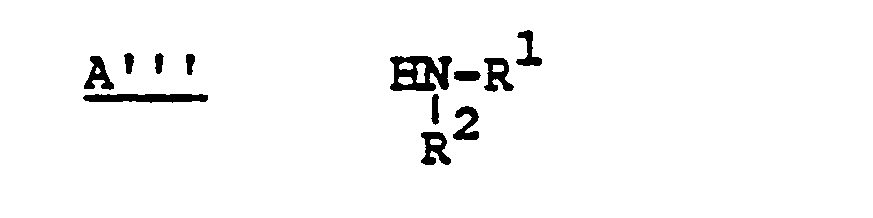
- Acid III in an inert organic solvent, such as tetrahydrofuran, is then made to undergo a carbodiimide coupling reaction with amide A in the presence of dicyclohexylcarbodiimide (DCC) or 1-(3-dimethylaminopropyl)-3-ethylcarbodiimide hydrochloride (WSC) and 1-hydroxybenzotriazole under an inert atmosphere such as argon employing a molar ratio of A:III of within the range of from about 1.2:1 to about 1:1, to form hydroxybisamide IV
- DCC dicyclohexylcarbodiimide
- WSC 1-(3-dimethylaminopropyl)-3-ethylcarbodiimide hydrochloride
- 1-hydroxybenzotriazole under an inert atmosphere such as argon employing a molar ratio of A:III of within the range of from about 1.2:1 to about 1:1, to form hydroxybisamide IV
- Hydroxybisamide IV is then subjected to cyclodehydration wherein a solution of IV in an inert organic solvent such as tetrahydrofuran, acetonitrile or chloroform , under an inert atmosphere such as argon, is treated with triphenylphosphine and carbon tetrachloride in the presence of an amine base such as triethylamine, to form oxazoline V.
- an inert organic solvent such as tetrahydrofuran, acetonitrile or chloroform
- an inert atmosphere such as argon
- hydroxybisamide IV is treated with a sulfonyl chloride, such as methane sulfonyl chloride, and an amine base such as triethylamine followed by treatment with potassium carbonate in acetone to form oxazoline V.
- a sulfonyl chloride such as methane sulfonyl chloride
- an amine base such as triethylamine
- Oxazoline V is oxidized by treatment with manganese dioxide or nickel peroxide, preferably nickel peroxide, to form the oxazole IA
- oxazole IA can be prepared from acid III by a carbodiimide coupling as described previously except substituting A for A to obtain VI.
- Pro is a conventional protecting group. Hydroxyamide VI is then subjected to a cyclodehydration and oxidation as described for IV and V to form VII
- the protecting group of VII can be removed to form the corresponding acid VIII which is treated with excess oxalyl chloride in the presence of an inert organic solvent such as toluene, methylene chloride or chloroform, and optionally a catalytic amount of dimethylformamide, while stirring under an inert atmosphere such as argon, to form the crude acid chloride IX which is treated with amine hydrochloride A in the presence of an organic base such as triethylamine under an inert atmosphere such as argon, employing a molar ratio of IX:A" of within the range of from about 0.5:1 to about 1:1 and preferably from about 0.8:1 to about 1:1, to form IA .
- aldehyde XI is then treated with a mixture of lithium bromide or lithium chloride and trimethylphosphonoacetate and triethylamine in an inert organic solvent such as methylene chloride or chloroform to form the ester XII
- ester XII inert organic solvent such as tetrahydrofuran, ether or dimethoxyethane is cooled to a temperature of from about -78 C to 0 °C and reacted with diisobutylaluminum hydride in an aromatic solvent such as toluene for a period of from about 0.5 to about 4 hours to form alcohol XIII
- Alcohol XIII is treated with bromotriphenylphosphonium bromide (formed by adding bromine to triphenylphosphine in toluene or other aromatic solvent under an inert atmosphere such as argon, at a reduced temperature of from about -10 to about 10°C) in the presence of pyridine and toluene, at a reduced temperature of from about -10 to about 10°C, to form bromide XIV
- LDA lithium diisopropylamide
- a strong base such as potassium t-amylate in toluene or NaH/dimethylsulfoxide
- Ester XV is then deprotected by treating XV in methanol under an inert atmosphere such as argon with hydrochloric acid in methanol (prepared by adding acetyl chloride to methanol) to form alcohol XVI
- XVI may then be used in place of II as a starting material following the procedure hereinbefore described to form acid IIIA and subsequently to form the trans compound of the invention IA"
- acid III or IIIA is reacted with an alkylchloroformate in the presence of an amine such as triethylamine to form the mixed anhydride which is amidated by reacting with methanol-ammonia solution or concentrated aqueous ammonia solution to form amide XVII.
- an amine such as triethylamine
- Amide XVII is then treated with phosphorus pentasulfide (P 2 S 5 ) or Lawesson's Reagent (2,4-bis(4-methoxyphenyl)-1,3-dithia-2,4-diphosphetane-2,4-disulfide) to form the corresponding thioamide XVIII which is treated with bromopyruvic acid in a polar solvent such as dimethylformamide in the presence of a weak base such as K 2 CO 3 employing a molar ratio of XVIII: bromopyruvic acid of within the range of from about 1:1 to about 1:1.5 to form thiazoline XIX
- Thiazoline XIX is then dehydrated by treatment with a sulfonyl chloride such as methanesulfonyl chloride in the presence of a base such as triethylamine to form thiazole acid XX which is then made to undergo a carbodiimide coupling reaction with amine in the presence of DCC or WSC under an inert atmosphere such as argon employing a molar ratio of A :XX of within the range of from about 1:1 to about 2:1, to form amide IB a
- a sulfonyl chloride such as methanesulfonyl chloride
- a base such as triethylamine
- thiazole acid XX which is then made to undergo a carbodiimide coupling reaction with amine in the presence of DCC or WSC under an inert atmosphere such as argon employing a molar ratio of A :XX of within the range of from about 1:1 to about 2:1, to form amide
- Compounds of the invention IC where X is NH are prepared starting with acid III or IIIA which is made to undergo a coupling reaction with amine B where Boc is t-butyloxycarbonyl and Pro is a protecting group such as preferably -CH 2 CH 2 Si(CH 3 ) 3 , in the presence of a coupling agent such as 1-(3-dimethylaminopropyl)-3-ethylcarbodiimide hydrochloride (WSC) and 1-hydroxybenzotriazole (HOBT) and methylene chloride employing a molar ratio of III or IIIA:B of within the range of from about 1.2:1 to about 1:1, for a period of from about 12 to about 90 hours.
- a coupling agent such as 1-(3-dimethylaminopropyl)-3-ethylcarbodiimide hydrochloride (WSC) and 1-hydroxybenzotriazole (HOBT) and methylene chloride employing a molar ratio of III or IIIA
- the resulting amide is made to undergo a thionation reaction by treating the amide with Lawesson's reagent in the presence of benzene at a temperature of from about 50 to about 75 C for a period of from about 1 to about 4 hours, to form the ester XXI
- the ester XXI is cyclized by treating a solution of XXI in an inert solvent such as acetonitrile, chloroform or tetrahydrofuran, with triphenylphosphine (employing a molar ratio of XXI:triphenylphosphine of from about 0.8:1 to about 1:1) and carbon tetrachloride in the presence of an amine base such as triethylamine or diisopropylethylamine, to form imidazoline XXII Imidazoline XXII is then deprotected to remove the Pro protecting group, using conventional procedures, for example, by treatment with trifluoroace
- esters IA', IA", IBa, and ICa may be converted to the corresponding acids, that is I 1 by treating the esters with a base, such as lithium hydroxide, sodium hydroxide or potassium hydroxide to form the corresponding alkali metal salt, followed by neutralization with an acid, such as dilute hydrochloric acid or oxalic acid to form the acid compounds of the invention.
- a base such as lithium hydroxide, sodium hydroxide or potassium hydroxide
- an acid such as dilute hydrochloric acid or oxalic acid to form the acid compounds of the invention.
- Compounds of formula I wherein Z is -(CH 2 ) 2 - may be prepared from acid I 1 by subjecting I 1 to hydrogenation using, for example, a hydrogenation catalyst, such as palladium on charcoal, in the presence of an inert organic solvent such as ethyl acetate (EtOAc) or acetic acid (AcOH) to form acid of the invention 12
- a hydrogenation catalyst such as palladium on charcoal
- an inert organic solvent such as ethyl acetate (EtOAc) or acetic acid (AcOH)
- R is CONHS0 2 R 3 , that is 1 3 are prepared by treating acid I 1 or 1 2 with a sulfonamide of the structure C in the presence of a coupling agent such as carbonyldiimidazole or WSC in the presence of an amine such as 4-dimethyl aminopyridine under an inert atmosphere such as argon employing a molar ratio of C:I 1 or I 2 of within the range of from about 0.8:1 to about 1.2:1, to form sulfonamide 1 3 .
- a coupling agent such as carbonyldiimidazole or WSC
- an amine such as 4-dimethyl aminopyridine
- an inert atmosphere such as argon employing a molar ratio of C:I 1 or I 2 of within the range of from about 0.8:1 to about 1.2:1, to form sulfonamide 1 3 .
- Acids I 1 or 1 2 may be converted to the corresponding alkyl esters by treating the acids I 1 and 1 2 with the appropriate alcohol under acid catalysis to form the esters.
- nitrile XXVI is then subjected to a cycloaddition reaction by treating XXVI with sodium azide in the presence of ammonium chloride, dimethylformamide and lithium chloride at a temperature of from about 100°C to about 130°C to form 1 4 .
- the protected tetrazole XXVIII may then be used in place of hydroxymethyl compound II to form the various compounds of the formula XXIX wherein X is 0, S or NH which is deprotected by treatment with aqueous acid such as aqueous hydrochloric acid to form compounds of the invention I 5 .
- stereoisomeric forms of the compounds of the invention namely, cis-exo, cis-endo and all trans forms and stereoisomeric pairs may be prepared by employing starting materials and following the procedures as outlined in U.S. Patent No. 4,143,054. Examples of such stereoisomers are set out below.
- nucleus in each of the compounds of the invention is depicted as for matter of convenience: it will also be appreciated that the nucleus in the compounds of the invention may be depicted as
- the compounds of this invention are thromboxane receptor antagonists and as such are useful as inhibitors of thromboxane receptor mediated actions.
- thromboxane receptor antagonist includes compounds which are so-called thromboxane A 2 receptor antagonists, thromboxane A 2 antagonists, thromboxane A 2 /prostaglandin endoperoxide antagonists, TP-receptor antagonists, or thromboxane antagonists.
- the compounds of the invention are also thromboxane synthetase inhibitors and thus are useful as inhibitors of thromboxane production.
- the compounds of this invention are useful as inhibitors of platelet function, i.e., for the prevention and treatment of thrombotic vascular occlusive disorders, whether complete or partial, for example, arterial thrombosis, including that of the coronary, cerebral, ophthalmic, hepatic, mesenteric, renal, peripheral arteries or vascular or organ grafts, unstable angina, transient ischemic attacks, or intermittent claudication. They may be useful to prevent thrombosis following vascular injury produced in the course of diagnostic or therapeutic procedures such as endarterectomy or angiography.
- the compounds may be useful in the treatment or prevention of disorders characterized by platelet consumption and/or activation, including, platelet activation, dysfunction, and/or loss during extracorporeal circulation, the use of radiographic contrast agents, thrombotic thrombocytopenia purpura, disseminated intravascular coagulation, purpura fulminans, hemolytic transfusion reaction, or hemolytic uremic syndrome, systemic lupus, cyclosporine-induced renal toxicity, pulmonary hypertens ' ;n, side effects from dialysis, or abdominal aortic aneurism repair.
- the compounds may be used in the treatment of venous thrombosis or embolism, including pulmonary embolism, deep venous thrombosis, hepatic vein thrombosis, and renal vein thrombosis.
- the compounds of this invention are useful as inhibitors of arterial or venous vasoconstriction. Accordingly, they may be useful to prevent vasoconstriction associated with unstable angina, chronic stable angina, and variant, or Prinzmetal's angina, Raynaud's syndrome, migraine headache, vasospasm of the coronary, cerebral, ophthalmic, hepatic, mesenteric, renal, peripheral arteries or vascular grafts, vascular injury such as that associated with surgery or trauma.
- Hypertension of pregnancy, the hepato-renal syndrome, and pulmonary hypertension are additional examples of vasoconstrictive disorders treatable by the compounds of this invention.
- the compounds of this invention are useful as inhibitors of bronchoconstriction, i. e., airway hyper- responsiveness, allergic bronchospasm, asthma, and bronchoconstrictive responses to environmental, infectious, noxious or mechanical stimuli.
- bronchoconstriction i. e., airway hyper- responsiveness, allergic bronchospasm, asthma, and bronchoconstrictive responses to environmental, infectious, noxious or mechanical stimuli.
- the compounds of this invention are useful as inhibitors of ischemic and reperfusion injury to various tissues, including, myocardium, skin, brain, bowel, or kidney, alone or in combination with other agents intended to restore blood flow.
- these compounds may be useful for improving postischemic myocardial function and decreasing myocardial infarct size. Ischemia caused by reduced blood flow during diagnostic or therapeutic procedures may benefit by treatment with these compounds, for example, they reduce the myocardial stunning observed after bypass surgery. In addition, they may be useful for reducing the tissue injury caused by a stroke.
- the compounds of this invention may be useful in the prevention or treatment of other conditions including burns, diabetic retinopathy, tumor metastases and tardive dyskinesia.
- the compounds may be useful in potentiating diuretic-induced diuresis.
- the thromboxane receptor antagonists of the invention may be used with a thrombolytic agent such as t-PA, streptokinase, urokinase, prourokinase or anisoyiated plasminogenstreptokinase activator complex (APSAC) within 6 hours of a myocardial infarction.
- a thrombolytic agent such as t-PA, streptokinase, urokinase, prourokinase or anisoyiated plasminogenstreptokinase activator complex (APSAC)
- APSAC anisoyiated plasminogenstreptokinase activator complex
- the compounds of the invention can be administered orally or parenterally to various mammalian species known to be subject to such maladies, e.g., humans, cats, dogs and the like in an effective amount within the dosage range of about 0.1 to about 100 mgikg, preferably about 0.2 to about 50 mg/kg and more preferably about 0.5 to about 25 mg/kg (or from about 1 to about 2500 mg, preferably from about 5 to about 2000 mg) on a regimen in single or 2 to 4 divided daily doses.
- oxazole derivatives of the invention that is compounds of formula I where X is O have particularly long duration of action and these may, if desired, be administered in the above dosages once daily, once every other day, or if desired once daily two times a week.
- the active substance can be utilized in a composition such as tablet, capsule, solution or suspension containing about 5 to about 500 mg per unit of dosage of a compound or mixture of compounds of formula I or in topical form for wound healing (0.01 to 5% by weight compound of formula I, 1 to 5 treatments per day).
- a composition such as tablet, capsule, solution or suspension containing about 5 to about 500 mg per unit of dosage of a compound or mixture of compounds of formula I or in topical form for wound healing (0.01 to 5% by weight compound of formula I, 1 to 5 treatments per day).
- They may be compounded in conventional matter with a physiologically acceptable vehicle or carrier, excipient, binder, preservative, stabilizer, flavor, etc., or with a topical carrier such as Plastibase (mineral oil gelled with polyethylene) as called for by accepted pharmaceutical practice.
- Plastibase mineral oil gelled with polyethylene
- certain members additionally serve as intermediates for other members of the group.
- the compounds of the invention may also be administered topically to treat peripheral vascular diseases and as such may be formulated as a cream or ointment.
- reaction temperature reached a maximum of 8°C and subsequently leveled off to 4°C for the remainder of the base addition.
- the reaction was then run at room temperature for 90 minutes. A 0 C ice bath was introduced and the reaction was quenched by the addition of 152 mL of glacial acetic acid, over 30 minutes. Solvents were removed in vacuo (azeotroped with toluene). Water (640 mL) and 50 mL of concentrated HCI were added (pH 2.6). Dilution with 640 mL of ethyl acetate, the addition of 149 g of NaCI and a few seed crystals of 3-carboxypropyltriphenylphosphonium bromide was followed by vigorous stirring for 15 minutes.
- the precipitate was collected by filtration and washed with 2 portions each of 320 mL of ethyl acetate. The ethyl acetate layer was separated, the aqueous layer was extracted with ethyl acetate (2 x 200 mL each), the combined ethyl acetate layers were dried over MgSO 4 and concentrated. Aqueous 5% K 2 CO 3 was added (507 mL) followed by vigorous stirring for 1 hour. No precipitation occurred. The reaction mixture was concentrated to a paste and suspended in 508 mL of water. Several hours of vigorous stirring produced no precipitate. The water was decanted off and the residue was suspended in 200 mL of aqueous 5% K 2 C0 3 solution.
- Acetyl chloride (5.20 mL, 0.073 mol) was added dropwise to 80 mL of methanol at room temperature under argon. The acetyl chloride/methanol solution was then added to a solution of 42.98 g (0.18 mol) of the above acid in 700 mL of methanol in one portion. Stirring was continued for 3 hours. Triethylamine was added (0.09 mol, 12.21 mL), methanol was removed in vacuo, and the residue was partitioned between 300 mL of ethyl acetate and 150 mL of water.
- TLC showed a stable acylimidazole.
- a solution of 495 mg Part B amine (2.0 mmol) in 10mL dry THF was added using an additional 5 mL THF to quantitatively transfer the amine.
- TLC of the homogeneous mixture after 1 hour stirring at room temperature indicated very slow reaction. Therefore, THF was evaporated by passing argon over the mixture overnight until its volume was reduced to 2 mL and a precipitate had formed. Addition of 5 mL THF redissolved all precipitate.
- TLC indicated clean conversion to the acid chloride having the name [1S-(1 ⁇ ,2 ⁇ (Z),3a,4a]]-6-[3-[4-(chlorocarbonyl)-2-oxazolyl]-7- oxabicyclo[2.2.1 ]hept-2-yl]-4-hexenoic acid, methyl ester.
- the solvent was evaporated, and toluene was added and evaporated again to purge any remaining oxalyl chloride.
- the reaction mixture was diluted with ethyl acetate and water, the organic layer was separated, and the aqueous layer was extracted twice with 20 mL of ethyl acetate. The organic layers were combined, washed with brine, dried over MgS0 4 , and concentrated in vacuo to afford 0.43 g of an orange oil.
- the product was obtained in 78% yield.
- Example 1 To a solution of Example 1, Part D acid (2.45 g, 9.13 mmol) in dry benzene (100 mL) was added, dropwise over a 10 minute period, oxalyl chloride (0.96 mL, 11 mmol). After stirring for 5 hours, the reaction was concentrated in vacuo, dissolved in dry THF (10 mL) and added dropwise over a 5 minute period to a 0°C solution of concentrated ammonium hydroxide (3 mL) in THF (100 mL). The reaction was then concentrated in vacuo. The residual solid was partitioned between ethyl acetate (150 mL) and 0.25 M K 2 C0 3 (25 mL).
- Triethylamine (0.59 mL, 4.2 mmol) was added followed by the dropwise addition of methanesulfonyl chloride (0.33 mL, 4.2 mmol). After stirring for 5 minutes, the reaction was diluted with diethyl ether (40 mL). The organic layer was extracted with 0.5M K 2 C0 3 (9 x 10 mL). The combined aqueous layers were brought to pH 1.5 with 6 N HCI and extracted with diethyl ether (6 x 25 mL). These combined organic layers were dried (Na 2 SO 4 ) and concentrated in vacuo. The yield of the product acid was 212 mg (43%).
- N- ⁇ -Boc-asparagine (18.0 g, 77.5 mmol) was added to a solution of bis(trifluoroacetoxy)iodo sylbenzene (50.0 g, 116.3 mmol) in 1/1 DMF/H 2 O (620 mL). After 15 minutes, pyridine (12.5 mL, 155.1 mmol) was added. The dark yellow solution was stirred overnight (16 hours). The now pale yellow solution was concentrated in vacuo below 40° C. The residue was diluted with water (600 mL), washed with diethyl ether (6 X 400 mL), and then concentrated in vacuo. This crude product was dissolved in water (100 mL).
- Example 10 ester To a solution of Example 10 ester in methanol (8 mL) was added 2N KOH (4 mL). The reaction was stirred at room temperature for 4 hours. The methanol was removed in vacuo. The residue was taken up in methylene chloride (25 mL) and brought to pH 2 with 1N HCI. After shaking, the aqueous layer was further extracted with methylene chloride (25 mL). The combined organic layers were dried (Na 2 SO 4 ) and concentrated in vacuo. The residue was taken up in methylene chloride (10 mL) and swirled with ethereal HCI (4 mL) for 30 seconds. The mixture was concentrated in vacuo.
- Part A compound (7.30 g, 30.1 mmol) in 70 mL of C 2 HsOH at room temperature was added a solution of KCN (9.81 g, 150.6 mmol) in 29 mL of water.
- This reaction mixture was stirred for 20 hours, then extracted with CHCl 3 three times (50 mL). The organic layers were combined and washed with water, then brine, and dried over MgS0 4 and concentrated in vacuo to obtain a yellow oil containing title compound and remaining Part A compound.
- This oil was purified by flash chromatography (95:5 hexane-ethyl acetate) to obtain 2.16 g (41 %) of the desired title product as an oil.
- Part B compound (2.16 g, 12.4 mmol) in 100 mL of CH 3 COOH was added PtO 2 (0.60 g). The mixture was stirred at room temperature under H 2 balloon at 1 atmosphere. After 20 hours the reaction mixture was filtered through a celite pad, and the pad was washed with ethanol twice. The filtrate was concentrated in vacuo to obtain a semi-solid. This was stirred in hexane, and title product in the form of a white fluffy solid (2.00 g, 95%) was obtained by filtration.
- Example 30 ester in 8 of 1N NaOH and 8 mL of THF was stirred for 18 hours, then concentrated in vacuo to remove THF and acidified to pH 1.5 with 1 N HCI. Ethyl acetate was added and the organic layer was separated. The aqueous layer was extracted twice with 20 mL ethyl acetate. The organic layers were combined, washed with brine, dried over MgS0 4 , and concentrated in vacuo. A white solid was obtained. This was crystallized from hexane and chloroform to give 0.40 g (84%) of pure product as a white solid.
- Example 32 ester A solution of 0.17 g (0.33 mmol) of Example 32 ester in 5 mL of 1N NaOH and 2 mL of tetrahydrofuran was stirred at room temperature for 10 hours, then concentrated in vacuo to remove THF and acidified to pH 1.5 with concentrated HCI. Ethyl acetate was added and the organic layer was separated. The aqueous layer was extracted twice with 20 mL ethyl acetate. The organic layers were combined, washed with brine, dried over MgSO 4 and concentrated in vacuo. A clear oil was obtained.
- Example 34 compound A solution of 0.13 g (0.33 mmol) of Example 34 compound in 10 mL of 1 N NaOH and 2 mL of tetra hydrofuran was stirred for 10 hours at room temperature, then concentrated in vacuo to remove THF and acidified to pH 1.5 with 1 N HCI. Ethyl acetate was added and the organic layer was separated. The aqueous layer was extracted twice with 20 mL ethyl acetate. The organic layers were combined, washed with brine, dried over MgSO 4 and concentrated in vacuo. A clear oil was obtained.
- Example 36 ester in 8 mL of 1 N NaOH and 8 mL of THF was stirred for 18 hours, then concentrated in vacuo to remove THF and acidified to pH 1.5 with 1 N HCI. Ethyl acetate was added and the organic layer was separated. The aqueous layer was extracted twice with 20 mL ethyl acetate. The organic layers were combined, washed with brine, dried over MgS0 4 and concentrated in vacuo. A clear oil was obtained. This was crystallized from hexane and chloroform to give 0.14 g (100%) of pure product as a white solid.
- Example 38 ester in 8 mL of 1 N NaOH and 8 mL of THF was stirred for 18 hours, then concentrated in vacuo to remove THF and acidified to pH 1.5 with 1 N HCI. Ethyl acetate was added and the organic layer was separated. The aqueous layer was extracted twice with 20 mL ethyl acetate. The organic layers were combined, washed with brine, dried over MgSO 4 and concentrated in vacuo. A clear oil was obtained. This was crystallized from hexane and chloroform to give 0.13 g (87%) of pure product as a yellow solid.
- Example 40 ester A solution of 0.37 g (0.80 mmol) of Example 40 ester in 15 mL of 1 N NaOH and 15 mL of methanol was stirred for 18 hours, and acidified to pH 2 with concentrated HCI. Ethyl acetate was added and the organic layer was separated. The aqueous layer was extracted twice with 20 mL ethyl acetate. The organic layers were combined, washed with brine, dried over MgS0 4 , and concentrated in vacuo. A red oil was obtained. This was chromatographed (0.1% CH 3 COOH in (0% to 100% EtOAc in hexane gradient)) to give 0.25 g (75%) of pure title product as a yellow oil.
- Example 44 oxazole 410 mg, 0.84 mmol
- 20 mL of CH 3 0H 20 mL
- 1 N NaOH solution 5 mL
- This mixture was stirred at room temperature for 2.5 hours and concentrated in vacuo.
- This mixture was partitioned between 10 mL of 1 N HCI solution saturated with NaCl and EtOAc (4 times with 20 mL).
- the EtOAc extracts were dried (MgSO 4 ), filtered and concentrated in vacuo.
- Example 46 ester (0.20 g, 0.38 mmol) in 10 mL of 1 N NaOH and 10 mL of THF was prepared. The reaction mixture was stirred for 13 hours, then concentrated in vacuo to remove THF and acidified to pH 2 with 1N HCI. EtOAc was added and the organic layer was separated. The aqueous layer was extracted twice with 20 mL of EtOAc. The organic layers were combined, washed with brine, and concentrated in vacuo to obtain a clear oil. This oil was chromatographed (0.1% CH 3 COOH in (0% to 50% EtOAc in hexane gradient)) to obtain 0.12 g (66%) of title acid in the form of a white solid. mp 68-69° C. R f is 0.18 in 1:1 hexane-EtOAc with 0.05% CH 3 COOH.
- triphenylphosphine (77 mmol, 1.0 equiv) was added. This mixture warmed due to exothermic reaction. After stirring overnight, most of the solvent was evaporated, and hexane was added to precipitate triphenylphosphine oxide and triphenylphosphine. The precipitate was filtered off, and the filtrate was concentrated before flash chromatography (5% to 15% EtOAc in hexanes gradient) allowed isolation of 16.31 g pure title aldehyde as an oil.
- Example 1 acid A solution of 130 mg of Example 1 acid in 10 mL of ethyl acetate and 1.0 mL of acetic acid was degassed via a vacuum-fill cycle with argon. To this solution was added 34 mg of 10% Pd/C and the atmosphere was exchanged for hydrogen by two vacuum-fill cycles. A slight positive pressure was maintained through use of a hydrogen balloon. The mixture was stirred at room temperature for 22.5 hours, diluted with CH 2 Cl 2 and filtered through a polycarbonate filter to remove the catalyst. The filtrate was concentrated in vacuo. The residue was diluted with toluene and reconcentrated. Upon addition of ethyl acetate to the residue, a small amount of gel-like material did not dissolve.
- Example 1 To a stirred mixture of Example 1, Part D acid (6.70 g, 25.2 mmol), 1-hydroxybenzotriazole monohydrate (3.40 g, 25.2 mmol) and TFA salt of Example 1, Part B amine (8.97 g, 25.2 mmol) in 100 mL of DMF under argon at 0°C was added sequentially (C 2 H 5 ) 3 N (17.6 mL, 126 mmol) and 1-(3-dimethylaminopropyl)-3-ethylcarbodiimide hydrochloride salt (4.82 g, 25.2 mmol). The mixture was stirred at 0°C for 2 hours and at room temperature for 16 hours.
- the crude mesylate was dissolved in 60 mL of acetone and combined with K 2 C0 3 -(5.0 g, 36.2 mmol). The mixture was refluxed for 4.5 hours and cooled to room temperature. The solid was filtered off and rinsed with acetone (4 X 40 mL). The filtrate was concentrated in vacuo and chromatographed on 120 g of Merck silica gel 60 using 2% CH 3 OH/CH 2 Cl 2 as eluant to give 3.93 g (86%) of title oxazoline.
Landscapes
- Chemical & Material Sciences (AREA)
- Organic Chemistry (AREA)
- Health & Medical Sciences (AREA)
- Life Sciences & Earth Sciences (AREA)
- General Health & Medical Sciences (AREA)
- General Chemical & Material Sciences (AREA)
- Medicinal Chemistry (AREA)
- Nuclear Medicine, Radiotherapy & Molecular Imaging (AREA)
- Bioinformatics & Cheminformatics (AREA)
- Pharmacology & Pharmacy (AREA)
- Engineering & Computer Science (AREA)
- Animal Behavior & Ethology (AREA)
- Chemical Kinetics & Catalysis (AREA)
- Public Health (AREA)
- Veterinary Medicine (AREA)
- Diabetes (AREA)
- Hematology (AREA)
- Pulmonology (AREA)
- Pharmaceuticals Containing Other Organic And Inorganic Compounds (AREA)
- Heterocyclic Carbon Compounds Containing A Hetero Ring Having Oxygen Or Sulfur (AREA)
- Heterocyclic Carbon Compounds Containing A Hetero Ring Having Nitrogen And Oxygen As The Only Ring Hetero Atoms (AREA)
Abstract

Description
- The present invention relates to 7-oxabicycloheptyl substituted heterocyclic amide prostaglandin analogs which are thromboxane A2 (TXA2) receptor antagonists or combined thromboxane A2 receptor antagonists/thromboxane synthase inhibitors useful, for example, in the treatment of thrombotic and/or vasospastic disease, and have good duration of action. These compounds have the structural formula

- m is 1, 2 or 3; n is 0, 1, 2, 3 or 4;
- Z is -(CH2)2- or -CH=CH-
- and when Z is -CH = CH-, n is 1,2,3, or 4;
- R is C02H, CO2Iower alkyl, CO2alkali metal, CH20H, CONHS02R3, CONHR3a, or

- X is 0, S or NH;
- R' is lower alkyl, lower alkenyl, lower alkynyl, aralkyl, aryl, cycloalkyl, or cycloalkylalkyl each of R' being unsubstituted or optionally substituted with an alkyl, aryl, cycloalkyl, or cycloalkylalkyl group;
- R2 is hydrogen, lower alkyl, aryl, or aralkyl; or
- R' and R2 together with the nitrogen to which they are linked may form a 5- to 8- membered ring;
- R3 is lower alkyl, aryl or aralkyl; and
- R3a is hydrogen, lower alkyl, aryl or aralkyl.
- Thus, the compounds of the invention encompass the following types of compounds:


- The term "lower alkyl" or "alkyl" as employed herein includes both straight and branched chain radicals of up to 16 carbons, preferably 1 to 8 carbons, such as methyl, ethyl, propyl, isopropyl, butyl, t-butyl, isobutyl, pentyl, hexyl, isohexyl, heptyl, 4, 4-dimethylpentyl, octyl, 2,2,4-trimethylpentyl, nonyl, decyl, undecyl, dodecyl, the various branched chain isomers thereof, and the like as well as such groups including 1, 2 or 3 halo substituents, an aryl substituent, an alkyl-aryl substituent, a haloaryl substituent, a cycloalkyl substituent or an alkylcycloalkyl substituent.
- The term "cycloalkyl" includes saturated cyclic hydrocarbon groups containing 3 to 12 carbons, preferably 3 to 8 carbons, which include cyclopropyl, cyclobutyl, cyclopentyl, cyclohexyl, cycloheptyl, cyclooctyl, cyclodecyl and cyclododecyl, any of which groups may be substituted with substituents such as halogen, lower alkyl, lower alkoxy and/or a hydroxy group.
- The term "aryl" or "Ar" as employed herein refers to monocyclic or bicyclic aromatic groups containing from 6 to 10 carbons in the ring portion, such as phenyl, naphthyl. Aryl (or Ar), phenyl or naphthyl may include substituted aryl, substituted phenyl or substituted naphthyl, which may include 1 or 2 substituents on either the phenyl or naphthyl such as lower alkyl, trifluoromethyl, halogen (Cl, Br, I or F), lower alkoxy, aralkoxy, hydroxy, alkylthio, alkylsulfinyl, alkylsulfonyl, arylthio, arylsulfinyl, and/or arylsulfonyl.
- The term "aralkyl", "aryl-alkyl" or "aryl-lower alkyl" as used herein refers to lower alkyl groups as discussed above having an aryl substituent, such as benzyl.
- The term "lower alkoxy", "alkoxy" or "aralkoxy" includes any of the above lower alkyl, alkyl or aralkyl groups linked to an oxygen atom.
- The term "halogen" or "halo" as used herein refers to chlorine, bromine, fluorine or iodine with chlorine being preferred.
- The term "lower alkenyl" or "alkenyl" as employed herein with respect to the R' substituent includes a carbon chain of up to 16 carbons, preferably 3 to 10 carbons, containing one double bond which will be separated from "N" by at least one saturated carbon moiety such as -(CH2)qwhere q can be 1 to 14, such as 2-propenyl, 2-butenyl, 3-butenyl, 2-pentenyl, 4-pentenyl and the like, and may include a halogen substituent such as I, Cl, or F.
- The term "lower alkynyl" or "alkynyl" as employed herein with respect to the R' substituent includes a carbon chain of up to 16 carbons, preferably 3 to 10 carbons, containing one triple bond which will be separated from "N" by at least one saturated carbon moiety such as -(CH2)q'-where q' can be 1 to 14, such as 2-propynyl, 2-butynyl, 3-butynyl and the like.
- Preferred are compounds of formula I wherein Z is -CH = CH- in the cis configuration, m is 1, n is 2 or 3, R is C02H, R' is substituted phenylalkyl or cyclohexylalkyl and R2 is H or methyl.
- The compounds of formula I of the invention wherein Z is -CH = CH or -(CH2)2- may be prepared as follows.
- Compounds of the invention where Z is -CH = CH- and preferably in the cis form, and X is 0 are prepared starting with the hydroxymethyl compound II


- Acid III, in an inert organic solvent, such as tetrahydrofuran, is then made to undergo a carbodiimide coupling reaction with amide A


- Hydroxybisamide IV is then subjected to cyclodehydration wherein a solution of IV in an inert organic solvent such as tetrahydrofuran, acetonitrile or chloroform , under an inert atmosphere such as argon, is treated with triphenylphosphine and carbon tetrachloride in the presence of an amine base such as triethylamine, to form oxazoline V.

- Alternatively, hydroxybisamide IV is treated with a sulfonyl chloride, such as methane sulfonyl chloride, and an amine base such as triethylamine followed by treatment with potassium carbonate in acetone to form oxazoline V.
- Oxazoline V is oxidized by treatment with manganese dioxide or nickel peroxide, preferably nickel peroxide, to form the oxazole IA

- Alternatively, oxazole IA can be prepared from acid III


- The protecting group of VII can be removed to form the corresponding acid VIII which is treated with excess


- Compounds of formula I wherein Z represents -CH = CH- which is the trans double bond isomer may be prepared starting with hydroxymethyl compound II which includes a cis double bond. Compound II is treated with a protecting compound such as t-butyldimethylsilyl chloride or other silyl protecting group as described hereinbefore in the presence of imidazole or triethylamine and an inert organic solvent such as methylene chloride or tetrahydrofuran, to form the protected compound X


- For compounds of the invention where Z = -CH = CH-in the trans form and n = 2, aldehyde XI is then treated with a mixture of lithium bromide or lithium chloride and trimethylphosphonoacetate and triethylamine in an inert organic solvent such as methylene chloride or chloroform to form the ester XII

- A solution of ester XII in an inert organic solvent such as tetrahydrofuran, ether or dimethoxyethane is cooled to a temperature of from about -78 C to 0 °C and reacted with diisobutylaluminum hydride in an aromatic solvent such as toluene for a period of from about 0.5 to about 4 hours to form alcohol XIII

- Alcohol XIII is treated with bromotriphenylphosphonium bromide (formed by adding bromine to triphenylphosphine in toluene or other aromatic solvent under an inert atmosphere such as argon, at a reduced temperature of from about -10 to about 10°C) in the presence of pyridine and toluene, at a reduced temperature of from about -10 to about 10°C, to form bromide XIV

- An acetic acid alkyl ester such as t-butyl acetate or ethyl acetate is treated with a solution of LDA (lithium diisopropylamide) in an inert organic solvent such as tetrahydrofuran at a reduced temperature of from about -78 to about -60 °C for a period of from about 0.5 to about 2 hours followed by addition of a solution of bromide XIV in an inert organic solvent such as tetrahydrofuran to form ester XV (where n = 2)

- For compounds of the invention where Z = -CH = CH- in the trans form and n is 1, 3, or 4, aldehyde XI is allowed to react with a phosphonium salt of formula P


- Ester XV is then deprotected by treating XV in methanol under an inert atmosphere such as argon with hydrochloric acid in methanol (prepared by adding acetyl chloride to methanol) to form alcohol XVI

- XVI may then be used in place of II as a starting material following the procedure hereinbefore described to form acid IIIA

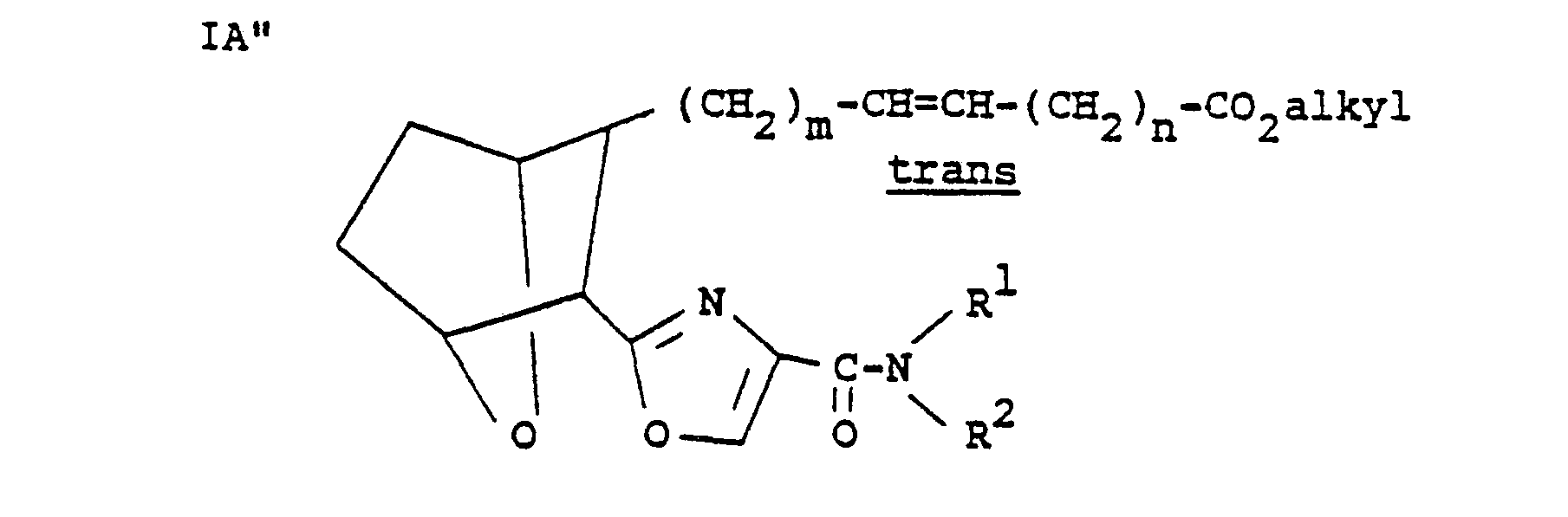
- Compounds of the invention IB wherein Z is -CH = CH- and X is S may be prepared starting with acid III or IIIA as follows:
- Acid III or IIIA is reacted with oxalyl chloride, optionally in the presence of catalytic amounts of dimethylformamide, in methylene chloride, to form the corresponding acid chloride which is amidated by reacting with ammonia to form the amide XVII

- Alternatively, acid III or IIIA is reacted with an alkylchloroformate in the presence of an amine such as triethylamine to form the mixed anhydride which is amidated by reacting with methanol-ammonia solution or concentrated aqueous ammonia solution to form amide XVII.
- Amide XVII is then treated with phosphorus pentasulfide (P2S5) or Lawesson's Reagent (2,4-bis(4-methoxyphenyl)-1,3-dithia-2,4-diphosphetane-2,4-disulfide) to form the corresponding thioamide XVIII


- Thiazoline XIX is then dehydrated by treatment with a sulfonyl chloride such as methanesulfonyl chloride in the presence of a base such as triethylamine to form thiazole acid XX


- Compounds of the invention IC where X is NH are prepared starting with acid III or IIIA which is made to undergo a coupling reaction with amine B


- The esters IA', IA", IBa, and ICa may be converted to the corresponding acids, that is I1

- Compounds of formula I wherein Z is -(CH2)2-may be prepared from acid I1 by subjecting I1 to hydrogenation using, for example, a hydrogenation catalyst, such as palladium on charcoal, in the presence of an inert organic solvent such as ethyl acetate (EtOAc) or acetic acid (AcOH) to form acid of the invention 12

- Compounds of the invention wherein R is CONHS02R3, that is 13


- Acids I1 or 12 may be converted to the corresponding alkyl esters by treating the acids I1 and 12 with the appropriate alcohol under acid catalysis to form the esters.
- Compounds of the invention wherein R is -CH2-5-tetrazolyl, and Z is -(CH2)2- that is I4


- The nitrile XXVI is then subjected to a cycloaddition reaction by treating XXVI with sodium azide in the presence of ammonium chloride, dimethylformamide and lithium chloride at a temperature of from about 100°C to about 130°C to form 14.
- Compounds of the invention wherein R is -CH2-5-tetrazolyl, and Z is -CH = CH- that is I5


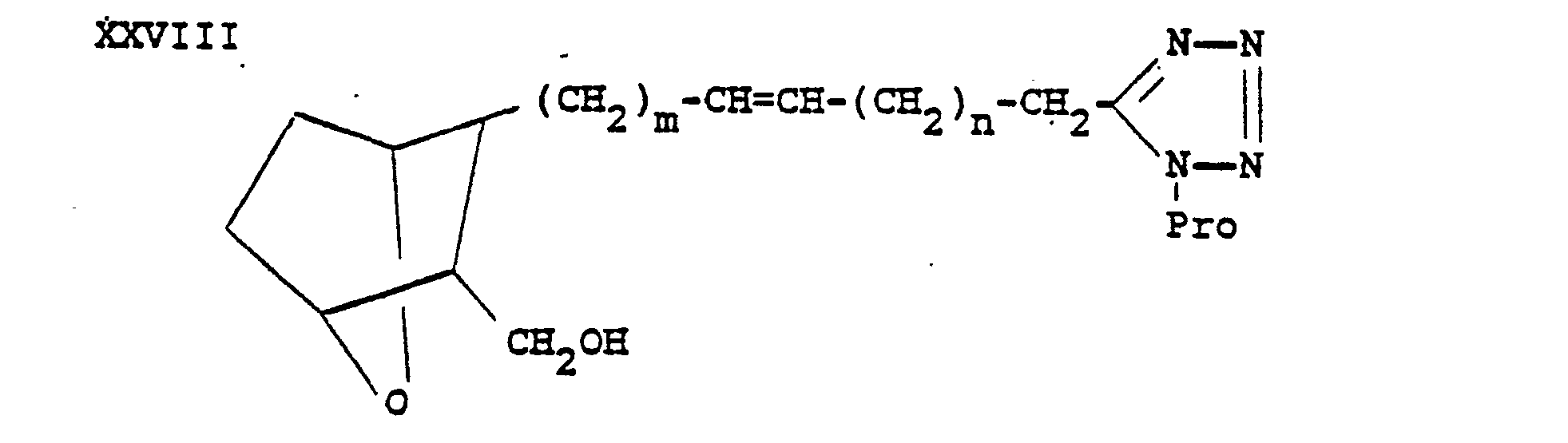
- The protected tetrazole XXVIII may then be used in place of hydroxymethyl compound II to form the various compounds of the formula XXIX wherein X is 0, S or NH

- Compounds of formula I wherein R is CONHR3a wherein R3a is other than H may be prepared from the corresponding acid I6


- Compounds of formula I wherein R is CONH2 may be prepared from the corresponding acid 16, employing the procedure as described above for making amide I7 except that ammonium chloride is employed in place of amine G to form the amide of the invention I8

- Compounds of formula I wherein R is CH20H may be prepared from the corresponding ester 19


- The compounds of this invention have four centers of asymmetry as indicated by the asterisks in formula I. However, it will be apparent that each of the formulae set out above which do not include asterisks still represent all of the possible stereoisomers thereof. All of the various stereoisomeric forms are within the scope of the invention.
- The various stereoisomeric forms of the compounds of the invention, namely, cis-exo, cis-endo and all trans forms and stereoisomeric pairs may be prepared by employing starting materials and following the procedures as outlined in U.S. Patent No. 4,143,054. Examples of such stereoisomers are set out below.


- The nucleus in each of the compounds of the invention is depicted as


- The compounds of this invention are thromboxane receptor antagonists and as such are useful as inhibitors of thromboxane receptor mediated actions. The term "thromboxane receptor antagonist" includes compounds which are so-called thromboxane A2 receptor antagonists, thromboxane A2 antagonists, thromboxane A2/prostaglandin endoperoxide antagonists, TP-receptor antagonists, or thromboxane antagonists.
- The compounds of the invention are also thromboxane synthetase inhibitors and thus are useful as inhibitors of thromboxane production.
- The compounds of this invention are useful as inhibitors of platelet function, i.e., for the prevention and treatment of thrombotic vascular occlusive disorders, whether complete or partial, for example, arterial thrombosis, including that of the coronary, cerebral, ophthalmic, hepatic, mesenteric, renal, peripheral arteries or vascular or organ grafts, unstable angina, transient ischemic attacks, or intermittent claudication. They may be useful to prevent thrombosis following vascular injury produced in the course of diagnostic or therapeutic procedures such as endarterectomy or angiography. The compounds may be useful in the treatment or prevention of disorders characterized by platelet consumption and/or activation, including, platelet activation, dysfunction, and/or loss during extracorporeal circulation, the use of radiographic contrast agents, thrombotic thrombocytopenia purpura, disseminated intravascular coagulation, purpura fulminans, hemolytic transfusion reaction, or hemolytic uremic syndrome, systemic lupus, cyclosporine-induced renal toxicity, pulmonary hypertens ';n, side effects from dialysis, or abdominal aortic aneurism repair. The compounds may be used in the treatment of venous thrombosis or embolism, including pulmonary embolism, deep venous thrombosis, hepatic vein thrombosis, and renal vein thrombosis.
- The compounds of this invention are useful as inhibitors of arterial or venous vasoconstriction. Accordingly, they may be useful to prevent vasoconstriction associated with unstable angina, chronic stable angina, and variant, or Prinzmetal's angina, Raynaud's syndrome, migraine headache, vasospasm of the coronary, cerebral, ophthalmic, hepatic, mesenteric, renal, peripheral arteries or vascular grafts, vascular injury such as that associated with surgery or trauma. Hypertension of pregnancy, the hepato-renal syndrome, and pulmonary hypertension are additional examples of vasoconstrictive disorders treatable by the compounds of this invention.
- The compounds of this invention are useful as inhibitors of bronchoconstriction, i. e., airway hyper- responsiveness, allergic bronchospasm, asthma, and bronchoconstrictive responses to environmental, infectious, noxious or mechanical stimuli.
- The compounds of this invention are useful as inhibitors of ischemic and reperfusion injury to various tissues, including, myocardium, skin, brain, bowel, or kidney, alone or in combination with other agents intended to restore blood flow. For example, these compounds may be useful for improving postischemic myocardial function and decreasing myocardial infarct size. Ischemia caused by reduced blood flow during diagnostic or therapeutic procedures may benefit by treatment with these compounds, for example, they reduce the myocardial stunning observed after bypass surgery. In addition, they may be useful for reducing the tissue injury caused by a stroke.
- The compounds of this invention may be useful in the prevention or treatment of other conditions including burns, diabetic retinopathy, tumor metastases and tardive dyskinesia. The compounds may be useful in potentiating diuretic-induced diuresis.
- In addition, the thromboxane receptor antagonists of the invention may be used with a thrombolytic agent such as t-PA, streptokinase, urokinase, prourokinase or anisoyiated plasminogenstreptokinase activator complex (APSAC) within 6 hours of a myocardial infarction. In such case, the thrombolytic agent may be used in amounts conventionally employed, for example, as disclosed in the Physicians' Desk Reference for reducing post-ischemic myocardial injury.
- The compounds of the invention can be administered orally or parenterally to various mammalian species known to be subject to such maladies, e.g., humans, cats, dogs and the like in an effective amount within the dosage range of about 0.1 to about 100 mgikg, preferably about 0.2 to about 50 mg/kg and more preferably about 0.5 to about 25 mg/kg (or from about 1 to about 2500 mg, preferably from about 5 to about 2000 mg) on a regimen in single or 2 to 4 divided daily doses.
- The oxazole derivatives of the invention, that is compounds of formula I where X is O have particularly long duration of action and these may, if desired, be administered in the above dosages once daily, once every other day, or if desired once daily two times a week.
- The active substance can be utilized in a composition such as tablet, capsule, solution or suspension containing about 5 to about 500 mg per unit of dosage of a compound or mixture of compounds of formula I or in topical form for wound healing (0.01 to 5% by weight compound of formula I, 1 to 5 treatments per day). They may be compounded in conventional matter with a physiologically acceptable vehicle or carrier, excipient, binder, preservative, stabilizer, flavor, etc., or with a topical carrier such as Plastibase (mineral oil gelled with polyethylene) as called for by accepted pharmaceutical practice. Also as indicated in the discussion above, certain members additionally serve as intermediates for other members of the group.
- The compounds of the invention may also be administered topically to treat peripheral vascular diseases and as such may be formulated as a cream or ointment.
- The following Examples represent preferred embodiments of the present invention. Unless otherwise indicated, all temperatures are expressed in degrees Centigrade.
- To a solution of 575 mg of 4-cyclohexylbutyl amine hydrochloride (3.0 mmol), 615 mg t-butyloxy carbonyl-L-serine (3.0 mmol, 1.0 equiv), 405 mg 1-hydroxybenzotriazole hydrate (3.0 mmol, 1.0 equiv), and 387 mg diisopropylethylamine (3.0 mmol, 1.0 equiv) in 10 mL dry tetrahydrofuran (TXF) stirring under argon at 0°, was added 618 mg 1,3-dicyclohexylcarbodiimide (3.0 mmol, 1.0 equiv) in a single portion. A precipitate slowly formed. After 1 hour the mixture was warmed to room temperature and stirred for 4 hours. After dilution with ethyl acetate, the mixture was filtered, and the filtrate was washed with a pH 1 salt solution (formed by mixing water, brine, and 1 M aqueous HCI solution). Further washing (twice) with 1 M NaHCO3 was followed by drying over Na2S04. and evaporation to give 1.1 g of crude title amide.

- To a solution of 1.1 g crude Part A amide in 4 mL CH2CI2 at room temperature was added 4 mL trifluoroacetic acid. The mixture was stirred for 4 hours. After solvent evaporation, residual trifluoroacetic acid was azeotropically removed by rotoevaporation with CHCl3. Flash chromatography (150 g silica, 10% [10% concentrated aqueous NH3 in CH30H] in CH2CI2) gave, after azeotroping with toluene and exposure to high vacuum, 495 mg of pure title amine as a white solid. The yield of title amine was 68% overall from 4-cyclohexylbutyl amine hydrochloride.

- To a partial solution of 36.27 g of [4aR(4aα,5β,8β,8aβ)]-octahydro-5,8-epoxy-1H-2-benzopyran-3-ol (prepared as described in U.S. Patent No. 4,143,054) (0.23 mol) and 3-carboxypropyltriphenylphosphonium bromide (127.34 g, 0.37 mol) in 600 mL of dry THF under argon at 3 C was added dropwise over 1 hour a solution of 370.6 mL of potassium t-amylate (0.68 mol of a 1.8M toluene solution) with mechanical stirring. Initially the reaction temperature reached a maximum of 8°C and subsequently leveled off to 4°C for the remainder of the base addition. The reaction was then run at room temperature for 90 minutes. A 0 C ice bath was introduced and the reaction was quenched by the addition of 152 mL of glacial acetic acid, over 30 minutes. Solvents were removed in vacuo (azeotroped with toluene). Water (640 mL) and 50 mL of concentrated HCI were added (pH 2.6). Dilution with 640 mL of ethyl acetate, the addition of 149 g of NaCI and a few seed crystals of 3-carboxypropyltriphenylphosphonium bromide was followed by vigorous stirring for 15 minutes. The precipitate was collected by filtration and washed with 2 portions each of 320 mL of ethyl acetate. The ethyl acetate layer was separated, the aqueous layer was extracted with ethyl acetate (2 x 200 mL each), the combined ethyl acetate layers were dried over MgSO4 and concentrated. Aqueous 5% K2CO3 was added (507 mL) followed by vigorous stirring for 1 hour. No precipitation occurred. The reaction mixture was concentrated to a paste and suspended in 508 mL of water. Several hours of vigorous stirring produced no precipitate. The water was decanted off and the residue was suspended in 200 mL of aqueous 5% K2C03 solution. After vigorous stirring, a light tan solid was collected by filtration and rinsed several times with water. The combined aqueous layers were extracted 5 X with 1:1 toluene/ether (230mL each). After cooling the combined aqueous layers with a 0°C ice bath, concentrated HCI was added to pH 2.5, followed by extraction 1 X with 460 mL then 2 X with 230 mL each of ethyl acetate. The combined ethyl acetate layers were dried over MgSO4 and evaporated in vacuo to yield 49.74g of an oil. Trituration from 330 mL of ether (room temperature, overnight) oiled out phosphorous by-products. The ether solution was decanted away from the dark red oil into a separatory funnel, and the oil which was carried over by the decantation was drained off (1.56 g). Evaporation of the ether solution in vacuo yielded 43.08 g of [1 S-[1α,2α(Z),3α,4α]]-6-[3-hydroxymethyl)-7-oxabicyclo[2.2.1]hept-2-yl]-4-hexenoic acid in the form of a viscous yellow oil.
- 1HNMR indicated a product: triphenylphosphine oxide: ether molar ratio of 23:1:1.8 (mass % 93:4.7:2.2). Yield exclusive of triphenylphosphine oxide/ether, 40.06 g (72.5%).
- Acetyl chloride (5.20 mL, 0.073 mol) was added dropwise to 80 mL of methanol at room temperature under argon. The acetyl chloride/methanol solution was then added to a solution of 42.98 g (0.18 mol) of the above acid in 700 mL of methanol in one portion. Stirring was continued for 3 hours. Triethylamine was added (0.09 mol, 12.21 mL), methanol was removed in vacuo, and the residue was partitioned between 300 mL of ethyl acetate and 150 mL of water. After separation of the layers, the aqueous layer was extracted with 150 mL of ethyl acetate, the combined ethyl acetate layers were washed with brine, dried over Na2SO4 and evaporated in vacuo to yield 43.06 g of a viscous tan oil. Flash chromatography on 1350 g of E. Merck Kieselgel 60 silica gel (240-400 mesh, 75/25 ether/hexanes, then ether after the desired product began eluting off the column) yielded 35.74 g title ester in the form of a viscous light yellow oil, free from triphenylphosphine oxide by NMR.
- 1H NMR (CDCI3, ref. TMS): S 5.41-5.38, m (2H); 4.49, d, J = 4.69Hz (1 H); 4.22, d, J = 4.69Hz (1 H); 3.73-3.69, m (1 H); 3.67, s, (3H); 3.60, m (1 H); 2.37, br s (4H); 2.12-1.99, m (3H); 1.97-1.85, m (1 H); 1.72, m (2H); 1.46, m (2H).
- 13C NMR (CDCl3, ref. 77.00): 5 173.50, 130.42, 128.63, 80.23, 79.22, 61.74, 51.49, 48.95, 46.45, 33.86, 29.69, 29.31, 25.94, 22.92
- To a solution of 2.43 g of impure Part C alcohol (80% pure = 1.94 g, 7.6 mmol, contaminated with triphenylphosphine oxide) in 40 mL acetone under argon at 0°, was added slowly 8 mL Jones' Reagent (2.6 M in CrVI). The red color of the reagent persisted toward the end of the addition. This resulting precipitated mixture was stirred for 20 minutes before 2-propanol was added to quench excess reagent. Still at 0°, 3 M aqueous NaHSO3 solution was added with stirring until all salts dissolved. Brine was added, and extraction (3 times) with ethyl acetate followed. After drying the extracts over Na2SO4. and solvent evaporation, flash chromatography (150 g silica, 25% to 40% [5% acetic acid in ethyl acetate] in hexane gradient) afforded, after azeotropic removal of acetic acid with toluene, 1.91 g of an oil. This oil was impure title acid (80% pure = 1.53 g, contaminated with triphenylphosphine oxide), obtained in 75% yield.

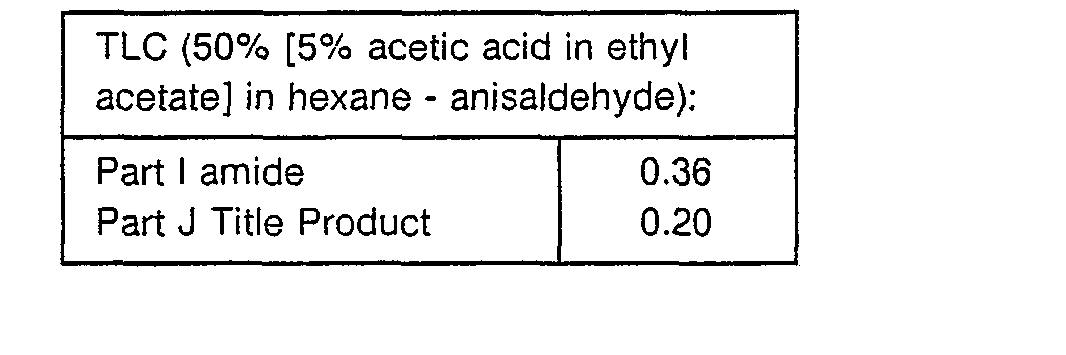
- To a solution of 733 mg impure Part D acid (80% pure = 586 mg, 2.2 mmol, 1.1 equiv, contaminated with triphenylphosphine oxide) in 4 mL dry tetrahydrofuran (THF) under argon was added 356 mg 1,1'-carbonyldiimidazole (2.2 mmol, 1.1 equiv), and the mixture was left for 1 hour. Since a large volume of precipitate had formed, 5 mL dry THF was added, and the mixture was gently warmed to obtain a solution. (TLC showed a stable acylimidazole.) After stirring 30 minutes, a solution of 495 mg Part B amine (2.0 mmol) in 10mL dry THF was added using an additional 5 mL THF to quantitatively transfer the amine. TLC of the homogeneous mixture after 1 hour stirring at room temperature indicated very slow reaction. Therefore, THF was evaporated by passing argon over the mixture overnight until its volume was reduced to 2 mL and a precipitate had formed. Addition of 5 mL THF redissolved all precipitate. After 5 hours more stirring, the mixture was evaporated, and flash chromatography (150 g silica, 50% to 100% ethyl acetate in hexane gradient, then 0% to 10% CH30H in ethyl acetate gradient) gave 230 mg of pure title hydroxybisamide as an oil. The yield of title hydroxybisamide was 23%.
- Also isolated were the isomeric aminoesteramide (27%) and the 2:1 adduct (16%). These by-products could be converted in good yields to title hydroxybisamide by transesterification with KCN in C030H at room temperature, although the aminoesteramide may isomerize spontaneously.

- This chemistry is described by M.J. Miller, P.G. Mattingly, M.A. Morrison, and J.F. Kerwin, Jr., J. Am. Chem. Soc., 1980, 102, 7026.
- To a solution of 240 mg of pure Part E hydroxybisamide (0.48 mmol) in 3 mL dry THF under argon at room temperature, was added 189 mg triphenylphosphine (0.72 mmol, 1.5 equiv), 73 mg triethylamine (0.72 mmol, 1.5 equiv), and 89 mg CCl4 (0.58 mmol, 1.2 equiv), and the mixture was heated to reflux. After 1 hour another aliquot each of CCl4 and triethylamine were added, and after 2.5 hours more another aliquot of each were added again. 2 hours later another aliquot each of CCl4 and triethylamine and half an aliquot (95 mg) of triphenylphosphine were added. After 2 hours more, TLC finally indicated complete consumption of Part E hydroxybisamide, and the initially colorless, homogeneous mixture had formed a white precipitate and had darkened. Solvent evaporation was followed by flash chromatography (silica, 15% acetone in toluene) which afforded 190 mg-of pure title oxazoline, an oil. The oxazoline was obtained in 83% yield.

- This chemistry is described by D.L. Evans, D.K. Minster, U. Jordis, S.M. Hecht, A.L. Mazzu, Jr., and A.I. Meyers, J. Org. Chem., 1979, 44, 497.
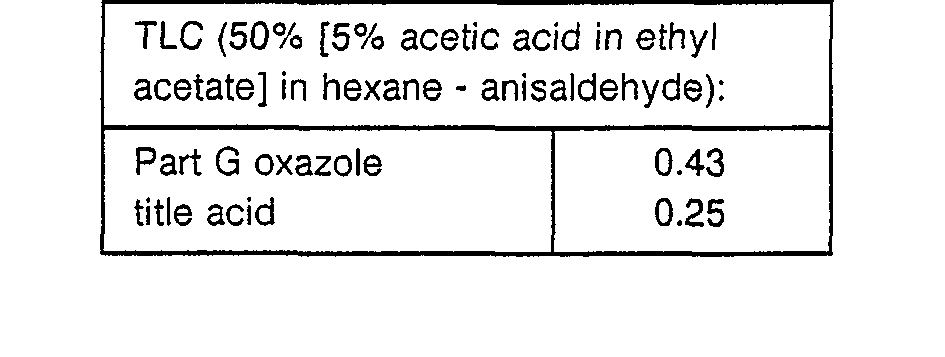
- To a solution of 190 mg of pure Part F oxazoline (0.40 mmol) in 10 mL CHCI3, was added 200 mg untitrated Ni02, and the heterogenous mixture was stirred at room temperature. TLC indicated some progress in the first 1 hour, but then reaction stopped. Over 1 day, five additional aliquots of the reagent were added until the reaction was complete. The mixture was diluted with ethyl acetate, and this was stirred with 3 M aqueous NaHSO3 solution until the black color of the Ni02 disappeared and most of the solids dissolved. Extraction (3 times) with ethyl acetate was followed by drying over Na2SO4. and evaporation. Flash chromatography (silica, 25% to 35% ethyl acetate in hexane gradient) afforded 90 mg of pure title oxazole, a solid. The oxazole was obtained in 48% yield.

- To 90 mg of pure Part G oxazole (0.19 mmol) in 4 mL CH30H at room temperature, was added 2 mL of 1.0 M aqueous NaOH solution. After stirring the mixture for 1.3 hours, 1 M aqueous HCI solution was added to lower the pH to 1. Extraction with ethyl acetate (3 times) followed. The extracts were dried over Na2SO4, and solvent evaporation gave crude title acid. Flash chromatography (25% to 50% [5% acetic acid in ethyl acetate] in hexane gradient) afforded, after azeotropic removal of acetic acid with toluene, 71 mg of pure title acid as a solid. The yield of title acid was 81%.
- This chemistry is described by P. Sieber, Helv. Chim. Acta, (1977), 60, 2711.
- To a solution of 20.7 g of N-t-butyloxycarbonyl-0-benzyl-(L)-serine (70 mmol), 11.0 g pyridine (139 mmol, 2.0 equiv), and 9.9 g 2-trimethylsilylethanol (84 mmol, 1.2 equiv) in 50 mL dry CH3CN stirring under argon at 0°, was added 15.8 g 1,3-dicyclohexylcarbodiimide (76 mmol, 1.1 equiv) in a single portion. A precipitate formed. After 3 hours the mixture was warmed to room temperature and stirred for 12 hours. A solution of 1.4 g oxalic acid dihydrate (11 mmol, 0.15 equiv) in 3 mL dimethylformamide (DMF) was added, and the mixture was stirred for 1 hour before filtration. The filtercake was washed with ethyl acetate until the filtrate was free of title ester. The filtrate was washed twice with 1 M aqueous HCI solution plus brine and twice with 1 M aqueous NaHCO3 solution. Drying over Na2SO4 and evaporation gave 34.8 g of crude title ester (79% pure = 27.6 g, contaminated with solvent and 2-trimethylsilylethanol) as an oil in 100% yield.

- To a solution of 34.8 g of crude Part A ester (79% pure = 27.6 g, contaminated with solvent and 2-trimethylsilylethanol, 70 mmol) in 200 mL ethyl acetate plus 300 mL acetic acid at room temperature under argon was added 10 g of 30% Pd on carbon catalyst. The mixture was then stirred under an atmosphere of H2 for 4 days. TLC showed nearly complete clean conversion. The mixture was filtered through a polycarbonate membrane, and after evaporation of the solvent, residual acetic acid was removed by azeotroping with toluene and CH2CI2. Flash chromatography (750 g silica, 10% to 30% ethyl acetate in hexane gradient) gave 3.58 g of pure starting material, Part A ester, (13% yield) and 16.49 g of pure title debenzylated ester as an oil. The yield of title ester was 78%.

- This chemistry is described by P. Sieber, R.H. Andreatta, K. Eisler, B. Kamber, B. Riniker, and H. Rink, Peptides: Proceedings of the Fifth American Peptide Symposium, M. Goodman and J. Meienhofer, Eds., Halsted Press, New York. (1977), pp. 543-545.
- To a solution of 10.4 g of Part B ester (34.1 mmol) in 200 mL diethyl ether was added 40 mL of an approximately 6.5 M HCI/methanol/methyl acetate solution (260 mmol). (This solution was prepared by adding 42 g acetyl chloride (0.54 mmol) dropwise to 35 g methanol (1.1 mmol) stirring at 0° followed by stirring at room temperature for 2 hours). The mixture was then stirred for 4 hours during which gas slowly evolved. While stirring in a room temperature bath, 32.8 g NaHCO3 (390 mmol) was added cautiously in small portions to control gas evolution during neutralization. The mixture was then filtered through a glass frit, using 50% methanol in diethyl ether to wash the filtercake. Evaporation of the solvent gave 8.06 g of the semisolid, crude, nearly pure title amine hydrochloride. This material may have been only a partial salt, but assuming a pure 1:1 salt the yield was 98%.

- To a solution of 9.40 g, Example 1, Part D acid (85% pure = 7.99 g, 29.8 mmol), 8.04 g of crude, nearly pure Part C amine hydrochloride (95% pure = 7.60 g, 31.6 mmol, 1.06 equiv), 4.43 g 1-hydroxybenzotriazole hydrate (32.8 mmol, 1.1 equiv), and 4.24 g diisopropylethylamine (32.8 mmol, 1.1 equiv) in 50 mL dry THF stirring under argon at room temperature, was added approximately 6.8 g 1,3-dicyclohexylcarbodiimide (33 mmol, 1.1 equiv) in a single portion. A precipitate slowly formed. After 16 hours, the solvent was evaporated, and flash chromatography (silica, 30% to 100% ethyl acetate in hexane gradient) gave an oil containing a solid. This material was taken up in diethyl ether in which the solid did not dissolve, and filtered. Evaporation gave 9.45 g of nearly pure title amide (90% pure = 8.51 g), a clear oil. The yield of title amide was 63%.

- To a solution of 8.3 g of nearly pure Part D amide (90% pure = 7.5 g, 16.6 mmol) in 150 mL dry CH3CN under argon at room temperature (room temperature bath), was added 13.1 g triphenylphosphine (50 mmol, 3.0 equiv), 6.4 g diisopropylethylamine (50 mmol, 3.0 equiv), and finally 7.7 g CCl4 (50 mmol, 3.0 equiv). After stirring for 2 hours, 1 M aqueous NaHCO3 solution was added, and the mixture was extracted three times with CH2CI2. Drying over Na2SO4. was followed by evaporation and flash chromatography (silica, 20% to 50% ethyl acetate in hexane gradient) which afforded 5.9 g of nearly pure title oxazoline (90% pure = 5.3 g), an oil. The oxazoline was obtained in 73% yield.

- This chemistry is described by D.L. Evans, D.K. Minster, U. Jordis, S.M. Hecht, A.L. Mazzu, Jr., and A.I. Meyers, J. Org. Chem., (1979), 44, 497.
- To a solution of 5.1 g of nearly pure Part E oxazoline (90% pure = 4.6 g, 10.5 mmol) in 50 mL CH2Cl2, was added 10.1 g untitrated Ni02, and the heterogenous mixture was stirred at room temperature. (Exothermic reaction resulted in the mixture warming somewhat.) TLC indicated nearly complete reaction after 1 hour. An additional aliquot, 2.0 g, of Ni02 was then added. After 30 minutes the reaction was complete, and 150 mL ethyl acetate was added. To reduce and dissolve the Ni salts, 100 mL 3 M aqueous NaHS03 solution and 200 mL 1 M aqueous trisodium citrate solution were added. Stirring caused all of the solids to dissolve, and the mixture warmed. Separation and extraction twice more with ethyl acetate (TLC indicated complete extractton of title oxazole) was followed by drying over Na2SO4 and evaporation. Flash chromatographic purification of the 3.8 g of crude product (150 g silica, 20% to 75% ethyl acetate in hexane gradient) afforded 2.60 g of pure title oxazole, an oil. The oxazole was obtained in 57% yield.

- This chemistry is described by P. Sieber, R.H. Andreatta, K. Eisler, B. Kamber, B. Riniker, and H. Rink, Peptides: Proceedings of the Fifth American Peptide Symposium, M. Goodman and J. Meienhofer, Eds., Halsted Press, New York, (1977), pp.543-545.
- To a solution of 3.1 g of pure Part F oxazole (7.1 mmol) in 20 mL dry DMF under argon, was added 12.0 g of tetrabutylammonium fluoride on silica (Fluka, 13.9. mmol, 1.96 equiv), and the heterogenous mixture was stirred at room temperature for 6 hours. The mixture was diluted with 20 mL of 1% F3CCO2H, 1% CH20H 98% ethyl acetate and filtered using 40 mL of the same solvent to wash the filtercake. The filtrate was evaporated and azeotroped three times with toluene to remove the DMF. The crude product was purified on an ion exchange resin: After washing a 250 g column of AG 50W-X8 (hydrogen form) with water and then 50% CH30H in water until the eluant was colorless, the crude product dissolved in 40 mL of 50% CH30H in water was loaded, and elution was carried out with the same solvent. This afforded 2.65 g of nearly pure title oxazole acid (90% pure = 2.38 g), an oil. The oxazole acid was obtained in 100% yield.

- To a solution of 750 mg of 4-cyclohexylbutylamine hydrochloride (3.9 mmol) and 1.08 g triethylamine (10.8 mmol, 2.8 equiv) in 10 mL dry THF stirring under argon at 0°, was added 584 mg CIC02C2H5 (5.4 mmol, 1.4 equiv). After warming to room temperature, the heterogeneous mixture was stirred for 3 hours. Dilution with diethyl ether was followed by washing (twice) with 1 M aqueous HCI solution. The organic layer was dried over Na2SO4 and evaporated to obtain 950 mg of crude ethyl carbamate intermediate, an oil, contaminated with some of the imide.
- To a solution of 950 mg of crude ethyl carbamate intermediate in 10 mL dry THF stirring under argon at 0°, was added 950 mg lithium aluminum hydride (25 mmol, 6.4 equiv). Gas was evolved. The mixture was then heated to reflux for 2 hours. After recooling to 0 and adding 20 mL diethyl ether, 1.0 mL water was cautiously added to quench excess hydride. The mixture was rewarmed to room temperature, and while stirring vigorously, 1.0 mL 15% aqueous NaOH solution, then 3.0 mL water were added. The mixture was filtered, washing the filter cake with 10% [10% concentrated aqueous NH3 in CH30H] in diethyl ether, and the filtrate was evaporated. This material was evaporated several times with CH30H to remove NH3, and finally acidified with concentrated aqueous HCI solution. Azeotropic removal of water with toluene and CH30H yielded, after exposure to high vacuum, 830 mg of impure secondary amine hydrochloride (80% pure = 660 mg, contaminated with tertiary amine hydrochloride) as a solid. The product was obtained in 83% yield and was taken on without purification.

- A sample of impure Part G oxazole acid (contaminated with tetrabutylammonium, but as the free acid, 0.20 mmol) was dried by azeotroping with dry DMF and toluene twice (high vacuum). This material was placed in 2 mL toluene, and while stirring the heterogeneous mixture at room temperature under argon, 127 mg oxalyl chloride (1.0 mmol, 5 equiv) was added. Gas was evolved. After 1 hour an additional 127 mg oxalyl chloride was added. Again gas was evolved This mixture was stirred overnight. TLC indicated clean conversion to the acid chloride having the name [1S-(1α,2α(Z),3a,4a]]-6-[3-[4-(chlorocarbonyl)-2-oxazolyl]-7- oxabicyclo[2.2.1 ]hept-2-yl]-4-hexenoic acid, methyl ester. The solvent was evaporated, and toluene was added and evaporated again to purge any remaining oxalyl chloride.
- To the crude acid chloride of the Part G acid was added 4 mL CHCI3. The material did not all dissolve. While stirring under argon at room temperature, 100 mg of impure Part H secondary amine hydrochloride (80% pure = 80 mg, contaminated with tertiary amine hydrochloride, 0.39 mmol, 2 equiv) and 145 mg triethylamine (1.4 mmol, 7 equiv) were added. After stirring at room temperature for 1 hour, the mixture was diluted with ethyl acetate, water was added, and extraction (twice) with ethyl acetate was followed by drying over Na2S04. and evaporation. This gave 120 mg of impure title amide as a gum. The crude product was taken on without purification.

- To 120 mg of impure Part I amide in 6 mL CH30H at room temperature, was added 2 mL of 1.0 M aqueous NaOH solution. After stirring the mixture for 3 hours, 1 M aqueous HCI solution was added to lower the pH to 1. Extraction with ethyl acetate (3 times) followed. The extracts were dried over Na2SO4, and solvent evaporation gave crude acid title product. Flash chromatography (50% to 100% [5% acetic acid in ethyl acetate] in hexane gradient) afforded, after azeotropic removal of acetic acid with toluene, 70 mg of pure title product as an oil. The yield of title product was 72% overall from the impure Part G oxazole acid.
- To a stirred solution of pyrrolidine (1.11 g, 15.7 mmol), t-butyloxycarbonyl (BOC)-(L)-serine (3.22 g, 15.7 mmol), 1-hydroxybenzotriazole hydrate (2.12 g, 15.7 mmol) and diisopropylethyl amine (2.73 mL, 15.7 mmol) in 30 mL of THF under argon was added 1,3-dicyclohexylcarbodiimide (3.23 g, 15.7 mmol). This mixture was stirred at room temperature for 17 hours and concentrated in vacuo. The mixture was diluted with 200 mL ethyl acetate and the precipitate was filtered off. The precipitate was rinsed with ethyl acetate (3 x 40 mL). The combined filtrates were washed with 1 N aqueous HCI solution (3 x 70 mL), and saturated NaHCO3 solution (2 x 80 mL). The organic layer was dried (MgSO4), filtered and concentrated in vacuo. This was chromatographed on 140 g of Merck silica gel 60 using 2% CH30H in CH2CI2 as eluant to give 1.64 g (41 %) of title amide.
- TLC: silica gel, 4% CH30H in CH2CL2, Rf 0.24, Ce(SO4)2
- 13C NMR (67.5 MHz, CDCl3) δ: 169.4, 155.6, 79.7, 62.8, 53.5, 46.5, 45.9, 28.0, 28.0 28.0, 25.7, 23.8
- To a stirred solution of Part A amide (0.96 g, 3.72 mmol) in 20 mL of dry CH2Cl2 under argon at 0°C was added 5 mL of trifluoroacetic acid (TFA). The mixture was stirred at 0°C for 2 hours and diluted with 50 mL of toluene. This mixture was concentrated in vacuo. To a stirred solution of this amine-TFA salt, 1-hydroxybenzotriazole hydrate (0.50 g, 3.73 mmol), and 5 mL of triethylamine in 20 mL of DMF was added a solution of Example 1, Part D acid (1.00 g, 3.73 mmol) in 10 mL of DMF. To this mixture was then added ethyl-3(3-dimethylamino)propyl carbodiimide hydrochloride salt. The reaction mixture was stirred at room temperature for 19 hours and concentrated in vacuo. The mixture was diluted with 400 mL of ethyl acetate and washed with 1 N HCI solution (3 x 30 ml), 0.2 N NaOH solution (2 x 30 mL) and brine (1 x 60 mL). The organic layer was dried (MgSO4.), filtered, and concentrated in vacuo. Purification was effected by flash chromatography on 50 g of Merck silica gel 60 using 0.4 L each of 2% and 4% CH30H in CH2Cl2 as eluants to give 320 mg (22%) of title alcohol.
- TLC: silica gel, 4% CH3OH in CH2CI2, Rf 0.22, Ce(SO4)2.
- 13C NMR (67.5 MHz, CDCl3) δ: 173.4, 172.2, 168.8, 129.3, 129.2, 78.9, 78.9, 63.5, 54.3, 52.2, 51.4, 48.0, 46.6, 45.9, 33.7, 29.5, 28.8, 27.2, 25.8, 24.0, 22.7
- To a stirred solution of Part B alcohol (305 mg, 0.75 mmol) and diisopropylethyl amine (0.39 mL, 2.24 mmol) in 10 mL of CH2Cl2 under argon at 0°C was added methanesulfonyl chloride (0.07 mL, 0.90 mmol). This mixture was stirred at room temperature for 4 hours and concentrated in vacuo. The crude mesylate was dissolved in 30 mL of acetone and combined with 0.60 g of K2CO3. This mixture was heated to reflux for 4 hours, cooled to room temperature, and diluted with 100 mL of acetone. The precipitate was filtered off and rinsed with acetone (3 x 40 mL). The filtrate was concentrated in vacuo and chromatographed on 50 g of Merck silica gel 60 using 2% CH3OH in CH2Cl2 as eluant to give 210 mg (72%) of title oxazoline.
- TLC: silica gel, 4% CH30H in CH2Cl2, Rf 0.20, Ce(SO4)2.
- 13C NMR (67.5 MHz, CDCl3) δ: 173.4, 168.2, 167.7, 129.5, 129.1, 78.9, 78.9, 68.7, 67.5, 51.4, 48.4, 46.5, 46.4, 46.1, 33.9, 29.7, 28.8, 27.1, 25.9, 24.1, 22.8
- To a stirred solution of Part C oxazoline (200 mg, 0.51 mmol) in 5 mL of CH2Cl2 was added 200 mg of Ni02. The reaction mixture was stirred at room temperature for 3 hours at which time another 200 mg of Ni02 was added. The mixture was stirred at room temperature for 1 hour and 200 mg of Ni02 was added. This mixture was stirred for another 1 hour and one more portion of 200 mg of Ni02 was added. The reaction mixture was stirred at room temperature for 17 hours and diluted with 80 mL of ethyl acetate. To the resulting mixture was added 5 mL of 3M NaHS03 solution and 40 mL of 1 M sodium citrate solution. The organic layer was separated and the aqueous layer was extracted with ethyl acetate (3 x 70 mL). The combined organic extracts were dried (MgSO4), filtered, and concentrated in vacuo. This was chromatographed on 18 g of Merck silica gel 60 using 2% CH30H in CH2Cl2 as eluant to give 69.2 mg (35%) of title ester.
- TLC: silica gel, 4% CH30H in CH2CI2, Rf 0.24, Ce(SO4)2.
- 13C NMR (67.5 MHz, CDCI3) δ: 173.2, 163.1, 160.3, 142.2, 137.1, 129.3, 128.7, 79.4, 79.1, 51.4, 49.6, 48.2, 46.7, 46.6, 33.7, 29.7, 28.9, 27.8, 26.4, 23.7, 22.7
- To a stirred solution of Part D ester (69.0 mg, 0.18 mmol) and 2 mL of water in 12 mL of THF was added 2 mL of 1 N LiOH solution. This mixture was sparged with argon for 10 minutes and stirred at room temperature for 7 hours. The mixture was acidified to pH 2 by the addition of 1N HCI solution and saturated with NaCI. The THF layer was separated and the aqueous layer was extracted with ethyl acetate (4 x 60 mL). The combined organic extracts were dried (MgSO4), filtered and concentrated in vacuo. Purification was effected by flash chromatography on 10 g of Merck silica gel 60 using 10% CH3OH in CH2CI2 as eluant to give 26 mg (39%) of title acid.
- TLC: silica gel, 6% CH30H in CH2CI2, Rf 0.22, Ce(SO4)2.
- 13C NMR (67.5 MHz, DMSO-ds) δ: 175.1, 163.2, 159.6, 142.2, 136.3, 130.5, 127.6, 78.8, 78.4, 48.8, 47.7, 46.3, 45.8, 29.3, 28.4, 27.5, 25.9, 23.3, 23.2, 22.8
- To a stirred solution of cyclohexylamine (1.11 g, 15.7 mmol), Boc-(L)-serine (3.22 g, 15.7 mmol), 1-hydroxybenzotriazole hydrate (2.12 g, 15.7 mmol) and diisopropylethyl amine (2.73 mL, 15.7 mmol) in 30 mL of THF under argon at 0°C was added 1,3-dicyclohexylcarbodiimide (3.23 g 15.7 mmol). This mixture was stirred at room temperature for 18 hours. The mixture was diluted with 200 mL ethyl acetate and the precipitate was filtered. The precipitate was rinsed with ethyl acetate (3 x 40 mL). The combined filtrates were washed with 1N aqueous HCI solution (3 x 70 mL), and saturated NaHCO3 solution (2 x 80 mL). The organic layer was dried (MgSO4), filtered and concentrated in vacuo. This was chromatographed on 140 g of Merck silica gel 60 using 2% CH30H in CH2Cl2 as eluant to give 1.64 g (41%) of title amide.
- TLC: silica gel, 4% CH30H in CH2Cl2, Rf 0.24, Ce(SO4)2.
- 13C NMR (67.5 MHz, CDCl3) δ: 170.1, 156.1, 80.2, 62.7, 48.1, 32.6, 32.6, 28.1, 28.1, 28.1, 25.3, 24.5, 24.5, 24.5
- To a stirred solution of Part A amide (1.06 g, 3.73 mmol) in 20 mL of dry CH2Cl2 under argon at 0° C was added 5 mL of TFA. The mixture was stirred at 0°C for 2 hours and diluted with 50 mL of toluene. This mixture was concentrated in vacuo. To a stirred solution of this amine-TFA salt, 1- hydroxybenzotriazole hydrate (0.50 g, 3.73 mmol), and 6 mL of triethyl amine in 20 mL of DMF was added a solution of Example 1, Part D acid (1.00 g, 3.73 mmol) in 10 mL of DMF. To this mixture was then added ethyl-3-(3-dimethylamino)propyl carbodiimide hydrochloride salt (0.55 g, 3.73 mmol). The reaction mixture was stirred at room temperature for 19.5 hours and concentrated in vacuo. The mixture was diluted with 400 mL of ethyl acetate and washed with 1 N HCI solution (3 x 40 mL), 0.2 N NaOH solution (2 x 30 mL), saturated NaHCO3 solution (1 x 30 mL) and brine (1 x 100 mL). The organic layer was dried (MgSO4), filtered, and concentrated in vacuo. Purification was effected by flash chromatography on 60 g of Merck silica gel 60 using 2% CH30H in CH2CI2 as eluant to give 690 mg (42%) of title alcohol.
- TLC: Silica gel, 4% CH30H in CH2CI2, Rf 0.30, Ce(S04)2.
- 13C NMR (67.5 MHz in, CDCI3) δ: 173.3, 173.0, 169.6, 129.4, 129.0, 79.1, 78.9, 62.7, 54.4, 53.7, 51.4, 48.2, 48.0, 33.7, 32.6, 32.6, 32.6, 29.5, 28.6, 27.5, 25.3, 24.6, 24.6, 22.7
- To a stirred solution of Part B alcohol (680 mg, 1.56 mmol) and diisopropylethyl amine (0.82 mL, 4.68 mmol) in 20 mL of CH2Cl2 under argon at 0 C was added methanesulfonyl chloride (0.13 mL, 1.63 mmol). This mixture was stirred at room temperature for 1 hour and concentrated in vacuo. The crude mesylate was dissolved in 20 mL of acetone and combined with 647 mg of K2CO3. This mixture was heated at 54° C for 3.5 hours, cooled to room temperature and diluted with 100 mL of acetone. The precipitate was filtered off and rinsed with acetone (3 x 50 mL). The filtrate was concentrated in vacuo and chromatographed on 50 g of Merck silica gel 60 using 2% CH30H in CH2Cl2 as eluant to give 540 mg (83%) of title oxazoline.
- TLC: silica gel, 4% CH30H in CH2CI2, Rf 0.42, Ce(SO4)2.
- 13C NMR (67.5 MHz, CDCl3) 5: 173.2, 170.4, 169.2, 129.5, 128.9, 79.1, 79.0, 69.7, 68.4, 51.4, 48.4, 47.8, 46.4, 33.8, 33.0, 32.8, 29.6, 28.9, 27.3, 25.4, 24.7, 24.7, 22.8
- To a stirred solution of Part C oxazoline (530 mg, 1.26 mmol) in 5 mL of CH2Cl2 was added 1.06 g of Ni02. The reaction mixture was stirred at room temperature for 3 hours at which time another 530 mg of Ni02 was added. The mixture was stirred at room temperature for 1 hour and 530 mg of Ni02 was added. This mixture was stirred for another 80 minutes and diluted with 120 mL of ethyl acetate. To the resulting mixture was added 10 mL of 3M NaHSO3 solution and 70 mL of 1 M sodium citrate solution. The organic layer was separated and the aqueous layer was extracted with ethyl acetate (2 x 100 mL). The combined organic extracts were washed with brine (1 x 100 mL), dried (MgSO4), filtered, and concentrated in vacuo. This was chromatographed on 40 g of Merck silica gel 60 using 2% CH30H in CH2CI2 as eluant to give 370 mg (70%) of title ester.
- TLC: silica gel, 4% CH30H in CH2Cl2, Rf 0.64, Ce(SO4)2.
- '3C NMR (67.5 MHz, CDCl3) δ: 173.2, 163.7, 159.6, 140.6, 136.1, 129.4, 128.5, 79.5, 79.3, 51.4, 49.6, 47.8, 46.6, 33.7, 33.0, 33.0, 29.7, 28.8, 27.8, 25.4, 24.9, 24.9, 22.7
- To a stirred solution of Part D ester (360 mg, 0.86 mmol) and 10 mL of water in 60 mL of THF was added 10 mL of 1 N LiOH solution. This mixture was sparged with argon for 10 minutes and stirred at room temperature for 7 hours. The mixture was acidified to pH 2 by the addition of 1N HCI solution and saturated with NaCI. The THF layer was separated and the aqueous layer was extracted with ethyl acetate (4 x 80 mL). The combined organic extracts were dried (MgSO4), filtered and concentrated in vacuo. Purification was effected by flash chromatography on 40 g of Merck silica gel 60 using 4% CH3OH in CH2Cl2 as eluant to give 300 mg (86%) of title acid.
- TLC: silica gel, 6% CH30H in CH2Cl2, Rf 0.32, Ce(SO4)2.
- 13C NMR (67.5 MHz, CDCI3) δ: 176.9, 163.9, 160.0, 141.0, 129.5, 128.5, 79.5, 79.5, 48.1, 46.6, 33.7, 32.9, 32.9, 29.7, 28.9, 27.9, 25.5, 24.9, 24.9
- To a stirred solution of 2-cyclohexylethylamine (2.00 g, 15.7 mmol), Boc-(L)-serine (3.22 g, 15.7 mmol), 1-hydroxybenzotriazole hydrate (2.12 g, 15.7 mmol) and diisopropylethyl amine (2.73 mL, 15.7 mmol) in 40 mL of THF under argon at 0° C was added 1,3-dicyclohexylcarbodiimide (3.23 g, 15.7 mmol). This mixture was stirred at room temperature and 10 mL of DMF was added. The reaction mixture was then stirred at room temperature for 18 hours. The mixture was diluted with 300 mL ethyl acetate and the precipitate was filtered. The precipitate was rinsed with ethyl acetate (3 x 40 mL). The combined filtrate was washed with 1N aqueous HCI solution (3 x 70 mL), and saturated NaHC03 solution (2 x 80 mL). The organic layer was dried (MgSO4), filtered and concentrated in vacuo. This was chromatographed on 160 g of Merck silica gel 60 using 1:4 hexane-diethyl ether as eluant to give 1.91 g (39%) of title amide.
- TLC: silica gel, 4% CH30H in CH2Cl2, Rf 0.34, Ce(S04)2.
- 13C NMR (67.5 MHz, CDCl3) δ: 171.1, 80.3, 62.9, 37.3, 36.8, 35.2, 33.1, 33.1, 28.3, 28.3, 28.3, 26.4, 26.1, 26.1
- To a stirred solution of Part A amide (1.28 g, 3.73 mmol) in 20 mL of dry CH2CI2 under argon at 0°C was added 5 mL of TFA. The mixture was stirred at 0°C for 2 hours and diluted with 50 mL of toluene. This mixture was concentrated in vacuo. To a stirred solution of this amine-TFA salt, 1-hydroxybenzotriazole hydrate (0.50 g, 3.73 mmol), and 5 mL of triethylamine in 20 mL of DMF was added a solution of Example 1, Part D acid (1.00 g, 3.73 mmol) in 10 mL of DMF. To this mixture was then added ethyl-3(3-dimethylamino)propyl carbodiimide hydrochloride salt (0.55 g, 3.73 mmol). The reaction mixture was stirred at room temperature for 17 hours and concentrated in vacuo. The mixture was diluted with 400 mL of ethyl acetate and washed with 1 N HCI solution (3 x 40 mL), 0.2 N NaOH solution (2 x 30 mL), saturated NaHCO3 solution (1 x 30 mL) and brine (1 x 100 mL). The organic layer was dried (MgSO4), filtered, and concentrated in vacuo. Purification was effected by flash chromatography on 60 g of Merck silica gel 60 using 2% CH30H in CH2Cl2 as eluant to give 1.00 g (54%) of title alcohol.
- TLC: silica gel, 4% CH30H in CH2Cl2, Rf 0.30, Ce(S04)2.
- 13C NMR (67.5 MHz, CDCl3) δ: 173.4, 172.9, 170.4, 129.3, 129.0, 79.0, 78.9, 62.7, 54.2, 53.7, 51.4, 48.0, 37.3, 36.6, 35.3, 33.7, 32.9, 32.9, 29.5, 28.6, 27.3, 26.3, 26.0, 26.0, 22.7
- To a stirred solution of Part B alcohol (890 mg, 1.80 mmol) and diisopropylethyl amine (0.94 mL, 5.40 mmol) in 30 mL of CH2Cl2 under argon at 0°C was added methanesulfonyl chloride (0.14 mL, 1.80 mmol). This mixture was stirred at room temperature for 1 hour and concentrated in vacuo. The crude mesylate was dissolved in 30 mL of acetone and combined with 0.77 g of K2CO3. This mixture was heated to reflux for 4 hours, cooled to room temperature, and diluted with 100 mL of acetone. The precipitate was filtered off and rinsed with acetone (3 x 50 mL). The filtrate was concentrated in vacuo and chromatographed on 60 g of Merck silica gel 60 using 2% CH30H in CH2Cl2 as eluant to give 480 mg (54%) of title oxazoline.
- TLC: silica gel, 4% CH30H in CH2CI2, Rf 0.42, Ce(S04)2.
- 13C NMR (67.5 MHz, CDCI3) 5: 173.1, 171.2, 169.2, 129.4, 128.9, 79.1, 79.0, 69.6, 68.3, 51.4, 48.3, 46.3, 36.9, 36.8, 35.2, 33.7, 33.0, 32.9, 29.6, 28.8, 27.2, 26.3, 26.1, 26.1, 22.8
- To a stirred solution of Part C oxazoline (480 mg, 1.01 mmol) in 20 mL of CH2CI2 was added 480 mg of Ni02. The reaction mixture was stirred at room temperature for 1 hour at which time another 480 mg of NiO2 was added. The mixture was stirred at room temperature for 3 hours and 480 mg of Ni02 was added. This mixture was stirred for another 15.5 hours and one more portion of 480 mg of Ni02 was added. The reaction mixture was stirred for 1.5 hours and diluted with 100 mL of ethyl acetate. To the resulting mixture was added 20 mL of 3M NaHS03 solution and 30 mL of 1 M sodium citrate solution. The organic layer was separated and the aqueous layer was extracted with ethyl acetate (2 x 100 mL). The combined organic extracts were washed with brine (1 x 50 mL), dried (MgSO4), filtered, and concentrated in vacuo. This was chromatographed on 45 g of Merck silica gel 60 using 2% CH3OH in CH2CI2 as eluant to give 200 mg (42%) of title ester.
- TLC: silica gel, 4% CH20H in CH3Cl2, Rf 0.60, Ce(S04)2.
- 13C NMR (67.5 MHz, CDCl3) 5: 173.1, 163.7, 160.4, 140.3, 136.0, 129.3, 128.4, 79.4, 79.3, 51.3, 49.6, 46.6, 36.9, 36.7, 35.2, 33.6, 33.0, 33.0, 29.7, 28.8, 27.7, 26.4, 26.0, 26.0, 22.7
- To a stirred solution of Part D ester (190 mg, 0.40 mmol) and 4 mL of water in 30 mL of THF was added 4 mL of 1 N LiOH solution. This mixture was sparged with argon for 10 minutes and stirred at room temperature for 5 hours. The mixture was acidified to pH 2 by the addition of 1 N HCI solution and saturated with NaCl. The THF layer was separated and the aqueous layer was extracted with ethyl acetate (4 x 25 mL). The combined organic extracts were dried (MgSO4), filtered and concentrated in vacuo. Purification was effected by flash chromatography on 20 g of Merck silica gel 60 using 4% CH3OH in CH2Cl2 as eluant to give 106.7 mg (59%) of title acid.
- TLC: silica gel, 6% CH30H in CH2CI2, Rf 0.32, Ce(SO4)2.
- '3C NMR (67.5 MHz, CDCl3) δ: 176.9, 163.9, 160.7, 140.8, 135.7, 129.4, 128.4, 79.5, 79.4, 49.6, 46.5, 36.9, 36.8, 35.2, 33.7, 33.0, 33.0, 29.6, 28.8, 27.8, 26.4, 26.1, 26.1, 22.6
- To a stirred solution of 2-(4-chlorophenyl)ethylamine (2.44 g, 15.7 mmol), Boc-(L)-serine (3.22 g, 15.7 mmol), 1-hydroxybenzotriazole hydrate (2.12 g, 15.7 mmol) and diisopropylethyl amine (2.73 mL, 15.7 mmol) in 30 mL of THF under argon at 0°C was added 1,3-dicyclohexylcarbodiimide (3.23 g, 15.7 mmol). This mixture was stirred at room temperature and 10 mL of DMF was added. The reaction mixture was then stirred at room temperature for 18 hours. The mixture was diluted with 200 mL ethyl acetate and the precipitate was filtered. The precipitate was rinsed with ethyl acetate (3 x 40 mL). The combined filtrates was washed with 1 N aqueous HCI solution (3 x 70 mL), and saturated NaHC03 solution (2 x 80 mL). The organic layer was dried (MgSO4), filtered and concentrated in vacuo. This was chromatographed on 160 g of Merck silica gel 60 using 1:4 hexane-diethyl ether as eluant to give 2.56 g (48%) of title amide.
- TLC: silica gel, 4% CH30H in CH2Cl2, Rf 0.34, Ce(SO4)2.
- 13C NMR (67.5 MHz, CDCI3) δ: 173.1, 157.6, 139.2, 133.1, 131.4, 131.4, 129.4, 129.4, 80.8, 63.3, 58.0, 41.7, 35.7, 34.7, 28.7, 28.7, 28.7
- To a stirred solution of Part A amide (1.28 g, 3.73 mmol) in 20 mL of dry CH2Cl2 under argon at 0°C was added 5 mL of TFA. The mixture was stirred at 0°C for 2 hours and diluted with 50 mL of toluene. This mixture was concentrated in vacuo. To a stirred solution of this amine-TFA salt, 1-hydroxybenzotriazole hydrate (0.50 g, 3.73 mmol), and 5 mL of triethylamine in 20 mL of DMF was added a solution of Example 1, Part D acid (1.00 g, 3.73 mmol) in 10 mL of DMF. To this mixture was then added ethyl-3(3-dimethylamino)propyl carbodiimide hydrochloride salt (0.55 g, 3.73 mmol). The reaction mixture was stirred at room temperature for 17 hours and concentrated in vacuo. The mixture was diluted with 400 mL of ethyl acetate and washed with 1 N HCI solution (3 x 40 mL), 0.2N NaOH solution (2 x 30 mL), saturated NaHCO3 solution (1 x 30 mL) and brine (1 x 100 mL). The organic layer was dried (MgSO4), filtered, and concentrated in vacuo. Purification was effected by flash chromatography on 60 g of Merck silica gel 60 using 2% CH3OH in CH2CI2 as eluant to give 1.00 g (54%) of title alcohol.
- TLC: silica gel, 4% CH30H in CH2Cl2, Rf 0.30, Ce(SO4)2.
- 13C NMR (67.5 MHz, CDCI3) δ: 173.5, 172.9, 170.6, 137.2, 132.1, 130.0, 130.0, 129.3, 129.1, 128.5, 128.5, 79.0, 78.9, 62.7, 54.1, 53.9, 51.4, 48.0, 40.8, 34.8, 33.7, 29.5, 28.7, 27.3, 22.7
- To a stirred solution of Part B alcohol (890 mg, 1.80 mmol) and diisopropylethyl amine (0.94 mL, 5.40 mmol) in 30 mL of CH2Cl2 under argon at 0°C was added methanesulfonyl chloride (0.14 mL, 1.80 mmol). This mixture was stirred at room temperature for 1 hour and concentrated in vacuo. The crude mesylate was dissolved in 30 mL of acetone and combined with 0.77 g of K2C03. This mixture was heated to reflux for 4 hours, cooled to room temperature, and diluted with 100 mL of acetone. The precipitate was filtered off and rinsed with acetone (3 x 50 mL). The filtrate was concentrated in vacuo and chromatographed on 60 g of Merck silica gel 60 using 2% CH30H in CH2Cl2 as eluant to give 480 mg (54%) of title oxazoline.
- TLC: silica gel, 4% CH30H in CH2Cl2, Rt 0.42, Ce(SO4)2.
- 13C NMR (67.5 MHz, CDCl3) δ: 171.6, 169.4, 169.3, 137.0, 132.3, 130.0, 130.0, 129.5, 129.0, 128.6, 128.6, 79.1, 79.0, 69.6, 68.3, 51.5, 48.2, 46.3, 40.0, 34.8, 33.8, 29.6, 28.9, 27.2, 22.8
- To a stirred solution of Part C oxazoline (480 mg, 1.01 mmol) in 20 mL of CH2Cl2 was added 480 mg of NiO2. The reaction mixture was stirred at room temperature for 1 hour at which time another 480 mg of NiO2 was added. The mixture was stirred at room temperature for 3 hours and 480 mg of NiO2 was added. This mixture was stirred for another 15.5 hours and one more portion of 480 mg of NiO2 was added. The reaction mixture was stirred for 1.5 hours and diluted with 100 mL of ethyl acetate. To the resulting mixture was added 20 mL of 3M NaHS03 solution and 30 mL of 1M sodium citrate solution. The organic layer was separated and the aqueous layer was extracted with ethyl acetate (2 x 100 mL). The combined organic extracts were washed with brine (1 x 50 mL), dried (MgSO4), filtered, and concentrated in vacuo. This was chromatographed on 45 g of Merck silica gel 60 using 2% CH30H in CH2Cl2 as eluant to give 200 mg (42%) of title ester.
- TLC: silica gel, 4% CH30H in CH2Cl2, Rr 0.60, Ce(SO4)2.
- 13C NMR (67.5 MHz, CDCI3) δ: 173.2, 163.9, 160.6, 140.5, 137.2, 135.8, 132.2, 130.0, 130.0, 129.4, 128.6, 128.6, 128.5, 79.5, 79.3, 51.4, 49.6, 46.6, 40.1 35.2, 33.7, 29.7, 28.9, 27.8, 22.7
- To a stirred solution of Part D ester (190 mg, 0.40 mmol) and 4 mL of water in 30 mL of THF was added 4 mL of 1N LiOH solution. This mixture was sparged with argon for 10 minutes and stirred at room temperature for 5 hours. The mixture was acidified to pH 2 by the addition of 1N HCI solution and saturated with NaCi. The THF layer was separated and the aqueous layer was extracted with ethyl acetate (4 x 25 mL). The combined organic extracts was dried (MgSO4), filtered and concentrated in vacuo. Purification was effected by flash chromatography on 20 g of Merck silica gel 60 using 4% CH3OH in CH2CI2 as eluant to give 106.7 mg (59%) of title acid.
- TLC: silica gel, 6% CH30H in CH2CI2, RI 0.32, Ce(SO4)2.
- 13C NMR (67.5 MHz, CDCl3) δ: 176.9, 175.4, 164.0, 160.9, 140.9, 137.2, 130.1, 130.1, 129.4, 128.6, 128.6, 79.6, 79.5, 49.6, 46.6, 40.2, 35.1, 33.7, 29.7, 28.9, 27.9, 22.6
- To a stirred solution of 4-chloroaniline (2.00 g, 15.7 mmol), Boc-(L)-serine (3.22 g, 15.7 mmol), 1-hydroxybenzotriazole hydrate (2.12 g, 15.7 mmol) and diisopropylethyl amine (5.40 mL, 31.2 mmol) in 40 mL of DMF under argon was added ethyl-3(3-dimethylamino)propyl carbodiimide, hydrochloride salt (2.31 g, 15.7 mmol). This mixture was stirred at room temperature for 17 hours and concentrated in vacuo. The mixture was diluted with 400 mL ethyl acetate and washed with 1 N aqueous HCI solution (3 x 70 mL), and saturated NaHC03 solution (2 x 70 mL). The organic layer was dried (MgSO4), filtered and concentrated in vacuo. This was chromatographed on 80 g of Merck silica gel 60 using 1 L of each of 1:3 and 1:4 hexane-diethyl ether as eluants to give 1.02 g (21 %) of title amide.
- TLC: silica gel, 4% CH30H in CH2CI2, Rf 0.34, Ce(SO4)2.
- To a stirred solution of Part A amide (1.02 g, 3.24 mmol) in 12 mL of dry CH2Cl2 under argon at 0°C was added 3 mL of TFA. The mixture was stirred at 0°C for 3 hours and diluted with 50 mL of toluene. This mixture was concentrated in vacuo. To a stirred solution of this amine-TFA salt, 1-hydroxybenzotriazole hydrate (0.50 g, 3.73 mmol), and 5 mL of triethylamine in 20 mL of DMF was added a solution of Example 1, Part D acid (1.00 g, 3.73 mmol) in 10 mL of DMF. To this mixture was then added 1-(3-dimethylaminopropyl)-3-ethylcarbodiimide. hydrochloride salt. The reaction mixture was stirred at room temperature for 17 hours and concentrated in vacuo. The mixture was diluted with 400 mL of ethyl acetate and washed with 1 N HCI solution (3 x 30 mL), 0.2N NaOH solution (2 x 30 mL) and brine (1 x 100 mL). The organic layer was dried (MgSO4), and concentrated in vacuo. Purification was effected by flash chromatography on 80 g of Merck silica gel 60 using 2% CH3OH in CH2CI2 as eluant to give 380 mg (22%) of title alcohol.
- TLC: silica gel, 4% CH30H in CH2Cl2, Rf 0.31, Ce(SO4)2.
- To a stirred solution of Part B alcohol (370 mg, 0.80 mmol) and diisopropylethyl amine (0.42 mL, 2.39 mmol) in 5 mL of CHCl3 under argon at 0°C was added methanesulfonyl chloride (0.068 mL, 0.88 mmol). This mixture was stirred at room temperature for 30 minutes and concentrated in vacuo. The crude mesylate was dissolved in 10 mL of acetone and combined with 0.70 g of K2C03. This mixture was heated almost to reflux for 3 hours, cooled to room temperature and diluted with 100 mL of acetone. The precipitate was filtered off and rinsed with acetone (3 x 30 mL). The filtrate was concentrated in vacuo and chromatographed on 35 g of Merck silica gel 60 using 2% CH30H in CH2CI2 as eluant to give 210 mg (59%) title oxazoline.
- TLC: silica gel, 4% CH30H in CH2Cl2, Rf 0.68, Ce(SO4)2.
- 13C NMR (67.5 MHz, CDCl3) δ: 173.2, 170.0, 169.6, 135.8, 129.5, 129.4, 128.9, 128.9, 128.5, 120.9, 120.9, 79.2, 79.2, 69.4, 68.7, 51.4, 48.3, 46.4, 33.7, 29.6, 28.8, 27.2, 22.8
- To a stirred solution of Part C oxazoline (200 mg, 0.45 mmol) in 3 mL of CH2Cl2 was added 200 mg of Ni02.. The reaction mixture was stirred at room temperature for 1.5 hours at which time another 200 mg of Ni02 was added. The mixture was stirred at room temperature for 1.5 hours and 200 mg of Ni02 was added. This mixture was stirred for another 1.5 hours and one more portion of 200 mg of Ni02 was added. The reaction mixture was stirred for 2 hours and diluted with 100 mL of ethyl acetate. To the resulting mixture was added 5 mL of 3M NaHS03 solution and 30 mL of 1M sodium citrate solution. The organic layer was separated and the aqueous layer was extracted with ethyl acetate (2 x 100 mL). The combined organic extracts were dried (MgSO4), filtered, and concentrated in vacuo. This was chromatographed on 15 g of Merck silica gel 60 using 2% CH30H in CH2Cl2 as eluant to give 140 mg (70%) of title ester.
- TLC: silica gel, 4% CH3OH in CH2CI2, Rf 0.76, Ce(SO4)2.
- 13C NMR (67.5 MHz, CDCl3) δ: 173.2, 164.2, 158.4, 141.4, 136.0, 135.9, 129.5, 129.3, 128.9, 128.9, 128.4, 121.1, 121.1, 79.6, 79.4, 51.4, 49.6, 46.6, 33.7, 29.7, 28.9, 27.9, 22.8
- To a stirred solution of Part D ester (135 mg, 0.03 mmol) and 3 mL of water in 15 mL of THF was added 3 mL of 1 N LiOH solution. This mixture was sparged with argon for 10 minutes and stirred at room temperature for 5 hours. The mixture was acidified to pH 2 by the addition of 1 N HCI solution and saturated with NaCI. The THF layer was separated and the aqueous layer was extracted with ethyl acetate (4 x 15 mL). The combined organic extracts were dried (MgS04), filtered and concentrated in vacuo. Purification was effected by flash chromatography on 15 g of Merck silica gel 60 using 4% CH3OH in CH2CI2 as eluant to give 79.2 mg (61 %) of title acid.
- TLC: silica gel, 6% CH3OH in CH2CI2, Rf 0.36, Ce(SO4)2.
- '3C NMR (67.5 MHz in, CDCl3) δ: 179.0, 177.6, 164.2, 141.7, 136.0, 135.9, 129.4, 128.9, 128.5, 121.2, 121.2, 79.7, 79.5, 49.6, 46.6, 33.6, 32.3, 29.7, 28.9, 27.9, 22.6
- 0.21 g of impure Example 2, Part G compound (50% pure = 0.11 g, 0.33 mmol) was stirred in about 4 mL toluene, and 0.1 mL (1.14 mmol) of oxalyl chloride was added. One drop of dimethylformamide was added, and the mixture was stirred for 2 hours at room temperature after which the reaction was complete by TLC. The reaction mixture was concentrated in vacuo; the residue was reconcentrated twice from 2 mL of toluene to afford an orange oil namely [1S-[1α,2α(Z),3α,4α]]-6-(4(chlorocarbonyl)-2-oxazolyl)-7- oxabicyclo[2.2.1]hept-2-yl]-4-hexenoic acid, methyl ester. To this oil was added about 3 mL of CHCl3 followed by 0.11 mL (0.08 g, 0.78 mmol) of triethylamine and 0.13 g (0.71 mmol) of 4-(4-chlorophenyl) butyl amine, and the mixture was stirred overnight at room temperature. The reaction mixture was diluted with ethyl acetate and water, the organic layer was separated, and the aqueous layer was extracted twice with 20 mL of ethyl acetate. The organic layers were combined, washed with brine, dried over MgS04, and concentrated in vacuo to afford 0.43 g of an orange oil. This oil was flash chromatographed (silica; 0% to 100% ethyl acetate in hexane gradient) to obtain 0.26 g of impure title methyl ester (50% pure = 0.13 g) as an oil. The product was obtained in 78% yield.
- 13C NMR (67.8 MHz, CDCI3) 8: 172.8, 163.6, 160.3, 140.2, 140.2, 135.7, 131.0, 129.4, 129.1, 128.2, 128.0, 79.2, 79.1, 51.1, 49.4, 46.3, 38.4, 34.4, 33.5, 29.4, 28.6, 28.1, 27.6, 22.5
- 0.26g of impure Part A ester (50% pure = 0.13 g, 0.26 mmol) was stirred in about 30 mL 1 N NaOH and 2 mL of THF for 8 hours at room temperature. The reaction mixture was concentrated to remove THF and acidified to pH about 2 with concentrated HCI. Ethyl acetate was added and the organic layer was separated. The aqueous layer was'extracted twice with about 20 mL ethyl acetate. The organic layers were combined, washed with saturated NaCI, dried over MgSO4, and concentrated in vacuo to give 0.2 g of a clear oil. This was flash chromatographed (silica, 0.50% CH30H; 0.25% CH3CO2H; 99.25% ethyl acetate) to provide 0.10 g of pure product. The product was obtained in 79% yield.
- 13C NMR (67.8 MHz, CDCI3) δ: 178.4, 164.4, 161.4, 141.0, 140.4, 135.6, 131.3, 129.6, 129.3, 128.5, 128.3, 79.5, 79.4, 49.6, 46.5, 38.8, 34.6, 33.6, 29.6, 28.9, 28.4, 27.8, 22.5
- To a solution of Example 1, Part D acid (2.45 g, 9.13 mmol) in dry benzene (100 mL) was added, dropwise over a 10 minute period, oxalyl chloride (0.96 mL, 11 mmol). After stirring for 5 hours, the reaction was concentrated in vacuo, dissolved in dry THF (10 mL) and added dropwise over a 5 minute period to a 0°C solution of concentrated ammonium hydroxide (3 mL) in THF (100 mL). The reaction was then concentrated in vacuo. The residual solid was partitioned between ethyl acetate (150 mL) and 0.25 M K2C03 (25 mL). The aqueous layer was extracted with ethyl acetate (25 mL). The combined organic layers were dried (Na2SO4.) and concentrated in vacuo. The residue (2.2 g) was suspended in boiling ether (100 mL). Ethyl acetate (ca. 10 mL) was added to effect solution. The mixture was concentrated to ca. 50 mL on a steam bath, cooled to room temperature, seeded and chilled overnight. Pure title amide (1.19 g, 49%) was obtained by filtration. Additional title amide (145 mg) was obtained by concentration of the mothor liquors to 15 mL and allowing crystallization to occur.
- To a 60°C solution of Part A amide (267 mg, 0.999 mmol) in dry toluene (10 mL) was added Lawesson's Aeagent (222 mg, 0.55 mmol). The reaction was stirred at 60 C for 30 minutes, diluted with diethyl ether (50 mL), and washed with half-saturated NaHCO3 (2 x 5 mL). The organic layer was dried (Na2SO4) and concentrated in vacuo. The residue was passed through a short silica plug using 50% ethyl acetate,hexanes to yield a yellow solid (249 mg, 88%).
- To a solution of Part B thioamide (400 mg, 1.41 mmol) and powdered anhydrous K2C03 (390 mg, 2.82 mmol) in dry DMF (10 mL) was added, in several portions, bromopyruvic acid (contains 0.4 mol water/mol bromoacid, 295 mg, 1.69 mmol). The reaction was allowed to stir at room temperature for 30 minutes. After this time, an additional 29.5 mg portion of bromopyruvic acid was added. After an additional 1 hour, the solvent was removed in vacuo below 30° C. The residue was suspended/dissolved in methylene chloride (10 mL). Triethylamine (0.59 mL, 4.2 mmol) was added followed by the dropwise addition of methanesulfonyl chloride (0.33 mL, 4.2 mmol). After stirring for 5 minutes, the reaction was diluted with diethyl ether (40 mL). The organic layer was extracted with 0.5M K2C03 (9 x 10 mL). The combined aqueous layers were brought to pH 1.5 with 6 N HCI and extracted with diethyl ether (6 x 25 mL). These combined organic layers were dried (Na2SO4) and concentrated in vacuo. The yield of the product acid was 212 mg (43%).
- To a solution of Part C acid (42.0 mg. 0.120 mmol) in dry DMF (1 mL) was added 1,1'-carbonyldiimidazole (20.3 mg, 0.125 mmol). The reaction was allowed to stir for 1 hour. A solution of (cyclohexylbutyl)amine hydrochloride (23.4 mg, 0.131 mmol) and triethylamine (0.020 mL, 0.14 mmol) in dry DMF (0.5 mL) was then added. The reaction was stirred for 1 hour, and concentrated to remove DMF. The residue was taken up in diethyl ether (20 mL) and 0.5 N HCI (5 mL). The organic layer was dried (Na2SO4) and concentrated in vacuo. The resultant amide (46.8 mg, 81%) was chromatographed (silica, 50% ethyl acetate/hexanes) to yield 37.1 mg (64%) of title ester as a colorless oil.
- To a solution of Part D amide in methanol (1 mL) was added 2 N KOH (0.3 mL). The reaction was stirred for 2 hours. An additional 0.3 mL portion of KOH was added. After an additional 1 hour, the reaction was concentrated to remove methanol. The residue was dissolved in water (1 mL) and 1 N HCI was added to bring the pH to 2. The mixture was extracted with methylene chloride (3 x 5 mL). The combined organic layers were dried (Na2SO4) and concentrated in vacuo to yield an oil (34.7 mg, 96%).
- N-α-Boc-asparagine (18.0 g, 77.5 mmol) was added to a solution of bis(trifluoroacetoxy)iodo sylbenzene (50.0 g, 116.3 mmol) in 1/1 DMF/H2O (620 mL). After 15 minutes, pyridine (12.5 mL, 155.1 mmol) was added. The dark yellow solution was stirred overnight (16 hours). The now pale yellow solution was concentrated in vacuo below 40° C. The residue was diluted with water (600 mL), washed with diethyl ether (6 X 400 mL), and then concentrated in vacuo. This crude product was dissolved in water (100 mL). To the solution was added 0.5M Na2C03 to bring the pH to ca. 8. Then, THF (100 mL) was added. To this vigorously stirred mixture was added, dropwise benzylchloroformate (CBZ-CI) (80% pure determined by NMR integration; 19.8 g, 93.0 mmol) dissolved in THF (50 mL). Additional Na2C03 solution was added as needed to maintain a basic pH (as judged by pH 5-10 range pH strips). One hour after the addition was completed, the reaction was concentrated to remove THF. The residue was extracted with diethyl ether (3 X 200 mL). The aqueous layer was brought to pH 2 with concentrated H2SO4. The mixture was extracted with diethyl ether (4 X 200 mL). These latter extracts were dried (Na2SO4) and concentrated in vacuo. Chromatography (80% ethyl acetate/hexanes containing 1% acetic acid) yielded 4.23 g (16%) of slightly impure title product.
- Rf (silica, ethyl acetate + 0.5% acetic acid) 0.27.
- To a 0°C solution of the Part A acid (3.96 g, 11.7 mmol) in dry THF (50 mL) was added 1,1'-carbonyldiimidazole (2.08 g, 12.9 mmol). After 1 hour, 2-(trimethylsilyl)ethanol (3.4 mL) was added. The reaction was then brought to 70° C for 1 hour. After cooling, the reaction was concentrated and chromatographed .(flash, silica, 50 mm dia, 25% ethyl acetate/hexanes) to yield 3.08 g (60%) of title ester in the form a transparent oil: Rf (silica, 25% ethyl acetate/hexanes) 0.32.
- To a solution of the Part B Z-amine (2.89 g, 6.60 mmol) in 2-propanol/water (65 mU6 mL) was added ammonium formate (2.08 g, 33.0 mmol) and then a slurry of Pd/C (10%, 0.5 g) in 2-propanol (4 ml). The mixture was stirred at room temperature for 1 hour. The reaction was filtered through Celite@ and concentrated in vacuo. The residue was taken up in 70 mL of ethyl acetate and 30 mL of saturated NaCl containing 8 mL of 5N NaOH. The aqueous layer was further extracted with ethyl acetate (2 X 70 mL). The combined organic layers were dried (Na2SO4) and concentrated in vacuo to give title compound in the form of an oil (1.85 g, 92%): Rf (silica, 10% methanol/chloroform) 0.75.
- WSC (1.18 g, 6.15 mmol) was added to a solution of [1S-[1α,2α(Z),3α,4α]]-6-[3-(carboxy)-7-oxabicyclo-[2.2.1 ]hept-2-yl]-4-hexenoic acid, methyl ester (1.65 g, 6.15 mmol), Part C compound (1.85 g, 6.08 mmol), and HOBT (831 mg, 6.15 mmol) in methylene chloride (60 mL). The reaction was stirred for 16 hours, diluted with methylene chloride (300 mL), extracted (1 X 50 mL of 1 N HCI; 1 X 50 mL of saturated NaHC03; 1 X 50 mL of water), dried (Na2SO4) and concentrated in vacuo. Chromatography (flash, silica, 50 mm dia, 40% ethyl acetate/hexanes, 2L; 60% ethyl acetate, 1L) yielded an oil: 2.11 g (63%): Rf (silica, 10% methanol/chloroform) 0.67.
- The preceding amide (1.94 g, 3.50 mmol) was stirred at 65° C in benzene (40 mL) with Lawesson's Reagent (850 mg, 2.10 mmol) for 1.5 hours. The reaction was cooled and diluted with diethyl ether (250 mL). The mixture was washed (2 X 50 mL of 0.5N Na2CO3), dried (Na2SO4), concentrated in vacuo, and chromatographed (flash, silica, 50 mm dia, 25% ethyl acetate/hexanes) to yield 1.61 g (80%) of title compound in the form of an oil: Rf (silica, 25% ethyl acetate/hexanes) 0.14.
- Carbon tetrachloride (3.00 mL. 31.2 mmol) was added to a solution of Part D compound (1.61 g, 2.82 mmol), triphenylphosphine (2.22 g, 8.46 mmol), triethylamine (1.18 mL, 8.46 mmol) in dry acetonitrile (28 mL). The reaction was stirred for 4 hours. The reaction was diluted with diethyl ether (125 mL), saturated NaCI (1'25 mL) and water (5 mL). The aqueous phase was further extracted with ether (125 mL). The combined organic layers were dried (Na2SO4) and concentrated in vacuo. The residue was triturated sequentially with ether (20 mL, 10 mL and 7 mL), each time taking and concentrating the filtrate for the next cycle. Chromatography (flash, silica, 50 mm dia. 50% ethyl acetateihexanes) yielded 1.09 g (72%) of title compound in the form of an oil: RI (silica, 50% ethyl acetate/hexanes) 0.29.
- To a solution of Part E compound (1.09 g, 2.03 mmol) in methylene chloride (2 mL) was added trifluoroacetic acid (4 mL). The reaction was stirred at room temperature for 1 hour, diluted with toluene (40 mL) and was then concentrated in vacuo. The residue was taken up in ethyl acetate (60 mL) and was washed (2 x 5 mL) with saturated NaHC03. The organic layer was dried (Na2SO4) and concentrated in vacuo to yield [1S-(1α,2α(Z),3α,4α]]-6-[3-(5-carboxy-4,5-dihydro-1H-imidazol-2-yl)-7-oxabicyclo[2.2.1]hept-2-yl]-4-hexenoic acid. methyl ester (261 mg, 27%). The aqueous phase was brought to pH 2 and concentrated in vacuo. Extraction of the solid with chloroform (2 X 15 mL) followed by concentration in vacuo yielded title compound (553 mg, 73%).
- A mixture of Part F acid (516 mg, 1.38 mmol), (4-cyclohexylbutyl)amine hydrochloride (345 mg, 1.80 mmol), WSC (345 mg, 1.80 mmol), HOBT (243 mg, 1.80 mmol) and triethylamine (0.50 mL, 3.6 mmol) in methylene chloride (15 mL) was stirred for 24 hours. The reaction was diluted with methylene chloride (50 mL) and was washed (2 X 10 mL of saturated NaHC03), dried (Na2SO4) and concentrated in vacuo to yield a yellowish oil, namely [1S-[1α,2α(Z),3α,4α]]-6-[3-[5-[[(4-cyclohexylbutyl)amino]carbonyl]-4,5-dihydro-1H-imidazol-2-yl]-7-oxabicyclo[2.2.1]hept-2-yl]-4-hexenoic acid, methyl ester. This oil was dissolved in chloroform (20 mL). Active MnO2 (Aldrich, 1.0 g) was added. The reaction was stirred for 24 hours. An additional 0.5 g portion of Mn02 was added and stirring was continued for 3 days. Further Mn02(0.5 g) was added. After 5 hours, the reaction was filtered through Celite@. The pad was rinsed with portions of chloroform. The combined filtrates were concentrated in vacuo. Chromatography (flash, silica, 25 mm dia, 2% methanol/chloroform) yielded 235 mg (36%) of title ester compound in the form of an oil.
- To a solution of Example 10 ester in methanol (8 mL) was added 2N KOH (4 mL). The reaction was stirred at room temperature for 4 hours. The methanol was removed in vacuo. The residue was taken up in methylene chloride (25 mL) and brought to pH 2 with 1N HCI. After shaking, the aqueous layer was further extracted with methylene chloride (25 mL). The combined organic layers were dried (Na2SO4) and concentrated in vacuo. The residue was taken up in methylene chloride (10 mL) and swirled with ethereal HCI (4 mL) for 30 seconds. The mixture was concentrated in vacuo. Trituration with 10 mL of ethyl acetate (boiling to room temperature) yielded a white solid which was collected by filtration, washed with ethyl acetate (5 mL) and dried to yield title acid as a white solid: 126.4 mg (52%); mp 168-173° C.
- 'H NMR (tetradeuteriomethanol/deuteriochloroform, 270 MHz): δ 8.05 (s, 1H), 5.23-5.36 (m, 2H), 4.73 (s,
- 1 H), 4.41 (s, 1 H), 3.74 (d, J = 8 Hz, 1H), 3.34-3.37 (m, 2H), 0.84-2.44 (m, 28H);
- 13C NMR (complete decoupling, 67.8 MHz, tetradeuteriomethanol/deuteriochloroform): δ 175.4, 157.0, 147.8, 130.1, 127.3, 120.7, 80.0, 79.9, 44.9, 39.8, 37.4, 36.9, 33.5, 33.1, 29.1, 28.7, 28.1, 26.3, 26.2, 24.1, 22.6.
- IR (KBr): 3427 (m), 3232 (m), 3009 (m), 2923 (s), 2851 (m), 1730 (m), 1718 (m), 1651 (m), 1566 (m), 1448 (w), 1334 (w), 1189 (w) cm-1.
- LRMS (Cl, NH3 DEP 50, pos. ion spectrum) m/z (rel. int.) 458 (2), 184 (7), 173 (14), 172 (6), 169 (9), 168 (13), 167 (5), 157 (10), 156 (100), 155 (25), 154 (35), 152 (6).

- To a 0°C slurry of 1.0 mmol [4aR-(4aα,5β,8β,8aβ)]-octahydro-5,8-epoxy-1H-2-benzopyran-3-ol, prepared as described in U.S. Patent No. 4,143,054, and 1.4 mmol 3-(tetrazol-5-yl)propyltriphenylphosphonium bromide in tetrahydrofuran is added dropwise a 1.8M solution of KOt-amylate in toluene (2.8 mmol). The mixture is allowed to warm to room temperature overnight. The reaction mixture is quenched by the addition of acetic acid. The reaction mixture is concentrated in vacuo and purified by silica gel chromatography using CH30H/CH2CI2 mixture as eluants.
- A solution of 1.0 mmol of title A tetrazole in THF is cooled to 0°C and treated with 1.0 mmol of triethylamine and 1.0 mmol of bromomethylmethyl ether. The mixture is stirred for 4 hours at room temperature and then partitioned between saturated aqueous NaHC03 and ethyl acetate. The ethyl acetate layer is dried, filtered and concentrated in vacuo to afford title B tetrazole.
- Following Example 1 except substituting Example 12, Part B tetrazole for Example 1, Part C ester, the title compound is obtained.
- To a solution 1.0 mmol of title C tetrazole in CH30H (25 mL) is added 1 drop of concentrated HCI solution. The solution is heated to reflux for 2 hours. On cooling, the reaction mixture is concentrated in vacuo. The crude product is purified by reverse-phase HPLC using CH3CN/0.02% aqueous H3PO4 mixtures as the mobile phase to afford title tetrazole.
- Examples of additional compounds in accordance with the present invention which may be prepared following the procedures outlined in the specification and working Examples include, but are not limited to the following:


- To a stirred solution of 5-phenyl-1-pentanol (5.0 g, 30.4 mmol) in 20 mL of methylene chloride at -70 C under argon, was added first (C2H5)3N (4.0 g, 39.5 mmol), then methanesulfonyl chloride (2.83 mL, 4.18 g, 36.5 mmol) dropwise. The reaction mixture was slowly warmed to room temperature. After stirring for 2 hours at room temperature, water was added, and the reaction mixture was extracted with methylene chloride (50 mL). The aqueous layer was extracted twice more with CH2Cl2 (25 mL). The organic layers were combined and washed with brine, dried over MgSO4, and concentrated to obtain 7.30 g (100%) of title compound in the form of a yellow oil. Rf 0.9 in 50% hexane-ethyl acetate (UV, Ce(SO4)2).
- '3C NMR (CDCl3): δ 141.9, 128.2, 125.6, 69.9, 37.1, 35.5, 30.6, 28.8, 24.8.
- To a stirred solution of Part A compound (7.30 g, 30.1 mmol) in 70 mL of C2HsOH at room temperature was added a solution of KCN (9.81 g, 150.6 mmol) in 29 mL of water. This reaction mixture was stirred for 20 hours, then extracted with CHCl3 three times (50 mL). The organic layers were combined and washed with water, then brine, and dried over MgS04 and concentrated in vacuo to obtain a yellow oil containing title compound and remaining Part A compound. This oil was purified by flash chromatography (95:5 hexane-ethyl acetate) to obtain 2.16 g (41 %) of the desired title product as an oil.
- 13C NMR (CDCI3): a 141.8, 128.0, 125.5, 119.5, 35.4, 30.5, 27.9, 24.9, 16.7.
- To a stirred solution of Part B compound (2.16 g, 12.4 mmol) in 100 mL of CH3COOH was added PtO2 (0.60 g). The mixture was stirred at room temperature under H2 balloon at 1 atmosphere. After 20 hours the reaction mixture was filtered through a celite pad, and the pad was washed with ethanol twice. The filtrate was concentrated in vacuo to obtain a semi-solid. This was stirred in hexane, and title product in the form of a white fluffy solid (2.00 g, 95%) was obtained by filtration.
- A sample of 1.61 g of Example 2, Part G oxazole acid (4.8 mmol) was dried by azeotroping with dry DMF and toluene twice (high vacuum). This material (which contained residual DMF) was dissolved in 30 mL toluene, and while stirring at room temperature under argon, 2.9 g oxalyl chloride (23 mmol) was added. Gas was evolved. A dark oil formed at the bottom of the reaction mixture. (The oil was the product of the reaction of DMF with oxalyl chloride.) After 5 minutes an additional 2.9 g oxalyl chloride was added. This mixture was stirred overnight. TLC indicated clean conversion to the acid chloride. The supernatant was pipetted off and transferred to an argon filled flask. Twice the oil was stirred with additional toluene and the supernatant transferred. The combined supernatants were evaporated with CHCI3 to provide 1.54 g (91% yield) of the acid chloride, namely [1S-[1α,2α(Z),3α,4α]]-6-[3-[4-(chlorocarbonyl)-2-oxazolyl]-7-oxabicyclo [2.2.1 ]hept-2-yl]-4-hexenoic acid, methyl ester.
- To a solution of (0.55 g, 3.0 mmol) Part C amine in 5 mL of chloroform at 0° C, was added (0.3 g, 3.0 mmol) triethylamine and (0.53 g, 1.5 mmol) the above acid chloride. The mixture was stirred at room temperature for 14 hours, then diluted with chloroform and water. The organic layer was separated, and the aqueous layer was extracted with 20 mL of chloroform twice. The organic layers were combined, washed with brine, dried over MgSO4, and concentrated. Flash chromatography (0% to 75% EtOAc in hexane gradient) gave 0.49 g of product as a clear oil in 65% yield. Rf 0.5 in 1:1 hexane-ethyl acetate (UV, Ce(S04) 2).
- 13C NMR (67.8 MHz, CDCl3): 5 172.8, 163.5, 160.1, 140.1, 135.8, 129.1, 128.2, 79.2. 79.0, 51.0, 49.4, 46.3, 38.7, 37.2, 37.0, 33.4, 33.0, 29.4, 29.2, 28.6, 27.5, 26.6, 26.3, 26.1, 22.5.
- A solution of (0.49 g, 0.97 mmol) Example 30 ester in 8 of 1N NaOH and 8 mL of THF was stirred for 18 hours, then concentrated in vacuo to remove THF and acidified to pH 1.5 with 1 N HCI. Ethyl acetate was added and the organic layer was separated. The aqueous layer was extracted twice with 20 mL ethyl acetate. The organic layers were combined, washed with brine, dried over MgS04, and concentrated in vacuo. A white solid was obtained. This was crystallized from hexane and chloroform to give 0.40 g (84%) of pure product as a white solid.
- R, 0.36 in 0.1% CH3COOH in (4% methanol in ethyl acetate). Visualized by UV: Ce(SO4)2. [α]D° = +30.2, c 0.58 g/100 mL of CH30H, mp 82-83° C.
- To a stirred solution of 0.49 g (1.40 mmol) acid chloride prepared as described in Example 2, Part I plus an unknown quantity of Vilsmeier salt in 10 mL of chloroform, was added 0.28 g (2.80 mmol) of triethylamine and 0.38 g (2.1 mmol) of 6-cyclohexylhexylamine prepared in Example 30, Part C. The mixture was stirred at room tempera ture for 10 hours, then diluted with ethyl acetate and water. The organic layer was separated, and the aqueous layer was extracted with 20 mL of ethyl acetate twice. The organic layers were combined, washed with brine, dried over MgSO4, and concentrated. Flash chromatography (0% to 100% ethyl acetate-hexane gradient) gave 0.17 g of title product as a clear oil in 25% yield. Rf=0.46 in 1:1 ethyl acetate:hexane.
- A solution of 0.17 g (0.33 mmol) of Example 32 ester in 5 mL of 1N NaOH and 2 mL of tetrahydrofuran was stirred at room temperature for 10 hours, then concentrated in vacuo to remove THF and acidified to pH 1.5 with concentrated HCI. Ethyl acetate was added and the organic layer was separated. The aqueous layer was extracted twice with 20 mL ethyl acetate. The organic layers were combined, washed with brine, dried over MgSO4 and concentrated in vacuo. A clear oil was obtained. This was chromatographed in 1:1 EtOAc-hexane with 0.25% CH3COOH to give 0.13 g (78%) of title product as an oil (containing 2.5% of the cis isomer of Example 31A compound). Rf=0.36 in 4% CH3OH, 0.1% CH3COOH, 95.5% EtOAc (UV, Ce-(SO4)2). [α]D° = +55° in CH30H at c = 0.50 g/100 mL.
- To a stirred solution of 0.18 g (0.50 mmol) of the acid chloride prepared in Example 2, Part 1 in 3 mL of chloroform at 0°C, under argon was added 0.10 g (1.0 mmol) of triethylamine and 0.07 g (1.0 mmol) of pyrrolidine. The mixture was warmed to room temperature and stirred for 10 hours, then diluted with ethyl acetate and water. The organic layer was separated, and the aqueous layer was extracted with 20 mL of ethyl acetate twice. The organic layers were combined, washed with brine, dried over MgSO4, and concentrated. Flash chromatography (50% to 100% ethyl acetate in hexane gradient then 2% methanol in ethyl acetate) gave 0.13 g of title product as'a clear oil in 68% yield. Rf=0.6 in 9:1 ethyl acetate-methanol (UV, Ce(SO4)2).
- 13C NMR (67.8 MHZ, CDCl3): δ 172.9, 162.9, 160.0, 141.9, 136.9, 129.0, 128.5, 79.2, 78.9, 51.1, 49.4, 47.9, 46.5, 46.4, 33.5, 29.5, 28.7, 27.6, 26.1, 23.4. 22.5.
- A solution of 0.13 g (0.33 mmol) of Example 34 compound in 10 mL of 1 N NaOH and 2 mL of tetra hydrofuran was stirred for 10 hours at room temperature, then concentrated in vacuo to remove THF and acidified to pH 1.5 with 1 N HCI. Ethyl acetate was added and the organic layer was separated. The aqueous layer was extracted twice with 20 mL ethyl acetate. The organic layers were combined, washed with brine, dried over MgSO4 and concentrated in vacuo. A clear oil was obtained. This was chromatographed (EtOAc then 1% CH30H, 0.25% CH3COOH, 98.75% EtOAc) to give 0.12 g (92%) of pure product as an oil. Rf=0.2 in 1% CH30H, 0.5% CH3COOH, 98.5% EtOAc. [α]°D = +35.7° in CH30H at c=2.40 g/100 mL.
- To a solution of (0.22 g, 3.7 mmol) propylamine in 5 mL of chloroform at 0° under argon, was added 0.162 g, (0.46 mmol) acid chloride prepared as described in Example 2, Part I. The mixture was warmed to room temperature and stirred for 14 hours, then diluted with chloroform and water. The organic layer was separated and the aqueous layer was extracted with 20 mL of chloroform twice. The organic layers were combined, washed with brine, dried over MgSO4, and concentrated. Flash chromatography (0% to 75% EtOAc in hexane gradient) gave 0.15 g of title product as a clear oil in 85% yield. Rf 0.29 in 4% methanol in ethyl acetate (UV, Ce(SO4)2).
- 13C NMR (CDCl3): 5 173.0, 163.7, 160.4, 140.2, 136.0, 129.2, 128.4, 79.3, 79.2, 51.2, 49.5, 46.5, 40.5, 33.6, 29.6, 28.7, 27.7, 22.7, 22.6, 11.2.
- A solution of 0.15 g (0.39 mmol) Example 36 ester in 8 mL of 1 N NaOH and 8 mL of THF was stirred for 18 hours, then concentrated in vacuo to remove THF and acidified to pH 1.5 with 1 N HCI. Ethyl acetate was added and the organic layer was separated. The aqueous layer was extracted twice with 20 mL ethyl acetate. The organic layers were combined, washed with brine, dried over MgS04 and concentrated in vacuo. A clear oil was obtained. This was crystallized from hexane and chloroform to give 0.14 g (100%) of pure product as a white solid. Rf 0.41 in 0.1% CH3COOH, 4% methanol, 95.9% ethyl acetate (UV, Ce(SO4)-2). mp 117-118°C, [α]°D = +42.12 at c 4.7 g/100 mL CH30H.
- To a solution of 0.189 g (1.27 mmol) 4-butylaniline in 5 mL of chloroform under argon at 0°C, was added 0.17 g (0.48 mmol) acid chloride prepared as described in Example 2, Part I and 0.145 g (1.44 mmol) triethylamine. The mixture was warmed to room temperature and stirred for 14 hours, then diluted with chloroform and water. The organic layer was separated, and the aqueous layer was extracted with 20 mL of chloroform twice. The organic layers were combined, washed with brine, dried over MgSO4, and concentrated. Flash chromatography (0% to 75% EtOAc in hexane gradient) gave 0.16 g of title product as a clear oil in 69% yield. Rf 0.87 in 4% methanol in ethyl acetate (UV, Ce(SO4)2).
- 13C NMR (CDCl3): δ 173.1, 163.9, 158.2, 141.1, 139.0, 136.2, 129.4, 128.7, 128.4, 119.7, 79.4, 79.3, 51.3, 49.6, 46.6, 34.9, 33.6, 33.5, 29.7, 28.8, 27.8, 22.7, 22.1, 13.8.
- A solution of 0.16 g (0.34 mmol) Example 38 ester in 8 mL of 1 N NaOH and 8 mL of THF was stirred for 18 hours, then concentrated in vacuo to remove THF and acidified to pH 1.5 with 1 N HCI. Ethyl acetate was added and the organic layer was separated. The aqueous layer was extracted twice with 20 mL ethyl acetate. The organic layers were combined, washed with brine, dried over MgSO4 and concentrated in vacuo. A clear oil was obtained. This was crystallized from hexane and chloroform to give 0.13 g (87%) of pure product as a yellow solid. Rf 0.47 in 0.1% CH3COOH, 4% methanol, 95.9% ethyl acetate (UV, Ce-(SO4)2). mp 113-114° C. [α]°D = +6.44, 0.59 g/100 mL of CH3OH.
- To a solution of 0.18 g (1.50 mmol) indoline in 5 mL of chloroform, was added 0.18 g (1.8 mmol) triethylamine and 0.46 g (1.30 mmol) acid chloride prepared as described in Example 2, Part I. The mixture was stirred at room temperature for 14 hours, then diluted with chloroform and water. The organic layer was separated, and the aqueous layer was extracted with 20 mL of chloroform twice. The organic layers were combined, washed with brine, dried over MgSO4, and concentrated. Flash chromatography (0% to 75% EtOAc in hexane gradient) gave 0.37 g of title product as a yellow oil in 65% yield. Rf 0.8 in 98.9% ethyl acetate, 1% methanol, 0.1% TFA (UV, Ce(SO4)2).
- A solution of 0.37 g (0.80 mmol) of Example 40 ester in 15 mL of 1 N NaOH and 15 mL of methanol was stirred for 18 hours, and acidified to pH 2 with concentrated HCI. Ethyl acetate was added and the organic layer was separated. The aqueous layer was extracted twice with 20 mL ethyl acetate. The organic layers were combined, washed with brine, dried over MgS04, and concentrated in vacuo. A red oil was obtained. This was chromatographed (0.1% CH3COOH in (0% to 100% EtOAc in hexane gradient)) to give 0.25 g (75%) of pure title product as a yellow oil. Rf 0.29 in 0.1% CH3COOH in 50% ethyl acetate in hexane (UV, Ce(SO4)2). [α]°D = +31.2 in CH3OH at c 0.48 g/100 mL.
- To a stirred solution of 1-(3-dimethylaminopropyl)-3-ethylcarbodiimide, hydrochloride salt (102 mg, 0.50 mmol) and 4-dimethylaminopyridine (66.7 mg, 0.50 mmol) in 50 mL of DMF was added benzenesulfonamide (80 mg, 0.51 mmol) and (C2H5)3N (0.14 mL, 1.00 mmol) followed by Example 1 acid (229 mg, 0.50 mmol). The mixture was stirred at room temperature for 18 hours and concentrated in vacuo. The residue was partitioned between 25 mL of 1 N HCI solution and EtOAc (4 x 40 mL). The combined EtOAc extracts were washed with 30 mL of brine, dried (MgS04), filtered and concentrated in vacuo. This was chromatographed on 30 g of Merck silica gel 60 using 2% CH30H in CH2Cl2 as eluant to give 250 mg of title sulfonamide. This product was partitioned between 60 mL of EtOAc and H20 (1 x 20 mL). The organic layer was dried (MgSO4), filtered and concentrated in vacuo to give 210 mg (70%) of title compound as a solid. m.p. 154-156° C, TLC: silica gel, 4% CH3OH/CH2Cl2, Rf 0.46, Ce(SO4)2.
- '3C NMR title compound (CDCI3, 67.5 MHz): 5 171.1, 170.5, 163.9, 161.1, 140.7, 139.0, 135.9, 133.5, 128.7, 128.2, 79.7, 79.7, 49.5, 46.4, 39.2, 37.4, 37.0, 35.9, 33.3, 33.3, 29.7, 28.8, 27.9, 26.6, 26.3, 26.3, 24.1, 22.3.
- To a stirred solution of 1-(3-dimethylaminopropyl)-3-ethylcarbodiimide, hydrochloride salt (102 mg, 0.50 mmol) and 4-dimethylaminopyridine (66.7 mg, 0.50 mmol) in 50 mL of DMF was added methanesul- fonamide (47.6 mg, 0.50 mmol) and (C2H5)3N (0.14 mL, 1.00 mmol) followed by Example 1 acid (229 mg, 0.50 mmol). The mixture was stirred at room temperature for 18 hours and concentrated in vacuo. The residue was partitioned between 25 mL of 1N HCI solution and EtOAc (4 times with 40 mL). The combined EtOAc extracts were washed with 30 mL of brine, dried (MgSO4), filtered and concentrated in vacuo. This was chromatographed on 30 g of Merck silica gel 60 using 2% CH30H in CH2Cl2 as eluant to give 200 mg of title sulfonamide. This product was partitioned between 60 mL of EtOAc and H20 (1 x 20 mL). The organic layer was dried (MgS04), filtered and concentrated in vacuo to give 150 mg (56%) of title compound as a solid. m.p. 140-142° C, TLC: silica gel, 4% CH3OH/CH2Cl2, Rf 0.40, Ce(SO4)2.
- 13C NMR title compound (CDCI3, 67.5 MHz): δ 171.8, 163.9, 161.0, 140.8, 135.9, 128.8, 128.7, 79.7, 79.7, 49.5, 46.4, 41.3, 39.2, 37.4, 37.0, 36.0, 33.3, 33.3, 29.7, 28.8, 28.0, 26.6, 26.3, 26.3, 24.1, 22.3.
- To a stirred solution of [1S-[1α,2α(Z),3α,4α]]-7-(3-hydroxymethyl)-7-oxabicyclo [2.2.1]hept-2-yi]-5-heptenoic acid, methyl ester (1.60 g, 5.97 mmol) in 100 mL of acetone at 0°C was added MnSO4 treated Jones reagent (about 100 mg MnSO4 dissolved in 100 mL of Jones reagent) until an orange-red color persisted. The mixture was stirred at 0°C for 30 minutes and at room temperature for 1.5 hours. The mixture was quenched with isopropyl alcohol (IPA) and concentrated in vacuo. The residue was partitioned between 70 mL of 3M NaHSO3 solution and EtOAc (4 x 100 mL). The combined EtOAc extracts were washed with H20 (1 x 70 mL) and brine (1 x 70 mL). The organic layer was dried (MgSO4), filtered and concentrated in vacuo to give 1.57 g (93%) of title acid which was used for the next transformation without further purification. TLC: silica gel, 4% CH3OH/CH2Cl2, Rf 0.24, Ce(SO4)2.
- 13C NMR title acid (CDCl3, 67.5 MHz): δ 176.7, 174.0, 130.5, 128.3, 78.4, 78.2, 51.8, 51.3, 47.8, 33.3, 29.0, 28.7, 27.2, 26.6, 24.6.
- To a stirred mixture of 4-cyclohexylbutylamine HCI salt (19.5 g, 102 mmol), 1-hydroxybenzotriazole H20 (16.5 g, 122 mmol) and Boc-L-serine (25.0 g, 122 mmol) in 400 mL of DMF under argon at 0°C was added sequentially (C2H5)3N (42.5 mL, 305 mmol) and 1-(3-dimethylaminopropyl)-3-ethyl carbodiimide HCI salt (23.4 g, 122 mmol). The mixture was stirred at 0°C for 1 hour and at room temperature for 18 hours. The mixture was concentrated in vacuo and diluted with 800 mL of EtOAc. The resulting solution was washed with 1N HCI solution (3 times with 120 mL), 0.2N NaOH solution (2 times with 100 mL), saturated NaHC03 solution (1 time with 100 mL) and brine (1 time with 150 mL). The organic layer was dried (MgSO4), filtered and concentrated in vacuo to give 39.9 g of title amide in a quantitative yield. TLC: silica gel, 4% CH30H/CH2CI2, Rf 0.38, Ce(SO4)2.
- 13C NMR title amide (CDCL3, 67.5 MHz): δ 171.2, 156.2, 80.3, 62.8, 39.6, 37.4, 37.0, 33.3, 29.6, 28.2, 26.6, 26.3,24.0.
- To a stirred solution of Part B amide (1.90 g, 5.56 mmol) in 20 mL of CH2Cl2 at 0°C was added 8 mL of trifluoroacetic acid (TFA). This mixture was stirred at 0° C for 3 hours. The mixture was diluted with 50 mL of toluene and concentrated in vacuo to give amine · TFA salt. To a stirred solution of this amine TFA salt, Part A acid (1.57 g, 5.57 mmol) and 1-hydroxybenzotriazole · H20 (0.75 g, 5.57 mmol) in 60 mL of DMF at 0°C under argon was added sequentially (C2H5)3N (3.88 mL, 27.8 mmol) and 1-(3-dimethylaminopropyl)-3-ethylcarbodiimide HCl · salt (1.07 g, 5.57 mmol). This mixture was then stirred at room temperature for 16 hours and concentrated in vacuo. The crude product was diluted with 400 mL of EtOAc and washed with 1 N HCI solution (3 times with 70 mL), 0.2N NaOH solution (2 times with 50 mL) and saturated NaHC03 solution (1 time with 50 mL). The organic layer was dried (MgSO4), filtered and concentrated in vacuo. This was chromatographed on 70 g of Merck silica gel 60 using 2% CH30H in CH2CI2 as eluant to give 1.74 g (42%) of title alcohol. TLC: silica gel, 2% CH30H/CH2CI2, Rf 0.18, Ce(SO4)-2.
- 13C NMR title alcohol (CDCl3, 67.5 MHz): δ 174.0, 173.2, 170.6, 130.6, 128.5, 79.2, 79.0, 62.7, 54.4, 53.5, 51.4, 48.0, 39.5, 37.4, 37.0, 33.3, 33.3, 33.3, 29.6, 28.6, 27.5, 26.6, 26.3, 26.3, 524.7, 24.1.
- To a stirred solution of Part C alcohol (1.10 g, 2.17 mmol) and (C2H5)3N (0.61 mL, 4.35 mmol) in 10 mL of dry CH2CI2 at 0°C was added methanesulfonyl chloride (0.20 mL, 2.61 mmol). This mixture was stirred at 0° C under argon atmosphere for 1.5 hours and diluted with 200 mL of CH2CI2. This mixture was washed with saturated NaHC03 solution (1 time with 20 mL) and brine (1 time with 20 mL). The organic layer was dried (MgSO4), filtered and concentrated in vacuo. The crude product was dissolved in 20 mL of acetone and combined with 1.40 g of K2C03. The mixture was refluxed for 5 hours and cooled to room temperature. The precipitate was filtered through a 2 inch pad of Celite@ and rinsed with acetone (4 times with 50 mL). The filtrate was concentrated in vacuo. Purification was effected by flash chromatography on 36 g of Merck silica gel 60 using 2% CH3OH in CH2Cl2 as eluant to give 740 mg (70%) of title oxazoline. TLC: silica gel, 4% CH3OH/CH2Cl2, Rt 0.48, Ce(S04)2. 13C NMR title compound (CDCl3, 67.5 MHz): δ 173.7, 171.2, 169.2, 130.5, 128.4, 79.0, 79.0, 69.6, 68.3, 51.3, 48.3, 46.3, 39.0, 37.4, 36.9, 33.3, 33.2, 33.2, 29.7, 29.6, 28.8, 27.2, 26.6, 26.5, 526.2, 26.2, 24.6, 24.0.
- To a stirred solution of Part D oxazoline (730 mg, 1.50 mmol) in 15 mL of dry CH2CI2 was added 1.10 g g of Ni02. This mixture was stirred at room temperature for one hour, then 0.74 g of Ni02 was added. This mixture was stirred at room temperature for an additional hour and a second portion of 0.74 g of Ni02 was added. This mixture was stirred at room temperature for one more hour and then diluted with 80 mL of EtOAc, 50 mL of 3M NaHSO3 solution and 50 mL of 1 M sodium citrate solution. The aqueous layer was separated and extracted with EtOAc (3 x 120 mL). The combined organic extracts were dried (MgSO4), filtered and concentrated in vacuo. This was chromatographed on 30 g of Merck silica gel 60 using 2% CH30H in CH2Cl2 as eluant to give 410 mg (56%) of title oxazole. TLC silica gel, 2% CH3OH/CH2Cl2, Rf 0.31, Ce(SO4)2.
- 13C NMR title compound (CDCl3, 67.5 MHz): δ 173.7, 163.8, 160.5, 140.4, 136.1, 130.5, 128.0, 79.5, 79.3, 51.3, 49.7, 46.6, 39.0, 37.4, 37.0, 33.3, 33.3, 29.8, 29.7, 28.9, 27.8, 26.6, 26.3, 24.6, 24.1.
- To a stirred'solution of Example 44 oxazole (410 mg, 0.84 mmol) in 20 mL of CH30H was added 5 mL of 1 N NaOH solution. This mixture was stirred at room temperature for 2.5 hours and concentrated in vacuo. This mixture was partitioned between 10 mL of 1 N HCI solution saturated with NaCl and EtOAc (4 times with 20 mL). The EtOAc extracts were dried (MgSO4), filtered and concentrated in vacuo. Purification was effected by flash chromatography on 20 g of Merck silica gel 60 using 150 mL of 2% CHaOH in CH2CI2 as eluant, followed with the elution of 4% CH3OH in CH2Cl2 with 1% acetic acid to give 370 mg (93%) of pure title acid. m.p. 123-125°C. TLC: silica gel, 6% CH30H in CH2Cl2, Rf 0.22, Ce(SO4)2.
- 13C NMR title compound (CDCl3, 67.5 MHz): δ 177.8, 164.0, 160.9, 140.9, 135.8, 130.5, 128.1, 79.4, 79.4, 49.8, 46.7, 39.2, 37.5, 37.0, 33.3, 33.3, 29.8, 28.9, 27.8, 26.6, 26.5, 26.3, 26.3, 24.4, 24.2.
- A solution of oxalyl chloride (9.4 mL, 13.6 g, 107 mmol) under argon in CH2Cl2 (500 mL) was prepared in a 1000 mL flask and cooled to -60°C. A solution of DMSO (15.4 mL, 18.5 g, 235 mmol) in 25 mL of CH2Cl2 was added dropwise over 10 minutes. The reaction mixture was stirred for 10 minutes, and 3,3-dimethyl-1-butanol (10 g, 98 mmol) was added slowly. Stirring was continued for an additional 20 minutes before (C2H5)3N (68.1 mL, 49.5 g, 489 mmol) was added, and then the reaction mixture was allowed to warm to room temperature. Water (50 mL) was then added. The mixture was separated, and the aqueous layer was extracted once with CH2Cl2 (30 mL). The organic layers were combined, washed sequentially with 1% aqueous HCI, water, saturated NaHCO3, H20, and saturated NaCi, and dried over MgS04. The filtered solution was concentrated using a rotary evaporator to obtain 3.3 g (33%) of title compound in the form of a yellow oil. The low yield was probably due to product volatility.
- 13C NMR (67.8 MHz, CDC13): δ 203.3, 56.4, 31.0, 29.7
- To a stirred solution of 3-carboxypropyltriphenyl phosphonium bromide (13.72 g, 31.9 mmol) in 60 mL of dry THF under argon at -15° C was added dropwise 1.72 N K t-amylate/toluene (32 mL, 57.9 mmol) over 10 minutes. The orange colored mixture was stirred for 0.5 hours. To this, Part A aldehyde (2.00 g, 19.9 mmol) was added slowly as a solution in 5 mL of THF. The reaction mixture was stirred at -15° C for 1 hour and at room temperature for 20 hours. The reaction mixture was quenched with 12 mL of CH3COOH added dropwise and then concentrated in vacuo. The residue was partitioned between EtOAc (100 mL) and water (100 mL). The aqueous layer was extracted twice more with EtOAc (100 mL). The combined organic layers were washed sequentially with 1% aqueous HCI, H20, saturated NaHCO3, H2O, and saturated NaCl, dried over MgSO4, and concentrated in vacuo. The residue was chromatographed eluting with 0.3% CH3COOH in (1% to 100% EtOAc in hexane gradient) to obtain 1.75 g (51 %) of the desired title product.
- 13C NMR (CDCl3): δ 179.8, 128.6, 128.4, 41.0, 34.1, 31.1, 29.2, 22.6.
- To a stirred solution of Part B acid (1.2 g, 7.04 mmol) in 8 mL of CH3COOH, was added 0.2 g of platinum oxide. This mixture was stirred for 14 hours under 1 atmosphere of H2 (balloon). The reaction mixture was filtered through a Celite@ pad. The filtrate was concentrated in vacuo. The residue was diluted with 50 mL toluene and concentrated again. This process was repeated once more, to obtain 1.2 g (100%) of the desired title product as oil.
- To a stirred solution of Part C acid (1.21 g, 7.02 mmol) in 50mL of toluene was added 3 mL of oxalyl chloride. This reaction mixture was stirred for 1 hour at room temperature under argon and concentrated in vacuo. The residue was diluted with 20 mL of toluene and concentrated again. This was repeated to remove traces of oxalyl chloride. The residue was stirred at room temperature under argon in 5 mL of CH30H and (C2H5)3N (1.17 mL, 8.43 mmol), and an excess of 9 M methanolic ammonia (2 mL) was added. After stirring for 16 hours, the reaction mixture was partitioned between 3 mL water and 20 mL EtOAc. The aqueous layer was extracted twice more with EtOAc (20 mL). The combined organic layers were washed with NaCI, dried over MgSO4, filtered, and concentrated in vacuo to obtain a semi-solid. The semi-solid was crystallized by trituration with hexane to obtain 0.5 g (42%) of the desired title product as a solid.
- 13C NMR (CDCla): δ 176.3, 43.9, 35.9, 30.2, 30.1, 29.3, 25.5, 24.2.
- To a solution of Part D amide (0.45 g, 2.62 mmol) in 50 mL of dry ether stirred under argon at 0° C was added lithium aluminum hydride (0.11 g, 2.88 mmol). Gas was evolved. The reaction mixture was stirred at room temperature for 4 days. While stirring vigorously, the reaction was cautiously quenched by addition of 0.02 mL of H20, 0.02 mL of 15% aqueous NaOH, and 0.072 mL of H20. A white precipitate formed. After stirring for 0.5 hours, the white precipitate was filtered, and the filtrate was concentrated in vacuo to obtain 0.4 g (89%) of title compound in the form of a yellow oil. This oil was crystallized by trituration with hexane and CHCI3.
- To a solution of acid chloride prepared in Example 2, Part I (0.46 g, 1.3 mmol) plus an unknown quantity of Vilsmeier salt in 5 mL of CHCl3 under argon at room temperature, was added (C2Hs)3N (0.25 mL, 0.18 g, 1.8 mmol) and Part E amine (0.24 g, 1.5 mmol). The reaction mixture was stirred at room temperature for 16 hours, then diluted with EtOAc and water. The organic layer was separated, and the aqueous layer was extracted with 20 mL of EtOAc twice. The organic layers were combined, washed with brine, dried over MgSO4 and concentrated. Flash chromatography (0% to 100% EtOAc in hexane gradient) gave 0.20 g (32%) of the desired title product as an oil. Rf is 0.8 in 1% TFA, 1% CH30H, 98% EtOAc.
- '3C NMR (CDCl3): δ 172.8, 163.6, 160.2, 140.1, 135.9, 129.1, 128.3, 79.3, 79.1, 51.1, 49.4, 46.4, 43.9, 38.8, 33.5, 29.9, 29.5, 29.4, 29.1, 28.7, 27.6, 26.7, 24.1, 22.5.
- A solution of Example 46 ester (0.20 g, 0.38 mmol) in 10 mL of 1 N NaOH and 10 mL of THF was prepared. The reaction mixture was stirred for 13 hours, then concentrated in vacuo to remove THF and acidified to pH 2 with 1N HCI. EtOAc was added and the organic layer was separated. The aqueous layer was extracted twice with 20 mL of EtOAc. The organic layers were combined, washed with brine, and concentrated in vacuo to obtain a clear oil. This oil was chromatographed (0.1% CH3COOH in (0% to 50% EtOAc in hexane gradient)) to obtain 0.12 g (66%) of title acid in the form of a white solid. mp 68-69° C. Rf is 0.18 in 1:1 hexane-EtOAc with 0.05% CH3COOH.
- [α]D° = +31.1 in CH30H at c = 0.46 g/100 mL.
- 13C NMR (CDCl3): δ 176.8, 163.9, 160.7, 140.8, 135.7, 129.4, 128.4, 79.5, 79.3, 49.6, 46.5, 44.0, 39.1, 33.6, 30.1, 29.6, 29.4, 29.3, 28.8, 27.8, 26.8, 24.3, 22.5.
- To a stirring solution of 20.57 g of [1S-[1α,2α(Z),3α,4α]]-7-[3-(hydroxymethyl)-7-oxabicyclo[2.2.1]hept-2-yl]-5-heptenoic acid, methyl ester (prepared as described in U.S. Patent No. 4,143,054) (76.8 mmol) and 5.74 g imidazole (84.4 mmol, 1.1 equiv) in 100 mL CH2Cl2 under argon at 0°, was added 12.05 g t-butyldimethylsilyl chloride (79.8 mmol, 1.04 equiv). A precipitate formed. The mixture was warmed to room temperature, and 10 minutes later it was diluted with diethyl ether (Et20), washed with water three times and brine once, dried over Na2SO4, and concentrated by rotoevaporation and then high vacuum. The residue, 30.31 g of nearly pure title silyl ether, was used without further purification. The yield of title ester was roughly quantitative.

- A solution of 30.31 g nearly pure Part A silyl ether (76.8 mmol) in 200 mL CH2Cl2 at -78 was treated with ozone until a blue color had persisted for 25 minutes. After purging excess O3 with O2, 48.0 g (CH3)2S (770 mmol, 10 equiv) was added, and the mixture was warmed to room temperature. After 1 hour stirring at room temperature, solvent and excess (CH3)2S were removed by rotoevaporation. 1H NMR of the crude material revealed incomplete reduction of the ozonide. Therefore, after redissolving in CH2C!2 at room temperature, 20.2 g triphenylphosphine (77 mmol, 1.0 equiv) was added. This mixture warmed due to exothermic reaction. After stirring overnight, most of the solvent was evaporated, and hexane was added to precipitate triphenylphosphine oxide and triphenylphosphine. The precipitate was filtered off, and the filtrate was concentrated before flash chromatography (5% to 15% EtOAc in hexanes gradient) allowed isolation of 16.31 g pure title aldehyde as an oil.

- A flask containing 3.3 g (37.9 mmol) of LiBr was placed under vacuum and heated with a heat gun to drive off any moisture. On cooling, the flask was flushed with Ar, and 20 mL of CH2CI2 was added. To this stirred mixture was added a solution of 5.44 g (29.9 mmol) of trimethylphossphonoacetate in 30 mL of CH2CI2 followed by 4.0 mL of (C2H5)3N (28.7 mmol). This mixture was stirred for 15 minutes after which a solution of 5.4 g (19.0 mmol max.) of crude Part B aldehyde in 35 mL of CH2Cl2 was added over 1 minute. This was accompanied by a slight exotherm and the formation of a sticky precipitate. This mixture was stirred vigorously at room temperature overnight. The reaction mixture was partitioned between 200 mL of hexane and 100 mL of 0.3 M HCI. The aqueous layer was extracted once with 100 mL of diethyl ether. The combined organic extracts were dried over MgS04, filtered, and concentrated in vacuo. TLC analysis showed that the reaction had not gone to completion (40-50%). The residue was then dissolved in 50 mL of CH2Cl2, and to it was added 6.3 g (18.8 mmol) of carbomethoxymethylenetriphenylphosphorane. This solution was stirred at room temperature for 22 hours and then concentrated in vacuo. The residue was triturated with diethyl ether and diluted with an equal volume of hexane. The mixture was refrigerated for 2 hours, and then the solid was removed by filtration. The filtrate was concentrated in vacuo. The crude product was purified by chromatography on 167 g silica gel using a 4:1 hexane-diethyl ether as eluent to provide 5.9 g (91 %) of title ester.
- TLC: silica gel, 2:1 hexane-ether, Rf 0.6, vanillin.
- 13C NMR (67.8 MHz in CDCl3): 5 148.8, 121.8, 79.9, 78.8, 61.9, 51.4, 44.8, 30.7, 29.5, 29.4, 25.9, 18.2, -5.4.
- A solution of 5.2 g (15.3 mmol) of Part C ester in 80 mL of THF was cooled to -78° C. To this stirred solution was added dropwise 50.0 mL of a 1.5 M DIBAL-H solution in toluene over a period of 20 minutes. The reaction was stirred at -78 C for 5 hours, and then the reaction was quenched by the addition of a solution of 10 mL of acetone in 10 mL of toluene. This was followed by the slow addition of 60 g of 10:9 (wiw) silica gel water. After several grams of the moist silica gel had been added, the cold bath was removed. The reaction mixture was diluted with 200 mL of ether. The pot temperature was monitored, and when it reached 10°C, the flask was immersed in an ice bath. This was stirred for 1 hour, and then the silica gel was removed by filtration. The filter cake was rinsed with two 100 mL portions of ether. The combined filtrates were dried over MgSO4., filtered, and concentrated in vacuo to afford 5.05 g (>100%) of crude title alcohol.
- TLC: silica gel, 2:1 hexane-ether, R, 0.1, vanillin.
- 13C NMR (67.8 MHz in CDCl3): 5 131.6, 130.3, 79.8, 78.8, 63.3, 61.8, 49.3, 45.4, 30.5, 29.5, 29.3, 25.9, 18.2, -5.4.
- To a flask containing 0.83 g of triphenylphosphine (3.17 mmol, 1.0 equiv) dissolved in 10 mL toluene under argon at 0°, was added 0.51 g of Br2 (3.17 mmol, 1.0 equiv) in a single portion. A yellowish precipitate and an orange gum formed. Scraping with a spatula converted the gum to more free flowing precipitate. The mixture was briefly warmed to room temperature, then recooled to 0°. To this was added dropwise a solution of 1.04 g of Part D alcohol (95% pure = 0.99 g, 3.17 mmol) and 0.28 g of pyridine (3.49 mmol, 1.1 equiv) in 5 mL toluene plus a 5 mL wash-in. The mixture was stirred at 0° for 30 minutes, then warmed to room temperature. Reaction was incomplete according to TLC. After 4 hours (no further progress by TLC), the mixture was filtered, and the filtrate was evaporated. Flash chromatography (3% to 50% EtOAc in hexanes gradient) allowed isolation of 880 mg of title bromide, an oil, and 190 mg of unreacted Part D alcohol. The yield of title bromide was 74%.

- To a solution of LDA in THF (2.70 mmol, 1.15 equiv, prepared by slowly adding 1.08 mL of 2.5 M C4H9Li in hexanes solution (2.70 mmol, 1.15 equiv) to a solution of 303 mg diisopropyl amine (3.0 mmol, 1.28 equiv) in 4 mL dry THF stirring at 0° under argon and then stirring for 15 minutes) stirring under argon at -78° was added dropwise a solution of 348 mg of t-butyl acetate (t-BuOAc) (3.0 mmol, 1.28 equiv) in 3 mL dry THF over 15 minutes. After stirring 1 hour, a solution of 880 mg Part E bromide (2.35 mmol) in 3 mL dry THF was added dropwise with two 2 mL wash-ins. After 8 hours of stirring at -78°, TLC showing only partial reaction, the mixture was allowed to very slowly warm (approximately 8° per hour) to room temperature. TLC indicated further progress, but still incomplete consumption of bromide. Addition of 1 mL of saturated aqueous NH4Cl solution was followed by drying over Na2SO4 and evaporation. The residue was flash chromatographed (5% EtOAc in hexane) to obtain 550 mg of nearly pure title ester product (97% pure = 534 mg). The yield of title ester was 55%.

- To a solution of 550 mg of nearly pure Part F ester (97% pure = 534 mg, 1.30 mmol) in 20 mL CH30H stirring at room temperature under argon, was added 2 mL of a solution of dry HCI in CH30H (prepared by adding 2 drops of acetyl chloride to 2 mL CH30H at room temperature and then allowing to stand 1 minute). TLC indicated complete conversion to an intermediate after 1 hour. This intermediate was then very slowly converted to product. Addition of 10 mL more HCI in CH30H solution hastened the reaction. After 14 days, 2 mL (C2H5)3N was added, and the mixture was evaporated. This gave 630 mg of crude title alcohol.

- To a solution of 630 mg of crude Part G alcohol in 20 mL acetone under argon at 0°, was added slowly 4 mL Jones' Reagent (2.6M in Crv'). The red color of the reagent persisted toward the end of the addition. The resulting precipitated mixture was allowed to warm to room temperature for 20 minutes before recooling and 2-propanol addition to quench excess reagent. Still at 0°, 3M aqueous NaHSOa solution was added with stirring until all salts dissolved. Brine was added, and extraction (3 times) with EtOAc followed. After drying the extracts over Na2SO4. and solvent evaporation, flash chromatography (silica, 25% to 50% (5% acetic acid in EtOAc) in hexane gradient) afforded, after azeotropic removal of acetic acid with toluene, 260 mg of title acid, obtained in 75% overall yield from Part F ester.

- Following the procedure of Example 1, starting at Part E except substituting the Part H acid for the Example 1, Part D acid, the title compound is obtained. mp 122-125°; TLC (50% [5% AcOH in EtOAc] in hexane; title acid Rf 0.33;
- 13C NMR (CDCl3, 67.8 MHz): 5 176.9, 163.9, 160.7, 140.8, 135.6, 130.0, 128.8, 79.4, 79.1, 49.1, 46.5, 39.1, 37.4, 36.9, 33.7, 33.2, 33.0, 29.7, 29.5, 28.8, 27.5, 26.5, 26.2, 24.0.
- A solution of 130 mg of Example 1 acid in 10 mL of ethyl acetate and 1.0 mL of acetic acid was degassed via a vacuum-fill cycle with argon. To this solution was added 34 mg of 10% Pd/C and the atmosphere was exchanged for hydrogen by two vacuum-fill cycles. A slight positive pressure was maintained through use of a hydrogen balloon. The mixture was stirred at room temperature for 22.5 hours, diluted with CH2Cl2 and filtered through a polycarbonate filter to remove the catalyst. The filtrate was concentrated in vacuo. The residue was diluted with toluene and reconcentrated. Upon addition of ethyl acetate to the residue, a small amount of gel-like material did not dissolve. The solution was decanted off and concentrated in vacuo. The crude product was dissolved in minimal hot ethyl acetate and diluted with ca. three volumes of hexane. On cooling no solid appeared, however, after standing at 5°C overnight a white gel-like solid formed. This was removed by filtration and dried in vacuo. The resulting white powder was triturated in hexane, filtered and dried in vacuo to afford 61 mg of pure title acid; m.p. 97(softens), 122-3°C.

- To a stirred mixture of Example 1, Part D acid (6.70 g, 25.2 mmol), 1-hydroxybenzotriazole monohydrate (3.40 g, 25.2 mmol) and TFA salt of Example 1, Part B amine (8.97 g, 25.2 mmol) in 100 mL of DMF under argon at 0°C was added sequentially (C2H5)3N (17.6 mL, 126 mmol) and 1-(3-dimethylaminopropyl)-3-ethylcarbodiimide hydrochloride salt (4.82 g, 25.2 mmol). The mixture was stirred at 0°C for 2 hours and at room temperature for 16 hours. The mixture was concentrated in vacuo and partitioned between 800 mL of EtOAc and 1N HCI solution (2 X 100 mL), 0.2N NaOH solution (2 X100 mL), saturated NaHCO3 solution (1 X 100 mL). The organic layer was dried (MgS04), filtered and concentrated in vacuo. This was chromatographed on 180 g of Merck silica gel 60 using 2% CH30H/CH2CI2 as eluant to give 4.75 g (39%) of title amide.
- TLC: silica gel, 50% (5% AcOH in EtOAc) in hexane, R, 0.22, anisaldehyde.
- To a stirred mixture of Part A amide (4.69 g, 9.53 mmol) in 60 mL of dry CH2CI2 under argon at 0°C was added sequentially (C2Hs)3N (2.66 mL, 19.1 mmol) and mesyl chloride (0.82 mL, 10.5 mmol). The mixture was stirred at 0°C for 1 hour and diluted with 100 mL of CH2CI2 and washed with saturated NaHC03 solution (1 X 30 mL) and brine (1 X 30 mL). The organic layer was dried (MgSO4), filtered and concentrated in vacuo. The crude mesylate was dissolved in 60 mL of acetone and combined with K2C03 -(5.0 g, 36.2 mmol). The mixture was refluxed for 4.5 hours and cooled to room temperature. The solid was filtered off and rinsed with acetone (4 X 40 mL). The filtrate was concentrated in vacuo and chromatographed on 120 g of Merck silica gel 60 using 2% CH3OH/CH2Cl2 as eluant to give 3.93 g (86%) of title oxazoline.
- TLC: silica gel, 20% acetone in toluene, R, 0.29, anisaldehyde.
- To a stirred mixture of Part 9 oxazoline (3.90 g, 8.23 mmol) in 80 mL of dry CH2Cl2 under argon was added 6 g of Ni02. The mixture was stirred at room temperature for 40 minutes at which time 4 g of Ni02 was added. The mixture was stirred for another 70 minutes and again 2 g of Ni02 was added. The mixture was stirred at room temperature for 2 hours and diluted with 120 mL of EtOAc, 60 mL of 3M NaHSO3 solution and 60 mL of 1 M sodium citrate solution. The aqueous layer was separated and extracted with EtOAc (4 X 150 mL). The combined EtOAc extracts were dried (MgS04), filtered and concentrated in vacuo. Purification was effected by flash chromatography on 120 g of Merck silica gel 60 using 2% CH3OH/CH2Cl2 as eluant to give 1.85 g (48%) of title oxazole.
- TLC: silica gel, EtOAc, Rf 0.81, anisaldehyde.
Claims (22)

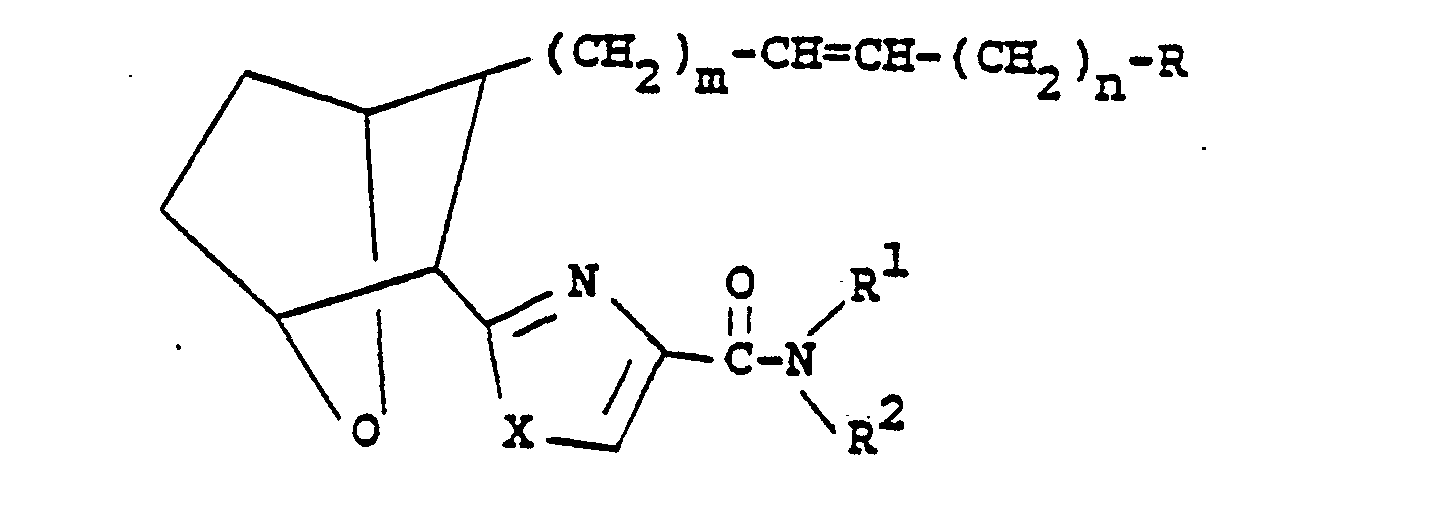


Applications Claiming Priority (2)
| Application Number | Priority Date | Filing Date | Title |
|---|---|---|---|
| US28882688A | 1988-12-23 | 1988-12-23 | |
| US288826 | 1988-12-23 |
Publications (2)
| Publication Number | Publication Date |
|---|---|
| EP0374952A2 true EP0374952A2 (en) | 1990-06-27 |
| EP0374952A3 EP0374952A3 (en) | 1991-03-27 |
Family
ID=23108806
Family Applications (1)
| Application Number | Title | Priority Date | Filing Date |
|---|---|---|---|
| EP19890123799 Ceased EP0374952A3 (en) | 1988-12-23 | 1989-12-22 | 7-oxabicycloheptyl substituted heterocyclic amide prostaglandin analogs useful in the treatment of thrombotic and vasospastic disease |
Country Status (18)
| Country | Link |
|---|---|
| EP (1) | EP0374952A3 (en) |
| JP (1) | JPH02221278A (en) |
| KR (1) | KR900009639A (en) |
| CN (1) | CN1031059C (en) |
| AU (1) | AU617569B2 (en) |
| CA (1) | CA2006355A1 (en) |
| DD (1) | DD286359A5 (en) |
| DK (1) | DK172411B1 (en) |
| FI (1) | FI97230C (en) |
| HU (1) | HUT54161A (en) |
| IL (1) | IL92837A (en) |
| MX (1) | MX18879A (en) |
| NO (1) | NO175258C (en) |
| NZ (1) | NZ231962A (en) |
| PH (1) | PH27413A (en) |
| PL (2) | PL164552B1 (en) |
| PT (1) | PT92768B (en) |
| ZA (1) | ZA899868B (en) |
Cited By (17)
| Publication number | Priority date | Publication date | Assignee | Title |
|---|---|---|---|---|
| EP0476994A1 (en) * | 1990-09-19 | 1992-03-25 | E.R. SQUIBB & SONS, INC. | 7-Oxabicycloheptyl substituted heterocyclic thioamide prostaglandin analogs useful in the treatment of thrombotic and vasospastic disease |
| EP0485794A1 (en) * | 1990-11-10 | 1992-05-20 | Bayer Ag | Substituted aminoacid amide derivatives, their preparation and use |
| EP0447188A3 (en) * | 1990-03-12 | 1992-07-15 | E.R. Squibb & Sons, Inc. | 7-oxabicycloheptane imidazole prostaglandin analogs useful in the treatment of thrombotic and vasospastic diseases |
| EP0497629A1 (en) * | 1991-02-01 | 1992-08-05 | E.R. SQUIBB & SONS, INC. | Heterocyclic amido prostaglandin analogs |
| EP0497085A1 (en) * | 1991-01-28 | 1992-08-05 | E.R. SQUIBB & SONS, INC. | Heterocyclic ketone prostaglandin analogs |
| US5158967A (en) * | 1991-06-12 | 1992-10-27 | E. R. Squibb & Sons, Inc. | 7-oxabicycloheptyl substituted heterocyclic amide prostaglandin analogs useful in the treatment of thrombotic and vasospastic disease |
| US5162352A (en) * | 1991-08-22 | 1992-11-10 | E. R. Squibb & Sons, Inc. | 7-oxabicycloheptyl substituted heterocyclic amide prostaglandin analogs |
| EP0544287A1 (en) * | 1991-11-27 | 1993-06-02 | E.R. SQUIBB & SONS, INC. | Gem-dialkyl-7-oxabicycloheptyl substituted heterocyclic amide prostaglandin analogs useful in the treatment of thrombotic and vasospastic disease |
| US5238951A (en) * | 1991-02-01 | 1993-08-24 | E. R. Squibb & Sons, Inc. | Heterocyclic amido prostaglandin analogs |
| US5280034A (en) * | 1991-08-23 | 1994-01-18 | E. R. Squibb & Sons, Inc. | Bis-heterocyclic prostaglandin analogs |
| US5550248A (en) * | 1990-11-29 | 1996-08-27 | E.R. Squibb & Sons, Inc. | Substituted stryl heterocyclic amido prostaglandin analogs |
| AU678451B2 (en) * | 1993-05-27 | 1997-05-29 | Bristol-Myers Squibb Company | 7-oxabicycloheptane carboxylic acid prostaglandin analog intermediates useful in the preparation of anti-thrombotic and anti-vasospastic compounds and method for preparing same |
| US5723646A (en) * | 1991-01-24 | 1998-03-03 | Bayer Aktiengesellschaft | Substituted amino acid amide derivatives their preparation and use as fungicides |
| US5849922A (en) * | 1996-05-31 | 1998-12-15 | Eli Lilly And Company | Preparation of substituted alkenoic acids |
| US5849766A (en) * | 1996-05-31 | 1998-12-15 | Eli Lilly And Company | Carbamoyl substituted heterocycles |
| US5856584A (en) * | 1997-08-06 | 1999-01-05 | The Nutrasweet Company | Preparation of 3,3-dimethylbutyraldehyde by oxidation of 3, 3-dimethylbutanol |
| US5905175A (en) * | 1998-05-20 | 1999-05-18 | The Nutrasweet Company | Synthesis and purification of 3,3-dimethylbutyraldehyde via oxidation of 1-chloro-3,3-dimethylbutane with dimethyl sulfoxide |
Families Citing this family (3)
| Publication number | Priority date | Publication date | Assignee | Title |
|---|---|---|---|---|
| NZ232897A (en) * | 1989-04-03 | 1992-12-23 | Squibb & Sons Inc | Interphenylene 7-oxabicycloheptyl substituted heterocyclic amide prostaglandin analogues, preparation and pharmaceutical compositions thereof |
| NZ233600A (en) * | 1989-06-12 | 1992-10-28 | Squibb & Sons Inc | 7-oxabicyclo(2.2.1)heptane imidazole prostaglandin analogs and pharmaceutical compositions |
| CN113912619B (en) * | 2021-11-26 | 2022-12-06 | 沈阳药科大学 | Sesquiterpene compound extracted and separated from schisandra chinensis and method and application thereof |
Family Cites Families (2)
| Publication number | Priority date | Publication date | Assignee | Title |
|---|---|---|---|---|
| US4456617A (en) * | 1983-01-12 | 1984-06-26 | E. R. Squibb & Sons, Inc. | 7-Oxabicycloheptane substituted amino prostaglandin analogs and their use in inhibiting platelet aggregation and bronchoconstriction |
| US4663337A (en) * | 1986-04-18 | 1987-05-05 | E. R. Squibb & Sons, Inc. | 7-oxabicycloheptane substituted amides useful in the treatment of thrombotic disease |
-
1989
- 1989-12-21 NZ NZ231962A patent/NZ231962A/en unknown
- 1989-12-21 CA CA002006355A patent/CA2006355A1/en not_active Abandoned
- 1989-12-21 PH PH39757A patent/PH27413A/en unknown
- 1989-12-21 IL IL9283789A patent/IL92837A/en unknown
- 1989-12-21 NO NO895170A patent/NO175258C/en not_active IP Right Cessation
- 1989-12-21 ZA ZA899868A patent/ZA899868B/en unknown
- 1989-12-22 KR KR1019890019281A patent/KR900009639A/en not_active Ceased
- 1989-12-22 EP EP19890123799 patent/EP0374952A3/en not_active Ceased
- 1989-12-22 HU HU896777A patent/HUT54161A/en unknown
- 1989-12-22 PL PL89282945A patent/PL164552B1/en unknown
- 1989-12-22 AU AU47290/89A patent/AU617569B2/en not_active Ceased
- 1989-12-22 FI FI896249A patent/FI97230C/en not_active IP Right Cessation
- 1989-12-22 PL PL89300381A patent/PL165147B1/en unknown
- 1989-12-22 DK DK663189A patent/DK172411B1/en not_active IP Right Cessation
- 1989-12-22 MX MX1887989A patent/MX18879A/en unknown
- 1989-12-23 CN CN89105849A patent/CN1031059C/en not_active Expired - Fee Related
- 1989-12-25 JP JP1338033A patent/JPH02221278A/en active Pending
- 1989-12-27 DD DD89336462A patent/DD286359A5/en unknown
- 1989-12-29 PT PT92768A patent/PT92768B/en not_active IP Right Cessation
Cited By (24)
| Publication number | Priority date | Publication date | Assignee | Title |
|---|---|---|---|---|
| EP0447188A3 (en) * | 1990-03-12 | 1992-07-15 | E.R. Squibb & Sons, Inc. | 7-oxabicycloheptane imidazole prostaglandin analogs useful in the treatment of thrombotic and vasospastic diseases |
| EP0476994A1 (en) * | 1990-09-19 | 1992-03-25 | E.R. SQUIBB & SONS, INC. | 7-Oxabicycloheptyl substituted heterocyclic thioamide prostaglandin analogs useful in the treatment of thrombotic and vasospastic disease |
| US5290799A (en) * | 1990-09-19 | 1994-03-01 | E. R. Squibb & Sons, Inc. | 7-oxabicycloheptyl substituted heterocyclic thioamide prostaglandin analogs useful in the treatment of thrombotic and vasospastic disease |
| EP0485794A1 (en) * | 1990-11-10 | 1992-05-20 | Bayer Ag | Substituted aminoacid amide derivatives, their preparation and use |
| US5550248A (en) * | 1990-11-29 | 1996-08-27 | E.R. Squibb & Sons, Inc. | Substituted stryl heterocyclic amido prostaglandin analogs |
| US5942541A (en) * | 1991-01-24 | 1999-08-24 | Bayer Aktiengesellschaft | Substituted amino acid amide derivatives their preparation and use as fungicides |
| US5723646A (en) * | 1991-01-24 | 1998-03-03 | Bayer Aktiengesellschaft | Substituted amino acid amide derivatives their preparation and use as fungicides |
| EP0497085A1 (en) * | 1991-01-28 | 1992-08-05 | E.R. SQUIBB & SONS, INC. | Heterocyclic ketone prostaglandin analogs |
| EP0497629A1 (en) * | 1991-02-01 | 1992-08-05 | E.R. SQUIBB & SONS, INC. | Heterocyclic amido prostaglandin analogs |
| US5238951A (en) * | 1991-02-01 | 1993-08-24 | E. R. Squibb & Sons, Inc. | Heterocyclic amido prostaglandin analogs |
| US5158967A (en) * | 1991-06-12 | 1992-10-27 | E. R. Squibb & Sons, Inc. | 7-oxabicycloheptyl substituted heterocyclic amide prostaglandin analogs useful in the treatment of thrombotic and vasospastic disease |
| EP0518118A1 (en) * | 1991-06-12 | 1992-12-16 | E.R. SQUIBB & SONS, INC. | 7-Oxabicycloheptyl substituted heterocyclic amide prostaglandin analogs useful in the treatment of thrombotic and vasospastic disease |
| US5162352A (en) * | 1991-08-22 | 1992-11-10 | E. R. Squibb & Sons, Inc. | 7-oxabicycloheptyl substituted heterocyclic amide prostaglandin analogs |
| US5280034A (en) * | 1991-08-23 | 1994-01-18 | E. R. Squibb & Sons, Inc. | Bis-heterocyclic prostaglandin analogs |
| EP0544287A1 (en) * | 1991-11-27 | 1993-06-02 | E.R. SQUIBB & SONS, INC. | Gem-dialkyl-7-oxabicycloheptyl substituted heterocyclic amide prostaglandin analogs useful in the treatment of thrombotic and vasospastic disease |
| AU678451B2 (en) * | 1993-05-27 | 1997-05-29 | Bristol-Myers Squibb Company | 7-oxabicycloheptane carboxylic acid prostaglandin analog intermediates useful in the preparation of anti-thrombotic and anti-vasospastic compounds and method for preparing same |
| US5849922A (en) * | 1996-05-31 | 1998-12-15 | Eli Lilly And Company | Preparation of substituted alkenoic acids |
| US5849766A (en) * | 1996-05-31 | 1998-12-15 | Eli Lilly And Company | Carbamoyl substituted heterocycles |
| US5990308A (en) * | 1996-05-31 | 1999-11-23 | Eli Lilly And Company | Intermediates in the preparation of substituted alkenoic acids |
| US6031095A (en) * | 1996-05-31 | 2000-02-29 | Eli Lilly And Company | Intermediates in the preparation of substituted alkenoic acids |
| US6075147A (en) * | 1996-05-31 | 2000-06-13 | Eli Lilly And Company | Carbamoyl substituted heterocycles |
| US6114534A (en) * | 1996-05-31 | 2000-09-05 | Eli Lilly And Company | Carbamoly substituted heterocycles |
| US5856584A (en) * | 1997-08-06 | 1999-01-05 | The Nutrasweet Company | Preparation of 3,3-dimethylbutyraldehyde by oxidation of 3, 3-dimethylbutanol |
| US5905175A (en) * | 1998-05-20 | 1999-05-18 | The Nutrasweet Company | Synthesis and purification of 3,3-dimethylbutyraldehyde via oxidation of 1-chloro-3,3-dimethylbutane with dimethyl sulfoxide |
Also Published As
| Publication number | Publication date |
|---|---|
| PT92768B (en) | 1995-12-29 |
| FI896249A0 (en) | 1989-12-22 |
| MX18879A (en) | 1994-01-31 |
| PH27413A (en) | 1993-06-21 |
| HUT54161A (en) | 1991-01-28 |
| DD286359A5 (en) | 1991-01-24 |
| PT92768A (en) | 1990-06-29 |
| JPH02221278A (en) | 1990-09-04 |
| EP0374952A3 (en) | 1991-03-27 |
| CN1043716A (en) | 1990-07-11 |
| DK172411B1 (en) | 1998-05-25 |
| HU8906777D0 (en) | 1990-03-28 |
| FI97230B (en) | 1996-07-31 |
| IL92837A0 (en) | 1990-09-17 |
| CN1031059C (en) | 1996-02-21 |
| DK663189D0 (en) | 1989-12-22 |
| NO175258C (en) | 1994-09-21 |
| ZA899868B (en) | 1990-09-26 |
| NO175258B (en) | 1994-06-13 |
| NO895170L (en) | 1990-06-25 |
| AU617569B2 (en) | 1991-11-28 |
| DK663189A (en) | 1990-06-24 |
| NZ231962A (en) | 1992-10-28 |
| IL92837A (en) | 1994-06-24 |
| NO895170D0 (en) | 1989-12-21 |
| PL165147B1 (en) | 1994-11-30 |
| KR900009639A (en) | 1990-07-05 |
| PL164552B1 (en) | 1994-08-31 |
| FI97230C (en) | 1996-11-11 |
| CA2006355A1 (en) | 1990-06-23 |
| AU4729089A (en) | 1990-06-28 |
Similar Documents
| Publication | Publication Date | Title |
|---|---|---|
| EP0374952A2 (en) | 7-Oxabicycloheptyl substituted heterocyclic amide prostaglandin analogs useful in the treatment of thrombotic and vasospastic disease | |
| US5100889A (en) | 7-oxabicycloheptyl substituted heterocyclic amide or ester prostaglandin analogs useful in the treatment of thrombotic and vasospastic disease | |
| EP0391652B1 (en) | Interphenylène 7-oxabicycloheptyl substituted heterocyclic amide prostaglandin analogs useful in the treatment of thrombotic and vasopastic disease | |
| EP0332008A2 (en) | Peptide-like aminoacid derivatives | |
| EP0447188A2 (en) | 7-Oxabicycloheptane imidazole prostaglandin analogs useful in the treatment of thrombotic and vasospastic diseases | |
| US5153327A (en) | 7-Oxabicycloheptyl substituted heterocyclic amide or ester prostaglandin analogs useful in the treatment of thrombotic and vasospastic disease | |
| US4638012A (en) | 7-oxabicycloheptane α-substituted ketone prostaglandin analogs useful in the treatment of thrombotic disease | |
| US5280034A (en) | Bis-heterocyclic prostaglandin analogs | |
| DE3735128A1 (en) | 7-OXABICYCLOHEPTANE DERIVATIVES AND MEDICINAL PRODUCTS CONTAINING THESE COMPOUNDS | |
| US5290799A (en) | 7-oxabicycloheptyl substituted heterocyclic thioamide prostaglandin analogs useful in the treatment of thrombotic and vasospastic disease | |
| RU2015980C1 (en) | 7-oxabicycloheptyl-substituted heterocyclic amides or stereoisomers thereof as thromboxane receptor antagonists | |
| US5135939A (en) | Heterocyclic ketone prostaglandin analogs | |
| US5238951A (en) | Heterocyclic amido prostaglandin analogs | |
| AU640550B2 (en) | Heterocyclic amido prostaglandin analogs | |
| CA2081679A1 (en) | Gem-dialkyl-7-oxabicycloheptyl substituted heterocyclic amide prostaglandin analogs useful in the treatment of thrombotic and vasospastic disease | |
| DE602004003380T2 (en) | 1-PHENYL-2-OXO-3-SULFONYLAMINO-PYRROLIDINE DERIVATIVES AND RELATED COMPOUNDS AS A FACTOR XA INHIBITORS FOR THE TREATMENT OF ACUTE VASCULAR DISEASES | |
| CA2016466A1 (en) | 7-oxabicycloheptane imidozole prostaglandin analogs useful in the treatment of thrombotic and vasospastic disease | |
| DD299186A5 (en) | PHENYLENE-7-OXABICYCLOHEPTYL-SUBSTITUTED HETEROCYCLOAMIDE-PROSTAGLANDINANALOGA |
Legal Events
| Date | Code | Title | Description |
|---|---|---|---|
| PUAI | Public reference made under article 153(3) epc to a published international application that has entered the european phase |
Free format text: ORIGINAL CODE: 0009012 |
|
| AK | Designated contracting states |
Kind code of ref document: A2 Designated state(s): AT BE CH DE ES FR GB GR IT LI LU NL SE |
|
| RIN1 | Information on inventor provided before grant (corrected) |
Inventor name: SHER, PHILIP M. Inventor name: FLOYD, DAVID Inventor name: HALL, STEVEN E. Inventor name: STEIN, PHILIP D. |
|
| PUAL | Search report despatched |
Free format text: ORIGINAL CODE: 0009013 |
|
| 17P | Request for examination filed |
Effective date: 19901228 |
|
| AK | Designated contracting states |
Kind code of ref document: A3 Designated state(s): AT BE CH DE ES FR GB GR IT LI LU NL SE |
|
| 17Q | First examination report despatched |
Effective date: 19930921 |
|
| APAB | Appeal dossier modified |
Free format text: ORIGINAL CODE: EPIDOS NOAPE |
|
| GRAG | Despatch of communication of intention to grant |
Free format text: ORIGINAL CODE: EPIDOS AGRA |
|
| STAA | Information on the status of an ep patent application or granted ep patent |
Free format text: STATUS: THE APPLICATION HAS BEEN REFUSED |
|
| 18R | Application refused |
Effective date: 20010723 |
|
| APAF | Appeal reference modified |
Free format text: ORIGINAL CODE: EPIDOSCREFNE |