EP0382501B1 - Machine postale pourvue d'un circuit de moyens d'entraînement - Google Patents
Machine postale pourvue d'un circuit de moyens d'entraînement Download PDFInfo
- Publication number
- EP0382501B1 EP0382501B1 EP90301283A EP90301283A EP0382501B1 EP 0382501 B1 EP0382501 B1 EP 0382501B1 EP 90301283 A EP90301283 A EP 90301283A EP 90301283 A EP90301283 A EP 90301283A EP 0382501 B1 EP0382501 B1 EP 0382501B1
- Authority
- EP
- European Patent Office
- Prior art keywords
- switch
- drive gear
- cam
- capacitor
- trip
- Prior art date
- Legal status (The legal status is an assumption and is not a legal conclusion. Google has not performed a legal analysis and makes no representation as to the accuracy of the status listed.)
- Expired - Lifetime
Links
- 239000003990 capacitor Substances 0.000 claims description 37
- 230000002093 peripheral effect Effects 0.000 description 3
- 238000007599 discharging Methods 0.000 description 1
- 230000002452 interceptive effect Effects 0.000 description 1
- 239000000463 material Substances 0.000 description 1
- 230000004048 modification Effects 0.000 description 1
- 238000012986 modification Methods 0.000 description 1
Images



Classifications
-
- G—PHYSICS
- G07—CHECKING-DEVICES
- G07B—TICKET-ISSUING APPARATUS; FARE-REGISTERING APPARATUS; FRANKING APPARATUS
- G07B17/00—Franking apparatus
- G07B17/00459—Details relating to mailpieces in a franking system
- G07B17/00508—Printing or attaching on mailpieces
-
- G—PHYSICS
- G07—CHECKING-DEVICES
- G07B—TICKET-ISSUING APPARATUS; FARE-REGISTERING APPARATUS; FRANKING APPARATUS
- G07B17/00—Franking apparatus
- G07B17/00459—Details relating to mailpieces in a franking system
- G07B17/00467—Transporting mailpieces
-
- G—PHYSICS
- G07—CHECKING-DEVICES
- G07B—TICKET-ISSUING APPARATUS; FARE-REGISTERING APPARATUS; FRANKING APPARATUS
- G07B17/00—Franking apparatus
- G07B17/00459—Details relating to mailpieces in a franking system
- G07B17/00467—Transporting mailpieces
- G07B2017/00491—Mail/envelope/insert handling system
-
- G—PHYSICS
- G07—CHECKING-DEVICES
- G07B—TICKET-ISSUING APPARATUS; FARE-REGISTERING APPARATUS; FRANKING APPARATUS
- G07B17/00—Franking apparatus
- G07B17/00459—Details relating to mailpieces in a franking system
- G07B17/00508—Printing or attaching on mailpieces
- G07B2017/00516—Details of printing apparatus
- G07B2017/00524—Printheads
- G07B2017/00548—Mechanical printhead
Definitions
- the present invention is generally concerned with a drive system for mailing machines including driving means for controlling rotary printing structures, and more particularly with an improved drive system including a control circuit therefor.
- a mailing machine which includes a postage meter and a base on which the postage meter is removably mounted.
- the postage meter includes a rotary printing drum and a drive gear therefor which are mounted on a common shaft and normally located in a home position.
- the base includes a drive mechanism having an output gear which is disposed in meshing engagement with the drum drive gear when the postage meter is mounted on the base.
- the drive mechanism includes a single revolution clutch, having a helical spring, for rotating the drum from the home position and into engagement with a letter fed to the drum.
- Each revolution of the clutch, and thus of the drum, is initiated by a letter engaging a trip lever to release the helical spring.
- the drum prints a postage value on the letter while feeding the same downstream beneath the drum as the drum returns to its home position.
- the drive mechanism intermittently operates the rotary printing drum.
- US-A-4,763,575 discloses a mailing machine as recited in the preamble of claim 1 of this specification.
- a mailing machine comprising: means for feeding a sheet through and from the machine; a postage meter including rotary printing means for printing indicia on a sheet fed through the machine; means for driving the printing means, the driving means including a drive gear for rotating the printing means, a shutter bar movable into and out of locking engagement with the drive gear, and an actuating member for moving the shutter bar; trip means for sensing a sheet; a source of supply of d.c.
- circuit means for controlling the driving means including a trip switch actuatable in response to the trip means sensing a sheet fed to the machine; the driving means being arranged to be responsive to actuation of the trip switch to cause the actuating member to move the shutter bar out of locking engagement with the drive gear and then to cause the drive gear to rotate; characterized in that the circuit means includes means for disabling the trip switch for a predetermined time period after the driving means commences rotating the drive gear.
- apparatus in which the invention may be incorporated includes a mailing machine 10 which includes a base 12, having a housing 14, and a postage meter 16 which is removably mounted on the base 12.
- the postage meter 16 forms therewith a slot 18 through which sheets 20, including mailpieces such as letters, envelopes, cards or other sheet-like materials, may be fed in a downstream path of travel 22.
- the postage meter 16 (Fig. 1) includes rotary printing structure including a postage printing drum 24 and a drive gear 26 therefor.
- the drum 24 and drive gear 26 are spaced apart from one another and mounted on a common drum drive shaft 28.
- the drum 24 is conventionally constructed and arranged for feeding the respective sheets 20 in the path of travel 22, which extends beneath the drum 24, and for printing postage data, registration data or other selected indicia on the upwardly disposed surface of each sheet 20.
- the drum drive gear 26 has a key slot 30 formed therein, which is located vertically beneath the drum drive shaft 28 when the postage meter drum 24 and drive gear 26 are located in their respective home positions.
- the postage meter 16 additionally includes a shutter bar 32, having an elongate key portion 34 which is transversely dimensioned to fit into the drive gear's key slot 30.
- the shutter bar 32 is conventionally reciprocably mounted within the meter 16 for movement toward and away from the drum drive gear 26, to permit moving the shutter bar's key portion 34 into and out of the key slot 30, under the control of the mailing machines base 10, when the drum drive gear 26 is located in its home position.
- the shutter bar 32 has a channel 36 formed thereinto from its lower surface 38, and, the mailing machine's base 12 includes a movable lever arm 40, having an arcuately-shaped upper end 42, which extends upwardly through an aperture 44 formed in the housing 14.
- the lever arm's upper end 42 fits into the channel 36 in bearing engagement with the shutter bar 32 for reciprocally moving the bar 32, to and between one position, wherein shutter bar's key portion 34 is located in the drum drive gear's key slot 30, for preventing rotation of the drum drive gear 26, and another position wherein the key portion 34 is located out of the key slot 30, for permitting rotation of the drum drive gear 26.
- the base 12 includes a drive system output gear 46 which extends upwardly through another housing aperture 48 and into meshing engagement with the drum gear 26.
- the base 12 additionally includes sheet aligning structure including a registration fence 50 against which an edge 52 of a given sheet 20 may be urged when fed to the mailing machine 10.
- the base 12 includes drive system trip structure for sensing sheets 20 fed to the machine 10, including a trip lever 54 which extends upwardly through another housing aperture 58 and into the path of travel 22 of each sheet 20 fed to the mailing machine 10.
- the base 12 includes a conventional input feed roller 60, known in the art as an impression roller.
- the impression roller 60 is suitably secured to or integrally formed with a driven shaft 61.
- the shaft 61 is resiliently connected to the housing 14, as hereinafter set forth in greater detail, for causing the roller 60 to extend upwardly through the housing aperture 58 and into the path of travel 22 for urging each sheet 20 into printing engagement with the drum 24 and cooperating therewith for feeding the sheets 20 through the machine 10.
- the base 12 For feeding sheets 20 (Fig. 1) from the mailing machine 10, the base 12 includes a conventional output feed roller 62, known in the art as an ejection roller.
- the roller 62 includes a cylindrically-shaped rim 62A and a coil spring 62B connecting the rim 62A to a hubbed, driven shaft 63.
- the rim 62A is driven by the shaft 63 via the coil spring 62B.
- the shaft 63 is rotatably connected to the housing 14, as hereinafter set forth in greater detail, for causing the roller 62 to extend upwardly through a further housing aperture 64 and into the path of travel 22.
- the postage meter 16 includes a suitable idler roller 66 which is conventionally yieldably mounted, to accommodate mixed thickness batches of sheets 20, with its axis disposed parallel with the axis of the ejection roller 62, when the meter 16 is mounted on the base 14. As thus mounted, the idler roller 66 extends downwardly into the path of travel 22.
- the idler roller 66 is also conventionally movably mounted for adjusting vertical spacing thereof from the ejection roller 62, to accommodate feeding a given batch of relatively thick sheets 20, such as a batch of envelopes which are each stuffed with a letter and inserts.
- the rollers, 62 and 66 are constructed and arranged to accommodate feeding sheets 20 of mixed thickness therebetween and in the path of travel 22 from the machine 10.
- the base 12 (Fig. 1), and thus the mailing machine 10, includes an elongate impression roller carriage 67 which includes a pair of parallel-spaced side walls 67A, one of which is shown, and a lower wall 67B which extends between and is suitably secured to or integrally formed with the side walls 67A.
- the carriage 67 generally horizontally extends from the ejection roller shaft 63, and beneath and in supporting relationship with the impression roller shaft 61. More particularly, one end of each of the carriage side walls 67A is preferably pivotably attached to the housing 14 so as to define parallel-spaced arcuately-shaped bearing surfaces 67C within which the ejection roller shaft 63 is rotatably mounted.
- the side walls 67A are conventionally constructed and arranged for rotatably supporting the opposed ends of the impression roller shaft 61.
- the carriage 67B lower wall is preferably connected to the housing 14 by means of a depending spring 68.
- the base 12 includes a driven gear 61A which is suitably fixedly connected to or integrally formed with the impression roller shaft 61.
- the impression roller shaft 61 and drive gear 61A are both conventionally rotatably connected to the carriage 67.
- the base 12 includes a driven gear 63A which is suitably fixedly connected to or integrally formed with the ejection roller shaft 63.
- the base 12 includes an endless gear belt 69 which is looped about the gears 61A and 63A for transmitting rotational movement of the gear 61A to the gear 63A, whereby the ejection roller shaft 63 and the impression roller 60 are driven in timed relationship with one another.
- the gears 61A and 63A, and the impression roller 60 and ejection roller 62 are relatively dimensioned for ensuring that the peripheral velocity of the ejection roller 62 is greater than the peripheral velocity of the impression roller 60, when neither of the respective rollers 60 and 62 are in engagement with a sheet 20 fed thereto.
- the impression roller drive shaft 61 and drive gear 61A therefor are urged downwardly as the supporting carriage 67 pivots downwardly about the ejection roller shaft 63, against the force exerted on the carriage 67 by the spring 68, to provide a variable gap between the drum 24 and impression roller 60, to accommodate mixed thickness sheets 20.
- the spring 68 resiliently urges the carriage 70, and thus the impression roller 60, upwardly against any downwardly directed force exerted on the impression roller 60, by a given sheet 20 fed beneath the postage meter drum 24, for urging mixed thickness sheets 20 into printing engagement with the drum 24.
- the base 12 (Fig. 1), and thus the mailing machine 10, includes an intermittently operable, electromechanical, drive system 70 (Fig. 2) for driving the shutter bar lever arm 40 (Fig. 1), output gear 26 and thus the postage meter drum 24, and the roller shaft 63 and thus the roller 60, preferably in timed relationship with one another, in response to movement of the trip lever 54 by a sheet 20 fed to the machine 10.
- an intermittently operable, electromechanical, drive system 70 (Fig. 2) for driving the shutter bar lever arm 40 (Fig. 1), output gear 26 and thus the postage meter drum 24, and the roller shaft 63 and thus the roller 60, preferably in timed relationship with one another, in response to movement of the trip lever 54 by a sheet 20 fed to the machine 10.
- the drive system 70 (Fig. 2) is conventionally supported by the housing 14 and generally includes a drive mechanism 72 and drive system operating apparatus 74. More particularly, the drive mechanism 72 (Fig. 2) comprises a plurality of interactive structures including control structure 76, actuating structure 78, drive mechanism latching structure 80 and rotary timing cam structure 82. And, the operating apparatus 74 includes trip lever structure 84, and, in addition, comprises a plurality of components, including a trip switch 86, trip solenoid 88, motor switch 90 and d.c. motor drive system 92, and a control circuit 94 to which the components 86, 88, 90 and 92 are electrically connected.
- the drive mechanism 72 (Fig. 2) comprises a plurality of interactive structures including control structure 76, actuating structure 78, drive mechanism latching structure 80 and rotary timing cam structure 82.
- the operating apparatus 74 includes trip lever structure 84, and, in addition, comprises a plurality of components, including a trip switch 86, trip solenoid 88, motor switch 90 and
- the control structure 76 (Fig. 2) includes a control member 100 which is conventionally pivotably mounted for rotation, in a generally vertically-extending plane, on a pivot shaft 102 which is secured to or integrally formed with the housing 14.
- the control member 100 includes a vertically oriented, upwardly-extending, leg 104, a laterally-extending leg 106 and a depending leg 108.
- the upwardly-extending leg 104 acts as a cam, latch and stop, and includes a cam surface 110, latching surface 112 and a stop surface 114.
- the laterally-extending leg 106 acts as a cam follower and includes a cam follower surface 116.
- the depending leg 108 acts as a lever arm and includes upper and lower slots 118 and 120.
- the control structure 76 also includes upper and lower springs, 122 and 124.
- the upper spring 122 has one end located in the upper slot 118 for attachment thereof to the depending leg 108 and has the other end attached to the actuating structure 78.
- the lower spring 124 has one end located in the lower slot 120 for attachment thereof to the depending leg 108 and has the other end indirectly attached to the housing 14.
- the actuating structure 78 (Fig. 2) includes an actuating member 130 which is also conventionally pivotably mounted for rotation, in a generally vertically-extending plane, on the pivot shaft 102.
- the actuating member 130 (Fig. 4) includes an upwardly-extending leg which acts as a lever arm and, in particular, is the shutter bar actuating lever arm 40.
- the actuating member 130 includes opposed legs, 134 and 136, which laterally extend from the actuating lever arm 40, and a depending leg 138.
- One of the laterally-extending legs 134 acts as a cam key and cam follower and is thus transversely dimensioned to act as a key and includes a cam follower surface 140.
- the other laterally-extending leg 136 acts as a pivot limiter and motor switch actuator, and includes a travel limiting surface 142, which is conventionally formed for contacting a housing stop 143, and a motor switch actuating shoulder 144.
- the depending leg 138 acts as a lever arm and includes a lower slot 146 in which the aforesaid other end of the control structure's upper spring 122 (Fig. 2) is located for attachment thereof to the depending leg 138.
- the drive mechanism latching structure 80 (Fig. 2) includes an latching member 150 which is conventionally pivotably mounted for rotation, in a generally horizontally-extending plane, on another pivot shaft 152 which is secured to or integrally formed with the housing 14.
- the latching member 150 (Fig. 3) has a plurality of laterally-extending legs including one laterally-extending leg 154 which acts as a lever arm and includes a trip solenoid shaft striking surface 155.
- Another of the laterally-extending legs 156 acts as a leaf spring
- yet another of the laterally-extending legs 158 acts as a leaf spring flexure limiter.
- the leaf spring leg 156 and flexure limiting leg 158 extend substantially parallel to each other and define a longitudinally-extending slot 162 therebetween.
- still another of the laterally-extending legs 160 acts as a cam follower and latch, and includes a cam follower surface 164 and latching surface 166.
- the rotary timing cam structure 82 (Fig. 2) includes a generally annularly-shaped rotary cam 180, which is suitably secured to or integrally formed with a drive shaft 182.
- the drive shaft 182 (Fig. 5) is conventionally connected to the housing 14, as by means of a supporting frame 183 which is conventionally removably connected to the housing 14, to permit rotation of the cam 180 in a generally vertically-extending plane.
- the cam 180 has an outer, peripherally-extending cam surface 184, which tapers inwardly toward the viewing end of the drive shaft 182 to accommodate camming engagement with the control member's cam follower surface 116.
- the cam surface 184 when thus viewed and also when viewed as extending counter-clockwise from a line "1" (Fig. 5A) passing through the average radius of the cam surface 184, commences at a radial distance "r1" from the axis of the shaft 182, spirals outwardly, and ends at a radial distance "r2" from the axis of the shaft 182.
- the cam 180 also includes a radially-extending surface 186 having an average radial width of the sum of r2 - r1.
- the cam 180 has a generally annularly-shaped inwardly-facing cam surface 188, surrounding the drive shaft 182, and includes a slot 190 formed thereinto from the surface 188.
- the slot 190 is located vertically above the drive shaft 182, when the cam 180 is disposed in its home position, and is suitably dimensioned for receiving thereinto the actuating member's key-shaped, laterally-extending, leg 134.
- the trip lever structure 84 (Fig. 2) includes a trip member 200 which is conventionally pivotably mounted for rotation, in a generally vertically-extending plane, on a pivot shaft 202 which is secured to or integrally formed with the housing 14.
- the trip member 200 includes an upwardly extending leg, known in the art as the trip lever 54, and a depending leg 204, which acts as a lever arm and includes a slot 206 formed therein.
- the trip lever 54 preferably includes an upper, laterally-extending, shoulder 208, having an arcuately-extending upper edge 210 which extends towards respective sheets 20 fed thereto for supporting and guiding such sheets 20 into the path of travel 22 when the trip lever 54 is engaged and moved by such sheets 20.
- the trip lever 54 includes a lower, laterally-extending trip switch actuating shoulder 212.
- the trip lever structure 84 further includes a spring 214, having one end located in the depending leg's slot 206 and the other end conventionally connected to the housing 14.
- the trip switch 86 (Fig. 2) is preferably a single pole double throw switch having two modes of operation.
- the switch 86 is conventionally physically connected to the housing 14 for suitable location of the switch 86 relative to the trip lever's switch actuating shoulder 212, to allow the shoulder 212 to operate the switch 86 in response to movement of the trip lever 54.
- the switch 86 includes an operating lead 220 and two switch position, leads, 220A and 220B. When the switch 86 is in one of its modes of operation, the leads 220 and 220A are electrically connected, whereas when the switch 86 is in its other mode of operation, the leads 220 and 220B are electrically connected.
- the trip solenoid 88 (Fig. 2) is preferably a conventional D.C. solenoid which includes a core or shaft 230.
- the solenoid 88 is conventionally physically connected to the housing 14 for suitably locating the shaft 230 relative to the latching member 150 to allow the shaft 230 to strike the surface 155 of the latching member 150 and pivot the latching member 150 against the force exerted thereon by the leaf spring 156, when the solenoid 88 is energized from the control circuit 94.
- the motor switch 90 (Fig. 2) is preferably a single pole double throw switch having two modes of operation.
- the switch 90 is conventionally physically connected to the housing 14 for suitable location of the switch 90 relative to the actuating member lever arm's switch actuating shoulder 144, to allow the shoulder 144 to operate the switch 90 in response to movement of the actuating member's lever arm 40.
- the switch 90 includes an operating lead 236 and two switch position leads 236A and 236B. When the switch 90 is in one of its modes of operation, the leads 236 and 236A are electrically connected, whereas when the switch 90 in its other mode of operation, the leads 236 and 236B are electrically connected.
- the d.c. motor drive system 92 (Fig. 2) preferably includes a conventional d.c. motor, 240 having an output shaft 242.
- the motor 24 is conventionally physically connected to the housing 14 via a gear box 244.
- the motor output shaft 242 is preferably connected, via a reduction gear train 246 within the gear box 244, to an output drive gear 248, which is suitably journalled to the gear box 244 for rotation.
- the drive system 92 additionally includes a timing cam drive gear 250 and gear belt 252.
- the cam drive gear 250 is suitably fixedly connected to or integrally formed with the cam drive shaft 182.
- the cam 180 is mounted for rotation with the drive gear 250.
- the gear belt 252 is endlessly looped about and disposed in meshing engagement with the drive gear 248 and cam drive gear 250.
- the drive system 92 further includes an ejection roller drive gear 254 and a drive shaft 256 on which the gear 254 is conventionally fixedly mounted.
- the drive shaft 256 is suitably rotatably connected to the housing 14 for conventionally connecting one end thereof to the ejection roller shaft 63A (Fig. 1) and disposing the ejection roller drive gear 254 (Fig. 2) in meshing engagement with the gear belt 252, between the motor output drive gear 248 and timing cam drive gear 250.
- the drive system 92 additionally includes the drive system output gear 46, (Fig. 2), which is suitably fixedly connected to or integrally formed with the cam drive shaft 182 for rotation therewith and extends upwardly through the housing 14 for engagement with the drum drive gear 26 (Fig. 1).
- the cam 180 is mounted for rotation with the output gear 46 (Fig. 1) and drive gear 26.
- the control circuit 94 (Fig. 2) preferably includes a conventional d.c. power supply 270.
- the control circuit 94 includes suitable trip control circuitry for interconnecting the trip switch 86, trip solenoid 88 and power supply 270 for energization of the solenoid 88 in response to operation of the switch 86.
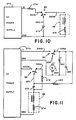
- the trip control circuitry is conventionally constructed and arranged such that in one mode of operation the switch 86 (Figs. 9, 10 and 11) is operated to electrically connect the switch leads 220 and 220B for energizing the solenoid 88.
- the solenoid 88 is energized through a series connected capacitor 272, from the power supply 270.
- the solenoid 88 is operated for a time period which corresponds, substantially, to the charging time constant of the R-C circuit defined by the capacitor 272 and internal resistance 274 of the solenoid 88.
- the switch 86 is operated to electrically disconnect the switch leads 220 and 220B for maintaining deenergization of the solenoid 88, and to electrically connect the switch leads 220 and 220A for discharging the capacitor 272 through a series connected resistor 276.
- the resistance value of the resistor 276 is preferably chosen to ensure that the capacitor 272 does not discharge sufficiently to permit the next operation of the switch 86 to energize the solenoid 88 before the completion of a single revolution of the drum drive gear 26 or cam 180.
- the time constant of the R-C circuit defined by the capacitor 272 and resistor 276 is chosen to maintain the discharge interval of the capacitor 272 for a predetermined time period, preferably corresponding substantially to the time interval during which the drum drive gear 26 and cam 180 complete rotation thereof through a single revolution. Accordingly, the trip switch 86 is disabled from energizing the solenoid 88 for a predetermined time period after any given energization thereof.
- the resistance value of the resistor 276 is preferably chosen to ensure completion of discharge of the capacitor 272 before the next operation of the switch 86 which follows completion of a single revolution of the drum drive gear 26 or cam 180, to permit commencement of the next revolution thereof substantially immediately after completion of any given single revolution thereof.
- the solenoid circuit is in its at-ready mode of operation upon completion of any given single revolution but not during any given revolution thereof.
- the embodiment shown in Fig. 10 differs from that of Figs. 9 and 11, in that the solenoid 88 is energized from the capacitor 272, which is connected across the solenoid 88 when the switch 88 is operated to electrically connect the switch leads 220 and 220B. Again, the solenoid 88 is operated for a time period which corresponds, substantially, to the charging time constant of the R-C circuit defined by the capacitor 272 and the internal resistance 274 of the solenoid 88.
- the embodiment shown in Fig. 10 also differs from that of Fig.
- the switch 86 in that in its other mode of operation the switch 86 is operated to electrically disconnect the switch leads 220 and 220B and connect the switch lead 220 and 220A for charging the capacitor 272, through a series connected resistor 278, from the power supply 270.
- the charging time constant of the capacitor 272 is determined by the time constant of R-C circuit defined by the capacitor 272 and resistor 278.
- the resistance value of the resistor 278 is preferably chosen to ensure that the capacitor 272 does not charge sufficiently to permit the next operation of the switch 86 to energize solenoid 88 before the completion of a single revolution of the drum drive gear 26 or cam 180.
- the time constant of the R-C circuit defined by the capacitor 272 and resistor 278 is chosen to maintain the charging interval of the capacitor 272 for a predetermined time period corresponding substantially to the time interval during which the drum drive gear 26 and cam 180 complete rotation through a single revolution.
- the trip switch 86 is disabled from energizing the solenoid 88 for a predetermined time period after any given energization thereof.
- the resistance value of the resistor 278 is preferably chosen to ensure completion of charging of the capacitor 272 before the next operation of the switch 86 after the completion of a single revolution of the drum drive gear 26 or cam 180, to permit commencement of the next revolution thereof substantially immediately after completion of any given revolution thereof.
- the solenoid circuit is in its at-ready mode of operation upon completion of any given single revolution thereof but not during any given revolution thereof.
- control circuit 94 includes suitable motor control circuitry for interconnecting the motor switch 90, d.c. motor 240 and power supply 270 for energization and deenergization of the d.c. motor 240 in response to operation of the switch 90.
- the motor control circuitry is conventionally constructed and arranged such that in one mode of operation the switch 90 (Figs. 9 and 11) is operated to electrically disconnect the leads 236 and 236A, for opening a shunt circuit across the d.c. motor 240, and to electrically connect the switch leads 236 and 236B, for energizing the d.c. motor 240 from the power supply 270.
- the switch 90 operated to electrically disconnect the switch leads 236 and 236B, for deenergizing the d.c. motor 240, and to electrically connect the switch leads 236 and 236A, for closing the shunt circuit across the d.c. motor 240 for dynamically braking the d.c. motor 240.
- the shunt circuit is a simple short circuit
- the shunt circuit includes a capacitor 280 and a diode connected in parallel with one another across the motor 240.
- the switch leads 236 and 236B are disconnected for disconnecting the motor 240 from the supply 270, and the switch leads 236 and 236A connected for connecting the shunt circuit 280, 282, across the motor 240.
- the cathode of the diode 282, the side of the capacitor 280 connected thereto and the negative terminal of the motor 240 are connected directly to the ground of the power supply 270.
- the anode of the diode 282, positive terminal of the motor 240 and other side of the capacitor 280 are also electrically connected to the ground of the power supply 270 via the series connected resistor 284, capacitor 272 and solenoid 88.
- the trip switch 86 When the trip switch 86 is operated to connect the switch leads 220 and 220B for energizing the solenoid 88 via the capacitor 272, the side of the capacitor 280 connected to the anode of the diode 282 is connected via the switch 86 to the negative voltage source of the power supply 270, for appropriately charging the capacitor 280 to subsequently discharge through the motor 240 for dynamically braking the motor 240. Thereafter, when the motor switch 90 is operated to disconnect the switch leads 236 and 236A and connect the switch leads 236 and 236B, the motor 240 is energized and the capacitor 280 remains charged.
- the capacitor 280 discharges through the motor 240 causing current to flow in the motor 240 in the appropriate direction that is, opposite to that of the motor operating current, for dynamically braking the motor 240.
- the resistance value of the resistor 284 is selected to ensure that the capacitor 280 is discharged sufficiently rapidly to avoid causing the motor 240 to rotate in the wrong direction.
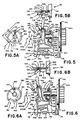
- the drive system 70 Prior in time to operation of the mailing machine 10 (Fig. 1), the drive system 70 (Fig. 2) is in its normal or at-ready mode of operation, as shown in Figs. 2, 3, 5, 5A and 5B.
- the trip lever 54 As thus shown, the trip lever 54 (Fig. 2) is held, by means of the spring 214, in engagement with trip switch 86, which acts as a travel limiting stop.
- the trip lever shoulder 212 holds the switch 86 in its operating mode wherein the leads 220 and 220A are electrically connected for maintaining the trip solenoid 88 deenergized.
- the spring 124 is connected for urging the control member 100 out of its home position, the control member 100 is held in its home position by the latching member 154, against rotation by the spring 124, since the latching member's latching surface 166 is held in engagement with the control member's latching surface 112 by the spring 124.
- the control member's cam surface 116 is located out of engagement with the cam 180.
- the actuating member 130 (Fig. 5 and 5A) is urged into locking relationship with the rotary cam 180, by the spring 122.
- the actuating member's lever arm 40 is held in engagement with the control member's latching surface 114 by the spring 122.
- the actuating member's lever arm 40 positions the shutter bar key portion 24 (Fig. 1) in the drum drive gear slot 30, thereby locking the drum drive gear 30 and thus the drum 24 against rotation, positions the lever arm's key leg 134 (Figs. 5 and 5A) in the rotary cam's slot 190, thereby locking the cam 180 against rotation, positions the lever arm's stop surface 142 out of contact with the housing stop 143 and positions the motor switch actuating shoulder 144 out of engagement with the motor switch 90.
- the actuating member 130 is thus held, the actuating member's cam surface 140 is located out of engagement with the cam 180. Since the latching member 154 (Fig. 3) holds the control member 100 in place against rotation by the spring 124 (Figs.
- the control member 100 cannot pivot the actuating member's lever arm 40.
- the latching member 154 indirectly prevents actuation of the motor switch 90, holds the shutter bar lever arm's key portion 24 (Fig. 1) in the drum drive gear slot 30 and holds the lever arm's key leg 134 (Figs. 5 and 58) in the cam slot 90, whereby the drum 24 (Fig. 1) and cam 180 (Figs. 5 and 5B) are locked in their respective home positions.
- the motor switch 90 (Fig. 2) is maintained in its mode of operation wherein the leads 236 and 236B (Fig. 9) are disconnected for preventing the d.c.
- the latching member 150 rotates about the shaft 152, the latching member's latching surface 166 arcuately moves out of engagement with the control member's latching surface 112 (Fig. 6), thereby releasing the control member 100 and permitting rotation thereof by the spring 124.
- the free end of the flexure limiting leg 158 bridges the slot 162 for engaging leg 156, to limit the flexure of the leaf spring leg 156.
- the control member 100 pivots the actuating member's lever arm 40 away from the cam 180, thereby moving the shutter bar key portion 34 (Fig.
- the capacitance value of the capacitor 272 (Figs. 9, 10 and 11) is conventionally selected to ensure that the switch 90 is actuated before the solenoid 88 is deenergized.
- the capacitor 272 becomes sufficiently charged (Figs.9 and 11) or discharged (Fig. 10), as the case may be, to cause the solenoid 88 to be deenergized after the switch 90 is actuated, although the switch leads 220 and 220B may be maintained electrically connected by the trip lever shoulder 212 (Fig. 2).
- the latching member 150 (Fig. 3) is rotated about the pivot shaft 152 by the leaf spring leg 156, thereby causing the latching member's cam follower surface 164 (Fig.
- switch leads 236 and 236A are electrically disconnected for removing the shunt circuit from across the d.c. motor 240, followed by the switch leads 236 and 236B being electrically connected for energizing the d.c. motor 240 from the power supply 270.
- the peripheral velocity of the ejection roller 62 is greater than that of the impression roller 60, as a result of which the ejection roller 62 tends to pull respective sheets 20 which are fed thereto from beneath drum 24 while the drum 24 and impression roller 60 are still rotating in engagement with the sheets 20.
- the ejection roller shaft 63 continues rotation and stores energy in the coil spring 62B as the ejection roller rim 62A slips relative to the shaft 63, until the drum 24 is no longer in engagement with the sheet 20.
- the coil spring 62B releases the energy stored therein by driving the ejection roller rim 62A for feeding the sheet 20 from the machine 10.
- the ejection roller 62 feeds the sheet 20 out of engagement with the trip lever 54.
- the trip lever 54 is rotated about the pivot shaft 202 (Fig.2) by the spring 214, causing the trip lever's shoulder 212 to operate the trip switch 86 for disconnecting the switch leads 220 and 220B and connecting the switch leads 220 and 220A for returning the trip switch 86 to its at-ready mode of operation.
- the trip switch 86 (Fig.2) is returned to its at-ready mode of operation, as hereinbefore discussed, the trip switch 86 is disabled from energizing the solenoid 88 for a predetermined time period after any given energization thereof.
- the time period preferably corresponds substantially to the time interval during which the cam 180 or drum drive gear 26 complete rotation thereof through a single revolution. Accordingly, if a next sheet 20 were fed to the machine 10 after return of the trip switch 86 to its at-ready mode of operation, but before completion of a single revolution of the cam 180 or drum drive gear 26, movement of the trip lever 40 by the sheet 20, sufficiently to operate the switch 86, would not result in energization of the solenoid 88.
- the solenoid circuit is constructed and arranged to prevent the drive mechanism 72 from being double tripped during any given single cycle of operation thereof, thereby ensuring single revolution operation of the drive mechanism 72 and preventing sheets 20 from being jammed between the drum 24 (Fig. 1) and impression roller 60, and ejection roller 62 and idler roller 66.
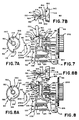
- the actuating member's cam follower surface 140 When the actuating member 130 is thus held by the control member 100, the actuating member's cam follower surface 140 is located in a plane which is slightly spaced apart from, and which extends substantially parallel to, the rotary cam's camming surface 188 (Fig. 6). Thus the cam follower surface 140 is not initially disposed in engagement with the cam surface 188, due to the spring 124 holding the actuating member's lever arm 40 against the stop 143. Moreover, when the cam 180 commences rotation, the control member's cam follower surface 116 is located out of engagement with the cam's peripherally-extending cam surface 184.
- the rotating cam 180 continues to maintain the shutter bar's key portion 34 (Fig. 1) out of the drum drive gear slot 30, and continues to maintain the actuating member's key leg 134 (Figs. 8A and 8B) out of cam slot 190, until the cam 180 rotates still further and disengages the cam follower surface 140.
- the spring 122 rotates the actuating member 130 (Figs. 5, 5A and 5B) into engagement with the latched control member 100, thereby urging the shutter bar's key portion 24 (Fig. 1) into the drum drive gear slot 30 to prevent further rotation of the drum drive gear 26 and thus the drum 24, moving the actuating member's key leg 134 (Figs.
- the switch leads 236 and 236B are electrically disconnected for deenergizing the d.c. motor 240, followed by the switch leads 236 and 236A being electrically connected to close the shunt circuit across the d.c. motor 240 for dynamically braking the d.c. motor 240.
- the d.c. motor 240 is both deenergized and dynamically braked as the shutter bar key portion 24 (Fig. 1) enters the drum drive gear slot 30 and the actuating member's key leg 134 (Figs.
Landscapes
- Physics & Mathematics (AREA)
- General Physics & Mathematics (AREA)
- Engineering & Computer Science (AREA)
- Computer Security & Cryptography (AREA)
- Devices For Checking Fares Or Tickets At Control Points (AREA)
- Transmission Devices (AREA)
Claims (7)
- Machine postale comprenant:
un moyen (24, 60, 62, 66) pour charger une feuille (20) à travers et depuis la machine;
un dispositif d'affranchissement (16) compor-tant un moyen d'impression rotatif (24) destiné à imprimer une marque sur une feuille chargée dans la machine;
un moyen (72) pour entraîner le moyen d'impression, le moyen d'entraînement comportant un engrenage d'entraînement (26) destiné à faire tourner le moyen d'impression, une barre d'obturation (32) pouvant se déplacer en et hors d'un engagement par verrouillage avec l'engrenage d'entraînement, et un élément d'activation (130) destiné à déplacer la barre d'obturation;
un moyen de déclenchement (84) destiné à détecter une feuille;
une source (270) d'alimentation d'énergie en courant continu; et
un moyen de circuit pour commander le moyen d'entraînement (72), le moyen de circuit comportant un commutateur de déclenchement (86) pouvant être actionné en réponse à la détection par le moyen de déclenchement (84) du chargement d'une feuille dans la machine;
le moyen d'entraînement (72) étant aménagé de façon à être sensible à l'activation du commutateur de déclenchement (86) pour faire déplacer la barre d'obturation (32) par l'élément d'activation (130) hors de l'engagement par verrouillage avec l'engrenage d'entraînement (26), et de faire ensuite tourner l'engrenage d'entraînement;
caractérisé en ce que le moyen de circuit comporte un moyen (272, 276, 278) pour désactiver le commutateur de déclenchement (86) au bout d'une durée prédéterminée après que le moyen d'entraînement (72) ait commandé à faire tourner l'engrenage d'entraînement (26). - Machine selon la revendication 1, dans laquelle la durée prédéterminée correspond à une durée pendant laquelle l'engrenage d'entraînement (26) et ainsi le moyen d'impression rotatif (24) achèvent la rotation de ceux-ci en un tour unique de ceux-ci.
- Machine selon la revendication 1 ou 2, dans laquelle le moyen de circuit comporte un condensateur (272) et un solénoïde (88) pouvant être excité par l'alimentation (270) à travers le condensateur (272), en réponse à l'activation du commutateur de déclenchement (86) lorsqu'une feuille est chargée dans la machine.
- Machine selon la revendication 1 ou 2, dans laquelle le moyen de circuit comporte un condensateur (272) aménagé de façon à être chargé par l'alimentation (270) avant activation du commutateur de déclenchement (86), et un solénoïde (88) pouvant être excité par le condensateur (272) en réponse à l'activation du commutateur de déclenchement lorsqu'une feuille est chargée dans la machine.
- Machine selon la revendication 3, dans laquelle le moyen de circuit comporte une résistance (276) aménagée de façon à être connectée au condensateur (272) après activation du commutateur de déclenchement (86) pour retarder la décharge du condensateur de la durée prédéterminée.
- Machine selon la revendication 4, dans laquelle le moyen de circuit comporte une résistance (276) aménagée de façon à être connectée au condensateur (272) après activation du commutateur de déclenchement (86) pour retarder la charge du condensateur de la durée prédéterminée.
- Machine selon la revendication 1, dans laquelle la durée prédéterminée s'achève lorsque l'engrenage d'entraînement (26), et ainsi le moyen d'impression rotatif (24), a effectué une simple rotation de celui-ci.
Applications Claiming Priority (2)
| Application Number | Priority Date | Filing Date | Title |
|---|---|---|---|
| US07/307,803 US4881461A (en) | 1989-02-08 | 1989-02-08 | Mailing machine including improved driving means circuit |
| US307803 | 1989-02-08 |
Publications (3)
| Publication Number | Publication Date |
|---|---|
| EP0382501A2 EP0382501A2 (fr) | 1990-08-16 |
| EP0382501A3 EP0382501A3 (fr) | 1991-05-02 |
| EP0382501B1 true EP0382501B1 (fr) | 1995-03-01 |
Family
ID=23191223
Family Applications (1)
| Application Number | Title | Priority Date | Filing Date |
|---|---|---|---|
| EP90301283A Expired - Lifetime EP0382501B1 (fr) | 1989-02-08 | 1990-02-07 | Machine postale pourvue d'un circuit de moyens d'entraînement |
Country Status (5)
| Country | Link |
|---|---|
| US (1) | US4881461A (fr) |
| EP (1) | EP0382501B1 (fr) |
| AU (1) | AU627273B2 (fr) |
| CA (1) | CA2008964A1 (fr) |
| DE (1) | DE69017239T2 (fr) |
Families Citing this family (6)
| Publication number | Priority date | Publication date | Assignee | Title |
|---|---|---|---|---|
| US4905980A (en) * | 1989-02-08 | 1990-03-06 | Pitney Bowes Inc. | Control circuit for single revolution means |
| US4876959A (en) * | 1989-02-08 | 1989-10-31 | Pitney Bowes Inc. | Drive system for rotary printing apparatus including improved means for locking and unlocking the apparatus |
| FR2668725B1 (fr) * | 1990-11-07 | 1994-10-07 | Secap | Ensemble de separation et de traitement d'objets empiles, notamment d'objets postaux. |
| US5355068A (en) * | 1991-12-19 | 1994-10-11 | Pitney Bowes Inc. | Mailing machine including shutter bar control system |
| US5495103A (en) * | 1994-03-16 | 1996-02-27 | Ascom Hasler Mailing Systems Ag | Optical mail piece sensor for postage meter |
| US5706727A (en) * | 1995-03-14 | 1998-01-13 | Ascom Hasler Mailing Systems Ag | Postage meter with improved paper path |
Family Cites Families (22)
| Publication number | Priority date | Publication date | Assignee | Title |
|---|---|---|---|---|
| GB488217A (fr) * | ||||
| GB191204683A (en) * | 1911-04-26 | 1912-07-11 | Soennecken F | Improvements in or relating to Machines for Copying Documents and the like. |
| GB576267A (en) * | 1943-03-12 | 1946-03-26 | Pitney Bowes Postage Meter Co | Improvements in letter controlled mechanism |
| DE918640C (de) * | 1951-06-10 | 1954-09-30 | Roto Werke A G | Rotationsvervielfaeltiger mit Motorantrieb |
| US2934009A (en) * | 1956-10-22 | 1960-04-26 | Pitney Bowes Inc | Sheet feeding and treating |
| US2871781A (en) * | 1957-05-06 | 1959-02-03 | Pitney Bowes Inc | Piece printing and ejecting device |
| BE584698A (fr) * | 1958-11-18 | |||
| DE2437817A1 (de) * | 1974-08-02 | 1976-02-12 | Gerhard Ritzerfeld | Rotationsvervielfaeltiger |
| US4037535A (en) * | 1974-08-22 | 1977-07-26 | Burroughs Corporation | High speed printing apparatus |
| US4016467A (en) * | 1975-03-10 | 1977-04-05 | Pitney-Bowes, Inc. | Servodrive apparatus for driving the postage printing drum in a postage meter |
| US4259902A (en) * | 1979-10-30 | 1981-04-07 | Pitney Bowes Inc. | Electronic postage meter with power failure accounting protection system |
| US4421023A (en) * | 1982-05-20 | 1983-12-20 | Pitney Bowes Inc. | Printer control systems for electronic postage meter |
| US4628476A (en) * | 1982-12-08 | 1986-12-09 | Pitney Bowes Inc. | Completing an incomplete trip in an electronic postage meter |
| US4489256A (en) * | 1983-12-27 | 1984-12-18 | Everest & Jennings, Inc. | Primary and secondary dynamic braking system |
| US4731728A (en) * | 1985-01-10 | 1988-03-15 | Pitney Bowes Inc. | Postage meter with means for preventing unauthorized postage printing |
| US4643089A (en) * | 1985-01-18 | 1987-02-17 | Pitney Bowes Inc. | Apparatus for controlling printing means |
| GB2177656B (en) * | 1985-07-04 | 1989-04-05 | Roneo Alcatel Ltd | Value selection mechanism for postal franking machines |
| US4729311A (en) * | 1986-12-08 | 1988-03-08 | Ncr Corporation | Printing apparatus including a single revolution clutch |
| US4767970A (en) * | 1986-12-22 | 1988-08-30 | Ampex Corporation | Dynamic brake control for a tape drive system |
| US4763575A (en) * | 1987-04-06 | 1988-08-16 | Pitney Bowes Inc. | Envelope pressure plate for mailing machine |
| US4936568A (en) * | 1989-02-08 | 1990-06-26 | Pitney Bowes Inc. | Control circuit for single revolution means |
| US4905590A (en) * | 1989-02-08 | 1990-03-06 | Pitney Bowes Inc. | Mailing machine including driving means circuit |
-
1989
- 1989-02-08 US US07/307,803 patent/US4881461A/en not_active Expired - Lifetime
-
1990
- 1990-01-31 CA CA002008964A patent/CA2008964A1/fr not_active Abandoned
- 1990-02-07 EP EP90301283A patent/EP0382501B1/fr not_active Expired - Lifetime
- 1990-02-07 DE DE69017239T patent/DE69017239T2/de not_active Expired - Fee Related
- 1990-02-08 AU AU49247/90A patent/AU627273B2/en not_active Ceased
Also Published As
| Publication number | Publication date |
|---|---|
| AU627273B2 (en) | 1992-08-20 |
| DE69017239D1 (de) | 1995-04-06 |
| CA2008964A1 (fr) | 1990-08-08 |
| US4881461A (en) | 1989-11-21 |
| EP0382501A3 (fr) | 1991-05-02 |
| EP0382501A2 (fr) | 1990-08-16 |
| DE69017239T2 (de) | 1995-11-09 |
| AU4924790A (en) | 1990-08-16 |
Similar Documents
| Publication | Publication Date | Title |
|---|---|---|
| EP0382496B1 (fr) | Machine à affranchir avec déverrouillage de moyens d'entraînement actionné par des lettres | |
| EP0382501B1 (fr) | Machine postale pourvue d'un circuit de moyens d'entraînement | |
| EP0382499B1 (fr) | Machine avec cicuit de commande pour déactiver un déclencheur | |
| EP0382500B1 (fr) | Machine comprenant une came tournante activée par des feuilles transportées | |
| US4905600A (en) | Single revolution drive system including a rotary timing cam | |
| EP0382498B1 (fr) | Machine postale pourvue de moyens d'alignement de feuilles | |
| US4876959A (en) | Drive system for rotary printing apparatus including improved means for locking and unlocking the apparatus | |
| US4903591A (en) | Mailing machine including improved trip means | |
| EP0382497B1 (fr) | Machine postale pourvue de moyens d'alimentation en feuilles | |
| EP0547872B1 (fr) | Machine de traitement de courrier possédant un système de commande de barre de déclenchement | |
| GB2262480A (en) | A drive system for rotary printing apparatus. | |
| EP0547922B1 (fr) | Machine de traitement de courrier possédant un système de commande de tambour d'impression | |
| CA2032071A1 (fr) | Base destinee a une machine de traitement du courrier | |
| CA2032026A1 (fr) | Circuit de controle d'un moteur de machine |
Legal Events
| Date | Code | Title | Description |
|---|---|---|---|
| PUAI | Public reference made under article 153(3) epc to a published international application that has entered the european phase |
Free format text: ORIGINAL CODE: 0009012 |
|
| AK | Designated contracting states |
Kind code of ref document: A2 Designated state(s): CH DE FR GB LI |
|
| PUAL | Search report despatched |
Free format text: ORIGINAL CODE: 0009013 |
|
| AK | Designated contracting states |
Kind code of ref document: A3 Designated state(s): CH DE FR GB LI |
|
| 17P | Request for examination filed |
Effective date: 19911019 |
|
| 17Q | First examination report despatched |
Effective date: 19930429 |
|
| GRAA | (expected) grant |
Free format text: ORIGINAL CODE: 0009210 |
|
| AK | Designated contracting states |
Kind code of ref document: B1 Designated state(s): CH DE FR GB LI |
|
| REF | Corresponds to: |
Ref document number: 69017239 Country of ref document: DE Date of ref document: 19950406 |
|
| ET | Fr: translation filed | ||
| PLBE | No opposition filed within time limit |
Free format text: ORIGINAL CODE: 0009261 |
|
| STAA | Information on the status of an ep patent application or granted ep patent |
Free format text: STATUS: NO OPPOSITION FILED WITHIN TIME LIMIT |
|
| PGFP | Annual fee paid to national office [announced via postgrant information from national office to epo] |
Ref country code: CH Payment date: 19960202 Year of fee payment: 7 |
|
| 26N | No opposition filed | ||
| PG25 | Lapsed in a contracting state [announced via postgrant information from national office to epo] |
Ref country code: LI Effective date: 19970228 Ref country code: CH Effective date: 19970228 |
|
| REG | Reference to a national code |
Ref country code: CH Ref legal event code: PL |
|
| REG | Reference to a national code |
Ref country code: GB Ref legal event code: IF02 |
|
| PGFP | Annual fee paid to national office [announced via postgrant information from national office to epo] |
Ref country code: FR Payment date: 20030117 Year of fee payment: 14 |
|
| PGFP | Annual fee paid to national office [announced via postgrant information from national office to epo] |
Ref country code: GB Payment date: 20030129 Year of fee payment: 14 |
|
| PGFP | Annual fee paid to national office [announced via postgrant information from national office to epo] |
Ref country code: DE Payment date: 20030228 Year of fee payment: 14 |
|
| PG25 | Lapsed in a contracting state [announced via postgrant information from national office to epo] |
Ref country code: GB Free format text: LAPSE BECAUSE OF NON-PAYMENT OF DUE FEES Effective date: 20040207 |
|
| PG25 | Lapsed in a contracting state [announced via postgrant information from national office to epo] |
Ref country code: DE Free format text: LAPSE BECAUSE OF NON-PAYMENT OF DUE FEES Effective date: 20040901 |
|
| GBPC | Gb: european patent ceased through non-payment of renewal fee |
Effective date: 20040207 |
|
| PG25 | Lapsed in a contracting state [announced via postgrant information from national office to epo] |
Ref country code: FR Free format text: LAPSE BECAUSE OF NON-PAYMENT OF DUE FEES Effective date: 20041029 |
|
| REG | Reference to a national code |
Ref country code: FR Ref legal event code: ST |