EP0383678B1 - Méthode et système pour écrire et lire des données codées - Google Patents
Méthode et système pour écrire et lire des données codées Download PDFInfo
- Publication number
- EP0383678B1 EP0383678B1 EP90400394A EP90400394A EP0383678B1 EP 0383678 B1 EP0383678 B1 EP 0383678B1 EP 90400394 A EP90400394 A EP 90400394A EP 90400394 A EP90400394 A EP 90400394A EP 0383678 B1 EP0383678 B1 EP 0383678B1
- Authority
- EP
- European Patent Office
- Prior art keywords
- coded data
- restoration
- code length
- code
- stage
- Prior art date
- Legal status (The legal status is an assumption and is not a legal conclusion. Google has not performed a legal analysis and makes no representation as to the accuracy of the status listed.)
- Expired - Lifetime
Links
Images







Classifications
-
- H—ELECTRICITY
- H04—ELECTRIC COMMUNICATION TECHNIQUE
- H04N—PICTORIAL COMMUNICATION, e.g. TELEVISION
- H04N1/00—Scanning, transmission or reproduction of documents or the like, e.g. facsimile transmission; Details thereof
- H04N1/41—Bandwidth or redundancy reduction
- H04N1/411—Bandwidth or redundancy reduction for the transmission or storage or reproduction of two-tone pictures, e.g. black and white pictures
- H04N1/413—Systems or arrangements allowing the picture to be reproduced without loss or modification of picture-information
- H04N1/415—Systems or arrangements allowing the picture to be reproduced without loss or modification of picture-information in which the picture-elements are subdivided or grouped into fixed one-dimensional [1D] or two-dimensional [2D] blocks
-
- H—ELECTRICITY
- H04—ELECTRIC COMMUNICATION TECHNIQUE
- H04N—PICTORIAL COMMUNICATION, e.g. TELEVISION
- H04N19/00—Methods or arrangements for coding, decoding, compressing or decompressing digital video signals
- H04N19/60—Methods or arrangements for coding, decoding, compressing or decompressing digital video signals using transform coding
-
- H—ELECTRICITY
- H04—ELECTRIC COMMUNICATION TECHNIQUE
- H04N—PICTORIAL COMMUNICATION, e.g. TELEVISION
- H04N19/00—Methods or arrangements for coding, decoding, compressing or decompressing digital video signals
- H04N19/10—Methods or arrangements for coding, decoding, compressing or decompressing digital video signals using adaptive coding
- H04N19/102—Methods or arrangements for coding, decoding, compressing or decompressing digital video signals using adaptive coding characterised by the element, parameter or selection affected or controlled by the adaptive coding
- H04N19/13—Adaptive entropy coding, e.g. adaptive variable length coding [AVLC] or context adaptive binary arithmetic coding [CABAC]
-
- H—ELECTRICITY
- H04—ELECTRIC COMMUNICATION TECHNIQUE
- H04N—PICTORIAL COMMUNICATION, e.g. TELEVISION
- H04N19/00—Methods or arrangements for coding, decoding, compressing or decompressing digital video signals
- H04N19/30—Methods or arrangements for coding, decoding, compressing or decompressing digital video signals using hierarchical techniques, e.g. scalability
-
- H—ELECTRICITY
- H04—ELECTRIC COMMUNICATION TECHNIQUE
- H04N—PICTORIAL COMMUNICATION, e.g. TELEVISION
- H04N19/00—Methods or arrangements for coding, decoding, compressing or decompressing digital video signals
- H04N19/90—Methods or arrangements for coding, decoding, compressing or decompressing digital video signals using coding techniques not provided for in groups H04N19/10-H04N19/85, e.g. fractals
- H04N19/91—Entropy coding, e.g. variable length coding [VLC] or arithmetic coding
Definitions
- the present invention generally relates to methods and systems for writing and reading coded data, and more particularly to a method and a system for writing and reading coded data which are coded by the orthogonal transform coding so that an image can be restored progressively or sequentially.
- the information quantity of the image data is considerably large compared to that of the numerical data. Hence, especially when storing and transmitting the image data of a gray scale image or a color image at a high speed and with a high quality, it is necessary to code the tone of each pixel with a high efficiency.
- ADCT adaptive discrete cosine transform
- the image is divided into blocks of 8 x 8 pixels, and an image signal of each block is transformed into coefficients of a spatial frequency distribution using the two-dimensional discrete cosine transform (hereinafter simply referred to as a DCT).
- the coefficients of the spatial frequency distribution are quantized at a threshold value adapted for the human eye, and the obtained quantization coefficients are coded by use of a Huffman code table.
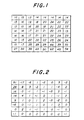
- FIGS.1 through 6 For example, an image is divided into blocks of 8 x 8 pixels and each pixel is described in 256 gradation levels "0" through "255".
- DCT coefficients shown in FIG.2 are obtained by transforming the image data shown in FIG.1 into coefficients of the spatial frequency distribution using the DCT.
- quantization coefficients shown in FIG.4 are obtained.
- the quantization coefficients shown in FIG.4 are transformed using the Huffman code, for example, so as to obtain coded data for each block of the image.
- FIG.5 shows a coding circuit which employs the ADCT.
- An input image is divided into the blocks of 8 x 8 pixels as shown in FIG.1, and an input image signal which is related to the blocks is supplied to a DCT part 141 via an input terminal 140.
- the numbers shown in FIG.1 indicate the gradation levels of each pixel within the block.
- the DCT part 141 subjects the input image signal to an orthogonal transform in conformance with the DCT according to the following formula (1), where F j denotes the DCT coefficient and f i denotes the input image signal.
- coefficients of the spatial frequency distribution that is, the DCT coefficients shown in FIG.2, are obtained from the DCT part 141.
- the DCT coefficients from the DCT part 141 are supplied to a linear quantization part 142.
- the linear quantization part 142 refers to a quantization matrix 143 which includes a table of threshold values shown in FIG.3 which are determined by a visual experimentation, and makes a linear quantization by dividing the DCT coefficients of the pixels by the corresponding threshold values. As a result, those DCT coefficients having absolute values less than the corresponding threshold values are regarded as zero, and quantization coefficients having values for only the DC components and small AC components are generated as shown in FIG.4. In FIG.4, the fractions are omitted.
- the DC component refers to a component (0, 0) in the x and y directions in FIG.4.
- the quantization coefficients which are arranged two-dimensionally as shown in FIG.4 are scanned in a zigzag manner with a scanning sequence shown in FIG.6 so that the data become arranged one-dimensionally.
- the one-dimensionally arranged data are supplied to a variable length coding part 144.
- the variable length coding part 144 subjects a difference between a first DC component of each block and a DC component of a previous block to a variable length coding.
- the variable length coding part 144 subjects a run length of a value of an invalid coefficient (zero coefficient) to a value of a significant coefficient (non-zero coefficient) to a variable length coding.
- the DC and AC components are coded using a code table 145 which includes a Huffman code table which is established on the basis of statistics of each image. Coded data which is obtained from the variable length coding part 144 is stored in a code data storage part 146.
- the coded data is restored into the image according to the following method.
- a process is carried out in a reverse sequence in FIG.5. That is, the coded data of the variable length coding is returned to the one-dimensionally arranged quantization coefficients by referring to the Huffman code table. Then, a reference is made to the scanning sequence shown in FIG.6 to return the one-dimensionally arranged quantization coefficients to the two-dimensionally arranged quantization coefficients shown in FIG.4.
- the threshold values shown in FIG.3 are multiplied to the two-dimensionally arranged quantization coefficients to obtain the DCT coefficients shown in FIG.2.
- the original image is successively restored in blocks by carrying out a reverse DCT on the DCT coefficients.
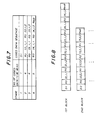
- FIG.7 shows a case where the restoration is made in four stages, that is, the stages "1" through "4".
- the number of coded data which are to be restored in each stage per block is designated in advance.
- the designated number of coded data are restored into the quantization coefficients, and the quantization coefficients are divided within the block into a number of stages (bands) from a low frequency range.
- the quantization coefficients which are divided in each stage and restored and the quantization coefficients which are restored in the previous stage are combined, and the quantization coefficients which are not received are all set to zero to make up one block.
- the reverse DCT is carried out progressively in this manner to restore the original image.
- one coded data is read out from each block in the stage "1".
- the coded data is read out from a first coded data sequence D1, that is, the coded data is read out from only the scanning sequence number "1" of each block shown in FIG.6.
- the read out coded data is restored back into the DCT coefficients by being subjected to the reverse DCT. In other words, only the DC components are restored in the stage "1" because the coded data is read out from only the coded data sequence D1 of each block.
- Dm denotes the coded data of the difference value of the DC component of the mth block
- Il,m,n denotes the coded data of the value of the nth significant coefficient of the mth block in the lth stage (restoration stage “1")
- Rk denotes the coded data which indicates that the run length of the invalid coefficient of the AC component is k
- Reob denotes the coded data which indicates that the end of the block ends with the run of the invalid coefficient.
- the coded data (from the scanning sequence number "2" in FIG.6) with respect to the first coefficient of the first block which has a run length "0" from the coded data sequence D1 which corresponds to the DC component and the coded data (from the scanning sequence number "3" in FIG.6) with respect to the second coefficient of the first block which has the run length "0" from the coded data sequence D1 are read out in the stage "2".
- the read out coded data are restored back into the quantization coefficients by being subjected to the reverse DCT.
- the coded data are similarly read out from the scanning sequence numbers "4" and "5" in FIG.6 and restored back into the quantization coefficients by being subjected to the reverse DCT.
- the coded data are similarly read out from the scanning sequence numbers "6" and "7" in FIG.6 and restored back into the quantization coefficients by being subjected to the reverse DCT.
- a method of storing the coded data for both the sequential and progressive restoration is proposed in Miura et al., "A Study on CODEC for Still Images with Sequential/Progressive Build Up", National Conference of Electronics and Information Communication Society, Fall 1988.
- the image is divided into blocks of 8 x 8 pixels, and the image signal of each block is transformed into coefficients of the spatial frequency distribution in conformance with the DCT.
- the coefficients are quantized using threshold values which are adapted to the human eye, and the quantization coefficients are scanned in a zigzag manner as shown in FIG.6 from the low-frequency components to the high-frequency components.
- DC components a difference between the DC components of each block and a previous block is coded.
- a run length of an invalid coefficient which is zero to a significant coefficient which is not zero is coded for each block.
- the above described coding process is carried out for all of the blocks of the image.
- the coded data for each block are connected between the blocks and the coded data corresponding to the image are stored in a coded data storage part.
- the coding takes place in the coding circuit shown in FIG.5 and is stored in the coded data storage part 146.
- FIG.8 shows an example of coded data sequences having the file format.
- the same designations are used as in FIG.7.
- the coded data reading circuit comprises a variable length restoration part 151, a restoration table 152, a coefficient extraction part 153, a coefficient storage part 154, a variable length coding part 155 and a code table 156.
- a coded data table 150 corresponds to the coded data table 146 shown in FIG.5.
- the coded data reading circuit 151 reads out the variable length coded data from the coded data table 150 and carries out an image restoring process.
- the coded data are successively read out in blocks from the coded data table 150.
- the original image is successively restored in blocks in a reverse sequence to the above and is supplied to a restoration circuit (not shown) via a path A and an output terminal T0.
- the coded data sequences of the first, second, ... blocks are read out from the coded data storage part 150 for one image as shown in FIG.8 and supplied to the variable length restoration part 151.
- the variable length restoration part 151 refers to the restoration table 152 and restores the quantization coefficients shown in FIG.4.
- the restoration table 152 stores a table which is in reverse to the Huffman code table.
- the coefficient extraction part 153 stores in the coefficient storage part 154 the quantization coefficients in blocks of each image. In order to carry out the progressive image restoration, the coefficient extraction part 153 thereafter extracts the designated number of quantization coefficients from the coefficient storage part 154 in blocks so as to carry out the variable length coding.
- the number of quantization coefficients is designated depending on the restoration stage shown in FIG.7.
- variable length coding part 155 carries out a variable length coding to obtain coded data of the significant coefficients and the run lengths of the invalid coefficients which are received using the code table 156 which includes the Huffman code table.
- the number of coded data designated in the restoration stage are supplied to the restoration circuit via the output terminal T0.
- the quantization coefficients which are restored from the coded data amounting to one image must be coded again into the coded data based on the variable length coding. For this reason, there is a problem in that a complex processing sequence must be carried out to extract the coded data corresponding to each restoration stage from the quantization coefficients which are stored in the coefficient storage part 154.
- Patent specification GB-A-2,146,874 discloses a decoder for decoding variable length codes.
- the publication OPTICAL ENGINEERING, vol. 26, no. 7, July 1987, pages 581-589, Bellingham, WA, US; K.-H. TZOU: "Progressive image transmission: a review and comparison of techniques” discloses progressive transmission of images over slow transmission lines using several passes over the image.
- Another and more specific object of the present invention is to provide a method of writing and reading coded data which are coded by an orthogonal transform coding so that an original image can be restored progressively or sequentially, the original image being divided into blocks of an arbitrary number of pixels, the coded data being obtained by coding quantization coefficients which are obtained when gradation levels of the pixels within each block are subjected to a two-dimensional discrete cosine transform, the method comprising the steps of extracting the quantization coefficients for each restoration stage, subjecting the extracted quantization coefficients to a variable length coding, writing the variable length coded quantization coefficients into storage means as the coded data, reading the coded data from the storage means, restoring a code length of the coded data based on the read coded data, extracting coded data corresponding to the restored code length from the read coded data, and outputting the extracted coded data as coded data required in each restoration stage.
- the method of the present invention it is possible to simplify the process of extracting the code
- Still another object of the present invention is to provide a system for writing and reading coded data which are coded by an orthogonal transform coding so that an original image can be restored progressively or sequentially, the original image being divided into blocks of an arbitrary number of pixels, the coded data being obtained by coding quantization coefficients which are obtained when gradation levels of the pixels within each block are subjected to a two-dimensional discrete cosine transform, the system comprising coefficient extraction means for extracting the quantization coefficients for each restoration stage, variable length coding means for subjecting the extracted quantization coefficients to a variable length coding, storage means for storing the variable length coded quantization coefficients as the coded data, means for reading the coded data from the storage means, code length restoration means for restoring a code length of the coded data based on the coded data read from the storage means, and coded data extraction means for extracting coded data corresponding to the restored code length from the read coded data and outputting the extracted coded data as coded data required in each restoration
- This first embodiment of the system employs a first embodiment of a method of writing and reading coded data according to the present invention.
- the system generally comprises a coded data storage means 20 for storing coded data, a code length restoration means 30 responsive to the coded data read out from the coded data storage means 20 for restoring the code length of the coded data, and a coded data extraction means 40 responsive to the coded data read out from the coded data storage means 20 for extracting and outputting a coded data amounting to the restored code length.
- FIG.11 those parts which are essentially the same as those corresponding parts in FIG.10 are designated by the same reference numerals, and a description thereof will be omitted.
- the coded data storage means 20 is made up of a storing address calculation part 21, a storing address holding part 22 and a coded data storage part 23.
- the storing address calculation part 21 calculates a storing address in response to an output of the code length restoration means 30.
- the storing address holding part 22 is coupled to the storing address calculation part 21 and holds the storing address which is calculated in the storing address calculation part 21.
- the coded data storage part 23 receives the output address of the storing address holding part 22.
- the code length restoration means 30 is made up of a code length restoration part 31, a code length table 32 and a code length adding part 33.
- the code length restoration part 31 restores the code length responsive to an output of the coded data storage means 20 based on the code length table 32.
- the code length adding part 33 adds the code length in response to an output of the code length restoration part 31. An output of the code length adding part 33 is supplied to the storing address calculation part 21.
- the coded data extraction means 40 is made up of a coded data extraction part 41.
- the coded data extraction part 41 outputs coded data which are supplied to a restoration circuit (not shown).
- a starting address Pmn of an nth restoration stage of an mth block and a code length Smn of the nth restoration stage of the mth block are obtained for each block as shown in FIG.12, so as to extract the required coded data from the continuous coded data sequence amounting to one image. Measures are taken so that the quantization coefficients are not restored from the coded data and no process is carried out to code the coded data. Accordingly, the coded data sequence which is required in the restoration stage of the progressive restoration can be read out at a high speed from the continuous coded data sequence which amounts to one image and is stored for the sequential restoration.
- the coded data sequences shown in FIG.12 for each block are connected between the blocks and stored in the coded data storage part 23, similarly to the conventional system.
- the coded data are continuously read out from the starting address of the coded data storage part 23 and are supplied to the restoration circuit via a terminal 50.
- the number of coded data which are restored in one restoration stage is designated as shown in FIG.13, similarly to the case described in conjunction with FIG.7.
- the starting address of each block (block addresses P11, P21, ...) are held in the storing address holding part 22.
- Reob is detected from the coded data which are stored in the coded data storage part 23 and the starting address of each block obtained by detecting the boundary of each block is held.
- the calculation of the starting address is carried out in the storing address calculation part 21 which receives the output of the code length restoration means 30.
- the coded data (D384, ...) are read out from the coded data storage part 23 starting from the starting address of the first block (P11, address 0).
- the read out coded data are supplied to the coded data extraction part 41 and the code length restoration part 31.
- the code length restoration part 31 restores the code length of the received coded data (D384, %) by use of the code length table 32 which is made up of a code length table of each coded data, and the restored code length is supplied to the code length adding part 33.
- the restored code length is supplied to the coded data extraction part 41. For example, when the code length of the coded data D384 is 10 bits, the code length "10" is supplied to the code length adding part 33 and the coded data extraction part 41.
- the code length adding part 33 supplies the code length "10" as it is to the storing address calculation part 21.
- the coded data extraction part 41 extracts the coded data amounting to the code length "10", that is, the coded data D384 of the first stage of the first block.
- the extracted coded data are supplied to the restoration circuit via the terminal 50.
- the first coded data (D384, ...) of the second block is read out from the coded data storage part 23 according to the starting address (P21) of the second block and supplied to the coded data extraction part 41 and the code length restoration part 31.
- the code length restoration part 31 restores the code length of the received coded data (D384, %) and supplies the code length "10" of the coded data D384 to the code length adding part 33 and the code data extraction part 41.
- the code length adding part 33 supplies the received code length "10" to the storing address calculation part 21 as it is.
- the storing address calculation part 21 adds the starting address P21 of the second block held in the storing address holding part 22 and the code length "10" of the first stage calculated in the code length adding part 33.
- the storing address calculation part 21 renews the address of the second block which is held in the storing address holding part 22 to the starting address P22 (P21+"10") of the second stage.
- the coded data extraction part 41 extracts the coded data amounting to the code length "10", that is, the coded data D384 of the first stage of the second block.
- the extracted coded data are supplied to the restoration circuit via the terminal 50.
- the coded data of the first stage are extracted for all of the blocks which correspond to one image, and the image of the first stage is restored in the restoration circuit.
- the image restoring process for the second and subsequent stages is carried out similarly to the first stage.
- the read out coded data are supplied to the coded data extraction part 41 and the code length restoration part 31.
- the code length restoration part 31 restores the code length of the received coded data (R0, I-96, R0, I-64, ...) by use of the code length table 32, and the restored code length is supplied to the code length adding part 33.
- the restored code length is supplied to the coded data extraction part 41. For example, when the code length of the coded data R0 is 4 bits, the code length "4" is supplied to the code length adding part 33 and the coded data extraction part 41.
- the code length adding part 33 holds the received code length "4", adds the code lengths "8", “4" and “7” of the remaining three coded data (I-96, R0, I-64) and supplies the added value "23" to the storing address calculation part 21.
- the coded data extraction part 41 successively extracts the coded data amounting to the code length "23" (added value of code lengths "4", "8", "4" and "7"), that is, the coded data (R0, I-96, R0, I-64) of the second stage of the first block.
- the extracted coded data are supplied to the restoration circuit via the terminal 50.
- the coded data (R0, I-96, R1, I-32, ...) are read out from the coded data storage part 23 according to the starting address P22 of the second stage of the second block, and the read out coded data are supplied to the coded data extraction part 41 and the code length restoration part 31.
- the code length restoration part 31 restores the code length ("4", "8”, "5", "6", %) of the received coded data (R0, I-96, R1, I32, ...) by use of the code length table 32, and the restored code lengths are supplied to the coded data extraction part 41 and the code length adding part 33.
- the code length adding part 33 adds the code lengths of the four coded data which are restored in the second stage, and the added value "23" is supplied to the storing address calculation part 21.
- the storing address calculation part 21 adds the starting address P22 of the second stage of the second block held in the storing address holding part 22 and the code length "23" of the second stage which is calculated in the code length adding part 33.
- the storing address calculation part 21 renews the address of the second block which is held in the storing address holding part 22 to the starting address P23 (P22+"23") of the third stage.
- the coded data extraction part 41 successively extracts the coded data amounting to the code length "23" (added value of code lengths "4", “8", "5" and “6"), that is, the coded data (R0, I-96, R1, I32) of the second stage of the second block.
- the extracted coded data are supplied to the restoration circuit via the terminal 50.
- the coded data of the second stage are extracted for all of the blocks which correspond to one image, and the image of the second stage is restored in the restoration circuit.
- the coded data extraction part 41 comprises a latch circuit 413, a counter 414, a comparator 415 and an extraction controller 416.
- the coded data stored in the coded data storage part 23 is read out and supplied to a data input terminal Di of the latch circuit 413 via a terminal 410.
- the code length from the code length restoration part 31 is supplied to one input terminal of the comparator 415 via a terminal 411.
- Coded data from a data output terminal Do of the latch circuit 413 is output as the output of the coded data extraction part 41.
- FIG.15 is a flow chart for explaining an operation of the coded data extraction part 41.
- the terminal 410 receives the coded data sequence from the coded data storage part 23 one bit at a time and that the terminal 411 receives the code length "10" from the code length restoration part 31.
- the extraction controller 416 resets the counter 414 to "0" in a step S1 by supplying a reset signal RESET to a reset terminal of the counter 414.
- the extraction controller 416 After receiving a code length calculation complete signal via a path which is not shown, the extraction controller 416 outputs one clock signal SCK in a step S2.
- the clock signal SCK is supplied to a clock terminal CLK of the latch circuit 413 and to the counter 414.
- the latch circuit 413 latches the received coded data sequence as the transmitting coded data sequence and outputs one bit in a step S3.
- the counter 414 increments the count by one in a step S4 and supplies a value "1" to the other input terminal of the comparator 415.
- the extraction controller 416 discriminates in a step S5 whether or not the output value of the counter 414 becomes equal to the code length "10" from the code length restoration part 31 and a signal EQUAL which has a value "1" is output from the comparator 415.
- the comparator 415 outputs the signal EQUAL which has the value "1” only when the two compared values match each other.
- the extraction controller 416 outputs the clock signal SCK nine times until the signal EQUAL which has the value "1” is received from the comparator 415.
- the code length restoration part 31 restores the code length by using the data which has the bit width of 15 bits and is obtained by subjecting the coded data sequence from the coded data storage part 23 to a serial-to-parallel conversion.
- This second embodiment of the system employs a second embodiment of a method of writing and reading coded data according to the present invention.
- each original image is divided into blocks of 8 x 8 pixels, and the gradation levels of the pixels within each block are transformed into DCT coefficients according to the DCT and then quantized into quantization coefficients similarly as described before in conjunction with FIGS.1 through 4.
- a coded data sequence having a structure shown in FIG.16 is employed.
- the coded data sequence of the first stage is formed by extracting only the quantization coefficients D1, D2, ... of the first stage of each block. Then, the coded data sequence of the second stage is formed by extracting only the quantization coefficients of the second stage of each block. Then the quantization coefficients are extracted to the final fourth stage in this manner to form the coded data sequence of the fourth stage.
- Each of these coded data sequences are compressed based on the Huffman code and connected.
- a header is provided at the beginning of the coded data sequence.
- This header includes a code quantity information on the coded data sequence for each restoration stage.
- a header portion CLEN1 of the header includes the code quantity information on the compressed coded data sequence of the first stage.
- header portions CLEN2, CLEN3 and CLEN4 respectively include the code quantity information on the compressed coded data sequences of the second, third and fourth stages.
- the header portions CLEN1 through CLEN4 have a fixed length. For this reason, the starting positions of the coded data sequences of the restoration stages can be obtained with ease by reading out the header portions CLEN1 through CLEN4. This means that it is possible to simply obtain the coded data sequences for each of the restoration stages. As a result, it is possible to obtain coded data sequences such that it is possible to quickly make the progressive restoration and also make the sequential restoration.
- a code forming circuit shown in FIG.17 is used to form the coded data sequence having the structure shown in FIG.16.
- the code forming circuit comprises a coefficient extraction part 51, a coefficient storage part 52, a variable length coding part 53, a code table 54, a coded data storage part 55 and a code counting part 56.
- Quantization coefficients of each block shown in FIG.4 and corresponding to one image are supplied to the coefficient extraction part 51 via a terminal 50.
- the coefficient extraction part 51 temporarily stores the quantization coefficients in the coefficient storage part 52.
- the read coded data sequence of the restoration stage shown in FIG.7 is supplied to the coefficient extraction part 51 via a terminal 57.
- the coefficient extraction part 51 reads out predetermined quantization coefficients from each block in the sequence of the stages.
- the predetermined quantization coefficients are supplied to the variable length coding part 53 which compresses the predetermined quantization coefficients by the Huffman code, for example, by referring to the code table 54.
- variable length coding part 53 compresses each of the coded data sequences of the first through fourth stages, and the compressed coded data sequences are supplied to the coded data storage part 55 for each stage.
- the variable length coding part 53 also supplies to the code counting part 56 the code length of each restoration stage.
- the header has a fixed length and the bit lengths of the coded data sequences of the restoration stages are included in the header portions CLEN1 through CLEN4.
- the code counting part 56 successively adds the bit lengths which are written in the header portions CLEN1 through CLEN4 and calculates an address information which sets the coded data sequence for each restoration stage. For this reason, the coded data storage part 55 can connect and store the header and the coded data portion as shown in FIG.16 based on the address information.
- both the progressive and sequential restoration can be carried out satisfactorily. That is, in the case of the progressive restoration, the coded data are read out continuously from the start based on the code lengths written in the header portions CLEN1 through CLEN4 of the header. On the other hand, in the case of the sequential restoration, the required coded data are extracted from the continuous coded data sequences by using the code lengths which are written in the header portions CLEN1 through CLEN4 of the header. Accordingly, the operation of reading out the coded data becomes simple for the sequential restoration, and in addition, it is possible to read out the coded data at a high speed for the progressive restoration.
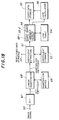
- FIG.18 shows an essential part of the second embodiment of the system.
- those parts which are essentially the same as those corresponding parts in FIG.17 are designated by the same reference numerals, and a description thereof will be omitted.
- FIG.19 shows coded data sequences which are formed in this embodiment for each of the restoration stages
- FIG.20 shows another essential part of the second embodiment of the system.
- the coded data reading circuit comprises a DCT part 67, a linear quantization part 68 and a quantization matrix 69 in addition to the elements shown in FIG.17.
- the DCT part 67, the linear quantization part 68 and the quantization matrix 69 respectively correspond to the DCT part 141, the linear quantization part 142 and the quantization matrix 143 shown in FIG.5.
- An input image signal which is obtained by dividing the image into blocks of 8 x 8 pixels as shown in FIG.1 is applied to the DCT part 67 via the terminal 50.
- the DCT part 67 subjects the input image signal to an orthogonal transform in conformance with the DCT.
- coefficients of the spatial frequency distribution that is, the DCT coefficients shown in FIG.2 are obtained from the DCT part 67 and are supplied to the linear quantization part 68.
- the linear quantization part 68 refers to the quantization matrix 69 which includes a table of threshold values shown in FIG.3 which are determined by a visual experimentation, and makes a linear quantization by dividing the DCT coefficients of the pixels by the corresponding threshold values.
- the read coded data sequence of the restoration stage shown in FIG.7 is supplied to the coefficient extraction part 51 from the terminal 57.
- the data Dm is extracted for each block from the positions of the scanning sequence "1" of the quantization coefficients shown in FIG.6 and supplied to the variable length coding part 53.
- the coefficient extraction part 51 informs the variable length coding part 53 that the restoration stage is the restoration stage "1" by supplying a pulse signal or the like.
- the variable length coding part 53 holds the data which indicates the restoration stage "1" in a first counter 53-1.
- the data D1 through Dm of the restoration stage “1" shown in FIG.19 are compressed by referring to the code table 54, and the bit length of the compressed coded data is counted in a second counter 53-2.
- the variable length coding part 53 supplies the compressed coded data to the coded data storage part 55.
- the coded data which is stored in the coded data storage part 55 is made up of the header which has the fixed length and the coded data sequence portion which has a variable length. Accordingly, the starting position from which the coded data sequence of the compressed data D1, ... is stored in the coded data storage part 55 is known for the restoration stage "1".
- the coded data sequence of the restoration stage "1" is stored in the coded data storage part 55
- the length of the compressed coded data of the restoration stage “1” is supplied from the second counter 53-2 to the coded data storage part 55.
- the length of the compressed coded data is written into the header portion CLEN1 of the header with a fixed length, as the length of the coded data of the restoration stage "1".
- the value of the header portion CLEN1 is supplied from the second counter 53-2 to the code counting part 56.
- the code counting part 56 adds the value of the header portion CLEN1 and the length of the header so as to obtain the starting position from which the coded data sequence of the restoration stage "2" is stored in the coded data storage part 55.
- the coefficient extraction part 51 carries out a control with respect to the restoration stage "2" based on the read coded data sequence of the restoration stage “2" shown in FIG.7.
- the quantization coefficients which are shown as the second and third in scanning sequence of FIG.6 are extracted by the coefficient extraction part 51.
- the coefficient extraction part 51 Based on the format of the read coded data sequence of the restoration stage shown in FIG.7, the coefficient extraction part 51 outputs the coded data of the restoration stage "2" shown in FIG.19 similarly as in the case of the restoration stage "1".
- the first counter 53-1 of the variable length coding part 53 indicates the restoration stage "2"
- the variable length coding part 53 compresses the coded data of the restoration stage "2" by referring to the code table 54.
- the length of the compressed coded data is counted in the second counter 53-2 and is supplied to the coded data storage part 55.
- the compressed coded data of the restoration stage “2" are stored in the coded data storage part 55 from the starting position of the restoration stage “2” calculated in the code counting part 56.
- the counted value of the second counter 53-2 is supplied to the code counter part 56, and an operation similar to the above described is carried out to obtain the starting position from which the coded data sequence of the restoration stage "2" is stored in the coded data storage part 55.
- the code length which is counted in the second counter 53-2 is written into the header portion CLEN2 of the header with a fixed length.
- the coded data of the restoration stages "3" and "4" are stored similarly into the coded data storage part 55.
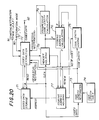
- FIG.20 shows a coded data reading circuit for reading the stored coded data from the coded data storage part 55 for the purpose of restoring the original image.
- the coded data reading circuit comprises a coded data storage part 71 which corresponds to the coded data storage part 55 shown in FIG.18, a coded data extraction part 72, a code length restoration part 73, a code length table 74, a code length adding part 75, a storing address calculation part 76, a storing address holding part 77, a header holding part 78 and a progressive code length calculation part 79.
- the coded data storage part 71 stores the coded data made up of the header which has the fixed length and the coded data sequence portion which has the variable length as shown in FIG.16.
- the contents of the coded data sequence stored in the coded data storage part 71 are as shown in FIG.19.
- the coded data extraction part 72 prestores the number of codes for each stage.
- a restoration mode data "0”, for example, is supplied to the coded data extraction part 72 via a terminal 80 so as to control the coded data reading circuit to a progressive restoration mode.
- a starting restoration stage (“1", “2", “3” or "4") is supplied to the coded data extraction part 72 via a terminal 81.
- the header (CLEN1 through CLEN4) which is added to the beginning of the coded data sequence as shown in FIG.16 is read out from the coded data storage part 71 and is held in the header holding part 78.
- the header information corresponding to the stages which are to be restored is supplied from the header holding part 78 to the progressive code length calculation part 79 which calculates the total code length of the restoration stages. For example, when restoring the restoration stage "2", the code length information CLEN1 (for example, 50 bits) of the restoration stage "1" and the code length information CLEN2 (for example, 100 bits) of the restoration stage "2" are added in the progressive code length calculation part 79.
- the code length CLEN1+CLEN2 (for example, 150 bits) up to the restoration stage "2" is calculated in the progressive code length calculation part 79.
- the storing address calculation part 76 sets the output D in FIG.20 to "32", for example, and holds the starting address of the coded data in the storing address holding part 77.
- the coded data extraction part 72 extracts the coded data amounting to the calculated code length CLEN1+CLEN2 (for example, 150 bits) and supplies the extracted coded data to the restoration circuit (not shown) via a terminal 83.
- the image of the restoration stage "1" is restored in the restoration circuit when the coded data of CLEN1 (for example, 50 bits) are received, and the coded data of CLEN2 is then restored to progressively restore the image of the restoration stage "2".
- the image of the restoration stages "3" and after can be restored progressively by a similar procedure by calculating the code length of each stage which is to be restored based on the code length information CLEN3, CLEN4 and the like.
- a restoration mode data "1”, for example, is supplied to the coded data extraction part 72 via the terminal 80 so as to control the coded data reading circuit to a sequential restoration mode.
- a starting restoration stage (“1", “2", “3” or "4") is supplied to the coded data extraction part 72 via the terminal 81.
- the coded data extraction part 72 reads the header which is added to the beginning of the coded data sequence from the coded data storage part 71, and holds the code length information CLEN1 through CLEN4 of each restoration stage in the header holding part 78.
- the storing address calculation part 76 calculates the starting addresses P11, P21, P31 and P41 (where Plm denotes the starting address of the mth block of the 1th stage) of the restoration stages based on the code length information CLEN1 through CLEN4.
- the code length restoration part 73 refers to the code length table 74 to detect the coded data D1 and its code length while collating the pattern of the received coded data to the code length table 74.
- the detected code length is supplied to the code length adding part 75 and the coded data extraction part 72. For example, when the code length of the coded data D1 is "10", this value "10" is supplied to the code length adding part 75 and the coded data extraction part 72. In this state, it is known in the code length adding part 75 that the number of coded data is one, and thus, the code length adding part 75 supplies the code length "10" as it is to the storing address calculation part 76.
- the coded data extraction part 72 extracts the coded data corresponding to the code length "10" which is received from the code length restoration part 73. That is, the coded data extraction part 72 extracts the coded data D1 of the first block of the restoration stage "1" and supplies the extracted coded data D1 to the restoration circuit via the terminal 82.
- the coded data R0, I2,1.1, R0, I2,1.2, ... of the first block of the restoration stage “2" are read out from the coded data storage part 71 based on the starting address P21 of the coded data sequence of the restoration stage "2".
- the starting address P21 is obtained by adding the starting address of the coded data sequence and the code length information CLEN1 which indicates the code length of the coded data sequence of the restoration stage "1".
- the read coded data are supplied to the coded data extraction part 72 and the code length restoration part 73.
- the code length restoration part 73 refers to the code length table 74 and restores the code length of the coded data R0, I2,1.1, R0, I2,1.2, ... .
- the restored code length is supplied to the code length adding part 75 and the coded data extraction part 72.
- the code length of the coded data R0 is "4" bits, for example, the value "4" is supplied to the code length adding part and the coded data extraction part 72.
- the code length adding part 75 holds the code length "4" of the received coded data R0, and adds thereto the code lengths "8", "4" and "7” of the remaining three coded data I2,1.1, R0 and I2,1.2 which are successively received.
- An added value "23" is supplied from the code length adding part 75 to the storing address calculation part 76.
- the coded data extraction part 72 extracts the coded data which are successively received and has the code length which totals to "23". That is, the coded data extraction part 72 extracts the coded data (R0, I2,1.1, R0, I2,1.2) of the first block of the restoration stage "2" and supplies the extracted coded data to the restoration circuit via the terminal 82.
- the coded data are extracted similarly for the restoration stages "3" and "4" and supplied to the restoration circuit via the terminal 82. As a result, the restoration of the coded data of the first block is completed.
- the restoration process with respect to the second block is carried out similarly to the first block.
- the code length restoration part 73 refers to the code length table 74 to detect the coded data D2 and its code length while collating the pattern of the received coded data to the code length table 74. The detected code length is supplied to the code length adding part 75 and the coded data extraction part 72.
- the code length adding part 75 supplies the code length "10" as it is to the storing address calculation part 76.
- the coded data extraction part 72 extracts the coded data corresponding to the code length "10" which is received from the code length restoration part 73. That is, the coded data extraction part 72 extracts the coded data D2 of the second block of the restoration stage "2" and supplies the extracted coded data D2 to the restoration circuit via the terminal 82.
- the coded data R0, I2,2.1, R1, I2,2.2, ... of the second block of the restoration stage “2" are read out from the coded data storage part 71 based on the renewed starting address P22 of the coded data sequence of the restoration stage "2".
- the read coded data are supplied to the coded data extraction part 72 and the code length restoration part 73.
- the code length restoration part 73 refers to the code length table 74 and restores the code length of the coded data R0, I2,2.1, R1, I2,2.2, ... .
- the restored code length is supplied to the code length adding part 75 and the coded data extraction part 72.
- the code length adding part 75 holds the code length "4" of the received coded data R0, and adds thereto the code lengths "8", "5" and "6” of the remaining three coded data I2,2.1, R1 and I2,2.2 which are successively received.
- An added value "23" is supplied from the code length adding part 75 to the storing address calculation part 76.
- the coded data extraction part 72 extracts the coded data which are successively received and has the code length which totals to "23". That is, the coded data extraction part 72 extracts the coded data (R0, I2,2.1, R1, I2,2.2) of the second block of the restoration stage "2" and supplies the extracted coded data to the restoration circuit via the terminal 82.
- the image is sequentially restored from the first block.
- the block numbers are assigned from the top left to the bottom right of the image
- the image is sequentially restored from the top left to the bottom right of the image.
- a code restoration completion signal is included in the signals output from the code length restoration part 73.
- the code length is added every time the code length adding part 75 receives the code restoration completion signal.
- a storing address renew signal is included in the signals output from the coded data extraction part 72. This storing address renew signal is supplied to the storing address holding part 77, and the output of the code length adding part 75 is cleared when the address of the storing address holding part 77 is renewed in response to the storing address renew signal.
- This third embodiment of the system employs a third embodiment of a method of writing and reading coded data according to the present invention.
- the restoration stage of the progressive restoration is determined by the position, that is, the zigzag scanning address, of the DCT coefficients.
- the correspondence of the stage and the position of the DCT coefficients are as shown in the following Table. Table Stage Position "1" 1 "2" 2 & 3 "3" 4 to 6 "4" 7 to 64
- the divided DCT coefficients are shown in FIGS.21A and 21B, and the coded data sequences of each stage is shown in FIG.22.
- FIG.23 shows a coded data reading circuit for reading the stored coded data from the coded data storage part 55 shown in FIG.18 for the purpose of restoring the original image.
- the coded data reading circuit comprises in addition to the elements shown in FIG.20 a run length restoration part 91, a run length restoration table 92 and a significant code length detection part 93.
- the coefficient extraction part 51 shown in FIG.18 extracts only the DCT coefficients which exist within the range of the position shown in the Table for each of the stages, and the extracted coded data are supplied to the variable length coding part 53.
- the DCT coefficients shown in FIGS.21A and 21B only the DC components (coefficients at the position 1) are extracted in each block of the stage "1", and the coded data sequences shown in FIG.22 are produced.
- FIG.21A shows the first block and FIG.21B shows the second block.
- "X" denotes a non-zero coefficient.
- stage "2" only the DCT coefficients which exist within the range of the positions 2 to 3 are extracted, and the coded data sequences shown in FIG.22 are similarly produced as in the stage "1". If the last DCT coefficient is zero in a stage, a code Reob is added to indicate the end of the stage (band). The coding takes place similarly thereafter, and the coded data sequences shown in FIG.22 are produced from the DCT coefficients of the first and second blocks shown in FIGS.21A and 21B for each stage.
- the coded data are continuously extracted from the beginning of the stage as in the case of the second embodiment.
- the run length restoration part 91 refers to the run length restoration table 92 to restore the run length.
- the restored run length is supplied to the significant code length detection part 93 which accumulates the run lengths for each block so as to obtain the positions of the DCT coefficients.
- the significant code length detection part 93 compares the obtained positions with the final position of the stage which is received from the coded data extraction part 72, and discriminates whether or not each coefficient belongs to the concerned block.
- the run length restoration part 91 detects the code Reob
- the run length restoration part 91 prohibits the significant code length detection part 93 from outputting the significant code length so that the coded data (Reob) is not output from the coded data extraction part 72.
- the accumulated value in the significant code length detection part 75 matches the final position or the code Reob is detected in the significant code length detection part 75
- the extraction of the coded data for the concerned stage is ended and a renew signal is output from the significant code length detection part 75.
- the rest of the operation of the coded data reading circuit shown in FIG.23 is the same as that shown in FIG.20.
- FIG.24 shows an embodiment of the significant code length detection part 75.
- the significant code length detection part 75 comprises an adder 101, a comparator 102, a position storage part 103, an OR circuit 104 and a mask circuit 105 which are connected as shown.
- the restored run length RUN from the run length restoration part 91 is applied to a terminal 110, and the code Reob when output from the run length restoration part 91 is applied to a terminal 111.
- the restored code length from the code length restoration part 73 is applied to a terminal 112.
- the final position which is received from the coded data extraction part 72 is applied to a terminal 113.
- the adder 101 adds the restored run length RUN from the run length restoration part 91 and an accumulated value from the position storage part 103 which receives an output of the adder 101 and stores the position within the block.
- the output of the adder 101 is also supplied to the comparator 102 which compares the output of the adder 101 with the final position.
- the comparator 102 outputs a detection signal when the two compared positions coincide, and this detection signal is supplied to the OR circuit 104.
- the OR circuit 104 also receives the code Reob from the terminal 111, and a renew signal is output from the OR circuit 104 via a terminal 115.
- the mask circuit 105 receives the code Reob from the terminal 111 and the restored code length from the terminal 112, and outputs the significant code length via a terminal 116.
- the coded data extraction part may have a construction similar to that shown in FIG.14.
Landscapes
- Engineering & Computer Science (AREA)
- Multimedia (AREA)
- Signal Processing (AREA)
- Compression Or Coding Systems Of Tv Signals (AREA)
- Compression Of Band Width Or Redundancy In Fax (AREA)
- Image Processing (AREA)
- Compression, Expansion, Code Conversion, And Decoders (AREA)
Claims (20)
- Procédé d'écriture et de lecture de données codées qui sont codées au moyen d'un codage par transformation orthogonale de telle sorte qu'une image originale puisse être restaurée progressivement ou séquentiellement, ladite image originale étant divisée en blocs d'un nombre arbitraire de pixels, lesdites données codées étant obtenues en codant des coefficients de quantification qui sont obtenus lorsque des niveaux de gradation des pixels dans chaque bloc sont soumis à une transformation cosinus discrète bidimensionnelle, caractérisé en ce que ledit procédé comprend les étapes de : extraction des coefficients de quantification pour chaque stade de restauration ; soumission des coefficients de quantification extraits à un codage de longueur variable, écriture des coefficients de quantification codés de longueur variable dans un moyen de stockage en tant que les données codées; lecture des données codées dans le moyen de stockage; restauration d'une longueur de code des données codées sur la base des données codées lues; extraction de données codées correspondant à la longueur de code restaurée à partir des données codées lues; et émission en sortie des données codées extraites en tant que données codées requises dans chaque stade de restauration.
- Procédé selon la revendication 1, caractérisé en ce que ladite étape d'écriture des coefficients de quantifications codés de longueur variable consiste à écrire tous les coefficients de quantification codés de longueur variable dans chaque bloc de telle sorte que les coefficients de quantification codés de longueur variable soient connectés entre les blocs.
- Procédé selon la revendication 1 ou 2, caractérisé en ce que ladite étape de restauration de la longueur de code consiste à restaurer une somme de longueurs de code d'un nombre de données codées qui sont requises dans chaque stade de restauration pour chaque bloc lors d'une restauration progressive de l'image originale.
- Procédé selon la revendication 3, caractérisé en ce qu'est en outre prévue l'étape de calcul d'une adresse de début depuis laquelle les données codées sont lues dans le moyen de stockage sur la base de la longueur de code restaurée.
- Procédé selon la revendication 4, caractérisé en ce que ladite étape d'extraction des données codées consiste à lire successivement les données codées dans le moyen de stockage en partant de l'adresse de début lors d'une restauration séquentielle de l'image originale.
- Procédé selon la revendication 1, caractérisé en ce que les données codées stockées dans le moyen de stockage comportant un en-tête qui indique une information de quantité de codes pour chaque stade de restauration et une partie de séquence de données codées dans laquelle les données codées correspondant à un nombre prédéterminé de stades de restauration sont connectées, ledit nombre prédéterminé de stades de restauration étant requis pour la restauration progressive de l'image originale.
- Procédé selon la revendication 6, caractérisé en ce que ladite étape de restauration de la longueur de code consiste à calculer la longueur de code sur la base de l'information de quantité de codes contenue dans l'en-tête.
- Procédé selon la revendication 7, caractérisé en ce qu'est en outre prévue l'étape de calcul d'une adresse de début à partir de laquelle les données codées sont lues dans le moyen de stockage sur la base de l'information de quantité de codes contenue dans l'en-tête, ladite étape de restaurations de la longueur de code consistant à calculer la longueur de code à partir d'une somme de l'information de quantité de codes pour ledit nombre prédéterminé de stades de restauration, ladite étape d'extraction des données codées consistant à lire successivement les données codées dans le moyen de stockage en partant de l'adresse de début d'un premier étage lors d'une restauration progressive de l'image originale.
- Procédé selon la revendication 8, caractérisé en ce que ladite étape de restauration de la longueur de code consiste à restaurer une somme des longueurs de code d'un certain nombre de données codées qui sont requises dans chaque stade de restauration pour chaque bloc lors d'une restauration séquentielle de l'image originale.
- Procédé selon l'une quelconque des revendications 6 à 9, caractérisé en ce que sont en outre prévues les étapes de restauration d'une longueur de séquence sur la base des données codées lues dans le moyen de stockage et de détection d'une longueur de code significative sur la base de la longueur de séquence restaurée, ladite étape d'extraction des données codées consistant à lire les données codées dans le moyen de stockage en réponse à la longueur de code significative détectée.
- Système pour écrire et lire des données codées qui sont codées au moyen d'un codage par transformation orthogonale de telle sorte qu'une image originale puisse être restaurée progressivement ou séquentiellement, ladite image originale étant divisée en blocs d'un nombre arbitraire de pixels, lesdites données codées étant obtenues en codant des coefficients de quantification qui sont obtenus lorsque des niveaux de gradation des pixels dans chaque bloc sont soumis à une transformation cosinus discrète bidimensionnelle, caractérisé en ce que ledit système comprend un moyen d'extraction de coefficient (57, 52) pour extraire les coefficients de quantification pour chaque stade de restauration ; un moyen de codage de longueur variable (53, 54, 56) pour soumettre les coefficients de quantification extraits à un codage de longueur variable ; un moyen de stockage (56, 23, 71) pour stocker les coefficients de quantification codés de longueur variable en tant que données codées ; un moyen pour lire les données codées dans le moyen de stockage ; un moyen de restauration de longueur de code (31-33, 73-75) pour restaurer une longueur de code des données codées sur la base des données codées lues dans ledit moyen de stockage ; et un moyen d'extraction de données codées (41, 72) pour extraire des données codées correspondant à la longueur de code restaurée à partir des données codées lues et pour émettre en sortie les données codées extraites en tant que données codées requises dans chaque étage de restauration.
- Système selon la revendication 11, caractérisé en ce que ledit moyen de stockage (56, 23, 71) écrit tous les coefficients de quantification codés de longueur variable dans chaque bloc de telle sorte que les coefficients de quantification codés de longueur variable soient connectés entre les blocs.
- Système selon la revendication 11 ou 12, caractérisé en ce que ledit moyen de restauration de longueur de code (31-33, 73-75) restaure une somme de longueurs de code d'un certain nombre de données codées qui sont requises dans chaque étage de restauration pour chaque bloc lors d'une restauration progressive de l'image originale.
- Système selon la revendication 13, Caractérisé en ce qu'est en outre prévu un moyen de calcul d'adresse de début (21, 22, 76, 77) pour calculer une adresse de début à partir de laquelle les données codées sont lues dans le moyen de stockage (56, 23, 71) sur la base de la longueur de code restaurée.
- Système selon la revendication 11, caractérisé en ce que ledit moyen d'extraction de données codées (41, 72) lit successivement les données codées dans le moyen de stockage (56, 23, 71) en partant de l'adresse de début lors d'une restauration séquentielle de l'image originale.
- Système selon la revendication 11, caractérisé en ce que les données codées stockées dans le moyen de stockage (56, 23, 71) comportent un en-tête qui indique une information de quantité de codes pour chaque stade de restauration et une partie de séquence de données codées dans laquelle les données codées correspondant à un nombre prédéterminé de stades de restauration sont connectées, ledit nombre prédéterminé de stades de restauration étant requis pour la restauration progressive de l'image originale.
- Système selon la revenedication 16, caractérisé en ce que ledit moyen de restauration de longueur de code (73-75) calcule la longueur de code sur la base de l'information de quantité de codes contenue dans l'en-tête.
- Système selon la revendication 17, caractérisé en ce qu'est en outre prévu un moyen de calcul d'adresse de début (76, 77) pour calculer une adresse de début à partir de laquelle les données codées sont lues dans le moyen de stockage sur la base de l'information de quantité de codes contebue dans l'en-tête, ledit moyen de restauration de longueur de code (73-75) calculant la longueur de code à partir d'une somme de l'information de quantité de codes pour ledit nombre prédéterminé de stades de restauration, ledit moyen d'extraction de données codées (72) lisant successivement les données codées dans le moyen de stockage en partant de l'adresse de début d'un premier étage lors d'une restauration progressive de l'image originale.
- Système selon la revendication 18, caractérisé en ce que ledit moyen de restauration de longueur de code (73-75) restaure une somme de longueurs de code d'un certain nombre de données codées qui sont requises dans chaque stade de restauration pour chaque bloc lors d'une restauration séquentielle de l'image originale.
- Système selon l'une quelconque des revendications 16 à 19, caractérisé en ce que sont en outre prévus un moyen de restauration de longueur de séquence (91, 92) pour restaurer une longueur de séquence sur la base des données codées lues dans le moyen de stockage (56, 71) et un moyen de détection de longueur de code significative (93) pour détecter une longueur de code significative sur la base de la longueur de séquence restaurée, ledit moyen d'extraction de données codées (72) lisant les données codées dans le moyen de stockage en réponse à la longueur de code significative détectée.
Applications Claiming Priority (4)
| Application Number | Priority Date | Filing Date | Title |
|---|---|---|---|
| JP1034229A JP2571274B2 (ja) | 1989-02-14 | 1989-02-14 | 符号データ格納・読出方式 |
| JP34229/89 | 1989-02-14 | ||
| JP19575389A JP2614325B2 (ja) | 1989-07-28 | 1989-07-28 | 画像データ符号化方式及び符号データ読出し処理方式 |
| JP195753/89 | 1989-07-28 |
Publications (3)
| Publication Number | Publication Date |
|---|---|
| EP0383678A2 EP0383678A2 (fr) | 1990-08-22 |
| EP0383678A3 EP0383678A3 (fr) | 1992-12-16 |
| EP0383678B1 true EP0383678B1 (fr) | 1996-04-24 |
Family
ID=26373020
Family Applications (1)
| Application Number | Title | Priority Date | Filing Date |
|---|---|---|---|
| EP90400394A Expired - Lifetime EP0383678B1 (fr) | 1989-02-14 | 1990-02-13 | Méthode et système pour écrire et lire des données codées |
Country Status (4)
| Country | Link |
|---|---|
| EP (1) | EP0383678B1 (fr) |
| KR (1) | KR930004004B1 (fr) |
| CA (1) | CA2009848C (fr) |
| DE (1) | DE69026634T2 (fr) |
Cited By (7)
| Publication number | Priority date | Publication date | Assignee | Title |
|---|---|---|---|---|
| US6061749A (en) | 1997-04-30 | 2000-05-09 | Canon Kabushiki Kaisha | Transformation of a first dataword received from a FIFO into an input register and subsequent dataword from the FIFO into a normalized output dataword |
| US6118724A (en) | 1997-04-30 | 2000-09-12 | Canon Kabushiki Kaisha | Memory controller architecture |
| US6195674B1 (en) | 1997-04-30 | 2001-02-27 | Canon Kabushiki Kaisha | Fast DCT apparatus |
| US6237079B1 (en) | 1997-03-30 | 2001-05-22 | Canon Kabushiki Kaisha | Coprocessor interface having pending instructions queue and clean-up queue and dynamically allocating memory |
| US6311258B1 (en) | 1997-04-03 | 2001-10-30 | Canon Kabushiki Kaisha | Data buffer apparatus and method for storing graphical data using data encoders and decoders |
| US6336180B1 (en) | 1997-04-30 | 2002-01-01 | Canon Kabushiki Kaisha | Method, apparatus and system for managing virtual memory with virtual-physical mapping |
| US6707463B1 (en) | 1997-04-30 | 2004-03-16 | Canon Kabushiki Kaisha | Data normalization technique |
Families Citing this family (6)
| Publication number | Priority date | Publication date | Assignee | Title |
|---|---|---|---|---|
| US5303058A (en) * | 1990-10-22 | 1994-04-12 | Fujitsu Limited | Data processing apparatus for compressing and reconstructing image data |
| JP3336029B2 (ja) * | 1991-01-02 | 2002-10-21 | 株式会社リコー | 画像圧縮用量子化方法及び装置 |
| GB2251756B (en) * | 1991-01-11 | 1995-01-04 | Sony Broadcast & Communication | Compression of video signals |
| GB2252001B (en) * | 1991-01-11 | 1995-01-04 | Sony Broadcast & Communication | Storage of video signals |
| US5295203A (en) * | 1992-03-26 | 1994-03-15 | General Instrument Corporation | Method and apparatus for vector coding of video transform coefficients |
| KR100186915B1 (ko) * | 1994-07-13 | 1999-05-01 | 모리시다 요이치 | 디지털 부호화 장치 및 디지털 부호 복호화 장치 |
Family Cites Families (1)
| Publication number | Priority date | Publication date | Assignee | Title |
|---|---|---|---|---|
| GB2146874A (en) * | 1983-08-26 | 1985-04-24 | British Telecomm | Decoding of minimum redundancy codes |
-
1990
- 1990-02-12 CA CA002009848A patent/CA2009848C/fr not_active Expired - Fee Related
- 1990-02-13 DE DE69026634T patent/DE69026634T2/de not_active Expired - Fee Related
- 1990-02-13 EP EP90400394A patent/EP0383678B1/fr not_active Expired - Lifetime
- 1990-02-14 KR KR1019900001786A patent/KR930004004B1/ko not_active Expired - Fee Related
Cited By (15)
| Publication number | Priority date | Publication date | Assignee | Title |
|---|---|---|---|---|
| US6393545B1 (en) | 1919-04-30 | 2002-05-21 | Canon Kabushiki Kaisha | Method apparatus and system for managing virtual memory with virtual-physical mapping |
| US6237079B1 (en) | 1997-03-30 | 2001-05-22 | Canon Kabushiki Kaisha | Coprocessor interface having pending instructions queue and clean-up queue and dynamically allocating memory |
| US6311258B1 (en) | 1997-04-03 | 2001-10-30 | Canon Kabushiki Kaisha | Data buffer apparatus and method for storing graphical data using data encoders and decoders |
| US6272257B1 (en) | 1997-04-30 | 2001-08-07 | Canon Kabushiki Kaisha | Decoder of variable length codes |
| US6246396B1 (en) | 1997-04-30 | 2001-06-12 | Canon Kabushiki Kaisha | Cached color conversion method and apparatus |
| US6259456B1 (en) | 1997-04-30 | 2001-07-10 | Canon Kabushiki Kaisha | Data normalization techniques |
| US6061749A (en) | 1997-04-30 | 2000-05-09 | Canon Kabushiki Kaisha | Transformation of a first dataword received from a FIFO into an input register and subsequent dataword from the FIFO into a normalized output dataword |
| US6195674B1 (en) | 1997-04-30 | 2001-02-27 | Canon Kabushiki Kaisha | Fast DCT apparatus |
| US6336180B1 (en) | 1997-04-30 | 2002-01-01 | Canon Kabushiki Kaisha | Method, apparatus and system for managing virtual memory with virtual-physical mapping |
| US6349379B2 (en) | 1997-04-30 | 2002-02-19 | Canon Kabushiki Kaisha | System for executing instructions having flag for indicating direct or indirect specification of a length of operand data |
| US6118724A (en) | 1997-04-30 | 2000-09-12 | Canon Kabushiki Kaisha | Memory controller architecture |
| US6414687B1 (en) | 1997-04-30 | 2002-07-02 | Canon Kabushiki Kaisha | Register setting-micro programming system |
| US6507898B1 (en) | 1997-04-30 | 2003-01-14 | Canon Kabushiki Kaisha | Reconfigurable data cache controller |
| US6674536B2 (en) | 1997-04-30 | 2004-01-06 | Canon Kabushiki Kaisha | Multi-instruction stream processor |
| US6707463B1 (en) | 1997-04-30 | 2004-03-16 | Canon Kabushiki Kaisha | Data normalization technique |
Also Published As
| Publication number | Publication date |
|---|---|
| KR900013769A (ko) | 1990-09-05 |
| DE69026634D1 (de) | 1996-05-30 |
| DE69026634T2 (de) | 1996-11-14 |
| CA2009848C (fr) | 1995-11-21 |
| KR930004004B1 (ko) | 1993-05-19 |
| EP0383678A2 (fr) | 1990-08-22 |
| CA2009848A1 (fr) | 1990-08-14 |
| EP0383678A3 (fr) | 1992-12-16 |
Similar Documents
| Publication | Publication Date | Title |
|---|---|---|
| US5249066A (en) | Method and system for writing and reading coded data | |
| EP0519962B1 (fr) | Codage d'image numerique utilisant une analyse aleatoire de trames image | |
| EP0383678B1 (fr) | Méthode et système pour écrire et lire des données codées | |
| USRE37507E1 (en) | Variable length coding/decoding method of image data and apparatus thereof | |
| KR0150955B1 (ko) | 비트고정을 위한 영상압축방법과 신장방법 및 그 장치 | |
| US5121191A (en) | Method and apparatus for coding motion pictures | |
| US6665444B1 (en) | Image processing apparatus and method, and storage medium | |
| EP0588653A2 (fr) | Procédé et dispositif pour le codage et la restauration de données d'image | |
| EP0888010A2 (fr) | Procédé et appareil pour le codage des images | |
| EP1250010A1 (fr) | Système de traitement de données d'image | |
| EP0765090A3 (fr) | Appareil et procédé de codage et enregistrement/reproduction d'image | |
| WO1990015505A1 (fr) | Compression image par image de signaux a quantification vectorielle et autre post-traitement | |
| US4953020A (en) | Television transmission system with differential encoding of transform coefficients | |
| JPH04229382A (ja) | ディジタル画像データの解像度交換装置 | |
| JP2793402B2 (ja) | 画像符号化装置 | |
| US7450769B2 (en) | Image processing method for facilitating data transmission | |
| KR100530745B1 (ko) | 고해상도 영상신호를 저해상도 디스플레이 장치에 디스플레이하는 디스플레이 방법 | |
| JP2698034B2 (ja) | コード変換方法、コード変換システム及びディジタル・データ信号処理方法 | |
| JP3392949B2 (ja) | 画像圧縮装置および画像伸張装置 | |
| JP3194757B2 (ja) | 電子カメラ装置 | |
| JPH0752951B2 (ja) | 画像データ圧縮処理方法および装置 | |
| JPH05292326A (ja) | 画像データ符号化装置 | |
| JP2614325B2 (ja) | 画像データ符号化方式及び符号データ読出し処理方式 | |
| JP2571274B2 (ja) | 符号データ格納・読出方式 | |
| JPH07115668A (ja) | 画像圧縮装置及び画像圧縮方法 |
Legal Events
| Date | Code | Title | Description |
|---|---|---|---|
| PUAI | Public reference made under article 153(3) epc to a published international application that has entered the european phase |
Free format text: ORIGINAL CODE: 0009012 |
|
| AK | Designated contracting states |
Kind code of ref document: A2 Designated state(s): DE FR GB NL |
|
| PUAL | Search report despatched |
Free format text: ORIGINAL CODE: 0009013 |
|
| AK | Designated contracting states |
Kind code of ref document: A3 Designated state(s): DE FR GB NL |
|
| 17P | Request for examination filed |
Effective date: 19930208 |
|
| 17Q | First examination report despatched |
Effective date: 19950606 |
|
| GRAH | Despatch of communication of intention to grant a patent |
Free format text: ORIGINAL CODE: EPIDOS IGRA |
|
| GRAA | (expected) grant |
Free format text: ORIGINAL CODE: 0009210 |
|
| AK | Designated contracting states |
Kind code of ref document: B1 Designated state(s): DE FR GB NL |
|
| PG25 | Lapsed in a contracting state [announced via postgrant information from national office to epo] |
Ref country code: NL Free format text: LAPSE BECAUSE OF FAILURE TO SUBMIT A TRANSLATION OF THE DESCRIPTION OR TO PAY THE FEE WITHIN THE PRESCRIBED TIME-LIMIT Effective date: 19960424 |
|
| REF | Corresponds to: |
Ref document number: 69026634 Country of ref document: DE Date of ref document: 19960530 |
|
| ET | Fr: translation filed | ||
| NLV1 | Nl: lapsed or annulled due to failure to fulfill the requirements of art. 29p and 29m of the patents act | ||
| PLBE | No opposition filed within time limit |
Free format text: ORIGINAL CODE: 0009261 |
|
| STAA | Information on the status of an ep patent application or granted ep patent |
Free format text: STATUS: NO OPPOSITION FILED WITHIN TIME LIMIT |
|
| 26N | No opposition filed | ||
| REG | Reference to a national code |
Ref country code: GB Ref legal event code: IF02 |
|
| PGFP | Annual fee paid to national office [announced via postgrant information from national office to epo] |
Ref country code: GB Payment date: 20030212 Year of fee payment: 14 |
|
| PG25 | Lapsed in a contracting state [announced via postgrant information from national office to epo] |
Ref country code: GB Free format text: LAPSE BECAUSE OF NON-PAYMENT OF DUE FEES Effective date: 20040213 |
|
| GBPC | Gb: european patent ceased through non-payment of renewal fee |
Effective date: 20040213 |
|
| PGFP | Annual fee paid to national office [announced via postgrant information from national office to epo] |
Ref country code: DE Payment date: 20080207 Year of fee payment: 19 |
|
| PGFP | Annual fee paid to national office [announced via postgrant information from national office to epo] |
Ref country code: FR Payment date: 20080208 Year of fee payment: 19 |
|
| REG | Reference to a national code |
Ref country code: FR Ref legal event code: ST Effective date: 20091030 |
|
| PG25 | Lapsed in a contracting state [announced via postgrant information from national office to epo] |
Ref country code: DE Free format text: LAPSE BECAUSE OF NON-PAYMENT OF DUE FEES Effective date: 20090901 |
|
| PG25 | Lapsed in a contracting state [announced via postgrant information from national office to epo] |
Ref country code: FR Free format text: LAPSE BECAUSE OF NON-PAYMENT OF DUE FEES Effective date: 20090302 |