EP0387593A2 - Thermoplastische Legierungen mit Polycarbonaten auf Basis substituierter Cyclohexylidenbisphenole - Google Patents
Thermoplastische Legierungen mit Polycarbonaten auf Basis substituierter Cyclohexylidenbisphenole Download PDFInfo
- Publication number
- EP0387593A2 EP0387593A2 EP90103772A EP90103772A EP0387593A2 EP 0387593 A2 EP0387593 A2 EP 0387593A2 EP 90103772 A EP90103772 A EP 90103772A EP 90103772 A EP90103772 A EP 90103772A EP 0387593 A2 EP0387593 A2 EP 0387593A2
- Authority
- EP
- European Patent Office
- Prior art keywords
- bis
- weight
- hydroxyphenyl
- thermoplastic
- und
- Prior art date
- Legal status (The legal status is an assumption and is not a legal conclusion. Google has not performed a legal analysis and makes no representation as to the accuracy of the status listed.)
- Withdrawn
Links
Classifications
-
- C—CHEMISTRY; METALLURGY
- C08—ORGANIC MACROMOLECULAR COMPOUNDS; THEIR PREPARATION OR CHEMICAL WORKING-UP; COMPOSITIONS BASED THEREON
- C08L—COMPOSITIONS OF MACROMOLECULAR COMPOUNDS
- C08L69/00—Compositions of polycarbonates; Compositions of derivatives of polycarbonates
-
- C—CHEMISTRY; METALLURGY
- C08—ORGANIC MACROMOLECULAR COMPOUNDS; THEIR PREPARATION OR CHEMICAL WORKING-UP; COMPOSITIONS BASED THEREON
- C08G—MACROMOLECULAR COMPOUNDS OBTAINED OTHERWISE THAN BY REACTIONS ONLY INVOLVING UNSATURATED CARBON-TO-CARBON BONDS
- C08G64/00—Macromolecular compounds obtained by reactions forming a carbonic ester link in the main chain of the macromolecule
- C08G64/04—Aromatic polycarbonates
- C08G64/06—Aromatic polycarbonates not containing aliphatic unsaturation
-
- C—CHEMISTRY; METALLURGY
- C08—ORGANIC MACROMOLECULAR COMPOUNDS; THEIR PREPARATION OR CHEMICAL WORKING-UP; COMPOSITIONS BASED THEREON
- C08L—COMPOSITIONS OF MACROMOLECULAR COMPOUNDS
- C08L101/00—Compositions of unspecified macromolecular compounds
Definitions
- the alloys according to the invention with polycarbonates based on substituted cyclohexylidene bisphenols (A) have significant advantages over previously known alloys with polycarbonates. At the same time, they have high heat resistance, good flowability of the melt and high temperature stability, even under the influence of atmospheric oxygen. They are particularly structurally viscous, which is of great benefit for injection molding and extrusion processing; Injection molded parts are easy to demold.
- the alloys are also very tough, particularly tracking-resistant, hydrolytically stable and stable against UV and ⁇ rays. Furthermore, they have a high gas permeability and a high selectivity for gas separations, for example for the separation of carbon dioxide / oxygen mixtures.
- thermoplastic alloys according to the invention preferably contain 5 to 98% by weight, particularly preferably 10 to 95% by weight and in particular 20 to 90% by weight of at least one thermoplastic aromatic polycarbonate (A) with difunctional carbonate structural units of the formula (I). They preferably contain 0 to 90% by weight, particularly preferably 0 to 75% by weight and in particular 0 to 60% by weight of at least one amorphous thermoplastic (B). They preferably contain 0 to 90% by weight, particularly preferably 0 to 75% by weight and in particular 0 to 60% by weight of at least one partially crystalline thermoplastic (C). They preferably contain 0 to 90% by weight, particularly preferably 0 to 75% by weight and in particular 0-60% by weight of at least one graft polymer (E). In addition, they preferably contain 0 to 80% by weight, particularly preferably 0 to 60% by weight, very particularly preferably 0 to 45% by weight, and in particular 0 to 30% by weight, of at least one rubber (D).
- the sum of the rubber (D) and the rubber content of the graft polymer (E) is preferably 0 to 80% by weight, particularly preferably 0 to 60% by weight, very particularly preferably 0 to 45% by weight. % and in particular 0 to 30% by weight.
- thermoplastic alloys according to the invention preferably contain, in addition to at least one thermoplastic aromatic polycarbonate (A) with difunctional carbonate structural units of the formula (I), A), one or two further constituents from B), C), D) and E).
- thermoplastic alloys composed of at least one thermoplastic polycarbonate (A) with difunctional carbonate structural units of the formula (I), and 1 to 99% by weight of at least one amorphous thermoplastic (B), or 1 to 99% by weight of at least one graft polymer (E). Alloys from the alloy components A) and E) are particularly preferred.
- Particularly preferred alloys are also those of at least one thermoplastic polycarbonate (A) with difunctional carbonate structural units of the formula (I), 1 to 98% by weight, preferably 20 to 75% by weight and particularly preferably 30 to 60% by weight, at least one partially crystalline thermoplastic with a melting temperature of 60 to 400 ° C, and 1 to 98 wt .-%, preferably 10 to 35 wt .-% and particularly preferably 15 to 25 wt .-%, at least one graft polymer made of at least one rubber and at least one grafted-on polymer (E).
- A thermoplastic polycarbonate
- difunctional carbonate structural units of the formula (I) 1 to 98% by weight, preferably 20 to 75% by weight and particularly preferably 30 to 60% by weight
- at least one partially crystalline thermoplastic with a melting temperature of 60 to 400 ° C and 1 to 98 wt .-%, preferably 10 to 35 wt .-% and particularly preferably 15 to 25 wt .-%
- thermoplastic alloys made from at least one thermoplastic polycarbonate (A) with difunctional carbonate structural units of the formula (I) from 1 to 98% by weight, preferably 10 to 70% by weight, particularly preferably 20 to 60% by weight, at least an amorphous thermoplastic (B) with a glass transition temperature of 40 to 300 ° C, and from 1 to 98 wt .-%, preferably 10 to 80 wt .-%, particularly preferably 20 to 60 wt .-%, of at least one graft polymer of at least a rubber and at least one grafted-on polymer (E).
- A thermoplastic polycarbonate
- B amorphous thermoplastic
- B with a glass transition temperature of 40 to 300 ° C
- 1 to 98 wt .-% preferably 10 to 80 wt .-%, particularly preferably 20 to 60 wt .-%, of at least one graft polymer of at least a rubber and at least one grafted-on polymer (E).
- thermoplastic alloys made of at least one thermoplastic polycarbonate (A) with difunctional carbonate structural units of the formula (I) from 1 to 98% by weight, preferably 10 to 80% by weight, particularly preferably 20 to 70% by weight, at least one amorphous thermoplastic (B) with a glass transition temperature of 40 to 300 ° C and from 1 to 60% by weight, preferably 1 to 20% by weight and particularly preferably 2 to 5% by weight, of at least one rubber (D).
- thermoplastic aromatic polycarbonates (A) used according to the invention preferably contain 100 to 10 mol%, particularly preferably 100 to 25 mol%, very particularly preferably 100 to 50 mol% and in particular 100 mol% of difunctional carbonate structural units of the formula (I ), based on the total amount of difunctional carbonate structural units in the polycarbonate.
- the amorphous thermoplastics (B) have a glass transition temperature of preferably 50 to 280 ° C., particularly preferably up to 250 ° C. and very particularly preferably 80 to 230 ° C.
- the partially crystalline thermoplastics (C) have melting temperatures of preferably 70 to 350 ° C, particularly preferably 80 to 320 ° C and in particular 100 to 300 ° C.
- thermoplastic aromatic polycarbonates (A) used according to the invention generally have average molecular weights M w (weight average) of at least 10,000, preferably from 10,000 to 250,000 and in particular from 15,000 to 80,000.
- the carbonate structural units of the formula (I) are bisphenols of the formula (II) underlying, in the R1, R2, R3, R4, R5, R6 and R7 have the same meaning as in formula (I).
- R1 R2 R3 and R4 are preferably hydrogen, methyl, ethyl, phenyl, cyclohexyl, chlorine and bromine, but particularly preferably hydrogen, methyl and bromine.
- radicals R1, R2, R3 and R4 are not equal to hydrogen, the same substituents are preferred. If two of the radicals R1, R2, R3 and R4 are not equal to hydrogen, the o, o′-substitution, based on the carbonate groups (formula (I)) or the phenolic OH groups (formula (II)), is preferred. If all four radicals R1, R2, R3 and R4 are not equal to hydrogen, the o, o, o ', o'-substitution, based on before, is preferred.
- the radicals R5, R6 and R7 can be C1-C12 hydrocarbon radicals.
- Such hydrocarbon residues are, for example, n-alkyl residues For example, methyl, ethyl, n-propyl, n-butyl, n-pentyl, n-hexyl, n-heptyl, n-octyl, n-nonyl, n-decyl, n-undecyl and n-dodecyl and C3-C12 isoalkyl radicals such as isopropyl, tert-butyl, 1-methylpropyl, 1,1-dimethylpropyl, 1-methylbutyl, 1,2-dimethylpropyl, 2,2-dimethylpropyl, isohexyl, isoheptyl, isooctyl (such as 1,1,3, 3-tetramethylbutyl), isononyl
- Preferred iso-C3-C12-alkyl radicals are isopropyl, tert-butyl, 1-methylpropyl, 1,1-dimethylpropyl and 1,1,3,3-tetramethylbutyl, particularly preferred tert-butyl, 1,1-dimethylpropyl and 1 , 1,3,3-tetramethylbutyl and very particularly preferred tert-butyl and 1,1,3,3-tetramethylbutyl.
- C1-C12 hydrocarbon radicals are methyl, ethyl, cycloalkyl, cyclohexyl-substituted alkyl, especially cyclohexyl-substituted C1- to C3-alkyl, aryl and aralkyl, especially phenyl-substituted C1- to C3-alkyl, particularly preferred methyl, cyclohexyl , Phenyl, cumenyl and perhydrocumenyl and very particularly preferred methyl, cyclohexyl and phenyl, but especially methyl.
- N-alkyl radicals in the formulas (I) and (II) are preferably R5 and / or R7 and iso-C3-C12-alkyl radicals and other C6-C12-hydrocarbon radicals as C6-C12-alkyl radicals for R6, if it is based on accessibility the components arrive.
- the hydrocarbon radical is preferably R7 when it comes to the heat resistance of the polycarbonates.
- the two hydrocarbon radicals are preferably R5 and R7 when it comes to the heat resistance of the polycarbonate.
- the radicals C2 to C12-n-alkyl and C6 to C12-isoalkyl are preferably the radical R6 when R5 and R6 or R5, R6 and R7 of the formulas (I) and (II) are hydrocarbon radicals and it the heat resistance of the polycarbonates according to the invention is important.
- bisphenols of the formula (II) are: 1,1-bis (4-hydroxyphenyl) -3,4-dimethylcyclohexane 1,1-bis (4-hydroxyphenyl) -3,5-dimethylcyclohexane 1,1-bis (4-hydroxyphenyl-3,4,5-trimethylcyclohexane 1,1-bis (4-hydroxyphenyl) -3-methyl-5-ethylcyclohexane 1,1-bis (4-hydroxyphenyl) -3-methyl-5-isopropylcyclohexane 1,1-bis (4-hydroxyphenyl) -3,5-di-tert-butyl-cyclohexane 1,1-bis (4-hydroxyphenyl) -3-methyl-5-tert-butylcyclohexane 1,1-bis (4-hydroxyphenyl) -3-methyl-4-phenylcyclohexane 1,1-bis (4-hydroxyphenyl) -3-methyl-4-phenylcyclohexane 1,1
- Preferred bisphenols are, for example: 1,1-bis (4-hydroxyphenyl) -4-tert-butylcyclohexane 1,1-bis (4-hydroxyphenyl) -3,5-dimethylcyclohexane 1,1-bis (4-hydroxyphenyl) -4- (1,1,3,3-tetramethylbutyl) cyclohexane 1,1-bis (4-hydroxyphenyl) -4-phenylcyclohexane 1,1-bis (4-hydroxyphenyl) -4-cyclohexyl-cyclohexane 1,1-bis (4-hydroxyphenyl) -4-cumylcyclohexane 1,1-bis (4-hydroxyphenyl) -3,5-di-tert-butyl-cyclohexane 1,1-bis (4-hydroxyphenyl) -3-methyl-5-tert-butylcyclohexane 1,1-bis (4-hydroxyphenyl) -3-tert-butyl-cyclohe
- Particularly preferred bisphenols are: 1,1-bis (4-hydroxyphenyl) -3-tert-butyl-cyclohexane 1,1-bis (4-hydroxyphenyl) -4-tert-butyl-cyclohexane 1,1-bis (4-hydroxyphenyl) -3,5-dimethylcyclohexane 1,1-bis (4-hydroxyphenyl) -4- (1,1,3,3-tetramethylbutyl) cyclohexane 1,1-bis (4-hydroxyphenyl) -3,5-di-tert-butyl-cyclohexane
- Bisphenols of the formula (II) are known or can be prepared from corresponding ketones and phenols by customary processes.
- the polycarbonates according to the invention each contain 100 mol%.
- Complementary amounts of other difunctional carbonate structural units for example those of the formula (III) which are based on bisphenols of the formula (IV).
- Bisphenols of the formula (IV) are those in which Z is an aromatic radical having 6 to 30 carbon atoms, which may contain one or more aromatic nuclei, may be substituted and aliphatic radicals or cycloaliphatic radicals other than that of the formula (II) or can contain heteroatoms as bridge members.
- diphenols of the formula (IV) are Hydroquinone, Resorcinol, Dihydroxydiphenyls, Bis (hydroxyphenyl) alkanes, Bis (hydroxyphenyl) cycloalkanes, Bis (hydroxyphenyl) sulfides, Bis (hydroxyphenyl) ether, Bis (hydroxyphenyl) ketones, Bis (hydroxyphenyl) sulfones, Bis (hydroxyphenyl) sulfoxides, ⁇ , ⁇ ′-bis (hydroxyphenyl) diisopropylbenzenes and their nuclear alkylated and nuclear halogenated compounds.
- Preferred other diphenols are, for example: 4,4'-dihydroxydiphenyl, 2,2-bis (4-hydroxyphenyl) propane, 2,4-bis (4-hydroxyphenyl) -2-methylbutane, 1,1-bis (4-hydroxyphenyl) cyclohexane, ⁇ , ⁇ ′-bis (4-hydroxyphenyl) -p-diisopropylbenzene, 2,2-bis (3-methyl-4-hydroxyphenyl) propane, 2,2-bis (3-chloro-4-hydroxyphenyl) propane, Bis (3,5-dimethyl-4-hydroxyphenyl) methane, 2,2-bis (3,5-dimethyl-4-hydroxyphenyl) propane, Bis (3,5-dimethyl-4-hydroxyphenyl) sulfone, 2,4-bis (3,5-dimethyl-4-hydroxyphenyl) -2-methylbutane, 1,1-bis (3,5-dimethyl-4-hydroxyphenyl) cyclohexane, ⁇ , ⁇ ′,
- Particularly preferred diphenols of the formula (IV) are, for example: 2,2-bis (4-hydroxyphenyl) propane, 2,2-bis (3,5-dimethyl-4-hydroxyphenyl) propane, 2,2-bis (3,5-dichloro-4-hydroxyphenyl) propane, 2,2-bis (3,5-dibromo-4-hydroxyphenyl) propane and 1,1-bis (4-hydroxyphenyl) cyclohexane.
- the other diphenols can be used both individually and in a mixture.
- small amounts preferably amounts between 0.05 and 2.0 mol% (based on diphenols used), of three- or more than three-functional compounds, in particular those with three or more than three phenolic compounds, are used as branching agents, if known Hydroxyl groups to obtain branched polycarbonates.
- Some of the compounds that can be used have three or more than three phenolic hydroxyl groups Phloroglucin, 4,6-dimethyl-2,4,6-tri- (4-hydroxyphenyl) -hepten-2, 4,6-dimethyl-2,4,6-tri- (4-hydroxyphenyl) heptane, 1,3,5-tri- (4-hydroxyphenyl) benzene, 1,1,1-tri- (4-hydroxyphenyl) ethane, Tri- (4-hydroxyphenyl) phenylmethane, 2,2-bis (4,4-bis (4-hydroxyphenyl) cyclohexyl) propane, 2,4-bis (4-hydroxyphenyl-isopropyl) phenol, 2,6-bis (2-hydroxy-5'-methylbenzyl) -4-methylphenol, 2- (4-hydroxyphenyl) -2- (2,4-dihydroxyphenyl) propane, Hexa- (4- (4-hydroxyphenyl-isopropyl) phenyl) orthoterephthalic acid
- Some of the other three-functional compounds are 2,4-dihydroxybenzoic acid, trimesic acid, cyanuric chloride and 3,3-bis (3-methyl-4-hydroxyphenyl) -2-oxo-2,3-dihydroindole.
- monofunctional compounds in conventional concentrations serve as chain terminators for regulating the molecular weight.
- Suitable compounds are, for example, secondary amines, phenols and acid chlorides.
- Phenols for example tert-butylphenols or other alkyl-substituted phenols, are preferred.
- Small amounts of phenols of the formula (V) are particularly suitable for regulating the molecular weight wherein R represents a branched C8 and / or C9 alkyl radical.
- the proportion of CH3 protons in the alkyl radical R between 47 and 89% and the proportion of CH and CH2 protons between 53 and 11%; R is also preferably in the o- and / or p-position to the OH group, and particularly preferably the upper limit of the ortho fraction 20%.
- phenols are phenol, p-tert-butylphenol, hydroxydiphenyl, p-cumylphenol and in particular p-3,5-dimethylheptylphenol and m- and p- (1,1,3,3-tetramethylbutyl) phenol.
- the chain terminators are generally used in amounts of 0.1 to 10, preferably 0.5 to 8 mol%, based on the diphenols used.
- the polycarbonates according to the invention can preferably be prepared in a manner known per se by the phase boundary process (cf. H. Schnell, "Chemistry and Physics of Polycarbonates", Polymer Reviews, Vol. IX, page 33 ff., Interscience Publ., 1964).
- the diphenols of the formula (II) are dissolved in an aqueous alkaline phase. Mixtures of diphenols of the formula (II) and the other diphenols, for example those of the formula (IV), are used to produce copolycarbonates with other diphenols.
- chain terminators e.g. of the formula (V) are added.
- reaction with phosgene is carried out by the phase interface condensation method.
- the reaction temperature is generally between 0 ° C and 40 ° C.
- the optionally used 0.05 to 2 mol% of branching agents can either be introduced with the diphenols in the aqueous alkaline phase or added dissolved in the organic solvent before the phosgenation.
- diphenols of the formula (II) to be used as well as the other diphenols of the formula (IV) their mono- and / or bis-chlorocarbonic acid esters can also be added be used, which are added dissolved in organic solvents.
- the amount of chain terminators and branching agents then depends on moles of di-phenolate structural units of (II) and, if appropriate, of the other di-phenolate structural units such as, for example, of (IV); Likewise, the amount of phosgene can be reduced accordingly in a known manner when using chlorocarbonic acid esters.
- Chlorinated hydrocarbons such as chloroform, dichloroethane, di- and tetrachlorethylene, tetrachloroethane, methylene chloride, chlorobenzene and dichlorobenzene, but also not chlorinated, can be used, for example, as the organic phase for the interfacial polycondensation and as the organic solvent for the solution of the chain terminators and optionally for the branching agents and the chlorocarbonic acid esters Hydrocarbons, such as Toluene and xylene, as well as mixtures of these solvents, in particular mixtures of methylene chloride and chlorobenzene, are used. If necessary, the chain terminators and branching agents used can be dissolved in the same solvent.
- the organic phase for the interfacial polycondensation is, for example, methylene chloride, chlorobenzene or toluene and mixtures of methylene chloride and chlorobenzene.
- aqueous NaOH solution or KOH solution serves as the aqueous alkaline phase.
- the preparation of the polycarbonates according to the invention by the phase interface process can be carried out in the usual way by catalysts such as tertiary amines and phase transfer catalysts, in particular tertiary aliphatic amines such as e.g. Tributylamine, triethylamine, N-ethylpiperidine and especially quaternary ammonium and phosphonium compounds and crown ethers such as e.g. Catalyzed tetrabutylammonium bromide and triphenylbenzylphosphonium bromide; the catalysts are generally used in amounts of 0.05 to 30 mol%, based on moles of diphenols used.
- the catalysts are generally added before the start of phosgenation or during or after the phosgenation.
- the polycarbonates according to the invention are isolated in a known manner, e.g. by separating the organic phase obtained in the phase interface process with the dissolved polycarbonate, washing neutral and free of electrolytes and then the polycarbonate, for example using an evaporation extruder as granules, or by precipitation with the aid of a non-solvent and subsequent drying or by spray evaporation as powder or as pellets isolated.
- thermoplastic, aromatic polycarbonates according to the invention can also after known processes in a homogeneous phase, the so-called "pyridine process” and by the known melt transesterification process using, for example, diphenyl carbonate instead of phosgene.
- pyridine process the so-called "pyridine process”
- melt transesterification process using, for example, diphenyl carbonate instead of phosgene.
- the polycarbonates according to the invention are isolated in a known manner.
- amorphous thermoplastics which can be used as alloy component B) according to the invention are aromatic polycarbonates without difunctional carbonate structural units of the formula (I), optionally with built-in polysiloxane blocks, built-in aliphatic polyether blocks or built-in aliphatic polyester blocks, aromatic polyesters, aromatic polyester carbonates without difunctional carbonate structural units of the formula (I), -aromatic polyesters, polyamides, polyarylene sulfones, aromatic polyethers, aromatic polyimides, polyepoxides, vinyl polymers and (meth) acrylic polymers.
- the aromatic polyester carbonates without difunctional carbonate structural units of the formula (I) are preferred, the aromatic polycarbonates without difunctional carbonate structural units of the formula (I) with built-in polysiloxane blocks, aromatic polyesters, aliphatic-aromatic polyesters, polyamides and vinyl polymers and particularly preferably the aromatic polyesters, the aromatic polyester carbonates without difunctional carbonate structural units of the formula (I), the polyamides and the vinyl polymers are used.
- aromatic polycarbonates without difunctional carbonate structural units of the formula (I) can be used as alloy component (B).
- Such polycarbonates contain only difunctional carbonate structural units of the formula (III), which are based on bisphenols of the formula (IV). These can be homopolycarbonates from only one bisphenol or copolycarbonates from at least two bisphenols.
- Formulas (III) and (IV) are explained above. The statements made for the polycarbonates with carbonate structural units of the formula (I) apply to the polycarbonates with regard to molecular weight, branching agents, chain terminators and production processes.
- the bisphenols mentioned as preferred under formula (IV) are also preferred here.
- Polycarbonate-polysiloxane block copolymers in which the polycarbonate component is composed of at least one aromatic bisphenol of the formula (IV) can also serve as alloy component B).
- the polysiloxane blocks can, for example, be incorporated into the polycarbonate-polysiloxane block copolymer by introducing polysiloxanes with Cl or bisphenol end groups into the polycarbonate reaction, for example using the two-phase interface process.
- Such and other usable polysiloxane blocks are widely described in the literature.
- the siloxane content in the polycarbonate-polysiloxane block copolymers can be varied within wide limits, for example from 0.1 to 80% by weight, depending on the desired properties of the block copolymer.
- the preparation of suitable polysiloxane blocks which can be incorporated in polycarbonate and the synthesis of polycarbonate-polysiloxane copolymers is described, for example, in: US Pat. No. 3,189,662, DE-PS 1,595,790, DE-PS 2,411,123, DE-OS 2,411,363 , EP-A-216 106, DE-OS 3 506 472.
- the alloy component B) can also be, for example, polycarbonate-polyether block copolymers and polycarbonate-polyester block copolymers with aliphatic polyether blocks, for example polyethylene oxide, polypropylene oxide and preferably polybutylene oxide blocks, or with aliphatic polyester blocks, for example made from hexanediol-adipic acid polyester or hexanediol dimer fatty acid Polyester.
- Block copolymers of this type and their preparation are described in DE-OS 2 636 783, 2 636 784, 2 827 325, 2 726 376, 2 726 416, 2 726 417, 2 712 435, 2 702 626.
- Aromatic polyesters and polyester carbonates which can be used according to the invention as alloy component B) are composed of at least one aromatic bisphenol of the formula (VI), of at least one aromatic dicarboxylic acid and optionally of carbonic acid.
- Suitable aromatic dicarboxylic acids are, for example, orthophthalic acid, terephthalic acid, isophthalic acid, tert-butylisophthalic acid, 3,3'-diphenyldicarboxylic acid, 4,4'-diphenyldicarboxylic acid, 4,4'-benzophenonedicarboxylic acid, 3,4'-benzophenonedicarboxylic acid, 4,4'-diphenylether dicarboxylic acid , 4,4'-diphenylsulfone dicarboxylic acid, 2,2-bis (4-carboxyphenyl) propane, trimethyl-3-phenylindane-4 ', 5-dicarboxylic acid.
- aromatic dicarboxylic acids terephthalic acid and / or isophthalic acid are particularly preferably used.
- the preferences mentioned under formula (IV) apply to the bisphenols.
- Aromatic polyesters and polyester carbonates can be prepared by methods known from the literature for polyester and polyester carbonate production, e.g. by the homogeneous solution process, the melt transesterification process and the two-phase interface process. Melt transesterification processes and in particular the two-phase interface process are preferably used.
- the two-phase interface method is described, for example, in EP-A-68 014, 88 322, 134 898, 151 750, 182 189, 219 708, 272 426 in DE-OS 2 940 024, 3 007 934, 3 440 020 and in polymer reviews, Volume 10, Condensation Polymers by Interfacial and Solution Methods, Paul W. Morgan, Interscience Publishers New York, 1965, chap. VIII, p. 325, polyester.
- Aliphatic-aromatic polyesters which can be used as alloy component B) are, for example, amorphous polyesters composed of cyclohexane-1,4-dimethanol and terephthalic acid and / or isophthalic acid, which, as comonomers, can also contain other dicarboxylic acids and aliphatic dihydroxy compounds in condensed form, e.g. Glycol, propylene glycol and butylene glycol.
- polyesters examples include cyclohexane-1,4-dimethanol-terephthalic acid polyesters, cyclohexane-1,4-dimethanol-terephthalic acid-isophthalic acid copolyesters and cyclohexane-1,4-dimethanol-terephthalic acid-ethylene glycol copolyester.
- Such polyesters are described, for example, in EP-A-273 151, 273 152, 155 989, 226 974, 185 309, 152 825, 226 189, 272 416 and US Pat. No. 4,188,314, 4,634,737.
- Amorphous thermoplastic polyamides which can be used as alloy component B) can be obtained, for example, by polycondensation of diamines, such as ethylenediamine, tetramethylene diamine, hexamethylene diamine, decamethylene diamine, 2,2,4- and 2,4,4-trimethylhexamethylene diamine, m- and p -Xylylenediamine, bis- (4-aminocyclohexyl) methane, mixtures of 4,4'- and 2,2'-diaminodicyclohexylmethanes, 2,2-bis- (4-aminocyclohexyl) propane, 3,3'-dimethyl-4 , 4'-diamino-dicyclohexylmethane, 3-aminoethyl-3,5,5-trimethyl-cyclohexylamine, 2,5-bis (aminomethyl) norbornane, 2,6-bis (aminomethyl) norbornane and 1,4- Diamin
- Amorphous copolyamides obtained by polycondensation of several of the diamines and / or dicarboxylic acids mentioned above are thus also included. Also included are amorphous copolyamides which are produced using ⁇ -aminocarboxylic acids such as ⁇ -aminocaproic acid, ⁇ -aminoundecanoic acid or ⁇ -aminolauric acid or of their lactams.
- thermoplastic polyamides are those consisting of isophthalic acid, hexamethylene diamine and other diamines such as 4,4'-diaminodicyclohexyl methane, isophorone diamine, 2,2,4- and / or 2,4,4-trimethylhexamethylene diamine, 2,5- and / or 2,6-bis (aminomethyl) norbornane are available, those which are obtainable from isophthalic acid, 4,4'-diamino-di-cyclohexylmethane and ⁇ -caprolactam, those which are obtained from isophthalic acid, 3,3'- Dimethyl-4,4'-diamino-dicyclohexylmethane and ⁇ -laurolactam are available, and those which are available from terephthalic acid and 2,2,4- and / or 2,4,4-trimethylhexamethylene diamine.
- mixtures of the positionally isomeric diaminodicyclohexylmethanes can also be used, which are composed of 70 to 99 mol% of the 4,4'-diamino isomer 1 to 30 mol% of the 2,4'-diamino isomer 0 to 2 mol% of the 2,2'-diamino isomer and, if appropriate, correspondingly more highly condensed diamines obtained by hydrogenating technical-grade diaminodiphenylmethane.
- amorphous polyamides and their preparation are known (see, for example, Ullmann, Encyclopedia of Industrial Chemistry, Volume 19, p. 50).
- Polyarylene sulfones that can be used as alloy component B) generally have average molecular weights M w (weight average; measured by the light scattering method in CHCl3) from 10,000 to 200,000, preferably from 20,000 to 90,000. Examples of this are the polyarylene sulfones obtainable by known processes from 4,4′-dichlorodiphenyl sulfone and at least one bisphenol, in particular 2,2-bis (4-hydroxyphenyl) propane and bis (4-hydroxyphenyl) sulfone, which, for example, give polyarylene sulfones lead with difunctional sulfone structural units of the formulas (VIII) and (IX).
- polyarylene sulfones are known (see for example US Pat. No. 3,264,536, DE-AS 1,794,171, GB Pat. No. 1,264,900, US Pat. No. 3,641,207, EP-A-00 38 028, DE-OS 3 601 419 and DE-OS 3 601 420, EP 149 359, EP 294 773 and the publications G. Blinne et al., Kunststoffe 75/1 (1985) 29-34 and RN Johnson et al., Journal of Polymer Science, Part A1, 5 (1967) 2375-2398
- the suitable polyarylene sulfones can also be branched in a known manner (see, for example, DE-OS 2 305 413).
- Aromatic polyethers which can be used according to the invention as alloy component B) are, for example, polyphenylene oxides.
- Polyphenylene oxides are known and are described, for example, in US Pat. Nos. 3,306,874, 3,306,875, 3,257,357, 3,257,358, 3,661,848, 3,219,625, 3,378,505, 3,639,656, 4,011,200, 3,929,930 , EP-A-0 248 526, 0 271 699, DE-OS 2 126 434.
- the molecular weights M w weight average) are generally 10,000 to 80,000, preferably 15,000 to 60,000.
- Polyphenylene oxides are generally obtained by an oxidative coupling reaction of one or more disubstituted or trisubstituted phenols as homo- or copolymers.
- a copper-amine complex is generally used as the catalyst for the reaction. Copper-amine complexes of primary, secondary and / or tertiary amines can be used.
- suitable homopolyphenylene oxides are: Poly (2,3-dimethyl-6-ethylphenylene-1,4-ether), Poly (2,3,6-trimethylphenylene-1,4-ether), Poly (2,4'-methylphenylphenylene-1,4-ether), Poly (2-bromo-6-phenylphenylene-1,4-ether), Poly (2-methyl-6-phenylphenylene-1,4-ether).
- Suitable copolymeric polyphenylene oxides can e.g. of two or more phenols used to make the homopolyphenylene oxides listed above. Poly (2,6-dimethylphenylene-1,4-ether) is particularly preferred. Graft and block copolymers of polyphenylene oxides and polyvinyl aromatics such as polystyrene are also suitable as alloy component B). Suitable styrene-grafted polyphenylene oxides are described, for example, in the publication "Xyron", Japan plastics age, March / April 1979, pp. 29-33.
- Aromatic polyimides which can be used as alloy component B) are, for example, aromatic polyetherimides as described in U.S. Patent 4,395,518, 3,855,178, EP-A-120,183, 120,184, 179,471, 292,243, 278,066, DE-PS 2,735,501 and the publications Polyetherimide, Kunststoffe-Plastics 4/1982, p. 32-35, polyether, plastics, 73/5 (1983), pp 266-269, RO Johnson and HS Burlhis, J. of Pol. Sc., Polymer Symp. 70 (1983) pp. 129-143 and DM White et al., J. of Pol. Sc., Pol. Chemistry Ed., 19 (1981), pp. 1635-1685.
- polyetherimides can be obtained, for example, by reacting bisnitrobisphthalimides and alkali bisphenolates with elimination of alkali metal nitrite or by reacting bisether bisphthalic anhydrides with diamines with elimination of water.
- a preferred aromatic polyetherimide is, for example, that of repeating units of the formula (X)
- Polyepoxides which can be used as alloy component B) are, for example, polyepoxides as can be prepared from epichlorohydrin and bisphenols, for example bisphenol A, by known methods.
- Formula (XI) shows a particularly preferred epoxy in which n can be, for example, 5 to 200.
- the Group 3 monomers generally serve as comonomers to the Group 1 and Group 2 monomers.
- suitable homopolymers and copolymers are polystyrene, polymethyl methacrylate, styrene-methylstyrene copolymers, styrene-acrylonitrile copolymers, ⁇ -methylstyrene-acrylonitrile copolymers, styrene-maleic anhydride copolymers, styrene-phenylmaleimide copolymers, styrene-methyl methacrylate copolymers Methyl methacrylate / acrylonitrile copolymers, styrene-acrylonitrile-maleic anhydride copolymers, styrene-acrylonitrile-phenylmaleimide copolymers, ⁇ -methylstyrene-acrylonitrile-methyl methacrylate copolymers, ⁇ -methylstyrene-acrylonitrile-tert.-butyl methacrylate tert-copolymers
- the vinyl polymers and (meth) acrylic polymers can be prepared by known radical, anionic and cationic polymerization processes.
- the known redox polymerization or the known polymerization using organometallic mixed catalysts can also be advantageous.
- the polymerization can take place in bulk, solution or emulsion, as is known.
- the weight average molecular weights of the vinyl polymers and (meth) acrylic polymers are generally 10,000 to 300,000, preferably 30,000 to 200,000.
- Examples of partially crystalline thermoplastics which can be used as alloy component C) according to the invention are polyolefins, ionomers, aliphatic-aromatic polyesters, polyamides, aromatic polyether ketones and polyphenylene sulfides. Aliphatic-aromatic polyesters and the polyamides are particularly preferred, and the aliphatic-aromatic polyesters are particularly preferred.
- partially crystalline polyolefins can be used as alloy component C).
- Such polyolefins are, for example, homo- and copolymers of olefins, such as. Ethylene, propylene, butene-1, pentene-1, hexene-1, heptene-1, 3-methylbutene-1, 4-methylbutene-1, 4-methylpentene-1, octene-1 and others.
- Some such polyolefins are polyethylene, polypropylene, polybutene-1, poly-4-methylpentene-1. In polyethylene, a distinction is made between PE, HDPE (high density), LDPE (low density), and LLDPE (very low density).
- the different densities of polyethylene come about through different processes and cocondensation with other monomers, as is known.
- Known processes for the production of polyolefins are, for example, the high-pressure process and the low-pressure process (Ziegler-Natta catalysis with organometallic mixed catalysts).
- Preferred alloy components C) are polyethylene and poly-4-methylpentene-1, particularly preferred is polyethylene.
- the polyolefins can also contain minor amounts of other monomers.
- ionomers are also suitable as alloy component C).
- These are generally polyolefins, as described above, in particular polyethylene, which contain monomers co-condensed with acid groups, e.g. Acrylic acid, methacrylic acid.
- the acid groups are converted with the help of metal ions such as Na+, Ca++, Mg++ and Al+++ into ionic, possibly ionically crosslinked polyolefins, which can however still be processed thermoplastically.
- metal ions such as Na+, Ca++, Mg++ and Al+++ into ionic, possibly ionically crosslinked polyolefins, which can however still be processed thermoplastically.
- Such polymers are, for example, ethylene-acrylic acid copolymers, the acid groups of which have been converted into metal salt-like groups.
- Such ionomers are described e.g. in U.S. Patents 3,264,272, 3,404,134, 3,355,319, 4,321,337.
- Aromatic-aliphatic polyesters which can be used as partially crystalline alloy component C) are preferably polyalkylene terephthalates, for example those based on ethylene glycol, 1,3-propanediol, 1,4-butanediol, 1,6-hexanediol and 1,4-bis- hydroxymethyl cyclohexane.
- Polybutylene terephthalates, polyethylene terephthalates and copolymers of cyclohexane-1,4-dimethanol and ethylene glycol and terephthalic acid, to the extent that they are partially crystalline, are particularly preferably used.
- the polybutylene terephthalate is very particularly preferably used.
- the molecular weights M w (weight average) of these polyalkylene terephthalates are generally 10,000 to 200,000, preferably 10,000 to 80,000.
- the polyalkylene terephthalates can be obtained by known processes, for example from dialkyl terephthalate and the corresponding diol, by transesterification (see, for example, US Pat. No. 2,647,885, 2,643,989, 2,534,028, 2,578,660, 2,742,494, 2,901,466).
- Semi-crystalline polyamides which are suitable as alloy component C) are in particular polyamide-6, polyamide-6,6, polyamide-4,6 semi-crystalline copolyamides based on these components.
- partially crystalline polyamides the acid component of which, in particular, in whole or in part (eg in addition to ⁇ -caprolactam) from adipic acid and / or terephthalic acid and / or isophthalic acid and / or suberic acid and / or sebacic acid and / or azelaic acid and / or dodecanedicarboxylic acid and / or one Cyclohexanedicarboxylic acid, and the diamine component wholly or partly consists in particular of m- and / or p-xylylenediamine and / or hexamethylenediamine and / or 2,2,4-and / or 2,4,4-trimethylhexamethylenediamine and / or isophoronediamine and their compositions are known in principle from the prior
- partially crystalline polyamides which are wholly or partly prepared from lactams having 6 to 12 carbon atoms, optionally with the use of one or more of the above-mentioned starting components.
- Particularly preferred semi-crystalline polyamides are polyamide-6 and polyamide-6,6 or copolyamides with a small proportion, e.g. up to about 10 percent by weight of other co-components.
- Aromatic polyether ketones can also be used as partially crystalline alloy component C), which are described, for example, in the patents GB 1 078 234, US 4 010 147, EP 135 938, 292 211, 275 035, 270 998, 165 406, JA 62 151 421 and in Publications CK Sham et. al., Polymer 29/6 (1988), pp. 1016-1020 , and JE Harris et al., J. Appl. Polym. Sc. 35/7 (1988), pp. 1877-1891 .
- These polyether ketones can be obtained, for example, by reacting bisphenols with bis (halogenoaryl) ketones in polar aprotic solvents in the presence of alkali metal carbonates.
- polymers with difunctional structural units of the formula (XII) for example, by reaction of hydroquinone with 4,4'-difluorobenzophenone, polymers with difunctional structural units of the formula (XII) and by reaction of bis- (4-hydroxyphenyl) ketone with 4,4'-difluorobenzophenone, polymers with difunctional structural units of the formula (XIII ) be preserved.
- These polymers are preferably usable polyether ketones.
- Polymers that can be used as partially crystalline alloy component C) are also thermoplastic linear or branched polyarylene sulfides. They have structural units of the general formula (XIV) wherein R1 to R4 are independently C1-C6 alkyl, phenyl or hydrogen.
- the polyarylene sulfides can also contain diphenyl units. Most important is the polyarylene sulfide with R1 to R4 equal to H.
- Thermoplastic rubbers can be used as rubbers (D).
- Such thermoplastic rubbers are, for example, thermoplastic polyurethanes, poly ether esters, polyester amides, polyether amides, thermoplastic olefin elastomers, ethylene-ethyl acrylate copolymers, styrene-butadiene segment polymers, styrene-isoprene segment polymers, hydrogenated styrene-butadiene segment polymers.
- Thermoplastic polyurethanes, polyether esters and in particular hydrogenated styrene-butadiene segment polymers are preferably used.
- thermoplastic polyurethanes are manufactured, for example, from three components, from long-chain bifunctional polyols, short-chain diols or diamine and diisocyanate.
- the three components are implemented e.g. at start temperatures between 60 and 140 ° C with vigorous stirring.
- the isocyanate groups react with the hydroxyl groups to form urethane groups without splitting off by-products. After shredding and storage for several days, the elastomer can be processed thermoplastically.
- Long chain suitable polyols are for example
- Ethanediol polyadipate, butanediol 1,4-polyadipate, ethanediol butanediol polyadipate, hexanediol 1,6-neopentylglycol polyadipate, propylene glycol (1,2) polyether, tetramethylene oxide ( tetrahydrofuran polyether), hexanediol-1,6 -polycarbonate and polycaprolactone.
- Suitable short-chain diols or diamines are, for example, ethanediol, 1,4-butanediol, 1,6-hexanediol, hydroquinone-di- ⁇ -hydroxyethyl ether and isophoronediamine.
- Suitable diisocyanates are, for example, 4,4'-diphenylmethane diisocyanate (MDI), hexamethylene diisocyanate (HDI), isophorone diisocyanate (IPDI) and 1,5-naphthylene diisocyanate (NDI).
- MDI 4,4'-diphenylmethane diisocyanate
- HDI hexamethylene diisocyanate
- IPDI isophorone diisocyanate
- NDI 1,5-naphthylene diisocyanate
- thermoplastic polyurethanes and their production are described in the publication W. Goyert et al., Kunststoffe 68th year 1978, pp. 2-8, in the monograph J.H. Saunders et al., Polyurethanes, Chemistry and Technology, Vol. 11, pp. 299-451, Interscience Publishers, Hew York, 1964, and in the patents US 2,729,618, US 3,214,411.
- Suitable polyether esters are, for example, block copolymers made of soft segments such as polytetramethylene glycol or polypropylene glycol or polyethylene glycol terephthalate and hard segments made of polybutylene terephthalate as described, for example, in JW Crary, GAK 7/1986, volume 39, pp. 330-334, and GK Hoeschele, Chimica 28 / 9 (1974) pp. 544-552.
- polyester amides and polyether amides are described, for example, in EP-A-126 928, DE-OS 2 523 991, EP-A-281 461 and the publication Kunststoffe 72/5 (1982), pp. 282-283 . They are block copolymers of Polyether segments such as polyethylene glycol, polypropylene glycol and polybutylene glycol and polyamide segments such as PA 6, PA 6 6, PA 11, PA 12, PA 6 11, P 6 12.
- Suitable styrene-butadiene, styrene-isoprene and hydrogenated styrene-butadiene segment polymers are described, for example, in US Pat. Nos. 3,333,024, 3,753,936, 3,281,383, DE-PS 2,819,493, DE-OS 2,613,200 and 2,643,757.
- rubbers can also be used as rubbers (D).
- Such rubbers are, for example, natural rubber, epichlorohydrin rubbers, ethylene-vinyl acetate rubbers, polyethylene chlorosulfone rubbers, silicone rubbers, polyether rubbers, diene rubbers, hydrogenated diene rubbers, polyalkenamer rubbers, acrylate rubbers, ethylene-propylene rubbers, ethylene-propylene rubbers, ethylene-propylene rubbers .
- Silicone rubbers, diene rubbers, hydrogenated diene rubbers, acrylate rubbers, ethylene-propylene-diene rubbers (diene e.g. dicyclopentadiene, ethylidene norbornene or hexadiene-1,4) are preferred.
- Diene rubbers are, for example, homopolymers of conjugated dienes with 4 to 8 carbon atoms such as butadiene, isoprene, piperylene and chloroprene, copolymers of such dienes with one another and copolymers of such dienes with styrene, acrylic or methacrylic compounds (for example acrylonitrile, methacrylonitrile, acrylic acid, methacrylic acid, butyl acrylate and Methyl methacrylate).
- homopolymers of conjugated dienes with 4 to 8 carbon atoms such as butadiene, isoprene, piperylene and chloroprene
- copolymers of such dienes with one another and copolymers of such dienes with styrene acrylic or methacrylic compounds (for example acrylonitrile, methacrylonitrile, acrylic acid, methacrylic acid, butyl acrylate and Methyl methacrylate).
- butadiene, butadiene-styrene, butadiene-methyl methacrylate, butadiene-acrylic acid butyl ester and butadiene-acrylonitrile rubbers are particularly preferred.
- Acrylate rubbers are, for example, alkyl acrylate rubbers based on one or more C1-C8 alkyl acrylates, in particular ethyl, butyl, octyl, 2-ethylhexyl acrylate.
- These alkyl acrylate rubbers can contain up to 30% by weight of monomers such as vinyl acetate, acrylonitrile, styrene, methyl methacrylate, vinyl ether in copolymerized form.
- alkyl acrylate rubbers may also contain small amounts (up to 5% by weight) of crosslinking polyfunctional monomers in copolymerized form.
- examples are esters of unsaturated carboxylic acids with a polyol (preferably 2 to 20 carbon atoms in the ester group) such as ethylene glycol dimethacrylate.
- Esters of a polybasic carboxylic acid with an unsaturated alcohol such as triallyl cyanurate, triallyl isocyanurate; Divinyl compounds such as divinylbenzene; Esters of unsaturated carboxylic acids with unsaturated alcohols (preferably 6 to 12 carbon atoms in the ester residue) such as allyl methacrylate; Phosphoric acid esters, e.g. Triallyl phosphate and 1,3,5-triacryloylhexahydro-s-triazine. Particularly preferred polyfunctional monomers are triallyl cyanurate, triallyl isocyanurate, triallyl phosphate, allyl methacrylate.
- Suitable acrylate rubbers are also products that contain a cross-linked diene rubber from one or more conjugated dienes, such as polybutadiene or a copoly Merisat a conjugated diene with an ethylenically unsaturated monomer, such as styrene and / or acrylonitrile, as the core and an acrylate coat.
- conjugated dienes such as polybutadiene or a copoly Merisat a conjugated diene with an ethylenically unsaturated monomer, such as styrene and / or acrylonitrile
- Suitable silicone rubbers can be, for example, crosslinked silicone rubbers composed of units of the general formulas R2SiO, RSiO 3/2 , R3SiO 1/2 and SiO 2/4 , where R represents a monovalent radical.
- R represents a monovalent radical.
- the amounts of the individual siloxane units are such that for 100 units of the formula R2SiO 0 to 10 mol units of the formula RSiO 3/2 , 0 to 1.5 mol units R3SiO 1/2 and 0 to 3 mol units of the formula SiO 2/4 are present.
- R can be either a monovalent saturated hydrocarbon radical having 1 to 18 carbon atoms, the phenyl radical or the alkoxy radical or a group which can be attacked by free radicals, such as the vinyl or mercaptopropyl radical. It is preferred that at least 80% of all radicals R are methyl; combinations of methyl and ethyl or methyl are particularly preferred.
- Preferred silicone rubbers contain built-in units of groups which can be attacked by free radicals, in particular vinyl, allyl, halogen, mercapto groups, preferably in amounts of 2 to 10 mol%, based on all radicals R.
- Graft polymers which are obtained by radical polymerization of at least one of the monomers listed above in three groups in the presence of at least one rubber (non-thermoplastic rubber) can be used as graft polymers E) in the alloys according to the invention.
- Preferred production processes are emulsion, solution, bulk or suspension polymerization.
- the graft polymers can be produced by radical emulsion graft polymerization of the vinyl monomers in the presence of rubber latices at temperatures from 50 to 90 ° C. using water-soluble initiators such as peroxodisulfate, or with the aid of redox initiators.
- Rubbers can also be used which already consist of pre-formed core-shell rubber particles which consist of two different rubbers.
- the core can consist of a polybutadiene rubber or a silicone rubber and the sheath can consist of an acrylate rubber (see above and, for example, EP 260 558 core / sheath made of silicone / acrylate).
- One or more graft casings can be applied to the rubber particles by simple grafting or multiple step-by-step grafting, each graft casing having a different composition.
- polyfunctional crosslinking or reactive group-containing monomers can also be grafted on in order to achieve certain effects in the alloy (see, for example, EP-A-230 282, DE-OS 3 601 419, EP-A-269 861).
- the graft polymers E) generally contain 5 to 90% by weight, in particular 20 to 85% by weight of rubber and 95 to 10% by weight, in particular 80 to 15% by weight, of graft-copolymerized monomers.
- the rubbers in this graft copolymer are generally in the form of at least partially crosslinked particles having an average particle size of 0.05 to 5 ⁇ m, preferably 0.1 to 2 ⁇ m, in particular 0.1 to 1 ⁇ m.
- the monomers and rubbers mentioned as preferred or particularly preferred in the case of vinyl polymers and (meth) acrylic polymers and in the case of the rubbers are also preferred or particularly preferred in the case of the graft polymers.
- the polymer alloys of this invention can be made in various ways.
- the starting polymers can be dissolved together in a solvent or a solvent mixture.
- the polymer alloy can be obtained by jointly precipitating the polymers by adding a non-solvent or by dropping the solution into a precipitant, and also by evaporating off the solvent.
- individual polymers of the final alloy can also be mixed alone.
- latices of a resinous copolymer eg styrene-acrylonitrile copolymer
- a rubber eg butadiene-acrylonitrile copolymer
- the alloy of the starting polymers can also be melted in mixing devices such as e.g. Extruders, internal kneaders and mixing rollers take place.
- Customary additives can be added to the individual alloy components during their manufacture or after their manufacture, also via their solution or melt. Common additives can also be added to the alloy during its manufacture. Customary additives can also be added to the finished alloy, also via their solution or melting.
- Typical additives are, for example, stabilizers, nucleating agents, mold release agents, pigments, flame retardants, antistatic agents, conductivity additives, fillers, reinforcing materials and fibers in the usual amounts.
- graphite for example graphite, carbon black, metal fibers, metal powder, diatomaceous earth, talc, kaolin, mica, clays, CaF2, CaCO3, aluminum oxides, aluminum nitride, silicates, barium sulfate both as fillers and reinforcing materials and as nucleating agents, as mold release agents, for example glycerol stearates, pentaerythritol tetrastearate Trimethylolpropane tristearate, as fibers for example glass fibers and C fibers and as pigments for example TiO2, Fe oxides, carbon black and organic pigments.
- mold release agents for example glycerol stearates, pentaerythritol tetrastearate Trimethylolpropane tristearate
- fibers for example glass fibers and C fibers and as pigments for example TiO2, Fe oxides, carbon black and organic pigments.
- the alloys according to the invention can be processed in a known manner, for example by injection molding or extrusion, to give any shape, including plates, foils and fibers.
- the plates and foils obtained can be subjected to deep-drawing processes.
- the foils can be processed in combination with other foils to form composite foils.
- the alloys according to the invention can also be used in other composite materials, e.g. in combination with fibers and other polymers.
- the moldings produced from the alloys according to the invention have advantages over previously known materials, in particular for components in the electrical and electronics sector, for large, highly stressed housing parts, for the automotive sector as body parts and engine compartment parts and for gas-permeable and gas-separating foils due to the properties mentioned above.
- PC-BP4B Polycarbonate from 1,1-bis (4-hydroxyphenyl) -4-tert-butylcyclohexane
- the bisphenolate-free alkaline aqueous phase was separated off; after acidification with dilute phosphoric acid, the organic phase is washed with water until free from electrolytes and evaporated.
- the glass transition temperature Tg (according to differential thermal analysis) was 221 ° C.
- Example 1 was repeated with the difference that half of the bisphenol used there was replaced by 114 g (0.5 mol) of 2,2-bis (4-hydroxyphenyl) propane (bisphenol A).
- the glass transition temperature Tg (according to differential thermal analysis) was 192 ° C.
- PC-BP35DM Polycarbonate made from 1,1-bis (4-hydroxyphenyl) -3,5-dimethyl-cyclohexane
- the bisphenolate-free alkaline aqueous phase was separated off; after acidification with dilute phosphoric acid, the organic phase is washed with water until free from electrolytes and evaporated.
- the glass transition temperature Tg (according to differential thermal analysis) was 229 ° C.
- Example 1 was repeated with the difference that half of the bisphenol used there was replaced by 114 g (0.5 mol) of 2,2-bis (4-hydroxyphenyl) propane (bisphenol A).
- the glass transition temperature Tg (according to differential thermal analysis) was 196 ° C.
- the bisphenolate-free alkaline aqueous phase was separated off; after acidification with dilute phosphoric acid, the organic phase is washed with water until free from electrolytes and evaporated.
- Tables 1-3 Properties of alloys according to the invention are listed in Tables 1-3.
- the alloys were mixed via the melt in a twin-screw extruder at temperatures between 265 and 330 ° C, in each case at the lowest temperature at which there was still good homogenization of the alloy components.
- the polycarbonates of Examples 1-5 used for the alloys were produced in the same way as described there, only on a correspondingly enlarged scale.
Landscapes
- Chemical & Material Sciences (AREA)
- Health & Medical Sciences (AREA)
- Chemical Kinetics & Catalysis (AREA)
- Medicinal Chemistry (AREA)
- Polymers & Plastics (AREA)
- Organic Chemistry (AREA)
- Compositions Of Macromolecular Compounds (AREA)
- Polyesters Or Polycarbonates (AREA)
- Graft Or Block Polymers (AREA)
Abstract
- A) 1 bis 99 Gew.-% mindestens eines thermoplastischen aromatischen Polycarbonats, das difunktionelle Carbonatstruktureinheiten der Formel (I)

R¹, R², R³, R⁴ unabhängig voneinander Wasserstoff, C₁-C₁₂-Kohlenwasserstoffrest, Halogen und
R⁵ R⁶, R⁷ unabhängig voneinander H und Kohlenwasserstoffrest, mit der Maßgabe, daß mindestens einer der Reste R⁵- R⁷ ein Kohlenwasserstoffrest ist, daß bei Vorliegen von nur einem dieser Kohlenwasserstoffreste dieser 3-12 C-Atome enthält und kein n-Alkyl ist,
und daß bei Vorliegen von zwei oder drei Kohlenwasserstoffreste R⁵ - R⁷ diese beliebige C₁-C₁₂-Kohlenwasserstoffreste sind,
- B) 0 bis 99 Gew.-% mindestens eines amorphen von (A) verschiedenen Thermoplasten mit einer Glastemperatur von 40 bis 300°C,
- C) 0 bis 99 Gew.-% mindestens eines teilkristallinen Thermoplasten mit einer Schmelztemperatur von 60 bis 400°C,
- D) 0 bis 99 Gew.-%, mindestens eines Kautschuks,
- E) 0 bis 99 Gew.-% mindestens eines Pfropfpolymerisats aus mindestens einem Kautschuk mit mindestens einem aufgepfropften Monomeren aus der Gruppe der Vinylverbindungen, Acryl- und Methacrylverbindungen und Maleinsäureabkömmlinge.
Description
- Gegenstand der Erfindung sind thermoplastische Legierungen aus
- A) 1 bis 99 Gew.-% mindestens eines thermoplastischen aromatischen Polycarbonats, das difunktionelle Carbonatstruktureinheiten der Formel (I)

R¹, R², R³, R⁴ unabhängig voneinander Wasserstoff, C₁-C₁₂-Kohlenwasserstoffrest, Halogen und
R⁵, R⁶, R⁷ unabhängig voneinander H und Kohlenwasserstoffrest, mit der Maßgabe, daß mindestens einer der Reste R⁵, R⁶ oder R⁷ ein Kohlenwasserstoffrest ist, daß bei Vorliegen von nur einem der Reste R⁵, R⁶ oder R⁷ als Kohlenwasserstoffrest dieser ein C₃-C₁₂-Kohlenwasserstoffrest mit der Ausnahme von C₃-C₁₂-n-Alkyl ist, und daß bei Vorliegen von zwei oder drei Resten R⁵, R⁶ und R⁷ als Kohlenwasserstoffreste diese beliebige C₁-C₁₂-Kohlenwasserstoffreste sind,
in Mengen von 100 bis 1 Mol-%, bezogen auf die Gesamtmenge an difunktionellen Carbonatstruktureinheiten im Polycarbonat, enthält, - B) 0 bis 99 Gew.-% mindestens eines von (A) verschiedenen amorphen Thermoplasten mit einer Glastemperatur von 40 bis 300°C mit Ausnahme aromatischer Polycarbonate,
- C) 0 bis 99 Gew.-% mindestens eines teilkristallinen Thermoplasten mit einer Schmelztemperatur von 60 bis 400°C,
- D) 0 bis 99 Gew.-% mindestens eines Kautschuks,
- E) 0 bis 99 Gew.-% mindestens eines Pfropfpolymerisats aus mindestens einem Kautschuk mit mindestens einem aufgepfropften Polymer aus mindestens einem Monomeren aus der Gruppe der Vinylverbindungen, Acryl- und Methacrylverbindungen und Maleinsäureabkömmlinge,
- Die erfindungsgemäßen Legierungen mit Polycarbonaten auf Basis substituierter Cyclohexylidenbisphenole (A) weisen bedeutende Vorteile gegenüber bisher bekannten Legierungen mit Polycarbonaten auf. Sie besitzen gleichzeitig hohe Wärmestandfestigkeit, gute Fließfähigkeit der Schmelze und hohe Temperaturstabilität, selbst unter Luftsauerstoffeinfluß Sie sind besonders strukturviskos, was für die Spritzguß- und die Extrusionsverarbeitung von bedeutendem Nutzen ist; Spritzgußteile sind leicht entformbar. Die Legierungen sind außerdem sehr zäh, besonders kriechstromfest, hydrolytisch stabil und stabil gegen UV- und γ-Strahlen. Weiterhin haben sie eine hohe Gasdurchlässigkeit und eine hohe Selektivität für Gastrennungen, so beispielsweise für die Trennung von Kohlendioxid/Sauerstoff-Gemischen.
- Die erfindungsgemäßen thermoplastischen Legierungen enthalten bevorzugt 5 bis 98 Gew.-%, besonders bevorzugt 10 bis 95 Gew.-% und insbesondere 20 bis 90 Gew.-% mindestens eines thermoplastischen aromatischen Polycarbonats (A) mit difunktionellen Carbonatstruktureinheiten der Formel (I). Sie enthalten bevorzugt 0 bis 90 Gew.-%, besonders bevorzugt 0 bis 75 Gew.-% und insbesondere 0 bis 60 Gew.-% mindestens eines amorphen Thermoplasten (B). Sie enthalten bevorzugt 0 bis 90 Gew.-%, besonders bevorzugt 0 bis 75 Gew.-% und insbesondere 0 bis 60 Gew.-% mindestens eines teilkristallinen Thermoplasten (C). Sie enthalten bevorzugt 0 bis 90 Gew.-%, besonders bevorzugt 0 bis 75 Gew.-% und insbesondere 0 - 60 Gew.-% mindestens eines Pfropfpolymerisats (E). Zusätzlich enthalten sie bevorzugt 0 bis 80 Gew.-%, besonders bevorzugt 0 bis 60 Gew.-%, ganz besonders bevorzugt 0 bis 45 Gew.-%, und insbesondere 0 bis 30 Gew.-%, mindestens eines Kautschuks (D).
- In den erfindungsgemäßen thermoplastischen Legierungen beträgt die Summe aus dem Kautschuk (D) und dem Kautschukanteil des Pfropfpolymerisats (E) bevorzugt 0 bis 80 Gew.-%, besonders bevorzugt 0 bis 60 Gew.-%, ganz besonders bevorzugt 0 bis 45 Gew.-% und insbesondere 0 bis 30 Gew.-%.
- Die erfindungsgemäßen thermoplastischen Legierungen enthalten bevorzugt neben mindestens einem thermoplastischen aromatischen Polycarbonat (A) mit difunktionellen Carbonatstruktureinheiten der Formel (I), A), einen oder zwei weitere Bestandteile aus B), C), D) und E).
- Besonders bevorzugte Legierungen sind thermoplastische Legierungen aus mindestens einem thermoplastischen Polycarbonat (A) mit difunktionellen Carbonatstruktureinheiten der Formel (I), und 1 bis 99 Gew.-% mindestens eines amorphen Thermoplasten (B), oder 1 bis 99 Gew.-% mindestens eines Pfropfpolymerisats (E). Insbesondere bevorzugt sind Legierungen aus den Legierungsbestandteilen A) und E).
- Besonders bevorzugte Legierungen sind auch solche aus mindestens einem thermoplastischen Polycarbonat (A) mit difunktionellen Carbonatstruktureinheiten der Formel (I), 1 bis 98 Gew.-%, bevorzugt 20 bis 75 Gew.-% und besonders bevorzugt 30 bis 60 Gew.-%, mindestens eines teilkristallinen Thermoplasten mit einer Schmelztemperatur von 60 bis 400°C, und 1 bis 98 Gew.-%, bevorzugt 10 bis 35 Gew.-% und besonders bevorzugt 15 bis 25 Gew.-%, mindestens eines Pfropfpolymerisats aus mindestens einem Kautschuk und mindestens einem aufgepfropften Polymer (E).
- Besonders bevorzugte Legierungen sind thermoplastische Legierungen aus mindestens einem thermoplastischen Polycarbonat (A) mit difunktionellen Carbonatstruktureinheiten der Formel (I) aus 1 bis 98 Gew.-%, bevorzugt 10 bis 70 Gew.-% besonders bevorzugt 20 bis 60 Gew.-%, mindestens eines amorphen Thermoplasten (B) mit einer Glastemperatur von 40 bis 300°C, und aus 1 bis 98 Gew.-%, bevorzugt 10 bis 80 Gew.-%, besonders bevorzugt 20 bis 60 Gew.-%, mindestens eines Pfropfpolymerisats aus mindestens einem Kautschuk und mindestens einem aufgepfropften Polymer (E).
- Besonders bevorzugt sind ebenfalls thermoplastische Legierungen aus mindestens einem thermoplastischen Polycarbonat (A) mit difunktionellen Carbonatstruktureinheiten der Formel (I) aus 1 bis 98 Gew.-%, bevorzugt 10 bis 80 Gew.-%, besonders bevorzugt 20 bis 70 Gew.-%, mindestens eines amorphen Thermoplasten (B) mit einer Glastemperatur von 40 bis 300°C und aus 1 bis 60 Gew.-%, bevorzugt 1 bis 20 Gew.-% und besonders bevorzugt 2 bis 5 Gew.-%, mindestens eines Kautschuks (D).
- Die erfindungsgemäß verwendeten thermoplastischen aromatischen Polycarbonate (A), enthalten bevorzugt 100 bis 10 Mol-%, besonders bevorzugt 100 bis 25 Mol-%, ganz besonders bevorzugt 100 bis 50 Mol-% und insbesondere 100 Mol-% an difunktionellen Carbonatstruktureinheiten der Formel (I), bezogen auf die Gesamtmenge von difunktionellen Carbonatstruktureinheiten im Polycarbonat.
- Die amorphen Thermoplasten (B) besitzen eine Glastemperatur von bevorzugt 50 bis 280°C, besonders bevorzugt bis 250°C und ganz besonders bevorzugt 80 bis 230°C.
- Die teilkristallinen Thermoplasten (C) haben Schmelztemperaturen von bevorzugt 70 bis 350°C, besonders bevorzugt 80 bis 320°C und insbesondere von 100 bis 300°C.
- Die erfindungsgemäß verwendeten thermoplastischen aromatischen Polycarbonate (A) haben im allgemeinen mittlere Molekulargewichte
M w (Gewichtsmittel) von mindestens 10.000, vorzugsweise von 10.000 bis 250.000 und insbesondere von 15.000 bis 80.000. - Den Carbonatstruktureinheiten der Formel (I) liegen Bisphenole der Formel (II)

R¹, R², R³, R⁴, R⁵, R⁶ und R⁷ die gleiche Bedeutung wie in Formel (I) haben. - In den Formeln (I) und (II) sind R¹ R² R³ und R⁴ bevorzugt Wasserstoff, Methyl, Ethyl, Phenyl, Cyclohexyl, Chlor und Brom, besonders bevorzugt jedoch Wasserstoff, Methyl und Brom.
- Wenn mehr als einer der Reste R¹, R², R³ und R⁴ ungleich Wasserstoff ist, werden gleiche Substituenten bevorzugt. Wenn zwei der Reste R¹, R², R³ und R⁴ ungleich Wasserstoff sind, wird die o,o′-Substitution, bezogen auf die Carbonatgruppen (Formel (I)) bzw. die phenolischen OH-Gruppen (Formel (II)), bevorzugt. Wenn alle vier Reste R¹, R², R³ und R⁴ ungleich Wasserstoff sind, wird die o,o,o′ ,o′-Substitution, bezogen wie vor, bevorzugt.
- In den Formeln (I) und (II) können die Reste R⁵, R⁶ und R⁷ C₁-C₁₂-Kohlenwasserstoffreste bedeuten. Solche Kohlenwasserstoffreste sind beispielsweise n-Alkylreste wie z.B. Methyl, Ethyl, n-Propyl, n-Butyl, n-Pentyl, n-Hexyl, n-Heptyl, n-Octyl, n-Nonyl, n-Decyl, n-Undecyl und n-Dodecyl sowie C₃-C₁₂-Isoalkylreste, wie z.B. Isopropyl, tert.-Butyl, 1-Methylpropyl, 1,1-Dimethylpropyl, 1-Methylbutyl, 1,2-Dimethylpropyl, 2,2-Dimethylpropyl, Isohexyl, Isoheptyl, Isooctyl (wie z.B. 1,1,3,3-Tetramethylbutyl) , Isononyl (wie z.B. 3,5-Dimethylheptyl), Isodecyl, Isoundecyl und Isododecyl, weiterhin C₆-C₁₂-Cycloalkyl, wie z.B. Cyclohexyl mit n-Alkyl oder Isoalkyl substituiertes Cyclohexyl (wie z.B. Methyl-, Äthyl-, Isopropyl-, oder tert.-Butyl-Cyclohexyl), Arylsubstituiertes Cyclohexyl (wie z.B. Phenylcyclohexyl) und Cyclohexyl, an das Phenylreste anelliert sind, Aryl (wie z.B. Phenyl und Naphthyl), Aralkyl (wie z.B. Benzyl und Cumen yl), Alkaryl (wie z.B. Methylphenyl und Isopropylphenyl) und Cycloalkyl substituiertes Alkyl (wie z.B. Perhydrocumenyl).
- Bevorzugte Iso-C₃-C₁₂-Alkylreste sind Isopropyl, tert.-Butyl, 1-Methylpropyl, 1,1-Dimethylpropyl und 1,1,3,3-Tetramethylbutyl, besonders bevorzugte tert.-Butyl, 1,1-Dimethylpropyl und 1,1,3,3-Tetramethylbutyl und ganz besonders bevorzugte tert.-Butyl und 1,1,3,3-Tetramethylbutyl.
- Andere bevorzugte C₁-C₁₂-Kohlenwasserstoffreste sind Methyl, Ethyl, Cycloalkyl, Cyclohexyl-substituiertes Alkyl, insbesondere Cyclohexyl-substituiertes C₁- bis C₃-Alkyl, Aryl und Aralkyl, insbesondere Phenyl-substituierts C₁- bis C₃-Alkyl, besonders bevorzugte Methyl, Cyclohexyl, Phenyl, Cumenyl und Perhydrocumenyl und ganz besonders bevorzugte Methyl, Cyclohexyl und Phenyl, insbesondere jedoch Methyl.
- Bevorzugt stehen n-Alkylreste in den Formeln (I) und (II) für R⁵ und/oder R⁷ und Iso-C₃-C₁₂-Alkylreste und andere C₆-C₁₂-Kohlenwasserstoffreste als C₆-C₁₂-Alkylreste für R⁶, wenn es auf die Zugänglichkeit der Komponenten ankommt. Bei Vorhandensein eines Kohlenwasserstoffrestes und zweier Wasserstoffe für die Reste R⁵, R⁶ und R⁷ der Formeln (I) und (II) steht der Kohlenwasserstoffrest bevorzugt für R⁷, wenn es auf die Wärmestandfestigkeit der Polycarbonate ankommt. Bei Vorhandensein von zwei Kohlenwasserstoffresten und einem Wasserstoff für die Reste R⁵, R⁶ und R⁷ der Formeln (I) und (II) stehen die beiden Kohlenwasserstoffreste bevorzugt für R⁵ und R⁷, wenn es auf die Wärmestandfestigkeit des Polycarbonats ankommt. Weiterhin stehen die Reste C₂ bis C₁₂-n-Alkyl und C₆ bis C₁₂-Isoalkyl, wenn vorhanden, bevorzugt für den Rest R⁶, wenn R⁵ und R⁶ oder R⁵, R⁶ und R⁷ der Formeln (I) und (II) Kohlenwasserstoffreste sind und es auf die Wärmestandfestigkeit der erfindungsgemäßen Polycarbonate ankommt.
- Beispiele für Bisphenole der Formel (II) sind:
1,1-Bis-(4-hydroxyphenyl)-3,4-dimethyl-cyclohexan
1,1-Bis(4-hydroxyphenyl)-3,5-dimethyl-cyclohexan
1,1-Bis-(4-hydroxyphenyl-3,4,5-trimethyl-cyclohexan
1,1-Bis-(4-hydroxyphenyl)-3-methyl-5-äthyl-cyclohexan
1,1-Bis-(4-hydroxyphenyl)-3-methyl-5-isopropyl-cyclohexan
1,1-Bis-(4-hydroxyphenyl)-3,5-di-tert.-butyl-cyclohexan
1,1-Bis-(4-hydroxyphenyl)-3-methyl-5-tert.-butyl-cyclohexan
1,1-Bis-(4-hydroxyphenyl)-3-methyl-4-phenyl-cyclohexan
1,1-Bis(4-hydroxyphenyl)-3-methyl-4-cyclohexyl-cyclohexan
1,1-Bis-(3-chlor-4-hydroxyphenyl)-3,5-dimethyl-cyclohexan
1,1-Bis-(3,5-dimethyl-4-hydroxyphenyl)-3,5-dimethyl-cyclohexan
1,1-Bis-(3,5-dimethyl-4-hydroxyphenyl)-3,4-dimethyl-cyclohexan
1,1-Bis-(3,5-dichlor-4-hydroxyphenyl)-3,5-dimethyl-cyclohexan
1,1-Bis-(3,5-dichlor-4-hydroxyphenyl)3,4-dimethyl-cyclohexan
1,1-Bis-(3,5-dibrom-4-hydroxyphenyl)3,5-dimethyl-cyclohexan
1,1-Bis-(3,5-dibrom-4-hydroxyphenyl)-3,4-dimethyl-cyclohexan
1,1-Bis-(4-hydroxyphenyl)-4-isopropyl-cyclohexan
1,1-Bis-(4-hydroxyphenyl)-4-tert.-butyl-cyclohexan
1,1-Bis-(4-hydroxyphenyl)-4-(1-methylpropyl)-cyclohexan
1,1-Bis-(4-hydroxyphenyl)-4-(1,1-dimethylpropyl)-cyclohexan
1,1-Bis-(4-hydroxyphenyl)-3-isopropyl-cyclohexan
1,1-Bis-(4-hydroxyphenyl)-3-tert.-butyl-cyclohexan
1,1-Bis-(4-hydroxyphenyl)-3-(1-methylpropyl)-cyclohexan
1,1-Bis-(4-hydroxyphenyl)-3-(1,1-dimethylpropan-cyclohexan
1,1-Bis-(3-methyl-4-hydroxyphenyl)-4-tert.-butyl-cyclohexan
1,1-Bis-(3-methyl-4-hydroxyphenyl)-4-(1,1-dimethylpropyl)-cyclohexan
1,1-Bis-(3-chlor-4-hydroxyphenyl)-4-tert.-butyl-cyclohexan
1,1-Bis-(3,5-dimethyl-4-hydroxyphenyl)-4-tert.-butylcyclohexan
1,1-Bis-(3,5-dimethyl-4-hydroxyphenyl)-4-(1,1-dimethylpropyl)-cyclohexan
1,1-Bis-(3,5-dimethyl-4-hydroxyphenyl)-3-isopropyl-cyclohexan
1,1-Bis-(3,5-dimethyl-4-hydroxyphenyl)-3-tert.-butyl-cyclohexan
1,1-Bis-(3,5-dichlor-4-hydroxyphenyl)-4-tert.-butyl-cyclohexan
1,1-Bis-(3,5-dichlor-4-hydroxyphenyl)-4-(1,1-dimethylpropyl)-cyclohexan
1,1-Bis-(3,5-dichlor-4-hydroxyphenyl)-4-isopropyl-cyclohexan
1,1-Bis-(3,5-dichlor-4-hydroxyphenyl)-4-(1-methyl-propyl)-cyclohexan
1,1-Bis-(3,5-dichlor-4-hydroxyphenyl)-3-isopropyl-cyclohexan
1,1-Bis-(3,5-dibrom-4-hydroxyphenyl)-4-tert.-butyl-cyclohexan
1,1-Bis-(3,5-dibrom-4-hydroxyphenyl)-4-(1,1-dimethyl-propyl)-cyclohexan
1,1-Bis-(3,5-dibrom-4-hydroxyphenyl)-4-isopropyl-cyclohexan
1,1-Bis-(3,5-dibrom-4-hydroxyphenyl)-4-(1-methylpropyl)-cyclohexan
1,1-Bis-(3,5-dibrom-4-hydroxyphenyl)-3-isopropyl-cyclohexan
1,1-Bis-(3,5-dibrom-4-hydroxyphenyl)-3-tert.-butyl-cyclohexan
1,1-Bis-(4-hydroxyphenyl)-4-(1,1,3,3-tetramethylbutyl)-cyclohexan
1,1-Bis-(4-hydroxyphenyl)4-phenyl-cyclohexan
1,1-Bis-(4-hydroxyphenyl)4-cumyl-cyclohexan
1,1-Bis-(4-hydroxyphenyl)-4-benzyl-cyclohexan
1,1-Bis-(4-hydroxyphenyl)-4-cyclohexyl-cyclohexan
1,1-Bis-(4-hydroxyphenyl)-4-perhydrocumyl-cyclohexan
1,1-Bis-(4-hydroxyphenyl)-3-phenyl-cyclohexan
1,1-Bis-3-methyl-4-hydroxyphenyl)-4-(1,1,3,3-tetramethylbutyl)-cyclohexan
1,1-Bis-(3-methyl-4-hydroxyphenyl)-4-phenyl-cyclohexan
1,1-Bis-(3-methyl-4-hydroxyphenyl)-4-cumyl-cyclohexan
1,1-Bis-(3-methyl-4-hydroxyphenyl)-4-cyclohexyl-cyclohexan
1,1-Bis-(3,5-dimethyl-4-hydroxyphenyl)4-(1,1,3,3-tetramethylbutyl)-cyclohexan
1,1-Bis-(3,5-dimethyl-4-hydroxyphenyl)-4-phenyl-cyclohexan
1,1-Bis-(3,5-dimethyl-4-hydroxyphenyl)-4-cumyl-cyclohexan
1,1-Bis-(3,5-dimethyl-4-hydroxyphenyl)-4-cyclohexyl-cyclohexan
1,1-Bis-(3-chlor-4-hydroxyphenyl)-4-(1,1,3,3-tetramethylbutyl)-cyclohexan
1,1-Bis-(3,5-dichlor-4-hydroxyphenyl)-4-phenyl-cyclohexan
1,1-Bis-(3,5-dichlor-4-hydroxyphenyl)-4-cumyl-cyclohexan
1,1-Bis-(3,5-dichlor-4-hydroxyphenyl)4-cyclohexyl-cyclohexan
1,1-Bis-(3,5-dibrom-4-hydroxyphenyl)-4-(1,1,3,3-tetramethylbutyl)-cyclohexan
1,1-Bis-(3,5-dibrom-4-hydroxyphenyl)-4-phenyl-cyclohexan
1,1-Bis(3,5-dibrom-4-hydroxyphenyl)-4-cumyl-cyclohexan
1,1-Bis-(3,5-dibrom-4-hydroxyphenyl)-4-cyclohexyl-cyclohexan
1,1-Bis-(3,5-dibrom-4-hydroxyphenyl)-4-perhydrocumyl-cyclohexan - Bevorzugte Bisphenole sind beispielsweise:
1,1-Bis-(4-hydroxyphenyl)-4-tert.-butylcyclohexan
1,1-Bis-(4-hydroxyphenyl)-3,5-dimethyl-cyclohexan
1,1-Bis-(4-hydroxyphenyl)-4-(1,1,3,3-tetramethylbutyl)-cyclohexan
1,1-Bis-(4-hydroxyphenyl)-4-phenyl-cyclohexan
1,1-Bis-(4-hydroxyphenyl)-4-cyclohexyl-cyclohexan
1,1-Bis-(4-hydroxyphenyl)-4-cumyl-cyclohexan
1,1-Bis-(4-hydroxyphenyl)-3,5-di-tert.-butyl-cyclohexan
1,1-Bis-(4-hydroxyphenyl)-3-methyl-5-tert.-butyl-cyclohexan
1,1-Bis-(4-hydroxyphenyl)-3-tert.-butyl-cyclohexan - Besonders bevorzugte Bisphenole sind:
1,1-Bis-(4-hydroxyphenyl)-3-tert.-butyl-cyclohexan
1,1-Bis-(4-hydroxyphenyl)-4-tert.-butyl-cyclohexan
1,1-Bis-(4-hydroxyphenyl)-3,5-dimethyl-cyclohexan
1,1-Bis-(4-hydroxyphenyl)-4-(1,1,3,3-tetramethylbutyl)-cyclohexan
1,1-Bis-(4-hydroxyphenyl)-3,5-di-tert.-butyl-cyclohexan - Bisphenole der Formel (II) sind bekannt oder können nach üblichen Verfahren aus entsprechenden Ketonen und Phenolen hergestellt werden.
- Die erfindungsgemäßen Polycarbonate enthalten neben den Carbonatstruktureinheiten der Formmel (I) jeweils zu 100 Mol-%. komplementäre Mengen an anderen difunktionellen Carbonatstruktureinheiten, beispielsweise solche der Formel (III), denen Bisphenole der Formel (IV) zugrundeliegen.

- Bisphenole der Formel (IV) sind solche, in denen Z ein aromatischer Rest mit 6 bis 30 C-Atomen ist, der einen oder mehrere aromatische Kerne enthalten kann, substituiert sein kann und aliphatische Reste oder andere cycloaliphatische Reste als die der Formel (II) oder Heteroatome als Brückenglieder enthalten kann.
- Beispiele für Diphenole der Formel (IV) sind
Hydrochinon,
Resorcin,
Dihydroxydiphenyle,
Bis-(hydroxyphenyl)-alkane,
Bis-(hydroxyphenyl)-cycloalkane,
Bis-(hydroxyphenyl)-sulfide,
Bis-(hydroxyphenyl)-ether,
Bis-(hydroxyphenyl)-ketone,
Bis-(hydroxyphenyl)-sulfone,
Bis-(hydroxyphenyl)-sulfoxide,
α,α′-Bis(hydroxyphenyl)-diisopropylbenzole
sowie deren kernalkylierte und kernhalogenierte Verbindungen. - Diese und weitere geeignete andere Diphenole sind z.B. in den US-PS 3 028 365, 2 999 835, 3 148 172, 3 275 601, 2 991 273, 3 271 367, 3 062 781, 2 970 131 und 2 999 846, in den DE-OS 1 570 703, 2 063 050, 2 063 052, 2 211 956, der FR-OS 1 561 518 und in H. Schnell, "Chemistry and Physics of Polycarbonates", Interscience Publishers, New York 1964", beschrieben.
- Bevorzugte andere Diphenole sind beispielsweise:
4,4′-Dihydroxydiphenyl,
2,2-Bis-(4-hydroxyphenyl)-propan,
2,4-Bis-(4-hydroxyphenyl)-2-methylbutan,
1,1-Bis-(4-hydroxyphenyl)-cyclohexan,
α,α′-Bis-(4-hydroxyphenyl)-p-diisopropylbenzol,
2,2-Bis-(3-methyl-4-hydroxyphenyl)-propan,
2,2-Bis-(3-chlor-4-hydroxyphenyl)-propan,
Bis-(3,5-dimethyl-4-hydroxyphenyl)-methan,
2,2-Bis-(3,5-dimethyl-4-hydroxyphenyl)-propan,
Bis-(3,5-dimethyl-4-hydroxyphenyl)-sulfon,
2,4-Bis-(3,5-dimethyl-4-hydroxyphenyl)-2-methylbutan,
1,1-Bis-(3,5-dimethyl-4-hydroxyphenyl)-cyclohexan,
α,α′,-Bis-(3,5-dimethyl-4-hydroxyphenyl)-p-diisopropylbenzol,
2,2-Bis-(3,5-dichlor-4-hydroxyphenyl)-propan und
2,2-Bis-(3,5-dibrom-4-hydroxyphenyl)-propan. - Besonders bevorzugte Diphenole der Formel (IV) sind beispielsweise:
2,2-Bis-(4-hydroxyphenyl)-propan,
2,2-Bis-(3,5-dimethyl-4-hydroxyphenyl)-propan,
2,2-Bis-(3,5-dichlor-4-hydroxyphenyl)-propan,
2,2-Bis-(3,5-dibrom-4-hydroxyphenyl)-propan und
1,1-Bis-(4-hydroxyphenyl)-cyclohexan. - Insbesondere ist 2,2-Bis-(4-hydroxyphenyl)-propan bevorzugt.
- Die anderen Diphenole können sowohl einzeln als auch im Gemisch eingesetzt werden.
- Als Verzweiger dienen, falls benutzt, in bekannter Weise geringe Mengen, vorzugsweise Mengen zwischen 0,05 und 2,0 Mol% (bezogen auf eingesetzte Diphenole), an drei- oder mehr als dreifunktionellen Verbindungen, insbesondere solchen mit drei oder mehr als drei phenolischen Hydroxylgruppen, um verzweigte Polycarbonate zu erhalten. Einige der verwendbaren Verbindungen mit drei oder mehr als drei phenolischen Hydroxylgruppen sind
Phloroglucin,
4,6-Dimethyl-2,4,6-tri-(4-hydroxyphenyl)-hepten-2,
4,6-Dimethyl-2,4,6-tri-(4-hydroxyphenyl)-heptan,
1,3,5-Tri-(4-hydroxyphenyl)-benzol,
1,1,1-Tri-(4-hydroxyphenyl)-ethan,
Tri-(4-hydroxyphenyl)-phenylmethan,
2,2-Bis-(4,4-bis-(4-hydroxyphenyl)-cyclohexyl)-propan,
2,4-Bis-(4-hydroxyphenyl-isopropyl)-phenol,
2,6-Bis-(2-hydroxy-5′-methyl-benzyl)-4-methylphenol,
2-(4-Hydroxyphenyl)-2-(2,4-dihydroxyphenyl)-propan,
Hexa-(4-(4-hydroxyphenyl-isopropyl)-phenyl)-ortho-terephthalsäureester,
Tetra-(4-hydroxyphenyl)-methan,
Tetra-(4-(4-hydroxyphenyl-isopropyl)-phenoxy)-methan und
1,4-Bis-((4′-,4˝-dihydroxytriphenyl)-methyl)-benzol. - Einige der sonstigen dreifunktionellen Verbindungen sind 2,4-Dihydroxybenzoesäure, Trimesinsäure, Cyanurchlorid und 3,3-Bis-(3-methyl-4-hydroxyphenyl)-2-oxo-2,3-dihydroindol.
- Als Kettenabbrecher zur Regelung des Molekulargewichts dienen in bekannter Weise monofunktionelle Verbindungen in üblichen Konzentrationen. Geeignete Verbindungen sind z.B. sekundäre Amine, Phenole und Säurechloride. Bevorzugt werden Phenole, z.B. tert.-Butylphenole oder andere Alkyl-substituierte Phenole. Zur Regelung des Molekulargewichts sind insbesondere kleine Mengen Phenole der Formel (V) geeignet
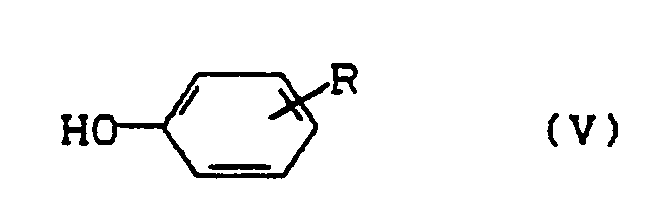
- Einige besonders geeignete Phenole sind Phenol, p-tert.-Butylphenol, Hydroxydiphenyl, p-Cumylphenol und insbesondere p-3,5-Dimethylheptylphenol und m- und p-(1,1,3,3-Tetramethylbutyl)-phenol. Die Kettenabbrecher werden im allgemeinen in Mengen von 0,1 bis 10, bevorzugt 0,5 bis 8 Mol-%, bezogen auf eingesetzte Diphenole, eingesetzt.
- Die erfindungsgemäßen Polycarbonate können vorzugsweise nach dem Phasengrenzflächenverfahren (vgl. H. Schnell, "Chemistry and Physics of Polycarbonates", Polymer Reviews, Vol. IX, Seite 33 ff., Interscience Publ., 1964) in an sich bekannter Weise hergestellt werden. Hierbei werden die Diphenole der Formel (II) in wäßrig alkalischer Phase gelöst. Zur Herstellung von Co-Polycarbonaten mit anderen Diphenolen werden Gemische von Diphenolen der Formel (II) und den anderen Diphenolen, beispielsweise denen der Formel (IV), eingesetzt. Zur Regulierung des Molekulargewichtes können Kettenabbrecher z.B. der Formel (V) zugegeben werden. Dann wird in Gegenwart einer inerten, vorzugsweise Polycarbonat lösenden, organischen Phase mit Phosgen nach der Methode der Phasengrenzflächenkondensation umgesetzt. Die Reaktionstemperatur liegt im allgemeinen zwischen 0°C und 40°C.
- Die gegebenenfalls mitzuverwendenden 0,05 bis 2 Mol-% an Verzweigern können entweder mit den Diphenolen in der wäßrig alkalischen Phase vorgelegt werden oder in dem organischen Lösungsmittel gelöst vor der Phosgenierung zugegeben werden.
- Neben den einzusetzenden Diphenolen der Formel (II) sowie den anderen Diphenolen der Formel (IV) können auch deren Mono- und/oder Bis-chlorkohlensäureester mitver wendet werden, wobei diese in organischen Lösungsmitteln gelöst zugegeben werden. Die Menge an Kettenabbrechern sowie an Verzweigern richtet sich dann nach Molen Di-phenolat-Struktureinheiten von (II) und gegebenenfalls von den anderen Di-phenolat-Struktureinheiten wie beispielsweise von (IV); ebenso kann bei Einsatz von Chlorkohlensäureestern die Phosgenmenge in bekannter Weise entsprechend reduziert werden.
- Als organische Phase für die Phasengrenzflächenpolykondensation sowie als organische Lösungsmittel für die Lösung der Kettenabbrecher sowie gegebenenfalls für die Verzweiger und die Chlorkohlensäureester können beispielsweise chlorierte Kohlenwasserstoffe, wie Chloroform, Dichlorethan, Di- und Tetrachlorethylen, Tetrachlorethan, Methylenchlorid, Chlorbenzol und Dichlorbenzol, aber auch nicht chlorierte Kohlenwasserstoffe, wie z.B. Toluol und Xylol, sowie Mischungen dieser Lösungsmittel, insbesondere Mischungen aus Methylenchlorid und Chlorbenzol dienen Gegebenenfalls können die verwendeten Kettenabbrecher und Verzweiger im gleichen Solvens gelöst werden.
- Als organische Phase für die Phasengrenzflächenpolykondensation dienen beispielsweise Methylenchlorid, Chlorbenzol oder Toluol sowie Mischungen aus Methylenchlorid und Chlorbenzol.
- Als wäßrige alkalische Phase dient beispielsweise wäßrige NaOH-Lösung oder KOH-Lösung.
- Die Herstellung der erfindungsgemäßen Polycarbonate nach dem Phasengrenzflächenverfahren kann in üblicher Weise durch Katalysatoren wie tertiäre Amine und Phasentransferkatalysatoren, insbesondere tertiäre aliphatische Amine wie z.B. Tributylamin, Triethylamin, N-Ethylpiperidin und insbesondere quartäre Ammonium- und Phosphoniumverbindungen und Kronenether, wie z.B. Tetrabutylammoniumbromid und Triphenylbenzylphosphoniumbromid katalysiert werden; die Katalysatoren werden im allgemeinen in Mengen von 0,05 bis 30 Mol-%, bezogen auf Mole an eingesetzten Diphenolen, eingesetzt. Die Katalysatoren werden im allgemeinen vor Beginn der Phosgenierung oder während oder auch nach der Phosgenierung zugesetzt.
- Die Isolierung der erfindungsgemäßen Polycarbonate erfolgt in bekannter Weise, z.B. indem man die bei dem Phasengrenzflächenverfahren erhaltene organische Phase mit dem gelösten Polycarbonat abtrennt, neutral und elektrolytfrei wäscht und dann das Polycarbonat beispielsweise über einen Eindampfextruder als Granulat, oder über Fällung mit Hilfe eines Nichtlösers und anschließende Trocknung oder über eine Sprühverdampfung als Pulver bzw. als Pellets isoliert.
- Die erfindungsgemäßen hochmolekularen, thermoplastischen, aromatischen Polycarbonate können auch nach dem bekannten Verfahren in homogener Phase, dem sogenannten "Pyridinverfahren" sowie nach dem bekannten Schmelzumesterungsverfahren unter Verwendung von beispielsweise Diphenylcarbonat anstelle von Phosgen hergestellt werden. Auch hier werden die erfindungsgemäßen Polycarbonate in bekannter Weise isoliert.
- Beispiele für erfindungsgemäß als Legierungsbestandteil B) einsetzbare amorphe Thermoplaste sind aromatische Polycarbonate ohne difunktionelle Carbonatstruktureinheiten der Formel (I), gegebenenfalls mit eingebauten Polysiloxanblöcken, eingebauten aliphatischen Polyetherblöcken oder eingebauten aliphatischen Polyesterblöcken, aromatische Polyester, aromatische Polyestercarbonate ohne difunktionelle Carbonatstruktureinheiten der Formel (I), aliphatisch-aromatische Polyester, Polyamide, Polyarylensulfone, aromatische Polyether, aromatische Polyimide, Polyepoxide, Vinylpolymere und (Meth)Acrylpolymere.
- Von diesen Beispielen werden bevorzugt die aromatischen Polyestercarbonate ohne difunktionelle Carbonatstruktureinheiten der Formel (I), die aromatischen Polycarbonate ohne difunktionelle Carbonatstruktureinheiten der Formel (I) mit eingebauten Polysiloxanblöcken, aromatische Polyester, aliphatisch-aromatische Polyester, Polyamide und Vinylpolymere und besonders bevorzugt die aromatischen Polyester, die aromatischen Polyestercarbonate ohne difunktionelle Carbonatstruktureinheiten der Formel (I), die Polyamide und die Vinylpolymeren eingesetzt.
- Erfindungsgemäß sind als Legierungsbestandteil (B) aromatische Polycarbonate ohne difunktionelle Carbonatstruktureinheiten der Formel (I) einsetzbar. Solche Polycarbonate enthalten nur difunktionelle Carbonatstruktureinheiten der Formel (III), denen Bisphenole der Formel (IV) zugrundeliegen. Dabei kann es sich um Homopolycarbonate aus nur einem Bisphenol oder Copolycarbonate aus mindestens zwei Bisphenolen handeln. Die Formeln (III) und (IV) sind oben erklärt. Für die Polycarbonate gilt in bezug auf Molekulargewicht, Verzweiger, Kettenabbrecher und Herstellverfahren das für die Polycarbonate (A) mit Carbonatstruktureinheiten der Formel (I) Gesagte. Die unter der Formel (IV) als bevorzugt genannten Bisphenole werden auch hier bevorzugt.
- Als Legierungsbestandteil B) können auch PolycarbonatPolysiloxan-Blockcopolymere dienen, in denen der Polycarbonatanteil aus mindestens einem aromatischen Bisphenol der Formel (IV) aufgebaut ist. Die Polysiloxanblöcke können beispielsweise in das Polycarbonat-Polysiloxan-Blockcopolymer eingebaut werden, indem man Polysiloxane mit Cl- oder Bisphenol-Endgruppen in die Polycarbonatreaktion, z.B. nach dem Zweiphasengrenzflächenverfahren, mit einführt. Solche Polysiloxane sind beispielsweise Polydimethylsiloxane der Formeln (VI) und (VII) mit

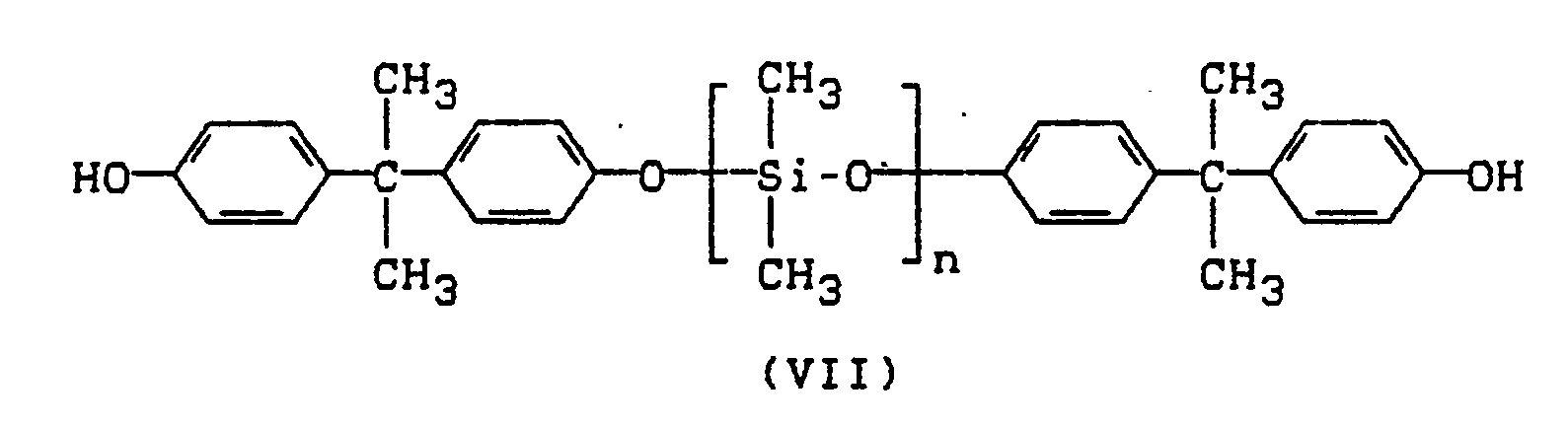
- Als Legierungsbestandteil B) können beispielsweise auch Polycarbonat-Polyether-Blockcopolymere und Polycarbonat-Polyester-Blockcopolymere dienen mit aliphatischen Polyetherblöcken, z.B. Polyethylenoxid-, Polypropylenoxid- und bevorzugt Polybutylenoxid-Blöcken, oder mit aliphatischen Polyesterblöcken, z.B. aus Hexandiol-Adipinsäurepolyester oder Hexandiol-Dimerfettsäure-Polyester. Blockcopolymere dieser Art und ihre Herstellung sind beschrieben in den DE-OS 2 636 783, 2 636 784, 2 827 325, 2 726 376, 2 726 416, 2 726 417, 2 712 435, 2 702 626.
- Erfindungsgemäß als Legierungsbestandteil B) einsetzbare aromatische Polyester und Polyestercarbonate sind aus mindestens einem aromatischen Bisphenol der Formel (VI), aus mindestens einer aromatischen Dicarbonsäure und gegebenenfalls aus Kohlensäure aufgebaut. Geeignete aromatische Dicarbonsäuren sind beispielsweise Orthophthalsäure, Terephthalsäure, Isophthalsäure, tert.-Butylisophthalsäure, 3,3′-Diphenyldicarbonsäure, 4,4′-Diphenyldicarbonsäure, 4,4′-Benzophenondicarbonsäure, 3,4′-Benzophenondicarbonsäure, 4,4′-Diphenyletherdicarbonsäure, 4,4′-Diphenylsulfondicarbonsäure, 2,2-Bis-(4-carboxyphenyl)-propan, Trimethyl-3-phenylindan-4′,5-dicarbonsäure.
- Von den aromatischen Dicarbonsäuren werden besonders bevorzugt die Terephthalsäure und/oder Isophthalsäure eingesetzt. Für die Bisphenole gelten die unter Formel (IV) genannten Bevorzugungen.
- Aromatische Polyester und Polyestercarbonate können nach Verfahren hergestellt werden, wie sie für die Polyester- bzw. Polyestercarbonat-Herstellung aus der Literatur bekannt sind, so z.B. nach Verfahren in homogener Lösung, nach Schmelzumesterungsverfahren und nach dem Zweiphasengrenzflächenverfahren. Bevorzugt werden Schmelzumesterungsverfahren und insbesondere das Zweiphasengrenzflächenverfahren angewandt.
- Schmelzumesterungsverfahren (Acetatverfahren und Phenylesterverfahren) werden beispielsweise in den US-PS 3 494 885, 4 386 186, 4 661 580, 4 680 371 und 4 680 372, den EP-A-26 120, 26 121, 26 684, 28 030, 39 845, 91 602, 97 970, 79 075, 146 887, 156 103, 234 913, 234 919 und 240 301 und den DE-AS 1 495 626, 2 232 877 beschrieben. Das Zweiphasengrenzflächenverfahren wird beispielsweise beschrieben in EP-A-68 014, 88 322, 134 898, 151 750, 182 189, 219 708, 272 426 in DE-OS 2 940 024, 3 007 934, 3 440 020 und in Polymer Reviews, Volume 10, Condensation Polymers by Interfacial and Solution Methods, Paul W. Morgan, Interscience Publishers New York, 1965, Kap. VIII, S. 325, Polyester.
- Beim Acetatverfahren werden im allgemeinen Bisphenoldiacetat bzw. Bisphenol und Acetatanhydrid sowie aromatische Dicarbonsäure unter Abspaltung von Essigsäure zum Polyester kondensiert. Beim Phenylesterverfahren werden im allgemeinen Bisphenol, aromatische Dicarbonsäure bzw. Diphenylester der aromatischen Dicarbonsäure und gegebenenfalls Diphenylcarbonat unter Phenolabspaltung und gegebenenfalls CO₂-Abspaltung zum Polyester bzw. Polyestercarbonat umgesetzt. Beim Zweiphasengrenzflächenverfahren dienen als Ausgangsstoffe zur Herstellung von Polyestern bzw. Polyestercarbonaten im allgemeinen Alkalibisphenolat, aromatisches Dicarbonsäuredichlorid und gegebenenfalls Phosgen. Bei dieser Kondensationsreaktion werden der Polyester bzw. das Polycarbonat unter Alkalichloridbildung hergestellt. Im allgemeinen ist das gebildete Salz in der wäßrigen Phase gelöst, während der gebildete Polyester bzw. das gebildete Polyestercarbonat in der organischen Phase gelöst vorliegt und daraus isoliert wird.
- Aliphatisch-aromatische Polyester, die als Legierungsbestandteil B) eingesetzt werden können, sind beispielsweise amorphe Polyester aus Cyclohexan-1,4-dimethanol und Terephthalsäure und/oder Isophthalsäure, die als Comonomere noch andere Dicarbonsäuren und aliphatische Dihydroxyverbindungen einkondensiert enthalten können, z.B. Glykol, Propylenglykol und Butylenglykol. Beispiele für solche Polyester sind Cyclohexan-1,4-dimethanol-Terephthalsäure-Polyeester, Cyclohexan-1,4-dimethanol-Terephthalsäure-Isophthalsäure-Copolyester und Cyclohexan-1,4-dimethanol-Terephthalsäure-Ethylenglykol-Copolyester. Solche Polyester werden beispielsweise beschrieben in EP-A-273 151, 273 152, 155 989, 226 974, 185 309, 152 825, 226 189, 272 416 und US-PS 4 188 314, 4 634 737.
- Amorphe thermoplastische Polyamide, die als Legierungsbestandteil B) verwendet werden können, sind beispielsweise zu erhalten durch Polykondensation von Diaminen, wie Ethylendiamin, Tetramethylendiamin, Hexamethylendiamin, Decamethylendiamin, 2,2,4- und 2,4,4-Trimethylhexamethylendiamin, m- und p-Xylylendiamin, Bis-(4-aminocyclohexyl)-methan, Gemischen aus 4,4′- und 2,2′-Diaminodicyclohexylmethanen, 2,2-Bis-(4-aminocyclohexyl)-propan, 3,3′-Dimethyl-4,4′-diamino-dicyclohexylmethan, 3-Aminoethyl-3,5,5-trimethyl-cyclohexylamin, 2,5-Bis-(aminomethyl)-norbornan, 2,6-Bis-(aminomethyl)-norbornan und 1,4-Diamino-methylcyclohexan, und von beliebigen Gemischen dieser Diamine mit Dicarbonsäuren, wie beispielsweise mit Oxalsäure, Adipinsäure, Azelainsäure, Decandicarbonsäure, Heptadecandicarbonsäure, 2,2,4-Tri methyladipinsäure, 2,4,4- Trimethyladipinsäure, Isophthalsäure und Terephthalsäure, und mit beliebigen Gemischen dieser Dicarbonsäuren. Es sind somit auch amorphe Copolyamide einbezogen, die durch Polykondensation mehrerer der vorstehend genannten Diamine und/oder Dicarbonsäuren erhalten werden. Ferner sind amorphe Copolyamide einbezogen, die unter Mitverwendung von ω-Aminocarbonsäuren wie ω-Aminocapronsäure, ω-Aminoundecansäure oder ω-Aminolaurinsäure oder von deren Lactamen hergestellt sind.
- Besonders geeignete, amorphe, thermoplastische Polyamide sind solche, die aus Isophthalsäure, Hexamethylendiamin und weiteren Diaminen wie 4,4′-Diaminodicyclohexylmethan, Isophorondiamin, 2,2,4- und/oder 2,4,4-Trimethylhexamethylendiamin, 2,5- und/oder 2,6-Bis-(aminomethyl)-norbornan erhältlich sind, solche, die aus Isophthalsäure, 4,4′-Diamino-di-cyclohexylmethan und ω-Caprolactam erhältlich sind, solche, die aus Isophthalsäure, 3,3′-Dimethyl-4,4′-diamino-dicyclohexylmethan und ω-Laurinlactam erhältlich sind, und solche, die aus Terephthalsäure und 2,2,4- und/oder 2,4,4-Trimethylhexamethylendiamin erhältlich sind.
- Anstelle des reinen 4,4′-Diaminodicyclohexylmethans können auch Gemische der stellungsisomeren Diaminodicyclohexylmethane eingesetzt werden, die sich zusammensetzen aus
70 bis 99 Mol-% des 4,4′-Diaminoisomeren
1 bis 30 Mol-% des 2,4′-Diaminoisomeren
0 bis 2 Mol-% des 2,2′-Diaminoisomeren
und gegebenenfalls entsprechend höherkondensierten Diaminen, die durch Hydrierung von Diaminodiphenylmethan technischer Qualität erhalten werden. - Die amorphen Polyamide und deren Herstellung sind bekannt (siehe beispielsweise Ullmann, Enzyklopödie der technischen Chemie, Band 19, S. 50).
- Polyarylensulfone, die als Legierungsbestandteil B) eingesetzt werden können, haben im allgemeinen mittlere Molekulargewichte
M w (Gewichtsmittel; gemessen nach der Lichtstreumethode in CHCl₃) von 10.000 bis 200.000, vorzugsweise von 20.000 bis 90.000. Beispiele dafür sind die nach bekannten Verfahren erhältlichen Polyarylensulfone aus 4,4′-Dichlordiphenylsulfon und mindestens einem Bisphenol, insbesondere 2,2-Bis-(4-hydroxyphenyl)-propan und Bis-(4-hydroxyphenyl)-sulfon, die beispielsweise zu Polyarylensulfonen mit difunktionellen Sulfonstruktureinheiten der Formeln (VIII) und (IX) führen.
- Diese Polyarylensulfone sind bekannt (siehe beispielsweise US-PS 3 264 536, DE-AS 1 794 171, GB-PS 1 264 900, US-PS 3 641 207, EP-A-00 38 028, DE-OS 3 601 419 und DE-OS 3 601 420, EP 149 359, EP 294 773 und die Veröffentlichungen G. Blinne et al., Kunststoffe 75/1 (1985) 29-34 und R.N. Johnson et al., Journal of Polymer Science, Part A1, 5 (1967) 2375-2398. Die geeigneten Polyarylensulfone können auch in bekannter Weise verzweigt sein (siehe beispielsweise DE-OS 2 305 413).
- Aromatische Polyether, die erfindungsgemäß als Legierungsbestandteil B) Einsatz finden können, sind beispielsweise Polyphenylenoxide. Polyphenylenoxide sind bekannt und werden beispielsweise beschrieben in US-PS 3 306 874, 3 306 875, 3 257 357, 3 257 358, 3 661 848, 3 219 625, 3 378 505, 3 639 656, 4 011 200, 3 929 930, EP-A-0 248 526, 0 271 699, DE-OS 2 126 434. Die Molekulargewichte
M w Gewichtsmittel) sind im allgemeinen 10.000 bis 80.000, bevorzugt 15.000 bis 60.000. Polyphenylenoxide werden im allgemeinen durch eine oxidative Kupplungsreaktion von einem oder mehreren zweifach oder dreifach substituierten Phenolen als Homo- oder Copolymere erhalten Als Katalysator der Reaktion dient im allgemeinen ein Kupfer-Amin-Komplex. Verwendet werden können Kupfer-Amin-Komplexe primärer, sekundärer und/oder tertiärer Amine. Beispiele von geeigneten Homo-Polyphenylenoxiden sind:
Poly-(2,3-dimethyl-6-ethylphenylen-1,4-ether),
Poly-(2,3,6-trimethylphenylen-1,4-ether),
Poly-(2,4′-methylphenylphenylen-1,4-ether),
Poly-(2-bromo-6-phenylphenylen-1,4-ether),
Poly-(2-methyl-6-phenylphenylen-1,4-ether).
Poly-(2-phenylphenylen-1,4-ether),
Poly-(2-chlorophenylen-1,4-ether),
Poly-(2-methylphenylen-1,4-ether),
Poly-(2-chloro-6-ethylphenylen-1,4-ether),
Poly-(2-chloro-6-bromophenylen-1,4-ether),
Poly-(2,6-di-n-propylphenylen-1,4-ether),
Poly-(2-methyl-6-isopropylphenylen-1,4-ether),
Poly-(2-chloro-6-methylphenylen-1,4-ether),
Poly-(2-methyl-6-ethylphenylen-1,4-ether),
Poly-(2,6-dibromophenylen-1,4-ether),
Poly-(2,6-dichlorophenylen-1,4-ether),
Poly-(2,6-diethylphenylen-1,4-ether),
Poly-(2,6-dimethylphenylen-1,4-ether). - Geeignete copolymere Polyphenylenoxide können z.B. von zwei oder mehr Phenolen hergestellt werden, die für die Herstellung der oben aufgeführten Homopolyphenylenoxide verwendet werden. Besonders bevorzugt ist der Poly-(2,6-dimethylphenylen-1,4-ether). Pfropf- und Blockcopolymere aus Polyphenylenoxiden und Polyvinylaromaten wie Polystyrol sind auch geeignet als Legierungsbestandteil B). Geeignete styrolgepfropfte Polyphenylenoxide werden beispielsweise in der Veröffentlichung "Xyron", Japan plastics age, März/April 1979, S 29 - 33 beschrieben.
- Aromatische Polyimide, die als Legierungsbestandteil B) einsetzbar sind, sind beispielsweise aromatische Polyetherimide, wie sie in US-PS 4 395 518, 3 855 178, EP-A-120 183, 120 184, 179 471, 292 243, 278 066, DE-PS 2 735 501 und den Veröffentlichungen Polyetherimid, Kunststoffe-Plastics 4/1982, S. 32-35, Polyetherimide, Kunststoffe 73/5 (1983), S. 266-269, R.O. Johnson und H.S. Burlhis, J. of Pol. Sc., Polymer Symp. 70 (1983) S. 129-143 und D.M. White et al., J. of Pol. Sc., Pol. Chemistry Ed., 19 (1981), S. 1635-1685, beschrieben sind. Die Synthese dieser Polyetherimide kann, wie dort beschrieben, beispielsweise durch Umsetzen von Bisnitrobisphthalimiden und Alkalibisphenolaten unter Abspaltung von Alkalinitrit oder durch Umsetzen von Bisetherbisphthalsäureanhydriden mit Diaminen unter Wasserabspaltung erhalten werden. Ein bevorzugtes aromatisches Polyetherimid ist beispielsweise das aus wiederkehrenden Einheiten der Formel (X)


- Vinylpolymere und (Meth-)Acrylpolymere, wie sie als Legierungsbestandteil B) einsetzbar sind, sind Homo- und Copolymerisate, beispielsweise aus folgenden Monomeren:
- 1. Styrol und seine Derivate wie z.B. α-Methylstyrol, α-Chlorstyrol, p-Chlorstyrol, 2,4-Dichlorstyrol, p-Methylstyrol, 3,4-Dimethylstyrol, o- und p-Divinylbenzol, p-Methyl-α-methylstyrol und p-Chlor-α-methylstyrol, bevorzugt Styrol und α-Methylstyrol.
- 2. Acryl- und Methacrylverbindungen wie z.B. Acryl -und Methacrylsäure, Acrylnitril, Methacrylnitril, Methylacrylat, Äthylacrylat, n- und Isopropylacrylat, n- und Isobutylacrylat, tert.-Butylacrylat, 2-Äthylhexylacrylat, Methylmethacrylat, Äthylmethacrylat, n- und Isopropylmethacrylat, n- und Isobutylmethacrylat, tert.-Butylmethacrylat, Cyclohexylmethacrylat und Isobornylmethacrylat, bevorzugt Acrylnitril, Methacrylnitril, Methylmethacrylat, tert.-Butylmethacrylat.
- 3. Maleinsäureanhydrid und dessen Abkömmlinge, wie Maleinsäureester, Maleinsäurediester und Maleinimide, z.B. Alkyl- und Arylmaleinimide, wie beispielsweise Methyl- oder Phenylmaleinimid, bevorzugt Maleinsäureanhydrid und Maleinimide, insbesondere Phenylmaleinimid.
- Die Monomeren der Gruppe 3 dienen im allgemeinen als Comonomere zu den Monomeren der Gruppen 1 und 2.
- Beispiele für geeignete Homo- und Copolymerisate sind Polystyrol, Polymethylmethacrylat, Styrol-Methylstyrol-Copolymere, Styrol-Acrylnitril-Copolymere, α-Methylstyrol-Acrylnitril-Copolymere, Styrol-Maleinsäureanhydrid-Copolymere, Styrol-Phenylmaleinimid-Coplymere, Styrol-Methylmethacrylat-Copolymere, Methylmethacrylat/Acrylnitril-Copolymere, Styrol-Acrylnitril-Maleinsäureanhydrid-Copolymere, Styrol-Acrylnitril-Phenylmaleinimid-Copolymere, α-Methylstyrol-Acrylnitril-Methylmethacrylat-Copolymere, α-Methylstyrol-Acrylnitril-tert.-Butylmethacrylat-Copolymere, Styrol-Acrylnitril-tert.-Butylmethacrylat-Copolymere.
- Die Vinylpolymeren und (Meth-)Acrylpolymeren können nach bekannten radikalischen, anionischen und kationischen Polymerisationsverfahren hergestellt werden. Auch die bekannte Redoxpolymerisation oder die bekannte Polymerisation mit metallorganischen Mischkatalysatoren kann vorteilhaft sein. Die Polymerisation kann in Masse, Lösung oder Emulsion stattfinden, wie bekannt.
- Auch gemischte Verfahren wie Lösungs-, Fällungs- oder Massesuspensionsverfahren können Einsatz finden, wie bekannt. Die Gewichtsmittel-Molekulargewichte der Vinylpolymeren und (Meth-)Acrylpolymeren betragen im allgemeinen 10.000 bis 300.000, bevorzugt 30.000 bis 200.000.
- Beispiele für erfindungsgemäß als Legierungsbestandteil C) einsetzbare teilkristalline Thermoplaste sind Polyolefine, Ionomere, aliphatisch-aromatische Polyester, Polyamide, aromatische Polyetherketone und Polyphenylensulfide. Besonders bevorzugt sind aliphatisch-aromatische Polyester und die Polyamide, besonders bevorzugt die aliphatisch-aromatischen Polyester.
- Als Legierungsbestandteil C) sind erfindungsgemäß teilkristalline Polyolefine einsetzbar. Solche Polyolefine sind beispielsweise Homo- und Copolymerisate von Olefinen, wie zB. Ethylen, Propylen, Buten-1, Penten-1, Hexen-1, Hepten-1, 3-Methylbuten-1, 4-Methylbuten-1, 4-Methylpenten-1, Octen-1 und andere. Einige solcher Polyolefine sind Polyethylen, Polypropylen, Polybuten-1, Poly-4-methylpenten-1. Beim Polyethylen unterscheidet man PE, HDPE (high density), LDPE (low density), und LLDPE (very low density). Die unterschiedlichen Dichten des Polyethylens kommen durch unterschiedliche Verfahren und Cokondensation mit anderen Monomeren zustande, wie bekannt. Bekannte Verfahren zur Herstellung von Polyolefinen sind z.B. das Hochdruckverfahren und das Niederdruckverfahren (Ziegler-Natta-Katalyse mit metallorganischen Mischkatalysatoren).
- Bevorzugte Legierungsbestandteile C) sind Polyethylen und Poly-4-Methylpenten-1, besonders bevorzugt ist Polyethylen. Die Polyolefine können neben den Olefinen auch noch untergeordnete Mengen anderer Monomerer enthalten.
- Als Legierungsbestandteil C) sind erfindungsgemäß auch Ionomere geeignet. Dabei handelt es sich im allgemeinen um Polyolefine, wie oben beschrieben, insbesondere um Polyethylen, die Monomere mit Säuregruppen cokondensiert enthalten, wie z.B. Acrylsäure, Methacrylsäure. Die Säuregruppen werden mit Hilfe von Metallionen wie beispielsweise Na⁺, Ca⁺⁺, Mg⁺⁺ und Al⁺⁺⁺ in ionische, ggf. ionisch vernetzte Polyolefine umgewandelt, die sich jedoch noch thermoplastisch verarbeiten lassen. Solche Polymeren sind beispielsweise Ethylen-Acrylsäure-Copolymere, deren Säuregruppen in metallsalzartige Gruppen umgewandelt sind. Beschrieben werden solche Ionomeren z.B. in den Patentschriften US 3 264 272, 3 404 134, 3 355 319, 4 321 337.
- Aromatisch-aliphatische Polyester, die als teilkristalliner Legierungsbestandteil C) einsetzbar sind, sind bevorzugt Polyalkylenterephthalate, also beispielsweise solche auf Basis von Ethylenglykol, Propandiol-1,3, Butandiol-1,4, Hexandiol-1,6 und 1,4-Bis-hydroxymethyl-cyclohexan. Besonders bevorzugt werden Polybutylenterephthalate, Polyethylenterephthalate und Copolymere aus Cyclohexan-1,4-dimethanol und Ethylenglykol sowie Terephthalsäure eingesetzt, soweit diese teilkristallin sind. Ganz besonders bevorzugt wird das Polybutylenterephthalat eingesetzt.
- Die Molekulargewichte
M w (Gewichtsmittel) dieser Polyalkylenterephthalate sind im allgemeinen 10.000 bis 200.000, bevorzugt 10.000 bis 80.000. Die Polyalkylenterephthalate können nach bekannten Verfahren beispielsweise aus Terephthalsäuredialkylester und dem entsprechenden Diol durch Umesterung erhalten werden (s. z.B. US-PS 2 647 885, 2 643 989, 2 534 028, 2 578 660, 2 742 494, 2 901 466). - Teilkristalline Polyamide, die sich als Legierungsbestandteil C) eignen, sind insbesondere Polyamid-6, Polyamid-6,6, Polyamid-4,6 teilkristalline Copolyamide auf Basis dieser Komponenten. Weiterhin kommen teilkristalline Polyamide in Betracht, deren Säurekomponente insbesondere ganz oder teilweise (z.B. neben ε-Caprolactam) aus Adipinsäure und/oder Terephthalsäure und/oder Isophthalsäure und/oder Korksäure und/oder Sebacinsäure und/oder Azelainsäure und/oder Dodecandicarbonsäure und/oder einer Cyclohexandicarbonsäure besteht, und deren Diaminkomponente ganz oder teilweise insbesondere aus m- und/oder p-Xylylendiamin und/oder Hexamethylendiamin und/oder 2,2,4-und/oder 2,4,4-Trimethylhexamethylendiamin und/oder Isophorondiamin besteht und deren Zusammensetzungen im Prinzip aus dem Stand der Technik bekannt sind (siehe beispielsweise Encyclopedie of Polymers, Vol. 11, S. 315 ff).
- Außerdem sind geeignet teilkristalline Polyamide, die ganz oder teilweise aus Lactamen mit 6 bis 12 C-Atomen, gegebenenfalls unter Mitverwendung einer oder mehrerer der obengenannten Ausgangskomponenten, hergestellt werden.
- Besonders bevorzugte teilkristalline Polyamide sind Polyamid-6 und Polyamid-6,6 oder Copolyamide mit geringem Anteil, z.B. bis etwa 10 Gewichtsprozent, an anderen Co-Komponenten.
- Als teilkristalliner Legierungsbestandteil C) lassen sich auch aromatische Polyetherketone einsetzen, die beispielsweise in den Patentschriften GB 1 078 234, US 4 010 147, EP 135 938, 292 211, 275 035, 270 998, 165 406, JA 62 151 421 und in den Veröffentlichungen C.K. Sham et. al., Polymer 29/6 (1988), S. 1016 - 1020, und J.E. Harris et al., J. Appl. Polym. Sc. 35/7 (1988), S. 1877 - 1891 beschrieben sind. Diese Polyetherketone können beispielsweise erhalten werden, indem man Bisphenole mit Bis-(halogenaryl)-ketonen in polaren aprotischen Lösungsmitteln in Gegenwart von Alkalicarbonaten umsetzt. So können beispielsweise durch Umsetzung von Hydrochinon mit 4,4′-Difluorbenzophenon Polymere mit difunktionellen Struktureinheiten der Formel (XII) und durch Umsetzung von Bis-(4-hydroxyphenyl)keton mit 4,4′-Difluorbenzophenon Polymere mit difunktionellen Struktureinheiten der Formel (XIII)

- Polymere, die als teilkristalliner Legierungsbestandteil C) einsetzbar sind, sind auch thermoplastische lineare oder verzweigte Polyarylensulfide. Sie haben Struktureinheiten der allgemeinen Formel (XIV)

- Polyarylensulfide und ihre Herstellung sind bekannt und werden beispielsweise in den US-PS 3 354 129, 3 786 035, 3 853 824, 3 856 560, 3 862 095 und EP-A- 0 171 021 sowie in den Veröffentlichungen W. Baerecke, International Polymer Science and Technology, Vol. 1, No. 9, 1974, 5. T/52 - T/54 und A.S. Wood, Mod. Plast. Int. 18/4 (1988) S. 34 - 37 beschrieben.
- Als Kautschuke (D) können thermoplastische Kautschuke eingesetzt werden. Solche thermoplastischen Kautschuke sind beispielsweise thermoplastische Polyurethane, Poly etherester, Polyesteramide, Polyetheramide, thermoplastische Olefinelastomere, Ethylen-Ethylacrylat-Copolymere, Styrol-Butadien-Segment-Polymere, Styrol-Isopren-Segment-Polymere, hydrierte Styrol-Butadien-Segment-Polymere. Bevorzugt werden thermoplastische Polyurethane, Polyetherester und insbesondere hydrierte Styrol-Butadien-Segment-Polymere eingesetzt.
- Die thermoplastischen Polyurethane werden beispielsweise aus drei Komponenten hergestellt, aus langkettigen bifunktionellen Polyolen, kurzkettigen Diolen oder Diamin und Diisocyanat. Die Umsetzung der drei Komponenten erfolgt z.B. bei Starttemperaturen zwischen 60 und 140°C unter starkem Rühren. Dabei reagieren die Isocyanat- mit den Hydroxylgruppen unter Bildung Urethangruppen ohne Abspaltung von Nebenprodukten. Nach Zerkleinern und mehrtägiger Lagerung kann das Elastomer thermoplastisch verarbeitet werden. Langkettige geeignete Polyole sind beispielsweise
- Äthandiol-polyadipat, Butandiol-1,4-polyadipat, Äthandiol-butandiol-polyadipat, Hexandiol-1,6-neopentylglykol-polyadipat, Propylenglykol(1,2)-polyäther, Tetramethylenoxid (= Tetrahydrofuran-polyäther), Hexandiol-1,6-polycarbonat und Polycaprolacton.
- Kurzkettige geeignete Diole oder Diamine (Kettenverlängerer) sind z.B. Äthandiol, Butandiol-1,4, Hexandiol-1,6, Hydrochinon-di-β-hydroxyäthyl-äther und Isophorondiamin.
- Geeignete Diisocyanate sind beispielsweise 4,4′-Diphenylmethan-diisocyanat (MDI), Hexamethylen-diisocyanat (HDI), Isophoron-diisocyanat (IPDI) und 1,5-Naphthylen-diisocyanat (NDI).
- Die thermoplastischen Polyurethane und ihre Herstellung werden in der Veröffentlichung W. Goyert et al., Kunststoffe 68. Jahrgang 1978, S. 2 - 8, in der Monographie J.H. Saunders et al., Polyurethanes, Chemistry and Technology, Vol. 11, S. 299 - 451, Interscience Publishers, Hew York, 1964, und in den Patentschriften US 2 729 618, US 3 214 411 beschrieben.
- Geeignete Polyetherester sind beispielsweise Blockcopolymere aus weichen Segmenten wie Polytetramethylenglykol- oder Polypropylenglykol- oder Polyethylenglykol-Terephthalat und harten Segmenten aus Polybutylenterephthalat wie beispielsweise in J.W. Crary, GAK 7/1986, Jahrgang 39, S. 330 - 334, und G.K. Hoeschele, Chimica 28/9 (1974) S. 544 - 552 beschrieben.
- Geeignete Polyesteramide und Polyetheramide sind beispielsweise beschrieben in den EP-A-126 928, DE-OS 2 523 991, EP-A-281 461 und der Veröffentlichung Kunststoffe 72/5 (1982), S. 282 - 283. Es sind Blockcopolymere aus Polyethersegmenten wie Polyethylenglykol, Polypropylenglykol und Polybutylenglykol und Polyamidsegmenten wie PA 6, PA 6 6, PA 11, PA 12, PA 6 11, P 6 12.
- Geeignete Styrol-Butadien-, Styrol-Isopren- und hydrierte Styrol-Butadien-Segment-Polymere sind beispielsweise in US-PS 3 333 024, 3 753 936, 3 281 383, DE-PS 2 819 493, DE-OS 2 613 200 und 2 643 757 beschrieben. Bevorzugt werden die SBS-Blockcopolymeren und die hydrierten SBS-Blockcopolymeren (SEBS = Styrol-Ethylen-Butylen-Styrol-Blockcopolymere).
- Als Kautschuke (D) können auch andere Kautschuke als die oben genannten thermoplastischen Kautschuke eingesetzt werden. Solche Kautschuke sind beispielsweise Naturkautschuk, Epichlorhydrin-Kautschuke, Ethylen-Vinylacetat-Kautschuke, Polyethylenchlorsulfonkautschuke, Siliconkautschuke, Polyetherkautschuke, Dienkautschuke, hydrierte Dienkautschuke, Polyalkenamer-Kautschuke, Acrylatkautschuke, Ethylen-Propylen-Kautschuke, Ethylen-Propylen-Dien-Kautschuke, Butylkautschuke, Fluorkautschuke. Bevorzugt werden Siliconkautschuke, Dienkautschuke, hydrierte Dienkautschuke, Acrylatkautschuke, Ethylen-Propylen-Dien-Kautschuke (Dien z.B. Dicyclopentadien, Äthylidennorbornen oder Hexadien-1,4).
- Dien-Kautschuke sind beispielsweise Homopolymerisate von konjugierten Dienen mit 4 bis 8 Kohlenstoffatomen wie Butadien, Isopren, Piperylen und Chloropren, Copolymerisate solcher Diene untereinander und Copolymerisate solcher Diene mit Styrol, Acryl- oder Methacrylverbindungen (z.B. Acrylnitril, Methacrylnitril, Acrylsäure, Methacrylsäure, Acrylsäurebutylester und Methylmethacrylat).
- Besonders bevorzugt werden von den Dien-Kautschuken Butadien-, Butadien-Styrol-, Butadien-Methylmethacrylat, Butadien-Acrylsäurebutylester- und Butadien-Acrylnitril-Kautschuke. Acrylatkautschuke sind beispielsweise Alkylacrylat-Kautschuke auf der Basis von einem oder mehreren C₁-C₈-Alkylacrylaten, so insbesonders von Ethyl-, Butyl, Octyl-, 2-Ethylhexylacrylat. Diese Alkylacrylatkautschuke können bis zu 30 Gew.-% Monomere wie Vinylacetat, Acrylnitril, Styrol, Methylmethacrylat, Vinylether copolymerisiert enthalten. Diese Alkylacrylatkautschuke können weiterhin kleine Mengen (bis zu 5 Gew.-%) vernetzend wirkender polyfunktioneller Monomerer copolymerisiert enthalten. Beispiele sind Ester von ungesättigten Carbonsäuren mit einem Polyol (vorzugsweise 2 bis 20 Kohlenstoffatome in der Estergruppe) wie Ethylenglykoldimethacrylat. Ester einer mehrbasischen Carbonsäure mit einem ungesättigten Alkohol (vorzugsweise 8 bis 30 Kohlenstoffatome im Esterrest) wie Triallylcyanurat, Triallylisocyanurat; Divinylverbindungen wie Divinylbenzol; Ester ungesättigter Carbonsäuren mit ungesättigten Alkoholen (bevorzugt 6 bis 12 Kohlenstoffatome im Esterrest) wie Allylmethacrylat; Phosphorsäureester, z.B. Triallylphosphat und 1,3,5-Triacryloylhexahydro-s-triazin. Besonders bevorzugte polyfunktionelle Monomere sind Triallylcyanurat, Triallylisocyanurat, Triallylphosphat, Allylmethacrylat.
- Geeignete Acrylatkautschuke sind auch Produkte, die einen vernetzten Dienkautschuk aus einem oder mehreren konjugierten Dienen, wie Polybutadien oder ein Copoly merisat eines konjugierten Diens mit einem ethylenisch ungesättigten Monomer, wie Styrol und/oder Acrylnitril, als Kern und einem Acrylatmantel enthalten.
- Geeignete Siliconkautschuke können z.B. vernetzte Siliconkautschuke aus Einheiten der allgemeinen Formeln R₂SiO, RSiO3/2, R₃SiO1/2 und SiO2/4 sein, wobei R einen einwertigen Rest darstellt. Die Mengen der einzelnen Siloxaneinheiten sind dabei so bemessen, daß auf 100 Einheiten der Formel R₂SiO 0 bis 10 Mol-Einheiten der Formel RSiO3/2, 0 bis 1,5 Mol-Einheiten R₃SiO1/2 und 0 bis 3 Mol.-Einheiten der Formel SiO2/4 vorhanden sind.
- R kann dabei entweder ein einwertiger gesättigter Kohlenwasserstoffrest mit 1 bis 18 Kohlenstoffatomen, der Phenylrest oder der Alkoxy-Rest oder eine radikalisch angreifbare Gruppe wie der Vinyl- oder der Mercaptopropylrest sein. Bevorzugt ist, daß mindestens 80 % aller Reste R Methyl sind; insbesondere bevorzugt sind Kombinationen aus Methyl und Ethyl oder Methyl.
- Bevorzugte Silikonkautschuke enthalten eingebaute Einheiten radikalisch angreifbarer Gruppen, insbesondere Vinyl-, Allyl-, Halogen-, Mercaptogruppen, vorzugsweise in Mengen von 2 bis 10 Mol.-%, bezogen auf alle Reste R.
- Sie können beispielsweise hergestellt werden, wie in EP-A-260 558 beschrieben.
- Als Pfropfpolymerisate E) können in den erfindungsgemäßen Legierungen Pfropfpolymerisate eingesetzt werden, die durch radikalische Polymerisation von mindestens einem der vorstehend in drei Gruppen aufgeführten Monomeren in Gegenwart mindestens eines Kautschuks (nicht thermoplastischer Kautschuk) erhalten werden. Bevorzugte Herstellverfahren sind die Emulsions-, Lösungs-, Masse- oder Suspensionspolymerisation. So können die Pfropfpolymerisate beispielsweise durch radikalische Emulsionspfropfpolymerisation der Vinylmonomeren in Gegenwart von Kautschuklatices bei Temperaturen von 50 bis 90°C unter Verwendung wasserlöslicher Initiatoren wie Peroxodisulfat, oder mit Hilfe von Redoxinitiatoren erzeugt werden.
- Einsatz können auch Kautschuke finden, die bereits aus vorgebildeten Kern-Mantel-Kautschukteilchen bestehen, die aus zwei verschiedenen Kautschuken bestehen. So kann beispielsweise der Kern aus einem Polybutadien-Kautschuk oder einem Siliconkautschuk bestehen und der Mantel aus einem Acrylatkautschuk (s. oben und z.B. EP 260 558 Kern/Mantel aus Silicon/Acrylat). Durch einfache Pfropfung oder mehrfache schrittweise Pfropfung können eine oder mehrere Pfropfhüllen auf die Kautschukteilchen aufgebracht werden, wobei jede Pfropfhülle eine andere Zusammensetzung haben kann. Zusätzlich zu den zu pfropfenden Monomeren können polyfunktionelle vernetzende oder reaktive Gruppen enthaltende Monomere mit aufgepfropft werden, um bestimmte Wirkungen in der Legierung zu erzielen (s. z.B. EP-A-230 282, DE-OS 3 601 419, EP-A-269 861).
- Die Pfropfpolymerisate E) enthalten im allgemeinen 5 bis 90 Gew.-%, insbesondere 20 bis 85 Gew.-% Kautschuk und 95 bis 10 Gew.-%, insbesondere 80 bis 15 Gew.-%, pfropfcopolymerisierte Monomere. Die Kautschuke liegen in diesem Pfropfmischpolymerisaten im allgemeinen in Form wenigstens partiell vernetzter Teilchen einer mittleren Teilchengröße von 0,05 bis bis 5 µm, bevorzugt von 0,1 bis 2 µm, insbesondere von 0,1 bis 1 µm, vor.
- Die bei den Vinylpolymeren und (Meth-)Acrylpolymeren sowie bei den Kautschuken als bevorzugt oder besonders bevorzugt genannten Monomeren und Kautschuke werden auch bei den Pfropfpolymerisaten bevorzugt bzw. besonders bevorzugt.
- Die Polymerlegierungen dieser Erfindung können auf verschiedene Weise hergestellt werden. So können die Ausgangspolymeren gemeinsam in einem Lösungsmittel oder einem Lösungsmittelgemisch gelöst werden. Durch gemeinsames Ausfällen der Polymeren durch Zugabe eines Nichtlösers oder Eintropfen der Lösung in ein Fällungsmittel kann die Polymerlegierung erhalten werden, ebenso wie durch Abdampfen des Lösungsmittels.
- Bevor die endgültige Mischung aller Legierungsbestandteile erfolgt, können auch einzelne Polymeren der endgültigen Legierung allein gemischt werden. So können beispielsweise Latices eines harzartigen Copolymerisats (z.B. Styrol-Acrylnitril-Copolymer) und eines Kautschuks (z.B. Butadien-Acrylnitril-Copolymer) durch gemeinsame Fällung gemischt werden, bevor sie mit dem Polycarbonat zur endgültigen Formmasse legiert werden.
- Die Legierung der Ausgangspolymeren kann jedoch auch über die Schmelze in Mischvorrichtungen wie z.B. Extrudern, Innenknetern und Mischwalzen erfolgen.
- Den einzelnen Legierungsbestandteilen können während ihrer Herstellung oder nach ihrer Herstellung übliche Additive zugesetzt werden, auch über ihre Lösung oder Schmelze. Übliche Additive können auch der Legierung während ihrer Herstellung zugesetzt werden. Auch der fertigen Legierung können übliche Additive zugesetzt werden, auch über ihre Lösung oder Schmelzen.
- Übliche Additive sind beispielsweise Stabilisatoren, Nucleierungsmittel, Entformungsmittel, Pigmente, Flammschutzmittel, Antistatika, Leitfähigkeitszusätze, Füllstoffe, Verstärkungsstoffe und Fasern in den üblichen Mengen.
- Im einzelnen können beispielsweise Graphit, Ruß, Metallfasern, Metallpulver, Kieselgur, Talkum, Kaolin, Glimmer, Tone, CaF₂, CaCO₃, Aluminiumoxide, Aluminiumnitrid, Silicate, Bariumsulfat sowohl als Füllstoffe und Verstärkungsstoffe als auch als Nucleierungsmittel, als Entformungsmittel beispielsweise Glycerinstearate, Pentaerythrittetrastearat und Trimethylolpropantristearat, als Fasern beispielsweise Glasfasern und C-Fasern und als Pigmente beispielsweise TiO₂, Fe-Oxide, Ruß und organische Pigmente eingesetzt werden.
- Die erfindungsgemäßen Legierungen können in bekannter Weise, beispielsweise im Spritzguß oder in der Extrusion zu beliebigen Formkörpern, auch Platten, Folien und Fasern, verarbeitet werden.
- Die erhaltenen Platten und Folien können Tiefziehverfahren unterworfen werden. Die Folien können im Verbund mit anderen Folien zu Verbundfolien verarbeitet werden. Weiterhin können die erfindungsgemäßen Legierungen auch in anderen Verbundwerkstoffen eingesetzt werden, z.B. in Kombination mit Fasern und anderen Polymeren.
- Die aus den erfindungsgemäßen Legierungen hergestellten Formkörper haben aufgrund der vorn genannten Eigenschaften Vorteile gegenüber bisher bekannten Werkstoffen, insbesondere für Bauteile im Elektro- und Elektroniksektor, für große, hochbeanspruchte Gehäuseteile, für den Automobilsektor als Karosserieteile und Teile Motorraum und für gasdurchlässige und Gase trennende Folien.
- In 3 l Wasser wurden 184 g (4,6 Mol) NaOH und 324 g (1 Mol) 1,1-Bis-(4-hydroxyphenyl)-4-tert.-butylcyclohexan gelöst. Dazu wurden 3 l Methylenchlorid mit darin gelöstem 6,8 g (0,033 Mol) 4-(1,1,3,3-Tetramethylbutyl)-phenol gegeben. Unter intensivem Rühren wurden dann bei 25°C 148,5 g (1,5 Mol) Phosgen innerhalb von 30 Minuten in das Gemisch eingeleitet. Nach Zugabe von 1,13 g (0,01 Mol) N-Ethylpiperidin wurde das Gemisch 60 Minuten bei 25°C intensiv gerührt. Die bisphenolatfreie alkalisch-wäßrige Phase wurde abgetrennt; die organische Phase nach dem Ansäuern mit verdünnter Phosphorsäure mit Wasser elektrolytfrei gewaschen und eingedampft. Das erhaltene Polycarbonat wurde dann durch Trocknung vom restlichen Methylenchlorid befreit. Es war farblos und zeigte eine relative Viskosität ηrel = 1,313 (gemessen in einer Methylenchlorid-Lösung, c = 5 g/l, bei 25°C). Die Glastemperatur Tg (nach Differentialthermoanalyse) betrug 221°C.
- Beispiel 1 wurde wiederholt mit dem Unterschied, daß die Hälfte des dort eingesetzten Bisphenols durch 114 g (0,5 Mol) 2,2-Bis-(4-hydroxyphenyl)-propan (Bisphenol A) ersetzt wurde.
- Das erhaltene Polycarbonat hatte eine relative Viskosität ηrel von 1,297 (gemessen in einer Methylenchlorid-Lösung bei 25°C, c = 5 g/l). Die Glastemperatur Tg (nach Differentialthermoanalyse) betrug 192°C.
- In 3 l Wasser wurden 184 g (4,6 Mol) NaOH und 296 g (1 Mol) 1,1-Bis-(4-hydroxyphenyl)-3,5-dimethyl-cyclohexan gelöst. Dazu wurden 3 l Methylenchlorid mit darin gelöstem 7,2 g (0,035 Mol) 4-(1,1,3,3-Tetramethyl)-butylphenol gegeben. Unter intensivem Rühren wurden dann bei 25°C 148,5 g (1,5 Mol) Phosgen innerhalb von 30 Minuten in das Gemisch eingeleitet. Nach Zugabe von 1,13 g (0,01 Mol) N-Ethylpiperidin wurde das Gemisch 60 Minuten bei 25°C intensiv gerührt.
- Die bisphenolatfreie alkalisch-wäßrige Phase wurde abgetrennt; die organische Phase nach dem Ansäuern mit verdünnter Phosphorsäure mit Wasser elektrolytfrei gewaschen und eingedampft. Das erhaltene Polycarbonat wurde dann durch Trocknung vom restlichen Methylenchlorid befreit. Es war farblos und zeigte eine relative Viskosität ηrel von 1,304 (gemessen in Dichlormethan bei 25°C, c = 5 g Polycarbonat/l Lösung). Die Glastemperatur Tg (nach Differentialthermoanalyse) betrug 229°C.
- Beispiel 1 wurde wiederholt mit dem Unterschied, daß die Hälfte des dort eingesetzten Bisphenols durch 114 g (0,5 Mol) 2,2-Bis-(4-hydroxyphenyl)-propan (Bisphenol A) ersetzt wurde.
- Das erhaltene Polycarbonat hatte eine relative Viskosität ηrel von 1,301 (gemessen in Dichlormethan bei 25°C, c = 5 gPolycarbonat/l Lösung). Die Glastemperatur Tg (nach Differentialthermoanalyse) betrug 196°C.
- In 3 l Wasser wurden 184 g (4,6 Mol) NaOH und 380 g (1 Mol) 1,1-Bis-(4-hydroxyphenyl)-4-(1,1,3,3-tetramethylbutyl)-cyclohexan gelöst. Dazu wurden 3 l Methylenchlorid mit darin gelöstem 7,4 g (0,036 Mol) 4-(1,1,3,3-Tetramethylbutyl)-phenol gegeben. Unter intensivem Rühren wurden dann bei 25°C 148,5 g (1,5 Mol) Phosgen innerhalb von 30 Minuten in das Gemisch eingeleitet. Nach Zugabe von 1,13 g (0,01 Mol) N-Ethylpiperidin wurde das Gemisch 60 Minuten bei 25°C intensiv gerührt. Die bisphenolatfreie alkalisch-wäßrige Phase wurde abgetrennt; die organische Phase nach dem Ansäuern mit verdünnter Phosphorsäure mit Wasser elektrolytfrei gewaschen und eingedampft. Das erhaltene Polycarbonat wurde dann durch Trocknung vom restlichen Methylenchlorid befreit. Es war farblos und zeigte eine relative Viskosität ηrel = 1,307 (gemessen in einer Methylenchlorid-Lösung, c = 5 g/l, bei 25°C).
-
- 1. PC-BPA
Polycarbonat aus Bisphenol-A mit Endgruppen aus 4-(1,1,3,3-Tetramethyl-butyl)-phenol, ηrel = 1,302 (gemessen in CH₂Cl₂-Lösung, c = 5 g/l, bei 25°C). - 2. PCSI-BPA
Polysiloxan-Polycarbonat-Blockcopolymer aus Bisphenol-A und aus 7 Gew.-% Bisphenol-A-Endgruppen-haltigen Polydimethylsiloxanblöcken (bezogen auf Blockcopolymer) mit einer mittleren Polydimethylsiloxanblocklänge vonP n = 70 Dimethylsiloxaneinheiten, ηrel = 1,298 (gemessen wie in Beispiel 1), Polycarbonatendgruppen wie in Beispiel 1. - 3. APEC 35
Aromatisches Polyestercarbonat aus 65 Gew.-% Bisphenol-A-Carbonat-Einheiten und 35 Gew.-% Bisphenol-A-Terephthalat-Einheiten, Endgruppen wie in Beispiel 1, ηrel = 1,311 (gemessen wie in Beispiel 2). - 4. PA-AM
Amorphes Polyamid aus Hexamethylendiamin und Isophthalsäure, ηrel = 2,42 (gemessen in m-Kresol bei 25°C, c = 10 g/l Lösung), Tg = 123°C (gemessen durch Differentialthermoanalyse). - 5. PST
Polystyrol mit einem Gewichtsmittelmolekulargewicht vonM w = 170.000. - 6. PBT
Polybutylenterephthalat, ηrel = 1,720 (in Phenol/o-Dichlorbenzol 1/1 Gew.-Teile bei 25°C, c = 5 g/l Lösung) - 7. PPS
Polyphenylensulfid, Herstellverfahren nach EP 171 021, Schmelzviskosität ηm = 50 Pa x sec (gemessen bei 306°C bei einer Scherrate τ = 100 Pa im Kegel-Platte-Viskosimeter) - 8. PUR
Thermoplastisches Polyurethan mit einem Schmelzbereich von ca. 200 bis 220°C und einem Zahlenmittel- Mol.-Gewicht (M n) von 85.700, aufgebaut aus einem Oligoester aus Butylenglykol-1,4 und Adipinsäure (M n 2000), 4,4-Diphenylmethan-diisocyanat und Butandiol-1,4 als Kettenverlängerer, Verhältnis von NCO- zu OH-Gruppen 1,03. - 9. SEBS
Teilhydriertes Polystyrol-Polybutadien-Polystyrol-Blockcopolymer (= Polystyrol-Polyethylen-butylen-Polystyrol-Blockcopolymer), Kraton G 1651, Handelsprodukt der Shell AG. - 10. PB-MMA
Pfropfpolymerisat aus 80 Gew.-% Polybutadien und 20 Gew.-% gepfropften Methylmethacrylat, mittlere Kautschukteilchengröße 0,4 µm. - 11. AC-MMA
Pfropfpolymerisat aus 80 Gew.-% vernetztem Butylacrylat-Kautschuk und 20 Gew.-% gepfropftem Methylmethacrylat, mittlere Kautschukteilchengröße 0,5 µm. - 12. PB-SAN
Pfropfpolymerisat aus 50 Gew.% Polybutadien und 50 Gew.% gepfropften Styrol/Acrylnitril im Gew.-Verhältnis 72/28, mittlere Kautschukteilchengröße 0,4 µm. - 13. AC-SAN
Pfropfpolymerisat aus 60 Gew.-% eines vernetzten Butylacrylatkautschuks und 40 Gew.-% gepfropftem Styrol/Acrylnitril, 72/28 Gew.-Teile, mittlere Kautschukteilchengröße 0,5 µm. - Eigenschaften von erfindungsgemäßen Legierungen sind in den Tabellen 1 - 3 aufgeführt. Die Legierungen wurden über die Schmelze in einem Doppelwellenextruder bei Temperaturen zwischen 265 und 330°C gemischt, jeweils bei der niedrigsten Temperatur, bei der noch eine gute Homogenisierung der Legierungsbestandteile gegeben war.
- Die für die Legierungen eingesetzten Polycarbonate der Beispiele 1 - 5 wurden auf dieselbe Weise hergestellt, wie dort beschrieben, nur im entsprechend vergrößerten Maßstab. Die ηrel-Werte der eingesetzten Polycarbonate lagen zwischen 1,295 und 1,315 (gemessen bei 25°C in CH₂Cl₂, c = 5 g Polycarbonat/l Lösung).
Tabelle 1 Polymerlegierungen I Zusammensetzung Polymerlegierung (Gewichtsteile) Eigenschaften Beispiel PC-BP4B PC-BP40 PC-BP35DM PC-BPA PCSI-BPA APEC35 PA-AM PST Vicat B °C ak kJ/m² Bemerkungen 7 50 50 183 12 F 8 50 50 160 18 FF 9 30 70 185 29 F 10 70 30 157 8 FF/B 11 95 5 223 8 F Vicat B(°C) = Vicat-Erweichungstemperatur VST/B/120 nach ISO 306 DIN 53 460 am Normkleinstab ak = = Kerbschlagzähigkeit bei 23°C nach ISO 179 DIN 53 453 am Normkleinstab F = gute Fließfähigkeit der Schmelze FF = besonders gute Fließfähigkeit der Schmelze B = benzinfest (Stab 80 x 10 x 4 mm, 5 min bei 25°C in Toluol/Isooctangemisch 1/1 Gew.-Teile mit 0,6 % Randfaserdehnung gelagert), d.h. ohne Risse in den Prüfkörpern nach der Lagerung Tabelle 2 Polymerlegierungen II Zusammensetzung Polymerlegierung (Gewichtsteile) Eigenschaften Beispiel PC-BP4B PC-BP4B-BPA PC-BP35DM-BPA PC-BPA PCSI-BPA PBT PPS PUR SEBS PB-MMA AC-MMA Vicat B °C ak kJ/m² Bemerkungen 12 48 48 4 181 17 B, F 13 35 35 20 10 159 27 B, FF 14 55 30 15 153 18 B, FF 15 55 30 15 222 10 B, F Vicat B(°C) = Vicat-Erweichungstemperatur VST/B/120 nach ISO 306 DIN 53 460 am Normkleinstab ak = = Kerbschlagzähigkeit bei 23°C nach ISO 179 DIN 53 453 am Normkleinstab F = gute Fließfähigkeit der Schmelze FF = besonders gute Fließfähigkeit der Schmelze B = benzinfest (Stab 80 x 10 x 4 mm, 5 min bei 25°C in Toluol/Isooctangemisch 1/1 Gew.-Teile mit 0,6 % Randfaserdehnung gelagert), d.h. ohne Risse in den Prüfkörpern nach der Lagerung Tabelle 3 Polymerlegierungen III Zusammensetzung Polymerlegierung (Gewichtsteile) Eigenschaften Beispiel PC-BP4B PC-BP35DM-BPA PC-BP40 PB-MMA PB-SAN AC-MMA AC-SAM Vicat B °C ak kJ/m² Bemerkung 16 75 25 201 24 B 17 80 20 181 27 B, F 18 80 20 161 23 B, FF 19 85 15 210 17 B Vicat B(°C) = Vicat-Erweichungstemperatur VST/B/120 nach ISO 306 DIN 53 460 am Normkleinstab ak = = Kerbschlagzähigkeit bei 23°C nach ISO 179 DIN 53 453 am Normkleinstab F = gute Fließfähigkeit der Schmelze FF = besonders gute Fließfähigkeit der Schmelze B = benzinfest (Stab 80 x 10 x 4 mm, 5 min bei 25°C in Toluol/Isooctangemisch 1/1 Gew.-Teile mit 0,6 % Randfaserdehnung gelagert), d.h. ohne Risse in den Prüfkörpern nach der Lagerung
Claims (1)
- Thermoplastische Legierungen aus
A) 1 bis 99 Gew.-% mindestens eines thermoplastischen aromatischen Polycarbonats, das difunktionelle Carbonatstruktureinheiten der Formel (I)
R¹, R², R³, R⁴ unabhängig voneinander Wasserstoff, C₁-C₁₂-Kohlenwasserstoffrest, Halogen und
R⁵, R⁶, R⁷ unabhängig voneinander H und Kohlenwasserstoffrest, mit der Maßgabe, daß mindestens einer der Reste R⁵, R⁶ oder R⁷ ein Kohlenwasserstoffrest ist, daß bei Vorliegen von nur einem der Reste R⁵, R⁶ oder R⁷ als Kohlenwasserstoffrest dieser ein C₃-C₁₂-Kohlenwasserstoffrest mit der Ausnahme von C₃-C₁₂-n-Alkyl ist, und daß bei Vorliegen von zwei oder drei Resten R⁵, R⁶ und R⁷ als Kohlenwasserstoffreste diese beliebige C₁-C₁₂-Kohlenwasserstoffreste sind,
in Mengen von 100 bis 1 Mol-%, bezogen auf die Gesamtmenge an difunktionellen Carbonatstruktureinheiten im Polycarbonat, enthält,
B) 0 bis 99 Gew.-% mindestens eines amorphen von (A) verschiedenen Thermoplasten mit einer Glastemperatur von 40 bis 300°C,
C) 0 bis 99 Gew.-% mindestens eines teilkristallinen Thermoplasten mit einer Schmelztemperatur von 60 bis 400°C,
D) 0 bis 99 Gew.-% mindestens eines Kautschuks,
E) 0 bis 99 Gew.-% mindestens eines Pfropfpolymerisats aus mindestens einem Kautschuk mit mindestens einem aufgepfropften Polymer aus mindestens einem Monomeren aus der Gruppe der Vinylverbindungen, Acryl- und Methacrylverbindungen und Maleinsäureabkömmlinge,
in denen die Summe aus A), B), C), D) und E) gleich 100 Gew.-% beträgt.
Applications Claiming Priority (4)
| Application Number | Priority Date | Filing Date | Title |
|---|---|---|---|
| DE3908002 | 1989-03-11 | ||
| DE3908002 | 1989-03-11 | ||
| DE3926613 | 1989-08-11 | ||
| DE3926613A DE3926613A1 (de) | 1989-03-11 | 1989-08-11 | Thermoplastische legierungen mit polycarbonaten auf basis substituierter cyclohexylidenbisphenole |
Publications (2)
| Publication Number | Publication Date |
|---|---|
| EP0387593A2 true EP0387593A2 (de) | 1990-09-19 |
| EP0387593A3 EP0387593A3 (de) | 1992-07-08 |
Family
ID=25878736
Family Applications (1)
| Application Number | Title | Priority Date | Filing Date |
|---|---|---|---|
| EP19900103772 Withdrawn EP0387593A3 (de) | 1989-03-11 | 1990-02-27 | Thermoplastische Legierungen mit Polycarbonaten auf Basis substituierter Cyclohexylidenbisphenole |
Country Status (4)
| Country | Link |
|---|---|
| US (1) | US5034457A (de) |
| EP (1) | EP0387593A3 (de) |
| JP (1) | JPH02279760A (de) |
| DE (1) | DE3926613A1 (de) |
Families Citing this family (33)
| Publication number | Priority date | Publication date | Assignee | Title |
|---|---|---|---|---|
| US5998019A (en) * | 1993-11-16 | 1999-12-07 | Baxter International Inc. | Multi-layered polymer structure for medical products |
| US6461696B1 (en) | 1993-11-16 | 2002-10-08 | Baxter International Inc. | Multi-layered polymer based moisture barrier structure for medical grade products |
| US6964798B2 (en) | 1993-11-16 | 2005-11-15 | Baxter International Inc. | Multi-layered polymer based thin film structure for medical grade products |
| US5849843A (en) | 1993-11-16 | 1998-12-15 | Baxter International Inc. | Polymeric compositions for medical packaging and devices |
| US6297046B1 (en) | 1994-10-28 | 2001-10-02 | Baxter International Inc. | Multilayer gas-permeable container for the culture of adherent and non-adherent cells |
| US5935847A (en) | 1994-10-28 | 1999-08-10 | Baxter International Inc. | Multilayer gas-permeable container for the culture of adherent and non-adherent cells |
| US5585434A (en) * | 1995-05-31 | 1996-12-17 | Montell North America Inc. | Blends of polyolefin graft copolymers and polycarbonate |
| US6024220A (en) | 1995-06-07 | 2000-02-15 | Baxter International Inc. | Encapsulated seam for multilayer materials |
| US6391404B1 (en) | 1995-06-07 | 2002-05-21 | Baxter International Inc. | Coextruded multilayer film materials and containers made therefrom |
| US6011124A (en) * | 1996-12-28 | 2000-01-04 | Eastman Chemical Company | Blends of bisphenol a polycarbonate and polyesters |
| US6005059A (en) * | 1996-12-28 | 1999-12-21 | Eastman Chemical Company | Clear polycarbonate and polyester blends |
| US6037424A (en) * | 1996-12-28 | 2000-03-14 | Eastman Chemical Company | Clear blends of polycarbonates and polyesters |
| US6043322A (en) * | 1996-12-28 | 2000-03-28 | Eastman Chemical Company | Clear polycarbonate and polyester blends |
| US5942585A (en) * | 1996-12-28 | 1999-08-24 | Eastman Chemical Company | Polycarbonate and polyester blends |
| CH692846A5 (it) | 1997-02-24 | 2002-11-29 | Baxter Biotech Tech Sarl | Film a più strati coestrusi per contenitori di fluidi sterilizzabili. |
| US6497676B1 (en) | 2000-02-10 | 2002-12-24 | Baxter International | Method and apparatus for monitoring and controlling peritoneal dialysis therapy |
| US6743523B1 (en) | 2000-03-16 | 2004-06-01 | Baxter International Inc. | Multiple layer film of a new non-PVC material |
| US6372848B1 (en) | 2000-10-10 | 2002-04-16 | Baxter International Inc. | Blend of ethylene and α-olefin copolymers obtained using a metallocene catalyst for fabricating medical films and tubings |
| US20030125662A1 (en) | 2002-01-03 | 2003-07-03 | Tuan Bui | Method and apparatus for providing medical treatment therapy based on calculated demand |
| US7238164B2 (en) | 2002-07-19 | 2007-07-03 | Baxter International Inc. | Systems, methods and apparatuses for pumping cassette-based therapies |
| JP4911873B2 (ja) * | 2003-09-22 | 2012-04-04 | 株式会社リコー | 芳香族ポリカーボネート樹脂 |
| AU2005240969A1 (en) | 2004-04-27 | 2005-11-17 | Baxter Healthcare S.A. | Stirred-tank reactor system |
| US7226985B2 (en) * | 2005-07-12 | 2007-06-05 | Eastman Chemical Company | Polyester-polycarbonate compositions |
| US7425590B2 (en) * | 2005-07-12 | 2008-09-16 | Eastman Chemical Company | Transparent two phase polyester-polycarbonate compositions |
| US7700696B2 (en) * | 2006-06-28 | 2010-04-20 | Sabic Innovative Plastics Ip B.V. | Polycarbonate composition having improved scratch resistance, and articles formed therefrom |
| US8870812B2 (en) | 2007-02-15 | 2014-10-28 | Baxter International Inc. | Dialysis system having video display with ambient light adjustment |
| US7998115B2 (en) | 2007-02-15 | 2011-08-16 | Baxter International Inc. | Dialysis system having optical flowrate detection |
| US8558964B2 (en) | 2007-02-15 | 2013-10-15 | Baxter International Inc. | Dialysis system having display with electromagnetic compliance (“EMC”) seal |
| US8361023B2 (en) | 2007-02-15 | 2013-01-29 | Baxter International Inc. | Dialysis system with efficient battery back-up |
| US7731689B2 (en) | 2007-02-15 | 2010-06-08 | Baxter International Inc. | Dialysis system having inductive heating |
| DE102009015040A1 (de) * | 2009-03-26 | 2010-09-30 | Bayer Materialscience Ag | (Co)polycarbonate mit verbesserten optischen Eigenschaften |
| US20160355668A1 (en) | 2014-01-06 | 2016-12-08 | Saudi Basic Industries Corporation | Modified release agent for improved polycarbonate stability |
| US11179516B2 (en) | 2017-06-22 | 2021-11-23 | Baxter International Inc. | Systems and methods for incorporating patient pressure into medical fluid delivery |
Family Cites Families (6)
| Publication number | Priority date | Publication date | Assignee | Title |
|---|---|---|---|---|
| US4469833A (en) * | 1983-05-27 | 1984-09-04 | General Electric Company | Flame retardant polycarbonate compositions |
| JPS6162039A (ja) * | 1984-09-04 | 1986-03-29 | Fuji Xerox Co Ltd | 電子写真用感光体 |
| JPS6162040A (ja) * | 1984-09-04 | 1986-03-29 | Fuji Xerox Co Ltd | 電子写真用感光体 |
| JPS61105550A (ja) * | 1984-10-29 | 1986-05-23 | Fuji Xerox Co Ltd | 電子写真用感光体 |
| EP0285693B1 (de) * | 1987-04-09 | 1991-01-02 | General Electric Company | Thermoplastische Zubereitungen mit endgruppenkontrollierten Polyamidharzen |
| US4839426A (en) * | 1987-08-10 | 1989-06-13 | General Electric Company | Misciblizing blends of polycarbonate and styrene copolymers |
-
1989
- 1989-08-11 DE DE3926613A patent/DE3926613A1/de not_active Withdrawn
-
1990
- 1990-02-27 EP EP19900103772 patent/EP0387593A3/de not_active Withdrawn
- 1990-03-06 JP JP2052869A patent/JPH02279760A/ja active Pending
- 1990-03-06 US US07/489,399 patent/US5034457A/en not_active Expired - Fee Related
Also Published As
| Publication number | Publication date |
|---|---|
| US5034457A (en) | 1991-07-23 |
| EP0387593A3 (de) | 1992-07-08 |
| DE3926613A1 (de) | 1990-09-13 |
| JPH02279760A (ja) | 1990-11-15 |
Similar Documents
| Publication | Publication Date | Title |
|---|---|---|
| EP0414053B1 (de) | Polycarbonate aus substituierten Cyclohexylidenbisphenolen | |
| EP0387593A2 (de) | Thermoplastische Legierungen mit Polycarbonaten auf Basis substituierter Cyclohexylidenbisphenole | |
| DE69028152T2 (de) | Verfahren zur Herstellung von Polycarbonat-Polysiloxan-Blockcopolymeren | |
| EP0362646B1 (de) | Mischungen von speziellen, neuen Polycarbonaten mit anderen Thermoplasten oder mit Elastomeren | |
| US5132154A (en) | Polycarbonate mixtures in optical applications | |
| EP0419926B1 (de) | Thermoplastische Legierungen mit Polyestern und Polyestercarbonaten auf Basis substituierter Cycloalkylidenbisphenole | |
| EP0691201B1 (de) | Hinterspritzte Laminate mit Farbschicht | |
| EP0193121A2 (de) | Thermoplastische Formmassen auf Basis von Polysiloxan-Polycarbonat-Blockcopolymeren | |
| EP0436186A2 (de) | Wärmeformbeständige, gut verarbeitbare und thermostabile Polycarbonat-Formmassen | |
| EP0135779B1 (de) | Polycarbonatharz-Zusammensetzungen | |
| DE3808839A1 (de) | Thermoplastische formmassen enthaltend spezielle copolymere | |
| EP0387596A2 (de) | Thermoplastische Legierungen mit Polycarbonaten auf Basis n-alkyl-substituierter Cyclohexylidenbisphenole | |
| EP0469404B1 (de) | Polyestercarbonate auf Basis von 1,1-Bis-(4-hydroxyphenyl)-alkylcycloalkanen und thermoplastische Legierungen daraus | |
| EP0469403B1 (de) | Hochmolekulare Polyester auf Basis von 1,1-Bis-(4-hydroxyphenyl)-alkylcycloalkanen und thermoplastische Legierungen daraus | |
| EP0014412B1 (de) | Thermoplastische Massen und Verfahren zu ihrer Herstellung | |
| DE4026475A1 (de) | Ternaere mischungen | |
| EP0337105A1 (de) | Thermoplastische Formmassen enthaltend aliphatische Polycarbonate | |
| DE4114589A1 (de) | Polycarbonat/polyamid-formmassen | |
| EP0410239A1 (de) | Polycarbonat-Formmassen | |
| EP0751167B1 (de) | Blockcopolycarbonate mit Polyisobutylen-Alpha-Halogen-Ketocarbonsäure-Blöcken | |
| DE4005118A1 (de) | Benzinbestaendige thermoplastische formmasse | |
| WO1999060058A1 (de) | Polyalkylenterephthalat-formmassen mit verbesserten mechanischen und termischen eigenschaften | |
| DE19822248A1 (de) | Polyalkylenterephthalat-Formmassen mit verbesserten mechanischen und thermischen Eigenschaften |
Legal Events
| Date | Code | Title | Description |
|---|---|---|---|
| PUAI | Public reference made under article 153(3) epc to a published international application that has entered the european phase |
Free format text: ORIGINAL CODE: 0009012 |
|
| 17P | Request for examination filed |
Effective date: 19900302 |
|
| AK | Designated contracting states |
Kind code of ref document: A2 Designated state(s): DE ES FR GB IT NL |
|
| PUAL | Search report despatched |
Free format text: ORIGINAL CODE: 0009013 |
|
| AK | Designated contracting states |
Kind code of ref document: A3 Designated state(s): DE ES FR GB IT NL |
|
| 17Q | First examination report despatched |
Effective date: 19941012 |
|
| STAA | Information on the status of an ep patent application or granted ep patent |
Free format text: STATUS: THE APPLICATION HAS BEEN WITHDRAWN |
|
| 18W | Application withdrawn |
Withdrawal date: 19950213 |