EP0390375B1 - Körniges Füllmaterial für Module, die nukleare Abfälle enthalten - Google Patents
Körniges Füllmaterial für Module, die nukleare Abfälle enthalten Download PDFInfo
- Publication number
- EP0390375B1 EP0390375B1 EP90302799A EP90302799A EP0390375B1 EP 0390375 B1 EP0390375 B1 EP 0390375B1 EP 90302799 A EP90302799 A EP 90302799A EP 90302799 A EP90302799 A EP 90302799A EP 0390375 B1 EP0390375 B1 EP 0390375B1
- Authority
- EP
- European Patent Office
- Prior art keywords
- waste
- storage module
- void
- granular fill
- module
- Prior art date
- Legal status (The legal status is an assumption and is not a legal conclusion. Google has not performed a legal analysis and makes no representation as to the accuracy of the status listed.)
- Expired - Lifetime
Links
Images
Classifications
-
- G—PHYSICS
- G21—NUCLEAR PHYSICS; NUCLEAR ENGINEERING
- G21F—PROTECTION AGAINST X-RADIATION, GAMMA RADIATION, CORPUSCULAR RADIATION OR PARTICLE BOMBARDMENT; TREATING RADIOACTIVELY CONTAMINATED MATERIAL; DECONTAMINATION ARRANGEMENTS THEREFOR
- G21F7/00—Shielded cells or rooms
-
- G—PHYSICS
- G21—NUCLEAR PHYSICS; NUCLEAR ENGINEERING
- G21F—PROTECTION AGAINST X-RADIATION, GAMMA RADIATION, CORPUSCULAR RADIATION OR PARTICLE BOMBARDMENT; TREATING RADIOACTIVELY CONTAMINATED MATERIAL; DECONTAMINATION ARRANGEMENTS THEREFOR
- G21F9/00—Treating radioactively contaminated material; Decontamination arrangements therefor
- G21F9/28—Treating solids
- G21F9/34—Disposal of solid waste
Definitions
- This invention generally relates to storage modules into which containers of nuclear waste are deposited, and is specifically concerned with a granular fill material used to fill the void space created between the waste containers and the inner walls of the storage module.
- the void space created between the waste containers and the module inner wall was filled with a cementitious material that would harden into a continuous solid.
- a grout formed from a Portland-based cement was used for this purpose. After the cement or grout was allowed to harden, the completed modules were carried from the area where they were loaded within a disposal site for storage for an indefinite period of time.
- the modules must be stable and durable structures, since storage periods of up to 200 years or more are necessary, depending on the type of radioactive waste and its half-life.
- a common method of disposing the modules is to bury them in specially prepared underground disposal sites.
- a disposal site may comprise a trench having a flat floor with a monitoring system incorporated therein to periodically monitor if any water is within the trench and to determine whether or not radioactive substances have somehow leaked from the modules.
- a layer of gravel is deposited over the floor for drainage, and the modules are stacked over the gravel layer in mutually adjoining columns. The stacked columns of modules are then covered by a plurality of layers of soils and sands.
- An example of such a disposal site is disclosed in U.S. Patent No. 4,681,706. After the stacked modules have been completely covered over, they may be stored indefinitely until the radioactive material contained within them decays into harmlessness.
- the storage modules are formed of reinforced and relatively thick concrete to make them mechanically strong and impervious to water, a problem can arise if the concrete forming the module should develop a crack. Such a crack might result from a seismic disturbance, a shifting of the modules within the soil, from subsidence, or a dropping of one of the modules during the stacking operation.
- the cementitious grout used as an additional barrier to immobilize the radioactive package within the module could also develop a crack which could then allow water and possibly waste material to pass through the walls of the storage modules.
- a concrete module with a cementitious grout is, under most circumstances, capable of safely storing radioactive waste containers for an indefinite period of time, there are conditions which could result in a crack that could lead to a leakage condition.
- the monitoring system should notify an operator at the disposal site that an unacceptable situation has developed which needs to be remedied.
- the storage modules could be uncovered and the faulty storage module responsible for the leakage could then be removed from the site for repair or replacement.
- the hardened grout in such a module could hinder the removal of the leaking waste packages, making it necessary to break up the hardened grout and possibly even the walls of the storage module and the waste containers just to get at the waste.
- Another shortcoming associated with the use of grout is the tendency of the some of the lighter weight waste containers to float upwardly when the heavy grout is poured into the module. When this occurs, it becomes necessary for an operator to push the container or containers back down into the module interior before the grout hardens so that the module lid will fit properly. The added step caused by such unwanted floating slows the module packing procedure, and increases the amount of radiation exposure to the operators.
- the package is stored for an indefinite period with a hardened cement filler between the cement shell and the waste receptacles, and is thus subject to the same disadvantages relating to the potential for cracks and the difficulty in retrievability associated with a cement filler.
- a packaging and storing system and module which eliminates the void space but which allows the waste containers to be easily retrieved should a problem arise or a new technology develop.
- a module should include a crack-proof barrier capable of chemically and physically arresting the flow of liquid waste, to prevent the migration of radioactive nuclides into the surrounding ground.
- the invention is a granular fill material for use in a storage module to substantially immobilize a nuclear waste package within the module by filling a void between the package and the module, the granular fill comprising sand filler of an amount ranging from 20% to 80%, bentonite clay of an amount between 10% and 40% and Fuller's earth for absorbing organic liquids.
- the granular or particulate filler provides easy retrievability of the waste package from a storage module, and occupies the void space created between the waste package and the module to act as a barrier that is capable of chemically and physically arresting liquids.
- the granular fill not only immobilizes the waste package within the module, but also provides for the immobilization of wastes themselves in the event the waste packages become damaged.
- the granular fill immobilizes and retains radioactive or hazardous wastes which may be carried by mineral assets or salt solutions, organic solvents and concentrated bases, and does not cause any unwanted floating of the waste containers within the module when installed therein.
- the granular fill includes sand as a base filler material of an amount ranging from 20% to 80%, a bentonite clay material that can absorb several times its own volume of water and can absorb nuclides in solution of an amount between 10% and 40%, and from 10% to 40% of Fuller's earth which is a solid absorbent material that has an affinity for organic solvents to supplement the bentonite.
- the granular fill material may also include an acid neutralizing material of a particulate solid of up to 25%.
- One such material contemplated is quicklime which will provide the acid neutralization by changing the mineral acids from fluid leakage into calcium salts, and will absorb water, causing the quicklime to be converted to slaked lime, which will still act in an acid neutralizing capacity.
- slaked lime can be simply added as the acid neutralization material, which would eliminate the heat release incidental to the reaction of quicklime with water.
- the granular fill may also contain a material known as "getter” for absorbing radionuclides to prevent the radionuclides from migrating from the wastes.
- the present invention includes the provision of a storage module for storing nuclear waste material having an interior cavity defined by sidewalls and a bottom, integrally formed of concrete, and a lid removably closing off the interior cavity, wherein at least one waste container is provided within the interior cavity, and a granular filler material is provided to at least partially fill a void defined between the waste container and the module, the granular filler material characterized by from 20% to 80% of a sand filler, a water absorbent clay of between 10% and 40%, and an organic liquid absorbent material of an amount from 10% to 40%.
- the granular filler material would thus comprise at least sand, a water absorbent clay and an organic liquid absorbent material.
- the water absorbent clay may bentonite and the organic liquid absorbent may be Fuller's earth.
- an acid neutralizer and a getter can also be advantageously included.
- the present invention relates to a method storing at least one waste container by placing the waste container in an internal cavity of a storage module, wherein the storage module is comprised of concrete reinforced sidewalls, a bottom, and a removable lid; filling the void created around the waste container within the internal cavity with a granular fill material for substantially immobilizing the waste container; packing the granular fill material within the module about the waste container; closing off the internal cavity by removably securing the concrete lid to the storage module, and storing the storage module containing the granular fill material and the waste container at a waste disposal site.
- the granular fill material is made by mixing together sand, bentonite clay, and Fuller's earth as above, and may include an acid neutralizer and a getter as other constituents.
- the above-noted method of storing contemplates placing either one or a plurality of waste containers in the storage module, which may be steel drums or low specific activity boxes.
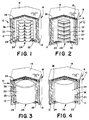
- Figure 1 is a perspective, cutaway view of a packed storage module including drums in accordance with the present invention.
- FIG. 2 is a perspective, cutaway view of another packed module with low specific activity boxes in accordance with the present invention.
- Figure 3 is another perspective, cutaway view of a packed module with a high integrity container in accordance with the present invention.
- Figure 4 is yet another perspective, cutaway view of a module packed in accordance with the invention with a liner.
- a storage module 10 is described as follows:
- the storage module 10 includes a container 12 formed of reinforced concrete and defining a bottom and sidewalls.
- the container 12 is closed off, as illustrated in each of the figures, by a lid 14 placed atop the upper most edges of the container 12.
- the lid 14 is removably attached to the container 12 for purposes as will become more apparent below, by way of an upstanding ridge 13 on container 12 and a parametric recess 15 on the lid 14.
- Such a connection provides a secure placement of the lid 14 on the container 12, wherein the weight of lid 14 adequately ensures that the lid 14 will not fall off, while the lid 14 can be removed with the aid of equipment (not shown), such as a hoist or crane.
- the storage modules 10 are shaped as a hexagonal prism.
- Each of the sides of the hexagon are illustrated as substantially flat side 16, and between each of the sides 16 is corner side 18.
- the sides 16 of adjacent modules 10 abut one another to define a honeycomb-type arrangement when viewed as a plan view from above.
- the corner sides 18 make small gaps between the abutting modules 10 when they are stacked in a module array, wherein the small spaces are large enough to receive recovery tools (not shown) for the retrieval of one of the modules should such recovery become desirable.
- the formed spaces are small enough so that when the module array is covered in a burial facility, no significant amount of soil subsidence will occur.
- each container 12 In order to facilitate movement of the storage modules either before they are filled or afterward, the bottom of each container 12 is provided with forklift grooves 22, of which one is clearly illustrated in each figure. Thus, the module can be effectively handled by a conventional forklift or a shielded forklift (not shown) as necessary, when dealing with high levels of radiation.
- a steel reinforcing mesh 24 is formed within the walls of both the container 12 and the lid 14. The reinforcing mesh 24 is provided within the concrete at the time the container 12 and lid 14 are formed, as is conventionally known.
- the sidewalls 16 and 18 define an interior space 20, which is preferably cylindrical.
- the walls of the container 12 are at least 76.20 millimeters (mm) thick and the cylindrical interior space 20 of the container 16 is at least 1905.00 mm in diameter.
- at least one waste container 26 is provided within the interior space 20, at least one waste container 26 is provided.
- FIG 1 several stacks of steel drums 28 are illustrated, wherein there are preferably seven stacks of two drums per stack.
- a stack of low specific activity boxes 30 is illustrated wherein there may be several stacks with a plurality of boxes per stack depending on the size of each box 30.
- a high integrity container 32 is illustrated in Figure 3, wherein only a single container is illustrated for the purpose of holding a relatively large amount of waste material.
- each of the above-mentioned containers whether being steel drums 28, low specific activity boxes 30 or the integrity container 32 are designed in accordance with the type of waste to be held therein in accordance with well known standards.
- the walls of the high integrity container 32 are made of sufficient thickness and of the proper material for the storage of highly radioactive wastes.
- a liner 34 can be included. Within the liner 34, other waste containers can be provided, wherein the liner 34 provides an additional barrier layer.
- a void space is created in the cylindrical interior space 20 between the waste containers or packages 26 and sides of the container 12, which according to the present invention is filled with a particulate filler granular fill material 36.
- This granular fill material is packed around the waste containers of packages 26 so that the waste containers 26 are substantially immobilized within the module 10 and the waste packages 26 will not move around within the module 10 during transportation and disposal.
- the granular fill material 36 is basically similar to a cementitious grout, which has been used in the prior art, for immobilizing waste packages within a storage module.
- the granular fill of the present invention provides additional advantageous features which could not be obtained by the use of hardenable material such as cement.
- the granular fill 36 occupies the void space to act as an active barrier, which is capable of chemical and physical action should any liquid either enter the module from outside at the disposal site or as a result of leakage of waste from the waste package therein. Moreover, the granular fill enhances the retrievability of the waste packages of the module at any point in the future, if a problem were to arise, i.e. leakage, or if technology advances to a point where the waste could be treated in a better way.
- the granular fill material 36 also will occupy all void spaces around each of the waste packages therein, wherein as viewed in Figure 1, the granular fill 36 effectively fills between the columns of drums 28 as well as the area between the drums and the walls of the container 12. Finally, the granular fill 36 will help to prevent subsidence from occurring around the burial site if the walls of the container should break. Thus, the security of the waste packages in the modules 10 are guaranteed, while still providing easy retrievability of a waste container should it become desirable.
- the granular fill is comprised of a number of constituents which together create a barrier for immobilization of wastes and retention of liquids that may enter the granular fill area of the module 10.
- the first material, used as a base medium is sand in an amount ranging from approximately 20% to 80%, which provides the bulk of the filler into which the other constituents can be mixed.
- the granular fill will contain approximately 50% by volume of sand.
- Another major component of the granular fill is a bentonite clay of an amount from 10% to 40% by volume.
- the bentonite clay is of the type known as Wyoming bentonite, which is a montmorillonite clay.
- the Wyoming bentonite is capable of absorbing liquids, and in fact can absorb several times its own volume of water, which is a main ingredient of any liquid leakage. Thus, any liquids leaking from a waste package 26 or any element of the waste which may leach into water that gets into the module 10 from the environment can be absorbed.
- Wyoming bentonite is also capable of absorbing nuclides in solution, which is important when storing radioactive wastes.
- Another major constituent of granular fill 36 is a material known as Fuller's earth in an amount from 10% to 40% by volume for the purpose of absorbing organic liquids.
- Fuller's earth is a grain clay consisting of hydrated aluminum silicates which can be provided as a particulate solid absorbent material having an affinity for organic solvents to supplement the Wyoming bentonite.
- the granular fill 36 may also contain a particulate solid for acid neutralization in an amount from approximately 0% to 25%.
- a particulate solid preferably is quicklime, CaO.
- the quicklime will provide acid neutralization to effectively chain mineral acids released from fluid leakage into calcium salts.
- the quicklime also will absorb water, wherein the quicklime will be converted to slaked lime, CA(OH)2.
- the slaked lime will then still retain the acid neutralizing capacity for the granular fill.
- slaked lime CA(OH)2 can be the original acid neutralizing ingredient mixed with the granular fill wherein the slaked lime will act as an effective acid neutralizer while the heat release incidental to the reaction of quicklime, CaO, with water would be eliminated. However, the water absorbing quality would likewise be removed.
- the granular fill may also contain a material known as a getter of an amount from approximately 0% to 25%.
- This getter material adsorbs radionuclides by capturing the radionuclides on an external surface of the resin beads.
- the getter is selected to supplement the absorbative capacity of the bentonite which is already capable of waste absorption of nuclides in solution.
- the getter is selected from any of the minerals of the zeolite group of minerals, such as analcime, chabazite, natrolite, and stilbite.
- each of the constituent materials and the base sand of the granular fill 36 it is preferable that each of the materials are of a similar fineness relative to each other. This facilitates the mixing of the constituents as well as the filling of the void space within a storage module 10 and the packing of the granular fill around the waste containers. When packing the granular fill, it is contemplated to simply tap the granular fill tightly within the module 10 or to additionally utilize a vibrator.
- the granular fill 36 will enhance retrievability in the event that a waste package needs to be removed from module 10 in contradistinction to a cementitious material or grout.
- the granular fill can actually provide a greater shielding than a grout or cement if the granular fill is denser as it is packed within the module 10.
- the liquid would necessarily leak into the entire volume of the granular fill wherein the granular constituents would prevent any radionuclides from migrating. If concrete with a cement grout were to crack, a leak path would be created for radionuclides to migrate to the surrounding environment, the prevention of which is one of the major goals achieved by the present invention.
- the storage module 10 can be used to hold any number of other types of hazardous wastes and wastes of varying degree of radioactivity from a nuclear power plant.
- the containers for the wastes would be designed in accordance with the waste product stored therein.
- the granular fill 36 advantageously can be packed to surround any shape of container and act as an effective barrier in both the physical and chemical sense for preventing leakage of waste elements, such as radionuclides, from the waste packages.
- Other granular material constituents could also be added to the granular fill in appropriate proportion if it were necessary together counteract or absorb a specific element not provided for above with regard to nuclear waste.
Landscapes
- Engineering & Computer Science (AREA)
- Physics & Mathematics (AREA)
- General Engineering & Computer Science (AREA)
- High Energy & Nuclear Physics (AREA)
- Environmental & Geological Engineering (AREA)
- Processing Of Solid Wastes (AREA)
- Solid-Sorbent Or Filter-Aiding Compositions (AREA)
Claims (15)
- Lagerungsmodul (10) zur Lagerung von nuklearem Abfallmaterial mit einem inneren Hohlraum (20), der durch Seitenwände (16) und einen Boden definiert ist, integral aus Zement gebildet, und einem Deckel (14), der den inneren Hohlraum (20) entfernbar abschließt, wobei wenigstens ein Abfallbehälter (26) in dem inneren Hohlraum (20) vorgesehen ist, und ein körniges Füllmaterial (36) vorgesehen ist, um wenigstens teilweise eine zwischen dem Abfallbehälter (26) und dem Modul (10) definierte Lücke zu füllen, wobei das körnige Füllmaterial (36) durch von 20% bis 80% eines Sandfüllstoffs gekennzeichnet ist, einen wasserabsorbierenden Ton von 10% bis 40%, und ein organisches flüssigkeitsabsorbierendes Material.
- Lagerungsmodul (10) nach Anspruch 1, weiterhin gekennzeichnet durch ein Säureneutralisierendes Material in einer Menge bis zu 25%.
- Lagerungsmodul (10) nach Anspruch 2, in dem das Säureneutralisierende Material gebrannten Kalk einschließt, um Säuren zu neutralisieren und Wasser zu absorbieren.
- Lagerungsmodul (10) nach Anspruch 2, in dem das Säureneutralisierende Material gelöschten Kalk einschließt.
- Lagerungsmodul (10) nach Anspruch 1 oder 2, weiterhin gekennzeichnet durch ein Gettermaterial, das Radionuklide in einer Menge bis zu 25% absorbiert.
- Lagerungsmodul (10) nach Anspruch 5, in dem das Gettermaterial ein Zeolitmineral ist.
- Lagerungsmodul (10) nach Anspruch 1, in dem der wasserabsorbierende Ton aus Bentonit besteht.
- Lagerungsmodul (10) nach Anspruch 1, in dem das organische flüssigkeitsabsorbierende Material Bleicherde ist.
- Lagerungsmodul (10) nach Anspruch 7, weiterhin gekennzeichnet durch ein Säureneutralisierendes Material einer Menge bis zu 25%, das wenigstens gebrannten Kalk oder gelöschten Kalk umfasst, und ein Gettermaterial, das Radionuklide einer Menge bis zu 25% absorbiert, das ein Zeolitmineral umfasst.
- Verfahren zur Lagerung wenigstens eines Abfallbehälters (26) mit darin gelagertem nuklearem Abfallmaterial, wobei das Verfahren durch die folgenden Schritte gekennzeichnet ist:
der Abfallbehälter (26) wird in einen inneren Hohlraum (20) eines Lagerungsmoduls (10) gebracht, wobei der innere Hohlraum (20) von Seitenwänden (16) und einem Boden definiert ist, die aus Zement des Lagerungsmoduls (10) gebildet sind, und eine Lücke wird zwischen dem Abfallbehälter (26) und dem Modul (10) geschaffen,
die Lücke wird wenigstens teilweise mit einem körnigen Füllmaterial (36) gefüllt, das aus einer Mischung aus Sand, wasserabsorbierendem Ton und einem Material zum Absorbieren organischer Flüssigkeiten besteht, um den Abfallbehälter (26) mit dem Modul (10) im wesentlichen stillzulegen;
das körnige Füllmaterial (36) wird um den Abfallbehälter gepackt;
der innere Hohlraum (20) wird abgeschlossen, indem ein Betondeckel (14) entfernbar an dem Lagerungsmodul (10) befestigt wird; und der Lagerungsmodul (10) wird mit dem Abfallbehälter (26) und dem körnigen Füllmaterial (36) an einer Abfallendlagerstelle gelagert. - Verfahren nach Anspruch 10, in dem der Schritt des Füllens der Lücke mit dem körnigen Füllmaterial (36), durch den Schritt gekennzeichnet ist, 20 Volumen% bis 80 Volumen% Sand als Grundmittel mit anderen. Bestandteilen zusammenzumischen, die Bentonitton von 10 % bis 40% und Fullererde von 10% bis 40% einschließen.
- Verfahren nach Anspruch 10, in dem der Schritt des Füllens der Lücke mit dem körnigen Füllmaterial (36) weiterhin durch den Schritt gekennzeichnet ist, ein Säureneutralisierungsmittel als einen anderen Bestandteil zu mischen, der wenigstens eines der Gruppe von gebranntem Kalk und gelöschtem Kalk umfasst.
- Verfahren nach Anspruch 10 oder 11, in dem der Schritt des Füllens der Lücke mit dem körnigen Füllmaterial (36) weiterhin durch den Schritt gekennzeichnet ist, einen Getter von Radionukliden als einen anderen Bestandteil zu mischen, der ein Zeolitmineral umfasst.
- Verfahren nach Anspruch 10, in dem der Schritt des Füllens der Lücke mit dem körnigen Füllmaterial (36) durch Anordnen einer Vielzahl von Abfallbehältern (26) in den inneren Hohlraum (20) gekennzeichnet ist, und das körnige Füllmaterial (36) in die Lücke um die Vielzahl von Abfallbehältern (36) gefüllt wird, um im wsesentlichen alle Abfallbehälter (26) stillzulegen.
- Verfahren nach Anspruch 10, in dem der Schritt des Füllens der Lücke mit einem körnigem Füllmaterial (36) durch praktisch vollständiges Füllen der Lücke mit dem körnigen Füllmaterial (36) gekennzeichnet ist, so daß, wenn der Deckel (14) den inneren Hohlraum (20) abschließt, der Lagerungsmodul (10) im wesentlichen ganz voll ist.
Applications Claiming Priority (2)
| Application Number | Priority Date | Filing Date | Title |
|---|---|---|---|
| US331341 | 1989-03-31 | ||
| US07/331,341 US4950426A (en) | 1989-03-31 | 1989-03-31 | Granular fill material for nuclear waste containing modules |
Publications (3)
| Publication Number | Publication Date |
|---|---|
| EP0390375A2 EP0390375A2 (de) | 1990-10-03 |
| EP0390375A3 EP0390375A3 (de) | 1991-04-10 |
| EP0390375B1 true EP0390375B1 (de) | 1995-03-08 |
Family
ID=23293553
Family Applications (1)
| Application Number | Title | Priority Date | Filing Date |
|---|---|---|---|
| EP90302799A Expired - Lifetime EP0390375B1 (de) | 1989-03-31 | 1990-03-15 | Körniges Füllmaterial für Module, die nukleare Abfälle enthalten |
Country Status (7)
| Country | Link |
|---|---|
| US (1) | US4950426A (de) |
| EP (1) | EP0390375B1 (de) |
| JP (1) | JPH02287199A (de) |
| KR (1) | KR100198834B1 (de) |
| CA (1) | CA2013507A1 (de) |
| DE (1) | DE69017488T2 (de) |
| ES (1) | ES2071011T3 (de) |
Cited By (2)
| Publication number | Priority date | Publication date | Assignee | Title |
|---|---|---|---|---|
| DE102014002390B3 (de) * | 2014-02-24 | 2015-05-13 | Cura Ingenieurgesellschaft Mbh | Behälter zur Lagerung von radioaktivem Abfall |
| WO2022159502A1 (en) * | 2021-01-19 | 2022-07-28 | Deep Isolation, Inc. | Supporting hazardous waste canisters in drillholes |
Families Citing this family (44)
| Publication number | Priority date | Publication date | Assignee | Title |
|---|---|---|---|---|
| US5849364A (en) * | 1989-05-10 | 1998-12-15 | New Waste Concepts, Inc. | Self-foaming sprayable composition |
| US5556033A (en) * | 1989-05-10 | 1996-09-17 | New Waste Concepts, Inc. | Apparatus for forming a foamed outdoor protective cover layer |
| EP0404999B1 (de) * | 1989-06-30 | 1992-12-16 | Jost-Ulrich Kügler | Verfahren zur Herstellung einer Abdichtung bei Deponien oder dergleichen |
| US5385429A (en) * | 1991-03-25 | 1995-01-31 | Landfill Service Corporation | Synthetic cover for waste |
| US5161915A (en) * | 1991-03-25 | 1992-11-10 | Landfill Service Corporation | Synthetic cover for waste piles |
| US5171483A (en) * | 1991-05-16 | 1992-12-15 | Science Applications International Corporation | Method for retrievable/permanent storage of hazardous waste materials |
| DE4123034C2 (de) * | 1991-07-12 | 1995-02-23 | Max Dipl Ing Himmelheber | Endlagerbehälter zur Endlagerung radioaktiver Abfälle |
| GB9123282D0 (en) * | 1991-11-02 | 1991-12-18 | British Nuclear Fuels Plc | A container |
| US5245120A (en) * | 1991-12-27 | 1993-09-14 | Physical Sciences, Inc. | Process for treating metal-contaminated materials |
| FR2690456B1 (fr) * | 1992-04-27 | 1999-12-24 | Commissariat Energie Atomique | Materiau de colmatage, procede de fabrication de ce materiau de colmatage et procede de mise en place de ce materiau sur un site de stockage de conteneurs. |
| GB2295263B (en) * | 1993-08-16 | 1997-07-09 | Nirex Uk Ltd | Repository for radioactive waste-vault backfill |
| GB9316995D0 (en) * | 1993-08-16 | 1993-09-29 | Untited Kingdom Nirex Limited | Repository for radioactive waste-vault backfill |
| US5489739A (en) * | 1993-12-30 | 1996-02-06 | Amoco Corporation | Method for disposing naturally occurring radioactive material within a subterranean formation |
| US5402455A (en) * | 1994-01-06 | 1995-03-28 | Westinghouse Electric Corporation | Waste containment composite |
| US5545796A (en) * | 1994-02-25 | 1996-08-13 | Scientific Ecology Group | Article made out of radioactive or hazardous waste and a method of making the same |
| US5464988A (en) * | 1994-11-23 | 1995-11-07 | The United States Of America As Represented By The Department Of Energy | Tritium waste package |
| US5556447A (en) * | 1995-01-23 | 1996-09-17 | Physical Sciences, Inc. | Process for treating metal-contaminated materials |
| FR2736357B1 (fr) * | 1995-07-07 | 1997-08-08 | Commissariat Energie Atomique | Materiau de colmatage et son procede de fabrication |
| DE19545761A1 (de) * | 1995-12-07 | 1997-06-12 | Siemens Ag | Behälter mit einem radioaktiven Körper |
| US5819186A (en) * | 1996-04-26 | 1998-10-06 | Stephens; Patrick J. | Cellular grout radiation barrier |
| US5832392A (en) * | 1996-06-17 | 1998-11-03 | The United States Of America As Represented By The United States Department Of Energy | Depleted uranium as a backfill for nuclear fuel waste package |
| US5695443A (en) * | 1996-07-26 | 1997-12-09 | Brent; Robert W. | High energy radiation emission shelter and method of making the same |
| US6495846B1 (en) | 1999-02-25 | 2002-12-17 | James A. Vaughan | Apparatus and method for nuclear waste storage |
| EP1103984B1 (de) * | 1999-06-19 | 2002-09-18 | GNB Gesellschaft für Nuklear-Behälter mbH | Transport- und/oder Lagerbehälter für radioaktive wärmeentwickelnde Elemente |
| US6435770B1 (en) | 2000-10-20 | 2002-08-20 | Advanced Material Technologies Llc | Method of forming a synthetic cap on a bulk material pile |
| US6973758B2 (en) | 2001-05-14 | 2005-12-13 | Rad Technology, Llc | Shielded structure for radiation treatment equipment and method of assembly |
| US7014059B2 (en) * | 2002-05-17 | 2006-03-21 | Master Lite Security Products, Inc. | Explosion resistant waste container |
| CA2445675A1 (en) * | 2003-10-20 | 2005-04-20 | Yanzhong Wu | Composition and method for forming a sprayable materials cover |
| US7472661B2 (en) * | 2004-06-23 | 2009-01-06 | Aquablok, Ltd | Method of delivering plant seed material |
| DE102004035277B4 (de) * | 2004-07-21 | 2006-07-13 | Ghattas, Nader Khalil, Prof. Dr. | Mehrsperrenbehälter für radioaktiven Müll |
| RU2357307C1 (ru) * | 2007-07-30 | 2009-05-27 | Федеральное государственное унитарное предприятие "Российский Федеральный Ядерный Центр-Всероссийский Научно-Исследовательский Институт Технической Физики имени академика Е.И. Забабахина" (ФГУП "РФЯЦ-ВНИИТФ им. академ. Е.И. Забабахина") | Способ упаковки отработанного ядерного топлива |
| KR100870741B1 (ko) | 2008-05-14 | 2008-11-26 | 주식회사 계림폴리콘 | 폴리에틸렌(pe)고건전성 용기를 보관하는 덧포장 용기 |
| CN101303907B (zh) * | 2008-06-23 | 2011-11-16 | 西南科技大学 | 一种放射性废物处置回填材料及其制备方法 |
| US8597471B2 (en) | 2010-08-19 | 2013-12-03 | Industrial Idea Partners, Inc. | Heat driven concentrator with alternate condensers |
| RU2459294C1 (ru) * | 2011-01-19 | 2012-08-20 | Открытое акционерное общество "Российский концерн по производству электрической и тепловой энергии на атомных станциях" (ОАО "Концерн Росэнергоатом") | Способ упаковки поврежденного отработавшего ядерного топлива |
| JP5933930B2 (ja) * | 2011-04-18 | 2016-06-15 | 国立大学法人群馬大学 | 止水性充填材、該止水性充填材による人工多重バリア用充填材 |
| DE202011102838U1 (de) * | 2011-07-02 | 2011-12-27 | Ewald von Hagen | Strahlenschutz-Versatz zur Verhinderung & Austritt radioaktiver Strahlung im Bergbau |
| DE102011122745A1 (de) | 2011-12-29 | 2013-07-04 | Sebastian Oberwalder | Materialkombination zur Abschirmung von radioaktiver Strahlung, insbesondere Röntgen- und Gammastrahlung, sowie die Verwendung dieses Materials zur Herstellung von Behältern für radioaktive Materialien sowie zur Abschirmung von Räumen |
| ITRM20120230A1 (it) * | 2012-05-21 | 2013-11-22 | Sogin Societa Gestione Impianti Nuc Leari Spa | Sviluppo di una speciale matrice vetrosa avente particolari proprieta chimico fisiche e nucleari per l utilizzo in un processo di messa in sicurezza mediante inglobamento di un elemento combustibile nucleare irraggiato danneggiato a seguito di evento |
| US20140044227A1 (en) * | 2012-08-13 | 2014-02-13 | Transnuclear, Inc. | Composite basket assembly |
| WO2015075751A1 (en) | 2013-11-21 | 2015-05-28 | So.G.I.N. - Societa' Gestione Impianti Nucleari | Glass for the containment of radioactive elements and highly toxic and hazardous wastes and procedure of containment by said glass |
| JP6757103B2 (ja) * | 2018-06-15 | 2020-09-16 | 卯 石井 | 放射線透過低減容器 |
| JP6978013B2 (ja) * | 2018-06-15 | 2021-12-08 | 卯 石井 | 放射線透過低減容器 |
| GB2624847A (en) * | 2022-09-03 | 2024-06-05 | Mcleod Neil | Methodology for the treatment of radionuclide contaminated soils and groundwaters |
Family Cites Families (18)
| Publication number | Priority date | Publication date | Assignee | Title |
|---|---|---|---|---|
| NL271326A (de) * | 1958-12-31 | |||
| US3196619A (en) * | 1961-04-19 | 1965-07-27 | Continental Oil Co | Method for disposing of harmful organic waste materials |
| DE3011602A1 (de) * | 1980-03-26 | 1981-10-08 | Kernforschungsanlage Jülich GmbH, 5170 Jülich | Verfahren und vorrichtung zur endlagerung von tritium, insbesondere tritiumabfaellen aus kernkraftwerken, mit der moeglichkeit der tritiumrueckgewinnung |
| DE3012561A1 (de) * | 1980-03-31 | 1981-10-08 | Uwe Ing.(grad.) 6458 Rodenbach Grahmann | Entlagerungsgebinde zum beseitigen radioaktiver abfaelle |
| US4377509A (en) * | 1980-07-14 | 1983-03-22 | The United States Of America As Represented By The Secretary Of The Navy | Packaging for ocean disposal of low-level radioactive waste material |
| US4350461A (en) * | 1980-12-03 | 1982-09-21 | Stabatrol Corporation | Multiple waste disposal vaults |
| JPS57197500A (en) * | 1981-05-29 | 1982-12-03 | Hitachi Ltd | Method of solidifying radioactive waste pellet |
| US4416810A (en) * | 1981-07-30 | 1983-11-22 | Noakes John E | Disposal of radioactive aromatic liquid wastes |
| GB2125610B (en) * | 1982-08-04 | 1985-10-16 | Atomic Energy Authority Uk | Containers for use in the contained dumping of radioactive waste |
| US4681706A (en) * | 1984-07-05 | 1987-07-21 | Westinghouse Electric Corp. | Nuclear waste packaging facility |
| US4784802A (en) * | 1984-07-05 | 1988-11-15 | Westinghouse Electric Corp. | Nuclear waste disposal site |
| US4775494A (en) * | 1985-06-10 | 1988-10-04 | Rowsell Farrell D | Hazardous and radioactive liquid waste disposal method |
| US4778627A (en) * | 1986-01-13 | 1988-10-18 | James William Ayres | Disposable hazardous and radioactive liquid hydrocarbon waste composition and method |
| US4781860A (en) * | 1986-01-13 | 1988-11-01 | James W. Ayres | Disposable hazardous and radioactive liquid aqueous waste composition and method |
| US4770715A (en) * | 1986-05-02 | 1988-09-13 | Wormald, U.S., Inc. | Novel compositions and method for control and clean-up of hazardous organic spills |
| US4778628A (en) * | 1986-05-15 | 1988-10-18 | The United States Of America As Represented By The United States Department Of Energy | Underground waste barrier structure |
| US4842774A (en) * | 1987-08-07 | 1989-06-27 | The United States Of America As Represented By The United States Department Of Energy | Pyramiding tumuli waste disposal site and method of construction thereof |
| US4844840A (en) * | 1987-08-14 | 1989-07-04 | Bechtel Group, Inc. | Method and structure for hazardous waste containment |
-
1989
- 1989-03-31 US US07/331,341 patent/US4950426A/en not_active Expired - Lifetime
-
1990
- 1990-03-15 DE DE69017488T patent/DE69017488T2/de not_active Expired - Fee Related
- 1990-03-15 EP EP90302799A patent/EP0390375B1/de not_active Expired - Lifetime
- 1990-03-15 ES ES90302799T patent/ES2071011T3/es not_active Expired - Lifetime
- 1990-03-30 KR KR1019900004339A patent/KR100198834B1/ko not_active Expired - Fee Related
- 1990-03-30 JP JP2087303A patent/JPH02287199A/ja active Pending
- 1990-03-30 CA CA002013507A patent/CA2013507A1/en not_active Abandoned
Cited By (4)
| Publication number | Priority date | Publication date | Assignee | Title |
|---|---|---|---|---|
| DE102014002390B3 (de) * | 2014-02-24 | 2015-05-13 | Cura Ingenieurgesellschaft Mbh | Behälter zur Lagerung von radioaktivem Abfall |
| WO2022159502A1 (en) * | 2021-01-19 | 2022-07-28 | Deep Isolation, Inc. | Supporting hazardous waste canisters in drillholes |
| EP4260345A4 (de) * | 2021-01-19 | 2024-06-05 | Deep Isolation, Inc. | Unterstützung von kanistern für gefährliche abfälle in bohrlöchern |
| AU2022210417B2 (en) * | 2021-01-19 | 2025-12-11 | Deep Isolation, Inc. | Supporting hazardous waste canisters in drillholes |
Also Published As
| Publication number | Publication date |
|---|---|
| DE69017488D1 (de) | 1995-04-13 |
| EP0390375A3 (de) | 1991-04-10 |
| JPH02287199A (ja) | 1990-11-27 |
| CA2013507A1 (en) | 1990-09-30 |
| EP0390375A2 (de) | 1990-10-03 |
| KR100198834B1 (ko) | 1999-06-15 |
| ES2071011T3 (es) | 1995-06-16 |
| US4950426A (en) | 1990-08-21 |
| DE69017488T2 (de) | 1995-09-28 |
| KR900015179A (ko) | 1990-10-26 |
Similar Documents
| Publication | Publication Date | Title |
|---|---|---|
| EP0390375B1 (de) | Körniges Füllmaterial für Module, die nukleare Abfälle enthalten | |
| CA1259805A (en) | Underground waste barrier structure | |
| JPS5915841B2 (ja) | キケンナコケイブツシツオホカンスルタメノホウソソウタイ オヨビ ソノホウソウタイオケイセイスルホウホウ | |
| JP4919528B1 (ja) | 放射性セシウムによる汚染物の収納容器、及び放射性セシウムによる汚染物の収納方法 | |
| US4845372A (en) | Nuclear waste packing module | |
| US4861194A (en) | Waste disposal system | |
| US5125532A (en) | System for the permanent storage of radioactive wastes | |
| JP2014228470A (ja) | 放射性核種含有水の浄化壁及び土壌汚染の防止方法 | |
| US5171483A (en) | Method for retrievable/permanent storage of hazardous waste materials | |
| EP1171888B1 (de) | Abfallbehälter | |
| JPS6221100A (ja) | 放射性廃棄物の地中処分方法 | |
| JPS5871498A (ja) | 放射性廃棄物封入のコンクリ−ト構造体 | |
| KR930008247B1 (ko) | 핵 폐기물 포장 모듈 | |
| KR102706456B1 (ko) | 방사성폐기물 표층처분시설 처분 드럼의 부유방지와 위치 고정을 위한 구속 장치 | |
| JPH01274098A (ja) | 放射性廃棄物の処理方法 | |
| JPS63194789A (ja) | 廃棄物用ピツト | |
| KR101434458B1 (ko) | 방사성 폐기물 포장 용기 | |
| JPS6337300A (ja) | 放射性廃棄物の収容方法 | |
| Pulkkinen et al. | Costs of reactor waste management for Swedish nuclear power plants | |
| John | Policy and Techniques of Radioactive waste Management | |
| JPH055080B2 (de) | ||
| Dragičević et al. | New Radioactive Waste Packaging Type and Storage System at the Krško NPP | |
| Forsberg | Regional waste treatment with monolith disposal for low-level radioactive waste | |
| Olden et al. | An Application of Conventional Building Technology in the Storage of LowLevel Solid Reactor Wastes | |
| Lange | Intrusion resistant underground structure (IRUS): design and operations |
Legal Events
| Date | Code | Title | Description |
|---|---|---|---|
| PUAI | Public reference made under article 153(3) epc to a published international application that has entered the european phase |
Free format text: ORIGINAL CODE: 0009012 |
|
| AK | Designated contracting states |
Kind code of ref document: A2 Designated state(s): DE ES FR GB |
|
| PUAL | Search report despatched |
Free format text: ORIGINAL CODE: 0009013 |
|
| AK | Designated contracting states |
Kind code of ref document: A3 Designated state(s): DE ES FR GB |
|
| 17P | Request for examination filed |
Effective date: 19911007 |
|
| 17Q | First examination report despatched |
Effective date: 19931001 |
|
| GRAA | (expected) grant |
Free format text: ORIGINAL CODE: 0009210 |
|
| AK | Designated contracting states |
Kind code of ref document: B1 Designated state(s): DE ES FR GB |
|
| ET | Fr: translation filed | ||
| REF | Corresponds to: |
Ref document number: 69017488 Country of ref document: DE Date of ref document: 19950413 |
|
| REG | Reference to a national code |
Ref country code: ES Ref legal event code: FG2A Ref document number: 2071011 Country of ref document: ES Kind code of ref document: T3 |
|
| PLBE | No opposition filed within time limit |
Free format text: ORIGINAL CODE: 0009261 |
|
| STAA | Information on the status of an ep patent application or granted ep patent |
Free format text: STATUS: NO OPPOSITION FILED WITHIN TIME LIMIT |
|
| 26N | No opposition filed | ||
| PGFP | Annual fee paid to national office [announced via postgrant information from national office to epo] |
Ref country code: GB Payment date: 19970205 Year of fee payment: 8 |
|
| PG25 | Lapsed in a contracting state [announced via postgrant information from national office to epo] |
Ref country code: GB Free format text: LAPSE BECAUSE OF NON-PAYMENT OF DUE FEES Effective date: 19980315 |
|
| GBPC | Gb: european patent ceased through non-payment of renewal fee |
Effective date: 19980315 |
|
| PGFP | Annual fee paid to national office [announced via postgrant information from national office to epo] |
Ref country code: ES Payment date: 20000314 Year of fee payment: 11 |
|
| PG25 | Lapsed in a contracting state [announced via postgrant information from national office to epo] |
Ref country code: ES Free format text: LAPSE BECAUSE OF NON-PAYMENT OF DUE FEES Effective date: 20010316 |
|
| PGFP | Annual fee paid to national office [announced via postgrant information from national office to epo] |
Ref country code: FR Payment date: 20020221 Year of fee payment: 13 |
|
| PGFP | Annual fee paid to national office [announced via postgrant information from national office to epo] |
Ref country code: DE Payment date: 20020320 Year of fee payment: 13 |
|
| REG | Reference to a national code |
Ref country code: ES Ref legal event code: FD2A Effective date: 20030303 |
|
| PG25 | Lapsed in a contracting state [announced via postgrant information from national office to epo] |
Ref country code: DE Free format text: LAPSE BECAUSE OF NON-PAYMENT OF DUE FEES Effective date: 20031001 |
|
| PG25 | Lapsed in a contracting state [announced via postgrant information from national office to epo] |
Ref country code: FR Free format text: LAPSE BECAUSE OF NON-PAYMENT OF DUE FEES Effective date: 20031127 |
|
| REG | Reference to a national code |
Ref country code: FR Ref legal event code: ST |