EP0390634A1 - Microspheres composites magnetisables de polymere reticule hydrophobe, leur procédé de préparation et leur application en biologie - Google Patents
Microspheres composites magnetisables de polymere reticule hydrophobe, leur procédé de préparation et leur application en biologie Download PDFInfo
- Publication number
- EP0390634A1 EP0390634A1 EP90400705A EP90400705A EP0390634A1 EP 0390634 A1 EP0390634 A1 EP 0390634A1 EP 90400705 A EP90400705 A EP 90400705A EP 90400705 A EP90400705 A EP 90400705A EP 0390634 A1 EP0390634 A1 EP 0390634A1
- Authority
- EP
- European Patent Office
- Prior art keywords
- microspheres
- magnetizable
- weight
- crosslinking
- hydrophobic
- Prior art date
- Legal status (The legal status is an assumption and is not a legal conclusion. Google has not performed a legal analysis and makes no representation as to the accuracy of the status listed.)
- Granted
Links
Images

Classifications
-
- G—PHYSICS
- G01—MEASURING; TESTING
- G01N—INVESTIGATING OR ANALYSING MATERIALS BY DETERMINING THEIR CHEMICAL OR PHYSICAL PROPERTIES
- G01N33/00—Investigating or analysing materials by specific methods not covered by groups G01N1/00 - G01N31/00
- G01N33/48—Biological material, e.g. blood, urine; Haemocytometers
- G01N33/50—Chemical analysis of biological material, e.g. blood, urine; Testing involving biospecific ligand binding methods; Immunological testing
- G01N33/53—Immunoassay; Biospecific binding assay; Materials therefor
- G01N33/543—Immunoassay; Biospecific binding assay; Materials therefor with an insoluble carrier for immobilising immunochemicals
- G01N33/54313—Immunoassay; Biospecific binding assay; Materials therefor with an insoluble carrier for immobilising immunochemicals the carrier being characterised by its particulate form
- G01N33/54326—Magnetic particles
- G01N33/5434—Magnetic particles using magnetic particle immunoreagent carriers which constitute new materials per se
-
- C—CHEMISTRY; METALLURGY
- C08—ORGANIC MACROMOLECULAR COMPOUNDS; THEIR PREPARATION OR CHEMICAL WORKING-UP; COMPOSITIONS BASED THEREON
- C08F—MACROMOLECULAR COMPOUNDS OBTAINED BY REACTIONS ONLY INVOLVING CARBON-TO-CARBON UNSATURATED BONDS
- C08F292/00—Macromolecular compounds obtained by polymerising monomers on to inorganic materials
-
- C—CHEMISTRY; METALLURGY
- C08—ORGANIC MACROMOLECULAR COMPOUNDS; THEIR PREPARATION OR CHEMICAL WORKING-UP; COMPOSITIONS BASED THEREON
- C08K—Use of inorganic or non-macromolecular organic substances as compounding ingredients
- C08K9/00—Use of pretreated ingredients
- C08K9/10—Encapsulated ingredients
-
- G—PHYSICS
- G01—MEASURING; TESTING
- G01N—INVESTIGATING OR ANALYSING MATERIALS BY DETERMINING THEIR CHEMICAL OR PHYSICAL PROPERTIES
- G01N2446/00—Magnetic particle immunoreagent carriers
- G01N2446/20—Magnetic particle immunoreagent carriers the magnetic material being present in the particle core
-
- G—PHYSICS
- G01—MEASURING; TESTING
- G01N—INVESTIGATING OR ANALYSING MATERIALS BY DETERMINING THEIR CHEMICAL OR PHYSICAL PROPERTIES
- G01N2446/00—Magnetic particle immunoreagent carriers
- G01N2446/30—Magnetic particle immunoreagent carriers the magnetic material being dispersed in the polymer composition before their conversion into particulate form
-
- G—PHYSICS
- G01—MEASURING; TESTING
- G01N—INVESTIGATING OR ANALYSING MATERIALS BY DETERMINING THEIR CHEMICAL OR PHYSICAL PROPERTIES
- G01N2446/00—Magnetic particle immunoreagent carriers
- G01N2446/60—Magnetic particle immunoreagent carriers the magnetic material being dispersed in a medium other than the main solvent prior to incorporation into the polymer particle
- G01N2446/64—Magnetic material dispersed in oil drop
-
- G—PHYSICS
- G01—MEASURING; TESTING
- G01N—INVESTIGATING OR ANALYSING MATERIALS BY DETERMINING THEIR CHEMICAL OR PHYSICAL PROPERTIES
- G01N2446/00—Magnetic particle immunoreagent carriers
- G01N2446/60—Magnetic particle immunoreagent carriers the magnetic material being dispersed in a medium other than the main solvent prior to incorporation into the polymer particle
- G01N2446/66—Magnetic material dispersed in surfactant
-
- G—PHYSICS
- G01—MEASURING; TESTING
- G01N—INVESTIGATING OR ANALYSING MATERIALS BY DETERMINING THEIR CHEMICAL OR PHYSICAL PROPERTIES
- G01N2446/00—Magnetic particle immunoreagent carriers
- G01N2446/80—Magnetic particle immunoreagent carriers characterised by the agent used to coat the magnetic particles, e.g. lipids
- G01N2446/84—Polymer coating, e.g. gelatin
-
- Y—GENERAL TAGGING OF NEW TECHNOLOGICAL DEVELOPMENTS; GENERAL TAGGING OF CROSS-SECTIONAL TECHNOLOGIES SPANNING OVER SEVERAL SECTIONS OF THE IPC; TECHNICAL SUBJECTS COVERED BY FORMER USPC CROSS-REFERENCE ART COLLECTIONS [XRACs] AND DIGESTS
- Y10—TECHNICAL SUBJECTS COVERED BY FORMER USPC
- Y10T—TECHNICAL SUBJECTS COVERED BY FORMER US CLASSIFICATION
- Y10T428/00—Stock material or miscellaneous articles
- Y10T428/29—Coated or structually defined flake, particle, cell, strand, strand portion, rod, filament, macroscopic fiber or mass thereof
- Y10T428/2982—Particulate matter [e.g., sphere, flake, etc.]
- Y10T428/2991—Coated
-
- Y—GENERAL TAGGING OF NEW TECHNOLOGICAL DEVELOPMENTS; GENERAL TAGGING OF CROSS-SECTIONAL TECHNOLOGIES SPANNING OVER SEVERAL SECTIONS OF THE IPC; TECHNICAL SUBJECTS COVERED BY FORMER USPC CROSS-REFERENCE ART COLLECTIONS [XRACs] AND DIGESTS
- Y10—TECHNICAL SUBJECTS COVERED BY FORMER USPC
- Y10T—TECHNICAL SUBJECTS COVERED BY FORMER US CLASSIFICATION
- Y10T428/00—Stock material or miscellaneous articles
- Y10T428/29—Coated or structually defined flake, particle, cell, strand, strand portion, rod, filament, macroscopic fiber or mass thereof
- Y10T428/2982—Particulate matter [e.g., sphere, flake, etc.]
- Y10T428/2991—Coated
- Y10T428/2998—Coated including synthetic resin or polymer
Definitions
- the present invention relates to magnetizable composite microspheres of hydrophobic crosslinked vinylaromatic polymers, as such or in aqueous dispersion, their preparation process and their application in biology in particular.
- magnetizable beads US Patent No. 4,339,337
- the pearls obtained contain magnetizable charges distributed in the polymer matrix.
- composite microspheres formed from a core essentially consisting of magnetizable particles and a shell of hydrophobic polymer.
- the magnetizable composite microspheres of hydrophobic crosslinked vinyl aromatic polymer are characterized in that: - They have a diameter of the order of 0.05 to 10 ⁇ m, preferably of the order of 0.1 to 5 ⁇ m; - they understand : . a core essentially consisting of magnetizable particles having a diameter of less than 300 10 ⁇ 4 ⁇ m and preferably of the order of 50 10 ⁇ 4 to 120 10 ⁇ 4 ⁇ m; .
- a shell consisting of a hydrophobic crosslinked copolymer derived from at least one hydrophobic vinylaromatic monomer and from at least one polyethylenically unsaturated emulsifying polymer soluble in said vinylaromatic monomer (s) and capable of crosslinking with said at least one vinyl aromatic monomer (s).
- a hydrophobic crosslinked copolymer derived from at least one hydrophobic vinylaromatic monomer and from at least one polyethylenically unsaturated emulsifying polymer soluble in said vinylaromatic monomer (s) and capable of crosslinking with said at least one vinyl aromatic monomer (s).
- magnetite magnetite
- hematite chromium dioxide
- ferrites such as manganese, nickel, manganese-zinc ferrites, alloys of cobalt, nickel, gadolinium, samarium-cobalt ...
- the preferred materials are magnetite and hematite.
- the amount of magnetizable particles forming the core corresponds to approximately 0.5 to 70%, preferably to approximately 15 to 60% of the weight of the magnetizable composite microsphere.
- vinyl aromatic monomers mention may be made of those of the styrene, alpha-methylstyrene, ethylstyrene, tert-butylstyrene, vinyltoluene type.
- vinyl aromatic monomers are present alone or as a mixture with each other in any proportion, or alternatively as a mixture with another copolymerizable monomer, insoluble in water, which can constitute up to 50% of the mixture and chosen from diene compounds, such as butadiene , isoprene; alkyl acrylates and methacrylates in which the alkyl group has 3 to 10 carbon atoms; esters of ethylenic acids having 4 or 5 carbon atoms and of alkyl having 1 to 8 carbon atoms, such as: heptyl fumarate, octyl fumarate, methyl itaconate, ethyl itaconate.
- diene compounds such as butadiene , isoprene
- alkyl acrylates and methacrylates in which the alkyl group has 3 to 10 carbon atoms
- esters of ethylenic acids having 4 or 5 carbon atoms and of alkyl having 1 to 8 carbon atoms, such as
- a crosslinking monomer such as for example divinylbenzene, vinyl methacrylate, acrylates or methacrylates of mono or polyalkylene (2- 4C) glycol, triallyl cyanurate, condensates of unsaturated carboxylic acids and polyols, such as, for example, trimethylol propane acrylate and methacrylate.
- a crosslinking monomer such as for example divinylbenzene, vinyl methacrylate, acrylates or methacrylates of mono or polyalkylene (2- 4C) glycol, triallyl cyanurate, condensates of unsaturated carboxylic acids and polyols, such as, for example, trimethylol propane acrylate and methacrylate.
- polyesters of alkylene glycol and of aliphatic and / or aromatic unsaturated diacid examples are polyesters of propylene glycol and maleic anhydride, polyesters of propylene glycol, maleic anhydride and phthalic anhydride.
- the crosslinking emulsifying polymers represent approximately from 3 to 15%, preferably from 5 to 10% of the weight of hydrophobic vinylaromatic monomer.
- hydrophobic vinylaromatic monomer means the group formed by hydrophobic vinylaromatic monomers, their comonomers and their optional crosslinking comonomers.
- the magnetizable composite microspheres forming the subject of the invention can be presented as such or in dispersion in water; the amount of dispersed microspheres corresponds to approximately 10 to 70%, preferably 15 to 50% of the total weight of the dispersion.
- the present invention also relates to a process for the preparation of said magnetizable composite microspheres.
- the process consists of: - dispersing magnetizable particles having a diameter of less than 300 10 ⁇ 4 ⁇ m, preferably of the order of 80 10 ⁇ 4 to 120 10 ⁇ 4 ⁇ m, coated with a monomolecular layer of a non-water-soluble dispersing agent in a mixture consisting of at least one hydrophobic vinyl aromatic monomer, of at least one polyethylenically unsaturated emulsifying polymer soluble in said vinyl aromatic monomer (s) and capable of crosslinking with said vinyl aromatic monomer (s) and optionally a complementary dispersing agent.
- any crosslinking comonomers can be used either in the dispersion stage or in the preemulsion stage (they can then serve as a solvent for the polymerization initiator).
- - "ethylenically unsaturated copolymerizable compounds” the whole formed by the "vinylaromatic monomers” and the crosslinking emulsifying polymer.
- dispersing agents forming a water-soluble mono-molecular coating around the magnetizable particles
- those having a long hydrocarbon chain terminated by a polar group of the type - COOH, NH2, etc. such as fatty acids, fatty amines. containing at least 12 carbon atoms and more particularly C18 fatty acids, such as oleic, linoleic and linolenic acids.
- the magnetizable particles coated with dispersing agent can be prepared for example by peptization in the dispersing agent of magnetic particles obtained by sol-gel route, dispersion in an organic carrier liquid (US Pat. No. 3,843,540) then flocculation with using a polar solvent such as ketone, ester, alcohol and separation of the coated particles.
- a polar solvent such as ketone, ester, alcohol
- the proportions of magnetizable particles represent from 0.5 to 60%, preferably from 15 to 50% of the weight of copolymerizable ethylenically unsaturated compounds.
- the step of dispersing the magnetizable particles is carried out by progressive introduction, with stirring at a temperature of the order of 0 to 30 ° C, of the magnetizable particles coated with a non-water-soluble dispersing agent in the copolymerizable ethylenically unsaturated compounds. If necessary, this step can be carried out in the presence of an additional anionic or cationic dispersing agent; by way of example, mention may be made of phosphoric esters, ethoxylated alkylaromatics, etc .; said agent can be used in a proportion of 3 to 15% of the weight of the copolymerizable ethylenically unsaturated compounds.
- organosoluble polymerization initiator is then introduced into the dispersion, optionally in the form of a solution in a little vinyl aromatic monomer or one of its crosslinking or non-crosslinking comonomers.
- azonitriles such as azobisisobutyronitrile, azobiscyclohexane carbonitrile; or peroxides, such as benzoyl, dicumyl, ditertiobutyl, diacetyl, dioctanoyl, lauroyl, methyl ethyl ketone, caprylyl, 2,4-dichloro-2,4-benzoyl, parachlorobenzoyl peroxides; perpivalate, dietyl-peracetate, tert-butyl perbenzoate; ditertiobutyl diperphthalate; 1,1-ditertiobutyl-peroxide-3,3,5-trimethyl-cyclohexane.
- azonitriles such as azobisisobutyronitrile, azobiscyclohexane carbonitrile
- peroxides such as benzoyl, dicumyl, ditertiobutyl, diace
- the preemulsion step is carried out by homogenization of the magnetic fluid obtained with water, at a temperature lower than that of decomposition of the initiator, using a vigorous stirring system such as a colloid mill, high pressure pump, vibration agitator, ultrasonic device, etc., until an emulsion of magnetic fluid droplets of the order of 0.03 to 10 ⁇ m is obtained, preferably of the order of 0 , 1 to 5 ⁇ m.
- a vigorous stirring system such as a colloid mill, high pressure pump, vibration agitator, ultrasonic device, etc.
- This preemulsion operation is preferably carried out at a pH of the order of 7 to 11.
- the amount of water present is such that the aqueous dispersion of microspheres obtained after copolymerization contains from 10 to 65%, preferably from 10 to 30% of its weight of said microspheres.
- an additional emulsifier may be present; it can be anionic, cationic or non-ionic and used in an amount of 0.1 to 5% by weight relative to that of the ferrofluid to be pre-emulsified.
- anionic emulsifying agents there may be mentioned the salts of fatty acids; alkylsulfates, alkylsulfonates, alkylarylsulfonates, alkylsulfosuccinates, alkaline alkylphosphates; alkyl sulfosuccinates; sulfonates of alkylphenolpolyglycolic ethers; ester salts of alkyl sulfopolycarboxylic acids; the condensation products of fatty acids with oxy- and amino-alkanesulfonic acids; sulfated derivatives of polyglycolic ethers; sulfated esters of fatty acids and polyglycols; alkanolamides of sulfated fatty acids.
- the polymerization operation is carried out at a temperature of the order of 30 to 130 ° C, and preferably of the order of 50 to 85 ° C. It lasts approximately 2 to 10 hours and generally 2 to 5 hours.
- An aqueous dispersion is thus obtained of a mixture of magnetizable composite microspheres and of microspheres not containing magnetizable charges ("white" microspheres), the diameter of which is of the order of 0.05 to 10 ⁇ m, and generally l from 0.1 to 5 ⁇ m.
- the level of magnetizable microspheres can represent from 20 to 90% by weight of the total amount of microspheres. The higher the concentration of magnetizable charges in the microspheres, the greater the quantity of "white" microspheres.
- the separation of the magnetizable microspheres is preferably carried out by magnetization.
- the separate magnetizable microspheres can be redispersed in water to obtain a dispersion containing 10 to 70% by weight, preferably 15 to 50% by weight of magnetizable composite microspheres.
- the magnetizable composite microspheres as such or in aqueous dispersion, described above can be used in biology to immobilize biologically active substances (proteins such as antibodies, enzymes ...; antigens; drugs ...) by adsorption or covalence; depending on the nature of said active substance, the products of the invention can be advantageously used in diagnostic tests (agglutination - "RIA” radioimmunological assay - "IRMA” immunoradiometric assay - "EIA” enzyme immuno assay), in affinity chromatography , as an enzymatic catalyst in biotechnology, as a cell culture support.
- diagnostic tests agglutination - "RIA” radioimmunological assay - "IRMA” immunoradiometric assay - "EIA” enzyme immuno assay
- affinity chromatography as an enzymatic catalyst in biotechnology, as a cell culture support.
- Resin A 123 polycondensates of propylene glycol and maleic and phthalic anhydrides, sold by ORKEM).
- GAFAC RE 610 mixture of mono and phosphoric diesters of ethoxylated alkyl-aryl derivatives, marketed by GAF
- 12.5 g of magnetic pigment consisting of 10 g of Fe3O4 with an average diameter of the order of 80 10 ⁇ 4 to 120 10 ⁇ 4 ⁇ m surfactated with 2.5 g of is gradually introduced into the mixture obtained, with stirring. oleic acid.
- the organic phase obtained is introduced into 230 g of water brought to pH 10 by addition of 1 N potassium hydroxide and dispersed in the aqueous phase using the ULTRA-TURRAX homogenizer (T 45 drive motor, dispersion rod 45 N, generator T 45/66, marketed by PROLABO).
- T 45 drive motor, dispersion rod 45 N, generator T 45/66 marketed by PROLABO.
- the average diameter of the droplets obtained is of the order of 0.4 ⁇ m (measurement using the CILAS 850 laser particle sizer, sold by CILAS).
- the preemulsion obtained is polymerized in a 500 l reactor at 80 ° C for 4 hours under nitrogen.
- the medium is then cooled; during cooling 50 ml of an aqueous solution at 0.5% by weight of sodium lauryl sulphate are added.
- the latex obtained is filtered through a 5 ⁇ m cloth; the residual monomers are removed by stripping using a rotary evaporator.
- the magnetizable microspheres are then separated using a magnet; their level represents approximately 65% of the total weight of microspheres.
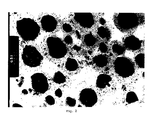
- the magnetizable microspheres have an average diameter of the order of 0.4 ⁇ m and contain 18% of their weight of ferrite particles forming the core of the microspheres, as shown in the photo in Figure No. 1. (cross-section of the microspheres seen under a transmission microscope; magnification 120,000).
- Example 1 The procedure of Example 1 is repeated using the following quantities of the same reagents: 1st step - Resin A 123 6 g - GAFAC RE 610 4 g - Styrene 60g - Magnetic pigment 30g 2nd stage - Dioctanoyl peroxide 0.7 g - Divinylbenzene 1.5g - Organic phase of the 1st stage 40 g - Water at pH 10 200g
- the polymerization conditions are identical; 50% of the weight of the microspheres formed are magnetizable.
- the magnetizable microspheres have an average diameter of the order of 0.6 ⁇ m and contain 43% of their weight of ferrite particles forming the core of the microspheres, as shown in the photo in FIG. 2 (magnification 44,000).
Landscapes
- Health & Medical Sciences (AREA)
- Chemical & Material Sciences (AREA)
- Immunology (AREA)
- Engineering & Computer Science (AREA)
- Life Sciences & Earth Sciences (AREA)
- Medicinal Chemistry (AREA)
- Polymers & Plastics (AREA)
- Organic Chemistry (AREA)
- Hematology (AREA)
- Urology & Nephrology (AREA)
- Chemical Kinetics & Catalysis (AREA)
- Biomedical Technology (AREA)
- Molecular Biology (AREA)
- Analytical Chemistry (AREA)
- Cell Biology (AREA)
- Microbiology (AREA)
- Biotechnology (AREA)
- Materials Engineering (AREA)
- Food Science & Technology (AREA)
- Physics & Mathematics (AREA)
- Inorganic Chemistry (AREA)
- Biochemistry (AREA)
- General Health & Medical Sciences (AREA)
- General Physics & Mathematics (AREA)
- Pathology (AREA)
- Soft Magnetic Materials (AREA)
- Manufacturing Of Micro-Capsules (AREA)
- Medicines Containing Antibodies Or Antigens For Use As Internal Diagnostic Agents (AREA)
- Immobilizing And Processing Of Enzymes And Microorganisms (AREA)
- Polymerisation Methods In General (AREA)
- Compositions Of Macromolecular Compounds (AREA)
- Compounds Of Iron (AREA)
- Processes Of Treating Macromolecular Substances (AREA)
- Powder Metallurgy (AREA)
- Hard Magnetic Materials (AREA)
- Materials For Medical Uses (AREA)
- Saccharide Compounds (AREA)
- Investigating Or Analysing Biological Materials (AREA)
- Addition Polymer Or Copolymer, Post-Treatments, Or Chemical Modifications (AREA)
- Macromonomer-Based Addition Polymer (AREA)
Abstract
Utilisation en biologie.
Description
- La présente invention a pour objet des microsphères composites magnétisables de polymères vinylaromatiques réticulés hydrophobes, telles quelles ou en dispersion aqueuse, leur procédé de préparation et leur application en biologie notamment.
- Il est connu de préparer des perles magnétisables (brevet US n° 4.339.337) de diamètre allant de 0,05 à 3 mm par polymérisation en suspension d'un monomère vinylaromatique en présence d'un amorceur organosoluble, d'un agent de suspension et d'une charge magnétisable dispersée au sein d'une solution dans ledit monomère d'un polymere non hydrosoluble. Les perles obtenues renferment des charges magnétisables réparties dans la matrice de polymère.
- Il a egalement été proposé (brevet US n° 4.358.388) de préparer des latex de polymères hydrophobes magnétisables par homogénéisation d'une solution aqueuse d'émulsifiant et d'une dispersion d'une charge magnétisable dans une phase organique formée d'un amorceur organosoluble , de tout ou partie du monomère hydrophobe et/ou d'un composé organique insoluble dans l'eau, puis polymérisation. Les latex obtenus sont formés de particules de polymère de diamètre d'environ 0,03 à 5 µm renfermant des charges magnétisables réparties dans la matrice polymère, lesdites charges ayant tendance à migrer en périphérie.
- La demanderesse a maintenant trouvé des microsphères composites formées d'un coeur (core) essentiellement constitué de particules magnétisables et d'une écorce (shell) de polymère hydrophobe.
- Selon l'invention les microsphères composites magnétisables de polymère vinylaromatique réticulé hydrophobe sont caractérisées en ce que :
- elles présentent un diamètre de l'ordre de 0,05 à 10 µm, de préférence de l'ordre de 0,1 à 5 µm ;
- elles comprennent :
. un coeur essentiellement constitué de particules magnétisables présentant un diamètre inférieur à 300 10⁻⁴ µm et de préférence de l'ordre de 50 10⁻⁴ à 120 10⁻⁴ µm ;
. et une écorce constituée d'un copolymère réticulé hydrophobe dérivé d'au moins un monomètre vinylaromatique hydrophobe et d'au moins un polymère émulsifiant polyéthyléniquement insaturé soluble dans ledit ou lesdits monomère(s) vinylaromatique(s) et susceptible de réticuler avec ledit ou lesdits monomère(s) vinylaromatique(s).
Parmi les matériaux pouvant constituer les particules magnétisables formant le coeur des microsphères, on peut citer la magnétite, l'hématite, le dioxyde de chrome, les ferrites telles que les ferrites de manganèse, nickel, manganèse-zinc ..., les alliages de cobalt, nickel, gadolinium, samarium-cobalt ... Les matériaux préférentiels sont la magnétite et la l'hématite. - La quantité de particules magnétisables formant le coeur correspond à environ 0,5 à 70 %, de préférence à environ 15 à 60 % du poids de la microsphère composite magnétisable.
- Parmi les monomères vinylaromatiques on peut citer ceux du type styrène, alpha-méthylstyrène, éthylstyrène, tertiobutylstyrène, vinyltoluène.
- Ces monomères vinylaromatiques sont présents seuls ou en mélange entre eux en toute proportion, ou encore en mélange avec un autre monomère copolymérisable, insoluble dans l'eau, pouvant constituer jusqu'à 50 % du mélange et choisi parmi les composés diéniques, tels que butadiène, isoprène ; les acrylates et méthacrylates d'alkyle dont le groupe alkyle possède 3 à 10 atomes de carbone ; les esters d'acides éthyléniques possédant 4 ou 5 atomes de carbone et d'alkyle possédant 1 à 8 atomes de carbone, tels que : fumarate d'heptyle, fumarate d'octyle, itaconate de méthyle, itaconate d'éthyle.
- Peuvent également être présents de 0 à 5 % en poids par rapport au(x) monomère(s), d'un monomère réticulant comme par exemple le divinylbenzène, le méthacrylate de vinyle, les acrylates ou méthacrylates de mono-ou polyalkylène (2-4C) glycol, le cyanurate de triallyle, les condensats d'acides carboxyliques insaturés et de polyols, comme par exemple les acrylate et methacrylate de triméthylol-propane.
- Parmi les polymères émulsifiants réticulant avec le ou les monomères vinylaromatiques on peut citer les polyesters d'alkylène glycol et de diacide insaturé aliphatique et/ou aromatique, les polymères carboxylés de diolefines ... de masse molaire en poids de l'ordre de 500 à 10 000, de préférence de l'ordre de 1 000 à 5 000. Des exemples sont les polyesters de propylène glycol et d'anhydride maléïque, les polyesters de propylène glycol, d'anhydride maléïque et d'anhydride phtalique.
- Les polymères émulsifiants réticulants représentent environ de 3 à 15 %, de préférence de 5 à 10 % du poids de monomère vinylaromatique hydrophobe. Ici le terme "monomère vinylaromatique hydrophobe" signifie l'ensemble formé par les monomères vinylaromatiques hydrophobes, leurs comonomères et leurs comonomères réticulants éventuels.
- Les microsphères composites magnétisables faisant l'objet de l'invention peuvent se présenter telles quelles ou en dispersion dans l'eau ; la quantité de microsphères dispersées correspond à environ 10 à 70 %, de préférence 15 à 50 % du poids total de la dispersion.
- La présente invention a également pour objet un procédé de préparation desdites microsphères composites magnétisables.
- Le procédé consiste :
- à disperser des particules magnétisables présentant un diamètre inférieur à 300 10⁻⁴ µm, de préférence de l'ordre de 80 10⁻⁴ à 120 10⁻⁴ µm, revêtues d'une couche monomoléculaire d'un agent dispersant non hydrosoluble dans un mélange constitué d'au moins un monomère vinylaromatique hydrophobe, d'au moins un polymère émulsifiant polyéthylèniquement insaturé soluble dans ledit ou lesdits monomère(s) vinylaromatique(s) et susceptible de réticuler avec ledit ou lesdits monomère(s) vinylaromatique(s) et éventuellement d'un agent dispersant complémentaire.
- a préémulsionner le fluide magnétique ainsi obtenu dans de l'eau, après introduction préalable dans ledit fluide d'un amorceur organosoluble de polymérisation;
- a copolymériser les composés éthylèniquement insaturés présents dans le milieu
- a séparer les microsphères magnétisables formées des microsphères non magnétisables
- et éventuellement à redisperser dans l'eau les microsphères magnétisables. - On entendra ci-après par :
- "monomères vinylaromatiques", l'ensemble formé par les monomères vinylaromatiques, leurs comonomères et les comonomères éventuels réticulants. La nature et leurs quantités respectives ont déjà été mentionnées ci-dessus ; les éventuels comonomères réticulants peuvent être mis en oeuvre soit à l'étape de dispersion, soit à l'étape de préémulsion (ils peuvent alors servir de solvant à l'amorceur de polymérisation).
- "composés éthylèniquement insaturés copolymérisables" l'ensemble formé par les "monomères vinylaromatiques" et le polymère émulsifiant réticulant. - La nature des particules magnétisables a déjà été mentionnée ci-dessus.
- Parmi les agents dispersants formant un revêtement mono-moléculaire hydrosoluble autour des particules magnétisables on peut citer ceux présentant une longue chaîne hydrocarbonée terminée par un groupe polaire du type - COOH, NH₂ ..., tels que les acides gras, les amines grasses ... contenant au moins 12 atomes de carbone et plus particulièrement les acides gras en C₁₈, tels que les acides oléïque, linoléïque et linolénique.
- Les particules magnétisables revêtues d'agent dispersant peuvent être préparées par exemple par peptisation dans l'agent dispersant de particules magnétiques obtenues par voie sol-gel, dispersion dans un liquide vecteur organique (brevet US n° 3.843.540) puis floculation à l'aide d'un solvant polaire du type cétone, ester, alcool et séparation des particules enrobées.
- Les proportions de particules magnétisables représentent de 0,5 à 60 %, de préférence de 15 à 50 % du poids de composés éthyléniquement insaturés copolymérisables.
- L'étape de dispersion des particules magnétisables est réalisée par introduction progressive, sous agitation à une température de l'ordre de 0 à 30°C, des particules magnétisables revêtues d'agent dispersant non hydrosoluble dans les composés éthyléniquement insaturés copolymérisables. Si nécessaire cette étape peut être réalisée en présence d'un agent dispersant complémentaire anionique ou cationique ; à titre d'exemple on peut citer les esters phosphoriques, alkylaromatiques éthoxylés ... ; ledit agent peut être mis en oeuvre à raison de 3 à 15 % du poids des composés éthyléniquement insaturés copolymérisables.
- Un amorceur organosoluble de polymérisation est ensuite introduit dans la dispersion, éventuellement sous forme de solution dans un peu de monomère vinylaromatique ou d'un de ses comonomères réticulants ou non.
- Il est mis en oeuvre en quantité comprise entre environ 0,1 à 10 % en poids par rapport aux composés éthyléniquement insaturés copolymérisables.
- Comme exemple d'amorceur on peut citer les azonitriles comme l'azobisisobutyronitrile, l'azobiscyclohexane carbonitrile ; ou les peroxydes, comme les peroxydes de benzoyle, dicumyle, ditertiobutyle, diacétyle, dioctanoyle, lauroyle, méthyléthylcétone, caprylyle, dichloro-2,4-benzoyle, parachlorobenzoyle ; les perpivalate, diétyl-peracétate, perbenzoate de tertiobutyle ; le diperphtalate de ditertiobutyle ; le 1,1-ditertiobutyle-peroxyde-3,3,5-triméthyl-cyclohexane.
- L'étape de préémulsion est réalisée par homogénéisation du fluide magnétique obtenu avec de l'eau, à une température inférieure à celle de décomposition de l'amorceur, à l'aide d'un système d'agitation énergique tel que moulin à colloïdes, pompe à haute pression, agitateur à vibrations, appareil à ultra-sons ... jusqu'à obtenir une émulsion de gouttelettes de fluide magnétique de taille de l'ordre de 0,03 à 10 µm, de préférence de l'ordre de 0,1 à 5 µm.
- Cette opération de préémulsion est de préférence réalisée à un pH de l'ordre de 7 à 11.
- La quantité d'eau présente est telle que la dispersion aqueuse de microsphères obtenue après copolymérisation contienne de 10 à 65 %, de préférence de 10 à 30 % de son poids desdites microsphères.
- Si nécessaire un émulsifiant complémentaire peut être présent ; il peut être anionique, cationique ou non-ionique et utilisé à raison de 0,1 à 5 % en poids par rapport à celui du ferrofluide à préémulsionner.
- Parmi les agents émulsifiants anioniques peuvent être cités les sels d'acides gras ; les alkylsulfates, alkylsulfonates, alkylarylsulfonates, alkylsulfosuccinates, alkylphosphates alcalins ; les sulfosuccinates d'alkyle ; les sulfonates d'éthers alkylphénolpolyglycoliques ; les sels d'esters d'acides alkylsulfopolycarboxyliques ; les produits de condensation des acides gras avec les acides oxy-et amino-alcanesulfoniques ; les dérivés sulfatés des éthers polyglycoliques ; les esters sulfatés d'acides gras et de polyglycols ; les alcanolamides d'acides gras sulfatés.
- Parmi les agents émulsifiants cationiques peuvent être cités les alkylamines et leurs sels solubles dans l'eau, les sels solubles des alkylamines N-substituées par des radicaux alkyle et/ou alkylaryle et/ou hydroxyalkyle. Et, parmi les agents émulsifiants non ioniques, les esters gras de polyalcools, les alcanolamides d'acides gras, les polyoxydes d'éthylène, les copolyoxydes d'éthylène et de propylène, les alkylphénols oxyéthylénés.
- L'opération de polymérisation est réalisée à une température de l'ordre de 30 à 130°C, et de préférence de l'ordre de 50 à 85°C. Elle dure environ de 2 à 10 heures et généralement de 2 à 5 heures.
- On obtient ainsi une dispersion aqueuse d'un mélange de microsphères composites magnétisables et de microsphères ne renfermant pas de charges magnétisables (microsphères "blanches"), dont le diamètre est de l'ordre de 0,05 à 10 µm, et généralement de l'ordre de 0,1 à 5 µm. Le taux de microsphères magnétisables peut représenter de 20 à 90 % en poids de la quantité totale de microsphères. Plus la concentration de charges magnétisables dans les microsphères est importante, plus grande est la quantité de microsphères "blanches".
- La séparation des microsphères magnétisables est de préférence réalisée par aimantation.
- Si désiré, les microsphères magnétisables séparées peuvent être redispersées dans l'eau afin d'obtenir une dispersion renfermant de 10 à 70 % en poids, de préférence 15 à 50 % en poids de microsphères composites magnétisables.
- Les microsphères composites magnétisables, telles quelles ou en dispersion aqueuse, ci-dessus décrites peuvent être utilisées en biologie pour immobiliser des substances biologiquement actives (protéines telles que anticorps, enzymes ... ; antigènes ; médicaments ..) par adsorption ou covalence ; selon la nature de ladite substance active les produits de l'invention peuvent être avantageusement utilisés dans les tests de diagnostic (agglutination - "RIA" radioimmunological assay - "IRMA" immunoradiometric assay - "EIA" enzyme immuno assay), en chromatographie d'affinité, comme catalyseur enzymatique en biotechnologie, comme support de culture cellulaire.
- Les exemples suivants sont donnés à titre indicatif et ne peuvent être considérés comme une limite du domaine et de l'esprit de l'invention.
- On introduit :
. 8 g de Résine A 123 (polycondensats de propylène glycol et d'anhydrides maléïque et phtalique, commercialisé par ORKEM).
. et 4 g de GAFAC RE 610 (mélange de mono et diesters phosphoriques de dérivés alkyl-aryl ethoxylés, commercialisé par GAF)
dans 75,5 g de styrène.
On introduit petit à petit sous agitation dans le mélange obtenu 12,5 g de pigment magnétique constitué de 10 g de Fe₃O₄ de diamètre moyen de l'ordre de 80 10⁻⁴ à 120 10⁻⁴ µm surfacté par 2,5 g d'acide oléïque. - On ajoute à 40 g du fluide magnétique obtenu, une solution de 0,6 g de peroxyde de dioctanoyle dans 1,5 g de divinylbenzène.
- La phase organique obtenue est introduite dans 230 g d'eau amenée à pH 10 par addition de potasse 1 N et dispersée dans la phase aqueuse à l'aide de l'homogénéiseur ULTRA-TURRAX (moteur d'entrainement T 45, tige de dispersion 45 N, générateur T 45/66, commercialisé par PROLABO).
- Le diamètre moyen des gouttelettes obtenues est de l'ordre de 0,4 µm (mesure à l'aide du granulomètre laser CILAS 850, commercialisé par CILAS).
- La préémulsion obtenue est polymérisée dans un réacteur de 500 l à 80°C pendant 4 heures sous azote. Le milieu est ensuite refroidi ; en cours de refroidissement 50 ml d'une solution aqueuse à 0,5 % en poids de laurylsulfate de sodium sont ajoutés.
- Le latex obtenu est filtré sur une toile de 5 µm ; les monomères résiduels sont éliminés par stripping à l'aide d'un évaporateur rotatif.
- Les microsphères magnétisables sont ensuite séparées à l'aide d'un aimant ; leur taux représente environ 65 % du poids total de microsphères.
- Les microsphères magnétisables présentent un diamètre moyen de l'ordre de 0,4 µm et renferment 18 % de leur poids de particules de ferrite formant le coeur des microsphères, comme le montre la photo de la figure n° 1. (coupe des microsphères vue au microscope à transmission ; grossissement 120.000).
- On répète le mode opératoire de l'exemple 1 à l'aide des quantités suivantes des mêmes réactifs :
1ère étape - Résine A 123 6 g - GAFAC RE 610 4 g - Styrène 60 g - Pigment magnétique 30 g 2ème étape - Peroxyde de dioctanoyle 0,7 g - Divinylbenzène 1,5 g - Phase organique de la 1ère étape 40 g - Eau à pH 10 200 g - Les conditions de polymérisation sont identiques ; 50 % du poids des microsphères formées sont magnétisables.
- Les microsphères magnétisables présentent un diamètre moyen de l'ordre de 0,6 µm et renferment 43 % de leur poids de particules de ferrite formant le coeur des microsphères, comme le montre la photo de la figure n° 2 (grossissement 44.000).
Claims (14)
- elles présentent un diamètre de l'ordre de 0,05 à 10 µ
- elles comprennent :
. un coeur essentiellement constitué de particules magnétisables présentant un diamètre inférieur à 300 10⁻⁴ µm
. et une écorce constituée d'un copolymère réticulé hydrophobe dérivé d'au moins un monomètre vinylaromatique hydrophobe et d'au moins un polymère émulsifiant polyéthylèniquement insaturé soluble dans ledit ou lesdits monomère(s) vinylaromatique(s) et susceptible de réticuler avec ledit ou lesdits monomère(s) vinylaromatique(s).
- à disperser des particules magnétisables présentant un diamètre inférieur à 300 10⁻⁴ µm, revêtues d'une couche monomoléculaire d'un agent dispersant non hydrosoluble dans un mélange constitué d'au moins un monomère vinylaromatique hydrophobe, d'au moins un polymère émulsifiant polyéthylèniquement insaturé soluble dans ledit ou lesdits monomère(s) vinylaromatique(s) et susceptible de réticuler avec ledit ou lesdits monomère(s) vinylaromatique(s) et éventuellement d'un agent dispersant complémentaire.
- à préémulsionner le fluide magnétique ainsi obtenu dans de l'eau, après introduction préalable dans ledit fluide d'un amorceur organosoluble de polymérisation ;
- à copolymériser les composés éthylèniquement insaturés présents dans le milieu
- à séparer les microsphères magnétisables formées des microsphères non magnétisables
- et éventuellement à redisperser dans l'eau les microsphères magnétisables.
Applications Claiming Priority (2)
| Application Number | Priority Date | Filing Date | Title |
|---|---|---|---|
| FR8904231 | 1989-03-31 | ||
| FR8904231A FR2645160B1 (fr) | 1989-03-31 | 1989-03-31 |
Publications (2)
| Publication Number | Publication Date |
|---|---|
| EP0390634A1 true EP0390634A1 (fr) | 1990-10-03 |
| EP0390634B1 EP0390634B1 (fr) | 1995-05-17 |
Family
ID=9380242
Family Applications (1)
| Application Number | Title | Priority Date | Filing Date |
|---|---|---|---|
| EP90400705A Expired - Lifetime EP0390634B1 (fr) | 1989-03-31 | 1990-03-16 | Microspheres composites magnetisables de polymere reticule hydrophobe, leur procédé de préparation et leur application en biologie |
Country Status (12)
| Country | Link |
|---|---|
| US (1) | US5356713A (fr) |
| EP (1) | EP0390634B1 (fr) |
| JP (1) | JP2623358B2 (fr) |
| AT (1) | ATE122704T1 (fr) |
| AU (1) | AU5239690A (fr) |
| CA (1) | CA2013459A1 (fr) |
| DE (1) | DE69019411T2 (fr) |
| ES (1) | ES2072996T3 (fr) |
| FI (1) | FI901628A7 (fr) |
| FR (1) | FR2645160B1 (fr) |
| IL (1) | IL93947A0 (fr) |
| NO (1) | NO178376C (fr) |
Cited By (8)
| Publication number | Priority date | Publication date | Assignee | Title |
|---|---|---|---|---|
| EP0498998A3 (en) * | 1990-12-28 | 1993-10-20 | Westinghouse Electric Corp | Method for remotely heating a polymeric material to a selected temperature |
| FR2773416A1 (fr) * | 1998-01-06 | 1999-07-09 | Bio Merieux | Particules magnetiques perfectionnees, leurs procedes d'obtention et leurs utilisations dans la separation de molecules |
| WO2001033223A1 (fr) * | 1999-11-05 | 2001-05-10 | Bio Merieux | Nanospheres composites et leurs conjugues avec des biomolecules |
| WO2001033224A1 (fr) * | 1999-11-05 | 2001-05-10 | Bio Merieux | Particules composites et leurs conjugues avec des biomolecules |
| US7217457B2 (en) * | 2001-05-10 | 2007-05-15 | Bio Merieux | Composite particles, derived conjugates, preparation method and applications |
| WO2007068859A1 (fr) * | 2005-12-15 | 2007-06-21 | Biomerieux | Procede de preparation de particules composites, particules composites obtenues et leur utilisation dans un test diagnostic |
| WO2007110917A1 (fr) | 2006-03-27 | 2007-10-04 | Tokyo Institute Of Technology | Procede de production de particule ferromagnetique enduite de polymere et particule ferromagnetique enduite de polymere |
| CN116161706A (zh) * | 2023-02-27 | 2023-05-26 | 北京唯公医疗技术有限公司 | 一种空心二氧化硅磁性微球的合成方法 |
Families Citing this family (66)
| Publication number | Priority date | Publication date | Assignee | Title |
|---|---|---|---|---|
| US6515009B1 (en) | 1991-09-27 | 2003-02-04 | Neorx Corporation | Therapeutic inhibitor of vascular smooth muscle cells |
| US5811447A (en) | 1993-01-28 | 1998-09-22 | Neorx Corporation | Therapeutic inhibitor of vascular smooth muscle cells |
| US5770609A (en) * | 1993-01-28 | 1998-06-23 | Neorx Corporation | Prevention and treatment of cardiovascular pathologies |
| US6306421B1 (en) | 1992-09-25 | 2001-10-23 | Neorx Corporation | Therapeutic inhibitor of vascular smooth muscle cells |
| US6395494B1 (en) | 1993-05-13 | 2002-05-28 | Neorx Corporation | Method to determine TGF-β |
| US6251920B1 (en) | 1993-05-13 | 2001-06-26 | Neorx Corporation | Prevention and treatment of cardiovascular pathologies |
| US5981568A (en) | 1993-01-28 | 1999-11-09 | Neorx Corporation | Therapeutic inhibitor of vascular smooth muscle cells |
| US5595722A (en) * | 1993-01-28 | 1997-01-21 | Neorx Corporation | Method for identifying an agent which increases TGF-beta levels |
| US6663881B2 (en) * | 1993-01-28 | 2003-12-16 | Neorx Corporation | Therapeutic inhibitor of vascular smooth muscle cells |
| US6491938B2 (en) | 1993-05-13 | 2002-12-10 | Neorx Corporation | Therapeutic inhibitor of vascular smooth muscle cells |
| CA2162586C (fr) * | 1993-05-13 | 2006-01-03 | David J. Grainger | Prevention et traitement de pathologies associees a la proliferation anormale de cellules de muscle lisse |
| US5628407A (en) * | 1994-12-05 | 1997-05-13 | Bolt Beranek And Newman, Inc. | Method and apparatus for separation of magnetically responsive spheres |
| US5684130A (en) * | 1995-06-05 | 1997-11-04 | Solid Phase Sciences Corporation | Process for synthesis of organic compounds using magnetic particles |
| ATE377418T1 (de) | 1995-06-07 | 2007-11-15 | Poniard Pharmaceuticals Inc | Vorbeugung und behandlung von kardiovaskulären beschwerden mit tamoxifen-analogen |
| FR2735778B1 (fr) * | 1995-06-22 | 1997-08-22 | Prolabo Sa | Nouveau latex de microspheres magnetisables monodisperses calibrees, procede de preparation et utilisation dudit latex en chimie ou en biologie |
| US5834121A (en) * | 1996-01-16 | 1998-11-10 | Solid Phase Sciences Corp. | Composite magnetic beads |
| JP4034351B2 (ja) | 1996-04-25 | 2008-01-16 | バイオアレイ ソリューションズ エルエルシー | 粒子近接表面の光制御した動電学的アッセンブリ |
| DE59707683D1 (de) * | 1996-11-28 | 2002-08-14 | Fludicon Gmbh | Magnetorheologische Flüssigkeiten und mit Polymer beschichtete, magnetische Teilchen |
| FR2758884B1 (fr) | 1997-01-30 | 1999-04-02 | Bio Merieux | Procede pour isoler, notamment detecter ou quantifier un analyte dans un milieu |
| US6423410B1 (en) * | 1998-09-04 | 2002-07-23 | Mds Proteomics, Inc. | Ultrasonically generated paramagnetic polymer particles |
| CN1105741C (zh) * | 1998-11-10 | 2003-04-16 | 中国科学院化工冶金研究所 | 超顺磁性聚合物微球及其制造方法 |
| AU4989501A (en) * | 2000-04-06 | 2001-10-23 | Luminex Corp | Magnetically-responsive microspheres |
| WO2001087458A1 (fr) * | 2000-05-12 | 2001-11-22 | University Of Cincinnati | Ensembles magnetiques a base de billes |
| DE60117556T2 (de) | 2000-06-21 | 2006-11-02 | Bioarray Solutions Ltd. | Multianalytische molekularanalyse durch verwendung anwendungsspezifischer zufallspartikelarrays |
| US9709559B2 (en) * | 2000-06-21 | 2017-07-18 | Bioarray Solutions, Ltd. | Multianalyte molecular analysis using application-specific random particle arrays |
| DE10033583A1 (de) | 2000-07-11 | 2002-01-24 | Bayer Ag | Superparamagnetische Perlpolymerisate |
| US6613083B2 (en) | 2001-05-02 | 2003-09-02 | Eckhard Alt | Stent device and method |
| US7262063B2 (en) | 2001-06-21 | 2007-08-28 | Bio Array Solutions, Ltd. | Directed assembly of functional heterostructures |
| US7285412B2 (en) | 2001-07-27 | 2007-10-23 | Surface Logix Inc. | Device for magnetic immobilization of cells |
| US7169578B2 (en) | 2001-07-27 | 2007-01-30 | Surface Logix, Inc. | Cell isolation and screening device and method of using same |
| US7169577B2 (en) | 2001-07-27 | 2007-01-30 | Surface Logix, Inc. | Cell isolation and screening device and method of using same |
| EP1463825B1 (fr) | 2001-10-15 | 2017-12-06 | BioArray Solutions Ltd. | Analyse multiplexee de loci polymorphes par interrogation et detection a mediation enzymatique simultanees |
| US7526114B2 (en) | 2002-11-15 | 2009-04-28 | Bioarray Solutions Ltd. | Analysis, secure access to, and transmission of array images |
| US7255895B2 (en) * | 2003-01-21 | 2007-08-14 | Bioarray Solutions, Ltd. | Method for controlling solute loading of polymer microparticles |
| US6964747B2 (en) * | 2003-01-21 | 2005-11-15 | Bioarray Solutions, Ltd. | Production of dyed polymer microparticles |
| WO2005029705A2 (fr) | 2003-09-18 | 2005-03-31 | Bioarray Solutions, Ltd. | Codage numerique pour identification de sous-types des types de supports solides codes |
| CA2539824C (fr) | 2003-09-22 | 2015-02-03 | Xinwen Wang | Polyelectrolyte immobilise en surface a plusieurs groupes fonctionnels pouvant se lier de maniere covalente a des biomolecules |
| CA2899287A1 (fr) | 2003-10-28 | 2005-05-12 | Bioarray Solutions Ltd. | Optimisation de l'analyse de l'expression genique a l'aide de sondes de capture immobilisees |
| WO2005045060A2 (fr) | 2003-10-29 | 2005-05-19 | Bioarray Solutions, Ltd. | Analyse multiplexee d'acide nucleique par fragmentation d'adn bicatenaire |
| US20050106577A1 (en) * | 2003-11-17 | 2005-05-19 | Hashem Akhavan-Tafti | Cleavable solid phases for isolating nucleic acids |
| US20050106576A1 (en) * | 2003-11-17 | 2005-05-19 | Hashem Akhavan-Tafti | Methods of using cleavable solid phases for isolating nucleic acids |
| KR20070037708A (ko) * | 2004-03-23 | 2007-04-06 | 커먼웰쓰 사이언티픽 앤드 인더스트리얼 리서치 오가니제이션 | 산화철 입자가 함입된 중합체 비드 |
| US8153344B2 (en) * | 2004-07-16 | 2012-04-10 | Ppg Industries Ohio, Inc. | Methods for producing photosensitive microparticles, aqueous compositions thereof and articles prepared therewith |
| US8563212B2 (en) * | 2004-07-16 | 2013-10-22 | Transitions Optical, Inc. | Methods for producing photosensitive microparticles, non-aqueous dispersions thereof and articles prepared therewith |
| US8563213B2 (en) * | 2004-07-16 | 2013-10-22 | Transitions Optical, Inc. | Methods for producing photosensitive microparticles |
| US7848889B2 (en) | 2004-08-02 | 2010-12-07 | Bioarray Solutions, Ltd. | Automated analysis of multiplexed probe-target interaction patterns: pattern matching and allele identification |
| JP4811565B2 (ja) * | 2005-03-31 | 2011-11-09 | Jsr株式会社 | 多孔質表面を有する磁性粒子およびその製造方法、生化学用担体、ならびにビオチン類結合用粒子 |
| US8486629B2 (en) | 2005-06-01 | 2013-07-16 | Bioarray Solutions, Ltd. | Creation of functionalized microparticle libraries by oligonucleotide ligation or elongation |
| TWI322793B (en) * | 2006-10-02 | 2010-04-01 | Chung Cheng Inst Of Technology Nat Defense University | Functionalized magnetizable microspheres and preparation thereof |
| US7981688B2 (en) | 2007-03-08 | 2011-07-19 | University Of Washington | Stimuli-responsive magnetic nanoparticles and related methods |
| US8426214B2 (en) * | 2009-06-12 | 2013-04-23 | University Of Washington | System and method for magnetically concentrating and detecting biomarkers |
| US20110117668A1 (en) * | 2009-11-09 | 2011-05-19 | University Of Washington Through Its Center For Commercialization | Self-powered smart diagnostic devices |
| US9080933B2 (en) | 2009-11-09 | 2015-07-14 | University Of Washington Through Its Center For Commercialization | Stimuli-responsive polymer diagnostic assay comprising magnetic nanoparticles and capture conjugates |
| WO2011127390A2 (fr) | 2010-04-09 | 2011-10-13 | Luminex Corporation | Dispositif de séparation magnétique |
| MX349562B (es) | 2011-12-09 | 2017-08-02 | Pasteur Institut | Ensayo de inmuno deteccion multiplex. |
| US10086093B2 (en) | 2013-02-28 | 2018-10-02 | The General Hospital Corporation | miRNA profiling compositions and methods of use |
| US9349535B2 (en) | 2013-12-17 | 2016-05-24 | Metastable Materials, Inc. | Method and apparatus for manufacturing isotropic magnetic nanocolloids by pulsed laser ablation |
| CN105126714B (zh) * | 2015-08-05 | 2020-04-14 | 浙江东方基因生物制品股份有限公司 | 一种功能性纳米颗粒复合微球及其制备与应用 |
| US11561219B2 (en) | 2016-08-26 | 2023-01-24 | Juno Therapeutics, Inc. | Methods of enumerating particles present in a cell composition |
| BR112020001719A2 (pt) | 2017-07-29 | 2020-07-21 | Juno Therapeutics Inc | reagentes para expansão de células que expressam receptores recombinantes |
| US12140526B2 (en) | 2018-02-28 | 2024-11-12 | Juno Therapeutics, Inc. | Methods for detecting particles present in a cell composition |
| US20200041518A1 (en) | 2018-08-03 | 2020-02-06 | CellMax Life, Inc. | Lipid vesicle-coated magnetic beads and uses of the same |
| EP4182687A4 (fr) * | 2020-07-20 | 2024-09-11 | Bio-Rad Laboratories, Inc. | Dosage immunologique pour anticorps neutralisant le sars-cov-2 et matériaux correspondants |
| KR20230159851A (ko) | 2021-03-22 | 2023-11-22 | 주노 쎄러퓨티크스 인코퍼레이티드 | 치료 세포 조성물의 효력을 결정하는 방법 |
| CN117321200A (zh) | 2021-03-22 | 2023-12-29 | 朱诺治疗学股份有限公司 | 评估病毒载体颗粒效力的方法 |
| WO2026020055A2 (fr) | 2024-07-18 | 2026-01-22 | Juno Therapeutics, Inc. | Procédés d'évaluation d'exosomes dans une composition cellulaire et utilisations associées |
Citations (3)
| Publication number | Priority date | Publication date | Assignee | Title |
|---|---|---|---|---|
| DE1959649A1 (de) * | 1968-11-28 | 1970-06-11 | Balm Paints Ltd | Koernchenfoermige Polymere und UEberzugsmassen daraus |
| US4339337A (en) * | 1979-08-24 | 1982-07-13 | Rhone-Poulenc Industries | Process for the preparation of magnetic beads of vinylaromatic polymers |
| EP0156537A2 (fr) * | 1984-03-02 | 1985-10-02 | Board Of Regents University Of Texas System | Fluide magnétique biologique |
Family Cites Families (13)
| Publication number | Priority date | Publication date | Assignee | Title |
|---|---|---|---|---|
| US3228881A (en) * | 1963-01-04 | 1966-01-11 | Chevron Res | Dispersions of discrete particles of ferromagnetic metals |
| US3714102A (en) * | 1970-12-02 | 1973-01-30 | Gulf Oil Canada Ltd | Polymer encapsulation of finely divided solids |
| US3843540A (en) * | 1972-07-26 | 1974-10-22 | Us Interior | Production of magnetic fluids by peptization techniques |
| FR2480764B1 (fr) * | 1980-04-18 | 1985-10-04 | Rhone Poulenc Spec Chim | Latex de polymeres magnetiques et procede de preparation |
| US4421660A (en) * | 1980-12-15 | 1983-12-20 | The Dow Chemical Company | Colloidal size hydrophobic polymers particulate having discrete particles of an inorganic material dispersed therein |
| US4454234A (en) * | 1981-12-30 | 1984-06-12 | Czerlinski George H | Coated magnetizable microparticles, reversible suspensions thereof, and processes relating thereto |
| US4695392A (en) * | 1983-05-12 | 1987-09-22 | Advanced Magnetics Inc. | Magnetic particles for use in separations |
| JPS59221302A (ja) * | 1983-05-31 | 1984-12-12 | Japan Synthetic Rubber Co Ltd | 磁性重合体粒子の製造方法 |
| US4680200A (en) * | 1985-07-22 | 1987-07-14 | The Dow Chemical Company | Method for preparing colloidal size particulate |
| FR2613372B1 (fr) * | 1987-04-03 | 1989-06-09 | Rhone Poulenc Chimie | Particules composites polymere/metal compactes, dispersions aqueuses desdites particules, leur procede de preparation et leur application en biologie |
| JPS63305149A (ja) * | 1987-06-05 | 1988-12-13 | Mitsubishi Kasei Corp | 磁性を有する多孔質架橋共重合体粒子およびその製造方法 |
| FR2618084B1 (fr) * | 1987-07-15 | 1989-11-10 | Rhone Poulenc Chimie | Microspheres magnetisables a base de polysiloxane, leur procede de preparation et leur application en biologie |
| FR2624873B1 (fr) * | 1987-12-18 | 1992-01-10 | Rhone Poulenc Chimie | Particules composites magnetisables a base d'organopolysiloxane reticule, leur procede de preparation et leur application en biologie |
-
1989
- 1989-03-31 FR FR8904231A patent/FR2645160B1/fr not_active Expired - Lifetime
-
1990
- 1990-03-16 EP EP90400705A patent/EP0390634B1/fr not_active Expired - Lifetime
- 1990-03-16 AT AT90400705T patent/ATE122704T1/de not_active IP Right Cessation
- 1990-03-16 ES ES90400705T patent/ES2072996T3/es not_active Expired - Lifetime
- 1990-03-16 DE DE69019411T patent/DE69019411T2/de not_active Expired - Fee Related
- 1990-03-23 JP JP2072259A patent/JP2623358B2/ja not_active Expired - Fee Related
- 1990-03-29 AU AU52396/90A patent/AU5239690A/en not_active Abandoned
- 1990-03-29 IL IL93947A patent/IL93947A0/xx unknown
- 1990-03-29 NO NO901440A patent/NO178376C/no not_active IP Right Cessation
- 1990-03-30 CA CA002013459A patent/CA2013459A1/fr not_active Abandoned
- 1990-03-30 FI FI901628A patent/FI901628A7/fi not_active Application Discontinuation
-
1993
- 1993-06-01 US US08/070,053 patent/US5356713A/en not_active Expired - Lifetime
Patent Citations (3)
| Publication number | Priority date | Publication date | Assignee | Title |
|---|---|---|---|---|
| DE1959649A1 (de) * | 1968-11-28 | 1970-06-11 | Balm Paints Ltd | Koernchenfoermige Polymere und UEberzugsmassen daraus |
| US4339337A (en) * | 1979-08-24 | 1982-07-13 | Rhone-Poulenc Industries | Process for the preparation of magnetic beads of vinylaromatic polymers |
| EP0156537A2 (fr) * | 1984-03-02 | 1985-10-02 | Board Of Regents University Of Texas System | Fluide magnétique biologique |
Cited By (16)
| Publication number | Priority date | Publication date | Assignee | Title |
|---|---|---|---|---|
| EP0498998A3 (en) * | 1990-12-28 | 1993-10-20 | Westinghouse Electric Corp | Method for remotely heating a polymeric material to a selected temperature |
| US6521341B1 (en) | 1998-01-06 | 2003-02-18 | Bio Merieux | Magnetic particles, method for obtaining same and uses for separating molecules |
| FR2773416A1 (fr) * | 1998-01-06 | 1999-07-09 | Bio Merieux | Particules magnetiques perfectionnees, leurs procedes d'obtention et leurs utilisations dans la separation de molecules |
| WO1999035500A1 (fr) * | 1998-01-06 | 1999-07-15 | Bio Merieux | Particules magnetiques perfectionnees, leurs procedes d'obtention et leurs utilisations dans la separation de molecules |
| US6866838B1 (en) | 1999-11-05 | 2005-03-15 | Bio Merieux | Composite nanospheres and their conjugates with biomolecules |
| FR2800635A1 (fr) * | 1999-11-05 | 2001-05-11 | Bio Merieux | Nanospheres composites, conjugues derives, procede de preparation et leurs utilisations |
| FR2800636A1 (fr) * | 1999-11-05 | 2001-05-11 | Bio Merieux | Particules composites, conjugues derives, leur procede de preparation et utilisations |
| WO2001033224A1 (fr) * | 1999-11-05 | 2001-05-10 | Bio Merieux | Particules composites et leurs conjugues avec des biomolecules |
| WO2001033223A1 (fr) * | 1999-11-05 | 2001-05-10 | Bio Merieux | Nanospheres composites et leurs conjugues avec des biomolecules |
| US7001589B2 (en) | 1999-11-05 | 2006-02-21 | Bio Merieux | Composite nanospheres and their conjugates with biomolecules |
| US7217457B2 (en) * | 2001-05-10 | 2007-05-15 | Bio Merieux | Composite particles, derived conjugates, preparation method and applications |
| WO2007068859A1 (fr) * | 2005-12-15 | 2007-06-21 | Biomerieux | Procede de preparation de particules composites, particules composites obtenues et leur utilisation dans un test diagnostic |
| FR2894970A1 (fr) * | 2005-12-15 | 2007-06-22 | Biomerieux Sa | Procede de preparation de particules composites, particules composites obtenues et leur utilisation dans un test diagnostic |
| WO2007110917A1 (fr) | 2006-03-27 | 2007-10-04 | Tokyo Institute Of Technology | Procede de production de particule ferromagnetique enduite de polymere et particule ferromagnetique enduite de polymere |
| EP2000484A4 (fr) * | 2006-03-27 | 2009-12-30 | Tokyo Inst Tech | Procede de production de particule ferromagnetique enduite de polymere et particule ferromagnetique enduite de polymere |
| CN116161706A (zh) * | 2023-02-27 | 2023-05-26 | 北京唯公医疗技术有限公司 | 一种空心二氧化硅磁性微球的合成方法 |
Also Published As
| Publication number | Publication date |
|---|---|
| FI901628A7 (fi) | 1990-10-01 |
| EP0390634B1 (fr) | 1995-05-17 |
| FR2645160B1 (fr) | 1992-10-02 |
| DE69019411D1 (de) | 1995-06-22 |
| ATE122704T1 (de) | 1995-06-15 |
| IL93947A0 (en) | 1990-12-23 |
| NO901440D0 (no) | 1990-03-29 |
| NO901440L (no) | 1990-10-01 |
| NO178376C (no) | 1996-03-13 |
| JP2623358B2 (ja) | 1997-06-25 |
| FI901628A0 (fi) | 1990-03-30 |
| AU5239690A (en) | 1990-10-04 |
| ES2072996T3 (es) | 1995-08-01 |
| DE69019411T2 (de) | 1995-11-09 |
| JPH02286729A (ja) | 1990-11-26 |
| NO178376B (no) | 1995-12-04 |
| CA2013459A1 (fr) | 1990-09-30 |
| FR2645160A1 (fr) | 1990-10-05 |
| US5356713A (en) | 1994-10-18 |
Similar Documents
| Publication | Publication Date | Title |
|---|---|---|
| EP0390634B1 (fr) | Microspheres composites magnetisables de polymere reticule hydrophobe, leur procédé de préparation et leur application en biologie | |
| EP0038730B1 (fr) | Latex de polymères magnétiques et procédé de préparation | |
| EP1397429B1 (fr) | Particules composites, conjugues derives, procede de preparation et applications | |
| DE3116995C2 (fr) | ||
| CH649008A5 (fr) | Procede de preparation de perles magnetiques de polymeres vinylaromatiques. | |
| EP0777691B1 (fr) | Procede de preparation par polymerisation en dispersion d'un latex monodisperse calibre | |
| EP1966260B1 (fr) | Procede de preparation de particules composites, particules composites obtenues et leur utilisation dans un test diagnostic | |
| EP0291389B1 (fr) | Particules de polymère comportant, implantées à leur surface, des molécules amphiphiles portant des groupes ionogènes ou réactifs, leur procédé de préparation et leur application en biologie | |
| EP0110281A1 (fr) | Polymères de carbonate de vinylène, leur procédé de préparation et leur usage | |
| US4170685A (en) | Polyvinyl pyridine microspheres | |
| EP0436449B1 (fr) | Microsphères magnétisables à base de polysilsesquioxane, leur procédé de préparation et leur application en biologie | |
| JP4811565B2 (ja) | 多孔質表面を有する磁性粒子およびその製造方法、生化学用担体、ならびにビオチン類結合用粒子 | |
| US4259223A (en) | Cross-linked polyvinyl pyridine coated glass particle catalyst support and aqueous composition or polyvinyl pyridine adducted microspheres | |
| EP0097516A2 (fr) | Particules de polymères contenant une charge et servant comme transporteur d'une substance biologique | |
| EP0291390B1 (fr) | Procédé de préparation de particules de polymère ou de latex constitués de particules de polymère comportant, implantées à leur surface, des molécules amphiphiles portant des groupes ionogènes ou réactifs | |
| FR2619569A1 (fr) | Procede de fabrication d'une resine thermoplastique resistante au choc, comportant une etape de transfert des particules d'un latex de renforcement dans les monomeres de la matrice, a l'aide d'agents ioniques | |
| FR2528436A1 (fr) | Latex de polymeres pour applications biologiques et procede de preparation | |
| SU1249024A1 (ru) | Способ синтеза функциональных магнитных латексов | |
| WO2001033224A1 (fr) | Particules composites et leurs conjugues avec des biomolecules | |
| FR2463778A1 (fr) | Procede de preparation de perles magnetiques de polymeres vinylaromatiques | |
| CA1218185A (fr) | Microspheres d'acroleine |
Legal Events
| Date | Code | Title | Description |
|---|---|---|---|
| PUAI | Public reference made under article 153(3) epc to a published international application that has entered the european phase |
Free format text: ORIGINAL CODE: 0009012 |
|
| AK | Designated contracting states |
Kind code of ref document: A1 Designated state(s): AT BE CH DE DK ES FR GB GR IT LI LU NL SE |
|
| 17P | Request for examination filed |
Effective date: 19901102 |
|
| 17Q | First examination report despatched |
Effective date: 19921221 |
|
| RAP1 | Party data changed (applicant data changed or rights of an application transferred) |
Owner name: PROLABO |
|
| RAP1 | Party data changed (applicant data changed or rights of an application transferred) |
Owner name: SOCIETE PROLABO |
|
| RAP1 | Party data changed (applicant data changed or rights of an application transferred) |
Owner name: SOCIETE PROLABO |
|
| GRAA | (expected) grant |
Free format text: ORIGINAL CODE: 0009210 |
|
| AK | Designated contracting states |
Kind code of ref document: B1 Designated state(s): AT BE CH DE DK ES FR GB GR IT LI LU NL SE |
|
| PG25 | Lapsed in a contracting state [announced via postgrant information from national office to epo] |
Ref country code: AT Effective date: 19950517 Ref country code: GR Free format text: LAPSE BECAUSE OF FAILURE TO SUBMIT A TRANSLATION OF THE DESCRIPTION OR TO PAY THE FEE WITHIN THE PRESCRIBED TIME-LIMIT Effective date: 19950517 Ref country code: DK Effective date: 19950517 |
|
| REF | Corresponds to: |
Ref document number: 122704 Country of ref document: AT Date of ref document: 19950615 Kind code of ref document: T |
|
| REF | Corresponds to: |
Ref document number: 69019411 Country of ref document: DE Date of ref document: 19950622 |
|
| GBT | Gb: translation of ep patent filed (gb section 77(6)(a)/1977) |
Effective date: 19950619 |
|
| REG | Reference to a national code |
Ref country code: ES Ref legal event code: FG2A Ref document number: 2072996 Country of ref document: ES Kind code of ref document: T3 |
|
| ITF | It: translation for a ep patent filed | ||
| PLBE | No opposition filed within time limit |
Free format text: ORIGINAL CODE: 0009261 |
|
| STAA | Information on the status of an ep patent application or granted ep patent |
Free format text: STATUS: NO OPPOSITION FILED WITHIN TIME LIMIT |
|
| 26N | No opposition filed | ||
| REG | Reference to a national code |
Ref country code: GB Ref legal event code: IF02 |
|
| PGFP | Annual fee paid to national office [announced via postgrant information from national office to epo] |
Ref country code: ES Payment date: 20020225 Year of fee payment: 13 |
|
| PG25 | Lapsed in a contracting state [announced via postgrant information from national office to epo] |
Ref country code: ES Free format text: LAPSE BECAUSE OF NON-PAYMENT OF DUE FEES Effective date: 20030317 |
|
| REG | Reference to a national code |
Ref country code: ES Ref legal event code: FD2A Effective date: 20030317 |
|
| PGFP | Annual fee paid to national office [announced via postgrant information from national office to epo] |
Ref country code: CH Payment date: 20080313 Year of fee payment: 19 |
|
| PGFP | Annual fee paid to national office [announced via postgrant information from national office to epo] |
Ref country code: GB Payment date: 20080312 Year of fee payment: 19 Ref country code: IT Payment date: 20080327 Year of fee payment: 19 Ref country code: SE Payment date: 20080306 Year of fee payment: 19 Ref country code: LU Payment date: 20080313 Year of fee payment: 19 Ref country code: NL Payment date: 20080303 Year of fee payment: 19 |
|
| PGFP | Annual fee paid to national office [announced via postgrant information from national office to epo] |
Ref country code: FR Payment date: 20080311 Year of fee payment: 19 Ref country code: DE Payment date: 20080313 Year of fee payment: 19 |
|
| PGFP | Annual fee paid to national office [announced via postgrant information from national office to epo] |
Ref country code: BE Payment date: 20080916 Year of fee payment: 19 |
|
| BERE | Be: lapsed |
Owner name: SOC. *PROLABO Effective date: 20090331 |
|
| REG | Reference to a national code |
Ref country code: CH Ref legal event code: PL |
|
| EUG | Se: european patent has lapsed | ||
| GBPC | Gb: european patent ceased through non-payment of renewal fee |
Effective date: 20090316 |
|
| NLV4 | Nl: lapsed or anulled due to non-payment of the annual fee |
Effective date: 20091001 |
|
| REG | Reference to a national code |
Ref country code: FR Ref legal event code: ST Effective date: 20091130 |
|
| PG25 | Lapsed in a contracting state [announced via postgrant information from national office to epo] |
Ref country code: DE Free format text: LAPSE BECAUSE OF NON-PAYMENT OF DUE FEES Effective date: 20091001 Ref country code: CH Free format text: LAPSE BECAUSE OF NON-PAYMENT OF DUE FEES Effective date: 20090331 Ref country code: LI Free format text: LAPSE BECAUSE OF NON-PAYMENT OF DUE FEES Effective date: 20090331 |
|
| PG25 | Lapsed in a contracting state [announced via postgrant information from national office to epo] |
Ref country code: NL Free format text: LAPSE BECAUSE OF NON-PAYMENT OF DUE FEES Effective date: 20091001 Ref country code: BE Free format text: LAPSE BECAUSE OF NON-PAYMENT OF DUE FEES Effective date: 20090331 |
|
| PG25 | Lapsed in a contracting state [announced via postgrant information from national office to epo] |
Ref country code: FR Free format text: LAPSE BECAUSE OF NON-PAYMENT OF DUE FEES Effective date: 20091123 Ref country code: GB Free format text: LAPSE BECAUSE OF NON-PAYMENT OF DUE FEES Effective date: 20090316 |
|
| PG25 | Lapsed in a contracting state [announced via postgrant information from national office to epo] |
Ref country code: IT Free format text: LAPSE BECAUSE OF NON-PAYMENT OF DUE FEES Effective date: 20090316 |
|
| PG25 | Lapsed in a contracting state [announced via postgrant information from national office to epo] |
Ref country code: LU Free format text: LAPSE BECAUSE OF NON-PAYMENT OF DUE FEES Effective date: 20090316 |
|
| PG25 | Lapsed in a contracting state [announced via postgrant information from national office to epo] |
Ref country code: SE Free format text: LAPSE BECAUSE OF NON-PAYMENT OF DUE FEES Effective date: 20090317 |