EP0394631A2 - Composition of fungicide for agricultural and horticultural use - Google Patents
Composition of fungicide for agricultural and horticultural use Download PDFInfo
- Publication number
- EP0394631A2 EP0394631A2 EP90103112A EP90103112A EP0394631A2 EP 0394631 A2 EP0394631 A2 EP 0394631A2 EP 90103112 A EP90103112 A EP 90103112A EP 90103112 A EP90103112 A EP 90103112A EP 0394631 A2 EP0394631 A2 EP 0394631A2
- Authority
- EP
- European Patent Office
- Prior art keywords
- compound
- carbon atoms
- group
- fungicide
- alkyl group
- Prior art date
- Legal status (The legal status is an assumption and is not a legal conclusion. Google has not performed a legal analysis and makes no representation as to the accuracy of the status listed.)
- Withdrawn
Links
- 239000000417 fungicide Substances 0.000 title claims abstract description 42
- 239000000203 mixture Substances 0.000 title claims abstract description 31
- 230000000855 fungicidal effect Effects 0.000 title claims abstract description 25
- 239000004480 active ingredient Substances 0.000 claims abstract description 39
- 150000001875 compounds Chemical class 0.000 claims abstract description 36
- 125000006615 aromatic heterocyclic group Chemical group 0.000 claims abstract description 5
- 150000001408 amides Chemical group 0.000 claims abstract description 3
- 230000003287 optical effect Effects 0.000 claims abstract description 3
- 125000004432 carbon atom Chemical group C* 0.000 claims description 28
- -1 dithiocarbamate compound Chemical class 0.000 claims description 15
- 125000000217 alkyl group Chemical group 0.000 claims description 12
- 239000005749 Copper compound Substances 0.000 claims description 8
- 150000001880 copper compounds Chemical class 0.000 claims description 8
- 125000004435 hydrogen atom Chemical group [H]* 0.000 claims description 6
- 229930192627 Naphthoquinone Natural products 0.000 claims description 4
- 125000004093 cyano group Chemical group *C#N 0.000 claims description 4
- NIXOWILDQLNWCW-UHFFFAOYSA-N 2-Propenoic acid Natural products OC(=O)C=C NIXOWILDQLNWCW-UHFFFAOYSA-N 0.000 claims description 3
- 150000004045 organic chlorine compounds Chemical class 0.000 claims description 3
- PAYRUJLWNCNPSJ-UHFFFAOYSA-N N-phenyl amine Natural products NC1=CC=CC=C1 PAYRUJLWNCNPSJ-UHFFFAOYSA-N 0.000 claims description 2
- 125000003342 alkenyl group Chemical group 0.000 claims description 2
- 125000003545 alkoxy group Chemical group 0.000 claims description 2
- 125000004414 alkyl thio group Chemical group 0.000 claims description 2
- 125000000304 alkynyl group Chemical group 0.000 claims description 2
- 125000004429 atom Chemical group 0.000 claims description 2
- 125000001316 cycloalkyl alkyl group Chemical group 0.000 claims description 2
- 125000000753 cycloalkyl group Chemical group 0.000 claims description 2
- 239000012990 dithiocarbamate Substances 0.000 claims description 2
- 125000005843 halogen group Chemical group 0.000 claims description 2
- 239000002253 acid Substances 0.000 claims 1
- 241000196324 Embryophyta Species 0.000 description 28
- XLYOFNOQVPJJNP-UHFFFAOYSA-N water Substances O XLYOFNOQVPJJNP-UHFFFAOYSA-N 0.000 description 21
- 230000009969 flowable effect Effects 0.000 description 19
- 201000010099 disease Diseases 0.000 description 15
- 208000037265 diseases, disorders, signs and symptoms Diseases 0.000 description 15
- 230000000694 effects Effects 0.000 description 12
- 239000004563 wettable powder Substances 0.000 description 12
- 239000004615 ingredient Substances 0.000 description 11
- 238000009472 formulation Methods 0.000 description 9
- 238000011081 inoculation Methods 0.000 description 9
- 241000233866 Fungi Species 0.000 description 8
- 230000003449 preventive effect Effects 0.000 description 8
- 239000000843 powder Substances 0.000 description 7
- 241000233622 Phytophthora infestans Species 0.000 description 6
- 230000001681 protective effect Effects 0.000 description 6
- 239000004576 sand Substances 0.000 description 6
- 239000002689 soil Substances 0.000 description 6
- 239000000725 suspension Substances 0.000 description 6
- 240000008067 Cucumis sativus Species 0.000 description 5
- 241000227653 Lycopersicon Species 0.000 description 5
- 238000005507 spraying Methods 0.000 description 5
- 239000004495 emulsifiable concentrate Substances 0.000 description 4
- 235000010799 Cucumis sativus var sativus Nutrition 0.000 description 3
- 241001281805 Pseudoperonospora cubensis Species 0.000 description 3
- 238000002156 mixing Methods 0.000 description 3
- XERJKGMBORTKEO-VZUCSPMQSA-N (1e)-2-(ethylcarbamoylamino)-n-methoxy-2-oxoethanimidoyl cyanide Chemical compound CCNC(=O)NC(=O)C(\C#N)=N\OC XERJKGMBORTKEO-VZUCSPMQSA-N 0.000 description 2
- LDVVMCZRFWMZSG-OLQVQODUSA-N (3ar,7as)-2-(trichloromethylsulfanyl)-3a,4,7,7a-tetrahydroisoindole-1,3-dione Chemical compound C1C=CC[C@H]2C(=O)N(SC(Cl)(Cl)Cl)C(=O)[C@H]21 LDVVMCZRFWMZSG-OLQVQODUSA-N 0.000 description 2
- 241000213004 Alternaria solani Species 0.000 description 2
- 239000005745 Captan Substances 0.000 description 2
- 239000005756 Cymoxanil Substances 0.000 description 2
- 239000005764 Dithianon Substances 0.000 description 2
- 235000007688 Lycopersicon esculentum Nutrition 0.000 description 2
- 239000005802 Mancozeb Substances 0.000 description 2
- 239000005807 Metalaxyl Substances 0.000 description 2
- 241000233614 Phytophthora Species 0.000 description 2
- 241000233629 Phytophthora parasitica Species 0.000 description 2
- IMHBYKMAHXWHRP-UHFFFAOYSA-N anilazine Chemical compound ClC1=CC=CC=C1NC1=NC(Cl)=NC(Cl)=N1 IMHBYKMAHXWHRP-UHFFFAOYSA-N 0.000 description 2
- 150000001448 anilines Chemical class 0.000 description 2
- 229940117949 captan Drugs 0.000 description 2
- MMUFAGXJPKNAHT-UHFFFAOYSA-N copper;quinolin-8-ol Chemical compound [Cu].C1=CN=C2C(O)=CC=CC2=C1 MMUFAGXJPKNAHT-UHFFFAOYSA-N 0.000 description 2
- PYZSVQVRHDXQSL-UHFFFAOYSA-N dithianon Chemical compound S1C(C#N)=C(C#N)SC2=C1C(=O)C1=CC=CC=C1C2=O PYZSVQVRHDXQSL-UHFFFAOYSA-N 0.000 description 2
- 239000000428 dust Substances 0.000 description 2
- 239000008187 granular material Substances 0.000 description 2
- ZQEIXNIJLIKNTD-UHFFFAOYSA-N methyl N-(2,6-dimethylphenyl)-N-(methoxyacetyl)alaninate Chemical compound COCC(=O)N(C(C)C(=O)OC)C1=C(C)C=CC=C1C ZQEIXNIJLIKNTD-UHFFFAOYSA-N 0.000 description 2
- ACVYVLVWPXVTIT-UHFFFAOYSA-N phosphinic acid Chemical class O[PH2]=O ACVYVLVWPXVTIT-UHFFFAOYSA-N 0.000 description 2
- 230000003032 phytopathogenic effect Effects 0.000 description 2
- 150000003455 sulfinic acids Chemical class 0.000 description 2
- HRPVXLWXLXDGHG-UHFFFAOYSA-N Acrylamide Chemical class NC(=O)C=C HRPVXLWXLXDGHG-UHFFFAOYSA-N 0.000 description 1
- 241001444083 Aphanomyces Species 0.000 description 1
- 241000335053 Beta vulgaris Species 0.000 description 1
- 235000010149 Brassica rapa subsp chinensis Nutrition 0.000 description 1
- 235000000536 Brassica rapa subsp pekinensis Nutrition 0.000 description 1
- 241000499436 Brassica rapa subsp. pekinensis Species 0.000 description 1
- IQCCFSBVMUMMNZ-UHFFFAOYSA-N CC(C(CC=CC1)C1C(C)=O)=O Chemical compound CC(C(CC=CC1)C1C(C)=O)=O IQCCFSBVMUMMNZ-UHFFFAOYSA-N 0.000 description 1
- 235000008534 Capsicum annuum var annuum Nutrition 0.000 description 1
- 240000008384 Capsicum annuum var. annuum Species 0.000 description 1
- 239000005747 Chlorothalonil Substances 0.000 description 1
- 241001451061 Choanephora cucurbitarum Species 0.000 description 1
- 229940126062 Compound A Drugs 0.000 description 1
- 239000005752 Copper oxychloride Substances 0.000 description 1
- 239000004129 EU approved improving agent Substances 0.000 description 1
- 239000005780 Fluazinam Substances 0.000 description 1
- 239000005789 Folpet Substances 0.000 description 1
- NLDMNSXOCDLTTB-UHFFFAOYSA-N Heterophylliin A Natural products O1C2COC(=O)C3=CC(O)=C(O)C(O)=C3C3=C(O)C(O)=C(O)C=C3C(=O)OC2C(OC(=O)C=2C=C(O)C(O)=C(O)C=2)C(O)C1OC(=O)C1=CC(O)=C(O)C(O)=C1 NLDMNSXOCDLTTB-UHFFFAOYSA-N 0.000 description 1
- 244000025221 Humulus lupulus Species 0.000 description 1
- 235000009809 Humulus lupulus var lupuloides Nutrition 0.000 description 1
- 235000006878 Humulus lupulus var neomexicanus Nutrition 0.000 description 1
- 235000009800 Humulus lupulus var pubescens Nutrition 0.000 description 1
- 235000009808 Humulus lupulus var. lupulus Nutrition 0.000 description 1
- 240000008415 Lactuca sativa Species 0.000 description 1
- 235000003228 Lactuca sativa Nutrition 0.000 description 1
- 240000007594 Oryza sativa Species 0.000 description 1
- 241000233679 Peronosporaceae Species 0.000 description 1
- 241000233616 Phytophthora capsici Species 0.000 description 1
- 231100000674 Phytotoxicity Toxicity 0.000 description 1
- 241000233639 Pythium Species 0.000 description 1
- 244000061456 Solanum tuberosum Species 0.000 description 1
- 235000009754 Vitis X bourquina Nutrition 0.000 description 1
- 235000012333 Vitis X labruscana Nutrition 0.000 description 1
- 240000006365 Vitis vinifera Species 0.000 description 1
- 235000014787 Vitis vinifera Nutrition 0.000 description 1
- 239000002671 adjuvant Substances 0.000 description 1
- 238000007605 air drying Methods 0.000 description 1
- 239000003795 chemical substances by application Substances 0.000 description 1
- HKMOPYJWSFRURD-UHFFFAOYSA-N chloro hypochlorite;copper Chemical compound [Cu].ClOCl HKMOPYJWSFRURD-UHFFFAOYSA-N 0.000 description 1
- CRQQGFGUEAVUIL-UHFFFAOYSA-N chlorothalonil Chemical compound ClC1=C(Cl)C(C#N)=C(Cl)C(C#N)=C1Cl CRQQGFGUEAVUIL-UHFFFAOYSA-N 0.000 description 1
- 239000010949 copper Substances 0.000 description 1
- 244000038559 crop plants Species 0.000 description 1
- WURGXGVFSMYFCG-UHFFFAOYSA-N dichlofluanid Chemical compound CN(C)S(=O)(=O)N(SC(F)(Cl)Cl)C1=CC=CC=C1 WURGXGVFSMYFCG-UHFFFAOYSA-N 0.000 description 1
- HZSIIUZUXPCJOL-UHFFFAOYSA-J dicopper;dichloride;dihydroxide Chemical compound [OH-].[OH-].[Cl-].[Cl-].[Cu+2].[Cu+2] HZSIIUZUXPCJOL-UHFFFAOYSA-J 0.000 description 1
- 150000004659 dithiocarbamates Chemical class 0.000 description 1
- 239000003995 emulsifying agent Substances 0.000 description 1
- 239000003337 fertilizer Substances 0.000 description 1
- UZCGKGPEKUCDTF-UHFFFAOYSA-N fluazinam Chemical compound [O-][N+](=O)C1=CC(C(F)(F)F)=C(Cl)C([N+]([O-])=O)=C1NC1=NC=C(C(F)(F)F)C=C1Cl UZCGKGPEKUCDTF-UHFFFAOYSA-N 0.000 description 1
- HKIOYBQGHSTUDB-UHFFFAOYSA-N folpet Chemical compound C1=CC=C2C(=O)N(SC(Cl)(Cl)Cl)C(=O)C2=C1 HKIOYBQGHSTUDB-UHFFFAOYSA-N 0.000 description 1
- 239000004009 herbicide Substances 0.000 description 1
- 150000002460 imidazoles Chemical class 0.000 description 1
- 239000002917 insecticide Substances 0.000 description 1
- 239000007788 liquid Substances 0.000 description 1
- YKSNLCVSTHTHJA-UHFFFAOYSA-L maneb Chemical compound [Mn+2].[S-]C(=S)NCCNC([S-])=S YKSNLCVSTHTHJA-UHFFFAOYSA-L 0.000 description 1
- 229920000940 maneb Polymers 0.000 description 1
- 238000004519 manufacturing process Methods 0.000 description 1
- 238000002844 melting Methods 0.000 description 1
- 230000008018 melting Effects 0.000 description 1
- 238000000034 method Methods 0.000 description 1
- UWVQIROCRJWDKL-UHFFFAOYSA-N oxadixyl Chemical compound CC=1C=CC=C(C)C=1N(C(=O)COC)N1CCOC1=O UWVQIROCRJWDKL-UHFFFAOYSA-N 0.000 description 1
- 239000005648 plant growth regulator Substances 0.000 description 1
- 229920002635 polyurethane Polymers 0.000 description 1
- 239000007787 solid Substances 0.000 description 1
- 238000003756 stirring Methods 0.000 description 1
- 239000000126 substance Substances 0.000 description 1
- 239000004094 surface-active agent Substances 0.000 description 1
Classifications
-
- A—HUMAN NECESSITIES
- A01—AGRICULTURE; FORESTRY; ANIMAL HUSBANDRY; HUNTING; TRAPPING; FISHING
- A01N—PRESERVATION OF BODIES OF HUMANS OR ANIMALS OR PLANTS OR PARTS THEREOF; BIOCIDES, e.g. AS DISINFECTANTS, AS PESTICIDES OR AS HERBICIDES; PEST REPELLANTS OR ATTRACTANTS; PLANT GROWTH REGULATORS
- A01N43/00—Biocides, pest repellants or attractants, or plant growth regulators containing heterocyclic compounds
- A01N43/48—Biocides, pest repellants or attractants, or plant growth regulators containing heterocyclic compounds having rings with two nitrogen atoms as the only ring hetero atoms
- A01N43/56—1,2-Diazoles; Hydrogenated 1,2-diazoles
Definitions
- the present invention relates to compositions of fungicide for agricultural and horticultural use, more in details to new compositions of fungicide for agricultural and horticultural use formed by mixing a specific amide-substituted derivatives and a compound which is an effective ingredient of a known fungicide.
- fungicides containing acylalanine compound as active ingredient for instance metalaxyl ) (common name) etc.
- fungicide containing phosphinic acid compound as active ingredient for isntatnce, fosethyl(common name) etc.
- fungicide containing cyanoxime compound as active ingredient for instance, cymoxanil(common name) etc.
- fungicides containing dithiocarbamate compound as active ingredient for instance, mancozeb (common name) etc.
- fungicides containing N-haloalkylthio compound as active ingredient for instance, captan (common name) etc.
- fungicides containing organochlorine compound as active ingredient for instance, chlorothalonil (common name) etc.
- fungicides containing sulfinic acid compound as active ingredient for instance, dichlofulanide (common name) etc.
- fungicides containing inorganic copper compound as active ingredient for instance, copper oxychloride etc.
- fungicides containing organic copper compound as active ingredient for instance, oxine copper (common name) etc.
- fungicides containing aniline compound as active ingredient for instance, fulazinam and anilazine (common name)
- fungicides containing naphthoquinone compound as active ingredient for instance, dithianon (common name) etc.
- the inventors of the present invention has completed the present invention by finding out that the drawbacks mentioned above can be overcome by using the fungicides of the present invention which are formed by mixing a specific amide-substituted derivatives with the known fungicides mentioned above.
- the fungicides of the present invention exhibit the preventive effect (multiplied effect) against the downy mildiew, one of the dieseases which are most difficut to prevent, and the disease (which is caused by the phytopathogenic fungi which belongs to Phycomycetes) by a small amount of application comparing to the application of each single effective ingredient, and show the various kinds of superior characteristics that they have both of the preventive and curative effects, the effectiveness against the resistant fungi of the known fungicides and the long residual effect.
- Composition of fungicide for agricultural and horticultural use containing at least one of an amide-substituted derivative represented by the formula (I) and its optical isomer and at least one kind of the active ingredient compound of the known fungicide, (wherein A represents a five membered heterocyclic aromatic group represented by B represents a five membered heterocyclic aromatic group represented by D represents -CN, -CSNH 2 or -C(SO)NH 2 .
- active ingredient compounds of the above known fungicides for instance dithiocarbamate compounds, N-haloalkylthio compounds, organochlorine compounds, sulfinic acid compounds, inorganic copper compounds, organic copper compounds, aniline compounds, naphthoquinone compounds, acylalanine compounds, phosphinic acid compounds, cyano-oxim compounds, acrylic amide compounds, and acrylic acid compounds or imidazole compounds ( compounds disclosed in Japanese Patent Laid-open No. Hei 1-131163) are mentioned, and the concrete general names and the structural formulas are illustrated as follows but the present invention should not be limited to the illustrated exmaples.
- Dithiocabomate Compounds such as: mancozeb maneb polycarbamate
- N-haloalkylthio compounds such as : captan folpet
- Oruganochlorine compounds such as : chlorotalonil
- Inorganic copper compounds such as : basic chloride copper copper hydroxide Cu(OH)z
- Organic copper compound such as : oxine copper
- Aniline compounds such as : fluazinam anilazine
- Naphthoquinone compounds such as : dithianon
- Acylalanine compound such as : metalaxyl oxadixyl
- Phosphinic acid compounds such as : fosethyl
- Cyanooxim compounds such as : cymoxanil
- Acrylic amide compound such as : known compound A
- the melting point of each compound is as follows:
- the fungicide for agricultural and horticultural use of the present invention is effective to not only the downy mildiew or the phytophtora disease of every kind of plants but also to the other diseases.
- the major diseases the followings are mentioned; downy mildiews of cucumber, grape, lettuce, chinese cabbage, common hop; Phytophthora blight of potato, tomato and green pepper; Phytophthora capsici Leonian of cucumber; damping-off of tomato, cucumber and rice plant caused by Pythium fungi as well as beet plant damping-off diseases caused by Aphanomyces fungi
- the fungicide can be applied to crops for instance by means of seed treatment, foliage treatment and soil treatment.
- the amount and concentration thereof to be actually applied to crops vary in accordance with the crops to be treated in accordance with the crops to be treated, the diseases to be protected against, the degree of the occurrence of the diseases, and the method of application of the fungicide, when the fungicide is to be applied over crops , the amount of the active ingredient may be from 2 to 2000 g/ha, preferably from 10 to 1000 g.
- the concentration of the fungicide to be applied may be from 1 to 1000 ppm, preferably from 5 to 500 ppm.
- the fungicide composition for agricutural and horticultural use of the present invention, it can be used in combination with a suitable carrier, for example, a solid carrier, a liquid carrier and any adjuvant for formulation such as surface active agent in the form of wettable powders, emulsifiers, flowables, dusts or granulars for spraying on foliage, dernching or soil incorporating soil.
- a suitable carrier for example, a solid carrier, a liquid carrier and any adjuvant for formulation such as surface active agent in the form of wettable powders, emulsifiers, flowables, dusts or granulars for spraying on foliage, dernching or soil incorporating soil.
- fungicide of the present invention may be used in combination with the other kind of fungicide, insecticides, herbicides, plant growth regulators, and fertilizer substances, soil improving agents and the like.
- the mixing rate of the amide substituted derivative represented by the above formula (I) and the effective ingredient of the other known fungicide, in general, to the former the latter may be from 0.1 to 300 parts by weight but preferably from 0.5 to 100 parts by weight. Further, the amount of the effective ingredient of the fomulations may be from 0.1 to 99.9 % but preferably from 1 to 90 %.
- compositions of the fungicide for agricultural and horticultural use of the present invention are mentioned hereunder, in which the kinds of ingredients and the amounts thereof are concretely described. Needless to say, these examples do not whatsoever limit the scope of the present invention.
- the compound No. of the examples of the formulations mentioned hereunder represents the compound No. described in the TABLE 1 and the "parts" means " part by weight”.
- the above-described components are mixed together and ground by using a jet air mill to form a wettable powder.
- the wettable powder is diluted with water up to one hundredth to ten thousandth in concentration and sprayed at a rate of 100 to 2000 g of the active ingredients per hectare.
- the above-described components are mixed together and ground by using a jet air mill to form a wettable powder.
- the wettable powder is diluted with water up to one hundredth to ten thousandth in concentration and sprayed at a rate of 100 to 2000 g of the active ingredients per hectare.
- the above-described components are mixed together and ground by using a jet air mill to form a wettable powder.
- the wettable powder is diluted with water up to one hundredth to ten thousandth in concentration and sprayed at a rate of 100 to 2000 g of the active ingredients per hectare.
- each component except the active ingredient (present compound) are uniformly dissolved together to form a solution.
- the resulting mixture is added by the present compound, thoroughly stirred and wet-ground by means of sand mill to obtain a flowable.
- the flowable is diluted with water up to one hundredth to ten thousandth in concentration and sprayed at a rate of 100 to 2000 g of the active ingredients per hectare.
- each component except the active ingredient (present compound) are uniformly dissolved together to form a solution.
- the resulting mixture is added by the present compound, thoroughly stirred and wet-ground by means of sand mill to obtain a flowable.
- the flowable is diluted with water up to one hundredth to ten thousandth in concentration and sprayed at a rate of 100 to 2000 g of the active ingredients per hectare.
- each component except the active ingredient (present compound) are uniformly dissolved together to form a solution.
- the resulting mixture is added by the present compound, thoroughly stirred and wet-ground by means of sand mill to obtain a flowable.
- the flowable is diluted with water up to one hundredth to ten thousandth in concentration and sprayed at a rate of 100 to 2000 g of the active ingredients per hectare.
- the above components are intimately mixed to form an emulsifiable concentrate.
- the emulsifiable concentrate is diluted with water up to one hundredth to ten thousandth in concentration and sprayed at a rate of 100 to 2000 g of the active ingredients per hectare.
- the above components are intimately mixed to form an emulsifiable concentrate.
- the emulsifiable concentrate is diluted with water up to one hundredth to ten thousandth in concentration and sprayed at a rate of 100 to 2000 g of the active ingredients per hectare.
- the above components are homogeneously mixed together to form a dust.
- the dust is spreaded or mixed with soil at a rate of 100 to 2000 g of the active ingredients per hectare.
- the above components are mixed intimately together and ground, incorporated with a small amount of water and mixed together with stirring.
- the resulting mixture is granulated by means of extrusion-granulator and dried to form granules.
- the granule is spreaded or mixed with soil at a rate of 100 to 2000 g of the active ingredients per hecare.
- the above-described components are mixed together and ground by using a jet air mill to form a wettable powder.
- the wettable powder is diluted with water up to one hundredth to ten thousandth in concentration and sprayed at a rate of 100 to 2000 g of the active ingredients per hectare.
- the above-described components are mixed together and ground by using a jet air mill to form a wettable powder.
- the wettable powder is diluted with water up to one hundredth to ten thousandth in concentration and sprayed at a rate of 100 to 2000 g of the active ingredients per hectare.
- the above-described components are mixed together and ground by using a jet air mill to form a wettable powder.
- the wettable powder is diluted with water up to one hundredth to ten thousandth in concentration and sprayed at a rate of 100 to 2000 g of the active ingredients per hectare.
- each component except the active ingredient (present compound) are uniformly dissolved together to form a solution.
- the resulting mixture is added by the present compound, thoroughly stirred and wet-ground by means of sand mill to obtain a flowable.
- the flowable is diluted with water up to one hundredth to ten thousandth in concentration and sprayed at a rate of 100 to 2000 g of the active ingredients per hectare.
- each component except the active ingredient (present compound) are uniformly dissolved together to form a solution.
- the resulting mixture is added by the present compound, thoroughly stirred and wet-ground by means of sand mill to obtain a flowable.
- the flowable is diluted with water up to one hundredth to ten thousandth in concentration and sprayed at a rate of 100 to 2000 g of the active ingredients per hectare.
- each component except the active ingredient (present compound) are uniformly dissolved together to form a solution.
- the resulting mixture is added by the present compound, thoroughly stirred and wet-ground by means of sand mill to obtain a flowable.
- the flowable is diluted with water up to one hundredth to ten thousandth in concentration and sprayed at a rate of 100 to 2000 g of the active ingredients per hectare.
- compositions of the present invention which were in the form of the wettable powders as formed in accordance with the above-mentioned formulation examples 1 to 3 and 11 to 13 and which were diluted with water into a determined concentration of the effective ingredient, were sprayed thereover with a gun type sprayer in an amount of 20 ml/pot.
- compositions of the present invention which were in the form of the wettable powders as formed in accordance with the above-mentioned formulation examples 1 to 3 and 11 to 13 and which were diluted with water into a determined concentration of the effective ingredient, were sprayed thereover with a gun type sprayer in an amount of 20 ml/pot. After air-drying, the pot was placed in said inoculation box, and the proportion of the diseased area on the leaf in each plant formed after 5 days passed was measured. The protective value was calculated on the basis of the following formula: (Note:
- compositions of the present invention which were in the form of the wettable powders as formed in accordance with the above-mentioned formulation examples 1 to 3 and 11 to 13 and which were diluted with water into a determined concentration of the effective ingredient, were sprayed thereover with a gun type sprayer in an amount of 30 ml/pot.
- compositions of the present invention which were in the form of the wettable powders as formed in accordance with the above-mentioned formulation examples 1 to 3 and 11 to 13 and which were diluted with water into a determined concentration of the effective ingredient, were sprayed thereover with a gun type sprayer in an amount of 20 ml/pot.
- compositions of the present invention which were in the form of the wettable powders as formed in accordance with the above-mentioned formulation examples 1 to 3 and 11 to 13 and which were diluted with water into a determined concentration of the effective ingredient, were sprayed thereover with a gun type sprayer in an amount of 20 ml/pot.
- the pots were put in a greenhouse, and 7th day after the inoculation, the proportion of the diseased area on the leaf in each plant was measured.
- the protective value was calculated on the basis of the following formula: (Note:
- compositions of the present invention which were in the form of the wettable powders as formed in accordance with the above- mentioned formulation examples 1 to 3 and 11 to 13 and which were diluted with water into a determined concentration of the effective ingredient, were sprayed thereover with a gun type sprayer in an amount of 20 ml/pot.
- a suspension of spores of Alternaria solani (4 x 10 5 /ml) was sprayed over the plants, and the pots were put in an inoculation box kept at a temperature of 25 ° C and humidity of 95% or more for 7 day.
- the protective value was calculated on the basis of the followina formula: (Note:
Landscapes
- Life Sciences & Earth Sciences (AREA)
- Agronomy & Crop Science (AREA)
- Pest Control & Pesticides (AREA)
- Plant Pathology (AREA)
- Health & Medical Sciences (AREA)
- Engineering & Computer Science (AREA)
- Dentistry (AREA)
- General Health & Medical Sciences (AREA)
- Wood Science & Technology (AREA)
- Zoology (AREA)
- Environmental Sciences (AREA)
- Agricultural Chemicals And Associated Chemicals (AREA)
Abstract
Description
- The present invention relates to compositions of fungicide for agricultural and horticultural use, more in details to new compositions of fungicide for agricultural and horticultural use formed by mixing a specific amide-substituted derivatives and a compound which is an effective ingredient of a known fungicide.
- Conventionally, the development of the fungicide for agricultural and horticultural use has been widely carried out in order to prevent the diseases of plants and many agents have been applied to the practical use.
- However, many of the conventional fungicides for agricultural and horticultural use have drawbacks respectively and few of those is sufficient. The preferable conditions as superior fungicides for agricultural and horticultural use are to be satisfied for instance in the following conditions:
- (1) to have the control effect by a small amount of application;
- (2) to have the control effect against every disease;
- (3) to have both of the preventive and the curative effects;
- (4) to have no occurrence of resistant fungi;
- (5) to have long residual effect.
- Recently, because the protection against the plant diseases (for instance downy mildew or phytophthora disease and so on) has become more important many kinds of fungicides for agricultural and horticultural use have been employed for protecting against such diseases, but each of those has shown drawbacks respectively.
- For instance, fungicides containing acylalanine compound as active ingredient (for instance metalaxyl ) (common name) etc. ), fungicide containing phosphinic acid compound as active ingredient (for isntatnce, fosethyl(common name) etc.) and fungicide containing cyanoxime compound as active ingredient (for instance, cymoxanil(common name) etc. ) have been supplied in the practical use, however those have the drawbacks of the lowering of the effect due to the occurrence of resistant fungi, the limitation of the application to the particular diseases and the short residual effect and so on.
- While, fungicides containing dithiocarbamate compound as active ingredient (for instance, mancozeb (common name) etc.), fungicides containing N-haloalkylthio compound as active ingredient (for instance, captan (common name) etc.), fungicides containing organochlorine compound as active ingredient (for instance, chlorothalonil (common name) etc.), fungicides containing sulfinic acid compound as active ingredient (for instance, dichlofulanide (common name) etc.), fungicides containing inorganic copper compound as active ingredient (for instance, copper oxychloride etc.), fungicides containing organic copper compound as active ingredient ( for instance, oxine copper (common name) etc.), fungicides containing aniline compound as active ingredient (for instance, fulazinam and anilazine (common name)) and fungicides containing naphthoquinone compound as active ingredient (for instance, dithianon (common name) etc.) have been supplied for the practical use, and those are characterised in the effectiveness for control against each disease and occurrence of resistant fungi, however those have the drawbacks that they have little curative effect (the preventive effect against the attack of disease, in case the plant is infected with the phytopathogenic fungi.), and further that those are to be applied in a comparatively large amount because, if the application is in small amount, it shows insufficient effect, so that there may be a threat of phytotoxicity in the useful plant.
- The inventors of the present invention has completed the present invention by finding out that the drawbacks mentioned above can be overcome by using the fungicides of the present invention which are formed by mixing a specific amide-substituted derivatives with the known fungicides mentioned above.
- In more detail, the fungicides of the present invention exhibit the preventive effect (multiplied effect) against the downy mildiew, one of the dieseases which are most difficut to prevent, and the disease (which is caused by the phytopathogenic fungi which belongs to Phycomycetes) by a small amount of application comparing to the application of each single effective ingredient, and show the various kinds of superior characteristics that they have both of the preventive and curative effects, the effectiveness against the resistant fungi of the known fungicides and the long residual effect.
- Composition of fungicide for agricultural and horticultural use containing at least one of an amide-substituted derivative represented by the formula (I) and its optical isomer and at least one kind of the active ingredient compound of the known fungicide,


- Wherein R1 represents a hydrogen atom, a lower alkyl group having from 1 to 8 carbon atoms, a cycloalkyl group having from 3 to 6 carbon atoms, a cycloalkylalkyl group having from 4 to 8 carbon atoms, a halogenated alkyl group having from 1 to 8 carbon atoms, an alkenyl group having from 2 to 8 carbon atoms, a halogenated alkeny group having from 2 to 8 carbon atoms, alkynyl having from 2 to 8 carbon atoms or an alenyl group having from 3 to 8 carbon atoms,
- R2and R3 represents each independently a hydrogen atom, a lower alkyl group having from 1 to 4 carbon atoms, a hologen atom, a hologenated alkyl group having from 1 to 4 carbon atoms, an alkoxy group having from 1 to 4 carbon atoms and cyano group or a lower alkylthio group having from 1 to 4 carbon atoms,
- R4, R5 and Rs represents each independently a hydrogen atom, a lower alkyl group having from 1 to 4 carbon atoms, halogen atom or halogenated alkyl group having from 1 to 4 carbon atoms.
- As the active ingredient compounds of the above known fungicides, for instance dithiocarbamate compounds, N-haloalkylthio compounds, organochlorine compounds, sulfinic acid compounds, inorganic copper compounds, organic copper compounds, aniline compounds, naphthoquinone compounds, acylalanine compounds, phosphinic acid compounds, cyano-oxim compounds, acrylic amide compounds, and acrylic acid compounds or imidazole compounds ( compounds disclosed in Japanese Patent Laid-open No. Hei 1-131163) are mentioned, and the concrete general names and the structural formulas are illustrated as follows but the present invention should not be limited to the illustrated exmaples.
- Dithiocabomate Compounds such as: mancozeb


- N-haloalkylthio compounds such as : captan


- Oruganochlorine compounds such as : chlorotalonil

- Sulfinic acid compounds such as : dichlofluanid

- Inorganic copper compounds such as : basic chloride copper

- Organic copper compound such as : oxine copper

- Aniline compounds such as : fluazinam


- Naphthoquinone compounds such as : dithianon

- Acylalanine compound such as : metalaxyl


- Phosphinic acid compounds such as : fosethyl

- Cyanooxim compounds such as : cymoxanil

- Acrylic amide compound such as : known compound A

- Acrylic acid compound such as : known compound B

- Those compounds are the ones synthesized by the manufacturing method described in the specification of the Japanese Patent Application No. Hei 1-199963 filed by the same applicant as the present application.


- The melting point of each compound is as follows:

- The fungicide for agricultural and horticultural use of the present invention is effective to not only the downy mildiew or the phytophtora disease of every kind of plants but also to the other diseases. As the major diseases, the followings are mentioned; downy mildiews of cucumber, grape, lettuce, chinese cabbage, common hop; Phytophthora blight of potato, tomato and green pepper; Phytophthora capsici Leonian of cucumber; damping-off of tomato, cucumber and rice plant caused by Pythium fungi as well as beet plant damping-off diseases caused by Aphanomyces fungi
- For application of the fungicide for agricutural and horticultural use of the present invention to crops, the fungicide can be applied to crops for instance by means of seed treatment, foliage treatment and soil treatment. Although the amount and concentration thereof to be actually applied to crops vary in accordance with the crops to be treated in accordance with the crops to be treated, the diseases to be protected against, the degree of the occurrence of the diseases, and the method of application of the fungicide, when the fungicide is to be applied over crops , the amount of the active ingredient may be from 2 to 2000 g/ha, preferably from 10 to 1000 g. The concentration of the fungicide to be applied may be from 1 to 1000 ppm, preferably from 5 to 500 ppm.
- When applying the fungicide composition for agricutural and horticultural use of the present invention, it can be used in combination with a suitable carrier, for example, a solid carrier, a liquid carrier and any adjuvant for formulation such as surface active agent in the form of wettable powders, emulsifiers, flowables, dusts or granulars for spraying on foliage, dernching or soil incorporating soil.
- Further, the fungicide of the present invention may be used in combination with the other kind of fungicide, insecticides, herbicides, plant growth regulators, and fertilizer substances, soil improving agents and the like.
- The mixing rate of the amide substituted derivative represented by the above formula (I) and the effective ingredient of the other known fungicide, in general, to the former the latter may be from 0.1 to 300 parts by weight but preferably from 0.5 to 100 parts by weight. Further, the amount of the effective ingredient of the fomulations may be from 0.1 to 99.9 % but preferably from 1 to 90 %.
- Examples of formulations of compositions of the fungicide for agricultural and horticultural use of the present invention are mentioned hereunder, in which the kinds of ingredients and the amounts thereof are concretely described. Needless to say, these examples do not whatsoever limit the scope of the present invention. The compound No. of the examples of the formulations mentioned hereunder represents the compound No. described in the TABLE 1 and the "parts" means " part by weight".

- The above-described components are mixed together and ground by using a jet air mill to form a wettable powder. Upon use, the wettable powder is diluted with water up to one hundredth to ten thousandth in concentration and sprayed at a rate of 100 to 2000 g of the active ingredients per hectare.

- The above-described components are mixed together and ground by using a jet air mill to form a wettable powder. Upon use, the wettable powder is diluted with water up to one hundredth to ten thousandth in concentration and sprayed at a rate of 100 to 2000 g of the active ingredients per hectare.

- The above-described components are mixed together and ground by using a jet air mill to form a wettable powder. Upon use, the wettable powder is diluted with water up to one hundredth to ten thousandth in concentration and sprayed at a rate of 100 to 2000 g of the active ingredients per hectare.

- In the above respective flowables, each component except the active ingredient (present compound) are uniformly dissolved together to form a solution. The resulting mixture is added by the present compound, thoroughly stirred and wet-ground by means of sand mill to obtain a flowable. Upon use, the flowable is diluted with water up to one hundredth to ten thousandth in concentration and sprayed at a rate of 100 to 2000 g of the active ingredients per hectare.

- In the above respective flowables, each component except the active ingredient (present compound) are uniformly dissolved together to form a solution. The resulting mixture is added by the present compound, thoroughly stirred and wet-ground by means of sand mill to obtain a flowable. Upon use, the flowable is diluted with water up to one hundredth to ten thousandth in concentration and sprayed at a rate of 100 to 2000 g of the active ingredients per hectare.
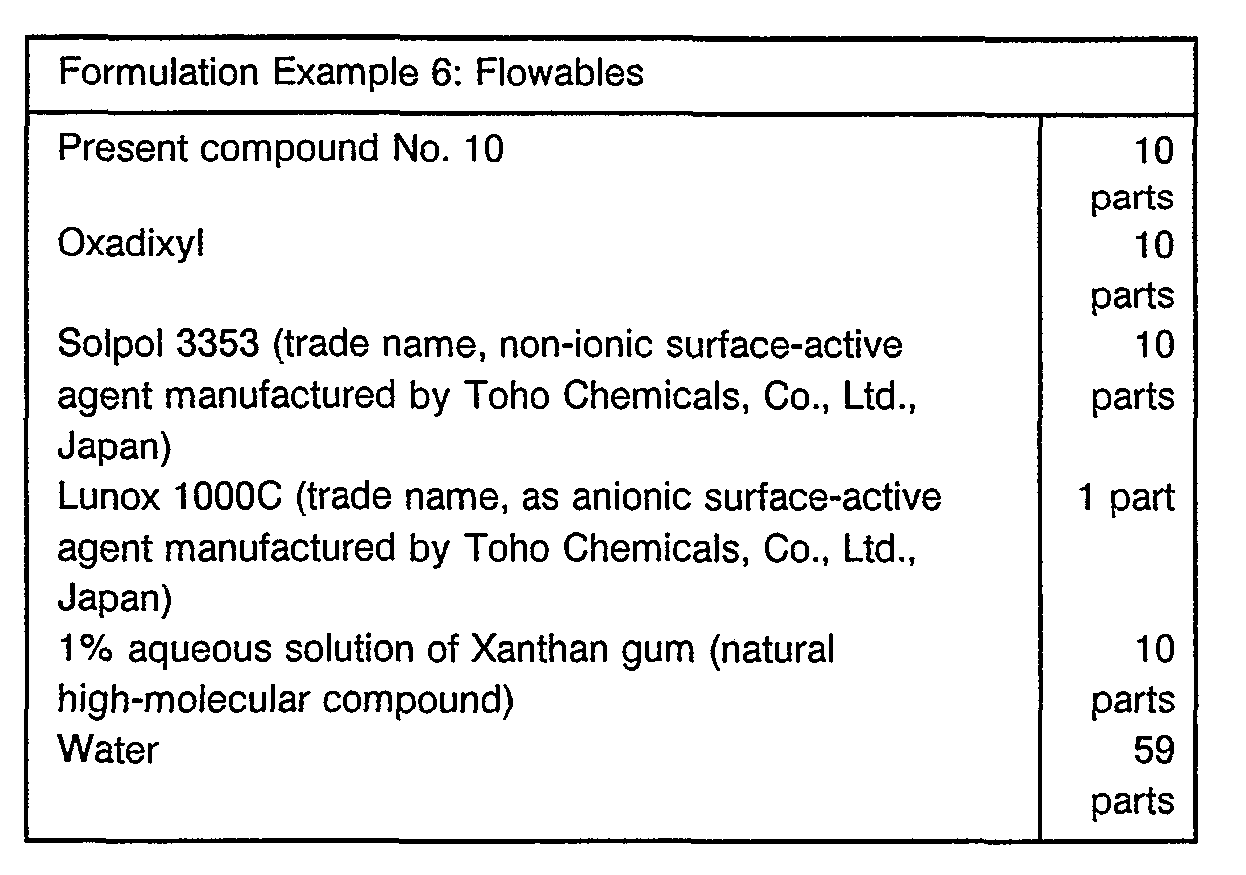
- In the above respective flowables, each component except the active ingredient (present compound) are uniformly dissolved together to form a solution. The resulting mixture is added by the present compound, thoroughly stirred and wet-ground by means of sand mill to obtain a flowable. Upon use, the flowable is diluted with water up to one hundredth to ten thousandth in concentration and sprayed at a rate of 100 to 2000 g of the active ingredients per hectare.

- The above components are intimately mixed to form an emulsifiable concentrate. Upon used, the emulsifiable concentrate is diluted with water up to one hundredth to ten thousandth in concentration and sprayed at a rate of 100 to 2000 g of the active ingredients per hectare.

- The above components are intimately mixed to form an emulsifiable concentrate. Upon used, the emulsifiable concentrate is diluted with water up to one hundredth to ten thousandth in concentration and sprayed at a rate of 100 to 2000 g of the active ingredients per hectare.

- The above components are homogeneously mixed together to form a dust. Upon use, the dust is spreaded or mixed with soil at a rate of 100 to 2000 g of the active ingredients per hectare.

- The above components are mixed intimately together and ground, incorporated with a small amount of water and mixed together with stirring. The resulting mixture is granulated by means of extrusion-granulator and dried to form granules. Upon use, the granule is spreaded or mixed with soil at a rate of 100 to 2000 g of the active ingredients per hecare.

- The above-described components are mixed together and ground by using a jet air mill to form a wettable powder. Upon use, the wettable powder is diluted with water up to one hundredth to ten thousandth in concentration and sprayed at a rate of 100 to 2000 g of the active ingredients per hectare.

- The above-described components are mixed together and ground by using a jet air mill to form a wettable powder. Upon use, the wettable powder is diluted with water up to one hundredth to ten thousandth in concentration and sprayed at a rate of 100 to 2000 g of the active ingredients per hectare.
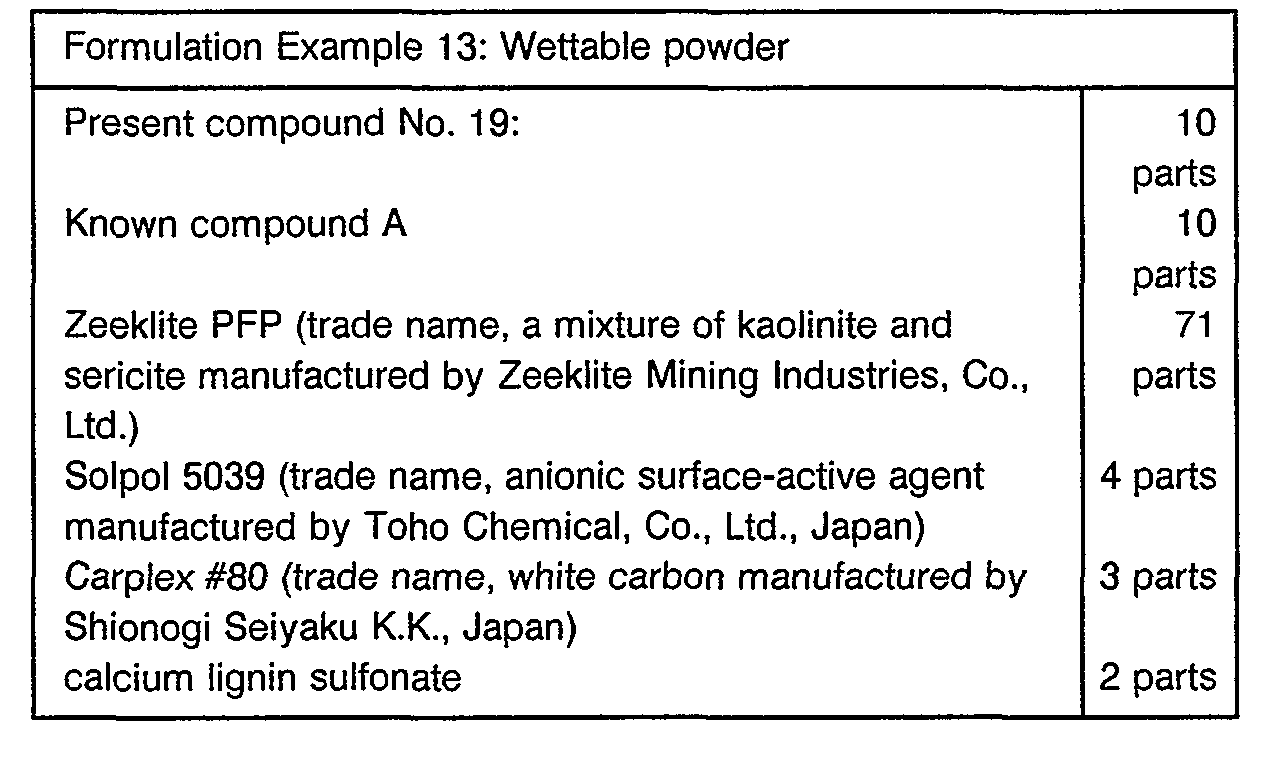
- The above-described components are mixed together and ground by using a jet air mill to form a wettable powder. Upon use, the wettable powder is diluted with water up to one hundredth to ten thousandth in concentration and sprayed at a rate of 100 to 2000 g of the active ingredients per hectare.

- In the above respective flowables, each component except the active ingredient (present compound) are uniformly dissolved together to form a solution. The resulting mixture is added by the present compound, thoroughly stirred and wet-ground by means of sand mill to obtain a flowable. Upon use, the flowable is diluted with water up to one hundredth to ten thousandth in concentration and sprayed at a rate of 100 to 2000 g of the active ingredients per hectare.

- In the above respective flowables, each component except the active ingredient (present compound) are uniformly dissolved together to form a solution. The resulting mixture is added by the present compound, thoroughly stirred and wet-ground by means of sand mill to obtain a flowable. Upon use, the flowable is diluted with water up to one hundredth to ten thousandth in concentration and sprayed at a rate of 100 to 2000 g of the active ingredients per hectare.

- In the above respective flowables, each component except the active ingredient (present compound) are uniformly dissolved together to form a solution. The resulting mixture is added by the present compound, thoroughly stirred and wet-ground by means of sand mill to obtain a flowable. Upon use, the flowable is diluted with water up to one hundredth to ten thousandth in concentration and sprayed at a rate of 100 to 2000 g of the active ingredients per hectare.
- Next, the effect of the compounds of the present invention is concretely described hereinafter by reference to biological tests.
- When tomato plants (cultivar: Fukuju), which were growing in pots each having a diameter of 8 cm, became 3-leaf state, the compositions of the present invention, which were in the form of the wettable powders as formed in accordance with the above-mentioned formulation examples 1 to 3 and 11 to 13 and which were diluted with water into a determined concentration of the effective ingredient, were sprayed thereover with a gun type sprayer in an amount of 20 ml/pot. Next day after the spraying, a suspension of spores of Phytophthora infestans (2 x 10⁵/ml) was sprayed over the plants, and the pots were put in an inoculation box kept at a temperature of 20 ° C and humidity of 95% or more for 5 days. Afterwards, the proportion of the diseased area on the leaf in each plant was measured. The protective value was calculated on the basis of the following formula:

- A means "Proportion of diseased area on the leaves of test plants" and
- B means "Proportion of diseased area on the leaves of control plants")
- The test results obtained are shown in Table 2.
- When tomato plants (cultivar: Fukuju), which were growing in pots each having a diameter of 8 cm, became 3-leaf state, a suspension of spores of Phytophthora infestans (2 x 10⁵/ml) was sprayed over the plants, and the pots were put in an inoculation box kept at a temperature of 20 ° C and humidity of 95% or more for a whole day and night. Afterwards, the compositions of the present invention, which were in the form of the wettable powders as formed in accordance with the above-mentioned formulation examples 1 to 3 and 11 to 13 and which were diluted with water into a determined concentration of the effective ingredient, were sprayed thereover with a gun type sprayer in an amount of 20 ml/pot. After air-drying, the pot was placed in said inoculation box, and the proportion of the diseased area on the leaf in each plant formed after 5 days passed was measured. The protective value was calculated on the basis of the following formula:

- A means "Proportion of diseased area on the leaves of test plants" and
- B means "Proportion of diseased area on the leaves of control plants")
- The test results obtained are shown in Table 3.
- When potato plants (cultivar: Danshaku), which were growing in pots each having a diameter of 21 cm, became 5- to 6-leaf state, the compositions of the present invention, which were in the form of the wettable powders as formed in accordance with the above-mentioned formulation examples 1 to 3 and 11 to 13 and which were diluted with water into a determined concentration of the effective ingredient, were sprayed thereover with a gun type sprayer in an amount of 30 ml/pot. Next day after the spraying, a suspension of spores of Phytophthora infestans (2 x 10⁵/ml) was sprayed over the plants, and the pots were put in an inoculation box kept at a temperature of 20 C and humidity of 95% or more for 5 days. Afterwards, the proportion of the diseased area on the leaf in each plant was measured. The protective value was calculated on the basis of the following formula:

- A means "Proportion of diseased area on the leaves of test plants" and
- B means "Proportion of diseased area on the leaves of control plants")
- The test results obtained are shown in Table 4.
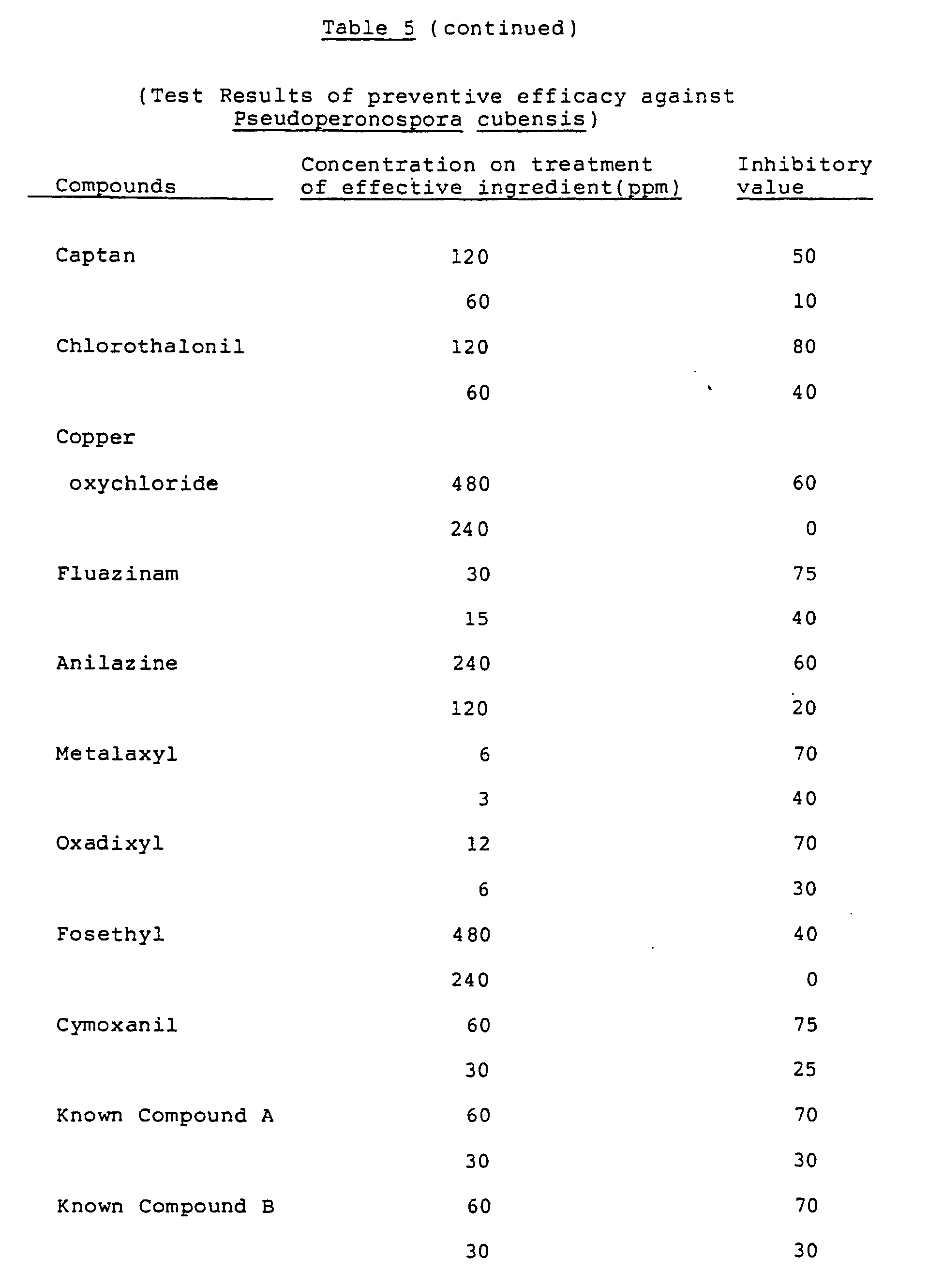
- When cucumber plants (cultivar: Sagami-hanjiro), which were growing in pots each having a diameter of 8 cm, became 1- to 2-leaf state, the compositions of the present invention, which were in the form of the wettable powders as formed in accordance with the above-mentioned formulation examples 1 to 3 and 11 to 13 and which were diluted with water into a determined concentration of the effective ingredient, were sprayed thereover with a gun type sprayer in an amount of 20 ml/pot. Next day after the spraying, a suspension of spores of Pseudoperonospora cubensis (2 x 10⁵/ml) was sprayed over the plants, and the pots were put in an inoculation box kept at a temperature of 25 C and humidity of 95% or more for a whole day and night. Afterwards, the pot in a greenhouse, and the 7th days after the inoculation, the proportion of the diseased area on the leaf in each plant was measured. The protective value was calculated on the basis of the following formula:

- A means "Proportion of diseased area on the leaves of test plants" and
- B means "Proportion of diseased area on the leaves of control plants")
- The test results obtained are shown in Table 5.
- When cucumber plants (cultivar: Sagami-hanjiro), which were growing in pots each having a diameter of 8 cm, became 1- or 2-leaf state, a suspension of spores of Pseudoperonospor cubensis (2 x 10⁵/ml) was sprayed over the plants, and the pots were put in an inoculation box kept at a temperature of 25 ° C and humidity of 95% or more for a whole day and night. Afterwards, the compositions of the present invention, which were in the form of the wettable powders as formed in accordance with the above-mentioned formulation examples 1 to 3 and 11 to 13 and which were diluted with water into a determined concentration of the effective ingredient, were sprayed thereover with a gun type sprayer in an amount of 20 ml/pot. Afterwards, the pots were put in a greenhouse, and 7th day after the inoculation, the proportion of the diseased area on the leaf in each plant was measured. The protective value was calculated on the basis of the following formula:

- A means "Proportion of diseased area on the leaves of test plants" and
- B means "Proportion of diseased area on the leaves of control plants")
- The test results obtained are shown in Table 6.
- When tomato plants (cultivar: Fukuju), which were growing in pots each having a diameter of 8 cm, became 3-leaf state, the compositions of the present invention, which were in the form of the wettable powders as formed in accordance with the above- mentioned formulation examples 1 to 3 and 11 to 13 and which were diluted with water into a determined concentration of the effective ingredient, were sprayed thereover with a gun type sprayer in an amount of 20 ml/pot. Next day after the spraying, a suspension of spores of Alternaria solani (4 x 10⁵/ml) was sprayed over the plants, and the pots were put in an inoculation box kept at a temperature of 25 ° C and humidity of 95% or more for 7 day. Afterwards, the proportion of the diseased area on the leaf in each plant was measured. The protective value was calculated on the basis of the followina formula:

- A means "Proportion of diseased area on the leaves of test plants" and
- B means "Proportion of diseased area on the leaves of control plants")
- The test results obtained are shown in Table 7.




Claims (2)
- Composition of fungicide for agricultral and horticultural use contining at least one of an amide substituted derivative represented by the formula (I) and its optical isomer and at least one of the active ingredient compound of the known fungicide,


 Wherein R1 represents a hydrogen atom, a lower alkyl group having from 1 to 8 carbon atoms, a cycloalkyl group having from 3 to 6 carbon atoms, a cycloalkylalkyl group having from 4 to 8 carbon atoms, a halogenated alkyl group having from 1 to 8 carbon atoms, an alkenyl group having from 2 to 8 carbon atoms, a halogenated alkeny group having from 2 to 8 carbon atoms, alkynyl having from 2 to 8 carbon atoms or an alenyl group having from 3 to 8 carbon atoms,R2 and R3 represents each independently a hydrogen atom, a lower alkyl group having from 1 to 4 carbon atoms, a hologen atom, a hologenated alkyl group having from 1 to 4 carbon atoms, an alkoxy group having from 1 to 4 carbon atoms, cyano group or a lower alkylthio group having from 1 to 4 carbon atoms,R4 , Rs and R6 represents each independently a hydrogen atom, a lower alkyl group having from 1 to 4 carbon atoms, halogen atom or a halogenated alkyl group having from 1 to 4 carbon atoms.
 - 2. Composition as set forth in Claim 1, wherein the known active ingredient compound of the known fungicide is dithiocarbamate compound, N-haloalkylthio compound, organochlorine compound, sulfinic acid compound, inroganic copper compound, organic copper compound, aniline compound, naphthoquinone compound, acylalanine compound, phosfinic acid compound, cyano-oxim compound, acrylic amide compound or acrylic acid compound.
Applications Claiming Priority (2)
| Application Number | Priority Date | Filing Date | Title |
|---|---|---|---|
| JP105542/89 | 1989-04-25 | ||
| JP1105542A JPH0249708A (en) | 1988-04-27 | 1989-04-25 | Agricultural and horticultural fungicide composition |
Publications (2)
| Publication Number | Publication Date |
|---|---|
| EP0394631A2 true EP0394631A2 (en) | 1990-10-31 |
| EP0394631A3 EP0394631A3 (en) | 1991-07-31 |
Family
ID=14410474
Family Applications (1)
| Application Number | Title | Priority Date | Filing Date |
|---|---|---|---|
| EP19900103112 Withdrawn EP0394631A3 (en) | 1989-04-25 | 1990-02-19 | Composition of fungicide for agricultural and horticultural use |
Country Status (1)
| Country | Link |
|---|---|
| EP (1) | EP0394631A3 (en) |
Cited By (2)
| Publication number | Priority date | Publication date | Assignee | Title |
|---|---|---|---|---|
| WO1997010716A1 (en) * | 1995-09-22 | 1997-03-27 | Basf Aktiengesellschaft | Harmful fungi control with an active substance inhibiting respiration by inhibiting the cytochrome complex iii, combined with an amide |
| EP2220937A3 (en) * | 2003-10-10 | 2011-03-30 | Bayer CropScience AG | Synergistic fungicidal combinations |
Family Cites Families (3)
| Publication number | Priority date | Publication date | Assignee | Title |
|---|---|---|---|---|
| AU3766085A (en) * | 1984-01-20 | 1985-07-25 | Sumitomo Chemical Company, Limited | Fungicidal composition |
| CA1243601A (en) * | 1985-11-14 | 1988-10-25 | Ulrich Gisi | Fungicidal compositions and their use |
| EP0268892A3 (en) * | 1986-11-06 | 1990-10-10 | Nissan Chemical Industries Ltd. | Substituted-amido derivatives, method for preparation of the same and phytopathogenic fungicides containing the same |
-
1990
- 1990-02-19 EP EP19900103112 patent/EP0394631A3/en not_active Withdrawn
Cited By (4)
| Publication number | Priority date | Publication date | Assignee | Title |
|---|---|---|---|---|
| WO1997010716A1 (en) * | 1995-09-22 | 1997-03-27 | Basf Aktiengesellschaft | Harmful fungi control with an active substance inhibiting respiration by inhibiting the cytochrome complex iii, combined with an amide |
| US6169056B1 (en) | 1995-09-22 | 2001-01-02 | Basf Aktiengesellschaft | Harmful fungi control with an active substance inhibiting respiration by inhibiting the cytochrome complex III, combined with an amide |
| EP2220937A3 (en) * | 2003-10-10 | 2011-03-30 | Bayer CropScience AG | Synergistic fungicidal combinations |
| EP2220936A3 (en) * | 2003-10-10 | 2011-03-30 | Bayer CropScience AG | Synergistic fungicidal combinations |
Also Published As
| Publication number | Publication date |
|---|---|
| EP0394631A3 (en) | 1991-07-31 |
Similar Documents
| Publication | Publication Date | Title |
|---|---|---|
| PL167500B1 (en) | Pesticide | |
| EP0753258B1 (en) | Synergistic fungicidal compositions of N-acetonyl-benzamides | |
| US5310747A (en) | Benzimidazole derivatives, agricultural and horticultural fungicides containing the same as an active ingredient and intermediate compounds thereof | |
| JP4343304B2 (en) | Bactericidal composition containing N-acetonylbenzamide | |
| JP2744924B2 (en) | Improvements on fungicides | |
| EP0935917B1 (en) | Fungicidal compositions containing N-[3'-(1'-chloro-3'-methyl-2'-oxopentan)]-3,5-dichloro-4-methylbenzamide | |
| US6348614B1 (en) | Aminobutyric acid fungicides | |
| JPS6033396B2 (en) | Fungal control composition containing 3-(N-acyl-N-arylamino)-gamma-butyrothiolactone and the compound as an active ingredient | |
| KR0179660B1 (en) | Insecticides and Fungicides | |
| US5677333A (en) | Method for controlling phytopathogenic fungi | |
| US4097594A (en) | Mono-5-substituted-3-chloro-4H-1,2,6-thiadiazin-4-one antifungal agents | |
| US6753339B1 (en) | Fungicide compositions | |
| JPH0465804B2 (en) | ||
| JP2990872B2 (en) | Insecticidal composition for agricultural and horticultural use | |
| EP0150959A2 (en) | A fungicidal composition | |
| US4275079A (en) | Fungicidal N-alkynylanilides | |
| PL188887B1 (en) | Fungicides | |
| US4100281A (en) | Mono-5-substituted-thio-3-chloro-4H-1,2,6-thiadiazin-4-one antifungal agents | |
| EP1013171B1 (en) | Fungicidal compositions containing N-acetonylbenzamides | |
| KR100231518B1 (en) | Agricultural Horticultural Fungicide Composition | |
| US4196284A (en) | 5-Substituted-thio-3-chloro-4H-1,2,6-thiadiazin-4-ones | |
| JPH0249708A (en) | Agricultural and horticultural fungicide composition | |
| EP1195089B1 (en) | Fungicidal compositions containing N-(3'-(1'-chloro-3'-methyl-2'-oxopentan))-3,5-dichloro-4-methylbenzamide and fosetyl-aluminium | |
| JPS61194004A (en) | Improvement on fungicide | |
| RU2207342C2 (en) | N,n-dimethyl-[3-(propoxycarbonylamino)propyl]- ammonium o-ethyl phosphite eliciting fungicide activity |
Legal Events
| Date | Code | Title | Description |
|---|---|---|---|
| PUAI | Public reference made under article 153(3) epc to a published international application that has entered the european phase |
Free format text: ORIGINAL CODE: 0009012 |
|
| AK | Designated contracting states |
Kind code of ref document: A2 Designated state(s): AT BE CH DE DK ES FR GB GR IT LI LU NL SE |
|
| PUAL | Search report despatched |
Free format text: ORIGINAL CODE: 0009013 |
|
| AK | Designated contracting states |
Kind code of ref document: A3 Designated state(s): AT BE CH DE DK ES FR GB GR IT LI LU NL SE |
|
| 16A | New documents despatched to applicant after publication of the search report | ||
| 17P | Request for examination filed |
Effective date: 19920117 |
|
| 17Q | First examination report despatched |
Effective date: 19920623 |
|
| STAA | Information on the status of an ep patent application or granted ep patent |
Free format text: STATUS: THE APPLICATION IS DEEMED TO BE WITHDRAWN |
|
| 18D | Application deemed to be withdrawn |
Effective date: 19921104 |