EP0400863A1 - Bait composition for controlling vermin - Google Patents
Bait composition for controlling vermin Download PDFInfo
- Publication number
- EP0400863A1 EP0400863A1 EP90305543A EP90305543A EP0400863A1 EP 0400863 A1 EP0400863 A1 EP 0400863A1 EP 90305543 A EP90305543 A EP 90305543A EP 90305543 A EP90305543 A EP 90305543A EP 0400863 A1 EP0400863 A1 EP 0400863A1
- Authority
- EP
- European Patent Office
- Prior art keywords
- vermin
- bait
- bait composition
- xmc
- controlling
- Prior art date
- Legal status (The legal status is an assumption and is not a legal conclusion. Google has not performed a legal analysis and makes no representation as to the accuracy of the status listed.)
- Granted
Links
Classifications
-
- A—HUMAN NECESSITIES
- A01—AGRICULTURE; FORESTRY; ANIMAL HUSBANDRY; HUNTING; TRAPPING; FISHING
- A01N—PRESERVATION OF BODIES OF HUMANS OR ANIMALS OR PLANTS OR PARTS THEREOF; BIOCIDES, e.g. AS DISINFECTANTS, AS PESTICIDES OR AS HERBICIDES; PEST REPELLANTS OR ATTRACTANTS; PLANT GROWTH REGULATORS
- A01N25/00—Biocides, pest repellants or attractants, or plant growth regulators, characterised by their forms, or by their non-active ingredients or by their methods of application, e.g. seed treatment or sequential application; Substances for reducing the noxious effect of the active ingredients to organisms other than pests
- A01N25/002—Biocides, pest repellants or attractants, or plant growth regulators, characterised by their forms, or by their non-active ingredients or by their methods of application, e.g. seed treatment or sequential application; Substances for reducing the noxious effect of the active ingredients to organisms other than pests containing a foodstuff as carrier or diluent, i.e. baits
-
- A—HUMAN NECESSITIES
- A01—AGRICULTURE; FORESTRY; ANIMAL HUSBANDRY; HUNTING; TRAPPING; FISHING
- A01N—PRESERVATION OF BODIES OF HUMANS OR ANIMALS OR PLANTS OR PARTS THEREOF; BIOCIDES, e.g. AS DISINFECTANTS, AS PESTICIDES OR AS HERBICIDES; PEST REPELLANTS OR ATTRACTANTS; PLANT GROWTH REGULATORS
- A01N47/00—Biocides, pest repellants or attractants, or plant growth regulators containing organic compounds containing a carbon atom not being member of a ring and having no bond to a carbon or hydrogen atom, e.g. derivatives of carbonic acid
- A01N47/08—Biocides, pest repellants or attractants, or plant growth regulators containing organic compounds containing a carbon atom not being member of a ring and having no bond to a carbon or hydrogen atom, e.g. derivatives of carbonic acid the carbon atom having one or more single bonds to nitrogen atoms
- A01N47/10—Carbamic acid derivatives, i.e. containing the group —O—CO—N<; Thio analogues thereof
- A01N47/22—O-Aryl or S-Aryl esters thereof
Definitions
- the present invention relates to a bait composition for controlling vermin. More particularly, the present invention relates to a bait composition useful for exterminating agriculturally noxious terrestrial mollusca which are difficult to control, for example, slugs (incilaria) and snails; noxious aquatic mollusca, for example, pond snails; harmful and unpleasant insects and arthropods (isopoda) which often destroy crops, for example, pillbugs and sowbugs, ants and crickets.
- molluscs-killing agent containing, as an effective component, metaldehyde (metaacetoaldehyde) is widely utilized to exterminate agriculturally noxious terrestrial mollusca, for example, slugs and euhadra ⁇ helix. Nevertheless, there are very few expellent agents which do not harm humans and are effective for exterminating pond snails, which are noxious to paddy-rice plants, and currently only lime nitrogen is utilized for this purpose.
- metaldehyde metalacetoaldehyde
- NAC 1-naphthyl N-methylcarbamate
- metaldehyde which is usually used to exterminate terrestrial mollusca
- Conventional lure-killing agents for vermin consisting of a killing agent for mollusca, mixed with a luring bait material, do not always have a satisfactory vermin-killing activity and spectrum, and therefore, the conventional lure-killing agents must contain a high concentration of the effective component, or require two or more effective components to enhance the activity and spectrum thereof, and therefore, are not widely employed to protect edible plants.
- An object of the present invention is to provide a bait composition for controlling vermin, which composition is safe and has a high control activity and a wide control spectrum for a variety of vermin, even when containing a low concentration of an effective component.
- the above-mentioned object can be attained by the bait composition of the present invention for controlling vermin, which composition comprises 3,5-xylyl N-methylcarbamate contained in a bait material.
- the inventors of the present invention carried out intensive research into the providing of controlling agents for vermin, such as terrestrial mollusca, and as a result, discovered for the first time that, when fed, 3,5-xylyl N-methylcarbamate (hereinafter referred to as "XMC") has an excellent exterminating activity not only for the noxious terrestrial mollusca but also for harmful aquatic mollusca, insects, and arthropods (homopoda). Note, it is important that the XMC be utilized by feeding the vermin through the mouth but not the respiratory organ thereof, to exterminate same.
- vermin such as terrestrial mollusca
- XMC 3,5-xylyl N-methylcarbamate
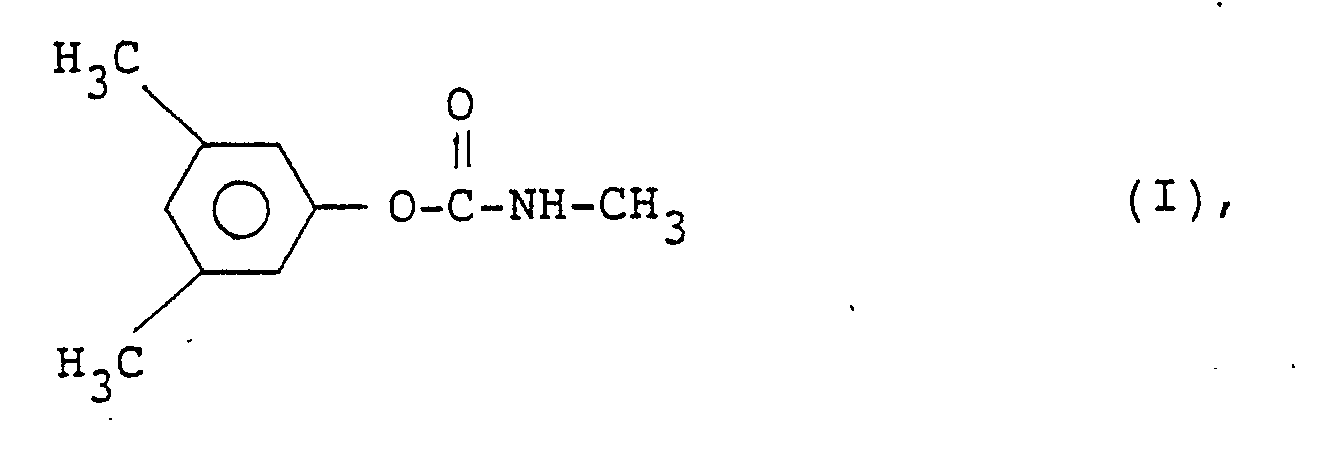
- XMC has the formula (I): usually in the form of a white powder, and is soluble in most organic solvents.
- the XMC is preferably contained in an amount of 0.5% to 5% by weight, more preferably 1% to 3% by weight, in a bait material, to ensure the vermin- controlling effect thereof.
- the bait material usable for the present invention is not limited to specific types of edible materials, and usually comprises at least one member selected from the group consisting of soybean oil draff, wheat flour, rice bran, biscuit powder and potato, which are edible materials for luring vermin.
- the vermin-controlling bait composition of the present invention can be prepared in such a manner that a predetermined amount of the XMC is mixed with the vermin-luring edible material, the mixture is pulverized and kneaded together with water, the resultant paste is pelletized in predetermined shapes and dimensions, and the paste pellets are dried to provide dry pellets.
- the shape and dimensions of the pellets are variable depending on the use thereof but usually the pellets are in the form of a short rod having a length of 1 to 10 mm and a diameter of 1 to 5 mm.
- a bait material for example, dried potato chips
- a solution of the XMC in a solvent for example, ethylalcohol and their dried.
- the vermin-controlling bait composition of the present invention can be applied in a usual manner for controlling vermin, for example, by placing in an area in which the plants to be protected are cultivated or on a plant cultivating shelf.
- bait composition pellets were prepared by mixing the XMC in the amount as indicated in Table 1 with a luring bait material obtained by mixing 70% by weight of soybean oil draff with 30% by weight of wheat flour, and by pulverizing the bait mixture; kneading the resultant mixture together with water, pelletizing the resultant paste to form a number of short-rod-shaped pellets having a diameter of 2 mm and a length of 3 to 7 mm, and drying the pellets.
- the bait composition pellets in an amount of 3 g were placed on a plastic resin plate having a diameter of 9 cm, and left to stand below a plant cultivating shelf in a greenhouse for three days, to lure-kill slugs, and thereafter, the number of lure-killed slugs were counted.
- Example 5 In comparative Example 5, the same procedures as in Example 1 were carried out, except that the vermin-controlling component was omitted from the bait composition.
- Table 1 shows that the vermin-controlling bait compositions of Examples 1 and 2 have a higher efficiency for lure-killing slugs than those of Comparison Examples 1 to 5.
- Example 3 thin potato chips were dried under vacuum and immersed in a solution of 1% by weight of XMC in ethyl alcohol, at room temperature for 6 hours, and the resultant XMC-impregnated potato chips then dried in the ambient atmosphere at room temperature.
- the resultant dried potato chips contained 1.7% by weight of XMC.
- a plastic pot having an inside bottom area of 1/5000 are, were placed one liter of water, 10 pond snails, and 3 g of the XMC-impregnated potato chips, and after three days, the number of dead or living pond snails were counted.
- Comparative Example 6 the same procedures as in Example 3 were carried out except that the dried potato chips were not impregnated with XMC.
- Table 2 Item Amount of XMC Number of pond snails Example No. (% by wt.) Living Dead Example 3 1.7 0 10 Comparative Example 6 0 10 0
- a bait material was prepared by mixing 25% by weight of biscuit powder, 25% by weight of soybean oil draff, 25% by weight of parched rice bran, and 25% by weight of wheat flour, and pulverizing the mixture.
- a bait composition was prepared by mixing 97% by weight of the bait material with 3% by weight of XMC powder.
- the resultant bait composition was kneaded together with water in an amount of 30% based on the total weight of the bait material, the resultant paste was pelletized to form pellets having a diameter of 2 mm and a length of from 3 to 7 mm, and the resultant pellets were dried.
- the plates containing the pellets were left to stand in a plurality of places in a garden, for 3 days, and thereafter, the numbers of lure-killed terrestrial mollusca, insects and homopoda on the plates were counted.
- Tables 1 to 3 clearly indicate that the bait composition of the present invention comprising XMC as an effective component, and a bait material comprising, for example, food waste, is useful for lure-killing various vermin, for example, noxious mollusca, insects, and arthropods by lure-feeding, at a high extermination activity and wide spectrum for a variety of vermin, and therefore, is an industrially applicable material.
Landscapes
- Life Sciences & Earth Sciences (AREA)
- Health & Medical Sciences (AREA)
- General Health & Medical Sciences (AREA)
- Dentistry (AREA)
- Plant Pathology (AREA)
- Engineering & Computer Science (AREA)
- Pest Control & Pesticides (AREA)
- Agronomy & Crop Science (AREA)
- Wood Science & Technology (AREA)
- Zoology (AREA)
- Environmental Sciences (AREA)
- Food Science & Technology (AREA)
- Toxicology (AREA)
- Agricultural Chemicals And Associated Chemicals (AREA)
Abstract
Description
- The present invention relates to a bait composition for controlling vermin. More particularly, the present invention relates to a bait composition useful for exterminating agriculturally noxious terrestrial mollusca which are difficult to control, for example, slugs (incilaria) and snails; noxious aquatic mollusca, for example, pond snails; harmful and unpleasant insects and arthropods (isopoda) which often destroy crops, for example, pillbugs and sowbugs, ants and crickets.
- It is known that a molluscs-killing agent containing, as an effective component, metaldehyde (metaacetoaldehyde) is widely utilized to exterminate agriculturally noxious terrestrial mollusca, for example, slugs and euhadra·helix. Nevertheless, there are very few expellent agents which do not harm humans and are effective for exterminating pond snails, which are noxious to paddy-rice plants, and currently only lime nitrogen is utilized for this purpose.
- Further, in general, to exterminate unpleasant vermin, for example, sowbugs and ants, 1-naphthyl N-methylcarbamate (hereinafter referred as "NAC") mixed with metaldehyde, which is usually used to exterminate terrestrial mollusca, is employed for home use.
- Conventional lure-killing agents for vermin, consisting of a killing agent for mollusca, mixed with a luring bait material, do not always have a satisfactory vermin-killing activity and spectrum, and therefore, the conventional lure-killing agents must contain a high concentration of the effective component, or require two or more effective components to enhance the activity and spectrum thereof, and therefore, are not widely employed to protect edible plants.
- An object of the present invention is to provide a bait composition for controlling vermin, which composition is safe and has a high control activity and a wide control spectrum for a variety of vermin, even when containing a low concentration of an effective component.
- The above-mentioned object can be attained by the bait composition of the present invention for controlling vermin, which composition comprises 3,5-xylyl N-methylcarbamate contained in a bait material.
- The inventors of the present invention carried out intensive research into the providing of controlling agents for vermin, such as terrestrial mollusca, and as a result, discovered for the first time that, when fed, 3,5-xylyl N-methylcarbamate (hereinafter referred to as "XMC") has an excellent exterminating activity not only for the noxious terrestrial mollusca but also for harmful aquatic mollusca, insects, and arthropods (homopoda). Note, it is important that the XMC be utilized by feeding the vermin through the mouth but not the respiratory organ thereof, to exterminate same.
- XMC has the formula (I):
- In the vermin-controlling bait composition of the present invention, the XMC is preferably contained in an amount of 0.5% to 5% by weight, more preferably 1% to 3% by weight, in a bait material, to ensure the vermin- controlling effect thereof.
- The bait material usable for the present invention is not limited to specific types of edible materials, and usually comprises at least one member selected from the group consisting of soybean oil draff, wheat flour, rice bran, biscuit powder and potato, which are edible materials for luring vermin.
- The vermin-controlling bait composition of the present invention can be prepared in such a manner that a predetermined amount of the XMC is mixed with the vermin-luring edible material, the mixture is pulverized and kneaded together with water, the resultant paste is pelletized in predetermined shapes and dimensions, and the paste pellets are dried to provide dry pellets.
- The shape and dimensions of the pellets are variable depending on the use thereof but usually the pellets are in the form of a short rod having a length of 1 to 10 mm and a diameter of 1 to 5 mm.
- In another process for preparing the vermin-controlling bait composition of the present invention, a bait material, for example, dried potato chips, are impregnated with a solution of the XMC in a solvent, for example, ethylalcohol and their dried.
- The vermin-controlling bait composition of the present invention can be applied in a usual manner for controlling vermin, for example, by placing in an area in which the plants to be protected are cultivated or on a plant cultivating shelf.
- The present invention will be further explained by way of specific examples, which are merely representative and do not in any way restrict the scope of the present invention.
- In each of Examples 1 and 2, bait composition pellets were prepared by mixing the XMC in the amount as indicated in Table 1 with a luring bait material obtained by mixing 70% by weight of soybean oil draff with 30% by weight of wheat flour, and by pulverizing the bait mixture; kneading the resultant mixture together with water, pelletizing the resultant paste to form a number of short-rod-shaped pellets having a diameter of 2 mm and a length of 3 to 7 mm, and drying the pellets.
- The bait composition pellets in an amount of 3 g were placed on a plastic resin plate having a diameter of 9 cm, and left to stand below a plant cultivating shelf in a greenhouse for three days, to lure-kill slugs, and thereafter, the number of lure-killed slugs were counted.
- In each of Comparative Examples 1 and 2, the same procedures as mentioned above were carried out, except that the XMC was replaced by NAC in the amount as indicated in Table 1.
- In each of Comparative Examples 3 and 4, the same procedures as in Examples 1 and 2 were carried out, except that the XMC was replaced by metaldehyde in the amount as shown in Table 1.
- In comparative Example 5, the same procedures as in Example 1 were carried out, except that the vermin-controlling component was omitted from the bait composition.
- In such of the examples and comparative examples, the feeding test was repeated 25 times. The results are shown in Table 1. Note, the results are statistically treated in accordance with Duncan's new multiple range test method, to determine significant differences between the average values of the results of the lure-killing tests in each of the example and comparative examples. The result of the statistical examination is also shown in Table 1.
Table 1 Item Vermin-controlling component Number of lure-killed vermin ± standard deviation per feeding plate Indication of significant differences using Duncan's test method (*) Example No. Type Amount (% by wt.) Example 1 XMC 1 5.4 ± 6.0 a b 2 " 3 7.0 ± 8.6 a Comparative Example 1 NAC 1 1.5 ± 2.1 c d 2 " 3 3.3 ± 3.5 b c 3 Metaldehyde 1 4.0 ± 4.4 a b c 4 " 3 4.4 ± 6.0 a b c 5 None - 00 ± 00 d Note: (*) ... Each of the lower case alphabetical characters indicates that no significant difference can be found between average values indicated by the same lower-case alphabetical characters in a level of significance of 5% in accordance with Duncan's new multiple range test method. - Table 1 shows that the vermin-controlling bait compositions of Examples 1 and 2 have a higher efficiency for lure-killing slugs than those of Comparison Examples 1 to 5.
- In Example 3, thin potato chips were dried under vacuum and immersed in a solution of 1% by weight of XMC in ethyl alcohol, at room temperature for 6 hours, and the resultant XMC-impregnated potato chips then dried in the ambient atmosphere at room temperature. The resultant dried potato chips contained 1.7% by weight of XMC. In a plastic pot having an inside bottom area of 1/5000 are, were placed one liter of water, 10 pond snails, and 3 g of the XMC-impregnated potato chips, and after three days, the number of dead or living pond snails were counted.
- In Comparative Example 6, the same procedures as in Example 3 were carried out except that the dried potato chips were not impregnated with XMC.
- The results are shown in Table 2.
Table 2 Item Amount of XMC Number of pond snails Example No. (% by wt.) Living Dead Example 3 1.7 0 10 Comparative Example 6 0 10 0 - A bait material was prepared by mixing 25% by weight of biscuit powder, 25% by weight of soybean oil draff, 25% by weight of parched rice bran, and 25% by weight of wheat flour, and pulverizing the mixture.
- Then a bait composition was prepared by mixing 97% by weight of the bait material with 3% by weight of XMC powder. The resultant bait composition was kneaded together with water in an amount of 30% based on the total weight of the bait material, the resultant paste was pelletized to form pellets having a diameter of 2 mm and a length of from 3 to 7 mm, and the resultant pellets were dried.
- An amount of 3 g of the bait composition pellets was placed in on each of a plurality of plastic resin plates having a diameter of 9 cm.
- The plates containing the pellets were left to stand in a plurality of places in a garden, for 3 days, and thereafter, the numbers of lure-killed terrestrial mollusca, insects and homopoda on the plates were counted.
- The above-mentioned procedures were repeated five times. The total number of lure-killed vermin per plate, and the standard deviation of the results of the test, are shown in Table 3.
Table 3 Sort of vermin Number of lure-killed vermin ± standard deviation Slugs 11.6 ± 5.6 Snails 0.8 ± 0.8 Ants 28.4 ± 22.7 Earwigs 1.6 ± 1.1 Crickets 0.6 ± 0.9 Pillbugs 1.2 ± 1.1 Sowbugs 4.4 ± 2.4 - Tables 1 to 3 clearly indicate that the bait composition of the present invention comprising XMC as an effective component, and a bait material comprising, for example, food waste, is useful for lure-killing various vermin, for example, noxious mollusca, insects, and arthropods by lure-feeding, at a high extermination activity and wide spectrum for a variety of vermin, and therefore, is an industrially applicable material.
Claims (3)
Applications Claiming Priority (2)
| Application Number | Priority Date | Filing Date | Title |
|---|---|---|---|
| JP134600/89 | 1989-05-30 | ||
| JP1134600A JP2815400B2 (en) | 1989-05-30 | 1989-05-30 | Insect bait composition for controlling pests |
Publications (2)
| Publication Number | Publication Date |
|---|---|
| EP0400863A1 true EP0400863A1 (en) | 1990-12-05 |
| EP0400863B1 EP0400863B1 (en) | 1994-06-15 |
Family
ID=15132192
Family Applications (1)
| Application Number | Title | Priority Date | Filing Date |
|---|---|---|---|
| EP90305543A Expired - Lifetime EP0400863B1 (en) | 1989-05-30 | 1990-05-22 | Bait composition for controlling vermin |
Country Status (5)
| Country | Link |
|---|---|
| EP (1) | EP0400863B1 (en) |
| JP (1) | JP2815400B2 (en) |
| KR (1) | KR0148377B1 (en) |
| AU (1) | AU632328B2 (en) |
| DE (1) | DE69009862T2 (en) |
Cited By (2)
| Publication number | Priority date | Publication date | Assignee | Title |
|---|---|---|---|---|
| CN1061217C (en) * | 1997-04-08 | 2001-01-31 | 中国科学院动物研究所 | Terrestrial mollush bait |
| EP1992226A1 (en) * | 2007-05-16 | 2008-11-19 | Bayer CropScience Aktiengesellschaft | Snail bait |
Families Citing this family (2)
| Publication number | Priority date | Publication date | Assignee | Title |
|---|---|---|---|---|
| JP2001247408A (en) * | 2000-03-08 | 2001-09-11 | Hodogaya Chem Co Ltd | Feeding insect pest control composition using acid-soluble polymer |
| JP4712984B2 (en) * | 2001-02-22 | 2011-06-29 | 株式会社中川ケミカル | Assembled advertising device |
Citations (3)
| Publication number | Priority date | Publication date | Assignee | Title |
|---|---|---|---|---|
| GB743958A (en) * | 1952-11-22 | 1956-01-25 | Merck Ag E | Improvements in or relating to pesticides |
| GB2030045A (en) * | 1978-09-08 | 1980-04-02 | Sumitomo Chemical Co | Pesticidal aqueous suspensions |
| US4299616A (en) * | 1980-03-31 | 1981-11-10 | Stauffer Chemical Company | Herbicide compositions of extended soil life |
-
1989
- 1989-05-30 JP JP1134600A patent/JP2815400B2/en not_active Expired - Lifetime
-
1990
- 1990-05-22 EP EP90305543A patent/EP0400863B1/en not_active Expired - Lifetime
- 1990-05-22 DE DE69009862T patent/DE69009862T2/en not_active Expired - Fee Related
- 1990-05-29 AU AU56050/90A patent/AU632328B2/en not_active Ceased
- 1990-05-29 KR KR1019900007782A patent/KR0148377B1/en not_active Expired - Fee Related
Patent Citations (3)
| Publication number | Priority date | Publication date | Assignee | Title |
|---|---|---|---|---|
| GB743958A (en) * | 1952-11-22 | 1956-01-25 | Merck Ag E | Improvements in or relating to pesticides |
| GB2030045A (en) * | 1978-09-08 | 1980-04-02 | Sumitomo Chemical Co | Pesticidal aqueous suspensions |
| US4299616A (en) * | 1980-03-31 | 1981-11-10 | Stauffer Chemical Company | Herbicide compositions of extended soil life |
Cited By (4)
| Publication number | Priority date | Publication date | Assignee | Title |
|---|---|---|---|---|
| CN1061217C (en) * | 1997-04-08 | 2001-01-31 | 中国科学院动物研究所 | Terrestrial mollush bait |
| EP1992226A1 (en) * | 2007-05-16 | 2008-11-19 | Bayer CropScience Aktiengesellschaft | Snail bait |
| WO2008138552A1 (en) * | 2007-05-16 | 2008-11-20 | Bayer Cropscience Ag | Snail bait |
| EP2245928A2 (en) | 2007-05-16 | 2010-11-03 | Bayer CropScience AG | Snail bait |
Also Published As
| Publication number | Publication date |
|---|---|
| JPH032104A (en) | 1991-01-08 |
| DE69009862T2 (en) | 1994-11-03 |
| KR0148377B1 (en) | 1998-10-15 |
| AU5605090A (en) | 1990-12-06 |
| DE69009862D1 (en) | 1994-07-21 |
| EP0400863B1 (en) | 1994-06-15 |
| KR900017475A (en) | 1990-12-19 |
| AU632328B2 (en) | 1992-12-24 |
| JP2815400B2 (en) | 1998-10-27 |
Similar Documents
| Publication | Publication Date | Title |
|---|---|---|
| EP0969738B1 (en) | Propionic acid, ammonia, propanediol and water solutions and the use thereof | |
| US5017620A (en) | Pesticide composition | |
| US4988516A (en) | Insecticide | |
| US4765979A (en) | Method and composition for killing terrestrial molluscs | |
| EP0400863B1 (en) | Bait composition for controlling vermin | |
| CN1078808C (en) | Plant pesticide | |
| Sotherton | The effects of herbicides on the chrysomelid beetle Gastrophysa polygoni (L.) in the laboratory and field | |
| RU2045198C1 (en) | Emulsion concentrate | |
| US5270045A (en) | Method of using a bait composition for controlling vermin | |
| CN114586800A (en) | Pharmaceutical composition and application thereof in prevention and control of spodoptera frugiperda | |
| DE2408001C3 (en) | Cockroach bait | |
| JP2004537605A (en) | Edible insecticide | |
| DE60209074T2 (en) | Ingestible molluscicides | |
| EP0280978B1 (en) | Use of 2-(2-chloro-1-methoxyethoxy)phenyl methylcarbamate as molluscicide | |
| CN102771504A (en) | Compound pesticide for controlling apolygus lucorum and preparation method of compound pesticide | |
| RU2176879C1 (en) | Insecticide composition and method of control of insects | |
| JPH04235902A (en) | Attracting insecticide of slugs | |
| CN102771495B (en) | Pesticide synergic insect-killing composition containing guadipyr | |
| JP2010001263A (en) | Vermin damage-preventing agent for vegetable and flowering plant | |
| CN111345304A (en) | A kind of insecticidal composition for controlling macadamia nut red spider | |
| JPS61207485A (en) | Powdered soil conditioner | |
| CN116158445B (en) | Composition containing 4-trifluoromethyl nicotinamide and microbial pesticide and application thereof | |
| RU1777756C (en) | Method for production of rodenticide | |
| RU1814514C (en) | Nontoxic rodenticide | |
| CN118985636A (en) | Biocontrol composition, preparation method thereof and application thereof in spodoptera frugiperda control |
Legal Events
| Date | Code | Title | Description |
|---|---|---|---|
| PUAI | Public reference made under article 153(3) epc to a published international application that has entered the european phase |
Free format text: ORIGINAL CODE: 0009012 |
|
| AK | Designated contracting states |
Kind code of ref document: A1 Designated state(s): DE FR GB IT NL |
|
| 17P | Request for examination filed |
Effective date: 19901228 |
|
| 17Q | First examination report despatched |
Effective date: 19930202 |
|
| GRAA | (expected) grant |
Free format text: ORIGINAL CODE: 0009210 |
|
| AK | Designated contracting states |
Kind code of ref document: B1 Designated state(s): DE FR GB IT NL |
|
| REF | Corresponds to: |
Ref document number: 69009862 Country of ref document: DE Date of ref document: 19940721 |
|
| ITF | It: translation for a ep patent filed | ||
| ET | Fr: translation filed | ||
| PLBE | No opposition filed within time limit |
Free format text: ORIGINAL CODE: 0009261 |
|
| STAA | Information on the status of an ep patent application or granted ep patent |
Free format text: STATUS: NO OPPOSITION FILED WITHIN TIME LIMIT |
|
| 26N | No opposition filed | ||
| PGFP | Annual fee paid to national office [announced via postgrant information from national office to epo] |
Ref country code: FR Payment date: 19960416 Year of fee payment: 7 |
|
| PGFP | Annual fee paid to national office [announced via postgrant information from national office to epo] |
Ref country code: GB Payment date: 19960513 Year of fee payment: 7 |
|
| PGFP | Annual fee paid to national office [announced via postgrant information from national office to epo] |
Ref country code: NL Payment date: 19960529 Year of fee payment: 7 |
|
| PGFP | Annual fee paid to national office [announced via postgrant information from national office to epo] |
Ref country code: DE Payment date: 19960729 Year of fee payment: 7 |
|
| PG25 | Lapsed in a contracting state [announced via postgrant information from national office to epo] |
Ref country code: GB Effective date: 19970522 |
|
| PG25 | Lapsed in a contracting state [announced via postgrant information from national office to epo] |
Ref country code: NL Effective date: 19971201 |
|
| GBPC | Gb: european patent ceased through non-payment of renewal fee |
Effective date: 19970522 |
|
| PG25 | Lapsed in a contracting state [announced via postgrant information from national office to epo] |
Ref country code: FR Free format text: LAPSE BECAUSE OF NON-PAYMENT OF DUE FEES Effective date: 19980130 |
|
| NLV4 | Nl: lapsed or anulled due to non-payment of the annual fee |
Effective date: 19971201 |
|
| PG25 | Lapsed in a contracting state [announced via postgrant information from national office to epo] |
Ref country code: DE Free format text: LAPSE BECAUSE OF NON-PAYMENT OF DUE FEES Effective date: 19980203 |
|
| REG | Reference to a national code |
Ref country code: FR Ref legal event code: ST |
|
| PG25 | Lapsed in a contracting state [announced via postgrant information from national office to epo] |
Ref country code: IT Free format text: LAPSE BECAUSE OF NON-PAYMENT OF DUE FEES Effective date: 20050522 |