EP0401046B1 - Système à mélanger par vis sans fin double - Google Patents
Système à mélanger par vis sans fin double Download PDFInfo
- Publication number
- EP0401046B1 EP0401046B1 EP90306022A EP90306022A EP0401046B1 EP 0401046 B1 EP0401046 B1 EP 0401046B1 EP 90306022 A EP90306022 A EP 90306022A EP 90306022 A EP90306022 A EP 90306022A EP 0401046 B1 EP0401046 B1 EP 0401046B1
- Authority
- EP
- European Patent Office
- Prior art keywords
- auger
- developer
- toner
- developer material
- roll
- Prior art date
- Legal status (The legal status is an assumption and is not a legal conclusion. Google has not performed a legal analysis and makes no representation as to the accuracy of the status listed.)
- Expired - Lifetime
Links
- 230000009977 dual effect Effects 0.000 title claims description 15
- 239000000463 material Substances 0.000 claims description 22
- 238000002156 mixing Methods 0.000 claims description 15
- 230000005484 gravity Effects 0.000 claims description 5
- 238000004891 communication Methods 0.000 claims description 2
- 238000000151 deposition Methods 0.000 claims description 2
- 238000003384 imaging method Methods 0.000 claims description 2
- 108091008695 photoreceptors Proteins 0.000 description 9
- 239000002245 particle Substances 0.000 description 8
- 239000000203 mixture Substances 0.000 description 5
- 238000000429 assembly Methods 0.000 description 2
- 230000000712 assembly Effects 0.000 description 2
- 238000010276 construction Methods 0.000 description 2
- 239000008187 granular material Substances 0.000 description 2
- 229910052751 metal Inorganic materials 0.000 description 2
- 239000002184 metal Substances 0.000 description 2
- 239000000843 powder Substances 0.000 description 2
- 229910052782 aluminium Inorganic materials 0.000 description 1
- XAGFODPZIPBFFR-UHFFFAOYSA-N aluminium Chemical compound [Al] XAGFODPZIPBFFR-UHFFFAOYSA-N 0.000 description 1
- 238000004140 cleaning Methods 0.000 description 1
- 230000000694 effects Effects 0.000 description 1
- 239000000835 fiber Substances 0.000 description 1
- 239000000758 substrate Substances 0.000 description 1
Images



Classifications
-
- G—PHYSICS
- G03—PHOTOGRAPHY; CINEMATOGRAPHY; ANALOGOUS TECHNIQUES USING WAVES OTHER THAN OPTICAL WAVES; ELECTROGRAPHY; HOLOGRAPHY
- G03G—ELECTROGRAPHY; ELECTROPHOTOGRAPHY; MAGNETOGRAPHY
- G03G15/00—Apparatus for electrographic processes using a charge pattern
- G03G15/06—Apparatus for electrographic processes using a charge pattern for developing
- G03G15/08—Apparatus for electrographic processes using a charge pattern for developing using a solid developer, e.g. powder developer
- G03G15/09—Apparatus for electrographic processes using a charge pattern for developing using a solid developer, e.g. powder developer using magnetic brush
-
- G—PHYSICS
- G03—PHOTOGRAPHY; CINEMATOGRAPHY; ANALOGOUS TECHNIQUES USING WAVES OTHER THAN OPTICAL WAVES; ELECTROGRAPHY; HOLOGRAPHY
- G03G—ELECTROGRAPHY; ELECTROPHOTOGRAPHY; MAGNETOGRAPHY
- G03G15/00—Apparatus for electrographic processes using a charge pattern
- G03G15/06—Apparatus for electrographic processes using a charge pattern for developing
- G03G15/08—Apparatus for electrographic processes using a charge pattern for developing using a solid developer, e.g. powder developer
- G03G15/0822—Arrangements for preparing, mixing, supplying or dispensing developer
-
- G—PHYSICS
- G03—PHOTOGRAPHY; CINEMATOGRAPHY; ANALOGOUS TECHNIQUES USING WAVES OTHER THAN OPTICAL WAVES; ELECTROGRAPHY; HOLOGRAPHY
- G03G—ELECTROGRAPHY; ELECTROPHOTOGRAPHY; MAGNETOGRAPHY
- G03G2215/00—Apparatus for electrophotographic processes
- G03G2215/08—Details of powder developing device not concerning the development directly
- G03G2215/0802—Arrangements for agitating or circulating developer material
- G03G2215/0816—Agitator type
- G03G2215/0819—Agitator type two or more agitators
Definitions
- the invention relates generally to an electrophotographic printing machine and, more particularly, to a development system which includes a dual auger assembly for mixing the developer.
- an electrophotographic printing machine includes a photoconductive member which is charged to a substantially uniform potential to sensitize the surface thereof.
- the charged portion of the photoconductive member is exposed to a light image of an original document being reproduced.
- the image is developed by bringing a developer material into contact therewith.
- the developer material comprises toner particles adhering triboelectrically to carrier granules.
- the toner particles are attracted to the latent image from the carrier granules to form a powder image on the photoconductive member which is subsequently transferred to a copy sheet.
- the copy sheet is heated to permanently affix the powder image thereto in image configuration.
- a preferred system for accomplishing the crossmixing function is the use of a dual auger system to transport the toner in two directions and achieve a toner interchange between augers. Dual auger systems are disclosed, for example, in the following prior art documents.
- U.S. Patent No. 4,274,362 to Beck et al discloses magnetic brush mixing augers made of twisted strips of aluminum sheet metal with smooth axial edges.
- the auger members are located in the sump portion of a developing pan where they circulate, distribute and intermix dry toner.
- a dispensing system evenly distributes regular amounts of toner while the copier is operable.
- U.S. Patent No. 4,056,076 to Smith discloses a crossmixing system for mixing and charging multicomponent developer in a circulating development system of an electrostatographic processor.
- a pair of parallel passive crossmixers are used as mixing devices and a single active crossmixer is used as a blending (triboelectric charging) device.
- U.S. Patent No. 4,146,323 to Forward et al discloses an auger for a development system comprised of an elongated twisted strip of sheet metal with helically contoured edges. As toner is dispensed, fresh toner is added to the developer from a toner dispenser directly above a crossmixer to keep the toner concentration at a high level.
- U. S. Patent 4,478,512 to Zoltner assigned to Xerox Corporation, discloses a developer system in which a pair of augers mix newly dispensed toner with denuded carrier particles and returns the mixture into a developer sump.
- US-A-4,576,466 discloses a developing system having a primary spiral screw (5) for conveying developer (including at least toner) in one direction with respect to the width of an area to be developed, and a secondary spiral screw (16) arranged for receiving developer from the primary spiral screw via an apertured receptable (13) and for conveying the developer in a direction opposite to the conveyance direction of the primary signal screw. Both screws (5,6) are horizontally oriented. Developer is conveyed to a magnetic developer sleeve (2) by an agitator (4) having blades 11.
- the present invention provides a development system including a developer roll adapted for depositing developer material on an imaging surface having an electrostatic latent image thereon, a dual auger system for mixing said developer material and transferring mixed developer material to said developer roll, said dual auger system comprising a first auger aligned in a horizontal plane and adapted to mix and supply developer material to said developer roll, a second auger, adjacent to said first auger and positioned along a non-horizontal plane, adjacent ends of said first and second augers being separated by a vertical distance, said augers having a plurality of developer material transport communication apertures at said auger ends whereby developer material is transported from one auger to the other by gravitational forces, characterised in that the first auger is located in a horizontal plane and the second auger is located in a non-horizontal plane.
- FIG. 1 is a side view, in section, of a xerographic reproduction machine incorporating a dual auger mixing assembly in accordance with the present invention.
- FIG. 2 is an enlarged side view of the developer assembly of the machine shown in FIG. 1.
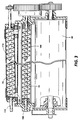
- FIG. 3 is a top view of the developer assembly of the machine shown in FIG. 1.
- FIG. 4 is top view schematic representation of the developer material transfer between augers.
- FIG. 5 is a side view schematic representation of the developer material transfer between the augers.
- FIG. 1 of the drawings there is shown a xerographic type reproduction machine 8 incorporating a dual auger mixing assembly in accordance with the present invention, designated generally by the numeral 10.
- Machine 8 has a suitable frame (not shown) on which the machine xerographic components are operatively supported.
- the machine xerographic components include a recording member, shown here in the form of a rotatable photoreceptor 14.
- photoreceptor 14 comprises a drum having a photoconductive surface 16.
- a charge corotron 18 for placing a uniform charge on the photoconductive surface 16 of photoreceptor 14; an exposure station 22 where the previously charged photoconductive surface 16 is exposed to image rays of a document 9 being copied or reproduced; development station 24 where the latent electrostatic image created on photoconductive surface 16 is developed by toner; and transfer detack corotrons 28 and 30 for assisting transfer of the developed image to a suitable copy substrate material such as a copy sheet 32 brought forward in timed relation with the developed image on photoconductive surface 16. Residual toner is removed from the drum surface at cleaning station 34.
- Copy sheets 32 are brought forward to the transfer area by feed roll pair 40, sheet guides 42, 43 serving to guide the sheet through an approximately 180° turn prior to the transfer area. Following transfer, the sheet 32 is carried forward to a fusing station 48 where the toner image is fixed by fusing roll 49. After fusing, the copy sheet 32 is discharged to an output tray.
- a transparent platen 50 supports the document 9 as the document is moved past a scan point 52 by a constant velocity type transport 54.
- scan point 52 is in effect a scan line extending across the width of platen 50 at a desired point along the platen where the document is scanned line by line as the document is moved along platen 50 by transport 54.
- Transport 54 has input and output document feed roll pairs 55, 56, respectively, on each side of scan point 52 for moving document 9 across platen 50 at a predetermined speed.
- Exposure lamp 58 is provided to illuminate a strip-like area of platen 50 at scan point 52. The image rays from the document line scanned are transmitted by a gradient index fiber lens array 60 to exposure station 22 to expose the photoconductive surface 16 of the moving photoreceptor 14.
- Developer station 24 includes a developer housing 65 in which a toner dispensing cartridge 66 is rotatably mounted so as to dispense toner particles downward into a sump area occupied by the dual auger mixing assembly 70 of the present invention.
- Assembly 70 includes a pair of rotatably mounted augers 72, 74; further details of the construction and operation of assembly 70 are provided below.
- a magnetic brush developer roll 80 is disposed in predetermined operative relation to the photoconductive surface 16 of photoreceptor 14, the length of developing roll 80 being equal to or slightly greater than the width of photoconductive surface 16, with the axis of roll 80 parallel to the axis of photoreceptor 14.
- Developer roll 80 has a plurality of stationary magnet assemblies 81 ( Figure 2) disposed within a rotatable cylinder or sleeve 75, sleeve 75 being rotatably journaled for rotation in the opposing sides of developer housing 65. Magnet assemblies 81 are arranged so that as sleeve 75 rotates, developer is attracted to the exterior surface of sleeve 75 to form a brush-like layer 82 on sleeve 75. Rotation of sleeve 75 carries the developer brush 82 into developing relation with the photoconductive surface 16 of photoreceptor 14 to develop the latent electrostatic image therein.
- FIGS. 2 and 3 show an end view and top view of the developer assembly.
- Figures 4 and 5 show the toner transfer betweens auger from a top and side view perspective, respectively.
- Auger 72 having arcuate segments 104 is mounted on horizontal shaft 100 which is driven by motor means (not shown) in a counterclockwise direction.
- Supported beneath auger 72 is a trough 106 extending the length of the auger.
- Auger 74 having arcuate segments 114, is mounted on inclined shaft 116 and driven by appropriate motor means in a clockwise direction.
- the configuration of shaft 116 is that the auger has an uphill end (Figure 2 out of the page) and a downhill end ( Figure 2 into the page).
- Auger 74 is contained within a cylinder 118 enclosed except for toner transfer openings 120, 122 at both ends.
- the downhill end of auger 74 with transfer opening 120 is positioned adjacent, but lower than, one end of auger 72 and receives developer from the auger via gravity feed.
- the developer is transferred from auger 72 to auger 74 by gravitational force acting on the toner.
- Auger 74 then mixes the developer and carries it uphill.
- the developer then falls into sump 110 or is again picked up by auger 72 via the higher opening 122 at the uphill end.
- auger 72 is angled upward at an angle of approximately 1°.
- a suitable controller 89 is provided for operating the various components of machine 8 in predetermined timed relation with one another to produce copies.
- machine 8 is actuated by a suitable start control button.
- the document to be copied is then inserted into the nip of document transport roll pair 55, 56 which carries the document across platen 50.
- controller 89 in response to the signal from the detector, starts feed roll pair 40 to advance the copy sheet 32 forward in timed relation with the document 9 as the document is transported across platen 50 and past scan point 52 by document transport 54.
- the document image developed on the photoconductive surface 16 of photoreceptor 14 is transferred to copy sheet 32 as the copy sheet moves through the transfer area. Following transfer, the copy sheet 32 passes to fusing station 48 where the image is fixed.
- Auger 72 continually mixes the fresh toner with the denuded carrier particles and existing developer. As the auger 72 rotates in a counterclockwise direction, and with arcuate segments 104 having an orientation as shown, the mixture is conveyed from right to left in Figure 4 and into the page in Figure 5. The mixture then transfers into the auger 74 system, which carries the developer uphill to the retransfer point. The system is thus constantly ensuring that freshly added toner is constantly being mixed into the existing developer.
- the dual auger crossmixing system accomplishes inter-auger developer transfer by a construction which utilizes the forces of gravity to accomplish the transfer at each auger end.
- the augers can be spaced physically further apart than is possible with the prior art systems. Because of the "drop distance" between each auger end, no developer buildup is experienced at either end.
Landscapes
- Physics & Mathematics (AREA)
- General Physics & Mathematics (AREA)
- Dry Development In Electrophotography (AREA)
Claims (4)
- Système de développement comportant un rouleau développateur (80) prévu pour déposer du matériau développateur sur une surface de formation d'image (16) ayant une image latente électrostatique sur celle-ci, un système à double vis sans fin pour mélanger ledit matériau développateur et transférer le développateur mélangé audit rouleau développateur, ledit système à double vis sans fin comprenant une première vis sans fin (72) prévue pour mélanger et délivrer le matériau développateur audit rouleau développateur, une seconde vis sans fin (74), contigüe à ladite première vis sans fin, les extrémités adjacentes desdites première et seconde vis sans fin étant séparées par une certaine distance verticale et des ouvertures de communication de transport de toner (120, 122) auxdites extrémités des vis sans fin, d'où il résulte que le toner est transporté d'une première vis sans fin à l'autre par une force de pesanteur, caractérisé en ce que la première vis sans fin (72) est placée dans un plan horizontal et que la seconde vis sans fin (74) est placée dans un plan qui n'est pas horizontal.
- Système de développement selon la revendication 1, dans lequel un élément de type auge à ouverture (106) est positionné au-dessous de ladite première vis sans fin et dans lequel la seconde vis sans fin est enfermée à l'intérieur d'un cylindre (118) ayant des ouvertures de transport de toner (120, 122) aux deux extrémités.
- Système de développement selon la revendication 1 ou 2, dans lequel ladite seconde vis sans fin est inclinée à un angle d'approximativement 1° par rapport au plan horizontal de ladite première vis sans fin.
- Système de développement à brosse magnétique à double vis sans fin dans lequel le matériau développateur est délivré à un rouleau à brosse magnétique tournant, le système comprenant
une première vis sans fin d'alimentation (72) ayant une longueur au moins aussi grande que ledit rouleau à brosse magnétique (80), ladite première vis sans fin étant positionnée suivant un plan horizontal et prévue pour transporter le matériau développateur dans un premier sens de façon à délivrer ledit matériau audit rouleau à brosse magnétique,
une seconde vis sans fin d'inter-mélange (74) tournant, en utilisation, dans un sens opposé à ladite première vis sans fin, et
des ouvertures de transport de matériau développateur (120, 122) caractérisé en ce que la seconde vis sans fin d'inter-mélange (74) est pratiquement de la même longueur que ladite première vis sans fin et est positionnée à un certain angle par rapport à ladite première vis sans fin, de sorte qu'une extrémité est plus basse que l'extrémité adjacente de la première vis sans fin, tandis que l'autre extrémité est plus haute que l'autre extrémité respective de la première vis sans fin et en ce que le matériau développateur est transporté, en utilisation, par la pesanteur de ladite première extrémité de la première vis sans fin à l'extrémité adjacente de ladite seconde vis sans fin, la seconde vis sans fin transportant le matériau développateur vers le haut à l'autre extrémité où le toner est transféré par alimentation par pesanteur à ladite autre extrémité de ladite première vis sans fin.
Applications Claiming Priority (2)
| Application Number | Priority Date | Filing Date | Title |
|---|---|---|---|
| US07/360,809 US4978997A (en) | 1989-06-02 | 1989-06-02 | Crossmixing dual auger system |
| US360809 | 1989-06-02 |
Publications (3)
| Publication Number | Publication Date |
|---|---|
| EP0401046A2 EP0401046A2 (fr) | 1990-12-05 |
| EP0401046A3 EP0401046A3 (fr) | 1992-05-20 |
| EP0401046B1 true EP0401046B1 (fr) | 1995-03-29 |
Family
ID=23419487
Family Applications (1)
| Application Number | Title | Priority Date | Filing Date |
|---|---|---|---|
| EP90306022A Expired - Lifetime EP0401046B1 (fr) | 1989-06-02 | 1990-06-01 | Système à mélanger par vis sans fin double |
Country Status (5)
| Country | Link |
|---|---|
| US (1) | US4978997A (fr) |
| EP (1) | EP0401046B1 (fr) |
| JP (1) | JPH03163479A (fr) |
| CA (1) | CA2017264C (fr) |
| DE (1) | DE69018126T2 (fr) |
Families Citing this family (9)
| Publication number | Priority date | Publication date | Assignee | Title |
|---|---|---|---|---|
| JPH05127537A (ja) * | 1991-11-08 | 1993-05-25 | Fujitsu Ltd | 現像装置 |
| US5257077A (en) * | 1992-01-31 | 1993-10-26 | Xerox Corporation | Toner dispensing apparatus for a xerographic reproduction machine |
| US5519470A (en) * | 1994-03-04 | 1996-05-21 | Xerox Corporation | Cross mixing paddle wheel |
| US5510881A (en) * | 1994-11-18 | 1996-04-23 | Xerox Corporation | Positive push development auger |
| KR0122124Y1 (ko) * | 1995-05-30 | 1998-12-01 | 김광호 | 현상기의 교반기 장치 |
| US6580881B2 (en) | 2001-10-04 | 2003-06-17 | Lexmark International, Inc. | Method of detecting waste toner in a container of an image forming apparatus |
| US7426361B2 (en) * | 2005-09-01 | 2008-09-16 | Eastman Kodak Company | Developer mixing apparatus having four ribbon blenders |
| JP5168631B2 (ja) * | 2008-03-11 | 2013-03-21 | 株式会社リコー | 現像装置及び画像形成装置 |
| US20130051861A1 (en) * | 2011-08-22 | 2013-02-28 | Alan E. Rapkin | Angled magnetic auger for a developer station |
Family Cites Families (9)
| Publication number | Priority date | Publication date | Assignee | Title |
|---|---|---|---|---|
| US2028745A (en) * | 1933-04-01 | 1936-01-28 | Wallace M Hendrick | Apparatus for bituminous mixing |
| US3664299A (en) * | 1970-12-07 | 1972-05-23 | Eg & G Inc | Electrostatic recording paper toner section |
| US4056076A (en) * | 1975-04-24 | 1977-11-01 | Xerox Corporation | Developer mixing system |
| US3999514A (en) * | 1975-09-29 | 1976-12-28 | International Business Machines Corporation | Magnetic brush developer |
| US4146323A (en) * | 1977-06-29 | 1979-03-27 | Xerox Corporation | Auger for a development system |
| US4274362A (en) * | 1979-12-05 | 1981-06-23 | Pitney Bowes, Inc. | Magnetic brush mixing augers |
| JPS58163968A (ja) * | 1982-03-24 | 1983-09-28 | Konishiroku Photo Ind Co Ltd | 現像装置 |
| US4478512A (en) * | 1983-05-11 | 1984-10-23 | Xerox Corporation | Toner cartridge for use in an electrophotographic printing machine |
| US5006893A (en) * | 1987-12-18 | 1991-04-09 | Minolta Camera Kabushiki Kaisha | Image forming apparatus with improved toner replenishment |
-
1989
- 1989-06-02 US US07/360,809 patent/US4978997A/en not_active Expired - Fee Related
-
1990
- 1990-05-22 CA CA002017264A patent/CA2017264C/fr not_active Expired - Fee Related
- 1990-05-26 JP JP2136939A patent/JPH03163479A/ja active Pending
- 1990-06-01 EP EP90306022A patent/EP0401046B1/fr not_active Expired - Lifetime
- 1990-06-01 DE DE69018126T patent/DE69018126T2/de not_active Expired - Fee Related
Also Published As
| Publication number | Publication date |
|---|---|
| DE69018126T2 (de) | 1995-11-09 |
| DE69018126D1 (de) | 1995-05-04 |
| JPH03163479A (ja) | 1991-07-15 |
| CA2017264A1 (fr) | 1990-12-02 |
| US4978997A (en) | 1990-12-18 |
| EP0401046A2 (fr) | 1990-12-05 |
| CA2017264C (fr) | 1994-09-20 |
| EP0401046A3 (fr) | 1992-05-20 |
Similar Documents
| Publication | Publication Date | Title |
|---|---|---|
| EP1533665B1 (fr) | Appareil de formation d'images avec trois éléments d'agitation et de transport pour toner dans une unité de développement | |
| JP3246682B2 (ja) | 電子写真複写機のトナー配給装置 | |
| US5758238A (en) | Auger configuration for eliminating auger mark print defect | |
| EP0401046B1 (fr) | Système à mélanger par vis sans fin double | |
| US4965639A (en) | Toner supply cartridge for reproduction and printing machines | |
| US4996565A (en) | Developer material mixing apparatus | |
| US5510881A (en) | Positive push development auger | |
| US5937252A (en) | Trickle port between two augers in a developer housing | |
| JP2981019B2 (ja) | トナー供給カートリッジ | |
| US5519470A (en) | Cross mixing paddle wheel | |
| US6510304B2 (en) | Auger for magnetic materials with specific use for developer transport in elelctrographic printing systems | |
| JP3505110B2 (ja) | 現像装置 | |
| US4872036A (en) | Developing apparatus | |
| JPH04198966A (ja) | 画像形成装置 | |
| JP2707248B2 (ja) | 現像装置 | |
| JPH071407B2 (ja) | 現像装置 | |
| JP3795596B2 (ja) | 現像装置 | |
| JP2600238B2 (ja) | 現像装置 | |
| JP3079888B2 (ja) | 現像装置 | |
| JPH063961A (ja) | 現像装置 | |
| JP2536026Y2 (ja) | 乾式電子写真装置 | |
| JP2767786B2 (ja) | 現像装置 | |
| JPS62156686A (ja) | クリ−ニング装置 | |
| JPH063951A (ja) | 現像装置 | |
| CN1036277A (zh) | 用于显影系统的交叉混合螺旋推进加料机构 |
Legal Events
| Date | Code | Title | Description |
|---|---|---|---|
| PUAI | Public reference made under article 153(3) epc to a published international application that has entered the european phase |
Free format text: ORIGINAL CODE: 0009012 |
|
| AK | Designated contracting states |
Kind code of ref document: A2 Designated state(s): DE FR GB |
|
| PUAL | Search report despatched |
Free format text: ORIGINAL CODE: 0009013 |
|
| AK | Designated contracting states |
Kind code of ref document: A3 Designated state(s): DE FR GB |
|
| 17P | Request for examination filed |
Effective date: 19921105 |
|
| 17Q | First examination report despatched |
Effective date: 19930805 |
|
| GRAA | (expected) grant |
Free format text: ORIGINAL CODE: 0009210 |
|
| AK | Designated contracting states |
Kind code of ref document: B1 Designated state(s): DE FR GB |
|
| ET | Fr: translation filed | ||
| REF | Corresponds to: |
Ref document number: 69018126 Country of ref document: DE Date of ref document: 19950504 |
|
| PLBE | No opposition filed within time limit |
Free format text: ORIGINAL CODE: 0009261 |
|
| STAA | Information on the status of an ep patent application or granted ep patent |
Free format text: STATUS: NO OPPOSITION FILED WITHIN TIME LIMIT |
|
| 26N | No opposition filed | ||
| PGFP | Annual fee paid to national office [announced via postgrant information from national office to epo] |
Ref country code: GB Payment date: 19980526 Year of fee payment: 9 |
|
| PGFP | Annual fee paid to national office [announced via postgrant information from national office to epo] |
Ref country code: DE Payment date: 19980608 Year of fee payment: 9 |
|
| PGFP | Annual fee paid to national office [announced via postgrant information from national office to epo] |
Ref country code: FR Payment date: 19980609 Year of fee payment: 9 |
|
| PG25 | Lapsed in a contracting state [announced via postgrant information from national office to epo] |
Ref country code: GB Free format text: LAPSE BECAUSE OF NON-PAYMENT OF DUE FEES Effective date: 19990601 |
|
| PG25 | Lapsed in a contracting state [announced via postgrant information from national office to epo] |
Ref country code: FR Free format text: THE PATENT HAS BEEN ANNULLED BY A DECISION OF A NATIONAL AUTHORITY Effective date: 19990630 |
|
| GBPC | Gb: european patent ceased through non-payment of renewal fee |
Effective date: 19990601 |
|
| PG25 | Lapsed in a contracting state [announced via postgrant information from national office to epo] |
Ref country code: DE Free format text: LAPSE BECAUSE OF NON-PAYMENT OF DUE FEES Effective date: 20000503 |
|
| REG | Reference to a national code |
Ref country code: FR Ref legal event code: ST |