EP0403735A1 - Ressource management method - Google Patents
Ressource management method Download PDFInfo
- Publication number
- EP0403735A1 EP0403735A1 EP90105160A EP90105160A EP0403735A1 EP 0403735 A1 EP0403735 A1 EP 0403735A1 EP 90105160 A EP90105160 A EP 90105160A EP 90105160 A EP90105160 A EP 90105160A EP 0403735 A1 EP0403735 A1 EP 0403735A1
- Authority
- EP
- European Patent Office
- Prior art keywords
- time
- resource
- value
- demand
- values
- Prior art date
- Legal status (The legal status is an assumption and is not a legal conclusion. Google has not performed a legal analysis and makes no representation as to the accuracy of the status listed.)
- Withdrawn
Links
Images




Classifications
-
- G—PHYSICS
- G06—COMPUTING OR CALCULATING; COUNTING
- G06Q—INFORMATION AND COMMUNICATION TECHNOLOGY [ICT] SPECIALLY ADAPTED FOR ADMINISTRATIVE, COMMERCIAL, FINANCIAL, MANAGERIAL OR SUPERVISORY PURPOSES; SYSTEMS OR METHODS SPECIALLY ADAPTED FOR ADMINISTRATIVE, COMMERCIAL, FINANCIAL, MANAGERIAL OR SUPERVISORY PURPOSES, NOT OTHERWISE PROVIDED FOR
- G06Q10/00—Administration; Management
- G06Q10/06—Resources, workflows, human or project management; Enterprise or organisation planning; Enterprise or organisation modelling
-
- G—PHYSICS
- G06—COMPUTING OR CALCULATING; COUNTING
- G06F—ELECTRIC DIGITAL DATA PROCESSING
- G06F13/00—Interconnection of, or transfer of information or other signals between, memories, input/output devices or central processing units
-
- G—PHYSICS
- G05—CONTROLLING; REGULATING
- G05B—CONTROL OR REGULATING SYSTEMS IN GENERAL; FUNCTIONAL ELEMENTS OF SUCH SYSTEMS; MONITORING OR TESTING ARRANGEMENTS FOR SUCH SYSTEMS OR ELEMENTS
- G05B19/00—Program-control systems
- G05B19/02—Program-control systems electric
- G05B19/418—Total factory control, i.e. centrally controlling a plurality of machines, e.g. direct or distributed numerical control [DNC], flexible manufacturing systems [FMS], integrated manufacturing systems [IMS] or computer integrated manufacturing [CIM]
- G05B19/41865—Total factory control, i.e. centrally controlling a plurality of machines, e.g. direct or distributed numerical control [DNC], flexible manufacturing systems [FMS], integrated manufacturing systems [IMS] or computer integrated manufacturing [CIM] characterised by job scheduling, process planning, material flow
-
- Y—GENERAL TAGGING OF NEW TECHNOLOGICAL DEVELOPMENTS; GENERAL TAGGING OF CROSS-SECTIONAL TECHNOLOGIES SPANNING OVER SEVERAL SECTIONS OF THE IPC; TECHNICAL SUBJECTS COVERED BY FORMER USPC CROSS-REFERENCE ART COLLECTIONS [XRACs] AND DIGESTS
- Y02—TECHNOLOGIES OR APPLICATIONS FOR MITIGATION OR ADAPTATION AGAINST CLIMATE CHANGE
- Y02P—CLIMATE CHANGE MITIGATION TECHNOLOGIES IN THE PRODUCTION OR PROCESSING OF GOODS
- Y02P90/00—Enabling technologies with a potential contribution to greenhouse gas [GHG] emissions mitigation
- Y02P90/02—Total factory control, e.g. smart factories, flexible manufacturing systems [FMS] or integrated manufacturing systems [IMS]
Definitions
- This invention relates in general to methods for allocating resources to satisfy a time varying demand on those resources and, more particularly, to improved methods for allocating manufacturing or process resources having multiple constraints thereon to meet various time varying manufacturing or service demands having multiple manufacturing or service parameter requirements.
- the resources intended to be used to make the products or provide the services have certain inherent capacity.
- the quantity that can be produced or handled per unit time on a particular machine or or by particular workers or at a particular stage of the process may be fixed by physical constraints on the machine or workers or process stage; or a given production machine or stage may only be capable of reaching certain temperatures or lifting certain weight or only have available only certain atmospheres or chemicals or voltages or currents; or a given resource may only be capable of carrying out particular steps or providing a particular sequence of steps.
- Those of skill in the art will appreciate that these are only examples of the many physical constraints that may be associated with individual production or process resources.
- the words "capacity" or "capacities” are intended to refer collectively to the many limitations or constraints which determine the ability of a resource to respond to a demand.
- the product or service desired will require that certain physical steps or other conditions be provided. For example, a certain quantity of the product must be made; or at certain stages of the process various materials must be subjected to certain temperatures, voltages, forming operations and/or atmospheres; or certain ingredients or information must be added.
- the problem faced by those managing the resources is to balance in the most desirable way, the demand on the resources against the availability of the resources, taking into account all of the complex details and interactions that are part of real world production or processes.
- This activity is generally referred to as “scheduling” or “production control” and has existed for many years.
- An important and especially complex part of this activity is determining how new or modified demands may be optimally accommodated in a manufacturing or service process which is already partially loaded by previously scheduled demands. Many possible options may exist for accommodating the new or modified demands.
- resource availability is changing in real time as the previously scheduled production lots or materials or service recipients continue to advance through the process.
- time buckets that is, using fixed unit increments of time wherein a given resource, e.g., a particular production resource, is assigned an availability value. For example, a large chart is made on which the production resources are listed, e.g., along the left margin and usually in the order intended to be used. Running across the top are the unit time increments, for example, hours, days or weeks. The intersections of the resource rows and the time columns are the "time buckets". When a resource is committed to perform a particular step for a particular duration, the corresponding number of time buckets are filled in or marked in some fashion.
- the start time, stop time and duration are indicated by where on the chart and how many of the time buckets are filled in. Often, the amount of a resource committed to a particular production lot and/or the amount remaining that might be assigned to another production lot or both are recorded. In a typical, sequential, time bucket scheduling chart, the track of an individual batch or production lot appears as a staggered series of entries extending from upper left toward lower right.
- scheduling interval are used herein to denote a period of time extending into the future during which it is desired to be able to schedule resources.
- the longer the production or service cycle time the longer the scheduling interval. Scheduling intervals of weeks, months and years are common. In some rare cases which involve very long process cycles, schedules can extend over one or more decades.
- process or “processes” are used herein to refer generally to the steps by which one or more resources operate on various input materials to change their physical state to provide a product or service that satisfies the demand.
- the symbol “c” is used herein to denote capacity or capacities associated with resources, i.e., what amounts and/or properties of the resources are available.
- the symbol “r” is used herein to denote physical requirements on various resources associated with various demands, i.e., what amounts and/or properties of the resources are needed to meed the demand.
- both "c” and “r” are usually multi-dimensional.
- a resource may have simultaneous capacities "c” for achievable lifting range, work rate, decision making ability, materials handled, forming ability, computation ability, temperature, voltage and current range capability, chemicals dispensed, impurities excluded or provided, input/output configurations, and so forth.
- a desired product or service may have simultaneous demand requirements "r” for values of these or other capacity attributes which must be provided.
- both c and r can change with time and that the process for satisfying the demand may be sequential, parallel or a combination thereof.
- a process for allocating resources to alter the physical state of predetermined input materials to meet a predetermined production or service demand comprising: converting the demands into an array of physical resource capacity requirements for each resource which is ordered in time and has entries only for time values when the required capacities change; providing for each resource an array of available capacities which is ordered in time and has entries only for time values when the available capacities change; comparing the time ordered arrays of required and available capacities to determine whether and when the available capacities equal or exceed the required capacities and, when successful, modifying the time ordered array of available capacities to provide an up-dated time ordered array of available capacities reflecting the assignment of available capacities to meet the requirements associated with the demands, wherein the up-dated time ordered array of available capacities only has entries when the up-dated available capacities change; and applying the resource required first in time to the input materials to change the physical state thereof.
- this is accomplished by a process comprising: identifying the demands for altering the physical state of the predetermined input materials; identifying one or more quantifiable physical requirements r associated with the q th physical demand, relevant to altering the physical state of the input materials; identifying the resources needed to provide the desired alteration of the physical state of the predetermined input materials; identifying one or more quantifiable physical capacities c associated with the p th physical resource, relevant to altering the physical state of the input materials; providing an orderable array of multidimensional demand vertices D q [t,r,j] for the demand q, wherein t is time, r identifies the physical requirements associated with the q th demand, and j is an integer index running from 1 to J wherein J is the total number of times wherein r has differing values; ordering the array of multidimensional vertices D q [t,r,j] for increasing values of t, wherein each value of j corresponds to a value of t where r changes
- the above described process is desirably repeated for each value of j and for each resource p and demand q until a series of beginning and ending times is obtained for completing the entire desired manufacturing or service sequence on all of the needed resources.
- the above described resource allocation process also yields an updated ordered array of resource vertices R p incorporating the newly accommodated demand. This forms the starting vertex array for considering further demand.
- This is useful in the situation where the starting time is not limited by some preceding step constraining when the lot is available to start processing on the p th resource. If the lot is ready to start but scheduling is constrained by the availability of a p th resource, then this embodiment provides the first available starting time when the p th resource has available capacities c which meet all of the demand requirements r.
- This is useful where the steps performed by the p th resource need not be continuous in time, and is especially helpful in maximizing resource usage.
- the above-described process provides a particularly compact data matrix so that large numbers of resource capacities and demand requirements can be quickly evaluated to obtain more effective resource utilization.
- FIG. 1 shows in simplified form a schematic block diagram of a physical system embodying the present invention, comprising input unit 10 and output unit 12 coupled to processor 14.
- Memory data store 16 is also coupled to processor 14.
- Input unit 10 is conveniently a conventional keyboard and CRT, but other data input means well known in the art may also be used. Examples are, paper tape readers, magnetic tape readers, disk readers and the like, to name a few.
- Output unit 12 is conveniently a printer, but other output units will also serve, such as for example, a modem, a CRT, a tape punch, and a tape or disk drive for recording output information.
- the combination of input unit 10, output unit 12 central processor 14 and memory and data store 16 makes up computer system 18.
- Computer system 18 is desirably but not essentially coupled to interface controller 20 which in turn is coupled to bus 22 which extends to various physical resources 24.
- Interface controller 20 and bus 22 provide one or two way communication between resources 24 and computer system 18, for the purpose of updating computer system 18 on the status of the various resources and/or allowing computer system 18 to instruct various resources 24 to commence or terminate work on input materials supplied thereto by other means (not shown) or make intermediate adjustments during a particular process step, e.g., when a demand requirement such as for example a processing temperature is to change within a particular resource apparatus.
- Model TXP computer manufactured by Tandem Corporation of Cupertino, CA which includes a central processor and a memory data store having RAM and non-volatile magnetic storage.
- a type 3270 input terminal manufactured by IBM of Armonk, NY is coupled thereto as the input device.
- the output is a conventional printer. Any type of compatible printer may be used.
- the Tandem computer utilizes the "Guardian" operating system which is well known in the art.
- the Tandem computer is programmable in Tandem Assembly Language (TAL) which is well known in the art, but other well known computer languages may also be used.
- the Model TXP Tandem computer is a 32 bit machine with a 83.3 nanosecond micro-instruction time, I/O channel speed up to 5 megabits/second, and CPU capability to address 16 megabits of physical memory and 1 gigabit of virtual memory.
- the computer hardware and its operating system and programming languages are entirely conventional.
- the present invention lies in the combination of hardware and software which results in a unique system having the particular properties described herein and which is uniquely capable of performing the invented process.
- Tandem computer has been used to implement the present invention
- other computer hardware, operating systems, and language choices could also be used, provided that they have computational precision and speed suitable for the scheduling precision and complexity desired to be provided.
- 32 bit single precision or 16 bit double precision machines with MIPS rates of about 0.75 or more are believed to provide reasonable performance for many scheduling applications.
- the unique approach of the present invention materially reduces the speed and memory capacity demands placed on the hardware, so that the present invention is particularly adaptable to computers of relatively modest capability.
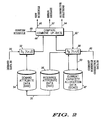
- FIG. 2 shows in simplified schematic form, a block diagram of the planning model of the present invention according to a preferred embodiment thereof.
- the Demand Attribute Data (DAD) File 34, Resource Attribute Data (RAD) File 36, and Current Capacity Allocation Data (CCAD) File 42 shown in FIG. 2 are logical data store files and may be located in any physical memory space or media.
- the boxes denoted by the identification numbers 32, 38 and 44 in FIG. 2 are intended to represent logical functions and may be embodied in any physical processor unit. The logical operation of the resource planning system depicted in FIG. 2 will now be described.
- Demand Data (DD) 30 is combined in logical unit 32 with Demand Attribute Data (DAD) stored in file 34 to obtain an array of demand vertices D q [t,r,j], defined above.
- DAD Demand Attribute Data
- Demand Data generally describes the type of product or service desired to be obtained, the quantity needed, the desired completion (and/or starting) date, and other information concerning special features (e.g., color, quality, authorizations, licenses, etc.) that must be included.
- Demand Data is a complete description of the relevant information concerning the product or service demanded.
- the Demand Data is not by itself directly useful for scheduling. It must be combined with information in the DAD file.
- the DAD file contains reference information that relates particular product or service types and features to the process used for providing it. It tells what steps must be provided and in what order to build the product or provide the service and what resources are needed for those steps.
- the DAD file is generally changed only when there is a change in the process for making a particular product or service. It is desirable when the DAD file information is loaded to check it against the resource information in the RAD file to insure that the DAD file process only asks for physically realizable resources.
- the RAD file contains reference information on the resources, i.e., their intrinsic capability, such as for example, their unloaded capacity and achievable parameter ranges (e.g., temperature, atmosphere, forming ability, decision making ability, etc.), and whether they are on-line and ready for use.
- the RAD file generally only changes when there are changes in the resources or their capabilities. For example, when a new machine or service module is added, data concerning the old unit is removed and replaced by data on the new unit. Also, when a unit is removed from service for repair or maintenance its status would be noted in the RAD file. Generally, there is no information in the RAD file about whether or not the resource is actually being used.
- Line 35 joining the RAD and DAD Files indicates that information from the RAD File is made available during loading or updating the DAD File for a consistency check. This is to insure that the process/equipment information in the DAD File is consistent with the physical capabilities of the installed resources.
- the capacity vertices R p [t,c,i] 38 are conveniently initialized using RAD file 36 to provide information on resource characteristics (what), unloaded capacity (how much), initial availability (when), any inherent capacity decay information, and anticipated life (shut-down timing), associated with each resource.
- Current Schedule Correction Data 40 may also be provided to update R p vertices 38 to reflect any known deviations from the previous schedule that affect resource availability or capacity. Examples of Current Schedule Correction Data are, unplanned equipment outages, strikes, production material shortages, split lots, shortfalls in resource performance, etc.
- the corrected values of R p [t,c,i] for each resource p, having available capacity c at time values t, are ordered by increasing time values t and stored in the Current Capacity Allocation Data (CCAD) file 42, as indicated by line 50, with an explicit or implicit index i denoting each change in capacities c and its related time value t.
- CCAD Current Capacity Allocation Data
- time ordered D q and R p vertex arrays are current, they are combined and decremented in planning module 44 to provide new proposed schedule 46 reflecting the newly accommodated demand.
- Confirmation input 48 is available, if desired, for confirming the new proposed schedule.
- the new schedule is delivered by any appropriate means to the affected resources to cause them to commence processing of the predetermined input material to alter its state to obtain the desired product output or provide the desired service.
- the vertices are re-ordered by increasing time values t, the index i for each capacity change is altered, if needed, to reflect the relative position of the newly ordered up-dated vertices, and the total number of vertices I adjusted to agree with the new total. This insures that no unnecessary information is being stored.
- CCAD File 42 contains the current schedule and information on all of the work in progress (WIP).
- an error message 52 or an alternative suggestion 54 results or both.
- the system will respond that the requested capacity and timing is not available during the scheduling interval. If so desired, the system can also respond with the possible times when the demand could be accommodated during the scheduling interval. This permits the user or the system, depending upon the decision authority allowed, to modify the demanded start/stop times to match those available. Further, if the demand requests a particular resource for an uninterrupted duration dt that is not available within the scheduling interval, then the system can respond with the available times which if combined would equal or exceed dt.
- the process of combining the D g and R p vertex arrays involves algebraically decrementing certain capacities c by the requirements r, but not others.
- the particular c and r values being considered involve numerical capacities and requirements (e.g., number of slots in a burn-in oven or spindles on the head of a turret lathe) then the requirement r being scheduled is algebraically subtracted from the currently available capacity c to obtain the up-dated R p values.
- the particular c and r values concern a resource parameter that is not reduced in amount by assigning the requirement to that resource, then algebraic subtraction is not appropriate.
- the combining process involves determining whether the required temperature or speed or color is within the available temperature or speed or color capabilities of that resource.
- the comparing and/or combining and/or decrementing process may return, for example, "true” or "false” rather than a numerical value.
- a numerical or true/false output may not be sufficient, especially when applying a requirement to a resource affects the available choices which may remain after the resource is partly committed.
- the resource is a printer or paint rack with capability of handling 1000 units and 3 colors, (e.g., red, green or blue)
- the words "comparing”, “combining” and/or “decrementing” are intended to refer in general to the process of determining whether the available capacity will handle the required capacity and, depending upon the nature of the parameters being compared, returning either a numerical difference where that is appropriate or a true/false output or other information output or both, where that is appropriate.
- FIGS. 3-7 reflect quantitative capacities and requirements that are algebraically combinable, as for example, quantity of units that can be heated in an oven or number of applications that can be processed.
- FIGS 3-5 and 7 show diagrams of the resource vertices R p [t,c,i] where t is time, c is one or more physical constraints associated with the p th resource and i is an integer index running from 1 to I where I is the total number of times that c has differing values.
- FIG. 3 shows the initialized, unloaded, capacity vertex array for the p th resource, derived from the RAD File.
- FIG. 5 is similar to FIG. 4 and depicts the situation after more capacity assignments have been made to meet additional demands.
- the vertex array has been re-ordered in time, additional index values i assigned and I increased to ten. For each value of index i, there is a corresponding value of t at the time when c changes value.
- this is merely for convenience and other consistent conventions could also be adopted.
- FIG. 6 is a plot analogous to FIG. 5 above, but for a demand vertex array D q [tr,j] desired to be applied to the capacity vertex array R p [t,c,i] shown in FIG. 5.
- FIG. 7 shows the result of comparing and combining FIGS. 5-6.
- c > r during the intervals t2-t1 and t4-t3
- the demand requirement can be accommodated.
- Combining D q and R p results in the changes to the R p shown in FIG. 7.
- the c values during these intervals have been decremented by the desired r quantities.
- a new schedule accommodating the demand can now be issued and the up-dated and re-ordered capacity vertex array R p [t,c,i] placed in the CCAD File.
- the time t1 in FIG. 6 is shown as exactly corresponding to the time t3 in FIG. 5 and the requirement amount r12 exactly equalling the amount of the available capacity peak between t3 and t4 of FIG. 5.
- the demand requirement r34 falls between times t8 and t9 in FIG. 5 and therefore creates two new vertices shown in FIG. 7.
- the vertices in FIG. 7 are re-indexed after the deletion of the vanished vertex discussed above and the addition of the two new vertices and I totals 11.
- the ordered up-dated vertex array is stored in the updated CCAD File via 50 (see FIG. 2).
- FIGS. 5-7 The sequence illustrated in FIGS. 5-7 is repeated for each resource and requirement to determine whether all of the requirements associated with a particular demand can be accommodated, either as initially requested or using one of the alternatives solutions suggested by the system when an exact match is not found.
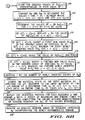
- FIGS. 8A and 8B together comprise a detailed flow diagram illustrating a preferred embodiment of the method of the present invention.
- FIGS. 8A and 8B illustrate the essential steps in a process for allocating resources to alter the physical state of predetermined input materials to meet a predetermined production or service demand.
- step 104 the demands for altering the physical state of the predetermined input materials are identified.
- step 104 one or more quantifiable physical requirements r associated with the q th physical demand, relevant to altering the physical state of the input materials, is identified.
- step 106 the resources needed to provide the desired alteration of the physical state of the predetermined input materials are identified.
- step 108 one or more quantifiable physical constraints c associated with the p th physical resource, relevant to altering the physical state of the input materials, is identified.
- step 110 an orderable array of multidimensional demand vertices D q [t,r,j] is provided for the demand q, wherein t is time, r identifies the physical requirements associated with the q th demand, and j is an integer index running from 1 to J. J is the total number of times wherein r has differing values.
- step 112 the array of multidimensional vertices D q [tr,j] is ordered for increasing values of t, wherein each value of j corresponds to a value of t where r changes value.
- step 114 the ordered values of D q [t,r,j] corresponding to each value of j is stored.
- step 116 an orderable array of multidimensional resource vertices R p [t,c,i] is provided for the resource p, wherein t is time, c identifies the physical constraints associated with the p th resource, and i is an integer index running from 1 to I. I is the total number of times wherein c has differing values.
- step 118 the array of multidimensional vertices R p [t,c,i] is ordered for increasing values of t, wherein each value of i corresponds to a value of t where c changes value.
- step 120 the ordered values of R p [t,c,i] are stored corresponding to each value of i.
- step 138 the process of steps 102-136 is repeated for each resource p and demand q until a series of beginning and ending times is obtained for completing the entire desired manufacturing or service sequence on all of the needed resources.
- step 140 an updated ordered array of resource vertices R p incorporating the newly accommodated demand is provided.
- FIG. 9 is a detailed flow diagram illustrating a first alternative embodiment of the present invention. 5.
- FIG. 10 is a detailed flow diagram illustrating another alternative embodiment of the present invention. 6.
- a significant advantage of the method of the present invention as compared to prior art approaches to resource scheduling is the particularly compact data structure associated with the demand and resource vertices and the fine control that it permits over scheduling of the manufacturing or service process.
- time buckets are not used.
- the invented system only stores and/or manipulates information corresponding to changes in the resources or demands. Hence, there is no requirement to store or manipulate information concerning time buckets in which nothing is changing, e.g., those time buckets during which a resource is committed to a certain demand. This materially reduces the amount of data that must be stored and manipulated and not only permits less expensive computers and storage files to be used, but materially increases the response speed of the scheduling system.
- the vertices R p and D q are ordered in terms of increasing time, conveniently using an integer index.
- the only vertex values that need be stored are those corresponding to each different value of the constraints c or requirements r, and the time value t associated with such differing value.
- the values of c or r are known to be constant and, for convenience, set equal to the value after the last change. If a new demand is accommodated, new vertices are added to the ordered array, in the proper time location. Thus, the ordered relationship is preserved as new demand commitments are accommodated and old ones completed.
- vertices R p and D q are indicated as including integer indices i and j, these indices need not be explicitly stored.
- the index is implied without having to be explicitly held in memory.
- only the first and last vertices need be specially identified, and no index value need be stored for the intermediate values of the ordered array of vertices for the p th resource and q th demand. This further reduces the memory capacity that must be provided and the access time for retrieving the stored information.
- the time values associated with the vertices are not limited by the minimum unit time interval as in the time bucket system, but may have the full precision associated with the computer system and software being employed. This permits a time precision orders of magnitude greater than would be physically possible with the time bucket system, since with a time bucket approach the time precision can only be increased at the expense of increasing the total number of time buckets that must be stored and manipulated. For real systems of any significant complexity, it is not possible to have a fine grained time measure in a time bucket approach.
- the great time precision permitted by the invented scheduling system does not increase the data storage requirement, since the time precision is limited by the length of the computer word and not by the size of the data store. Increasing the size of the data store allows more events to be scheduled but does not affect the precision of the scheduled time values. For example, implementing the present invention using a computer having a 32 bit single precision or 16 bit double precision numerical calculation and storage capability allows resource scheduling to a precision of one second over a scheduling interval of about a century, and correspondingly greater precision over shorter scheduling intervals. This is another substantial advantage of the invented system.
- the invented system not only indicates a failure to match but also returns information that is especially convenient for deciding how the initial demand could be modified so that it can be accommodated by the available resources. For example, various alternative parameters or informational suggestions are indicated as possible returns. This information allows the operator to modify the requested demand to better match the particular resource combination actually available.
- the operator may consider the possibility of splitting the manufacturing lot into two or more parts to utilize partially available capacity at different times. As those of skill in the art will appreciate, having this kind of information makes it possible to greatly improve the efficiency of utilization of the resources.
- the system can with this information automatically perform the optimization process. This is a significant improvement over prior art systems.
Landscapes
- Engineering & Computer Science (AREA)
- Business, Economics & Management (AREA)
- Physics & Mathematics (AREA)
- General Physics & Mathematics (AREA)
- Strategic Management (AREA)
- Entrepreneurship & Innovation (AREA)
- Quality & Reliability (AREA)
- Theoretical Computer Science (AREA)
- Human Resources & Organizations (AREA)
- Economics (AREA)
- General Engineering & Computer Science (AREA)
- Game Theory and Decision Science (AREA)
- Educational Administration (AREA)
- Manufacturing & Machinery (AREA)
- Development Economics (AREA)
- Automation & Control Theory (AREA)
- Marketing (AREA)
- Operations Research (AREA)
- Tourism & Hospitality (AREA)
- General Business, Economics & Management (AREA)
- Management, Administration, Business Operations System, And Electronic Commerce (AREA)
- General Factory Administration (AREA)
Abstract
An improved method and system is described for allocating manufacturing or process resources having multiple constraints thereon to meet various time varying manufacturing or service demands having multiple parameter requirements.
The demand requirements are expressed as a multi-dimensional time ordered array of vertices Dq[t,r,j] (32, FIG. 2), for each demand q, wherein t is time and r identifies the physical requirements associated with the qth demand and j is an integer index running from 1 to J wherein J is the total number of times wherein r has differing values. The available resources are expressed as a multi-dimensional time ordered array of resource vertices Rp[t,c,i] (38, FIG. 2) for each resource p, where c expresses the physical capacities associated with the pth resource, t is time and i is an integer index running from 1 to I where I is the total number of times wherein c has differing values.
Description
- This invention relates in general to methods for allocating resources to satisfy a time varying demand on those resources and, more particularly, to improved methods for allocating manufacturing or process resources having multiple constraints thereon to meet various time varying manufacturing or service demands having multiple manufacturing or service parameter requirements.
- There is an ongoing requirement in commerce and industry to achieve the best possible usage of manufacturing or other resources, e.g., production machines, computers transportation systems, controllers, testers, labor, etc., consistent with the volume, characteristics and quality of products or services desired to be produced using those resources. Frequently, a particular product or service which is desired to be obtained may need many sequential or parallel steps that must be performed using the various resources. The particular steps or parameters of those steps may vary with different products or services and/or during different stages of the assembly or handling process.
- At the same time, the resources intended to be used to make the products or provide the services have certain inherent capacity. For example, the quantity that can be produced or handled per unit time on a particular machine or or by particular workers or at a particular stage of the process may be fixed by physical constraints on the machine or workers or process stage; or a given production machine or stage may only be capable of reaching certain temperatures or lifting certain weight or only have available only certain atmospheres or chemicals or voltages or currents; or a given resource may only be capable of carrying out particular steps or providing a particular sequence of steps. Those of skill in the art will appreciate that these are only examples of the many physical constraints that may be associated with individual production or process resources. As used herein, the words "capacity" or "capacities" are intended to refer collectively to the many limitations or constraints which determine the ability of a resource to respond to a demand.
- Similarly, the product or service desired will require that certain physical steps or other conditions be provided. For example, a certain quantity of the product must be made; or at certain stages of the process various materials must be subjected to certain temperatures, voltages, forming operations and/or atmospheres; or certain ingredients or information must be added. Collectively, these demand requirements define what it takes to obtain the desired product or service.
- The problem faced by those managing the resources, is to balance in the most desirable way, the demand on the resources against the availability of the resources, taking into account all of the complex details and interactions that are part of real world production or processes. This activity is generally referred to as "scheduling" or "production control" and has existed for many years. An important and especially complex part of this activity, is determining how new or modified demands may be optimally accommodated in a manufacturing or service process which is already partially loaded by previously scheduled demands. Many possible options may exist for accommodating the new or modified demands. Also, resource availability is changing in real time as the previously scheduled production lots or materials or service recipients continue to advance through the process.
- Historically, scheduling has been done by the use of what is referred to in the art as "time buckets", that is, using fixed unit increments of time wherein a given resource, e.g., a particular production resource, is assigned an availability value. For example, a large chart is made on which the production resources are listed, e.g., along the left margin and usually in the order intended to be used. Running across the top are the unit time increments, for example, hours, days or weeks. The intersections of the resource rows and the time columns are the "time buckets". When a resource is committed to perform a particular step for a particular duration, the corresponding number of time buckets are filled in or marked in some fashion. The start time, stop time and duration are indicated by where on the chart and how many of the time buckets are filled in. Often, the amount of a resource committed to a particular production lot and/or the amount remaining that might be assigned to another production lot or both are recorded. In a typical, sequential, time bucket scheduling chart, the track of an individual batch or production lot appears as a staggered series of entries extending from upper left toward lower right.
- When a new or modified demand is presented to the production scheduler, he scans the board looking for time buckets which have unused capacity and which match the other demand requirements. If he finds a sufficient number of available time buckets with sufficient unused capacity, he enters the next production lot into the schedule. Various marking or identification schemes have been used in the past to record this information and computer programs have been written for many general purpose computers that attempt to keep track of this time bucket allocation procedure.
- A major difficulty with these and other prior art scheduling approaches is that they become extremely unwieldy and time consuming when the number of constraints on the manufacturing resources and/or the number of demand requirements needed by the desired products or services rises. Very large charts and/or data matrices are needed. Even though powerful (and expensive) computers are employed to maintain the time bucket allocation data and receive the input demand requirements, inordinately long times are required with prior art approaches to achieve optimal balancing of resources against demand. It has not been possible to achieve real-time demand-resource allocation solutions for complex manufacturing or process resources faced with complex product or service demands. One of the reasons for this is the very large amount of data required to be recorded and manipulated by prior art approaches.
- Accordingly, it is a object of the present invention to provide an improved method for comparing resource availability versus demand requirements for better resource scheduling.
- It is a further object of the present invention to provide an improved method for resource and demand identification, coding and reconciliation which requires less memory and computing resources than in the prior art and/or, which can be accomplished in less time.
- It is an additional object of the present invention to provide an improved method for resource and demand identification, coding and reconciliation which can provide more accurate information output than has been previously available.
- The words "scheduling interval" are used herein to denote a period of time extending into the future during which it is desired to be able to schedule resources. In general, the longer the production or service cycle time the longer the scheduling interval. Scheduling intervals of weeks, months and years are common. In some rare cases which involve very long process cycles, schedules can extend over one or more decades.
- The words "process" or "processes" are used herein to refer generally to the steps by which one or more resources operate on various input materials to change their physical state to provide a product or service that satisfies the demand. The symbol "c" is used herein to denote capacity or capacities associated with resources, i.e., what amounts and/or properties of the resources are available. The symbol "r" is used herein to denote physical requirements on various resources associated with various demands, i.e., what amounts and/or properties of the resources are needed to meed the demand.
- Those of skill in the art will appreciate that both "c" and "r" are usually multi-dimensional. For example, a resource may have simultaneous capacities "c" for achievable lifting range, work rate, decision making ability, materials handled, forming ability, computation ability, temperature, voltage and current range capability, chemicals dispensed, impurities excluded or provided, input/output configurations, and so forth. Similarly, a desired product or service may have simultaneous demand requirements "r" for values of these or other capacity attributes which must be provided. Further, those of skill in the art will understand that both c and r can change with time and that the process for satisfying the demand may be sequential, parallel or a combination thereof.
- As used herein, the expressions "</=", ">/=" and "=/=" are intended to indicate "less than or equal to", "greater than or equal to", and "not equal to", respectively.
- The attainment of the foregoing and other objects and advantages is achieved though the present invention wherein there is provided a process for allocating resources to alter the physical state of predetermined input materials to meet a predetermined production or service demand, comprising:
converting the demands into an array of physical resource capacity requirements for each resource which is ordered in time and has entries only for time values when the required capacities change;
providing for each resource an array of available capacities which is ordered in time and has entries only for time values when the available capacities change;
comparing the time ordered arrays of required and available capacities to determine whether and when the available capacities equal or exceed the required capacities and, when successful, modifying the time ordered array of available capacities to provide an up-dated time ordered array of available capacities reflecting the assignment of available capacities to meet the requirements associated with the demands, wherein the up-dated time ordered array of available capacities only has entries when the up-dated available capacities change; and
applying the resource required first in time to the input materials to change the physical state thereof. - In a preferred embodiment, this is accomplished by a process comprising:
identifying the demands for altering the physical state of the predetermined input materials;
identifying one or more quantifiable physical requirements r associated with the qth physical demand, relevant to altering the physical state of the input materials;
identifying the resources needed to provide the desired alteration of the physical state of the predetermined input materials;
identifying one or more quantifiable physical capacities c associated with the pth physical resource, relevant to altering the physical state of the input materials;
providing an orderable array of multidimensional demand vertices Dq[t,r,j] for the demand q, wherein t is time, r identifies the physical requirements associated with the qth demand, and j is an integer index running from 1 to J wherein J is the total number of times wherein r has differing values;
ordering the array of multidimensional vertices Dq[t,r,j] for increasing values of t, wherein each value of j corresponds to a value of t where r changes value;
storing the ordered values of Dq[t,r,j] corresponding to each value of j;
providing an orderable array of multidimensional resource vertices Rp[t,c,i] for the resource p, wherein t is time, c identifies the physical capacities associated with the pth resource, and i is an integer index running from 1 to I wherein I is the total number of times wherein c has differing values;
ordering the array of multidimensional vertices Rp[t,c,i] for increasing values of t, wherein each value of i corresponds to a value of t where c changes value;
storing the ordered values of Rp[t,c,i] corresponding to each value of j;
comparing Rp and Dq to determine the values i′ and i˝ of i between which c >/= r, t(i′) </= t(j=1) and t(i˝) >/= t(j=2), and decrementing the values of c in Rp[t,c,i] for i = (i′+1) to (i˝-1) by r(j=1), and if t(i′) = t(j=1) replacing c in the value of Rp[t,c,i′] by c = c(i′) - r(j=1), or if t(i′) < t(j=1) inserting a first new value R⁺p in the ordered array of vertices Rp at t(i′) < t </= t(j=1), wherein the first newly inserted value R⁺p has c = c(i′) - r(j=1), and if t(i˝) = t(j=2) leaving the value of Rp[t,c,i˝] unaltered, or if t(i˝) > t(j=2) inserting a further new value R⁺⁺p in the ordered array of vertices Rp at t(j=2) </= t < t(i˝), wherein the further newly inserted value R⁺⁺p has c = c(i˝-1) + r(j=1), and increasing I by the number of newly inserted values of Rp; and
changing the physical state of the input material by applying the pth resource to the input material of the qth demand at a beginning time tb of t(i′) </= tb </= t(j=1) until an ending time te of t(j=2) </= te </= t(i˝). - The above described process is desirably repeated for each value of j and for each resource p and demand q until a series of beginning and ending times is obtained for completing the entire desired manufacturing or service sequence on all of the needed resources. The above described resource allocation process also yields an updated ordered array of resource vertices Rp incorporating the newly accommodated demand. This forms the starting vertex array for considering further demand.
- In a further embodiment, the comparing step is modified to determine the first available values i* and i** and corresponding times t(i*) and t(i**) when c >/= r for a time interval dt = t(j=2) - t(j=1), and then setting t(j=1) = t(i*) and t(j=2) = t(i*) + dt. This is useful in the situation where the starting time is not limited by some preceding step constraining when the lot is available to start processing on the pth resource. If the lot is ready to start but scheduling is constrained by the availability of a pth resource, then this embodiment provides the first available starting time when the pth resource has available capacities c which meet all of the demand requirements r.
- In a still further embodiment, the comparing step is modified to determine the first available combination of a predetermined number of i value pairs ia, ib; ic, id; ....in,im corresponding to time intervals dt₁, dt₂, ... dtn, wherein dt₁ + dt₂ + ... dtn >/= dt. This is useful where the steps performed by the pth resource need not be continuous in time, and is especially helpful in maximizing resource usage.
- If the foregoing process results in any pre-existing changes in c being eliminated, then the vertices associated with these eliminated changes are deleted, the vertex array re-ordered to reflect the deletions and the value of I=imax correspondingly adjusted.
- The above-described process provides a particularly compact data matrix so that large numbers of resource capacities and demand requirements can be quickly evaluated to obtain more effective resource utilization.
- The foregoing and other aspects and advantages of the invention will be more fully appreciated by reference to the below-listed figures and the detailed description thereof and the examples that follows.
-
- FIG. 1 is a simplified block diagram of a typical computer and communication bus arrangement useful for the present invention;
- FIG. 2 is a simplified block representation of the logical system of the present invention according to a preferred embodiment;
- FIGS. 3-5 and 7 are simplified plots of available resource capacity versus time, before and after addition of various demand requirements; and
- FIG. 6 is a simplified plot of a demand requirement versus time which is combined with FIG. 5 to produce FIG. 7.
- FIGS. 8A and 8B together comprise a detailed flow diagram illustrating a preferred embodiment of the method of the present invention.
- FIG. 9 is a detailed flow diagram illustrating an alternative embodiment of the present invention.
- FIG. 10 is a detailed flow diagram illustrating another alternative embodiment of the present invention.
- FIG. 1 shows in simplified form a schematic block diagram of a physical system embodying the present invention, comprising
input unit 10 andoutput unit 12 coupled toprocessor 14.Memory data store 16 is also coupled toprocessor 14.Input unit 10 is conveniently a conventional keyboard and CRT, but other data input means well known in the art may also be used. Examples are, paper tape readers, magnetic tape readers, disk readers and the like, to name a few.Output unit 12 is conveniently a printer, but other output units will also serve, such as for example, a modem, a CRT, a tape punch, and a tape or disk drive for recording output information. The combination ofinput unit 10,output unit 12central processor 14 and memory anddata store 16 makes upcomputer system 18. -
Computer system 18 is desirably but not essentially coupled tointerface controller 20 which in turn is coupled tobus 22 which extends to variousphysical resources 24.Interface controller 20 andbus 22 provide one or two way communication betweenresources 24 andcomputer system 18, for the purpose of updatingcomputer system 18 on the status of the various resources and/or allowingcomputer system 18 to instructvarious resources 24 to commence or terminate work on input materials supplied thereto by other means (not shown) or make intermediate adjustments during a particular process step, e.g., when a demand requirement such as for example a processing temperature is to change within a particular resource apparatus. - As those of skill in the art will appreciate based on the description herein, direct communication between
computer system 18 andresources 24 is more desirable, but indirect communication involving the intervention of other apparatus or humans is also effective. Those of skill in the art will further appreciate based on the description herein, that the exact hardware configuration ofcomputer system 18 and/orcommunication system - It is convenient to use a Model TXP computer manufactured by Tandem Corporation of Cupertino, CA which includes a central processor and a memory data store having RAM and non-volatile magnetic storage. A type 3270 input terminal manufactured by IBM of Armonk, NY is coupled thereto as the input device. The output is a conventional printer. Any type of compatible printer may be used. The Tandem computer utilizes the "Guardian" operating system which is well known in the art. The Tandem computer is programmable in Tandem Assembly Language (TAL) which is well known in the art, but other well known computer languages may also be used. The Model TXP Tandem computer is a 32 bit machine with a 83.3 nanosecond micro-instruction time, I/O channel speed up to 5 megabits/second, and CPU capability to address 16 megabits of physical memory and 1 gigabit of virtual memory.
- Absent the logical programs described herein which make the computer perform the invented process and which reconfigure the computer into the unique logical apparatus of the present scheduling system, the computer hardware and its operating system and programming languages are entirely conventional. The present invention lies in the combination of hardware and software which results in a unique system having the particular properties described herein and which is uniquely capable of performing the invented process.
- While the Tandem computer has been used to implement the present invention, those of skill in the art will understand that other computer hardware, operating systems, and language choices could also be used, provided that they have computational precision and speed suitable for the scheduling precision and complexity desired to be provided. For example, 32 bit single precision or 16 bit double precision machines with MIPS rates of about 0.75 or more are believed to provide reasonable performance for many scheduling applications. As will be subsequently explained, the unique approach of the present invention materially reduces the speed and memory capacity demands placed on the hardware, so that the present invention is particularly adaptable to computers of relatively modest capability.
- FIG. 2 shows in simplified schematic form, a block diagram of the planning model of the present invention according to a preferred embodiment thereof. The Demand Attribute Data (DAD)
File 34, Resource Attribute Data (RAD)File 36, and Current Capacity Allocation Data (CCAD)File 42 shown in FIG. 2 are logical data store files and may be located in any physical memory space or media. The boxes denoted by theidentification numbers - Demand Data (DD) 30 is combined in
logical unit 32 with Demand Attribute Data (DAD) stored infile 34 to obtain an array of demand vertices Dq[t,r,j], defined above. Demand Data generally describes the type of product or service desired to be obtained, the quantity needed, the desired completion (and/or starting) date, and other information concerning special features (e.g., color, quality, authorizations, licenses, etc.) that must be included. In short, Demand Data is a complete description of the relevant information concerning the product or service demanded. - The Demand Data is not by itself directly useful for scheduling. It must be combined with information in the DAD file. The DAD file contains reference information that relates particular product or service types and features to the process used for providing it. It tells what steps must be provided and in what order to build the product or provide the service and what resources are needed for those steps. The DAD file is generally changed only when there is a change in the process for making a particular product or service. It is desirable when the DAD file information is loaded to check it against the resource information in the RAD file to insure that the DAD file process only asks for physically realizable resources.
- The RAD file contains reference information on the resources, i.e., their intrinsic capability, such as for example, their unloaded capacity and achievable parameter ranges (e.g., temperature, atmosphere, forming ability, decision making ability, etc.), and whether they are on-line and ready for use. The RAD file generally only changes when there are changes in the resources or their capabilities. For example, when a new machine or service module is added, data concerning the old unit is removed and replaced by data on the new unit. Also, when a unit is removed from service for repair or maintenance its status would be noted in the RAD file. Generally, there is no information in the RAD file about whether or not the resource is actually being used.
Line 35 joining the RAD and DAD Files indicates that information from the RAD File is made available during loading or updating the DAD File for a consistency check. This is to insure that the process/equipment information in the DAD File is consistent with the physical capabilities of the installed resources. - The capacity vertices Rp[t,c,i] 38 are conveniently initialized using
RAD file 36 to provide information on resource characteristics (what), unloaded capacity (how much), initial availability (when), any inherent capacity decay information, and anticipated life (shut-down timing), associated with each resource. CurrentSchedule Correction Data 40 may also be provided to update Rp vertices 38 to reflect any known deviations from the previous schedule that affect resource availability or capacity. Examples of Current Schedule Correction Data are, unplanned equipment outages, strikes, production material shortages, split lots, shortfalls in resource performance, etc. The corrected values of Rp[t,c,i] for each resource p, having available capacity c at time values t, are ordered by increasing time values t and stored in the Current Capacity Allocation Data (CCAD)file 42, as indicated byline 50, with an explicit or implicit index i denoting each change in capacities c and its related time value t. - Those of skill in the art will appreciate based on the description herein that the logical operations required to initialize the resource vertices Rp and update the vertices Rp with the Current Schedule Correction information are similar to the operations required to update the vertices Rp with new demand information, and that the description which follows concerning the modification of the resources vertices Rp to accommodate new demand, applies generally to the above-described operations for obtaining the current values of the vertices Rp which are used as the starting array for scheduling the new demand.
- When the time ordered Dq and Rp vertex arrays are current, they are combined and decremented in planning
module 44 to provide new proposedschedule 46 reflecting the newly accommodated demand.Confirmation input 48 is available, if desired, for confirming the new proposed schedule. The new schedule is delivered by any appropriate means to the affected resources to cause them to commence processing of the predetermined input material to alter its state to obtain the desired product output or provide the desired service. - Provision is also made to remove any pre-existing Rp[t,c,i] vertices corresponding to changes in capacities c which disappear as a result of accommodating the new demand and to add any new vertices corresponding to changes in capacities c required to be added by the new demand. The vertices are re-ordered by increasing time values t, the index i for each capacity change is altered, if needed, to reflect the relative position of the newly ordered up-dated vertices, and the total number of vertices I adjusted to agree with the new total. This insures that no unnecessary information is being stored. The updated and re-ordered Rp[t,c,i] values reflecting the newly accommodated demand are obtained, as indicated by
line 50′, and fed back toCCAD file 42, as indicated bylines 50. As noted previously, the values of i and I=imax may be explicitly or implicitly stored. In this manner,CCAD File 42 contains the current schedule and information on all of the work in progress (WIP). - Where the demand vertices Dq and resource vertices Rp are such that a complete solution cannot be found, i.e., some or all of the demand as requested cannot be absorbed by the currently available capacity, then an
error message 52 or analternative suggestion 54 results or both. For example, where a demand having a specified start and/or stop time is presented, and insufficient capacities are available at the specified start and stop times or during the entire specified start-stop interval, then the system will respond that the requested capacity and timing is not available during the scheduling interval. If so desired, the system can also respond with the possible times when the demand could be accommodated during the scheduling interval. This permits the user or the system, depending upon the decision authority allowed, to modify the demanded start/stop times to match those available. Further, if the demand requests a particular resource for an uninterrupted duration dt that is not available within the scheduling interval, then the system can respond with the available times which if combined would equal or exceed dt. - Those of skill in the art will appreciate based on the description herein that the process of combining the Dg and Rp vertex arrays involves algebraically decrementing certain capacities c by the requirements r, but not others. For example, where the particular c and r values being considered involve numerical capacities and requirements (e.g., number of slots in a burn-in oven or spindles on the head of a turret lathe) then the requirement r being scheduled is algebraically subtracted from the currently available capacity c to obtain the up-dated Rp values. However, where the particular c and r values concern a resource parameter that is not reduced in amount by assigning the requirement to that resource, then algebraic subtraction is not appropriate. For example, where the particular capacity and requirement values c, r refer to the temperature range and settings of a burn-in oven or the spindle speed range and setting of a turret lathe head or the color capabilities of a printer (red, blue, green, etc.), then the combining process involves determining whether the required temperature or speed or color is within the available temperature or speed or color capabilities of that resource. In this situation, the comparing and/or combining and/or decrementing process may return, for example, "true" or "false" rather than a numerical value.
- In some situations, a numerical or true/false output may not be sufficient, especially when applying a requirement to a resource affects the available choices which may remain after the resource is partly committed. For example, if the resource is a printer or paint rack with capability of handling 1000 units and 3 colors, (e.g., red, green or blue), then assigning a demand requirement for 500 blue units during the interval dt=t2-t1 may preclude simultaneously assigning a demand requirement for 500 red units. Once part of the resource capacity is committed to blue units the remaining capacity is only available for further blue units during the time interval dt and cannot be scheduled for red or green units. It is important that the up-dated Rp values reflect this information so that when further scheduling is attempted, the CCAD file shows that during the dt=t2-t1 the c value for "color" is limited to "blue". At the time t2 when the 500 blue units are completed, the c value corresponding to "color" would be reset to the next scheduled color or to the alternative colors if none had yet been scheduled.
- Accordingly, as used herein, the words "comparing", "combining" and/or "decrementing" are intended to refer in general to the process of determining whether the available capacity will handle the required capacity and, depending upon the nature of the parameters being compared, returning either a numerical difference where that is appropriate or a true/false output or other information output or both, where that is appropriate.
- The process by which Dq[t,r,j] and Rp[t,c,i] are compared and Rp[t,c,i] updated is illustrated in further detail in FIGS. 3-7. For ease of explanation, FIGS. 3-7 reflect quantitative capacities and requirements that are algebraically combinable, as for example, quantity of units that can be heated in an oven or number of applications that can be processed.
- FIGS 3-5 and 7 show diagrams of the resource vertices Rp[t,c,i] where t is time, c is one or more physical constraints associated with the pth resource and i is an integer index running from 1 to I where I is the total number of times that c has differing values. FIG. 3 shows the initialized, unloaded, capacity vertex array for the pth resource, derived from the RAD File. There is a first vertex Rp[t1,cmax,1] at time t=t1 where the resource is first available and has its full capacity cmax, and a second vertex Rp[t2,cI,I=2] at time t2 where the resource reaches its end-of-useful-life and the available capacity drops to cI, e.g., zero. There are only two vertices, so I=2.
- FIG. 4 shows the same capacity vertex array as in FIG. 3, but after a demand requirement has been applied during the interval dt=t3-t2. This is displayed as a reduction in the available value of c during that interval. Two new vertices have been added corresponding to this capacity assignment and the vertices re-ordered and renumbered, and I=4. FIG. 5 is similar to FIG. 4 and depicts the situation after more capacity assignments have been made to meet additional demands. The vertex array has been re-ordered in time, additional index values i assigned and I increased to ten. For each value of index i, there is a corresponding value of t at the time when c changes value. For convenience but not essentially, the convention is adopted that the c value at, for example time t4, is the c value after the requirement applied at t4 is subtracted and that c remains constant at this value during the interval t4 > t </= t5. However, this is merely for convenience and other consistent conventions could also be adopted. Similarly, the assignment of the initial Rp[t,c,i] value to have index i=1 is merely arbitrary and any other numerical value could be used, provided that the vertices later in time are arranged in order of increasing time. Further, if the end-of-useful-life time is large compared to the scheduling interval, then the final vertex Rp[t,c,I] may be omitted and the value Rp[t,c,I-1] assumed to continue indefinitely. Those of skill in the art will appreciate based on the description herein that many variations may be made on the above described arrangement for labelling the vertex array which achieve the same results.
- FIG. 6 is a plot analogous to FIG. 5 above, but for a demand vertex array Dq[tr,j] desired to be applied to the capacity vertex array Rp[t,c,i] shown in FIG. 5. Demand vertex array Dq[t,r,j] of FIG. 6 requires quantity r₁₂ during the interval dt=t21-t1 and quantity r₃₄ during the interval dt=t4-t3, corresponding respectively to the ordered vertices j=1...4, where J=4.
- FIG. 7 shows the result of comparing and combining FIGS. 5-6. First, since c > r during the intervals t2-t1 and t4-t3, the demand requirement can be accommodated. Combining Dq and Rp results in the changes to the Rp shown in FIG. 7. The c values during these intervals have been decremented by the desired r quantities. A new schedule accommodating the demand can now be issued and the up-dated and re-ordered capacity vertex array Rp[t,c,i] placed in the CCAD File. Several features of the present system are illustrated.
- The time t1 in FIG. 6 is shown as exactly corresponding to the time t3 in FIG. 5 and the requirement amount r₁₂ exactly equalling the amount of the available capacity peak between t3 and t4 of FIG. 5. As a result of these coincidences, vertex i=3 of FIG. 5 is no longer present after demand requirement r₁₂ is accommodated and has been deleted from FIG. 7, the remaining vertices renumbered and I adjusted accordingly.
- The demand requirement r₃₄ falls between times t8 and t9 in FIG. 5 and therefore creates two new vertices shown in FIG. 7. The vertices in FIG. 7 are re-indexed after the deletion of the vanished vertex discussed above and the addition of the two new vertices and I totals 11. The ordered up-dated vertex array is stored in the updated CCAD File via 50 (see FIG. 2).
- The sequence illustrated in FIGS. 5-7 is repeated for each resource and requirement to determine whether all of the requirements associated with a particular demand can be accommodated, either as initially requested or using one of the alternatives solutions suggested by the system when an exact match is not found.
- FIGS. 8A and 8B together comprise a detailed flow diagram illustrating a preferred embodiment of the method of the present invention. FIGS. 8A and 8B illustrate the essential steps in a process for allocating resources to alter the physical state of predetermined input materials to meet a predetermined production or service demand.
- First, in the step identified by
reference numeral 102, the demands for altering the physical state of the predetermined input materials are identified. Instep 104, one or more quantifiable physical requirements r associated with the qth physical demand, relevant to altering the physical state of the input materials, is identified. - In
step 106, the resources needed to provide the desired alteration of the physical state of the predetermined input materials are identified. - In
step 108, one or more quantifiable physical constraints c associated with the pth physical resource, relevant to altering the physical state of the input materials, is identified. - Next in
step 110, an orderable array of multidimensional demand vertices Dq[t,r,j] is provided for the demand q, wherein t is time, r identifies the physical requirements associated with the qth demand, and j is an integer index running from 1 to J. J is the total number of times wherein r has differing values. - In
step 112, the array of multidimensional vertices Dq[tr,j] is ordered for increasing values of t, wherein each value of j corresponds to a value of t where r changes value. - In
step 114, the ordered values of Dq[t,r,j] corresponding to each value of j is stored. - In
step 116, an orderable array of multidimensional resource vertices Rp[t,c,i] is provided for the resource p, wherein t is time, c identifies the physical constraints associated with the pth resource, and i is an integer index running from 1 to I. I is the total number of times wherein c has differing values. - In
step 118, the array of multidimensional vertices Rp[t,c,i] is ordered for increasing values of t, wherein each value of i corresponds to a value of t where c changes value. - Now referring to FIG. 8B, in
step 120 the ordered values of Rp[t,c,i] are stored corresponding to each value of i. - In
step 122, Rp and Dq are compared to determine the values i′ and i˝ of i between which c >/= r, t(i′) </= t(j=1), and t(i˝) >/= t(j=2). - In
step 124, the values of c in Rp[t,c,i] are decremented for i = (i′+1) to (i˝-1) by r(j=1). In step 126, if t(i′) = t(j=1), c in the value of Rp[t,c,i′) is replaced by c = c(i′) - r(j=1). - In step 128, if t(i′) < t(j=1), a first new value R⁺p is inserted in the ordered array of vertices Rp at t(i′) < t </= t(j=1), wherein the first newly inserted value R⁺p has c = c(i′) - r(j=1) .
- In
step 130, if t(i˝) = t(j=2), the value of Rp[t,c,i˝] is left unaltered. - In
step 132, if t(i˝) > t(j=2), a further new value R⁺⁺p is inserted in the ordered array of vertices Rp at t(j=2) </= t < t(i˝), wherein the further newly inserted value R⁺⁺p has c = c(i˝-1) + r(j=1). And instep 134, I is increased by the number of newly inserted values of Rp. - In
step 136, the physical state of the input material is changed by applying the pth resource to the input material of the qth demand at a beginning time tb of t(i′) </= tb </= t(j=1) until an ending time te of t(j=2) </= te </= t(i˝). - In
step 138, the process of steps 102-136 is repeated for each resource p and demand q until a series of beginning and ending times is obtained for completing the entire desired manufacturing or service sequence on all of the needed resources. - In
step 140, an updated ordered array of resource vertices Rp incorporating the newly accommodated demand is provided. - FIG. 9 is a detailed flow diagram illustrating a first alternative embodiment of the present invention. 5. According to this alternative embodiment, the process described above is modified by changing the comparison step to determine the first available values i* and i** and corresponding times t(i*) and t(i**) when c >/= r for a time interval dt = t(j=2) - t(j=1), and then setting (144) t(j=1) = t(i*) and t(j=2) = t(i*) + dt.
- FIG. 10 is a detailed flow diagram illustrating another alternative embodiment of the present invention. 6. According to this alternative embodiment, the process described above is modified by changing the comparing step to determine the first available combination of a predetermined number of i value pairs ia, ib; ic, id; ....in,im corresponding to time intervals dt₁, dt₂, ... dtn, wherein dt₁ + dt₂ + ... dtn >/= dt.
- A significant advantage of the method of the present invention as compared to prior art approaches to resource scheduling is the particularly compact data structure associated with the demand and resource vertices and the fine control that it permits over scheduling of the manufacturing or service process. These advantages come about for several reasons.
- First, time buckets are not used. The invented system only stores and/or manipulates information corresponding to changes in the resources or demands. Hence, there is no requirement to store or manipulate information concerning time buckets in which nothing is changing, e.g., those time buckets during which a resource is committed to a certain demand. This materially reduces the amount of data that must be stored and manipulated and not only permits less expensive computers and storage files to be used, but materially increases the response speed of the scheduling system.
- The vertices Rp and Dq are ordered in terms of increasing time, conveniently using an integer index. The only vertex values that need be stored are those corresponding to each different value of the constraints c or requirements r, and the time value t associated with such differing value. At all intermediate values of time t, the values of c or r are known to be constant and, for convenience, set equal to the value after the last change. If a new demand is accommodated, new vertices are added to the ordered array, in the proper time location. Thus, the ordered relationship is preserved as new demand commitments are accommodated and old ones completed.
- While the vertices Rp and Dq are indicated as including integer indices i and j, these indices need not be explicitly stored. By storing the vertices so that each vertex corresponding to the next i or j value is logically adjacent to the value corresponding to the preceding i or j value, the index is implied without having to be explicitly held in memory. Hence, only the first and last vertices need be specially identified, and no index value need be stored for the intermediate values of the ordered array of vertices for the pth resource and qth demand. This further reduces the memory capacity that must be provided and the access time for retrieving the stored information.
- Second, the time values associated with the vertices are not limited by the minimum unit time interval as in the time bucket system, but may have the full precision associated with the computer system and software being employed. This permits a time precision orders of magnitude greater than would be physically possible with the time bucket system, since with a time bucket approach the time precision can only be increased at the expense of increasing the total number of time buckets that must be stored and manipulated. For real systems of any significant complexity, it is not possible to have a fine grained time measure in a time bucket approach.
- Those of skill in the art will also appreciate, based on the description herein, that the great time precision permitted by the invented scheduling system does not increase the data storage requirement, since the time precision is limited by the length of the computer word and not by the size of the data store. Increasing the size of the data store allows more events to be scheduled but does not affect the precision of the scheduled time values. For example, implementing the present invention using a computer having a 32 bit single precision or 16 bit double precision numerical calculation and storage capability allows resource scheduling to a precision of one second over a scheduling interval of about a century, and correspondingly greater precision over shorter scheduling intervals. This is another substantial advantage of the invented system.
- Based on the description herein, those of skill in the art will appreciate that if the demand as initially stated cannot be met by the available resources, that the invented system not only indicates a failure to match but also returns information that is especially convenient for deciding how the initial demand could be modified so that it can be accommodated by the available resources. For example, various alternative parameters or informational suggestions are indicated as possible returns. This information allows the operator to modify the requested demand to better match the particular resource combination actually available.
- For example, the operator, among other things, may consider the possibility of splitting the manufacturing lot into two or more parts to utilize partially available capacity at different times. As those of skill in the art will appreciate, having this kind of information makes it possible to greatly improve the efficiency of utilization of the resources.
- Further, by providing the system with the decision making rules applicable to such trade-offs, the system can with this information automatically perform the optimization process. This is a significant improvement over prior art systems.
- Having thus described the invention, those of skill in the art will appreciate based on such description that many variations made be made without departing from the spirit and intent of the present invention. For example, but not intended to be limiting, other hardware may be utilized to achieve the same logical system as described herein, or the details of how the vertex arrays are manipulated may be varied while achieving the same result. Accordingly, it is intended to include such variations in the claims that follow.
Claims (6)
1. A process for allocating one or more resources to meet one or more predetermined demands on the resources for altering the physical state of predetermined input materials, comprising:
converting the demands into an array (110, FIG.8A) of physical resource capacity requirements for each resource which is ordered in time and has entries only for time values when the required capacities change;
providing for each resource an array (116, FIG. 8A) of available capacities which is ordered in time and has entries only for time values when the available capacities change;
comparing (122, FIG. 8B) the time ordered arrays of required and available capacities to determine whether and when the available capacities equal or exceed the required capacities and, when successful, modifying the time ordered array of available capacities to provide an up-dated time ordered array of available capacities reflecting the assignment of available capacities to meet the requirements associated with the demands, wherein the up-dated time ordered array of available capacities only has entries when the up-dated available capacities change; and
applying the resource (136-140, FIG. 8B) required first in time to the input materials to change the physical state thereof.
converting the demands into an array (110, FIG.8A) of physical resource capacity requirements for each resource which is ordered in time and has entries only for time values when the required capacities change;
providing for each resource an array (116, FIG. 8A) of available capacities which is ordered in time and has entries only for time values when the available capacities change;
comparing (122, FIG. 8B) the time ordered arrays of required and available capacities to determine whether and when the available capacities equal or exceed the required capacities and, when successful, modifying the time ordered array of available capacities to provide an up-dated time ordered array of available capacities reflecting the assignment of available capacities to meet the requirements associated with the demands, wherein the up-dated time ordered array of available capacities only has entries when the up-dated available capacities change; and
applying the resource (136-140, FIG. 8B) required first in time to the input materials to change the physical state thereof.
2. A process for allocating resources to alter the physical state of predetermined input materials to meet a predetermined production or service demand, comprising:
identifying (102, FIG. 8A) the demands for altering the physical state of the predetermined input materials;
identifying (104) one or more quantifiable physical requirements r associated with the qth physical demand, relevant to altering the physical state of the input materials;
identifying (106) the resources needed to provide the desired alteration of the physical state of the predetermined input materials;
identifying (108) one or more quantifiable physical constraints c associated with the pth physical resource, relevant to altering the physical state of the input materials;
providing (110) an orderable array of multidimensional demand vertices Dq[t,r,j] for the demand q, wherein t is time, r identifies the physical requirements associated with the qth demand, and j is an integer index running from 1 to J wherein J is the total number of times wherein r has differing values;
ordering (112) the array of multidimensional vertices Dq[t,r,j] for increasing values of t, wherein each value of j corresponds to a value of t where r changes value;
storing (114) the ordered values of Dq[t,r,j] corresponding to each value of j;
providing (116) an orderable array of multidimensional resource vertices Rp[t,c,i] for the resource p, wherein t is time, c identifies the physical constraints associated with the pth resource, and i is an integer index running from 1 to I wherein I is the total number of times wherein c has differing values;
ordering (118) the array of multidimensional vertices Rp[t,c,i] for increasing values of t, wherein each value of i corresponds to a value of t where c changes value;
storing (120, FIG 8B) the ordered values of Rp[t,c,i] corresponding to each value of i;
comparing (122) Rp and Dq to determine the values i′ and i˝ of i between which c >/= r, t(i′) </= t(j=1) and t(i˝) >/= t(j=2), and decrementing (124) the values of c in Rp[t,c,i] for i = (i′+1) to (i˝-1) by r(j=1), and if t(i′) = t(j=1), replacing (126) c in the value of Rp[t,c,i′] by c = c(i′) - r(j=1), or if t(i′) < t(j=1), inserting (128) a first new value R⁺p in the ordered array of vertices Rp at t(i′) < t </= t(j=1), wherein the first newly inserted value R⁺p has c = c(i′) - r(j=1), and if t(i˝) = t(j=2), leaving (130) the value of Rp[t,c,i˝] unaltered, or if t(i˝) > t(j=2), inserting (132) a further new value R⁺⁺p in the ordered array of vertices Rp at t(j=2) </= t < t(i˝), wherein the further newly inserted value R++p has c = c(i˝-1) + r(j=1), and increasing (134) I by the number of newly inserted values of Rp; and
changing (136) the physical state of the input material by applying the pth resource to the input material of the qth demand at a beginning time tb of t(i′) </= tb </= t(j=1) until an ending time te of t(j=2) </= te </= t(i˝).
identifying (102, FIG. 8A) the demands for altering the physical state of the predetermined input materials;
identifying (104) one or more quantifiable physical requirements r associated with the qth physical demand, relevant to altering the physical state of the input materials;
identifying (106) the resources needed to provide the desired alteration of the physical state of the predetermined input materials;
identifying (108) one or more quantifiable physical constraints c associated with the pth physical resource, relevant to altering the physical state of the input materials;
providing (110) an orderable array of multidimensional demand vertices Dq[t,r,j] for the demand q, wherein t is time, r identifies the physical requirements associated with the qth demand, and j is an integer index running from 1 to J wherein J is the total number of times wherein r has differing values;
ordering (112) the array of multidimensional vertices Dq[t,r,j] for increasing values of t, wherein each value of j corresponds to a value of t where r changes value;
storing (114) the ordered values of Dq[t,r,j] corresponding to each value of j;
providing (116) an orderable array of multidimensional resource vertices Rp[t,c,i] for the resource p, wherein t is time, c identifies the physical constraints associated with the pth resource, and i is an integer index running from 1 to I wherein I is the total number of times wherein c has differing values;
ordering (118) the array of multidimensional vertices Rp[t,c,i] for increasing values of t, wherein each value of i corresponds to a value of t where c changes value;
storing (120, FIG 8B) the ordered values of Rp[t,c,i] corresponding to each value of i;
comparing (122) Rp and Dq to determine the values i′ and i˝ of i between which c >/= r, t(i′) </= t(j=1) and t(i˝) >/= t(j=2), and decrementing (124) the values of c in Rp[t,c,i] for i = (i′+1) to (i˝-1) by r(j=1), and if t(i′) = t(j=1), replacing (126) c in the value of Rp[t,c,i′] by c = c(i′) - r(j=1), or if t(i′) < t(j=1), inserting (128) a first new value R⁺p in the ordered array of vertices Rp at t(i′) < t </= t(j=1), wherein the first newly inserted value R⁺p has c = c(i′) - r(j=1), and if t(i˝) = t(j=2), leaving (130) the value of Rp[t,c,i˝] unaltered, or if t(i˝) > t(j=2), inserting (132) a further new value R⁺⁺p in the ordered array of vertices Rp at t(j=2) </= t < t(i˝), wherein the further newly inserted value R++p has c = c(i˝-1) + r(j=1), and increasing (134) I by the number of newly inserted values of Rp; and
changing (136) the physical state of the input material by applying the pth resource to the input material of the qth demand at a beginning time tb of t(i′) </= tb </= t(j=1) until an ending time te of t(j=2) </= te </= t(i˝).
3. The process of claim 2 wherein the described process is repeated (138) for each resource p and demand q until a series of beginning and ending times is obtained for completing the entire desired manufacturing or service sequence on all of the needed resources.
4. The process of claim 2 further comprising providing (140) an updated ordered array of resource vertices Rp incorporating the newly accommodated demand.
5. The process of claim 2 wherein the comparing step is modified (142, FIG 9) to determine the first available values i* and i** and corresponding times t(i*) and t(i**) when c >/= r for a time interval dt = t(j=2) - t(j=1), and then setting (144) t(j=1) = t(i*) and t(j=2) = t(i*) + dt.
6. The process of claim 2 wherein the comparing step is modified to determine (146, FIG. 10) the first available combination of a predetermined number of i value pairs ia, ib; ic, id; ....in,im corresponding to time intervals dt₁, dt₂, ... dtn, wherein dt₁ + dt₂ + ... dtn >/= dt.
Applications Claiming Priority (2)
| Application Number | Priority Date | Filing Date | Title |
|---|---|---|---|
| US342774 | 1989-04-25 | ||
| US07/342,774 US5128860A (en) | 1989-04-25 | 1989-04-25 | Manufacturing or service system allocating resources to associated demands by comparing time ordered arrays of data |
Publications (1)
| Publication Number | Publication Date |
|---|---|
| EP0403735A1 true EP0403735A1 (en) | 1990-12-27 |
Family
ID=23343223
Family Applications (1)
| Application Number | Title | Priority Date | Filing Date |
|---|---|---|---|
| EP90105160A Withdrawn EP0403735A1 (en) | 1989-04-25 | 1990-03-19 | Ressource management method |
Country Status (4)
| Country | Link |
|---|---|
| US (1) | US5128860A (en) |
| EP (1) | EP0403735A1 (en) |
| JP (1) | JPH02297634A (en) |
| KR (1) | KR0140984B1 (en) |
Cited By (4)
| Publication number | Priority date | Publication date | Assignee | Title |
|---|---|---|---|---|
| EP0915401A3 (en) * | 1997-11-10 | 2001-01-31 | Basf Corporation | Computerized virtual paint manufacturing and application system |
| US6216108B1 (en) * | 1997-08-11 | 2001-04-10 | Levander Mark R. | Service business management system |
| EP0991004A3 (en) * | 1998-09-28 | 2001-08-29 | KPMG Management Consulting | Process monitoring and control methods |
| EP1491976A3 (en) * | 2003-06-25 | 2007-02-14 | M&F Maschinen- und Fertigungsanlagen-Optimierung Josef Nagel | Data capturing and processing system for controlling manufacturing processes |
Families Citing this family (45)
| Publication number | Priority date | Publication date | Assignee | Title |
|---|---|---|---|---|
| US5991732A (en) * | 1989-02-15 | 1999-11-23 | Moslares; Andres Monedero | Strategical-tactical logistic system |
| US5367677A (en) * | 1990-05-11 | 1994-11-22 | Thinking Machines Corporation | System for iterated generation from an array of records of a posting file with row segments based on column entry value ranges |
| US5235508A (en) * | 1990-05-31 | 1993-08-10 | At&T Bell Laboratories | Automated resource allocation cutting stock arrangement using random cut patterns |
| US5289370A (en) * | 1991-05-31 | 1994-02-22 | At&T Bell Laboratories | Automated resource allocation method employing a learning arrangement |
| US5291397A (en) * | 1991-12-20 | 1994-03-01 | Powell Roger A | Method for resource allocation and project control for the production of a product |
| US5586021A (en) * | 1992-03-24 | 1996-12-17 | Texas Instruments Incorporated | Method and system for production planning |
| US5303170A (en) * | 1992-04-03 | 1994-04-12 | International Business Machines Corporation | System and method for process modelling and project planning |
| US5287194A (en) * | 1992-11-25 | 1994-02-15 | Xerox Corporation | Distributed printing |
| AU6247094A (en) * | 1993-03-11 | 1994-09-26 | Fibercraft/Descon Engineering, Inc. | Design and engineering project management system |
| US5365425A (en) * | 1993-04-22 | 1994-11-15 | The United States Of America As Represented By The Secretary Of The Air Force | Method and system for measuring management effectiveness |
| US5619695A (en) * | 1994-02-03 | 1997-04-08 | Lockheed Martin Corporation | Method and apparatus for scheduling resources |
| US7647241B1 (en) * | 1994-05-27 | 2010-01-12 | Infor Global Solutions (Veenendaal) B.V | Computer program product for determining and reducing customer service impact |
| US6801820B1 (en) | 1994-05-27 | 2004-10-05 | Lilly Software Associates, Inc. | Method and apparatus for scheduling work orders in a manufacturing process |
| US5492632A (en) * | 1994-09-23 | 1996-02-20 | Motorola, Inc. | Method and system for monitoring and controlling a filtration process |
| US5884276A (en) * | 1994-10-12 | 1999-03-16 | U S West, Inc. | System for translating an optimization problem for use in efficient resource allocation |
| US5649113A (en) * | 1994-10-12 | 1997-07-15 | U S West Technologies, Inc. | Method and system for translating an optimization problem for use in efficient resource allocation |
| US5845258A (en) * | 1995-06-16 | 1998-12-01 | I2 Technologies, Inc. | Strategy driven planning system and method of operation |
| US5765137A (en) * | 1996-03-04 | 1998-06-09 | Massachusetts Institute Of Technology | Computer system and computer-implemented process for correlating product requirements to manufacturing cost |
| US5826238A (en) * | 1996-04-02 | 1998-10-20 | Taiwan Semiconductor Manufacturing | Daily target generation and machine allocation with priority |
| US5889673A (en) * | 1996-12-27 | 1999-03-30 | Vanguard International Semiconductor Corporation | Manufacturing method and system for dynamic dispatching of integrated circuit wafer lots |
| US6195590B1 (en) * | 1998-02-11 | 2001-02-27 | Roger A. Powell | System for control and resource allocation for the manufacture of a product |
| JPH11232324A (en) * | 1998-02-16 | 1999-08-27 | Nec Yamagata Ltd | Load division type production management system and production management method |
| SE512843C2 (en) * | 1998-11-02 | 2000-05-22 | Ericsson Telefon Ab L M | Load control in a data processing system m.a. priority level based hierarchy of buffers |
| US6366915B1 (en) * | 1998-11-04 | 2002-04-02 | Micron Technology, Inc. | Method and system for efficiently retrieving information from multiple databases |
| US6167320A (en) * | 1999-03-03 | 2000-12-26 | Powell; Roger A. | System for control and resource allocation for the manufacturing of a product |
| US6393332B1 (en) | 1999-04-02 | 2002-05-21 | American Standard Inc. | Method and system for providing sufficient availability of manufacturing resources to meet unanticipated demand |
| US6415194B1 (en) | 1999-04-02 | 2002-07-02 | American Standard Inc. | Method and system for providing sufficient availability of manufacturing resources to meet unanticipated demand |
| US6415195B1 (en) | 1999-04-02 | 2002-07-02 | American Standard Inc. | Method and system for providing sufficient availability of manufacturing resources to meet unanticipated demand |
| US6397118B1 (en) | 1999-04-02 | 2002-05-28 | American Standard Inc. | Method and system for providing sufficient availability of manufacturing resources to meet unanticipated demand |
| US6681218B1 (en) * | 1999-11-04 | 2004-01-20 | International Business Machines Corporation | System for managing RDBM fragmentations |
| KR100311051B1 (en) * | 1999-12-18 | 2001-11-03 | 윤종용 | Method for optimizing and analyzing the efficiency of an equipment and apparatus for analyzing the efficiency of the equipment |
| US7373310B1 (en) * | 2000-04-06 | 2008-05-13 | International Business Machines Corporation | Workflow system matrix organization search engine |
| US7117161B2 (en) | 2000-08-21 | 2006-10-03 | Bruce Elisa M | Decision dynamics |
| US7415393B1 (en) | 2001-06-14 | 2008-08-19 | Massachusetts Institute Of Technology | Reliability buffering technique applied to a project planning model |
| US7349863B1 (en) * | 2001-06-14 | 2008-03-25 | Massachusetts Institute Of Technology | Dynamic planning method and system |
| US7689490B2 (en) * | 2004-05-28 | 2010-03-30 | Morgan Stanley | Matching resources of a securities research department to accounts of the department |
| US7769654B1 (en) | 2004-05-28 | 2010-08-03 | Morgan Stanley | Systems and methods for determining fair value prices for equity research |
| US7734517B2 (en) * | 2004-05-28 | 2010-06-08 | Morgan Stanley | Systems and method for determining the cost of a securities research department to service a client of the department |
| US7752103B2 (en) | 2004-09-10 | 2010-07-06 | Morgan Stanley | Systems and methods for auctioning access to securities research resources |
| US7953652B1 (en) | 2006-06-12 | 2011-05-31 | Morgan Stanley | Profit model for non-execution services |
| US8266289B2 (en) * | 2009-04-23 | 2012-09-11 | Microsoft Corporation | Concurrent data processing in a distributed system |
| JP5884515B2 (en) * | 2012-01-27 | 2016-03-15 | 富士通株式会社 | Chart generation program, chart generation method, and chart generation apparatus |
| JP6313671B2 (en) | 2014-06-23 | 2018-04-18 | 株式会社Screenホールディングス | Method for creating schedule for substrate processing apparatus and substrate processing apparatus |
| US11393050B2 (en) * | 2015-12-22 | 2022-07-19 | Hitachi, Ltd. | Resource accommodation device, schedule management device, and resource accommodation system |
| JP6573693B2 (en) * | 2018-03-23 | 2019-09-11 | 株式会社Screenホールディングス | Method for creating schedule for substrate processing apparatus and substrate processing apparatus |
Family Cites Families (11)
| Publication number | Priority date | Publication date | Assignee | Title |
|---|---|---|---|---|
| US4208712A (en) * | 1964-12-09 | 1980-06-17 | Mobil Oil Corporation | Multi-unit optimization |
| US3703725A (en) * | 1970-11-02 | 1972-11-21 | Texas Instruments Inc | Method for operating a manufacturing line |
| US3845286A (en) * | 1973-02-05 | 1974-10-29 | Ibm | Manufacturing control system for processing workpieces |
| JPH0650442B2 (en) * | 1983-03-09 | 1994-06-29 | 株式会社日立製作所 | Facility group control method and system |
| US4517637A (en) * | 1983-04-21 | 1985-05-14 | Inconix Corporation | Distributed measurement and control system for industrial processes |
| JPH0736123B2 (en) * | 1983-05-09 | 1995-04-19 | 株式会社日立製作所 | Equipment group control method |
| US4697242A (en) * | 1984-06-11 | 1987-09-29 | Holland John H | Adaptive computing system capable of learning and discovery |
| US4635182A (en) * | 1984-07-03 | 1987-01-06 | The United States Of America As Represented By The Secretary Of The Navy | Apparatus for controlling multiple time-varying processes |
| US4591983A (en) * | 1984-07-09 | 1986-05-27 | Teknowledge, Inc. | Hierarchical knowledge system |
| US4658320A (en) * | 1985-03-08 | 1987-04-14 | Elecspec Corporation | Switch contact arc suppressor |
| US4670848A (en) * | 1985-04-10 | 1987-06-02 | Standard Systems Corporation | Artificial intelligence system |
-
1989
- 1989-04-25 US US07/342,774 patent/US5128860A/en not_active Expired - Fee Related
-
1990
- 1990-03-19 EP EP90105160A patent/EP0403735A1/en not_active Withdrawn
- 1990-04-24 KR KR1019900005715A patent/KR0140984B1/en not_active Expired - Fee Related
- 1990-04-25 JP JP2111582A patent/JPH02297634A/en active Pending
Non-Patent Citations (2)
| Title |
|---|
| ADVANCES IN INSTRUMENTATION * |
| I & CS * |
Cited By (4)
| Publication number | Priority date | Publication date | Assignee | Title |
|---|---|---|---|---|
| US6216108B1 (en) * | 1997-08-11 | 2001-04-10 | Levander Mark R. | Service business management system |
| EP0915401A3 (en) * | 1997-11-10 | 2001-01-31 | Basf Corporation | Computerized virtual paint manufacturing and application system |
| EP0991004A3 (en) * | 1998-09-28 | 2001-08-29 | KPMG Management Consulting | Process monitoring and control methods |
| EP1491976A3 (en) * | 2003-06-25 | 2007-02-14 | M&F Maschinen- und Fertigungsanlagen-Optimierung Josef Nagel | Data capturing and processing system for controlling manufacturing processes |
Also Published As
| Publication number | Publication date |
|---|---|
| KR900016890A (en) | 1990-11-14 |
| US5128860A (en) | 1992-07-07 |
| JPH02297634A (en) | 1990-12-10 |
| KR0140984B1 (en) | 1998-07-01 |
Similar Documents
| Publication | Publication Date | Title |
|---|---|---|
| US5128860A (en) | Manufacturing or service system allocating resources to associated demands by comparing time ordered arrays of data | |
| US5946663A (en) | Method of planning a production schedule and an apparatus for planning a production schedule | |
| US4935869A (en) | File transfer control method among a plurality of computer systems | |
| KR100341145B1 (en) | Method and apparatus for forming a production plan | |
| US5971585A (en) | Best can do matching of assets with demand in microelectronics manufacturing | |
| US20090319401A1 (en) | Techniques for efficient allocation of stock items | |
| US20020062239A1 (en) | Program planning management system | |
| GB2219109A (en) | Inference planning system | |
| WO2025007696A1 (en) | Shop scheduling method and system for large-sized complex product, and device and medium | |
| EP2610696A1 (en) | Process design/production planning device | |
| US6535773B1 (en) | Device and method for calculating required quantity of material | |
| US7200454B2 (en) | Method, system, and storage medium for integrating rework operations into an advanced planning process | |
| KR101868993B1 (en) | System, method and computer program for work management to manufacture printed circuit board | |
| JPH05314143A (en) | Product production planning system in batch plant | |
| EP2133833A1 (en) | Tool, method and system for project management | |
| US7409351B2 (en) | Method and system for splitting an order in a flexible order transaction system | |
| JP2007148635A (en) | Production scheduling program and production scheduling apparatus | |
| TWI741760B (en) | Learning based resource allocation method, learning based resource allocation system and user interface | |
| CN119359402A (en) | An intelligent order delivery method and delivery system | |
| Lee et al. | Iterative procedures for multi-period order selection and loading problems in flexible manufacturing systems | |
| US20040128177A1 (en) | System and method for balancing manufacturing orders | |
| JP2931157B2 (en) | Production planning method | |
| Zhao et al. | Process management of customized product manufacturing for steel structures | |
| Lee | Production planning for flexible manufacturing systems with multiple machine types: a practical method | |
| KR102738544B1 (en) | Energy-saving production scheduling method based on minimization of total operation time of dye machine |
Legal Events
| Date | Code | Title | Description |
|---|---|---|---|
| PUAI | Public reference made under article 153(3) epc to a published international application that has entered the european phase |
Free format text: ORIGINAL CODE: 0009012 |
|
| 17P | Request for examination filed |
Effective date: 19901001 |
|
| AK | Designated contracting states |
Kind code of ref document: A1 Designated state(s): DE FR GB IT SE |
|
| 17Q | First examination report despatched |
Effective date: 19931208 |
|
| STAA | Information on the status of an ep patent application or granted ep patent |
Free format text: STATUS: THE APPLICATION HAS BEEN WITHDRAWN |
|
| 18W | Application withdrawn |
Withdrawal date: 19950306 |