EP0415383A2 - Polyester film for fabrication - Google Patents
Polyester film for fabrication Download PDFInfo
- Publication number
- EP0415383A2 EP0415383A2 EP90116564A EP90116564A EP0415383A2 EP 0415383 A2 EP0415383 A2 EP 0415383A2 EP 90116564 A EP90116564 A EP 90116564A EP 90116564 A EP90116564 A EP 90116564A EP 0415383 A2 EP0415383 A2 EP 0415383A2
- Authority
- EP
- European Patent Office
- Prior art keywords
- film
- particle diameter
- lubricant
- films
- polyester film
- Prior art date
- Legal status (The legal status is an assumption and is not a legal conclusion. Google has not performed a legal analysis and makes no representation as to the accuracy of the status listed.)
- Granted
Links
Classifications
-
- C—CHEMISTRY; METALLURGY
- C08—ORGANIC MACROMOLECULAR COMPOUNDS; THEIR PREPARATION OR CHEMICAL WORKING-UP; COMPOSITIONS BASED THEREON
- C08J—WORKING-UP; GENERAL PROCESSES OF COMPOUNDING; AFTER-TREATMENT NOT COVERED BY SUBCLASSES C08B, C08C, C08F, C08G or C08H
- C08J5/00—Manufacture of articles or shaped materials containing macromolecular substances
- C08J5/18—Manufacture of films or sheets
-
- B—PERFORMING OPERATIONS; TRANSPORTING
- B29—WORKING OF PLASTICS; WORKING OF SUBSTANCES IN A PLASTIC STATE IN GENERAL
- B29D—PRODUCING PARTICULAR ARTICLES FROM PLASTICS OR FROM SUBSTANCES IN A PLASTIC STATE
- B29D7/00—Producing flat articles, e.g. films or sheets
- B29D7/01—Films or sheets
-
- C—CHEMISTRY; METALLURGY
- C08—ORGANIC MACROMOLECULAR COMPOUNDS; THEIR PREPARATION OR CHEMICAL WORKING-UP; COMPOSITIONS BASED THEREON
- C08K—Use of inorganic or non-macromolecular organic substances as compounding ingredients
- C08K3/00—Use of inorganic substances as compounding ingredients
- C08K3/01—Use of inorganic substances as compounding ingredients characterized by their specific function
-
- C—CHEMISTRY; METALLURGY
- C08—ORGANIC MACROMOLECULAR COMPOUNDS; THEIR PREPARATION OR CHEMICAL WORKING-UP; COMPOSITIONS BASED THEREON
- C08L—COMPOSITIONS OF MACROMOLECULAR COMPOUNDS
- C08L67/00—Compositions of polyesters obtained by reactions forming a carboxylic ester link in the main chain; Compositions of derivatives of such polymers
-
- C—CHEMISTRY; METALLURGY
- C08—ORGANIC MACROMOLECULAR COMPOUNDS; THEIR PREPARATION OR CHEMICAL WORKING-UP; COMPOSITIONS BASED THEREON
- C08J—WORKING-UP; GENERAL PROCESSES OF COMPOUNDING; AFTER-TREATMENT NOT COVERED BY SUBCLASSES C08B, C08C, C08F, C08G or C08H
- C08J2367/00—Characterised by the use of polyesters obtained by reactions forming a carboxylic ester link in the main chain; Derivatives of such polymers
- C08J2367/02—Polyesters derived from dicarboxylic acids and dihydroxy compounds
Definitions
- the present invention relates to a polyester film for fabrication. More particularly, the present invention relates to polyester film for fabrication which has excellent deep drawabilities, pin hole resistance, excellent folding properties and the like and is useful, singly or after being laminated to other material such as a metal plate, for fabricating vessels or cans.
- plastic film It has been well known to manufacture vessels, cans and the like by deep draw forming such as vacuum forming, air-pressure forming or the like of a plastic film.
- plastic film usually used include polyolefin films, polystyrene films, polyvinyl chloride films, and non-oriented polyethylene terephthalate films.
- the severest defect of polyolefin, polystyrene and polyvinyl chloride films is that they lack thermal resistance and most of them cannot be used at a temperature no lower than 100°C.
- non-oriented polyethylene terephthalate films are disadvantageous in that they undergo crystallization phenomenon at a temperature no lower than 100°C and as a result lose transparency and become brittle. Further technicallymore, most of plastics materials that have hitherto been used have a poor gas barrier property.
- metal cans are coated with appropriate coating material on their inner and outer surfaces in order to prevent corrosion.
- thermoplastic resin film as means for preventing rusts without using organic solvents with view to simplifying process, increasing hygienic qualities, preventing environmental pollution, and the like. That is, a process has been tried in which after a thermoplastic resin film is laminated on a plate of a metal such as brick, tin-free steel or a aluminum and the resulting laminate is fabricated into a can by draw forming or the like.
- thermoplastic resin film It has been tried to use a polyolefin film and a polyamide film as the thermoplastic resin film as described above. However, it has been found that they fail to satisfy all of fabrication quality, thermal resistance and fragrance preserving property simultane strictlyously.
- PET polyethylene terephthalate
- an object of the present invention is to provide a biaxially oriented polyester film for fabrication which can solve the above-described problems.
- the present invention provides
- biaxially oriented polyester film [II] is particularly useful for laminating to metal containers.
- Typical example of the copolyester which can be used in the film of the present invention includes copolyethylene terephthalate.
- Comonomer component, or mixed component, in the copolyester may be either an acid component or an alcohol component.
- the acid component there can be used, for example, aromatic dibasic acids such as isophthalic acid, phthalic acid, and naphthalenedicarboxylic acid; aliphatic dicarboxylic acids such as adipic acid, azelaic acid, sebacic acid, and decanedicarboxylic acid; alicyclic dicarboxylic acids such as cyclohexanedicarboxylic acid, etc.; and the like.
- the alcohol component there can be used, for example, aliphatic diols such as butanediol, neopentyl glycol, and hexanediol; alicyclic diols such as cyclohexanediol, etc.; and the like. These compounds can be used singly or two or more of them can be used in combination.
- the proportion of the copolymerized component may vary depending on the kinds of the comonomers but generally is in a range such that the resulting copolyester has a melting point in a range of from 210 to 245°C, preferably from 215 to 240°C, and more preferably form 220 to 235°C. If the melting point of the copolyester is below 210°C, the polymer has a poor thermal resistance and tends to generate crazing (cracks) at the time of fabrication such as can forming, for example, fabrication of cans and it is impossible to print on molded materials or objects.
- crazing crazing
- the melting point of the polyester is measured by a method in which fusion peak is determined at a temperature elevation rate of 10°C/minute using DSC-SSC/580 manufactured by Seiko Electron Co., Ltd.
- the copolyester used in the present invention contains a lubricant (or ship agent) having an average particle diameter of no greater than 2.5 ⁇ m.
- the lubricant may be either inorganic or organic ones. However, inorganic lubricants are preferred. Examples of the inorganic lubricant include silica, alumina, titanium dioxide (titania), calcium carbonate, and barium sulfate. As for the organic lubricant, silicone particles can be used. No matter which lubricant is used specifically, it must have an average particle diameter of no greater than 2.5 ⁇ m.
- Average particle diameter of the lubricant exceeding 2.5 ⁇ m is undesirable because in this case large particles are contained in a small quantity and the large particles present in portions of the film which undergo deformation as a result of fabrication such as deep draw plate forming or the like could serve as stating points from which pin holes would grow and the film could be broken according to circumstances.
- Particularly preferred lubricant is a spherical monodispersed lubricant which has an average particle diameter of no greater than 2.5 ⁇ m and at the same time has a particle diameter ratio, defined as a ratio of long diameter/short diameter, of from 1.0 to 1.2.
- lubricant include regular sphere-shaped silica, titania, zirconia, and silicone particles.
- the average particle diameter and particle diameter ratio of the spherical monodispersed lubricant are obtained by depositing a metal by vapor deposition on the surfaces of the particles of the lubricant, taking electron micrograph of the particles at a magnification of from X10,000 to X30,000 and measuring long diameters, short diameters and diameters of projected area circles of the images of the particles in the electron micrograph, and applying the values thus obtained to the following equation to calculate the both parameters.
- the spherical lubricant particles have a sharp particle diameter distribution and more preferably have a realtive standard deviation of no greater than 0.5, and particularly no greater than 0.3.
- the amount of the lubricant to be contained in the copolyester may preferably be determined depending on the reeling property films during their production. Generally, it is preferred to add a smaller amount of the lubricant when it has a greater particle diameter vice versa. For example, silica having an average particle diameter of 2.0 ⁇ m is added preferably in an amount of about 0.05% by weight, and titanium dioxide having an average particle diameter of 0.3 ⁇ m is used preferably in an amount of about 0.3% by weight. Also, it is possible to make the film opaque by controlling the amount of the lubricant on purpose. For example, addition of titanium dioxide gives rise to white films.
- copolyester used in the present invention may if desired contain in a dispersed state various other additives such as antioxidants, heat stabilizers, ultraviolet absorbents, plasticizers, pigments, antistatic agents and the like.
- the process of producing the copolyester used in the film of the present invention can be produced by various processes.
- it can be produced by a process in which terephthalic acid, ethylene glycol and a copolymerizable component are subjected to esterification reaction, followed by polycondensing the reaction product to give a copolyester
- a process in which dimethyl terephthalate, ethylene glycol and a copolymerizable component are subjected to interesterification reaction, followed by polycondensing the reaction product to obtain a copolyester, etc. are preferred.
- another process can be used in which after blending a polyester consisting of a copolymerizable component with a polyethylene terephthalate, the resulting blend is molten and copolymerized by partition reaction.
- the polyester film of the present invention is produced by melting the above-described copolyester, extruding the molten polymer through a die to form it into a film, and then biaxially orienting or stretching the film and thermosetting it.
- the plane orientation coefficient of the film must be no smaller than 0.10 and no greater than 0.16, and preferably higher than 0.11 and no higher than 0.15. If the film has a plane orientation coefficient of below 0.10, there tend to arise problems such as the occurrence of cracks when deep draw forming is carried out at a high deep draw ratio. On the other hand, if the plane orientation coefficient exceeds 0.16, breakage could occur during deep draw forming, which makes it impossible to perform the very deep draw forming.
- f is a plane orientation coefficient
- n x , n y and n z are refractive indices along a transverse direction, longitudinal direction and thickness, respectively, of a film.
- the refractive indices are measured at 25°C under monochromatic light, spectral line D of Na, using an Abbe refractometer with attaching a polarized analyzer to its ocular side and using methylene iodide as a mount solution.
- the polyester film of the present invention must have a thermal shrinkage at 150°C of no higher than 10%, preferably no higher than 7%, and more preferably no higher than 6%, and a density of lower than 1.385 g/cm3, and preferably from 1.380 to 1.384 g/cm3.
- the thermal shrinkage is obtained by marking two gauge marks at a distance or gauge length (x) of about 10 cm on a sample film at room temperature, holding the sample film in a circulating hot air oven for 30 minutes and then cooling down to room temperature again, followed by measuring the distance (y) between the two gauge marks, and calculating the objective parameter from the results obtained according to the following equation: and the thermal shrinkage in a longitudinal direction of the film is used as a representative parameter.
- the thermal shrinkage at 150°C of the polyester exceeds 10%, the film shrinks to a great extent upon printing deep draw formed film products so that the products are deformed, which is obviously undesirable. If the thermal shrinkage is no higher than 10%, preferively no higher than 7%, and more preferably no higher than 6%, good results can be obtained because no deformation at all or minimized deformation, if any, is observed in the shape of the formed products when they are printed.
- the density of films is measured using a density gradient tube.
- the density of the film exceeding 1.385 g/cm3 is undesirable because the film has a poor deep drawabilities and is susceptible to cracks, tearing, or breakage.
- the biaxially oriented polyester film of the present invention When the biaxially oriented polyester film of the present invention is to be used as being laminated to a metal plate for manufacturing metal vessels or cans, it is preferred that the film have in addition to the above-described requriements, the following requriements (1) and (2):
- refractive indices are measured at 25°C under monochromatic light, spectral line D of Na, using an Abbe refractometer with attaching a polarized analyzer to its ocular side and using methylene iodide as a mount solution in the same manner as described above.
- heat orientation in successive fabrication or conversion may preferably be performed under conditions of a longitudinal draw ratio of from 2.5 to 4.0, preferably from 2.5 to 3.6 a transverse draw ratio of from 2.7 to 4.0, preferably from 2.7 to 3.6 and a heat setting temperature of from 150 to 230°C.
- the biaxially orientation and heat setting may be carried out with selecting, in addition to the above-described conditions, those conditions such that the film has a plane orientation coefficient of from 0.10 to 0.16, a thermal shrinkage at 150°C of no higher than 10%, and a density of lower than 1.385 g/cm3, and further those conditions such that the film has a refractive index in a thickness direction of no lower than 1.495 and no higher than 1.530 and a film plane refractive index distribution of from 1.61 to 1.66 in all directions.
- the polyester of the present invention has a thickness of preferably from 6 to 250 ⁇ m more preferably, 25 to 175 in the case of forming vessels or cans singly with film. In the case where it is applied to vessels or cans by deep draw forming, it has a thickness of from 10 to 75 ⁇ m, and preferably from 15 to 50 ⁇ m. If the thickness of the film is smaller than 10 ⁇ m, tears tend to occur in the film at the time of the processing. On the other hand, the thickness of the film exceeding 50 ⁇ m amounts to be over-improvement in the quality, which is not only unnecessary but also uneconomical.
- suitable metal plate to which the polyester film of the present invention can be applied to include plates of brick, tin-free steel, aluminum and the like are used appropriately.
- the polyester film of the present invention has excellent deep drawabilities, pin hole resistance, excellent folding properties and the like and is useful, singly or after being laminated to another material such as a metal plate or a plastics plate, for deep draw forming of vessels cans, and the like.
- the polyester film [II] which is designed for use in the manufacture of metal vessels (cans), when it is deep draw formed after being affixed to a metal plate to form a metal vessel, exhibits excellent deep draw drawabilities and can give rise to metal vessels having excellent impact strength and thermal resistance.
- Copolyethylene terephthalate comprising 12% by mole of isophthalic acid (melting point: 229°C, intrinsic viscosity: 0.60) containing 0.07% by weight of silica having an average particle diameter of 2.0 ⁇ m was melt-extruded at 270°C and cooled rapidly to solidify, thus giving rise to non-oriented films.
- the non-oriented films thus obtained were subjected to longitudinal stretching, transverse stretching and then heat setting under the conditions shown in Table 1 to obtain biaxially oriented films having a thickness of 125 ⁇ m.
- Copolyethylene terephthalate comprising copolymerized components shown in Table 2 (intrinsic viscosity: 0.60) containing 0.05% by weight of silica having an average paticle diameter of 2.3 ⁇ m was melt-extruded at various temperatures shown in Table 2 and coled rapidly to solidify, thus giving rise to non-oriented films.
- the non-oriented films thus obtained were subjected to longitudinal stretching, transvrse stretching and then heat setting under the conditions shown in Table 2 to obtain biaxially oriented films having a thickness of 125 ⁇ m.
- Copolyethylene terephthalate comprising 12% by mole of isophthalic acid (intrinsic viscosity: 0.60) containing a lubricant shown in Table 3 was melt-extruded at 270°C and cooled rapidly to solidify, thus giving rise to non-oriented films.
- the non-oriented films thus obtained were subjected to longitudinal stretching at a temperature of 80°C at a ratio of 3.3 times the original, transverse stretching at a temperature f 110°C at a ratio of 3.5 times the original, and then heat setting at a temperature of 200°C.
- Copolyethylene terephthalate comprising copolymerized components shown in Table 5 (intrinsic viscosity: 0.60) containing 0.05% by weight of monodispersed spherical silca having an average particle diameter of 2.0 ⁇ m (particle diameter ratio: 1.07, relative standard deviation: 0.1) was melt-extruded at various temperatures shown in Table 5 and cooled rapidly to solidify, thus giving rise to non-oriented films.
- the non-oriented films thus obtained were subjected to longitudinal stretching, transverse stretching and then heat setting under the conditions shown in Table 5 to obtain biaxially oriented films having a thickness of 125 ⁇ m.
- Copolyethylene terephthalate comprising copolymerized components shown in Table 6 (intrinsic viscosity: 0.60) containing 0.10% by weight of bulk silica having an average particle diameter of 2.3 ⁇ m (particle diameter rato: 2.1, relative standard deviation: 7) was melt-extruded at various temperatures shown in Table 6 and cooled rapidly to solidify, thus giving rise to non-oriented films.
- the non-oriented films thus obtained were subjected to longitudinal stretching, transverse stretching and then heat setting under the conditions shown in Table 6 to obtain biaxially oriented films having a thickness of 125 ⁇ m.
- Copolyethylene terephthalate compising copolymerized components shown in Table 8 (intrinsic viscosity: 0.60) containing monodispersed spherical silica having an average particle diameter of 1.5 ⁇ m or 2.3 ⁇ m (particle diameter ratio: 1.07, relative standard deviation: 0.1) was melt-extruded at various temperatures shown in Table 8 and cooled rapidly solidify, thus giving rise to non-oriented films.
- the non-oriented films thus obtained were subjected to longitudinal stretching, transverse stretching and then heat setting under the conditions shown in Table 8 to obtain biaxially oriented films having a thickness of from 25 to 30 ⁇ m.
- Copolyethylene terephthalate comprising 12% by mole of isophthalic acid (intrinsic viscosity: 0.60) containing a lubricant shown in Table 9 was melt-extruded at 280°C and cooled rapidly to solidify, thus giving rise to non-oriented films.
- the non-oriented films thus obtained were subjected to longitudinal stretching at a temperature of 100°C at a ratio of 3.0 times the original, transverse stretching at a temperature of 110°C at a ratio of 3.1 times the original, and then heat setting at a temperature shown in Table 9.
- Copolyethylene terephthalate comprising 12% by mole of isophthalic acid (melting point: 229°C, intrinsic viscosity: 0.60) containing 0.05% by weight of monodispersed spherical silica having an average particle diameter of 2.0 ⁇ m was melt-extruded at 280°C and cooled rapidly to solidify, thus giving rise to non-oriented films.
- the non-oriented films thus obtained were subjected to longitudinal stretching, transverse stretching and then heat setting under the conditions shown in Table 10 to obtain biaxially oriented films.
Landscapes
- Chemical & Material Sciences (AREA)
- Engineering & Computer Science (AREA)
- Organic Chemistry (AREA)
- Manufacturing & Machinery (AREA)
- Health & Medical Sciences (AREA)
- Chemical Kinetics & Catalysis (AREA)
- Medicinal Chemistry (AREA)
- Polymers & Plastics (AREA)
- Materials Engineering (AREA)
- Mechanical Engineering (AREA)
- Manufacture Of Macromolecular Shaped Articles (AREA)
- Compositions Of Macromolecular Compounds (AREA)
- Shaping By String And By Release Of Stress In Plastics And The Like (AREA)
Abstract
Description
- The present invention relates to a polyester film for fabrication. More particularly, the present invention relates to polyester film for fabrication which has excellent deep drawabilities, pin hole resistance, excellent folding properties and the like and is useful, singly or after being laminated to other material such as a metal plate, for fabricating vessels or cans.
- It has been well known to manufacture vessels, cans and the like by deep draw forming such as vacuum forming, air-pressure forming or the like of a plastic film. Examples of the plastic film usually used include polyolefin films, polystyrene films, polyvinyl chloride films, and non-oriented polyethylene terephthalate films. However, the severest defect of polyolefin, polystyrene and polyvinyl chloride films is that they lack thermal resistance and most of them cannot be used at a temperature no lower than 100°C. On the other hand, non-oriented polyethylene terephthalate films are disadvantageous in that they undergo crystallization phenomenon at a temperature no lower than 100°C and as a result lose transparency and become brittle. Furthermore, most of plastics materials that have hitherto been used have a poor gas barrier property.
- Generally, metal cans are coated with appropriate coating material on their inner and outer surfaces in order to prevent corrosion. Recently, however, it has been proposed to coat metal cans with a thermoplastic resin film as means for preventing rusts without using organic solvents with view to simplifying process, increasing hygienic qualities, preventing environmental pollution, and the like. That is, a process has been tried in which after a thermoplastic resin film is laminated on a plate of a metal such as brick, tin-free steel or a aluminum and the resulting laminate is fabricated into a can by draw forming or the like.
- It has been tried to use a polyolefin film and a polyamide film as the thermoplastic resin film as described above. However, it has been found that they fail to satisfy all of fabrication quality, thermal resistance and fragrance preserving property simultaneously.
- On the other hand, polyethylene terephthalate (PET) films and believed to have balanced characteristics and various proposals on their application. For example, the following are proposed:
- (A) Plate forming material (or material for fabricating cans) composed of a biaxially oriented PET film laminated on a metal plate through an adhesive layer of a low melting point polyester (Japanese Patent Publications (Kokai) Nos. Sho 56-10451 and Hei 1-192546, etc.);
- (B) Plate forming material composed of a noncrystalline or very low crystalline, low melting point modified PET film laminated on a metal plate (Japanese Patent Publications (Kokai) Nos. Hei 1-192545 and Hei 2-57339, etc.);
- (C) A biaxially oriented PET film which has a low degree of orientation and is heat set and which is used for producing laminates together with a metal plate (Japanese Patent Publication (Kokai) No. Sho 64-22530); and the like.
- However, as a result of investigation by the present inventors, it revealed that none of the above materials exhibits sufficient characteristics but has the following problems:
- Plate forming material (A) is excellent in thermal resistance and fragrance preserving property but has an insufficient fabrication quality because it in cludes a laminated, biaxially oriented PET film so that chalking (formation of minute cracks) and breakage of films occur in the case of can forming involving deformation to a great extent.
- Plate forming material (B) has a good fabrication quality but a poor fragrance preserving property because it includes a laminated noncrystalline or low-crystalline modified PET film, and therefore the film tends to be embrittled upon post-treatments after the can forming such as printing and retort sterilization so that there is a possibility that the film would be degenerated to become one which could be easily cracked or split when given impact from outside the can.
- Film (C) does not always have isotropic film plane and therefore fabrication quality of the film tends to be poor in a specific direction on the plane of the film when all direction deformation is carried out as in the case of can forming.
- Accordingly, an object of the present invention is to provide a biaxially oriented polyester film for fabrication which can solve the above-described problems.
- As a result of intensive investigation, it has now been found that the above-described object of the present invention can be achieved by the following.
- That is, the present invention provides
- [I] a biaxially oriented polyester film comprising a copolyester which contains a lubricant having an average particle diameter of no greater than 2.5 µm and has a melting point of from 210 to 245°C, the film having a surface orientation coefficient of from 0.10 to 0.16, a thermal shrinkage at 150°C of no higher than 10%, and a density of lower than 1.385 g/cm³, and
- [II] a biaxially oriented polyester film comprising a copolyester which contains a lubricant having an average particle diameter of no greater than 2.5 µm and has a melting point of from 210 to 245°C, the film having a plane orientation coefficient of from 0.10 to 0.16, a thermal shrinkage at 150°C of no higher than 10%, a density of lower than 1.385 g/cm³, a refractive index in a direction of thickness of from 1.495 to 1.530, and a film plane refractive index of from 1.61 to 1.66 in all directions.
- The latter biaxially oriented polyester film [II] is particularly useful for laminating to metal containers.
- Typical example of the copolyester which can be used in the film of the present invention includes copolyethylene terephthalate. Comonomer component, or mixed component, in the copolyester may be either an acid component or an alcohol component. As for the acid component, there can be used, for example, aromatic dibasic acids such as isophthalic acid, phthalic acid, and naphthalenedicarboxylic acid; aliphatic dicarboxylic acids such as adipic acid, azelaic acid, sebacic acid, and decanedicarboxylic acid; alicyclic dicarboxylic acids such as cyclohexanedicarboxylic acid, etc.; and the like. As for the alcohol component, there can be used, for example, aliphatic diols such as butanediol, neopentyl glycol, and hexanediol; alicyclic diols such as cyclohexanediol, etc.; and the like. These compounds can be used singly or two or more of them can be used in combination.
- The proportion of the copolymerized component may vary depending on the kinds of the comonomers but generally is in a range such that the resulting copolyester has a melting point in a range of from 210 to 245°C, preferably from 215 to 240°C, and more preferably form 220 to 235°C. If the melting point of the copolyester is below 210°C, the polymer has a poor thermal resistance and tends to generate crazing (cracks) at the time of fabrication such as can forming, for example, fabrication of cans and it is impossible to print on molded materials or objects. On the other hand, if the melting point exceeds 245°C, the crystallizability of the polymer becomes too high for the polymer to have a sufficient fabrication quality. Here, the melting point of the polyester is measured by a method in which fusion peak is determined at a temperature elevation rate of 10°C/minute using DSC-SSC/580 manufactured by Seiko Electron Co., Ltd.
- The copolyester used in the present invention contains a lubricant (or ship agent) having an average particle diameter of no greater than 2.5 µm. The lubricant may be either inorganic or organic ones. However, inorganic lubricants are preferred. Examples of the inorganic lubricant include silica, alumina, titanium dioxide (titania), calcium carbonate, and barium sulfate. As for the organic lubricant, silicone particles can be used. No matter which lubricant is used specifically, it must have an average particle diameter of no greater than 2.5 µm. Average particle diameter of the lubricant exceeding 2.5 µm is undesirable because in this case large particles are contained in a small quantity and the large particles present in portions of the film which undergo deformation as a result of fabrication such as deep draw plate forming or the like could serve as stating points from which pin holes would grow and the film could be broken according to circumstances.
- Particularly preferred lubricant is a spherical monodispersed lubricant which has an average particle diameter of no greater than 2.5 µm and at the same time has a particle diameter ratio, defined as a ratio of long diameter/short diameter, of from 1.0 to 1.2. Examples of such lubricant include regular sphere-shaped silica, titania, zirconia, and silicone particles.
- The average particle diameter and particle diameter ratio of the spherical monodispersed lubricant are obtained by depositing a metal by vapor deposition on the surfaces of the particles of the lubricant, taking electron micrograph of the particles at a magnification of from X10,000 to X30,000 and measuring long diameters, short diameters and diameters of projected area circles of the images of the particles in the electron micrograph, and applying the values thus obtained to the following equation to calculate the both parameters.

- It is preferred that the spherical lubricant particles have a sharp particle diameter distribution and more preferably have a realtive standard deviation of no greater than 0.5, and particularly no greater than 0.3.
- The relative standard deviation is expressed by the following equation.
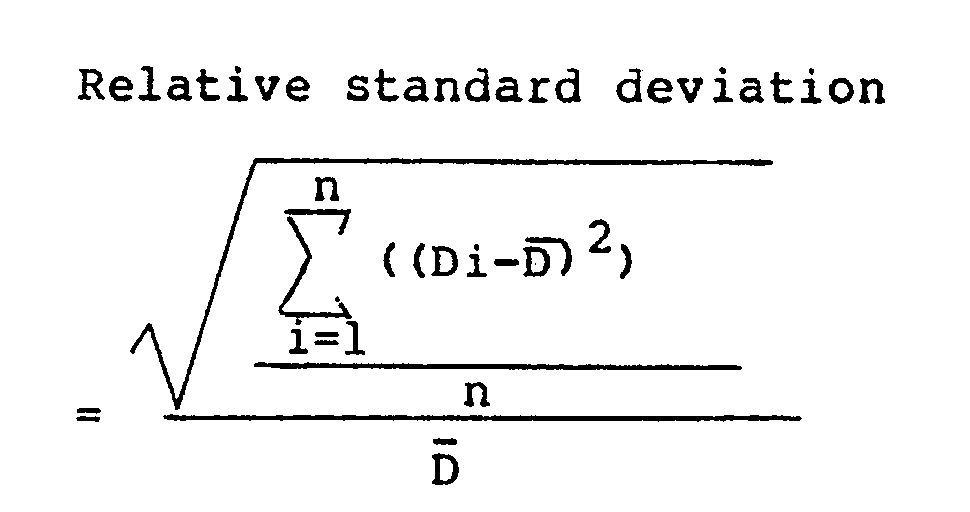
Di: diameter of projected area circle of each particle (µm)
D: average of diameters of projected area circles
- The amount of the lubricant to be contained in the copolyester may preferably be determined depending on the reeling property films during their production. Generally, it is preferred to add a smaller amount of the lubricant when it has a greater particle diameter vice versa. For example, silica having an average particle diameter of 2.0 µm is added preferably in an amount of about 0.05% by weight, and titanium dioxide having an average particle diameter of 0.3 µm is used preferably in an amount of about 0.3% by weight. Also, it is possible to make the film opaque by controlling the amount of the lubricant on purpose. For example, addition of titanium dioxide gives rise to white films.
- The copolyester used in the present invention may if desired contain in a dispersed state various other additives such as antioxidants, heat stabilizers, ultraviolet absorbents, plasticizers, pigments, antistatic agents and the like.
- No limitation is posed on the process of producing the copolyester used in the film of the present invention but it can be produced by various processes. For example, it can be produced by a process in which terephthalic acid, ethylene glycol and a copolymerizable component are subjected to esterification reaction, followed by polycondensing the reaction product to give a copolyester, a process in which dimethyl terephthalate, ethylene glycol and a copolymerizable component are subjected to interesterification reaction, followed by polycondensing the reaction product to obtain a copolyester, etc., are preferred. Also, another process can be used in which after blending a polyester consisting of a copolymerizable component with a polyethylene terephthalate, the resulting blend is molten and copolymerized by partition reaction.
- The polyester film of the present invention is produced by melting the above-described copolyester, extruding the molten polymer through a die to form it into a film, and then biaxially orienting or stretching the film and thermosetting it. The plane orientation coefficient of the film must be no smaller than 0.10 and no greater than 0.16, and preferably higher than 0.11 and no higher than 0.15. If the film has a plane orientation coefficient of below 0.10, there tend to arise problems such as the occurrence of cracks when deep draw forming is carried out at a high deep draw ratio. On the other hand, if the plane orientation coefficient exceeds 0.16, breakage could occur during deep draw forming, which makes it impossible to perform the very deep draw forming.
- Here, the plane orientation coefficient referred to above is defined by the following equation:
f = [(nx + ny)/2] - nz
where f is a plane orientation coefficient, and nx, ny and nz are refractive indices along a transverse direction, longitudinal direction and thickness, respectively, of a film. The refractive indices are measured at 25°C under monochromatic light, spectral line D of Na, using an Abbe refractometer with attaching a polarized analyzer to its ocular side and using methylene iodide as a mount solution. - The polyester film of the present invention must have a thermal shrinkage at 150°C of no higher than 10%, preferably no higher than 7%, and more preferably no higher than 6%, and a density of lower than 1.385 g/cm³, and preferably from 1.380 to 1.384 g/cm³.
- The thermal shrinkage is obtained by marking two gauge marks at a distance or gauge length (x) of about 10 cm on a sample film at room temperature, holding the sample film in a circulating hot air oven for 30 minutes and then cooling down to room temperature again, followed by measuring the distance (y) between the two gauge marks, and calculating the objective parameter from the results obtained according to the following equation:

- If the thermal shrinkage at 150°C of the polyester exceeds 10%, the film shrinks to a great extent upon printing deep draw formed film products so that the products are deformed, which is obviously undesirable. If the thermal shrinkage is no higher than 10%, preferably no higher than 7%, and more preferably no higher than 6%, good results can be obtained because no deformation at all or minimized deformation, if any, is observed in the shape of the formed products when they are printed.
- On the other hand, the density of films is measured using a density gradient tube. The density of the film exceeding 1.385 g/cm³ is undesirable because the film has a poor deep drawabilities and is susceptible to cracks, tearing, or breakage.
- When the biaxially oriented polyester film of the present invention is to be used as being laminated to a metal plate for manufacturing metal vessels or cans, it is preferred that the film have in addition to the above-described requriements, the following requriements (1) and (2):
- (1) The refractive index of the film in a direction of the thickness thereof is no lower than 1.495 and no higher than 1.530, and preferably no lower than 1.500 and no higher than 1.530. If it is below 1.495, the film has a insufficient fabrication quality, and if it exceed 1.530, that is, if the film is extremely low oriented, the film has a nearly noncrystalline structure, resulting in that the film tends to have an insufficient thermal resistance.
- (2) The refractive index on the plane of the film must be in a range of no lower than 1.61 and no higher than 1.66, and preferably no lower than 1.615 and no higher than 1.655, in all directions. This is because deformation must occur uniformly in all directions in processings such as deep draw forming and drawdie forming which are widely used in can forming or in the manufacture of cans, and because any portions of the film must be able to follow this deformation. If the film plane refractive index is below 1.61 in a direction, the film has good fabrication quality but has a poor thermal resistance in this direction while in a direction in which the film plane refractive index exceeds 1.66, chalking and breakage occur in the film when it is deep draw formed because it has a poor fabrication in that direction.
- These refractive indices are measured at 25°C under monochromatic light, spectral line D of Na, using an Abbe refractometer with attaching a polarized analyzer to its ocular side and using methylene iodide as a mount solution in the same manner as described above.
- In order to obtain the above-described refractive index in a direction of thickness and refractive index distribution in a direction of plane of the film, heat orientation in successive fabrication or conversion may preferably be performed under conditions of a longitudinal draw ratio of from 2.5 to 4.0, preferably from 2.5 to 3.6 a transverse draw ratio of from 2.7 to 4.0, preferably from 2.7 to 3.6 and a heat setting temperature of from 150 to 230°C. More preferably, the biaxially orientation and heat setting may be carried out with selecting, in addition to the above-described conditions, those conditions such that the film has a plane orientation coefficient of from 0.10 to 0.16, a thermal shrinkage at 150°C of no higher than 10%, and a density of lower than 1.385 g/cm³, and further those conditions such that the film has a refractive index in a thickness direction of no lower than 1.495 and no higher than 1.530 and a film plane refractive index distribution of from 1.61 to 1.66 in all directions.
- The polyester of the present invention has a thickness of preferably from 6 to 250 µm more preferably, 25 to 175 in the case of forming vessels or cans singly with film. In the case where it is applied to vessels or cans by deep draw forming, it has a thickness of from 10 to 75 µm, and preferably from 15 to 50 µm. If the thickness of the film is smaller than 10 µm, tears tend to occur in the film at the time of the processing. On the other hand, the thickness of the film exceeding 50 µm amounts to be over-improvement in the quality, which is not only unnecessary but also uneconomical.
- Examples of suitable metal plate to which the polyester film of the present invention can be applied to include plates of brick, tin-free steel, aluminum and the like are used appropriately.
- Hereafter, the present invention will be described in greater detail with reference to the following non-limitative Examples.
- As will be obvious from the following examples, the polyester film of the present invention has excellent deep drawabilities, pin hole resistance, excellent folding properties and the like and is useful, singly or after being laminated to another material such as a metal plate or a plastics plate, for deep draw forming of vessels cans, and the like. Particularly, the polyester film [II] which is designed for use in the manufacture of metal vessels (cans), when it is deep draw formed after being affixed to a metal plate to form a metal vessel, exhibits excellent deep draw drawabilities and can give rise to metal vessels having excellent impact strength and thermal resistance.
- In this case, as the method for laminating a metal plate with polyester film, following two methods of (1) and (2) may be, for example, applied.
- (1) A thin layer of polyester film adjacent to a metal plate is intimately bonded by heating the metal plate to lower than the melting point of polyester film, laminating the metal plate with the polyester film and thereafter rapid cooling the polyester-laminated metal without crystallizing that thin layer portion film.
- (2) An adhesive layer is coated as a primer on a polyester film, and then the surface thereof is laminated with a metal plate. As the adhesive layer, well-known resin adhesives such as epoxy type, epoxy-phenol type, epoxy-ester type alkyd type adhesives can be used according the objects thereof.
- Copolyethylene terephthalate comprising 12% by mole of isophthalic acid (melting point: 229°C, intrinsic viscosity: 0.60) containing 0.07% by weight of silica having an average particle diameter of 2.0 µm was melt-extruded at 270°C and cooled rapidly to solidify, thus giving rise to non-oriented films. The non-oriented films thus obtained were subjected to longitudinal stretching, transverse stretching and then heat setting under the conditions shown in Table 1 to obtain biaxially oriented films having a thickness of 125 µm.
- The characteristics of the films obtained are shown in Table 4.
Table 1 Longitudinal stretching temperature (°C) Longitudinal stretching ratio Transverse stretching temperature (°C) Transverse stretching ratio Heat Setting Temperature (°C) Example 1 90 3.0 110 3.2 190 Comparative Example 1 90 3.6 110 3.7 150 Comparative Example 2 90 3.6 110 3.7 205 - Copolyethylene terephthalate comprising copolymerized components shown in Table 2 (intrinsic viscosity: 0.60) containing 0.05% by weight of silica having an average paticle diameter of 2.3 µm was melt-extruded at various temperatures shown in Table 2 and coled rapidly to solidify, thus giving rise to non-oriented films. The non-oriented films thus obtained were subjected to longitudinal stretching, transvrse stretching and then heat setting under the conditions shown in Table 2 to obtain biaxially oriented films having a thickness of 125 µm.
- The characteristics of the films obtained are shown in Table 4.
Table 2 Copolymerized component comonomer (mol %) Melt Extrusion Temperature (°C) Conditions of Longitudinal Stretching Conditions of Transverse Stretching Heat Fixing Temperature (°C) Temperature (°C) Ratio Temperature (°C) Ratio Example 2 Sebacic acid 9 270 90 3.2 110 3.3 200 Comparative Example 3 none 290 90 2.5 125 2.8 235 Comparative Example 4 none 290 95 2.1 125 2.2 235 Comparative Example 5 Isophthalic acid 4.5 285 95 2.3 125 2.4 220 Comparative Example 6 Isophthalic acid 22 230 90 3.5 60 3.6 160 - Copolyethylene terephthalate comprising 12% by mole of isophthalic acid (intrinsic viscosity: 0.60) containing a lubricant shown in Table 3 was melt-extruded at 270°C and cooled rapidly to solidify, thus giving rise to non-oriented films. The non-oriented films thus obtained were subjected to longitudinal stretching at a temperature of 80°C at a ratio of 3.3 times the original, transverse stretching at a temperature f 110°C at a ratio of 3.5 times the original, and then heat setting at a temperature of 200°C.
- The resulting biaxially oriented films (thickness: 25 µm)had characteristics shown in Table 4.
Table 3 Lubricant Average Particle Diameter (µm) Amoung (%) Example 3 Tianium Dioxide 0.3 0.2 Example 4 Titanium Dioxide 0.3 0.5 - Ten films obtained in Examples 1 to 4 and Comparative Examples 1 to 6, respectively, each having a width of 600 mm were heated for 10 seconds using an IR heater to raise the temperature of the films to 90°C, and then the films were placed on a metal mold having an inlet diameter of 70 mm, a bottom diameter of 55 mm and a depth of 120 mm and pressure air formed at a pressure of 5 kg/cm². Then, brims of the resulting cup-like products were cut off and brim portions were curled to form cups.
- These cups were evaluated on their deep drawabilities and printing properties (dimension stability upon printing). The results were considered in combina tion to make general evaluation. Table 4 shows results of general evaluation. Smbols ○ and X in Table 4 have the following meanings.
Deep Draw Forming Properties
○: No crack nor breakage ocurred in the film.
X: Cracks or breakage occurred in the film.
Printing Properties
○: No strain occured in the cup.
X: Strain occurred in the cup.
General Evaluation
○: Acceptable
X: UnacceptableTable 4 Melting point (°C) Longitudinal Thermal Shrinkage (%) Density (g/cm³) Plane Orientation Coefficient Deep Drawabilities (Cracks) Deep Drawabilities (Breakage) Printing Properties (Strain of Shape) General Evaluation Example 1 229 3.5 1.382 0.140 ○ ○ ○ ○ Example 2 243 2.2 1.380 0.105 ○ ○ ○ ○ Example 3 229 1.7 1.384 0.108 ○ ○ ○ ○ Example 4 229 1.8 1.382 0.108 ○ ○ ○ ○ Comparative Example 1 229 11.0 1.375 0.162 ○ X X X Comparative Example 2 229 0.7 1.375 0.095 X ○ ○ X Comparative Example 3 225 1.5 1.405 0.136 X X ○ X Comparative Example 4 225 1.0 1.402 0.115 X X ○ X Comparative Example 5 247 2.0 1.387 0.115 X X ○ X Comparative Example 6 208 3/5 1.352 0.070 X ○ ○ X - The results shown in Table 4 revealed that the films obtained in Examples 1 to 4 were excellent in deep drawabilities and printing properties.
- Copolyethylene terephthalate comprising copolymerized components shown in Table 5 (intrinsic viscosity: 0.60) containing 0.05% by weight of monodispersed spherical silca having an average particle diameter of 2.0 µm (particle diameter ratio: 1.07, relative standard deviation: 0.1) was melt-extruded at various temperatures shown in Table 5 and cooled rapidly to solidify, thus giving rise to non-oriented films. The non-oriented films thus obtained were subjected to longitudinal stretching, transverse stretching and then heat setting under the conditions shown in Table 5 to obtain biaxially oriented films having a thickness of 125 µm.
- The characteristics of the resulting films are shown in Table 7.


- Copolyethylene terephthalate comprising copolymerized components shown in Table 6 (intrinsic viscosity: 0.60) containing 0.10% by weight of bulk silica having an average particle diameter of 2.3 µm (particle diameter rato: 2.1, relative standard deviation: 7) was melt-extruded at various temperatures shown in Table 6 and cooled rapidly to solidify, thus giving rise to non-oriented films. The non-oriented films thus obtained were subjected to longitudinal stretching, transverse stretching and then heat setting under the conditions shown in Table 6 to obtain biaxially oriented films having a thickness of 125 µm.
- The characteristics of the resulting films are shown in Table 7.
Table 6 Comonomer Melt Extrusion Temperature (°C) Conditions of Longitudinal Stretching Conditions of Transverse Stretching Heat Setting Temperature (°C) Component Composition (mol %) Temperature (°C) Ratio Temperature (°C) Ratio Comparative Example 11 Isophthalic acid 12 270 90 3.0 110 3.2 190 Comparative Example 12 Sebacic acid 12 270 90 3.0 110 3.2 200 - Thirteen films obtained in Examples 5 to 11 and Comparative Examples 7 to 12, respectively, each having a width of 600 mm were heated for 10 seconds using an IR heater to raise the temperature of the films to 90°C, and then the films were placed on a metal mold having an inlet diameter of 70 mm, a bottom diameter of 55 mm and a depth of 120 mm and pressure air formed at a pressure of 5 kg/cm². Then, brims of the resulting cup-like products were cut off and brim portions were curled to form cups.
- These cups were evaluated on their deep drawabilities and printing properties (dimension stability upon printing). The results were considered in combination to make general evaluation. Table 7 shows results of general evaluation. Symbols ○ and X in Table 4 have the following meanings.
Deep Drawabilities
○: No crack, breakage or pin hole occurred in the film.
X: Cracks, breakage or pin holes occurred in the film.
Printing Properties
○: No strain occurred in the cup.
X: Strain occurred in the cup.
General Evaluation
○: Acceptable
X: Unacceptable - The results shown in Table 7 revealed that the films obtained in Examples 5 to 11 were excellent in deep drawabilities and printing properties.


- Copolyethylene terephthalate compising copolymerized components shown in Table 8 (intrinsic viscosity: 0.60) containing monodispersed spherical silica having an average particle diameter of 1.5 µm or 2.3 µm (particle diameter ratio: 1.07, relative standard deviation: 0.1) was melt-extruded at various temperatures shown in Table 8 and cooled rapidly solidify, thus giving rise to non-oriented films. The non-oriented films thus obtained were subjected to longitudinal stretching, transverse stretching and then heat setting under the conditions shown in Table 8 to obtain biaxially oriented films having a thickness of from 25 to 30 µm.
- The characteristics of the resulting films are shown in Table 11.


- Copolyethylene terephthalate comprising 12% by mole of isophthalic acid (intrinsic viscosity: 0.60) containing a lubricant shown in Table 9 was melt-extruded at 280°C and cooled rapidly to solidify, thus giving rise to non-oriented films. The non-oriented films thus obtained were subjected to longitudinal stretching at a temperature of 100°C at a ratio of 3.0 times the original, transverse stretching at a temperature of 110°C at a ratio of 3.1 times the original, and then heat setting at a temperature shown in Table 9.
- The resulting biaxially oriented films had characteristics shown in Table 11.
Table 9 Lubricant Average Particle Diameter (µm) Amount (%) Heat Fixing Temperature (°C) Example 16 Titanium Dioxide 0.3 0.3 170 Comparative Example 16 Bulk Silica 2.7 0.05 190 - Copolyethylene terephthalate comprising 12% by mole of isophthalic acid (melting point: 229°C, intrinsic viscosity: 0.60) containing 0.05% by weight of monodispersed spherical silica having an average particle diameter of 2.0 µm was melt-extruded at 280°C and cooled rapidly to solidify, thus giving rise to non-oriented films. The non-oriented films thus obtained were subjected to longitudinal stretching, transverse stretching and then heat setting under the conditions shown in Table 10 to obtain biaxially oriented films.
- The characteristics shown in Table 11.
Table 10 Conditions of Longitudinal Stretching Conditions of Transverse Stretching Heat Setting Temperature (°C) Temperature (°C) Ratio Temperature (°C) Ratio Comparative Example 17 100 3.0 110 3.1 210 Comparative Example 18 100 3.6 110 3.7 180 Comparative Example 19 100 2.5 110 3.5 180 Comparative Example 20 100 3.0 110 3.8 180 - Thirteen films obtained in Examples 12 to 16 and Comparative Examples 13 to 20, respectively, were each laminated on both surfaces of a tin-free steel plate of a thickness of 0.25 mm heated at temperature of 260°C, and then the films were cut into discs of 150 mm in diameter. The discs thus obtained were deep draw formed in two steps using a draw die and a punch to produce cylindrical vessels of 55 mm in diameter having no seam on the respective side walls thereof.
- These vessels were evaluated on their deep drawabilities, resistance to impact fractures and resistance to thermal embrittlement. The results were considered in combination to make general evaluation. Table 11 shows results of general evaluation. Symbols ○, Δ and X in Table 11 have the following meanings.
- Deep Drawabilities-1
○: No abnormality in the film was observed on both the inne and outer surfaces of the vessels during the processing. Chalking and breakage was not deserved and
Δ: Chalking was observed in the films on the inner and outer surfaces at the upper portion of the vessel or
X: Breakage was observed in a portion of the films on the inner and outer surfaces of the vessel. - Deep Drawabilities-2
○: No abnormality in the film was observed on both the inner and outer surfaces of the container during the processing, and rust prevention test conducted on the inner film surface of the vessel gave a value measured of no higher than 0.2 mA. The rust prevention test was carried out by charging an aqueous 1% NaCl solution in the vessel, introducing an electrode in the solution, establishing a voltage of 6V using the vessel as a positive electrode and measuring a value of current. The test is abbreviated as ERV test higher than 0.2 mA.
X: No abnormality was observed in the film on both the inner and outer surfaces of the vessel, but the ERV test gave a current value of no lower than 0.2 mA. Upon observation on an enlarged scale of portions to which electricity was applied, cracks in a form of pin hole starting from bulky particle (for example, particle diameter is no less than 10 µm.) were found in a portion of the films on the inner and outer surfaces of vessel. - Water was filled in a vessel having good deep drawability. For each test, ten such waterfilled vessels were fallen from a height of 1 m onto a polyvinyl chloride tile floor, and then The ERV test was conducted on the inside the container. Symbols ○, Δ and X in Table 11 have the following meanings.
○: All the ten vessels gave a current value of no higher than 0.2 mA.
Δ: One to fice vessels gave a current value of no lower than 0.2 mA.
X: Six or more vessels gave a current value of no lower than 0.2 mA, or showed cracks immediately after the falling. - Containers which exhibited good deep drawabilities were kept at 210°C for 5 minutes, fllowed by evaluation of the above-described resistance to impact fracture. In this case, symbols ○, Δ and X in Table 11 have the following meanings.
○: All the ten vessels gave a current value of no higher than 0.2 mA.
Δ: One to five vessels gave a current value of no lower than 0.2 mA.
X: Six or more vessels gave a current value of no lower than 0.2 mA, or showed cracks immediately after the heating at 210°C for 5 minutes.
General Evaluation
○: Acceptable
X: Unacceptable - The results described in Table 11 revealed that the films obtained in Examples 12 to 16 were excellent in all of the deep draw forming properties, resistance to impact fracture and thermal resistance.


Claims (4)
Applications Claiming Priority (4)
| Application Number | Priority Date | Filing Date | Title |
|---|---|---|---|
| JP1221579A JPH0819246B2 (en) | 1989-08-30 | 1989-08-30 | Polyester film for container molding |
| JP221579/89 | 1989-08-30 | ||
| JP24886389A JPH0735092B2 (en) | 1989-09-25 | 1989-09-25 | Polyester film for molding |
| JP248863/89 | 1989-09-25 |
Publications (3)
| Publication Number | Publication Date |
|---|---|
| EP0415383A2 true EP0415383A2 (en) | 1991-03-06 |
| EP0415383A3 EP0415383A3 (en) | 1991-05-29 |
| EP0415383B1 EP0415383B1 (en) | 1995-03-01 |
Family
ID=26524395
Family Applications (1)
| Application Number | Title | Priority Date | Filing Date |
|---|---|---|---|
| EP90116564A Expired - Lifetime EP0415383B1 (en) | 1989-08-30 | 1990-08-29 | Polyester film for fabrication |
Country Status (4)
| Country | Link |
|---|---|
| US (1) | US5473004A (en) |
| EP (1) | EP0415383B1 (en) |
| KR (1) | KR950014236B1 (en) |
| DE (1) | DE69017314T2 (en) |
Cited By (10)
| Publication number | Priority date | Publication date | Assignee | Title |
|---|---|---|---|---|
| EP0474240A3 (en) * | 1990-09-06 | 1993-01-13 | Teijin Limited | Polyester film for laminated metal sheet drawing and processing |
| EP0586161A1 (en) * | 1992-08-25 | 1994-03-09 | Teijin Limited | Biaxially oriented polyester film for lamination onto metal sheet |
| EP0574232A3 (en) * | 1992-06-09 | 1994-03-16 | Teijin Ltd | |
| US5424121A (en) * | 1992-09-06 | 1995-06-13 | Teijin Limited | Biaxially oriented polyester film |
| US5618621A (en) * | 1992-07-22 | 1997-04-08 | Teijin Limited | Biaxially oriented laminated polyester film for use as film to be bonded onto metal sheet |
| EP1002827A1 (en) * | 1998-11-20 | 2000-05-24 | Toray Industries, Inc. | Formable biaxially-oriented polyester film |
| EP0940425A4 (en) * | 1997-09-10 | 2001-07-18 | Teijin Ltd | Polyester film |
| EP1852255A1 (en) * | 2006-04-08 | 2007-11-07 | Mitsubishi Polyester Film GmbH | Polyester film having low mechanical strength |
| EP3584079A1 (en) | 2018-06-20 | 2019-12-25 | Mitsubishi Polyester Film GmbH | Thermoformable, transparent polyester package with a top and a bottom film, method for their preparation and their use |
| EP3584275A1 (en) | 2018-06-20 | 2019-12-25 | Mitsubishi Polyester Film GmbH | Transparent thermoformable biaxially oriented polyester film, method for the preparation thereof and utilisation thereof |
Families Citing this family (5)
| Publication number | Priority date | Publication date | Assignee | Title |
|---|---|---|---|---|
| CA2186935C (en) * | 1995-10-02 | 2005-01-04 | Masahiro Kimura | Biaxially oriented polyester film to be formed into containers |
| EP0882758B1 (en) * | 1996-10-30 | 2002-03-20 | Teijin Limited | Polyester film for metal sheet laminating |
| CN1202157C (en) * | 1999-12-03 | 2005-05-18 | 东丽株式会社 | Biaxially stretched polyester film for forming |
| DE10152141A1 (en) * | 2001-10-23 | 2003-04-30 | Mitsubishi Polyester Film Gmbh | Matt, biaxially oriented polyester film, process for its production and its use |
| WO2020067193A1 (en) * | 2018-09-28 | 2020-04-02 | ユニチカ株式会社 | Polyester film, and method for manufacturing same |
Family Cites Families (5)
| Publication number | Priority date | Publication date | Assignee | Title |
|---|---|---|---|---|
| US4115617A (en) * | 1976-03-24 | 1978-09-19 | Teijin Limited | Weather-resistant adhesive film |
| US4818581A (en) * | 1986-08-27 | 1989-04-04 | Teijin Limited | Biaxially oriented polyester film |
| GB8724238D0 (en) * | 1987-10-15 | 1987-11-18 | Metal Box Plc | Laminated metal sheet |
| JPH085159B2 (en) * | 1988-01-28 | 1996-01-24 | 新日本製鐵株式会社 | Laminated steel sheet having a two-layer coating structure and method for producing the same |
| JPH085158B2 (en) * | 1988-01-28 | 1996-01-24 | 新日本製鐵株式会社 | Laminated steel sheet for cans with excellent workability and corrosion resistance |
-
1990
- 1990-08-29 EP EP90116564A patent/EP0415383B1/en not_active Expired - Lifetime
- 1990-08-29 DE DE69017314T patent/DE69017314T2/en not_active Expired - Lifetime
- 1990-08-30 KR KR1019900013532A patent/KR950014236B1/en not_active Expired - Fee Related
-
1994
- 1994-07-20 US US08/277,703 patent/US5473004A/en not_active Expired - Lifetime
Cited By (16)
| Publication number | Priority date | Publication date | Assignee | Title |
|---|---|---|---|---|
| US5372867A (en) * | 1990-09-06 | 1994-12-13 | Teijin Limited | Polyester film for laminated metal sheet drawing and processing containing solid lubricant and having specified protrusion rate |
| EP0474240A3 (en) * | 1990-09-06 | 1993-01-13 | Teijin Limited | Polyester film for laminated metal sheet drawing and processing |
| EP0574232A3 (en) * | 1992-06-09 | 1994-03-16 | Teijin Ltd | |
| US5618621A (en) * | 1992-07-22 | 1997-04-08 | Teijin Limited | Biaxially oriented laminated polyester film for use as film to be bonded onto metal sheet |
| EP0798112A3 (en) * | 1992-07-22 | 1999-10-06 | Teijin Limited | Biaxially oriented laminated polyester film for use as film to be bonded onto metal sheet |
| EP0586161A1 (en) * | 1992-08-25 | 1994-03-09 | Teijin Limited | Biaxially oriented polyester film for lamination onto metal sheet |
| US5686510A (en) * | 1992-08-25 | 1997-11-11 | Teijin Limited | Biaxially oriented polyester film for lamination onto metal sheet |
| US5424121A (en) * | 1992-09-06 | 1995-06-13 | Teijin Limited | Biaxially oriented polyester film |
| EP0940425A4 (en) * | 1997-09-10 | 2001-07-18 | Teijin Ltd | Polyester film |
| EP1002827A1 (en) * | 1998-11-20 | 2000-05-24 | Toray Industries, Inc. | Formable biaxially-oriented polyester film |
| EP1852255A1 (en) * | 2006-04-08 | 2007-11-07 | Mitsubishi Polyester Film GmbH | Polyester film having low mechanical strength |
| US7514141B2 (en) | 2006-04-08 | 2009-04-07 | Mitsubishi Polyester Film Gmbh | Polyester film with low mechanical strength |
| EP3584079A1 (en) | 2018-06-20 | 2019-12-25 | Mitsubishi Polyester Film GmbH | Thermoformable, transparent polyester package with a top and a bottom film, method for their preparation and their use |
| EP3584275A1 (en) | 2018-06-20 | 2019-12-25 | Mitsubishi Polyester Film GmbH | Transparent thermoformable biaxially oriented polyester film, method for the preparation thereof and utilisation thereof |
| US10618260B2 (en) | 2018-06-20 | 2020-04-14 | Mitsubishi Polyester Film Gmbh | Thermoformable transparent packing made of polyester with a lower foil and an upper foil, process for production thereof and use thereof |
| US11041056B2 (en) | 2018-06-20 | 2021-06-22 | Mitsubishi Polyester Film Gmbh | Transparent, thermoformable, biaxially oriented polyester film, process for production thereof and use thereof |
Also Published As
| Publication number | Publication date |
|---|---|
| EP0415383B1 (en) | 1995-03-01 |
| DE69017314D1 (en) | 1995-04-06 |
| DE69017314T2 (en) | 1995-08-24 |
| KR910004719A (en) | 1991-03-29 |
| KR950014236B1 (en) | 1995-11-23 |
| EP0415383A3 (en) | 1991-05-29 |
| US5473004A (en) | 1995-12-05 |
Similar Documents
| Publication | Publication Date | Title |
|---|---|---|
| US5384354A (en) | Polyester film for lamination onto metal sheet for processing of said sheet, and use thereof | |
| EP0474240B1 (en) | Polyester film for laminated metal sheet drawing and processing | |
| EP0415383B1 (en) | Polyester film for fabrication | |
| US5240779A (en) | Polyester film for fabrication | |
| EP0646455B1 (en) | Laminated polyester film for use as film with which metal plate is to be laminated | |
| KR19990072212A (en) | White Laminated Polyester Film for Metal Plate Bonding Processing | |
| JP2851468B2 (en) | Polyester film for metal plate lamination processing | |
| JP3366205B2 (en) | Polyester film for lamination of metal plate for can body and method for producing laminated metal plate for can body using the film | |
| JP3048725B2 (en) | Polyester film for laminating metal plates | |
| JPH0639979A (en) | Polyester film for metal plate laminating process | |
| JP3071557B2 (en) | Polyester film for metal plate lamination processing | |
| JP3071573B2 (en) | Polyester film for metal plate lamination processing | |
| JPH06218895A (en) | Polyester film for laminated molding of metal plate | |
| JP3048753B2 (en) | White polyester film for metal plate bonding | |
| JPH05222216A (en) | Polyester film for laminating metal plates | |
| JPH11207909A (en) | Laminated polyester film for metal plate lamination processing | |
| JPH11179846A (en) | White film for lamination of metal | |
| JP3071574B2 (en) | Polyester film for metal plate lamination processing | |
| JPH0639981A (en) | Polyester film for metallic sheet laminating fabrication | |
| JPH06107815A (en) | Polyester film for laminating metal plates | |
| JP3297660B2 (en) | Method for producing biaxially oriented white polyester film for bonding external surfaces of metal cans | |
| JPH10180969A (en) | White film for metal laminate and its manufacture | |
| JPH04105922A (en) | Polyester film for use in metal bonding process | |
| JPH04261826A (en) | Polyester film for laminating metallic sheet | |
| JPH05186613A (en) | Metallic plate-laminating polyester film |
Legal Events
| Date | Code | Title | Description |
|---|---|---|---|
| PUAI | Public reference made under article 153(3) epc to a published international application that has entered the european phase |
Free format text: ORIGINAL CODE: 0009012 |
|
| AK | Designated contracting states |
Kind code of ref document: A2 Designated state(s): DE FR GB NL |
|
| PUAL | Search report despatched |
Free format text: ORIGINAL CODE: 0009013 |
|
| AK | Designated contracting states |
Kind code of ref document: A3 Designated state(s): DE FR GB NL |
|
| 17P | Request for examination filed |
Effective date: 19910927 |
|
| 17Q | First examination report despatched |
Effective date: 19920710 |
|
| GRAA | (expected) grant |
Free format text: ORIGINAL CODE: 0009210 |
|
| AK | Designated contracting states |
Kind code of ref document: B1 Designated state(s): DE FR GB NL |
|
| REF | Corresponds to: |
Ref document number: 69017314 Country of ref document: DE Date of ref document: 19950406 |
|
| ET | Fr: translation filed | ||
| PLBE | No opposition filed within time limit |
Free format text: ORIGINAL CODE: 0009261 |
|
| STAA | Information on the status of an ep patent application or granted ep patent |
Free format text: STATUS: NO OPPOSITION FILED WITHIN TIME LIMIT |
|
| 26N | No opposition filed | ||
| REG | Reference to a national code |
Ref country code: GB Ref legal event code: IF02 |
|
| PGFP | Annual fee paid to national office [announced via postgrant information from national office to epo] |
Ref country code: NL Payment date: 20040727 Year of fee payment: 15 |
|
| PG25 | Lapsed in a contracting state [announced via postgrant information from national office to epo] |
Ref country code: NL Free format text: LAPSE BECAUSE OF NON-PAYMENT OF DUE FEES Effective date: 20060301 |
|
| NLV4 | Nl: lapsed or anulled due to non-payment of the annual fee |
Effective date: 20060301 |
|
| PGFP | Annual fee paid to national office [announced via postgrant information from national office to epo] |
Ref country code: FR Payment date: 20090723 Year of fee payment: 20 |
|
| PGFP | Annual fee paid to national office [announced via postgrant information from national office to epo] |
Ref country code: DE Payment date: 20090824 Year of fee payment: 20 Ref country code: GB Payment date: 20090728 Year of fee payment: 20 |
|
| REG | Reference to a national code |
Ref country code: GB Ref legal event code: PE20 Expiry date: 20100828 |
|
| PG25 | Lapsed in a contracting state [announced via postgrant information from national office to epo] |
Ref country code: GB Free format text: LAPSE BECAUSE OF EXPIRATION OF PROTECTION Effective date: 20100828 |
|
| PG25 | Lapsed in a contracting state [announced via postgrant information from national office to epo] |
Ref country code: DE Free format text: LAPSE BECAUSE OF EXPIRATION OF PROTECTION Effective date: 20100829 |