EP0416793A1 - Cathéter - Google Patents
Cathéter Download PDFInfo
- Publication number
- EP0416793A1 EP0416793A1 EP19900309367 EP90309367A EP0416793A1 EP 0416793 A1 EP0416793 A1 EP 0416793A1 EP 19900309367 EP19900309367 EP 19900309367 EP 90309367 A EP90309367 A EP 90309367A EP 0416793 A1 EP0416793 A1 EP 0416793A1
- Authority
- EP
- European Patent Office
- Prior art keywords
- optical fiber
- lumen
- catheter
- catheter assembly
- sheath
- Prior art date
- Legal status (The legal status is an assumption and is not a legal conclusion. Google has not performed a legal analysis and makes no representation as to the accuracy of the status listed.)
- Withdrawn
Links
- 239000013307 optical fiber Substances 0.000 claims abstract description 31
- 201000010099 disease Diseases 0.000 claims abstract description 7
- 208000037265 diseases, disorders, signs and symptoms Diseases 0.000 claims abstract description 7
- 230000000694 effects Effects 0.000 claims description 3
- 238000004891 communication Methods 0.000 claims description 2
- 238000011282 treatment Methods 0.000 abstract description 18
- 238000000034 method Methods 0.000 description 35
- 206010020871 hypertrophic cardiomyopathy Diseases 0.000 description 28
- 210000001519 tissue Anatomy 0.000 description 20
- 208000031309 Hypertrophic Familial Cardiomyopathy Diseases 0.000 description 14
- 201000010552 hypertrophic cardiomyopathy 1 Diseases 0.000 description 14
- 210000005240 left ventricle Anatomy 0.000 description 11
- 229910052751 metal Inorganic materials 0.000 description 11
- 239000002184 metal Substances 0.000 description 11
- 238000013459 approach Methods 0.000 description 9
- 206010047302 ventricular tachycardia Diseases 0.000 description 9
- 210000004165 myocardium Anatomy 0.000 description 8
- 208000001871 Tachycardia Diseases 0.000 description 6
- 230000002107 myocardial effect Effects 0.000 description 6
- 230000006794 tachycardia Effects 0.000 description 6
- 210000003813 thumb Anatomy 0.000 description 6
- 238000002679 ablation Methods 0.000 description 5
- 210000001105 femoral artery Anatomy 0.000 description 5
- 239000000835 fiber Substances 0.000 description 5
- 230000033001 locomotion Effects 0.000 description 5
- 208000014674 injury Diseases 0.000 description 4
- 206010061216 Infarction Diseases 0.000 description 3
- 210000000709 aorta Anatomy 0.000 description 3
- 210000001765 aortic valve Anatomy 0.000 description 3
- 238000010586 diagram Methods 0.000 description 3
- 239000003814 drug Substances 0.000 description 3
- 229940079593 drug Drugs 0.000 description 3
- 210000003191 femoral vein Anatomy 0.000 description 3
- 238000002594 fluoroscopy Methods 0.000 description 3
- 230000004217 heart function Effects 0.000 description 3
- 230000007574 infarction Effects 0.000 description 3
- 238000013507 mapping Methods 0.000 description 3
- 230000000649 photocoagulation Effects 0.000 description 3
- 238000001356 surgical procedure Methods 0.000 description 3
- 230000008733 trauma Effects 0.000 description 3
- XKRFYHLGVUSROY-UHFFFAOYSA-N Argon Chemical compound [Ar] XKRFYHLGVUSROY-UHFFFAOYSA-N 0.000 description 2
- 230000008602 contraction Effects 0.000 description 2
- 230000001788 irregular Effects 0.000 description 2
- 230000008569 process Effects 0.000 description 2
- 238000002407 reforming Methods 0.000 description 2
- 238000011477 surgical intervention Methods 0.000 description 2
- 238000012546 transfer Methods 0.000 description 2
- 230000002861 ventricular Effects 0.000 description 2
- 238000012795 verification Methods 0.000 description 2
- 206010022998 Irritability Diseases 0.000 description 1
- 229910052779 Neodymium Inorganic materials 0.000 description 1
- 208000031481 Pathologic Constriction Diseases 0.000 description 1
- 208000027418 Wounds and injury Diseases 0.000 description 1
- WYTGDNHDOZPMIW-RCBQFDQVSA-N alstonine Natural products C1=CC2=C3C=CC=CC3=NC2=C2N1C[C@H]1[C@H](C)OC=C(C(=O)OC)[C@H]1C2 WYTGDNHDOZPMIW-RCBQFDQVSA-N 0.000 description 1
- 229910052786 argon Inorganic materials 0.000 description 1
- 230000008901 benefit Effects 0.000 description 1
- 230000005540 biological transmission Effects 0.000 description 1
- 238000007675 cardiac surgery Methods 0.000 description 1
- 230000008859 change Effects 0.000 description 1
- 238000002681 cryosurgery Methods 0.000 description 1
- 230000006378 damage Effects 0.000 description 1
- 230000007423 decrease Effects 0.000 description 1
- 230000003247 decreasing effect Effects 0.000 description 1
- 230000000881 depressing effect Effects 0.000 description 1
- 230000003292 diminished effect Effects 0.000 description 1
- 238000011038 discontinuous diafiltration by volume reduction Methods 0.000 description 1
- 238000002651 drug therapy Methods 0.000 description 1
- 230000008014 freezing Effects 0.000 description 1
- 238000007710 freezing Methods 0.000 description 1
- 230000006870 function Effects 0.000 description 1
- 208000019622 heart disease Diseases 0.000 description 1
- 210000005003 heart tissue Anatomy 0.000 description 1
- 230000001771 impaired effect Effects 0.000 description 1
- 230000001939 inductive effect Effects 0.000 description 1
- 238000003780 insertion Methods 0.000 description 1
- 230000037431 insertion Effects 0.000 description 1
- 230000013011 mating Effects 0.000 description 1
- 210000003205 muscle Anatomy 0.000 description 1
- 238000013164 myectomy Methods 0.000 description 1
- 208000010125 myocardial infarction Diseases 0.000 description 1
- QEFYFXOXNSNQGX-UHFFFAOYSA-N neodymium atom Chemical compound [Nd] QEFYFXOXNSNQGX-UHFFFAOYSA-N 0.000 description 1
- 230000003287 optical effect Effects 0.000 description 1
- 230000009467 reduction Effects 0.000 description 1
- 230000004044 response Effects 0.000 description 1
- 230000001020 rhythmical effect Effects 0.000 description 1
- 239000000523 sample Substances 0.000 description 1
- 230000035939 shock Effects 0.000 description 1
- 238000011272 standard treatment Methods 0.000 description 1
- 230000036262 stenosis Effects 0.000 description 1
- 208000037804 stenosis Diseases 0.000 description 1
- 230000003685 thermal hair damage Effects 0.000 description 1
Images





Classifications
-
- A—HUMAN NECESSITIES
- A61—MEDICAL OR VETERINARY SCIENCE; HYGIENE
- A61B—DIAGNOSIS; SURGERY; IDENTIFICATION
- A61B18/00—Surgical instruments, devices or methods for transferring non-mechanical forms of energy to or from the body
- A61B18/18—Surgical instruments, devices or methods for transferring non-mechanical forms of energy to or from the body by applying electromagnetic radiation, e.g. microwaves
- A61B18/20—Surgical instruments, devices or methods for transferring non-mechanical forms of energy to or from the body by applying electromagnetic radiation, e.g. microwaves using laser
- A61B18/22—Surgical instruments, devices or methods for transferring non-mechanical forms of energy to or from the body by applying electromagnetic radiation, e.g. microwaves using laser the beam being directed along or through a flexible conduit, e.g. an optical fibre; Couplings or hand-pieces therefor
- A61B18/24—Surgical instruments, devices or methods for transferring non-mechanical forms of energy to or from the body by applying electromagnetic radiation, e.g. microwaves using laser the beam being directed along or through a flexible conduit, e.g. an optical fibre; Couplings or hand-pieces therefor with a catheter
- A61B18/245—Surgical instruments, devices or methods for transferring non-mechanical forms of energy to or from the body by applying electromagnetic radiation, e.g. microwaves using laser the beam being directed along or through a flexible conduit, e.g. an optical fibre; Couplings or hand-pieces therefor with a catheter for removing obstructions in blood vessels or calculi
-
- A—HUMAN NECESSITIES
- A61—MEDICAL OR VETERINARY SCIENCE; HYGIENE
- A61B—DIAGNOSIS; SURGERY; IDENTIFICATION
- A61B17/00—Surgical instruments, devices or methods
- A61B17/00234—Surgical instruments, devices or methods for minimally invasive surgery
- A61B2017/00238—Type of minimally invasive operation
- A61B2017/00243—Type of minimally invasive operation cardiac
-
- A—HUMAN NECESSITIES
- A61—MEDICAL OR VETERINARY SCIENCE; HYGIENE
- A61B—DIAGNOSIS; SURGERY; IDENTIFICATION
- A61B17/00—Surgical instruments, devices or methods
- A61B17/34—Trocars; Puncturing needles
- A61B2017/348—Means for supporting the trocar against the body or retaining the trocar inside the body
- A61B2017/3482—Means for supporting the trocar against the body or retaining the trocar inside the body inside
- A61B2017/3484—Anchoring means, e.g. spreading-out umbrella-like structure
- A61B2017/3488—Fixation to inner organ or inner body tissue
-
- A—HUMAN NECESSITIES
- A61—MEDICAL OR VETERINARY SCIENCE; HYGIENE
- A61B—DIAGNOSIS; SURGERY; IDENTIFICATION
- A61B18/00—Surgical instruments, devices or methods for transferring non-mechanical forms of energy to or from the body
- A61B2018/00005—Cooling or heating of the probe or tissue immediately surrounding the probe
- A61B2018/00011—Cooling or heating of the probe or tissue immediately surrounding the probe with fluids
-
- A—HUMAN NECESSITIES
- A61—MEDICAL OR VETERINARY SCIENCE; HYGIENE
- A61B—DIAGNOSIS; SURGERY; IDENTIFICATION
- A61B90/00—Instruments, implements or accessories specially adapted for surgery or diagnosis and not covered by any of the groups A61B1/00 - A61B50/00, e.g. for luxation treatment or for protecting wound edges
- A61B90/39—Markers, e.g. radio-opaque or breast lesions markers
-
- A—HUMAN NECESSITIES
- A61—MEDICAL OR VETERINARY SCIENCE; HYGIENE
- A61M—DEVICES FOR INTRODUCING MEDIA INTO, OR ONTO, THE BODY; DEVICES FOR TRANSDUCING BODY MEDIA OR FOR TAKING MEDIA FROM THE BODY; DEVICES FOR PRODUCING OR ENDING SLEEP OR STUPOR
- A61M25/00—Catheters; Hollow probes
- A61M2025/0098—Catheters; Hollow probes having a strain relief at the proximal end, e.g. sleeve
Definitions
- the invention relates to apparatus useful in treatment of heart diseases, for example ventricular tachycardia, hypertrophic cardiomyopathy (HCM) and idiopathic hypertrophic subaortic stenosis (IHSS), and more particularly, in percutaneous treatment using laser energy (ablation).
- HCM hypertrophic cardiomyopathy
- IHSS idiopathic hypertrophic subaortic stenosis
- the condition is often described as a heart beat which is too fast, although the disease is far more complex.
- the orderly contractions of the heart are not present because various portions of the myocardium do not contract and relax in proper synchronism with the rest of the heart.
- the most common treatment for tachycardia is through the use of various drugs. Some drugs reduce the irritability of the offending myocardial tissue, whereas other drugs may slow the response time of all myocardial tissue. In either case the treatment is administered systemically resulting in various side effects.
- a first variation on surgical excision involves cryosurgery.
- the diseased myocardial tissue is destroyed by freezing. See for example "The Successful Cryosurgical Treatment of Paroxyal Ventrical Tachycardia", Chest, Volume 75, at page 612, 1979.
- Other variations involve the use of DC shock and radiofrequency energy.
- the present invention overcomes the difficulties in the prior art treatments by use of novel apparatus including a novel catheter to photoablate that tissue which impairs cardiac function.
- novel apparatus including a novel catheter to photoablate that tissue which impairs cardiac function.
- the most important advantage is that the use of a percutaneous procedure does not require thoractomy thus significantly reducing cost, time, trauma and mortality rate.
- the present invention provides apparatus for treating diseases of the human heart, characterised in that it comprises:
- the present invention provides a catheter assembly for use in the apparatus of the first aspect of the invention, the catheter assembly comprising: a first, outer flexible sheath (18); a second, inner flexible sheath (22) removably disposed within the outer sheath and suitable to receive an optical fiber (52) and also an elongate locating and/or maintaining means (42) to locate and/or maintain a distal end of the optical fiber in or adjacent the heart; a branched tubular housing (26) having a first tubular member (28) the distal end of which can engage the proximal end of the outer sheath (18), and a second tubular member (32) extending from the first tubular member at a position intermediate the proximal and distal ends of the first tubular member whereby the interior of the first and second tubular members are in communication with each other, the first tubular member being suitable to receive therethrough the optical fibre (52) and the second tubular member being suitable to receive therethrough the elongate means (42).
- the apparatus and catheter assembly of the present invention can be used in a new method to treat IHSS or HCM using a percutaneous approach obviating the need for the interoperative Morrow procedure.
- the method is to percutaneously deliver a catheter via the femoral artery or vein to the septal wall of the left ventrical.
- the catheter is fixed to the wall by a fixation device after which the laser fiber optic tube is inserted into the catheter and positioned at the distal end.
- the fiber optical assembly is secured to a laser which is activated to irradiate the tissue. After sufficient volume reduction is achieved by repeated use of laser energy, the device is removed.
- a preferred catheter assembly consisting of a fiber optic tube, an automatic fixation device, a delivery catheter and a guiding catheter with associated connectors is inserted into the human body either in a retrograde fashion through the femoral artery or transceptually through the femoral vein.
- the catheter is affixed to the septal wall in the hypertrophied region by means of a fixation device contained within the catheter.
- the laser is then energized for a period of time photocoagulating or ablating the irradiated myocardial tissue.
- the thermal damage caused by photocoagulation creates a local myocardial infarction with subsequent reduction in tissue volume. This change decreases the thickness of the septal wall reducing the outflow track gradient and restoring more normal left ventricular performance.
- part of the laser energy is absorbed by the tissue directly underneath the fiber optic probe and part is scattered throughout the tissue, eventually being totally absorbed over a much greater area than the diameter of the fiber optic tube.
- the absorbed energy raises the temperature of the tissue resulting in a controlled injury and reduced volume of the affected tissue.
- the present invention alleviates the cost and trauma associated with a thorocotomy.
- the catheter assembly of the invention is introduced percutaneously and advanced into the left ventricle either transarterially in retrograde fashion, or transceptually after transveneous introduction.
- the distal tip is positioned adjacent a site to be treated and maintained in position with fixation means.
- Energy from a medical laser is supplied to the site via an optical fiber within the special catheter.
- the myocardial tissue at the identified site is photocoagulated or photoablated.
- Other sites identified during the mapping process are similarly treated. Because the technique is performed percutaneously without bypass, each ablated or coagulated focus may be immediately tested to ensure that the corresponding tachycardia mode has been successfully treated.
- the present invention concerns, inter alia a technique for the percutaneous treatment of idiopathic hypertrophic subaortic stenosis (IHSS) and hypertrophic cardiomyopathy (HCM).
- IHSS idiopathic hypertrophic subaortic stenosis
- HCM hypertrophic cardiomyopathy
- the common treatment for either disease is surgically to reduce the thickness by removing some of the muscle tissue (i.e., performing a myectomy) or reforming the myocardium to improve the shape of the inside of the chamber and increase its volume (i.e., cardiomyoplasty).
- the reforming can be done surgically (i.e., myoptomy) or by inducing a controlled infarct.
- the present invention provides apparatus and catheter assembly for performing these procedures percutaneously using laser energy.
- FIG. 1 is a plan view of catheter (10) of the subject invention.
- catheter (10) One purpose of catheter (10) is to transmit energy from a medical laser to the myocardium. This transfer may be transarterial or transveneous as described below.
- Distal tip (12) is held in position within the ventricle by preformed sigmoidal bend (14) of guiding sheath 18 and fixation wire (42).
- Distal metal ring (16) provides a radiopaque indication of the location of distal tip (12).
- winged member (20) For ease of grasping and turning guiding sheath (18), it contains winged member (20) at its proximal end.
- the distal end of a Y-shaped housing (26) (referred to also as "wye 26") frictionally engages the proximal end of guiding sheath (18 ) during use, but is shown exploded in FIG. 1 to reveal the detail.
- Inner catheter (22) runs the entire length of guiding sheath (18).
- Inner catheter (22) contains the inner lumen through which runs the optical fiber (52) for transmission of the laser energy and the fixation wire (42).
- Inner catheter (22) is frictionally coupled via swagging or thermoplasty to metal tubing (24) which runs most of of the length of wye (26) and defines the inner lumen of main branch (28) of wye (26).
- a cylinder and mating piston assembly (30) (referred to also as “syringe 30 ⁇ ) frictionally engages main branch (28) of wye (26).
- Secondary branch (32) of wye (26) receives sheath (34) which contains the optical fiber through which the laser energy is transmitted.
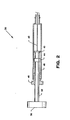
- FIG. 2 is a cutaway view of syringe 30.
- thumb knob 36 At its most proximal end is thumb knob 36. Depressing thumb knob 36 moves shaft 38 distally which moves piston 40 distally.
- Fixation wire 42 which runs the entire length of catheter 10, is fixedly attached to piston 40 and is therefore moved distally by pressing thumb knob 36.
- Fixation wire 42 is substantially stiffer than the inner catheter 22 of catheter 10. The movement of thumb knob 36 (and hence fixation wire 42) in the distal or proximal direction permits medical personnel to fix the position of distal tip 12 of catheter 10 (see also FIG. 1) and to penetrate the heart tissue for stability (see also FIG. 7).
- Rubber seal 44 sealingly engages wall 46 of syringe 30.
- Configured stopper 48 guides the movement of shaft 38 for smooth operation. Because syringe 30 is airtight, it may be used for resisting inadvertent proximal or distal movement of fixation wire 42.
- FIG. 3 is a cutaway view of wye 26.
- the outer structure is a molded, rigid plastic. It has a main branch 28 into which syringe 30 is inserted and a secondary branch which receives the optical fiber.
- the main branch contains metal tubing 24 which provides a lumen for fixation wire 42.
- Metal tubing 24 has an aperture 50 which is Positioned to receive optical fiber 52.
- Metal tubing 24 is fixedly engaged by rigid plastic sleeve 54 which in turn is fixedly engaged by the main body of wye 26 and its distal end 56.
- Rigid plastic sleeve 62 is frictionally engaged by the proximal end of main branch 28. Syringe 30 frictionally engages within the inner diameter of rigid plastic sleeve 62.
- Sheath 34 runs the length of secondary branch 32. It provides the lumen for optical fiber 52. Sheath 34 is sealingly engaged by stopper 58 which in turn is sealingly engaged by the proximal end of secondary branch 32. The outer diameter of sheath 34 is decreased at point 60 corresponding to the distal end of secondary branch 32. Sheath 34 terminates at aperture 50 of metal tubing 24.
- FIG. 4 is a cutaway view of the main body of catheter 10.
- Guiding sheath 18 runs substantially the entire length of catheter 10. Its proximal end is covered by strain relief 64 which is somewhat less flexible than guiding sheath 18, but not rigid. Guiding sheath 18 terminates at point 66 exposing inner catheter 22 which terminates at distal tip 12. Sigmoidal bend 14 and distal metal ring 16 are not shown for clarity, but may be seen in detail in FIG. 5.
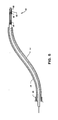
- FIG. 5 is a cutaway view of the distal end of catheter 10.
- Distal tip 12 has a metallic cylinder 68 which frictionally and adhesively engages within inner catheter 22.
- Metallic cylinder 68 also assists in precisely locating distal tip 12 under fluoroscopy.
- Optical fiber 52 is fixedly attached within the lumen of metallic cylinder 68 which also aids in energy transfer, in addition to terminating optical fiber 52.
- Fixation wire 42 terminates just proximal to metallic cylinder 68 when extended maximally in the distal direction. Fixation wire 42 may be advanced and retracted in the manner discussed above to assist in fixation of distal tip 12.
- Sigmoidal bend 14 of guiding sheath 18 is preformed. Because guiding sheath 18 is substantially less flexible than inner catheter 22, sigmoidal bend 14 greatly aids in placement of distal tip 12 and in maintaining the desired location. Distal metal ring 16 is placed on sigmoidal bend 14. Because distal metal ring 16 is radioopaque, it is also helpful in identifying sigmoidal bend 14 during the procedure.
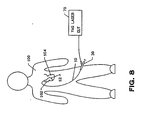
- FIG. 6 is a schematic diagram of a percutaneous procedure practicing the present invention.
- Yag laser. 70 is preferably a Model YAG-1 manufactured and sold by Quantronix, Incorporated, although similar products are available elsewhere. Energy from YAG laser 70 is transferred via optical fiber 52 to distal tip 12 placed within left ventricle 104 of heart 102 of patient 100.
- catheter 10 is inserted into the femoral artery and proceeds through the aorta into left ventricle 104 via the aortic valve (see also FIG. 7). During operation, the entire catheter system may be cooled by waterflow in the annular space between guiding sheath 18 and inner catheter 22.
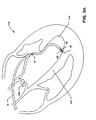
- FIG. 7 shows an enlarged cutaway view of heart 102 undergoing treatment for HCM or IHSS.
- left ventricle 104 has had its volume diminished by excessive thickness of septal wall 110 (shaded area) resulting in HCM.
- septal wall 110 at point 108 interferes with emptying of left ventricle 104 by occluding aortic valve 106 resulting in IHSS.
- Catheter 10 has been inserted within the femoral artery as shown in FIG. 6 and has been advanced through the aorta into left ventricle 104. Notice sigmoidal bend 14 interacts with the irregular shape within left ventricle 104 to maintain the position of metallic cylinder 68 along the axis of catheter 10. Extension of fixation wire 42 prevents transverse motion. Ideally metallic cylinder 68 is positioned within 1mm of the tissue to be irradiated with the laser energy. Distal metal ring 16 aids in verification of placement using fluoroscopy. Once the exact position of metallic cylinder 68 is obtained, it is afixed by advancing thumb knob 36 as discussed above.
- a short burst of laser energy is issued.
- the duration is approximately 15 seconds and the power is approximately 15 watts.
- This energy is sufficient to either cut the myocardial tissue and thereby reform it or at least produce a controlled infarct which greatly shrinks the tissue volume at the infarct area. In this fashion, the myocardium is reformed to enlarge the chamber volume and alleviate occlusion of the aortic outflow track as described by Morrow.
- FIG.7A shows an enlarged cutaway view of heart 102 undergoing treatment of ventricular tachycardia using apparatus of the present invention.
- Heart 102 has been mapped using standard endocardial electrophysiological techniques. The mapping process identifies those areas to be irradiate.
- Catheter 10 has been inserted within the femoral artery as shown in FIG. 6 and has been advanced through the aorta into left ventricle 104. Notice sigmoidal bend 14 interacts with the irregular shape within left ventricle 104 to maintain the position of metallic, cylinder 68 along the axis of catheter 10. Extension of fixation wire 42 prevents transverse motion. Ideally metallic cylinder 68 is positioned within 1mm of the tissue to be irradiated with the laser energy. Distal metal ring 16 aids in verification of placement using fluoroscopy. Once the exact position of metallic cylinder 68 is fixed by the advancing thumb knob 36 as discussed above.
- a short burst of laser energy is issued.
- the duration is approximately 15 second and the power is approximately 15 watts. This energy is sufficient to either ablate or photocoagulate the tissue associated with the tachycardia foci. Using standard endocardial techniques, the irradiated areas may be immediately tested to ensure that the tachycardia foci have been destroyed.
- FIG. 8 shows an alternative approach to the procedure.
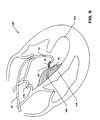
- catheter 10 is advanced to heart 102 transveneously. Insertion is preferably made into the femoral vein and is advanced to the right side of heart 102. Left ventrical 104 is entered transeptally as shown in FIG. 9.
- FIG. 9 is a cutaway and enlarged view of heart 102. It differs from FIG. 7 only in that left ventrical 104 is entered transeptually as shown using procedures known in the art.
- FIG. 9A is a cutaway and enlarged view of heart 102. It differs from FIG. 7A only in that left ventricle 104 is entered transeptually as shown using procedures known in the art.
- sigmoidal used herein includes reference to any suitable curve, for example a curve in the general form of a 'C' or an 'S' or an ogee, or a serpentine or sinuous curve, which effects or facilitates location of the catheter with respect to the heart.
- the "rigid wye" referred to herein can be regarded as comprising a first tubular portion having first and second ends and a second tubular portion which communicates with the interior of said first portion intermediate betweeen said first and second ends.
- the fixation wire can be, for example, any suitable flexible elongate member capable of transmitting compressive force and preferably having an end portion suitable for being fixed (whether by piercing or otherwise) to or adjacent the treatment site.
Landscapes
- Health & Medical Sciences (AREA)
- Surgery (AREA)
- Physics & Mathematics (AREA)
- Life Sciences & Earth Sciences (AREA)
- Biomedical Technology (AREA)
- Heart & Thoracic Surgery (AREA)
- Otolaryngology (AREA)
- Electromagnetism (AREA)
- Optics & Photonics (AREA)
- Engineering & Computer Science (AREA)
- Vascular Medicine (AREA)
- Nuclear Medicine, Radiotherapy & Molecular Imaging (AREA)
- Medical Informatics (AREA)
- Molecular Biology (AREA)
- Animal Behavior & Ethology (AREA)
- General Health & Medical Sciences (AREA)
- Public Health (AREA)
- Veterinary Medicine (AREA)
- Laser Surgery Devices (AREA)
- Media Introduction/Drainage Providing Device (AREA)
Applications Claiming Priority (4)
| Application Number | Priority Date | Filing Date | Title |
|---|---|---|---|
| US07/400,701 US4985028A (en) | 1989-08-30 | 1989-08-30 | Catheter |
| US400702 | 1989-08-30 | ||
| US400701 | 1989-08-30 | ||
| US07/400,702 US4997431A (en) | 1989-08-30 | 1989-08-30 | Catheter |
Publications (1)
| Publication Number | Publication Date |
|---|---|
| EP0416793A1 true EP0416793A1 (fr) | 1991-03-13 |
Family
ID=27017160
Family Applications (1)
| Application Number | Title | Priority Date | Filing Date |
|---|---|---|---|
| EP19900309367 Withdrawn EP0416793A1 (fr) | 1989-08-30 | 1990-08-28 | Cathéter |
Country Status (1)
| Country | Link |
|---|---|
| EP (1) | EP0416793A1 (fr) |
Cited By (10)
| Publication number | Priority date | Publication date | Assignee | Title |
|---|---|---|---|---|
| EP0515867A3 (en) * | 1991-05-01 | 1993-03-31 | The Trustees Of Columbia University In The City Of New York | Myocardial revascularization through the endocardial surface using a laser |
| WO1993015676A1 (fr) * | 1992-02-05 | 1993-08-19 | Angelase, Inc. | Catheter a laser a fil de fixation mobile incorpore |
| EP0668058A1 (fr) * | 1994-02-16 | 1995-08-23 | Novoste Corporation | Cathéter positionable d'électrophysiologie |
| WO1996035469A1 (fr) * | 1995-05-10 | 1996-11-14 | Cardiogenesis Corporation | Systeme de traitement ou de diagnostic pour le tissu cardiaque |
| WO1998019618A1 (fr) * | 1996-11-07 | 1998-05-14 | Vascular Science Inc. | Procedes et dispositif de marquage de structures corporelles tubulaires |
| AU695783B2 (en) * | 1991-05-01 | 1998-08-20 | Trustees Of Columbia University In The City Of New York, The | Myocardial revascularization through the endocardial surface using a laser |
| AU714277B2 (en) * | 1991-05-01 | 1999-12-23 | Trustees Of Columbia University In The City Of New York, The | Myocardial revascularization through the endocardial surface using a laser |
| US6251104B1 (en) | 1995-05-10 | 2001-06-26 | Eclipse Surgical Technologies, Inc. | Guiding catheter system for ablating heart tissue |
| US6261315B1 (en) | 1997-10-28 | 2001-07-17 | St. Jude Medical Cardiovascular Group, Inc. | Tubular body structure marking methods and apparatus |
| US6723069B1 (en) | 1994-02-16 | 2004-04-20 | Novoste Corporation | Electrophysiology positioning catheter |
Citations (9)
| Publication number | Priority date | Publication date | Assignee | Title |
|---|---|---|---|---|
| FR2187365A1 (fr) * | 1972-06-09 | 1974-01-18 | Medtronic Inc | |
| FR2365351A1 (fr) * | 1976-09-24 | 1978-04-21 | Benhaim Jean | Sonde pour interruption non chirurgicale du faisceau de his chez l'homme |
| US4103690A (en) * | 1977-03-21 | 1978-08-01 | Cordis Corporation | Self-suturing cardiac pacer lead |
| DE2826383A1 (de) * | 1978-06-16 | 1979-12-20 | Eichler Juergen | Sonde fuer die laser-chirurgie |
| EP0048410A1 (fr) * | 1980-09-22 | 1982-03-31 | Olympus Optical Co., Ltd. | Dispositif à laser pour un endoscope |
| WO1985002101A1 (fr) * | 1983-11-08 | 1985-05-23 | Laserscope, Inc. | Dispositif endoscopique possedant un montage de poignee et un montage de catheter |
| DE3527451A1 (de) * | 1984-08-15 | 1986-02-27 | Olympus Optical Co., Ltd., Tokio/Tokyo | Laservorrichtung fuer medizinische zwecke |
| US4718417A (en) * | 1985-03-22 | 1988-01-12 | Massachusetts Institute Of Technology | Visible fluorescence spectral diagnostic for laser angiosurgery |
| DE3718139C1 (de) * | 1987-05-29 | 1988-12-08 | Strahlen Umweltforsch Gmbh | Herzkatheter |
-
1990
- 1990-08-28 EP EP19900309367 patent/EP0416793A1/fr not_active Withdrawn
Patent Citations (9)
| Publication number | Priority date | Publication date | Assignee | Title |
|---|---|---|---|---|
| FR2187365A1 (fr) * | 1972-06-09 | 1974-01-18 | Medtronic Inc | |
| FR2365351A1 (fr) * | 1976-09-24 | 1978-04-21 | Benhaim Jean | Sonde pour interruption non chirurgicale du faisceau de his chez l'homme |
| US4103690A (en) * | 1977-03-21 | 1978-08-01 | Cordis Corporation | Self-suturing cardiac pacer lead |
| DE2826383A1 (de) * | 1978-06-16 | 1979-12-20 | Eichler Juergen | Sonde fuer die laser-chirurgie |
| EP0048410A1 (fr) * | 1980-09-22 | 1982-03-31 | Olympus Optical Co., Ltd. | Dispositif à laser pour un endoscope |
| WO1985002101A1 (fr) * | 1983-11-08 | 1985-05-23 | Laserscope, Inc. | Dispositif endoscopique possedant un montage de poignee et un montage de catheter |
| DE3527451A1 (de) * | 1984-08-15 | 1986-02-27 | Olympus Optical Co., Ltd., Tokio/Tokyo | Laservorrichtung fuer medizinische zwecke |
| US4718417A (en) * | 1985-03-22 | 1988-01-12 | Massachusetts Institute Of Technology | Visible fluorescence spectral diagnostic for laser angiosurgery |
| DE3718139C1 (de) * | 1987-05-29 | 1988-12-08 | Strahlen Umweltforsch Gmbh | Herzkatheter |
Cited By (13)
| Publication number | Priority date | Publication date | Assignee | Title |
|---|---|---|---|---|
| EP0876795A3 (fr) * | 1991-05-01 | 2000-06-07 | The Trustees of Columbia University in the City of New York | Revascularisation myocardiale à travers de la surface endocardiale au moyen de laser |
| EP0515867A3 (en) * | 1991-05-01 | 1993-03-31 | The Trustees Of Columbia University In The City Of New York | Myocardial revascularization through the endocardial surface using a laser |
| AU695783B2 (en) * | 1991-05-01 | 1998-08-20 | Trustees Of Columbia University In The City Of New York, The | Myocardial revascularization through the endocardial surface using a laser |
| AU714277B2 (en) * | 1991-05-01 | 1999-12-23 | Trustees Of Columbia University In The City Of New York, The | Myocardial revascularization through the endocardial surface using a laser |
| WO1993015676A1 (fr) * | 1992-02-05 | 1993-08-19 | Angelase, Inc. | Catheter a laser a fil de fixation mobile incorpore |
| EP0668058A1 (fr) * | 1994-02-16 | 1995-08-23 | Novoste Corporation | Cathéter positionable d'électrophysiologie |
| US6723069B1 (en) | 1994-02-16 | 2004-04-20 | Novoste Corporation | Electrophysiology positioning catheter |
| WO1996035469A1 (fr) * | 1995-05-10 | 1996-11-14 | Cardiogenesis Corporation | Systeme de traitement ou de diagnostic pour le tissu cardiaque |
| US6251104B1 (en) | 1995-05-10 | 2001-06-26 | Eclipse Surgical Technologies, Inc. | Guiding catheter system for ablating heart tissue |
| US6592575B1 (en) | 1995-05-10 | 2003-07-15 | Randy J. Kesten | Guiding catheter system for ablating heart tissue |
| US6830568B1 (en) | 1995-05-10 | 2004-12-14 | Randy J. Kesten | Guiding catheter system for ablating heart tissue |
| WO1998019618A1 (fr) * | 1996-11-07 | 1998-05-14 | Vascular Science Inc. | Procedes et dispositif de marquage de structures corporelles tubulaires |
| US6261315B1 (en) | 1997-10-28 | 2001-07-17 | St. Jude Medical Cardiovascular Group, Inc. | Tubular body structure marking methods and apparatus |
Similar Documents
| Publication | Publication Date | Title |
|---|---|---|
| US5106386A (en) | Catheter | |
| US4985028A (en) | Catheter | |
| US5104393A (en) | Catheter | |
| EP1171191B1 (fr) | Kit pour l'acces transveineux a l'espace pericardique par l'oreillette droite | |
| US6139522A (en) | Electrophysiology positioning catheter | |
| US5824005A (en) | Maneuverable electrophysiology catheter for percutaneous or intraoperative ablation of cardiac arrhythmias | |
| US5968010A (en) | Method for transvenously accessing the pericardial space via the right atrium | |
| US6190382B1 (en) | Radio-frequency based catheter system for ablation of body tissues | |
| EP1983903B1 (fr) | Dispositif d'ablation et systeme pour guider le dispositif d'ablation dans un corps | |
| US20030032936A1 (en) | Side-exit catheter and method for its use | |
| JP2001521795A (ja) | 心臓組織切除のガイド用カテーテルシステム | |
| JPH09506017A (ja) | 心房マッピングおよび切除用のカテーテル装置 | |
| JP2000504972A (ja) | 経皮心筋層血管再生マーキングシステム | |
| AU2973200A (en) | Medical device having an incrementally displaceable electrode | |
| CA2273948A1 (fr) | Appareil permettant d'acceder a l'espace pericardique et technique correspondante | |
| US20040215168A1 (en) | Kit for transvenously accessing the pericardial space via the right atrium | |
| EP0416793A1 (fr) | Cathéter | |
| US6723069B1 (en) | Electrophysiology positioning catheter | |
| JP2007500035A (ja) | 組織切除プローブの案内カテーテル | |
| US20250041021A1 (en) | Positional markers for catheter wires | |
| US20240325074A1 (en) | Passive steerable dilator | |
| CN121712460A (zh) | 标测和经中隔穿刺导管 | |
| WO2025132257A1 (fr) | Dispositif de perforation radiofréquence à extrémité ouverte | |
| CN121285335A (zh) | 用于经中隔穿刺和电解剖标测的成形扩张器 |
Legal Events
| Date | Code | Title | Description |
|---|---|---|---|
| PUAI | Public reference made under article 153(3) epc to a published international application that has entered the european phase |
Free format text: ORIGINAL CODE: 0009012 |
|
| AK | Designated contracting states |
Kind code of ref document: A1 Designated state(s): CH DE DK FR GB IT LI NL |
|
| RIN1 | Information on inventor provided before grant (corrected) |
Inventor name: ISNER, JEFFREY M. Inventor name: CLARKE, RICHARD |
|
| 17P | Request for examination filed |
Effective date: 19910218 |
|
| 17Q | First examination report despatched |
Effective date: 19930803 |
|
| STAA | Information on the status of an ep patent application or granted ep patent |
Free format text: STATUS: THE APPLICATION IS DEEMED TO BE WITHDRAWN |
|
| 18D | Application deemed to be withdrawn |
Effective date: 19940830 |