EP0425695A1 - Continuous sheet of electron beam crosslinked foam - Google Patents
Continuous sheet of electron beam crosslinked foam Download PDFInfo
- Publication number
- EP0425695A1 EP0425695A1 EP90907414A EP90907414A EP0425695A1 EP 0425695 A1 EP0425695 A1 EP 0425695A1 EP 90907414 A EP90907414 A EP 90907414A EP 90907414 A EP90907414 A EP 90907414A EP 0425695 A1 EP0425695 A1 EP 0425695A1
- Authority
- EP
- European Patent Office
- Prior art keywords
- copolymer
- foam
- weight
- ethylene
- foam according
- Prior art date
- Legal status (The legal status is an assumption and is not a legal conclusion. Google has not performed a legal analysis and makes no representation as to the accuracy of the status listed.)
- Granted
Links
Classifications
-
- C—CHEMISTRY; METALLURGY
- C08—ORGANIC MACROMOLECULAR COMPOUNDS; THEIR PREPARATION OR CHEMICAL WORKING-UP; COMPOSITIONS BASED THEREON
- C08J—WORKING-UP; GENERAL PROCESSES OF COMPOUNDING; AFTER-TREATMENT NOT COVERED BY SUBCLASSES C08B, C08C, C08F, C08G or C08H
- C08J9/00—Working-up of macromolecular substances to porous or cellular articles or materials; After-treatment thereof
- C08J9/04—Working-up of macromolecular substances to porous or cellular articles or materials; After-treatment thereof using blowing gases generated by a previously added blowing agent
- C08J9/06—Working-up of macromolecular substances to porous or cellular articles or materials; After-treatment thereof using blowing gases generated by a previously added blowing agent by a chemical blowing agent
-
- C—CHEMISTRY; METALLURGY
- C08—ORGANIC MACROMOLECULAR COMPOUNDS; THEIR PREPARATION OR CHEMICAL WORKING-UP; COMPOSITIONS BASED THEREON
- C08L—COMPOSITIONS OF MACROMOLECULAR COMPOUNDS
- C08L23/00—Compositions of homopolymers or copolymers of unsaturated aliphatic hydrocarbons having only one carbon-to-carbon double bond; Compositions of derivatives of such polymers
- C08L23/02—Compositions of homopolymers or copolymers of unsaturated aliphatic hydrocarbons having only one carbon-to-carbon double bond; Compositions of derivatives of such polymers not modified by chemical after-treatment
- C08L23/10—Homopolymers or copolymers of propene
- C08L23/12—Polypropene
-
- C—CHEMISTRY; METALLURGY
- C08—ORGANIC MACROMOLECULAR COMPOUNDS; THEIR PREPARATION OR CHEMICAL WORKING-UP; COMPOSITIONS BASED THEREON
- C08J—WORKING-UP; GENERAL PROCESSES OF COMPOUNDING; AFTER-TREATMENT NOT COVERED BY SUBCLASSES C08B, C08C, C08F, C08G or C08H
- C08J9/00—Working-up of macromolecular substances to porous or cellular articles or materials; After-treatment thereof
- C08J9/0061—Working-up of macromolecular substances to porous or cellular articles or materials; After-treatment thereof characterized by the use of several polymeric components
-
- C—CHEMISTRY; METALLURGY
- C08—ORGANIC MACROMOLECULAR COMPOUNDS; THEIR PREPARATION OR CHEMICAL WORKING-UP; COMPOSITIONS BASED THEREON
- C08L—COMPOSITIONS OF MACROMOLECULAR COMPOUNDS
- C08L23/00—Compositions of homopolymers or copolymers of unsaturated aliphatic hydrocarbons having only one carbon-to-carbon double bond; Compositions of derivatives of such polymers
- C08L23/02—Compositions of homopolymers or copolymers of unsaturated aliphatic hydrocarbons having only one carbon-to-carbon double bond; Compositions of derivatives of such polymers not modified by chemical after-treatment
- C08L23/10—Homopolymers or copolymers of propene
- C08L23/14—Copolymers of propene
-
- C—CHEMISTRY; METALLURGY
- C08—ORGANIC MACROMOLECULAR COMPOUNDS; THEIR PREPARATION OR CHEMICAL WORKING-UP; COMPOSITIONS BASED THEREON
- C08L—COMPOSITIONS OF MACROMOLECULAR COMPOUNDS
- C08L23/00—Compositions of homopolymers or copolymers of unsaturated aliphatic hydrocarbons having only one carbon-to-carbon double bond; Compositions of derivatives of such polymers
- C08L23/02—Compositions of homopolymers or copolymers of unsaturated aliphatic hydrocarbons having only one carbon-to-carbon double bond; Compositions of derivatives of such polymers not modified by chemical after-treatment
- C08L23/10—Homopolymers or copolymers of propene
- C08L23/14—Copolymers of propene
- C08L23/142—Copolymers of propene at least partially crystalline copolymers of propene with other olefins
-
- C—CHEMISTRY; METALLURGY
- C08—ORGANIC MACROMOLECULAR COMPOUNDS; THEIR PREPARATION OR CHEMICAL WORKING-UP; COMPOSITIONS BASED THEREON
- C08J—WORKING-UP; GENERAL PROCESSES OF COMPOUNDING; AFTER-TREATMENT NOT COVERED BY SUBCLASSES C08B, C08C, C08F, C08G or C08H
- C08J2323/00—Characterised by the use of homopolymers or copolymers of unsaturated aliphatic hydrocarbons having only one carbon-to-carbon double bond; Derivatives of such polymers
- C08J2323/02—Characterised by the use of homopolymers or copolymers of unsaturated aliphatic hydrocarbons having only one carbon-to-carbon double bond; Derivatives of such polymers not modified by chemical after treatment
- C08J2323/10—Homopolymers or copolymers of propene
-
- C—CHEMISTRY; METALLURGY
- C08—ORGANIC MACROMOLECULAR COMPOUNDS; THEIR PREPARATION OR CHEMICAL WORKING-UP; COMPOSITIONS BASED THEREON
- C08J—WORKING-UP; GENERAL PROCESSES OF COMPOUNDING; AFTER-TREATMENT NOT COVERED BY SUBCLASSES C08B, C08C, C08F, C08G or C08H
- C08J2423/00—Characterised by the use of homopolymers or copolymers of unsaturated aliphatic hydrocarbons having only one carbon-to-carbon double bond; Derivatives of such polymers
-
- C—CHEMISTRY; METALLURGY
- C08—ORGANIC MACROMOLECULAR COMPOUNDS; THEIR PREPARATION OR CHEMICAL WORKING-UP; COMPOSITIONS BASED THEREON
- C08L—COMPOSITIONS OF MACROMOLECULAR COMPOUNDS
- C08L2203/00—Applications
- C08L2203/14—Applications used for foams
-
- C—CHEMISTRY; METALLURGY
- C08—ORGANIC MACROMOLECULAR COMPOUNDS; THEIR PREPARATION OR CHEMICAL WORKING-UP; COMPOSITIONS BASED THEREON
- C08L—COMPOSITIONS OF MACROMOLECULAR COMPOUNDS
- C08L2205/00—Polymer mixtures characterised by other features
- C08L2205/03—Polymer mixtures characterised by other features containing three or more polymers in a blend
-
- C—CHEMISTRY; METALLURGY
- C08—ORGANIC MACROMOLECULAR COMPOUNDS; THEIR PREPARATION OR CHEMICAL WORKING-UP; COMPOSITIONS BASED THEREON
- C08L—COMPOSITIONS OF MACROMOLECULAR COMPOUNDS
- C08L23/00—Compositions of homopolymers or copolymers of unsaturated aliphatic hydrocarbons having only one carbon-to-carbon double bond; Compositions of derivatives of such polymers
- C08L23/02—Compositions of homopolymers or copolymers of unsaturated aliphatic hydrocarbons having only one carbon-to-carbon double bond; Compositions of derivatives of such polymers not modified by chemical after-treatment
- C08L23/04—Homopolymers or copolymers of ethene
- C08L23/08—Copolymers of ethene
- C08L23/0807—Copolymers of ethene with unsaturated hydrocarbons only containing four or more carbon atoms
- C08L23/0815—Copolymers of ethene with unsaturated hydrocarbons only containing four or more carbon atoms with aliphatic 1-olefins containing one carbon-to-carbon double bond
-
- C—CHEMISTRY; METALLURGY
- C08—ORGANIC MACROMOLECULAR COMPOUNDS; THEIR PREPARATION OR CHEMICAL WORKING-UP; COMPOSITIONS BASED THEREON
- C08L—COMPOSITIONS OF MACROMOLECULAR COMPOUNDS
- C08L23/00—Compositions of homopolymers or copolymers of unsaturated aliphatic hydrocarbons having only one carbon-to-carbon double bond; Compositions of derivatives of such polymers
- C08L23/02—Compositions of homopolymers or copolymers of unsaturated aliphatic hydrocarbons having only one carbon-to-carbon double bond; Compositions of derivatives of such polymers not modified by chemical after-treatment
- C08L23/04—Homopolymers or copolymers of ethene
- C08L23/08—Copolymers of ethene
- C08L23/0846—Copolymers of ethene with unsaturated hydrocarbons containing atoms other than carbon or hydrogen
- C08L23/0853—Ethylene vinyl acetate copolymers
-
- C—CHEMISTRY; METALLURGY
- C08—ORGANIC MACROMOLECULAR COMPOUNDS; THEIR PREPARATION OR CHEMICAL WORKING-UP; COMPOSITIONS BASED THEREON
- C08L—COMPOSITIONS OF MACROMOLECULAR COMPOUNDS
- C08L23/00—Compositions of homopolymers or copolymers of unsaturated aliphatic hydrocarbons having only one carbon-to-carbon double bond; Compositions of derivatives of such polymers
- C08L23/02—Compositions of homopolymers or copolymers of unsaturated aliphatic hydrocarbons having only one carbon-to-carbon double bond; Compositions of derivatives of such polymers not modified by chemical after-treatment
- C08L23/04—Homopolymers or copolymers of ethene
- C08L23/08—Copolymers of ethene
- C08L23/0846—Copolymers of ethene with unsaturated hydrocarbons containing atoms other than carbon or hydrogen
- C08L23/0869—Copolymers of ethene with unsaturated hydrocarbons containing atoms other than carbon or hydrogen with unsaturated acids, e.g. [meth]acrylic acid; with unsaturated esters, e.g. [meth]acrylic acid esters
-
- C—CHEMISTRY; METALLURGY
- C08—ORGANIC MACROMOLECULAR COMPOUNDS; THEIR PREPARATION OR CHEMICAL WORKING-UP; COMPOSITIONS BASED THEREON
- C08L—COMPOSITIONS OF MACROMOLECULAR COMPOUNDS
- C08L2312/00—Crosslinking
- C08L2312/06—Crosslinking by radiation
-
- C—CHEMISTRY; METALLURGY
- C08—ORGANIC MACROMOLECULAR COMPOUNDS; THEIR PREPARATION OR CHEMICAL WORKING-UP; COMPOSITIONS BASED THEREON
- C08L—COMPOSITIONS OF MACROMOLECULAR COMPOUNDS
- C08L51/00—Compositions of graft polymers in which the grafted component is obtained by reactions only involving carbon-to-carbon unsaturated bonds; Compositions of derivatives of such polymers
- C08L51/06—Compositions of graft polymers in which the grafted component is obtained by reactions only involving carbon-to-carbon unsaturated bonds; Compositions of derivatives of such polymers grafted on to homopolymers or copolymers of aliphatic hydrocarbons containing only one carbon-to-carbon double bond
-
- Y—GENERAL TAGGING OF NEW TECHNOLOGICAL DEVELOPMENTS; GENERAL TAGGING OF CROSS-SECTIONAL TECHNOLOGIES SPANNING OVER SEVERAL SECTIONS OF THE IPC; TECHNICAL SUBJECTS COVERED BY FORMER USPC CROSS-REFERENCE ART COLLECTIONS [XRACs] AND DIGESTS
- Y10—TECHNICAL SUBJECTS COVERED BY FORMER USPC
- Y10S—TECHNICAL SUBJECTS COVERED BY FORMER USPC CROSS-REFERENCE ART COLLECTIONS [XRACs] AND DIGESTS
- Y10S521/00—Synthetic resins or natural rubbers -- part of the class 520 series
- Y10S521/915—Utilizing electrical or wave energy during cell forming process
Definitions
- Cured foams made of conventional resin proportions have a problem in that only a few kinds of facing material may be used in a heat molding process due to the low expansion stress of the foams.
- foam according to the present invention has 50 kg/cm2 ⁇ % or more in tensile strength, so that it is superior to conventional foams.
- Foam according to the present invention is of improved tensile strength at high temperatures, whereby less disuniformity in thickness of product occurs, and heat-molding processability is improved.
- the molding processability (L/D) can be expanded to 1.2.
- the resin components (A), (B) and (C), powdered into 32-mesh-passing size, are provided, of which proportions are within the ranges of the present invention.
- the components are fed into a high-speed mixing apparatus (such as a Henschel mixer or a super mixer).
- a high-speed mixing apparatus such as a Henschel mixer or a super mixer.
- an ordinary chemical foaming agent of the decomposable type for example, azodicarbonamide, dinitrosopentamethylene-tetramine, etc.
- other additives may also be included. Thereby, initial mixing is carried out.
- the obtained sheet must be cured in order not to allow interior gas generated by the decomposition of the foaming agent to escape during the foaming process.
- a conventional ionizing radiation method may be used.
- a conventional peroxide compound can be added prior to irradiation; furthermore, if desired, a multi-functional monomer of divinylbenzene, trimethylolpropane triacrylate, pentaerythritol triacrylate, etc.; a multi functional dimer of those; or a multi functional trimer of those may be added as a crosslinking promoting agent.
- Added within the scope of the present invention may be an inorganic filler such as calcium carbonate, talc, glass balloon, glass fiber, etc.; an antistatic agent; a flame retarder; and a colorant.
- Et-Bt of ethylene/ ⁇ -olefin copolymer means a copolymer formed by the polymerization of ethylene with butane as an ⁇ -olefin.
- the low-density polyethylene is made by the high pressure method, and the high-density polyethylene is made by the low pressure method.
- the linear very-low-density polyethylene is a polyethylene of which density is 0.910 g/cm3 or lower, and which is made by the high-pressure ion polymerization method and the intermediate-low-pressure solution polymerization method.
Landscapes
- Chemical & Material Sciences (AREA)
- Health & Medical Sciences (AREA)
- Chemical Kinetics & Catalysis (AREA)
- Medicinal Chemistry (AREA)
- Polymers & Plastics (AREA)
- Organic Chemistry (AREA)
- Engineering & Computer Science (AREA)
- Materials Engineering (AREA)
- Crystallography & Structural Chemistry (AREA)
- General Chemical & Material Sciences (AREA)
- Manufacture Of Porous Articles, And Recovery And Treatment Of Waste Products (AREA)
Abstract
Description
- The present invention relates to a foam, and more particularly to a sheet-type foam which is cured by an electron beam.
- Electron-beam cured foams have been used as cushioning materials in automobile interiors, and as heat-resisting and heat-insulating materials.
- Japanese Patent Laying-Open No. 265935/1988 discloses a cured foam consisting of an olefin resin comprising linear very-low-density polyethylene of more than 10 wt.%. The linear very-low-density polyethylene is made by copolymerizing ethylene with an α-olefin having more than 4 carbons. According to the disclosure, the olefin resin may be a polymer made from olefin monomers, such as polypropylene, or a copolymer mixture of ethylene/ethylacrylate. The linear very-low-density polyethylene may be composed by a process in which ethylene is copolymerized with an α-olefin having more than 4 carbons, such as butene-1, hexene-1, octene-1, 4-methylpentene-1, in order to add an appropriate number of short branches to the main linear chains, whereby the density is decreased.
- The above document further discloses the following example. Ethylene/propylene random copolymer of 35 parts by weight having density of 0.89 g/cm³, Melt Index of 7.0 g/10min, and melting point of 145 °C; high-density polyethylene of 30 parts by weight having density of 0.957 g/cm³ and MI of 6.5 g/10min; linear very-low-density ethylene/4-methylpentene-1 copolymer of 35 parts by weight having density of 0.905 g/cm³ and MI of 0.0 g/10min; azodicarbonamide, as a foaming agent, of 15 parts by weight; trimethylpropane-trimethacrylate of 3.0 parts by weight; and a heat stabilizer of 0.5 parts by weight were mixed. The mixture was formed into a sheet of 1.5 mm thickness by an extruder. In order to cross-link the sheet, both surfaces were irradiated by an electron beam of 2.0 Mrad in an electron-beam irradiation apparatus. The sheet was then uniformly transported through a hot air stove at 250 °C for heat foaming, whereby a sheet-type foam of about 4 mm in thickness was obtained.
- The obtained cross-linked foam is of inferior tensile strength and dimensional stability, although it has good flexibility. That is, a foam produced in direct accordance with the technology disclosed in Japanese Patent Laying-Open No. 265935/1988 results in insufficient tensile strength and insufficient dimensional stability, due to inappropriateness in the selection of resins and the mixing ratio.
- Additionally, Japanese Patent Laying-Open No. 155232/1981 and Japanese Patent Laying-Open No. 157839/1983 disclose a resin made of a copolymer of ethylene of which melting point ranges from 117 °C to 123 °C and density ranges from 0.890 g/cm³ to 0.910 g/cm³, and an α-olefin having 4 to 8 carbons. However, this resin is not comprised of 3 components, as in the above example from the prior art.
- It is an object of the present invention to provide an electron-beam cured sheet-type foam of improved tensile strength and dimensional stability.
- It is another object of the present invention to provide an electron-beam cured sheet-type foam of improved tensile strength, dimensional stability and flexibility.
- It is yet another object of the present invention to provide an electron-beam cured sheet-type foam of improved tensile strength at high temperatures and increased processability in molding wherein the foam is used in a composite material.
- It is a further object of the present invention to provide an electron-beam cured sheet-type foam of improved dimensional stability whereby it may be more suitably used as a cushioning material in the automobile interiors.
- It is yet another object of the present invention to provide an electron-beam cured sheet-type foam of improved tensile strength at high temperatures whereby it may be more suitably used as a heat-resisting and heat-insulating foamed material.
- According to one aspect of the present invention, an electron-beam cured sheet-type foam comprises a polypropylene type resin (A) of 100 parts by weight of which main component is propylene; a copolymer resin (B) of 5 to 40 parts by weight, composed of ethylene and at least one selected from the group consisting of acrylic acid, ethylacrylate, maleic acid anhydride and vinylacetate; and a copolymer resin (C) of 10 to 80 parts by weight ethylene, of which melting point ranges from 117 °C to 123 °C and density ranges from 0.890 g/cm³ to 0.910 g/cm³, and an α-olefin having 4 to 8 carbons. This foam ranges from 20 to 60 % in gel percent and from 5 to 40 in expansion rate.
- This foam may preferably be 50 kg/cm²·% or more in tensile strength at 150 °C, and 5 % or less in size-change rate at 120 °C, or size stability.
- The inventors have found that a foam of improved flexibility, tensile strength, dimensional stability, and processability in molding may be obtained by mixing the resins (A), (B) and (C) in a proper ratio, and by electron-beam curing prior to foaming.
- A polypropylene type resin (A) comprising propylene for use in a foam according to the present invention is, for example, a propylene homo-polymer; or a random copolymer, block copolymer or random/block copolymer of propylene, and at least one selected from the group consisting of ethylene and butane. The amount of ethylene and/or butene-1 in the copolymer may range from 2 to 35 weight percent, preferably from 3 to 30 weight percent. More preferably, the copolymer may be a random copolymer including ethylene of 4 to 15 weight percent.
- The copolymer resin (B) may include ethylene and at least one compound of 5 to 30 weight percent (preferably, 8 to 25 weight percent) selected from the group consisting of acrylic acid, ethylacrylate, maleic acid anhydride and vinylacetate. More preferably, the copolymer (B) may be ethylene-ethylacrylate (EEA) comprising ethylacrylate of 8 to 18 percent, or a three-component copolymer of ethylene/ethylacrylate/maleic-acid-anhydride (EEA-MAH), including ethylacrylate and maleic acid anhydride of 8 to 18 weight percent in total.
- The copolymer resin (C) of ethylene and α-olefin having 4 to 8 carbons ranges from 117 to 123 °C in melting point, and from 0.890 to 0.910 g/cm³ in density. Preferably, the copolymer (C) may include an α-olefin having 4 to 6 carbons, and may range from 117 to 123 °C in melting point and from 0.895 to 0.905 g/cm³ in density. The copolymer (C) of ethylene and α-olefin may be an ethylene/α-olefin copolymer as disclosed in Japanese Patent Laying-Open No. 157839/1983. There is a proportion between the density and the melting point of the copolymer, wherein the melting point increases as the density increases; but some physical characteristics of the resin, such as melting point, tensile strength, expansibility and flexibility, can be changed under a constant density, by using a different catalyst or a different mixing method. The copolymer (C) in the foam according to the present invention is different from the linear very-low-density polyethylene as described in Japanese Patent Laying-Open No. 265935/1988, viz., Ultzex (Mitsui Petrochemical Industries Ltd.) and Excelen (Sumitomo Chemical Co., Ltd.). For example, at density ranging from 0.890 to 0.910 g/cm³, the polyethylene used in Japanese Patent Laying-Open No. 265935/1988 has a melting point 4 to 7 °C lower than that used in the present invention. The lower melting point deteriorates the dimensional stability of the foam. At the same time the polyethylene used in the present invention has a higher melting point at low density, providing good flexibility and low size-change rate at 120 °C.
- According to the present invention, the mixing ratio of resin components (A), (B) and (C) is defined as follows: the component (A) is 100 parts by weight, the component (B) is 5 to 40 parts by weight (preferably, 5 to 25 parts by weight), and the component (C) is 10 to 80 parts by weight (preferably, 20 to 50 parts by weight). If the proportion of the component (B) is more than 40 parts by weight, the size stability (size-change rate at 120 °C) of the obtained foam becomes more than 5 percent. If the proportion of component (B) is lower than 5 parts by weight, the obtained foam cannot satisfy the required levels of flexibility, heat resistance, tensile strength and molding processability. Particularly, the obtained foam lacks sufficient tensile strength at high temperatures. Moreover, if the proportion of the component (B) is lower than 5 parts by weight, the obtained foam has the same characteristics as those of a foam made from a mixture of the components (A) and (C). If a foam contains an excess of the component (A), the obtained foam lacks sufficiently high flexibility, although it has high shock resistance and dimensional stability. If a foam contains an excess of the component (C), the obtained foam has inferior heat resistance, although it has high flexibility. If the proportion of the component (C) is less than 10 parts by weight, the flexibility of the obtained foam deteriorates. Moreover, if the proportion of the component (C) is more than 80 parts by weight, the size stability deteriorates, although good flexibility may be obtained.
- According to the present invention, the foam ranges from 20 to 60 percent in gel percent and from 5 to 40 in expansion rate.
- If the gel percent is lower than 20 percent, the dimensional stability of the obtained foam deteriorates due to gel shortage. Furthermore, the predetermined density cannot be obtained and the formed surfaces of the foam are rough, due to the fact that a gas is generated inside the foam during production which disrupts the surfaces. Moreover, sufficient tensile strength at high temperatures cannot be obtained. If the gel percent is more than 60 percent, the obtained foam tends too strongly to retain its shape resulting in greater than 6 percent of dimensional stability (size-change rate at 120 °C). The flexibility also deteriorates.
- The expansion rate must range from 5 to 40. If the expansion rate is lower than 5, the flexibility deteriorates inasmuch as the foam becomes too hard, although the tensile strength and the molding processability remain sufficient. If the expansion rate is more than 40, the shock-absorbing ability deteriorates inasmuch as the obtained foam becomes too soft, although the flexibility remains sufficient.
- According to the present invention, the foam may be 50 kg/cm²·% or more in tensile strength at 150 °C. If the tensile strength is lower than 50 kg/cm²·%, the obtained foam becomes ruptured, because the tensile strength of the foam is not sufficient at high temperatures to correspond with the expansion and the expansion stress of the facing material (such as a sheet of vinylchloride), when the foam is heat-processed after being laminated with the facing material.
- Cured foams made of conventional resin proportions have a problem in that only a few kinds of facing material may be used in a heat molding process due to the low expansion stress of the foams. However, foam according to the present invention has 50 kg/cm²·% or more in tensile strength, so that it is superior to conventional foams. Foam according to the present invention is of improved tensile strength at high temperatures, whereby less disuniformity in thickness of product occurs, and heat-molding processability is improved. The molding processability (L/D) can be expanded to 1.2.
- The dimensional stability (size-change rate at 120 °C) of a foam according to the present invention is preferably 5 percent or less. If the dimensional stability is more than 5 percent, foam shrinkage is so great that products in which the inclusion of a heat-process method is essential cannot be obtained.
- The 25%-compressive hardness of the foam according to the present invention preferably ranges from 0.1 to 1.0 kg/cm² at ordinary temperatures. If the compressive hardness is more than 1.0 kg/cm², the tensile strength of foam becomes so great that its tactility deteriorates. If the compressive hardness is lower than 0.1 kg/cm², the foam becomes so soft that a "reaching-bottom feeling" results (i.e., a feeling of reaching the opposite surface when the foam is pressed by a finger). Furthermore, foam of weak tensile strength deteriorates handling characteristics in manufacturing and transforming processes.
- The 5%-tensile stress of the foam according to the present invention may range from 10 to 100 kg/cm² at ordinary temperature. If the stress is more than 100 kg/cm², the shock absorbing ability deteriorates and the tensile strength becomes too great. If the stress is lower than 10 kg/cm², the tensile strength becomes too weak, although the flexibility is adequate.
- The 25%-compressive hardness and the 5%-tensile stress at ordinary temperature may be used as a measure of suppleness flexibility. Foams of which characteristics are within the above ranges will have suppleness noticeably different from those of conventional foams, when such foams are evaluated after they are laminated with various kinds of facing material and processed to form products.
- The foam according to the present invention is a sheet. The foam may be more than 10 m long, and may be rolled in forming a material product. The long sheet may be processed in several continuous manufacturing steps in order to decrease losses during the steps.
- A method for manufacturing a foam according to the present invention will henceforth be described.
- The resin components (A), (B) and (C), powdered into 32-mesh-passing size, are provided, of which proportions are within the ranges of the present invention. The components are fed into a high-speed mixing apparatus (such as a Henschel mixer or a super mixer). Furthermore, an ordinary chemical foaming agent of the decomposable type (for example, azodicarbonamide, dinitrosopentamethylene-tetramine, etc.) of 2 to 20 parts by weight is added to the resin components of 100 parts by weight. At the same time, other additives may also be included. Thereby, initial mixing is carried out. The obtained material is fed into an extruder heated at 130 to 190 °C, and melt-diffusion mixing is effected, producing a long sheet which is 0.5 to 6 mm in thickness. In the mixing steps, it is important that the forming agent be decomposed as little as possible.
- The obtained sheet must be cured in order not to allow interior gas generated by the decomposition of the foaming agent to escape during the foaming process. In order to cure the sheet, a conventional ionizing radiation method may be used. A conventional peroxide compound can be added prior to irradiation; furthermore, if desired, a multi-functional monomer of divinylbenzene, trimethylolpropane triacrylate, pentaerythritol triacrylate, etc.; a multi functional dimer of those; or a multi functional trimer of those may be added as a crosslinking promoting agent. Added within the scope of the present invention may be an inorganic filler such as calcium carbonate, talc, glass balloon, glass fiber, etc.; an antistatic agent; a flame retarder; and a colorant.
- The obtained cured sheet is introduced into a heated-air atmosphere or onto a chemical liquid such as silicon oil, of which temperature is 10 to 100 °C higher than the decomposing temperature of the foaming agent, whereby the foaming agent is rapidly decomposed to make the sheet-type cured foam.
- If a corona discharging process is applied to at least one surface of the obtained foam, whereby the surface-wetting tension is more than 37 dyne/cm, the foam will be sufficiently adhesive to coating materials. A foam having an adhesive layer, or a cohesive layer formed of a coating material, can be laminated with a sheet of facing material, a film, another kind of foam, a metallic foil, a sheet of paper, a piece of nonwoven fabric made of natural fiber or synthetic fiber, or a piece of synthetic leather. The obtained laminated product can be molded by various methods.
- The parameters will be explained in the following:
- (a) Melting Point (°C)
The melting point is a temperature at the highest peak of endothermic peaks in measurement with a differential spectrum calorimeter (DSC). - (b) Density (g/cm³)
The density is measured in accordance with JISK6767. - (c) Gel Percent (%)
The foam to be measured is broken into small pieces, and 0.2 g pieces of the foam are selected by accurate weighing. The weighed pieces are soaked in tetralin at 135 °C for 2 hours, to elute soluble substances. Then, the insoluble part is taken out from the tetralin, and the tetralin remaining in the insoluble part is removed by acetone. The acetone is removed by hot water at 40 °C. The insoluble part is then dried in a vacuum drier at 100 °C for 1 hour, and the weight w1(g) of the insoluble part is measured. The gel percent (%) is calculated by the following formula, wherein 10 pieces of the foam should be used.
Gel Percent (%) = (w1 / 0.2) x 100 - (d) Expansion Rate
A 10x10-cm piece is taken from a sheet-type foam. The piece is measured with respect to its thickness t (cm) and its weight w2 (g). The expansion rate is calculated by the following formula, wherein 10 sample pieces are used.
Expansion Rate = 1 / (w2 / [10 x 10 x t]) - (e) Tensile Strength at 150 °C (kg/cm²·%)
A 1x10-cm piece is taken from a sheet-type foam, and measured with respect to its thickness t(cm). The piece of foam is set between chucks in a tensilon-type tensile tester within a heat box at 150 °C. The distance between the chucks is 5 cm. The piece of foam is protected by paper or the like at the chucked portions, so that it will not be fractured at those portions. 5 minutes after the piece is set in the heat box, the piece is stretched at a tensile speed of 200 mm/min. The rupture stress s1(kg) and the rupture extension s2(cm) are recorded on a sheet of record paper.
The tensile strength at 150 °C (kg/cm²·%) can be calculated by the following formula, wherein 5 pieces of foam are used.
- (f) Size-Change Rate at 120 °C (Dimensional Stability) (%)
A 10x10-cm piece is taken from a sheet-type foam, and measured in thickness t(mm) at the center. The piece is heated for 1 hour in a hot air drier at 120 °C. Subsequently, the piece is left for 2 hours at room temperature, and then its size is measured. The 120°C-Size-Change rate (%) can be calculated by the following formula.
- (g) 25% Compressive Hardness at Ordinary Temperature (kg/cm²)
The Compressive Hardness is measured in accordance with JIS K-6767. - (h) 5% Expansion Stress at Ordinary Temperature (kg/cm²)
A 1x10-cm piece is taken from a sheet-type foam, and its thickness t(cm) is measured. The piece is set between chucks separated by a distance of 5 cm in a tensilon-type tensile tester, and stretched at 20 mm/min. The changes of stress and elongation are recorded on a sheet of paper, and then the stress s1 (kg) of the piece is measured when it has been stretched five percent. The 5%-expansion stress at ordinary temperature is calculated by the following formula.
5%-expansion Stress (kg/cm²) at ordinary temperature
= s1 / (1 x t) - (i) Molding Processability (L/D)
Cylindrical metal molds of which the depth(L)/diameter(D) ratio varies at intervals of 0.05 are used. A foam or laminated sheet is vacuum-molded at 160 to 180 °C by a vacuum molding machine. The maximum ratio at which the foam forms a molding without any breaks is determined as the value of molding processability.
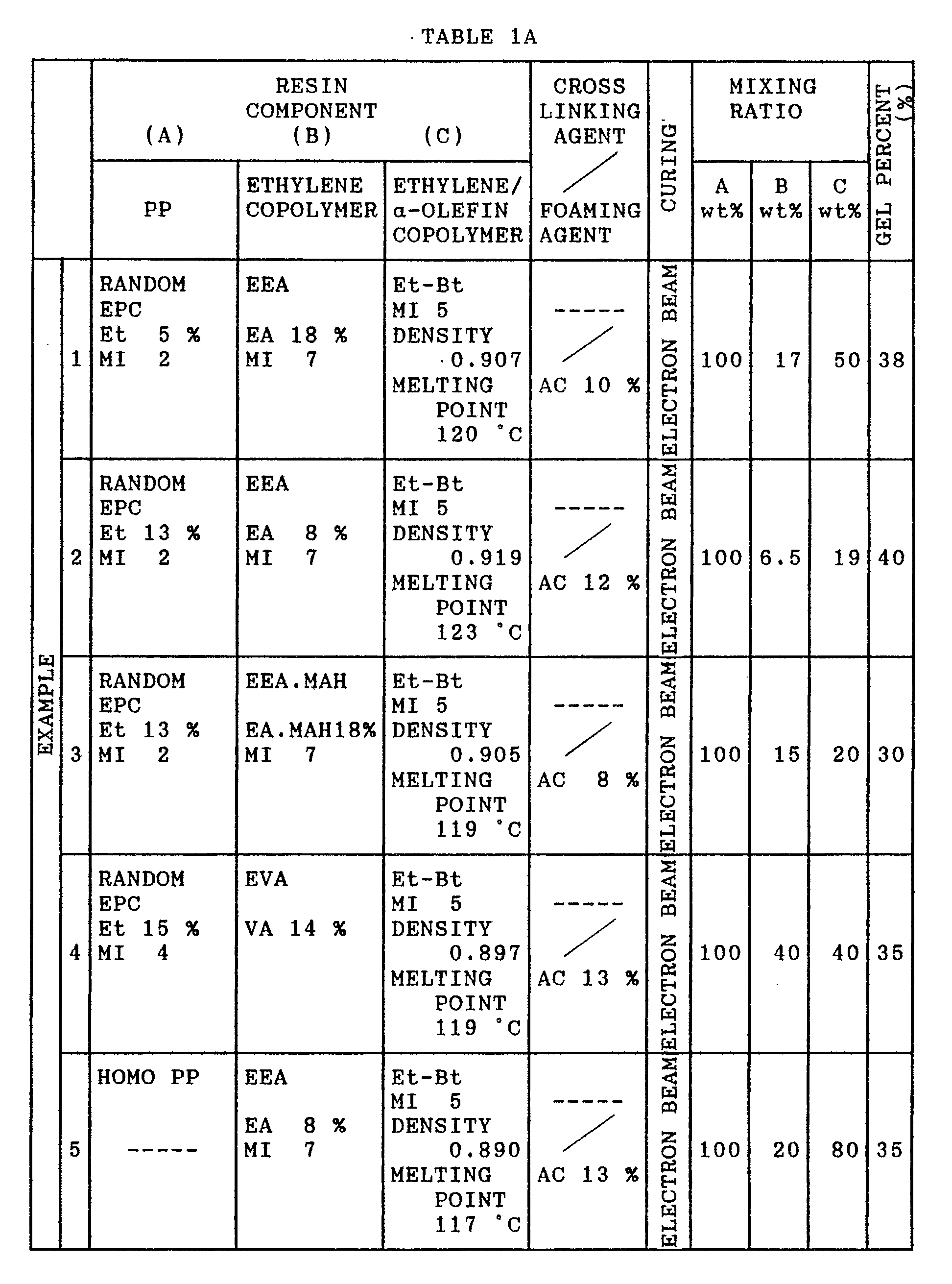
Molding Processability (L/D) = L / D - Tables 1A and 1B show the resin composition, the mixing ratio, the curing methods and the characteristics of the foams according to the present invention. In the tables, "random" means random copolymer, "block" means block copolymer, and "homo" means homo polymer. "EPC" means propylene/ethylene copolymer, "BPC" means propylene/butane copolymer, "EEA" means ethylene/ethylacrylate, "EVA" means ethylene/vinylacetate copolymer, and "EEA·MAH" means (ethylene/ethylacrylate/maleic-acid-anhydride) terpolymer. "Et-Bt" of ethylene/α-olefin copolymer means a copolymer formed by the polymerization of ethylene with butane as an α-olefin. The low-density polyethylene is made by the high pressure method, and the high-density polyethylene is made by the low pressure method. The linear very-low-density polyethylene is a polyethylene of which density is 0.910 g/cm³ or lower, and which is made by the high-pressure ion polymerization method and the intermediate-low-pressure solution polymerization method.
- Examples according to the present invention and comparative examples will henceforth be described.
- One-hundred-fifty-kg mixtures of the resin components, a foaming agent, and other additives were each fed into a 500-litter Henschel mill. Each portion of the obtained mixed material was fed into an extruder of which cylinder temperature was 170 to 180 °C to carry out melt-mixing, whereby a long sheet of 1.5 mm thickness and 500 mm width was formed. The long sheet was set in an electron-beam irradiating device, and then it was cured with 2 to 10 Mrad electron-beam radiation. The obtained foamable cured sheet was introduced uniformly onto silicon oil of which temperature ranges from 210 to 240 °C, thereby foaming the sheet. The foamed sheet was dried by hot air, whereby a sheet-type cured foam was obtained. The obtained foams ranged from 2.5 to 3.5 mm in thickness and from 950 to 1100 mm in width. The foams according to the present invention, as shown in Table 1B, had high degrees of flexibility, tensile strength, dimensional stability and molding processability, since the resin components, the mixing ratio, the curing method and the cross-linking density were chosen appropriately. Particularly, 25%-compressive hardness and 5%-expansion stress as parameters of flexibility were superior, so that the obtained flexible foams had a good tactility. Furthermore, the obtained foams had a tensile strength at high temperature which had not been achieved by conventional foams.
- Tables 2A and 2B show the resin component, the mixing ratio, the curing method and the characteristics of the obtained foams with regard to comparative examples. The comparative examples were cured by the electron-beam curing method in the same manner as in the examples according to the present invention, or in the curing method with peroxide compounds, and foamed in the same way as in the examples according to the present invention.
- Comparative examples 1 to 3 were made of ethylene/α-olefin copolymer. As shown in Table 2B, the comparative examples were inferior, at least in terms of flexibility, tensile strength and dimensional stability, since the resin components, the mixing ratio and the curing method were apart from the scope of the present invention. In particular, the comparative examples were much inferior in terms of tensile strength at high temperature and 120°C side-change rate. Comparative examples 4 to 7 were made of linear very-low-density polyethylene (EXCELEN). As shown in Table 2B, the comparative examples were inferior, at least in terms of flexibility, tensile strength and dimensional stability, since the resin components, the mixing ratio and the curing method were apart from the scope of the present invention. Comparative examples 4 to 7, as well as Comparative examples 1 to 3, were noticeably inferior to the examples according to the present invention in terms of tensile strength at high temperature and 120°C size-change rate. In the tables, the parts marked by an asterisk are apart from the scope of the present invention.
- As which have been described above, the foams according to the present invention are superior in terms of flexibility, or tactility in particular. A high degree of molding processability can be obtained in accordance with the present invention, because the foams have a high degree of tensile strength, particularly at high temperatures. Furthermore, the foams according to the present invention also have sufficient dimensional stability, whereby they may be suitable as a damping material, for application to the doors, the ceiling, the instrument panel, etc. of automobiles interiors. The foams according to the present invention can be also applied to the base material of heat-resist adhesive tape, the base material of packagings, and heat-resisting and heat-insulate molding products, including various kinds of valves and pipes, etc., by virtue of the above characteristics.


Claims (12)
- An electron-beam cured sheet-type foam comprising: a polypropylene type resin (A) of 100 parts by weight of which main component is propylene; a copolymer resin (B) of 5 to 40 parts by weight which is made of ethylene and at least one selected from the group consisting of acrylic acid, ethylacrylate, maleic acid anhydride and vinylacetate; and a copolymer resin (C) made of ethylene, of which melting point ranges from 117 °C to 123 °C and density ranges from 0.890 g/cm³ to 0.910 g/cm³, and an α-olefin which includes 4 to 8 carbons; wherein the gel percent ranges from 20 to 60 percent and the expansion rate ranges from 5 to 40.
- A foam according to claim 1, wherein the toughness at 150 °C is 50 kg/cm²·% or more, and the size-change rate at 120 °C is 5 percent or less.
- A foam according to claim 2, wherein the 25%-compressive hardness at ordinary temperature ranges from 0.1 to 1.0 kg/cm², and the 5%-expansion stress at ordinary temperature ranges from 10 to 100 kg/cm².
- A foam according to claim 3, wherein the parts by weight of said polypropylene type resin (A) is 100, the parts by weight of said copolymer (B) ranges from 5 to 25, and the parts by weight of said copolymer (C) ranges from 20 to 50.
- A foam according to claim 4, wherein said copolymer (C) is a copolymer including an α-olefin of 4 to 6 carbons of which melting point ranges from 117 to 123 °C, and density ranges from 0.895 to 0.905 g/cm³.
- A foam according to claim 5, wherein said copolymer (B) includes a copolymerizing component of 5 to 30 weight percent.
- A foam according to claim 6, wherein said copolymer (B) includes a copolymerizing component of 8 to 25 weight percent.
- A foam according to claim 7, wherein said copolymer (B) is one selected from the group consisting of ethylene/ethylacrylate copolymer, including ethylacrylate of 8 to 18 percent; and a three-component copolymer of ethylene/ethylacrylate/maleic-acid-anhydride, including ethylacrylate and maleic acid anhydride of 8 to 18 weight percent in total.
- A foam according to claim 8, wherein said polypropylene type resin (A) is a polymer selected from the group consisting of a propylene homo-polymer; and a random copolymer, block copolymer and random/block copolymer, including propylene and at least one selected from the group consisting of ethylene and butene.
- A foam according to claim 9, wherein said polypropylene type resin (A) is a copolymer including a copolymerizing component of 2 to 35 weight percent.
- A foam according to claim 10, wherein said polypropylene type resin (A) is a copolymer including a copolymerizing component of 3 to 30 weight percent.
- A foam according to claim 11, wherein said polypropylene type resin (A) is a random copolymer including ethylene of 4 to 15 weight percent.
Applications Claiming Priority (3)
| Application Number | Priority Date | Filing Date | Title |
|---|---|---|---|
| JP123773/89 | 1989-05-16 | ||
| JP12377389 | 1989-05-16 | ||
| PCT/JP1990/000612 WO1990014385A1 (en) | 1989-05-16 | 1990-05-14 | Continuous sheet of electron beam crosslinked foam |
Publications (3)
| Publication Number | Publication Date |
|---|---|
| EP0425695A1 true EP0425695A1 (en) | 1991-05-08 |
| EP0425695A4 EP0425695A4 (en) | 1992-07-08 |
| EP0425695B1 EP0425695B1 (en) | 1996-12-18 |
Family
ID=14868925
Family Applications (1)
| Application Number | Title | Priority Date | Filing Date |
|---|---|---|---|
| EP90907414A Expired - Lifetime EP0425695B1 (en) | 1989-05-16 | 1990-05-14 | Continuous sheet of electron beam crosslinked foam |
Country Status (6)
| Country | Link |
|---|---|
| US (1) | US5110842A (en) |
| EP (1) | EP0425695B1 (en) |
| JP (1) | JPH0645717B2 (en) |
| KR (1) | KR0157309B1 (en) |
| DE (1) | DE69029458T2 (en) |
| WO (1) | WO1990014385A1 (en) |
Cited By (8)
| Publication number | Priority date | Publication date | Assignee | Title |
|---|---|---|---|---|
| EP0704476A1 (en) * | 1993-04-01 | 1996-04-03 | Sekisui Chemical Co., Ltd. | Plastic foam material composed of a polyolefin based resin composition and method for making same |
| EP1379578A4 (en) * | 2001-02-23 | 2004-05-12 | Phat Cushion Llc | Foam cushion and method of making and using the same |
| EP1538175A1 (en) * | 2003-12-04 | 2005-06-08 | Benecke-Kaliko AG | Process for producing grained moulded articles adn the articles formed thereby |
| US7040706B2 (en) | 2002-12-09 | 2006-05-09 | Phat Cushion Llc | Seat and method of making same |
| US7173070B2 (en) | 2001-02-23 | 2007-02-06 | Phat Cushion Llc | Foam cushion and method of making and using the same |
| EP1752485A1 (en) * | 2005-08-08 | 2007-02-14 | Alveo AG | Soft polyolefin foams with high heat resistance |
| CN103467842A (en) * | 2013-08-22 | 2013-12-25 | 湖北祥源新材科技有限公司 | Electron accelerator irradiation crosslinking pure polypropylene foaming sheet material and preparation method thereof |
| US9260577B2 (en) | 2009-07-14 | 2016-02-16 | Toray Plastics (America), Inc. | Crosslinked polyolefin foam sheet with exceptional softness, haptics, moldability, thermal stability and shear strength |
Families Citing this family (10)
| Publication number | Priority date | Publication date | Assignee | Title |
|---|---|---|---|---|
| EP0726290B2 (en) * | 1995-02-08 | 2005-10-19 | Toray Industries, Inc. | A polyolefin based crosslinked foam |
| BE1010400A3 (en) * | 1996-07-02 | 1998-07-07 | Solvay | Composition containing polyolefin and ethylene-vinyl acetate. |
| AU2001280177A1 (en) * | 2000-08-29 | 2002-03-13 | Jsp Corporation | Extruded polyolefin resin foam |
| US6541533B2 (en) | 2001-01-10 | 2003-04-01 | Jsp Corporation | Extruded polyolefin resin foam |
| CN100447191C (en) * | 2003-06-27 | 2008-12-31 | 三井化学株式会社 | Resin composition for foam and use thereof |
| JP4563109B2 (en) * | 2003-08-22 | 2010-10-13 | 日東電工株式会社 | Method for producing foam dustproof material, and method for producing dustproof structure using foam dustproof material |
| JP2008255287A (en) * | 2007-04-09 | 2008-10-23 | Toray Ind Inc | Easy-adhesive polyolefin cross-linked resin foam |
| JP5417890B2 (en) * | 2009-02-25 | 2014-02-19 | 東レ株式会社 | Crosslinked resin foam for plating |
| US9365711B2 (en) | 2011-09-23 | 2016-06-14 | Dow Global Technologies Llc | Olefin-based polymer compositions and articles prepared therefrom |
| US20210102037A1 (en) * | 2017-03-31 | 2021-04-08 | Sekisui Chemical Co., Ltd. | Foam and molded article |
Family Cites Families (3)
| Publication number | Priority date | Publication date | Assignee | Title |
|---|---|---|---|---|
| JPS6234930A (en) * | 1985-08-06 | 1987-02-14 | Toray Ind Inc | Crosslinked polypropylene resin foam having excellent heat-resistance and formability |
| JPS63159447A (en) * | 1986-12-22 | 1988-07-02 | Japan Styrene Paper Co Ltd | Crosslinked polyolefin resin foam and its production |
| JPS63265935A (en) * | 1987-04-24 | 1988-11-02 | Sekisui Chem Co Ltd | Crosslinked synthetic resin foam |
-
1990
- 1990-05-14 WO PCT/JP1990/000612 patent/WO1990014385A1/en not_active Ceased
- 1990-05-14 JP JP2-507211A patent/JPH0645717B2/en not_active Expired - Lifetime
- 1990-05-14 US US07/598,646 patent/US5110842A/en not_active Expired - Lifetime
- 1990-05-14 KR KR1019900702608A patent/KR0157309B1/en not_active Expired - Fee Related
- 1990-05-14 EP EP90907414A patent/EP0425695B1/en not_active Expired - Lifetime
- 1990-05-14 DE DE69029458T patent/DE69029458T2/en not_active Expired - Fee Related
Non-Patent Citations (1)
| Title |
|---|
| See references of WO9014385A1 * |
Cited By (16)
| Publication number | Priority date | Publication date | Assignee | Title |
|---|---|---|---|---|
| EP0704476A1 (en) * | 1993-04-01 | 1996-04-03 | Sekisui Chemical Co., Ltd. | Plastic foam material composed of a polyolefin based resin composition and method for making same |
| US5543438A (en) * | 1993-04-01 | 1996-08-06 | Sekisui Chemical Co., Ltd. | Plastic foam material composed of a polyolefin based resin composition and method for making same |
| AU682712B2 (en) * | 1993-04-01 | 1997-10-16 | Sekisui Chemical Co., Ltd. | Plastic foam material composed of a polyolefin based resin composition and method for making same |
| EP1379578A4 (en) * | 2001-02-23 | 2004-05-12 | Phat Cushion Llc | Foam cushion and method of making and using the same |
| US6818676B2 (en) | 2001-02-23 | 2004-11-16 | Phat Cushion, Llc | Foam cushion and method of making and using the same |
| US7173070B2 (en) | 2001-02-23 | 2007-02-06 | Phat Cushion Llc | Foam cushion and method of making and using the same |
| US7040706B2 (en) | 2002-12-09 | 2006-05-09 | Phat Cushion Llc | Seat and method of making same |
| EP1538175A1 (en) * | 2003-12-04 | 2005-06-08 | Benecke-Kaliko AG | Process for producing grained moulded articles adn the articles formed thereby |
| EP1752485A1 (en) * | 2005-08-08 | 2007-02-14 | Alveo AG | Soft polyolefin foams with high heat resistance |
| WO2007017250A1 (en) * | 2005-08-08 | 2007-02-15 | Sekisui Alveo Ag | Soft polyolefin foams with high heat resistance |
| RU2379316C2 (en) * | 2005-08-08 | 2010-01-20 | Секисуи Алвео Аг | Soft polyolefin foamed material with high thermal stability |
| CN101263187B (en) * | 2005-08-08 | 2011-06-08 | 积水阿尔维奥股份公司 | Soft polyolefin foam with high heat resistance |
| US9260577B2 (en) | 2009-07-14 | 2016-02-16 | Toray Plastics (America), Inc. | Crosslinked polyolefin foam sheet with exceptional softness, haptics, moldability, thermal stability and shear strength |
| US10301447B2 (en) | 2009-07-14 | 2019-05-28 | Toray Plastics (America), Inc. | Crosslinked polyolefin foam sheet with exceptional softness, haptics, moldability, thermal stability and shear strength |
| CN103467842A (en) * | 2013-08-22 | 2013-12-25 | 湖北祥源新材科技有限公司 | Electron accelerator irradiation crosslinking pure polypropylene foaming sheet material and preparation method thereof |
| CN103467842B (en) * | 2013-08-22 | 2015-11-25 | 湖北祥源新材科技有限公司 | A kind of electron accelerator irradiation is cross-linked virgin pp foam sheet and preparation method |
Also Published As
| Publication number | Publication date |
|---|---|
| EP0425695A4 (en) | 1992-07-08 |
| US5110842A (en) | 1992-05-05 |
| DE69029458T2 (en) | 1997-05-28 |
| JPH0645717B1 (en) | 1994-06-15 |
| KR920700253A (en) | 1992-02-19 |
| EP0425695B1 (en) | 1996-12-18 |
| KR0157309B1 (en) | 1998-12-01 |
| WO1990014385A1 (en) | 1990-11-29 |
| JPH0645717B2 (en) | 1994-06-15 |
| DE69029458D1 (en) | 1997-01-30 |
Similar Documents
| Publication | Publication Date | Title |
|---|---|---|
| EP0425695B1 (en) | Continuous sheet of electron beam crosslinked foam | |
| US6545094B2 (en) | Blends of ethylenic polymers with improved modulus and melt strength and articles fabricated from these blends | |
| US4510031A (en) | Heat-foamable olefinic resin composition and process for production of olefinic resin foam from said composition | |
| KR101361340B1 (en) | Crosslinked Polyolefin Resin Foam | |
| EP1373401B1 (en) | Blends of ethylenic polymers with improved modulus and melt strength and articles fabricated from these blends | |
| JPWO1990014385A1 (en) | Continuous sheet-shaped electron beam crosslinked foam | |
| US4331777A (en) | Foaming synthetic resin compositions stabilized with certain naphthyl amine compounds | |
| JPH07116310B2 (en) | Method for producing crosslinked polyolefin resin laminated foam | |
| JPS59215329A (en) | Crosslinked synthetic resin foam | |
| EP0972795B1 (en) | Curable and foamable polyolefinic resin composition, cured foam of polyolefinic resin and method for producing it | |
| JP2663559B2 (en) | Radiation-crosslinked polyolefin resin foam and method for producing the same | |
| JPH07145259A (en) | Method for producing crosslinked polypropylene resin foam sheet having uniform cells | |
| JPH0267129A (en) | Laminated molded body and preparation thereof | |
| JPH07119310B2 (en) | Continuous sheet cross-linked foam | |
| JPS5962643A (en) | Crosslinked foam of synthetic resin | |
| JPS63175041A (en) | Radiation crosslinked thick polypropylene resin foam and production thereof | |
| JP2000086796A (en) | Polyolefin resin composition for crosslinked foam, crosslinked polyolefin resin foam, and method for producing the same | |
| JPS6234929A (en) | Crosslinked polyethylene resin foam having excellent formability | |
| JP3149152B2 (en) | Non-crosslinked linear low density polyethylene resin pre-expanded particles and method for producing the same | |
| JPH08198993A (en) | Cross-linked polypropylene resin foam sheet | |
| JPH0657025A (en) | Polyolefin resin composition for cross-linking foaming and cross-linked polyolefin resin foam | |
| JPH07113018A (en) | Method for producing crosslinked polyolefin resin foam | |
| JP2000007814A (en) | Crosslinked polypropylene foam resin composition and method for producing the foam | |
| MXPA99000433A (en) | Process for elaborating foam articles that have a good hardness at low temperatures from high strength propylene materials to the fus | |
| JPS61287943A (en) | Crosslinked polyethylene resin foam |
Legal Events
| Date | Code | Title | Description |
|---|---|---|---|
| PUAI | Public reference made under article 153(3) epc to a published international application that has entered the european phase |
Free format text: ORIGINAL CODE: 0009012 |
|
| 17P | Request for examination filed |
Effective date: 19901224 |
|
| AK | Designated contracting states |
Kind code of ref document: A1 Designated state(s): BE DE GB NL |
|
| A4 | Supplementary search report drawn up and despatched |
Effective date: 19920514 |
|
| AK | Designated contracting states |
Kind code of ref document: A4 Designated state(s): BE DE GB NL |
|
| 17Q | First examination report despatched |
Effective date: 19940607 |
|
| GRAG | Despatch of communication of intention to grant |
Free format text: ORIGINAL CODE: EPIDOS AGRA |
|
| GRAH | Despatch of communication of intention to grant a patent |
Free format text: ORIGINAL CODE: EPIDOS IGRA |
|
| GRAH | Despatch of communication of intention to grant a patent |
Free format text: ORIGINAL CODE: EPIDOS IGRA |
|
| GRAA | (expected) grant |
Free format text: ORIGINAL CODE: 0009210 |
|
| AK | Designated contracting states |
Kind code of ref document: B1 Designated state(s): BE DE GB NL |
|
| REF | Corresponds to: |
Ref document number: 69029458 Country of ref document: DE Date of ref document: 19970130 |
|
| PLBE | No opposition filed within time limit |
Free format text: ORIGINAL CODE: 0009261 |
|
| STAA | Information on the status of an ep patent application or granted ep patent |
Free format text: STATUS: NO OPPOSITION FILED WITHIN TIME LIMIT |
|
| 26N | No opposition filed | ||
| REG | Reference to a national code |
Ref country code: GB Ref legal event code: IF02 |
|
| PGFP | Annual fee paid to national office [announced via postgrant information from national office to epo] |
Ref country code: NL Payment date: 20040505 Year of fee payment: 15 |
|
| PGFP | Annual fee paid to national office [announced via postgrant information from national office to epo] |
Ref country code: BE Payment date: 20040715 Year of fee payment: 15 |
|
| PG25 | Lapsed in a contracting state [announced via postgrant information from national office to epo] |
Ref country code: BE Free format text: LAPSE BECAUSE OF NON-PAYMENT OF DUE FEES Effective date: 20050531 |
|
| BERE | Be: lapsed |
Owner name: *TORAY INDUSTRIES INC. Effective date: 20050531 |
|
| PG25 | Lapsed in a contracting state [announced via postgrant information from national office to epo] |
Ref country code: NL Free format text: LAPSE BECAUSE OF NON-PAYMENT OF DUE FEES Effective date: 20051201 |
|
| NLV4 | Nl: lapsed or anulled due to non-payment of the annual fee |
Effective date: 20051201 |
|
| BERE | Be: lapsed |
Owner name: *TORAY INDUSTRIES INC. Effective date: 20050531 |
|
| PGFP | Annual fee paid to national office [announced via postgrant information from national office to epo] |
Ref country code: DE Payment date: 20080522 Year of fee payment: 19 |
|
| PGFP | Annual fee paid to national office [announced via postgrant information from national office to epo] |
Ref country code: GB Payment date: 20080514 Year of fee payment: 19 |
|
| GBPC | Gb: european patent ceased through non-payment of renewal fee |
Effective date: 20090514 |
|
| PG25 | Lapsed in a contracting state [announced via postgrant information from national office to epo] |
Ref country code: GB Free format text: LAPSE BECAUSE OF NON-PAYMENT OF DUE FEES Effective date: 20090514 |
|
| PG25 | Lapsed in a contracting state [announced via postgrant information from national office to epo] |
Ref country code: DE Free format text: LAPSE BECAUSE OF NON-PAYMENT OF DUE FEES Effective date: 20091201 |