EP0427987A2 - Vorrichtung und Verfahren zur Herstellung von Schaumbechern - Google Patents
Vorrichtung und Verfahren zur Herstellung von Schaumbechern Download PDFInfo
- Publication number
- EP0427987A2 EP0427987A2 EP90120508A EP90120508A EP0427987A2 EP 0427987 A2 EP0427987 A2 EP 0427987A2 EP 90120508 A EP90120508 A EP 90120508A EP 90120508 A EP90120508 A EP 90120508A EP 0427987 A2 EP0427987 A2 EP 0427987A2
- Authority
- EP
- European Patent Office
- Prior art keywords
- article
- finished
- preformed
- forming
- section
- Prior art date
- Legal status (The legal status is an assumption and is not a legal conclusion. Google has not performed a legal analysis and makes no representation as to the accuracy of the status listed.)
- Withdrawn
Links
Images








Classifications
-
- B—PERFORMING OPERATIONS; TRANSPORTING
- B29—WORKING OF PLASTICS; WORKING OF SUBSTANCES IN A PLASTIC STATE IN GENERAL
- B29C—SHAPING OR JOINING OF PLASTICS; SHAPING OF MATERIAL IN A PLASTIC STATE, NOT OTHERWISE PROVIDED FOR; AFTER-TREATMENT OF THE SHAPED PRODUCTS, e.g. REPAIRING
- B29C44/00—Shaping by internal pressure generated in the material, e.g. swelling or foaming ; Producing porous or cellular expanded plastics articles
- B29C44/34—Auxiliary operations
- B29C44/36—Feeding the material to be shaped
- B29C44/38—Feeding the material to be shaped into a closed space, i.e. to make articles of definite length
- B29C44/44—Feeding the material to be shaped into a closed space, i.e. to make articles of definite length in solid form
- B29C44/445—Feeding the material to be shaped into a closed space, i.e. to make articles of definite length in solid form in the form of expandable granules, particles or beads
-
- B—PERFORMING OPERATIONS; TRANSPORTING
- B29—WORKING OF PLASTICS; WORKING OF SUBSTANCES IN A PLASTIC STATE IN GENERAL
- B29C—SHAPING OR JOINING OF PLASTICS; SHAPING OF MATERIAL IN A PLASTIC STATE, NOT OTHERWISE PROVIDED FOR; AFTER-TREATMENT OF THE SHAPED PRODUCTS, e.g. REPAIRING
- B29C44/00—Shaping by internal pressure generated in the material, e.g. swelling or foaming ; Producing porous or cellular expanded plastics articles
- B29C44/34—Auxiliary operations
- B29C44/3415—Heating or cooling
- B29C44/3426—Heating by introducing steam in the mould
-
- B—PERFORMING OPERATIONS; TRANSPORTING
- B29—WORKING OF PLASTICS; WORKING OF SUBSTANCES IN A PLASTIC STATE IN GENERAL
- B29L—INDEXING SCHEME ASSOCIATED WITH SUBCLASS B29C, RELATING TO PARTICULAR ARTICLES
- B29L2031/00—Other particular articles
- B29L2031/712—Containers; Packaging elements or accessories, Packages
- B29L2031/7132—Bowls, Cups, Glasses
Definitions
- the present invention relates to a method of and apparatus for forming finished cups of expanded resin.
- the present invention especially relates to a method of and an apparatus for improving the efficiency in producing thin-walled finished articles by compressively forming preformed articles.
- a conventional method of forming containers of expanded resin such as for example expanded polystyrene containers, consists in filling the cavity of a metal mold with expandable thermoplastic resin particles, for instance expandable polystyrene beads, heating the particles to be expanded and fused, and cooling the same.
- expandable thermoplastic resin particles for instance expandable polystyrene beads
- So-called expanded polystyrene containers produced in the above fashion are widely used in the distribution stage and consumption stage due to their combined properties of high forming accuracy, excellent heat insulation, and great strength-to-weight ratio.
- Containers for instant noodles, cups for beverage, etc. can be cited as familiar examples.
- expanded polystyrene containers When expanded polystyrene containers are designed for containing a liquid substance, they must be produced such that the liquid substance contained therein does not leak.
- the expanded polystyrene containers are formed in a slender and deep tapering shape, such as for example, cups for beverage etc., a so-called stacking height or the height of cups stacked as fitted in one another, should be as low as possible to improve the housing efficiency in storage and transportation of the cups. To reduce the stacking height, thin-walled containers should be made.
- a method of forming thin-walled containers made of expanded resin having a satisfactory strength-to-weight ratio, while maintaining a mass equivalent to conventional thick-walled containers of expanded resin is disclosed in Japanese Publication for Examined Patent Application No. 8744-1973 (Tokukosho No. 48-8744) and Japanese Publication for Unexamined Patent Application No. 142668-1975 (Tokukaisho No. 50-142668).
- Such a method consists in compressing and reducing the wall thickness of the containers prior to or after a cooling process, after the resin particles are expanded through heat.
- cups having a wall thickness equal to 0. 5mm such as for example thin-walled cups that can be employed in automatic vending machines of beverages, could not be formed with such a method.
- the problem of water-tightness is left unresolved.
- a method solving the problem of water-tightness and shortening the forming cycle time is disclosed in Japanese Publication for Unexamined Patent Application No. 153119-1988 (Tokukaisho No. 63-153119; Japanese Publication for Unexamined Patent Application No. 153119-1988 corresponds to U.S. Patent No. 4,758,394).
- This method consists in conducting the forming process of preformed articles (hereinafter referred to as preforming process) and the forming process of finished articles (hereinafter referred to as finish-forming process), in a closed chamber designed such that the interior pressure thereof can be controlled.
- preforming process preformed articles
- finish-forming process forming process of finished articles
- the preformed article is then locked into a metal mold having a spatial width smaller than the metal mold employed during the preforming process, and re-heated and mechanically compressed at the same time during the finish-forming process, thereby producing a thin-walled expanded resin cup.
- the preformed article can uniformly be heated to be fused. This method thus enables the production of water-tight cups having a wall thickness equal to 0.5mm.
- the preformed article is kept in a heated state while it is transferred to be subjected to the finish-forming process. Therefore, the time needed for re-heating during the finish-forming process is reduced and the forming cycle is shorter than a conventional forming cycle.
- Fig. 17 schematically illustrates the forming process adopted in the forming method disclosed in Japanese Publication for Unexamined Patent No. 153119-1988 (Tokukaisho No. 63-153119, U.S. Patent No. 4,758,394). Processes designated with the same step number in the preforming process and the finish-forming process, such as for instance S21 and S21′ are conducted simultaneously.
- the female member and the male member of a preforming mold lock thereby forming a preformed article (S21′).
- the female member of the preforming mold is then lifted up to open the preforming mold (S23′).
- a cylinder connected to the male member of the preforming mold is then operated to move horizontally the male member whereon the preformed article is disposed toward the finish-processing side (S24′).
- the preformed article is released (S25′) from the male member of the preforming mold that is then returned to its original position in the preforming processing side (S27′). The preforming process is thus completed.
- the preformed article is transferred from the male member of the preforming mold to the female member of a finish-forming mold (S25).
- the female member of the finish-forming mold is temporarily lifted up (S26) and after the male member of the preforming mold is returned to its original position in the preforming processing side, the female member and the male member of the finish-forming mold lock, thereby enabling the preformed article to be compressed and formed into a finished article (S28).
- the male member of the finish-forming mold is then moved down (S29) and the finished article is discharged (S21).
- the female member of the finish-forming mold is lifted up (S23) after the male member of the finish-forming mold was moved up again to prevent the inner pressure of the closed chamber from decreasing (S22).
- the female member of the finish-forming mold then stays in a standby state until the arrival of another preformed article (S25). The finish-forming process cycle is thus completed.
- a test for detecting defective articles is thus indispensable.
- a conventional method for detecting defective articles consists in, for example, pouring a liquid substance such as watel or other substance into the finished article and visually checking whether it leaks.
- An object of the present invention is to provide a method and an apparatus capable of shortening the compression forming cycle during the process of forming preformed articles into finished articles, thereby improving the forming efficiency for finished articles and significantly reducing the manufacturing cost of cups of expanded resin.
- Another object of the present invention is to provide a method and an apparatus whose functions for forming finished articles include various functions such as inspection of finished articles and other functions thereby permitting to further reduce the manufacturing cost of cups of expanded resin.
- a finish-forming method for producing cups of expanded resin in accordance with the present invention is cparacterized in employing transferring means for conveying a preformed article which was subjected to a preforming process and was supplied thereto, to the female member of a finish-forming mold while at the same time collecting a finished article from the male member of the finish-forming mold, and for discharging the finished article after it was subjected to an inspection process.
- the preformed article is produced by filling expandable thermoplastic resin particles into the cavity of a preforming mold, and heating the resin particles to be expanded and fused through indirect heat such as steam, etc. , during a preforming process.
- the preformed article is then compressed through heat during a finish-forming process, and a finished article whose wall thickness is thinner than that of the preformed article is formed.
- the finish-forming method for forming cups of expanded resin in accordance with the present invention permits to carry the following three processes simultaneously: a first process where the transferring means collects a preformed article after the preformed article was subjected to a preforming process, a second process where a finished article is discharged from the transferring means, and a third process where another preformed article is compressed though heat in a finish-forming mold and formed into a finished, article.
- a fourth process where the transferring means conveys the preformed article collected after the preformed article was subjected to a preforming process to, for example, the female member
- a fifth process where the finished article that was compressed through heat is transferred from, for example, the male member to the transferring means, can be conducted simultaneously.
- a sixth process where the finished article is subjected to an inspection in the transferring means, and a seventh process where the finished articles discharged by the transferring means that were judged to be defective are removed and the conforming articles are counted, can be performed while the transferring means is moving to and fro. The number of processes executed in practice is thus reduced.
- an apparatus for forming finished cups of expanded resin in accordance with the present invention comprises feeding means for supplying a preformed article to the apparatus for forming finished articles, transferring means for collecting the preformed article from the feeding means and transferring it to a finish-forming mold, collecting a finished article from the finish-forming mold, and discharging the finished artic!e after the finished article was subjected to an inspection, sorting means for removing the articles that were judged to be defective among the finished articles discharged from the transferring means, counting and stacking the conforming articles, and moving means for moving the transferring means to positions where the central axis of the transferring means and the central axis of the feeding means, the central axis of the transferring means and the central axis of the finish-forming mold, and the central axis of the transferring means and the central axis of the sorting means are respectively joined by a vertical line.
- the moving means shifts the transferring means to a position where the central axis of the transferring means and the central axis of the finish-forming mold are joined by a vertical line. Then, the transferring means accurately transfers the preformed article to, for example, the female member of the finish-forming mold, and accurately collects the finished article from, for example, the male member of the finish-forming mold. After the transferring means collected the finished article, the moving means shifts the transferring means to a position where the central axis of the transferring means is joined by a vertical line with the central axis of the feeding means and the central axis of the sorting means.
- the finished article While the transferring means is moving, the finished article is subjected to an inspection in the transferring means. Then another preformed article is accurately supplied again to the transferring means, while at the same time the finished article is accurately discharged and sent from the transferring means to the sorting means. The transferring means is then moved again in order to convey the preformed article that was supplied thereto toward the finish-forming mold. Simultaneously with the motion of the transferring means, in the sorting means the finished article is removed when it was judged to be defective, and is counted and stacked when it was judged to be conforming.
- the implementation of the transferring means permits to conduct the supply of the preformed article, the transfer of the preformed article to the finish-forming mold, the inspection and the discharge of the finished article very efficiently.
- the shipment of the conforming articles can be executed rapidly.
- Fig. 1 to Fig. 13 are views illustrating a first embodiment of the present invention.
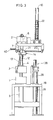
- Fig. 2 to Fig. 4 illustrate essential parts of an apparatus for forming finished articles used for embodying a method for forming finished cups of expanded resin in accordance with the present invention.
- the apparatus for forming finished articles comprises a lower fixed frame 1 attached to a frame table 18.
- An upper fixed frame 2 is disposed above the lower fixed frame 1, and is connected to the lower fixed frame 1 and supported by two connecting bars 12 in the vicinity of its left edge and of its right edge.
- a mobile frame 3 is pierced in the vicinity of its left edge and right edge by the connecting bars 12 and is horizontally fixed to a piston leading end 19 of a hydraulic cylinder 5 serving as mobile frame moving means.
- a female member 8 is accommodated vertically in the upper fixed frame 2.
- the female member 8 is indirectly heated by steam or other mediums and cooled by cooling water or other mediums and forms one part of a finish-forming mold.
- a male member 4 is installed vertically upon the mobile frame 3.
- the male member 4 is heated and cooled in the same manner as the female member 8 and forms the other part of the finish-forming mold.
- the mobile frame 3 slides in a horizontal position between the lower fixed frame 1 and the upper fixed frame 2 up and down along the connecting bars 12, in response to the up and down motion of the piston leading end 19.
- the male member 4 is brought near to and is moved away from the fixed female member 8.
- the vertical movement of the male member 4 enables the finish-forming mold to be alternatively opened and closed.
- An air opening for letting air in/out and an airflow pipe, not shown, are formed in the female member 8.
- the male member 4 is accommodated with an air injection pipe and air injection outlet formed in the wall ceiling thereof, not shown. Pairs of the female member 4 and male member 8 may be also disposed in a desired number.
- a pair of horizontal shafts 20 is positioned in the lower section of the upper fixed frame 2, one horizontal shaft 20 on each side of the same.
- the two horizontal shafts 20 are disposed horizontally and orientated toward the front of the forming apparatus.
- a transfer mold 7 serving as transferring means is installed upon a transferring device 14 in an upright position.
- Sliding connectors 21 belonging to transferring device coupling means are mounted in a protruding fashion on both sides of the transferring device 14 and support the transferring device 14 horizontally.
- Each of the sliding connectors 21 are engaged respectively with each of the horizontal shafts 20 so as to be able to slide.
- a pair of connecting rods 13, belonging to the transferring device coupling means, is installed such that, one end of each connecting rod 13 is rotatably connected to the external wall of one of the sliding connectors 21, and the other end of each connecting rod 13 is rotatably connected to the lower section of one of the sides of the mobile frame 3. Accordingly, when the mobile frame 3 slides up and down along the connecting bars 12, the transferring device 14 moves in an interlocked manner and slides horizontally back and forth along the horizontal shafts 20 by means of the sliding connectors 21.
- the number of transfer molds 7 should be equal to the number of female members 8 and male members 4 installed.
- the connecting rods 13 should be mounted such that the mounting angle that the connecting rods 13 form with the vertical direction when the mobile frame 3 is moved to its lowest position, is reduced and the motion range of the transferring device 14 is enlarged.
- an air cylinder 40 should be installed for pushing out and assisting the transferring device 14 to slide smoothly when the transferring device 14 starts moving.
- the mounting angle of the connecting rods 13 with respect to the vertical direction may be set to, for example, approximately 260 supposing that the distance separating the upper fixed frame 2 and the mobile fixed frame 3 is set to 500mm, and that the maximum height of finished articles is set to 120mm. If the maximum height for the finished articles is set to 150mm, the mounting angle may be set to, for example, approximately 10°.
- the transferring device 14 is located in a position where the central axis of the transfer mold 7 is joined by a vertical line with the central axis of the female member 8.
- the transferring device 14 slides and moves horizontally along the horizontal shafts 20 and reaches the forefront position of its sliding range.
- the central axis of the transfer mold 7 is joined by a vertical line with a stacking device 10 serving as feeding means for supplying preformed articles installed upwards.
- the central axis of the transfer mold 7 is also joined by a vertical line with the central axis of a sorting device 38 and the central axis of a stacking device for finished articles 39.
- the sorting device 38 is mounted vertically below the stacking device 10, and functions as sorting means for counting and letting pass therethrough the conforming finished articles and removing the defective ones.
- the stacking device for finished articles 39 is formed in the shape of an upright cylindrical pipe, and its opening is positioned right below the sorting device 38. Provision is made such that only the conforming articles that passed through the sorting device 38 are stacked in the stacking device for finished articles 39.
- Preformed articles 22 are stacked and stored in the stacking device 10. Provision is made such that the preformed articles 22 are released one by one from the stacking device 10 and supplied to the transfer mold 7 by means of a releasing device 11 attached to the stacking device 10.
- the number of stacking devices 10 is equal to the number of transfer molds 7, (i.e. the number of female members 8 or male members 4).
- the number of sorting devices 38 and the number of stacking devices for finished articles 39 are respectively equal to the number of transfer molds 7.
- the transfer mold 7 is composed of a cavity section 24 and a core section 25.
- the cavity section 24 is accommodated with a hollow space 29 that is shaped in accordance with the shape of finished articles 23.
- the core section 25 it is formed in a tapering shape in accordance with the shape of the preformed articles 22.
- An airflow pipe 28 is accommodated within the wall of the cavity section 24.
- the airflow pipe 28 is designed for aspirating air and reducing the air pressure in the hollow space 29 thereby permitting to retain the finished article 23.
- One end of the airflow pipe 28 has an opening giving access to the hollow space 29 and formed in the internal ceiling wall of the cavity section 24.
- the airflow pipe 28 passes through the wall of the cavity section 24, and the other end thereof has an opening giving access to outside, formed in the external wall of the cavity section 24 and connected to a vacuum device, not shown, to be described later.
- the airflow pipe 28 also serves as an air injection pipe used for injecting air in the hollow space 29 at the time of the discharge of the finished article.
- Narrow grooves 41 are formed over the internal wall of the cavity section 24, except in portion of the cavity section 24 corresponding to the vicinity of the brim portion of the finished article 23.
- the narrow grooves 41 all communicate with each other through a passage and lead to the airflow pipe 28.
- the narrow grooves 41 are designed to facilitate the discharge of the finished article 23 through injection of air in the hollow space 29.
- the cavity section 24 of the transfer mold 7 is connected to a vacuum pressure sensor 42 for detecting the vacuum degree within the cavity section 24, and to a throttle valve 43 employed for controlling the suction speed of the vacuum device and for adjusting the sensitivity of the vacuum pressure sensor 42.
- the cavity section 24 is further connected to the vacuum device through a pipe and a vacuum pressure regulator 44 used for controlling the vacuum pressure and disposed on the main body of the forming apparatus.
- a plurality of transfer molds 7 are installed4 one vacuum pressure sensor 42 and one throttle valve 43 are mounted on each cavity section 24. In this case, the vacuum pressure sensors 42 and the throttle valves 43 are connected to the the vacuum pressure regulator 44 by means of branched piping.).
- the members 24, 42, 43, 44 and the vacuum device are connected by flexible tubes.
- the vacuum degree between the cavity section 24 and the finished article 23 is detected by the vacuum pressure sensor 42 after air was exhausted from the cavity section 24 via the airflow pipe 28 through the action of the vacuum device. If the finished article 23 has pinholes or other faults, a vacuum degree that is lower than that of a conforming article is detected by the vacuum pressure sensor 42 whereby judgement is made that the finished article 23 is defective.
- the vacuum pressure sensor 42 is adopted for detecting pinholes and other faults formed in the finished article 23, the suction pressure and the suction speed need to be controlled.
- the vacuum pressure adjustment performed by the vacuum pressure regulator 44 aims at reducing the number of detection errors and at assuring that faults are detected accurately.
- the suction speed control performed by the throttle valve 43 aims at preventing that the sensitivity of the vacuum pressure sensor 42 deteriorates due to excessive suction speed.
- an outwardly flaring hollow space 30 is accommodated within the core section 25.
- a central stem 27 formed in the hollow space 30 serves as a support for the core section 25.
- several air bypasses 31 that connect the hollow space 30 and the outside air, are formed in the ceiling wall of the core section 25.
- the lower edge of the stem 27 of the core section 25 is connected to a neck section 26 protruding from the center of the ceiling wall of the cavity section 24, thereby permitting the core section 25 and the cavity section 24 that have the above internal structures to be formed integrally.
- An airflow pipe 32 has an opening formed in the external wall of the cavity section 24, passes through the wall of the cavity section 24, penetrates through the central parts of the neck section 26 and the stem 27, and has another opening in the ceiling wall of the core section 25 where it is connected to the outside air.
- the preformed article 22 disposed on the core section 25 is blown through injection of air via the airflow pipe 32 and is transferred toward the female member 8 that is positioned vertically above the core section 25.
- the stacking device 10 is arranged so as to keep the preformed articles 22 stacked in a stand-by condition and as to supply a preformed article 22 to the transfer mold 7 when the transfer mold 7 was moved to a position where the central axis of the stacking device 10 and the central axis of the transfer mold 7 are joined by a vertical line.
- the position where the central axes of the members 4 and 8 and the central axis of the transfer mold 7 are joined by a vertical line will be referred to as the position vertically above or below the member 4 or 8.
- the position where the central axis of the stacking device 10 and the central axis of the transfer mold 7 are joined by a vertical line will be referred to as the position vertically below the stacking device 10.
- the preformed articles 22 are inscribed and maintained by four parallel and upright guiding poles 33.
- the lowest of the stacked preformed articles 22 is maintained and prevented from falling by a stopper 34, belonging to releasing means.
- the stopper 34 is installed in the vicinity of a lip section 36 formed in an annular shape at the brim portion of the preformed article 22, and is formed integrally with a stripper 35 belonging to the releasing means.
- a wedge for pushing down the lip section 36 of the preformed article 22, is fixed on the internal wall of the stripper 35.
- the stripper 35 is fixed on a shaft 37 that is installed horizontally along the longitudinal direction of the transferring device 14 at a position corresponding to the brim portion of the lowest of the preformed articles 22 and on the front side of the apparatus for forming finished articles as illustrated in Fig. 2.
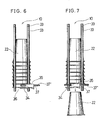
- a shaft 37′ is disposed in parallel with the shaft 37 at a position corresponding to the brim portion of the lowest preformed article 22 and on the rear side of the apparatus for forming finished articles (see Fig. 6 and Fig. 7).
- Another stopper 34 and another stripper 35 are accommodated on the shaft 37′ in the same fashion as described above.
- the shafts 37 and 37′ are respectively connected with an air cylinder, not shown, accommodated in the releasing device 11 (see Fig. 2).
- the air cylinder of the releasing device 11 is actuated and the shafts 37 and 37′ are moved together with the pair of stoppers 34 and the pair of strippers 35 disposed on the stacking device 10.
- wedges accommodated in the strippers 35 push down the lip sections 36 of the lowest preformed article 22 on both sides, and the stoppers 34 cancel their stopper function so that the preformed article 22 that was pushed down, falls due to its own weight.
- the preformed article 22 to be released next is blocked by the strippers 35 and does not fall.
- the shafts 37 and 37′ are moved and cause the stoppers 34 and strippers 35 to return to their original positions, the stacked preformed articles 22 drop by a distance corresponding to the height of the preformed article 22 from which the height of the portion overlapped by another preformed article 22 is subtracted.
- one preformed article 22 is accurately supplied to the core section 25 of the transfer mold 7 for each forming operation of the finished articles
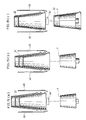
- the above releasing system may be also arranged' as illustrated in Fig. 14 and Fig. 15. Namely, as illustrated in Fig. 14(a), a pair of stoppers 34′ maintain the lip section 36 of the lowest preformed article 22 on both sides. At each opening and closing operation of the pair of stoppers 34′, the stacked preformed articles 22 drop due to their own weight by a distance corresponding to the height of the preformed article 22 from which the height of the portion overlapped by another preformed article 22 is subtracted, thereby setting the lowest preformed article 22 free. Meanwhile, as illustrated in Fig. 15(a), two air injection nozzles 45 are disposed symmetrically with respect to the central axis of the preformed article 22 at positions other than the positions where the stoppers 34′ are mounted.
- the position of the outlets of the air injection nozzles 45 are set such that air is suitably injected toward the lip section 36 of the preformed article 22 when the preformed article 22 is free, as was described above.
- air is injected from the air injection nozzles 45 toward the lip section 36, the preformed article 22 is released and supplied to the transfer mold 7, as illustrated in Fig. 14(c) or Fig. 15(c).
- the stoppers 34′ are disposed such that the longitudinal direction thereof is parallel with or orthogonal to the shaft 37. When a plurality of stacking devices 10 are installed, the pairs of stoppers 34′ mounted on the stacking devices 10 are opened and closed simultaneously and in an interlocked fashion irrespectively of their longitudinal direction.
- Air injection outlets, or air injection slits may be provided below lip supports 34′a (shown in, Fig. 14(b)) formed on the stoppers 34′ instead of the air injection nozzles 45. In this case, air is injected toward the lip section 36 of the preformed article 22 in a direction indicated by the arrow C shown in Fig. 14(b) after the preformed article 22 was set free, thereby permitting the preformed article 22 to be released and supplied to the transfer mold 7.
- the sorting device 38 is composed of a stacking section 38a formed in the shape of a hollow cylinder and standing up-right, a lead 38b formed in a semi-cylindrical shape and mounted vertically upon the stacking section 38a such as if a portion of the lateral wall of the stacking section 38a was extended, a selecting stopper 38c disposed between the lead 38b and the stacking section 38a, a photoelectric tube 38d fixed to the lateral wall of the stacking section 38a, and a feed stopper 38e attached to the bottom opening of the stacking section 38a.
- the aperture of the stacking section 38a and the aperture formed by the pipes composing the stacking device for finished articles 39 mentioned earlier are large enough to allow the storage or the passage of the finished articles 23.
- the selecting stopper 38c is for example constituted by a plate that penetrated through and goes out from a slit, not shown, formed in the lateral wall of the lead 38b. Provision is made such that, when a fault is detected during the vacuum degree check performed by the vacuum pressure sensor 42 mentioned earlier, the selecting stopper 38c actuates and penetrates through the slit of the lead 38b thereby preventing the defective article from being supplied to the stacking section 38a.
- the defective article that was stopped is for example discarded outside by means of air injected through the lateral wall of the lead section 38b.
- the selecting stopper 38c does not actuate whereby the conforming article falls freely within the stacking device 38a without being obstructed.
- the photoelectric tube 38d is a sensor employed for detecting the number of conforming finished articles 23 that fall freely within the sorting device 38.
- the selecting stopper 38c is composed of a defective article discharging cylinder 38f, a piston section 38g, a defective article receptacle supporting section 38h fixed in an up-right position at the tip of the piston section 38g, and a defective article receptacle 38i formed in the shape of a plate and fixed horizontally on the defective article receptacle supporting section 38h.
- the selecting stopper 38c is not actuated when the finished article 23 is judged to be conforming.
- the piston section 38g is dispatched out of the defective article discharging cylinder 38f, and the defective article is intercepted by the defective article receptacle 38i, as illustrated in Fig. 16(b).
- the piston section 38g is then drawn into the defective article discharging cylinder 38f, causing the defective article to be moved outside as illustrated in Fig. 16(c).
- the implementation of the defective article receptacle 38i is not necessary, and provision may be made such that the defective article is discharged according to the following arrangement. Namely, the defective article receptacle supporting section 38h is shifted until it reaches the vicinity of the central axis of the sorting device 38, and provision is made such that the defective article is collected by the up-right defective article receptacle supporting section 38h. The piston section 38g then rotates thereby inclining the defective article receptacle supporting section 38h, and the defective article is discharged.
- the feed stopper 38e actuates and suspends the supply of finished articles 23 to the stacking device for finished articles 39.
- an alarm or other device indicates that the stacking device for finished articles 39 needs to be replaced. Provision is made such that the finished articles 23 are stacked within the stacking section 38a while the feed stopper 38e is actuated and the supply of the finished articles 23 to the stacking device for finished articles 39 is suspended. The manufacturing process of the finished articles 23 thus does not have to be stopped.
- the process for selecting the defective articles and the process for counting the number of conforming articles are carried out independently in each of the sorting devices 38.
- raw material of expandable thermoplastic resin used for forming cups of expandable resin examples include homopolymers or copolymers of styrene, ethylene, propylene etc., or mixture of these polymers to which a suitable foaming agent is impregnated.
- Fig. 1 shows a flow chart illustrating a forming method of forming finished articles 23 (hereinafter referred to as finish-forming method) used for manufacturing cups of expanded resin in accordance with the present invention. Processes designated by the same step number such as for example S1a, S1b, S1c, are executed simultaneously.
- the mobile frame 3 is moved upward causing the male member 4 mounted on the mobile frame 3 to be lifted up to its highest position (S4b), and the male member 4 and the female member 8 mounted on the fixed frame 2 to close.
- the shape of the mold cavity, not shown, defined by the female member 8 and the male member 4 coincides with the shape of the finished article 23.
- finish-forming compression forming
- a preformed article 22 of a size larger than the above mold cavity is placed in the female member 8, and after the finish-forming mold composed of the female member 8 and male member 4 closed, the preformed article 22 is heated indirectly through steam or other method and compressed simultaneously, and cooled by means of cooling water or other method.
- a finished article 23 is thus obtained (S1c).
- the finish-forming mold is opened and at the same time, air is blown between the female member 8 and the finished article 23 through the air opening and airflow pipe accommodated in the female member 8, causing the finished article 23 to be placed on the male member 4.
- the mobile frame 3 is then lowered after the finished article 23 was placed upon the male member 4, as illustrated in Fig. 11, (S2b).
- the transfer mold 7 on which core section 25 a preformed article 22 is disposed is positioned vertically below the female member 8. Then, as illustrated in Fig. 12, air is injected through the airflow pipe 32 (see Fig. 5) that has an opening on the ceiling wall of the core section 25, causing the preformed article 22 placed upon the transfer mold 7 to be blown and transferred toward the female member 8 as shown by the arrow A of Fig. 12 (fourth process, S3c). At this time, air is also aspirated in the female member 8 whereby the air pressure within the interstice between the female member 8 and the preformed article 22 diminishes. The preformed article 22 is therefore maintained in the female member 8 by the outer pressure.
- the male member 4 ascends once again toward the female member 8 where the preformed article 22 is held, and the process returns to the initial step S1c.
- One cycle of the sequence of finish-forming operations performed in the finish-forming mold is thus complete.
- the transfer mold 7 mounted on the transferring device 14 is moved to a position vertically below the stacking device 10 and vertically above the sorting device 38.
- a first process is carried out, i.e. the stacking device 10 releases one preformed article 22 (S1a).
- a second process is executed, i.e. air is injected through the airflow pipe 28 (see Fig.
- the transfer mold 7 on which core section 25 the preformed article 22 is placed is moved horizontally to a position vertically below the female member 8 (S2a).
- the finished article 23 is either discharged from or passes through the sorting device 38. Namely, when the finished article 23 was determined to be defective during a sixth process, i.e. an inspection (to be covered later), performed in the cavity section 24, the selecting stopper 38c is actuated and prevents the defective article from falling freely into the stacking section 38a. The defective article is then removed from the lead section 38b and discharged outside. When the finished article 23 is judged to be conforming, the selecting stopper 38c is not actuated whereby the conforming finished article 23 falls freely into the stacking section 38a and is counted as conforming article by the photoelectric tube 38d (seventh process, S2c). The conforming finished article 23 further drops into the stacking device for finished articles 39 where it is stacked.
- the sixth process mentioned earlier namely an inspection for determining whether the finished article 23 is a conforming or a defective article, is carried out (S4c), while the transfer mold 7 is being shifted horizontally.
- the inspection process consists in exhausting air from the cavity section 24 by means of the vacuum device with a suction speed controlled through the throttle valve 43 and so as to obtain a vacuum pressure controlled through the vacuum pressure regulator 44, then measuring the vacuum degree obtained within the interstice between the cavity section 24 and the finished article 23 by means of the vacuum pressure sensor 42 and comparing this vacuum degree with a predetermined vacuum degree serving as reference.
- the process returns once again to steps S1a and S1b and one cycle of the sequence of finish-forming operations performed in the transfer mold 7 is thus complete.
- the feed stopper 38e is activated and prevents the finished articles 23 to be supplied from the stacking section 38a to the stacking device for finished articles 39 while at the same time an alarm or the like indicates that the stacking device for finished articles 39 needs to be replaced.
- the finished articles 23 are temporarily stacked in the stacking section 38a until the stacking device for finished articles 39 is replaced.
- the finish-forming cycle thus does not have to be suspended.
- the count of the stacked finished articles 23 is executed within the stacking device for finished articles 39 whereby the finished articles 23 only need to be packed in a crating material or the like and shipped thereafter.
- the transferring device 14 whereon the transfer mold 7 is mounted, moves horizontally back and forth in an interlocked fashion with the mobile frame 3 due to the action of the sliding connectors 21 that are sliding along the horizontal shafts 20, and of the connecting rods 13.
- Such an arrangement permits to ensure that the central axis of the transfer mold 7 is joined by a vertical line with the central axes of the female member 8 and the male member 4, and with the central axes of the sorting device 38 and the stacking device for finished articles 39, respectively.
- This arrangement therefore permits to ensure that the transfer mold 7 does not come in contact with the female member 8, and that the supply and transfer of the preformed articles 22 or the transfer and discharge of the finished articles 23 are executed accurately.
- the supply of preformed articles 22 during the finish-forming process is performed continuously.
- the finish-forming process may be thus conducted as if it were an independent process and does not have to be subordinated to the supply of each preformed article 22, as was the case for the conventional forming process example described with reference to Fig. 17.
- the supply of the preformed article 22 to the transfer mold 7 (S1a, first process), the discharge of the finished article 23 from the transfer mold 7 (S1b, second process), and the compression forming within the female member 8 and the male member 4, i.e. the forming of the finished article 23 (S1c, third process) are conducted simultaneously.
- step S4c, sixth process the inspection of the finished article 23 (step S4c, sixth process) as well as the selection and the count of the conforming articles (step S2c, seventh process) are conducted while the transfer mold 7 is being moved.
- the supply of a preformed article, the discharge of a finished article and the forming of a finished article are conducted within the same time as that needed for the discharge of a finished article when a conventional method is adopted.
- the cycle of a sequence of finish-forming operations including the inspection and the selection process of finished articles is shorter than that of a conventional method. The above arrangement thus permits to significantly reduce the time necessary to perform the whole manufacturing process of cups of expanded resin.
- the first process consisting in feeding the preformed articles is conducted continuously and independently thereby permitting to save the time of waiting for the preformed articles to be supplied during the finish-forming process.
- time is needed for each process namely: the supply of a preformed article; the forming of the finished article; and the discharge of the finished article.
- the second process where a finished article is discharged and the third process where another finished article is formed are conducted simultaneously with the first process, i.e. the supply of a preformed article.
- the forming cycle of cups of expanded resin may be thus shortened.
- the fourth process consisting in transferring the preformed article from the transferring means to the finish-forming mold
- the fifth process consisting in transferring the finished article after it was formed from the finish-forming mold to the transferring means, are carried out simultaneously.
- Such an arrangement permits the compression forming performed in the finish-forming mold and the discharge of the finished article performed in the transferring means to be conducted efficiently.
- both the sixth process i.e. the inspection of the finished article
- the seventh process i.e. the selection and the count of the conforming articles are conducted while the transferring means is being moved.
- An inspection process thus does not need to be conducted separately.
- Such an arrangement therefore contributes considerably to a reduction of the labor of the equipment for forming cups of expanded resin, as well as to a reduction in the time required to execute all the processes.
- the transferring means is shifted by the moving means to a position where the central axis of the transferring means is joined by a vertical line with the central axes of the feeding means and sorting means.
- the preformed article is thus accurately supplied to the core section of the transferring means while at the same time, the finished article is accurately discharged to the sorting means from the cavity section formed in the transferring means.
- the transferring means is shifted by the moving means to a position where the central axis of the transferring means is joined by a vertical line with the central axis of the finish-forming mold.
- the above arrangement also offers the advantage that the conforming articles stacked in the sorting device are counted and may be thus packed in a crating material and shipped without any further labor.
- the supply of a preformed article, the discharge of a finished article and the compression forming of another finished article are conducted simultaneously and accurately within the time needed for the discharge of a finished article when a conventional method is adopted.
- the cycle for forming finished articles is shorter than that of a conventional method and includes the processes of inspection, count and stacking of the conforming articles.
Landscapes
- Moulds For Moulding Plastics Or The Like (AREA)
- Casting Or Compression Moulding Of Plastics Or The Like (AREA)
- Processing And Handling Of Plastics And Other Materials For Molding In General (AREA)
Applications Claiming Priority (4)
| Application Number | Priority Date | Filing Date | Title |
|---|---|---|---|
| JP284452/89 | 1989-10-31 | ||
| JP28445289A JPH0624777B2 (ja) | 1989-10-31 | 1989-10-31 | 発泡樹脂製カップの二次成形方法および二次成形装置 |
| JP2057470A JPH0759381B2 (ja) | 1990-03-07 | 1990-03-07 | 発泡樹脂製カップの二次成形方法および二次成形装置 |
| JP57470/90 | 1990-03-07 |
Publications (2)
| Publication Number | Publication Date |
|---|---|
| EP0427987A2 true EP0427987A2 (de) | 1991-05-22 |
| EP0427987A3 EP0427987A3 (en) | 1991-07-17 |
Family
ID=26398523
Family Applications (1)
| Application Number | Title | Priority Date | Filing Date |
|---|---|---|---|
| EP19900120508 Withdrawn EP0427987A3 (en) | 1989-10-31 | 1990-10-25 | Method of and apparatus for forming finished cups of expanded resin |
Country Status (4)
| Country | Link |
|---|---|
| US (2) | US5127815A (de) |
| EP (1) | EP0427987A3 (de) |
| AU (1) | AU632866B2 (de) |
| CA (1) | CA2028636C (de) |
Families Citing this family (6)
| Publication number | Priority date | Publication date | Assignee | Title |
|---|---|---|---|---|
| IT1247883B (it) * | 1991-05-03 | 1995-01-05 | Devi Spa | Procedimento e macchina per lo stampaggio di materiale plastico accoppiato |
| US5993705A (en) * | 1997-05-30 | 1999-11-30 | Fort James Corporation | Methods for conveying containers through an oven to produce heat-insulative foamed layers therethrough |
| US5948341A (en) * | 1997-12-02 | 1999-09-07 | Husky Injection Molding Systems Ltd. | Apparatus, system and method for removing parts from a mold |
| JP4121874B2 (ja) * | 2002-03-13 | 2008-07-23 | 日世株式会社 | 生分解性成形物の製造方法およびそれに用いる成形型 |
| CN101659120B (zh) * | 2008-08-28 | 2012-09-05 | 晋溢生化科技股份有限公司 | 隔热纸容器的制备方法及其产品 |
| US20100294448A1 (en) * | 2009-04-24 | 2010-11-25 | David Pierce | Processes for molding pulp paper containers and lids |
Family Cites Families (27)
| Publication number | Priority date | Publication date | Assignee | Title |
|---|---|---|---|---|
| US3069725A (en) * | 1959-04-03 | 1962-12-25 | Andrew A Root | Apparatus and method for making foamed plastic containers |
| DE1291470B (de) * | 1962-08-20 | 1969-03-27 | Illinois Tool Works | Verfahren und Vorrichtung zum Zufoerdern von Behaeltern in eine Schraubenwalzen-Einrollstation |
| US3479694A (en) * | 1965-08-19 | 1969-11-25 | Thomas W Winstead | Continuous method and apparatus for manufacturing articles from foamed thermoplastic material |
| US3605192A (en) * | 1969-07-28 | 1971-09-20 | Illinois Tool Works | Continuous motion container molding machine |
| JPS4920748B1 (de) * | 1970-02-12 | 1974-05-27 | ||
| US3703255A (en) * | 1970-02-12 | 1972-11-21 | Scott Paper Co | Plastic container having expanded side wall |
| FR2119922B1 (de) * | 1970-12-30 | 1975-07-18 | Illinois Tool Works | |
| CA974237A (en) * | 1971-01-18 | 1975-09-09 | Minnesota Mining And Manufacturing Company | Ampholytic fluoroaliphatic surfactants |
| JPS4844184A (de) * | 1971-10-11 | 1973-06-25 | ||
| JPS5431572B2 (de) * | 1972-06-16 | 1979-10-08 | ||
| US3874830A (en) * | 1973-05-16 | 1975-04-01 | Maryland Cup Corp | Apparatus for post treating preformed foam containers |
| US3982635A (en) * | 1975-01-27 | 1976-09-28 | Monsanto Company | Feeding and discharging apparatus for blow molding operation |
| NO761713L (de) * | 1975-05-21 | 1976-11-23 | Selene Trust | |
| US3982872A (en) * | 1975-06-16 | 1976-09-28 | Ex-Cell-O Corporation | Lateral transfer loading apparatus for stretch blow machines |
| US4060577A (en) * | 1976-02-11 | 1977-11-29 | Maryland Cup Corporation | Method for producing seamless foam plastic cups from expandable sidewall blanks |
| DE2613768C3 (de) * | 1976-03-31 | 1984-09-06 | Fa. Ph. Kurtz, 6981 Hasloch | Vorrichtung zum zweistufigen Herstellen von geschäumten Thermoplast-Erzeugnissen |
| US4239727A (en) * | 1978-09-15 | 1980-12-16 | Mobil Oil Corporation | Method and apparatus for thermoforming thermoplastic foam articles |
| US4376090A (en) * | 1979-05-29 | 1983-03-08 | Paul Marcus | Injection molding system |
| US4442064A (en) * | 1980-11-12 | 1984-04-10 | Mobil Oil Corporation | Thermoforming and self-alignment trimming method and apparatus |
| US4360491A (en) * | 1981-03-09 | 1982-11-23 | Mobil Oil Corporation | Floating remolding shoes for foam thermoforming molds |
| US4534927A (en) * | 1982-08-31 | 1985-08-13 | Sekisui Kaseihin Kogyo Kabushiki Kaisha | Method and apparatus for manufacturing cups having a lip |
| US4579275A (en) * | 1984-01-23 | 1986-04-01 | Standard Oil Company (Indiana) | Containers |
| US4571320A (en) * | 1984-10-31 | 1986-02-18 | General Motors Corporation | Method and apparatus for loading and unloading sheet molding compound in and from a press |
| JPS63153119A (ja) * | 1985-10-03 | 1988-06-25 | Sekisui Plastics Co Ltd | 発泡樹脂製カツプの成形方法および成形装置 |
| KR900001905B1 (ko) * | 1985-10-03 | 1990-03-26 | 세끼스이 가세이힌고교 가부시끼가이샤 | 발포수지제 컵의 성형방법 및 성형장치 |
| US4878970A (en) * | 1988-05-27 | 1989-11-07 | Amoco Corporation | Heating of a foam cup to increase stiffness |
| US5176607A (en) * | 1989-04-14 | 1993-01-05 | Owens-Illinois Plastic Products Inc. | Method and apparatus for forming a fabricated thermoplastic container and a fabricated thermoplastic container fabricated thereby |
-
1990
- 1990-10-18 US US07/599,769 patent/US5127815A/en not_active Expired - Fee Related
- 1990-10-25 EP EP19900120508 patent/EP0427987A3/en not_active Withdrawn
- 1990-10-26 CA CA002028636A patent/CA2028636C/en not_active Expired - Fee Related
- 1990-10-29 AU AU65613/90A patent/AU632866B2/en not_active Ceased
-
1992
- 1992-07-01 US US07/907,474 patent/US5326517A/en not_active Expired - Fee Related
Also Published As
| Publication number | Publication date |
|---|---|
| AU632866B2 (en) | 1993-01-14 |
| CA2028636C (en) | 1994-12-13 |
| US5127815A (en) | 1992-07-07 |
| CA2028636A1 (en) | 1991-05-01 |
| US5326517A (en) | 1994-07-05 |
| EP0427987A3 (en) | 1991-07-17 |
| AU6561390A (en) | 1991-05-09 |
Similar Documents
| Publication | Publication Date | Title |
|---|---|---|
| US3081489A (en) | Manufacture of hollow articles from thermoplastic materials | |
| US5799468A (en) | Filling blister-pack strips | |
| US5127815A (en) | Apparatus for forming finished cups of expanded resin | |
| CN114518058B (zh) | 一种民爆品药柱自动生产线及生产方法 | |
| US3954369A (en) | Apparatus for making a liquid container from thermoplastic synthetic material | |
| CN103827649A (zh) | 用于确定容器产品的预定特性存在的方法和实施该方法的设备 | |
| CN110789896A (zh) | 一种中药方剂智能抓药系统 | |
| GB2193481A (en) | Apparatus for packaging particulate product in bags for deposit into cartons | |
| US5645865A (en) | Insert molding system | |
| EP1868787B1 (de) | Vorrichtung zur übertragung von dosen | |
| US5582845A (en) | Insert molding system incorporating insert detection system | |
| EP3571036B1 (de) | Verbesserte maschine zur herstellung von behältern und prüfungsverfahren | |
| JP2005096452A (ja) | 深いパントを持ったローラーボトルを取り出すためのエアーアシストの使用 | |
| JP3187729B2 (ja) | インサート成形システム | |
| US8277211B2 (en) | Apparatus for transferring doses and dose | |
| US4441878A (en) | Bottle ejector | |
| JPH02191117A (ja) | タバコをパケツテイング機械のラツピングラインに供給する装置 | |
| CN110979772B (zh) | 一种非接触式液体灌装控制液位方法 | |
| JPS591652B2 (ja) | 物品取出し装置 | |
| CN201807649U (zh) | 自动上料的预拉伸机 | |
| CN211624843U (zh) | 一种新型充气机 | |
| US3158898A (en) | Apparatus for molding plastic containers | |
| EP4377658A1 (de) | Integrierbares system zur prüfung der druckdichtigkeit von kunststoffverpackungen und prüfverfahren | |
| CN210880716U (zh) | 注塑成品自动分类装置 | |
| JPH0759381B2 (ja) | 発泡樹脂製カップの二次成形方法および二次成形装置 |
Legal Events
| Date | Code | Title | Description |
|---|---|---|---|
| PUAI | Public reference made under article 153(3) epc to a published international application that has entered the european phase |
Free format text: ORIGINAL CODE: 0009012 |
|
| 17P | Request for examination filed |
Effective date: 19901025 |
|
| AK | Designated contracting states |
Kind code of ref document: A2 Designated state(s): DE FR GB |
|
| PUAL | Search report despatched |
Free format text: ORIGINAL CODE: 0009013 |
|
| AK | Designated contracting states |
Kind code of ref document: A3 Designated state(s): DE FR GB |
|
| 17Q | First examination report despatched |
Effective date: 19940125 |
|
| STAA | Information on the status of an ep patent application or granted ep patent |
Free format text: STATUS: THE APPLICATION HAS BEEN WITHDRAWN |
|
| 18W | Application withdrawn |
Withdrawal date: 19941104 |