EP0430085B1 - Magnetlegierung mit ultrakleinen Kristallkörnern und Herstellungsverfahren - Google Patents
Magnetlegierung mit ultrakleinen Kristallkörnern und Herstellungsverfahren Download PDFInfo
- Publication number
- EP0430085B1 EP0430085B1 EP90122344A EP90122344A EP0430085B1 EP 0430085 B1 EP0430085 B1 EP 0430085B1 EP 90122344 A EP90122344 A EP 90122344A EP 90122344 A EP90122344 A EP 90122344A EP 0430085 B1 EP0430085 B1 EP 0430085B1
- Authority
- EP
- European Patent Office
- Prior art keywords
- alloy
- crystal grains
- magnetic
- heat treatment
- present
- Prior art date
- Legal status (The legal status is an assumption and is not a legal conclusion. Google has not performed a legal analysis and makes no representation as to the accuracy of the status listed.)
- Expired - Lifetime
Links
- 239000013078 crystal Substances 0.000 title claims 6
- 238000000034 method Methods 0.000 title claims 3
- 229910001004 magnetic alloy Inorganic materials 0.000 title claims 2
- 229910045601 alloy Inorganic materials 0.000 claims 7
- 239000000956 alloy Substances 0.000 claims 7
- 229910000808 amorphous metal alloy Inorganic materials 0.000 claims 3
- 238000010438 heat treatment Methods 0.000 claims 2
- 239000000203 mixture Substances 0.000 claims 2
- ZOXJGFHDIHLPTG-UHFFFAOYSA-N Boron Chemical compound [B] ZOXJGFHDIHLPTG-UHFFFAOYSA-N 0.000 claims 1
- 229910000640 Fe alloy Inorganic materials 0.000 claims 1
- 229910052788 barium Inorganic materials 0.000 claims 1
- 229910052790 beryllium Inorganic materials 0.000 claims 1
- 229910052796 boron Inorganic materials 0.000 claims 1
- 229910052791 calcium Inorganic materials 0.000 claims 1
- 229910052804 chromium Inorganic materials 0.000 claims 1
- 238000002425 crystallisation Methods 0.000 claims 1
- 230000008025 crystallization Effects 0.000 claims 1
- 229910052733 gallium Inorganic materials 0.000 claims 1
- 229910052735 hafnium Inorganic materials 0.000 claims 1
- XEEYBQQBJWHFJM-UHFFFAOYSA-N iron Substances [Fe] XEEYBQQBJWHFJM-UHFFFAOYSA-N 0.000 claims 1
- 229910052749 magnesium Inorganic materials 0.000 claims 1
- 229910052748 manganese Inorganic materials 0.000 claims 1
- 229910052750 molybdenum Inorganic materials 0.000 claims 1
- 229910052759 nickel Inorganic materials 0.000 claims 1
- 229910052758 niobium Inorganic materials 0.000 claims 1
- BASFCYQUMIYNBI-UHFFFAOYSA-N platinum Chemical group [Pt] BASFCYQUMIYNBI-UHFFFAOYSA-N 0.000 claims 1
- 229910052712 strontium Inorganic materials 0.000 claims 1
- 229910052715 tantalum Inorganic materials 0.000 claims 1
- 229910052718 tin Inorganic materials 0.000 claims 1
- 229910052719 titanium Inorganic materials 0.000 claims 1
- 229910052721 tungsten Inorganic materials 0.000 claims 1
- 229910052720 vanadium Inorganic materials 0.000 claims 1
- 229910052726 zirconium Inorganic materials 0.000 claims 1
Images


Classifications
-
- C—CHEMISTRY; METALLURGY
- C22—METALLURGY; FERROUS OR NON-FERROUS ALLOYS; TREATMENT OF ALLOYS OR NON-FERROUS METALS
- C22C—ALLOYS
- C22C38/00—Ferrous alloys, e.g. steel alloys
-
- H—ELECTRICITY
- H01—ELECTRIC ELEMENTS
- H01F—MAGNETS; INDUCTANCES; TRANSFORMERS; SELECTION OF MATERIALS FOR THEIR MAGNETIC PROPERTIES
- H01F1/00—Magnets or magnetic bodies characterised by the magnetic materials therefor; Selection of materials for their magnetic properties
- H01F1/01—Magnets or magnetic bodies characterised by the magnetic materials therefor; Selection of materials for their magnetic properties of inorganic materials
- H01F1/03—Magnets or magnetic bodies characterised by the magnetic materials therefor; Selection of materials for their magnetic properties of inorganic materials characterised by their coercivity
- H01F1/12—Magnets or magnetic bodies characterised by the magnetic materials therefor; Selection of materials for their magnetic properties of inorganic materials characterised by their coercivity of soft-magnetic materials
- H01F1/14—Magnets or magnetic bodies characterised by the magnetic materials therefor; Selection of materials for their magnetic properties of inorganic materials characterised by their coercivity of soft-magnetic materials metals or alloys
- H01F1/147—Alloys characterised by their composition
- H01F1/153—Amorphous metallic alloys, e.g. glassy metals
- H01F1/15308—Amorphous metallic alloys, e.g. glassy metals based on Fe/Ni
-
- C—CHEMISTRY; METALLURGY
- C22—METALLURGY; FERROUS OR NON-FERROUS ALLOYS; TREATMENT OF ALLOYS OR NON-FERROUS METALS
- C22C—ALLOYS
- C22C45/00—Amorphous alloys
- C22C45/02—Amorphous alloys with iron as the major constituent
Definitions
- the present invention relates to a magnetic alloy with ultrafine crystal grains excellent in magnetic properties and their stability, a major part of the alloy structure being occupied by ultrafine crystal grains, suitable for magnetic heads, etc.
- ferrites Conventionally used as magnetic materials for magnetic parts such as magnetic heads are ferrites, showing relatively good frequency characteristics with small eddy current losses.
- ferrites do not have high saturation magnetic flux densities, so that they are insufficient for high-density magnetic recording of recent magnetic recording media when used for magnetic heads.
- magnetic materials having higher saturation magnetic flux densities and permeabilities are needed.
- thin Fe-A l -Si alloy layers, thin Co-Nb-Zr amorphous alloy layers, etc. are recently investigated. Such attempts are reported by Shibata et al., NHK Technical Report 29 (2), 51-106 (1977), and by Hirota et al., Kino Zairyo (Functional Materials) August, 1986, p. 68, etc.
- both magnetostriction ⁇ s and magnetic anisotropy K should be nearly zero to achieve high permeability.
- These alloys achieve saturation magnetic flux densities of only 12 kG or so. Because of this problem, investigation is conducted to provide Fe-Si alloys having higher saturation magnetic flux densities and smaller magnetostrictions, but they are still insufficient in corrosion resistance and magnetic properties. In the case of the above Co-base amorphous alloys, they are easily crystallized when they have compositions suitable for higher saturation magnetic flux densities, meaning that they are poor in heat resistance, making their glass bonding difficult.
- a magnetic alloy with the features including in the first part of claim 1 is known from Journal of Applied Physics, vol. 62, No. 5, pages 1948-1951.
- the alloy known from this document contains considerable amounts of Cr and Ni and an accordingly small amount of Fe. It is a superparamagnetic alloy in which the fine bcc phase is dispersed in a non-magnetic matrix, so that it is not easily magnetised in a magnetic field.
- JP-A-59-150404 discloses an electromagnetic device comprising a core made of a low-loss magnetic, boron containing Fe alloy, which is amorphous.
- an object of the present invention is to provide a magnetic alloy having excellent magnetic properties, heat resistance and reliability.
- a magnetic alloy based on Fe, M and B (M represents at least one element selected from Ti, Zr, Hf, V, Nb, Mo, Ta, Cr, W and Mn), at least 50% of the alloy structure being occupied by crystal grains having an average grain size of 50nm or less, and the crystal grains being based on a bcc structure, has high saturation magnetic flux density and permeability and also good heat resistance, suitable for magnetic cores.
- the present invention defined in claim 1 has been made based upon this finding.
- B is an indispensable element, which is dissolved in a bcc Fe, effective for making the crystal grains ultrafine and controlling the alloy's magnetostriction and magnetic anisotropy.
- M is at least one element selected from Ti, Zr, Hf, V, Nb, Mo, Ta, Cr, W and Mn, which is also an indispensable element.
- the crystal grains can be made ultrafine, and the alloy's heat resistance can be improved.
- the M content (x), the B content (y) and the total content of M and B (x + y) should meet the following requirements: 4 ⁇ x ⁇ 15, 2 ⁇ y ⁇ 25, and 7 ⁇ x + y ⁇ 35.
- the alloy When x and y are lower than the above lower limits, the alloy has poor heat resistance. On the other hand, when x and y are larger than the above upper limits, the alloy has poor saturation magnetic flux density and soft magnetic properties. Particularly, the preferred ranges of x and y are: 5 ⁇ x ⁇ 15, 10 ⁇ y ⁇ 20, and 15 ⁇ x + y ⁇ 30.
- the alloys show excellent heat resistance.
- the above composition may further contain at least one element (X) selected from Si, Ge, P, Ga, Al and N, and at least one element (T) selected from Au, platinum group elements, Co, Ni, Sn, Be, Mg, Ca, Sr and Ba.
- element (X) selected from Si, Ge, P, Ga, Al and N
- element (T) selected from Au, platinum group elements, Co, Ni, Sn, Be, Mg, Ca, Sr and Ba.
- the magnetic alloy with ultrafine crystal grains has a composition represented by the general formula: Fe 100-x-y-z M x B y X z (atomic %) wherein M represents at least one element selected from Ti, Zr, Hf, V, Nb, Mo, Ta, Cr, W and Mn, X represents at least one element selected from Si, Ge, P, Ga, Al and N, 4 ⁇ x ⁇ 15, 2 ⁇ y ⁇ 25, 0 ⁇ z ⁇ 10, and 7 ⁇ x + y + z ⁇ 35, at least 50% of the alloy structure being occupied by crystal grains having an average grain size of 50nm or less, and the crystal grains being based on a bcc structure.
- the magnetic alloy with ultrafine crystal grains has a composition represented by the general formula: Fe 100-x-y-b M x B y T b (atomic %) wherein M represents at least one element selected from Ti, Zr, Hf, V, Nb, Mo, Ta, Cr, W and Mn, T represents at least one element selected from Au, platinum group elements, Co, Ni, Sn, Be, Mg, Ca, Sr and Ba, 4 ⁇ x ⁇ 15, 2 ⁇ y ⁇ 25, 0 ⁇ b ⁇ 10, and 7 ⁇ x + y + b ⁇ 35, at least 50% of the alloy structure being occupied by crystal grains having an average grain size of 50nm or less, and the crystal grains being based on a bcc structure.
- M represents at least one element selected from Ti, Zr, Hf, V, Nb, Mo, Ta, Cr, W and Mn
- T represents at least one element selected from Au, platinum group elements, Co, Ni, Sn, Be, Mg, Ca, Sr and
- the magnetic alloy with ultrafine crystal grains has a composition represented by the general formula: Fe 100-x-y-z-b M x B y X z T b (atomic %) wherein M represents at least one element selected from Ti, Zr, Hf, V, Nb, Mo, Ta, Cr, W and Mn, X represents at least one element selected from Si, Ge, P, Ga, Al and N, T represents at least one element selected from Au, platinum group elements, Co, Ni, Sn, Be, Mg, Ca, Sr and Ba, 4 ⁇ x ⁇ 15, 2 ⁇ y ⁇ 25, 0 ⁇ z ⁇ 10, 0 ⁇ b ⁇ 10, and 7 ⁇ x + y + z + b ⁇ 35, at least 50% of the alloy structure being occupied by crystal grains having an average grain size of 50nm or less, and the crystal grains being based on a bcc structure.
- M represents at least one element selected from Ti, Zr, Hf, V, Nb, Mo, Ta,
- the element X With respect to the element X, it is effective to control magnetostriction and magnetic anisotropy, and it may be added in an amount of 10 atomic % or less. When the amount of the element X exceeds 10 atomic %, the deterioration of soft magnetic properties takes place.
- the preferred amount of X is 0.5-8 atomic %.
- the amount of T (b) is preferably 10 atomic % or less. When it exceeds 10 atomic %, extreme decrease in a saturation magnetic flux density takes place.
- the preferred amount of T is 0.5-8 atomic %.
- the above-mentioned alloy of the present invention has a structure based on crystal grains having an average grain size of 50nm or less. Particularly when the average grain size is 20nm or less, excellent soft magnetic properties can be obtained.
- ultrafine crystal grains should be at least 50% of the alloy structure, because if otherwise, excellent soft magnetic properties would not be obtained.
- an amorphous phase may remain partially, or the alloy structure may become 100% crystalline. In either case, excellent soft magnetic properties can be obtained.
- M and B form ultrafine compounds based on bcc Fe and uniformly dispersed in the alloy structure by a heat treatment, suppressing the growth of such crystal grains. Accordingly, the magnetic anisotropy is apparently offset by this action of making the crystal grains ultrafine, resulting in excellent soft magnetic properties.
- a method of producing a magnetic alloy with ultrafine crystal grains comprising the steps of producing an amorphous alloy having either one of the above-mentioned compositions, and subjecting the resulting amorphous alloy to a heat treatment to cause crystallization, thereby providing the resulting alloy having a structure, at least 50% of which is occupied by crystal grains based on a bcc Fe solid solution and having an average grain size of 50nm or less.
- the amorphous alloy is usually produced by a liquid quenching method such as a single roll method, a double roll method, a rotating liquid spinning method, etc., by a gas phase quenching method such as a sputtering method, a vapor deposition method, etc.
- the amorphous alloy is subjected to a heat treatment in an inert gas atmosphere, in hydrogen or in vacuum to cause crystallization, so that at least 50% of the alloy structure is occupied by crystal grains based on a bcc structure solid solution and having an average grain size of 50nm or less.
- the heat treatment according to the present invention is preferably conducted at 450°C-800°C.
- the heat treatment temperature is 500-700°C.
- the heat treatment time is generally 1 minute to 200 hours, preferably 5 minutes to 24 hours. The heat treatment temperatures and time may be determined within the above ranges depending upon the compositions of the alloys.
- the alloy of the present invention undergoes a heat treatment at as high a temperature as 450-800°C, glass bonding is easily conducted in the production of magnetic heads, providing the resulting magnetic heads with high reliability.
- the heat treatment of the alloy of the present invention can be conducted in a magnetic field.
- a magnetic field is applied in one direction, a magnetic anisotropy in one direction can be given to the resulting heat-treated alloy.
- a rotating magnetic field by conducting the heat treatment in a rotating magnetic field, further improvement in soft magnetic properties can be achieved.
- the heat treatment for crystallization can be followed by a heat treatment in a magnetic field.
- An alloy melt having a composition (atomic %) of 7% Nb, 18 % B and balance substantially Fe was rapidly quenched by a single roll method to produce a thin amorphous alloy ribbon of 18 ⁇ m in thickness.
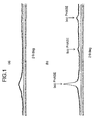
- Fig. 1 (a) The X-ray diffraction pattern of this amorphous alloy before a heat treatment is shown in Fig. 1 (a). It is clear from Fig. 1 (a) that this pattern is a halo pattern peculiar to an amorphous alloy.
- this thin alloy ribbon was subjected to a heat treatment at 600°C for 1 hour in a nitrogen gas atmosphere to cause crystallization, and then cooled to room temperature.
- the X-ray diffraction pattern of the alloy obtained by the heat treatment at 600°C is shown in Fig. 1 (b).
- Fig. 1 (b) The X-ray diffraction pattern of the alloy obtained by the heat treatment at 600°C is shown in Fig. 1 (b).
- the alloy after a 600°C heat treatment had a structure mostly constituted by ultrafine crystal grains made of a bcc Fe solid solution having a small half-width.
- the alloy after the heat treatment had a structure mostly constituted by ultrafine crystal grains having an average grain size of 10nm or less.
- the percentage of ultrafine crystal grains is determined by a generally employed intersection method.
- the length of each crystal grains crossed by the line (L1, L2, L3 ... L n ) is summed to provide a total length (L1 + L2 + L3 + ... + L n ), and the total length is divided by L to determine the percentage of crystal grains.
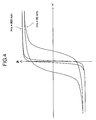
- a toroidal core produced by the amorphous alloy of this composition was subjected to a heat treatment at various heat treatment temperatures without applying a magnetic field to measure a dc B-H hysteresis curve by a dc B-H tracer and an effective permeability ⁇ e1k at 1 kHz by an LCR meter.
- the heat treatment time was 1 hour, and the heat treatment atmosphere was a nitrogen gas atmosphere.
- the alloy of the present invention can be obtained by crystallizing the corresponding amorphous alloy.
- the alloy of the present invention has extremely reduced magnetostriction than the amorphous counterpart, meaning that it is suitable as soft magnetic materials.
- the alloy of the present invention shows higher saturation magnetic flux density than the Fe-Si-A l alloy, and its ⁇ e1k exceeds 10000 in some cases. Therefore, the alloy of the present invention is suitable for magnetic heads for high-density magnetic recording, choke cores, high-frequency transformers, sensors, etc.
- Thin heat-treated alloy ribbons of 5 mm in width and 15 ⁇ m in thickness having the compositions shown in Table 1 were produced in the same manner as in Example 1. It was measured with respect to B10 and Hc by a dc B-H tracer, an effective permeability ⁇ e1k at 1 kHz by an LCR meter, and a core loss Pc at 100 kHz and at 0.2 T by a U-function meter. The average crystal grain size and the percentage of crystal grains were determined by using the photomicrographs of the alloy structures. The results are shown in Table 1. Any of the heat-treated alloys had crystal grains based on a bcc structure and having an average grain size of 50nm or less.
- the alloys of the present invention show saturation magnetic flux densities equal to or higher than those of the Fe-Si-Al alloy and the Co-base amorphous alloy, and also have higher ⁇ e1k than those of the Fe-Si, etc. Accordingly, the alloys of the present invention are suitable as alloys for magnetic heads.
- Thin amorphous alloy ribbons of 5 mm in width and 15 ⁇ m in thickness having the compositions shown in Table 2 were produced by a single roll method. Next, each of these thin alloy ribbons was formed into a toroidal core of 19 mm in outer diameter and 15 mm in inner diameter, and subjected to a heat treatment at 550°C-700°C in an Ar gas atmosphere to cause crystallization.
- the alloys after the heat treatment had structures mostly constituted by ultrafine crystal grains based on a bcc structure and having an average grain size of 50nm or less.
- the alloys of the present invention show extremely larger ⁇ e1k 30/ ⁇ e1k than those of the conventional materials, and so excellent heat resistance, suffering from less deterioration of magnetic properties even at as high a temperature as 600°C. Accordingly, they are suitable as magnetic materials for magnetic heads needing glass bonding, sensors operated at high temperature, etc.
- the larger the B content the larger the value of ⁇ e1k 30/ ⁇ e1k .
- ⁇ e1k 30/ ⁇ e1k is low, meaning that the heat resistance is poor.
- Alloy layers having compositions shown in Table 3 were produced on fotoceram substrates by a sputtering method, and subjected to a heat treatment at 550-700°C for 1 hour to cause crystallization. At this stage, their ⁇ e1M 0 was measured.
- the alloys after the heat treatment had structures mostly constituted by ultrafine crystal grains based on a bcc structure and having an average grain size of 50nm or less.
- the alloy layers of the present invention show ⁇ e1m 1/ ⁇ e1M 0 closer to 1 than the alloys of Comparative Examples, and suffer from less deterioration of magnetic properties even at a high temperature, showing better heat resistance.
- the alloys of the present invention are suitable for producing high-reliability magnetic heads.
- magnetic alloy with ultrafine crystal grains having excellent saturation magnetic flux density, permeability and heat resistance can be produced.
Landscapes
- Chemical & Material Sciences (AREA)
- Engineering & Computer Science (AREA)
- Materials Engineering (AREA)
- Mechanical Engineering (AREA)
- Metallurgy (AREA)
- Organic Chemistry (AREA)
- Physics & Mathematics (AREA)
- Electromagnetism (AREA)
- Dispersion Chemistry (AREA)
- Power Engineering (AREA)
- Soft Magnetic Materials (AREA)
Claims (7)
- Magnetische borhaltige Eisenlegierung mit ultrafeinen Kristallkörnern auf der Basis einer bcc-Structure, dadurch gekennzeichnet,
daß sie eine Zusammensetzung der allgemeinen Formel
Fe100-x-y-z-bMxByXzTb (Atom-%)
aufweist, wobei M für mindestens eines der Elemente Ti, Zr, Hf, V, Nb, Mo, Ta, Cr, W und Mn; X für mindestens eines der Elemente Si, Ge, P, Ga, Al und N; und T mindestens eines der Elemente Au, der Platingruppe, Co, Ni, Sn, Be, Mg, Ca, Sr und Ba steht; 4 ≦ x ≦ 15; 2 ≦ y ≦ 25; 0 ≦ z ≦ 10, 0 ≦ b ≦ 10; und 7 ≦ x + y + z + b ≦ 35 ist; und
daß die Legierungsstruktur zu mindestens 50% von Kristallkörnern einer mittleren Korngröße von 50 nm oder weniger eingenommen wird. - Legierung nach Anspruch 1, wobei der Rest der Legierungsstruktur aus einer amorphen Phase besteht.
- Legierung nach Anspruch 1, die im wesentlichen aus einer kristallinen Phase besteht.
- Legierung nach einem der Ansprüche 1 bis 3, wobei 10 < y ≦ 20 ist.
- Legierung nach einem der Anspüche 1 bis 4, wobei die Kristallkörner eine mittlere Korngröße von 20 nm oder weniger aufweisen.
- Verfahren zur Herstellung einer Magnetlegierung mit ultrafeinen Kristallkörnern mit folgenden Verfahrensschritten:
Herstellen einer amorphen Legierung der in einem der Ansprüche 1 bis 5 angegebenen Zusammensetzung, und
Wärmebehandeln der erhaltenen amorphen Legierung zur Kristallisation, wodurch die sich ergebende Legierung mit einer Struktur versehen wird, die zu mindestens 50 % von Kristallkörnern einer mittleren Korngröße von 50 nm oder weniger eingenommen wird. - Verfahren nach Anspruch 6, wobei die amorphe Legierung während der Wärmebehandlung einem Magnetfeld ausgesetzt wird.
Applications Claiming Priority (2)
| Application Number | Priority Date | Filing Date | Title |
|---|---|---|---|
| JP30361789 | 1989-11-22 | ||
| JP303617/89 | 1989-11-22 |
Publications (3)
| Publication Number | Publication Date |
|---|---|
| EP0430085A2 EP0430085A2 (de) | 1991-06-05 |
| EP0430085A3 EP0430085A3 (en) | 1992-05-06 |
| EP0430085B1 true EP0430085B1 (de) | 1994-05-25 |
Family
ID=17923146
Family Applications (1)
| Application Number | Title | Priority Date | Filing Date |
|---|---|---|---|
| EP90122344A Expired - Lifetime EP0430085B1 (de) | 1989-11-22 | 1990-11-22 | Magnetlegierung mit ultrakleinen Kristallkörnern und Herstellungsverfahren |
Country Status (5)
| Country | Link |
|---|---|
| US (1) | US5591276A (de) |
| EP (1) | EP0430085B1 (de) |
| KR (1) | KR930012182B1 (de) |
| CA (1) | CA2030446C (de) |
| DE (1) | DE69009152T2 (de) |
Families Citing this family (34)
| Publication number | Priority date | Publication date | Assignee | Title |
|---|---|---|---|---|
| CA2040741C (en) * | 1990-04-24 | 2000-02-08 | Kiyonori Suzuki | Fe based soft magnetic alloy, magnetic materials containing same, and magnetic apparatus using the magnetic materials |
| JPH0681086A (ja) * | 1992-09-03 | 1994-03-22 | Hitachi Metals Ltd | 耐蝕性に優れた超微細結晶粒組織を有する合金 |
| CA2151691A1 (en) * | 1994-07-08 | 1996-01-09 | Peter Yongxin Zhou | High response electronic article surveillance system responders and methods for making same |
| US5755986A (en) * | 1995-09-25 | 1998-05-26 | Alps Electric Co., Ltd. | Soft-magnetic dielectric high-frequency composite material and method for making the same |
| US5833770A (en) * | 1996-02-26 | 1998-11-10 | Alps Electric Co., Ltd. | High frequency soft magnetic alloy and plane magnetic element, antenna and wave absorber comprising the same |
| CA2210017C (en) * | 1996-07-15 | 2006-06-06 | Teruo Bito | Method for making fe-base soft magnetic alloy |
| US6332933B1 (en) | 1997-10-22 | 2001-12-25 | Santoku Corporation | Iron-rare earth-boron-refractory metal magnetic nanocomposites |
| AU5313899A (en) | 1998-07-13 | 2000-02-01 | Santoku America, Inc. | High performance iron-rare earth-boron-refractory-cobalt nanocomposites |
| JP3620784B2 (ja) * | 1998-08-25 | 2005-02-16 | 日立金属株式会社 | 高周波加速空胴用磁心およびこれを用いた高周波加速空胴 |
| US6462456B1 (en) | 1998-11-06 | 2002-10-08 | Honeywell International Inc. | Bulk amorphous metal magnetic components for electric motors |
| US6803694B2 (en) | 1998-11-06 | 2004-10-12 | Metglas, Inc. | Unitary amorphous metal component for an axial flux electric machine |
| US6737784B2 (en) | 2000-10-16 | 2004-05-18 | Scott M. Lindquist | Laminated amorphous metal component for an electric machine |
| US7144468B2 (en) | 2002-09-05 | 2006-12-05 | Metglas, Inc. | Method of constructing a unitary amorphous metal component for an electric machine |
| US6784588B2 (en) | 2003-02-03 | 2004-08-31 | Metglas, Inc. | Low core loss amorphous metal magnetic components for electric motors |
| CN100378875C (zh) * | 2003-04-02 | 2008-04-02 | 真空融化两合公司 | 磁芯及其制造方法和在电流互感器和电流补偿的扼流圈中的应用 |
| US7235910B2 (en) | 2003-04-25 | 2007-06-26 | Metglas, Inc. | Selective etching process for cutting amorphous metal shapes and components made thereof |
| US20060042938A1 (en) * | 2004-09-01 | 2006-03-02 | Heraeus, Inc. | Sputter target material for improved magnetic layer |
| US20060286414A1 (en) * | 2005-06-15 | 2006-12-21 | Heraeus, Inc. | Enhanced oxide-containing sputter target alloy compositions |
| US20070253103A1 (en) * | 2006-04-27 | 2007-11-01 | Heraeus, Inc. | Soft magnetic underlayer in magnetic media and soft magnetic alloy based sputter target |
| KR100838732B1 (ko) * | 2006-12-20 | 2008-06-17 | 주식회사 포스코 | 비정질 형성능이 우수한 철계 벌크비정질 합금 |
| KR100838733B1 (ko) * | 2006-12-20 | 2008-06-17 | 주식회사 포스코 | 크롬 몰리브덴 함유 철계 벌크비정질 합금 |
| US8821650B2 (en) * | 2009-08-04 | 2014-09-02 | The Boeing Company | Mechanical improvement of rare earth permanent magnets |
| JP2019186327A (ja) * | 2018-04-05 | 2019-10-24 | パナソニックIpマネジメント株式会社 | 磁歪材料およびそれを用いた磁歪式デバイス |
| US11682509B2 (en) * | 2018-11-15 | 2023-06-20 | Rogers Corporation | High frequency magnetic films, method of manufacture, and uses thereof |
| EP3908683A4 (de) * | 2019-01-11 | 2022-11-02 | Monash University | Legierung auf eisenbasis |
| CN109778085B (zh) * | 2019-03-14 | 2020-04-17 | 安徽智磁新材料科技有限公司 | 具有良好韧性的非晶合金及其制备方法 |
| US11679991B2 (en) | 2019-07-30 | 2023-06-20 | Rogers Corporation | Multiphase ferrites and composites comprising the same |
| CN110468353B (zh) * | 2019-08-21 | 2021-12-21 | 江苏中科启航新材料工业研究院有限公司 | 一种高饱和磁感应强度铁基非晶合金及制备方法 |
| TW202116700A (zh) | 2019-09-24 | 2021-05-01 | 美商羅傑斯公司 | 鉍釕m型六方晶系鐵氧體、包含彼之組合物及複合物、及製造方法 |
| US11783975B2 (en) | 2019-10-17 | 2023-10-10 | Rogers Corporation | Nanocrystalline cobalt doped nickel ferrite particles, method of manufacture, and uses thereof |
| GB2603655B (en) | 2019-10-30 | 2024-01-03 | Rogers Corp | M-Type hexaferrite comprising antimony |
| KR20220141305A (ko) | 2020-02-21 | 2022-10-19 | 로저스코포레이션 | 나노결정질 구조를 갖는 z형 헥사페라이트 |
| WO2021226297A1 (en) | 2020-05-07 | 2021-11-11 | Rogers Corporation | M-type hexaferrite having a planar anisotropy |
| KR102220790B1 (ko) * | 2020-07-30 | 2021-03-02 | (주)그라미 | 기능성 화장판 및 그 제조방법 |
Family Cites Families (11)
| Publication number | Priority date | Publication date | Assignee | Title |
|---|---|---|---|---|
| US4439236A (en) * | 1979-03-23 | 1984-03-27 | Allied Corporation | Complex boride particle containing alloys |
| JPS565962A (en) * | 1979-06-27 | 1981-01-22 | Sony Corp | Manufacture of amorphous magnetic alloy |
| JPS5638808A (en) * | 1979-09-05 | 1981-04-14 | Matsushita Electric Ind Co Ltd | Heat treatment for amorphous magnetic alloy in magnetic field |
| DE3049906A1 (en) * | 1979-09-21 | 1982-03-18 | Hitachi Ltd | Amorphous alloys |
| JPS57190304A (en) * | 1981-05-19 | 1982-11-22 | Hitachi Metals Ltd | Magnetic material |
| JPS57202709A (en) * | 1981-06-08 | 1982-12-11 | Hitachi Metals Ltd | Magnetic material and manufacture therefor |
| JPS59150404A (ja) * | 1983-02-08 | 1984-08-28 | Toshiba Corp | 電磁気装置 |
| JPS6130008A (ja) * | 1984-07-23 | 1986-02-12 | Toshiba Corp | トロイダル磁芯 |
| KR920005044B1 (en) * | 1987-07-23 | 1992-06-25 | Hitachi Ltd | Magnetic head |
| US5225006A (en) * | 1988-05-17 | 1993-07-06 | Kabushiki Kaisha Toshiba | Fe-based soft magnetic alloy |
| US5084795A (en) * | 1989-02-08 | 1992-01-28 | Matsushita Electric Industrial Co., Ltd. | Magnetic head and method of manufacturing the same |
-
1990
- 1990-11-21 CA CA002030446A patent/CA2030446C/en not_active Expired - Fee Related
- 1990-11-22 EP EP90122344A patent/EP0430085B1/de not_active Expired - Lifetime
- 1990-11-22 DE DE69009152T patent/DE69009152T2/de not_active Expired - Fee Related
- 1990-11-22 KR KR1019900018927A patent/KR930012182B1/ko not_active Expired - Fee Related
-
1993
- 1993-11-19 US US08/154,715 patent/US5591276A/en not_active Expired - Lifetime
Non-Patent Citations (2)
| Title |
|---|
| * abstract * * |
| 59 150 404 ( TOSHIBA K.K. ) 28 August 1984 * |
Also Published As
| Publication number | Publication date |
|---|---|
| KR930012182B1 (ko) | 1993-12-24 |
| EP0430085A3 (en) | 1992-05-06 |
| DE69009152D1 (de) | 1994-06-30 |
| US5591276A (en) | 1997-01-07 |
| EP0430085A2 (de) | 1991-06-05 |
| DE69009152T2 (de) | 1995-01-19 |
| CA2030446C (en) | 2001-01-23 |
| CA2030446A1 (en) | 1991-05-23 |
| KR910009948A (ko) | 1991-06-28 |
Similar Documents
| Publication | Publication Date | Title |
|---|---|---|
| EP0430085B1 (de) | Magnetlegierung mit ultrakleinen Kristallkörnern und Herstellungsverfahren | |
| US5340413A (en) | Fe-NI based soft magnetic alloys having nanocrystalline structure | |
| US5966064A (en) | Nanocrystalline alloy having excellent pulse attenuation characteristics, method of producing the same, choke coil, and noise filter | |
| EP0271657B1 (de) | Weichmagnetische Legierung auf Eisenbasis und Herstellungsverfahren | |
| GB1580498A (en) | Metallic glasses having a combination of high permeability low magnetostriction low ac core loss and high thermal stability | |
| EP0072893B1 (de) | Metallische Gläser mit einer Kombination folgender Eigenschaften: hohe Permeabilität, niedrige Koerzitivkraft, niedriger Kernverlust bei Wechselstrom, niedrige Erregerkraft, hohe thermische Stabilität | |
| EP0429022B1 (de) | Magnetlegierung mit ultrakleinen Kristallkörnern und Herstellungsverfahren | |
| EP1001437A1 (de) | Auf Eisen basierte weichmagnetisch Legierung,Magnetkern davon,und Herstellungsverfahren | |
| EP0240600B1 (de) | Glasartige Legierungen mit Perminvar-Eigenschaften | |
| EP0575190B1 (de) | Weichmagnetische Legierung auf Eisenbasis und Herstellungsverfahren | |
| EP0084138B1 (de) | Metallegierungen mit Glasstruktur, einer Magnetostriktion in der Nähe von Null und hoher thermischer und magnetischer Stabilität | |
| EP0342921B1 (de) | Weichmagnetische Legierung auf Eisenbasis | |
| JPH07103453B2 (ja) | 恒透磁率性に優れた合金およびその製造方法 | |
| JPH0917623A (ja) | ナノ結晶合金磁心およびその製造方法 | |
| EP0351051B1 (de) | Weichmagnetische, auf Eisen basierende Legierung | |
| EP0329704B1 (de) | Metallglasslegierungen mit sehr kleiner magnetostriktion für hochfrequenzanwendungen | |
| US4834814A (en) | Metallic glasses having a combination of high permeability, low coercivity, low AC core loss, low exciting power and high thermal stability | |
| JP3058675B2 (ja) | 超微結晶磁性合金 | |
| US4938267A (en) | Glassy metal alloys with perminvar characteristics | |
| JP2934471B2 (ja) | 超微結晶磁性合金およびその製法 | |
| JP3233289B2 (ja) | 超微結晶合金薄帯及び粉末並びにこれを用いた磁心 | |
| JP3058662B2 (ja) | 超微結晶磁性合金 | |
| EP0868733B1 (de) | Weichmagnetische legierungen | |
| EP0121046B1 (de) | Amorphe Legierung für einen Magnetkopf und Magnetkopf mit einer amorphen Legierung | |
| JPH04280949A (ja) | 磁性薄帯 |
Legal Events
| Date | Code | Title | Description |
|---|---|---|---|
| PUAI | Public reference made under article 153(3) epc to a published international application that has entered the european phase |
Free format text: ORIGINAL CODE: 0009012 |
|
| 17P | Request for examination filed |
Effective date: 19901212 |
|
| AK | Designated contracting states |
Kind code of ref document: A2 Designated state(s): DE FR GB |
|
| PUAL | Search report despatched |
Free format text: ORIGINAL CODE: 0009013 |
|
| AK | Designated contracting states |
Kind code of ref document: A3 Designated state(s): DE FR GB |
|
| 17Q | First examination report despatched |
Effective date: 19930514 |
|
| GRAA | (expected) grant |
Free format text: ORIGINAL CODE: 0009210 |
|
| AK | Designated contracting states |
Kind code of ref document: B1 Designated state(s): DE FR GB |
|
| REF | Corresponds to: |
Ref document number: 69009152 Country of ref document: DE Date of ref document: 19940630 |
|
| ET | Fr: translation filed | ||
| PLBE | No opposition filed within time limit |
Free format text: ORIGINAL CODE: 0009261 |
|
| STAA | Information on the status of an ep patent application or granted ep patent |
Free format text: STATUS: NO OPPOSITION FILED WITHIN TIME LIMIT |
|
| 26N | No opposition filed | ||
| REG | Reference to a national code |
Ref country code: GB Ref legal event code: IF02 |
|
| PGFP | Annual fee paid to national office [announced via postgrant information from national office to epo] |
Ref country code: FR Payment date: 20061108 Year of fee payment: 17 |
|
| PGFP | Annual fee paid to national office [announced via postgrant information from national office to epo] |
Ref country code: DE Payment date: 20061116 Year of fee payment: 17 |
|
| PGFP | Annual fee paid to national office [announced via postgrant information from national office to epo] |
Ref country code: GB Payment date: 20061122 Year of fee payment: 17 |
|
| GBPC | Gb: european patent ceased through non-payment of renewal fee |
Effective date: 20071122 |
|
| PG25 | Lapsed in a contracting state [announced via postgrant information from national office to epo] |
Ref country code: DE Free format text: LAPSE BECAUSE OF NON-PAYMENT OF DUE FEES Effective date: 20080603 |
|
| REG | Reference to a national code |
Ref country code: FR Ref legal event code: ST Effective date: 20080930 |
|
| PG25 | Lapsed in a contracting state [announced via postgrant information from national office to epo] |
Ref country code: GB Free format text: LAPSE BECAUSE OF NON-PAYMENT OF DUE FEES Effective date: 20071122 |
|
| PG25 | Lapsed in a contracting state [announced via postgrant information from national office to epo] |
Ref country code: FR Free format text: LAPSE BECAUSE OF NON-PAYMENT OF DUE FEES Effective date: 20071130 |